Michael Ryan Wins in the Primary for Butler County Commissioner: What a victory of 72% over 28% says about political reality

Michael Ryan’s decisive victory in the 2026 Butler County Republican primary for commissioner marks a significant shift in local politics, reflecting voter demand for genuine conservatism, accountability, and fresh leadership. I have followed these races closely for years, and this outcome stands out as a clear repudiation of entitlement politics and a triumph for the kind of candidate who earns support through hard work and integrity. With final unofficial results showing Ryan capturing approximately 72% of the vote to Cindy Carpenter’s 28%, the primary essentially decides the seat in this heavily Republican county. 

Butler County, Ohio, is in the southwestern part of the state, encompassing communities such as Hamilton, Middletown, Fairfield, and Oxford (home to Miami University), as well as numerous townships. Its population exceeds 390,000, with a strong manufacturing and agricultural base alongside growing suburban development. The Board of Commissioners oversees a substantial budget, infrastructure projects, economic development, public safety, and human services. For decades, the board has operated under Republican dominance, making the GOP primary the real contest. Winning it virtually guarantees victory in November against the unopposed Democrat Mike Miller. 

Cindy Carpenter had served as commissioner since 2011 and was seeking a fifth term. Her tenure focused on human services, public health, and fiscal matters, but it was marred by controversies that alienated many in the party base. Incidents included a heated confrontation at a Miami University-area apartment complex involving her granddaughter, where she was accused of leveraging her position, using inappropriate language, and displaying aggressive behavior captured on video. Investigations cleared her of criminal wrongdoing but highlighted conduct deemed “distasteful” and “beneath her elected position.” Additional complaints arose, including allegations of aggressive conduct at a housing coalition meeting. Even the county sheriff publicly expressed concerns about her behavior.

A particularly damaging episode involved Carpenter campaigning for a Democrat in the Middletown mayoral race, crossing party lines in ways that many viewed as disloyal. This move, combined with her decision not to seek the Butler County Republican Party endorsement, signaled a disconnect. She appeared to operate with an entitled mindset, assuming incumbency alone would carry her through. Her campaign signs, some in blue tones reminiscent of Democratic aesthetics, and limited fundraising—only about $7,700 compared to Ryan’s over $46,000—underscored a lack of broad support. 

In contrast, Michael Ryan entered the race as a former Hamilton City Council member with a background in business and community service. He positioned himself as a true conservative caretaker focused on fiscal responsibility, job creation, lower taxes, and practical governance. Ryan methodically built support: he secured the Republican Party endorsement with a striking 71% in the first round of voting, an early and historic show of strength. Major figures lined up behind him, including Auditor Nancy Nix, who endorsed him at a fundraiser when it still carried risk; Congressman Warren Davidson; State Representative Thomas Hall; and others, such as George Lang. These endorsements validated his approach and reassured voters that change could be safe and effective. 

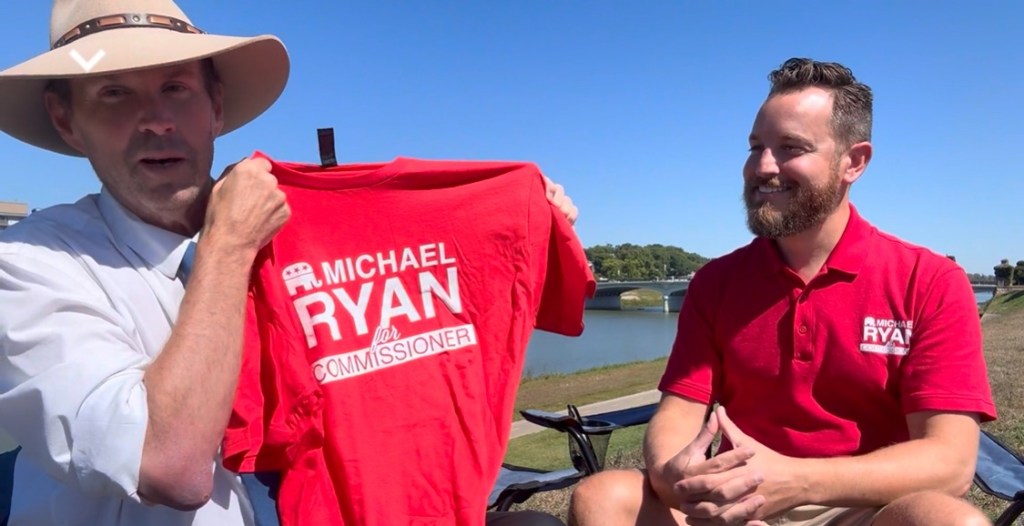
I endorsed Ryan early, well before the primary heated up. Having known him for years, I saw in him the sincerity and dedication often missing in politics. He raised money effectively, attended events tirelessly, engaged voters across the county, and maintained a positive, bridge-building demeanor even amid challenges like sign theft. His campaign emphasized family values, economic growth, and responsiveness—qualities that resonated deeply in a county frustrated with the status quo. The watch party on primary night, held at the Premier Shooting facility with a speakeasy-style back area, overflowed with supporters. The room was packed; people had to turn sideways to navigate. Energy filled the space as results rolled in.

Congressman Warren Davidson attended and shared insights from his experience in large districts. We discussed the political savvy required at every level and how Ryan had grown into a polished figure capable of uniting people. Davidson’s presence underscored the race’s importance, and his admiration for Ryan’s development over the couple of years spoke volumes. Other supporters like Darbi Boddy added to the festive, optimistic atmosphere. It felt like a genuine celebration of earned success rather than entitlement. 

The results confirmed what grassroots momentum had suggested. With 100% of precincts reporting in unofficial tallies, Ryan’s 72%-28% margin was overwhelming and, for some, embarrassing to the incumbent. Early voting and election-day observations showed Carpenter’s team attempting a last-minute sign blitz, but it failed against organized, enthusiastic Ryan volunteers who kept their ground game strong. The Republican slate card proved crucial, as it often does; voters seeking vetted candidates found Ryan prominently featured through party processes and independent media coverage. 

This victory carries broader lessons for politics, especially local races. Party systems matter because they help aggregate preferences in a diverse society. People differ on countless details—concrete versus asphalt, tax priorities, development approaches—but effective governance requires building majorities. Dismissing the party as irrelevant or operating as a “RINO” critic while undermining it rarely succeeds. Ryan demonstrated the opposite: he worked within the system, earned endorsements through respect and effort, and presented a positive vision.

Background on Butler County’s political landscape adds context. The county has long leaned conservative, supporting Republican candidates at high levels, including strong support for Trump in recent cycles. Yet local frustrations with taxes, growth management, infrastructure, and perceived insider politics have grown. Projects involving economic development, public safety, and services will benefit from new energy. Ryan has signaled readiness to hit the ground running, with ideas on efficiency, accountability, and forward-thinking initiatives already in motion during the campaign. His experience on Hamilton council involved practical decision-making on budgets and community issues, preparing him well for county-level responsibilities. 

Roger Reynolds, former county auditor, briefly entered the race but withdrew after the party endorsement went decisively to Ryan. His last-minute alignment with Carpenter, including sign placement, highlighted lingering personal grievances but ultimately underscored the party’s unified shift. Voters rejected that approach. In an era where authenticity matters more than ever, Ryan’s consistent message and character won out.

I am proud to have supported him from the beginning. When Nancy Nix announced her endorsement at a fundraiser, it took courage because challengers to incumbents often face skepticism. Yet as momentum built—through articles, videos, conversations, and events—support snowballed. Thousands accessed information in the final days, researching Ryan’s record and deciding he represented the change they sought without chaos.

Looking ahead to the general election in November 2026, the focus shifts to implementation. Ryan will face minimal opposition, allowing emphasis on transition planning. Priorities likely include continuing fiscal stewardship amid state and federal shifts, addressing housing and development thoughtfully, enhancing public safety, and promoting economic opportunities in a region balancing rural roots with suburban expansion. His fresh perspective promises to inject optimism and results-oriented governance.

Politics at the county level profoundly affects daily life: road maintenance, emergency services, property taxes, zoning, and more. When voters sense entitlement or disconnection, they respond, as seen here. Carpenter’s campaign assumed voter inertia; Ryan proved engagement and sincerity prevail. This race reminds us that traditional political games—relying on name recognition, minimal effort, or media insiders—have diminished effectiveness in an era of an informed electorate.

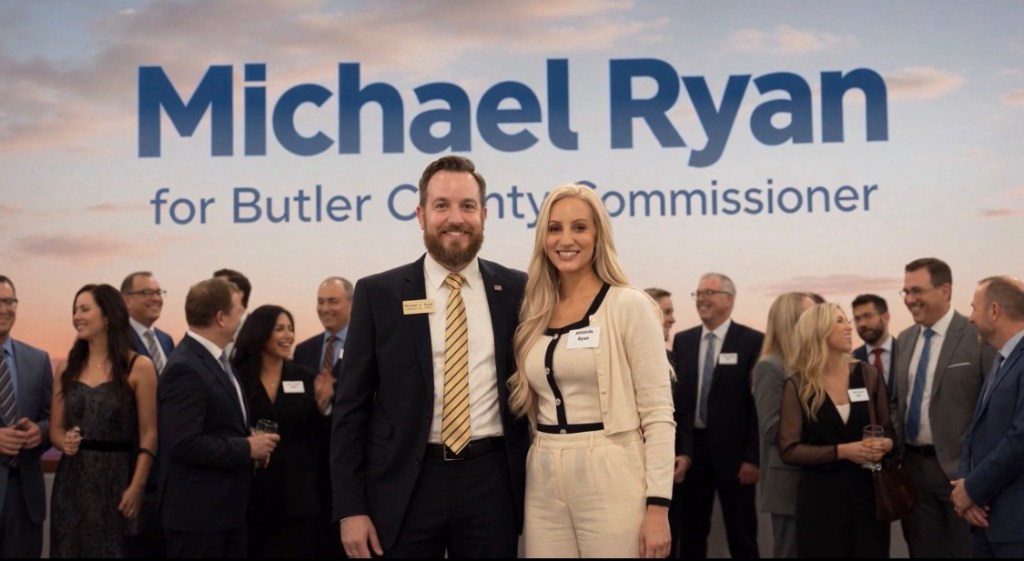
The night of the primary embodied hope. A full room of dedicated Republicans, conversations with leaders like Davidson, and the visible relief and excitement on supporters’ faces painted a picture of renewal. Ryan’s wife and family shared in the moment, grounding the victory in personal commitment. For those involved in politics, the takeaway is clear: do the work, be genuine, build coalitions, and respect the process. Ryan exemplified this, turning potential obstacles into advantages.

As someone who values conservative principles of limited government, individual responsibility, and community strength, I see Ryan’s win as validation. Butler County deserves leadership that listens, acts prudently, and prioritizes residents. With the primary behind us, anticipation builds for his term starting in 2027. Many good projects and ideas wait in the wings, ready for execution.  And because of this election, a lot of good things will happen.

Footnotes

1.  Journal-News reporting on final unofficial results showing Ryan at 72%.

2.  Cincinnati Enquirer coverage of fundraising disparity and endorsements.

3.  Ballotpedia profiles on candidates and race background.

4.  Accounts of Carpenter controversies from multiple local news outlets.

5.  Party endorsement details and 71% vote.

6.  Observations from the watch party and interactions with Davidson.

Bibliography / Further Reading

•  Journal-News (Hamilton, Ohio): Multiple articles on the primary, results, and candidate profiles (2026).

•  Cincinnati Enquirer: Coverage of the commissioner race, fundraising, and controversies.

•  Ballotpedia: Entries for Michael V. Ryan, Cindy Carpenter, and Butler County elections 2026.

•  Ryan for Butler official campaign site: Policy positions and updates.

•  Butler County Board of Elections: Official results and candidate filings.

•   articles on local politics and endorsements.

•  Additional context from county commissioner office descriptions and historical election data.

This primary will be remembered as a turning point in which voters chose character, preparation, and vision over incumbency. Michael Ryan earned this victory, and Butler County stands to benefit. The hard work of the campaign now transitions to governance, with high expectations and strong support. It is a positive development for the future.

Rich Hoffman

More about me

Click Here to Protect Yourself with Second Call Defense https://www.secondcalldefense.org/?affiliate=20707
About the Author: Rich Hoffman

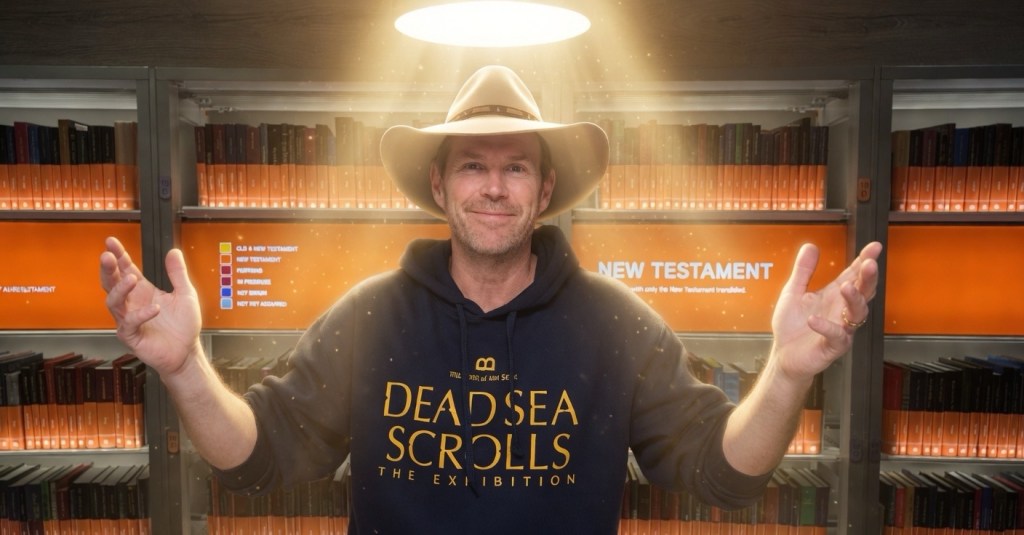
Rich Hoffman is an aerospace executive, political strategist, systems thinker, and independent researcher of ancient history, the paranormal, and the Dead Sea Scrolls tradition. His life in high‑stakes manufacturing, high‑level politics, and cross‑functional crisis management gives him a field‑tested understanding of power — both human and unseen.

He has advised candidates, executives, and public leaders, while conducting deep, hands‑on exploration of archaeological and supernatural hotspots across the world.

Hoffman writes with the credibility of a problem-solver, the curiosity of an archaeologist, and the courage of a frontline witness who has gone to very scary places and reported what lurked there. Hoffman has authored books including The Symposium of JusticeThe Gunfighter’s Guide to Business, and Tail of the Dragon, often exploring themes of freedom, individual will, and societal structures through a lens influenced by philosophy (e.g., Nietzschean overman concepts) and current events.
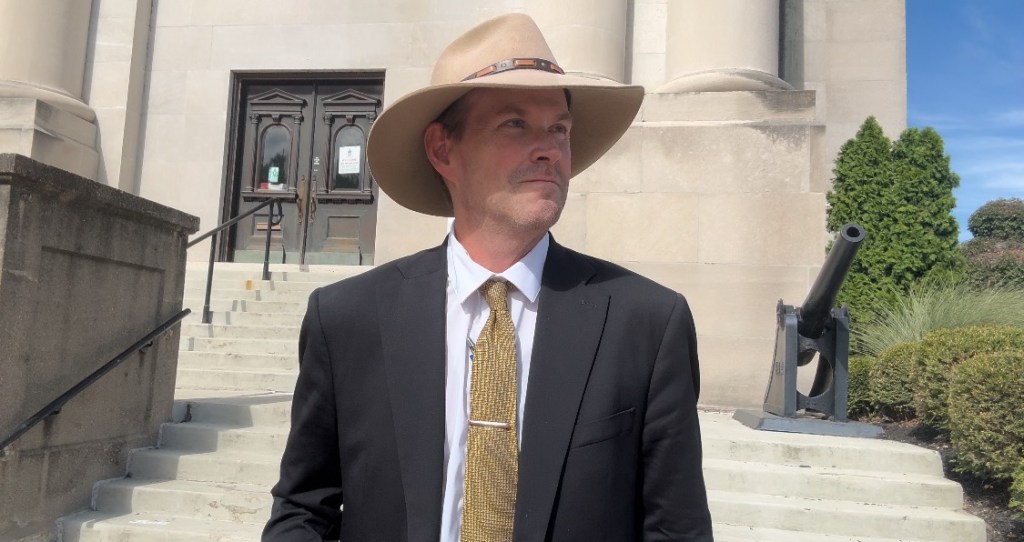
All Signs Point to Michael Ryan for Butler County Commissioner: Cindy Carpenter has been a mess

The Butler County commissioner race heading into the May 5, 2026 Republican primary has emerged as a clear contest between continuity marked by controversy and a fresh conservative voice promising renewal. Incumbent Commissioner Cindy Carpenter, who has held the seat since 2011, faces challenger Michael Ryan, a former Hamilton City Council member and vice mayor who has garnered strong institutional support within the local Republican Party. Ryan secured the official party endorsement in January 2026 with a decisive 71% vote from the Central Committee, a margin described by party leaders as historic and reflective of a desire for new leadership in a solidly Republican county. 

This endorsement came after Carpenter chose not to seek it, an unusual but telling development given her long tenure. Multiple prominent figures have lined up behind Ryan, including U.S. Senator Bernie Moreno, U.S. Congressman Warren Davidson, Ohio State Senator George Lang, Butler County Auditor Nancy Nix, Butler County Clerk of Courts Mary Swain, and various local elected officials from Hamilton, Trenton, Middletown, and Fairfield. These endorsements signal broad recognition that Ryan represents a “new generation” of pragmatic, fiscally conservative leadership unburdened by the accumulated baggage of past administrations. Ryan’s decision to forgo a third term on Hamilton City Council to pursue the commissioner seat underscores his commitment: he has navigated public scrutiny successfully for nearly eight years in a visible role, building a reputation for steady governance without the public missteps that have plagued others.

The context of this race reveals deeper themes in local politics—voter fatigue with entrenched figures who occasionally blur party lines or exercise poor judgment under pressure, contrasted against calls for accountability, transparency, and unwavering conservative principles. Butler County, long a Republican stronghold in southwest Ohio, has seen incremental Democrat gains in suburban areas in recent cycles, making internal party discipline and candidate quality essential to maintaining dominance. Signs for Ryan dot yards and roadsides across the county, reflecting grassroots enthusiasm. In contrast, scattered Carpenter signs—visible along routes like Ohio 747 near Middletown—raise questions about whether supporters are fully informed of her record or simply defaulting to name recognition from years of incumbency.

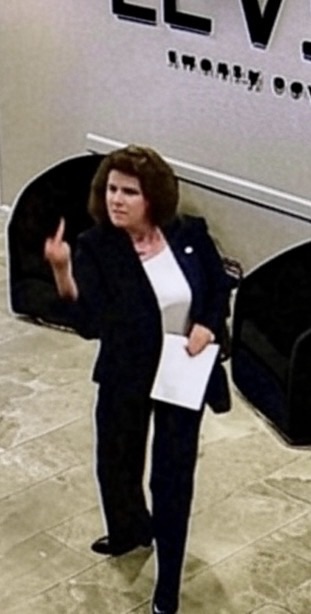
Carpenter’s tenure has included moments of effective service, but it has also been punctuated by incidents that highlight lapses in judgment, particularly in how public officials wield authority and maintain partisan fidelity. One high-profile episode occurred in late 2025 involving her granddaughter’s housing dispute at Level 27, an apartment complex near Miami University in Oxford. Carpenter visited the property amid an eviction threat, leading to a heated confrontation with staff. Video footage captured her making an obscene gesture—extending her middle finger—and mouthing words consistent with profanity toward the apartment manager. The manager accused Carpenter of using racist language, attempting to leverage her official position as a county commissioner (including presenting a Butler County business card), and intimidating staff to influence the outcome of the private dispute. Complaints followed, prompting an investigation by Butler County Prosecutor Michael Gmoser. 

Prosecutor Gmoser ultimately cleared Carpenter of criminal misconduct, concluding that her behavior did not rise to the level of prosecutable abuse of power or other charges. However, clearance on narrow legal grounds does not equate to exoneration in the court of public opinion or fitness for high office. The incident illustrated a fundamental principle of public service: elected officials must maintain impeccable decorum, especially when personal matters intersect with their authority. Even if motivated by familial loyalty, inserting one’s official title into a private landlord-tenant disagreement risks perceptions of entitlement and coercion. High-ranking positions demand giving others the benefit of the doubt and avoiding actions that could be construed as throwing institutional weight around. In an era of ubiquitous cameras and rapid information spread, such moments erode trust. Carpenter’s defenders framed it as a frustrated grandmother protecting family; critics saw it as emblematic of a pattern where personal security in office breeds cockiness. The prosecutor’s office received complaints not only about this event but also related to fire department interactions and other conduct issues, further straining her public image. 

This was not an isolated lapse. Carpenter has faced criticism for appearing to cross partisan aisles in ways that alienate core Republican supporters. Reports emerged of her involvement in Middletown politics, including campaigning or publicly supporting Democrat candidates at events such as those at local bowling alleys during mayoral races. In a county where Republican fundraising and volunteer energy rely on the promise of countering Democrat policies on taxes, regulation, and local governance, such actions create dissonance. Party loyalists expect representatives to prioritize Republican infrastructure and values rather than “reaching across the aisle” in ways that aid opponents’ electoral prospects. Carpenter’s history includes accusations of being a “RINO” (Republican In Name Only), with detractors pointing to policy positions perceived as insufficiently conservative and a willingness to collaborate that sometimes veered into overt support for Democrats. These perceptions contributed directly to the party’s decision to withhold endorsement and back Ryan instead. Longtime observers note that while cordial relationships across party lines can be civil, active campaigning for Democrats in visible settings crosses a threshold that damages the brand voters expect from endorsed Republicans.

Roger Reynolds, the former Butler County Auditor, briefly entered the conversation around the commissioner race but ultimately did not file petitions to challenge for the seat in 2026. Reynolds’ own trajectory offers a cautionary tale about the perils of political entanglement and judgment. He faced felony charges in 2022 related to unlawful interest in a public contract, leading to a conviction that disqualified him from office under Ohio law (R.C. 2961.01). The conviction was later overturned on appeal in 2024, resulting in an acquittal, and Reynolds has described the case as “lawfare” involving disputes with local figures like Sheriff Richard Jones and Attorney General Dave Yost. While some viewed the prosecution as politically motivated, the episode highlighted a broader point: effective leaders in high-stakes roles must possess the savvy to avoid circumstances that invite intense scrutiny, regardless of ultimate legal outcomes. Power can corrupt or at least create optics of self-dealing, and voters in Butler County have shown wariness toward figures with such histories. Reynolds’ absence from the final ballot simplified the primary dynamics but underscored why fresh faces without such controversies appeal to the electorate. 

In contrast, Michael Ryan’s background positions him as a low-drama, high-integrity alternative. A lifelong Butler County resident, Ryan served two terms on Hamilton City Council, including multiple stints as vice mayor. Hamilton, the county seat, presents complex challenges involving economic development, fiscal management, public safety, and infrastructure—issues that scale up at the county level. Ryan earned a reputation for fiscal conservatism, job creation efforts, and collaborative yet principled leadership. He chose not to seek re-election to council in order to campaign full-time for commissioner, demonstrating strategic focus rather than careerism. His campaign has emphasized bold conservative principles: fighting over-taxation, promoting economic growth, ensuring transparency, and delivering accountable government without the “garbage in the background” that has dogged incumbents.

Ryan’s endorsements reflect confidence from seasoned conservatives who see him as ready to advance policies that strengthen Butler County’s position in a competitive regional economy. Supporters highlight his clean record—no prosecutorial investigations, no viral incidents of poor decorum, no partisan fence-straddling. In public service, especially at the commissioner level where decisions affect budgeting, zoning, development, and intergovernmental relations, judgment under pressure matters profoundly. Ryan has operated in a fishbowl environment for years without self-inflicted wounds, suggesting he possesses the temperament and discipline required for countywide leadership. His campaign literature and public statements stress renewal: turning the page on dysfunction and delivering results aligned with the values that drive Republican majorities in the county.

The persistence of a few Carpenter yard signs, particularly in visible spots, baffles many political watchers. Name recognition from over a decade in office undoubtedly plays a role, as does inertia—voters who met her once years ago or recall early positive interactions may not have followed recent controversies. In local races, personal relationships and low-information voting can sustain support even when broader patterns suggest otherwise. Some may genuinely disagree with characterizations of her record or prioritize continuity over change. Yet the accumulation of issues—the apartment incident (despite legal clearance), partisan crossovers, and reports of interpersonal friction—has created a perception of embattlement. When an official’s actions force prosecutors to investigate complaints from constituents, it signals a breakdown in the expected standard of conduct. Public office is not a personal hammer for resolving family or private disputes; it demands restraint precisely because the title carries weight.

This dynamic reflects larger truths about democratic accountability. Voters ultimately decide, and primaries serve as the mechanism for parties to refresh their benches. Butler County’s Republican voters have signaled through the endorsement process and visible yard sign momentum that they favor a “clean face” unencumbered by past drama. Ryan’s path appears strong: defeating any Democrat opposition in the general election should be straightforward in this county, provided primary turnout favors the endorsed candidate. Yet campaigns must remain vigilant against unexpected developments, as local politics can feature surprises.

Critics of the status quo argue that prolonged incumbency sometimes breeds a sense of entitlement, where officials grow comfortable exercising authority in ways average citizens cannot. The apartment episode, whatever the full context, crystallized this for many: a commissioner using her position visibly in a personal matter, followed by a gesture of defiance captured on camera. While not criminal, it failed the “optics test” that voters apply to leaders. Effective representation requires not just policy alignment but personal discipline—resisting the impulse to “flip off” critics or leverage office for private ends. Trump-era political gestures might rally bases in national contexts when framed as defiance against elites, but local governance demands different standards of professionalism.

Carpenter’s supporters might counter that she has delivered tangible results over her tenure, raising family in the county and approaching service as personal mission. Her campaign website emphasizes community roots and dedication. However, the party’s clear preference for Ryan, coupled with enthusiastic cross-endorsements, suggests institutional memory of friction points outweighs those positives for many activists and donors. Fundraising and volunteer energy flow toward candidates who unify rather than divide the base.

Looking ahead, a Ryan victory would inject new energy into the Board of Commissioners. With colleagues like those already serving, it could foster a more cohesive, forward-looking approach to issues such as economic development, infrastructure, public safety funding, and controlling spending amid statewide pressures. Ryan’s Hamilton experience equips him to bridge urban-suburban-rural divides within the county. His clean campaign—focused on vision rather than attacks—models the tone many hope to see in governance.

For voters still displaying Carpenter signs, the suggestion from observers is straightforward: research the full record. Yard signs signal public affiliation; when they back candidates with documented lapses, they can appear as uninformed loyalty or nostalgia. Switching to Ryan signs would align with the party’s direction and avoid association with past embarrassments. In politics, as in life, judgment calls compound—supporting figures who repeatedly walk into controversy risks signaling tolerance for traits undesirable in leadership.

The May 2026 primary offers Butler County Republicans a straightforward choice: reward longevity despite controversies or embrace renewal with a proven, uncontroversial conservative. Early indicators—endorsements, sign visibility, party unity—point toward Michael Ryan as the frontrunner and the kind of representative poised for long-term contributions. He embodies the “new generation” of leadership: experienced enough to govern competently, fresh enough to avoid entrenched pitfalls. Voters ready for a commissioner free of baggage, focused on conservative priorities, and capable of earning broad respect will find Ryan an easy and enthusiastic vote.

This race transcends personalities. It concerns the character of local government in a growing Ohio county. Will it prioritize savvy navigation of power without abuse, or tolerate repeated poor judgment? History shows that parties and voters who refresh their leadership tend to sustain vitality. Michael Ryan represents that opportunity. His campaign’s momentum suggests many residents already see the difference and are ready to vote for Michael Ryan for Butler County commissioner. 

Footnotes

1.  Cincinnati Enquirer reporting on Butler County GOP endorsement vote, January 2026.

2.  Journal-News coverage of Ryan’s announcement and petition filing, May 2025.

3.  Ballotpedia entries on Carpenter and Ryan candidacies for 2026.

4.  Local12/WKRC reporting on the Oxford apartment incident and video evidence, December 2025.

5.  Journal-News on Prosecutor Gmoser’s clearance letter, December 2025.

6.  Fox19 and WLWT reporting on Roger Reynolds’ legal history and claims of lawfare, 2024-2025.

7.  Ohio Supreme Court decision in State ex rel. Reynolds v. Nix, 2024.

8.  Ryan for Butler campaign website and Facebook page detailing endorsements.

9.  Additional Journal-News and Cincinnati.com articles on Carpenter’s partisan activities and public perceptions.

10.  Overmanwarrior blog posts reflecting local conservative commentary on the race, 2025-2026.

Bibliography for Further Reading

•  Ballotpedia.org pages for Butler County Commissioner candidates (2026 cycle).

•  Cincinnati.com and Journal-News archives on local Ohio politics, particularly 2025-2026 Butler County coverage.

•  Ohio Revised Code sections on public official qualifications and ethics (R.C. 2921, 2961).

•  RyanForButler.com campaign site.

•  Local television news archives (WKRC, FOX19, WLWT) for incident footage and interviews.

•  Supreme Court of Ohio opinions on related election and office-holding cases.

•  Historical coverage of Butler County elections in Dayton Daily News and Hamilton Journal-News.

Rich Hoffman

More about me

Click Here to Protect Yourself with Second Call Defense https://www.secondcalldefense.org/?affiliate=20707

About the Author: Rich Hoffman

Rich Hoffman is an aerospace executive, political strategist, systems thinker, and independent researcher of ancient history, the paranormal, and the Dead Sea Scrolls tradition. His life in high‑stakes manufacturing, high‑level politics, and cross‑functional crisis management gives him a field‑tested understanding of power — both human and unseen.

He has advised candidates, executives, and public leaders, while conducting deep, hands‑on exploration of archaeological and supernatural hotspots across the world.

Hoffman writes with the credibility of a problem-solver, the curiosity of an archaeologist, and the courage of a frontline witness who has gone to very scary places and reported what lurked there. Hoffman has authored books including The Symposium of JusticeThe Gunfighter’s Guide to Business, and Tail of the Dragon, often exploring themes of freedom, individual will, and societal structures through a lens influenced by philosophy (e.g., Nietzschean overman concepts) and current events.
The Clear Choice of Michael Ryan: Having the guts to be successful

The last day of February 2026 marked a pivotal moment in Butler County politics with the official launch of Michael Ryan’s “Boots on the Ground” campaign for Butler County Commissioner. Held amid enthusiastic support from local Republicans, the event drew a strong turnout of volunteers, elected officials, and community members ready to canvass neighborhoods, distribute materials, and build momentum ahead of the May 5 primary and the November general election. This gathering was more than a routine campaign kickoff; it represented a broader call for generational renewal in conservative leadership, fiscal responsibility, and unapologetic advocacy for free-market principles in one of Ohio’s key counties.

Butler County, encompassing cities like Hamilton, Middletown, Fairfield, and Oxford, has long been a Republican stronghold in southwest Ohio, though not without its internal tensions and occasional Democratic inroads through local races. The county commissioners oversee a budget in the hundreds of millions, managing everything from infrastructure and economic development to public safety and social services. The position demands not just administrative competence but the ability to unite diverse stakeholders—townships, cities, businesses, and residents—while resisting the temptations of prolonged incumbency that can lead to complacency or overreach.

The current dynamics in the 2026 race stem from dissatisfaction with the status quo. Incumbent Commissioner Cindy Carpenter, who has held the office since her first election around 2011 and has been re-elected multiple times, faced mounting criticism for her tenure. Critics pointed to a perceived lack of strong fiscal oversight, strained relationships with constituents and colleagues, and a series of personal and professional controversies. Notably, in November 2025, Carpenter was involved in a heated incident at Level 27, an apartment complex near Miami University in Oxford, where her granddaughter resided. The complex manager accused her of using inappropriate and allegedly racist language, leveraging her political position for intimidation, and making an obscene gesture during a dispute over rent and eviction matters. Video footage captured parts of the exchange, prompting a formal complaint and an investigation by Butler County Prosecutor Michael Gmoser. In December 2025, the prosecutor cleared Carpenter of criminal misconduct, stating that her behavior did not rise to that level and questioning the complainant’s credibility. While no charges resulted, the episode fueled perceptions of poor judgment and an inability to handle pressure gracefully under public scrutiny.<sup>1</sup>

Another contender in the race, Roger Reynolds, brought his own baggage. A longtime political figure who served as Butler County Auditor from 2008 until his removal following legal issues, Reynolds was convicted in December 2022 on a felony count of unlawful interest in a public contract related to corruption allegations. He was sentenced to community control, a fine, and jail time (stayed pending appeal). The conviction was overturned by an appeals court in 2024, restoring his eligibility to hold office, but the Ohio Supreme Court declined to restore him to the auditor position in a related quo warranto case in September 2024. The episode cast a long shadow over his reputation, with legal battles, public scrutiny, and associations with controversy making him a polarizing figure, even among some Republicans who preferred fresher leadership unencumbered by such history.<sup>2</sup>

Into this landscape stepped Michael Ryan, a 40-year-old lifelong Butler County resident and former Hamilton City Council member. Born and raised in Hamilton, Ohio—the county seat—Ryan graduated from Stephen T. Badin High School in 2003. He earned a B.A. from Wright State University and an Associate of Applied Sciences from the Cincinnati College of Mortuary Science. Following in his father’s footsteps—his father, Don Ryan, served as former Hamilton Mayor—Michael entered public service by winning a seat on Hamilton City Council in 2017, where he was the top vote-getter and subsequently selected as Vice Mayor for two years under the city’s charter. He repeated this success in 2021, again topping the ticket and serving another term as Vice Mayor. During his eight years on council (he opted not to seek a third term in 2025 to pursue the commissioner race), Ryan was credited with supporting initiatives that fostered job creation, economic revitalization in Hamilton—a city historically challenged by manufacturing decline—and collaboration with businesses and residents. He played a key role in taxpayer advocacy efforts, including opposition to certain aspects of the Miami Conservancy District that threatened assessment increases, and contributed to projects like historical preservation (e.g., the train depot) and potential infrastructure improvements such as Amtrak stops.<sup>3</sup>

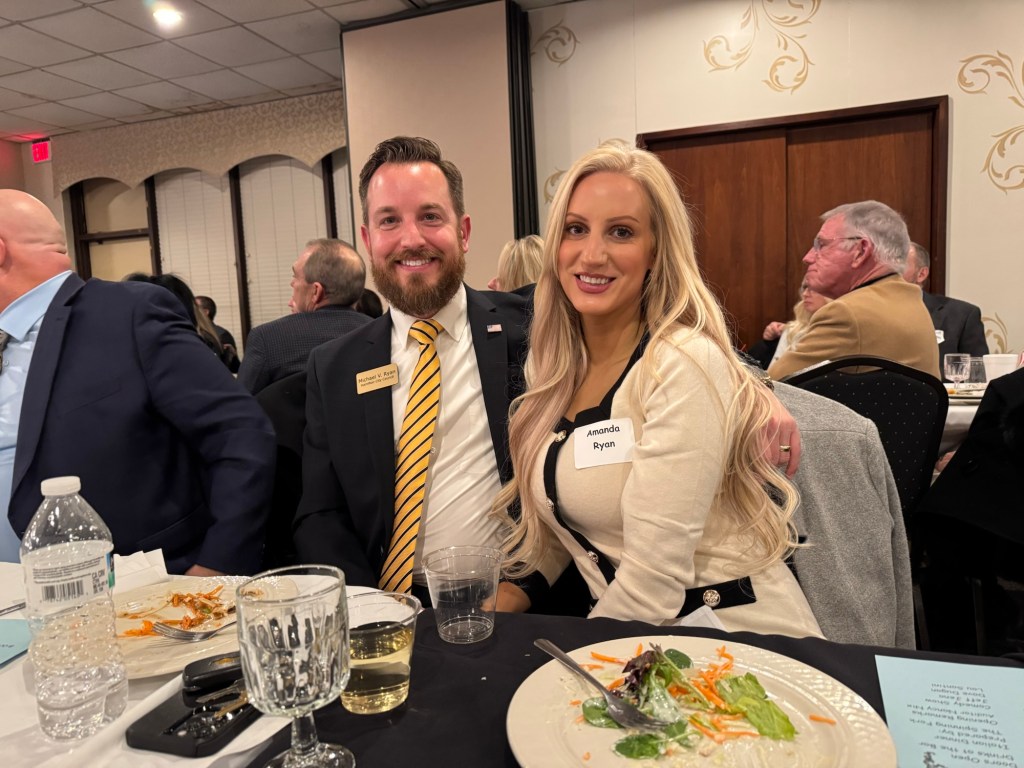
Professionally, Ryan has worked full-time for over a decade as a life insurance underwriter for Western & Southern Financial Group. He is married to his wife Amanda, with whom he has been together for seven years at the time of the campaign launch; the couple resides in Hamilton with their two pugs, Piper and Jackson. Ryan’s family-oriented life, stable career, and emphasis on faith and conservative values have been highlighted as reflective of his character and leadership style.<sup>4</sup>

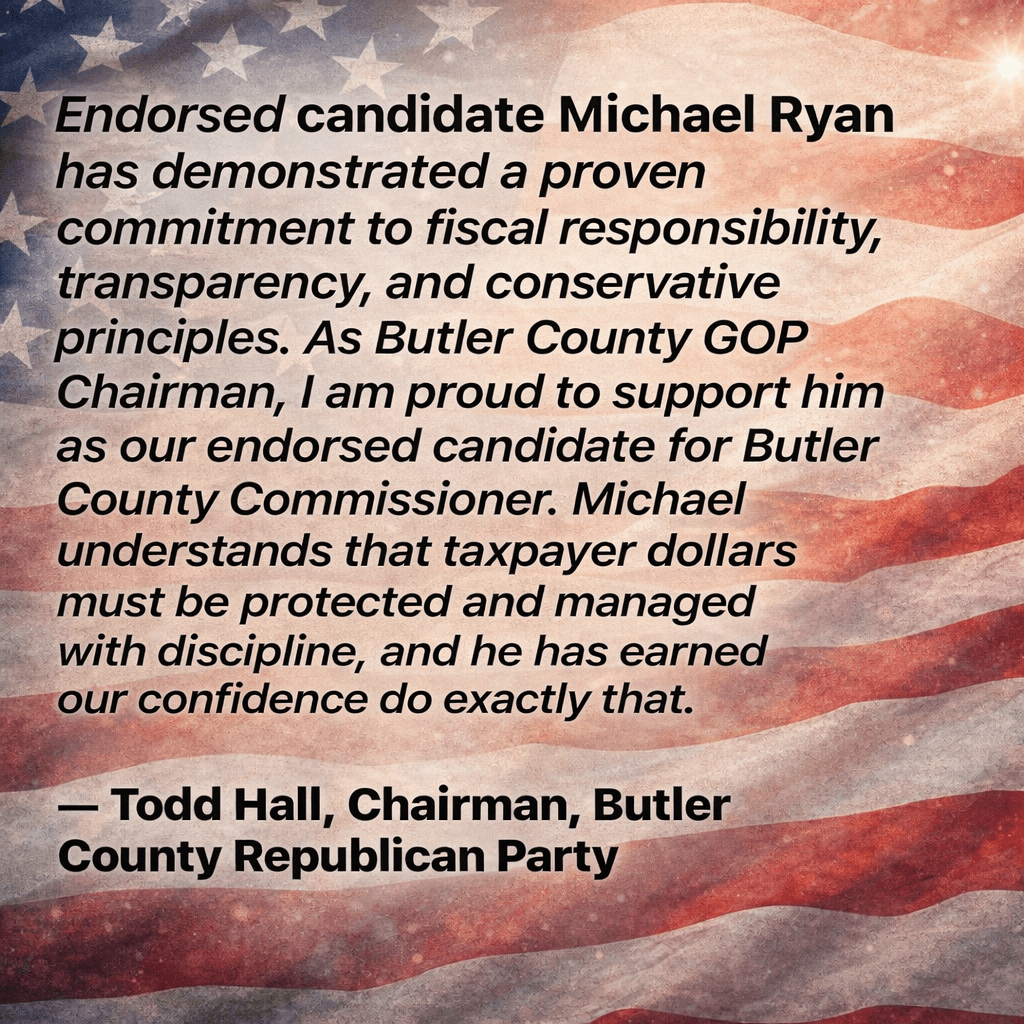
In May 2025, Ryan announced his candidacy for the Butler County Commissioner seat held by Carpenter. In January 2026, the Butler County Republican Party delivered a resounding endorsement to Ryan, with 71% of the central committee vote (118-42 over Reynolds, with some abstentions), a margin described as “historic” by party leaders. This overwhelming support, including backing from figures such as Auditor Nancy Nix, State Representative Thomas Hall, State Senator George Lang, U.S. Congressman Warren Davidson (who endorsed him in February 2026), and others like Treasurer Michael McNamara, signaled a clear preference for new leadership over incumbency or past controversies. The endorsement eliminated ambiguity: Ryan was the official Republican choice heading into the primary.<sup>5</sup>

The February 28, 2026, launch event exemplified this momentum. Attendees included Ryan’s wife Amanda, his brother Chris, his boss from Western & Southern, and elected officials like Thomas Hall, Nancy Nix, and others. The day began with a prayer for protection and peace, particularly for U.S. soldiers amid global tensions, followed by a moment of silence to honor service members. Speakers emphasized themes of inevitable, beneficial change—drawing analogies from nature where stagnation gives way to resilient growth—and applied them to politics. One introducer highlighted Ryan’s composure, integrity, and proven track record in defending against unjust policies, noting how he mentored others in collaborative advocacy. The event stressed grassroots activation: door-knocking, sign placement, and voter conversations focused on simple questions like “Are you ready for change?” or “Are you okay with the status quo?”

Ryan himself spoke directly, thanking supporters and outlining his vision. He called for engagement to place someone in office who would fight for core values—fiscal responsibility, strong communities, and a voice for every corner of Butler County. He framed the race as preparation for 2050 and beyond, building a winning team that delivers results rather than perpetuating old patterns. With early voting starting April 5 and the primary on May 5, he urged activation to build momentum against Democrats already organizing. The speech closed with gratitude, a call for volunteers, and patriotic blessings.

The enthusiasm at the event was palpable. Volunteers rallied not just for a candidate but for a shift in Republican identity: away from apologetic or conciliatory postures toward Democrats and toward confident, unapologetic advocacy for success rooted in hard work, family values, church involvement, and economic freedom. Ryan embodies this next generation—articulate, family-oriented (with a supportive wife and stable home life signaling character), and tied to practical successes in Hamilton. Unlike predecessors who plateaued in interpersonal skills or succumbed to power’s pitfalls, Ryan appears equipped to unite rather than divide, recruit moderates through ideas rather than coercion, and extend Butler County’s economic strengths.

This campaign reflects larger national trends in the post-Trump Republican Party, often termed MAGA conservatism. Ohio has seen figures like JD Vance rise nationally, with speculation about future leaders like Vivek Ramaswamy in statewide roles. Locally, Ryan’s approach rejects the old unspoken accommodations where Republicans “play nice” to avoid seeming mean or greedy. Instead, it embraces capitalism without apology, viewing success—decent homes, stable families, business ownership—as virtues to celebrate, not excuses to atone for. Democrats, facing demographic and ideological shifts, have lost ground; even some like Pennsylvania’s John Fetterman have moderated to survive. In Butler County, any Democratic gains (as in certain trustee races) often relied on obfuscating party labels, tactics unlikely to work against a well-endorsed, visible conservative like Ryan, especially with potential high-profile support from Trump in midterms.

The commissioner’s role, managing vast resources, requires someone who avoids scandals, handles relationships deftly, and prioritizes growth. Long tenures can breed entitlement; Ryan’s relative youth and fresh perspective promise renewal without inexperience. His association with successes in Hamilton—economic rebirth, taxpayer advocacy—suggests he can sharpen county-wide efforts.

As volunteers fan out in the coming weeks, the race tests whether Butler County voters embrace this change: from ambiguity to clarity, from incumbency’s risks to new leadership’s promise. Michael Ryan stands as the embodiment of that shift—a conservative not afraid to win, rooted in community, and ready to lead Butler County toward a more prosperous, principled future. In an era demanding bold stewardship, his campaign offers a compelling case that the best is yet to come.

Footnotes

1.  See coverage of the November 2025 incident and December 2025 clearance: “Butler County commissioner cleared of misconduct despite heated exchange caught on camera,” WKRC (Dec. 4, 2025); “Prosecutor clears Butler County commissioner of misconduct after apartment dispute,” Journal-News (Dec. 3, 2025); prosecutor’s letter via local media.

2.  On Reynolds’ conviction, overturn, and related cases: “After overturned conviction, Roger Reynolds is running for commissioner,” Cincinnati Enquirer (Sep. 8, 2025); Ohio Supreme Court decision in State ex rel. Reynolds v. Nix (Sep. 25, 2024); Attorney General sentencing release (Mar. 31, 2023).

3.  Ryan’s council service and achievements: “Hamilton councilman Ryan to run for Butler County Commission,” Journal-News (May 19, 2025); campaign site ryanforbutler.com; announcements crediting work on economic projects and Miami Conservancy opposition.

4.  Personal biography: From official campaign website ryanforbutler.com (“Faith and Family” section); family ties noted in “Newcomer Michael Ryan becomes Hamilton’s vice mayor,” Journal-News (Dec. 28, 2017).

5.  Endorsement details: “County GOP backs new face for commissioner over incumbent,” Cincinnati Enquirer (Jan. 10, 2026); “Butler County GOP puts support behind county commission candidate Ryan,” Journal-News (Jan. 12, 2026); Warren Davidson endorsement release (Feb. 23, 2026) via campaign Facebook.

Rich Hoffman

More about me

Click Here to Protect Yourself with Second Call Defense https://www.secondcalldefense.org/?affiliate=20707

The Unraveling of Commissioner Cindy Carpenter: When Behavior Catches Up in Butler County Politics

In Butler County, Ohio, public office is supposed to be about service, fiscal responsibility, and representing the people who elected you—not leveraging your title for personal favors, flipping off constituents on camera, or repeatedly crossing party lines while clinging to a Republican label. Yet for over a decade, Butler County Commissioner Cindy Carpenter has operated in ways that have tested those expectations, culminating in a series of self-inflicted controversies that now threaten her long-held seat. The latest chapter, unfolding quietly but decisively in early February 2026, marks a turning point: on February 3, 2026, during a regularly scheduled commissioners’ meeting, the board—acting on advice from Prosecutor Michael Gmoser—voted to remove Carpenter from her position on the Housing and Homeless Coalition board due to mounting complaints about her conduct. This isn’t speculation or rumor; it’s documented in public video of the meeting, where the prosecutor’s guidance was read into the record, underscoring that the severity of the issues warranted her immediate removal pending further review.[1]

This move didn’t come out of nowhere. It builds directly on the December 2025 investigation into Carpenter’s heated exchange at her granddaughter’s apartment complex near Miami University in Oxford. What started as a family visit escalated into accusations of racist language, intimidation, and abuse of office. The apartment manager filed a formal complaint, prompting Prosecutor Gmoser to investigate. His report, read aloud at a commission meeting shortly after, cleared her of criminal wrongdoing—no charges for intimidation or racial utterances that would trigger prosecution—but pulled no punches on the optics: her behavior was “distasteful” and “beneath the dignity of an elected officeholder.”[2] Carpenter admitted to making an obscene gesture (the middle finger) caught on video, but denied any racial slurs. The prosecutor emphasized it wasn’t illegal, but that leniency was never meant to be a free pass. It was a warning that such actions erode public trust, especially from someone in a position of authority.

Fast-forward to January 2026, and the political repercussions accelerated. The Butler County Republican Party, which had long endorsed Carpenter in past cycles, shifted decisively. At their endorsement meeting, they backed challenger Michael Ryan—a former Hamilton City Council member—with a strong 71% vote, described internally as “historic.”[3] Carpenter didn’t even seek the endorsement this time, a move party chair Todd Hall called “not unusual” for her, but one that spoke volumes. Ryan’s platform emphasizes conservative values, accountability, and a fresh approach to county issues like economic development and public safety—areas where Carpenter’s tenure has drawn criticism for divisiveness. Other challengers, including a Democrat (Mike Miller) and minor Republican candidates, round out the May 2026 primary field, but Ryan’s GOP backing positions him as the serious alternative.

Why the party abandonment? It’s not just politics; it’s pattern recognition. Carpenter has served since 2011, winning multiple terms but often amid complaints about her temperament. Colleagues and observers describe her as “difficult” to work with—quick to outbursts, resistant to collaboration, and prone to going rogue on policy. One glaring example: while holding a Republican endorsement, she was caught campaigning for a Democrat—Middletown’s mayor—at a polling place, holding signs and promoting the candidate.[4] That incident alone alienated many in the GOP base, who saw it as a slap in the face to party loyalty. For years, she received the benefit of the doubt: “That’s just her personality,” people said. “She flies off the handle sometimes, but she’s effective.” But effectiveness wears thin when trust erodes.

The homelessness portfolio, ironically, has been a flashpoint. Carpenter has long advocated for addressing homelessness, chairing related committees, and pushing for more permanent supportive housing units (she cited a need for 274 in prior gap analyses).[5] Yet her approach has sparked internal rifts. In 2025, she led a grassroots effort through her Housing and Homeless Collaborative to remove Butler County from Ohio’s Balance of State Continuum of Care, seeking independent HUD status to secure additional funding potentially.[6] Commissioners Don Dixon and T.C. Rogers vigorously opposed it, sending objection letters and questioning accountability for millions of taxpayer dollars. Dixon was concerned about providers making unchecked decisions without voter oversight; Carpenter argued that urban counties like Hamilton and Montgomery receive far more funding under similar arrangements.[7] The split highlighted her willingness to buck the majority on the board she shares with them.

Enter the February 3, 2026, meeting. Amid ongoing fallout from the Oxford incident, new complaints surfaced—severe enough that Prosecutor Gmoser advised Dixon and Rogers, as legal counsel to the board, to remove Carpenter from the Housing and Homeless Coalition board immediately.[8] The prosecutor isn’t pursuing criminal charges (yet), but his guidance underscores that elected officials must maintain public confidence. Complaints from coalition members, providers, or stakeholders—possibly building on years of perceived abrasiveness—pushed the issue over the edge. Dixon voted in favor of the removal; the action passed, stripping her from a board central to her self-proclaimed expertise. Video from the meeting shows the discussion, the prosecutor’s letter read aloud, and the vote—no ambiguity.[9]

This isn’t a partisan witch hunt. The complaints aren’t coming solely from political opponents; they’re from people who’ve dealt with her directly—young residents at the apartment complex who felt bullied, coalition partners frustrated by her style, and even fellow Republicans tired of defending the indefensible. As noted, “You can’t be mad and say things or do things that people can scrutinize negatively—you have to be smart enough not to walk into traps.” Throwing your weight around as a commissioner to demand special treatment for family, then escalating when challenged, is exactly that trap. When it’s on camera, it doesn’t fade; it festers.

The broader lesson here is accountability. Public officials aren’t above scrutiny. Carpenter’s 11+ years in office gave her the benefit of the doubt for too long—personality quirks excused, party-crossing overlooked, outbursts tolerated. But once the Oxford video surfaced, the dam broke. More people felt empowered to speak: “If she did that there, what about here?” The prosecutor’s initial “not criminal, but distasteful” statement was fair at the time; now, with additional complaints drawing him back in, it’s harder to dismiss. He has other priorities—crime, opioids, budgets—but when complaints pile up against a commissioner, he must investigate. Removing her from the homelessness board isn’t punishment; it’s prudence. Trust in county government requires it.

For voters heading into the May 2026 primary, the choice is clear. Michael Ryan offers a contrast: endorsed by the GOP, focused on conservative principles, and with no history of similar scandals. He’s attended events, built relationships, and positioned himself as a team player. Carpenter’s absence from many GOP gatherings and her reputation for difficulty have left her isolated. The primary isn’t about punishing her—it’s about what’s best for Butler County. A commissioner who can’t handle public interaction without controversy, who loses party support, and who faces board removals isn’t serving effectively.

Her past is catching up because she built the momentum herself. No one forced her to go to that apartment complex and leverage her title. No one made her flip off people on camera. No one compelled the emotional outbursts or party-line crossings. Those were choices. Now, consequences follow—not because of “politics,” but because behavior matters. In a Republican-leaning county like Butler, voters expect alignment and decorum. When that’s absent, options emerge.

This story matters beyond one person. It reminds everyone in the office that power is temporary and trust is earned daily. When you abuse it—even in small ways—it compounds. Carpenter could have de-escalated, apologized fully, and collaborated more. Instead, the pattern continued, and now the board on which she sits has acted against her. The prosecutor provided avenues for explanation; she hasn’t helped herself.

Butler County deserves better than stale leadership mired in self-made drama. The shoes are dropping, and they’re landing squarely where they belong—on choices made over the years.  Cindy Carpenter is a mess, and there are now fewer and fewer people around to clean it up.  Because she just keeps making messes. 

Bibliography / Sources

1.  Video evidence from Butler County Commissioners’ meeting, February 3, 2026 (public session; removal vote and prosecutor’s advice read into record).

2.  Butler County Prosecutor Michael Gmoser’s report, December 2025 (read into commission record; covered in Journal-News, December 3, 2025).

3.  Butler County GOP endorsement announcement for Michael Ryan, January 2026 (Journal-News, January 12, 2026).

4.  Reports of Carpenter campaigning for the Democratic Middletown mayor (local accounts, referenced in multiple critiques).

5.  Carpenter statements on homelessness gap analysis (Journal-News, various 2023–2025 articles).

6.  Efforts to redesignate Continuum of Care (Journal-News, March 2025; Cincinnati Enquirer, July 2025).

7.  Dixon/Rogers objection letter and board discussions (Citizen Portal, March 2025).

8.  Prosecutor Gmoser’s advice on board removal (February 3, 2026, meeting video; emerging mentions on social media, e.g., Facebook groups).

9.  Public meeting archives, Butler County website (butlercountyohio.org; video footage).

Rich Hoffman

Click Here to Protect Yourself with Second Call Defense https://www.secondcalldefense.org/?affiliate=20707

Butler County GOP Endorses Michael Ryan for Commissioner: The coalition builder, not the revenge tour, or the middle finger

Politics used to be about buying your way onto the field with whatever the old media would let you run; now it’s a multi-front dialogue with voters in a thousand micro‑channels you can’t bully, buy, or badger. That’s precisely why the Butler County Republican Party’s endorsement for the 2026 commissioner race matters more than the yard‑sign arms race or a late sprint of cable buys. The party met and took a hard look at candidates and momentum, then endorsed Michael Ryan, the Hamilton vice mayor and former two-term councilman, with 71% of the vote—a landslide in intraparty terms and a signal that the center of gravity has moved.1

Now, Michael’s not a surprise. He telegraphed this run early, skipped a safe third council term to go county-wide, and built a coalition that looks like the next decade of Republican leadership rather than the last. The local press documented the pivot: he pulled petitions in May 2025 and argued that county policy needs someone who can assemble teams, manage a large budget, and negotiate growth while keeping conservative guardrails intact. The Journal‑News laid out the framing: Butler County’s annual budget sits near $500 million, which is not far off Hamilton’s total because the city runs utilities—so a Ryan résumé of budget discipline and project delivery isn’t a stretch to scale.2

Meanwhile, what makes an endorsement decisive isn’t just math inside a party meeting; it’s the psychology of trust outside it. Voters aren’t shopping for saviors; they’re looking for steady hands who can do the table talk, bring coalition politics back from bloodsport, and keep the county in the black while the national mood whipsaws. Michael’s case is that he’s done that already—eight years on council, two stints as vice mayor, a list of jobs recruited, investments landed. If you want to see his pitch in his own words, his site stacks the receipts—balanced budgets, 1,400 new jobs, $700 million in capital investment—and shows a broad bench of local Republican endorsements from state senator George Lang to sitting city council members across the county. If you view campaign websites skeptically (good habit), remember that the basic resume points have been corroborated and referenced in local coverage.32

Roger Reynolds is the wild card—and yes, I have supported him in the past for other fights—but this seat, this season, isn’t the right battlefield. He’s well‑known, to be sure. His 2022 felony conviction over unlawful interest in a public contract was overturned in 2024 by the Twelfth District Court of Appeals, and the Ohio Supreme Court refused to disturb that reversal; that’s an essential legal clearance. But the same Supreme Court opinion blocked him from reclaiming the auditor’s office he’d won in 2022, clarifying he can run again in the future, not retroactively retake the seat. He’s used that clean bill of eligibility to jump into this commissioner race in 2026.45

Here’s where the political calculus cuts sharply: being legally eligible isn’t the same as being politically restored. Voters have long memories; they remember the courtroom saga even if the headline at the end credits “overturned.” The Enquirer summarized the timeline cleanly—indictment, a single felony conviction on the Lakota angle, subsequent reversal, and the present campaign posture. That’s nothing; it’s the kind of backstory that makes your consultants salivate over message discipline and makes your donors jittery about whether a million dollars in signs and mailers can buy back normalcy. And, on top of that, the first skirmish of 2026 was a legal “cease” letter from Reynolds’s counsel to Ryan over campaign statements—“normal campaign bickering,” Reynolds said—but it sets a tone. If your brand promise is “100% positive campaign,” you don’t want week one to be a lawyerly demand letter and a press cycle about “defamation.” That’s oxygen you don’t get back.6

So let’s talk yard signs, because politicians who plan a resurrection often think in terms of saturating real estate with their names, then buying enough broadcast to push past the whispers. Butler County’s population sits around 400,000 people; the geographic sprawl and the number of micro‑communities—from Liberty and West Chester to Hamilton, Fairfield, Middletown, Oxford, and the townships—means your sign budget leaks. People steal them, wind takes them, HOAs yank them. You replace and replace, and your spending ends up as a weekly chore. I don’t care if you’ve earmarked $125,000 or double that; you won’t beat an endorsement plus a ground game in honest conversations across civic slots. The Journal‑News reported the early posture: Ryan’s petitions were certified mid‑2025; Reynolds announced and described the election as a referendum on fiscal discipline rather than “courtroom drama,” but the party’s endorsement last week says rank-and-file Republicans aren’t buying the “just the future” frame. They picked the coalition builder, not the comeback.71

Now, about Cindy Carpenter. She has been on the board since 2011 and is seeking another term. Longevity usually earns deference, but not automatic endorsement. The county’s official page lists her current term running through December 31, 2026; that’s the seat this primary decides.8 And she walked into 2026 with a fresh controversy: the Oxford apartment office incident involving her granddaughter’s rent dispute, a flipped middle finger on video, and accusations of “racist” remarks that the prosecutor ultimately said did not amount to wrongdoing, though he wrote her conduct was “distasteful and beneath her elected position.” You can parse tone and motive all day; the legal piece is settled—no charges and the matter closed—but voters see the tape and the headlines. That’s enough to move marginal supporters toward the more predictable alternative.91011

If you’re counting coalition math, the endorsement vote margin—71%—is not a nudge; it’s a shove. Nancy Nix, now the county auditor, reportedly attended the endorsement meeting and confirmed the tally. In a county where winning the GOP primary is often tantamount to winning in November, a unified endorsement improves fundraising and volunteer energy. It also narrows the “independent” lane for a sitting commissioner who didn’t get the nod. If Carpenter runs without the party’s backing, as some have suggested she might, she’ll need a ballot strategy that reintroduces herself as a pragmatic caretaker, not an insurgent. That’s a hard sell after fifteen years in office and a fresh headline about “inappropriate gesture.”1

What does the “post‑MAGA” Republican center look like in Butler County? It seems less like a purity test and more like a competence test married to coalition instincts. The culture war isn’t over, but voters have learned the cost of gridlock and personality feuds in local government. Ryan’s style—steady, pragmatic, pro-growth, minimalist on mudslinging—fits that mood. Even the critiques thrown at him (“stepping stone,” says Carpenter) sound antique in a county where younger Republicans have already moved into leadership slots in councils and school boards. The Journal’s News coverage links Ryan’s Hamilton résumé to county-wide feasibility: he’s worked with local, state, and federal decision-makers on public safety and infrastructure, and even served as a liaison for the Amtrak stop push in Hamilton. Those are not ideological fantasies; they’re governing tasks where people skills matter.2

And yes, campaigns need money. Ryan’s fundraising velocity looks like a candidate with broad buy-in—events across the county and a donor list that isn’t just from one township. Whether it’s $100,000 in the bank now or double that soon, the point isn’t how many mailers you can print; it’s how many doors you can knock with volunteers who believe you’ll answer their emails after you win. The county GOP endorsement helps there; donors prefer campaigns that aren’t about to splinter the party. Meanwhile, Reynolds ‘ suggestion that he’ll spend heavily—to the tune of six figures and perhaps beyond—won’t fix the core problem: a campaign that starts by relitigating perception rather than proposing coalitions. The Enquirer’s report on his launch emphasized his intent to return “windfall” property tax revenue to taxpayers and raise the Homestead Exemption; those are policy planks that will attract attention. But they’re competing against a party coalescing around a candidate who can execute a full agenda without dragging legal undertones into every meeting.51

Let’s zoom out into strategy—because if I were advising Reynolds, I wouldn’t tell him to burn $250,000 on a race he’s likely to lose by 12‑15 points after the endorsement lands and consolidates. I’d say to him to rebuild his brand across the map: show up for other candidates, be helpful, become indispensable in the trenches, help elect school board members and trustees, and re-establish the “workhorse, not lightning rod” identity. That takes two years; it doesn’t show up in six months. And then consider a race aligned with your strengths and your arc, not a head-on collision with a party that just voted for someone else overwhelmingly. The Journal-News article, calling the 2026 commissioner contest “off and running,” captured the vibe—three Republicans, but only one whose petitions were already certified, who positioned the race as “no distractions.” That kind of language puts the burden on the other two to explain why their distractions are the voters’ problem.7

As for Carpenter, I don’t think she’s a villain; I think she’s a discovered Democrat. I guess longevity breeds muscle memory: you reach for authority instead of coalition. Voters can forgive that once, even twice, if the essentials are stable—roads paved, budgets balanced, ops quiet. But the moment a county commissioner’s name becomes shorthand for “that clip,” you lose the institutional halo and become another “brand management” project. When the prosecutor writes that your conduct didn’t rise to misconduct but was “unseemly for a person in her governmental capacity,” he has foreclosed the legal fight and opened the political one. That line will be in mailers whether you like it or not.9

So let’s talk about why Michael Ryan is getting the oxygen. Take Hamilton’s decade: Spooky Nook, industrial recruitment, hotels, restaurants, and an intentional move to professionalize the city’s growth narrative. The projects drew coverage on Local 12 and WCPO as they moved from idea to construction. Ryan’s campaign site links those stories because they’re public record and because they demonstrate a pattern—jobs, capital investment, and a tax base that didn’t need a culture‑war siren to grow. That’s not fantasy; it’s visible on the ground.3

And that gets to the key point: trust and unity. You want commissioners who can assemble teams and get people to work together. The post‑MAGA Republican mood isn’t anti-passion; it’s anti-drama. Politics will always draw blood—that’s built into the incentives—but we’re past the phase where you win by keeping enemies. You win by maintaining coalitions. Ryan’s tenure has been, in my experience, the kind of steady hand that translates across jurisdictions. That’s why the endorsement reads: “We choose execution over excavation.”1

Will this primary be clean? Cleanish. Reynolds has already put legal heat on a rival over statements; Carpenter has already been under an investigative microscope for the Oxford dispute. Ryan said from the start he’d run forward, not backward. If he holds that line, he wins the contrast without throwing punches. Voters know what negative looks like; a candidate who doesn’t need it earns an advantage. The Journal‑noted that he’s focusing on county work while stepping away from a sure council reelection this past year underscored the seriousness. He isn’t auditioning; he’s already governing at scale and wants a bigger toolbox.12

Budget posture matters here, too. Reynolds’ webpage and statements emphasize returning “excess” taxes and trimming county-wide spending; that resonates with conservatives who see reserves as proof of over‑taxation. The Enquirer quoted his figure—$165 million in projected windfall—to argue the county should give it back. That’s a message built to win in a vacuum. But the county is not a vacuum; it is pipelines, roads, courts, human services, and emergency management in a region with real growth pressures. The choice isn’t “tax or freedom”; it’s “how do you scale skillfully and still protect the taxpayer?” Ryan’s resume suggests a bias toward growth with discipline; Reynolds’s indicates a bias toward tax rebate with enforcement. That’s a healthy debate. The question is whether you want that debate led by a figure whose first month of campaign coverage includes legal letters and remembrance of overturned convictions.5

At the end of the day, endorsements don’t vote; people do. But endorsements shape who knocks doors with a smile, who makes phone calls with energy, and who shows up at the farmers’ market with a candidate they’ll vouch for. The Butler County GOP made this easy for the average Republican: the party chose the coalition builder and did it decisively. Signage will follow; donors will align; volunteers will multiply. Carpenter, running as an independent (if that’s where this heads), faces a map where the party she’s long identified with chose another standard-bearer. Reynolds, running as a revenge tour, spends a lot of money to test whether yard signs can outshout a decade’s worth of narrative. I don’t think they can. If he asked me privately, I’d advise him to pause, help the team, and come back when the story is about contribution, not correction. The early legal dust-up with Ryan over “defamation” is precisely the kind of oxygen leak you can’t repair with cash.6

Michael Ryan’s advantage isn’t charisma or cash; it’s consistency and coalition—the dull virtues that win in local government and keep winning after you’re sworn in. He has stayed on message, prep’d the county for his arrival by reminding voters of outcomes they can touch—jobs, buildings, budget discipline—and signaled that commissioners should convene, not crusade. When you have that many people who have worked with you and still like you, politics gets easy. You can negotiate without a knife on the table and tell a thousand small stories about how a problem got solved without making enemies. That’s why he looks like the future of the county’s Republican leadership—the brand that doesn’t need apologetics when the cameras are off.23

So yes, celebrate the endorsement. It’s a coalition announcement more than a party ritual: Butler County Republicans chose a governing style. If the election maps break the usual way—primary decides most of November—this nod might be the moment future voters remember as the pivot. Every county needs the next wave of steady hands; every township needs trustees who can form a quorum without fireworks; every school board needs members who can stare down budget math and still make curriculum decisions. That cascade begins with visible wins and ends with a bench you can count on. We need more Michael Ryans, not fewer. And if you’re Roger Reynolds and you want redemption, the path isn’t paved with yard signs. It’s paved with other people’s wins that you helped engineer. Build that for two years, and you’ll be viable in 2028 for a race that fits. Try to sprint through a primary you’ve already lost in the court of party morale, and you’ll spend a quarter‑million dollars to learn a lesson you could have learned for free.71

As for voters: enjoy that your choice might be easy. You don’t often get a three-way intraparty field where one candidate looks like the obvious governing adult and doesn’t need mud to make his case. If you want to vote happy—if that’s allowed in local politics—this might be your chance. You’ll be voting for a county commissioner who can take Butler County’s good run and extend it without asking for a personality cult or a tear-jerking redemption arc. He’s advertised as who he is: a nice guy who knows how to put the right people at the table and get to yes.  Michael Ryan is the Republican Party-endorsed candidate for county commissioner, and we are lucky to have him. 

Footnotes

1. “County GOP backs new face for commissioner over incumbent … Ryan won with 71% of the vote,” summary of Cincinnati.com/Enquirer reporting via WorldNews mirror (Jan. 10, 2026).1

2. Hamilton councilman Ryan to run for Butler County Commission; budget scale context and résumé highlights (Journal‑News, May 19, 2025).2

3. Michael Ryan campaign website: résumé, endorsements, economic development links (accessed Jan. 11, 2026).3

4. Supreme Court of Ohio: Reynolds cannot be restored to the Auditor post after reversal; eligible to run in the future (Court News Ohio, Sept. 25, 2024).4

5. “After overturned conviction, ex‑auditor runs for county commissioner,” (Cincinnati Enquirer, Sept. 8, 2025).5

6. “Cease‑and‑desist letter issued to Butler County commissioner candidate,” legal exchange between Reynolds and Ryan (Journal‑News, Jan. 6, 2026).6

7. Butler County official page: Cindy Carpenter’s current term dates (bcohio.gov).8

8. Prosecutor clears Cindy Carpenter of misconduct; characterization as “unseemly” and “distasteful” (Journal‑News, Dec. 3, 2025).9

9. Enquirer coverage: Oxford apartment office incident; video clip and manager’s allegation vs. prosecutor’s findings (Dec. 4, 2025).1011

10. “Commission race drawing large crowd from GOP”—field composition and early posture (Journal‑News, Sept. 15, 2025).7

11. Journal‑News election‑season context on Ryan focusing on county run rather than council re-elect (Oct. 26, 2025).12

Bibliography

• Cincinnati Enquirer. “After overturned conviction, ex‑auditor runs for county commissioner.” Sept. 8, 2025.5

• Cincinnati Enquirer. “County commissioner denies ‘racist’ remarks during heated exchange,” Dec. 4, 2025; “County commissioner flashes middle finger in apartment office” (video), Dec. 4, 2025.1011

• Court News Ohio. “County Auditor Will Not Be Restored to Office Following Acquittal From Felony.” Sept. 25, 2024.4

• Journal‑News (Cox, Ohio). “Hamilton councilman Ryan to run for Butler County Commission.” May 19, 2025.2

• Journal‑News. “Commission race drawing large crowd from GOP.” Sept. 15, 2025.7

• Journal‑News. “Cease‑and‑desist letter issued to Butler County commissioner candidate.” Jan. 6, 2026.6

• Journal‑News. “Prosecutor clears Butler County commissioner of misconduct after apartment dispute.” Dec. 3, 2025.9

• Butler County Government (bcohio.gov). “Commissioner Cindy Carpenter—term information.” Accessed Jan. 11, 2026.8

• Ryan for Butler County Commissioner (ryanforbutler.com). Accessed Jan. 11, 2026.3

• WorldNews aggregation of Cincinnati.com report. “County GOP backs new face for commissioner over incumbent.” Jan. 10, 2026 (used for endorsement vote figure as reported by attendees).1

Rich Hoffman

Click Here to Protect Yourself with Second Call Defense https://www.secondcalldefense.org/?affiliate=20707

It All Comes Down to Sullivan: Live by the Legal Sword, die by it too

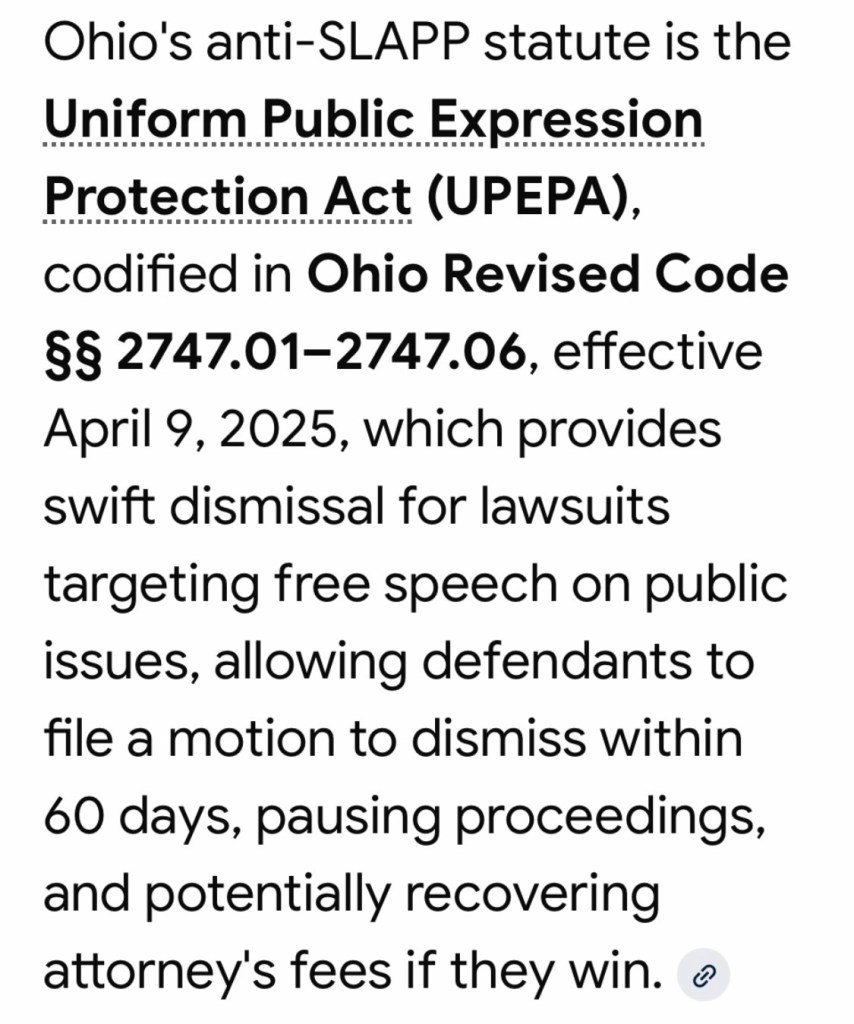
These people never learn. When you are the front runner in a serious commissioner election in Butler County, Ohio, as Michael Ryan is, the dirty tricks trying to prevent his momentum are just the kind of thing that give politics a bad name.  What starts you on the road to good health in politics isn’t kale or cardio, it’s truth without legalese, straight talk without a billable hour attached. I deal with lawyers all the time—good ones, bad ones, and the “print this from the shelf and scare them” variety—and my general opinion, even conceding that the profession began with noble intentions, is that far too much of it has drifted into a uniform intimidation racket. You’ve seen the type: the form-letter cease-and-desist that looks like an astrology reading for defamation, except the fortune costs you a retainer and the outcome is a long, nervous wait for a judge who usually tosses it after you’ve lost sleep and savings. The trick is the tone, not the law: it’s written to make you believe you must respond with a lawyer, because only priests of the temple may interpret the runes. I don’t like the practice and personally think it should be destroyed, and that the perpetrators of such legal manipulation should be thrown in jail and punished with career-ending justice, just for applying the kind of abuses of power that are all too common.

And then there’s this, additionally

This is why the old play of lawfare against rivals—especially in local races where reputations are accessible targets—needs to be called out. We’ve watched how it stains the process in Butler County. Roger Reynolds, who was convicted on a single count in late 2022, later saw that conviction overturned on appeal in May 2024 for “insufficient evidence,” with the appellate panel ordering an acquittal and discharge. The case centered on the golf academy idea tied to Lakota Schools and Four Bridges; the court noted that the proposal never matured, that the school board held the authority, and that the key witness’s legal counsel ended the discussion before any contract could be secured. 1234 In September 2024, the Ohio Supreme Court declined to restore him to the auditor’s office immediately (the seat had been filled due to the bar against felons holding office at the time of his conviction) but clarified he remains eligible to run in the future. 5 That’s the landscape: facts matter, timelines matter, and our politics should run on open argument, not legal intimidation.

Then there’s Cindy Carpenter. She recently walked into a student housing office in Oxford to resolve back rent tied to a family member. A surveillance camera caught her flipping off the counter during the exchange; staff alleged racist language and abuse of office. The Butler County Prosecutor investigated and concluded that her conduct, while “unseemly,” did not rise to the level of misconduct or abuse of power. 67 It’s all on tape and all public now; the gesture happened, the allegations were made, and the official finding closed the matter without charges. 86 You can dislike the behavior—I do—but voters deserve a campaign where candidates fight this out in daylight, not by hiring attorneys to stuff the mailbox of a rival.

Enter Michael Ryan. He’s a Hamilton City Councilman turned countywide candidate, and he’s collected a long list of conservative endorsements—state senator George Lang, multiple township trustees and councilmembers, and county auditor Nancy Nix among them—because he’s making the case for generational leadership and a forward-looking county agenda. 9 He launched his commission bid in May 2025, framing it around growth, jobs, and fewer distractions—promising to fight for every city, township, and village, and to recruit the next-generation workforce. 10 Ryan’s pitch has resonated in part because people are tired of courthouse drama and lawfare theatrics; they want a debate about budgets, infrastructure, and living standards, not another stack of demand letters mailed in bulk from counsel. And he’s not alone—the GOP field is crowded, with Reynolds and Carpenter in the mix for the May 2026 primary—but the voter mood described by local reporting is unmistakable: they’re weighing future capacity, not re-litigating yesterday’s trials. 11

Now, when the intimidation letter lands—as it did from Reynolds to Ryan—you don’t have to swallow the premise that only a lawyer can answer it. You can answer it yourself, plainly and legally, because the guardrail is still the Sullivan standard from 1964. New York Times Co. v. Sullivan was a 9–0 Supreme Court decision that put a constitutional backbone into defamation law for public officials: to win, a public official must prove “actual malice,” meaning the speaker knew the statement was false or acted with reckless disregard for its truth, and must do so with “convincing clarity.” 1213 The case grew out of a civil rights-era advertisement that contained factual errors; a local jury hit the Times with $500,000 in damages, but the Supreme Court reversed, explaining that debate on public issues must be “uninhibited, robust, and wide-open,” even when the attacks are “vehement” and sometimes “unpleasantly sharp.” 1415

If you want numbers: the jury’s original $500,000 damage award (an enormous sum in 1960) was wiped away; the final holding established a higher burden that has, for six decades, made defamation claims by public officials very hard to win without proof of knowing falsity or reckless disregard. 1514 In practical terms, that means campaign statements, press releases, and political commentary about public officeholders are protected—unless the speaker crosses the line into deliberate falsehood or reckless disregard for the truth. 1316 The standard is why you don’t need to hire a lawyer to say, “We disagree, and our statements are protected political speech,” and it’s why cease-and-desist letters are so often theatre: they depend on the recipient’s fear, not on an actual path to winning under Sullivan.

So let’s put it together. Reynolds’ single-count conviction was reversed; whatever lessons he took from the ordeal, sending form-letter threats at a rival to police campaign commentary is the wrong takeaway. 12 Carpenter’s apartment-office incident was embarrassing but not criminal; voters can judge her temperament, but the prosecutor closed the file. 6 Ryan, meanwhile, has stacked endorsements and is running an argument-heavy, growth-forward race; that’s where the energy is. 9 Let them debate. Let voters see who can build coalitions and deliver results without resorting to legal cudgels. And when the legal cudgel shows up anyway, answer it with Sullivan—because in American political life, the First Amendment demands a high tolerance for hard speech about public officials, and the courts have enforced that by design. 1315

In the decades since Sullivan, the Supreme Court clarified and extended the actual-malice requirement through several landmark decisions:

Gertz v. Robert Welch, Inc. (1974)

This case distinguished between public officials, public figures, and private individuals. The Court held that the actual‑malice standard does not apply to defamation claims by private individuals. Instead, states may allow recovery with a lower standard of fault—such as negligence—when proven, and plaintiffs are limited to actual damages unless actual malice is shown 12.

• Outcome: Private individuals need not meet the high threshold; states can define fault and damages within constitutional bounds 23.

Curtis Publishing Co. v. Wally Butts (1967)

Extending Sullivan, the Court held that public figures (like former coach Wally Butts) must prove actual malice to prevail in libel suits. The investigation in question fell short of reasonable journalistic standards, leading to damages after the Court found reckless disregard for truth 45.

Philadelphia Newspapers v. Hepps (1986)

When private individuals sue over speech on matters of public concern, the Court ruled they must bear the burden of proving falsity—not leave it to the defendant. This ensures truth holds primacy in public discourse and avoids chilling speech 67.

Hustler Magazine, Inc. v. Falwell (1988)

This case affirmed that even intentional infliction of emotional distress torts related to offensive parody do not evade the actual‑malice rule when a public figure is involved. Religious leader Jerry Falwell could not recover without proving that Hustler knowingly published false statements or acted with reckless disregard 89.

• Result: Political satire and parody targeting public figures are constitutionally protected—even if deeply offensive—absent false statements made with actual malice.

Together, these rulings illustrate how Sullivan’s actual‑malice standard has been reinforced and nuanced:

• It does apply to both public officials and public figures (Butts, Falwell).

• It does not apply to private individuals (Gertz), though they must still show fault and harm.

• Plaintiffs challenge private or public speech tied to public concern must prove falsity (Hepps).

These cases bolster the legal shield for political speech—underscoring that public dialogue outpaces legal intimidation unless clearly false and malicious.

We’ve seen it too often, when candidates in politics can’t make a good argument, they turn to lawfare and hope that the public perception of expensive lawyers will do the work for them of winning an office they otherwise don’t deserve.  In Roger Reynold’s case, he is the one who got himself into trouble in the first place, and nobody wants to see that kind of trouble in the office of the Butler County Commissioners, just to repair the reputation of a person looking for respect that he lost during the process.  There are other ways to win respect, and this isn’t how you do it.  Showing leadership is the way to restore party integrity, not to make more rifts that cost more than reputations.  And hiring expensive, pin-headed lawyers to send out form letters of intimidation on a case they know is phony as they sent it, is why there are problems in politics to begin with.

Footnotes

1. New York Times Co. v. Sullivan set the “actual malice” standard for public officials, requiring proof that the defendant knew a statement was false or acted with reckless disregard, and emphasized “uninhibited, robust, and wide-open” debate on public issues. 1314

2. The original jury verdict in Alabama awarded L.B. Sullivan $500,000 in damages; the U.S. Supreme Court reversed unanimously in 1964. 15

3. Former Butler County Auditor Roger Reynolds’ 2022 unlawful-interest conviction was overturned for insufficient evidence in May 2024; the appeals court ordered acquittal and discharge. 12

4. The Ohio Supreme Court, in September 2024, declined to restore Reynolds to office mid-term but affirmed his eligibility to run in the future. 5

5. Butler County Prosecutor Michael Gmoser cleared Commissioner Cindy Carpenter of misconduct after the Oxford apartment incident, noting the gesture was “unseemly” but not unlawful. 6

6. Michael Ryan launched his commission bid in May 2025 and lists numerous Republican endorsements on his campaign website. 109

7. Local reporting describes a crowded May 2026 GOP primary field for the commission seat and outlines competing narratives about experience versus future focus. 11

Bibliography

• New York Times Co. v. Sullivan case summaries and analyses: LII / Cornell Wex; First Amendment Encyclopedia (MTSU); Wikipedia overview; FindLaw case history; Encyclopaedia Britannica.

• Reynolds appellate decision and related coverage: Twelfth District opinion (PDF); WCPO; Cincinnati Enquirer; WLWT; Ohio Supreme Court case update.

• Carpenter incident and prosecutorial review: Journal-News; Local 12 WKRC; Cincinnati.com video clip.

• Michael Ryan campaign and endorsements: Ryan for Butler County website; Journal-News launch story; Primary field coverage.

Rich Hoffman

Click Here to Protect Yourself with Second Call Defense https://www.secondcalldefense.org/?affiliate=20707

Butler County Commissioner Cindy Carpenter Runs Willingly Into a Buzz-saw: Nothing says “vote for me” like giving the public the finger

The Butler County 2026 primary election is shaping up to be one of the most consequential political battles in recent memory. For years, local politics have simmered under the surface, but now, with Cindy Carpenter’s long tenure as commissioner under scrutiny, the stakes couldn’t be higher. This isn’t just another election—it’s a referendum on leadership, accountability, and the future direction of Butler County. And when it mattered most, how did Cindy Carpenter present herself? Well, she flipped off everyone in a wild, out-of-control tirade that could have easily been avoided, showing the world that what people say about her behind closed doors is actually true. When everyone was out of the room at the Level 27 apartment complex at Miami University, we saw on camera what Cindy Carpenter thinks of people who disagree with her. [1]


As the Journal-News reported, witnesses described the scene as ‘shocking and unbecoming of an elected official,’ noting that Carpenter was visibly angry and used gestures that ‘crossed the line of professionalism.’ [1] One resident quoted in the article said, ‘We expect leaders to solve problems, not escalate them.’ These words echo what many voters already feel: that Carpenter’s behavior reflects a deeper problem of temperament and judgment.

Cindy Carpenter has held her seat for a long time, and with that longevity comes a confident expectation of stability and integrity. Unfortunately, recent events have cast a long shadow over her reputation. For years, whispers of her being a ‘RINO’—Republican In Name Only—have circulated among grassroots conservatives. Those whispers turned into shouts last year when she was caught openly campaigning for a Democrat in Middletown. For a commissioner in a county that prides itself on conservative values, this was more than a lapse in judgment—it was a betrayal of trust. At the time, she was the endorsed Republican commissioner, and she showed tremendous disrespect for that endorsement. As one Journal-News editorial put it, ‘Carpenter’s actions raise serious questions about her loyalty to the party and her constituents.’ [2]

Cindy Carpenter, at her best


But if that weren’t enough, another controversy erupted that speaks volumes about character and temperament. A video surfaced from a security camera at an apartment complex where a family member of Carpenter—reported as her daughter by some, her granddaughter by others—was facing eviction for unpaid rent. Instead of handling the matter privately and with grace, Carpenter was caught on camera engaging in a heated argument and flipping off someone during the dispute. This isn’t the behavior of a seasoned leader; it’s the optics of chaos, entitlement, and poor judgment. When you’re an incumbent fighting to keep your seat, the last thing you want is to look like an overbearing parent abusing influence to protect a relative. [3]

Michael Ryan, one of Carpenter’s challengers, issued a press release shortly after the incident, stating: ‘The people of Butler County deserve leaders who act with dignity and respect, even in difficult situations. What we saw on that video does not reflect those values.’ [4] Ryan’s statement went further, pledging to ‘restore trust and transparency in county government’ and to ‘end the cycle of favoritism and dysfunction.’ These are not just campaign slogans—they are commitments grounded in a vision for better governance.

Ryan’s involvement in the Spooky Nook Sports Complex development showcased his ability to think big and deliver results. In his press release, he reminded voters of that success: ‘When others said it couldn’t be done, we brought stakeholders together and made it happen. That’s the kind of leadership Butler County needs.’ [4]


Contrast that with Roger Reynolds, another challenger in this race. While Reynolds may present himself as a viable alternative, his baggage is well-documented. From ethical questions to controversies that have dogged his career, Reynolds represents the kind of old-guard politics that Butler County needs to move beyond. Supporting Reynolds would be a step backward—a return to the same entrenched interests that have stifled progress for years. As Michael Moser commented in a recent interview, ‘We cannot afford to recycle the same problems under a different name.’ [5]

This primary isn’t just about personalities; it’s about the future of Butler County. Will voters choose a path of renewal and accountability, or will they cling to incumbency and compromise? Carpenter’s recent behavior suggests a leader out of touch with her constituents’ values and expectations. Ryan, on the other hand, embodies the principles of transparency, collaboration, and forward momentum.

Michael Ryan and his wife, Amanda. A fresh start without the baggage for Butler County


As we approach May 2026, the choice is very clear. Butler County deserves leadership that reflects its best qualities—not the worst impulses of entitlement and political expediency. Cindy Carpenter’s controversies aren’t just unfortunate—they’re disqualifying. Michael Ryan offers a better way forward, and for those who care about the integrity and prosperity of this community, the time to act is now.  And this isn’t just an opportunity to talk about Michael Ryan, or to re-assess the Roger Reynolds case, but Cindy should have known better.  The impaired judgment alone should be enough to eliminate her from the job now, without even waiting for the primary to be over.  When you walk into an apartment complex and communicate with people who work with students at a college or university, and you end up turning the whole room against you, which is clearly the case when she finally did leave, which was seen on camera, it’s a lack of skill thing more than any other attribute.  Whether or not Cindy Carpenter abused her authority, depending on who’s telling the story, what we did see was what she does when nobody is looking.  Being in a public place and giving the finger to employees of a business in anger is irrational at best.  We need people who build relationships, not those who can turn entire groups of people against them.  Dealing with this apartment payment issue with cash in hand should have been easy, and for anybody who does business at a high level, she should have had much better command of the situation.  But instead, she only confirmed what all her critics have said about her and showed why politicians can be so dangerous.  On the one hand, they put on a happy face, but when they think no one is looking, they flip people off when they fail to convince them to listen to reason.  A good negotiator never does something like this.  They should be, at a high level of politics, skilled in negotiations.  Because Cindy has been caught on camera doing really dumb things as a politician many times, I am excited to have someone like Michael Ryan running for a commissioner seat.  When we talk about the need for fresh, new faces in government, it’s because of failures like Cindy Carpenter that we make the statement.  And there is only one person to blame; this isn’t dirty politics or a gotcha to harm Cindy out of some sense of unfairness.  She walked into this buzzsaw, willingly on her own accord.  And she wasn’t even smart enough to be careful in a public place full of cameras.  So when we talk about these offices and who should be in them, no matter who is voting, I think we can all agree, that we need someone in an important office that doesn’t give young people the finger at a very public apartment complex when trying to resolve a family members back payment on rent, all events that could have been handled, much, much, better.

References:
[1] Journal-News, ‘Video Shows Cindy Carpenter in Heated Exchange at Apartment Complex,’ 2025.
[2] Journal-News Editorial, ‘Carpenter’s Campaign Misstep Raises Questions,’ 2024.
[3] Security Footage Report, Level 27 Apartments, Miami University, 2025.
[4] Michael Ryan Campaign Press Release, ‘Restoring Trust in Butler County,’ 2025.
[5] Interview with Michael Moser, Butler County GOP Leadership Forum, 2025.

Rich Hoffman

Click Here to Protect Yourself with Second Call Defense https://www.secondcalldefense.org/?affiliate=20707

Meet the Candidates for Butler County Commissioner: Why Michael Ryan is the best

So, why Michael Ryan over the other two people running for the same Butler County Commissioner seat?  Well, a nice walk down High Street in Hamilton, Ohio, makes it all very clear.  Cindy Carpenter is the incumbent in this race, and she has held that seat for about 15 years.  The other is Roger Reynolds, who used to be the auditor of Butler County.  Before getting into any of the negative stuff, let’s just say that Michael Ryan is a good fresh start for the Butler County Republican Party, and he is coming into the race highly endorsed by a lot of very important people.  And he has great donors who are supporting him early in this process, which was quite evident at his October fundraiser.  Michael Ryan doesn’t have any baggage; he and his wife are a really good couple, and what he has done as vice-mayor of Hamilton has been very enterprising.  The good job that he and the city council have done for Hamilton is obvious just by walking down the streets of the West Side.  I was born in Hamilton.  I’ve lived in and around it most of my life.  And I have traveled all over the world and have an excellent idea of what good is, and the Hamilton of today is fantastic.  And Michael Ryan has a lot to do with its recovery from a not-so-good place.  Ryan has been optimistic and shown a remarkable ability to work with others to make things that seem impossible happen.  And there really aren’t many people anywhere better for the Butler County Commissioner job than Michael Ryan.  Butler County is lucky to have him, and I think he could do great things for the County over the next decade. I’m very excited to vote for him. 

But why not Cindy Carpenter?  Well, Cindy has always been thought of as a RINO.  Most of the time, she has run unopposed.  She has been a yes vote on police budgets.  But she has essentially been a Democrat socially, and recently proved it by campaigning for the Democrat mayor of Middletown, Ohio, Elizabeth Slamka.  Cindy was caught at a voting location openly pushing for the Democrat, and it was all caught on camera, which was very embarrassing for her.  Of course, when Cindy was caught, there wasn’t much she could say; she was the Republican endorsed candidate openly pushing for a Democrat mayor in a town that needs a lot of help, Middletown.  Simply put, after all these years, that’s the best Cindy can do, and she will never be a spectacular success.  She has had her chance; we know what she is, and we know she supports Democrats and doesn’t respect the endorsement process.  It’s not like the Elizabeth Slamka issue was in the past; it was very recent, and I think it ruined her forever.  She’ll never be able to live it down.  We’re in a period of party politics that wants more MAGA representatives, and Cindy isn’t one of them.  She’s too much of the kind of politics that people want to run away from.  Not to sign up for another term, especially when they openly support Democrats who have proven to be really detrimental to cities and counties where they gain a majority.  Hamilton didn’t improve because of people like Cindy Carpenter.  It improved despite her.  Michael Ryan gets much of the credit, and we want a lot more of his kind of presence.  I’m sure Ryan will support police budgets, even as tax cuts become a higher priority for him.  In a one-for-one comparison, all the positives go to Michael Ryan, and there are none for Cindy Carpenter.  She did her thing, it wasn’t perfect, and she is a closet Democrat.  So let’s dump her and move on to someone better.

The other candidate is someone I’ve supported in the past.  I would have preferred that he not run until he got his life back together after a rough trial he just went through, which cost him well over a million dollars.  I was very supportive of him during all that, so people are wondering why I’m not supporting him for commissioner.  Well, through the trial, I got to know him better.  I’ve known him for a long time, and I like him.  But he tends to get combative with people, and you learn a lot about them by how they handle pressure.  And under pressure, Roger Reynolds showed he’s someone people want to fight.  And that’s how he ended up in court to begin with.  As a commissioner, you need to be able to work with people and build relationships.  And Roger has a hard time with relationships.  So I might like the guy.  But he’s not ready for a public office.  He has had relationship problems with his wives, and in my book, if you can’t handle a marriage, you are going to struggle with a lot of other things in your life.  And after listening to the testimony of the former Lakota treasurer, Jenni Logan, there was a lot of poor judgment that gave early indications of spousal commitments.  Most of those are private problems, but he’s the one who decided to run for office, even though there are a lot of red flags about him personally that have only muddied this race for what I think are really selfish reasons. 

I would have said the same thing about President Trump’s marriages, and it took me a while to start taking him seriously.  I’ve met Trump several times, especially during the early Tea Party and Reform Party years.  And I’ve met Melania Trump, too, and I’ll say she’s been good for Trump and has made him better for the public office he’s now doing so well in.  Maybe Roger will find someone who will help him improve as a person, like Trump did.  But right now, he has a lot of digging to do to get out of a hole he put himself in.  And, unfortunately, he is seeking redemption through public office, even though a much better person is running for the job.  Roger is damaged goods, and he needs to present himself undamaged.  And it’s not just marriages that Roger has destroyed.  He has relationship problems, which raise major red flags for a job like this commissioner position.  Again, Roger has been around for a long time, and everyone knows what they are getting.  He’s not going to do anything significant.  But Michael Ryan has a chance to, so it’s really not a hard decision for voters.  Because of the way the world is changing toward better MAGA options at these positions, Michael Ryan is the only reasonable choice.  That’s why I am happy to support him over these other candidates.  If Roger wants to return to public office, he needs to fix some things about himself first.  Seeking redemption by voter validation isn’t healthy.  And Butler County needs to do good things for itself, not provide a platform for personal growth at the expense of progress.  And that is what anybody but Michael Ryan would be for the Republican Party, Hamilton, Ohio, in general, and Butler County as a whole.  People deserve the best person for the office, and for me, nobody would be better than Michael Ryan.     

Rich Hoffman

Click Here to Protect Yourself with Second Call Defense https://www.secondcalldefense.org/?affiliate=20707

It’s All About Family: Why Michael Ryan is Right for Butler County Commissioner

It was a successful fundraiser for Michael Ryan on the West Side of Hamilton, Ohio, where he has served as a vice mayor for several years.  Ryan is running for Butler County Commissioner, so a fundraiser was held at the Shooter’s Event Center, which was very well attended and well represented among donors, showing a great early sign for his campaign.  Under normal conditions, a person like Michael Ryan would be an easy one to vote for.  However, this campaign represents a significant shift in direction for the Republican Party, as two incumbent candidates are running for the same position.  Cindy Carpenter is already a commissioner, and it’s her seat that is up for election.  There are some serious issues with her that we’ll address specifically.  But as to who is best for this commissioner seat, Michael Ryan is the easy favorite.  Then there is the latecomer to the race, Roger Reynolds, whom I have supported a lot in the past.  For him, this is the wrong seat at the wrong time for a lot of reasons.  Things I’d rather not discuss, but he put himself out there for a public seat, so it’s going to get uncomfortable.  As for the Michael Ryan fundraiser and why he is the best pick for the seat, as well as the future of the Butler County Republican Party being best represented by him, there is no question.  The task will be to show the average voter the differences between those three Republicans in name.  It really comes down to how we define what the “Grand Old Party” is, and I would say its economic viability as best represented by the MAGA movement and political figures like J.D. Vance, Vivek Ramaswamy, and locally, Michael Ryan.  They are all around the same age, and the young Republicans, who were well represented at Michael’s event, are looking toward the next generation.  Not the over-50 crowd.  Many people are seeking Republicans for a fresh start, and that is why Michael Ryan is the best candidate for consideration.

Lots of great options on High Street in Hamilton, Ohio

As I met Michael’s parents and his wife Amanda’s, I couldn’t help but notice a pattern in the kind of politician I most support, in virtually all cases.  They are good families with working relationships with their spouses.  One thing that really stands out about Michael is that his wife, Amanda, is very engaging, and they make a strong political couple, working together as a team to meet the needs of a political office.  For instance, there is a lot that goes into a political job that goes well beyond the function of doing the job itself.  Being a representative means talking to a lot of people all the time, and it is best when there is a supportive spouse to help with that task as a team.  And Amanda fits right into that role very well.  However, what’s also noticeable is that they both have very supportive and intact parents who are deeply involved in the process.  That’s great when it comes to Michael and Amanda, but it’s something I notice among all the political people I support.  They all have strong families that help them in the background, and for me, that is the first ingredient for success in a political position.  How can you offer yourself as a manager of the public trust if you can’t work with the trust within a family unit?  That is certainly the case with George and Debbie Lang, a compelling political couple who are supporting Michael Ryan’s campaign very early in the process.  George was supposed to attend the fundraiser, but was held up in Columbus and was running late. 

There were other notable couples present as well. Mark Welch has been very supportive, as a West Chester Trustee.  And Nancy Nix, who has a great relationship with her husband, Bob, ended up covering for George’s absence.  But what they all have in common, which I think a lot of, is that they have functional relationships with their spouses, which I would say is the foundation of any political office.  If you can’t work well together with your spouse, how can you work together with other people in the party, or the community as a whole?  Even more than that, I had a chance to talk to the Butler County Young Republicans, who were there to support Michael from Miami University, all dressed up in suits and ties. All of them were inclined toward that kind of life, including a healthy marriage, good personal decisions, and taking responsibility for themselves. Ben Nguyen, a very young man running for the Lakota school board, was there to support Michael Ryan as one of those young Republicans. He represents the new generation of hopeful people joining the Republican Party, which is very family-oriented. I am very encouraged by meeting them; they are part of the party that has emerged from Charlie Kirk’s efforts at Turning Point USA.  Gone are the days when the public would support scandalous figures who used a powerful political office to nurture sexual affairs and financial despondency by abusing the public trust.  No, these were all people who expect the best from those running for public office, and they are being judged on how well they handle their affairs, starting at home.

Downtown Hamilton is Thriving These Days

And whether it’s fair or not, for people to know what a good family is, it starts with having a good family, so it’s no surprise that Michael and Amanda Ryan both had their parents at this event, and they were very engaging.  They actually reminded me of a younger version of George and Debbie Lang, in terms of a couple who work well together.  When you deal with the public, you really need a good partner in life to help keep everything sorted out. Typically, that’s what I look for when supporting a political person: how well they maintain a relationship with their spouse.  If they are bouncing around between girlfriends or boyfriends and wearing gold rings on their pinky fingers, I likely won’t be endorsing them because, in my experience, those types of people don’t fare well in politics.  And ultimately, the measure of a good office holder is in what they have done, and for Michael, because he has a happy home life, that has translated into being an outstanding city council member who has helped build a good team that has brought excellent economic value to a city that has needed it.  Hamilton, Ohio, is on the uptick economically largely because Michael Ryan has been very effective at attracting investment interest to the town, and it all starts with being a good person who doesn’t get swept away by the tides of influence that often accompany such activity.  Having a good spouse to help keep everything grounded is a key to being successful when those pressures are applied.  And they are usually the difference between success and failure.  And upon meeting the family of Michael Ryan, it becomes obvious very quickly that the headlines that emerge from his public life will lean in the positive direction, rather than the negative, as people who lean into an office to fill a void inside them often do.  In my experience, to run a successful public office, you need a good private life with a supportive spouse as a partner.  And Michael Ryan certainly has that.

Rich Hoffman

Click Here to Protect Yourself with Second Call Defense https://www.secondcalldefense.org/?affiliate=20707

The Innovations of Michael V. Ryan: Forming an important relationship with Joby Aviation that is the gateway to the future

The plan is for Joby Aviation to conduct some flight tests soon, as early as 2026, in the Miami Valley, where it has a new manufacturing plant in Dayton.  And the Vice Mayor of Hamilton, Ohio, Michael Ryan, wants Butler County to be part of it, as a member of the Hamilton City Council who has done a commendable job of restoring commercial viability to the historic city.  And he has some bigger ideas about helping Butler County as a whole by running for commissioner in an upcoming election, which coincides with the release of Joby Aviation’s new air taxis from its Dayton facility.  Michael recently met with the people involved in this expansion and reported some results to me as part of his campaign platform, which is quite ambitious.  I love the topic of sky taxis, or as they are known to President Trump, eVTOL (vertical takeoff and landing) vehicles.  Joby is headquartered in Santa Cruz, California, and currently has five sky taxis that they are delivering to Dubai as the first flight destination.  As I’ve covered this topic extensively, I believe this is one of the most significant transportation trends to emerge from the human race.  Essentially, these eVTOL vehicles are personal vehicles, much like the Jetsons’ or the flying cars from Back to the Future.  But the technology is real, and it’s happening now, in 2025.  In Dubai, they have already built the infrastructure, which consists of four vertiports: one at the airport and three others located around the city.  They will essentially serve as an Uber experience, but instead of getting into a car and having a driver take you somewhere, you will get into one of these very advanced drones.  Initially, they will be piloted by a real operator.  However, they will soon be completely automated, and you will interact with the experience through your phone. 

In America, there are only three places seriously considering entering the eVTOL market: New York, Los Angeles, and the Bay Area in San Francisco.  However, Michael Ryan is trying to make Butler County the most obvious starting point, as Ohio is the birthplace of aviation, and the new Joby plant is just up the road along the Aviation Corridor.  There are few places in America as aviation-focused as the span of I-75 from Dayton to CVG in Kentucky, and making Hamilton and Butler County, in general, a hub for Joby interaction would be a tremendous commercial opportunity.  All Joby is waiting for is the FAA to complete their review and for some testing flights to occur around Dayton International Airport.  The Trump administration is ready to support this new opportunity, and it won’t take long for everyone to clamor for their own vertiports.  It’s good to see that Michael Ryan isn’t even the commissioner of Butler County yet, and he’s already trying to create opportunities that few in the world have seen yet.  The timeline will be fast; the Dayton facility plans to produce 500 air taxis per year, and it won’t take long for them to become as common as routine airplanes. However, eVTOL vehicles will operate under the flight levels of current commercial airlines and personal planes.  Traffic problems will be significantly reduced because traffic can be stacked in the air.  Infrastructure is relatively simple compared to railroads and highways.  Vertiports typically require an investment of $100,000-$ 200,000 for the pad to operate from, and a few million dollars for a multi-level stack terminal.  However, eVTOL vehicles can operate almost anywhere, including in dense cities, which will be demonstrated in Dubai before 2025 comes to a close. 

Speed is the wave of the future in communication, so the amount of time that people spend interacting with each other will need to increase.  The experimental trend that had been emerging during the COVID-19 pandemic has turned out to be a bust: the work-from-home crowd did not turn out well.  Economic activity, aside from all the socialist experiments, occurs when people who can invest and produce manufacturing can communicate with each other easily, which is why so much industry ends up clustering along highway access.  It used to be railroads.  Starting in 2025 and beyond, access to vertiports will be available, and ultimately, person-to-person travel will be possible from your driveway to your employer.  Ground traffic will become a second-level option.  It will be like riding a horse as compared to a car.  When you can get anywhere within a city in 10 to 15 minutes, that speeds up human interaction, which emerging AI and a new space economy currently are constrained by traditional infrastructure that is much slower than it needs to be.  Many people aren’t thinking about these things yet, but Michael Ryan is.  He is a refreshing new Republican who fits in very nicely with the J.D. Vance generation, as well as Vivek Ramaswamy, who will soon be the governor of Ohio.  As Elon Musk develops Starship to emerge into this new commercial space economy, where SpaceX has just had a very successful test of their flight 10 Starship, things are going to move very fast, not years from now, but within the year.  Therefore, a political vision will become increasingly important in meeting those emerging market trends.  As a city council member, Michael Ryan and his team in Hamilton have been effective at staving off further taxation of a legacy economy that has largely shifted away.

One of the most impressive renovations to Hamilton is part of the good work that Michael Ryan and the Hamilton City Council have brought forth, namely the Spooky Nook Sports Champion Mill, which is America’s largest indoor sports complex.  It’s a fantastic facility right on the river, across from downtown Hamilton, and is a testament to what is possible when an old space is historically preserved and transformed into something that everyone enjoys.  The Joby Aviation air taxi technology would be ideal for this specific site, as it would enable people to get in and out of the area much faster than with a car.  It would take a one- to two-hour trip by car from the surrounding area, making it about 15 minutes, as Joby vehicles can travel at speeds of up to 200 miles per hour.  And they are now safe enough to consider them more reliable than traditional cars.  They will quickly prove to be the safest way to travel.  As Michael pointed out to me during our conversation, personalized sky travel won’t even be the most lucrative market.  Logistics will be revolutionized as drone technology soon delivers to our doors, as Amazon has been promising for a long time.  The technology is now here, making it viable to have distribution centers far away from congested traffic corridors.  Because the drones can fly over these areas, Joby technology will enable drop-offs from airports to these centers to occur much faster and more efficiently.  Things are about to get a lot faster, and Michael Ryan is looking to make Butler County the most attractive destination for this new Joby Aviation opportunity.  Michael Ryan has been a city council member in Hamilton since 2017, and it didn’t take long for great things like the Spooky Nook complex to emerge with new economic viability that is bringing new opportunities to the city of Hamilton, which is the best way to keep taxes down, to pay for infrastructure with financial viability, not personal property taxes.  And what Michael Ryan is doing with forming partnerships with Joby Aviation shows an opportunity on a much larger scale.  And he is far ahead of any other politician in the country, which is something to be very proud of. 

Rich Hoffman

Click Here to Protect Yourself with Second Call Defense https://www.secondcalldefense.org/?affiliate=20707