

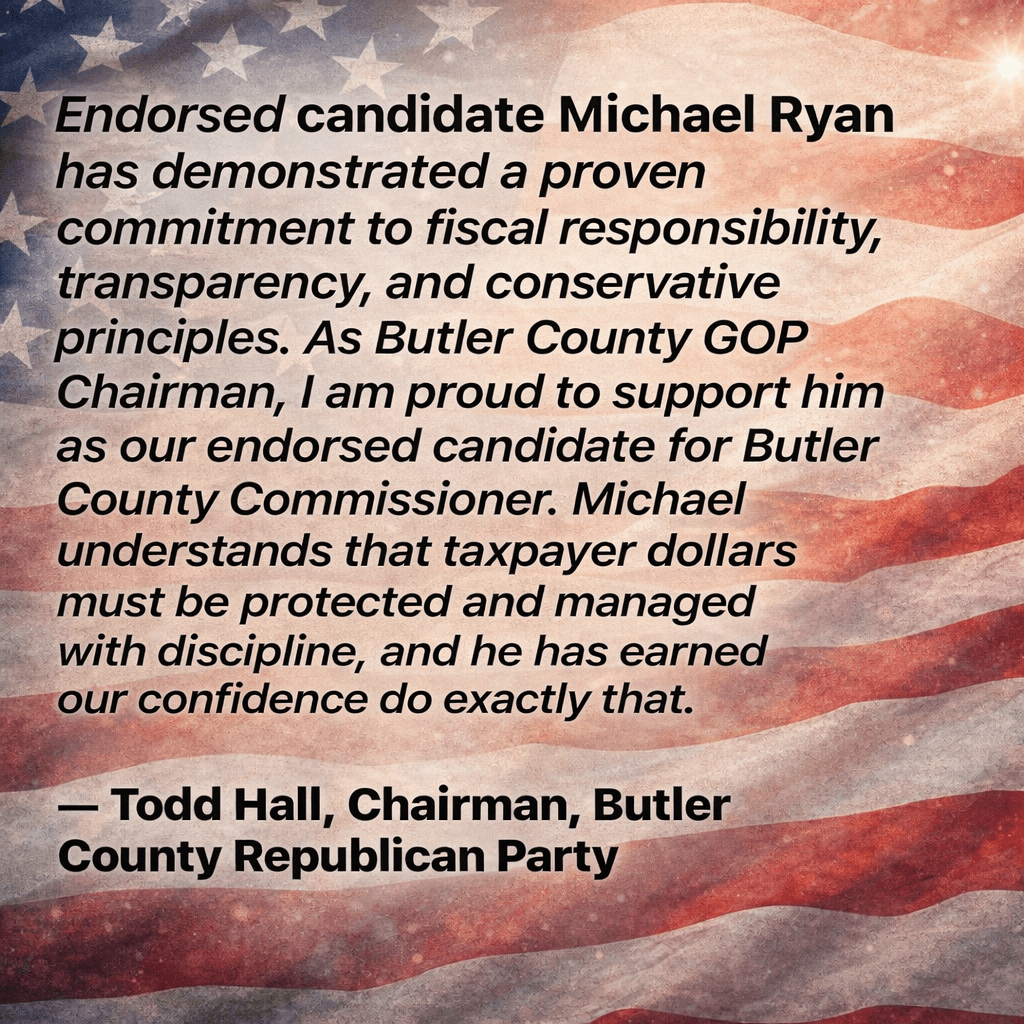
Politics used to be about buying your way onto the field with whatever the old media would let you run; now it’s a multi-front dialogue with voters in a thousand micro‑channels you can’t bully, buy, or badger. That’s precisely why the Butler County Republican Party’s endorsement for the 2026 commissioner race matters more than the yard‑sign arms race or a late sprint of cable buys. The party met and took a hard look at candidates and momentum, then endorsed Michael Ryan, the Hamilton vice mayor and former two-term councilman, with 71% of the vote—a landslide in intraparty terms and a signal that the center of gravity has moved.1
Now, Michael’s not a surprise. He telegraphed this run early, skipped a safe third council term to go county-wide, and built a coalition that looks like the next decade of Republican leadership rather than the last. The local press documented the pivot: he pulled petitions in May 2025 and argued that county policy needs someone who can assemble teams, manage a large budget, and negotiate growth while keeping conservative guardrails intact. The Journal‑News laid out the framing: Butler County’s annual budget sits near $500 million, which is not far off Hamilton’s total because the city runs utilities—so a Ryan résumé of budget discipline and project delivery isn’t a stretch to scale.2
Meanwhile, what makes an endorsement decisive isn’t just math inside a party meeting; it’s the psychology of trust outside it. Voters aren’t shopping for saviors; they’re looking for steady hands who can do the table talk, bring coalition politics back from bloodsport, and keep the county in the black while the national mood whipsaws. Michael’s case is that he’s done that already—eight years on council, two stints as vice mayor, a list of jobs recruited, investments landed. If you want to see his pitch in his own words, his site stacks the receipts—balanced budgets, 1,400 new jobs, $700 million in capital investment—and shows a broad bench of local Republican endorsements from state senator George Lang to sitting city council members across the county. If you view campaign websites skeptically (good habit), remember that the basic resume points have been corroborated and referenced in local coverage.32
Roger Reynolds is the wild card—and yes, I have supported him in the past for other fights—but this seat, this season, isn’t the right battlefield. He’s well‑known, to be sure. His 2022 felony conviction over unlawful interest in a public contract was overturned in 2024 by the Twelfth District Court of Appeals, and the Ohio Supreme Court refused to disturb that reversal; that’s an essential legal clearance. But the same Supreme Court opinion blocked him from reclaiming the auditor’s office he’d won in 2022, clarifying he can run again in the future, not retroactively retake the seat. He’s used that clean bill of eligibility to jump into this commissioner race in 2026.45
Here’s where the political calculus cuts sharply: being legally eligible isn’t the same as being politically restored. Voters have long memories; they remember the courtroom saga even if the headline at the end credits “overturned.” The Enquirer summarized the timeline cleanly—indictment, a single felony conviction on the Lakota angle, subsequent reversal, and the present campaign posture. That’s nothing; it’s the kind of backstory that makes your consultants salivate over message discipline and makes your donors jittery about whether a million dollars in signs and mailers can buy back normalcy. And, on top of that, the first skirmish of 2026 was a legal “cease” letter from Reynolds’s counsel to Ryan over campaign statements—“normal campaign bickering,” Reynolds said—but it sets a tone. If your brand promise is “100% positive campaign,” you don’t want week one to be a lawyerly demand letter and a press cycle about “defamation.” That’s oxygen you don’t get back.6
So let’s talk yard signs, because politicians who plan a resurrection often think in terms of saturating real estate with their names, then buying enough broadcast to push past the whispers. Butler County’s population sits around 400,000 people; the geographic sprawl and the number of micro‑communities—from Liberty and West Chester to Hamilton, Fairfield, Middletown, Oxford, and the townships—means your sign budget leaks. People steal them, wind takes them, HOAs yank them. You replace and replace, and your spending ends up as a weekly chore. I don’t care if you’ve earmarked $125,000 or double that; you won’t beat an endorsement plus a ground game in honest conversations across civic slots. The Journal‑News reported the early posture: Ryan’s petitions were certified mid‑2025; Reynolds announced and described the election as a referendum on fiscal discipline rather than “courtroom drama,” but the party’s endorsement last week says rank-and-file Republicans aren’t buying the “just the future” frame. They picked the coalition builder, not the comeback.71
Now, about Cindy Carpenter. She has been on the board since 2011 and is seeking another term. Longevity usually earns deference, but not automatic endorsement. The county’s official page lists her current term running through December 31, 2026; that’s the seat this primary decides.8 And she walked into 2026 with a fresh controversy: the Oxford apartment office incident involving her granddaughter’s rent dispute, a flipped middle finger on video, and accusations of “racist” remarks that the prosecutor ultimately said did not amount to wrongdoing, though he wrote her conduct was “distasteful and beneath her elected position.” You can parse tone and motive all day; the legal piece is settled—no charges and the matter closed—but voters see the tape and the headlines. That’s enough to move marginal supporters toward the more predictable alternative.91011
If you’re counting coalition math, the endorsement vote margin—71%—is not a nudge; it’s a shove. Nancy Nix, now the county auditor, reportedly attended the endorsement meeting and confirmed the tally. In a county where winning the GOP primary is often tantamount to winning in November, a unified endorsement improves fundraising and volunteer energy. It also narrows the “independent” lane for a sitting commissioner who didn’t get the nod. If Carpenter runs without the party’s backing, as some have suggested she might, she’ll need a ballot strategy that reintroduces herself as a pragmatic caretaker, not an insurgent. That’s a hard sell after fifteen years in office and a fresh headline about “inappropriate gesture.”1
What does the “post‑MAGA” Republican center look like in Butler County? It seems less like a purity test and more like a competence test married to coalition instincts. The culture war isn’t over, but voters have learned the cost of gridlock and personality feuds in local government. Ryan’s style—steady, pragmatic, pro-growth, minimalist on mudslinging—fits that mood. Even the critiques thrown at him (“stepping stone,” says Carpenter) sound antique in a county where younger Republicans have already moved into leadership slots in councils and school boards. The Journal’s News coverage links Ryan’s Hamilton résumé to county-wide feasibility: he’s worked with local, state, and federal decision-makers on public safety and infrastructure, and even served as a liaison for the Amtrak stop push in Hamilton. Those are not ideological fantasies; they’re governing tasks where people skills matter.2
And yes, campaigns need money. Ryan’s fundraising velocity looks like a candidate with broad buy-in—events across the county and a donor list that isn’t just from one township. Whether it’s $100,000 in the bank now or double that soon, the point isn’t how many mailers you can print; it’s how many doors you can knock with volunteers who believe you’ll answer their emails after you win. The county GOP endorsement helps there; donors prefer campaigns that aren’t about to splinter the party. Meanwhile, Reynolds ‘ suggestion that he’ll spend heavily—to the tune of six figures and perhaps beyond—won’t fix the core problem: a campaign that starts by relitigating perception rather than proposing coalitions. The Enquirer’s report on his launch emphasized his intent to return “windfall” property tax revenue to taxpayers and raise the Homestead Exemption; those are policy planks that will attract attention. But they’re competing against a party coalescing around a candidate who can execute a full agenda without dragging legal undertones into every meeting.51
Let’s zoom out into strategy—because if I were advising Reynolds, I wouldn’t tell him to burn $250,000 on a race he’s likely to lose by 12‑15 points after the endorsement lands and consolidates. I’d say to him to rebuild his brand across the map: show up for other candidates, be helpful, become indispensable in the trenches, help elect school board members and trustees, and re-establish the “workhorse, not lightning rod” identity. That takes two years; it doesn’t show up in six months. And then consider a race aligned with your strengths and your arc, not a head-on collision with a party that just voted for someone else overwhelmingly. The Journal-News article, calling the 2026 commissioner contest “off and running,” captured the vibe—three Republicans, but only one whose petitions were already certified, who positioned the race as “no distractions.” That kind of language puts the burden on the other two to explain why their distractions are the voters’ problem.7
As for Carpenter, I don’t think she’s a villain; I think she’s a discovered Democrat. I guess longevity breeds muscle memory: you reach for authority instead of coalition. Voters can forgive that once, even twice, if the essentials are stable—roads paved, budgets balanced, ops quiet. But the moment a county commissioner’s name becomes shorthand for “that clip,” you lose the institutional halo and become another “brand management” project. When the prosecutor writes that your conduct didn’t rise to misconduct but was “unseemly for a person in her governmental capacity,” he has foreclosed the legal fight and opened the political one. That line will be in mailers whether you like it or not.9
So let’s talk about why Michael Ryan is getting the oxygen. Take Hamilton’s decade: Spooky Nook, industrial recruitment, hotels, restaurants, and an intentional move to professionalize the city’s growth narrative. The projects drew coverage on Local 12 and WCPO as they moved from idea to construction. Ryan’s campaign site links those stories because they’re public record and because they demonstrate a pattern—jobs, capital investment, and a tax base that didn’t need a culture‑war siren to grow. That’s not fantasy; it’s visible on the ground.3
And that gets to the key point: trust and unity. You want commissioners who can assemble teams and get people to work together. The post‑MAGA Republican mood isn’t anti-passion; it’s anti-drama. Politics will always draw blood—that’s built into the incentives—but we’re past the phase where you win by keeping enemies. You win by maintaining coalitions. Ryan’s tenure has been, in my experience, the kind of steady hand that translates across jurisdictions. That’s why the endorsement reads: “We choose execution over excavation.”1
Will this primary be clean? Cleanish. Reynolds has already put legal heat on a rival over statements; Carpenter has already been under an investigative microscope for the Oxford dispute. Ryan said from the start he’d run forward, not backward. If he holds that line, he wins the contrast without throwing punches. Voters know what negative looks like; a candidate who doesn’t need it earns an advantage. The Journal‑noted that he’s focusing on county work while stepping away from a sure council reelection this past year underscored the seriousness. He isn’t auditioning; he’s already governing at scale and wants a bigger toolbox.12
Budget posture matters here, too. Reynolds’ webpage and statements emphasize returning “excess” taxes and trimming county-wide spending; that resonates with conservatives who see reserves as proof of over‑taxation. The Enquirer quoted his figure—$165 million in projected windfall—to argue the county should give it back. That’s a message built to win in a vacuum. But the county is not a vacuum; it is pipelines, roads, courts, human services, and emergency management in a region with real growth pressures. The choice isn’t “tax or freedom”; it’s “how do you scale skillfully and still protect the taxpayer?” Ryan’s resume suggests a bias toward growth with discipline; Reynolds’s indicates a bias toward tax rebate with enforcement. That’s a healthy debate. The question is whether you want that debate led by a figure whose first month of campaign coverage includes legal letters and remembrance of overturned convictions.5
At the end of the day, endorsements don’t vote; people do. But endorsements shape who knocks doors with a smile, who makes phone calls with energy, and who shows up at the farmers’ market with a candidate they’ll vouch for. The Butler County GOP made this easy for the average Republican: the party chose the coalition builder and did it decisively. Signage will follow; donors will align; volunteers will multiply. Carpenter, running as an independent (if that’s where this heads), faces a map where the party she’s long identified with chose another standard-bearer. Reynolds, running as a revenge tour, spends a lot of money to test whether yard signs can outshout a decade’s worth of narrative. I don’t think they can. If he asked me privately, I’d advise him to pause, help the team, and come back when the story is about contribution, not correction. The early legal dust-up with Ryan over “defamation” is precisely the kind of oxygen leak you can’t repair with cash.6
Michael Ryan’s advantage isn’t charisma or cash; it’s consistency and coalition—the dull virtues that win in local government and keep winning after you’re sworn in. He has stayed on message, prep’d the county for his arrival by reminding voters of outcomes they can touch—jobs, buildings, budget discipline—and signaled that commissioners should convene, not crusade. When you have that many people who have worked with you and still like you, politics gets easy. You can negotiate without a knife on the table and tell a thousand small stories about how a problem got solved without making enemies. That’s why he looks like the future of the county’s Republican leadership—the brand that doesn’t need apologetics when the cameras are off.23
So yes, celebrate the endorsement. It’s a coalition announcement more than a party ritual: Butler County Republicans chose a governing style. If the election maps break the usual way—primary decides most of November—this nod might be the moment future voters remember as the pivot. Every county needs the next wave of steady hands; every township needs trustees who can form a quorum without fireworks; every school board needs members who can stare down budget math and still make curriculum decisions. That cascade begins with visible wins and ends with a bench you can count on. We need more Michael Ryans, not fewer. And if you’re Roger Reynolds and you want redemption, the path isn’t paved with yard signs. It’s paved with other people’s wins that you helped engineer. Build that for two years, and you’ll be viable in 2028 for a race that fits. Try to sprint through a primary you’ve already lost in the court of party morale, and you’ll spend a quarter‑million dollars to learn a lesson you could have learned for free.71
As for voters: enjoy that your choice might be easy. You don’t often get a three-way intraparty field where one candidate looks like the obvious governing adult and doesn’t need mud to make his case. If you want to vote happy—if that’s allowed in local politics—this might be your chance. You’ll be voting for a county commissioner who can take Butler County’s good run and extend it without asking for a personality cult or a tear-jerking redemption arc. He’s advertised as who he is: a nice guy who knows how to put the right people at the table and get to yes. Michael Ryan is the Republican Party-endorsed candidate for county commissioner, and we are lucky to have him.
—
Footnotes
1. “County GOP backs new face for commissioner over incumbent … Ryan won with 71% of the vote,” summary of Cincinnati.com/Enquirer reporting via WorldNews mirror (Jan. 10, 2026).1
2. Hamilton councilman Ryan to run for Butler County Commission; budget scale context and résumé highlights (Journal‑News, May 19, 2025).2
3. Michael Ryan campaign website: résumé, endorsements, economic development links (accessed Jan. 11, 2026).3
4. Supreme Court of Ohio: Reynolds cannot be restored to the Auditor post after reversal; eligible to run in the future (Court News Ohio, Sept. 25, 2024).4
5. “After overturned conviction, ex‑auditor runs for county commissioner,” (Cincinnati Enquirer, Sept. 8, 2025).5
6. “Cease‑and‑desist letter issued to Butler County commissioner candidate,” legal exchange between Reynolds and Ryan (Journal‑News, Jan. 6, 2026).6
7. Butler County official page: Cindy Carpenter’s current term dates (bcohio.gov).8
8. Prosecutor clears Cindy Carpenter of misconduct; characterization as “unseemly” and “distasteful” (Journal‑News, Dec. 3, 2025).9
9. Enquirer coverage: Oxford apartment office incident; video clip and manager’s allegation vs. prosecutor’s findings (Dec. 4, 2025).1011
10. “Commission race drawing large crowd from GOP”—field composition and early posture (Journal‑News, Sept. 15, 2025).7
11. Journal‑News election‑season context on Ryan focusing on county run rather than council re-elect (Oct. 26, 2025).12
—
Bibliography
• Cincinnati Enquirer. “After overturned conviction, ex‑auditor runs for county commissioner.” Sept. 8, 2025.5
• Cincinnati Enquirer. “County commissioner denies ‘racist’ remarks during heated exchange,” Dec. 4, 2025; “County commissioner flashes middle finger in apartment office” (video), Dec. 4, 2025.1011
• Court News Ohio. “County Auditor Will Not Be Restored to Office Following Acquittal From Felony.” Sept. 25, 2024.4
• Journal‑News (Cox, Ohio). “Hamilton councilman Ryan to run for Butler County Commission.” May 19, 2025.2
• Journal‑News. “Commission race drawing large crowd from GOP.” Sept. 15, 2025.7
• Journal‑News. “Cease‑and‑desist letter issued to Butler County commissioner candidate.” Jan. 6, 2026.6
• Journal‑News. “Prosecutor clears Butler County commissioner of misconduct after apartment dispute.” Dec. 3, 2025.9
• Butler County Government (bcohio.gov). “Commissioner Cindy Carpenter—term information.” Accessed Jan. 11, 2026.8
• Ryan for Butler County Commissioner (ryanforbutler.com). Accessed Jan. 11, 2026.3
• WorldNews aggregation of Cincinnati.com report. “County GOP backs new face for commissioner over incumbent.” Jan. 10, 2026 (used for endorsement vote figure as reported by attendees).1
Rich Hoffman

Click Here to Protect Yourself with Second Call Defense https://www.secondcalldefense.org/?affiliate=20707

