

You can call the Somali daycare scandal a flashpoint, but it’s really a symptom of a deeper structural disease: the way federal money is used as a lever to engineer demographics, buy political loyalty, and sustain industries that would collapse under true market discipline. Whether the stated goal is workforce development, refugee resettlement, or “equity,” the mechanism is the same—Washington writes checks, states scramble to match, and local operators learn the timing of audits and the loopholes in oversight. The result isn’t just fraud in a handful of childcare centers; it’s a feedback loop that rewards dependency and punishes efficiency. Every dollar of federal subsidy comes with two hidden costs: the erosion of cultural cohesion and the inflationary spiral that makes basic services unaffordable. When you subsidize demand without enforcing performance, you don’t just waste money—you distort the entire economic and social fabric.
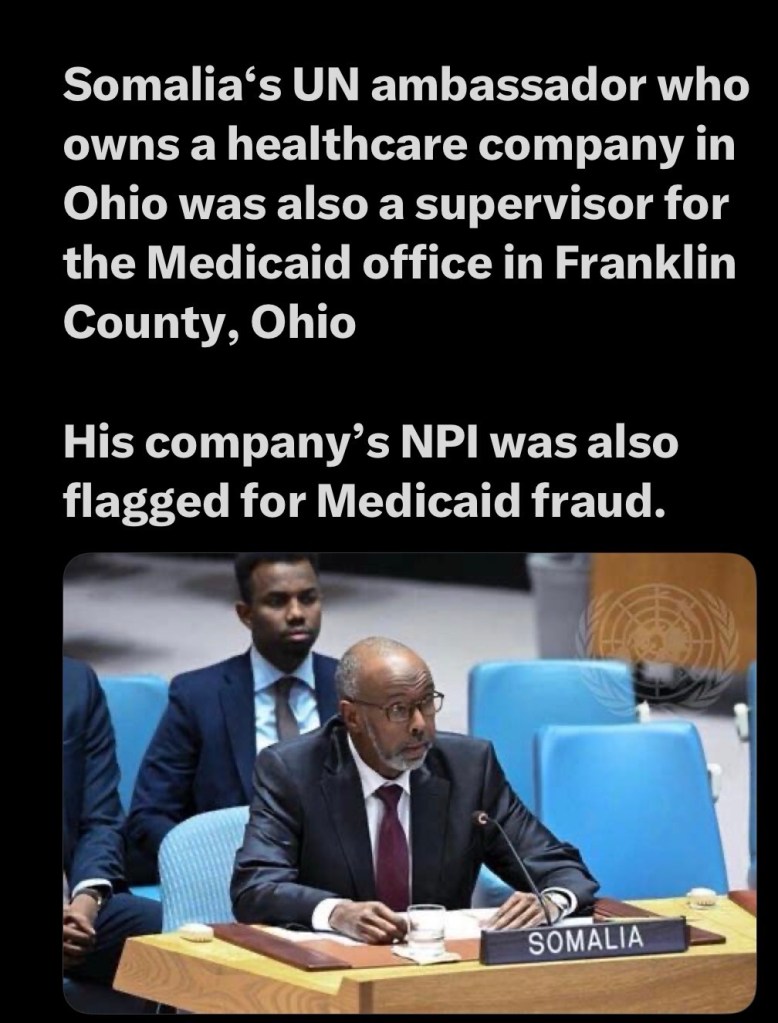
Multiply that pattern across every sector federal money touches. Public education? Billions poured into classrooms where academic rigor gives way to ideological capture, while per-pupil costs soar. Healthcare? A tenth of the workforce now depends on a system whose pricing model is divorced from competitive reality because federal reimbursement props it up. Infrastructure? Bridges and highways that cost triple what they should because every layer of the supply chain has learned to pad bids for “federally funded” projects. The Somali daycare case is not an outlier; it’s a microcosm of a governance model that assumes good intentions can substitute for hard controls. Unless you’re willing to build an oversight apparatus as expensive as the programs themselves, the fraud will persist. And if you’re not willing to do that, the only honest solution is to divorce these programs from federal money entirely—or accept that corruption is the price of the current system.
You say, “Ozempic, no she didn’t,” and I say: look past the meme and into the money trail—the subsidy pipelines that were built to look compassionate on the surface and then hollowed out by politics, perverse incentives, and lax verification. That’s the frame. Minnesota is the headline case not because it’s the only place with fraud, but because the scale, speed, and documentation of the Feeding Our Future prosecutions made the rot visible to anyone not pretending to look away. Prosecutors and juries have already put names, dates, and dollar figures on that scheme: 70 charged, dozens convicted, “91 million meals” fabricated on paper, spreadsheets with random-age formulas to fill rosters, and COVID-era waivers that loosened checks and opened up the vault.¹ ² ³ ⁴ 1234
But Minnesota’s story is not just the kids-meal program. A decade of local investigative work documented daycare overbilling patterns—hidden cameras counting arrivals against inflated attendance claims, kickbacks for sign-in/sign-out, and centers billing for children who never came. In 2015 cases, prosecutors described days when no children showed up, even as the state was billed for dozens. Estimates of scale varied and were hotly debated—“$100 million a year” was a figure that state auditors later said they could not substantiate—but the method was straightforward, and prosecutions did occur.⁵ ⁶ ⁷ 565
Now, at the turn of 2025 to 2026, a viral “door‑knocking” video reignited the daycare angle in Minnesota, explicitly focusing on Somali-run centers. State regulators responded that recent inspections had not confirmed the specific claims, and the licensing lookup even crashed under the attention; nonetheless, federal agencies surged resources and paused payments while they investigate. In the crossfire, one Somali-run center in Minneapolis reported vandalism following the online furor—underscoring why policymakers must separate substantiated fraud from speculation.⁸ ⁹ ¹⁰ 789
That distinction becomes even more important as the conversation shifts to Ohio. Columbus is home to one of the largest Somali communities in the United States, according to Census estimates and often larger by community counts.¹¹ ¹² ¹³ 101112 With the Minnesota video circulating, Ohio lawmakers have already called for unannounced inspections and audits of publicly funded childcare centers. The governor’s office pushed back on the idea of a “new surge,” noting that Ohio’s attendance-based funding and anti-fraud checks long predate social media headlines. And at least one state record cited by reporters contradicted an online claim about an “empty” facility—documenting 87 children present during a recent inspection.¹⁴ ¹⁵ ¹⁶ 131415
The core theme remains: when federal or state money flows through programs with complex eligibility, weak identity and attendance verification, and political pressure to expand access rapidly, fraud risk rises. Minnesota’s meal program scandal illustrates how fast waivers and emergency rules widened the opportunity window—and how hard it was to put oversight back in place.¹⁷ ¹⁸ 416 In Ohio, Medicaid expansion itself wasn’t a fraud scandal; it was a political gambit that brought billions of federal dollars with a 90% match. Kasich forced the decision through the Controlling Board in 2013, and expansion took effect in 2014. Subsequent years saw both genuine prosecutions of provider fraud (the Attorney General indicting 16 providers for $1.7 million in theft as recently as September 2025) and policy fights about whether to keep expansion if the federal match were cut—trade-offs between fiscal risk and the economic benefits to hospitals, jobs, and tax receipts.¹⁹ ²⁰ ²¹ ²² 17181920
So how do you write policy that is compassionate, not gullible; rigorous, not punitive to legitimate providers; and immune to the vote-buying optics of “look at all the dollars I brought your district”? Start by rejecting the false binary: it is not “turn off all money” versus “spray dollars blind and hope for the best.” The path forward is the unglamorous build-out of program integrity—identity, attendance, payments, and audits—with the political will to let real-time controls veto the ribbon-cutting ceremony.
Attendance that counts. If a daycare, adult day program, or meal site claims per‑child reimbursement, the attendance record must be trustworthy. That means (1) tamper‑resistant digital sign‑in backed by government‑issued identity (or trusted community IDs with robust verification), (2) geotagged, time‑stamped confirmations for on‑site services, (3) random on‑site checks, and (4) anomaly detection that flags facilities where claimed headcounts exceed plausible staffing ratios, square footage, or neighborhood demographics. Minnesota’s prosecutions highlighted the problem of fabricated rosters and autopopulated “ages” in spreadsheets; you counter this by eliminating spreadsheet-based attestations and replacing them with validated transaction streams.²³ ²⁴ 32
Payments that pause when signals fire. Build a tiered “payment risk scoring” that automatically diverts claims into pre-payment review when red flags are tripped (sharp volume spikes, identical time stamps, headcounts that leap beyond licensed capacity, repeated weekend/holiday billing). Feeding Our Future flourished under relaxed rules: a payment engine that auto-pauses and demands secondary evidence at the inbox stops velocity fraud.²⁵ ²⁶ 416
Licensing that measures utilization, not paperwork. Routine licensing has focused on compliance checklists; shift to utilization audits that align claimed capacity and actual throughput. Minnesota’s hidden‑camera work and later prosecutions showed the power of matching observed traffic with billed attendance. Ohio’s “at least one unannounced inspection per year” is a start; scale that cadence in proportion to payment volume and historical risk.¹⁵ ²⁷ 135
Separating verified fraud from community scapegoating. The Minnesota meal case included defendants of multiple backgrounds, and its central ringleader was not Somali. Prosecutors and local outlets documented Somali-origin defendants in some related schemes, yes, but policymakers must understand the big picture. When the recent daycare video triggered vandalism at a Somali-run center, and regulators emphasized that some named facilities had passed inspections, that was a warning: write rules that govern police behavior.⁸ ¹⁰ ²⁸ 978
Politics: disincentivize the “show me the headcount” press release. Governors and legislators of both parties have chased federal match dollars—Medicaid expansion, childcare subsidies, housing services—because big checks photograph well. Ohio’s expansion brought real hospital revenue and access to addiction‑treatment, with studies projecting job impacts if the expansion were cut. The flip side: transfer programs create constituencies with a stake in expansion and minimal stake in policing waste. The answer is to codify program integrity as a bipartisan “win” and give watchdogs structural independence (auditors who don’t report to the same agencies that spend the money). Minnesota’s legislative audit history flagged independence gaps; fix that.²⁹ ²⁰ ³⁰ 61921
Concrete legislative package for Ohio (and exportable anywhere):
1. Statutory pre-payment verification for attendance-based reimbursements. Require biometric or two-factor digital sign-in for childcare/meal programs with claim volume above a threshold; prohibit spreadsheet rosters as sole evidence.²³ 3
2. Scaled unannounced inspections. Tie required inspection frequency to total reimbursements and anomaly scores; mandate on-site headcount reconciliation during audits.¹⁵ 13
3. Independent Program Integrity Office. Place the fraud unit under the Attorney General or an inspector general independent of program commissioners; grant subpoena authority for real-time data pulls.²⁹ 6
4. Provider transparency. Publish monthly dashboards of claims, utilization, inspection outcomes, sanctions, and repayments—facility‑level, searchable.
5. Federal match guardrails without cliff effects. Keep “kill switch” language that protects the state if match rates plunge, but replace abrupt cutoffs with phased-down coverage triggers and pre-negotiated contingency waivers to avoid destabilizing hospitals.²¹ ²² 1920
6. Whistleblower incentives and protections. Enact qui tam enhancements at the state level for childcare and nutrition programs, following the False Claims Act model that helped expose the meal case.²⁵ 4
7. Cross-program identity resolution. Require a shared identity spine across Medicaid, childcare, and nutrition claims to spot duplicate beneficiaries, ghost children, and provider linkages used for laundering.
8. Community‑neutral enforcement. Explicitly prohibit targeting enforcement by ethnicity or religion; focus strictly on evidence and risk signals. Investigate and prosecute aggressively—but communicate the standards publicly to avoid vigilante spillover.⁸ ¹⁰ 97
Back to the root claim: “free money” reshapes demographics and creates policy dependence. Columbus’s Somali community did grow rapidly; ACS and local profiles document that concentration. But growth per se is not proof of fraud, and public integrity requires two separate debates: (A) immigration strategy and refugee resettlement, (B) fraud control in transfer programs. When we blur them, we get bad policy and ugly politics. Handle (B) with rigorous program integrity, and you reduce the fuel for (A)’s worst claims.¹¹ ¹³ 1012
In the end, you don’t fix a broken incentive structure by starving legitimate services or by using demographic paint rollers; you fix it by making fraud materially harder and more likely to be caught quickly—and by making the politics of “I brought money” contingent on “I kept it clean.” Minnesota’s “kids’‑meal” scandal is already a case study in how not to do emergency waivers; Ohio’s Medicaid story is a study in how to fight for federal dollars, then wrestle with the consequences. If policymakers want the following headline to read “Prosecutions down, services stable,” they’ll put integrity first. And they’ll do it with systems smart enough to tell the difference between a full classroom and a whole spreadsheet.
All that sounds like a lot of money, and it is. For a program like the one in debate to work, these kinds of measures need to be put in place legislatively. But as we do it, we have to ask ourselves why we should in the first place. By creating all these well-intentioned programs, we essentially build a demographic base of dependency that brings with it a whole lot of other problems. Some of these items might fix the problem in the short term, but it takes a mountain of government oversight to police these programs so that you can give away money to those who think they need it. Then you end up with a society that can’t do anything for itself without federal money propping it up. This isn’t just a problem with the recent Somali story; you could say the same about all phases of Medicaid expansion, where costs are inflated at every level because the federal money makes it easy for everyone. Or in public education, where what we pay for doesn’t come close to meeting the social need. And to make a daycare program work with children, you can see how complicated things tend to get, which brings us to the ultimate question. Is any of it worth doing at all? And I think the preponderance of evidence says no. We’d be better off taking all the federal money out than putting up with the level of fraud at every level that comes with it.
—
Footnotes
1. Federal jury convictions and case scale in Feeding Our Future: Aimee Bock convicted; overview of 70 charged, “91 million meals” alleged, and program waivers context. 12
2. IRS criminal investigation press release detailing random-age spreadsheet formula; guilty plea context. 3
3. FBI/DOJ tallies of indictments and convictions; waiver environment noted. 4
4. KARE 11 coverage compendium from 2022–2025. 8
5. FOX9 decade-of-fraud overview; hidden camera counts vs. billed attendance. 5
6. American Experiment’s 2019 analysis of CCAP fraud allegations and OLA audit dynamics. 6
7. Legislative Auditor statements about inability to corroborate the $100M estimate; prosecutions noted. 5
8. Report of vandalism at Somali-run daycare following viral video. 9
9. Licensing inspections and regulator responses amid viral claims. 7
10. KARE 11’s “full coverage” page noting investigation status and breadth. 8
11. Franklin County/Columbus Somali population estimates (ACS-based). 10
12. ACS program overview and data tools (for policymakers to pull local tables). 11
13. Community estimate commentary (Columbus Somali Community Project / UPG North America). 12
14. Ohio lawmaker letters for inspections; statutory unannounced inspection baseline. 13
15. Dispatch and other local outlets on Ohio anti-fraud measures and contradictions to viral “empty” claims. 1415
16. Additional local reporting on calls for investigation. 22
17. Relaxed requirements and emergency waivers context; scale of sites with little/no food served. 4
18. Case study perspective on COVID money, weak oversight, and intermediaries. 16
19. Ohio Controlling Board approval and expansion launch (2013–2014). 17
20. Ohio AG prosecutions of Medicaid provider fraud (2025). 18
21. Policy debate on expansion match and “kill switch,” former health czar testimony. 19
22. Economic modeling of job and revenue impacts if the expansion ended. 20
23. Specific fraud methods (fabricated attendance; spreadsheet formulas). 3
24. Prosecutors’ description of fake rosters and claimed headcounts. 2
25. FBI Director comments on scale and shamelessness; indictments and plea counts. 4
26. Overview of waiver-driven vulnerabilities in the meal program. 16
27. Historical use of hidden cameras and utilization vs. billing audits in Minnesota daycare cases. 5
28. Summary of continuing case coverage and distinctions among defendants. 8
29. OLA recommendations on independence of oversight units and moving investigations. 6
30. Scholarly overview of Ohio’s Medicaid expansion politics. 21
—
Bibliography (for policymakers & staff)
• MPR News. “Feeding Our Future’s head Aimee Bock convicted on all fraud charges.” March 19, 2025. 1
• St. Cloud Times / USA TODAY Network. “What we know about the Feeding Our Future Minnesota Covid fraud scheme.” March 20, 2025. 2
• IRS Criminal Investigation. “Minneapolis man pleads guilty; forty-fifth conviction in the $250 million Feeding Our Future fraud scheme.” March 24, 2025. 3
• FOX News. “45 convicted in massive $250M COVID-era scam…” July 18, 2025. (Context on waivers and scale.) 4
• KARE 11. “Full coverage: Feeding Our Future fraud scheme.” Ongoing compendium, updated Dec. 5, 2025. 8
• FOX9 Investigators. “Through the years: A decade of investigating fraud in Minnesota.” Dec. 29, 2025. 5
• Center of the American Experiment. “Child care welfare fraud.” Spring 2019. (Discusses OLA and CCAP.) 6
• FOX9 / Fox News Digital. “Minnesota childcare fraud scandal sparks questions…” Dec. 30, 2025. 7
• FOX9. “Somali-run daycare in Minneapolis broken into, vandalized.” Dec. 31, 2025. 9
• Ohio NBC4 (WCMH). “Ohio lawmaker calls for investigation into Columbus‑area childcare facilities.” Dec. 30–31, 2025. 13
• Columbus Dispatch (via St. Cloud Times syndication). “Somali day care allegations prompt demand for Ohio fraud probe.” Dec. 31, 2025. 14
• Cleveland.com. “Ohio GOP lawmakers demand daycare investigation, but viral claims appear dubious.” Dec. 2025. 15
• KFF Health News Morning Briefing. “Ohio Board OKs Medicaid Expansion, Lawsuits Loom.” Oct. 22, 2013. 17
• Ohio Attorney General Dave Yost. “16 Medicaid Providers Facing Fraud, Theft Charges.” Sept. 16, 2025. 18
• Health Policy Institute of Ohio. “Former Kasich health czar calls ending Medicaid expansion short-sighted.” March 21, 2025 (news brief referencing Toledo Blade). 19
• Statehouse News Bureau (Ohio). “Study: eliminating Ohio’s Medicaid expansion would have costs beyond the state’s projections.” July 25, 2025. 20
• ACS / Census.gov. “American Community Survey Data tools and tables.” (How to pull local demographic estimates.) 11
• Neilsberg Insights. “Somali Population in Franklin County, OH by City: 2025 Ranking & Insights.” Oct. 1, 2025. 10
• UPG North America. “Somalis in the Columbus Metropolitan Area.” (Community estimates and context.) 12
• Journal of Health Politics, Policy and Law (Duke University Press). “Medicaid Expansion: A Tale of Two Governors.” Oct. 2016. (Comparative state politics.) 23
Rich Hoffman
Click Here to Protect Yourself with Second Call Defense https://www.secondcalldefense.org/?affiliate=20707

