The American Novelist Ayn Rand: Understanding the rise of socialism in America


I have been saying this for years: ten years ago, twenty years ago, back when I was doing radio shows and walking people through Cleon Skousen’s The Naked Communist and the larger body of work that showed how the communist movement as a philosophy had already impregnated itself into American society. Most people did not want to talk about it then. They treated the subject like an embarrassment or a relic of the Cold War that had been safely buried. I wrote books of my own, put them out there, and kept advocating for capitalism because that is the actual economic engine of the United States. When we talk about America being so great, so wonderful, and we almost seem to have an insecure need to remind ourselves of it all the time, it is because we have been under sustained assault by forces that prefer a corporate form of socialism, and that assault has been aggressive for a very long time. It is a real problem, and the evidence is now sitting in plain sight.

What surprises me is how many people in the Fox News orbit, and in broader conservative media, act as if the sudden visibility of socialism and communism is some brand-new development. The same people who shrugged when I raised the issue years ago now look startled. Bernie Sanders was never an outlier; he was a representative of a current that had been moving on the left for decades. When Democrats start losing ground, you see figures like that gain oxygen, and you see cities and states that have voted blue for generations produce the logical results. New England has been practicing a softer version of this for a long time. New York is not an aberration. The kids running around calling themselves socialists did not invent the ideology in a vacuum. They were taught it. Public schools have been delivering pieces of that curriculum for years, and the culture has rewarded the language of grievance and redistribution. I warned about it. A lot of us did. Now the bill is coming due, and the people who once treated the warning as overheated are suddenly discovering that the problem did not simply disappear.

I like a lot of people in the broader movement. I like Steve Bannon a great deal. The way he has been treated, the jail time, the selective enforcement, the institutional effort to sideline him, has been corrupt and ugly. He has done important work with War Room and with the larger project of forcing attention onto the administrative state and the global arrangements that treat national sovereignty as an inconvenience. He made films, including serving as an executive producer on Julie Taymor’s Titus with Anthony Hopkins, a brutal and faithful take on Shakespeare’s bloodiest play, which is my favorite. That alone tells you something about the range of the man. He has operated inside the Hollywood sandbox for stretches of his career, raised money, dealt with the people who control distribution and narrative, and still tried to produce work that cut against the grain. The question I keep asking is whether you can play in that sandbox for years and come out entirely your own person. I have my doubts. The incentives are powerful. High-level politics and high-level media are environments where you sit around tables with people who do not share the same level of conviction about the productive core of the American experiment. You learn to speak in codes, to manage coalitions, to keep certain doors open. That is the nature of the work. It does not make the man worthless. It does mean the purity of the original impulse gets tested every single day.

What I cannot square is the apparent distaste for Ayn Rand. I have heard him talk about her work in ways that treat it as naïve, or as a kind of Wall Street cartoon of capitalism that turns people into commodities. He has distinguished that vision and what he calls the enlightened capitalism of the Judeo-Christian West. Fair enough as a philosophical difference. Rand was an atheist. She had a complicated personal life. She was more of a pure libertarian than a conservative in the traditional sense, and I am not a big libertarian myself. Yet the core of what she put on the page remains one of the clearest fictional diagnoses of the looter mentality that I have ever read, and it is bizarre to me that someone who understands the value of money, who has operated in finance, who drives people toward serious books, and who has spent years criticizing the Federal Reserve and the soft corruption of the system would keep her at arm’s length. Atlas Shrugged ranked as the second most frequently cited book after the Bible in a Library of Congress and Book-of-the-Month Club survey of works that shaped American lives. That is not a small data point. The novel is a sustained argument about what happens when the people who actually create value decide they will no longer carry the people who only know how to take it.

Rand fled the Soviet Union. The Bolsheviks confiscated her father’s pharmacy. She watched a functioning commercial order get smashed in the name of the collective, and she never got over it. That hatred of the communist method runs through everything she wrote. The Fountainhead came first, in 1943, and it is my favorite of her novels. Howard Roark is the architect who will not let his designs be diluted by committees and second-rate talents who want to ride his talent without earning it. There is a scene where he is invited to join an advisory board for a kind of world’s fair project, and he refuses. He will not lend his name and his mind so that lesser people can loot the prestige. Some readers find that extreme. In ordinary politics it is often impractical. George Lang and I have talked about this more than once. In a majority party you have to work with people whose instincts are not identical to yours if you want votes to move in a productive direction. Absolute purity can become a form of vanity. At the same time, Rand is right that there is a difference between tactical compromise with imperfect allies and the slow acceptance of actively evil principles. You cannot split the difference with people whose operating premise is that your productivity exists to be harvested. Roark’s refusal is a dramatic statement of that boundary. I see versions of it in the best of Trump’s refusal to play the expected game. I see versions of it in anyone who has built something real and then watched the administrative class try to regulate, tax, or shame it into submission.

Atlas Shrugged is the larger canvas. John Galt and the producers withdraw. They stop supplying the energy, the invention, the organizational talent that keeps the lights on. The looters are left with the machinery and no one who knows how to run it. The book is long, sometimes didactic, and unapologetic about the creator’s moral superiority over the expropriator. It is not a happy story. It is a warning written by someone who had witnessed the real thing in Russia and recognized the same intellectual currents moving through American universities and policy circles in the middle of the twentieth century. When the Tea Party erupted in 2009 and 2010, the novel found a new audience. “Who is John Galt?” showed up on signs. Sales spiked. People who had never read a word of Objectivist philosophy suddenly recognized the emotional truth of the strike. Hollywood had no interest in touching the material with any seriousness. The independent film trilogy that eventually appeared was made outside the studio system, with rotating casts, limited budgets, and the predictable critical hostility. Unions and the usual cultural gatekeepers treated the project as radioactive. Clint Eastwood and others circled The Fountainhead for years without ever getting a serious production off the ground. The resistance was not mysterious. The books argue that the people who make things have a moral right to the value they create, and that the people who only know how to consume or commandeer that value are not victims but predators. That message does not sit well with an industry and an academic class that has spent decades teaching the opposite.

I do not swallow every piece of Rand’s personal philosophy. She was extreme. The childhood wound of watching her father’s standing and property taken never fully healed, and it shows in the absolute tone of the later work. I am a Christian. I believe in family obligations that go beyond the pure calculation of self-interest. I do not think every social coordination is looting. But the central distinction she draws between producers and looters is still the cleanest language I have found for what is happening in large parts of American institutional life. Pirates board a ship, kill or maroon the people who built and sailed it, and then congratulate themselves on the redistribution of the cargo. Corporate raiders in the political sense do a slower version of the same thing. They capture the regulatory apparatus, the tax code, the university, the HR department, the foundation, and they extract. They call it equity, sustainability, or the common good. The result is the same: the people who know how to build eventually decide the game is no longer worth playing on those terms.

That is why the party culture matters more than most people want to admit. I watched the new Spider-Man film, No Way Home, and there is a scene where Peter Parker walks into an apartment full of people in their twenties. Beers are being handed around without ceremony. There is no real threshold, no sense that anyone is required to bring anything other than their presence and willingness to dissolve into the group. It is presented as normal, even warm. I have never liked that atmosphere. I married young and stepped out of it early. I do not romanticize the college or post-college party as some necessary rite of passage. Rand saw the same pattern in the Soviet and post-Soviet cultural residue and in the Western imitation of it: the deliberate lowering of standards, the free-love rhetoric that treats self-possession as bourgeois repression, the pressure to surrender individual judgment to the warmth of the crowd. The 1960s did not invent the impulse, but they industrialized it in the West. Once you train a generation to find identity in collective release rather than in the disciplined creation of value, you have prepared the ground for the political language of socialism. The kid who learns that adulthood begins by getting drunk and losing himself in a game or at a party is not being prepared to be a producer. He is being prepared for management.

I am not Howard Roark. I am not prepared to dynamite the building rather than see it compromised. Politics requires more patience and more willingness to persuade than pure fiction allows. But I have learned to recognize the looter pattern early, and when I see it taking over an enterprise I tend to check out. Not with terrorism, not by vanishing into a Colorado valley, but by refusing to keep pouring effort into a structure that has already decided my contribution is collective property. My own book Tail of the Dragon was, among other things, an effort to work through the same themes of self-initiation and refusal to be pulled under by people who only know how to take. Readers who have lived the problem recognized it.

If I were twenty-five again, or just out of college, or interning for some member of Congress on the Hill with more time than obligations, I know exactly how I would spend it. I would get a Library of Congress reader card, which is free and available across the hall from the main reading room, and I would go into that magnificent space every day, with its gold ceiling and its quiet gravity. I would take Atlas Shrugged or, better, start with The Fountainhead, and I would read for an hour or two. The tunnels that run under the street connect the Capitol complex, the Court, and the Library, so the people who work there never have to step outside into the city’s ordinary weather. It is a physical expression of the idea that the serious business of the republic is intellectual before it is anything else. Steve Bannon lives essentially next door to that world. The proximity is not accidental. The same few blocks contain the Supreme Court, the Library, and the offices where the daily compromises of legislation are hammered out. It is the most concentrated expression of American institutional ambition I know. I would use it. I would also walk over to the Supreme Court cafeteria when I needed a break. The building itself is a statement that law is supposed to be something higher than the temporary majority. Spending months in that environment with Rand’s novels would do more for a young person’s understanding of the current crisis than any number of seminars on equity.

I did my own version of that education later at night, after second-shift work, at Perkins, Denny’s, and Waffle House between midnight and four in the morning, reading until it was time to go back on the clock—hundreds of books. The habit of sitting alone with a serious text and refusing the easy company of the moment is how you build the internal resources that later let you recognize a looter when he smiles and calls himself your partner. The same impulse took my family to Put-in-Bay just a few weeks ago. Sometimes you need an island, a stretch of water, a temporary removal from the people who treat your energy as an open account. It is not Atlantis. It is just a necessary interval of clarity.

The novels are fiction. They are also more accurate in their portrayal of the moral psychology of redistribution than most of the nonfiction assigned in schools. Socialism is not a discovery. It is the oldest temptation in political life: the belief that the people who did not build the thing have a superior claim on it because there are more of them, or because they feel more strongly, or because history is said to be moving in their direction. Rand had watched that claim enforced with guns in Russia. She wrote the American version of the warning. You do not have to accept her atheism or her more extreme personal conclusions to see that the warning still applies. The engine of the world is not the committee. It is not the hashtag. It is not the person who has learned to speak the language of the oppressed while living off the productivity of others. The engine is the individual mind that looks at raw material and sees a railroad, a new alloy, a better way to generate power, a story worth telling, and then does the long, unglamorous work of making it real.

That is what is under assault. That is why the old books keep finding new readers whenever the political temperature rises. And that is why I keep returning to them even when people I otherwise respect prefer to keep their distance. The argument is not finished. The strike is not over. The only question is how many people still remember what it means to refuse to be looted.

Notes

1.  W. Cleon Skousen, The Naked Communist (Salt Lake City: Ensign Publishing, 1958; multiple later editions). Skousen, a former FBI agent, distilled Marxist theory and operational history into a widely circulated Cold War text that sold nearly two million copies.

2.  On the 1991 Library of Congress / Book-of-the-Month Club survey ranking Atlas Shrugged second only to the Bible among books that most influenced respondents’ lives, see Los Angeles Times, “Bible Ranks 1 of Books That Changed Lives,” December 2, 1991; and subsequent discussions in libertarian and Objectivist literature.

3.  Steve Bannon’s critical distinction between Randian capitalism and “enlightened capitalism of the Judeo-Christian West” appears in reporting from his 2014 remarks and later analyses, including Ralph Benko, “Ayn Rand’s Ghost Does Not Haunt The Trump Administration,” Forbes, December 18, 2016, and Wikipedia’s summary of Bannon’s economic nationalism.

4.  Bannon’s role as executive producer on Titus (1999, dir. Julie Taymor) is documented in contemporary Variety coverage and later profiles, including The Paris Review, “Steve Bannon’s Obsession with Shakespeare’s Goriest Play,” November 29, 2016.

5.  Ayn Rand’s family background and the confiscation of her father’s business after the Bolshevik Revolution are standard biographical facts; see Anne C. Heller, Ayn Rand and the World She Made (New York: Nan A. Talese/Doubleday, 2009), and Barbara Branden, The Passion of Ayn Rand (New York: Doubleday, 1986).

6.  Sales surge and cultural visibility of Atlas Shrugged during the Tea Party period (2009–2010) are recorded in contemporary publishing data and reporting; “Who is John Galt?” signage became a common visual marker at rallies.

7.  The independent Atlas Shrugged film trilogy (2011, 2012, 2014) was produced outside the major studio system after decades of unsuccessful Hollywood development efforts. Critical and commercial reception was poor; the producers widely noted union and cultural resistance.

8.  Rand’s major fiction: Anthem (1938), The Fountainhead (1943), Atlas Shrugged (1957). Nonfiction collections include For the New Intellectual (1961) and The Virtue of Selfishness (1964).

9.  Parallel readings of Atlas Shrugged and the original Star Wars (1977) as narratives of resistance to oppressive systems are interpretive; George Lucas has not affirmed direct influence, though readers of both frequently observe the thematic overlap with individual agency versus bureaucratic or imperial control.

10.  Personal observations on party culture, the Spider-Man: No Way Home apartment scene, and the Put-in-Bay interval are drawn from direct experience and recent family travel.

Bibliography

Branden, Barbara. The Passion of Ayn Rand. New York: Doubleday, 1986.

Burns, Jennifer. Goddess of the Market: Ayn Rand and the American Right. New York: Oxford University Press, 2009.

Heller, Anne C. Ayn Rand and the World She Made. New York: Nan A. Talese/Doubleday, 2009.

Hoffman, Rich. Tail of the Dragon. [Publisher details per author’s edition].

Hoffman, Rich. The Gunfighter’s Guide to Business. [Publisher details per author’s edition].

Hoffman, Rich. The Politics of Heaven. Manuscript in final preparation, targeted 2027.

Peikoff, Leonard. Objectivism: The Philosophy of Ayn Rand. New York: Dutton, 1991.

Rand, Ayn. Anthem. London: Cassell, 1938; various later editions.

Rand, Ayn. Atlas Shrugged. New York: Random House, 1957.

Rand, Ayn. For the New Intellectual. New York: Random House, 1961.

Rand, Ayn. The Fountainhead. New York: Bobbs-Merrill, 1943.

Rand, Ayn. The Virtue of Selfishness. New York: New American Library, 1964.

Skousen, W. Cleon. The Naked Communist. Salt Lake City: Ensign Publishing, 1958; subsequent editions.

Shakespeare, William. Titus Andronicus. Multiple scholarly editions; film adaptation Titus (1999), dir: Julie Taymor, executive produced in part by Stephen K. Bannon.

Additional context on the Tea Party’s reception of Rand, Hollywood’s development history of the novels, and Bannon’s public economic commentary may be found in contemporary reporting from Forbes, The New York Times, Variety, and Objectivist periodicals such as The Objective Standard and New Ideal. For the Library of Congress survey, see the 1991 Book-of-the-Month Club / Center for the Book results as reported in the Los Angeles Times and subsequent secondary literature. Primary Marxist and progressive texts that form the intellectual background against which Rand wrote remain essential contrasting reading: Marx and Engels, The Communist Manifesto; and selected works of the American progressive and New Left traditions.

Rich Hoffman

More about me

Click Here to Protect Yourself with Second Call Defense https://www.secondcalldefense.org/?affiliate=20707
About the Author: Rich Hoffman

Rich Hoffman is an author, political consultant, and strategic advisor based in Cincinnati, Ohio, and the creator of The Politics of Heaven—a unique framework that connects biblical theology, ancient history, and modern power structures to explain how moral alignment and spiritual forces shape global events. Blending real-world political experience with deep research into archaeology, UFO phenomena, and suppressed historical narratives, Hoffman offers compelling commentary on topics ranging from ancient civilizations and the Dead Sea Scrolls to modern populist movements, paranormal continuity, and leadership strategy in chaotic environments. As the author of The Gunfighter’s Guide to Business and the forthcoming Politics of Heaven, he brings a grounded yet provocative voice to media discussions, supported by firsthand experiences and a cross-disciplinary approach that bridges science, history, and theology. For interviews, speaking engagements, or expert analysis, visit richhoffmanbooks.com or contact directly via phone at 513-307-5815 or email at rhoffman@richhoffmanbooks.com.  If you’ve seen the movie, Disclosure Day and want to talk about it and the implications of Presidnet Trump’s UAP disclosures, let me know and we can bring some color to your coverage. https://richhoffmanbooks.com/media-inquiries-broadcast-topics-and-contact-info/?frame-nonce=ad51e7ecba I do have a firsthand UFO encounter to discuss.

A Warning for Trump: Be careful of the bootlickers and losers

This is the hard part, with the honeymoon essentially over, the Trump administration has to watch that it doesn’t lose its edge.  I’m not particularly worried about it, but it’s something Trump will have to be careful about because when it comes to deal-making, he loves doing it certainly more than the political process.  And we’re talking about falling in love with the people you negotiate with, like China, like Russia, Syria, Saudi Arabia, where people pander to him, massage his ego, and then slip the Shakespearian knife in Trump’s back when they think he’s not looking.  The bad guys in the world have no choice but to appease Trump. That is the case usually with my “gunfighter at the bar with his back-to-the-room” metaphor that I always talk about.  The enemy does not seek to kill valuable people if they think they can use them first, which is perfectly true with Trump and his natural ability to get leverage in just about any situation.  But it is because of this tendency that Bill Gates and Dr. Fauci lied straight to Trump’s face about COVID during the last administration, the Fed practiced Modern Monetary Theory with Larry Fink as their distribution center right under the nose of Trump.  This is the point in the story where the appeasers appease, and the suckers bite on the sweet candy and sicken themselves forever.  And Trump, if he wants to do well in this term and achieve all the things that are possible, has to be cautious about his nature.  “If you can’t beat them, join them,” is what the enemy is saying.  And adding, “then beat them when you have their trust by a last-minute betrayal.”  Trump has to resist falling in love with the bad guys under the pretense of compassion because the villainy they are capable of is far worse than his nature understands.  At heart, he has developed into a great negotiator by understanding how to read a room and its people.  And he generally does like people.  And the only defense that bad people have against such a person is to appeal to his good nature to keep him from destroying them.  And many of them need to be destroyed.

The caution comes from Pam Bondi at the DOJ, the handling of the Epstein files, and the public expectation that people will go to jail.  And James O’Keefe and Laura Loomer have been reporting that there are not so forthcoming reports on other elements, such as video of sexual exploitation of children involved in the Epstein Island personalities.  And when you play in the sandbox that Trump plays in, and Pam Bondi, it is likely that people you know are on that Epstein list, and the pain and betrayal of that can be pretty harsh.  This is the difference between campaigning and doing.  It is easy to talk about something, but not so easy to do it.  Ultimately, I think Trump will follow through on the challenges before him.  However, in trying to deal with people and salvage relationships, especially in the Middle East, sometimes his love of making friends is more than destroying an enemy, and it will be used against him.  We’re dealing with some evil people who must be dealt with harshly.  It’s what people expect and don’t necessarily want to make a deal with bad people, even if it doesn’t strengthen the American position in the world.  And Trump is going to have to fight through that carefully.  The best way to preserve Trump’s legacy is with America First and easy wins on the scoreboard.  We have the midterms coming up soon, and if Trump wants more than just a couple of years of cosmetic cooperation, he needs to put some bad guys in jail.

The judicial problem I thought was very well explained recently by Matt Gaetz on the WarRoom.  To become a judge in America, you have to jump through many hoops, belong to many clubs, and prove yourself to be a good caretaker of the BAR Association, which has shown to be very progressive and radical.  I have often pointed out, especially among older judges, their relationship to Freemasonry as a problem because of their commitment to altruism, which, for fans of Ayn Rand, is a deadly word in a productive society.  We elect Presidents, congresspeople, senators, all kinds of positions, but the hold outs to the MAGA agenda are these legal people who are connected to deep and malicious finance, and they do think they can appease the beast in Trump just long enough to crush him when his back is turned and that’s where we are.  People who survive the barriers to the judicial profession only do so by jumping through hoops of social formation that is truly devastating to the perpetuation of a productive, sovereign country, and that is what Trump is up against.  Appeasing them with kindness and good deals won’t stop the villainy of their nocturnal deeds, and their oaths to the corruptive nature of mass collectivism, through the sacrifice of self, for the benefit of others.  Many judicial types see their role in life as stopping materialists like Trump with everything they have in their very souls.  And there is no way to make friends and bring them to your side.  They have to be destroyed, and if they are on video doing nasty things with little kids on Epstein Island, they need to be torn to shreds in front of the public spectacularly because it’s what people want in our Representative Republic.

Glenn Beck ran the numbers recently through AI on the possible ways the American economy survives.  And let me say that I think most of them are wrong.   I am very optimistic about the future of America and our economy.  But we must listen to caution and do good things with the information.  However, those AI programs don’t have many scenarios where the American dollar will survive an economic collapse in the world by 2030.  And I know that’s where Trump’s heart is.  There is a good chance that the AI programs can’t see yet, because it’s more intuitive than practical, that America will lead the world in a capitalist revolution that will improve things for everyone.  But many bad people will gladly throw themselves in front of that train, and we have to have the guts to run them over.  Because those people have the wrong ideas about existence, there is no way to reform them.  And it’s through that kind of ruthlessness that America survives and thrives. But there will be a lot of casualties, and some of them will be friends.  And it will be painful.  And there is no way to negotiate away the pain.  And not fall in love with the office of the Presidency because the ceremonial routine is filled with appeasers trying to massage Trump’s ego, just long enough to outlast him.  Don’t ever lose your edge because the edge that matters is in the knife they are trying to stick in Trump’s back when they think he’ll turn his back just long enough because it’s the only move they have.  Be recklessly cautious.

Rich Hoffman

Click Here to Protect Yourself with Second Call Defense https://www.secondcalldefense.org/?affiliate=20707

The Secret of Hiram Abiff: Sacrifice is not the highest form of self and for over 5 million years, humans have had it wrong

People have an ancient need, most people do, to belong.  They need to feel attached to other people, which is likely the case for the last 5 million years of human evolution.  Likely, it goes back much further than that, and if we dig deep enough in the earth and the mounds of antiquity, we would discover the limits of our carbon dating method in that it can only give us results for items that don’t decay away into nothing within a few thousand years.  And that the evidence for the Vico Cycle elements of human existence has been shed off the Earth’s back many times.  The evidence of this history is physical, and it’s so disturbing to institutional knowledge that it rocks the foundations of human belief systems so it has emerged underground to those who want to think of themselves as only the wisest to see it, and that personalities like Pythagoras and Hermes were the carriers of this ancient knowledge from the mystery schools where the initiates were given this vast knowledge to be carried like bricks of a wall into the tapestry of human purpose and existence, which leads to all the conspiracy theories of Freemasonry and the happenings that go on in Masonic lodges.  I happen to know a lot of masons, master masons, and the type, and I am what many would call an expert on the occult.  That’s not something that they give you college degrees for; it’s only something you can acquire by reading vast amounts of very esoteric material.  But I am not a Mason.  I have been offered to be.  Just as saying that I’m an expert at the occult doesn’t mean that I’m sacrificing chickens to some demon god from beyond time and space.  I would argue that they are all wrong in what their application to life is and has been, and my opinions are very much alone in this regard.  So I’m willing to argue the merits, but I understand the need, and in saying that, I understand why there is so much anger and fear over the Trump presidency.

When I say that human existence has evolved over millions of years, I say that because it would have taken at least that long to develop the religion of astrology and to calculate all the math that has emerged into the mystery schools for which Egyptian society was built, and even Jewish, Greek and Roman society.  There is a lot of talk about the necessity for numbers that are hidden in the text of the Bible for instance that point back to the alignment of the planets and how long it takes to develop a thought process of observing the powers of an all knowing God through the placement of stars in the sky so that a belief system can emerge.  This is also why there is so much terror over humans traveling to Mars, because the night sky will be different there, and many of the astrology mystery schools that have emerged from what Masons believe to be Atlantean origins for all life on Earth will mean completely different things in a Mars night sky.  So these mystery schools are very timid about modern society, and they see it as a vast evil because it’s selfish and materialistic, and that the point of Freemasonry is to give up all those things and to die of the self, and be initiated into the whole, the root cause of mankind’s actual failure, the need to belong to others and to limit themselves to a collective whole.  It is in that statement that subconsciously, we see Freemasonry as evil and corrosive, while they see altruism and giving up oneself as the ultimate merit of a life well lived.  To live for others, not to ever utter that others might not be worth living for. 

Most of the heroes of these mystery schools have never outgrown the need for sacrifice and appeasement to the ultimate forces we call God in the universe.  And back to the occult worship, I study why they want to be occultists, I would never seek the help of supernatural aid to achieve something I want to do in the world, which is what all forms of sacrifice are, the sacrifice of life to a God and hoping that the god will grant some wish to the person doing the sacrifice, it’s an immature desire to appease the master parent of life that people never grow out of as children.  Children want to appease their parents, whom, when they are little, see as very strong and bigger than they are.  So too are adults and their occult gods.  The need to sacrifice to them is of the same mentality.  But slowly, humanity has outgrown that desire, and what is happening with the Trump presidency is quite an extraordinary transition.  It’s a kind of “Who is John Galt” approach to the ancient mystery schools of yielding to the forces that need to be sacrificed to, which for Freemasonry is the point of their existence, represented in the architect of King Solomon’s Temple, Hiram Abiff.  In Freemasonry, initiates learn about the murder of the Temple’s architect on the steps of rising knowledge and wisdom within the Temple by three ruffians who demanded to know the secret of the order.  But Hiram refuses, so he is killed over it, where Freemasonry sees this as a highly moral act of defiance to the materialistic forces of heathen behavior.  The ultimate secret that Hiram died for in refusing to disclose about the masonic order is that altruism is the highest form of life for which all should live and sacrifice to. 

Like the John Galt character from the famous book Atlas Shrugged, President Trump is a materialist who has dedicated himself to American capitalism and its advancement as a moral obligation.  Many Freemasons lean toward socialism, but because of the nature of their belief systems, there is a struggle.  Most of their heroes, like Pythagoras, were killed by aggressors, which points to the problem of the psychology of the belief systems at their heart.  Socrates was killed.  Jesus was killed much like Pythagoras, at the hands of the mobs and political elements of their times, so for people of those mystery school orders, those are necessary sacrifices that must be made to live a good life, and not to fear it.  Give back to people while you still can and die to the nature of the self. At the same time, Trump expresses living a good self that spills over through the power of positive thinking, encouraging others to live better for themselves for the sake of themselves.  And when an assassin’s bullet failed to land in Trump’s head, killing him, this rocked the subconscious of more than 5 million years of mystery school thinking, which has been wrong from the beginning.  So the universe is pretty upset that Trump is president.  And its acolytes, as well, are not happy that sacrifice is losing its power over human existence.  And this has been the cause of the many Vico Cycle failures of civilization throughout that duration, even the fall of Atlantis, as the Greeks told the story, ending in corruption and sorcery well before the island continent sank under the Atlantic Ocean.  Their civilization was dead long before that happened, and they took their poison with them to the far reaches of the earth to start new civilizations that we now dig up and see their ancient ruins. But in the scheme of things, they are just recent events compared to the long struggle to grapple with them.  But for the first time, sacrifice isn’t the core belief system. Instead, productivity is what has rocked the foundations of every collectivist organization that ever existed.  And they are very terrified of that emergence. 

Rich Hoffman

Click Here to Protect Yourself with Second Call Defense https://www.secondcalldefense.org/?affiliate=20707

The Blood Cult of Baal: Destroying the Deep State demand for sacrifice

Since it is the most obvious topic in the world, and I have had to talk about it related to several local cases, many people have approached me wanting some kind of class on the conspiracies that most affect us, and why they are important. And unfortunately, either consciously or unconsciously, most people participate because of their need for group behavior. It’s a problem that has been with us since the beginning of time. The keys to this problem are outlined especially in the Bible, which I’ve had a relationship with for over 50 years. And I’ve read it many, many times. Then, as our times demand, because it’s the main topic of our everyday news, I constantly refer to one key aspect that reminds me of the supporting text of one of my favorite passages, Psalms 82. Now, I have known people who would consider themselves biblical scholars and make their livings interpreting the Bible, and my take on the purpose of the Bible is entirely different. I think all the churches and almost every person get the interpretations of the Bible wrong, the point of the plot. All the Abrahamic religions, Christianity, Judaism, and Islam, have, to my mind, interpreted everything incorrectly, which makes up most of the religions of the entire world. The rest believe that UFOs came to the world and had a massive battle, and we are the result, which is clearly the case in the Mahabharata, which I’ve read too and is a thing all its own. For the Bible, I think the Greeks and Romans saw what they wanted to see when they gave their interpretation of the Bible, and people who wanted to control all humanity carefully edited the text for a very malicious purpose, and that was to preserve the Cult of Baal that has been with us since the beginning of recorded time, predating the Bible by many thousands of years, likely tens of thousands of years.

The Cult of Baal it’s very much alive today, maybe more than ever.

As I said in the video, which covers a lot of needed ground, I see myself as politically right of God, Yahweh. I am far more conservative. But out of all my religious study over the years, I really like Yahweh and I feel his pain, and want to help him. When I read the Bible, I don’t read about an all-powerful god who created the universe. That might be the case from various points of view. What I see is a character trying desperately to destroy the Blood Cult of Baal so that humanity can perpetuate productively into a much more prosperous future. It is Baal who is the Darth Vader of the Bible, not Satan, Lucifer, or the Devil, which are mentioned in the Bible but are not discussed nearly to the level that Baal is. The fight between Baal and Yahweh is the entire point of the Bible, it’s the plot that should be the center of all discussion. Yet the presentation of the material is given to us to serve deities, as humans always did. People either pick Baal, which is always tempting humanity away from God, Yahweh, or they like Yahweh so long as he performs some magic and heals some people from illnesses, almost like they must be bribed into doing the right thing in life; otherwise, they always slip into the temptation to worship Baal. And this is how we get our modern political foundations where “sacrifice” is the core tenant of religion and life as we know it. But what I hear coming from Yahweh is “productivity.” Yahweh, in many ways, wanted people to become capitalists, and he rewarded those who fought to free people of bondage to the Cult of Baal. Think of Elijah at Mt. Carmal, the famous dual between the priests of Baal and Yahweh, 1 Kings 18. Why is it do you think that the “Free Palestine” movement is also capitalist-hating Marxists? The answer is obvious if you look with the right eyes and correct definitions of reality.

Abortion is just one form of the modern sacrifice culture to ancient deities.

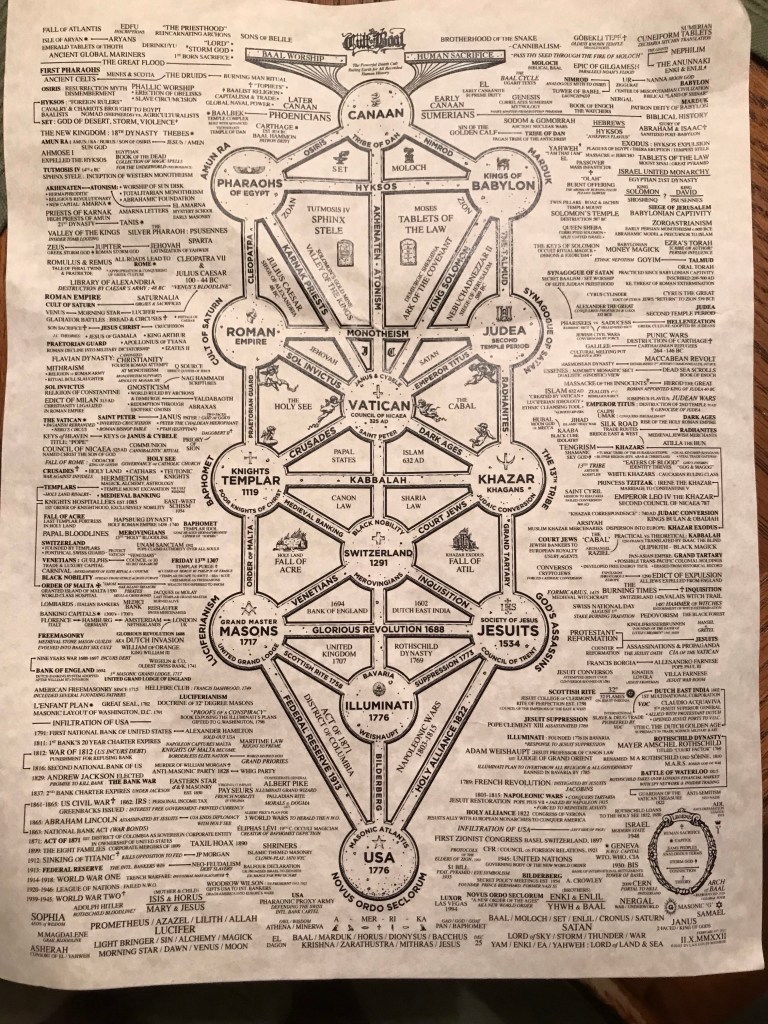
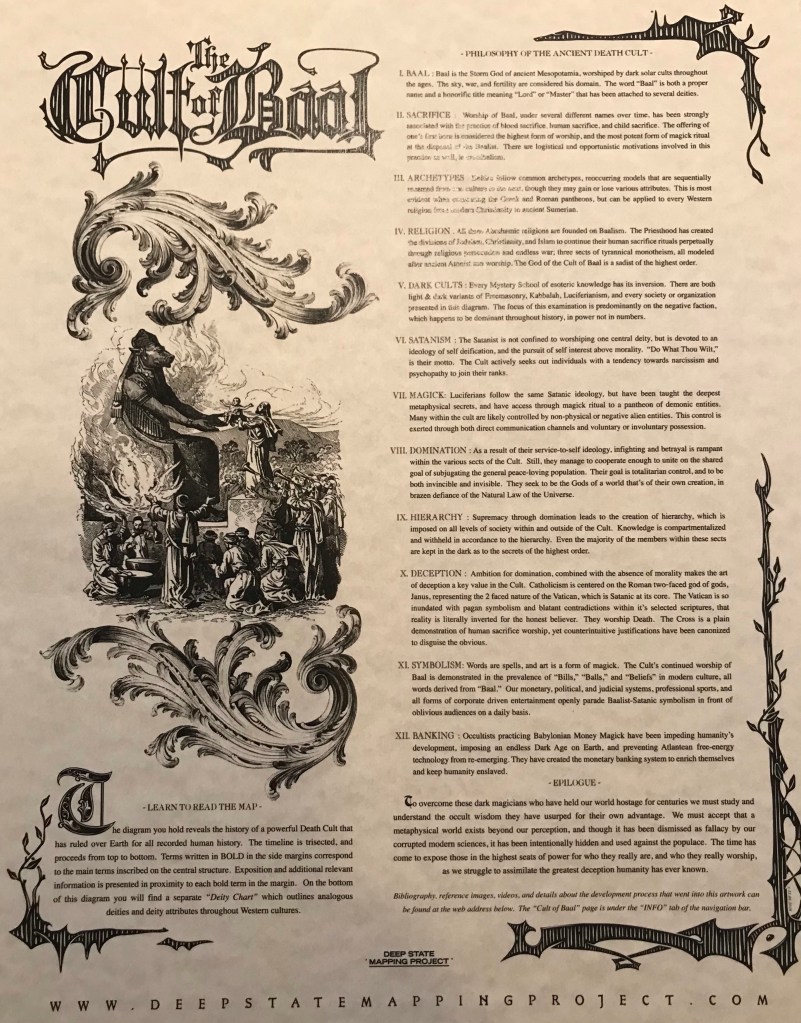
The great deception is constructing a society that still serves Baal while the global masses perform the deeds unaware.  This was done by essentially changing the names and focus of our religious figures to lure everyone into continuing to serve Baal in his insatiable appetite for sacrifice.  As people asked me for more information, I thought of these guys at the Deep State Mapping Project, a very new phenomenon.  I don’t think these guys would even exist if not for Trump’s first term in office.  But the crack in the façade occurred, and now there is water squirting out everywhere, and these Deep State Mapping guys are part of that positive erosion of the Deep State control over the world.  When we talk about the Deep State, we are talking about a complicated history that essentially is committed to keeping the world in the mode of sacrificial beings appeasing Baal and his pantheon of losers, cutthroats, and maniacal lunatics who are hundreds of thousands of years old and still linger in our interactions of quantum physics.  Yahweh was rebelling against this Cult of Baal as is captured in that Psalm 82 passage and other places, especially in the actual Jewish word for God, Elohim, which means plural god in many cases, or a reference to the Divine Council that rules everything from beyond our conscious tapestries.  I’ve known about all this for a long time, but the plot became most apparent when all these characters thought they could get away with the COVID killings, massive election fraud, and domination over the media in an attempt to get rid of Trump and the humanity that elected him.  It was the Deep State grasping for power as the old Cult of Baal was being threatened for the first time because of the decentralization of information in our current society. 

Baal has always been a problem

These Deep State Mapping guys have taken many of the studies I have personally conducted and made it very easy for people. It might seem like a crazy QAnon conspiracy theory at first, but I have independently validated most of the maps they offer, especially the Cult of Baal, and can provide testimony to their truth. Trying to shame people into compliance is the way the Cult of Baal has maintained itself for thousands of years, and it is a starving entity that demands humans sustain a cult of sacrifice, which we have. Sacrifice is the central premise behind most of the world’s religions on purpose. Yet, Ayn Rand, an atheist, could see this problem nicely by pointing out that human beings are meant to be productive. If you make things, why would there be a need to sacrifice anything to anyone, no matter how vital the god was? The conspiracy theories of the past, and I read all of Jim Marr’s books, and I miss that guy a lot, aren’t so conspiratorial now that the curtain has been pulled back, and we can see things better than we ever have. And to see this vast conspiracy in the best, most educational way possible, I would suggest the material provided by the Deep State Mapping Project. Things are going to get pretty wild over the next ten years. The Deep State has already lost control, so the water is flowing faster now. I spend a lot of my free time trying to prepare people for it by having them question the reality they have been taught. Yahweh understood, and I like him. I want to help him and spend a lot of my time doing that for purposes that the human race has a great need of. And these guys at deepstatemappingproject.com are doing a great job simplifying the process and vast amounts of information. It took me four or five decades to piece it all together myself. It’s all there for your convenience, and for those curious, I would suggest starting that needed education with their material. There is much to discuss, and an excellent map certainly helps.

Who would ever think to sacrifice their firstborn children to Baal? Apparently, a lot of people, as history has witnessed through oceans of blood and death.

Rich Hoffman

I Disagree with the Bible on Wealth Creation: Money is a measure of good and evil

One of the problems I have always had with the Bible, going all the way back to bible school, which I had most Sundays from age 5 to the 8th grade, was this idea that a rich person was evil and working against God unless they gave away all their material items during their life and wholly dedicated their life to God, in every way. I have never read the Bible that way nor interpreted religion with such narrowmindedness. Making money and religion were always two separate things as defined by the old powers of Europe, and I really didn’t have a personal approach to it until recently, when I spent a considerable time in the deserts of New Mexico writing my book The Gunfighter’s Guide to Business, and specifically the chapter where I say, “Money is not the Root of all Evil.” There I argue that America has been a different kind of invention that couldn’t have been understood during the Biblical period, nor when the Romans decided what books of the Bible to include in the Council of Nicaea. Cultures have been hindering themselves with this problem for many thousands of years at this point, and it’s caused a lot of problems. But before you can come to a rational conclusion on the matter, you have to go against literally every pastor, minister, and biblical interpreter that has ever been known because I think they all got it wrong and that they have been holding civilization back, and creating many of the problems we see today politically, and have actually empowered evil to thrive behind the definitions as they have been interpreted by institutionalism, as the Roman Empire was undoubtedly inspired to do.

A few of the most controversial passages from the Bible regarding wealth come from the Book of James 2:6 “But ye have despised the poor. Do not rich men oppress you and draw you before the judgment seats?”  Then again, with Jesus saying in Luke 18:25 that “it is easier for a camel to go through the eye of a needle than for a rich man to enter the kingdom of God,” There are many others, of course, littered throughout the Bible and I would argue not so much that they are wrong, but that they don’t capture the entirety of the morality of money. I have personally been able to forgive the Bible for these definitions, which run counter to the essence of a life well lived, but at the core of how the political left attacks conservatives is this deeply rooted guilt of making money and taking care of the poor. Because if a conservative has made a lot of money in their life, then by association, they will turn away from the Bible because it doesn’t fit their life experience with definitions like what the Bible provides. But with all other things, especially in the definitions of evil, which are well articulated throughout the Bible, then those get tossed away as well. My argument has been that the concept of American capitalism, as established by the wonderful book The Wealth of Nations by Adam Smith, is that in the times of Jesus, nobody had good definitions of money and how they were moral markers in a healthy society. And who would have expected the writers of the Bible to ever figure it out during that period of human history? Indeed, proper definitions of the value of money in a culture did not arrive upon the human race until Ayn Rand did it in her outstanding work, Atlas Shrugged, in 1957. And such a definition would have only come from a culture like America, which was vastly different in its use of capitalism than any other place in the world.

America was created to answer an ancient problem: living life free of kings and regional governors. In such a society, the only way to get rich was to obtain permission to be so by schmoozing up to the powers that controlled the region people lived in. And this is undoubtedly the issue during the teachings of Jesus. To preach the ways of God that he was, away from Jewish institutionalism, was a severe rebellion in those times. It was an unheard-of menace, so they plotted to kill him. And, of course, the people who were protecting their wealth would have been the villains of what Jesus was preaching. But there wasn’t an America even conceived of at the time, and the writers of the Bible never could imagine anything like freedom being possible. So the problem persists for a nation like America that it was built around a religious connection to ancient documents that defined money before the concept of individual freedom had been worked out politically. And for the human race, that is a very recent development. It’s even more recent than the work of Karl Marx in Europe. There is a morality to money, as applied by the United States, that is quite a good measure that is fundamental to rooting out evil in a society that is very much the topic of our present politics and is the theme of our times. 

I benefit from knowing many people in my life who are very rich. In some cases, they are extremely rich, and I have been able to see up close how that wealth creation has benefited the world around them. Adding to that an extensive study of comparative religion and reverence specifically for biblical research, I can see how definitions working against the rich, or materialism in general, would cause people problems. But I would say the Bible is wrong about wealth creation and the “rich” in general while being “right” about the definitions of “evil” itself. We can’t just pick and choose what we like in the Bible and toss out that which we don’t, which most religions do, no matter what their source material is. Instead, I would say that wealth creation has benefited from inventions in politics over the years and that the criteria for rich people have changed with the creation of America. Money helps a healthy society measure the morality of a culture in ways that institutions have never achieved after many centuries of trying. In a free culture, those who make money do so because society values something they produce for that society. But we associate wealth creation such as the Biden family has achieved as a sell-out of his office to the rivals who would like to destroy the concept of capitalism to hide their evil actions behind the traditional definitions they can’t live up to. But for a person like President Trump, who has acquired all the material items and wealth that could be imagined in a single lifetime, then used that wealth to fight for the cause of truth and justice, then suddenly the Biblical definitions aren’t broad enough to encompass the morality of money as a representative of a life well lived. Then, in that case, all wealth creation is not equal; it is good and bad among the wealthy, and how they have made their money roots out their behavior in ways that benefit moral discourse. And in that way, the right kind of wealthy people are paramount to a healthy society, especially in contrast to those who were likely just as Jesus spoke about in his time with the metaphor of the camel and the eye of the needle. 

Rich Hoffman

Click to buy The Gunfighter’s Guide to Business

George Lang: The Morality of Money

I get asked often why I like George Lang, the Ohio senator for the 4th District, so much. I cover a lot of topics, and having so much respect for an establishment politician doesn’t often seem like they are elements that are conducive to each other. I think it’s the same kind of anxiety that is often witnessed when showing respect for Ayn Rand while still having great reverence for the religious right, the hard biblical conservatives. How can you serve the God of money and still serve God because we think of those things as opposed to one another? Yet, while Ayn Rand was an atheist, she was able in her work to cut through the true value of the measurement of money in a culture in very beneficial ways that are well represented in great American novels like Atlas Shrugged and The Fountainhead. And few people in the world understand the morality of money more than George Lang, not in serving it as a deity of its own, but as a measure of good human conduct. It’s a side of politics that not many people get to see, especially translated by a media culture that has no way to express such a topic to the public, because they don’t understand it themselves. However, an economic report coming out will show Ohio in a very favorable way. The time of improvement is when George Lang has been in Columbus as first a representative, then as a senator. I see his fingerprints all over the detailed findings showing the state of Ohio becoming quite an economic powerhouse. I’m not allowed to talk about it yet, not in detail. But I was quite impressed with it, and it points to some not-so-well-known attributes that come directly from George Lang’s Business First Caucus, where he has stayed very focused, along with a handful of other politicians in Columbus. And that is very unique among any political class because if they don’t understand the “morality of money,” they quickly become the detriments often talked about in the Bible who lose their way and get distracted by every shiny thing. And by walking that tightrope, George Lang has done some extraordinary things as a senator that is making Ohio much better off than the federal government as a whole that is suffering significant hardships under Joe Biden and the other looters of the Beltway culture. 

You may have to turn up the volume, but this room paid great reverence to Senator Lang, which was well deserved.

A few things happened recently, I was in a meeting with a bunch of people from Columbus who expressed themselves with great respect to George Lang, and they wondered if the people of Southern Ohio knew how good he was behind the scenes when people weren’t looking. Of course, the answer is yes; most people do know. And I was also recently up in Columbus at the Statehouse talking to many people, and the running joke about “Georgie” is that he doesn’t want to talk about anything but a business-first agenda for Ohio. And it wasn’t a derogatory reference, but one of respect for being able to go to Columbus and, with all the pressure from various factions, to stay focused on the real measure of success for any state or federal government, and that is its financial health. Without financial health, society really can’t be moral. People can function morally independently. But society can’t function without revenue and healthy businesses to provide jobs for people; a society really can’t function without wealth. I’ve known George for many years, well before he was going to Columbus as a politician. I remember him well as a trustee in West Chester, Ohio, where the business first policies were well laid as a foundation for the greatness that is seen there today. George Lang has always had the idea of getting the government out of the way of the creative output that makes businesses happen, and that has translated to tremendous growth wherever his attention has been applied. And now, as a Senator for the 4th District, his influence has been rubbing off on other politicians very favorably, even into the Governor’s office. I have seen up close and personal that Governor DeWine and his Lt. Governor Jon Husted have significantly benefited from George Lang’s focus on business first and supporting infrastructure as an administration that has made business much more of a priority than it has been previously. 

Usually, when we talk about business, politics, and money, the first thing that pops into our minds is corruption. You can’t serve the two gods, God, and money, equally. That is the way that we have been taught incorrectly as a civilization. By doing good things, by having the means to work and be productive, the measure of morality is often in money. Good people tend to find that money is a direct measure of their personal morality. The many socialists who have been trying to infect American culture for more than a century now will apply that money is the root of all evil and that only collective wealth redistribution can establish morality. But actually, the opposite is true. Money directly measures moral conduct when it represents productivity, innovation, and strength of character. When money is corrupted, it comes from those most lazy who seek to align the power of government to get as much of it as possible without having to do work. So the government is used as a wealth extractor to redistribute wealth to the unearned. Behind most bad economic reports in state and federal governments all over the world, this is how corruption occurs. 

Yet, when government is applied to remove the barriers to morality toward the creation of businesses in which families can build lives around as job creators, then great things happen, and the morality of that good conduct directly translates into the health of a state government. I’ve seen George Lang perform in very good ways morally under tremendous pressure without ever compromising himself in the process, and that’s not easy to do in such a high political position. It would be very easy to stumble a toe under such pressure, but George Lang handles it always with great care and grace because he understands those basic Ayn Rand rules of money as a measure of morality. Rather than empowering those who would do anything to get it without the productivity that makes it, George empowers the kind of Adam Smith economic value that should be at the heart of every economic policy throughout the world. This is why the rest of the country is currently struggling and will continue to do so as long as Democrats continue to pervert the relationship between business and government. But Ohio is making a dramatic turnaround economically into something that is very respectful and is on its way to becoming one of the best states to live in America, which is saying something. George Lang has been in Columbus long enough to have rubbed off on the culture there, and they reflect his eternal optimism and industrious spirit. So, when people wonder why I love George Lang so much, it’s for all these reasons and more. He is the real deal, and he understands the morality of money and the need for the goodness that is represented by wealth creation. And for the very few who truly understand that unique ratio, the world is always a better place. 

Rich Hoffman

Click to buy The Gunfighter’s Guide to Business

The Arrest of President Trump: It’s ‘Atlas Shrugged’ in real life, but with a better ending

It was eerily similar to the end of the great book Atlas Shrugged, where the arrest of John Galt resulted in the torture of the main character in similar ways as Jesus Christ was captured and tortured. The arrest of President Trump by a desperate, thieving government was almost a word-for-word script of the classic novel by Ayn Rand. Even though the book was always considered extremely over-the-top science fiction, we had now seen in 2023 the future so dystopian when that book was released in 1957 to be completely accurate. You could attribute the arrest and prosecution of President Trump to precisely the same reasons as John Galt was arrested. Or even Jesus Christ. It is beyond coincidence that all this is happening during the holy week, with Good Friday coming, where Jesus Christ was killed for his threat to the established order. It also reminded me of the killing of Socrates and many other names throughout history who have threatened the established order, which resulted in their arrest and torture to preserve their corruption from the eyes of the public. I’m sure objectivists will want to argue that President Trump is anything like the pure, Ayn Rand characters of flawless bravery, but it’s the only thing that came to my mind as I watched Trump fly on his big private plane to New York, to stay in his golden tower among the skyline, a lifetime of achievement building up to his remarkable life. And his life of individual achievement threatened this dystopian monstrosity of a corrupt government that wanted more than anything to destroy its rival. In this case, President Trump is the presidential frontrunner. You could almost place the villain of Atlas Shrugged, Mr. Thomson, who is the president of the United States, in that book with Joe Biden. But as bad as Atlas Shrugged is, as a story about how government abuses its power, the real world of this prosecution of President Trump is far worse and more sinister. Even Ayn Rand couldn’t imagine the evil we have witnessed in this obvious attempted destruction of Trump.

President Biden, like his fictional counterpart, Mr. Thompson from the book, knows what they have done. They acquired power through massive election fraud, and that evidence is clear for all. But this arrest of their political rival only confirms to the extreme extent the corruption we have seen on the surface. The fear they have shown toward Trump is something we have only established in the worst of our fictional explorations in movies and novels. A polite society does not even acknowledge this level of corruption, there are few mechanisms of psychology to acknowledge such a thing, yet there it was for us all to see. Trump being arrested by a phony legal premise and having his fingerprints taken and paraded around as a captive of tyrannical authority. It was the evil of a state-controlled government intent to suppress the ambitions of all people everywhere to the same sacrificial government as we have seen from the Aztecs, the practitioners of human sacrifice in the land of Canaan, or the cannibals of the South Pacific. These despots of tyranny only know one thing, which is governed by the dominant, the most power-hungry, and the most corrupt, and they seek to destroy any rivals to that understanding. Ayn Rand’s book about these forces has always been one of the best to put the finger on this very evil power and explain it to an audience as a work of philosophy that no human society had ever managed to capture. This tyranny was explored but not very well understood in the story of Christ. History has watched so many characters who take on an enormous persona for personal freedom emerge through history only to have the established order seek to preserve itself emphatically. But there hasn’t ever been a work of art that so intensely captured the nature of that evil than Atlas Shrugged

But where I have always thought that the end of Atlas Shrugged had John Galt compromised from the overall theme of the book, this arrest of President Trump was an awakening that I never thought I would ever see happen in the human race. Literally, the entire world watched; there was never a bigger stage, a more extensive example of abuse, of tyranny where all the stops of corruption were pulled out and laid naked on the stage for all to see. It almost had the theatrical impact of the play Equus, where the characters appear nude for the audience to tie their mind in knots from the morality of it all. Or the immorality of it instead. This arrest of President Trump is how the book Atlas Shrugged should have ended. Trump was bigger than the small-minded people seeking to arrest him. It had more of a Superman feel to it, where finally, a member of the human race had transcended the corruption and tyranny of thousands of years of small-minded abuse.   The same forces that used to burn members of the Protestant reformation at the stake were suddenly eclipsed by this massive figure that President Trump had become. The feeble government of Mr. Thomson only had corruption to blow into its sails as a shocked world saw them naked and afraid by the towering figure of Trump and the MAGA movement outgrowing their feeble attempts at control. This was a government that didn’t know what to do, so it did the unthinkable, and a moment in human history hatched a new kind of individualism. Trump had transcended their menace, the worst they could impose, and through it all, he looked bigger than the system itself.

The end of Atlas Shrugged resulted in the complete collapse of the government and its communist assumptions. The deal John Galt offered to the tyrannical government that imprisoned him was for the losers of existence to get out of the way of the producers who essentially were responsible for making everything. I’ve had a relationship with Atlas Shrugged for many years, and I have witnessed up close and very personally the extreme hatred the political left has for the book. It strips away an assumption made by Karl Marx and other leftist philosophers about how society is constructed. That teamwork is more important than individualism. But the truth is that the political left is slow, cumbersome, and bureaucratic, and they just get in the way of the fast-moving individuals who have all the answers and innovation at their fingertips. And the best thing in any society is to get out of the way of those people. Yet a government like Joe Biden’s can’t accept that reality, that they are just useless in the scheme of things, and that the power President Trump has is something no amount of government force could ever possess. And in their attempts to maintain that power over thousands of years of attempted government, they had never succeeded. Yet President Trump did something that history had never seen before; he transcended the state’s power in new ways. Characters like him in the past would have been burned at the stake, thrown to the lions, and killed a thousand other ways to prevent the reality from settling in that it is not the state that runs the world. It’s individuals. And probably no place else but America could such an ostentatious exhibition have ever been displayed. President Trump could have never even happened if not for our Constitution, free speech, and economic system. And because he did, he grew into something that even the most corrupt government in the world had lost control of. And that is a sequel to Atlas Shrugged that I have always wanted to see. It’s better than the book, and the future is much less bleak because of it.

Rich Hoffman

Click to buy The Gunfighter’s Guide to Business

Paul Ryan was Just as Bad as Nancy: The Never Trumper hatred runs deeper than the SWAMP wants to admit

There will be, of course, a lot of hard feelings over the next decade or so.  People like Paul Ryan, who thought they understood the world, arrived at power as Speaker of the House in the wake of John Boehner, only to learn that it was all a ruse for them.  Everything they knew was wrong, and they had built their entire lives on falsehoods.  Such revelations come hard to soft minds, and to protect themselves from the inevitability of reality, they build up political beliefs to protect themselves from the truth as the universe knows it.  And that was never more clear than when former Speaker of the House Paul Ryan went on CNN early in 2023 to talk about what a loser President Trump was, from his point of view, and attempt to establish his platform of political philosophy that now shapes the Fox News Channel as one of its advisors.  The Murdoch kids at Fox News are looking to make their own mark, unlike their father, who was never exactly a “conservative.” Roger Ailes was the mastermind of Fox News when it was best.  Now it is a husk of its former self.  It has good reporters like Tucker Carlson still doing good work, but the days of Bill O’Reilly are long gone, and with it, its reputation as a conservative network.  They have aligned themselves with the Paul Ryan types of Never Trumper, thinking that they could see the future but what they have bought into was a realization that many figured out many years before the start of the Tea Party movement.  People like Paul Ryan were being pushed out of office, and Trump was just the start of it. 

It was obvious that Paul Ryan went on CNN to attempt to sell his view of the world to the public despite of the evidence when he said that “Trump was a loser; he cost them the House in 2018, then again in 2020, and cost them the Senate in 2022.” That statement was the fantasy of a delusional person who failed to see the political world as it was happening.  The House was lost in 2018 because Ryan was a Never Trumper who failed to get behind Trump’s agenda.  In 2020 it was lost because, partially under the advisement of Ryan at Fox News, that network played a part in the election fraud that occurred on a massive scale, as many Never Trumpers joined Democrats to protect the SWAMP from an outraged and very conservative public.  Americans are much more conservative than many want to admit in the political world, especially those concerned with turning America into an element of a one-world order.  And Paul Ryan has found himself outside of that movement essentially from the beginning.  He lost his Speaker job because he ran away from conservative ideas; he listened to John Boehner regarding protecting the “institution” of the Speaker job, as the crying John Boehner left his office in disgrace because the pressure was getting too hot.  I should know, the former speaker, Boehner, is a neighbor of mine, and we have many mutual friends.  I know why he left his Speaker job and handed it over to Paul Ryan, who also found he couldn’t hack the pressure coming from the Tea Party element of the Republican Party.  These are people who couldn’t take the heat, and they left the kitchen.  And now they are angry at the source of the heat.  People don’t want their kind of global conservativism.  They want constitutional sovereignty, and they want American exceptionalism.  Paul Ryan and John Boehner, along with many current holdovers, want the institution’s protection as a mainstay of the SWAMP and all the corruption that comes with it.  And they are as surprised as anybody at how wrong they were all along. 

I was a fan of Paul Ryan when Mitt Romney picked him to be his Vice President in 2012.  I thought Ryan would be a great Ayn Rand economic mind because he was very much a supporter of Atlas Shrugged.  That was encouraging.  But as soon as the Romney people got a hold of Ryan, he abandoned Ayn Rand’s ideas of objectivism and adopted the progressive Romney platform without much of a fuss.  As soon as he did that, I didn’t have a lot of hope for him or Mitt Romney.  I had an invitation to hang out with Romney, Ryan, John Kasich, and many other prominent-name politicians when they came to West Chester, Ohio, along with Kid Rock, to do a big shindig.  I was offered a VIP opportunity, but I turned it down.  I had a lot going on, and I wasn’t going to go out of my way to meet a person who abandoned Ayn Rand’s ideas just to fit into a RINO Republican version of global politics.  I wanted Romney and Ryan to win.  I hoped everyone would come together and do good things for conservative values, but I was really let down by Ryan, and I didn’t want to bring my wet blanket of skepticism to the event, which would have soured it for everyone else.  I was hoping to be wrong about Ryan and the gang.  Of course, I turned out not to be, but I wanted to be.  Instead, we found out that all those RINOs who were at that West Chester event would find themselves on the political out just a few years later because they did not represent the Tea Party movement that was quickly emerging due to the obvious socialism of the Obama administration.  The national debt had just hit 10 trillion, and people were furious.  They were going to push out these kinds of politicians, and it was apparent even back then that Paul Ryan was playing for the wrong team.     

Now the national debt is 31 trillion dollars, just 12 years later, and Paul Ryan, thinking he’s the smartest guy in the room, represents that inflated number.  The game works like this, Republicans play nice and work on bipartisan legislation with Democrats.  Democrats work their progressive agenda toward destroying America as a sovereign country, and they feed the fires of globalism.  And everyone is just supposed to sit around and be happy about it.  So people picked Trump in 2015 because they didn’t like Paul Ryan and the other RINOs.  And the more people pushed for Trump, the more election fraud had to be committed to hide all the RINOs behind the curtain playing the globalism game.  And by 2022, people realized that there wasn’t much difference between Paul Ryan, John Boehner, and Mitt Romney than even the most radical Democrats.  So we are fighting all of them, which is why we don’t have representation in the House, the Senate, and the White House.  But we are getting there, and Paul Ryan keeps setting himself up as the vehicle of stupidity because he’s exposing himself not to be the smartest guy in the room.  He has only been able to project himself that way because he surrounds himself with losers who don’t understand these things and use ideological ideas to mask reality.  Ryan plays well to a crowd like that.  But years ago, I knew better, as did many Tea Party types.  So much so that we did other things when we had a chance to meet them personally.  And we didn’t miss him when a few years later, he was no longer Speaker of the House.  We didn’t lose anything politically when Nancy Pelosi took over from him.  But what was lost was the mask he wore which she didn’t.  And at that point, we could see what was really going on, which is where things are presently, politically.  Paul Ryan was just as bad as Nancy Pelosi.

Rich Hoffman

Click to buy The Gunfighter’s Guide to Business

Want to Know Why We Aren’t Using Ivermectin to Treat Covid: Read Ayn Rand’s ‘Anthem’ to understand

More so than before Trump was in office, Ayn Rand’s work has absolute power in identifying who the enemy of our modern times is and what can be done to defeat them. Before Trump, there were many considerations, and nobody really knew whether or not the American Constitution would hold up under the Obama presidency. But now we know it will. Trump was a good, Constitutional president, and he showed the world just how powerful America could be if it followed its Constitution. It took him essentially just a few years, even under great fire, to fix many things that had been long paralyzing our country from the countless attacks that came from those unnamed enemies over the last century. Even with all their efforts, America could snap back into good effect quickly, and that is what we learned with Trump, historically. So now that we have seen the Constitution tested authentically, we can now turn our attention to the enemies and understand them and their motives so we can eradicate them from our lives. And to do that, I can’t think of a better writer, or creative person, in all human history that has put their hand on who that enemy to humanity is than Ayn Rand. Ayn Rand is the Holy Water to evil in the world. They hate her, and for great reason. But she is very much a product of American culture. Specifically, under this current Biden administration, the most significant authority of what is wrong with the kind of people who want to end America. And of all her works, I would say that her book Anthem, from 1938, is the best at showing who those enemies are and what they want to drive us all to, and I’d recommend everyone to read it now.

I read many books; it’s one of my favorite things to do. I’ve read Brave New World, Animal Farm,and 1984. I’ve spoken a lot about the novel by Edward Bellamy, Looking Backward from 1888, which projected a socialist utopia across the world. These are all dystopian novels that many consider irrefutable classics in literature, and they have gone to a great measure to shape our modern world and our opinions about authority and government. But a better and more hopeful dystopian novel has never been written than Ayn Rand’s Anthem. I’ve read all her books many times, and I don’t think there is a better novel of this type out there. Anthem isn’t very long; you can easily read it in an afternoon. But its scope and story are undoubtedly influential and insightful. As a Russian immigrant who suffered greatly under communism and retreated to America for a safe haven, Ayn Rand took her unique perspective and passion and translated it into this magnificent masterpiece. And even though at this point it is nearly 100 years old, it is as relevant today as it was then, perhaps more so. I tend to think that everyone knows these books until I hear the constant complaints by many regarding Covid protocols and the lack of use of Hydroxychloroquine and Ivermectin to treat the virus, and I say to them, “didn’t you read Anthem? That’s what the whole book was about?” Of course, the look I get back is mystification. “What’s Anthem?”

Essentially the point of the book is that a future society has regressed along the Vico Cycle back to a theocratic society that has retreated to a time before technological invention. A village council of wise people called the Council of Candlemakers spent 50 years inventing and getting it approved, the great new technology of making candles. The lead character, who has never known anything about the world like the rest of society, but social collectivism, doesn’t even have an understanding of the word “I” or “me.” Yet through a series of accidents, he discovers a lightbulb deep in a tunnel that has been hidden from the world hundreds of years in the past, perhaps even thousands. And upon discovering the light bulb (again), he takes it to the Council of Candlemakers, expecting them to be thankful. But what he finds instead are a bunch of threatened people who have spent their whole life inventing the candle and sharing it with the world. The lightbulb would destroy their power and prestige in their community which has far more power to them than the convenience of using lightbulbs over candles in that particular society. Many before Covid came along couldn’t understand such a reference. But now, they have seen it firsthand. Ivermectin is that modern lightbulb that the health authority class is threatened by. They want power and control, not a solution to Covid, and there you have it; we have the evidence of the villains in Anthem, except clearly now in real life in a way that people can understand. 

The book, as I said, is very easy to read. It’s short. But to make things even easier for new readers, or even old readers of Ayn Rand, The Atlas Society back in 2018 turned Anthem into a graphic novel, which was then turned into a series of videos that were easy to watch. Eighteen episodes will take viewers through the entire book. When The Atlas Society did this work, Trump was in the White House, so I guess the effort went unnoticed. People had an Ayn Rand character in the White House, and people dropped off interest a bit because of it in this kind of reading material. Ayn Rand was very popular during the Obama presidency. Now that Biden is in the White House, which continues that “enemy” of America perspective, Ayn Rand is making a comeback. I have had so many people talking to me about Ayn Rand and wanting to know more about her that I decided to do this to make it easier for people to get easy access to all her great works. The difference between now and the past obviously is that Constitutional element. In Ayn Rand’s day, she saw only a gradual erosion until the world would literally be destroyed in the way it was in Anthem. But a hundred years later, the American Constitution is still intact and is working. Of late, the Biden Vaccine mandates have been slapped down by the Supreme Court in a healthy way, so we have survived a lot of trouble since Anthem was written. But understanding the motives of the bad guys is another matter. They are still doing their work, and we now must know what they are after and stop them in the tracks. For that, Anthem will help a lot.

The villains of Ayn Rand’s novels are very much a real thing; we see them every one, in our communities, our national governments, our businesses, and even our families. It can be hard to see them because of the emotion that comes with our relationships with them that can cause us not to want to know the truth. Yet the truth is the truth, and if we really want to solve our modern problems, we must not turn away from it. Literature is a great refuge to get our thoughts together and to seek solutions, and to do that; you must know how to identify the problem. Nobody but Ayn Rand was better at articulating that problem, and Anthem is a masterwork of hers that everyone should read. And to make it as easy as possible, the graphic novel videos are fantastic introductions to her work or tenacious reminders of its relevancy. Yet whatever the case, Anthem is the only way to understand Covid-19 because all other reasons for rationality fall short otherwise.

Rich Hoffman

Click to buy The Gunfighter’s Guide to Business

I Love Corruption: Knowing the nature of people is worth more than the wealth of the measure

Corruption is Good if you Capture Human Behavior

Personally, I love corruption. There is a chapter in my book, The Gunfighter’s Guide to Business, called “Money is Not the Root of All Evil, It Reveals It,” that deals specifically with this unique way of looking at the world. Corruption is caused by the insecurity of a person, or a group of people, in their ability to produce. A person lacking corruption and is confident in their ability to produce will not seek shortcuts to success because they understand that the opportunities for which money is generated are always available to them. Whereas the cheaters trying to scam their way through each day feel they will only get a few open doors to financial opportunities in their lives, and they will bend their ethics to step through those open doors. Now all too often, those open doors are traps set by other people for the opportunity to take whatever value someone else has, and the whole game can seem very treacherous and bloodthirsty. But the value is in the money, which then reveals the content of the game’s characters. Once you can see and measure what people will do for money, you can then know everything you need to know about them and turn their efforts toward the success you want to see happening. Corruption shows what kind of people are playing the game, and knowing who is corrupt and who is not is very useful in playing the great games of value. There is a lot of evil in the world that would not be seen if we did not have the value of money to measure it and witness what people will do to get their hands on it.

I tend to view many things in life from the perspective of Poker. The religions of the world have tried for centuries to figure out the motives of mankind and to contain ambition behind otherworldly rules of conduct that, like Santa Claus, might get you into Heaven if you are a good little boy and girl. When religion doesn’t work, we turn to governments to regulate behavior, and the fear of being put in jail might keep us all honest and trustworthy in our interactions with each other. But what these methods essentially only do is to push corrupt behavior deep down and out of sight. It essentially makes all of society like a Thanksgiving Dinner with a family that doesn’t really like each other; when we pass the corn, it’s always very civil and polite. While behind everyone’s backs, there is always plotting and scheming going on. But at the table everyone is polite. That is what we generally have in society and why we are so shocked when we discover that corruption has been happening. Like how shocked many are to learn that Dr. Fauci has been a corrupt administrator in government health for most of his career. He can hide his corruption behind the façade of social rules and conduct. But when we study what he is willing to do for money, or how money moved from government to government employees as him acting as the broker for funding, the need for power is instantly recognizable, and that behavior tells us a lot about the people we are dealing with. The measurement of money reveals a lot about the people trying to possess it. The most corrupt people are the most insecure about how the value of money is generated. People least corrupt understand that money is produced from the value of production. But those naturally lazy and not wanting to produce in life will have all kinds of insecurities about their ability to acquire money and will jump easily at every opportunity to become corrupt to get it because they don’t think many such opportunities will come their way in their lives.

It really comes down to the question of what we want to know about people and if we want to really know it. Governments would like to believe that human behavior can be controlled through fear, such as fearing the law, fearing the power of government, or fearing the opinions of others. Religions believe that good conduct can be controlled in society by fearing what might happen to you in the afterlife. And if only you might listen to them, then maybe you might have everlasting life. Instead, to my eyes, a good poker game tells you everything you need to know about people, and a good player can control what everyone at the table is doing and thinking based on how big the pot gets. Poker is a uniquely American game that is born out of pure capitalism, and it’s actually much more moral than we have been led to believe by the same forces who today want us all to fall into centrally controlled socialism. Playing Poker reveals a lot about the characters playing the game to acquire the total sum of the pot bet between game rounds. The good and honest player will be willing to toss away a bad hand and play again in the next round. The corrupt player will try to cheat and stuff cards up their sleeve to pull out when the pots are significant because they fear they might miss such an opportunity if they don’t cheat in some way to make the conditions of the game more favorable to them. To my eyes, knowing such information about people is much more valuable than in the value of the money itself. Money is just a measurement of value. But what people will do to have it is far more critical. 

So it is in that way I see corruption as a good thing to see because it tells you who you are dealing with. The rules of society might make the preacher look like a bastion of Heavenly summation. But when alone with children of the congregation, they might be abusing them all in the name of God. Or the politician might seek legislation to provide good conduct in social interaction while they are taking money from a donor to do something voters don’t want. But the temptation of money makes it hard to turn away from. The social face may look like an outstanding citizen, complete with power dress and nice shoes. But what goes on in the politician’s mind is another matter, will they take shortcuts to get the money, or will they hold true to constitutional principles? Are they worried that they only have a few chances in life to make wealth for themselves, or is every day an opportunity to hit the jackpot and they play the game for the joy of it, knowing they will have plenty of chances for success because of their character? These are the fundamental ways to understand social behavior, and yes, corruption is just one more measurement of a thriving culture. If we have a society with a lot of corruption in it, we obviously need to change something to inspire different behavior. But we can’t delude ourselves into believing that the rules of mankind might encourage good behavior. Instead, we must understand that we must first see it with some kind of measurement and act on that knowledge. Pretending that corruption isn’t happening because we refuse to measure it is not a way to solve problems. Half the battle is in knowing, and when we have money to measure corruption, we can then see a lot that is true about the health of our society, which I find extremely valuable.   

Rich Hoffman

Click to buy The Gunfighter’s Guide to Business