I have been running a series on Ayn Rand because too many people who once understood her through the Tea Party years have let her slip out of memory, or worse, accepted the lazy smear that she was merely an atheist with nothing useful to say. That is a mistake. The radical left still hates her for the same reason they hate successful producers today. They understand, even if they will not admit it, that her arguments cut the moral legs out from under every scheme of redistribution, regulation, and class resentment.
I was reminded of this again after lunch with one of my favorite senators, George Lang. We talked about The Fountainhead, about the gold standard, and about how few people who claim to like Rand have actually read the full range of her nonfiction. That conversation pushed me to pick up the 1966 collection Capitalism: The Unknown Ideal again. It remains one of the clearest statements ever written of why pure capitalism is not just an economic preference but a moral necessity.
The book is not a dry economics text. Rand called it a nonfiction footnote to Atlas Shrugged. With contributions from Nathaniel Branden, a young Alan Greenspan, and Robert Hessen, it argues that the system we call capitalism today is a bastardized version of the real thing—an unknown ideal because it has never been allowed to exist in pure form. What we have instead is a mixed economy of freedom mixed with controls, and the controls always expand.
Capitalism as the Only Moral Social System
Rand’s central claim is simple and radical. Man is a rational being who must use his own mind to survive. Any social system that initiates force against that process is not merely inefficient; it is immoral. Capitalism, properly understood, is the only system that bans the initiation of physical force from human relationships and leaves individuals free to produce, trade, and keep what they create.
She defines it precisely: a social system based on the recognition of individual rights, including property rights, in which all property is privately owned. The government’s sole legitimate function is to protect those rights by retaliating against those who initiate force. Everything else—regulation of production, redistribution of wealth, “industrial policy,” licensing of speech—is a violation.
This is why she rejected the conservative approach of her time. Conservatives often tried to defend capitalism on practical grounds or by appeal to tradition while accepting the moral premise of altruism—that the individual has a duty to live for others. Rand called that a fatal compromise. In “The Anatomy of Compromise,” she shows that when you try to mix a rational principle with an irrational one, the irrational always wins. You cannot have a little bit of socialism without eventually losing the foundation of freedom.
America’s Persecuted Minority: Big Business
One of the most powerful essays in the collection is “America’s Persecuted Minority: Big Business.” Rand flips the usual narrative on its head. The productive genius is not the exploiter; he is the one being hamstrung by the looters and moochers who use the power of the state to seize what they did not create. Business people are treated as a scapegoat class in the same way other minorities have been treated under collectivist regimes. In Soviet Russia it was the bourgeoisie. In Nazi Germany it was the Jews. In America it is the successful businessman.
I see this hatred every day in the attacks on Trump, on Vivek Ramaswamy, on any rich person who made money by creating value rather than extracting it through politics. The radical left’s outrage is not about fairness. It is pure Marxist class warfare dressed up in modern language. Rand saw it clearly because she lived it. Her father lost his pharmacy when the Bolsheviks nationalized private businesses. She never forgot.
Solving World Hunger: Production, Not Politics
People still talk about solving world hunger as if it were a distribution problem that requires more government. That is backward. Pigs, chickens, and rabbits reproduce rapidly. There is no physical shortage of the capacity to produce food. Shortages are created by politics—by governments that micromanage, confiscate, and regulate the very people who would otherwise raise the animals and grow the crops.
If you want to end hunger, get as close as possible to pure capitalism. Remove the artificial constraints. Let people own property, keep their profits, and trade freely. The poor in the United States, even under our imperfect capitalism, are rich compared to most of the world. A few American dollars can still be a fortune to someone living under the policies that Rand warned against. The guilt that drives redistribution often comes from people who helped create the barriers to opportunity and then want to ease their conscience by confiscating more from the productive.
Greenspan on Gold and the Hard Reality of Theory
One of the most quoted essays in the book is Alan Greenspan’s “Gold and Economic Freedom,” written years before he became Federal Reserve chairman. He argued that gold and economic freedom are inseparable. The gold standard protects property rights by limiting the government’s ability to inflate away wealth through deficit spending. Without it, the welfare state can confiscate savings silently.
Greenspan later operated in a system far from that ideal. Theory is cleaner than practice when you face political realities, activist judges, and entrenched interests. That does not make the original argument wrong. It shows how hard it is to implement principle once the mixed economy has taken hold. We are still living with the consequences of easy money, quantitative easing, and the revolving door between the Fed and large asset managers. The warnings in that 1966 essay hold up.
True Monopolies, Railroads, and the Industrial Revolution
The collection also dismantles the usual antitrust myths. Free-market monopolies can only be maintained by superior efficiency and better service. Coercive monopolies require government intervention—subsidies, franchises, or legal barriers to entry. The history of American railroads is a clear example. Most of the transcontinental lines were built with government land grants and ended in financial chaos. James J. Hill’s Great Northern was built without federal subsidies and remained the only one that did not go bankrupt.
Robert Hessen’s essay on the effects of the Industrial Revolution on women and children is equally important. Child labor was not created by capitalism; it was inherited from a world of grinding poverty. Factories gave children a way to earn a living and survive to adulthood. Rising wealth created by capitalism eventually made child labor unnecessary. The laws usually get the credit; the production gets the blame.
Airwaves, Speech, and the Nature of Government
Rand’s essay on the property status of the airwaves is still relevant. The early chaos in radio was not a failure of free enterprise but a failure of government to recognize and protect property rights in frequencies. Instead of allowing private ownership and trade, the government declared the airwaves public property and nationalized them through licensing. That opened the door to political control of speech—the same impulse we still see whenever independent voices become inconvenient.
Ohio’s Choice and the Fight Ahead
All of this is not abstract philosophy. It is the framework for understanding the hatred directed at successful people in our own state. Vivek Ramaswamy is a rich man who built companies. That alone is enough for the radical left and their media allies to paint him as untrustworthy. The same pattern appears in the attacks on Trump. They do not hate wealth. They hate the independence that wealth can buy when it is earned rather than granted.
I have watched this for decades. The people who want a governor who has never had to make a payroll or risk his own capital are the same people who will expand the very controls that create shortages and dependency. Michael Ryan understands these issues at the county level. Senators like George Lang still talk about gold-backed approaches and business-friendly policy. We need more of them.
Rand was not interested in being practical in the usual sense. She was interested in being right on principle. She knew that a culture that accepts altruism as its moral code will eventually sacrifice the producers. She also believed that the potential for human progress under pure capitalism is limitless. The nineteenth century, when America came closest to the ideal, proved it.
I have read her books many times, along with the work of those who analyzed her. I agree with her on the essentials of capitalism even while I am more of a man of faith than she was. The philosophy can be taken further. But the fight is now. The books are still on the shelves at Barnes & Noble. You can get them quickly. Read Capitalism: The Unknown Ideal. Then look at the news with clearer eyes.
If you want to solve poverty and hunger, expand opportunity. More capitalism, not less. More people who understand how wealth is actually created. That is the only path that treats individuals as ends in themselves rather than means to someone else’s political vision.
Don’t give up the ship.
Footnotes
1. Ayn Rand, Capitalism: The Unknown Ideal (New York: New American Library, 1966; expanded 1967). Rand described the book as a nonfiction footnote to Atlas Shrugged.
2. Ayn Rand, “What Is Capitalism?” in Capitalism: The Unknown Ideal.
3. Ayn Rand, “America’s Persecuted Minority: Big Business,” in Capitalism: The Unknown Ideal.
4. Ayn Rand, “The Anatomy of Compromise,” in Capitalism: The Unknown Ideal.
5. Alan Greenspan, “Gold and Economic Freedom,” originally published in The Objectivist (1966) and reprinted in Capitalism: The Unknown Ideal.
6. Robert Hessen, “The Effects of the Industrial Revolution on Women and Children,” in Capitalism: The Unknown Ideal.
7. Ayn Rand, “The Property Status of Airwaves,” in Capitalism: The Unknown Ideal.
8. On James J. Hill and the Great Northern Railway, see Burton W. Folsom Jr. and related free-market historical accounts; the railroad is frequently cited in Objectivist literature as the counter-example to subsidized lines.
Bibliography
Rand, Ayn. Capitalism: The Unknown Ideal. With additional articles by Nathaniel Branden, Alan Greenspan, and Robert Hessen. New York: New American Library, 1966 (hardcover); expanded Signet paperback, 1967.
Rand, Ayn. Atlas Shrugged. New York: Random House, 1957.
Rand, Ayn. The Fountainhead. New York: Bobbs-Merrill, 1943.
Greenspan, Alan. “Gold and Economic Freedom.” The Objectivist, 1966.
Folsom, Burton W., Jr. Works on the “robber barons” myth and James J. Hill.
Additional recommended reading: Ayn Rand Lexicon entries on capitalism, business people, and the gold standard (aynrandlexicon.com); Ayn Rand Institute materials on laissez-faire.
Rich Hoffman
More about me
Click Here to Protect Yourself with Second Call Defense https://www.secondcalldefense.org/?affiliate=20707

About the Author: Rich Hoffman
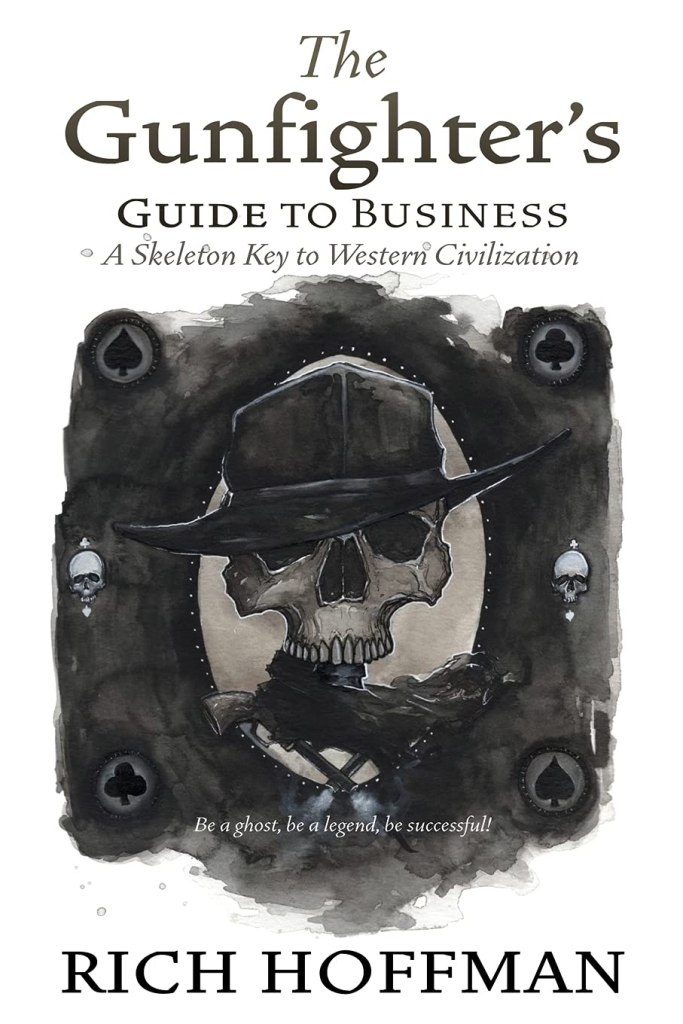
Rich Hoffman is an author, political consultant, and strategic advisor based in Cincinnati, Ohio, and the creator of The Politics of Heaven—a unique framework that connects biblical theology, ancient history, and modern power structures to explain how moral alignment and spiritual forces shape global events. Blending real-world political experience with deep research into archaeology, UFO phenomena, and suppressed historical narratives, Hoffman offers compelling commentary on topics ranging from ancient civilizations and the Dead Sea Scrolls to modern populist movements, paranormal continuity, and leadership strategy in chaotic environments. As the author of The Gunfighter’s Guide to Business and the forthcoming Politics of Heaven, he brings a grounded yet provocative voice to media discussions, supported by firsthand experiences and a cross-disciplinary approach that bridges science, history, and theology. For interviews, speaking engagements, or expert analysis, visit richhoffmanbooks.com or contact directly via phone at 513-307-5815 or email at rhoffman@richhoffmanbooks.com. If you’ve seen the movie, Disclosure Day and want to talk about it and the implications of Presidnet Trump’s UAP disclosures, let me know and we can bring some color to your coverage. https://richhoffmanbooks.com/media-inquiries-broadcast-topics-and-contact-info/?frame-nonce=ad51e7ecba I do have a firsthand UFO encounter to discuss.