I don’t want my tax money to pay for communist thought. That’s what they have been doing, and that’s what they want to continue. When this issue goes to the ballot in November that’s what we’re all fighting is an attempt by these groups to preserve a communist cause in the United States.
Below is a great article from the Daily Reckoning about Oil Shale in Colorado. There is only one reason that our country is in a financial mess, and that is because fools are standing in the way. I am thinking of a speech from John Galt uttered in the book Atlas Shrugged. “You propose to establish a social order based on the following tenets: that you’re incompetent to run your own life, but competent to run the lives of others—that you’re unfit to exist in freedom, but fit to become an omnipotent ruler—that you’re unable to earn your living by the use of your own intelligence, but able to judge politicians and to vote them into jobs of total power over arts you have never seen, over sciences you have never studied, over achievements of which you have no knowledge, over the gigantic industries where you, by your own definition of your capacity, would be unable successfully to fill the job of assistant greaser.”
Oil Shale Reserves: Stinky Water, Sweet Oil
A Daily Reckoning White Paper Report By Dan Denning
You won’t think much of Rio Blanco County if you ever drive through it. In fact, unless you take a right turn off Interstate-70 West at Rifle, head north on Railroad Avenue and then west on Government road to Colorado state highway number thirteen, odds are you’ll never even step foot in Rio Blanco County.
But even if you keep heading west toward Grand Junction, through the town of Parachute and the shuttered oil shale refineries from the 1970s, you’ll see the Book Cliffs geologic formation on your right. For miles and miles. It’s a bleak landscape. Almost lunar. At first glance, it’s the kind of land you’d never want to explore, much less settle down in.
Oil Shale Reserves : America’s Strategic Future
In the small world of geologists, though, the region is well-known. In fact, you might even say it’s the single most important patch of undeveloped, unloved, and desolate looking land in America. But you’d never guess this particular corner of the Great American Desert may play an integral role in America’s strategic future just by looking at it. You’d never guess that the whole stretch of brown, red, and orange land contains enough recoverable oil and gas to make you forget about the Middle East for the rest of time.
There are places in Rio Blanco County like Stinking Water Creek, named after the smelly mix of oil and water the first white settlers found there, that tell you oil’s always been around the Rocky Mountains. It’s just not always been easy to find. It’s one thing to find oil that bubbles out of the ground in liquid form. It’s quite another to drill a thousand feet down, and encounter oil locked up tight inside a greasy rock.
The first seeping pools of oil were discovered in Western Colorado as far back as 1876, the year the state entered the Union. But exploration didn’t get serious until drillers settled in the town of Rangely in Rio Blanco County.
By 1903, thirteen different drillers had come and gone in Rangely. According to the local museum, the only six wells that actually struck oil were producing just two to ten barrels of oil a day. Hardly a Spindeltop, the gusher that launched the Texas oil-boom on January 10th, 1901, and immediately began producing 100,000 barrels per day.
The energy reserves of the Piceance Basin, upon which Rio Blanco County sits, contain massive petroleum reserves of a very unusual nature: Oil shale.
Oil Shale Reserves : A Congressional Legacy
Most of the nation’s oil shale reserves rest under the control of the U.S. government – a legacy of a 95-year old Congressional Act. In 1910, Congress passed the Pickett Act, which authorized President Taft to set aside oil- bearing land in California and Wyoming as potential sources of fuel for the U.S. Navy. Taft did so right away. The Navy was in the process of switching from coal-burning ships to oil burning ships. And the U.S. military, conscious of the expanding role of America in the world, needed a dependable supply of fuel in case of a national emergency.
From 1910 to 1925 the Navy developed the Naval Petroleum and Oil Shale Reserves Program. The program became official in 1927 and President Roosevelt even expanded the scope of the program in 1942 as the U.S. geared up for war with Japan and Germany.
Several of the oil fields set aside for the nation’s first strategic reserve, particularly Elk Hills in California, would go on to produce oil for the U.S. government. Elk Hills was eventually sold off to Occidental Petroleum for $3.65 billion in 1998 in the largest privatization in U.S. history. The shale reserves, however, still remain, locked 1,000 feet underground in the Colorado desert.
Unlocking The Future
The destruction of Hurricane Katrina shows the importance of a strategic petroleum reserve, or, more accurately, a strategic energy reserve. But the SPR in Louisiana only holds about 800 million barrels of emergency, enough to get the country through about 90 days of regular oil usage. That’s barely a band-aid for a country that faces a potential energy heart attack.
In other words, the future of oil shale may have finally arrived. Extracting oil from shale is no simple task, which is why the reserves remain almost completely undeveloped. But an emerging new technology promises to unlock the awesome potential of the oil shale.
“The technical groundwork may be in place for a fundamental shift in oil shale economics,” the Rand Corporation recently declared. “Advances in thermally conductive in-situ conversion may enable shale-derived oil to be competitive with crude oil at prices below $40 per barrel. If this becomes the case, oil shale development may soon occupy a very prominent position in the national energy agenda.”
Estimated U.S. oil shale reserves total an astonishing 1.5 trillion barrels of oil – or more than five times the stated reserves of Saudi Arabia. This energy bounty is simply too large to ignore any longer, assuming that the reserves are economically viable. And yet, oil shale lies far from the radar screen of most investors.
But we here at The Daily Reckoning are on the case. Just yesterday, I caught a first-hand glimpse of a cutting-edge oil shale project spearheaded by Shell. I trekked out to a barren moonscape in Colorado to tour the facility with Shell geologists. To summarize my findings, oil shale holds tremendous promise, but the technologies that promise to unlock this promise remain somewhat experimental. But sooner or later, the oil trapped in the shale of Colorado will flow to the surface. And when it does, it will enrich investors who arrive early to the scene.
Can Oil Shale Change The World?
America’s oil shale reserves are enormous, totaling at least 1.5 trillion barrels of oil. That’s five times the reserves of Saudi Arabia! And yet, no one is producing commercial quantities of oil from these vast deposits. All that oil is still sitting right where God left it, buried under the vast landscapes of Colorado and Wyoming.
Obviously, there are some very real obstacles to oil production from shale. After all, if it was such a good thing, we’d be doing it already, right? “Oil shale is the fuel of the future, and always will be,” goes a popular saying in Western Colorado.
But what if we could safely and economically get our hands on all that oil? Imagine how the world might change. The U.S. would instantly have the world’s largest oil reserves. Imagine…having so much oil we’d never have to worry about Saudi Arabia again, or Hugo Chavez, or the mullahs in Tehran. And instead of ships lined up in L.A.’s port to unload cheap Chinese goods, we might see oil tankers lined up waiting to export America’s tremendous oil bounty to the rest of the world. The entire geopolitical and economic map of the world would change…and the companies in the vanguard of oil shale development might make hundreds of billions of dollars as they convert America’s untapped shale reserves into a brand new energy revolution.
Presidents Gerald Ford and Jimmy Carter may have been entertaining similar ambitions in the late 1970s when they encouraged and funded the development of the West’s shale deposits. A shale-boom ensued, although not much oil flowed. The government spent billions and so did Exxon Mobil. New boomtowns sprung up in Rifle, Parachute, Rangely, and Meeker here in Colorado.
And then came Black Monday. May 2, 1982. The day Exxon shut down its $5 billion Colony Oil Shale project. The refineries closed. The jobs left (the American oil industry has lost nearly as many jobs in the last ten years as the automobile and steel industries.) And the energy locked in Colorado’s vast shale deposits sat untouched and unrefined.
Oil Shale Technology – Old & New
Extracting oil from the shale is no simple task. The earliest attempts to extract the oil utilized an environmentally unfriendly process known as “retorting.” Stated simply, retorting required mining the shale, hauling it to a processing facility that crushed the rock into small chunks, then extracted a petroleum substance called kerogen, then upgraded the kerogen through a process of hydrogenation (which requires lots of water) and refined it into gasoline or jet fuel.
But the difficulties of retorting do not end there, as my colleague, Byron King explains:
“After you retort the rock to derive the kerogen (not oil), the heating process has desiccated the shale (OK, that means that it is dried out). Sad to say, the volume of desiccated shale that you have to dispose of is now greater than that of the hole from which you dug and mined it in the first place. Any takers for trainloads of dried, dusty, gunky shale residue, rife with low levels of heavy metal residue and other toxic, but now chemically-activated crap? (Well, it makes for enough crap that when it rains, the toxic stuff will leach out and contaminate all of the water supplies to which gravity can reach, which is essentially all of ‘em. Yeah, right. I sure want that stuff blowin’ in my wind.) Add up all of the capital investment to build the retorting mechanisms, cost of energy required, cost of water, costs of transport, costs of environmental compliance, costs of refining, and you have some relatively costly end-product.”
But a new technology has emerged that may begin to tap the oil shale’s potential. Royal Dutch Shell, in fact, has recently completed a demonstration project (The Mahogany Ridge project) in which it produced 1,400 barrels of oil from shale in the ground, without mining the shale at all.
Instead, Shell utilized a process called “in situ” mining, which heats the shale while it’s still in the ground, to the point where the oil leaches from the rock. Shell’s Terry O’Connor described the breakthrough in testimony before Congress earlier this summer (And Congress may have an acute interest in the topic, since the U.S. government controls 72% of all U.S. oil shale acreage):
“Some 23 years ago, Shell commenced laboratory and field research on a promising in ground conversion and recovery process. This technology is called the In-situ Conversion Process, or ICP. In 1996, Shell successfully carried out its first small field test on its privately owned Mahogany property in Rio Blanco County, Colorado some 200 miles west of Denver. Since then, Shell has carried out four additional related field tests at nearby sites. The most recent test was carried out over the past several months and produced in excess of 1,400 barrels of light oil plus associated gas from a very small test plot using the ICP technology…
“Most of the petroleum products we consume today are derived from conventional oil fields that produce oil and gas that have been naturally matured in the subsurface by being subjected to heat and pressure over very long periods of time. In general terms, the In-situ Conversion Process (ICP) accelerates this natural process of oil and gas maturation by literally tens of millions of years. This is accomplished by slow sub-surface heating of petroleum source rock containing kerogen, the precursor to oil and gas. This acceleration of natural processes is achieved by drilling holes into the resource, inserting electric resistance heaters into those heater holes and heating the subsurface to around 650-700F, over a 3 to 4 year period.
“During this time, very dense oil and gas is expelled from the kerogen and undergoes a series of changes. These changes include the shearing of lighter components from the dense carbon compounds, concentration of available hydrogen into these lighter compounds, and changing of phase of those lighter, more hydrogen rich compounds from liquid to gas. In gaseous phase, these lighter fractions are now far more mobile and can move in the subsurface through existing or induced fractures to conventional producing wells from which they are brought to the surface. The process results in the production of about 65 to 70% of the original “carbon” in place in the subsurface.
“The ICP process is clearly energy-intensive, as its driving force is the injection of heat into the subsurface. However, for each unit of energy used to generate power to provide heat for the ICP process, when calculated on a life cycle basis, about 3.5 units of energy are produced and treated for sales to the consumer market. This energy efficiency compares favorably with many conventional heavy oil fields that for decades have used steam injection to help coax more oil out of the reservoir. The produced hydrocarbon mix is very different from traditional crude oils. It is much lighter and contains almost no heavy ends.
“However, because the ICP process occurs below ground, special care must be taken to keep the products of the process from escaping into groundwater flows. Shell has adapted a long recognized and established mining and construction ice wall technology to isolate the active ICP area and thus accomplish these objectives and to safe guard the environment. For years, freezing of groundwater to form a subsurface ice barrier has been used to isolate areas being tunneled and to reduce natural water flows into mines. Shell has successfully tested the freezing technology and determined that the development of a freeze wall prevents the loss of contaminants from the heated zone.”
It may seem, as O’Conner said, counter-intuitive to freeze the water around a shale deposit, and then heat up the contents within the deposit. It’s energy-intensive. And it’s a lot of work. What’s more, there’s no proof yet it can work on a commercial-scale.
Yet both technologies, the freeze wall and the heating of shale, have been proven in the field to work. The freeze wall was used most recently in Boston’s Big Dig project. It was also used to prevent ground water from seeping into the salt caverns at the Strategic Petroleum reserve in Weeks Island, LA.
But still, you may be wondering, does it really make sense to heat the ground up a thousand feet down for three or four years and wait? Of course it does. In case you missed O’Conner’s math, Shell could harvest up to a million barrels per acre, or a billion barrels per square mile, on an area covering over a thousand square miles.
It’s still early days in the oil shale fields of Colorado and Wyoming, but it looks to me like someone’s gonna make a lot of money out there. I’m working hard to discover how we outside investors can play along.
Shell’s Mahogany Ridge
Last week, I paid a visit to Royal Dutch Shell’s oil shale project in Colorado. The visit left me with more questions than answers, but I came away from the place with the sense that this opportunity is very real…or, at least, it soon will be.
After driving across a vast expanse of “Nowhere,” Colorado, my brother and I met up with a few geologists from Shell. Of course it’s just those large, unpopulated tracts of high desert that make the area so appealing from a geopolitical point of view. Tapping into the oil shale 2,000 feet underground isn’t going to bother too many people. And there are no spotted owls around either. If the technology to turn shale into oil works, the entire area will become a new American boom patch.
Soon after we arrived, the geologists escorted us around the facility, chatting all the while about the successes and challenges of their venture.
The two trickiest aspects of oil shale development, as the geologists and engineers explained, are heating the shale to extreme temperatures, while simultaneously surrounding the heated area with a subterranean ice wall. Shell doesn’t know, or isn’t saying, which part of the project will be the most challenging. If you were about to change the world by making it economic to tap into as much as 2 trillion barrels of oil under the Colorado plateau, you’d be pretty careful about showing your competitors how you were going to do it.
First, anything that heats up rock around it to around 600 or 700 degrees Fahrenheit has to conduct electrically generated heat well. The most conductive metals on the Periodic Table of Elements are, in order, silver, copper, and gold. Naturally, the number of heaters you put in a place affects the amount of time it takes to turn the shale goo into API 34 crude. The more heaters, the more cost, though.
And given the fact that Shell does not know yet if the heaters will be recoverable, you can see that sticking silver, copper, or gold heaters 2000 meters underground and then leaving them there once the kerogen has been pumped has a serious effect on the economics of your operation.
At the moment, Shell is not sure what the optimal size of production zones ought to be. The big issue here is how big can a freeze-wall be to be effective and freezing the groundwater surrounding a shale deposit? The test projects, as you can see, were quite small. Shell doesn’t know, or isn’t saying, what the optimum size is for a each “pod” or “cell”. That’s what they’ll have to figure out at the next stage…and the picture with the dirt is a football field sized project….where rather than creating the freeze-wall at 50 meters down…they will do it at 1,000 ft. down…. with 2,000 being the desired and necessary depth for commercial viability. I’m not sure anyone has ever created a freeze-wall at that depth….neither is shell. But we’ll find out. The oil itself that comes from the process looks like…oil. No heavy refining needed.
Shell thinks the whole thing is economic at a crude price of $30. So barring a major reversal of geopolitical trends, they’re forging ahead.
Since the Bureau of Land Management owns about 80% of the oil shale acreage in Colorado, there is no investment play on private companies that might own land with rich shale deposits. Although, if Shell and the DOE are right that you can recover a million barrels of oil per acre…it wouldn’t take much land to make a man rich out here.
Oil Shale: Testing Public Lands
The Bureau of Land Management recently received ten applications (by eight companies) for a pilot program to develop Colorado’s shale reserves. The program allows the companies access to public lands for the purpose of testing shale-extraction technologies. You see below an interesting mix of large, publicly traded oil giants and small, privately held innovators.
Natural Soda, Inc. of Rifle, Colorado.
EGL Resources Inc. of Midland, Texas.
Salt Lake City-based Kennecott Exploration Company.
Independent Energy Partners of Denver, Colorado
Denver-based Phoenix Wyoming, Inc.
Chevron Shale Oil Company.
Exxon Mobil Corporation.
Shell Frontier Oil and Gas Inc
There is dispute within the industry over how long, if ever, demonstration extraction technologies can become commercially viable. I’ve spoken with some of the smaller companies that have applied for leases from the BLM. Some of them will have to raise money to conduct the project. And some of them have been less than forthcoming about how exactly their extraction technology is different or better than previous methods.
How will it all unfold? Well, for starters, it could all utterly fail. To me, Shell’s in-situ process looks the most promising. It also makes the most sense economically. There may be a better, less energy-intensive way to heat up the ground than what Shell has come up with. But Shell, Chevron, and Exxon Mobil clearly have the resources to scoop up any private or small firm that makes a breakthrough.
And there are a host of smaller firms involved with the refining and drilling process that figure to play a key role in the development of the industry, should that development pick up pace.
The Energy Policy Act of 2005, otherwise known as a listless piece of legislation without any strategic vision, does, at least, make provision for encouraging research into the development of shale. But government works slow, when it works at all. It’s going to take an external shock to the economy to really ratchet up interest and development of the nation’s energy reserves…say…something like a nuclear Iran.
Al Gore and his friends of communism advocates want to stop the American economy and they are what is driving up our fuel costs by standing in the way of technological development. Our country is being run by fools and idiots by our default, because while the rest of us work at real jobs, those thieves of our tax dollars are using our own resources to destroy us. Those of us that think will never get along with communists. I’m going to call them that for now on, because that’s what they are. I don’t want the world they are advocating. I want oil, fast cars and government off my back.
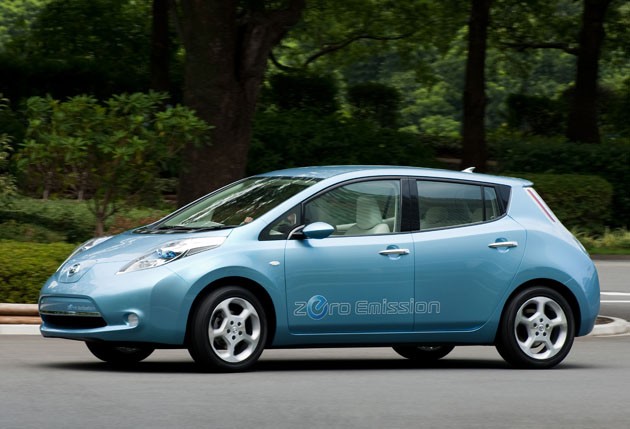
My wife and I took my daughter car shopping today and I made sure she didn’t pick some electric car that had trouble running under 100 MPH. My mind was on the recent reports on electric cars while we looked. The day before today’s Earthday show on WLW the Nissan Leaf won the 2011 World Car of the Year award at the New York International Auto Show, beating out the short list of three finalists — the Audi A8 and the BMW 5 Series. The Leaf was the first electric vehicle to win the award.
According to the jurors, Nissan‘s electric car has a lot going for it:
“The Leaf is the gateway to a brave new electric world from Nissan. This 5-seater, 5-door hatchback is the world’s first, purpose-built, mass-produced electric car. Dropped onto a unique platform and body, the Leaf’s lithium-ion battery modules and electric motor generate 108hp and 206 lb ft of torque, propelling the hatch from zero to 60mph in 11.5 seconds and a top speed of 90mph. It has a range of over 100 miles on a full charge (claims Nissan), takes around 8 hours to recharge using 220-240V power supply and produces zero tailpipe emissions. Its low center of gravity produced sharp turn-in with almost no body roll and no understeer. The good news? It feels just like a normal car, only quieter.”
Read the rest of the article here:
Is it any surprise that our government, which is pushing green technology isn’t doing anything about the extortion of fuel prices, so that Americans go out and buy cars like this stupid “Leaf.”
I’ve driven for many years electric-powered forklifts. They work well enough and similar to propane powered lift trucks without the emission. The biggest downfall of electric vehicles is the battery technology. It takes too long to charge them and they run out of power too fast. And they aren’t new. It’s been over a decade with millions and millions of dollars of research done and battery technology still can’t last much longer than 8 hours with constant use on a shipping dock. And a car that only goes 100 miles per 8 hour charge is not a replacement for oil powered vehicles. Not even close!
Then another problem emerges; a 220 outlet is not a typical outlet. That’s what you might run a washer and dryer off of. So to charge up the car, you’ll have to have a special outlet in your garage. A standard outlet is 110 so people won’t be able to do like I suggested at Burger King and sneak the power away secretly from an outside outlet.
All those things are bad, but the worst of all is the name of these stupid electric cars. In America we have names for cars like Mustang, Charger, Firebird, Thunderbird, that’s what American’s like to buy. What did they call this stupid car……………….a Leaf? A LEAF! Who wants to drive around a car named after a plant? Leaves are something that decays and blows away. Whose stupid idea was it to name a car after something fragile like a leaf?
That is a typical government type of name for a product. These are the same type of overly specialized fools that conceived that the solution to the unemployed in Florida was to buy people who didn’t have job capes. What a brilliant marketing idea by clueless, useless people, the same type of people who came up with the name “The Leaf.”
So, what kind of mind created those types of people? What are the students that go to college and learn how to brain-storm and come up with names like “The Leaf” and capes for the unemployed like? Have a look at what students do in their leisure time to understand how they’ll behave in business when they graduate. Here are tomorrow’s keepers of the world taking a little downtime from the hard studies of university. Progressives think all this behavior is good and healthy for young people.
While you watch the gas prices go up, know in your mind the type of fool and thief that is creating policy that is hurting your pocketbook on half-baked, thoughtless endeavors suitable only for a drunk. That is what the Leaf is and the stupid cape ideas are and the nudging of American society into electric cars while we function with our hands tied behind our backs with regulation is an attack on Americanism. Meanwhile, the Obama administration will grant Brazil a deep-sea drilling license to help that country economically and distribute the wealth of our nation and allow our economy to crumble…..on purpose.
Here are those spring break kids all grown up. These are the people who stand in the way of American growth and economic development. They are parasites that loot our taxes and fill their pockets. These are the progressive groups behind the electric car push.
So here’s how it’s going to work, and this is a note to progressives. You better respect the law because once you eliminate it, such as what the union boys of Trumka and his thugs are doing, you create a free-for-all environment where the rules can be broken the other way too.
So when I hear people say that Donald Trump is not a serious enough candidate to even consider for the American Presidency, that Trump’s desire to throw his hat in the ring as a kind of circus stunt and not to be taken seriously is misguided. I say why?
I remember the negotiations Reagan had with the Soviet Union during the 80’s and Reagan held the line in his sheer belief that he was on the moral side of God. His determination shocked many of his advisors who second guessed him to no end. But Reagan did us all a favor with his hard-line negotiations and in hind-sight appeared to be a brilliant negotiator. The United States could use the best that we have in that department, and in this modern age, it’s Donald Trump.
So I say put Donald Trump on the ticket. Let him go at Obama, because the next election will be a fist fight, and that’s the kind of guy it’s going to take to win this presidential election. Not some soft-spoken nice guy that is super smart but doesn’t have the ability to convey their ideas to a public that just wants to watch TV reality shows. Trump understands how to do that. He’s currently a TV star, so why not?
I have a kindergartner at one school and two kids at Independence. Both schools start at the same time. She will have to take the older ones early and the process at each school will be at least 25 minutes. So she will have to take the other child to the other school and then pick her up at noon since kindergarten will NOT be a full day, and then at 4:00, she has to pick up the older ones. Thanks for the loss of income!
This leads me to some obvious questions that she should ask herself. Is it my fault she has kids so close together? Why isn’t she home during the day? Does she have to work because she and her husband bought too much house, too many cars, or ran up their credit card debt too high? Is she a single woman and if so why did the marriage not work? What is she doing about finding someone to help her with her family burdens? Is there a mom that can help, a dad, a brother or a sister? If not why? Do they live in another town? If so, why does she live away from them? Are all three of these children from the same man? Are all three of these children from her, or did she obtain a few of them from a new marriage with a man who has kids from a previous marriage? If so, why did she marry a man with kids from another woman? Didn’t she think that she might have trouble raising them?
I’m sure some of that doesn’t apply to her, and I’m sure that some of it does. But as a tax payer, none of it is any of my business. It’s her life and her decisions………………….until she asks me for money. Or until the school system has to engage in a program to help a woman like her by supplying buses or schedule deviations to accommodate her busy life. In fact, the school issues where the school attempts to be everything to everybody for every possible circumstance is the microcosm of the macrocosm to the federal problems. Every program created to help women like her is money, it’s expensive, and it plays to the weaknesses of our population by pandering to them. So I do not support it. I do not want to pay for behavior that will perpetuate the destruction of our population psychologically. And I don’t want my personal property taxes to go up just so she can get her three kids to kindergarten. That’s her job to figure out. Not mine and certainly not the school system.
Human beings like to be challenged. Competition is a natural process that cannot be engineered out of evolution. You can see it in young people when they play video games. In the video game world, all things are equal. Strength, speed, agility, it is the mind that guides the characters, and if you have ever played a game online, you’ll see that human beings are a competitive species. So to make the most of the human race, competition must be a part of the society. This is why capitalism is the economy that produces skyscrapers and communism produces village huts. And we are teaching our children to create village huts. That is the direction of our current society and I do not support it without question. It is not important whether or not it’s inconvenient for a mother to get her three kids to kindergarten. What’s important is that she thinks of a way to do so. The competition and will to survive is the key to making a prosperous human being. So to my mind I would help that woman best by giving her the challenge of figuring out the problem. Not throwing money at more convenience, because that makes people lazy. It’s the “I can’t find the remote” syndrome. You know, where you keep the TV on the same channel even though you don’t want to watch what’s on that station, because you can’t find the remote to change the channel. You could still get up and change the channel manually on the cable unit itself, but often that isn’t even an option in the mind of the lazy TV viewer. When I was a kid, before TV remotes we always had to change the channel by hand. It is with the invention of the TV remote that such a task seemed laborious.
Now, as a father it was my job to make sure that she has things to think about on such a day. It means a great deal more to receive a gift like that, which she made by hand, as opposed to some manufactured item produced by someone else. Because there is value in her production, and her production is a reflection of how she feels about me. And if I didn’t give her anything to feel, that would make me a bad parent. And if I had just done what everyone told me to all my life, I would have been a crappy parent.
But when my kids were growing up, I didn’t follow the rules of society. I took what I valued, and rejected the rest as tripe. I picked the path I wanted instead of the one provided. I do that at state and national parks too. I seldom ever stay on the trail. I break the rules often, proudly.
The rally at Glendale was very metaphoric. As I stood in the square filming and taking pictures there were three trains that passed by the station there, each at least 20 to 30 cars each. That meant there were 60 to 90 train cars going someplace coming from somewhere and that made me feel happy. The reason was that I had butterflies in my stomach over the premier of Atlas Shrugged Part 1 down at Newport on the Levy and I had read a lot of bad reviews from the Hollywood establishment and I loved the book and really wanted the movie to be good. The reviewers criticized the film for not adopting to the modern age by getting rid of the train oriented story line. And here I was watching three trains roar by in a half an hour from the CSX Line. Trains are a sign of an economy where things are happening. So it was my first inclination that the reviewers were missing the point of the film and were wrong about it. I had promised the booking agent for the film that Cincinnati would be a great market and I promised a sellout at the Newport on the Levy location, so all during the rally with the Cincinnati Tea Party I was thinking of our next destination which was the 8:20 PM showing of Atlas.
My wife and I left the rally to arrive at Newport in the drifting rain. The lights were on at Great American Ball Park across the river as the Reds were playing the Pirates. We arrived at around 7:45 and much to my relief, Atlas Shrugged was SOLD OUT! I have never been so glad to not be able to buy a ticket. We picked up tickets to the 10:45 show and headed to the Claddagh Irish Pub which is a favorite of ours when we go to Newport. We had a few beers, and watched the Reds game on the big screen while a major storm rolled in across the river outside. We like Claddagh because it’s a medieval looking place full of cubbyholes for the kind of meetings I attend a lot, where your neighbor can’t listen to what you’re saying. If offers the good kind of privacy for passing time, especially with your wife.
But that only went so far and after an hour or so, we went over to our favorite book store where I finished reading The Coming Insurrection. I became angry at the tone of that book, especially what was on the back cover shown in that picture.
We went to our movie; I was relieved that it was good. I already put up a review, so there isn’t any reason to repeat it here. Needless to say the weekend numbers were reputable. The film made a respectable $1,676,917 gross, averaging $5,608 per theater. The producers are considering expanding to over 1000 screens for the next weekend so that’s great.
I went to bed with hope that a violent future can be averted. If enough people become educated, watch movies that aren’t controlled by radical left-winged filmmakers which is just about everyone, and reading books that pander to a liberal publishing industry, while liberal unions are pushing for even more taxes to pay for their very expensive public wages, if the Tea Party continues to do its work and films like Atlas Shrugged are shown to people who haven’t or won’t read the book, this country has a chance.
If there is anything that one must reflect on tax day it’s, why do we pay so much in taxes, and why are there so many that want us to pay more!
I like the trend and I hope that the pendulum will continue to swing to the right and bring things more to the middle, because the radical talk I’m hearing from the left are fighting words that can only lead to one end, and that’s not what they want, believe me.
The Coming Insurrection might work in Europe where their minds are soft and their hearts are softer, but you can forget about it in the United States. Don’t even try it.
The theme of the article was that Lakota is operating with fewer administrators than the state average, so doesn’t that mean they are operating more efficiently than other school districts?
No. Statements like that, just like the president’s speech, is full of smoke and mirrors designed to justify excessively high costs of an out-of-control government at all levels, hoping that people will be foolish enough to just look at the smoke and not at what causes it.
Read that article here:
Lakota has 58% fewer administrators per pupil than state average, report says By Lindsey Hilty, Staff Writer Updated 1:43 AM Thursday, April 14, 2011
LIBERTY TWP. — At a time when finances of the Lakota Local School District have come under intense scrutiny from voters, officials say state data shows they are running a lean operation.
The district has 58 percent fewer administrators per pupil than the state average, and 20 percent fewer administrators than similar districts, which are categorized by size and demographics, according to the latest report released from the Ohio Department of Education in March.
In the 2009 report, Lakota had 43 percent fewer administrators than the state average, Interim Superintendent Ron Spurlcok said; however, “with our recent budget reductions and consolidations, we have seen that number grow.” While that number may be touted as a good thing for the bottom line, he warned that it puts a strain on operations.
Assistant principals are responsible for discipline and also must sit in on all individual education plan meetings for students with disabilities.
“We realize economies of scale by running larger buildings, so we can economize where possible,” Kursman said. However, fewer administrators in larger buildings means a bigger demand for their time, whether it is handling parent concerns, analyzing student data or reviewing teacher performance.
Many buildings now share assistant principals, she said, if the principal is called away for a meeting or to direct traffic due to transportation cuts, there is no one left to manage the building.
Levy opponent Rich Hoffman said he isn’t impressed with the numbers. “I don’t believe any of the stats they give me anymore, because the reality is that they could do a lot more with a lot less if things really get pushy,” he said.
Hoffman said administrators could be reduced more, but they aren’t the issue.
The problem, he said, is “I think Lakota has drowned itself in salary obligations, and when you’re trying to cover 22 buildings when management of those salary obligations has been bad, it turns out to be a catastrophic mistake. Administrators get paid a lot, but there aren’t so many of them that it affects the bottom line costs, so their damage to the budget is negligible.”
There are too many employees netting more than $65,000 annually, he said, and that is the crux of the problem. He pointed to the salary lists recently published in the Pulse-Journal, and said the increase in employees in just one year who reached the $65,000 plus benchmark is unsustainable.
“You have to get the costs in line, but the costs are your salaries … None of us can afford it anymore.” Hoffman called for tough negotiations as the board as the Lakota Education Association reopen the 2011-2012 school year contract, and said many in the community would stand behind the board as long as it was aggressive in controlling costs.
In fiscal year 2010, Lakota spent $96 million on salaries. In 2011, that number dropped $2 million due to retirements, no increase to the base salaries and a reduction in force. Employees still earned close to $2 million in step raises, Treasurer Jenni Logan said, but one third of employees, who are at the top of the pay scale, saw no step increase. As details from legislation like SB 5 keep the district in a holding pattern, Logan said, “Inside the walls of Lakota, we’re focusing on the job at hand, which is educating our students.”
From that place, the world is placed into its perspective. All the things that the “looters” like the aforementioned Weiner’s proclaim to be important will quickly be seen for what they truly are, just the cries of small-minded children.
So now you know a secret of mine. I fear no breakdown of society because of that place. I know what the world could look like if you took away all government, because there isn’t a government at that place. It is beyond the reach of people like President Obama, George Soros and his silly Huffington Post and all the Weiner’s he likes so much. Those people are the representatives of the lead-foot travelers that are either too scared or too unhealthy to move on their own. And they do not represent the direction of the human race.
All things should evolve into improvements, not in decline, and Atlas Shrugged besides the book Thus Spoke Zarathustra is the first serious work that explores that evolution. And it is understandable that those who are close to that transition themselves would be attracted to the message. That message will be missed by the Weiner’s and those like them. Because of their limited perspective, they will cleave like fools to the world of their understanding, and will always fear the perspective of a mountaintop hideaway. The revelations that would fall upon them will shatter their reality in ways that they aren’t prepared to deal with.
If you’ve studied other cultures, their rise and fall, there are common themes. Visit any ruin of an ancient civilization and you will see that all those societies bankrupted themselves. They either ran out of water, food, or their currency. Visit Ankor Watt, Chitzen Itza, or any city in Egypt and you’ll see it. Study the past to see your future.
In Mel Gibson’s brilliant film, Apocalypto Gibson showed wonderfully the height of the Mayan Empire and displayed the problems they were having. The Mayans built huge cities, depleted their food supply and built a corrupt hierarchy of politics that sought human sacrifice to appease the mob, and to keep the masses believing that the ruling class held some sort of power with the “gods,” so that society could continue for just a bit longer hoping by some miracle that if they cut off just one more head, or paint their faces just a few more colors so the gods would take mercy on their lives and save them all. In this case the god is Kukulcan. For those of you that don’t know much about history, the main street in Cancun that all the nightclubs are on, is named after that god.
• A mass burial containing 40 men and women who appear to have been violently killed. The suggestion has been made that some of these were buried alive: “From the vertical position of some of the fingers, which appear to have been digging in the sand, it is apparent that not all of the victims were dead when they were interred – that some had been trying to pull themselves out of the mass of bodies.”
The relationship of these burials to the central burial is unclear. It is unlikely that they were all deposited at the same time. Wood in several parts of the mound has been radiocarbon-dated to between 950 and 1000 CE. Check out more about this from this article. http://en.wikipedia.org/wiki/Cahokia
Many people don’t even know that Cahokia is even there in the middle of the United States. It’s the giant hill alongside the highway on the way into St. Louis. You can see the arch of St. Louis easily from the ruins of Cahokia, yet people don’t know much about the ancient city. In fact, Cahokia wasn’t even discovered until developers tried to build a neighborhood over it. I wrote a screenplay about the place for some financial people a few years ago and we had an actress and a director, but the whole thing fell apart in pre-production. But here was the conception teaser for it. The history that I speak about is real. The modern aspect of it is fiction.
On the other hand there are people like Porter Standsberry out there that are “really” looking at the real problems coming to our culture, and people like Porter are the kind of people our government wants to cut their head off in human sacrifice, figuratively speaking of course.
As stated in the interview, there is a preponderance of evidence that Obama was born in Hawaii. What that means is that there are some newspaper reports, and some other documents that lean in the direction of birth in Hawaii, but it appears that Obama claimed otherwise to get financial aid. So on one side of the story or another, Obama has lied in his past. He’s either claimed to be a foreign student for admission into Occidental College or he was really born in Kenya and his grandparents placed the notification in the newspaper in Hawaii. I think many Americans would forgive him for the first offense. Because the second offense is much more serious, which is why over 10 million dollars and much public relation debate has been created to combat even bring up the question.
If we are stuck with this joke for a few more years because everyone is too weak to actually demand that our public officials live by the actual rules of our law, then I say the law goes our way too. Ignore that speed limit sign, those demands to buckle up, forget the DUI laws. And for taxes, forget about April 15th, just send in your taxes whenever you feel like it. Heck, it’s just rules and laws. Who cares……..right?


 If they are not the enemy, who is? A look at this chart shows why the teachers are fighting to get rid of S.B.5. Look how much more teacher’s make than the rest of labor in Ohio. Even people who have difficulty reading charts can see that Ohio Education Association employees make a lot more than the average middle class employee working in Ohio. And teaching is a theoretical part-time job. They have a real scam going at tax payer expense, that’s what we’re fighting, so are they the enemy? Yes, because they are taking money from our pockets! They are an enemy just as a thief that robs us in an ally. It happens in education, it happens in Medicare, in fact in virtually everything that has the word GOVERNMENT attached to it. Listen to Bill Cunningham discuss with a doctor the cost of the Obama health care plan to begin to understand what we’re facing just in the medical industry.