The case of Justin Daniel Dennis, a former social studies teacher at Lakota East High School in the Lakota Local School District (Butler County, Ohio), exemplifies a persistent and troubling issue in American public education: educator sexual misconduct with students. On January 28, 2026, Dennis pleaded guilty in Butler County Common Pleas Court to three counts of attempted sexual battery, third-degree felonies. Five additional counts of sexual battery were dismissed as part of the plea agreement. He faces a potential maximum sentence of 18 months per count (up to 4.5 years total) and mandatory registration as a Tier III sex offender. Sentencing is scheduled for March 12, 2026.
The misconduct occurred during the 2021-2022 school year, when the victim—a 17-year-old senior and member of the Hope Squad (a student mental health assistance group Dennis advised)—engaged in a months-long sexual relationship with him. According to court documents and the Butler County Sheriff’s Office, the pair had consensual sexual intercourse and oral sex multiple times in various locations: Dennis’s classroom at Lakota East High School, his home in West Chester Township, his former home in Liberty Township, and the parking lot of the victim’s workplace in Springdale. The relationship came to light years later when the victim (now in her 20s) provided investigators with text message threads discussing their past interactions, serving as key evidence.
Dennis, then 42 (now 43), taught subjects including psychology, economics, and government. He was arrested in August 2025 on initial charges, indicted on eight counts of sexual battery in September 2025, and was no longer employed by the district. Authorities emphasized the betrayal of trust inherent in his dual role as teacher and mentor.
This incident is far from isolated. Educator sexual misconduct—ranging from inappropriate comments and grooming to physical contact and intercourse—remains a significant problem in U.S. public schools. A landmark 2004 U.S. Department of Education report by Charol Shakeshaft estimated that 9.6% of K-12 students experience some form of educator sexual misconduct during their school career. More recent research, including a 2022 multistate survey of recent high school graduates, found 11.7% reported at least one instance, with 11% involving sexual comments and smaller percentages involving physical acts like touching or intercourse. Perpetrators are predominantly male (around 85% in recent data), and victims are often female (around 72%). Academic teachers commit the majority (about 63%), followed by coaches or gym teachers (20%).
Underreporting is a major barrier to accurate prevalence estimates. Disclosure rates to authorities are extremely low—often around 4-5%—due to fear, shame, grooming tactics (e.g., special attention, gifts), or societal stigma. Many cases surface years later, as in Dennis’s, when victims gain distance and perspective. Nationwide, hundreds of educators face charges annually; for instance, analyses of news reports have documented over 100-200 teacher arrests for child sex crimes in single years, though this captures only reported and prosecuted cases.
In Ohio specifically, the issue mirrors national trends. The Ohio Department of Education has disciplined dozens of educators for sexual misconduct in various periods, with cases involving sexual battery, gross sexual imposition, and related felonies. While exact statewide statistics for 2021-2026 are not centralized in public reports, local investigations (e.g., in the Miami Valley) have identified multiple convictions since the mid-2010s, often involving classroom or school-related encounters. Social media and text evidence frequently play a role in detection, as seen here.
Broader systemic factors contribute to these incidents. Public school teachers often enjoy tenure-like protections through collective bargaining agreements, which can complicate the removal of teachers for misconduct. Salaries in districts such as Lakota can reach six figures, with benefits and summers off—conditions that some argue foster complacency or entitlement in low-accountability environments. Unions rarely publicly condemn members aggressively or advocate stricter self-policing; instead, they often defend due process.
Progressive ideologies in education—emphasizing emotional expression over restraint, secularism over traditional moral frameworks, and sometimes reduced emphasis on authority boundaries—may exacerbate temptations in authority dynamics. Vulnerable students (e.g., those facing personal issues, seeking mentorship, or in transitional phases such as senior year) may misinterpret grooming as care, using their bodies as “currency” to obtain attention or support. Parental abdication also plays a role: many families rely on schools as extended babysitters, outsourcing moral and emotional guidance amid busy lives or dual-career pressures.
Critics argue these cases represent the “tip of the iceberg.” Estimates suggest that 10-20% of educators may engage in boundary-crossing behavior over their careers, though most do not escalate to criminal levels or detection. Unreported incidents could involve brief encounters, emotional affairs, or grooming that victims rationalize or suppress. Long-term effects on victims include difficulties with trust, relationships, mental health, and family formation—trauma that can persist into adulthood.
Addressing this requires higher standards: merit-based evaluations tied to performance and conduct, proactive monitoring (e.g., open-door policies, supervision), robust background checks, and cultural shifts toward accountability. Parents must prioritize involvement over convenience, and society must reinforce moral boundaries rather than relativism. Teacher unions and districts should condemn misconduct unequivocally rather than defensively.
The Dennis case, in a reputedly strong district like Lakota, underscores that no community is immune. It demands scrutiny of funding, governance, and cultural priorities in public education. Taxpayers fund these institutions, expecting safety and positive development—not betrayal. Until accountability trumps protectionism, such tragedies will recur.
This case at Lakota is terrible along many fronts. It’s not only the abuse of a teacher in an authority role over a subordinate that provoked the abuse of that trust relationship; it is also within the broader culture as a whole. The parents who tolerate it. The fellow teachers who know that a young lady has been in a classroom alone with a teacher for too long, with the door shut but did nothing about it, and the buzz in the hallways that never gets help. Even further, it ultimately falls on the parents themselves, who unquestioningly trust authority figures because they are too lazy to do the work of parenting themselves, leaving their children vulnerable to predators who are drawn to the teaching profession with high incomes and lots of leisure time to spend on corrupt fantasies. The problem is, this isn’t an unusual problem; it’s a common one. And if you are sending your children to these public school indoctrination factories, you are likely ruining their potential permanently. They will struggle in life because of their terrible experiences with teachers who have no reservations about abusing them sexually and otherwise. It is currently one of the largest catastrophes our society has experienced.
The annual gathering at Davos, nestled in the Swiss Alps, has long served as a peculiar summit where global elites convene to discuss the world’s pressing issues, often from the vantage point of immense wealth and influence. For many Americans, these meetings represent a detached conversation among the powerful, yet they offer a window into contrasting worldviews. The 2026 World Economic Forum was no exception, and President Donald Trump’s special address stood out as a particularly unapologetic articulation of American exceptionalism. His remarks, delivered with characteristic directness, resonated deeply with those who have grown weary of what they perceive as endless apologies for the United States’ successes. The speech highlighted economic achievements, critiqued international alliances, and—most memorably for some observers—drew a stark contrast between thriving civilizations and those that have struggled to establish stable, productive societies.
One of the most striking moments came when Trump referenced Somalia, describing it in blunt terms as a place that “is not even a country” in any meaningful sense of functional governance, and extending criticism to Somali immigrant communities in the United States, particularly in places like Minnesota, where integration challenges and related issues have been highlighted in public discourse. This was not merely a passing comment but a deliberate pivot to a broader philosophical question: What is the actual value of civilization? Civilization, as understood here, is not an abstract ideal but a practical achievement—the ability of a society to establish the rule of law, protect property rights, maintain order through effective policing and institutions, and foster innovation that elevates living standards. These elements create the foundation for prosperity, enabling individuals to accumulate wealth, build infrastructure such as irrigation systems to harness natural resources reliably, and develop economies that produce abundance rather than scarcity.
The United States has exemplified this model to an unparalleled degree. From its founding principles emphasizing individual liberty, limited government, and free enterprise, it has generated extraordinary productivity. Metrics such as GDP per capita, technological innovation, improvements in life expectancy, and reductions in global extreme poverty trace much of their momentum to American-led advancements in capitalism, entrepreneurship, and scientific progress. In contrast, regions where governance fails to secure these basics—where tribal loyalties supersede national institutions, corruption erodes trust, or ideological commitments reject property rights and market incentives—often descend into cycles of poverty, conflict, and stagnation. Somalia serves as a poignant case study. Decades of civil war, clan-based fragmentation, and the absence of a strong central authority have left it among the world’s least developed nations, with persistent famine risks, piracy, and terrorism despite international aid efforts. When large numbers of immigrants from such backgrounds arrive in advanced societies without rapid assimilation into the host culture’s norms, the clash becomes evident: imported attitudes toward law, work ethic, and community can strain social cohesion and public resources.
Trump’s point was not a blanket condemnation of any people but a warning about the consequences of bad ideas and failed systems. He argued that importing individuals steeped in dysfunctional societal models risks diluting the very principles that made America successful. This echoes longstanding debates in political philosophy. Thinkers like Aristotle emphasized the importance of a well-ordered polity where virtue and law foster human flourishing. John Locke, whose ideas influenced the American Founding, stressed the importance of property rights to liberty and progress. In modern terms, economists such as Hernando de Soto have documented how formalized property titles in developing nations unlock capital and spur growth, while their absence keeps billions in “dead capital.” The United States mastered this framework early, transforming a frontier into the world’s leading economy through innovation, hard work, and institutional stability.
Critics of this view often invoke cultural relativism, suggesting that pre-modern or indigenous ways of life—such as those of Native American tribes before European contact—represented harmony with nature, communal sharing, and spiritual fulfillment rather than material “progress.” Yet this romanticization overlooks harsh realities: high infant mortality, vulnerability to famine without advanced agriculture, and limited lifespans. Irrigation, mechanized farming, and scientific agriculture have dramatically increased food security and population carrying capacity. Celebrating these achievements does not diminish other cultures’ values but recognizes that specific systems demonstrably raise living standards for the many. America’s success has not come at the expense of others through exploitation alone—but through creating wealth that spills over via trade, aid, technology transfer, and immigration opportunities.
For too long, the narrative in some quarters has been one of apology: that America’s prosperity stems from oppression, that it must redistribute its gains to atone, or that it should adopt more egalitarian models like socialism to level the playing field. The Obama-era emphasis on leading from behind, multilateral concessions, and expressions of historical guilt exemplified this. Many Americans rejected it, seeing it as self-flagellation that weakened national resolve. Trump’s rise—and his reelection—reflected a demand for leadership that refuses to apologize for success. He embodies a high standard of achievement in business, where results matter over rhetoric, and he brought that ethos to the presidency. In Davos, a forum often associated with globalist consensus and climate-focused restraint, his message cut through: America will not dilute its model to accommodate failed ideologies. Instead, others should emulate what works.
This extends beyond immigration to geopolitics. Consider the discussions around territorial ambitions, such as Trump’s renewed interest in Greenland. Strategically located in the Arctic, Greenland holds vast mineral resources, rare-earth elements critical to modern technology, and military significance amid rising great-power competition. Trump has argued that U.S. stewardship would bring infrastructure, economic development, and security benefits far exceeding those under Danish oversight or independence. Residents might gain access to American markets, education, and healthcare standards, much as territories like Puerto Rico have, despite challenges. Canada, too, benefits enormously from proximity to the U.S. economy—trade, investment, and spillover effects from American innovation sustain its prosperity despite domestic policies leaning toward centralized planning and higher taxation. Without the U.S. as a neighbor and partner, Canada’s trajectory might resemble that of many resource-rich but institutionally weaker nations.
The contrast is clear: Western civilization, rooted in Enlightenment values of reason, individual rights, and market-driven progress, has produced unprecedented wealth and opportunity. Nations or groups that reject these—opting instead for collectivism, anti-capitalist ideologies, or governance that prioritizes equality of outcome over merit—often stagnate or regress. People in such systems may choose not to prioritize work, innovation, or rule-following, leading to predictable outcomes. Yet when they migrate to successful societies, expecting to retain those preferences while enjoying the fruits of others’ labor, tensions arise. Trump articulated what many feel: the U.S. offers opportunity, but not at the cost of importing dysfunction. Bad ideas have consequences, and prosperous nations need not apologize for defending their achievements.
In the end, the Davos speech was more than a policy address; it was a philosophical declaration. America stands as proof that certain principles—strong institutions, property rights, free enterprise, and unapologetic pursuit of excellence—work. Others do not. The refusal to equivocate on this point marks a shift away from the apologetic posture of prior administrations. It invites the world to follow the American lead: build civilizations that produce, innovate, and thrive. Those who do will prosper; those who cling to failing models will not. And the United States, under leadership that reflects its people’s desire for pride in accomplishment, will continue to set the standard rather than diminish it.
Bibliography
• de Soto, Hernando. The Mystery of Capital: Why Capitalism Triumphs in the West and Fails Everywhere Else. Basic Books, 2000.
• Diamond, Jared. Guns, Germs, and Steel: The Fates of Human Societies. W.W. Norton & Company, 1997.
• Locke, John. Two Treatises of Government. 1689. (Cambridge University Press edition, 1988).
• Maddison, Angus. The World Economy: Historical Statistics. OECD Publishing, 2003.
• World Bank. “World Development Indicators.” Ongoing database, accessed 2026.
• Acemoglu, Daron, and James A. Robinson. Why Nations Fail: The Origins of Power, Prosperity, and Poverty. Crown Business, 2012.
• Trump, Donald J. Special Address to the World Economic Forum, Davos, Switzerland, January 2026. Transcript available via White House archives and WEF.org.
• Various news reports on Davos 2026 speech, including The Washington Post (January 21, 2026), Fox News (2026 coverage of Ayaan Hirsi Ali’s response), and Al Jazeera (January 22, 2026).
Footnotes
1. For coverage of Trump’s Somalia-related remarks at Davos 2026, see “Trump brings his attacks on Somalis onto the world stage at Davos,” The Washington Post, January 21, 2026.
2. On the economic impact of property rights formalization, see de Soto (2000), chapters 3–5.
3. Comparative historical GDP data showing U.S. divergence post-1800: Maddison (2003).
4. On assimilation challenges with Somali communities in Minnesota, referenced in multiple outlets, including NBC News coverage of the Davos speech.
5. Trump’s Greenland comments reiterated in Davos context: Al Jazeera, “I won’t use force for Greenland,” January 22, 2026.
6. Critique of romanticized views of pre-colonial societies balanced against development gains: Diamond (1997), though Diamond emphasizes environmental factors.
7. Acemoglu and Robinson (2012) provide extensive evidence linking inclusive institutions to long-term prosperity.
In the realm of global politics, protests serve as a barometer of societal discontent, yet their legitimacy often hinges on the nature of the regime they challenge. Distinguishing between “good” and “bad” protesters requires an examination of context: are they rallying against an elected, representative government, or are they resisting tyrannical rule? This question came into sharp focus during the 2020 protests in Minneapolis, Minnesota, which erupted following the death of George Floyd in police custody on May 25, 2020. These demonstrations, part of the broader Black Lives Matter movement, quickly escalated into widespread unrest, including looting, arson, and clashes with law enforcement, resulting in an estimated $500 million in damages across the Twin Cities area. In contrast, protests in countries like Venezuela, Hong Kong, and Iran have often been viewed through a different lens by the United States—supported as righteous uprisings against oppressive dictatorships. The key difference lies in the foundational principles of democracy, free will, and self-governance. Protests in the U.S. that aim to undermine policies enacted by a duly elected administration, such as those under President Donald Trump, border on sedition, while those abroad that seek to dismantle authoritarian structures align with American values of liberty and human rights. If we explore these distinctions, delving into historical and contemporary contexts, the role of money and culture in measuring societal value, the mechanics of representative republics versus mob rule, and the perils of communist influences attempting to exploit civil unrest for revolutionary ends.
To understand the Minneapolis protests, one must first grasp their origins and evolution. On May 25, 2020, George Floyd, a 46-year-old African American man, was arrested by Minneapolis police officers on suspicion of using a counterfeit $20 bill. During the arrest, Officer Derek Chauvin knelt on Floyd’s neck for over nine minutes, leading to his death, which was ruled a homicide. Video footage of the incident, captured by bystanders, went viral, igniting outrage over police brutality and systemic racism. Protests began the next day, initially peaceful, with thousands gathering at the site of Floyd’s death on East 38th Street and Chicago Avenue. However, by May 27, the demonstrations turned violent, with looting at stores like Target and Cub Foods, and arson setting fire to buildings along Lake Street, including the Third Precinct police station, which protesters overran and burned. Over the following days, the unrest spread to Saint Paul and other cities, leading to 604 arrests, 164 arsons, and two deaths during the initial phase from May 26 to June 7. The protests were characterized by demands for police reform, but they also included calls to defund or abolish police departments, which critics argued amounted to an assault on established law and order.
These events occurred against the backdrop of the Trump administration’s policies, particularly on immigration and law enforcement, which protesters often decried as oppressive. Trump’s approach emphasized strict border control, including the construction of a border wall and enhanced deportation efforts, aimed at enforcing existing laws passed by Congress. In Minnesota, a state with significant immigrant communities, some protests intertwined racial justice with immigration issues, portraying federal policies as tools of suppression. Yet, from the perspective of election legitimacy, these protests challenged the outcomes of the 2016 election, where Trump was elected on a platform promising stronger law enforcement and border security. The 2020 election, which saw Trump lose amid widespread mail-in voting due to the COVID-19 pandemic, further fueled debates over electoral integrity. Claims of irregularities, such as unverified mail ballots and changes to voting rules by state officials without legislative approval, led to lawsuits and audits, though courts largely upheld the results. Protesters in Minneapolis, by seeking to force policy changes through disruption rather than the ballot box, exemplified what some view as seditious behavior—actions that undermine a government chosen by the people.
Sedition, as defined in U.S. law under 18 U.S.C. § 2384, involves conspiring to overthrow or oppose by force the authority of the government or to prevent the execution of its laws. Historically, sedition laws have been controversial, dating back to the Alien and Sedition Acts of 1798, which criminalized false statements against the government amid fears of French influence. These acts were repealed, but similar provisions resurfaced in the Espionage Act of 1917 and its 1918 amendments, targeting anti-war speech during World War I. In modern times, sedition charges are rare due to First Amendment protections, requiring speech to incite imminent lawless action per Brandenburg v. Ohio (1969). However, the Minneapolis unrest, with its destruction of public property and calls to dismantle police forces enforcing federal and state laws, raised questions about whether such actions crossed into seditious territory. Critics argue that while peaceful protest is protected, violence aimed at policy overthrow bypasses democratic processes, echoing the point that these actions seek to subvert a government “picked by the people.”
Contrast this with protests in Venezuela, where demonstrators have long challenged the authoritarian regime of Nicolás Maduro. Since 2013, Venezuelans have protested against economic collapse, hyperinflation, shortages, and political repression under Maduro’s socialist government, which succeeded Hugo Chávez’s Bolivarian Revolution. Major waves occurred in 2014, following the attempted rape of a student and subsequent arrests, leading to 43 deaths and thousands of arrests. In 2017, protests intensified over Maduro’s attempts to consolidate power, including dissolving the opposition-led National Assembly. By 2019, opposition leader Juan Guaidó declared himself interim president, sparking massive demonstrations against Maduro’s fraudulent re-election in 2018, where voter turnout was artificially inflated and opposition candidates were barred. The U.S. supported these protests, recognizing Guaidó and imposing sanctions on Maduro’s regime to pressure for democratic restoration. Unlike Minneapolis, these protests targeted a regime that suppressed elections, jailed opponents, and relied on violence to maintain control, aligning with U.S. interests in promoting self-governance.
Similarly, Hong Kong’s 2019 pro-democracy protests arose from opposition to an extradition bill that would allow transfers to mainland China, threatening the city’s autonomy under the “one country, two systems” framework established in 1997. Beginning in March 2019, millions marched peacefully, but clashes with police escalated, involving tear gas, rubber bullets, and arrests. Protesters demanded withdrawal of the bill, an inquiry into police brutality, and universal suffrage for legislative and chief executive elections. The U.S. condemned China’s crackdown, passing the Hong Kong Human Rights and Democracy Act in November 2019 to support protesters and sanction officials. These actions were seen as resistance to communist encroachment by the Chinese Communist Party, which imposed a national security law in 2020, leading to mass arrests and the erosion of freedoms.
In Iran, the 2022 protests following the death of Mahsa Amini in morality police custody highlighted resistance to theocratic rule. Amini, arrested for improper hijab, died on September 16, 2022, sparking nationwide demonstrations led by women removing veils and chanting “Woman, Life, Freedom.” The regime responded with violence, killing at least 551 protesters, including 68 children, and arresting thousands. The U.S. supported these protests by easing sanctions on technology to aid communication and condemning the repression. Unlike U.S. protests, these aimed to dismantle a regime that denies free elections and enforces religious law through brutality.
The U.S. has historically backed such international protests as vehicles for promoting democracy and human rights. In Venezuela, the Trump administration recognized Guaidó and imposed sanctions to isolate Maduro. For Hong Kong, bipartisan legislation provided support against Chinese influence. In Iran, statements and actions affirmed solidarity with protesters seeking freedom. This aligns with America’s foundational values, where money measures initiative and ownership, fostering a culture of self-reliance and free will. In representative republics, citizens elect officials to enact policies, as in Trump’s immigration agenda, which prioritized enforcement to preserve national sovereignty. Protests forcing change through violence confuse this with direct democracy, potentially leading to majority tyranny.
Election integrity is central to this distinction. The 2020 U.S. election faced scrutiny over mail-in ballots, with claims of fraud in swing states like Georgia and Pennsylvania. Audits and lawsuits revealed serious issues. In contrast, regimes like Maduro’s rig elections, justifying protests as the only recourse. Elections are rigged in other countries, and its hard to admit that it has been happening in America. Concern about “mail balls made up in a Walmart parking lot” echoes debates over ballot security, highlighting why preserving electoral processes is vital to prevent insurrection.
Underlying U.S. protests, is communist infiltration via progressive politics. Historical fears, like McCarthyism in the 1950s, targeted alleged communist subversion. Today, claims persist of cultural Marxism influencing movements like BLM, seen as platforms to usher in socialism by undermining capitalism and family structures. In Minneapolis, some viewed protests as exploiting civil rights for communist ends, contrasting with genuine struggles abroad against actual communist dictators.
The difference boils down to intent and system: U.S. protests against elected policies risk sedition, while those abroad against tyranny merit support. Preserving free elections, resisting infiltration, and valuing self-governance ensure America’s republic endures, unlike faraway places lacking such freedoms.
The coining of money and the imposition of tariffs represent two interconnected levers of economic sovereignty that the framers of the Constitution intended to place firmly in the hands of the people’s representatives, yet the practical evolution of American governance has exposed persistent vulnerabilities in how these powers are exercised. Article I, Section 8 grants Congress the authority “to coin Money, regulate the Value thereof, and of foreign Coin,” establishing a clear congressional role in monetary matters, while the power to lay and collect duties, imposts, and excises—including tariffs—resides with the legislative branch as a core taxing function. In theory, this framework ensures democratic accountability: elected lawmakers, responsive to voters, would shape both the nation’s currency and its trade policies to protect domestic interests and maintain economic balance.
Yet, over more than two centuries, the regulation of money has slipped through constitutional cracks into an administrative realm dominated by extra-legislative influences. The creation of the Federal Reserve in 1913, while nominally under congressional charter, delegated vast monetary policy authority to a quasi-independent entity influenced by international banking interests and private financial networks. This backdoor arrangement has allowed unelected actors—often aligned with globalist priorities—to leverage America’s economic freedoms in ways that favor concentrated wealth over broad national prosperity. Congress retains oversight in name, but the practical ability to define how money is created, its value regulated, or interest rates set has been diluted, creating a loophole where monetary policy operates beyond direct electoral accountability. The result has been chronic trade imbalances, wealth redistribution upward through financial mechanisms, and a system where banking interests exert disproportionate sway, often at the expense of American workers and industries.
This monetary vacuum stands in stark contrast to the current debates over tariff authority, particularly in the context of recent executive actions upheld as necessary to restore trade equilibrium. While some argue that returning tariff regulation strictly to Congress aligns with separation of powers—emphasizing Congress’s constitutional primacy over taxation and commerce—such a move risks exacerbating existing imbalances. Justices like Chief Justice John Roberts and Justice Amy Coney Barrett have expressed concerns during oral arguments about unchecked executive overreach, questioning broad delegations that could allow presidents to impose sweeping tariffs without clear congressional limits, potentially eroding legislative authority. Roberts highlighted tariffs as fundamentally a form of taxation on Americans, a core congressional power, while Barrett probed whether statutes like the International Emergency Economic Powers Act truly confer such expansive authority, warning against interpretations that grant presidents near-unlimited discretion over imports from any nation.
These concerns about checks and balances are valid on paper, yet they overlook the deeper structural flaw: the Constitution’s under-specified framework for monetary regulation has already permitted centuries of exploitation by unaccountable financial elites. Upholding executive tariff powers in this instance—particularly when used to counter predatory trade practices and rectify persistent deficits—actually enhances overall balance. A strong executive, directly elected and subject to voter judgment every four years, provides a more immediate mechanism for the people’s will to influence financial and trade outcomes. Voters can reward or punish administrations based on tangible results in jobs, wages, and national wealth retention, bypassing the slower, more insulated congressional processes often swayed by lobbying and international pressures.
In contrast, rigid congressional control over tariffs, without addressing the monetary loophole, would likely perpetuate the status quo of unprofitable trade arrangements that have functioned as a stealth wealth pre-distribution scheme favoring global capital over domestic producers. The Trump-era tariffs, by leveraging executive action to force renegotiated deals and protect strategic industries, demonstrate how proactive leadership can begin to correct these distortions more swiftly than fragmented legislative efforts. While Roberts and Barrett rightly guard against executive aggrandizement in general, their emphasis on defined separations should not blind us to the reality that monetary policy’s administrative drift has created far greater long-term vulnerabilities than targeted executive trade interventions. True constitutional fidelity demands closing the money regulation gap—perhaps through renewed congressional assertion or structural reform—while recognizing that a vigorous executive, checked by elections, offers the quickest path to voter-driven corrections in trade and finance. Upholding such executive authority in the tariff realm thus restores a practical balance of power, empowering citizens to regulate their economic destiny more effectively than the current system ever has, and paving the way for genuine, profitable equilibrium in America’s global standing.
In mid-January 2026, the Supreme Court stands on the threshold of a consequential ruling that will define the practical limits of presidential power over trade and the durability of “emergency” tariff programs launched in 2025. The consolidated challenges—captioned in press and policy coverage as Learning Resources, Inc. v. Trump and Trump v. V.O.S. Selections, Inc.—ask whether the International Emergency Economic Powers Act of 1977 (IEEPA) authorizes the President to impose sweeping, global, and “reciprocal” tariffs without new, specific congressional direction. Oral argument on November 5, 2025, suggested significant skepticism from justices across the ideological spectrum about using IEEPA as the legal engine for across-the-board import duties. The Court has not yet issued a decision, after passing on its first January opinion day and again this week. That delay is notable because the Court purposely fast-tracked these cases from the Court of International Trade and the Federal Circuit. 1234
The stakes are immediate and measurable. Customs authorities reported more than $200 billion in tariff collections during 2025 under the new suite of executive orders, while estimates of potential refund liability if the IEEPA tariffs fall range from roughly $150 billion upward, depending on how the Court structures remedies. Market and logistics watchers warn that an adverse ruling could trigger a surge in imports as firms rush to capture a “tariff holiday” window before any replacement system comes online. The freight cycle, inventory planning, and pricing strategies across large swaths of the economy will respond quickly to whatever the Court decides. 567
Here, we want to take a strictly factual, doctrinal, and quantitative approach to the pending decision, as many key players in the process will read it, perhaps ahead of time, to avert a disaster. Few people like the Supreme Court in the world as much as I do; I understand their role in all this very well. But these are history-making circumstances that require unique, new definitions. It (1) outlines the legal question presented and the Court’s apparent lines of concern; (2) catalogs the statutory scaffolding of U.S. tariff authority, distinguishing IEEPA from Section 232 (national security) and Section 301 (unfair practices); (3) quantifies revenue and exposure; (4) compares analogous Supreme Court and lower‑court precedents in the tariff/delegation space; and (5) sketches credible “Plan B” pathways if the Court curtails the 2025 IEEPA program, with attention to timing, procedures, and policy leverage.
—
I. What the Court Is Being Asked to Decide
The 2025 tariff program had two pillars: (a) “trafficking” tariffs, tied to fentanyl and illicit drug flows from China, Canada, and Mexico, and (b) “reciprocal” tariffs, including a 10% baseline global duty and higher rates calibrated to perceived imbalances. The Administration grounded both in IEEPA after declaring national emergencies affecting national security, foreign policy, and the economy. The lower courts held that the program exceeded statutory authority, and the Supreme Court granted expedited review. During the argument, justices repeatedly pressed the government for the textual hook in IEEPA authorizing the imposition of general import duties—tariffs—as opposed to targeted sanctions or restrictions. Several also raised the “major questions” and nondelegation doctrines, signaling discomfort with reading an emergency statute to confer a virtually open-ended tariff power, typically associated with Article I, rather than a more specific trade statute. 12
Press and legal analyses after the argument captured that mood: both liberal and conservative justices “appeared to cast doubt” on IEEPA’s suitability as a vehicle for comprehensive tariffs, even while recognizing that Congress has, in discrete statutes, granted presidents contingent tariff tools in specific contexts. Reuters and SCOTUSblog, among others, reported that a majority of the Court seemed skeptical that the 1977 law—long used for asset freezes and sanctions—also permitted an across-the-board import duty regime. 31
Since January’s first opinion day, the Court has released decisions in other argued cases but has not resolved the tariffs matter—leaving businesses, importers, and government accounts in limbo. Newsrooms tracking the Court’s calendar expect additional opinion days this month; still, no one outside the Court can reliably predict the exact release date of this decision, underscoring the need for scenario planning on both sides of Pennsylvania Avenue. 89
—
II. The Statutory Map: IEEPA vs. Section 232 vs. Section 301
IEEPA (50 U.S.C. §§ 1701‑1707). Enacted in 1977, IEEPA gives the President broad powers to regulate transactions involving “any property in which any foreign country or a national thereof has any interest” during a declared national emergency tied to national security, foreign policy, or the economy. Historically, administrations used IEEPA for targeted sanctions, asset blocks, and export/import prohibitions directed at specific adversaries or behaviors—not for comprehensive tariff schedules. The text does not use the words “tariff,” “duty,” or “tax.” Those omissions featured prominently in the justices’ questions and in lower‑court opinions that found the 2025 program ultra vires. 102
Section 232 (19 U.S.C. § 1862). By contrast, Section 232 expressly allows the President to act—after a Commerce Department investigation and finding—to “adjust” imports that “threaten to impair” national security. The Supreme Court held in Algonquin (1976) that the President may require licenses and impose fees within Section 232’s framework, and, in 2018‑- 2020 litigation, courts rejected nondelegation challenges to the 232 steel/aluminum tariffs. Yet the Court has never squarely blessed the use of IEEPA for general tariffs. Of note, since early 2025, the Administration increased and expanded 232 duties (e.g., raising aluminum to 25%, adding derivative products, eliminating country exemptions), and Commerce/BIS formalized derivative‑coverage procedures—moves that could support a post‑IEEPA “Plan B.” 111213
Section 301 (19 U.S.C. § 2411). Section 301 authorizes the U.S. Trade Representative to investigate and respond to unfair trade practices with duties and other measures—after notice‑and‑comment and findings. The Federal Circuit in 2025 upheld the legality of the 2018‑- 2019 expansions of China 301 tariffs, confirming that 301 provides a durable (if slower) pathway for targeted tariffs. In 2024, USTR completed the statutory four-year review and locked in additional increases on strategic items (e.g., EVs, solar, semiconductors), underscoring that the policy machinery for 301 remains active and court-tested. 1415
Policy think tanks and trade‑law advisories have, accordingly, framed three tiers of fallback authority if IEEPA tariffs are struck: (1) 232 (national security) investigations and proclamations; (2) 301 (unfair practices) investigations and tariff lists; and (3) narrower legacy tools (e.g., Section 338) in limited contexts. These paths differ sharply in speed, scope, and litigation risk—critical for planning if the Court narrows IEEPA. 1617
—
III. Revenues, Effective Rates, and Refund Exposure
Collections. U.S. Customs and Border Protection (CBP) reported collecting “more than $200 billion” in tariffs between January 20 and December 15, 2025, attributing the surge to “more than 40” executive orders under the tariff program. Independent modeling by the Penn Wharton Budget Model suggests that from January to June 2025 alone, new tariffs raised $58.5 billion in customs revenue and lifted the average effective tariff rate from ~2.2% to ~9.1%, with China-linked flows facing the steepest increases. 518
Macro‑budget effects. The Congressional Budget Office (CBO), in an August 2025 update, estimated that if the higher tariff levels persist through 2035, primary deficits would fall by ~$3.3 trillion and total deficits by ~$4.0 trillion, with an ~18‑percentage‑point jump in the effective tariff rate relative to 2024 flows. CBO caveated that these are projections contingent on policy continuity and trade diversion dynamics. 19
Refund risk. Reuters reported companies, customs brokers, and trade counsel bracing for a potential refund fight “approaching $150 billion” if the Court voids IEEPA-based collections, a figure echoed across the trade press. The sheer transaction volume—hundreds of thousands of importers and tens of millions of entries—would make any refund program administratively complex, and CBP quietly prepared for electronic refund processing to take effect in February 2026. 6
Sectoral and logistics impact. Freight analysts warn that a ruling against IEEPA tariffs could quickly boost U.S. inbound volumes, particularly ahead of Lunar New Year and spring replenishment, after a 2025 “rate recession” and inventory drawdowns; Project44’s tariff report cited sharp year-over-year contractions in U.S.–China trade during 2025. A tariff‑pause window—even brief—could spur import front‑loading as firms hedge against whatever successor regime the Administration deploys. 7
Pre‑2025 baselines. To contextualize the 2025 spike, remember that the first-term 301 China tariffs and Section 232 actions already raised annual customs duties to historically high levels, with FY2024 customs receipts around the upper tens of billions. The 2025 additions layered global and reciprocal constructs on top of the existing 301/232 scaffolding, which helps explain the extraordinary jump in CBP collections in late FY2025. 20
—
IV. The Doctrinal Frame: Separation of Powers and Trade
The Court’s resolution will likely turn on statutory interpretation sharpened by separation‑of‑powers canons. Three strands matter:
1. Text and structure of IEEPA. IEEPA empowers the President to “investigate, regulate, or prohibit” transactions in foreign‑interest property during a declared emergency. Courts have long treated it as a sanctions statute—powerful, but not a blank check to “lay and collect” duties, a core Article I function typically exercised via detailed tariff statutes. If the government asks the Court to accept a reading that silently authorizes all-purpose tariff authority, skepticism follows. 102
2. Major Questions and Nondelegation. Recent terms saw the Court invoke “major questions” to require explicit congressional authorization for actions of vast economic significance. While that doctrine often polices agency interpretations, the logic—demanding a clear statement when the Executive claims vast new powers from old statutes—can carry over to IEEPA. Relatedly, nondelegation concerns lurk: if IEEPA were read to grant open-ended tariff authority, would that constitute an impermissible transfer of legislative power? Oral argument reflected precisely these themes. 2
3. Trade precedents: Algonquin, AIIS, and Transpacific. The Supreme Court in Algonquin upheld a then-current version of Section 232 and found no nondelegation problem where Congress set a process keyed to national security findings. More recently, the Federal Circuit in American Institute for International Steel rejected a facial nondelegation attack on Section 232 steel tariffs, and the Supreme Court denied certiorari. In Transpacific Steel, the Federal Circuit addressed the timing and scope of Section 232 and again denied review. Those decisions underscore that Congress can and does arm presidents with tariff levers—but by statute‑and by specific design. That makes the IEEPA controversy distinct: the question is not whether presidents may ever levy tariffs, but whether this emergency statute authorizes these tariffs, absent the procedural guardrails and more explicit statements found in 232/301. 112122
—
V. If the Court Narrows IEEPA: Practical Plan‑B Pathways
Almost every serious brief and policy memo anticipates that an IEEPA loss would prompt tariff-makers to seek other authorities. The key considerations are speed, scope, and justiciability:
A. Section 232 (Trade Expansion Act).
Speed & process. A Commerce investigation, public comment, and report precede presidential action; “emergency‑fast” still means 60–90+ days, and complex cases can run longer. Scope. Security tethered and product-specific, but the 2025 expansions (including autos/parts and derivatives) show how 232 can reach large value streams—litigation risk. Algonquin remains a pillar, and AIIS / Transpacific litigation history suggests courts tolerate 232 if process and findings are followed. Operationally, Commerce/BIS’s 2025 inclusions process and expanded derivative codes would make a rapid, well-documented reprise feasible. 171213
B. Section 301 (Trade Act).
Speed & process. Investigations are procedurally heavier (petitions, hearings, findings); typical timelines are measured in months, not weeks. Scope. Country‑ or practice‑specific (e.g., PRC IP/tech transfer), not a global baseline—litigation risk. The 2018–2019 expansions survived appellate scrutiny in 2025, reinforcing 301’s staying power for targeted regimes. Operationally, USTR’s 2024 four-year review and targeted increases in strategic sectors provide ready-to-deploy playbooks. 1415
C. Hybrid and interim measures.
Refund/off‑ramp management. If the Court invalidates IEEPA tariffs, it may or may not dictate the mechanics of refunds. CBP planned electronic refunds beginning February 6, 2026, but Treasury and Justice could seek limiting constructions (e.g., net‑of‑pass-through, documentation thresholds) to moderate fiscal impact—market signaling. Agencies could announce immediate 232/301 initiations to compress any “holiday” window, dampening import surges and price whipsaw—foreign‑policy posture. Even in the absence of IEEPA, the Administration can combine export controls, procurement preferences, and inbound investment screening to maintain leverage while 232/301 spools up. 617
—
VI. If the Court Upholds IEEPA Tariffs: What That Would Mean
A win for the government would validate a novel reading of IEEPA as a general‑tariff instrument during a declared emergency. That would preserve the Administration’s preferred speed and scope and keep the reciprocal/baseline design intact. But it would also mark a meaningful shift in the balance of‑powers in trade, making the White House—any White House—the central actor for broad import duties absent new congressional limits. Expect reactions on several fronts:
• Congressional recalibration. A decision upholding IEEPA tariffs could spur bipartisan efforts to cabin emergency powers in trade, as we saw with attempts to reform Section 232 post-2018. 10
• Global response. Trading partners could challenge IEEPA-based tariffs at the WTO or retaliate; retaliatory cycles would depend on the scope, carve-outs, and negotiation dynamics. (Press coverage has already tied 2025 tariff moves to escalating global trade uncertainty.) 23
• Domestic litigation. Even with a green light from IEEPA authority, commodity‑ – or country-specific challenges would continue (e.g., exemptions, product coverage, due process), as seen under 232/301. 1214
—
VII. The “Checks and Balances” Debate: Courts vs. Elections vs. Congress
This case has revived a perennial question: where are the real checks on economic power—in the elected presidency (via election cycles), in Congress’s Article I tariff prerogatives, or in judicially enforced statutory limits? On one side, skeptics of judicial intervention argue that a president elected on a mandate to renegotiate trade relationships should retain leverage tools—tariffs included—to force outcomes that Congress could not or would not legislate. On the other hand, the Constitution assigns tariff-taxing power to Congress, and emergency statutes like IEEPA are not presumed to displace that allocation absent clear text. The Court’s doctrinal trend—major questions, limits on agency adventurism—leans toward requiring Congress to speak plainly when it wishes to authorize sweeping economic moves. Oral argument reflected this balance: the justices queried whether IEEPA’s “regulate or prohibit” language could bear the weight of a global tariff system without a more specific, contemporary congressional say. 21
If the Court narrows IEEPA here, that doesn’t foreclose robust tariff policy; it pushes the Executive to use trade-specific statutes (232/301) that incorporate the processes and findings Congress designed. The Administration has plainly anticipated this outcome, and policy analyses across the spectrum acknowledge multiple “Plan B‑F” tracks already sketched out. The question is timing: how quickly can those processes be triggered to avoid leverage loss and economic whiplash if IEEPA collections stop? 1716
Although Article I gives Congress authority “to coin Money [and] regulate the Value thereof,” the Constitution leaves the modern mechanics of monetary governance—and the interaction between domestic liquidity, cross‑border finance, and trade accounts—to a sprawling lattice of statutes and administrative actors developed long after the Founding. That institutional reality has produced a practical “administrative gap”: global banking and market infrastructures can shape capital flows and relative prices faster than Congress can legislate, yet courts lack obvious textual hooks to referee those dynamics ex ante. In that setting, shifting all broad tariff levers back to Congress may vindicate separation‑of‑powers in theory while still leaving intact the back‑door channels through which financial interests exert pressure on trade outcomes in practice. The constitutional allocation of tariff power and the constitutional silence on contemporary monetary intermediation simply do not map one‑to‑one.
Chief Justice Roberts and Justice Barrett have signaled, in different contexts, a premium on clear lines: Congress writes the big rules; the Executive executes those rules; courts enforce the boundaries. If they cabin IEEPA on that basis, they will reinforce an elegant blueprint—but they will not, by doing so, resolve the persistent vulnerability created by the Constitution’s sparse treatment of modern money and market plumbing. A strong, election‑checked Executive tariff tool operates as a direct, voter‑responsive counterweight to those vulnerabilities: it allows the White House to alter relative prices at the border in real time when global financing channels or state‑capitalist rivals tilt the playing field. In that sense, upholding the 2025 tariff architecture would not erase Congress’s role; it would supply a democratic “fast gear” that complements Congress’s slower, statute‑driven “torque.”
Nor is this an argument for unbounded presidential discretion. The point is that, where monetary and financial influences can exploit gaps the Framers could not fully specify, a court‑affirmed executive tariff lever—subject to judicial review for statutory fit and to electoral review by the public—can restore a measure of balance that monetary‑policy lawmaking alone has not delivered. For Roberts and Barrett, who prize administrable limits, the question is whether a narrowed but viable emergency‑trade instrument can coexist with Congress’s trade statutes to keep power distributed across branches and, critically, responsive to voters. Preserving that instrument would give citizens a more immediate say over how the United States defends its terms of trade—something the Constitution’s money clauses, standing alone, have never been able to guarantee.
—
VIII. Quantifying What’s at Risk—Short‑Run and Long‑Run
Short‑run (next 90‑180 days).
Revenue. A ‑less adverse decision could halt IEEPA collections immediately, potentially opening a short “free trade” interval before 232/301 measures kick in. That’s particularly salient with seasonal ordering cycles (apparel, consumer durables, autos) already in motion—trade volumes. Logistics managers expect a near-term import bounce if duties drop, especially in categories hit with elevated 2025 rates—fiscal exposure. Refund claims processing—if ordered—would begin amid questions of pass-through and interest. 76
Medium‑run (6‑18 months).
Replacement architecture. A sequenced deployment—232 for strategic categories (steel, aluminum, autos/parts, strategic minerals), 301 refreshes for PRC practices—could reconstruct much of the leverage with more procedural guardrails—market adaptation. Effective rates would likely settle below IEEPA’s 2025 peaks but above pre-2018 levels, depending on scope and carve-outs. Budget path. CBO’s $4 trillion decade-long deficit effect is explicitly conditional; a narrower regime reduces that top line. 121519
Long‑run (multi-year).
Precedent. A Supreme Court ruling limiting IEEPA for tariffs would set an enduring boundary between “sanctions-style” emergency tools and the tariff‑taxing power, nudging big trade choices back toward Congress or trade-specific delegations—institutional response. Expect Congress to revisit emergency‑powers statutes and tariff‑process statutes, and expect administrations of both parties to plan with 232/301 front‑of‑mind for large-scale tariffs. 10
—
IX. Comparable Cases and Lessons
Three bodies of law are particularly instructive:
1. National‑security-linked tariff actions: Algonquin (1976) validated a 232 regime embedded in executive‑branch investigation and findings. Later challenges to 232 (2018–2022) failed on nondelegation grounds (AIIS) and on procedural‑timing theories (Transpacific), with SCOTUS denying cert. The through‑line: Congress can delegate tariff levers when it provides intelligible principles and procedures; courts tend to defer if the statute is specific and the Executive follows the steps. 112122
2. Trade‑remedy statutes with administrative processes: Section 301 litigation in 2018–2025 resulted in a Federal Circuit decision upholding USTR’s authority to modify and expand China tariff lists. These cases show courts accept robust tariff countermeasures when Congress built the pathway and agencies compile the record. 14
3. Emergency powers repurposed for fiscal instruments: The novelty of using IEEPA to impose a generalized tariff schedule is what attracted the Court’s scrutiny. Post‑Loper Bright (Chevron’s demise), claims of broad executive power from ambiguous statutes face a steeper climb—especially when the asserted authority has vast economic consequences, and Congress has enacted detailed, alternative tariff statutes. 2
—
X. A Practical Note on Implementation, Regardless of Outcome
Whatever the decision, implementation choices will shape real-world impact:
• If IEEPA is curtailed: The Court could (a) invalidate prospectively, (b) remand with guidance while staying the mandate to allow transition, or (c) order broader remedies affecting past collections. A stay or phase‑out would blunt immediate shocks, though not remove refund fights. Agencies will likely announce rapid 232/301 steps to signal continuity of trade policy objectives. 617
• If IEEPA is upheld: Expect challenges to particular rates, categories, and exemptions, and congressional moves to refine emergency trade powers. International countermoves are likely. Agencies may still shift some weight to 232/301 to reduce litigation exposure while keeping IEEPA as a backstop. 2312
—
The Court’s pending tariffs decision is not a referendum on whether the United States may use tariffs as leverage; it is a statutory and constitutional inquiry into which branch authorizes what, and under which law. If the justices read IEEPA narrowly—as the argument hints—they will be vindicating Congress’s primacy over tariff design while leaving the Executive ample room to pursue similar objectives through Section 232 and Section 301. Those alternatives are slower and more procedurally demanding, but they anchor policy in text and precedent the Court has historically respected. But it will cost a tremendous amount of revenue our country desperately needs, with no real recourse to fill the hole with a path forward.
From a policy‑operations standpoint, the Administration’s leverage need not evaporate with an IEEPA loss; it would, however, require a disciplined pivot to trade‑specific authorities and a careful choreography to avoid a damaging “shock‑gap” in collections and bargaining power. Conversely, an IEEPA win would secure maximum executive flexibility, while likely triggering congressional oversight and international friction that would re-enter the calculus.
Either outcome will echo beyond this term. It will signal how the Roberts Court balances emergency‑power claims against Congress’s Article I prerogatives in the economic sphere—an area where the Court has lately demanded clear legislative statements for actions of significant significance. That signal will guide not just tariff policy in 2026, but the larger architecture of U.S. economic statecraft in the years ahead. 1
—
Footnotes
1. Oral‑argument coverage and analysis emphasizing skepticism toward IEEPA tariffs: SCOTUSblog argument analysis; Holland & Knight post‑argument alert. 12
2. Docket timing and opinion‑day reporting indicating no tariff opinion yet and next windows: Reuters; USA Today; SCOTUSblog live coverage. 384
3. Overview of the 2025 tariff program and legal challenges: Reuters; The Center Square case roundup. 324
4. CBP 2025 collections announcement; PWBM practical rate analysis through June 2025. 518
13. Continuing press chronology of January opinion‑day expectations and non-decisions. 89
—
Bibliography (selected)
• Primary Legal & Congressional Analyses
• Congressional Research Service, Court Decisions Regarding Tariffs Imposed Under IEEPA (LSB11332, Sept. 15, 2025). 10
• CRS Insight, Expanded Section 232 Tariffs on Steel and Aluminum (IN12519, Sept. 26, 2025). 12
• U.S. Dept. of Commerce/BIS, Adoption and Procedures of the Section 232 Steel and Aluminum Tariff Inclusions Process (Federal Register notice, Aug. 19, 2025). 13
• Supreme Court & Appellate Cases
• Fed. Energy Admin. v. Algonquin SNG, Inc., 426 U.S. 548 (1976). (discussed in sources). 11
• American Institute for International Steel v. United States, 806 F. App’x 982 (Fed. Cir. 2020), cert. denied, 141 S. Ct. 133 (2020). 2111
• Transpacific Steel LLC v. United States, 4 F.4th 1306 (Fed. Cir. 2021), cert. denied, 142 S. Ct. 1414 (2022). 2225
• Oral‑Argument & Docket Coverage
• SCOTUSblog, Court appears dubious of Trump’s tariffs (Nov. 5, 2025); No tariff opinion (Jan. 9, 2026). 14
• Reuters/US News & World Report, Supreme Court Plans Rulings … as Trump awaits fate of tariffs (Jan. 9, 2026). 3
Few works of fiction demonstrate how a single cultural artifact can redirect mass sentiment as clearly as Robert A. Heinlein’s Stranger in a Strange Land. The lesson is not merely about the book’s plot or its notoriety, but about how one or two influential voices—amplified at the right moment—can reframe the public’s sense of normal, desirable, and permissible. In that sense, the novel became a lever: it showed how quickly intellectual fashion can spread once an idea is given a compelling narrative vessel and a ready audience. Whether the author intended it or not, such works often become signal boosters for movements eager to shake the old moral architecture.
At the center of the novel’s cultural imprint, as I read it, is a sustained argument against organized religion—less a theological disagreement than a social revolution by narrative means. Heinlein built his case dramatically, not dogmatically, embedding a worldview in characters and community structures that model life without traditional guardrails and sold it with the use of group orgies and severe sexual deviancy. To me, that is where the damage began: by undermining institutions that help ordinary people consolidate virtue and discipline desire, the book invited a generation to experiment with a vacuum—an open space where inherited norms were cast as oppressive rather than protective.
This is where my position diverges most sharply from Heinlein’s. I argue that human beings require shared standards, rituals, and guardrails to become their best selves. Organized religion—at its best—provides a civilizational scaffolding: it teaches time-tested boundaries, channels ambition toward fruitful ends, and aligns private conduct with public well-being. Remove that scaffolding, and something else will rush in to fill the void: fads, chemicals, celebrity cults, ideological tribes, and the market’s loudest impulses. In retrospect, the novel did not merely critique religion; it reprogrammed sentiment against an order that had long helped cultivate responsibility and continuity.
That shift, once normalized, cascaded into the wider cultural economy. Publishing, music, film, fashion, and campus discourse seized on the book’s rebellion as a mood, infusing it into slogans, styles, and scenes. The effect snowballed: when guardrails are mocked long enough, the next generation mistakes the mockery for wisdom and the absence of boundaries for freedom. Yet freedom without structure becomes drift—a vacancy the market will monetize and the state will eventually regulate. What was sold as liberation often ends as dependency—on substances, on trends, or on authorities who promise to manage the chaos.
Another uncomfortable reality: power centers notice when a single narrative can mobilize the masses. When culture proves it can be swung by a small cohort of storytellers and influencers, hidden patrons inevitably appear—financiers, tastemakers, publicity machines—eager to steer the swing for their own ends. I’m not accusing Heinlein of conspiracy; I’m describing the structural fact that memes attract money, and money reorganizes culture. Once the idea is loose, the sponsors come, and the social machinery follows.
The long-tail consequence has been a population re-educated by entertainment—trained to distrust inherited wisdom, to laugh at the past, and to outsource meaning to the loudest novelty. This is not progress; it is civilizational amnesia. The cost shows up as broken families, attenuated civic trust, declining attention spans, and rising loneliness—symptoms of a culture that has traded thick institutions for thin ideologies. What looked like enlightenment from a distance often feels like atomization up close.
I’m not denying Heinlein’s craft or the book’s clever provocations. He staged a serious debate and gave it commercial muscle. But a debate that deconstructs without reconstructing is not a public service; it is a demolition project with no blueprint for the rebuild. The aftermath is predictable: a vacuum that gets filled by commercial spectacle and political manipulation, neither of which makes people more virtuous, more responsible, or more free.
So the task now is not to censor the past but to relearn how culture works—how a few works, a few voices, at a few key moments, can swing the habits of millions. The remedy is to rebuild moral architecture openly and confidently: to argue for the goods that institutions secure, to defend boundaries that dignify the person, and to recover a language of obligation that lifts people above impulse. If a novel could hasten our drift, then a counter‑culture of serious books, films, and music can hasten our return. The first step is telling the truth about what happened: we traded structure for sensation, and we are living with the bill. It’s time to pay it by rebuilding what works.
There’s a reason certain books become cultural accelerants rather than mere entertainment: they supply a portable metaphysics with just enough voltage to light up restless minds, and just enough ambiguity to be co-opted by seekers and opportunists alike. Robert A. Heinlein’s Stranger in a Strange Land is one of those books, a mid-century science fiction novel that cracked open the 1960s with an outsider’s catechism on sex, religion, death, money, and the divine spark in each individual. Its Martian-tutored protagonist, Valentine Michael Smith, landed on an Earth beset by institutional power, moral boilerplate, and spiritual fatigue, and he answered with an unsettling blend of radical empathy and radical freedom. The novel coined a word—grok—to name comprehension so intimate it dissolves the distance between knower and known. Forty-plus years later, that one word would christen an AI system built by the richest technologist on the planet. And in between, the same book passed—secondhand, sometimes orally—through prison yards and crash pads, helping to underwrite a new church in real life and, if some accounts are even half right, lending imagery and idiom to darker congregations as well. That is how literature, when it fully enters the bloodstream, becomes a condition of existence for a culture. It can elevate; it can deform; it can be misunderstood with catastrophic confidence. It is never “just a story.” (Stranger’s term “grok,” its countercultural adoption, and the book’s icon status are well‑documented.12)
The plot skeleton is simple enough: a human born on Mars returns to Earth carrying Martian language, habits, and powers, and tries to reconcile an alien metaphysics with human frailty. Heinlein sets the stage with an Earth under a world government and a media‑religious complex that rings uncomfortably familiar: bureaucrats who genuflect to expediency, churches that commodify ecstasy, and a populace reduced to spectatorship. In that theater, Smith learns, imitates, provokes, and then founds a religion—the Church of All Worlds—whose liturgy of water-sharing, free love, and the mantra “Thou art God” scandalized the early sixties and then fit the late sixties like a glove. The book won a Hugo in 1962, sold in the millions by the end of the decade, and became an icon of the counterculture, precisely because its invitation ran both inward and outward: individuate beyond the cages, but also love past the fences. If some readers mainly heard the erotic and communal notes, the text still insists that Smith’s path runs through personal trial, not collectivist absorption; his charisma is a hazard as much as a hope. (On themes, reception, and cultural impact: Britannica; EBSCO; SparkNotes syntheses.134)
Words travel. “Grok” escaped the book and took on a life in hacker subculture and tech jargon, shorthand for a depth of understanding you can’t fake. The Oxford English Dictionary installed it; programmers adopted it as a badge of mastery; radio hosts still explain it to callers as “intuitive grasp plus empathy.” This isn’t a trivial migration of slang. “Grok” is the kind of word that makes engineers feel philosophical, and philosophers feel practical, because it fuses cognition and communion. That fusion is precisely what makes the term alluring for people building machines that aim to “understand” us. When Elon Musk’s team at xAI named their system Grok, it was a deliberate raid on Heinlein’s storehouse: to “grok” is to know with such immersion that the boundary between observer and observed thins—an AI aspiration in one syllable. Whether any machine can attain that intimacy is beside the point; the branding conveys the ambition, and the aspiration shapes the build. Musk’s public remarks and multiple reference write-ups trace the name straight to Heinlein; even neutral entries now record Grok (the chatbot) as named for Stranger’s Martian verb. (Grok etymology and xAI’s naming are noted across reference sources and news explainer pieces.567)
Then there is the other trail—the one that runs through penitentiary talk, Haight‑Ashbury mimicry, and a homicide trial that soaked the sixties in a final, nauseous dye. Accounts from journalists and cultural critics argue that Charles Manson, during a stint at McNeil Island in the early 1960s, encountered Stranger in a Strange Land (primarily via inmate buzz) alongside L. Ron Hubbard’s Dianetics, and scavenged from both to assemble a pastiche religion with rituals and vocabulary echoing Heinlein: water ceremonies; “grokking”; the image of a messiah‑figure magnetizing women into a sexually communal “family.” Jeet Heer summarized this lineage crisply—Manson as the barely literate synthesizer, absorbing by conversation and performative memory rather than close reading; Stranger as the source of terms and rites; Dianetics as the promise of mind‑over‑matter. Heer isn’t alone in drawing lines; contemporary and retrospective pieces (some serious, some gossipy) have recycled a 1970 San Francisco report asserting Manson read the book “over and over,” even nicknaming his probation officer “Jubal” after Heinlein’s garrulous lawyer‑sage. Critics will argue about how direct or decisive the influence was; no one seriously denies the White Album and “Helter Skelter” obsession, but the Heinlein element moves in and out of focus depending on which witness you privilege. The fair reading: Stranger’s countercultural prestige and ritual aesthetics gave Manson stage props, not a script—and he used them for a theater of control, not liberation. (On Manson’s exposure to Heinlein/Hubbard and alleged borrowings: New Republic overview; a research blog that archives period claims; caution advised.89)
If you widen the aperture, the 1960s offer an ecosystem of appropriation. Heinlein’s novel fed a real-world neo-pagan church—the Church of All Worlds—whose founders openly acknowledged the book as scripture in spirit and structure: water-sharing liturgy, “nests” of community, and “Thou art God” as an immanentist creed. That religious offshoot shows a benign pathway: fiction used to animate community, ritual, ecology, and mythopoesis. Manson’s path was malign, substituting domination for discipline. The exact text, two radically divergent implementations, and a lesson that literature teachers should emphasize in boldface: interpretation has moral consequences. (On CAW’s derivation from Heinlein, see Carole Cusack’s study of Stranger as “scripture.”10)
Once you accept that books are live wires, you can track their voltage across decades. When a modern AI system takes the name Grok, it doesn’t merely nod to geek lore; it aligns itself with a thesis about intelligence—understanding as fusion. From one angle, that’s poetic overreach; from another, it’s a principled wager: that great models must internalize context, not just compute it. The irony is that, as Grok the product acquired cultural baggage—political slant controversies; allegations around deepfake image generation; even bans and regulatory probes in multiple countries—the Heinleinian halo didn’t shield it. Indeed, the “grok” label invites higher scrutiny: if you promise empathetic comprehension, you’ll be judged against the harms caused when the tool “understands” poorly or is misused. Governments from Malaysia to the U.K. have, in recent weeks, moved to restrain or investigate Grok’s image features after reports of nonconsensual sexualized imagery; the Pentagon simultaneously announced plans to put Grok on specific networks, a whiplash example of dual reception when high-voltage tech hits the public square. A word from a 1961 novel now headlines diplomatic notes and defense briefings. (On Grok’s naming and the current regulatory/policy storyline, see Wikipedia’s product page, CBS/Observer coverage, and The Independent’s explainer.511121314)
The temptation—especially for academics and cultural arbiters—is to treat Stranger’s afterlives as mere epiphenomena: ephemera of fandom here, the aberrations of losers and outlaws there, and, in the 2020s, the opportunistic stylings of billionaire technologists. But that misses the central mechanism. Narratives are cognitive scaffolds. They let people borrow sophistication without earning it. The same scaffolding can lift you to a vista or collapse on top of you. In Stranger, Heinlein depicts a messiah whose hard-won understanding of human ambiguity sits alongside scenes of utopian play; readers who import the play without the ordeal will replicate the surface without the substance. That’s the “borrowed authority” problem I keep returning to: quoting a text to import its aura while evading its demands. At best, that breeds smugness; at worst, it breeds governance by incantation, whether the incantations are mythic (“Thou art God”) or technological (“we grok”). The book itself is not to blame for the misuse, but it is a litmus test for whether readers are consuming the form of meaning or the work of meaning. (Stranger’s themes and the individualized vs. collectivized readings are surveyed in the critical guides.154)
I understand why mid-century intellectuals fell for Heinlein, and why a particular cadre of administrators and politicians in any era fall for the aesthetics of knowing. Dropping the proper names—Campbell and Jung yesterday, “grok” and AGI today—becomes a way to signal altitude. But altitude faked kills. Charles Manson is the berserk, criminal parody of that altitude; bureaucratic myth‑talk is the polite parody; and tech‑branding that promises transcendent comprehension is the market parody. Each borrows light while neglecting the filament—the character, the cost, the test—that makes light possible—the grotesque version murders in canyons. The genteel version governs by sermon. The glossy version ships fast and apologizes later. In every case, the reading of myth (or sci-fi mythopoesis) is outer first, inner last—which is to say, backwards. (Stranger’s countercultural pull and the later critiques of its simplifications are part of the long critical conversation.316)
The disputed territory is thornier. Did three paperbacks, a stack of Beatles LPs, and a handful of amphetamines cause the Tate‑LaBianca murders? That’s a prosecutor’s theater and a journalist’s cautionary tale; Vincent Bugliosi immortalized the official motive as “Helter Skelter,” a race‑war fantasy Manson drew from the White Album. The Beatles themselves have pushed back on the idea that their songs encoded apocalypse; commentators like Ivor Davis have argued the motive story over‑credits the soundtrack and under‑analyzes Manson’s pathology and manipulations. Tom O’Neill’s twenty-year investigation, CHAOS, complicated the picture further by questioning elements of the prosecution’s narrative and mapping suggestive corridors between Manson’s world and the ecosystem of informants, researchers, and programs now shorthanded as MKULTRA’s shadow—provocation enough to trigger furious rebuttals, careful reviews, and a Netflix codicil years later. The public record confirms that MKULTRA existed (with Senate hearings, FOIA caches, and declassified files); it does not confirm that Manson was a CIA puppet. The responsible thing to say is simple: the official story isn’t the whole story, and the alternate stories aren’t proven. But note what is not in dispute: Stranger in a Strange Land and Dianetics were live topics in Manson’s prison exposure; the White Album obsessed him; and he could mimic the vocabulary of enlightenment to parasite individual souls. (Helter Skelter motive; Beatles responses; O’Neill’s CHAOS; MKULTRA documentation.1718192021)
If the 1960s trained us to fear the charismatic cult, the 2020s should train us to fear the charismatic API. The leap from “grok” as personal empathy to “Grok” as an industrial cognition engine is not merely punny; it’s programmatic. The system promises fundamental‑time awareness, cultural fluency, and an irreverent voice. When it fails on those promises—by reflecting the biases of its owners or by being exploited to generate violation at scale—the gap between aspiration and consequence becomes the headline. Regulators respond; militaries experiment; the public oscillates between fascination and recoil. The Heinleinian admonition here would be to own the ordeal: if you market comprehension, accept accountability for the harms that follow from comprehension simulated without care. (On Grok’s controversies, bans, and adoption: CBS, The Independent, Observer summaries; see also the product page’s historical notes.111213145)
So what is the through‑line from a prison rumor mill to a billionaire’s announcement stream? It is the operationalization of fiction. Heinlein offered a parable of an alien who learns humanity and tries to save it from itself through a liturgy of courage and tenderness. Counterculture kids operationalized the parable into communes and churches; some criminals operationalized its aesthetics into pretexts for domination; future technologists operationalized its most famous verb into a target for machine “understanding.” The sober adult lesson is to insist on direction of fit: inner first, outer second. If a text invites you to grok, grok the work—the discipline, the testing, the humility—before you grok the sign—the slogan, the ritual, the brand. The failure of academia in its worst mood is to reward the sign and neglect the work; the inability of public life is to confuse quotation with qualification. Both failures are preventable, but only if we reinstate the distinction that Stranger dramatizes, whether we like it or not: the individual is the bearer of light, not the abstraction; communities are healthy to the extent they honor that light rather than harvest it.
If you want to measure a culture’s maturity, don’t look at which books it venerates; look at how it uses them. Does it use them as permission slips for appetite or as programs for courage? Does it treat their heroes as costumes to wear or as ordeals to undergo? Stranger in a Strange Land remains a diagnostic device because it contains both temptations: the easy mask and the arduous pilgrimage. In one century, its vocabulary flowed into a murder trial, a registered religion, and a frontier AI model. That spread is not an argument for censorship or for piety. It is a map of how narratives move through human weakness and human ambition. It is a warning to the would-be leader who quotes because quoting is easy. And it is a small benediction for the reader who remembers what the book actually said: that no collective can save you from the courage of becoming a person, and that no brand can substitute for the work of truly understanding—of grokking—anything at all.
—
Footnotes
1. Heinlein’s novel as a counterculture icon and plot/themes overview. Encyclopaedia Britannica, “Stranger in a Strange Land.”1
2. “Grok” coined by Heinlein; definition and diffusion into tech culture. Wikipedia, “Grok.”2
3. Study‑guide syntheses on themes (religion, individual vs. collective, Jesus parallels). SparkNotes; eNotes analysis.415
4. Cultural impact and reception in the 1960s; research overviews. EBSCO Research Starters; Ohio State Pressbook chapter.322
5. Church of All Worlds derived from Stranger: Carole M. Cusack, “Science Fiction as Scripture…,” University of Sydney (pdf).10
6. Manson’s exposure to Stranger/Dianetics while imprisoned; ritual/vocabulary echoes (caveat: interpretive essaying, not court findings). Jeet Heer, The New Republic; curated archival discussion on MansonBlog.89
7. Prosecutor’s framing of motive as “Helter Skelter”; Beatles pushback. Helter Skelter (book) entry; Rolling Stone retrospective (Beatles’ remarks).1718
8. Alternate/critical framings of motive narrative. Ivor Davis’ essay.23
9. CHAOS (Tom O’Neill) as revisionist probe; CIA review synopsis; Wikipedia background, including Op. CHAOS reference. (Allegations, not fact.)1920
10. MKULTRA’s existence, scope, and hearings—primary documentation. U.S. Senate 1977 hearing (pdf); CIA FOIA MK‑ULTRA page.2124
11. “Grok” (chatbot) named after Heinlein’s term; product histories. Wikipedia “Grok (chatbot).”5
12. Press and explainer confirmations of Grok naming from Heinlein’s word; xAI news ecosystem. ABP News explainer; Sentisight analysis; The Independent overview.6714
13. Regulatory/bans/probes and adoption headlines (Malaysia/Indonesia bans; Ofcom investigation; Pentagon adoption remarks). CBS News; Observer; CBS/AP.111312
—
Working Bibliography (select)
• Heinlein, Robert A. Stranger in a Strange Land. (Novel; multiple editions). Overview in Britannica.1
• Cusack, Carole M. “Science Fiction as Scripture: Stranger in a Strange Land and the Church of All Worlds.” (University of Sydney).10
Politics used to be about buying your way onto the field with whatever the old media would let you run; now it’s a multi-front dialogue with voters in a thousand micro‑channels you can’t bully, buy, or badger. That’s precisely why the Butler County Republican Party’s endorsement for the 2026 commissioner race matters more than the yard‑sign arms race or a late sprint of cable buys. The party met and took a hard look at candidates and momentum, then endorsed Michael Ryan, the Hamilton vice mayor and former two-term councilman, with 71% of the vote—a landslide in intraparty terms and a signal that the center of gravity has moved.1
Now, Michael’s not a surprise. He telegraphed this run early, skipped a safe third council term to go county-wide, and built a coalition that looks like the next decade of Republican leadership rather than the last. The local press documented the pivot: he pulled petitions in May 2025 and argued that county policy needs someone who can assemble teams, manage a large budget, and negotiate growth while keeping conservative guardrails intact. The Journal‑News laid out the framing: Butler County’s annual budget sits near $500 million, which is not far off Hamilton’s total because the city runs utilities—so a Ryan résumé of budget discipline and project delivery isn’t a stretch to scale.2
Meanwhile, what makes an endorsement decisive isn’t just math inside a party meeting; it’s the psychology of trust outside it. Voters aren’t shopping for saviors; they’re looking for steady hands who can do the table talk, bring coalition politics back from bloodsport, and keep the county in the black while the national mood whipsaws. Michael’s case is that he’s done that already—eight years on council, two stints as vice mayor, a list of jobs recruited, investments landed. If you want to see his pitch in his own words, his site stacks the receipts—balanced budgets, 1,400 new jobs, $700 million in capital investment—and shows a broad bench of local Republican endorsements from state senator George Lang to sitting city council members across the county. If you view campaign websites skeptically (good habit), remember that the basic resume points have been corroborated and referenced in local coverage.32
Roger Reynolds is the wild card—and yes, I have supported him in the past for other fights—but this seat, this season, isn’t the right battlefield. He’s well‑known, to be sure. His 2022 felony conviction over unlawful interest in a public contract was overturned in 2024 by the Twelfth District Court of Appeals, and the Ohio Supreme Court refused to disturb that reversal; that’s an essential legal clearance. But the same Supreme Court opinion blocked him from reclaiming the auditor’s office he’d won in 2022, clarifying he can run again in the future, not retroactively retake the seat. He’s used that clean bill of eligibility to jump into this commissioner race in 2026.45
Here’s where the political calculus cuts sharply: being legally eligible isn’t the same as being politically restored. Voters have long memories; they remember the courtroom saga even if the headline at the end credits “overturned.” The Enquirer summarized the timeline cleanly—indictment, a single felony conviction on the Lakota angle, subsequent reversal, and the present campaign posture. That’s nothing; it’s the kind of backstory that makes your consultants salivate over message discipline and makes your donors jittery about whether a million dollars in signs and mailers can buy back normalcy. And, on top of that, the first skirmish of 2026 was a legal “cease” letter from Reynolds’s counsel to Ryan over campaign statements—“normal campaign bickering,” Reynolds said—but it sets a tone. If your brand promise is “100% positive campaign,” you don’t want week one to be a lawyerly demand letter and a press cycle about “defamation.” That’s oxygen you don’t get back.6
So let’s talk yard signs, because politicians who plan a resurrection often think in terms of saturating real estate with their names, then buying enough broadcast to push past the whispers. Butler County’s population sits around 400,000 people; the geographic sprawl and the number of micro‑communities—from Liberty and West Chester to Hamilton, Fairfield, Middletown, Oxford, and the townships—means your sign budget leaks. People steal them, wind takes them, HOAs yank them. You replace and replace, and your spending ends up as a weekly chore. I don’t care if you’ve earmarked $125,000 or double that; you won’t beat an endorsement plus a ground game in honest conversations across civic slots. The Journal‑News reported the early posture: Ryan’s petitions were certified mid‑2025; Reynolds announced and described the election as a referendum on fiscal discipline rather than “courtroom drama,” but the party’s endorsement last week says rank-and-file Republicans aren’t buying the “just the future” frame. They picked the coalition builder, not the comeback.71
Now, about Cindy Carpenter. She has been on the board since 2011 and is seeking another term. Longevity usually earns deference, but not automatic endorsement. The county’s official page lists her current term running through December 31, 2026; that’s the seat this primary decides.8 And she walked into 2026 with a fresh controversy: the Oxford apartment office incident involving her granddaughter’s rent dispute, a flipped middle finger on video, and accusations of “racist” remarks that the prosecutor ultimately said did not amount to wrongdoing, though he wrote her conduct was “distasteful and beneath her elected position.” You can parse tone and motive all day; the legal piece is settled—no charges and the matter closed—but voters see the tape and the headlines. That’s enough to move marginal supporters toward the more predictable alternative.91011
If you’re counting coalition math, the endorsement vote margin—71%—is not a nudge; it’s a shove. Nancy Nix, now the county auditor, reportedly attended the endorsement meeting and confirmed the tally. In a county where winning the GOP primary is often tantamount to winning in November, a unified endorsement improves fundraising and volunteer energy. It also narrows the “independent” lane for a sitting commissioner who didn’t get the nod. If Carpenter runs without the party’s backing, as some have suggested she might, she’ll need a ballot strategy that reintroduces herself as a pragmatic caretaker, not an insurgent. That’s a hard sell after fifteen years in office and a fresh headline about “inappropriate gesture.”1
What does the “post‑MAGA” Republican center look like in Butler County? It seems less like a purity test and more like a competence test married to coalition instincts. The culture war isn’t over, but voters have learned the cost of gridlock and personality feuds in local government. Ryan’s style—steady, pragmatic, pro-growth, minimalist on mudslinging—fits that mood. Even the critiques thrown at him (“stepping stone,” says Carpenter) sound antique in a county where younger Republicans have already moved into leadership slots in councils and school boards. The Journal’s News coverage links Ryan’s Hamilton résumé to county-wide feasibility: he’s worked with local, state, and federal decision-makers on public safety and infrastructure, and even served as a liaison for the Amtrak stop push in Hamilton. Those are not ideological fantasies; they’re governing tasks where people skills matter.2
And yes, campaigns need money. Ryan’s fundraising velocity looks like a candidate with broad buy-in—events across the county and a donor list that isn’t just from one township. Whether it’s $100,000 in the bank now or double that soon, the point isn’t how many mailers you can print; it’s how many doors you can knock with volunteers who believe you’ll answer their emails after you win. The county GOP endorsement helps there; donors prefer campaigns that aren’t about to splinter the party. Meanwhile, Reynolds ‘ suggestion that he’ll spend heavily—to the tune of six figures and perhaps beyond—won’t fix the core problem: a campaign that starts by relitigating perception rather than proposing coalitions. The Enquirer’s report on his launch emphasized his intent to return “windfall” property tax revenue to taxpayers and raise the Homestead Exemption; those are policy planks that will attract attention. But they’re competing against a party coalescing around a candidate who can execute a full agenda without dragging legal undertones into every meeting.51
Let’s zoom out into strategy—because if I were advising Reynolds, I wouldn’t tell him to burn $250,000 on a race he’s likely to lose by 12‑15 points after the endorsement lands and consolidates. I’d say to him to rebuild his brand across the map: show up for other candidates, be helpful, become indispensable in the trenches, help elect school board members and trustees, and re-establish the “workhorse, not lightning rod” identity. That takes two years; it doesn’t show up in six months. And then consider a race aligned with your strengths and your arc, not a head-on collision with a party that just voted for someone else overwhelmingly. The Journal-News article, calling the 2026 commissioner contest “off and running,” captured the vibe—three Republicans, but only one whose petitions were already certified, who positioned the race as “no distractions.” That kind of language puts the burden on the other two to explain why their distractions are the voters’ problem.7
As for Carpenter, I don’t think she’s a villain; I think she’s a discovered Democrat. I guess longevity breeds muscle memory: you reach for authority instead of coalition. Voters can forgive that once, even twice, if the essentials are stable—roads paved, budgets balanced, ops quiet. But the moment a county commissioner’s name becomes shorthand for “that clip,” you lose the institutional halo and become another “brand management” project. When the prosecutor writes that your conduct didn’t rise to misconduct but was “unseemly for a person in her governmental capacity,” he has foreclosed the legal fight and opened the political one. That line will be in mailers whether you like it or not.9
So let’s talk about why Michael Ryan is getting the oxygen. Take Hamilton’s decade: Spooky Nook, industrial recruitment, hotels, restaurants, and an intentional move to professionalize the city’s growth narrative. The projects drew coverage on Local 12 and WCPO as they moved from idea to construction. Ryan’s campaign site links those stories because they’re public record and because they demonstrate a pattern—jobs, capital investment, and a tax base that didn’t need a culture‑war siren to grow. That’s not fantasy; it’s visible on the ground.3
And that gets to the key point: trust and unity. You want commissioners who can assemble teams and get people to work together. The post‑MAGA Republican mood isn’t anti-passion; it’s anti-drama. Politics will always draw blood—that’s built into the incentives—but we’re past the phase where you win by keeping enemies. You win by maintaining coalitions. Ryan’s tenure has been, in my experience, the kind of steady hand that translates across jurisdictions. That’s why the endorsement reads: “We choose execution over excavation.”1
Will this primary be clean? Cleanish. Reynolds has already put legal heat on a rival over statements; Carpenter has already been under an investigative microscope for the Oxford dispute. Ryan said from the start he’d run forward, not backward. If he holds that line, he wins the contrast without throwing punches. Voters know what negative looks like; a candidate who doesn’t need it earns an advantage. The Journal‑noted that he’s focusing on county work while stepping away from a sure council reelection this past year underscored the seriousness. He isn’t auditioning; he’s already governing at scale and wants a bigger toolbox.12
Budget posture matters here, too. Reynolds’ webpage and statements emphasize returning “excess” taxes and trimming county-wide spending; that resonates with conservatives who see reserves as proof of over‑taxation. The Enquirer quoted his figure—$165 million in projected windfall—to argue the county should give it back. That’s a message built to win in a vacuum. But the county is not a vacuum; it is pipelines, roads, courts, human services, and emergency management in a region with real growth pressures. The choice isn’t “tax or freedom”; it’s “how do you scale skillfully and still protect the taxpayer?” Ryan’s resume suggests a bias toward growth with discipline; Reynolds’s indicates a bias toward tax rebate with enforcement. That’s a healthy debate. The question is whether you want that debate led by a figure whose first month of campaign coverage includes legal letters and remembrance of overturned convictions.5
At the end of the day, endorsements don’t vote; people do. But endorsements shape who knocks doors with a smile, who makes phone calls with energy, and who shows up at the farmers’ market with a candidate they’ll vouch for. The Butler County GOP made this easy for the average Republican: the party chose the coalition builder and did it decisively. Signage will follow; donors will align; volunteers will multiply. Carpenter, running as an independent (if that’s where this heads), faces a map where the party she’s long identified with chose another standard-bearer. Reynolds, running as a revenge tour, spends a lot of money to test whether yard signs can outshout a decade’s worth of narrative. I don’t think they can. If he asked me privately, I’d advise him to pause, help the team, and come back when the story is about contribution, not correction. The early legal dust-up with Ryan over “defamation” is precisely the kind of oxygen leak you can’t repair with cash.6
Michael Ryan’s advantage isn’t charisma or cash; it’s consistency and coalition—the dull virtues that win in local government and keep winning after you’re sworn in. He has stayed on message, prep’d the county for his arrival by reminding voters of outcomes they can touch—jobs, buildings, budget discipline—and signaled that commissioners should convene, not crusade. When you have that many people who have worked with you and still like you, politics gets easy. You can negotiate without a knife on the table and tell a thousand small stories about how a problem got solved without making enemies. That’s why he looks like the future of the county’s Republican leadership—the brand that doesn’t need apologetics when the cameras are off.23
So yes, celebrate the endorsement. It’s a coalition announcement more than a party ritual: Butler County Republicans chose a governing style. If the election maps break the usual way—primary decides most of November—this nod might be the moment future voters remember as the pivot. Every county needs the next wave of steady hands; every township needs trustees who can form a quorum without fireworks; every school board needs members who can stare down budget math and still make curriculum decisions. That cascade begins with visible wins and ends with a bench you can count on. We need more Michael Ryans, not fewer. And if you’re Roger Reynolds and you want redemption, the path isn’t paved with yard signs. It’s paved with other people’s wins that you helped engineer. Build that for two years, and you’ll be viable in 2028 for a race that fits. Try to sprint through a primary you’ve already lost in the court of party morale, and you’ll spend a quarter‑million dollars to learn a lesson you could have learned for free.71
As for voters: enjoy that your choice might be easy. You don’t often get a three-way intraparty field where one candidate looks like the obvious governing adult and doesn’t need mud to make his case. If you want to vote happy—if that’s allowed in local politics—this might be your chance. You’ll be voting for a county commissioner who can take Butler County’s good run and extend it without asking for a personality cult or a tear-jerking redemption arc. He’s advertised as who he is: a nice guy who knows how to put the right people at the table and get to yes. Michael Ryan is the Republican Party-endorsed candidate for county commissioner, and we are lucky to have him.
—
Footnotes
1. “County GOP backs new face for commissioner over incumbent … Ryan won with 71% of the vote,” summary of Cincinnati.com/Enquirer reporting via WorldNews mirror (Jan. 10, 2026).1
2. Hamilton councilman Ryan to run for Butler County Commission; budget scale context and résumé highlights (Journal‑News, May 19, 2025).2
3. Michael Ryan campaign website: résumé, endorsements, economic development links (accessed Jan. 11, 2026).3
4. Supreme Court of Ohio: Reynolds cannot be restored to the Auditor post after reversal; eligible to run in the future (Court News Ohio, Sept. 25, 2024).4
5. “After overturned conviction, ex‑auditor runs for county commissioner,” (Cincinnati Enquirer, Sept. 8, 2025).5
6. “Cease‑and‑desist letter issued to Butler County commissioner candidate,” legal exchange between Reynolds and Ryan (Journal‑News, Jan. 6, 2026).6
7. Butler County official page: Cindy Carpenter’s current term dates (bcohio.gov).8
8. Prosecutor clears Cindy Carpenter of misconduct; characterization as “unseemly” and “distasteful” (Journal‑News, Dec. 3, 2025).9
9. Enquirer coverage: Oxford apartment office incident; video clip and manager’s allegation vs. prosecutor’s findings (Dec. 4, 2025).1011
10. “Commission race drawing large crowd from GOP”—field composition and early posture (Journal‑News, Sept. 15, 2025).7
11. Journal‑News election‑season context on Ryan focusing on county run rather than council re-elect (Oct. 26, 2025).12
—
Bibliography
• Cincinnati Enquirer. “After overturned conviction, ex‑auditor runs for county commissioner.” Sept. 8, 2025.5
• Court News Ohio. “County Auditor Will Not Be Restored to Office Following Acquittal From Felony.” Sept. 25, 2024.4
• Journal‑News (Cox, Ohio). “Hamilton councilman Ryan to run for Butler County Commission.” May 19, 2025.2
• Journal‑News. “Commission race drawing large crowd from GOP.” Sept. 15, 2025.7
• Journal‑News. “Cease‑and‑desist letter issued to Butler County commissioner candidate.” Jan. 6, 2026.6
• Journal‑News. “Prosecutor clears Butler County commissioner of misconduct after apartment dispute.” Dec. 3, 2025.9
• Butler County Government (bcohio.gov). “Commissioner Cindy Carpenter—term information.” Accessed Jan. 11, 2026.8
• Ryan for Butler County Commissioner (ryanforbutler.com). Accessed Jan. 11, 2026.3
• WorldNews aggregation of Cincinnati.com report. “County GOP backs new face for commissioner over incumbent.” Jan. 10, 2026 (used for endorsement vote figure as reported by attendees).1
I’ve been thinking a lot about why places like the Creation Museum feel so good, so clarifying, so strangely peaceful in a world that is racing toward noise and confusion. The day after Christmas 2025, my wife and I gave ourselves a simple gift—one day in Northern Kentucky to walk through exhibits dedicated to the Book of Genesis, to consider the first words people used to anchor reality, and to be among people who weren’t embarrassed to say that values matter, that truth exists, that our lives are accountable to more than fashion and force. I’ve been to the Ark Encounter too—the sister site Ken Ham’s team built—and I’ve always admired the sincerity and craftsmanship behind both projects. It’s not that you have to agree with every detail of their interpretation; it’s that the experience reminds you what a society feels like when people share a moral vocabulary and are willing to live by it. That sensation—a shared foundation—has become rare. When you step out of those doors, the contrast is obvious: a secular culture increasingly says there’s no shared foundation at all, and then wonders why the political kitchen is a mess, why trust collapses, why crime rises or governance frays or people feel isolated and angry. The idea that a secular world can function sustainably is attractive in theory and brittle in practice. My own proclamation, tested across business, government, and the day‑to‑day pressures of family life, is that it cannot.
My friend Todd Minniear being sworn in as President of the Liberty Township Trustees on January 6th 2026. Without the hand on a Bible the promises have no meaning, or context
I’ve been open to the debate. I’ve listened to the arguments about separation of church and state, the fear that religious conviction leads to wars of doctrine or oppressive social control. I understand the logic behind wanting neutral ground—some space where the State doesn’t weaponize God and God doesn’t seize the State. Historically, Americans know exactly why the First Amendment begins with religion: they fled countries where the State punished belief or demanded it, and they didn’t want federal power to become a priesthood in uniform.[1] But somewhere in that effort to restrain coercion, we drifted into a different error: confusing neutrality with nihilism. In practice, our public institutions evacuated shared moral content and then expected people to behave, expected businesses to operate, expected courts to arbitrate, expected children to learn, expected citizens to sacrifice—without shared purpose or metaphysical meaning. That hollowness is what I mean by “secularism” here, not a simple legal separation, but a cultural posture that denies any binding moral architecture at the center of public life. When you throw out the Ten Commandments, when you refuse a common oath because you don’t believe it, when you insist that every value is relative, you remove not just symbols but the agreed‑upon citizenship of virtue. You end up legislating tactics instead of truth, and tactics alone cannot build a civilization.[2]
Good government necessitates social agreement on values for law and order to sustain
If you step inside the Creation Museum, you find something that modern administrative life can’t provide: a sense of coherence that connects knowledge to duty. You can disagree with their young‑earth timelines or their carbon‑dating critiques and still appreciate the underlying lesson—a society needs a moral template. That template is about obligations—toward God, toward the truth, toward one another—and those obligations bind us even when convenience suggests otherwise. Emile Durkheim, no evangelical by any stretch, recognized that religion functions sociologically by creating the sacred—a point of collective reverence that stabilizes norms and discourages predatory behavior.[3] Strip that out and the rituals of respect disappear, leaving only private interests vying for position. Robert Putnam showed how civic life atrophies when shared institutions thin out, when we “bowl alone,” when participation and obligation retreat.[4] Business leaders, judges, engineers, inspectors—we all feel it in the daily grind: decision‑making becomes fragile when there is no widely accepted compass. Even the best program plan fails if it lives in a vacuum of meaning.
The Creation Museum in Northern Kentucky, a wonderful place
The counterargument says that religion causes conflict—that secular space is supposed to prevent wars of doctrine by removing faith from public calculation. Historically, yes, religious wars have occurred; human beings fight over anything that anchors identity. But the cure is not to remove anchors; it’s to choose anchors that turn hearts toward self‑control and mercy. The question isn’t “religion or peace,” but “which moral order best disciplines power and offers forgiveness?” The American Founding assumed that virtue was necessary for liberty and that religion was the most practical instructor of virtue—Tocqueville saw that plainly.[5] The First Amendment works not by sterilizing public religion, but by protecting it from state capture and protecting citizens from religious coercion. It assumes, in other words, that religion will thrive freely and will thereby sustain the habits of self‑government. This is not hostility toward faith; it is scaffolding for faith’s free operation across plural communities. Courts have vacillated for decades on how to apply that balance—Engel v. Vitale limited school‑sponsored prayer,[6] then later cases narrowed or reinterpreted the Lemon test’s reach,[7] with Kennedy v. Bremerton recognizing that personal religious expression need not be purged from public employment.[8] The point isn’t to litigate doctrine; it’s to remember that our system was designed to let religion breathe in the civic air, not to suffocate it.
What a great bookstore!
When secularism becomes a comprehensive worldview—a philosophy that reduces moral truth to private taste—notice the pattern. Public assurances about equality and compassion remain in the rhetoric, but the institutional courage to enforce norms collapses. A society without shared moral content has difficulty setting limits on violence or exploitation because it refuses to say why one ought not do a thing beyond preference or procedure. Alasdair MacIntyre described this with unsparing clarity: when virtue theory is abandoned, we inherit a culture of incommensurable moral claims—emotivism—where arguments devolve into expressions of will rather than reason.[9] In business terms, that looks like cultural drift—every meeting is a negotiation of appetites, with no shared first principles to resolve the conflict. In law, it looks like proceduralism without justice. In education, it looks like content stripped of meaning. In media, it looks like outrage cycles fueled by algorithmic attention rather than truth. You can still have sophisticated technology, but you lose wisdom. Charles Taylor’s account of secular modernity admits the trade: the “immanent frame” can stabilize certain freedoms but empties transcendence, and with it, the ability to answer “why.”[10]
A very unique place
Walk through the Creation Museum and you feel the opposite effect. The exhibits are meant to argue for a particular cosmology, yes, but the deeper experience is social: alignment. People sing the same hymns, they reflect on the same stories, they accept that authority is not just a bureaucratic title but a moral office answerable to God. That shared consent to moral order produces peace—even where debate exists on details, the atmosphere is oriented toward reverence. It’s the same sensation one feels inside a good church on a Sunday morning—a relief that the room is not staging a competition of egos but rehearsing charity and courage. Jonathan Haidt’s work makes the point from a different angle: humans bind and blind; moral communities bind us together with shared sacred values and inevitably blind us to some counter‑claims, but the binding is essential for cooperation.[11] The sober question is whether our binding story teaches love of neighbor and humility. In the biblical tradition, it does, and that matters for everything from family life to factory floors.
Ambitious displays within the context of history
You can see why, after a day in that environment, a trip to the Smithsonian sometimes feels lukewarm—not because science is bad, but because the presentations often employ a deliberate neutrality that subtracts moral consequence from the narrative. It’s science as a series of facts rather than science interrogated by responsibility. The Museum of the Bible, by contrast, radiates a sense that the literary achievement of Scripture is nut and bolt for civilization—whatever the denominational debates over translation, the civilizational impact is beyond question. A museum can either aim at wonder or at relativism; sometimes the same building holds both. The question is whether our public culture still knows how to talk about goodness as a sturdy thing, not an opinion.
This debate isn’t abstract for me. I interact with government regularly. I see how bills get written, how media narratives shape legislative appetite, how election incentives distort courage. A secular posture—where conviction is suspect and truth is negotiable—depresses the willingness to do hard, right things. Engineering knows this in material terms: you can cheat a tolerance, but the airframe will remember. Law knows this: you can fudge a rule, but justice will remember. Business knows this: you can delay a difficult choice, but the market will remember. A society without a shared moral anchor will buy time with procedures and lose the soul of performance. And when it loses that soul, it becomes easier for external enemies to fracture it—from propaganda to immigration debates to economic sabotage—because the internal immune system of virtue has been suppressed in the name of neutrality.[12]
But neutrality was never the goal; fairness was. The promise of America rests on equal protection and free conscience, not the abolition of moral language. The founders did not imagine a naked public square—they imagined a modestly clothed one, where citizens bring convictions without state compulsion.[13] When modern elites invoke “separation of church and state,” they often mean “banish religious reasoning from public institutions.” Jefferson’s letter to the Danbury Baptists used the metaphor to reassure a minority that the federal government wouldn’t intrude on their worship, not to exile religion from civic life.[14] Over time, the metaphor grew into an ideology that sees piety as dangerous. That suspicion coexists uneasily with social data: religious participation correlates with charitable giving, volunteering, stable families, and lower crime,[15] and it builds social capital that secular substitutes rarely match.[16] You can’t brute‑force these fruits with policy. They are cultural. They require a story of meaning people choose to live by.
Are there religious abuses? Yes. Are there bad churches? Yes. Are there weaponized doctrines? Yes. So there are bad banks, bad courts, bad schools, bad newspapers, bad laboratories. Human nature will corrupt anything it touches. The correction, then, is not to evict religion from the public ecosystem, but to purify it—reform it—by calling it back to its own standards. In Christianity, those standards include the fruit of the Spirit: love, joy, peace, patience, kindness, goodness, faithfulness, gentleness, self‑control. If a religious institution doesn’t cultivate those, it earns reform or decline. But the existence of failure does not argue for the abolition of the only widely available language strong enough to restrain the worst instincts of power. A secular philosophy often proposes procedural checks; a moral tradition demands virtue. The former can slow harm; the latter can prevent it at the root.
Look at all those homeschool options!
So we went to the Creation Museum to breathe values—to be among people who were not ashamed to say that goodness exists, that truth is real, that beauty is objective, and that society goes to pieces when we pretend otherwise. It isn’t about forcing belief; it’s about remembering that belief orders life and that the ordering is not optional for civilization. If you want confirmation, you can test museums against one another. Visit a secular facility where narrative design deliberately refuses moral conclusions, and then visit the Museum of the Bible. Watch how people respond. One experience will feel informative; the other will feel formative. You might debate manuscript integrity, translation variance, canon history—the intellectual work is welcome—but you will also feel the social warmth that comes when a room of people agree that moral order is not a negotiable commodity. That warmth is not a sentimental convenience; it is a precondition for honest politics and high‑trust business.
I know some will reply that secular frameworks enable pluralism—that by removing religion from public arbitration, we avoid endless theological lawsuits. That argument is respectable and has achieved good in limiting specific harms. But our present secularism is not a modest procedural boundary; it is an anthropological claim that refuses to name the good beyond private choice. That is untenable. Human beings are teleological—they need ends, purposes—and a society that won’t speak honestly about ends will end up obsessing over means. We’ll set up compliance structures, not justice; risk matrices, not courage; brand management, not truth. When a nation forgets why it exists—that rights are not granted by the State but secured by it,[17] that duties are owed to each other because we are made in God’s image—it becomes easy to rearrange institutions against the very people they were meant to serve. The vacuum draws in other ideologies, often more aggressive and less merciful, that prefer domination to persuasion. And because secular public discourse has weakened moral confidence, the vacuum welcomes the worst guests.
There are lots of Dinosaurs, it’s Jurassic Park meets the Bible
The fix is not complicated in theory, even if it’s demanding in practice. Recover the idea that public life depends on private virtue, and private virtue depends on a transcendent standard. Encourage religion without establishing it. Protect conscience while insisting that our shared moral language is not optional. Teach children that some acts are wrong not because the State says so today, but because they violate what the State is supposed to honor every day. Invite museums, schools, businesses, media, and the courts to acknowledge that a society is healthiest when people agree on basic moral commitments—truthfulness, fidelity, stewardship, courage, mercy—and that those commitments are not simply personal preferences. If we do this, pluralism becomes livable because disagreement happens within a common moral grammar.
People sometimes ask me, after a day like the one we had at the Creation Museum, whether we are closing ourselves off from “real” science or “real” politics. I answer that love of God and love of truth are the opposite of anti‑science or anti‑politics. A moral universe makes experimentation meaningful; it holds scientists to honesty precisely because results matter. A moral universe keeps politics from devolving into pure contest; it holds legislators to integrity because laws shape human flourishing. The secular experiment tried to sustain those virtues without the metaphysical oxygen that created them. For a time, it worked—habits carried over from religious generations. But as the generational memory fades, the tank runs empty. You can feel it everywhere—from the local council to the federal bureaucracy, from boardrooms to classrooms. We are rationing virtues we stopped cultivating.
If you want to remember how to cultivate them, walk back into a place that takes values seriously. Listen to hymns; read Genesis; argue with carbon dating; reconcile faith and physics where you can and note your disagreements where you must. But don’t pretend that the disagreement abolishes our need for a shared moral order. It does not. The debate itself presupposes a standard for honesty and charity. In that sense, the Creation Museum is useful not merely for what it asserts about origins but for what it models about the social effect of belief. People there feel obligated to treat one another well, and that obligation is rooted in a story larger than themselves. That, more than any specific exhibit caption, is what our public square now lacks. Recover it, and schools will regain purpose, courts will regain moral confidence, businesses will regain cultural backbone, and governance will regain courage.
One of my favorite things from the Creation Museum
We came home from Northern Kentucky grateful—not only for the content we saw but for the reminder that peace is not the absence of conviction. Peace is the fruit of rightly ordered conviction. A secular approach, as presently practiced, cannot deliver that fruit because it has uprooted the tree. It promised fairness by abolishing shared morality and has left us with procedures that cannot prevent chaos. Religion—not mandated by the State, not policed as a tool of power, but lived freely by citizens—can. It is not the only ingredient, but it is an irreplaceable one. To build a healthy society, you must name what is good and teach people to love it. The Creation Museum gives you a taste of that lesson. The question is whether we will carry it back into the public square with courage.
Here’s why!
I said to my family, and I’ll say here: you don’t have to be cruel to those who disagree, or hostile to those of other faiths, or blind to the complexities of pluralism. You simply have to be honest that a civilization cannot survive without shared moral ground. You must recognize that a naked public square isn’t neutral; it’s vulnerable. And you must be willing to rebuild a culture that honors virtue openly, without apology. If you want to see the difference, spend a day in a place that dares to say values are real. Then ask yourself which world you want your children to inherit—the one that believes in goodness and demands it, or the one that refuses to name it and then watches, powerless, as the center falls apart.
—
Footnotes
[1] First Amendment to the U.S. Constitution; see also James Madison, “Memorial and Remonstrance Against Religious Assessments” (1785).
[2] See the Ten Commandments’ historical role in Anglo‑American law: John Witte Jr., Religion and the American Constitutional Experiment (Westview, 2000).
[3] Émile Durkheim, The Elementary Forms of Religious Life (1912), esp. on collective effervescence and social cohesion.
[4] Robert D. Putnam, Bowling Alone: The Collapse and Revival of American Community (Simon & Schuster, 2000); Robert D. Putnam and David E. Campbell, American Grace: How Religion Divides and Unites Us (Simon & Schuster, 2010).
[5] Alexis de Tocqueville, Democracy in America (1835–1840), esp. Vol. I on the role of religion in sustaining democratic habits.
[6] Engel v. Vitale, 370 U.S. 421 (1962).
[7] Lemon v. Kurtzman, 403 U.S. 602 (1971); for the Court’s later narrowing and critiques of the Lemon test, see American Legion v. American Humanist Association, 588 U.S. ___ (2019).
[8] Kennedy v. Bremerton School District, 597 U.S. ___ (2022), protecting personal prayer as private speech.
[9] Alasdair MacIntyre, After Virtue (Notre Dame, 1981).
[10] Charles Taylor, A Secular Age (Harvard University Press, 2007).
[11] Jonathan Haidt, The Righteous Mind: Why Good People Are Divided by Politics and Religion (Pantheon, 2012).
[12] On moral capital and social resilience, see Yuval Levin, The Fractured Republic (Basic Books, 2016); also Peter Berger, The Sacred Canopy (1967).
[13] See George Washington’s Farewell Address (1796) on religion and morality as “indispensable supports.”
[14] Thomas Jefferson’s letter to the Danbury Baptist Association (January 1, 1802), articulating the “wall of separation” metaphor.
[15] Pew Research Center, “Religion and Public Life” surveys; see also Arthur C. Brooks, Who Really Cares (Basic Books, 2006) on charitable giving and religiosity.
[16] Putnam and Campbell, American Grace; see also David E. Campbell, Why We Vote: How Schools and Communities Shape Our Civic Life (Princeton, 2008).
[17] Declaration of Independence (1776): rights are “endowed by their Creator,” governments are instituted to secure those rights.
—
Bibliography
Berger, Peter. The Sacred Canopy: Elements of a Sociological Theory of Religion. Anchor, 1967.
Brooks, Arthur C. Who Really Cares: The Surprising Truth About Compassionate Conservatism. Basic Books, 2006.
Campbell, David E. Why We Vote: How Schools and Communities Shape Our Civic Life. Princeton University Press, 2008.
Durkheim, Émile. The Elementary Forms of Religious Life. 1912.
Haidt, Jonathan. The Righteous Mind: Why Good People Are Divided by Politics and Religion. Pantheon, 2012.
Levin, Yuval. The Fractured Republic: Renewing America’s Social Contract in the Age of Individualism. Basic Books, 2016.
MacIntyre, Alasdair. After Virtue. University of Notre Dame Press, 1981.
Madison, James. “Memorial and Remonstrance Against Religious Assessments.” 1785.
Pew Research Center. Various reports on religion, social trust, and civic engagement.
Putnam, Robert D. Bowling Alone: The Collapse and Revival of American Community. Simon & Schuster, 2000.
Putnam, Robert D., and David E. Campbell. American Grace: How Religion Divides and Unites Us. Simon & Schuster, 2010.
Taylor, Charles. A Secular Age. Harvard University Press, 2007.
Tocqueville, Alexis de. Democracy in America. 1835–1840.
Washington, George. Farewell Address. 1796.
Witte Jr., John. Religion and the American Constitutional Experiment. Westview Press, 2000.
U.S. Supreme Court decisions: Engel v. Vitale (1962), Lemon v. Kurtzman (1971), American Legion v. American Humanist Association (2019), Kennedy v. Bremerton School District (2022).
Declaration of Independence (1776); U.S. Constitution (First Amendment).
This seems to come up every year when people are reflecting and sending each other motivational messages, such as they do on LinkedIn. Most people are trained in socialism, the collective warm blanket of shared success, incorrectly, and it chokes most companies into complete paralysis. Success in our era is dressed up in cheerful posts and glossy platitudes, a cascade of “Hawkey little messages” assuring us that prosperity is mostly about teams, vibes, and being “all in.” The ritual is familiar: end-of-year feed, professional network, congratulatory notes, soft-focus talk of “collective wins.” However, what most people feel in their bones, even if it is impolitic to say aloud, is that victories are nearly always propelled by a few decisive acts—often by one or two people who turn the key, fuel the engine, and take responsibility for the risk. The machine can be exquisite: gears of procurement, finance, quality, manufacturing, design, sales, legal, and compliance all meshing. However, machines, however sentimental, do not start themselves. Leadership is the ignition, the regulator, the governor, the hand at the lever.
If you want success, build a machine that reliably makes success. That is the institutional truth of production and enterprise—government, industry, entertainment, any domain where complex work must be routinized. Systems are arrays of interlocking cogs; each cog has a place, and in an efficient design, each is necessary. However, necessity is not sufficiency. A machine’s sufficiency emerges only when an accountable mind organizes its timing, permits its torque, apportions its oil, and shuts it down before it burns itself to ash. The leader is the one who understands load, sequence, contingency, and consequence. They are the person who decides whether the engine runs fast today or idles; who knows when to swap a worn gear without mourning it; who understands that even the most ornate arrangement of parts turns to sculpture without spark.
We train most people to be components. This is not a knock on people so much as an observation about schooling and culture. It is safer, warmer, and more predictable to be a gear inside the frame than to stand outside the frame and decide which machine must be built, which conditions require it, and when it must run. The collective promises comfort; the individual bears cost. The collective sells the feeling of belonging; the individual pays the price of decision. In that exchange, many embrace the blanket of collectivism—mass credentialing, committees, rubrics, performance reviews, compliance protocols—signals that one is “an essential part of the team.” Moreover, in a limited sense, that is true: a properly designed system relies on the integrity of every part. Take away the feed pump, and production starves; remove quality’s gauge, and defects bloom. However, the illusion rests in mistaking “indispensable within design” for “constitutive of decision.” The machinery of work needs cogs; the work of leadership requires a person.
Leadership is not consensus engineering. It is not the median of opinions distilled into approved action. Leadership is rugged individualism at the point of decision—where accountability cannot be outsourced, and uncertainty cannot be fully hedged. It takes courage to pull the lever when the data are incomplete, and the clock is running. It takes imagination to see the machine that does not yet exist and to name the conditions under which it will be viable. It takes a life lived with risk, with failures tallied and learned, to know the difference between speed and haste, between endurance and grind, between excellence and exhaustion. Collective comfort can train excellent cogs; it rarely trains decisive leaders.
Watch team sports if you need a working metaphor. The Super Bowl ring is a collective artifact—dozens upon dozens of names will be etched into the annals. Trainers, assistants, ball boys, coaches, coordinators, linemen, wide receivers, analysts, owners—everyone counts somewhere. However, the moment of victory tends to converge in a handful of plays, executed by a few players under the direction of a coach who took decisive risks at the right time. The ring belongs to all; the victory turns on the few. Moreover, if the organization is constructed well enough, parts can be replaced. Players retire or are traded; staff rotates. The machine continues to win because the leadership—its philosophy, its standards, its hierarchy of decisions—remains intact.
This is why strong organizations do not worship any single cog. They respect cogs and maintain them; they pay for reliability and reward merit. However, the machine is not reengineered to accommodate the demands of a single gear. Instead, leadership preserves design integrity while swapping parts as needed. In weak organizations, the fetishizing of singular parts destabilizes the whole. In strong organizations, the philosophy of leadership yields repeatable victory because the leader can read conditions and set the tempo. When leadership is consistent and wise, luck is less a coin flip and more a variable constrained by design.
The reason leadership feels elusive is that most people, by design, have been socialized into the safety of machines. The world is complex; specialization is rational. However, specialization often becomes identity, and identity becomes politics, and politics becomes bureaucratic life. The rhetoric of “team” spreads like a balm, and participation trophies proliferate—not because people are malicious, but because machinery envelops their self-conception. Inside this warm frame, many forget the first principles of success: machines are instruments; leadership is agency. The machine is necessary; the leader is decisive.
Righteous leadership is not domination. It is stewardship under justice. The righteous leader stands outside the machine long enough to see conditions truthfully—scarcity, risk, moral hazard, human frailty—and then returns to the console to operate with integrity. Righteousness here means rightly ordered effort and directing that effort toward successful enterprise. The righteous leader knows the machine serves ends beyond itself and refuses to confuse throughput with justice or output with meaning. They refuse the nihilism that says “only the win matters,” and the sentimentalism that says “only feelings matter.” Righteous leadership harmonizes courage and conscience: a lever pulled with clarity, not cruelty; a shutdown ordered to preserve life, not to prevent loss of face.
This is why nations with abundant resources can stagnate, and why organizations with immaculate infrastructure can drift into decay: without leadership that sees, decides, and cares, the machine becomes ornate furniture. Oil rigs rust; factories idle; supply chains fray. Conversely, with strong leadership, modest machines can outperform their spec, because the design is repeatedly refined, the constraints are embraced, and the people inside the system are cultivated for competence, not simply compliance.
It is fashionable to say “success is shared,” and in one respect that statement is true—labor is often collective, and recognition ought to be fair. However, success is not collectively decided. Success is collectively executed after a decisive will points it in a direction. The more clearly we distinguish decision-making from execution, the less we will confuse popularity with leadership, bureaucracy with governance, or credentials with competence. Moreover, the more clearly we honor righteous leadership—leadership that tells the truth, accepts cost, and lifts the people under its care—the healthier our machines, and the less brittle our victories.
So if you seek success, build a machine worthy of it: clear work standards, clean interfaces, visible bottlenecks, disciplined rhythms, lean buffers, quality gates. Then seek, become, or empower a leader of conscience. Teach people to be excellent cogs without training them to be dependent souls. Reward initiative alongside reliability. Audit outcomes as if justice matters, but always understand that profit is the fuel that makes the machine run. Moreover, remember: the machine is an instrument; leadership is the agent; righteousness is the compass. When those three align, the lever is pulled at the right time—and the win, when it comes, is more than luck and more than noise. It is the visible fruit of invisible virtues: courage, clarity, and care. However, just because it is invisible, does not mean it does not exist. Only that people from their perspective do not see it, because they are just cogs in the wheel, and their understanding of the big picture is severely limited.
—
Footnotes
[1] Peter F. Drucker, The Effective Executive (HarperBusiness, 2006).
[2] W. Edwards Deming, Out of the Crisis (MIT Press, 2000).
[3] Eliyahu M. Goldratt, The Goal (North River Press, 2014).
[4] Stephen R. Covey, The 7 Habits of Highly Effective People (Simon & Schuster, 2013).
[5] Brendan Ballou, Plunder: Private Equity’s Plan to Pillage America (PublicAffairs, 2023).
[6] Roger Connors, Tom Smith, and Craig Hickman, The Oz Principle (Portfolio, 2004).
[7] F. A. Hayek, The Road to Serfdom (University of Chicago Press, 2007).
[8] Alexis de Tocqueville, Democracy in America (Penguin Classics, 2003).
[9] Jim Collins, Good to Great (HarperBusiness, 2001).
[10] Andrew Grove, High Output Management (Vintage, 2015).
—
Bibliography
Ballou, Brendan. Plunder: Private Equity’s Plan to Pillage America. New York: PublicAffairs, 2023.
Collins, Jim. Good to Great: Why Some Companies Make the Leap… and Others Do not. New York: HarperBusiness, 2001.
Covey, Stephen R. The 7 Habits of Highly Effective People. New York: Simon & Schuster, 2013.
Deming, W. Edwards. Out of the Crisis. Cambridge, MA: MIT Press, 2000.
Drucker, Peter F. The Effective Executive. New York: HarperBusiness, 2006.
Goldratt, Eliyahu M. The Goal: A Process of Ongoing Improvement. Great Barrington, MA: North River Press, 2014.
Grove, Andrew S. High Output Management. New York: Vintage, 2015.
Hayek, F. A. The Road to Serfdom. Chicago: University of Chicago Press, 2007.
Tocqueville, Alexis de. Democracy in America. London: Penguin Classics, 2003.
Connors, Roger, Tom Smith, and Craig Hickman. The Oz Principle: Getting Results Through Individual and Organizational Accountability. New York: Portfolio, 2004.
To answer the most asked question I get during the holidays, no, I don’t cook. My wife does. That’s not a joke, it’s a commitment we made in 1988 when we married young and chose a traditional family on purpose. I mow the grass, fix the cars, bring home the apples; she turns them into pie. That division of labor has kept our household steady for nearly four decades, and every year the same eyebrows go up from people who ask those kinds of questions—“You can’t say that.” Of course I can. We built our marriage like a small business with roles we both wanted, not roles assigned by a committee of strangers. And when someone tries to question our deal at the family gatherings over the years, I keep a poker face, and stay civil and nice—but I remember. My wife remembers too: I had an aunt once who took her to lunch to lecture her on feminism, the in-laws who offered social pressure in progressive wrapping paper, the yearly chorus of “help with the dishes or else.” We pushed back not to score points, but to defend something we knew was worth protecting.
What’s funny—what’s tragic, really—is how much social commentary people will smuggle into a question around stuffing and cranberry sauce. Behind the small talk lives a theory of marriage: some think roles should be erased; we think roles should be agreed upon. I believe in complementary strengths. And I don’t belittle the cook; I admire the work my wife does in our family, she is 100% committed in ways that are nearly gone these days. She’s made possible the work I do when most people are sleeping, because the clothes are clean, the house runs well, and a hot plate finds its way to my chair in the middle of the night. You want to know how I read so much, write so much, keep so many projects moving? It starts with the dinner that arrives without me asking.
Now, if we’re going to talk about how marriages actually fare, let’s invite the numbers into the room. The United States logged 2,041,926 marriages in 2023—about 6.1 per 1,000 people—and 672,502 divorces across 45 reporting states and D.C., roughly 2.4 per 1,000. That’s the official snapshot, and it tells you something simple: marriages rebounded from the pandemic dip, and divorces keep drifting down from their 1980s peak. 12 If you prefer measures that adjust for who’s actually at risk, Bowling Green State University’s National Center for Family & Marriage Research (NCFMR) puts the 2023 refined divorce rate at 14.4 divorces per 1,000 married women, slightly down from 2022; some analysts saw it nudge lower again in 2024. The refined marriage rate for women in 2023 held around 31.5 per 1,000 unmarried women. Translate that: fewer divorces relative to the number married, and a stable likelihood of marriage among those unmarried. 34
Of course, national averages flatten out the geography. In 2023, Utah had the highest refined marriage rate (49 marriages per 1,000 unmarried women), while Louisiana and Delaware were near the bottom; for divorce, Alaska had the highest rate and Vermont the lowest, with the U.S. at 14.4 overall. That’s culture, economics, and age composition all doing their dance. 43
And how long do marriages last? The federal government no longer publishes fine-grained duration tables the way it once did, but the NSFG’s event histories and Census reports paint enough of the outline: the median age at first marriage has climbed to historic highs—about 30.2 for men and 28.4 for women in 2023—meaning couples enter marriage later, after more schooling and work. Later marriages tend to be more stable than teen marriages, and the divorce hazards have shifted more toward economic stress and mismatched expectations than any single “traditional vs. egalitarian” switch. 56
If you step back and trace the arc since the mid-20th century, the significant facts are now old facts: we marry later, we marry less often, and divorce rates (by multiple measures) are lower than they were at their peak. OECD cross-national data puts the crude marriage rate for many wealthy countries between 3 and 5 per 1,000 today; the U.S. is higher than most at around 6, but it’s still far below the 1970s. Pandemic disruptions knocked weddings down in 2020, and they bounced back in 2021–2023. 78
The household story is equally stark: fewer than half of U.S. households today are married‑couple households. That was 78.8% after World War II; it’s been under half since 2010. Does that mean marriage is dead? The cost of progressive lifestyles really starts to show here. Our living arrangements have diversified, and a growing share of adults delay or forgo marriage—and often cohabit instead. 910 Pew’s longer view shows that most Americans now find cohabitation acceptable, even for couples who don’t plan to marry, though a majority still believes the country is better off if long-term couples eventually marry. Cohabitation has grown across age groups; by 2022, roughly 9% of Americans ages 18–64 were cohabiting at a point in time, up from 7.8% a decade earlier, with the highest shares in the late 20s. 1112
Does all that mean traditional marriage is disappearing? It’s more honest to say we’re in a sorting era. The median age at first marriage rose; remarriage fell; and the marriage share is increasingly concentrated among the college-educated and the religiously observant in certain regions. NCFMR shows the remarriage rate declining steadily since 2008—down to about 34.4 per 1,000 previously‑married men and 18.5 for women in 2023—suggesting fewer second chances through formal vows and more cohabitation after divorce. 13
And yet, under all the trends, the old expectations haven’t entirely vanished. A widely cited study in American Sociological Review found that in marriages formed after 1975, a husband’s lack of full-time employment predicts higher divorce risk, while a wife’s full-time employment does not—evidence that the breadwinner norm still carries weight even as homemaking expectations for wives have softened. 14 Another line of research argues that when partners’ gender norms clash—when the meaning of “husband” and “wife” isn’t mutually agreed—marriage becomes both more complicated to form and easier to break. That’s not ideology; it’s matching theory with real data on cohorts and states. 15
Once you admit the obvious—that marriage is a covenant built on agreements—my answer about holiday cooking stops sounding provocative and starts sounding like governance. The deal in our house is clear and cherished. We never outsourced it to a trend line or surrendered it to an aunt with a pamphlet. And when the holiday question lands, I hear the undertone: “Are you compliant with the new code?” No, we’re compliant with our vows. That choice has paid dividends in steadiness, in output, in the way we raise children and grandchildren, and yes, in sanity.
Around the globe, OECD figures show crude marriage rates clustered around the 4‑per‑1,000 mark with wide variance, and Our World in Data summarizes the broad pattern: most rich countries see later marriage, fewer marriages, and a decoupling of marriage from childbearing. In lower-income regions, median marriage ages are younger and formal rates are higher, but there’s intense regional variety, and progress on ending child marriage remains uneven and far too slow. 71617
Where does that leave the “traditional marriage comeback”? In the U.S., there’s no sudden surge in crude marriage rates; what we do see is a stabilization post-pandemic, a continued decline in divorce rates, and a concentration of marriage among those who treat it as a purposeful life strategy rather than an automatic milestone. Whether a couple chooses entirely traditional roles, fully egalitarian roles, or something bespoke for their house, the risk lies in misalignment—pressure from outside to reshape the inside. What saves a marriage is consented clarity. My wife and I made ours long ago, and we’ve maintained it against polite frowns and impolite lectures. I didn’t ask the world to bless that agreement, and I certainly didn’t give the world veto power over it. The results, measured by the calendar and the calm of a well-run home, speak for themselves.
So, no, I don’t cook at Christmas, Thanksgiving, or ever. She cooks, I carry the burdens outside the house, and the house hums. If the conversation at the table drifts toward social engineering, I smile and let the numbers do the talking: later marriages, fewer divorces, more cohabitation, fewer married‑couple households, and a stubborn breadwinner signal that hasn’t lost its force. You can read those trends as doom or as instruction; I read them as proof that the marriages that last are the ones grounded in agreed roles, mutual respect, and a united front against outside manipulation. That’s our holiday recipe. It’s kept us going for 37 winters, and it works. And always remember, advice is only as good as the people giving it. And most people aren’t qualified to give it.
—
Notes & Sources (selected)
• U.S. marriages and divorces (2023): 2,041,926 marriages; 6.1 per 1,000 population; 672,502 divorces across 45 reporting states and D.C.; 2.4 per 1,000. Centers for Disease Control and Prevention (CDC), NCHS FastStats & NVSS tables. 12
• Refined rates: NCFMR refined divorce rate ~14.4 (2023) and refined marriage rate ~31.5 (2023); state variation (Utah high marriage, Alaska high divorce). 34
• Median age at first marriage (U.S., 2023–2024): ~30.2 men, ~28.4 women; historical series since 1890. U.S. Census (MS‑2) and NCFMR profiles. 65
• Married‑couple household share under 50%; historical peak ~78.8% (1949). Census & USAFacts syntheses. 910
• Cohabitation attitudes and prevalence: Pew Research Center (2019) and NCFMR (2012–2022 CPS analysis). 1112
• Remarriage decline (2008–2023): NCFMR Family Profile on remarriage rates. 13
• Breadwinner signal & divorce risk: Alexandra Killewald, American Sociological Review (2016). 14
• Gender‑norm conflict and marital outcomes: Antman, Kalsi, Lee, Journal of Demographic Economics (2021). 15
• OECD cross‑national marriage/divorce comparisons & COVID disruption: OECD Family Database & documentation; Our World in Data. 78
• Global institution change overview: Our World in Data’s “Marriages and Divorces.” 16
• Child marriage progress & pace to elimination: UNICEF Data brief (2023). 17
—
Annotated Bibliography
• CDC/NCHS – FastStats: Marriage and Divorce. U.S. nationwide counts and crude rates for marriages and divorces; latest provisional (2023). Clear definitions and coverage notes about non-reporting states for divorce. 1
• CDC/NVSS – National Marriage & Divorce Rate Trends (2000–2023). Historical tables showing year-by-year changes in crude marriage and divorce rates, with footnotes on state coverage. 2
• NCFMR (Bowling Green State University) – Refined Marriage & Divorce Rates (2023). ACS-based indicators that adjust for the population at risk; state maps and margins of error. Essential for understanding geographic variation and trends beyond crude rates. 43
• U.S. Census – Historical Marital Status Tables (MS‑1 & MS‑2). Extended‑run time series on marital status and median age at first marriage. Useful for context on age trends and the shrinking share of married adults. 6
• USAFacts – “How has marriage in the US changed over time?” (2025). Synthesizes Census series into digestible charts on age at first marriage and household composition; suitable for communicating to general audiences. 10
• Pew Research Center – “Marriage and Cohabitation in the U.S.” (2019). Attitudes and experiences around living together; relationship satisfaction comparisons; long-term shifts in cohabitation acceptance. 11
• NCFMR – “A Decade of Change in Cohabitation Across Age Groups: 2012 & 2022” (2024). CPS-based point-in-time prevalence by age; growth concentrated in late‑20s cohorts. 12
• NCFMR – “Remarriage Rate, 2023” (2025). ACS event counts and rates documenting the decline of remarriage across sexes and ages. 13
• Killewald (2016) – “Money, Work, and Marital Stability” (ASR). Panel Study of Income Dynamics analysis distinguishing economic resources from role signals: the persistent effect of male full-time employment on stability. 14
• Antman, Kalsi, Lee (2021) – “Gender norm conflict and marital outcomes” (JDE). Theory and evidence on how norm mismatch reduces marriage formation and increases fragility. 15
• OECD Family Database – SF3.1 Marriage and Divorce Rates. International comparisons of crude rates, mean age at first marriage, and pandemic‑era disruptions; handy Excel annexes. 7
• Our World in Data – “Marriages and Divorces” & grapher for marriage rates. Broad global synthesis with interactive charts; connects U.S. trends to wider patterns. 168
• UNICEF Data – “Is an End to Child Marriage within Reach?” (2023). Global progress and uneven pace; regional concentration and projected timelines. 17
You can call the Somali daycare scandal a flashpoint, but it’s really a symptom of a deeper structural disease: the way federal money is used as a lever to engineer demographics, buy political loyalty, and sustain industries that would collapse under true market discipline. Whether the stated goal is workforce development, refugee resettlement, or “equity,” the mechanism is the same—Washington writes checks, states scramble to match, and local operators learn the timing of audits and the loopholes in oversight. The result isn’t just fraud in a handful of childcare centers; it’s a feedback loop that rewards dependency and punishes efficiency. Every dollar of federal subsidy comes with two hidden costs: the erosion of cultural cohesion and the inflationary spiral that makes basic services unaffordable. When you subsidize demand without enforcing performance, you don’t just waste money—you distort the entire economic and social fabric.
Multiply that pattern across every sector federal money touches. Public education? Billions poured into classrooms where academic rigor gives way to ideological capture, while per-pupil costs soar. Healthcare? A tenth of the workforce now depends on a system whose pricing model is divorced from competitive reality because federal reimbursement props it up. Infrastructure? Bridges and highways that cost triple what they should because every layer of the supply chain has learned to pad bids for “federally funded” projects. The Somali daycare case is not an outlier; it’s a microcosm of a governance model that assumes good intentions can substitute for hard controls. Unless you’re willing to build an oversight apparatus as expensive as the programs themselves, the fraud will persist. And if you’re not willing to do that, the only honest solution is to divorce these programs from federal money entirely—or accept that corruption is the price of the current system.
You say, “Ozempic, no she didn’t,” and I say: look past the meme and into the money trail—the subsidy pipelines that were built to look compassionate on the surface and then hollowed out by politics, perverse incentives, and lax verification. That’s the frame. Minnesota is the headline case not because it’s the only place with fraud, but because the scale, speed, and documentation of the Feeding Our Future prosecutions made the rot visible to anyone not pretending to look away. Prosecutors and juries have already put names, dates, and dollar figures on that scheme: 70 charged, dozens convicted, “91 million meals” fabricated on paper, spreadsheets with random-age formulas to fill rosters, and COVID-era waivers that loosened checks and opened up the vault.¹ ² ³ ⁴ 1234
But Minnesota’s story is not just the kids-meal program. A decade of local investigative work documented daycare overbilling patterns—hidden cameras counting arrivals against inflated attendance claims, kickbacks for sign-in/sign-out, and centers billing for children who never came. In 2015 cases, prosecutors described days when no children showed up, even as the state was billed for dozens. Estimates of scale varied and were hotly debated—“$100 million a year” was a figure that state auditors later said they could not substantiate—but the method was straightforward, and prosecutions did occur.⁵ ⁶ ⁷ 565
Now, at the turn of 2025 to 2026, a viral “door‑knocking” video reignited the daycare angle in Minnesota, explicitly focusing on Somali-run centers. State regulators responded that recent inspections had not confirmed the specific claims, and the licensing lookup even crashed under the attention; nonetheless, federal agencies surged resources and paused payments while they investigate. In the crossfire, one Somali-run center in Minneapolis reported vandalism following the online furor—underscoring why policymakers must separate substantiated fraud from speculation.⁸ ⁹ ¹⁰ 789
That distinction becomes even more important as the conversation shifts to Ohio. Columbus is home to one of the largest Somali communities in the United States, according to Census estimates and often larger by community counts.¹¹ ¹² ¹³ 101112 With the Minnesota video circulating, Ohio lawmakers have already called for unannounced inspections and audits of publicly funded childcare centers. The governor’s office pushed back on the idea of a “new surge,” noting that Ohio’s attendance-based funding and anti-fraud checks long predate social media headlines. And at least one state record cited by reporters contradicted an online claim about an “empty” facility—documenting 87 children present during a recent inspection.¹⁴ ¹⁵ ¹⁶ 131415
The core theme remains: when federal or state money flows through programs with complex eligibility, weak identity and attendance verification, and political pressure to expand access rapidly, fraud risk rises. Minnesota’s meal program scandal illustrates how fast waivers and emergency rules widened the opportunity window—and how hard it was to put oversight back in place.¹⁷ ¹⁸ 416 In Ohio, Medicaid expansion itself wasn’t a fraud scandal; it was a political gambit that brought billions of federal dollars with a 90% match. Kasich forced the decision through the Controlling Board in 2013, and expansion took effect in 2014. Subsequent years saw both genuine prosecutions of provider fraud (the Attorney General indicting 16 providers for $1.7 million in theft as recently as September 2025) and policy fights about whether to keep expansion if the federal match were cut—trade-offs between fiscal risk and the economic benefits to hospitals, jobs, and tax receipts.¹⁹ ²⁰ ²¹ ²² 17181920
So how do you write policy that is compassionate, not gullible; rigorous, not punitive to legitimate providers; and immune to the vote-buying optics of “look at all the dollars I brought your district”? Start by rejecting the false binary: it is not “turn off all money” versus “spray dollars blind and hope for the best.” The path forward is the unglamorous build-out of program integrity—identity, attendance, payments, and audits—with the political will to let real-time controls veto the ribbon-cutting ceremony.
Attendance that counts. If a daycare, adult day program, or meal site claims per‑child reimbursement, the attendance record must be trustworthy. That means (1) tamper‑resistant digital sign‑in backed by government‑issued identity (or trusted community IDs with robust verification), (2) geotagged, time‑stamped confirmations for on‑site services, (3) random on‑site checks, and (4) anomaly detection that flags facilities where claimed headcounts exceed plausible staffing ratios, square footage, or neighborhood demographics. Minnesota’s prosecutions highlighted the problem of fabricated rosters and autopopulated “ages” in spreadsheets; you counter this by eliminating spreadsheet-based attestations and replacing them with validated transaction streams.²³ ²⁴ 32
Payments that pause when signals fire. Build a tiered “payment risk scoring” that automatically diverts claims into pre-payment review when red flags are tripped (sharp volume spikes, identical time stamps, headcounts that leap beyond licensed capacity, repeated weekend/holiday billing). Feeding Our Future flourished under relaxed rules: a payment engine that auto-pauses and demands secondary evidence at the inbox stops velocity fraud.²⁵ ²⁶ 416
Licensing that measures utilization, not paperwork. Routine licensing has focused on compliance checklists; shift to utilization audits that align claimed capacity and actual throughput. Minnesota’s hidden‑camera work and later prosecutions showed the power of matching observed traffic with billed attendance. Ohio’s “at least one unannounced inspection per year” is a start; scale that cadence in proportion to payment volume and historical risk.¹⁵ ²⁷ 135
Separating verified fraud from community scapegoating. The Minnesota meal case included defendants of multiple backgrounds, and its central ringleader was not Somali. Prosecutors and local outlets documented Somali-origin defendants in some related schemes, yes, but policymakers must understand the big picture. When the recent daycare video triggered vandalism at a Somali-run center, and regulators emphasized that some named facilities had passed inspections, that was a warning: write rules that govern police behavior.⁸ ¹⁰ ²⁸ 978
Politics: disincentivize the “show me the headcount” press release. Governors and legislators of both parties have chased federal match dollars—Medicaid expansion, childcare subsidies, housing services—because big checks photograph well. Ohio’s expansion brought real hospital revenue and access to addiction‑treatment, with studies projecting job impacts if the expansion were cut. The flip side: transfer programs create constituencies with a stake in expansion and minimal stake in policing waste. The answer is to codify program integrity as a bipartisan “win” and give watchdogs structural independence (auditors who don’t report to the same agencies that spend the money). Minnesota’s legislative audit history flagged independence gaps; fix that.²⁹ ²⁰ ³⁰ 61921
Concrete legislative package for Ohio (and exportable anywhere):
1. Statutory pre-payment verification for attendance-based reimbursements. Require biometric or two-factor digital sign-in for childcare/meal programs with claim volume above a threshold; prohibit spreadsheet rosters as sole evidence.²³ 3
2. Scaled unannounced inspections. Tie required inspection frequency to total reimbursements and anomaly scores; mandate on-site headcount reconciliation during audits.¹⁵ 13
3. Independent Program Integrity Office. Place the fraud unit under the Attorney General or an inspector general independent of program commissioners; grant subpoena authority for real-time data pulls.²⁹ 6
4. Provider transparency. Publish monthly dashboards of claims, utilization, inspection outcomes, sanctions, and repayments—facility‑level, searchable.
5. Federal match guardrails without cliff effects. Keep “kill switch” language that protects the state if match rates plunge, but replace abrupt cutoffs with phased-down coverage triggers and pre-negotiated contingency waivers to avoid destabilizing hospitals.²¹ ²² 1920
6. Whistleblower incentives and protections. Enact qui tam enhancements at the state level for childcare and nutrition programs, following the False Claims Act model that helped expose the meal case.²⁵ 4
7. Cross-program identity resolution. Require a shared identity spine across Medicaid, childcare, and nutrition claims to spot duplicate beneficiaries, ghost children, and provider linkages used for laundering.
8. Community‑neutral enforcement. Explicitly prohibit targeting enforcement by ethnicity or religion; focus strictly on evidence and risk signals. Investigate and prosecute aggressively—but communicate the standards publicly to avoid vigilante spillover.⁸ ¹⁰ 97
Back to the root claim: “free money” reshapes demographics and creates policy dependence. Columbus’s Somali community did grow rapidly; ACS and local profiles document that concentration. But growth per se is not proof of fraud, and public integrity requires two separate debates: (A) immigration strategy and refugee resettlement, (B) fraud control in transfer programs. When we blur them, we get bad policy and ugly politics. Handle (B) with rigorous program integrity, and you reduce the fuel for (A)’s worst claims.¹¹ ¹³ 1012
In the end, you don’t fix a broken incentive structure by starving legitimate services or by using demographic paint rollers; you fix it by making fraud materially harder and more likely to be caught quickly—and by making the politics of “I brought money” contingent on “I kept it clean.” Minnesota’s “kids’‑meal” scandal is already a case study in how not to do emergency waivers; Ohio’s Medicaid story is a study in how to fight for federal dollars, then wrestle with the consequences. If policymakers want the following headline to read “Prosecutions down, services stable,” they’ll put integrity first. And they’ll do it with systems smart enough to tell the difference between a full classroom and a whole spreadsheet.
All that sounds like a lot of money, and it is. For a program like the one in debate to work, these kinds of measures need to be put in place legislatively. But as we do it, we have to ask ourselves why we should in the first place. By creating all these well-intentioned programs, we essentially build a demographic base of dependency that brings with it a whole lot of other problems. Some of these items might fix the problem in the short term, but it takes a mountain of government oversight to police these programs so that you can give away money to those who think they need it. Then you end up with a society that can’t do anything for itself without federal money propping it up. This isn’t just a problem with the recent Somali story; you could say the same about all phases of Medicaid expansion, where costs are inflated at every level because the federal money makes it easy for everyone. Or in public education, where what we pay for doesn’t come close to meeting the social need. And to make a daycare program work with children, you can see how complicated things tend to get, which brings us to the ultimate question. Is any of it worth doing at all? And I think the preponderance of evidence says no. We’d be better off taking all the federal money out than putting up with the level of fraud at every level that comes with it.
—
Footnotes
1. Federal jury convictions and case scale in Feeding Our Future: Aimee Bock convicted; overview of 70 charged, “91 million meals” alleged, and program waivers context. 12
15. Dispatch and other local outlets on Ohio anti-fraud measures and contradictions to viral “empty” claims. 1415
16. Additional local reporting on calls for investigation. 22
17. Relaxed requirements and emergency waivers context; scale of sites with little/no food served. 4
18. Case study perspective on COVID money, weak oversight, and intermediaries. 16
19. Ohio Controlling Board approval and expansion launch (2013–2014). 17
20. Ohio AG prosecutions of Medicaid provider fraud (2025). 18
21. Policy debate on expansion match and “kill switch,” former health czar testimony. 19
22. Economic modeling of job and revenue impacts if the expansion ended. 20
23. Specific fraud methods (fabricated attendance; spreadsheet formulas). 3
24. Prosecutors’ description of fake rosters and claimed headcounts. 2
25. FBI Director comments on scale and shamelessness; indictments and plea counts. 4
26. Overview of waiver-driven vulnerabilities in the meal program. 16
27. Historical use of hidden cameras and utilization vs. billing audits in Minnesota daycare cases. 5
28. Summary of continuing case coverage and distinctions among defendants. 8
29. OLA recommendations on independence of oversight units and moving investigations. 6
30. Scholarly overview of Ohio’s Medicaid expansion politics. 21
—
Bibliography (for policymakers & staff)
• MPR News. “Feeding Our Future’s head Aimee Bock convicted on all fraud charges.” March 19, 2025. 1
• St. Cloud Times / USA TODAY Network. “What we know about the Feeding Our Future Minnesota Covid fraud scheme.” March 20, 2025. 2
• IRS Criminal Investigation. “Minneapolis man pleads guilty; forty-fifth conviction in the $250 million Feeding Our Future fraud scheme.” March 24, 2025. 3
• FOX News. “45 convicted in massive $250M COVID-era scam…” July 18, 2025. (Context on waivers and scale.) 4
• Ohio Attorney General Dave Yost. “16 Medicaid Providers Facing Fraud, Theft Charges.” Sept. 16, 2025. 18
• Health Policy Institute of Ohio. “Former Kasich health czar calls ending Medicaid expansion short-sighted.” March 21, 2025 (news brief referencing Toledo Blade). 19
• Statehouse News Bureau (Ohio). “Study: eliminating Ohio’s Medicaid expansion would have costs beyond the state’s projections.” July 25, 2025. 20
• ACS / Census.gov. “American Community Survey Data tools and tables.” (How to pull local demographic estimates.) 11
• Neilsberg Insights. “Somali Population in Franklin County, OH by City: 2025 Ranking & Insights.” Oct. 1, 2025. 10
• UPG North America. “Somalis in the Columbus Metropolitan Area.” (Community estimates and context.) 12
• Journal of Health Politics, Policy and Law (Duke University Press). “Medicaid Expansion: A Tale of Two Governors.” Oct. 2016. (Comparative state politics.) 23













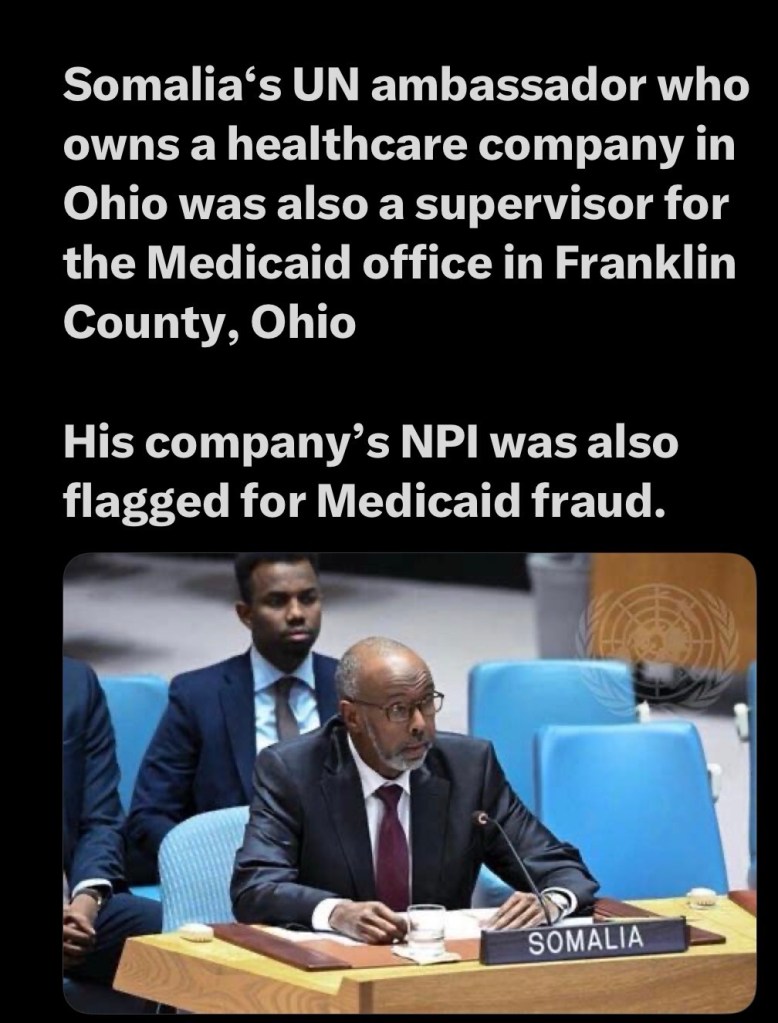
 The Overmanwarrior