Marijuana Use at the High Place of Tel Arad, Israel: The problem with legalizing communication with inter-dimensional entities

I promised more context for why I hate the legalization of marijuana so much, and in the case of mass society, intoxicants.  It’s not enough to say that drugs should be illegal; people need to understand why.  And for me, it’s a battle of consciousness and who controls your thoughts.  How can people, for instance, fight for small government and the benefits of an intelligent republic, but then surrender all thought through intoxication over to other forces that invade your personal sovereignty, and the most important at that, our minds and the thoughts that those minds produce?  When smoke filled the air of an inner sanctum, it was never accidental. It was engineered. In the eighth century BCE, at the Judahite fortress shrine of Tel Arad, roughly thirty-five miles south of Jerusalem, two limestone altars stood before the threshold of the “holy of holies.” Laboratory analysis of the charred residue on those altars has now told us plainly what ancient worshipers were inhaling: on one, frankincense blended with animal fat to volatilize its perfume at higher temperatures; on the other, cannabis mixed with animal dung to slow‑burn at lower temperatures, releasing a psychoactive aerosol sufficient to induce altered states. The compounds identified—THC, CBD, CBN, terpenes, and terpenoids—leave no doubt that the cannabis inflorescences were burned not for fragrance but for ecstasy.¹ ² ³ ⁴ 1234

That is the kind of hard, physical evidence that strips away modern euphemisms. At Tel Arad, cannabis was a ritual technology. It was the apparatus by which priests or officiants crossed the threshold from sober perception to trance, much as frankincense, sourced via Arabian trade routes, made the sanctum smell like heaven even as cannabis smoke tuned human minds to hear it.¹ ³ ⁵ 135 The shrine’s use window, ca. 760–715 BCE, places it squarely in Judah’s political and religious turbulence, between the First Temple’s glory and the Assyrian pressure, when competing cults and high places dotted the land. The Arad altars stood not in a marginal folk‑site but in a fortress on the southern frontier—a liminal place in geography and consciousness.² ⁵ 25

The broader archaeology of Canaan corroborates that mind-altering substances were embedded in ritual. In the Late Bronze Age cemetery at Tel Yehud, archaeologists recovered imported Base‑Ring jugs shaped like poppy heads whose residues test positive for opium—likely associated with funerary rites and the cult of the dead, whether to raise spirits or ease the passage.⁶ 6 Across the Near East, ecstasy was not a fringe practice; it was a cultivated technique. Tel Arad’s twin altars memorialize that technique at the threshold of the inner sanctum, where incense regulated the smell and cannabis regulated the state of mind.¹ ³ 14

From that ancient record, one conclusion emerges that remains relevant today: cannabis was used to override sober cognition in a sacred framework. It did not sharpen judgment; it sought communion—voices, visions, feedback from a realm beyond ordinary waking life. Whether you interpret those experiences as genuine encounters with non-human intelligences or as products of hyper-stimulated neural circuitry, the public‑policy implication is the same. Normalizing marijuana enshrines altered consciousness as a cultural good. The more potent the product and the wider the adoption, the more a society tunes its public square toward ritualized disinhibition.

You can see the continuity of this logic in India’s long bhang tradition. Bhang, a paste made from cannabis leaves, has been woven into festivals like Holi and Maha Shivaratri for centuries, with references in Vedic literature and Ayurvedic lore and with colonial observers documenting its ubiquity.⁷ ⁸ ⁹ ¹⁰ 78910 Contemporary estimates run in the millions of annual consumers around major festivals, placing cannabis within a sacred calendar rather than on the margins of culture.⁸ 8 In visual culture, the art that issues from such states is strikingly consistent across continents: charged neon geometrics, entity‑forms, fractal mandalas—repertoire that echoes shamanic cosmologies from Siberia to Amazonia and now saturates modern psychedelic aesthetics. The continuity of motifs suggests a continuity of effect: the same kinds of altered states produce the same types of visions.

But where ancient priests burned cannabis to induce ecstasy within a small, controlled ritual community, modern legalization scales that effect to whole populations. That is where archeology’s lesson collides with public health. If cannabis is a portal, the portal’s throughput matters. Epidemiology repeatedly associates heavier or earlier cannabis use with increased risk of psychotic outcomes, observing dose‑response effects: meta‑analysis finds the heaviest users have odds ratios near 3.9 for schizophrenia or related psychoses compared with non‑users.¹¹ 11 A 2025 synthesis applying Hill’s criteria argues there is a high likelihood cannabis contributes to schizophrenia development overall, with a pooled OR ≈ 2.88 and roughly two‑fold greater risk for adolescent users.¹⁴ 12 More granular clinical work shows that in diagnosed schizophrenia, cannabis use is tied to increased positive symptoms (hallucinations, delusions) and higher excitement, even as negative symptom patterns can vary; no causality is claimed, but the association is robust.¹³ 13 And among people with schizophrenia, cannabis use is significantly associated with some suicide‑related outcomes, including elevated odds of attempted suicide and increased hazards for suicide death.¹⁵ 14

Jurisdiction-level studies add a societal lens. After U.S. recreational legalization (2009–2019), modeling shows +5.8% injury crash rates and +4.1% fatal crash rates in the aggregate, controlling for factors like unemployment, speed limits, seat‑belt use, rural miles, and alcohol trends—effects vary by state, but the direction is worrisome.¹⁶ ¹⁷ 1516 Systematic reviews converge on negative road‑safety impacts in most studies, and national surveys now find 4–6% of drivers self‑report driving within an hour of cannabis use, with risk perceptions conspicuously more lenient than for alcohol.¹⁸ ¹⁹ 1718 None of this proves that every consumer will suffer harm; it demonstrates that scaled access increases measurable externalities—most acutely among young men, high‑potency users, and those who combine cannabis with alcohol.¹² ¹⁸ 1917

So why invoke Tel Arad in a twenty-first-century legalization debate? Because it reveals what cannabis was for in a culture that canonized sacred space: it was for ecstasy, for crossing boundaries, for letting something else participate in one’s thinking. If you grant the metaphysical possibility that those “somethings” are genuine non-human intelligences, then mass legalization looks like opening a wide conduit into a population’s decision-making machinery. If you deny that and call the entities neural artifacts, the conclusion hardly changes: repeated entry into states that mimic external agency undermines habituated sovereignty and clarity—what a civilization requires for law, craft, and self-government.

There is also a moral claim at stake. Cultures thrive on lucidity—on earned competence and honest accountability. We do not need to romanticize intoxication because it looks antiquarian. Tel Arad was not quaint. It was precise. One altar perfumed the sanctum; the other hijacked cognition. Judah’s priests were innovating in ritual engineering, not engaging in harmless herbalism. The residue composition—the dung matrix, the cannabinoid profile, the deliberate temperature control—shows purposeful design to modulate consciousness.¹ ² ³ 123 That is the legacy modern marijuana culture inherits: techniques to create porosity. Legalization, commercialization, and age-neutral marketing scale porosity to a level ancient officiants never imagined, and the data on psychosis and road safety tell us the cost.

For these reasons, I reject marijuana as a cultural good. The Tel Arad shrine is a fossilized warning: cannabis has been a conduit into ecstasy in high places for a very long time, and cultures that survive do not hand their sovereignty to smoke. The way forward is not to sacralize intoxication, but to honor clarity—frankincense is fragrant; cannabis is psychoactive. The former perfumes a room; the latter reprograms it. Tel Arad did both. We should do neither.

David Jay Brown and Sara Phinn Huntley’s The Illustrated Field Guide to DMT Entities: Machine Elves, Tricksters, Teachers, and Other Interdimensional Beings (2025) brings this conversation into sharp modern focus. Structured like a naturalist’s handbook for hyperspace, the book catalogs 25 distinct entity types encountered in DMT and ayahuasca experiences—from self-transforming machine elves and mantis insectoids to reptilians, gray aliens, fairies, nature spirits, and divine forms like Grandmother Ayahuasca and the Virgin Mary. Each chapter includes encounter narratives from trip reports and scientific studies, rich descriptions of behavior, appearance, and the messages or teachings they impart, accompanied by visionary artwork from artists such as Alex Grey and Sara Phinn Huntley herself 12. The field guide poses a profound question: Are these beings mere constructs of the human psyche, or are they independent intelligences inhabiting other dimensions? That question lies at the heart of every cross-cultural psychedelic tradition, from Tel Arad’s cannabis altars to global shamanic rites.

The guide has not only attracted readers interested in visionary art or entheogens but has also gained credibility through endorsements from figures like Graham Hancock and through guest appearances by Brown and Huntley on platforms like the “Rebel Spirit Radio” podcast 3. Meanwhile, mainstream voices like Joe Rogan regularly revisit “DMT astronauts”—individuals who deliberately seek these entities for spiritual insight or practical guidance—and discuss whether contemporary governments and institutions might align with such interdimensional “high priests” to influence mass consciousness 45. This book is a frontier consideration into a new science of analysis and reinforces the core argument: humanity’s engagement with psychoactive smoke—from ancient altars to modern DMT breakthroughs—is not benign. It is a politics of consciousness intervention, where the line between personal sovereignty and external mental imposition is perilously blurred.  And it’s very dangerous, and should under no rational endeavor, should ever be legalized in a serious society.

Footnotes

1. Arie, Rosen, Namdar (2020), GC‑MS identification of THC/CBD/CBN; animal dung/fat matrices; dating and functional interpretation. 1

2. Science News coverage of the shrine context, the cannabis–dung mixture, and THC levels consistent with altered states. 2

3. Taylor & Francis newsroom summary highlighting frankincense chemistry (boswellic acids) and deliberate psychoactive use of cannabis. 3

4. Times of Israel report: cannabis “to stimulate ecstasy” and implications for Temple ritual analogs. 4

5. Sci. News overview of shrine chronology, fortress border function, and compositional findings. 5

6. Biblical Archaeology Society: Tel Yehud opium residues in Base‑Ring jugs; cult‑of‑the‑dead context. 6

7. Wikipedia (summary with sources) on bhang as an edible cannabis preparation and festival use. 7

8. Firstpost explainer on Holi and bhang’s historical embedding; contemporary practice estimates. 8

9. IndiaTimes feature with Vedic/Ayurvedic references and colonial documentation of bhang. 9

10. SAGE review on the historical context and research state of cannabis use in India. 10

11. Marconi et al. (2016) meta-analysis: dose‑response; OR≈3.9 for heaviest use vs. non-use. 11

12. JAMA Network Open invited commentary (2025) summarizing evidence and Ontario cohort demographics; rising PARF after medical legalization. 19

13. eClinicalMedicine IPD meta-analysis (2023) associating cannabis use with higher positive and excitement dimensions in schizophrenia. 13

14. Biomolecules (2025) systematic review applying Hill’s criteria; overall OR≈2.88; doubled adolescent risk. 12

15. Psychological Medicine (2025) meta-analysis: cannabis use in schizophrenia linked to attempted suicide and suicide death hazards. 14

16. Journal of Studies on Alcohol and Drugs (2022): legalization associated with +5.8% injury crashes and +4.1% fatal crashes in aggregate. 15

17. IIHS bibliography summary of the same study’s methodology and state heterogeneity. 16

18. MDPI systematic review (2023) concluding negative impacts of legalization on road safety in most studies; risk profiles. 17

19. AAA Foundation (2024) fact sheet on DUI‑C prevalence (~4–6%), risk perceptions, and sex differences. 18

Bibliography

Arie, E.; Rosen, B.; Namdar, D. (2020). Cannabis and Frankincense at the Judahite Shrine of Arad. Tel Aviv, 47(1), 5–28. 1

Bower, B. (2020). An Israeli shrine may have hosted the first ritual use of marijuana. Science News. 2

Farmer, C. M.; Monfort, S. S.; Woods, A. N. (2022). Changes in Traffic Crash Rates After Legalization of Marijuana. Journal of Studies on Alcohol and Drugs, 83, 494–501. 15

Marconi, A., et al. (2016). Meta-analysis of the Association Between the Level of Cannabis Use and Risk of Psychosis. Schizophrenia Bulletin, 42(5), 1262–1269. 11

Argote, M., et al. (2023). Association between cannabis use and symptom dimensions in schizophrenia spectrum disorders. eClinicalMedicine, 64, 102199. 13

Pourebrahim, S., et al. (2025). Does Cannabis Use Contribute to Schizophrenia? Biomolecules, 15, 368. 12

Mulligan, L. D., et al. (2025). Cannabis use and suicide in schizophrenia. Psychological Medicine, 55, e79. 14

González Sala, F., et al. (2023). Effects of Cannabis Legalization on Road Safety: A Literature Review. IJERPH, 20(5), 4655. 17

AAA Foundation for Traffic Safety (2024). Cannabis Use, Public Health, and Traffic Safety (Fact Sheet). 18

Biblical Archaeology Society (2022). Narcotics used in Canaanite Cult: Opium in Late Bronze Age Graves. 6

Firstpost (2025). The Big ‘Bhang Theory’: Why Indians drink bhang on Holi. 8

IndiaTimes (2023). On Holi, a look at the tradition of using bhang and its legality. 9


Rich Hoffman
Click Here to Protect Yourself with Second Call Defense https://www.secondcalldefense.org/?affiliate=20707

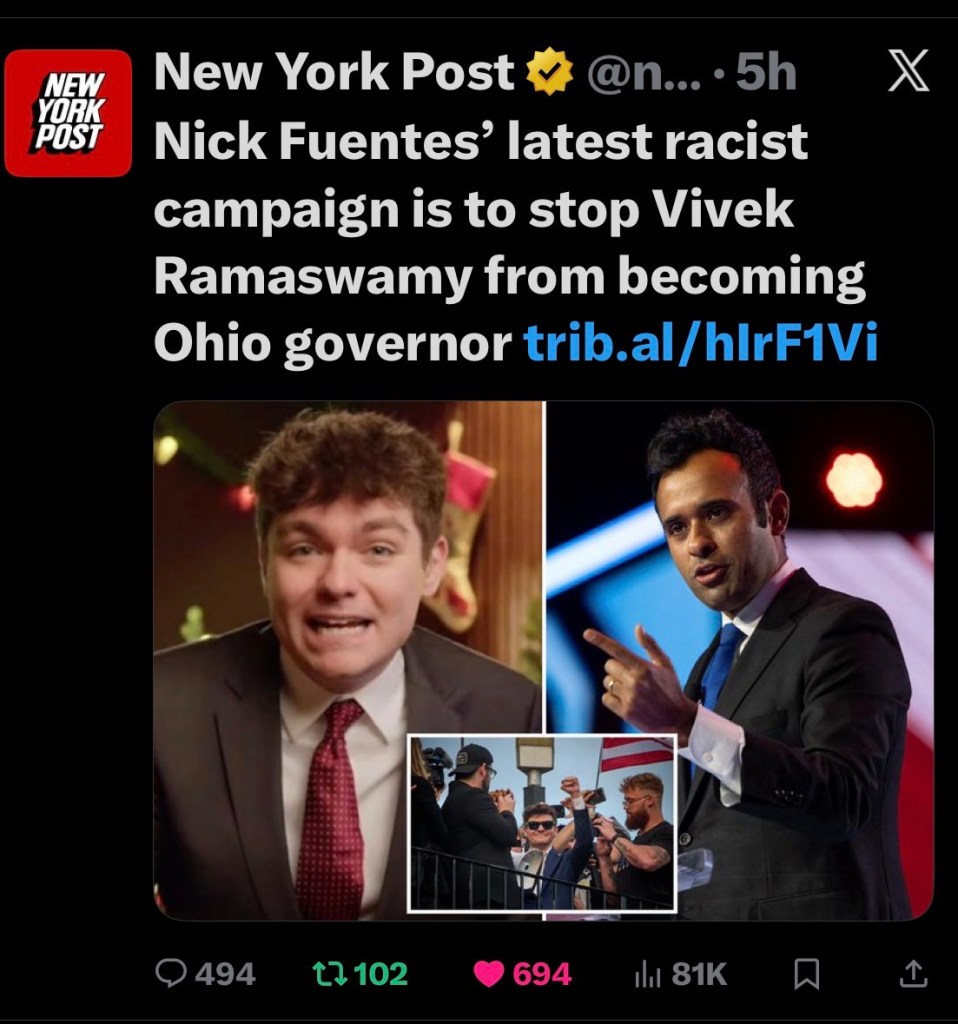
Nick Fuentes Picked a Fight with the Heavyweight, Vivek Ramaswamy: And he’ll get his teeth knocked out and his jaw broke, just like Jake Paul–but he’ll be rich

Jake Paul’s recent fight with Anthony Joshua is the perfect illustration of what happens when spectacle replaces substance. Paul, a YouTube celebrity with millions of followers, stepped into the ring against a world-class heavyweight—a man with Olympic gold and years of professional dominance. The pre-fight theatrics were designed to sell the drama, but anyone who understood boxing knew the outcome was inevitable. Paul fought briefly, suffered a broken jaw in two places, and left the arena humiliated in front of tens of millions of viewers. Yet, for him, the payday—reportedly $92 million—made the beating worthwhile. It was never about winning; it was about monetizing attention, even at the cost of personal dignity.

In many ways, that’s exactly what Nick Fuentes is doing with his attacks on Vivek Ramaswamy and, by extension, the MAGA movement. Vivek is the Trump-endorsed candidate for Ohio governor, a heavyweight in political terms, and Nick is trying to build his brand by picking a fight he cannot win. The goal isn’t policy or principle—it’s clicks, donations, and notoriety. Like Paul, Fuentes is willing to take a beating if it means short-term gains. But compromising integrity for a few bucks is a dangerous trade. Real influence comes from credibility, not shock-jock theatrics, and when the dust settles, Vivek will be fine. Nick, on the other hand, risks being remembered as the guy who sold his future for a viral moment.

Before we get lost in the weeds on Nick and the “war” he’s trying to gin up against Vivek Ramaswamy in Ohio, the first thing to understand is that this is a publicity grab, a brand‑building exercise in the attention economy dressed up as a crusade. Tucker Carlson’s long sit‑down with Nick dropped late October 2025 and lit up the right for weeks—not because Nick said anything new, but because platforming him without hard pushback sparked a visible fracture among conservatives: Shapiro condemned the interview as “normalizing” a Hitler apologist, Heritage’s president defended Tucker as a free‑speech stand, and even Senate Republicans openly rebuked the tone and content. That intra‑movement rift is real, it’s documented, and it tells you what lane Nick is driving in: controversy converts to cash. 12345

When Nick went on Piers Morgan Uncensored in December 2025, he doubled down—“Hitler was very f***ing cool,” he said, shrugging off historical atrocity with aesthetic fanboy talk about uniforms and parades. That wasn’t clipped speculation; it aired, it was challenged in real time, and it produced the predictable outrage cycle. He also conceded “at least six million” Jews were killed, but framed Holocaust memory as a mechanism to browbeat white Christians—a rhetorical move that’s been part of his pattern: push past decency, trivialize mass murder, court the shock. The point isn’t whether he “means” it; the point is that publicly saying it pays in a donor‑driven creator market. 678

And sure, people will ask how a 27‑ or 28‑year‑old ends up with this microphone. There’s a timeline: Unite the Right 2017, Groyper wars harassing mainstream conservative events in 2019, deplatforming cycles from YouTube for hate speech, and then re‑ascendance on platforms willing to host him; he even turned up at Mar‑a‑Lago in November 2022 when Ye (Kanye) brought him to dinner with Trump—a fiasco the former president later said he didn’t foresee. That dinner is a hinge in the public memory; it proved how oxygen flows to extremism when spectacle meets lax vetting. 910111213

Now, does Nick hurt Vivek in Ohio? No—he helps him by contrast. Ohio 2026 is shaping up as Ramaswamy vs. Acton, and the fundamentals are what they are: Vivek’s cash advantage, statewide endorsements, and consolidated GOP backing set the terrain; Acton’s own story is COVID‑era and compassion‑branded, but even Gov. DeWine has publicly said those shutdown decisions were his, not hers—undercutting the “Lockdown Lady” moniker his party uses.  Because, DeWine is really a Democrat, and Amy was his girl.  On balance, the race is competitive in public polling but leans Republican in a red‑trending Ohio; when the smoke clears, voters will choose jobs, affordability, and competence over influencer theatrics. That’s why a shock‑jock swipe from Nick won’t move the needle—it hardens a tiny niche while most Ohioans tune out the performative nihilism. 141516171819

And here’s the part nobody wants to say out loud: this is a business model. The pundit economy rewards dopamine spikes—outrage, taboo, transgression—because creator monetization has shifted from legacy ad rails to direct fan funding. Platforms like Rumble now integrate Bitcoin tipping (with Tether) so audiences can spray micro‑payments across controversial content in seconds. You don’t need brand safety; you need attention. That’s why “Hitler is cool” becomes an economic lever: it draws fire, it drives views, it pulls in tips from an aggrieved subculture that feels ignored by institutions. In this incentive structure, “being unhinged” is not a bug; it’s a feature. 202122

So, the math here is straightforward. Nick’s short‑term revenue maximizes by attacking Trump‑aligned figures like Vivek; it creates a pseudo‑rebellion narrative (“I speak the truths your gatekeepers won’t”), harvests donations, and inflates his standing with under‑30 males who see no path in a culture saturated with porn, atomized dating markets, and collapsing family formation—all frustrations he riffs on. But that same strategy destroys long‑term trust and any real governing coalition. Tucker’s interview gave Nick oxygen; Shapiro’s response—and the broader backlash—marked the boundary lines of mainstream conservatism. Vivek will do well to stay above it, keep on policy‑first, and connect with Ohio’s economy and families, and let the theatrics burn themselves out. That contrast, in the end, will decide everything. 3235

I’ll add one more note because I’ve lived this choice set: taking money and chasing the algorithm means someone else owns your argument. Independent voices who refuse the pay‑to‑play goose—whether that’s bot‑inflated follower counts or crypto tip farms—give up the easy ego pop in exchange for credibility with serious people who need facts, not theatrics. In Ohio, facts look like campaign filings, union endorsements crossing over, county‑by‑county organizing, and policy planks about taxes, education, and industry. That’s where Vivek is playing. That’s where this race will be decided. 1516

 While Vivek Ramaswamy will be fine in Ohio—his strategy is solid, his Trump endorsement is strong—he could easily swat away Nick Fuentes by pointing to the Jake Paul fight as a metaphor. Picking a fight with a heavyweight when you’re clearly outmatched is reckless, and Nick’s attempt to derail Vivek’s campaign is no different. It’s a stunt, not a strategy, and it will fail.

But here’s the deeper truth Nick is tapping into: the rise of a disenfranchised generation. Under‑30 men are angry, disconnected, and increasingly unwilling to pursue marriage or family because they see the culture as broken—porn saturation, hookup norms, and progressive narratives have eroded trust. Nick speaks to that frustration, and that’s why his voice resonates even when his tactics are self‑destructive. This is the future of media and politics: decentralized, unfiltered, and without institutional guardrails. Legacy platforms can’t contain it, and the genie isn’t going back in the bottle. Even when Vivek wins and MAGA thrives for now, the next wave will be shaped by these angry young men who feel robbed of a normal life—and commentators like Nick will only grow louder in that vacuum.

Footnotes

1. Tucker Carlson’s interview with Nick Fuentes published Oct. 27, 2025; episode listings and YouTube analytics confirm timing and reach. 12

2. Coverage of the interview’s fallout and intra‑GOP rift (Heritage defense; Shapiro’s critique; Senate Republicans’ reactions). 345

3. Piers Morgan interview (Dec. 8–9, 2025) where Fuentes said “Hitler was very f***ing cool”; additional reportage on his Holocaust remarks. 687

4. Fuentes background and extremism timeline: Unite the Right, Groyper wars, deplatforming, ideological positions. 9

5. Mar‑a‑Lago dinner (Nov. 22–25, 2022) with Ye and Fuentes; Trump’s later statements on not recognizing Fuentes. 10111213

6. Ohio 2026 overview: Ramaswamy’s fundraising and endorsements; Acton’s profile; DeWine clarifying COVID decisions. 141516171819

7. Creator‑economy monetization and Rumble’s Bitcoin tipping integration (Tether partnership; rollout timing). 202122

8. Shapiro’s extended takedown of Tucker/Fuentes; the boundary between mainstream conservatism and the groyper fringe. 235

Selected Bibliography

• Tucker Carlson x Nick Fuentes: “Tucker Carlson Interviews Nick Fuentes” (Podchaser listing, Oct. 27, 2025); “Tucker Carlson Interviews Nick Fuentes” (YouTube). 12

• Intra‑movement rift: USA TODAY analysis of interview fallout; POLITICO on Shapiro’s critique and Heritage backlash; Fox News coverage of the AmericaFest sparring. 345

• Piers Morgan interview: The Independent, Jewish Telegraphic Agency, and The Forward reports on Fuentes’ Hitler comments and Holocaust remarks (Dec. 2025). 687

• Mar‑a‑Lago dinner (2022): USA TODAY, NBC News, ABC News, POLITICO accounts and Trump’s statement. 10111213

• Ohio 2026: Cleveland Scene and Columbus Underground on fundraising and endorsements; Acton campaign site; NBC4 on DeWine’s COVID responsibility remarks; Ohio Capital Journal profile. 1415241718

• Creator monetization: Cointelegraph and industry reports on Rumble’s Bitcoin tipping rollout and Tether partnership. 20

Rich Hoffman

Click Here to Protect Yourself with Second Call Defense https://www.secondcalldefense.org/?affiliate=2070

Ohio is Not Moving Away From Trump: People who buy lottery tickets aren’t going to flip a Red State

(I wrote this before Trump signed that stupid pot executive order. I won’t write any more support for Trump, or speak favourably of him in any more videos. This article is still true, and is the case with Ohio in general. People can do what they want. For me, this is where I step off the Trump train. It was fun while it lasted.  He said people from my side didn’t call him to warn him away from making that really dumb decision.  Well, I warned him, and he did it anyway.  So I’ve cooled off a lot on Trump and don’t feel like defending him any longer, as it’s a waste of my time.  With that said, the facts of this article still hold.  The Democrats are offering worse people, with even dumber ideas about pot and civilization in general.  So the facts are the facts.  But because of Trump’s all talk and no action on the essential things, and his alignment with pot, I am done with his administration.  I took down all my Trump signs and got rid of all my Trump collectibles.  I didn’t throw them away; I put them away and out of sight.  They are part of history.  But I am no longer as proud of Trump as I have been for 10 years.  Needless to say, between him and the Democrats, Ohio will still pick him.) 

Ohio didn’t suddenly sour on Trump because one online poll said so, and the breathless headlines that tried to turn a three-month, opt-in web survey into a pronouncement on the Buckeye State’s political soul tell you more about the media’s incentives than about voters. The story making the rounds came from Morning Consult’s December state-level approval tracker, which rolled up interviews from September through November and reported Ohio at 49% disapprove, 48% approve, 2% don’t know—net −1, same as Iowa. That is the entire basis for the “Ohio flips negative” narrative. It’s wafer-thin, within the plausible margin for any nonprobability sample, and it relies on online panel responses that are later weighted to look representative. If you know how Ohio votes, and who actually shows up on Election Day, the “flip” reads like a media convenience, not a signal. 12

Start with what the poll is, not what people pretend it is. Morning Consult’s state approval series is an online, quota‑- and sample-tracking program; they interview registered voters every day via a network of web panels, then weight those respondents to government benchmarks and past vote, and publish a three-month rolling average for each state. They’re transparent about it: a July 2025 methodology primer spells out the quota sampling, ranking, and the +/-1 to +/-6 point state-level margins, depending on population. In other words, these are not random samples drawn from a known frame of all Ohio voters; they are scaled, modeled estimates built from opt-in online interviews, aggregated across a quarter. That matters when the “movement” being hyped is a one-point net change. 34

If you want to understand why these numbers gyrate month to month, look at how they’re constructed. Nonprobability online panels can be excellent for speed and topic tracking; they also introduce two significant vulnerabilities in politics: coverage and self-selection. Every serious polling standards body has wrestled with this. AAPOR’s task force reports—one classic from 2013 and another extensive update in 2022—explain that opt-in online samples don’t give you known selection probabilities for respondents, so you rely on weighting and modeling to back into representativeness. That’s defensible for many uses, but it’s also where nonresponse and selection biases can sneak in, mainly when partisan participation differs across modes. The reports also catalog quality metrics to diagnose panel drift and response attentiveness; the punchline is that online panels can be made useful, but you must keep their inferential limits in mind. None of that supports turning a −1 net in a rolling average into “Ohio abandons Trump.” 56

It’s not just theory. The lived reality in Ohio has been three straight presidential cycles of double-digit rightward lean relative to the country and consistent Trump wins. In 2024, Trump carried Ohio by about eleven points—roughly 55% to 44%—adding more raw votes than he had in 2020, even as total turnout dipped slightly. That outcome reinforced the long glide from swing‑state status to reliable red terrain, with the GOP broadening margins across most counties. Anyone living here saw the on-the-ground coalition: working-age voters in exurbs and small industrial towns whose politics are shaped by affordability, energy, and cultural stability—not by who answers online surveys on their phone during lunch. That’s the fundamental disconnect between online approval tracking and honest Ohio elections. 789

Media framed the December tracker as a “flip” because it fits a larger storyline about Trump underwater in swing states and a blue wave threat in 2026, but step back and you see the core fact the headlines buried: even Morning Consult’s own map shows Trump net‑positive in 22 states, with Ohio and Iowa moving to net −1 inside an error band. When your method can swing a couple of points on panel composition changes or weighting updates, you don’t declare reversals—you caution readers. The Cincinnati Enquirer piece, which repeats the 49/48/2 figures, at least notes that margins vary by state and are derived from a three-month roll-up; it still presented the “flip” as a dramatic change without grappling with how fragile a one-point net is on an online panel. That’s precisely how suppression narratives work: take noisy readings, build a doom arc, hope the mood sticks. 110

Iowa and Ohio were singled out, but notice how the same tracker had Florida at 50/46 approval for Trump—net positive—and Pennsylvania at 47 approve/50 disapprove—basically what you would expect from a purple state. If you are trying to tell the story of collapsing support in former GOP strongholds, Florida’s numbers don’t help that narrative, so they get footnoted, while the two net −1 states get the spotlight. That’s selection by headline, not by method. And again, we’re talking about slim differences inside modeled margins: it’s a map designed for trend reading, not knife-edge pronouncements. 11

Now, to the core critique: online panels systematically underrepresent the kind of “silent majority” MAGA voters most common in Ohio. You can hear it in any shop floor breakroom: people who work fifty or sixty hours a week aren’t clicking survey invites, and they’re not keen on sharing opinions with strangers for points or coupons. AAPOR’s work on nonprobability sampling and online panels acknowledges the coverage problem and the dependence on weighting to correct for it. Pollsters like YouGov defend their panels as high‑quality with strong fraud detection and advanced weighting; they also admit that recruitment tilts toward the more digitally connected. Even when you calibrate to census and voter file benchmarks, you’re still correcting a nonrandom, volunteer sample. When the political signal you’re measuring is heavily driven by turnout and preference intensity among people who aren’t panel joiners, you can miss a lot of real-world support until ballots are counted. 12136

There’s also the “shy” question. In 2016 and 2020, analysts argued about social desirability creating a hidden Trump vote. The academic record is mixed: a Yale list experiment found no evidence that Trump support was under-reported; FiveThirtyEight suggested shy voters weren’t the main driver of error. On the other hand, the USC Dornsife team showed systematic differences across modes, with self-administered polls showing higher Trump support than live interviewer surveys, consistent with a discomfort effect. The newest work on social pressure finds cross-pressured partisans on both sides, with the aggregate bias likely dampened. Put all that together, and I’d call the shy effect situational, not universal—more relevant where stigma is high, less relevant in places where Trump is a social norm. In Ohio, especially outside a handful of urban neighborhoods, there’s not much stigma in saying you’re for Trump. The bigger bias here is availability: who answers at all—online, by phone, or at the door. 14151617

When the media reach for “approval” to make a case about electoral strength, they also conflate two different animals. Approval is a temperature check about job performance; elections are about choice under constraints—issues, opponents, down-ballot dynamics, mobilization, and rules. Look at Emerson’s December 2025 Ohio survey: it used mixed mode (cellphone text/IVR plus an online panel), and found Trump approval 46/48 among Ohio voters—again a slight net negative—, but in the same poll, Democrats gained some ground in governor and Senate horse races as women consolidated for Amy Acton while men stayed with Vivek Ramaswamy. That’s not a collapse; it’s issue sorting. It tells you that campaign narratives and mobilization matter more than a two-point swing in approval. And even Emerson’s series acknowledged that, since August, Trump’s approval fell by three points while disapproval rose by six—but the economy remained the top issue (44%), immigration (8%), and education (7%)—a profile that has historically favored Republicans in Ohio. 1819

There’s an additional wrinkle: turnout validation. When researchers link surveys to voter files, they consistently find that self-reported voting overstates actual turnout, and that this bias is disproportionately among the more educated and politically attentive—precisely the groups who are more likely to complete online polls. Harvard’s Kosuke Imai and UNC’s Ted Enamorado showed that once you validate against the voter file, inflated turnout claims drop, and the sample’s voting behavior looks more like the real electorate. If your online panel tilts toward habitual survey‑takers who also overreport civic activity, no amount of ranking thoroughly fixes the difference between “people who like to answer surveys” and “people who actually vote.” This is one reason approval and intention measures in opt-in panels can underperform in high‑salience elections—turnout composition swamps neat demographic weights. 2021

So what can you actually learn from the Ohio “flip” month? Two things: first, the national mood in late fall 2025 went sour around affordability and government dysfunction; national aggregates showed Trump underwater at the end of the shutdown, with Gallup at 36% approve, NBC/YouGov, and Quinnipiac similarly negative. That atmospheric dip can tint state panels—even red ones—for a few weeks. Second, you should watch trajectories across methods, not a single three-month roll-up. Emerson’s Ohio series put Trump’s approval in the mid-40s; Morning Consult’s national tracker had him in the mid-40s, too; RealClear’s compilation showed a spread across outlets from the high 30s to the mid-40s. All consistent with a choppy environment, not with Ohio turning blue. 2223

The media hook—“Ohio flips negative”—also ignores a simple, durable counter‑fact: elections here continue to break for Republicans, even when national approval wobbles. The 2024 map showed GOP dominance across nearly all counties, and state certification confirmed that Trump netted more votes than his 2020 Ohio total despite slightly lower turnout. That doesn’t happen in a state “flipping away”; it occurs in a state consolidating. 89

Let’s talk method faults more directly, because that’s the part that actually teaches you something worthwhile. Nonprobability online polling faces four recurring problems in U.S. electoral work:

First, coverage error. Not all likely voters are reachable or inclined to join web panels. Internet access is high, but panel participation has its own skews: time availability, digital comfort, and willingness to trade opinions for incentives. AAPOR’s reports and YouGov’s own methodology notes acknowledge this and lean on active sampling and propensity scoring to compensate. In practice, compensation helps; it does not erase differences in contactability. The working-age, shift-based voters who anchor Ohio’s GOP strength are precisely under-covered by panel culture. 125

Second, selection and nonresponse. Even if you invite a demographically balanced slice of your panel, the people who respond to political surveys at a given moment are not random. During periods of partisan enthusiasm, one side may “show up” more in surveys; during periods of disgust or cynicism, response rates fall unevenly. AAPOR’s 2022 task force walks through how response quality metrics can improve detection, but it doesn’t change the fact that in high‑polarization cycles, panel response is a mood-weighted sample. When affordability becomes the top issue—as it did in late 2025—people irritated with politics may be less inclined to answer; that alone can shift approval by 2 points without any underlying change in vote intent. 6

Third, mode effects. In political polling, live‑caller phone, IVR, text‑to‑web, and online panel surveys can produce different distributions, especially on sensitive questions. USC’s 2016 work showed online self-administered surveys yielded higher Trump support than interviewer-administered phone polls, consistent with social comfort patterns. In Ohio, where “Trump talk” is everyday in many communities, the mode effect probably flattens, but nationally, when media storms frame a narrative of controversy, online samples can absorb more activism from the left—people who like surveys and like being heard. That can tilt a short‑window tracker. 16

Fourth, translating approval to a vote. Approval is not a ballot. Ohio voters have repeatedly separated “job rating” judgments from vote choice, prioritizing affordability, energy prices, border policy, and cultural guardrails. Emerson’s December Ohio poll confirmed the issue stack: economy at 44%, then “threats to democracy” at 13%, healthcare at 11%, housing at 9%, immigration at 8%. That landscape, coupled with historic vote margins, suggests Republicans will remain favored unless they become complacent. A one-point net approval drift in a web panel doesn’t rewrite that reality. 18

Now, some readers will push back with other online trackers. Civiqs, for instance, had Ohio at 51% disapprove/44% approve of Trump in early December after the shutdown, and local coverage highlighted the dip among younger voters and college-educated respondents. That’s a data point; it shows how shifts in subgroup composition can affect approval. But even that report noted the split by age—50+ approve, 18–49 disapprove—and the gender gap. Translate that to turnout and geographic distribution—older voters vote more, and Ohio’s GOP strength is outside the big metros—and the electoral consequences look less dire than the topline suggests. 22

If you want Ohio-specific reassurance that the fundamentals haven’t changed, look at actual 2024 results and how they mapped across counties: red strength intensified almost everywhere; Democrats tightened only in a few suburban counties like Union, Clermont, and Delaware. The new coalition here is anchored in places the media rarely visits, and it shows up when it matters—not in online panels, but on paper ballots. That’s the silent majority phenomenon people talk about—not “shy,” just disinterested in surveys. 24

Two practical lessons for reading polls as we head into 2026:

First, weigh the method, not the headline. An online three-month tracker is useful for trend sense; don’t treat a one-point net as a regime change. Check whether other modes—mixed IVR/text, live‑caller statewide polls—show the same movement. In December, Emerson’s mixed-mode Ohio survey clocked Trump at 46/48 approval, consistent with Morning Consult’s national mid-40s; RealClear’s national batteries ranged from 39–46 approve, depending on the house effects. That triangulation tells you the mood was softer, not collapsing. 1823

Second, remember the reality of turnout and election timing. Polls measure talking; elections measure doing. Pew’s “validated voter” work makes this plain: the people who say they vote are not always the ones who do, and compositional differences matter more in midterms. The Ohio electorate that shows up in 2026 will look more like 2024 Ohio voters than like a national online panel. That means more weight on the working class and the 50+ cohort, less on the disengaged younger respondents who fill out online surveys between classes. 25

Gas will be under $2 going into the next election cycle.   What matters politically: perceived affordability. Voters judge by weekly spend—fuel, utilities, groceries—and by whether they feel their community is stabilizing or fraying. Trump’s rallies have leaned hard into affordability and border policy precisely because those resonate in Ohio. Even the USA Today roundups that touted the “flip” acknowledged that Florida remains net‑positive on Trump and that national averages ticked up slightly after the November low. If energy stays cheaper and wages steady, approval will follow—but more importantly, votes will hold. 11

Is the left trying to plant suppression narratives through poll headlines? Of course, that’s politics. The tactic is as old as Gallup: shape mood, depress the other side’s excitement, declare inevitability. The antidote is local reality: county maps, early vote patterns, precinct work, and actual field operations. Ohio Republicans have a structural advantage here; if they keep “same‑day, paper, ID” as a rallying cry and focus on precinct captains instead of Twitter fights, they’ll out-organize online sentiment. The 2024 map already proved the coalition is resilient. 8

For readers who want receipts—the footnotes that help you judge the robustness—here’s a compact reference set you can use whenever the following “flip” headline drops:

• Morning Consult’s tracker and its state-level methodology primer, detailing the three-month roll-up and weighting to CPS benchmarks. 23

• The Cincinnati Enquirer and USA Today write-ups that summarized the December update (the 49/48/2 Ohio figure and the context of 22 net‑positive states) are useful to see how reporters framed the same dataset. 111

• Emerson College Polling’s December 2025 Ohio survey, showing mixed‑mode data for gubernatorial and Senate matchups and Trump approval at 46/48 with issue salience led by the economy. Local TV and NBC4 coverage of that same poll adds clarity on sample size (n≈850, MOE ±3.3). 1819

• Civiqs-based local coverage indicating a post-shutdown approval dip (Ohio 51 disapprove / 44 approve), with subgroup splits by age and education—worth reading but always weighed against turnout patterns. 22

• The election result confirmations: NBC News Ohio 2024 live results (55–44), county breakdowns from NBC4, and certification notes from Cleveland.com on turnout and vote totals. These ground everything. 789

• AAPOR’s nonprobability sampling reports (2013; updated task force on online panels and data quality metrics in 2022/2023). These are the “how the sausage is made” documents for opt-in online surveys. 5626

• Mode‑effect and shy‑vote literature: Yale’s list experiment (no shy effect), FiveThirtyEight’s skeptical analysis, USC’s 2016 mode comparison, and recent work on social pressure showing cross-pressured partisans on both sides. Use these to push back when someone waves “shy voters” as either a cure-all or a fantasy. 14151617

• Turnout validation studies: linking surveys to voter files to debias self-reported voting, which underscores why online samples overrepresent habitual survey‑takers. 20

If you collect those sources, you’ll see how flimsy the “Ohio flips negative on Trump” headline is in methodological terms. It’s a cautious tracker’s small net move during a rough national month, not a realignment. And even inside the tracker’s own series, Florida and other GOP states remained net‑positive, with the number of above-water states still exceeding similar points in Trump’s first term. The narrative breaks under its own weight. 11

What should Ohio Republicans do with this? Treat it as a lesson in media jujitsu. When a web panel drifts two points, smile and keep organizing. Push precinct-level turnout plans, show up in the workplaces and churches where surveys don’t go, and keep beating the drum on affordability with receipts: local gas averages, utility bills, grocery basket comparisons over six months. You don’t need a poll to tell you what the checkout line tells you. And if you want a poll, prefer mixed‑mode, registration-based samples connected to the voter file (SSRS’s Voter Poll methods statement is a good model). Those designs reduce the self-selection bias of pure opt-in panels and tend to track the actual electorate more accurately. 27

Ohio didn’t flip. It yawned while national pundits tried to turn a rounding error into prophecy. The people who will decide 2026 are not filling out online “approval” pulse checks; they’re making shifts, fixing machines, and then voting. And when you look past the headlines to the county maps and the validation studies and the complex math of turnout, the story is the same one you’ve seen for three cycles: Ohio is MAGA country, not a trending blue lab experiment. Polls will keep trying to tell a different story because it sells. But the ballots—paper, same day, with ID—are what count. Those who have told the truth about Ohio for years now will continue to do so. 7  Ohio won’t turn away from Trump in exchange for the kind of people who buy lottery tickets and fill out online polls.

Sources for further reading (a handy set to clip under the essay body for footnoted context):

• Morning Consult state tracker and methodology: “Tracking Trump” and “Methodology Primer—State‑Level Tracking (July 2025).” 23

• Local coverage of the December Ohio/Iowa net‑one reading: Cincinnati Enquirer; USA Today overview. 111

• Emerson College Polling—Ohio (Dec. 6–8, 2025) plus NBC4/WLWT write-ups. 181928

• Civiqs/Ohio coverage (Canton Repository). 22

• Ohio 2024: NBC News live results; county breakdown (NBC4); certification (Cleveland.com). 789

• AAPOR reports on nonprobability sampling & online panel quality. 56

• Mode effect & shy voter literature: Yale list experiment; FiveThirtyEight; USC Dornsife; Acta Politica social pressure paper. 14151617

• Turnout validation: Imai & Enamorado on linking surveys to voter files. 20

• SSRS Voter Poll methodology as an example of multi-frame, verified voter sampling. 27

Rich Hoffman

Click Here to Protect Yourself with Second Call Defense https://www.secondcalldefense.org/?affiliate=2070

The Ohio Governor Race: Vivek Ramaswamy vs. Amy Acton—”the lockdown lady”

You know, people keep asking me about this Ohio governor race, and I’ll tell you what I think: Vivek Ramaswamy is going to win, and he’s going to win big. But that doesn’t mean you sit back and assume it’s all going to happen on autopilot. Campaigns aren’t won by assumptions; they’re won by hard work, strategy, and relentless execution. And if you’ve seen some of the chatter online—polls showing Amy Acton up by a point or two—you might think, “Wow, is Vivek in trouble?” No, he’s not. But let’s break this down because there’s a lot of smoke and mirrors in these early numbers.

First, let’s talk about Amy Acton. Who is she? Most people don’t even remember her name right now, and that’s part of the problem. She’s the former Ohio Health Director who became the face of lockdowns during COVID. Back in 2020, she was the one telling you to stay home, mask up, and cancel your life. She shut down schools, businesses, county fairs—you name it.¹ She was Ohio’s Dr. Fauci, taking cues straight from the CDC and enforcing some of the harshest restrictions in the Midwest. And it wasn’t just policy; it was the tone. She leaned into fear. She made people miserable. And when the heat got too much, she resigned in June 2020 because she refused to lift bans on county fairs.² That’s her legacy.

Now, fast forward to 2025. People have short memories, and Democrats are counting on that. They’re hoping voters see “Dr. Acton” and think “compassionate health expert” instead of “lockdown czar.” But here’s the reality: once she starts talking, once Vivek and his team start connecting her to those lockdowns, it’s game over. Ohioans haven’t forgotten the pain of 2020—they’ve just moved on. But if you remind them who caused it, they’ll move on from her real fast.

And what’s she running on? Abortion rights, reproductive freedom, and vague promises of “public health leadership.”³ That’s it. No major accomplishments since leaving office. No executive experience beyond a failed stint as health director. She’s endorsed by unions like AFSCME and UAW, and big-city mayors are lining up behind her.⁴ But endorsements don’t erase a record of failure. And in a state that leans red, with Trump back in the White House and MAGA energy surging, that’s not enough.

Now, Vivek Ramaswamy—he’s the opposite story. Entrepreneur, author, former presidential candidate. He’s smart, articulate, and aggressive. He’s raised nearly $10 million for this race, compared to Acton’s $1.4 million.⁵ He’s got Trump’s endorsement, JD Vance in his corner, and the Ohio GOP machine behind him.⁶ His platform? Bold: eliminate income and property taxes, merit pay for teachers, work requirements for Medicaid.⁷ He’s even courting unions, which is a savvy move in a state where blue-collar voters matter.⁸

So why the tight polls? Because polls lie. Or, more accurately, they mislead. Early polls oversample urban areas, lean left in methodology, and create narratives that help Democrats fundraise. RealClearPolitics has Vivek up by 6.5 points (49.5% to 43%).⁹ But Impact Research claims Acton is down by just one point, and Hart Research even shows her up by one among likely voters.¹⁰ Sounds scary, right? Until you realize these are snapshots taken before the campaign really starts. Acton hasn’t been vetted yet. She hasn’t faced Vivek on a debate stage. She hasn’t had to answer for the misery she caused during COVID. When that happens, those numbers will swing hard.

Here’s what I told people: don’t panic, but don’t get complacent. Vivek could walk out today and win by 15 points, maybe more. On Acton’s best day, she loses by eight. But campaigns aren’t about best days; they’re about execution. Vivek needs ads, billboards, ground game, and a war chest big enough to drown out the noise. And that’s why he’s smart to push fundraising now. Take nothing for granted. Because Democrats will throw everything at this race—they know Ohio is a battleground, and they’d love to embarrass Trump by flipping it blue.

And let’s not forget the Trump factor. If Trump does a couple of rallies in Ohio for Vivek, it’s lights out for Acton. He probably doesn’t even need that help, but it would seal the deal. MAGA voters will turn out in force. Independents? They’ll break for Vivek once they see Acton’s record. And suburban moms—the group Democrats are banking on—aren’t going to forget who kept their kids out of school for months. That’s political kryptonite.

So what happens when Acton starts talking? Disaster. She’s awkward, ideological, and out of touch. She was a radical during COVID, and she hasn’t changed. Democrats think they can hide that, but they can’t. The minute Vivek’s team rolls out ads showing her press conferences from 2020, it’s over. She’s the lockdown lady. The face of fear. And Ohioans aren’t voting for that in 2026.

Now, let’s talk strategy. Vivek needs to keep doing what he’s doing: stay aggressive, stay visible, and keep hammering the contrast. He’s a builder; she’s a bureaucrat. He’s about freedom; she’s about control. And he needs to remind voters that elections have consequences—because if Acton wins, Ohio goes backward. More mandates, more government overreach, more progressive nonsense. That’s the choice.

So, bottom line: Vivek wins. Easily. But only if he fights like he’s ten points down. No coasting, no assumptions. Raise the money, run the ads, knock the doors. Because politics is like football—you don’t win by reading the headlines; you win by playing the game. And when the game starts, Amy Acton is going to get crushed. She’s going to be exposed for what she is: a failed health director with no vision, no leadership, and no chance. 

And let’s not forget just how angry people were at Amy Acton during and after those lockdowns. This wasn’t mild criticism—it was rage, rage that she provoked.  People had been pushed beyond their limit, and she knew it as she did it. Protesters showed up at her home in Bexley, some carrying rifles, shouting slogans, and waving signs with anti-Semitic slurs.¹ Armed demonstrators patrolled her street while others plastered her address online.² She had to be assigned a security detail and eventually went into hiding because the threats were so severe.³ People doxed her, compared her to Nazis, and called her a “globalist” for extending stay-at-home orders.⁴ It got so bad that she resigned under pressure, citing concerns for her safety and her family’s well-being.⁵ That’s the level of backlash we’re talking about—the kind of fury that doesn’t just disappear. Ohioans haven’t forgotten that, and once voters are reminded, it will come roaring back.  And all that was just for a member of the DeWine administration.  Imagine her as the head of the Executive Branch. 

Notes on doxing actions:

1. Forward. “Ohio Protesters Gather in Front of Dr. Amy Acton’s Home.” May 2020.

2. Times of Israel. “Jewish Ohio Health Official Resigns After Anti-Semitic Backlash.” June 2020.

3. FOX 5 New York. “Public Health Officials Resign, Some Assigned Security Detail Amid Threats.” June 2020.

4. WKYC. “Why Did Dr. Amy Acton Resign as Ohio Health Director?” November 2020.

5. Jewish Telegraphic Agency. “Amy Acton Faced Anti-Semitic Backlash After Lockdown Orders.” February 2021.

Bibliography

1. Cleveland.com. “Amy Acton’s Role in Ohio COVID Lockdowns.” June 2020.

2. Columbus Dispatch. “Acton Resigns Amid Controversy Over Fair Bans.” June 2020.

3. Cincinnati Enquirer. “Amy Acton Campaign Platform: Abortion Rights and Public Health.” October 2025.

4. Dayton Daily News. “Unions Back Acton for Governor.” November 2025.

5. RealClearPolitics. “Ohio Governor Race Polling Average.” December 2025.

6. Fox News. “Trump Endorses Vivek Ramaswamy for Ohio Governor.” November 2025.

7. Politico. “Ramaswamy’s Policy Agenda: Taxes, Education, Medicaid.” November 2025.

8. Wall Street Journal. “Ramaswamy Courts Unions in Ohio.” December 2025.

9. RealClearPolitics. “Ohio Governor Race Polling Average.” December 2025.

10. Impact Research and Hart Research Polls. “Ohio Governor Race Polling.” November 2025.

Rich Hoffman

Click Here to Protect Yourself with Second Call Defense https://www.secondcalldefense.org/?affiliate=20707
FBI Delays, Media Spin, and the Brian Cole Jr. Pipe Bomber Case: What They Don’t Want You to Know

The Brian Cole Jr. pipe bomber case is more than a criminal investigation; it is a lens into systemic failures within the FBI and DOJ, compounded by media complicity in narrative control. Despite clear evidence linking Cole to pipe bombs planted near Republican and Democrat headquarters on January 5, 2021, his arrest came nearly five years later. Why? The answer lies in a troubling intersection of bureaucratic inertia, political bias, and deliberate concealment. This case shows how the Cole case, recent assassination attempts on Donald Trump, and the broader pattern of FBI delays in politically sensitive investigations, alongside the media’s role in shaping public perception, have come together to initiate a level of corruption that will require more than civilian oversight through an elected president in the White House.

Timeline

• Jan. 5, 2021: Pipe bombs discovered near RNC and DNC headquarters in Washington, D.C.

• 2021–2024: FBI claims “ongoing investigation,” releases grainy surveillance footage of masked suspect.

• Dec. 2025: Brian Cole Jr. arrested after new administration reviews dormant case files.

The case was never a mystery. Surveillance video captured Cole’s gait and clothing; cell-site data placed him near both bomb sites; and receipts showed purchases of bomb components. When interrogated, Cole confessed, citing anger over alleged election fraud as his motive. Yet, despite this evidence, the FBI stalled for years.

Internal sources suggest the case “languished” under prior leadership due to its political sensitivity. Acting on it in 2021 would have reignited debates over election legitimacy — a narrative the establishment sought to suppress. Instead, the case was buried until a new administration prioritized transparency.

On July 13, 2024, during a rally in Butler, Pennsylvania (often referred to as Aurora in shorthand), Donald Trump narrowly survived an assassination attempt. The shooter, Thomas Crooks, fired from a rooftop, killing one attendee and injuring two others before being neutralized.

Secret Service agents reportedly spotted Crooks 20 minutes before shots were fired, but failed to act. The FBI later declared Crooks “acted alone,” though his digital footprint revealed a mix of ideologies and possible external influences.

Media coverage was muted compared to hypothetical scenarios involving Democrat figures. Within days, the story vanished from the front pages — a stark contrast to the saturation coverage of January 6.

The Cole case and Aurora attempt are not anomalies; they reflect a systemic pattern. Politically sensitive cases often stall for years, while less controversial matters move swiftly.

Statistics

• Median DOJ decision time: 61 days for standard cases.³

• Politically charged cases: often years, as seen with Hunter Biden laptop probe and Clinton email review.

• White-collar prosecutions have declined 40% since 2016, while resources shift to “domestic extremism” narratives.⁴

• Epstein files heavily redacted, shielding high-profile names.

• Indictments against James Comey and Letitia James dismissed due to unlawful appointments.

• Internal memos reveal obstruction in probes tied to Biden and Trump.

The media’s role in shaping perception cannot be overstated.

CNN initially described the suspect as “a White male,” contradicting later photos showing Cole as African American. ABC framed the motive as “belief in false election fraud claims,” reinforcing a narrative that dissent equals extremism.

Networks downplayed the assassination attempt, using vague terms like “popping sounds” and avoiding deep dives into security lapses. Compare this to the exhaustive coverage of January 6 — a clear double standard.

From Operation Mockingbird to the Twitter Files, evidence of media-government collusion is undeniable. Today, editorial scripts often mirror DOJ talking points, conditioning public opinion to accept selective outrage.

When law enforcement delays justice and media manipulates narratives, public trust erodes. Worse, these dynamics enable the weaponization of institutions against political opponents. The result? A chilling effect on free speech and a dangerous precedent where questioning authority becomes synonymous with terrorism.  There should be statutory timelines for politically sensitive cases, so these investigations don’t get shelved in disorder.  There should also be independent oversight of FBI investigations.  We could say that’s why we have Presidential investigations, and that’s how Kash Patel came into the power of his seat, as we elected a president who would be independent and in charge of these career FBI types.  There also needs to be transparency mandates for media-government interactions. There is way too much collusion going on.  It is good that the Trump administration is bringing in anti-establishment media sources to add competition to the press pool, but the level of collusion that goes on between the administrative types and the official media narrative has been excessively alarming. 

The Brian Cole Jr. case, Aurora assassination attempt, and FBI’s pattern of delay expose a sobering truth: America’s justice system and media ecosystem are vulnerable to politicization. Reform is not optional — it is imperative.  Clearly, the FBI saw the direction in which the pipe bomber cases were going with Brian Cole Jr., and they did not want a resolution to the case.  It would have changed the entire January 6th narrative.  It would have changed the impeachment case against Trump.  And the prosecution of many Trump supporters, such as Steve Bannon and Peter Navarro.  Instead, the FBI, when they arrested Peter Navarro at Reagan International and put him in leg irons in front of everyone for the perp walk of embarrassment that they clearly staged for maximum public impact, knew at the time that Brian Cole Jr. was likely the guilty party, and they had their own fingerprints all over the information.  And they declined to act in the best interests of the case and instead dug in to their own complicity in the violent conditions that occurred on January 6th.  The efforts of the FBI to blow on the embers of anger to drive that day toward an objective they had to quell the outrage over mass election fraud, for which they played their part. 

But this isn’t the first time, nor will it be the last.  We have seen the FBI behave in this way before, in many cases, going back to the Ruby Ridge massacre, to the Islamic terrorism of the San Bernardino office killings, and their allowing the media into the apartment of the suspects to taint the evidence before the investigation could proceed.  They have a long history of this kind of radicalism and are terrible at their jobs.  They need a lot more than civilian oversight through elected presidents.  They are a corrupt organization that appears beyond reform.  And this recent pipe bomb case is just the tip of the iceberg.  Sure, we might like Kash Patel and Dan Bongino now, but they won’t be there forever.  They will be gone eventually, and who will replace them?  More Jim Comey types?  People who clearly have had the power of the offices go to their heads?  When you have evidence like this case against Brian Cole Jr. so obvious, and abundant, and they didn’t act on it, it just reveals how political all their investigations are, and that we can’t trust anything they do, because they require so much oversight to get at fundamental truths.  Based on the evidence, there is little that can be done to save their reputations.  We might get short-term improvements in their performance, but the bottom line is that the government can never have the kind of power that we have given to the FBI and the CIA.  Without a doubt, they will abuse that power and, when caught, will deny and manipulate the facts to cover up their crimes.  And in the case of Brian Cole Jr., they were complicit, without a doubt. 

Bibliography

1. CBS News. “FBI Arrests Suspect in 2021 Pipe Bomb Case.” December 2025.

2. ABC News. “Trump Rally Shooting: What We Know.” July 2024.

3. TRAC Reports. “DOJ Case Processing Statistics.” 2024.

4. Newsweek. “FBI Under Fire for Politicized Delays.” 2025.

5. Columbia Journalism Review. “Media and State: A Symbiotic Relationship.” 2023.

6. Fox News. “CNN Misidentifies Pipe Bomber.” 2025.

(Additional sources: TIME Magazine, FBI Press Releases, The Hill, WABC, DOJ internal memos.)

Rich Hoffman

Click Here to Protect Yourself with Second Call Defense https://www.secondcalldefense.org/?affiliate=20707
Free Tina Peters: The Battle for Honest Elections in America

You know, here’s the thing: if President Trump doesn’t get Tina Peters out of that Colorado prison, then everything we’ve fought for on election integrity is just theater. It’s all optics without substance. Because if you don’t control your election systems, you don’t control your government. And that’s the bottom line. People say, “There’s no evidence of fraud.” Really? Then why is Tina Peters sitting in a cell for nine years? She was the Mesa County Clerk, the one person in Colorado who had the guts to blow the whistle during the heaviest part of the 2020 election scandal. She saw irregularities, she reported them, and for that, they threw her in prison.

Let’s get the facts straight. Tina Peters was convicted in October 2024 on seven counts—four felonies and three misdemeanors—for allegedly breaching election systems during a 2021 update.¹ They said she conspired to commit criminal impersonation, attempted to influence a public servant, and violated her official duties. Nine years in state prison for trying to preserve election records? That’s not justice; that’s retaliation. And where is she now? La Vista Correctional Facility in Pueblo, Colorado, locked away like a political prisoner.²

And don’t forget, she wasn’t alone in this fight. Mike Lindell—the MyPillow guy—stood shoulder to shoulder with her, pouring millions into exposing voting machine companies.³ Steve Bannon and Peter Navarro? They got four months each for contempt of Congress because they wouldn’t play ball with the January 6 narrative.⁴ Rudy Giuliani? Bankrupted for daring to question election results. This is a pattern: punish the whistleblowers, destroy the evidence, and control the narrative.

Now, here’s the legal reality: Trump can’t just sign a pardon and free Tina Peters. Article II of the Constitution gives the president the power to grant pardons for federal crimes, not for state convictions.⁵ Colorado prosecuted her under state law, and Governor Jared Polis isn’t about to hand Trump a win. So what do we do? Sit back and let her rot? Absolutely not. There are practical steps Trump can take, and they start with leverage—political, legal, and financial.

First, a pressure campaign. Trump needs to call out Polis and AG Phil Weiser by name, which he has been doing lately. Make it politically toxic for them to keep Peters locked up. Rallies, Truth Social posts, interviews—turn up the heat. When the public sees a grandmother rotting in prison for questioning election fraud, the optics shift fast.

Second, DOJ leverage. This is where it gets interesting. The Department of Justice can’t override a state conviction, but it can make life very uncomfortable for Colorado. How? Start with federal election law hooks. The 2020 election was a federal election. Peters’ actions were tied to preserving federal election records. File a federal habeas corpus petition arguing her imprisonment violates constitutional rights under federal election statutes like the Help America Vote Act. Force Colorado to defend its conviction in federal court.

Then there’s civil rights enforcement. Frame this as retaliation against a whistleblower exercising First Amendment rights. The DOJ Civil Rights Division can open an investigation into political persecution. Even if it doesn’t overturn her sentence immediately, it creates a legal basis for federal intervention and puts Colorado under a microscope.

Now, here’s the big one: federal funding leverage. Colorado gets millions in federal grants for election security and compliance under HAVA and EAC programs. Those funds are discretionary. Condition future funding on transparency and whistleblower protections. Announce that Colorado risks losing federal election security money because it retaliated against Peters. That’s constitutional under the Spending Clause, and it hits where it hurts—the budget.

Another angle: federal subpoenas and custody transfers. If Peters has evidence relevant to federal crimes—say, election tampering—the DOJ can subpoena her testimony. Request a temporary transfer to federal custody for questioning. That doesn’t erase her sentence, but it moves her out of state prison and into a federal process where deals can happen.

Finally, amplify public awareness. Trump should feature Peters’ case in speeches, rallies, and interviews. Get Mike Lindell, Steve Bannon, and the Warroom team hammering this story every day, give them some red meat. When people see the truth—that Peters was jailed to bury evidence of election fraud—the pressure becomes unbearable.  And Trump is naturally good at that kind of thing.  But if he’s waiting for help from other Republicans, they don’t have the guts.  It will have to come from him, and him alone.  The damage from this case will benefit other efforts around the country.  Allowing the radical left to control the discussion, as they have, will not help with the Midterms, where Democrats are planning to cheat, because it’s their only strategy.  This case could greatly frustrate those efforts. 

And let’s talk numbers because facts matter. The Heritage Foundation database lists 1,561 proven cases of election fraud over decades, with 20 cases in 2024 alone.⁶ Brookings says fraud rates are minuscule—0.0000845% in Arizona over 25 years—but those stats ignore systemic vulnerabilities in digital voting systems.⁷ Globally, we know electronic manipulation happens—Venezuela, China, Russia. You give people the illusion of choice, then flip the results. That’s the game. And it happened here in 2020.

So when they say, “There’s no evidence,” what they mean is, “We buried the evidence and jailed the people who had it.” Tina Peters had the proof. She tried to show it. They raided her home, seized her devices, and threw her in prison. That’s tyranny, plain and simple. And if Trump doesn’t act, it sends a message: whistleblowers will be crushed, and election integrity will remain a myth.

Here’s the bottom line: Trump has tools. He can’t wave a magic wand, but he can apply pressure—legal, financial, and political—until Colorado cracks. And he must. Because if we don’t fight for Peters, we don’t fight for honest elections. And without honest elections, we don’t have a republic.

Summary of Key Actions for President Trump

1. Launch a Pressure Campaign

    • Publicly call out Colorado Governor Jared Polis and AG Phil Weiser.

    • Mobilize grassroots and media to demand Tina Peters’ release.

2. Leverage DOJ Authority

    • File federal habeas corpus petitions citing election law violations.

    • Open a Civil Rights investigation into political retaliation.

3. Use Federal Funding Leverage

    • Condition Colorado’s federal election security funds on transparency and whistleblower protections.

    • Publicize potential funding cuts to increase pressure.

4. Subpoena Tina Peters for Federal Testimony

    • DOJ can request a temporary transfer to federal custody for testimony related to election integrity.

5. Amplify Public Awareness

    • Feature Peters’ case in speeches, rallies, and media appearances.

    • Encourage allies like Mike Lindell, Steve Bannon, and WarRoom to keep the story alive; they need red meat to pound away at the base.

This is one of the most critical agenda items for the Trump administration because much remains unsaid.  All the horrible things going on in the world with Hamas, China, Russia, Venezuela, and our own domestic money policy that is under siege are nothing compared to the villainy that occurred against Tina Peters.  If she is allowed to be held in jail by a corrupt, leftist Democrat government in Colorado, people will lose faith in fighting for an honest election in 2026.  And without an honest election, the radical left plans to capture enough seats to impeach Trump and give the government back to the Deep State.  So this is a critical time.  We need a very vicious pressure campaign that forces this issue on the nightly news, because so far, they have been able to ignore it.  Once Trump won the last election, all the hostile forces treated it as a concession to buy a little time.  And the Midterms were their target.  If Tina Peters is not freed, then Trump will have a hard time holding power, and those who will fight for him will become discouraged.  So freeing Tina from jail is a must-do occasion.  There is no other option. Yes, there was election fraud in the 2020 election, and those who committed it, numbering in the many thousands, have to be punished for what they did.  Otherwise, we don’t have a country. 

Bibliography (Chicago Style)

1. Colorado Judicial Branch. “People v. Tina Peters: Sentencing Order.” October 2024.

2. CBS News. “Tina Peters Sentenced to Nine Years in State Prison.” October 2024.

3. Fox News. “Mike Lindell Faces $1 Billion Lawsuit Over Election Claims.” 2023.

4. ABC News. “Steve Bannon, Peter Navarro Sentenced for Contempt of Congress.” 2024.

5. U.S. Constitution, Article II, Section 2.

6. Heritage Foundation. “Election Fraud Database.” 2024.

7. Brookings Institution. “Election Fraud Rates in U.S. Elections.” 2023.

Rich Hoffman

Click Here to Protect Yourself with Second Call Defense https://www.secondcalldefense.org/?affiliate=20707
The Affordability Crisis: Price increases to fill vacant personalities are the folly of socialism looming in the background

The question of housing affordability has become one of the most pressing socio-economic issues in the United States today. With the average home price reaching approximately $400,000 in 2024, many young families and individuals find themselves priced out of the market. This reality raises a critical question: why does the housing industry continue to prioritize large, expensive homes when market signals clearly indicate a growing demand for smaller, affordable housing options? Historically, the American housing model was built on accessibility. Following World War II, the United States experienced an unprecedented housing boom driven by the GI Bill, which provided returning veterans with low-interest mortgages and educational benefits. Between 1945 and 1960, the average home price increased from roughly $8,000 to $12,000 [1], while median household income rose from $2,400 to $5,600 [2]. These homes were predominantly single-story ranch houses designed to be affordable for working-class families. They featured simple layouts, modest square footage, and efficient construction methods that allowed developers to build entire neighborhoods quickly and inexpensively. This model supported rapid suburbanization and contributed to the rise of the American middle class. By contrast, the late 20th and early 21st centuries saw a shift toward larger homes, often called “McMansions.” In 1980, the average home price was $47,000 [3], but by 2000, it had climbed to $120,000 [4], and by 2020, it had skyrocketed to $320,000 [5]. This escalation far outpaced wage growth, creating a structural imbalance in housing affordability and leaving younger generations unable to enter the market. The cultural and economic forces that once prioritized affordability have been replaced by incentives that reward size, luxury, and perceived status, setting the stage for today’s housing crisis.

The persistent trend toward building larger homes is not driven solely by consumer demand but by systemic incentives in the real estate and finance sectors. Developers maximize profits by constructing high-value properties, while municipalities benefit from increased property tax revenues. This dynamic discourages the development of smaller, entry-level homes, even though demographic data suggests that younger generations prefer affordability and functionality over size and luxury. According to recent affordability indices, the ratio of median household income to qualifying income for a median-priced home fell to 0.68 in 2024 [6]. This indicates that homeownership is increasingly unattainable for average earners, reinforcing the argument for a return to smaller, cost-effective housing models. Yet the financial ecosystem—from banks to zoning boards—remains locked into a paradigm that rewards high-margin projects. Mortgage lenders often favor larger loans because they generate higher interest revenue, while local governments prioritize developments that promise substantial tax inflows. These incentives create a feedback loop that perpetuates the construction of oversized homes, even as market demand shifts toward affordability. Furthermore, inflationary pressures and speculative investment exacerbate the problem. Between 2000 and 2024, housing prices grew by more than 230%, while median incomes increased by less than 75%. This disparity underscores the structural imbalance between wages and housing costs, a gap that cannot be bridged solely by traditional market mechanisms. Without intervention, the housing market risks becoming increasingly exclusionary, limiting access to homeownership and eroding the foundation of economic mobility.

Beyond economics, cultural factors play a significant role in shaping housing trends. For decades, the pursuit of status through material possessions influenced consumer preferences, encouraging the construction of larger homes as symbols of success. Golf memberships, luxury cars, and sprawling properties became markers of achievement, reinforcing a cycle of materialism that drove housing design. However, contemporary social values are shifting. Younger generations prioritize experiences, sustainability, and financial flexibility over conspicuous consumption. They are less interested in impressing neighbors with square footage and more concerned with affordability and quality of life. This cultural evolution underscores the need for housing policies and development strategies that align with changing societal norms. Yet the industry has been slow to adapt, clinging to outdated assumptions about what buyers want. Compounding the affordability crisis is the growing influence of institutional investors such as Blackstone, Invitation Homes, and other private equity firms that have acquired tens of thousands of single-family homes across the country. These firms often purchase distressed properties in bulk, outbidding individual buyers with cash offers, and then convert these homes into rental units. This practice accelerates the transition from an ownership-based society to a rental-based one, echoing predictions from the World Economic Forum that “you will own nothing and be happy.” While such statements are controversial, they highlight the structural forces reshaping housing markets globally and the erosion of the American Dream. Institutional investors operate with access to cheap capital and sophisticated financial instruments, enabling them to dominate local markets and set rental prices that further strain household budgets. When ownership becomes unattainable, wealth accumulation stalls, and generational inequality deepens, creating a society increasingly divided along economic lines. The presence of these investors also distorts housing supply, as homes that could serve as affordable entry points for families are removed from the ownership pool and repurposed for profit-driven rental schemes.

Failure to address this imbalance has profound social and economic consequences. Young adults delay marriage and family formation because they cannot afford homes. Communities lose stability as homeownership declines, and wealth inequality deepens as property ownership consolidates among institutional investors. Ultimately, the American Dream of homeownership becomes unattainable for a growing segment of the population. The current housing crisis reflects a failure to adapt to evolving market realities and cultural values. Continuing to build large, expensive homes in the face of declining affordability and changing consumer preferences is economically unsustainable and socially detrimental. A strategic pivot toward smaller, affordable housing—akin to the post-WWII ranch-style model—offers a viable solution to restore accessibility to the American Dream. Developers, policymakers, and financial institutions must recognize that the market is in charge, not the egos of those who seek to maximize profit at the expense of social stability. If this shift does not occur, the consequences will ripple across generations, transforming a nation of homeowners into a nation of renters and undermining the very foundation of American prosperity. The time to act is now: by embracing affordability, sustainability, and inclusivity, the housing industry can realign with the values that once made homeownership a cornerstone of American life.  But price increases, as a solution to fill the empty minds of vacant personalities, are the driving force here.  Everyone can’t be rich; they don’t have a mind for it, nor do they want it.  But we have been caught in giving everyone a sense of wealth without them doing the work of wealth, and in the process, we have opened Pandora’s box of illusion that many are perfectly willing to exploit for a short-term gain.  But the cost of those short-term gains is now before us, and it’s wrapped up in this whole affordability debate.  And looming in the background is the mechanisms of Marxism that knew what they were doing all along.  Once people throw in the towel, what will they want?  That’s what has happened in New York with the new communist mayor there.  And behind it all, there is a push to hide from the world the moral bankruptcy of the instigators if what gets ushered in behind the carnage is socialism and government-driven price controls.  When really, what was needed all along were market-driven sentiments of pure capitalism; if only people had listened to those market forces instead of trying to control them.

References:

[1] U.S. Census Bureau. Historical Housing Data, 1945–1960.

[2] U.S. Census Bureau. Median Income Trends, 1945–1960.

[3] National Association of Realtors. Housing Price Trends, 1980.

[4] Federal Reserve Economic Data (FRED). Median Home Prices, 2000.

[5] Federal Reserve Economic Data (FRED). Median Home Prices, 2020.

[6] Housing Affordability Index Report, 2024.

Rich Hoffman

Click Here to Protect Yourself with Second Call Defense https://www.secondcalldefense.org/?affiliate=20707

Justice Deferred: Why Prosecutions Under Trump’s Second Term Remain Slow—and What Global Parallels Reveal

Donald Trump’s second term reignited expectations of sweeping accountability for political corruption. Yet, despite strong rhetoric and high-profile promises, major prosecutions remain elusive.  One year into Trump’s second term, the question persists: Why haven’t the big names gone to jail? Hillary Clinton remains free, despite years of allegations. The Clintons’ ties to corruption, Epstein’s network, and the weaponization of law enforcement against Trump allies have fueled public frustration. From Rudy Giuliani to Peter Navarro, loyalists have faced bankruptcy and imprisonment for defending election integrity. Meanwhile, figures like Letitia James and James Comey—central to prosecutorial misconduct—walk free after cases were dismissed due to procedural irregularities, not innocence.

This paradox underscores a deeper truth: prosecutions are not merely legal acts—they are political acts requiring stability, mandate, and timing. In a polarized nation, aggressive prosecutions without securing legislative dominance risk triggering retaliatory cycles, undermining the very agenda they aim to protect.

The dismissal of cases against Letitia James and James Comey illustrates the fragility of prosecutorial authority. A federal judge recently threw out charges citing the unlawful appointment of Lindsey Halligan as interim U.S. attorney, despite clear evidence of misconduct. The crime was procedural, not substantive—a loophole exploited to shield political elites from accountability1.

This is not unique. DOJ statistics reveal that high-profile political cases often span 3–7 years from indictment to resolution, with declination rates exceeding 39% when political volatility threatens institutional legitimacy2. Prosecutors, like any actors, weigh personal risk: firebomb threats, reputational ruin, and career destruction loom large when partisan control can flip overnight.

Trump’s own experience reinforces this caution. His first term saw relentless lawfare—Mueller investigations, impeachment trials, and civil suits—weaponized to cripple his agenda. The lesson? Without a stable mandate, prosecutions become pyrrhic victories, inviting reciprocal vengeance when power shifts.

The human toll of this legal warfare is staggering. Rudy Giuliani, once America’s Mayor, now faces $1.36 million in unpaid legal fees, with bankruptcy looming3. Mike Lindell, the MyPillow CEO, has liquidated assets to fund election integrity lawsuits, burning through millions4. Tina Peters, a Colorado clerk, sits in jail for investigating election fraud—a chilling precedent for dissent5.

These cases illustrate the asymmetry of lawfare: defending truth costs fortunes, while weaponizing law costs taxpayers. The financial attrition of Trump allies serves as a deterrent, signaling to future operatives that loyalty carries existential risk.

Enter the Epstein files—a political gambit disguised as transparency. Democrats, desperate to derail Trump ahead of midterms, embraced Epstein disclosures as a “gotcha” strategy, betting on salacious ties to tarnish MAGA credibility6. What they miscalculated was Trump’s counterplay: full release of the files, exposing a Democratic nexus of sexual trafficking, influence peddling, and elite corruption7.

This maneuver exemplifies asymmetric warfare: bait the opposition into overreach, then detonate the trap. As Trump played it, “rat poison in the nest”—a tactic to implode the colony from within. The fallout promises to be seismic, not for Trump, but for the progressive aristocracy entangled in Epstein’s web.

Brazil offers a cautionary mirror. Jair Bolsonaro, ousted after contesting election fraud, now faces 27 years in prison for an alleged coup attempt8. His successor, Lula da Silva—himself a convict released to reclaim power—embodies the cyclical weaponization of law. The message is clear: in politicized systems, justice is not blind; it is partisan.

For MAGA strategists, Bolsonaro’s fate underscores the imperative of institutional entrenchment. Without securing Congress and insulating the judiciary, Trump’s prosecutions risk reversal under a Democratic resurgence.

According to the Bureau of Justice Statistics, U.S. attorneys prosecuted 61% of suspects in matters concluded in FY 2023, with political cases often delayed beyond five years due to appeals and procedural challenges2. The median time from investigation to decision: 61 days, but high-profile cases involving political figures skew far longer, often requiring special counsel oversight.

Public impatience for “perp walks” is understandable. Yet, in the calculus of power, timing trumps theatrics. Immediate arrests may gratify the base but jeopardize the agenda if Democrats reclaim legislative control. Trump’s restraint is not weakness—it is war by other means.

The Epstein gambit, midterm positioning, and structural reforms signal a long game: secure the mandate, then strike decisively. Until then, justice remains deferred—not denied.  I would say to all who are seeking justice, defend Trump for the midterms, keep the Democrats running for the hills.  And sweep them up once the rat nest is poisoned and they can no longer do any harm.  But don’t play nice with them.  They would never give you the same benefit. 

References

NBC News. Judge dismisses cases against James Comey and Letitia James after finding prosecutor was unlawfully appointed. Nov. 24, 2025.1

Bureau of Justice Statistics. Federal Justice Statistics, 2023. March 2025.2

USA Today. Rudy Giuliani must pay his defense lawyers $1.36 million. Sept. 17, 2025.3

CBS News. Convicted Colorado election clerk Tina Peters transfer controversy. Nov. 23, 2025.4

PBS News. Trump signs bill to release Jeffrey Epstein case files. Nov. 20, 2025.7

CBS News. Jair Bolsonaro arrested before serving 27-year sentence for coup attempt. Nov. 22, 2025.8


To understand why prosecutions under Trump’s second term remain slow, we must situate this phenomenon within a broader historical and theoretical context. Lawfare—the strategic use of legal systems as instruments of political warfare—is not an American invention. It is a global sport, played with Machiavellian finesse and Foucauldian precision

Consider South Korea: former presidents Park Geun-hye and Lee Myung-bak were imprisoned for corruption, only to be pardoned later in a theatrical display of political mercy. This oscillation between punishment and absolution mirrors Michel Foucault’s thesis on power as a dynamic, relational force rather than a static possession [1]. In Israel, Benjamin Netanyahu’s corruption trials have dragged on for years, punctuated by coalition collapses and judicial reforms—a case study in how legal timing intersects with political survival [2].

Historical parallels abound. Watergate, often romanticized as a triumph of accountability, was in fact a slow burn. The scandal erupted in 1972, yet Nixon resigned only in 1974 after exhaustive hearings and strategic delays. Roman legal systems offer an even older template: prosecutions were frequently deferred until political winds shifted, illustrating Cicero’s dictum that law is the servant of politics, not its master [3].

Theoretical frameworks enrich this analysis. Machiavelli, in The Prince, counseled rulers to appear just while wielding power ruthlessly—a maxim evident in Trump’s calibrated restraint. Foucault’s Discipline and Punish reminds us that law is a technology of control, deployed to normalize behavior and consolidate authority [4]. When Trump delays prosecutions, he is not abdicating justice; he is performing sovereignty, signaling that timing—not immediacy—defines true dominion.

Global data corroborates this thesis. Transparency International reports that high-profile political prosecutions in democracies average 4–6 years from indictment to resolution, with delays often justified as procedural safeguards [5]. In Brazil, Lula da Silva’s conviction and subsequent resurgence exemplify lawfare’s cyclical nature: today’s convict is tomorrow’s kingmaker [6].

This expanded lens reframes Trump’s strategy as part of a transnational pattern: justice deferred is not justice denied—it is justice weaponized. The playful irony? While pundits clamor for perp walks, seasoned strategists know that the real game is chess, not checkers. Arrests gratify the mob; timing secures the throne.

Footnotes:
[1] Foucault, M. (1977). Discipline and Punish: The Birth of the Prison. Vintage Books.
[2] Peleg, I. (2023). Judicial Politics in Israel: Between Law and Power. Israel Studies Review.
[3] Cicero, M.T. (54 BCE). De Legibus.
[4] Machiavelli, N. (1532). The Prince.
[5] Transparency International. Global Corruption Report, 2024.
[6] Hunter, W. (2020). The Politics of Corruption in Brazil. Journal of Democracy.

Bibliography

Foucault, M. (1977). Discipline and Punish: The Birth of the Prison. Vintage Books.

Machiavelli, N. (1532). The Prince.

Cicero, M.T. (54 BCE). De Legibus.

Peleg, I. (2023). Judicial Politics in Israel: Between Law and Power. Israel Studies Review.

Transparency International. Global Corruption Report, 2024.

Hunter, W. (2020). The Politics of Corruption in Brazil. Journal of Democracy.

Rich Hoffman

Click Here to Protect Yourself with Second Call Defense https://www.secondcalldefense.org/?affiliate=20707

Sedition, Civilian Control, and the Afghan Shooter: A Constitutional Crisis in Motion

The foundation of American governance rests on a principle that distinguishes it from authoritarian regimes: civilian control over the military. This concept ensures that elected officials—not generals or unelected bureaucrats—command the armed forces. It is a safeguard against military coups and tyranny, preserving the democratic structure envisioned by the framers of the Constitution. When this principle is undermined, the entire system of governance faces existential risk.

Recent events have brought this issue into sharp focus. On November 26, 2025, an Afghan immigrant—Rahmanullah Lakanwal—opened fire on two National Guard members near the White House. This attack, occurring on the eve of Thanksgiving, was not an isolated act of violence. It was symptomatic of a deeper ideological war being waged against law and order, fueled by political rhetoric and systemic failures in immigration vetting. At the center of this controversy lies a video released by six members of Congress, including Senator Mark Kelly, urging military personnel to “refuse illegal orders” from President Trump. While framed as a constitutional safeguard, critics argue that the video constitutes sedition, a crime punishable by death under U.S. law.

Lakanwal, a 29-year-old Afghan national, ambushed two West Virginia National Guard members—Specialist Sarah Beckstrom and Staff Sergeant Andrew Wolfe—near the Farragut West Metro station, just blocks from the White House. Armed with a .357 Smith & Wesson revolver, he critically injured both soldiers before being subdued and hospitalized. Authorities have charged him with assault with intent to kill while armed, with potential escalation to murder charges if the victims succumb to their injuries.1

Lakanwal entered the United States in September 2021 under Operation Allies Welcome, a Biden administration initiative to resettle Afghans who assisted U.S. forces during the war. Approximately 76,000 Afghans were admitted under this program, many on humanitarian parole. Lakanwal, a former Afghan special forces commander who worked closely with U.S. and British troops, was granted asylum in 2025.

While the program aimed to honor commitments to allies, critics argue that vetting was rushed, creating security vulnerabilities. The Trump administration has since halted Afghan immigration processing indefinitely pending review.3

The FBI is investigating whether Lakanwal acted as a lone wolf inspired by jihadist ideology or had operational ties to terrorist networks. While no direct links to ISIS or al-Qaeda have been confirmed, authorities are treating the case as potential international terrorism.4

This incident underscores a broader trend: according to the Center for Strategic and International Studies (CSIS), the U.S. has averaged three jihadist plots or attacks per year since 2020, most inspired rather than directed by foreign groups.5

The ideological dimension cannot be ignored. Radical Islamists view Western democracies—and particularly Christian-majority nations like the U.S.—as adversaries. Acts of terror serve as both symbolic and tactical blows against these societies. When political rhetoric within the U.S. appears to legitimize defiance of lawful authority, it creates fertile ground for extremists seeking justification for violence.

Who Were the “Seditious Six?”

1. Sen. Mark Kelly (AZ)

2. Sen. Elissa Slotkin (MI)

3. Rep. Jason Crow (CO)

4. Rep. Chrissy Houlahan (PA)

5. Rep. Chris Deluzio (PA)

6. Rep. Maggie Goodlander (NH)6

The lawmakers urged military and intelligence personnel to “refuse illegal orders” and uphold the Constitution. While they claimed this was a defense against tyranny, critics—including President Trump—argued that the video that the “seditious six” produced constituted sedition, punishable by death under federal law. The Pentagon is reportedly investigating whether Kelly could be recalled to active duty for court-martial under the Uniform Code of Military Justice (UCMJ).67

Legal experts counter that advising troops not to follow unlawful orders is correct under military law. Sedition requires intent to overthrow the government by force, which the video did not explicitly advocate.8  And that’s the problem, because the clear intent was to inspire people like Rahmanullah Lakanwal to do it on their behalf while the “seditious six” claim innocence.

Legal Definitions

• Sedition (18 U.S.C. §2384): Conspiracy to use force to overthrow or oppose U.S. authority or hinder execution of law. Punishable by up to 20 years.9

• Insurrection (18 U.S.C. §2383): Violent rebellion against U.S. authority.10

January 6 Context

Prosecutors charged organized groups like the Oath Keepers and Proud Boys with seditious conspiracy for plotting to block certification of the 2020 election.11

Key Difference

January 6 was a reaction to election fraud—a protest against what participants saw as the destruction of democratic governance. The Kelly video, by contrast, sought to influence military obedience, striking at the heart of civilian control. While both raise constitutional questions, the latter arguably poses a more systemic threat because it undermines the chain of command that preserves a representative government that reports to the people and is obedient to them.  With January 6th, the government was picking our president, so we are dealing with a big difference and a major problem in context.  And it’s the same bad players in all cases.  The political left, and moderates in their back pocket, do not want a representative government that reports to a president they pick.  They want to put a complete loser like Joe Biden in power to rule over the masses as a fourth branch of government that rules from Tyson’s Corner mansions. 

Civilian oversight of the military is not a mere tradition; it is a constitutional mandate. Article II of the Constitution vests executive power in the President, who serves as Commander-in-Chief. This structure prevents military autonomy and ensures accountability through elections.

When elected officials encourage defiance of presidential orders, they erode this foundation. If the military becomes a political actor, democracy collapses into oligarchy or dictatorship. The Kelly video, regardless of intent, introduced ambiguity into a system that depends on clarity.

The Afghan shooter’s attack illustrates the real-world consequences of ideological destabilization. Political rhetoric that delegitimizes lawful authority does not exist in a vacuum; it reverberates globally, influencing actors who seek chaos. Immigration policies that prioritize mass over security compound the risk.

Moreover, the selective application of legal standards—aggressive prosecution of January 6 participants versus leniency toward lawmakers flirting with sedition—undermines public trust. Lawfare becomes a weapon, not a shield, when used to destroy political rivals rather than uphold justice.

The events of November 26, 2025, are a warning. When civilian control of the military is questioned, when immigration vetting fails, and when political discourse normalizes defiance of lawful authority, the republic teeters on the brink. Sedition is not a partisan label; it is a legal reality with grave consequences. Whether the Kelly video meets that threshold will be decided in courts and history books, but its implications are undeniable.

The Afghan shooter’s bullets were not just aimed at two soldiers; they were aimed at the constitutional order itself. Preserving that order requires vigilance—not only against foreign threats but against domestic rhetoric that erodes the foundations of governance.

• Operation Allies Welcome admitted approximately 76,000 Afghans between 2021 and 2022, with DHS reporting that 40% lacked full biometric vetting. [Footnote: DHS Report, 2023]

• CSIS data shows an average of 3 jihadist-inspired plots annually since 2020, with 68% involving lone actors. [Footnote: CSIS Terrorism Trends, 2024]

• Gallup polling (2024) indicates only 45% of Americans trust civilian control of the military, down from 62% in 2010. [Footnote: Gallup, 2024]

Legal Framework:

• Sedition prosecutions surged post-January 6, with DOJ charging 17 individuals under 18 U.S.C. §2384 in 2021–2023. [Footnote: DOJ Annual Report, 2023]

• Comparative analysis: Brazil faced 11 sedition-related prosecutions after Bolsonaro supporters stormed government buildings in 2023. [Footnote: Latin American Security Review, 2024]

Both Marjorie Taylor Greene’s resignation and Kelly’s video highlight systemic stress points: erosion of institutional norms and the weaponization of rhetoric. Greene’s failure to govern parallels Kelly’s flirtation with sedition—each case underscores the fragility of democratic guardrails when political actors prioritize ideology over institutional responsibility.

Academic Perspectives:

• Huntington’s “The Soldier and the State” remains foundational, warning that politicization of the military invites democratic collapse. [Footnote: Huntington, 1957]

• Recent scholarship (Feaver, 2022) argues that partisan signaling to military personnel correlates with declining trust in democratic institutions. [Footnote: Feaver, 2022]

Policy Recommendations:

1. Reinforce UCMJ clarity on unlawful orders.

2. Mandate bipartisan oversight for immigration vetting programs.

3. Establish congressional ethics review for rhetoric impacting military obedience.

References:

– DHS Report on Operation Allies Welcome (2023)

– CSIS Terrorism Trends (2024)

– Gallup Polling Data (2024)

– DOJ Annual Report (2023)

– Huntington, S. (1957). The Soldier and the State.

– Feaver, P. (2022). Armed Servants: Agency and Control in Civil-Military Relations.

Cross-Reference: Greene’s governance failure illustrates parallel institutional stress.

Rich Hoffman

Click Here to Protect Yourself with Second Call Defense https://www.secondcalldefense.org/?affiliate=20707

The Drug War’s Turning Point: Why Mexico’s Palace Was Stormed and Venezuela Became Ground Zero

Latin America is boiling over. In Mexico, hundreds of thousands of protesters stormed the National Palace in Mexico City, demanding accountability from President Claudia Sheinbaum after years of cartel-driven violence and corruption. In Venezuela, Nicolás Maduro clings to power through brazen election fraud, while his regime funnels billions from narcotics and oil into global networks tied to China, Russia, and Iran.

What triggered this sudden wave of defiance? The assassination of Uruapan Mayor Carlos Manzo—a rare politician who dared to defy cartel intimidation—was the spark. But the fuel was a psychological shift: the sight of U.S. aircraft carriers off Venezuela’s coast and Trump’s aggressive strikes on cartel-linked vessels in the Caribbean. For millions living under cartel terror, this was a signal: Big Brother is watching—and ready to act.

Section 1: Claudia Sheinbaum’s Crisis of Credibility

Mexico’s first female president, Claudia Sheinbaum, entered office in 2024, promising reform. Instead, her administration is mired in scandal. Two former officials accused of running a cartel-linked criminal enterprise remain at large—one even holds a Senate seat. U.S. Treasury sanctions forced Mexican banks to shut down after laundering millions for cartels.

Key Facts:

• Corruption Allegations: Intercam and CIBanco closed after U.S. sanctions for laundering cartel money.

• Public Perception: 60% of Americans view Mexico’s government unfavorably; nearly half say it’s doing a “terrible job” on border security.

• Protests: November 15 saw the largest anti-government rally in decades—120 injured, 20 arrested, and palace gates torn down.

Sheinbaum’s dilemma is apparent: appease cartels or risk destabilization. Her socialist platform, like AMLO’s before her, has created fertile ground for corruption—because authoritarian systems are easy to buy off.

Section 2: The Cartel State—Mexico’s Parallel Government

Cartels are not fringe actors—they are the state behind the state. Their reach extends from rural villages to federal institutions.

Scope of Influence:

• Major Players: Sinaloa Cartel and Jalisco New Generation Cartel (CJNG) dominate, alongside Gulf, Juárez, and splinter groups.

• Revenue: Mexican cartels generate $12.1 billion annually, surpassing Colombia as the world’s top drug-trafficking economy.

• Territorial Control: CJNG operates on every continent except Antarctica, controlling ports, smuggling routes, and even illicit gold mines in Venezuela.

Officials face a simple calculus: profit or perish. This systemic corruption explains why extermination camps—complete with crematoriums—exist in Jalisco and Colima, with authorities complicit in cover-ups.

Section 3: Fentanyl—Mexico’s Deadliest Export

Since 2019, Mexico has replaced China as the primary source of U.S.-bound fentanyl. The scale is staggering:

• Labs: CJNG and Sinaloa run industrial-scale “super labs” producing fentanyl powder and pills using Chinese precursors.

• Lab Dismantling: Under Sheinbaum, authorities dismantled 750 clandestine labs, seized 1.5 tons of fentanyl, and confiscated over 2 million pills in six months.

• Largest Bust: In Sinaloa, forces seized 630,000 pills and 282 lbs of powdered fentanyl—the biggest in history.

Border Seizures:

    • FY 2023: 27,275 lbs (12,370 kg)

    • FY 2024: 21,489 lbs (9,750 kg)

    • FY 2025 YTD: 5,515 lbs (2,500 kg)

• DEA Estimates: Cartels produce enough fentanyl for billions of lethal doses annually.

Economics:

• A single kilogram yields 500,000–1,000,000 doses, retailing for $20–$30 per pill in the U.S.—a street value exceeding $20 million per kg.

• CJNG and Sinaloa launder $1.4 billion annually through U.S. casinos and shell companies tied to fentanyl proceeds.

This is not just a criminal enterprise—it’s a weapon of mass destruction disguised as commerce.

Section 4: The Assassination That Sparked a Revolt

Carlos Manzo, Uruapan’s mayor, was gunned down on November 1 during Day of the Dead festivities. His crime? Publicly denouncing cartel extortion of avocado growers and demanding federal action.

Aftermath:

• Mastermind Arrested: Jorge Armando “El Licenciado,” linked to CJNG, ordered the hit via encrypted messaging.

• Security Failure: Seven of Manzo’s own bodyguards were arrested for complicity.

• Protests: His murder ignited nationwide outrage, culminating in the storming of the National Palace.

Manzo’s assassination was not isolated—seven mayors have been killed in 2025 alone. For ordinary Mexicans, his death symbolized a truth long whispered: the government serves the cartels, not the people.

Section 5: Venezuela—The Cartel Republic

While Mexico bleeds, Venezuela metastasizes. Maduro’s regime is a narco-state masquerading as a government.

Election Fraud:

• Maduro declared victory in 2024 with 51.2% of votes, but opposition tallies show 67–70% for Edmundo González.

• International observers condemned the process as illegitimate.

Drug Trade Dynamics:

• Venezuela is a key transshipment hub for cocaine and synthetic drugs, generating billions for elites tied to the Cartel of the Suns.

• Chinese chemical suppliers provide precursors; Chinese money-laundering networks move cartel cash globally.

Geopolitical Stakes:

• China relies on Venezuelan oil to fuel its Belt and Road ambitions; Russia and Iran exploit Caracas as a Western Hemisphere foothold.

• U.S. warships and the USS Gerald Ford carrier group now patrol Caribbean waters, signaling a counternarcotics mission—or regime change.

Section 6: The Trump Doctrine—Psychology as Strategy

Trump’s decision to strike cartel-linked vessels in international waters was more than a military maneuver—it was a psychological operation.

Impact:

• 22 vessels destroyed; 83 killed in Caribbean strikes since September.

• For Mexicans and Venezuelans living under cartel terror, these images broadcast hope: The U.S. is here, and the cartels are not invincible.

This perception emboldened protesters to storm Mexico’s palace and fueled whispers of resistance in Venezuela. Military presence, even without boots on the ground, alters the risk calculus for oppressed populations.

Section 7: The Human Cost

• Mexico: Over 460,000 homicides since 2006 in cartel-related violence.

• Border Spillover: Cartels issue bounties up to $50,000 for hits on U.S. law enforcement; ICE and CBP agents face ambushes and drone surveillance.

• Ohio Connection: Even local sheriffs like Butler County’s Richard Jones have been on cartel hit lists for years—a testament to the reach of these networks.

Section 8: Why This Matters

This is not just a regional crisis—it’s a global one. Cartels are the connective tissue between socialist regimes, authoritarian states, and transnational crime. They finance corruption, destabilize democracies, and weaponize narcotics against civil societies.

Solutions:

1. Designate Cartels as Terrorist Organizations (already underway for CJNG and Sinaloa).

2. Target Financial Networks—especially Chinese-linked laundering operations.

3. Deploy Persistent Naval Presence to disrupt trafficking routes.

4. Empower Local Resistance through intelligence and logistical support.

5. Expose Ideological Cover—Marxism cloaked in populism.

Closing Thoughts

The storming of Mexico’s palace and the unrest in Venezuela are not isolated events—they are symptoms of a deeper ideological and criminal convergence. Trump’s military strategy has cracked the psychological armor of cartel dominance, giving ordinary people a reason to fight back.  And for anybody who wants to fight back against sex trafficking and the degradation of human intellect, this fight against the cartels, from many directions, is the right thing.  A window has opened for the people of Mexico that they have long been waiting for, and they are starting to take action.  The best way to defeat the cartels is to turn the hunters into the hunted and make the people of Mexico defend themselves, knowing that their big brother is just offshore to help them out at a moment’s notice.  And of course, it’s much more than Mexico; the entire region has been overrun by communist influences for the last century, so attacking the drug boats is about reclaiming territorial security from very hostile, foreign invaders.  And the drug boats are just the start of something really good. 

Rich Hoffman

Click Here to Protect Yourself with Second Call Defense https://www.secondcalldefense.org/?affiliate=20707