
Why Big-Tent Team Building Beats Purity Factions and Revenge Politics: Why I love Nancy Nix so much in Butler County, Ohio

Traveling, Independent Media, and Coming Home to Butler County Politics

I’ve been traveling most of the summer, so I’ve been doing a lot of catching up.  You can’t help but notice the difference when you step away and then come back. I’ve been a little behind on the local politics, and I want to refer to some changes in the Butler County Republican Party at the chair level.[1] When you’re in a leadership position, there’s always somebody who thinks they could do it better than you. There’s always a critic. I tell people that’s part of leadership. You’re always going to have armchair quarterbacks. They’re going to criticize and say stuff. Sitting down and talking to people who don’t agree with you is hard. Winning them over to your side is hard.

In Butler County we’ve had strong Republican support for a long time. When you’re the weak party—as Democrats are in Ohio and in Butler County—the only realistic path to power is splitting the majority party. Some Republicans, once they lose the eye of the tiger, start looking for ways to lose so they can feel relevant again. That’s Rocky III territory. The champion takes the top for granted and gets knocked down by someone hungrier. Strong leadership holds the party together so the majority stays a majority.

Todd Hall, Armchair Quarterbacks, and the Reality of Party Leadership

I always liked Todd Hall. I remember when people would complain about him. When you’re the chairman, you’re the lightning rod. Todd managed to keep things moving by focusing on something everybody could rally behind: electing Republicans and keeping the county on a conservative track.[2] You need a big tent to win. Pure factions feel righteous and then lose. I’ve said it for years—I’ll take people who will come to the table, grab a pizza, and argue philosophy all day long. We have more in common than not. The alternative is handing Democrats the only hope they have: a fractured Republican Party.

Big Tent Republicans vs. Purity Factions: Why Winning Requires Team Building

Trump himself was not a lifelong Republican in the traditional sense. Elon Musk came into the MAGA orbit from a different background. I take people who show up and want to win. The opposite impulse—the desire to purge and purify until only the purest remain—is how majorities become minorities. Democrats understand this. Their only realistic path in Butler County is to encourage Republicans to fight each other, thereby opening up the general-election map.[3]

I’ve watched it. People who could not win through the front door start working the back door—undermining officeholders who did win their primaries, feeding narratives to the Journal-News, and treating every establishment Republican as the enemy. That is not strategy. That is revenge dressed up as principle. And it is exactly what hands seats to Democrats.

Nancy Nix: Fiscal Discipline, Quiet Influence, and Why I Stand Behind Her

I love Nancy Nix, and I mean that genuinely. I can tell you that in their household, back when the Trump question was still unsettled for some people, her husband and I were already on the same page. Nancy came around eventually because she is logical and watches results; not everyone always agrees with everything all the time. As a fiscally responsible officeholder, she reduced staff sizes when she was Treasurer and again when she was Auditor. She has run things in the black for a long time. That is top-level conservative performance.[4]

A lot of the people you see in the White House and in state-level Republican success came through networks that include Nancy Nix. I know some of the behind-the-scenes. Nancy has been part of important scaffolding on all levels.  When I was last at the White House, her fingerprints are on so many important things. She won’t claim credit, but I will give it. If Vivek is a few points up in the averages, a meaningful share of the organizational credit in this region runs through people like her.[5]

George Lang: Friendship, Door-Knocking, and the Night He Took Down a Protester

I’ve always been affiliated with George Lang. We’ve developed a real friendship. I’ve seen him, Debbie, and the girls work events, knock doors, and hold the party together behind the scenes for decades. I like his family. I like the way he carries himself under pressure.[6]

Here’s a story for context. At the Savannah Center Trump event in the primary season, I had a VIP pass. Todd Hall did not want to be seen sitting in the front row with Trump at that stage—he was still in the John Kasich lane as the Ohio guy. Fair enough. George was there as a state representative. A protester started coming down the aisle toward Trump. George had told me earlier he would handle it if it came to that. When the moment arrived, George grabbed the guy, put him on the ground, and bought the security detail the second and a half they needed. That is not armchair commentary. That is a man who showed up when it was not yet popular and did the physical work.[7]

I was with George during the difficult period around John Boehner. We did not always agree on every personnel fight, but I have seen him under real pressure, and I trust the man. When purity voices treat George as the problem, they are discarding decades of actual organizational labor.

Michael Ryan, Don Dixon, and the Commissioners Who Actually Govern

I really like Michael Ryan. I spoke with him just this morning about something positive on the Republican side. He is a good conservative and a good man. The party endorsement and the primary result were decisive.[8] Don Dixon and I go back a long way—I used to race soapbox with his son Brent. Don has been a solid commissioner. These are not theoretical conservatives. These are people who show up, manage budgets, and keep the county functioning.

Sheriff Richard Jones and the Mayberry Standard

I like Sheriff Jones. I want the Butler County Sheriff’s Office to carry a bit of Mayberry and a bit of Walnut Grove—competent, present, and rooted in the community. His book is worth reading. It makes me proud of the department. When personal and political conflicts involving Roger Reynolds spilled into court and public narrative, it became another example of how intra-party score-settling distracts from the actual work of public safety.[9][10]

Revenge Politics, Back-Door Insurrection, and the Journal-News Narrative

Here is the pattern I keep seeing. People who could not win their primaries, or who lost influence, start working to tear down those who did win. They feed stories. They call solid conservatives RINOs. They treat every successful officeholder as the establishment enemy. The recent Journal-News framing of the November races and the tone around party leadership fits the pattern: soft language toward Democratic opportunities, little enthusiasm for defending the Republican incumbents and nominees who actually earned their spots.[11]

That is not leadership. Leadership is hard. Leadership is sitting across the table from people you do not fully agree with and still building a winning team. Leadership is defending the people the voters already chose in the primary so the general election is about Republicans versus Democrats, not Republicans versus Republicans. When party leadership sounds happier to give Democrats a seat at the table than to fight for the Republican majority, the voters notice.

The West Chester Lesson and What Happens When You Play Nice with the Wrong Strategy

We already lived through a version of this in the West Chester trustee and school board fights. People who thought the pure strategy would deliver instead watched Democrats and soft candidates benefit from Republican disarray. Mark Welch and others paid the price of a fractured effort. The same dynamic is available at the county level if the new posture continues.[12]

A Longer View: From Ross Perot to Trump to the Present

I’ve been doing this a long time. Election night 1992, I was at Ross Perot’s place with his daughters after helping with the big Dallas rally. We drove hard back to Ohio so I could vote. I learned then what happens when the majority party fractures or when outsiders and insiders refuse to build anything durable.[13] Through the Tea Party years and the early Trump years, I watched the same purity-versus-majority argument play out. The people who told me Trump was going nowhere were often the same voices now calling Nancy Nix, Michael Ryan, or George Lang the problem. They were wrong then. They are wrong now.

What Butler County Actually Needs from Republican Leadership

Butler County is still a Republican stronghold if the party acts like one.[14] That requires leadership that understands the difference between primary competition and general-election self-sabotage. It requires people who will defend Nancy Nix, Michael Ryan, George Lang, Sheriff Jones, and the other officeholders who have earned their places. It requires the discipline to sit down with people you do not fully agree with and still leave the room as a team.

I have stood by people when it was unpopular—Darbi Boddy when others told me to stay away, Roger Reynolds in earlier seasons, and the current slate of solid conservatives even when the purity voices are loud. I will continue to do so. The alternative is a party that defines itself only by what it is against, hands Democrats open seats, and then wonders why the majority slipped.

I love Nancy Nix. I respect George Lang, Michael Ryan, and Sheriff Jones. I want a big-tent Republican Party that wins. The people trying to burn it down to feel important again are not helping Butler County. They are helping the only people who benefit from Republican disunity: Democrats.

If you are mad at me over this, check back in a decade. I’ll still be right, and I won’t let you forget it. Have a good day.

Footnotes

[1] Journal-News (Butler County / Cox First Media), “Republicans defend Butler County stronghold as Democrats seek local gains this fall,” late August 2026. The piece surveys November 2026 county and judicial races and the competitive posture of both parties.

[2] Butler County Republican Party materials and contemporaneous reporting identify Todd Hall as long-serving Executive Chairman through at least the May 2026 primary cycle.

[3] The “big tent” versus purity debate is a long-standing tension within the Republican Party, both nationally and locally.

[4] Nancy Nix has served Butler County in fiscal offices (Treasurer and Auditor) with a consistent record of staff reductions, budget discipline, and low-tax philosophy.

[5] Vivek Ramaswamy’s 2026 Ohio gubernatorial campaign has drawn significant support from Butler County and statewide Republicans; local organizers, including Nancy Nix, have been credited with early and sustained organizational assistance.

[6] George Lang, Ohio State Senator, has been a consistent conservative voice and organizational workhorse in Butler County Republican politics for decades.

[7] The 2015 Trump campaign event at the Savannah Center took place during the Republican presidential primary, when many establishment figures remained cautious or opposed.

[8] Michael Ryan won the May 2026 Republican primary for Butler County Commissioner with approximately 72 percent of the vote over long-time incumbent Cindy Carpenter after receiving a strong party endorsement.

[9] Richard K. Jones has served as Butler County Sheriff for multiple terms and has published a memoir detailing the department’s culture and operational philosophy.

[10] Roger Reynolds previously served as Butler County Auditor. His later political and legal conflicts became a public episode in local Republican politics.

[11] Journal-News, “Republicans defend Butler County stronghold as Democrats seek local gains this fall,” late August 2026.

[12] West Chester Township trustee and school-board contests in recent cycles illustrated the cost of intra-party warfare.

[13] Ross Perot’s 1992 independent presidential campaign and the subsequent Reform Party activity formed an early training ground for many later organizers.

[14] Butler County has maintained a structural Republican registration and performance advantage for decades, making internal cohesion the primary variable between comfortable majorities and avoidable losses.

Bibliography (full version is in the Word document and text files)

The complete formatted version with all footnotes properly placed is in the three files listed at the top. Download the .txt file, and you can copy the entire essay in one click.

Rich Hoffman

More about me

Click Here to Protect Yourself with Second Call Defense https://www.secondcalldefense.org/?affiliate=20707
About the Author: Rich Hoffman

Rich Hoffman is an author, political consultant, and strategic advisor based in Cincinnati, Ohio, and the creator of The Politics of Heaven—a unique framework that connects biblical theology, ancient history, and modern power structures to explain how moral alignment and spiritual forces shape global events. Blending real-world political experience with deep research into archaeology, UFO phenomena, and suppressed historical narratives, Hoffman offers compelling commentary on topics ranging from ancient civilizations and the Dead Sea Scrolls to modern populist movements, paranormal continuity, and leadership strategy in chaotic environments. As the author of The Gunfighter’s Guide to Business and the forthcoming Politics of Heaven, he brings a grounded yet provocative voice to media discussions, supported by firsthand experiences and a cross-disciplinary approach that bridges science, history, and theology. For interviews, speaking engagements, or expert analysis, visit richhoffmanbooks.com or contact directly via phone at 513-307-5815 or email at rhoffman@richhoffmanbooks.com.  If you’ve seen the movie, Disclosure Day and want to talk about it and the implications of Presidnet Trump’s UAP disclosures, let me know and we can bring some color to your coverage. https://richhoffmanbooks.com/media-inquiries-broadcast-topics-and-contact-info/?frame-nonce=ad51e7ecba I do have a firsthand UFO encounter to discuss.
Elon Musk, Russell Brand, and the Danger of Oppressive Government: Exceptionalism Versus Mediocrity in Human Endeavors

I have watched Elon Musk for a long time. I have watched him evolve. The same is true of Russell Brand. I remember when Brand was an outright socialist advocate, covered in tattoos, calling for revolution and the redistribution of wealth. I remember when Musk was voting for Obama, donating to Democrats, and operating comfortably inside that orbit. Trump himself leaned Democrat in earlier years, invited the Clintons into his world, and only later became the force he is now. People believe things, then reality catches up, and they come around in their own way. 

That arc is not rare. I saw it repeatedly in the early days of the Tea Party after the housing crisis. Retired engineers from places like GE who had spent decades voting for bigger government and going along with the corporate consensus suddenly called me. They were 65 or 70. They had steady paychecks for years. They wore the Hawaiian shirt on Fridays. They played it safe. Then they retired, looked at the deficit and the culture, and decided they wanted to do something useful. They wanted to fight tax increases and local levies. The paycheck was gone. The fear of HR and the next promotion was gone. Suddenly they could think for themselves.

Watching the Arc: From Collective Safety to Seeing the Trap

I see the same pattern in Musk and Brand. Brand spent years as a left-wing firebrand, guest-editing socialist magazines, endorsing Corbyn, preaching against capitalism. Then COVID, the lockdowns, the censorship, and the digital control mechanisms pushed him the other way. He now talks about freedom, digital ID dangers, and sounds far closer to the people who once opposed everything he stood for. 

Musk’s shift is more visible because of the scale. He supported Obama. He voted for Biden. He was inside the system that issues permits, contracts, and regulatory approvals. Then he bought Twitter, turned it into X, and ran headfirst into the apparatus that decides who gets to speak. He has had to file the endless FAA paperwork for Starship. He has watched mediocre bureaucrats slow down exceptional engineering. When he replies to Brand about an “oppressive government,” I hear a man who has finally felt the weight of the machine he once navigated more carefully. 

This is not pure conversion. It is pattern recognition. Once you have enough financial independence, or once the system starts targeting you directly, the incentives change. The same people who stayed quiet for decades while drawing a corporate or government check suddenly discover principles. I do not put them down for it. Better late than never. But I notice when the courage arrives only after the risk is lower.

The Corporate Judas Cycle and the Power of the Paycheck

I have seen the Judas move up close. A bright radio talent I knew had a private owner who did not care much about FCC memos. We could talk about American exceptionalism on air. We could say the hard things. Then a big corporate job appeared. The social media got cleaned up. The fighting-for-your-rights posts disappeared. The man who once spoke freely kissed the cheek for the steady check and the career ladder. Judas took the coins. Jesus, in the scapegoat tradition, knew it was coming. The system still runs on people willing to trade the exceptional for safety.

Corporate culture learned the lesson socialism figured out long ago. You do not build a mass movement by appealing to independent thinkers. You appeal to the collective. You offer safety, security, and a sense of belonging. You make Hawaiian shirt day the high point of the week. You hire the Normies—the blue-pill middle managers who show up to interviews in flip-flops and T-shirts—and you put them in charge of hiring. They reproduce themselves. They do not hire the exceptional because the exceptional make them feel small. The same personality type migrates easily into government jobs. Government is the ultimate safe paycheck with the ultimate power over others.

That is the core of oppressive government. It is not abstract tyranny. It is the systematic empowerment of mediocre people who would never hold power in a pure merit system. They gain leverage through the size of the state, endless money, grants, regulations, and the ability to punish anyone who stands too tall. Exceptional people become a threat. They might make the average feel inadequate. So the system levels everything downward.

Steve Bannon’s Strategy Versus Trump’s Exceptionalism

I like Steve Bannon. He kept things alive when others ran. He paid a price. He went to jail. He understands the front line. His deliberate “slob” presentation—untucked shirts, no tie, Band-Aid on the forehead—is a calculated move. He does not want to appear better than the people he is trying to pull into the movement. Joseph Campbell used to say it is not good to appear too good if you want to bring the average along. Bannon internalized that. He lowers himself so the crowd does not feel threatened.

Trump never did that. He wears the suit. He wears the red tie. He talks about winning, about being the best, about thinking big. We voted for that. We did not vote for a Normie in an untucked shirt. We voted for exceptionalism. When Musk started building the biggest rockets and the biggest companies and then turned against the regulatory state that slows him down, he moved closer to that same instinct. SpaceX is aiming at scale that still sounds insane to most people—Musk has talked about 30-plus Starship launches a day by 2030. That is not mediocrity. That is the opposite. 

Ohio’s Choice: Vivek Ramaswamy or Amy Acton’s Mediocrity

I see the same fight right here in Ohio. Vivek Ramaswamy is a rich man who built things. Amy Acton’s side attacks that fact as if wealth earned through production is a moral stain. She talks about people “buying” the office. The implication is that successful people cannot be trusted, while the candidate of lockdowns and average outcomes somehow can. The polls are tight. Some have Ramaswamy slightly ahead. Others show Acton with a narrow edge or a statistical tie. The race will turn on whether voters want opportunity and capital or the familiar comfort of managed mediocrity. 

Data centers are a perfect test. They bring tax revenue, jobs, and economic activity that can help close budget gaps and lower pressure on property taxes. The opposition often prefers the empty cornfield and the status quo. That is the voice of people who have never had to create the wealth they want to redistribute. It is the same impulse that treats exceptional builders as the enemy.

The Real Danger of Oppressive Government

An oppressive government is dangerous because it gives mediocre people the power to sit atop exceptional people. It funds the average and penalizes the outstanding. It turns corporations into risk-averse partners of the state so they can keep the grants and avoid the targeting. It creates a culture where people stay quiet until they retire, then suddenly want to be part of something important. It produces the Judas cycle over and over.

I have had more than enough of that mediocrity this summer of 2026. It has infected corporate culture deeply. The ultimate cost of a powerful government that hands out money and permission is that it rewards the people who will never do exceptional things and restrains the people who will.

Musk is not saying enough when he names “oppressive government.” The deeper problem is the systematic preference for the average over the excellent. We do not need more people who dress down so the crowd feels comfortable. We need more people willing to stand up, build, risk, and produce results that make the average uncomfortable. That is how a nation stays exceptional.

Footnotes

1.  Elon Musk’s documented political evolution includes donations and support for Obama, Hillary Clinton, and a 2020 vote for Biden before the post-2022 shift toward Republican candidates and full endorsement of Trump. See reporting on his donation history and public statements.

2.  Russell Brand’s earlier work included the book Revolution and explicit support for socialist redistribution and figures such as Jeremy Corbyn; his later public positions moved toward free-speech and anti-establishment critiques.

3.  Elon Musk’s recent X reply to Russell Brand stated “An oppressive government” in response to Brand’s content on digital ID and related control mechanisms.

4.  Musk has publicly stated the goal of 30-plus Starship launches per day by around 2030. Current production rates remain far lower, with recent comments indicating one vehicle per month and efforts to increase cadence.

5.  Ohio gubernatorial polling in summer 2026 has shown a tight race between Vivek Ramaswamy and Amy Acton, with results ranging from slight Ramaswamy leads to narrow Acton edges or statistical ties depending on the pollster and date.

6.  The “Judas” analogy draws on the New Testament scapegoat and betrayal narrative as a metaphor for trading principle for institutional safety and reward.

Bibliography

Brand, Russell. Revolution. New York: Ballantine Books, 2014.

Isaacson, Walter. Elon Musk. New York: Simon & Schuster, 2023.

Musk, Elon. Public statements and X posts on political evolution, Starship production goals, and government regulation (2022–2026).

Rand, Ayn. Capitalism: The Unknown Ideal. New York: New American Library, 1966/1967. (For the moral framework of producers versus looters and the nature of government force.)

Rand, Ayn. Atlas Shrugged. New York: Random House, 1957.

Trump, Donald J. The Art of the Deal. New York: Random House, 1987. (Early expression of the exceptionalism theme.)

Reporting on Ohio 2026 gubernatorial polling from Fox News, AARP, Wedgewood, Emerson, and related outlets (June–August 2026).

SpaceX and FAA documentation and public statements on Starship launch cadence and regulatory constraints.

Additional reading: Joseph Campbell on the hero’s journey and the danger of appearing “too good”; historical accounts of the Tea Party movement’s post-2008 composition; analyses of corporate risk-aversion and regulatory capture.

Rich Hoffman

More about me

Click Here to Protect Yourself with Second Call Defense https://www.secondcalldefense.org/?affiliate=20707

About the Author: Rich Hoffman

Rich Hoffman is an author, political consultant, and strategic advisor based in Cincinnati, Ohio, and the creator of The Politics of Heaven—a unique framework that connects biblical theology, ancient history, and modern power structures to explain how moral alignment and spiritual forces shape global events. Blending real-world political experience with deep research into archaeology, UFO phenomena, and suppressed historical narratives, Hoffman offers compelling commentary on topics ranging from ancient civilizations and the Dead Sea Scrolls to modern populist movements, paranormal continuity, and leadership strategy in chaotic environments. As the author of The Gunfighter’s Guide to Business and the forthcoming Politics of Heaven, he brings a grounded yet provocative voice to media discussions, supported by firsthand experiences and a cross-disciplinary approach that bridges science, history, and theology. For interviews, speaking engagements, or expert analysis, visit richhoffmanbooks.com or contact directly via phone at 513-307-5815 or email at rhoffman@richhoffmanbooks.com.  If you’ve seen the movie, Disclosure Day and want to talk about it and the implications of Presidnet Trump’s UAP disclosures, let me know and we can bring some color to your coverage. https://richhoffmanbooks.com/media-inquiries-broadcast-topics-and-contact-info/?frame-nonce=ad51e7ecba I do have a firsthand UFO encounter to discuss.

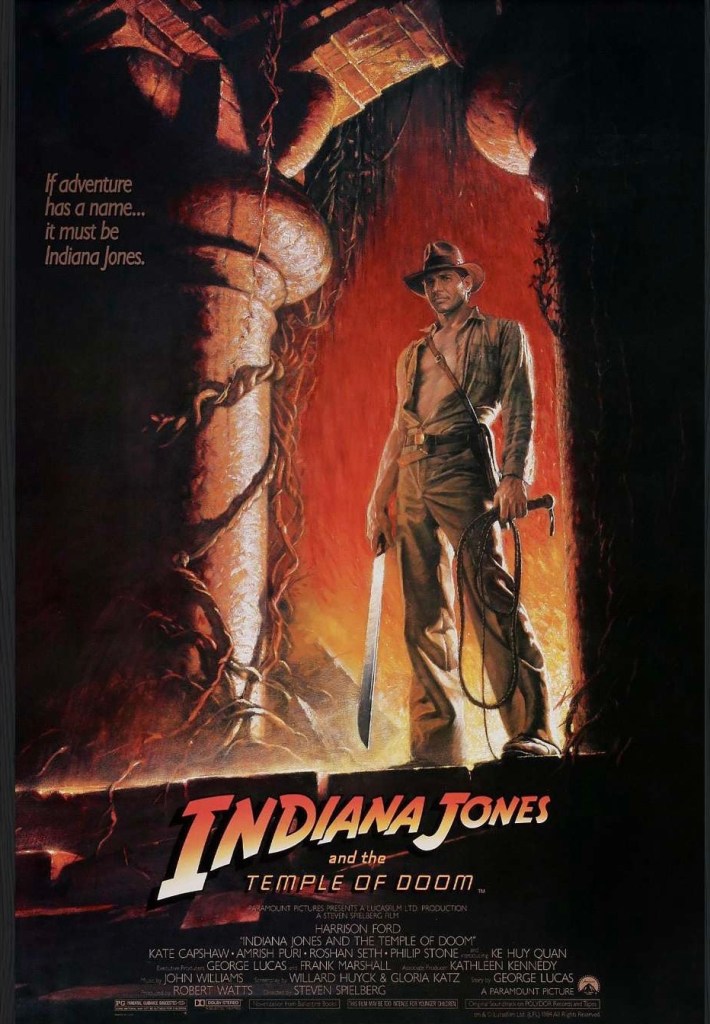
Why Indiana Jones and the Temple of Doom Is My Favorite Movie: Adventure, Mythology, and Always Landing on Your Feet and the pursuit of Fortune and Glory (sharing a bit of my personal self for those who want to know)

I can hear the groans already.  “Oh, he’s talking about movies again.”  But this one is a bit different and I share some things here that people have been asking about.  I have a lot of new people in my life, and they are asking.  So, I’m addressing their questions in bulk.  People ask me all the time what my favorite movie is. I get the question often enough that I finally decided to answer it properly here. My favorite is Indiana Jones and the Temple of Doom. A lot of people are surprised by that. Many consider it the weakest of the original trilogy. I disagree. For me, it is the one that stuck with me the most, and the reasons go well beyond the surface thrills.

I grew up on adventure. My grandfather was old enough to have lived through the era of the great serials. I saw Zorro with the whip long before I ever saw Indiana Jones crack one. Saturday-morning serial energy was already in my blood. When Raiders of the Lost Ark came out, I thought it was wonderful—maybe the best pure adventure movie ever made. But Temple of Doom became personal.

Reading the Book Before the Movie in Hamilton, Ohio

When I was a kid, I used to go downtown to the shopping center in Hamilton, Ohio, with my mom and grandmother. On the bottom floor, there was a bookstore section. I went straight to the books every time. One day they got me the novelization of Indiana Jones and the Temple of Doom. I read it before I saw the movie. I read it the way I used to read the old adventure books—religiously, over and over. The character already lived in my head before the images did.

That early exposure mattered. George Lucas has always been steeped in mythology. The pursuit of the Grail, the knight who starts out chasing fortune and glory and ends up learning something harder—these patterns were in the water. I did not have the language for it at fourteen or fifteen, but I felt it.

The Night We Snuck Out in Morehead, Kentucky

The memory that sealed it for me happened the summer the movie was in theaters. I was fourteen or fifteen, part of a High Adventure Explorer Post. We were on a week-long trip heading toward whitewater rafting in West Virginia. We stopped to camp just outside Morehead, Kentucky. Hot summer night. The kind of heat that stays with you after dark.

We went into town for snacks, and I spotted the movie theater. Temple of Doom was playing. I grabbed a newspaper, checked the times, and saw the last show was at eleven. Back at camp, the plan was lights out early so we could get up for the next day’s adventure. Around eight or nine, everyone was settling in. Three of us waited, then slipped out.

We walked the two miles into town in the dark, hearts pounding, half-convinced we were going to get caught the whole way. We sat through the movie until about one in the morning. Then we walked the two miles back, still sweating, still listening for any sound that meant trouble. We snuck into our tents, drank some water from the canteen, ate a Slim Jim I had stashed, and tried to sleep. At seven, the camp woke up as if nothing had happened. Nobody said a word. We ate breakfast and headed out for the rafting and the rest of the week’s adventures. Later that summer I flew with my family to the Grand Canyon and all over California. The whole stretch felt like one long Indiana Jones sequence.

I have had many experiences since then. I am older now. I still cannot think of many moments that felt better than that night—walking back in the heat with the movie still running through my head, knowing we had gotten away with it, feeling completely alive. We had lived a small version of the thing we had just watched. Jump in. Trust yourself. Land on your feet.

Why Temple of Doom Hits Different

Raiders gives you the competent, almost invincible Indy. Temple of Doom puts him through the wringer. Poisoned, chased, plane crash, mountain landing, bugs, capture, the blood, the voodoo doll, the forced drinking, the near-sacrifice. They break him down further than in any of the other films. Then he comes out the other side, returns the stones, restores the village, and still walks away with the girl and the open road to the next adventure. “Fortune and glory” at the beginning. Something closer to responsibility and compassion by the end. He keeps the light touch the whole time. The movie never turns grim for its own sake. That balance is rare.

I raised my kids on it. I have raised grandkids on it. The soundtrack still gets played in the car. They know the cues. The film became a shared language in the family for the idea that you can take a beating and still come up swinging with a grin.

Mythology, Campbell, and Earned Freedom

Later I learned more about the deeper currents. Joseph Campbell’s work on the hero’s journey and the Grail legends shaped a generation of storytellers. George Lucas absorbed those patterns. The connection between the Indiana Jones films and older quest stories—Parzival, the wasteland, the knight who must learn before he can restore—is not forced. Temple of Doom functions as a modern version of the hero who starts selfish and ends up doing the right thing for people who cannot help themselves. The Last Crusade made the Grail explicit. Temple of Doom already had the emotional shape.

They also earned the right to make something this wild. After Raiders became a phenomenon, Lucas and Spielberg had the political capital in Hollywood to go darker, stranger, more unhinged—child slavery, Thuggee cult, heart-ripping, the whole fever-dream tone. A movie like that would have a much harder time getting made today. They used the freedom they had earned.

The Lesson That Stuck

For me, the core of it has always been simple. Indiana Jones trusts his ability to land on his feet no matter how bad the situation looks. Plane on fire. Poison. Traps. Brainwashing. Torture. He keeps moving. He keeps improvising. In the end, he is still the same man, only clearer. That attitude got into me early. Jump off the building if you have to. Figure out the landing on the way down. I have needed that more than once.

People who know me mostly through the political writing sometimes raise an eyebrow when I talk about movies. Movies are a shared language. Books are private. A film you both love gives you common ground in five minutes. When hundreds of new people start reading or listening and want to know a little more about the person behind the commentary, this is one of the cleaner ways to open the door. I do not normally spend this much time on personal stories. This one felt worth it.

Indiana Jones and the Temple of Doom is not the most polished film in the series. It is the one that feels most like actual life mixed with myth—messy, punishing, redemptive, and somehow still fun. I have carried its lessons through everything that came after that hot night in Morehead. Fortune and glory are great goals.  Landing on your feet and doing the right thing when it counts is better.

Footnotes

1.  The novelization of Indiana Jones and the Temple of Doom was written by James Kahn and published by Ballantine Books in 1984, timed with the film’s release.

2.  George Lucas has repeatedly acknowledged the influence of Joseph Campbell’s The Hero with a Thousand Faces and related mythological studies on his storytelling, particularly visible in the Star Wars films and carrying over into the adventure structures of the Indiana Jones series. The two later became acquainted; Campbell viewed the original Star Wars trilogy at Skywalker Ranch.

3.  Scholarly and critical readings have linked the Indiana Jones trilogy to Arthurian and Grail-quest patterns (including Chrétien de Troyes’ Perceval and Wolfram von Eschenbach’s Parzival), with Temple of Doom often discussed as a wasteland/otherworld episode and The Last Crusade making the Grail motif explicit.

4.  Howard Kazanjian served as executive producer on Raiders of the Lost Ark and producer on Return of the Jedi, and held a key production role at Lucasfilm during the period.

5.  Indiana Jones and the Temple of Doom (1984) was directed by Steven Spielberg from a story by George Lucas, screenplay by Willard Huyck and Gloria Katz. It is a prequel set in 1935.

Bibliography

Campbell, Joseph. The Hero with a Thousand Faces. Princeton: Princeton University Press, 1949 (and later editions).

Kahn, James. Indiana Jones and the Temple of Doom (novelization). New York: Ballantine Books, 1984.

Lucas, George, and various collaborators. Indiana Jones and the Temple of Doom. Directed by Steven Spielberg. Paramount Pictures, 1984.

Aronstein, Susan. Critical essays on Arthurian narrative patterns in the Indiana Jones trilogy (various academic publications).

Additional reading: Bill Moyers’ interviews with Joseph Campbell (The Power of Myth); production histories of the Indiana Jones films; Wolfram von Eschenbach’s Parzival for the classic Grail-knight arc that echoes in the franchise’s deeper structure.

Rich Hoffman

More about me

Click Here to Protect Yourself with Second Call Defense https://www.secondcalldefense.org/?affiliate=20707

About the Author: Rich Hoffman

Rich Hoffman is an author, political consultant, and strategic advisor based in Cincinnati, Ohio, and the creator of The Politics of Heaven—a unique framework that connects biblical theology, ancient history, and modern power structures to explain how moral alignment and spiritual forces shape global events. Blending real-world political experience with deep research into archaeology, UFO phenomena, and suppressed historical narratives, Hoffman offers compelling commentary on topics ranging from ancient civilizations and the Dead Sea Scrolls to modern populist movements, paranormal continuity, and leadership strategy in chaotic environments. As the author of The Gunfighter’s Guide to Business and the forthcoming Politics of Heaven, he brings a grounded yet provocative voice to media discussions, supported by firsthand experiences and a cross-disciplinary approach that bridges science, history, and theology. For interviews, speaking engagements, or expert analysis, visit richhoffmanbooks.com or contact directly via phone at 513-307-5815 or email at rhoffman@richhoffmanbooks.com.  If you’ve seen the movie, Disclosure Day and want to talk about it and the implications of Presidnet Trump’s UAP disclosures, let me know and we can bring some color to your coverage. https://richhoffmanbooks.com/media-inquiries-broadcast-topics-and-contact-info/?frame-nonce=ad51e7ecba I do have a firsthand UFO encounter to discuss.

From the Portable Office on the Road: Butler County Republican Leadership Change and the Call for Unity in the Fight Against Socialist Inroads

I have been traveling a lot this summer of 2026. My portable office goes with me. It is a rolling command post with a good chair, a refrigerator stocked with my favorite drinks, and windows that change the view almost every day. One day, the Tetons. Another day, the high country in Colorado or the open stretches of Utah and New Mexico. Just before recording some thoughts, I watched the ferry reverse into its slip, filming through the glass as the water churned. That is the life right now. I can work, read for hours, and still stay connected to home while the scenery shifts.

From that distance, the picture in Butler County comes into sharper focus. Politics is a bloodsport. Transitions happen. I checked in with some of my closest people back home and learned that Todd Hall is no longer chairman of the Butler County Republican Party. Art Sauerwein has taken the role. I always liked Todd. The job is genuinely thankless. It wears people out. Running a business on top of it, managing personalities, herding volunteers, and keeping the central committee pointed in one direction takes a small army and constant energy. I hope Art has a good run at it. The party needs steady hands.

Perspective from Distance Makes the Stakes Clearer

When you are removed from the daily handshakes and the same faces at every event, the larger pattern stands out. We have minor philosophical differences among ourselves. That is normal. What is not normal is letting those differences become the main event while outright socialists and radical Democrats keep pushing into local offices. I have watched it happen in places like West Chester.  It is the same impulse you see nationally with the more extreme progressive candidates. It does not matter if the fight is on Main Street or in the national headlines. The goal of those forces is the same: expand government, raise the cost of living through policy, and treat constitutional limits as optional.

I have said for years that we need a big tent. I mean it. That includes people who may lean a little softer on some issues as long as they will stand with us against tax increases, against socialist experiments in the schools, and for basic fiscal order. Sheriff Richard Jones has always struck me as a Gunsmoke Republican. That is the personality I want in the top law enforcement job. Even if he occasionally frustrates pure ideologues, I want him successful. The same goes for others I have known for decades.

Local Fiscal Reality Versus the Socialist Alternative

Butler County and much of Ohio under Republican stewardship have largely kept the books balanced. Surpluses have been more common than structural deficits. There has been resistance to the constant pressure to raise taxes. That is good government. It is the opposite of the model that turns every problem into a reason for bigger bureaucracy and higher burdens on working families. When I talk to people at campgrounds across the country, the pattern repeats. Many of them are Trump voters. They fly the flags. They are getting away from out-of-control local governments elsewhere. They recognize solid management when they see it. We have had a good run of it here. The job now is to protect it and expand it.

Personal Notes on the Players

I think highly of George Lang. I always have. Nancy Nix is often painted as a mainstreamer these days. I do not see her that way. I see her as a person who has done great work in the auditor’s office. Roger Reynolds has sympathizers, and I was one of them for a long time. I never understood the decision to go after Nancy Nix the way it happened. That kind of personal fight does not help the larger cause. When you are trying to win elections and keep socialists from taking seats, internal score-settling becomes a luxury we cannot afford.

The chairman’s role is not glamorous. Todd Hall held it for a long stretch after David Kern. He came in young and stayed through periods of real discord. Some people felt he did not have enough hours in the day. That is a fair observation about the demands of the job. Leadership at that level requires heavy delegation and constant recruitment of capable people. I hope Art Sauerwein understands that and builds the team accordingly. I wish him well. I will miss Todd in the role, but the work continues.

The Real Task Ahead

Trump observed years ago that people get so used to winning that they start losing to experience the thrill of winning again. That is a real danger. We cannot afford boredom or internal exhaustion. The fall elections and the offices that matter most require Republicans to lock arms. The goal is straightforward: more Republicans in office than Democrats, constitutional values protected, fiscal discipline maintained, and the Trump agenda advanced at the county level the same way it is being advanced nationally.

I will spend more time on the road this year and then settle in for the fourth quarter closer to home. The portable office has proven its value. I can read, think, write, and still stay plugged into Butler County. When I talk to people at those campgrounds, I get a clearer read on the national mood than I sometimes get in the middle of local factional fights. Most of them want government that works without constantly reaching into their pockets or experimenting with radical social theories on their children.

I hope everyone finds a way to shake hands at the picnics and fundraisers. Support the new chairman. Remember what we have in common is larger than what divides us. Keep the focus on winning. Do not get tired of it. The alternative is watching more socialists and their enablers take ground, one township and one school board at a time.

Footnotes

1.  Conversations with longtime Butler County Republican contacts, summer 2026, regarding the transition from Todd Hall to Dan Ferguson as party chairman.

2.  Public record of Todd Hall’s long tenure as Butler County Republican Party executive chairman, beginning in the mid-2010s following David Kern.

3.  Local election results and coverage of West Chester Township trustee races and related contests showing shifts in local control.

4.  Butler County and Ohio fiscal performance under Republican majorities: consistent emphasis on balanced budgets and resistance to routine tax increases, as reflected in county and state budget outcomes over recent cycles.

5.  Public statements and reporting on Roger Reynolds’ legal history, his attempt to reclaim the auditor’s office from Nancy Nix, and his later involvement in the county commissioner primary before withdrawing.

6.  Sheriff Richard K. Jones’ long record and public positioning as a traditional law-and-order Republican.

7.  Observations from campground conversations across multiple western and mountain states during summer 2026 travel regarding voter sentiment and local government dissatisfaction.

8.  C-SPAN and local reporting on 2026 Butler County Republican events, including candidate and leadership appearances.

Selected Bibliography for Further Reading

•  Journal-News (Hamilton/Butler County) coverage of Butler County Republican Party leadership, endorsements, and primary contests, 2024–2026.

•  Butler County Republican Party official materials and candidate endorsement lists.

•  Ohio Republican Party statements and State Central Committee updates, 2026.

•  Ballotpedia and Butler County Board of Elections records on local races, including West Chester Township trustees and county offices.

•  Reporting on Roger Reynolds’ conviction, appellate reversal, and subsequent legal efforts regarding the auditor’s office.

•  Public financial and budget summaries from Butler County and the State of Ohio illustrating fiscal trends under Republican control.

•  Contemporary accounts of Sheriff Richard Jones’ tenure and local political positioning.

•  Travel notes and personal observations compiled during summer 2026 from portable office locations across the western United States.

Rich Hoffman

More about me

Click Here to Protect Yourself with Second Call Defense https://www.secondcalldefense.org/?affiliate=20707

About the Author: Rich Hoffman

Rich Hoffman is an author, political consultant, and strategic advisor based in Cincinnati, Ohio, and the creator of The Politics of Heaven—a unique framework that connects biblical theology, ancient history, and modern power structures to explain how moral alignment and spiritual forces shape global events. Blending real-world political experience with deep research into archaeology, UFO phenomena, and suppressed historical narratives, Hoffman offers compelling commentary on topics ranging from ancient civilizations and the Dead Sea Scrolls to modern populist movements, paranormal continuity, and leadership strategy in chaotic environments. As the author of The Gunfighter’s Guide to Business and the forthcoming Politics of Heaven, he brings a grounded yet provocative voice to media discussions, supported by firsthand experiences and a cross-disciplinary approach that bridges science, history, and theology. For interviews, speaking engagements, or expert analysis, visit richhoffmanbooks.com or contact directly via phone at 513-307-5815 or email at rhoffman@richhoffmanbooks.com.  If you’ve seen the movie, Disclosure Day and want to talk about it and the implications of Presidnet Trump’s UAP disclosures, let me know and we can bring some color to your coverage. https://richhoffmanbooks.com/media-inquiries-broadcast-topics-and-contact-info/?frame-nonce=ad51e7ecba I do have a firsthand UFO encounter to discuss.

Capitalism: The Unknown Ideal – Ayn Rand’s Moral Defense of the Only System Consistent with Human Nature, and Why It Still Matters in Ohio in 2026

I have been running a series on Ayn Rand because too many people who once understood her through the Tea Party years have let her slip out of memory, or worse, accepted the lazy smear that she was merely an atheist with nothing useful to say. That is a mistake. The radical left still hates her for the same reason they hate successful producers today. They understand, even if they will not admit it, that her arguments cut the moral legs out from under every scheme of redistribution, regulation, and class resentment.

I was reminded of this again after lunch with one of my favorite senators, George Lang. We talked about The Fountainhead, about the gold standard, and about how few people who claim to like Rand have actually read the full range of her nonfiction. That conversation pushed me to pick up the 1966 collection Capitalism: The Unknown Ideal again. It remains one of the clearest statements ever written of why pure capitalism is not just an economic preference but a moral necessity.

The book is not a dry economics text. Rand called it a nonfiction footnote to Atlas Shrugged. With contributions from Nathaniel Branden, a young Alan Greenspan, and Robert Hessen, it argues that the system we call capitalism today is a bastardized version of the real thing—an unknown ideal because it has never been allowed to exist in pure form. What we have instead is a mixed economy of freedom mixed with controls, and the controls always expand. 

Capitalism as the Only Moral Social System

Rand’s central claim is simple and radical. Man is a rational being who must use his own mind to survive. Any social system that initiates force against that process is not merely inefficient; it is immoral. Capitalism, properly understood, is the only system that bans the initiation of physical force from human relationships and leaves individuals free to produce, trade, and keep what they create.

She defines it precisely: a social system based on the recognition of individual rights, including property rights, in which all property is privately owned. The government’s sole legitimate function is to protect those rights by retaliating against those who initiate force. Everything else—regulation of production, redistribution of wealth, “industrial policy,” licensing of speech—is a violation. 

This is why she rejected the conservative approach of her time. Conservatives often tried to defend capitalism on practical grounds or by appeal to tradition while accepting the moral premise of altruism—that the individual has a duty to live for others. Rand called that a fatal compromise. In “The Anatomy of Compromise,” she shows that when you try to mix a rational principle with an irrational one, the irrational always wins. You cannot have a little bit of socialism without eventually losing the foundation of freedom. 

America’s Persecuted Minority: Big Business

One of the most powerful essays in the collection is “America’s Persecuted Minority: Big Business.” Rand flips the usual narrative on its head. The productive genius is not the exploiter; he is the one being hamstrung by the looters and moochers who use the power of the state to seize what they did not create. Business people are treated as a scapegoat class in the same way other minorities have been treated under collectivist regimes. In Soviet Russia it was the bourgeoisie. In Nazi Germany it was the Jews. In America it is the successful businessman. 

I see this hatred every day in the attacks on Trump, on Vivek Ramaswamy, on any rich person who made money by creating value rather than extracting it through politics. The radical left’s outrage is not about fairness. It is pure Marxist class warfare dressed up in modern language. Rand saw it clearly because she lived it. Her father lost his pharmacy when the Bolsheviks nationalized private businesses. She never forgot.

Solving World Hunger: Production, Not Politics

People still talk about solving world hunger as if it were a distribution problem that requires more government. That is backward. Pigs, chickens, and rabbits reproduce rapidly. There is no physical shortage of the capacity to produce food. Shortages are created by politics—by governments that micromanage, confiscate, and regulate the very people who would otherwise raise the animals and grow the crops.

If you want to end hunger, get as close as possible to pure capitalism. Remove the artificial constraints. Let people own property, keep their profits, and trade freely. The poor in the United States, even under our imperfect capitalism, are rich compared to most of the world. A few American dollars can still be a fortune to someone living under the policies that Rand warned against. The guilt that drives redistribution often comes from people who helped create the barriers to opportunity and then want to ease their conscience by confiscating more from the productive.

Greenspan on Gold and the Hard Reality of Theory

One of the most quoted essays in the book is Alan Greenspan’s “Gold and Economic Freedom,” written years before he became Federal Reserve chairman. He argued that gold and economic freedom are inseparable. The gold standard protects property rights by limiting the government’s ability to inflate away wealth through deficit spending. Without it, the welfare state can confiscate savings silently. 

Greenspan later operated in a system far from that ideal. Theory is cleaner than practice when you face political realities, activist judges, and entrenched interests. That does not make the original argument wrong. It shows how hard it is to implement principle once the mixed economy has taken hold. We are still living with the consequences of easy money, quantitative easing, and the revolving door between the Fed and large asset managers. The warnings in that 1966 essay hold up.

True Monopolies, Railroads, and the Industrial Revolution

The collection also dismantles the usual antitrust myths. Free-market monopolies can only be maintained by superior efficiency and better service. Coercive monopolies require government intervention—subsidies, franchises, or legal barriers to entry. The history of American railroads is a clear example. Most of the transcontinental lines were built with government land grants and ended in financial chaos. James J. Hill’s Great Northern was built without federal subsidies and remained the only one that did not go bankrupt. 

Robert Hessen’s essay on the effects of the Industrial Revolution on women and children is equally important. Child labor was not created by capitalism; it was inherited from a world of grinding poverty. Factories gave children a way to earn a living and survive to adulthood. Rising wealth created by capitalism eventually made child labor unnecessary. The laws usually get the credit; the production gets the blame. 

Airwaves, Speech, and the Nature of Government

Rand’s essay on the property status of the airwaves is still relevant. The early chaos in radio was not a failure of free enterprise but a failure of government to recognize and protect property rights in frequencies. Instead of allowing private ownership and trade, the government declared the airwaves public property and nationalized them through licensing. That opened the door to political control of speech—the same impulse we still see whenever independent voices become inconvenient. 

Ohio’s Choice and the Fight Ahead

All of this is not abstract philosophy. It is the framework for understanding the hatred directed at successful people in our own state. Vivek Ramaswamy is a rich man who built companies. That alone is enough for the radical left and their media allies to paint him as untrustworthy. The same pattern appears in the attacks on Trump. They do not hate wealth. They hate the independence that wealth can buy when it is earned rather than granted.

I have watched this for decades. The people who want a governor who has never had to make a payroll or risk his own capital are the same people who will expand the very controls that create shortages and dependency. Michael Ryan understands these issues at the county level. Senators like George Lang still talk about gold-backed approaches and business-friendly policy. We need more of them.

Rand was not interested in being practical in the usual sense. She was interested in being right on principle. She knew that a culture that accepts altruism as its moral code will eventually sacrifice the producers. She also believed that the potential for human progress under pure capitalism is limitless. The nineteenth century, when America came closest to the ideal, proved it.

I have read her books many times, along with the work of those who analyzed her. I agree with her on the essentials of capitalism even while I am more of a man of faith than she was. The philosophy can be taken further. But the fight is now. The books are still on the shelves at Barnes & Noble. You can get them quickly. Read Capitalism: The Unknown Ideal. Then look at the news with clearer eyes.

If you want to solve poverty and hunger, expand opportunity. More capitalism, not less. More people who understand how wealth is actually created. That is the only path that treats individuals as ends in themselves rather than means to someone else’s political vision.

Don’t give up the ship.

Footnotes

1.  Ayn Rand, Capitalism: The Unknown Ideal (New York: New American Library, 1966; expanded 1967). Rand described the book as a nonfiction footnote to Atlas Shrugged.

2.  Ayn Rand, “What Is Capitalism?” in Capitalism: The Unknown Ideal.

3.  Ayn Rand, “America’s Persecuted Minority: Big Business,” in Capitalism: The Unknown Ideal.

4.  Ayn Rand, “The Anatomy of Compromise,” in Capitalism: The Unknown Ideal.

5.  Alan Greenspan, “Gold and Economic Freedom,” originally published in The Objectivist (1966) and reprinted in Capitalism: The Unknown Ideal.

6.  Robert Hessen, “The Effects of the Industrial Revolution on Women and Children,” in Capitalism: The Unknown Ideal.

7.  Ayn Rand, “The Property Status of Airwaves,” in Capitalism: The Unknown Ideal.

8.  On James J. Hill and the Great Northern Railway, see Burton W. Folsom Jr. and related free-market historical accounts; the railroad is frequently cited in Objectivist literature as the counter-example to subsidized lines.

Bibliography

Rand, Ayn. Capitalism: The Unknown Ideal. With additional articles by Nathaniel Branden, Alan Greenspan, and Robert Hessen. New York: New American Library, 1966 (hardcover); expanded Signet paperback, 1967.

Rand, Ayn. Atlas Shrugged. New York: Random House, 1957.

Rand, Ayn. The Fountainhead. New York: Bobbs-Merrill, 1943.

Greenspan, Alan. “Gold and Economic Freedom.” The Objectivist, 1966.

Folsom, Burton W., Jr. Works on the “robber barons” myth and James J. Hill.

Additional recommended reading: Ayn Rand Lexicon entries on capitalism, business people, and the gold standard (aynrandlexicon.com); Ayn Rand Institute materials on laissez-faire.

Rich Hoffman

More about me

Click Here to Protect Yourself with Second Call Defense https://www.secondcalldefense.org/?affiliate=20707

About the Author: Rich Hoffman

Rich Hoffman is an author, political consultant, and strategic advisor based in Cincinnati, Ohio, and the creator of The Politics of Heaven—a unique framework that connects biblical theology, ancient history, and modern power structures to explain how moral alignment and spiritual forces shape global events. Blending real-world political experience with deep research into archaeology, UFO phenomena, and suppressed historical narratives, Hoffman offers compelling commentary on topics ranging from ancient civilizations and the Dead Sea Scrolls to modern populist movements, paranormal continuity, and leadership strategy in chaotic environments. As the author of The Gunfighter’s Guide to Business and the forthcoming Politics of Heaven, he brings a grounded yet provocative voice to media discussions, supported by firsthand experiences and a cross-disciplinary approach that bridges science, history, and theology. For interviews, speaking engagements, or expert analysis, visit richhoffmanbooks.com or contact directly via phone at 513-307-5815 or email at rhoffman@richhoffmanbooks.com.  If you’ve seen the movie, Disclosure Day and want to talk about it and the implications of Presidnet Trump’s UAP disclosures, let me know and we can bring some color to your coverage. https://richhoffmanbooks.com/media-inquiries-broadcast-topics-and-contact-info/?frame-nonce=ad51e7ecba I do have a firsthand UFO encounter to discuss.

The Columbus Dispatch’s Liberal Meltdown Over Bernie Moreno: Why Harsh Language Is the Only Justice Left Against Fauci’s COVID Catastrophe

I watched the clips. I read the outrage. And I am not embarrassed by Senator Bernie Moreno. I am proud of him.

When the Columbus Dispatch and its liberal opinion machinery clutched their pearls over Moreno dropping F-bombs on Dr. Anthony Fauci during that July 29, 2026 Senate hearing, they revealed exactly who they serve. They do not serve the Ohioans who lost jobs, businesses, childhoods, and years of life to policies Fauci championed. They serve the narrative that still treats Fauci as a secular saint who must never face real anger, even after he pleaded the Fifth more than one hundred times. 

The Hearing That Triggered the Dispatch’s Righteous Indignation

Moreno did not whisper. He asked Fauci, “Who the f*** do you think you were for doing that?” He was talking about the mask mandates, the school closures, the arrests of ordinary people—including a mother at an Ohio middle school football game—and the broader lockdown culture that Fauci’s guidance helped justify. Moreno told the hearing that the arrest of that woman was the moment he decided to sell his businesses and run for the Senate. Six years later, he sat across from the man he holds most responsible and refused to play nice. 

He also asked whether Fauci felt he was “in deep s***” for showing up with a team of lawyers. Later, outside the hearing, when asked why Fauci took the Fifth so many times, Moreno answered without filter: because he’s a piece of s***. 

The Columbus Dispatch opinion page, through Amelia Robinson, called this “deeper in the gutter than even Jim Jordan.” She compared it to childhood bullying, said it embarrassed Ohio, and wondered whether Senators Jon Husted, Sherrod Brown, Rob Portman, or Mike DeWine would ever sink so low. She defended Fauci’s record, framed the hearing as a “witch hunt,” and demanded apologies from the senators. 

That is the liberal press in Ohio in miniature. They can lecture us about “decorum” while the economic and human wreckage of the policies they once cheered goes largely unexamined and unpunished.

The Real Bill: What COVID Lockdowns Cost Ohio and America

Are we supposed to be polite about this? Nationally, serious estimates of the total economic cost of COVID and the response range from roughly $14 trillion to $16 trillion and higher when you add lost output, premature deaths valued in economic terms, long-term health damage, mental health costs, and educational losses. One major analysis put the figure above $16 trillion—about 90 percent of a year’s U.S. GDP. Another put pure GDP losses on a path to $14 trillion over four years. A Heritage-linked commission later put the broader figure near $18 trillion. 

In Ohio, the damage was concrete and brutal. The state’s unemployment rate exploded from the low single digits to a peak of 16.4 percent in April 2020—the highest on record in modern tracking. Ohio lost more than 800,000 jobs in that single month. Payroll employment collapsed by roughly 16 percent from February to April. Real GDP for the full year 2020 came in about 2.3 percent lower than 2019. The second-quarter contraction was far steeper—more than 10 percent on an annualized basis in some measures. Sectors like leisure and hospitality were gutted. Small businesses closed. Kids lost years of normal schooling and social development. Families were stressed to the breaking point. 

I do not need a perfect spreadsheet to know the human cost in Butler County, across the Miami Valley, and throughout this state. People I know lost businesses. Kids I care about lost childhoods. The long-term damage to learning, mental health, and trust in institutions is still with us. And the same voices that now lecture Moreno about manners spent 2020 cheering the very policies that produced this wreckage.

Lab Origin, Gain-of-Function, and the Accountability Vacuum

We also know more than we did in 2020 about the likely origin. The virus almost certainly emerged from research-related activity in Wuhan. Gain-of-function work that made animal viruses more transmissible to humans was the context. Fauci and the public health establishment spent years downplaying or denying the lab-leak possibility while defending the research funding pathways. He has now repeatedly invoked the Fifth Amendment rather than answer questions under oath about what he knew, when he knew it, and how the messaging was shaped. 

In a healthier republic, that combination—policy catastrophe plus origin questions plus stonewalling—would produce serious consequences. In the actual America of 2026, the man most associated with the response gets to plead the Fifth a hundred times while the Columbus Dispatch frets about a senator’s language.

Why Moreno’s Anger Is Not a Bug—It Is the Point

I voted for disruptors. I did not vote for people who would sit politely while the architects of the damage smile and take the Fifth. Moreno is doing exactly what a large share of Ohio voters sent him to do: refuse the script. The liberal press and the Democratic establishment prefer senators who speak in carefully measured tones that never threaten the permanent administrative class. That is why they prefer the old style. That is why they are so offended by Moreno.

Jon Husted is a different kind of politician—more institutional, more measured. I would still rather see him hold the other Ohio Senate seat than watch Sherrod Brown claw his way back. But I am not looking for two of the same. Moreno’s willingness to use the language of ordinary frustrated Americans is a feature. When the system refuses to accept real accountability, harsh language at a hearing is one of the few remaining pressure points. Public executions are no longer on the table. Perjury prosecutions seem unlikely. So voters get a senator who will at least look the man in the eye and say the quiet part out loud.

The same media complex that now scolds Moreno spent years treating dissent on lockdowns, school closures, and vaccine mandates as moral failure. They platformed the experts who got major things wrong and sidelined those who got them closer to right. Now they want the anger to stay within polite bounds. I reject that demand.

The Columbus Dispatch Is Not a Neutral Referee

Let’s drop the pretense. The Columbus Dispatch has long operated with a left-of-center editorial culture, even if its news pages sometimes maintain more balance. It broke a century-long pattern to endorse Hillary Clinton. Its opinion pages lean liberal on cultural and institutional questions. Amelia Robinson’s column is a piece of that tradition: defend the public-health establishment, pathologize Republican anger, and treat institutional “decorum” as the highest value even when the institutions failed spectacularly. 

When the paper and its allies frame Moreno as the problem, they are protecting a status quo that inflicted real harm on Ohio and then largely escaped consequences. That is not neutrality. That is advocacy.

Looking Ahead in Ohio Politics

Amy Acton is the Democratic nominee for governor. She was the public face of Ohio’s early COVID response under DeWine. The same networks that once celebrated her now want to elevate her further while treating any residual anger at the policies of that era as vulgar. Meanwhile, Bernie Moreno sits in the Senate doing the opposite of playing patty-cake. I prefer the latter.

I want Jon Husted to hold his seat against Sherrod Brown’s comeback bid. Two strong Republicans in the Senate are better for Ohio than a return to the old Democratic hold. But I am under no illusion that measured institutionalists alone will deliver the accountability many of us still want. Moreno’s approach is the necessary corrective.

Final Word

I am not interested in lectures about Senate decorum from outlets that spent years amplifying the very policies that cost this country trillions and this state hundreds of thousands of jobs and years of normal life. Fauci invoked the Fifth Amendment more than 100 times. The economic damage is measured in the tens of trillions nationally, and there is real suffering in every Ohio county. The origin questions remain serious. In that context, a senator who refuses to soft-pedal his contempt is representing the people who hired him.

I am proud of Bernie Moreno. Keep it up.

Footnotes

1.  Senate Homeland Security and Governmental Affairs Committee hearing, July 29, 2026; multiple contemporaneous reports of Moreno’s language and Fauci’s repeated invocation of the Fifth Amendment.

2.  Amelia Robinson, “Bernie Moreno mortified Ohio with profane attack on Fauci,” Columbus Dispatch, July 31, 2026.

3.  Ohio Department of Job and Family Services / BLS data: Ohio unemployment rate peaked at approximately 16.4–16.8 percent in April 2020; job losses exceeded 800,000 in that month alone.

4.  Ohio GDP: 2020 annual figure approximately 2.3 percent below 2019; sharp second-quarter contraction.

5.  National cost estimates: Cutler & Summers (~$16 trillion total including health losses); USC/related GDP-loss projections approaching $14 trillion; Heritage Nonpartisan Commission on China and COVID-19 (~$18 trillion broader estimate).

6.  Lab-origin discussion and gain-of-function context: extensive public record from 2021–2026 congressional inquiries, intelligence assessments, and scientific literature.

7.  Media bias assessments of the Columbus Dispatch: AllSides and Media Bias/Fact Check ratings placing it Left-Center to Lean Left on editorial/opinion content; historical endorsement shift in 2016.

Selected Bibliography for Further Reading

•  Cutler, David M., and Lawrence H. Summers. “The COVID-19 Pandemic and the $16 Trillion Virus.” JAMA, 2020 (and subsequent updates/discussions).

•  Ohio Department of Job and Family Services and U.S. Bureau of Labor Statistics. Monthly employment and unemployment releases, 2020.

•  Ohio Development Services Agency / BEA data on state GDP, 2019–2021.

•  Heritage Foundation Nonpartisan Commission on China and COVID-19. Report on economic and human costs (2024).

•  Senate Homeland Security and Governmental Affairs Committee. Hearing record and transcripts, July 29, 2026.

•  Robinson, Amelia. Opinion columns, Columbus Dispatch, July–August 2026.

•  AllSides Media Bias ratings and Media Bias/Fact Check profiles of the Columbus Dispatch.

•  Primary reporting from The Hill, Washington Examiner, Fox News, and local Ohio outlets on the Moreno-Fauci exchange.

•  Additional reading on lab-origin hypotheses, gain-of-function research funding, and pandemic policy trade-offs available in the public congressional record and scientific literature from 2021 onward.

Rich Hoffman

More about me

Click Here to Protect Yourself with Second Call Defense https://www.secondcalldefense.org/?affiliate=20707

About the Author: Rich Hoffman

Rich Hoffman is an author, political consultant, and strategic advisor based in Cincinnati, Ohio, and the creator of The Politics of Heaven—a unique framework that connects biblical theology, ancient history, and modern power structures to explain how moral alignment and spiritual forces shape global events. Blending real-world political experience with deep research into archaeology, UFO phenomena, and suppressed historical narratives, Hoffman offers compelling commentary on topics ranging from ancient civilizations and the Dead Sea Scrolls to modern populist movements, paranormal continuity, and leadership strategy in chaotic environments. As the author of The Gunfighter’s Guide to Business and the forthcoming Politics of Heaven, he brings a grounded yet provocative voice to media discussions, supported by firsthand experiences and a cross-disciplinary approach that bridges science, history, and theology. For interviews, speaking engagements, or expert analysis, visit richhoffmanbooks.com or contact directly via phone at 513-307-5815 or email at rhoffman@richhoffmanbooks.com.  If you’ve seen the movie, Disclosure Day and want to talk about it and the implications of Presidnet Trump’s UAP disclosures, let me know and we can bring some color to your coverage. https://richhoffmanbooks.com/media-inquiries-broadcast-topics-and-contact-info/?frame-nonce=ad51e7ecba I do have a firsthand UFO encounter to discuss.

Objectivism and the American Experiment: Why Ayn Rand Still Matters in an Age of Collective Delusion, and Why Peter Thiel is a tremendous asset to any civlization

Ayn Rand remains one of the most polarizing figures in modern philosophy and literature for a reason, a very healthy reason. A refugee from the Soviet Union who watched her father’s business seized and her family’s life reduced to poverty under collectivist rule, she arrived in the United States in 1926 carrying a clear-eyed hatred of any system that subordinates the individual mind to the group. She built an entire philosophical system—Objectivism—around the primacy of objective reality, the sovereignty of reason, and the moral right of the individual to live for his own sake. In an era when official culture insists that feelings can rewrite biology, that the state may confiscate the product of one person’s effort for another’s benefit, and that the individual is merely a unit in larger identity categories, her work is no longer a historical curiosity. It is a live confrontation with the day’s dominant premises.

Her novels and nonfiction supply an on-ramp that mainstream institutions will not provide. Anthem stands as one of the cleanest anti-communist fables ever written—a short, devastating portrait of a society that has erased the word “I.” The Fountainhead dramatizes the creator who refuses to subordinate his vision to the demands of the collective. Atlas Shrugged takes the logic further: the men of the mind withdraw, and the parasites who lived off their productivity discover they cannot run the world without them. These books still circulate because they name a conflict that never went away—the individual versus the collective—and because the collectivist side is once again confident enough to drop the mask. For those wanting to understand the news cycles of our day, the work of Ayn Rand will help you get your mind around it. 

Metaphysics: Reality Is Not Optional

Objectivism begins with a blunt metaphysical claim: existence exists. The universe is what it is independent of anyone’s wishes, prayers, social consensus, or emotional needs. Rand called this the primacy of existence. A rock is a rock whether or not someone finds the fact inconvenient. Facts are not created by consciousness; consciousness is the faculty that perceives them.

This sounds like common sense until one watches contemporary culture try to legislate it out of existence. A man cannot become a woman by declaration. A biological male does not acquire the capacity to menstruate or gestate simply because he “identifies” as female. The insistence that subjective feeling overrides observable reality is precisely the mentality Rand spent decades attacking. She was not writing about the more exotic claims of quantum measurement or observer effects in controlled laboratory settings; she was defending the four-dimensional world human beings actually inhabit and must act within. When that world is treated as infinitely malleable by will or decree, the result is not liberation. It is catastrophe dressed up as compassion.

Epistemology: Reason as Absolute

If reality is objective, then knowledge of it must be acquired by specific means. Rand held that the senses are the only source of information about the world and that reason is the faculty that identifies and integrates that material. There is no separate channel of “intuition,” mystical insight, or divine revelation that can override sensory evidence and logical processing. A concept that cannot be traced back to the evidence of the senses and the operation of logic is not merely mistaken; it is cognitively empty.

This is why she was merciless toward modern philosophy’s retreat from the world, particularly the influence of Immanuel Kant. If reason is limited or if “things-in-themselves” are forever inaccessible, then the door opens to every form of subjectivism and collectivist claim. Rand’s position is severe, and it leaves little room for the non-rational. One can grant that human sensory equipment is limited and that deeper layers of physical reality may require instruments and theories beyond the five senses; that does not license treating feelings or group consensus as substitutes for evidence. In the domain of ordinary human action—law, economics, medicine, education—her insistence on reason remains the only reliable check against those who would rewrite reality by force of declaration.

Ethics: The Virtue of Selfishness

The transition from facts to values is the most contentious part of her system. David Hume’s old problem—how one derives an “ought” from an “is”—is met head-on. Rand argued that the concept of value only arises for living organisms. A rock has no values because nothing can benefit or harm it as a rock. A living entity must act to maintain its life. For a human being, whose mode of survival is conceptual and productive rather than instinctual, the good is that which sustains and advances life according to the requirements of a rational being. The evil is that which destroys it.

From this, she derived rational egoism: one’s own life is the proper standard of value, and the moral purpose of each individual is to achieve their own happiness through productive work and voluntary trade. This is not a license for whim, predation, or short-term gratification. The man who drinks himself to death is not selfish; he is destroying the only value he possesses. Rational self-interest requires long-range thinking, integrity, and the refusal to live as a parasite or to treat others as sacrificial animals.

Altruism, in her usage, is not simple kindness or voluntary charity. It is the moral doctrine that the individual has a duty to sacrifice himself to others and that the needs of the collective create a claim on the productive. She rejected that doctrine root and branch. Charity is permissible and often admirable when it is voluntary and does not rest on the premise that the recipient has a moral mortgage on the giver. The moment it becomes a duty enforced by the state or by social pressure, it ceases to be benevolence and becomes predation with a halo.

Politics: Capitalism as the Only Moral System

If individuals have the right to their own lives and the products of their efforts, then the only political system consistent with that right bans the initiation of physical force. Government’s legitimate functions shrink to the police (to protect against domestic force), the military (to protect against foreign force), and the courts (to adjudicate disputes under objective law). Everything else—roads, schools, welfare, industrial policy—belongs in the realm of private voluntary action.

Capitalism, in this view, is not merely the most efficient system; it is the only moral one, because it is the only system that treats individuals as ends in themselves and organizes society based on trade rather than sacrifice. Any government seizure of wealth for redistribution is a violation of the producer’s right to the product of his mind. Rand did not arrive at this conclusion in a vacuum. She had watched the Bolsheviks liquidate private property and reduce her family to near-starvation. When she looked at the New Deal and the expanding administrative state in her adopted country, she saw a slower, softer version of the same principle: the subordination of the individual to the collective will.

The Novels as Philosophical Weapons

The Fountainhead gave the world Howard Roark, the architect who would rather see his building destroyed than allow it to be compromised by second-handers and taste-makers. He is the archetype of the man who lives by his own judgment. Atlas Shrugged escalated the drama: the inventors, industrialists, and thinkers who carry the world on their shoulders stop. The result is not utopia for the remaining population; it is collapse. The book’s influence on entrepreneurs, Silicon Valley founders, and a certain strain of American political thought is well documented. Peter Thiel has been open about its impact. Figures in the current administration’s orbit have circulated it for years. In Ohio, legislators have been known to hand out copies as a quiet statement of first principles.  My good friend Senator George Lang is one of them. And the hatred of Peter Thiel largely, and specifically, comes from his support of Ayn Rand’s philosophy of Objectivism, which the political left despises.  

Critics have always been harsh. Whittaker Chambers’s famous National Review attack treated Atlas Shrugged as if it issued from a totalitarian loudspeaker—an irony given Rand’s lifelong hatred of totalitarianism. Academic philosophers such as Robert Nozick argued that even if one accepts life as the standard of value, the leap to absolute property rights and the rejection of any enforceable duty of aid is not logically compelled. The Objectivist movement itself developed a reputation for rigidity and a personality cult, culminating in the public break with Nathaniel Branden. These criticisms are not trivial. A philosophy that demands near-perfect consistency will always struggle with the messy, interdependent realities of actual human lives, including disability, bad luck, and the genuine goods that arise from voluntary community.

Yet the core insight survives the objections. The productive genius of a relative handful of individuals—Edison, the Wrights, the modern equivalents like Elon Musk building reusable rockets and energy systems—creates the surplus that lifts entire societies. When those individuals are treated as cash cows for the collective or as moral suspects simply because they succeed, the long-term result is not justice. It is stagnation. The question is not whether Elon Musk or any particular innovator is personally likable. The question is whether a society that systematically handicaps its highest producers in the name of equity ends up better or worse for the average person. The historical record of systems that tried the latter experiment is not ambiguous.

America at the Crossroads of Two Traditions

Walk out of certain offices in the Ohio Statehouse and the architecture itself poses the question. Greek columns, vaulted ceilings, classical proportions—the visual language of a republican experiment that began on the other side of the Mediterranean. At the same time, the conversations that spontaneously arise among the people who work there often turn to Scripture, to the Book of Judges, to the warning that a people who demand a king “like all the nations” will discover what concentrated power does to both ruler and ruled. The American founding drew from both streams: classical political forms and a biblical anthropology that understood the corruption of the human heart and the danger of centralized authority.

Rand, an atheist, had little patience for the religious side of that inheritance. Yet her central political claim—that the smallest minority is the individual, and that any ideology which subordinates the individual to the group is already on the road to tyranny—converges with the older biblical suspicion of collective power. The scapegoat mechanism, the demand that someone be sacrificed for the sins or the needs of the many, is ancient. Objectivism names it without theological language and refuses to grant it moral legitimacy.

The same refusal applies to the newer forms of collectivism on offer: the racial and sexual identity politics that treat individuals as avatars of groups, the economic redistribution that treats productive achievement as a social resource to be reallocated, and the cultural insistence that biological reality itself is a social construct. These are not progressive refinements. They are regressions to the oldest political temptation—the belief that the group can rewrite the terms of its members’ existence.

The Continuing Argument

Objectivism is not the last word in philosophy. No system is. Human thought did not end with Aristotle, or with Rand, or with any other figure. Quantum theory, the limits of sensory apparatus, and the persistent human hunger for meaning beyond the strictly material remain open questions. One can accept the primacy of existence and the necessity of reason for navigating the world of action, while still acknowledging that the full picture of reality may lie beyond the current toolkit. The political core, however, does not require omniscience. It requires only the recognition that individuals are not raw material for someone else’s vision of the good, and that a society which protects the right of the mind to function is the only kind that has ever generated sustained prosperity and personal freedom.

That is why the books keep circulating and why the arguments keep returning. In a moment when collectivist premises dominate major institutions and when the productive minority is once again treated as a problem to be managed, Rand’s insistence on the individual as the irreducible unit of moral and political life is not nostalgia. It is a necessary corrective. The American experiment has always been an argument about how much room to give the person who refuses to live as a cog. Objectivism is one of the clearest modern statements of the side that says the person comes first. The debate is not academic. It is the daily substance of politics, culture, and the question of what kind of country this remains.

Further reading is straightforward. Start with the novels for the emotional and dramatic force, then move to the nonfiction for the systematic case. The rest is the ongoing work of testing those ideas against the evidence of history and the requirements of a free society.

Footnotes

1.  For biographical context and the formative impact of the Bolshevik Revolution on Rand’s thought, see her own accounts in We the Living (semi-autobiographical) and the biographical material in Letters of Ayn Rand, ed. Michael S. Berliner (New York: Dutton, 1995).

2.  Ayn Rand, “The Metaphysical Versus the Man-Made,” in Philosophy: Who Needs It (New York: Bobbs-Merrill, 1982); also “The Objectivist Ethics” in The Virtue of Selfishness (New York: New American Library, 1964).

3.  Ayn Rand, Introduction to Objectivist Epistemology, expanded 2nd ed., ed. Harry Binswanger and Leonard Peikoff (New York: NAL Books, 1990).

4.  Ayn Rand, “The Objectivist Ethics,” in The Virtue of Selfishness; the 1961 University of Wisconsin lecture is referenced in secondary literature and in Peikoff’s Objectivism: The Philosophy of Ayn Rand (New York: Dutton, 1991).

5.  Ayn Rand, “What Is Capitalism?” and related essays in Capitalism: The Unknown Ideal (New York: New American Library, 1966).

6.  On the novel’s reception and influence, see Jennifer Burns, Goddess of the Market: Ayn Rand and the American Right (Oxford: Oxford University Press, 2009); Whittaker Chambers’s review appeared in National Review, December 28, 1957. Robert Nozick’s critique is “On the Randian Argument,” The Personalist 52 (1971).

Bibliography

Burns, Jennifer. Goddess of the Market: Ayn Rand and the American Right. Oxford: Oxford University Press, 2009.

Chambers, Whittaker. “Big Sister Is Watching You.” National Review, December 28, 1957.

Nozick, Robert. “On the Randian Argument.” The Personalist 52 (1971): 282–304.

Peikoff, Leonard. Objectivism: The Philosophy of Ayn Rand. New York: Dutton, 1991.

Rand, Ayn. Anthem. Caldwell, ID: Caxton Printers, 1953 (orig. 1938).

———. Atlas Shrugged. New York: Random House, 1957.

———. Capitalism: The Unknown Ideal. New York: New American Library, 1966.

———. The Fountainhead. New York: Bobbs-Merrill, 1943.

———. Introduction to Objectivist Epistemology. Expanded 2nd ed. Edited by Harry Binswanger and Leonard Peikoff. New York: NAL Books, 1990.

———. Philosophy: Who Needs It. New York: Bobbs-Merrill, 1982.

———. The Virtue of Selfishness. New York: New American Library, 1964.

———. We the Living. New York: Macmillan, 1936.

Rich Hoffman

More about me

Click Here to Protect Yourself with Second Call Defense https://www.secondcalldefense.org/?affiliate=20707

About the Author: Rich Hoffman

Rich Hoffman is an author, political consultant, and strategic advisor based in Cincinnati, Ohio, and the creator of The Politics of Heaven—a unique framework that connects biblical theology, ancient history, and modern power structures to explain how moral alignment and spiritual forces shape global events. Blending real-world political experience with deep research into archaeology, UFO phenomena, and suppressed historical narratives, Hoffman offers compelling commentary on topics ranging from ancient civilizations and the Dead Sea Scrolls to modern populist movements, paranormal continuity, and leadership strategy in chaotic environments. As the author of The Gunfighter’s Guide to Business and the forthcoming Politics of Heaven, he brings a grounded yet provocative voice to media discussions, supported by firsthand experiences and a cross-disciplinary approach that bridges science, history, and theology. For interviews, speaking engagements, or expert analysis, visit richhoffmanbooks.com or contact directly via phone at 513-307-5815 or email at rhoffman@richhoffmanbooks.com.  If you’ve seen the movie, Disclosure Day and want to talk about it and the implications of Presidnet Trump’s UAP disclosures, let me know and we can bring some color to your coverage. https://richhoffmanbooks.com/media-inquiries-broadcast-topics-and-contact-info/?frame-nonce=ad51e7ecba I do have a firsthand UFO encounter to discuss.

From Put-in-Bay Caves to Edison’s Milan Home: A Family Vacation That Reveals the Enduring Spark of American Curiosity

I have spent a good deal of time lately thinking about the ancient copper mines of Lake Superior and the strange, almost otherworldly geology that surrounds the Great Lakes. Those thoughts were still turning over in my mind when my family and I loaded the RV and headed for South Bass Island. People from California or Europe might look at a map of Ohio and wonder why anyone would choose an island in Lake Erie for a vacation. From where I sit, it is one of the finest places on earth. It is close enough that my wife and I can reach it without turning the trip into an ordeal, yet once you are on the island you feel properly away from the mainland and its noise. That distance matters to me more than it once did.

We took the ferry with the RV, set up camp, and let the grandchildren loose on golf carts. They had a tremendous time. My son-in-law captured a different angle of the same days on his YouTube channel—lighter, more focused on the pure family fun. I present information one way; he and my daughter present it another. The island itself offered exactly what I had hoped for: a short escape, some serious geology, and a chance to feed the particular curiosity I see in one of my grandsons.

Why South Bass Island and the Lake Erie Caves Called to Us

The geology of these islands is young by deep-time standards. Much of what you see was shaped by the last ice age, roughly 12,000 years ago, yet the underlying limestone and the cave systems hold older stories. I wanted the grandchildren to walk through those stories. Perry’s Cave is the most famous of them. During the War of 1812, men under Commodore Oliver Hazard Perry used the underground freshwater stream inside the cave while the fleet was based in the natural harbor at Put-in-Bay. The cave sits fifty-odd feet below the surface, stays a constant cool temperature, and still carries that quiet historical weight. 

A short distance away is Crystal Cave at Heineman’s Winery, recognized as the world’s largest geode. You descend into a single vast cavity lined with celestite crystals, some of them more than a foot long. The space is large enough to accommodate a small group of people comfortably. Standing inside it feels less like visiting a tourist attraction and more like stepping into a mineral cathedral formed over thousands of years after the ice retreated. My grandson, the one who already shows the restless, pattern-seeking intelligence that strongly reminds me of a young Thomas Edison, had been talking about the largest geode in the world. We made sure he saw it. 

Joe’s Bar sits near the little airport, close enough that people flying in on small planes can walk over for a hamburger or fries. They allow dogs on the outdoor side, which is why my granddaughter wanted to go. We were not there for the drinking crowd. We were there because it sits almost on the path between the campground and the caves, and because a place that welcomes the family dog while serving simple food has its own quiet usefulness. These small details are part of what makes the island work.

The Edison Parallel and the Decision to Stay Longer in Milan

I talk about Thomas Edison a good deal around that particular grandson. It is not that I want to turn him into a replica. I want him to see that there have always been alternatives to the standard path. After the rest of us headed home, my oldest daughter, her husband, and that grandson stayed on. They took the extra days to drive over to Milan, Ohio, and visit Edison’s boyhood home. The house is modest, brick, and sits in a quiet town that still carries the inventor’s name with a certain local pride.

I had recommended Edmund Morris’s biography of Edison years earlier. Morris structured the book in reverse, beginning near the end of Edison’s life—when the older man was still frantically trying to solve the problem of domestic rubber production with Henry Ford and others—and working backward to the boy in Milan. That structure stays with me. It shows a man who never stopped pushing against limits, even when he was five minutes from death. His mother had pulled him out of the public school system early because the ordinary classroom could not contain him. She homeschooled him, protected his oddities, and gave him room to become the person who would later file patents at a pace almost no one has matched. 

That decision by a mother in a small Ohio town still matters. The regulatory and educational environment today makes another Edison far less likely. My daughter understands this. Her husband understands it. They did not stay behind to force a legend on a child. They stayed to show him the actual house, the actual town, and the atmosphere that once allowed a singular mind to develop without being sanded down into a drone.

Local Newspapers, Mickey’s Gas Station, and the Voynich Manuscript

While they were in the Milan area, they stopped at one of the Mickey’s locations—a regional gas-station and market chain that still feels rooted in northern Ohio rather than corporate nowhere. At the counter, they picked up free local newspapers. One of them carried a feature on the Voynich Manuscript, the world’s most mysterious book. My daughter texted me photos of the pages and asked what I thought of it.

I had already written about the manuscript. My working view is that it may be the notebook of a non-human intelligence that somehow ended up in human hands—an idea that fits the larger pattern I explore in The Politics of Heaven. Whether that theory is ultimately correct or not, the fact that a free newspaper distributed at a gas station in Edison country would feature the Voynich at all tells you something about the residual curiosity that still lives in these communities. They are not merely selling fuel and snacks. They are still willing to put strange, difficult ideas in front of ordinary people who might take a copy home and actually read it. 

That same spirit shows up in the little free papers and local efforts you find on the islands themselves. People publish them because they love the place and want to keep a certain industrious, heritage-minded atmosphere alive. It is the opposite of the passive consumption that dominates so much of modern life.

Hardware-Store Towels, Uranus Fudge, and the Ordinary Magic of Ohio Stops

One afternoon we took the kids to a beach facing Kelley’s Island from South Base Island. It is one of the better swimming spots in the area, down past the memorial at the far end. No one had packed swimsuits or towels. The water was cold, as Lake Erie usually is. My wife climbed into a golf cart, drove to the little hardware-and-grocery store that serves much of the island, bought towels and extra clothes, and raced back so the children would not freeze on the return ride. The whole episode lasted maybe half an hour. It was pure small-town improvisation, and it worked.

On other trips, we stop at Shelton’s fireworks store in Richmond, Indiana, right across the state line. Across the street sits the Uranus Fudge Factory, a place that leans hard into adolescent humor in its name yet sells genuinely high-quality candy. This has been a candy year for the grandchildren. We have hit obscure sweet shops all over Ohio, and Uranus held its own. We also make the ritual stop at the McDonald’s in Eaton with the good playground, even though the kids are now mostly too old to play on it. They still like being there. On the way back, we often grab Chinese food from the little plaza near the Walmart. These are not glamorous destinations. They are simply places that have kept a certain American texture—part commerce, part joke, part genuine local pride.

What These Days Actually Mean

I did not plan the vacation as a lesson. I planned it as time away with the people I care about, on an island that still feels like itself. The geology, the caves, the geode, the Edison house, the free newspaper with the Voynich article, the hardware-store towels, and the slightly ridiculous fudge factory all belong to the same larger pattern. They are evidence that pockets of real curiosity and individual initiative still exist in ordinary American places.

The copper mines of Superior, the glacial history of the islands, the unexplained manuscript, and the boy who was protected from the standard school system all feed into the same set of questions I have been carrying for years. Those questions will appear in full in The Politics of Heaven. For now, it is enough to say that a family trip to Put-in-Bay and a side journey to Milan reminded me why I keep returning to these subjects. Intelligence and inventiveness do not come from committees or from systems designed to produce uniform results. They come from particular minds given room to develop, often in small towns that still value their own odd heritage.

I am glad my daughter and son-in-law captured their version of the days on video. I am glad the grandchildren got to stand inside the largest geode, walk through Perry’s Cave, and see the actual house where Edison began. And I am glad a free newspaper at a gas station still bothers to tell people about the world’s most mysterious book. These are small signs, but they are real. In a time when so much of the culture seems determined to flatten everything into the same safe shape, they are worth noticing.

If you ever find yourself near Lake Erie with a few free days, take the ferry. Walk the caves. Stand inside the geode. And if you are driving through northern Ohio, stop at a Mickey’s and pick up whatever free paper they are giving away that week. You never know what might be inside it.

Footnotes

1.  Guinness World Records recognizes Crystal Cave at Heineman’s Winery on South Bass Island as the largest geode, a single celestite cavity discovered in 1887 while digging a well.

2.  Historical accounts credit men under Commodore Oliver Hazard Perry with using the underground stream in Perry’s Cave for freshwater during the 1813 occupation of the island before the Battle of Lake Erie.

3.  Edmund Morris, Edison (New York: Random House, 2019). The biography is structured in reverse chronological order, beginning near the end of Edison’s life and moving backward to his boyhood in Milan, Ohio.

4.  The Voynich Manuscript, held at Yale’s Beinecke Rare Book & Manuscript Library, remains undeciphered. Fringe theories have long included non-human or extraterrestrial origin; the author’s own published view aligns with that line of speculation as part of a broader inquiry into non-human intelligence.

5.  Mickey’s is a regional convenience-store and gas-station chain headquartered in the Milan, Ohio area, known for community involvement and local character.

Selected Bibliography

Morris, Edmund. Edison. New York: Random House, 2019.

Heineman’s Winery and Crystal Cave historical materials, Put-in-Bay, Ohio.

Perry’s Cave Family Fun Center and related War of 1812 documentation.

National Park Service materials on Perry’s Victory and International Peace Memorial.

Voynich Manuscript facsimile and scholarly literature, Beinecke Rare Book & Manuscript Library, Yale University.

Local histories of South Bass Island, Kelleys Island, and the Lake Erie island archipelago.

Geology of the Great Lakes region and post-glacial cave formation studies.

Hoffman, Rich. The Gunfighter’s Guide to Business.

Hoffman, Rich. The Politics of Heaven (forthcoming).

The Gunfighter’s Guide: A skeleton key to Western Civilization (gunfighterguide.shop) 

Rich Hoffman

More about me

Click Here to Protect Yourself with Second Call Defense https://www.secondcalldefense.org/?affiliate=20707

About the Author: Rich Hoffman

Rich Hoffman is an author, political consultant, and strategic advisor based in Cincinnati, Ohio, and the creator of The Politics of Heaven—a unique framework that connects biblical theology, ancient history, and modern power structures to explain how moral alignment and spiritual forces shape global events. Blending real-world political experience with deep research into archaeology, UFO phenomena, and suppressed historical narratives, Hoffman offers compelling commentary on topics ranging from ancient civilizations and the Dead Sea Scrolls to modern populist movements, paranormal continuity, and leadership strategy in chaotic environments. As the author of The Gunfighter’s Guide to Business and the forthcoming Politics of Heaven, he brings a grounded yet provocative voice to media discussions, supported by firsthand experiences and a cross-disciplinary approach that bridges science, history, and theology. For interviews, speaking engagements, or expert analysis, visit richhoffmanbooks.com or contact directly via phone at 513-307-5815 or email at rhoffman@richhoffmanbooks.com.  If you’ve seen the movie, Disclosure Day and want to talk about it and the implications of Presidnet Trump’s UAP disclosures, let me know and we can bring some color to your coverage. https://richhoffmanbooks.com/media-inquiries-broadcast-topics-and-contact-info/?frame-nonce=ad51e7ecba I do have a firsthand UFO encounter to discuss.

Why The Fountainhead Is Still the Most Important Novel in America:  Why so many Americans now treat the producer as the problem and the parasite as the moral authority

I sit down most days and watch the news panels the same way many people do. Fox News, the War Room, the usual circuit. Smart people, serious people, many of them I respect. Steve Bannon and his guests especially. And yet I keep hearing the same stunned tone when they talk about the sudden popularity of socialism, the rise of candidates who openly flirt with Marxist language, the young people who treat Bernie Sanders or Alexandria Ocasio-Cortez as prophets. They act as if this is some new weather system that just blew in.

I have been talking about the same weather for decades. The adverse effects of collectivism on a free human culture are not a mystery to me. They destroy the individual while pretending to help the group. I have committed a large portion of my working life to saying so, in writing, on the air, and in private conversation. So when the panels discover it late, I find myself less angry than simply tired. The diagnosis has been available the entire time. It sits on the shelf as a single novel that most of them will not touch.

That novel is The Fountainhead by Ayn Rand.

It is, without qualification, my favorite book. Not one of my favorites. The favorite. I have read it more times than I can cleanly count. I talked about it for years. I have carried its central argument into boardrooms, courtrooms, and conversations with my own grandchildren. When people ask me what single work of fiction best explains why so many Americans now treat the producer as the problem and the parasite as the moral authority, I do not hesitate. Read The Fountainhead. Then read it again.

Ayn Rand’s Escape from Communism and the American Novel That Resulted

Ayn Rand was a Russian refugee who escaped the Soviet system and came to America precisely because she wanted the opposite of what she had left. She watched the early years of the Bolshevik experiment up close. She understood, in her bones, what happens when the collective claims the right to own a man’s mind and the products of his mind. She wrote The Fountainhead as an artist, not as a political pamphlet, and the result is one of the clearest, most sustained examinations of the creator versus the second-hander that American literature has ever produced. 

Howard Roark is an architect who will not compromise the integrity of his buildings. When the establishment forces mediocrity onto a housing project he designed, he dynamites the result rather than allow his work to stand as a diluted lie. That act is not teenage rebellion. It is the logical end of a man who treats his own mind as the final court of appeal. The courtroom speech that closes the book is, in my view, as powerful as John Galt’s radio address in Atlas Shrugged. It is pure intellectual dynamite. Roark explains, without apology, the difference between the man who lives by the work of his own mind and the man who lives by borrowing, begging, or looting the work of others.

Most people do not want to see themselves as second-handers. That is exactly why the book still stings.

Why Some Conservatives Keep Their Distance from Ayn Rand

I remain mystified that so many people on the right, including voices I otherwise admire, treat Rand as radioactive. Bannon and others have expressed open dislike. The explanation usually circles her atheism. She was an atheist. She never pretended otherwise. That fact has allowed generations of religious conservatives to dismiss the entire body of work rather than engage the actual argument about production, integrity, and the moral status of the individual.

I am a Bible guy. I read it constantly. I take Joshua seriously—the man who marches around Jericho because God said to, who trusts the order larger than himself even when the math looks insane. I also take the Grail quest seriously. Percival finds the castle only when he stops forcing the journey and rides with looser reins. Those stories are not in conflict with the best of what Rand saw. They deepen it.

The Tower of Babel story is often read as a simple warning against human pride. Rand would have celebrated the ambition itself. The real sin in that story is the unified collective that tries to storm heaven by consensus rather than by individual excellence. When a man’s personal vision actually lines up with the larger order—when he becomes the vehicle rather than a cog—the result looks a lot like Joshua’s conquest and a lot like Roark’s refusal to bend. The difference is the source of the certainty. One man says “God told me.” The other says “I will not pretend.” Both refuse the noise of the crowd.

I live closer to Joshua’s path in daily practice. I want the commitment of marriage, the long obedience in the same direction, the willingness to enjoy the life God actually gave me rather than treat every compromise as spiritual death. But I understand what Roark was protecting. The forces that tried to break him are the same forces the Bible warns about under different names—the ones that pull a man away from the work he was made to do. Uncompromising clarity in the face of that noise is a form of spiritual discipline, whether the author acknowledged it or not.

Creators Versus Parasites and Why We Have So Few Edisons

The central question of The Fountainhead is simple and uncomfortable: are you creating, or are you feeding off someone else’s creation? Most people never ask it of themselves. Committees do not invent the light bulb. Consensus does not produce the theory of relativity. Those things come from individuals who refuse to bend.

My daughter recently took my grandson to Thomas Edison’s boyhood home in Milan, Ohio, for exactly that reason. I am not trying to manufacture another Edison. I want him to see that there are alternatives to the box the culture keeps trying to sell. Edison woke up every day trying to be a fountainhead. He made mistakes—plenty of them—but the posture was unmistakable. The same posture explains why an Elon Musk can exist in America and why a Jack Ma eventually runs into the wall in a more collective system. The culture that still has room for the uncompromising creator is the culture that keeps producing them. The culture that treats that spirit as a threat eventually smothers it. 

Hollywood’s Long War Against the Fountainhead Spirit

The resistance is not abstract. Zack Snyder, the director of 300 and a string of visually ambitious films, has spent years trying to adapt The Fountainhead. Studios treat the material as radioactive. He has said publicly that the book is considered “taboo” among the people who green-light projects. The same pattern appeared with the low-budget Atlas Shrugged trilogy made between 2011 and 2014. Funding was scraped together in pieces. Actors who appeared in it paid a quiet professional price. The collective does not need to ban the book. It only needs to make sure no one with real resources is allowed to put the story on a large screen without punishment. 

Clint Eastwood understood the same energy. He carried versions of it through Dirty Harry, the preacher in Pale Rider, Frank Morris in Escape from Alcatraz, and the driven director in White Hunter Black Heart. In the 1980s, when he was still fighting for the kind of films he wanted to make, those characters walked through the frame like men who would rather dynamite the building than let the second-handers own the final cut. White Hunter Black Heart feels, to me, like Eastwood’s private reckoning with the cost of that stance. He played the uncompromising artist for most of the running time and then, at the end, allowed the character a moment of regret. After that film, the pure Roark energy largely left his work. Age and the system both take their toll. 

Even Walt Disney once understood. In the American Adventure pavilion at Epcot, there is a quote set into the wall: “Throughout the centuries there were men who took first steps down new roads, armed with nothing but their own vision.” It is Ayn Rand’s line. I have stood in front of it with my grandchildren and told them it is one of the most important things in the entire park. Modern operators tend to cover it with seasonal decorations or other displays. The plaque is still there. The spirit that put it there is harder to find. 

Trump, the Ballroom, and the Same Old Courtroom Drama

I recently walked through the construction site of the new White House ballroom with my wife. We were invited. What is rising out of that hole in the ground is a clear, large-scale vision. The resistance to it has been immediate and predictable: you did not get our approval, the process was not followed, the collective must control the final shape. It is the same drama Roark faced, only now the building is the people’s house and the second-handers wear different titles. Trump has said publicly that The Fountainhead relates to business, beauty, life, and inner emotions—that it relates to everything. The comparison is not perfect, and pure Objectivists often bristle at it, but the pattern of an uncompromising builder meeting institutional resistance is hard to miss. 

Robert Kincaid, the Bridges of Madison County, and the Quiet Hunger for the Fountainhead Life

Robert James Waller’s The Bridges of Madison County sold in enormous numbers for a reason that had very little to do with the affair itself. Robert Kincaid is a roaming photographer who lives by his own vision in a landscape that offers almost nothing to support it. Francesca sees, for a few days, what it looks like to be the vehicle rather than another wheel on someone else’s ride. Most people settle for the comfortable, arranged path—the prom-king marriage, the nice house, the pool—and then spend the rest of their lives wondering why the castle never appears. The book worked because American readers still recognize the difference even if they no longer have the language for it.

What I Tell My Grandchildren and Why Independent Media Matters

When I take the grandchildren to Epcot or to Edison’s house or talk to them at the kitchen table, I am not trying to turn them into little Objectivists. I am trying to show them that they do not have to be cogs. They can be the vehicle. That requires a certain rebelliousness against the noise of the culture. It requires the willingness to trust a larger order while still showing up with full intensity, the way Joshua did and the way Percival finally learned to do. The plaque on the wall, the boyhood home of an inventor, the courtroom speech at the end of a long novel—these are seeds. They may not bloom for years. When the world starts testing them, I want the memory of their grandfather getting excited about a simple line of text to be one of the things that makes them stop and think there might be another way to live.

Independent media is the slow trickle that keeps these ideas alive when the big networks and the entertainment unions will not touch them. I do this work for that reason. The Tea Party years showed that people will reach for Rand when they are hungry for an explanation of what is happening to them. The hunger has not gone away. It has only been driven underground by the same second-hand mechanisms the books describe.

Read the Book. Then Read It Again.

The Fountainhead is not a new religion. Treating it that way is one of the fastest ways to miss the point. It is a work of art that dramatizes a permanent conflict: the man who creates versus the man who lives second-hand. It is a big book. It is demanding. It does not flatter. That is precisely why it remains useful, even as television panels are still trying to figure out why socialist language keeps gaining ground among the young.

I have the advantage of having watched the cultural impact of these ideas across decades—what worked, what failed, where the atheism limited Rand’s own reach, and where the moral clarity she captured still cuts through every fashionable excuse. The Bible, the Grail stories, Edison’s stubbornness, Eastwood’s best characters, the quiet rebellion of a man who refuses to hand his voice to a committee—all of it belongs in the same conversation. Rand never fully arrived at the larger synthesis. That does not make the novel less valuable. It makes the rest of us responsible for finishing the thought.

If you have never read it, get it. If you read it once and bounced off the characters or the length, try again. The courtroom speech alone is worth the price of admission. Then look around at the news, at the schools, at the institutions that keep trying to turn creators into employees of the collective, and ask yourself the question Roark never stopped asking: are you the fountainhead, or are you content to be another wheel?

I know which side I am on. I have known it for a long time. The work continues.

Footnotes

1.  Ayn Rand, The Fountainhead (New York: Bobbs-Merrill, 1943). The novel has sold more than ten million copies and remains in continuous print.

2.  For Rand’s early life and escape from Soviet Russia, see Anne C. Heller, Ayn Rand and the World She Made (New York: Nan A. Talese/Doubleday, 2009).

3.  The quote appears in the rotunda of the American Adventure pavilion at Epcot. Multiple visitor accounts and Disney historians confirm its presence; seasonal overlays have at times obscured individual plaques.

4.  Zack Snyder has discussed his unproduced Fountainhead adaptation in interviews, including on the Joe Rogan Experience (2024), describing industry resistance to the material as “taboo.”

5.  The Atlas Shrugged film trilogy (2011–2014) was produced independently on limited budgets after repeated failures to secure traditional Hollywood financing.

6.  Clint Eastwood’s interest in Rand’s work and the Roark-like qualities of several of his characters are documented in contemporary profiles and in the production history of White Hunter Black Heart (1990).

7.  Donald Trump’s public comments on The Fountainhead appear in a 2016 interview with Kirsten Powers for USA Today.

8.  Thomas Edison Birthplace Museum, Milan, Ohio; National Historic Landmark.

9.  Robert James Waller, The Bridges of Madison County (New York: Warner Books, 1992).

10.  On the broader cultural reception of Rand among conservatives and the persistent tension with her atheism, see Jennifer Burns, Goddess of the Market: Ayn Rand and the American Right (Oxford: Oxford University Press, 2009).

Selected Bibliography

Rand, Ayn. The Fountainhead. New York: Bobbs-Merrill, 1943.

Rand, Ayn. Atlas Shrugged. New York: Random House, 1957.

Rand, Ayn. Anthem. Caldwell, Idaho: Caxton Printers, 1966 (orig. 1938).

Heller, Anne C. Ayn Rand and the World She Made. New York: Nan A. Talese/Doubleday, 2009.

Burns, Jennifer. Goddess of the Market: Ayn Rand and the American Right. Oxford: Oxford University Press, 2009.

The Holy Bible, various translations (particularly the Book of Joshua and accounts of the Tower of Babel).

Chrétien de Troyes and later Grail romances (Percival tradition).

Waller, Robert James. The Bridges of Madison County. New York: Warner Books, 1992.

Viertel, Peter. White Hunter, Black Heart. New York: Doubleday, 1953 (basis for the 1990 film).

Eastwood, Clint, dir. White Hunter Black Heart. Warner Bros., 1990.

Eastwood, Clint, dir. Pale Rider. Warner Bros., 1985.

Eastwood, Clint, dir. Escape from Alcatraz. Paramount, 1979.

Snyder, Zack (unproduced adaptation notes and public statements on The Fountainhead).

Edison Birthplace Museum archival materials, Milan, Ohio.

Disney historical accounts of the American Adventure pavilion, Epcot.

Hoffman, Rich. The Gunfighter’s Guide to Business.

Hoffman, Rich. The Politics of Heaven (forthcoming).

Rich Hoffman

More about me

Click Here to Protect Yourself with Second Call Defense https://www.secondcalldefense.org/?affiliate=20707

About the Author: Rich Hoffman

Rich Hoffman is an author, political consultant, and strategic advisor based in Cincinnati, Ohio, and the creator of The Politics of Heaven—a unique framework that connects biblical theology, ancient history, and modern power structures to explain how moral alignment and spiritual forces shape global events. Blending real-world political experience with deep research into archaeology, UFO phenomena, and suppressed historical narratives, Hoffman offers compelling commentary on topics ranging from ancient civilizations and the Dead Sea Scrolls to modern populist movements, paranormal continuity, and leadership strategy in chaotic environments. As the author of The Gunfighter’s Guide to Business and the forthcoming Politics of Heaven, he brings a grounded yet provocative voice to media discussions, supported by firsthand experiences and a cross-disciplinary approach that bridges science, history, and theology. For interviews, speaking engagements, or expert analysis, visit richhoffmanbooks.com or contact directly via phone at 513-307-5815 or email at rhoffman@richhoffmanbooks.com.  If you’ve seen the movie, Disclosure Day and want to talk about it and the implications of Presidnet Trump’s UAP disclosures, let me know and we can bring some color to your coverage. https://richhoffmanbooks.com/media-inquiries-broadcast-topics-and-contact-info/?frame-nonce=ad51e7ecba I do have a firsthand UFO encounter to discuss.

Being More Than Human: The Lesson of Numbers 25


I wrote Symposium of Justice in 2004 under a pressure most people never carry for long, and the character I named Cliffhanger still sits with me whenever the talk turns to what it means to become more than human. The book was a modern Zorro story dressed in the clothes of a fast-food cook named Fletcher Finnegan, a man rich enough to sit in any boardroom yet who deliberately chose the lowest-status job in town so he could listen to the kids who actually knew where the crime lived. He put on an apron and flipped burgers because prestige is one of the oldest chains non-human intelligence uses to keep us in line. Once you no longer need the room’s approval, the bullets start to disappear. That was the part Hollywood never could grasp. They understood Superman from Krypton and Iron Man in a suit. They could not understand a man who had stopped asking the system for permission to exist.¹

The system in that book was never just corrupt cops or politicians. It was the machinery driven by intelligences that are neither human nor ever were. They feed on the human craving for status, for sexual conquest displayed in front of peers, for the lawn that is greener than the neighbor’s. Numbers 25 still haunts me because it shows the pattern in plain sight. Moses had already walked with God, already seen the bush burn, already split the sea, and still the people dragged Moabite women into the camp and had sex with them in open defiance right in front of their leader. Yahweh’s anger was not abstract. He kept Moses on the wrong side of the Jordan. Leadership that cannot enforce the line is not leadership; it is theater. The Overman is the one who refuses to play in that theater.²

Cliffhanger’s ten rules were never meant to replace the Ten Commandments. They were a working set of standards for a man who had already decided he would not live as spiritual livestock. I wrote them in my early thirties while the story was still hot in my hands, and I have lived by them since.

Rule one is to honor women as the pillars of society. That is not sentiment. A culture that treats women as disposable will collapse under its own weight, and non-human intelligences have always known how to use that collapse. Rule two demands that a man live as an example of the highest moral order he can conceive. Rule three is the refusal of mental depletion: no intoxication that dulls the edge, no cultivated ignorance. Pursue learning the way a man dying of thirst pursues water. Rule four is the quiet discipline of keeping the body and mind under the same command so that neither becomes a doorway for something else. Rule five insists that integrity is the alignment of stated values with actual behavior; anything less is performance for an audience that is not human. Rule six is to live the life you were given rather than the dream someone else sold you. Rule seven: in crisis, handle everything calmly and without confusion. Rule eight: be capable of firmness in the heart when firmness is required. Rule nine: sorrow is accepted with a smile. And the last rule, the one that still cuts deepest: resist hiding in numbers. Stand as an individual contributor.³

Cliffhanger’s Ten Rules

  1. Honor women as the pillars of society.

A culture that treats women as disposable will collapse under its own weight, and non‑human intelligences have always known how to use that collapse.

  • Live as an example of the highest moral order you can conceive.

A man’s life should reflect the standard he claims to uphold.

  • Refuse mental depletion.

No intoxication that dulls the edge, no cultivated ignorance. Pursue learning the way a man dying of thirst pursues water.

  • Keep the body and mind under the same command.

Quiet discipline prevents either from becoming a doorway for something else.

  • Align stated values with actual behavior.

Integrity is the congruence between what you claim and what you do; anything less is performance for an audience that is not human.

  • Live the life you were given, not the dream someone else sold you.

Authenticity is a form of sovereignty.

  • In a crisis, remain calm and free of confusion.

Clarity under pressure is a moral act.

  • Be capable of firmness in the heart when firmness is required.

Strength is not cruelty; it is resolve.

  • Accept sorrow with a smile.

Suffering is not an enemy — it is a teacher.

  1.  Resist hiding in numbers.

That still cuts deepest: resist hiding in numbers. Stand as an individual contributor.”

Those rules are what allowed Cliffhanger to walk through a house full of gunfire without taking a round. It was never magic. It was the disciplined refusal of the peer-pressure mechanisms that non-human intelligence has used since the garden. Once a man no longer needs the room to nod at him, the room loses its power to aim. Quantum observation is not a metaphor here. The man who has divorced himself from the need for status selects the reality in which the bullet misses, because he is no longer entangled with the fear that makes most men flinch. I explained that to studio people for years. They nodded, then asked if we could give him a suit or a radioactive spider. They wanted the power without the cost. The cost is that you will never again be fully approved by the herd. That is the price of the Overman.⁴

Quantum observation is the idea that at the smallest scales of reality, particles do not behave like solid objects but like probabilities—spreads of potential outcomes that only “collapse” into a definite state when they are measured. In quantum mechanics, observation isn’t passive; it changes the system. A particle’s position, momentum, or even existence as a wave or a point becomes real only when something interacts with it. Before that moment, reality is a cloud of possibilities. Quantum observation suggests that consciousness, measurement, or interaction plays a role in shaping what becomes actual, hinting that the universe is not a fixed machine but a responsive field where the act of looking helps determine what is seen.

I have watched the same pattern repeat from the tent in Numbers 25 to the sex parties that still happen in certain circles, the ones that echo the same Babylonian rituals Stanley Kubrick tried to show in Eyes Wide Shut and Conan the Barbarianbefore the films were softened. The bones of giants still change hands. The same intelligences still demand sacrifice and participation. Most people still trade their sovereignty for a place at the table. The Overman is the one who walks away from the table and still eats.⁵

Jesus was fully human and fully something else. The resurrection was not a metaphor for self-improvement. Ghosts came out of the tombs. The limits of flesh were broken in public. That is the direction, not the rejection of the body but the refusal to remain its prisoner. Moses failed because he could not hold the line. Joshua was given the land because someone had to. The cycle keeps repeating because most of us still prefer the approval of the camp to the hard work of becoming the being that non-human intelligence cannot herd.⁶

I am not interested in uploading consciousness into a machine so we can live forever as software. That is just another version of the same livestock arrangement, only with better climate control. The Overman I wrote about in 2004 is the man who stays in the body, stays in the fight, and refuses the spiritual cattle chute. He works the night shift at the restaurant so he can hear where the next crime is forming. He carries a bullwhip instead of a cape because the whip is honest about the cost of discipline. He selects the reality in which the bullets miss because he has already selected the reality in which he no longer needs the shooters’ respect.

That is the part I am still proud of. The rest of the culture is only now beginning to use words like ultra-human and non-human intelligence in public. I wrote the story twenty-two years ago because the pattern was already visible if you were willing to look past the need to be liked. The ten rules still stand. The bullets still miss when the man no longer flinches for applause. And the war with whatever has been herding us since the garden is still the only war that matters.

From Nietzsche to Teilhard de Chardin to Mircea Eliade and Jacques Vallée, a long intellectual thread has argued that the human being is not a completed creature but a transitional one. Nietzsche’s Übermensch was the first modern articulation of the “overman,” a figure who rises beyond inherited moral frameworks and becomes capable of shaping meaning rather than receiving it. Teilhard expanded the idea into the “Ultra-Human,” a being transformed by consciousness, complexity, and spiritual evolution. Eliade saw humanity as perpetually pulled toward the sacred, always reaching for a higher mode of existence through ritual, myth, and contact with the transcendent. Vallée reframed the question for the technological age, suggesting that encounters with non‑human intelligence may be part of a long‑running process that pushes humanity toward a more advanced form of awareness. Pasulka’s work in The Others brings this lineage into the present moment: she argues that extraordinary experiences, anomalous contact, and the emergence of non-human intelligences are forcing human beings to grow into something larger than the version of ourselves we inherited. In this view, the real struggle of the twenty-first century is not human versus artificial intelligence, but human versus the non-human intelligences that have always been present at the edges of our history — the same kind of character hinted at in recent disclosures and the strange figures emerging from the shadows of power. The question is whether humanity will rise to meet that challenge, or remain a species unaware of the evolutionary pressure being applied to it.

Numbers 25 is one of the clearest biblical moments where Yahweh sees Moses hesitate, and that hesitation is treated as weakness. The crisis at Baal‑Peor wasn’t just a moral failure — it was a collapse of sovereignty. The people aligned themselves with a rival deity, a rival ritual system, and a rival identity. In the lineage of thinkers such as Nietzsche, Teilhard de Chardin, Eliade, Vallée, and Pasulka, this moment reads like a test of whether humanity can rise to a higher form of discipline and consciousness or fall back into the gravitational pull of older, chaotic forces. Moses pauses, trying to manage the rebellion through judges and procedure, but Yahweh demands decisive action — the kind of firmness, clarity, and elevated moral strength associated with the “overman,” the “ultra‑human,” or the spiritually evolved human these writers describe. Phinehas, not Moses, embodies that higher threshold: he acts with total alignment, total conviction, and total sovereignty, restoring the boundary between human order and non-human influence. In this reading, Yahweh’s frustration with Moses is not about anger but about evolution — Moses hesitates at the very moment when the human being is supposed to rise. Numbers 25 becomes a story about whether humanity can grow into the being capable of resisting non‑human intelligences, chaotic ritual systems, and the collapse of moral order. Moses falters; Phinehas steps forward. The text preserves that contrast as a warning about what happens when leaders fail to evolve at the pace the crisis demands.

Numbers 25 opens with the Israelites camped at Shittim, where they begin engaging in Moabite rituals and festivals. The Moabite women invite the Israelite men to their sacrificial feasts, and the men join them — eating, bowing, and participating in the worship of Baal‑Peor, a local deity. This is treated in the text as a direct betrayal of Yahweh, a collapse of loyalty and identity.

As the people align themselves with Baal‑Peor, Yahweh’s anger is described as burning against Israel. He commands Moses to execute the leaders responsible for leading the rebellion. Moses instructs the judges to kill those who joined themselves to Baal‑Peor.

Right in the middle of this crisis, something shocking happens: an Israelite man named Zimri publicly brings a Midianite woman named Cozbi into the camp, in full view of Moses and the entire assembly. The text emphasizes that this act is deliberate, defiant, and visible — a symbolic gesture of rejecting Moses’s authority and Yahweh’s command.

While the people are weeping at the entrance of the Tent of Meeting, Phinehas, the grandson of Aaron, sees what Zimri has done. He takes a spear, enters the chamber where Zimri and Cozbi are having sex together, and kills them both with a single thrust. The moment he does this, the plague that had broken out among the Israelites stops.

By the time the plague ends, 24,000 people have died.

Yahweh declares that Phinehas’s action has “turned away” divine anger and restored the covenant. Phinehas is given a “covenant of peace” and a “lasting priesthood” because he acted with zeal when the leadership hesitated. The chapter ends with Yahweh commanding Moses to treat the Midianites as enemies because they were the ones who enticed Israel into the rebellion at Baal Peor.  This is a fight on many levels that still carries over to this very day.  And Moses was too nice, too human.

“The System” in my book was never just corrupt cops or politicians. It was the machinery driven by intelligences that are neither human nor ever were. They feed on the human craving for status, for sexual conquest displayed in front of peers, for the lawn that is greener than the neighbor’s. Numbers 25 still haunts me because it shows the pattern in plain sight. Moses had already walked with God, already seen the bush burn, already split the sea, and still the people dragged Moabite women into the camp and had sex with them in open defiance right in front of their leader. Yahweh’s anger was not abstract. He kept Moses on the wrong side of the Jordan. Leadership that cannot enforce the line is not leadership; it is theater. The Overman is the one who refuses to play in that theater.²

Cliffhanger’s ten rules were never meant to replace the Ten Commandments. They were a working set of standards for a man who had already decided he would not live as spiritual livestock. I wrote them in my early thirties while the story was still hot in my hands, and I have lived by them since.

Notes:

¹ The character Fletcher Finnegan was deliberately modeled on the dual nature of Don Diego de la Vega in the original Zorro stories and the 1957–1959 Disney television series. The decision to place him in a fast-food kitchen rather than a mansion was an attempt to invert the usual social camouflage: instead of pretending to be idle and foppish, Cliffhanger pretends to be ordinary and low-status so that the system itself overlooks him.

² Numbers 25:1–9 records the incident at Peor. The text is unambiguous that the Israelites engaged in sexual relations with Moabite women and joined in the worship of Baal of Peor in full view of Moses and the congregation. Yahweh’s response was immediate and severe; Moses was later barred from entering the land (Deuteronomy 32:48–52; 34:1–5). The episode has long been read as much a failure of leadership as a failure of the people.

³ These ten rules appear in Symposium of Justice (2004) as the practical code Cliffhanger lives by. They were never presented as a replacement for the Decalogue but as a set of operational standards for a man determined not to be managed by the ordinary levers of social control.

⁴ The idea that focused intention can select among probable outcomes draws on the observer effect in quantum mechanics and on the older tradition of disciplined positive concentration found in certain esoteric and practical philosophies. In the novel, the effect is treated as a consequence of having first severed the psychological tethers that keep most people entangled with the expectations of the crowd.

⁵ Jacques Vallée and John Keel both documented the recurring pattern of non-human intelligences interacting with human societies through deception, sexual or sacrificial demand, and the exploitation of human psychological weaknesses. The novel’s “System” is an early fictional attempt to name that pattern without reducing it to either pure folklore or pure extraterrestrial visitation.

⁶ The resurrection accounts in the Gospels (especially Matthew 27:52–53) include the detail of the tombs opening and the bodies of the saints rising. Whatever else one makes of the event, it presents a public rupture of ordinary human limits. The contrast with Moses’ exclusion from the land remains one of the sharpest illustrations in Scripture of the difference between a leader who cannot hold the line and a figure who transcends the ordinary terms of human failure.

Bibliography

Hoffman, Rich. Symposium of Justice. 2004.

Keel, John A. The Mothman Prophecies. New York: Saturday Review Press, 1975.

Keel, John A. Operation Trojan Horse. New York: G.P. Putnam’s Sons, 1970.

Nietzsche, Friedrich. Thus Spoke Zarathustra. Translated by Walter Kaufmann. New York: Viking, 1954.

Palka, E.W. The Others. [Publisher details as available].

Vallée, Jacques. Passport to Magonia. Chicago: Henry Regnery, 1969.

Vallée, Jacques. Dimensions: A Casebook of Alien Contact. Chicago: Contemporary Books, 1988.

¹ The character Fletcher Finnegan was deliberately modeled on the dual nature of Don Diego de la Vega in the original Zorro stories and the 1957–1959 Disney television series. The decision to place him in a fast-food kitchen rather than a mansion was an attempt to invert the usual social camouflage: instead of pretending to be idle and foppish, Cliffhanger pretends to be ordinary and low-status so that the system itself overlooks him.

² Numbers 25:1–9 records the incident at Peor. The text is unambiguous that the Israelites engaged in sexual relations with Moabite women and joined in the worship of Baal of Peor in full view of Moses and the congregation. Yahweh’s response was immediate and severe; Moses was later barred from entering the land (Deuteronomy 32:48–52; 34:1–5). The episode has long been read as much a failure of leadership as of the people.

³ These ten rules appear in Symposium of Justice (2004) as the practical code Cliffhanger lives by. They were never presented as a replacement for the Decalogue but as a set of operational standards for a man determined not to be managed by the ordinary levers of social control.

⁴ The idea that focused intention can select among probable outcomes draws on the observer effect in quantum mechanics and on the older tradition of disciplined positive concentration found in certain esoteric and practical philosophies. In the novel, the effect is treated as a consequence of having first severed the psychological tethers that keep most people entangled with the expectations of the crowd.

⁵ Jacques Vallée and John Keel both documented the recurring pattern of non-human intelligences interacting with human societies through deception, sexual or sacrificial demand, and the exploitation of human psychological weaknesses. The novel’s “System” is an early fictional attempt to name that pattern without reducing it to either pure folklore or pure extraterrestrial visitation.

⁶ The resurrection accounts in the Gospels (especially Matthew 27:52–53) include the detail of the tombs opening and the bodies of the saints rising. Whatever else one makes of the event, it presents a public rupture of ordinary human limits. The contrast with Moses’ exclusion from the land remains one of the sharpest illustrations in Scripture of the difference between a leader who cannot hold the line and a figure who transcends the ordinary terms of human failure.

Bibliography

Hoffman, Rich. Symposium of Justice. 2004.

Keel, John A. The Mothman Prophecies. New York: Saturday Review Press, 1975.

Keel, John A. Operation Trojan Horse. New York: G.P. Putnam’s Sons, 1970.

Nietzsche, Friedrich. Thus Spoke Zarathustra. Translated by Walter Kaufmann. New York: Viking, 1954.

Palka, E.W. The Others. [Publisher details as available].

Vallée, Jacques. Passport to Magonia. Chicago: Henry Regnery, 1969.

Vallée, Jacques. Dimensions: A Casebook of Alien Contact. Chicago: Contemporary Books, 1988.

The Holy Bible. Numbers 25; Deuteronomy 32–34; Matthew 27.

Rich Hoffman

More about me

Click Here to Protect Yourself with Second Call Defense https://www.secondcalldefense.org/?affiliate=20707

About the Author: Rich Hoffman

Rich Hoffman is an author, political consultant, and strategic advisor based in Cincinnati, Ohio, and the creator of The Politics of Heaven—a unique framework that connects biblical theology, ancient history, and modern power structures to explain how moral alignment and spiritual forces shape global events. Blending real-world political experience with deep research into archaeology, UFO phenomena, and suppressed historical narratives, Hoffman offers compelling commentary on topics ranging from ancient civilizations and the Dead Sea Scrolls to modern populist movements, paranormal continuity, and leadership strategy in chaotic environments. As the author of The Gunfighter’s Guide to Business and the forthcoming Politics of Heaven, he brings a grounded yet provocative voice to media discussions, supported by firsthand experiences and a cross-disciplinary approach that bridges science, history, and theology. For interviews, speaking engagements, or expert analysis, visit richhoffmanbooks.com or contact directly via phone at 513-307-5815 or email at rhoffman@richhoffmanbooks.com.  If you’ve seen the movie, Disclosure Day and want to talk about it and the implications of Presidnet Trump’s UAP disclosures, let me know and we can bring some color to your coverage. https://richhoffmanbooks.com/media-inquiries-broadcast-topics-and-contact-info/?frame-nonce=ad51e7ecba I do have a firsthand UFO encounter to discuss.