
The Dumps of Davos: Why America is not in the business of importing chaos and dysfunction

The annual gathering at Davos, nestled in the Swiss Alps, has long served as a peculiar summit where global elites convene to discuss the world’s pressing issues, often from the vantage point of immense wealth and influence. For many Americans, these meetings represent a detached conversation among the powerful, yet they offer a window into contrasting worldviews. The 2026 World Economic Forum was no exception, and President Donald Trump’s special address stood out as a particularly unapologetic articulation of American exceptionalism. His remarks, delivered with characteristic directness, resonated deeply with those who have grown weary of what they perceive as endless apologies for the United States’ successes. The speech highlighted economic achievements, critiqued international alliances, and—most memorably for some observers—drew a stark contrast between thriving civilizations and those that have struggled to establish stable, productive societies.

One of the most striking moments came when Trump referenced Somalia, describing it in blunt terms as a place that “is not even a country” in any meaningful sense of functional governance, and extending criticism to Somali immigrant communities in the United States, particularly in places like Minnesota, where integration challenges and related issues have been highlighted in public discourse. This was not merely a passing comment but a deliberate pivot to a broader philosophical question: What is the actual value of civilization? Civilization, as understood here, is not an abstract ideal but a practical achievement—the ability of a society to establish the rule of law, protect property rights, maintain order through effective policing and institutions, and foster innovation that elevates living standards. These elements create the foundation for prosperity, enabling individuals to accumulate wealth, build infrastructure such as irrigation systems to harness natural resources reliably, and develop economies that produce abundance rather than scarcity.

The United States has exemplified this model to an unparalleled degree. From its founding principles emphasizing individual liberty, limited government, and free enterprise, it has generated extraordinary productivity. Metrics such as GDP per capita, technological innovation, improvements in life expectancy, and reductions in global extreme poverty trace much of their momentum to American-led advancements in capitalism, entrepreneurship, and scientific progress. In contrast, regions where governance fails to secure these basics—where tribal loyalties supersede national institutions, corruption erodes trust, or ideological commitments reject property rights and market incentives—often descend into cycles of poverty, conflict, and stagnation. Somalia serves as a poignant case study. Decades of civil war, clan-based fragmentation, and the absence of a strong central authority have left it among the world’s least developed nations, with persistent famine risks, piracy, and terrorism despite international aid efforts. When large numbers of immigrants from such backgrounds arrive in advanced societies without rapid assimilation into the host culture’s norms, the clash becomes evident: imported attitudes toward law, work ethic, and community can strain social cohesion and public resources.

Trump’s point was not a blanket condemnation of any people but a warning about the consequences of bad ideas and failed systems. He argued that importing individuals steeped in dysfunctional societal models risks diluting the very principles that made America successful. This echoes longstanding debates in political philosophy. Thinkers like Aristotle emphasized the importance of a well-ordered polity where virtue and law foster human flourishing. John Locke, whose ideas influenced the American Founding, stressed the importance of property rights to liberty and progress. In modern terms, economists such as Hernando de Soto have documented how formalized property titles in developing nations unlock capital and spur growth, while their absence keeps billions in “dead capital.” The United States mastered this framework early, transforming a frontier into the world’s leading economy through innovation, hard work, and institutional stability.

Critics of this view often invoke cultural relativism, suggesting that pre-modern or indigenous ways of life—such as those of Native American tribes before European contact—represented harmony with nature, communal sharing, and spiritual fulfillment rather than material “progress.” Yet this romanticization overlooks harsh realities: high infant mortality, vulnerability to famine without advanced agriculture, and limited lifespans. Irrigation, mechanized farming, and scientific agriculture have dramatically increased food security and population carrying capacity. Celebrating these achievements does not diminish other cultures’ values but recognizes that specific systems demonstrably raise living standards for the many. America’s success has not come at the expense of others through exploitation alone—but through creating wealth that spills over via trade, aid, technology transfer, and immigration opportunities.

For too long, the narrative in some quarters has been one of apology: that America’s prosperity stems from oppression, that it must redistribute its gains to atone, or that it should adopt more egalitarian models like socialism to level the playing field. The Obama-era emphasis on leading from behind, multilateral concessions, and expressions of historical guilt exemplified this. Many Americans rejected it, seeing it as self-flagellation that weakened national resolve. Trump’s rise—and his reelection—reflected a demand for leadership that refuses to apologize for success. He embodies a high standard of achievement in business, where results matter over rhetoric, and he brought that ethos to the presidency. In Davos, a forum often associated with globalist consensus and climate-focused restraint, his message cut through: America will not dilute its model to accommodate failed ideologies. Instead, others should emulate what works.

This extends beyond immigration to geopolitics. Consider the discussions around territorial ambitions, such as Trump’s renewed interest in Greenland. Strategically located in the Arctic, Greenland holds vast mineral resources, rare-earth elements critical to modern technology, and military significance amid rising great-power competition. Trump has argued that U.S. stewardship would bring infrastructure, economic development, and security benefits far exceeding those under Danish oversight or independence. Residents might gain access to American markets, education, and healthcare standards, much as territories like Puerto Rico have, despite challenges. Canada, too, benefits enormously from proximity to the U.S. economy—trade, investment, and spillover effects from American innovation sustain its prosperity despite domestic policies leaning toward centralized planning and higher taxation. Without the U.S. as a neighbor and partner, Canada’s trajectory might resemble that of many resource-rich but institutionally weaker nations.

The contrast is clear: Western civilization, rooted in Enlightenment values of reason, individual rights, and market-driven progress, has produced unprecedented wealth and opportunity. Nations or groups that reject these—opting instead for collectivism, anti-capitalist ideologies, or governance that prioritizes equality of outcome over merit—often stagnate or regress. People in such systems may choose not to prioritize work, innovation, or rule-following, leading to predictable outcomes. Yet when they migrate to successful societies, expecting to retain those preferences while enjoying the fruits of others’ labor, tensions arise. Trump articulated what many feel: the U.S. offers opportunity, but not at the cost of importing dysfunction. Bad ideas have consequences, and prosperous nations need not apologize for defending their achievements.

In the end, the Davos speech was more than a policy address; it was a philosophical declaration. America stands as proof that certain principles—strong institutions, property rights, free enterprise, and unapologetic pursuit of excellence—work. Others do not. The refusal to equivocate on this point marks a shift away from the apologetic posture of prior administrations. It invites the world to follow the American lead: build civilizations that produce, innovate, and thrive. Those who do will prosper; those who cling to failing models will not. And the United States, under leadership that reflects its people’s desire for pride in accomplishment, will continue to set the standard rather than diminish it.

Bibliography

•  de Soto, Hernando. The Mystery of Capital: Why Capitalism Triumphs in the West and Fails Everywhere Else. Basic Books, 2000.

•  Diamond, Jared. Guns, Germs, and Steel: The Fates of Human Societies. W.W. Norton & Company, 1997.

•  Locke, John. Two Treatises of Government. 1689. (Cambridge University Press edition, 1988).

•  Maddison, Angus. The World Economy: Historical Statistics. OECD Publishing, 2003.

•  World Bank. “World Development Indicators.” Ongoing database, accessed 2026.

•  Acemoglu, Daron, and James A. Robinson. Why Nations Fail: The Origins of Power, Prosperity, and Poverty. Crown Business, 2012.

•  Trump, Donald J. Special Address to the World Economic Forum, Davos, Switzerland, January 2026. Transcript available via White House archives and WEF.org.

•  Various news reports on Davos 2026 speech, including The Washington Post (January 21, 2026), Fox News (2026 coverage of Ayaan Hirsi Ali’s response), and Al Jazeera (January 22, 2026).

Footnotes

1.  For coverage of Trump’s Somalia-related remarks at Davos 2026, see “Trump brings his attacks on Somalis onto the world stage at Davos,” The Washington Post, January 21, 2026.

2.  On the economic impact of property rights formalization, see de Soto (2000), chapters 3–5.

3.  Comparative historical GDP data showing U.S. divergence post-1800: Maddison (2003).

4.  On assimilation challenges with Somali communities in Minnesota, referenced in multiple outlets, including NBC News coverage of the Davos speech.

5.  Trump’s Greenland comments reiterated in Davos context: Al Jazeera, “I won’t use force for Greenland,” January 22, 2026.

6.  Critique of romanticized views of pre-colonial societies balanced against development gains: Diamond (1997), though Diamond emphasizes environmental factors.

7.  Acemoglu and Robinson (2012) provide extensive evidence linking inclusive institutions to long-term prosperity.

Rich Hoffman
Click Here to Protect Yourself with Second Call Defense https://www.secondcalldefense.org/?affiliate=20707
The Greatest Weapon That There Is: Why evil hates the Bible

I’ve been here before, and I’ve seen the anxiety that grips people when they start talking about Islam in America—the building of mosques, the infiltration into elected offices, and the aggressive ideological attack vector aimed at dismantling Christianity. It’s not paranoia; it’s a strategy. I’ve read the Qur’an many times, studied it, and I can tell you this: as a piece of literature, it’s not inherently evil. But when weaponized, it becomes a problem. And that’s what we’re dealing with—weaponization. So what do you do about it? Do you take it? Do you let it happen?  There is no way to make peace with it, because its implementation into society is meant to be disruptive and destructive.  And it’s not a problem that will go away on its own. 

Let me tell you the solution to this whole problem, and it’s not what most people think. I learned it during a grand jury experience where I served as foreman. I swore in many dozens of people—maybe a hundred—over my term. And I brought my Bible with me. The same Bible I’ve carried through airports all over the world, the same one that sits on my desk in my office. Not because I’m trying to thump people into submission, but because it’s a reference point for me—a running dialogue I’ve had for decades.

When I set that Bible on my desk in the grand jury room, people gave me looks. In these progressive times, swearing on the Bible isn’t common anymore. They’ve moved away from it because they don’t want to offend anyone—atheists, Muslims, whoever. But I insisted. I was the foreman, and it was my call. That Bible sat there like a sentinel among the case files. And here’s what I noticed: the emotional reaction it provoked was profound.

People who were already anxious—victims, witnesses—reacted to the presence of something pure. It wasn’t hostility; it was respect, maybe even fear. And I realized something: the Bible, as a symbol, is more powerful than any gun I’ve ever carried. And I’ve carried guns for a long time. I’m known for it. People think of me as a writer and a very aggressive gun carrier. I’ve walked into convenience stores with a Desert Eagle under my vest, and I know the look people give when they see it. Guns intimidate. But the Bible? It unsettles evil in a way guns never can.

That experience modified my thinking of the Bible as a weapon against evil itself. The greatest weapon you can carry in this modern age isn’t a .50 caliber—it’s the Bible. Not because you’re trying to convert people, but because it represents the foundation of Western civilization. And that’s why there’s a war against it. They’re trying to remove it from society and replace it with radical ideologies—specifically, radical Islam.

Make no mistake: this is a crusade. They are infiltrating. We saw it with the Afghan shooter in Washington, and with cells springing up in Texas. They target heavily Christian areas and try to flip them. They use the Qur’an as their ideological spear, aiming to replace the Bible and, with it, the entire cultural framework of the West. Their goal is simple: take over society by eroding its foundation.

And here’s the truth: if you want to fight that, you don’t start with bullets—you begin with roots. Get to know your Bible. Let people know you have a relationship with it.  Don’t be shy because the perpetrators of this ideological war are trying to strip away that security so they can replace it with something else. If you hold firm, you make their task harder. And that’s how you win wars: you make the enemy’s objectives impossible to achieve.

The Bible is unique among religious texts because it chronicles evil. It names it. It defines it. And evil hates being named. That’s why radical Islam despises the Bible—it exposes the darkness they operate in. The Qur’an doesn’t do that in the same way; it’s often used as a justification for dominance, not as a mirror for self-reflection.

Western law, ethics, and governance were built on biblical principles. The Ten Commandments influenced early common law. Concepts like justice, equality, and individual rights trace back to Judeo-Christian thought. Remove that, and you don’t just lose religion—you lose the moral architecture of the West. That’s why swearing on the Bible in court mattered. It wasn’t just a ritual; it was a declaration that truth is sacred. When we abandon that, we open the door to ideologies that don’t share those values.

Radical Islam isn’t just about personal faith—it’s about political control. Sharia law isn’t compatible with constitutional law. And yet, movements are pushing for its implementation in Western municipalities. That’s not speculation; it’s documented. Infiltration happens through cultural erosion first—symbols, language, rituals. When you stop swearing on the Bible, you’re not just being inclusive; you’re surrendering ground.

So here’s what I say: stop running from the Bible. Make it part of your life. Carry it.  Read it. Let people see it because its presence alone is a deterrent. It frustrates the plans of those who want to replace Western civilization with something hostile to freedom. And it costs nothing—except your commitment.

If you want to combat radical Islam, don’t bend to the fear they are trying to invoke. Start with confidence in your own heritage. The Bible is unique in that it purposefully explores the nature of evil, and evil indeed responds to it when they see it.  They show noticeable anger toward it and want to supplant it whenever possible.  It should come as no surprise that evil people in the world want to remove the Bible and replace it with other religions, because the Bible does such a good job of combating evil as a collection of ideas.  Like no other piece of literature ever attempted by the human race, the Bible tells the story of a God perpetually frustrated by the workings of evil in the world and offers a means to escape the ramifications of an evil lifestyle.  But before it can do that, it points out what evil is, what it does, and how damaging it is to the perpetual existence of the human race.  And while other religions work to establish obedience to a godly premise, the Bible goes many steps further: it spells out the impact of evil, the root cause, and the impediment to its utilization.  And evil, as it embodies itself in other people, consciously or unconsciously, knows the threat that the Bible poses to a positive society.  And they hate it for it.

Supplemental Context & Footnotes

1. Mosque Growth in the U.S.: The number of mosques in America grew from 1,209 in 2000 to 2,769 in 2020, reflecting a significant demographic and cultural shift.1

2. Radicalization Trends: Since 2021, over 50 jihadist-inspired incidents have occurred in the U.S., with lone-wolf attacks being the dominant form of violence.2

3. Recent Attacks: The New Orleans truck attack killed 14; an Afghan migrant assassinated National Guardsmen in Washington 34

4. Historical Role of the Bible: Western law and democratic ideals were deeply influenced by biblical principles, including concepts of justice and equality.5

5. Psychological Impact of Symbols: Studies show that religious symbols in courtrooms evoke moral authority and solemnity, influencing behavior and perception.6

Rich Hoffman

Click Here to Protect Yourself with Second Call Defense https://www.secondcalldefense.org/?affiliate=20707

Why You Should See ‘Flight Risk’: Setting up ‘The Resurrection’ in all its Book of Revelation glory

As of this writing, you can still see the new Mel Gibson movie, Flight Risk, in the movie theater, which you should do.  It’s such a good movie that you should not finish reading this before you do, you should rush to see it while you still can.  I’m sure the movie will be on streaming services soon, but this is one of those movies that is a point in history and is a bridge to other great things.  And we should all support a movie like this by going to the theater to see it because there is a bigger picture coming together here.  I personally love Mel Gibson.  I understand Mel Gibson.  And I think, as a filmmaker, he is one of the best there will ever be.  Ironically, back in my high school days when Mel Gibson was on his way to being considered by women to be the sexiest man alive, I had several teachers who wanted to date me as an underage opportunity because I reminded them of Mel Gibson, with that crazy kind of energy that was about to blow apart in a moment’s notice.  Those similarities might have been actual from a visual appearance and aspects of personality, but unlike Mel Gibson, I didn’t drink, smoke or even curse.  But I was always a fan of him in serious movies like The Bounty, The River, the Lethal Weapon movies, and Bird on a Wire with Goldie Hawn.  Mel Gibson was at the top of Hollywood society until he directed The Passion, which took the world by storm.  And Hollywood went into a shock.  Their wild playboy and king of the box office had turned against them with a dramatically Christian movie that cut to the core of all human corruption, and it made them angry.  And they cut Mel Gibson from the business from that day on.  Gibson is a great actor in front of the camera, but he’s even better as a director.  After The Passion, he directed Apocalypto, one of my favorite movies ever.  But by then, Hollywood essentially ran Gibson out of Hollywood until very recently.

But Mel Gibson didn’t just go away; he has been silently plotting to take on evil as he sees it in the background for the last twenty years.  He has appeared in a few movies here and there and directed a few as well, but he has only done enough to stay relevant in the business so that he could direct his long-thought-of masterpiece, a sequel to The Passion, called The Resurrection of Christ.  I think it will be the Braveheart of Christian films and that when it comes out, probably for Easter of 2027, the world will change because of it, and we want some of these movie theaters to still be open for that theatrical experience.  With Trump back in the White House and appointing Mel Gibson to be an ambassador of the Administration in Hollywood, fate has changed in Mel Gibson’s favor, and he will take his shot to make his long-dreamed-up masterpiece.  And this movie, Flight Risk, was done to open the door for the business side of making that movie, which will start shooting with many of the original actors in 2025.  The way the movie business works is you have to make studios money along with some investors, and Mel Gibson had to put some money in some people’s pockets to advance The Resurrection forward.  Hollywood will completely melt down over this movie, but some people are happy to go against the grain and invest in a project like The Resurrection, so long as they know that Mel Gibson still has the goods and can pull it off.  That is what Flight Risk is, and it’s a movie that is unusually brilliant and bold. 

What’s impressive about Flight Risk is that it’s a movie about high crimes and corruption at the top of our social structure, and yes, all the bad guys get it in the end.  However, the movie has only three actors, and the drama takes place on a little prop plane flying across Alaska over endless mountains. Most of what drives the narrative are people talking on a cell phone or airplane radio.  There are a few other people at the beginning and end of the movie, but it’s a very Hitchcock-like experiment in minimalism.  Mel Gibson is showing off his narrative ability with a camera by doing what few other people would ever dare to do in professional entertainment.  The special effects aren’t excellent.  There is no booming soundtrack.  There are no technical awards for outstanding achievements in film.  It’s just three people in an airplane flying over mountains for most of an hour and a half, and it is very compelling.  Mark Walberg stars in the movie, but otherwise, these people do not inspire people to go to the movies.  Michelle Dockery and Topher Grace are the real stars of the film.  Otherwise, it’s just those three actors for the entire film.  During a weak part of the year, the film has been number one for Lionsgate and has made a profit as the budget was set extremely low, made for about as little money as you can make a movie like this these days.  It hit around 40 million worldwide and has been a slow burner.  But it sets up Mel Gibson to knock the ball out of the park with The Resurrection because, in an economy of scale consideration, the margin on the film shows Mel knows how to hit it, so Flight Risk is successful on many frontiers. 

I think years from now, when people look at the miracle of something like The Resurrection being made, people will wonder how it came to be, and this little film Flight Risk will have to be the door that was opened for Hollywood to become Great Again, as a direct representation of the Trump White House.  To tell a compelling story with no money and just three actors on an airplane running out of gas is a great filmmaker showing off to set up much bigger things, and ultimately, that’s where all this is going.  My wife and I had an excellent date going to see it.  We were out shopping for some ties for some of my suits, and we had an extra couple of hours free, which was unusual, so we went to the movie next to the stores we were shopping at and saw Fight Risk.  I wanted to support Mel Gibson’s new film.  But I was also curious about what he could do with a movie like that.  And I was thrilled to see that he did quite a lot.  I have been cheering Mel Gibson on for twenty years to make the sequel to The Passion finally.  I don’t think anybody in the world could do what Mel Gibson can do with a project like that, to essentially bring the Ephesians and Book of Revelation alive from the Bible and put it on screen very dramatically.  Mel Gibson is a very flawed person; he was a womanizer, a heavy abuser of drugs and alcohol, and essentially a hard-wired lunatic.  But over time, he has grown into a man of God and is essentially the finger of justice as Heaven wishes to implement it on earth, and it has come out through the characters Mel Gibson has played and the movies he has directed.  And it all leads to one place, The Resurrection.  To put on film for the first time the wrath and chaos of the Book of Revelation in all its artistic necessity is going to be spectacular and timely. And the movie Flight Risk shows how it is possible. 

Rich Hoffman

Click Here to Protect Yourself with Second Call Defense https://www.secondcalldefense.org/?affiliate=20707
The Playbook for Defeating Evil: Lessons from the Snake in the Garden of Eden

There is much more to the story of Adam and Eve’s fall in the Garden of Eden than just the temptation to listen to a snake and eat the wrong fruit that would cast all mankind into everlasting sin. There is a recipe for defeating evil that is quite deliberate. Not to pick on snakes, but they are disembodied creatures strange to the touch, complete with a forked tongue and menacing appearance. In the stories of the Bible, and those like it which describe some version of the Adam and Eve story, the snake would go on to form in Western civilization a definite approach to defeating the nature of evil in human beings. A philosophic divorce from the nature of existence that would form the backdrop of an entirely new way of looking at the world and establishing a moral conduct within it. However, in Eastern cultures, essentially all oriental approaches to matters of good and evil, the serpent, or snake, is an object of reverence, representing rebirth and rejuvenation. Dragons, as they are of the serpent family, are worshipped favorably in oriental cultures, whereas in the West, they are meant to be slain. We have dragon slayers in Western civilization, slayers of evil, destroyers of the serpent. Killers of evil. In the East, we have a religious approach that lives in harmony with evil, a yin and yang approach that strives for balance. But in the West, we traditionally strive to defeat evil wholesale. So, in that regard, in a modern world where China and its supporters, some in our own government, are seeking to embrace evil rather than defeat it, and any defeat of evil is frustrated rather than dealt with in the traditional way that our culture measures it. 

But there is more to the story, literally, than just appearances. Western culture’s representation of evil as a snake has a much more literal meaning. Snakes are cold-blooded animals, whereas humans are warm-blooded. Snakes cannot sustain their energy for very long, so their actions are often swift because they run out of energy quickly. Humans can endure over a long time because we are warm-blooded, and can sustain ourselves no matter the climate conditions. Snakes hide in the ground and can be quite terrifying when they emerge into the light of day to sun themselves on a rock to gather up the warmth of the sun, which is yet another aspect of worshipping the sun as the current earth goddess worship is so concerned. The reverence for Eastern religions of nature worship instead of the conquest of it revolves around this central concept of accepting evil, embracing it, or making a conscious effort to defeat it. The two cultures are incompatible; there is no coexistence where good and evil shake hands and get along. And this is a fight that essentially started literally in the beginning; it is at the core of why all mankind was born into sin and had to make a conscious effort to deal with it. What we are seeing now, as in a modern context regarding the vast amounts of evil being presented to us, in many forms, all at once, is this panic by evil to reveal itself to gather energy. We see them coming out into the light of day to sun themselves on rocks, which is scary to look at. Because we are used to evil hiding away from our eyes, just as in nature. Seeing a snake is a startling experience because they tend to hide under rocks and in the ground and don’t make themselves known easily. 

But their sudden appearance everywhere and often is actually a good thing. It indicates their true condition, the status of global evil as it has existed on earth from the beginning of time. It takes energy to hide, stay malicious, and work in the background. Yet now we have evil out in the open for all to see, and the vast amounts of it are intimidating because we just didn’t know there was that much evil out there, at least those living their normal lives not thinking about fighting good and evil all the time. However, it’s good to see the snakes, to see them out of their hiding places. Because it tells us what their true condition is. Just because we can see something, because we can see the truth, it doesn’t mean that there is more evil in the world making itself known, rather it provides an indication of the truth, and now we are seeing it in abundance, for a vastness that just wasn’t part of our daily dialogue, at least until now. Then our natural reaction as members of Western civilization, that understands the keys to success in life, is not to embrace evil and to make peace with it, but to defeat it. So, it is natural for us to look at all these vast examples of evil and want to strike at it with a vengeance because that attitude is the key to all Western civilization, which is the natural outgrowth of human development.   In the beginning, there were snakes, lots of them. And they ruled the earth. And Western civilization made a conscious effort to grow, evolve, and despise evil. And to defeat it. 

With all that known, the way to beat evil is in how the snake actually behaves. Evil looks scary and can strike fast with its venomous bite. But it runs out of gas quickly, making it easy to outlast and overcome. So to answer the question I get all the time about evil as to why I am so patient in dealing with it, as opposed to some sexy defeat of it spectacularly, like the latest Hollywood movie, which would be far more exciting, is because the best tactical opposition to evil is in self-propelled energy, the warm-blooded nature of the human being, the thinking intellect. Evil gets tired quickly because of its cold-blooded nature. When we say that someone is “cold-blooded,” we are essentially talking about the nature of evil itself and how it can appear menacing, but it loses its energy quickly, making it very vulnerable to those with the intentions of good. Good being a long-term pursuit, a divorce from the animal ways of nature. Evil being short-term, live quickly and die just as such in accordance with nature’s impulses. Can we say that the buzzard eating roadkill is evil on the side of the road due to its parasitic nature, or should we expect a buzzard to develop an intellect to grow its food more humanely even to question the life feeding off of life nature of the universe as humans wonder about such things. And they do because they have developed intellects even to behold the thought; thus, Western civilization was born. And the concept of defeating evil became a priority in our culture. Of course, evil is very aware of this, yet they are powerless to defend themselves from the intentions of good because they run out of energy so fast. Which is what we are seeing happening right now. As scary as evil is, it is losing its effectiveness in the world, and they know it. So, they are panicking to strike while still having the energy to do it. But good is outlasting it and causing desperation, exposing this classic struggle with a truth that we have never had the luxury of dealing with. And the victor is going to the warm-blooded nature of existence over the cold-blooded parasite, which is the true message of the Adam and Eve story. The defeat of the snake is well at hand and within reach. Outlasting evil is the best way to defeat it 100% of the time. Never fight the strength of an enemy if you can avoid it. Always attack the weakness with your own strength, and in this situation, warm-blooded creatures defeat cold-blooded creatures whenever the long game is applied because of the lack of energy that the snake has to sustain itself through an extended conflict.

Rich Hoffman

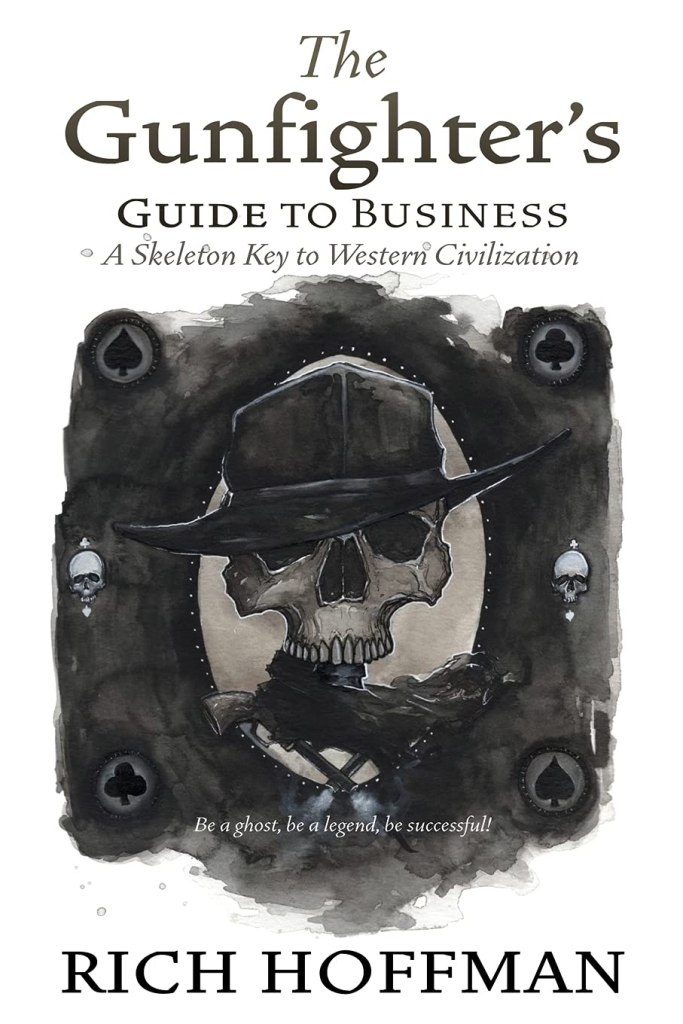
Click to buy The Gunfighter’s Guide to Business

They Killed James Bond: A warning to us all that nobody escapes from progressives

They Killed James Bond

Studios were surprised in Hollywood when the new James Bond film No Time To Die didn’t blow the doors off the box office over its opening weekend.  Like every other underperforming fool these days, they wanted to blame Covid, which governments created to commit election fraud, not that they killed James Bond in the movie.  Who thought that was a good idea?  After 60 years of narrow escapes, they found a way and a time for James Bond to die at the end of No Time To Die. They probably should have taken their own advice given to them in the title. It was just another disappointment that we are all getting used to strong, white, male characters that progressives think they can kill in stories and replace them with women or people of color for the sake of the visual aspects of things and that people would accept it.  Over the last two years, as we have waited for this movie to come out, the rumors of the next James Bond being a woman, a gay guy, or all kinds of other things have been discussed openly.  When the movie finally opened, enough people had enough.  It leaked out that this Daniel Craig James Bond was going to die, and people weren’t exactly in a rush to see it happen.  It’s not enough to make a technically good movie; James Bond is one of those special cases where he’s a hero who always gets away, like Bugs Bunny.  But then again, Bugs Bunny is pretty much banned these days too.  Any strong characters without obvious flaws in the mind of progressives are a danger to their politics, so they look to get rid of them and replace them with flawed, mortal characters who are easy to control by the government. 

This isn’t unique to the Bond film franchise.  I have written many hundreds of thousands of words about the failure of Disney to handle the Star Wars franchise.  It was astonishing that given all the great resources they had in Star Wars left to them by George Lucas, that they screwed it up so badly.  Yet when I saw The Force Awakens back in 2015, it was clear that when they decided to kill Han Solo, the plan was the same as Bond.  Kill off Anglo-Saxon white men in the public’s minds so their rule over mankind will end, starting with stories.  Then replace them with people of color and women, and make them like it.  That was essentially the goal of the new Star Wars films, and people rejected them so severely that the brand is now permanently damaged.  Disney has a new CEO who has been brought in to fix things.  Lucasfilm is also moving people around who like Star Wars to repair the brand, which will take years if possible.  I think they’ll make things better, but the damage is already set.  Some things you can’t tamper with.  If a character has a special place in people’s minds, you better treat them well and not take them for granted.  Otherwise, don’t expect to use them to drive box office results while at the same time appeasing all the anti-capitalist radicals who have infiltrated leftist thinking for communist domination of the world. 

Star Wars is an easy one to see because it’s so obvious.  As big of a company as they are, Disney never understood why people liked the film franchise.  Some of the plotlines they have introduced then rejected over the last several years indicate that Kathy Kennedy never understood why the films she was invited to produce worked, like the Indiana Jones films and all the Steven Spielberg projects she was a part of.  Because she thought she could interfere with what the public liked and that as long as space creatures and spaceships were flying around, that people would buy a ticket to her liberal propaganda.  Well, as it turns out, that’s not how things work.  People want heroes they can believe in.  People worth watching who manage to outsmart the bad guys. That’s why people buy a movie ticket.  Reality is tough enough.  When people enter a darkened theater, they want to see hope. 

I think movie box office results are some of the best votings there are.  People truly vote with their feet.  It’s not easy for Democrats to cheat the vote because they still can’t control what people like.  Ultimately people decide what they like and see and if they don’t want to see James Bond getting killed.  Then they won’t see it happen.  They might catch the movie on cable later, but they aren’t going to pay money to see it happen.  One of the clear political strategies that China has in mind for America and all the Davos insurgents is to rob our culture of hopes and dreams and instead show that even James Bond eventually gets it in the end.  Filmmakers seem to want to praise those types of people at cocktail parties rather than being blamed for being just another capitalist producer who put profits over the party.  The ultimate check on that power is to reject those films at the box office, which happened with the new James Bond film.  They killed Bond.  And the box office reflects that people didn’t want to see it happen. Just as Disney killed off Han Solo and thought they could replace him with some Dora the Explorer character, and they’d still make money.

Yet to continue to hide these things from the public, every time they get caught, Covid is used to hide the incompetence of the participants.  No Time To Die was supposed to be released in early April of 2020.  It has had its release date pushed back many times, finally hitting theaters in October of 2021, really at a terrible time for a Bond film.  This is what the Great Reset looks like, folks.  Incompetent people release their movies that used to be valuable to the public.  The public forgets about them and moves on to other things, and when the results don’t come out the way stakeholders expect, well then, they blame Covid.  Ultimately, governments have interfered with the marketplace, and the bootlickers have wasted more time appeasing them than actually trying to make a movie people want to see.  The governments are the new audience to appease, not the popcorn-eating public, and these projects are flat and boring.   And coming out of a disappointing time when governments tried to completely take over our healthcare with a made-up crisis in Covid, built in a Wuhan lab in China by Dr. Fauci NIH funding, movie producers are trying to take away anything that might be considered good in our movies and entertainment.  Their message to us is, “see, even James Bond gets it in the end.  Not even he can escape our power.” It shouldn’t come as a surprise to any of us, given what we have seen from authority figures in 2021.  The bad guys wrote this latest James Bond film as propaganda for the future they want to control.  That understanding makes me proud to see that people didn’t get suckered into it and decided to stay home.  No Time To Die didn’t come up short at the box office because of Covid.  People are starving for reasons to get out of the house.  They aren’t scared of the virus.  No, they don’t want to see one more icon of western civilization killed in front of their faces, which was the intention of the woke James Bond of this modern age.  People voted in a way that Democrats couldn’t steal, and it shows in the box office ultimately. 

Rich Hoffman

Click to buy The Gunfighter’s Guide to Business

My Thoughts on Afghanistan: Facing down evil once more

Its Time to Face Down Evil

I love Jags in West Chester, Ohio, and some of my friends who love to chew on cigar smoke while contemplating the complexities of life.  I found myself at the bar enjoying the atmosphere after one of those nights dressed the way I always am in my videos, like the one shown above, enjoying a Guinness.  A receptionist had come for me to take me to my table, so we walked through the posh interior headed for that destiny when an older, very affluent couple stopped me to compliment me on my hat.  At first, I thought they were poking fun at it a bit, but I realized they were quite sincere in their compliments after a few moments.  I don’t talk about it much, but I started dressing this way for one primary reason.  Our country is under attack and has been for a while.  Now is not the time to pretend like everything is fine and dandy.  I wear the outfits I do because it helps other people feel better about what’s going on, that there is still strength and courage out in the world, which is precisely what that couple was referencing without being able to put the words to the moment.  They just knew they liked it. We’ve allowed our culture to slip away from us by playing too friendly with the world.  And in doing business all over the world, I knew something that the rest of us have forgotten because our media culture makes sure we ignore it.

The efforts at toxic masculinity and other progressive pushes were meant to unarm us physically and intellectually.  My approach is to make sure that all those enemies know that, at least with me, that classical American values are at the core of my personality.  I’m happy to project that to anybody who wants to listen, like that couple at Jags.  And they appreciated it for lots of unsaid reasons.  What they could say was that they loved my hat and my leather vest.  Of course, I said thank you.  As another perk, I never have enough pockets for all my things, so the vests serve a practice role, most of which is to conceal my carry, which I never leave home without.  But more than anything, in these times, it did help to project to others that it was alright to let the progressive insurgents know that pushback on their Woke policies was a reality that they would have to deal with.

I’ve been asked hundreds of times over the last few days what I think of the Afghanistan situation and when I explain it, I think of that couple who loved my hat and western attire at Jags.  They didn’t know why they liked my outfit so much; they just knew they did.  Enough to make a big deal about it.  But I understand why they liked it so much; they were older, maybe a little older than me, so they had at some point in their past access to the western, which were the foundations of Hollywood for most of its life.  Westerns were also the first thing that progressives have attacked in our culture, which loves them still.  Only westerns have been satirized relentlessly for the last 30 years because they project what communists call “Toxic Masculinity.” Well, what happened in Afghanistan was that the good guys went there to bring western civilization to the world’s villains, and we helped many Afghan people do just that.  Women were freed for the first time in their aggressive Muslim culture.  America was that needed sheriff that came to town and brought justice to the dens of evil who wanted to continue to function as a backwater crime pit, and we staved it back for 20 years and allowed people to evolve without those fears.  Westerns from American culture have told this story repeatedly, from just about every John Wayne movie to Clint Eastwood’s Fistfull of Dollars.  To The Magnificent Seven, and many more.  The good sheriff coming to town to instill justice and natural law were what most westerns were about. They were specific creations of American ideas and western civilization in general.  And when people see the way I dress, it’s reassuring to them.  Not so much to the youth, although they do respond positively.  They are craving protection and order in their lives.  But we have these needs deep within our culture, and we have over a hundred years of stories about these themes that we’ve created and broadcast around the world.  The bad guys know it and want it undone, which is what Afghanistan was and why it’s such a tragedy.

The mistake purposeful or by sheer accident is irrelevant.  The political left ran by a Marxist ideology, even in radical Islam, expects the bold sheriff’s merits to be replaced by consensus building through the “international community.” The Biden administration has made mention of that strategy over and over as Afghanistan fell apart.  It was a plan built into the political left through echo chambers within academia, and they have made it their hill to die on.  That all countries are equal.  America should not be that white-hatted sheriff for the rest of the world. Instead, all nations would be managed through peer pressure of being out of alignment within the international community.  In other words, the cool kids would not let Afghanistan play in the reindeer games if they fell out of line.  Well, that’s their ideology, and it sounds good in the backyards of Georgetown while grilling hot dogs and sipping on red wine, but it doesn’t work in real life.  All it has done is give the biggest aggressor a chance to pick on all the peace lovers trying to kill the world with kindness.  China has been stoking these fires in the background for their ambitions of world domination, and their next target is Taiwan.  It’s easy for Americans to see all this, at least subconsciously, because of our long history of westerns in cinema.  We were raised to see good and evil in these ways even though our academic educations have put the blinders on us to make us blind to the intentions.  But deep down inside, we know what’s going on.  The minute the good Sherrif leaves the town, the villains come out and pillage the innocent. That reality was put into sharp focus as we watched Afghans pile onto C-17s in a desperate attempt to flee Afghanistan and the Christian-hating Taliban before they were all butchered, raped, and killed by the latest villains on earth. 

Without China, there would be no Taliban; they are the unsaid provocateurs here who planned to use this defeat to shame Americans into staying out of their business when it came to Taiwan and Japan.  And while America was killing itself worrying about whether or not we were using the proper pronouns when referencing ourselves, or in feeling guilt over racism, for which America is the most diverse nation in the world, China could make their move to run the world with communism.  So as sad as Afghanistan is, even that is part of the Chinese plan, to shame America so severely with a 20-year war that sent us packing with nothing to show for it and let Afghanistan destroy itself through its civil war without American involvement.  Then China could quickly kill off the winner to take over and have the mineral rights to the north and stimulate the opium production from the region to further poison the world into compliance with everything communists desire.  That is why I love moments like what I mentioned at Jags in my town of West Chester, Ohio.  It reminds me of times past when good sheriffs had to run the bad guys out of a city like Deadwood, Dodge City, or Tombstone.  We are there again, and over a beer, cigar smoke, and the banter of bold camaraderie, we are prepping ourselves for another fight in the streets.  Afghanistan isn’t the end of the fight, but the cue to strap on the guns and face down the evil villains.  And most people, even if they aren’t gunfighters themselves, know and understand the need because at least recognizing that need runs deep in American culture.  But now, instead of watching it on TV, we will have to do it in real life.  And that is the hope that the world is desperate for.  Afghanistan is just the latest proof to what degree only America can save that world from itself.

Rich Hoffman

The Gunfighter’s Guide to Business
Click to buy The Gunfighter’s Guide to Business

Guns and the Meaning of Life

It continues to be frustrating to read gun defenders getting tricked into arguing the merits of gun ownership against the position of the liberal aggressiveness that has far-reaching implications which I established in an article I wrote yesterday on the real fight in the world between eastern and western civilizations. The intent by liberals to enact gun control is to achieve their not so thinly veiled objective and that is to destroy all of Western Civilization and to replace it with the values of the orient. This has never been in dispute yet many people just don’t seem to understand the big picture, so they can’t defend it in an argument. To do so you have to understand the big game that the East has always been playing and to deal with them on those terms. It was last year that I visited the Indianapolis Children’s Museum and noted that they had an entire section dedicated to just the country of China, as if we were all going to be adopting to that reality soon anyway, so they were there to instruct visitors to what that world would look like. It can’t be argued that this is the world that the political left and even many on the right want for the United States, a gradual surrender economically to China and the spread of their communist system from there to here.

It’s all about state control over individual activity. When I talk about Western Culture I’m talking about a long boil of ideas that were in conflict with each other through many thousands of years, something that didn’t occur in the orient. Even within that Western culture the best of it was the sentiments of individualism that came out of works of art such as in Wolfram von Eschenbach’s Arthurian romances, specifically of the Parzival Grail quest. There are some really wonderful passengers about individualism that emerged quite radically against the state control of kings and territorial oversears typical in 13th century Europe that evolved over time into what the American gunfighter mythologies on the western frontier of North America evolved into that are worth protecting. That is after all why gun rights in America are necessary and need to be less restrictive, not more so. To find the Grail castle and eventually the Grail itself, the night Parzival had to ride his horse with the reigns limp and to find these treasures through authenticity to himself not to the obedience to a social system. That is a very important distinction that is at the core of all Western thought. And it is that which having gun ownership is meant to protect.

We have allowed the enemy to define the grounds for which we fight, which is to allow gun rights to become a safety issue, and that we should all give them up for the benefits of more security. But to do that we have to yield more power to the state, and to apply the Parzival metaphor to the situation, to guide the horse more directly and to seek the Grail Castle through institutionalized inquiry, for which it would always remain invisible to us. The harder you look, the less you find especially in the context of institutionalized perspective. But as we know through history, this always leads to collapse of society in one fashion or another. There is never any real safety in such a quest in life so the issue is never about safety, it’s about preserving ideas and concepts that were strictly part of western civilization for thousands of years of evolution. The moment that those ideas aren’t protected, the state controlled sentiments of the East desire to creep in and destroy everything humanity has worked so hard to build for thousands of years of trial and error.

The way it has been framed, the gunfighter of the American west was a whore and gambler representing the worst of us and is an image we should run from, not to. But I see them quite differently, as the latest additions to Eschenbach’s quest to define individual authenticity to the mandates of institutionalism. The individual effort of America’s gunfighters both in real life and through the emergence of Hollywood westerns is quite a statement about individuality and the merits that such contributions have on society as a whole is quite astonishing, and important. But without the gun, it wouldn’t have been possible. It was the gun after all that destroyed the Indians, who were the representatives of the orient in place within North America as immigrants of their own centuries before. I wouldn’t go so far to call them domesticated inhabitants. The strange culture of the Adena people with their obsession with Ancient Alien conspiracies, their elongated heads, their sometimes unusually tall stature with obvious roots from the Middle East and the Salisbury Plain and excessively sophisticated mathematics were not the same people as the Shawnee who were the Indians who fought the first stages of westward expansion in my home state of Ohio on the very ground that my home sits to this day. Not by a long shot. There is a deep and distant past that has many complex cultures coming in and out of it that have nothing to do with “indigenous” people. The Indians had their chance and they failed like all cultures around the world to get their grips into reality and to sustain the growing ambitions of mankind with fresh new philosophic concepts. But in Western Culture, such thoughts did percolate. Often the perpetrator would find themselves beheaded in Europe, or burnt at the stake, or even hung on a cross, but the effort was there and ideas did evolve. It was the gun and the American frontiersman who actually found the Grail Castle of Eschenbach in North America, not in some Heavenly light of Utopia but in the casinos and whore houses of upstart towns high in the mountains of South Dakota and California. The individual behavior may have been disgusting, but it was authentic and behind that effort came the greatest economy and civilization yet to emerge from human minds. And it all started with personal autonomy and the gun that protected that right.

A vast majority of our fellow human beings are much like Parzival. Often by accident while they are reckless in their youth treating life with their hands on the reigns loosely, they find their Grail Castle. But they do as Parzival did, they don’t ask questions when they should or act authentically to their nature, so they get kicked out of the kingdom even though they still stand where they always stood. The keys to the great Heavens are not as Jesus said, out there somewhere but are all around us. We must find them ourselves through our own authenticity which is the meaning of life, which can be and is often different for each one of us as individuals. Only by living an authentic and individual life can we find our own meaning and then give the value of that meaning to those of our civilization. And while we are searching for this individual meaning there are always villains who come along to pull us back to the mandates of institutionalism. For the first time in all human history there were very charismatic individuals roaming around the American West much the way Parzival did under King Author’s knighthood. The goal of such knights wasn’t loyalty to the court but honor in the individualized efforts of personal authenticity. Maybe only less than 1% of all people find such a Grail Castle in their lifetimes, but the treasure that springs forth from such a society is literally boundless, and worth the trouble. And to protect that opportunity in the face of mankind’s tendency toward detriment, we need personal guns to keep the effort alive, and deep into the future.

Rich Hoffman

Sign up for Second Call Defense here: http://www.secondcalldefense.org/?affiliate=20707 Use my name to get added benefits.

The Elephant in the Room, a History Lesson for those who need it on why President Trump is Desperately Needed

We need to talk about the nature of cooperation for a minute, especially in regards to political debate. The assumption has been that gental professionals could argue out issues without things coming to gunfire and violence within the framework of the republic, and to a large degree that has worked well through the first 200 years of America as a nation. But modern Democrats and some Republicans of a more progressive nature aren’t interested in preserving the American republic into the future, but they entertain leaving their own mark into the foundational emergence of a new Constitution. Let’s just talk about the elephant in the room. In modern politics, they are actively seeking to make government, for which they are a part of that managing body bigger and more powerful, so their hostilities toward the American Constitution is quite obvious. And that has never been more obvious than in this year’s crop of Democrat hopefuls for the American presidency. They, and the party that supports them are openly hostile to the kind of American government that we’ve had. They are only interested in changing it, not living with it and those of us who have been in this country all our lives and love it the way it is. They want to take from us to fill themselves. They aren’t interested in getting along or being respectful. They are by every definition domestic enemies of our Constitution and need to be treated that way, not rationed with.

The position that many Republicans have taken over the years has been embarrassing, and I have seen this up close on more than one occasion. Conservatives wanting to make that mind-numbing tight rope walk between their churches and the foundations of conservative values have made themselves into lots of Dr. Jekylls and Mr. Hydes. Christianity, especially how it emerged into the Roman Catholoic Church is very much an oriental concept that has from the beginning sought to bring an end to western civilization, the kind of advances which gave birth to Greek and Roman society. And the tide of aggression that has moved from east to west has been full throttle since Alexander the Great stopped his eastward conquest with some Buddhist monks in the vicinity of India. Since then western civilization has been attacked by the orient not with weapons but through their ideas as the church took over kingdoms and Europe fought over those ideas for the next 2000 years, even up until this very day where it is being counted on by Islam to become the next dominate religion so that all then nations of the world can unite under a theocracy and a system of communism very similar to what is currently in China. Republicans were taught to turn the other cheek in a fight and they have been getting their asses kicked regularly ever since.

Protestants fled the church in England to seek religious freedom in America. The Indian nations encountered were very much of the oriental religions but they were unorganized and on a declining path socially so the effects were not the same as they had been in Europe where confusing mixed messages about religion and politics were prevalent. The kind of Christians who emerged in pursuit of freedom were a far cry from the docile church goer in Europe who had conservative personal values but was taught by the church that there are many more things in life bigger than the self and that sacrificing that to the needs of the many was a very Jesus kind of thing to do. The more civilized America became in the years after the American Revolution, the more those confusing European ideas of conservative values emerged, which is what Protestants were running from in the first place, so those old oriental ideas about church and state have returned to our present world and the battle is quite vicious.

Don’t kid yourself, the battle is obvious. I have known for a long time that for conservative values to survive in the United States that we needed a spokesman in the White House like a Donald Trump, a person who would hit back when struck in the face, and not turn the other cheek. It is a dumb idea to not hit back when someone hits you. Who cares if its not a “Christian” thing to do? Christ in his early years obviously encountered the eastern religion of Buddhism and he brought that into his teachings which of course jostled the control the Roman Empire wanted for the west bank of the Mediterranean. The Jews had things under control there so the churches were very much part of the control mechanism of keeping the Empire united, even though the Romans themselves had many ancient gods they worshipped. The ideas of conquest are to allow those acquired territories to worship whoever they had before so long as the control of the churches paid homage to the greater power of government. That is after all the theme of the great book, The Canterbury Tales written in 1483 by Geoffrey Chaucer, in the years after Saint Thomas Becket was slaughtered by the King’s men in the Canterbury Cathedral. The idea of rebellion proposed against the tyranny of the state was to visit the spot of Becket’s murder, but to not drift outside of the control mechanism of the relationship of the church and the state, but to function within it. I consider The Canterbury Tales to be one of the most important works of European literature and it shows quite effectively this dysfunctional relationship that western culture has with itself, for which the concept of America was the solution. I had with me a copy of the American Constitution and to read the words of that little book while standing on the spot where Thomas Becket was slaughtered was for me quite an experience because I understood all the relationships that occurred in that spot and what led up to them and what the eventual answer was. Western expansion in America was the ultimate fight between east and west and as we all know, the “west” won. And I am very glad they did. I spent several days in the streets of Canterbury after my visit to Becket’s murder marked in the floor of the Canterbury Cathedral and read through my copy of The Canterbury Tales to let it all wash over me in a very intellectual way. I wish I could take every member of congress on that little intellectual journey so they could see how the pieces fit together, but most of them have no idea. They lack the intellectual fortitude, so they are victims to what they have been taught.

There is no making peace with the enemy and the modern Democrats are the enemy, they are the latest representatives of eastern culture that want more than anything else to wipe away the very concept of an American republic built on individual freedom as opposed to sacrifice to the gods of state control. For liberals that control of religion could be anything from Islam to global warming—an entirely made up new age religion to unify the minds of the youth movement to the causes of sacrificial liberalism—obedience to the state. Thomas Becket as a representative of church control was killed by his friend Henry II as the battle between church and state raged on in Europe, between individual value and those of the institutionalized opinion of a king or emperor. The orient had not had this philosophical battle, for them everything was yielding toward the end of personal existence so it was proper to let the self go into a rapture of selfless existence, therefor the citizen of the orient, which persists to this very day is happy to yield their thinking to a ruler because they’ll be dead soon anyway, so why not. But in the west it was a different story. What was the meaning of life but to have an individual life developed by a personal journey and to unleash the gifts upon the world that resulted from that journey? That is the battle being fought today in modern politics, especially in America. Around the rest of the world, most of them have already fallen to the diatribes of eastern philosophy through their various religions. If people have lost their way with Christianity, they can find themselves in Islam. But for the leaders of those societies, they want people to pick one of the two, just so long as they learn to take orders and instruction from a higher power. On earth that is the regional governor, or politician.

Democrats in that regard want to destroy what is left of Western Civilization that has been doing extraordinarily well in America. But make no mistake, they don’t want to live with the effects of that effort, they want to destroy it. They don’t want to have tea with people who think differently than they do. They don’t want to live in harmony. They want to destroy the American Constitution and bring oriental concepts into western culture by any means so to fulfill a long sought after goal that really extends back to the roots of human history. East and west cannot live together in harmony, the ideas are just too radically different, in the west it is individual merit that is valued, in the east, its sacrifice to the state with the state being the ladder to god. If you want to get to Heaven then you better obey the state. And that is where our modern conservatives fail, they are supposed to fight that assumption, not turn their cheek to surrender. They have been tricked by their own ignorance and lack of historical perspective. Most of them have probably never read The Canterbury Tales, which isn’t an easy read. But it’s a kid’s book compared to James Joyce in his great book Finnegans Wake, which is concerned with the same kind of problem—the role of the individual in an increasingly collective based culture that repeatedly spins on itself with the Vico cycle. The values of our day are not to get along, but to fight—not just the concept in America of Republicans and Democrats, but the values of eastern ideas and western. Both can’t coexist, because the east doesn’t have any intention of doing so. They have intended conquest since the Roman Empire decided to be united by Christianity because it was their last hope of unifying their people. But to do so they had to surrender to the whims of the eastern religions that had always threatened their control west of the lands along the old Silk Road into the orient. This fight isn’t new, its as old as time. But modern Republicans who don’t understand why President Trump is important to the preservation of Western Civilization either need a history lesson or they need to just shut up and get behind us who do. But no longer are they going to be allowed to pull that Trojan Horse into our American culture only to have radicalized Muslims, communists and Eastern religion soothsayers sneak out into the night while we sleep and end our society one rule at a time. That just won’t be permissible.

Rich Hoffman

Sign up for Second Call Defense here: http://www.secondcalldefense.org/?affiliate=20707 Use my name to get added benefits.