The Bad Guys Deserve Punishment: Destroying Iran to free people from tyranny

I’ve been watching everything unfold in real time. It feels good to see some real aggression from the top, finally. Everybody’s talking about how Trump’s inspiration is driving this new level of toughness—hitting Iran hard, taking out Maduro in Venezuela, and setting up hemispheric shielding through Kristi Noem’s new gig as Special Envoy for the Shield of the Americas. It’s exactly what we needed. We’ve lived through a very dangerous time, and we had to have justice for what was done to us. So when people whine, “Why are you being so aggressive? Why treat Venezuela like this? Why talk so tough on Iran, China, the cartels?”—I point to the big picture. We tried playing nice when we could, making deals, but the bad actors never stopped scheming in the background. Iran’s always been problematic, bragging about nuclear warheads and funding terrorists. Trump couldn’t walk away from negotiations with them, thumbing their nose at honest attempts at peace in the Middle East. If they’re going to keep sponsoring terror, you cut the head off the snake. That’s what’s happening now, and it had to happen.

Obviously, the Democrats support that kind of insurrection—they want the downfall of the United States. Peel back the layers, and you see China behind so much of it: property acquisitions here, buying up media companies to steer narratives their way. It’s been ugly, nasty, nasty, nasty. After what they did with COVID, the lockdowns, the global economic sabotage—Bill Gates, the whole crew—people get mad if they’re not in jail or tied up somewhere. They have too much money; they buy courts, buy freedom. They don’t get in trouble. And yeah, I still think Jeffrey Epstein’s alive out there. He’s too rich to die that way. Body double, bought-off guards, elements of law enforcement—it’s not hard with that kind of cash.

Trump doesn’t have the constitutional power to round them all up and jail them—he can’t do it directly—but he can attack their mechanisms of evil. The way bad guys use countries like Iran, Venezuela, Mexican drug cartels, North Korea, and even Russia, stirring up Ukraine—they hustle agents, cause chaos, turn everybody in the wrong direction. But Trump’s clear: no boots on the ground for forever wars. We never should’ve been doing that. I joke about it half-seriously, but what was the Iraq war really about? Oil? Securing prices and American interests? Weapons of mass destruction, they never found? Or was it about raiding the Baghdad Museum right after the invasion, grabbing ancient DNA or artifacts from Gilgamesh’s era to mess with human genetics, or hide giants like in Kandahar? Those conspiracy theories floated around podcasts after retirees started talking. People have lost faith in institutions, in the nightly news narrative: “We’re going to war to save people from communism,” or whatever. Yet the bad guys propped up maniacs for decades—Fidel Castro, the Iranian Revolution in the late ’70s as a Marxist movement hidden behind religion, so you couldn’t criticize it without attacking Islam. That’s how they sold it here: don’t criticize our communities, even as they shuffled in socialism, lined people up for food stamps and welfare, turning dependency into modern slavery to the government instead of plantations.

The same thing’s happening with radical Islam—thorny alliances everywhere, causing needless harm—cartels in Mexico, Venezuelan aggression, and China behind it all. China was built by the deep state; they never would’ve had the money without investment firms funneling stolen Federal Reserve wealth, Wall Street manipulations, modern monetary theory tricks at Jackson Hole conferences. It sounds wild because the media calls it crazy, but listen to those talks—it’s out there.

That’s why everybody’s upset about these moves. Iran’s economy is a dying fallout on the couch—they can’t fight a real war. No ships, no missiles, no planes of any worth. They’ve been de-industrialized by sanctions. Trump bombed them because they poked the bear with radical Islam and ideology issues tied to the Democrat party, which clearly represents America’s destruction in so many ways. Obama gave them billions to keep their economy afloat so they could buy terrorist toys; now Trump’s taking it all away. As an elected official, we put him in office to do this job; he’s doing it. We don’t want radical losers causing trouble worldwide. We don’t want cartels running Mexico—pulling people over for bribes, corruption everywhere. We want to vacation or do business there without fear. We don’t want Venezuela screwing our energy markets. We don’t want Iran sponsoring terrorism. We want peace in the Middle East—Jews, Christians, everybody getting along, building lives.

This is what Kristi Noem’s Shield of the Americas is about—stabilization in the hemisphere. She’s moved from DHS to Special Envoy, focusing on dismantling cartels, securing the Western Hemisphere, working with Rubio and Hegseth. It’s hemispheric shielding: choke off the bad guys economically and militarily without endless occupations. Trump’s not putting boots everywhere; he sends precision strikes, missiles as compliments of capitalism—paid for by the best system in the world. That’s how you win now.

All these characters in the background—COVID planners, great reset pushers, China feeders—they used distractions like Iran to usher agendas through while we fought shadows. Peel back the onion: destroy the disguises, pull off the masks. That’s happening in Iran right now, Venezuela (Maduro captured in January, U.S. overseeing oil rebuild), and Mexico (cartel disruptions). It’s great. I highly support what Trump’s doing—I want to see a whole lot more. He’s actually being too nice in some ways. The world deserves this reckoning for 2020: stolen elections, COVID as a weapon, great reset leashed to lockdowns, all attached to global control plots. Epstein, Gates, Russian honeypots, Chinese labs—it’s out there.

If you think that’s all a conspiracy, it’s in the open now. The people crying loudest about Iran are the ones who used these characters to cause trouble. Forget the courts, UN nonsense, and treaties that neutralized America so bad guys could thrive. Time for punishment. Show the world it happens. Use capitalism for upper mobility, freedom in Hong Kong, Venezuela, Mexico, England, and Europe. Lead by example: take away the hostiles causing trouble. Iran had no other intention but trouble since the late ’70s Marxist infusion feeding communism, China, Russia, socialist Latin America—all anti-American, anti-capitalist, anti-upward mobility. They played their part in lockdowns, freedom theft, and using COVID to destroy economies into a great reset.

This isn’t theory anymore; it’s action. Trump’s crushing them economically, stripping them of their covers, exposing them. The attacks on Iran neutralize them as a threat—they tried rational peace, but they’re hostile. Venezuela’s aggression, Mexico’s cartels—all choked off. No more hiding. Democrats and the media cry because Iran was their Marxist disguise, a haven, a proxy to break America down. Now excuses stripped away, masks off—nowhere to hide. They don’t like it, but too bad. It’s great, the bad guys needed to be punished.  And now they are.

Footnotes

1.  On Operation Epic Fury and Khamenei’s death: Strikes targeted nuclear sites, missiles, navy; civilian casualties reported (e.g., girls’ school in Minab). Trump urged regime change without full occupation.

2.  Maduro capture in January 2026: U.S. raid framed as anti-narco-terrorism; plans for long-term oil oversight and revenue split.

3.  Kristi Noem’s role: Appointed Special Envoy for the Shield of the Americas (Western Hemisphere) in March 2026, focusing on cartel dismantlement and border security partnerships.

4.  Iran’s 1979 Revolution: Marxist influences blended with Shia Islamism to avoid direct criticism of leftist elements.

5.  Iraq Museum looting: Over 15,000 artifacts stolen post-invasion; fringe theories link to ancient DNA/Gilgamesh,/giants myths.

6.  Kandahar giants: Persistent online legend from alleged U.S. military encounters; widely debunked but symbolic of institutional distrust.

7.  China-media investments: Documented stakes in U.S. outlets; fentanyl precursor supply to Mexican cartels well-reported.

8.  Obama’s Iran payment: $1.7 billion settlement for pre-1979 arms deal, not direct “terror funding” per official accounts.

9.  COVID/Great Reset conspiracies: WEF initiative twisted into global control narratives; Gates-Epstein links fueled speculation.

10.  Epstein “alive” theories: Persistent despite official ruling; tied to elite protections.

Bibliography

•  White House Fact Sheet on Iran (2026). https://www.whitehouse.gov/fact-sheets/2026/02/fact-sheet-president-donald-j-trump-addresses-threats-to-the-united-states-by-the-government-of-iran

•  DHS Announcement on Noem’s Role (March 5, 2026). https://www.dhs.gov/news/2026/03/05/thanks-president-trump-and-secretary-noem-america-safer

•  TIME on Shield of the Americas (2026). https://time.com/7382975/kristi-noem-new-job-shield-of-americas

•  Marxist.com on the Iranian Revolution (historical analysis).

•  Various: Axios, Politico, The Hill, CNN reports on 2026 operations in Iran/Venezuela.

•  Reuters Institute on Chinese media influence.

•  BBC on Great Reset conspiracies.

•  Brookings on Obama-Iran cash transfer.

•  CSIS/NBC on China-cartel connections.

Rich Hoffman

More about me

Click Here to Protect Yourself with Second Call Defense https://www.secondcalldefense.org/?affiliate=20707
The Shoe on the Other Foot: Reflections on ‘Tail of the Dragon,’ Prophecy, and the Triumph of Liberty Over Tyranny

The book Tail of the Dragon, which I wrote and published in 2012, remains one of the most personal and enduring statements I’ve ever made. At the time, I was deeply immersed in the political currents of the late 2000s and early 2010s—active in the Reform Party since the Ross Perot days, a supporter of Pat Buchanan’s ideas, an early Tea Party participant (even earning the nickname “Tax Killer” in my community for fighting tax increases), and someone who had long advocated for limited government against what I saw as growing tyranny. I began writing the novel around 2010, finishing it in 2012, during Barack Obama’s presidency, when frustrations with federal overreach, economic policies, and foreign entanglements were boiling over.

The story is framed as a high-octane action tale—a car chase thriller set on the real-life Tail of the Dragon, the legendary 11-mile stretch of U.S. Highway 129 straddling the Tennessee-North Carolina border in the Great Smoky Mountains. This road, with its 318 curves, has a storied history dating back centuries: originally a buffalo trail and Cherokee path, later used by hunters, trappers, and settlers in the 1700s and 1800s, it was paved in the 1930s and became a mecca for motorcyclists and sports car enthusiasts in the late 20th century.

I drew from my own experiences riding motorcycles across the U.S., immersing myself in the culture of independence and the open road—the raw desire for freedom unburdened by overbearing authority. The protagonist, Rick Stevens, a rebellious everyman whose NASCAR dreams have faded, becomes entangled in a high-stakes pursuit that pits individual liberty against a corrupt, tyrannical system. It’s packed with action, comedy in places, romance, and high-speed drama, inspired by classics like Smokey and the Bandit or The Dukes of Hazzard, but with a much darker, more serious edge. Unlike those lighthearted films where characters evade consequences, my story reflects real-world stakes: government overreach, loss of personal freedoms, and the moral cost of resistance.

Officially categorized as “philosophy in action” because that’s where my mind was—blending thrilling narrative with deep ideas about governance, justice, and human nature. I didn’t write it for quick sales or mass-market appeal; books, for me, are vehicles for ideas meant to endure for centuries, not fleeting articles or videos. They provide a framework—a complete world—to explore concepts that demand sustained thought.

At the time, the book puzzled people. Some saw it as just a car-chase novel; others recognized the anti-government manifesto woven in. It critiqued a system that enabled corruption, foreign meddling, and domestic tyranny. I distributed hundreds of copies to tourist spots near the Tail of the Dragon, where motor geeks and road warriors embraced it. The motorcycle community—fiercely independent—loved the authenticity. Online, it sold modestly, but it found a niche among Tea Party leaders, libertarians (though I’m not strictly one), and those disillusioned with the status quo.

The reception was mixed in mainstream circles. My connections—friends close to Glenn Beck, entertainment figures—hinted at potential for film adaptation, given the era’s boom in car-chase movies grossing billions. But Hollywood was shifting leftward, and my conservative, liberty-focused message was too explosive. Pre-Trump, pre-MAGA, it was taboo to openly challenge the Obama-era government so aggressively.

The ending is what many readers called “perfect”—and it’s the core of why the book feels prophetic today. Without spoiling it fully, the resolution isn’t a simple outlaw victory or easy escape. It grapples with justice, consequences, and optimism: even in chaos, there’s a path to something better. I am an optimist at heart; I see potential for good even amid fire. The characters face dire situations far beyond Bonnie and Clyde-style tragedy or Smokey and the Bandit hijinks, reflecting my real experiences with law, order, and government reform efforts.

Fast-forward to now, in 2026, and the world has caught up. People who read it years ago—Tea Party activists, early MAGA supporters, grassroots leaders—revisit it and say the arguments aged well. They ask: “You were anti-government then—why support crackdowns now on protesters, immigration enforcement, or actions against regimes like Iran?” The answer lies in that ending and the philosophy behind it.

In 2012, the government I opposed funded adversaries abroad while undermining constitutional principles at home. The Obama administration pursued policies toward Iran that included sanctions but also controversial elements—like the eventual JCPOA nuclear deal (finalized later in 2015) and cash transfers critics labeled as enabling terrorism.

It allowed influence from regimes in places like Venezuela, where China and others gained footholds through oil and alliances. Drug cartels and thugs thrived in hemispheric politics, enabled by weak borders and foreign policy that prioritized appeasement over strength.

My book was a call to fight back—violently, if necessary—against such tyranny. It was rough, angry, explosive. Mainstream folks shied away; motorcycle warriors and liberty-minded readers took it to heart.

Today, the shoe is on the other foot. A government aligned with the values I championed—freedom, upward mobility for the majority, cracking down on threats—holds power. Actions against violent protesters (like those in Minnesota scenarios), strong immigration enforcement, and decisive moves on Iran and Venezuela aren’t hypocrisy; they’re the fulfillment of what I advocated. A freedom-fighting government represents the people’s interests, not the old tyrannical one.

Recent developments illustrate this: U.S. operations targeting Iran’s nuclear sites and influence, combined with efforts in Venezuela to remove leaders like Nicolás Maduro, curb Chinese, Russian, and Iranian footholds in the hemisphere, and secure strategic resources like oil.

These are chess moves in a high-level game—eradicating threats that once thrived under the prior order, reducing adversarial footprints, and restoring American dominance in our sphere.

The difference isn’t anti-government absolutism (that’s libertarian territory, which I don’t claim). It’s defining tyranny versus legitimate authority. When “our side” wins, we fly the flag proudly, ensuring government serves freedom, not suppresses it. The former rulers now protest violently—borrowing our playbook but twisting it with force—because they’re on the outside.

Tail of the Dragon helped shape thinking among key influencers years ahead of the curve. It wasn’t a bestseller, but it has a cult following: people still seek copies, discuss it at rallies, reference it in conversations. It provided a philosophical framework for building a movement—one that took time (through Tea Party to MAGA, through investigations, COVID, and elections) but prevailed.

I’m proud of it. Books like this aren’t for immediate gain; they’re for longevity. The message endures: resist tyranny, but recognize when victory arrives and authority aligns with liberty. The world caught up, and that’s a good thing.

Bibliography

•  Hoffman, Rich. Tail of the Dragon. Self-published/iUniverse, 2012. (Primary source; available on Amazon and Goodreads.)

•  Tail of the Dragon official site. “History.” tailofthedragon.com/history. Accessed March 2026.

•  U.S. Department of State archives. “Iran–United States Relations During the Obama Administration.” Wikipedia summary drawing from primary sources, 2010–2016.

•  FactCheck.org. “Obama Didn’t Give Iran ‘150 Billion in Cash’.” March 1, 2019 (updated context).

•  Politico. “Obama’s Hidden Iran Deal Giveaway.” April 24, 2017.

•  Foreign Affairs. “Trump’s Way of War: Iran, Venezuela, and the End of the Powell Doctrine.” Recent analysis, 2026.

•  ABC News. “Trump Demands Venezuela Kick Out China and Russia.” January 6, 2026.

•  Various Goodreads and Amazon reviews of Tail of the Dragon by Rich Hoffman, 2012–present.

Footnotes

1.  Tail of the Dragon route history drawn from tailofthedragon.com and related sources.

2.  Book details from Amazon and Goodreads listings.

3.  Iran policy critiques based on archived Obama-era fact sheets and subsequent analyses.

4.  Current geopolitical actions referenced from 2026 news reports on U.S. operations in Iran and Venezuela.

Rich Hoffman

More about me

Click Here to Protect Yourself with Second Call Defense https://www.secondcalldefense.org/?affiliate=20707

The Clear Choice of Michael Ryan: Having the guts to be successful

The last day of February 2026 marked a pivotal moment in Butler County politics with the official launch of Michael Ryan’s “Boots on the Ground” campaign for Butler County Commissioner. Held amid enthusiastic support from local Republicans, the event drew a strong turnout of volunteers, elected officials, and community members ready to canvass neighborhoods, distribute materials, and build momentum ahead of the May 5 primary and the November general election. This gathering was more than a routine campaign kickoff; it represented a broader call for generational renewal in conservative leadership, fiscal responsibility, and unapologetic advocacy for free-market principles in one of Ohio’s key counties.

Butler County, encompassing cities like Hamilton, Middletown, Fairfield, and Oxford, has long been a Republican stronghold in southwest Ohio, though not without its internal tensions and occasional Democratic inroads through local races. The county commissioners oversee a budget in the hundreds of millions, managing everything from infrastructure and economic development to public safety and social services. The position demands not just administrative competence but the ability to unite diverse stakeholders—townships, cities, businesses, and residents—while resisting the temptations of prolonged incumbency that can lead to complacency or overreach.

The current dynamics in the 2026 race stem from dissatisfaction with the status quo. Incumbent Commissioner Cindy Carpenter, who has held the office since her first election around 2011 and has been re-elected multiple times, faced mounting criticism for her tenure. Critics pointed to a perceived lack of strong fiscal oversight, strained relationships with constituents and colleagues, and a series of personal and professional controversies. Notably, in November 2025, Carpenter was involved in a heated incident at Level 27, an apartment complex near Miami University in Oxford, where her granddaughter resided. The complex manager accused her of using inappropriate and allegedly racist language, leveraging her political position for intimidation, and making an obscene gesture during a dispute over rent and eviction matters. Video footage captured parts of the exchange, prompting a formal complaint and an investigation by Butler County Prosecutor Michael Gmoser. In December 2025, the prosecutor cleared Carpenter of criminal misconduct, stating that her behavior did not rise to that level and questioning the complainant’s credibility. While no charges resulted, the episode fueled perceptions of poor judgment and an inability to handle pressure gracefully under public scrutiny.<sup>1</sup>

Another contender in the race, Roger Reynolds, brought his own baggage. A longtime political figure who served as Butler County Auditor from 2008 until his removal following legal issues, Reynolds was convicted in December 2022 on a felony count of unlawful interest in a public contract related to corruption allegations. He was sentenced to community control, a fine, and jail time (stayed pending appeal). The conviction was overturned by an appeals court in 2024, restoring his eligibility to hold office, but the Ohio Supreme Court declined to restore him to the auditor position in a related quo warranto case in September 2024. The episode cast a long shadow over his reputation, with legal battles, public scrutiny, and associations with controversy making him a polarizing figure, even among some Republicans who preferred fresher leadership unencumbered by such history.<sup>2</sup>

Into this landscape stepped Michael Ryan, a 40-year-old lifelong Butler County resident and former Hamilton City Council member. Born and raised in Hamilton, Ohio—the county seat—Ryan graduated from Stephen T. Badin High School in 2003. He earned a B.A. from Wright State University and an Associate of Applied Sciences from the Cincinnati College of Mortuary Science. Following in his father’s footsteps—his father, Don Ryan, served as former Hamilton Mayor—Michael entered public service by winning a seat on Hamilton City Council in 2017, where he was the top vote-getter and subsequently selected as Vice Mayor for two years under the city’s charter. He repeated this success in 2021, again topping the ticket and serving another term as Vice Mayor. During his eight years on council (he opted not to seek a third term in 2025 to pursue the commissioner race), Ryan was credited with supporting initiatives that fostered job creation, economic revitalization in Hamilton—a city historically challenged by manufacturing decline—and collaboration with businesses and residents. He played a key role in taxpayer advocacy efforts, including opposition to certain aspects of the Miami Conservancy District that threatened assessment increases, and contributed to projects like historical preservation (e.g., the train depot) and potential infrastructure improvements such as Amtrak stops.<sup>3</sup>

Professionally, Ryan has worked full-time for over a decade as a life insurance underwriter for Western & Southern Financial Group. He is married to his wife Amanda, with whom he has been together for seven years at the time of the campaign launch; the couple resides in Hamilton with their two pugs, Piper and Jackson. Ryan’s family-oriented life, stable career, and emphasis on faith and conservative values have been highlighted as reflective of his character and leadership style.<sup>4</sup>

In May 2025, Ryan announced his candidacy for the Butler County Commissioner seat held by Carpenter. In January 2026, the Butler County Republican Party delivered a resounding endorsement to Ryan, with 71% of the central committee vote (118-42 over Reynolds, with some abstentions), a margin described as “historic” by party leaders. This overwhelming support, including backing from figures such as Auditor Nancy Nix, State Representative Thomas Hall, State Senator George Lang, U.S. Congressman Warren Davidson (who endorsed him in February 2026), and others like Treasurer Michael McNamara, signaled a clear preference for new leadership over incumbency or past controversies. The endorsement eliminated ambiguity: Ryan was the official Republican choice heading into the primary.<sup>5</sup>

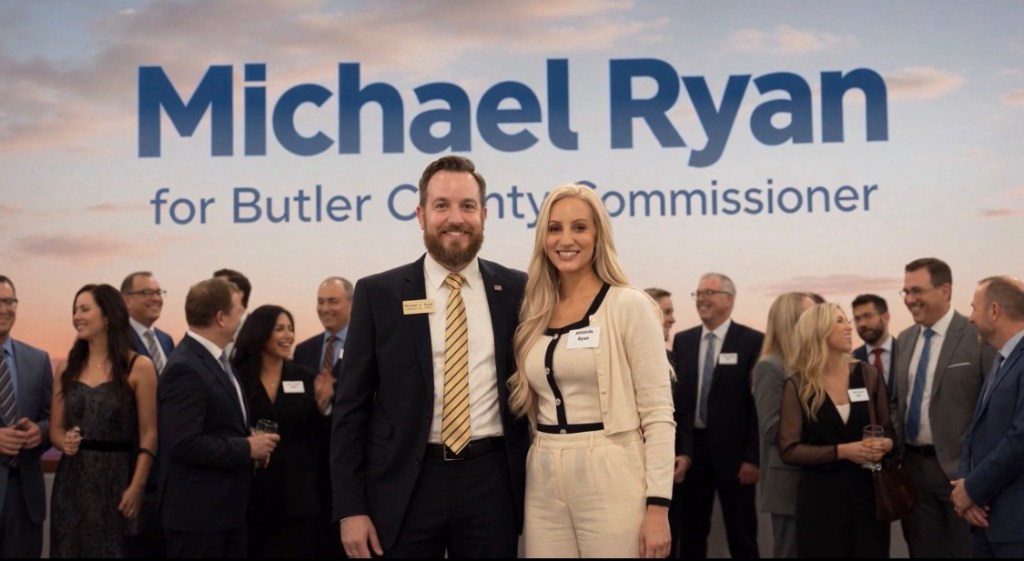
The February 28, 2026, launch event exemplified this momentum. Attendees included Ryan’s wife Amanda, his brother Chris, his boss from Western & Southern, and elected officials like Thomas Hall, Nancy Nix, and others. The day began with a prayer for protection and peace, particularly for U.S. soldiers amid global tensions, followed by a moment of silence to honor service members. Speakers emphasized themes of inevitable, beneficial change—drawing analogies from nature where stagnation gives way to resilient growth—and applied them to politics. One introducer highlighted Ryan’s composure, integrity, and proven track record in defending against unjust policies, noting how he mentored others in collaborative advocacy. The event stressed grassroots activation: door-knocking, sign placement, and voter conversations focused on simple questions like “Are you ready for change?” or “Are you okay with the status quo?”

Ryan himself spoke directly, thanking supporters and outlining his vision. He called for engagement to place someone in office who would fight for core values—fiscal responsibility, strong communities, and a voice for every corner of Butler County. He framed the race as preparation for 2050 and beyond, building a winning team that delivers results rather than perpetuating old patterns. With early voting starting April 5 and the primary on May 5, he urged activation to build momentum against Democrats already organizing. The speech closed with gratitude, a call for volunteers, and patriotic blessings.

The enthusiasm at the event was palpable. Volunteers rallied not just for a candidate but for a shift in Republican identity: away from apologetic or conciliatory postures toward Democrats and toward confident, unapologetic advocacy for success rooted in hard work, family values, church involvement, and economic freedom. Ryan embodies this next generation—articulate, family-oriented (with a supportive wife and stable home life signaling character), and tied to practical successes in Hamilton. Unlike predecessors who plateaued in interpersonal skills or succumbed to power’s pitfalls, Ryan appears equipped to unite rather than divide, recruit moderates through ideas rather than coercion, and extend Butler County’s economic strengths.

This campaign reflects larger national trends in the post-Trump Republican Party, often termed MAGA conservatism. Ohio has seen figures like JD Vance rise nationally, with speculation about future leaders like Vivek Ramaswamy in statewide roles. Locally, Ryan’s approach rejects the old unspoken accommodations where Republicans “play nice” to avoid seeming mean or greedy. Instead, it embraces capitalism without apology, viewing success—decent homes, stable families, business ownership—as virtues to celebrate, not excuses to atone for. Democrats, facing demographic and ideological shifts, have lost ground; even some like Pennsylvania’s John Fetterman have moderated to survive. In Butler County, any Democratic gains (as in certain trustee races) often relied on obfuscating party labels, tactics unlikely to work against a well-endorsed, visible conservative like Ryan, especially with potential high-profile support from Trump in midterms.

The commissioner’s role, managing vast resources, requires someone who avoids scandals, handles relationships deftly, and prioritizes growth. Long tenures can breed entitlement; Ryan’s relative youth and fresh perspective promise renewal without inexperience. His association with successes in Hamilton—economic rebirth, taxpayer advocacy—suggests he can sharpen county-wide efforts.

As volunteers fan out in the coming weeks, the race tests whether Butler County voters embrace this change: from ambiguity to clarity, from incumbency’s risks to new leadership’s promise. Michael Ryan stands as the embodiment of that shift—a conservative not afraid to win, rooted in community, and ready to lead Butler County toward a more prosperous, principled future. In an era demanding bold stewardship, his campaign offers a compelling case that the best is yet to come.

Footnotes

1.  See coverage of the November 2025 incident and December 2025 clearance: “Butler County commissioner cleared of misconduct despite heated exchange caught on camera,” WKRC (Dec. 4, 2025); “Prosecutor clears Butler County commissioner of misconduct after apartment dispute,” Journal-News (Dec. 3, 2025); prosecutor’s letter via local media.

2.  On Reynolds’ conviction, overturn, and related cases: “After overturned conviction, Roger Reynolds is running for commissioner,” Cincinnati Enquirer (Sep. 8, 2025); Ohio Supreme Court decision in State ex rel. Reynolds v. Nix (Sep. 25, 2024); Attorney General sentencing release (Mar. 31, 2023).

3.  Ryan’s council service and achievements: “Hamilton councilman Ryan to run for Butler County Commission,” Journal-News (May 19, 2025); campaign site ryanforbutler.com; announcements crediting work on economic projects and Miami Conservancy opposition.

4.  Personal biography: From official campaign website ryanforbutler.com (“Faith and Family” section); family ties noted in “Newcomer Michael Ryan becomes Hamilton’s vice mayor,” Journal-News (Dec. 28, 2017).

5.  Endorsement details: “County GOP backs new face for commissioner over incumbent,” Cincinnati Enquirer (Jan. 10, 2026); “Butler County GOP puts support behind county commission candidate Ryan,” Journal-News (Jan. 12, 2026); Warren Davidson endorsement release (Feb. 23, 2026) via campaign Facebook.

Rich Hoffman

More about me

Click Here to Protect Yourself with Second Call Defense https://www.secondcalldefense.org/?affiliate=20707

The Warm Blanket of Socialism: Hiding the tattoos and body piercings of millions of bad personal decisions with progressive crusades

The mirror doesn’t lie.  What looks back is the result of millions and millions of decisions, and most people don’t like what they see.  So they construct social engagements accordingly.  If they lean toward liberal politics, it is likely because they are ashamed of their decisions in life and look for social order to hide them from the realities of those bad decisions with a warm blanket of socialism to hide under.  And the last thing they want to do is have some conservative come into their room and rip away that protection from even themselves, let alone the judgments of the world. But beyond the personal, the reflection prompts deeper contemplation about the state of the nation—particularly the visible unraveling among those who champion a progressive, collectivist vision for society. What some call the “warm blanket of socialism” provides comfort to those less inclined toward self-reliance, a psychological shelter against the uncertainties of individual responsibility and the harsh light of personal accountability.

Self-reliance has long been a cornerstone of the American ethos, embodied in figures who tie their own shoes at a young age, change their own tires, perform their own brake jobs, cook their own meals, and build their lives through initiative. Such individuals tend to align with Republican values, emphasizing limited government, free markets, and personal merit. In contrast, those who feel lost or overwhelmed often seek refuge in collective structures—government programs, social safety nets, group identities—where shared burdens mitigate individual risk. This isn’t mere preference; it’s a response to upbringing and circumstance. If early life lacked lessons in independence, if family structures fractured through divorce, remarriage, or instability, the world can feel perpetually threatening. The “blanket” becomes essential, and any policy pulling it away—lower taxes reducing social services, pro-capitalist reforms favoring entrepreneurs, immigration enforcement, or school choice—evokes terror, like yanking covers off a frightened child in the dark.

This dynamic explains much of the current unrest. With policies under the Trump administration prioritizing capitalism, family stability, homeschooling, and distrust of public education, and reducing dependence on public aid, those accustomed to collective coverage feel exposed. Fewer people relying on the system means less communal “blanket” to hide behind. Protests erupt not only from policy disagreements but also from existential fear: the loss of a parental government that shields from consequences. This mirrors historical patterns—East Berlin walls, Soviet barriers—designed to prevent defection from collectivism to individual freedom, lest the illusion of security crumble.

Psychological research illuminates these divides. Conservatives often exhibit higher self-control, greater emphasis on personal responsibility, and stronger physiological responses to threats in ways that reinforce stability-seeking behaviors. Liberals, by contrast, prioritize harm avoidance, fairness as equality, and openness to change, sometimes at the expense of binding structures like authority or tradition. One study found that conservatives outperform liberals in self-control tasks, particularly when free will is framed positively, suggesting that ideology shapes not only beliefs but also behavioral resilience. Happiness gaps also appear: conservatives report higher life satisfaction, potentially attributable to attitudes that value personal agency over systemic solutions.

Family structure plays a pivotal role. Decades of rising divorce, blended families, absent parents, and serial partners disrupt trust in foundational institutions. Children navigating weekends between homes—with new spouses, girlfriends, boyfriends—often internalize instability, leading to victimhood narratives and reliance on external support. Data show complex patterns: conservatives are slightly more likely to have ever divorced in some age groups, but remarry more readily and report happier marriages overall. Marriage rates have declined sharply among Democrats compared to Republicans since the 1980s, with liberals increasingly forgoing marriage altogether, viewing it as less essential for happiness. Conservative women tend to marry younger and desire more children, sustaining family-oriented values. In red states, higher teen birth rates historically contrast with lower divorce rates in blue states like Massachusetts, highlighting how cultural norms around family influence outcomes.

Public education, infused with progressive ideologies over generations, amplifies this. Marxist influences in curricula—from high school to university—promote collectivism over individual merit, framing society as oppressive rather than opportunity-rich. Turning away from this requires reclaiming education rooted in self-reliance and traditional values.

Visible markers often signal these divides. Protesters against conservative policies frequently display extensive tattoos, piercings (nose rings, large earlobe gauges), and other body modifications—symbols of rebellion against norms and a return to “primitive” or indigenous aesthetics that reject Western civilization’s emphasis on restraint. Biblically, Leviticus 19:28 prohibits cuttings or marks for the dead, often interpreted as rejecting pagan mourning rituals or idolatry rather than all body art. Many Christian scholars argue that the New Testament shifts focus to heart intentions and body stewardship (1 Corinthians 6:19-20), not absolute bans. The verse targeted cultural compromise with false gods, not modern self-expression. Still, some view extreme modifications as desecration of the “temple,” opening doors to parasitic influences—spiritual or psychological—that erode personal sanctity. This ties to anti-civilizational trends: embracing perversions destructive to family, promoting LGBTQ+ agendas that undermine traditional bonds, and feeding primal urges over ordered happiness.

Yet statistics nuance perceptions. A 2023 Pew Research Center survey found that 32% of U.S. adults have at least one tattoo (22% have more than one), with roughly equal rates: 33% among Democrats/Democratic leaners and 32% among Republicans/Republican leaners. No major partisan divide exists; differences vary more by age (higher among under-50s), gender (38% women vs. 27% men), and race/ethnicity. Visible, extreme modifications may cluster more among vocal progressive activists, creating a perceptual association, but broader data indicate that tattoos are mainstream across ideologies.

The anger on display—protests that block highways, defend open borders, and resist enforcement—stems from poor personal decisions compounded by cultural shifts. Tattoos and piercings become outward signs of inner chaos, a rejection of self-care mirroring societal rejection of meritocracy. When self-reliance prevails, those who hide behind collectivism feel judged; their resentment manifests as demands for “fairness” that serve as cover for mistakes. We can’t restructure society around resentment—help those open to change, but not at civilization’s expense.

This isn’t hatred of people but a critique of ideology: understanding roots—broken families, poor teachings, fear—fosters empathy without capitulation. Promote self-reliance, stable families, capitalist opportunity; rebuild through virtue, not mandates. Policies favoring doers—business starters, home maintainers, homeschoolers—create prosperity for all willing to participate.  But what people believe politically, and act out socially, such as in the Minnesota riots, are reflections of their many bad decisions in life, and a transferance to society in general that they can pass off those mistakes through moral crusades that are always too little too late.  And usually, the body piercings and tattoos are a clear reflection of a fragmented mind hiding behind social causes because they have wrecked their lives personally, and can only get redemption through collectivist enterprise. 

Footnotes

1.  Pew Research Center, “32% of Americans have a tattoo, including 22% who have more than one,” August 15, 2023. https://www.pewresearch.org/short-reads/2023/08/15/32-of-americans-have-a-tattoo-including-22-who-have-more-than-one/

2.  Institute for Family Studies, “The Growing Link Between Marriage, Fertility, and Partisanship,” September 18, 2025.

3.  Gallup, “When and Why Marriage Became Partisan,” July 11, 2024.

4.  American Enterprise Institute, “The Republican Marriage Advantage: Partisanship, Marriage, and Family Stability in the Trump Era,” October 31, 2024.

5.  Desiring God, “Tattoos in Biblical Perspective,” December 19, 2013. https://www.desiringgod.org/interviews/tattoos-in-biblical-perspective

6.  Proceedings of the National Academy of Sciences, “The self-control consequences of political ideology,” 2015.

7.  Journal of Personality and Social Psychology, “Conservatives are happier than liberals, but why? Political ideology, personality, and life satisfaction,” 2012.

8.  PLOS ONE, studies on moral foundations and psychological motivations in liberalism vs. conservatism, 2020.

Rich Hoffman

More about me

Click Here to Protect Yourself with Second Call Defense https://www.secondcalldefense.org/?affiliate=20707

The Conspiracies of Erika Kirk: In a lot of ways, its all too much too fast

The recent assassination of Charlie Kirk on September 10, 2025, at Utah Valley University in Orem, Utah, has left a profound void in the conservative movement, particularly among young people drawn to his message through Turning Point USA (TPUSA). Charlie, at just 31 years old, was gunned down by a single shot to the neck from a rooftop sniper during an outdoor campus event. The accused, 22-year-old Tyler James Robinson from Washington, Utah, surrendered the next day and now faces charges including aggravated murder, with prosecutors seeking the death penalty. Robinson reportedly stated he acted because Kirk “spreads too much hate,” highlighting the toxic polarization that can turn ideological differences into deadly violence.

In the aftermath, Erika Kirk—Charlie’s wife of four years (they married in 2021)—stepped into the immense role of CEO and chairwoman of TPUSA. The organization’s board unanimously elected her shortly after the tragedy, and she has since vowed to carry on her husband’s legacy, emphasizing faith, family, and conservative values for the next generation. Erika, now in her late 30s and raising their two young children alone, delivered an emotional speech at Charlie’s memorial service held on September 21, 2025, at State Farm Stadium in Glendale, Arizona. Thousands attended, including President Donald Trump and Vice President JD Vance. Her address was heavy with grief; she recounted the hospital moment seeing her husband’s wound, paused in prayer, and called on attendees to “choose Christ” while pledging the movement would endure. She received a prolonged standing ovation.

At the close of the event, President Trump concluded his own remarks hailing Charlie as a “giant of his generation” and called Erika back to the stage for a supportive hug. This moment, captured in videos and widely shared, drew attention—some viewers noted her composure amid sorrow, while others speculated on body language or attire in ways that fueled online commentary. Grief manifests differently for everyone, especially under public scrutiny. Erika has spoken of putting on a “brave face” while managing profound loss, motherhood, and leadership of a major organization. The pressure is enormous: stepping from private family life into heading a high-profile entity built on her husband’s vision, all while mourning a brutal, public tragedy.

Recent events, like TPUSA’s “All-American Halftime Show” during Super Bowl LX in February 2026, underscore ongoing cultural divides. As an alternative to the official halftime performance featuring Bad Bunny—which some conservatives criticized for its pro-immigration themes and global market appeal—TPUSA’s event featured artists like Kid Rock, Brantley Gilbert, Lee Brice, and Gabby Barrett. It emphasized patriotism, faith, and family values, with tributes to Charlie. Erika did not appear in person but praised it afterward on social media, saying it was “incredible,” that “Charlie would’ve absolutely loved it,” and framing it as a way to “make Heaven crowded” while honoring God and country. The contrast highlighted philosophical tensions: an America First stance rooted in sovereignty and traditional values versus broader global outreach.

Criticism of Erika has surfaced in some corners—accusations of inauthenticity, questions about her past (including pre-marriage photos from college years showing a more carefree side), or even internal TPUSA drama like staff departures and leaked audio discussions. Some speculate wildly, turning personal grief into conspiracy narratives about TPUSA shifting directions or hidden motives. Others project unmet expectations onto her, wanting a saint-like figure perpetually in mourning, perhaps akin to a “Mother Mary” archetype, rather than a young widow navigating real-life changes: biological motherhood pressures, responsibility for children without their father, and the emotional toll of sudden leadership.

Yet this overlooks the human element. Erika and Charlie’s marriage was relatively short but appeared strong and faith-centered. They built a life together in their 30s, raising kids while advancing a movement that offered young conservatives an alternative to cultural despair—replacing lost optimism in institutions like housing markets, Social Security, or generational compounding with faith-based activism. Charlie’s work, alongside figures like Steve Bannon, Jack Posobiec, John Solomon, and others in election coverage, provided reliable, in-depth analysis that resonated deeply. His generation, much like my own kids’ peers, grew up amid disappointments from prior ones—broken promises of endless prosperity—and found redemption in characters like him (or even Candace Owens from related circles, despite fluctuations).

Assassination often elevates figures posthumously, much like Martin Luther King Jr., whose impact and Bible sales surged after his death, turning him into a larger-than-life symbol. Charlie’s killing has sparked similar dynamics: grief transfers emotions onto survivors, creating pressure for Erika to embody perfection. But she’s human—37 or 38, still finding her way, dealing with survival instincts, public-facing duties, and private sorrow. Expecting her to cry constantly, wear only somber clothes, or become a nun-like figure ignores reality. People grieve variably; some compartmentalize to function, especially with kids to raise and a legacy to steward.

The controversies often stem from hurt feelings—people who admired Charlie deeply, perhaps invested emotionally in him as a proxy for missing stability in their lives. When Erika doesn’t match idealized projections (a stable front every day, no “phony” moments under stress), it breeds speculation. But there’s no evidence of underlying plots to subvert TPUSA or counter the current political order. The movement Charlie built—youth mobilization for conservative principles, Christian values, and American exceptionalism—transcends the immediacy of momentary movements. If Erika carries it forward admirably, great; if she needs time to heal (perhaps stepping back for family), someone else will rise. The ideas endure because they’re bigger situationally.

Erika deserves grace. She’s bravely taken on a massive role amid unimaginable loss. TPUSA remains one of the strongest vehicles for young people seeking faith-based alternatives in a divided culture. Supporting her means recognizing the toll: the “layers of hurt” beneath any public facade, the difficulty of sounding grounded when everything’s shattered.  Personally, I think she needs to take a few years off, for her own good.  And let things settle in her own head.  Because people are going to read into everything she does and embed their own emotions into what they expect from her as the head of Turning Point.  It’s too much to ask her to replace Charlie Kirk, and that is what a lot of people want.  What everyone forgets is that the assassination itself was a devastating event that requires action, and a lot of that action hasn’t happened.  In a Christian sense, the emphasis has been forgiveness which leaves everyone feeling empty as a result, and wanting to replace that action with sainthood.  Then when Erika can’t present herself as a saint, people are angry with her.  And that just isn’t fair to her, her family, or the relationship she had with Charlie Kirk. 

The controversy surrounding Erika Kirk and Turning Point USA’s (TPUSA) “All-American Halftime Show” during Super Bowl LX in February 2026 often misses a deeper, more redemptive truth about human transformation and the nature of movements built on faith. Critics have seized on the event—headlined by Kid Rock, who sang a song at the halftime event about prostitutes and strippers—as somehow incompatible with Christian values, particularly given Kid Rock’s rock ‘n’ roll persona and past lyrics that embrace rebellion, excess, and a gritty, unpolished lifestyle. Some question the wisdom of placing the “mantle of Christ” on such figures, or see it as a dilution of purity in a faith-based youth organization now led by a grieving widow.

Yet this overlooks the biblical pattern of redemption itself. The original disciples of Jesus were hardly paragons of institutionalized holiness. Fishermen, tax collectors, zealots—many were societal outcasts, rough around the edges, and far from “pure” before their calling. Peter denied Christ three times; Paul persecuted believers before his dramatic conversion. Mary Magdalene, often cited as a key follower, had a troubled past marked by affliction and societal judgment before encountering Jesus. These were “down and out” people who didn’t fit neatly into polite society, yet they carried the Christian message forward, transforming it into the global force we know today. Institutions later tried to claim and sanitize that legacy, but its origins were raw, human, and imperfect.

In the same way, the MAGA movement—and TPUSA’s cultural push—draws from individuals who’ve lived messy lives, fallen into temptations, made mistakes, and only later turned toward something bigger and better. President Trump himself, Kid Rock, and countless others in this space embody that late-in-life redirection: shaking off past errors, learning from them, and dedicating energy to positive, faith-aligned efforts like patriotism, family values, and American sovereignty. The halftime show wasn’t about perfection; it was about offering an alternative to what many saw as the NFL’s push toward a global, pro-immigration narrative via Bad Bunny’s performance. By contrast, TPUSA’s event celebrated pro-America themes, faith, and family—drawing millions of viewers (with reports of over 19 million YouTube views) and reportedly pulling attention and revenue away from the official show. Whether Roger Goodell missed an opportunity to unify rather than divide is beside the point; the response resonated because it spoke to people seeking authentic, unapologetic expressions of belief.

Erika Kirk doesn’t have to be the flawless vessel for this. She’s a young widow in her late 30s, raising two children alone after her husband’s brutal assassination in September 2025, while stepping into the immense role of CEO at TPUSA. She praised the halftime show on social media as “incredible,” noting Charlie “would’ve absolutely loved it,” and framed it as a way to “make Heaven crowded” while honoring God and country. She wasn’t even present at the event, yet she supported it fully. If she’s not the one to carry the mantle forward long-term, someone else will—the movement transcends any single person. Charlie built TPUSA as a vehicle for young conservatives to find purpose amid cultural despair, replacing broken promises of endless prosperity with faith-based activism.

Criticism often stems from unrealistic expectations: that leaders must always have been holy, never stumbled, or fit a saintly mold. But humans rarely arrive at conviction without a process—mistakes, detours, and all. The healthy thing is seeing people dedicate themselves to something greater, as we see in the MAGA-aligned push and TPUSA’s efforts. Erika deserves grace as she navigates grief, leadership, and legacy. The halftime show, controversies aside, aligns with that redemptive arc: imperfect messengers pointing toward enduring values. The movement will continue, one way or another, because the ideas—faith, freedom, and national pride—aren’t dependent on flawless execution. They’re carried by those willing to step up, bumps and all.

For continued reading and research:

•  Wikipedia entry on the Assassination of Charlie Kirk (en.wikipedia.org/wiki/Assassination_of_Charlie_Kirk) – Detailed timeline, charges, and aftermath.

•  Erika Kirk’s Wikipedia page (en.wikipedia.org/wiki/Erika_Kirk) – Background, role at TPUSA, and post-assassination leadership.

•  Coverage of the memorial service, including Trump’s remarks and the hug moment (e.g., NBC News, BBC reports from September 2025).

•  TPUSA’s official statements and Erika’s social media (@mrserikakirk on Instagram/X) for direct insights into her perspective.

•  Articles on the Super Bowl halftime alternative (e.g., Taste of Country, Times of India) for context on cultural divides.

This isn’t about conspiracy—it’s about empathy for a young woman thrust into extraordinary circumstances, trying to honor a legacy while healing. The movement won’t stop; it evolves through people like her, or those who follow. She deserves a fair shake to find her footing.

Rich Hoffman

More about me

Click Here to Protect Yourself with Second Call Defense https://www.secondcalldefense.org/?affiliate=20707

Restoring Trust in American Elections: The Case for Reform in Light of Persistent 2020 Questions and the Path Forward

For millions of Americans, the 2020 presidential election left an indelible mark—not just because of its outcome, but because of the questions that have lingered ever since. Joe Biden received over 81 million votes, a record at the time, yet four years later, Kamala Harris garnered roughly 75 million in a similar political landscape with population growth and comparable partisan divides. This drop of more than 6 million votes, combined with Donald Trump’s increase from 74 million to around 77 million, has fueled widespread skepticism. Many see it not as natural voter shifts, but as evidence that 2020’s totals were artificially inflated through lax rules, mail-in ballot chaos, and vulnerabilities in electronic systems—especially under the cover of COVID-19 policies that expanded unmonitored voting.

These concerns are not fringe theories whispered in corners; they have driven national policy debates, legal actions, and now federal interventions. In late January 2026, FBI agents executed a search warrant at Fulton County’s election facility in Georgia, seizing hundreds of boxes containing 2020 ballots, tabulator tapes, electronic images, and voter rolls.<sup>1</sup> Fulton County, the epicenter of Georgia’s 11,779-vote margin favoring Biden, has long been a focal point for allegations of irregularities—misinterpreted surveillance video at State Farm Arena, disputed absentee ballot handling, and chain-of-custody questions. County officials promptly challenged the seizure in federal court, seeking the return of the materials and the unsealing of the warrant affidavit, arguing that it constituted overreach.<sup>2</sup> Yet for those convinced of fraud, this move signals accountability finally arriving under a Trump-led Justice Department.

We’ll examine these claims in the context of historical developments, empirical comparisons, and current developments. I would argue that, while courts and audits in 2020 found no widespread fraud sufficient to overturn the results, the system’s vulnerabilities—loose voter eligibility verification, the absence of universal ID requirements in key states, and reliance on potentially manipulable technology—created opportunities for abuse. And the authorities didn’t find fraud because they either didn’t want to look, or they deliberately looked in the wrong place to hide their complicity in the radicalism that did not want to honor voters in a self-governing government. Genuine self-governance requires secure elections in which every vote is verifiable, and every citizen’s voice counts equally. Reforms such as the Safeguard American Voters Eligibility (SAVE) Act offer a practical path forward, ensuring that only eligible citizens participate without disenfranchising legitimate voters.

A Brief History of Voting Technology and Fraud Concerns

America’s voting systems have always balanced innovation with risk. Paper ballots gave way to mechanical lever machines in the late 1800s to reduce intimidation and speed counting. Optical scanners emerged in the 1960s, followed by direct-recording electronic (DRE) machines in the 1990s. The 2000 Florida recount debacle led to the Help America Vote Act (HAVA) of 2002, which pushed states toward more modern systems but also highlighted persistent issues: punch-card errors, hanging chads, and questions about machine accuracy.

By 2020, many jurisdictions used touchscreen DREs or ballot-marking devices with paper trails, while others relied on hand-marked paper ballots scanned optically. Critics point to shared origins with machines used in countries such as Venezuela and to concerns about the security of Dominion and ES&S systems. High-profile lawsuits against companies making fraud claims (e.g., Mike Lindell’s defamation losses) have chilled some discussion, but audits consistently show machines perform accurately when properly maintained and paper records are available for verification.<sup>3</sup>  The evidence is there in most cases with the paper backup to match the vote count.  However, this manual check often doesn’t occur, creating opportunities for discrepancies to affect results.

Fraud itself has historically been rare. The Heritage Foundation has tracked and documented cases since 1982, totaling approximately 1,500, which is insignificant relative to the billions of votes.<sup>4</sup> Yet rarity does not equal impossibility, especially in high-stakes, loosely regulated environments. The 2020 expansion of mail-in voting, drop boxes, and relaxed signature-matching requirements—often justified as a pandemic necessity—amplified risks in states without strict safeguards.

Fulton County in Focus: From 2020 Allegations to 2026 Federal Action

Georgia’s narrow 2020 margin made Fulton County a lightning rod. Biden’s considerable urban advantage there offset rural Trump’s strength statewide. Allegations included “suitcase” ballots retrieved from beneath tables (later explained as standard procedure), water main breaks that delayed counting, and discrepancies in absentee ballot processing. Multiple recounts, including a hand audit, confirmed results, and courts rejected challenges.<sup>5</sup>

Fast-forward to 2026: The FBI’s seizure of roughly 700 boxes has reignited debate. Agents sought physical ballots, scanner tapes, digital images, and voter rolls from 2020.<sup>6</sup> Body camera footage shows tense interactions, with county staff expressing confusion over the warrant.<sup>7</sup> Fulton leaders, including Chair Robb Pitts, received warnings of potential arrests and filed for return of materials, citing state sovereignty and lack of transparency.<sup>8</sup>

Proponents view this as evidence that emerging issues—chain-of-custody breaches, unauthorized votes, or tampering — could surface. Critics call it political retribution, noting Trump’s repeated claims and the administration’s push to “nationalize” elections in Democratic areas.<sup>9</sup> Regardless, the action underscores why many demand reforms: if doubts persist after years of scrutiny, prevention through stricter rules is essential.

Vote Total Discrepancies: What the Numbers Really Tell Us

The stark contrast between 2020 and 2024 Democratic performance is central to skepticism. Biden’s 81.3 million votes dwarfed Obama’s 2012 total (65.9 million) and Harris’s ~75 million. In states with loose rules—no voter ID, universal mail ballots, minimal verification—Democrat margins often aligned with these patterns.

Turnout in 2020 hit 66.6%, driven by pandemic expansions and polarization. By 2024, fatigue, reduced mail voting, and demographic shifts (e.g., Harris underperforming among nonwhite voters) explain much of the decline.<sup>10</sup> Yet the gap—over 6 million fewer Democrat votes despite population growth—raises legitimate questions about 2020 inflation.

Comparisons with prior elections indicate that Democrats gained ~15 million votes from Obama to Biden, then lost most of them back to Harris. If electronic flipping, non-citizen voting, or dead voters on the rolls contributed even modestly, the numbers could align more closely with a natural ~55-60 million Democratic base in clean elections. States with strict ID and in-person emphasis showed more stable patterns.

The SAVE Act: A Common-Sense Safeguard

Introduced as H.R. 22 in the 119th Congress, the SAVE Act requires documentary proof of citizenship (passport, birth certificate, naturalization papers) for federal voter registration, ending reliance on sworn statements.<sup>11</sup> The House passed it in April 2025; it remains stalled in the Senate amid opposition from groups like the League of Women Voters and Brennan Center, who argue it could disenfranchise millions lacking easy access to documents.<sup>12</sup>

Supporters counter that non-citizen voting, though rare, occurs in lax systems and that proof requirements mirror those for passport or employment verification. Recent efforts urge Senate action before the 2026 midterm elections.<sup>13</sup> For Ohio—already requiring non-strict photo ID—the Act could complement existing rules without significant disruption, ensuring federal elections reflect citizens only.

Voter ID and Security: Protecting Access While Closing Loopholes

Thirty-six states require some voter ID; 23 mandate strict photo ID. Ohio’s non-strict system permits alternatives such as utility bills. Evidence indicates that ID laws deter negligible fraud but can slightly suppress turnout among low-income or minority voters.<sup>14</sup> Free IDs, expanded provisional ballots, and affidavits mitigate this.

States without strict ID requirements (e.g., California) have not documented widespread fraud, yet critics argue that loose rules enable abuse. A balanced approach—universal ID with accommodations—enhances security without barriers.

Electronic Systems, Audits, and Accountability

Machines face hacking fears, but paper trails and post-election audits (risk-limiting or full) verify accuracy. Cases such as Tina Peters’ ruthless conviction for unauthorized access highlight the risks of not having proper security in all elections with federal consequences.  To that point, all indications point to Arizona where Kari Lake should be the governor if election security had been properly utilized.<sup>15</sup> Robust audits, not bans, address concerns.

Conclusion: Toward a More Accountable Republic

The 2020 election exposed vulnerabilities that eroded trust. Courts dismissed widespread fraud claims, but anomalies and lax regulations raise doubts. The Fulton seizure may reveal more—or reaffirm prior findings—but prevention is preferable to reaction.

The SAVE Act, voter ID mandates, and improved audits offer solutions. Ohio legislators and federal counterparts can lead by prioritizing citizenship verification and transparency. Secure elections ensure the government reflects the people, not manipulation. Restoring faith requires action now—before doubts harden into division, which I would argue has already occurred.  Stealing elections by any means is a serious crime and we need to understand who has done what, and what impact that has had on a free republic for which the people rule over themselves.   And without secure elections, that just can’t happen.  And it must happen.  Which is why the SAVE Act is absolutely necessary.

Footnotes

1.  CBS News, “Body camera footage captures confusion as FBI agents seize election records in Fulton County,” 2026.

2.  PBS News, “Fulton County asks court to return 2020 election documents seized by the FBI,” Feb. 2026.

3.  Various court rulings and audits (e.g., Georgia hand recount).

4.  Heritage Foundation Election Fraud Database.

5.  Georgia Secretary of State audits and court dismissals.

6.  Reuters, “Georgia’s Fulton County challenges seizure of election records,” Feb. 2026.

7.  GPB News, “Footage released of FBI search and seizure,” Feb. 2026.

8.  The Guardian, “Fulton County leader says he was warned he faced arrest,” Feb. 2026.

9.  Brennan Center analysis, Feb. 2026.

10.  Election turnout data from U.S. Census and AP analyses.

11.  Congress.gov, H.R.22 – SAVE Act.

12.  League of Women Voters and Brennan Center statements.

13.  Rep. Bean press release, Feb. 2026.

14.  NCSL Voter ID overview.

15.  Heritage Foundation case summaries.

Bibliography for Further Reading

•  Congress.gov: H.R.22 – SAVE Act (119th Congress).

•  Brennan Center for Justice: Reports on voter ID and SAVE Act impacts.

•  Heritage Foundation: Election Fraud Database and related analyses.

•  CBS News, PBS News, The New York Times, Reuters: Coverage of the 2026 Fulton County FBI seizure.

•  Georgia Public Broadcasting and Atlanta Journal-Constitution: Local reporting on Fulton developments.

•  National Conference of State Legislatures: Voter ID laws by state.

•  U.S. Election Assistance Commission: Voting system guidelines and audits.

Rich Hoffman

Click Here to Protect Yourself with Second Call Defense https://www.secondcalldefense.org/?affiliate=20707

‘Melania,’: The Billie Jean of Politics

The recent release of the documentary film Melania, directed by Brett Ratner and distributed by Amazon MGM Studios, offers a compelling behind-the-scenes glimpse into the life of First Lady Melania Trump during the pivotal 20 days leading up to President Donald Trump’s second inauguration in January 2025. This project, which followed her 2024 memoir Melania (published by Skyhorse on October 8, 2024), extends the intimate, personal narrative she began in print, providing viewers with unprecedented access to her daily routines, family moments, White House transition preparations, and interactions at locations like Mar-a-Lago and Trump Tower.

The film arrives at a time when Melania Trump has stepped more visibly into the public eye, leveraging her platform to advocate for causes such as children’s welfare, anti-bullying initiatives (echoing her earlier Be Best campaign), and upward mobility. Her memoir, released just weeks before the 2024 election, framed her perspective on life in the spotlight, her Slovenian roots under communism, her modeling career, her marriage to Donald Trump, and her priorities as a mother and wife. The documentary builds on this, presenting her as a grounding influence on her husband—someone who brings elegance, class, and a measured outlook to the often chaotic world of politics. Observers familiar with her world note that her background, roughly aligned with those who came of age during the Reagan era, informs her values: a blend of capitalist ambition forged from escaping a communist system, combined with a deliberate choice to prioritize family over constant public engagement.

Attending the film’s opening day in a local theater proved surprisingly challenging; despite assumptions that theaters would be empty amid streaming dominance and polarized politics, the showing was packed, forcing seats in the handicap-accessible section to sit together. This turnout reflects broader enthusiasm among supporters, who view the project as more than mere entertainment—it’s a cultural artifact capturing a unique historical moment. Box office figures underscore this interest: the film opened to approximately $8 million domestically, marking one of the strongest theatrical debuts for a non-concert documentary in over a decade, far exceeding initial low projections of $3-5 million in some estimates.

The production’s scale has drawn scrutiny. Amazon MGM Studios acquired rights for a reported $40 million—the highest ever for a documentary—with additional tens of millions in marketing, leading to speculation about motives, including potential alignment with the administration given Amazon founder Jeff Bezos’s past criticisms and recent shifts in media coverage. Melania Trump has described the work not strictly as a documentary but as an entertainment piece—a creative, observational portrait akin to a painting, allowing audiences to sit with her character amid major events. This framing emphasizes its artistic merit over pure journalism, offering a positive, aspirational view of leadership, family, and personal resilience.

Critics from the left have responded with notable aggression, including campaigns to suppress attendance or mock empty screenings in certain areas, echoing longstanding animosity toward Melania Trump. Much of this stems from her choices: a former fashion model who opted for a private life, raising her son as a dedicated homemaker while married to a billionaire, rejecting the societal push for constant careerism or public activism. Her beauty, poise, and “golden tower” existence—insulated yet purposeful—provoke resentment among those who see it as unattainable or unfair. Radical elements decry her as out of touch, yet her narrative promotes unity, positive thinking, and bridging divides, ideals she hopes to advance in her second tenure as First Lady.

This backlash reveals a deeper divide: one side embraces high standards, personal responsibility, and optimism, while the other clings to victimhood narratives shielded by government dependency or lowered expectations. The film’s positive portrayal—reliving inauguration day from an insider’s view, showcasing Mar-a-Lago elegance, and highlighting mutual respect in the Trumps’ partnership—challenges that. It suggests Donald Trump’s success owes much to Melania’s stabilizing influence; their union combines his bold energy with her grace, creating a dynamic suited to executive leadership.

Ultimately, the documentary and memoir together solidify a vision of America aspiring upward. They invite viewers to witness a high bar of excellence—strong families, positive momentum, and unapologetic success—and ask whether reconciliation across divides is possible without compromising those standards. History shows that extending hands has often meant lowering expectations to appease radicals, but this era signals a rejection of that path. The enthusiastic reception, despite polarized reviews, indicates many Americans are drawn to this message of inspiration over grievance.

Walking out of the theater after viewing the documentary Melania, the underlying reasons for our societal divisions became starkly apparent, revealing why true reconciliation may be impossible. Melania Trump, through this film, embodies a philosophy aligned with her husband’s lifelong approach: showcasing personal success as a beacon for others. She presents her life—marked by elegance, family devotion, and achievement—as a high bar, inviting viewers to aspire to similar heights. “Look at what I’ve accomplished,” the narrative implies, “and let me show you how you can do it too.” It’s an optimistic, empowering message rooted in positive thinking and upward mobility, offering a behind-the-scenes glimpse into a world of high standards and mutual respect within the Trump family.

Yet, this vision clashes irreconcilably with the core tenets of left-wing politics, which thrive on below-the-line thinking and perpetual victimization. Progressive ideologies prioritize lowering expectations across all facets of life, from labor unions that resist performance-based accountability to broader policies that dismantle judgments on behavior. The goal is a society where “anything goes,” shielded from scrutiny or consequences, allowing individuals to avoid the discomfort of striving. In this worldview, high achievers like Melania—beautiful, poised, and unapologetically successful—become targets of resentment. Her choice to live insulated in a “golden tower,” prioritizing motherhood and privacy over relentless public engagement, is seen not as inspirational but as an affront to those who demand equality through diminished standards.

The hatred directed at the film, the Trumps, and conservative politics stems precisely from this refusal to embrace low bars. Critics on the radical left reject any invitation to elevate themselves, viewing expectations as oppressive. They weaponize peer pressure, media campaigns, and even violence to maintain a status quo of minimal accountability, relying on expansive government to protect them from life’s demands. No amount of kindness or outreach can bridge this gap; as long as one side insists on stripping away standards while the other upholds them, division persists. This dynamic ensures ongoing discontent, where unity requires conservatives to compromise their values—a concession that history shows only erodes societal progress. Melania’s documentary, in highlighting this high-bar ethos, underscores that true advancement demands forcing elevation, not appeasement, even if it invites backlash from those unwilling to rise.  Which makes this a uniquely valuable work of art that everyone should see.

Beyond its political and cultural insights, Melania stands as a genuine work of art, masterfully capturing a singular perspective on life in the United States during one of its most transformative periods. The film peels back layers of privacy with deliberate, cinematic flair, offering intimate access to Melania Trump’s world while maintaining an aura of grandeur and mystique. The setup shots—particularly those at Trump Tower, the seamless transitions into motorcades, and the fluid movement through opulent spaces—evoke a sense of controlled revelation, where the viewer is invited in but never fully overwhelms the subject’s carefully guarded essence.

This approach strikingly recalls how Michael Jackson promoted his iconic videos and shared glimpses of his private life in documentaries like those surrounding Thriller or his personal specials. Jackson, too, balanced extreme fame with deliberate barriers—veils of security, secluded estates, and a projected image of positivity—to protect himself from constant intrusion while uplifting audiences through aspirational artistry. He let people peek behind the curtain just enough to humanize the icon, fostering connection without sacrificing enigma. In Melania, similar techniques unfold: the film grants behind-the-scenes access to high-stakes moments, yet it preserves her poise and detachment, turning personal vulnerability into inspiration.

A particularly revealing moment underscores this parallel. In the car during one of her travels, Melania shares that Michael Jackson is her favorite artist, with “Billie Jean” as her top song (alongside “Thriller”). The track plays, and she sings along quietly, even briefly, in a rare, unguarded display—echoing the Carpool Karaoke-style intimacy Jackson sometimes allowed in his own media moments. She recalls meeting him once with Donald Trump, describing him as “very sweet, very nice.” This scene isn’t mere filler; it humanizes her, showing a shared appreciation for Jackson’s method of blending private authenticity with mass appeal. By channeling that same strategy—projecting positivity, offering selective insight, and inviting upliftment—Melania crafts a presentation that feels wholesome and enduring.

Ultimately, this Michael Jackson-inspired approach to marketing her lifestyle and perspective proves remarkably effective. It transforms what could have been a dry political portrait into something engaging and aspirational, likely contributing to the film’s success in theaters and its anticipated streaming draw. Melania isn’t just a documentary; it’s a thoughtfully composed invitation to see excellence up close, much like Jackson’s legacy of turning personal narrative into global inspiration. Everyone should see it—it’s a compelling, artful reminder of how high standards and positive projection can resonate in turbulent times.

For those interested in exploring further:

•  Melania Trump’s memoir Melania (Skyhorse Publishing, 2024) provides the foundational personal account.<sup>1</sup>

•  Coverage of the film’s production and release details Amazon’s involvement and box office performance.<sup>2</sup>

•  Analyses of public reactions and political context offer broader insights into cultural divisions.<sup>3</sup>

The work stands as a testament to individual agency in turbulent times, reminding us that true unity requires elevation, not concession.

<sup>1</sup> Wikipedia entry on Melania (memoir), confirming October 8, 2024 release.

<sup>2</sup> Reports from The Hollywood Reporter and Variety on opening weekend earnings around $8 million.

<sup>3</sup> Various sources including The New York Times and The Guardian on Amazon’s investment and criticisms.

Rich Hoffman

Click Here to Protect Yourself with Second Call Defense https://www.secondcalldefense.org/?affiliate=20707

The Fed Can’t Be Independent: When money is power, its control must rest with the people, not an untouchable elite

The recent events surrounding the Federal Reserve and President Trump’s administration lay bare a fundamental tension in American governance: the supposed independence of the central bank versus the democratic accountability demanded by an elected executive and, ultimately, the people. In early 2026, Federal Reserve Chair Jerome Powell publicly accused the administration of using a Justice Department criminal investigation—ostensibly into cost overruns on the Fed’s headquarters renovation and his congressional testimony—as a pretext to intimidate him into slashing interest rates more aggressively. Powell stated plainly that this threat stemmed from the Fed’s refusal to align monetary policy with the president’s preferences for lower borrowing costs, which Trump has repeatedly demanded to ease federal debt servicing and stimulate growth. This episode is not mere political theater; it exposes the core flaw in the Federal Reserve’s design. While defenders hail its independence as essential for sound economic stewardship—insulated from short-term political pressures—the reality is that this insulation has enabled an unaccountable entity to wield immense power over the nation’s currency, economy, and even its sovereignty, often in ways that favor entrenched financial elites over ordinary citizens.

The Federal Reserve was never meant to be a neutral arbiter of economic stability in the way its proponents claim. Established in 1913 through the Federal Reserve Act, it emerged from a secretive 1910 meeting on Jekyll Island, Georgia, where powerful bankers—including representatives of J.P. Morgan interests, Paul Warburg, and others representing a quarter of the world’s wealth—crafted a plan for a central bank disguised as a public institution. As detailed in G. Edward Griffin’s seminal work, The Creature from Jekyll Island: A Second Look at the Federal Reserve, this gathering aimed to create a cartel that could issue money from nothing (fiat currency via fractional-reserve banking), control bank reserves to prevent reckless competitors from collapsing the system, socialize losses through taxpayer bailouts, and present the whole apparatus as a safeguard for the public. The result was not a government agency in the traditional sense but a hybrid: privately influenced yet granted governmental authority, with board members appointed by the president but insulated from direct oversight on monetary decisions.

This structure deviates sharply from the constitutional framework envisioned by the Founders. Article I, Section 8 of the U.S. Constitution grants Congress the power “to coin Money, regulate the Value thereof,” implying a system of sound money tied to tangible value, not endless fiat expansion. Early American history reflects fierce resistance to centralized banking precisely because it concentrated power in unelected hands. Andrew Jackson, a Democrat who understood the threat of financial monopolies, waged war on the Second Bank of the United States in the 1830s. He viewed it as a corrupt engine benefiting the wealthy elite at the expense of farmers, mechanics, and laborers. Jackson’s veto of the bank’s recharter in 1832 declared that such concentrated power could “influence elections or control the affairs of the nation.” His policies dismantled the bank, ushering in a period of decentralized, state-chartered banking that coincided with explosive economic growth and westward expansion.

Similarly, Ulysses S. Grant, a Republican president during Reconstruction, navigated pressures from banking interests amid the Panic of 1873 and debates over greenbacks versus specie resumption. Grant’s administration pushed for sound money policies, resisting inflationary schemes that favored creditors and speculators over debtors and producers. The post-Civil War era under Grant saw the U.S. rise to global prominence through industrial expansion, innovation, and opportunity—precisely because monetary policy was not yet fully captured by a central cartel. These leaders—Jackson the populist Democrat and Grant the steadfast Republican—stood against centralized banking as antithetical to republican virtue and economic freedom. Their eras produced wealth creation that lifted millions, contrasting sharply with the boom-bust cycles exacerbated by modern central banking.

The Federal Reserve’s defenders argue that independence prevents politicians from manipulating money for electoral gain, ensuring decisions based on data rather than demagoguery. Yet history shows the opposite: central banks enable endless government spending, fund wars without direct taxation, and create inflation that acts as a hidden tax on savings and wages. The Fed’s massive bond purchases post-2008 crisis, for instance, flooded the system with liquidity, inflating asset bubbles while eroding purchasing power for average Americans. Ron Paul’s End the Fed powerfully articulates this critique, drawing on economic history to show how the institution fosters dependency, rewards recklessness, and undermines liberty. Paul argues that fiat money debases currency—stealing value from holders—and that true prosperity requires sound money, competition in banking, and accountability to voters.

Trump’s recent pressure on the Fed, including calls for rates as low as 1% and the escalation to subpoenas and threats, highlights the problem from the other side. If the Fed is truly independent, why does an elected president feel compelled to intimidate its chair? The answer lies in the Fed’s unchecked power over interest rates, money supply, and thus the cost of government debt. Trump’s frustration stems from a desire to align monetary policy with executive goals—lower rates to reduce borrowing costs on trillions in debt and boost growth. Yet this very dynamic reveals the constitutional mismatch: monetary policy, which affects every citizen’s wallet, remains largely outside the branches accountable to the people. Congress delegated its coinage power to an entity that operates with minimal direct oversight, creating a shadow government of bankers.

This setup serves globalist interests more than American ones. Centralized banking facilitates international coordination, where interest rate policies can be manipulated to favor multinational finance over national sovereignty. The Fed’s actions post-2008—buying toxic assets and guaranteeing returns—exemplified how losses are socialized while profits privatize. It rewards legacy wealth and entrenches inequality, preventing the broad access to opportunity that defined America’s rise.

The alternative is not chaos but a return to constitutional principles: Congress reclaiming money creation, perhaps through sound money standards or competing currencies, and subjecting policy to electoral scrutiny. Presidents like Jackson and Grant demonstrated that decentralized systems foster innovation and prosperity. Trump’s challenge, however flawed in execution, underscores a truth: the Fed cannot remain an island unto itself. True independence from scrutiny invites abuse; accountability to the people ensures service to the republic.

The intimidation tactics against Powell may backfire, raising inflation expectations and yields as markets lose confidence in institutional integrity. But they also force a reckoning. The Federal Reserve’s vaunted independence is, in practice, independence from the American people. Until that changes, the system remains rigged—favoring those who pull levers behind closed doors over those who build, work, and vote.  And we can’t allow that kind of system to erode our means of management over our money supply and the nation it is poised to serve.

Bibliography

•  Griffin, G. Edward. The Creature from Jekyll Island: A Second Look at the Federal Reserve. American Media, 2010 (updated editions available).

•  Paul, Ron. End the Fed. Grand Central Publishing, 2009.

•  Lowenstein, Roger. America’s Bank: The Epic Struggle to Create the Federal Reserve. Penguin Press, 2015.

•  Meltzer, Allan H. A History of the Federal Reserve (multiple volumes). University of Chicago Press, various dates.

•  Remini, Robert V. Andrew Jackson and the Course of American Freedom, 1822-1832. Harper & Row, 1981.

Footnotes for Further Reading

1.  For the Jekyll Island meeting and origins: Griffin (above), chapters on the “secret meeting.”

2.  Jackson’s Bank War: Remini’s biography series; also “The Bank War” essays from the Miller Center and Richmond Fed.

3.  Ron Paul’s critique: End the Fed, especially sections on inflation as theft and unconstitutional nature.

4.  Recent events: Powell’s January 11, 2026 statement (federalreserve.gov); coverage from Reuters, NPR, PBS News, and The New York Times on the DOJ probe and independence concerns.

5.  Grant-era policies: Discussions in economic histories of Reconstruction and the Panic of 1873.

Rich Hoffman

Click Here to Protect Yourself with Second Call Defense https://www.secondcalldefense.org/?affiliate=20707

Why Islam is Growing: If Republicans want to win the Midterms–the psychology of winning

Republicans are cutting themselves short on the midterms playing on their back feet when in truth, they have won all the seats, and should use that to club the enemy over the head, the Democrats.  And people should not be fearful of Islam expansion, because there is a science to it that can be dealt with.  Don’t be afraid, learn to spike the football on the face of your enemy.  And be sure to call your enemy, the enemy.  Stop trying to make peace with everyone and be nice.  People don’t like nice, they like winners!  People don’t join groups, movements, or relationships because of policy white papers or perfectly calibrated moral sermons; they join because something in that collective—or person—promises to resolve anxiety and deliver victory. In eras of uncertainty, strength signals beat gentleness signals. Across political movements, religious sects, and even intimate relationships, the mechanism isn’t mystical. It is psychological. Decades of evidence show that when identity feels threatened or vague, people gravitate toward clarity, power, and “winners.” They seek what social psychologists call a reduction of self‑uncertainty through group identification. Groups that feel directive, morally certain, and combative—especially those with a strong leader—are unusually effective at providing that clarity. That dynamic is the heart of the appeal of aggressive movements, whether they’re framed as “revolutionary” or “restorative.” 123

The first mechanism is the quest for significance. Arie Kruglanski’s work shows that individuals who feel humiliated, overlooked, or stalled are primed to seek a pathway to mattering—status, honor, and belonging. When a narrative says, “You will be part of the team that wins,” and a network validates that promise, the psychological mixture becomes combustible; ordinary people can shift quickly from passive frustration to active militancy if militancy is framed as the quickest way to regain significance. In that sense, “victory marketing” isn’t crude; it’s efficient. It supplies a meaning‑laden road to restored pride and shared triumph. 45

Kruglanski’s “3Ns”—Needs, Narratives, and Networks—explain the stickiness. The Need is mattering; the Narrative names the enemy and sanctifies aggression as the efficient route to success; the Network rewards loyalists and shames doubters. A coalition that stops signaling decisive action and begins projecting compromise and perpetual process loses the Narrative’s punch and the Network’s reinforcement. Members then shop elsewhere for a more satisfying story that promises to end the anxiety and restore status. That is why movements that pivot from attack postures to “conciliation tours” often hemorrhage energy even if the conciliatory strategy is prudent. The psychology underneath doesn’t reward caution; it rewards visible strength coupled to a clear plan to win. 67

A second mechanism is uncertainty‑identity. Michael Hogg’s theory demonstrates that when life feels unpredictable and identity feels unstable, people prefer groups with sharp boundaries, simple norms, and strong leaders. These structures reduce cognitive noise. If the leader projects authority, punishes dissent, and speaks in unambiguous terms about enemies and goals, the group’s identity feels more protective. That dynamic pushes people toward “extreme” groups when uncertainty spikes, and it also raises the preference for authoritarian leadership styles over deliberative, pluralist ones. Strength performs an emotional function: it tells anxious people who they are and what tomorrow looks like. 13

There’s a third layer: mortality and threat management. Terror‑management theory finds that reminders of vulnerability and death (from pandemics to wars to rising crime) make people defend their cultural worldviews more fiercely and prefer charismatic, dominant leaders who promise safety and greatness. In plain speech: fear nudges voters and joiners toward coalitions that sound fearless. Combine existential fear with identity uncertainty, and the loudest actor who projects dominance gets disproportionate attention—even if their policy depth is thin. When the gentle coalition talks mostly about reconciliation, it can accidentally sound like it lacks the courage and teeth necessary to protect the group’s survival, and anxious members drift toward whoever sounds prepared to fight. 89

Once you see these mechanisms, the appeal of aggressive movements becomes less mysterious. Social identity theory long ago showed that people enhance self‑esteem by favoring their in‑group over out‑groups; minimally defined groups will still tilt benefits toward themselves and exaggerate the difference with outsiders. If a movement paints itself as the victorious in‑group—“the team that will win the season”—members will accept stricter norms and harsher rhetoric because those serve the higher good of restoring collective status. The social reward is belonging to the winning jersey. 1011

That’s why “strength signals” matter more than we admit. Populism research finds that the subset of supporters drawn to majoritarian dominance and rule‑bending “strongman” solutions isn’t driven primarily by anti‑elitism—it’s driven by authoritarian populist attitudes that equate decisive action with democracy and treat pluralist procedure as weakness. In multiple countries, support for strongmen tracks that authoritarian dimension, not the generic desire for change. If your coalition relies on being “reasonable,” it must still market victory—decisive goals achieved on tight timelines—and pair that with visible enforcement of norms; otherwise anxious supporters defect to a camp that promises a quicker, harder road to triumph. 1213

This dynamic isn’t limited to politics and broad movements. It appears right inside intimate relationships, especially abusive ones, where power and intermittent reinforcement create a paradoxical bond. Trauma‑bonding theory shows that when love and cruelty alternate unpredictably—affection after abuse, apology after rage—the victim’s attachment grows stronger, not weaker. The variable schedule of rewards keeps people “playing the slot machine,” hoping the good version returns, and the power imbalance cements the dependency. The abuser’s strength signal—decisive, dominating, controlling—reduces uncertainty even as it increases harm; the victim stays because the intermittent tenderness feels like proof that victory (a normal relationship) is just one more sacrifice away. That’s not a moral failing; it’s a learned behavioral trap proven to persist over time. 1415

Understanding that trap clarifies something about aggressive movements: they often combine harsh discipline with bursts of inclusion, celebration, and “love bombing.” The alternation is intoxicating. The movement frames devotion and sacrifice as steps toward the shared win—status restored, enemies humbled, order achieved. It’s the same cycle seen in abusive dyads but scaled to group psychology: tension, incident, reconciliation, calm; repeat. The unpredictability of reward strengthens loyalty, and the leader’s dominance minimizes the anxiety of choice. 1617

This lens also illuminates why some young people—including women—joined extremist projects like the Islamic State. Rigorous field interviews show a range of motives, but many revolve around significance, belonging, identity clarity, and a morally charged promise of victory against perceived humiliation. Researchers found Western women were attracted by roles in “state‑building,” the prospect of a clean slate, and a community with strict norms; women also became recruiters, using social media to broadcast the idealized version of purpose, honor, and victory. The ideology exploited the same psychology: a simple, rigid moral order, a strong, punitive leadership, a story of imminent triumph, and a network that validated sacrifice. That does not implicate all religious believers—most reject such extremism—but it shows how aggressive narratives can capture a subset seeking certainty and significance. 1819

Demography matters for how these perceptions play out. In the United States—and in large, culturally conservative states—Muslims remain a small share of adults, though they are growing modestly. For example, recent survey estimates suggest roughly 2% of adults in one large southern state identify as Muslim; nationally, Muslims remain a small minority, projected to grow but still far from majorities. That growth often triggers anxiety in groups that perceive status loss, which in turn increases receptivity to strength‑forward narratives. Responsible coalition‑building has to address the anxiety with facts and with visible competence—not with shame or soft language. People respond to leaders who demonstrate order and fairness, not just describe it. 2021

None of this means gentle leadership is doomed. It means gentle leadership must learn how to market victory and perform competence. Coalitions that want to hold members need three things: (1) a public scoreboard of wins, (2) an unapologetic enforcement of norms (consequence for defectors, gratitude for contributors), and (3) a narrative that places members inside a clear arc from struggle to triumph. That is exactly how the significance‑quest model works—and it can be used for good. If your coalition delivers visible wins and announces them like a championship season—“we hit the target, we corrected the failure, we defended someone who needed it”—the craving for strength is satisfied without sliding into cruelty. 45

The counterforce to aggressive movements is not moralizing; it is precision. Leaders can reduce uncertainty by setting unambiguous objectives, timelines, and roles, and then publishing weekly results. Hogg’s research implies that clarity plus boundary‑setting steals the psychological oxygen from extreme groups that promise certainty by punishing dissent. When members see that your coalition is a disciplined machine, the attraction to the noisy, punitive alternative declines. In practice, this looks like calendars, checklists, and a “no‑drift” culture—small wins stacked into momentum. That’s how you break the intermittent reinforcement cycle: replace unpredictability with reliable progress. 1

Finally, understand that collective narcissism—investing wounded self‑worth into a belief that the in‑group’s greatness is not appreciated—magnifies intergroup hostility. Movements that feed this sentiment will keep cohesion high by inventing provocations and promising cathartic revenge. Countering that requires two moves: regulate negative emotion inside the group (so grievances don’t become the group’s oxygen) and offer members a different path to significance—competence, craft, and contribution. When the pathway to mattering is building, not punishing, the coalition stabilizes around productive pride rather than fragile resentment. 2223

Put simply: people want to be on the team that wins. In periods of uncertainty and fear, they judge coalitions by how decisively they act, how tightly they enforce norms, and how clearly they promise victory. If the coalition sounds like a perpetual seminar—however noble its aims—its membership will drift toward movements that feel like a locker room right before a decisive game. “Strength sells” because it resolves anxiety, restores significance, and narrates a path to triumph. If you want to keep members, don’t just be right. Be strong, be clear, and keep score in public.  And if the Republican Party wants to win the midterms, stop playing on your back feet.  Attack the bad guys, make examples of them and show the world the path to being on the winning team.  And everything will work out just fine.

(Further reading and footnote anchors)

• Quest for Significance & Radicalization: Overviews of how personal significance, violent narratives, and validating networks interact to produce recruitment and commitment. 45

• Uncertainty‑Identity & Authoritarian Leadership: Evidence that self‑uncertainty increases attraction to distinctive groups and strong, directive leaders. 12

• Terror‑Management & Leader Preference: Mortality salience strengthens worldview defense and support for charismatic, dominant leadership. 89

• Social Identity & In‑group Favoritism: Classic demonstrations (minimal group paradigm) of how group membership itself drives bias. 1011

• Collective Narcissism & Intergroup Hostility: How investing self‑worth in the in‑group’s image predicts aggression and conspiratorial thinking; interventions that reduce hostility. 2223

• Intermittent Reinforcement & Trauma Bonding: Empirical tests showing power imbalance + variable “good/bad” treatment strengthen attachment to abusers over time. 14

• Women & ISIS Recruitment: Data on female affiliates, motives (belonging, purpose, ideology), roles (recruiting, enforcement), and post‑territorial outcomes. 1918

• Religious demography (U.S. & Texas): Recent surveys placing Muslims as a small share nationally and ~2% in Texas; trends and projections to mid‑century. 2021

• Strongman appeal vs. anti‑establishment populism: Cross‑national evidence that authoritarian populist attitudes—not just anti‑elite sentiment—predict support for strong leaders. 12

Footnotes

[^1]: Kruglanski et al., “The Psychology of Radicalization and Deradicalization: How Significance Quest Impacts Violent Extremism,” Political Psychology (2014). 4

[^2]: Kruglanski, Bélanger, & Gunaratna, The Three Pillars of Radicalization: Needs, Narratives, and Networks (2019). 5

[^3]: Hogg, “From Uncertainty to Extremism: Social Categorization and Identity Processes,” Current Directions in Psychological Science (2014). 3

[^4]: Pyszczynski, Solomon, & Greenberg, “Thirty Years of Terror Management Theory,” Advances in Experimental Social Psychology (2015). 9

[^5]: Tajfel & Turner, “The Social Identity Theory of Intergroup Behavior,” classic chapter (updated). 10

[^6]: Golec de Zavala et al., “Collective Narcissism: Political Consequences…,” Political Psychology (2019). 22

[^7]: Dutton & Painter, “Emotional Attachments in Abusive Relationships: A Test of Traumatic Bonding Theory,” Violence and Victims (1993). 14

[^8]: Cook & Vale, “From Daesh to ‘Diaspora’: Tracing the Women and Minors of Islamic State,” ICSR (2018). 19

[^9]: Hoyle, Bradford, & Frenett, “Becoming Mulan? Female Western Migrants to ISIS,” ISD (2015). 18

[^10]: Pew Research Center, Religious Landscape Study—Texas profile (2023–24). 20

[^11]: Pew Research Center, “The Future of World Religions: Population Growth Projections, 2010–2050.” 21

[^12]: Brigevich & Wagner, “Anti‑establishment versus authoritarian populists and support for the strong(wo)man,” Frontiers in Political Science (2025). 12

Bibliography

• Arie W. Kruglanski et al. “The Psychology of Radicalization and Deradicalization: How Significance Quest Impacts Violent Extremism.” Political Psychology (2014). START overview

• Arie W. Kruglanski, Jocelyn J. Bélanger, Rohan Gunaratna. The Three Pillars of Radicalization: Needs, Narratives, and Networks. Oxford University Press (2019). Oxford Academic

• Michael A. Hogg. “From Uncertainty to Extremism.” Current Directions in Psychological Science (2014). PDF

• Michael A. Hogg & Janice Adelman. “Uncertainty–Identity Theory: Extreme Groups, Radical Behavior, and Authoritarian Leadership.” (2013). PDF

• Tom Pyszczynski, Sheldon Solomon, Jeff Greenberg. “Thirty Years of Terror Management Theory.” Advances in Experimental Social Psychology (2015). Chapter PDF

• Henri Tajfel & John Turner. “The Social Identity Theory of Intergroup Behavior.” (classic chapter). Text

• Agnieszka Golec de Zavala et al. “Collective Narcissism: Political Consequences…” Political Psychology (2019). Wiley

• Agnieszka Golec de Zavala. The Psychology of Collective Narcissism. Taylor & Francis/Open Access (2023). Open book

• Donald G. Dutton & Susan Painter. “Emotional Attachments in Abusive Relationships: A Test of Traumatic Bonding Theory.” Violence and Victims (1993). ResearchGate PDF

• Carolyn Hoyle, Alexandra Bradford, Ross Frenett. Becoming Mulan? Female Western Migrants to ISIS. ISD (2015). GIWPS resource

• Joana Cook & Gina Vale. From Daesh to ‘Diaspora’. ICSR/King’s College (2018). ICSR report

• Pew Research Center. Religious Landscape Study—Texas. (2023–24). State profile

• Pew Research Center. The Future of World Religions: Population Growth Projections, 2010–2050. (2015; note 2025 update note). Report

• Anna Brigevich & Andrea Wagner. “Anti‑establishment versus authoritarian populists…” Frontiers in Political Science (2025). Article

• Aleksandar Matovski. “The ‘Strongman’ Electoral Authoritarian Appeal.” In Popular Dictatorships (Cambridge, 2021). Chapter

Rich Hoffman

Click Here to Protect Yourself with Second Call Defense https://www.secondcalldefense.org/?affiliate=20707

Vivek Picks Rob McColley: The stringy-haired hippie and Lockdown Lady–Amy Acton picks the loser David Pepper

Ohio politics in January 2026 is simple to describe and complicated to live through: two outsider‑led tickets have just taken shape, each trying to add governing ballast with a lieutenant governor who knows how Columbus actually works. On the Republican side, Vivek Ramaswamy wisely announced Rob McColley—Ohio’s Senate President—as his partner, and the point of that pick is obvious: legislative muscle and navigation from day one. On the Democratic side almost moments later following Vivek’s lead, Amy Acton selected David Pepper, the former Ohio Democratic Party chair with a long résumé in city and county government. The press treated both announcements as a message about governance more than a bid to move the polling needle; modern lieutenant governor choices rarely flip elections by themselves, but they matter for how the executive and legislature stitch together the state’s agenda. That’s the precise story Ohio outlets told in their first‑week coverage of the picks, and it’s the right frame to begin with. 1234

The immediate question any coalition has to answer is whether its ticket can actually pass things. Ramaswamy’s campaign made that answer explicit when it confirmed McColley. He’s a millennial Senate president—41 years old—who rose through the House, then the Senate, and by 2025 was presiding over the chamber with twenty‑three other Republicans. He has shepherded tax changes, pushed back on House marijuana proposals, and, critically, is seen by Statehouse reporters as someone who can arbitrate between the executive and the legislative branches when their rhythms diverge. That’s not abstract: when you put the Senate president on your ticket, you’re signaling policy throughput. Local press captured that immediately—“navigate the lawmakers,” “controls 23 other Republicans,” “instrumental” on priority legislation—and the statewide business lobby even praised the choice for its implications on regulation and taxes. 52

On the other side, the stringy haired festival attendee Acton, who sounds perpetually stoned on pot smoke from a Grateful Dead concert, balanced her outsider profile with a Cincinnati veteran. Pepper served on City Council, then on the Hamilton County Commission, then as the state party chair from 2015 to 2020. Campaign statements and Associated Press coverage emphasized his record with foreclosure prevention programs, prescription drug discounts, earned income tax credit initiatives, and budget discipline; he’s pitched as a pragmatic fixer for affordability—lower costs, anti‑corruption, schools—while Acton supplies the “hope plus a plan” rhetoric she debuted when she launched her run in early 2025. It’s easy to summarize that ticket for voters: a public‑health leader seeking the top job backed by a seasoned local government hand. 67

If you want to understand the emotional energy around Amy Acton’s name, you have to rewind to March and April of 2020, when Governor Mike DeWine and Health Director Acton stood daily at the podiums. Ohio issued a stay‑at‑home order effective March 23, 2020 at 11:59 p.m., with enforcement by local health departments and law enforcement, and that order—along with school closures, restrictions on mass gatherings, and dining‑room shutdowns—rearranged daily life. Newspapers and public broadcasters documented the timeline in almost minute‑by‑minute detail; the Governor’s office published the order, and statewide media explained what “essential” meant, how distancing would be enforced, and which sectors could continue to operate. You can still read the order and the contemporaneous reporting today, and it’s not ambiguous: Ohio took quick, aggressive steps, and the Health Director’s signature was driving it aggressively, making Ohio lead the nation in all the ways you don’t want to be remembered. 89101112

Acton’s resignation in June 2020 was equally well documented. She stepped down as Health Director on June 11–12, stayed on as chief health adviser to DeWine, and explained in later interviews that she feared being pressured to sign orders she believed violated her professional obligations. ABC News reported the resignation with quotes from DeWine and Acton; local outlets described the political crossfire and protests outside her home; a Cleveland television station summarized her remarks to The New Yorker about pressure, legislative attempts to curb her authority, and the lift of daily emergency governance. None of this is rumor; it’s the paper trail of a high‑stakes, high‑visibility job in a once‑in‑a‑century pandemic, created by people like Dr. Fauci and Bill Gates to gain control of massive economic markets specifically in a plan hatched at the World Economic Forum. 13141516

Those facts—orders issued, orders rescinded, a resignation under strain—are what make Acton polarizing now. Her supporters remember the calm briefings, the Dr. Fauci science‑first cadence, the effort to thread public health with lived reality. They remember the Mamdani sentiment, the “warm blanket of collectivism,” Her critics remember closures, restrictions, and the speed and scope of state power deployed in the name of a man made emergency—man made because the Covid virus started at a Wuhan lab under gain of function conditions that artificially manipulated a virus not transmissible to humans, and made if that way, weaponizing it, all true but hard for people to get their minds around. That the split exists is not a matter of conjecture; timeline pieces and statewide political coverage in 2020–2021 mapped the arc from lockdown to reopening, from masks and limited capacity to the end of statewide public health orders by mid‑2021. 17

Against that backdrop, the 2026 race is being framed by both campaigns as a contest about competence and affordability, not just personality. Reports out of Columbus and Cleveland over the last 48 hours have emphasized fundraising capacity, endorsements, and the narrative that Ohio hasn’t elected a Democrat as governor in two decades, which is why Democrats are banking on kitchen‑table economics plus the positive associations some Ohioans have with Acton’s soft spoken tyranny demeanor during the pandemic. Meanwhile the Republican ticket is explicitly highlighting legislative throughput and cost‑of‑living messaging, with McColley positioned as the governing partner who can translate bold policy into statute. Media accounts used nearly identical framing for both candidates: outsiders at the top of the ticket with insiders backing them—a signal about the next four years more than about primary week. 1184

There’s also a fresh fight over identity politics and tone. Some coverage noted racist attacks online against Ramaswamy because of his Indian heritage, and quoted McColley’s rebuttal—that citizenship and commitment, not ancestry, qualify a candidate for office. Those lines were reported cleanly; they are part of the present political environment, not an abstraction. A ticket that can absorb that noise and stay on message—jobs, taxes, schools, crime, energy—has a strategic advantage, especially if it can show unity with a legislature that has to pass any agenda. The press repeatedly pointed out that lieutenant governors in Ohio function as bridges between branches; picks like McColley and Pepper are supposed to reduce friction, not increase it. 194

The math of the race—north vs. south, Cleveland vs. Cincinnati, swing counties vs. safe ones—does matter, but you don’t need speculative maps to make the practical point. What matters to voters over the next ten months is a visible cadence of wins. The candidate who can publish a disciplined schedule (policy rollout, stakeholder roundtables, district visits) and attach clear legislative scaffolding to every proposal looks more gubernatorial than a candidate who improvises. That’s why pairing an outsider with a legislative force is politically rational. Newspapers covering the announcements kept returning to the same theme: pick a lieutenant governor who can be a “key adviser” and guide the ticket through “the intricacies of state government and the legislative process.” That’s the core competence argument. 4

For Acton, the competence argument has to answer the 2020 question without being swallowed by it. Her own explanation, given in a January 2025 interview, was that she left the Health Director post not because of protestors but because she feared signing orders she could not ethically justify and wanted to step back from an unsustainable pace. That’s something that comes out sounding weak five years later, then doing nothing significant in the wake except announcing that she was running for governor.  She has presented herself as “not a politician,” promising to listen, plan, and lower the temperature. Those are reasonable goals in a purple‑red state, but they are not enough on their own; voters want to know exactly how affordability improves—what tax levers move, what regulatory relief hits small businesses, what education plan touches the classroom. Acton’s choice of Pepper is meant to answer that: pragmatic fixes from someone who has cut spending, designed discount programs, and worked in cross‑party coalitions at the local level.  Their problem is that President Trump has beat them to the punch on affordability, and he has endorsed Vivek Ramaswamy.  We’re talking about a summer of 2026 that will have gas under $2 per gallon. 76

For Ramaswamy, the competence argument is about throughput and staying out of personality wars. (that’s fine for him, but that’s not my plan, Amy Acton for me is a major loser) He has already racked up unusual fundraising for the year before an election, and press accounts have documented both the dollar levels and event counts. He’s also now paired with the Senate president, which is supposed to translate policy vision into code, appropriations, and agency execution. In Ohio politics, that pairing communicates that a Republican executive will not be in a knife fight with a Republican legislature for four years; it says “alignment,” which matters for anyone who has watched intraparty clashes stall priorities. 18

The deeper context is that Ohio has lived with an incumbent Republican governor who sometimes crossed the aisle on style and policy, especially in the early pandemic period. Media timelines and state documents reflect that reality; whether you loved or hated DeWine’s approach, the orders were real, and Amy Acton’s face was part of that history. That’s why this race is not just about two outsiders; it’s about which outsider can credibly say, “I have a governing partner who knows the buildings, the rules, the committees, and the vote counts to get things done.” Both tickets made that claim this week. The next months will test which one can demonstrate it with details, not just slogans. 89

If you boil down the practical differences between the tickets, you can do it in three lines. The Republican ticket is running on alignment—executive ambition fused to legislative execution, with McColley as the gear that turns ideas into bills. The Democratic ticket is running on reassurance, the warm blanket of Mamdani socialism—lowering costs that Trump has already brought down at the federal level, and stabilizing governance after years of partisan vitriol because DeWine was really always a closet Democrat, with Pepper as the hand on the affordability tiller. Both narratives are valid campaign strategies in a state like Ohio. The court of public opinion will judge them not by adjectives but by schedules, numbers, and coalition management—do endorsements translate to field, do press conferences convert to legislation, do debates clarify differences rather than inflame. Ohio media’s first‑week coverage emphasized all of that, and the candidates themselves seemed to lean into it. 3

One last point. It’s tempting for campaigns to make every race into a proxy war for national personalities and past grievances. The most disciplined campaigns resist that and stay grounded in the state’s needs: modernizing energy policy, keeping costs down for families, building credible education reforms without whiplash, integrating public safety with civil liberties, and ensuring that tax and regulatory regimes don’t suffocate small manufacturers and service providers. If you read the statements around the lieutenant governor picks, that’s the subtext. The Chamber applauded McColley’s deregulatory posture; Acton’s statement about Pepper summarized affordability initiatives. Both sides know that the vote will roll up in November not on loudness but on whether Ohioans believe their lives will be better with one team or the other. 26

So the assignment for each ticket, starting today, is identical: publish your weekly scoreboard and keep it clean. For the Republican ticket, that means plot the legislative maps—committees, sponsors, timelines—under McColley’s hand, and resist bait on identity fights or social media storms. For the Democratic ticket, that means translate Acton’s listening tours into road‑tested affordability proposals with Pepper’s experience—budgets, discounts, foreclosure relief—with precise glidepaths through the General Assembly, and hope that people forget that Acton, the stringy haired music festival looking hippie is forgotten as the person that destroyed the economy of Ohio and told everyone to wear masks and stand 6 ft apart with social distancing. Neither side will win Ohio with rhetoric alone and they won’t need to.  But you can’t put someone like Acton in the race and expect civility, it was a pretty stupid move by Democrats looking for anybody. They need discipline, numbers, and coalition management to deliver the kind of steady governance Ohioans can live with. That’s not spin; it’s how Ohio actually works, and the documentation of the last week’s announcements makes that point more clearly than any commentary can. 14

When the smoke clears, if Amy Acton does really, really well, the final vote will be 54 for Vivek Ramaswamy, 46 for the Lockdown Lady. Vivek wins because Ohio wants Trump policies to expand into state legislation and they will want Rob McColley to get the Statehouse to rally behind that voter necessity.

Footnotes

1. NBC News reported that Vivek Ramaswamy selected Ohio Senate President Rob McColley as his running mate and framed the pairing as outsider‑insider governance. 1

2. Ohio outlets (10TV, Cleveland.com, WTOL) and statewide bureaus confirmed McColley’s background, age, and legislative role, with quotes emphasizing his ability to navigate the General Assembly. 2204

3. Ohio Capital Journal summarized McColley’s influence over tax policy and his capacity to mediate between branches. 5

4. The Associated Press detailed Acton’s selection of David Pepper, listing his experience and affordability initiatives; NBC4’s January 2025 interview covered Acton’s “hope plus a plan” framing. 67

5. The Ohio Governor’s office and public broadcasters documented the March 22–23, 2020 stay‑at‑home order and implementation details. 89

6. Cleveland.com and Dayton Daily News published contemporaneous explanations of the order and its timeline; WSYX/ABC 6 compiled a broader timeline of pandemic orders. 101112

7. ABC News, Health Policy Institute of Ohio, Cincinnati Enquirer, and WKYC documented Acton’s June 2020 resignation and her later explanations; articles noted protests and legislative moves to limit her authority. 13141516

8. Ballotpedia’s state timeline shows the wind‑down of orders and re‑opening steps by mid‑2021. 17

9. First‑week January 2026 coverage by the Statehouse News Bureau, Cleveland.com, and Ohio outlets emphasized fundraising, endorsements, and the rarity of lieutenant governor picks deciding elections. 183

10. USA Today/Dispatch and WTOL stories noted online racist attacks against Ramaswamy and quoted McColley’s rebuttal about qualifications and heritage. 194

Bibliography

• Henry J. Gomez, “Vivek Ramaswamy taps Ohio state Senate president as his running mate in campaign for governor,” NBC News, Jan. 6–7, 2026. 1

• 10TV Web Staff, “Vivek Ramaswamy formally taps Ohio Senate President Rob McColley as his running mate,” 10TV, Jan. 7, 2026. 2

• Cleveland.com/Open, “Ohio Senate President Rob McColley is Ramaswamy’s pick…” Jan. 7, 2026. 20

• Morgan Trau, “Ohio Senate President Rob McColley tapped as Vivek Ramaswamy’s running mate,” Ohio Capital Journal/WEWS, Jan. 6, 2026. 5

• Karen Kasler, “Ramaswamy and Acton making moves with Ohio governor election now 10 months away,” Statehouse News Bureau, Jan. 6, 2026. 18

• Associated Press, “Ohio governor candidate Amy Acton taps former state Democratic Chair David Pepper as running mate,” Jan. 7, 2026. 6

• Colleen Marshall & Brian Hofmann, “Dr. Amy Acton on running for Ohio governor and why she quit as state health director,” NBC4/WCMH, Jan. 30–31, 2025. 7

• Governor Mike DeWine press materials, “Ohio Issues ‘Stay at Home’ Order,” March 22, 2020; Ideastream Public Media explainer; Cleveland.com text of the order. 8910

• Laura A. Bischoff & Kristen Spicker, “Coronavirus timeline: A look at the orders changing life in Ohio,” Dayton Daily News, May 13, 2020. 11

• WSYX/ABC 6, “Timeline of coronavirus in Ohio,” March–April 2020. 12

• ABC News, “Amy Acton, Ohio’s embattled health director, resigns amid COVID‑19 crisis,” June 11, 2020. 13

• Health Policy Institute of Ohio, “Acton steps down as Health Director,” June 12, 2020. 14

• Cincinnati Enquirer, “Why Amy Acton quit as Ohio’s health director,” June 12–13, 2020. 15

• WKYC, “Former Ohio Health Director Dr. Amy Acton was worried about being pressured to sign orders,” Nov. 3, 2020. 16

• Ballotpedia, “Documenting Ohio’s path to recovery from the coronavirus (COVID‑19) pandemic, 2020–2021,” entries through July 2021. 17

• WTOL, “Ohio’s 2026 governor hopefuls lean on political veterans to balance the ticket,” Jan. 2026. 4

• Cleveland.com, “Ohio’s race for governor: What the running mate choices reveal,” Jan. 2026. 3

Rich Hoffman

Click Here to Protect Yourself with Second Call Defense https://www.secondcalldefense.org/?affiliate=20707