‘Taxes Have Consequences’: The path forward in Ohio regarding property tax destruction

I’ve been thinking a lot about the upcoming 2026 Ohio gubernatorial race, and there are always a certain number of suckers who are going to fall for the polished narratives coming from the other side. They won’t remember yesterday, let alone six years ago, when the lockdowns crushed Ohio’s economy in ways we’re still feeling today. Amy Acton, the former health director who became the face of those restrictive policies during the COVID era, is running for governor as a Democrat. She’s going to go out there and talk nice, sounding reasonable and compassionate, and a chunk of voters—especially those who don’t follow politics closely or have short memories—are going to buy it. That’s the danger. The meat and potatoes of any campaign are the economy, taxes, jobs, and everyday affordability, but the left has its playbook: when policies fail, they pivot to personal attacks, calling opponents Nazis or extremists because they have little else substantive to offer. Timing matters too. Vivek Ramaswamy is a wealthy, successful entrepreneur with a background in business and biotech that many admire, but some voters struggle to relate to that level of achievement. Others might get bored during the long campaign stretch from now in April 2026 through the November election. Months of stops repeating the same policy points can wear thin without something to keep people engaged.

That’s where I see a real opportunity for Vivek to stand out. Republicans have historically been uncomfortable with topics outside strict policy—paranormal stuff, cryptozoology, disclosure on unexplained phenomena. By default, those areas get ceded to liberals who love to explore the mysterious. But Trump showed how to fluff up speeches with entertaining content: the snake metaphor, stories about men’s and women’s sports, even dancing to YMCA to get the crowd laughing and connected. There’s plenty in Ohio to do the same. We’ve had a surge of Bigfoot sightings recently, especially in the northeast around Youngstown, Portage County, and areas between Akron and there. People are reporting large, hairy figures—eight to ten feet tall—moving through the woods, accompanied by grunts, musty odors, footprints, and even pets shaking in fear. It started clustering in early March 2026, with multiple reports in just a few days near Mantua Center and Garrettsville. These aren’t fringe stories; they’ve made local news, gone viral on social media, and drawn attention from Bigfoot enthusiasts across the state. Ohio already has a reputation for this kind of activity—Hocking Hills calls itself the Bigfoot capital with festivals, and the state ranks high in sightings historically. Vivek should talk to the people who experienced these encounters. Listen to their stories without mocking them. It would make fantastic clips for TikTok and YouTube—human, relatable, showing a candidate who engages real Ohioans on what’s on their minds, even the unusual. You don’t have to believe in Bigfoot to show attention to folks who feel traumatized or excited by what they saw. Those rural and small-town areas near Youngstown include voters who might otherwise lean toward Acton’s camp. Meeting them where they are and hearing them out could freshly capture the narrative and beat Democrats to the punch on engaging the paranormal, just as JD Vance or others could on UFO disclosure. Spielberg-style wonder isn’t owned by one side; Republicans should run with it and make it part of showing government can connect with everyday wonder and curiosity again.

The serious policy side can’t be ignored, of course. Property taxes have become a flashpoint in Ohio, and Vivek has talked about rollbacks or even bolder moves toward zero income taxes. Some critics accuse him of flip-flopping or softening his stance, but that’s not accurate from what I’ve seen and heard. He’s building support with legislators who understand the real-world constraints. My good friend Senator George Lang, the majority whip at the Ohio Statehouse, handed me a powerful book that puts all this in perspective: Taxes Have Consequences: An Income Tax History of the United States by Arthur B. Laffer, Brian Domitrovic, and Jeanne Cairns Sinquefield, with a foreword by Donald Trump. It’s essentially a roadmap for the tax policies we need moving forward, especially as we navigate the next few years under a Trump-influenced administration where Vivek could play a key role in Ohio. The book traces the devastating experiment of the federal income tax since the 16th Amendment in 1913. What started as a small levy on the wealthy quickly became a tool for social engineering and revenue extraction with Marxist and socialist fingerprints all over it. High tax rates have repeatedly stifled growth, innovation, and prosperity, while cuts—like those under Kennedy, Reagan, and Trump—unleashed economic booms that lifted average incomes and helped lower earners the most. The Laffer Curve, which Art Laffer famously illustrated, shows that beyond a certain point, higher rates actually reduce revenue because they discourage work, investment, and risk-taking. The book details how the top marginal rate has dictated America’s economic fate for over a century: sky-high rates in the 1930s contributed to the prolongation of the Great Depression, while post-war cuts and the 1980s reforms correlated with surges in GDP, jobs, and opportunity.

Trump’s foreword ties it directly to his own policies, emphasizing how lowering rates and simplifying the code boosted the economy before external shocks hit. This isn’t abstract theory—it’s history with data. The authors show how taxes harm not just the economy but the social atmosphere: they distort behavior, punish success, and create dependency. For Christians or anyone with a moral framework, it’s a reminder that stewardship and honest labor thrive under systems that reward productivity rather than penalize it. Ohio sits right in the thick of similar challenges at the state and local levels with property taxes. People are fed up. They’ve watched home values compound for decades through a kind of pyramid scheme fueled by easy money, Federal Reserve policies since 1913, and development that turned farmland into subdivisions. Twenty years ago, a house might sell for $100,000; through repeated appreciation—$150k, $200k, $300k or more—owners felt wealthy on paper. They passed school, fire, and police levies, and senior services, without much pain because equity gains masked the bite. But that runway has ended. Homes built with cheaper materials and packed closer together have topped out in what buyers are willing to pay, especially with dual-income families stretched thin by inflation that has eroded the dollar’s value. Young people look at half-million-dollar mortgages and say, “No thanks.” They’re opting out—less drinking, less reckless behavior, rejecting the lifestyles they saw drain their parents. Beer sales are down among the young; the new rebellion is living cleaner, smaller, and smarter.

The result is a brick wall. Property tax revenue, which funds over 60% of local school budgets in Ohio (billions annually), faces revolt. Voters reject new levies because they can’t afford the inflated bills anymore. Developers and builders know the game: buy cheap farmland, subdivide, sell high, watch values rise on cheap credit and inflation. But when appreciation stalls and inflation erodes real wages, the tax burden feels like robbery without corresponding services. Schools built assumptions around perpetual growth that never materialized in the long term. Fire departments, roads, and senior programs—all tied to this model—are vulnerable if the faucet turns off abruptly. That’s why a sudden, total rollback or constitutional abolition of property taxes sounds appealing to the 7-8% who want to burn it all down, but it’s not practical for winning elections or governing. A full cutoff would cause chaos: mass layoffs in education, larger classes, program cuts, potential school closures in some districts, and pressure to spike income or sales taxes elsewhere to backfill—sometimes dramatically. Legislators know this. Republicans in the House and Senate, including those Vivek would work with, recognize you can’t just flip a switch without grinding infrastructure to a halt. The state isn’t ready for an all-out divorce from local funding mechanisms that maintain roads, schools, and services.

Instead, the smart path is a deliberate wind-down: roll back rates gradually, reform assessment practices, cap growth tied to inflation rather than unchecked reappraisals, diversify with income taxes or other sources where feasible, and pair it with broader economic growth that puts more money in people’s pockets. Vivek’s background in wealth management and business creation, along with a high-level understanding of capital flows, uniquely equips him for this. He gets how taxes have consequences—not just revenue numbers but behavioral shifts, investment decisions, and social health. Critics framing his Indian immigrant parents as somehow disqualifying are drifting into nonsense that has no place in conservatism. That racial or ethnic attack echoes left-wing identity politics or worse—Hitler’s socialist Nazi tactics of division, not American conservatism rooted in individual merit, opportunity, and e pluribus unum. Nick Fuentes-style shock jockery or drifting toward Tucker Carlson’s more isolationist edges risks alienating the broader MAGA coalition that values wins over purity spirals. Real conservatism builds coalitions around shared principles: lower taxes, strong borders, economic freedom, and cultural sanity. Vivek embodies success through innovation and hard work; attacking that because of heritage is lunacy and plays into the left’s divide-and-conquer game. He’s not flipping on taxes—he’s being pragmatic, courting legislators who see the addiction to government programs built up over decades. Schools, in particular, expanded on the assumption of endless property tax growth from rising values. Abrupt cuts without transition would hurt the very families we want to help.

The book Taxes Have Consequences articulates this history brilliantly. It shows how the income tax, sold as temporary and fair in 1913, ballooned into a tool that funded expansive government and distorted the economy. Periods of low rates saw flourishing: the Roaring Twenties, post-WWII boom, Reagan era, and Trump’s pre-COVID surge. High rates correlated with stagnation or decline. Socially, it fostered resentment, underground economies, and a pyramid-like reliance on growth that eventually hits limits—just like Ohio’s property tax model. Inflation from fiat money printing since the Fed’s creation compounds it, making each dollar buy less while nominal home values create illusory wealth that taxes then erode. To fix it long-term, we need more than tweaks: sound money policies (gold-standard elements or currency competition), wealth creation through energy independence, fossil fuels, a manufacturing resurgence, and, yes, emerging sectors like the space economy that could infuse real value. Young people turning away from vice and toward responsibility is a positive cultural shift; they won’t sustain the old tax-and-spend model. Parents cashing out to condos leave fewer buyers for inflated homes. The market will constrain until costs come down or real incomes rise.

Vivek Ramaswamy has the best tax policy vision and rollback ability in the conversation right now because he understands these dynamics at scale. He’ll need guts, debate, and collaboration with the legislature—including voices like Senator Lang—to implement gradual relief without collapse. Sprinkling in fun engagements like visiting Bigfoot witnesses in the Youngstown area would lighten the heavy load. People are sick of government size and intrusion; they haven’t gotten value for their taxes and are ready for change. But winning popular support means meeting voters where they are—on pocketbook pain and on the human stories that make life interesting. Amy Acton will try to memory-hole her role in economic destruction and paint herself as the caring alternative, relying on short attention spans and Nazi-style smears when pressed on substance. A certain number will fall for it. But Vivek can counter by staying substantive on taxes while adding entertainment and genuine curiosity that Trump mastered. Go to those rural spots, listen to the sighting stories, and turn them into engaging content. It captures attention in a media-saturated world and shows Republicans aren’t stuffy on everything.

This race is about more than one election. It’s a microcosm of the national struggle: can we unwind the tax addiction built since 1913 without chaos, restore economic vitality, and reconnect with the American spirit that includes wonder, hard work, and skepticism of overreach? Ohio’s brick wall on property values and taxes reflects the national pyramid scheme hitting limits. Vivek, with his policy depth and ability to engage broadly, is positioned to lead that grind-it-down process—month by month, bill by bill, with the courage to debate and the wisdom to avoid abrupt pain that loses voters. Critics who want instant demolition ignore how representative government works: you persuade the majority who still want some services but resent the cost and inefficiency. The book from Laffer and team provides the intellectual ammunition, showing tax cuts as the proven path to prosperity rather than punishment.

As we head through these months of campaigning, the contrast will sharpen. Acton’s side will offer more government band-aids—tax credits, debt relief—without addressing root causes like inflation and dependency. Vivek can offer a real rollback grounded in history, paired with cultural engagement that makes politics fun again. Bigfoot might seem trivial next to billion-dollar budgets, but ignoring what captures people’s imagination cedes ground. Trump proved metaphors, stories, and showmanship win hearts while policy wins minds. Ohio has the ingredients: frustrated taxpayers tired of the endless levy cycle, a new generation rejecting decline, and pockets of genuine mystery that remind us life holds more than spreadsheets. Listening to those Bigfoot witnesses in the northeast wouldn’t cost anything but time and respect—it could humanize the campaign and pull in independents who see a candidate willing to engage their world.

Ultimately, taxes do have consequences, as the book details across a century of evidence. They shape economies, families, and societies. Ohio’s reliance on property taxes, tied to the same inflationary home-value game that national policy enabled, has reached its limit. People aren’t supporting endless spending anymore; they’re tapped out. Gradual reform, economic growth to create real wealth, and cultural reconnection are the way forward. Vivek understands this at a level that pure politicians often don’t, thanks to his private-sector success. Paired with pragmatic legislators who know you can’t flip the switch overnight without pain, he can deliver relief that sticks. The suckers who forget Acton’s past or fall for nice talk will always exist, but a campaign that mixes meat-and-potatoes tax reform with engaging, memorable moments can reach the rest. It’s going to take hard work, but it’s doable. Ohio’s best days can still lie ahead if we learn from tax history since 1913 and apply those lessons boldly but wisely.

Footnotes

1.  Details on Amy Acton’s 2026 gubernatorial campaign, including her background as Ohio’s former health director during COVID lockdowns and current platform on affordability, drawn from campaign announcements and coverage in early 2026.

2.  Reports of the March 2026 Bigfoot “flap” in northeast Ohio, with multiple sightings in Portage County near Mantua, Garrettsville, and extending toward Youngstown/Trumbull areas, including descriptions of 8-10 foot figures, footprints, and pet reactions; see local news and Bigfoot Society accounts.

3.  Vivek Ramaswamy’s positions on property tax rollbacks, zero income tax ambitions, and campaign strategy in the 2026 Ohio race, including primary dynamics and legislative pragmatism.

4.  Analysis of Ohio property tax funding for schools (over 60% of local revenue in many districts) and risks of abrupt repeal, including potential service cuts or alternative tax spikes.

5.  Historical context from Taxes Have Consequences on U.S. income tax since 1913, Laffer Curve effects, and correlations between tax rates and economic outcomes across administrations.

6.  Ohio-specific property tax reforms in 2025-2026 legislation (e.g., HB 186 capping growth) and ongoing levy struggles amid voter resistance.

Bibliography

•  Laffer, Arthur B., Brian Domitrovic, and Jeanne Cairns Sinquefield. Taxes Have Consequences: An Income Tax History of the United States. Post Hill Press, 2022. (With foreword by Donald J. Trump.)

•  Hoffman, Rich. The Gunfighter’s Guide to Business: A Skeleton Key to Western Civilization. Self-published, 2021 (expanded editions via Overmanwarrior.com).

•  Council on Foreign Relations or Tax Foundation reports on state property tax structures (general reference for the Ohio context).

•  Local coverage: Cleveland19, WKBN, New York Post, Fox News, in March 2026, Ohio Bigfoot sightings.

•  Ohio Capital Journal, Signal Ohio, Columbus Dispatch, and AP News for 2026 gubernatorial race updates on Ramaswamy, Acton, and tax issues.

•  Policy Matters Ohio and Tax Foundation analyses on property tax repeal impacts on schools and local services (2025-2026).

•  Further reading: Laffer Center materials on supply-side economics; historical works on the 16th Amendment and Federal Reserve; Bigfoot Field Researchers Organization (BFRO), Ohio reports for cryptid context.

These provide solid entry points for exploring the tax history, campaign dynamics, and cultural elements discussed. Dig in, think critically, and let’s continue pushing for better policy and engagement in Ohio and beyond.

Rich Hoffman

More about me

Click Here to Protect Yourself with Second Call Defense https://www.secondcalldefense.org/?affiliate=20707
About the Author: Rich Hoffman

Rich Hoffman is an aerospace executive, political strategist, systems thinker, and independent researcher of ancient history, the paranormal, and the Dead Sea Scrolls tradition. His life in high‑stakes manufacturing, high‑level politics, and cross‑functional crisis management gives him a field‑tested understanding of power — both human and unseen.

He has advised candidates, executives, and public leaders, while conducting deep, hands‑on exploration of archaeological and supernatural hotspots across the world.

Hoffman writes with the credibility of a problem-solver, the curiosity of an archaeologist, and the courage of a frontline witness who has gone to very scary places and reported what lurked there. Hoffman has authored books including The Symposium of JusticeThe Gunfighter’s Guide to Business, and Tail of the Dragon, often exploring themes of freedom, individual will, and societal structures through a lens influenced by philosophy (e.g., Nietzschean overman concepts) and current events.

The No Kings Sedition: Its all paid for by those trying to overthrow America

Democrats have been lying low in the shadows, licking their wounds after the last election cycle, and waiting for the perfect moment to strike back with all their usual finagling. They’ve been pounding away with constant pushback on everything from the economy to foreign policy, but the Iranian situation right now—this whole mess with the Strait of Hormuz and the threats of escalation—is where they’re making their big, calculated move. It’s not random; it’s orchestrated. They’ve been taking it on the chin for a while, staying quiet while the country started to feel the momentum of real leadership again, and now they’re emerging with their germs of dissent and their coordinated push because they see an opening. But here’s the thing I keep telling everyone who tunes in: there’s always a counter to their moves, and President Trump is the master of reading the room and delivering it. This Iranian thing couldn’t have come at a better time, even if it looks threatening and bad on the surface. If you’re going to confront it, do it decisively, get it out of the way before summer fully hits, and watch the gas prices snap back under control—which is exactly what’s going to happen. I told everybody weeks ago that the Iranians are not going to be allowed to clog up that vital waterway. It’s just not going to work out the way they ever wanted or planned. Their little game of running speedboats and firing rockets at tankers might make headlines for a day or two, but it’ll be dealt with pretty quickly. In the grand scheme of things, it’s not the insurmountable problem they’re hyping it up to be.

To really understand why this moment feels so pivotal, you have to go back into the background of U.S.-Iran relations, something I’ve unpacked in detail because it’s not just current events—it’s decades of bad policy piling up. The story starts in the 1950s with the CIA-backed coup against Prime Minister Mohammad Mossadegh, which put the Shah back in power and set the stage for resentment that boiled over in the 1979 Islamic Revolution. That revolution wasn’t some organic people’s uprising in the way the left likes to romanticize it; it was a theocratic takeover that replaced a flawed but modernizing monarchy with a brutal mullah regime that has oppressed its own citizens ever since. The embassy hostage crisis, the Iran-Iraq War, where they used human waves and chemical weapons, the tanker wars in the Strait of Hormuz back in the 1980s—including the U.S. Navy’s Operation Earnest Will and the downing of Iran Air Flight 655 by the USS Vincennes—all of that set patterns we’re still living with. Iran has threatened to close the Strait dozens of times over the years because they know it carries about 20 percent of the world’s oil supply. A blockade spikes global prices overnight, which is exactly what we’ve seen in the last few weeks with gas creeping toward five dollars a gallon in some spots before the latest pause kicked in. Trump pulled us out of Obama’s JCPOA nuclear deal in 2018 for good reason—it was a giveaway that funneled cash to the regime while they kept enriching uranium and funding proxies like Hezbollah and the Houthis. His “maximum pressure” campaign starved them of revenue, and now, in 2026, we’re seeing the regime double down because they’re cornered. I believe Trump was counting on the Iranian people themselves to take back their country eventually. They’ve been beaten down by decades of oppression—the morality police, the executions, the economic misery—but recent protests like the 2022 Woman, Life, Freedom movement after Mahsa Amini’s death showed flashes of resistance. Hundreds killed, thousands arrested, yet it fizzled because the regime’s Revolutionary Guard and Basij thugs are a mismatched bunch of enforcers, not a unified military facing a real, organized opposition. The people run around in rubber boats trying to clog up the Strait with rockets and mines, but that’ll be handled fast—not a big problem when you have real naval power and allies who understand the stakes.

Democrats, on the other hand, have always had a soft spot for Iran and other authoritarian governments. They loved the JCPOA because it let them pretend diplomacy was working while the mullahs built their bomb and spread terror. They cozy up to China’s Communist Party, overlook Venezuela’s socialist collapse under Maduro, and cheer whenever a strongman sticks it to the West. It’s all about it for them now—power centralized, control over the masses, the illusion of equity through force. That’s why this rash of protests we’ve been watching—the so-called “No Kings” movement—isn’t just a spontaneous reaction to the Iranian standoff. They attempt to manufacture chaos and shift the narrative back in their direction. And I think it’s a great thing in the long run. All this stuff forces the opposition to show their true colors. Elections, at their core, are negotiations over positions and power. Republicans have historically read the room wrong because so many of us are good Christian people raised to turn the other cheek. We forgive our neighbor even when that neighbor wants to cut our heads off and crucify us on live television. We look for ways to have lunch and find common ground, which is noble but leaves us on the wrong side of hard negotiations. That’s exactly why so many of us gravitated to Trump—he’s not the typical Republican who folds for the sake of decorum. Trump is about wins, plain and simple. He’s Republican in name but results-oriented in action, and that’s why people keep supporting him even through the noise. He gets things done. Just to let everybody know, Trump’s going to be back on the road this summer doing all that good stuff—rallies, appearances, the full campaign energy even though he’s already in office. It’s like he’s running for president all over again because momentum never stops. The best way to start getting everything moving in the right direction when you’re in a fight is to bring your past along—bring Speaker Johnson and the whole unified team, just like he did before. Get everybody together, have some fun, and show the country that government can be energetic and effective again instead of this dour, bureaucratic slog we endured for years.

I would also say to everybody paying attention that disclosure is a smart play here. Releasing more on the UFO/UAP files takes away a huge media headline that the Democrats and their allies have been salivating over. They love that stuff because it feeds into narratives of government secrecy and elite control, something very close to their hearts. Trump could snatch that away from them entirely, and he’s already signaling he’s willing to do a lot of good things in that space. It gives him leeway on the Iranian deal, too—he has to give a little on the political theater side to break something loose that’s been a problem forever. Ultimately, it will bring gas prices down to a great level and solve many downstream issues. There are plenty of speculators out there right now profiting off the manufactured crisis; media reports are spiking prices for the moment, but they’ll get back under control pretty fast once the Strait reopens and the visits from U.S. assets make their point. Let’s talk more about the “No Kings” movement because calling Trump a king or an authoritarian is the height of projection. He certainly isn’t one, but I think all this noise is good because it forces the opposition to reveal who they really are. I’ve seen these movements pop up in England, all over Europe, Washington D.C., and right here at the Ohio Statehouse in Columbus—not far from my home in Middletown. They look the same everywhere: not organic grassroots uprisings driven by free speech or genuine voter frustration. This is a coordinated effort involving roughly 500 organizations—radical liberal, socialist, and even radical Islamic elements—all tied together by the Soros network. George Soros and his son Alex have poured billions—estimates put the Open Society Foundations and related groups at over three billion dollars funneled through these channels—buying influence, printing signs, busing people in, and funding media amplification. If not for the money, a lot of these folks wouldn’t show up at all. They’re franchise Democrats who turn out for a free lunch, a free T-shirt, or a pallet of pre-printed rocks and signs ready to throw. That’s the kind of organization we’re dealing with—hostile to the American experiment, cheerleading from corporate media outlets that pretend it’s all spontaneous outrage against the Trump White House.

In my view, and I’ve said this locally in Ohio and at the federal level, this “No Kings” push is no organic movement. It’s a paid-for infomercial produced by the radical left to try to destroy the United States from within. They used to hide behind other liberal causes—racism narratives, minority crisis issues—but now the mask is off with a bunch of crazy radicals who look and sound like people you wouldn’t want to sit next to on a bus. Those are the faces on TV advocating for the movement, and it’s pushing independents straight into the arms of Republicans. If only the GOP would dare wrap its arms around those voters, it couldn’t be easier. Trump has a clear strategy to steer things back on track, playing the Iran game in a way no previous president has dared. That’s why these problems festered in the background for so long—the left’s weapons of radical Islam, radical Marxism, and communism are being taken away one by one. So, of course, the money flows: three billion dollars into five hundred organizations, protests erupting like clockwork the moment Trump takes a hard line. But here’s the reality check: locally in Ohio, where I live, and certainly at the national level, Democrats have scored a few little pickup victories only when Republicans got asleep at the wheel or too cocky riding the Trump wave without defending turf properly. Some in the party got their hearts out of it because they secretly expected Democrats to retake power and didn’t want the responsibility that comes with winning. It’s hard when you’re in charge—you have no one to complain about except yourself. There’s a fair number of Republicans who want Democrats back in so they can stay in the comfortable role of opposition. This movement gives them an off-ramp from behaving like actual Republicans. But it’s going to blow up in everybody’s face because it’s not organic. It’s a funded operation by radicals who’ve been trying to undermine the country for decades. What they don’t have anymore is the polite illusion. People watching these idiots on TV are saying, “I don’t want that. I don’t want to be associated with that. I can’t vote for that.” It’s pushing the country the other way.

Just look at the contrast: Trump supporters stand in line for eight, twelve, twenty-four hours to get a seat ten rows back at a rally because they’re excited about real change. These protest crowds don’t have that energy. They’ve got franchise lunatics trading time for cash, drugs, or free swag. They’re not high-quality people showing up on camera, and it’s kind of humorous how badly it makes their side look. As far as worrying about it goes, only Republicans who don’t understand how to read the leaves are sweating this. They need more confidence in themselves because the victory is clear if you’re actually listening beyond the nightly news spin. Where do you think all that three billion dollars is coming from, and who’s receiving it? The media will say anything for a few bucks or a free steak dinner, but that money buys influence and it shows in the quality of the foot soldiers—radical losers who look horrible on screen and remind everyday Americans exactly why they voted for Trump in the first place. The most likely consequence as we head into June and July—especially if Trump keeps the pressure on without letting the Democrats steal the narrative—is that gas prices recover rapidly. This isn’t something that lingers for years or even months once the Strait issue is settled. Real victories are there for the taking, and it really comes down to having the courage to stay in power whether some in the party want the responsibility or not. Democrats don’t have much gas left in their tank; it takes three billion dollars just to get their people to show up and look stupid on camera. That’s not a winning position. You might as well be a Republican right now, and that’s how the ball is going to bounce when the dust settles. Don’t worry about it. It’s going to come out just the way logic and history say it will. In the meantime, they’re being exposed as the crazy lunatics they always were, and we know exactly how much they were paid to act that way. Good things come to those who wait, especially those who hate what we’ve picked for representative government and are trying to flatten the tires to push toward the midterms. They’re acting desperate, and desperate doesn’t photograph well. Looking good for Republicans overall.

If you ever want to dig deeper into the philosophy that underpins all this—how to navigate chaos, win negotiations, and build something lasting instead of tearing down—I’d point you toward my book, The Gunfighter’s Guide to Business: A Skeleton Key to Western Civilization. It lays out the mindset that treats life and politics like the Old West: know your terrain, carry the right tools, and don’t apologize for defending what’s yours. Trump embodies a lot of that frontier spirit, which is why the radical left hates it so much. They prefer managed decline and dependency. We prefer wins, clarity, and a government that gets out of the way so people can thrive.

Looking ahead, Trump’s going to keep leveraging this Iran situation for broader gains—getting the Russia-Ukraine conflict out of the headlines where it’s been conveniently ignored, pushing for better negotiating positions on everything from rare earth metals to energy independence. A lot is going on behind the scenes that’s headed toward proper closure, and the Democrats know it. That’s why the protests are ramping up—to try and bring people to their cause. But again, their whole side is paid for. It’s not organic. It’s not the kind of passion that fills arenas or lines up for hours. It’s manufactured, and the country is seeing through it. The bad guys are desperate, and that desperation is their undoing. Republicans need to keep reading the room correctly, stay unified, and remember that we win when we stop turning the other cheek and start delivering results. I’m confident it’s all going to balance out in our favor by the time summer rolls around, and the American people will be reminded once again why they put their trust in leadership that actually fights for them.

Footnotes

1.  Recent reporting on the April 2026 U.S.-Iran ceasefire negotiations and Strait of Hormuz reopening conditional on infrastructure threats; see coverage from Reuters and Al Jazeera on Trump’s deadlines and conditional pause.

2.  Background on U.S.-Iran history drawn from Council on Foreign Relations timelines, including JCPOA withdrawal (2018), maximum pressure campaign, and 2022-2023 Woman, Life, Freedom protests (BBC, Human Rights Watch reports on regime crackdowns).

3.  Trump’s 2026 public schedule and rally-style events referenced in White House releases and conservative outlets, noting continued campaign-style travel.

4.  “No Kings” protest network details, including Indivisible’s Soros/Open Society Foundations grants (~$3M direct) and broader ecosystem of 500+ progressive groups with combined revenues exceeding $3 billion; Fox News investigations and Capital Research Center analyses of funding flows.

5.  Ohio-specific protest activity at Statehouse and local coverage in Columbus Dispatch/Middletown outlets; national patterns documented in New York Post and Washington Examiner reporting on astroturf elements.

Bibliography

•  Council on Foreign Relations. “U.S.-Iran Relations: A Timeline.” CFR.org (updated 2026).

•  Open Society Foundations annual reports and grant databases (public filings via InfluenceWatch/Capital Research Center).

•  Human Rights Watch. “Iran: Crackdown on Woman, Life, Freedom Protests” (2022-2025 updates).

•  Hoffman, Rich. The Gunfighter’s Guide to Business: A Skeleton Key to Western Civilization. Self-published, 2021 (expanded editions available via Overmanwarrior.com).

•  Reuters. “Trump Announces Conditional Ceasefire in Iran Standoff” (April 2026).

•  Fox News. “Soros Network Funds ‘No Kings’ Protests: Inside the $3B Progressive Machine” (2026 investigative series).

•  BBC Persian Service archives on Iranian internal dissent and Strait of Hormuz incidents.

•  U.S. Energy Information Administration. “Strait of Hormuz Oil Transit Chokepoint” (fact sheets, 2026).

•  Additional further reading: George Soros’s Open Society writings for a primary source on his philanthropy philosophy; compare with critiques in David Horowitz’s The Shadow Party (updated editions) and recent think-tank papers from Heritage Foundation on foreign policy leverage strategies.

Rich Hoffman

More about me

Click Here to Protect Yourself with Second Call Defense https://www.secondcalldefense.org/?affiliate=20707

About the Author: Rich Hoffman

Rich Hoffman is an aerospace executive, political strategist, systems thinker, and independent researcher of ancient history, the paranormal, and the Dead Sea Scrolls tradition. His life in high‑stakes manufacturing, high‑level politics, and cross‑functional crisis management gives him a field‑tested understanding of power — both human and unseen.

He has advised candidates, executives, and public leaders, while conducting deep, hands‑on exploration of archaeological and supernatural hotspots across the world.

Hoffman writes with the credibility of a problem-solver, the curiosity of an archaeologist, and the courage of a frontline witness who has gone to very scary places and reported what lurked there. Hoffman has authored books including The Symposium of JusticeThe Gunfighter’s Guide to Business, and Tail of the Dragon, often exploring themes of freedom, individual will, and societal structures through a lens influenced by philosophy (e.g., Nietzschean overman concepts) and current events.
All Signs Point to Michael Ryan for Butler County Commissioner: Cindy Carpenter has been a mess

The Butler County commissioner race heading into the May 5, 2026 Republican primary has emerged as a clear contest between continuity marked by controversy and a fresh conservative voice promising renewal. Incumbent Commissioner Cindy Carpenter, who has held the seat since 2011, faces challenger Michael Ryan, a former Hamilton City Council member and vice mayor who has garnered strong institutional support within the local Republican Party. Ryan secured the official party endorsement in January 2026 with a decisive 71% vote from the Central Committee, a margin described by party leaders as historic and reflective of a desire for new leadership in a solidly Republican county. 

This endorsement came after Carpenter chose not to seek it, an unusual but telling development given her long tenure. Multiple prominent figures have lined up behind Ryan, including U.S. Senator Bernie Moreno, U.S. Congressman Warren Davidson, Ohio State Senator George Lang, Butler County Auditor Nancy Nix, Butler County Clerk of Courts Mary Swain, and various local elected officials from Hamilton, Trenton, Middletown, and Fairfield. These endorsements signal broad recognition that Ryan represents a “new generation” of pragmatic, fiscally conservative leadership unburdened by the accumulated baggage of past administrations. Ryan’s decision to forgo a third term on Hamilton City Council to pursue the commissioner seat underscores his commitment: he has navigated public scrutiny successfully for nearly eight years in a visible role, building a reputation for steady governance without the public missteps that have plagued others.

The context of this race reveals deeper themes in local politics—voter fatigue with entrenched figures who occasionally blur party lines or exercise poor judgment under pressure, contrasted against calls for accountability, transparency, and unwavering conservative principles. Butler County, long a Republican stronghold in southwest Ohio, has seen incremental Democrat gains in suburban areas in recent cycles, making internal party discipline and candidate quality essential to maintaining dominance. Signs for Ryan dot yards and roadsides across the county, reflecting grassroots enthusiasm. In contrast, scattered Carpenter signs—visible along routes like Ohio 747 near Middletown—raise questions about whether supporters are fully informed of her record or simply defaulting to name recognition from years of incumbency.

Carpenter’s tenure has included moments of effective service, but it has also been punctuated by incidents that highlight lapses in judgment, particularly in how public officials wield authority and maintain partisan fidelity. One high-profile episode occurred in late 2025 involving her granddaughter’s housing dispute at Level 27, an apartment complex near Miami University in Oxford. Carpenter visited the property amid an eviction threat, leading to a heated confrontation with staff. Video footage captured her making an obscene gesture—extending her middle finger—and mouthing words consistent with profanity toward the apartment manager. The manager accused Carpenter of using racist language, attempting to leverage her official position as a county commissioner (including presenting a Butler County business card), and intimidating staff to influence the outcome of the private dispute. Complaints followed, prompting an investigation by Butler County Prosecutor Michael Gmoser. 

Prosecutor Gmoser ultimately cleared Carpenter of criminal misconduct, concluding that her behavior did not rise to the level of prosecutable abuse of power or other charges. However, clearance on narrow legal grounds does not equate to exoneration in the court of public opinion or fitness for high office. The incident illustrated a fundamental principle of public service: elected officials must maintain impeccable decorum, especially when personal matters intersect with their authority. Even if motivated by familial loyalty, inserting one’s official title into a private landlord-tenant disagreement risks perceptions of entitlement and coercion. High-ranking positions demand giving others the benefit of the doubt and avoiding actions that could be construed as throwing institutional weight around. In an era of ubiquitous cameras and rapid information spread, such moments erode trust. Carpenter’s defenders framed it as a frustrated grandmother protecting family; critics saw it as emblematic of a pattern where personal security in office breeds cockiness. The prosecutor’s office received complaints not only about this event but also related to fire department interactions and other conduct issues, further straining her public image. 

This was not an isolated lapse. Carpenter has faced criticism for appearing to cross partisan aisles in ways that alienate core Republican supporters. Reports emerged of her involvement in Middletown politics, including campaigning or publicly supporting Democrat candidates at events such as those at local bowling alleys during mayoral races. In a county where Republican fundraising and volunteer energy rely on the promise of countering Democrat policies on taxes, regulation, and local governance, such actions create dissonance. Party loyalists expect representatives to prioritize Republican infrastructure and values rather than “reaching across the aisle” in ways that aid opponents’ electoral prospects. Carpenter’s history includes accusations of being a “RINO” (Republican In Name Only), with detractors pointing to policy positions perceived as insufficiently conservative and a willingness to collaborate that sometimes veered into overt support for Democrats. These perceptions contributed directly to the party’s decision to withhold endorsement and back Ryan instead. Longtime observers note that while cordial relationships across party lines can be civil, active campaigning for Democrats in visible settings crosses a threshold that damages the brand voters expect from endorsed Republicans.

Roger Reynolds, the former Butler County Auditor, briefly entered the conversation around the commissioner race but ultimately did not file petitions to challenge for the seat in 2026. Reynolds’ own trajectory offers a cautionary tale about the perils of political entanglement and judgment. He faced felony charges in 2022 related to unlawful interest in a public contract, leading to a conviction that disqualified him from office under Ohio law (R.C. 2961.01). The conviction was later overturned on appeal in 2024, resulting in an acquittal, and Reynolds has described the case as “lawfare” involving disputes with local figures like Sheriff Richard Jones and Attorney General Dave Yost. While some viewed the prosecution as politically motivated, the episode highlighted a broader point: effective leaders in high-stakes roles must possess the savvy to avoid circumstances that invite intense scrutiny, regardless of ultimate legal outcomes. Power can corrupt or at least create optics of self-dealing, and voters in Butler County have shown wariness toward figures with such histories. Reynolds’ absence from the final ballot simplified the primary dynamics but underscored why fresh faces without such controversies appeal to the electorate. 

In contrast, Michael Ryan’s background positions him as a low-drama, high-integrity alternative. A lifelong Butler County resident, Ryan served two terms on Hamilton City Council, including multiple stints as vice mayor. Hamilton, the county seat, presents complex challenges involving economic development, fiscal management, public safety, and infrastructure—issues that scale up at the county level. Ryan earned a reputation for fiscal conservatism, job creation efforts, and collaborative yet principled leadership. He chose not to seek re-election to council in order to campaign full-time for commissioner, demonstrating strategic focus rather than careerism. His campaign has emphasized bold conservative principles: fighting over-taxation, promoting economic growth, ensuring transparency, and delivering accountable government without the “garbage in the background” that has dogged incumbents.

Ryan’s endorsements reflect confidence from seasoned conservatives who see him as ready to advance policies that strengthen Butler County’s position in a competitive regional economy. Supporters highlight his clean record—no prosecutorial investigations, no viral incidents of poor decorum, no partisan fence-straddling. In public service, especially at the commissioner level where decisions affect budgeting, zoning, development, and intergovernmental relations, judgment under pressure matters profoundly. Ryan has operated in a fishbowl environment for years without self-inflicted wounds, suggesting he possesses the temperament and discipline required for countywide leadership. His campaign literature and public statements stress renewal: turning the page on dysfunction and delivering results aligned with the values that drive Republican majorities in the county.

The persistence of a few Carpenter yard signs, particularly in visible spots, baffles many political watchers. Name recognition from over a decade in office undoubtedly plays a role, as does inertia—voters who met her once years ago or recall early positive interactions may not have followed recent controversies. In local races, personal relationships and low-information voting can sustain support even when broader patterns suggest otherwise. Some may genuinely disagree with characterizations of her record or prioritize continuity over change. Yet the accumulation of issues—the apartment incident (despite legal clearance), partisan crossovers, and reports of interpersonal friction—has created a perception of embattlement. When an official’s actions force prosecutors to investigate complaints from constituents, it signals a breakdown in the expected standard of conduct. Public office is not a personal hammer for resolving family or private disputes; it demands restraint precisely because the title carries weight.

This dynamic reflects larger truths about democratic accountability. Voters ultimately decide, and primaries serve as the mechanism for parties to refresh their benches. Butler County’s Republican voters have signaled through the endorsement process and visible yard sign momentum that they favor a “clean face” unencumbered by past drama. Ryan’s path appears strong: defeating any Democrat opposition in the general election should be straightforward in this county, provided primary turnout favors the endorsed candidate. Yet campaigns must remain vigilant against unexpected developments, as local politics can feature surprises.

Critics of the status quo argue that prolonged incumbency sometimes breeds a sense of entitlement, where officials grow comfortable exercising authority in ways average citizens cannot. The apartment episode, whatever the full context, crystallized this for many: a commissioner using her position visibly in a personal matter, followed by a gesture of defiance captured on camera. While not criminal, it failed the “optics test” that voters apply to leaders. Effective representation requires not just policy alignment but personal discipline—resisting the impulse to “flip off” critics or leverage office for private ends. Trump-era political gestures might rally bases in national contexts when framed as defiance against elites, but local governance demands different standards of professionalism.

Carpenter’s supporters might counter that she has delivered tangible results over her tenure, raising family in the county and approaching service as personal mission. Her campaign website emphasizes community roots and dedication. However, the party’s clear preference for Ryan, coupled with enthusiastic cross-endorsements, suggests institutional memory of friction points outweighs those positives for many activists and donors. Fundraising and volunteer energy flow toward candidates who unify rather than divide the base.

Looking ahead, a Ryan victory would inject new energy into the Board of Commissioners. With colleagues like those already serving, it could foster a more cohesive, forward-looking approach to issues such as economic development, infrastructure, public safety funding, and controlling spending amid statewide pressures. Ryan’s Hamilton experience equips him to bridge urban-suburban-rural divides within the county. His clean campaign—focused on vision rather than attacks—models the tone many hope to see in governance.

For voters still displaying Carpenter signs, the suggestion from observers is straightforward: research the full record. Yard signs signal public affiliation; when they back candidates with documented lapses, they can appear as uninformed loyalty or nostalgia. Switching to Ryan signs would align with the party’s direction and avoid association with past embarrassments. In politics, as in life, judgment calls compound—supporting figures who repeatedly walk into controversy risks signaling tolerance for traits undesirable in leadership.

The May 2026 primary offers Butler County Republicans a straightforward choice: reward longevity despite controversies or embrace renewal with a proven, uncontroversial conservative. Early indicators—endorsements, sign visibility, party unity—point toward Michael Ryan as the frontrunner and the kind of representative poised for long-term contributions. He embodies the “new generation” of leadership: experienced enough to govern competently, fresh enough to avoid entrenched pitfalls. Voters ready for a commissioner free of baggage, focused on conservative priorities, and capable of earning broad respect will find Ryan an easy and enthusiastic vote.

This race transcends personalities. It concerns the character of local government in a growing Ohio county. Will it prioritize savvy navigation of power without abuse, or tolerate repeated poor judgment? History shows that parties and voters who refresh their leadership tend to sustain vitality. Michael Ryan represents that opportunity. His campaign’s momentum suggests many residents already see the difference and are ready to vote for Michael Ryan for Butler County commissioner. 

Footnotes

1.  Cincinnati Enquirer reporting on Butler County GOP endorsement vote, January 2026.

2.  Journal-News coverage of Ryan’s announcement and petition filing, May 2025.

3.  Ballotpedia entries on Carpenter and Ryan candidacies for 2026.

4.  Local12/WKRC reporting on the Oxford apartment incident and video evidence, December 2025.

5.  Journal-News on Prosecutor Gmoser’s clearance letter, December 2025.

6.  Fox19 and WLWT reporting on Roger Reynolds’ legal history and claims of lawfare, 2024-2025.

7.  Ohio Supreme Court decision in State ex rel. Reynolds v. Nix, 2024.

8.  Ryan for Butler campaign website and Facebook page detailing endorsements.

9.  Additional Journal-News and Cincinnati.com articles on Carpenter’s partisan activities and public perceptions.

10.  Overmanwarrior blog posts reflecting local conservative commentary on the race, 2025-2026.

Bibliography for Further Reading

•  Ballotpedia.org pages for Butler County Commissioner candidates (2026 cycle).

•  Cincinnati.com and Journal-News archives on local Ohio politics, particularly 2025-2026 Butler County coverage.

•  Ohio Revised Code sections on public official qualifications and ethics (R.C. 2921, 2961).

•  RyanForButler.com campaign site.

•  Local television news archives (WKRC, FOX19, WLWT) for incident footage and interviews.

•  Supreme Court of Ohio opinions on related election and office-holding cases.

•  Historical coverage of Butler County elections in Dayton Daily News and Hamilton Journal-News.

Rich Hoffman

More about me

Click Here to Protect Yourself with Second Call Defense https://www.secondcalldefense.org/?affiliate=20707

About the Author: Rich Hoffman

Rich Hoffman is an aerospace executive, political strategist, systems thinker, and independent researcher of ancient history, the paranormal, and the Dead Sea Scrolls tradition. His life in high‑stakes manufacturing, high‑level politics, and cross‑functional crisis management gives him a field‑tested understanding of power — both human and unseen.

He has advised candidates, executives, and public leaders, while conducting deep, hands‑on exploration of archaeological and supernatural hotspots across the world.

Hoffman writes with the credibility of a problem-solver, the curiosity of an archaeologist, and the courage of a frontline witness who has gone to very scary places and reported what lurked there. Hoffman has authored books including The Symposium of JusticeThe Gunfighter’s Guide to Business, and Tail of the Dragon, often exploring themes of freedom, individual will, and societal structures through a lens influenced by philosophy (e.g., Nietzschean overman concepts) and current events.
Fossil Fuels and Human Flourishing: Alex Epstein’s Fossil Future, and the Imperative of Reliable Energy for Global Progress

In the bustling corridors of the Ohio Statehouse in Columbus, where policy shapes the daily lives of millions, one encounters leaders who prioritize practical wisdom over fleeting trends. State Senator George F. Lang, a Republican representing Ohio’s 4th District, which encompasses much of Butler County, exemplifies this ethos. As Senate Majority Whip in the 136th General Assembly, Lang has long championed policies rooted in economic reality and human advancement.   Visitors to his office are greeted not just by legislative fervor but by a quiet testament to intellectual curiosity: a table displaying copies of Fossil Future: Why Global Human Flourishing Requires More Oil, Coal, and Natural Gas—Not Less by philosopher and energy expert Alex Epstein. Lang freely distributes these books to legislators, constituents, and anyone seeking deeper insight into energy policy. This gesture reflects a decades-long commitment to education and informed discourse, a tradition Lang cultivated even during the early Tea Party movement around 2010, when he gifted copies of Ayn Rand’s Atlas Shrugged as holiday presents to underscore the value of individual liberty and productive enterprise. 

Fossil fuels remain indispensable for human flourishing, and the attack against them is more occult-driven than practical. Drawing on Epstein’s core arguments, empirical data on energy access and poverty alleviation, Ohio-specific examples of renewable energy’s limitations, and the broader political landscape, it argues that derailing fossil fuel development through misguided regulations and ideological mandates has imposed unnecessary costs on society. Energy policy must prioritize affordability, reliability, and abundance to lift billions out of poverty, sustain economic mobility, and enable the very progress that environmental alarmists claim to champion. The central thesis aligns with Lang’s practice of book distribution: true leadership educates citizens on energy’s foundational role in a thriving civilization, rejecting the false choice between prosperity and planetary stewardship.

George Lang: A Legislator Who Values Ideas and Practical Energy Solutions

Senator George Lang’s career embodies a blend of small-business acumen and public service. A graduate of Southeast Missouri State University with a degree in communications (minors in marketing and speech), Lang entered politics after building a successful career as a business owner. Elected to the Ohio House in 2016 and the Senate in 2020, he now serves as Majority Whip, influencing key decisions on everything from labor notices to community investments.   His office ritual of offering books like Epstein’s Fossil Future—and earlier, Atlas Shrugged—stems from a belief that legislators and citizens alike benefit from engaging big ideas.  Lang has handed out such volumes for years, encouraging recipients to read widely, even contrarian works. This practice echoes his Tea Party roots, where intellectual self-reliance countered government overreach.

In Ohio’s energy debates, Lang has been proactive. He co-sponsored Senate Bill 294 (introduced in late 2025), which mandates that new power generation meet strict standards for affordability, reliability, and cleanliness—explicitly favoring domestic sources like natural gas (deemed “clean” under the bill’s criteria) while scrutinizing intermittent renewables. Critics decry it as a de facto barrier to wind and solar, but Lang counters that it ensures grid stability amid rising demand from data centers and manufacturing. “Energy is so critical to our economy,” he has stated, emphasizing the need for reliable power to attract advanced industries.   This aligns with his distribution of Fossil Future: policy must be evidence-based, not driven by subsidies or virtue signaling. Lang’s approach—practical, readerly, and unapologetically pro-human progress—stands in contrast to centralized mandates that have burdened Ohio and the nation.

The Core Arguments of Alex Epstein’s Fossil Future

Alex Epstein’s Fossil Future (2022) is no mere polemic; it is a 430-page philosophical and empirical defense of hydrocarbon energy as the bedrock of modern civilization. Epstein, who has testified before Congress and founded the Center for Industrial Progress, reframes the energy debate through a “human flourishing framework.” Rather than the dominant “anti-impact” worldview—which obsesses over minimizing human effects on nature at all costs—Epstein insists we evaluate energy by its net contribution to human life: health, prosperity, safety, and opportunity.  

The book’s central thesis is unequivocal: fossil fuels’ benefits—unparalleled cost-effectiveness, reliability, and energy density—far outweigh their side effects, including climate impacts, which humanity can “master” through adaptation and technology powered by abundant energy. Epstein details how oil, coal, and natural gas have enabled the Industrial Revolution’s gains: a doubling of global life expectancy since 1800, an 11-fold increase in per-capita income, and the support of a population that has grown from under 1 billion to over 8 billion. Without them, alternatives like solar and wind (currently just 3% of global primary energy) cannot scale reliably or affordably to meet exploding demand.  

Epstein dismantles “climate catastrophism” by noting that the benefits of fossil fuels’ climate mastery (e.g., heating, air conditioning, disaster-resilient infrastructure) have already saved millions of lives. He projects that restricting fossil fuels would condemn billions—especially in developing nations—to energy poverty, reversing gains in literacy, healthcare, and economic mobility. Renewables’ intermittency (wind blows only 34% of the time on average; solar 23%) requires backups that often rely on… fossil fuels. Epstein advocates “energy freedom”: policies that unleash fossil fuels, nuclear power, and true innovation rather than mandating reliance on unreliable sources. 

This layered analysis—philosophical reorientation, empirical data, and policy prescription—makes Fossil Future a “must-read” for anyone in energy policy, as Lang recognizes. It is not anti-environment but pro-human: the environment improves precisely because fossil fuels free us from subsistence drudgery.

Fossil Fuels’ Indispensable Role in Human Progress and Poverty Alleviation

The empirical case for fossil fuels is overwhelming. Since widespread adoption around 1800, they have powered unprecedented human flourishing. Global GDP has skyrocketed, life expectancy has more than doubled (from ~35 years pre-industrial to ~72 today), and extreme poverty has plummeted. In 1800, nearly all humanity lived in destitution; by 2022, that figure was under 9%, despite population growth.  

Energy access is the linchpin. As the International Energy Agency (IEA) reports, 685 million people lacked access to electricity in 2022—a number that rose for the first time in a decade as population growth outpaced connections—while 2.1 billion still rely on polluting cooking fuels, causing 3.2 million premature deaths annually.   Billions consume less energy than a typical refrigerator requires. Fossil fuels bridge this gap affordably: their high energy density (concentrated, on-demand) enables refrigerators, hospitals, internet access, and factories that lift people from subsistence. Studies show a strong correlation between energy consumption per capita and poverty reduction; below 30-40 GJ/capita, modest increases yield dramatic gains in health and income. 

Historically, fossil fuels fueled the escape from Malthusian traps. Coal- and oil-powered mechanized agriculture, fertilizers, and transport averted famines and enabled urbanization. Air quality in developed nations has improved despite (and because of) fossil fuels, via scrubbers and efficiency—contrary to claims of inevitable degradation. Life expectancy gains track energy abundance more than any other factor, with fossil-driven GDP growth accounting for substantial portions of health improvements. 

In developing regions, restricting fossil fuels exacerbates suffering. Sub-Saharan Africa, home to two-thirds of the world’s extreme poor, invests heavily in upstream fossil fuel exports but lags in domestic power generation. Epstein and the data underscore that without scalable, cheap energy, people with low incomes remain trapped. Solar panels on Mars work for space stations; they do not power billions reliably here. 

The Pitfalls of Renewable Mandates: Ohio’s Real-World Lessons

Ohio illustrates the folly of prioritizing intermittency. In Greenville (Darke County), three wind turbines now punctuate the once-open skyline near the Whirlpool facility, Walmart, and fairgrounds—visible landmarks that once blended into “God’s country.” Installed to offset ~70% of the plant’s power, they generate when the wind blows but underscore unreliability: “Can we watch TV tonight, darling? Is the wind blowing?” as locals quip.  

Nearby, Lebanon’s $13-14 million municipal solar array (10+ MW on 41 acres of floodplain) promises savings but faces vulnerabilities: tornadoes, hail, and high winds common to Ohio could shred panels, disrupting grid contributions.   Statewide, renewables account for ~2% of electricity (per the EIA), while natural gas (52%) and coal (29%) provide the backbone. Lang’s SB 294 targets this imbalance by requiring “reliable” new generation—implicitly challenging wind/solar’s capacity factors. 

Nationally, California’s renewable-energy push has led to blackouts and sky-high rates, forcing reliance on out-of-state fossil fuels. Obama’s and Biden-era regulations squeezed nuclear and coal, subsidizing intermittents while ignoring nuclear’s clean, high-output potential (91% capacity factor). Epstein warns: such policies entrench energy poverty globally. Solar flashlights suit camping; they do not industrialize nations.

Political Dimensions: Centralized Control vs. Energy Freedom

Democrats’ regulatory war on fossils—via EPA rules, subsidies, and mandates—reflects an “Earth worship” that Epstein critiques as anti-human. From TSA union disputes to opposition against reliable power, centralized authority throttles innovation. Trump’s policies reversed this, boosting domestic production and lowering costs. Ohio Republicans, via Lang, continue this: SB 294 prioritizes U.S.-sourced fuels, minimizing foreign dependence. 

Critics attribute anti-fossil stances to population control or primitivism—village councils over Starbucks economies. Transgender policies and family erosion compound this by shrinking future demand. Yet data refute catastrophe: fossil side effects are manageable; benefits are not.

Broader Implications and Rebuttals

Energy abundance correlates with autonomy: internet access, education, and entrepreneurship. Suppressing fossils widens rich-poor gaps, as 1.18 billion live in “energy poverty” beyond mere connections.  Rebuttals to Epstein (e.g., climate models) falter on adaptation: fossil-powered mastery (dikes, AC) has already mitigated risks. Renewables’ land use, rare-earth mining, and backup needs often exceed fossil fuels’ footprint.

Conclusion: A Fossil Future for Ohio and the World

Senator Lang’s book-giving is more than a gesture—it seeds understanding that fossil fuels are not villains but enablers of the good life. Epstein’s Fossil Future equips us to reject scarcity mindsets in pursuit of energy freedom. Ohio’s turbines and panels symbolize short-term optics over long-term reality; policy must follow data. As global demand surges (2.2% in 2024), prioritizing fossil fuels alongside nuclear power ensures mobility, health, and prosperity. 

Trump-era gains proved reversible only if abandoned. For decades ahead, leaders like Lang must expand this message nationally. Fossil fuels power refrigerators, factories, and dreams—denying them is not environmentalism; it is regression. Read Fossil Future. Support reliable energy. Human flourishing demands it.  Life and everyone in it is far better off with energy from fossil fuels. 

Footnotes

1.  Ohio Senate biography of George Lang.

2.  Additional legislative records confirming Whip role.

3.  Epstein book reviews summarizing framework.

4.  IEA 2024 energy access data.

5.  Whirlpool Greenville wind project details.

6.  Lebanon solar array project reports.

7.  Historical energy-poverty correlations from Visualizing Energy and related studies.

8.  SB 294 legislative analyses.

9.  Life expectancy and GDP linkages from multiple economic histories.

Bibliography for Further Reading

•  Epstein, Alex. Fossil Future: Why Global Human Flourishing Requires More Oil, Coal, and Natural Gas—Not Less. Portfolio, 2022.

•  International Energy Agency. Tracking SDG7: The Energy Progress Report 2024/2025. IEA, 2024-2025.

•  Ohio Senate. “Senator George F. Lang Biography.” ohiosenate.gov.

•  Pielke Jr., Roger. “Book Review: Fossil Future.” Substack, 2023.

•  Ritchie, Hannah. “Access to Energy.” Our World in Data, 2019 (updated).

•  U.S. Energy Information Administration. Ohio Electricity Profile and Capacity Factors.

•  World Bank/UNDP. Reports on energy poverty and extreme poverty, 2022-2024.

•  Lang-sponsored legislation: Ohio Senate Bill 294 (2025-2026 session).

Rich Hoffman

More about me

Click Here to Protect Yourself with Second Call Defense https://www.secondcalldefense.org/?affiliate=20707

About the Author: Rich Hoffman

Rich Hoffman is an aerospace executive, political strategist, systems thinker, and independent researcher of ancient history, the paranormal, and the Dead Sea Scrolls tradition. His life in high‑stakes manufacturing, high‑level politics, and cross‑functional crisis management gives him a field‑tested understanding of power — both human and unseen.

He has advised candidates, executives, and public leaders, while conducting deep, hands‑on exploration of archaeological and supernatural hotspots across the world.

Hoffman writes with the credibility of a problem-solver, the curiosity of an archaeologist, and the courage of a frontline witness who has gone to very scary places and reported what lurked there. Hoffman has authored books including The Symposium of JusticeThe Gunfighter’s Guide to Business, and Tail of the Dragon, often exploring themes of freedom, individual will, and societal structures through a lens influenced by philosophy (e.g., Nietzschean overman concepts) and current events.
The Clear Choice of Michael Ryan: Having the guts to be successful

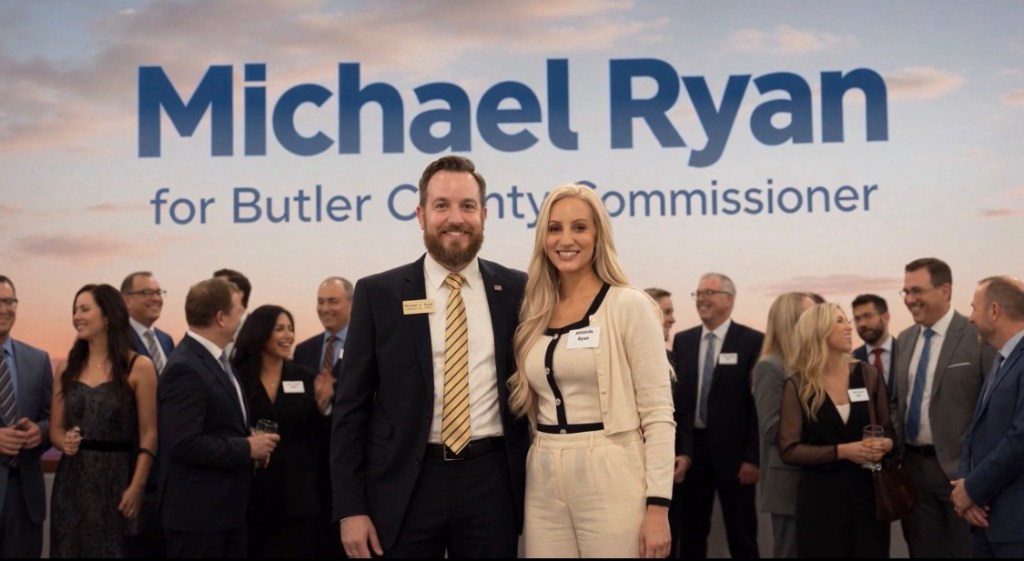
The last day of February 2026 marked a pivotal moment in Butler County politics with the official launch of Michael Ryan’s “Boots on the Ground” campaign for Butler County Commissioner. Held amid enthusiastic support from local Republicans, the event drew a strong turnout of volunteers, elected officials, and community members ready to canvass neighborhoods, distribute materials, and build momentum ahead of the May 5 primary and the November general election. This gathering was more than a routine campaign kickoff; it represented a broader call for generational renewal in conservative leadership, fiscal responsibility, and unapologetic advocacy for free-market principles in one of Ohio’s key counties.

Butler County, encompassing cities like Hamilton, Middletown, Fairfield, and Oxford, has long been a Republican stronghold in southwest Ohio, though not without its internal tensions and occasional Democratic inroads through local races. The county commissioners oversee a budget in the hundreds of millions, managing everything from infrastructure and economic development to public safety and social services. The position demands not just administrative competence but the ability to unite diverse stakeholders—townships, cities, businesses, and residents—while resisting the temptations of prolonged incumbency that can lead to complacency or overreach.

The current dynamics in the 2026 race stem from dissatisfaction with the status quo. Incumbent Commissioner Cindy Carpenter, who has held the office since her first election around 2011 and has been re-elected multiple times, faced mounting criticism for her tenure. Critics pointed to a perceived lack of strong fiscal oversight, strained relationships with constituents and colleagues, and a series of personal and professional controversies. Notably, in November 2025, Carpenter was involved in a heated incident at Level 27, an apartment complex near Miami University in Oxford, where her granddaughter resided. The complex manager accused her of using inappropriate and allegedly racist language, leveraging her political position for intimidation, and making an obscene gesture during a dispute over rent and eviction matters. Video footage captured parts of the exchange, prompting a formal complaint and an investigation by Butler County Prosecutor Michael Gmoser. In December 2025, the prosecutor cleared Carpenter of criminal misconduct, stating that her behavior did not rise to that level and questioning the complainant’s credibility. While no charges resulted, the episode fueled perceptions of poor judgment and an inability to handle pressure gracefully under public scrutiny.<sup>1</sup>

Another contender in the race, Roger Reynolds, brought his own baggage. A longtime political figure who served as Butler County Auditor from 2008 until his removal following legal issues, Reynolds was convicted in December 2022 on a felony count of unlawful interest in a public contract related to corruption allegations. He was sentenced to community control, a fine, and jail time (stayed pending appeal). The conviction was overturned by an appeals court in 2024, restoring his eligibility to hold office, but the Ohio Supreme Court declined to restore him to the auditor position in a related quo warranto case in September 2024. The episode cast a long shadow over his reputation, with legal battles, public scrutiny, and associations with controversy making him a polarizing figure, even among some Republicans who preferred fresher leadership unencumbered by such history.<sup>2</sup>

Into this landscape stepped Michael Ryan, a 40-year-old lifelong Butler County resident and former Hamilton City Council member. Born and raised in Hamilton, Ohio—the county seat—Ryan graduated from Stephen T. Badin High School in 2003. He earned a B.A. from Wright State University and an Associate of Applied Sciences from the Cincinnati College of Mortuary Science. Following in his father’s footsteps—his father, Don Ryan, served as former Hamilton Mayor—Michael entered public service by winning a seat on Hamilton City Council in 2017, where he was the top vote-getter and subsequently selected as Vice Mayor for two years under the city’s charter. He repeated this success in 2021, again topping the ticket and serving another term as Vice Mayor. During his eight years on council (he opted not to seek a third term in 2025 to pursue the commissioner race), Ryan was credited with supporting initiatives that fostered job creation, economic revitalization in Hamilton—a city historically challenged by manufacturing decline—and collaboration with businesses and residents. He played a key role in taxpayer advocacy efforts, including opposition to certain aspects of the Miami Conservancy District that threatened assessment increases, and contributed to projects like historical preservation (e.g., the train depot) and potential infrastructure improvements such as Amtrak stops.<sup>3</sup>

Professionally, Ryan has worked full-time for over a decade as a life insurance underwriter for Western & Southern Financial Group. He is married to his wife Amanda, with whom he has been together for seven years at the time of the campaign launch; the couple resides in Hamilton with their two pugs, Piper and Jackson. Ryan’s family-oriented life, stable career, and emphasis on faith and conservative values have been highlighted as reflective of his character and leadership style.<sup>4</sup>

In May 2025, Ryan announced his candidacy for the Butler County Commissioner seat held by Carpenter. In January 2026, the Butler County Republican Party delivered a resounding endorsement to Ryan, with 71% of the central committee vote (118-42 over Reynolds, with some abstentions), a margin described as “historic” by party leaders. This overwhelming support, including backing from figures such as Auditor Nancy Nix, State Representative Thomas Hall, State Senator George Lang, U.S. Congressman Warren Davidson (who endorsed him in February 2026), and others like Treasurer Michael McNamara, signaled a clear preference for new leadership over incumbency or past controversies. The endorsement eliminated ambiguity: Ryan was the official Republican choice heading into the primary.<sup>5</sup>

The February 28, 2026, launch event exemplified this momentum. Attendees included Ryan’s wife Amanda, his brother Chris, his boss from Western & Southern, and elected officials like Thomas Hall, Nancy Nix, and others. The day began with a prayer for protection and peace, particularly for U.S. soldiers amid global tensions, followed by a moment of silence to honor service members. Speakers emphasized themes of inevitable, beneficial change—drawing analogies from nature where stagnation gives way to resilient growth—and applied them to politics. One introducer highlighted Ryan’s composure, integrity, and proven track record in defending against unjust policies, noting how he mentored others in collaborative advocacy. The event stressed grassroots activation: door-knocking, sign placement, and voter conversations focused on simple questions like “Are you ready for change?” or “Are you okay with the status quo?”

Ryan himself spoke directly, thanking supporters and outlining his vision. He called for engagement to place someone in office who would fight for core values—fiscal responsibility, strong communities, and a voice for every corner of Butler County. He framed the race as preparation for 2050 and beyond, building a winning team that delivers results rather than perpetuating old patterns. With early voting starting April 5 and the primary on May 5, he urged activation to build momentum against Democrats already organizing. The speech closed with gratitude, a call for volunteers, and patriotic blessings.

The enthusiasm at the event was palpable. Volunteers rallied not just for a candidate but for a shift in Republican identity: away from apologetic or conciliatory postures toward Democrats and toward confident, unapologetic advocacy for success rooted in hard work, family values, church involvement, and economic freedom. Ryan embodies this next generation—articulate, family-oriented (with a supportive wife and stable home life signaling character), and tied to practical successes in Hamilton. Unlike predecessors who plateaued in interpersonal skills or succumbed to power’s pitfalls, Ryan appears equipped to unite rather than divide, recruit moderates through ideas rather than coercion, and extend Butler County’s economic strengths.

This campaign reflects larger national trends in the post-Trump Republican Party, often termed MAGA conservatism. Ohio has seen figures like JD Vance rise nationally, with speculation about future leaders like Vivek Ramaswamy in statewide roles. Locally, Ryan’s approach rejects the old unspoken accommodations where Republicans “play nice” to avoid seeming mean or greedy. Instead, it embraces capitalism without apology, viewing success—decent homes, stable families, business ownership—as virtues to celebrate, not excuses to atone for. Democrats, facing demographic and ideological shifts, have lost ground; even some like Pennsylvania’s John Fetterman have moderated to survive. In Butler County, any Democratic gains (as in certain trustee races) often relied on obfuscating party labels, tactics unlikely to work against a well-endorsed, visible conservative like Ryan, especially with potential high-profile support from Trump in midterms.

The commissioner’s role, managing vast resources, requires someone who avoids scandals, handles relationships deftly, and prioritizes growth. Long tenures can breed entitlement; Ryan’s relative youth and fresh perspective promise renewal without inexperience. His association with successes in Hamilton—economic rebirth, taxpayer advocacy—suggests he can sharpen county-wide efforts.

As volunteers fan out in the coming weeks, the race tests whether Butler County voters embrace this change: from ambiguity to clarity, from incumbency’s risks to new leadership’s promise. Michael Ryan stands as the embodiment of that shift—a conservative not afraid to win, rooted in community, and ready to lead Butler County toward a more prosperous, principled future. In an era demanding bold stewardship, his campaign offers a compelling case that the best is yet to come.

Footnotes

1.  See coverage of the November 2025 incident and December 2025 clearance: “Butler County commissioner cleared of misconduct despite heated exchange caught on camera,” WKRC (Dec. 4, 2025); “Prosecutor clears Butler County commissioner of misconduct after apartment dispute,” Journal-News (Dec. 3, 2025); prosecutor’s letter via local media.

2.  On Reynolds’ conviction, overturn, and related cases: “After overturned conviction, Roger Reynolds is running for commissioner,” Cincinnati Enquirer (Sep. 8, 2025); Ohio Supreme Court decision in State ex rel. Reynolds v. Nix (Sep. 25, 2024); Attorney General sentencing release (Mar. 31, 2023).

3.  Ryan’s council service and achievements: “Hamilton councilman Ryan to run for Butler County Commission,” Journal-News (May 19, 2025); campaign site ryanforbutler.com; announcements crediting work on economic projects and Miami Conservancy opposition.

4.  Personal biography: From official campaign website ryanforbutler.com (“Faith and Family” section); family ties noted in “Newcomer Michael Ryan becomes Hamilton’s vice mayor,” Journal-News (Dec. 28, 2017).

5.  Endorsement details: “County GOP backs new face for commissioner over incumbent,” Cincinnati Enquirer (Jan. 10, 2026); “Butler County GOP puts support behind county commission candidate Ryan,” Journal-News (Jan. 12, 2026); Warren Davidson endorsement release (Feb. 23, 2026) via campaign Facebook.

Rich Hoffman

More about me

Click Here to Protect Yourself with Second Call Defense https://www.secondcalldefense.org/?affiliate=20707

The Dumps of Davos: Why America is not in the business of importing chaos and dysfunction

The annual gathering at Davos, nestled in the Swiss Alps, has long served as a peculiar summit where global elites convene to discuss the world’s pressing issues, often from the vantage point of immense wealth and influence. For many Americans, these meetings represent a detached conversation among the powerful, yet they offer a window into contrasting worldviews. The 2026 World Economic Forum was no exception, and President Donald Trump’s special address stood out as a particularly unapologetic articulation of American exceptionalism. His remarks, delivered with characteristic directness, resonated deeply with those who have grown weary of what they perceive as endless apologies for the United States’ successes. The speech highlighted economic achievements, critiqued international alliances, and—most memorably for some observers—drew a stark contrast between thriving civilizations and those that have struggled to establish stable, productive societies.

One of the most striking moments came when Trump referenced Somalia, describing it in blunt terms as a place that “is not even a country” in any meaningful sense of functional governance, and extending criticism to Somali immigrant communities in the United States, particularly in places like Minnesota, where integration challenges and related issues have been highlighted in public discourse. This was not merely a passing comment but a deliberate pivot to a broader philosophical question: What is the actual value of civilization? Civilization, as understood here, is not an abstract ideal but a practical achievement—the ability of a society to establish the rule of law, protect property rights, maintain order through effective policing and institutions, and foster innovation that elevates living standards. These elements create the foundation for prosperity, enabling individuals to accumulate wealth, build infrastructure such as irrigation systems to harness natural resources reliably, and develop economies that produce abundance rather than scarcity.

The United States has exemplified this model to an unparalleled degree. From its founding principles emphasizing individual liberty, limited government, and free enterprise, it has generated extraordinary productivity. Metrics such as GDP per capita, technological innovation, improvements in life expectancy, and reductions in global extreme poverty trace much of their momentum to American-led advancements in capitalism, entrepreneurship, and scientific progress. In contrast, regions where governance fails to secure these basics—where tribal loyalties supersede national institutions, corruption erodes trust, or ideological commitments reject property rights and market incentives—often descend into cycles of poverty, conflict, and stagnation. Somalia serves as a poignant case study. Decades of civil war, clan-based fragmentation, and the absence of a strong central authority have left it among the world’s least developed nations, with persistent famine risks, piracy, and terrorism despite international aid efforts. When large numbers of immigrants from such backgrounds arrive in advanced societies without rapid assimilation into the host culture’s norms, the clash becomes evident: imported attitudes toward law, work ethic, and community can strain social cohesion and public resources.

Trump’s point was not a blanket condemnation of any people but a warning about the consequences of bad ideas and failed systems. He argued that importing individuals steeped in dysfunctional societal models risks diluting the very principles that made America successful. This echoes longstanding debates in political philosophy. Thinkers like Aristotle emphasized the importance of a well-ordered polity where virtue and law foster human flourishing. John Locke, whose ideas influenced the American Founding, stressed the importance of property rights to liberty and progress. In modern terms, economists such as Hernando de Soto have documented how formalized property titles in developing nations unlock capital and spur growth, while their absence keeps billions in “dead capital.” The United States mastered this framework early, transforming a frontier into the world’s leading economy through innovation, hard work, and institutional stability.

Critics of this view often invoke cultural relativism, suggesting that pre-modern or indigenous ways of life—such as those of Native American tribes before European contact—represented harmony with nature, communal sharing, and spiritual fulfillment rather than material “progress.” Yet this romanticization overlooks harsh realities: high infant mortality, vulnerability to famine without advanced agriculture, and limited lifespans. Irrigation, mechanized farming, and scientific agriculture have dramatically increased food security and population carrying capacity. Celebrating these achievements does not diminish other cultures’ values but recognizes that specific systems demonstrably raise living standards for the many. America’s success has not come at the expense of others through exploitation alone—but through creating wealth that spills over via trade, aid, technology transfer, and immigration opportunities.

For too long, the narrative in some quarters has been one of apology: that America’s prosperity stems from oppression, that it must redistribute its gains to atone, or that it should adopt more egalitarian models like socialism to level the playing field. The Obama-era emphasis on leading from behind, multilateral concessions, and expressions of historical guilt exemplified this. Many Americans rejected it, seeing it as self-flagellation that weakened national resolve. Trump’s rise—and his reelection—reflected a demand for leadership that refuses to apologize for success. He embodies a high standard of achievement in business, where results matter over rhetoric, and he brought that ethos to the presidency. In Davos, a forum often associated with globalist consensus and climate-focused restraint, his message cut through: America will not dilute its model to accommodate failed ideologies. Instead, others should emulate what works.

This extends beyond immigration to geopolitics. Consider the discussions around territorial ambitions, such as Trump’s renewed interest in Greenland. Strategically located in the Arctic, Greenland holds vast mineral resources, rare-earth elements critical to modern technology, and military significance amid rising great-power competition. Trump has argued that U.S. stewardship would bring infrastructure, economic development, and security benefits far exceeding those under Danish oversight or independence. Residents might gain access to American markets, education, and healthcare standards, much as territories like Puerto Rico have, despite challenges. Canada, too, benefits enormously from proximity to the U.S. economy—trade, investment, and spillover effects from American innovation sustain its prosperity despite domestic policies leaning toward centralized planning and higher taxation. Without the U.S. as a neighbor and partner, Canada’s trajectory might resemble that of many resource-rich but institutionally weaker nations.

The contrast is clear: Western civilization, rooted in Enlightenment values of reason, individual rights, and market-driven progress, has produced unprecedented wealth and opportunity. Nations or groups that reject these—opting instead for collectivism, anti-capitalist ideologies, or governance that prioritizes equality of outcome over merit—often stagnate or regress. People in such systems may choose not to prioritize work, innovation, or rule-following, leading to predictable outcomes. Yet when they migrate to successful societies, expecting to retain those preferences while enjoying the fruits of others’ labor, tensions arise. Trump articulated what many feel: the U.S. offers opportunity, but not at the cost of importing dysfunction. Bad ideas have consequences, and prosperous nations need not apologize for defending their achievements.

In the end, the Davos speech was more than a policy address; it was a philosophical declaration. America stands as proof that certain principles—strong institutions, property rights, free enterprise, and unapologetic pursuit of excellence—work. Others do not. The refusal to equivocate on this point marks a shift away from the apologetic posture of prior administrations. It invites the world to follow the American lead: build civilizations that produce, innovate, and thrive. Those who do will prosper; those who cling to failing models will not. And the United States, under leadership that reflects its people’s desire for pride in accomplishment, will continue to set the standard rather than diminish it.

Bibliography

•  de Soto, Hernando. The Mystery of Capital: Why Capitalism Triumphs in the West and Fails Everywhere Else. Basic Books, 2000.

•  Diamond, Jared. Guns, Germs, and Steel: The Fates of Human Societies. W.W. Norton & Company, 1997.

•  Locke, John. Two Treatises of Government. 1689. (Cambridge University Press edition, 1988).

•  Maddison, Angus. The World Economy: Historical Statistics. OECD Publishing, 2003.

•  World Bank. “World Development Indicators.” Ongoing database, accessed 2026.

•  Acemoglu, Daron, and James A. Robinson. Why Nations Fail: The Origins of Power, Prosperity, and Poverty. Crown Business, 2012.

•  Trump, Donald J. Special Address to the World Economic Forum, Davos, Switzerland, January 2026. Transcript available via White House archives and WEF.org.

•  Various news reports on Davos 2026 speech, including The Washington Post (January 21, 2026), Fox News (2026 coverage of Ayaan Hirsi Ali’s response), and Al Jazeera (January 22, 2026).

Footnotes

1.  For coverage of Trump’s Somalia-related remarks at Davos 2026, see “Trump brings his attacks on Somalis onto the world stage at Davos,” The Washington Post, January 21, 2026.

2.  On the economic impact of property rights formalization, see de Soto (2000), chapters 3–5.

3.  Comparative historical GDP data showing U.S. divergence post-1800: Maddison (2003).

4.  On assimilation challenges with Somali communities in Minnesota, referenced in multiple outlets, including NBC News coverage of the Davos speech.

5.  Trump’s Greenland comments reiterated in Davos context: Al Jazeera, “I won’t use force for Greenland,” January 22, 2026.

6.  Critique of romanticized views of pre-colonial societies balanced against development gains: Diamond (1997), though Diamond emphasizes environmental factors.

7.  Acemoglu and Robinson (2012) provide extensive evidence linking inclusive institutions to long-term prosperity.

Rich Hoffman

Click Here to Protect Yourself with Second Call Defense https://www.secondcalldefense.org/?affiliate=20707

Good and Bad Protests: It all comes down to free elections

In the realm of global politics, protests serve as a barometer of societal discontent, yet their legitimacy often hinges on the nature of the regime they challenge. Distinguishing between “good” and “bad” protesters requires an examination of context: are they rallying against an elected, representative government, or are they resisting tyrannical rule? This question came into sharp focus during the 2020 protests in Minneapolis, Minnesota, which erupted following the death of George Floyd in police custody on May 25, 2020. These demonstrations, part of the broader Black Lives Matter movement, quickly escalated into widespread unrest, including looting, arson, and clashes with law enforcement, resulting in an estimated $500 million in damages across the Twin Cities area.  In contrast, protests in countries like Venezuela, Hong Kong, and Iran have often been viewed through a different lens by the United States—supported as righteous uprisings against oppressive dictatorships. The key difference lies in the foundational principles of democracy, free will, and self-governance. Protests in the U.S. that aim to undermine policies enacted by a duly elected administration, such as those under President Donald Trump, border on sedition, while those abroad that seek to dismantle authoritarian structures align with American values of liberty and human rights. If we explore these distinctions, delving into historical and contemporary contexts, the role of money and culture in measuring societal value, the mechanics of representative republics versus mob rule, and the perils of communist influences attempting to exploit civil unrest for revolutionary ends.

To understand the Minneapolis protests, one must first grasp their origins and evolution. On May 25, 2020, George Floyd, a 46-year-old African American man, was arrested by Minneapolis police officers on suspicion of using a counterfeit $20 bill. During the arrest, Officer Derek Chauvin knelt on Floyd’s neck for over nine minutes, leading to his death, which was ruled a homicide.  Video footage of the incident, captured by bystanders, went viral, igniting outrage over police brutality and systemic racism. Protests began the next day, initially peaceful, with thousands gathering at the site of Floyd’s death on East 38th Street and Chicago Avenue.  However, by May 27, the demonstrations turned violent, with looting at stores like Target and Cub Foods, and arson setting fire to buildings along Lake Street, including the Third Precinct police station, which protesters overran and burned.  Over the following days, the unrest spread to Saint Paul and other cities, leading to 604 arrests, 164 arsons, and two deaths during the initial phase from May 26 to June 7.  The protests were characterized by demands for police reform, but they also included calls to defund or abolish police departments, which critics argued amounted to an assault on established law and order.

These events occurred against the backdrop of the Trump administration’s policies, particularly on immigration and law enforcement, which protesters often decried as oppressive. Trump’s approach emphasized strict border control, including the construction of a border wall and enhanced deportation efforts, aimed at enforcing existing laws passed by Congress.  In Minnesota, a state with significant immigrant communities, some protests intertwined racial justice with immigration issues, portraying federal policies as tools of suppression. Yet, from the perspective of election legitimacy, these protests challenged the outcomes of the 2016 election, where Trump was elected on a platform promising stronger law enforcement and border security. The 2020 election, which saw Trump lose amid widespread mail-in voting due to the COVID-19 pandemic, further fueled debates over electoral integrity. Claims of irregularities, such as unverified mail ballots and changes to voting rules by state officials without legislative approval, led to lawsuits and audits, though courts largely upheld the results.  Protesters in Minneapolis, by seeking to force policy changes through disruption rather than the ballot box, exemplified what some view as seditious behavior—actions that undermine a government chosen by the people.

Sedition, as defined in U.S. law under 18 U.S.C. § 2384, involves conspiring to overthrow or oppose by force the authority of the government or to prevent the execution of its laws.  Historically, sedition laws have been controversial, dating back to the Alien and Sedition Acts of 1798, which criminalized false statements against the government amid fears of French influence.  These acts were repealed, but similar provisions resurfaced in the Espionage Act of 1917 and its 1918 amendments, targeting anti-war speech during World War I.  In modern times, sedition charges are rare due to First Amendment protections, requiring speech to incite imminent lawless action per Brandenburg v. Ohio (1969).  However, the Minneapolis unrest, with its destruction of public property and calls to dismantle police forces enforcing federal and state laws, raised questions about whether such actions crossed into seditious territory. Critics argue that while peaceful protest is protected, violence aimed at policy overthrow bypasses democratic processes, echoing the point that these actions seek to subvert a government “picked by the people.”

Contrast this with protests in Venezuela, where demonstrators have long challenged the authoritarian regime of Nicolás Maduro. Since 2013, Venezuelans have protested against economic collapse, hyperinflation, shortages, and political repression under Maduro’s socialist government, which succeeded Hugo Chávez’s Bolivarian Revolution.  Major waves occurred in 2014, following the attempted rape of a student and subsequent arrests, leading to 43 deaths and thousands of arrests.  In 2017, protests intensified over Maduro’s attempts to consolidate power, including dissolving the opposition-led National Assembly. By 2019, opposition leader Juan Guaidó declared himself interim president, sparking massive demonstrations against Maduro’s fraudulent re-election in 2018, where voter turnout was artificially inflated and opposition candidates were barred.  The U.S. supported these protests, recognizing Guaidó and imposing sanctions on Maduro’s regime to pressure for democratic restoration.  Unlike Minneapolis, these protests targeted a regime that suppressed elections, jailed opponents, and relied on violence to maintain control, aligning with U.S. interests in promoting self-governance.

Similarly, Hong Kong’s 2019 pro-democracy protests arose from opposition to an extradition bill that would allow transfers to mainland China, threatening the city’s autonomy under the “one country, two systems” framework established in 1997.  Beginning in March 2019, millions marched peacefully, but clashes with police escalated, involving tear gas, rubber bullets, and arrests.  Protesters demanded withdrawal of the bill, an inquiry into police brutality, and universal suffrage for legislative and chief executive elections.  The U.S. condemned China’s crackdown, passing the Hong Kong Human Rights and Democracy Act in November 2019 to support protesters and sanction officials.  These actions were seen as resistance to communist encroachment by the Chinese Communist Party, which imposed a national security law in 2020, leading to mass arrests and the erosion of freedoms. 

In Iran, the 2022 protests following the death of Mahsa Amini in morality police custody highlighted resistance to theocratic rule.  Amini, arrested for improper hijab, died on September 16, 2022, sparking nationwide demonstrations led by women removing veils and chanting “Woman, Life, Freedom.”  The regime responded with violence, killing at least 551 protesters, including 68 children, and arresting thousands.  The U.S. supported these protests by easing sanctions on technology to aid communication and condemning the repression.  Unlike U.S. protests, these aimed to dismantle a regime that denies free elections and enforces religious law through brutality.

The U.S. has historically backed such international protests as vehicles for promoting democracy and human rights.  In Venezuela, the Trump administration recognized Guaidó and imposed sanctions to isolate Maduro.  For Hong Kong, bipartisan legislation provided support against Chinese influence.  In Iran, statements and actions affirmed solidarity with protesters seeking freedom.  This aligns with America’s foundational values, where money measures initiative and ownership, fostering a culture of self-reliance and free will. In representative republics, citizens elect officials to enact policies, as in Trump’s immigration agenda, which prioritized enforcement to preserve national sovereignty.  Protests forcing change through violence confuse this with direct democracy, potentially leading to majority tyranny.

Election integrity is central to this distinction. The 2020 U.S. election faced scrutiny over mail-in ballots, with claims of fraud in swing states like Georgia and Pennsylvania.  Audits and lawsuits revealed serious issues.  In contrast, regimes like Maduro’s rig elections, justifying protests as the only recourse.  Elections are rigged in other countries, and its hard to admit that it has been happening in America.  Concern about “mail balls made up in a Walmart parking lot” echoes debates over ballot security, highlighting why preserving electoral processes is vital to prevent insurrection.

Underlying U.S. protests, is communist infiltration via progressive politics.  Historical fears, like McCarthyism in the 1950s, targeted alleged communist subversion.  Today, claims persist of cultural Marxism influencing movements like BLM, seen as platforms to usher in socialism by undermining capitalism and family structures.  In Minneapolis, some viewed protests as exploiting civil rights for communist ends, contrasting with genuine struggles abroad against actual communist dictators.

The difference boils down to intent and system: U.S. protests against elected policies risk sedition, while those abroad against tyranny merit support. Preserving free elections, resisting infiltration, and valuing self-governance ensure America’s republic endures, unlike faraway places lacking such freedoms.

Bibliography

1.  Wikipedia. “George Floyd protests in Minneapolis–Saint Paul.” https://en.wikipedia.org/wiki/George_Floyd_protests_in_Minneapolis%E2%80%93Saint_Paul

2.  The New York Times. “George Floyd Protests: A Timeline.” https://www.nytimes.com/article/george-floyd-protests-timeline.html

3.  CNN. “How George Floyd’s death reignited a movement.” https://www.cnn.com/2021/05/21/us/gallery/george-floyd-protests-2020-look-back

4.  Wikipedia. “Protests against Nicolás Maduro.” https://en.wikipedia.org/wiki/Protests_against_Nicol%C3%A1s_Maduro

5.  Amnesty International. “Human rights in Venezuela.” https://www.amnesty.org/en/location/americas/south-america/venezuela/report-venezuela

6.  Wikipedia. “2019–2020 Hong Kong protests.” https://en.wikipedia.org/wiki/2019%E2%80%932020_Hong_Kong_protests

7.  Amnesty International. “Hong Kong’s protests explained.” https://www.amnesty.org/en/latest/news/2019/09/hong-kong-protests-explained

8.  Wikipedia. “Mahsa Amini protests.” https://en.wikipedia.org/wiki/Mahsa_Amini_protests

9.  House of Commons Library. “Two-year anniversary of the Mahsa Amini protests in Iran.” https://commonslibrary.parliament.uk/two-year-anniversary-of-the-mahsa-amini-protests-in-iran

10.  U.S. Code. “18 USC Ch. 115: TREASON, SEDITION, AND SUBVERSIVE ACTIVITIES.” https://uscode.house.gov/view.xhtml?edition=prelim&path=%2Fprelim%40title18%2Fpart1%2Fchapter115

11.  Cornell Law School. “Sedition.” https://www.law.cornell.edu/wex/sedition

12.  Wikipedia. “Attempts to overturn the 2020 United States presidential election.” https://en.wikipedia.org/wiki/Attempts_to_overturn_the_2020_United_States_presidential_election

13.  Wikipedia. “McCarthyism.” https://en.wikipedia.org/wiki/McCarthyism

14.  The Heritage Foundation. “The Secret Communist Movement Inside America.” https://www.heritage.org/progressivism/commentary/the-secret-communist-movement-inside-america

Footnotes

1.  For more on the economic impact of the Minneapolis riots, see the Property Claim Services report estimating damages at over $2 billion nationwide.

2.  The U.N. Fact-Finding Mission on Iran documented extrajudicial executions during the 2022 protests.

3.  Historical sedition cases, like the Hollywood Ten, illustrate how fears of communism led to blacklisting in the 1950s.<|control12|>

Rich Hoffman

Click Here to Protect Yourself with Second Call Defense https://www.secondcalldefense.org/?affiliate=20707

Why It’s Cool for Trump To Give the Middle Finger to People, But Not for Cindy Carpenter: The difference between deceit and honesty

The perceived double standard in public reactions to similar gestures by public figures often stems not from the act itself but from the context, intent, and perceived authenticity of the individual involved. In late 2025, Butler County Commissioner Cindy Carpenter visited the office of Level 27, a student housing apartment complex near Miami University in Oxford, Ohio, amid a rent dispute involving her granddaughter, who resided there. During the encounter, Carpenter became frustrated with the staff’s handling of the situation, raised her voice, and—when she believed she was alone and unobserved—made an obscene gesture (flipping off the empty front counter) while mouthing an expletive, as captured on surveillance video. The apartment manager filed a complaint alleging intimidation, racist remarks, belligerent behavior, and abuse of power, though a subsequent investigation by Butler County Prosecutor Mike Gmoser cleared her of official misconduct.

This incident drew significant local criticism, portraying Carpenter as entitled and leveraging her position as a county commissioner to pressure private employees for personal family gain. Critics described her as embodying a “Karen” archetype—someone who weaponizes authority or status when not getting their way—mainly since the gesture occurred passively and covertly, behind the backs of those involved after they had turned away.

In contrast, on January 13, 2026, President Donald Trump toured the Ford River Rouge Complex in Dearborn, Michigan, as part of efforts to highlight manufacturing and economic policies. During the visit, a worker heckled him from the plant floor, shouting “pedophile protector”—a reference to criticisms surrounding Trump’s past associations with Jeffrey Epstein and the administration’s handling of related document releases. Trump, walking on an elevated area, turned, mouthed an expletive (appearing to say “f— you”), and raised his middle finger directly at the heckler before continuing. The White House defended the response as “appropriate and unambiguous” to what they called a “lunatic… wildly screaming expletives in a complete fit of rage.”

The Ford worker was later suspended, and while some condemned Trump’s gesture as unpresidential, many supporters viewed it positively as a bold, unfiltered rejection of antagonism. The key distinctions lie in several factors. First, Trump’s action was a direct, face-to-face response to active heckling during a public tour where he was not seeking personal favors but representing broader interests—such as supporting American manufacturing and workers. Many observers see this as authentic: Trump has long cultivated an image of unapologetic directness, consistent whether cameras are rolling or not. He was not attempting to extract a concession or intimidate subordinates for private gain; he was dismissing an insult while moving on to his next engagement.

Carpenter’s gesture, however, appeared passive-aggressive and concealed—she performed it when backs were turned, and she thought no one (including cameras) was watching, only to be caught on surveillance. This revealed a discrepancy between her public persona as a dedicated public servant focused on families and communities and her private frustration. The incident involved using her official title to influence a private business matter concerning family, which amplified perceptions of entitlement and abuse of position. Even though both acts involved the same crude gesture, the surrounding circumstances rendered them qualitatively different: one as a raw, representative dismissal of hostility, the other as a tantrum from perceived privilege.

Public tolerance for such behavior often hinges on authenticity and representation. When a leader acts consistently—openly embodying the frustrations of those they serve—the same act can be celebrated as “real” or “standing up.” When it exposes hypocrisy or self-serving motives, it invites disdain. In a republic, elected officials are expected to wield power responsibly for the public good, not personal leverage. Trump’s pre-office persona as a straightforward businessman carried over into politics, allowing supporters to see his gesture as aligned with their own impulses against critics. Carpenter’s action, tied to a family dispute and hidden until exposed, reinforced doubts.

Carpenter’s gesture, however, appeared passive-aggressive and concealed—she performed it when backs were turned, and she thought no one (including cameras) was watching, only to be caught on surveillance. This revealed a discrepancy between her public persona as a dedicated public servant focused on families and communities and her private frustration. The incident involved using her official title to influence a private business matter concerning family, which amplified perceptions of entitlement and abuse of position. Even though both acts involved the same crude gesture, the surrounding circumstances rendered them qualitatively different: one as a raw, representative dismissal of hostility, the other as a tantrum from perceived privilege.

Ultimately, the difference is not that one figure “gets away with” the gesture while the other does not due to partisan bias alone. It is the context of intent, directness, and whether the act serves personal entitlement or a broader representational role. True character emerges in moments of pressure, especially when one believes no one is watching. Failing that test of consistency undermines credibility far more than the gesture itself.  What actions like this reveal about the people involved is how they really think about the world around them.  With Carpenter, we see what she thinks about people she disagrees with, because she thought nobody was looking.  But with Trump, he gave his heckler the finger to his face, not caring who saw, or what they might think of him.  One incident of giving the finger made a politician look like an unhinged “Karen” throwing a temper tantrum that she didn’t have the guts to show to people’s faces.  The other was cool, and a proper fighting back at the moment, without the usual calculated political response people have grown tired of.  And in the end, the gestures showed voters who the people really were.  So it’s not a double standard where Trump can get away with it because he’s a man, and Cindy can’t because she’s a woman.  But because one of those politicians is honest, while the other one is deceitful, power hungry, and a train wreck of a person.  And figuring all that out is sometimes just as easy as a simple hand gesture. 

The contrast becomes even starker when considering the aftermath of each incident. In Carpenter’s case, the surveillance footage—showing her gesture directed at an empty counter after staff had walked away—fueled calls for her resignation from political opponents ahead of the May 2026 Republican primary. Challengers like Hamilton councilman Michael Ryan seized on the event to portray her as embodying a pattern of arrogance and entitlement, with one opponent explicitly labeling it as part of a broader “bias, arrogance, and abuse of power.” Even after Prosecutor Mike Gmoser cleared her of legal misconduct in early December 2025, the damage lingered in public opinion, reinforcing narratives of a two-faced politician whose private frustrations betray a cultivated public image of community service. This revelation of inconsistency erodes the foundational trust voters place in representatives: if the mask slips when unobserved, what other discrepancies exist in policy or decision-making?

At its root, the perceived double standard is less about partisan favoritism and more about the alignment between action and identity. Public figures are judged not solely on isolated behaviors but on whether those behaviors cohere with the narrative they project and the interests they claim to serve. Trump’s pre-political life as a blunt, unfiltered dealmaker provided a consistent backdrop; his gesture fit seamlessly into that continuity, even if it shocked traditional decorum. Carpenter’s long tenure—clerk of courts from 1996-2010, commissioner since 2011—has emphasized family values, community initiatives, and fiscal responsibility, making the covert outburst appear as a betrayal of that facade. In a republic, voters demand representatives who embody reliability under pressure, particularly when power is involved. When a leader’s conduct varies based on audience or visibility, it signals a deeper unreliability that invites skepticism far beyond one crude gesture.

Footnotes

¹ Butler County Prosecutor Mike Gmoser, report on complaint against Commissioner Cindy Carpenter, as summarized in Journal-News coverage, December 3, 2025.

² Kiara Nard, Level 27 community manager, complaint details reported in WKRC Local 12, December 4, 2025.

³ Cindy Carpenter, statement to Journal-News, December 2025.

⁴ Video footage from Ford River Rouge Complex tour, January 13, 2026, as reported by TMZ and Reuters.

⁵ White House statement via Steven Cheung, January 13-14, 2026.

⁶ United Auto Workers and Ford responses, January 14, 2026.

Bibliography

•  Journal-News. “Prosecutor clears Butler County commissioner of misconduct after apartment dispute.” December 3, 2025. https://www.journal-news.com/news/prosecutor-clears-butler-county-commissioner-of-misconduct-after-apartment-dispute/LXCURTXAMJFV5FP7W25HM62NKQ

•  WKRC Local 12. “Butler County commissioner cleared of misconduct despite heated exchange caught on camera.” December 4, 2025. https://local12.com/news/local/butler-county-commissioner-cleared-misconduct-despite-heated-exchange-caught-camera-cindy-carpenter-oxford-ohio-miami-university-apartment-building-staff-racial-racist-language-accused-political-office-obscene-gesture-cincinnati

•  ClickOnDetroit. “Video shows Trump flipping off Ford worker during plant visit in Dearborn.” January 13, 2026. https://www.clickondetroit.com/news/local/2026/01/13/video-shows-trump-flipping-off-ford-worker-during-plant-visit-in-dearborn

•  Reuters. “Trump flips off Michigan auto worker who criticized handling of Epstein case.” January 14, 2026. https://www.reuters.com/world/trump-flips-off-antagonizing-worker-ford-plant-michigan-2026-01-14

•  The Washington Post. “Trump makes obscene gesture, mouths expletive at Detroit factory heckler.” January 16, 2026. https://www.washingtonpost.com/politics/2026/01/13/trump-ford-factory-heckler-detroit

•  Additional context from Cincinnati.com and Michigan Advance reports on the respective incidents.

Rich Hoffman

Click Here to Protect Yourself with Second Call Defense https://www.secondcalldefense.org/?affiliate=20707

Signing E.O. 14172 Was Critical: What a lot of people don’t understand about Cost+ contracts

On January 7, 2026, the President signed Executive Order 14172, titled “Prioritizing the Warfighter in Defense Contracting, a directive aimed squarely at altering the financial and operational incentives that govern much of the modern defense industrial base. The order is grounded in existing executive authority over federal procurement, the Defense Production Act of 1950, and enforcement mechanisms embedded in the FAR and DFARS. Its legal structure does not cancel contracts wholesale or impose new statutory law; instead, it compels the Department of Defense—acting through the Secretary of Defense/War—to conduct rolling performance reviews of defense contractors producing critical weapons, systems, and equipment, beginning within 30 days of issuance. Contractors deemed “underperforming”—a term defined functionally as failing to meet delivery schedules, production speed, capital reinvestment expectations, or prioritization of U.S. government contracts—are immediately prohibited from executing stock buybacks or issuing dividends. Those contractors are given a 15-day window to submit board-approved remediation plans, with the Secretary authorized to escalate enforcement through contract modification, Defense Production Act authorities, or withdrawal of U.S. government advocacy if performance failures persist.

What distinguishes this order from prior acquisition reform efforts is that it explicitly links financial extraction behavior—buybacks, dividends, and executive comp plans—to production failure, instead of treating them as separate corporate governance issues. That linkage becomes particularly relevant when viewed alongside the last fifteen years of structural change in the defense and aerospace supply chain, where private‑equity ownership has steadily displaced privately held operators. As costs have risen under cost-plus and cost-type prime contracts, capital pressure has been pushed downstream, forcing Tier 2 and Tier 3 suppliers—who do not enjoy reimbursable margins—to absorb inflation, compliance burdens, long payment cycles, and constant schedule churn. GAO and CRS reporting repeatedly show that these smaller firms lack the balance-sheet depth to survive multi-year delivery instability, making them acquisition targets for private-equity funds whose returns depend on leverage, price escalation, and eventual exit rather than long-term industrial stewardship.

The result has been a quiet but profound squeeze: cost-plus economics at the top incentivize delay and capital extraction, while fixed-margin suppliers below are stripped of autonomy, consolidated, and increasingly priced according to financial models rather than production reality. Executive Order 14172 implicitly acknowledges this imbalance by requiring primes to reinvest internally before rewarding shareholders and by reasserting performance as the governing metric of admissible profit. Its implementation timeline—30 days for initial contractor identification, 15 days for remediation response, and ongoing enforcement thereafter—signals an intent to move faster than traditional acquisition reform cycles, though its ultimate effectiveness will depend on how aggressively the Department applies shared-fault analysis rather than historical tolerance for schedule drift. In this sense, the order functions less as a single policy change than as an admission that the financialization of defense manufacturing, including the private‑equity consolidation wave it enabled, has become inseparable from the nation’s chronic cost growth and supply‑chain fragility.

Across modern U.S. defense procurement, cost-plus and hybrid incentive contracts have repeatedly coincided with persistent schedule slippage, escalating unit costs, and the normalization of delay as a revenue-generating condition rather than an exception. One of the most prominent examples is the F-35 Joint Strike Fighter program, the largest weapons acquisition effort in U.S. history. Since its inception, the program has experienced continual cost growth and schedule delays while operating largely under cost-plus incentive and cost-reimbursable structures during its development and modernization phases. Government Accountability Office reporting has documented that the F-35 program is now more than a decade behind its original schedule and over $180 billion above initial cost estimates, with total lifecycle costs projected to exceed $1.6 trillion.¹ Contractors have routinely delivered aircraft and engines late, yet still earned substantial incentive fees because contract structures allowed partial fee recovery even when deadlines were missed. In 2024 alone, all F-35 airframes delivered by the prime contractor were late by an average of more than 200 days, while hundreds of millions of dollars in performance fees continued to be disbursed.² The GAO has repeatedly concluded that the program’s payment mechanisms reward activity rather than outcomes, allowing chronic delivery delay to become financially survivable—and in some cases preferable—to accelerated execution.³

Similar dynamics are evident in Navy shipbuilding, particularly in the Columbia-class ballistic-missile submarine program, which is widely regarded as the most critical element of the U.S. nuclear deterrent. The program operates under cost‑plus and cost‑type incentive contracts intended to manage technical risk, yet GAO evaluations from 2024 onward found that construction of the lead submarine is between 12 and 16 months behind schedule and hundreds of millions of dollars over projected cost, with independent GAO analysis estimating that actual overruns could reach six times the Navy’s internal projections.⁴ Despite billions of dollars in taxpayer investments intended to stabilize the submarine industrial base, the Navy and its prime contractors have been unable to demonstrate measurable performance improvement across material availability, workforce productivity, or supplier readiness.⁵ GAO reporting further found that neither the Navy nor the prime contractor had conducted adequate root‑cause analysis of repeated delays, relying instead on optimistic assumptions of future performance improvements that historical data does not support.⁶

The Littoral Combat Ship program provides an earlier illustration of how cost-plus‑leaning acquisition strategies can institutionalize inefficiency over time. Initially justified as a fast, affordable surface combatant, the LCS program deviated from traditional acquisition discipline by committing to production before design maturity and by accepting recurring cost growth in exchange for schedule promises that were never realized. Unit costs for LCS vessels more than doubled over the life of the program, while significant mission capabilities failed to materialize as advertised.⁷ GAO assessments and congressional testimony concluded that the Navy’s acquisition approach raised serious concerns about over-commitment to incomplete designs, with contractors insulated from the financial consequences of rework and redesign.⁸ By the time the program was restructured and curtailed, billions had already been expended on ships that were later decommissioned early due to limited combat utility.⁹

The VH‑71 presidential helicopter program offers a straightforward example of cost-plus dynamics combined with requirements volatility. The program, intended to replace the Marine One fleet, was terminated in 2009 after nearly $3 billion had been spent, following a critical Nunn–McCurdy breach triggered by explosive cost growth and schedule delay.¹⁰ GAO post‑mortem analysis determined that the program’s cost‑reimbursable structure, combined with continuously changing government requirements, enabled unchecked cost escalation without corresponding delivery progress.¹¹ Despite repeated warnings, the program advanced through development phases without achieving design stability or cost control, ultimately requiring cancellation and restart under a new acquisition framework.¹²

Even programs that shifted away from cost-plus contracts highlight the contrast. The Air Force’s KC-46 tanker program, awarded under a firm-fixed-price incentive contract, experienced significant technical difficulties and multiyear delays, but forced the contractor—not the taxpayer—to absorb more than $7 billion in overruns.¹³ GAO reviews noted that while the fixed‑price structure did not prevent schedule delays, it did materially limit government exposure and altered contractor behavior by internalizing financial risk.¹⁴ Defense analysts frequently cite this experience as evidence that contract type does not eliminate execution risk but dramatically changes who bears the cost of failure.

Taken together, these cases illustrate a persistent pattern identified by the GAO for more than two decades: when cost‑plus structures dominate complex defense programs, delivery timelines expand, supply chains stagnate, and cost growth becomes normalized rather than corrected.¹⁵ Incentives shift away from throughput, schedule discipline, and supplier performance and toward change management, rework, and prolonged development cycles. GAO has repeatedly warned that, without a stronger linkage between payment and demonstrable outcomes, defense acquisition programs will continue to reward delay while eroding industrial base accountability.¹⁶

 So I am a big fan of this executive order.  It’s been a long time coming.  And it’s the only way to deal with escalating pricing in other fields.  Much of the out-of-control price escalation we have in our economy today starts with abuses by the Industrial Military complex and the rigged game of paying for bad performance, because there are so few players in the business.  Something had to be done.

Footnotes

1. U.S. Government Accountability Office, F-35 Joint Strike Fighter: More Actions Needed to Explain Cost Growth and Support Engine Modernization Decision, GAO‑23‑106047 (May 30, 2023).

2. U.S. Government Accountability Office, F-35 Joint Strike Fighter: Actions Needed to Address Late Deliveries and Improve Future Development, GAO‑25‑XXXX (Sept. 2025).

3. U.S. Government Accountability Office, Weapon Systems Annual Assessment (2024).

4. U.S. Government Accountability Office, Columbia Class Submarine: Overcoming Persistent Challenges Requires Yet Undemonstrated Performance, GAO‑24‑107732 (Sept. 30, 2024).

5. Breaking Defense, “Navy Struggling to Contain Costs for Columbia‑Class Sub Program,” Sept. 30, 2024.

6. U.S. Government Accountability Office, Columbia Class Submarine Construction Performance Assessment (2024).

7. U.S. Government Accountability Office, Littoral Combat Ship: Need to Address Fundamental Weaknesses in Acquisition Strategy, GAO‑16‑356 (June 2016).

8. Senate Armed Services Committee Hearing Transcript, Dec. 1, 2016 (GAO testimony).

9. Defense One, “Littoral Combat Ship at a Crossroads,” Dec. 2016.

10. U.S. Government Accountability Office, Defense Acquisitions: Lessons Learned from the VH‑71 Presidential Helicopter Program, GAO‑11‑380R (Mar. 25, 2011).

11. Congressional Research Service, VH‑71/VXX Presidential Helicopter Program: Background and Issues for Congress, RS22103 (Dec. 22, 2009).

12. Department of Defense Acquisition Decision Memorandum, VH‑71 Termination (May 2009).

13. Defense News, “How Boeing Lost $7 Billion on the KC-46 Tanker,” Jan. 9, 2024.

14. U.S. Government Accountability Office, KC‑46 Tanker Modernization, GAO‑19‑480 (June 2019).

15. U.S. Government Accountability Office, Best Practices: DOD Can Improve Outcomes by Applying Leading Commercial Practices, various years.

16. U.S. Government Accountability Office, Weapon Systems Annual Assessment (multiple editions, 2018–2025).

Bibliography

Government Accountability Office. Weapon Systems Annual Assessment. Washington, DC: GAO, multiple years.

Government Accountability Office. F-35 Joint Strike Fighter: More Actions Needed to Explain Cost Growth. GAO‑23‑106047.

Government Accountability Office. Columbia Class Submarine: Overcoming Persistent Challenges. GAO‑24‑107732.

Government Accountability Office. Littoral Combat Ship: Need to Address Fundamental Weaknesses. GAO‑16‑356.

Government Accountability Office. Defense Acquisitions: Lessons Learned from the VH‑71 Program. GAO‑11‑380R.

Congressional Research Service. Presidential Helicopter Replacement Program. RS22103.

Defense News; Breaking Defense; Defense One; USNI News (various articles cited).

Rich Hoffman

Click Here to Protect Yourself with Second Call Defense https://www.secondcalldefense.org/?affiliate=20707

Butler County GOP Endorses Michael Ryan for Commissioner: The coalition builder, not the revenge tour, or the middle finger

Politics used to be about buying your way onto the field with whatever the old media would let you run; now it’s a multi-front dialogue with voters in a thousand micro‑channels you can’t bully, buy, or badger. That’s precisely why the Butler County Republican Party’s endorsement for the 2026 commissioner race matters more than the yard‑sign arms race or a late sprint of cable buys. The party met and took a hard look at candidates and momentum, then endorsed Michael Ryan, the Hamilton vice mayor and former two-term councilman, with 71% of the vote—a landslide in intraparty terms and a signal that the center of gravity has moved.1

Now, Michael’s not a surprise. He telegraphed this run early, skipped a safe third council term to go county-wide, and built a coalition that looks like the next decade of Republican leadership rather than the last. The local press documented the pivot: he pulled petitions in May 2025 and argued that county policy needs someone who can assemble teams, manage a large budget, and negotiate growth while keeping conservative guardrails intact. The Journal‑News laid out the framing: Butler County’s annual budget sits near $500 million, which is not far off Hamilton’s total because the city runs utilities—so a Ryan résumé of budget discipline and project delivery isn’t a stretch to scale.2

Meanwhile, what makes an endorsement decisive isn’t just math inside a party meeting; it’s the psychology of trust outside it. Voters aren’t shopping for saviors; they’re looking for steady hands who can do the table talk, bring coalition politics back from bloodsport, and keep the county in the black while the national mood whipsaws. Michael’s case is that he’s done that already—eight years on council, two stints as vice mayor, a list of jobs recruited, investments landed. If you want to see his pitch in his own words, his site stacks the receipts—balanced budgets, 1,400 new jobs, $700 million in capital investment—and shows a broad bench of local Republican endorsements from state senator George Lang to sitting city council members across the county. If you view campaign websites skeptically (good habit), remember that the basic resume points have been corroborated and referenced in local coverage.32

Roger Reynolds is the wild card—and yes, I have supported him in the past for other fights—but this seat, this season, isn’t the right battlefield. He’s well‑known, to be sure. His 2022 felony conviction over unlawful interest in a public contract was overturned in 2024 by the Twelfth District Court of Appeals, and the Ohio Supreme Court refused to disturb that reversal; that’s an essential legal clearance. But the same Supreme Court opinion blocked him from reclaiming the auditor’s office he’d won in 2022, clarifying he can run again in the future, not retroactively retake the seat. He’s used that clean bill of eligibility to jump into this commissioner race in 2026.45

Here’s where the political calculus cuts sharply: being legally eligible isn’t the same as being politically restored. Voters have long memories; they remember the courtroom saga even if the headline at the end credits “overturned.” The Enquirer summarized the timeline cleanly—indictment, a single felony conviction on the Lakota angle, subsequent reversal, and the present campaign posture. That’s nothing; it’s the kind of backstory that makes your consultants salivate over message discipline and makes your donors jittery about whether a million dollars in signs and mailers can buy back normalcy. And, on top of that, the first skirmish of 2026 was a legal “cease” letter from Reynolds’s counsel to Ryan over campaign statements—“normal campaign bickering,” Reynolds said—but it sets a tone. If your brand promise is “100% positive campaign,” you don’t want week one to be a lawyerly demand letter and a press cycle about “defamation.” That’s oxygen you don’t get back.6

So let’s talk yard signs, because politicians who plan a resurrection often think in terms of saturating real estate with their names, then buying enough broadcast to push past the whispers. Butler County’s population sits around 400,000 people; the geographic sprawl and the number of micro‑communities—from Liberty and West Chester to Hamilton, Fairfield, Middletown, Oxford, and the townships—means your sign budget leaks. People steal them, wind takes them, HOAs yank them. You replace and replace, and your spending ends up as a weekly chore. I don’t care if you’ve earmarked $125,000 or double that; you won’t beat an endorsement plus a ground game in honest conversations across civic slots. The Journal‑News reported the early posture: Ryan’s petitions were certified mid‑2025; Reynolds announced and described the election as a referendum on fiscal discipline rather than “courtroom drama,” but the party’s endorsement last week says rank-and-file Republicans aren’t buying the “just the future” frame. They picked the coalition builder, not the comeback.71

Now, about Cindy Carpenter. She has been on the board since 2011 and is seeking another term. Longevity usually earns deference, but not automatic endorsement. The county’s official page lists her current term running through December 31, 2026; that’s the seat this primary decides.8 And she walked into 2026 with a fresh controversy: the Oxford apartment office incident involving her granddaughter’s rent dispute, a flipped middle finger on video, and accusations of “racist” remarks that the prosecutor ultimately said did not amount to wrongdoing, though he wrote her conduct was “distasteful and beneath her elected position.” You can parse tone and motive all day; the legal piece is settled—no charges and the matter closed—but voters see the tape and the headlines. That’s enough to move marginal supporters toward the more predictable alternative.91011

If you’re counting coalition math, the endorsement vote margin—71%—is not a nudge; it’s a shove. Nancy Nix, now the county auditor, reportedly attended the endorsement meeting and confirmed the tally. In a county where winning the GOP primary is often tantamount to winning in November, a unified endorsement improves fundraising and volunteer energy. It also narrows the “independent” lane for a sitting commissioner who didn’t get the nod. If Carpenter runs without the party’s backing, as some have suggested she might, she’ll need a ballot strategy that reintroduces herself as a pragmatic caretaker, not an insurgent. That’s a hard sell after fifteen years in office and a fresh headline about “inappropriate gesture.”1

What does the “post‑MAGA” Republican center look like in Butler County? It seems less like a purity test and more like a competence test married to coalition instincts. The culture war isn’t over, but voters have learned the cost of gridlock and personality feuds in local government. Ryan’s style—steady, pragmatic, pro-growth, minimalist on mudslinging—fits that mood. Even the critiques thrown at him (“stepping stone,” says Carpenter) sound antique in a county where younger Republicans have already moved into leadership slots in councils and school boards. The Journal’s News coverage links Ryan’s Hamilton résumé to county-wide feasibility: he’s worked with local, state, and federal decision-makers on public safety and infrastructure, and even served as a liaison for the Amtrak stop push in Hamilton. Those are not ideological fantasies; they’re governing tasks where people skills matter.2

And yes, campaigns need money. Ryan’s fundraising velocity looks like a candidate with broad buy-in—events across the county and a donor list that isn’t just from one township. Whether it’s $100,000 in the bank now or double that soon, the point isn’t how many mailers you can print; it’s how many doors you can knock with volunteers who believe you’ll answer their emails after you win. The county GOP endorsement helps there; donors prefer campaigns that aren’t about to splinter the party. Meanwhile, Reynolds ‘ suggestion that he’ll spend heavily—to the tune of six figures and perhaps beyond—won’t fix the core problem: a campaign that starts by relitigating perception rather than proposing coalitions. The Enquirer’s report on his launch emphasized his intent to return “windfall” property tax revenue to taxpayers and raise the Homestead Exemption; those are policy planks that will attract attention. But they’re competing against a party coalescing around a candidate who can execute a full agenda without dragging legal undertones into every meeting.51

Let’s zoom out into strategy—because if I were advising Reynolds, I wouldn’t tell him to burn $250,000 on a race he’s likely to lose by 12‑15 points after the endorsement lands and consolidates. I’d say to him to rebuild his brand across the map: show up for other candidates, be helpful, become indispensable in the trenches, help elect school board members and trustees, and re-establish the “workhorse, not lightning rod” identity. That takes two years; it doesn’t show up in six months. And then consider a race aligned with your strengths and your arc, not a head-on collision with a party that just voted for someone else overwhelmingly. The Journal-News article, calling the 2026 commissioner contest “off and running,” captured the vibe—three Republicans, but only one whose petitions were already certified, who positioned the race as “no distractions.” That kind of language puts the burden on the other two to explain why their distractions are the voters’ problem.7

As for Carpenter, I don’t think she’s a villain; I think she’s a discovered Democrat. I guess longevity breeds muscle memory: you reach for authority instead of coalition. Voters can forgive that once, even twice, if the essentials are stable—roads paved, budgets balanced, ops quiet. But the moment a county commissioner’s name becomes shorthand for “that clip,” you lose the institutional halo and become another “brand management” project. When the prosecutor writes that your conduct didn’t rise to misconduct but was “unseemly for a person in her governmental capacity,” he has foreclosed the legal fight and opened the political one. That line will be in mailers whether you like it or not.9

So let’s talk about why Michael Ryan is getting the oxygen. Take Hamilton’s decade: Spooky Nook, industrial recruitment, hotels, restaurants, and an intentional move to professionalize the city’s growth narrative. The projects drew coverage on Local 12 and WCPO as they moved from idea to construction. Ryan’s campaign site links those stories because they’re public record and because they demonstrate a pattern—jobs, capital investment, and a tax base that didn’t need a culture‑war siren to grow. That’s not fantasy; it’s visible on the ground.3

And that gets to the key point: trust and unity. You want commissioners who can assemble teams and get people to work together. The post‑MAGA Republican mood isn’t anti-passion; it’s anti-drama. Politics will always draw blood—that’s built into the incentives—but we’re past the phase where you win by keeping enemies. You win by maintaining coalitions. Ryan’s tenure has been, in my experience, the kind of steady hand that translates across jurisdictions. That’s why the endorsement reads: “We choose execution over excavation.”1

Will this primary be clean? Cleanish. Reynolds has already put legal heat on a rival over statements; Carpenter has already been under an investigative microscope for the Oxford dispute. Ryan said from the start he’d run forward, not backward. If he holds that line, he wins the contrast without throwing punches. Voters know what negative looks like; a candidate who doesn’t need it earns an advantage. The Journal‑noted that he’s focusing on county work while stepping away from a sure council reelection this past year underscored the seriousness. He isn’t auditioning; he’s already governing at scale and wants a bigger toolbox.12

Budget posture matters here, too. Reynolds’ webpage and statements emphasize returning “excess” taxes and trimming county-wide spending; that resonates with conservatives who see reserves as proof of over‑taxation. The Enquirer quoted his figure—$165 million in projected windfall—to argue the county should give it back. That’s a message built to win in a vacuum. But the county is not a vacuum; it is pipelines, roads, courts, human services, and emergency management in a region with real growth pressures. The choice isn’t “tax or freedom”; it’s “how do you scale skillfully and still protect the taxpayer?” Ryan’s resume suggests a bias toward growth with discipline; Reynolds’s indicates a bias toward tax rebate with enforcement. That’s a healthy debate. The question is whether you want that debate led by a figure whose first month of campaign coverage includes legal letters and remembrance of overturned convictions.5

At the end of the day, endorsements don’t vote; people do. But endorsements shape who knocks doors with a smile, who makes phone calls with energy, and who shows up at the farmers’ market with a candidate they’ll vouch for. The Butler County GOP made this easy for the average Republican: the party chose the coalition builder and did it decisively. Signage will follow; donors will align; volunteers will multiply. Carpenter, running as an independent (if that’s where this heads), faces a map where the party she’s long identified with chose another standard-bearer. Reynolds, running as a revenge tour, spends a lot of money to test whether yard signs can outshout a decade’s worth of narrative. I don’t think they can. If he asked me privately, I’d advise him to pause, help the team, and come back when the story is about contribution, not correction. The early legal dust-up with Ryan over “defamation” is precisely the kind of oxygen leak you can’t repair with cash.6

Michael Ryan’s advantage isn’t charisma or cash; it’s consistency and coalition—the dull virtues that win in local government and keep winning after you’re sworn in. He has stayed on message, prep’d the county for his arrival by reminding voters of outcomes they can touch—jobs, buildings, budget discipline—and signaled that commissioners should convene, not crusade. When you have that many people who have worked with you and still like you, politics gets easy. You can negotiate without a knife on the table and tell a thousand small stories about how a problem got solved without making enemies. That’s why he looks like the future of the county’s Republican leadership—the brand that doesn’t need apologetics when the cameras are off.23

So yes, celebrate the endorsement. It’s a coalition announcement more than a party ritual: Butler County Republicans chose a governing style. If the election maps break the usual way—primary decides most of November—this nod might be the moment future voters remember as the pivot. Every county needs the next wave of steady hands; every township needs trustees who can form a quorum without fireworks; every school board needs members who can stare down budget math and still make curriculum decisions. That cascade begins with visible wins and ends with a bench you can count on. We need more Michael Ryans, not fewer. And if you’re Roger Reynolds and you want redemption, the path isn’t paved with yard signs. It’s paved with other people’s wins that you helped engineer. Build that for two years, and you’ll be viable in 2028 for a race that fits. Try to sprint through a primary you’ve already lost in the court of party morale, and you’ll spend a quarter‑million dollars to learn a lesson you could have learned for free.71

As for voters: enjoy that your choice might be easy. You don’t often get a three-way intraparty field where one candidate looks like the obvious governing adult and doesn’t need mud to make his case. If you want to vote happy—if that’s allowed in local politics—this might be your chance. You’ll be voting for a county commissioner who can take Butler County’s good run and extend it without asking for a personality cult or a tear-jerking redemption arc. He’s advertised as who he is: a nice guy who knows how to put the right people at the table and get to yes.  Michael Ryan is the Republican Party-endorsed candidate for county commissioner, and we are lucky to have him. 

Footnotes

1. “County GOP backs new face for commissioner over incumbent … Ryan won with 71% of the vote,” summary of Cincinnati.com/Enquirer reporting via WorldNews mirror (Jan. 10, 2026).1

2. Hamilton councilman Ryan to run for Butler County Commission; budget scale context and résumé highlights (Journal‑News, May 19, 2025).2

3. Michael Ryan campaign website: résumé, endorsements, economic development links (accessed Jan. 11, 2026).3

4. Supreme Court of Ohio: Reynolds cannot be restored to the Auditor post after reversal; eligible to run in the future (Court News Ohio, Sept. 25, 2024).4

5. “After overturned conviction, ex‑auditor runs for county commissioner,” (Cincinnati Enquirer, Sept. 8, 2025).5

6. “Cease‑and‑desist letter issued to Butler County commissioner candidate,” legal exchange between Reynolds and Ryan (Journal‑News, Jan. 6, 2026).6

7. Butler County official page: Cindy Carpenter’s current term dates (bcohio.gov).8

8. Prosecutor clears Cindy Carpenter of misconduct; characterization as “unseemly” and “distasteful” (Journal‑News, Dec. 3, 2025).9

9. Enquirer coverage: Oxford apartment office incident; video clip and manager’s allegation vs. prosecutor’s findings (Dec. 4, 2025).1011

10. “Commission race drawing large crowd from GOP”—field composition and early posture (Journal‑News, Sept. 15, 2025).7

11. Journal‑News election‑season context on Ryan focusing on county run rather than council re-elect (Oct. 26, 2025).12

Bibliography

• Cincinnati Enquirer. “After overturned conviction, ex‑auditor runs for county commissioner.” Sept. 8, 2025.5

• Cincinnati Enquirer. “County commissioner denies ‘racist’ remarks during heated exchange,” Dec. 4, 2025; “County commissioner flashes middle finger in apartment office” (video), Dec. 4, 2025.1011

• Court News Ohio. “County Auditor Will Not Be Restored to Office Following Acquittal From Felony.” Sept. 25, 2024.4

• Journal‑News (Cox, Ohio). “Hamilton councilman Ryan to run for Butler County Commission.” May 19, 2025.2

• Journal‑News. “Commission race drawing large crowd from GOP.” Sept. 15, 2025.7

• Journal‑News. “Cease‑and‑desist letter issued to Butler County commissioner candidate.” Jan. 6, 2026.6

• Journal‑News. “Prosecutor clears Butler County commissioner of misconduct after apartment dispute.” Dec. 3, 2025.9

• Butler County Government (bcohio.gov). “Commissioner Cindy Carpenter—term information.” Accessed Jan. 11, 2026.8

• Ryan for Butler County Commissioner (ryanforbutler.com). Accessed Jan. 11, 2026.3

• WorldNews aggregation of Cincinnati.com report. “County GOP backs new face for commissioner over incumbent.” Jan. 10, 2026 (used for endorsement vote figure as reported by attendees).1

Rich Hoffman

Click Here to Protect Yourself with Second Call Defense https://www.secondcalldefense.org/?affiliate=20707