I have been living inside a new Bible. Not a novelty Bible. Not one of those thin inspirational editions that treat Scripture like a greeting card. The Jonathan Edwards Study Bible, New King James Version, edited by Dr. Matthew Everhard and published by Thomas Nelson in August of 2026. I cannot say enough about it. The notes are Edwards. The sermons sit next to the text. The Resolutions are there. The miscellany system is explained so a man can actually work the way Edwards worked. Every time I pick up a different Bible, I change perspective a little. This one changed it a lot.
I was going through it, and I couldn’t help thinking about a miracle that doesn’t get preached the way it should. Not only the crucifixion. Not only the empty tomb. The miracle that Christianity emerged at all. That the word got out. That a Jewish movement in a backwater of the Roman Empire became the operating system of Western civilization. I want to talk about Christianity as a military and commercial endeavor—not instead of the spiritual, but as the way the spiritual actually conquered. What benefit did Christianity bring to the race and to civilization? Magnificent. And I keep thinking, reading Edwards, how many movements rose and fell that we will never know about because the writing did not survive, or it is still buried in the desert waiting to be discovered. We know Christianity because it was documented, scaled, and defended by men who understood value.
King Charles, the Quran, and Knowing Where You Are
I saw King Charles in England talking about the holy book of the Quran, how we have to respect it, all that progressive mantra that is designed to undo Western civilization. You need to know where you are. You need to know your own nation’s history. I have read the Quran for years. I cannot say there is anything in any version I’ve read that has the spiritual and intellectual merit I get from Edwards. Edwards is a good writer. He is a great mind under pressure. He is the kind of intelligence that contemplates large ideas and then puts them into a form a civilization can use. If you want to know what the United States began as—a Christian nation in the serious sense, not the slogan sense—this Bible is the right tool.
Somebody asked me if I was working for the publisher because I have been pushing this volume so hard. I am not. I want them to make money. Scholars spent years, decades of work behind them, putting Edwards next to the text so a man in 2026 can buy it on the open market and think. How do you make a living long enough to produce something intelligent? How do you buy a hamburger and still have thousands of hours left to put a mind like Edwards in one place? That question is not small. It is the same question Paul answered with a needle and goat hair.
Paul Was a Businessman. That is why we still have Christianity.
My favorite book in the Bible is Ephesians. Paul wrote it. I think a lot of people confuse Paul with John. John wrote Revelation. John is the one who survived—tradition says they tried to boil him and he lived, and then he wrote. They killed Paul in Rome, most likely sometime between 64 and 67. People mix the two up. They should not. John is the seer. Paul is the scaler.
Paul came in late. He was against Jesus, and then he was for Jesus. Many people in the world might find themselves in that place. He was a Pharisee, educated, and a tentmaker. The original disciples, when they were still following Jesus around Galilee, were mostly fishermen. Dirt poor. I tend to see that first circle as an early form of communal living—they held things in common, lived off shared provision, and took care of their own. Historians generally see the Jerusalem church in Acts as voluntary generosity inside a tight, persecuted community, not a formal communist system. It was “we take care of our own,” not a political ideology. And it did not last as a model. It could not scale.
Paul’s idea came from a businessman. Because of Paul, we still have Christianity today. That is not a slight against Peter or James or John. It is an observation about how movements survive. The dramatic turn—from hunting the church to becoming its biggest champion after the Damascus Road—matters. His background as a tentmaker and an educated Pharisee gave him a different toolkit than the original disciples. He could travel. He could talk to Gentiles. He could write letters that functioned as operating manuals. Without the missionary journeys and without letters like Ephesians, Christianity might have stayed a small Jewish sect. He brought structure, theology, and a scalable vision.
Financial Independence Is Not a Side Note. It Is the Strategy.
The part of Paul that made him effective with people initially against the movement is the part churches don’t like to talk about on Sunday. He did not have to live off a handout. He could be bold, even if he went a little over the edge, because he was financially independent enough from his trade to go against the grain and reshape a movement. That personal independence—having a trade, having a bank account from business days—gave him latitude. Everybody else emphasized martyrdom. Martyrdom is remembered. Martyrdom does not stay around long enough, or hold enough social influence, to make people listen after the body is gone. They were easily disposed of, crucified, written into history as a memento. It takes more than that to make a movement work.
Paul knew how to scale ideas. Ephesians is the proof. He supported himself while traveling and preaching, so he wasn’t as vulnerable to local pressure or to needing one house to feed him. That freedom let him be bolder in the message and push boundaries without worrying about immediate survival. The other apostles were deeply rooted in the Jewish context. Paul was building something that could outlast any single leader. The shift from “follow me to death” to “this truth can transform anyone, anywhere” is the difference between a local witness and a civilization.
If Paul had never converted, I think the movement would have fizzled. The Roman world was full of rebellions and religious groups we have never even heard of. Without his organizational skill and his ability to take the message beyond Jewish circles, Christianity likely stays small, localized, and eventually fades like the rest. His conversion and his strategic vision gave him a unique angle on the bigger picture. I wonder how many political efforts to overthrow or outlast Rome rose and fell that we will never know about. Paul would have been one of them if he had stayed Saul.
Ephesians 6:12 and the Politics of Heaven
My favorite verse is Ephesians 6:12. I love that line because it is a truth revealed to a mind under tremendous pressure, telling the grim reality of the human race. “For we do not wrestle against flesh and blood, but against principalities, against powers, against the rulers of the darkness of this age, against spiritual hosts of wickedness in the heavenly places.” Paul is preaching monotheism against the tides of the day, against a Roman world that had many gods, and he comes up with the idea that the secret rulers of existence are not the men in front of you. Thank goodness he had the creative nerve to write it that way.
I recognize that verse because I’ve learned it the hard way. The true reality of the universe is that good people end up hurting each other while chasing things that don’t matter, and the reason isn’t always the name on the driver’s license. It is the entities behind the people. Our mistake is stopping at Tim or Bob or Bill. I don’t remember names the way other people want me to. I care about the principalities that climb into bodies and drive them. The flesh-and-blood parts—whose nose looks like the father, whose hair color came from the great-grandfather—mean little to me. The politics of the principality does.
I have a granddaughter a few years old. I watch her walk, run, pick things up, touch the world, learn who is important and who is not. Those bonds will go through her entire life—parents, uncles, cousins, grandparents—even when she is forty or fifty. She is writing those meetings into her experience as she learns. We all go through that. But what was the human being before the human being? What is a person’s spiritual essence before it manifests in flesh and blood? What is the politics of that principality? That is the kind of thing I think about. A personality there is not rooted only in genetic material. We are not always what we are as defined by the human experience. We are what we are whether it manifests or not.
When Does the Principality Enter the World?
People want a clean answer on conception, quickening, birth. I think the principalities are already at work when a mother and father find themselves wanting to form a union to produce a child. They either will themselves into the world or wield the world toward its demise. Human beings create political systems that reflect that dependency because we learned to become flesh, and we rarely see the principal active behind the desire. We are stuck seeing the physical side. The human experience starts to feel like actors on a stage, with invisible directors.
That is why the incarnation is such a radical move. God of the universe taking form as a human being, the Spirit moving through people—if you only watch flesh, it looks strange. If you watch principalities, it looks like the only way to break through hidden influences and meet us in the middle of the mess. Human beings are not the whole problem. The forces that drive the human being are. If you measure your value only by how much you sacrifice yourself to other human beings, you can feed the wrong powers and call it virtue. I have an awful lot of friends in that place. To be nice, I will put my wife in that category. She is a person who will sacrifice as a mother, as a wife, as a community member, so that something good can happen. A lot of people judge their value in the world by what they are willing to give up. Hidden power resides behind the efforts of everything we interact with. You have to know what you are serving.
Paul and the Apostles Did Not Get Along. That Is Why It Worked.
Christianity did not spread as a locked-arm kumbaya. Paul fought the original apostles. The clashes were open. Peter was vocal. The question of Gentiles, purity, who is in and who is out—those were not polite committee meetings. It is amazing Christianity even made it. The Jerusalem circle wanted purity. Keep the impure out. Paul wanted scale. Include the nations. If the purity party had won clean, there would have been no movement that could leave Judea. There would have been no Edwards. There would have been no Washington. There would have been no Lincoln. Christianity does not break out of being a Jewish sect without Paul’s vision for the Gentile world.
I mentioned Nancy Nix in the video because that is how this works in real life. I was at Fort Necessity, walking around the bookstore outside the theater, and she called. She represents Republican politics in my community in Butler County, Ohio. We do not talk every five seconds. We talk a good deal. We think alike about a lot of things. She was having a particular problem—kids not playing well in the sandbox, twenty-five people in a room with twenty-five backgrounds and twenty-five ideas of right and wrong, and you have to point them in one direction. That is the same problem Paul had. How do you bring people together and make a movement voters, or believers, can actually trust? Real movements are made in that mess. Not by people who only keep the circle pure. By people who can stand the friction and still build.
Fort Necessity, Mount Vernon, Ford’s Theatre, Gettysburg
If Paul met Jesus on the road to Damascus, my wife and I had Fort Necessity on a wrong turn. We were headed toward Washington. We took a wrong turn onto the National Road with the camper. Hard to turn a camper around in the mountains. We were too far in to go back, so we kept going and drove right by Necessity. I pulled into the big parking lot to turn around. I went back into the camper for a Mello Yello. She said we were already an hour and a half off schedule; we were here- why not go into the museum? So we did. March or April 2026. Cool. Not crowded. A Wednesday afternoon, and we had the place to ourselves. I walked the ground where a young George Washington learned what command costs.
A few months later the Washington movie came out, and we went to see it. I was already thinking about what made Washington Washington. The Great Awakening—the idea of a people who could stand up against the mother country—was coming out of churches. Edwards was in the air those men breathed. Then the same year I got to Mount Vernon, to the grave where Washington and Martha overlook the Potomac, into the house, into the room. I have been interested in the influence on his day-to-day life. Edwards is one of those influences. I was thinking about Edwards before this Bible existed. Then this is the year they put the Study Bible together. That is not an accident in my calendar.
A couple of days after Necessity, my friend Nancy called while I was in that library. A couple of days after that, my wife and I were in Gettysburg. We had already been in Washington. We took a whole day for Ford’s Theatre. I stood at the door of the box Booth walked through to shoot Lincoln in the back of the head. I had been at the White House that morning. Assassination attempts on Trump were in my head—the Butler, Pennsylvania picture, blood down the face. I was ready to leave and get a sandwich. My wife wanted to go across the street to see where Lincoln had died. We had made friends with a tour guide, a Park Service man who gives the presentation on stage. He saw we were abnormally interested. He took us to the Petersen House, to the room where Lincoln died. A little chair sat by the bed. I sat there a long time. No ghosts. A good museum. A man who works that room every day and understood where I was.
I sat there thinking what Lincoln was thinking as he bled out. I think he was thinking about the creation of the United States. I think he was thinking about the men who had already given their lives. I think the moral language in his pocket went back through the Awakening to Edwards. Then we spent days on the Gettysburg field with the RV. Maps. Day one, day two, day three. Temperature. What the soldiers felt like. I had this overwhelming thought that Edwards—the sermons, the memos of the Awakening in a man’s kit—helped Union soldiers hold together long enough to win, and Lincoln put everything on that hold. Day three. Cemetery Ridge. A republic built on Christian values against an aristocracy that still wanted Europe’s old arrangement. That does not happen without a moral backbone. That backbone does not happen without Edwards. Edwards does not happen in the form that made America without a Christianity that could already scale. That Christianity does not happen without Paul.
Trump Is a Lot Like Paul
A lot of people in the political circles I run in are asking what we are supposed to be doing. Trump has been in the White House. He has held Bibles. He has tried to bring old tradition back into the public eye. I don’t know that Trump is “into it” the way a seminary man is. He is a businessman. In many ways, Trump is a lot like Paul. We were given a second chance because a man with a messy former life and a real business ability sat Christians and conservatives down at a table of political power they would not have had otherwise. Charlie Kirk and a lot of others got a larger platform because of that. Things are better because of it. It does not always come in the package you would have designed on a Sunday morning. Paul did not either.
Both used a practical scaling mindset. Neither arrived as the saint the purity party wanted. Both made the movement larger than the room that wanted to keep it small. That is the comparison. I catch some of that same spirit in Edwards—the hope in the sermons that God would walk with a people onto the battlefields of life and that justice would be served. There are always difficulties. A remnant will always rather dismantle what was built than build on it. I am saying no. We need to build on what we built here and continue it productively.
The Second Great Awakening Will Not Come From Washington
We always focus on Washington and Franklin and Jefferson and Adams. What made them? The first Great Awakening made the moral weather they walked through. A Second Great Awakening will not come from the Trump administration as a program. The administration can facilitate space. It cannot preach it. It has to come from churches and Bibles and men who will talk in public. Putting this Edwards Bible together helps people recover the first so we can form another.
What does a modern awakening look like? A lot of people despise AI. They do not like Elon Musk. They think we are headed for Age of Ultron, Tony Stark trying to fix the world and creating new problems. I am having a public conversation with a human-created intelligence on purpose. That does not mean we end up the villain. I think the next awakening is going to use the technology we created to serve the old fire—real-time reference, real-time argument, people able to spy on a serious conversation from their own house at whatever hour they can stand it. Churches on Sunday give you the names and the memorize-the-event version. They do not give you the psychology of why the thing worked. That is why this conversation matters.
The biggest threat to the legacy is not a missile. It is an anti-business movement aimed at the root of what Paul brought into Christianity: a sense of value, then that value carried into a relationship with the everlasting, with the principalities beyond flesh and blood. When people attack business and capital in Western culture, they are often attacking the mechanism that let Christianity endure long enough to shape law, ethics, and institutions. Paul’s business mindset did not just help Christianity. It shaped the DNA of a civilization that understood productivity and serving others as spiritual work. That came from a tentmaker who refused to live only on other people’s tables.
What I Want People to Take From This
Paul is why Christianity is a world force and not a forgotten Judean faction. Edwards is a large reason we have an America that could produce Washington and Lincoln. Washington and Lincoln are why a republic is left to defend.
I don’t think Jesus would say, “Take joy in melting their faces.” I think Jesus would do the thing that got Him in trouble: preach anyway, against the warnings, against the purity party, against the empire. Paul took that and made it travel. Edwards took that and made it American. We are due to take it again.
In the age of disclosure, you must understand the politics of heaven. Start with Paul. Start with Edwards.
Notes
1. The Jonathan Edwards Study Bible: Experience Abiding Joy in Christ (NKJV), general editor Dr. Matthew Everhard (Thomas Nelson, August 18, 2026). Study notes drawn from Edwards’s works; includes the Resolutions, an introduction to the Miscellanies note-taking system, and essays on Edwards’s theology and the First Great Awakening. Works of Jonathan Edwards are freely available at edwards.yale.edu.
2. Acts 18:2–3 identifies Paul, Aquila, and Priscilla as tentmakers (Greek skēnopoios). Cilicia, Paul’s home region, was known for cilicium, goat-hair cloth used in tents. Paul sometimes refused congregational support so the gospel would not look like a sales pitch (1 Corinthians 9; 1 Thessalonians 2:9; Acts 20:33–35).
3. Acts 2:44–45 and 4:32–35 describe voluntary sharing in the Jerusalem church. Most historians treat this as emergency generosity in a persecuted minority, not a transferable political economy. The model does not govern later Pauline congregations.
4. Ephesians 6:12 (NKJV): “For we do not wrestle against flesh and blood, but against principalities, against powers, against the rulers of the darkness of this age, against spiritual hosts of wickedness in the heavenly places.” Parallel language appears in Ephesians 1:21, 3:10; Colossians 1:16, 2:15; Romans 8:38; 1 Corinthians 15:24.
5. Early tradition places Paul’s martyrdom in Rome under Nero, commonly dated 64–67. The New Testament does not narrate the death. John of Patmos, associated by church tradition with the apostle John, is the figure tied to Revelation and to survival of attempted execution.
6. Conflicts over Gentile inclusion are recorded in Acts 15 and Galatians 2. Paul’s public confrontation with Peter at Antioch is one of the clearest internal fractures in the earliest movement.
7. Jonathan Edwards (1703–1758), pastor at Northampton, author of A Faithful Narrative of the Surprising Work of God (1737) and the Enfield sermon “Sinners in the Hands of an Angry God” (1741). The First Great Awakening (roughly 1734–1745) created the first intercolonial religious public in British America.
8. Fort Necessity National Battlefield, Farmington, Pennsylvania, marks Washington’s 1754 defeat in the opening of the French and Indian War. Mount Vernon; Ford’s Theatre and the Petersen House in Washington, D.C.; Gettysburg National Military Park.
9. Mark A. Noll, America’s God: From Jonathan Edwards to Abraham Lincoln (Oxford University Press, 2002), traces the theological line from the Awakening through the early republic and the Civil War era. Influence is cultural and moral, not a claim that Edwards sat in Lincoln’s cabinet.
10. The comparison of Trump to Paul is analogical: a commercially formed outsider who enlarges a religious-political coalition the purity faction would have kept small. It is not a claim of apostleship.
Bibliography
The Holy Bible, New King James Version. Nashville: Thomas Nelson.
The Jonathan Edwards Study Bible: Experience Abiding Joy in Christ (NKJV). Edited by Matthew Everhard. Nashville: Thomas Nelson, 2026.
Edwards, Jonathan. A Faithful Narrative of the Surprising Work of God. 1737.
Edwards, Jonathan. A Treatise Concerning Religious Affections. 1746.
Edwards, Jonathan. “Sinners in the Hands of an Angry God.” Enfield, Connecticut, July 8, 1741.
Edwards, Jonathan. The Works of Jonathan Edwards. Yale University. https://edwards.yale.edu.
Marsden, George M. Jonathan Edwards: A Life. New Haven: Yale University Press, 2003.
Noll, Mark A. America’s God: From Jonathan Edwards to Abraham Lincoln. New York: Oxford University Press, 2002.
Wright, N. T. Paul: A Biography. San Francisco: HarperOne, 2018.
Bruce, F. F. Paul: Apostle of the Heart Set Free. Grand Rapids: Eerdmans, 1977.
Berding, Kenneth. “Was Paul a Tentmaker?” The Good Book Blog, Biola University, 2021.
Wink, Walter. Naming the Powers: The Language of Power in the New Testament. Philadelphia: Fortress Press, 1984.
Arnold, Clinton E. Powers of Darkness: Principalities and Powers in Paul’s Letters. Downers Grove, IL: InterVarsity Press, 1992.
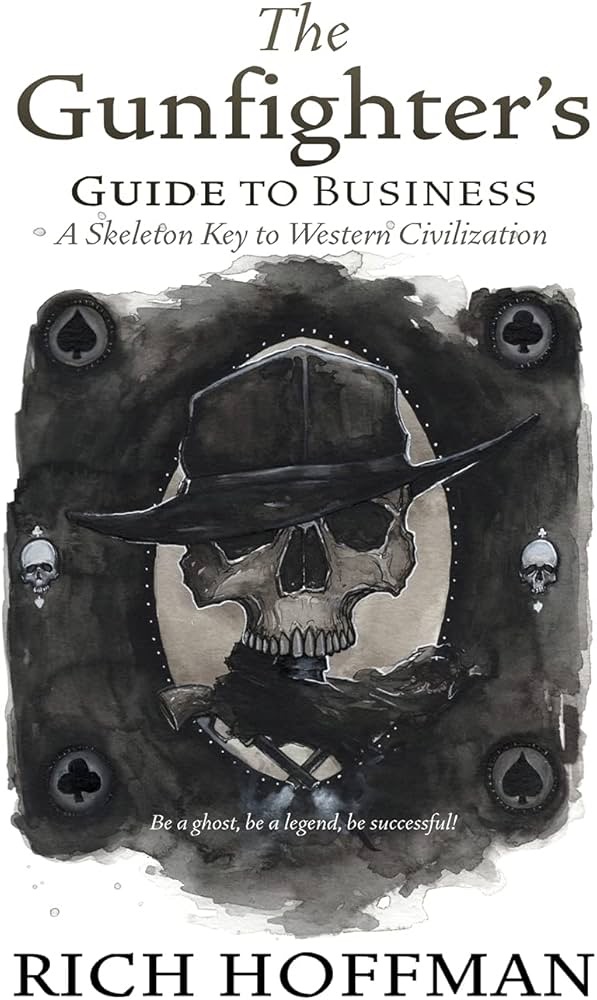
Hoffman, Rich. The Gunfighter’s Guide to Business.
Hoffman, Rich. The Politics of Heaven. Manuscript, forthcoming.
Rich Hoffman
More about me
Click Here to Protect Yourself with Second Call Defense https://www.secondcalldefense.org/?affiliate=20707
About the Author: Rich Hoffman
Rich Hoffman is an author, political consultant, and strategic advisor based in Cincinnati, Ohio, and the creator of The Politics of Heaven—a unique framework that connects biblical theology, ancient history, and modern power structures to explain how moral alignment and spiritual forces shape global events. Blending real-world political experience with deep research into archaeology, UFO phenomena, and suppressed historical narratives, Hoffman offers compelling commentary on topics ranging from ancient civilizations and the Dead Sea Scrolls to modern populist movements, paranormal continuity, and leadership strategy in chaotic environments. As the author of The Gunfighter’s Guide to Business and the forthcoming Politics of Heaven, he brings a grounded yet provocative voice to media discussions, supported by firsthand experiences and a cross-disciplinary approach that bridges science, history, and theology. For interviews, speaking engagements, or expert analysis, visit richhoffmanbooks.com or contact directly via phone at 513-307-5815 or email at rhoffman@richhoffmanbooks.com. If you’ve seen the movie, Disclosure Day and want to talk about it and the implications of Presidnet Trump’s UAP disclosures, let me know and we can bring some color to your coverage. https://richhoffmanbooks.com/media-inquiries-broadcast-topics-and-contact-info/?frame-nonce=ad51e7ecba I do have a firsthand UFO encounter to discuss.