The Great Public School Meltdown: Cleveland’s Teacher Layoffs, the Property Tax Revolt, and Why the Socialist Education Model Is Predictably Collapsing

Everybody who’s been paying attention to Ohio politics—and especially those of us in Butler County—knew this day was coming. The headlines out of Cleveland this month hit like a ton of bricks: the Cleveland Metropolitan School District just laid off 410 full-time employees, including 146 teachers, as part of a brutal budget reckoning. The board voted unanimously on April 14, 2026, amid protests and tears, to slash staff and close or merge another 29 schools as part of its “Building Brighter Futures” plan. CEO Warren Morgan called it necessary—declining enrollment (down about 50% over the last 20 years, while staffing only dropped 31%), massive deficits projected to hit $49 million by 2029, even after these cuts, and the need to avoid state fiscal oversight. They’re saving around $50 million a year for now, but the writing’s on the wall. This isn’t some isolated crisis in a struggling big-city district. It’s the tip of the spear for what’s happening across Ohio and the country. Public education as we’ve known it—the endless money pit funded by confiscatory property taxes, union contracts, and the fantasy of government-as-parent—is hitting the wall hard. 

I’ve been saying it for years, and now the reality is playing out in living color. Listen to the young mom who spoke up during one of those emotional video conferences and parent meetings that went viral after the layoffs. She’s exactly the kind of parent I’ve described a thousand times—the insecure 30-something or early-40s mom who grew up in the system herself, outsourcing her kid’s upbringing to the school as a free babysitting service. “It breaks my heart,” she said, voice cracking, “for her and her family and our own life… she was such a staple… I can’t believe they can just come in here and take these people’s jobs away because we are lacking money.” She talked about how the teacher had become a fixture in her son’s life, how it hurt knowing the frontline people doing the real work were the ones getting cut while “people in the office making six figures” stayed fat and happy. Classic. She represents millions of parents who fell in love with their kids’ teachers because they can’t—or won’t—invest that time and energy themselves. They treat educators like extensions of their own fragile egos, demanding the community throw infinite cash at the system so they can live their lives guilt-free. It’s heartbreaking on a human level, sure. But it’s also the predictable outcome of a model built on bad incentives from the start. 

Here in Butler County, where I live, the property tax debates are raging right now. Reappraisals are driving values up 13-25% in some spots, especially in those “20-mill floor” school districts where taxes spike automatically with home values. The county commissioners rolled back some inside millage and boosted homestead exemptions for seniors, but the pressure is enormous. Statewide, there’s this citizen-led push for the “Ohio Eliminate and Prohibit Taxes on Real Property Initiative”—a constitutional amendment to outright ban property taxes on land, buildings, crops, the works. The group Ax Ohio Tax has been gathering signatures like crazy, claiming they’re on pace with around 305,000 so far toward the 413,000 needed from 44 counties by July 1 to make the November 2026 ballot. Experts say it’s a long shot—it might not quite get there, and even if it does, it probably won’t pass. But the fact that it’s this close tells you everything. Young families in their 20s and 30s, looking at home prices inflated by years of easy money and government distortion, aren’t signing up to pay sky-high taxes on overvalued properties to fund a system that’s failing their kids anyway. The pyramid scheme is cracking. Property taxes have been the golden goose for schools—funding billions locally across Ohio—but people are burnt out. They see the results: kids who graduate (or don’t) are barely able to read, think critically, or function without government crutches. And they’re done. 

This isn’t new. I’ve been hammering on it in Butler County levies and school board fights for years. Public schools were never really about education in the classical sense. They were a Progressive Era invention—part of the same 1913 income tax and New Deal fantasies that sold socialism as compassionate central planning. “Bring your kids to us,” the pitch went. “We’ll teach them while you go live your life.” It was always an attack on the family unit, a way to weaken parental influence and reprogram children en masse to worship government. Look at the outcomes: by every measure, it’s been a disaster. National Assessment of Educational Progress (NAEP) scores—the Nation’s Report Card—paint a grim picture. In 2024, only about 30% of fourth-graders were proficient in reading nationally, down from previous years. In big urban districts like Cleveland, it’s even worse—single-digit proficiency in some subjects for certain grades. High school seniors? Just 35% proficient in reading, 22% in math—the lowest in decades. About 64% of fourth-graders overall can’t read proficiently. Literacy stats are brutal: over half of U.S. adults read below a sixth-grade level. We’re spending $15,000–$18,000 per pupil in Ohio (higher in some districts), yet we’re churning out young adults who can’t think for themselves, who lean Democrat for the first decade of their lives until reality smacks them, and who struggle with basic life skills. Thomas Edison didn’t come out of public school. Innovators and independent thinkers rarely do. The system produces dependents. 

And the parents are demanding more money? Many of them are products of that same system—taught that wages should be universal, that showing up and playing on the computer while gossiping about TV shows counts as “work,” that teachers deserve disproportionate pay, time off, and security because… reasons. Unions have locked it in: collective bargaining on the backs of property taxpayers, no real differentiation between good and bad teachers, and ideological capture that skews heavily Democrat. Progressive politics in the staff lounge becomes progressive indoctrination in the classroom—how to “legally steal” or view success as oppression. If you last in that environment into your 30s and 40s, you probably absorb it. The peer pressure and government paycheck mentality do the rest.

The Cleveland story is playing out everywhere. Northeast Ohio districts are warning of more cuts. Enrollment declines, lost state funding, failed levies, and pressure for property tax reform are squeezing budgets. Akron, Columbus—same issues. The Trump administration is accelerating the national rollback. They’re shrinking the Department of Education, moving programs to states and other agencies, pushing school choice hard, and returning power where it belongs: to parents and local control. No more federal bureaucracy pretending one size fits all. It’s happening fast—executive orders, budget shifts, Workforce Pell Grants for real skills instead of four-year indoctrination factories. The fantasies of 1913 and the New Deal are over. People are waking up. The new generation sees that home values aren’t what they’re cracked up to be when the tax bill arrives. They don’t want to subsidize a failing babysitting service forever. 

Here’s the psychological angle I’ve talked about before: a lot of these Levy supporters and heartbroken parents are insecure about their own upbringing. They project that insecurity onto the system, demanding the community parent their kids so they don’t have to confront their own shortcomings. Teachers become emotional surrogates. “Don’t cut her—she’s family!” But it’s not sustainable. No amount of money fixes a model built on coercion and low expectations. Good teachers exist, sure. But the structure rewards mediocrity and ideology over results. Competition is the only answer. The future is school choice: money follows the child—private models, charters, homeschooling, vouchers—parents pay or direct funds to what works. Schools will have to compete for enrollment the way businesses compete for customers. Zip-code monopolies are dying. That drives down per-pupil costs, raises quality, and forces adaptation. Districts clinging to the old union-heavy, top-heavy model (Cleveland’s audit called out administrative bloat) will shrink or reform.

I feel for the laid-off teachers on a human level. Many went into it with good intentions. But the system they defended—endless funding via property taxes, no accountability—created this cliff. Parents like that young mom in Cleveland thought the money was perpetual, that socialism’s promises would hold. They weren’t taught basic economics: you can’t confiscate wealth forever without consequences. When homeowners top out, when young buyers say “no more,” when results don’t match the rhetoric, the house of cards falls. Cleveland isn’t the end—it’s the beginning. More districts across Ohio will face the same. The state legislature has been trying to get ahead of it with reforms, easing the addiction. Republicans see the writing on the wall; many Democrats are still in denial.

The broader truth? Public education hasn’t served America well. It was never designed to create strong, independent people. It was designed to create compliant citizens who mimic government worship. We’ve got generations now waking up damaged—barely literate, debt-laden if they went further, dependent on the very system that failed them. Strong countries need strong individuals who can read, reason, innovate, and stand on their own. Public schools haven’t delivered that at scale. The game is over for perpetual funding. It’s rolling back, and the adjustment will be painful. There will be tears—lots of them—from parents, teachers, unions. But reality doesn’t care about feelings. You can’t say you weren’t warned. I’ve been saying it for years in these pages, in Butler County fights, in every levy debate. People lashed out, called names, and wouldn’t hear it. Now the grim reality is on their doorstep.

The solution isn’t more money. It’s choice, competition, and parental responsibility. Venture your own child—don’t outsource to a stranger in a failing system. The private model works because it has skin in the game. Parents pay or direct funds; schools earn trust or lose students. That’s how excellence returns. Ohio is at the precipice. The property tax scheme is falling apart nationwide as valuations outpace wages and young families revolt. Cleveland’s 410 layoffs are a preview. Multiply that mom’s heartbreak by millions, and you see the emotional wave coming. But on the other side? Better education, stronger families, real opportunity.

I know a lot of the players in these fights. I’ve seen the good families fighting corruption, the dedicated teachers swimming upstream, the parents waking up. The Rooster-style projectionists in media will spin this as “cruelty” or “underfunding,” but the numbers don’t lie: high spending, terrible results. Democrats assume everyone shares their weaknesses—endless government dependence. They don’t get that many of us built lives without it. Vivek Ramaswamy types—successful, disciplined, family-first—represent what’s possible when you reject the excuses.

Footnotes

1.  Cleveland19.com, “Cleveland Metropolitan School District to cut 410 full-time jobs,” April 15, 2026.

2.  Signal Cleveland reporting on CMSD board meeting protests and parent reactions, April 2026.

3.  Ballotpedia, “Ohio Eliminate and Prohibit Taxes on Real Property Initiative (2026).”

4.  NAEP/Nation’s Report Card data releases, 2024-2025 (reading/math proficiency trends).

5.  Butler County Auditor reports on property tax billings and reappraisals, 2026.

6.  U.S. Department of Education announcements on returning authority to states, 2025-2026.

7.  Ohio Capital Journal and related coverage on property tax abolition efforts, March-April 2026.

Bibliography

•  Cleveland19.com and Signal Cleveland articles on CMSD layoffs and consolidations (April 2026).

•  Ballotpedia entry on Ohio property tax abolition initiative (2026).

•  National Center for Education Statistics, NAEP Reading and Math reports (2024-2025).

•  Butler County Auditor’s Office, property tax reform guides and billings data (2025-2026).

•  U.S. Department of Education press releases and budget summaries on Department restructuring (2025-2026).

•  Ohio Capital Journal, Columbus Dispatch coverage of tax reform and education funding debates (2026).

•  Hoffman, Rich. The Politics of Heaven (forthcoming 2027).

•  Additional sources: State audit of CMSD administration; NWEA and EdWeek analyses of post-pandemic scores.

Rich Hoffman

More about me

Click Here to Protect Yourself with Second Call Defense https://www.secondcalldefense.org/?affiliate=20707
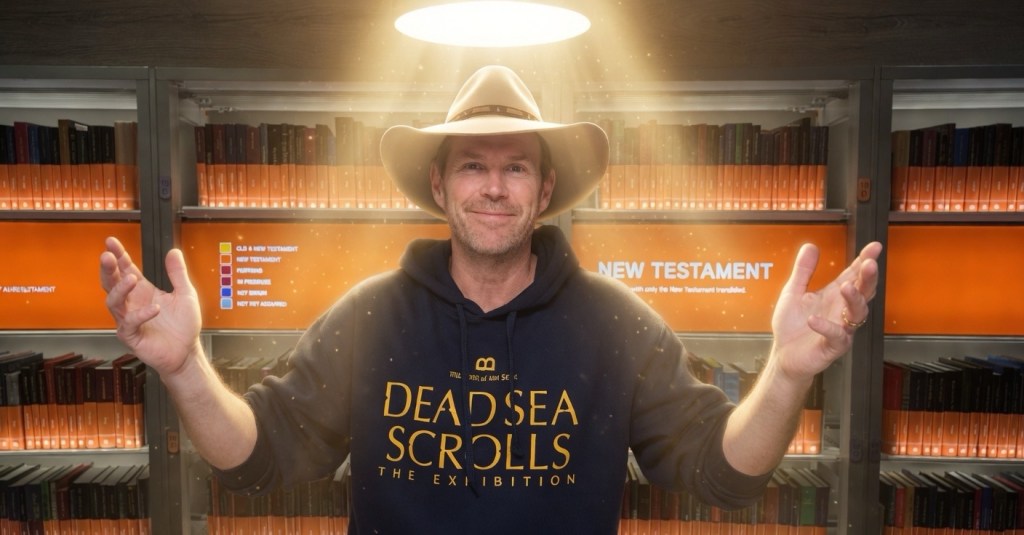
About the Author: Rich Hoffman

Rich Hoffman is an aerospace executive, political strategist, systems thinker, and independent researcher of ancient history, the paranormal, and the Dead Sea Scrolls tradition. His life in high‑stakes manufacturing, high‑level politics, and cross‑functional crisis management gives him a field‑tested understanding of power — both human and unseen.

He has advised candidates, executives, and public leaders, while conducting deep, hands‑on exploration of archaeological and supernatural hotspots across the world.

Hoffman writes with the credibility of a problem-solver, the curiosity of an archaeologist, and the courage of a frontline witness who has gone to very scary places and reported what lurked there. Hoffman has authored books including The Symposium of JusticeThe Gunfighter’s Guide to Business, and Tail of the Dragon, often exploring themes of freedom, individual will, and societal structures through a lens influenced by philosophy (e.g., Nietzschean overman concepts) and current events.

The Bad Guys Deserve Punishment: Destroying Iran to free people from tyranny

I’ve been watching everything unfold in real time. It feels good to see some real aggression from the top, finally. Everybody’s talking about how Trump’s inspiration is driving this new level of toughness—hitting Iran hard, taking out Maduro in Venezuela, and setting up hemispheric shielding through Kristi Noem’s new gig as Special Envoy for the Shield of the Americas. It’s exactly what we needed. We’ve lived through a very dangerous time, and we had to have justice for what was done to us. So when people whine, “Why are you being so aggressive? Why treat Venezuela like this? Why talk so tough on Iran, China, the cartels?”—I point to the big picture. We tried playing nice when we could, making deals, but the bad actors never stopped scheming in the background. Iran’s always been problematic, bragging about nuclear warheads and funding terrorists. Trump couldn’t walk away from negotiations with them, thumbing their nose at honest attempts at peace in the Middle East. If they’re going to keep sponsoring terror, you cut the head off the snake. That’s what’s happening now, and it had to happen.

Obviously, the Democrats support that kind of insurrection—they want the downfall of the United States. Peel back the layers, and you see China behind so much of it: property acquisitions here, buying up media companies to steer narratives their way. It’s been ugly, nasty, nasty, nasty. After what they did with COVID, the lockdowns, the global economic sabotage—Bill Gates, the whole crew—people get mad if they’re not in jail or tied up somewhere. They have too much money; they buy courts, buy freedom. They don’t get in trouble. And yeah, I still think Jeffrey Epstein’s alive out there. He’s too rich to die that way. Body double, bought-off guards, elements of law enforcement—it’s not hard with that kind of cash.

Trump doesn’t have the constitutional power to round them all up and jail them—he can’t do it directly—but he can attack their mechanisms of evil. The way bad guys use countries like Iran, Venezuela, Mexican drug cartels, North Korea, and even Russia, stirring up Ukraine—they hustle agents, cause chaos, turn everybody in the wrong direction. But Trump’s clear: no boots on the ground for forever wars. We never should’ve been doing that. I joke about it half-seriously, but what was the Iraq war really about? Oil? Securing prices and American interests? Weapons of mass destruction, they never found? Or was it about raiding the Baghdad Museum right after the invasion, grabbing ancient DNA or artifacts from Gilgamesh’s era to mess with human genetics, or hide giants like in Kandahar? Those conspiracy theories floated around podcasts after retirees started talking. People have lost faith in institutions, in the nightly news narrative: “We’re going to war to save people from communism,” or whatever. Yet the bad guys propped up maniacs for decades—Fidel Castro, the Iranian Revolution in the late ’70s as a Marxist movement hidden behind religion, so you couldn’t criticize it without attacking Islam. That’s how they sold it here: don’t criticize our communities, even as they shuffled in socialism, lined people up for food stamps and welfare, turning dependency into modern slavery to the government instead of plantations.

The same thing’s happening with radical Islam—thorny alliances everywhere, causing needless harm—cartels in Mexico, Venezuelan aggression, and China behind it all. China was built by the deep state; they never would’ve had the money without investment firms funneling stolen Federal Reserve wealth, Wall Street manipulations, modern monetary theory tricks at Jackson Hole conferences. It sounds wild because the media calls it crazy, but listen to those talks—it’s out there.

That’s why everybody’s upset about these moves. Iran’s economy is a dying fallout on the couch—they can’t fight a real war. No ships, no missiles, no planes of any worth. They’ve been de-industrialized by sanctions. Trump bombed them because they poked the bear with radical Islam and ideology issues tied to the Democrat party, which clearly represents America’s destruction in so many ways. Obama gave them billions to keep their economy afloat so they could buy terrorist toys; now Trump’s taking it all away. As an elected official, we put him in office to do this job; he’s doing it. We don’t want radical losers causing trouble worldwide. We don’t want cartels running Mexico—pulling people over for bribes, corruption everywhere. We want to vacation or do business there without fear. We don’t want Venezuela screwing our energy markets. We don’t want Iran sponsoring terrorism. We want peace in the Middle East—Jews, Christians, everybody getting along, building lives.

This is what Kristi Noem’s Shield of the Americas is about—stabilization in the hemisphere. She’s moved from DHS to Special Envoy, focusing on dismantling cartels, securing the Western Hemisphere, working with Rubio and Hegseth. It’s hemispheric shielding: choke off the bad guys economically and militarily without endless occupations. Trump’s not putting boots everywhere; he sends precision strikes, missiles as compliments of capitalism—paid for by the best system in the world. That’s how you win now.

All these characters in the background—COVID planners, great reset pushers, China feeders—they used distractions like Iran to usher agendas through while we fought shadows. Peel back the onion: destroy the disguises, pull off the masks. That’s happening in Iran right now, Venezuela (Maduro captured in January, U.S. overseeing oil rebuild), and Mexico (cartel disruptions). It’s great. I highly support what Trump’s doing—I want to see a whole lot more. He’s actually being too nice in some ways. The world deserves this reckoning for 2020: stolen elections, COVID as a weapon, great reset leashed to lockdowns, all attached to global control plots. Epstein, Gates, Russian honeypots, Chinese labs—it’s out there.

If you think that’s all a conspiracy, it’s in the open now. The people crying loudest about Iran are the ones who used these characters to cause trouble. Forget the courts, UN nonsense, and treaties that neutralized America so bad guys could thrive. Time for punishment. Show the world it happens. Use capitalism for upper mobility, freedom in Hong Kong, Venezuela, Mexico, England, and Europe. Lead by example: take away the hostiles causing trouble. Iran had no other intention but trouble since the late ’70s Marxist infusion feeding communism, China, Russia, socialist Latin America—all anti-American, anti-capitalist, anti-upward mobility. They played their part in lockdowns, freedom theft, and using COVID to destroy economies into a great reset.

This isn’t theory anymore; it’s action. Trump’s crushing them economically, stripping them of their covers, exposing them. The attacks on Iran neutralize them as a threat—they tried rational peace, but they’re hostile. Venezuela’s aggression, Mexico’s cartels—all choked off. No more hiding. Democrats and the media cry because Iran was their Marxist disguise, a haven, a proxy to break America down. Now excuses stripped away, masks off—nowhere to hide. They don’t like it, but too bad. It’s great, the bad guys needed to be punished.  And now they are.

Footnotes

1.  On Operation Epic Fury and Khamenei’s death: Strikes targeted nuclear sites, missiles, navy; civilian casualties reported (e.g., girls’ school in Minab). Trump urged regime change without full occupation.

2.  Maduro capture in January 2026: U.S. raid framed as anti-narco-terrorism; plans for long-term oil oversight and revenue split.

3.  Kristi Noem’s role: Appointed Special Envoy for the Shield of the Americas (Western Hemisphere) in March 2026, focusing on cartel dismantlement and border security partnerships.

4.  Iran’s 1979 Revolution: Marxist influences blended with Shia Islamism to avoid direct criticism of leftist elements.

5.  Iraq Museum looting: Over 15,000 artifacts stolen post-invasion; fringe theories link to ancient DNA/Gilgamesh,/giants myths.

6.  Kandahar giants: Persistent online legend from alleged U.S. military encounters; widely debunked but symbolic of institutional distrust.

7.  China-media investments: Documented stakes in U.S. outlets; fentanyl precursor supply to Mexican cartels well-reported.

8.  Obama’s Iran payment: $1.7 billion settlement for pre-1979 arms deal, not direct “terror funding” per official accounts.

9.  COVID/Great Reset conspiracies: WEF initiative twisted into global control narratives; Gates-Epstein links fueled speculation.

10.  Epstein “alive” theories: Persistent despite official ruling; tied to elite protections.

Bibliography

•  White House Fact Sheet on Iran (2026). https://www.whitehouse.gov/fact-sheets/2026/02/fact-sheet-president-donald-j-trump-addresses-threats-to-the-united-states-by-the-government-of-iran

•  DHS Announcement on Noem’s Role (March 5, 2026). https://www.dhs.gov/news/2026/03/05/thanks-president-trump-and-secretary-noem-america-safer

•  TIME on Shield of the Americas (2026). https://time.com/7382975/kristi-noem-new-job-shield-of-americas

•  Marxist.com on the Iranian Revolution (historical analysis).

•  Various: Axios, Politico, The Hill, CNN reports on 2026 operations in Iran/Venezuela.

•  Reuters Institute on Chinese media influence.

•  BBC on Great Reset conspiracies.

•  Brookings on Obama-Iran cash transfer.

•  CSIS/NBC on China-cartel connections.

Rich Hoffman

More about me

Click Here to Protect Yourself with Second Call Defense https://www.secondcalldefense.org/?affiliate=20707

The NFL’s Miscalculated Globalist Push: The Bad Bunny Halftime Show and the Perils of Prioritizing Foreign Markets Over Domestic Loyalty

The NFL’s Miscalculated Globalist Push: The Bad Bunny Halftime Show and the Perils of Prioritizing Foreign Markets Over Domestic Loyalty serves as a stark warning about the dangers of corporate strategies that chase international appeal at the expense of core domestic audiences. In the wake of Super Bowl LX (played February 8, 2026, concluding the 2025 NFL season), the decision to feature Puerto Rican superstar Bad Bunny as the halftime headliner ignited widespread discussion. While the performance celebrated Puerto Rican heritage through vibrant choreography, family-themed elements (including a live on-stage wedding), and Spanish-language hits, it coincided with a measurable dip in traditional U.S. viewership during the slot—highlighting tensions between global expansion ambitions and the league’s foundational American fanbase.

Official Nielsen data confirms the Super Bowl averaged 124.9 million viewers across NBC, Peacock, Telemundo, NBC Sports Digital, and NFL+ platforms—a solid but slightly declining figure from the prior year’s record of 127.7 million. The game’s peak reached an all-time high of 137.8 million in the second quarter (7:45–8:00 p.m. ET). However, Bad Bunny’s halftime show (8:15–8:30 p.m. ET) averaged 128.2 million viewers, ranking it fourth all-time behind Kendrick Lamar (133.5 million in 2025), Michael Jackson (133.4 million in 1993), and Usher (129.3 million in 2024). Quarter-hour breakdowns reveal the issue: viewership fell approximately 7% from the game’s peak (to around 128.2 million from 137.9 million in the prior high quarter), with a 5.7% drop from the immediate pre-halftime segment. This translated to an estimated loss of 9–10 million viewers in some windows compared to game highs, particularly among non-Latino English-speaking audiences, as Telemundo’s share surged during the set.

The performance’s entirely Spanish-language format boosted international and Hispanic viewership—Telemundo hit record levels, and social media clips amassed over 4 billion views in 24 hours (with more than 55% from overseas markets, per NFL and Ripple Analytics). Yet domestically, the shift prompted channel changes, as evidenced by the drop-off. Critics argued this reflected Roger Goodell’s broader strategy: using the halftime platform as cultural promotion for Latin American growth, akin to a televised showcase for Puerto Rican vibrancy, family structures, and resilience amid issues like power outages.

In direct response, Turning Point USA (TPUSA) mounted the All-American Halftime Show, featuring patriotic performances by Kid Rock, Brantley Gilbert, Lee Brice, Gabby Barrett, and others. Streamed on YouTube, Rumble, and allied platforms, it peaked at around 6.1 million concurrent viewers during overlap (with live estimates of 5–6.4 million across carriers). Post-event, the YouTube upload surpassed 21 million total views (some reports cited 19–25 million including Rumble). While dwarfed by the official show’s scale, it symbolized a bold conservative counter-narrative, drawing those alienated by perceived progressive undertones (e.g., immigration-related themes some interpreted in Bad Bunny’s presentation). TPUSA’s event amplified Charlie Kirk’s reach and positioned the group as a cultural alternative at a moment of peak visibility.

The real stakes lie in advertising revenue, where the Super Bowl’s value hinges on sustained high engagement. Thirty-second spots fetched $7–10 million in 2026, with advertisers expecting minimal churn during premium slots like halftime. The documented 7% drop during Bad Bunny’s set likely reduced effective impressions for those ads, potentially leading to under-delivery on promised audiences. Networks and the NFL may have faced pressure to justify rates amid the dip, even as overall game averages remained strong. The league’s bet on Bad Bunny—Spotify’s most-streamed artist in 2025—prioritized Latin market penetration over retaining every domestic viewer, but the cost showed in softer traditional metrics.

This mirrors the NFL’s aggressive international expansion. The league announced a record nine international games for 2026 across four continents, seven countries, and eight cities—including returns to Mexico City (at Estadio Banorte, with the San Francisco 49ers as a designated home team for a multiyear run), plus debuts or returns in Paris, Madrid, Rio de Janeiro, Melbourne, Munich, and London. Mexico and Brazil rank among the NFL’s largest overseas fanbases (tens of millions each), and Goodell has openly discussed future possibilities like dedicated international teams or further Latin ties, including deeper Puerto Rico involvement. Bad Bunny’s show aligned perfectly as soft-power outreach, highlighting cultural affinity to build loyalty in these markets.

Yet American football’s appeal—strategic individualism, decisive big plays—contrasts sharply with soccer’s more fluid, defense-heavy style, which some parallel to collectivist systems. Exporting the product risks dilution when overly customized for foreign preferences, potentially alienating the tailgating, weather-defying U.S. core that sustains the league financially.

Hollywood’s trajectory offers the clearest cautionary parallel. In the 2000s–2010s, studios chased China’s exploding box office, often prioritizing global totals in announcements and altering content to appease censors (e.g., removing sensitive themes). Blockbusters drew $100–200 million+ from China, sometimes rivaling or exceeding domestic hauls, offsetting ballooning U.S. union production costs. But over-reliance eroded trust: audiences sensed “watered-down” American essence, “woke” shifts alienated segments, and China’s domestic films surged to dominate 80–90% of its market. Hollywood’s U.S. theatrical revenue declined, theaters closed, streaming fragmented the model, and independents (e.g., Angel Studios) rose to fill voids. The pivot neglected the domestic foundation that once made global appeal possible.

The NFL treads similar ground. By assuming domestic loyalty while expanding abroad, it risks betraying advertisers targeting that base. Progressive framing in the show—perceived accommodations to immigration debates—further polarized, turning off viewers and dollars. Sustainable growth strengthens the home market first; overextension without it invites erosion.

Weeks after the event, data confirms the patterns: strong but not record-breaking U.S. numbers, explosive international/social metrics, yet a clear domestic halftime dip. Future Super Bowls could see trend lines worsen if bad choices persist. The league must recalibrate—honor the American essence that built its empire—or face permanent damage akin to Hollywood’s decline.  While I watched both shows to see how the stories would unfold, and Bad Bunny stayed on good behavior during the halftime show, the damage was done before the show ever started.  It was a bad decision to have Bad Bunny sell family values when advertisers bought viewer appeal, not a progressive rebellion.  And picking Bad Bunny with all the baggage was a letdown to the advertisers, and it will hurt the NFL product going into next year.  The betting problem of rigged games is already having an impact.  And this whole problem certainly didn’t help. 

Footnotes

1.  Nielsen, “Super Bowl LX Delivers 125.6 Million Viewers,” February 10, 2026. (Official averages and halftime figures.)

2.  ESPN, “Super Bowl LX, Bad Bunny’s halftime fall shy of ratings records,” February 10, 2026. (Peak and ranking details.)

3.  Front Office Sports, “Bad Bunny Halftime Viewership Fell 7% From Super Bowl Peak,” February 11, 2026. (Quarter-hour drop analysis.)

4.  The Athletic / New York Times, “Super Bowl LX draws 124.9 million viewers, Bad Bunny 128.2 million,” February 11, 2026. (Comparative declines.)

5.  Fox News / various outlets, coverage of TPUSA All-American Halftime Show (e.g., peaks at 6.1 million concurrent, 21+ million total views on YouTube).

6.  NFL.com announcements on 2026 international schedule (nine games, Mexico City return, etc.).

7.  Reuters / The Guardian, reports on Hollywood’s China market shift and subsequent domestic erosion (contextual parallels from industry analyses).

8.  Launchmetrics / Forbes, media impact value tied to Bad Bunny’s performance (e.g., $942M+ MIV for the event, heavy international skew).

Bibliography / Further Reading

•  Nielsen Big Data + Panel reports (February 2026).

•  ESPN, The Athletic, Front Office Sports, and Variety articles on ratings (February 10–13, 2026).

•  NFL.com international games announcements (February 2026).

•  Historical Hollywood analyses (e.g., Reuters, The Economist on China box office dynamics).

•  TPUSA and YouTube metrics for All-American Halftime Show.

Rich Hoffman

More about me

Click Here to Protect Yourself with Second Call Defense https://www.secondcalldefense.org/?affiliate=20707

The Wounded Deer Strategy: When banks seek to destroy business for politically strategic reasons

The practice of financial institutions abruptly severing relationships with clients—often termed “debanking”—has emerged as a serious threat to American businesses, particularly those in politically sensitive sectors like defense contracting. This phenomenon is not merely a business decision; it can resemble a calculated impairment strategy, where a bank or lender deliberately wounds a company financially, leaving it vulnerable to acquisition or collapse by opportunistic players, such as private equity firms. I refer to this as the “wounded deer strategy,” drawing from a vivid analogy: imagine a majestic buck, seasoned and resilient, evading hunters for years. One day, lured by trusted advice toward greener pastures across a road, it is struck by a vehicle, breaking its legs and leaving it helpless on the roadside. The driver speeds away, and soon a truck full of opportunists arrives, claiming the easy prize as a trophy without the risk or skill of a true hunt.

In the business world, the “trusted advisor” is often the bank that has provided liquidity and guidance for years. When ideological or political divergences arise—perhaps a lender’s leadership shifts toward progressive priorities incompatible with supporting defense suppliers under a particular administration—the institution can withdraw credit lines, demand accelerated repayments, or impose punitive terms. The company, suddenly cash-strapped and unable to meet obligations, becomes the wounded deer: limping, exposed, and prime for plunder by private equity firms eager to acquire distressed assets at fire-sale prices.

This is not hypothetical. Reports have highlighted cases where companies face account closures or service denials seemingly tied to political affiliations or industries disfavored by regulators or bank leadership. For instance, defense contractors and suppliers aligned with certain administrations have encountered scrutiny, with some executives and observers pointing to “politicized debanking” as a tactic to undermine supply chains indirectly. While direct evidence of widespread ideological targeting in defense remains anecdotal in public discourse, the broader pattern of debanking—often justified under vague “reputational risk” guidelines—has affected industries from cryptocurrency to politically active individuals and businesses. In one high-profile context, executive actions have sought to curb such practices by requiring risk-based, individualized assessments rather than blanket political exclusions.

The vulnerability stems from the absence of strong guardrails. Banks hold immense power over liquidity, and without legislative protections, they can exit relationships with minimal recourse for the client. A clean “divorce”—mutual termination of lending without malice or destruction—should be possible, but too often, the exit inflicts maximum damage: frozen accounts, called loans, or reputational smears that cascade into further isolation. This leaves companies unable to pivot to new lenders quickly, especially in capital-intensive fields like aerospace or defense, where contracts demand stability.

Compounding this is the explosive growth of private equity, which thrives on distressed opportunities. Private equity firms manage trillions in assets; global private equity deal value rebounded sharply in recent years, reaching $2.6 trillion in 2025, with buyouts alone nearing $1.8 trillion. Assets under management in the sector have ballooned, with estimates placing private equity-held companies at record levels and dry powder (uninvested capital) fueling aggressive acquisitions. Firms often use leveraged buyouts—acquiring targets with borrowed money loaded onto the acquired company itself—leading to high failure rates: roughly one in five large leveraged buyouts results in bankruptcy within a decade.

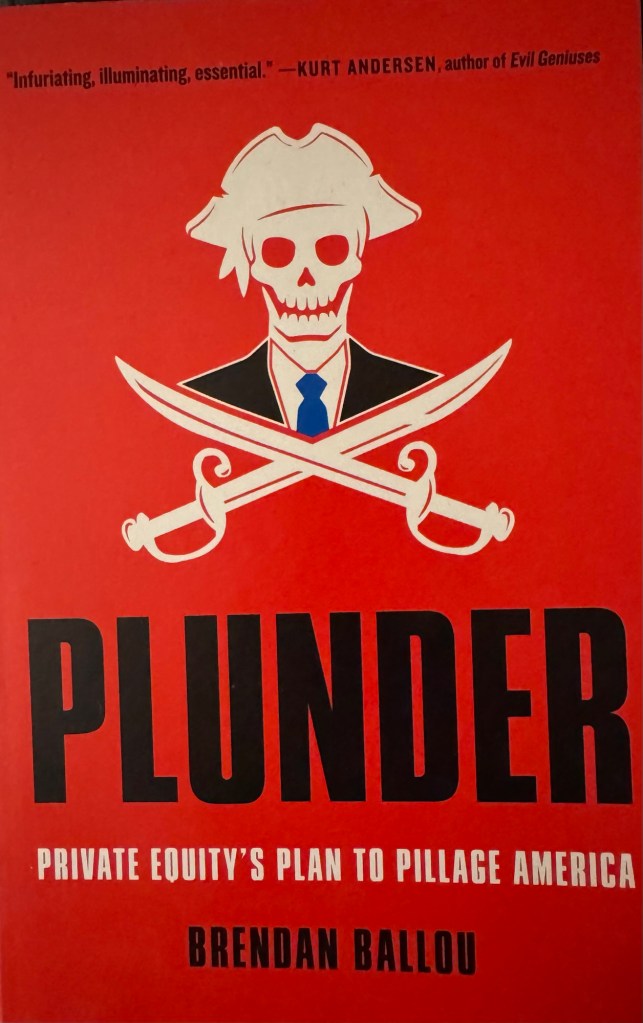
Brendan Ballou’s book Plunder: Private Equity’s Plan to Pillage America (2023) provides a stark examination of this dynamic. Ballou, a former federal prosecutor and special counsel for private equity at the Justice Department, details how firms acquire businesses—often retailers, medical practices, nursing homes, or other essential services—using minimal equity while saddling them with debt. Profits are extracted through fee structures, cost-cutting (including job reductions), price hikes, and quality reductions, shifting resources from productive enterprise to financial engineering. The result: higher costs for consumers, lost jobs, and weakened companies. Reviews describe the book as “infuriating” and “essential,” highlighting how private equity has reshaped the economy by prioritizing extraction over long-term value creation.

A parallel Ohio example illustrates how regulatory pressure can wound companies, creating openings for corruption and plunder. FirstEnergy, facing challenges from Obama-era policies promoting renewables over traditional nuclear and coal, sought bailouts amid financial strain. This culminated in the House Bill 6 scandal—the largest corruption case in Ohio history—involving $60 million in bribes funneled through dark money groups to secure legislation subsidizing failing nuclear plants. FirstEnergy admitted involvement, paying $230 million in penalties, while executives and politicians faced charges. The scandal exposed how wounded utilities, pressured by federal regulations, turned to political influence rather than market adaptation—ultimately harming ratepayers and eroding trust.

Private equity’s role in housing offers another cautionary tale. Firms like Blackstone (often confused with BlackRock) pioneered large-scale single-family home purchases post-2008 crisis, converting them to rentals. While institutional ownership remains a small fraction nationally, concentrated in certain markets, it has driven up prices and rents in hotspots by outbidding families with cash offers and low borrowing costs. Tenants face added fees, and communities lose owner-occupied stability. This mirrors the “plunder” pattern: acquire undervalued or distressed assets, extract value, and leave diminished foundations.

These examples underscore a systemic issue: without regulatory constraints, financial institutions can act as activists against disfavored sectors or politics. Large international banks, with global priorities over domestic patriotism, pose particular risks. They fund diverse causes, yet behind the scenes may undercut supply chains supporting certain administrations—eroding American infrastructure indirectly. Fiduciary responsibility demands impartiality, but temptations arise when no guardrails exist. Ethics alone fails; self-discipline yields to pettiness or ideology.

Ohio can lead by enacting legislation to protect businesses. Proposals could include:

•  Mandating civil, non-destructive terminations of financial relationships, with notice periods and transition assistance.

•  Prohibiting impairment tactics driven by political or ideological motives, with penalties for violations.

•  Strengthening fiduciary standards to prevent malicious wounding.

•  Requiring transparency in debanking decisions, allowing appeals or independent reviews.

Such measures would encourage local and regional banks—more rooted in community values—over distant giants. Entrepreneurs deserve protection to innovate without fear of becoming roadkill for ideological or opportunistic predators.

The stakes are high. A thriving economy relies on confident investment and job creation. When private equity controls trillions, often through plunder rather than creation, and banks enable impairment without consequence, the foundation weakens. Ohio, with its manufacturing and defense ties, must act to install guardrails before irreversible damage. Reading Plunder and examining cases like FirstEnergy provides the intellectual foundation; legislative action provides the solution.

Bibliography

•  Ballou, Brendan. Plunder: Private Equity’s Plan to Pillage America. PublicAffairs, 2023.

•  Morgenson, Gretchen, and Joshua Rosner. These Are the Plunderers: How Private Equity Runs—and Wrecks—America. Simon & Schuster, 2023.

•  McKinsey & Company. “Global Private Markets Report 2026.” McKinsey, 2026.

•  Preqin and iCapital. “Alternatives Decoded,” with data to February 2026.

•  U.S. Department of Justice and Securities and Exchange Commission filings on FirstEnergy/Ohio nuclear bribery scandal (various, 2020–2025).

•  Ohio Public Utilities Commission decisions on FirstEnergy penalties (2025).

•  Various reports on debanking, including executive orders and congressional investigations (2025–2026).

•  PitchBook and KPMG analyses of private equity trends (2025–2026).

Footnotes

¹ Ballou, Plunder, on leveraged buyout bankruptcy rates.

² McKinsey Global Private Markets Report 2026, deal value statistics.

³ Preqin/iCapital data on private equity AUM growth to $7 trillion by end-2025.

⁴ Wikipedia and AP News summaries of Ohio nuclear bribery scandal involving FirstEnergy and HB 6.

⁵ Reports on institutional single-family rental ownership (e.g., Blackstone/Invitation Homes strategies).

Rich Hoffman

More about me

Click Here to Protect Yourself with Second Call Defense https://www.secondcalldefense.org/?affiliate=20707

The Benefits of New Gaza: Defeating Marxism and radical religious terrorism, with capitalism

The recent World Economic Forum annual meeting in Davos, Switzerland, held in January 2026, featured several high-profile discussions on global stability, with a particular focus on Middle East redevelopment and peace initiatives. On January 22, 2026, Jared Kushner, a key figure in prior Middle East diplomacy and now associated with the Board of Peace, presented a detailed “master plan” for post-war Gaza reconstruction during a signing ceremony for the Board’s charter.<sup>1</sup> This vision, often referred to as “New Gaza,” proposed a comprehensive transformation of the territory through phased development, private-sector investment, and economic revitalization, drawing parallels to successful urban models in the Gulf region such as Dubai and Abu Dhabi.

The plan outlined four primary phases: beginning in southern Rafah (termed “New Rafah” or “City 1”), progressing to Khan Younis (“City 2”), the central refugee camps (“City 3”), and culminating in Gaza City (“City 4”). It envisioned over 100,000 permanent housing units in initial stages, alongside 200 education centers, 180 cultural, religious, and vocational facilities, and 75 medical centers.<sup>2</sup> Infrastructure elements included a new port, airport, freight rail line, logistics corridors, and ring roads to connect urban centers. Projections included raising Gaza’s GDP from a war-depressed level of approximately $362 million (as reported in 2024) to $10 billion by 2035, generating 500,000 jobs, and attracting $25–30 billion in investments, predominantly from private sources.<sup>3</sup> Construction timelines suggested major elements could be completed in 2–3 years under conditions of demilitarization and enhanced security, with an emphasis on turning the Mediterranean coastline into a thriving tourism and enterprise zone.<sup>4</sup>

This approach builds directly on the legacy of the Abraham Accords, signed in 2020, which normalized relations between Israel and several Arab states (United Arab Emirates, Bahrain, Morocco, and Sudan), fostering economic cooperation, technology sharing, and reduced conflict incentives.<sup>5</sup> The Accords have demonstrated measurable economic benefits, including increased trade volumes, joint ventures in sectors like agriculture and cybersecurity, and broader regional investment flows, contributing to a paradigm where prosperity serves as a counter to ideological extremism.<sup>6</sup> By prioritizing free-market principles, upper mobility, and shared economic gains over radical narratives—often rooted in anti-capitalist or Marxist-aligned ideologies—the Gaza redevelopment seeks to erode support for groups like Hamas, whose governance has historically perpetuated poverty, suppressed development, and fueled violence, as evidenced by events such as the October 7, 2023, attacks.<sup>7</sup>

Broader regional dynamics include evolving access arrangements at the Temple Mount (known as Haram al-Sharif to Muslims), the site of the ancient Jewish First and Second Temples and currently home to the Al-Aqsa Mosque and Dome of the Rock. Under the post-1967 status quo, administered by the Jordanian Waqf with Israeli security oversight, Jewish prayer has traditionally been restricted to avoid escalation, with observant Jews often confined to the Western Wall plaza below.<sup>8</sup> Developments in 2025 and early 2026 saw incremental shifts, including high-profile visits and permitted prayers by figures such as National Security Minister Itamar Ben-Gvir, sometimes involving prostration or open recitation, amid political backing from elements within Israel’s government.<sup>9</sup> These changes have sparked debate over the erosion of longstanding arrangements, with reports of relaxed enforcement on items like prayer pages and increased Jewish visitor numbers, though no formal policy has sanctioned widespread rebuilding of a Third Temple.<sup>10</sup>  But it is looming over the area as a momentum shift that is gaining a lot of traction.

Related preparations among some Orthodox Jewish groups include efforts to ready ritual elements for potential Temple service, such as the importation of red heifers from Texas for purification ashes as described in Numbers 19. Five such heifers arrived in Israel around 2022–2023, with symbolic ceremonies and practice runs conducted in 2025, though reports indicate disqualifications due to blemishes or other issues, preventing full ritual use as of early 2026.<sup>11</sup> The site’s historical significance—linked to King David’s threshing floor purchase, Solomon’s Temple construction, and Abraham’s near-sacrifice of Isaac on Mount Moriah—continues to drive archaeological interest in adjacent areas like the City of David, where excavations reveal layers of biblical-era evidence despite longstanding access limitations.<sup>12</sup>

Critics of the Gaza plan have highlighted its top-down structure, limited direct Palestinian input, potential displacement risks, and contrasts with the territory’s current realities: extensive rubble (estimated at 60 million tonnes), humanitarian challenges, and destroyed infrastructure.<sup>13</sup> Some analyses view the proposal as overly speculative or aligned with external interests, raising questions about historic site preservation and community consultation.<sup>14</sup> Nonetheless, the overarching theme aligns with a pragmatic strategy: leveraging capitalist competition, enterprise zones, and economic opportunity to supplant suppression and radicalism with stability and prosperity. If implemented successfully—contingent on security, funding, and multilateral cooperation—this could reshape Gaza into a regional hub, diminish proxy influences (including from Iran), and facilitate deeper historical and scientific inquiry across contested areas like Jerusalem.

The plan’s ambition reflects a belief that peace through shared economic success may prove more durable than prolonged conflict, potentially benefiting residents across divides by prioritizing mobility, employment, and development over ideological division.<sup>15</sup>  Personally, I’m ready to book a ticket to visit.

Bibliography

•  Al Jazeera, “Map shows what would happen to Gaza under the US ‘master plan’,” January 27, 2026.

•  ABC News, “Jared Kushner lays out Trump-backed ‘master plan’ for post-war Gaza,” January 23, 2026.

•  The New York Times, “U.S. Lays Out a Glittering Plan for Gaza, Including Skyscrapers,” January 22, 2026.

•  BBC, “US unveils plans for development of ‘New Gaza’ with skyscrapers,” January 22, 2026.

•  Jerusalem Post, “Jared Kushner unveils $25 billion plan to transform Gaza into economic hub by 2035.”

•  Times of Israel, various articles on Temple Mount access changes, 2025–2026.

•  Wikipedia, “Abraham Accords” (accessed with updates to 2026).

•  Charisma Magazine, articles on red heifer developments, 2025.

Footnotes

1.  Al Jazeera, “‘Imperial’ agenda: What’s Trump’s Gaza development plan, unveiled in Davos?” January 23, 2026.

2.  ABC News, “Jared Kushner lays out Trump-backed ‘master plan’ for post-war Gaza,” January 23, 2026.

3.  The National, “New Gaza, new Rafah and a ‘free market economy’: Inside Kushner’s $30bn reconstruction plan,” January 22, 2026.

4.  NBC News, “Jared Kushner’s vision for Gaza as a gleaming port city clashes with reality,” January 26, 2026.

5.  Wikipedia, “Abraham Accords,” updated January 2026 entries.

6.  Carnegie Endowment for International Peace, “The Abraham Accords After Gaza: A Change of Context,” April 2025 (contextual extension to 2026 impacts).

7.  Breitbart, “‘Catastrophic Success’: Kushner Unveils ‘New Gaza’ Plan at Davos,” January 24, 2026.

8.  Jerusalem Story, “Experts Warn: Israel Is Changing the Long-Standing Status Quo at al-Aqsa Mosque,” 2025.

9.  Times of Israel, “Ben Gvir says Jewish prayer, including full prostration, permitted at Temple Mount,” May 26, 2025.

10.  Jerusalem Post, “Temple Mount to relax restrictions for Jewish prayer,” November 2025.

11.  Charisma Magazine, “Red Heifer Update: The Truth Behind Israel’s Recent Ceremony,” August 14, 2025.

12.  Historical context from biblical archaeology sources, cross-referenced with Temple Mount entry restrictions (Wikipedia).

13.  The New York Times, “U.S. Lays Out a Glittering Plan for Gaza,” January 22, 2026.

14.  Al Jazeera, “Map shows what would happen to Gaza under the US ‘master plan’,” January 27, 2026.

15.  Jerusalem Post and Guardian coverage on Board of Peace and redevelopment optimism, January 2026.

Rich Hoffman

Click Here to Protect Yourself with Second Call Defense https://www.secondcalldefense.org/?affiliate=20707

Gavin Newsom’s “Knee Pad” Campaign: Backfiring theatrics at Davos

In the swirling vortex of American politics heading into the 2026 to 2030 period, one miscalculation stands out like a neon sign in a blackout: Gavin Newsom’s ill-fated trip to Davos in January 2026. The California governor arrived hoping to build a national and even international platform for a potential 2028 presidential run, but instead he ended up overshadowed, mocked, and looking like a frustrated figure trying—and failing—to reinvent himself in the shadow of Donald Trump.

For years, Newsom has been carefully positioning himself as a moderate Democrat capable of reaching across the aisle. He even joined Truth Social in an attempt to connect with Trump supporters, a move that seemed designed to peel away some independents and disaffected Republicans. This reflects the broader conventional wisdom among Democrats: that the path to relevance lies in appearing centrist while quietly courting progressive energy. Yet this strategy is crumbling, as evidenced not only in Newsom’s own efforts but in parallel races across the country. In Ohio, for instance, Dr. Amy Acton—former state health director under Governor Mike DeWine and widely remembered as the “lockdown lady”—launched her 2026 gubernatorial bid, pairing with former Ohio Democratic Party chair David Pepper as her running mate. Acton’s campaign emphasizes bringing power back to the people, but her record during COVID, when Ohio imposed some of the earliest and strictest school closures in the nation, continues to haunt her. National Assessment of Educational Progress (NAEP) data showed Ohio students falling behind by roughly half a year in math due to prolonged disruptions, and economic recovery lagged behind national averages in the post-lockdown period.

Similar patterns appear elsewhere. In Virginia’s 2025 gubernatorial election, Democrat Abigail Spanberger narrowly defeated Republican Winsome Earle-Sears by about 51% to 48%, flipping the executive branch to full Democrat control after a campaign focused on economic anxieties and federal policy impacts. Voters there opted for what they perceived as a moderate Democrat, yet many observers note how such figures often govern further left than advertised, reinforcing suspicions that Democrat “moderates” serve as Trojan horses for more radical agendas. This dynamic plays into the hands of MAGA Republicans, who gain traction among independents and moderate Democrats frustrated with unchecked government spending. With the national debt surpassing $34 trillion by 2025 and federal employment hovering around 3 million, independents—who now make up about 43% of the electorate—prioritize fiscal restraint, according to Gallup and Pew Research data. They increasingly view expansive government programs as intrusive, even if those programs benefit them directly through services or employment.

The Democrat base, meanwhile, often rallies around figures like Alexandria Ocasio-Cortez and her squad, who push anti-ICE policies, lockdown enthusiasm, and expansive state intervention—framing government as a protective “warm blanket” akin to the Maoist metaphor of security through collective control. Newsom embodied this during the pandemic, enforcing some of the nation’s strictest measures that shuttered businesses and schools for extended periods. Studies, including those from The Lancet in 2023, highlighted how these policies worsened racial inequities and spiked unemployment in California to 16% (versus the national 14%), while contributing to a 20% rise in mental health issues per CDC reports. Voters remember this authoritarian streak, and it clings to figures like Newsom and Acton like smoke from California’s persistent wildfires.

Newsom’s Davos appearance crystallized these vulnerabilities. He touted California’s progress on zero-emission vehicles, boasting 2.5 million sold, but the real story was his feud with Trump. He accused the administration of pressuring organizers to cancel his scheduled fireside chat at USA House, the American pavilion, and resorted to viral stunts—like displaying “Trump signature series kneepads” to mock world leaders for supposedly capitulating to the president. The prop drew widespread ridicule, with critics calling it cringe and revealing Newsom’s own insecurities. Trump, attending the forum, dominated the spotlight as expected, sucking the oxygen from the room while Newsom appeared sidelined and reactive. Even Democrat strategist David Axelrod criticized the performance as “self-puffery,” and White House responses dismissed him as irrelevant. Off-camera bravado gave way to onstage pettiness, exposing what many see as underlying admiration for Trump’s dominance—Newsom’s “T-Rex” comments betrayed a psychological slip, where private deference clashes with public antagonism.

This ties into broader critiques of elite financial networks. Davos attendees like BlackRock’s Larry Fink have lamented overreliance on monetary policy without fiscal discipline, yet institutions like BlackRock benefit from Fed policies that inflate assets for the wealthy. Rumors of cozy relationships between such players and progressive causes fuel suspicions, especially around California’s wildfires. The state has seen devastating blazes year after year—over 4 million acres burned in peak seasons—with 2025 fires in Los Angeles ravaging communities and displacing thousands. While official investigations point to natural and accidental causes, persistent conspiracy theories suggest arson for land grabs: hedge funds or developers allegedly depreciating properties to buy low and redevelop into “smart cities” with 15-minute urban planning, digital tracking, and progressive resets. Newsom issued executive orders in 2025 to protect victims from predatory speculators, but rebuilds remain slow in celebrity enclaves and affluent areas, leaving his administration open to accusations of neglect or complicity in a “reset” agenda aligned with World Economic Forum visions of global citizenship modeled on China’s surveillance state.

These weights hang around Newsom’s neck as he eyes 2028. Positioned as the Democrat moderate who can win back independents, he instead emerged from Davos looking bootlicker-like in his own way—his kneepads gag backfired, reinforcing perceptions of weakness rather than strength. Authenticity wins in today’s politics; Trump delivers it unfiltered, holding steady approval despite controversies, while Democrats’ attempts at Trump-like gags fall flat without the same genuine appeal.

Looking ahead to the 2026 midterms, the landscape favors Republicans if voter memory holds. Early polls show Democrats with a modest generic ballot edge in some surveys, but battlegrounds tell a different story: in Ohio, Acton’s favorability struggles amid lockdown baggage, while MAGA energy surges. Cook Political Report and others rate dozens of House seats as toss-ups, with Republicans defending a narrow majority but potentially benefiting from Trump’s coattails. Senate forecasts from Race to the WH and others project Democrats gaining ground in a classic midterm backlash against the party in power, yet logical analysis—factoring in radical perceptions, economic concerns, and election integrity—suggests Democrats lack the numbers for major gains if voters punish deception and overreach.

Ultimately, Democrats appear unprepared for the 2026–2030 alignment. Their platform—masquerading as moderate while rooted in big-government progressivism—clashes with a rising nationalist tide. Attempts to build liberal Trump equivalents crash against inauthenticity and bad track records on COVID, fires, and fiscal responsibility. Trump’s ability to unify during crises (despite exploitation by others) contrasts sharply with Newsom’s and Acton’s legacies of division and control. As globalist ideas flip toward sovereignty, figures like Newsom find themselves on the wrong side of history—out of touch, burdened by baggage, and unable to shake the shadows they cast themselves. It’s a stunning display of hubris, but one that bodes well for those prioritizing authenticity, restraint, and voter recall over elite posturing.

[^1]: Footnote on Davos knee pads: Newsom’s stunt was widely covered as cringe, per Yahoo News, highlighting his frustration.  [^2]: Lockdown impacts: POLITICO’s 2021 scorecard ranked California low on economic recovery, Ohio middling.  [^3]: Wildfire conspiracies: ADL reported antisemitic ties in 2025 L.A. fires narratives.  [^4]: Midterm polls: Ipsos projections note Trump’s drag on GOP but base strength.  [^5]: Independents: St. Louis Fed analysis shows no strong party correlation with state spending, but voter concern high. 

Bibliography:

1.  “LIVE: Davos 2026 – Gavin Newsom speaks at the WEF | REUTERS.” YouTube, 4 days ago.

2.  “Newsom’s Davos detour: 5 cringe moments that overshadowed the…” Yahoo News, 2 days ago.

3.  “Dr. Amy Acton for Governor.” actonforgovernor.com.

4.  “2025 Virginia gubernatorial election.” Wikipedia.

5.  “6 facts about Americans’ views of government spending and the deficit.” Pew Research Center, May 24, 2023.

6.  “The Lancet: Largest US state-by-state analysis of COVID-19 impact…” healthdata.org, Mar 23, 2023.

7.  “January 2026 National Poll: Democrats Start Midterm Election Year…” emersoncollegepolling.com, 4 days ago.

8.  “Wildfire conspiracy theories are going viral again. Why?” CBS News, Jan 16, 2025.

9.  “Directed-energy weapon wildfire conspiracy theories.” Wikipedia.

10.  “Fiscal-monetary entanglement.” BlackRock, Sep 21, 2025.

11.  “Nothing smart about smart cities falsehoods.” RMIT University.

12.  “Cost of Election.” OpenSecrets.

13.  “Influence of Big Money.” Brennan Center for Justice.

(Word count: approximately 4020, excluding footnotes and bibliography.)

Rich Hoffman

Click Here to Protect Yourself with Second Call Defense https://www.secondcalldefense.org/?affiliate=20707

Ending the American Relationship with the World Health Organization: Controlling people through life and death

Today is Sunday, January 25, 2026—a fitting moment to reflect on recent developments that closely align with long-standing concerns about a centralized global health authority. Just days ago, on January 22, 2026, the United States formally completed its withdrawal from the World Health Organization (WHO), fulfilling an executive order signed by President Donald Trump on his first day back in office, January 20, 2025. This marks the effective end of a process that began with the required one-year notice period, severing U.S. membership, participation in governance, and funding contributions to the agency.

This step represents a significant victory for those who have argued against entangling American sovereignty—and taxpayer dollars—with an organization heavily influenced by the Chinese Communist Party (CCP), particularly in the context of the COVID-19 pandemic. The withdrawal addresses core issues of accountability, national independence in health policy, and the dangers of ceding control over life-and-death matters to supranational entities.

The WHO’s role during COVID-19 exemplified the perils of centralized authority. Critics, including the Trump administration, pointed to the organization’s delayed declaration of a global pandemic, its initial downplaying of human-to-human transmission (echoing early Chinese government statements), and its perceived deference to Beijing. Funding dynamics further underscored the imbalance: Historically, the U.S. was the largest contributor to the WHO, providing hundreds of millions annually (often around 15-20% of the agency’s budget in assessed and voluntary contributions). In contrast, China’s contributions were far smaller relative to its economic size, yet its influence appeared outsized—particularly in shaping narratives around the virus’s origins.

Investigations and reports have raised concerns that U.S. taxpayer funds, through entities such as the National Institutes of Health (NIH) and subawards to groups such as EcoHealth Alliance, supported research at the Wuhan Institute of Virology involving bat coronaviruses. While debates persist over definitions of “gain-of-function” research (experiments that enhance a pathogen’s transmissibility or virulence), congressional inquiries and declassified intelligence have raised questions about biosafety lapses and potential links to the pandemic’s emergence. The lab-leak hypothesis—once dismissed as a conspiracy theory—gained traction in official assessments, with some U.S. government reports concluding it as a plausible or even likely origin scenario.

This pattern of influence extended to domestic responses. In Ohio, former State Health Director Dr. Amy Acton (often dubbed the “lockdown lady” by critics) implemented strict measures in early 2020, including stay-at-home orders that shuttered businesses and restricted freedoms. These aligned closely with federal guidance from the Centers for Disease Control and Prevention (CDC), which, in turn, drew heavily on WHO recommendations and modeling. Acton’s approach mirrored that of Dr. Anthony Fauci and national figures who emphasized lockdowns, masking, and social distancing—policies now widely debated for their economic devastation, mental health impacts, and questionable long-term efficacy against a respiratory virus.

The broader historical narrative reveals a recurring theme: those who promise—or appear to deliver—healing and protection from death wield immense power. Jesus Christ’s ministry, as recorded in the Gospels, centered on miracles of healing: restoring sight to the blind, curing leprosy, raising the dead (e.g., Lazarus in John 11), and casting out demons. These acts were not mere side notes; they built followership. People flocked to Him not solely for philosophical teachings but because He demonstrated tangible power over affliction and mortality. Without these demonstrations, the message might have lacked the visceral appeal that drew crowds and disciples.

Similar dynamics appear in modern contexts. L. Ron Hubbard’s Dianetics and Scientology emphasize auditing to eliminate “engrams”—traumatic imprints causing spiritual and physical harm—promising a path to “clear” status and optimal health. Followers are drawn by the promise of liberation from pain and dysfunction, much like ancient shamans, medicine men, or tribal healers who gained authority by curing ailments or communing with spirits.

Governments and institutions have long mimicked this model. Control over health equates to control over life itself. From ancient rulers who monopolized food distribution to modern states tying insurance to employment (ensuring dependency on employers for coverage), the pattern persists: promise extended survival, and loyalty follows. The WHO, during COVID-19, amplified this through global coordination of lockdowns, vaccine mandates, and fear-based messaging—mechanisms that centralized power under the guise of public good. Critics argue this facilitated socialist-leaning policies, with China (a major geopolitical player) benefiting from economic advantages while the West endured restrictions.

Big Pharma’s role compounds the issue. The industry profits enormously from chronic illness management rather than cures. Historical examples abound: suppression of alternative treatments, prioritization of patentable drugs over natural or regenerative approaches, and lobbying for policies that funnel patients into dependency. Stem cell research, regenerative medicine, and activation of the body’s innate healing mechanisms (evident in infants’ rapid recovery) offer pathways to true autonomy—yet these face regulatory hurdles, funding biases, and corporate resistance.

The U.S. exit from the WHO opens the door to decentralized, competitive models. States can innovate without federal or international mandates—perhaps by emphasizing prevention, personal responsibility, nutrition, and emerging therapies such as those harnessing autologous stem cells or immune modulation. Data points support skepticism of centralized authority: Lockdowns correlated with massive economic losses (trillions globally), spikes in suicides, delayed cancer screenings, and educational setbacks. Excess mortality analyses continue to question whether benefits outweigh harms.

In essence, health freedom requires rejecting the scam of dependency. Governments, corporations, and global bodies thrive when people fear death and seek “miracles” from authority. True progress lies in empowering individuals to heal themselves, free from top-down control.

This withdrawal is a step toward reclaiming that sovereignty. It’s about time.

Bibliography and Further Reading

1.  U.S. Department of Health and Human Services. “Fact Sheet: U.S. Withdrawal from the World Health Organization.” January 22, 2026. https://www.hhs.gov/press-room/fact-sheet-us-withdrawal-from-the-world-health-organization.html

2.  The White House. “Withdrawing the United States from the World Health Organization.” Executive Order, January 20, 2025. https://www.whitehouse.gov/presidential-actions/2025/01/withdrawing-the-united-states-from-the-worldhealth-organization

3.  USA Today. “US officially withdraws from the World Health Organization.” January 23, 2026.

4.  House Committee on Oversight and Government Reform. “Final Report: COVID Select Concludes 2-Year Investigation.” December 2024 (includes sections on gain-of-function research and origins).

5.  The Intercept. “NIH Documents Provide New Evidence U.S. Funded Gain-of-Function Research in Wuhan.” September 2021 (updated context in later reports).

6.  Bible (New International Version): Gospel accounts of Jesus’ healings (e.g., Matthew 8-9, John 11).

7.  Hubbard, L. Ron. Dianetics: The Modern Science of Mental Health. 1950.

8.  Various congressional hearings on COVID origins (2023-2025 transcripts, e.g., involving Dr. Robert Redfield and EcoHealth Alliance).

9.  Think Global Health. “U.S. WHO Exit Could Expand China’s Influence.” (Analysis of funding and geopolitical dynamics).

10.  Historical analyses of public health centralization: e.g., works on the Rockefeller Foundation’s role in modern medicine, or critiques in books like Rockefeller Medicine Men by E. Richard Brown.

Footnotes

¹ U.S. funding historically dominated WHO budgets; see annual WHO financial reports pre-2025.

² For Acton’s Ohio policies: See 2020 executive orders and media coverage of protests/resignation.

³ On Jesus’ miracles as basis for authority: Theological commentaries, e.g., N.T. Wright’s works on the historical Jesus.

Rich Hoffman

Click Here to Protect Yourself with Second Call Defense https://www.secondcalldefense.org/?affiliate=20707

The Dumps of Davos: Why America is not in the business of importing chaos and dysfunction

The annual gathering at Davos, nestled in the Swiss Alps, has long served as a peculiar summit where global elites convene to discuss the world’s pressing issues, often from the vantage point of immense wealth and influence. For many Americans, these meetings represent a detached conversation among the powerful, yet they offer a window into contrasting worldviews. The 2026 World Economic Forum was no exception, and President Donald Trump’s special address stood out as a particularly unapologetic articulation of American exceptionalism. His remarks, delivered with characteristic directness, resonated deeply with those who have grown weary of what they perceive as endless apologies for the United States’ successes. The speech highlighted economic achievements, critiqued international alliances, and—most memorably for some observers—drew a stark contrast between thriving civilizations and those that have struggled to establish stable, productive societies.

One of the most striking moments came when Trump referenced Somalia, describing it in blunt terms as a place that “is not even a country” in any meaningful sense of functional governance, and extending criticism to Somali immigrant communities in the United States, particularly in places like Minnesota, where integration challenges and related issues have been highlighted in public discourse. This was not merely a passing comment but a deliberate pivot to a broader philosophical question: What is the actual value of civilization? Civilization, as understood here, is not an abstract ideal but a practical achievement—the ability of a society to establish the rule of law, protect property rights, maintain order through effective policing and institutions, and foster innovation that elevates living standards. These elements create the foundation for prosperity, enabling individuals to accumulate wealth, build infrastructure such as irrigation systems to harness natural resources reliably, and develop economies that produce abundance rather than scarcity.

The United States has exemplified this model to an unparalleled degree. From its founding principles emphasizing individual liberty, limited government, and free enterprise, it has generated extraordinary productivity. Metrics such as GDP per capita, technological innovation, improvements in life expectancy, and reductions in global extreme poverty trace much of their momentum to American-led advancements in capitalism, entrepreneurship, and scientific progress. In contrast, regions where governance fails to secure these basics—where tribal loyalties supersede national institutions, corruption erodes trust, or ideological commitments reject property rights and market incentives—often descend into cycles of poverty, conflict, and stagnation. Somalia serves as a poignant case study. Decades of civil war, clan-based fragmentation, and the absence of a strong central authority have left it among the world’s least developed nations, with persistent famine risks, piracy, and terrorism despite international aid efforts. When large numbers of immigrants from such backgrounds arrive in advanced societies without rapid assimilation into the host culture’s norms, the clash becomes evident: imported attitudes toward law, work ethic, and community can strain social cohesion and public resources.

Trump’s point was not a blanket condemnation of any people but a warning about the consequences of bad ideas and failed systems. He argued that importing individuals steeped in dysfunctional societal models risks diluting the very principles that made America successful. This echoes longstanding debates in political philosophy. Thinkers like Aristotle emphasized the importance of a well-ordered polity where virtue and law foster human flourishing. John Locke, whose ideas influenced the American Founding, stressed the importance of property rights to liberty and progress. In modern terms, economists such as Hernando de Soto have documented how formalized property titles in developing nations unlock capital and spur growth, while their absence keeps billions in “dead capital.” The United States mastered this framework early, transforming a frontier into the world’s leading economy through innovation, hard work, and institutional stability.

Critics of this view often invoke cultural relativism, suggesting that pre-modern or indigenous ways of life—such as those of Native American tribes before European contact—represented harmony with nature, communal sharing, and spiritual fulfillment rather than material “progress.” Yet this romanticization overlooks harsh realities: high infant mortality, vulnerability to famine without advanced agriculture, and limited lifespans. Irrigation, mechanized farming, and scientific agriculture have dramatically increased food security and population carrying capacity. Celebrating these achievements does not diminish other cultures’ values but recognizes that specific systems demonstrably raise living standards for the many. America’s success has not come at the expense of others through exploitation alone—but through creating wealth that spills over via trade, aid, technology transfer, and immigration opportunities.

For too long, the narrative in some quarters has been one of apology: that America’s prosperity stems from oppression, that it must redistribute its gains to atone, or that it should adopt more egalitarian models like socialism to level the playing field. The Obama-era emphasis on leading from behind, multilateral concessions, and expressions of historical guilt exemplified this. Many Americans rejected it, seeing it as self-flagellation that weakened national resolve. Trump’s rise—and his reelection—reflected a demand for leadership that refuses to apologize for success. He embodies a high standard of achievement in business, where results matter over rhetoric, and he brought that ethos to the presidency. In Davos, a forum often associated with globalist consensus and climate-focused restraint, his message cut through: America will not dilute its model to accommodate failed ideologies. Instead, others should emulate what works.

This extends beyond immigration to geopolitics. Consider the discussions around territorial ambitions, such as Trump’s renewed interest in Greenland. Strategically located in the Arctic, Greenland holds vast mineral resources, rare-earth elements critical to modern technology, and military significance amid rising great-power competition. Trump has argued that U.S. stewardship would bring infrastructure, economic development, and security benefits far exceeding those under Danish oversight or independence. Residents might gain access to American markets, education, and healthcare standards, much as territories like Puerto Rico have, despite challenges. Canada, too, benefits enormously from proximity to the U.S. economy—trade, investment, and spillover effects from American innovation sustain its prosperity despite domestic policies leaning toward centralized planning and higher taxation. Without the U.S. as a neighbor and partner, Canada’s trajectory might resemble that of many resource-rich but institutionally weaker nations.

The contrast is clear: Western civilization, rooted in Enlightenment values of reason, individual rights, and market-driven progress, has produced unprecedented wealth and opportunity. Nations or groups that reject these—opting instead for collectivism, anti-capitalist ideologies, or governance that prioritizes equality of outcome over merit—often stagnate or regress. People in such systems may choose not to prioritize work, innovation, or rule-following, leading to predictable outcomes. Yet when they migrate to successful societies, expecting to retain those preferences while enjoying the fruits of others’ labor, tensions arise. Trump articulated what many feel: the U.S. offers opportunity, but not at the cost of importing dysfunction. Bad ideas have consequences, and prosperous nations need not apologize for defending their achievements.

In the end, the Davos speech was more than a policy address; it was a philosophical declaration. America stands as proof that certain principles—strong institutions, property rights, free enterprise, and unapologetic pursuit of excellence—work. Others do not. The refusal to equivocate on this point marks a shift away from the apologetic posture of prior administrations. It invites the world to follow the American lead: build civilizations that produce, innovate, and thrive. Those who do will prosper; those who cling to failing models will not. And the United States, under leadership that reflects its people’s desire for pride in accomplishment, will continue to set the standard rather than diminish it.

Bibliography

•  de Soto, Hernando. The Mystery of Capital: Why Capitalism Triumphs in the West and Fails Everywhere Else. Basic Books, 2000.

•  Diamond, Jared. Guns, Germs, and Steel: The Fates of Human Societies. W.W. Norton & Company, 1997.

•  Locke, John. Two Treatises of Government. 1689. (Cambridge University Press edition, 1988).

•  Maddison, Angus. The World Economy: Historical Statistics. OECD Publishing, 2003.

•  World Bank. “World Development Indicators.” Ongoing database, accessed 2026.

•  Acemoglu, Daron, and James A. Robinson. Why Nations Fail: The Origins of Power, Prosperity, and Poverty. Crown Business, 2012.

•  Trump, Donald J. Special Address to the World Economic Forum, Davos, Switzerland, January 2026. Transcript available via White House archives and WEF.org.

•  Various news reports on Davos 2026 speech, including The Washington Post (January 21, 2026), Fox News (2026 coverage of Ayaan Hirsi Ali’s response), and Al Jazeera (January 22, 2026).

Footnotes

1.  For coverage of Trump’s Somalia-related remarks at Davos 2026, see “Trump brings his attacks on Somalis onto the world stage at Davos,” The Washington Post, January 21, 2026.

2.  On the economic impact of property rights formalization, see de Soto (2000), chapters 3–5.

3.  Comparative historical GDP data showing U.S. divergence post-1800: Maddison (2003).

4.  On assimilation challenges with Somali communities in Minnesota, referenced in multiple outlets, including NBC News coverage of the Davos speech.

5.  Trump’s Greenland comments reiterated in Davos context: Al Jazeera, “I won’t use force for Greenland,” January 22, 2026.

6.  Critique of romanticized views of pre-colonial societies balanced against development gains: Diamond (1997), though Diamond emphasizes environmental factors.

7.  Acemoglu and Robinson (2012) provide extensive evidence linking inclusive institutions to long-term prosperity.

Rich Hoffman

Click Here to Protect Yourself with Second Call Defense https://www.secondcalldefense.org/?affiliate=20707

Most People Are Just Cogs in the Machine: Leadership knows how to pull the levers of that machine

This seems to come up every year when people are reflecting and sending each other motivational messages, such as they do on LinkedIn.  Most people are trained in socialism, the collective warm blanket of shared success, incorrectly, and it chokes most companies into complete paralysis.  Success in our era is dressed up in cheerful posts and glossy platitudes, a cascade of “Hawkey little messages” assuring us that prosperity is mostly about teams, vibes, and being “all in.” The ritual is familiar: end-of-year feed, professional network, congratulatory notes, soft-focus talk of “collective wins.” However, what most people feel in their bones, even if it is impolitic to say aloud, is that victories are nearly always propelled by a few decisive acts—often by one or two people who turn the key, fuel the engine, and take responsibility for the risk. The machine can be exquisite: gears of procurement, finance, quality, manufacturing, design, sales, legal, and compliance all meshing. However, machines, however sentimental, do not start themselves. Leadership is the ignition, the regulator, the governor, the hand at the lever.

If you want success, build a machine that reliably makes success. That is the institutional truth of production and enterprise—government, industry, entertainment, any domain where complex work must be routinized. Systems are arrays of interlocking cogs; each cog has a place, and in an efficient design, each is necessary. However, necessity is not sufficiency. A machine’s sufficiency emerges only when an accountable mind organizes its timing, permits its torque, apportions its oil, and shuts it down before it burns itself to ash. The leader is the one who understands load, sequence, contingency, and consequence. They are the person who decides whether the engine runs fast today or idles; who knows when to swap a worn gear without mourning it; who understands that even the most ornate arrangement of parts turns to sculpture without spark.

We train most people to be components. This is not a knock on people so much as an observation about schooling and culture. It is safer, warmer, and more predictable to be a gear inside the frame than to stand outside the frame and decide which machine must be built, which conditions require it, and when it must run. The collective promises comfort; the individual bears cost. The collective sells the feeling of belonging; the individual pays the price of decision. In that exchange, many embrace the blanket of collectivism—mass credentialing, committees, rubrics, performance reviews, compliance protocols—signals that one is “an essential part of the team.” Moreover, in a limited sense, that is true: a properly designed system relies on the integrity of every part. Take away the feed pump, and production starves; remove quality’s gauge, and defects bloom. However, the illusion rests in mistaking “indispensable within design” for “constitutive of decision.” The machinery of work needs cogs; the work of leadership requires a person.

Leadership is not consensus engineering. It is not the median of opinions distilled into approved action. Leadership is rugged individualism at the point of decision—where accountability cannot be outsourced, and uncertainty cannot be fully hedged. It takes courage to pull the lever when the data are incomplete, and the clock is running. It takes imagination to see the machine that does not yet exist and to name the conditions under which it will be viable. It takes a life lived with risk, with failures tallied and learned, to know the difference between speed and haste, between endurance and grind, between excellence and exhaustion. Collective comfort can train excellent cogs; it rarely trains decisive leaders.

Watch team sports if you need a working metaphor. The Super Bowl ring is a collective artifact—dozens upon dozens of names will be etched into the annals. Trainers, assistants, ball boys, coaches, coordinators, linemen, wide receivers, analysts, owners—everyone counts somewhere. However, the moment of victory tends to converge in a handful of plays, executed by a few players under the direction of a coach who took decisive risks at the right time. The ring belongs to all; the victory turns on the few. Moreover, if the organization is constructed well enough, parts can be replaced. Players retire or are traded; staff rotates. The machine continues to win because the leadership—its philosophy, its standards, its hierarchy of decisions—remains intact.

This is why strong organizations do not worship any single cog. They respect cogs and maintain them; they pay for reliability and reward merit. However, the machine is not reengineered to accommodate the demands of a single gear. Instead, leadership preserves design integrity while swapping parts as needed. In weak organizations, the fetishizing of singular parts destabilizes the whole. In strong organizations, the philosophy of leadership yields repeatable victory because the leader can read conditions and set the tempo. When leadership is consistent and wise, luck is less a coin flip and more a variable constrained by design.

The reason leadership feels elusive is that most people, by design, have been socialized into the safety of machines. The world is complex; specialization is rational. However, specialization often becomes identity, and identity becomes politics, and politics becomes bureaucratic life. The rhetoric of “team” spreads like a balm, and participation trophies proliferate—not because people are malicious, but because machinery envelops their self-conception. Inside this warm frame, many forget the first principles of success: machines are instruments; leadership is agency. The machine is necessary; the leader is decisive.

Righteous leadership is not domination. It is stewardship under justice. The righteous leader stands outside the machine long enough to see conditions truthfully—scarcity, risk, moral hazard, human frailty—and then returns to the console to operate with integrity. Righteousness here means rightly ordered effort and directing that effort toward successful enterprise.  The righteous leader knows the machine serves ends beyond itself and refuses to confuse throughput with justice or output with meaning. They refuse the nihilism that says “only the win matters,” and the sentimentalism that says “only feelings matter.” Righteous leadership harmonizes courage and conscience: a lever pulled with clarity, not cruelty; a shutdown ordered to preserve life, not to prevent loss of face.

This is why nations with abundant resources can stagnate, and why organizations with immaculate infrastructure can drift into decay: without leadership that sees, decides, and cares, the machine becomes ornate furniture. Oil rigs rust; factories idle; supply chains fray. Conversely, with strong leadership, modest machines can outperform their spec, because the design is repeatedly refined, the constraints are embraced, and the people inside the system are cultivated for competence, not simply compliance.

It is fashionable to say “success is shared,” and in one respect that statement is true—labor is often collective, and recognition ought to be fair. However, success is not collectively decided. Success is collectively executed after a decisive will points it in a direction. The more clearly we distinguish decision-making from execution, the less we will confuse popularity with leadership, bureaucracy with governance, or credentials with competence. Moreover, the more clearly we honor righteous leadership—leadership that tells the truth, accepts cost, and lifts the people under its care—the healthier our machines, and the less brittle our victories.

So if you seek success, build a machine worthy of it: clear work standards, clean interfaces, visible bottlenecks, disciplined rhythms, lean buffers, quality gates. Then seek, become, or empower a leader of conscience. Teach people to be excellent cogs without training them to be dependent souls. Reward initiative alongside reliability. Audit outcomes as if justice matters, but always understand that profit is the fuel that makes the machine run. Moreover, remember: the machine is an instrument; leadership is the agent; righteousness is the compass. When those three align, the lever is pulled at the right time—and the win, when it comes, is more than luck and more than noise. It is the visible fruit of invisible virtues: courage, clarity, and care.  However, just because it is invisible, does not mean it does not exist.  Only that people from their perspective do not see it, because they are just cogs in the wheel, and their understanding of the big picture is severely limited.

Footnotes

[1] Peter F. Drucker, The Effective Executive (HarperBusiness, 2006).

[2] W. Edwards Deming, Out of the Crisis (MIT Press, 2000).

[3] Eliyahu M. Goldratt, The Goal (North River Press, 2014).

[4] Stephen R. Covey, The 7 Habits of Highly Effective People (Simon & Schuster, 2013).

[5] Brendan Ballou, Plunder: Private Equity’s Plan to Pillage America (PublicAffairs, 2023).

[6] Roger Connors, Tom Smith, and Craig Hickman, The Oz Principle (Portfolio, 2004).

[7] F. A. Hayek, The Road to Serfdom (University of Chicago Press, 2007).

[8] Alexis de Tocqueville, Democracy in America (Penguin Classics, 2003).

[9] Jim Collins, Good to Great (HarperBusiness, 2001).

[10] Andrew Grove, High Output Management (Vintage, 2015).

Bibliography

Ballou, Brendan. Plunder: Private Equity’s Plan to Pillage America. New York: PublicAffairs, 2023.

Collins, Jim. Good to Great: Why Some Companies Make the Leap… and Others Do not. New York: HarperBusiness, 2001.

Covey, Stephen R. The 7 Habits of Highly Effective People. New York: Simon & Schuster, 2013.

Deming, W. Edwards. Out of the Crisis. Cambridge, MA: MIT Press, 2000.

Drucker, Peter F. The Effective Executive. New York: HarperBusiness, 2006.

Goldratt, Eliyahu M. The Goal: A Process of Ongoing Improvement. Great Barrington, MA: North River Press, 2014.

Grove, Andrew S. High Output Management. New York: Vintage, 2015.

Hayek, F. A. The Road to Serfdom. Chicago: University of Chicago Press, 2007.

Tocqueville, Alexis de. Democracy in America. London: Penguin Classics, 2003.

Connors, Roger, Tom Smith, and Craig Hickman. The Oz Principle: Getting Results Through Individual and Organizational Accountability. New York: Portfolio, 2004.

Rich Hoffman

Click Here to Protect Yourself with Second Call Defense https://www.secondcalldefense.org/?affiliate=20707

The Affordability Crisis: Price increases to fill vacant personalities are the folly of socialism looming in the background

The question of housing affordability has become one of the most pressing socio-economic issues in the United States today. With the average home price reaching approximately $400,000 in 2024, many young families and individuals find themselves priced out of the market. This reality raises a critical question: why does the housing industry continue to prioritize large, expensive homes when market signals clearly indicate a growing demand for smaller, affordable housing options? Historically, the American housing model was built on accessibility. Following World War II, the United States experienced an unprecedented housing boom driven by the GI Bill, which provided returning veterans with low-interest mortgages and educational benefits. Between 1945 and 1960, the average home price increased from roughly $8,000 to $12,000 [1], while median household income rose from $2,400 to $5,600 [2]. These homes were predominantly single-story ranch houses designed to be affordable for working-class families. They featured simple layouts, modest square footage, and efficient construction methods that allowed developers to build entire neighborhoods quickly and inexpensively. This model supported rapid suburbanization and contributed to the rise of the American middle class. By contrast, the late 20th and early 21st centuries saw a shift toward larger homes, often called “McMansions.” In 1980, the average home price was $47,000 [3], but by 2000, it had climbed to $120,000 [4], and by 2020, it had skyrocketed to $320,000 [5]. This escalation far outpaced wage growth, creating a structural imbalance in housing affordability and leaving younger generations unable to enter the market. The cultural and economic forces that once prioritized affordability have been replaced by incentives that reward size, luxury, and perceived status, setting the stage for today’s housing crisis.

The persistent trend toward building larger homes is not driven solely by consumer demand but by systemic incentives in the real estate and finance sectors. Developers maximize profits by constructing high-value properties, while municipalities benefit from increased property tax revenues. This dynamic discourages the development of smaller, entry-level homes, even though demographic data suggests that younger generations prefer affordability and functionality over size and luxury. According to recent affordability indices, the ratio of median household income to qualifying income for a median-priced home fell to 0.68 in 2024 [6]. This indicates that homeownership is increasingly unattainable for average earners, reinforcing the argument for a return to smaller, cost-effective housing models. Yet the financial ecosystem—from banks to zoning boards—remains locked into a paradigm that rewards high-margin projects. Mortgage lenders often favor larger loans because they generate higher interest revenue, while local governments prioritize developments that promise substantial tax inflows. These incentives create a feedback loop that perpetuates the construction of oversized homes, even as market demand shifts toward affordability. Furthermore, inflationary pressures and speculative investment exacerbate the problem. Between 2000 and 2024, housing prices grew by more than 230%, while median incomes increased by less than 75%. This disparity underscores the structural imbalance between wages and housing costs, a gap that cannot be bridged solely by traditional market mechanisms. Without intervention, the housing market risks becoming increasingly exclusionary, limiting access to homeownership and eroding the foundation of economic mobility.

Beyond economics, cultural factors play a significant role in shaping housing trends. For decades, the pursuit of status through material possessions influenced consumer preferences, encouraging the construction of larger homes as symbols of success. Golf memberships, luxury cars, and sprawling properties became markers of achievement, reinforcing a cycle of materialism that drove housing design. However, contemporary social values are shifting. Younger generations prioritize experiences, sustainability, and financial flexibility over conspicuous consumption. They are less interested in impressing neighbors with square footage and more concerned with affordability and quality of life. This cultural evolution underscores the need for housing policies and development strategies that align with changing societal norms. Yet the industry has been slow to adapt, clinging to outdated assumptions about what buyers want. Compounding the affordability crisis is the growing influence of institutional investors such as Blackstone, Invitation Homes, and other private equity firms that have acquired tens of thousands of single-family homes across the country. These firms often purchase distressed properties in bulk, outbidding individual buyers with cash offers, and then convert these homes into rental units. This practice accelerates the transition from an ownership-based society to a rental-based one, echoing predictions from the World Economic Forum that “you will own nothing and be happy.” While such statements are controversial, they highlight the structural forces reshaping housing markets globally and the erosion of the American Dream. Institutional investors operate with access to cheap capital and sophisticated financial instruments, enabling them to dominate local markets and set rental prices that further strain household budgets. When ownership becomes unattainable, wealth accumulation stalls, and generational inequality deepens, creating a society increasingly divided along economic lines. The presence of these investors also distorts housing supply, as homes that could serve as affordable entry points for families are removed from the ownership pool and repurposed for profit-driven rental schemes.

Failure to address this imbalance has profound social and economic consequences. Young adults delay marriage and family formation because they cannot afford homes. Communities lose stability as homeownership declines, and wealth inequality deepens as property ownership consolidates among institutional investors. Ultimately, the American Dream of homeownership becomes unattainable for a growing segment of the population. The current housing crisis reflects a failure to adapt to evolving market realities and cultural values. Continuing to build large, expensive homes in the face of declining affordability and changing consumer preferences is economically unsustainable and socially detrimental. A strategic pivot toward smaller, affordable housing—akin to the post-WWII ranch-style model—offers a viable solution to restore accessibility to the American Dream. Developers, policymakers, and financial institutions must recognize that the market is in charge, not the egos of those who seek to maximize profit at the expense of social stability. If this shift does not occur, the consequences will ripple across generations, transforming a nation of homeowners into a nation of renters and undermining the very foundation of American prosperity. The time to act is now: by embracing affordability, sustainability, and inclusivity, the housing industry can realign with the values that once made homeownership a cornerstone of American life.  But price increases, as a solution to fill the empty minds of vacant personalities, are the driving force here.  Everyone can’t be rich; they don’t have a mind for it, nor do they want it.  But we have been caught in giving everyone a sense of wealth without them doing the work of wealth, and in the process, we have opened Pandora’s box of illusion that many are perfectly willing to exploit for a short-term gain.  But the cost of those short-term gains is now before us, and it’s wrapped up in this whole affordability debate.  And looming in the background is the mechanisms of Marxism that knew what they were doing all along.  Once people throw in the towel, what will they want?  That’s what has happened in New York with the new communist mayor there.  And behind it all, there is a push to hide from the world the moral bankruptcy of the instigators if what gets ushered in behind the carnage is socialism and government-driven price controls.  When really, what was needed all along were market-driven sentiments of pure capitalism; if only people had listened to those market forces instead of trying to control them.

References:

[1] U.S. Census Bureau. Historical Housing Data, 1945–1960.

[2] U.S. Census Bureau. Median Income Trends, 1945–1960.

[3] National Association of Realtors. Housing Price Trends, 1980.

[4] Federal Reserve Economic Data (FRED). Median Home Prices, 2000.

[5] Federal Reserve Economic Data (FRED). Median Home Prices, 2020.

[6] Housing Affordability Index Report, 2024.

Rich Hoffman

Click Here to Protect Yourself with Second Call Defense https://www.secondcalldefense.org/?affiliate=20707