Its Time for NASA to get The Right Stuff, Again: They need to work faster, longer, and launches need to happen much more often

My wife and I recently returned from a trip to NASA’s Space Coast in Florida, a place that has held a special significance in my life for over 30 years. My family has owned a condominium complex in the area for decades, and we’ve visited the Cape Canaveral region dozens of times. It’s been a big part of our lives, from family vacations to watching the ebb and flow of the aerospace industry along the coast. This latest visit was particularly exciting because I wanted to get a firsthand look at the facilities tied to the Artemis program, as well as the impressive campuses of private companies like SpaceX and Blue Origin. I am deeply invested in the expansion of human presence off-planet Earth—not just for the adventure and acquisition of knowledge, but for risk mitigation against existential threats to humanity and to unlock the full potential of human intellect beyond our world. I want a thriving space economy, and I want NASA to succeed spectacularly in leading that charge. However, my observations during this trip left me with a mix of enthusiasm and constructive criticism about the current state of NASA’s Artemis program.

We timed our visit toward the end of February 2026, hoping to catch some activity. SpaceX had a busy schedule with multiple Falcon 9 launches deploying Starlink satellites, including one on a Wednesday, another on a Friday, and a Saturday night launch around 9 p.m. that I was particularly eager to witness. These launches have become so routine and reliable that they barely make headlines anymore, which is actually a good thing—it means the infrastructure is robust, dependable, and taken for granted like buses running on schedule.¹ Yet for me, personally, it was a milestone: after all these years of visiting the area, including many stays at our family condo with views toward the launch sites, I had never personally witnessed a launch until that Saturday night. I set up my camera on the balcony, and when the Falcon 9 lifted off, it was thrilling—a bright streak lighting up the night sky, followed by the booster’s controlled descent. It felt like a long-overdue personal victory, but it also underscored a deeper issue: launches from the Space Coast should be commonplace, not rare exceptions.

In contrast, the Artemis program felt stagnant. While touring the Kennedy Space Center facilities, I noticed a heavy emphasis on historical reverence—the Apollo era, the Shuttle program, the achievements of the past. There’s immense pride in what NASA accomplished when it was the only game in town, but far less visible momentum on current endeavors. The exhibits and tours celebrate the “right stuff” mentality of old, yet the gift shop selling “The Right Stuff” merchandise feels like a relic rather than a living ethos.² When stacked against the dynamic energy at SpaceX and Blue Origin, the difference is stark.

SpaceX’s operations are behind secure gates, but their pace is undeniable. During our visit, we saw a Falcon booster that had just landed on a droneship being towed into Port Canaveral on a flatbed truck, cleaned up near restaurants where cruise ships depart, and prepared for reuse—all on a Saturday, with crews working as if it were a regular weekday.³ The company had three launches in a short window that week alone, demonstrating frequency, reusability, and high employee engagement. Blue Origin’s campus, visible right outside the visitor center gates, is enormous—once an empty field, now dominated by a massive factory complex for their New Glenn rocket and lunar lander work, rivaling or exceeding large industrial sites I’ve seen elsewhere, like GE facilities in Ohio.⁴ Their footprint signals serious investment in a new space economy.

Artemis, however, hit a snag during our stay. NASA had been preparing for an early-March launch of Artemis II, the crewed lunar flyby mission using the Space Launch System (SLS) rocket and Orion spacecraft. But during final checks, including a dry run or wet dress rehearsal, issues emerged: leaks (including helium flow anomalies in the upper stage and prior hydrogen concerns) and other mechanical problems.⁵ The decision was made to scrub the March window, roll the stack back into the Vehicle Assembly Building (VAB) for fixes, and target April at the earliest.⁶ This delay was disappointing but not surprising given the program’s history of setbacks.

I offer this as constructive criticism because I genuinely want Artemis to work. The program represents NASA’s path to sustained lunar presence, eventual Mars exploration, and broader human expansion. But it suffers from several structural issues. First, the cadence is too slow. Apollo launches happened far more frequently, with shorter intervals that kept teams sharp, knowledge fresh, and momentum high.⁷ In Artemis, years pass between major flights—Artemis I was uncrewed in 2022, Artemis II is now pushed further, and landings are delayed. This leads to entropy: experienced personnel move on, retire, or shift careers, and institutional knowledge erodes. High turnover in skilled aerospace roles exacerbates this.

Second, there’s a cultural shift away from the bold, risk-accepting “right stuff” era.⁸ In the past, engineers and workers stayed late, worked extra shifts, and treated the mission as an adventure worth personal sacrifice. Today, NASA seems more bureaucratic—9-to-5 mindsets, emphasis on protocols (even lingering COVID-era restrictions in some views), and fear of media backlash from any failure. Catastrophic risks like Challenger and Columbia are memorialized heartbreakingly at the Atlantis exhibit, but those risks were part of pushing boundaries. Adventurers accepted it; today, there’s paralysis by analysis and PR caution.⁹

Third, workforce engagement appears lower than that of private firms. SpaceX recruits passionate people who work multiple shifts, weekends included, to meet aggressive schedules. NASA has fallen into patterns where not all hires prioritize the mission’s higher purpose—some treat it as just a job. This ties into broader criticisms of prioritizing diversity, equity, and inclusion (DEI) metrics over merit-based selection of the “best and brightest” for frontline problem-solving.¹⁰ While inclusion is valuable, the core must remain technical excellence and drive.

The recent program changes highlight these struggles. NASA announced major revisions: adding an interim mission (now Artemis III in 2027) for low-Earth orbit tests of docking with commercial landers (from SpaceX and Blue Origin), life support, and other systems—pushing the first lunar landing to Artemis IV in 2028, with potential for another that year.¹¹ This “sprinkling in” another mission before attempting a landing suggests the original Artemis III step was too ambitious given accumulated delays and risks, including ongoing Orion heat shield concerns from Artemis I (unexpected char loss, leading to trajectory adjustments rather than full redesign for Artemis II).¹² Changing reentry vectors might be more practical than material overhauls, which could take a decade, but it still reflects caution over boldness.

Historically, political decisions have hampered NASA. The Obama-era cancellation of Constellation, reliance on Russian Soyuz for ISS access, and redirection toward other priorities (like studying Islamic contributions to science) felt like a betrayal of the adventure spirit.¹³ The Trump administration’s creation of Space Force and push for resurgence helped, but sustained congressional support has been inconsistent.¹⁴ Without it, NASA can’t match the frequency of private players.

The local Space Coast economy reflects this. Property values have stabilized but not exploded as they could with consistent activity.¹⁵ Cocoa Beach and the surrounding areas thrive more from tourism and private launches than NASA events. When launches were rare, the vibrancy lagged; now, with SpaceX’s dominance, there’s renewed energy—people shopping at Publix, upper mobility in aerospace jobs, families coming to watch launches.

I remain optimistic. NASA has the infrastructure—Kennedy Space Center is ideal for launches—and partnerships with SpaceX, Blue Origin, and others. Administrator statements post-delay emphasized fixing issues quickly, increasing cadence (targeting more frequent SLS flights), and returning to basics to accelerate progress toward 2028 landings.¹⁶ But success requires cultural revival: robust second and third shifts, seven-day operations, passion over paycheck, acceptance of managed risk for exploration, and political unity beyond one administration.

I’ve seen the Space Coast transform, from Apollo’s glory to the Shuttle era to today’s commercial boom. My first personal launch sighting was exhilarating, but it shouldn’t have taken 30+ years. Launches should be daily occurrences—maybe grab pizza and watch one every evening. That’s the expectation we need: frequent, reliable, advancing humanity. Artemis can lead if it recaptures the right stuff—not just in a gift shop, but in every engineer, worker, and decision.

The space economy could double U.S. GDP contributions through innovation, jobs, and knowledge gains.¹⁷ It’s not just money; it’s human bandwidth expanding. Congress, local leaders, the White House—everyone must rally. Private companies are setting the pace; NASA should leverage that, not lag.  But to do all that, NASA needs to work harder and faster.  A lot faster. 

Footnotes:

¹ SpaceX Starlink launches in late February 2026 included multiple launches from Cape Canaveral.

² “The Right Stuff” refers to the 1979 book/1983 film on Mercury program bravery.

³ Reusable Falcon 9 boosters routinely recovered and refurbished.

⁴ Blue Origin’s KSC facility is massive for New Glenn production.

⁵ Helium flow anomaly in SLS upper stage led to rollback.

⁶ NASA targeted April 2026 for Artemis II post-rollback.

⁷ Apollo had a higher launch frequency in peak years.

⁸ Tom Wolfe’s “The Right Stuff” captured the early astronaut/test pilot ethos.

⁹ Analysis paralysis and PR fears cited in delays.

¹⁰ Broader debates on merit vs. DEI in technical fields.

¹¹ NASA added a mission, shifted landing to Artemis IV in 2028.

¹² Orion heat shield char loss from Artemis I prompted changes.

¹³ Obama-era program shifts and ISS reliance on Russia.

¹⁴ Space Force established in 2019 under Trump.

¹⁵ Local economy tied to aerospace activity levels.

¹⁶ Post-delay press conference emphasized speed and fixes.

¹⁷ Estimates of space economy growth potential.

Bibliography / Further Reading

•  NASA official Artemis updates: https://www.nasa.gov/artemis

•  Artemis II delay announcements (Feb 2026): NASA blogs and press releases on helium issues and rollback.

•  SpaceX launch manifests: https://www.spacex.com/launches

•  Blue Origin facilities overview: Wikipedia and company announcements on KSC campus.

•  Orion heat shield investigation: NASA technical reports post-Artemis I.

•  Historical Apollo cadence: NASA history archives.

•  “The Right Stuff” by Tom Wolfe (1979).

•  Space economy reports: Various economic analyses on growth projections.

•  Political history: Coverage of Constellation cancellation and Space Force creation.

Rich Hoffman

More about me

Click Here to Protect Yourself with Second Call Defense https://www.secondcalldefense.org/?affiliate=20707
Firefly Lands on the Moon: Another step toward a space economy

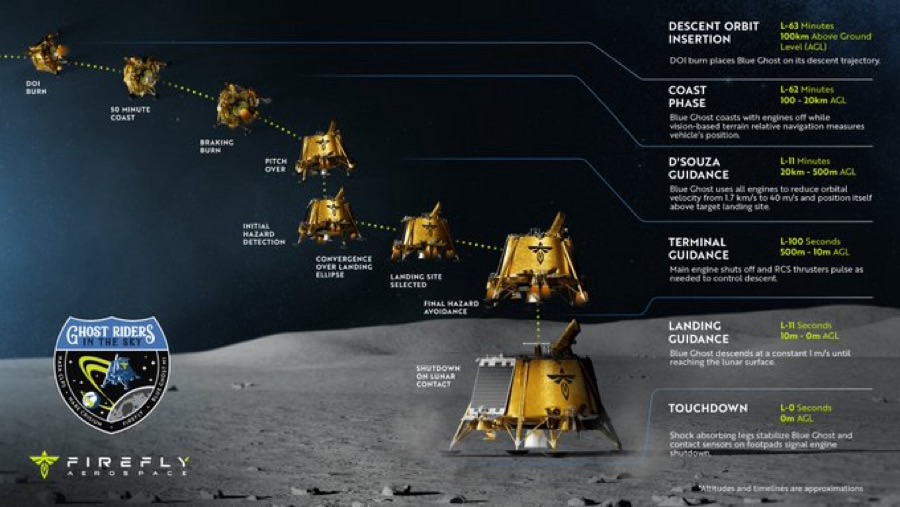
Never forget that at 3:34 AM on March 2, 2025, Firefly’s Blue Ghost lunar lander touched down on the moon’s surface.  It’s the second time a private company achieved a soft lunar landing, indicating many good things to come.  The first was Odysseus from Intuitive Machines almost a year ago.  I know several people at Firefly and know how significant their company is growing in the right direction, and this landing was an important historical marker showing that a smaller commercial company can pull off something like this in a partnership with NASA.  It would take NASA decades to do these launches, and now we see these private companies in a profoundly competitive undertaking, and they are doing so successfully.  There will be many more good things to come from Firefly, which is very exciting, and this goes along with what I have been saying about space.  This landing occurred one day before SpaceX sent Starship 8 into space, and just ahead of Blue Origin, a ship full of women, like celebrity Katy Perry, going into space as if it were just another day at the office.  Space is becoming routine, which is what we want to see happen.  And the moon has needed much more attention than it has received; we should have never stopped going.  I don’t care if aliens were on the moon to scare off Buzz Aldrin and Neil Armstrong, pushing us never to return.  NASA moved into the Space Shuttle program after the Apollo missions, but we have never since the early 70s dared to return to the moon.  Now, we have private companies doing the job that governments were too slow to do themselves.  And it’s all very exciting.  Firefly is a great new company, and it will play a significant role in the expansion of a space economy that I have been talking about for quite some time now.

And while discussing it, I’ll make a few predictions.  Just as Elon Musk is pushing for humanity to get into space and settle on Mars, to ensure that humans survive, I would dare say that this isn’t the first time our species has encountered this problem.  I think we will find that the relics on Mars are from our history and that our move to Earth was for many of the same reasons that we want to now return to Mars.  Not to discover it for the first time but to return there and complete a story that began for us many thousands of years ago.  Elon Musk is simply fulfilling the hard-wired desires that are built into human consciousness to ensure the continuation of the species, in the same way a sperm knows to penetrate the egg within a woman.  We must penetrate space to move our species as a thinking consciousness into the universe, as we were meant to.  On earth as it is in Heaven.  We are meant to ascend into Heaven, to the kingdoms we know from our past, which are in the sky. Mark it on your calendar and remember who told you all this.  Once we move into space and start checking things out, that’s when we are going to learn about ourselves.  The proof is coming.  I would say that it is all around us, hidden behind our institutionalized history.  But that won’t last very long; the evidence is abundant and will be confirmed with a space economy.  I could go into quite a long discussion about hidden lifeforms behind a curtain of Dark Matter made of neutrinos and cold fusion.  But let’s save that for other times.  Instead, let’s talk about the excitement of this growing economy brought to us by commercial-driven space utilization.

At a recent Vivek Ramaswamy governor announcement event at CTL Aerospace, I must have had more than 100 people ask me why I love aerospace.  And I tell them that the future is there.  It’s been like panning for gold in a little mountain stream during the Gold Rush.  I get a lot of offers to make a lot of money doing many things, especially in communications.  But I like to stay close to where the gold is, and I like knowing people like the cool cats at Firefly and other companies.  I get very excited every time SpaceX puts up a new rocket.  From all I know about history and science, I see aerospace as the ultimate gold nugget, and I’ve been committed to it for over four decades.  To use a Western metaphor, I’d rather dig for gold in aerospace than sit in a comfortable job in town as a lawyer or communications expert.  It’s not the money that excites me; the growth of human intellect and what adventure can bring us is the ultimate treasure.  But that doesn’t mean that money doesn’t matter.  But on a scale that I think is better than just some average well-paying job.  The growth of the space economy will far outpace any technical time humans have ever experienced, whether it be steamships, early airplanes, trains, or automobiles.  The space economy will likely contribute hundreds of trillions of dollars to the first to utilize it.  And that, to me, is the best of the big gold nuggets.  But this time we should have learned some critical lessons, to keep the Marxists out of this business, as they dramatically crippled every modern industry that humans have invented.  The Firefly launch is more vital than past attempts when Trump is in office and cheerleading on all these efforts.  So, the resolution rate is much higher than at any other time in history.

I watched Brit Hume on Fox News the other night stumble around perplexed about how Trump thinks he will go into all these tariff wars, cut taxes, and still expand the economy.  As everyone was, he spoke about an economy that they think has seen the climax of its days and that all government management has to be wrapped around managing those fixed assets.  But that’s not where Trump is as he is facing down what we all are, a 36 trillion dollar deficit that is out of control.  If you want to fix that without touching the Social Security and Medicare concept, something dramatic has to happen.  And as I have been pointing out, it’s in this space economy.   With Firefly putting their lunar module on the moon after a drought of 50 years, a half a century.  Our economy has been held back by a lot of Marxist parasites who moved into administrative positions at NASA and the Pentagon and held back human civilization in a very catastrophic way.  However, the more private people have grown more powerful, and the more that government has lost it, the more companies like SpaceX and Firefly have grown and are now doing the big things.  And that is where the future treasures are.  And that is the only kind of treasure I care about in the long line of treasures in any economy.  The best to my mind is in space, and the adventures to come.  And when I see scrappy companies like Firefly have success, I am more than happy for them.  These are fascinating times! 

Rich Hoffman

Click Here to Protect Yourself with Second Call Defense https://www.secondcalldefense.org/?affiliate=20707

SpaceX Does it Again: Crawling out from under Cost-Plus restrictions

For perspective, you can go back through all my writing, millions and millions of words back to 2013 when I wrote an article from Florida about the essential end of the Space Shuttle program and that Obama’s vision for NASA was to partner with Russian cosmonauts for any future space missions.  I was very outraged at the policy, and if I never liked Obama for anything, it was his anti-growth attitude to suppress American exceptionalism as it often presents itself in space travel, that I hated the most.  We were going backward under Obama and Biden, and the only growth we have seen in over two decades came from the four years we had from Trump the first time.  So, I have been very excited about watching the civilian infrastructure for space develop, and anywhere I can help it, I certainly do.  So if I’m more excited these days and very enthusiastic for every day, as many people pointed out to me at a Jags get-together ahead of the inauguration of Trump, I’m sure eventually they’ll understand.  I don’t think people realize what a miracle the week of January 13th was in 2025.  Yes, SpaceX did it again; they landed their Superheavy booster rocket back on the pad it launched from after carrying another Starship into space.  They lost the ship due to a pressure problem that couldn’t gas out fast enough on a new second-generation Starship, and it ruptured the hull, causing the whole thing to break up in the atmosphere.   That was unfortunate but very correctable.  The real trick was repeating the landing of the booster rocket to show that the first time wasn’t an accident.  Watching that rocket capture chopsticks system work now repeatably was a fantastic thing to witness, and it takes us a long way from my complaints about when Obama ended the Space Shuttle program over a decade ago.

But that wasn’t all; just a few hours before SpaceX launched, Blue Origin put their own rocket into space, but this one was carrying a lunar lander from Firefly, a Texas-based company, that was returning to the moon.  Another personal problem I have is with NASA and governments around the world.  I don’t care what anybody found when we went to the moon the first time.  There was no excuse not to have a Hilton there by now so I could vacation on the moon with my family.  This raw, primitive embrace of backward thinking that came to us from both political parties has infuriated me to no end.  When people ask me why I have had my war against public education, it starts with this lack of preparation as a culture to advance people into space.  We should have been doing this since the original moon missions, and as I was growing up, it looked good.  But the Department of Education under Jimmy Carter and the socialist politics that held our society down through labor unions and liberal politics stopped that advancement and I have never been good with it.   If we don’t have a culture pushing for adventures into space, we are deliberately trying to suppress the ambitions of the human race in a very unhealthy way.  So, for me, watching all this space activity just a few days before President Trump’s return to the White House was fantastic and deserved as a subject of massive optimism.  For a culture to produce two space launches like Blue Origin and SpaceX produced, it would have taken NASA a decade to do one of them.  Let alone two significant ones.  We are dealing with good times, finally.

The amount of capacity and bandwidth is the real challenge, and that’s what is changing, which I’ll be pointing out often because I am pretty sure people don’t know what to think of these displays of monumental ambition.  It takes thousands of manhours and intelligence calculations to produce one rocket into space, especially when discussing complicated payloads.  But here we have a culture that did it twice in the same week. Additionally, there are several Falcon rockets that are taking constant payload into space, whether people or satellites for the Starlink system, we have come a long way from the Obama administration sending Americans into space through partnerships with Russia.  As soon as SpaceX realized that they had lost their Starship, they were already planning to pull another out of their manufacturing facility, where several others were waiting, and they were planning another launch next month.  SpaceX expects to launch at least 20 more times in 2025 to develop Starship further.  What they learned from this recent one, even though it burned up in the atmosphere, was extremely valuable compared to the traditional hindrances of a cost-plus company.  The way SpaceX is attacking the problem is the definition of how these things will be done in the future, and it embodies a whole new view of manufacturing that is escaping the clutches of global socialists like Obama, who were deliberately trying to hold back humanity.   It’s one of those situations in which small-minded people have been trying to destroy society to rule over the ashes.  And these new manufacturing methods being developed at SpaceX are a rebellion against that sentiment.  And it’s precisely what space needs for humans to colonize the stars.  Other companies are now moving in that same direction regarding the “rate of resolution.”

Cost-plus companies have been hijacked by all kinds of horrible forces that have held back the aerospace industry since the first moon landing.  When parasitic characters realized they could stall contracts and make money off ignorant governments for more congressional money to be thrown at the trolls to build something, trouble was clearly on the horizon.  That’s why space had to move into civilian care because there was looting politics in government control that held us back with people like Obama.  A setback like Starship had at SpaceX this week would have stopped advancement at a typical cost-plus company for a decade in the past.  Instead, Elon Musk said immediately that the plan was to roll out another Starship and get ready for a second try next month.  The only thing that will hold them back is the speed of government, which will increase dramatically once Trump is back in office.  There is a lot to be very excited about, and I am.  It’s not just about going to space that is exciting; it is about watching the human race crawl out from under a very oppressive political climate and an education system that has sought to cripple us purposely.  Not to inspire us to grow.  And due to all that, we see that the human race is doing big things again, and the American culture, which has produced the world’s wealthiest people, is putting that wealth to good use in adventure and enterprise.  As good as this past week was, and it was, I see under the incoming Trump administration launches like that happening every single day.  I don’t think people realize yet how important all this is and what it will do for us.  But I can see it and am very excited about what’s coming.   In many ways, it’s a dream come true. 

Rich Hoffman

Click Here to Protect Yourself with Second Call Defense https://www.secondcalldefense.org/?affiliate=20707

Blue Origin’s Spaceflight: The unfortunate cost of being one of the world’s most hated men

What Should Have Been

I wanted to enjoy the rocket launch of Blue Origin as it occurred in July of 2021.  But, hey, it’s Jeff Bezos. I’ve written many good articles on Bezos in the pre-Trump days, but he’s come out as so anti-Trump, that it’s impossible to like the guy.  But as a big fan of commercialized space and the steps Bezos had played in making it more of a reality, I did my best to put all that aside to support what he did when he went to space with three other people to prove that traveling into space could be so easy that anybody could do it.  And it was, the space flight itself was great.  The Blue Origin rocket itself was brilliant.  It took off effortlessly with minimal infrastructure and flew out into space without any sign of struggle.  The booster rocket returned to earth and landed like a special effect from some excellent science fiction movie.  It was so good that it didn’t look real.  Then, the capsule containing the passengers came back to earth and landed almost where they had all taken off.  Nobody emerged from the vehicle looking chaotic or stressed out. It was smooth as silk and quite an achievement for commercial spaceflight.  Jeff Bezos even wore a cowboy hat before and after to understand the kind of mentality it will take to commercialize space. That space flight itself did not have to involve pressure suits and other inconveniences.  In all those ways, the flight was enormously successful. However, spaceflight was never going to be the problem.  The problem was Bezos himself.  As one of the world’s wealthiest people, that, of course, makes him a target of every bootlicker there is.  Add to that the awkward nature of Bezos himself, where he always comes out sounding like a Bond villain, even at a birthday party, and the PR for the spaceflight was just terrible. 

After what Amazon did to Parler after the Trump election of 2020, it was the final straw for me.  Amazon is a great place to buy books and just about anything else you might want, but now they had made themselves political activists, and that was the beginning of their eventual doom.  Their branding would be harmed forever.  Now that won’t matter, but it will slowly rot Amazon in the years to come because they essentially alienated 80 million Trump-voting Americans, which will be a real problem in the future.  I responded by moving my book, The Gunfighter’s Guide to Business, from Amazon’s Bookbaby and moved it to a more conservative publisher, which took some effort.  Amazon is the largest bookseller globally, so my current publisher lists books there, but I was not about to publish my book with Amazon, even though they have tremendous resources.  It comes down to Jeff Bezos and his activism that is the problem.  I often forgive, to some extent, rich people and how they have to appease the mobs of progressivism. Still, Bezos has gone too far in trying to control the corrosive elements of progressivism by becoming one of its spokesmen.  And that is what ruined his spaceflight.  After the historic flight, Bezos gave $100 million as a donation to liberal causes to the communist Van Jones, which was simply unforgivable. 

I get it; Bezos didn’t have any blacks on the space flight, so he had to do something for the black community to justify his picks for space.  But that didn’t stop the onslaught of hatred that emerged after the flight, everything from the rocket looking like a penis to Bezos’s cowboy hat during the journey.  People don’t like Bezos because he presents himself as a progressive hack.  Like many other modern people of great wealth, they think the future is in globalism, so they have worked against American tradition to favor a change state government that liberals will run.  And that dream is falling apart in their hands, running like water between their fingers, and Bezos seems to have an understanding of that.  After all, Amazon knows that conservative books are outselling liberal books by a lot so that the trend won’t be going in the direction of Van Jones.  Bezos has gone all-in on betting that liberalism would win anyway, and that has created a level of tension that is ever-present with anything attached to Blue Origin.  Of course, Bezos shares that problem with the Walt Disney Company who has also gone all-in on a progressive world of tomorrow.  But like Virgin Galactic’s journey to space, they made the mistake of miscategorizing space travel as an extension of preserving the earth rather than escaping from it.  Bezos made comments about looking back on the earth from space and appreciating that we are all in it together or something stupid like that; it came out sounding terrible.  Not something people could feel proud of. 

That’s the sad part of the story; what should have been a great day came out as a bla.  A perfect feat of engineering that involved many thousands of people turned out to be all about the odd personality of Jeff Bezos.  Nobody cared about his mom, his brother, or the other passengers because the entire event came out as a pr appeasement of progressive erosion to give a rich person a ride into space.  The scope of the effort was lost in the hatred toward Jeff Bezos by a public that decided it just doesn’t like him.  And if he were the kind of person who could care less, it would at least be honest.  But he tries to pull the shades over everyone’s eyes, including Van Jones.  To cover that ground of oddness, he just tossed $100 million to a devout global communist from CNN, giving more power to an enemy of Americana all the while trying to appeal to the cowboys and Trump voters by wearing the cowboy hat.  What he ended up doing was making everyone mad.  The story of space was lost in the drama, which is saying a lot.  With such an outstanding achievement into the vastness of space, all people saw was a way to poke fun at Bezos, one of the world’s most hated people.  But people don’t tell him they hate him because they want a chance to maybe get some money from him at some point.  Yet as I say all the time, you can tell a lot more about people by what they do, not necessarily what they say.  And that is what came in the aftermath of the Blue Origin space flight; people could only find fault in an otherwise faultless flight.  A journey to space without error, as predictable as the hands on a clock, but as hated as a pile of cow dung.  The public would have instead had anybody else go to space aside from Jeff Bezos. That’s what’s sad about the effort; rather than advance space travel, it had the feeling of setting it back by decades.  Giving that big check to a communist as payment for letting the socialists and the communists of the world let Bezos go to space came out as an ominous message of appeasement rather than freedom.   It said to the world that we are slaves to it and the communist greenie weenies who inhabit its service like a virus of thought that seeks to chain humans to earth forever and never let go. 

Rich Hoffman

Click to buy The Gunfighter’s Guide to Business

The Next Big Thing: Cheering on Richard Branson and his wonderful company Virgin Galactic

Putting politics aside which is hard to do because ultimately everything is political, but considering our modern conditions, those definitions are changing by the moment. I am and have always been a very excited person for everything new little thing that comes along as I am very much in love with the things that humans imagine. Nature is nice too, but I really like what humans do with the tools provided by nature and to see how civilization can advance. While many look at cell phones and the hyper communications that come with them as dangerous to the old order of doing things I think it’s all part of our natural evolution as a species accelerating toward some yet to be known destination. While everyone who knows me understands how much I love tradition particularly the American western mythologies and concepts, I am very much an achievement driven person excited for tomorrow in so many ways. And that is why despite his politics, I have been very much a fan of Richard Branson’s Virgin Galactic endeavors. And according to him from the interview shown below, he still plans to get his space airline into space before Christmas of this year, which would be a great feat. I am very much hopeful that he will be successful.

It’s been coming along for a while now, but if it is considered the sheer amount of information that is coming at us so fast and furious these days as opposed to when man landed on the moon in 1969 the human race is scratching at a huge change in thought and processing. As I was catching up on what Virgin Galactic was up to and if they were going to meet their timeline one of the lead stories on the Microsoft News dashboard was the newly recorded sounds of Mars as captured by the recent rover that just landed there. Much of this past week due to the very good series on the National Geographic Channel about colonizing Mars radio broadcasts across the country were contemplating what the steps to such an act would look like and what we’d all do once we got there. Elon Musk has after all been turning up the heat for his own departure from earth to live on the ancient red planet. I see many of his antics such as the smoking pot incident on a recent podcast as his teenage moment of creating enough escape velocity for himself to make the journey. He is sabotaging his own relationship with the earth so that he can psychologically make that journey to be the first to live on Mars. Jeff Bezos of Amazon is about to unleash a series of space endeavors that are quite ambitious with his Blue Origin company. Between all these adventurous billionaires fueled by childhood loves of movies like Star Wars and Star Trek compounded by a strong deregulatory economy by the Trump administration—the primer is set for some very exciting technological breakthroughs on the frontier of space.

As I was playing Red Dead Redemption 2 by Rockstar Games on my PlayStation 4 and started messing around with the online play with many thousands of other players all over the world simultaneously, I couldn’t help but think of how subconsciously as a human species this visit to the western genre was necessary for our current age to accept what was about to happen. It’s not the safety of the herd that the human race is after, it’s the rough existence away from the support of civilization for which adventure promises great rewards and many opportunities for death. This next generation needs to be someone reckless and masochistic in order to endure the rigors of a dynamic shift in human consciousness, leaving the comfort of our earth and scratching at the unlimited barriers of space travel. Presently we call space anything over 62 miles, or anybody who travels over 50 miles and astronaut. We think of the moon as a long way away, and Mars prohibitively distant. But all those definitions are about to change just as they did in the period of American westward expansion once electricity and phone communications shrunk the world with power. The main observation I had about that great video game was that human beings needed to revisit that last period of adventure and see what it looked like so that they could take this next big journey.

I don’t really like the term “collective consciousness” because it assumes that we are all functioning out of one great well of wisdom which is not what I think is going on. Rather, there are certain rational decisions that are common to reality so it is bound to be a mathematical probability that all humans will come to similar conclusions just by the mandate of deductive reasoning. And that is why texting is more interesting than talking to an actual person for most people, the human mind to seek out the rapid communication forms that come from something like a modern smart phone as opposed to a very static conversation with one single human being is needed for the world of tomorrow, where information must be process quickly as our knowledge base explodes from what was previously understood. Young people especially will have to think much faster than humans do today and be shocked by much fewer discovers than previous generations just to keep up with all the news stories that will began to demand our attention as the frontiers of space are unzipped.

Aerospace is one of my favorite industries due to its exploratory nature. I desire to be a part of it as much as possible and to be quite honest, I love every day of my life because I am. I love to help build the vehicles that take humans to the frontiers of our imagination and I have had a front row seat to many of these new developments. So out of a love of adventure which transcends politics, I am happily cheering on the events of these coming days. Richard Branson has worked hard with his team to get into space first and if he doesn’t make it soon, Elon Musk and Jeff Bezos will overtake Virgin Galactic. So he doesn’t have all the time in the world, competition and capitalism demand results and the pressure is certainly on. If Branson can get into space by Christmas of 2018 it would be a life changing moment for many people around the world. But if Christmas comes and goes and Virgin Galactic is still mired in testing, then Blue Origin or SpaceX will get there first. This new space race isn’t between nations and governments, it between billionaires and capitalist mandates and that is redefining everything rapidly.

Humans are such conceptual creatures and once we get an idea in our heads reality has a way of growing around it. And from what I see that growth will spawn entirely new industries and lifestyles. There is great reason to be optimistic. Once space tourism is unleashed, likely by Virgin Galactic first, our conceptual knowledge will expand at such a pace that the world has never witnessed. We have been preparing ourselves for this age for years with the rapid digestion of so much information. It’s not by accident or greed, it’s all by necessity. As I’ve said many times my goal in a very busy life is to read at least one book a week, but I am even feeling the pressure to read not just one, but five. So grudgingly I have turned to audio books for some of them because by necessity I need the information coming at me faster than I could possibly read everything and still do everything else needed in an 18-hour work day which is pretty typical. We are all going through a similar transition and that’s what it takes to live and grow in an expanding economy driven by human adventure and curiosity. And much of that next phase starts when Richard Branson gets his Virgin Galactic space tourism over that 50-mile line where humans become technically astronauts.

Rich Hoffman

Sign up for Second Call Defense here: http://www.secondcalldefense.org/?affiliate=20707 Use my name to get added benefits.