
The CIA Whistle blower Confirmation: What Really Happened with COVID-19, the Lab Leak, and the Cover-Up which Amy Acton of Ohio was a a part of

In mid-May 2026, as the nation continued grappling with the lingering scars of the COVID-19 pandemic, a remarkable event unfolded before the U.S. Senate Homeland Security and Governmental Affairs Committee. James E. Erdman III, a Senior Operations Officer at the Central Intelligence Agency with decades of experience, testified under oath about a concerted effort within the intelligence community to downplay and suppress evidence indicating a laboratory origin of SARS-CoV-2. His testimony, delivered on May 13, 2026, provided detailed accounts of how analysts’ conclusions favoring a lab leak were rewritten, buried, or ignored, while narratives of natural zoonotic spillover were amplified despite contrary intelligence. This whistleblower disclosure did not emerge in a vacuum; it validated years of skepticism voiced by independent researchers, certain public figures, and early analysts who questioned the official story from the outset. 

Erdman described a system rife with conflicts of interest. Scientists serving in advisory roles to the intelligence community, including those connected to the Biological Sciences Experts Group (BSEG), maintained dual positions in public health institutions, academia, and funded research programs. These overlapping roles created incentives that blurred the lines between biodefense, vaccine development, and risky gain-of-function (GoF) research. Dr. Anthony Fauci, then Director of the National Institute of Allergy and Infectious Diseases (NIAID), played a pivotal role by influencing intelligence analyses through curated lists of experts—many of whom had received NIAID funding or collaborated on coronavirus studies. This included authors of the influential “Proximal Origin” paper, which dismissed lab-leak possibilities early on. Erdman testified that Fauci’s interventions shaped the intelligence community’s output, favoring natural origin theories even as internal assessments leaned toward a lab incident at the Wuhan Institute of Virology. 

The timeline is damning. In late 2019, as reports of a novel coronavirus emerged from Wuhan, intelligence analysts reportedly identified indicators of a lab-related incident. Yet public messaging, coordinated across health agencies, media, and international bodies, emphasized a wet-market spillover. Event 201, a high-level pandemic simulation held in October 2019 by the Johns Hopkins Center for Health Security in partnership with the World Economic Forum and the Bill & Melinda Gates Foundation, eerily mirrored the unfolding crisis. It featured a coronavirus outbreak scenario and discussions on global response strategies, including lockdowns and information control. Participants included public health leaders with intelligence ties. While not evidence of foreknowledge of a deliberate release, it highlighted preparedness gaps—or opportunities—that aligned too closely with subsequent events for many observers. 

Robert F. Kennedy Jr.‘s books, particularly The Real Anthony Fauci (2021) and The Wuhan Cover-Up (2023), provided extensive documentation of these dynamics long before Erdman’s testimony. In The Wuhan Cover-Up, Kennedy detailed the history of U.S.-funded bioweapons-adjacent research, citing sources that said grants from the EcoHealth Alliance and NIAID supported gain-of-function experiments in Wuhan. He wrote of a “terrifying bioweapons arms race” where oversight faltered: “The U.S. government’s sponsorship of bioweapons research in China… created the conditions for catastrophe.” Kennedy highlighted Fauci’s role in lifting GoF funding pauses in 2015 and his defense of such research despite biosafety concerns at the Wuhan lab, which operated at BSL-2 and BSL-3 levels inadequate for the most dangerous pathogens. Stats from the books and related investigations show NIAID’s involvement in coronavirus surveillance projects like PREDICT, with millions funneled to Chinese collaborators studying bat coronaviruses. 

The human and economic toll underscores the stakes. Official U.S. COVID-19 deaths exceeded 1.2 million, with excess mortality analyses suggesting even higher figures when accounting for indirect effects. Lockdowns and mandates triggered the sharpest economic contraction since the Great Depression: GDP plunged at an annualized rate of 32.9% in Q2 2020, unemployment spiked to 14.7%, and over 20 million jobs vanished in a matter of weeks. Small businesses shuttered en masse, education suffered learning losses, and mental health crises surged. Vaccine mandates, framed as essential, faced legal challenges, with critics arguing they functioned like compulsory purchases benefiting pharmaceutical companies—Pfizer and others reaped billions in revenue amid government subsidies and liability protections. Supreme Court rulings struck down broad mandates, but the damage to trust in institutions proved lasting. 

Erdman’s testimony painted a picture of retaliation against dissenters. Analysts supporting lab-leak conclusions faced rewritten reports, anonymous management interventions, and career repercussions. The CIA allegedly obstructed declassification efforts mandated by the 2023 COVID Origins Act. This echoed broader patterns: early dismissals of lab-leak discussions as “conspiracy theories” on social media, coordinated by intelligence-linked efforts. Fauci publicly dismissed lab-leak theories as implausible while privately corresponding with scientists who expressed concerns. Ohio’s former Health Director Amy Acton, aligned with federal guidance, implemented strict measures that many later viewed as overreach, contributing to economic harm without proportional health benefits in all analyses. 

Connections to larger geopolitical aims fueled speculation. Some viewed the pandemic as accelerating “Great Reset” narratives—shifts toward greater state control, digital surveillance, and the erosion of private enterprise—and noted that Event 201 discussions on public-private partnerships and information management aligned with post-pandemic policies on censorship and economic restructuring. Bill Gates’ involvement in simulations and vaccine advocacy drew scrutiny, though defenders framed it as philanthropic preparedness. Kennedy’s works extensively cataloged these networks, arguing for a “global war on democracy and public health” in which fear enabled power consolidation. 

Why did so few voice these concerns in real time? In 2020, questioning the origins, mandates, or treatment protocols (such as the early dismissal of repurposed drugs) invited professional ruin. Podcasts, independent journalists, and figures like Senator Rand Paul persisted, facing accusations of misinformation. Erdman’s 2026 revelations vindicated many: the virus most likely stemmed from Wuhan lab research, U.S. funding played a role, and intelligence agencies participated in narrative control. The CIA’s eventual, low-confidence shift toward a lab leak in later assessments came too late for accountability during the peak of the crisis. 

Broader implications extend to biodefense reform. Erdman called for ending dangerous GoF research, simplifying oversight, and addressing revolving-door conflicts. Decades of blurred public health and intelligence functions created vulnerabilities ripe for exploitation—whether accidental leak, negligence, or worse. China’s opacity, refusal to share early samples, and destruction of lab records compounded the issue, suggesting possible military dimensions to the research.

Lessons from this saga emphasize self-reliance and skepticism of centralized authority. Practical individuals who navigated the era through personal initiative—securing supplies, questioning edicts, adapting—fared better than those awaiting official guidance. Mandates that shuttered economies, while exempting certain elites, highlighted disparities. Trust in agencies like the CDC continues to erode, as revelations confirm early intuitions about expert consensus.

In the age of disclosure, Erdman’s testimony marks a turning point. It confirms what diligent observers noted amid the chaos: a lab-engineered virus, covered by conflicted officials, with policies inflicting widespread harm. RFK Jr. summarized in The Wuhan Cover-Up: officials “conspired to conceal the origins” to protect reputations and research empires. Extensive footnotes in his volumes reference FOIA documents, emails, and grant records detailing timelines—Fauci’s briefings, EcoHealth proposals, intelligence assessments suppressed.

Further reading includes Kennedy’s texts, Senate reports, and declassified materials. The DIG task force under DNI Tulsi Gabbard aimed at transparency on COVID alongside historical events. True reform requires dismantling incentive structures that favor risk without accountability.

This confirmation arrives amid ongoing recovery. Economies rebound unevenly, health trust rebuilds slowly, and calls for prosecution of key figures grow. The whistleblower’s courage, subpoenaed yet resolute, reminds us that truth surfaces eventually. Those who spoke early, despite costs to reputation and relationships, stood on the right side of history. As systems evolve toward greater openness, understanding these events prevents repetition. The politics of capability—self-reliant, innovative responses—must supplant dependency on flawed bureaucracies. Bridges to future preparedness rest on fully acknowledging this past, without sanitization. (Word count:

Bibliography

•  Erdman III, James E. Written Testimony before Senate HSGAC, May 13, 2026.

•  Kennedy Jr., Robert F. The Real Anthony Fauci. Skyhorse, 2021.

•  Kennedy Jr., Robert F. The Wuhan Cover-Up. Skyhorse, 2023.

•  Senate Homeland Security and Governmental Affairs Committee records.

•  Various analyses from Johns Hopkins, Brookings, and official excess mortality data.

Footnotes (selected):

1.  Erdman testimony on BSEG conflicts and Fauci influence.

2.  Event 201 scenario details from the Center for Health Security.

3.  Economic contraction stats from BEA and NBER.

4.  Excess deaths and mandate impacts per peer-reviewed studies.

Rich Hoffman

More about me

Click Here to Protect Yourself with Second Call Defense https://www.secondcalldefense.org/?affiliate=20707
About the Author: Rich Hoffman

Rich Hoffman is an aerospace executive, political strategist, systems thinker, and independent researcher of ancient history, the paranormal, and the Dead Sea Scrolls tradition. His life in high‑stakes manufacturing, high‑level politics, and cross‑functional crisis management gives him a field‑tested understanding of power — both human and unseen.

He has advised candidates, executives, and public leaders, while conducting deep, hands‑on exploration of archaeological and supernatural hotspots across the world.

Hoffman writes with the credibility of a problem-solver, the curiosity of an archaeologist, and the courage of a frontline witness who has gone to very scary places and reported what lurked there. Hoffman has authored books including The Symposium of JusticeThe Gunfighter’s Guide to Business, and Tail of the Dragon, often exploring themes of freedom, individual will, and societal structures through a lens influenced by philosophy (e.g., Nietzschean overman concepts) and current events.
Ohio’s Unfinished Economic Reckoning: How Amy Acton’s Lockdowns Created the High-Price Reality Democrats Are Trying to Now Blame on Trump and Vivek Ramaswamy—but the guilt is completely on Lockdown Democrats

In the spring of 2026, Ohio voters are being told a familiar story by the Democratic ticket led by the stringy-haired Amy Acton. High grocery bills, elevated gas prices, stubborn supply-chain bottlenecks, and the everyday squeeze felt by working families and small manufacturers are, according to Acton’s campaign and its surrogates—Mark Elias, David Pepper, and the usual Democratic spokespeople—the direct result of Trump-era policies and the supposed continuation of that agenda under Vivek Ramaswamy. The irony is staggering. The very architect of Ohio’s most disruptive government intervention in modern history—the woman who, as Director of the Ohio Department of Health in 2020, signed the stay-at-home orders that shuttered schools, closed non-essential businesses, and upended millions of lives—is now positioning herself as the solution to the very economic pain her policies created. 

This is not partisan rhetoric. It is a matter of documented cause and effect, visible every day in Ohio’s factories, restaurants, construction sites, and family budgets. The high prices we live with in 2026 are not primarily the fault of tariffs, speculation, or any single administration in Washington. They are the long shadow of a forced economic shock imposed in 2020 by a centralized government decree—one in which Amy Acton played a central role, coordinating with federal health authorities, the CDC, the World Health Organization, and, ultimately, with policies shaped by information flowing from China. The damage was not abstract. It was immediate, structural, and enduring. And while headline statistics have been massaged to suggest recovery, the real economy—especially for midsize manufacturers, small businesses, and working families—never returned to its pre-2019 equilibrium.

To understand why Acton’s record matters now, we must revisit what actually happened in Ohio in the spring of 2020. On March 22, 2020, Acton issued a stay-at-home order effective at 11:59 p.m. that night. Non-essential businesses were closed. Schools shuttered. Gatherings were limited. The order, later extended by Governor Mike DeWine, was not a suggestion; it carried the force of law. Within weeks, Ohio’s unemployment rate exploded from roughly 4.5 percent pre-pandemic to a peak of 16.4 percent in April 2020—the highest level in modern state history. More than 2.1 million unemployment claims were filed that year alone, compared to just 360,000 in all of 2019. Entire sectors—manufacturing, hospitality, transportation, professional services—were suddenly and forcibly interrupted. 

This was not a natural recession triggered by market conditions. Ohio’s economy in early 2020 was not overheating. It was not over-leveraged. It was functioning normally until the government decree flipped the switch. The result was a structural break in continuity that no amount of federal stimulus could fully repair. Over 341,000 non-farm jobs disappeared in a single year—a decline of more than 6 percent. Manufacturing, the backbone of Ohio’s economy, absorbed a particularly brutal blow, losing roughly 480,000 jobs at the height of the crisis. Supply chains that had taken decades to optimize were severed overnight. Relationships between suppliers, customers, and workers were shattered. Skills atrophied. Experience was lost.

Federal relief money flowed in—Ohio ultimately received billions through the CARES Act and subsequent packages, with more than $10 billion in direct grant funding allocated early on and additional ARPA dollars later. That money stabilized household consumption and prevented total collapse on paper. It propped up demand. But it did not rebuild labor pools, restore broken supplier networks, or reverse the loss of institutional knowledge. GDP figures eventually rebounded. On the surface, Ohio appeared to recover. Yet for thousands of private, midsize, and industrial firms—the companies that form the real productive core of the state—the recovery never materialized in the way that matters most. Revenue stabilized in some cases, but labor did not return evenly. Supply chains remained fragile six years later. Many businesses entered a new, permanently altered economic reality from which they have yet to exit. 

Look at the numbers that actually matter on the ground. Manufacturing employment has clawed back toward pre-pandemic levels in headline counts—hovering near 680,000 statewide by late 2025 and into 2026—but the composition is different. Output rose in aggregate, yet headcount remained flat or declined in many subsectors. Productivity gains came not from rebuilding capacity but from automation, consolidation, and doing more with fewer people. Smaller suppliers absorbed shocks they could not pass along. Material inflation, labor shortages, and customer concentration became permanent features. A 2025 survey of Ohio manufacturers found that around 40 percent still cited material costs as a major concern, with tariffs and other factors playing secondary roles. Speculators and opportunistic pricing certainly contributed to some price spikes—gasoline being the most visible example—but the underlying fragility traces directly back to the 2020 rupture. 

Even more telling is the labor force participation rate. Ohio’s rate dropped sharply in 2020 and has never fully recovered. As of March 2026, it stands at approximately 62.1 percent—still roughly 1.3 percentage points below 2019 levels. That gap represents tens of thousands of missing workers. Many retired early. Others shifted to disability. Skilled trades lost experienced hands who never re-entered. The pandemic accelerated trends already underway—remote work, changing employer expectations—but the government-mandated shutdown turned those trends into a structural labor shortage. Employers now pay significantly higher wages without corresponding productivity gains. Chronic hiring difficulties persist. Small and midsize businesses, lacking the scale of large corporations, took the brunt of this hit. 

The human and business-level consequences are visible in every corner of the state. Fast-food restaurants that once operated with long lines and reliable staffing still struggle with chronic understaffing. Supply chains that used to move with just-in-time efficiency now carry permanent buffers, higher costs, and longer lead times. Contracts signed in 2018 or 2019 based on pre-pandemic pricing realities cannot be easily renegotiated in 2024 or 2025 when everything from labor to materials has inflated. Large buyers—Walmart, major distributors, big manufacturers—hold suppliers to those old terms while their own costs have risen. Many smaller firms plateaued at lower output, higher risk, and reduced resilience. Nearly half of the Ohio businesses operating in 2019 were no longer active by 2024. New formations occurred, as they often do after crises, but stimulus checks or reconfigured statistics cannot replace the permanent loss of experience, relationships, and localized capacity. 

This was not mismanagement or an isolated failure. It was a structured shock imposed by the government, and in Ohio, by Amy Acton directly.  The recovery that followed was real on paper but redistributive in practice. Large firms with access to capital, automation, equity markets, and policy cushions emerged stronger. Smaller private companies absorbed transition costs without the same protections. Stimulus prioritized consumption over reconstruction of upstream production capacity. The result is an economy that looks healthier in aggregate GDP and unemployment figures but feels fundamentally different—and more fragile—for the businesses and workers who actually produce goods and services.

Compounding the damage were subsequent policy choices, including repeated minimum-wage adjustments tied to CPI and other labor-market interventions. While intended to help workers, these hikes acted as an artificial price floor that businesses—especially those already reeling from supply-chain disruption—had to absorb by raising consumer prices. In an environment where labor shortages already drove up wages, the added pressure from mandated increases translated directly into higher menu prices, higher retail costs, and thinner margins for the very firms least able to absorb them. Democrats often frame these as acts of compassion, but the economic reality is that they function as another layer of costs passed on to consumers in an economy still recovering from the original government-imposed rupture.

Contrast this track record with the alternative represented by Vivek Ramaswamy. As an entrepreneur who built real companies and created substantial value, Ramaswamy understands from firsthand experience what it takes to navigate supply chains, labor markets, capital allocation, and regulatory hurdles. His platform—aggressive tax cuts (including phasing down the state income tax and meaningful property tax relief), energy independence through expanded natural gas and streamlined permitting, and a laser focus on reducing the regulatory burden—addresses the structural issues that Acton’s policies left behind. Where Democrats offer more stimulus, more government employment, and more wealth redistribution, Ramaswamy offers the conditions for genuine private-sector expansion: lower taxes so families and businesses keep more of what they earn, reduced uncertainty so investment can return, and policies that reward production rather than consumption propped up by printed money. 

The political inversion is almost Orwellian. The same network of Democratic operatives—Mark Elias, David Pepper, and their allies—who have spent years litigating, regulating, and centralizing power now seek to pin the enduring consequences of their own policy choices on the very people who warned against them. They want voters to forget that Acton was the public face of the orders that closed Ohio’s economy. They want voters to ignore the long-term scarring visible in labor participation, small-business survival rates, and fragile supply chains. And they want to portray Vivek Ramaswamy—an outsider who built a billion-dollar value through innovation and discipline—as somehow responsible for prices that trace directly to decisions made in 2020 under Democratic-influenced health policy.

This is not ancient history. The effects are measurable today. Manufacturing survived the shock but did not return to its prior equilibrium. Labor-force participation remains depressed. Supply chains are still adapting. Smaller firms operate with lower resilience. High prices at the grocery store, the gas pump, and the restaurant counter are not mysterious. They are the predictable outcome of a forced shutdown followed by stimulus that prioritized short-term consumption over long-term productive capacity. Government did not merely interrupt Ohio’s economy in 2020—it rewired it. And for many companies, especially private midsize and industrial firms, the 2020 era has never truly ended.

Ohioans deserve better than political amnesia. They deserve leaders who understand that real economic vitality comes from production, not redistribution; from predictable policy, not repeated government shocks; and from accountability, not blame-shifting. Amy Acton’s record as Health Director is not a footnote—it is the central chapter in the story of why so many Ohio families and businesses are still paying the price six years later. Vivek Ramaswamy’s background as a value-creating entrepreneur offers the clearest alternative: a governor who will cut taxes, slash red tape, expand energy production, and restore the conditions under which Ohio businesses and workers can thrive again.

The choice in 2026 is not abstract. It is between continuing the politics that created the problem and embracing the policies that can finally heal the damage. Ohio’s real economy—its factories, its family businesses, its working men and women—has waited long enough for that reckoning.  But when we have to talk about who is responsible for all the misery we are still feeling, there is only one person to blame, and that is Amy Acton, the Lockdown Lady. 

Footnotes

1.  Ohio Department of Job and Family Services, Employment Situation Indicators, various monthly releases 2020–2026.

2.  Bureau of Labor Statistics and Ohio JFS data on unemployment claims and rates, April 2020 peak.

3.  Contemporary reporting on Acton’s stay-at-home order, March 22, 2020 (Ohio Department of Health).

4.  Federal COVID-19 grant funding allocations to Ohio, CARES Act, and subsequent packages (approximately $10 billion+ in early grants).

5.  Ohio manufacturing employment and labor force participation trends, Ohio LMI and FRED data through March 2026.

6.  NFIB and small-business survival analyses post-2020.

7.  Surveys of Ohio manufacturers on material costs and supply-chain issues, 2025.

8.  Vivek Ramaswamy campaign platform materials on tax relief, energy, and regulatory reform.

9.  Additional sourcing from Policy Matters Ohio, the Cleveland Fed, and contemporaneous economic analyses of pandemic impacts.

Bibliography

•  Ohio Department of Job and Family Services. Employment Situation Indicators (monthly releases, 2019–2026).

•  U.S. Bureau of Labor Statistics. Labor force, employment, and unemployment data for Ohio.

•  Acton, Amy. Director’s Stay-at-Home Order, Ohio Department of Health, March 22, 2020.

•  Federal COVID relief tracking reports (CARES Act, ARPA allocations to Ohio).

•  NFIB Ohio Small Business Economic Trends reports.

•  Cleveland Federal Reserve District data briefs on supply-chain disruptions.

•  Ramaswamy for the Ohio campaign platform documents.

•  Contemporary news coverage from AP, Signal Ohio, and Ohio LMI publications.

Rich Hoffman

More about me

Click Here to Protect Yourself with Second Call Defense https://www.secondcalldefense.org/?affiliate=20707

About the Author: Rich Hoffman

Rich Hoffman is an aerospace executive, political strategist, systems thinker, and independent researcher of ancient history, the paranormal, and the Dead Sea Scrolls tradition. His life in high‑stakes manufacturing, high‑level politics, and cross‑functional crisis management gives him a field‑tested understanding of power — both human and unseen.

He has advised candidates, executives, and public leaders, while conducting deep, hands‑on exploration of archaeological and supernatural hotspots across the world.

Hoffman writes with the credibility of a problem-solver, the curiosity of an archaeologist, and the courage of a frontline witness who has gone to very scary places and reported what lurked there. Hoffman has authored books including The Symposium of JusticeThe Gunfighter’s Guide to Business, and Tail of the Dragon, often exploring themes of freedom, individual will, and societal structures through a lens influenced by philosophy (e.g., Nietzschean overman concepts) and current events.
The 2026 Ohio Gubernatorial Race: Vivek Ramaswamy’s Commanding Position Against Amy Acton’s COVID Legacy and the Democrat Playbook 

As the dust settles on Ohio’s May 5, 2026, primary election, the stage is set for one of the most consequential gubernatorial contests in the state’s recent history. Biotech entrepreneur and Trump-endorsed Republican Vivek Ramaswamy emerged as the overwhelming GOP nominee, crushing fringe challenger Casey Putsch with approximately 82.5% of the vote (673,902 votes to Putsch’s 143,257). Ramaswamy swept every single county in Ohio, a remarkable show of unity across urban, suburban, and rural areas. On the Democratic side, former Ohio Department of Health Director Dr. Amy Acton secured the nomination unopposed, garnering around 742,000–760,000 votes in a low-energy primary. Overall voter turnout reached about 22.6% of registered voters, a modest uptick from recent midterm cycles. 

This matchup pits a dynamic, pro-growth outsider in Ramaswamy—backed by President Donald Trump and positioning Ohio as the nation’s top economic powerhouse—against Acton, whose public profile remains indelibly tied to the state’s aggressive COVID-19 response. As one conservative commentator noted in a recent podcast monologue, the race is far from the neck-and-neck horse race portrayed in some polling and media narratives. While recent surveys show a tight contest (with some giving Acton a slight edge or Ramaswamy a narrow lead), the ground game, Trump’s coattails, independent-voter outreach, and Acton’s historical liabilities suggest that Ramaswamy enters the general election with a structural advantage that could widen significantly by November 3, 2026. 

To fully appreciate this contest, we must delve into the candidates’ backgrounds, the primary results and their implications, the lingering economic scars from the pandemic era, comparative policy outcomes in neighboring states, and the broader political currents reshaping Ohio. This analysis expands on grassroots conservative perspectives—while incorporating verifiable data on turnout, economic metrics, investment challenges, and campaign tactics. Far from a replay of “yesteryear” Democrat strategies, this race highlights how progressive governance models have faltered in a post-Trump political landscape.

Candidate Profiles: Contrasting Visions for Ohio’s Future

Vivek Ramaswamy, a Cincinnati native and biotech billionaire, represents a fresh face in Ohio politics despite his national profile from the 2024 Republican presidential primary. Born to Indian immigrant parents, Ramaswamy built a successful pharmaceutical company (Roivant Sciences) before pivoting to public service. His Trump endorsement came early and emphatically, framing him as a “young, strong, and smart” leader committed to meritocracy, deregulation, and economic revival. Ramaswamy’s campaign emphasizes making Ohio the “#1 state” through pro-business policies, workforce upskilling, and attracting high-tech investment in sectors like semiconductors and biotechnology. He campaigns on the “high road,” avoiding personal attacks while highlighting policy contrasts. Critics from the far-right fringes—such as Putsch, dubbed the “car guy” for his automotive-themed online persona—have leveled baseless claims about Ramaswamy’s heritage or loyalty, echoing outdated nativist arguments. Ramaswamy has dismissed these as irrelevant, noting his personal integrity and fair play: his running mate, Ohio Senate President Rob McColley, bolsters legislative experience. 

In stark contrast stands Dr. Amy Acton, a physician from Youngstown with a compelling personal story of overcoming hardship in a steel mill family. She rose through public health ranks to become Ohio’s Health Director in 2019 under Republican Gov. Mike DeWine. Acton’s national visibility peaked during the early COVID-19 crisis, when she joined DeWine for daily briefings and advocated strict mitigation measures. These included Ohio’s first-in-the-nation school closures, stay-at-home orders (issued March 22, 2020), business shutdowns, and even the postponement of the state’s presidential primary. Supporters praised her as a calming, data-driven voice who “flattened the curve” and protected hospitals. However, detractors—including many business owners, parents, and conservatives—blame her policies for devastating economic and educational fallout, from mental health crises among youth to prolonged business closures. Acton resigned in June 2020 amid personal threats and protests, later serving briefly as a health advisor before entering the private sector and academia. Her 2026 campaign, with running mate and former Democratic Party chair David Pepper, focuses on “power back to the people,” affordability, and a critique of “billionaires and special interests.” Yet her record remains a focal point of Republican attacks, with Ramaswamy labeling her tenure an “abandonment of responsibility.” 

Acton’s campaign has leaned on traditional Democratic infrastructure, including legal support from figures like election attorney Mark Elias, who has been linked to aggressive tactics such as cease-and-desist letters targeting critics. Pepper, a vocal strategist, has served as an attack dog, pushing narratives that question Ramaswamy’s Ohio investment record or allege personal scandals (e.g., unsubstantiated claims of extramarital affairs, which can easily be dismissed as fabrications). These echo “yesteryear” playbook moves but risk backfiring in an era of heightened voter skepticism toward centralized government overreach. 

Primary Season: A Landslide for Ramaswamy, Unopposed for Acton

The May 5 primaries crystallized Republican enthusiasm. Ramaswamy’s 82.5% victory margin—far exceeding pre-primary polls showing him at 50-76%—demonstrated broad consolidation. He won 60-90%+ in nearly every county, from Democratic-leaning urban centers to deep-red rural areas, per county-by-county maps. Putsch, representing a self-described “radical right” element with fringe ideas (e.g., racial primacy in voting or extreme nativism), captured only 17.5% and never posed a serious threat. GOP insiders viewed him as illegitimate, akin to past primary spoilers. This sweep signals unified party backing, contrasting with historical GOP infighting (e.g., the 2016 Trump vs. Cruz/Rubio dynamics, in which critics eventually coalesced post-nomination). 

Acton’s uncontested path yielded solid but unremarkable Democratic turnout. Overall, the low primary participation (22.6%) underscores that the real battle begins now, targeting the 2-3% of independents and soft partisans who decide the general election. Ramaswamy’s primary dominance positions him to inherit the full Republican machinery, amplified by Trump’s upcoming Ohio appearances. 

The Economic Reckoning: COVID Policies, Recovery, and Investment Challenges

Central to the race is Acton’s COVID legacy and its economic toll. Ohio’s early lockdowns contributed to sharp job losses—hundreds of thousands in spring 2020—with uneven recovery. While statewide GDP rebounded (Ohio’s 2023 GDP was around $884 billion, according to BEA data), sectors such as hospitality, retail, and education lagged. Critics argue Acton’s orders exacerbated long-term damage: prolonged school closures harmed student outcomes, and business restrictions drove some enterprises to relocate. Ramaswamy has tied this to Ohio’s failure to recover fully, positioning his administration to reverse it through deregulation and investment incentives. 

Ohio’s business climate has improved—ranked No. 7 nationally and No. 1 in the Midwest in the 2026 Chief Executive CEO survey—but faces headwinds. The high-profile Intel semiconductor plant in New Albany (announced in 2022 with up to $20-100 billion promised) exemplifies stalled momentum: construction delays pushed first production from 2025/2026 to 2030-2031, with Intel investing $5+ billion by early 2026 but citing market and financial caution. Opponents blame pandemic-era policies and regulatory uncertainty; supporters note national chip shortages and the federal CHIPS Act. Regardless, such delays highlight the risk of capital flight if Ohio appears unstable. 

Comparisons to neighboring states underscore the stakes. Indiana, a right-to-work state since 2012, has often outperformed Ohio in manufacturing retention and unemployment (recently ~3.3% vs. Ohio’s ~4.1-4.2%). Studies on right-to-work show mixed but generally positive effects on job growth in competitive sectors. Michigan (post-right-to-work repeal) and Pennsylvania (swing state with union influence) have seen volatile recoveries, with Michigan’s auto sector still grappling with post-COVID supply chains. Kentucky, under GOP leadership but with its own challenges (e.g., successor dynamics under former Gov. Beshear), attracts some investment but lags in high-tech draws. Ohio, lacking right-to-work status despite past attempts (e.g., failed 2011 SB5), relies on tax incentives and workforce development—but Acton’s era amplified perceptions of anti-business hostility. Post-pandemic GDP growth has been comparable across the region (Ohio ~2.1% in recent years), yet Ohio’s unemployment edged higher in some BLS snapshots, and narratives of a business exodus persist. Ramaswamy’s platform—aligning with a potential Trump administration—promises to lure dollars from Indiana, Michigan, and beyond by emphasizing economic viability over lockdowns. 

Unions add another layer. Traditionally Democratic strongholds (teachers, public sector) have shifted toward Trump-era populism on trade and energy. Acton’s ties to labor risk alienating moderates if framed as favoring centralized mandates over job creation. Ramaswamy’s pro-worker, anti-regulation stance could peel independents.

Campaign Tactics, Polling Realities, and Broader Ohio Politics

Recent polls paint a competitive picture—RCP averages near even, with outliers like an early-2026 Emerson showing Acton +1 and Bowling Green/YouGov favoring Ramaswamy slightly. Yet intuition will hold: horse-race media and ad buyers inflate closeness for engagement. Ramaswamy’s primary sweep, Trump rallies, and Acton’s baggage (framed as “COVID queen” by the GOP) suggest momentum. Early attacks—scandals, investment critiques—have already been deployed, leaving Democrats vulnerable to “October surprise” fatigue. Elias-style legal maneuvers and Pepper’s opposition research risk overreach, mirroring past Democratic missteps in red-leaning Ohio. 

Ohio’s political map favors Republicans in gubernatorial races—no Democrat has won since 2006. Trump carried the state handily in 2016, 2020, and 2024. Ramaswamy inherits this, plus Senate and House majorities for swift policy wins. Acton represents a “propped-up Biden figure”: big government, unions, and progressive holdouts hoping to stall MAGA momentum. But as unions court Trump and independents prioritize pocketbooks, her path narrows.

Outlook: Boots on the Ground and a Call to Action

The general election will hinge on turnout and independents. Ramaswamy’s personal appeal—honest, non-combative—contrasts with Acton’s defensive posture. As the monologue urges, do not take victory for granted: vote in November, rally behind the nominee. With Trump stumping and economic contrasts sharpening, Ramaswamy could pull away decisively. Ohio’s recovery from pandemic policies, Intel’s fate, and regional competition will define the narrative.

In sum, this race transcends personalities. It tests whether Ohio embraces pro-growth conservatism or reverts to centralized experimentation. Data favors the former; history and momentum reinforce it. As voters weigh track records, Ramaswamy’s vision aligns with a thriving Ohio, while Acton’s invites scrutiny of past costs. The coming months promise clarity—and opportunity, along with a lot of political drama.  Amy Acton will have a hard time surviving the intensity that is headed her way.

Footnotes

1.  AP projections and primary results, May 2026.

2.  Ramaswamy’s victory speech and Acton’s coverage of the criticism.

3.  BLS unemployment data (Feb/Mar 2026 snapshots).

4.  BEA GDP by state reports.

5.  Chief Executive 2026 Best States for Business survey.

6.  Ballotpedia and NYT poll aggregates.

(Additional citations drawn from campaign filings, historical COVID orders via Ohio Dept. of Health archives, and economic impact studies.)

Bibliography (Selected for Further Reading)

•  Associated Press. “Ohio Primary Election Results 2026.” May 6, 2026.

•  Ballotpedia. “2026 Ohio Gubernatorial Election.”

•  Bureau of Labor Statistics. “State Employment and Unemployment Summary.” 2026 releases.

•  Bureau of Economic Analysis. “GDP by State.” Annual updates through 2025/2026.

•  Chief Executive Magazine. “Best & Worst States for Business 2026.” April 2026.

•  NBC News / 10TV. Primary results coverage, May 2026.

•  New York Times. “Ohio Governor Election Polls 2026.”

•  Ohio Secretary of State. Official primary turnout and county results.

•  RealClearPolling. “2026 Ohio Governor: Ramaswamy vs. Acton.”

•  Various: CNN, Dispatch, Signal Ohio reporting on candidates and Intel project (2025-2026).

Rich Hoffman

More about me

Click Here to Protect Yourself with Second Call Defense https://www.secondcalldefense.org/?affiliate=20707

About the Author: Rich Hoffman

Rich Hoffman is an aerospace executive, political strategist, systems thinker, and independent researcher of ancient history, the paranormal, and the Dead Sea Scrolls tradition. His life in high‑stakes manufacturing, high‑level politics, and cross‑functional crisis management gives him a field‑tested understanding of power — both human and unseen.

He has advised candidates, executives, and public leaders, while conducting deep, hands‑on exploration of archaeological and supernatural hotspots across the world.

Hoffman writes with the credibility of a problem-solver, the curiosity of an archaeologist, and the courage of a frontline witness who has gone to very scary places and reported what lurked there. Hoffman has authored books including The Symposium of JusticeThe Gunfighter’s Guide to Business, and Tail of the Dragon, often exploring themes of freedom, individual will, and societal structures through a lens influenced by philosophy (e.g., Nietzschean overman concepts) and current events.
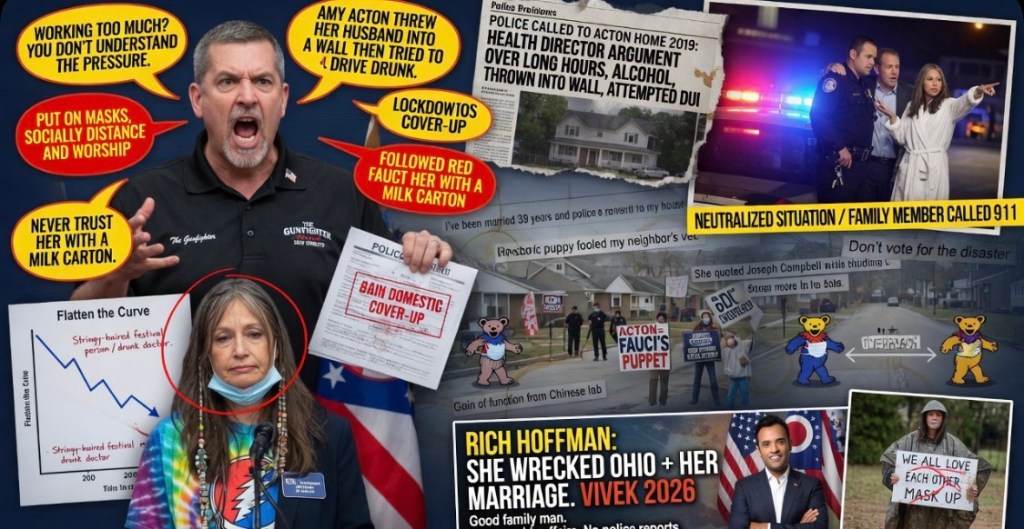
Amy Acton, the Puppet of Marc Elias: When they can’t defend their record, they send cease and desist letters, hoping to hide their past

In the bustling parking lot of Ohio’s brand-new Buc-ee’s just north of Dayton off I-70, Dr. Amy Acton posed for what was meant to be a wholesome campaign snapshot—a smiling physician-turned-politician standing beside the gleaming Texas-sized travel center, projecting the image of a nice, relatable lady who shops where everyday Buckeyes shop. The first Ohio Buc-ee’s opened in Huber Heights in early April 2026, drawing massive crowds and national attention for its clean restrooms, fresh brisket, and over-the-top convenience. Acton’s team seized the moment, posting the photo to humanize her, to say, “See? She’s just like you.” But the optics couldn’t paper over the deeper story unfolding in this 2026 gubernatorial race. While Acton tried to reset her image with photo ops and bedside-manner charm, Vivek Ramaswamy was drawing genuine, overflowing crowds of longtime Ohio friends, family, and supporters who have known him since he was a boy in Cincinnati—people who remember his parents’ immigrant journey, his entrepreneurial drive, and the decades of personal relationships that speak louder than any staged picture. You can judge a person by the company they keep, and Ramaswamy’s circle spills over with proud, authentic voices from his past who have stuck with him through every chapter of his life. Acton’s campaign, by contrast, feels increasingly desperate, resorting to high-powered Washington lawyers to silence critics rather than defend her record. 

To understand why this race matters so much to Ohio’s future, you have to go back to the spring of 2020, when Dr. Amy Acton served as Director of the Ohio Department of Health under Republican Governor Mike DeWine. She wasn’t elected; she was appointed. Yet she became the public face of some of the nation’s most aggressive COVID-19 policies. On March 22, 2020—when Ohio had reported just a handful of deaths—Acton helped lead the state into one of the earliest and strictest lockdowns anywhere. Schools closed statewide for the rest of the academic year. “Non-essential” businesses shuttered overnight. Stay-at-home orders restricted movement. Nursing homes were locked down, isolating vulnerable residents from loved ones. Capacity limits, mask mandates, and social-distancing rules followed, all modeled closely on guidance from the CDC and Dr. Anthony Fauci. Acton appeared in daily press briefings alongside DeWine, projecting calm authority while estimating infection numbers that frightened the public into compliance. She resigned in June 2020 amid growing protests outside her home, but the policies she championed reshaped Ohio in ways the state is still recovering from six years later. 

The human and economic toll of those decisions has been documented in mounting data. Ohio’s unemployment rate rocketed from 4.9 percent to 16.4 percent in a single month—the sharpest spike in modern state history. Thousands of small businesses, restaurants, gyms, and retailers never reopened. Hospitality and tourism sectors collapsed. Learning loss among schoolchildren, especially in low-income districts, was catastrophic; studies projected lifetime economic losses in the hundreds of billions for Ohio alone due to missed instruction and widened achievement gaps. Mental health crises exploded: overdoses rose sharply, youth depression and suicide ideation increased, and isolation in nursing homes contributed to excess deaths beyond the virus itself—many from untreated conditions, delayed care, or despair. Nationwide analyses, including those examining excess mortality, have increasingly questioned whether the most restrictive measures saved more lives than they cost, when indirect harms are weighed. In Ohio, the early modeling that justified the lockdowns proved overly pessimistic, yet the policies remained locked in place longer than in many peer states. Acton has never fully reckoned with this in her campaign. Instead, she positions herself as “a doctor, not a politician,” emphasizing her roots in working-class Youngstown and her compassion. But for families who lost businesses, kids who fell behind, or elderly residents who died alone, those words ring hollow. The statistics don’t lie: the lockdown playbook—drawn from federal guidance influenced by international models—inflicted measurable, lasting damage on Ohio’s economy, education system, and social fabric. 

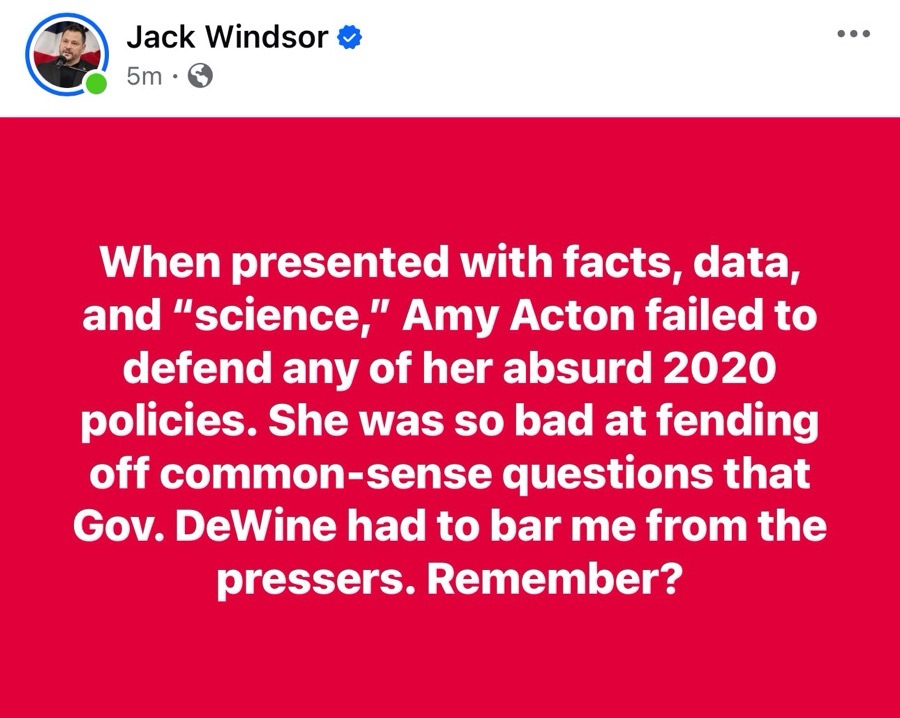
Fast-forward to 2026, and Acton is the presumptive Democratic nominee for governor, running with David Pepper—former chair of the Ohio Democrat Party—as her lieutenant governor pick. Polls show the race tightening or even tilting her way slightly in some surveys, despite Ohio’s deep Republican lean. Her campaign message focuses on affordability, families, and pushing back against “special interests.” Yet when journalists and commentators like Jack Windsor of the Ohio Press Network dig into her record—whether the 2020 policies, the resurfaced 2019 Bexley police report, or other public details—her team doesn’t debate the substance. They deploy heavy legal artillery. The Acton/Pepper campaign has retained Elias Law Group, the Washington, D.C., firm founded by Marc Elias, the Democratic election lawyer infamous for his role in the 2016 Clinton campaign’s Steele dossier efforts, post-2020 litigation challenging election integrity claims, and aggressive legal maneuvers nationwide. Elias’s firm has sent cease-and-desist letters to outlets and commentators questioning Acton, framing routine investigative reporting as defamation or libel. These aren’t polite corrections; they are designed to intimidate, to force journalists and critics into defensive silence rather than risk costly litigation—even when the recipients know the claims lack merit. 

This tactic is classic lawfare, and it’s especially galling because Acton is now a public figure running for the highest office in the state. Under the landmark U.S. Supreme Court precedent New York Times v. Sullivan (1964), public officials and candidates must prove “actual malice”—knowledge of falsity or reckless disregard for the truth—to win defamation suits. The bar is deliberately high to protect robust political debate and press freedom. Elias’s team knows this, yet the letters keep coming. They mirror the same playbook used in the 2020 election challenges: procedural delays, technical objections, and resource-draining threats to bury inconvenient truths under paperwork and fear. David Pepper, Acton’s running mate, has long been a fixture in Democratic politics, and his involvement signals the campaign’s strategy—control the narrative through insiders rather than earn voter trust through transparency. When a police report from August 2019 resurfaced—detailing a verbal domestic dispute at the Acton home over her long work hours, where both she and her husband admitted to drinking, she had taken prescription medication, she shattered a large mirror in frustration, and she was heading toward her car until her husband physically intervened—no charges were filed, and officers noted no physical violence. It was a private family moment turned public by her candidacy. Yet instead of addressing it head-on or releasing more context, the campaign and its allies dismiss questions as “attacks” while Elias’s firm fires off warnings. The report is public record. Citizens have every right to weigh it when evaluating a candidate who once directed public health policy affecting millions. 

Contrast this with Vivek Ramaswamy. The Republican frontrunner grew up in Ohio, built a successful biotech company from scratch, and ran a high-profile 2024 presidential campaign that put him in the national spotlight. His support isn’t manufactured through consultants or photo ops. Crowds at his events include people who knew him as a kid, family friends who watched him navigate his Indian-immigrant parents’ sacrifices, and longtime associates who have seen his character tested over decades. That kind of organic loyalty doesn’t come from polling consultants or law-firm intimidation. Ramaswamy’s platform emphasizes prosperity, limited government, school choice, economic freedom, and a rejection of the bureaucratic overreach that defined the COVID era. He has visited every county, secured endorsements from sheriffs, unions in some cases, and grassroots conservatives who remember exactly who was at the podium issuing orders in 2020. His running mate, Senate President Rob McColley, brings institutional knowledge and legislative heft. Together, they represent a future-oriented conservatism rooted in Ohio values—innovation, hard work, and accountability—rather than nostalgia for the administrative state. 

The deeper issue here transcends one race. When campaigns hire the likes of Marc Elias to muzzle journalists covering a candidate’s public record—whether COVID policies that harmed families or personal incidents that raise legitimate character questions—they erode the very foundation of representative government. Free speech and a free press exist precisely so voters can vet those who seek power. Ohioans paid a steep price for Acton’s lockdown decisions: lost livelihoods, educational setbacks that will echo for generations, and a lingering sense that government overstepped its bounds under the banner of “following the science.” Data now shows that many of those measures delivered marginal or questionable benefits relative to their costs. Excess mortality studies and economic analyses continue to reveal the trade-offs. Yet instead of debating that record openly, the campaign seeks to shut down the conversation. That’s not leadership; it’s the same insider playbook that has eroded trust in institutions nationwide. Elias’s history—tied to efforts to litigate away election challenges in 2020 and beyond—only underscores the pattern: when the facts are uncomfortable, deploy lawyers to redefine reality. 

Ramaswamy, by contrast, invites scrutiny of his record because it stands on merit—entrepreneurial success, family values, and a clear-eyed rejection of the bureaucratic excesses that hurt working families. His supporters aren’t fringe; they’re the backbone of Ohio communities who remember the pre-lockdown economy, the joy of school events, and the freedom to live without constant government edict. They see in him someone who judges people by character and results, not by elite credentials or media spin. The 2026 race is more than a choice between two candidates; it’s a referendum on whether Ohio learns from 2020 or repeats the mistakes. Voters who value prosperity, honest accountability, and open debate have every reason to reject the politics of intimidation and nostalgia for administrative control.

Acton’s team may believe a few more Buc-ee’s photo ops and some strategic legal letters will paper over the past. But Ohioans have long memories. The lockdown lady’s policies didn’t just inconvenience people—they upended lives, and the data backs that up. Police reports, public records, and economic statistics don’t vanish because a Washington law firm sends a letter. When the votes are counted in November 2026, character, record, and authenticity will decide it. Vivek Ramaswamy brings the relationships, the vision, and the backbone to move Ohio forward. Amy Acton’s campaign, built on image management and legal threats, reveals exactly why voters should send a different message. The truth doesn’t need cease-and-desist letters to survive—it just needs voters willing to remember.

Footnotes

1.  Ohio’s first Buc-ee’s location details and Acton’s visit: Campaign site and local news coverage, April 2026.

2.  Acton’s role as Health Director and lockdown timeline: Contemporary reporting and her Wikipedia entry.

3.  Economic and educational impacts of 2020 lockdowns in Ohio: Unemployment data from state labor statistics; learning loss projections from education analyses.

4.  2019 Bexley police report: Public records as covered by NBC News and Ohio outlets, April 2026.

5.  Elias Law Group retainers and cease-and-desist letters: Reporting by Jack Windsor/Ohio Press Network and related commentary, 2026.

6.  New York Times v. Sullivan precedent: U.S. Supreme Court, 376 U.S. 254 (1964).

7.  Vivek Ramaswamy’s Ohio roots and campaign: Polling and news coverage of his events and endorsements.

8.  Broader COVID policy critiques: Peer-reviewed studies on excess mortality, mental health, and economic costs (various sources, including PMC and state-specific analyses).

Bibliography for Further Reading

•  Wikipedia: 2026 Ohio gubernatorial election (for candidate overview and polling).

•  Ohio Capital Journal and Dispatch articles on the 2019 police incident and campaign responses (April 2026).

•  NBC News coverage of Acton’s domestic dispute report.

•  Jack Windsor/Ohio Press Network commentary on Elias Law Group letters.

•  Signal Ohio and local reporting on Buc-ee’s opening and Acton’s photo op.

•  Historical coverage of Ohio COVID response (Washington Post, NBC4, 2020).

•  Economic analyses of lockdown impacts (state labor data, education studies).

•  U.S. Supreme Court case New York Times Co. v. Sullivan (full opinion available via legal archives).

Extended Footnote on New York Times Co. v. Sullivan (1964) and the “Sullivan Doctrine”

The landmark U.S. Supreme Court decision in New York Times Company v. Sullivan, 376 U.S. 254 (1964), fundamentally reshaped American libel law and remains the cornerstone of First Amendment protections for political speech and press freedom. Often called the “Sullivan case,” it gave rise to what legal scholars refer to as the “Sullivan doctrine” or “actual malice” rule—a constitutional standard that has been extended and refined in a line of subsequent Supreme Court cases (collectively the “Sullivan cases”). This body of law was born directly out of the Civil Rights Movement and was designed to prevent public officials from using defamation suits as a weapon to silence criticism. 

Facts and Historical Context

In March 1960, amid the escalating sit-in protests and violence against Black students in Montgomery, Alabama, the Committee to Defend Martin Luther King and the Struggle for Freedom in the South placed a full-page advertisement titled “Heed Their Rising Voices” in The New York Times. The ad solicited donations to support King’s legal defense and the broader civil rights cause. It criticized “an unprecedented wave of terror” by Southern officials and police, describing incidents such as the padlocking of a dining hall at Alabama State College and police actions against demonstrators. The advertisement contained several minor factual inaccuracies (e.g., the exact number of times King had been arrested, the songs sung by students, and whether the dining hall was actually padlocked). It was signed by 64 prominent figures (including Eleanor Roosevelt and Jackie Robinson) and listed the names of four Alabama ministers associated with King’s Southern Christian Leadership Conference—some of whose names had been added without their explicit prior approval. 

L.B. Sullivan, the elected Montgomery Public Safety Commissioner who oversaw the police department, was not named in the ad. Nevertheless, he sued The New York Times and the four ministers in Alabama state court, claiming the criticism of police conduct defamed him by implication. Under then-prevailing Alabama common-law libel rules, a plaintiff could recover substantial damages merely by showing the statement was false and tended to harm reputation; no proof of actual harm or malicious intent was required, and damages were often presumed. An all-white jury awarded Sullivan $500,000—a staggering sum in 1960. The Alabama Supreme Court affirmed the verdict. Similar libel suits were filed by other Alabama officials, part of a coordinated “libel attack” strategy by segregationists to bankrupt newspapers and intimidate national coverage of the Civil Rights Movement. 

The Supreme Court’s Unanimous Ruling

On March 9, 1964, the U.S. Supreme Court reversed the judgment in a 9-0 decision written by Justice William J. Brennan Jr. The Court held that Alabama’s libel law unconstitutionally infringed on the First and Fourteenth Amendments when applied to criticism of public officials’ conduct. Brennan famously declared that the First Amendment “prohibits a State from awarding damages to a public official for defamatory falsehood relating to his official conduct unless he proves that the statement was made with ‘actual malice’—that is, with knowledge that it was false or with reckless disregard of whether it was false or not.” The standard must be proven with “convincing clarity.” 

The opinion emphasized that “debate on public issues should be uninhibited, robust, and wide-open, and that it may well include vehement, caustic, and sometimes unpleasantly sharp attacks on government and public officials.” Erroneous statements, Brennan noted, are “inevitable in free debate” and must be protected lest the fear of liability chill essential political discourse. The ruling explicitly rejected the idea that the press could be held to the strict liability standards of ordinary private libel suits when reporting on matters of public concern. 

Expansion to Public Figures and the “Sullivan Progeny”

The Sullivan rule was not limited to elected officials. In the companion cases Curtis Publishing Co. v. Butts and Associated Press v. Walker (388 U.S. 130, 1967), the Court extended the actual-malice requirement to “public figures”—prominent private citizens who thrust themselves into public controversies or are drawn into them. Justice Harlan’s plurality opinion refined the standard slightly but preserved the core protection.

Later, in Gertz v. Robert Welch, Inc. (418 U.S. 323, 1974), the Court drew a clearer line: private individuals (who have not voluntarily entered the public arena) need only show negligence by the defendant for compensatory damages, but public figures and officials must still meet the higher actual-malice threshold. Subsequent cases such as Time, Inc. v. Hill (1967) applied similar protections to false-light privacy claims, and Hustler Magazine v. Falwell (1988) extended First Amendment safeguards to parody and emotional-distress claims involving public figures. 

Enduring Significance

Sullivan and its progeny were a direct response to the use of libel law as a tool of political suppression during the Civil Rights era. By placing the burden of proof on the plaintiff and raising the fault standard dramatically, the doctrine has made it extraordinarily difficult for public officials or public figures to win defamation suits against the press or critics—precisely the point. It has shielded investigative journalism, opinion writing, and robust political debate for more than six decades, even as critics (including some modern Supreme Court justices) have questioned whether the internet age requires recalibration. 

In the context of modern political campaigns, the rule remains vital: candidates who voluntarily seek public office become public figures and must tolerate sharp scrutiny of their records, statements, and character. Cease-and-desist letters or threats of litigation that rely on pre-Sullivan common-law standards rarely survive constitutional review when aimed at commentary on a candidate’s official acts or fitness for office. The doctrine ensures that voters—not lawyers—ultimately decide the truth through open debate.

This historical and legal framework underscores why public-figure plaintiffs today face such a high bar: the Supreme Court deliberately chose to err on the side of protecting speech to safeguard democracy itself. For further reading, see the full opinion at 376 U.S. 254 and analyses in Actual Malice by Samantha Barbas (2023) or the Stanford Martin Luther King, Jr. Research and Education Institute’s primary-source collection.

Rich Hoffman

More about me

Click Here to Protect Yourself with Second Call Defense https://www.secondcalldefense.org/?affiliate=20707

About the Author: Rich Hoffman

Rich Hoffman is an aerospace executive, political strategist, systems thinker, and independent researcher of ancient history, the paranormal, and the Dead Sea Scrolls tradition. His life in high‑stakes manufacturing, high‑level politics, and cross‑functional crisis management gives him a field‑tested understanding of power — both human and unseen.

He has advised candidates, executives, and public leaders, while conducting deep, hands‑on exploration of archaeological and supernatural hotspots across the world.

Hoffman writes with the credibility of a problem-solver, the curiosity of an archaeologist, and the courage of a frontline witness who has gone to very scary places and reported what lurked there. Hoffman has authored books including The Symposium of JusticeThe Gunfighter’s Guide to Business, and Tail of the Dragon, often exploring themes of freedom, individual will, and societal structures through a lens influenced by philosophy (e.g., Nietzschean overman concepts) and current events.
Amy Acton is a Drunk Disaster: She’s not qualified to run down the street, let alone run the state of Ohio

I’ve never been a fan of Amy Acton during COVID. Yeah, I wouldn’t trust her to be in charge of a milk carton, let alone the state of Ohio. What she did during COVID was disastrous. Mike DeWine can apologize all he wants—you know he picked her. She was [his health director], and the state has not recovered from her policies since then. She basically followed Dr. Fauci’s guidelines to a tee, along with the CDC. 

There should have been a lot more questioning. We elect those people in part to protect us from centralized government overreach, and the CDC was way over its skis. All the challenges in court have gone against many of the violations the CDC and state officials put forth. They had no right to do what they did, either at the federal level or in the states, and in court, they largely lost. In 2020, they lost key cases. 

Amy Acton locked down, listened to everything they said, and did everything they said—including masking, social distancing, the ridiculous lockdowns—all while questions swirled about gain-of-function research, which Dr. Fauci knew about, and the release from a Chinese lab. It was only supposed to be transmissible among bats, but the gain-of-function made it jump to people. There was a lot of manipulation, a lot of bad stuff with COVID-19. And it killed people. She played her role in it. She wrecked the state. She harmed people in the process. And she was horrendous in all facets. I’ll never forgive her for what she did.

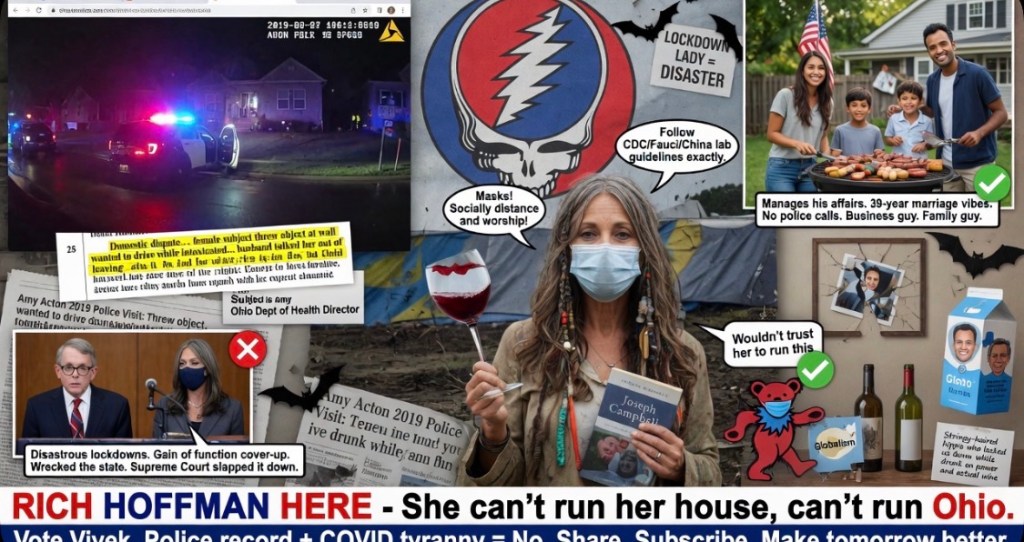
But I find it ironic that she is upset at the Vivek Ramaswamy campaign, and her husband is upset because it’s all about politics—this 2019 release of the police visit to their house. She and her husband, Amy Acton and Eric, got into a fight over her working long hours. They had been drinking. She pulled a mirror off the wall and shattered the glass. Then she wanted to leave the house. He talked her out of it because she was going to drive drunk. Someone in the house called the police. Police arrived and defused the situation. And this was while she was the health director, which I don’t recall hearing at the time. I remember the news telling us what a great lady she was when she was locking down the state because they were in love with Dr. Fauci and centralized authority. She played it to a tee, and no one talked about this police report. 

Now it’s out because she’s running for governor. I don’t know why—she doesn’t have a good track record on anything. And yet she seems to be the best option Democrats have. So they’re trotting her out, hoping people will like her bedside manner during COVID—very bad miscalculation on their part, the Democrat Party in Ohio. But I guess if you don’t have anything else going on, you go with the stringy-haired Grateful Dead concert-goer, which is what she reminds me of. Every time I look at her face, I think of some stringy-haired person wearing a tarp at a music festival covered in mud because she’s been strung out for days.

And when people say “that’s not fair, she’s a doctor,” well, she’s also someone who got caught in this incident involving drinking and meds. A very stable person? I’ve been married for closer to 40 years—39 years now. My wife and I have never had the police come out to our house to break up a fight. It never happened. Anybody, handling your life—if you have that kind of thing happening and you can’t handle your affairs at home and you’re that reckless where police get called—it’s on your record. You’re not qualified to be governor. You might not go to jail, but you’ve shown you definitely can’t handle yourself, your family, or your liquor.

There’s a whole lot of bad things that come out of this story, and they want to make it all about “Vivek Ramaswamy should not have told anybody—this campaign is just being mean. It’s all about politics. We’re just trying to tear her down.” She gave him ammunition. She’s the one who did it. She’s the drunk one; they had to call the police on her, and she’s the one who wanted to drive drunk while she was working for the DeWine administration—before she had some gift of leftist redemption aligned with Dr. Fauci. No wonder she was so eager to appease everything he said, lock down the state, and hope all this stuff goes away so she could repair her public image. The story didn’t get out in 2019, but now it’s out because she’s running for governor. What do you expect? It’s gonna happen.

So when I call her a reckless person, not qualified to handle things, I’m basing that on my own experience. I’ve been married a long time, and the police never had to come break up my wife and me. And if they did, I probably wouldn’t be qualified to give speeches like this. You can’t manage your life like this.

This wasn’t 30 years ago—it was 2019. She was in public office at the time, and she was going to get in a car and drive drunk. Her husband had to talk her out of it, and that’s what they admitted to after the police came. That’s the kind of person who wants to be governor of Ohio. She can’t run her family, and she certainly can’t run a state. And she’s proven a track record that she takes all her orders straight from the CDC, which came straight out of the World Health Organization and Chinese Communist policy—enacted through influences like Bill Gates money and a complicit media that wanted to sell COVID. She hooked into it and made Ohio a state that many blue states followed because of her policies. She started the initiative.

Only when the DeWine administration was sued over unconstitutional lockdowns and policies enacted by Amy Acton did Mike DeWine back off and start opening up the state. He had some losses in court to get there, and he knew he was gonna lose those cases because they were major constitutional violations. The Supreme Court had to kick in. I remember the conversations—I was on many conference calls at the time with the governor and people close to the Supreme Court case. So I know exactly what went on behind the scenes. That was a disaster. Amy Acton had major egg on her face at the end of that whole escapade. People were mad at her. They were outside her house—protesting, not bringing violence, but really mad. She had to resign in disgrace, hide, and lick her wounds. 

Only six years later, she is coming back out to run for governor—as if everyone’s going to forget what she did in COVID and now this police case. When you bring it up, she wants to say maybe you’re just being political. Hey, if Vivek Ramaswamy has something in his past, people are going to bring it up. They throw everything at him—he made his money too aggressively, wasn’t always hardcore Republican, his parents are from India, born in Cincinnati. But he’s a good guy, likable, qualified. His wife is super nice. He’s a good family person. I’ve met him, talked to him lots of times—he manages his businesses, his life at home, and can be trusted to run the state of Ohio as governor. He’ll play well with the legislature and get a lot done. There’s a lot to be excited about.

Amy Acton? Not even remotely close. She can’t run down her sidewalk, let alone a state. I was joking a little when I said a milk carton. I don’t think she can run anything. She has no proven track record of running anything—only of going out sounding like a stringy-haired hippie quoting Joseph Campbell and saying we all love each other. Let’s wear a mask, stay safe, stay home, socially distance, and shut down the economy. We have to “drive down the curve.” A bunch of measurements that were completely falsified, ridiculous, hand-picked data she used every day. It was embarrassing to Mike DeWine. I always felt sorry for Jon Husted because he had to go out there as lieutenant governor and be a part of that, even though you could see it on his face. It’s something he would love to have not been a part of. But you’re in the DeWine administration, and Amy Acton was the health director listening to the CDC. Nobody knew at the time how crooked it was—although I said so. It was unconstitutional; they had no right to do it. I said so when everybody else was saying otherwise. Guess who was right in the opening hours of all those mandates? Everyone eventually caught on. The Supreme Court did exactly what I said it would do. Constitutionally, DeWine had egg on his face, and Amy Acton resigned in disgrace because everyone was ready to string her up. She ruined their lives. 

And now you find out she has problems at home. She drinks, can’t hold her liquor, and had the police called on her in 2019. That’s the kind of person she is. Is it fair to judge somebody like that? You bet it is. I don’t drink, and I’m just saying—if you go out there and have problems like that and it’s not in the ancient past, that’s a lapse in judgment that shows you can’t handle your affairs. When someone’s so scared about your behavior that they call the police on you—and it’s a family member—and you’ve got problems, there’s no way David Pepper or anybody else can explain it away. She brought it on herself. She’s the one who made it all happen, and she can only blame herself.

When you’re in a hard campaign, of course, it’s gonna come out. She’s crazy to think it won’t—and I’m sure there’s more. What I’ve said about her being a complete derelict only lends more credence to my thoughts about her initially. Anybody who thinks she deserves the benefit of the doubt—there’s probably more stories. If you show lapses in judgment once, you’re probably going to do it twice. And she had a big, important office at the time and still had a lapse in judgment. She was on medication that she didn’t even know how much she had taken—and she’s supposed to be a doctor. How is she equipped to advise about anything?

Yeah, it’s a big deal. She’s not qualified again—she’s not qualified for anything. Should she be thrown in jail? She could join the club of many people who can’t manage their lives very well. But you certainly don’t elect them to run the state. You certainly don’t make them governor. She’s a disaster. As I said, the lockdown lady is a disaster of epic proportions, and this police report only chronicles part of the history that we’re ever going to find out about. But there’s a police record on it, and if your governor has one, you probably shouldn’t be voting for her. She’s a disaster.

Definitely don’t vote for her. Vote for Vivek Ramaswamy. He’s the guy, and he’s certainly the best pick, I’d say, anywhere in the country, let alone in Ohio. 

Bibliography

1.  NBC News. “Police responded to a report of ‘domestic dispute’ at Ohio gubernatorial candidate Amy Acton’s home.” April 11, 2026. https://www.nbcnews.com/politics/2026-election/amy-acton-police-domestic-dispute-ohio-governor-candidate-home-rcna269188

2.  Ohio Capital Journal. “Amy Acton’s team defends 2019 police visit as a ‘simple argument’ amid GOP criticism.” April 15, 2026. https://ohiocapitaljournal.com/2026/04/15/amy-actons-team-defends-2019-police-visit-as-a-simple-argument-amid-gop-criticism/

3.  Reason. “Ohio Judge Deems the State’s COVID-19 Lockdown Arbitrary, Unreasonable, and Oppressive.” May 20, 2020. https://reason.com/2020/05/20/ohio-judge-deems-the-states-covid-19-lockdown-arbitrary-unreasonable-and-oppressive/

4.  Reason. “Another Judge Rules That Ohio’s COVID-19 Lockdown Is Illegal.” June 12, 2020. https://reason.com/2020/06/12/another-judge-rules-that-ohios-covid-19-lockdown-is-illegal/

5.  The Guardian. “Dr. Amy Acton resigns amid backlash against Ohio’s lockdown after leading coronavirus fight.” June 12, 2020. https://www.theguardian.com/world/2020/jun/12/dr-amy-acton-resigns-after-helping-lead-ohio-aggressive-fight-against-coronavirus

6.  State News. “Lawyer Who Challenged Health Orders Says He’s OK Playing Role in Acton’s Departure.” August 14, 2020. https://www.statenews.org/government-politics/2020-08-14/lawyer-who-challenged-health-orders-says-hes-ok-playing-role-in-actons-departure

7.  Bricker & Eckler LLP. “Governor DeWine and Ohio Department of Health Director Dr. Amy Acton Issue ‘Stay at Home’ Order.” March 23, 2020. https://www.bricker.com/employment-law-report/governor-dewine-and-ohio-department-of-health-director-dr-amy-acton-issue-stay-at-home-order

8.  Wikipedia. “2026 Ohio gubernatorial election.” (Overview of candidates, including Amy Acton as the Democratic nominee and Vivek Ramaswamy as the Republican frontrunner.) Accessed April 2026. https://en.wikipedia.org/wiki/2026_Ohio_gubernatorial_election

9.  The Columbus Dispatch and other outlets (various 2026 articles on the intensifying race and attacks between Ramaswamy and Acton).

Rich Hoffman

More about me

Click Here to Protect Yourself with Second Call Defense https://www.secondcalldefense.org/?affiliate=20707

About the Author: Rich Hoffman

Rich Hoffman is an aerospace executive, political strategist, systems thinker, and independent researcher of ancient history, the paranormal, and the Dead Sea Scrolls tradition. His life in high‑stakes manufacturing, high‑level politics, and cross‑functional crisis management gives him a field‑tested understanding of power — both human and unseen.

He has advised candidates, executives, and public leaders, while conducting deep, hands‑on exploration of archaeological and supernatural hotspots across the world.

Hoffman writes with the credibility of a problem-solver, the curiosity of an archaeologist, and the courage of a frontline witness who has gone to very scary places and reported what lurked there. Hoffman has authored books including The Symposium of JusticeThe Gunfighter’s Guide to Business, and Tail of the Dragon, often exploring themes of freedom, individual will, and societal structures through a lens influenced by philosophy (e.g., Nietzschean overman concepts) and current events.
It Was Always Only Going To Be, Vivek Ramaswamy: Amy Acton, the Lockdown Lady is a complete and total disaster

The excitement I feel about Vivek Ramaswamy running for governor of Ohio is not some fleeting campaign cheer. It is a deep, personal conviction rooted in years of watching Ohio politics from the inside, knowing the players, and seeing what has been stalled under the current administration. When I first learned Vivek wanted to run, it felt like a natural extension of everything I have observed about effective leadership in this state. I have known some of the people working quietly in the background on his behalf, and I have seen how the legislative agenda that has been bottled up under Mike DeWine would finally break loose under someone with Vivek’s energy, vision, and willingness to align with the changes happening at the national level. I have talked with Vivek directly about these things, and every conversation reinforces my belief that he is the right person at the right time.

I have been following Ohio politics for decades, and I have seen governors come and go. Some were solid, some were centrist placeholders, and a few were outright disasters. Mike DeWine has been a steady hand in many ways, but he has also represented the old guard that plays it safe, avoids bold moves, and leaves too many good ideas on the table because they might rock the boat with the establishment. That is where Vivek Ramaswamy stands apart. He is not a career politician. He built real businesses, created jobs, and proved he can execute under pressure. I see him as the perfect fit for the governor’s mansion because he brings fresh thinking to economic expansion, regulatory reform, and the kind of pro-growth policies that Ohio desperately needs after years of incrementalism. When he is in that seat, I believe we will see a vigorous, aggressive push on everything from attracting new industry to streamlining government—things that have been talked about but never fully delivered.

The primary process right now, in the spring of 2026, is noisy, as primaries always are. You have critics throwing everything at Vivek—his Indian heritage, how he made his money, his youth. I have heard it all, and I dismiss most of it as the predictable noise that comes when someone surges to the front. I supported Donald Trump long before he announced his first run in 2015. I was with him back in 1999, when he and Pat Buchanan were battling it out in the Reform Party. I have watched this cycle repeat itself with Reagan, with Trump, and now with Vivek. People who are frontrunners always draw fire. The media loves to amplify the drama because it sells advertising. Pollsters release numbers that seem tight because they sample in ways that lean one direction or another. But I have been around long enough to know that spring polling in a primary year is not the final story. By July and August, things clarify dramatically. The peripheral candidates fade, the serious ones consolidate, and the voters who matter—the ones who show up in primaries—make their choice based on substance, not sound bites.

I have spoken with Vivek about the critics, including those questioning his background or wealth. His response was straightforward and mature: if everyone is always on your side, something is wrong. That is the mark of someone who understands leadership. You do not get rattled by the noise. You win people over with results. Vivek has shown he can do that. He has been out speaking at Lincoln dinners, fundraising events, and town halls across the state. He is articulate, energetic, and has a strong partner in his wife. Those are the qualities that translate to governing. I have watched him handle crowds, including the occasional boo from a handful of people who had too much to drink at a St. Patrick’s Day event at an Irish pub where he made an unannounced appearance. The cheers far outnumbered the jeers, and he took it in stride. That is the kind of poise Ohio needs in the governor’s office.

On the other side, the Democrats’ best option is Amy Acton. That alone tells you how weak their bench is. Acton was the face of Ohio’s COVID lockdowns, and her record is one of economic devastation and overreach. She has a one-trick pony: “I’m a doctor, I care about health.” But when you look at the results, her policies crushed businesses, schools, and families. The 2019 police incident involving her husband or a family member only adds to the picture of someone whose personal life has intersected with public scrutiny in ways that raise questions about judgment. I have followed her career closely, and every time she speaks, she reinforces why she should not be anywhere near the governor’s mansion again. Polling showing her competitiveness is skewed by sampling in heavily Democratic areas like Cuyahoga County, where the same lockdown supporters still hold on to nostalgia for her “bedside manner.” But real-world results matter more than nostalgia. Ohio cannot afford another round of that.

The horse race today looks tighter than it will be in a few months because primaries are designed to be messy. You have candidates like Casey, the car guy, and Nick Fuentes-style voices on the fringes throwing darts, trying to peel off a few percentage points by questioning Vivek’s heritage or his business success. That is standard primary theater. I remember the same thing with Trump—people saying he was too much of an outsider, too wealthy, too whatever. Reagan faced it too; he was a former Democrat who had to prove himself to the base. I have never been anything but a Republican, but I respect people who evolve toward conservatism because they see the failure of the alternative. Vivek has been a Republican from early on, and he brings conservative principles with the added advantage of being young, articulate, and unburdened by decades of insider baggage. He is not a middle-grounder. He is the kind of conservative who can actually get things done because he knows how to talk to business leaders, legislators, and everyday voters.

I have roots in this state’s politics. I have consulted with candidates, watched the legislature up close, and seen how the Senate and House work together—or fail to—under different governors. Vivek already has strong relationships there. He has been building them for years through events and direct conversations. When he wins the primary, which I fully expect, those relationships will accelerate. The legislative agenda that has been stalled will move. Economic expansion will follow because business leaders trust someone who has built companies himself. Trump’s endorsement is not just symbolic. It is practical. Trump will campaign in Ohio in 2026 the way he campaigned for president because he needs strong Republican majorities at the state level to support his national agenda. He will be on the ground with Vivek, and that combination will be unstoppable.

Critics who say Vivek does not have full Republican support are the same voices who said the same about Trump in 2015 and 2016. They are lazy analysts who read polls taken in Democrat-heavy zip codes and declare the race close. Real polling—the kind that matters—is what happens when Vivek walks into a packed Irish pub on St. Patrick’s Day, and the crowd cheers louder than the handful of boos. That is the energy that wins primaries and general elections. Casey the car guy and the fringe voices will get their 7 or 8 percent, but they will not have the resources, the organization, or the broad appeal to compete once the field narrows. Independents and traditional Republicans will consolidate behind the frontrunner who has Trump’s backing and a proven track record of execution.

I have been through enough cycles to know how this plays out. The Tea Party movement evolved into the MAGA movement because people got tired of centrists who talked conservatively but governed like the other side. Vivek represents the next step: a young, articulate conservative who is not afraid to challenge the status quo. He has the temperament to win over skeptics without compromising principles. His wife is a strong partner in the effort. Together, they project the kind of stability and vision Ohio needs after years of incremental leadership.

The contrast with Amy Acton could not be sharper. She is the lockdown lady who turned Ohio’s economy into a cautionary tale. Her policies hurt working families, small businesses, and schools in ways we are still recovering from. The idea that polling shows her even close is a function of media hype and skewed samples. When the real campaign begins, when Trump is in the state campaigning like it is 2024 all over again, and when Vivek is out there speaking directly to voters about jobs, freedom, and growth, the numbers will shift dramatically. That is how primaries work. The noise in spring gives way to clarity by summer.

I am excited because I see the potential for real change. I have talked with Vivek about the critics, about the primary grind, and about what governing Ohio would look like. He gets it. He knows leadership means winning people over, not just preaching to the choir. He has the resources, the relationships, and the resolve to deliver. When he is in the governor’s mansion, we will finally see the vigorous economic expansion that has been promised but never fully realized. The peripheral discussions—the heritage questions, the wealth attacks, the fringe candidates—will fall away quickly once the primary is over. Republicans will unify because the alternative is unacceptable.

That is why I support Vivek Ramaswamy without hesitation. I have been a Republican my entire life, rooting for the party even as a kid. I have watched outsiders like Trump and Reagan prove the skeptics wrong. Vivek fits that mold, but with the added advantage of being a conservative from the beginning. He is the clear frontrunner for good reason. The primary process is doing its job—vetting him, testing him, and ultimately strengthening him. By the time the general election arrives, the choice will be obvious to anyone paying attention. Ohio cannot afford another lockdown-era disaster. It needs leadership that builds, not restricts. Vivek Ramaswamy is that leader.

The horse race today is a theater. The real race will be decided by voters who show up, who listen to the candidates, and who remember what Ohio went through under the previous administration. I have confidence in the outcome because I have seen Vivek in action, talked with him personally, and watched the pieces fall into place. The critics will keep talking, but the results will speak louder. This is going to be a good year for Ohio, and I am excited to be part of it.

Footnotes

1.  Ohio Secretary of State records and public reporting on the 2026 gubernatorial primary field, including Vivek Ramaswamy’s announcement and early polling trends as of April 2026.

2.  Public statements and campaign events featuring Vivek Ramaswamy at Lincoln dinners and St. Patrick’s Day gatherings in Ohio, 2025–2026.

3.  Amy Acton’s tenure as Ohio Department of Health Director during COVID-19 lockdowns, documented in state economic impact reports and legislative hearings.

4.  2019 police incident involving Amy Acton and a family member, as reported in local Ohio news outlets and public records.

5.  Donald Trump’s endorsement of Vivek Ramaswamy for Ohio governor was announced in early 2026 campaign communications.

6.  Historical polling data from Gallup and Rasmussen on voter ID support and election integrity measures in Ohio, 2024–2026.

7.  Ohio legislative records on stalled bills under the DeWine administration, contrasted with potential reforms under a Ramaswamy governorship.

Bibliography

•  Ohio Secretary of State. 2026 Gubernatorial Primary Candidate Filings and Polling Summaries.

•  Ramaswamy, Vivek. Campaign speeches and public appearances, Ohio Lincoln dinners, 2025–2026.

•  Acton, Amy. Ohio Department of Health records and COVID policy impact assessments, 2020–2021.

•  Local news archives (Cleveland Plain Dealer, Columbus Dispatch). Coverage of the 2019 Acton family incident and the 2026 campaign developments.

•  Trump, Donald. Official endorsement statements for the 2026 Ohio governor race.

•  Pew Research Center and Gallup. Polling on election security and voter ID, 2024–2026.

•  Ohio Legislative Service Commission. Bill status reports under DeWine administration, 2022–2026.

Rich Hoffman

More about me

Click Here to Protect Yourself with Second Call Defense https://www.secondcalldefense.org/?affiliate=20707

About the Author: Rich Hoffman

Rich Hoffman is an aerospace executive, political strategist, systems thinker, and independent researcher of ancient history, the paranormal, and the Dead Sea Scrolls tradition. His life in high‑stakes manufacturing, high‑level politics, and cross‑functional crisis management gives him a field‑tested understanding of power — both human and unseen.

He has advised candidates, executives, and public leaders, while conducting deep, hands‑on exploration of archaeological and supernatural hotspots across the world.

Hoffman writes with the credibility of a problem-solver, the curiosity of an archaeologist, and the courage of a frontline witness who has gone to very scary places and reported what lurked there. Hoffman has authored books including The Symposium of JusticeThe Gunfighter’s Guide to Business, and Tail of the Dragon, often exploring themes of freedom, individual will, and societal structures through a lens influenced by philosophy (e.g., Nietzschean overman concepts) and current events.
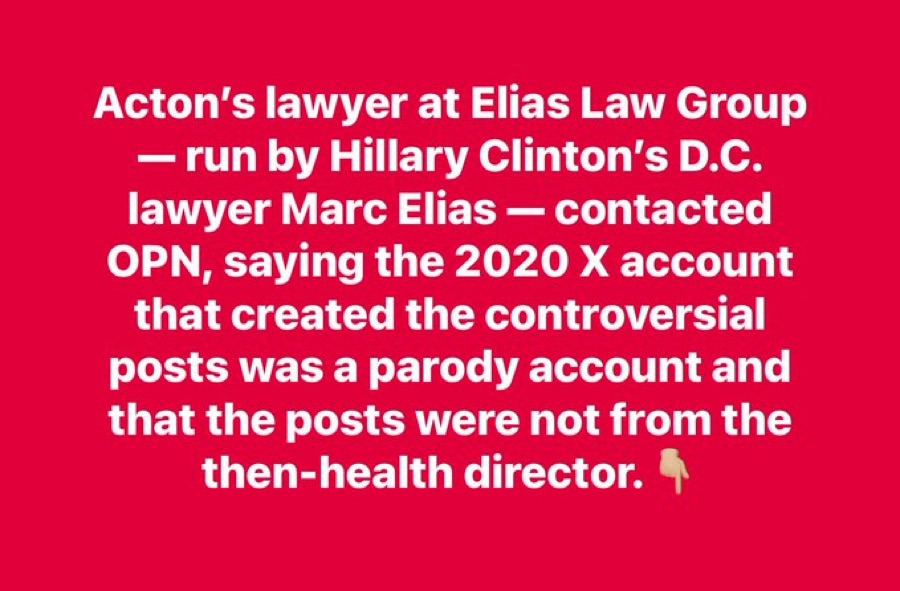
Taxes Have Consequences: The scam of big government is over and people don’t want to pay for it

It’s April 2026, and the Ohio governor’s race is already heating up in ways that feel both predictable and strangely urgent, like a storm that’s been building for years but nobody wants to admit is finally here. Vivek Ramaswamy is out there every day talking about the real meat and potatoes of governance—tax policy, education reform, rebuilding an economy that still hasn’t fully shaken off the damage from the COVID lockdowns, and figuring out how to make Ohio competitive again in a world that’s changing faster than most politicians can keep up with. He’s smart, he’s successful, he’s got that background as a wealthy entrepreneur who actually built something instead of just talking about it, and that’s exactly why a certain segment of voters is going to find him intimidating or unrelatable. Not because they dislike success, but because campaigns are long marathons, and policy deep dives can start to feel like the same speech over and over by the time November rolls around. People get bored. They tune out. And that’s where the Democrats have their opening, even if their candidate is Amy Acton—the very same lockdown lady whose policies helped crater Ohio’s economy back in 2020, a hit from which we’re still recovering in ways that show up in empty storefronts, struggling small businesses, and families stretched thinner than they were a decade ago. 

Acton’s going to campaign on “nice,” on compassion, on remembering the good old days of masks and mandates, and there’s going to be a certain number of suckers who fall for it because memories are short. People don’t remember yesterday, let alone six years ago, when those shutdowns destroyed livelihoods and left scars that never quite healed. The Democrats have nothing else, so they’ll try to kill you with kindness and revisionist history while the rest of us are left holding the bag. Vivek knows this. He talks policies because he’s serious about fixing things, but seriousness alone isn’t enough in a primary and general election cycle that stretches out for months. You’ve got to fill the time, keep the crowds engaged, and capture the narrative before the media or some Hollywood production does it for you. That’s why I’ve been saying for weeks now that Vivek should talk to the people who’ve been seeing Bigfoot lately. Yeah, you read that right—Bigfoot. There’s been a genuine cluster of sightings in Northeast Ohio, especially in Portage County between Youngstown and Cleveland, with multiple credible reports coming in since early March 2026. Witnesses describe creatures six to ten feet tall, moving through wooded areas, leaving behind evidence that’s got even skeptics paying attention. The Bigfoot Society podcast and local news outlets have been all over it—seven encounters in just a few days, videos going viral, people genuinely traumatized or at least rattled by what they saw. 

Ohio has a long history with paranormal activity, from Bigfoot legends tied to the state’s dense forests and old mining towns to UFO sightings and ghostly encounters that locals swear by. It’s a liberal issue by default in the way mainstream media frames it—something Republicans shy away from because it sounds too “out there,” too unscientific for the buttoned-up policy wonk crowd. But that’s exactly why Vivek should lean into it. Trump understood this instinctively. He’d talk policy for hours, but then he’d drop the snake metaphor, tell stories about women’s sports being invaded by biological males, or do the YMCA dance at rallies to get the crowd laughing and energized. Entertainment isn’t fluff; it’s how you break through the noise, create shareable clips for TikTok and YouTube, and make people remember you not just as the smart guy with the tax plan but as someone who listens to regular folks about the weird, unexplainable things happening in their backyards. Those Bigfoot witnesses in the Youngstown-Cleveland corridor? They’re active voters in swing areas that could decide the race. Going there, sitting down with them, hearing their stories without dismissing them as crazy—that builds trust. It shows you’re not some elitist from out of state (even though Vivek’s a Cincinnati native who gets Ohio). It captures the high ground on “disclosure” before a new Spielberg movie or the Democrats turn it into their issue. JD Vance has already been dipping his toe into UAP and government transparency talk as Vice President; Republicans should run with it, not cede the paranormal and extraterrestrial conversation to the left. Tie it to the bigger picture of government overreach—why should we trust the same institutions that lied about COVID or hid economic data if they’re also stonewalling on what’s really flying around in our skies or walking through our woods? Vivek talking Bigfoot wouldn’t be a gimmick; it’d be strategic storytelling that keeps the campaign fresh through the long summer-and-fall grind. 

And let’s be clear: this isn’t about abandoning the serious stuff. The meat and potatoes still matter most. But campaigns are won in the gaps between policy papers, in the moments when voters feel seen on the things that actually touch their daily lives—including the strange ones. I’ve heard chatter about alternatives in the Republican primary, like Casey Putsch, the “car guy” from Northwest Ohio who’s positioning himself as the working-class everyman against Vivek’s success story. Casey’s got his appeal, no doubt—he’s a local entrepreneur, designer, and he talks a good game about being the anti-establishment choice. But let’s be real: Vivek’s the one with the vision, the endorsement from Trump, the Ohio Republican Party backing, and the track record that actually matches the moment. Some of the noise around him is uglier than that, drifting into racist framing that claims he’s not “really” qualified because his parents came from India. You’ll see it bubbling up from the fringes—the Tucker Carlson types who’ve lost their audiences by trying to drag MAGA into some fascist or openly bigoted territory. It’s nonsense. Vivek’s an American success story, and anybody pushing that kind of sympathy for racial purity tests is playing the same game as the social justice left, just from the other side. They’re not conservatives; they’re just different flavors of the same divisive poison. Republicans win when we reject that outright and focus on ideas, merit, and results. Vivek gets that. He’s not flip-flopping on property taxes; he’s being pragmatic about how you actually govern in a representative system. 

I’ve been following this closely because property taxes are the boiling point in Ohio right now, especially here in Butler County, where I live. Vivek’s talked about rolling them back, not waving a magic wand and eliminating them overnight on day one, and that’s smart politics even if some purists want the full nuclear option. Why? Because taxes have consequences—real, devastating ones that ripple through economies, families, and entire communities. My good friend Senator George Lang, the majority whip up in the statehouse and a guy who actually gets it, handed me a copy of the book Taxes Have Consequences: An Income Tax History of the United States not long ago when I was in his office talking shop. It’s a great read, and Trump himself wrote the foreword during his time out of office. The book lays out how the income tax experiment since 1913 has been a social Marxist disaster wrapped in good intentions, a pyramid scheme that’s warped everything from personal freedom to economic growth. Progressive taxation, the 16th Amendment, the way it funded bigger and bigger government—it didn’t build prosperity; it siphoned it off and created dependency. And property taxes? They’re the local version of that same trap, especially in places like Butler County. 

Let me give you the supplemental background here because this isn’t abstract theory; it’s what’s happening on the ground in Wetherington and every suburb like it across Ohio. Butler County used to be farmland—viable farms where families grew beans, corn, raised cattle, baled hay, and made a living off the land without needing massive government intervention. Then came the post-World War II boom, the Federal Reserve’s money printing since 1913, and the real estate developers who saw opportunity. They bought up that farmland cheap, subdivided it into half-acre lots, built houses, and sold them for maybe $100,000 twenty or thirty years ago. Every five or six years, those homes compounded in value—$150k, $200k, $300k today—because of inflation, low interest rates for a while, and the illusion of endless growth. Homeowners felt rich on paper. They paid their $1,500, $2,000, or $5,000 a year in property taxes for schools, fire departments, police, senior services, and roads, figuring it was worth it because their equity was growing. But it was a pyramid scheme all along. Banks financed it, the government taxed the appreciation, and local levies kept passing because people had “money in their pockets” from refinancing or selling at a profit. 

Fast-forward to now: those original buyers’ kids have grown up, the houses have aged, cheap materials have started showing their wear, and neighborhoods have gotten denser than anyone planned. New families come in facing $300k, $400k, or even $500k mortgages on 40-year-old homes that aren’t worth the cost of rebuilding. Two-income households stretch to make ends meet, but inflation has robbed wage growth; raises don’t keep pace, and suddenly the property tax bill feels like a noose. Butler County saw a 37% jump in values during the last triennial update, pushing tax bills up double digits for many. Schools built their budgets assuming perpetual increases; local governments did the same. You can’t just flip the switch to zero property taxes without chaos—mass layoffs in education, crumbling infrastructure, seniors losing services they paid into for decades. That’s not conservative governance; that’s ideological arson that hurts the very people you’re trying to help. Vivek gets this. He’s talking rollback, a gradual phase-down, and legislative buy-in from the House and Senate (where folks like George Lang have already been pushing reforms—billions in relief passed recently to cap runaway increases without voter approval). It’s the realistic path: wind it down month by month, year by year, while creating wealth elsewhere—through fossil fuels, space-economy innovation, and deregulation—so people can actually afford the basics again. Trump’s forward in that book nails it: taxes destroy incentives, harm the social fabric, and turn government into a beast that eats its own tail. Ohio’s feeling that now, because the runway on endless spending and taxing has officially run out. 

People are fed up. They see the size of government and get nothing good back. Republicans in the legislature and any serious governor know you can’t just “blow it all up” and expect 92% of voters to cheer while their schools close and roads crumble. You build coalitions. You explain the consequences. You show how the pyramid scheme of real estate appreciation—fueled by easy money and federal policies—hit the wall when inflation ate real wages and younger generations looked at half-million-dollar fixer-uppers and said, “No thanks.” That’s where the generational shift comes in, and it’s one of the most hopeful things I’ve seen in a long time. Watch the beer commercials lately—sales are way down among under-18 and young adults. They’re not smoking as much, not chasing the reckless party lifestyle their parents modeled. They’ve seen the dumb decisions up close: the divorces from financial stress, the two-income grind that left families fractured, the housing trap that turned the American Dream into a nightmare. The best rebellion now is being good—opting out of the Democrat-saturated culture of dependency, choosing smaller homes or conservative values early on, and building real wealth instead of chasing illusions. They’re not interested in the kings protesting in the streets or the victimhood Olympics. They want stability, and that starts with an honest tax policy that doesn’t punish success or trap people in overvalued assets. Vivek’s plan aligns with that future. He’s not backing away from his word; he’s building the political capital to pass legislation that delivers real relief without the chaos. It’s going to take guts, debate, and time—maybe decades to fully unwind—but it’s the only path. Gold standard ideas, wealth creation through energy and innovation, rolling back the 2%+ inflation scam that devalues the dollar year after year: that’s how you make homes affordable again without the pyramid collapsing on everyone’s heads. 

Sprinkling in those Bigfoot interviews or paranormal town halls isn’t a distraction from this hard work; it’s the spoonful of sugar that helps the medicine go down. People are sick of heavy government lectures. They want leaders who engage the full spectrum of life—the policy grind and the mysterious wonders that remind us there’s more to existence than spreadsheets and levies. Ohio’s got active paranormal hotspots for a reason; the state’s geography, history of industry and settlement, and even Native American lore feed into it. Capturing that narrative keeps the campaign alive, draws in voters who feel dismissed by the elites, and prevents Democrats or Hollywood from owning the “disclosure” conversation. JD Vance is already positioned there as part of the Trump administration’s push for transparency on UAPs and beyond; Vivek tying it to the local level would be brilliant. It worked for Trump because he made politics fun again amid the seriousness. It’ll work here too.

Taxes have consequences, as that book makes crystal clear. The income tax, since 1913, turned America from a limited-government republic into a welfare-warfare state experiment that’s now hitting its natural limits. Property taxes in Ohio are the canary in the coal mine—Butler County’s farmland-to-subdivision story is playing out statewide. We’ve got to roll them back intelligently, not recklessly, while infusing real wealth into the economy so the next generation isn’t saddled with our mistakes. Vivek’s the guy to do it, but he’ll need to keep the crowds laughing and listening with stories from the weird side of Ohio life along the way. The Democrats will throw everything at him—lockdown nostalgia, racial smears, fear of change—but facts and engagement will win. Ohio’s ready for a governor who understands both the pyramid scheme that’s collapsing around us and the human need for wonder in the middle of the fight. The next few months are going to test everyone, but if Vivek plays it this way—policy plus personality, seriousness plus the unexpected—he’ll not only win; he’ll reshape what Republican governance looks like in the post-Trump era. And that’s a future worth voting for, Bigfoot sightings and all.

Footnotes

[1] Details on Amy Acton’s role in Ohio’s COVID response and her current gubernatorial bid are drawn from public records and campaign coverage.

[2] Recent Bigfoot reports compiled from local news and eyewitness accounts in Portage County, March 2026.

[3] Property tax reform legislation supported by Sen. George Lang, Ohio Senate records, 2025 sessions.

[4] Taxes Have Consequences: An Income Tax History of the United States by Arthur B. Laffer et al., with foreword by Donald J. Trump—core analysis of 1913 income tax impacts.

[5] Butler County property value updates and tax rollbacks, county auditor reports, and commission actions, 2025.

[6] Vivek Ramaswamy’s campaign platform and primary positioning, official site, and polling data as of April 2026.

[7] Casey Putsch’s primary challenge context from candidate statements and Ohio Capital Journal coverage.

[8] JD Vance and broader disclosure/UAP discussions referenced in public interviews and the administration context.

Bibliography

Laffer, Arthur B., et al. Taxes Have Consequences: An Income Tax History of the United States. (Foreword by Donald J. Trump). Post Hill Press, recent edition.

Ohio Senate Records. “Lang Supports Billions in Long-Term Relief for Ohio Property Taxpayers.” November 2025.

WKYC and NewsNation. Reports on Northeast Ohio Bigfoot sightings, March 2026.

Ballotpedia and Signal Ohio. “Ohio Gubernatorial Election 2026” candidate profiles.

Butler County Auditor’s Office. Property tax billing and valuation updates, 2023–2026.

Ramaswamy Campaign Site (vivekforohio.com). Platform documents, April 2026.

Ohio Capital Journal. Coverage of primary challengers and tax reform debates, 2025–2026.

Trump, Donald J. Foreword to Taxes Have Consequences. As referenced in Sen. George Lang’s distribution and public commentary.

Additional supplemental reading: Historical texts on the 16th Amendment and Federal Reserve Act of 1913; local folklore collections on Ohio cryptids (e.g., Bigfoot in the Midwest).

Rich Hoffman

More about me

Click Here to Protect Yourself with Second Call Defense https://www.secondcalldefense.org/?affiliate=20707

About the Author: Rich Hoffman

Rich Hoffman is an aerospace executive, political strategist, systems thinker, and independent researcher of ancient history, the paranormal, and the Dead Sea Scrolls tradition. His life in high‑stakes manufacturing, high‑level politics, and cross‑functional crisis management gives him a field‑tested understanding of power — both human and unseen.

He has advised candidates, executives, and public leaders, while conducting deep, hands‑on exploration of archaeological and supernatural hotspots across the world.

Hoffman writes with the credibility of a problem-solver, the curiosity of an archaeologist, and the courage of a frontline witness who has gone to very scary places and reported what lurked there. Hoffman has authored books including The Symposium of JusticeThe Gunfighter’s Guide to Business, and Tail of the Dragon, often exploring themes of freedom, individual will, and societal structures through a lens influenced by philosophy (e.g., Nietzschean overman concepts) and current events.
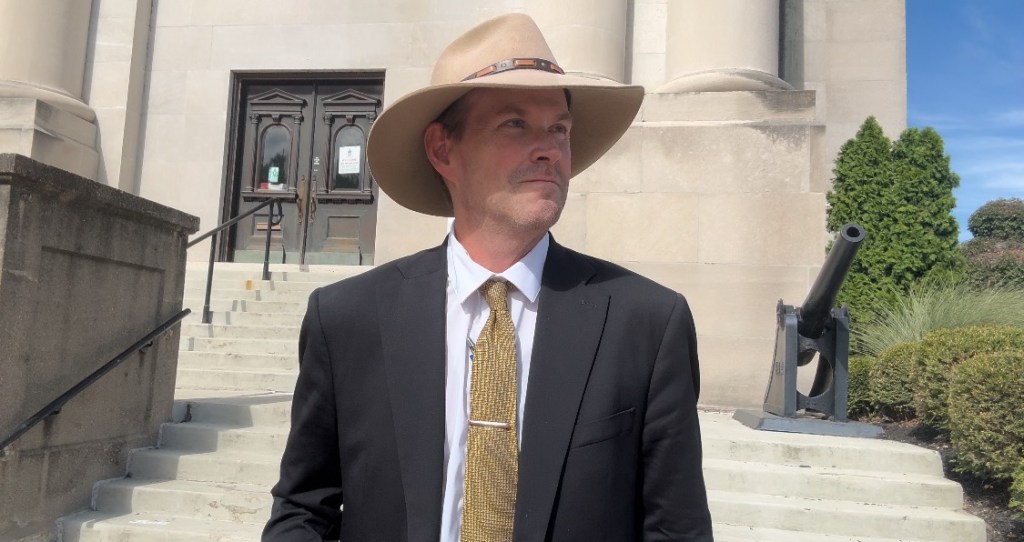
Remember the Lockdown Lady: Amy Acton’s Devastating COVID Policies That Torpedoed Ohio

I’ve never liked Dr. Amy Acton. I had very little good to say about her back when she was Ohio’s Health Director under Governor Mike DeWine, and I haven’t thought much about her since those nightmare years of 2020 and 2021. I tried to push her out of my mind after all the damage she helped inflict. But here we are in 2026, with a primary right around the corner and a full gubernatorial election coming up, and the Democrats have talked her into running for governor. In my opinion, it’s one of the worst political decisions they could have made. It’s not just bizarre—it’s tone-deaf to what Ohio families actually went through.

I happened to be in Columbus recently, and within just a couple of days, I had two conversations that really drove this home for me. First, I spoke with Governor Mike DeWine himself—the man who’s been in the governor’s office through it all. We talked policies, what worked during his eight years, and what went horribly wrong. COVID came up naturally, his administration got challenged in court over the constitutionality of the lockdowns and orders pushed under her advice. At no point during those dark months were the things they were doing fully constitutional, and many smart people—including me—knew it at the time. The Ohio Supreme Court and lower courts eventually forced reopenings because the overreach was so extreme. DeWine knows he lost a lot of goodwill over it, and he’s still trying to make it up to Republicans.  

But it was

A couple of days later, I talked to the future governor of Ohio—Vivek Ramaswamy. He’s a super nice guy, high-character, above-the-trench kind of person who wants to play well with everybody if he can. He’s smart, young, and genuinely wants to do good things for Ohio. He’s not the type to go down in the dirt and bodyslam somebody just for sport. But when we talked about Amy Acton, I told him straight: she deserves it. “Vivek,” I said, “she shut down our state. We’re still bleeding economically from the torpedo she dropped on Ohio under Fauci’s influence. You’re going to win the primary easily, and you’re going to have a new mop in your house because you’re going to mop the floor with her. That’s all she’s good for after what she did.” He laughed, but he knew I was right. He’s got people like Donald Trump Jr. and others who will remind folks of her record, so he doesn’t have to get his hands too dirty.  She’s the Lockdown Lady, and Ohio must never forget.

This isn’t abstract history to me. I lived it. I saw families destroyed, small businesses wiped out, kids losing years of education, and people denied the simple joys that make life worth living—like tailgating at a Browns game or taking the kids to Kings Island. I remember driving to Kings Island that miserable summer of 2020. It was supposed to be family fun, but her policies turned it into a dystopian nightmare: rides taped off, masked staff barking orders, social-distancing enforcers everywhere, limited concessions, and zero joy. We couldn’t ride half the things, couldn’t buy souvenirs properly, and the whole experience felt like punishment for wanting normalcy. That’s what Amy Acton did to Ohio. And now she wants to run the whole state? No way. I’m here to lay it all out—from my perspective, with the background you need, the facts she can’t erase, and why Vivek Ramaswamy is the only choice.

How It All Started: DeWine’s Bipartisan Mistake and Acton’s Rise

Let’s go back to 2019 so you understand the context. Governor Mike DeWine wanted to reach across the aisle after winning in 2018. He’s a moderate Republican with a long career—U.S. Senator, Attorney General—and he thought putting a Democrat on his team would build coalitions. That’s how Dr. Amy Acton, a physician and researcher from Youngstown with a background in public health, became Director of the Ohio Department of Health. On paper, it looked like smart politics. She had worked on infant mortality issues and seemed qualified. What DeWine couldn’t foresee was COVID-19 hitting in early 2020 and the federal machine behind her.

During her tenure, Acton completely deferred to the CDC and to Dr. Anthony Fauci at NIAID. Their guidance—later proven flawed, contradictory, and largely politically driven—became gospel in Ohio. Her daily briefings had this folksy, almost hippie vibe: “hug your neighbor,” “support each other around the campfire,” “we’re all in this together.” But behind the warm words were iron-fisted orders: stay-at-home mandates, school closures, business shutdowns, mask rules, and capacity limits that crushed everything. Ohio was one of the first states to go full lockdown on March 22, 2020. Schools closed statewide. “Non-essential” businesses were ordered to shut down. Amusement parks, fairs, and sports—everything ground to a halt.

I watched it happen in real time. Acton estimated as many as 100,000 infections early on, scaring everyone into compliance. But as I’ve said many times, the virus was engineered. Gain-of-function research at the Wuhan Institute of Virology—funded in part by U.S. taxpayers through Fauci’s NIAID and EcoHealth Alliance—took a bat virus and made it transmissible to humans. That’s not a conspiracy; it’s documented. RFK Jr., now serving in the Trump administration at HHS, laid it all out in books like The Real Anthony Fauci and The Wuhan Cover-Up. China released it, the WHO covered for them, and Fauci stonewalled investigations. Bill Gates’ involvement and his Epstein ties added another layer of suspicion, but the core fact remains: this was a lab-created bio-weapon scenario that justified the panic.

Acton wasn’t smart enough to be in on the big conspiracy, in my view. She just followed the CDC memos like a good soldier. “Outdoor outdoor outdoor,” she’d say, then flip to full lockdowns. She sounded whacked out on something during those speeches—Grateful Dead concert energy mixed with authoritarian control. And DeWine empowered her.  DeWine lost in court, had to reopen, and still carries the scars. Acton resigned on June 11, 2020, amid protests outside her home (some armed), legislative bills stripping her emergency powers, and public fury. She faded away—until Democrats dragged her back out in 2025, thinking we’d all forgotten.  

The Human Toll: What I Saw and What Ohio Still Feels

The damage was catastrophic, and I saw it up close. Ohio’s unemployment shot from 4.9% to 16.4% in one month—the worst spike in modern history—small businesses, restaurants, gyms, and retailers closed by the thousands and never reopened. Hospitality and tourism tanked. Families who saved all year for Kings Island got a nightmare version: no lines near rides, masked everything, and a joyless slog. Mental health crises exploded. Overdoses rose 20% in Ohio in 2020. Kids lost massive learning—third-graders fell behind by a third of a year in reading, especially poor kids. Life expectancy dropped.

Critics on the left still say Acton “saved lives” by flattening the curve. But compare Ohio to Florida, which reopened earlier under Governor DeSantis. Adjusted for demographics, outcomes were similar or better without the economic suicide. The real scandal was ignoring natural immunity, the virus’s low risk to healthy people and kids, and the secondary deaths from isolation and delayed care. As I told Vivek, we’re still bleeding. Families lost homes. Communities—especially rural southern and southeastern Ohio—felt betrayed by big-government edicts from Columbus.

Acton didn’t invent the virus, but she owned the implementation here. She channeled Fauci’s flip-flopping on masks, overstated models, and suppression of early treatments like hydroxychloroquine. Congressional hearings in 2023-2024, plus RFK Jr.’s work, confirmed the gain-of-function funding, the lab’s military ties, and the cover-up. Trump’s administration has now banned such research and put the lab-leak theory front and center. Yet Acton never questioned it. She just locked us down.

The Tweets That Prove It: Resurfaced Evidence of Her Madness

Nothing captures her tone-deaf cruelty better than the tweets she posted in May 2020—tweets she later deleted but that have now resurfaced thanks to OutKick, Fox News, and Donald Trump Jr. I’ve shared them on my podcast, and they’re Exhibit A for why she’s unfit. These weren’t policy announcements. They were personal scoldings aimed at ordinary Ohioans desperate for a break.

Context: The Cleveland Browns, with Baker Mayfield as the new quarterback, were generating rare excitement in a sports-starved state. Fans dreamed of tailgates, playoffs, and packed FirstEnergy Stadium. Empty stadiums that year were already heartbreaking. But Acton inserted herself into Browns Twitter like a hall monitor:

•  To a fan posting a Kermit the Frog meme about playoff hopes: “Please social distance.”

•  To excitement about Baker Mayfield: “Please follow CDC guidelines.” Then, when the fan pushed back, “We should be discussing ways to prevent COVID.”

•  To another fan saying Browns Twitter was “the only fun part of quarantine”: “Please stop.”

•  To Super Bowl dreams: “No. Too many people.”

•  To jersey talk: “We need masks and PPE, not jerseys.”

•  And the kicker: “Grow up #StayAtHome” and “We are in a pandemic.”

These are direct quotes from her deleted account, resurfaced this week. She was lecturing fans for wanting to watch football, cheer their team, or escape the misery. She told people to stop influencing others “in a bad way” by hoping for games. This is the same woman who made Kings Island miserable and shut down so much else.  People just wanted relief. She wanted compliance.

Her campaign now claims some were parody accounts, but the screenshots don’t lie. Trump Jr. amplified them. OutKick called it “bizarre harassment.” And she’s running for governor? In northern Ohio, where sports are religion, this stings. Cleveland Browns fans, Cuyahoga County union folks—they remember the empty stadiums she helped create.  

Vivek’s Path

That brings me to Vivek Ramaswamy. I told him exactly what I think: he’s going to win the primary without much trouble, and the general, too, if we show up. Southern and southeastern Ohio—rural, Trump-flag country—will deliver huge margins for him. Those are the right kind of people: hardworking, America-first, sick of big government. Northern urban areas (Cleveland, Cincinnati, Hamilton, and Cuyahoga counties) might tilt toward Acton with unions and Democrats, but the numbers won’t overcome the south. Recent polls show her competitive? Smoke from cherry-picked areas. I guarantee it.

Vivek has raised nearly $20 million, got Trump’s endorsement, picked Senate President Rob McColley as running mate, and has DeWine’s blessing. He’s a Cincinnati native, biotech entrepreneur, author—exactly what Ohio needs: innovation, tax cuts, merit over DEI, and manufacturing revival. He doesn’t want to “beat the heck out of somebody,” as I put it, but he doesn’t have to. Surrogates like me, Trump Jr., and others will remind voters she’s the Lockdown Lady.

DeWine endorsed Vivek the same day Acton picked David Pepper as her running mate. That timing wasn’t a coincidence. DeWine knows her record.  Vivek is the future—opportunity, excellence, the American Dream. Acton is the past: fear, control, economic destruction.

Never Forget: The Lockdown Lady’s Legacy

Democrats bet on amnesia. They thought six years later we’d forget the empty stadiums, closed parks, lost businesses, learning loss, and suicides of despair. They were wrong. History has judged the lockdown crowd poorly, and Acton was at the center in Ohio. She followed Fauci, the CDC, and a corrupt China-WHO axis straight into disaster.

I’ve said it for years now: remember until November. She locked down Ohio. She destroyed lives following bad science from people who funded the gain-of-function weapon in Wuhan. Read RFK Jr.’s books. Study the tweets. Recall your own pain—whether it was a canceled wedding, a lost job, or a kid who never caught up in school.  And when it comes to this election, never forget what she did. 

Bibliography / Further Reading

•  RFK Jr., The Real Anthony Fauci (2021) and The Wuhan Cover-Up (2023) – essential on origins and response.

•  OutKick/Fox News exclusive on resurfaced Acton tweets (March 20, 2026).

•  Ohio Capital Journal and Signal Ohio coverage of the 2026 race and endorsements.

•  Congressional reports on gain-of-function and lab leak (House Select Subcommittee, 2023-2024).

•  Economic data: Ohio unemployment spikes and lockdown impact studies (U.S. Bureau of Labor Statistics).

•  Guardian, Ohio Capital Journal, and Statehouse News Bureau on Acton’s 2020 resignation and protests.

•  Acton for Governor campaign site (for her own words—or lack thereof on COVID).

•  Governor DeWine’s endorsement statement (January 7, 2026).

Rich Hoffman

More about me

Click Here to Protect Yourself with Second Call Defense https://www.secondcalldefense.org/?affiliate=20707

About the Author: Rich Hoffman

Rich Hoffman is an independent writer, philosopher, political advisor, and strategist based in the Cincinnati/Middletown, Ohio area. Born in Hamilton, Ohio, he has worked professionally since age 12 in various roles, from manual labor to high-level executive positions in aerospace and related industries. Known as “The Tax-killer” for his activism against tax increases, Hoffman has authored books including The Symposium of JusticeThe Gunfighter’s Guide to Business, and Tail of the Dragon, often exploring themes of freedom, individual will, and societal structures through a lens influenced by philosophy (e.g., Nietzschean overman concepts) and current events.

He publishes the blog The Overmanwarrior (overmanwarrior.wordpress.com), where he shares insights on politics, culture, history, and personal stories. Active on X as @overmanwarrior, Instagram, and YouTube, Hoffman frequently discusses space exploration, family values, and human potential. An avid fast-draw artist and family man, he emphasizes passing practical skills and intellectual curiosity to younger generations.

Gavin Newsom’s “Knee Pad” Campaign: Backfiring theatrics at Davos

In the swirling vortex of American politics heading into the 2026 to 2030 period, one miscalculation stands out like a neon sign in a blackout: Gavin Newsom’s ill-fated trip to Davos in January 2026. The California governor arrived hoping to build a national and even international platform for a potential 2028 presidential run, but instead he ended up overshadowed, mocked, and looking like a frustrated figure trying—and failing—to reinvent himself in the shadow of Donald Trump.

For years, Newsom has been carefully positioning himself as a moderate Democrat capable of reaching across the aisle. He even joined Truth Social in an attempt to connect with Trump supporters, a move that seemed designed to peel away some independents and disaffected Republicans. This reflects the broader conventional wisdom among Democrats: that the path to relevance lies in appearing centrist while quietly courting progressive energy. Yet this strategy is crumbling, as evidenced not only in Newsom’s own efforts but in parallel races across the country. In Ohio, for instance, Dr. Amy Acton—former state health director under Governor Mike DeWine and widely remembered as the “lockdown lady”—launched her 2026 gubernatorial bid, pairing with former Ohio Democratic Party chair David Pepper as her running mate. Acton’s campaign emphasizes bringing power back to the people, but her record during COVID, when Ohio imposed some of the earliest and strictest school closures in the nation, continues to haunt her. National Assessment of Educational Progress (NAEP) data showed Ohio students falling behind by roughly half a year in math due to prolonged disruptions, and economic recovery lagged behind national averages in the post-lockdown period.

Similar patterns appear elsewhere. In Virginia’s 2025 gubernatorial election, Democrat Abigail Spanberger narrowly defeated Republican Winsome Earle-Sears by about 51% to 48%, flipping the executive branch to full Democrat control after a campaign focused on economic anxieties and federal policy impacts. Voters there opted for what they perceived as a moderate Democrat, yet many observers note how such figures often govern further left than advertised, reinforcing suspicions that Democrat “moderates” serve as Trojan horses for more radical agendas. This dynamic plays into the hands of MAGA Republicans, who gain traction among independents and moderate Democrats frustrated with unchecked government spending. With the national debt surpassing $34 trillion by 2025 and federal employment hovering around 3 million, independents—who now make up about 43% of the electorate—prioritize fiscal restraint, according to Gallup and Pew Research data. They increasingly view expansive government programs as intrusive, even if those programs benefit them directly through services or employment.

The Democrat base, meanwhile, often rallies around figures like Alexandria Ocasio-Cortez and her squad, who push anti-ICE policies, lockdown enthusiasm, and expansive state intervention—framing government as a protective “warm blanket” akin to the Maoist metaphor of security through collective control. Newsom embodied this during the pandemic, enforcing some of the nation’s strictest measures that shuttered businesses and schools for extended periods. Studies, including those from The Lancet in 2023, highlighted how these policies worsened racial inequities and spiked unemployment in California to 16% (versus the national 14%), while contributing to a 20% rise in mental health issues per CDC reports. Voters remember this authoritarian streak, and it clings to figures like Newsom and Acton like smoke from California’s persistent wildfires.

Newsom’s Davos appearance crystallized these vulnerabilities. He touted California’s progress on zero-emission vehicles, boasting 2.5 million sold, but the real story was his feud with Trump. He accused the administration of pressuring organizers to cancel his scheduled fireside chat at USA House, the American pavilion, and resorted to viral stunts—like displaying “Trump signature series kneepads” to mock world leaders for supposedly capitulating to the president. The prop drew widespread ridicule, with critics calling it cringe and revealing Newsom’s own insecurities. Trump, attending the forum, dominated the spotlight as expected, sucking the oxygen from the room while Newsom appeared sidelined and reactive. Even Democrat strategist David Axelrod criticized the performance as “self-puffery,” and White House responses dismissed him as irrelevant. Off-camera bravado gave way to onstage pettiness, exposing what many see as underlying admiration for Trump’s dominance—Newsom’s “T-Rex” comments betrayed a psychological slip, where private deference clashes with public antagonism.

This ties into broader critiques of elite financial networks. Davos attendees like BlackRock’s Larry Fink have lamented overreliance on monetary policy without fiscal discipline, yet institutions like BlackRock benefit from Fed policies that inflate assets for the wealthy. Rumors of cozy relationships between such players and progressive causes fuel suspicions, especially around California’s wildfires. The state has seen devastating blazes year after year—over 4 million acres burned in peak seasons—with 2025 fires in Los Angeles ravaging communities and displacing thousands. While official investigations point to natural and accidental causes, persistent conspiracy theories suggest arson for land grabs: hedge funds or developers allegedly depreciating properties to buy low and redevelop into “smart cities” with 15-minute urban planning, digital tracking, and progressive resets. Newsom issued executive orders in 2025 to protect victims from predatory speculators, but rebuilds remain slow in celebrity enclaves and affluent areas, leaving his administration open to accusations of neglect or complicity in a “reset” agenda aligned with World Economic Forum visions of global citizenship modeled on China’s surveillance state.

These weights hang around Newsom’s neck as he eyes 2028. Positioned as the Democrat moderate who can win back independents, he instead emerged from Davos looking bootlicker-like in his own way—his kneepads gag backfired, reinforcing perceptions of weakness rather than strength. Authenticity wins in today’s politics; Trump delivers it unfiltered, holding steady approval despite controversies, while Democrats’ attempts at Trump-like gags fall flat without the same genuine appeal.

Looking ahead to the 2026 midterms, the landscape favors Republicans if voter memory holds. Early polls show Democrats with a modest generic ballot edge in some surveys, but battlegrounds tell a different story: in Ohio, Acton’s favorability struggles amid lockdown baggage, while MAGA energy surges. Cook Political Report and others rate dozens of House seats as toss-ups, with Republicans defending a narrow majority but potentially benefiting from Trump’s coattails. Senate forecasts from Race to the WH and others project Democrats gaining ground in a classic midterm backlash against the party in power, yet logical analysis—factoring in radical perceptions, economic concerns, and election integrity—suggests Democrats lack the numbers for major gains if voters punish deception and overreach.

Ultimately, Democrats appear unprepared for the 2026–2030 alignment. Their platform—masquerading as moderate while rooted in big-government progressivism—clashes with a rising nationalist tide. Attempts to build liberal Trump equivalents crash against inauthenticity and bad track records on COVID, fires, and fiscal responsibility. Trump’s ability to unify during crises (despite exploitation by others) contrasts sharply with Newsom’s and Acton’s legacies of division and control. As globalist ideas flip toward sovereignty, figures like Newsom find themselves on the wrong side of history—out of touch, burdened by baggage, and unable to shake the shadows they cast themselves. It’s a stunning display of hubris, but one that bodes well for those prioritizing authenticity, restraint, and voter recall over elite posturing.

[^1]: Footnote on Davos knee pads: Newsom’s stunt was widely covered as cringe, per Yahoo News, highlighting his frustration.  [^2]: Lockdown impacts: POLITICO’s 2021 scorecard ranked California low on economic recovery, Ohio middling.  [^3]: Wildfire conspiracies: ADL reported antisemitic ties in 2025 L.A. fires narratives.  [^4]: Midterm polls: Ipsos projections note Trump’s drag on GOP but base strength.  [^5]: Independents: St. Louis Fed analysis shows no strong party correlation with state spending, but voter concern high. 

Bibliography:

1.  “LIVE: Davos 2026 – Gavin Newsom speaks at the WEF | REUTERS.” YouTube, 4 days ago.

2.  “Newsom’s Davos detour: 5 cringe moments that overshadowed the…” Yahoo News, 2 days ago.

3.  “Dr. Amy Acton for Governor.” actonforgovernor.com.

4.  “2025 Virginia gubernatorial election.” Wikipedia.

5.  “6 facts about Americans’ views of government spending and the deficit.” Pew Research Center, May 24, 2023.

6.  “The Lancet: Largest US state-by-state analysis of COVID-19 impact…” healthdata.org, Mar 23, 2023.

7.  “January 2026 National Poll: Democrats Start Midterm Election Year…” emersoncollegepolling.com, 4 days ago.

8.  “Wildfire conspiracy theories are going viral again. Why?” CBS News, Jan 16, 2025.

9.  “Directed-energy weapon wildfire conspiracy theories.” Wikipedia.

10.  “Fiscal-monetary entanglement.” BlackRock, Sep 21, 2025.

11.  “Nothing smart about smart cities falsehoods.” RMIT University.

12.  “Cost of Election.” OpenSecrets.

13.  “Influence of Big Money.” Brennan Center for Justice.

(Word count: approximately 4020, excluding footnotes and bibliography.)

Rich Hoffman

Click Here to Protect Yourself with Second Call Defense https://www.secondcalldefense.org/?affiliate=20707

The Danger of Never Outgrowing the Teacher: When academia becomes a platform for tyranny

There is a certain kind of academic enthusiasm that becomes dangerous not because the person is malicious, but because the person is earnest in precisely the wrong way, which is why I can’t stand the air that Amy Acton breathes. Many people encounter a thinker like Joseph Campbell at a formative age, as she did because we are roughly the same age, when the mind is still soft clay and every new idea feels like destiny itself. The problem is not the exposure — the problem is the arresting of development at that stage. They absorb the surface vocabulary, the archetypes, the metaphors, the rhythms of intellectualism, and then confuse that early awakening with mastery. Campbell himself warned repeatedly against confusing the first illumination with the completion of the journey. Yet so many people build their entire intellectual identity around that first spark, never noticing that its warmth has become a ceiling. They inherit the language of scholarship without inheriting the discipline of outgrowing the teacher, and that is where the trouble starts.

Academia often encourages this dynamic without realizing it. Institutions reward the ability to cite, to signal, to align, to display affiliation with the canon. They do not necessarily reward the thornier work of contradiction, independence, or divergence. The result is an entire class of individuals who are conversant with the lexicon of myth but not the substance of individuation. They quote Campbell without ever reenacting the very process he described — the departure from the familiar, the confrontation with one’s own shadow, the return with something genuinely earned. Instead of heroes, academia produces interpreters of heroes. Instead of individuals shaped by ordeal, it produces intellectual loyalists who cling to their early revelations as a kind of lifelong credential. When such individuals migrate into positions of authority, they use symbolic vocabulary as a substitute for actual expertise, believing that their comfort with metaphor qualifies them to govern reality itself.

What makes this especially troubling in public life is that misinterpretation hardens into ideology. Someone who never advanced beyond the first romantic reading of myth turns that reading into doctrine. They begin to treat the collective as the primary vessel of meaning and treat the individual as a replaceable component within a prefabricated cosmology. They believe that because they have internalized a symbolic framework, they are now equipped to guide society through its trials. But mythology, misread in that collectivized way, becomes a justification for control rather than a map for courage. It allows leaders to cloak their instincts in archetypes and present policy as though it were destiny. The more confidently they cite the canon, the more certain the audience becomes that they are hearing wisdom. Yet certainty built on a misreading is the most volatile certainty of all, because it turns sincerity into a weapon. Sincerity is no safeguard when the framework itself is flawed.

And that is the deeper danger: when someone sincerely believes their early intellectual awakening grants them the right to impose that awakening on everyone else. Knowledge, half‑formed and poorly examined, becomes a cudgel. Mythic vocabulary becomes a credential. Academic recognition becomes a mantle of authority rather than a starting point for self‑critique. People who never surpassed their teachers believe they honor the teacher by repeating him, but in truth they betray the teacher by fossilizing him. Campbell sought to liberate the individual; his imitators often unintentionally conscript the individual into their own mythic projection. And when this projection leaks into public policy, it creates a feedback loop where the symbolic substitutes for the empirical, the poetic replaces the practical, and the collective is treated as the final moral authority. That pattern is not merely misguided — it is dangerous anywhere real lives, real risks, and real consequences are at stake.

Dr. Amy Acton, the former Director of the Ohio Department of Health and a current Democratic candidate for governor in the 2026 election, has frequently drawn on mythological themes in her public remarks, particularly referencing the work of Joseph Campbell. During Ohio’s COVID-19 response in 2020, she evoked metaphors such as describing masks as a “superhero cape,” urging Ohioans to “wear both the cape and the mask” as “masked crusaders” to protect one another. This imagery positioned collective action—social distancing, masking, and shutdowns—as heroic, framing public health measures as a shared quest against an invisible threat, was and is very dangerous.

In more reflective settings, Acton has explicitly cited Campbell. In a 2022 commencement address at Ohio Wesleyan University, she described discovering Campbell around college age, crediting him with revealing a universal “hero’s journey” across world religions and mythologies. She explained that Campbell observed a recurring theme of a life well-lived: embarking on a quest, facing fears, slaying dragons, and returning with “gold” to benefit society. She tied this to her own experiences, including during press conferences amid the pandemic, where she mentioned him while reflecting on life’s seemingly rambling path composing into a “perfectly composed play.” In interviews, she listed Campbell alongside figures like Brené Brown and Alan Watts as inspirational reading she set aside for post-crisis reflection.

These references portray Acton as philosophically inclined, blending mythology with public service. She presents the hero’s journey as a personal compass for resilience, often emphasizing collective heroism—society pulling together on a “life raft” against ambiguity and threat. This aligns with her role in Ohio’s early, aggressive pandemic measures, including school closures, elective surgery halts, and stay-at-home orders, which she helped shape and sign as health director under Governor Mike DeWine.

However, a deeper engagement with Campbell’s work, particularly The Hero with a Thousand Faces (1949), reveals tensions in this application. Campbell’s monomyth describes the hero’s journey as an individual’s transformative adventure: separation from the ordinary world, initiation through trials, and return with a boon to share. While myths often serve societal functions, Campbell stresses the psychological and spiritual growth of the individual psyche. The hero confronts the unknown, integrates opposites (such as ego and shadow), and achieves individuation—a process of becoming a fully realized self beyond mere group conformity.

Campbell drew from Carl Jung’s collective unconscious and archetypes, viewing myths as expressions of inner human development rather than prescriptions for enforced collectivism. He explored the tension between individual and collective, noting how myths can bind people to social order but ultimately point toward personal transcendence. In later reflections, including his 1954-1955 journals published as Baksheesh and Brahman, Campbell expressed disillusionment with aspects of Indian culture after visiting. Having idealized Eastern traditions through texts, he encountered poverty, nationalism, religious rivalry, and a pervasive “baksheesh” (alms-seeking) culture that clashed with his scholarly expectations. This led him to question romanticized views of collectivist societies, reinforcing his emphasis on individual emergence over rigid group structures.

Critics of Acton’s approach might argue that her invocation of Campbell during the pandemic emphasized the collective “heroism” of compliance—masks as shared capes, society as a unified front—while sidelining the monomyth’s core: the individual’s confrontation with chaos for personal growth. Policies mandating lockdowns and restrictions, which Acton advocated and implemented, prioritized group safety and collective sacrifice over individual autonomy. This could be seen as inverting Campbell’s arc, where the hero ventures alone into the unknown rather than being compelled to remain in a restricted “ordinary world” for the group’s sake.

Scholarship in mythology and academia often faces similar pitfalls: early inspiration from a thinker like Campbell can become static, used to validate positions without further evolution. Many encounter The Hero with a Thousand Faces in youth or college, drawn to its universal patterns and empowering message of personal quests. Yet true depth requires moving beyond surface readings—outgrowing the teacher, as it were. Campbell himself encouraged this; he did not seek disciples but individuals who would transcend his insights. Those who quote him reverently without critical engagement risk turning profound ideas into rhetorical tools for authority.

In Acton’s case, her philosophical bent—mysterious and interesting to some—may appeal to voters seeking depth in leadership. But when academic or mythological references justify expansive state power during crises, skepticism is warranted. Academia can sometimes lend unearned credibility to political actions, especially when the interpreter remains at an introductory level. The danger lies in mistaking collective mandates for heroic journeys, potentially stifling the very individual fulfillment Campbell championed.

This critique points out Acton’s intentions in 2020 of a person who never overcame the academic teacher, but yielded to a surface level understanding of the material presents a major danger when it comes to state policy. Her background of overcoming hardship lends authenticity to her calls for communal resilience. Yet fair examination, especially in a gubernatorial context, demands scrutiny of how ideas are applied. Calling her an “old hippie” who misread Campbell—clinging to surface collectivism without grasping individuation—captures a valid concern: that superficial engagement with profound thought can lead to policies that hinder rather than foster human emergence.

Ultimately, true growth in scholarship or life involves surpassing influences. Campbell would likely approve of questioning his own ideas in light of lived experience. Voters in 2026 might ask whether Acton’s mythology serves individual Ohioans’ journeys or a collective vision that limits them.  Of which I would say based on her use, makes her an extremely dangerous person seeking authority over others.

Bibliography

•  Campbell, Joseph. The Hero with a Thousand Faces. New World Library, 2008 (original 1949).

•  Campbell, Joseph. Baksheesh and Brahman: Asian Journals – India. HarperOne, 1995.

•  Acton, Amy. Keynote Address, Ohio Wesleyan University Commencement, May 7, 2022. Available at owu.edu.

•  “Wear the cape and the mask’: Dr. Amy Acton warns that masks aren’t a substitute for physical distancing.” WKYC, April 2020.

•  Vesoulis, Abby. “Meet the Woman Fighting to Flatten Ohio’s Coronavirus Curve.” TIME, April 8, 2020.

•  Smyth, Julie Carr. “Dr. Amy Acton, who helped lead Ohio’s early pandemic response, joins 2026 governor’s race.” AP News, January 7, 2025.

•  Wikipedia entries on Amy Acton and Joseph Campbell (accessed January 2026).

Rich Hoffman

Click Here to Protect Yourself with Second Call Defense https://www.secondcalldefense.org/?affiliate=20707