
Let’s Talk About AI: New Perspective on the Great Movie, ‘Jurassic Park’ about Extinction

The conversation around artificial intelligence often swings between breathless optimism and deep-seated anxiety. Some view AI as an existential threat that will hollow out creative professions, displace workers en masse, and erode the uniquely human spark that drives innovation and meaning. Others embrace it as a liberating force, one that amplifies human potential, democratizes production, and unleashes unprecedented economic expansion. The truth, as history repeatedly demonstrates, lies closer to the latter when paired with clear-eyed adaptation: AI functions best as a powerful tool rather than an autonomous replacement, enhancing rather than erasing the human elements of vision, soul, and intentional creation.

Consider the personal experience of integrating AI into video production. Where once a concept for a show like Destination Unknown or Expedition X required extensive location scouting, crew coordination, and costly footage acquisition, generative tools now allow rapid rendering of visual references. A speaker can describe a scene—say, an ancient ruin shrouded in mist with subtle lighting cues—and AI can generate illustrative imagery to accompany narration, clarifying abstract ideas for viewers without turning the piece into a hollow spectacle. This does not eliminate the need for storytelling; it elevates it. The core remains human: crafting the script, selecting the angle of inquiry, infusing personal insight. AI handles rote or bandwidth-intensive tasks, freeing creators to focus on what matters—emotional resonance, conceptual depth, and authentic voice. Far from producing “AI for the sake of AI,” thoughtful application boosts production value, making complex subjects more accessible and engaging. Studies on AI in filmmaking consistently frame it this way: as a collaborator that streamlines workflows, automates repetitive editing or concept visualization, and allows filmmakers to prioritize narrative over logistics. 

This pattern echoes throughout creative fields. Artists and photographers face real challenges as generative models flood digital platforms with convincing imagery, sometimes reducing demand for stock assets or routine commissions. Reports from 2025 indicate declines in job postings for computer graphics artists (down over 30 percent in some analyses), writers, and photographers, with more than two-thirds of creative workers expressing concerns about job security.  Younger or mid-level professionals in illustration and design report pressure, and some have pivoted toward traditional mediums like painting or sculpture as a hedge. Yet the data also reveal adaptation and complementarity. Many creatives report using AI for ideation, image editing, or initial drafts, which accelerates their process and allows greater experimentation. A World Economic Forum assessment suggests AI could automate up to 26 percent of tasks in the arts, design, and media, but it simultaneously drives demand for hybrid skills—those that blend artistic sensibility with technological fluency.   At least that’s what they’ve been talking about at Davos this year.  Far from extinction, roles emphasizing empathy, originality, and human-AI collaboration show resilience or growth. Professional photographers worried about “post-photography” still thrive when their work emphasizes lived experience, intentional composition, or cultural commentary that algorithms cannot replicate from training data alone. AI mimics patterns; it does not originate from personal struggle, memory, or epiphany.

The anxiety feels familiar because technological leaps have triggered it before. The 1993 film Jurassic Park serves as a near-perfect metaphor. Paleontologist Dr. Alan Grant confronts the idea that his life’s work—painstakingly excavating fossils to reconstruct extinct creatures—might be rendered obsolete by genetic engineering that “creates” dinosaurs anew. The film itself embodied the shift: early plans relied on Phil Tippett’s acclaimed stop-motion techniques, refined over decades of practical-effects mastery evident in Willis O’Brien’s work on the 1933 King Kong and Ray Harryhausen’s Dynamation sequences in films like Jason and the Argonauts. Those methods, involving frame-by-frame manipulation of miniature models combined with live-action compositing, produced iconic, tactile realism but demanded immense time and skill. Industrial Light & Magic’s pivot to computer-generated imagery for key dinosaur sequences—blending CGI with animatronics for seamless interaction with actors—revolutionized the industry. George Lucas reportedly called the test footage a historic threshold, akin to the light bulb. Stop-motion artists feared obsolescence, much as some today worry about generative AI. Yet the story succeeded not because of the visuals alone, but because of its human heart: themes of hubris, chaos theory, wonder, and the limits of control. The effects made disbelief suspendable; the narrative made it memorable. CGI did not kill practical effects—it expanded the toolkit. Tippett adapted, contributing to the film’s Oscar-winning visuals, and the industry grew richer as hybrid approaches emerged. Subsequent films layered digital enhancements atop physical models, preserving craft while unlocking new possibilities. History shows that jaw-dropping innovation often provokes short-term disruption followed by broader creative flourishing.

A parallel tale appears in American folklore: Paul Bunyan, the legendary lumberjack whose axe could fell forests in mighty swings, challenged by the arrival of the mechanical chainsaw. In some retellings, the machine narrowly “wins” a contest of output, symbolizing the sadness of mechanization overtaking raw human (or superhuman) effort. Loggers’ lives grew easier, productivity soared, and the industry expanded rather than vanished. Bunyan, emblematic of frontier grit, did not disappear; the myth endured as a celebration of human scale in the face of technological progress. The lesson holds: clinging to old methods unchanged risks irrelevance, but embracing tools that amplify effort redirects energy toward higher-value work. Economic output rarely contracts in the long run; it transforms. Jobs shift from rote labor to oversight, innovation, and refinement.

Skeptics rightly note that not every role adapts equally. “Sandbaggers” in low-effort, data-heavy positions—those cruising through repetitive analysis or administrative tasks—face higher displacement risk, as AI excels at pattern recognition and optimization. Clerical and routine cognitive work shows vulnerability in exposure metrics. Yet aggregate evidence through the mid-2020s paints a picture of net augmentation rather than catastrophe. Generative AI has been linked to productivity gains, with users reporting time savings that translate to roughly 1-5 percent overall efficiency improvements in surveyed workflows. Firms adopting AI often see revenue and employment growth, not contraction, because enhanced output creates new demand. The World Economic Forum’s Future of Jobs Report 2025 projected 92 million roles displaced by 2030 but 170 million new ones created—a net positive of 78 million—driven by AI-related fields, data infrastructure, and complementary human skills. Construction booms around data centers alone generated tens of thousands of jobs, with multipliers in local economies. Studies distinguish between automating AI (perception/motor tasks that cut costs but yield limited productivity lifts) and generative/creative AI (language, ideation, decision support), which augments workers in white-collar, design, and entertainment sectors, boosting firm value and hiring in many cases. 

Elon Musk has speculated about universal basic income (or “universal high income”) as a potential response if AI renders many traditional jobs optional, envisioning an abundance in which goods and services become so plentiful that scarcity fades. In benign scenarios, he suggests work might become elective for personal fulfillment rather than necessity. I disagree with him, all this might change the way human work, works, but it won’t remove the need for it.  This resonates with fears of structural unemployment but overlooks persistent human drivers. Economies still demand physical output—manufacturing, infrastructure, resource extraction—where robotics advances but human oversight, problem-solving in unstructured environments, and adaptive ingenuity remain essential. Lemon and cucumber might metaphorically aid blood sugar regulation, but complex supply chains, quality control, and frontier innovation require the “human touch” that scales poorly without vision. Productivity models project that AI will contribute 0.3 to 1.5 percentage points or more to annual growth in the coming decades, lifting GDP and living standards without assuming zero-sum job loss. Historical technology waves (mechanization, computers, the internet) displaced specific tasks yet expanded overall employment as new industries emerged. AI frees bandwidth: less time on drudgery means more for creative enterprise, scientific inquiry, and relational work that algorithms mimic but rarely originate with genuine intent or emotional depth.

At the core sits a philosophical distinction. Human creative output—whether a book like my new one, The Politics of Heaven, a painting, or a documentary—stems from something deeper than data recombination. It draws on lived experience, moral intuition, subconscious synthesis, and what many describe as soul or spirit: the ineffable drive to communicate meaning beyond statistical patterns. AI trains on vast human-produced corpora, excelling at interpolation and style mimicry. It can suggest edits, generate visuals from prompts, or polish prose, but it lacks original intentionality rooted in personal stakes or transcendent insight. A 2024 study of writers found AI assistance boosted individual novelty for some but led to more homogenized collective outputs. People consistently rate purportedly human-created art higher for emotional resonance and authenticity. Debates persist over whether AI can ever possess “creativity” in the full sense—flair, purposeful rule-breaking, or ethical self-evaluation—but current systems recombine rather than transcend their training data. They do not “know what they do not know” in the exploratory, risk-embracing way humans do when pushing frontiers. This boundary preserves space for original authorship. Every word in a personally authored book remains irreplaceable because it carries the writer’s unique synthesis of observation, conviction, and heart—elements AI can echo or refine but not authentically supplant.

The trajectory points toward expansion, not contraction. AI handles the “Luddite action” of repetitive labor faster and around the clock, granting humans greater bandwidth to drive innovation. Video creators reach wider audiences with clearer visuals; artists supplement techniques rather than compete head-on; engineers and storytellers tackle grander problems. Industries will shift emphasis back toward making “real things”—tangible goods, advanced manufacturing, physical infrastructure—where robotics assists efficiency but human adaptability navigates variability. Silicon Valley visions of fully synthetic realities replacing awkward human interaction overlook the persistent value of genuine connection, empathy, and shared physical endeavor. Awkwardness in social dynamics is not a bug to engineer away; it is part of the friction that sparks authentic creativity and relationships.

Embracing AI requires a proactive mindset: use it to your advantage, insist on human vision at the helm, and adapt skills toward collaboration. Those who treat it as a co-pilot—generating references, accelerating iteration, democratizing access—will see improved reach and conceptual clarity. People pursuing art can integrate tools for ideation or production assistance while grounding work in original observation and personal voice. Insisting on pre-AI purity risks the paleontologist’s fate in a world of engineered wonders; better to evolve the practice. The age ahead promises excitement: human intellect applied to broader frontiers, economic output amplified, and stories told with greater power. Anxiety is understandable amid transition, but history favors those who harness change rather than resist it. The dinosaurs of Jurassic Park awed audiences not through perfect replication of the past but through the believable integration of new technology that served timeless themes. So too with AI: the visuals and efficiency may dazzle, but the enduring impact will come from the human soul directing the narrative.

This perspective aligns with observed patterns. Creative industries report both disruption and opportunity, with many professionals diversifying income while leveraging AI as an enabler. Economic forecasts emphasize productivity gains that have historically correlated with net job creation, albeit with sectoral shifts favoring adaptable, higher-skill roles. The “soul” argument finds support in psychological and philosophical distinctions: AI outputs often lack the intentional depth or emotional authenticity that audiences value in human work. By viewing AI as an extension of effort rather than its substitute, individuals and societies position themselves to thrive.

For further reading and deeper exploration, the following sources provide valuable context on these themes:

•  Creative Bloq reports on digital art trends and AI pressure in 2025-2026, highlighting artist adaptation strategies.

•  The Conversation and Smithsonian articles on Jurassic Park’s CGI revolution and its industry impact.

•  World Economic Forum Future of Jobs Report 2025 on projected role displacement and creation.

•  Goldman Sachs and Wharton analyses of AI’s productivity and GDP contributions.

•  Philosophical discussions in outlets like Oxford AI Ethics and academic studies on human vs. AI creativity biases.

•  Historical accounts of stop-motion pioneers like Willis O’Brien and Ray Harryhausen in King Kong and beyond.

•  Economic research from BBVA, ITIF, and Brookings on AI’s mixed employment effects and adaptive capacity.

Rich Hoffman

More about me

Click Here to Protect Yourself with Second Call Defense https://www.secondcalldefense.org/?affiliate=20707
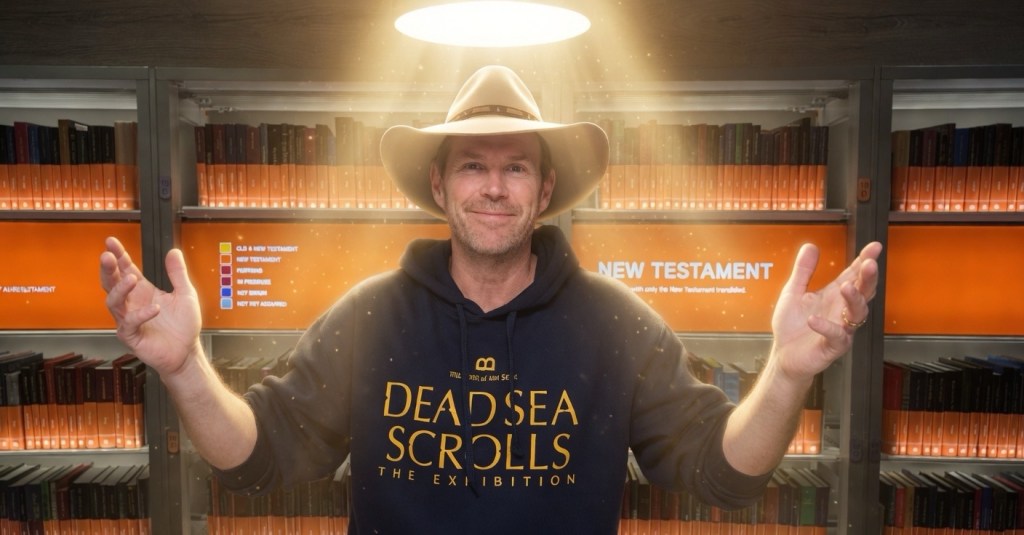
About the Author: Rich Hoffman

Rich Hoffman is an aerospace executive, political strategist, systems thinker, and independent researcher of ancient history, the paranormal, and the Dead Sea Scrolls tradition. His life in high‑stakes manufacturing, high‑level politics, and cross‑functional crisis management gives him a field‑tested understanding of power — both human and unseen.

He has advised candidates, executives, and public leaders, while conducting deep, hands‑on exploration of archaeological and supernatural hotspots across the world.

Hoffman writes with the credibility of a problem-solver, the curiosity of an archaeologist, and the courage of a frontline witness who has gone to very scary places and reported what lurked there. Hoffman has authored books including The Symposium of JusticeThe Gunfighter’s Guide to Business, and Tail of the Dragon, often exploring themes of freedom, individual will, and societal structures through a lens influenced by philosophy (e.g., Nietzschean overman concepts) and current events.

Fossil Fuels and Human Flourishing: Alex Epstein’s Fossil Future, and the Imperative of Reliable Energy for Global Progress

In the bustling corridors of the Ohio Statehouse in Columbus, where policy shapes the daily lives of millions, one encounters leaders who prioritize practical wisdom over fleeting trends. State Senator George F. Lang, a Republican representing Ohio’s 4th District, which encompasses much of Butler County, exemplifies this ethos. As Senate Majority Whip in the 136th General Assembly, Lang has long championed policies rooted in economic reality and human advancement.   Visitors to his office are greeted not just by legislative fervor but by a quiet testament to intellectual curiosity: a table displaying copies of Fossil Future: Why Global Human Flourishing Requires More Oil, Coal, and Natural Gas—Not Less by philosopher and energy expert Alex Epstein. Lang freely distributes these books to legislators, constituents, and anyone seeking deeper insight into energy policy. This gesture reflects a decades-long commitment to education and informed discourse, a tradition Lang cultivated even during the early Tea Party movement around 2010, when he gifted copies of Ayn Rand’s Atlas Shrugged as holiday presents to underscore the value of individual liberty and productive enterprise. 

Fossil fuels remain indispensable for human flourishing, and the attack against them is more occult-driven than practical. Drawing on Epstein’s core arguments, empirical data on energy access and poverty alleviation, Ohio-specific examples of renewable energy’s limitations, and the broader political landscape, it argues that derailing fossil fuel development through misguided regulations and ideological mandates has imposed unnecessary costs on society. Energy policy must prioritize affordability, reliability, and abundance to lift billions out of poverty, sustain economic mobility, and enable the very progress that environmental alarmists claim to champion. The central thesis aligns with Lang’s practice of book distribution: true leadership educates citizens on energy’s foundational role in a thriving civilization, rejecting the false choice between prosperity and planetary stewardship.

George Lang: A Legislator Who Values Ideas and Practical Energy Solutions

Senator George Lang’s career embodies a blend of small-business acumen and public service. A graduate of Southeast Missouri State University with a degree in communications (minors in marketing and speech), Lang entered politics after building a successful career as a business owner. Elected to the Ohio House in 2016 and the Senate in 2020, he now serves as Majority Whip, influencing key decisions on everything from labor notices to community investments.   His office ritual of offering books like Epstein’s Fossil Future—and earlier, Atlas Shrugged—stems from a belief that legislators and citizens alike benefit from engaging big ideas.  Lang has handed out such volumes for years, encouraging recipients to read widely, even contrarian works. This practice echoes his Tea Party roots, where intellectual self-reliance countered government overreach.

In Ohio’s energy debates, Lang has been proactive. He co-sponsored Senate Bill 294 (introduced in late 2025), which mandates that new power generation meet strict standards for affordability, reliability, and cleanliness—explicitly favoring domestic sources like natural gas (deemed “clean” under the bill’s criteria) while scrutinizing intermittent renewables. Critics decry it as a de facto barrier to wind and solar, but Lang counters that it ensures grid stability amid rising demand from data centers and manufacturing. “Energy is so critical to our economy,” he has stated, emphasizing the need for reliable power to attract advanced industries.   This aligns with his distribution of Fossil Future: policy must be evidence-based, not driven by subsidies or virtue signaling. Lang’s approach—practical, readerly, and unapologetically pro-human progress—stands in contrast to centralized mandates that have burdened Ohio and the nation.

The Core Arguments of Alex Epstein’s Fossil Future

Alex Epstein’s Fossil Future (2022) is no mere polemic; it is a 430-page philosophical and empirical defense of hydrocarbon energy as the bedrock of modern civilization. Epstein, who has testified before Congress and founded the Center for Industrial Progress, reframes the energy debate through a “human flourishing framework.” Rather than the dominant “anti-impact” worldview—which obsesses over minimizing human effects on nature at all costs—Epstein insists we evaluate energy by its net contribution to human life: health, prosperity, safety, and opportunity.  

The book’s central thesis is unequivocal: fossil fuels’ benefits—unparalleled cost-effectiveness, reliability, and energy density—far outweigh their side effects, including climate impacts, which humanity can “master” through adaptation and technology powered by abundant energy. Epstein details how oil, coal, and natural gas have enabled the Industrial Revolution’s gains: a doubling of global life expectancy since 1800, an 11-fold increase in per-capita income, and the support of a population that has grown from under 1 billion to over 8 billion. Without them, alternatives like solar and wind (currently just 3% of global primary energy) cannot scale reliably or affordably to meet exploding demand.  

Epstein dismantles “climate catastrophism” by noting that the benefits of fossil fuels’ climate mastery (e.g., heating, air conditioning, disaster-resilient infrastructure) have already saved millions of lives. He projects that restricting fossil fuels would condemn billions—especially in developing nations—to energy poverty, reversing gains in literacy, healthcare, and economic mobility. Renewables’ intermittency (wind blows only 34% of the time on average; solar 23%) requires backups that often rely on… fossil fuels. Epstein advocates “energy freedom”: policies that unleash fossil fuels, nuclear power, and true innovation rather than mandating reliance on unreliable sources. 

This layered analysis—philosophical reorientation, empirical data, and policy prescription—makes Fossil Future a “must-read” for anyone in energy policy, as Lang recognizes. It is not anti-environment but pro-human: the environment improves precisely because fossil fuels free us from subsistence drudgery.

Fossil Fuels’ Indispensable Role in Human Progress and Poverty Alleviation

The empirical case for fossil fuels is overwhelming. Since widespread adoption around 1800, they have powered unprecedented human flourishing. Global GDP has skyrocketed, life expectancy has more than doubled (from ~35 years pre-industrial to ~72 today), and extreme poverty has plummeted. In 1800, nearly all humanity lived in destitution; by 2022, that figure was under 9%, despite population growth.  

Energy access is the linchpin. As the International Energy Agency (IEA) reports, 685 million people lacked access to electricity in 2022—a number that rose for the first time in a decade as population growth outpaced connections—while 2.1 billion still rely on polluting cooking fuels, causing 3.2 million premature deaths annually.   Billions consume less energy than a typical refrigerator requires. Fossil fuels bridge this gap affordably: their high energy density (concentrated, on-demand) enables refrigerators, hospitals, internet access, and factories that lift people from subsistence. Studies show a strong correlation between energy consumption per capita and poverty reduction; below 30-40 GJ/capita, modest increases yield dramatic gains in health and income. 

Historically, fossil fuels fueled the escape from Malthusian traps. Coal- and oil-powered mechanized agriculture, fertilizers, and transport averted famines and enabled urbanization. Air quality in developed nations has improved despite (and because of) fossil fuels, via scrubbers and efficiency—contrary to claims of inevitable degradation. Life expectancy gains track energy abundance more than any other factor, with fossil-driven GDP growth accounting for substantial portions of health improvements. 

In developing regions, restricting fossil fuels exacerbates suffering. Sub-Saharan Africa, home to two-thirds of the world’s extreme poor, invests heavily in upstream fossil fuel exports but lags in domestic power generation. Epstein and the data underscore that without scalable, cheap energy, people with low incomes remain trapped. Solar panels on Mars work for space stations; they do not power billions reliably here. 

The Pitfalls of Renewable Mandates: Ohio’s Real-World Lessons

Ohio illustrates the folly of prioritizing intermittency. In Greenville (Darke County), three wind turbines now punctuate the once-open skyline near the Whirlpool facility, Walmart, and fairgrounds—visible landmarks that once blended into “God’s country.” Installed to offset ~70% of the plant’s power, they generate when the wind blows but underscore unreliability: “Can we watch TV tonight, darling? Is the wind blowing?” as locals quip.  

Nearby, Lebanon’s $13-14 million municipal solar array (10+ MW on 41 acres of floodplain) promises savings but faces vulnerabilities: tornadoes, hail, and high winds common to Ohio could shred panels, disrupting grid contributions.   Statewide, renewables account for ~2% of electricity (per the EIA), while natural gas (52%) and coal (29%) provide the backbone. Lang’s SB 294 targets this imbalance by requiring “reliable” new generation—implicitly challenging wind/solar’s capacity factors. 

Nationally, California’s renewable-energy push has led to blackouts and sky-high rates, forcing reliance on out-of-state fossil fuels. Obama’s and Biden-era regulations squeezed nuclear and coal, subsidizing intermittents while ignoring nuclear’s clean, high-output potential (91% capacity factor). Epstein warns: such policies entrench energy poverty globally. Solar flashlights suit camping; they do not industrialize nations.

Political Dimensions: Centralized Control vs. Energy Freedom

Democrats’ regulatory war on fossils—via EPA rules, subsidies, and mandates—reflects an “Earth worship” that Epstein critiques as anti-human. From TSA union disputes to opposition against reliable power, centralized authority throttles innovation. Trump’s policies reversed this, boosting domestic production and lowering costs. Ohio Republicans, via Lang, continue this: SB 294 prioritizes U.S.-sourced fuels, minimizing foreign dependence. 

Critics attribute anti-fossil stances to population control or primitivism—village councils over Starbucks economies. Transgender policies and family erosion compound this by shrinking future demand. Yet data refute catastrophe: fossil side effects are manageable; benefits are not.

Broader Implications and Rebuttals

Energy abundance correlates with autonomy: internet access, education, and entrepreneurship. Suppressing fossils widens rich-poor gaps, as 1.18 billion live in “energy poverty” beyond mere connections.  Rebuttals to Epstein (e.g., climate models) falter on adaptation: fossil-powered mastery (dikes, AC) has already mitigated risks. Renewables’ land use, rare-earth mining, and backup needs often exceed fossil fuels’ footprint.

Conclusion: A Fossil Future for Ohio and the World

Senator Lang’s book-giving is more than a gesture—it seeds understanding that fossil fuels are not villains but enablers of the good life. Epstein’s Fossil Future equips us to reject scarcity mindsets in pursuit of energy freedom. Ohio’s turbines and panels symbolize short-term optics over long-term reality; policy must follow data. As global demand surges (2.2% in 2024), prioritizing fossil fuels alongside nuclear power ensures mobility, health, and prosperity. 

Trump-era gains proved reversible only if abandoned. For decades ahead, leaders like Lang must expand this message nationally. Fossil fuels power refrigerators, factories, and dreams—denying them is not environmentalism; it is regression. Read Fossil Future. Support reliable energy. Human flourishing demands it.  Life and everyone in it is far better off with energy from fossil fuels. 

Footnotes

1.  Ohio Senate biography of George Lang.

2.  Additional legislative records confirming Whip role.

3.  Epstein book reviews summarizing framework.

4.  IEA 2024 energy access data.

5.  Whirlpool Greenville wind project details.

6.  Lebanon solar array project reports.

7.  Historical energy-poverty correlations from Visualizing Energy and related studies.

8.  SB 294 legislative analyses.

9.  Life expectancy and GDP linkages from multiple economic histories.

Bibliography for Further Reading

•  Epstein, Alex. Fossil Future: Why Global Human Flourishing Requires More Oil, Coal, and Natural Gas—Not Less. Portfolio, 2022.

•  International Energy Agency. Tracking SDG7: The Energy Progress Report 2024/2025. IEA, 2024-2025.

•  Ohio Senate. “Senator George F. Lang Biography.” ohiosenate.gov.

•  Pielke Jr., Roger. “Book Review: Fossil Future.” Substack, 2023.

•  Ritchie, Hannah. “Access to Energy.” Our World in Data, 2019 (updated).

•  U.S. Energy Information Administration. Ohio Electricity Profile and Capacity Factors.

•  World Bank/UNDP. Reports on energy poverty and extreme poverty, 2022-2024.

•  Lang-sponsored legislation: Ohio Senate Bill 294 (2025-2026 session).

Rich Hoffman

More about me

Click Here to Protect Yourself with Second Call Defense https://www.secondcalldefense.org/?affiliate=20707

About the Author: Rich Hoffman

Rich Hoffman is an aerospace executive, political strategist, systems thinker, and independent researcher of ancient history, the paranormal, and the Dead Sea Scrolls tradition. His life in high‑stakes manufacturing, high‑level politics, and cross‑functional crisis management gives him a field‑tested understanding of power — both human and unseen.

He has advised candidates, executives, and public leaders, while conducting deep, hands‑on exploration of archaeological and supernatural hotspots across the world.

Hoffman writes with the credibility of a problem-solver, the curiosity of an archaeologist, and the courage of a frontline witness who has gone to very scary places and reported what lurked there. Hoffman has authored books including The Symposium of JusticeThe Gunfighter’s Guide to Business, and Tail of the Dragon, often exploring themes of freedom, individual will, and societal structures through a lens influenced by philosophy (e.g., Nietzschean overman concepts) and current events.

Lakota Schools Never Learns: New Superintendent Ashley Whitely is more of the same past failures–ask for more tax money, and teach kids Democrat politics

Public education in the United States stands as one of the most entrenched institutions of modern civilization, yet its fundamental design reveals a profound misalignment with human nature and family sovereignty.[^1] For centuries, the transmission of knowledge, values, and skills occurred primarily within the family unit, reinforced by community and society as supportive extensions rather than replacements. Compulsory schooling, modeled after 19th-century Prussian systems and imported into America through reformers like Horace Mann, shifted this dynamic dramatically. Children were removed from the familial hearth—where organic, personalized mentorship could flourish—and placed into centralized social hierarchies designed to enforce conformity, pecking orders, and state-approved narratives. This model, while promising universal literacy and opportunity, has instead fostered dependency, ideological indoctrination, and fiscal inefficiency. As John Taylor Gatto argued in his seminal critique The Underground History of American Education, the system was never primarily about empowerment but about social control and workforce standardization.[^2]

Nowhere is this misalignment more evident than in suburban districts like Lakota Local Schools in Butler County, Ohio—the largest suburban public school system in southwest Ohio, serving approximately 17,887 students across 22–23 schools in West Chester and Liberty Townships.[^3] Located in the greater Cincinnati area, Lakota exemplifies the carbon-copy problems plaguing districts nationwide: escalating property tax burdens, bloated administrative layers, union-driven wage spirals, and a progressive ideological tilt that often prioritizes social engineering over academic excellence and parental authority. Residents like those in nearby Middletown, Ohio, witness these issues firsthand, as similar patterns repeat across Hamilton and Butler Counties. The district’s recent leadership transition and repeated levy defeats offer a microcosm of why the public education model is fundamentally broken—and why resistance through low-tax advocacy and school choice represents the path forward.

At its core, effective education marries parental responsibility with societal support, not the reverse. Removing children from the family for seven to eight hours daily, five days a week, severs the natural bonds of mentorship and moral formation. Teachers, once envisioned as extensions of the home, have become agents of a bureaucratic “social order” where students navigate artificial pecking orders—cliques, grade-point competitions, and now identity-based hierarchies—rather than real-world apprenticeships. This detachment has proven devastating: declining test scores, rising mental health crises, and generational alienation from parental values. Progressive education, amplified since the 1960s, has accelerated the divorce of children from family, promoting platforms that emphasize state-defined equity, gender fluidity, and partisan activism over timeless skills like reading, math, and critical thinking rooted in heritage.[^4]

Critics across the political spectrum—from libertarian school-choice advocates to traditionalists—note that U.S. public schools consume over $800 billion annually nationwide yet produce outcomes inferior to many peer nations, especially when adjusted for per-pupil spending.[^5] Ohio’s model, heavily reliant on local property taxes (supplemented by state aid), exacerbates inequities tied to ZIP codes. Funding follows geography, not merit or parental demand. The result? Districts like Lakota operate as monopolies, insulated from market pressures. True reform demands detaching funding from residence: vouchers, education savings accounts, open enrollment, and charter expansion. Parents, not bureaucrats, should direct resources to institutions that deliver value—whether traditional public, private, homeschool, or hybrid. Lakota’s story illustrates why clinging to the status quo fails both fiscally and culturally.

Lakota’s fiscal narrative is one of repeated tax extraction attempts met with growing taxpayer fatigue. The district’s last successful operating and permanent improvement levy passed in 2013, intended as a five-year measure but stretched to 15 years through pressure management and economic conditions.[^6] It funded operations amid post-recession recovery, but by the 2020s, escalating costs—driven by union contracts, inflation, and administrative bloat—necessitated more. Earlier attempts tell a cautionary tale. In 2011 alone, voters rejected Lakota levies three times in 18 months, reflecting early resistance to millage hikes amid economic uncertainty.[^7] Fast-forward to November 4, 2025: The district placed one of Ohio’s largest school levies ever on the ballot—a $506.4 million bond issue (4.99 mills) paired with a 0.95-mill permanent improvement levy for its Master Facilities Plan. The proposal aimed to demolish, renovate, and consolidate 21 buildings into 16 (including four new elementary schools), promising operational savings, smaller class sizes, enhanced security, and fewer grade transitions.[^8]

Financial details were layered with optimistic projections: State co-funding via the Ohio Facilities Construction Commission would cover 32 percent (roughly $200 million), reducing the effective bond collection to 3.99 mills. An existing 2.28-mill bond roll-off in 2028 would offset much of the hike, yielding a net increase of just 2.66 mills—or roughly $93.10 annually per $100,000 of auditor-appraised home value ($208 gross, delayed collection to 2029). Seniors and low-income disabled residents would see even less (about $68.71).[^9] District leaders, including Treasurer/CFO Adam Zink, framed it as a “last resort” to avoid deeper operating cuts and redirect savings to classrooms. Yet voters delivered a decisive rejection: 61 percent “no” (approximately 60.81 percent to 39.19 percent), one of the starkest defeats in recent memory.[^10]

This was no anomaly. The district’s 12-year streak of balanced budgets (because of declining enrollment through FY2024) masked underlying pressures: staffing costs (predominantly wages and benefits under union contracts), enrollment fluctuations, and state funding volatility.[^11] The 2013 levy’s longevity proved temporary; without new revenue, forecasts warned of shortfalls by FY2028–2029. Superintendent Dr. Ashley Whitely, in a January 2026 interview, conceded another levy is “a matter of when, not if,” signaling plans for a revised, perhaps scaled-down proposal after community input sessions and a ThoughtExchange survey.[^12] This “shell game”—big ask first, retreat to smaller—has become predictable, eroding trust.

The 2025 levy push occurred under new leadership installed amid crisis. Former Superintendent Matt Miller resigned in January 2023 after a tumultuous year. Board member Darbi Boddy and others highlighted allegations stemming from his divorce, detailed in police records: Miller admitted arranging and participating in group sexual encounters with his ex-wife.[^13] A private investigation cleared him of on-the-job misconduct or legal violations, but the public spectacle—coupled with claims of board hostility—doomed his tenure. Miller had positioned himself as a progressive exemplar, yet the revelations shattered that image.[^14]

In May 2024, the board hired Dr. Ashley Whitely as Superintendent/CEO, effective August 1, 2024. A former Lakota East English teacher and department chair (five years in-district), plus assistant superintendent at Wyoming City Schools, Whitely brought local roots and a “proven track record” in professional development and community partnership.[^15] Her vision, outlined in district messages and the “Let’s Go Lakota!” video series, emphasizes “Building OUR Future…One Piece at a Time,” the E + R = O performance pathway (Events + Responses = Outcomes), a staff-co-created Culture Blueprint, and over 100 listening sessions. She champions the Master Facilities Plan for safety, programming, and efficiencies.[^16]

Initial hopes for reform—perhaps embracing competition via open enrollment or market-driven efficiencies—faded quickly. Whitely’s role evolved into levy cheerleader, promoting the 2025 ballot as essential for “redirect[ing] dollars toward academics.” Post-defeat, she solicits input on facilities but insists on future tax measures.[^17] This aligns with the district’s pattern: Administrators for administrators. National Center for Education Statistics data shows 5 district-level administrators, 49 school administrators, 76 administrative support staff, and total FTE staff of roughly 1,988 (including about 729 teachers) for 17,500-plus students.[^18] Total headcount exceeds 2,061. Salaries reflect this top-heaviness: Former Superintendent Miller earned $199,639 (2023 peak); current structures project assistant superintendents up to $165,000-plus.[^19]

Critics, including new board member Benjamin Nguyen (elected 2025 alongside incumbents), highlight the mismatch with private-sector accountability. Unlike CEOs who scale operations amid market shifts, Lakota’s leadership maintains escalating wages, refuses workforce reductions despite declining enrollment trends in some areas, and layers bureaucracy. The “famous” salary transparency reports (local analyses comparing Lakota admins to regional peers) have long shown disproportion—often exceeding governors’ pay or comparable private roles—yet little reform follows.[^20]

Lakota’s budget—predominantly staffing (teachers and classified unions under contract)—grows unchecked. Five-year forecasts assume wage hikes, new programming for state report cards, and no scaling despite efficiencies promised in the failed Master Facilities Plan.[^21] Too many administrators oversee administrators; summer-heavy schedules (nine-month operations for many) yield high per-day costs. Property taxes fund this while state models collapse under pension liabilities and mandates.

Worse, cultural drift compounds the issue. Public schools nationwide increasingly insert progressive curricula—gender ideology, pronoun policies, CRT undertones—divorcing students from parental authority. While Lakota has removed some problematic materials and adopted neutral policies under board pressure, the broader model recruits youth toward statist loyalty rather than family-centric independence. Teachers’ unions, dominant in negotiations, prioritize compensation over innovation. The “free babysitting” value proposition of yesteryear—drop kids off, secure college/job outcomes—has evaporated amid rising costs, ideological conflicts, and mediocre proficiency (69 percent in core subjects per state metrics).[^22]

Voters recognize the scam: Levies no longer “invest” but subsidize inefficiency. The 2025 defeat echoed taxpayer weariness after decades of escalation. Economic illusions of endless growth once masked the burden; now, with inflation, remote work, and housing costs, resistance grows. Low taxes foster community vitality—business attraction, population retention—far more than shiny facilities. As one analysis notes, districts failing levies often thrive via market adaptation; Lakota’s monopoly mindset persists.[^23]

True CEOs innovate. Lakota should pursue open enrollment aggressively, attracting students (and per-pupil state aid) from underperforming districts. Detach funding from ZIP codes via Ohio’s expanding voucher/EdChoice programs. Embrace hybrid models, reduce admin layers (target fewer than 40 total), benchmark salaries privately, and cut non-essential staff. Competition would force excellence: Lower “prices” (effective tax cost per outcome), higher value.

School board members like Nguyen offer glimmers of accountability. Anti-levy organizations and citizen groups—doing the oversight boards often neglect—have proven more valuable than cheerleaders. Ohio’s property tax reliance is unsustainable; broader reforms (income-based or choice-driven funding) loom.

Nationally, districts adopting choice outperform monopolies. Florida and Arizona models demonstrate gains without endless bonds. Lakota could lead by proving smaller government yields better education.

Dr. Ashley Whitely’s tenure, like predecessors’, risks perpetuating the cycle: Cheerlead taxes, ignore marketplace realities, double down on bureaucracy. The 2025 defeat and her “matter of when” stance confirm no learning occurred. Yet community pushback—rejecting the $506 million ask—signals maturity. Low taxes and fiscal restraint build stronger neighborhoods than lavish, ideologically captured schools.

Public education’s inception promised uplift; its execution delivered dependency. Lakota proves the thesis: Family teaching, societal backup, and competitive choice outperform removal and regimentation. Voters must sustain resistance until leaders adapt—or parents exit via choice. The next levy attempt will test this resolve. History suggests defeat again, until the model evolves. Residents owe it to future generations to demand better: Not more spending, but smarter, freer education.  And the new superintendent at Lakota schools is just more of the same failure-based education approach that nobody likes, and is poised to change dramatically in the times to come.

Over the past decade, the consistent rejection of new school levies in the Lakota Local Schools district has functioned as an informal tax‑stabilization mechanism. When a district of Lakota’s size goes twelve-plus years without a new operating levy, the cumulative savings for homeowners and businesses become enormous. A single failed levy—typically in the range of 5–7 mills—can represent millions of dollars per year that remain in private hands. Spread across more than 110,000 residents and tens of thousands of parcels, the avoided tax burdens since 2013 likely total hundreds of millions over the decade. For most families, that means thousands of dollars that stayed in their household budgets; for businesses with larger property footprints, it means tens of thousands saved per year that could instead be invested in hiring, equipment, or expansion.

The opportunity cost dimension may actually be the most important. Property‑tax‑resistant communities often grow faster because stable taxes encourage residential investment, business development, and long‑term homeownership. West Chester and Liberty Township have repeatedly been cited as among the fastest‑growing and most competitive economic corridors in Ohio—not in spite of tax restraint, but largely because of it. Keeping levy pressure low increases disposable income, which boosts retail, construction, restaurants, and small business dynamism. Over a decade, that economic flywheel compounds: more residents, more businesses, more payroll, and more value creation than would have existed under a heavier tax regime.

There’s also a governance value created by tax resistance. When levies fail, districts are forced to prioritize, modernize operations, and seek non‑tax solutions to structural problems. Lakota’s delayed levy cycle has pushed administrators—Miller previously, and now Dr. Whitely—to be more transparent, more financially innovative, and more accountable to the public. That pressure often leads to leaner operations, better auditing, and a clearer articulation of needs versus wants. From a community perspective, that’s a form of economic value too: it disciplines public institutions to behave more like private ones, where efficiency isn’t optional.

Taken together, the anti‑tax presence in the Lakota district hasn’t just saved residents money—it has shaped the character of Butler County’s growth. Lower tax burdens helped produce one of the most economically vibrant suburban regions in the state, attracting investment and stabilizing property markets even during volatile national periods. The savings are measurable, but the long-term community value—strong growth, predictable tax environments, and a business‑friendly climate—is the larger legacy.

Footnotes

[^1]: Based on historical analysis of Prussian compulsory education models adopted in the U.S. during the 19th century.

[^2]: John Taylor Gatto, The Underground History of American Education (New York: Oxford Village Press, 2000).

[^3]: Lakota Local School District official enrollment data and National Center for Education Statistics (NCES) district profile, 2024–2025.

[^4]: See critiques in progressive education history, including works by Diane Ravitch and E.D. Hirsch Jr. on curriculum shifts since the 1960s.

[^5]: U.S. Department of Education and OECD PISA comparative spending/outcome reports, latest available cycles.

[^6]: Lakota Local Schools historical levy records and Ohio Department of Education financial reports.

[^7]: Journal-News (Hamilton, Ohio) coverage of 2011 levy elections.

[^8]: Lakota Local School District Master Facilities Plan documents and ballot language, September 2025.

[^9]: Lakota “Financial Facts Behind the 2025 Ballot” publication and auditor’s office millage calculators.

[^10]: Official election results from Butler County Board of Elections, November 4, 2025, reported by WLWT and Cincinnati Enquirer.

[^11]: Lakota five-year financial forecasts submitted to Ohio Department of Education, FY2024–2029.

[^12]: Cincinnati Business Courier interview with Dr. Ashley Whitely, January 2026.

[^13]: Police records and board meeting minutes referencing Miller’s resignation, January 2023.

[^14]: Cincinnati Enquirer and Journal-News reporting on the investigation and public fallout.

[^15]: Lakota Local Schools board announcement and Cincinnati Enquirer, May 4, 2024.

[^16]: District “Let’s Go Lakota!” communications and superintendent message archive on lakotaonline.com.

[^17]: Post-election statements and ThoughtExchange survey updates from Superintendent Whitely.

[^18]: NCES Common Core of Data, Lakota Local School District staffing tables, 2024–2025.

[^19]: OpenPayrolls.com and Lakota salary schedules, 2023–2025 data.

[^20]: Local salary comparison reports circulated in Butler County media and taxpayer analyses.

[^21]: Lakota five-year forecast assumptions and board budget documents.

[^22]: Ohio State Report Card metrics for Lakota Local Schools, latest proficiency data.

[^23]: Comparative studies on levy-failure districts by EdChoice and Ohio Auditor of State performance audits.

Bibliography for Further Reading

Cincinnati Enquirer. “Lakota Local Schools names Ashley Whitely as its superintendent.” May 4, 2024.

Journal-News. Coverage of 2011–2025 levy attempts and Miller resignation.

Lakota Local School District. Master Facilities Plan financial documents and superintendent messages (lakotaonline.com).

National Center for Education Statistics (NCES). Lakota Local District Detail, 2024–2025.

Ohio Department of Education. School district financial forecasts and report cards.

WLWT / WVXU. Election results and levy coverage, November 2025.

Cincinnati Business Courier. Whitely interview on future levies, January 2026.

OpenPayrolls.com. Lakota employee salary database.

Gatto, John Taylor. The Underground History of American Education.

EdChoice.org and Ohio Auditor of State reports on vouchers, choice, and district audits.

Rich Hoffman

More about me

Click Here to Protect Yourself with Second Call Defense https://www.secondcalldefense.org/?affiliate=20707

About the Author: Rich Hoffman

Rich Hoffman is an independent writer, philosopher, political advisor, and strategist based in the Cincinnati/Middletown, Ohio area. Born in Hamilton, Ohio, he has worked professionally since age 12 in various roles, from manual labor to high-level executive positions in aerospace and related industries. Known as “The Tax-killer” for his activism against tax increases, Hoffman has authored books including The Symposium of JusticeThe Gunfighter’s Guide to Business, and Tail of the Dragon, often exploring themes of freedom, individual will, and societal structures through a lens influenced by philosophy (e.g., Nietzschean overman concepts) and current events.

He publishes the blog The Overmanwarrior (overmanwarrior.wordpress.com), where he shares insights on politics, culture, history, and personal stories. Active on X as @overmanwarrior, Instagram, and YouTube, Hoffman frequently discusses space exploration, family values, and human potential. An avid fast-draw artist and family man, he emphasizes passing practical skills and intellectual curiosity to younger generations.

What the TSA Funding and the Iranian Aggression in the Strait of Hormuz Reveal: Democrats want to harm the economy in both scenarios with an anti-American agenda

The recent developments in the Middle East, particularly the decisive military actions taken by the Trump administration against Iranian targets, have exposed deep fissures in American political life and revealed the true priorities of those who claim to represent progressive values. What began as a targeted bombing campaign to neutralize threats from a hostile regime has been met with a bizarre and troubling response from certain quarters of the Democratic Party and left-leaning media, where voices seem almost eager to amplify the remaining terrorist elements capable of disrupting global oil flows through the Strait of Hormuz. This narrow waterway, situated between Iran and the United Arab Emirates in the Persian Gulf, represents one of the most strategically vital passages in the world, funneling approximately 20 percent of global seaborne oil trade—roughly 21 million barrels per day under normal conditions—through a chokepoint as narrow as 21 miles at its most constricted point.  Historically, this strait has been a flashpoint for conflict; during the 1980s Tanker War between Iran and Iraq, both sides attacked commercial shipping, leading to U.S. naval intervention under Operation Earnest Will to protect oil tankers. The geography itself underscores the vulnerability: while 21 miles may seem vast on a map, it is narrow enough for modern anti-ship missiles, speedboats operated by Iran’s Islamic Revolutionary Guard Corps (IRGC), and even rudimentary mines to pose credible threats, yet wide enough that vessels cannot simply “hide” in open seas without sophisticated escort protection. Ships transiting the area must navigate between Iranian coastal defenses and the Omani side, making any disruption not just a regional issue but a global economic shock, as evidenced by past spikes in crude prices during similar crises.

The Trump administration’s campaign, which included precision strikes on military infrastructure such as those at Kharg Island—Iran’s primary oil export hub, where U.S. forces targeted over 90 military assets while sparing core oil facilities—has fundamentally altered the balance of power.  Reports indicate that these operations, coordinated in part with Israeli efforts, eliminated significant portions of Iran’s leadership succession bench, including the Supreme Leader Ayatollah Ali Khamenei and dozens of top commanders, effectively decapitating the command structure that once orchestrated proxy terrorism across the region.  This was no accidental escalation; it followed years of Iranian provocations, from nuclear enrichment programs set back by earlier U.S. actions in 2025 to support for groups like Hamas and Hezbollah, which have long destabilized the Middle East. The strikes targeted air defenses, missile batteries positioned along the Strait of Hormuz, and naval assets, rendering Iran’s ability to organize a sustained closure of the waterway severely compromised. In the immediate aftermath, Iranian remnants attempted retaliatory actions with speedboats and anti-ship missiles—tactics reminiscent of their “swarm” tactics in past incidents—but without centralized leadership or intact infrastructure, these efforts amount to little more than guerrilla harassment rather than a viable military strategy capable of halting commerce indefinitely.

Yet, rather than celebrating this reduction in a long-standing threat to American energy security and global stability, segments of the Democrat establishment and aligned media outlets have responded in ways that can only be described as cheerleading for the very terrorist elements left scrambling in Iran’s diminished capacity. Coverage has fixated on potential disruptions to oil shipments, speculating wildly about prolonged blockades that would drive gasoline prices skyward and derail economic progress under the current administration. This is not neutral reporting; it aligns with a broader ideological agenda that prioritizes weakening capitalist structures over securing American interests. The goal, as evidenced by repeated patterns, appears rooted in a desire to impose a net-zero-energy future, in which fossil fuel flows are throttled not by market forces but by engineered crises, forcing societies toward reliance on unreliable alternatives or, in the most extreme visions, a return to pre-industrial existence. One need only look at the climate rhetoric that has dominated left-leaning discourse for decades: shutting down pipelines, opposing domestic drilling, and now implicitly rooting for Iranian proxies to succeed where sanctions and diplomacy failed. This mindset views high energy prices not as a policy failure but as a feature, punishing consumers and industries alike to accelerate a transition that ignores practical realities like the intermittent nature of renewables and the immediate needs of working families.

The Strait of Hormuz incident encapsulates this perfectly. With the waterway’s narrowest stretch creating a natural bottleneck—vessels must slow and align in a predictable lane for safe passage—any residual Iranian speedboat attacks or missile launches from the mainland could theoretically endanger tankers. However, the scale of the U.S.-led degradation of Iranian naval and coastal capabilities has rendered such threats marginal. Iran’s “bass boat” navy, as critics have mockingly termed the IRGC’s small, fast-attack vessels used for fishing one moment and asymmetric warfare the next, lacks the logistical support or air cover to sustain operations against a coalition presence. Trump has already called for international partners, including approximately seven nations, to contribute minesweepers and escorts, leveraging alliances that recognize the shared interest in uninterrupted energy flows.  Traffic through the strait, while initially reduced to a trickle amid the early chaos of retaliatory strikes—with estimates of only dozens of vessels transiting in the first weeks compared to over 100 daily pre-conflict—has begun to recover as U.S. forces neutralize threats.  Iranian oil exports themselves continue at reduced but notable volumes, underscoring that the regime’s own economic lifeline persists even as it attempts to weaponize the passage against adversaries. The notion that this could spiral into another prolonged ground war akin to Iraq is pure speculation peddled by those invested in market volatility; boots-on-the-ground scenarios ignore the precision, standoff nature of the current operations, and the absence of any viable Iranian conventional force.

This cheerleading for disruption ties directly into a deeper anti-Trump animus that has stripped away the Democrat Party’s moderate facade. Once bolstered by centrist voices who could bridge divides, the party now stands exposed after waves of defections from its ranks. Union workers, laborers, and everyday Democrats who once formed the backbone of the coalition have shifted toward the Republican side, drawn by tangible results in economic security and a rejection of radical policies. Figures like Pennsylvania Senator John Fetterman, previously seen as a progressive stalwart, have moved toward positions that emphasize strength abroad and support for decisive action against threats such as Iran, aligning more closely with MAGA priorities on national security. Similarly, podcaster Joe Rogan—long a voice of independent inquiry—has critiqued leftward excesses and shown openness to perspectives once dismissed, including explorations of faith and personal responsibility. Elon Musk, who built revolutionary companies while navigating early left-leaning sympathies, has increasingly championed free-market principles and innovation unfettered by government overreach. Even Robert F. Kennedy Jr. has broken from family traditions to advocate for pragmatic governance. These are not Republicans migrating leftward; they represent a genuine realignment in which former Democrats, recognizing the failures of identity-driven radicalism and economic sabotage, have gravitated toward a growing GOP tent under Trump’s leadership. As someone who has held conservative convictions since childhood, I approach this influx with some caution—the “big tent” expands rapidly, incorporating voices that may not align perfectly on every issue—but the net effect is to strengthen the movement. It dilutes the radicals left behind, those who now dominate media narratives and push agendas that prioritize ideological purity over prosperity.

The absence of any remaining Iranian leadership structure capable of orchestrating a coherent closure of the strait further undermines the doomsday predictions. With key figures eliminated and succession plans disrupted, the regime’s Marxist-adjacent authoritarian framework—characterized by centralized control, suppression of dissent, and alliances with adversarial powers like China—lacks the organizational muscle for sustained operations. (Note: while the Islamic Republic is fundamentally a Shia theocratic system governed by the principle of velayat-e faqih, or guardianship of the jurist, it incorporated anti-imperialist and redistributive elements from the 1979 Revolution that some analysts have likened to Marxist influences, though communist factions were later purged.) This vacuum leaves scattered terrorist remnants, easily countered by American naval superiority and coalition patrols. Speculation about skyrocketing oil prices persisting at elevated levels—perhaps locking gasoline at around $3.50 per gallon indefinitely—ignores historical precedents in which resolved crises led to rapid stabilization. Markets react to uncertainty with volatility, but once security is restored, barrels will trade lower, potentially dipping gasoline below $2 in the not-too-distant future as domestic production ramps up and global flows normalize. Card sharks in futures markets may bet on prolonged pain, but those bets are being unwound as reality sets in: the region is being secured through justified force, not endless occupation.

This dynamic exposes the fundamental philosophical rift. Democrats, now largely unmasked without their moderate cover, pursue policies that undermine self-rule and free enterprise. From reluctance to fully fund transportation security amid shutdown threats—actions that could grind air travel to a halt and mirror desires to cripple economic engines—to broader efforts against fossil fuels, the pattern is consistent: hurt capitalism at all costs to usher in a managed decline. Chuck Schumer and similar figures exemplify this by framing fiscal standoffs in ways that prioritize partisan leverage over public safety, hoping disruptions erode support for the administration. In contrast, the Republican Party, bolstered by defectors seeking common ground, offers a vision of strength, innovation, and abundance. Trump’s approach—opening the tent wide while delivering results—facilitates this evolution. People who were once skeptical, including those who viewed certain figures as too far left during earlier campaigns, now see the logic under pressure from real-world governance. This is not Republicans compromising; it is a magnetic pull toward policies that work, evident in parallel movements worldwide: Italy’s shifts under Giorgia Meloni, Argentina’s Milei revolution against socialism, Brazil’s adjustments, Mexico’s easing of cartel pressures, Canada’s populist stirrings, and European realignments against entrenched elites.

Globally, the removal of threats like Iran’s regime reverberates. George Soros and his network, including successors, have long funded elements that sow discord, preferring chaos to organized self-governance where moneyed interests cannot play kingmaker. Their immature worldview clashes with representative systems that empower citizens. As Trump dismantles such obstacles—from Iranian proxies to domestic regulatory overreach—more individuals awaken to the benefits of ordered liberty. In the Strait of Hormuz specifically, oil will continue flowing because the infrastructure for interference has been neutralized. American dominance in the region, achieved through air and naval power rather than quagmires, ensures this. Media attempts to manufacture crises, portraying terrorists as underdogs or inevitable victors, ring hollow as facts emerge: no mass closure, no boots on the ground quagmire, no permanent economic sabotage.

The cheerleading for potential chaos reveals a side long suspected but now undeniable. Without the polite moderates who once provided camouflage, radicals stand exposed, rooting against American success, whether through domestic shutdowns or foreign disruptions. This anti-team America stance contrasts sharply with the defectors streaming into the broader conservative coalition. The trend accelerates over the coming years: four, six, or more, as global populist waves mirror the U.S. shift. Marxism’s allure—centralized control disguised as equity—fails under scrutiny, leaving adherents isolated. In Iran, the vacuum created by leadership losses prevents any orchestrated Strait closure, despite desperate attempts by holdouts. The illusion peddled in some outlets, suggesting a robust threat persists, crumbles in light of evidence of degraded capabilities.

Economically, the payoff is clear. With secure shipping lanes, energy abundance returns, lowering costs for families and industries. Speculative bets on perpetual high prices will falter as tankers resume normal transit under protection. This is the future: flourishing commerce, reduced threats, and a political landscape realigned toward prosperity. Those clinging to old ideologies find themselves sidelined, their masks removed by the very successes they decry. The Strait of Hormuz remains open not by Iranian sufferance but through American resolve, proving once more that strength deters aggression while weakness invites it.

Expanding on the historical context, the Persian Gulf has long been a theater of great-power competition. Pre-1979, Iran under the Shah was a U.S. ally, stabilizing oil flows; the Islamic Revolution reversed this, birthing a system that exported revolution via proxies. The 1980-1988 Iran-Iraq War saw the strait mined and tankers attacked, prompting reflagging operations where U.S. warships escorted Kuwaiti vessels. Lessons from that era inform today’s response: targeted naval interdiction can work without a full invasion. Iran’s current arsenal—anti-ship ballistic missiles like the Khalij Fars, fast-attack craft, and submarine threats—has been systematically degraded, as confirmed in post-strike assessments. Supplemental economic data reinforce optimism: pre-conflict, Gulf exports underpinned global supply chains; disruptions temporarily raise West Texas Intermediate crude prices, but diversification (U.S. shale, alliances with Saudi Arabia and the UAE) buffers the impact. Forecasts from energy analysts, accounting for resumed patrols, point to normalization within months, countering alarmist narratives.

Politically, the realignment transcends personalities. Labor unions, once Democrat mainstays, fracture over issues like energy jobs versus green mandates. Fetterman’s evolution—praising decisive foreign policy—exemplifies how representative pressures compel adaptation. Rogan’s platform amplifies voices questioning orthodoxy, fostering conversions through dialogue. Musk’s enterprises, from electric vehicles to space, thrive in open markets, his critiques of regulatory capture aligning with conservative skepticism. Kennedy’s independent run highlighted anti-establishment sentiment cutting across lines. This influx enlarges the tent, accommodating diverse views on fiscal matters and social issues while unifying around core principles: secure borders, energy dominance, and the rejection of globalist entanglements that empower adversaries.

The Marxist label applied to Iran merits nuance in background: the 1979 revolutionaries blended Islamist fervor with leftist economics, nationalizing industries and allying with Soviet remnants initially, but Khomeini’s purges eliminated true communists by the 1980s. Today’s regime blends theocracy with state capitalism, funneling oil revenues to proxies while partnering with China via Belt and Road initiatives. Its hostility stems from ideological opposition to Western liberalism, not from pure Marxism, yet it shares the goal of undermining capitalism through disruption. Allies in Beijing benefit from the chaos that elevates their influence. Removing this node weakens that axis, paving the way for regional realignments favoring stability.

On the domestic front, TSA funding battles illustrate the pattern: withholding resources to manufacture crises, hoping airport delays erode public confidence. This echoes broader shutdown tactics that prioritize narrative over function. Contrast with the Republican emphasis on funding security while streamlining bureaucracy. The exposure of such tactics accelerates defections, as average citizens—union members, small-business owners—recognize the disconnect from their livelihoods.

Worldwide echoes abound. Italy’s Meloni government curbs migration and revives industry; Argentina’s Milei slashes spending to combat inflation; Brazil navigates post-leftist adjustments; Mexico confronts cartels with renewed vigor; Canada faces provincial pushes against federal overreach; Europe contends with energy crises post-Russia sanctions, fueling populist surges. Each dismantles radical covers, mirroring U.S. trends. Soros-funded NGOs, promoting open borders and identity politics, lose ground as the public demands accountability.

Analysis of the Hormuz situation, speculation of endless hostility ignores military realities. U.S. and allied assets have cleared key threats; Iranian “fishing” boats repurposed for attacks lack sustainment. Oil flows resume, prices moderate. This victory, smooth and leadership-focused, signals broader progress against adversarial networks. Those celebrating potential setbacks reveal priorities that are misaligned with the national interest. The future belongs to the expanding coalition prioritizing strength, growth, and unity—Team America redefined through inclusion of the awakened. Gas prices will decline as security solidifies, economies flourish, and radical elements fade into irrelevance. This evolution, driven by results over rhetoric, defines the coming era.

Footnotes

1.  EIA estimates on global oil transit chokepoints (historical baseline for 21 million barrels/day figure).

2.  AP/Reuters reporting on coalition calls and vessel transits (March 2026 updates).

3.  Fox News and NPR accounts of leadership eliminations post-strikes.

4.  CNN and Politico details on Kharg Island targeting.

5.  Historical context from U.S. Naval Institute records on the 1980s Tanker War.

6.  Analyses of Iranian regime ideology from scholarly sources like those in Foreign Affairs archives.

7.  Examples of political shifts drawn from public statements by Fetterman, Rogan interviews, and Musk commentary.

8.  Oil price forecasts and shipping data from Kpler, TankerTrackers, and Lloyd’s List (2026 conflict metrics).

9.  Global populist movements referenced in comparative political studies (e.g., Journal of Democracy).

10.  U.S.-Iran relations timeline from Council on Foreign Relations backgrounders.

Bibliography

•  CNN. “Trump Administration Underestimated Iran War’s Impact on Strait of Hormuz.” March 13, 2026. https://www.cnn.com/2026/03/12/politics/hormuz-trump-administration-underestimated-iran

•  Al Jazeera. “Trump Says US May Hit Iran’s Kharg Island Again ‘Just for Fun’.” March 15, 2026. https://www.aljazeera.com/news/2026/3/15/trump-says-us-may-hit-irans-kharg-island-again-just-for-fun

•  AP News. “Trump Says He’s Asked ‘About 7’ Countries to Join Coalition to Police Iran’s Strait of Hormuz.” March 15, 2026. https://apnews.com/article/iran-iraq-us-trump-march-15-2026-9bbed3c906146844be08fdfd02595754

•  Fox News. “Trump Says Iran Strikes Eliminated Most Leadership.” March 3, 2026. https://www.foxnews.com/politics/trump-says-irans-succession-bench-wiped-out-israeli-strike-hits-leadership-deliberations

•  NPR. “Trump Warns Iran Not to Retaliate After Ayatollah Ali Khamenei Is Killed.” March 1, 2026. https://www.npr.org/2026/03/01/nx-s1-5731333/iran-us-israel-strikes

•  CNBC. “Traffic Is Trickling Through Strait of Hormuz.” March 18, 2026. https://www.cnbc.com/2026/03/18/hormuz-bottleneck-vessel-tanker-tracker-shipping-strait-of-hormuz.html

•  Reuters. “Oil Tankers ‘Starting to Dribble Through’ Strait of Hormuz.” March 17, 2026. https://www.reuters.com/business/energy/oil-tankers-starting-dribble-through-strait-hormuz-says-white-house-2026-03-17/

•  U.S. Energy Information Administration. “World Oil Transit Chokepoints.” Updated reports on Hormuz.

•  Council on Foreign Relations. “U.S.-Iran Relations Timeline.” Background primer.

•  Foreign Affairs. Articles on Iranian revolutionary ideology and regional proxies.

•  Additional references: Kpler energy analytics, Lloyd’s List Intelligence shipping data, and public statements from political figures as cited in mainstream coverage (March 2026). 202

Rich Hoffman

More about me

Click Here to Protect Yourself with Second Call Defense https://www.secondcalldefense.org/?affiliate=20707

About the Author: Rich Hoffman

Rich Hoffman is an independent writer, philosopher, political advisor, and strategist based in the Cincinnati/Middletown, Ohio area. Born in Hamilton, Ohio, he has worked professionally since age 12 in various roles, from manual labor to high-level executive positions in aerospace and related industries. Known as “The Tax-killer” for his activism against tax increases, Hoffman has authored books including The Symposium of JusticeThe Gunfighter’s Guide to Business, and Tail of the Dragon, often exploring themes of freedom, individual will, and societal structures through a lens influenced by philosophy (e.g., Nietzschean overman concepts) and current events.

He publishes the blog The Overmanwarrior (overmanwarrior.wordpress.com), where he shares insights on politics, culture, history, and personal stories. Active on X as @overmanwarrior, Instagram, and YouTube, Hoffman frequently discusses space exploration, family values, and human potential. An avid fast-draw artist and family man, he emphasizes passing practical skills and intellectual curiosity to younger generations.

The Merger Is Complete: All Assets Secure – Why Ohio (and America) Cannot Talk Financial Stabilization Without Confronting Financialization and Returning to Real Production

The merger is complete. All assets are secure. That phrase has been echoing in my mind lately as I sit down with state leaders like Senator George Lang, the Ohio State Treasurer, and others in the growing movement here in the Buckeye State. We are not just talking about balancing budgets or tweaking tax policy anymore. We are staring down the barrel of a much deeper conversation—one that cannot happen in a vacuum. Preserving Ohio’s financial future, and by extension the country’s, demands we confront a natural byproduct of decades of drift into pure financial engineering: the dominance of financialization. It is the term that has surfaced repeatedly in our private discussions, and it is the invisible force that has warped our economy into something unrecognizable from the one the Founders envisioned.

Kevin Freeman, the author of Pirate Money: Discovering the Founders’ Hidden Plan for Economic Justice and Defeating the Great Reset, has laid out the principles that are now gaining traction. Under a potential Vivek Ramaswamy administration in 2026–2027—and with leaders like Senator Lang stepping forward—this idea is poised to evolve into policy. The core concept is straightforward yet revolutionary: states create a gold reserve managed directly by the treasurer. Citizens can hold value in physical gold or silver, stored securely in a state depository, and access it through a modern debit card or electronic transfer for everyday purchases. The money in your account is not fiat paper subject to endless printing; it is backed ounce-for-ounce by hard metal. You spend gold without ever carrying a coin. The value stays anchored to something real.  

Senator Lang has been vocal about this in legislative circles. Ohio House Bill 206, introduced by Representatives Jennifer Gross and Riordan McClain, already proposes exactly this framework: a state-managed transactional currency rooted in gold and silver. The treasurer would hold the bullion in a protected reserve, and citizens could buy, hold, and spend it electronically. Every “dollar” spent would be convertible to actual metal. It is optional, constitutional (states have clear authority under Article I, Section 10), and already working in pilot form in Texas, Florida, Louisiana, and elsewhere. Freeman calls it “gold you can spend.” I call it sanity.  

But here is the catch—and this is where the conversation with Lang and the treasurer always turns serious: you cannot build the infrastructure for a gold-backed system while the economy remains addicted to financialization. That addiction is the black hole at the center of everything. It is the reason Main Street has been swallowed by Wall Street. It is why so many companies that used to make things now make money off money. And it is why a growing number of us—myself included—have deliberately refused to play the game.

Financialization is not some abstract academic term. It is the process by which the financial sector—banks, hedge funds, private equity, asset managers—stops serving the real economy and instead becomes the economy. Profits come not from producing better hamburgers, better tires, better homes, or better steel, but from trading debt like baseball cards, leveraging interest rates, securitizing everything, and extracting fees from every layer of the transaction. BlackRock is the poster child. With over $10 trillion in assets under management, it is the largest shareholder in nearly 90 percent of the S&P 500. Larry Fink’s firm does not build factories; it owns pieces of every factory, every airline, every retailer. It profits whether the underlying company succeeds or fails because the game is now about ownership of the capital structure itself, not the output. 

This is not capitalism as Adam Smith or even Henry Ford understood it. This is a casino layered on top of the real economy. When you buy someone’s debt, package it, sell it, insure it, and then bet against it—all while the Federal Reserve keeps interest rates artificially low or high to favor the house—you create wealth that has no anchor in physical reality. The Dow Jones Industrial Average looks healthy on paper, but much of that “growth” is stock buybacks funded by cheap debt, not new factories humming three shifts a day. BlackRock and its peers have perfected this. They gained enormous power during the 2008 crisis by managing toxic assets for the Fed, then used the same tools to consolidate control. Today the Big Three (BlackRock, Vanguard, State Street) control roughly a fifth of all S&P 500 shares. They vote those shares, influence boards, and extract fees regardless of whether the company actually produces anything of lasting value. 

I have had a front-row seat to this vortex my entire adult life. I made deliberate choices—every single year, every opportunity—to stay out of it. I could have leveraged real estate deals, flipped debt instruments, ridden the private-equity wave, or parked money in funds that profited from the very inflation the Fed engineered. Many friends did exactly that. They have swimming pools of cash, second homes in the Bahamas, and portfolios that look impressive on a spreadsheet. I do not begrudge them the money. But I watched what it did to their thinking. Success became detached from making something people genuinely wanted. It became about timing the next rate cut, the next bailout, the next round of quantitative easing. The forbidden fruit of financialization tastes sweet in college textbooks and MBA programs, but it rots the soul of production.

This is why I have always measured my own economic decisions by a simple test: Does this create a better physical product or service that competes in the open market? If I make a better hamburger, I get rich because people buy more of them. If I build better homes with honest materials at honest prices, the market rewards me. The value is in the wood, the stone, the craftsmanship—not in how cleverly I can leverage a bank loan or securitize the mortgage payments into a derivative. When companies start measuring success by how much debt they can service or how many assets they can flip rather than how many units they ship, the culture shifts. Plants close on weekends. Third shifts disappear. Executives leave at 5 p.m. sharp and do not answer the phone. Why work harder when the real money comes from the interest-rate spread, the management fee, or the carried-interest loophole?

The data backs this up brutally. Since the United States fully abandoned the gold standard—first under FDR in 1933 with Executive Order 6102 (which confiscated private gold holdings) and then under Nixon in 1971—the dollar has lost roughly 90 percent of its purchasing power. That is not an accident. When money can be printed without limit, the incentive structure flips. Central bankers at Jackson Hole sip lattes and debate “monetary theory” while companies learn that the fastest path to shareholder value is not innovation but financial engineering. The Federal Reserve keeps rates high enough to reward bondholders and asset managers but low enough (in crisis) to bail them out. The result? An entire generation of executives who treat labor as a cost to minimize rather than a partner in production. They do not need to run three shifts seven days a week when leverage and cheap debt do the heavy lifting.  

Trump’s short-term approach—flood the system with energy, tariffs, and stimulus—will ignite the wet wood and create a roaring blaze of apparent prosperity. People will feel wealthier in their pockets for a while. That is the point of the first four years: get the engine turning again. But the long-term conversation, the one Lang, the treasurer, and Freeman are pushing in Ohio, is what happens next. How do we protect the value of that freshly created wealth? How do we prevent it from being inflated away or siphoned into the same financial black hole?

The answer is not complicated, but it is hard. We must divorce the economy from financialization and re-anchor it to Main Street production. A state gold reserve with a debit card is step one. It gives citizens an escape hatch from fiat volatility. But the deeper reform is cultural and structural: companies must be measured—and rewarded—by what they actually make, how efficiently they make it, and how many people willingly pay for it in the open market. Not by how cleverly they shuffle debt or extract fees. Not by how many weekends they can take off because the balance sheet looks good on paper.

I have lived this choice for thirty-plus years. I have walked past opportunities that would have made me “rich” by Wall Street standards because they required me to play the game I instinctively knew was phony. I would rather build something real—something that lasts, something people value—than swim in a pool of spreadsheet wealth that evaporates the moment the Fed changes course. That is not sacrifice; it is principle. And it is the principle Ohio must adopt if we are serious about a gold-backed system.

Look around manufacturing today. Plants that once ran 24/7 now shutter at 5 p.m. Friday and stay dark until Monday. Executives brag about “work-life balance” while the balance sheet is propped up by financial tricks. The workforce has absorbed the lesson: show up, collect the paycheck, go home. Why push for excellence when the real profits come from the Delta between phony valuation and actual output? This is the lazy class financialization has bred—not just at the top, but throughout the ranks. People with nice houses and nice cars who have never felt the exhaustion of building something that actually competes. They are the modern equivalent of the Ferris Bueller dads—out of touch, coasting on leverage, wondering why their kids do not respect them.

The Founders understood this danger. They wrote gold and silver into the Constitution precisely because they had lived through the chaos of unbacked paper money during the Revolution. States were explicitly forbidden from issuing bills of credit for good reason. Hamilton and Jefferson debated banks, but both agreed the ultimate measure of wealth was productive capacity, not financial sleight of hand. We drifted away from that wisdom first in 1933 and then decisively in 1971. The result is the hollowed-out economy we see today: record stock valuations alongside shuttered factories, record CEO pay alongside stagnant wages for those who still make things.

Ohio is at a crossroads. With leaders like Senator Lang and a treasurer willing to explore transactional gold, we have a chance to lead. Texas and Florida have already moved. More states are watching. If we pair a state gold depository and debit-card system with policies that reward actual production—tax incentives for three-shift operations, penalties for excessive financial engineering, honest accounting that separates real assets from leveraged paper—we can rebuild what was lost.

This is bigger than monetary policy. It is about the soul of work. Do we want an economy where success is measured by how many physical goods and services we create that the world actually wants? Or do we want one where success is measured by how cleverly we game the spreadsheets? The first path builds real wealth that can be passed to grandchildren. The second builds a pyramid that eventually collapses.

I have made my choice. I attach myself to hard assets and real output. I have sacrificed short-term paper gains for long-term substance. I will not change course now, even as the financialization racket reaches its peak. The game is ending. Trump’s four years will provide the fuel, but the states—and Ohio in particular—must provide the guardrails. A gold standard without a return to production-based measurement is just another pretty facade. We need both.

The merger is complete. All assets are secure. Now the real work begins: making sure those assets are real, not phantom. Ohio has the leaders, the moment, and the model. The question is whether the rest of the country—and especially the next generation—will have the courage to follow.

Footnotes

[1] Kevin Freeman, Pirate Money (Post Hill Press, 2024); see also his presentations to state legislatures on transactional gold, October 2024.

[2] Ohio House Bill 206 (2025), establishing state-managed gold/silver transactional currency.

[3] Senator George Lang, sponsor testimony on related financial legislation, Ohio Senate, 2025–2026 sessions.

[4] Executive Order 6102 (April 5, 1933), Franklin D. Roosevelt; full text available in Federal Register.

[5] BlackRock 10-K filings and asset-under-management reports, 2025–2026; see also analyses in Harvard Business Review on the “Big Three” asset managers.

[6] U.S. dollar purchasing-power loss since 1971, calculated via BLS and ShadowStats methodologies.

[7] Constitutional Currency / TransactionalGold.com resources on state-level gold legislation.

[8] Federal Reserve History essays on Roosevelt’s gold program and Nixon shock.

[9] Economic War Room with Kevin Freeman (BlazeTV) episodes on state depositories and debit-card systems.

Bibliography (selected for further research)

•  Freeman, Kevin D. Pirate Money: Discovering the Founders’ Hidden Plan for Economic Justice and Defeating the Great Reset. Post Hill Press, 2024.

•  Ohio Legislative Service Commission analyses of HB 206 and Senate Bill 269 (2025–2026).

•  “States Work To Make Gold And Silver Alternative Currencies,” Guildhall Precious Metals / Epoch Times, 2025–2026 reporting.

•  “How Asset Managers Like BlackRock Took Over the World,” LSE Review of Books, June 2025.

•  Federal Reserve History: “Roosevelt’s Gold Program” and related primary documents.

•  U.S. Senate Permanent Subcommittee on Investigations: “Wall Street and the Financial Crisis: Anatomy of a Financial Collapse,” 2011 (updated analyses available).

•  Constitutional Currency / TransactionalGold.com policy toolkits and model legislation.

•  Biblical Archaeology Review and related economic history archives for broader context on ancient sound-money systems (cross-reference for philosophical grounding).

•  Ohio Senate GOP and Business First Caucus materials on economic growth targets to $1 trillion GDP by 2030.

This is not theory. This is the hard conversation we must have before the next cycle of phony prosperity pulls us back under. The merger is complete. The assets are secure. Now let us make sure they stay that way—anchored to what we actually build, not what we pretend to own on paper.

Rich Hoffman

More about me

Click Here to Protect Yourself with Second Call Defense https://www.secondcalldefense.org/?affiliate=20707

About the Author: Rich Hoffman

Rich Hoffman is an independent writer, philosopher, political advisor, and strategist based in the Cincinnati/Middletown, Ohio area. Born in Hamilton, Ohio, he has worked professionally since age 12 in various roles, from manual labor to high-level executive positions in aerospace and related industries. Known as “The Tax-killer” for his activism against tax increases, Hoffman has authored books including The Symposium of JusticeThe Gunfighter’s Guide to Business, and Tail of the Dragon, often exploring themes of freedom, individual will, and societal structures through a lens influenced by philosophy (e.g., Nietzschean overman concepts) and current events.

He publishes the blog The Overmanwarrior (overmanwarrior.wordpress.com), where he shares insights on politics, culture, history, and personal stories. Active on X as @overmanwarrior, Instagram, and YouTube, Hoffman frequently discusses space exploration, family values, and human potential. An avid fast-draw artist and family man, he emphasizes passing practical skills and intellectual curiosity to younger generations.

Hemispheric Defense Has Long Been Needed: Bring peace to the human race from Earth to Mars

The announcement by President Donald Trump in early March 2026 of a new hemispheric defense initiative marked a pivotal shift in U.S. foreign policy, emphasizing the protection of the Western Hemisphere from external threats and internal destabilization. This “Shield of the Americas” coalition, unveiled at a summit in Miami, Florida, on March 7, involved commitments from 17 nations to combat drug cartels and terrorist networks through coordinated military action.   Trump described it as a necessary response to the “sinister cartels” poisoning America, invoking the Trump Corollary to the Monroe Doctrine to assert U.S. dominance in the region.   The initiative was built on the 2026 National Defense Strategy, which prioritized securing U.S. borders, countering narco-terrorists, and ensuring access to key terrain like the Panama Canal and the Gulf of Mexico.   This move came amid ongoing operations, such as strikes on Venezuelan vessels, which by March had resulted in the destruction of over 46 ships and the deaths of at least 157 individuals, framed by the administration as a war on narco-terrorism.  

Trump’s 2024 reelection, following his claims of widespread fraud in the 2020 election that saw Joe Biden declared the winner, underscored a resilient populist movement. Despite legal challenges and investigations finding no evidence of systemic fraud (because the bad guys didn’t want to look), Trump’s narrative of a “rigged” 2020 contest resonated with millions, leading to his overwhelming 2024 victory, which supporters hailed as “too big to rig.” Born in 1946 in Queens, New York, Trump rose from real estate magnate to reality TV star before entering politics in 2015. His first term (2017-2021) focused on economic nationalism, tax cuts, and border security, but ended amid controversy over the January 6 Capitol riot (caused by election fraud by the government itself trying to keep him from returning to the White House). His return to power in 2025 emphasized dismantling “globalist” influences, including reducing U.S. funding to international organizations perceived as burdensome.

Central to Trump’s hemispheric defense vision is a critique of the United Nations, seen as a flawed attempt at global governance funded disproportionately by American capitalism. Founded in 1945 after World War II to promote peace and cooperation, the UN has faced longstanding U.S. criticism for inefficiency, anti-American bias, and overreliance on American contributions—historically accounting for 22% of its regular budget.   Figures like Senator Jesse Helms in the 1990s pushed for reforms by withholding funds, echoing broader conservative arguments that the UN undermines national sovereignty.  Trump’s administration has continued this trend, withdrawing from bodies like UNESCO and the Human Rights Council, arguing they promote “woke” agendas and allow influence from adversaries like China and Russia.  Conservative critics often view the UN as a vehicle for globalism that erodes U.S. sovereignty, promoting one-world government ideals and supporting policies like Agenda 21, which they see as threats to property rights and individual freedoms.  

This skepticism reflects a deeper philosophical divide: American exceptionalism, rooted in capitalism, versus the global spread of socialism, Marxism, and communism. The U.S., as a “melting pot” attracting immigrants from diverse backgrounds, embodies values of individual liberty, upward mobility, and self-governance, as articulated by Alexis de Tocqueville in his 1835 work Democracy in America. Capitalism here fosters innovation and prosperity, as evidenced by symbols like the suburban home with a white picket fence. In contrast, socialism—where the state controls production—has dominated regions such as Europe (with social-democratic welfare states in Sweden and Denmark), Canada (universal healthcare), Mexico (state-owned oil under PEMEX), and much of South and Central America. China remains a communist powerhouse under the Chinese Communist Party, North Korea an isolated dictatorship, and Russia grapples with its Soviet legacy while trying to open markets, ineffectively. 

Latin America’s history illustrates this tension, deeply intertwined with U.S. interventions during the Cold War era. The Monroe Doctrine, articulated by President James Monroe in 1823, warned European powers against further colonization or intervention in the Western Hemisphere, establishing the U.S. as the region’s protector.   Initially symbolic due to limited U.S. power, it evolved with President Theodore Roosevelt’s 1904 Corollary, which asserted U.S. rights to intervene in Latin American affairs to maintain stability, inverting the doctrine’s original anti-colonial intent.   This paved the way for “Big Stick” diplomacy and numerous interventions, from the Banana Wars (1898-1934) to Cold War operations.  

During the Cold War, U.S. policy focused on containing communism, leading to interventions like the 1954 CIA-backed coup in Guatemala against President Jacobo Árbenz, whose land reforms threatened U.S. interests like the United Fruit Company.   In Cuba, Fidel Castro’s 1959 revolution overthrew Fulgencio Batista, leading to a communist regime after the failed 1961 Bay of Pigs invasion—a CIA-backed attempt by Cuban exiles to oust Castro, which solidified his alliance with the Soviet Union and prompted the 1962 Cuban Missile Crisis.  Castro, born in 1926 to a wealthy landowner, studied law and led guerrilla warfare from the Sierra Maestra mountains, nationalizing U.S. assets and imposing central planning.   His rule suppressed dissent, but he became an icon for anti-imperialists. In Venezuela, Hugo Chávez, elected in 1998 after a failed 1992 coup, implemented “21st-century socialism,” nationalizing industries like oil and launching social programs funded by petroleum revenues.  Chávez, born in 1954 in a poor rural family, served in the military and drew inspiration from Simón Bolívar, but his policies led to economic collapse under successor Nicolás Maduro, fueling drug trafficking via the “Cartel of the Suns.”   Mexican drug cartels, like Sinaloa and Jalisco New Generation, exacerbate U.S. fentanyl crises, with over 72,000 fentanyl-related deaths in 2023 alone, though provisional data for 2025 show a 21% decline in overall overdose deaths amid enforcement efforts.   

The War on Drugs, declared by President Richard Nixon in 1971 as “public enemy number one,” escalated U.S. involvement in Latin America, framing narcotics as a national security threat.   Rooted in earlier prohibitions such as the 1914 Harrison Narcotics Act, it intensified under President Ronald Reagan in the 1980s through policies like mandatory minimum sentences and increased funding for interdiction.   Operations targeted Latin American sources, including support for anti-communist forces like the Contras in Nicaragua, blending drug enforcement with Cold War geopolitics.  

Marxism’s influence extends beyond Latin America. Karl Marx, born in 1818 in Trier, Germany, developed his theories amid the Industrial Revolution, collaborating with Friedrich Engels on the 1848 Communist Manifesto, which proclaimed class struggle as the engine of history.   Marxism spread globally through revolutions: the 1917 Russian Revolution established the Soviet Union, inspiring communist parties worldwide; Mao Zedong’s 1949 victory in China adapted Marxism to agrarian societies; and anti-colonial movements in Africa and Asia drew on Marxist anti-imperialism.   In South Africa, Nelson Mandela, born in 1918 and a leader in the anti-apartheid struggle, was affiliated with the South African Communist Party (SACP), serving on its Central Committee in the early 1960s despite later denials for political reasons.    Mandela’s pragmatism aligned him with communists against apartheid, though he transitioned to democratic governance after his 1990 release from prison and 1994 presidency.  

In the U.S., critics argue that Marxist strategies underpin urban entitlement programs, contributing to “blue zones” in cities where socialism obviously infiltrates capitalist systems. The hemispheric defense push addresses these threats by targeting regimes like Venezuela and Cuba, seen as conduits for drugs and instability. Open borders, critics claim, allow influxes from socialist nations, weakening U.S. society—a strategy linked to figures like George Soros and Hillary Clinton. The 1980 Mariel Boatlift exemplified this: Castro released over 125,000 Cubans, including prisoners and mental health patients, flooding Florida and straining resources, though many integrated successfully.   Despite this, Florida has shifted to a solid Republican state.

Trump’s agenda includes merit-based reforms, like eliminating property taxes—a proposal echoed in states like Florida, North Dakota, and Georgia, where lawmakers aim to phase out or cut them using state funds or oil revenues.     This aligns with reducing the burdens on centralized government, favoring capitalism over socialism. Other states, such as Texas, Indiana, Kansas, and Wyoming, are exploring similar measures, often replacing property taxes with sales taxes or state surpluses, though critics warn of potential impacts on local services like education.   

Looking ahead, hemispheric stability could end communist influences from China, fostering capitalist societies in Mexico, Brazil, and Argentina. Cuba’s potential fall would open markets and reveal archaeological treasures, like the underwater formations off its coast—sonar-detected structures resembling ancient pyramids, possibly 6,000 years old, hinting at lost civilizations.     Discovered in 2001 at depths of 600-750 meters, these geometric formations off the Guanahacabibes Peninsula have sparked debates on whether they are natural or remnants of an advanced pre-Columbian society, potentially predating known Mesoamerican civilizations.   Expanding U.S. principles, perhaps adding states like Cuba or Greenland under constitutional governance, could promote global peace through competition, benefiting humanity from Earth to Mars.  And its about time. 

[1] For further reading on Trump’s foreign policy: The Trump Doctrine and the Emerging International System by Stanley A. Renshon.

[2] On UN history: The United Nations: A Very Short Introduction by Jussi M. Hanhimäki.

[3] On Marxism: The Communist Manifesto by Karl Marx and Friedrich Engels.

[4] Mandela biography: Long Walk to Freedom by Nelson Mandela.

[5] Castro biography: Fidel Castro: My Life by Fidel Castro and Ignacio Ramonet.

[6] Chávez and Venezuela: Hugo Chávez: Oil, Politics, and the Challenge to the U.S. by Nikolas Kozloff.

[7] Mariel Boatlift: The Mariel Boatlift: A Cuban-American Journey by Victor Andres Triay.

[8] Underwater archaeology: Atlantis Beneath the Ice by Rand Flem-Ath and Rose Flem-Ath.

[9] Property tax reforms: Tax Revolt: The Rebellion Against an Overbearing, Arrogant, and Abusive Government by David O. Sears and Jack Citrin.

[10] Monroe Doctrine: The Monroe Doctrine: Empire and Nation in Nineteenth-Century America by Jay Sexton.

[11] Cold War Interventions: The Cold War in the Third World by Robert J. McMahon.

[12] War on Drugs: The New Jim Crow: Mass Incarceration in the Age of Colorblindness by Michelle Alexander.

[13] Socialism in Latin America: Latin American Revolutions: Old and New World Origins by Greg Grandin.

Rich Hoffman

More about me

Click Here to Protect Yourself with Second Call Defense https://www.secondcalldefense.org/?affiliate=20707

About the Author: Rich Hoffman

Rich Hoffman is an independent writer, philosopher, political advisor, and strategist based in the Cincinnati/Middletown, Ohio area. Born in Hamilton, Ohio, he has worked professionally since age 12 in various roles, from manual labor to high-level executive positions in aerospace and related industries. Known as “The Tax-killer” for his activism against tax increases, Hoffman has authored books including The Symposium of JusticeThe Gunfighter’s Guide to Business, and Tail of the Dragon, often exploring themes of freedom, individual will, and societal structures through a lens influenced by philosophy (e.g., Nietzschean overman concepts) and current events.

He publishes the blog The Overmanwarrior (overmanwarrior.wordpress.com), where he shares insights on politics, culture, history, and personal stories. Active on X as @overmanwarrior, Instagram, and YouTube, Hoffman frequently discusses space exploration, family values, and human potential. An avid fast-draw artist and family man, he emphasizes passing practical skills and intellectual curiosity to younger generations.

A Warrior’s Heart: Warren Davidson and Vivek Ramaswamy are the center of the political universe

It was an intriguing week in Ohio politics, one that began with the State of the State address at the Statehouse in Columbus, where I had the opportunity to engage with Governor Mike DeWine and several legislators deeply invested in the direction of our state and nation. These conversations unfolded in a setting that felt both historic and intimate, surrounded by the echoes of decisions that shape lives far beyond the marble halls. As someone who’s been navigating the blurry lines between business, authorship, and political commentary for years, I find these moments invaluable—they peel back the layers of headlines and reveal the human elements driving policy and principle. The air was thick with concern over Congressman Warren Davidson’s recent vote against President Trump’s war powers in the context of the Iran situation, a decision that aligned him with Democrats like Thomas Massie and sparked alarm among some Republicans. I spoke with several people in the legislature who expressed real unease about this, viewing it as a potential fracture in party unity at a time when the margins are razor-thin. Yet, after spending at least ten minutes talking directly with Warren about it, I came away with a deeper appreciation for his stance. I like Warren a lot; he’s a principled man, and his position makes sense when you consider the broader implications for executive power. [1]

The vote in question stemmed from the recent escalation with Iran, where decisive action was taken and not yet resolved within 24 hours, but it reignited debates about the boundaries of presidential authority. Warren’s point, as he explained it to me, is that while we all appreciate a strong leader like Trump who can act swiftly in defense of the nation, we don’t want unchecked executive powers that could drag us into prolonged conflicts without congressional oversight. Congress alone has the constitutional mandate to declare war and authorize sustained military engagements; the president can respond defensively, but perpetual conquests à la Napoleon aren’t the American way. I get that—it’s about trusting the process, not just the person. With Trump in the White House, everyone might agree with Warren’s caution because we’ve seen how he handles power responsibly, but what about future administrations? That’s the crux of it. Warren is aligned with Trump on nearly everything else; if you look at his record, it’s a testament to conservative values. For instance, there was that illuminating hearing where he went toe-to-toe with Maxine Waters over her attempts to label ICE as a terrorist organization. He defended ICE vigorously, emphasizing its role in maintaining national security under the Trump administration. It was a moment of clarity amid partisan noise, underscoring Warren’s commitment to border integrity and law enforcement.[2]

I recall Warren’s “warrior heart” speech when he announced his vote—it was poignant and well-articulated, echoing his military background as a West Point graduate and Army veteran. He’s done this before on issues like the debt ceiling, standing firm even when it means bucking party lines. Representing Ohio’s 8th Congressional District, which includes much of the Butler County region—a stronghold of Trump support—he knows his constituents value the Constitution above all. Behind closed doors, I’m sure Trump would affirm that honest checks on power are essential, much like in any executive role in business or governance. Sometimes you leverage friendships, positive thinking, or even brokered terminations to achieve consensus, but the assumption is always that representatives should adhere tightly to foundational principles. Up in Columbus, I heard similar sentiments from people in the know, those who deal with these tightropes daily. It’s a balance: following what you believe your constituents want while resisting peer pressure from either side. Most of us want Republicans to support the Trump administration fully, given the slim majorities, to tackle threats like Venezuela, Mexican cartels, Iran’s aggressions, and China’s economic maneuvers against the dollar. Yet, after listening to Warren, I can say he’s every bit the Trump supporter, but he stands by his principles, and that’s what we elect representatives for.[3]

At the time of his vote, it was clear the measure would pass in the House and head to the Senate, so his stance wasn’t going to derail Trump’s initiatives. Instead, it was a principled record-setter, emphasizing that this administration—and future ones—must operate within constitutional bounds. When the lights are off, and it’s one-on-one, no doubt Trump would agree with Warren on the need for debate. That’s healthy; cross-purposes foster better governance. I also had a substantial conversation with Vivek Ramaswamy during the same timeframe, overlapping with discussions involving the governor and others. The question on many minds was what happens now that DeWine’s term is winding down at the end of this year. It’s shaping up to be a Vivek-led Republican era, with Democrats like Amy Acton—the so-called “lockdown lady” from the COVID days—vying to upend that. I chatted with DeWine about his Lockdown legacy or whatever remnants of those policies linger, but it was light, just folks talking. He seemed a bit sad; politics has been his life, from prosecutor to senator to governor, and this is the final chapter. He’ll likely hang around in some meaningful way, but the Republicans in Columbus are eagerly awaiting the new governor.[4] 

Vivek and I delved into a lot, from his transition from CEO of biotech firms like Roivant Sciences to politics, to the mood post-State of the State. His question to me was about the governor’s mindset, and my take was simple: everyone’s waiting for the new era. Vivek has great ideas; he needs gubernatorial support to implement them. It was an intimate gathering, not a broad spectacle, allowing for real one-on-one talks. These smaller venues let you gauge what people are truly about, beyond the surface. Media often isn’t equipped for that—they skim the headlines without understanding the nuts and bolts. With Vivek facing scrutiny, primary challengers like Casey Putsch, and rhetoric from radical Democrats, getting to the deeper level reveals his genuine intent. As for Warren, many wonder why he went against Trump, but he’s been stellar on other fronts. He wants to ensure that in two years, or ten, or fifteen, we don’t have rubber-stamp wars. Even with a strong CEO like Trump making executive decisions on Iran—a radical ideology threatening economic dominance—we need constitutional fidelity first. More discussion, healthy debate—that’s key in any government endeavor.[5] 

I love Warren Davidson; every time I talk to him and his wife, Lisa, they’re just sweet, nice people in it for the right reasons. He walks that fine line between pressure and principle, drawing from his “warrior heart” ethos. In one-on-one settings, you see he’s the real deal—a good guy through and through. Even amid anger from some over his vote, he redeems himself not by owing anyone, but by being authentic. People at the steakhouse in Columbus were disappointed that he wasn’t fully on the Republican bandwagon at that moment, but he’s a strong conservative who’ll defend the Constitution fiercely, even against a powerhouse president like Trump. It’s not anti-Trump; it’s pro-debate. Shifting to Vivek, all these threads centered around the Statehouse. I told everyone, including Vivek, that he’s got the right attention for this. He’s very wealthy and young, and could retire to a beach in Rhode Island and vanish happily. Instead, he wants to apply his success to lead Ohio beneficially. Ahead of the primaries on May 5, he’s poised to do great things. As I said to him, echoing my chats with others: everyone’s waiting for DeWine to step aside. DeWine isn’t bad—he’s been decent on business, not obstructing the Business First Caucus or investments like Intel’s chip plant—but many Republicans like me feel he’s leaned too Democrat, especially on COVID lockdowns that hammered the economy. We’re still recovering.[6] 

Vivek’s been good at uniting people; the Republican Party endorsed him, and we discussed that. It’s great seeing coalescence. When Vivek becomes governor, it’ll be a solid period—Warren finishing his term, Trump advancing his agenda, but with healthy checks in place. On war powers, it’s constitutional: Congress declares war, manages finances. Nothing wrong with reminding everyone of that. It was refreshing getting context directly from these guys. We’re better off with them in office, representing us well. I told both to their faces how proud I am; it was sincere, just people connecting. They’re willing to tackle the hard stuff, and that’s not easy.

To delve deeper, let’s consider the historical underpinnings of these discussions. The War Powers Resolution of 1973, passed over President Nixon’s veto, was designed precisely to prevent unchecked executive military actions following the Vietnam War. It requires the president to notify Congress within 48 hours of committing forces and withdraw them within 60 days without authorization.[7] In the recent flare-up in Iran, Trump’s swift response mirrored the 2020 Soleimani strike, but Warren’s vote echoes past bipartisan efforts to reclaim congressional prerogative. Think of Libya in 2011 under Obama or Syria under Trump—debates raged then, too. Warren’s consistency here aligns with libertarians like Massie, who often prioritize constitutional limits over party loyalty. His district, encompassing Butler, Darke, Miami, Preble, and parts of Hamilton and Warren counties, is a microcosm of Ohio’s conservative heartland, where Trump won big in 2024, yet values like fiscal responsibility and limited government resonate deeply.[8]

My interaction with Warren reminded me of why I admire him: he’s not swayed by theater. In that Maxine Waters exchange, he dismantled her narrative point by point, highlighting ICE’s role in combating human trafficking and drug cartels—issues hitting Ohio hard with the fentanyl crisis. Statistics show Ohio’s overdose deaths peaked during the pandemic, underscoring the need for strong borders.[9] Warren’s “warrior heart” isn’t rhetoric; it’s rooted in his Ranger service, where decisions meant life or death. As for the peer pressure, it’s real—in thin-majority Congresses, every vote counts, but representatives like him embody the Founders’ intent: a deliberative body, not a monolith.

Turning to DeWine, our chat was poignant. His term ends January 11, 2027, after two terms limited by Ohio’s constitution.[10]  He’s been in politics since the 1970s—Greene County prosecutor, state senator, congressman, lieutenant governor, U.S. senator, attorney general, governor. A lifetime, really. He seemed reflective, perhaps melancholic, about wrapping up. But Republicans are chomping at the bit for a more conservative shift. DeWine’s handled business influx well—think Honda’s EV investments or Amazon’s expansions—but his COVID policies, with Acton’s guidance, locked down too hard for many. The economy took a hit; unemployment spiked to 16.4% in April 2020, and the recovery has been uneven.[11] Vivek aims to dismantle that legacy by promising tax cuts, deregulation, and a revival of innovation. His biotech background—founding Roivant, worth billions—positions him uniquely.[12] 

Talking to Vivek, I sensed his authenticity. He’s endorsed by Trump and the Ohio GOP, leading polls against Putsch and Hill.[13]  His running mate, Senate President Rob McColley, adds legislative heft. We discussed the primaries—not even close, in my view. Republicans can’t wait for Vivek in the mansion. He’s stepping down from ivory towers; governing’s harder than CEO-ing, balancing disagreeing factions. But his heart’s in it—genuine, like Warren’s. These personal convos, eye-to-eye, reveal good people wanting to do well. For those curious about headlines—Davidson’s “betrayal,” Vivek’s “outsider” status, DeWine’s heritage (his family’s from Ireland, actually, but he’s Ohio-born)—it’s about job performance. I’m happy to have these talks amid speculation about Iran’s duration or primaries.  It’s a tricky world, but when everything is founded in sincerity, which it is, the direction of the future is much clearer. 

[1] For more on Warren Davidson’s military background and voting rationale, see his official congressional biography.

[2] Reference to the 2019 House Financial Services Committee hearing, where Davidson challenged Waters on ICE labeling.

[3] Ohio’s 8th District demographics from the U.S. Census Bureau data.

[4] Details on DeWine’s term limits per the Ohio Constitution, Article III, Section 2.

[5] Historical context from the War Powers Resolution, 50 U.S.C. §§ 1541-1548.

[6] Ohio unemployment data from the Bureau of Labor Statistics.

[7] Nixon veto overridden November 7, 1973; see Congressional Record.

[8] 2024 election results in Ohio districts from the Ohio Secretary of State.

[9] Ohio Department of Health overdose statistics, 2020-2025.

[10] DeWine’s political timeline from Ballotpedia.

[11] BLS data on Ohio’s pandemic economic impact.

[12] Roivant Sciences’ founding and valuation from Forbes profiles.

[13] Recent polling from Emerson College and others on the 2026 Ohio gubernatorial race.

Bibliography

1.  “How one House Republican voted to buck Trump on Iran.” CNN, March 5, 2026. https://www.cnn.com/2026/03/05/politics/warren-davidson-house-republican-war-powers-iran

2.  “House fails to adopt Iran war powers resolution.” ABC News, March 5, 2026. https://abcnews.com/Politics/house-primed-vote-iran-war-powers-resolution/story?id=130788637

3.  “Here are the candidates running for Ohio statewide office in 2026.” Ohio Capital Journal, February 6, 2026. https://ohiocapitaljournal.com/2026/02/06/here-are-the-candidates-running-for-ohio-statewide-office-in-2026

4.  “Ohio gubernatorial and lieutenant gubernatorial election, 2026.” Ballotpedia. https://ballotpedia.org/Ohio_gubernatorial_and_lieutenant_gubernatorial_election,_2026

5.  “2026 Ohio gubernatorial election.” Wikipedia. https://en.wikipedia.org/wiki/2026_Ohio_gubernatorial_election

6.  “Vivek for Ohio.” Campaign website. https://vivekforohio.com/

7.  “Vivek Ramaswamy – Ballotpedia.” https://ballotpedia.org/Vivek_Ramaswamy

8.  “Mike DeWine – Ballotpedia.” https://ballotpedia.org/Mike_DeWine

9.  “Mike DeWine.” Wikipedia. https://en.wikipedia.org/wiki/Mike_DeWine

10.  “Vision for the Future – Governor Mike DeWine.” Ohio.gov. https://governor.ohio.gov/administration/governor

11.  Additional sources: U.S. Census Bureau, Bureau of Labor Statistics, Ohio Secretary of State election archives, Forbes business profiles.     

Rich Hoffman

More about me

Click Here to Protect Yourself with Second Call Defense https://www.secondcalldefense.org/?affiliate=20707

About the Author: Rich Hoffman

Rich Hoffman is an independent writer, philosopher, political advisor, and strategist based in the Cincinnati/Middletown, Ohio area. Born in Hamilton, Ohio, he has worked professionally since age 12 in various roles, from manual labor to high-level executive positions in aerospace and related industries. Known as “The Tax-killer” for his activism against tax increases, Hoffman has authored books including The Symposium of JusticeThe Gunfighter’s Guide to Business, and Tail of the Dragon, often exploring themes of freedom, individual will, and societal structures through a lens influenced by philosophy (e.g., Nietzschean overman concepts) and current events.

He publishes the blog The Overmanwarrior (overmanwarrior.wordpress.com), where he shares insights on politics, culture, history, and personal stories. Active on X as @overmanwarrior, Instagram, and YouTube, Hoffman frequently discusses space exploration, family values, and human potential. An avid fast-draw artist and family man, he emphasizes passing practical skills and intellectual curiosity to younger generations.

‘Pirate Money’ in Ohio: The way to fight back against a failed Federal Reserve and inflation-based big government economy

The question that often arises in discussions about state-issued currencies is whether such initiatives, like those proposed in Kentucky or Ohio, are constitutional. They function as a form of currency that could serve as a pillar of stability for our nation, especially in an era where federal monetary policy has led to rampant inflation and economic uncertainty. I found myself pondering this deeply during a recent visit to the Ohio Statehouse, where I reconnected with old friends who work there. It was a serendipitous encounter that led me straight into the office of Senator George Lang, a man I’ve always admired for his sharp intellect and unwavering commitment to conservative principles. Lang and I have shared many conversations over the years, often diving into the world of books—recommendations that challenge the status quo and inspire action. On this particular day, as we caught up, the discussion turned to a topic that has been gaining traction among legislators and economic thinkers alike: a return to sound money through a state-level gold standard.

Lang handed me a copy of a relatively new book by Kevin Freeman, titled Pirate Money. The Blaze publishes it, and Freeman, whom I’ve followed through his economic commentary on that platform, draws from his extensive background advising the Pentagon and military leaders on financial warfare. I’ve known people at The Blaze over the years, and Freeman’s insights into global economics have always struck me as prescient. This book isn’t just another treatise on monetary policy; it’s a call to action, proposing an innovative way for states to reclaim control over their currencies using gold and silver, bypassing the Federal Reserve’s failures. As Lang and I talked, he mentioned that he’s been encouraging his colleagues in the legislature to read it by passing out copies from his office. The concept resonated with me immediately, especially after my own harrowing experiences with banks in 2025—a year that exposed the ugly underbelly of the financial industry in ways I hadn’t fully appreciated before.

You see, I’m not inherently anti-bank; they’ve served a purpose in facilitating commerce. But last year, I encountered the kind of predatory behavior that makes you question the entire system. Hidden fees, arbitrary account freezes, and a lack of transparency revealed the “ugly people” behind the polished facades—executives and regulators who prioritize control over service. This isn’t isolated; it’s symptomatic of a broader issue tied to the Federal Reserve and its monopoly on money creation. Freeman’s book delves into this, explaining how the Fed’s policies have enabled entities like BlackRock to amass unprecedented power, launder printed money through Wall Street, and impose agendas such as ESG (Environmental, Social, and Governance) criteria on corporations. If a CEO steps out of line, they risk deplatforming or worse—losing access to banking services based on social media profiles or political affiliations. I’ve seen this firsthand; banks now scrutinize applicants’ online presence, denying services to those deemed “undesirable.” This social credit system, imported from communist China, has infiltrated American finance, and it’s out of control.

My conversation with Lang covered a lot of ground, but the gold standard idea stood out. Freeman argues for a “constitutional backdoor” via Article 1, Section 10 of the U.S. Constitution, which prohibits states from coining money or emitting bills of credit but explicitly allows them to make “nothing but gold and silver coin a tender in payment of debts.”  This clause, rooted in the Founders’ distrust of fiat currency following the inflationary disasters of the Continental Dollar during the Revolutionary War, grants states the authority to establish gold and silver as legal tender. Freeman’s proposal builds on this: states could create vaults where citizens deposit gold, which is then used as backing for a digital debit card system. You’d buy gold with dollars, store it in the state vault, and spend it via a card that deducts the equivalent value in real time, adjusted for market prices. No need to carry physical coins; it’s as convenient as swiping a credit card, but insulated from inflation.

A new kind of gold card

This isn’t a pie-in-the-sky theory. Texas has already paved the way with its Texas Bullion Depository, established in 2015, a state-run facility for storing precious metals.  In 2025, Texas advanced further with House Bill 1056, enabling gold and silver deposits to be spent via debit-style cards, creating a digital payments platform backed by physical bullion.  By January 2026, the Texas Comptroller was seeking industry input on this system, aiming to implement it by May 2027 without state funding, relying instead on service fees.  Ohio is following suit. In April 2025, Representatives Brian Lorenz, Mark Johnson, and Josh Williams sponsored House Bill 208 (though some records refer to similar legislation as HB 206, sponsored by Representative Jennifer Gross), which aims to establish a transactional currency based on gold and silver.  The bill has been circulating but is currently stuck in the Judiciary Committee, needing leadership to push it forward. Lang and Gross are key supporters, with Lang distributing Freeman’s book to build momentum. This isn’t just for the wealthy; it’s a democratizing force that allows everyday people to protect their savings from erosion.

To understand why this is urgent, we must revisit the history of America’s monetary system—a tale of stability lost to central planning. In colonial America, currency was scarce and chaotic. The British Crown restricted silver and gold inflows to the colonies, forcing settlers to rely on foreign coins, barter, or makeshift scrip. The most common was the Spanish “piece of eight,” or eight-reales silver coin, minted in the New World and prized for its consistent value.  Pirates played a surprising role here; they plundered Spanish galleons, circulating these coins throughout the Atlantic world. Freeman draws the title Pirate Money from this era, noting that “pirate money”—looted Spanish silver—fueled early American commerce by evading royal monopolies.  These coins were often cut into “bits” for change—a one-reale bit equaled 12.5 cents, hence “two bits” for a quarter.  This decentralized, metal-backed system contrasted sharply with the inflationary paper-money experiments, such as Massachusetts’ pine-tree shillings or the Continental Congress’s fiat notes, which collapsed under overprinting.

The Founders, scarred by hyperinflation during the Revolution—where “not worth a Continental” became a proverb—enshrined sound money in the Constitution. Congress was granted the power to “coin money” and regulate its value, while states were barred from issuing fiat currency but were allowed to accept gold and silver tender.  The U.S. adopted a bimetallic standard in 1792, with the dollar defined as a specific weight of silver or gold. This stability propelled economic growth until the 20th century. But cracks appeared with the Civil War’s greenbacks, fiat notes that depreciated rapidly. Post-war, the U.S. returned to gold in 1879, enjoying decades of low inflation and prosperity.

The turning point came in 1913 with the Federal Reserve’s creation, ostensibly to stabilize banking, but it granted a private cartel monopoly over the money supply. Critics, including Freeman, argue this enabled endless printing, detached from real assets. Then, in 1933, amid the Great Depression, President Franklin D. Roosevelt issued Executive Order 6102, confiscating private gold holdings at $20.67 per ounce, only to revalue it at $35 shortly after via the Gold Reserve Act of 1934—a 69% devaluation that transferred wealth to the government.   This severed the dollar’s domestic full gold backing, though international convertibility persisted under Bretton Woods.

The final blow was the “Nixon Shock” in 1971. Facing gold outflows and inflation from Vietnam War spending, President Richard Nixon suspended dollar-to-gold convertibility on August 15, 1971, effectively ending the gold standard.   This unleashed fiat money, where dollars are backed only by faith in the government. The results? Catastrophic inflation. In the 1970s, prices soared, with annual rates peaking at 15% in 1980.  A dollar from 1970 buys just 13 cents worth of goods today—an 87% erosion.  Over the last century, the dollar has lost over 96% of its purchasing power since 1913.  From 1925 to 2025, it’s declined 95%, with stark generational impacts: $100 in 1975 is worth $16.40 today. 

This inflation isn’t accidental; it’s baked into the system. The Fed targets 2% annual inflation, but real rates often exceed that target, especially post-2020, with COVID stimulus flooding trillions into the economy. Homes, once affordable on a single income, now price out young families. Everything’s too expensive because money loses value yearly. Freeman highlights the shift from a production economy—making stuff—to a finance economy, where wealth comes from trading paper assets, interest rates, and debt manipulation. BlackRock exemplifies this: managing trillions, it influences CEOs via asset control, pushing agendas that prioritize globalism over American interests.  During the pandemic, the Fed hired BlackRock to manage bond purchases, raising conflict-of-interest concerns by blurring the lines between public policy and private profit.  

Compounding this domestic rot are external threats. President Trump understood this, cracking down on Iran, Venezuela, Mexico, and Canada to protect the dollar from attacks. Why Greenland? Strategic resources. But the real adversary is China, propped up since Nixon’s 1972 visit, which opened the door to currency manipulation and intellectual property theft.  Freeman, an expert in economic warfare, warns that wars today are fought through finance, not just bombs. China has been waging a stealth assault on the dollar: dumping U.S. Treasuries, stockpiling gold, and promoting the renminbi as a reserve currency.   In 2026, Beijing issued directives for financial institutions to divest Treasuries en masse, spiking yields and straining U.S. debt financing.  Allies like the BRICS nations follow suit, accelerating de-dollarization. If the dollar falls, America’s global clout crumbles—exactly China’s aim.

Trump provided a reprieve from 2017 to 2021, stabilizing the dollar amid these assaults. But with Democrats pushing centralized planning and Republicans sometimes complicit, the direction is toward more control. The Great Reset, championed by globalists, envisions a world where you “own nothing and be happy,” with currencies digitized for surveillance. Freeman’s Pirate Money counters this: states like Ohio and Texas can rebel by creating gold-backed systems, using the cashless infrastructure against the centralizers.

Imagine: You deposit your paycheck into an Ohio vault, converting it to gold at current prices. Your “black card” deducts value for purchases—gas, groceries, PlayStation—without inflation’s bite. Gold appreciates, so savings grow. No more losing 2-5% per year; your money retains value. This forces the Fed to compete, curbing excesses. It’s not Bitcoin’s volatility; it’s stable, tangible gold, recognized worldwide since antiquity.

Critics say it’s for the rich, but Freeman argues otherwise. Centralized bankers thrive on monopoly, leveraging inflation to steal value. By decentralizing, more people retain wealth, reducing inequality. In Ohio, HB 208 needs champions. Knock on Lang’s door; he’ll give you the book. Gross is sponsoring related efforts. With Vivek Ramaswamy as governor in Ohio and in partnership with a Trump administration, support could surge.

This isn’t radical; it’s constitutional. States have the right, and the time is now, while Trump stabilizes the dollar. Democrats should back it too—protecting value benefits all. If we wait, inflation will devour more. As Freeman notes, pirates used gold to win independence; we can too.

In conclusion, Kentucky’s notes—or any state’s gold tender—are constitutional under Article 1, Section 10. They stabilize our nation against Fed failures, BlackRock’s influence, and China’s attacks. Ohio, lead the way with HB 208. I’ll be one of the first to sign up. 

Footnotes

1.  U.S. Constitution, Article 1, Section 10: “No State shall… coin Money; emit Bills of Credit; make any Thing but gold and silver Coin a Tender in Payment of Debts…” 

2.  Kevin D. Freeman, Pirate Money (The Blaze, 2025), pp. 45-67, discussing colonial use of Spanish coins.

3.  Executive Order 6102, April 5, 1933, by Franklin D. Roosevelt, requiring the surrender of gold at below-market rates. 

4.  Gold Reserve Act of 1934, revaluing gold from $20.67 to $35 per ounce.

5.  Nixon Shock: Suspension of gold convertibility, August 15, 1971. 

6.  Inflation statistics: Dollar lost 87% value since the 1970s; peaked at 15% in 1980. 

7.  BlackRock’s role in Fed bond programs, 2020. 

8.  China’s Treasury divestment, 2026 directives. 

9.  Texas Bullion Depository, established 2015; HB 1056, 2025. 

10.  Ohio HB 206 (or 208 variant): Gold and silver transactional currency. 

Bibliography

•  Freeman, Kevin D. Pirate Money: The Constitutional Path to Sound Money. The Blaze, 2025.

•  Griffin, G. Edward. The Creature from Jekyll Island: A Second Look at the Federal Reserve. American Media, 1994.

•  Rothbard, Murray N. What Has Government Done to Our Money? Ludwig von Mises Institute, 1963.

•  Eichengreen, Barry. Golden Fetters: The Gold Standard and the Great Depression, 1919-1939. Oxford University Press, 1992.

•  Lowenstein, Roger. “The Nixon Shock.” Bloomberg Businessweek, August 4, 2011.

•  U.S. Constitution, Annotated Edition. Library of Congress.

•  Federal Reserve Economic Data (FRED). “Purchasing Power of the Consumer Dollar.”

•  Texas Comptroller of Public Accounts. “Request for Information: Digital Payment System Backed by Bullion,” January 2026.

•  Ohio House of Representatives. “H.B. No. 206: Establish a Transactional Currency Based on Gold and Silver.”

•  Freeman, Kevin D. Advisory Reports to Pentagon on Economic Warfare, Various Dates.

Rich Hoffman

More about me

Click Here to Protect Yourself with Second Call Defense https://www.secondcalldefense.org/?affiliate=20707

About the Author: Rich Hoffman

Rich Hoffman is an independent writer, philosopher, political advisor, and strategist based in the Cincinnati/Middletown, Ohio area. Born in Hamilton, Ohio, he has worked professionally since age 12 in various roles, from manual labor to high-level executive positions in aerospace and related industries. Known as “The Tax-killer” for his activism against tax increases, Hoffman has authored books including The Symposium of JusticeThe Gunfighter’s Guide to Business, and Tail of the Dragon, often exploring themes of freedom, individual will, and societal structures through a lens influenced by philosophy (e.g., Nietzschean overman concepts) and current events.

He publishes the blog The Overmanwarrior (overmanwarrior.wordpress.com), where he shares insights on politics, culture, history, and personal stories. Active on X as @overmanwarrior, Instagram, and YouTube, Hoffman frequently discusses space exploration, family values, and human potential. An avid fast-draw artist and family man, he emphasizes passing practical skills and intellectual curiosity to younger generations.

The Bad Guys Deserve Punishment: Destroying Iran to free people from tyranny

I’ve been watching everything unfold in real time. It feels good to see some real aggression from the top, finally. Everybody’s talking about how Trump’s inspiration is driving this new level of toughness—hitting Iran hard, taking out Maduro in Venezuela, and setting up hemispheric shielding through Kristi Noem’s new gig as Special Envoy for the Shield of the Americas. It’s exactly what we needed. We’ve lived through a very dangerous time, and we had to have justice for what was done to us. So when people whine, “Why are you being so aggressive? Why treat Venezuela like this? Why talk so tough on Iran, China, the cartels?”—I point to the big picture. We tried playing nice when we could, making deals, but the bad actors never stopped scheming in the background. Iran’s always been problematic, bragging about nuclear warheads and funding terrorists. Trump couldn’t walk away from negotiations with them, thumbing their nose at honest attempts at peace in the Middle East. If they’re going to keep sponsoring terror, you cut the head off the snake. That’s what’s happening now, and it had to happen.

Obviously, the Democrats support that kind of insurrection—they want the downfall of the United States. Peel back the layers, and you see China behind so much of it: property acquisitions here, buying up media companies to steer narratives their way. It’s been ugly, nasty, nasty, nasty. After what they did with COVID, the lockdowns, the global economic sabotage—Bill Gates, the whole crew—people get mad if they’re not in jail or tied up somewhere. They have too much money; they buy courts, buy freedom. They don’t get in trouble. And yeah, I still think Jeffrey Epstein’s alive out there. He’s too rich to die that way. Body double, bought-off guards, elements of law enforcement—it’s not hard with that kind of cash.

Trump doesn’t have the constitutional power to round them all up and jail them—he can’t do it directly—but he can attack their mechanisms of evil. The way bad guys use countries like Iran, Venezuela, Mexican drug cartels, North Korea, and even Russia, stirring up Ukraine—they hustle agents, cause chaos, turn everybody in the wrong direction. But Trump’s clear: no boots on the ground for forever wars. We never should’ve been doing that. I joke about it half-seriously, but what was the Iraq war really about? Oil? Securing prices and American interests? Weapons of mass destruction, they never found? Or was it about raiding the Baghdad Museum right after the invasion, grabbing ancient DNA or artifacts from Gilgamesh’s era to mess with human genetics, or hide giants like in Kandahar? Those conspiracy theories floated around podcasts after retirees started talking. People have lost faith in institutions, in the nightly news narrative: “We’re going to war to save people from communism,” or whatever. Yet the bad guys propped up maniacs for decades—Fidel Castro, the Iranian Revolution in the late ’70s as a Marxist movement hidden behind religion, so you couldn’t criticize it without attacking Islam. That’s how they sold it here: don’t criticize our communities, even as they shuffled in socialism, lined people up for food stamps and welfare, turning dependency into modern slavery to the government instead of plantations.

The same thing’s happening with radical Islam—thorny alliances everywhere, causing needless harm—cartels in Mexico, Venezuelan aggression, and China behind it all. China was built by the deep state; they never would’ve had the money without investment firms funneling stolen Federal Reserve wealth, Wall Street manipulations, modern monetary theory tricks at Jackson Hole conferences. It sounds wild because the media calls it crazy, but listen to those talks—it’s out there.

That’s why everybody’s upset about these moves. Iran’s economy is a dying fallout on the couch—they can’t fight a real war. No ships, no missiles, no planes of any worth. They’ve been de-industrialized by sanctions. Trump bombed them because they poked the bear with radical Islam and ideology issues tied to the Democrat party, which clearly represents America’s destruction in so many ways. Obama gave them billions to keep their economy afloat so they could buy terrorist toys; now Trump’s taking it all away. As an elected official, we put him in office to do this job; he’s doing it. We don’t want radical losers causing trouble worldwide. We don’t want cartels running Mexico—pulling people over for bribes, corruption everywhere. We want to vacation or do business there without fear. We don’t want Venezuela screwing our energy markets. We don’t want Iran sponsoring terrorism. We want peace in the Middle East—Jews, Christians, everybody getting along, building lives.

This is what Kristi Noem’s Shield of the Americas is about—stabilization in the hemisphere. She’s moved from DHS to Special Envoy, focusing on dismantling cartels, securing the Western Hemisphere, working with Rubio and Hegseth. It’s hemispheric shielding: choke off the bad guys economically and militarily without endless occupations. Trump’s not putting boots everywhere; he sends precision strikes, missiles as compliments of capitalism—paid for by the best system in the world. That’s how you win now.

All these characters in the background—COVID planners, great reset pushers, China feeders—they used distractions like Iran to usher agendas through while we fought shadows. Peel back the onion: destroy the disguises, pull off the masks. That’s happening in Iran right now, Venezuela (Maduro captured in January, U.S. overseeing oil rebuild), and Mexico (cartel disruptions). It’s great. I highly support what Trump’s doing—I want to see a whole lot more. He’s actually being too nice in some ways. The world deserves this reckoning for 2020: stolen elections, COVID as a weapon, great reset leashed to lockdowns, all attached to global control plots. Epstein, Gates, Russian honeypots, Chinese labs—it’s out there.

If you think that’s all a conspiracy, it’s in the open now. The people crying loudest about Iran are the ones who used these characters to cause trouble. Forget the courts, UN nonsense, and treaties that neutralized America so bad guys could thrive. Time for punishment. Show the world it happens. Use capitalism for upper mobility, freedom in Hong Kong, Venezuela, Mexico, England, and Europe. Lead by example: take away the hostiles causing trouble. Iran had no other intention but trouble since the late ’70s Marxist infusion feeding communism, China, Russia, socialist Latin America—all anti-American, anti-capitalist, anti-upward mobility. They played their part in lockdowns, freedom theft, and using COVID to destroy economies into a great reset.

This isn’t theory anymore; it’s action. Trump’s crushing them economically, stripping them of their covers, exposing them. The attacks on Iran neutralize them as a threat—they tried rational peace, but they’re hostile. Venezuela’s aggression, Mexico’s cartels—all choked off. No more hiding. Democrats and the media cry because Iran was their Marxist disguise, a haven, a proxy to break America down. Now excuses stripped away, masks off—nowhere to hide. They don’t like it, but too bad. It’s great, the bad guys needed to be punished.  And now they are.

Footnotes

1.  On Operation Epic Fury and Khamenei’s death: Strikes targeted nuclear sites, missiles, navy; civilian casualties reported (e.g., girls’ school in Minab). Trump urged regime change without full occupation.

2.  Maduro capture in January 2026: U.S. raid framed as anti-narco-terrorism; plans for long-term oil oversight and revenue split.

3.  Kristi Noem’s role: Appointed Special Envoy for the Shield of the Americas (Western Hemisphere) in March 2026, focusing on cartel dismantlement and border security partnerships.

4.  Iran’s 1979 Revolution: Marxist influences blended with Shia Islamism to avoid direct criticism of leftist elements.

5.  Iraq Museum looting: Over 15,000 artifacts stolen post-invasion; fringe theories link to ancient DNA/Gilgamesh,/giants myths.

6.  Kandahar giants: Persistent online legend from alleged U.S. military encounters; widely debunked but symbolic of institutional distrust.

7.  China-media investments: Documented stakes in U.S. outlets; fentanyl precursor supply to Mexican cartels well-reported.

8.  Obama’s Iran payment: $1.7 billion settlement for pre-1979 arms deal, not direct “terror funding” per official accounts.

9.  COVID/Great Reset conspiracies: WEF initiative twisted into global control narratives; Gates-Epstein links fueled speculation.

10.  Epstein “alive” theories: Persistent despite official ruling; tied to elite protections.

Bibliography

•  White House Fact Sheet on Iran (2026). https://www.whitehouse.gov/fact-sheets/2026/02/fact-sheet-president-donald-j-trump-addresses-threats-to-the-united-states-by-the-government-of-iran

•  DHS Announcement on Noem’s Role (March 5, 2026). https://www.dhs.gov/news/2026/03/05/thanks-president-trump-and-secretary-noem-america-safer

•  TIME on Shield of the Americas (2026). https://time.com/7382975/kristi-noem-new-job-shield-of-americas

•  Marxist.com on the Iranian Revolution (historical analysis).

•  Various: Axios, Politico, The Hill, CNN reports on 2026 operations in Iran/Venezuela.

•  Reuters Institute on Chinese media influence.

•  BBC on Great Reset conspiracies.

•  Brookings on Obama-Iran cash transfer.

•  CSIS/NBC on China-cartel connections.

Rich Hoffman

More about me

Click Here to Protect Yourself with Second Call Defense https://www.secondcalldefense.org/?affiliate=20707

Launching a Life: Model Rockets, Wind, and the Spark of Adventure

I’ve always believed that we humans are meant to impose our will on the environment around us. Not recklessly, of course—we’re not charging into hurricanes for fun—but deliberately, purposefully. We don’t let the weather dictate our plans; within reason, we decide what we do, and we do it regardless. That philosophy has guided much of my life, from professional challenges in aerospace to personal commitments. It’s a theme I try to instill in everyone around me, especially the young ones. And on a blustery, rainy Saturday in March, it became the backdrop for one of the most rewarding days I’ve had in years: launching model rockets with my youngest grandson.

He’s nine now, tall for his age, sharp as a tack, and already showing signs of a brilliant future. Science draws him like a magnet. Several years ago, when he was four or five, I bought him a model rocket kit. We planned to build it together, paint it, and send it skyward. But life intervenes—busy schedules, new babies in the family, vacations, the endless pull of obligations. The kit sat on a shelf, waiting for the right moment. I didn’t want to rush him; he was young, and forcing it might have dimmed the spark rather than kindled it.

That changed recently during a trip my wife and I took to the NASA area, touring facilities tied to Blue Origin and SpaceX. Walking those grounds, surrounded by reminders of the expanding space economy, I felt a renewed urgency. Time moves fast—kids grow up quicker than we realize. I started looking for souvenirs for all my grandchildren, little tokens to keep the wonder alive. For him, though, it wasn’t just a trinket. It was a reminder of that dusty rocket kit and his genuine love for anything related to space, engineering, and flight. I made a quiet commitment: we were going to do this before he outgrew it. No more delays.

We targeted a Saturday in March. The forecast called for warmth—comfortable enough to be outside—but also rain and wind. I didn’t care. We were launching, come what may. He’s science-inclined, curious about everything, and I wanted him to experience the real thing: not a sanitized, perfect day, but the messy, unpredictable reality of experimentation. That’s where true learning happens.

The day arrived, and the weather delivered exactly what it promised: gusty winds, low clouds, intermittent rain. We set up in an open field, far from power lines or crowds. First came assembly. We spread out the pieces on a table in the garage—cardboard tubes, fins, nose cones, parachutes, engines. He dove in with focus, following instructions but asking questions at every step. Why this glue here? How does the parachute deploy? What makes it stable in flight? We talked about center of gravity, drag, thrust, recovery systems. Basic rocketry principles, but taught hands-on, not from a textbook.

Model rocketry is more than a hobby; it’s an accessible gateway to STEM.[^1] Estes Rockets, the company behind most beginner kits, has been inspiring kids since the 1950s. These small, solid-fuel rockets reach hundreds or thousands of feet, then deploy parachutes for safe descent. They teach physics, aerodynamics, electronics (with simple igniters), and patience. For a nine-year-old, it’s magic wrapped in science.

We finished two rockets: a smaller one for easy flights, and a larger, more ambitious design. Painted, decorated, engines installed. Then, out to the field.

The first launch was tentative. We set up the pad, connected the electric igniter, counted down. Whoosh! It streaked upward, punching through the low clouds. But the wind caught it immediately. Instead of a graceful arc, it drifted fast and far. We lost sight in the gray. That became the theme of the day: rockets vanishing into clouds, then drifting on currents we couldn’t predict.

We adapted. He learned to estimate trajectories based on wind direction and speed. “Watch the flag,” I told him. “See how it’s blowing? That’s your drift vector.” We calculated rough landing zones, then hiked to search. One rocket came down over half a mile away—caught by a strong gust, parachute fully deployed, floating like Mary Poppins. It landed in a distant backyard. My wife and grandson trekked through yards, knocking on doors, retrieving it triumphantly. No surrender. We recovered it, muddy but intact.

The smaller rocket performed spectacularly—at least in ascent. It hit over 280 miles per hour from a standstill, a blistering acceleration that thrilled us both. But on descent, the cardboard body started unraveling under stress. We didn’t panic. We drove to Tractor Supply, bought glue, repaired it in the field, and used a heater to speed curing. A couple hours later, it flew again—fixed on the fly, better than before.

That’s the real lesson: troubleshooting. Life doesn’t go as planned. Igniters fail. Wind shifts. Rockets drift. You fix it, adapt, persist. We talked about cold fronts, cloud layers, condensation—why the sky looked the way it did, how dense air aloft held moisture, leading to our rain. Meteorology became part of the adventure. He absorbed it all, eyes wide.

His mother is a professional photographer; his dad experiments with content creation, traveling the world for a YouTube-style channel. He’s grown up watching high-end video production. YouTube is this generation’s Hollywood—kids dream of channels, subscribers, viral moments instead of rock stardom. He’s paid close attention: editing, cuts, narrative flow, dialogue.

Throughout the day, he filmed. Multiple angles—me prepping the pad, countdowns, launches, recoveries. He captured mishaps: the long drifts, the repair session, the triumphant finds. I noticed but didn’t interfere. I figured he was just playing around.

That evening, he went home and edited. A 15-minute video emerged—polished, narrated in his own voice, with cuts, transitions, music. It chronicled everything: building, launching, laughing at failures, celebrating recoveries. Sophisticated doesn’t begin to describe it. For a nine-year-old, it was remarkable. His parents’ influence showed, but this was his creation—his enthusiasm, his story.

I was floored. Not just proud (though grandparents are allowed that), but genuinely impressed. He turned a grandfather-grandson outing into a production. It had heart, humor, science. I’ll share it on it here to give it a wider audience—he deserves it. He’s not shy; he expresses himself openly. This glimpse into our family’s Saturday might inspire others.

The day wasn’t perfect. Rockets got lost (temporarily), weather fought us, plans shifted. But perfection isn’t the point. The mishaps were the gold: recovering a drifter, gluing a torn tube, predicting drift. Those build resilience. Intelligence, unfed, can wander into unproductive places. Hobbies like this channel it productively. Model rocketry feeds curiosity, teaches engineering basics, fosters grit.

In aerospace, where I’ve spent much of my career as an executive, we deal with unpredictability daily. Rockets don’t always fly straight. Missions face delays, anomalies. You troubleshoot, iterate, succeed. Sharing that with him—hands dirty, minds engaged—felt like passing a torch. He’s headed toward engineering, space, something impactful. My job is to show doors worth walking through.

We’ve only started. More launches ahead. He’s proud of his “trophies”—the rockets on his shelf, reminders of the adventure. When things go wrong, he doesn’t panic. He fights through. That’s a lifetime gift.

If you’re busy, schedules packed, kids growing fast—make the time. Block it out. The weather might not cooperate, but impose your will. The rewards—light in young eyes, skills cascading forward—are worth every gusty, rainy minute.

[^1]: Estes Rockets official site and National Association of Rocketry resources highlight educational benefits; see generally model rocketry as a STEM tool.

[^2]: Personal observation; no specific external citation needed for family anecdotes.

Rich Hoffman

More about me

Click Here to Protect Yourself with Second Call Defense https://www.secondcalldefense.org/?affiliate=20707

About the Author: Rich Hoffman

Rich Hoffman is an independent writer, philosopher, political advisor, and strategist based in the Cincinnati/Middletown, Ohio area. Born in Hamilton, Ohio, he has worked professionally since age 12 in various roles, from manual labor to high-level executive positions in aerospace and related industries. Known as “The Tax-killer” for his activism against tax increases, Hoffman has authored books including The Symposium of Justice, The Gunfighter’s Guide to Business, and Tail of the Dragon, often exploring themes of freedom, individual will, and societal structures through a lens influenced by philosophy (e.g., Nietzschean overman concepts) and current events.

He publishes the blog The Overmanwarrior (overmanwarrior.wordpress.com), where he shares insights on politics, culture, history, and personal stories. Active on X as @overmanwarrior, Instagram, and YouTube, Hoffman frequently discusses space exploration, family values, and human potential. An avid fast-draw artist and family man, he emphasizes passing practical skills and intellectual curiosity to younger generations.