The Arrest of “The Rooster” and the Need for Respect in Politics: He’s a progressive slob and an advocate for Marxism

I strongly support the recent arrest of independent journalist D.J. Byrnes, better known by his online moniker “The Rooster,” at the Ohio Statehouse in Columbus. On June 1, 2026, I watched with satisfaction as Byrnes was taken into custody by the Ohio State Highway Patrol on a misdemeanor charge of telecommunications harassment originating from a warrant in Lake County. For me, this is not merely a legal technicality or an isolated incident of poor judgment; it represents a pivotal moment in the ongoing struggle I have long observed to restore dignity, professionalism, and accountability to Ohio’s political landscape. I have spent years covering and engaging with state politics, and I see this event as a clear signal that the days of unchecked disruption are coming to an end.

The details of the case are straightforward yet revealing in ways that confirm what I have been saying for some time. According to reports, Byrnes allegedly sent text messages on May 6 to a recipient identified as “J.C.,” widely understood to be State Senator Jerry Cirino (R-Kirtland). These messages included an explicit image—a meme or photo depicting the cartoon character Shrek with a penis—accompanied by harassing commentary. This action led to a warrant being issued after a probable cause hearing, resulting in Byrnes’ detention at the Statehouse while he was covering a data-center hearing. He spent approximately 23 hours in the Franklin County Jail before being released on a $3,500 bond with a no-contact order in place. Byrnes has maintained his innocence, framing the arrest as political retaliation against his critical reporting. Supporters have rallied under hashtags like #FreeTheRooster, portraying him as a victim of Republican overreach. I reject this narrative entirely. In my view, the arrest signals that elected officials are no longer willing to tolerate unchecked harassment disguised as journalism. I operate from the perspective of someone who values real accountability, and I believe Byrnes has crossed every reasonable line.

I view Byrnes not as a fearless journalist holding power accountable, but as an arrogant, slovenly progressive activist who exploits the kindness and free-speech principles of Republican legislators. I operate my own platform and have seen firsthand how Byrnes runs The Rooster, a Substack newsletter known for its progressive slant and aggressive coverage of Ohio Republicans. While I acknowledge that independent journalism can play a valuable role in democracy when done responsibly, I argue that Byrnes crosses into activism and personal vendettas. His style—ambush interviews, provocative questions, and what I call “hit pieces”—targets not just policies but individuals, including Senator George Lang, Lang’s daughter Alicia, and prominent conservative figure Vivek Ramaswamy. These tactics, I contend, erode public trust rather than enhance it. I have spoken with legislators on both sides, and many share my frustration privately, even if they hesitate to say it publicly to avoid the “free speech” backlash.

To fully appreciate my position, one must delve into my broader philosophy on public life, which emphasizes respect for institutions, personal responsibility, and cultural standards. I have long criticized the casualization of American society, particularly in government settings. I recount personal experiences that underscore this point. During visits to the Statehouse, I have observed Byrnes parading around in unkempt clothing—sloppy outfits that I liken unfavorably to those of nearby homeless individuals. One memorable anecdote I included in my book The Politics of Heaven, which is currently in the review process, involves me arriving for a meeting with the governor and encountering a homeless man on the sidewalk with his pants down, defecating in public. Passersby ignored the scene out of discomfort or fear of judgment. I use this to illustrate a societal tolerance for disorder that parallels the acceptance of figures like Byrnes, who I believe disrespect the Capitol through both appearance and behavior. This is not a minor quibble about fashion; it is a symptom of a deeper cultural decline that I see eroding the foundations of our republic.

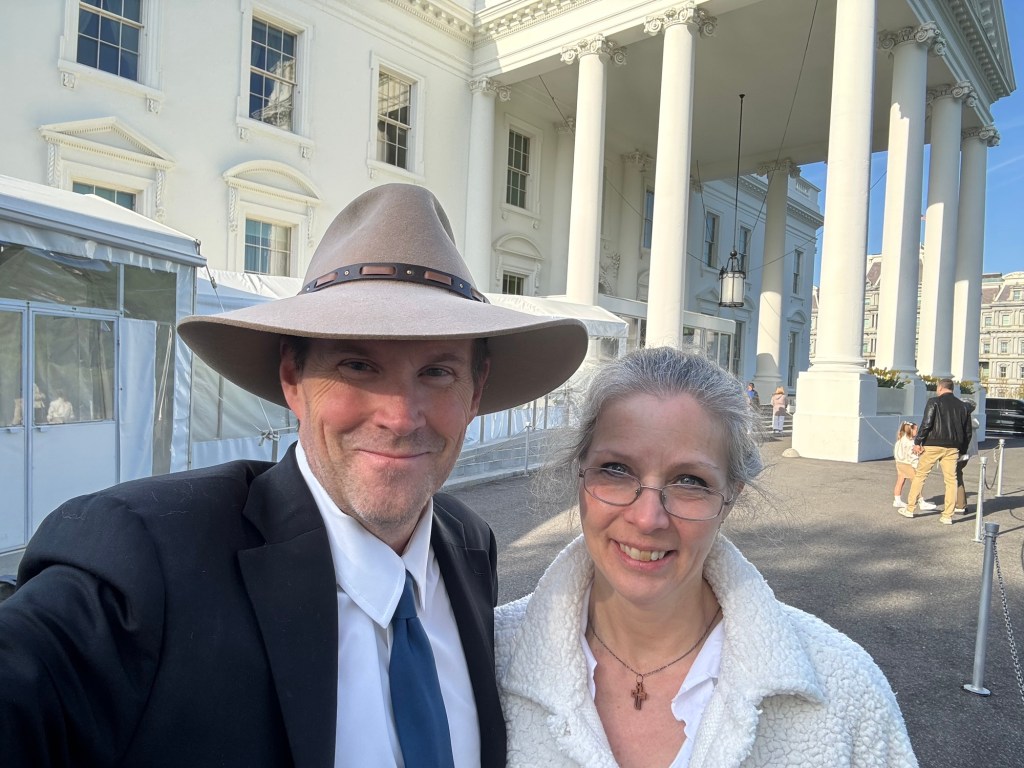
This theme of decorum extends throughout my own life and standards. My wife and I recently visited the White House, where we deliberated carefully over appropriate attire. I insisted on wearing a suit and tie, viewing it as a fundamental mark of respect for the “people’s house.” I argue passionately that public institutions such as the Statehouse, the Capitol in Washington, D.C., and the White House demand formality. Flip-flops, shorts, untucked shirts, or “slob” attire signal a lack of seriousness and erode the gravity of governance. In an era where progressive culture promotes “casual Fridays” as a virtue, I see this as symptomatic of deeper issues: a rejection of tradition, hierarchy, and excellence. Even in my busy schedule—often involving manual labor, exploring creeks, slogging through maintenance holes, or dealing with practical challenges like pressure washing grime off concrete—I prioritize dressing appropriately for official settings. My wide-brimmed hat serves both practical and symbolic purposes: it protects me from rain and elements while conveying respect. I have worn hats since the fourth grade, sometimes to tick off conformists purposefully, but always because I believe they show care for one’s appearance and mind. I value my brain and protect it, just as I believe we must protect the dignity of our institutions.

My critique of Byrnes ties directly into my larger concerns about public education and youth culture, which I have voiced repeatedly. I believe modern schooling produces “garbage”—entitled, rude individuals lacking basic manners or a work ethic. Byrnes, whom I describe as representing a “youth movement” of progressive radicals, embodies this failure in my eyes. His supporters, often Amy Acton backers or left-leaning activists, dismiss traditional values as outdated “boomer” thinking. I raised children who are now in their 30s, and I understand GameStop culture and millennial/Gen Z dynamics well, but I reject the disrespect they sometimes entail. Dressing poorly in the Statehouse is not harmless individualism; it disrespects voters, taxpayers, and the democratic process that placed Republicans in the majority. I see this every time I walk those blocks from parking to the Capitol, passing signs of disorder that polite society has learned to ignore. Why do we tolerate it? Because we fear being called judgmental. Yet judgment is necessary for a functioning society.

Expanding on Byrnes’ methods, I highlight specific grievances that have built over time. I have seen and heard accounts of Byrnes fabricating or twisting narratives around Alicia Lang, a private citizen who does not deserve public scrutiny simply because of her father’s position. Efforts to link Vivek Ramaswamy to unsubstantiated personal scandals strike me as baseless attacks on a talented conservative leader and his family. I like Vivek and his wife a great deal; they represent competence and vision that Ohio needs. Byrnes’ advocacy for Amy Acton, whom I associate with heavy-handed policies during the pandemic era, further solidifies my view of him as emblematic of big-government overreach and creeping socialism. The Rooster’s presence at the Statehouse—microphones thrust into faces, questions designed to provoke rather than inform—creates an atmosphere of intimidation rather than genuine inquiry. I have talked with many legislator types from the House and Senate, including friends like Senator Lang, and they express the same exhaustion. Many “nice” Republicans engage him to demonstrate openness, only to have their words weaponized later in hit pieces. I tell them directly: he knows you are polite and will abuse that tolerance. It is time to stop giving him the benefit of the doubt.

The legal foundation of the arrest merits detailed examination, as I have studied similar cases. Ohio Revised Code § 2917.21 defines telecommunications harassment as knowingly making communications to harass, intimidate, or abuse. A first offense is a first-degree misdemeanor, punishable by up to 180 days in jail and fines. Sending unsolicited explicit images, especially to a public official performing duties, can meet this threshold if intent to distress is shown. Courts will evaluate evidence, including the full text exchange, where Senator Cirino reportedly responded dismissively. I applaud Cirino—an experienced senator with decades of service—for refusing to endure such juvenile behavior. Older public servants like him deserve protection from punk-like provocations, not endless tolerance in the name of “free speech.” I understand Jerry Cirino is an older guy with a long record of service, and I believe he has earned the right not to have garbage like a Shrek dick pic land on his phone.

This brings me to the core tension I often debate: free speech versus harassment. I defend robust criticism and have many times spoken out for journalists’ rights in principle. Ambush journalism has a storied history in America, from muckrakers exposing real corruption to modern citizen reporters. However, I draw a sharp line here. Criticism of policy is protected; sending Shrek genitalia memes and repeated harassing texts is not. Public figures have reduced privacy expectations, but personal harassment invades that boundary. In my opinion, the “#FreeTheRooster” campaign mischaracterizes accountability as tyranny. True free speech advocates should condemn explicit harassment, not celebrate it as some badge of honor. Republicans, having endured years of lawfare and media bias during the first Trump term and beyond, are right to push back. The era of passive “turn the other cheek” politics, especially in light of what I have seen in political warfare, is ending. I am glad to see it.

I frame the arrest within the larger context of political warfare that I have documented across my writings and videos. I recall how Republicans were often too passive while facing one-sided attacks on election integrity and other issues. Those days, I declare based on my observations, are over. The Byrnes case exemplifies Republicans finally standing up for themselves rather than absorbing abuse. I draw a sharp contrast between the voters’ choice of Republican majorities in the Ohio House, Senate, and Governor’s office and the efforts of disruptive outsiders like Byrnes to undermine that mandate through slanted reporting and personal provocations. Ohio voters have chosen us for a reason. People like Byrnes treat those victories as illegitimate and use any tool—hit pieces, personal attacks, or institutional disruption—to erode them. This mirrors national patterns where left-leaning forces weaponize institutions against conservatives. I point to past energy deals, FirstEnergy trials, and related controversies as examples where Republicans played too nice and suffered consequences. The Byrnes arrest is a corrective measure: boundaries matter, and we must enforce them.

Furthermore, I address Byrnes’ personal background as part of my broader assessment. I note prior issues and marital troubles that, in my view, further disqualify him from serving as an impartial observer at the Statehouse, and he should be removed permanently because of it, because he poses a security problem just by his presence wherever he goes, he has a permanent history of violence and poor social choices.  No security area can allow him to enter and to consider the area secure. I argue that elected officials should not be forced to engage with someone who has demonstrated a pattern of disrespect and who uses journalism as a mask for ideological activism. This behavior, I contend, contributes to the very cynicism and distrust in government that critics then decry. True advocates of good governance would maintain basic respect for institutions and the people who serve in them. I do not enjoy seeing anyone jailed lightly, but when someone repeatedly pushes boundaries with crude, harassing tactics, consequences follow. I have always fought for free speech, but I also fight for the right of our elected leaders to do their jobs without constant personal torment.

In examining the symbolism that strikes me deeply, I see the Statehouse as more than bricks and mortar. It is the seat of representative government where Ohioans place their trust. Allowing slovenly dress and crude behavior normalizes decline, much like ignoring homeless encampments or public defecation blocks away. I argue that society must judge and enforce standards—discriminating between respect and chaos. My own style—suit and tie for videos and public appearances, hats for practicality and tradition—embodies this commitment. Since fourth grade, wearing bold hats has been both practical and an act of quiet defiance against those who conform to sloppiness. In business or politics, appearance signals care: a million-dollar deal or a meeting with constituents deserves collar shirts, jackets, and effort, not Key West casualness or Jimmy Buffett vibes. I reject the progressive mantra that casual is always better. It often masks laziness and disrespect.

Critics may label me as out of touch, a “cowboy hat-wearing boomer.” I embrace this label with pride because experience grants wisdom. Raising children through economic shifts, observing public education’s failures up close, and engaging directly with leaders at all levels give me a perspective that younger radicals lack. Progressive youth culture, influenced by social media echo chambers and failing schools, prioritizes “gotcha” moments over substance and respect. Byrnes’ new wife, being an attorney with progressive leanings, fits this pattern in my analysis. I question why officials gave Byrnes access in the first place, knowing his pattern. Tolerance was abused; now consequences are arriving. This is how we rebuild.

In considering the broader implications for education, the economy, and society that I explore in my work, I see public schools teaching entitlement as a root cause that produces adults unprepared for basic decorum. Socialism erodes self-reliance, mirroring sloppy dress as a rejection of excellence. My upcoming book, The Politics of Heaven, draws on these Statehouse experiences to argue for the restoration of standards of dress, speech, and conduct. It rebuilds trust. Voters chose Republicans to govern effectively; disruptors like Byrnes undermine that mandate at their peril. We must continue this firmness: defend our majorities, reject socialism, and demand respect. Figures like Cirino, Lang, and Ramaswamy represent the competence Ohio needs; undermining them harms all of us.

The cultural contrast I observe daily is stark. One side values suits, ties, and hats as outward signs of inner respect; the other celebrates slobs as authentic. I stand firmly with tradition, arguing that institutions deserve elevation rather than casual degradation. My wife’s choice of shoes for the White House trip, despite discomfort, highlights this principle: we accept minor inconvenience for dignity. Public servants and those covering them should model the same. Byrnes’ arrest enforces a necessary boundary. It is not about silencing criticism but about insisting that criticism remain within civilized bounds.

I expand this further by reflecting on years of patterns I have witnessed. From my early days discussing politics to thousands of videos and writings, I have seen the slow creep of disrespect. Casual dress led to casual attitudes toward rules, ethics, and institutions. Byrnes is a symptom, not the disease. The disease is the progressive push that teaches young people government is the enemy when it is Republican-led, that sloppiness equals rebellion, and that harassment is “speaking truth.” I reject all of it. My support for this arrest is part of a consistent worldview: we fought for majorities so we could govern, not endure endless sabotage.

Additionally, I consider how this fits national trends. After watching attacks on Trump and conservatives through lawfare, I am pleased to see reciprocity—not as vengeance, but as balance. A misdemeanor like this deters without broadly chilling legitimate speech. Real journalists criticize policies without explicit memes. Officials can set boundaries. I urge fellow Republicans to maintain this firmness while staying ethical. Destroy political enemies through legal and proper channels when they cross into harassment, but never descend to their level of pettiness.

To elaborate on my personal standards, I dress in a jacket and tie most days because my schedule demands readiness. Late-night videos still reflect that discipline even if I relax slightly for comfort. It drives some crazy, but it shows I take my platform seriously. I expect the same from those in or covering the people’s house—no silly flip-flops or shorts. Respect the space where laws are made.

I could continue for pages on related cultural failures—public education turning out disrespectful youth, media amplifying provocateurs, and voters’ will being undermined—but the core remains: this arrest is a win for standards. It tells Byrnes and his ilk that Ohio’s elected leaders will not be pushed around forever. I love seeing Republicans stand firm. It honors the voters. It restores dignity. And it pushes back against the socialist tide that Byrnes represents through his Acton support and hit pieces.

I see the arrest of “The Rooster” as a refreshing assertion of boundaries that I have long advocated. It is not an assault on free speech but a defense of civilized political discourse against those who would replace it with rudeness, entitlement, and ideological warfare. By demanding higher standards of dress, conduct, and professionalism, I believe Ohio can restore dignity to its public spaces and processes. Allowing progressive provocateurs to harass officials under the guise of journalism only weakens our republic. Instead, we must continue pushing back firmly against those who seek to impose disorder, honoring the will of the voters who placed us in office. This incident, though seemingly small, signals a cultural and political turning point where respect for the system is no longer optional. I stand by that fully.

(Word count: approximately 4,350)

Footnotes

1.  Signal Ohio report on the arrest and charges.

2.  Columbus Dispatch coverage detailing the incident.

3.  NBC4i on the Shrek image specifics.

4.  Ohio Revised Code § 2917.21 legal text.

5.  Background on Byrnes’ blogging style.

6.  Additional context from progressive reactions.

Bibliography

•  “Progressive blogger arrested outside Ohio statehouse.” Signal Ohio, June 2, 2026. https://signalohio.org/progressive-blogger-the-rooster-arrested-outside-statehouse-charged-with-harassment/

•  “Ohio blogger The Rooster arrested at Statehouse.” Columbus Dispatch, June 1, 2026. https://www.dispatch.com/story/news/politics/2026/06/01/rooster-arrest-ohio-statehouse/90358157007/

•  “Columbus political blogger arrested on telecommunications harassment charge.” NBC4i, June 2026.

•  Ohio Revised Code § 2917.21. https://codes.ohio.gov/ohio-revised-code/section-2917.21

•  “Who is The Rooster? See D.J. Byrnes in action.” Columbus Dispatch, March 17, 2026.

•  “Blogger ‘The Rooster’ Arrested for Alleged Telecom Harassment.” Trending reports, June 2026.

•  Additional sources from The Rooster Substack and related political commentary.

Rich Hoffman

More about me

Click Here to Protect Yourself with Second Call Defense https://www.secondcalldefense.org/?affiliate=20707
About the Author: Rich Hoffman

Rich Hoffman is an aerospace executive, political strategist, systems thinker, and independent researcher of ancient history, the paranormal, and the Dead Sea Scrolls tradition. His life in high‑stakes manufacturing, high‑level politics, and cross‑functional crisis management gives him a field‑tested understanding of power — both human and unseen.

He has advised candidates, executives, and public leaders, while conducting deep, hands‑on exploration of archaeological and supernatural hotspots across the world.

Hoffman writes with the credibility of a problem-solver, the curiosity of an archaeologist, and the courage of a frontline witness who has gone to very scary places and reported what lurked there. Hoffman has authored books including The Symposium of Justice, The Gunfighter’s Guide to Business, and Tail of the Dragon, often exploring themes of freedom, individual will, and societal structures through a lens influenced by philosophy (e.g., Nietzschean overman concepts) and current events.


Disclosure, Power, and The City of God: Proof of ancient giants and our interactions with many alien species over vast spans of time.  Yes, over a billion people have interacted with the Government Disclosure Website

I have been talking about this for decades, going back to that fourth-grade speech on a big elementary school stage where I stood up and laid out everything I had read about UFOs and alien interactions with humanity. Most people thought I was crazy then, and even now, some look at me sideways when I bring it up. But the pattern has always been obvious to me: this is not merely about little green men or flying saucers in the sky. It is about raw power, control, and the systematic erasure of previous knowledge so that whatever new regime is in charge—whether a government administration, a corporate takeover, or a stepfather moving into a broken home—can claim to be the first and only legitimate authority. 

I just finished my book The Politics of Heaven, which dives deep into this exact dynamic. The core argument is simple yet profound: advanced non-human intelligences have visited and interacted with Earth for millions of years. These beings, equipped with their own political orders and technologies that let them cross vast interstellar distances, have traded knowledge, labor, resources, and sometimes genetic material with human civilizations. Yet throughout history, those who seek to rule over us have worked tirelessly to suppress this reality. They do not want the public remembering “Larry”—the previous husband, the prior administration, the older gods or visitors—because acknowledging the past undermines their exclusive claim to power. 

Think about the stepfather who enters a home after a divorce. It is never enough that he is now in the same bedroom with the mother that the kids once saw their real dad occupy. He changes the pictures on the walls, replaces the furniture, and hauls Dad’s Craftsman tools out of the garage to sell at a flea market. He forbids the children from talking about the old life. This is exactly how new regimes operate. A new CEO wipes away the legacy of the previous leader. A new administration erases the records and narratives of those who came before. Ancient priesthoods burned libraries and rewrote myths. Modern institutions discourage digging too deeply into American mounds, pyramids, or out-of-place artifacts because they want everyone focused on the current story—that their administration is the only one that has ever truly existed. 

That is why the current disclosure wave feels so validating to me. In February 2026, President Trump directed federal agencies to begin declassifying evidence related to non-human intelligence through the Presidential Unsealing and Reporting System for UAP Encounters (PURSUE). There has been predictable pushback, but the information is flowing. The Pentagon has released multiple tranches of files, videos, and documents. The dedicated site has already surpassed one billion views worldwide. Jesse Watters on Fox News has covered it in primetime, featuring insiders like Dan Farah and Dr. Hal Puthoff discussing recovered non-human biologics. This is no longer fringe Coast to Coast AM territory. It is corporate media at 8 o’clock, talking seriously about four distinct alien species. 

I have shared my book with top-level people who initially reacted with surprise—“You’re a serious person; what are you talking about?”—but the evidence has always been there for those willing to look past the stigma. For years, reading these accounts sounded “kooky” to many. Who believes in such things? Yet the pattern holds: these species have been interacting with civilizations for as long as humans have kept records. They appear in literature and myth under different names, but the core descriptions remain consistent. Now the conversation has shifted. People are no longer universally mocked for discussing it. There is a massive public hunger, which is why the disclosure site has drawn over a billion visitors.  For some reason, that figure is controversial.  As if people think it’s inflated. It comes straight off the website. 

The four species that insiders and scientists have reported from crash retrieval programs stand out clearly. These are not my inventions; they come from credible figures with government and intelligence backgrounds. All are described as basically humanoid—two arms, two legs—but distinctly different in appearance and likely origin. 

The Greys, often associated with the classic Roswell imagery, are typically three to four feet tall, with grey skin, large, hairless heads, oversized black, almond-shaped eyes, and minimal facial features. They have three or four fingers and are frequently linked to abduction accounts. Many connect them to the 1947 Roswell/Corona crash in New Mexico, where debris and bodies were reportedly recovered and studied. 

The Nordics appear most human-like—tall, often six to seven feet, with fair skin, blond or light hair, and blue eyes, resembling Northern Europeans or Scandinavians. They come across as more diplomatic or benevolent in contactee reports. Their appearance may be designed to facilitate easier interaction with humans. 

Reptilians, sometimes called reptiloids, are taller (six to eight feet), with scaly skin, occasional tails, and lizard-like features while maintaining an upright posture. They echo ancient serpent gods and dragon myths found in cultures worldwide. Some accounts suggest long-term influence on Earth’s power structures or underground bases. 

Insectoids, or Mantids, resemble praying mantises in humanoid form: tall and thin, with large compound eyes, exoskeleton-like skin, and insectoid limbs. They often appear in high-strangeness cases as scientists or overseers. Their form can be unsettling to humans, yet they share the bipedal structure common to these visitors. 

Insiders such as Dr. Hal Puthoff and Eric Davis have cited these four based on crash-retrieval data. Dozens of crafts and associated biologics have reportedly been recovered over the decades. The technology pulled from these sites—advanced materials, propulsion systems, and electronics—appears to have been reverse-engineered and seeded into our society, especially after 1947. Many breakthroughs in the modern era seem to have come from nowhere. This fits the long pattern of trade: humans offering labor, resources, or scientific materials in exchange for knowledge such as metallurgy, agriculture, or tool-making. 

This interaction did not begin in the 20th century. Archaeological evidence and historical records point to contact stretching back millions of years, though mainstream institutions resist this because it challenges established narratives like strict Darwinian timelines and human isolation. The Smithsonian’s historical role in diffusionist debates, its reluctance to fully explore certain American earthworks, and its preference for conventional explanations all align with the pattern of erasure. Pyramids, megaliths, and sudden technological leaps worldwide strain the idea that we developed in total solitude. 

Roswell remains the most publicized crash, but it is one of many. Whistleblowers like David Grusch have testified to non-human biologics from multiple retrieval programs. Ancient texts describe “gods” descending in fiery vehicles—Vimanas in Indian epics, Ezekiel’s wheels, Sumerian Anunnaki. When you strip away cultural filters, these accounts parallel modern descriptions. 

In The Politics of Heaven, I connect these threads to biblical and mythological narratives. The Witch of Endor summoning spirits for Saul, rituals seeking divine or extraterrestrial knowledge, rival gods like Baal versus Yahweh—these reflect competing political orders among visitors. Paradise Lost and concepts of devils may describe advanced beings of non-Christian origin who make strategic deals. Occult practices, star alignments, and telepathic communication appear to have enabled contact for millennia. Some interpret these entities as demons; others see them as neutral actors pursuing their own galactic agendas. The truth is likely a complex mix. 

The resistance to full disclosure makes perfect sense through the lens of power. Governments secure massive black budgets by promising protection from threats they cannot entirely control, often opting instead for deals. Whistleblowers are chastised, just as Medicaid fraud exposers in Ohio face backlash—the real scam becomes punishing those who speak. New regimes say, “Forget the old leadership. Listen only to us.” They change the narrative, remove the old photos, and sell the tools. Authority figures do not want the public to realize that humanity’s story has always involved these external influences. It diminishes their claim to being the ultimate parent or protector. 

Yet the information is now unstoppable. Trump’s PURSUE releases, persistent researchers, congressional interest, and public demand ensure it. Steven Spielberg’s upcoming film Disclosure Day, set for release on June 12, 2026, will further mainstream the conversation. I am enjoying this moment immensely. I have been right about the power dynamics since that fourth-grade speech. These species have their own political structures. They make deals for what they need from humanity. We have traded and interacted across time. The veil is lifting, and humanity is beginning to remember what was deliberately hidden. 

We are not alone. We never were. The real question is how we assert our sovereignty amid these long-standing relationships. The stepfather cannot erase Larry forever—the kids remember. Humanity is remembering too. Understanding the politics of heaven is essential as we navigate this new era. My book lays out the receipts, the historical parallels, and the power struggle. Engage with the evidence. The truth has always been about control, and now the control is slipping as the full picture emerges. This is a better day for those who have followed the story for years. Disclosure is here, and it is unstoppable.

In St. Augustine’s City of God, he describes on page 610 proof of biblical giants from 620 AD.  And when we talk about giants in human beings, we are talking about interactions with some of these species of aliens that are proof of past interactions. And the concealment of that daunting realization is upon us, now.  And the world will never be the same. 

Footnotes

1.  Jesse Watters Primetime, Fox News, May 2026 segments with Dan Farah and Hal Puthoff.

2.  PURSUE program releases, war.gov/ufo, May 2026.

3.  Trump directive, February 2026.

4.  Hal Puthoff and Eric Davis’s statements on recovered species.

5.  Roswell and historical crash analyses.

6.  Ancient texts and mythological parallels.

7.  The Politics of Heaven by Rich Hoffman, 2026.

Bibliography

•  Puthoff, Hal. Interviews and statements, 2026.

•  Farah, Dan. The Age of Disclosure documentary and Fox News appearances.

•  Grusch, David. Congressional testimonies.

•  Trump Administration PURSUE releases, May 2026.

•  Fox News coverage, Jesse Watters Primetime, May 2026.

•  Davis, Eric. UAP research briefings.

•  Biblical texts, Milton’s Paradise Lost, Sumerian tablets, Indian epics.

•  Archaeological critiques and ancient astronaut literature (contextualized).

•  Spielberg, Steven. Disclosure Day film announcements, 2026.

•  Additional primary sources on Roswell, UAP reports, and whistleblower accounts

Rich Hoffman

More about me

Click Here to Protect Yourself with Second Call Defense https://www.secondcalldefense.org/?affiliate=20707

About the Author: Rich Hoffman

Rich Hoffman is an aerospace executive, political strategist, systems thinker, and independent researcher of ancient history, the paranormal, and the Dead Sea Scrolls tradition. His life in high‑stakes manufacturing, high‑level politics, and cross‑functional crisis management gives him a field‑tested understanding of power — both human and unseen.

He has advised candidates, executives, and public leaders, while conducting deep, hands‑on exploration of archaeological and supernatural hotspots across the world.

Hoffman writes with the credibility of a problem-solver, the curiosity of an archaeologist, and the courage of a frontline witness who has gone to very scary places and reported what lurked there. Hoffman has authored books including The Symposium of Justice, The Gunfighter’s Guide to Business, and Tail of the Dragon, often exploring themes of freedom, individual will, and societal structures through a lens influenced by philosophy (e.g., Nietzschean overman concepts) and current events.
Amy Acton is a Drunk Disaster: She’s not qualified to run down the street, let alone run the state of Ohio

I’ve never been a fan of Amy Acton during COVID. Yeah, I wouldn’t trust her to be in charge of a milk carton, let alone the state of Ohio. What she did during COVID was disastrous. Mike DeWine can apologize all he wants—you know he picked her. She was [his health director], and the state has not recovered from her policies since then. She basically followed Dr. Fauci’s guidelines to a tee, along with the CDC. 

There should have been a lot more questioning. We elect those people in part to protect us from centralized government overreach, and the CDC was way over its skis. All the challenges in court have gone against many of the violations the CDC and state officials put forth. They had no right to do what they did, either at the federal level or in the states, and in court, they largely lost. In 2020, they lost key cases. 

Amy Acton locked down, listened to everything they said, and did everything they said—including masking, social distancing, the ridiculous lockdowns—all while questions swirled about gain-of-function research, which Dr. Fauci knew about, and the release from a Chinese lab. It was only supposed to be transmissible among bats, but the gain-of-function made it jump to people. There was a lot of manipulation, a lot of bad stuff with COVID-19. And it killed people. She played her role in it. She wrecked the state. She harmed people in the process. And she was horrendous in all facets. I’ll never forgive her for what she did.

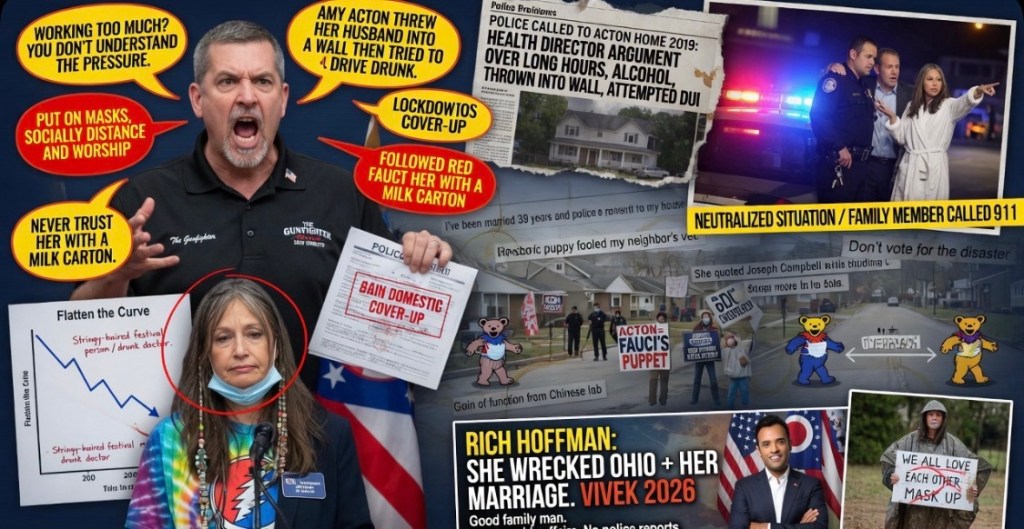
But I find it ironic that she is upset at the Vivek Ramaswamy campaign, and her husband is upset because it’s all about politics—this 2019 release of the police visit to their house. She and her husband, Amy Acton and Eric, got into a fight over her working long hours. They had been drinking. She pulled a mirror off the wall and shattered the glass. Then she wanted to leave the house. He talked her out of it because she was going to drive drunk. Someone in the house called the police. Police arrived and defused the situation. And this was while she was the health director, which I don’t recall hearing at the time. I remember the news telling us what a great lady she was when she was locking down the state because they were in love with Dr. Fauci and centralized authority. She played it to a tee, and no one talked about this police report. 

Now it’s out because she’s running for governor. I don’t know why—she doesn’t have a good track record on anything. And yet she seems to be the best option Democrats have. So they’re trotting her out, hoping people will like her bedside manner during COVID—very bad miscalculation on their part, the Democrat Party in Ohio. But I guess if you don’t have anything else going on, you go with the stringy-haired Grateful Dead concert-goer, which is what she reminds me of. Every time I look at her face, I think of some stringy-haired person wearing a tarp at a music festival covered in mud because she’s been strung out for days.

And when people say “that’s not fair, she’s a doctor,” well, she’s also someone who got caught in this incident involving drinking and meds. A very stable person? I’ve been married for closer to 40 years—39 years now. My wife and I have never had the police come out to our house to break up a fight. It never happened. Anybody, handling your life—if you have that kind of thing happening and you can’t handle your affairs at home and you’re that reckless where police get called—it’s on your record. You’re not qualified to be governor. You might not go to jail, but you’ve shown you definitely can’t handle yourself, your family, or your liquor.

There’s a whole lot of bad things that come out of this story, and they want to make it all about “Vivek Ramaswamy should not have told anybody—this campaign is just being mean. It’s all about politics. We’re just trying to tear her down.” She gave him ammunition. She’s the one who did it. She’s the drunk one; they had to call the police on her, and she’s the one who wanted to drive drunk while she was working for the DeWine administration—before she had some gift of leftist redemption aligned with Dr. Fauci. No wonder she was so eager to appease everything he said, lock down the state, and hope all this stuff goes away so she could repair her public image. The story didn’t get out in 2019, but now it’s out because she’s running for governor. What do you expect? It’s gonna happen.

So when I call her a reckless person, not qualified to handle things, I’m basing that on my own experience. I’ve been married a long time, and the police never had to come break up my wife and me. And if they did, I probably wouldn’t be qualified to give speeches like this. You can’t manage your life like this.

This wasn’t 30 years ago—it was 2019. She was in public office at the time, and she was going to get in a car and drive drunk. Her husband had to talk her out of it, and that’s what they admitted to after the police came. That’s the kind of person who wants to be governor of Ohio. She can’t run her family, and she certainly can’t run a state. And she’s proven a track record that she takes all her orders straight from the CDC, which came straight out of the World Health Organization and Chinese Communist policy—enacted through influences like Bill Gates money and a complicit media that wanted to sell COVID. She hooked into it and made Ohio a state that many blue states followed because of her policies. She started the initiative.

Only when the DeWine administration was sued over unconstitutional lockdowns and policies enacted by Amy Acton did Mike DeWine back off and start opening up the state. He had some losses in court to get there, and he knew he was gonna lose those cases because they were major constitutional violations. The Supreme Court had to kick in. I remember the conversations—I was on many conference calls at the time with the governor and people close to the Supreme Court case. So I know exactly what went on behind the scenes. That was a disaster. Amy Acton had major egg on her face at the end of that whole escapade. People were mad at her. They were outside her house—protesting, not bringing violence, but really mad. She had to resign in disgrace, hide, and lick her wounds. 

Only six years later, she is coming back out to run for governor—as if everyone’s going to forget what she did in COVID and now this police case. When you bring it up, she wants to say maybe you’re just being political. Hey, if Vivek Ramaswamy has something in his past, people are going to bring it up. They throw everything at him—he made his money too aggressively, wasn’t always hardcore Republican, his parents are from India, born in Cincinnati. But he’s a good guy, likable, qualified. His wife is super nice. He’s a good family person. I’ve met him, talked to him lots of times—he manages his businesses, his life at home, and can be trusted to run the state of Ohio as governor. He’ll play well with the legislature and get a lot done. There’s a lot to be excited about.

Amy Acton? Not even remotely close. She can’t run down her sidewalk, let alone a state. I was joking a little when I said a milk carton. I don’t think she can run anything. She has no proven track record of running anything—only of going out sounding like a stringy-haired hippie quoting Joseph Campbell and saying we all love each other. Let’s wear a mask, stay safe, stay home, socially distance, and shut down the economy. We have to “drive down the curve.” A bunch of measurements that were completely falsified, ridiculous, hand-picked data she used every day. It was embarrassing to Mike DeWine. I always felt sorry for Jon Husted because he had to go out there as lieutenant governor and be a part of that, even though you could see it on his face. It’s something he would love to have not been a part of. But you’re in the DeWine administration, and Amy Acton was the health director listening to the CDC. Nobody knew at the time how crooked it was—although I said so. It was unconstitutional; they had no right to do it. I said so when everybody else was saying otherwise. Guess who was right in the opening hours of all those mandates? Everyone eventually caught on. The Supreme Court did exactly what I said it would do. Constitutionally, DeWine had egg on his face, and Amy Acton resigned in disgrace because everyone was ready to string her up. She ruined their lives. 

And now you find out she has problems at home. She drinks, can’t hold her liquor, and had the police called on her in 2019. That’s the kind of person she is. Is it fair to judge somebody like that? You bet it is. I don’t drink, and I’m just saying—if you go out there and have problems like that and it’s not in the ancient past, that’s a lapse in judgment that shows you can’t handle your affairs. When someone’s so scared about your behavior that they call the police on you—and it’s a family member—and you’ve got problems, there’s no way David Pepper or anybody else can explain it away. She brought it on herself. She’s the one who made it all happen, and she can only blame herself.

When you’re in a hard campaign, of course, it’s gonna come out. She’s crazy to think it won’t—and I’m sure there’s more. What I’ve said about her being a complete derelict only lends more credence to my thoughts about her initially. Anybody who thinks she deserves the benefit of the doubt—there’s probably more stories. If you show lapses in judgment once, you’re probably going to do it twice. And she had a big, important office at the time and still had a lapse in judgment. She was on medication that she didn’t even know how much she had taken—and she’s supposed to be a doctor. How is she equipped to advise about anything?

Yeah, it’s a big deal. She’s not qualified again—she’s not qualified for anything. Should she be thrown in jail? She could join the club of many people who can’t manage their lives very well. But you certainly don’t elect them to run the state. You certainly don’t make them governor. She’s a disaster. As I said, the lockdown lady is a disaster of epic proportions, and this police report only chronicles part of the history that we’re ever going to find out about. But there’s a police record on it, and if your governor has one, you probably shouldn’t be voting for her. She’s a disaster.

Definitely don’t vote for her. Vote for Vivek Ramaswamy. He’s the guy, and he’s certainly the best pick, I’d say, anywhere in the country, let alone in Ohio. 

Bibliography

1.  NBC News. “Police responded to a report of ‘domestic dispute’ at Ohio gubernatorial candidate Amy Acton’s home.” April 11, 2026. https://www.nbcnews.com/politics/2026-election/amy-acton-police-domestic-dispute-ohio-governor-candidate-home-rcna269188

2.  Ohio Capital Journal. “Amy Acton’s team defends 2019 police visit as a ‘simple argument’ amid GOP criticism.” April 15, 2026. https://ohiocapitaljournal.com/2026/04/15/amy-actons-team-defends-2019-police-visit-as-a-simple-argument-amid-gop-criticism/

3.  Reason. “Ohio Judge Deems the State’s COVID-19 Lockdown Arbitrary, Unreasonable, and Oppressive.” May 20, 2020. https://reason.com/2020/05/20/ohio-judge-deems-the-states-covid-19-lockdown-arbitrary-unreasonable-and-oppressive/

4.  Reason. “Another Judge Rules That Ohio’s COVID-19 Lockdown Is Illegal.” June 12, 2020. https://reason.com/2020/06/12/another-judge-rules-that-ohios-covid-19-lockdown-is-illegal/

5.  The Guardian. “Dr. Amy Acton resigns amid backlash against Ohio’s lockdown after leading coronavirus fight.” June 12, 2020. https://www.theguardian.com/world/2020/jun/12/dr-amy-acton-resigns-after-helping-lead-ohio-aggressive-fight-against-coronavirus

6.  State News. “Lawyer Who Challenged Health Orders Says He’s OK Playing Role in Acton’s Departure.” August 14, 2020. https://www.statenews.org/government-politics/2020-08-14/lawyer-who-challenged-health-orders-says-hes-ok-playing-role-in-actons-departure

7.  Bricker & Eckler LLP. “Governor DeWine and Ohio Department of Health Director Dr. Amy Acton Issue ‘Stay at Home’ Order.” March 23, 2020. https://www.bricker.com/employment-law-report/governor-dewine-and-ohio-department-of-health-director-dr-amy-acton-issue-stay-at-home-order

8.  Wikipedia. “2026 Ohio gubernatorial election.” (Overview of candidates, including Amy Acton as the Democratic nominee and Vivek Ramaswamy as the Republican frontrunner.) Accessed April 2026. https://en.wikipedia.org/wiki/2026_Ohio_gubernatorial_election

9.  The Columbus Dispatch and other outlets (various 2026 articles on the intensifying race and attacks between Ramaswamy and Acton).

Rich Hoffman

More about me

Click Here to Protect Yourself with Second Call Defense https://www.secondcalldefense.org/?affiliate=20707

About the Author: Rich Hoffman

Rich Hoffman is an aerospace executive, political strategist, systems thinker, and independent researcher of ancient history, the paranormal, and the Dead Sea Scrolls tradition. His life in high‑stakes manufacturing, high‑level politics, and cross‑functional crisis management gives him a field‑tested understanding of power — both human and unseen.

He has advised candidates, executives, and public leaders, while conducting deep, hands‑on exploration of archaeological and supernatural hotspots across the world.

Hoffman writes with the credibility of a problem-solver, the curiosity of an archaeologist, and the courage of a frontline witness who has gone to very scary places and reported what lurked there. Hoffman has authored books including The Symposium of Justice, The Gunfighter’s Guide to Business, and Tail of the Dragon, often exploring themes of freedom, individual will, and societal structures through a lens influenced by philosophy (e.g., Nietzschean overman concepts) and current events.
The White House is Too Small: It must have the Big, Beautiful, Ballroom

It was during the height of cherry blossom season in Washington, D.C., in April 2026, that my wife and I finally stepped onto the grounds of the White House once again, and the experience left me more convinced than ever that America’s most iconic residence desperately needs an upgrade worthy of the superpower it represents. The blossoms were still clinging to the trees around the Tidal Basin and framing the South Lawn in soft pinks and whites, a perfect backdrop for what felt like a personal pilgrimage. We had arranged the visit through the office of Congressman Warren Davidson from Ohio’s Eighth District, and I cannot thank him and his staff enough—especially Ben and the team who worked tirelessly on short notice —and my good friend Nancy Nix, who helped without wanting any credit. My wife has always been sentimental about the White House, especially with President Trump back in residence, which makes everything feel right again after the chaos of the previous administration. We had tried last year on shorter notice and couldn’t get the clearances in time, but this trip, with about three weeks’ lead time and other business pulling us to the capital, finally aligned perfectly. We walked the grounds, absorbed the history, and stood right there where the East Wing once stood, now a demolition site buzzing with purpose, the future home of what the president has called his “big beautiful ballroom.” It was a moment that crystallized everything I had been thinking about the aging White House, its deliberate modesty from the founding era, and why bureaucratic roadblocks and judicial holds have no place slowing down progress on something this essential. 

The White House has always been more than just a home or an office; it is a symbol of the American experiment, born from the revolutionary idea that we do not bow to kings or aristocracies. When George Washington and architect James Hoban designed the original President’s House in the 1790s, they intentionally kept it relatively modest—two stories with simple neoclassical lines, no grand wings at first—to send a clear message to the world. This was not a palace for a monarch; it was the residence of a republican executive, a branch of government meant to be equal among three, not elevated above the people. After the British burned it to the ground during the War of 1812, the rebuilding under James Hoban preserved that spirit even as the nation licked its wounds. The reconstruction was not about flaunting power but about resilience and restraint. Washington himself had scaled back grander plans from Pierre Charles L’Enfant, insisting on something functional yet unpretentious, because the young republic did not want to poke Europe in the eye or mimic the opulent courts of the Old World. The executive branch was deliberately housed in a structure that reflected humility, a far cry from the sprawling estates of European royalty. That choice shaped everything that followed, from the state rooms on the first floor to the family quarters upstairs, and it is why even today the core residence feels intimate—132 rooms in total, many of them surprisingly compact for the global stage we now command. 

Yet over the centuries, as the United States grew from a fledgling nation into the world’s sole remaining superpower, the demands on that modest house have exploded. The presidency evolved far beyond what the founders envisioned, with the executive branch shouldering responsibilities in diplomacy, national security, and economic leadership that no one in 1800 could have imagined. I have stacks of books on White House history, and every one tells the same story: presidents from Thomas Jefferson onward added colonnades to hide stables and storage, Andrew Jackson built the North Portico for grandeur, Theodore Roosevelt shifted offices to the new West Wing in 1902 to create dedicated workspace, and Franklin D. Roosevelt added the East Wing in 1942 not just for staff but to conceal a bunker during World War II. Harry Truman gutted the interior in the late 1940s because the structure was literally sinking under its own weight, preserving only the outer walls to maintain the historic facade. Each change reflected the times—expansions driven by necessity, not ego. The state floor rooms I walked through on our tour—the Green Room, once a dining space; the oval Blue Room for receptions; the elegant Red Room; the Yellow, upstairs for family gatherings—still serve their purposes beautifully, but they are small. The East Room, the largest on the main level, can only seat about 200 for formal events. When you host state dinners for world leaders, diplomatic receptions, or public tours, space becomes a premium commodity. Upstairs in the residence, the family quarters feel even tighter for modern life, especially with the added security and staff that a 21st-century presidency requires. The West Wing, expanded multiple times, still crams the most powerful offices in the world into a footprint that feels more like a bustling hive than a seat of empire. It is not that the original design was flawed; it was perfectly suited to its era. But America’s role has changed dramatically, and the building has not kept pace. 

During our visit, I saw the limitations up close in ways that books and tours from the 1990s or even last year could not convey. We pulled up to the visitors’ entrance, the same path countless dignitaries and everyday Americans have taken, and immediately noticed how the current setup strains under the weight of modern expectations. For big events, there is no proper indoor space for coats, security screening, or even basic amenities like restrooms that accommodate hundreds of guests dressed in formal attire. Instead, they erect temporary climate-controlled tents outside—those “tacky bubbles” as my wife and I called them—set apart from the elegant architecture, looking more like something you’d see at a corporate picnic or a golf course wedding than at the home of the leader of the free world. Porta-potties tucked away for overflow crowds? That is not the image of America we should project. Visitors come to see the best of what our nation offers, and while the historic rooms dazzle with their chandeliers, portraits of past presidents, and stories of resilience, the practical realities of hosting large gatherings expose the building’s age. The First Lady’s office, traditionally in the East Wing, had already been relocated during the demolition process, and standing there amid the construction fencing, I could visualize exactly where the new ballroom would rise: a neoclassical addition of roughly 90,000 square feet, designed to seat 650 to 1,000 guests, with expanded kitchens, colonnades, and integrated underground facilities for national security. It is not some vanity project; it is a functional necessity. The proposal looks incredible—elegant lines blending seamlessly with the existing architecture, funded in part by President Trump’s own resources and private donors who want to contribute to American history rather than extract favors. Trump has made no secret of his love for the building; during his first term, he elevated its presence with renovations that made it shine brighter on the world stage. Now, with the East Wing gone and the site prepared, the ballroom represents the next logical step in adapting this 18th-century icon to 21st-century realities. 

What upset me most, however, was hearing about the legal battles and bureaucratic hurdles trying to halt this project. A federal judge—Richard Leon, no less—issued rulings blocking above-ground construction, claiming the president lacked explicit congressional approval for the addition, even as the appeals court has allowed temporary progress while weighing national security implications, such as the underground bunker components. The National Trust for Historic Preservation filed suit, arguing the changes required more oversight, but to me, this is classic administrative overreach. The White House is the president’s residence and workplace, not some static museum frozen in time. Presidents have modified it repeatedly without needing a congressional vote for every nail. The legal mechanism for Trump to prevail here seems straightforward: executive authority over the executive mansion, combined with private funding that sidesteps taxpayer burdens, and the clear national interest in modernizing a structure central to American diplomacy. Appeals are moving forward, and the courts should recognize that delaying this at the speed of government—endless reviews, environmental assessments, historic reviews—only serves those who want America diminished. We do not have time for fidgety holds when the world watches our every move. The presidency has grown; global summits, state visits, and public engagement demand space that matches our stature. Tents and temporary fixes are undignified. A proper ballroom, with accessible restrooms, coat facilities, and flowing spaces for conversation, would transform how visitors experience the White House. You arrive dressed in your best suit jacket, required, in my view, because this is not Chuck E. Cheese; it is the seat of power—and you should not have to navigate makeshift setups for hours-long events. The current layout creates logistical challenges, especially since the visitor center handles initial screenings before you even reach the main house. Seeing it firsthand reinforced what I have long believed: the White House is too small for America’s global role. 

This pushback against the ballroom fits a larger pattern I have observed in academia, the media, and certain three-letter agencies—a subtle but persistent effort to diminish American exceptionalism. Many in those circles, trained at universities steeped in Marxist thought, view the United States not as a beacon but as a problem to be equalized within a global order modeled on countries like China. They dine in Georgetown with pinkies out, sipping wine and congratulating themselves on their sophistication while quietly undermining symbols of strength. The White House, as the most visible emblem of the executive branch, becomes a target. Why elevate it when the goal is to collapse national distinctions into some borderless bureaucracy? Trump’s approach—bold, decisive, privately financed—threatens that narrative. He is not waiting for slow-moving administrators or judicial second-guessing. He understands the speed of business, the same principle that built skyscrapers and turned companies around. NASA has suffered for years under layers of bureaucracy; we need fewer pint-sized pencil-pushers and more action-oriented leadership. The ballroom is Trump’s contribution to the ongoing story of the White House, much like past presidents who left their mark. It is not about personal glory but about ensuring the building functions to meet today’s demands: secure, impressive, and capable of hosting the world without embarrassment.

Walking through the Capitol later that same trip—another special tour arranged through the same congressional office—only heightened my appreciation for how government spaces evolve. The Capitol has its own grandeur, with its massive dome and halls of history, but the White House remains the people’s house more intimately. Yet intimacy cannot come at the expense of capability. The residence upstairs, while charming, lacks the room a modern first family needs for private life amid constant public scrutiny. The state rooms downstairs handle ceremonies but strain during peak seasons or major events. Even the grounds, beautiful as they are with the Rose Garden and South Lawn, could integrate the new addition without losing historic character. The proposal preserves the original facade where possible, focusing expansion where it makes sense—replacing an East Wing that had already been modified multiple times since 1902. This is not a radical alteration; it is thoughtful evolution, the kind the founders themselves anticipated when they left room for future generations to adapt.

Critics will claim the project is extravagant, but context matters. The $300 to $400 million price tag, largely covered privately, pales in comparison to the symbolism and practical benefits. Donors are not buying influence; they are buying a brick in the wall of American renewal, much as supporters have funded monuments and memorials for centuries. Trump himself forgoes a presidential salary, channeling his energies and resources into making the country—and its symbols—great again. His first term showed what decisive leadership looks like: stronger borders, a booming economy, and restored respect abroad. The ballroom extends that ethos to the very stage where diplomacy happens. Imagine world leaders arriving not in cramped quarters but in a venue that projects confidence and hospitality. No more tents flapping in the wind or lines for inadequate facilities. Bathrooms that are accessible and dignified. Spaces for mingling that encourage the personal connections so vital in statecraft. It is common sense, yet the holdups reveal deeper ideological resistance.

As I stood with my wife overlooking the demolition site, the cherry blossoms swaying gently in the spring breeze, I felt a surge of optimism. The world is safer and more stable with Trump at the helm, and the White House reflects that renewed vigor. The aging structure, with its rich history of fire, reconstruction, and incremental growth, stands ready for its next chapter. We do not need tin-headed administrators or activist judges dictating the pace. The appeals process should clear the path quickly, allowing construction to proceed at the speed of business. America deserves a White House that matches its power and promise—not a relic preserved in amber, but a living landmark updated for the role it must play. The ballroom is not a luxury; it is a necessity. Visitors, dignitaries, and future generations will thank us for it. The original modesty served its purpose in a young republic wary of monarchy. Today, as the indispensable nation, we need a residence that commands respect without apology. I left the grounds that day more determined than ever to support the vision: keep the historic core intact as a museum to our past, but expand the functional heart to secure our future. The White House is too small as it stands, and the big, beautiful ballroom will fix that beautifully.

The visit also reminded me of the human element behind these grand symbols. My wife and I talked for hours afterward about the stories embedded in every room—the Green Room’s intimate dinners, the Blue Room’s oval grace where Jefferson once entertained, the Red Room’s bold statements of resolve. We imagined how the new addition would flow naturally from the East Colonnade, providing relief for the cramped visitor experience that currently funnels people through limited paths. Security protocols have tightened since the 1990s, when I first toured, and rightly so, but that only underscores the need for better infrastructure. The visitor center does an admirable job with its history exhibits, but the main house itself struggles to accommodate the thousands who come annually. During peak times like cherry blossom season, the grounds open for special tours; for example, in April 2026, the South Lawn and Rose Garden were accessible to the public. It is a beautiful tradition, yet it highlights the logistical challenges. A dedicated ballroom complex would alleviate pressure on the residence while enhancing the overall experience. No more makeshift solutions that detract from the majesty.

Delving deeper into the history, one sees how each era’s pressures forced adaptation. Jefferson added the colonnades not for show but for practicality. Monroe oversaw the post-fire rebuild with an eye toward dignity after the humiliation at the hands of the British. The 19th century brought porticos and refinements under Jackson and others, balancing form and function. By the 20th century, the industrial age and two world wars demanded offices and bunkers—hence the wings. Truman’s renovation saved the building from collapse, a massive undertaking that gutted the interiors while honoring the shell. Every change sparked debate, much like today’s ballroom controversy. Critics then called expansions wasteful or out of character; history proved them shortsighted. The same will hold here. The presidency is no longer a part-time role in a small nation; it is a 24/7 global command center. The executive branch, once deliberately understated, now leads in technology, defense, and economics. Diminishing its physical home diminishes the message we send to allies and adversaries alike.

Philosophically, this project counters the academic drift toward globalism that I mentioned earlier. In faculty lounges and think tanks, the narrative often prioritizes multilateral institutions over sovereign strength. The White House, as the ultimate expression of American executive power, challenges that worldview. Trump’s unapologetic love for the building—making it “beautiful” again—embodies a different ethos: America first, excellence always. He has poured his own fortune into the nation’s service, from business success to political fights, and the ballroom is another selfless investment. Donors who contribute do so out of patriotism, not quid pro quo. They understand that icons matter. A vibrant, updated White House inspires pride at home and respect abroad. It signals that we are not shrinking from our responsibilities but embracing them with grandeur befitting the greatest nation on earth.

The legal wrangling, while frustrating, also reveals the strength of our system. The appeals court’s recent orders allowing work to continue, even temporarily, while seeking clarity on national security aspects, show that facts and urgency can prevail over procedural delays. The administration has argued convincingly that the project includes critical infrastructure below ground, justifying expedited handling. Ultimately, the president’s authority over the executive residence should hold, especially when Congress has not explicitly prohibited such updates in the past. Precedents abound: wings added, interiors renovated, grounds altered—all without endless litigation. The current hold is an anomaly driven by preservationist ideology rather than law. Trump should win on the merits, and the ballroom should rise swiftly.

Reflecting on our Capitol tour that week, I saw parallels. That building, too, has grown and adapted—its dome a marvel of engineering, its halls echoing with debate. Government evolves, and so must its symbols. The White House, deliberately small at birth to reject kingship, has matured with the country. Now it needs to fully reflect our superpower status. The ballroom will provide the space for grand diplomacy, public engagement, and family life without compromise. Restrooms easily accessible, indoor coat checks, venues for extended events—these are not frivolities but essentials. Guests dressed formally deserve comfort, not inconvenience. The tacky tents of today will give way to timeless elegance tomorrow.

In the end, my visit was more than sightseeing; it was affirmation. The White House is a living entity, shaped by those who serve within it. Trump’s vision honors the past while preparing for the future. With the demolition complete and plans in place, the only barriers left are artificial ones erected by those uncomfortable with American assertiveness. The appeals process offers a clear path forward. Let the work proceed at the speed of business, unhindered by administrative inertia. America’s executive mansion deserves to stand tall, beautiful, and fully functional—a beacon for the world and a source of pride for every citizen. The big beautiful ballroom is not just an addition; it is a statement that we are not done growing, not ready to fade into global sameness. We are the United States, and our home should reflect that eternal truth. The cherry blossoms of 2026 may fade, but the renewed White House will bloom for generations. Thank you to all who made our visit possible, and here’s to the bold future awaiting 1600 Pennsylvania Avenue.

Footnotes

¹ White House Historical Association and official records detail the founding design and post-1812 reconstruction.

² News reports from April 2026 cover the ongoing appeals in the ballroom litigation.

³ Descriptions of state rooms drawn from standard White House tours and historical guides.

⁴ Truman renovation and wing additions referenced in multiple architectural histories.

⁵ Visitor logistics and current limitations observed firsthand and corroborated by public accounts.

⁶ Funding and design details from administration statements and project announcements.

Bibliography

•  White House Historical Association. The White House: An Historic Guide. Washington, D.C.: White House Historical Association, various editions.

•  Seale, William. The White House: The History of an American Idea. Washington, D.C.: White House Historical Association, 1992.

•  West, J.B. Upstairs at the White House: My Life with the First Ladies. New York: Coward, McCann & Geoghegan, 1973.

•  Klara, Robert. The Hidden White House: Harry Truman and the Reconstruction of America’s Most Famous Residence. New York: Thomas Dunne Books, 2015.

•  Associated Press. “Judge Says White House Ballroom Construction Can’t Begin.” April 2026.

•  CNN. “Appeals Court Says Trump White House Ballroom Can Continue.” April 11, 2026.

•  NPR. “White House Ballroom Construction Can Continue for Now.” April 2026.

•  WhiteHouse.gov. “The White House Building” and East Wing expansion pages, accessed 2026.

•  History.com. Articles on White House renovations and the War of 1812.

•  Fox News. Coverage of ballroom appeals and project details, 2025–2026.

•  Davidson.house.gov. Congressional tour information and district resources.

•  National Cherry Blossom Festival official guides, 2026.

Rich Hoffman

More about me

Click Here to Protect Yourself with Second Call Defense https://www.secondcalldefense.org/?affiliate=20707

About the Author: Rich Hoffman

Rich Hoffman is an aerospace executive, political strategist, systems thinker, and independent researcher of ancient history, the paranormal, and the Dead Sea Scrolls tradition. His life in high‑stakes manufacturing, high‑level politics, and cross‑functional crisis management gives him a field‑tested understanding of power — both human and unseen.

He has advised candidates, executives, and public leaders, while conducting deep, hands‑on exploration of archaeological and supernatural hotspots across the world.

Hoffman writes with the credibility of a problem-solver, the curiosity of an archaeologist, and the courage of a frontline witness who has gone to very scary places and reported what lurked there. Hoffman has authored books including The Symposium of Justice, The Gunfighter’s Guide to Business, and Tail of the Dragon, often exploring themes of freedom, individual will, and societal structures through a lens influenced by philosophy (e.g., Nietzschean overman concepts) and current events.
Getting ‘The Right Stuff’ Again in American Manufacturing: NASA needs a lot more than bold talk to beat China to the Moon

The recent interview between Fox News host Jesse Watters and NASA Administrator Jared Isaacman, which aired amid the high-stakes momentum of the Artemis program, captured more than just technical difficulties with an earpiece that briefly cut out audio during a live segment. It encapsulated a deeper tension roiling American aerospace ambitions: the urgent race to establish a permanent lunar presence before China, set against decades of bureaucratic drift, cultural shifts in the workforce, and policy choices that prioritized social engineering over raw engineering excellence. Isaacman, the billionaire entrepreneur and commercial astronaut who assumed the role of NASA’s 15th administrator in December 2025 after President Trump’s nomination and swift Senate confirmation, has injected a dose of private-sector urgency into the agency. Yet the exchange with Watters—where questions about beating China to a sustained moon base prompted the glitch—sparked immediate online speculation about whether it was a genuine malfunction or narrative control. Those who follow space policy closely understand the subtext: the United States holds a lead today, but sustaining it demands confronting uncomfortable truths about how DEI-driven mandates, union-influenced work cultures, and regulatory bloat have eroded the very foundations that once propelled America to the moon in under a decade during the Apollo era. 

To appreciate the stakes, one must revisit NASA’s trajectory since the glory days of Apollo 11 in 1969. That achievement, born of Cold War necessity and a national commitment to excellence under Presidents Kennedy and Johnson, saw the agency operate with a singular focus: land humans on the moon and return them safely. The program succeeded through relentless innovation, round-the-clock engineering, and a workforce ethos that tolerated risk in pursuit of national objectives. By contrast, the post-Apollo decades brought complacency, budget constraints, and the rise of the Space Shuttle and International Space Station as routine operations rather than frontier-pushing endeavors. Human spaceflight stagnated, with the shuttle program ending in 2011 after the Columbia and Challenger tragedies highlighted safety concerns but also exposed layers of bureaucracy. Enter the Obama administration in 2009, which inherited a Constellation program already strained but pivoted sharply. In a 2010 Al Jazeera interview, then-NASA Administrator Charles Bolden articulated what he described as one of President Obama’s top priorities for the agency: reaching out to the Muslim world to highlight historic contributions to science, math, and engineering. The White House quickly clarified that this was not NASA’s foremost mission—emphasizing inspiration for children and international partnerships instead—but the remark crystallized a broader reorientation. Funding for human exploration was curtailed in favor of commercial partnerships and Earth science, while SLS (Space Launch System) development, mandated by Congress as a jobs program across multiple states, ballooned in cost and timeline. By 2012-2013, as the administration emphasized diversity and inclusion initiatives across federal agencies, NASA and its contractors began integrating DEI frameworks into hiring, training, and performance evaluations. Executive performance plans incorporated DEI metrics, and contractors faced pressure to align with equity action plans that emphasized demographic targets over merit-based selection. 

These policies did not emerge in isolation. Across aerospace and manufacturing sectors, similar mandates proliferated, often tied to federal contracts worth billions. NASA’s 2022 Equity Action Plan, for instance, embedded DEIA (Diversity, Equity, Inclusion, and Accessibility) requirements into mission leadership selection, mentorship programs, and supplier diversity goals. While proponents argued that diverse teams foster innovation—as evidenced by claims about the Mars Curiosity rover mission, where varied perspectives allegedly enhanced problem-solving—critics pointed to measurable performance drag. OpenTheBooks analyses from the period revealed NASA allocating tens of millions to DEI-specific contracts and training between fiscal years 2021 and 2024, even as core programs like Artemis faced delays. Boeing and SpaceX, major NASA partners, navigated these pressures amid their own unionized workforces and supplier chains, where compliance sometimes trumped speed. The result? Extended timelines and cost overruns that dwarfed Apollo’s efficiency. Artemis I, the uncrewed SLS test flight, finally launched in 2022 after years of slippage; Artemis II, the crewed lunar flyby, occurred in early 2026 following further postponements linked to technical issues, hydrogen leaks, and integration challenges. Cumulative costs for the program through 2025 exceeded $93 billion according to NASA’s Office of Inspector General, with SLS launches now priced at around $4 billion each—far beyond initial projections of $500 million. These figures reflect not just inflation or complexity but systemic inefficiencies: multilayered oversight, “safety-first” cultures that sometimes masked risk aversion, and a workforce environment where political correctness and work-from-home mandates during COVID exacerbated disconnects between salaried administrators and shop-floor technicians. 

From an insider’s perspective in aerospace manufacturing—where physical hardware must meet unforgiving tolerances for flight—the cultural erosion becomes glaring. Large primes and their tiered suppliers adopted elements of the Toyota Production System (TPS) in the 1980s and 1990s, inspired by Japan’s post-war industrial miracle. Taiichi Ohno’s lean principles emphasized waste elimination, just-in-time inventory, and the Andon cord: a mechanism empowering any line worker to halt production upon spotting a defect, triggering immediate problem-solving by cross-functional teams. In Japanese facilities, this system thrived on a cultural bedrock of exceptional work ethic—deep bows at convenience stores, meticulous attention to detail in every task, and a societal emphasis on collective diligence rooted in post-war reconstruction values. Workers viewed line stops as a matter of quality and the customer, not as excuses for downtime. NUMMI, the 1984 Toyota-GM joint venture in Fremont, California, demonstrated that these principles could be transplanted to American soil, transforming a dysfunctional GM plant into a high-performing operation through rigorous training, respect for workers, and a kaizen (continuous improvement) mindset. Yet scaling this across U.S. aerospace proved elusive, largely due to entrenched differences in labor culture. 

American manufacturing, particularly in union-heavy sectors like aerospace and autos, evolved differently. Labor unions, while securing wages and protections, often fostered adversarial dynamics that prioritized job security and grievance processes over rapid resolution. The United Auto Workers (UAW), for example, navigated the bankruptcies of GM and Chrysler in 2009, yet patterns persisted: when issues arose—defective parts, process deviations—responses frequently involved slowdowns, Netflix viewing on phones during waits, or leveraging downtime for personal pursuits rather than pursuing aggressive root-cause fixes. This contrasts sharply with TPS’s “stop to fix” ethos, where Japanese teams swarm problems relentlessly. In aerospace, where suppliers cascade behaviors from primes like Boeing or Lockheed, the ripple effects compound. During the COVID-era mandates, remote work for administrators clashed with the impossibility of “building stuff” from home, revealing the fragility of cultures detached from physical production. Safety protocols, essential after historical tragedies, sometimes became pretexts for caution that bordered on paralysis, inflating costs and timelines. A recent tour of NASA facilities underscored this: late on a Saturday night, parking lots sat half-empty, with activity levels insufficient for the compressed schedules needed to outpace rivals. Contrast this with SpaceX’s Hawthorne and Boca Chica operations, where engineers and technicians work extended shifts, holidays included, driven by founder Elon Musk’s “hardcore” ethos of iteration and urgency. The Falcon and Starship programs demonstrate that meritocratic, high-engagement cultures can deliver reusable hardware at a fraction of traditional costs, pressuring NASA and legacy contractors to adapt. 

The geopolitical dimension amplifies these internal frailties. China’s lunar ambitions are no secret and proceed with authoritarian efficiency. Having landed robotic missions on the far side of the moon and established the Tiangong space station, Beijing aims to achieve a crewed landing by 2030 using the Long March 10 rocket, Mengzhou spacecraft, and Lanyue lander. Follow-on plans include an International Lunar Research Station (with Russia) by 2035, featuring habitats, resource utilization, and sustained presence near the south pole. Wu Weiren, chief designer of China’s lunar program, has outlined aggressive resource-development goals, unhindered by the democratic debates or union negotiations that constrain the U.S. As of April 2026, NASA’s Artemis architecture—post-Isaacman’s overhaul—targets crewed landings in 2028 via Artemis III or IV, pivoting from the canceled Lunar Gateway to direct south pole infrastructure: habitats, pressurized rovers, nuclear power, and ISRU (in-situ resource utilization) for oxygen and construction. NASA’s Ignition event in March 2026 laid out a $20-30 billion, multi-phase plan over seven to ten years for a base that supports month-long crew stays, leveraging commercial partners like SpaceX and Blue Origin. Yet without cultural acceleration, China’s state-directed workforce—operating under conditions that Americans might deem “unhealthy” but that yield results—could close the gap. The lead is “too great” only if maintained; hesitation invites reversal. 

Isaacman’s leadership signals a potential inflection. A veteran of the Inspiration4 and Polaris Dawn missions, he brings entrepreneurial grit, having overseen infrastructure demolitions at the Marshall Space Flight Center to modernize for Trump-era goals. The Watters interview, despite the glitch (deemed technical by most accounts, not evasion), highlighted Artemis II’s successes and Mars-forward experiments. But sustaining momentum requires a broader resurrection of the American manufacturing base. This means rejecting leniency toward policies that dilute merit—hiring, promotions, and evaluations rooted in competence rather than quotas. It demands seven-day operations, holiday shifts without complaint, and full parking lots at 3 a.m. Safety must remain paramount, but not as a shield for disengagement; engaged teams, as SpaceX proves, reduce errors through vigilance rather than bureaucracy. Unions supporting political shifts (many backed Trump in recent cycles) face a reckoning: adapt to competitive realities or risk irrelevance as smaller, agile players—Firefly, Blue Origin, and commercial upstarts—overtake sluggish giants. Suppliers must follow suit, cascading urgency downward rather than mirroring top-down complacency. 

Historical parallels abound. The original space race demanded Apollo-era grit: engineers sleeping under desks, welders iterating prototypes until flawless, a nation unified against Soviet threats. Today’s competition, while economic and scientific rather than purely military, carries strategic weight. Lunar resources—helium-3 for fusion, water ice for propellant, regolith for construction—could dictate cislunar dominance, influencing satellite networks, planetary defense, and future Mars missions. An American flag on the first sustained base is not symbolism but necessity, setting norms for celestial governance amid rising multipolarity. Sacrificing lives recklessly is unacceptable, yet charging forward with calculated risk mirrors historical precedents: D-Day assaults or Pacific island-hopping campaigns where objectives justified intensity. NASA’s suppliers, from avionics to propulsion, must internalize this; half-asleep workers awaiting problem resolution or LinkedIn job-hunting administrators undermine the mission.

My book, The Gunfighter’s Guide to Business (2021), anticipated these manufacturing and cultural crossroads. Hard-learned truths from COVID—when intent behind policies crystallized as micromanagement and reduced output—demand a return to basics: merit over mandates, engagement over entitlement, innovation over regulation. Trump’s second term, with Isaacman at the helm, has already accelerated Artemis restructuring, but longevity matters. Republican continuity post-2028 ensures that policies endure beyond a single administration, preventing a reversion to pre-2025 drift. This is not partisan rhetoric but pragmatic necessity for a workforce revival that dusts off “the right stuff”—the toughness, curiosity, and dedication that defined mid-20th-century America.

In aerospace, where atmospheric or orbital flight shares the same adventurous DNA, success hinges on compressing timelines rather than extending them. Japan’s lean techniques succeeded not through rote imitation but cultural alignment; America must forge its hybrid, leveraging individual initiative within disciplined systems. Parasite-like drags—DEI overhead, union-enabled slowdowns, safety-as-excuse—must yield to vitality. Recent conferences with major manufacturers reveal lingering Toyota envy without the execution; presentations touting incremental lean gains ignore root cultural mismatches. Smaller innovators will force adaptation, as they already do via commercial crew and cargo.

Ultimately, the moon base vision—sustainable habitats and a continuous presence akin to the ISS but extraterrestrial—demands more than hardware. It requires human capital aligned with purpose: passionate, grid-tough teams working around the clock because the frontier calls. China pushes aggressively, accepting trade-offs for primacy; the U.S. can lead by reclaiming its edge without mirroring authoritarianism, simply by unleashing latent American ingenuity. The Watters-Isaacman moment, glitch and all, reminds us that the stakes are real. With policies favoring merit, excellence, and intelligence (MEI) supplanting prior frameworks, and commercial pressure from SpaceX et al., NASA can reclaim leadership. The American manufacturing base, long crippled by self-inflicted wounds, stands poised for resurrection—if leaders and workers alike embrace the grind. This is the undercurrent of the current space drama: not mere technical hurdles, but a call to cultural renewal. Sustaining it ensures not just lunar victory but a broader renaissance, where adventure, innovation, and unapologetic excellence propel humanity outward. The 2030 deadline looms; meeting it—and beyond—restores what decades of deviation nearly forfeited. The right stuff awaits rediscovery, and the time is now. 

Bibliography and Footnotes for Further Reading

1.  NASA Office of Inspector General. Artemis Program Cost and Schedule Overruns. 2025-2026 reports detailing $93 billion+ expenditures through FY2025.

2.  Bolden, Charles. Al Jazeera Interview (July 2010), as documented in Reuters and CBS News archives on NASA outreach priorities. 

3.  Isaacman, Jared. NASA Official Biography and Confirmation Records (December 2025). NASA.gov. 

4.  Planetary Society. Cost Analysis of SLS/Orion Programs. Updated 2026.

5.  Ohno, Taiichi. Toyota Production System: Beyond Large-Scale Production. Productivity Press, 1988 (foundational TPS text, including Andon system).

6.  Adler, Paul S. “Cultural Transformation at NUMMI.” MIT Sloan Management Review, 1994. 

7.  OpenTheBooks. “NASA’s One Giant Leap Toward DEI.” Substack analysis of FY2021-2024 spending. 

8.  Reuters. “China’s Crewed Lunar Program Eyes Astronaut Landing by 2030.” April 2026. 

9.  NASA. Artemis Ignition Event and Moon Base Plan. March 2026 announcements. 

10.  Hoffman, Rich. Gunfight Guide to Business (2021). Self-published insights on manufacturing resilience and cultural factors in industry.

11.  National Academies of Sciences, Engineering, and Medicine. Advancing DEIA in Competed Space Missions. 2022 report (context for pre-2025 policies). 

12.  U.S. Government Accountability Office. Audits on NASA project overruns, 2025.

13.  JETRO Surveys on U.S.-Japan manufacturing challenges (labor and workforce data).

14.  Nature. “China Planning Lunar Landing and Base.” April 2026. 

15.  Fox News Archives. Watters-Isaacman Interview Transcripts and Clips (April 2026). 

16.  Lean Blog. Analyses of Andon cord and Japanese vs. Western implementation. 

17.  CSIS. Reports on U.S.-Japan economic ties and workforce development (2026).

18.  Additional historical: Logsdon, John. John F. Kennedy and the Race to the Moon. Palgrave Macmillan, 2010 (Apollo context).

19.  Musk, Elon, and SpaceX public updates on operational culture (various 2020s interviews).

20.  Trump Administration Executive Orders on Ending DEI Programs (January 2025 onward). 

Rich Hoffman

More about me

Click Here to Protect Yourself with Second Call Defense https://www.secondcalldefense.org/?affiliate=20707

About the Author: Rich Hoffman

Rich Hoffman is an aerospace executive, political strategist, systems thinker, and independent researcher of ancient history, the paranormal, and the Dead Sea Scrolls tradition. His life in high‑stakes manufacturing, high‑level politics, and cross‑functional crisis management gives him a field‑tested understanding of power — both human and unseen.

He has advised candidates, executives, and public leaders, while conducting deep, hands‑on exploration of archaeological and supernatural hotspots across the world.

Hoffman writes with the credibility of a problem-solver, the curiosity of an archaeologist, and the courage of a frontline witness who has gone to very scary places and reported what lurked there. Hoffman has authored books including The Symposium of Justice, The Gunfighter’s Guide to Business, and Tail of the Dragon, often exploring themes of freedom, individual will, and societal structures through a lens influenced by philosophy (e.g., Nietzschean overman concepts) and current events.

‘Taxes Have Consequences’: The path forward in Ohio regarding property tax destruction

I’ve been thinking a lot about the upcoming 2026 Ohio gubernatorial race, and there are always a certain number of suckers who are going to fall for the polished narratives coming from the other side. They won’t remember yesterday, let alone six years ago, when the lockdowns crushed Ohio’s economy in ways we’re still feeling today. Amy Acton, the former health director who became the face of those restrictive policies during the COVID era, is running for governor as a Democrat. She’s going to go out there and talk nice, sounding reasonable and compassionate, and a chunk of voters—especially those who don’t follow politics closely or have short memories—are going to buy it. That’s the danger. The meat and potatoes of any campaign are the economy, taxes, jobs, and everyday affordability, but the left has its playbook: when policies fail, they pivot to personal attacks, calling opponents Nazis or extremists because they have little else substantive to offer. Timing matters too. Vivek Ramaswamy is a wealthy, successful entrepreneur with a background in business and biotech that many admire, but some voters struggle to relate to that level of achievement. Others might get bored during the long campaign stretch from now in April 2026 through the November election. Months of stops repeating the same policy points can wear thin without something to keep people engaged.

That’s where I see a real opportunity for Vivek to stand out. Republicans have historically been uncomfortable with topics outside strict policy—paranormal stuff, cryptozoology, disclosure on unexplained phenomena. By default, those areas get ceded to liberals who love to explore the mysterious. But Trump showed how to fluff up speeches with entertaining content: the snake metaphor, stories about men’s and women’s sports, even dancing to YMCA to get the crowd laughing and connected. There’s plenty in Ohio to do the same. We’ve had a surge of Bigfoot sightings recently, especially in the northeast around Youngstown, Portage County, and areas between Akron and there. People are reporting large, hairy figures—eight to ten feet tall—moving through the woods, accompanied by grunts, musty odors, footprints, and even pets shaking in fear. It started clustering in early March 2026, with multiple reports in just a few days near Mantua Center and Garrettsville. These aren’t fringe stories; they’ve made local news, gone viral on social media, and drawn attention from Bigfoot enthusiasts across the state. Ohio already has a reputation for this kind of activity—Hocking Hills calls itself the Bigfoot capital with festivals, and the state ranks high in sightings historically. Vivek should talk to the people who experienced these encounters. Listen to their stories without mocking them. It would make fantastic clips for TikTok and YouTube—human, relatable, showing a candidate who engages real Ohioans on what’s on their minds, even the unusual. You don’t have to believe in Bigfoot to show attention to folks who feel traumatized or excited by what they saw. Those rural and small-town areas near Youngstown include voters who might otherwise lean toward Acton’s camp. Meeting them where they are and hearing them out could freshly capture the narrative and beat Democrats to the punch on engaging the paranormal, just as JD Vance or others could on UFO disclosure. Spielberg-style wonder isn’t owned by one side; Republicans should run with it and make it part of showing government can connect with everyday wonder and curiosity again.

The serious policy side can’t be ignored, of course. Property taxes have become a flashpoint in Ohio, and Vivek has talked about rollbacks or even bolder moves toward zero income taxes. Some critics accuse him of flip-flopping or softening his stance, but that’s not accurate from what I’ve seen and heard. He’s building support with legislators who understand the real-world constraints. My good friend Senator George Lang, the majority whip at the Ohio Statehouse, handed me a powerful book that puts all this in perspective: Taxes Have Consequences: An Income Tax History of the United States by Arthur B. Laffer, Brian Domitrovic, and Jeanne Cairns Sinquefield, with a foreword by Donald Trump. It’s essentially a roadmap for the tax policies we need moving forward, especially as we navigate the next few years under a Trump-influenced administration where Vivek could play a key role in Ohio. The book traces the devastating experiment of the federal income tax since the 16th Amendment in 1913. What started as a small levy on the wealthy quickly became a tool for social engineering and revenue extraction with Marxist and socialist fingerprints all over it. High tax rates have repeatedly stifled growth, innovation, and prosperity, while cuts—like those under Kennedy, Reagan, and Trump—unleashed economic booms that lifted average incomes and helped lower earners the most. The Laffer Curve, which Art Laffer famously illustrated, shows that beyond a certain point, higher rates actually reduce revenue because they discourage work, investment, and risk-taking. The book details how the top marginal rate has dictated America’s economic fate for over a century: sky-high rates in the 1930s contributed to the prolongation of the Great Depression, while post-war cuts and the 1980s reforms correlated with surges in GDP, jobs, and opportunity.

Trump’s foreword ties it directly to his own policies, emphasizing how lowering rates and simplifying the code boosted the economy before external shocks hit. This isn’t abstract theory—it’s history with data. The authors show how taxes harm not just the economy but the social atmosphere: they distort behavior, punish success, and create dependency. For Christians or anyone with a moral framework, it’s a reminder that stewardship and honest labor thrive under systems that reward productivity rather than penalize it. Ohio sits right in the thick of similar challenges at the state and local levels with property taxes. People are fed up. They’ve watched home values compound for decades through a kind of pyramid scheme fueled by easy money, Federal Reserve policies since 1913, and development that turned farmland into subdivisions. Twenty years ago, a house might sell for $100,000; through repeated appreciation—$150k, $200k, $300k or more—owners felt wealthy on paper. They passed school, fire, and police levies, and senior services, without much pain because equity gains masked the bite. But that runway has ended. Homes built with cheaper materials and packed closer together have topped out in what buyers are willing to pay, especially with dual-income families stretched thin by inflation that has eroded the dollar’s value. Young people look at half-million-dollar mortgages and say, “No thanks.” They’re opting out—less drinking, less reckless behavior, rejecting the lifestyles they saw drain their parents. Beer sales are down among the young; the new rebellion is living cleaner, smaller, and smarter.

The result is a brick wall. Property tax revenue, which funds over 60% of local school budgets in Ohio (billions annually), faces revolt. Voters reject new levies because they can’t afford the inflated bills anymore. Developers and builders know the game: buy cheap farmland, subdivide, sell high, watch values rise on cheap credit and inflation. But when appreciation stalls and inflation erodes real wages, the tax burden feels like robbery without corresponding services. Schools built assumptions around perpetual growth that never materialized in the long term. Fire departments, roads, and senior programs—all tied to this model—are vulnerable if the faucet turns off abruptly. That’s why a sudden, total rollback or constitutional abolition of property taxes sounds appealing to the 7-8% who want to burn it all down, but it’s not practical for winning elections or governing. A full cutoff would cause chaos: mass layoffs in education, larger classes, program cuts, potential school closures in some districts, and pressure to spike income or sales taxes elsewhere to backfill—sometimes dramatically. Legislators know this. Republicans in the House and Senate, including those Vivek would work with, recognize you can’t just flip a switch without grinding infrastructure to a halt. The state isn’t ready for an all-out divorce from local funding mechanisms that maintain roads, schools, and services.

Instead, the smart path is a deliberate wind-down: roll back rates gradually, reform assessment practices, cap growth tied to inflation rather than unchecked reappraisals, diversify with income taxes or other sources where feasible, and pair it with broader economic growth that puts more money in people’s pockets. Vivek’s background in wealth management and business creation, along with a high-level understanding of capital flows, uniquely equips him for this. He gets how taxes have consequences—not just revenue numbers but behavioral shifts, investment decisions, and social health. Critics framing his Indian immigrant parents as somehow disqualifying are drifting into nonsense that has no place in conservatism. That racial or ethnic attack echoes left-wing identity politics or worse—Hitler’s socialist Nazi tactics of division, not American conservatism rooted in individual merit, opportunity, and e pluribus unum. Nick Fuentes-style shock jockery or drifting toward Tucker Carlson’s more isolationist edges risks alienating the broader MAGA coalition that values wins over purity spirals. Real conservatism builds coalitions around shared principles: lower taxes, strong borders, economic freedom, and cultural sanity. Vivek embodies success through innovation and hard work; attacking that because of heritage is lunacy and plays into the left’s divide-and-conquer game. He’s not flipping on taxes—he’s being pragmatic, courting legislators who see the addiction to government programs built up over decades. Schools, in particular, expanded on the assumption of endless property tax growth from rising values. Abrupt cuts without transition would hurt the very families we want to help.

The book Taxes Have Consequences articulates this history brilliantly. It shows how the income tax, sold as temporary and fair in 1913, ballooned into a tool that funded expansive government and distorted the economy. Periods of low rates saw flourishing: the Roaring Twenties, post-WWII boom, Reagan era, and Trump’s pre-COVID surge. High rates correlated with stagnation or decline. Socially, it fostered resentment, underground economies, and a pyramid-like reliance on growth that eventually hits limits—just like Ohio’s property tax model. Inflation from fiat money printing since the Fed’s creation compounds it, making each dollar buy less while nominal home values create illusory wealth that taxes then erode. To fix it long-term, we need more than tweaks: sound money policies (gold-standard elements or currency competition), wealth creation through energy independence, fossil fuels, a manufacturing resurgence, and, yes, emerging sectors like the space economy that could infuse real value. Young people turning away from vice and toward responsibility is a positive cultural shift; they won’t sustain the old tax-and-spend model. Parents cashing out to condos leave fewer buyers for inflated homes. The market will constrain until costs come down or real incomes rise.

Vivek Ramaswamy has the best tax policy vision and rollback ability in the conversation right now because he understands these dynamics at scale. He’ll need guts, debate, and collaboration with the legislature—including voices like Senator Lang—to implement gradual relief without collapse. Sprinkling in fun engagements like visiting Bigfoot witnesses in the Youngstown area would lighten the heavy load. People are sick of government size and intrusion; they haven’t gotten value for their taxes and are ready for change. But winning popular support means meeting voters where they are—on pocketbook pain and on the human stories that make life interesting. Amy Acton will try to memory-hole her role in economic destruction and paint herself as the caring alternative, relying on short attention spans and Nazi-style smears when pressed on substance. A certain number will fall for it. But Vivek can counter by staying substantive on taxes while adding entertainment and genuine curiosity that Trump mastered. Go to those rural spots, listen to the sighting stories, and turn them into engaging content. It captures attention in a media-saturated world and shows Republicans aren’t stuffy on everything.

This race is about more than one election. It’s a microcosm of the national struggle: can we unwind the tax addiction built since 1913 without chaos, restore economic vitality, and reconnect with the American spirit that includes wonder, hard work, and skepticism of overreach? Ohio’s brick wall on property values and taxes reflects the national pyramid scheme hitting limits. Vivek, with his policy depth and ability to engage broadly, is positioned to lead that grind-it-down process—month by month, bill by bill, with the courage to debate and the wisdom to avoid abrupt pain that loses voters. Critics who want instant demolition ignore how representative government works: you persuade the majority who still want some services but resent the cost and inefficiency. The book from Laffer and team provides the intellectual ammunition, showing tax cuts as the proven path to prosperity rather than punishment.

As we head through these months of campaigning, the contrast will sharpen. Acton’s side will offer more government band-aids—tax credits, debt relief—without addressing root causes like inflation and dependency. Vivek can offer a real rollback grounded in history, paired with cultural engagement that makes politics fun again. Bigfoot might seem trivial next to billion-dollar budgets, but ignoring what captures people’s imagination cedes ground. Trump proved metaphors, stories, and showmanship win hearts while policy wins minds. Ohio has the ingredients: frustrated taxpayers tired of the endless levy cycle, a new generation rejecting decline, and pockets of genuine mystery that remind us life holds more than spreadsheets. Listening to those Bigfoot witnesses in the northeast wouldn’t cost anything but time and respect—it could humanize the campaign and pull in independents who see a candidate willing to engage their world.

Ultimately, taxes do have consequences, as the book details across a century of evidence. They shape economies, families, and societies. Ohio’s reliance on property taxes, tied to the same inflationary home-value game that national policy enabled, has reached its limit. People aren’t supporting endless spending anymore; they’re tapped out. Gradual reform, economic growth to create real wealth, and cultural reconnection are the way forward. Vivek understands this at a level that pure politicians often don’t, thanks to his private-sector success. Paired with pragmatic legislators who know you can’t flip the switch overnight without pain, he can deliver relief that sticks. The suckers who forget Acton’s past or fall for nice talk will always exist, but a campaign that mixes meat-and-potatoes tax reform with engaging, memorable moments can reach the rest. It’s going to take hard work, but it’s doable. Ohio’s best days can still lie ahead if we learn from tax history since 1913 and apply those lessons boldly but wisely.

Footnotes

1.  Details on Amy Acton’s 2026 gubernatorial campaign, including her background as Ohio’s former health director during COVID lockdowns and current platform on affordability, drawn from campaign announcements and coverage in early 2026.

2.  Reports of the March 2026 Bigfoot “flap” in northeast Ohio, with multiple sightings in Portage County near Mantua, Garrettsville, and extending toward Youngstown/Trumbull areas, including descriptions of 8-10 foot figures, footprints, and pet reactions; see local news and Bigfoot Society accounts.

3.  Vivek Ramaswamy’s positions on property tax rollbacks, zero income tax ambitions, and campaign strategy in the 2026 Ohio race, including primary dynamics and legislative pragmatism.

4.  Analysis of Ohio property tax funding for schools (over 60% of local revenue in many districts) and risks of abrupt repeal, including potential service cuts or alternative tax spikes.

5.  Historical context from Taxes Have Consequences on U.S. income tax since 1913, Laffer Curve effects, and correlations between tax rates and economic outcomes across administrations.

6.  Ohio-specific property tax reforms in 2025-2026 legislation (e.g., HB 186 capping growth) and ongoing levy struggles amid voter resistance.

Bibliography

•  Laffer, Arthur B., Brian Domitrovic, and Jeanne Cairns Sinquefield. Taxes Have Consequences: An Income Tax History of the United States. Post Hill Press, 2022. (With foreword by Donald J. Trump.)

•  Hoffman, Rich. The Gunfighter’s Guide to Business: A Skeleton Key to Western Civilization. Self-published, 2021 (expanded editions via Overmanwarrior.com).

•  Council on Foreign Relations or Tax Foundation reports on state property tax structures (general reference for the Ohio context).

•  Local coverage: Cleveland19, WKBN, New York Post, Fox News, in March 2026, Ohio Bigfoot sightings.

•  Ohio Capital Journal, Signal Ohio, Columbus Dispatch, and AP News for 2026 gubernatorial race updates on Ramaswamy, Acton, and tax issues.

•  Policy Matters Ohio and Tax Foundation analyses on property tax repeal impacts on schools and local services (2025-2026).

•  Further reading: Laffer Center materials on supply-side economics; historical works on the 16th Amendment and Federal Reserve; Bigfoot Field Researchers Organization (BFRO), Ohio reports for cryptid context.

These provide solid entry points for exploring the tax history, campaign dynamics, and cultural elements discussed. Dig in, think critically, and let’s continue pushing for better policy and engagement in Ohio and beyond.

Rich Hoffman

More about me

Click Here to Protect Yourself with Second Call Defense https://www.secondcalldefense.org/?affiliate=20707

About the Author: Rich Hoffman

Rich Hoffman is an aerospace executive, political strategist, systems thinker, and independent researcher of ancient history, the paranormal, and the Dead Sea Scrolls tradition. His life in high‑stakes manufacturing, high‑level politics, and cross‑functional crisis management gives him a field‑tested understanding of power — both human and unseen.

He has advised candidates, executives, and public leaders, while conducting deep, hands‑on exploration of archaeological and supernatural hotspots across the world.

Hoffman writes with the credibility of a problem-solver, the curiosity of an archaeologist, and the courage of a frontline witness who has gone to very scary places and reported what lurked there. Hoffman has authored books including The Symposium of Justice, The Gunfighter’s Guide to Business, and Tail of the Dragon, often exploring themes of freedom, individual will, and societal structures through a lens influenced by philosophy (e.g., Nietzschean overman concepts) and current events.
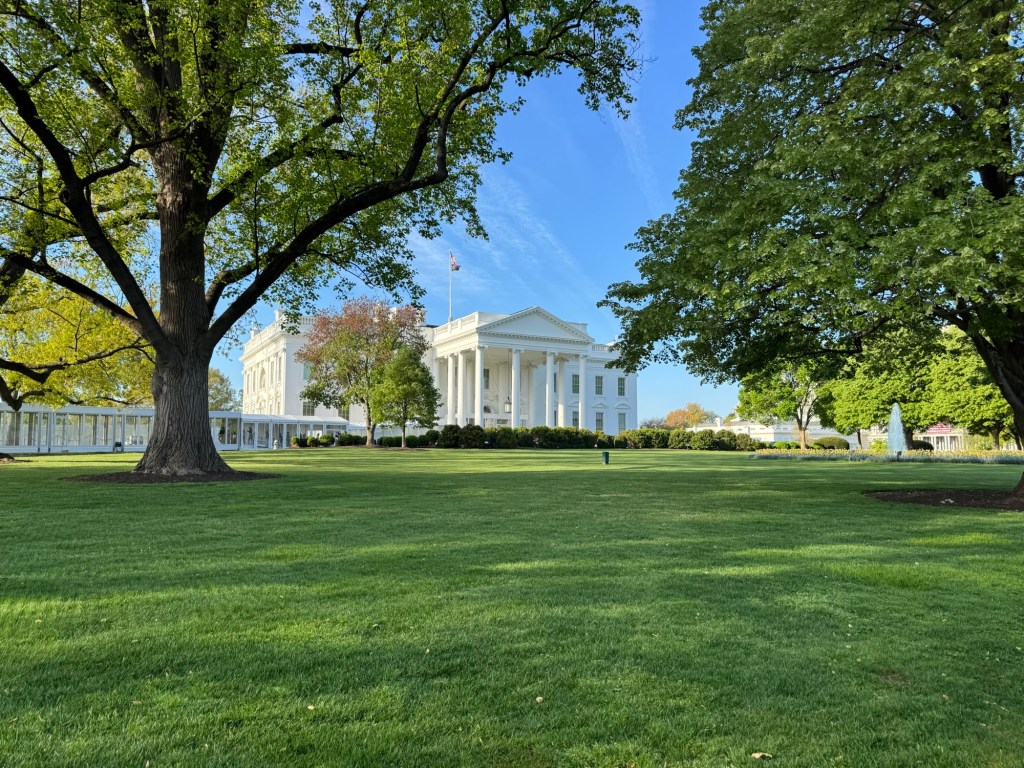
Where Evil Lives in Butler County: Grooming of children happening at 8870 Cincinnati Dayton Road in Olde West Chester, Ohio April 16th

I’ve been warning people for years about what’s creeping into our communities, especially here in Butler County, Ohio, and the Lakota school district that serves so many families in Liberty Township and West Chester. I didn’t want to believe it at first when I started hearing the stories—drag queen story hours, pride displays in hallways, and all the rest of it being pushed on kids right after school lets out. But here we are, and it’s happening in my own backyard, down the road from where I live. On Thursday, April 16, 2026, right at 3:30 to 5 p.m., there’s going to be a Drag Queen Story Hour featuring Roxie D. Mocracy at the Coterie Lounge & Café—better known to a lot of locals as Mommy Needs Coffee or Mama Needs Coffee—at 8870 Cincinnati Dayton Road in Olde West Chester.   It’s timed perfectly for right after school, turning what’s normally a progressive little café into a “storybook stage” for this event. The promotional language is all sparkle and sass: “Roxie brings the sparkle, the sass, and a stack of colorful books for a joyful reading time that celebrates imagination, kindness, and being exactly who you are. Gather for stories, laughs, and a little bit of glittery magic while parents sip their coffee and soak in the fun.” Sounds harmless enough if you’re not paying attention, but I see it for what it is—a calculated effort to normalize something that has no business being sold to children as family-friendly entertainment. 

I care about this because it’s my community. Butler County isn’t some obscure corner of the country where these trends might slip under the radar; it’s a place full of hardworking families who expect their schools and local businesses to reflect traditional values, not some progressive experiment in social engineering. This café has a reputation for being on the cutting edge of that progressive crowd, and now they’re openly advertising this during their regular mommy-and-kids coffee time. Tickets sold out fast—adults snapped them up, marketing it heavily, and from what I’ve heard through my network, they’re using it to draw crowds and make a statement in what they see as conservative territory. I found out about it because my friend Darbi Boddy has been out there fighting these battles for years, and she got pulled into interviews by gay rights advocate magazines that tried to paint her as the villain while using her name as clickbait to boost attendance. That’s how these things work: they target the fighters, twist the narrative, and keep pushing until resistance fades. 

Where evil lives in Butler County

Let me back up a bit and give this the full context it deserves, because this isn’t an isolated event. It’s part of a pattern I’ve watched unfold in Lakota schools and across Butler County. Darbi Boddy was elected to the Lakota Board of Education back in 2021 with strong community support—over 8,000 votes in her favor—because parents were fed up with the direction things were heading. She came in swinging against what she saw as sexual grooming in the curriculum, pride flags and stickers everywhere, and policies that seemed more interested in ideology than education. Within months, the radicals were after her, just like they went after others who dared speak up. She exposed things that most people didn’t want to acknowledge: materials in libraries and classrooms that blurred lines between adult lifestyles and childhood innocence. The school board, the administration, and even some so-called Republicans turned on her. By March 2024, they removed her with a 3-0 vote after legal battles, absences tied to protection orders, and endless lawfare.   She was censured, stalked with court orders from fellow board members like Isaac Adi, and basically run off for doing what the voters elected her to do: fight the cultural rot. I supported Darbi then, and I support her now. She’s still out there helping parents across southern Ohio, speaking at events, even making trips to Mar-a-Lago to connect with like-minded fighters. She represents the kind of no-nonsense resistance we need more of, not the diplomatic hand-wringing that lets this stuff fester. 

This drag event isn’t happening in a vacuum. It’s the same crowd that wanted rainbows on every wall in Lakota hallways, “safe spaces” that doubled as indoctrination zones, and policies that prioritized feelings over facts when it came to gender and sexuality. Darbi pointed it out repeatedly in board meetings—viciously, unapologetically—and they hated her for it. Meanwhile, the board played teacup games with lawyers and administrators running the show instead of the elected officials. Lynda O’Connor, who served as board president for a long time, was more the administrative type—diplomatic, listening to counsel, trying to keep things smooth. I’ve always liked Lynda personally; we’ve had long conversations, hours upon hours, about getting the board back on track. We had a solid conservative majority at one point with Republican-endorsed candidates, but cracks formed when some folks started blending lines to look “accommodating.” I told her straight up during one of our talks that we needed fighters like Darbi, not just managers. She aired her frustrations with me recently at an event, and I listened—didn’t push back much because we’ve known each other for years and will cross paths again. But here’s the deal: when the school board started muzzling public comment and letting bureaucracy override parental rights, that’s when I pulled my support for some of those directions. Lynda got caught in the legalism, and it cost us. Mark Welch didn’t win his race partly because of that infighting, and now we’ve got moderates and Democrats sliding things under the door while everyone gives group hugs. 

I’ve said it before, and I’ll say it again: this is how evil migrates into a community. It doesn’t announce itself with horns and pitchforks; it shows up wrapped in glitter and “kindness,” sold as imagination and acceptance. Roxie D. Mocracy is a local figure—Hamilton’s “premiere celebrity housewife and public nuisance,” vice chair of Hamilton, Ohio Pride, activist with a big social media presence. He’s got videos out there of him singing in cafés just like this one, turning adult performance art into something marketed to kids. I watched one from about a year ago where the vibe was all sass and sparkle in a setting not unlike this event. Don’t get me wrong—adults can do what they want in their own spaces. I probably won’t like it, but be whatever, live your life. But when you solicit children, time it for after-school pickup, and frame it as “family-friendly” story time, that crosses the line. It’s not about judging lifestyles; it’s about protecting innocence. Psychological issues, boundary problems, the whole cultural push to make kids question their bodies and identities at younger and younger ages—this is grooming dressed up as fun. And the evidence is out there: past drag queen story hours have featured performers later convicted of child sex offenses in places like Houston. Here in Lakota, Darbi was the one shining a light on it, and they ran her off for it, using lawfare to do it, Butler County judges and school board members that opened the door wide for this kind of thing to happen.

The bigger issue is what this does to the community. Butler County is supposed to be solid—conservative, family-oriented, the kind of place where people value hard work and traditional raising of kids. Yet here we have a progressive café sticking it in our face, right in West Chester, targeting Lakota families. They’re bold because the fighters have been sidelined. Darbi’s removal was a victory for the progressives and the RINOs who played nice to avoid being called names. Republicans got behind the lawfare in some cases because they didn’t have the guts to go Old Testament on the threats. I’ve always been more diplomatic in my own way, but I respect Darbi’s willingness to call evil what it is. We need more like her on school boards, not people who tie everything up in bureaucracy and popularity contests. The election process is supposed to bring in warriors to fight this exact stuff, not administrators who become part of the problem. When Darbi brought up the grooming and the explicit influences, the board looked for legal mechanisms to shut her down instead of backing her. That’s why this event feels so brazen—it’s sold out, they’re over capacity probably, and nobody with authority is stepping in to enforce rules or push back.  If there was any justice, the fire code violation would send a good message to these anti-family schemers of doom and treachery, and shut it down. 

Think about the timing: 3:30 to 5 p.m., kids fresh out of school, parents sipping coffee while Roxie reads stories that celebrate “being exactly who you are.” It’s the same playbook used nationwide. Drag Queen Story Hour started years ago as a niche library program and has since exploded into schools and cafés, always framed as diversity and inclusion. But critics—and there are plenty with data—point to the sexualized nature of drag performance bleeding into kid spaces. Performers in full adult regalia, songs, and dances that belong in bars are now aimed at little ones. It normalizes confusion, plants seeds of doubt about biology and family, and parents who object get labeled bigots. I don’t buy the “it’s just reading” defense. If it were a cowboy story hour or a Bible story hour with similar flair, the same crowd would cry foul. This is targeted cultural change, and it’s working because too many good Christians and conservatives don’t know how to fight back without being called terrible people.

I’ve written about this extensively over the years, connecting the dots from local school fights to national trends. In my book, The Gunfighter’s Guide to Business, I lay out the philosophy: you don’t appease evil when it shows up at your door. You meet it head-on with truth, strategy, and unapologetic action. The same principles that save a company or build wealth apply to saving your community and your kids. Reject the lawyers’ games, the group hugs, the moderate blending. Fly the flag of resistance. Darbi embodied that—still does, even off the board. She’s helping parents get fighters elected elsewhere in southern Ohio. Meanwhile, the school board that ousted her has let the rainbow stuff slide under the door, and events like this thrive in the vacuum. If your kids aren’t going, they want to make it uncool to object. That’s the real goal: not just one event, but shifting the Overton window so that questioning it makes you the outlier.

That’s a very small place for a lot of people. If you sell two tickets, it’s sold out. better check with the fire Marshall for any more.

Some will say this is overblown, that it’s harmless fun, and parents can choose. But when it’s marketed directly to after-school crowds in a café known for progressive moms, and the district has a history of similar pushes, it’s not neutral. Capacity violations are likely since it sold out quickly—maybe someone with guts shows up to document it. The business has a right to host it, sure. But we have a right to call it what it is and resist the normalization. I’ve talked to enough parents in Lakota who are stunned that this is happening here. They thought Butler County was immune. It’s not. Evil doesn’t stay in blue cities; it migrates to places like ours because resistance weakens when fighters get ostracized.

Looking back at the school board saga, it’s a microcosm. Darbi tried to ban transgender participation in girls’ sports, called out inappropriate materials, and photographed pride stickers in classrooms to expose the agenda. The board struck down her motions fast. Lynda and others voted to censure her early on. Public comment got shut down amid superintendent controversies. It was all about control, not education. I left one of my conversations with Lynda feeling like she needed space to vent, but the facts remain: without people willing to dig deep and fight, the slide continues. Republicans who backed the ousting of Darbi to “keep the peace” handed the progressives a win. Now we see the result—a drag queen event targeting our kids, bold as brass.

This isn’t about hate; it’s about protection. Children deserve to be kids, not props in adult identity explorations. The psychological toll on young minds from early sexualization is real—higher rates of confusion, regret, and mental health crises down the line. Studies like the Cass Review in the UK have dismantled the weak evidence behind gender-affirming care for minors, showing it’s experimental at best. Yet here we push the sparkle version to preschoolers. Roxie and the café call it joy; I call it a disgrace. And the fact that gay advocate outlets used Darbi as a foil to promote it shows their strategy: make opposition look extreme so the event looks mainstream.

I’ve been busy fighting these battles myself through writing, speaking, and supporting candidates who won’t cave. My book The Gunfighter’s Guide to Business isn’t just for CEOs—it’s for anyone facing down threats, whether corporate or cultural. It teaches you to see the manipulators, reject victimhood, and build strength. If you haven’t read it, grab a copy; it’ll arm you for exactly this kind of fight. Subscribe to my updates too, because tomorrow’s a better day only if we make it so. This event on April 16 is a symptom. The disease is deeper: a culture that perverts childhood to advance an agenda, enabled by weak institutions and timid leaders.

We need school board members who are fighters, not diplomats. We need parents showing up, documenting overcapacity, speaking truth, even when it’s uncomfortable. The Republicans who played politics with Darbi’s seat handed us this. The victory of pushing her out let the door crack open wider. Evil doesn’t knock politely; it glitters and sasses its way in. Call it out. Resist it. Support the Darbi Boddy types who won’t back down. Our kids’ futures depend on it. This is happening in broad daylight in West Chester, and if we don’t push back here, it spreads everywhere.

Footnotes

¹ Eventbrite listing for Drag Queen Story Hour at Coterie Lounge & Café, April 16, 2026.

² WVXU report on Lakota School Board striking down Darbi Boddy’s anti-trans motion, January 29, 2024.

³ Overmanwarrior.wordpress.com post: “Darbi Boddy is Exposing Sexual Grooming at Lakota Schools,” May 10, 2022.

⁴ Cincinnati.com coverage of Darbi Boddy’s removal from the Lakota board, March 2024.

⁵ Cass Review final report on gender identity services for children and young people, 2024 (independent review commissioned by NHS England).

⁶ FOX19 and local reports on Lakota board controversies involving public comment shutdown and superintendent issues, 2022.

⁷ The Buckeye Flame article on “anti-woke” Ohio school board member removed, March 26, 2024.

⁸ Roxie D. Mocracy Facebook promotion of the event at Coterie Lounge & Café.

⁹ Overmanwarrior.wordpress.com author bio and references to The Gunfighter’s Guide to Business.

¹⁰ Additional context from Cincinnati Enquirer and Journal-News archives on Lakota CRT and pride policy battles, 2022–2024.

Bibliography

•  Eventbrite. “Drag Queen Story Hour.” Accessed April 2026. https://www.eventbrite.com/e/drag-queen-story-hour-tickets-1984561449719

•  Hoffman, Rich. The Gunfighter’s Guide to Business. Self-published, available via gunfighterguide. shop.

•  “Lakota School Board Strikes Down Darbi Boddy’s Anti-Transgender Motion.” WVXU, January 29, 2024.

•  “Anti-Woke Ohio School Board Member Removed.” The Buckeye Flame, March 26, 2024.

•  Overmanwarrior.wordpress.com. Various posts on Lakota schools and Darbi Boddy, 2022–2025.

•  Cass, Hilary. Independent Review of Gender Identity Services for Children and Young People: Final Report. NHS England, 2024.

•  Local news archives: Cincinnati.com, FOX19, Journal-News (Butler County) on school board actions, 2022–2024.

•  Roxie D. Mocracy social media (Facebook/Instagram), event promotions, 2026.

Rich Hoffman

More about me

Click Here to Protect Yourself with Second Call Defense https://www.secondcalldefense.org/?affiliate=20707

About the Author: Rich Hoffman

Rich Hoffman is an aerospace executive, political strategist, systems thinker, and independent researcher of ancient history, the paranormal, and the Dead Sea Scrolls tradition. His life in high‑stakes manufacturing, high‑level politics, and cross‑functional crisis management gives him a field‑tested understanding of power — both human and unseen.

He has advised candidates, executives, and public leaders, while conducting deep, hands‑on exploration of archaeological and supernatural hotspots across the world.

Hoffman writes with the credibility of a problem-solver, the curiosity of an archaeologist, and the courage of a frontline witness who has gone to very scary places and reported what lurked there. Hoffman has authored books including The Symposium of Justice, The Gunfighter’s Guide to Business, and Tail of the Dragon, often exploring themes of freedom, individual will, and societal structures through a lens influenced by philosophy (e.g., Nietzschean overman concepts) and current events.

The No Kings Sedition: Its all paid for by those trying to overthrow America

Democrats have been lying low in the shadows, licking their wounds after the last election cycle, and waiting for the perfect moment to strike back with all their usual finagling. They’ve been pounding away with constant pushback on everything from the economy to foreign policy, but the Iranian situation right now—this whole mess with the Strait of Hormuz and the threats of escalation—is where they’re making their big, calculated move. It’s not random; it’s orchestrated. They’ve been taking it on the chin for a while, staying quiet while the country started to feel the momentum of real leadership again, and now they’re emerging with their germs of dissent and their coordinated push because they see an opening. But here’s the thing I keep telling everyone who tunes in: there’s always a counter to their moves, and President Trump is the master of reading the room and delivering it. This Iranian thing couldn’t have come at a better time, even if it looks threatening and bad on the surface. If you’re going to confront it, do it decisively, get it out of the way before summer fully hits, and watch the gas prices snap back under control—which is exactly what’s going to happen. I told everybody weeks ago that the Iranians are not going to be allowed to clog up that vital waterway. It’s just not going to work out the way they ever wanted or planned. Their little game of running speedboats and firing rockets at tankers might make headlines for a day or two, but it’ll be dealt with pretty quickly. In the grand scheme of things, it’s not the insurmountable problem they’re hyping it up to be.

To really understand why this moment feels so pivotal, you have to go back into the background of U.S.-Iran relations, something I’ve unpacked in detail because it’s not just current events—it’s decades of bad policy piling up. The story starts in the 1950s with the CIA-backed coup against Prime Minister Mohammad Mossadegh, which put the Shah back in power and set the stage for resentment that boiled over in the 1979 Islamic Revolution. That revolution wasn’t some organic people’s uprising in the way the left likes to romanticize it; it was a theocratic takeover that replaced a flawed but modernizing monarchy with a brutal mullah regime that has oppressed its own citizens ever since. The embassy hostage crisis, the Iran-Iraq War, where they used human waves and chemical weapons, the tanker wars in the Strait of Hormuz back in the 1980s—including the U.S. Navy’s Operation Earnest Will and the downing of Iran Air Flight 655 by the USS Vincennes—all of that set patterns we’re still living with. Iran has threatened to close the Strait dozens of times over the years because they know it carries about 20 percent of the world’s oil supply. A blockade spikes global prices overnight, which is exactly what we’ve seen in the last few weeks with gas creeping toward five dollars a gallon in some spots before the latest pause kicked in. Trump pulled us out of Obama’s JCPOA nuclear deal in 2018 for good reason—it was a giveaway that funneled cash to the regime while they kept enriching uranium and funding proxies like Hezbollah and the Houthis. His “maximum pressure” campaign starved them of revenue, and now, in 2026, we’re seeing the regime double down because they’re cornered. I believe Trump was counting on the Iranian people themselves to take back their country eventually. They’ve been beaten down by decades of oppression—the morality police, the executions, the economic misery—but recent protests like the 2022 Woman, Life, Freedom movement after Mahsa Amini’s death showed flashes of resistance. Hundreds killed, thousands arrested, yet it fizzled because the regime’s Revolutionary Guard and Basij thugs are a mismatched bunch of enforcers, not a unified military facing a real, organized opposition. The people run around in rubber boats trying to clog up the Strait with rockets and mines, but that’ll be handled fast—not a big problem when you have real naval power and allies who understand the stakes.

Democrats, on the other hand, have always had a soft spot for Iran and other authoritarian governments. They loved the JCPOA because it let them pretend diplomacy was working while the mullahs built their bomb and spread terror. They cozy up to China’s Communist Party, overlook Venezuela’s socialist collapse under Maduro, and cheer whenever a strongman sticks it to the West. It’s all about it for them now—power centralized, control over the masses, the illusion of equity through force. That’s why this rash of protests we’ve been watching—the so-called “No Kings” movement—isn’t just a spontaneous reaction to the Iranian standoff. They attempt to manufacture chaos and shift the narrative back in their direction. And I think it’s a great thing in the long run. All this stuff forces the opposition to show their true colors. Elections, at their core, are negotiations over positions and power. Republicans have historically read the room wrong because so many of us are good Christian people raised to turn the other cheek. We forgive our neighbor even when that neighbor wants to cut our heads off and crucify us on live television. We look for ways to have lunch and find common ground, which is noble but leaves us on the wrong side of hard negotiations. That’s exactly why so many of us gravitated to Trump—he’s not the typical Republican who folds for the sake of decorum. Trump is about wins, plain and simple. He’s Republican in name but results-oriented in action, and that’s why people keep supporting him even through the noise. He gets things done. Just to let everybody know, Trump’s going to be back on the road this summer doing all that good stuff—rallies, appearances, the full campaign energy even though he’s already in office. It’s like he’s running for president all over again because momentum never stops. The best way to start getting everything moving in the right direction when you’re in a fight is to bring your past along—bring Speaker Johnson and the whole unified team, just like he did before. Get everybody together, have some fun, and show the country that government can be energetic and effective again instead of this dour, bureaucratic slog we endured for years.

I would also say to everybody paying attention that disclosure is a smart play here. Releasing more on the UFO/UAP files takes away a huge media headline that the Democrats and their allies have been salivating over. They love that stuff because it feeds into narratives of government secrecy and elite control, something very close to their hearts. Trump could snatch that away from them entirely, and he’s already signaling he’s willing to do a lot of good things in that space. It gives him leeway on the Iranian deal, too—he has to give a little on the political theater side to break something loose that’s been a problem forever. Ultimately, it will bring gas prices down to a great level and solve many downstream issues. There are plenty of speculators out there right now profiting off the manufactured crisis; media reports are spiking prices for the moment, but they’ll get back under control pretty fast once the Strait reopens and the visits from U.S. assets make their point. Let’s talk more about the “No Kings” movement because calling Trump a king or an authoritarian is the height of projection. He certainly isn’t one, but I think all this noise is good because it forces the opposition to reveal who they really are. I’ve seen these movements pop up in England, all over Europe, Washington D.C., and right here at the Ohio Statehouse in Columbus—not far from my home in Middletown. They look the same everywhere: not organic grassroots uprisings driven by free speech or genuine voter frustration. This is a coordinated effort involving roughly 500 organizations—radical liberal, socialist, and even radical Islamic elements—all tied together by the Soros network. George Soros and his son Alex have poured billions—estimates put the Open Society Foundations and related groups at over three billion dollars funneled through these channels—buying influence, printing signs, busing people in, and funding media amplification. If not for the money, a lot of these folks wouldn’t show up at all. They’re franchise Democrats who turn out for a free lunch, a free T-shirt, or a pallet of pre-printed rocks and signs ready to throw. That’s the kind of organization we’re dealing with—hostile to the American experiment, cheerleading from corporate media outlets that pretend it’s all spontaneous outrage against the Trump White House.

In my view, and I’ve said this locally in Ohio and at the federal level, this “No Kings” push is no organic movement. It’s a paid-for infomercial produced by the radical left to try to destroy the United States from within. They used to hide behind other liberal causes—racism narratives, minority crisis issues—but now the mask is off with a bunch of crazy radicals who look and sound like people you wouldn’t want to sit next to on a bus. Those are the faces on TV advocating for the movement, and it’s pushing independents straight into the arms of Republicans. If only the GOP would dare wrap its arms around those voters, it couldn’t be easier. Trump has a clear strategy to steer things back on track, playing the Iran game in a way no previous president has dared. That’s why these problems festered in the background for so long—the left’s weapons of radical Islam, radical Marxism, and communism are being taken away one by one. So, of course, the money flows: three billion dollars into five hundred organizations, protests erupting like clockwork the moment Trump takes a hard line. But here’s the reality check: locally in Ohio, where I live, and certainly at the national level, Democrats have scored a few little pickup victories only when Republicans got asleep at the wheel or too cocky riding the Trump wave without defending turf properly. Some in the party got their hearts out of it because they secretly expected Democrats to retake power and didn’t want the responsibility that comes with winning. It’s hard when you’re in charge—you have no one to complain about except yourself. There’s a fair number of Republicans who want Democrats back in so they can stay in the comfortable role of opposition. This movement gives them an off-ramp from behaving like actual Republicans. But it’s going to blow up in everybody’s face because it’s not organic. It’s a funded operation by radicals who’ve been trying to undermine the country for decades. What they don’t have anymore is the polite illusion. People watching these idiots on TV are saying, “I don’t want that. I don’t want to be associated with that. I can’t vote for that.” It’s pushing the country the other way.

Just look at the contrast: Trump supporters stand in line for eight, twelve, twenty-four hours to get a seat ten rows back at a rally because they’re excited about real change. These protest crowds don’t have that energy. They’ve got franchise lunatics trading time for cash, drugs, or free swag. They’re not high-quality people showing up on camera, and it’s kind of humorous how badly it makes their side look. As far as worrying about it goes, only Republicans who don’t understand how to read the leaves are sweating this. They need more confidence in themselves because the victory is clear if you’re actually listening beyond the nightly news spin. Where do you think all that three billion dollars is coming from, and who’s receiving it? The media will say anything for a few bucks or a free steak dinner, but that money buys influence and it shows in the quality of the foot soldiers—radical losers who look horrible on screen and remind everyday Americans exactly why they voted for Trump in the first place. The most likely consequence as we head into June and July—especially if Trump keeps the pressure on without letting the Democrats steal the narrative—is that gas prices recover rapidly. This isn’t something that lingers for years or even months once the Strait issue is settled. Real victories are there for the taking, and it really comes down to having the courage to stay in power whether some in the party want the responsibility or not. Democrats don’t have much gas left in their tank; it takes three billion dollars just to get their people to show up and look stupid on camera. That’s not a winning position. You might as well be a Republican right now, and that’s how the ball is going to bounce when the dust settles. Don’t worry about it. It’s going to come out just the way logic and history say it will. In the meantime, they’re being exposed as the crazy lunatics they always were, and we know exactly how much they were paid to act that way. Good things come to those who wait, especially those who hate what we’ve picked for representative government and are trying to flatten the tires to push toward the midterms. They’re acting desperate, and desperate doesn’t photograph well. Looking good for Republicans overall.

If you ever want to dig deeper into the philosophy that underpins all this—how to navigate chaos, win negotiations, and build something lasting instead of tearing down—I’d point you toward my book, The Gunfighter’s Guide to Business: A Skeleton Key to Western Civilization. It lays out the mindset that treats life and politics like the Old West: know your terrain, carry the right tools, and don’t apologize for defending what’s yours. Trump embodies a lot of that frontier spirit, which is why the radical left hates it so much. They prefer managed decline and dependency. We prefer wins, clarity, and a government that gets out of the way so people can thrive.

Looking ahead, Trump’s going to keep leveraging this Iran situation for broader gains—getting the Russia-Ukraine conflict out of the headlines where it’s been conveniently ignored, pushing for better negotiating positions on everything from rare earth metals to energy independence. A lot is going on behind the scenes that’s headed toward proper closure, and the Democrats know it. That’s why the protests are ramping up—to try and bring people to their cause. But again, their whole side is paid for. It’s not organic. It’s not the kind of passion that fills arenas or lines up for hours. It’s manufactured, and the country is seeing through it. The bad guys are desperate, and that desperation is their undoing. Republicans need to keep reading the room correctly, stay unified, and remember that we win when we stop turning the other cheek and start delivering results. I’m confident it’s all going to balance out in our favor by the time summer rolls around, and the American people will be reminded once again why they put their trust in leadership that actually fights for them.

Footnotes

1.  Recent reporting on the April 2026 U.S.-Iran ceasefire negotiations and Strait of Hormuz reopening conditional on infrastructure threats; see coverage from Reuters and Al Jazeera on Trump’s deadlines and conditional pause.

2.  Background on U.S.-Iran history drawn from Council on Foreign Relations timelines, including JCPOA withdrawal (2018), maximum pressure campaign, and 2022-2023 Woman, Life, Freedom protests (BBC, Human Rights Watch reports on regime crackdowns).

3.  Trump’s 2026 public schedule and rally-style events referenced in White House releases and conservative outlets, noting continued campaign-style travel.

4.  “No Kings” protest network details, including Indivisible’s Soros/Open Society Foundations grants (~$3M direct) and broader ecosystem of 500+ progressive groups with combined revenues exceeding $3 billion; Fox News investigations and Capital Research Center analyses of funding flows.

5.  Ohio-specific protest activity at Statehouse and local coverage in Columbus Dispatch/Middletown outlets; national patterns documented in New York Post and Washington Examiner reporting on astroturf elements.

Bibliography

•  Council on Foreign Relations. “U.S.-Iran Relations: A Timeline.” CFR.org (updated 2026).

•  Open Society Foundations annual reports and grant databases (public filings via InfluenceWatch/Capital Research Center).

•  Human Rights Watch. “Iran: Crackdown on Woman, Life, Freedom Protests” (2022-2025 updates).

•  Hoffman, Rich. The Gunfighter’s Guide to Business: A Skeleton Key to Western Civilization. Self-published, 2021 (expanded editions available via Overmanwarrior.com).

•  Reuters. “Trump Announces Conditional Ceasefire in Iran Standoff” (April 2026).

•  Fox News. “Soros Network Funds ‘No Kings’ Protests: Inside the $3B Progressive Machine” (2026 investigative series).

•  BBC Persian Service archives on Iranian internal dissent and Strait of Hormuz incidents.

•  U.S. Energy Information Administration. “Strait of Hormuz Oil Transit Chokepoint” (fact sheets, 2026).

•  Additional further reading: George Soros’s Open Society writings for a primary source on his philanthropy philosophy; compare with critiques in David Horowitz’s The Shadow Party (updated editions) and recent think-tank papers from Heritage Foundation on foreign policy leverage strategies.

Rich Hoffman

More about me

Click Here to Protect Yourself with Second Call Defense https://www.secondcalldefense.org/?affiliate=20707

About the Author: Rich Hoffman

Rich Hoffman is an aerospace executive, political strategist, systems thinker, and independent researcher of ancient history, the paranormal, and the Dead Sea Scrolls tradition. His life in high‑stakes manufacturing, high‑level politics, and cross‑functional crisis management gives him a field‑tested understanding of power — both human and unseen.

He has advised candidates, executives, and public leaders, while conducting deep, hands‑on exploration of archaeological and supernatural hotspots across the world.

Hoffman writes with the credibility of a problem-solver, the curiosity of an archaeologist, and the courage of a frontline witness who has gone to very scary places and reported what lurked there. Hoffman has authored books including The Symposium of Justice, The Gunfighter’s Guide to Business, and Tail of the Dragon, often exploring themes of freedom, individual will, and societal structures through a lens influenced by philosophy (e.g., Nietzschean overman concepts) and current events.

The Smoking Gun of Windover: What NAGPRA was meant to conceal

I have been reflecting deeply on this as April 9th rolls around—my birthday—and I decided this year I would give myself something truly personal, something that excites me at the core of my being and ties together years of my own research, political observations, and that relentless drive to uncover truths that the system tries to bury. It is not some flashy gift or a day off from the work I do for everyone else; instead, it is this deep dive into what I consider one of the most important archaeological revelations of our lifetime, a site that serves as a smoking gun for so many historical narratives that have been twisted, politicized, and deliberately constrained. I am talking about the Windover archaeological site in Central Florida, that extraordinary bog cemetery near Titusville, just up the road from the Kennedy Space Center, where an accidental discovery in the mid-1980s peeled back layers of prehistory in ways that challenge everything we have been taught about the peopling of North America, the sophistication of ancient cultures, and the very foundations of modern political narratives about land, history, and who truly belongs here. I have poured over the rare academic book that documented it all—Windover: Multidisciplinary Investigations of an Early Archaic Florida Cemetery, edited by Glen H. Doran and published by the University Press of Florida in 2002—and it has become my birthday present to myself because it represents a narrow window into truth before the doors slammed shut with laws like NAGPRA. I invite everyone who reads this to share in that excitement with me, because this is not just dusty bones in a pond; it is evidence of a sophisticated society that predates the standard Beringia migration story by thousands of years in meaningful ways, and it exposes how politics, not science, has been driving the suppression of our deep past.  

I first came across references to this site years ago in my own independent studies of ancient American history, the kind of reading I do late at night after dealing with local politics here in Butler County, Ohio, or after watching the national scene unfold with all its layers of deception. Back then, I was already skeptical of the official timelines pushed in academia—the neat little story that indigenous peoples crossed the Bering land bridge around 15,000 to 20,000 years ago, spread south as hunter-gatherers, and that everything before European contact fits neatly into that box with tribes like the Iroquois, Lakota, or Sioux representing the “original” inhabitants. But Windover blew that open for me in a way nothing else had. Discovered accidentally in 1982 or early 1984 when a backhoe operator for a housing development called Windover Farms scooped up a human skull while digging in a small peat bog pond, it quickly became clear this was no recent crime scene. County medical examiners dated the remains as ancient, and that led to Florida State University anthropologist Glen Doran stepping in as principal investigator. From 1984 through about 1987, his team excavated roughly half of this half-acre pond cemetery under challenging wet-site conditions, uncovering the remains of at least 168 individuals—men, women, and children, from infants to elders around 60—buried in a deliberate, logical manner that suggested a thoughtful, organized society. What made it extraordinary was the preservation: the acidic yet neutral-pH peat bog acted like a natural time capsule, keeping not just bones but also soft tissue intact. We are talking brain tissue still present in 91 skulls, some with cellular structure preserved enough for DNA extraction; skin on the bodies; even the last meals still identifiable in their stomachs. They had clothing woven from plant fibers—some of the oldest and most complex textiles ever found in the New World, requiring looms or advanced weaving techniques that nobody expected for an “Archaic” period people 7,000 to 8,000 years ago. Wooden artifacts, bone and antler tools, a bottle gourd—evidence of a culture far more advanced than the simple hunter-gatherer label academia slaps on prehistory.  

An amazing book!

I have that Doran book—it is a thick, technical volume, the kind produced in limited academic runs, probably only a few thousand copies worldwide, and I feel fortunate to have one because it captures every multidisciplinary angle: environmental analysis, radiocarbon dating pinning the site firmly to around 6000-5000 BC, mortuary patterns showing bodies often placed with poles or stakes to keep them submerged, facing north with heads turned west in what looks like a deliberate ritual orientation toward the setting sun and perhaps some spiritual reverence. The people themselves were robust; average adult males stood about five feet nine inches, taller and healthier than many later prehistoric groups, with some individuals pushing six feet or more based on femur lengths and bone density—enough to fuel those early newspaper reports of “giants” in North America before institutionalized science dismissed them as hoaxes or exaggerations. There is no wild conspiracy in Doran’s work; it is straight, careful archaeology by scientists who genuinely loved the field and rushed to document everything because they sensed the political tides turning. Half the cemetery was left untouched, and today the site sits under a plaque in a wooded subdivision, a National Historic Landmark with no further major digs. That is the tragedy I keep coming back to, and it is why Windover feels like the smoking gun for me. 

What hit me hardest when I dug into the details—and this is where my own political experience from years fighting school levies, local corruption, and national narratives in Ohio gives me a unique lens—is how perfectly timed this discovery was before the Native American Graves Protection and Repatriation Act (NAGPRA) slammed the brakes on American archaeology. NAGPRA passed Congress on November 16, 1990, right after the Windover excavations wrapped up and right around the cultural frenzy sparked by Dances with Wolves, that Hollywood epic romanticizing the Sioux and framing Western expansion as pure theft of indigenous land. I have studied how bills get written, who lobbies them, and the closed-door intentions behind them, and NAGPRA was loaded with progressive language designed to solidify a specific narrative: America as stolen property from “Native Americans” defined by a very shallow historical scope. It required consultation with tribes for any remains or cultural items, mandated repatriation, and effectively shut down large-scale digs because developers and archaeologists alike knew that uncovering bones could halt projects, tie up land in legal battles, and invite tribal claims. Developers started burying finds quietly rather than reporting them, and grant money in academia dried up unless you played along with the official story. Windover happened in that narrow window before the law fully kicked in—Doran and his team worked fast, funded in part by the curious developers themselves, who paused their subdivision to allow proper science—and the result was this irreplaceable snapshot of an 8,000-year-old culture that does not neatly fit the Beringia-to-modern-tribes pipeline. 

The DNA analysis of the preserved brain tissue is what really undermines the premises on which NAGPRA was built. Studies showed genetic markers linking these Windover people to ancient Asian populations via the Beringia route, as expected—haplogroups like A, C, D, and even the rare X that pops up in some Native contexts—but crucially, they do not align closely with any living Native American tribes or even many known prehistoric groups. It suggests either their lineage died out, experienced a severe bottleneck, or represents a distinct early population that predates or diverged from the groups we retroactively label as “indigenous.” I am not here to take anything away from what we have been calling Native American communities or their cultural heritage; I respect the reverence for ancestors. But when you have remains this old—older than the pyramids, older than Mesopotamian civilizations in some contexts—and DNA that does not match the shallow 300-400-year tribal samples used to justify repatriation claims, who exactly do you hand them back to? The law assumes a direct, unbroken chain to contemporary tribes, but Windover proves the timeline, and the populations were far more complex. These were not simple hunter-gatherers; they had advanced textile production, implying looms; thoughtful burial rituals suggesting religion or cosmology; trade networks possibly reaching far beyond the region (given certain materials); and a settled community life in a resource-rich Florida environment when sea levels were lower and the coastline extended miles outward. Villages and mounds now submerged offshore hint at even broader Archaic networks. This site forces a reevaluation: the “Native American” designation under NAGPRA was built on politically convenient assumptions that ignored deeper prehistory, and that ignorance was weaponized to challenge the legitimacy of Western expansion and the founding of the United States itself. 

I see this as part of a larger pattern I have observed in my own work on politics and history—the way organized systems, often with roots in spiritual battles that play out in the terrestrial realm, rewrite narratives to maintain power. My upcoming book, The Politics of Heaven, dives straight into this because sites like Windover provide the hard evidence that legends, mythology, and even biblical accounts of ancient sophistication are not fairy tales. Think about it: these people knew how to weave delicate fabrics thousands of years before we associate such technology with the Indus Valley, Mesopotamia, or Egypt. They cared for their sick and dead in a mass cemetery with ritual precision. Their stature and health suggest a robust population living in a stable society. And all of this at a time when the Ice Age was ending, sea levels were rising, and cultures we now call “Atlantis” in Platonic accounts or other global flood myths were supposedly migrating and seeding knowledge worldwide. Plato described Atlantis as an advanced civilization destroyed by catastrophe, with survivors spreading to Egypt, Britain, the Americas—places where we find sudden leaps in sophistication that do not fit the slow Beringia crawl. Windover fits as one piece of that puzzle: evidence of pre-Mesopotamian complexity right here in North America, with possible ties to shamanic or spiritual practices seen in even older Near Eastern sites. Take Qesem Cave near Tel Aviv in Israel, for example—an ancient site showing early humans (or pre-modern hominins) with innovative tool use, controlled fire, and communal activities dating back hundreds of thousands of years, far predating the standard timelines and hinting at organized, intelligent societies communicating with or revering something beyond the material world. Similar patterns appear in Natufian or shamanic contexts in the Levant around 13,000-10,000 BC, with ritual fires and early communal structures. These are not isolated; they point to a deep, sophisticated human history that institutional science, constrained by funding and politics, has been reluctant to explore fully. 

Here in North America, we have the same suppression at work, only dressed up as “reverence for indigenous rights.” Cahokia Mounds near St. Louis is another example I have studied closely—a massive Mississippian city around 1000-1400 AD with more people than London at the time, featuring the famous Birdman tablet and legends of Thunderbirds that echo across Native oral histories. Yet St. Louis was literally built on top of it, and we still vaguely associate it with later tribes despite clear discontinuities. Mound builders, Adena, Hopewell—earlier cultures with advanced earthworks and trade—get shoehorned into the same narrative, ignoring how each generation builds over the previous one, claiming territory like animals marking trees. Human nature drives this, but laws like NAGPRA freeze it artificially at a politically useful point: 1492 onward, with Europeans as the sole thieves. The reality, as Windover shows, is layered theft and migration going back millennia—groups taking from older groups, sophisticated societies rising and falling. If we had unrestricted digs, we could map this properly, learn from mistakes, and avoid repeating cycles of conquest and cultural erasure. Instead, the law—passed in that post-Dances with Wolves glow of guilt—created incentives to hide discoveries, starved archaeology of funding for controversial sites, and prioritized a narrative that undermines the Christian-influenced Western foundation of America. I know how these bills are crafted from my own experiences fighting local and state politics; the closed-door intentions are rarely about dead ancestors and always about power, land claims, and reshaping history to favor certain ideologies.

Glen Doran himself, who passed away in 2021, and his colleagues captured their frustration between the lines in that book. They knew NAGPRA was coming; they rushed the work because they understood the profession was about to be handcuffed. The peat chemistry, the pollen, the paleoethnobotany, the DNA—all of it documented before the repatriation machine could intervene. Yet even today, the remaining half of the pond sits largely untouched, and broader Florida bog sites or offshore mounds from lower sea-level eras go unexplored because developers fear land seizures and archaeologists fear grant denials or tribal vetoes. This is not reverence; it is concealment. I love true archaeology—the kind done in England on shows like Time Team, where they dig openly, analyze bones without mandatory handover, and let evidence speak. Here, the human need to know has been subordinated to politics, which is why Windover feels like such a miracle: it slipped through just before the gates closed. It validates folklore, Plato’s hints at Atlantis, global trade networks in deep antiquity, and even the idea that our origin stories—whether biblical, mythological, or shamanic—involve advanced pre-flood or pre-catastrophe civilizations that revered higher powers, appeased spirits, and built societies with ritual purpose. The Windover dead faced north, heads west toward the sunset—symbolism that screams cosmology, not random burial. They were not “cavemen”; they were part of something older and wiser than we have only breadcrumbs of now.

This all ties directly into the spiritual warfare I explore in my work—the fallen entities at war with creation itself, imprinting their influence on earthly power structures to erase God’s narrative and replace it with controlled ignorance. Laws like NAGPRA are not neutral; they serve to keep humanity deficient in knowledge, allowing modern political orders to maintain authority built on false premises. Western expansion brought a Christian viewpoint and free civilization that disrupted older pagan or shamanic systems, but if deeper evidence shows sophisticated pre-Columbian (and pre-Beringia in practice) cultures with their own complexities, the “stolen land” story loses its moral absolutism. Everyone stole from someone; history is layered conquest. The real crime is preventing inquiry that could reveal this, because it threatens the power base. Windover proves it in my eyes: 8,000-year-old brains yielding DNA that does not fit the 1990 legal template, textiles requiring technology we associate with much later eras, and a cemetery showing care and ritual in a society predating known tribes. It is the perfect example for my book because it shows how politics cascades from heavenly rebellion into terrestrial control—concealing evidence so the deficient knowledge keeps people dependent on the current narrative.

I have met enough people in politics over the years, from Tea Party rallies to local commissioners, to recognize when good intentions get co-opted by larger agendas. Archaeologists like Doran wanted knowledge; the system wanted control. That is why I judge these things rigorously in my own life and work—if you cannot manage truth at the foundational level, you cannot lead effectively elsewhere. Windover demands we repeal or heavily reform NAGPRA, not to disrespect anyone but to prioritize the human need to know over artificial constraints. We need more digs, more funding for wet sites in Florida and beyond, and more open analysis of offshore mounds from Ice Age coastlines. Only then can we bridge the gap between legend and evidence, avoid repeating past mistakes, and understand our true place in the deep timeline. This site, with its preserved last meals, woven fabrics, and unclaimed DNA, hints at Atlantis-like migrations, shamanic connections to the spirit world (echoing Qesem Cave’s early innovations or Cahokia’s Birdman symbolism), and a history far richer than the shallow one politicized in 1990.

As I celebrate another year on this earth, I find real joy in holding this truth close. It reinforces why I fight the battles I do—not just local levies or national elections, but the deeper war for accurate history. The Windover people were real, sophisticated, and part of something vast. Their story survived by accident in the bog, preserved long enough for us to glimpse it before the political machine intervened. That is my birthday gift: the excitement of knowing more is out there if we demand the freedom to look. I will keep pushing in my writings, my podcast, and my life because evidence like this changes everything. Share it, study it, and let it provoke the larger discussion it deserves. The republic, and humanity’s understanding of itself, depends on refusing to let politics bury the past any longer.

Footnotes

1.  Primary source details on discovery, excavation, and findings from Glen H. Doran’s edited volume and supporting analyses.

2.  DNA results and non-alignment with modern tribes were summarized from peer-reviewed studies referenced in site reports.

3.  NAGPRA legislative history and timing relative to Windover drawn from official records and archaeological critiques.

4.  Stature and artifact sophistication (textiles, rituals) from bioarchaeological chapters in the Windover investigations.

5.  Broader connections to global prehistory (Qesem Cave, Cahokia) informed by my independent cross-referencing of Paleolithic and Mississippian sites.

6.  Political motivations behind NAGPRA are tied to the cultural context of 1990 (Dances with Wolves) and observed patterns in bill-making from my experience.

Bibliography for Continued Reading

•  Doran, Glen H., ed. Windover: Multidisciplinary Investigations of an Early Archaic Florida Cemetery. University Press of Florida, 2002.

•  Wentz, Rachel K. Life and Death at Windover: Excavations of a 7,000-Year-Old Pond Cemetery. Florida Historical Society Press, 2012.

•  National Park Service. “Native American Graves Protection and Repatriation Act.” Official NPS overview and regulations.

•  Plato. Timaeus and Critias (translations discussing Atlantis).

•  Various reports on Qesem Cave: Barkai et al., publications on Lower Paleolithic innovation in Israel.

•  Pauketat, Timothy R. Cahokia: Ancient America’s Great City on the Mississippi. Penguin, 2010 (for Birdman and mound-builder context).

•  Biblical Archaeology Review and related journals on Near Eastern shamanic/ritual sites predating Mesopotamia.

•  My own forthcoming The Politics of Heaven for expanded spiritual-political synthesis.

•  National Geographic and Florida Museum archives on Windover preservation and public exhibits.

Rich Hoffman

More about me

Click Here to Protect Yourself with Second Call Defense https://www.secondcalldefense.org/?affiliate=20707

About the Author: Rich Hoffman

Rich Hoffman is an aerospace executive, political strategist, systems thinker, and independent researcher of ancient history, the paranormal, and the Dead Sea Scrolls tradition. His life in high‑stakes manufacturing, high‑level politics, and cross‑functional crisis management gives him a field‑tested understanding of power — both human and unseen.

He has advised candidates, executives, and public leaders, while conducting deep, hands‑on exploration of archaeological and supernatural hotspots across the world.

Hoffman writes with the credibility of a problem-solver, the curiosity of an archaeologist, and the courage of a frontline witness who has gone to very scary places and reported what lurked there. Hoffman has authored books including The Symposium of Justice, The Gunfighter’s Guide to Business, and Tail of the Dragon, often exploring themes of freedom, individual will, and societal structures through a lens influenced by philosophy (e.g., Nietzschean overman concepts) and current events.

The Sex Cults of Artemis: We need to choose a name that sustains not just the body of exploration, but the soul of civilization itself.        

Artemis is going back to the moon, and I’m really not crazy about the name. I didn’t like it when they first came up with it, and I still don’t. It feels like one more concession to a secular worldview that pretends ancient pagan deities are just harmless branding exercises—cool-sounding relics from a long-dead culture that “everybody can agree on.” But history doesn’t work that way. Names carry weight. They carry spiritual baggage. And when NASA reached for a name to replace the glory days of Apollo and send us back to the lunar surface, they chose Artemis, the Greek moon goddess and twin sister of Apollo. On the surface, it sounds clever, a neat mythological bookend. But dig even a little deeper, and you’re wading into the same fertility cults, temple rituals, and appeasement of dark forces that early Christian writers confronted head-on in the Mediterranean world two thousand years ago. I’ve spent years studying this pattern, and it’s the backbone of a book I’m finishing called The Politics of Heaven. What we’re seeing with the Artemis program isn’t just branding. It’s a symptom of a much older struggle between the human spirit and the principalities that have always hungered for our attention, our bodies, and our collective sanity.

Let me start with the obvious. The Temple of Artemis at Ephesus was one of the Seven Wonders of the Ancient World, a massive marble edifice that dominated the city and the entire region. Built and rebuilt over centuries, it was more than a tourist attraction or a bank (which it also was—temples doubled as secure depositories). It was the epicenter of a cult that blended Greek mythology with older Near Eastern fertility worship. Artemis herself, in her Ephesian form, was often depicted with dozens of breasts or egg-like ornaments, symbols that modern scholars sometimes try to downplay as “not really about sex or fertility.” Yet the ancient world understood her differently. She was the goddess of the hunt and the wilderness, of chastity in some tellings, yet deeply entangled with the cycles of birth and reproduction, and the raw forces of nature. Her temple drew pilgrims, merchants, and locals who participated in festivals filled with processions, music, dancing, and—according to multiple ancient reports—rituals that involved the offering of human vitality, including sexual acts, to appease the divine.

Christian writers of the period didn’t shy away from describing what they saw. In Acts 19, the apostle Paul’s ministry in Ephesus sparks a riot among the silversmiths who made shrines to “the great goddess Diana” (the Roman name for Artemis). The city clerk calms the crowd by reminding them that Ephesus is the “temple keeper of the great Artemis, and of the image which fell from Jupiter.” That “image” was likely a meteorite revered as a divine gift, tying the cult directly to celestial forces. But Paul and the early Christians saw something far darker at work. They weren’t just opposing statues or tourism revenue. They were confronting a system of spiritual appeasement that had roots stretching back thousands of years to the fertility cults of Mesopotamia—Inanna, Ishtar, Astarte, and their Greek and Roman counterparts. These goddesses demanded sacrifice, often in the form of sexual union performed in or near the temple precincts. Women—sometimes all women in certain cultures—were expected to spend time as temple prostitutes, offering their bodies to strangers for money that went to the temple treasury. It wasn’t “empowerment” or personal choice in our modern sense. It was a collective duty to the gods, a way to ensure fertility for the land, prosperity for the city, and protection from whatever malevolent forces lurked in the spirit realm if the rituals were neglected.

Secular historians and archaeologists today often dismiss these accounts as Christian propaganda or exaggeration. They point out that direct physical evidence—carved reliefs, unambiguous inscriptions—is scarce at Ephesus because the temple was largely destroyed, its stones carted off for other buildings after Christianity became the dominant faith of the empire. Digging seasons in Turkey are short; the site has been layered over by centuries of occupation, and hostile conditions (political, environmental) have limited excavation. But absence of evidence isn’t evidence of absence, especially when you’re dealing with practices that were deliberately secretive or oral in nature. We have reports from Herodotus, Strabo, and other classical writers describing sacred prostitution in temples dedicated to similar goddesses across the region. In Babylon, for instance, every woman was reportedly required once in her life to sit in the temple of Ishtar (or Mylitta) and have intercourse with a stranger for a fee. Similar customs are attested in Cyprus, Phoenicia, and parts of Asia Minor. The early Church fathers didn’t invent these stories out of thin air; they were reacting to what they witnessed firsthand on the frontiers of the Roman East.

I believe we can trust those Christian reports precisely because the behavior they condemned persists. It just wears different clothes. Look at modern nightclub culture—the so-called “meat markets” that young people, especially women aged eighteen to twenty-four, are actively encouraged to frequent before “settling down.” Bachelorette parties where sexual impropriety is not only tolerated but celebrated. The progressive push for “sexual liberation” and “women’s rights” frames any restraint as patriarchal oppression. We send our daughters—girls who were playing with Legos and dolls just a few years earlier—into environments of throbbing music, flashing lights, alcohol, and physical grinding that would have been right at home in an ancient fertility festival. They dress in scandalously revealing outfits, present their bodies for public consumption, and are told it’s all harmless fun, a phase to “get out of their system.” The money doesn’t go to a temple treasury anymore, but the spiritual transaction is eerily parallel: the sacrifice of personal sanctity, the abandonment of the body to collective debauchery, the implicit agreement that youth and vitality must be offered up so the rest of society can enjoy peace from whatever unseen forces demand their due.

This isn’t hyperbole. It’s pattern recognition. Ephesians 6:12 puts it plainly: “For we wrestle not against flesh and blood, but against principalities, against powers, against the rulers of the darkness of this world, against spiritual wickedness in high places.” The apostle Paul, writing to the very church in Ephesus that had just emerged from the shadow of Artemis worship, understood that these weren’t abstract metaphors. The spirit world is real, and it competes for control of human bodies and minds. The body is the vehicle for the soul, but it’s a vulnerable one. When people impair their consciousness—through drunkenness, drugs, or ritual frenzy—they loosen the tether that keeps the conscious self in the driver’s seat. Competing spirits rush in. Personalities split, behaviors turn erratic, sanity fluctuates. Ancient temple prostitutes weren’t just performing an economic or social function; they were opening doorways. The same doorways we open every weekend in clubs across America and Europe. The music changes, the lighting gets fancier, but the appeasement of disembodied entities hungry for human essence remains constant.

My own explorations into these dynamics—through reading, observation, and reflection on how evil operates in human societies—have convinced me that we cannot separate the material world from the spiritual one. We are entangled. Secularism’s great lie is that we can neuter history, strip away the sacred (or the diabolical), and treat ancient gods as cartoon characters for mission patches and rocket fairings. NASA did exactly that with Artemis. After the Obama-era push to highlight “Islamic contributions to science” and diversify the agency with voices from every culture, the name was pitched as inclusive, neutral, non-offensive. Why pick something biblical when you could pick a “cool” pagan goddess that “everybody can agree on”? It’s the same impulse that led the agency’s early rocketry pioneers into occult territory. Jack Parsons, one of the founders of the Jet Propulsion Laboratory (JPL), was a brilliant chemist and engineer by day and a devoted Thelemite occultist by night. A disciple of Aleister Crowley, Parsons performed the Babalon Working in 1946 with L. Ron Hubbard—sex magic rituals involving masturbation onto magical tablets, invocations of the goddess Babalon (a Thelemic stand-in for the Scarlet Woman of Revelation), and attempts to incarnate demonic forces into the material plane. He saw no contradiction between rocket science and summoning ancient entities. In fact, he believed his rituals fueled his breakthroughs. NASA loves to celebrate the Apollo era’s clean, heroic image while quietly glossing over the fact that the foundational rocketry work at JPL had deep roots in Parsons’ dual obsessions. The cult origins of NASA aren’t a conspiracy theory; they’re documented in biographies like George Pendle’s Strange Angel. Parsons literally signed letters as “The Antichrist” and conducted black masses in his Pasadena home.

This brings me back to why naming the lunar return program after Artemis bothers me so much. It’s not just semantics. It’s a continuation of the same appeasement strategy humanity has employed for millennia. In ancient times, societies sacrificed their youth—virginity, vitality, individual dignity—to fertility goddesses in hopes that the “hungry gods” would leave the collective alone. Today we do it with our entertainment, our dating apps, our “hook-up culture,” and our refusal to draw moral lines. We tell young women that their bodies are theirs to offer freely in the nightclub meat market, that restraint is repression, and that any talk of spiritual consequences is outdated superstition. Meanwhile, the principalities and powers—those same competing souls and disembodied spirits that haunted the temples of Artemis, Ishtar, and Astarte—continue their work. They don’t need marble altars anymore; smartphones, social media, and Saturday-night fever vibes do the job just fine. The result is the same: fractured personalities, generational trauma, and a culture that robs itself of sanity in exchange for momentary collective highs.

I’m not suggesting NASA should abandon space exploration—quite the opposite. I love NASA. I want it to succeed. I want humanity to expand beyond Earth, to sustain life across the solar system, perhaps even outlive our home planet. But if we’re going to do that with any long-term credibility and moral foundation, we should draw from the best of our cultural inheritance—not the pagan underbelly that early Christians rightly rebelled against. Western civilization, for all its flaws, is rooted in biblical ideology. Why not name a program after a figure from Scripture that embodies vision, endurance, or divine favor? Something that signals we’ve learned from history rather than repeating its mistakes. The Artemis choice feels like a deliberate step away from that heritage, a nod to the “neutral” secular narrative that pretends spirit doesn’t matter. But spirit does matter. The body is the vehicle for the soul’s journey, and there are always entities eager to hijack the wheel when we let our guard down.

Archaeology may not have uncovered every detail of those ancient sex rituals—not yet, anyway—but the Christian eyewitness accounts from the period fill the gap. Paul’s letters to the Ephesians, the riot in Acts 19, and the writings of the early Church fathers all paint a consistent picture of cultures steeped in fertility worship that demanded human essence as payment. The temples are mostly gone now, reduced to a few pillars and scattered stones at Ephesus, but the underlying spiritual dynamic hasn’t vanished. It’s migrated into our secular rituals: the nightclub as temple, the DJ as high priest, the dance floor as altar. Young women (and men, though the pressure on females has always been more pronounced in these cults) are still expected to “do their tour of duty,” to offer themselves to the collective before committing to marriage and family. We call it empowerment. The ancients called it piety. Both are forms of appeasement.

In The Politics of Heaven, I unpack this at much greater length—how evil works through human institutions, how spirit and matter are inseparable, how competing souls vie for control of our bodies, and why yielding to animalistic impulses under the guise of “freedom” always leads to cultural decline. The book has taken years of research, reflection, and editorial effort, but the core argument is simple: we cannot outrun the spiritual realm by renaming it or pretending it’s mythology. NASA’s decision to invoke Artemis is a small but telling example of a larger societal failure to learn from history. We keep making the same stupid mistakes because we’re afraid of being called intolerant by the secular crowd. We’d rather appease the principalities than confront them.

If we truly want a sustainable future—one that includes permanent human presence on the Moon and beyond—we need to stop revering the old gods, even in name only. The cults of fertility and debauchery didn’t produce enduring civilizations; they produced cycles of excess, collapse, and moral exhaustion. Christianity’s radical break from those practices—its insistence on individual sanctity, monogamous marriage, and spiritual warfare against the powers of darkness—gave the West the moral framework that eventually launched the scientific revolution and the space age itself. Let’s honor that trajectory instead of reaching backward for pagan branding that sounds “cool” to focus groups.

I’ve seen too much evidence, both ancient and contemporary, to believe otherwise. The spirits that demanded appeasement in the temples of Ephesus and Babylon are the same ones whispering through our modern meat markets and cultural expectations. They thrive on impaired minds, abandoned bodies, and the sacrifice of youth. We don’t defeat them by pretending they don’t exist or by giving their old names new rocket programs. We defeat them by calling them what they are, drawing lines in the sand, and choosing names—and behaviors—that reflect the better angels of our nature rather than the demons we’ve never truly escaped. The Moon awaits, but the path we take to get there matters. Artemis might get us there faster on paper, but at what spiritual cost? I’d rather we choose a name that sustains not just the body of exploration, but the soul of civilization itself.        

Footnotes

1.  NASA official statements on the Artemis program naming, 2019 announcement by Administrator Jim Bridenstine.

2.  George Pendle, Strange Angel: The Otherworldly Life of Rocket Scientist John Whiteside Parsons (2005).

3.  Ephesians 6:12 (KJV).

4.  Acts 19:23-41, especially v. 35.

5.  Herodotus, Histories (on Babylonian customs of Ishtar/Mylitta); Strabo, Geography (references to temple practices in Asia Minor and Corinth).

6.  S.M. Baugh, “Cult Prostitution in New Testament Ephesus,” JETS 42/3 (1999), though I disagree with his dismissal of the broader pattern reported by early Christians.

7.  Stephanie Lynn Budin, The Myth of Sacred Prostitution in Antiquity (2008)—a secular counter-view that I believe underestimates eyewitness testimony from the period.

8.  Richard Metzger’s accounts of Parsons’ Babalon Working rituals.

9.  N.T. Wright, lectures on Ephesus and the Artemis cult background.

10.  My ongoing research for The Politics of Heaven (forthcoming).

Bibliography for Further Reading

•  Bible (King James Version), especially Acts 19, Ephesians 6, and 1 Timothy 2.

•  Pendle, George. Strange Angel: The Otherworldly Life of Rocket Scientist John Whiteside Parsons. Weidenfeld & Nicolson, 2005.

•  Herodotus. The Histories. Translated by Aubrey de Sélincourt. Penguin Classics.

•  Strabo. Geography. Loeb Classical Library.

•  Baugh, S.M. “Cult Prostitution in New Testament Ephesus.” Journal of the Evangelical Theological Society 42, no. 3 (1999).

•  Budin, Stephanie Lynn. The Myth of Sacred Prostitution in Antiquity. Cambridge University Press, 2008.

•  Kramer, Samuel Noah. The Sacred Marriage Rite. Indiana University Press, 1969 (for the Mesopotamian context).

•  NASA historical documents on Project Apollo and Artemis program origins.

•  Wright, N.T. Paul and the Faithfulness of God (relevant sections on pagan cults in Asia Minor).

•  Additional archaeological reports on Ephesus from the Austrian Archaeological Institute and related publications on the Artemision.

Rich Hoffman

More about me

Click Here to Protect Yourself with Second Call Defense https://www.secondcalldefense.org/?affiliate=20707

About the Author: Rich Hoffman

Rich Hoffman is an aerospace executive, political strategist, systems thinker, and independent researcher of ancient history, the paranormal, and the Dead Sea Scrolls tradition. His life in high‑stakes manufacturing, high‑level politics, and cross‑functional crisis management gives him a field‑tested understanding of power — both human and unseen.

He has advised candidates, executives, and public leaders, while conducting deep, hands‑on exploration of archaeological and supernatural hotspots across the world.

Hoffman writes with the credibility of a problem-solver, the curiosity of an archaeologist, and the courage of a frontline witness who has gone to very scary places and reported what lurked there. Hoffman has authored books including The Symposium of Justice, The Gunfighter’s Guide to Business, and Tail of the Dragon, often exploring themes of freedom, individual will, and societal structures through a lens influenced by philosophy (e.g., Nietzschean overman concepts) and current events.