Principalities and Powers: What Ephesians 6:12 Means When the Same Spirit Shows Up in Two Unrelated People

After the mistrial of Lindsay Clancy today, people are wondering a lot about evil, which I just so happen to spend a lot of time talking about. So let’s set some ground rules here and talk about what makes evil work in the world so that we can prepare ourselves to defeat it. Emphatically! And ruthlessly. Let’s begin. When we see a jury of our peers unable to see right from wrong, we have to understand the strategy of evil to weaken the resolve of jurors, the manipulations of lawyers, and the antics of political persuasion, and ultimately, the power of government. I would suggest, in addition to this text, that you watch this video. It has a lot of different kinds of things in it.

What the Word Actually Means

The New Testament word behind “principalities” is archai, rulers, first things, authorities at the head of an order. It is almost always paired with exousiai, powers, the right to act. In Ephesians 6:12 Paul adds two more phrases: the kosmokratores of this darkness, world-rulers, and the pneumatika of wickedness in the heavenly places. The sentence is built to take the fight off the sidewalk. “We wrestle not against flesh and blood.”¹. This is a political statement, not a religious one.  And I will likely spend the next 20 years of my life proving it and defining it for people.  But it’s quite a statement, and a big, major political problem. 

Colossians 1:16 says thrones, dominions, principalities, and powers were created through Christ and for Him. The vocabulary is larger than demons. It can name any organized spiritual authority, loyal or rebel. In the spiritual-warfare conversations most people know, the word has narrowed in scope. Principalities are treated as territorial, as the unseen administration behind nations, systems, and persons. I use the word that way because that is how the encounter presented itself. I do not use it as a slogan. “Satan is working” is a bumper sticker. The question is the work. Against whom. Through whom. Toward what political end.

Our eyes were built for human scale. They miss the microbe and the principality. That is not an argument that the unseen is imaginary. It is an argument that the instrument is limited. I would not take a courtroom’s word that a virus does not exist because the jury cannot see it.

I Met the Same Character in Two Different People

I met a personality recently. I met it in two people, in two different business settings, close enough in time that I could not pretend I was imagining a mood. The bodies were unrelated. The personality was not. Same language. Same pressure. This thing made sure to let me know it was the same “thing” in two different bodies.  It was very specific to me almost with a wink and a nod.  Same intent. Same way of coming at the conversation. If you have ever watched a driver get out of one car and into another and keep the same hands on the wheel, you know the feeling. The vehicle changed. The driver did not.²

I have written in The Politics of Heaven that people who drink hard, who live on painkillers, who hollow out the pronoun I, surrender the vehicle they live in. I do not mean every drinker is possessed. I mean an empty house is easier to occupy than a house with a resident who knows his own name. The two men I am talking about were not sophisticated. They were not formidable on their own. They were vacant enough to be used. Both had the same kind of tattoo on the inner arm, the kind you can cover with a sleeve in a professional room and flash when the Monday-night crowd wants to know you are still one of the rebels at BW3s half drunk by the second quarter of a Monday Night Football game. I do not think the ink is the spirit. I think the ink, in those cases, was a marker of a type: the man who wants the title of an executive and the alibi of a slob, who will fold under peer pressure, who has already practiced not being fully present in his own skin.³

If you have a tattoo on the inside of your arm and you are reading this to see whether I just called you evil, I did not. Sit with the other layer. When the lights are out, what do you rehearse in your head? That is the question I am asking about susceptibility, not about ink.

I have seen the same signature in places that could not have compared notes. A café. A terminal. Tokyo, Paris, Heathrow. A young waitress who has no idea she is being used, who thinks she is only tired and behind on a car payment, and then another person on another continent running the same play against the same target. The temptation is not always lust. Sometimes it is the attempt to get a man to blow up his public life so the rest of his work becomes easy to dismiss. That is a political move. It is not a horror-movie fog. It is an operation.

The Book of Enoch Is No Longer a Basement Subject

Jude quotes Enoch. Genesis 6 leaves the door open rather than closing it. The Book of the Watchers, preserved in 1 Enoch and among the Dead Sea Scrolls, tells the story the short biblical verses assume the reader already knows: two hundred Watchers conspire, descend, take wives from the daughters of men, beget the giants, and teach what heaven had not authorized.⁴ The text is not in most Protestant canons. It is nothing. A book the New Testament can cite is a book a serious reader of the Bible has to account for.

Timothy Alberino has been making that case for years in Birthright and in his commentary on Enoch. In late 2025, he sat down with Glenn Beck on episode 274 of the podcast, and the conversation moved from Genesis 6 to the Watchers to transhumanism in front of an audience that does not live on fringe forums.⁵ Ten years ago, this was a few tens of thousands of people online. I have been in the subject more than twenty years. Millions can now hear the same file. That does not make every inference true. It does mean the subject is no longer easy to exile with a laugh track.

Alberino’s warning about “Nephilim 2.0” is not that a chatbot is a demon. It is that the old pattern—hybridizing the human, seizing Adam’s brief, rewriting the creature so the Cross no longer applies to it—can return as gene editing, machine merger, and the dream of becoming an immortal without God. Fire is not evil. The heart that uses fire to burn a village is. I use AI as a tool on this show. I do not think the tool is the Watcher. I think the Watcher would be happy to have a new kind of empty vessel.

Augustine, Giants, and What the Flood Did Not Wash Away

City of God is one of the books I go back to a lot and I absolutely love it.  I love it so much so that if I wasn’t already married to my wife, I’d marry it!. It takes time. It is worth the time. Augustine is writing as Rome is coming apart and as Christianity is being asked to explain why the city of man is not the City of God. In Book XV he talks about giants. He says sepulchers give up bones of incredible size. He says he himself, with others, saw on the shore at Utica a human molar so large that, cut down to ordinary teeth, it might have made a hundred. He believed it belonged to a giant. He thought the bodies of the ancients were larger, and the giants larger still.⁶

That is a fifth-century report, not a modern osteology paper. I do not need Augustine to have measured a femur correctly to take his witness seriously. He assumed his readers around the Mediterranean already knew the old world had held larger men. Goliath is in the canon. Og’s bed is in the canon. Genesis says the Nephilim were in the earth in those days, and also after.⁷

I live with the Hopewell and Adena earthworks in my own river valley. I have written about copper culture and the mounds for years. I think we have been timid about what the ground still holds. I also think a spirit does not have to maintain the skeleton of a fifteen-foot body to keep working. A soul is not required to be the size of the corpse. If a soul can be smaller than a cell, then the death of a giant does not retire the intelligence that used the giant. The flood judged a world. I do not believe it vacuumed every rebel power out of the air. If it had, Paul would not have written Ephesians 6 to a church living after Noah, after Abraham, after the Cross.

Job Is the Political Text People Skip

The book of Job is not only a book about suffering. It is a book about a courtroom. Satan presents himself among the sons of God and asks permission to wreck a loyal servant. The motive is political. Prove that worship is a transaction. Prove that the kingdom is only as strong as the hedge. Take that lesson off the page, and you have a method. Harass the person who would otherwise be a problem. Empty the person who can be worn like a coat. Conceal the operation by making the subject sound unhinged, so the Trojan horse never has to come out of the wood in daylight.⁸

That is why I keep using the word political. Democrats in a Republican county do not need a majority on Tuesday if they can spend two years sanding down trust. Principalities do not need to win a show of hands if they can unmake the image they hate. The conspiracy, if you want the old word, is not a committee in a basement. It is the long project of erasing the original: the garden, the image, the Son. The Watchers’ crime in Enoch is not only lust. It is a vote against the arrangement God had made. Two hundred of them decided heaven’s rule was negotiable.

The empty vessel is useful because it does not argue. Legalize the solvents, praise the erasure of the pronoun I, call rootedness oppression, and you have manufactured occupancy. I am not saying every short man who drinks after work is a portal. I am saying, from what I have watched, insecure people who already live outside themselves are cheaper to run than people who wake up intending to be good.

What I Saw, and What I Cannot Photograph

I cannot put the principality on a slide. I can report the pattern. Same speech in two mouths that had no business sharing a script. Same type of compromised body. Same objective: get inside the work, dirty the witness, keep the war from being named. Quantum talk about entanglement is a modern vocabulary for an old claim: that distance and clock time do not bind a spirit the way they bind a truck. I do not pretend that vocabulary is a proof. I am saying the observed thing is older than the vocabulary.

Spider-Man: Far From Home put a body-jumping antagonist on a screen because storytellers keep stumbling into the mechanic. I did not get the idea from the movie. I got it from the meeting. Science fiction is often late to the church’s mail.

If you stay in the Bible and refuse this subject, you stay in a censored Bible. The inconvenient pages are the ones that tell you the war did not end when the water receded. We assume God has won at the end of the story, and I believe He does. That is not the same as assuming the field is quiet. Turning the other cheek is a command about revenge. It is not a claim that no one is swinging.

A Tool, a Book, and the Work in Front of Us

I will keep using the tools in front of me, including this one, because a principality is not allergic to electricity, and neither is the other side. The point is the heart. Play God, rewrite the creature, chase deathlessness without the Creator, and you are back in Genesis 6 with better lab equipment. Ask a question, solve a problem, put language on an encounter you would rather not leave in a fog, and you are doing what readers of Scripture have always done with the instruments of their century.

Alberino’s books are on the table. Enoch is on the table. Augustine is on the table. Paul is on the table. The Politics of Heaven is my effort to write the psychology and the politics of that war in one place, because quoting Ephesians 6:12 is not the same as understanding why the enemy wants the city. I will not agree with every explorer on every bone in every mound. I will not pretend I did not recognize the same face in two different, short men with tattoos on the inside of their arms, to conceal who they are. 

Do not give a principality the courtesy of silence just because it would prefer to stay in the shadows.  Hey, I’ve been traveling a lot and thinking about these things on long camping trips while everyone else has been sleeping inside my camper, with the smell of woodsmoke from our campfire dying away into the deep night. I think I understand and can relate to Paul as he wrote Ephesians.  You have to go through some tough stuff, then think in isolation before you can begin to see the tormentors of existence.  And I think it is there that we have to focus on the real war at hand.   I think Paul, and only Paul, could have written the marvelous work of Ephesians and begin to contemplate the efforts of principalities. 

Notes

1.  Greek of Ephesians 6:12: palē, wrestling, not a vague struggle; archas, exousias, kosmokratoras tou skotous toutou, pneumatika tēs ponērias en tois epouraniois. See also Ephesians 1:21; 3:10; Colossians 1:16; 2:15; Romans 8:38; 1 Corinthians 15:24.

2.  This is testimony, not a lab result. I am describing two business encounters within days of each other and a recognition I have had in other cities. I am not asking a reader to take my word as canon. I am asking a reader of Paul to leave room for the thing Paul said we wrestle.

3.  Inner-arm tattoos as a tell are my field notes from these cases and from a type I have watched for years. They are not a doctrine. Plenty of marked skin belongs to people who are awake in their own lives. The question is occupancy, not decoration.

4.  1 Enoch 6–16, the Book of the Watchers. Jude 14–15 cites Enoch. Genesis 6:1–4 remains the canonical hinge. 1 Enoch fragments are among the Dead Sea Scrolls; the full Ethiopic corpus preserved the book for the Ethiopian Church.

5.  “The RETURN of a Hidden Biblical Alien Race?” Timothy Alberino with Glenn Beck, The Glenn Beck Podcast, Ep. 274, November 2025. Alberino, Birthright: The Coming Posthuman Apocalypse and the Usurpation of Adam’s Dominion on Planet Earth (2020), and The Book of Enoch, with commentary on the Book of the Watchers.

6.  Augustine, City of God 15.9, the Utica Murmur; 15.23 on angels and the daughters of men. Written in the years after 410. I read him as an early Christian mind defending the faith inside a failing imperial order, not as a modern archaeologist.

7.  Genesis 6:4; Deuteronomy 3:11; 1 Samuel 17. “Also after that” is the phrase that keeps the subject from dying in the Flood chapter.

8.  Job 1–2. The Accuser’s politics are the demand that loyalty be exposed as a deal. Homer’s Trojan Horse is only a later picture of concealment. I use it as an image, not as Scripture.

Bibliography for Further Reading

Scripture and the Powers

The Holy Bible. Especially Genesis 6; Deuteronomy 3; 1 Samuel 17; Job 1–2; Daniel 10; Matthew 4; Mark 5; John 12:31; Romans 8:38–39; 1 Corinthians 15:24–26; Ephesians 1:21; 2:2; 3:10; 6:10–20; Colossians 1:16; 2:10, 15; Jude 6, 14–15; Revelation 12.

Arnold, Clinton E. Powers of Darkness: Principalities and Powers in Paul’s Letters. InterVarsity, 1992.

Arnold, Clinton E. Ephesians: Power and Magic. Baker, 1989.

Caird, G. B. Principalities and Powers. Clarendon, 1956.

Heiser, Michael S. The Unseen Realm. Lexham, 2015.

Heiser, Michael S. Reversing Hermon. Defender, 2017.

O’Brien, Peter T. “Principalities and Powers.” Evangelical Review of Theology 16 (1992).

Wink, Walter. Naming the Powers. Fortress, 1984. Read as a map of the vocabulary even where the theology diverges.

Wright, N. T. Paul and the Faithfulness of God. Fortress, 2013. For the larger Pauline world in which the powers sit.

Enoch, Watchers, and Second Temple Literature

1 Enoch. Translations by R. H. Charles (1912); George W. E. Nickelsburg and James C. VanderKam (Fortress); and the Alberino / Blurry Creatures edition with commentary on the Book of the Watchers.

2 Enoch and 3 Enoch, in Charlesworth, James H., ed. The Old Testament Pseudepigrapha. 2 vols. Doubleday, 1983–85.

Nickelsburg, George W. E. 1 Enoch 1. Hermeneia. Fortress, 2001.

VanderKam, James C. Enoch and the Growth of an Apocalyptic Tradition. Catholic Biblical Association, 1984.

Collins, John J. The Apocalyptic Imagination. 3rd ed. Eerdmans, 2016.

Stuckenbruck, Loren T. The Myth of Rebellious Angels. Mohr Siebeck, 2014.

Boccaccini, Gabriele. Beyond the Essene Hypothesis. Eerdmans, 1998.

The Dead Sea Scrolls Study Edition. García Martínez and Tigchelaar.

Vermes, Geza. The Complete Dead Sea Scrolls in English.

Augustine and the Early Church

Augustine. The City of God. Especially Books XI–XV. Translations by Marcus Dods; R. W. Dyson; and the Loeb edition.

Augustine. Confessions.

Kelly, J. N. D. Early Christian Doctrines. Harper, 1978.

Pelikan, Jaroslav. The Christian Tradition, Vol. 1. University of Chicago Press, 1971.

Giants, Genesis 6, and the Old World

Doak, Brian R. The Last of the Rephaim. Brown Judaic Studies, 2012.

Hendel, Ronald. “The Nephilim Were on the Earth.” In The Fall of the Angels, ed. Auffarth and Stuckenbruck. Brill, 2004.

Annus, Amar. “On the Origin of Watchers.” Journal for the Study of the Pseudepigrapha 19 (2010).

Homer. Iliad. For the older-and-larger-bodies tradition Augustine also cites through Pliny.

Pliny the Elder. Natural History 7.

Alberino, Beck, and the Present Conversation

Alberino, Timothy. Birthright: The Coming Posthuman Apocalypse and the Usurpation of Adam’s Dominion on Planet Earth. 2020.

Alberino, Timothy. The Book of Enoch. With Blurry Creatures. Commentary on 1 Enoch 1–36.

Beck, Glenn, host. The Glenn Beck Podcast, Ep. 274, “The RETURN of a Hidden Biblical Alien Race?” with Timothy Alberino. November 2025.

Heiser, Michael S. Demons. Lexham, 2020.

Missler, Chuck. Return of the Nephilim. Briefings and notes, Koinonia House.

Spiritual Warfare, Discernment, and the Occupied Life

Lewis, C. S. The Screwtape Letters. 1942.

Lewis, C. S. The Great Divorce. 1945.

Peretti, Frank. This Present Darkness. Crossway, 1986. Fiction that taught a generation the furniture of the subject. Not evidence. Atmosphere.

Nee, Watchman. The Spiritual Man. Christian Fellowship Publishers.

Bounds, E. M. Power Through Prayer and the Satan volumes.

Leahy, Frederick S. Satan Cast Out. Banner of Truth, 1975.

Unger, Merrill F. Biblical Demonology. Scripture Press, 1952.

Politics, Concealment, and the Long War

Hoffman, Rich. The Politics of Heaven. Forthcoming.

Hoffman, Rich. The Gunfighter’s Guide to Business. Liberty Hill Publishing, 2021.

Ellul, Jacques. The Presence of the Kingdom and The Subversion of Christianity.

O’Donovan, Oliver. The Desire of the Nations. Cambridge, 1996.

Schaeffer, Francis A. How Should We Then Live? Revell, 1976.

Voegelin, Eric. The New Science of Politics. University of Chicago Press, 1952. For the old habit of immanentizing what belongs to another city.

Consciousness, Tools, and the Limit of the Eye

Chalmers, David J. The Conscious Mind. Oxford, 1996. For the hardness of the problem, not for angels.

Penrose, Roger. The Emperor’s New Mind. Oxford, 1989.

Polkinghorne, John. Quantum Physics and Theology. Yale, 2007.

Scruton, Roger. The Face of God. Continuum, 2012.

Local Ground and the Older America

Squier and Davis. Ancient Monuments of the Mississippi Valley. 1848.

Webb, William S., and Charles E. Snow. The Adena People.

Romain, William F. Mysteries of the Hopewell. University of Akron Press, 2000.

Baldwin, John D. Ancient America. 1872. Read with a modern filter and an open map.

Rich Hoffman

More about me

Click Here to Protect Yourself with Second Call Defense https://www.secondcalldefense.org/?affiliate=20707
About the Author: Rich Hoffman

Rich Hoffman is an author, political consultant, and strategic advisor based in Cincinnati, Ohio, and the creator of The Politics of Heaven—a unique framework that connects biblical theology, ancient history, and modern power structures to explain how moral alignment and spiritual forces shape global events. Blending real-world political experience with deep research into archaeology, UFO phenomena, and suppressed historical narratives, Hoffman offers compelling commentary on topics ranging from ancient civilizations and the Dead Sea Scrolls to modern populist movements, paranormal continuity, and leadership strategy in chaotic environments. As the author of The Gunfighter’s Guide to Business and the forthcoming Politics of Heaven, he brings a grounded yet provocative voice to media discussions, supported by firsthand experiences and a cross-disciplinary approach that bridges science, history, and theology. For interviews, speaking engagements, or expert analysis, visit richhoffmanbooks.com or contact directly via phone at 513-307-5815 or email at rhoffman@richhoffmanbooks.com.  If you’ve seen the movie, Disclosure Day and want to talk about it and the implications of Presidnet Trump’s UAP disclosures, let me know and we can bring some color to your coverage. https://richhoffmanbooks.com/media-inquiries-broadcast-topics-and-contact-info/?frame-nonce=ad51e7ecba I do have a firsthand UFO encounter to discuss.
Podcast Episode: The New Jonathan Edwards Bible: I appreciate all the kind words

Pip: The Overmanwarrior is the rare corner of the internet where a Bible in an airport carry bag, a Dead Sea Scrolls exhibition pin, and a forthcoming space-economy forecast all coexist without anyone blinking.

Mara: Rich Hoffman covers all of it in one sprawling post — the Jonathan Edwards Study Bible, the personal library behind it, and what a desk Bible signals to the people who walk past it. Let’s start with the book itself and the argument around it.

The Jonathan Edwards Study Bible: A Weapon Worth Carrying

Pip: The post opens with a direct claim: the Bible is one of the best tools available for fighting what he calls the evil of the current moment — and a new study Bible just arrived that he thinks is worth your attention.

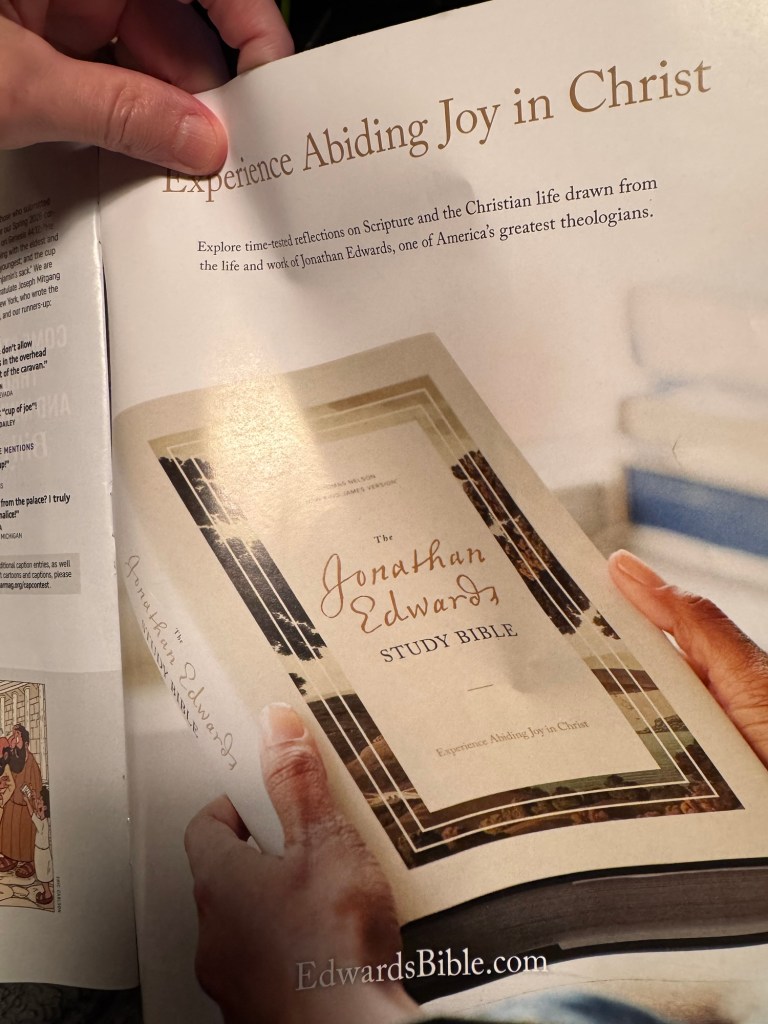
Mara: He sets the scene in Biblical Archaeology Review, a magazine he has received since the 1970s, before landing on the advertisement that prompted the piece. The Jonathan Edwards Study Bible, published August 18, 2026, from Thomas Nelson, general editor Dr. Matthew Everhard, available in hardcover, Leathersoft, and genuine leather.

Pip: So a magazine subscription that predates most of our listeners’ parents is still doing its job as a discovery engine. That’s a long return on a postal address.

Mara: The recommendation is unambiguous. “I would suggest all my readers get a copy, and to use it so we can have much better discussions in the coming years.”

Pip: The stakes behind that suggestion matter. Edwards is positioned not as a historical curiosity but as a founding-era architect — the argument being that the moral conditions that made the United States possible ran through his pulpit in Northampton during the First Great Awakening.

Mara: Everhard’s edition puts Edwards’s own doctrinal work under the New King James text, adds essays on his life and the Awakening, reprints the Resolutions he wrote as a young man, and explains the note system so a reader can build their own practice. That is the practical pitch: it is a reading method, not just a reference volume.

Pip: Three study Bibles already sit in rotation — the carry Bible with filled margins, the Crossway ESV Archaeology Study Bible given to him by a friend who later gave away his own copy, and a MacArthur Study Bible a retired Army colonel set on the desk on June 12, 2023, and walked out.

Mara: The Edwards volume is described as the first new study Bible in some time that he would consider letting the traveler retire to the shelf. That is a meaningful threshold given how much mileage the carry Bible has.

Pip: Then there is the Museum of the Bible visit on his birthday, a Dead Sea Scrolls exhibition pin still in the green bag, and a long passage on the Teacher of Righteousness at Qumran — the point being that the world Jesus and John the Baptist walked into already had a language, a priesthood, and a set of arguments about purity and power.

Mara: What ties it together is the desk. Forty or fifty messages arrived in three weeks from people who used to come through his office. The line repeats: they miss the Bible on the desk. Not the speeches. The book. He writes that what they valued “was not a performance of righteousness. It was a reminder that the world was not all bad.”

Pip: That is a quiet observation with a sharp edge — a habit you thought was private turns out to have been load-bearing for a lot of people who never said so while they were standing in the room.

Mara: The closing recommendation is direct: hardcover if it stays on a table, leather if it travels. Read Edwards’s own line from the edition — “the enjoyment of God is the only happiness with which the soul can be satisfied” — then read the maps, then write in the blanks.


Pip: A Bible in a green bag, a space-economy forecast, and forty messages from people who miss a desk object — it is a wide orbit, but it all pulls toward the same center.

Mara: The question underneath all of it is what a habit signals, and who was quietly depending on it. That tension is not going away.

Rich Hoffman

More about me

Click Here to Protect Yourself with Second Call Defense https://www.secondcalldefense.org/?affiliate=20707

About the Author: Rich Hoffman

Rich Hoffman is an author, political consultant, and strategic advisor based in Cincinnati, Ohio, and the creator of The Politics of Heaven—a unique framework that connects biblical theology, ancient history, and modern power structures to explain how moral alignment and spiritual forces shape global events. Blending real-world political experience with deep research into archaeology, UFO phenomena, and suppressed historical narratives, Hoffman offers compelling commentary on topics ranging from ancient civilizations and the Dead Sea Scrolls to modern populist movements, paranormal continuity, and leadership strategy in chaotic environments. As the author of The Gunfighter’s Guide to Business and the forthcoming Politics of Heaven, he brings a grounded yet provocative voice to media discussions, supported by firsthand experiences and a cross-disciplinary approach that bridges science, history, and theology. For interviews, speaking engagements, or expert analysis, visit richhoffmanbooks.com or contact directly via phone at 513-307-5815 or email at rhoffman@richhoffmanbooks.com.  If you’ve seen the movie, Disclosure Day and want to talk about it and the implications of Presidnet Trump’s UAP disclosures, let me know and we can bring some color to your coverage. https://richhoffmanbooks.com/media-inquiries-broadcast-topics-and-contact-info/?frame-nonce=ad51e7ecba I do have a firsthand UFO encounter to discuss.

The New Jonathan Edwards Bible: I appreciate all the kind words

We’re going to go down a rabbit hole here for a bit, because we need to. The evil we are dealing with is pretty easy to beat. And the Bible is one of the best ways to beat it. I’ve confirmed that with a long journey and a lot of experience but for now, let me give you a great weapon to fight that evil. I was reading Biblical Archaeology Review the way I always read it when a new one comes to my mailbox. I take the day. I sit with the issue and I shut off the world to do what I enjoy most. I have been receiving that magazine since the 1970s, when it first came out, and it is still one of the happiest things I do with a stretch of quiet hours.¹ My wife understands that. Most people never see it. I do not usually talk about it. I think its time that we defend our American laws with a bibilical understanding and framework. And just let the Karl Marx lovers have their faces melt. I’m tired of them personally, and their ridiculous view of human affairs.

Then I saw an advertisement for a new study Bible centered on Jonathan Edwards,I wanted others to know it exists. I like the people who put it together and I want to see it sell successfully. The Jonathan Edwards Study Bible is out now from Thomas Nelson, New King James Version, general editor Dr. Matthew Everhard, who is a fantastic scholar. The publication date was August 18, 2026. It comes in hardcover, flexible Leathersoft, and genuine leather.² I already have more study Bibles than a reasonable person needs. I plan to make this the next one I put my hands on every day. I would suggest all my readers get a copy, and to use it so we can have much better discussions in the coming years. Do not let the God-hating Marxist left define our law-and-order society.

I would argue that Edwards shaped the moral weather that made the United States possible, in the 1730s and 1740s, in the First Great Awakening, from a pulpit in Northampton and from a mind that refused to separate joy in God from serious thought.³ I recommend getting the new Bible and living with it. That is the news. The rest is why the news landed on me the way it did.

The Bible in the Green Bag

The Bible I typically carry has been through airports all over the world. Soft pages. Maps in the back. Notes in every blank the editors left me. I have filled the margins to the end. It does not look ruined. It looks used. I could carry it another ten years, and it would still hold. I keep it in a green utility bag with my laptop, the phone, a charging brick, and whatever snack will survive security. One bag. One pass through the scanner. Then I sit at the gate and do what I have always done while a plane loads: I look at the maps, the timelines, the concordance, and a note I wrote two years ago in another terminal.

I am not opening it because I think God will only forgive me if the other passengers watch. I open it because I like it. I like the history that survived. I like the drawings. I like having a piece of the ancient world in my hands while the PA system talks about zone two.

That Carry Bible is not my only one. I keep going back to the Crossway ESV Archaeology Study Bible. I gave a softcover of that one to my youngest daughter. I kept the copy I use. It is a wealth of a book: the text, then the dirt beneath the text, the photographs, the sidebars, the sense that Abraham, Hezekiah, and Paul walked on actual ground.⁴ I first saw it advertised in Biblical Archaeology Review years ago and kept it on the back burner until I bought it. A decade later, I still reach for it more than almost anything else on the shelf, because archaeology is the companion that keeps the stories from floating.

Then there is the MacArthur Study Bible a friend put in my hands on June 12, 2023. He wrote in the front. I did not ask for it. He was a retired Army colonel, later president of aerospace companies, and he valued the conversations we had about biblical context. He walked into the office, set down one of his favorites, and left. I keep it where I can see it from the chair.⁵

Those three sit in a kind of rotation: the traveler, the archaeologist, the gift. The Edwards volume is the first new study Bible in a while that I would consider letting the traveler retire to the shelf.

Museum of the Bible and a Pin from Qumran Country

My favorite day of 2026 so far was my birthday. I took a break from work. My wife and I went to the Museum of the Bible in Washington. We are members. Besides the main reading room at the Library of Congress, that museum is my favorite place on earth, and inside it, my favorite gallery is the History of the Bible exhibit. You walk into architecture that evokes a cathedral. You watch the book move through languages, empires, paper, print, and culture. I am not talking about a private feeling there. I am talking about the measurable power a set of texts has had on human civilization.⁶

I carry a small pin from a Dead Sea Scrolls exhibition in the same bag. I do not want to forget that trip. The Teacher of Righteousness in the Qumran literature is, for me, one of the most compelling figures in Second Temple history. I do not flatten Jesus into that figure. I do not need to. A man is born into a world that already has a language, a priesthood, a Roman shadow, and a set of arguments about purity and power. John the Baptist and Jesus both make more sense when you have sat with the Community Rule, the Habakkuk Pesher, and the people who left Jerusalem’s gravity for the desert.⁷ The Essenes were suspicious of wealth and of a priesthood they thought had made itself comfortable with the wrong masters. That is not a modern talking point. That is the air of the first century.

I find the psychology of that period inexhaustible. Conference calls still get my attention. I listen. Some of them take an hour to arrive at the sentence that could have been said in four minutes. In those stretches I used to slide the desk Bible over and keep my mind working: instead of getting bored: a map, a timeline, a note. Not as theater. As ballast.

What People Thought They Were Looking At

I dress for work—shirt, jacket, often a tie. I have a White House tie. I have one Ross Perot gave me years ago. I have silk ties from the Trump Organization, the kind with the mark on the back, soft, well-made. Ties are not a costume. They are respect for the room I am walking into and the work we do there. 

TSA has watched that combination for years: the jacket, the green bag, the Bible coming out of it. More than once the assumption has been that I must be a preacher or some other official holy man. I am not. I am an executive who likes Scripture, archaeology, and not wasting the twenty minutes before a plane pushes back. People sitting in the next seat have asked, in so many words, why a person would look at a Bible in an airport unless he were trying to get something forgiven. I find that question more revealing than they intend. You can live a decent life and still want the book. You can refuse tattoos, refuse to deface the body, refuse the little wink that says “I am as wrecked as you are,” and still not be a priest. You can be a man who thinks the human temple is not a billboard.⁸

I have been stunned, this summer of 2026, at how much hostility that posture draws once you leave a familiar building. Inside two-decade-old relationships, people who suddenly miss me are letting me know just how much, they miss the Bible on my desk realizing it was more than just furniture. People who ran large companies told me later it was the first thing they trusted when they walked in my office.  Not the speeches I gave them. The book. A flag that said the room was safe for a person who still went to church on Sunday and did not need to advertise a tattoo on the inside of their arm or hidden on an ankle.  

I have had something like forty or fifty messages in the last three weeks from people who used to come through that door. The line repeats. They miss the Bible on the desk. Some of them have more money than they will ever be able to spend and can afford to say what they think in their older years. What they valued was not a performance of righteousness. It was a reminder that the world was not all bad. That has been the shock of changing circumstances. You do not know who was quietly depending on a habit you thought was private until the habit is no longer in the same room.

A New Market, an Old Warning About Wealth

I have been talking with new people in Butler County and in the space-adjacent market I have watched for years. I first heard the pitch the way you hear a hundred pitches on LinkedIn. Everybody has a new idea. My own working estimate, from the work I have actually done, is that the space economy is heading toward something on the order of three trillion dollars by around 2033.⁹ That is not hype. That is a forecast based on experience. If it is even close, the people who build the right things will be rewarded on a scale that sounds like island-buying money to anyone still thinking in last decade’s units.

I am not embarrassed by the pursuit of wealth. I am careful about it. Jesus was not sentimental about rich men. The people behind the Dead Sea Scrolls were not sentimental about rich men. A needle is still a needle.¹⁰ If I had no dime and a box of chicken nuggets from Kroger and a new issue of Biblical Archaeology Review, I would still be myself. The magazine and the book are the happy part. The wealth is the instrument. Nicodemus had standing in the priesthood and still came to Jesus at night. He did not have to choose between influence and curiosity. I would rather earn the hours from five to ten in the evening, the hours when a man who has already taken care of his people can sit in a chair and read, than pretend poverty is automatically holy.¹¹

The colonel who gave me the MacArthur Bible had seen the military change and then seen large companies change until he barely recognized them. He told those stories in an office that still had a Bible on the desk. When he retired, I lost interest in the polite version of going along. That is a disclosure, not a press release. The people who stepped into some of those roles were closer to the airport glance than to the man who wrote in the front of a study Bible. Why are you wearing a tie? Why don’t you have the tattoo? Why don’t you throw a curse word into the meeting so we know you are not a robot? I have known that weather existed. I had commented on it from a protected side of the glass. This year I have been on the other side of the glass.

The Teacher of Righteousness did not win a popularity contest in Jerusalem. The community at Qumran put miles between itself and a priesthood it thought had made peace with the wrong power. I do not think the answer for a modern working life is to move to a desert. I do think the answer is to stop being surprised that people who are only sails, and never a keel, hate a keel when they see one. They go with the wind. A person who gets up in the morning intending to be good is steering. Those two habits do not like each other.

Why Edwards, and Why Now

Jonathan Edwards filled notebooks. The Miscellanies, the Notes on Scripture, the Resolutions he wrote as a young man and kept. The new study Bible is built out of that habit. Everhard’s edition puts Edwards’s own doctrinal work under the NKJV text, adds essays on his life and the Awakening, reprints the Resolutions, and explains the note system so a reader can start one of his own.¹² That is not merchandising. That is an old American technology: write what you see in the text until the text starts writing back to you.

I have been doing a smaller version of that in the carry Bible for years. Lines in the places the publisher left blank. Thoughts in the maps. Reactions I did not want to lose between Dayton and some other runway. Edwards did it at a different scale in the 1740s and 1750s. The country that came after him, the republic that knew his sermons even when it argued with them, did not appear out of a vacuum. If you want a founding-era mind that treated Scripture as something a serious adult could spend a life on, he is near the head of the line.

I am loyal to the Bible that has already been around the world with me. I am not going to mistreat it. I am thinking about letting it live on the shelf and putting a leather Edwards next to the chair and in the bag. A new study Bible is not a better God. It is another set of trained eyes, another century of notes, another chance to keep the mind awake while the rest of the cabin looks at a phone.

If you need a first Bible, or another Bible, this is the one I would put in front of you this month. Hardcover if it will stay on a table. Leathersoft or leather if it is going to travel. Read Edwards’s own sentence on the cover logic of the edition: the enjoyment of God is the only happiness with which the soul can be satisfied.¹³ Then read the maps. Then write in the blanks.

What I Am Building Next

I have said for a while that the age of disclosure and the politics of heaven are not separate subjects. They are the same story told from two altitudes. That work is coming.¹⁴ Until it does, the ordinary practice remains the same. Subscribe to a better day. Sit with a magazine that still believes the dirt in Israel and Jordan and the West Bank can teach you to read. Carry a book that has already outlived empires. Dress as if the work matters. Do not wait for a stranger in an airport to bless the habit.

If you have been one of the people writing to say you missed the Bible on my desk, I appreciate all the kind words and have been impressed how many people were using that object as something stable in their life. Edwards can sit where the last one sat. The green bag still does its work and carries in it what’s truly valuable. 

Notes

1.  Biblical Archaeology Review began publication in 1975 under Hershel Shanks and the Biblical Archaeology Society. I have read it across five decades. The Fall 2026 issue includes work on Negev tombs, Kidron Valley monuments, Tell Qasile, and spacing in the Dead Sea Scrolls.

2.  The Jonathan Edwards Study Bible: Experience Abiding Joy in Christ (NKJV), Thomas Nelson, general editor Matthew Everhard. Hardcover ISBN 9781400339532; also issued in brown Leathersoft and black genuine leather. Comfort Print, red letter, maps, concordance, essays, Resolutions, and an introduction to Edwards’s Miscellanies method.

3.  Jonathan Edwards (1703–1758), pastor at Northampton, later missionary at Stockbridge and president of the College of New Jersey—the First Great Awakening’s most demanding American theologian. “Sinners in the Hands of an Angry God” (1741) is the famous shard. The Religious Affections and the Miscellanies are the longer works.

4.  ESV Archaeology Study Bible, Crossway, editorial oversight by John Currid and David Chapman, first issued 2018, later TruTone editions. Field notes, photographs, maps, timelines. I have also used Zondervan’s older NIV Archaeological Study Bible; they are different books.

5.  The MacArthur Study Bible, long associated with John MacArthur and issued in NASB, NKJV, ESV, and other texts across many printings. The copy on my shelf is the one dated in the front, June 12, 2023.

6.  Museum of the Bible, Washington, D.C. The History of the Bible floor remains, for me, the heart of the building. Membership is how we treat a place we intend to keep returning to.

7.  Teacher of Righteousness: the sectarian leader in the Damascus Document, the Habakkuk Pesher (1QpHab), and related Qumran texts. I read him as a Second Temple reformer whose conflict with a “Wicked Priest” and with Jerusalem’s establishment belongs in any serious account of the world Jesus and John walked into. That is history and typology, not a claim that the Gospel is only Qumran.

8.  I mean the body as temple in the Pauline sense, 1 Corinthians 6:19–20, not a fashion rule I am prepared to police on strangers. It is a rule I keep.

9.  Public forecasts of the commercial space economy vary. Morgan Stanley and others have used a trillion-dollar frame toward 2040. My three-trillion-by-2033 figure is an experience-based working number, not a consensus estimate. Treat it as a claim to test.

10.  Matthew 19:24 and parallels. The camel and the needle. The point is not that wealth is impossible. The point is that it is spiritually expensive.

11.  John 3; John 7:50–51; John 19:39–40. Nicodemus again, because he is the patron saint of people in positions who still want the conversation.

12.  Edwards’s “Resolutions” (1722–1723) and the Miscellanies notebooks are in the Yale Edition of the Works of Jonathan Edwards. Everhard’s study Bible is a reading edition of that archive under Scripture, not a replacement for the Yale volumes.

13.  The cover quotation is Edwards on the enjoyment of God as the soul’s only satisfying happiness. Related language runs through the Miscellanies and The End for Which God Created the World.

14.  The Politics of Heaven is the book I have been building toward; “the age of disclosure” is the public weather that book has to walk into. Forthcoming. The desk Bible is older than both.

Bibliography for Further Reading

Study Bibles and Editions

The Jonathan Edwards Study Bible: Experience Abiding Joy in Christ (NKJV). Edited by Matthew Everhard. Thomas Nelson, 2026.

ESV Archaeology Study Bible. Edited by John D. Currid and David Chapman. Crossway, 2018.

ESV Study Bible. Crossway, 2008.

The MacArthur Study Bible. Various texts and publishers; Thomas Nelson and others.

NIV Archaeological Study Bible. Zondervan, 2005.

Holy Bible, New King James Version. Thomas Nelson.

Holy Bible, English Standard Version. Crossway.

Biblia Hebraica Stuttgartensia and Nestle-Aland Novum Testamentum Graece. For readers who want the next shelf over.

Jonathan Edwards

Edwards, Jonathan. The Works of Jonathan Edwards. 26 vols. Yale University Press, 1957–2008. Especially vol. 2, Religious Affections; vol. 8, Ethical Writings; vol. 13 and following, the Miscellanies; vol. 15, Notes on Scripture.

Edwards, Jonathan. A Jonathan Edwards Reader. Edited by John E. Smith, Harry S. Stout, and Kenneth P. Minkema. Yale University Press, 1995.

Edwards, Jonathan. “Resolutions.” 1722–1723.

Edwards, Jonathan. “Sinners in the Hands of an Angry God.” 1741.

Marsden, George M. Jonathan Edwards: A Life. Yale University Press, 2003.

McClymond, Michael J., and Gerald R. McDermott. The Theology of Jonathan Edwards. Oxford University Press, 2012.

Noll, Mark A. The Rise of Evangelicalism. InterVarsity, 2003.

Stout, Harry S. The New England Soul. Oxford University Press, 1986.

Tracy, Patricia J. Jonathan Edwards, Pastor. Hill and Wang, 1980.

Qumran, Second Temple Judaism, and the Teacher of Righteousness

The Dead Sea Scrolls Study Edition. Edited by Florentino García Martínez and Eibert J. C. Tigchelaar. Brill / Eerdmans.

Vermes, Geza. The Complete Dead Sea Scrolls in English. Penguin, revised editions.

Collins, John J. The Scepter and the Star. 2nd ed. Eerdmans, 2010.

Collins, John J. Beyond the Qumran Community. Eerdmans, 2010.

Cross, Frank Moore. The Ancient Library of Qumran. 3rd ed. Sheffield, 1995.

Fitzmyer, Joseph A. The Dead Sea Scrolls and Christian Origins. Eerdmans, 2000.

Magness, Jodi. The Archaeology of Qumran and the Dead Sea Scrolls. 2nd ed. Eerdmans, 2021.

Schiffman, Lawrence H. Reclaiming the Dead Sea Scrolls. Doubleday, 1994.

VanderKam, James C. The Dead Sea Scrolls Today. 2nd ed. Eerdmans, 2010.

Wise, Michael, Martin Abegg Jr., and Edward Cook. The Dead Sea Scrolls: A New Translation. Harper.

Biblical Archaeology and the Land

Biblical Archaeology Review. Biblical Archaeology Society, 1975–present.

Cline, Eric H. Biblical Archaeology: A Very Short Introduction. Oxford University Press, 2009.

Currid, John D. Doing Archaeology in the Land of the Bible. Baker, 1999.

Dever, William G. What Did the Biblical Writers Know and When Did They Know It? Eerdmans, 2001.

Hoffmeier, James K. The Archaeology of the Bible. Lion Hudson, 2008.

Kitchen, K. A. On the Reliability of the Old Testament. Eerdmans, 2003.

Mazar, Amihai. Archaeology of the Land of the Bible, 10,000–586 B.C.E. Doubleday, 1990.

Shanks, Hershel. Freeing the Dead Sea Scrolls. Continuum, 2010.

Stern, Ephraim. Archaeology of the Land of the Bible, Vol. 2. Doubleday, 2001.

Museum of the Bible. Permanent exhibition catalogs and the History of the Bible gallery materials. Washington, D.C.

Scripture, Wealth, and the Conscience of a Working Life

Augustine. Confessions and City of God.

Bonhoeffer, Dietrich. The Cost of Discipleship.

Calvin, John. Institutes of the Christian Religion.

Lewis, C. S. Mere Christianity and The Abolition of Man.

Niebuhr, Reinhold. Moral Man and Immoral Society. Scribner, 1932.

Pascal, Blaise. Pensées.

Wesley, John. “The Use of Money.”

The Gospel of John, chapters 3, 7, and 19.

Matthew 19:16–30.

1 Corinthians 6:19–20.

American Religion and the Public Order

Ahlstrom, Sydney E. A Religious History of the American People. Yale University Press, 1972.

Bailyn, Bernard. The Ideological Origins of the American Revolution. Harvard University Press, 1967.

Kidd, Thomas S. The Great Awakening. Yale University Press, 2007.

Noll, Mark A. America’s God. Oxford University Press, 2002.

Sweeney, Douglas A. The American Evangelical Story. Baker, 2005.

Space, Industry, and the Instrument of Wealth

Bezos, Jeff, and the public Blue Origin/industrial-space record read as primary sources, not devotionals.

Hoffmeier is archaeology; for space, keep the shelf honest:

Logsdail, various commercial space market outlooks; Morgan Stanley Research, “Space: Investing in the Final Frontier,” and subsequent updates.

National Academies and NASA commercial market assessments, 2020–2026.

Hoffman, Rich. The Gunfighter’s Guide to Business. Liberty Hill Publishing, 2021.

Hoffman, Rich. The Politics of Heaven. Forthcoming.

On Dress, Attention, and the Desk as a Signal

Carnegie, Dale. How to Win Friends and Influence People. Only after you already know why you would wear the tie without him.

Postman, Neil. Amusing Ourselves to Death. Viking, 1985.

Sennett, Richard. The Fall of Public Man. Knopf, 1977.

Weil, Simone. Gravity and Grace. Attention as the real liturgy of a working day.

Rich Hoffman

More about me

Click Here to Protect Yourself with Second Call Defense https://www.secondcalldefense.org/?affiliate=20707

About the Author: Rich Hoffman

Rich Hoffman is an author, political consultant, and strategic advisor based in Cincinnati, Ohio, and the creator of The Politics of Heaven—a unique framework that connects biblical theology, ancient history, and modern power structures to explain how moral alignment and spiritual forces shape global events. Blending real-world political experience with deep research into archaeology, UFO phenomena, and suppressed historical narratives, Hoffman offers compelling commentary on topics ranging from ancient civilizations and the Dead Sea Scrolls to modern populist movements, paranormal continuity, and leadership strategy in chaotic environments. As the author of The Gunfighter’s Guide to Business and the forthcoming Politics of Heaven, he brings a grounded yet provocative voice to media discussions, supported by firsthand experiences and a cross-disciplinary approach that bridges science, history, and theology. For interviews, speaking engagements, or expert analysis, visit richhoffmanbooks.com or contact directly via phone at 513-307-5815 or email at rhoffman@richhoffmanbooks.com.  If you’ve seen the movie, Disclosure Day and want to talk about it and the implications of Presidnet Trump’s UAP disclosures, let me know and we can bring some color to your coverage. https://richhoffmanbooks.com/media-inquiries-broadcast-topics-and-contact-info/?frame-nonce=ad51e7ecba I do have a firsthand UFO encounter to discuss.

George Lang’s Bible in the Backseat, Jonathan Edwards, Darbi Boddy: Lessons to build a better, and stronger, GOP in Butler County

I am not a separation of church and state guy the way the left has used it to push a secular agenda. But to understnad that, you have to understand history, and many people just don’t. And those same people don’t know much about one of the people I consider to be one of the early American Founding Fathers, Jonathan Edwards. I say, use what works and is healthy for a great society, and don’t argue with the poliitcal left the interpritation of law and order when they want to destroy America by using its own laws and policy against its creation. Since that is their method, I would advise that we drop the polite veil and admit what we are all thinking: churches go well with Republican politics, and we should be a whole lot more open about it, and just let the Marxists of the Democratic Party have their faces melt. Art Sauerwein is the new chairman of the Butler County Republican Party. The Journal-News piece I have been talking about put his wish list in public: take back the schools and make them more conservative; see more Christian values in the community; and, most of all, Republicans already in office need to learn to cut spending and cut taxes. I agree with most of that list. I would put the disagreement, if there is one, in a sliver. Five percent, maybe. The problem is not the nouns. The problem is that a county chairman saying he is displeased with his own officeholders signals to every Democrat and every reporter in the room that the party is not united.¹

I have a particular soft spot for people who take thankless chairs. I also have a long memory of what happens when the Bush years go slack, when Clinton years teach the other side to use government as a wealth-transfer machine, and when a Republican majority forgets that it was elected to stop that machine, not to learn its levers. Small-government capitalism is not the same project as confiscating through the tax code and redistributing under a better letterhead. I have been on that argument since before the Tea Party years. I have not left it.

What I will not do is pretend that the way you get Christian schools and lower taxes is to twist the arms of the people you still need on the card. That is the Democrat tactic with different hymns. Ostracize, purity-test, call the holdout a RINO, and then act surprised when the tent is an empty Sunday-school classroom with folding chairs and no majority.

Why I Walked George Lang to His Car

People tell me I cannot be trusted because I am friends with George Lang. I was invited to an evening with him and his wife, Debbie. We get along. I like them. I like George. Not because he is a state senator from the 4th District. Because we can stay on a subject until the parking lot lights are the only ones left.²

We started years ago with a mutual fascination with Ayn Rand and the long story of human order. She was an atheist. I was not. We did not make religion the ticket into the room. We made taxes, small business, the Ohio caucus work, jobs that let a family buy nice things without the government picking the neighbor’s pocket. Those are the planks you can stand on with a man who is not yet where you are on Sunday morning. Then you walk him to the car.

This year, 2026, not a decade ago, we were still talking when we got to his car, extending the evening as much as possible because the conversation was good. He knows what I carry. He knows the maps and the notes. He pulled out a Bible that had been given to him in the Senate. It was beautiful. I would have liked it for the shelf. It was his. He had been going through it. Debbie has said, in the way honest people say it, that they have not always lived in that lane. I did not need a performance. I needed the book’s facts in the car of a man who helps write Ohio law. That is how influence works. That is Nicodemus in a parking lot instead of a midnight stair.³

If the chairperson’s job is to get people on the card, then the chairman’s job is to make nights like that more common, not to publish a scolding that makes the next senator keep the Bible in the trunk.

Jonathan Edwards Did Not Found America From a Letter to the Editor

The Jonathan Edwards Study Bible came out in August 2026 from Thomas Nelson, NKJV, notes drawn from Edwards’s own work, edited by Matthew Everhard. I saw it advertised in Biblical Archaeology Review, which is still the magazine I would take to a desert island and be happy with nothing else.   I will likely make that Edwards volume my next daily Bible. The one I have carried through airports is full of notes. Every blank space they left me has writing in it.⁴

Edwards did his public work in the 1730s through the 1750s, while a young George Washington was still making himself and Franklin was already allergic to other people’s piety and still able to hear the weather. The Awakening put biblical speech in the streets. The colonies that broke from England were not a faculty workshop. They were a people who had been arguing, singing, and frightening themselves with sermons about a God who was not a mascot. I do not claim Edwards “founded” the United States. I claim the country is harder to imagine without that pressure in the air.

He was also the grandfather of Aaron Burr, who later killed Alexander Hamilton. I am not a Hamilton man. I mention the grandson so nobody thinks I am selling a stained-glass window. Edwards’s own church in Northampton eventually threw him out because he would not lower the table to the town’s comfort. He finished in a smaller charge at Stockbridge, among the Mahican, and then the College of New Jersey—Princeton—made him president. He lasted about a month. He took the smallpox inoculation during an outbreak, fever followed, and he died on March 22, 1758. His last counsel was to trust God and not be afraid. The same college that begged him to come later drifted into the progressive machine that now congratulates itself for unmaking the civilization he helped catechize.⁵

That arc is the warning. You can put a Christian on a letterhead and still lose the building. You can also lose the building by refusing to put your arm around anyone who is not already converted.

Darbi Boddy and the Noble Death That Vacates the Seat

I have always had a soft spot for Darbi Boddy on the Lakota school board. She came out of a Puritan temperament: right is right, wrong is wrong, say it, take the heat. I admired the spine. The political class asked whether she knew she had to go to other people and shake hands. She drew a line so hard that the people who should have been part of her coalition treated her as a problem to be managed. She was removed. Not enough Republicans came to her defense in the way that kept the seat. I was very angry about that. I still am.⁶

There is a Christian imagination that treats the pike as the only honorable furniture—burned, sawn, beheaded, and therefore faithful. The martyrs were real. Rome tried to kill the church, and the church outlived the attempt. I am asking a different question for a school board and a county party. Are we here to die beautifully and hand the district back to the purple-haired people eaters or are we here to keep the chair and put more than one adult in the room?

A public school system designed as an agent of social reconstruction will not become conservative because a chairman tells the Journal-News he would like that very much. You need people on the board who can last. You need people around them who do not run at the first ugly headline. You need a farm team that was not raised only in a sanctuary, because most of the county was not. Maybe forty percent can make the born-again jump on a timetable that satisfies a Sunday-school teacher. The rest will come, if they come, the way George came toward a Bible in a backseat: over years, over taxes, over ancient history, over the proof that you will still walk them to the car when they are not yet where you are.

The Church That Taught Me Business Had Classrooms and a Mortgage

I saw my grandson today, and I told him about my years between eleven and sixteen, High Adventure, the Scout post that met at a big church on RT42 in West Chester. We made pizzas in the church kitchen, and people came to pick them up. That was a fundraiser, a civics lesson, and a first business plan. My family church in Fairfield was the other building. My wife and I were married there. Catechism, Sunday school, the pastor’s house on the property, the side rooms where a kid learned how adults talk when they think they are only running a troop meeting. Then the money ran out. They sold it. It broke my family’s heart. It is not on the market presently. I have been thinking about buying it back for a couple of million. dollars In any other use, that ground in Fairfield is a different number. Because it is a church, the market treats it like a problem.⁷

I am not announcing a closing. I am saying the thought is serious, and Jonathan Edwards is the reason the thought got louder. Churches decline when they have no profit model and a pastor who thinks Jesus only ever taught under a tree. Jesus could walk from village to village. A sanctuary in a hot real-estate corridor has a mortgage. Nicodemus money, the quiet help that keeps a ministry on its feet, is not a compromise with Egypt. It is how a thing survives long enough to teach the next boy how to sell a pizza and keep the books.

The West Chester Tea Party lost a church venue while I was in Japan not that long ago. A guest, a fight, and the door closed. For years the movement lived on donated fellowship halls and cookies after the meeting. Streamers, Republicans, whoever would come. That was a big tent that still knew the room had been a sanctuary an hour earlier. I want a building in this county that Tea Party groups and Republican meetings can use without a landlord who gets nervous. Not a state church. A civic table with a steeple still on it.

Princeton Forgot. The Party Should Not Copy the Forgetting.

Edwards as president of Princeton is the picture I cannot shake. The college wanted the man who could make seniors write on divinity and then talk about it. A short generation later, the heirs of that project began the long surrender. Liberty University and the older schools are not the same charter, but the temptation is the same: keep the Christian name, lose the Christian nerve, export Democrats with verse numbers. Complaining about that in a newspaper will not reverse it. Buying a pulpit, filling a room, putting your arm around a senator who keeps a Bible in the backseat, teaching a Scout to make change for a pizza—that is the slower work.

Peer pressure is not evangelism. “Agree, or we will put you outside” is what the other party already does. If we do it with better footnotes, we still lose the county. Jesus did not recruit from the Sanhedrin’s banquet list. He took the people who had fallen out of the wagon. Edwards could fill a town and still get voted out. Both facts matter. The first tells you preaching works. The second tells you preaching without a coalition becomes a memorial service.

What I Want the Chairman to Do Instead of Being Displeased

Help officeholders get elected. Help them get money. Help them get on the slate card. If you want Christian values in the community, put a beautiful Bible in more backseats by being the kind of man a senator will linger with in a parking lot. If you want the schools, do not design another martyr and then wonder why the seat is empty after they are killed or lose their seat in the next election. If you want taxes cut, stay on the subject with people who will go to the small-business caucus before they will go to your Wednesday Bible study volunteer class.

I will keep reading BAR. I will keep the Edwards volume in the rotation. I will keep walking George to the car. I will keep thinking about the Fairfield church, not because nostalgia is a strategy, but because the kids I see now do not have the side room I had, and a party that cannot raise its own young in a hall it does not have to rent is a party that will keep leasing its future from people who do not like its hymn.

Lead. Do not write the other side’s headline for them.

Notes

1.  Art Sauerwein, Butler County GOP executive chairman, quoted in late-August 2026 Journal-News coverage on local Republicans, schools, Christian values, spending, and taxes. A public rebuke of sitting Republican officeholders is usable copy for the other party. That is not mind-reading. That is how newspapers work.

2.  George F. Lang, Republican, Ohio Senate 4th District since 2021; previously Ohio House 52nd; West Chester. Married to Debbie Lang. I am describing a private evening in 2026 and a longer friendship. I am not claiming he has asked me to speak for him.

3.  John 3; 7:50–51; 19:39–42. Nicodemus keeps his station and still moves toward the teacher. Influence that can only speak in the sanctuary will not reach the people who write statutes.

4.  The Jonathan Edwards Study Bible (NKJV), Thomas Nelson, August 18, 2026, general editor Matthew Everhard. Biblical Archaeology Review, Biblical Archaeology Society, 1975–present.

5.  Edwards was inaugurated at the College of New Jersey on February 16, 1758; died March 22, 1758, after smallpox inoculation. Buried in the Presidents’ Lot, Princeton Cemetery. Esther Edwards married Aaron Burr Sr.; their son was Aaron Burr Jr. Northampton dismissed Edwards in 1750 over communion discipline; Stockbridge followed.

6.  Darbi Boddy won a Lakota Local Schools board seat in 2021 on a conservative platform and was removed by the board in March 2024 after a long, ugly fight and a 90-day absence tied to a protection-order conflict with another member. I am not retrying that case here. I am talking about coalition and what happens when courage has no bench.

7.  The Fairfield church of my childhood and marriage is named as a family fact and a present thought, not as a listed property and not as a pledge. High Adventure and the West Chester church on the Cincinnati-Dayton Road corridor are the Scout years as I lived them.

Bibliography for Further Reading

Local Politics and the People Named

Journal-News (Hamilton). Late-August 2026 coverage of Butler County Republicans and Chairman Art Sauerwein.

Lang, George F. Ohio Senate, District 4. Public record, 2021–present; Ohio House, 2017–2020.

Ballotpedia and the Ohio Legislature biographical pages for George Lang.

Journal-News. “2 conservative newcomers, incumbent win Lakota seats.” November 2021.

WVXU. “Darbi Boddy is removed from Lakota’s school board.” March 20, 2024.

WLWT. Lakota board appointment coverage following the vacant seat, April 2024.

FOX19. “Criminal charge dismissed against former Lakota school board member.” August 1, 2024.

Jonathan Edwards and the Awakening

The Jonathan Edwards Study Bible: Experience Abiding Joy in Christ (NKJV). Edited by Matthew Everhard. Thomas Nelson, 2026.

Edwards, Jonathan. The Works of Jonathan Edwards. 26 vols. Yale University Press.

Edwards, Jonathan. Religious Affections; Freedom of the Will; “Sinners in the Hands of an Angry God.”

Marsden, George M. Jonathan Edwards: A Life. Yale University Press, 2003.

Marsden, George M. A Short Life of Jonathan Edwards. Eerdmans, 2008.

McClymond, Michael J., and Gerald R. McDermott. The Theology of Jonathan Edwards. Oxford, 2012.

Noll, Mark A. The Rise of Evangelicalism. InterVarsity, 2003.

Kidd, Thomas S. The Great Awakening. Yale University Press, 2007.

Princeton University. Presidential biographies: Jonathan Edwards, 1758.

This Day in Presbyterian History. “February 23: Jonathan Edwards.” On the inoculation and death.

Princeton and the Long Drift

The Princetonians and official presidential histories of the College of New Jersey.

Noll, Mark A. Princeton and the Republic, 1768–1822. Princeton University Press, 1989.

Marsden, George M. The Soul of the American University. Oxford, 1994.

Burtchaell, James Tunstead. The Dying of the Light. Eerdmans, 1998.

Church, Money, and the Nicodemus Problem

The Gospel of John, chapters 3, 7, 19.

Luke 8:1–3. The women who funded the ministry.

Acts 4:32–37; 16:14–15. Property and hospitality in the first churches.

Wesley, John. “The Use of Money.”

Newbigin, Lesslie. The Gospel in a Pluralist Society. Eerdmans, 1989.

Bonhoeffer, Dietrich. Life Together.

Schaeffer, Francis A. The Church at the End of the 20th Century.

Schools, Boards, and the Limits of Martyrdom

Sowell, Thomas. Inside American Education. Free Press, 1993.

Hirsch, E. D., Jr. The Schools We Need. Doubleday, 1996.

Murray, Charles. Real Education. Crown Forum, 2008.

Gatto, John Taylor. Dumbing Us Down. New Society, 1992.

Ohio Department of Education standards files for the official language boards to actually vote on.

Parties, Tents, and Coalition

Burke, Edmund. Reflections on the Revolution in France. 1790.

Rauch, Jonathan. Political Realism. Brookings, 2015.

Riker, William H. The Theory of Political Coalitions. Yale, 1962.

Skocpol, Theda, and Vanessa Williamson. The Tea Party and the Remaking of Republican Conservatism. Oxford, 2012.

Hoffman, Rich. The Gunfighter’s Guide to Business. Liberty Hill, 2021.

Hoffman, Rich. The Politics of Heaven. Forthcoming.

Scripture, Friendship, and Slow Conversion

Lewis, C. S. Mere Christianity and The Four Loves.

Newby, Elizabeth. On ordinary friendship as the delivery system of belief, read against Lewis.

Augustine. Confessions. The long way toward a book that was already in the house.

Biblical Archaeology Review. For the magazine that sits on the table while the political argument goes on.

Boy Scouts of America. Handbook and the old troop-and-post structure. The side room was a civics school whether the adults knew it or not. 

Rich Hoffman

More about me

Click Here to Protect Yourself with Second Call Defense https://www.secondcalldefense.org/?affiliate=20707

About the Author: Rich Hoffman

Rich Hoffman is an author, political consultant, and strategic advisor based in Cincinnati, Ohio, and the creator of The Politics of Heaven—a unique framework that connects biblical theology, ancient history, and modern power structures to explain how moral alignment and spiritual forces shape global events. Blending real-world political experience with deep research into archaeology, UFO phenomena, and suppressed historical narratives, Hoffman offers compelling commentary on topics ranging from ancient civilizations and the Dead Sea Scrolls to modern populist movements, paranormal continuity, and leadership strategy in chaotic environments. As the author of The Gunfighter’s Guide to Business and the forthcoming Politics of Heaven, he brings a grounded yet provocative voice to media discussions, supported by firsthand experiences and a cross-disciplinary approach that bridges science, history, and theology. For interviews, speaking engagements, or expert analysis, visit richhoffmanbooks.com or contact directly via phone at 513-307-5815 or email at rhoffman@richhoffmanbooks.com.  If you’ve seen the movie, Disclosure Day and want to talk about it and the implications of Presidnet Trump’s UAP disclosures, let me know and we can bring some color to your coverage. https://richhoffmanbooks.com/media-inquiries-broadcast-topics-and-contact-info/?frame-nonce=ad51e7ecba I do have a firsthand UFO encounter to discuss.

Podcast Episode: Don’t Sour the Wine: Why Public Lectures from a County GOP Chair Push Officeholders Away

Pip: The Overmanwarrior has thoughts on party unity, and they are not delivered quietly.

Mara: Rich Hoffman’s recent writing zeroes in on one question: when does a county GOP chair’s public posture stop building the team and start doing the opposition’s work for them? Let’s start with the wine metaphor — and why it matters eight weeks before a midterm.

Don’t Sour the Wine: Lectures, Loyalty, and the Midterm Math

Mara: The post opens with a genuine acknowledgment that chairing a county party is hard, thankless work — and then pivots to a specific warning about what happens when the chairman’s message lands in print.

Pip: The Journal-News ran the new Butler County GOP chair’s priorities, and the quote that crystallized everything is this one: “The Republicans that are in office need to learn to cut spending and cut taxes, and I have not been seeing that happen, and it displeases me.”

Mara: That sentence is the spine of the argument. Once it’s in the paper, it belongs to every Democrat, every fence-sitter, and every volunteer quietly deciding whether this job is worth the abuse.

Pip: And the timing is the real problem. Democrats don’t have to beat Republicans if Republicans brand their own officeholders as failures eight weeks before Election Day. Kathy Wyenandt — cited here as the visible face of the Butler County Democratic Party — doesn’t need a majority tomorrow. She needs Republicans to do her turnout work for her.

Mara: The post draws a sharp distinction between the substance and the delivery. Cutting spending, reducing waste, watching the schools — those aren’t radical asks in a Republican county. The argument is tone, timing, venue, and target.

Pip: There’s a fast-food manager analogy in here that earns its keep. Barking works on teenagers folding boxes. It does not work on people you’re asking to put their name on a ballot, absorb the hate mail, and run again in two years.

Mara: The post also invokes David Kern — a Liberty Township trustee for 32 years who briefly chaired this same county party and, by the post’s account, discovered the hard way that herding quarreling Republicans is a different sport than fighting Democrats. That history, the argument goes, is sitting right there for anyone who wants to read it instead of repeating it.

Pip: And then there’s the Nicodemus point, which is doing real work. Nicodemus loved the message and still had to remain a functioning member of the priesthood. Serious politics is not a purity cult.

Mara: The post is direct about the arithmetic: the absolutist slice of the party is estimated well under 40 percent of Butler County Republicans, with the rest on the fence or transactional. Lecture the 60 percent as if they’re the problem, and you meet them later on the other side of the aisle — or at home on the couch.

Pip: The advice at the end is genuinely constructive. Bring the concerns to a closed session. Make the case. Help officeholders find the money and the coalition. Then go to the paper together.

Mara: The closing line lands the whole thing plainly: “Lecturing your own officeholders in the newspaper is how you do the Democrats’ work for them.”


Pip: Build the tent, inspect the team in private, cheer them in public. That’s the whole craft in one sentence.

Mara: The question of who gets to call themselves a team player — and who decides — isn’t going away before November. More on that next time.

Rich Hoffman

More about me

Click Here to Protect Yourself with Second Call Defense https://www.secondcalldefense.org/?affiliate=20707

About the Author: Rich Hoffman

Rich Hoffman is an author, political consultant, and strategic advisor based in Cincinnati, Ohio, and the creator of The Politics of Heaven—a unique framework that connects biblical theology, ancient history, and modern power structures to explain how moral alignment and spiritual forces shape global events. Blending real-world political experience with deep research into archaeology, UFO phenomena, and suppressed historical narratives, Hoffman offers compelling commentary on topics ranging from ancient civilizations and the Dead Sea Scrolls to modern populist movements, paranormal continuity, and leadership strategy in chaotic environments. As the author of The Gunfighter’s Guide to Business and the forthcoming Politics of Heaven, he brings a grounded yet provocative voice to media discussions, supported by firsthand experiences and a cross-disciplinary approach that bridges science, history, and theology. For interviews, speaking engagements, or expert analysis, visit richhoffmanbooks.com or contact directly via phone at 513-307-5815 or email at rhoffman@richhoffmanbooks.com.  If you’ve seen the movie, Disclosure Day and want to talk about it and the implications of Presidnet Trump’s UAP disclosures, let me know and we can bring some color to your coverage. https://richhoffmanbooks.com/media-inquiries-broadcast-topics-and-contact-info/?frame-nonce=ad51e7ecba I do have a firsthand UFO encounter to discuss.

Podcast Episode: No New Taxes Means No Relief: Lakota is at it again

Pip: The Overmanwarrior has a long memory and a short tolerance for school boards that treat a paid-off debt like a personal tragedy.

Mara: Rich Hoffman has one subject this episode: Lakota Local School District is back on the November ballot, and the case against it runs from enrollment projections to property-tax philosophy to who actually pays when apartments fill up.

Pip: Let’s start with the ballot itself and what the district is calling a non-increase.

No New Taxes, No Relief: Lakota Is Back on the Ballot

Mara: The core tension here is definitional — the district says this bond is not a tax increase, and the post argues that framing erases something real: the relief homeowners were about to receive.

Pip: The setup is precise. The Lakota Board voted on June 9, 2026, to place a bond before voters, and here is the sentence that does the most work: “You have been making a mortgage payment to the school district. The mortgage is almost paid off. Instead of celebrating the payoff, they want you to sign a new note for thirty-seven more years and call the signing a favor.”

Mara: The upshot is that a $223 million bond at 2.20 mills, timed to replace an expiring bond, keeps the bill identical — which means the cut you were owed never arrives. Collections begin in 2028, first due in 2029, right as the old debt dies.

Pip: And the $77-per-$100,000 headline is doing a lot of costume work. Liberty Township median sales run in the low-to-mid-500s. At $530,000, that’s roughly $408 a year — closer to a television than a rounding error, to borrow the post’s own framing.

Mara: The post also goes after the enrollment story the campaign depends on. District slides from September 2025 projected 19,074 students by 2033. But FutureThink, the consultants the district itself hired, delivered a March 2026 study showing 2025-26 enrollment at 16,913 and a ten-year path drifting toward the mid-sixteen thousands — not racing toward nineteen thousand.

Pip: So the spike that justifies a thirty-seven-year note may not be arriving on schedule.

Mara: There’s also the 2025 context. Last November’s package failed 60.81 percent to 39.19 percent — a $506.4 million bond plus a permanent-improvement levy. The post calls Phase One the same philosophy in a smaller first bite, and notes that Lakota’s general-fund operation already runs near $226 million annually for one suburban district.

Pip: The apartment argument ties it together: renters use the schools, one landlord sits on the tax duplicate, and the longtime homeowner gets the invoice. The post credits Liberty Township trustee Todd Minniear for understanding that math — his vote against adding apartments near Liberty Center is why Ford’s Garage exists instead of another stack of balconies.

Mara: The recommendation is direct: vote no on November 3. A failed bond means the old millage still expires, which is a tax cut in 2029. The post frames that outcome not as deprivation but as the reward the community already earned.

Pip: Which raises the question of what comes next — because the post is clear that a no vote is not the end of the conversation, just the beginning of a harder one about living inside $226 million.


Mara: The through-line is straightforward: a community that has been paying for decades is being asked to keep paying, and the argument for doing so depends on projections that the district’s own consultants don’t fully support.

Pip: November 3 is the answer, and then — if history holds — there will be another question in 2027. The ballot is apparently a perennial.

Rich Hoffman

More about me

Click Here to Protect Yourself with Second Call Defense https://www.secondcalldefense.org/?affiliate=20707

About the Author: Rich Hoffman

Rich Hoffman is an author, political consultant, and strategic advisor based in Cincinnati, Ohio, and the creator of The Politics of Heaven—a unique framework that connects biblical theology, ancient history, and modern power structures to explain how moral alignment and spiritual forces shape global events. Blending real-world political experience with deep research into archaeology, UFO phenomena, and suppressed historical narratives, Hoffman offers compelling commentary on topics ranging from ancient civilizations and the Dead Sea Scrolls to modern populist movements, paranormal continuity, and leadership strategy in chaotic environments. As the author of The Gunfighter’s Guide to Business and the forthcoming Politics of Heaven, he brings a grounded yet provocative voice to media discussions, supported by firsthand experiences and a cross-disciplinary approach that bridges science, history, and theology. For interviews, speaking engagements, or expert analysis, visit richhoffmanbooks.com or contact directly via phone at 513-307-5815 or email at rhoffman@richhoffmanbooks.com.  If you’ve seen the movie, Disclosure Day and want to talk about it and the implications of Presidnet Trump’s UAP disclosures, let me know and we can bring some color to your coverage. https://richhoffmanbooks.com/media-inquiries-broadcast-topics-and-contact-info/?frame-nonce=ad51e7ecba I do have a firsthand UFO encounter to discuss.

Podcast Episode: Spilled Milk on the Ocean Floor: Atlantis Claims, Lake Superior Copper, Florida’

Pip: The Overmanwarrior has a recurring habit of asking the questions that polite archaeology would rather leave in the parking lot.

Mara: Rich Hoffman’s latest piece covers a lot of ground — literally. We’re talking about Atlantis claims, the deep prehistory of the Americas, megalithic stones in Japan that nobody wants to officially date, and what the strongest surviving evidence for a busier ancient world actually looks like.

Pip: Let’s start with the spilled milk.

Spilled Milk, Sunken Cities, and What Survived

Mara: The whole piece opens with a framework for how to think about ancient evidence — not as a license to see ruins in every sonar blob, but as a warning about what time erases.

Pip: And the image he uses for that is genuinely good. “Time is a very good janitor. Volcanoes are better. Rising seas are better still. Official narratives can be lazy without being a conspiracy.”

Mara: That sentence does a lot of work. It holds two things at once — skepticism of breathless Atlantis claims and skepticism of the reflexive dismissal that follows them.

Pip: The Azores pyramid story is the first case study. A fisherman’s depth sounder, a hard-edged shape, and a clip that the algorithm keeps serving as though it just happened.

Mara: The Portuguese Hydrographic Institute pulled existing bathymetry from 2009 and found the feature sat around five hundred forty meters down — a submarine volcano on Dom João de Castro Bank, which actually built a temporary island in 1720 and then gave it back to the Atlantic.

Pip: So the official answer there was not a cover-up. It was a navy map.

Mara: The Cuba case is treated as more genuinely open. A Canadian-Cuban survey team found sonar images off the Guanahacabibes Peninsula that looked like streets and blocks at six hundred to seven hundred fifty meters depth. But as Cuban geologist Manuel Iturralde noted, placing a built city that deep would push the timeline back roughly fifty thousand years — well past any plausible connection to Plato’s calendar.

Pip: Twenty-five years later, still no cut stone on a Havana dock.

Mara: Right. And then there is Lost City — the actual hydrothermal field on the Atlantis Massif, carbonate chimneys venting hydrogen and methane, life running on chemistry instead of sunlight. A 2023 drill ship bored over twelve hundred meters into the massif. Beautiful science. Not a palace wall.

Pip: The piece is careful to keep those three Atlantics separate — the Portuguese volcano, the Cuban sonar grid, the alkaline spring. Mixing them is, in his words, how you swear the stain is a floor plan.

Mara: What he puts forward as the strongest evidence on this continent is Windover, Florida. In 1982 a backhoe operator clearing muck for a subdivision found what he thought was a round rock. Archaeologists eventually recovered at least 168 people from that peat pond, held there for seven to eight thousand years. Ninety-one skulls still contained brain tissue. The bodies were wrapped in the oldest woven cloth yet found in North America.

Pip: A bottle gourd in one burial dated to about 7,290 radiocarbon years. Stomach contents still had fish and berries. That is a National Historic Landmark, not a county-weekly rumor.

Mara: The Lake Superior copper record gets similar treatment. The Old Copper Complex pushed metal working back toward 9,500 years ago in that region. The piece notes the strange reversal — utilitarian tools eventually give way to copper as jewelry and status marker — and asks why a working technology would be abandoned. That is a real question, and the answer does not require Phoenician supervisors.

Pip: He is honest that the hypothesis of Superior copper reaching Bronze Age Europe is still a hypothesis. Lead isotopes, he says, are a jealous witness — good at saying where a metal did not come from — and the sample sizes claiming a Lake Superior fingerprint in European objects are small and unreplicated.

Mara: Japan enters the piece through Ishi-no-Hoden, a roughly five-hundred-ton cube of volcanic tuff in Takasago, carved out of a living hill so that it appears to float over a quarry pond. The Harima Fudoki from the early 700s already treated it as a wonder. Official dating remains open. Laser scans in the mid-2000s confirmed the shape and left the question of age unresolved.

Pip: And the road to it runs past a freight dock. Stonehenge got a visitor center. Ishi-no-Hoden got a ladle and a workday.

Mara: The kofun of Osaka carry a different kind of closure. Daisenryo is more than five hundred meters of engineered mound and moat. The Imperial Household Agency keeps the great ones shut because they are attributed to emperors. Archaeologists get the berm. They do not get the burial chamber. The piece argues that a state protecting a story by locking the basement should not then lecture anyone about settled origins.

Pip: Yonaguni and the Richat Structure in Mauritania both get the skeptical treatment. The Eye of the Sahara is an eroded dome with igneous roots dating to the breakup of Pangaea. A circle, as he puts it, is not a civilization.

Mara: The closing argument is the one that holds everything together. Windover, Gobekli Tepe, the Old Copper Complex, Ishi-no-Hoden, the locked kofun — these are the things that survived because they were lucky. The sonar pyramids are not in that stack. Not yet.

Pip: The honest sentence, and it lands: “The milk was in the carton. Some of it is still on the towels. That is enough to keep looking.”


Mara: What stays with me is the discipline of it — holding curiosity and skepticism in the same hand without dropping either.

Pip: The deep past keeps producing backhoe moments. The question is whether anyone is paying attention when the bucket comes up.

Rich Hoffman

More about me

Click Here to Protect Yourself with Second Call Defense https://www.secondcalldefense.org/?affiliate=20707

About the Author: Rich Hoffman

Rich Hoffman is an author, political consultant, and strategic advisor based in Cincinnati, Ohio, and the creator of The Politics of Heaven—a unique framework that connects biblical theology, ancient history, and modern power structures to explain how moral alignment and spiritual forces shape global events. Blending real-world political experience with deep research into archaeology, UFO phenomena, and suppressed historical narratives, Hoffman offers compelling commentary on topics ranging from ancient civilizations and the Dead Sea Scrolls to modern populist movements, paranormal continuity, and leadership strategy in chaotic environments. As the author of The Gunfighter’s Guide to Business and the forthcoming Politics of Heaven, he brings a grounded yet provocative voice to media discussions, supported by firsthand experiences and a cross-disciplinary approach that bridges science, history, and theology. For interviews, speaking engagements, or expert analysis, visit richhoffmanbooks.com or contact directly via phone at 513-307-5815 or email at rhoffman@richhoffmanbooks.com.  If you’ve seen the movie, Disclosure Day and want to talk about it and the implications of Presidnet Trump’s UAP disclosures, let me know and we can bring some color to your coverage. https://richhoffmanbooks.com/media-inquiries-broadcast-topics-and-contact-info/?frame-nonce=ad51e7ecba I do have a firsthand UFO encounter to discuss.

Podcast Episode: Ayn Rand’s Return of the Primitive: The Anti-Industrial Revolution and the War on the Mind

Pip: The Overmanwarrior has a knack for finding the book that explains the headlines before the headlines know what hit them.

Mara: Rich Hoffman is doing exactly that this week — working through Ayn Rand’s Return of the Primitive, a collection that ties progressive education, environmentalism, identity politics, and the philosophy of money into one sustained argument about where Western civilization is headed.

Pip: So: a 1971 book about the 1960s that apparently describes last Tuesday.

Mara: That’s the claim, and the post makes a serious case for it. Let’s start with what Rand actually argued and why the diagnosis keeps resurfacing.

Ayn Rand’s Return of the Primitive: Reason Under Siege

Mara: The central question the post puts on the table is whether the cultural movements that call themselves progressive are actually a retreat — a deliberate dismantling of the rational, industrial civilization that allows human beings to survive.

Pip: The post sets that up with a pointed line from Rand’s title essay, describing what she imagined as the logical endpoint: “There is no gradual, restrained retreat from technology. There is only the continued advance of the mind or the descent into helplessness and death.”

Mara: So the upshot is that Rand treats technology not as a convenience but as the concrete product of conceptual thought — remove it and you haven’t simplified life, you’ve ended it. That’s the stakes she’s arguing from.

Pip: And the post traces that argument across several fronts. The environmental movement of her day, she contended, rejected the premise that human life and human comfort outrank pristine wilderness — which she read as a rejection of the human mind itself.

Mara: The post quotes her framing directly: activists simultaneously attacked scientific progress as violence against the planet while advocating what she called “universal slavery for men under expanding state control.” The moral inversion, as the post puts it, is that creators get cast as aggressors.

Pip: Then there’s the education angle, which is where it gets uncomfortable for anyone who sat through a lot of group projects.

Mara: The essay called “The Comprachicos” draws the analogy to seventeenth-century criminals who physically deformed children for profit. Rand’s claim is that progressive education — shaped by Dewey and pragmatism — performs the same operation on the mind by replacing conceptual training with social adjustment and group conformity.

Pip: The post also covers the 1999 expanded edition, where Peter Schwartz extends the argument to multiculturalism and identity politics — ethnicity, race, and sex elevated as primary political categories, the individual dissolved into the group.

Mara: And “The Cashless Society” essay gets its own treatment. The post connects Rand’s argument there — that money is the barometer of a society’s virtue, and that when political pull replaces production, distribution reverts to force and favor — to contemporary corporate-political entanglement.

Pip: Montessori comes up as the affirmative alternative: independent, purposeful activity that builds the conceptual faculties rather than training children to defer to the pack.

Mara: The post is candid that the frame can be enlarged beyond Rand’s strict empiricism — it notes that questions raised by UAP disclosures and non-human intelligence involve dimensions she didn’t fully address, while still holding that her core political insight stands: the individual is the smallest and most important minority.

Pip: Which lands us squarely on the question of what a society looks like when it stops producing people who can think about first principles — and that’s a short walk to how power actually moves.


Mara: The through-line across all of this is a single claim: the conflict between the productive individual and the collectivist demand for regression is the defining contest of the era, and it has educational, philosophical, and economic roots.

Pip: Rand called it fifty years ago, the post argues. The outer forms have changed. The pattern hasn’t. Worth keeping an eye on what that pattern looks like next week.

Rich Hoffman

More about me

Click Here to Protect Yourself with Second Call Defense https://www.secondcalldefense.org/?affiliate=20707

About the Author: Rich Hoffman

Rich Hoffman is an author, political consultant, and strategic advisor based in Cincinnati, Ohio, and the creator of The Politics of Heaven—a unique framework that connects biblical theology, ancient history, and modern power structures to explain how moral alignment and spiritual forces shape global events. Blending real-world political experience with deep research into archaeology, UFO phenomena, and suppressed historical narratives, Hoffman offers compelling commentary on topics ranging from ancient civilizations and the Dead Sea Scrolls to modern populist movements, paranormal continuity, and leadership strategy in chaotic environments. As the author of The Gunfighter’s Guide to Business and the forthcoming Politics of Heaven, he brings a grounded yet provocative voice to media discussions, supported by firsthand experiences and a cross-disciplinary approach that bridges science, history, and theology. For interviews, speaking engagements, or expert analysis, visit richhoffmanbooks.com or contact directly via phone at 513-307-5815 or email at rhoffman@richhoffmanbooks.com.  If you’ve seen the movie, Disclosure Day and want to talk about it and the implications of Presidnet Trump’s UAP disclosures, let me know and we can bring some color to your coverage. https://richhoffmanbooks.com/media-inquiries-broadcast-topics-and-contact-info/?frame-nonce=ad51e7ecba I do have a firsthand UFO encounter to discuss.

Spilled Milk on the Ocean Floor: Atlantis Claims, Lake Superior Copper, Florida’s Windover People, and the Stones Japan Still Will Not Study

I keep a simple picture in my head when the latest Atlantis headline floats across X. It is two o’clock in the morning. I am half asleep. I pull a carton of milk from the refrigerator and drop it. I do not want the house waking up to a white lake on the kitchen floor, so I wipe it, wring the paper towels, bag the evidence, and go back to bed. In the morning, the carton is lighter. The floor is dry. Somebody who was not there will tell you nothing happened, because the proof is already in the trash.

That is how I think about the deep past before three thousand BC. Not as a license to invent temples on every seamount. As a warning. Time is a very good janitor. Volcanoes are better. Rising seas are better still. Official narratives can be lazy without being a conspiracy. And wanting Atlantis so badly that every sonar blob becomes a ziggurat is how you end up mopping the floor with the carton still in your hand.

Plato is fascinating. I will not pretend otherwise.[1] The story that survives is already a story about a story: Egyptian priests, Solon, a vanished island beyond the Pillars of Hercules, a people who got proud and were erased in a day and a night. By the time Plato wrote it down, the alleged events were already older than the gap between Charlemagne and us. If that culture ever existed as a place, not only as a parable, the milk has had a long time to dry.

Underwater Pyramids Off the Azores and Why Portugal Said Volcano

Every few months the same pictures recirculate: a fisherman’s depth sounder off Terceira, a hard-edged pyramid, cardinal alignment, breathless talk that the Portuguese Hydrographic Institute is about to rewrite the Bronze Age. I have watched that clip move around X the way a rumor moves around a small town. It feels new because the algorithm is hungry. It is not new.

In 2013, Diocleciano Silva reported a structure roughly sixty meters high between Terceira and São Miguel. Television loved the silhouette. The Instituto Hidrográfico did what a hydrographic institute is paid to do. It pulled existing high-resolution bathymetry from 2009 and compared it with the reported coordinates. At the spot in question, the seafloor sat on the order of five hundred forty meters down. There was a submarine rise, the kind the Azores manufacture by the dozen. There was not an artificial pyramid whose apex grazed forty meters of water.[2]

The feature sits on Dom João de Castro Bank, a named, charted, still-gassy submarine volcano. In December 1720 it built an island a mile and a half long and then gave it back to the Atlantic. Fishermen still work the bank because fish like the edges of old fire. If you ping that slope with a cheap sounder, geometry will lie to you. Volcanic edifices make faces. People hunting Atlantis will see a face.[3]

I am not sneering at the hunger. I am saying the official answer in this particular case was not laziness. It was a navy map. The spilled-milk problem is real. So is pareidolia. You can see what you want to see, but at least they are looking. 

The So-Called Sunken City Off Cuba

Then there is Cuba, which I find more interesting than the Azores pyramid precisely because it never quite died and never quite lived. In 2000 and 2001, a Canadian-Cuban survey team hunting colonial wrecks off the Guanahacabibes Peninsula, Pinar del Río, dragged side-scan sonar across a plateau six hundred to seven hundred fifty meters down and came home with images that looked like streets, blocks, and pyramids.

Paul Weinzweig said the organization was too much for geology. Video from a remotely operated vehicle showed smooth blocks, some stacked, some isolated, some vaguely pyramidal. Newspapers in Toronto and Sydney ran the story as a possible six-thousand-year-old city. Twenty-five years later we still do not have a crate of cut stone on a Havana dock. We do not have inscriptions. We do not have a hearth. We have sonar and a few hours of tape.[4]

Manuel Iturralde, a serious Cuban geologist who was on that expedition, said the shapes were unusual and that nature is richer than our textbooks. He also said that putting a built city at that depth would push the timeline back by about fifty thousand years, which is a problem if you are trying to hang the site on Maya cousins or on Plato’s calendar. The plateau sits on a faulted, mud-volcano-type seafloor. Linear ridges happen. Cubes of rock happen. Wishful enhancement of sonar prints happens even faster.[5]

Would I be shocked if something old turned up on the Cuban shelf in water a human diver can actually work? No. The Gulf, the Mississippi mouth, the Yucatán, and the old Olmec and Maya heartland are a single neighborhood if you think in rivers instead of passports. A site at two thousand feet is a different animal. That is not an Ice Age shoreline. That is a geological basement. If someone finally dredges a tool from those blocks, I will read the paper twice. Until then, it is a wet paper towel with a pyramid printed on it. The failure lies in the assumption that such a culture would be connected to the Maya, when in truth the Maya are probably connected to even older, undiscovered cultures.  Just to the north, off the coast of Florida, there is plenty of evidence of old Archaic-period civilizations predating the Maya by a lot. 

Lost City Is Real, and It Is Not Atlantis

The Atlantic does have a Lost City. Scientists named it that on purpose, which has been a gift to every thumbnail on the internet. It sits on the Atlantis Massif, which is another gift. It is a field of pale carbonate chimneys, some as tall as a building, venting warm, caustic water loaded with hydrogen and methane. Life down there does not wait on sunlight. It eats chemistry.

Lost City is not a ruin. It is serpentinization: seawater chewing through mantle rock, generating heat and simple molecules, and precipitating limestone towers for tens of thousands of years. In 2023, a drill ship bored a hole 1,268 meters into the massif, a short way north of the field, and recovered fluids that resemble the hidden plumbing of those vents. That is a beautiful discovery. It tells you how a world without photosynthesis can still set a table. It does not give you a palace wall.[6][7]

I mention this because the algorithm will keep marrying three different Atlantics: a Portuguese volcano, a Cuban sonar grid, and an alkaline spring with weird microbes. They are not the same story. Mixing them is how you spill the milk and then swear the stain is a floor plan.

Windover, Florida, and What 8,000 Years Actually Looks Like

If you want people who were organized before the classroom poster suggests, you do not have to drown in the Mid-Atlantic Ridge. You can drive to Titusville, a few miles from where rockets now leave the planet, and stand near a pond that used to be a cemetery.

In 1982, a backhoe operator named Steve Vanderjagt was clearing muck for the Windover Farms subdivision and picked up what he thought was a round rock. Florida does not have round rocks. The rock looked back. Archaeologists eventually lifted at least 168 people from that peat. The pond had held them for seven to eight thousand years. Ninety-one skulls still had brain tissue. Bodies had been staked under poles and wrapped in the oldest woven cloth yet found in North America. A bottle gourd in one burial dated to about 7,290 radiocarbon years. Stomach contents still contained fish and berries.[8]

That is not a rumor from a yellowed county weekly. That is a National Historic Landmark. Those people were tall for their world, careful with their dead, oriented in space, and capable of textiles that take patience and a mind that plans. I have heard the beer-and-severed-heads version of this story attached to Windover. The beer belongs more honestly to places like Göbekli Tepe, where limestone troughs the size of a bathtub bear chemical traces of fermented cereal from around the tenth millennium BC. Windover gives you cloth, gourds, and a cemetery that was used long enough for families to keep coming back. That is already enough to puncture the cartoon of the wandering simpleton who only learned civilization when somebody from the Near East arrived with a lecture.

Göbekli Tepe matters to this argument even though it sits in Turkey, not Brevard County. Hunter-gatherers cut T-shaped pillars, gathered in numbers, and almost certainly threw feasts. The brewing case is not locked, but calcium oxalate in those troughs is the kind of stain you are allowed to take seriously.[9]

Put Windover next to that, and the pattern is not “Atlantis built Florida.” The pattern is that the centuries before Abraham, before Moses, before the first Hebrew sojourn stories, were already crowded with people who knew how to gather, bury, weave, ferment, and move. The promised land was not the first place on earth where a mind woke up.

Lake Superior Copper and the Question Europe Does Not Want to Finish

Now the metal. Around Lake Superior, on the Keweenaw and on Isle Royale, people hammered native copper into points, knives, and axes when much of the world was still arguing with stone. This is the Old Copper Complex. It is not a campfire story. Museum drawers in Milwaukee are heavy with it.

The dates keep getting older. Mining signatures in lake mud and dates on artifacts now push copper working in that country back toward 9,500 years ago, with a long peak in the Middle Archaic. Somebody spent thousands of hours of labor pulling metal out of pits and glacial float. Then, in a twist that still bothers experimental archaeologists, many of those big utilitarian tools fade away, and copper becomes jewelry and a marker of status. Why walk away from a technology that worked? That is a real question. It does not require Phoenician supervisors.[10][11]

I tend to think some of that copper moved farther than the textbooks like. I think island-hopping along a colder Atlantic, with sea levels lower and the English Channel a valley instead of a ditch, is not science fiction. I think later Mediterranean sailors were less provincial than modern departments. I think stories about orichalcum — that shining mix people hang on Atlantis — are the kind of folklore you get when a culture remembers a metal it can no longer find.

Here is the part I will not fake for color. Most analyzed European Bronze Age copper provenances point to Cyprus, the Alps, Iberia, Britain, Slovakia, Tuscany. Lead isotopes are a jealous witness. They are good at saying where a metal did not come from. A handful of papers and popular lectures have claimed a Superior fingerprint in this or that European object. The sample sizes are small. The replications are not sitting on my desk. The honest sentence is that the trade route I like is still a hypothesis with a motive, not a cargo list.[12]

Absence of a Bronze Age hull on the floor of Lake Huron is not proof the hull never existed. Organic ships in cold, oxygenated water become rumors. Bronze becomes a green stain and then a rumor. That is spilled milk. It is also why I will not pound the table and tell a room that Veneti captains were loading Keweenaw ingots in 2000 BC. I will say this: people who could bury their dead in a Florida pond with woven shrouds, and people who could mine Isle Royale until the lake mud recorded the smoke, were not waiting around for Columbus to invent curiosity.

Dolmens, Glacial Erratics, and the Ohio Habit of Calling Everything a Rock

I live in a state that is one long argument between ice and memory. Ohio has earthworks that are mathematical whether a tourist wants them to be or not. Serpent Mound deserves the kind of approach road Stonehenge finally received, not a shrug. Down the Mississippi and into the Ohio Valley, you can feel a society that thought in ridges, solstices, and labor. Similar appetites show up in the Amazon and in Mesoamerica long before the Aztec brand name. Olmec roots run deeper than the postcard.

New England has stone chambers and propped boulders that some call dolmens and some call glaciers having a sense of humor. I have heard the accidental-geology sermon. I have also walked enough country to distrust a sermon that always ends with “stop looking.” Some of those features will stay glacial. Some will not. The spilled-milk move is to classify the whole drawer as ice so nobody has to catalog the odd ones.

Giants belong in this paragraph only as a warning. Ohio papers, including the counties around Miamisburg and Liberty Township, printed skeleton stories for a century: extra teeth, impossible stature, boxes of bones that went to a museum and then to a fog. I have been reading in that literature. Some of it is folklore with a ruler attached. Some of it may be mismeasured burials and nineteenth-century salesmanship. A six-foot-three sailor on a modern wreck is not an eight-foot race. If you want me to believe a different human type walked the Miami Valley, bring a bone that is still in a drawer with a number on it. Do not bring a clipping and a vibe.   But also, don’t say it didn’t exist because you gave the bones bag through NAGPRA to an Indian tribe that was not directly connected to the recovered bones.  What about the Mooneyed people the Cherokee eradicated when they moved into the area?  Were the Mooneyed people the real indigenous ones?  Who were they and where did they come from? 

The clippings exist. That is nothing. It is also not a species.[13]

Ishi-no-Hoden, the Keyhole Tombs, and a Fountain by the Warehouses

The site that rearranged my patience sits south of Kobe, in Takasago, on the grounds of Ōshiko Jinja. Locals and travelers call it Ishi-no-Hoden, the Stone Treasure Hall. It is a cube of volcanic tuff the size of a cottage, maybe five hundred tons, carved out of the living hill so neatly that it seems to float on a pond of its own quarry water. One side still grips the mountain. It looks unfinished, as if the crew walked off in the middle of a thought.

The Harima Fudoki, compiled in the early 700s, already treats it as a wonder and then trips over its own chronology, crediting men who did not live at the same time. Official Japan ties the nearby Tatsuyama quarries to the Kofun period. The monolith itself has no honest birth certificate. Laser scans in the mid-2000s confirmed the shape and left the date open to debate. People who live in that industrial weather will tell you it feels much older. I have stood there. I have washed my hands at the purification fountain because that is what you do before you walk into a shrine precinct, even when trucks are grinding past the parking lot like the sacred and the freight dock agreed to share a driveway.[14]

That is the image I cannot shake. One of the strangest worked stones on the islands, and the road to it is not a processional way. It is commerce. Stonehenge now has the visitor-center dignity it always deserved. Ishi-no-Hoden has a ladle and a workday. I do not want Disney. I want the courtesy of attention.

Then you go to Osaka, and the kofun rise out of the suburbs like keyholes cut into the earth. Daisenryō is more than five hundred meters of engineered mound, moat, and silence. The Imperial Household Agency keeps the great ones closed because they are tombs of emperors, or are said to be. Archaeologists get the berm, the haniwa, the occasional supervised walk on the grass. They do not get the burial chamber that would tell you who was actually put in the ground and what they were buried with. From the air those keyholes look startlingly like a design language that wandered. I have argued they look western in plan. That is an impression, not a laboratory result. Impression is allowed if you admit it.[15]

I do not buy the piety that says we cannot open those mounds because grandmother would be embarrassed. The dead are dead. Egypt would be a blank chapter if we had treated every wrapped body as a restraining order. NAGPRA and shrine politics and imperial dignity are not the same thing. I am saying a state that protects a story by locking the basement should not then lecture the rest of us about settled origins. If the relics in those keyholes ever show Near Eastern metalwork, glass, or motifs, the Silk Road gets older in the Japanese chapter. If they show nothing of the kind, the independent-development story gets a win it actually earned. Leaving the door shut and calling it reverence is how you keep the carton in the dark and insist it is still full.

I think the influence ran overland more than by a single heroic voyage: steppe, oasis, China, the islands, a long leak of forms. I also think the sea was never a wall to people who could see an island. Both can be true. What cannot be true is the claim that we already know because we have chosen not to look.

Yonaguni, the Sahara Eye, and Other Places the Internet Married to Plato

Off Yonaguni, the terraces look like a ruined grandstand. Masaaki Kimura spent years saying hands made them. Robert Schoch and later Japanese field studies said the sandstone is jointed the way bedded rock joints, and that the same right angles walk right up onto the dry coast. Tokyo does not manage the monument as a ruin. That does not forbid a little human tidying on a convenient ledge. It does mean the default is geology until someone bags a tool in place.[16]

Western Africa is the other marriage. The Richat Structure in Mauritania, the Eye of the Sahara, is a set of rings so tidy from orbit that Atlantis hunters drew canals on it in software. I have listened to those lectures. Some of the geographical special pleading is clever. The rock is not. It is an eroded dome with igneous guts that began during the breakup of Pangaea, not in 9600 BC. People passed through a greener Sahara and left tools. They did not leave Plato’s harbor. A circle is not a civilization.[17]

Could a lost culture have lived on a wetter West African plain and later been remembered as an island beyond Gibraltar? Folklore can migrate farther than copper. I will not call that proof. I will call it a question that still belongs on the table after the Eye itself has been returned to the geologists.

What the Strongest Evidence Actually Is

People ask me for the strongest clue that the official timeline is thin. I do not hand them a sonar pyramid. I hand them a stack of things that survived because they were lucky.

Windover is strongest on this continent because peat is a cheap time machine. Cloth, brains, gourds, and a cemetery used across generations will beat a thousand YouTube overlays.

Göbekli Tepe is strongest in the Old World because it is architecture before the lecture said architecture was allowed, and because the feast-and-fermentation argument is at least a chemical argument.

Old Copper is strongest as labor. You do not accidentally leave thousands of pits and a lead stain in island lakes. Somebody wanted that metal and organized the desire for it.

Ishi-no-Hoden is strongest as a rebuke. A half-born megalith sitting in a working landscape tells you how much of the human file is still labeled folklore because it is inconvenient to staff.

The kofun are strongest when locked in a cabinet. When a society admits the mounds are important enough for UNESCO and too important to open, the timeline is being protected as well as the bones.

Atlantis in the mid-Atlantic, as a datable city under a tourist depth, is not in that stack. Not yet. Deep water grinds stone into suggestion. The suggestion is to get a new viral clip every August. Suggestion is not a footnote.

Why We Study the Mess Instead of Defending the Narrative

I did not come to this from a need to baptize every mound as a lost white empire, and I did not come to it to defend a museum label written in 1962. The indigenous people who met Columbus were not the first chapter, nor a footnote. They were one more arrival in a long hallway. Maps in Lisbon, copper in Superior, ponds in Florida, keyholes in Osaka, pillars in Anatolia — that is a hallway. Trade can be a network without being a single named kingdom. Atlantis, if the word is still useful, may be that network remembered badly, the way a family remembers a rich uncle who died at sea.

We study this so we do not repeat the part Plato actually cared about. Not the orichalcum. The pride. A people who could organize labor at that scale and then vanish are a sermon whether they lived in the Atlantic, the Sahara, or only in an Athenian dialogue. Cultures make mistakes large enough to erase themselves. Rising water helps. So does fire. So do later people who need the land and the story.

The carton is lighter than it was when we went to bed. That is not proof of a thief, and it is not proof the carton was always that empty. It is proof we should stop yelling “nothing to see” while the paper towels are still wet.

If I am right about a pre-biblical traffic in metal, ideas, and burial customs, the evidence will show up the way Windover did: because a backhoe operator paid attention and a landowner decided not to pour a street over the dead. If I am wrong about Superior copper in the Mediterranean, the isotopes will keep saying so. I can live with being wrong. I cannot live with a method that treats curiosity as vandalism and geology as a blanket thrown over every hard edge on the seafloor.

Scan the bottom of the sea. Drill the vents. Open a kofun with ceremony and cameras. Date the cloth. Source the copper again with a larger sample and a meaner lab. Leave the volcanic banks to the fish. Keep Plato on the nightstand, where a good story belongs, and keep the peat ponds and the quarry stones in the working file, where history belongs.

The milk was in the carton. Some of it is still on the towels. That is enough to keep looking.

Bibliography and Further Reading

Primary reports, surveys, and the better popular treatments. I have marked the speculative shelf as such.

Dietrich, Oliver, et al. “The Role of Cult and Feasting in the Emergence of Neolithic Communities: New Evidence from Göbekli Tepe, South-eastern Turkey.” Antiquity 86 (2012).

Doran, Glen H., and David N. Dickel. Windover site reports and “A 7,290-Year-Old Bottle Gourd from the Windover Site, Florida.” American Antiquity 55, no. 2 (1990).

Instituto Hidrográfico da Marinha. Statement on the Terceira sonar feature, reported in Público, “Pirâmide subaquática ao largo da Terceira não existe,” October 4, 2013.

Kelley, Deborah S., et al. Papers on the Lost City Hydrothermal Field; NOAA Ocean Explorer background on serpentinization at the Atlantis Massif.

Martin, Susan R. Wonderful Power: The Story of Ancient Copper Working in the Lake Superior Basin. Detroit: Wayne State University Press, 1999.

Milwaukee Public Museum. “Old Copper Culture.” Collection overview and dating summary.

Pernicka, Ernst. Surveys of Bronze Age metal provenance and the limits of lead-isotope attribution—Journal of Archaeological Research and related handbooks.

Plato. Timaeus and Critias. Any reliable translation. Read both the geography and the moral.

Pompeani, David P., et al. Lake-sediment metal records of Archaic copper mining around Isle Royale and the Keweenaw. The Holocene and subsequent papers, including later work placing early copper use near 9500 cal BP.

Schoch, Robert M. Assessments of the Yonaguni formation as primarily jointed Miocene sandstone.

Wentz, Rachel. Life and Death at Windover: Excavations of a 7000-Year-Old Pond Cemetery. Florida Historical Society Press.

Weinzweig, Paul, and Paulina Zelitsky. Contemporary interviews in the Globe and Mail (December 2001) and the Sydney Morning Herald (October 2002) on the Guanahacabibes sonar survey.

Iturralde-Vinent, Manuel. Cautionary comments on the Cuban deep-water blocks, circulated in Cuban scientific and press accounts.

UNESCO / Sakai City. Materials on the Mozu-Furuichi Kofun Group and Imperial Household Agency access limits.

Takasago City / Ōshiko Jinja. Notices on Ishi-no-Hoden and the Tatsuyama stone quarries; Harima Fudoki references.

Matton, Guillaume, and Michel Jébrak, and later Ar/Ar work on the Richat Structure: geologic dome and CAMP-related gabbros, not a sunken capital.

On the speculative shelf, to be read with the carton in mind: popular Azores and Sahara-Atlantis lectures; newspaper giant-skeleton compilations from Ohio and the Mississippi Valley; claims of Superior copper in European museum bronzes awaiting large, independent isotope series.

Note on method. This essay is written in the first person because the questions are mine. The footnotes are there so the questions can be checked. Where the rock is volcanic, I have said so. Where the cabinet is locked, I have said that too. Wanting a lost world is not the same as finding one. Refusing to look is not the same as knowing.

Footnotes

[1] Plato, Timaeus and Critias, c. 360 BC. The Atlantis story is presented as a tale Solon heard in Egypt, set nine thousand years before Solon’s time.

[2] Instituto Hidrográfico da Marinha, communiqué summarized in Público, “Pirâmide subaquática ao largo da Terceira não existe,” October 4, 2013. High-resolution 2009 bathymetry showed depths of about 540 m at the reported position, not a 60 m pyramid rising to 40 m of water.

[3] Dom João de Castro Bank is a documented submarine volcano between Terceira and São Miguel. Summit depth is about 13 m. It built a temporary island in December 1720. See Wikipedia and Portuguese hydrographic records.

[4] Paul Weinzweig and Paulina Zelitsky / Advanced Digital Communications, working with Cuban authorities, 2000–2001. Contemporary coverage: Globe and Mail, December 7, 2001; Sydney Morning Herald, October 12, 2002.

[5] Manuel Iturralde-Vinent, Cuban geologist on the original team, cautioned that unusual geometry is not proof of architecture and that reaching 600–750 m would require tens of thousands of years of subsidence. Quoted in Spanish-language summaries and Granma retrospectives.

[6] Lost City Hydrothermal Field, Atlantis Massif, Mid-Atlantic Ridge. Discovered in 2000. Alkaline vents driven by serpentinization, not magma-fed black smokers. NOAA Ocean Explorer; Kelley et al.; Wikipedia, “Lost City Hydrothermal Field.”

[7] IODP Expedition 399 / JOIDES Resolution, Hole U1601C, 1,268 m below seafloor, 2023. Fluid chemistry matched Lost City end-member fluids after reaction with peridotite and gabbro above about 300°C. Reported 2025–2026 in Geochemistry, Geophysics, Geosystems coverage.

[8] Windover Archaeological Site, Brevard County, Florida. National Historic Landmark. Roughly 168 individuals, peat-pond cemetery dated about 7,000–8,000 years before present. Brain tissue in 91 skulls; woven palmetto-fiber textiles; bottle gourd dated 7,290 ± 120 rcybp. Doran and Dickel; Florida Historical Society.

[9] Dietrich et al., “The role of cult and feasting in the emergence of Neolithic communities,” Antiquity (2012). Calcium oxalate residues in large limestone troughs at Göbekli Tepe are suggestive of cereal fermentation, not a closed case.

[10] Old Copper Complex / Old Copper Culture. Utilitarian native-copper tools around the western Great Lakes. Radiocarbon work places early copper use as far back as about 9,500 cal BP, with a peak roughly between 7,000 and 5,000 cal BP. Pompeani et al.; Bebber; Milwaukee Public Museum.

[11] Lake sediment records near Isle Royale mines show elevated lead levels consistent with Archaic mining about 6,000 years ago: Pompeani and colleagues, The Holocene, and later lake-sediment papers.

[12] Mainstream Bronze Age provenance work sources most European copper to Cyprus, the Alps, Iberia, the British Isles, and the Balkans via lead isotopes and trace elements. See Pernicka and OXALID-related surveys. Claims of Superior copper in European bronzes remain contested, small-sample, and unreplicated at scale.

[13] Newspaper-era reports of oversized skeletons in Ohio and elsewhere are a real historical genre. They are not the same thing as curated, measured, peer-reviewed osteology. Nineteenth-century papers sold marvels. That is part of the spilled-milk problem, not a solution to it.

[14] Ishi-no-Hōden (Ishi no Hōden), Ōshiko Jinja, Takasago, Hyōgo. About 500-ton tuff monolith, unfinished, appearing to float over a quarry pond. Mentioned in the Harima Fudoki (713–717). Official dating is unknown; the associated quarries date to the Kofun period. National Historic Site, 1979/2017.

[15] Mozu-Furuichi kofun group, Osaka. Daisenryō Kofun (attributed to Emperor Nintoku) is about 525 m long. Imperial Household Agency restricts excavation of designated imperial tombs. UNESCO World Heritage, 2019.

[16] Yonaguni Monument, off Yonaguni Island. Masaaki Kimura argued for an artificial origin. Robert Schoch and later Japanese topographic studies treat it as jointed Miocene sandstone eroded along bedding planes. Japan’s Agency for Cultural Affairs does not list it as an archaeological site.

[17] Richat Structure (Eye of the Sahara), Mauritania. Eroded igneous/sedimentary dome. Gabbros consistent with CAMP-age magmatism around 200 million years ago; later carbonatites around 99 Ma. No excavated city, canals, or Bronze Age harbor works.

Rich Hoffman

More about me

Click Here to Protect Yourself with Second Call Defense https://www.secondcalldefense.org/?affiliate=20707

About the Author: Rich Hoffman

Rich Hoffman is an author, political consultant, and strategic advisor based in Cincinnati, Ohio, and the creator of The Politics of Heaven—a unique framework that connects biblical theology, ancient history, and modern power structures to explain how moral alignment and spiritual forces shape global events. Blending real-world political experience with deep research into archaeology, UFO phenomena, and suppressed historical narratives, Hoffman offers compelling commentary on topics ranging from ancient civilizations and the Dead Sea Scrolls to modern populist movements, paranormal continuity, and leadership strategy in chaotic environments. As the author of The Gunfighter’s Guide to Business and the forthcoming Politics of Heaven, he brings a grounded yet provocative voice to media discussions, supported by firsthand experiences and a cross-disciplinary approach that bridges science, history, and theology. For interviews, speaking engagements, or expert analysis, visit richhoffmanbooks.com or contact directly via phone at 513-307-5815 or email at rhoffman@richhoffmanbooks.com.  If you’ve seen the movie, Disclosure Day and want to talk about it and the implications of Presidnet Trump’s UAP disclosures, let me know and we can bring some color to your coverage. https://richhoffmanbooks.com/media-inquiries-broadcast-topics-and-contact-info/?frame-nonce=ad51e7ecba I do have a firsthand UFO encounter to discuss.

No New Taxes Means No Relief: Lakota is at it again

I have been saying no to Lakota tax increases for a long time. People who dislike that fact have a ready-made story about me. They say I will never be for anything. They say I hate schools. They say I would rather buy a television than teach a child. That last one is a joke I make myself, and I will make it again before we are done, because I would rather keep my money than subsidize a system that lectures families about everything except the marketplace those children will enter. I am not against education. I am against the public-education trick: lose at the ballot box, split the package, dress it up as a renewal, and come back until the people who write the checks get tired.

Last November the district asked this community for more than half a billion dollars. Voters answered with 61% no. That was not a polite disagreement. That was a verdict. Eight months later, the same board put a two-hundred-twenty-three-million-dollar, thirty-seven-year bond on the November 3, 2026 ballot and called it Phase One. They say it is not a tax increase. They say it merely replaces a bond that expires in 2028. They say seventy-seven dollars a year on a hundred-thousand-dollar home is what you are already paying, so why not keep paying it?

Here is what that sentence actually means. You have been making a mortgage payment to the school district. The mortgage is almost paid off. Instead of celebrating the payoff, they want you to sign a new note for thirty-seven more years and call the signing a favor. That is no new taxes. That is no tax relief. And tax relief is the thing this community has earned.

The Mortgage They Do Not Want You to Pay Off

Imagine a family in Liberty Township that bought a house in the early nineties. They paid the bank. They paid Lakota. They raised children who left the system twenty years ago. They kept writing the check because that is what property owners in Ohio do. They did not get a parade when the old bond schedule wound down. They got a brochure.

The brochure says the same thing every brochure says. Our buildings need work. Our classes are too large. Our enrollment is about to explode. If you vote no, you are against children. If you vote yes, your bill stays the same. Status quo. Responsible. Community.

I have watched this language for two decades. It is professional consent-building. The school board does not know how to say no, and the superintendent’s office is not hired to manage scarcity. It is hired to keep the train on the tracks after the train has already gone over the hill. When the train leaves the rails, they do not ask why the engineer was cheering. They ask the passengers for a new train.

Voting yes does not keep your taxes the same in any moral sense. It prevents the cut you were about to receive when the old debt died.

That is the whole argument, and everything else is scenery. The district is not wrong that buildings age. The district is not wrong that some classrooms are crowded. The district is wrong to claim that those facts entitle it to another generation of extraction without ever letting the burden fall on the people who already paid.

What Is Actually on the November 3 Ballot

Let us be precise, because the district is precise when it helps them and foggy when it does not.

On June 9, 2026, the Lakota Board of Education voted to place a bond issue before every elector in the district. The principal amount is $223,483,492. The maximum term is thirty-seven years. The Butler County Auditor certified an estimated average annual levy of 2.20 mills, which the resolution states amounts to $77 for each $100,000 of the county auditor’s market value. Collections would begin with tax year 2028 and first come due in calendar year 2029, timed to the death of the existing roughly 2.23 mill bond. [1] The election is Tuesday, November 3, 2026.

The money is not operating cash. It cannot legally be dumped into teacher salaries. It is debt service for facilities: renovating and improving existing schools, constructing facilities, safety work, furniture and equipment, site work, and land. Phase One of the Master Facilities Plan is estimated at $300 million. The Ohio Facilities Construction Commission would put up about seventy-seven million. Local taxpayers would carry $223 million.

If it passes, the district’s current sketch looks like this. Grade bands are being rearranged to reduce transitions: preschool at Liberty Early Childhood; K-5 in the remaining elementary plants; grades 6-8 at East Freshman and Plains Junior after additions; and grades 9-12 at East and West high schools after additions. Three schools will close: Adena Elementary, Ridge Junior, and the West Freshman / Creekside / Central complex. Twenty-one buildings become eighteen. [2]

That is the product. Now look at the price tag they put in the window.

The Seventy-Seven-Dollar Illusion

Every piece of official copy leads with $77 per $100,000. That number is not a lie. It is a costume. There is not a representative owner-occupied house in Liberty Township or West Chester listed on the tax duplicate at $100,000. Liberty’s recent median sales have been in the low-to-mid-500s. West Chester’s typical values sit in the low-to-mid-four hundreds.

Auditor market value / Annual cost of 2.20 mills / What the brochure calls it $100,000 / $77 / The headline $350,000 / About $270 / A modest house here $450,000 / About $347 / Common West Chester $530,000 / About $408 / Common Liberty Township $650,000 / About $501 / Plenty of roofs in this district

Figures are the bond’s stated $77 per $100,000, scaled. They do not include other school, township, or county levies.

Three hundred to four hundred dollars a year is not a Friday-night blowout at Liberty Center, though I have heard that comparison from people inside the system. It is a 65-inch television. It is several trips to Ford’s Garage. It is the difference between a household that just finished paying for someone else’s children and a household that gets to keep the last chapter of the old bond. The district calls it no increase because the new millage is almost identical to the old millage. I call it locking the extraction in place until most of the people voting today are dead.

Last Year They Asked for Half a Billion

November 4, 2025, was not a close call. The package failed 60.81 percent to 39.19 percent. The bond alone sought $506.4 million. There was a permanent-improvement levy riding along. Ballot language looked like nearly six mills. The district insisted the net would be 2.66 mills, or about $93 per $100,000, if collections waited until 2029 and old debt rolled off. Voters did not buy the complexity. [3]

I was not surprised. The 2025 plan was ostentatious. Tear-downs. New elementaries. A district-wide redesign sold as inevitability. When a community that has already funded a quarter-billion-dollar annual operation looks at a half-billion construction dream and says no, a healthy institution would ask whether the dream was the problem. Lakota asked how to slice the dream so it would fit through the door.

Phase One is the slice. Grades six through twelve first. Elementaries later. Same philosophy, smaller first bite, friendlier slogan. The public-education trick is to keep putting it on the ballot until compassion and confusion outvote memory. I do not think the memory of last November is that short. We will find out on November 3.

The Enrollment Story They Need You to Believe

The pitch depends on a spike. Maintain seventeen thousand students for years, then warn that apartments and new housing will deliver two thousand more children, nineteen thousand by 2033, hundreds already over capacity, nearly twenty-five hundred over by the end of the forecast if you use the aggressive numbers. Build or drown. That is the emergency.

The district’s own September 2025 slides said enrollment had reached 17,348, OFCC capacity was 16,577, and the system was already 771 students over. They projected 19,074 by 2033. [4] I do not dismiss crowding where it exists. I dismiss the habit of treating the high case as destiny and the housing pipeline as an act of God.

FutureThink Was More Cautious Than the Brochure

In March 2026, FutureThink delivered an enrollment study to the district. The total for 2025-26 in that report is 16,913. The ten-year path does not march to nineteen thousand. It drifts downward toward the mid-sixteen thousands by the mid-2030s. [5] The consultants, to their credit, tell the district to monitor births, housing, community school enrollment, and open enrollment. That is what a serious projection does. It does not convert every apartment proposal into a permanent crisis.

Two stories can be true at once. Some buildings feel tight today. Some grade levels bulge. And the long-run student count may not justify a thirty-seven-year debt service schedule sold as if the spike were already signed into law. If the independent study is closer to reality than the campaign slide, Lakota would be borrowing against a future that is not arriving.

This is why I keep dragging housing policy into a school argument. Enrollment is not weather. Enrollment is the residue of planning decisions made by trustees, zoning boards, and developers along the corridors we all drive. When those decisions load the district with children whose households do not share the same property-tax skin as a longtime homeowner, the school office declares an emergency, and the homeowner discovers another levy.

Apartments, Renters, and Who Pays the Bill

I like Costco. I like Liberty Center. I like development that looks like a place you would take your family on purpose. I do not like the psychological trick of county and township government, which is to look at empty dirt, imagine bodies, and call the bodies success. Bodies consume services. Bodies send children to school. Bodies vote. Bodies in apartments do not sit on the tax duplicate the way a paid-off house does.

The owner of the apartment building pays property tax once. The families inside pay rent. They use the schools, the roads, the deputies, the parks. On election day they are citizens, as they should be. The structural mismatch is still real. The coalition that benefits from the spending can grow faster than the coalition that writes the largest checks. School districts understand that math even when they pretend the conversation is only about children.

Renters vote for the services. Homeowners pay the bill. That is not a slur. It is the system’s design.

Todd Minniear saw this coming. He is a Liberty Township trustee, a small-government guy and not my Siamese twin. We do not agree on every topic. We agree on the load-bearing ones. When apartment proposals stacked up near new commercial toys, Todd’s warning was simple. You cannot recklessly add households that demand a school system and then act shocked when the school system sends the invoice to the people who already paid the taxes for it for thirty years.

Two years ago, in the hearings around those proposals, the answer from too many planners was that we would cross that bridge when we came to it. We are on the bridge. Lakota is the tollbooth. The district says there is a spike; therefore, you must keep paying. I say the spike, to the extent it is real, is the bill for yes votes that should have been no votes.

Ford’s Garage Instead of Another Stack of Balconies

If you want a picture of the difference one trustee can make, drive to Liberty Center and eat. During COVID, the place struggled. Condos were hard to move. The playground sat dark after the rest of the country had taken off their masks, because nobody wanted to call the health department to ask permission to let children play. I texted Todd from lunch. Why is this still closed? He made calls. The playground opened. My grandkids used it. That is government doing a small thing that actually matters.

There was also a temptation to drop an apartment complex onto the pad where Ford’s Garage sits now. Another trustee might have taken the bodies. Todd helped kill the apartment idea. A year and a half later, a theme restaurant arrived, the kind of room you expect in Orlando or Las Vegas, except you can go on a Thursday after a movie at the theater across the little park. On the menu there is a Sheriff Jones burger and a Todd Minniear burger. The Todd burger is the one I order. It is messy. It is also a tax base that turns over every night: people come, spend, leave, and do not enroll a child at 7:45 in the morning.

That is the contrast to consider. Commercial vitality throws off sales and property revenue without parking a permanent pupil in a classroom. An apartment complex throws off one owner’s tax bill and a precinct full of service demand. When Lakota says the enrollment spike requires a new thirty-seven-year note, they are describing the second model and mailing the statement to the first.

A Quarter-Billion Operating Budget, Already

Facilities are the ask this year. Operations are the ocean the ask floats on. Lakota’s general-fund operation is in the neighborhood of $226 million for the current fiscal year, with recent actual spending already north of two hundred million and climbing. [6] Call it a quarter of a billion dollars a year for one suburban district. Salaries and benefits eat most of it, as they do everywhere the public-sector union model still sets the clock.

On a student count near seventeen thousand, that is roughly thirteen thousand dollars per pupil from the operating side alone, before you count capital dreams. Ohio, as a state, spends near $17,000 per pupil. The national current-expenditure figures sit higher still, depending on the year and the accountant.

I can already hear the reply. See? We spend less than the average. We are efficient. Give us the bond. That is a category error. Below-average unit cost does not grant a moral claim on thirty-seven more years of debt if the outcomes are mediocre and the administration’s reflex is always expansion. A factory can spend less per widget than its competitors and still ship a product nobody wants to buy. The customers in this case cannot easily leave, because the tax is bolted to the house.

This community has not been stingy. The last bond was 2005. The last operating and permanent-improvement levy was in 2013, sold as a five-year bridge and extended through 2028. That stretch is the part the district likes to advertise as thrift. I read it as evidence that the last yes vote was larger than the brochure admitted, and that the institution learned it could live on the leftover air. Now that the air is thinning, they want the next yes before you notice you were about to breathe.

Outcomes Are the Part the Brochures Skip

Nice buildings do not automatically mean prepared adults. Lakota has had serious money for decades. Too many graduates still walk out unready for work or for a college that is not a remedial waiting room. I have talked to hundreds of people inside this system over the years. Plenty of them are decent. Plenty of classrooms are trying. The institution, as an institution, has drifted toward ideology and away from the marketplace.

I do not want Pride Month as a substitute for literacy. I do not want sexual politics smuggled in under social-emotional wallpaper. I do not want a free babysitting service that congratulates itself for equity language while employers quietly wonder what the diploma means. When district people tell me three hundred dollars a year is a small price to teach kids, they are asking me to pay my fair share of their mistakes and their curriculum. Fair share is the phrase you use when you have already decided the number and only need a sermon.

Saying no to the bond is not a curriculum veto by itself. Bond money is concrete and steel. But it is one of the few remaining levers a property owner has when the board will not say no, the superintendent class will not manage, and the next operating levy is already a rumor for 2028. They split the cost. Facilities now. Operations later. Teachers’ union step increases forever. If you keep saying yes to the split, you never get to the conversation about living within the two hundred twenty-six million.

Nancy Nix and the Math Problem of Property Taxes

I am going to say something that confuses the people who think I only throw rocks. I like competent government. I fought to put competent people in office. When they run the numbers in the black, I say so. Nancy Nix has been that kind of fiscal adult in Butler County. She does not enjoy the compliment. She has earned it. The county has operated with a seriousness about headcount and cash that you cannot take for granted anywhere in America.

I sat with her long enough to hear what a good auditor has to say, even when activists want a simpler hymn. There is a growing movement in Ohio to repeal property taxes outright. I hear from those people constantly. Many of them read me. They are tired of paying for schools after their children have been gone for twenty years. They look at a five-hundred-thousand-dollar house and see three or four hundred dollars a year of government clinging to the siding. They want the money back.

Nancy is not the enemy of that instinct. She is the person who has to make arithmetic survive contact with a government that was built on the assumption that the property-tax river never dries up. You cannot pull the plug on every district, every township, every county function on a Tuesday and call it a finished symphony. You also cannot keep telling seventy-year-olds that the river is sacred. The model is ancient; it is tied to ZIP codes instead of children, and young buyers are not lining up to inherit the millage with a smile.

That is the larger war. This levy is a local battle inside it. If Ohio ever funds students instead of geography, districts like Lakota will have to compete. Competition is the only force that brings per-pupil cost down without a speech. Until then, the only language the cheerleaders understand is a lost election.

What Voting No Actually Does

If the bond fails, the old millage still expires. That is the point they dance around. Failure is a tax cut in 2029, not a freeze in amber. The district will still have a massive operating budget. The buildings will still stand. The state co-funding window may shift. They will tell you that you left free state money on the table. State money is not free. It is a matching grant that requires you to indenture your own duplicate for a generation.

If the bond passes, you will be told nothing changed. Your bill looks familiar. The familiar bill is the trick. You just refinanced a house you had nearly paid off and congratulated yourself for keeping the payment flat.

I am a huge no. I will say it in rooms where it is unpopular. I will say it to people in the district who think I am cheap. I will say it to the professional consensus-builders who punish dissent until the dissenters get tired. I do not threaten anyone. I do not need to. I put facts in front of people who still own their own minds.

Good Government Is the Art of the Timely No

Todd saying no to apartments is why Ford’s Garage exists. A school board saying no to a superintendent’s monument is how you stay inside two hundred twenty-six million dollars. Voters saying no in 2025 is why this year’s ask is smaller. Voters saying no in 2026 is how you force the next conversation: manage the district you have, stop using development mistakes as a hostage note, and stop treating property owners as an ATM with a mascot.

People have asked me to run for the school board. I have always said no, because commentary requires independence. I may not say no forever. The board needs members who can stand in public, explain a refusal, and live with not being invited to the Friday wine tasting. Most people want to be liked. The system is built on that weakness. Liked people vote yes. Adults vote no and then do the hard work of living with the no.

Until that board exists, the taxpayer’s tool is the ballot. Not a riot. Not a smear. A no. Then another no if they come back in 2027. They will come back. They always come back. The only way the chaos model ends is if someone on the inside learns to stay within means, and someone on the outside keeps the lights on long enough for that lesson to hurt.

The Ask, Without the Perfume

Lakota wants you to authorize two hundred twenty-three million dollars of new bonded debt for thirty-seven years, collected at about seventy-seven dollars per hundred thousand of auditor value, beginning in 2029, to rebuild the secondary side of a district that already spends more than two hundred million a year, after voters crushed a five-hundred-six-million-dollar version of the same philosophy last fall.

They want you to believe enrollment is racing toward nineteen thousand even though a study sitting in their own files is far more cautious. They want you to treat apartment-driven growth as an act of nature. They want you to accept that a paid-off bond is a crisis rather than a reward. They want you to call that stewardship.

I want the money back. Not because I think children are disposable. Because I think a system that cannot live on a quarter-billion dollars a year, cannot tell a straight story about its own headcount, and cannot resist the next housing fad has lost the right to call the next thirty-seven years inevitable.

Vote no on November 3. If they bring an operating levy next, vote no again. Hire managers instead of cheerleaders. Put people on the board who can say the word. Keep the Todd Minniear instinct alive in the townships: better a restaurant that turns tables than a balcony that turns ballots. And when the old bond dies, do something radical in American public life. Keep the savings.

Notes

The numbered references in the essay correspond to the following sources. They are starting points, not a claim that any official agrees with my conclusions.

[1] Lakota Board of Education, Resolution to Proceed, June 9, 2026: bonds in the principal amount of $223,483,492; estimated average annual levy of 2.20 mills, certified as $77 per $100,000 of county auditor market value; election November 3, 2026; collections commencing in 2028, first due in calendar year 2029.

[2] Journal-News, July 6, 2026, and WCPO: Phase One would take Adena Elementary, Ridge Junior, and the Lakota West Freshman/Creekside/Lakota Central complex offline; reduce the building count from 21 to 18; add buildings at East Freshman, Plains Junior, and both high schools.

[3] Cincinnati Enquirer and Journal-News, November 2025: the November 4, 2025 bond and permanent improvement package failed 60.81 percent to 39.19 percent. The 2025 bond request was $506.4 million, plus a 0.95-mill PI levy.

[4] District presentations, September 2025: enrollment reported at 17,348 as of late September 2025; OFCC capacity listed at 16,577; district claimed it was already 771 students over capacity and projected 19,074 by 2033.

[5] FutureThink enrollment study for Lakota Local School District, March 11, 2026: 2025-26 total 16,913; projection declines toward approximately 16,555 by 2035-36. The study itself warns the district to watch live births, housing, and open enrollment.

[6] Lakota five-year forecast materials, Treasurer Adam Zink: FY2026 general-fund operating investment listed near $226 million; FY2025 general-fund expenditures in the low $221 million range before other financing uses.

Further Reading

Lakota Local Schools, Resolution to Proceed on November 2026 Bonds (BoardDocs, June 9, 2026). The controlling legal description of the amount, millage, term, and election date.

Lakota Master Facilities Plan site, https://mfp.lakotaonline.com, and the June 17, 2026 board news release on Phase One, grade bands, and the no-increase claim.

Zack Carreon, “Lakota approves $223M bond issue for November ballot,” WVXU, June 11, 2026; De’Jah Gross, WCPO, same week—straight news on the replacement structure.

Michael D. Clark, Journal-News coverage of the 2025 ballot, the 60.81 percent defeat, and the 2026 reset, including the July 6, 2026 strategic-plan piece.

FutureThink, “Report: Lakota Local School District,” March 11, 2026. Read the tables, not the campaign adjectives.

Adam Zink, Lakota five-year forecasts (September 2025 and February 2026)—operating reality, not construction poetry.

Thomas B. Fordham Institute, Ohio Education by the Numbers, 2026 edition; National Education Association, Rankings and Estimates. Context for per-pupil cost.

Butler County Auditor tax-calculator materials and Ohio Revised Code Chapter 133 and 5705 on bonds, millage, and auditor market value. The $77 figure lives here.

Redfin and Zillow 2026 market pages for Liberty Township and West Chester. Use them when someone pretends this is a hundred-thousand-dollar housing stock.

Ohio Department of Education and Workforce district profile and expenditure-per-pupil pages; Legislative Service Commission school-spending primers for readers who want the statewide frame.

Rich Hoffman