The Great Public School Meltdown: Cleveland’s Teacher Layoffs, the Property Tax Revolt, and Why the Socialist Education Model Is Predictably Collapsing

Everybody who’s been paying attention to Ohio politics—and especially those of us in Butler County—knew this day was coming. The headlines out of Cleveland this month hit like a ton of bricks: the Cleveland Metropolitan School District just laid off 410 full-time employees, including 146 teachers, as part of a brutal budget reckoning. The board voted unanimously on April 14, 2026, amid protests and tears, to slash staff and close or merge another 29 schools as part of its “Building Brighter Futures” plan. CEO Warren Morgan called it necessary—declining enrollment (down about 50% over the last 20 years, while staffing only dropped 31%), massive deficits projected to hit $49 million by 2029, even after these cuts, and the need to avoid state fiscal oversight. They’re saving around $50 million a year for now, but the writing’s on the wall. This isn’t some isolated crisis in a struggling big-city district. It’s the tip of the spear for what’s happening across Ohio and the country. Public education as we’ve known it—the endless money pit funded by confiscatory property taxes, union contracts, and the fantasy of government-as-parent—is hitting the wall hard. 

I’ve been saying it for years, and now the reality is playing out in living color. Listen to the young mom who spoke up during one of those emotional video conferences and parent meetings that went viral after the layoffs. She’s exactly the kind of parent I’ve described a thousand times—the insecure 30-something or early-40s mom who grew up in the system herself, outsourcing her kid’s upbringing to the school as a free babysitting service. “It breaks my heart,” she said, voice cracking, “for her and her family and our own life… she was such a staple… I can’t believe they can just come in here and take these people’s jobs away because we are lacking money.” She talked about how the teacher had become a fixture in her son’s life, how it hurt knowing the frontline people doing the real work were the ones getting cut while “people in the office making six figures” stayed fat and happy. Classic. She represents millions of parents who fell in love with their kids’ teachers because they can’t—or won’t—invest that time and energy themselves. They treat educators like extensions of their own fragile egos, demanding the community throw infinite cash at the system so they can live their lives guilt-free. It’s heartbreaking on a human level, sure. But it’s also the predictable outcome of a model built on bad incentives from the start. 

Here in Butler County, where I live, the property tax debates are raging right now. Reappraisals are driving values up 13-25% in some spots, especially in those “20-mill floor” school districts where taxes spike automatically with home values. The county commissioners rolled back some inside millage and boosted homestead exemptions for seniors, but the pressure is enormous. Statewide, there’s this citizen-led push for the “Ohio Eliminate and Prohibit Taxes on Real Property Initiative”—a constitutional amendment to outright ban property taxes on land, buildings, crops, the works. The group Ax Ohio Tax has been gathering signatures like crazy, claiming they’re on pace with around 305,000 so far toward the 413,000 needed from 44 counties by July 1 to make the November 2026 ballot. Experts say it’s a long shot—it might not quite get there, and even if it does, it probably won’t pass. But the fact that it’s this close tells you everything. Young families in their 20s and 30s, looking at home prices inflated by years of easy money and government distortion, aren’t signing up to pay sky-high taxes on overvalued properties to fund a system that’s failing their kids anyway. The pyramid scheme is cracking. Property taxes have been the golden goose for schools—funding billions locally across Ohio—but people are burnt out. They see the results: kids who graduate (or don’t) are barely able to read, think critically, or function without government crutches. And they’re done. 

This isn’t new. I’ve been hammering on it in Butler County levies and school board fights for years. Public schools were never really about education in the classical sense. They were a Progressive Era invention—part of the same 1913 income tax and New Deal fantasies that sold socialism as compassionate central planning. “Bring your kids to us,” the pitch went. “We’ll teach them while you go live your life.” It was always an attack on the family unit, a way to weaken parental influence and reprogram children en masse to worship government. Look at the outcomes: by every measure, it’s been a disaster. National Assessment of Educational Progress (NAEP) scores—the Nation’s Report Card—paint a grim picture. In 2024, only about 30% of fourth-graders were proficient in reading nationally, down from previous years. In big urban districts like Cleveland, it’s even worse—single-digit proficiency in some subjects for certain grades. High school seniors? Just 35% proficient in reading, 22% in math—the lowest in decades. About 64% of fourth-graders overall can’t read proficiently. Literacy stats are brutal: over half of U.S. adults read below a sixth-grade level. We’re spending $15,000–$18,000 per pupil in Ohio (higher in some districts), yet we’re churning out young adults who can’t think for themselves, who lean Democrat for the first decade of their lives until reality smacks them, and who struggle with basic life skills. Thomas Edison didn’t come out of public school. Innovators and independent thinkers rarely do. The system produces dependents. 

And the parents are demanding more money? Many of them are products of that same system—taught that wages should be universal, that showing up and playing on the computer while gossiping about TV shows counts as “work,” that teachers deserve disproportionate pay, time off, and security because… reasons. Unions have locked it in: collective bargaining on the backs of property taxpayers, no real differentiation between good and bad teachers, and ideological capture that skews heavily Democrat. Progressive politics in the staff lounge becomes progressive indoctrination in the classroom—how to “legally steal” or view success as oppression. If you last in that environment into your 30s and 40s, you probably absorb it. The peer pressure and government paycheck mentality do the rest.

The Cleveland story is playing out everywhere. Northeast Ohio districts are warning of more cuts. Enrollment declines, lost state funding, failed levies, and pressure for property tax reform are squeezing budgets. Akron, Columbus—same issues. The Trump administration is accelerating the national rollback. They’re shrinking the Department of Education, moving programs to states and other agencies, pushing school choice hard, and returning power where it belongs: to parents and local control. No more federal bureaucracy pretending one size fits all. It’s happening fast—executive orders, budget shifts, Workforce Pell Grants for real skills instead of four-year indoctrination factories. The fantasies of 1913 and the New Deal are over. People are waking up. The new generation sees that home values aren’t what they’re cracked up to be when the tax bill arrives. They don’t want to subsidize a failing babysitting service forever. 

Here’s the psychological angle I’ve talked about before: a lot of these Levy supporters and heartbroken parents are insecure about their own upbringing. They project that insecurity onto the system, demanding the community parent their kids so they don’t have to confront their own shortcomings. Teachers become emotional surrogates. “Don’t cut her—she’s family!” But it’s not sustainable. No amount of money fixes a model built on coercion and low expectations. Good teachers exist, sure. But the structure rewards mediocrity and ideology over results. Competition is the only answer. The future is school choice: money follows the child—private models, charters, homeschooling, vouchers—parents pay or direct funds to what works. Schools will have to compete for enrollment the way businesses compete for customers. Zip-code monopolies are dying. That drives down per-pupil costs, raises quality, and forces adaptation. Districts clinging to the old union-heavy, top-heavy model (Cleveland’s audit called out administrative bloat) will shrink or reform.

I feel for the laid-off teachers on a human level. Many went into it with good intentions. But the system they defended—endless funding via property taxes, no accountability—created this cliff. Parents like that young mom in Cleveland thought the money was perpetual, that socialism’s promises would hold. They weren’t taught basic economics: you can’t confiscate wealth forever without consequences. When homeowners top out, when young buyers say “no more,” when results don’t match the rhetoric, the house of cards falls. Cleveland isn’t the end—it’s the beginning. More districts across Ohio will face the same. The state legislature has been trying to get ahead of it with reforms, easing the addiction. Republicans see the writing on the wall; many Democrats are still in denial.

The broader truth? Public education hasn’t served America well. It was never designed to create strong, independent people. It was designed to create compliant citizens who mimic government worship. We’ve got generations now waking up damaged—barely literate, debt-laden if they went further, dependent on the very system that failed them. Strong countries need strong individuals who can read, reason, innovate, and stand on their own. Public schools haven’t delivered that at scale. The game is over for perpetual funding. It’s rolling back, and the adjustment will be painful. There will be tears—lots of them—from parents, teachers, unions. But reality doesn’t care about feelings. You can’t say you weren’t warned. I’ve been saying it for years in these pages, in Butler County fights, in every levy debate. People lashed out, called names, and wouldn’t hear it. Now the grim reality is on their doorstep.

The solution isn’t more money. It’s choice, competition, and parental responsibility. Venture your own child—don’t outsource to a stranger in a failing system. The private model works because it has skin in the game. Parents pay or direct funds; schools earn trust or lose students. That’s how excellence returns. Ohio is at the precipice. The property tax scheme is falling apart nationwide as valuations outpace wages and young families revolt. Cleveland’s 410 layoffs are a preview. Multiply that mom’s heartbreak by millions, and you see the emotional wave coming. But on the other side? Better education, stronger families, real opportunity.

I know a lot of the players in these fights. I’ve seen the good families fighting corruption, the dedicated teachers swimming upstream, the parents waking up. The Rooster-style projectionists in media will spin this as “cruelty” or “underfunding,” but the numbers don’t lie: high spending, terrible results. Democrats assume everyone shares their weaknesses—endless government dependence. They don’t get that many of us built lives without it. Vivek Ramaswamy types—successful, disciplined, family-first—represent what’s possible when you reject the excuses.

Footnotes

1.  Cleveland19.com, “Cleveland Metropolitan School District to cut 410 full-time jobs,” April 15, 2026.

2.  Signal Cleveland reporting on CMSD board meeting protests and parent reactions, April 2026.

3.  Ballotpedia, “Ohio Eliminate and Prohibit Taxes on Real Property Initiative (2026).”

4.  NAEP/Nation’s Report Card data releases, 2024-2025 (reading/math proficiency trends).

5.  Butler County Auditor reports on property tax billings and reappraisals, 2026.

6.  U.S. Department of Education announcements on returning authority to states, 2025-2026.

7.  Ohio Capital Journal and related coverage on property tax abolition efforts, March-April 2026.

Bibliography

•  Cleveland19.com and Signal Cleveland articles on CMSD layoffs and consolidations (April 2026).

•  Ballotpedia entry on Ohio property tax abolition initiative (2026).

•  National Center for Education Statistics, NAEP Reading and Math reports (2024-2025).

•  Butler County Auditor’s Office, property tax reform guides and billings data (2025-2026).

•  U.S. Department of Education press releases and budget summaries on Department restructuring (2025-2026).

•  Ohio Capital Journal, Columbus Dispatch coverage of tax reform and education funding debates (2026).

•  Hoffman, Rich. The Politics of Heaven (forthcoming 2027).

•  Additional sources: State audit of CMSD administration; NWEA and EdWeek analyses of post-pandemic scores.

Rich Hoffman

More about me

Click Here to Protect Yourself with Second Call Defense https://www.secondcalldefense.org/?affiliate=20707

About the Author: Rich Hoffman

Rich Hoffman is an aerospace executive, political strategist, systems thinker, and independent researcher of ancient history, the paranormal, and the Dead Sea Scrolls tradition. His life in high‑stakes manufacturing, high‑level politics, and cross‑functional crisis management gives him a field‑tested understanding of power — both human and unseen.

He has advised candidates, executives, and public leaders, while conducting deep, hands‑on exploration of archaeological and supernatural hotspots across the world.

Hoffman writes with the credibility of a problem-solver, the curiosity of an archaeologist, and the courage of a frontline witness who has gone to very scary places and reported what lurked there. Hoffman has authored books including The Symposium of JusticeThe Gunfighter’s Guide to Business, and Tail of the Dragon, often exploring themes of freedom, individual will, and societal structures through a lens influenced by philosophy (e.g., Nietzschean overman concepts) and current events.

The Public Education Wasteland: John D. Rockefeller’s massive failure

The public education system in the United States, as it has evolved over more than a century, stands as one of the most ambitious yet profoundly flawed experiments in social engineering. From its early roots in the common school movement of the 19th century to the massive philanthropic interventions of the early 20th century, it was shaped by a mix of genuine reformist zeal, industrial needs, progressive philosophy, and the influence of extraordinarily wealthy individuals who believed they could design better societies from the top down. I have long argued that this system was designed from the outset to be a disaster—not necessarily through deliberate malice in every case, but through a fundamental misalignment with human nature, individual potential, and the organic processes of learning and cultural transmission. What began as an effort to uplift and standardize often devolved into a mechanism for producing compliant participants in a corporate-industrial order rather than fully realized, critically thinking human beings grounded in family, philosophy, and personal initiative. The results surround us today: generations of adults who struggle with basic reasoning when encountered in everyday settings, from casual conversations at a grocery store checkout to broader societal debates. The system has not equipped people for intelligent, independent thought; instead, it has often reinforced cultural values shaped more by commercial profit motives than by timeless truths about value, desire, and human flourishing.

To understand this, one must go back to the historical context of American education before the heavy hand of centralized philanthropy and progressive ideology took hold. Compulsory schooling in the U.S. drew inspiration from Prussian models of the early 19th century, which emphasized state-directed education to foster obedience, discipline, and loyalty in a militarized society. American reformers like Horace Mann in Massachusetts adapted elements of this in the 1830s and 1840s, pushing for “common schools” that were free, tax-supported, and aimed at assimilating immigrants, instilling moral values (often Protestant ones), and creating a unified citizenry. The goal was noble on paper: reduce ignorance, promote social mobility, and build a republic of informed voters. Yet even then, tensions existed between local control, parental authority, and emerging bureaucratic structures. By the late 19th century, as industrialization accelerated, schools increasingly mirrored factory rhythms—bells signaling shifts, rows of desks enforcing order, and curricula focused on rote memorization of facts rather than deep inquiry or creative problem-solving.

It was into this evolving landscape that John D. Rockefeller entered with his vast fortune from Standard Oil. Rockefeller, a devout Baptist who rose from modest beginnings through relentless work and shrewd business acumen, viewed philanthropy not as mere charity but as a systematic way to address root causes of social ills. In 1902-1903, he established the General Education Board (GEB) with an initial gift of $1 million, eventually pouring in over $180 million from the Rockefeller family (equivalent to hundreds of millions or more in today’s terms). The GEB was chartered by Congress in 1903 with the broad mandate to promote education “within the United States of America, without distinction of race, sex, or creed.” Its early efforts focused heavily on the South, where post-Civil War poverty and underdevelopment lingered. The board funded rural schools, teacher training, high school construction (over 1,600 in the South in one decade), agricultural demonstration programs like boys’ corn clubs, and efforts to combat hookworm and improve farming practices. It also supported higher education, medical schools, and institutions like the University of Chicago, which Rockefeller had helped found earlier. 

Frederick T. Gates, Rockefeller’s key advisor and a former Baptist minister, played a central role in shaping the GEB’s vision. Gates envisioned “The Country School of To-Morrow,” where education would make rural life “beautiful, intelligent, fruitful, re-creative, healthful, and joyous.” The approach emphasized practical, scientific methods over abstract or classical learning for many students, particularly in vocational and agricultural contexts. The GEB insisted on sound accounting, matching grants to encourage local buy-in, and cooperation with existing systems, including segregated ones in the Jim Crow South. It channeled funds toward industrial education models influenced by figures like Booker T. Washington at Tuskegee, prioritizing skills for economic productivity over broader liberal arts for certain populations. Critics later pointed out paternalistic elements: the board often worked within segregation rather than challenging it outright, and its focus on “efficient” schooling aligned with industrial needs for a disciplined workforce. 

A persistent claim in modern critiques is that Rockefeller or the GEB explicitly aimed to create “a nation of workers, not thinkers,” with schools emphasizing obedience, rule-following, and memorization to feed 9-to-5 corporate jobs. This quote is widely circulated online and in videos, attributed directly to Rockefeller. However, historical records do not confirm he said it verbatim; it appears to be a popularized paraphrase or synthesis drawn from the era’s emphasis on vocational training and social efficiency. What is clear is the GEB’s pragmatic bent: it promoted standardized curricula, teacher professionalism, and schooling that prepared people for productive roles in an industrial economy. Rockefeller himself saw his giving as an extension of Christian stewardship—using wealth responsibly to improve society, much as he had built his business through efficiency and scale. He did not wake up intending harm; by all accounts, he believed stable companies, reliable workers, and orderly communities would benefit everyone. His philanthropy extended to medicine (funding the Rockefeller Institute and shifting toward scientific, often petroleum-derived pharmaceuticals) and public health, reflecting a worldview where organized expertise could solve human problems. 

Yet this top-down approach carried inherent risks. When immense wealth detaches individuals from everyday market validations and shared human struggles, perspective can erode. Rockefeller had survived ruthless business competition, antitrust battles, and public scrutiny that painted him as a monopolist. By the time he turned to education, he operated from a position of extraordinary insulation. His “good intentions” from his vantage point—creating compliant, skilled laborers to sustain strong companies and a taxable economy—translated into systems that prioritized conformity over the messy, imaginative processes of individual development. Schools became places where personal initiative, rooted in family and innate curiosity, was subordinated to collective goals defined by experts. The mundane subjects—arithmetic drills, grammar rules, standardized history—served efficiency, but often at the expense of fostering wonder, debate, or the ability to question authority constructively. This was not unique to Rockefeller; other industrialists like Andrew Carnegie and J.P. Morgan supported similar efforts, and the broader Progressive Era embraced “scientific” management of society.

Enter John Dewey, whose progressive education philosophy intertwined with and amplified these structural changes. Dewey (1859-1952), a philosopher and psychologist, rejected traditional “banking” models of education—where teachers deposit facts into passive students—in favor of experiential, child-centered learning. In works like The School and Society (1899) and Democracy and Education (1916), he argued that education should be a process of social reform, where students learn by doing, solving real problems, and engaging with their environment. Knowledge emerges from experience, not rote transmission. Schools, for Dewey, were laboratories for democracy: they should break down barriers between subjects, integrate play and work, and prepare students for collaborative life in a changing industrial world. He influenced teacher training, curricula, and the “project method,” where learning revolves around hands-on activities rather than lectures. 

On the surface, Dewey’s ideas sound liberating—emphasizing critical inquiry, adaptability, and social engagement. In practice, however, when fused with centralized funding and bureaucratic control, they often produced the opposite. Progressive education emphasized “social experience” and group processes over individual mastery of foundational knowledge or classical disciplines. It downplayed timeless content (great books, rigorous logic, moral absolutes rooted in philosophy or faith) in favor of relativistic, experiential methods that could easily drift into ideological conformity. Teacher unions, increasingly aligned with leftist politics in later decades, embraced elements of this framework, using schools not just for skills but as vehicles for social change. Funding tied to property taxes created local monopolies, insulating the system from market competition or parental choice. The result: curricula that sometimes prioritized “relevant” social issues or vocational tracking over developing autonomous minds capable of independent judgment.

I see the core problem as a philosophical vacuum. Human beings are not blank slates to be molded by experts or corporations. We are born with genetic predispositions, creative sparks, and a need for grounding in family structures, moral traditions, and personal agency. True education cultivates the whole person—intellect, character, imagination, and the capacity for self-reinvention. When young, children are most open and inventive, like Peter Pan figures full of wonder. Public systems, by adolescence, often dampen this through regimentation, testing regimes that reward memorization over synthesis, and cultural influences that value short-term profit or groupthink. Conversations at grocery stores reveal the fallout: adults lacking basic critical faculties, unable to connect dots across history, economics, or personal responsibility. Entire generations emerge unequipped for the “invisible hand” of Adam Smith’s marketplace—not just economic transactions, but the psychological and cultural dynamics where demand shapes supply through voluntary choices, grounded in real human desires rather than top-down engineering.

Compare this to the dangers of concentrated power, whether in kings, billionaires, or unelected experts. Rockefeller did not set out to “destroy the world,” any more than Bill Gates intended harm with his COVID-era initiatives on vaccines, lockdowns, or climate policies. Both operated from bubbles of immense resources, convinced their vision—shaped by success in one domain—applied universally. Gates, like Rockefeller before him, tied wealth to policy influence: funding global health, education reforms, and “solutions” that often bypassed rigorous debate or market testing. During the pandemic, protocols influenced by such figures (distancing, mandates, lab-origin questions sidelined) revealed the perils when sanity detaches from lived reality. Wealth insulates; it creates echo chambers where “good intentions” justify overreach. People in such positions lose the tethering that marketplace survival provides—the daily validation or correction through voluntary exchange with ordinary folks. Sanity requires constant exercise against shared experience; without it, systems built in vacuums produce monstrosities, as seen in education’s failure to produce resilient, philosophically grounded citizens.

The young voices emerging on social media today, piecing together these realizations, highlight a broader awakening. They see how the system breeds followers for corporate or governmental structures rather than autonomous individuals. Marketing shapes demand in unhealthy ways when corporations, not consumers, drive culture. Public education, funded coercively and captured by unions and ideologies, perpetuates bad ideas: it reflects and reinforces a culture where value is measured by compliance or credentialism, not genuine contribution or critical discernment. Crises like declining test scores, chronic absenteeism, teacher shortages, and abysmal proficiency in reading/math (with only a fraction of students proficient by middle school) underscore the wasteland. Students graduate without the tools for economic self-reliance or intellectual independence, vulnerable to manipulation by media, politics, or fleeting trends. 

This is not fixed by more money. Decades of increased spending have yielded diminishing or negative returns. The foundation was flawed: it subordinated parental and local roles to centralized “experts,” replaced family-based value formation with state-sanctioned socialization, and traded philosophical depth for utilitarian skills. Rockefeller’s era assumed a strong centralized society with stable workers would float all boats via upward mobility. Instead, it often eroded the family structures needed to raise complete humans, pushing government into the parental void. Dewey’s experientialism, without anchors in truth-seeking or individual rigor, lent itself to relativism and social engineering. When combined with tax-funded monopolies, the system normalized catastrophe—calling widespread mediocrity or ideological capture “normal” because shared insanity becomes the baseline.

Sanity itself is relational. We measure it against others’ shared experiences. When education produces masses who have lost imagination, critical faculties, and grounding—replaced by Peter Pan-like avoidance of adult responsibility or rigid adherence to authority—it creates a feedback loop of normalized dysfunction. People hit midlife crises harder because foundational tools for resilience were never built. Tragedy, disappointment, or economic rupture exposes the fragility. Wealthy influencers, detached from grocery-store realities, exacerbate this when they shape policy. A representative republic, with checks and balances, exists precisely to prevent any one person or class from imposing their vacuum-sealed vision. Electing leaders who restore market-like accountability—choice, competition, decentralization—offers a path forward.

Redesign from the ground up is essential. Models should prioritize outcomes like critical thinking, moral reasoning, practical skills tied to real value creation, and philosophical literacy rooted in family and voluntary community. Encourage homeschooling, charters, vouchers, and apprenticeships that align with individual gifts rather than one-size-fits-all regimentation. Teach the “why” behind subjects, fostering the ability to question marketing, authority, and cultural fads without descending into cynicism. Ground learning in human nature: curiosity, relationships, and the pursuit of truth about the universe. Draw from history’s lessons—Prussian obedience, progressive experimentation, philanthropic overreach—without romanticizing the past or ignoring successes like localized common schools or classical approaches that built earlier generations of innovators.

The awakening seen in viral clips and young commentators is hopeful. More people connecting the dots means less perpetuation of failure. If society is to avoid the destructive elements of wrong thinking, education must facilitate human values—autonomy, creativity, ethical grounding—rather than the wacky whims of any era’s ultra-wealthy or ideological class. Rockefeller and Dewey operated in their time with the tools and assumptions available; history now reveals the shortcomings. A free economy, representative governance, and decentralized learning provide the best safeguards against insanity at scale. Rebuilding requires humility: acknowledge the disaster, reject preservation of broken foundations, and scale success through competition and choice, not coercion.

This system has been a detriment far more than a benefit in many respects, producing dependent minds in an age demanding adaptability. Yet human potential endures. Parents, communities, and individuals choosing differently—prioritizing real education over credentials—can reclaim what was lost. The market of ideas and voluntary associations, not acquired power, should determine the trajectory of human desire and learning. Only then can we move from a wasteland of insufficient preparation to a renaissance of capable, sane, flourishing people.

Bibliography (selected key sources for further reading):

•  General Education Board reports and histories from the Rockefeller Archive Center (resource.rockarch.org).

•  John Dewey, Democracy and Education (1916) and The School and Society (1899).

•  Frederick T. Gates and Rockefeller correspondence on philanthropy.

•  Critiques including works on progressive education’s impact (e.g., analyses in History of Education Quarterly).

•  Snopes and historical fact-checks on attributed Rockefeller quotes.

•  Contemporary assessments of U.S. education outcomes from NAEP and related studies.

•  Books on industrial philanthropy, such as those examining the Progressive Era and GEB’s Southern focus (e.g., Anderson and Moss, Dangerous Donations).

Additional reading: Primary GEB documents, Dewey’s collected works, and modern examinations of compulsory schooling origins. These provide context for the faults while acknowledging intentions. Further research into Prussian influences, vocational tracking, and declines in critical thinking metrics will deepen understanding.

Rich Hoffman

More about me

Click Here to Protect Yourself with Second Call Defense https://www.secondcalldefense.org/?affiliate=20707

About the Author: Rich Hoffman

Rich Hoffman is an aerospace executive, political strategist, systems thinker, and independent researcher of ancient history, the paranormal, and the Dead Sea Scrolls tradition. His life in high‑stakes manufacturing, high‑level politics, and cross‑functional crisis management gives him a field‑tested understanding of power — both human and unseen.

He has advised candidates, executives, and public leaders, while conducting deep, hands‑on exploration of archaeological and supernatural hotspots across the world.

Hoffman writes with the credibility of a problem-solver, the curiosity of an archaeologist, and the courage of a frontline witness who has gone to very scary places and reported what lurked there. Hoffman has authored books including The Symposium of JusticeThe Gunfighter’s Guide to Business, and Tail of the Dragon, often exploring themes of freedom, individual will, and societal structures through a lens influenced by philosophy (e.g., Nietzschean overman concepts) and current events.

Radical Teachers in Lakota Use Students to Advocate Left-wing Politics: ICE protests at taxpayer facilities insult parents

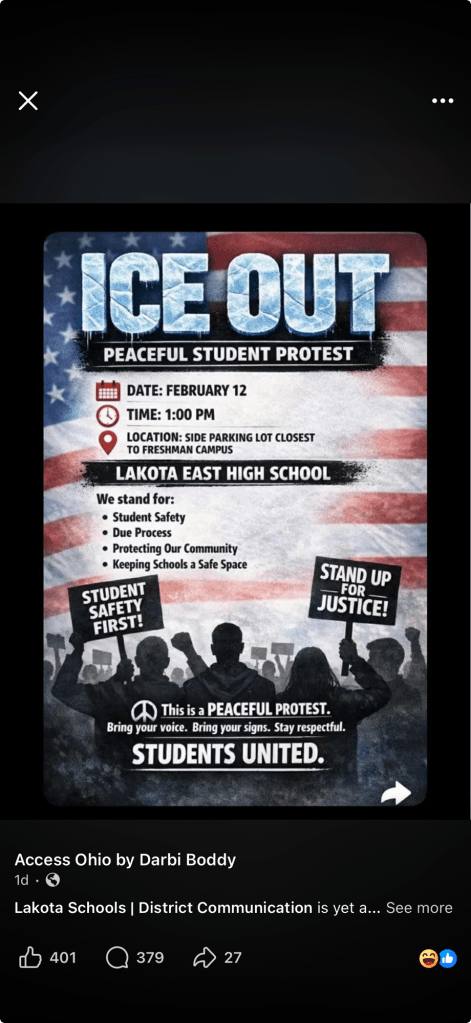
The events at Lakota Local School District in northern Cincinnati, Ohio, on February 12, 2026, represent a microcosm of broader national tensions surrounding student political activism, school administrative responses, potential teacher facilitation, and the influence of progressive ideologies in public education. In a predominantly conservative area of Butler County, students at Lakota East and Lakota West high schools engaged in walkouts protesting U.S. Immigration and Customs Enforcement (ICE) policies, including expanded enforcement, raids, and alleged excessive force under the Trump administration. These actions involved students exiting classrooms (at Lakota East around 1 p.m.), marching with signs, chanting slogans against ICE, and positioning themselves visibly along roadsides for media attention. At Lakota West, the protest occurred after school hours and off-campus to limit direct disruption.

Local media, such as WKRC Local 12, reported these demonstrations as student-led responses to federal immigration tactics, noting similar actions across the Tri-State region (Ohio, Kentucky, Indiana). Principals from multiple Lakota schools (including East, West, Hopewell Junior, Liberty Junior, and others) issued a letter to parents on February 11, 2026, preemptively addressing rumors of a “voluntary” walkout. The letter upheld students’ First Amendment rights to peaceful protest and civic expression while warning that unexcused absences would be subject to Ohio law and district policy—participation did not qualify for excused status (e.g., illness, emergencies), and preplanned requests would be denied. It emphasized respect for diverse views, noncoercion, a safe environment, and the requirement to report to the office before leaving the building.

Critics, like me, have labeled the letter evasive, arguing it downplayed administrative or teacher involvement while allowing the event to proceed. Eyewitness observations suggest that protest signs were prepared in classrooms with teacher awareness or permission, and that the walkouts occurred during school hours with limited enforcement. Participants rerouted around obstacles such as snowbanks to remain visible in high-traffic areas (e.g., near I-75), indicating deliberate efforts to maximize impact and media coverage. Coverage portrayed the protests as expressions of community solidarity in a Republican-leaning region, although turnout appeared modest relative to enrollment.

Lakota school board member Benjamin Nguyen publicly opposed the demonstrations, issuing a statement calling non-participants “patriots” and citing crimes by undocumented immigrants. Despite warnings of unexcused absences, many participants reportedly faced minimal repercussions, fueling claims of tacit approval to avoid liability or conflict.

The Nationwide Wave of Anti-ICE Student Protests in Early 2026

The Lakota walkouts aligned with a massive surge of “student-led” demonstrations (organized through teacher union radicalism) across the U.S. in January and February 2026, often coordinated via social media by progressive groups and spurred by intensified ICE operations, including detentions, and tragic incidents like fatal shootings involving agents in Minneapolis. Thousands participated nationwide, with actions in dozens of states and cities.

In the Cincinnati area:

•  Walnut Hills High School: 300–400 students walked out on February 4, 2026, holding signs like “Abolish ICE” in cold weather.

•  Princeton High School: Hundreds walked out on February 10, emphasizing opposition to racial profiling in a diverse student body.

•  Other schools, including the School of Creative and Performing Arts (dozens marching with chants on February 11) and Sycamore High School (tied to January actions), joined the wave.

Elsewhere in Ohio and nationally:

•  Central Ohio districts (Worthington, Hilliard, Upper Arlington) saw January walkouts after ICE’s Operation Buckeye.

•  Northeast Ohio (Cleveland Heights): Hundreds marched on February 12.

•  Other states: Texas (Hutto, Austin, Pflugerville), Kansas (Lawrence, Free State), Utah (multiple Salt Lake County schools with hundreds marching), California (Los Angeles Unified estimating thousands), Minnesota (lawsuits over ICE near schools), and more.

Protests focused on protecting immigrant families, creating “safe spaces,” and opposing overreach. Some districts threatened disciplinary action or investigated facilitation; others remained neutral or supportive. Conservative critics highlight the coordination, media amplification, and involvement of younger students as evidence of external influences beyond organic concern.

Teacher Unions, Political Leanings, and Potential Facilitation of Activism

Central to the controversy is whether these protests were student-driven or amplified by teachers and unions. Public school teachers often lean liberal/Democrat in surveys, and unions like the National Education Association (NEA), American Federation of Teachers (AFT), and Ohio affiliates (Ohio Education Association, Columbus Education Association) have advocated on immigration, condemning ICE near schools, supporting “sensitive locations” protections, and amplifying solidarity efforts.

In 2025–2026, unions pushed for reforms limiting enforcement near educational sites, filed lawsuits (e.g., Minnesota districts and unions), and issued statements opposing ICE actions that create fear in immigrant communities. Ohio unions, such as the OEA, strongly opposed enforcement in or around schools, citing trauma and learning disruptions. Critics argue that this normalizes progressive views in classrooms under the rubrics of “civic education” or “social justice,” potentially pressuring neutral spaces and facilitating activism (e.g., walkout guides or symbolic acts).

In conservative areas like Butler County, public schools are viewed as “liberal incubators” with limited oversight, allowing teachers to instill values diverging from parental ones. Many parents treat schools as convenient childcare, rarely scrutinizing political influences, enabling unchecked messaging. This contributes to generational shifts, with youth adopting radical positions via taxpayer-funded systems.

Implications, Reform Needs, and Long-Term Trajectories

These incidents reveal tensions between student free speech (protected under Tinker v. Des Moines for non-disruptive expression) and school neutrality. If teachers aided protest activities (e.g., by creating signs during class), this raises questions about resource use and impartiality. In polarized regions, such actions appear to leverage youth for adult agendas, thereby eroding trust.

Reform demands include stricter policies on political activities during school hours, transparency in responses, parental oversight, and union accountability. School choice could allow value-aligned options, reducing perceptions of indoctrination. Without reforms, public education risks prioritizing ideology, exacerbating divides, and alienating funding communities.

The Lakota protests, framed as civic engagement, highlight eroding confidence when schools seem to enable partisan activism in conservative strongholds. Balanced, impartial education is essential to serve all families properly.  These protests, as the Lakota one proves, show a much deeper scheme of radical left-wing politics using children to advance their political agendas at taxpayer expense.  It is a mechanism of injustice that must be stopped. 

Footnotes

¹ Local 12 (WKRC), “Students at 2 Tri-State schools protest against ICE, treatment of immigrants,” February 12, 2026.

² Journal-News, “Some local students are organizing protests, campus discussions about ICE enforcement,” February 12, 2026.

³ Cincinnati Enquirer, “Walnut Hills High School anti-ICE walkout draws 300 to 400 students,” February 4, 2026.

⁴ The Guardian, “These are the high schoolers taking a stand against ICE,” February 9, 2026.

⁵ Education Week, “Free Speech Debates Resurface With Student Walkouts Over ICE Raids,” February 5, 2026.

⁶ Ohio Capital Journal, “Central Ohio high school students protest ICE, teacher unions condemn ICE activity near schools,” January 23, 2026.

⁷ American Experiment, “When teachers’ unions turn schools into political stages,” January 21, 2026.

⁸ Chalkbeat, “Growing number of education groups criticize impact of ICE operations on students,” January 28, 2026.

Bibliography

1.  Local 12 (WKRC). “Students at 2 Tri-State schools protest against ICE, treatment of immigrants.” February 12, 2026. https://local12.com/news/local/students-at-multiple-butler-county-cincinnati-ohio-school-schools-walk-out-class-protest-against-ice-immigration-customs-enforcement-agents-officers-president-donald-trump-protesting-politics-political-immigrants-lakota-west-east

2.  Journal-News. “Some local students are organizing protests, campus discussions about ICE enforcement.” February 12, 2026. https://www.journal-news.com/news/some-local-students-are-organizing-protests-campus-discussions-about-ice-enforcement/X6DUPL4VLRCL3OKCKKCP5B6FHA

3.  Cincinnati Enquirer. “Walnut Hills High School anti-ICE walkout draws 300 to 400 students.” February 4, 2026. https://www.cincinnati.com/story/news/education/2026/02/04/some-300-to-400-walnut-hills-high-school-students-join-anti-ice-walkout/88510660007

4.  The Guardian. “These are the high schoolers taking a stand against ICE.” February 9, 2026. https://www.theguardian.com/us-news/2026/feb/09/us-high-schoolers-protest-ice

5.  Education Week. “Free Speech Debates Resurface With Student Walkouts Over ICE Raids.” February 5, 2026. https://www.edweek.org/leadership/free-speech-debates-resurface-with-student-walkouts-over-ice-raids/2026/02

6.  Ohio Capital Journal. “Central Ohio high school students protest ICE, teacher unions condemn ICE activity near schools.” January 23, 2026. https://ohiocapitaljournal.com/2026/01/23/central-ohio-high-schools-students-protest-ice-teacher-unions-condemn-ice-activity-near-schools

7.  American Experiment. “When teachers’ unions turn schools into political stages.” January 21, 2026. https://www.americanexperiment.org/when-teachers-unions-turn-schools-into-political-stages

8.  Chalkbeat. “Growing number of education groups criticize impact of ICE operations on students.” January 28, 2026. https://www.chalkbeat.org/2026/01/28/education-groups-say-ice-immigration-enforcement-is-hurting-students

Rich Hoffman

More about me

Click Here to Protect Yourself with Second Call Defense https://www.secondcalldefense.org/?affiliate=20707

Lakota School Teachers Need to Stop Having Sex with Students: The problem starts at the top

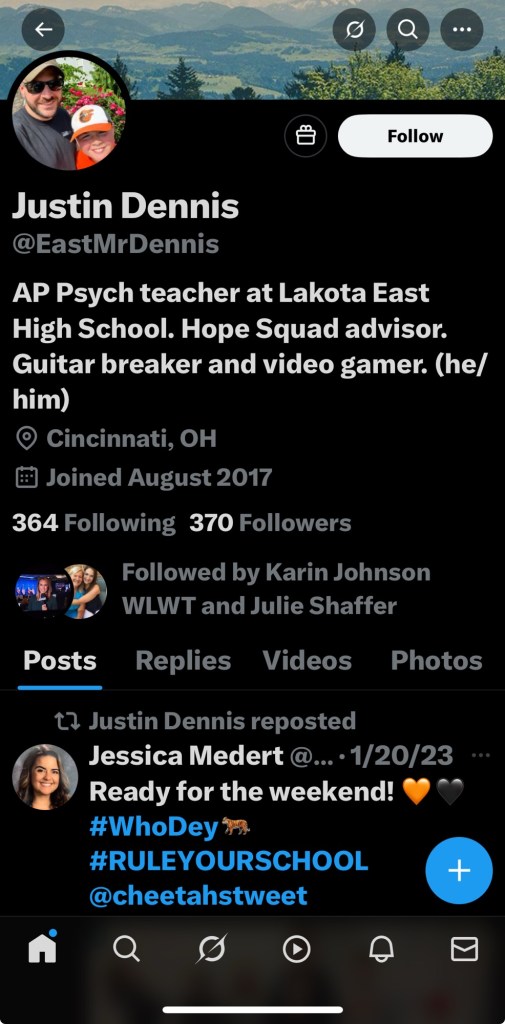
The worst thing about the recent case of 42-year old Lakota school teacher Justin Daniel Dennis from Lakota East, who had sex with a 17-year-old girl in his classroom and many other places, was that we warned about it when it was happening, during the 2021 school year.  And hundreds of people allowed it to happen because of their open sexual attitudes within the public school, from the school board, to other administrators, to the schools’ at all costs supporters.  At that time, we were discussing many administrative problems leading to the school superintendent’s resignation due to his bizarre sexual lifestyle, and many of us warned the Lakota schools that he was just the tip of the iceberg.  And instead of doing anything about it, the school board chose to do what they are known for, dancing on tabletops naked and passing out drunk in dirty bathrooms face down.  No wonder people like Justin Daniel Dennis thought he could get away with it.  And not just once, but according to the victim, the girl, now that she is a few years older and in her 20s, in college, who stated to police, they had sex in the school, in parking lots, all over the place, many times.  Lakota schools, like many public schools, have a permissive attitude toward sex in general, and it’s been out of control for a long time, and it starts at the top.  When you have stories like this one, it’s no wonder teachers think this behavior is acceptable.  Rather than addressing these problems when they arise, the school seeks to conceal the information.  We only became aware of this incident because four years later, the former student provided police with a statement, which they were able to verify, leading to an arrest on the first Monday of August, 2025. 

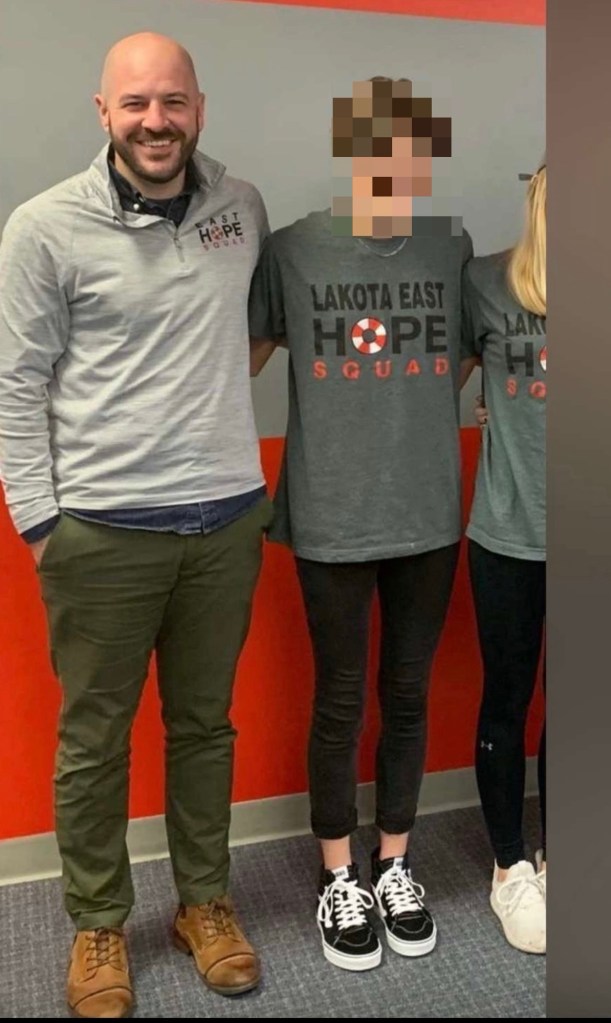
Justin Dennis taught psychology, economics, government, and cybersecurity at Lakota East and Lakota West, and was a listed advisor for the Hope Squad, a student assistance group.  This is more than an accusation of loose lips; his arrest was based on a recorded statement from the victim to Butler County deputies, provided on August 4, 2025, and they were shown corresponding evidence of a text thread with the teacher discussing their past relationship.  Of course, he is pleading not guilty as he is facing one to five years in prison and a $10K fine, and he’ll have to register as a sex offender.  Most criminals always deny committing the crime.  By the court documents that we have so far, it’s pretty obvious what happened, and it goes far beyond the sex of a 40-something-year-old teacher and a 17-year-old student.  It points to a culture itself that facilitates this kind of loose behavior, and it’s a massive problem.  Most of the teachers engaging in this behavior are not getting caught because nobody ever comes forward to report them.  And when we have discussed these things in the past in a community setting, all the apologists get upset and call us all right-winged extremists, because they think it’s unreasonable that we expect good behavior out of the teachers we pay for with property tax money.  And when something like this happens, they are all a little guilty, from the school board that covers up all these cases, to the school’s cheerleaders who overlook everything for the chance to keep their free babysitting service.  We now have numerous screenshots from this Lakota teacher’s social media accounts, and it’s pretty apparent what he was doing, as many in his position are as well: using the children of the school to mask their failures as individuals.  The shell game of unionized public education employment provides them with a convenient mask to hide their true identity from the public. 

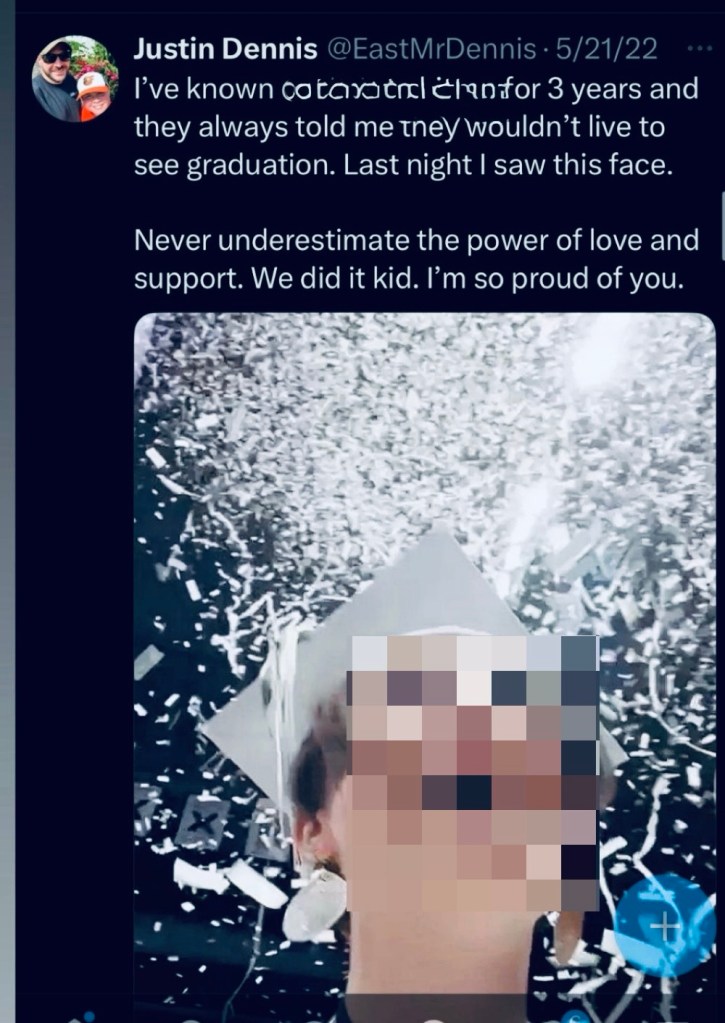
There is an alarming post that Dennis made once this girl graduated from high school, where he said, “We did it, kid.  I’m so proud of you.”  What he didn’t say was that they were having sex in his classroom, at his home, in the parking lot where she worked in Springdale, and many other places.  He was using his position of authority to gain personal sexual fulfillment out of a young person who was at a very vulnerable time in her life. As we learn more about the situation, it appears that this young lady was initially considering becoming a young man but has decided to remain a woman.  And when you reflect on the kind of Biden-era pronoun usage, which this guy Dennis has indications of on his X page, no wonder this kid was so confused.  And under the mask of helping troubled young kids, it gives teachers a mask to hide their sexual perversions.  Even making that statement, many people who live and work in the Lakota school system think that kind of value judgment is unfair.  If you are a man and you walk by a knothole in the fence, you should not feel inclined to stick stuff into it.  As a rational human being, you should know better than to indulge some animal instinct toward pleasure.  And that is even more the case when it comes to other human beings under your care—vulnerable young people who trust the adults in their lives.  And Lakota schools, as a culture, let these kids down time and time again.

And this teacher isn’t some guy stuck in the corner that nobody knew about.  On his X social media account, he only had 370 followers, and Lakota school board president Julie Shaffer is one of them.  And another school board member, Kelly Casper, reposted some of his articles.  So he’s an insider, known to the people who run the school.  And they were either foolish or they were in on it.  And based on what I know of the former school superintendent, who had all kinds of sexual problems of his own, which they worked very hard to cover up, the evidence points to them being in on it.  People were aware of what was happening, but they didn’t take action.  And it’s much bigger than just this case.  These are rotten individuals who often engage in questionable activities, and they exploit children to mask their flawed personalities. This is why the bad behavior from Lakota’s school board, which I was first-hand informed about by another school board member, is so important.  You can’t dance on tabletops with no panties and end the night puking your guts out and expect all the employees of the school to behave themselves.  The Lakota school board has created a permissive environment that is dangerous for children.  Cases like this give us just a hint of the magnitude of the problem.  And all the apologists who are talking about what a good teacher this Justin Dennis guy was, they are part of the problem too.  They are suckers, and they are all contributors to the guilt of this case.  It’s bad enough that an old man was having sex with a kid.  The crime is the abuse of authority that violates a relationship of trust, only to surrender to animal instincts and to act no better than a dog humping somebody’s leg.  And if you are a teacher or someone in authority, you never do it, under any condition.  However, instead, Lakota schools, like most public schools, often yield to primal instincts and surrender to the worst of human nature.  And it’s what they teach, and it’s what their role in the community entails.

Rich Hoffman

Click Here to Protect Yourself with Second Call Defense https://www.secondcalldefense.org/?affiliate=20707

We Have To Teach People Why Capitalism is Good: The Vivek Ramaswamy approach to Zohran Mamdani

I think people misread Vivek Ramaswamy’s comments about Zohran Mamdani incorrectly, for the most part.  However, when Vivek placed an ad in New York challenging the socialist candidate for mayor to a debate, it raised several interesting questions that will undoubtedly be part of future discussions about politics.  Vivek, of course, is jumping into the conversation about New York politics because, as a capitalist who made a lot of money in New York and is now planning to be the governor of Ohio, he is uniquely positioned to have a debate with what the political left thinks of as a bright young star, in Mamdani.  But critics of communism and socialism expect a more visceral hatred of Mamdani than Vivek shows to people.  I’ve had the fortune of knowing Vivek personally, and this is true for most people: bright individuals who can debate any topic with anyone don’t have to get defensive every time a challenge arises to their belief system.  So Vivek can have a very cerebral discussion about Mamdani without getting too upset that the trend in Democrat politics is a radical leaning towards far-left, Marxist policies.  And most people have been taught, through years of Cold War policy from the over 50s crowd and onward, that we are to approach communists and socialists with anger, like they are the invaders we saw in the movie Red Dawn.  Vivek comes from a much younger generation, and that’s a good thing because, in the post-Trump years, many things are going to change.  People are realizing right now, and with Mamdani, just how dangerous all the socialist instruction in our public schools has been.  And most young people have had extensive exposure to it through public education. For too many voters, this issue has snuck up on them, evoking a lot of fear in people like Mamdani.

I have been warning everyone about the problems with socialism for many years.  And while public schools don’t overtly have classes teaching Marxism in general, it is implicit in the background of almost everything done in the teaching process, including in kindergarten, when the teacher instructs you to share your toys with your neighbor.  And that everyone is equal.  Vivek Ramaswamy’s approach to the communist problem is to debate it, because he can.  Not to fight them in the streets or call them names.  There are many young people, like Zohran Mamdani, who will be able to utilize social media to capture the attention of young voters who lack opportunities to surpass their parents’ achievements.  For many young people who can’t afford to buy their own home or have children, life seems unappealing and not worth fighting for.  While most MAGA supporters of today’s politics likely have their own car, their own home with lots of property, maybe even a boat.  Several kids.  A pretty good life, and something that they want to defend from people who want to take all that from them.  Vivek understands that the under-50 crowd has vastly different motivations and perspectives, and that they don’t feel the need to fight for anything, because, from their perspective, they don’t have much to fight for.  Their minds have mainly been rotted out by the public education experience that taught them all the wrong Marxist things about social equality and the value of private property ownership.  Therefore, portraying our political enemies as revolting figures will not win over new voters, because those new voters essentially share Mamdani’s perspective. 

That’s why the future of the MAGA movement needs to include people like Vivek Ramaswamy and J.D. Vance, who can debate any issue with anyone, anywhere.  And Vivek certainly can, and that is the way to win over the next generation of voters.  If, during the Trump years, the goal was to overcome all the lies that had been told to us by a government that sought global socialism as its governing principle, now the shoe is on the other foot.  It’s not enough to question the government of socialists and to run them out of office.  The problem that J.D. Vance and Vivek Ramaswamy will face with young people is that many of them have to be taught the virtues of capitalism from scratch.  We can’t just hold up Adam Smith’s Wealth of Nations and tell them to read it.  They need to understand it relative to their thoughts as young socialists who we have let get out of control, rob away their hopes and dreams.  Fighting socialism and communism with the kind of Cold War hatred that we have in the past won’t work on today’s social media.  Capitalism has to be sold to people all over again.  It will help to have a successful Trump administration to point to so that young socialists can see for themselves how much better a capitalist system is than their socialist and communist teachings.  In the world’s plans, they never thought a Trump character would ever hold a position of power, revealing just how powerful capitalism could be.  His election was crucial in many ways at this particular point in history.  But do not assume that the new generation will have a hatred for communism as previous generations in America have.  It’s quite the opposite.  Most young people will have to be taught from scratch why capitalism is so much better, because they certainly haven’t been taught why in school, or entertainment, or their social groups. 

The shock everyone has felt at hearing Mamdani utter outright communist sentiment, wanting to be the mayor of New York City, what many think of as the capitalist capital of the world, is the reality that this new generation of young people is more prone to accept elements of Marxism because it’s all they know.  And for many, this issue snuck up on them as they realized how much of modern-day social media is dominated by young people who are just like Alexandria Ocasio-Cortez, and now Mamdani.  We say today they won’t and can’t win elections if this is what the Democrat Party is.  However, this is what the Democratic Party has been for quite some time.  They just hid it all behind a social mask, but it’s always been there, and now that people see it and hear them talk, the realization they have toward it is hatred.  However, be cautious not to demonize all these young socialists, as the goal is to win over that generation in a competitive race for the minds of a new generation.  And understand that capitalism has to be sold to them because they were not taught its value, and they do not have a natural love for it.  It will take someone like Vivek Ramaswamy to explain it to them and show them why it works.  They can’t expect just to read Adam Smith’s book and draw their conclusions.  They will have to be taught, with considerable debate.  And Vivek is just the right mind for all that.  He understands the problem all too well, even as many are just now waking up to it and have been caught off guard.  The next generation in America has to be mainly taught from scratch.  Their minds have been ruined.  And hating them won’t convince them to join you.  We have to earn them to our side person for person. 

Rich Hoffman

Click Here to Protect Yourself with Second Call Defense https://www.secondcalldefense.org/?affiliate=20707

More Rumors to Address: Do Lakota school board members dance on table tops drunk and naked

We’ve already discussed what is on the Rumor Has It website that Lakota schools produce to address a narrative they’d like to control.  But when it comes to public relations, which is what that official website of the school intends, you can learn a lot more about the people behind the website from what they don’t want to talk about, as opposed to what they do.  And in that regard, there is a big rumor running around out there about the school board itself, and how they behave at out-of-town education conferences that come up every time I speak to people in public about Lakota schools.  When the Lakota school board comes up, one particular incident instantly comes to mind, and it permeates the conversation for the duration.  I happen to know that this incident is not a rumor, as I have been informed about it by another school board member with direct knowledge.  But I was also told about it by the wife of the former superintendent, as she was explaining in great detail the crazy sexual exploits of her husband, for which this same school board knew about, and participated in a very destructive cover-up that involved police reports and all kinds of public debate.  While this isn’t a new story, as it involves members of the current school board, many of these individuals have survived several election cycles since.  Their supporters don’t care about any bad behavior exhibited at these social events. I might care about it and think it’s reprehensible.  However, voters who were aware of the trouble voted for these school board members anyway, and as far as I’m concerned, that sets the record straight regarding the kind of people on the school board and how they represent the community. 

https://www.lakotaonline.com/resources/community-resources/rumor-has-it

The incident we are talking about involved a lot of drinking to the point of severe intoxication and dancing on tabletops in full view of the public.  There is some cell phone footage circulating, but these are not pretty people.  It’s not appealing footage.  And the whole evening collapsed into a puking session, face down next to a toilet with clothes missing.  So if the Rumor Has It page wants to address rumors in the community and put a different spin on the kind of people who find that behavior reprehensible, there is a lot they could say to get a positive narrative.  Such as an argument that these same school board members tried to make about the superintendent, who was found to have an excessive sexual lifestyle that they declared was private.  Because they thought his public job was worth the cost of his private faults.  When I hear that kind of thing, I hear dollar signs because it costs a lot of money for people to hide private faults from public opinion.  Which I would argue is the whole reason behind this facility’s plan; it was conceived by people with major private frailties to hide from the public a title of respect gained through the building of new schools.  It is not uncommon for people who have experienced significant personal failures to seek public acceptance through titles and accreditation, in an attempt to hide them from the world.  It happens all the time, and would undoubtedly be something to talk about on the Rumor Has It webpage.  They could say on it that school board members at Lakota are only human and have human needs for drunkenness and sexual repression that need to be expressed through dancing and the removal of clothes, and what they do in their private life is their private business, even though they are on the road representing the Lakota School District.  What happens at education conventions stays at education conventions. 

However, that’s not what’s happening here. The purpose of the Rumor Has It website is to control the narrative, and that incident is one that they would like the public to forget.  They already have their supporters, who don’t see anything wrong with the behavior.  However, for those who find that behavior devastating, they may not have heard much about it unless the school addressed the issue on its website.  Because the local media certainly didn’t cover the story.  But you can’t keep something like that quiet, and among the kind of conservative voters I speak with, the church goers, the family-first GOP types, this whole incident is all the rage.  They certainly didn’t vote for these current school board members. Instead, they worked to replace them with new board members, only to have them resign amid great controversy.  And oddly enough, during all these news stories, this drinking incident that was on the tips of everyone’s tongues never made it into the newspaper or television coverage.  So, people shake their heads, and the story takes on a life of its own, permeating the background of every social gathering.  Because the school’s strategy isn’t transparent, it’s only talking about the kinds of things it wants, even listing the topics it has on the Rumor Has It website as a diversion from the real problems.  It’s not CRT that is the problem, at Lakota, even though that is one problem.  It’s not the policy of public comments.  The transgender bathroom debates.  It’s the quality of the school board members themselves and how they lead other adult employees.  And when stories like the drunken binge are floating around out there, of course the other unionized employees are going to point to it to justify their bad behavior, such as dating other students, getting caught with porn addictions, and other human resource disasters that come from a culture that says, “I’m only human, so don’t judge me.” 

When they don’t talk about it, more is said than what could otherwise be because the point of the page is to direct people’s attention to the topics they want to talk about, and to rally their progressive base.  Not to address serious issues.  A typical PR firm could easily make a statement about the pressures of running a school, noting that while out of town and away from their families, everyone deserves to let off a little steam, even if it involves a bit of indulgence, such as puking, and the clothes end up missing.  Everyone is just trying to do a good job, and what they do during their private time is their own business.  But saying that indicates bad judgment, and how can people who make those bad judgments also be held credible when it comes to asking the community to spend half a billion dollars on new taxes to pay to tear down old buildings and build new ones?  How can people trust those individuals with the quote process, given that they are prone to poor judgment in their private lives?  Why wouldn’t that same bad judgment carry over into their public roles as school board members?  So, to avoid all that, the Rumor Has It page simply avoids addressing it, which tells you everything you need to know about their intentions with the page.  It’s not about finding the truth or clarifying rumors.  It’s about controlling the narrative, and they seem to think so little of the public that they expect to get away with it.  This only makes people angrier and destroys the brand of the school because of the liberal nature of the people who run it and what they expect their roles to be in the process.  And to avoid the opinions of a public that sees such social behavior as expensive camouflage to social causes meant to hide private failures.  To avoid that can of worms, the topic is not mentioned, even though it’s the only thing people care about.

I will never vote for any more money to public schools, I think they are a broken mess that teaches all the wrong things to kids.  I believe government schools are detrimental to our society, so I’m always a hard ‘no’ on any tax increases.  I despise the socialist nature of the way the public education system was created.  However, as a community issue, many voters support or oppose various aspects for a multitude of reasons.  As long as these school board members remain on the board, I don’t see the public supporting any tax increases. If they truly want a chance to pass any levies, they should resign for the good of the school.  If they want to be competitive in a voucher environment, people will take their kids to places that don’t have stories like the one mentioned here hanging in the background all the time.  The mistakes of the past are what will hold back any passage of a levy request and are part of the reason it has been over a decade since a levy has passed.  People have strong feelings about these stories that emerge when a school district requests more funding, and because many people are aware of the issues, even if they don’t mention them on the Rumor Has It website, they still have knowledge and will vote accordingly.  And even if they have gotten away with much, as long as these school board members are running the show, people aren’t going to give them more money off their property taxes.  Because there are just too many damaged relationships with the community to support a tax increase, I think they will probably have to learn that with a few tax attempts that will be very bloody and embarrassing before they learn the hard lesson.  And by then, we’ll have a new governor in Ohio, and School Choice will expand significantly.  And parents aren’t going to want to send their kids to a school where the school board is so messed up.  And the Lakota school will learn all too late that the rumors they didn’t talk about destroyed their economic viability, and they’ll only have themselves to blame.

Rich Hoffman

Click Here to Protect Yourself with Second Call Defense https://www.secondcalldefense.org/?affiliate=20707

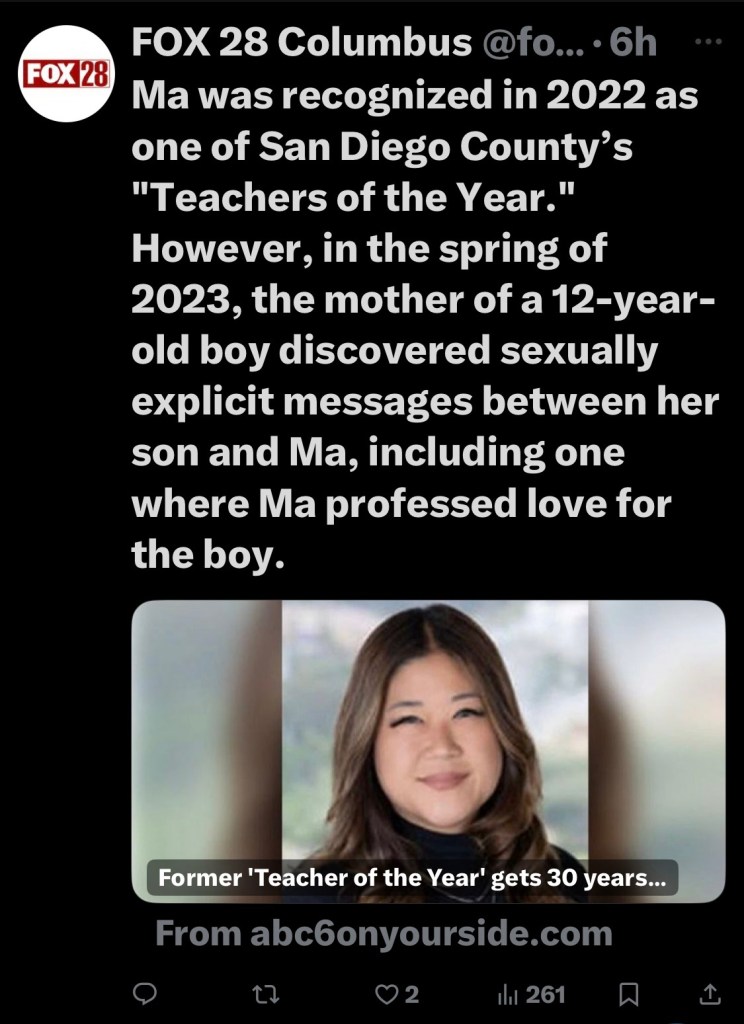
A Teacher of the Year Getting 30 Years in Jail: Another cover-up case at Lakota Schools

It should be shocking, but it isn’t, as news of the San Diego Teacher of the Year Jacqueline Ma pleading guilty to sexually grooming two of her students, one 11 and the other 12 for an extended period, that Lakota schools had another incident, which was quietly wiped away from the news cycle.  Where is Karin Johnson from Channel 5?  And with that, San Diego teacher, what gave her away as a young 36-year-old prototype that was given their highest honor?  She was the kind of teacher they wanted to say to the world that she was the best, and that parents could feel safe sending their kids to her with all their trust.  Was it the nose rings?  At Lakota, about a month before Jacqueline Ma cried like a baby in front of the judge, throwing all her guilt on the table, Lakota schools had plain clothed police officers escorting out a male teacher from the East Freshman building because the mother of a young girl caught the guy watching porn with her daughter.  And previously, that same teacher had a series of complaints trying to get into the girls’ locker room, to the point that they had to move him somewhere else once people knew what he was up to.  But to keep the story out of the news and to protect the school’s image, especially with this recent lawsuit in Columbus, where Lakota, along with 300 other plaintiffs who have joined the EdChoice lawsuit, want to pretend that they are something they aren’t.  So they can keep the trust of tax-paying parents, instead of admitting what they really are, a breeding ground for Democrat politics with serious sexual deviancy issues.  The media never reports on the issue until there is a confession, which is rare.  And before action is ever taken, as in the case of the Lakota case and the San Diego case, it takes a nosy parent to ask questions and insist on an investigation, which then turns up diabolical behavior discovered too late.

It should be evident by now what is going on; these public schools only care about their reputations so they can continue to steal money from taxpayers to fund their monstrous meat factories of sexual molestation and disastrous grooming of innocent kids.  These cases are so common that, statistically speaking, if you look at those who aren’t getting caught, it’s an astonishingly high number, so much so that all students would be able to report some creepy teacher they have to interact with who has boundary problems.  The schools cannot detect it through their teacher union contracts because they don’t ask for or tell about concealment policies.  Jacqueline Ma was given everything and had an incredibly bright future if only she could keep her shirt on.  Yet she had such bad judgment that she was taking her clothes off in class to show the young boys her boobies and was sending them text messages with all kinds of incriminating content because when people, any people, get into authority positions, it is very difficult not to abuse that relationship.  Obviously, for teachers of the year like Jacqueline Ma, it was tough to keep her clothes on, and her mind out of the gutter when she had a class full of students under her power, not to abuse it.  And back to the EdChoice case in Ohio, or Trump’s position to strengthen School Choice and eliminate centralized education methods, favoring more competitive approaches, it’s because of these stories that no public schools in the country can say that they are efficiently teaching children. Instead, they are abusing them sexually and ruining them for the rest of their lives, in many cases. 

I pick on Karin Johnson because I have a history with her.  She’s always there too late and supports the public school experience with blinders on.  I know her from my WLW days, when she was friends with Scott Sloan, the radio host.  I talked a lot about public school problems on his show until Scott got in trouble with his wife, a real estate agent, and those segments on a big radio station were what she thought was damaging to the real estate value of the school districts where she was selling.  So things went south, and Karin Johnson showed herself as a former cheerleader using the news as a pro-school advocate.  Only when a story completely collapses does she do a story on these dangerous public schools.  Instead of digging up the problems, they turn their attention to the people trying to bring all this to the surface, to protect the public schools for many of the reasons that were behind WLW radio getting out of that business.  The advertisers want to think well of these schools, whether they are good or not.  And now people hear too many of these stories that they want to pull their kids out of the schools and send them somewhere private.  And they want choices in education because the public option is far from reform-worthy.  Many people who have pushed these terrible stories under the radar want the public option to work for one reason or another, psychological or financial, and it’s hard for them to face the facts.  However, parents are sick of having to do all the work, and if it were not for them, the school would never admit to these transgressions.  And everything would continue to be swept under the rug.

It’s a problem in every workplace: the abuse of power by those who have authority over others, whether students or employees.  You cannot have a system of efficient teaching when a school system in San Diego gives a teacher like Jacqueline Ma a Teacher of the Year award, because they are measuring all the wrong values.  I would have told them that the nose ring should have been a disqualifying attribute.  You can’t be Teacher of the Year with a nose ring.  And if you take your clothes off in front of your students and send them pictures of you in sexual conditions, you can’t work as an authority figure in the school.  Or like in Lakota, where these cases are pretty much daily, if you watch porn with your students, grooming them, you are fired.  And if this young girl’s mom didn’t stick her nose into the situation, that teacher would still be employed, even though the other teachers know all about the problems.  They don’t say anything because they care more about the school’s reputation.  Not in actually being good and performing well.  The public school experience is inefficient, expensive, and corrosive because it has bad teachers instructing students in vulnerable positions, doing all the wrong things.  And it’s out of control because the checks on that power are more interested in keeping the stories from the public to hide it, because of some financial or emotional interest, that they have made the problem far worse.  It’s so bad that whistleblowers, like that girl’s mom at Lakota, are viewed as troublemakers, instead of the teachers caught doing the dirty deeds.  The assumption from the public school supporters is that we should all keep in mind the greater good of public education, even if that good is only in bad teachers continuing to get a paycheck stolen from property owners for a service that is horrible in general to an entire generation of kids.  And when it comes down to it, nobody but a few parents who care are looking out for the kids.  Not the news, not our politicians, not our business world, nobody.  Not even our churches.  Nobody cares because the evil under the rug is so vast and horrible that people would rather not find out about it until some tenacious parent catches someone guilty, and they cry like a baby, hoping to get a plea deal to cut 30 years of jail down to a lesser sentence.  By that time, their lives are already ruined. 

Rich Hoffman

Click Here to Protect Yourself with Second Call Defense https://www.secondcalldefense.org/?affiliate=20707

The Case of Emily Nutley: Why do so many teachers want to have sex with their students

Let’s talk about Emily Nutley, the 43-year-old former head counselor and director of academic services at St. Xavier High School, the prestigious all-boys Jesuit Catholic school in Cincinnati, Ohio, who pleaded guilty to two counts of sexual battery on April 7th, 2025.  She had a sexual relationship with a 17-year-old student who eventually got tired of her and told authorities about the scandal, which prompted an investigation, and the prosecution of the case by Melissa Powers, who I think is a fantastic prosecutor.  It wasn’t hard to prove the merits of the case since Nutley sent the student nude pictures of herself to his cell phone, so that pretty much was that.  But why, here as a young woman who was married with three kids, she had a master’s degree and lived in a very nice neighborhood in Mason, Ohio.  She had a great job.  Everything looked on the outside to be a pretty perfect life.  So why would she throw it all away to have a sexual relationship with a kid?  With so many options, why would she make such a horribly bad decision that would ruin her for the rest of her life?  And here’s the real issue: if she hadn’t pushed the relationship to the point that she did, where the kid got tired of her, how long would it have gone on, because it was the student who said something?  How many of these cases are going on that nobody will ever find out about because there hasn’t been a whistleblower?  And when there is a whistleblower, how many get covered up by the administrators trying to protect the school’s reputation?  In my experience, a lot.  There are a lot of Emily Nutleys out there.  I know the type of “pro teacher” employee that Emily Nutley was.  They are very common and prone to the same behavior; this is no isolated incident.

This case reminded me of when I was in high school a long time ago.  We had a Spanish teacher who was about the same age as Emily, at the end of her childbearing years and was hot to trot with all the emerging maleness of high school.  She was very willing to help certain guys in class with their homework.  She was well perfumed and would unbutton her shirt when she’d lean over you to help with something you were working on.  Very awkwardly, in front of the whole class.  And she was very willing to show off her goodies and lay them on your shoulder when she explained things to you.  My friends and I called her Senorita Slut because it was apparent she was climbing the walls with sexual tension.  This kind of thing is by no means new.  Emily Nutley isn’t the first and certainly won’t be the last.  And I’d say that her situation is quite common.  When you start talking to people in these schools, behind the polite decorum of professionalism, there is a lot of sex going on.  There is teacher-to-student sex.  Teacher to teacher sex.  And there are a lot more cases of teacher and parent sex than many people would like to admit to.  The teacher is explaining to a parent the conditions of their kid in class, and before long, they are exchanging phone numbers and sending each other nude photos over coffee at Starbucks.  If they don’t have a firm grip on their values, people fly off the handle pretty fast, which was undoubtedly the case with Emily Nutley.

I feel sorry for the former teacher; Emily’s life is ruined, and she’ll never recover.  Watching her plead guilty in court with her dad there to support her is just a train wreck of serious mistakes that any rational person should be able to avoid easily.  But she threw it all away for nothing, and now she will never be able to put it behind her.  In court, she attempted to place the blame on her husband for neglect, indicating that her sexual frustrations were because he wasn’t fulfilling his husbandly duties.  But what does she expect as a person in her 40s with three kids and many social requirements that a school teacher living in Mason is expected to live up to?  Sex for mature adults is not easy to come by, so life has a way of chipping away at people.  That doesn’t mean that you take up sexual residence with a student in your school.  Why him and not one of the many options for sex with just about anybody that’s out there these days?  It’s a lot easier now than when I was in school with Senorita Slut.  So why did she do it, and what can we do to protect ourselves from it?  And my answer to that is that you can’t do anything about it.  It’s a systems failure.  It’s what happens when people get together and is part of our biological coding.  When an intellectual mind fails to overcome biological desire, bad things happen.  And in public and private school settings, no matter how much money parents are paying for an excellent education, there is a desire for sex among human beings with each other.  And the more we rationalize surrendering to animal behavior in society, the more people like Emily Nutley are going to start sending naked pictures of themselves to their students.

I think at least 10% of the adult population of any education system has sexual activity going on with either the students or other adults in the school.  At least.  The only way that people like Emily Nutley get caught is that things get out of hand and someone says something.  Most of the time, the relationships fizzle out.  When we learned in Lakota that a superintendent had sexual fantasies about sex with some of the students that they shared, which came out in a police report, a window into that world was all too clear.  Sex in educational endeavors was common.  Putting aging women in a room full of emerging young men with their whole sexual lives in front of them is a dangerous combination.  And when you couple that to porn addiction among adult males and the lowering of social standards, you have a hazardous combination of things that are impossible to manage.  As I said, our education system is grotesquely broken, and I gave up on it long ago.  This case has an aggressive prosecutor in Melissa Powers.  It had naked pictures of the teacher sent to the student, the whistleblower.  And it had a confession by the perpetrator.  Her husband divorced her.  She lost her job.  Her kids will never forgive her.  And she currently awaits sentencing.  But without the whistleblower.  Without the prosecutor.  This would be just one more widespread occurrence in all schools, where humans desire to express themselves sexually to other people for a whole bunch of really dumb reasons.  And yeah, I feel sorry for Emily Nutley.  In many ways, she was doing what a progressive society encourages.  And she followed those rules to this complete social destruction, and she has lost everything in the process.  But even more than that, there are lots of these things going on; our education systems are not safe places. Instead, they are some of the most dangerous places, and the predators who hold master’s degrees are well paid, have families, and prestigious titles in society.  But behind it all is a lot of scandalous behavior from bored minds seeking fleshly affirmation, even at the promise of self-destruction.

Rich Hoffman

Click Here to Protect Yourself with Second Call Defense https://www.secondcalldefense.org/?affiliate=20707

What is Required for a New Lakota School Board Member: Its a system that needs to die

Coming up in the Lakota schools soon is an opportunity to elect three more conservative school board members, and to answer the question I have been asked regularly: am I running for one of them?  Because many people want me to.  Not to give a politically worthless answer, but in my opinion, people who genuinely appreciate the system should be the ones to run it.  I do not like the system, and I have no interest in working with people like that.  I view education as a reform effort, and I believe the amount of time required to fulfill a school board role exceeds 70 hours per week.   It’s not a helicopter position as it’s now for many people who are currently in it.  So I would advise people who want to help fix the system and are willing to do that level of work to let us know, and we’ll help you connect the dots.  But as far as one of those people being me, that wouldn’t be a good idea for those wanting to save the system in some regard.  I’m accustomed to being entirely in charge of the things I do; I’m not a very good consensus player.  I don’t even think the design of school boards in public education is correct; it needs a strong CEO-type to oversee these radical superintendents.  I don’t like the lawyers.  I don’t like the teacher’s unions.  I don’t like the way they are funded.  I don’t like what they teach.  I don’t think they work long enough hours, regardless of the level of employees, administrative, or the teachers themselves.  I support scrapping the whole thing and starting over.  However, there are many parents with school-age children who want to make the best of a difficult situation, and these are the types of individuals who should be leading the school. 

As far as holding on to the way things were in the past?  There is no chance of that.  I was watching the protests this weekend at the Statehouse against Trump and Elon Musk over their fears that Social Security will be cut, which isn’t even on the table.  However, the level of stupidity exhibited by some of those participants is genuinely overwhelming.  There is no talking to people like that with reason.  They can’t understand anything that needs to be changed, so, in my opinion, they should all be scrapped.  They are not prepared for what needs to be done.  I would argue that they aren’t even qualified to be parents.  I feel sorry for the children born into families with the kind of parents who go to these anti-Trump protests.  It’s not their fault their parents are idiots.  But I see no hope in any of those people; they are the result of a society that has experimented with Marxism, and they accepted those thoughts as a new reality.  And that is not the future of education.  There is only one way things are going, and no amount of crying like a baby is going to change anything.  The funding of public schools needs to change; it will change.  The government funding of schools, with unmanaged money moving from the federal government back to the local level, is not a future prospect.  It can’t be, and it never should have been.  People have seen what that system gave them, and they aren’t willing to continue with that method.  The per-pupil costs of educating students should be at least half what they currently are.  When I talk to people who are out there carrying signs in favor of preserving that system, they don’t understand it, and they never will.  Education has to be competitive; we need competition with other teachers, with other districts, and with other states.  The teacher’s union model of everyone getting a collective bargaining agreement for subpar work is over.

And as I say that, people will tell me tomorrow, and the day after that, and the week after that—that’s why I should be on the school board.  Consider what you’re saying and think about what you know about me.  Yes, I can speak very politically, and I work very well with people who hate me and plot against me with everything they can come up with.  My life is far more complicated than the most ostentatious Shakespeare play.  There isn’t any way for my life to be reflected in art because nobody would believe it, including the most conspiratorial of Shakespeare’s works.  My idea of the perfect school board member was and is Darbi Boddy.  She genuinely cared about making the school a great one, and she represented a sizeable demographic group within the Lakota school system.  And people from all political sides conspired to get rid of her.  Who in their right mind thinks I would put up with that?  Darby handled things very well and played by the rules, paying her legal fees to defend herself in ridiculous ways.  She never should have had to do that.  And I can say, I wouldn’t.  I would burn the whole system down from the inside out, along with all the people associated with it.  So be careful what you wish for.  I want what’s best for the people of my community.  However, what’s best for me is what people who deal with me receive, and I’m not sure people can see past the results they want, which are undoubtedly attainable.  But what would they do with the wreckage in the aftermath? That’s where the real trick is. 

I think there is a way to do it, but as I mentioned, I believe the job of a school board member at Lakota schools requires at least 70 hours a week.  It takes that long to read everything you need to read and speak with all the people you need to talk to.  The school board meetings need to be more prolonged, more frequent, and include more detailed information.  And the people working together need to build a team, not to resemble a Shakespearean drama.  And when I say that, we need three school board members who will work together, not against each other, and merge into the political faction of the teacher unions.  I have a very dominant personality in personal conduct, and I excel when I can give orders.  But consensus building is not my thing, and it never will be.  I’m the one you call to take the head shot.  Not the one who cleans up the mess.  And Lakota schools are a mess, and there is a lot to clean up.  And the people doing that need to like each other and to represent the community in the best way possible.  But there will be a lot of hard talks and times in the next two to three years.  Really, until Vivek Ramaswamy is governor of Ohio, we won’t be able to truly fix public education for good with competitive models and funding tied to the child, not the uncompetitive local school.  The property tax racket has to come to an end.  It has given us a garbage product taught by garbage people who are worthless in every category, and it’s time to put all that to an end.  As those protesters increasingly do in places like the Ohio Statehouse, they aren’t in the realm of reality, and that isn’t the fault of the rest of the world.  It is their social dysfunction to think that a school system can continue to get unlimited funds to sponsor a poor work ethic and to teach Marxism to the next generation isn’t even a consideration for the future.  I will not say everyone but me should do such a hard job.  But when it comes to delivery, be careful what you wish for.  My bedside manner on this topic does not come with any handholding.  I’ve been ready to pull the plug on the patient for a long time.  It’s a system that needs to die.

Rich Hoffman

Click Here to Protect Yourself with Second Call Defense https://www.secondcalldefense.org/?affiliate=20707

Protestors Aren’t Valued: Threats of violance are not replacements for good debate

I would say it was a fortunate thing for me to see; after all, that’s what I was after when my wife and I recently took a vacation to Washington, D.C.  Within a few days, I was able to see protestors up close and personal in places where they cause the most trouble, and they answered questions I had been having by seeing them up close and personal.  The first group I encountered was at the Mall in Washington in front of the Lincoln Memorial.  The second was just a few days later in the rotunda of the Ohio Statehouse.  Later that same night, I saw protestors at the Lakota school emergency meeting on school funding who were there to shout down local political representatives who were called to answer for depletions for school funding.  These protestors were the “always more money” types without ever demonstrating why spending more money would ever make anything better but to push a few more of them into diabetic medicine because of their terrible diets.  By the looks of their girth around the waist, they could afford to skip a few meals and more money would only make their problems worse.  That was the same problem with the protestors in Columbus; they were screaming for more school funding without demonstrating how more money would improve anything.  Then, of course, the protestors at the Mall were protesting Elon Musk’s attack on science when, in reality, he is personally doing more to enhance science than anybody in the world.  They were all such negative people who were very difficult to have any relationship with because the nature of their existence was below the line, and to my way of thinking, that makes them impossible to work with.  You can’t build a prosperous society with below-the-line people by using a business metaphor popular in efficiency discussions.  Negative people drowning in their misery need fulfillment that they can’t give themselves, which they misperceive as more of something to cover what is lost in themselves. 

I have a lifestyle that moves very fast.  I do a lot more during a typical day than most people will do in a month.  I don’t say that I want to put anybody down, but yeah, many people waste time talking about nothing, and I am not one of them.  I find something else to do when I sense that someone is wasting my time.  So I don’t get to see these kinds of protestors very often because I live my life in a way that doesn’t have time for them.  I don’t value what their problems are because I see Democrat politics as a political expression of a broken person who has not dealt with their deficient thinking.  And broken people are not equal to people who purposefully live good lives.  It is not correct or fair to penalize a good person with the thoughts of a bad person.  As defined here, an evil person is a person who allows bad decisions to govern their existence purposefully.  We aren’t talking about a mistake in judgment here and there; we are talking about purposeful neglect, using victimization status to avoid doing work, solving a problem, or even raising kids.  My experience with school funding protestors, for instance, is that they are surface-level people who do not have the self-confidence to raise their children, so the fantasy of state ownership of their children means they can appear to the world to care for their kids but what it does is allow them to blame someone else for the deficiencies of their children’s growth.  It’s much easier to blame a teacher or school funding when the real problem is the parents themselves.  The public education debate allows them to defer their responsibility in contributing to the problem because if only more money were spent on the children, nobody would notice that the protester is just a bad parent and probably a bad person.

Another aspect of this whole issue is that bad people, such as protestors, have been able to hide their failures behind the value of free speech.  In our form of government, where we encourage debate, we have not set a high enough bar, which is now occurring, for the quality of an opinion. Instead, protestors were celebrated for participating in the free speech debate, which is the cornerstone of our Republic, because they stood around like idiots holding a sign, protesting something.  Rather than present a reasonable argument about something that could be debated, they fall into the Al Green side of victimization protest, copying what they think worked during the Civil Rights movement.  So let me explain something about all that.  The Democrats wanted to erase their sins of the past of being slaveholders, and Lyndon Johnson was in the White House looking to bridge that gap and steal the merit away from Republicans who had been championing Civil Rights for people of color all along.  The protests of the flower children during that period were not the mechanism that launched reform.  It was the cover story of actual guilt that Democrats wanted to rid themselves of through the optics of protest.  So, the protests are not what moved the legislative needle on reform.  It was only a fake cover story to distract reporters and historians from the Democrat past of alignment on slaveholding as a political party that had been for it but wanted a divorce due to modern pressure to compete with Republicans and maybe even beat them at their own game.

So, the protests never worked.  And they certainly won’t work this time.  The vicious attacks against Tesla because Elon Musk is the CEO of the company only remind people of the kind of negative people who turn to protest rather than logical arguments and further root the MAGA movement to a growing audience.  The destruction or else form of political debate isn’t going to work.  They think that if they threaten to destroy property or even fight you in the parking lot of a public school, you will be compelled to see things their way for your safety and desire to preserve your property.  These people caught on camera keying the paint job of Tesla owners is the worst form of grievance jealousy that is attempting to disguise a flawed and broken person behind the value of the First Amendment.  But because they can’t articulate a debate, they only have the threat of violence and destruction as a counterpoint.  But if they run into MAGA supporters who are better at violence and fighting than they are, well, then they are in real trouble.  I certainly don’t have room or tolerance for one bit of bad behavior and below-the-line thinkers.  I’ll listen to a reasonable debate, but to be honest, I sniff things out very fast and determine if someone is wasting my time, and I will move beyond them quicker than they can blink.  And I’m certainly not alone in this.  These protestors will not recreate the past hippie movement protests and get legislative representation.  They will be left behind because that is the mode of the world.  I would say that it was always that way and that protests in America were more theater than substance.  But it’s even more so today, and seeing the early strategy against the Trump administration in general by protestors without an argument, they will not be successful because all they have to offer is violence.  And the people they are threatening aren’t going to put up with it. 

Rich Hoffman

Click Here to Protect Yourself with Second Call Defense https://www.secondcalldefense.org/?affiliate=20707