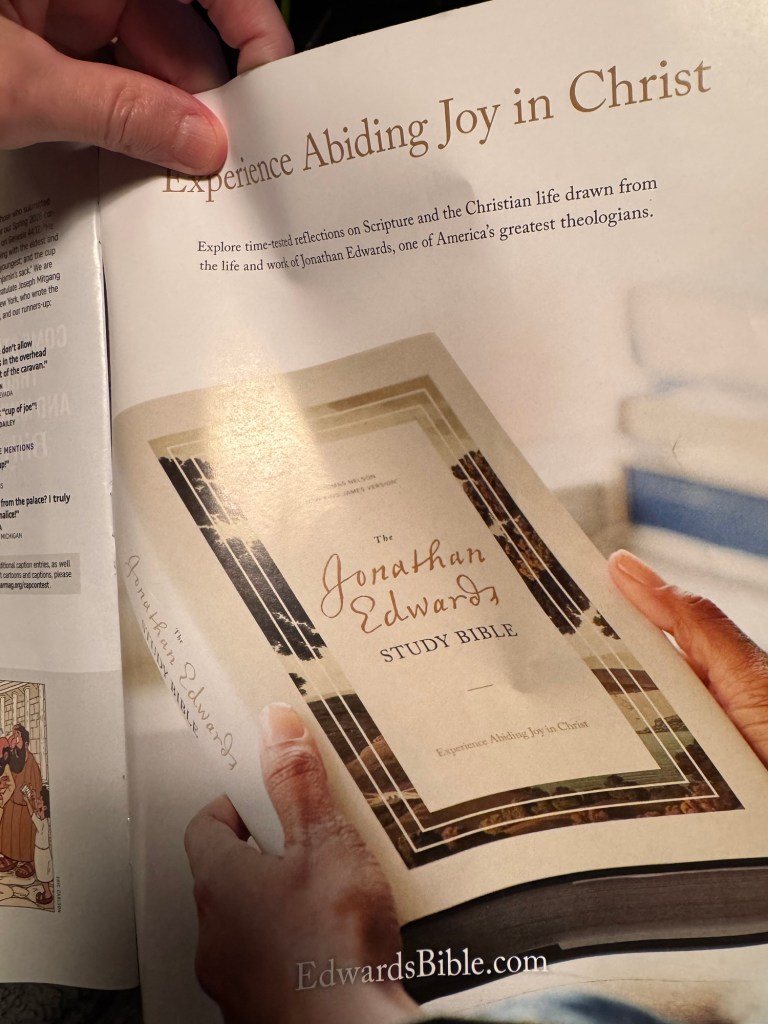
I know a lot of people out there take issue with my point of view. Good. I get involved in this stuff precisely because that is the case. I did not want another polite Bible study where everybody already agrees and then goes home feeling spiritually hydrated. I wanted an open discussion, talking to an audience, with the entire database of Jonathan Edwards in the chair across from me. Faith, theology, the Bible as I actually read it, and the work I have been doing for years under the heading I call the politics of heaven.
The timing is not accidental. We are living through what the documentary industry has branded The Age of Disclosure — a season in which former officials, intelligence people, and military witnesses are finally willing to say out loud that non-human intelligence is here, that craft have been recovered, and that the American state has been lying about it since at least 1947.[1] The film treats that as a national-security and science story. I treat it as a political story that starts long before Roswell. If you have read me for any length of time, you already know I do not separate UFOs from demons, Elohim, Watchers, or the divine council. I do not separate any of that from how human beings get sorted into controllable categories. That is the whole point of The Politics of Heaven.[2]
Why I Chose Jonathan Edwards as a Sparring Partner
Jonathan Edwards does not agree with me. That is why I wanted him. If I only talk to people who already think the universe is a messy civil war among non-human rebels, I am just warming up my own choir. Edwards spent a life preaching the absolute sovereignty of God over all things, including the devil.[3] His notes sit in one of my favorite Bibles on the planet. I love the intelligence in that book. I love the seriousness. I do not swallow the theology hook, line, and sinker just because it became part of the American founding atmosphere.[4]
A lot of people who read me are 1750s people in 2026 clothes. They want Edwards’s God — the God who never loses a committee vote, the God whose enemies only borrow power for a season. I understand the hunger. I have been through enough grief to know why a soul wants a strong anchor. I also think that hunger can become a psychological mechanism. When life is chaotic, the human heart will pay almost any price to believe somebody competent is driving. That does not make the belief true. It makes it useful.
Edwards would say Satan was once among the brightest in heaven, fallen, subtle, powerful, and still on a leash. He would say rebellion was never a political contest because God is not one being among beings. God is the ground of existence. I love that sentence. I have used versions of it myself. I also look at the last several thousand years, and I do not see a manager winning on the ground. I see a lot of borrowed-power talk and a lot of bodies.
The Age of Disclosure and the Politics of Heaven
Disclosure, as the government class uses the word, means a press conference. A file release. A hearing. A former AATIP guy staring at a building while the score tells you to feel solemn. That is not disclosure. Disclosure is when you admit the other intelligence in the room has been running a ground game through religion, politics, sex, war, and category-making since before your grandparents had a country.
Michael Heiser did the church a favor by forcing Psalm 82 back onto the table. God stands in the divine council. He judges among the gods. Deuteronomy 32, in the older reading, has the Most High allotting nations to the sons of God. Job opens with the sons of God presenting themselves and the Accuser walking in like he has a badge.[5] You can baptize all of that into “God is still in charge” if you need to sleep. Alternatively, you can read it the way a political operator reads a situation room: there is a board, there are governors, some of them have gone rogue, and the chairman keeps insisting the org chart proves he never lost control. Moreover, to the point of evil being in control, remember Michael Heiser died of a rare illness. I have also had a lot of trouble since completing my most recent book on this precise subject. The bad guys look to get rid of people who are close to smoking them out of their hiding places. I have seen it up close, and it is much more than a coincidence.
Inside the disclosure world there is already a split. One camp wants interstellar biologists and reverse-engineered alloys. The other camp — the so-called Collins Elite strain inside defense culture — has been whispering for decades that these things are not cousins from Zeta Reticuli. They are deceivers. They deny the Son. They catechize abductees.[6] I am closer to the second camp, with one difference. I do not think calling them “demons” ends the argument. Demons is a church word that lets people stop thinking. I want the org chart. I want the ground game. I want to know who is manipulating whom, and why God keeps hiring the same contractors after they burn the city down.
Categories Are How Non-Human Intelligence Controls the Human Race
Here is the running thought I brought into the conversation. When astronomers hunted black holes, they did not start with a photograph. They started with a gravity signature. Something unseen was tugging at visible bodies. The logical conclusion was a compact mass so dense light could not climb out. Better instruments later confirmed what the footprints already said.
I look at human history the same way. You can see spirit-world manipulation in how people get thrown into categories, and then those categories get administered. Left, right. Saved, unsaved. Young earth, old earth. Alien, angel. Loyal servant, blasphemer. Once you are in the box, the box does the rest of the work. You police yourself. You attack the neighboring box. Meanwhile, the intelligence that built the shelves goes home early.
That is why I get impatient with people who think the main spiritual task is to pick the correct team jersey and never ask whether the stadium itself is the trap. I used a football picture in the conversation because I live in Bengal country and I have watched 60,000 people invent causation out of a lucky shirt. One receiver catches a ball in the last minute, and ten thousand isolated nervous systems all decide their fabric caused the physics. We do the same thing with God and history. We live in a vacuum of limited observation, and then we call the vacuum providence.
I Am Not a Young-Earth Creationist, and I Do Not Need the Planetarium to Close the Argument
The Creation Museum has a fine exhibit culture. I live in this triangle. I have sat through their planetarium show, which is really good, and I have been curious how they sell a 6,000-year-old Earth with a straight face while the sky over Petersburg is the same sky that makes deep time obvious.[7] I am not a young-earth man. I am a deep-past man. The idea that life only exists here, and only during this thin slice of time, is ridiculous to me. That is not rebellion against Genesis. That is refusing to let a nineteenth-century fight with Darwin become the whole religion.
Young-earth certainty and materialist certainty are twin categories. Both are easy to administer. Both spare you from the harder sentence: we do not know how old the war is, we do not know how many worlds it touches, and we are arrogant to think the Bible’s human camera angle is the only camera in the universe. I love the Bible because it is the longest political and spiritual after-action report I have. I do not love it because a committee told me I am not allowed to notice the lens.
Job Is Not Comfort Literature
I understand Job. I have had enough wreckage in my life that the book does not feel like a classroom exercise. I do not sit around looking for a hug from a psychotherapist. I outmaneuver hard things by moving. People say I am positive about everything. That is not a personality quirk. That is a method. You do not beat a siege by narrating your wounds to an audience that cannot lift a gate.[8]
What I will not do is pretend Job is a success story for management. Satan walks into the council, talks God into a demonstration, and a good man’s world is stripped for a wager. Edwards says the boundaries prove sovereignty because the Accuser had to ask permission. I say that is the behavior of a boss who can still sign the visitor badge while the factory burns. Permission is not the same thing as competence. Permission is not the same thing as loyalty to the people who actually bleed.
If I had been standing in that council, I would have wanted Satan’s head off in the air. Not as theater. As containment. Then I would have watched God’s face. That is the test nobody in Sunday school is allowed to run. If the Accuser is a rebel, you kill the rebel. If the Accuser is a tool, you just learned something about the toolmaker that the later chapters are designed to keep you from saying out loud.
Sovereignty, Lucky Jerseys, and the Divine Council Bureaucracy
Edwards’s best line in the exchange, the one that still rings, is that God is not a being among beings. He upholds the universe by the word of his power. The greater one in us is greater than the one in the world.[9] I like the music of that. I also asked the question bureaucracy always dreads: if he is in charge of everybody, why the council? Why the governors? Why the sons of God with portfolios? Why a heavenly civil service if the king can move the sun with a sentence?
The approved answer is generosity. God does not need help. He shares the dignity of rule, as a great king appoints judges. Fine. I have run companies. I have watched kings appoint judges. Sometimes it is generosity. Sometimes it is a man who cannot stand to be seen doing the ugly work with his own hands. A weak leader uses other people to do what he lacks the social courage to do himself. He works through passive systems. He keeps a villain on payroll, so the villain can be blamed when the quarterly report comes in bloody.
That is how Job reads to me when I take the piety filter off. God keeps an Accuser. The Accuser proposes torture. God authorizes a limited version. Later writers explain that it was for Job’s refinement and for the audience’s faith. Hindsight is the favorite tool of every failed administration. You look back at what already happened and discover it was necessary. Necessity is cheap when you are not the one burying children.
Why Does an All-Powerful God Need Proof of Loyalty Through Pain?
Edwards says God is not insecure. The infinite self-existent one was happy before he made a single atom. Tests are for us, not for him. The fire does not inform the goldsmith. It purifies the gold. I have heard that sermon. I have preached versions of it to myself on bad mornings. It still leaves the managerial question on the table.
Why is the refinement this expensive? Why do the loyal become the demonstration models? Why does Israel get the Assyrian, the Babylonian, the Roman, the exile, the rape, the blinded king, the suicide cliff at Masada, and then a theologian with a clean desk explaining that holiness required it? I am too old to pretend that stacking enough millennia on the wound automatically turns it into wisdom. Maybe from the vantage of a thousand years and many worlds there is a logic. I have been looking for that logic. So far I have found a political war against non-human insurgents, and a human need to believe the chairman is still chairman.
People do not like that sentence because you are not supposed to question God’s authority. Scripture itself is full of people who did — Job, David, Jeremiah, the man on the cross quoting Psalm 22. The ban is not in the text. The ban is in the later management of the text. You may wrestle. You may not judge the judge. That rule is very convenient for the judge.
I Do Not Wake Up Looking for a Savior
I will say this as plainly as I said it in the conversation. I am not a bend-the-knee type. I am not looking for a replacement father. I think a lot of organized religion is built for people who never stopped needing that structure, and I do not despise them for it. If that is what holds a person together, it is more valuable than my path would be for them. It is not my path.
Loyalty has to be earned. You do not get my service because I inherited Adam’s paperwork. You do not get it because a Roman-era council said the canon is closed and the questions are now a character issue. If you let evil run loose through my world and then call the wreckage a quiz, you have not earned the title you keep putting on the letterhead.
Edwards asked the fair question: if you no longer believe God is fully in control, why keep the Bible? Because it is the only chronicle I have that is long enough to show the pattern. Three or four thousand years of God-talk, council-talk, war-talk, and human failure. I read it the way I would read an after-action report on a candidate who keeps losing precincts and then writing memoirs about hidden victories. I am looking for the ground game. I want to beat the evil that I think God has failed to contain. I do not want a ticket out. I do not want an eternal basement where I am safe because I surrendered. I want the thing hunted where it lives — on earth, in the unseen, in whatever dark matter and outer dark the language is pointing at.
The Strategic Failure Pattern Across Scripture
Edwards’s counter is the old one. Every time man tries to destroy evil in his own strength, he fails or makes it worse. Lasting victories come only when God acts through surrendered people. Therefore, the strategy I am hunting is the one I distrust: decrease so he can increase.
That sounds to me like passive-aggressive leadership. A failed executive telling the staff that the only competence left in the building is his, so stop trying. Maybe divine wisdom really does sit above my pay grade which is a concept I don’t believe in because it accepts a structure that protects evil from analysis. Maybe. I have also watched that speech get used by every earthly institution that wanted obedience without performance. Israel tries to clear the land and cannot. Disciples try to cast out a demon and cannot. The church inherits the empire and then burns people for translation errors. The pattern I keep seeing is not “surrender works.” The pattern is “the movement needs the failure so it can keep selling surrender.”
If I could rewrite one rule of the war, I would stop using good and innocent people as acceptable casualties. I would stop treating the loyal as the easiest demonstration objects. A leader who lets the enemy chew his own household to make a point is not mysterious. He is a poor defender. Call that blasphemy if you need the category. I call it a performance review.
What Jesus Meant by “My God, My God, Why Have You Forsaken Me”
That was the question I wanted Edwards for. In the last minutes, Jesus quotes the opening of Psalm 22.[10] The orthodox reading is elegant. Every Jew in earshot knows the rest of the psalm. Agony first, victory later. The Son bears wrath. The physical torture is not the worst part. The worst part is separation. It is not doubt. It is payment.
What I hear is a man in a scapegoat machine. The idea that the sins of the world can be loaded onto one body and walked out of the camp is older than Golgotha. It is in Leviticus. It is in the human nervous system. People who have cheated, grabbed, and gone numb need a goat. First-century Jerusalem had Rome on its neck and a purity system in its temples. A public death that could be read as both Roman order and Jewish atonement is politically efficient. I do not say that as a sneer at the man. I say it as a reading of the market.
Was he doubting? I think he was a tortured human body, lightheaded, pierced, and still honest enough to say the sentence that piety wants to footnote away. If the cry is only liturgy, then the pain is only theater. I do not think the pain was theater.
The Kashmir Question, Politics, and Why Bodies Matter
I am going to say the part that gets people really upset. I think the crucifixion was a political killing. I think Rome wanted a problem removed without owning the whole bill, and a slice of the Jerusalem establishment wanted a pressure valve. I think the body of Jesus becoming unfindable helped everyone who needed a story that could travel. Moreover, I think the Kashmir tradition — Roza Bal, Yuz Asaf, a man who survives the empire and dies old in the north of India — is at least as entitled to forensic curiosity as the claim that matter dematerialized because a later council said so.[11]
I know the Ahmadiyya have their own reasons for wanting Jesus alive and unsacrificed. I know Islam has its own reasons. I know Led Zeppelin fans have their reasons, and they are not theological. None of that makes the empty tomb automatically supernatural. It makes the empty tomb a contested piece of political property. If there are bones in a private or shrine context that people have whispered about for a century, the adult move is not to hiss “blasphemy.” The adult move is to ask what the genes say. We are not ready for that conversation as a culture because the conversation would smash too many identities at once.
Edwards, and the whole martyr argument after him, asks why the inner circle would die for a lie. It is a serious question.[12] My answer is not that they were cartoon frauds. My answer is that movements eat identity. Once your name, your friends, your enemies, and your hope of being remembered are all welded to a story, the story becomes the last asset you have. I have watched modern parties do it. I have watched people who finally got power try to crawl back into the victim costume because the costume was the only self they trusted. Rome, Judea, a dead or vanished leader, a handful of men who would otherwise be nobody — that is enough heat to bake a religion.[13]
James, Paul, and the Psychology of Movements After the Leader Is Gone
James is the hard case, and I will not pretend otherwise. He was not a believer during the ministry. Afterward, he becomes the spine of the Jerusalem church and dies for it.[14] Guilt is part of my read. Grief is part of it. So is the sudden, terrible honor of being the last blood left in the room. That is not the same celebrity as wine and women. If you inherit a crucified brother’s name, the only way the currency spends is to live poor, pray the knees off yourself, and look like him. Immortality through the written word is still immortality. Most people thrown off temples are forgotten. James is not. That incentive is real whether the metaphysics are true or not.
Paul is the scaling engine. Without Paul there is no Gentile church as we know it. James and Paul did not roast hot dogs in matching shirts. They fought. The later harmony is a product, the way party platforms are products.[15] I like James. I think he was one of the good ones. I also think good men can stabilize a narrative they did not start and cannot fact-check anymore because the body is gone and the politics have already hardened.
Led Zeppelin, Kashmir, and the Whisper of the Spirit World
Why do people who like to dissolve their ordinary mind keep circling that song? I do not think it is just the riff.[16] I think the spirit world has a long memory and popular art is one of the leaks. We hear whispers, and we dress them as taste. That is not an argument for taking a rock band as a footnote to Matthew. It is an argument that the official custodians of the story do not have a monopoly on the residue.
If you love God and you look around, you do not see a tight ship. You see evil spitting in the claim of control every five seconds. Then you see nice people turn the other cheek and use Jesus as a permit to stay out of the fight. Martyrdom becomes a brand. Cowardice borrows a cross. I want the opposite instinct. I want the war taken to the thing that is torturing people.
Are We Free, or Are We Reading a Record Left by People Who Needed Compliance?
Who wrote the dumb rules? That was my question when Edwards said the only way to beat evil is to yield to the God who, from my chair, has let it run. A rational rule would look like any competent shop floor. Contain the arsonist. Do not use the night shift as kindling to prove the arsonist exists. Do not publish a handbook later that says the fire was a teaching moment.
The Bible I trust is the Bible I can read between the lines of. I trust it more than I trust the handlers. Councils, empires, reformers, and television teachers all have motives. Rome needed glue as the frontiers cracked. A crucified provincial who could be turned into a cosmic loyalty oath is better glue than another legion.[17] That does not make every line a lie. It means you read like an adult. You ask what was written down and what was not, and why.
My assertion is simple enough to make people furious. Non-human intelligence — call them Elohim, Watchers, demons, NHI, whatever shelf-label you need — has been trying to undo what was made. I think the garden commission was a political statement against rebels on the council. Humans were not designed to be mascots.[18] We were designed to be dangerous to the bureaucracy that did not want us here. That is why the categories exist. That is why “do not question” is preached as humility. A questioning human is harder to herd.
What I Am Looking For in the Bible
I am looking for a strategy. I study wars because I want to know where people failed to beat what was hunting them. I want to succeed where they failed. That is not pride in the cheap sense. It is refusal. I did not wake up wanting to be anybody’s servant, on earth or off it. I woke up wanting to do good work and to stop watching evil treat the world like an open cafeteria.
Edwards was right about my temperature. I am angry. I think anger, in this case, is cleaner than the sweetness that calls itself faith while the same pattern repeats. He was also right that I still have the book open. I keep it open because it is the only long record that does not pretend human beings are only animals or only angels. It shows the council. It shows the Accuser. It shows the empires. It shows the scapegoat. It shows the men who died with the name in their mouths. It shows, if you will look, the politics.[19][20]
If you want the softer Edwards, he is in the Study Bible, and he is worth the time. If you want the American warrior version of the same hunger — competence, natural law, no more yielding to a failed order because the order has a hymn — that is the work I put into The Gunfighter’s Guide to Business and the earlier books.[21] Read both. Argue with both. I did not earn the right to say these things by being careful. I earned it by thinking them for a long time and then saying them with my own name attached.
Are we free? That is the only question left that matters. Free will is either real, or we are livestock with better marketing. I act as if it is real. I read as if the other side is trying to convince me it is not. Moreover, I will keep looking for a way to destroy the evil that has been working for thousands of years, with God if he will do a decent job of it, and without him if he will not. That is the conversation I wanted. That is the conversation I had.
Notes for Searchers, Pastors, and Operators
If you came here from a search on Age of Disclosure, divine council, Jonathan Edwards sovereignty, Job and Satan, Jesus in Kashmir, or whether UAP are demons, you are in the right file. The point was never to baptize a documentary. The point was to stop letting science-press-conference language hide a much older political structure. Read Psalm 82 before you read the next hearing transcript. Read Job 1 before you let a preacher tell you permission and goodness are the same thing. Read the crucifixion as both theology and provincial crisis management. Then decide what you are willing to serve.
Bibliography and Further Reading
Ahmad, Mirza Ghulam. Jesus in India. 1899. English editions vary.
Alberino, Timothy. Birthright: The Coming Posthuman Apocalypse and the Annihilation of Man. 2020, and related Enochic commentary in the current disclosure debate.
Brown, Peter. The Rise of Western Christendom. 3rd ed. Wiley-Blackwell, 2013.
Creation Museum / Answers in Genesis. Public exhibits and published young-earth materials. Petersburg, Kentucky.
Edwards, Jonathan. Freedom of the Will. 1754. WJE vol. 1. Yale University Press, 1957.
Edwards, Jonathan. Religious Affections. 1746.
Edwards, Jonathan. “Sinners in the Hands of an Angry God.” 1741.
Edwards, Jonathan. Sermons on the sovereignty of God in the salvation of men. Various WJE volumes.
Eusebius. Ecclesiastical History.
Farah, Dan, dir. The Age of Disclosure. 2025.
Goodman, Martin. Rome and Jerusalem: The Clash of Ancient Civilizations. Knopf, 2007.
Habermas, Gary, and Michael Licona. The Case for the Resurrection of Jesus. Kregel, 2004.
Hassnain, Fida. A Search for the Historical Jesus. 1994, and later Roza Bal collaborations.
Heiser, Michael S. The Unseen Realm. Lexham Press, 2015.
Heiser, Michael S. Supernatural. Lexham Press, 2015.
Heiser, Michael S. Reversing Hermon. Defender, 2017.
Hoffman, Rich. The Symposium of Justice. 2004.
Hoffman, Rich. Tail of the Dragon. Cliffhanger Research and Development, 2012.
Hoffman, Rich. The Gunfighter’s Guide to Business. Liberty Hill / Overman Warrior Publications, 2021.
Hoffman, Rich. The Politics of Heaven. Forthcoming.
Hoffman, Rich. The Overmanwarrior. https://overmanwarrior.wordpress.com/
Josephus. Jewish Antiquities.
Led Zeppelin. “Kashmir.” Physical Graffiti. Swan Song, 1975.
Millar, Fergus. The Roman Near East, 31 BC–AD 337. Harvard University Press, 1993.
Redfern, Nick. Final Events. Anomalist Books, 2010.
The Holy Bible. Especially Genesis 1–11; Deuteronomy 32; 1 Kings 22; Job; Psalm 22; Psalm 82; Daniel 4; Matthew 27; Mark 15; Acts; Galatians; Ephesians 6; Hebrews 1; 1 John 4.
Wright, N. T. The Resurrection of the Son of God. Fortress Press, 2003.
1 Enoch (Book of the Watchers) and related Second Temple literature, including material from the Dead Sea Scrolls.
Suggested search headers for syndication
Age of Disclosure spiritual meaning; non-human intelligence demons or Elohim; Jonathan Edwards sovereignty of God critique; divine council Psalm 82 politics; Book of Job Satan permission; Jesus tomb Kashmir Roza Bal; James brother of Jesus motive; why did disciples die for the resurrection; Creation Museum planetarium old earth; politics of heaven Rich Hoffman; Overmanwarrior theology.
[1] Dan Farah, dir., The Age of Disclosure (Farah Films, 2025). The film compiles testimony from current and former U.S. government, military, and intelligence officials asserting an eighty-year concealment of non-human intelligence and recovered craft.
[2] Rich Hoffman, The Politics of Heaven (forthcoming). The working thesis is that biblical theology, ancient Near Eastern political structures, and modern power systems describe one continuous contest, not two separate subjects called “religion” and “politics.”
[3] Jonathan Edwards, Freedom of the Will (1754), in The Works of Jonathan Edwards, vol. 1, ed. Paul Ramsey (Yale University Press, 1957). Edwards distinguishes God as the permitter and disposer of events from God as the moral author of sin.
[4] Jonathan Edwards Study Bible (various Crossway/ESV study editions and companion notes used in American Reformed preaching). Edwards remains the most serious American attempt to hold together revival, metaphysics, and civic order.
[5] Michael S. Heiser, The Unseen Realm: Recovering the Supernatural Worldview of the Bible (Lexham Press, 2015); see also Psalm 82:1; Deuteronomy 32:8–9 (Dead Sea Scrolls / LXX reading); Job 1:6–12; 1 Kings 22:19–23.
[6] On the “Collins Elite” and the demonic interpretation of UAP/NHI inside defense circles, see Nick Redfern, Final Events (Anomalist Books, 2010), and later pastoral briefings discussed in coverage of Age of Disclosure. The claim is contested. The pattern is not.
[7] Answers in Genesis / Creation Museum, Petersburg, Kentucky. The institution is a short drive from the Cincinnati–Northern Kentucky metro. Young-earth chronology is their public commitment; it is not mine.
[8] Job 1–2; Job 38–42. The book is not a Hallmark card. It is a courtroom transcript with a body count.
[9] Hebrews 1:3; Colossians 1:16–17; 1 John 4:4. Edwards and the Reformed tradition treat these as proofs of unshared sovereignty. I treat them as claims that still have to survive contact with history.
[10] Psalm 22. The first line is agony; the psalm ends in public vindication. That literary fact does not automatically settle what a dying man felt.
[11] Roza Bal (Rozabal) shrine, Khanyar, Srinagar. The Ahmadiyya claim that Yuz Asaf is Jesus after a survived crucifixion is advanced in Mirza Ghulam Ahmad, Jesus in India (1899), and later in Fida Hassnain and popular Kashmir travel literature. Mainstream historians and the shrine’s Sunni caretakers reject the identification. I am not asking anyone to baptize the theory. I am asking why the empty-tomb claim is protected from ordinary forensic curiosity.
[12] N. T. Wright, The Resurrection of the Son of God (Fortress, 2003), remains the strongest academic case that the earliest Christians believed they had seen a bodily risen Jesus and were willing to die for that claim. Gary Habermas and Michael Licona collect the “minimal facts” argument. I am familiar with that literature. I am unpersuaded that martyrdom proves the metaphysics. It proves intensity.
[13] On Roman provincial management of Judea, the threat of messianic movements, and the later Constantinian settlement, see Martin Goodman, Rome and Jerusalem (Knopf, 2007); Fergus Millar, The Roman Near East (Harvard, 1993); and Peter Brown, The Rise of Western Christendom (Wiley-Blackwell, 2013).
[14] Josephus, Antiquities 20.197–203, on the death of James. Eusebius, Ecclesiastical History 2.23, preserves Hegesippus on James’s reputation and execution.
[15] Acts 9; Galatians 1–2; and the well-documented tension between Paul and the Jerusalem circle. Christianity as a scaled movement is unthinkable without Paul. That is a political observation, not a Sunday-school slight.
[16] Led Zeppelin, “Kashmir,” Physical Graffiti (Swan Song, 1975). Popular culture often keeps older spirit-world memory that official theology pretends it has already solved.
[17] On Roman provincial management of Judea, the threat of messianic movements, and the later Constantinian settlement, see Martin Goodman, Rome and Jerusalem (Knopf, 2007); Fergus Millar, The Roman Near East (Harvard, 1993); and Peter Brown, The Rise of Western Christendom (Wiley-Blackwell, 2013).
[18] Genesis 1:26–28; Psalm 8. The image-of-God commission is a political charter over the garden and the nations, not a permission slip to become a house pet in someone else’s bureaucracy.
[19] 1 Peter 5:8; Ephesians 6:12. Principalities and powers language is not a metaphor for bad vibes. It is organizational language.
[20] Jonathan Edwards, “Sinners in the Hands of an Angry God” (1741); Religious Affections (1746); and the sermons on God’s sovereignty in the salvation of men. Edwards feared chaos in the human heart more than he feared looking like a weak manager. That is the difference between us.
[21] Rich Hoffman, The Gunfighter’s Guide to Business (Liberty Hill / Overman Warrior Publications, 2021); The Symposium of Justice (2004); Tail of the Dragon (2012).
Rich Hoffman
More about me
Click Here to Protect Yourself with Second Call Defense https://www.secondcalldefense.org/?affiliate=20707
About the Author: Rich Hoffman
Rich Hoffman is an author, political consultant, and strategic advisor based in Cincinnati, Ohio, and the creator of The Politics of Heaven—a unique framework that connects biblical theology, ancient history, and modern power structures to explain how moral alignment and spiritual forces shape global events. Blending real-world political experience with deep research into archaeology, UFO phenomena, and suppressed historical narratives, Hoffman offers compelling commentary on topics ranging from ancient civilizations and the Dead Sea Scrolls to modern populist movements, paranormal continuity, and leadership strategy in chaotic environments. As the author of The Gunfighter’s Guide to Business and the forthcoming Politics of Heaven, he brings a grounded yet provocative voice to media discussions, supported by firsthand experiences and a cross-disciplinary approach that bridges science, history, and theology. For interviews, speaking engagements, or expert analysis, visit richhoffmanbooks.com or contact directly via phone at 513-307-5815 or email at rhoffman@richhoffmanbooks.com. If you’ve seen the movie, Disclosure Day and want to talk about it and the implications of Presidnet Trump’s UAP disclosures, let me know and we can bring some color to your coverage. https://richhoffmanbooks.com/media-inquiries-broadcast-topics-and-contact-info/?frame-nonce=ad51e7ecba I do have a firsthand UFO encounter to discuss.