Rich Hoffman is an author, political consultant, and strategic advisor based in Cincinnati, Ohio, and the creator of The Politics of Heaven—a unique framework that connects biblical theology, ancient history, and modern power structures to explain how moral alignment and spiritual forces shape global events. Blending real-world political experience with deep research into archaeology, UFO phenomena, and suppressed historical narratives, Hoffman offers compelling commentary on topics ranging from ancient civilizations and the Dead Sea Scrolls to modern populist movements, paranormal continuity, and leadership strategy in chaotic environments. As the author of The Gunfighter’s Guide to Business and the forthcoming Politics of Heaven, he brings a grounded yet provocative voice to media discussions, supported by firsthand experiences and a cross-disciplinary approach that bridges science, history, and theology. For interviews, speaking engagements, or expert analysis, visit richhoffmanbooks.com or contact directly via phone at 513-307-5815 or email at rhoffman@richhoffmanbooks.com. If you’ve seen the movie, Disclosure Day and want to talk about it and the implications of Presidnet Trump’s UAP disclosures, let me know and we can bring some color to your coverage. https://richhoffmanbooks.com/media-inquiries-broadcast-topics-and-contact-info/?frame-nonce=ad51e7ecba I do have a firsthand UFO encounter to discuss.
I have watched this movie before. In 2015 and 2016, and again in 2024, the same class of people tried to tell America that Donald Trump’s wealth was a character defect. They said a rich man could not be trusted, that success itself was the indictment, that gold, planes, and golf were proof he was “not like you.” Voters put him in the White House twice anyway, because they understood something the professional scolds never will: independence is an asset. A man who does not need the job is harder to own. That is the lesson Ohio Democrats and a handful of leftover Republican wreckers are now trying to unlearn with Vivek Ramaswamy, and it is why Amy Acton spent Labor Day weekend screaming that you cannot buy Ohio.
She needed a chant. What she got was a gaffe.
The Speech That Sounded Like a Person Running Out of Road
Watch the clip. Acton is at a union picnic with Pete Buttigieg in tow, doing the ritual of the lockdown years: I am a doctor, not a politician, becoming one right in front of your eyes. Then she starts barking that Vivek cannot buy the state, cannot buy Ohio, cannot buy us, cannot buy us, cannot buy us in Ohio, that is the end of this. It is the sort of thing a campaign writes on a whiteboard when the internals look ugly and the only remaining argument is envy. The crowd does not catch fire. She looks like she is trying to start a wave at a funeral.
This is the same Amy Acton Ohio already knows. She ran public health under Mike DeWine when the state was locked down, businesses were smashed, kids were sent home, and “follow the science” became a political religion. She collected awards for it. A lot of Ohioans collected unemployment, missed funerals, and watched their Main Streets die. You can call that public service if you like. I call it the record she has to run on, and it is why the “I’m just like you” routine lands like a lead pipe. She is not just like you. She is the woman who told you to stay home while the people who write the rules kept their salaries.
The wealth attack is even thinner. Vivek flew to watch tennis. He likes tennis. He used to be a ranked junior. He has a court. He went to the U.S. Open and he has been to Paris. Wealthy people do that. Trump never ran from Mar-a-Lago or the golf course; he wore the gold clip and the silk tie and said, yes, I did well, and if you vote for me I will try to make it so you can do well too. That is a producer’s message. Acton’s message is the opposite: he has money, therefore he is illegitimate, therefore hand the keys to the people who want to tax the successful and redistribute the proceeds to the discontented. That is not a governing philosophy. That is a ransom note.
Why Attacking Wealth Is a Loser’s Tell
I have been thinking lately about the Apostle Paul. He was effective in part because he had standing and independence. He was not a ward of the movement. He could travel, argue, and endure because he was not begging the crowd for his next meal. Politics is not the church, but the principle is the same. A candidate who has already won in the private economy does not need Columbus the way a career public-health administrator needs Columbus. Vivek does not need a government job. That is supposed to be a feature. The people yelling “you can’t buy Ohio” are announcing that they cannot raise comparable money and cannot compete on growth, so they will compete on resentment.
David Pepper and the rest of the chorus have been working this line for months: billionaire, private jet, not one of us. Fine. Then explain why Trump’s jets and clubs did not stop two national victories, and why Ohioans who want plants, capital, and jobs might prefer a man who has already built companies to a woman whose signature achievement was closing the state. You can dislike Vivek’s style. You can argue policy. What you cannot do, with a straight face, is pretend that enjoying a tennis match is a civic crime while the alternative is more of the administrative state that already had its turn.
The other half of this farce is intra-Republican sabotage. After a primary, Democrats lock arms around whoever they nominated, even when she sounds like a chalkboard dragged down a stairwell. A slice of the right still wants to pick the scab. Nick Fuentes types, leftover primary rivals, the professional “I told you so” circuit—anyone who would rather be right about a Republican’s flaws than win the state—keep feeding the same clip. They did it to Trump in 2016 and 2024. He won anyway because voters vote their interest when the noise dies down. A good economy and job creators in your state beat a sermon about how the other guy’s plane is too nice.
Then Came the Fair, and the Overnight Conversion of a Shove Into an Assassination Plot
The timing is the tell. After the Labor Day chant made her look unhinged, the campaign needed a new story. Sunday at the Canfield Fair, a 38-year-old local named Patrick Havas pushed through a tent crowd toward Acton with a phone up, as if he were recording or trying to get close enough to be seen. He knocked over older people. Security took him down. After the fact, deputies found two pistols and a Taser-style device on him. He did not draw the guns. He did not fire. He did not brandish. Ohio is a constitutional-carry state. Carrying is not the same thing as attempting murder. The charges reported were disorderly conduct and misdemeanor assault for the people he knocked down. Acton was unhurt. The people who fell were assessed and, according to the sheriff, did not seek further treatment.
That is a bad scene at a fair. It is not a martyrdom. Campaign statements still said an “armed individual lunged” and injured multiple people. National copy followed the verb. By Saturday night into Sunday the lead was written as if Ohio had just watched a political assassination attempt. If there were clean video of a man trying to kill her, it would have been on every screen before supper. What we got instead was language inflation: lunge, attack, armed, threat—while the actual police story is a large man barreling for a better look or a confrontation, knocking seniors like bowling pins, and getting piled on by Highway Patrol.
This attack story is just another Democrat Jussie Smollett story, trying to gain sympathy and voter support through fake news talking points. This is the fullness of the Acton operation: when the speech is a disaster, change the subject to danger. When you cannot raise on growth, raise on fear. When you cannot debate or raise money, accuse the other side of buying the state. Look how many sucker politicians jumped on the bandwagon without knowing all the facts, which again came out looking like Amy Acton is a loser candidate.
What Ohio Actually Chooses When the Cameras Leave
Acton will keep the unions, the people who want the next transfer payment, and the media that still thinks 2020 was her finest hour. She will keep Pepper on the ticket as proof that the old Democratic machinery is still in the room. She will keep calling Vivek rich, which he is, and hoping Ohio has forgotten that successful people are allowed to like tennis, football Saturdays, and a life that is not a permanent campaign stop.
I want a state that recruits producers instead of lecturing them. If a man with a billion dollars in assets spends a few thousand to fly to a match, that is not the scandal. The scandal is a political class that treats his success as the crime and her lockdown résumé as the credential. Trump never apologized for winning. Vivek should not apologize for a court, a jet, or a seat at the Open. The people who need him to grovel are the same people who needed Trump to grovel. They lost that argument twice.
Vote like you want the factories and the payrolls. When things got tough for Amy Acton in 2026 she turned to fake news. Which only made everything worse. She is the lockdown lady and is horrible in every way a politician can be, which we all had a front-row seat to in 2020 when she destroyed Ohio’s economy and told everyone they could be superheroes if only they wore a mask in public. That is the person running for governor in Ohio as a Democrat. A disaster on a good day. On a bad day, she is a fake news agent of destruction and drunkenness.
Notes
1. Acton’s Labor Day-weekend remarks with Buttigieg at the Cincinnati AFL-CIO picnic, including the “you cannot buy this state / you can’t buy us” repetition, circulated widely on September 5–6, 2026. See WLWT coverage of the Hamilton picnic and contemporaneous rally video.
2. Acton served as Ohio Department of Health director under Gov. Mike DeWine beginning in 2019 and became the public face of the state’s COVID restrictions.
3. Criticism of Ramaswamy’s travel and tennis included Acton’s own Labor Day-weekend post attacking a U.S. Open appearance and earlier opinion pieces on a July 4 Paris trip.
4. Ramaswamy’s tennis background (junior player, Cincinnati Open ball boy, regular Open attendee) is part of his public biography and prior campaign videos.
5. Canfield Fair incident, September 6, 2026: Patrick Havas, 38, of Canfield, pushed through the Mahoning County Democratic Party tent, knocked down older attendees, was detained by Ohio State Highway Patrol executive protection; weapons recovered after detention; no brandishing reported; charges reported as disorderly conduct and two counts of misdemeanor assault. Acton uninjured.
6. Constitutional carry in Ohio means possession of a concealed firearm, without more, is not itself an assassination attempt.
7. Public polling through late summer 2026 generally showed a toss-up to slight-Ramaswamy edge depending on the house, which is consistent with a campaign hunting for a reset narrative.
8. Intra-GOP sniping after contested primaries is a recurring feature of the Trump era; Democrats have typically consolidated faster around flawed nominees.
Bibliography
Acton for Governor. Campaign statements and Labor Day / Canfield Fair remarks, September 2026.
Ballotpedia. “Amy Acton.” Candidate biography and office history.
CNN. “Armed man arrested after pushing through crowd toward Ohio Democratic gubernatorial nominee.” September 6, 2026.
Columbus Dispatch. “Armed man arrested after lunging at Amy Acton at Canfield Fair.” September 6, 2026.
Cincinnati Enquirer. Nick Anderson, “Ramaswamy’s Paris trip an example of his disconnect with Ohioans.” July 8, 2026.
HuffPost. “Vivek Ramaswamy Slammed For Leaving Ohio And Attending The U.S. Open.” September 6, 2026.
Mahoning County Sheriff’s Office / Ohio State Highway Patrol statements on the Canfield Fair detention of Patrick Havas, September 6, 2026.
New York Times. “Armed Man Arrested After Charging Toward Democratic Candidate for Ohio Governor.” September 6, 2026.
The Nerd Stash. “‘You Can’t Buy Us’: Ohio Dem Amy Acton Sparks Backlash After Awkward Rally Chant Aimed at Vivek Ramaswamy.” September 6, 2026.
Washington Post. “Armed individual ‘lunged’ at Democrat nominee for Ohio governor, campaign says.” September 6, 2026.
Wikipedia. “2026 Ohio gubernatorial election.” Polling averages and race ratings as of early September 2026.
WLWT. “Pete Buttigieg campaigns for Amy Acton, Greg Landsman at Cincinnati AFL-CIO picnic.” September 6, 2026.
Rich Hoffman is an author, political consultant, and strategic advisor based in Cincinnati, Ohio, and the creator of The Politics of Heaven—a unique framework that connects biblical theology, ancient history, and modern power structures to explain how moral alignment and spiritual forces shape global events. Blending real-world political experience with deep research into archaeology, UFO phenomena, and suppressed historical narratives, Hoffman offers compelling commentary on topics ranging from ancient civilizations and the Dead Sea Scrolls to modern populist movements, paranormal continuity, and leadership strategy in chaotic environments. As the author of The Gunfighter’s Guide to Business and the forthcoming Politics of Heaven, he brings a grounded yet provocative voice to media discussions, supported by firsthand experiences and a cross-disciplinary approach that bridges science, history, and theology. For interviews, speaking engagements, or expert analysis, visit richhoffmanbooks.com or contact directly via phone at 513-307-5815 or email at rhoffman@richhoffmanbooks.com. If you’ve seen the movie, Disclosure Day and want to talk about it and the implications of Presidnet Trump’s UAP disclosures, let me know and we can bring some color to your coverage. https://richhoffmanbooks.com/media-inquiries-broadcast-topics-and-contact-info/?frame-nonce=ad51e7ecba I do have a firsthand UFO encounter to discuss.
Pip: The Overmanwarrior is a show that refuses the easy road — no local gossip, no algorithm-friendly takes, just a man and a copper pit older than the pyramids’ reputation, asking whether the whole story of this continent needs to be rewritten.
Mara: Rich Hoffman’s recent work covers a lot of ground — Trump’s renaming of Lake Ontario, the deep prehistory of the Great Lakes, the Copper Scroll, and what the word “indigenous” is actually doing in a political argument. Let’s start with the lake, the copper, and why the naming fight is really about something much older.
Lake America and the Copper That Built the Ancient World
Pip: The segment opens with a provocation: Trump signed an executive order on August 27th renaming Lake Ontario as Lake America, and the argument here is that the outrage that followed is actually the point — that names are how institutions teach a public what to value and what to be ashamed of.
Mara: The post frames the whole project this way: “I am trying to encourage people to come down the rabbit hole and take whatever treasure they can carry back out.” That’s the method — not a seminar, not a grievance catalog, but a sustained question about what the naming fight is actually downstream of.
Pip: And what it’s downstream of, the argument goes, is an institutional habit of treating the founding of the United States as the continent’s original sin — where every pre-Columbian name becomes untouchable and every American assertion becomes an act of erasure.
Mara: Canada’s prime minister said the lake is called Ontario “today and forever.” New York’s governor said the state wouldn’t use the new name. The legal reality is narrow — Washington can rename what Washington prints, it cannot rename what Toronto says — but that gap is exactly why a name becomes a weapon.
Pip: The copper is where this gets genuinely interesting. The Old Copper Complex of the Upper Great Lakes — Isle Royale, the Keweenaw Peninsula — shows prehistoric pits worked by hunter-gatherers dating into the ninth millennium before the present. More than a thousand pits on Isle Royale alone. That is not a weekend hobby.
Mara: The post is careful here. Two things it calls firm: Archaic people of the Upper Great Lakes worked native copper very early, with some dates rivaling the oldest copper work in the Old World, and the metal is so pure it can be hammered without smelting. The leap — walking that copper across the Atlantic to Solomon’s Temple — is flagged as a leap that still needs isotope evidence.
Pip: Then there’s the Windover site in Florida — a pond cemetery near Titusville where a backhoe in 1982 pulled up human bone dating seven to eight thousand years before the present. Brain tissue. Woven fiber. A readable last meal. A civilization of burial custom standing on this peninsula while the Near East was still becoming Egypt.
Mara: The Moon-eyed people tradition rounds out the prehistory argument. Cherokee oral memory, as recorded by early settlers, described finding and displacing a pale, light-shy people already living in the southern Appalachians. The point isn’t to convict a ghost — it’s that if the Cherokee displaced someone, they were the latest people of that ridge, not the first.
Pip: Which is exactly the human story from the Levant to the Andes — and exactly what the political use of “indigenous” tries to freeze out of the frame. The Copper Scroll enters as a related question: not where did the Temple treasure go, but where did the metal economy that made such a list thinkable come from in the first place.
Mara: The post asks whether the ancient Near East’s enormous copper hunger has been fully inventoried. Timna and the Arabah are on the map; recent radiocarbon work has restored a tenth-century industrial peak there. Lake Superior is the name the textbooks treat as a category error. The argument is that asking the question is scholarship — treating the crossing as proven is not.
Pip: So “Lake America” is doing a lot of work for four syllables. It’s not cartography — it’s a forced discussion about whether the United States is allowed to name its own waters without first clearing the claim through a political story that starts in 1492 and ignores every copper pit that came before.
Mara: The post puts it plainly: the copper miners of Superior, the burial people of Windover, the builders on the dry bay floor — those are indigenous facts. The political slogan that uses “indigenous” to unmake the United States is, the argument goes, not a fact. It is a maneuver.
Pip: And if the question of who names a lake connects to who gets to name the country itself, then the next question is what other forces — beyond the political — might have an interest in keeping that shame in place.
Mara: The thread running through all of this is the same question applied at different scales — are we getting what we want from the story we’ve been handed, whether that story is about a lake, a copper pit, or a national identity?
Pip: Follow the copper. Follow the names. That’s the assignment — and something tells me the rabbit hole goes considerably deeper than the bottom of Lake Superior.
Rich Hoffman is an author, political consultant, and strategic advisor based in Cincinnati, Ohio, and the creator of The Politics of Heaven—a unique framework that connects biblical theology, ancient history, and modern power structures to explain how moral alignment and spiritual forces shape global events. Blending real-world political experience with deep research into archaeology, UFO phenomena, and suppressed historical narratives, Hoffman offers compelling commentary on topics ranging from ancient civilizations and the Dead Sea Scrolls to modern populist movements, paranormal continuity, and leadership strategy in chaotic environments. As the author of The Gunfighter’s Guide to Business and the forthcoming Politics of Heaven, he brings a grounded yet provocative voice to media discussions, supported by firsthand experiences and a cross-disciplinary approach that bridges science, history, and theology. For interviews, speaking engagements, or expert analysis, visit richhoffmanbooks.com or contact directly via phone at 513-307-5815 or email at rhoffman@richhoffmanbooks.com. If you’ve seen the movie, Disclosure Day and want to talk about it and the implications of Presidnet Trump’s UAP disclosures, let me know and we can bring some color to your coverage. https://richhoffmanbooks.com/media-inquiries-broadcast-topics-and-contact-info/?frame-nonce=ad51e7ecba I do have a firsthand UFO encounter to discuss.
Pip: The Overmanwarrior has thoughts on party unity, and they are not delivered quietly.
Mara: Rich Hoffman’s recent writing zeroes in on one question: when does a county GOP chair’s public posture stop building the team and start doing the opposition’s work for them? Let’s start with the wine metaphor — and why it matters eight weeks before a midterm.
Don’t Sour the Wine: Lectures, Loyalty, and the Midterm Math
Mara: The post opens with a genuine acknowledgment that chairing a county party is hard, thankless work — and then pivots to a specific warning about what happens when the chairman’s message lands in print.
Pip: The Journal-News ran the new Butler County GOP chair’s priorities, and the quote that crystallized everything is this one: “The Republicans that are in office need to learn to cut spending and cut taxes, and I have not been seeing that happen, and it displeases me.”
Mara: That sentence is the spine of the argument. Once it’s in the paper, it belongs to every Democrat, every fence-sitter, and every volunteer quietly deciding whether this job is worth the abuse.
Pip: And the timing is the real problem. Democrats don’t have to beat Republicans if Republicans brand their own officeholders as failures eight weeks before Election Day. Kathy Wyenandt — cited here as the visible face of the Butler County Democratic Party — doesn’t need a majority tomorrow. She needs Republicans to do her turnout work for her.
Mara: The post draws a sharp distinction between the substance and the delivery. Cutting spending, reducing waste, watching the schools — those aren’t radical asks in a Republican county. The argument is tone, timing, venue, and target.
Pip: There’s a fast-food manager analogy in here that earns its keep. Barking works on teenagers folding boxes. It does not work on people you’re asking to put their name on a ballot, absorb the hate mail, and run again in two years.
Mara: The post also invokes David Kern — a Liberty Township trustee for 32 years who briefly chaired this same county party and, by the post’s account, discovered the hard way that herding quarreling Republicans is a different sport than fighting Democrats. That history, the argument goes, is sitting right there for anyone who wants to read it instead of repeating it.
Pip: And then there’s the Nicodemus point, which is doing real work. Nicodemus loved the message and still had to remain a functioning member of the priesthood. Serious politics is not a purity cult.
Mara: The post is direct about the arithmetic: the absolutist slice of the party is estimated well under 40 percent of Butler County Republicans, with the rest on the fence or transactional. Lecture the 60 percent as if they’re the problem, and you meet them later on the other side of the aisle — or at home on the couch.
Pip: The advice at the end is genuinely constructive. Bring the concerns to a closed session. Make the case. Help officeholders find the money and the coalition. Then go to the paper together.
Mara: The closing line lands the whole thing plainly: “Lecturing your own officeholders in the newspaper is how you do the Democrats’ work for them.”
Pip: Build the tent, inspect the team in private, cheer them in public. That’s the whole craft in one sentence.
Mara: The question of who gets to call themselves a team player — and who decides — isn’t going away before November. More on that next time.
Rich Hoffman is an author, political consultant, and strategic advisor based in Cincinnati, Ohio, and the creator of The Politics of Heaven—a unique framework that connects biblical theology, ancient history, and modern power structures to explain how moral alignment and spiritual forces shape global events. Blending real-world political experience with deep research into archaeology, UFO phenomena, and suppressed historical narratives, Hoffman offers compelling commentary on topics ranging from ancient civilizations and the Dead Sea Scrolls to modern populist movements, paranormal continuity, and leadership strategy in chaotic environments. As the author of The Gunfighter’s Guide to Business and the forthcoming Politics of Heaven, he brings a grounded yet provocative voice to media discussions, supported by firsthand experiences and a cross-disciplinary approach that bridges science, history, and theology. For interviews, speaking engagements, or expert analysis, visit richhoffmanbooks.com or contact directly via phone at 513-307-5815 or email at rhoffman@richhoffmanbooks.com. If you’ve seen the movie, Disclosure Day and want to talk about it and the implications of Presidnet Trump’s UAP disclosures, let me know and we can bring some color to your coverage. https://richhoffmanbooks.com/media-inquiries-broadcast-topics-and-contact-info/?frame-nonce=ad51e7ecba I do have a firsthand UFO encounter to discuss.
Pip: The Overmanwarrior is back from a summer of traveling, and he has opinions about Butler County Republicans — which, honestly, tracks.
Mara: Rich Hoffman’s latest post is a deep dive into local party politics: why big-tent coalition building beats purity factions, and what revenge politics actually costs a majority party. Let’s start with the case he makes for keeping the team together.
Why Winning Requires a Big Tent, Not a Pure Faction
Pip: The core argument here is about what actually threatens a Republican stronghold like Butler County — and the answer isn’t Democrats. It’s Republicans who’d rather be righteous than win.
Mara: He sets it up directly, writing: “The opposite impulse — the desire to purge and purify until only the purest remain — is how majorities become minorities. Democrats understand this. Their only realistic path in Butler County is to encourage Republicans to fight each other, thereby opening up the general-election map.”
Pip: So the threat isn’t a strong opposing party. It’s internal score-settling dressed up as principle — and that framing is doing a lot of work in this piece.
Mara: It is. He traces the pattern: people who lost primaries or lost influence start feeding narratives to the Journal-News, labeling solid conservatives RINOs, and undermining officeholders who actually won their races. He calls it “revenge dressed up as principle.”
Pip: Which brings us to the people he’s actually defending. Nancy Nix is the headline — he credits her with fiscal discipline across two county offices, reducing staff sizes as both Treasurer and Auditor, running things in the black, and providing behind-the-scenes organizational infrastructure that he says runs through networks reaching the White House.
Mara: He’s equally direct about George Lang, describing decades of door-knocking and event work — and one very vivid moment at a 2015 Trump event at the Savannah Center where Lang physically removed a protester heading toward Trump. The point being: that’s not armchair commentary, that’s someone who showed up before it was popular.
Pip: Michael Ryan gets a mention too — he won the May 2026 Republican primary for county commissioner with roughly 72 percent of the vote, and the post treats that primary result as decisive and worth defending, not relitigating.
Mara: Sheriff Richard Jones rounds out the slate. He wants the Sheriff’s Office to carry what he calls a “Mayberry” standard — competent, present, community-rooted. The post draws a line between that standard and the intra-party court drama that’s been distracting from actual public safety work.
Pip: And the West Chester trustee and school board fights are the cautionary tale — Republicans fractured, Democrats and soft candidates benefited, and the lesson apparently hasn’t fully landed yet at the county level.
Mara: His bottom line is blunt: Butler County stays a Republican stronghold only if the party acts like one — which means defending the people voters already chose in the primary, sitting across the table from people you don’t fully agree with, and still leaving the room as a team.
Pip: The alternative, he says, is handing Democrats the only gift they actually need.
Mara: The through-line is pretty clear — coalition discipline isn’t compromise, it’s the mechanism that keeps a majority a majority.
Pip: And apparently that argument needs re-litigating every few years, which suggests the lesson is harder to hold than it is to learn.
Rich Hoffman is an author, political consultant, and strategic advisor based in Cincinnati, Ohio, and the creator of The Politics of Heaven—a unique framework that connects biblical theology, ancient history, and modern power structures to explain how moral alignment and spiritual forces shape global events. Blending real-world political experience with deep research into archaeology, UFO phenomena, and suppressed historical narratives, Hoffman offers compelling commentary on topics ranging from ancient civilizations and the Dead Sea Scrolls to modern populist movements, paranormal continuity, and leadership strategy in chaotic environments. As the author of The Gunfighter’s Guide to Business and the forthcoming Politics of Heaven, he brings a grounded yet provocative voice to media discussions, supported by firsthand experiences and a cross-disciplinary approach that bridges science, history, and theology. For interviews, speaking engagements, or expert analysis, visit richhoffmanbooks.com or contact directly via phone at 513-307-5815 or email at rhoffman@richhoffmanbooks.com. If you’ve seen the movie, Disclosure Day and want to talk about it and the implications of Presidnet Trump’s UAP disclosures, let me know and we can bring some color to your coverage. https://richhoffmanbooks.com/media-inquiries-broadcast-topics-and-contact-info/?frame-nonce=ad51e7ecba I do have a firsthand UFO encounter to discuss.
Pip: There’s a book sitting in a Yale library that has defeated cryptographers, linguists, and machine learning systems for six centuries — and Rich Hoffman thinks he knows why nobody’s cracked it.
Mara: This episode follows his argument that the Voynich Manuscript may be exactly what it looks like: a record left by a non-human intelligence. Let’s start with the manuscript itself and what the evidence actually shows.
The Voynich Manuscript: Notes from an Outside Mind
Mara: The central question here is whether the Voynich Manuscript is a lost human artifact or something that was never meant for human readers at all — and the argument begins with what the physical object actually tells us.
Pip: The post anchors that argument in the radiocarbon data: “Somewhere between the years 1404 and 1438, on animal-skin parchment that laboratory carbon dating has pinned down with ninety-five percent confidence, someone or something produced a book that still sits in the Beinecke Rare Book and Manuscript Library at Yale and refuses every attempt the human race has made to understand it.”
Mara: So the object is genuinely old — that part is settled. What isn’t settled is who made it, because almost nothing inside behaves as if it belongs to fifteenth-century Europe.
Pip: The plants don’t match any known species. Botanists have spent decades trying. The script obeys Zipf’s law the way natural languages do, yet its conditional entropy sits around two bits — well below the three to four bits that living languages produce. Cryptographers who broke Enigma walked away empty-handed.
Mara: That statistical profile is the crux. It reads like language, it patterns like language, and it has defeated every tool we use to decode language. The post’s working theory is that the reference frame itself is wrong — we keep mapping the manuscript onto human knowledge systems because we are human.
Pip: Which is either a profound insight or the most elegant excuse for not solving a puzzle. The post earns it, though, because it does the work of eliminating the alternatives first.
Mara: Right — if it were a hoax, the materials science wouldn’t hold. If it were a cipher, someone would have broken it. The plants would match something known if it were a standard herbal. The non-human hypothesis is presented as the one that still fits the data.
Pip: The post also connects the manuscript’s balneological section — page after page of women in tube-connected pools — to David Grusch’s sworn 2023 congressional testimony about recovered non-human biologics, and to the visual vocabulary of Peruvian painter Pablo Amaringo, who depicted nearly identical imagery after ayahuasca.
Mara: That accumulation is the method. Dolmen structures along the Jordan River and around Lake Superior’s ancient copper mines, the Loveland Frogman sightings along the Little Miami River, Grusch’s testimony, Amaringo’s visions — none of it is proof individually, but the post argues the overlap is what demands attention.
Pip: The conclusion is quiet and unsettling: the manuscript isn’t waiting for a better cipher key. It’s waiting for us to admit the key may never have been human.
Mara: And that question — what records non-human intelligences may have left, and how institutionalism limits what we’re willing to consider — is exactly the territory the closing returns to.
Pip: Six hundred years of human attention, no translation, and the object is still looking back at us.
Mara: The deeper provocation is about what we’re willing to put on the board — whether the evidence leads somewhere uncomfortable or not. That’s a question worth carrying into the next episode.
Rich Hoffman is an author, political consultant, and strategic advisor based in Cincinnati, Ohio, and the creator of The Politics of Heaven—a unique framework that connects biblical theology, ancient history, and modern power structures to explain how moral alignment and spiritual forces shape global events. Blending real-world political experience with deep research into archaeology, UFO phenomena, and suppressed historical narratives, Hoffman offers compelling commentary on topics ranging from ancient civilizations and the Dead Sea Scrolls to modern populist movements, paranormal continuity, and leadership strategy in chaotic environments. As the author of The Gunfighter’s Guide to Business and the forthcoming Politics of Heaven, he brings a grounded yet provocative voice to media discussions, supported by firsthand experiences and a cross-disciplinary approach that bridges science, history, and theology. For interviews, speaking engagements, or expert analysis, visit richhoffmanbooks.com or contact directly via phone at 513-307-5815 or email at rhoffman@richhoffmanbooks.com. If you’ve seen the movie, Disclosure Day and want to talk about it and the implications of Presidnet Trump’s UAP disclosures, let me know and we can bring some color to your coverage. https://richhoffmanbooks.com/media-inquiries-broadcast-topics-and-contact-info/?frame-nonce=ad51e7ecba I do have a firsthand UFO encounter to discuss.
When we confront mysteries like the Voynich Manuscript, we have to admit that our understanding of the world is built on cascading evidence—one culture copying, borrowing, or inheriting from another—and that our interpretations are limited by the historical record institutions allow us to see. I have enormous respect for the archaeologists who dig in the dirt and give us the raw material to think with, but once that evidence exists, we must be willing to put every piece on the board—like sticky notes in a Six Sigma or Lean seminar—and follow the trail wherever it leads, even if the truth is uncomfortable. Institutionalism often pressures scholars to conform, whether through policies like NAGPRA that restrict the study of artifacts or through the kind of self‑preservation we’ve seen in recent scientific controversies, and that means unconventional ideas become essential tools. Dolmens in the Jordan Valley, the Wheel of Giants near the Sea of Galilee, and the dolmens around Lake Superior’s ancient copper mines all hint at cultures and connections we don’t fully understand, possibly even long‑distance trade or contact far earlier than our textbooks allow. If we’re going to crack something as opaque as the Voynich Manuscript, we must be willing to entertain wild theories—not because they’re true, but because they free us from institutional prejudice and help us see what the evidence might actually be showing us. keep coming back to the same quiet fact that will not leave me alone. Somewhere between the years 1404 and 1438, on animal-skin parchment that laboratory carbon dating has pinned down with ninety-five percent confidence, someone or something produced a book that still sits in the Beinecke Rare Book and Manuscript Library at Yale and refuses every attempt the human race has made to understand it.
So, as we reflect on the mysteries of something like the Voynich manuscript, we have to acknowledge that our understanding is often built on the pillars of what we know—those periods from Abraham’s time through the Woodland period and beyond—because written records have survived. But the real intrigue lies in what hasn’t survived and what we haven’t yet discovered.
Think about the dolmen structures scattered across the world; their stones still stand, hinting at ancient rituals, cultures, and even trade networks that may have stretched across oceans. We often measure history by what we can observe and document, but there’s a vast world of unknowns—cultures that predated familiar texts, religions that existed before Yahweh was even recorded into history, and trade routes that might have linked continents long before we currently believe. What was going on in the world from 2000 BCE to 8000 BCE? What religion did the Windover people of Central Florida practice? We can’t just say, “there is no evidence” because we haven’t found it yet. Nor can we say anything for certain until we’ve done the adventure of looking and asking the hard questions. What was the religion of those who built the dolmen structures along the Jordan River, and around Lake Superior, because they look like the same culture, by practice?
In the same way, when we look at something like the Voynich manuscript, we’re facing a puzzle that can’t be solved by standing under the same lamppost where we’ve always looked. We need to shine a light on those uncharted areas and ask the questions that haven’t been asked yet. It’s only by pushing beyond the known parameters that we can truly uncover the answers that have eluded us for so long.We call it the Voynich Manuscript because a Polish-American book dealer named Wilfrid Voynich acquired it from a Jesuit collection near Rome in 1912, but that is only the last chapter of its known history of custody. Before that, it passed through the hands of a Prague alchemist, a court pharmacist to Emperor Rudolf II, and possibly the emperor himself. The parchment itself, the ink, the pigments, the stitching all belong to the early fifteenth century. The architecture drawn on its most famous fold-out page carries the distinctive swallow-tail merlons that northern Italian masons favored in the region around Verona and Milan. So the physical object was made in central Europe, most likely northern Italy or the adjacent Alpine valleys, right at the hinge between the late Middle Ages and the early Renaissance.
And yet almost nothing inside it behaves as if it belongs to that world.
The plants do not match any known species on Earth. Botanists have spent decades trying. A few leaves resemble European herbs if you squint hard enough and ignore the roots. Still, most of the drawings are hybrids that nature has never produced: roots that terminate in animal claws or lion-like heads, stems that branch into impossible geometries. These flowers look more like mechanical organs than petals. One folio in particular shows a creature that seems half plant and half beast, claws extended, head crowned with vegetation. It does not look like a medieval copyist’s mistake. It looks like something observed and recorded by an intelligence that does not share our taxonomy.
Then there are the women. Page after page of naked female figures, some crowned, most bare, standing in green or blue pools connected by an elaborate network of tubes and pipes. They bathe, they gestate, they hold stars on cords, they move through circular diagrams that look more like cosmic plumbing than any European bathhouse. The largest of these diagrams, the famous nine-rosette fold-out, spreads across six pages and shows circular islands linked by causeways, towers, walls, and what may be a volcano. Inside one of those circles sits a castle whose battlements are pure northern Italian. The rest of the page feels like architecture from somewhere else entirely.
The script itself is the purest insult to human expectation. It is not a cipher in any ordinary sense. Statistical analysis shows word frequencies that obey Zipf’s law the way natural languages do, yet the conditional entropy of the characters sits far below every known human writing system, around two bits instead of the three-to-four bits that living languages produce. The patterns are rigid, position-dependent, almost mechanical, and still no one has produced a translation that survives peer review. Cryptographers who broke Enigma, linguists who cracked Linear B, teams armed with modern machine learning- all of them have walked away empty-handed.
I have stared at high-resolution scans of those pages for years now, and the longer I look, the more the manuscript feels like a notebook that was never meant for us. Not a hoax. Not a lost European herbal. Not a coded medical text. Something closer to field notes taken by a non-human intelligence that brushed against our reality, leaving the record behind.
I am not the first person to sense the otherness. The Peruvian visionary painter Pablo Amaringo filled canvas after canvas with exactly this vocabulary after drinking ayahuasca: naked feminine spirits rising out of water, mermaid forms, plants that become animals, circular cosmic architectures pulsing with energy that does not belong to ordinary daylight. Amaringo claimed he was painting what the spirits showed him. The visual overlap with certain Voynich pages is not subtle. The same obsession with feminine water beings, the same organic tubes and circular mandalas, the same sense that the artist is recording a conversation rather than inventing decoration.
Closer to home, here in the Ohio River valleys where I have lived my entire life, we have our own small reminder that the boundary is thin. The Loveland Frogman sightings of 1955 and 1972 describe bipedal, leathery, grayish creatures three to four feet tall, frog-faced, standing upright beside the Little Miami River only a short drive from where I sit. One of them was said to hold a wand that sprayed sparks. The official explanation later became a large iguana that had lost its tail. That explanation has never satisfied anyone who has stood on those banks at night.
When you place the Frogman beside the congressional testimony of 2023, the picture sharpens. David Grusch, under oath before the House Oversight Committee, stated that the United States has recovered non-human biologics from crash sites of craft whose performance exceeds anything we can build. He spoke of multiple species, of multi-decade reverse-engineering programs, of materials that do not belong to our periodic table. Whether those beings are extraterrestrial, interdimensional, or something older that has always shared the planet with us is a secondary question. The primary fact is the admission, on the record, that non-human intelligences have physical presence and have left physical residue.
I look at the Voynich Manuscript, and I see another piece of that residue.
Imagine a small bipedal being, gray or greenish, frog-like or more classically “gray,” moving through the forests and river valleys of fifteenth-century northern Italy with a purpose we cannot yet name. It carries a notebook bound in the local style so that it will not attract attention if dropped. Inside that notebook it records the plants of this world as they appear to senses that are not human, the reproductive cycles of the dominant bipedal species, the astronomical patterns it uses for navigation or timing, the circular geometries of the places it considers important. It is taking notes the way any field researcher would. Then, one afternoon or one night, the notebook is left behind. Perhaps it was set down while the being was examining something. Perhaps it slipped from a pouch when the being returned to whatever craft or aperture it uses to leave our continuum. The book is found by a local, carried into a library or a private collection, and begins its six-hundred-year career as the most stubborn unsolved object in European history.
That is my working theory. It is not polite. It is not the theory that keeps university careers safe. But it accounts for the data better than the alternatives I have seen.
If the manuscript were simply a lost human language or an elaborate cipher, someone would have broken it by now. The statistical properties are too regular and too alien at the same time. If it were a hoax, the materials science would not hold up; the parchment is genuinely early fifteenth-century, and the pigments match the period. If it were a normal medical or herbal text, the plants would match something we know, and the women would not be arranged in cosmic plumbing diagrams. The only hypothesis that still fits is that the reference frame itself is wrong. We keep trying to map the manuscript onto human knowledge systems because we are human. The manuscript was never written inside those systems.
This is the same mistake we make with the older records. Moses speaks with a burning bush that is not a bush. Ezekiel describes wheels within wheels that sound more like technology than theology. The Book of Enoch, recovered among the Dead Sea Scrolls, speaks of Watchers who descended and taught forbidden arts. The ancient world is saturated with accounts of non-human teachers, non-human bargains, non-human bloodlines. We have spent centuries translating those accounts into allegory because the literal reading was too disruptive. The Voynich Manuscript is the same disruption written in a different alphabet.
The obsession with naked human women is not incidental. Every serious student of the contact literature eventually notices the same pattern. From the early modern occultists who mixed sex magic with angelic communication, through the Crowley-Parsons experiments at the edge of the Mojave, to the modern abductee reports that focus with clinical intensity on reproductive systems, the non-human interest in human biology and human sexuality is persistent. The Voynich balneological section reads like a laboratory notebook on exactly that subject. The women are not erotic in any human sense; they are specimens, vessels, stages in a process the writer found important enough to illustrate in exhaustive detail.
I do not claim the writer was frightened. Fascination and fear often travel together when the frame of reference collapses. The plant-animal hybrid on that one folio feels like something that crawled out of a place Lovecraft would have recognized: organic, intelligent, and utterly indifferent to our categories of beauty or horror. The circular diagrams on the rosette pages have the same cold geometry. They are not decorations. They are maps or circuit diagrams or star charts drawn by a mind that does not care whether we can read them.
The fact that the book survived is almost the strangest part. Paper and parchment vanish easily. This one was protected, sold, hidden, and finally placed in a climate-controlled vault where anyone with an internet connection can turn its pages in high resolution. It is as if the accident of its loss was meant to become permanent. Six hundred years of human attention have produced no translation, only a growing sense that the object is looking back at us.
I have no laboratory proof that a non-human hand held the quill. What I have is a manuscript that behaves exactly as field notes from an outside intelligence should behave, a growing body of official testimony that such intelligences leave physical traces, a local folklore of bipedal frog-like beings along the same river systems that feed the Ohio, and a visual language that reappears in the visionary art of people who deliberately open the same doors with plant medicines. The accumulation is what matters.
We keep applying the wrong map. We keep asking which medieval European doctor, alchemist, or hoaxer produced this book. The more productive question is what kind of mind would produce a book that no human mind has been able to claim. The Voynich Manuscript is not waiting for a better cipher key. It is waiting for us to admit that the key may never have been human.
That is the thought that will not leave me. Somewhere in the early fifteenth century, something that was not us walked through our world, took notes in a language that was not ours, and left the notebook behind. We found it. We have been staring at it ever since. And every decade that passes without a translation only deepens the suspicion that we were never the intended audience.
The book is still there. The plants still do not match. The women still bathe in their impossible tubes. The script still refuses. And the longer it refuses, the more it looks like evidence rather than enigma.
Footnotes
1. University of Arizona radiocarbon dating results published 2011; 95 % probability interval 1404–1438. See also René Zandbergen’s compilation of the dating data at voynich. nu.
2. Swallow-tail (Ghibelline) merlons on the castle in the upper right of the nine-rosette folio are characteristic of northern Italian fortifications of the period, especially the Verona–Milan corridor.
3. Beinecke MS 408; high-resolution digital facsimile freely available through the Beinecke Library website.
4. Currier’s A and B “languages,” low second-order character entropy (≈ 2.0 bits) versus 3–4 bits for natural languages; see Lindemann (2020) and earlier statistical work by Montemurro & Zanette.
5. David Grusch testimony, House Oversight Committee hearing, 26 July 2023; sworn statement regarding recovery of non-human biologics.
6. Pablo Amaringo, Ayahuasca Visions: The Religious Iconography of a Peruvian Shaman (1999) and subsequent collections; visual parallels noted by multiple independent observers.
7. Loveland Frogman primary sightings: 1955 (three bipedal creatures), 1972 (police officer Ray Shockey and subsequent reports).
8. On the persistence of non-human reproductive interest across contact traditions, see the comparative literature from Jacques Vallée, John Keel, and the more recent compilations of abduction research.
Selected Bibliography
Amaringo, Pablo, and Luis Eduardo Luna. Ayahuasca Visions: The Religious Iconography of a Peruvian Shaman. North Atlantic Books, 1999.
Clemens, Raymond, and Deborah E. Harkness. The Voynich Manuscript. Yale University Press, 2016. (Facsimile and scholarly introduction.)
Grusch, David. Testimony before the U.S. House Committee on Oversight and Accountability, 26 July 2023. Official transcript.
Keel, John A. The Mothman Prophecies. Saturday Review Press, 1975; and Operation Trojan Horse. Putnam, 1970.
Lindemann, Luke. Statistical analyses of Voynichese entropy and positional constraints, various papers 2018–2020.
Montemurro, Marcelo A., and Damián H. Zanette. “Keywords and Co-Occurrence Patterns in the Voynich Manuscript.” PLoS ONE, 2013.
Rugg, Gordon. Various papers on the “hoax” hypothesis and statistical structure; useful as negative control.
Vallée, Jacques. Passport to Magonia. Henry Regnery, 1969; and Messengers of Deception. And/Or Press, 1979.
Zandbergen, René. voynich.nu – the most comprehensive open repository of Voynich research, imaging, and historical documentation.
Additional primary sources: Beinecke Rare Book & Manuscript Library digital collection; University of Arizona AMS radiocarbon reports; original 1665/1666 correspondence of Johannes Marcus Marci regarding the manuscript’s earlier provenance.
Rich Hoffman is an author, political consultant, and strategic advisor based in Cincinnati, Ohio, and the creator of The Politics of Heaven—a unique framework that connects biblical theology, ancient history, and modern power structures to explain how moral alignment and spiritual forces shape global events. Blending real-world political experience with deep research into archaeology, UFO phenomena, and suppressed historical narratives, Hoffman offers compelling commentary on topics ranging from ancient civilizations and the Dead Sea Scrolls to modern populist movements, paranormal continuity, and leadership strategy in chaotic environments. As the author of The Gunfighter’s Guide to Business and the forthcoming Politics of Heaven, he brings a grounded yet provocative voice to media discussions, supported by firsthand experiences and a cross-disciplinary approach that bridges science, history, and theology. For interviews, speaking engagements, or expert analysis, visit richhoffmanbooks.com or contact directly via phone at 513-307-5815 or email at rhoffman@richhoffmanbooks.com. If you’ve seen the movie, Disclosure Day and want to talk about it and the implications of Presidnet Trump’s UAP disclosures, let me know and we can bring some color to your coverage. https://richhoffmanbooks.com/media-inquiries-broadcast-topics-and-contact-info/?frame-nonce=ad51e7ecba I do have a firsthand UFO encounter to discuss.
Pip: The Overmanwarrior is the kind of site where you go to read about local Ohio history and end up reconsidering whether ancient earthwork builders had help from outside the solar system — and honestly, that’s a fair trade.
Mara: Rich Hoffman takes us deep into that territory today — ancient mounds, inscribed stones, and the question of what intelligence, human or otherwise, has been shaping civilization from the beginning.
Pip: Let’s start with the Newark Holy Stones and the case for non-human fingerprints on Ohio’s ancient landscape.
The Newark Holy Stones and Non-Human Intelligence
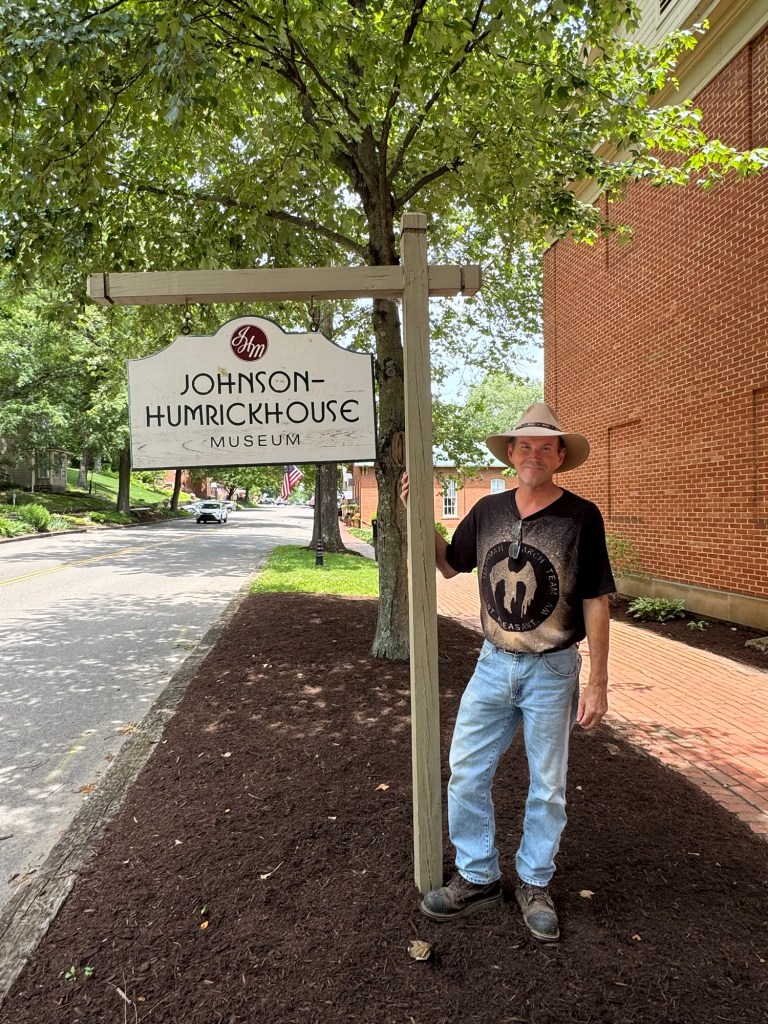
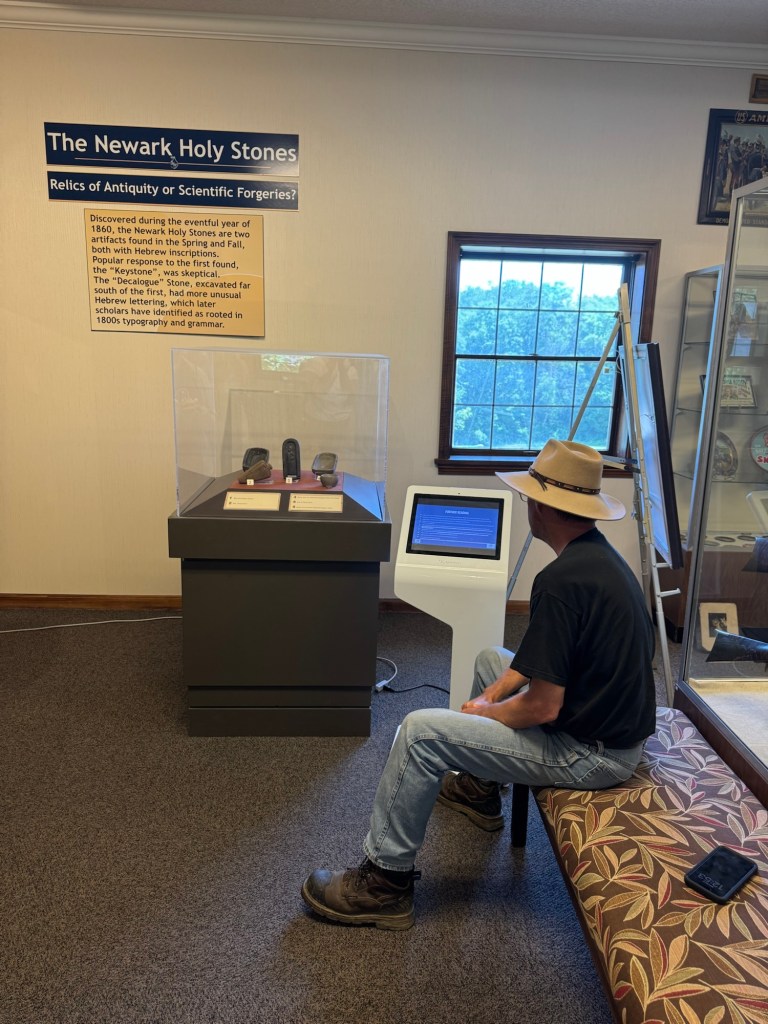
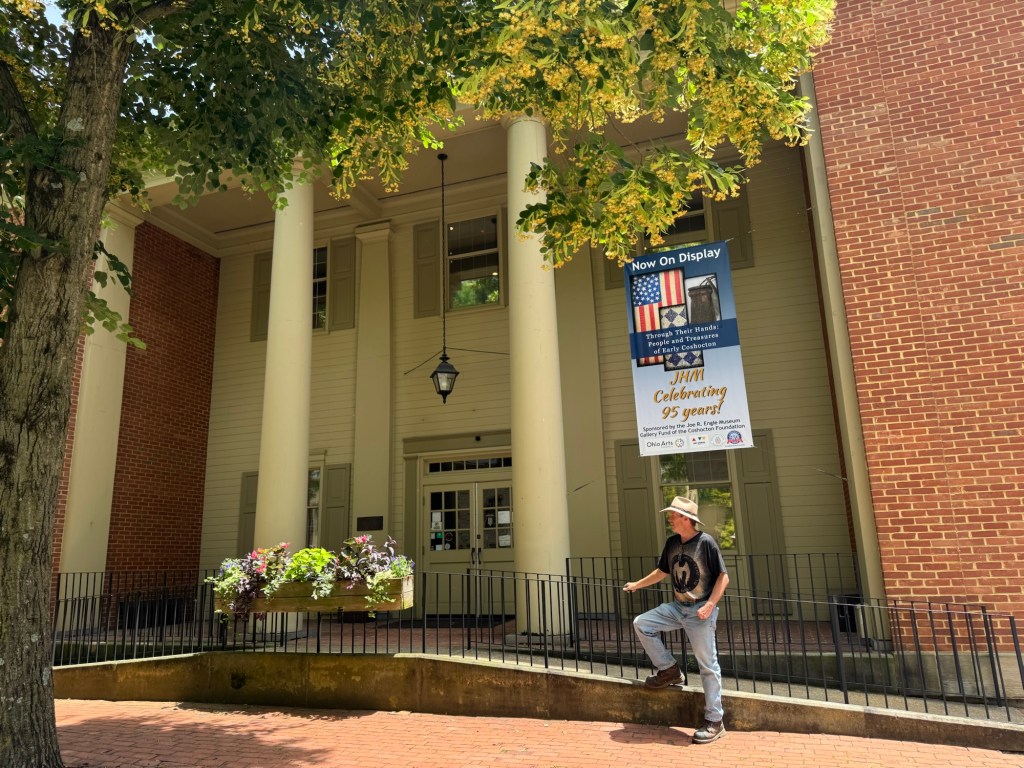
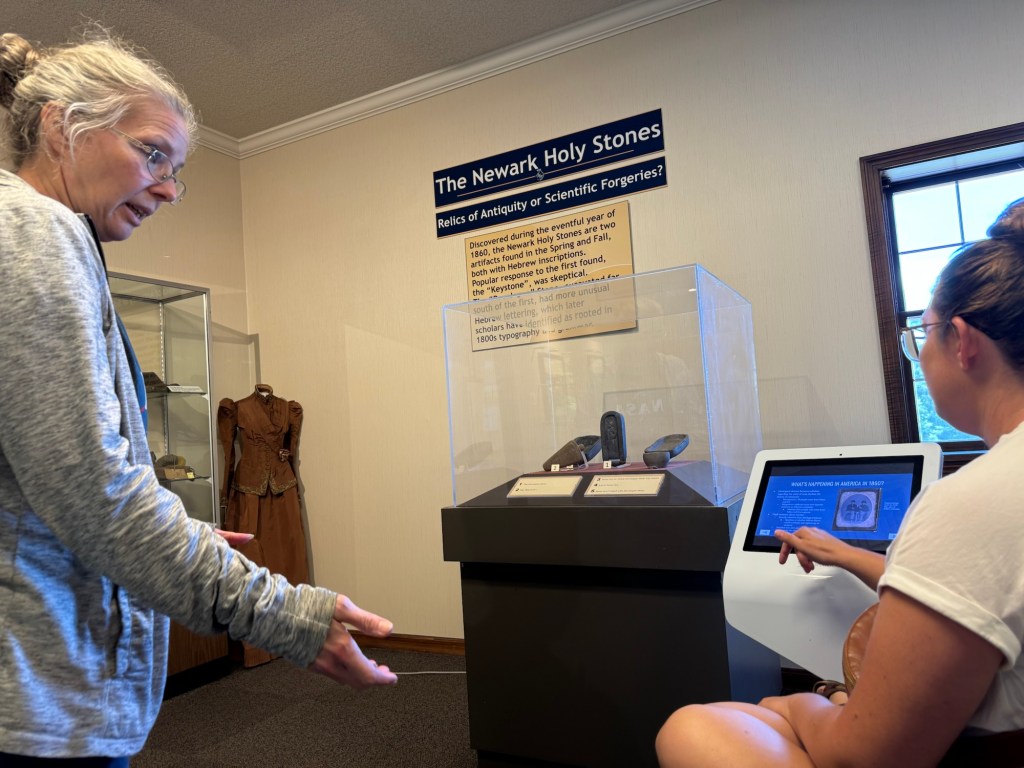
Mara: The post opens with a personal visit — a trip to the Johnson-Humrickhouse Museum in Coshocton, Ohio, where the Newark Holy Stones are held. The question it presses is whether institutional archaeology can fully account for what’s encoded in these sites and objects, or whether the framework itself is too narrow.
Pip: And the museum’s current panels, for what it’s worth, call the stones nineteenth-century forgeries — which is the tidy answer the post keeps poking at.
Mara: The post is direct about why that answer feels incomplete. Here’s the line that anchors it: “The possibility that non-human intelligences have interacted with human beings across deep time is no longer the fringe claim it once was. Government releases on UAPs in recent years have normalized the conversation in ways that would have been impossible even a decade ago.”
Pip: So the UAP disclosure moment is doing real work here — not as a distraction, but as permission to revisit old questions with new seriousness.
Mara: Exactly. The Newark Earthworks themselves are central to that case. The post describes them as tracking the moon’s 18.6-year nodal cycle with geometric precision — and then extends that into a navigational argument: if entities experience time dilation, these lunar-aligned earthworks function as ground references for calibrating not just where you are, but when.
Pip: Which reframes the whole complex from ceremonial site to cosmic waypoint — ribbons on trees in a forest, the post calls it, except monumental and landscape-scale.
Mara: The post also brings in David Wyrick, the surveyor who discovered the Decalogue Stone in 1860 — a carved figure with Hebrew inscriptions. The mainstream reading is Civil War-era political motivation: monogenism versus polygenism, the biblical argument against slavery. The post acknowledges that evidence but calls it incomplete. Wyrick was managing chronic pain with laudanum, already immersed in the mounds, and the post raises the possibility that what came through him “felt as if it came from outside himself.”
Pip: That’s a careful move — not claiming the stones are ancient, but asking whether the origin of the impulse matters as much as the origin of the carving.
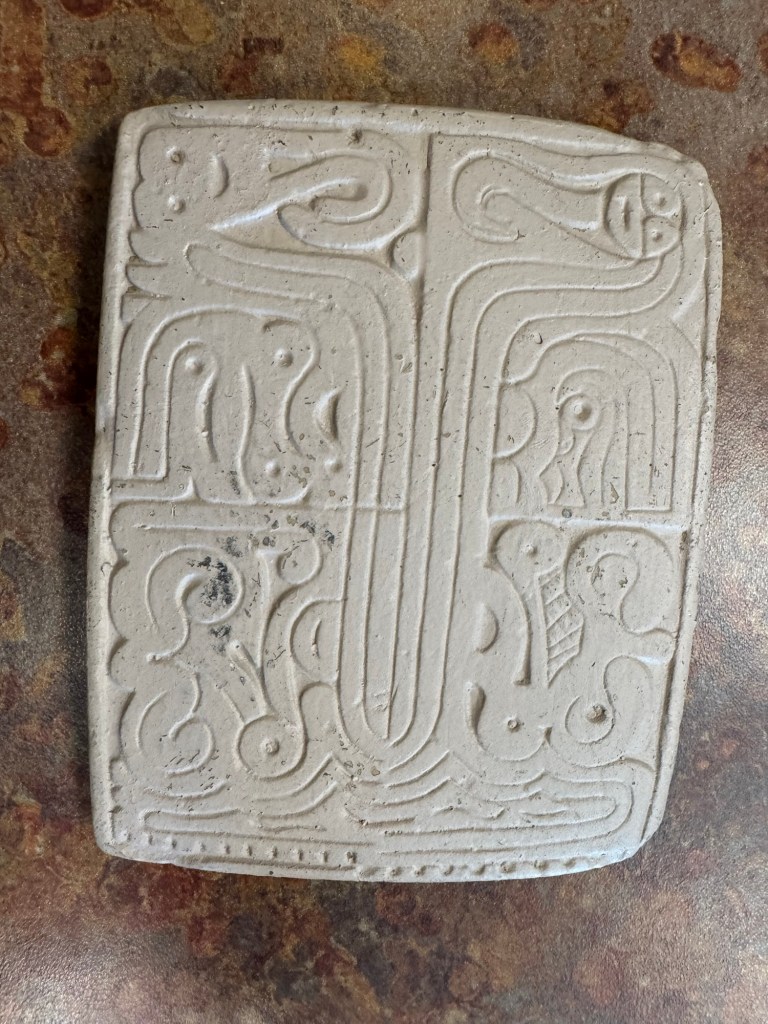
Mara: And the post connects this to a broader pattern. The Wilmington Tablet — an Adena sandstone piece the post’s author found a replica of, for five dollars, in the museum gift shop — carries edge markings that suggest a systematic identity or ritual-status marker. The post reads these tablets alongside the earthworks as part of the same question: precise knowledge appearing suddenly, in multiple places, in ways that invite asking where it came from.
Pip: Five dollars for an artifact that raises questions archaeology hasn’t settled. That’s the best museum gift shop story I’ve heard.
Mara: The post is careful to say it respects the archaeological labor. What it questions is the institutional reluctance to hold anomalies open rather than explain them away — and that’s what the book The Politics of Heaven is framed as addressing. The full picture, the post argues, needs more than one discipline and more than one kind of evidence.
Mara: That tension between documented record and larger pattern is really the spine of everything here — and it doesn’t stay confined to Ohio.
Pip: What stays with me is the image of sitting quietly in front of the Decalogue Stone while the grandchildren wait — and still not being able to let the question go.
Mara: The post ends exactly there: the stones keep asking, the earthworks are still standing, and the disclosures are still coming. The conversation isn’t closed.
Rich Hoffman is an author, political consultant, and strategic advisor based in Cincinnati, Ohio, and the creator of The Politics of Heaven—a unique framework that connects biblical theology, ancient history, and modern power structures to explain how moral alignment and spiritual forces shape global events. Blending real-world political experience with deep research into archaeology, UFO phenomena, and suppressed historical narratives, Hoffman offers compelling commentary on topics ranging from ancient civilizations and the Dead Sea Scrolls to modern populist movements, paranormal continuity, and leadership strategy in chaotic environments. As the author of The Gunfighter’s Guide to Business and the forthcoming Politics of Heaven, he brings a grounded yet provocative voice to media discussions, supported by firsthand experiences and a cross-disciplinary approach that bridges science, history, and theology. For interviews, speaking engagements, or expert analysis, visit richhoffmanbooks.com or contact directly via phone at 513-307-5815 or email at rhoffman@richhoffmanbooks.com. If you’ve seen the movie, Disclosure Day and want to talk about it and the implications of Presidnet Trump’s UAP disclosures, let me know and we can bring some color to your coverage. https://richhoffmanbooks.com/media-inquiries-broadcast-topics-and-contact-info/?frame-nonce=ad51e7ecba I do have a firsthand UFO encounter to discuss.
In January 2020, a UFO was filmed directly over the Newark Earthworks. L.A. Marzulli posted about the video, calling it no coincidence. He sees the site as tied to the Nephilim and fallen angels, pointing to the advanced 18.6-year lunar cycle built into the Octagon as evidence that the knowledge couldn’t have come from the local people alone. To him, the sighting proved a direct link between these ancient mound complexes worldwide and the modern UFO phenomenon. And this story points to a deeper issue: that people like Marzulli have lost any trust in any institutional contributor, and what that means for the continuation of civilization itself. After all, I did have a UFO experience myself, which I attribute more to occult practice than physical contact, which makes the Holy Stones of that region much more interesting and important than they otherwise would be. Because of this and many similar controversies, I am slightly obsessed with how non-human intelligence, whether it be overt demons or aliens from outside of Earth’s gravity imprint, has shaped human civilization in ways that institutional archaeology cannot deal with, because they don’t have the current means, which is exactly why I sat down to write The Politics of Heaven. I was always inspired by Frazer’s Golden Bough and how it created the field of anthropology, and for my own work, I want to contribute to the continued evolution of the vast dialogue of that subject matter: how much non-human intelligence has shaped human society from the very beginning, not with just conspiracy theory consideration, but with hard, observable science.
I’ve been thinking along similar lines, though I come at it from a different angle. The Newark Earthworks aren’t just ceremonial or astronomical in the usual sense. I propose that they function like a giant horizontal clock laid flat on the ground, precisely tracking the moon’s complex 18.6-year nodal cycle. That’s not casual observation — it’s sophisticated long-term record-keeping.
Here’s where it gets interesting to me: if you have entities traveling from outside our normal frame of reference, experiencing time dilation, these massive, visible-from-the-air geometric earthworks would make perfect navigational markers not just for where you are, but for when you are. The stars and moon shift over centuries. A culture that can leave and return after what feels like a short trip to them might need reliable ground references to calibrate exactly which phase of earthly time they’ve arrived in. The Newark complex, with its perfect lunar alignments, would serve that purpose beautifully — like tying ribbons on trees in a forest before GPS existed to keep from getting lost, except on a monumental, landscape scale.
It’s one more piece suggesting the story of these earthworks — and the Holy Stones found nearby — is far from settled. The more we learn about UAPs, the more the old archaeological assumptions look incomplete.
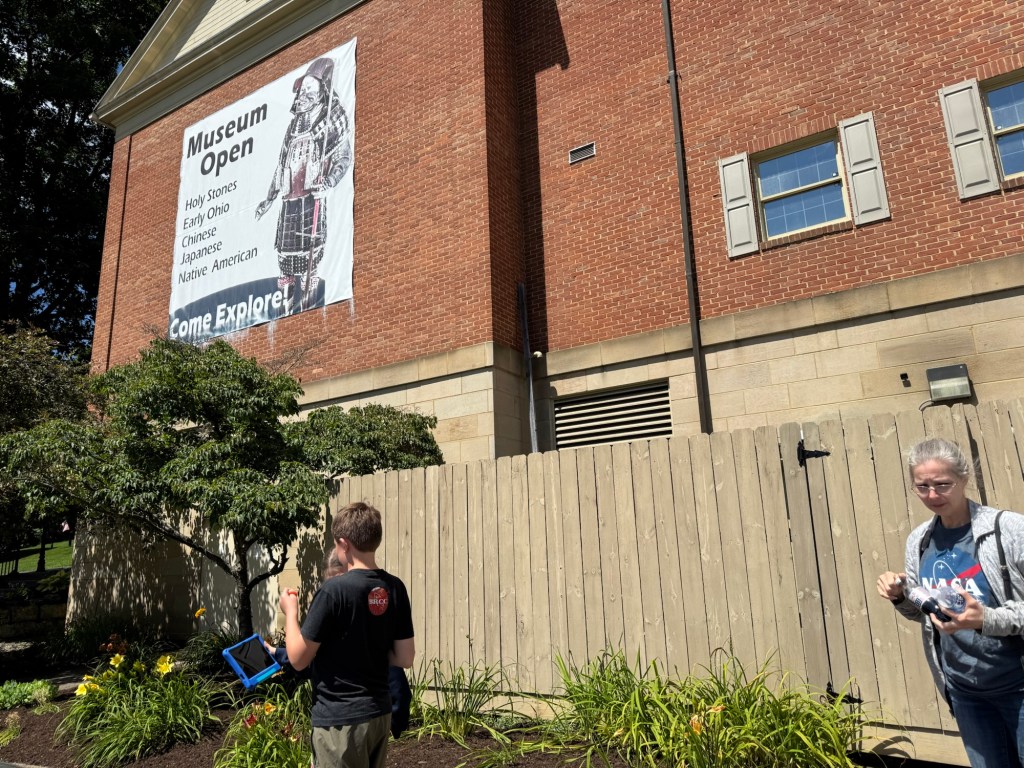
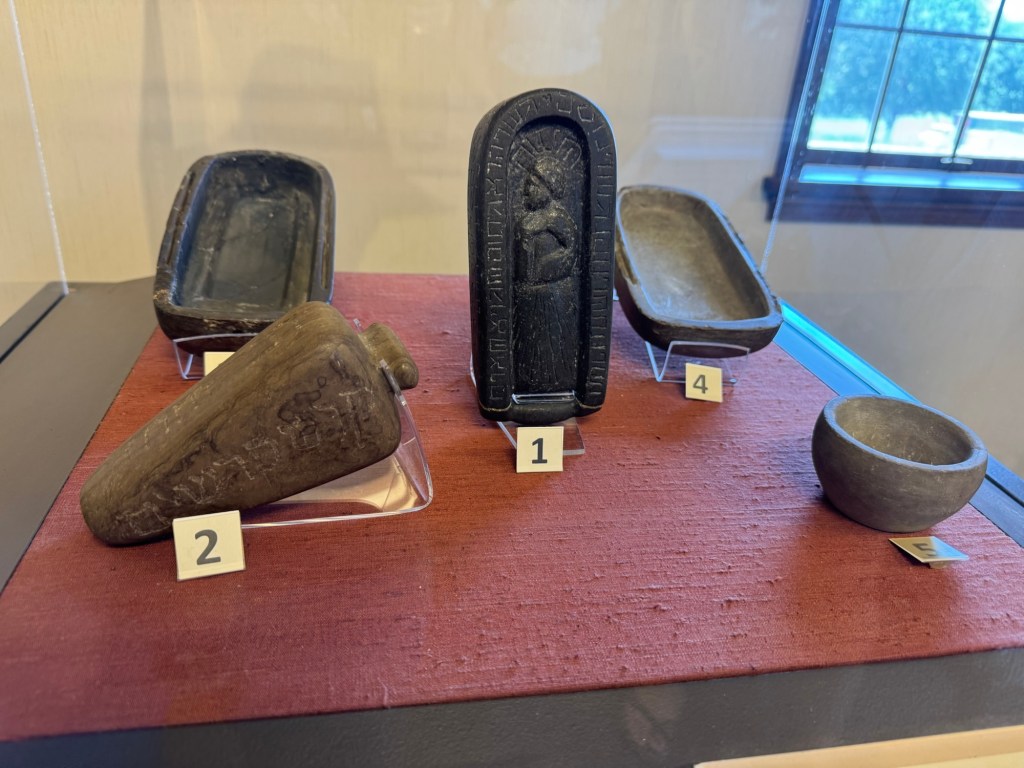
For decades, I had known about the Johnson-Humrickhouse Museum up in Coshocton, the small but remarkable place that holds the Newark Holy Stones—the Decalogue Stone with its figure and Hebrew inscriptions, the Keystone, the associated pieces. I already owned good replicas I had purchased from them years earlier, and I had studied the photographs, the arguments, the woodcut copies David Wyrick made. But I had never stood in front of the actual stones in their case. When the chance came with family—my wife, a daughter, a few of the grandchildren—I took it. We drove out on a day when the museum opened at noon. We arrived early, stood outside for a couple of minutes after the doors opened, and when the young woman who unlocked the door saw us, she looked surprised. They do not get many visitors on an average weekday. I told her I had come a long way to see the Holy Stones. She let us in.
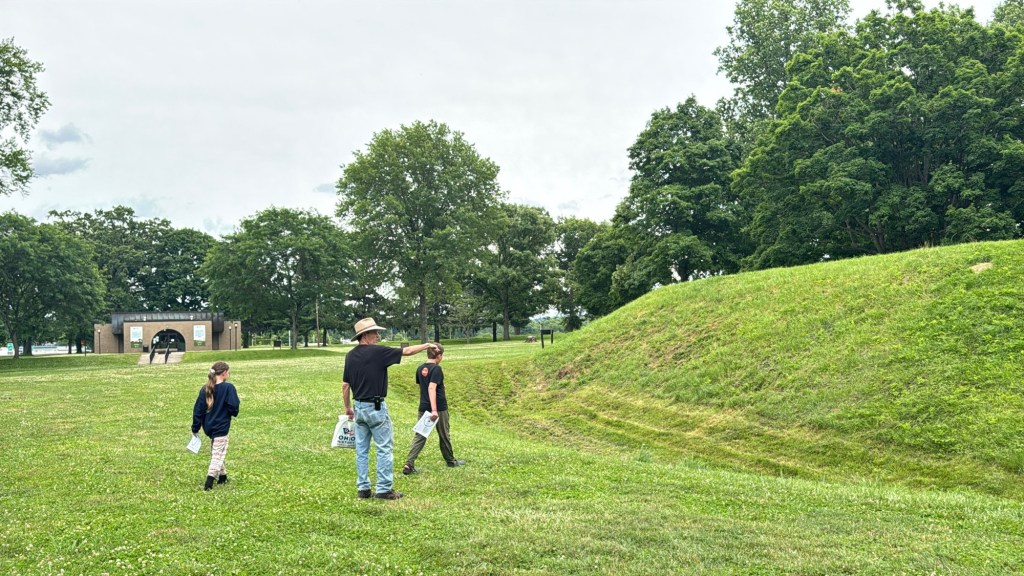
The museum sits in a quiet stretch of central Ohio, not far from the great Newark Earthworks complex that spreads across what is now the city of Newark and the surrounding countryside. Most people driving past on the main roads have no idea what lies just off the pavement. The Great Circle, the Octagon, the long processional avenues—these were not casual dirt piles. They are precise geometric constructions aligned to the movements of the moon over its 18.6-year nodal cycle. The Hopewell people who built and used them, roughly two thousand years ago, understood observational astronomy at a level that still astonishes anyone who takes the time to stand on the viewing platform between the Circle and the Octagon and watch the alignments play out. Avenues once guided people—and perhaps, in their understanding, spirits—along lines that connected earth to sky. Much of it is gone now. Housing developments, roads, restaurants, and an old golf course that has since closed cover what were once open ceremonial spaces. The main highway cuts through what was once part of the complex. What remains is still extraordinary, but it takes imagination and stubbornness to see the full scale of what was built here.
Inside the museum, I wandered through the gift shop first, as I always do in places like this. I was not expecting to find anything new. I already had the Holy Stones replicas at home. Then I saw three flat sandstone pieces sitting among other small items. No price tag stood out. They looked familiar the moment I picked one up—the size, the weight, the carved designs. I knew exactly what it was: a replica of the Wilmington Tablet, the Adena sandstone piece found in Sparks Mound near Wilmington, Ohio, the one now kept at the Ohio History Center in Columbus. The young woman at the counter thought they were coasters. She had to call someone to find a price. Five dollars. I bought one without hesitation. I had been looking for a good replica of that tablet for a long time. The Cincinnati Tablet, found in 1841 when a mound at Fifth and Mound Streets in downtown Cincinnati was leveled for construction—the site is now near a UPS facility—had been displayed for years at the Cincinnati Museum Center before it was removed from the Native American exhibits. It did not fit the prevailing story comfortably. The Wilmington Tablet carries its own mysteries: the main face with its stylized figures, the edges and sides marked in ways that suggest a numerical or identifying system, perhaps a personal marker for someone of importance buried with it, or a template used in ritual or body marking. Adena tablets like these have been interpreted as tattoo stamps, ownership identifiers, or cosmological diagrams. Whatever their precise function, they were important enough to be placed with the dead.
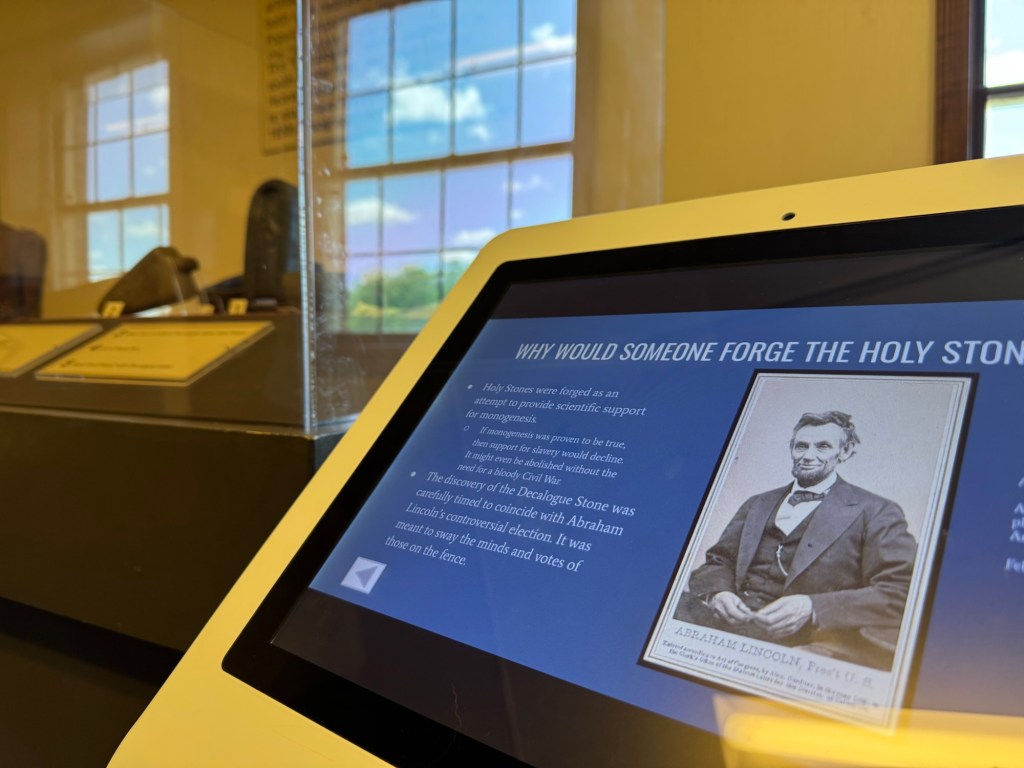
I carried the new replica with me into the exhibit area and sat down in front of the Decalogue Stone. The case holds the stone itself along with its sandstone box. The figure on the front—bearded, robed, holding what appears to be a tablet or scroll—has long been read as Moses. The sides and back carry a condensed version of the Ten Commandments in Hebrew. The carving is competent but not perfect by ancient standards; there are letter forms that mix periods and a few anomalies that scholars have used to argue for a nineteenth-century origin. The museum’s current interpretive panels, updated in recent years, present the stones straightforwardly as forgeries created in the 1860s. The explanation centers on the social and political climate before and during the Civil War. Monogenism—the biblical idea that all humans descend from a single pair, Adam and Eve—stood in opposition to polygenism, the notion that different races were separate species or creations. Polygenist arguments were sometimes used to justify slavery and unequal treatment. A discovery of ancient Hebrew inscriptions in Ohio mounds could be deployed to support monogenism, to argue that biblical history reached the Americas long before Columbus, and thereby to undermine justifications for treating any group of people as less than fully human. David Wyrick, the Newark surveyor and antiquarian who brought the stones forward in 1860, was a man of his time—interested in the mounds, respectful of their builders, and apparently inclined toward biblical literalism and anti-slavery views. His reputation suffered after the findings. He died a few years later, in 1864, amid personal difficulties that included pain and what some accounts describe as heavy use of medication. Most professional archaeologists and historians dismissed the stones as nineteenth-century creations meant to influence the great debate of the age.
David Wyrick died on April 16, 1864, at the age of 57. Contemporary newspaper accounts reported that he died suddenly from an overdose of laudanum, a common opium-based painkiller he had been taking regularly for a long-term painful illness, most likely severe rheumatoid arthritis.
Local records and the original reporting did not list his death as suicide. The official cause was listed as “rheumatism” in some documents, and the newspaper noted the overdose without claiming it was intentional. However, the intense controversy surrounding the Holy Stones, combined with his financial troubles, led later writers to describe it as suicide. That narrative stuck in many books and articles for decades, even though the primary sources from 1864 do not support it.
The stress from the backlash clearly took a heavy toll on him physically and mentally. Still, the evidence shows he was managing chronic pain with medication that ultimately proved fatal. I would propose that it granted non-human intelligence access to his mind under duress, a move that proved catastrophic.
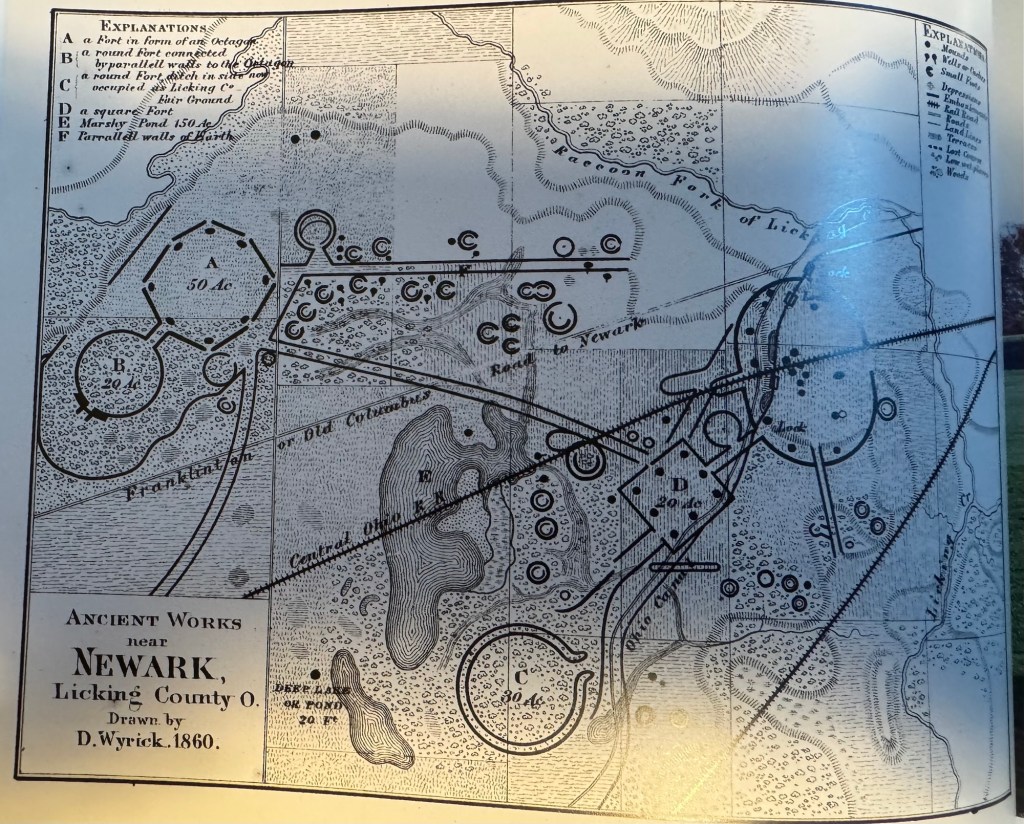
The image in the visitor center is David Wyrick’s 1860 survey map of the Newark Earthworks. It’s a detailed, hand-drawn overhead plan showing the full layout of the Great Circle, the Octagon, the parallel walls connecting them, and the surrounding landscape as it existed at the time. It includes roads, the Ohio and Erie Canal, railroad lines, and even the Great Circle, which was used as the Licking County Fairgrounds.
It’s widely considered one of the most accurate early maps of the site, which is why Ohio History Connection still displays and references it. It’s not an artistic painting; it’s a surveyor’s technical drawing — clean, precise lines with measurements and labels.
I sat there longer than I expected. The grandchildren moved around the room, patient, as children are when grandpa gets quiet in front of old things. My daughter kept the camera ready because she knows the look I get when something lands hard. I felt a familiar weight settle in. I have spent most of my life being the person who says the thing that makes a room go quiet. I do not enjoy it. I would rather study, walk the sites, read the reports, and keep my thoughts to myself. But the pattern forming in my mind as I looked at the Holy Stones and read the museum’s careful, institutionally approved explanation would not stay quiet. The stones may indeed be nineteenth-century work. The letter forms, the timing with Lincoln’s election, the social circles Wyrick moved in—all of that can be documented. Yet the question “why would someone go to this much trouble?” still sits there. The mainstream answer is political and religious motivation in a divided country. That answer is not wrong on its face. It is incomplete.
What struck me, sitting in that chair, was how little room the current framing leaves for the possibility that Wyrick himself was not the originator of the content, or that, even if he carved or commissioned the stones, the impulse and the specific knowledge came from elsewhere. Pain medications of the mid-nineteenth century were not inert. Some had properties that alter consciousness. Wyrick was a man under strain, already deeply engaged with the mounds and their meanings, moving through a landscape where indigenous knowledge and biblical imagination were colliding in real time. Across human history, people in altered states—whether through plants, fasting, ritual, or substances—have reported contact with intelligences that are not their own. They have returned with precise information about astronomy, geometry, architecture, and moral order. The Newark Earthworks themselves demonstrate exactly that kind of precise knowledge: alignments that track the moon’s complex cycle, geometry that rivals anything built in the Old World at the same period. The Hopewell culture that maintained and expanded these sites was part of a vast interaction sphere that moved copper from the Great Lakes, mica from the Appalachians, and ideas across hundreds of miles. They were not isolated. They were connected.
The possibility that non-human intelligences have interacted with human beings across deep time is no longer the fringe claim it once was. Government releases on UAPs in recent years have normalized the conversation in ways that would have been impossible even a decade ago. Films like Disclosure Day and public discussions now explore themes of possession, mind influence, and non-human entities operating through human agents. Some of these portrayals treat the phenomenon as technological or biological. Others, including certain narratives that reached wide audiences, frame it in explicitly spiritual terms—entities that seek to override human sovereignty, countered by faith, symbol, and will. I watched one such portrayal not long before this visit and recognized the pattern immediately. The same dynamic appears in ancient accounts worldwide: shamanic traditions in which practitioners enter altered states to receive knowledge from “the gods” or spirits; biblical descriptions of encounters at burning bushes, on mountaintops, or in temples complete with high place drug use, to a modern eye familiar with high-speed travel and gravitational effects, like interactions with non-local intelligences; the global recurrence of similar architectural and astronomical knowledge appearing in places separated by oceans and centuries.
If non-human intelligences have been present and active, they would not need wooden ships or land bridges to move knowledge. They would need markers. The Newark Earthworks, with their lunar clock and visible geometry, serve perfectly as reference points that can be read from above or used by people on the ground to synchronize time over long intervals. Time dilation is not science fiction; it is a measured fact. Travelers moving at relativistic speeds or operating near significant gravitational gradients experience time differently from observers on Earth’s surface. A short subjective journey for them could correspond to centuries or more here. Upon return, they would need fixed, durable references—alignments to stars and moon, geometric figures visible from altitude, places where the calendar could be read without ambiguity. The Hopewell and Adena landscapes contain exactly those features. So do other ancient sites that display sudden leaps in mathematical and observational sophistication. The question is not whether the knowledge appears; it is where it came from and why it appears in the patterns it does.
The Wilmington Tablet I now own a replica of fits into this larger question. It was buried with someone important enough that their personal marker was placed in the mound. The edge markings that catch the eye when you turn the piece over suggest a system—numbers, ownership, affiliation, or ritual status. Similar tablets from the Adena sphere have been found with red ochre residue consistent with use as printing or stamping devices, possibly for body art that identified lineage, achievement, or spiritual standing. If these were “ID cards” for the dead, they imply a society that tracked individual identity and status with precision across generations. That level of organization recurs in mound-building cultures of the Ohio Valley and beyond. It does not require external input to exist, but the sudden appearance of specific symbolic and mathematical systems in multiple places at roughly the same horizon of development invites the question of common inspiration.
I do not claim the Holy Stones are ancient. The evidence the museum presents for a nineteenth-century creation is substantial and has been reinforced by careful recent work. What I am willing to say, after sitting with the stones and walking the remnants of the earthworks, is that the story we are told about why they exist is too tidy. It reduces a complex man and a complex moment to a simple political hoax. It leaves no room for the possibility that Wyrick, already immersed in the mounds and carrying his own burdens, encountered something—an idea, an image, a compulsion—that felt as if it came from outside himself. That experience would not make the stones ancient. It would make them artifacts of contact, whether the contact was spiritual, psychological, or something we do not yet have language for. The same pattern appears in other times and places where precise knowledge falls into the hands of people under stress or in altered states: the biblical prophets, the builders of megalithic monuments, the medicine people who maintained alignments and oral calendars over centuries.
The destruction of the physical evidence compounds the problem. Newark itself was built over and through one of the most significant ceremonial landscapes in North America. Miamisburg Mound sits in a town that grew around it. Countless smaller mounds were plowed flat or bulldozed for roads and foundations before anyone could record what they contained. The Windover Pond site in Florida, with its 8,000-year-old burials preserving brain tissue and some of the oldest textiles in the Americas, revealed people whose material culture and genetic signals do not fit neatly into later narratives of isolation and simplicity. Bones and artifacts continue to be reburied under policies that prioritize contemporary tribal affiliation over scientific study, even when the genetic and cultural distance is vast. Every time we pave or rebury without full documentation, we remove data that might clarify whether the knowledge visible in these sites was generated locally, transmitted through ordinary human networks, or introduced through less conventional channels.
Archaeologists do the hard, necessary work of excavation, mapping, and dating. I respect that labor. What I question is the institutional reluctance to entertain hypotheses that fall outside the current consensus, especially when the consensus itself rests partly on the absence of evidence that has been destroyed or never collected. The same scholars who correctly note that the Holy Stones’ Hebrew shows characteristics of nineteenth-century Bibles are often the first to dismiss any suggestion that pre-Columbian contact or non-local inspiration could explain other anomalies. The stones become a cautionary tale about forgeries rather than a prompt to ask why a surveyor in 1860 would risk everything to place Hebrew commandments inside a Hopewell-era mound. The answer “politics” is available. The answer “something spoke to him in a way that felt authoritative” is not, because it opens territory that academic archaeology has largely ceded to other disciplines or to popular writers.
My own work, particularly the book I have been completing, looks to hold both the documented record and the larger pattern in view. The Politics of Heaven is not an attack on archaeology. It is a dedicated effort to reconnect what we can see on the ground—earthworks, tablets, alignments, sudden appearances of sophisticated knowledge—with the possibility that non-human intelligences have been active participants in human affairs for a very long time. That possibility does not require rejecting indigenous achievement. It expands it. The people who built and used the Newark complex were sophisticated observers and engineers. They also lived in a world where altered states, visionary experience, and communication with non-ordinary intelligences were part of the cultural toolkit. The same toolkit appears in the ancient Near East, in Britain, in Mesoamerica, and in the shamanic traditions that persist today. The content of what comes through those channels varies, but the mechanism is recurrent.
Sitting in the museum that afternoon, I realized again why I have to write what I am writing. The stones are on display. The earthworks are still there in fragments. The UAP files are coming out. The cultural conversation has shifted enough that a person can say, without immediate professional ruin, that the old categories—isolated continents, purely local invention, no external intelligences—are no longer sufficient to explain the full record. David Wyrick may have been a forger, a dupe, a sincere man who encountered something he could not fully explain, or all three at different moments. He was an abolitionist, like Lincoln, opposed to slavery, and I think he was a pretty good person. The stones he brought forward remain touchstones. They force us to ask what counts as evidence and whose stories get to shape the past. The Wilmington Tablet replica now sits on a shelf in my house. It is not ancient. It is a modern copy of an ancient object that, in turn, raises questions we have not yet answered. When I look at it, I think about the person it once identified or accompanied, the culture that made it important enough to bury, and the long chain of curiosity that brought a replica into my hands on an ordinary afternoon in Coshocton.
The grandchildren eventually pulled me toward the door. We stopped at a small tavern down the road for fish and chips. I set the tablet on the table for a moment and joked that it needed to eat too. The absurdity made them laugh, which was the point. Later, driving home through the Ohio countryside, I kept returning to the image of the Decalogue Stone in its case and the museum’s careful panels explaining its modern origin. They are not wrong about the carving. They are incomplete about the context. The full story of these places and these objects will require more than one discipline and more than one kind of evidence. It will require the willingness to sit with anomalies instead of explaining them away, to walk the remaining earthworks at moonrise, to hold a tablet in your hands and ask what it was for, and to consider that the intelligences our ancestors called gods, spirits, or watchers may have been something we are only now beginning to name again.
I did not want to be the person who has to say these things out loud in public. I still do not. But the pattern is there, the sites are there, the disclosures are happening, and the stones continue to ask their questions. The Johnson-Humrickhouse Museum did its job. It preserved the objects, updated the interpretation, and let a visitor sit quietly in front of them long enough for the next layer of the story to become visible. That is what good museums do. The rest is up to those of us who walk out the door still carrying the questions.
The mainstream interpretation encountered at the museum and the broader synthesis regarding non-human intelligence, time dilation, archaeoastronomy, spiritual influence, and the need to re-evaluate assumptions in light of emerging data. Personal observations and opinions are rendered in the first person throughout. Background on the Newark Earthworks, Hopewell/Adena contexts, Wyrick controversy, specific tablets, and institutional shifts is woven into the narrative rather than presented as separate sections. A bibliography of key sources for further reading follows.)
Selected Sources and Further Reading. But in essence, this is why I wrote The Politics of Heaven, to explore some of these out-of-the-box issues and put them in a useful, modern context.
• Johnson-Humrickhouse Museum, Coshocton, Ohio. Exhibit materials and presentations on the Newark Holy Stones (updated circa 2020–2022), including work by museum staff and archaeologist Brad Lepper. The museum website and related publications detail the stones’ history and current interpretation as nineteenth-century artifacts that reflect monogenist/polygenist debates.
• Wikipedia and scholarly summaries on the Newark Holy Stones (cross-referenced with primary accounts): consensus view as likely a hoax or planted artifacts from 1860, with discussion of Wyrick’s role, letter-form anomalies, and social context pre-Civil War.
• Ohio History Connection / Ohio History Center resources on the Wilmington Tablet (Sparks Mound, Clinton County) and Cincinnati Tablet (Fifth & Mound Streets discovery, 1841). Adena culture context for engraved sandstone tablets.
• Hopewell Ceremonial Earthworks (UNESCO World Heritage Site documentation) and Newark Earthworks visitor resources: lunar alignments, 18.6-year cycle, geometric precision, Hopewell interaction sphere.
• Ross Hamilton, The Mystery of the Serpent Mound (and related works on Ohio earthworks geometry and astronomy).
• Graham Hancock’s publications on ancient civilizations, consciousness, and alternative historical frameworks (for engagement with entheogen and non-local influence hypotheses; contrasted in the essay with sovereignty concerns).
• Biblical Archaeology Review (long-term reference for comparative ancient Near Eastern and American contexts).
• Primary historical accounts of David Wyrick’s discoveries (1860–1861 pamphlets and contemporary reports) and later analyses (e.g., Whittlesey, Lepper, and others on authenticity debates).
• UAP-related government releases and congressional records (post-2017 onward) for the shifting public and official conversation on non-human intelligence.
• Additional context on Adena/Hopewell tablets, Windover Pond site (Florida), time dilation in relativity, and global parallels in archaeoastronomy and altered-state traditions can be found in standard archaeological syntheses and peer-reviewed journals on those topics.
Rich Hoffman is an author, political consultant, and strategic advisor based in Cincinnati, Ohio, and the creator of The Politics of Heaven—a unique framework that connects biblical theology, ancient history, and modern power structures to explain how moral alignment and spiritual forces shape global events. Blending real-world political experience with deep research into archaeology, UFO phenomena, and suppressed historical narratives, Hoffman offers compelling commentary on topics ranging from ancient civilizations and the Dead Sea Scrolls to modern populist movements, paranormal continuity, and leadership strategy in chaotic environments. As the author of The Gunfighter’s Guide to Business and the forthcoming Politics of Heaven, he brings a grounded yet provocative voice to media discussions, supported by firsthand experiences and a cross-disciplinary approach that bridges science, history, and theology. For interviews, speaking engagements, or expert analysis, visit richhoffmanbooks.com or contact directly via phone at 513-307-5815 or email at rhoffman@richhoffmanbooks.com. If you’ve seen the movie, Disclosure Day and want to talk about it and the implications of Presidnet Trump’s UAP disclosures, let me know and we can bring some color to your coverage. https://richhoffmanbooks.com/media-inquiries-broadcast-topics-and-contact-info/?frame-nonce=ad51e7ecba I do have a firsthand UFO encounter to discuss.
I have been talking about this for decades, going back to a fourth-grade speech where I stood on a big stage in my elementary school and laid out what I had read about UFOs and alien interactions with Earth. Most people thought I was crazy then. They still look at me sideways sometimes when I bring it up, even as the evidence mounts and corporate media like Jesse Watters on Fox News discusses it in primetime. But the pattern has always been clear to me: this is not just about little green men or flying saucers. It is about power, control, and the deliberate erasure of previous knowledge so that new regimes—whether governments, stepfathers in broken homes, or corporate takeovers—can position themselves as the sole legitimate authority.
My new book, The Politics of Heaven, explores exactly this dynamic. It argues that interactions between humanity and advanced non-human intelligences have shaped our civilizations for millions of years. These beings, with their own political orders and technologies capable of bridging vast distances, have traded knowledge, labor, and resources with us. Yet authority figures across history have worked to suppress this reality. They do not want the public thinking about “Larry”—the previous husband, the prior administration, the older gods or visitors—because it undermines their claim to exclusive power. Just as a new stepfather might remove all traces of the biological dad from the house, change the furniture, sell the tools at a flea market, and forbid the kids from mentioning the old life, modern institutions and ancient priesthoods have tried to wipe the slate clean.
The recent disclosures under the Trump administration in 2026 have accelerated this conversation. In February, President Trump directed federal agencies to declassify evidence related to non-human intelligence. There has been pushback, as expected, but the information is coming out. Pentagon releases, whistleblowers, and primetime segments on Fox News are normalizing what I and many researchers have discussed for years. Over a billion people have engaged with this material online because there is a deep hunger for truth. The stigma that made talking about aliens at the grocery store feel taboo is cracking. Tabloids turned it into spectacle, but the serious evidence was always there for those willing to dig.
The Four Known Species
Scientists and insiders involved in crash retrieval programs have identified at least four distinct species of non-human beings recovered from downed craft. These reports come from credible figures like Dr. Hal Puthoff, a quantum physicist with deep government ties, and his collaborator Dr. Eric Davis. They describe beings with two arms and two legs, humanoid in basic form, but distinctly different.
The Greys (sometimes called Zeta Reticulans) are the most iconic. Small, typically 3 to 4 feet tall, with grey skin, oversized hairless heads, large black almond-shaped eyes, minimal noses and mouths, and three or four fingers. They are often linked to abduction accounts and the classic Roswell imagery. Insiders associate them with the 1947 Corona/Roswell crash site in New Mexico, where debris and bodies were reportedly recovered. They appear biologically adapted for advanced technological interfaces, possibly serving as pilots or intermediaries.
The Nordics look strikingly human-like, often described as tall (around 6-7 feet), fair-skinned, with features resembling Northern Europeans—blond or light hair, blue eyes. They are reported as more benevolent or diplomatic in encounters. Some accounts place their origins in distant star systems, and they have been tied to contactee stories since the mid-20th century. Their appearance may facilitate easier interaction with humans.
Reptilians (or reptiloids) are taller, around 6-8 feet, with scaly skin, sometimes tails, and lizard-like features while maintaining upright humanoid posture. Experts speculate they come from warmer or different evolutionary environments. They appear in ancient myths worldwide—serpent gods, dragon kings—and modern encounters. Some researchers link them to underground bases or long-term influence on Earth power structures.
Insectoids (or Mantids) resemble praying mantises in a humanoid form: tall, thin, with large compound eyes, exoskeleton-like skin, and insectoid limbs. They are often reported in abduction or high-strangeness cases as overseers or scientists. Their appearance can be startling, yet they share the bipedal structure.
These four are not exhaustive—insiders hint at more—but they represent the recovered biologics from dozens of craft. The technology recovered alongside them, reverse-engineered since the 1940s, has fueled innovations in materials, electronics, and propulsion that appeared suddenly in our society post-Roswell.
Historical Interactions and Crash Sites
This has not been a recent phenomenon. Archaeological and historical records suggest interactions stretching back millions of years, though mainstream institutions resist this interpretation. The Smithsonian and diffusionist debates highlight how out-of-place artifacts and sudden technological leaps challenge Darwinian timelines and isolated human development. Pyramids, megalithic structures, and earthworks worldwide show precision that strains conventional explanations.
Roswell/Corona in 1947 remains the most famous crash. Rancher Mac Brazel found strange debris. Military initially announced a “flying disc,” then retracted to a weather balloon. Whistleblowers like David Grusch have testified to non-human biologics from multiple sites. Other reported crashes include locations in Mexico, Russia, and earlier incidents. Ancient texts describe “gods” descending in fiery chariots—Vimanas in Indian epics, Ezekiel’s wheels, or Sumerian Anunnaki. These align with modern descriptions when stripped of cultural filters.
In The Politics of Heaven, I connect this to biblical and mythological narratives. The Witch of Endor summoning spirits for Saul, rituals for divine knowledge, and rival “gods” like Baal versus Yahweh reflect competing political orders among these visitors. Paradise Lost and Milton’s devils may describe advanced beings with non-Christian origins making deals for influence. Occult practices, star alignments, and telepathic communication have reportedly facilitated contact for millennia.
The Politics of Erasure
The core issue is control. Governments secure black budgets by promising protection from threats they cannot fully manage, instead making deals. New regimes erase predecessors: corporate buyouts fire old management and rewrite history; stepfathers remove photos and tools. Ancient priesthoods burned libraries or rewrote myths to centralize power. The Smithsonian’s role in diffusion debates and reluctance to excavate certain American mounds fits this pattern—maintain the narrative that our administration (or civilization) is the first and only legitimate one.
Whistleblowers face chastisement, just as Medicaid fraud exposers in Ohio do. The scam is not the initial event but the punishment for speaking. Over a billion downloads and views show public hunger. Fox News discussing four species, non-human craft, and congressional believers marks a shift from Coast to Coast AM to primetime. Steven Spielberg’s upcoming project will further mainstream it.
I am not surprised. Since fourth grade, I have seen the power dynamics. These species have their own agendas—trade, experimentation, influence. We traded labor, genetics, or resources for technology: cloth-making, metallurgy, or modern breakthroughs post-1947. Some view them as demons; others as neutral actors in a galactic political landscape. The truth is likely nuanced.
Disclosure is unstoppable now. Trump’s directive, the PURSUE releases, and persistent researchers ensure it. People must understand the politics of heaven—the heavenly (or cosmic) orders influencing Earth. My book ties these threads: power, history, and the fight against erasure. I have shared it with top people who initially dismissed it but now see the seriousness. This is not conspiracy; it is the unveiling of our true context.
We are not alone. We never were. The question is how we navigate these relationships without losing our sovereignty to those who would rule by hiding the past. The stepfather cannot erase Larry forever. The kids remember. Humanity is starting to remember too.
Footnotes
1. Jesse Watters Primetime segment, Fox News, May 2026.
2. Hal Puthoff and Eric Davis statements on recovered species.
3. Trump PURSUE directive, February 2026.
4. Roswell Report analyses and whistleblower testimonies.
5. Ancient astronaut theories and archaeological critiques (contextualized).
Bibliography
• Puthoff, Hal. Interviews and AAWSAP-related works.
• Davis, Eric. Briefings on UAP and biologics.
• Grusch, David. Congressional testimony.
• The Politics of Heaven by Rich Hoffman (self-published, 2026).
• Pentagon PURSUE releases, May 2026 tranches.
• Wikipedia and primary sources on Grey, Nordic, Reptilian, Insectoid encounters.
• Roswell incident archival reports.
• Books on ancient astronauts (von Däniken, Sitchin, and critiques).
• Fox News, NY Post, and related 2026 coverage.
• Additional: Milton’s Paradise Lost, biblical texts, Sumerian tablets, Indian epics for historical parallels.
Rich Hoffman is an aerospace executive, political strategist, systems thinker, and independent researcher of ancient history, the paranormal, and the Dead Sea Scrolls tradition. His life in high‑stakes manufacturing, high‑level politics, and cross‑functional crisis management gives him a field‑tested understanding of power — both human and unseen.
He has advised candidates, executives, and public leaders, while conducting deep, hands‑on exploration of archaeological and supernatural hotspots across the world.
Hoffman writes with the credibility of a problem-solver, the curiosity of an archaeologist, and the courage of a frontline witness who has gone to very scary places and reported what lurked there. Hoffman has authored books including The Symposium of Justice, The Gunfighter’s Guide to Business, and Tail of the Dragon, often exploring themes of freedom, individual will, and societal structures through a lens influenced by philosophy (e.g., Nietzschean overman concepts) and current events.