The Great Public School Meltdown: Cleveland’s Teacher Layoffs, the Property Tax Revolt, and Why the Socialist Education Model Is Predictably Collapsing

Everybody who’s been paying attention to Ohio politics—and especially those of us in Butler County—knew this day was coming. The headlines out of Cleveland this month hit like a ton of bricks: the Cleveland Metropolitan School District just laid off 410 full-time employees, including 146 teachers, as part of a brutal budget reckoning. The board voted unanimously on April 14, 2026, amid protests and tears, to slash staff and close or merge another 29 schools as part of its “Building Brighter Futures” plan. CEO Warren Morgan called it necessary—declining enrollment (down about 50% over the last 20 years, while staffing only dropped 31%), massive deficits projected to hit $49 million by 2029, even after these cuts, and the need to avoid state fiscal oversight. They’re saving around $50 million a year for now, but the writing’s on the wall. This isn’t some isolated crisis in a struggling big-city district. It’s the tip of the spear for what’s happening across Ohio and the country. Public education as we’ve known it—the endless money pit funded by confiscatory property taxes, union contracts, and the fantasy of government-as-parent—is hitting the wall hard. 

I’ve been saying it for years, and now the reality is playing out in living color. Listen to the young mom who spoke up during one of those emotional video conferences and parent meetings that went viral after the layoffs. She’s exactly the kind of parent I’ve described a thousand times—the insecure 30-something or early-40s mom who grew up in the system herself, outsourcing her kid’s upbringing to the school as a free babysitting service. “It breaks my heart,” she said, voice cracking, “for her and her family and our own life… she was such a staple… I can’t believe they can just come in here and take these people’s jobs away because we are lacking money.” She talked about how the teacher had become a fixture in her son’s life, how it hurt knowing the frontline people doing the real work were the ones getting cut while “people in the office making six figures” stayed fat and happy. Classic. She represents millions of parents who fell in love with their kids’ teachers because they can’t—or won’t—invest that time and energy themselves. They treat educators like extensions of their own fragile egos, demanding the community throw infinite cash at the system so they can live their lives guilt-free. It’s heartbreaking on a human level, sure. But it’s also the predictable outcome of a model built on bad incentives from the start. 

Here in Butler County, where I live, the property tax debates are raging right now. Reappraisals are driving values up 13-25% in some spots, especially in those “20-mill floor” school districts where taxes spike automatically with home values. The county commissioners rolled back some inside millage and boosted homestead exemptions for seniors, but the pressure is enormous. Statewide, there’s this citizen-led push for the “Ohio Eliminate and Prohibit Taxes on Real Property Initiative”—a constitutional amendment to outright ban property taxes on land, buildings, crops, the works. The group Ax Ohio Tax has been gathering signatures like crazy, claiming they’re on pace with around 305,000 so far toward the 413,000 needed from 44 counties by July 1 to make the November 2026 ballot. Experts say it’s a long shot—it might not quite get there, and even if it does, it probably won’t pass. But the fact that it’s this close tells you everything. Young families in their 20s and 30s, looking at home prices inflated by years of easy money and government distortion, aren’t signing up to pay sky-high taxes on overvalued properties to fund a system that’s failing their kids anyway. The pyramid scheme is cracking. Property taxes have been the golden goose for schools—funding billions locally across Ohio—but people are burnt out. They see the results: kids who graduate (or don’t) are barely able to read, think critically, or function without government crutches. And they’re done. 

This isn’t new. I’ve been hammering on it in Butler County levies and school board fights for years. Public schools were never really about education in the classical sense. They were a Progressive Era invention—part of the same 1913 income tax and New Deal fantasies that sold socialism as compassionate central planning. “Bring your kids to us,” the pitch went. “We’ll teach them while you go live your life.” It was always an attack on the family unit, a way to weaken parental influence and reprogram children en masse to worship government. Look at the outcomes: by every measure, it’s been a disaster. National Assessment of Educational Progress (NAEP) scores—the Nation’s Report Card—paint a grim picture. In 2024, only about 30% of fourth-graders were proficient in reading nationally, down from previous years. In big urban districts like Cleveland, it’s even worse—single-digit proficiency in some subjects for certain grades. High school seniors? Just 35% proficient in reading, 22% in math—the lowest in decades. About 64% of fourth-graders overall can’t read proficiently. Literacy stats are brutal: over half of U.S. adults read below a sixth-grade level. We’re spending $15,000–$18,000 per pupil in Ohio (higher in some districts), yet we’re churning out young adults who can’t think for themselves, who lean Democrat for the first decade of their lives until reality smacks them, and who struggle with basic life skills. Thomas Edison didn’t come out of public school. Innovators and independent thinkers rarely do. The system produces dependents. 

And the parents are demanding more money? Many of them are products of that same system—taught that wages should be universal, that showing up and playing on the computer while gossiping about TV shows counts as “work,” that teachers deserve disproportionate pay, time off, and security because… reasons. Unions have locked it in: collective bargaining on the backs of property taxpayers, no real differentiation between good and bad teachers, and ideological capture that skews heavily Democrat. Progressive politics in the staff lounge becomes progressive indoctrination in the classroom—how to “legally steal” or view success as oppression. If you last in that environment into your 30s and 40s, you probably absorb it. The peer pressure and government paycheck mentality do the rest.

The Cleveland story is playing out everywhere. Northeast Ohio districts are warning of more cuts. Enrollment declines, lost state funding, failed levies, and pressure for property tax reform are squeezing budgets. Akron, Columbus—same issues. The Trump administration is accelerating the national rollback. They’re shrinking the Department of Education, moving programs to states and other agencies, pushing school choice hard, and returning power where it belongs: to parents and local control. No more federal bureaucracy pretending one size fits all. It’s happening fast—executive orders, budget shifts, Workforce Pell Grants for real skills instead of four-year indoctrination factories. The fantasies of 1913 and the New Deal are over. People are waking up. The new generation sees that home values aren’t what they’re cracked up to be when the tax bill arrives. They don’t want to subsidize a failing babysitting service forever. 

Here’s the psychological angle I’ve talked about before: a lot of these Levy supporters and heartbroken parents are insecure about their own upbringing. They project that insecurity onto the system, demanding the community parent their kids so they don’t have to confront their own shortcomings. Teachers become emotional surrogates. “Don’t cut her—she’s family!” But it’s not sustainable. No amount of money fixes a model built on coercion and low expectations. Good teachers exist, sure. But the structure rewards mediocrity and ideology over results. Competition is the only answer. The future is school choice: money follows the child—private models, charters, homeschooling, vouchers—parents pay or direct funds to what works. Schools will have to compete for enrollment the way businesses compete for customers. Zip-code monopolies are dying. That drives down per-pupil costs, raises quality, and forces adaptation. Districts clinging to the old union-heavy, top-heavy model (Cleveland’s audit called out administrative bloat) will shrink or reform.

I feel for the laid-off teachers on a human level. Many went into it with good intentions. But the system they defended—endless funding via property taxes, no accountability—created this cliff. Parents like that young mom in Cleveland thought the money was perpetual, that socialism’s promises would hold. They weren’t taught basic economics: you can’t confiscate wealth forever without consequences. When homeowners top out, when young buyers say “no more,” when results don’t match the rhetoric, the house of cards falls. Cleveland isn’t the end—it’s the beginning. More districts across Ohio will face the same. The state legislature has been trying to get ahead of it with reforms, easing the addiction. Republicans see the writing on the wall; many Democrats are still in denial.

The broader truth? Public education hasn’t served America well. It was never designed to create strong, independent people. It was designed to create compliant citizens who mimic government worship. We’ve got generations now waking up damaged—barely literate, debt-laden if they went further, dependent on the very system that failed them. Strong countries need strong individuals who can read, reason, innovate, and stand on their own. Public schools haven’t delivered that at scale. The game is over for perpetual funding. It’s rolling back, and the adjustment will be painful. There will be tears—lots of them—from parents, teachers, unions. But reality doesn’t care about feelings. You can’t say you weren’t warned. I’ve been saying it for years in these pages, in Butler County fights, in every levy debate. People lashed out, called names, and wouldn’t hear it. Now the grim reality is on their doorstep.

The solution isn’t more money. It’s choice, competition, and parental responsibility. Venture your own child—don’t outsource to a stranger in a failing system. The private model works because it has skin in the game. Parents pay or direct funds; schools earn trust or lose students. That’s how excellence returns. Ohio is at the precipice. The property tax scheme is falling apart nationwide as valuations outpace wages and young families revolt. Cleveland’s 410 layoffs are a preview. Multiply that mom’s heartbreak by millions, and you see the emotional wave coming. But on the other side? Better education, stronger families, real opportunity.

I know a lot of the players in these fights. I’ve seen the good families fighting corruption, the dedicated teachers swimming upstream, the parents waking up. The Rooster-style projectionists in media will spin this as “cruelty” or “underfunding,” but the numbers don’t lie: high spending, terrible results. Democrats assume everyone shares their weaknesses—endless government dependence. They don’t get that many of us built lives without it. Vivek Ramaswamy types—successful, disciplined, family-first—represent what’s possible when you reject the excuses.

Footnotes

1.  Cleveland19.com, “Cleveland Metropolitan School District to cut 410 full-time jobs,” April 15, 2026.

2.  Signal Cleveland reporting on CMSD board meeting protests and parent reactions, April 2026.

3.  Ballotpedia, “Ohio Eliminate and Prohibit Taxes on Real Property Initiative (2026).”

4.  NAEP/Nation’s Report Card data releases, 2024-2025 (reading/math proficiency trends).

5.  Butler County Auditor reports on property tax billings and reappraisals, 2026.

6.  U.S. Department of Education announcements on returning authority to states, 2025-2026.

7.  Ohio Capital Journal and related coverage on property tax abolition efforts, March-April 2026.

Bibliography

•  Cleveland19.com and Signal Cleveland articles on CMSD layoffs and consolidations (April 2026).

•  Ballotpedia entry on Ohio property tax abolition initiative (2026).

•  National Center for Education Statistics, NAEP Reading and Math reports (2024-2025).

•  Butler County Auditor’s Office, property tax reform guides and billings data (2025-2026).

•  U.S. Department of Education press releases and budget summaries on Department restructuring (2025-2026).

•  Ohio Capital Journal, Columbus Dispatch coverage of tax reform and education funding debates (2026).

•  Hoffman, Rich. The Politics of Heaven (forthcoming 2027).

•  Additional sources: State audit of CMSD administration; NWEA and EdWeek analyses of post-pandemic scores.

Rich Hoffman

More about me

Click Here to Protect Yourself with Second Call Defense https://www.secondcalldefense.org/?affiliate=20707

About the Author: Rich Hoffman

Rich Hoffman is an aerospace executive, political strategist, systems thinker, and independent researcher of ancient history, the paranormal, and the Dead Sea Scrolls tradition. His life in high‑stakes manufacturing, high‑level politics, and cross‑functional crisis management gives him a field‑tested understanding of power — both human and unseen.

He has advised candidates, executives, and public leaders, while conducting deep, hands‑on exploration of archaeological and supernatural hotspots across the world.

Hoffman writes with the credibility of a problem-solver, the curiosity of an archaeologist, and the courage of a frontline witness who has gone to very scary places and reported what lurked there. Hoffman has authored books including The Symposium of JusticeThe Gunfighter’s Guide to Business, and Tail of the Dragon, often exploring themes of freedom, individual will, and societal structures through a lens influenced by philosophy (e.g., Nietzschean overman concepts) and current events.

The Public Education Wasteland: John D. Rockefeller’s massive failure

The public education system in the United States, as it has evolved over more than a century, stands as one of the most ambitious yet profoundly flawed experiments in social engineering. From its early roots in the common school movement of the 19th century to the massive philanthropic interventions of the early 20th century, it was shaped by a mix of genuine reformist zeal, industrial needs, progressive philosophy, and the influence of extraordinarily wealthy individuals who believed they could design better societies from the top down. I have long argued that this system was designed from the outset to be a disaster—not necessarily through deliberate malice in every case, but through a fundamental misalignment with human nature, individual potential, and the organic processes of learning and cultural transmission. What began as an effort to uplift and standardize often devolved into a mechanism for producing compliant participants in a corporate-industrial order rather than fully realized, critically thinking human beings grounded in family, philosophy, and personal initiative. The results surround us today: generations of adults who struggle with basic reasoning when encountered in everyday settings, from casual conversations at a grocery store checkout to broader societal debates. The system has not equipped people for intelligent, independent thought; instead, it has often reinforced cultural values shaped more by commercial profit motives than by timeless truths about value, desire, and human flourishing.

To understand this, one must go back to the historical context of American education before the heavy hand of centralized philanthropy and progressive ideology took hold. Compulsory schooling in the U.S. drew inspiration from Prussian models of the early 19th century, which emphasized state-directed education to foster obedience, discipline, and loyalty in a militarized society. American reformers like Horace Mann in Massachusetts adapted elements of this in the 1830s and 1840s, pushing for “common schools” that were free, tax-supported, and aimed at assimilating immigrants, instilling moral values (often Protestant ones), and creating a unified citizenry. The goal was noble on paper: reduce ignorance, promote social mobility, and build a republic of informed voters. Yet even then, tensions existed between local control, parental authority, and emerging bureaucratic structures. By the late 19th century, as industrialization accelerated, schools increasingly mirrored factory rhythms—bells signaling shifts, rows of desks enforcing order, and curricula focused on rote memorization of facts rather than deep inquiry or creative problem-solving.

It was into this evolving landscape that John D. Rockefeller entered with his vast fortune from Standard Oil. Rockefeller, a devout Baptist who rose from modest beginnings through relentless work and shrewd business acumen, viewed philanthropy not as mere charity but as a systematic way to address root causes of social ills. In 1902-1903, he established the General Education Board (GEB) with an initial gift of $1 million, eventually pouring in over $180 million from the Rockefeller family (equivalent to hundreds of millions or more in today’s terms). The GEB was chartered by Congress in 1903 with the broad mandate to promote education “within the United States of America, without distinction of race, sex, or creed.” Its early efforts focused heavily on the South, where post-Civil War poverty and underdevelopment lingered. The board funded rural schools, teacher training, high school construction (over 1,600 in the South in one decade), agricultural demonstration programs like boys’ corn clubs, and efforts to combat hookworm and improve farming practices. It also supported higher education, medical schools, and institutions like the University of Chicago, which Rockefeller had helped found earlier. 

Frederick T. Gates, Rockefeller’s key advisor and a former Baptist minister, played a central role in shaping the GEB’s vision. Gates envisioned “The Country School of To-Morrow,” where education would make rural life “beautiful, intelligent, fruitful, re-creative, healthful, and joyous.” The approach emphasized practical, scientific methods over abstract or classical learning for many students, particularly in vocational and agricultural contexts. The GEB insisted on sound accounting, matching grants to encourage local buy-in, and cooperation with existing systems, including segregated ones in the Jim Crow South. It channeled funds toward industrial education models influenced by figures like Booker T. Washington at Tuskegee, prioritizing skills for economic productivity over broader liberal arts for certain populations. Critics later pointed out paternalistic elements: the board often worked within segregation rather than challenging it outright, and its focus on “efficient” schooling aligned with industrial needs for a disciplined workforce. 

A persistent claim in modern critiques is that Rockefeller or the GEB explicitly aimed to create “a nation of workers, not thinkers,” with schools emphasizing obedience, rule-following, and memorization to feed 9-to-5 corporate jobs. This quote is widely circulated online and in videos, attributed directly to Rockefeller. However, historical records do not confirm he said it verbatim; it appears to be a popularized paraphrase or synthesis drawn from the era’s emphasis on vocational training and social efficiency. What is clear is the GEB’s pragmatic bent: it promoted standardized curricula, teacher professionalism, and schooling that prepared people for productive roles in an industrial economy. Rockefeller himself saw his giving as an extension of Christian stewardship—using wealth responsibly to improve society, much as he had built his business through efficiency and scale. He did not wake up intending harm; by all accounts, he believed stable companies, reliable workers, and orderly communities would benefit everyone. His philanthropy extended to medicine (funding the Rockefeller Institute and shifting toward scientific, often petroleum-derived pharmaceuticals) and public health, reflecting a worldview where organized expertise could solve human problems. 

Yet this top-down approach carried inherent risks. When immense wealth detaches individuals from everyday market validations and shared human struggles, perspective can erode. Rockefeller had survived ruthless business competition, antitrust battles, and public scrutiny that painted him as a monopolist. By the time he turned to education, he operated from a position of extraordinary insulation. His “good intentions” from his vantage point—creating compliant, skilled laborers to sustain strong companies and a taxable economy—translated into systems that prioritized conformity over the messy, imaginative processes of individual development. Schools became places where personal initiative, rooted in family and innate curiosity, was subordinated to collective goals defined by experts. The mundane subjects—arithmetic drills, grammar rules, standardized history—served efficiency, but often at the expense of fostering wonder, debate, or the ability to question authority constructively. This was not unique to Rockefeller; other industrialists like Andrew Carnegie and J.P. Morgan supported similar efforts, and the broader Progressive Era embraced “scientific” management of society.

Enter John Dewey, whose progressive education philosophy intertwined with and amplified these structural changes. Dewey (1859-1952), a philosopher and psychologist, rejected traditional “banking” models of education—where teachers deposit facts into passive students—in favor of experiential, child-centered learning. In works like The School and Society (1899) and Democracy and Education (1916), he argued that education should be a process of social reform, where students learn by doing, solving real problems, and engaging with their environment. Knowledge emerges from experience, not rote transmission. Schools, for Dewey, were laboratories for democracy: they should break down barriers between subjects, integrate play and work, and prepare students for collaborative life in a changing industrial world. He influenced teacher training, curricula, and the “project method,” where learning revolves around hands-on activities rather than lectures. 

On the surface, Dewey’s ideas sound liberating—emphasizing critical inquiry, adaptability, and social engagement. In practice, however, when fused with centralized funding and bureaucratic control, they often produced the opposite. Progressive education emphasized “social experience” and group processes over individual mastery of foundational knowledge or classical disciplines. It downplayed timeless content (great books, rigorous logic, moral absolutes rooted in philosophy or faith) in favor of relativistic, experiential methods that could easily drift into ideological conformity. Teacher unions, increasingly aligned with leftist politics in later decades, embraced elements of this framework, using schools not just for skills but as vehicles for social change. Funding tied to property taxes created local monopolies, insulating the system from market competition or parental choice. The result: curricula that sometimes prioritized “relevant” social issues or vocational tracking over developing autonomous minds capable of independent judgment.

I see the core problem as a philosophical vacuum. Human beings are not blank slates to be molded by experts or corporations. We are born with genetic predispositions, creative sparks, and a need for grounding in family structures, moral traditions, and personal agency. True education cultivates the whole person—intellect, character, imagination, and the capacity for self-reinvention. When young, children are most open and inventive, like Peter Pan figures full of wonder. Public systems, by adolescence, often dampen this through regimentation, testing regimes that reward memorization over synthesis, and cultural influences that value short-term profit or groupthink. Conversations at grocery stores reveal the fallout: adults lacking basic critical faculties, unable to connect dots across history, economics, or personal responsibility. Entire generations emerge unequipped for the “invisible hand” of Adam Smith’s marketplace—not just economic transactions, but the psychological and cultural dynamics where demand shapes supply through voluntary choices, grounded in real human desires rather than top-down engineering.

Compare this to the dangers of concentrated power, whether in kings, billionaires, or unelected experts. Rockefeller did not set out to “destroy the world,” any more than Bill Gates intended harm with his COVID-era initiatives on vaccines, lockdowns, or climate policies. Both operated from bubbles of immense resources, convinced their vision—shaped by success in one domain—applied universally. Gates, like Rockefeller before him, tied wealth to policy influence: funding global health, education reforms, and “solutions” that often bypassed rigorous debate or market testing. During the pandemic, protocols influenced by such figures (distancing, mandates, lab-origin questions sidelined) revealed the perils when sanity detaches from lived reality. Wealth insulates; it creates echo chambers where “good intentions” justify overreach. People in such positions lose the tethering that marketplace survival provides—the daily validation or correction through voluntary exchange with ordinary folks. Sanity requires constant exercise against shared experience; without it, systems built in vacuums produce monstrosities, as seen in education’s failure to produce resilient, philosophically grounded citizens.

The young voices emerging on social media today, piecing together these realizations, highlight a broader awakening. They see how the system breeds followers for corporate or governmental structures rather than autonomous individuals. Marketing shapes demand in unhealthy ways when corporations, not consumers, drive culture. Public education, funded coercively and captured by unions and ideologies, perpetuates bad ideas: it reflects and reinforces a culture where value is measured by compliance or credentialism, not genuine contribution or critical discernment. Crises like declining test scores, chronic absenteeism, teacher shortages, and abysmal proficiency in reading/math (with only a fraction of students proficient by middle school) underscore the wasteland. Students graduate without the tools for economic self-reliance or intellectual independence, vulnerable to manipulation by media, politics, or fleeting trends. 

This is not fixed by more money. Decades of increased spending have yielded diminishing or negative returns. The foundation was flawed: it subordinated parental and local roles to centralized “experts,” replaced family-based value formation with state-sanctioned socialization, and traded philosophical depth for utilitarian skills. Rockefeller’s era assumed a strong centralized society with stable workers would float all boats via upward mobility. Instead, it often eroded the family structures needed to raise complete humans, pushing government into the parental void. Dewey’s experientialism, without anchors in truth-seeking or individual rigor, lent itself to relativism and social engineering. When combined with tax-funded monopolies, the system normalized catastrophe—calling widespread mediocrity or ideological capture “normal” because shared insanity becomes the baseline.

Sanity itself is relational. We measure it against others’ shared experiences. When education produces masses who have lost imagination, critical faculties, and grounding—replaced by Peter Pan-like avoidance of adult responsibility or rigid adherence to authority—it creates a feedback loop of normalized dysfunction. People hit midlife crises harder because foundational tools for resilience were never built. Tragedy, disappointment, or economic rupture exposes the fragility. Wealthy influencers, detached from grocery-store realities, exacerbate this when they shape policy. A representative republic, with checks and balances, exists precisely to prevent any one person or class from imposing their vacuum-sealed vision. Electing leaders who restore market-like accountability—choice, competition, decentralization—offers a path forward.

Redesign from the ground up is essential. Models should prioritize outcomes like critical thinking, moral reasoning, practical skills tied to real value creation, and philosophical literacy rooted in family and voluntary community. Encourage homeschooling, charters, vouchers, and apprenticeships that align with individual gifts rather than one-size-fits-all regimentation. Teach the “why” behind subjects, fostering the ability to question marketing, authority, and cultural fads without descending into cynicism. Ground learning in human nature: curiosity, relationships, and the pursuit of truth about the universe. Draw from history’s lessons—Prussian obedience, progressive experimentation, philanthropic overreach—without romanticizing the past or ignoring successes like localized common schools or classical approaches that built earlier generations of innovators.

The awakening seen in viral clips and young commentators is hopeful. More people connecting the dots means less perpetuation of failure. If society is to avoid the destructive elements of wrong thinking, education must facilitate human values—autonomy, creativity, ethical grounding—rather than the wacky whims of any era’s ultra-wealthy or ideological class. Rockefeller and Dewey operated in their time with the tools and assumptions available; history now reveals the shortcomings. A free economy, representative governance, and decentralized learning provide the best safeguards against insanity at scale. Rebuilding requires humility: acknowledge the disaster, reject preservation of broken foundations, and scale success through competition and choice, not coercion.

This system has been a detriment far more than a benefit in many respects, producing dependent minds in an age demanding adaptability. Yet human potential endures. Parents, communities, and individuals choosing differently—prioritizing real education over credentials—can reclaim what was lost. The market of ideas and voluntary associations, not acquired power, should determine the trajectory of human desire and learning. Only then can we move from a wasteland of insufficient preparation to a renaissance of capable, sane, flourishing people.

Bibliography (selected key sources for further reading):

•  General Education Board reports and histories from the Rockefeller Archive Center (resource.rockarch.org).

•  John Dewey, Democracy and Education (1916) and The School and Society (1899).

•  Frederick T. Gates and Rockefeller correspondence on philanthropy.

•  Critiques including works on progressive education’s impact (e.g., analyses in History of Education Quarterly).

•  Snopes and historical fact-checks on attributed Rockefeller quotes.

•  Contemporary assessments of U.S. education outcomes from NAEP and related studies.

•  Books on industrial philanthropy, such as those examining the Progressive Era and GEB’s Southern focus (e.g., Anderson and Moss, Dangerous Donations).

Additional reading: Primary GEB documents, Dewey’s collected works, and modern examinations of compulsory schooling origins. These provide context for the faults while acknowledging intentions. Further research into Prussian influences, vocational tracking, and declines in critical thinking metrics will deepen understanding.

Rich Hoffman

More about me

Click Here to Protect Yourself with Second Call Defense https://www.secondcalldefense.org/?affiliate=20707

About the Author: Rich Hoffman

Rich Hoffman is an aerospace executive, political strategist, systems thinker, and independent researcher of ancient history, the paranormal, and the Dead Sea Scrolls tradition. His life in high‑stakes manufacturing, high‑level politics, and cross‑functional crisis management gives him a field‑tested understanding of power — both human and unseen.

He has advised candidates, executives, and public leaders, while conducting deep, hands‑on exploration of archaeological and supernatural hotspots across the world.

Hoffman writes with the credibility of a problem-solver, the curiosity of an archaeologist, and the courage of a frontline witness who has gone to very scary places and reported what lurked there. Hoffman has authored books including The Symposium of JusticeThe Gunfighter’s Guide to Business, and Tail of the Dragon, often exploring themes of freedom, individual will, and societal structures through a lens influenced by philosophy (e.g., Nietzschean overman concepts) and current events.

Lakota Schools Never Learns: New Superintendent Ashley Whitely is more of the same past failures–ask for more tax money, and teach kids Democrat politics

Public education in the United States stands as one of the most entrenched institutions of modern civilization, yet its fundamental design reveals a profound misalignment with human nature and family sovereignty.[^1] For centuries, the transmission of knowledge, values, and skills occurred primarily within the family unit, reinforced by community and society as supportive extensions rather than replacements. Compulsory schooling, modeled after 19th-century Prussian systems and imported into America through reformers like Horace Mann, shifted this dynamic dramatically. Children were removed from the familial hearth—where organic, personalized mentorship could flourish—and placed into centralized social hierarchies designed to enforce conformity, pecking orders, and state-approved narratives. This model, while promising universal literacy and opportunity, has instead fostered dependency, ideological indoctrination, and fiscal inefficiency. As John Taylor Gatto argued in his seminal critique The Underground History of American Education, the system was never primarily about empowerment but about social control and workforce standardization.[^2]

Nowhere is this misalignment more evident than in suburban districts like Lakota Local Schools in Butler County, Ohio—the largest suburban public school system in southwest Ohio, serving approximately 17,887 students across 22–23 schools in West Chester and Liberty Townships.[^3] Located in the greater Cincinnati area, Lakota exemplifies the carbon-copy problems plaguing districts nationwide: escalating property tax burdens, bloated administrative layers, union-driven wage spirals, and a progressive ideological tilt that often prioritizes social engineering over academic excellence and parental authority. Residents like those in nearby Middletown, Ohio, witness these issues firsthand, as similar patterns repeat across Hamilton and Butler Counties. The district’s recent leadership transition and repeated levy defeats offer a microcosm of why the public education model is fundamentally broken—and why resistance through low-tax advocacy and school choice represents the path forward.

At its core, effective education marries parental responsibility with societal support, not the reverse. Removing children from the family for seven to eight hours daily, five days a week, severs the natural bonds of mentorship and moral formation. Teachers, once envisioned as extensions of the home, have become agents of a bureaucratic “social order” where students navigate artificial pecking orders—cliques, grade-point competitions, and now identity-based hierarchies—rather than real-world apprenticeships. This detachment has proven devastating: declining test scores, rising mental health crises, and generational alienation from parental values. Progressive education, amplified since the 1960s, has accelerated the divorce of children from family, promoting platforms that emphasize state-defined equity, gender fluidity, and partisan activism over timeless skills like reading, math, and critical thinking rooted in heritage.[^4]

Critics across the political spectrum—from libertarian school-choice advocates to traditionalists—note that U.S. public schools consume over $800 billion annually nationwide yet produce outcomes inferior to many peer nations, especially when adjusted for per-pupil spending.[^5] Ohio’s model, heavily reliant on local property taxes (supplemented by state aid), exacerbates inequities tied to ZIP codes. Funding follows geography, not merit or parental demand. The result? Districts like Lakota operate as monopolies, insulated from market pressures. True reform demands detaching funding from residence: vouchers, education savings accounts, open enrollment, and charter expansion. Parents, not bureaucrats, should direct resources to institutions that deliver value—whether traditional public, private, homeschool, or hybrid. Lakota’s story illustrates why clinging to the status quo fails both fiscally and culturally.

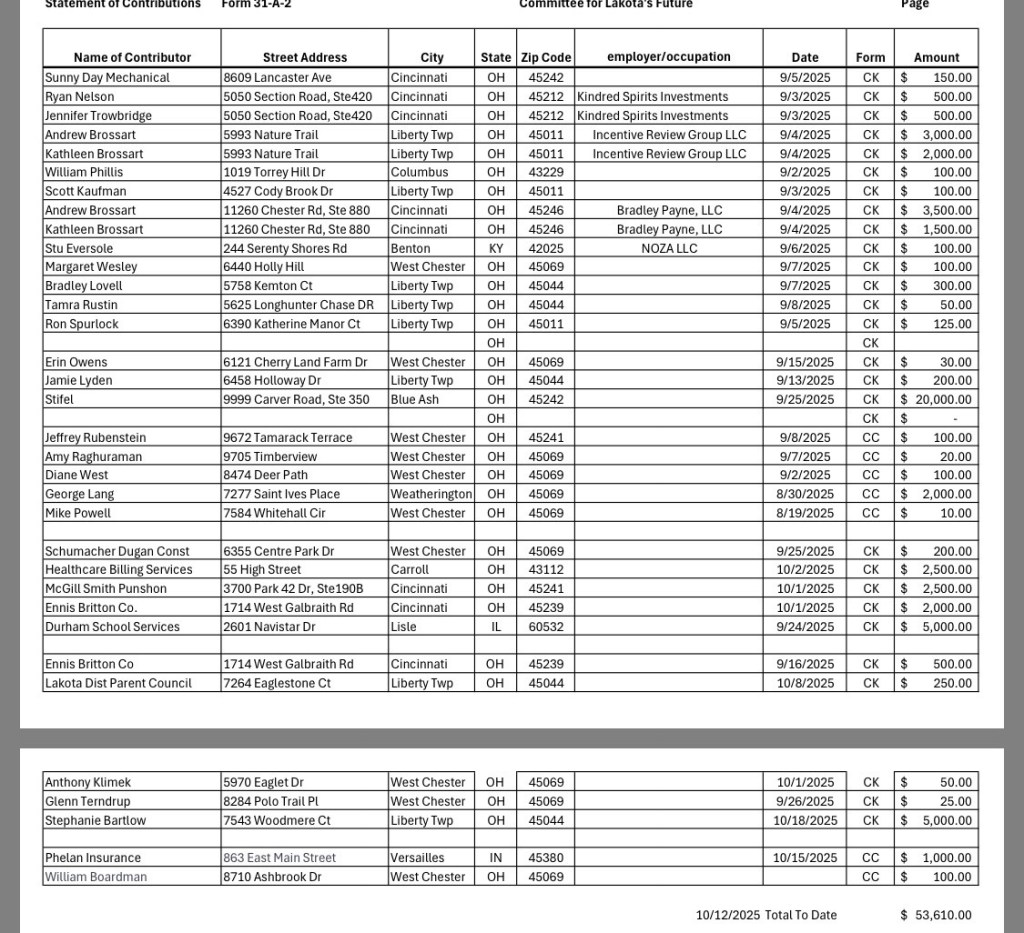
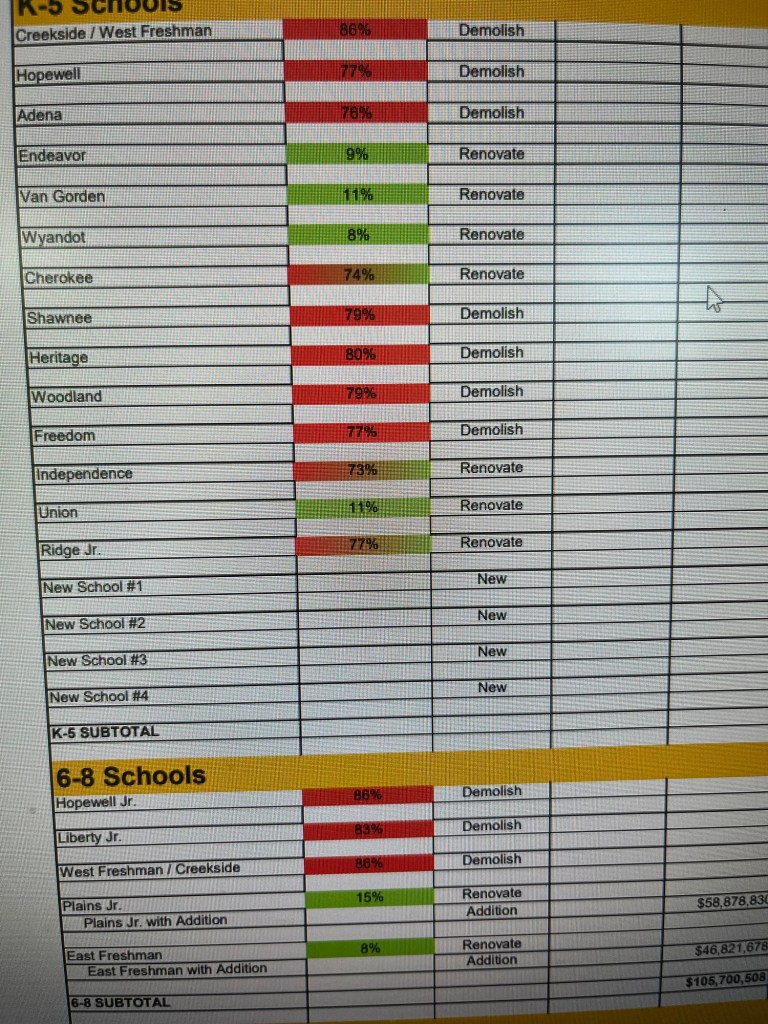
Lakota’s fiscal narrative is one of repeated tax extraction attempts met with growing taxpayer fatigue. The district’s last successful operating and permanent improvement levy passed in 2013, intended as a five-year measure but stretched to 15 years through pressure management and economic conditions.[^6] It funded operations amid post-recession recovery, but by the 2020s, escalating costs—driven by union contracts, inflation, and administrative bloat—necessitated more. Earlier attempts tell a cautionary tale. In 2011 alone, voters rejected Lakota levies three times in 18 months, reflecting early resistance to millage hikes amid economic uncertainty.[^7] Fast-forward to November 4, 2025: The district placed one of Ohio’s largest school levies ever on the ballot—a $506.4 million bond issue (4.99 mills) paired with a 0.95-mill permanent improvement levy for its Master Facilities Plan. The proposal aimed to demolish, renovate, and consolidate 21 buildings into 16 (including four new elementary schools), promising operational savings, smaller class sizes, enhanced security, and fewer grade transitions.[^8]

Financial details were layered with optimistic projections: State co-funding via the Ohio Facilities Construction Commission would cover 32 percent (roughly $200 million), reducing the effective bond collection to 3.99 mills. An existing 2.28-mill bond roll-off in 2028 would offset much of the hike, yielding a net increase of just 2.66 mills—or roughly $93.10 annually per $100,000 of auditor-appraised home value ($208 gross, delayed collection to 2029). Seniors and low-income disabled residents would see even less (about $68.71).[^9] District leaders, including Treasurer/CFO Adam Zink, framed it as a “last resort” to avoid deeper operating cuts and redirect savings to classrooms. Yet voters delivered a decisive rejection: 61 percent “no” (approximately 60.81 percent to 39.19 percent), one of the starkest defeats in recent memory.[^10]

This was no anomaly. The district’s 12-year streak of balanced budgets (because of declining enrollment through FY2024) masked underlying pressures: staffing costs (predominantly wages and benefits under union contracts), enrollment fluctuations, and state funding volatility.[^11] The 2013 levy’s longevity proved temporary; without new revenue, forecasts warned of shortfalls by FY2028–2029. Superintendent Dr. Ashley Whitely, in a January 2026 interview, conceded another levy is “a matter of when, not if,” signaling plans for a revised, perhaps scaled-down proposal after community input sessions and a ThoughtExchange survey.[^12] This “shell game”—big ask first, retreat to smaller—has become predictable, eroding trust.

The 2025 levy push occurred under new leadership installed amid crisis. Former Superintendent Matt Miller resigned in January 2023 after a tumultuous year. Board member Darbi Boddy and others highlighted allegations stemming from his divorce, detailed in police records: Miller admitted arranging and participating in group sexual encounters with his ex-wife.[^13] A private investigation cleared him of on-the-job misconduct or legal violations, but the public spectacle—coupled with claims of board hostility—doomed his tenure. Miller had positioned himself as a progressive exemplar, yet the revelations shattered that image.[^14]

In May 2024, the board hired Dr. Ashley Whitely as Superintendent/CEO, effective August 1, 2024. A former Lakota East English teacher and department chair (five years in-district), plus assistant superintendent at Wyoming City Schools, Whitely brought local roots and a “proven track record” in professional development and community partnership.[^15] Her vision, outlined in district messages and the “Let’s Go Lakota!” video series, emphasizes “Building OUR Future…One Piece at a Time,” the E + R = O performance pathway (Events + Responses = Outcomes), a staff-co-created Culture Blueprint, and over 100 listening sessions. She champions the Master Facilities Plan for safety, programming, and efficiencies.[^16]

Initial hopes for reform—perhaps embracing competition via open enrollment or market-driven efficiencies—faded quickly. Whitely’s role evolved into levy cheerleader, promoting the 2025 ballot as essential for “redirect[ing] dollars toward academics.” Post-defeat, she solicits input on facilities but insists on future tax measures.[^17] This aligns with the district’s pattern: Administrators for administrators. National Center for Education Statistics data shows 5 district-level administrators, 49 school administrators, 76 administrative support staff, and total FTE staff of roughly 1,988 (including about 729 teachers) for 17,500-plus students.[^18] Total headcount exceeds 2,061. Salaries reflect this top-heaviness: Former Superintendent Miller earned $199,639 (2023 peak); current structures project assistant superintendents up to $165,000-plus.[^19]

Critics, including new board member Benjamin Nguyen (elected 2025 alongside incumbents), highlight the mismatch with private-sector accountability. Unlike CEOs who scale operations amid market shifts, Lakota’s leadership maintains escalating wages, refuses workforce reductions despite declining enrollment trends in some areas, and layers bureaucracy. The “famous” salary transparency reports (local analyses comparing Lakota admins to regional peers) have long shown disproportion—often exceeding governors’ pay or comparable private roles—yet little reform follows.[^20]

Lakota’s budget—predominantly staffing (teachers and classified unions under contract)—grows unchecked. Five-year forecasts assume wage hikes, new programming for state report cards, and no scaling despite efficiencies promised in the failed Master Facilities Plan.[^21] Too many administrators oversee administrators; summer-heavy schedules (nine-month operations for many) yield high per-day costs. Property taxes fund this while state models collapse under pension liabilities and mandates.

Worse, cultural drift compounds the issue. Public schools nationwide increasingly insert progressive curricula—gender ideology, pronoun policies, CRT undertones—divorcing students from parental authority. While Lakota has removed some problematic materials and adopted neutral policies under board pressure, the broader model recruits youth toward statist loyalty rather than family-centric independence. Teachers’ unions, dominant in negotiations, prioritize compensation over innovation. The “free babysitting” value proposition of yesteryear—drop kids off, secure college/job outcomes—has evaporated amid rising costs, ideological conflicts, and mediocre proficiency (69 percent in core subjects per state metrics).[^22]

Voters recognize the scam: Levies no longer “invest” but subsidize inefficiency. The 2025 defeat echoed taxpayer weariness after decades of escalation. Economic illusions of endless growth once masked the burden; now, with inflation, remote work, and housing costs, resistance grows. Low taxes foster community vitality—business attraction, population retention—far more than shiny facilities. As one analysis notes, districts failing levies often thrive via market adaptation; Lakota’s monopoly mindset persists.[^23]

True CEOs innovate. Lakota should pursue open enrollment aggressively, attracting students (and per-pupil state aid) from underperforming districts. Detach funding from ZIP codes via Ohio’s expanding voucher/EdChoice programs. Embrace hybrid models, reduce admin layers (target fewer than 40 total), benchmark salaries privately, and cut non-essential staff. Competition would force excellence: Lower “prices” (effective tax cost per outcome), higher value.

School board members like Nguyen offer glimmers of accountability. Anti-levy organizations and citizen groups—doing the oversight boards often neglect—have proven more valuable than cheerleaders. Ohio’s property tax reliance is unsustainable; broader reforms (income-based or choice-driven funding) loom.

Nationally, districts adopting choice outperform monopolies. Florida and Arizona models demonstrate gains without endless bonds. Lakota could lead by proving smaller government yields better education.

Dr. Ashley Whitely’s tenure, like predecessors’, risks perpetuating the cycle: Cheerlead taxes, ignore marketplace realities, double down on bureaucracy. The 2025 defeat and her “matter of when” stance confirm no learning occurred. Yet community pushback—rejecting the $506 million ask—signals maturity. Low taxes and fiscal restraint build stronger neighborhoods than lavish, ideologically captured schools.

Public education’s inception promised uplift; its execution delivered dependency. Lakota proves the thesis: Family teaching, societal backup, and competitive choice outperform removal and regimentation. Voters must sustain resistance until leaders adapt—or parents exit via choice. The next levy attempt will test this resolve. History suggests defeat again, until the model evolves. Residents owe it to future generations to demand better: Not more spending, but smarter, freer education.  And the new superintendent at Lakota schools is just more of the same failure-based education approach that nobody likes, and is poised to change dramatically in the times to come.

Over the past decade, the consistent rejection of new school levies in the Lakota Local Schools district has functioned as an informal tax‑stabilization mechanism. When a district of Lakota’s size goes twelve-plus years without a new operating levy, the cumulative savings for homeowners and businesses become enormous. A single failed levy—typically in the range of 5–7 mills—can represent millions of dollars per year that remain in private hands. Spread across more than 110,000 residents and tens of thousands of parcels, the avoided tax burdens since 2013 likely total hundreds of millions over the decade. For most families, that means thousands of dollars that stayed in their household budgets; for businesses with larger property footprints, it means tens of thousands saved per year that could instead be invested in hiring, equipment, or expansion.

The opportunity cost dimension may actually be the most important. Property‑tax‑resistant communities often grow faster because stable taxes encourage residential investment, business development, and long‑term homeownership. West Chester and Liberty Township have repeatedly been cited as among the fastest‑growing and most competitive economic corridors in Ohio—not in spite of tax restraint, but largely because of it. Keeping levy pressure low increases disposable income, which boosts retail, construction, restaurants, and small business dynamism. Over a decade, that economic flywheel compounds: more residents, more businesses, more payroll, and more value creation than would have existed under a heavier tax regime.

There’s also a governance value created by tax resistance. When levies fail, districts are forced to prioritize, modernize operations, and seek non‑tax solutions to structural problems. Lakota’s delayed levy cycle has pushed administrators—Miller previously, and now Dr. Whitely—to be more transparent, more financially innovative, and more accountable to the public. That pressure often leads to leaner operations, better auditing, and a clearer articulation of needs versus wants. From a community perspective, that’s a form of economic value too: it disciplines public institutions to behave more like private ones, where efficiency isn’t optional.

Taken together, the anti‑tax presence in the Lakota district hasn’t just saved residents money—it has shaped the character of Butler County’s growth. Lower tax burdens helped produce one of the most economically vibrant suburban regions in the state, attracting investment and stabilizing property markets even during volatile national periods. The savings are measurable, but the long-term community value—strong growth, predictable tax environments, and a business‑friendly climate—is the larger legacy.

Footnotes

[^1]: Based on historical analysis of Prussian compulsory education models adopted in the U.S. during the 19th century.

[^2]: John Taylor Gatto, The Underground History of American Education (New York: Oxford Village Press, 2000).

[^3]: Lakota Local School District official enrollment data and National Center for Education Statistics (NCES) district profile, 2024–2025.

[^4]: See critiques in progressive education history, including works by Diane Ravitch and E.D. Hirsch Jr. on curriculum shifts since the 1960s.

[^5]: U.S. Department of Education and OECD PISA comparative spending/outcome reports, latest available cycles.

[^6]: Lakota Local Schools historical levy records and Ohio Department of Education financial reports.

[^7]: Journal-News (Hamilton, Ohio) coverage of 2011 levy elections.

[^8]: Lakota Local School District Master Facilities Plan documents and ballot language, September 2025.

[^9]: Lakota “Financial Facts Behind the 2025 Ballot” publication and auditor’s office millage calculators.

[^10]: Official election results from Butler County Board of Elections, November 4, 2025, reported by WLWT and Cincinnati Enquirer.

[^11]: Lakota five-year financial forecasts submitted to Ohio Department of Education, FY2024–2029.

[^12]: Cincinnati Business Courier interview with Dr. Ashley Whitely, January 2026.

[^13]: Police records and board meeting minutes referencing Miller’s resignation, January 2023.

[^14]: Cincinnati Enquirer and Journal-News reporting on the investigation and public fallout.

[^15]: Lakota Local Schools board announcement and Cincinnati Enquirer, May 4, 2024.

[^16]: District “Let’s Go Lakota!” communications and superintendent message archive on lakotaonline.com.

[^17]: Post-election statements and ThoughtExchange survey updates from Superintendent Whitely.

[^18]: NCES Common Core of Data, Lakota Local School District staffing tables, 2024–2025.

[^19]: OpenPayrolls.com and Lakota salary schedules, 2023–2025 data.

[^20]: Local salary comparison reports circulated in Butler County media and taxpayer analyses.

[^21]: Lakota five-year forecast assumptions and board budget documents.

[^22]: Ohio State Report Card metrics for Lakota Local Schools, latest proficiency data.

[^23]: Comparative studies on levy-failure districts by EdChoice and Ohio Auditor of State performance audits.

Bibliography for Further Reading

Cincinnati Enquirer. “Lakota Local Schools names Ashley Whitely as its superintendent.” May 4, 2024.

Journal-News. Coverage of 2011–2025 levy attempts and Miller resignation.

Lakota Local School District. Master Facilities Plan financial documents and superintendent messages (lakotaonline.com).

National Center for Education Statistics (NCES). Lakota Local District Detail, 2024–2025.

Ohio Department of Education. School district financial forecasts and report cards.

WLWT / WVXU. Election results and levy coverage, November 2025.

Cincinnati Business Courier. Whitely interview on future levies, January 2026.

OpenPayrolls.com. Lakota employee salary database.

Gatto, John Taylor. The Underground History of American Education.

EdChoice.org and Ohio Auditor of State reports on vouchers, choice, and district audits.

Rich Hoffman

More about me

Click Here to Protect Yourself with Second Call Defense https://www.secondcalldefense.org/?affiliate=20707

About the Author: Rich Hoffman

Rich Hoffman is an independent writer, philosopher, political advisor, and strategist based in the Cincinnati/Middletown, Ohio area. Born in Hamilton, Ohio, he has worked professionally since age 12 in various roles, from manual labor to high-level executive positions in aerospace and related industries. Known as “The Tax-killer” for his activism against tax increases, Hoffman has authored books including The Symposium of JusticeThe Gunfighter’s Guide to Business, and Tail of the Dragon, often exploring themes of freedom, individual will, and societal structures through a lens influenced by philosophy (e.g., Nietzschean overman concepts) and current events.

He publishes the blog The Overmanwarrior (overmanwarrior.wordpress.com), where he shares insights on politics, culture, history, and personal stories. Active on X as @overmanwarrior, Instagram, and YouTube, Hoffman frequently discusses space exploration, family values, and human potential. An avid fast-draw artist and family man, he emphasizes passing practical skills and intellectual curiosity to younger generations.

Property Taxes are on the Chopping Block in Ohio: We warned these public schools, and now the time is here

The push to eliminate property taxes represents one of the most significant challenges to longstanding fiscal structures in the United States, particularly in states like Ohio, where a citizen-led movement has gained substantial momentum. This effort is not merely a local grievance but part of a broader national conversation about taxation, homeownership, government dependence, and economic freedom. In Ohio, a proposed initiated constitutional amendment known as the Ohio Eliminate and Prohibit Taxes on Real Property Initiative has been cleared for signature gathering and targets the November 3, 2026, ballot. If successful, it would permanently prohibit taxes on real property, defined to include land, growing crops, and permanently attached buildings (though public utilities might still face some taxation under specific interpretations).

To qualify, proponents need 413,488 valid signatures (10% of votes cast in the preceding gubernatorial election), with signatures required from at least 5% of voters in 44 of Ohio’s 88 counties. Groups such as the Committee to Abolish Ohio Property Taxes and Citizens for Property Tax Reform have been actively collecting signatures, with reports indicating progress well in excess of 100,000 signatures as of late 2025 and early 2026, alongside widespread deployment of petitioners. The movement is explicitly citizen-driven, emerging from frustration with rising tax burdens rather than legislative initiative. Legislative allies and local officials express sympathy for taxpayer concerns but highlight the practical difficulties of abruptly replacing the revenue stream.

Property taxes in Ohio fund a substantial portion of local government operations, with estimates indicating they account for roughly 65% of regional revenue. For public schools, which receive over three-fifths of real property tax collections (approximately $13.6 billion for tax year 2024, payable in 2025), this is the largest single funding source—surpassing state aid and supporting the education of nearly 1.5 million students. Counties, townships, libraries, parks, fire districts, and other special districts also rely heavily on these funds for services ranging from emergency response and road maintenance to mental health, addiction treatment, developmental disabilities support, elderly services, and children’s protective services. In many townships, property taxes are the primary revenue source because they lack the authority to levy income or sales taxes.

Opponents of abolition, including local officials, school districts, and organizations like the Ohio Municipal League, warn that elimination would be “disastrous,” potentially forcing sharp increases in sales taxes (possibly to 18-20% in some areas) or income taxes (doubling or tripling rates) to fill the gap. Schools could face severe disruptions, including cuts to programs, staff, or facilities, amid already escalating costs from collective bargaining agreements and professional salaries. Now, where was all this concern when DeWine shut down schools for Covid protocols?  Talk about disruptions, how would any of this be different regarding a disruptive culture?  Recent legislative reforms—such as bills signed by Governor Mike DeWine in late 2025 that limit inflation-linked increases, expand homestead exemptions, and provide rollbacks—aim to provide relief without complete abolition, capping certain levies, and redirecting funds to homeowners. These measures offer partial mitigation but have been dismissed by advocates as insufficient, fueling continued signature drives.

This Ohio initiative aligns with similar debates in other states, where post-World War II rising home values have increased tax bills, eroding a sense of ownership. In North Dakota, proposals leverage oil revenues to phase out homeowner property taxes over a decade. Florida’s Governor Ron DeSantis has advocated phasing out non-school property taxes on homesteads, with multiple joint resolutions under consideration for gradual exemptions. Texas seeks to eliminate school-related property taxes, while Georgia, Indiana, Wyoming, and others are exploring offsets through sales tax expansions or state funds. These efforts reflect taxpayer discontent with “rent to the government” models, where perpetual payments undermine actual private ownership.

Historically, property taxes trace back to early American systems, evolving from feudal obligations and colonial practices. In Ohio, taxation of land began under territorial rule in the 1790s, with classifications by fertility until 1825, when an ad valorem system emerged. The 1851 Ohio Constitution mandated uniform taxation of real and personal property (with limited exemptions), and significant reforms followed, including the 1930s caps on unvoted levies (1% of actual value) and the shift away from state-level property taxes by 1932. The modern system solidified as local governments increasingly relied on property taxes for schools and services, especially after state income taxes (introduced in 1971) and other revenues reduced direct state dependence.

Critics frame property taxes as a “socialist enterprise,” enabling expansive government growth by treating property as a shared resource rather than a private asset. People like me argue that painless extraction—via escrow in mortgages or withholding—masks the burden, allowing unchecked expansion of services, union-driven salaries, and inefficiencies. High taxes, combined with stagnant or declining home values in some areas, risk forcing sales to corporate buyers such as private equity firms, thereby eroding individual wealth and control. This echoes broader concerns about progressive taxation funding “Great Society” programs, where expectations for government services outpace sustainable revenue.

Proponents of abolition envision a shift toward true market capitalism: lower utility costs, energy exports, improved deportation efficiency, and economic expansion that generates revenue through productivity and voluntary mechanisms such as sales taxes. Education could shift to competitive models—private, charter, homeschooling, or online—where families direct funds to preferred providers rather than relying on zip-code monopolies. This aligns with calls for accountability, in which services compete for “business” and excessive spending (e.g., inflated administrative costs or underperforming outcomes) is subject to market discipline.

Yet the transition poses risks. Abrupt revenue loss could destabilize essential services, exacerbate inequalities if alternatives favor the wealthy, or lead to regressive shifts toward consumption taxes. Historical precedents, such as the New Deal era’s expansion of government through property-based funding, suggest that entrenched interests resist change. Even sympathetic legislators face constraints from revenue dependencies and collective bargaining.

Ultimately, this debate transcends Ohio, reflecting a national reckoning with post-war fiscal models. Rising awareness that home ownership should confer security—not perpetual rent—fuels momentum. Whether through the 2026 ballot success or gradual reforms in the coming years (2027-2028), property taxes face severe scrutiny. The gravy train of unchecked expansion may indeed conclude, pushing society toward enterprise-driven wealth creation and limited government. Failure to adapt risks further alienation, while thoughtful restructuring could foster genuine prosperity.  I warned public schools, especially, for many years that they had built their entire foundation on this socialist property tax model, where government grows on the back of property ownership and, as an irresponsible action, grows too big.  In our family, all my grandchildren are being homeschooled because the product of public education is garbage.  And as it was for my own children when they were in school, I had to do most of the work of teaching anyway.  They traditionally attended public school for about two-thirds of their school days, and I had to unteach them all the material they learned in school.  So this day was long coming, and now, it’s here.  And people are seeing what they got for all that money that was wasted, and they don’t like it.

Bibliography for Further Reading

•  Ballotpedia: Ohio Eliminate and Prohibit Taxes on Real Property Initiative (2026). https://ballotpedia.org/Ohio_Eliminate_and_Prohibit_Taxes_on_Real_Property_Initiative_(2026)

•  Ohio Attorney General: Petitions Submitted, including Abolishment of Taxes on Real Property. https://www.ohioattorneygeneral.gov/Legal/Ballot-Initiatives

•  Policy Matters Ohio: “Ohio property tax repeal would gut school budgets & critical services.” https://policymattersohio.org/research/ohio-property-tax-repeal-would-gut-school-budgets-critical-services

•  Tax Foundation: “Property Tax Relief & Reform in 2025.” https://taxfoundation.org/research/state-tax/property-tax-relief

•  Ohio Department of Education: Overview of School Funding. https://education.ohio.gov/Topics/Finance-and-Funding/Overview-of-School-Funding

•  EH.net: “History of Property Taxes in the United States.” https://eh.net/encyclopedia/history-of-property-taxes-in-the-united-states

•  Ohio Capital Journal and Cleveland.com articles on 2025-2026 property tax reforms and initiatives.

Footnotes

¹ Ballotpedia, 2026 Ohio Initiative details.

² Policy Matters Ohio, funding allocation estimates.

³ Ohio Legislative Service Commission fiscal notes on recent bills.

⁴ Tax Foundation reports on multi-state proposals.

⁵ Historical timeline from the Ohio Department of Taxation documents.

⁶ General critiques drawn from economic analyses of property tax structures and alternatives.

Rich Hoffman

Click Here to Protect Yourself with Second Call Defense https://www.secondcalldefense.org/?affiliate=20707

CPS and their Lazy Employees Closed for 3 Days: Teaching kids to be wimps and to hide everything behind “safety”

The recent winter storm that struck the Greater Cincinnati region in late January 2026—often dubbed “Snowmageddon” or the “snow apocalypse” by locals and media alike—delivered a significant punch, blanketing the area with record-breaking snowfall. On January 25, 2026, Cincinnati logged 9.2 inches at Cincinnati/Northern Kentucky International Airport, shattering the previous single-day record for that date (5.8 inches in 2004) and ranking among the top one-day totals in city history.[^1] Storm totals across the Tri-State reached 10 to 16 inches in many spots, with some neighborhoods seeing even higher accumulations, marking the heaviest snowfall since events like February 1998.[^2] The storm arrived over the weekend, with heavy snow falling primarily on Sunday, January 25, followed by frigid temperatures dipping near or below zero, icy conditions, and lingering drifts that made travel challenging for days.

In response, Cincinnati Public Schools (CPS)—serving approximately 35,000 students and 6,500 staff across 66 schools—closed for three consecutive days: Monday, January 26; Tuesday, January 27; and Wednesday, January 28, 2026. Classes resumed on Thursday, January 29, after Superintendent Shauna Murphy announced the reopening, emphasizing safety as the top priority while calling on the community to clear sidewalks, salt icy patches, and ensure safe access to bus stops and crosswalks.[^3] Murphy’s statement highlighted the district’s eagerness to welcome students back but underscored the need for collective effort: “We are eager to welcome our students back, and we need the community’s help to make their commute safer.”[^4] This three-day shutdown drew sharp criticism from some residents, who argued that roads were passable relatively quickly, with many areas shoveled or plowed by Monday morning, and that the closure exemplified broader societal trends toward excessive caution.

Ohio’s snow emergency levels provide context for the decisions. Hamilton County, encompassing Cincinnati, declared a Level 3 snow emergency starting at 6 p.m. on Sunday, January 25, restricting roads to emergency personnel only due to heavy accumulation, ice, and extreme cold.[^5] By Monday, it downgraded to Level 2 before rush hour, and further to Level 1 by Tuesday or Wednesday in many areas, signaling improving but still hazardous conditions.[^6] Neighboring counties like Butler, Clermont, and Warren followed similar patterns, starting high and reducing as plowing progressed. These levels guide travel restrictions but leave school closure calls to superintendents, who weigh factors like bus safety, sidewalk accessibility, building conditions, staff availability, and liability risks.

The critique centers not on the storm’s severity—undeniably substantial—but on the response, particularly the extended closure of public schools like CPS. By Monday, much of the snow had been cleared from major roads, and personal observations from driving across Cincinnati showed navigable conditions despite piled snowbanks and side-street challenges. Trash collection continued in many areas, albeit with difficulties, and businesses operated, albeit with some disruptions. In northern states like Minnesota, the Dakotas, or the Northeast, similar or heavier snowfalls prompt adaptation rather than widespread shutdowns—plows run continuously, residents clear driveways, and life proceeds with gritted determination. Human tenacity historically overcomes such obstacles without paralyzing entire systems.

Yet in Cincinnati, the three-day closure extended beyond what many deemed necessary. An hour delay or two on Monday might have sufficed, allowing students and staff to resume routines while addressing residual hazards. Instead, the decision reinforced a pattern: prioritize “safety” above all, even when it borders on overcaution. Critics argue this hides administrative convenience—avoiding liability from potential accidents, bus delays, or injuries—and teacher/staff reluctance to brave conditions. Union influences and bureaucratic inertia play roles; it’s easier to close than coordinate amid risks. The superintendent’s plea for community help clearing sidewalks subtly shifts responsibility outward while justifying the delay.

This mentality extends far beyond one storm. Modern society increasingly hides behind “safety” to mask laziness, lack of fortitude, or aversion to discomfort. Public education, meant to prepare children for adulthood, instead teaches yielding to challenges. When schools close at the first sign of trouble—snow, cold, rain—children learn that crises warrant retreat, not resilience. They absorb that excuses like “it’s too dangerous” or “liability concerns” trump duty. This coddling produces adults unprepared for reality: drivers who panic on slightly slippery roads despite modern vehicles with traction control and front-wheel drive; workers who demand remote setups post-COVID or call off for minor inconveniences; individuals who turn to substances like legalized marijuana to “mellow out” stress rather than confront it.

The generational shift is stark. Older generations fought through blizzards, building character through adversity—shoveling without complaint, driving cautiously but confidently, showing up regardless. Today’s youth, shaped by administrative-heavy systems, learn the opposite: safety trumps effort, government coddles, and challenges are avoided. Public schools, funded by taxpayer dollars, bear particular responsibility. CPS, like many districts, emphasizes emotional well-being, equity, and risk aversion over grit and productivity. When closures occur, lost instructional time compounds—though Ohio’s flexible calamity day rules and built-in hours often prevent make-up days, as CPS’s 2025-2026 calendar allows significant buffer before extensions.[^7]

The economic ripple is profound. Extended closures disrupt families—parents miss work or juggle childcare—while signaling to the workforce that productivity yields to comfort. In large corporations, remote work persists as a “safety” holdover, eroding collaboration and output. In education, unions and administrators prioritize protection over performance, facilitating below-average effort. When 80% of society adopts this mindset, productivity plummets, innovation stalls, and resilience erodes.

Add legalized marijuana to the mix, and problems compound. Drivers already slow-reacting under optimal conditions—mellowed, delayed starts from stops, hesitant turns—face amplified hazards in snow. Untrained in crisis navigation due to school-taught avoidance, they crawl at 20-25 mph on 45-50 mph roads, causing backups and accidents. This isn’t mere anecdote; it’s observable in rush-hour chaos post-storm, where inexperience met residual ice.

The root lies in public education’s philosophical shift. Once emphasizing arithmetic, reading, citizenship, and perseverance, it now prioritizes social dynamics, safety protocols, and emotional shielding. Kids learn popularity contests and group norms but not how to dominate adversity—change a tire, shovel efficiently, drive in snow, or push through discomfort. They grow into adults who fear everything: cold feet, back strain, minor slips. Liberals, often dominating urban administrations like Hamilton County’s, amplify this by framing caution as compassion, using “safety” to justify inaction.

Contrast with private enterprise: businesses stayed open where possible, adapting because survival demands it. Taxpayer-funded entities like CPS face less pressure, hiding behind bureaucracy. The result? A softer society, less productive, more dependent. One storm exposes it: three days off for what could have been managed with delays teaches surrender, not strength.

This isn’t compassion—it’s detriment. True care prepares people to thrive amid hardship, not hide from it. Future generations will inherit adults ill-equipped for crises—marital, financial, or meteorological—because schools modeled yielding. It’s embarrassing, pathetic even, when paid services fail to model fortitude.

West Chester and surrounding areas, with their Republican-leaning success, resist some of this, but urban cores like Cincinnati succumb. The lesson: vigilance preserves excellence. Yielding to every flake erodes it gradually. Snowmageddon 2026 wasn’t apocalyptic in scale but in implication—society’s softening, starting in classrooms.

Shame on those who hide laziness behind safety. Fight through, show up, dominate the crisis. That’s how good communities—and people—endure.

Bibliography

•  Cincinnati Enquirer. “How much snow did we get? Yes, we broke records.” January 26, 2026. https://www.cincinnati.com/story/weather/2026/01/26/cincinnati-snow-record-how-much-snow-did-we-get-ohio/88358201007

•  FOX19. “PHOTOS: A blanket of white covers the Tri-State.” January 25, 2026. https://www.fox19.com/2026/01/26/photos-blanket-white-covers-tri-state

•  Cincinnati Public Schools. “CPS to Reopen Thursday, Jan. 29, 2026.” https://www.cps-k12.org/all-news/default-news-page/~board/district-homepage-news/post/cps-to-reopen-thursday-jan-29-2026

•  Cincinnati Enquirer. “Cincinnati schools reopening Jan. 29, other districts remain closed.” January 28, 2026. https://www.cincinnati.com/story/news/education/2026/01/28/cincinnati-schools-reopening-jan-29-other-districts-stay-closed/88402584007

•  City of Cheviot. “Hamilton County Level 3 Snow Emergency.” January 25, 2026. https://cheviot.org/hamilton-county-level-3-snow-emergency

•  Cincinnati Enquirer. “Snow emergency levels in Ohio today.” January 27, 2026. https://www.cincinnati.com/story/weather/2026/01/27/snow-emergency-levels-in-ohio-today-updates/88374686007

•  Cincinnati Public Schools Calendar 2025-2026. https://www.cps-k12.org/calendar

[^1]: National Weather Service data cited in Cincinnati Enquirer, Jan. 26, 2026.

[^2]: FOX19 reporting on storm totals, Jan. 25, 2026.

[^3]: CPS official announcement, Jan. 28, 2026.

[^4]: Superintendent Shauna Murphy statement, WLWT and FOX19 coverage.

[^5]: Hamilton County Sheriff’s declaration, Jan. 25, 2026.

[^6]: County downgrades reported in Cincinnati Enquirer, Jan. 27, 2026.

[^7]: CPS calendar and calamity day rules, Cincinnati Enquirer, Feb. 2, 2026.

Rich Hoffman

Click Here to Protect Yourself with Second Call Defense https://www.secondcalldefense.org/?affiliate=20707

Hamilton City Schools is Just the First: Years of collective bargaining agreements bankrupted public education

The announcement by Hamilton City Schools Superintendent Andrea Blevins in mid-January 2026 marked a significant moment in the ongoing fiscal challenges facing public education in Ohio. The district, serving the city of Hamilton in Butler County, unveiled a plan to eliminate approximately 153 positions—representing about 12% of its workforce—as part of a broader strategy to address a projected $10 million structural deficit for the 2026–2027 school year.<sup>1</sup> This included closing buildings such as Fairwood Elementary, consolidating the freshman campus into the high school, outsourcing preschool and nursing services, and implementing reductions across administrative, teaching, clerical, food service, custodial, and other roles.<sup>2</sup> While the initial figure of 153 positions was highlighted in media reports, district officials noted that through natural attrition and retirements, the actual number of forced separations could drop to around 101 or even fewer, with changes set to take effect starting in August 2026 to allow adequate notice.<sup>3</sup>

The shortfall stems from multiple converging factors: reduced state foundation funding under Ohio’s revised allocation formulas, recent changes in property tax laws that limit revenue growth, and declining student enrollment, reflecting broader demographic shifts in industrial communities like Hamilton.<sup>4</sup> These issues are not isolated; they illustrate a national and state-level reckoning with the sustainability of traditional public school funding models that have long relied on escalating property tax levies and generous state aid. In Hamilton’s case, the district’s current-year deficit was already around $5 million, with projections escalating without intervention, prompting proactive measures to avoid deeper program cuts or emergency borrowing.<sup>5</sup>

This development aligns with longstanding critiques of public education’s dependency on perpetual tax increases and union-driven collective bargaining agreements that prioritize salary scales, legacy costs, and benefits over merit-based compensation or operational efficiency. For decades, many Ohio school districts have assumed voters would approve levies to cover rising costs, including teacher salaries that often exceed private-sector equivalents for comparable education levels and workloads.<sup>6</sup> In Hamilton, as in neighboring districts, the era of unchecked levy approvals has ended amid economic pressures: inflation, housing affordability challenges, and taxpayer fatigue from repeated requests for additional funds. Property taxes, which fund a substantial portion of local school budgets in Ohio, have become particularly burdensome in areas with stagnant or declining industrial bases, where businesses relocate to avoid high taxation, leaving residential properties to shoulder more of the load.<sup>7</sup>

Nearby Lakota Local Schools in Butler County provide a parallel example. In 2025, voters rejected a $506 million bond issue and a permanent improvement levy tied to a district-wide facilities redesign, signaling resistance to additional tax burdens, even for infrastructure needs.<sup>8</sup> Lakota’s prior operating levies had sustained operations without new asks since 2013, but the failed 2025 measure highlighted growing skepticism toward large-scale spending proposals. This rejection occurred amid broader discussions of school choice and funding equity, where money follows students rather than zip codes, potentially forcing districts to compete on quality and cost.<sup>9</sup>

The broader Ohio context points to a deliberate policy shift toward tax relief. Political momentum, amplified by figures associated with the Trump administration and candidates like Vivek Ramaswamy in his 2026 gubernatorial bid, emphasizes reducing or eliminating state income taxes while pursuing significant rollbacks in property taxes—the “largest in Ohio’s history,” as Ramaswamy has proposed.<sup>10</sup> Ramaswamy’s platform includes making Ohio a zero-income-tax state to attract residents and businesses, coupled with aggressive property tax reductions to ease homeowner burdens and stimulate economic growth.<sup>11</sup> These ideas build on existing reforms that have lowered Ohio’s top personal income tax rate over the past decade and eliminated certain business taxes, though often at the expense of state aid to local services like schools.<sup>12</sup> Federal-level discussions under the Trump administration, including revenue from tariffs and potential clawbacks of federal taxes, further support a trajectory of lighter local tax loads over the coming decades.<sup>13</sup>

Critics of traditional public education funding argue that overreliance on property taxes has distorted community development. High levies deter business investment, contribute to population outflows, and exacerbate housing affordability issues, particularly for young families entering the market.<sup>14</sup> In declining industrial cities like Hamilton, where companies have long since departed, the tax base weakens further, creating a vicious cycle: fewer resources lead to service reductions, which accelerate out-migration. The push for enterprise zones and economic revitalization in such areas requires restraint on taxation to attract private capital, rather than burdening new opportunities with endless school funding demands.<sup>15</sup>

At the heart of these fiscal realities lies a deeper philosophical debate about the value and efficiency of public education. Collective bargaining has secured escalating wages, often tied to advanced degrees rather than performance, resulting in average teacher salaries well above those in many private-sector roles, despite generous vacation time, summers off, and job security.<sup>16</sup> Historical data shows Ohio teacher pay rising from averages around $63,000–$65,000 in the early 2010s to higher figures today, adjusted for inflation but still outpacing many comparable professions.<sup>17</sup> Proponents of reform contend that merit-based systems, competition from charters and private options, and student-centered funding (where per-pupil allocations follow the child) would incentivize excellence and cost control. Without zip-code-based monopolies, schools must attract families through superior results, not guaranteed enrollment.<sup>18</sup>

Additional pressures include the perceived ideological drift in curricula, where progressive influences have sometimes prioritized social agendas over core academic rigor, contributing to generations of students entering adulthood with skill gaps, delayed independence, and reliance on parental support.<sup>19</sup> This undermines the future tax base, as young adults struggle to form households, start families, and contribute economically. The traditional model—free transportation, extended daycare-like hours, and heavy administrative overhead—has been criticized as unsustainable, as parents increasingly drive their children to school or seek alternatives.<sup>20</sup>

The Hamilton announcement serves as an early indicator of inevitable restructuring across Ohio and beyond. Districts facing similar shortfalls will need to prioritize efficiency, reduce legacy costs, and adapt to competitive models. Charter schools, homeschooling, and voucher programs will gain traction as families demand better value. While painful in the short term—job losses, building consolidations, and service adjustments—the transition promises a more accountable, innovative education landscape aligned with economic realities and taxpayer priorities.<sup>21</sup>

This shift reflects a broader cultural move toward meritocracy, fiscal responsibility, and reduced government dependency. Public schools will survive, but in leaner, more responsive forms, focused on delivering robust education rather than serving as employment vehicles or ideological platforms. The warnings issued over the years about unsustainable models have materialized; adaptation, not denial, offers the path forward.<sup>22</sup> But as all these things are happening, don’t say I didn’t warn everyone.  They chose to ignore the inevitable.  The public school product costs too much.  Does too little.  And has turned out to be destructive to society, not beneficial.  So lots of changes are coming, because they have to. 

Bibliography

•  Local 12 (WKRC), “Tri-State school district to cut 153 positions, close school amid $9.6M budget shortfall,” January 22, 2026.

•  FOX19, “Hamilton City Schools announces $9.6M in budget cuts, job losses,” January 20, 2026.

•  WCPO, “Hamilton Schools announce cuts, including building closures,” January 2026.

•  Journal-News, “Hamilton Schools announce cuts, including building closures,” January 16, 2026.

•  WVXU, “Voters reject $506M Lakota Schools levy proposal,” November 4, 2025.

•  Forbes, “Vivek Ramaswamy Wants To Make Ohio The Ninth No-Income-Tax State,” March 13, 2025 (updated context 2026).

•  Cincinnati Enquirer, “Vivek Ramaswamy running for Ohio governor. Wants to end income, property taxes,” February 24, 2025.

•  Policy Matters Ohio, reports on state tax shifts and education funding, 2024–2026.

•  Tax Foundation, Ohio tax data and rankings, updated 2026.

Footnotes

1.  FOX19, “Hamilton City Schools announces $9.6M in budget cuts, job losses,” January 20, 2026.

2.  Local 12 (WKRC), “Tri-State school district to cut 153 positions,” January 22, 2026.

3.  Journal-News, “Hamilton Schools announce cuts,” January 16, 2026.

4.  Citizen Portal AI summary of Blevins’ presentation, January 16, 2026.

5.  WCPO coverage of Hamilton budget announcement, January 2026.

6.  Historical analyses from the Ohio Department of Education reports on teacher compensation trends.

7.  Tax Foundation data on Ohio property tax burdens relative to income.

8.  WVXU, “Voters reject $506M Lakota Schools levy proposal,” November 4, 2025.

9.  Lakota Local Schools’ official statements on 2025 ballot rejection.

10.  Vivek Ramaswamy campaign announcements, January 2026 (e.g., Facebook video on zero income tax and property tax rollback).

11.  Forbes article on Ramaswamy’s gubernatorial platform, with 2026 updates.

12.  Policy Matters Ohio, “The Great Ohio Tax Shift,” 2024–2025 analyses.

13.  Broader Trump administration economic policy discussions, 2025–2026.

14.  Economic studies on tax competition and business relocation in Midwest states.

15.  Hamilton enterprise zone revitalization efforts referenced in local economic development plans.

16.  Ohio teacher salary data from the National Education Association and state reports.

17.  Inflation-adjusted comparisons from the Bureau of Labor Statistics and Ohio data.

18.  School choice advocacy from organizations like EdChoice and Ohio-specific voucher expansions.

19.  Critiques in education policy literature on curriculum content and outcomes.

20.  Parental transportation trends from the U.S. Department of Transportation and local surveys.

21.  Projections from the Ohio Legislative Service Commission on education funding reforms.

22.  Long-term forecasts in state five-year financial reports for districts like Hamilton and Lakota.

Rich Hoffman

Click Here to Protect Yourself with Second Call Defense https://www.secondcalldefense.org/?affiliate=20707

Public Schools Were Designed By Dumb People to Make More Dumb People: Dewey always wanted communism

I’ve always been consistent on homeschooling issues; I’ve never thought that the public education system was any good.  In a conversation the other day with some people, they asked me about this, and I always hate answering the question because the essential elements aren’t very complimentary.  The person I was talking to said about themselves, “I’m not very smart, I barely made it through school myself, so I wouldn’t want to harm my kids by teaching them.  I would rather have a professional do it.”  I hate that conversation because it forces you to admit to how stupid most people are, which makes it hard to deal with them willingly.  I don’t have that confidence problem.  I think I can do everything, including working on my car, better than other people and feel better equipped to do it.  Especially teaching my kids.  I think the public education system was set up wrong from the start, and I’ve never been a fan, including in my own school days. I was friends with several honors-type students who were very high-IQ, genius-level students, and I watched how the school leeched off them.  There was nothing for the school to add to their education because all the people teaching those kids were stupid.  And you don’t want to hurt people’s feelings, but usually, people who choose to become school teachers aren’t the best and brightest; otherwise, they would try to make a go of things in the private sector, where they could make a lot of money.  The people who end up teaching are often like the person who was talking to me about public school —they aren’t the brightest our society has to offer.  Neither my wife nor my children finished their senior year of school; they graduated during their junior year.  They did graduate, but they never attended the ceremony, and none of them has ever looked back. 

Government schools are big business. Look how much money was raised by Lakota schools to pass the biggest tax increase in Ohio’s history!

Both of my children spent their senior years traveling Europe to finish their education, and we never sit around wishing they had done anything different.  If anything, we talk about wanting to homeschool them earlier.  A few times during their junior high years, we tried it, but family members really got in the way and were grotesquely unsupportive.  The experience was so bad that we pulled our kids out of school anyway and just finished their education online.  And that was twenty years ago.  There are many more options available now.  We had a close-knit family, so it was hard to ignore their opinions, and back then, those opinions mattered a lot more than they do today.  And, as always, the public school experience —the other kids, the employees, the choice of what to teach—was all constructed by stupid people so that kids can grow up to become more stupid people, and I can’t support that process. Instead, my view of education is that it is far more valuable than the public school system was designed to facilitate.  As I have always said, when John Dewey designed public education, it was made to teach communism.  Not how to teach kids how to think.  And I find it despicable.  I have tried to let other people change my mind, but over time, I have become even more firm in my positions because nobody has ever been able to, even though I have tried to give them the space to do so.  They have never been able to change my mind, even when given more than enough of a fair chance. 

During one of the previous No Lakota Tax campaigns, years ago, the standard teacher’s union complaint has always been classroom sizes, and that was their justification for needing more tax money to hire more teachers to reduce classroom sizes.  I said on the radio, on television, and in public forums that the reason was that the teachers were too lazy to teach a lot of kids, and that all that extra money was essentially to fund laziness.  So they got mad and challenged me to come into the school to teach a class myself so I could find out just how hard it was.  So I went to Lakota East and sat down in one of the classrooms to accept the challenge.  Kids and staff from Spark Magazine, which is a published magazine for the Lakota school system that goes out to a lot of people in a big district full of over 100,000 people, met me to propose the challenge, which they thought I would shy away from at the last minute.  I told them I was ready to teach not just one class, but four at once.  Bring four classrooms into the auditorium, and I would teach them all personally, any subject they wanted to cover, for as long as they could handle.  Now you have to understand that I work an average of 15 hours a day, most days of the week.  And my mind never stops working.  I have been married for more than 37 years and now have grandchildren.  This challenge was about 10 years ago, but I was pretty much the same as I am now.  Teaching a class is something I would call very easy. 

They chickened out because the teachers balked at the proposal.  They didn’t want me to make them look bad, and whenever there has been a public debate on the matter, they never hold up and are easily defeated.  And not to rub salt in the wound, but I have never met a person better equipped to teach any of my children or grandchildren anything, better than me.  And I know a lot of people.  I know a lot of people who think of themselves as brilliant.  And I would say none of them are better at teaching my children anything.  It’s lazy to drop a kid off at school and turn that vital task over to a professional.  So with all that in mind, remember, public schools were designed to teach kids the emerging communism of Karl Marx in those pre-Civil War days.  They were never intended to produce the next generation of geniuses.  And I expect my kids and my grandkids to be the best people they can be.  To elaborate on the point, I will put up some videos here of one of my grandsons and his dad, who have a weekly YouTube channel that I think is pretty neat.   It shows just how important it is to teach a child from a parent, and it’s so much better than the public school experience.  I think that my youngest grandson has a chance to be the next Thomas Edison or Albert Einstein.  The public school system does not make those types of people, and if it were effective, they certainly would.  So if we want people to live up to their full potential, you have to get them as far away from the public school system as possible.  And the truth is, most parents are too lazy to give their kids that chance.  And it’s a shame.  I feel sorry for every kid whose parent is too lazy to homeschool them.  My experience with it is that kids become so much better when they don’t have to endure the corrosive effects of being taught by grown adults to be dumb.  Because public school was designed by communists who wanted to suppress intellect, not expand it, and until we deal with that truth, we will continue to be very disappointed by the results.

Rich Hoffman

Click Here to Protect Yourself with Second Call Defense https://www.secondcalldefense.org/?affiliate=20707

Lakota Wants A Half A Billion Dollar Tax Increase: All the schools they want to destroy, and rebuild with wasted money–VOTE HELL NO!

This is what you get when you have liberals on a school board. Lakota Schools has decided to put two levies on the ballot in November, totaling half a billion dollars, which will cost most taxpayers at least $465.5 in property taxes.  They are stating that the combined $4.99 million bond issue will have a $0.95 million permanent improvement tax added to it, which will cost around $93.10 per $100,000 of home evaluation, providing $ 506.40 million to be repaid over 37 years.  And all that sounds wonderful until you realize that we’ve heard this all before, such as when the Liberty Junior building was proposed and built back in 1980, and is scheduled as one of the ten schools they want to demolish with this tax increase.  New school buildings can’t hide the fact that the people teaching in them and running them have no idea what they are doing, and that radical teacher union values are what are being taught to these generations of kids.  And, as with these school levies, which have been a while since we’ve had one at Lakota, I will be voting not just ‘no,’ but a resounding ‘hell no’ on this ridiculous proposal.  What it essentially comes down to is a bunch of liberal women on a school board who believe that new shoes worn to a social occasion can make lipstick on a swine look better.  Hey, nobody is looking at your shoes, if you’ve let yourself go, and all these school board members are just that type, new clothes can’t hide what disasters they are to social considerations.  And I say four ladies because Doug Horton acts like one of them, and given the way these big progressive organizations hire people like him, I would not be surprised to learn that he puts she/her as his listed pronouns.  This Lakota school board is a very progressive group, and they all believe that cosmetics can hide the fundamental flaws of the education system in general.

These are the schools Lakota is planning to tear down

They believe that this is the time to do this; they have wanted to for a long time, and we have held it off in our community by having at least a reasonable stopgap on the school board.  For the last couple of years, we (conservatives) had a three-to-two majority.  But the way that everyone behaved, the radical leftists in the background, there was no way to keep conservative members on the board.  When Darbi Boddy was no longer there, any hope of reform on spending vanished.  The idea that the Republican Party could at least appease the radicals with some playing nice was a fantasy.  Before they ran Darbi off, they ran off other conservatives with just as much viciousness.  I determined several years ago that the Lakota school board was beyond hope, and the best course of action was to let them reveal themselves to the community as they are, which is precisely what they are doing.  Talk about bad judgment, the people suggesting that new school buildings will solve their education problems of teaching students are the same people who are well known to strip on table tops at education conventions and end up passed out without their clothes in the bathroom.  So, when I say that for these very pretentious people, who look like people who have let themselves go, and believe that a new outfit worn to a social occasion will keep people from seeing what they are, that is the logic behind this ridiculous half a billion dollar monstrosity.  If it weren’t so outrageously absurd, we might laugh at it, but they are serious. 

Republicans played nice with these radical people as long as they could, and that has largely kept a tax increase off the ballot since 2012.  Declining enrollment has kept the budget afloat, and the wages reflect it, with a majority of the administrators and many of the Lakota teachers earning well into the six figures these days.  Their operating budget is approximately a quarter of a billion dollars, so these failing schools are a real drain on our community.  They are centers of government progressive imposition that are trending out of our society.  These four school board members have been advocates for same sex bathrooms and Critical Race Theory.  They ran off Darbi, who was doing a good job of pointing out those big problems, and a lot of people didn’t like that she wouldn’t play nice to keep Lakota’s board from going completely liberal, as it is now.  However, in the process, they were dragging our community into the gutter, and we needed to take a stand at some point. This levy is it.  I think it’s a 58% to 42% issue, with the majority aligning with the conservative nature of Butler County.  They believe that enough liberal-minded people have moved in from other areas to shift the vote total to something more even, with 50% for them and 49.9% against tax increases.  I don’t think so; I think they live in a social bubble and believe that Lakota residents are all at Cooper’s Hawk at Liberty Center, sipping wine with their pinkies out.  I think the real voters are actually watching the latest Trump speech and are waiting for Vivek Ramaswamy to be governor and to bring School Choice to Ohio on a mass level.  And to create a merit-based teaching system.  Never forget that School Choice was in the Big Beautiful Bill, as I had told everyone it would be.  Lakota is way behind the times, and it shows with this ridiculous levy initiative. 

I remember when Liberty Junior was proposed as the latest technology-driven school back in 1980, when it was built.  It was one of the first schools in the area to have air conditioning.  While that was 45 years ago, it’s still a nice school and could easily be used in a competitive school environment where Lakota will have to compete with other districts for students to attend, as the dollars will not be allocated to the school, but to the child.  By the time these people build the new schools after tearing down the old ones, education in America is likely to change dramatically under Trump’s administration, and with Vivek Ramaswamy as governor of Ohio.  And regarding Liberty Junior, many people attended that school, but nobody exceptional emerged from all that social investment.  It produced average people who grew up to be average, and I think Butler County wants more than that for the next generation.  That’s why they supported Trump.  And that’s why a lot more people these days are saying what I have been saying about education for decades, that government schools don’t do a very good job.  And we don’t like them leeching off our property taxes to instill social values in our kids that we don’t like.  And the people making these decisions aren’t very good.  They live their personal lives as disasters who try to hide that from the public, like an ugly person wearing new shoes to a party.  You can have a whole closet full of new shoes, and those people will never look as good in them as a runway model.  New schools won’t make the ugliness of a failed union model go away, and the bad people who support that structure, as their social conduct well testifies, can’t hide it from the world with more money wasted.  And yes, the cost to the average homeowner in Liberty Township will be $ 465.50 because most homes are valued at $ 500,000.  A little detail that Michael Clark at the Journal News, Julie Shaffer’s lapdog for many years, ignores when he says that the value of a house is still at the 100K range.  You can’t have a doghouse in Liberty Township or West Chester these days for $100,000.  This is an expensive levy for a failing school system, created by failed people who are trying to hide their horrible lives behind innocent children with new and shiny schools, hoping to tear down the mistakes of the past with bricks and mortar that is a lot easier than replacing the garbage that they are. You can’t put lipstick on a swine and expect it not to be a pig, which is precisely what Lakota schools hopes to do with this massive tax increase, unleashed by their tone-deaf grasp on reality.

And just for an update on what former Lakota School Board member Darbi Boddy is doing these days.  Well, I would say she is doing better work for the future than wasting it on that ridiculous school board that is run by the teachers’ union of Lakota, and all their outrageous costs and social desires.  Darbi has been at Mar-a-Lago spending time, doing important things, that will be revealed in this change state for education.  She is also associating with a very good person, Sam Sarbo in promoting educational freedom and school choice.  I would say that Darbi will play a very important role in the future education of Ohio, in a much more potent role than what she ever could have done on the Lakota school board. And very soon, the Lakota board will wish they hadn’t ran off their cover story and exposed themselves in the way they will experience with this school levy.  We tried to warn them.

Rich Hoffman

Click Here to Protect Yourself with Second Call Defense https://www.secondcalldefense.org/?affiliate=20707

The Fate of Atlantis: Letting the CIA shape a narrative through federal money on college campuses–controlling what people know and believe

I have a mission in life that involves the mounds of Ohio, which was why I was reading the older book now by David Price, Weaponizing Anthropology. Price is a professor of anthropology at Sait Martin’s University in Lacy, Washington, and is well known to poke a stick at things.  Even though he is noticeably interested in the fictional concept of social justice and radical progressive causes, he is also a free speech advocate who was pen pals with Julian Assange during the heyday of WikiLeaks.  I was also interested in what he had to say about CIA penetration into the field of anthropology, which we are all very familiar with now as a problem in all sciences.  So I slugged through the anti-Bush diatribes, because he was also pretty hard on President Obama, as the book was published around 2011.  So it’s not exactly up-to-date current events, but it does show to what extent the danger of providing federal money to science has been, which can then be applied to just about anything.  Thinking about the pre-COVID world, the ability to purchase scientific opinion was a real problem that is essentially the caution of a book like this, so it was a bit odd to read about it now, knowing what we do about things.  But for me, I don’t like being lied to, and the mound culture analysts that have come from the fields of archaeology and anthropology are ripe for exposure, and I was interested to see just what extent my thoughts on the matter were relevant as it turns out, its far worse than I thought.  The problem is how a government can control the flow of information and how much it costs to purchase the truth.  The CIA has been very interested in doing just that, and when you get this kind of evidence, the magnitude of the problems comes into focus fast.

For instance, if you look at the coastline of Florida, well into the Gulf of America, now would have been a vast span of land that took up most of it, all the way over to where the Mississippi River is now, which would have all been above water 15,000 years ago.  And the real definition of Native American indigenous people is not what we found when Columbus came to America, but was the remains of a previous culture that was advanced and very organized, and had been around longer than the established Clovis assumptions of post-Ice Age habitation.  Ocean levels were more than 400 feet lower because ice displacement from the glaciers locked up massive amounts of moisture at the poles.  That means that North America had a very different coastline, and the evidence of people living in America is well preserved miles offshore of our current coast.  Divers have found all kinds of good things to research, so it’s not controversial to observe and prove.  As I said to an investigator the other day who explores these kinds of things, as a science, we have been looking for the car keys under a parking lot light at night, because that’s where we can see.  But we lost the keys in the bar, which is now closed.  So we look where we can, and conclude things based on that minimal vantage point.  This is the case for all the mound builders; thousands of sites exist in the United States.  In Ohio, you can’t go even today more than 10 to 14 miles in any direction and not find evidence of this previous culture.  To get to the point, I think that the last culture was ancient Atlantis, as reported by Plato in his famous writings on the matter, which were historical, not elements of fantastic fiction.  The proof is everywhere, but we don’t look at it.

But why?  That’s where the CIA and other government forces come into the picture.  Why would the CIA want to create an official narrative within the field of social sciences to shape a domestic opinion?  Well, there is a political narrative of anti-American sentiment attached to the exploitation of indigenous people that shapes our political order, and any talk about Atlantis being destroyed, 50,000 years ago or even 10,000 years ago violates the narrative that the CIA has been able to inject into the official narrative to explain that Clovis people came into North America during the Ice Age and migrated as hunters and gathers as happy nature worshippers until the mean Europeans arrived and took their blissful life away from them with the exploits of capitalism. Instead, the Atlantis discussion shows the catastrophe of a failed government with advanced abilities that crumbled into nothingness for many detrimental reasons.  And we should understand, as a modern culture, what those reasons were, so we don’t make the same mistakes ourselves.   So, rather than deal with the facts, the CIA was able to capture the reporting of the facts through funding and penetration into campus scientists and force them to support a CIA-directed narrative, by controlling the nature of federal funding.  When the government can make loans for expensive educations available cheaply, they can control the terms of the education and, by clause of contract, force borrowers to say and do anything they want.  And it has been a massive problem that has massively compromised the field of anthropology.  We saw all the sciences exposed in raw form during COVID, where so many scientists said what the world governments wanted them to say.  In this way, David Price has been an insider whistleblower. 

The evidence of science should take us where the evidence goes.  And whatever it is, it is what it is.  I don’t talk about the Atlantis theory as a hope or wishful, and fanciful thinking, I say it because the evidence takes us there.  But hidden in front of that evidence is this government control of an official narrative installed by elements like the CIA, who have a massive desire to control the populations of the world, which is why they have been interested in anthropologists being on their payroll.  Through black budgets unregulated by Congress, these people have been able to shape the truth they want society to establish so they can control how people feel about it.  And there is an obvious political motivation behind the victimization narrative.  The CIA signed up for the globalist agenda at least since Kissinger was working to bring China into the fold.  A lot of history is hidden in plain sight all through China and Russia, and down into that vast territory in the Near East, to the familiar sites of Iraq and Iran.  And in all those areas, the same earth structures are seen in North America from a mound-building culture that came from somewhere and was everywhere, much deeper into history than we have been previously told.  And the motivation for these deceptions was control over the current population and what they know about history.  The Native American narrative is a Democrat plot against the creation of America to begin with.  And the forces of the world that currently want to be in power, as they showed during the self-made Covid crisis, are to erase the truth.  That, well before the Archaic period, there was a global civilization that suffered a catastrophe and fled to all corners of the world, resulting in the mound-building cultures that had with them a technology that was more occult than physical science.  And that society had failed long before Columbus discovered that ancient land.  Which, of course, would violate the narrative the modern CIA wanted to project.  And their ability to capture a version of the truth that the mass population would accept is the real result of government control over finance and the ability to know what the truth is and whether or not anybody can be trusted who accepts federal money, for anything.

Rich Hoffman

Click Here to Protect Yourself with Second Call Defense https://www.secondcalldefense.org/?affiliate=20707

Public Schools Are Going To Lose on EdChoice: Free legal advice on how to beat this case in court

In early May of 2025, oral arguments for the joint lawsuit by over 300 affiliates attached to public education funding made their pitch for why school vouchers harmed them and needed to be made unconstitutional.  Lakota schools in my district have recently joined this lawsuit with some horrendous legal advice from their counsel, but here’s the deal, and it’s quite clear after listening to the plaintive side of the case.  I had friends who went to provide testimony for the defense, for the position of the state to continue with the expansion of the school voucher program, in this case specifically, EdChoice.  I don’t think there was any question going into it how it was going to evolve.  But the position of the presenters, the public school argument, was incredibly weak.  Pathetically weak, and I guess you would expect them to be better prepared.  Here’s the deal: Public schools have left people wanting something better because they have performed terribly over a long period.  And parents want choices for their kids.  We’re not talking about not having education here.  We are talking about better education made that way through competition.  These pathetic public schools run by these ridiculously lazy teacher unions have destroyed the public education prospect as it was initially conceived.  Because most parents need the free babysitting service, they hold their noses and just put up with it.  But increasingly, parents don’t want to send their kids to public schools, and they want access to private schools, so they look for options like EdChoice to do so.  For many parents who currently send their kids to private schools, the system is really unfair to them.  They already pay property taxes to a local school attached to their zip code, and the full tuition for the private alternative.  Now, more people want the same option; they only wish that the tax money they pour into the system would be used to help give them an option instead of wasting it on a poorly managed local school they have no choice in.  Other than picking up and moving somewhere else.  It’s an evil system that is in deep need of reform. 

This is a common occurrence in public education institutions, and is why in Ohio, they can’t meet the ‘efficiency’ standard. This is a recent case out of state, but shows the system itself is broken and Ohio has plenty of their own cases.

I’m happy to do it. I usually do it twenty times a week for somebody somewhere, and I’ll give everyone some free legal work in this case.  This is an easy case without much drama because of the wording in the Ohio Constitution, which I think is a remarkable document.  I love the Ohio Constitution.  For fun, I read it at least once a week.  But for the plaintiffs in this EdChoice case, they are way off the rails on their argument.  And for the defense, here is how you win this case with an end zone dance.  The Ohio Constitution from 1851 says, “the General Assembly shall make such provisions, by taxation, or otherwise, as with the income arising from the school trust fund, will secure a thorough and efficient system of common schools throughout the state; but no religious or other sect, or sects, shall ever have any exclusive right to, or control of, any part of the school funds of this state.”  The problem with the teacher union-run public schools with an operating management system straight off the pages of the Democrat Party is that they have let their costs get away from them, and that nobody manages the efficiency of the product they produce, no matter how you manage “efficiency.”  We could measure efficiency by the output, student quality, and ability to navigate adult lives.  Or get jobs that they are well prepared for.  Or we can measure efficiency by the cost per pupil, how much money it takes to produce a good student, “efficiently.”  In all the cases, the public school presentation of their point of view falls short because of the wording, “efficiency.”  They want and expect an exclusive monopoly of state funds, which has caused them to be wildly inefficient.  And it is in this failure that there is a court case at all.  Public schools, six at this Columbus hearing, but a lot more in the background, are trying to stave off what they caused for themselves. 

People want choice from the public school system because it has proven itself to be incredibly inefficient in allocating funds to the proper education of Ohio students.  So the burden of proof in this case is on the plaintiffs to show how they have presented an efficient product worthy of state money, rather than their assumption that they are promised state money just for existing.  They have not met the minimum Constitutional threshold for their base argument.  That’s why the Supreme Court has found the Ohio school funding model unconstitutional up to this point and why it has lingered in indecision.  That word “efficiency” is a real problem for how public education evolved, and the writers were wise to put it there.  You could also say the same about the word “thorough.”  How can public schools say they provide a “thorough” education when the evidence shows that they do only what they have to do to get state money and use it to pay overpriced labor markets ridiculous amounts of money for perpetually poor performance?  The plaintiffs really sounded foolish in this constitutional regard at the Columbus oral arguments.  Even I was embarrassed for them.

I know it, the public school types claim that they are held to different standards than the private schools are not held to, and there is money in that compliance.  But that is again part of the problem of inefficiency, even if government standards have made the public school experience less efficient.  It contributes through their argument of the facts that the public school experience is unreasonably inefficient because of the standards the state has put on them to make the use of the money they get less effective.  Which only makes it worse for them.  This kind of back and forth is why more and more parents want an off-ramp to the public school experience.  Parents wish to choose whether it’s in a private school or to homeschool their kids so they don’t have to send their kids to a factory of Democrat politics, which is what modern education has evolved into.  Public schools are not teaching kids to grow up and become Republicans, which would make sense if it were fair both ways.  But they are actively trying to teach kids to grow up and become Democrats.  And what parent wants to pay for that if they don’t want to lose their kids to radical politics?  Which happens a lot in the public school experience.  And when you go to school board meetings to complain, and the school board cuts off the mic to shut everyone up, what do they expect to happen?  People will want to pull their kids out of those schools and will not want to waste their money on an inefficient school just because it happens to be in their zip code.  The public schools have shown that they waste the money and continue asking for more.  Because they are a bad product made that way through a monopoly status.  And the best thing for them, to make them Constitutionally viable, is to force them to be more efficient in a competitive marketplace, which is why EdChoice and many other voucher programs will increase in number in the years to come.  The teachers’ unions will not win this case, because they can’t show that they contribute an efficient and thorough product.  And with that, the case is over.

Rich Hoffman

Click Here to Protect Yourself with Second Call Defense https://www.secondcalldefense.org/?affiliate=20707