The Layered Foundations of Civilization and the True Meaning of Easter: Why Christianity Supplanted the Blood Cults of the World and Why Good Friday Is Indeed Good

I’ve said it many times before, and I’ll keep saying it because the evidence keeps piling up in every direction I look: civilizations don’t spring up out of nowhere like some secular fairy tale taught in modern classrooms. They build directly on top of previous civilizations, often literally stacking their cities, temples, and rituals atop the ruins of what came before. That’s why digging through the archaeological record to prove deep-time assumptions is so difficult—layers upon layers of human endeavor, each one trying to make sense of the same spiritual warfare that has raged since the beginning of recorded time. The same principle applies to our holidays, especially Easter. What we celebrate today isn’t some pristine invention of the early Church; it’s a Christian overlay on ancient pagan traditions, and that layering isn’t a bug—it’s the feature that makes the whole thing work psychologically and culturally for humanity’s long-term survival.  

This past Holy Week of 2026, as the world marked another Easter amid the chaos of our times, I found myself explaining this story over and over again to a new generation—mostly people under thirty—who are staring at the mess handed down by their parents and grandparents. Secular society led those older cohorts astray with promises of endless pleasure, moral relativism, and “progress” that stripped away any real foundation. These young people don’t like what they inherited. They’re drinking less, they’re not as sexually driven in the destructive ways previous generations were sold, and they’re turning to Christianity in numbers I haven’t seen in my lifetime. It’s not just some fleeting reaction to current events, though the assassination of Charlie Kirk last September certainly played a role in waking some of them up. Kirk and Turning Point USA had been reaching that exact demographic with a message of truth, responsibility, and American exceptionalism rooted in Judeo-Christian values. When radicals lashed out and killed the messenger, they didn’t kill the message—they turned Kirk into a symbol, almost a modern martyr in the eyes of many. That’s the danger of assassinating ideas: they don’t die; they multiply. But Kirk’s success wasn’t accidental. A whole cohort was already listening, already rejecting the secular void, and looking for something solid to stand on. Christianity is providing that anchor, just as it has for millennia.

Let’s get specific about Easter, because the question keeps coming up from these young seekers: Why the bunnies? Why the eggs? How does any of that connect to Christ’s resurrection? The answers take us straight back to those layered civilizations I mentioned. The Easter bunny and Easter eggs didn’t originate in the Gospels. They trace back to Germanic and broader European pagan traditions tied to spring fertility rites—reverence for the changing seasons where life bursts forth after winter’s death. Bunnies, with their legendary reproductive vigor, became symbols of vitality and new life. Eggs, obviously, represent rejuvenation—the perfect vessel from which new life hatches. Painting them was humanity’s way of imprinting our creative stamp on that divine process. These rituals migrated and blended across cultures, just as trade routes and migrations carried ideas from the Near East to Europe and beyond. The Christian tradition didn’t erase them; it baptized them, layering the resurrection of Christ—the ultimate victory over death—onto these older spring celebrations. That’s how holidays work. They evolve, but the core psychological need remains: to mark renewal, confront mortality, and seek meaning in the cycle of life and death.  

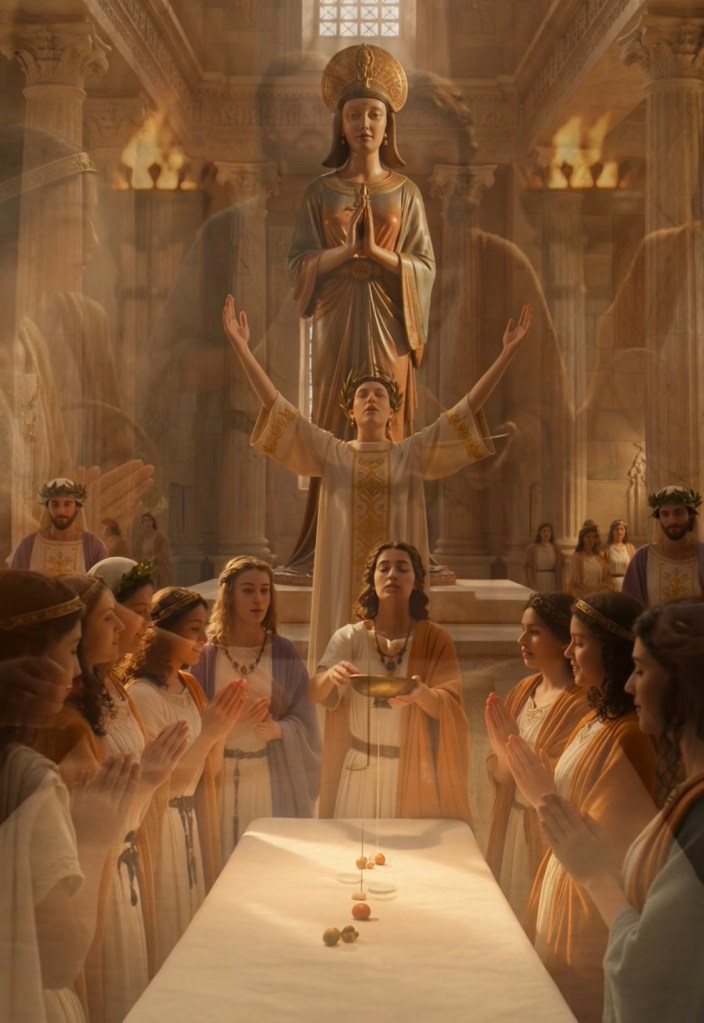
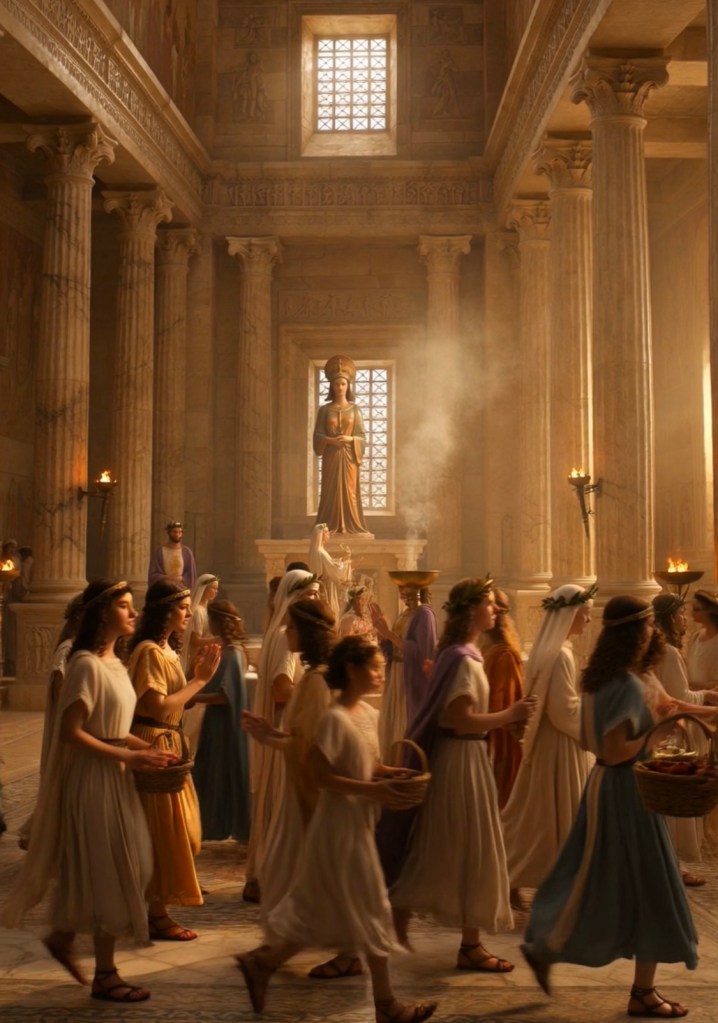
This isn’t some dilution of faith; it’s evidence of Christianity’s genius as a sustaining cultural mechanism. Look at the broader pattern. For hundreds of years—two or three centuries at a stretch, over and over—pagan societies rose and fell on the worship of planetary gods: Jupiter, Mars, Saturn among the Romans, borrowed wholesale from the Greeks, who themselves drew from Near Eastern deities. The same archetypes appear globally—uncovering similar pantheons and ritual cycles in Central America, South America, North America, Africa, and even ancient China. These civilizations kept collapsing under their own weight because they were psychologically tethered to blood cults. Human sacrifice wasn’t some fringe horror; it was the currency that kept the spiritual order supposedly in balance. The gods demanded blood—literal blood—to appease their hunger, to ensure fertility, to prevent catastrophe. Aztecs, Mayans, and countless others built entire societies around it. Temples like those of Artemis or Ishtar incorporated ritual prostitution and worse. Phoenician traders may have carried these practices across the oceans, with evidence of sophisticated pre-Beringia trade networks appearing in places like central Florida, near what’s now the Kennedy Space Center. The archaeological record hints at vast, interconnected systems far older and more advanced than the simple migration narratives we’re usually fed.

Christianity broke that cycle. It didn’t just compete with paganism; it psychologically supplanted it on a global scale. The crucifixion and resurrection of Christ presented the ultimate sacrifice—the Lamb of God offering Himself once for all—no more need for endless rivers of human blood on pyramids or altars. The body becomes bread; the blood becomes wine. Communion replaces the cannibalistic feasts that followed ritual killings. This wasn’t abstract theology; it was a pragmatic, world-changing intervention in the human condition. As I’ve explored in my upcoming book The Politics of Heaven, which draws heavily from Ephesians 6:12 and the ancient Book of Enoch, this spiritual war has been raging since the rebellion in heaven. Disembodied spirits—fallen entities hungry for the destruction of God’s creation—have whispered through dreams, drunkenness, hallucinogens like ayahuasca, or modern “possessions” that masquerade as progressive enlightenment. They crave anxiety, death, and the dismemberment of humanity because they are at war with the Creator. Christianity gave humanity the mechanism to say “no” on a civilizational level.

I’ve seen this truth play out personally. Years ago, my wife and I were in the Yucatan on Good Friday. We witnessed an entire town pour into the streets for a passion play—recreating Christ carrying the cross to His death. The whole community participated. It was profound. These were descendants of the very cultures that once cut out living hearts on temple steps and consumed the flesh in communal rites to appease gods who demanded blood to keep the sun rising or the rains falling. The Mayans and Aztecs didn’t do it for sport; they believed it was necessary for cosmic order. The Spanish conquest, whatever its flaws and whatever the secular historians scream about “genocide,” brought an end to that nightmare for the survivors. As I wrote about that experience in my reflections (what some have called Lockers of My Mind in my ongoing personal chronicles), it hit me hard: these people weren’t mourning lost heritage in that moment. They were liberated by it. Christianity replaced the terror with a single, sufficient sacrifice. No more pyramids running red. No more children or captives fed to the gods. Just bread and wine, remembrance, and the promise of resurrection. 

The critics—those secularists, progressives, and anti-human types who pine for “Earth worship” and indigenous revival—love to flip the script. They blame Christianity for slaughtering the Aztecs, Mayans, and every other group during the spread of Western civilization. “Look at all the bloodshed!” they cry. “The Crusades! The conquests! Christianity destroyed vibrant cultures! Peel back the layers, though, and you see the lie. Those “vibrant cultures” were built on industrial-scale human sacrifice. The Aztecs alone killed tens of thousands annually—estimates run into the hundreds of thousands over decades—to feed their bloodthirsty pantheon. Hearts torn out, bodies dismembered and eaten in front of crowds. The same patterns repeated worldwide: temple prostitutes in the cults of Ishtar, ritual killings in Phoenician outposts, even echoes in Roman and Greek practices before Christianity civilized them. The Jewish temple system itself pointed toward sacrifice, which is why tensions persist with some groups still longing for a Third Temple to resume animal (and, in some interpretations, fuller) offerings. Christ’s declaration—“It is finished”—shattered that—one sacrifice to end all sacrifices.

That’s why Good Friday is good. It marks the death that killed death’s dominion through blood currency. Easter celebrates the resurrection that proves the victory. We layer on the bunnies and eggs not to mock the old ways but to redeem them—spring renewal now points to eternal life in Christ, not seasonal appeasement of demons. This psychological shift was revolutionary. It toppled the Roman Empire not by sword alone but by offering a better story: humanity no longer enslaved to the whims of hostile spirits. Kings fell. Empires crumbled under the weight of this truth. And it continues today. Modern blood cults haven’t vanished; they’ve shape-shifted. Abortion clinics as modern altars, the desecration of the body through endless “self-expression,” broken families, and hedonistic pursuits that feed the same entities. Progressives who decry Christianity as oppressive are often the very ones seduced by these whispers, pushing policies that increase anxiety, death, and the consumption of innocence—whether literal or figurative.

I’ve written about this extensively because it’s not just history; it’s the present war. In The Politics of Heaven, I lay out the evidence of this vast conspiracy: giants, disembodied spirits, the ancient playbook from Enoch that explains the hunger for God’s creation. Jonathan Cahn’s work on the return of the gods captures the avatar-like reemergence of these entities in our time—possessing leaders, movements, and even individuals who surrender their integrity. From a quantum perspective, as I sometimes explore in my writings, it makes even more sense. Parallel realities, entangled essences, free will playing out against a backdrop that feels predestined because the spiritual architecture was set long ago. The stars the ancients charted weren’t superstition; they reflected a written order. Evil seeks to maintain its foothold, craving bloodlust because it is wild and destructive. Christianity provided the off-ramp.

Look at the young people today. They see through the secular lie. They’re not buying the narrative that Christianity “robbed” indigenous peoples of their essence. The essence of those cultures—the part worth preserving—was their humanity, which the blood cults were devouring. The heritage that needed eradicating was the one demanding hearts on pyramids. The survivors in the Yucatan that day understood it intuitively as they reenacted the Passion. They had a better life because of the Christian overlay. Pretty colors and sophisticated math in Aztec temples don’t excuse the horror. The same goes for every pagan system that required blood to function.

This is the productive, beneficial impact of Christianity that secular history deliberately obscures. It freed humanity from the cycle. It gave us moral judgment rooted in a single, sufficient sacrifice. It allowed civilization to advance rather than collapse every few centuries under spiritual exhaustion. As I detail in The Gunfighter’s Guide to Business and in my other works, such as The Symposium of Justice and Tail of the Dragon, the same principles apply to individual lives and enterprises: reject the appeasement of evil, embrace truth, and build something lasting. The overman—the Nietzschean ideal I’ve long admired but ultimately grounded in Christian reality—doesn’t bow to the old gods. He overcomes through Christ.

When people ask me why we celebrate Easter despite the “harm” attributed to Christianity, I point them to the Yucatan village, to the global archaeological record, to the undeniable decline of ritual sacrifice wherever the Gospel took root. We celebrate because we are remembering the sacrifice that ended the need for sacrifice. We celebrate bunnies and eggs because they now point to the ultimate renewal. We celebrate Good Friday because it was the day the currency of blood was retired forever for those who accept it. The evil spirits still lurk—they always have, and they always will until the final restoration. But Christianity armed humanity with the ultimate psychological and spiritual divorce from their demands.

The young people turning to faith right now are doing God’s work, whether they realize it fully or not. They’re rejecting the blood cults in modern dress—abortion, cultural suicide, the worship of self that feeds the same entities. They’re choosing life, renewal, and the Kingdom that was always meant to rule.

Easter isn’t just a holiday. It’s a declaration of victory layered atop the ruins of every failed pagan attempt to appease the dark. And in 2026, with the world still reeling from political violence and spiritual hunger, it’s more relevant than ever. That’s why it remains one of my favorite holidays. It reminds us that death was defeated, that renewal is possible, and that humanity is far better off because one perfect sacrifice broke the chains that had bound the earth for thousands of years. The bunnies still hop, the eggs still get painted, but now they point to something eternal. Christ is risen. The old cults are overthrown. And that is why we celebrate.

Footnotes

1.  See Jacob Grimm’s 1835 analysis of Eostre/Ostara traditions and modern archaeological confirmations of hare symbolism in Neolithic Europe.

2.  Bede’s Ecclesiastical History (731 C.E.) on the month of Eosturmonath and its assimilation into Christian practice.

3.  Bernal Díaz del Castillo’s eyewitness accounts in True History of the Conquest of New Spain detailing Aztec sacrificial practices.

4.  My own reflections on the Yucatan passion play, expanded in personal writings referenced as Lockers of My Mind.

5.  Jonathan Cahn, The Return of the Gods and related works on spiritual reemergence and avatars.

6.  Ephesians 6:12 and the Book of Enoch as foundational to The Politics of Heaven.

Bibliography for Further Reading

•  Hoffman, Rich. The Politics of Heaven: Evidence of a Vast Conspiracy Involving Giants, Disembodied Evil Spirits, and the Ancient Book of Enoch. (Ongoing project, excerpts available at overmanwarrior.wordpress.com).

•  Hoffman, Rich. The Gunfighter’s Guide to Business.

•  Hoffman, Rich. The Symposium of Justice.

•  Hoffman, Rich. Tail of the Dragon.

•  Bede. Ecclesiastical History of the English People.

•  Díaz del Castillo, Bernal. True History of the Conquest of New Spain.

•  Cahn, Jonathan. The Return of the Gods.

•  Smithsonian Magazine articles on Easter Bunny origins (2022).

•  Various archaeological reports on global pagan deities and trade networks (Phoenician and pre-Columbian contacts).

Rich Hoffman

More about me

Click Here to Protect Yourself with Second Call Defense https://www.secondcalldefense.org/?affiliate=20707
About the Author: Rich Hoffman

Rich Hoffman is an aerospace executive, political strategist, systems thinker, and independent researcher of ancient history, the paranormal, and the Dead Sea Scrolls tradition. His life in high‑stakes manufacturing, high‑level politics, and cross‑functional crisis management gives him a field‑tested understanding of power — both human and unseen.

He has advised candidates, executives, and public leaders, while conducting deep, hands‑on exploration of archaeological and supernatural hotspots across the world.

Hoffman writes with the credibility of a problem-solver, the curiosity of an archaeologist, and the courage of a frontline witness who has gone to very scary places and reported what lurked there. Hoffman has authored books including The Symposium of JusticeThe Gunfighter’s Guide to Business, and Tail of the Dragon, often exploring themes of freedom, individual will, and societal structures through a lens influenced by philosophy (e.g., Nietzschean overman concepts) and current events.

The Sex Cults of Artemis: We need to choose a name that sustains not just the body of exploration, but the soul of civilization itself.        

Artemis is going back to the moon, and I’m really not crazy about the name. I didn’t like it when they first came up with it, and I still don’t. It feels like one more concession to a secular worldview that pretends ancient pagan deities are just harmless branding exercises—cool-sounding relics from a long-dead culture that “everybody can agree on.” But history doesn’t work that way. Names carry weight. They carry spiritual baggage. And when NASA reached for a name to replace the glory days of Apollo and send us back to the lunar surface, they chose Artemis, the Greek moon goddess and twin sister of Apollo. On the surface, it sounds clever, a neat mythological bookend. But dig even a little deeper, and you’re wading into the same fertility cults, temple rituals, and appeasement of dark forces that early Christian writers confronted head-on in the Mediterranean world two thousand years ago. I’ve spent years studying this pattern, and it’s the backbone of a book I’m finishing called The Politics of Heaven. What we’re seeing with the Artemis program isn’t just branding. It’s a symptom of a much older struggle between the human spirit and the principalities that have always hungered for our attention, our bodies, and our collective sanity.

Let me start with the obvious. The Temple of Artemis at Ephesus was one of the Seven Wonders of the Ancient World, a massive marble edifice that dominated the city and the entire region. Built and rebuilt over centuries, it was more than a tourist attraction or a bank (which it also was—temples doubled as secure depositories). It was the epicenter of a cult that blended Greek mythology with older Near Eastern fertility worship. Artemis herself, in her Ephesian form, was often depicted with dozens of breasts or egg-like ornaments, symbols that modern scholars sometimes try to downplay as “not really about sex or fertility.” Yet the ancient world understood her differently. She was the goddess of the hunt and the wilderness, of chastity in some tellings, yet deeply entangled with the cycles of birth and reproduction, and the raw forces of nature. Her temple drew pilgrims, merchants, and locals who participated in festivals filled with processions, music, dancing, and—according to multiple ancient reports—rituals that involved the offering of human vitality, including sexual acts, to appease the divine.

Christian writers of the period didn’t shy away from describing what they saw. In Acts 19, the apostle Paul’s ministry in Ephesus sparks a riot among the silversmiths who made shrines to “the great goddess Diana” (the Roman name for Artemis). The city clerk calms the crowd by reminding them that Ephesus is the “temple keeper of the great Artemis, and of the image which fell from Jupiter.” That “image” was likely a meteorite revered as a divine gift, tying the cult directly to celestial forces. But Paul and the early Christians saw something far darker at work. They weren’t just opposing statues or tourism revenue. They were confronting a system of spiritual appeasement that had roots stretching back thousands of years to the fertility cults of Mesopotamia—Inanna, Ishtar, Astarte, and their Greek and Roman counterparts. These goddesses demanded sacrifice, often in the form of sexual union performed in or near the temple precincts. Women—sometimes all women in certain cultures—were expected to spend time as temple prostitutes, offering their bodies to strangers for money that went to the temple treasury. It wasn’t “empowerment” or personal choice in our modern sense. It was a collective duty to the gods, a way to ensure fertility for the land, prosperity for the city, and protection from whatever malevolent forces lurked in the spirit realm if the rituals were neglected.

Secular historians and archaeologists today often dismiss these accounts as Christian propaganda or exaggeration. They point out that direct physical evidence—carved reliefs, unambiguous inscriptions—is scarce at Ephesus because the temple was largely destroyed, its stones carted off for other buildings after Christianity became the dominant faith of the empire. Digging seasons in Turkey are short; the site has been layered over by centuries of occupation, and hostile conditions (political, environmental) have limited excavation. But absence of evidence isn’t evidence of absence, especially when you’re dealing with practices that were deliberately secretive or oral in nature. We have reports from Herodotus, Strabo, and other classical writers describing sacred prostitution in temples dedicated to similar goddesses across the region. In Babylon, for instance, every woman was reportedly required once in her life to sit in the temple of Ishtar (or Mylitta) and have intercourse with a stranger for a fee. Similar customs are attested in Cyprus, Phoenicia, and parts of Asia Minor. The early Church fathers didn’t invent these stories out of thin air; they were reacting to what they witnessed firsthand on the frontiers of the Roman East.

I believe we can trust those Christian reports precisely because the behavior they condemned persists. It just wears different clothes. Look at modern nightclub culture—the so-called “meat markets” that young people, especially women aged eighteen to twenty-four, are actively encouraged to frequent before “settling down.” Bachelorette parties where sexual impropriety is not only tolerated but celebrated. The progressive push for “sexual liberation” and “women’s rights” frames any restraint as patriarchal oppression. We send our daughters—girls who were playing with Legos and dolls just a few years earlier—into environments of throbbing music, flashing lights, alcohol, and physical grinding that would have been right at home in an ancient fertility festival. They dress in scandalously revealing outfits, present their bodies for public consumption, and are told it’s all harmless fun, a phase to “get out of their system.” The money doesn’t go to a temple treasury anymore, but the spiritual transaction is eerily parallel: the sacrifice of personal sanctity, the abandonment of the body to collective debauchery, the implicit agreement that youth and vitality must be offered up so the rest of society can enjoy peace from whatever unseen forces demand their due.

This isn’t hyperbole. It’s pattern recognition. Ephesians 6:12 puts it plainly: “For we wrestle not against flesh and blood, but against principalities, against powers, against the rulers of the darkness of this world, against spiritual wickedness in high places.” The apostle Paul, writing to the very church in Ephesus that had just emerged from the shadow of Artemis worship, understood that these weren’t abstract metaphors. The spirit world is real, and it competes for control of human bodies and minds. The body is the vehicle for the soul, but it’s a vulnerable one. When people impair their consciousness—through drunkenness, drugs, or ritual frenzy—they loosen the tether that keeps the conscious self in the driver’s seat. Competing spirits rush in. Personalities split, behaviors turn erratic, sanity fluctuates. Ancient temple prostitutes weren’t just performing an economic or social function; they were opening doorways. The same doorways we open every weekend in clubs across America and Europe. The music changes, the lighting gets fancier, but the appeasement of disembodied entities hungry for human essence remains constant.

My own explorations into these dynamics—through reading, observation, and reflection on how evil operates in human societies—have convinced me that we cannot separate the material world from the spiritual one. We are entangled. Secularism’s great lie is that we can neuter history, strip away the sacred (or the diabolical), and treat ancient gods as cartoon characters for mission patches and rocket fairings. NASA did exactly that with Artemis. After the Obama-era push to highlight “Islamic contributions to science” and diversify the agency with voices from every culture, the name was pitched as inclusive, neutral, non-offensive. Why pick something biblical when you could pick a “cool” pagan goddess that “everybody can agree on”? It’s the same impulse that led the agency’s early rocketry pioneers into occult territory. Jack Parsons, one of the founders of the Jet Propulsion Laboratory (JPL), was a brilliant chemist and engineer by day and a devoted Thelemite occultist by night. A disciple of Aleister Crowley, Parsons performed the Babalon Working in 1946 with L. Ron Hubbard—sex magic rituals involving masturbation onto magical tablets, invocations of the goddess Babalon (a Thelemic stand-in for the Scarlet Woman of Revelation), and attempts to incarnate demonic forces into the material plane. He saw no contradiction between rocket science and summoning ancient entities. In fact, he believed his rituals fueled his breakthroughs. NASA loves to celebrate the Apollo era’s clean, heroic image while quietly glossing over the fact that the foundational rocketry work at JPL had deep roots in Parsons’ dual obsessions. The cult origins of NASA aren’t a conspiracy theory; they’re documented in biographies like George Pendle’s Strange Angel. Parsons literally signed letters as “The Antichrist” and conducted black masses in his Pasadena home.

This brings me back to why naming the lunar return program after Artemis bothers me so much. It’s not just semantics. It’s a continuation of the same appeasement strategy humanity has employed for millennia. In ancient times, societies sacrificed their youth—virginity, vitality, individual dignity—to fertility goddesses in hopes that the “hungry gods” would leave the collective alone. Today we do it with our entertainment, our dating apps, our “hook-up culture,” and our refusal to draw moral lines. We tell young women that their bodies are theirs to offer freely in the nightclub meat market, that restraint is repression, and that any talk of spiritual consequences is outdated superstition. Meanwhile, the principalities and powers—those same competing souls and disembodied spirits that haunted the temples of Artemis, Ishtar, and Astarte—continue their work. They don’t need marble altars anymore; smartphones, social media, and Saturday-night fever vibes do the job just fine. The result is the same: fractured personalities, generational trauma, and a culture that robs itself of sanity in exchange for momentary collective highs.

I’m not suggesting NASA should abandon space exploration—quite the opposite. I love NASA. I want it to succeed. I want humanity to expand beyond Earth, to sustain life across the solar system, perhaps even outlive our home planet. But if we’re going to do that with any long-term credibility and moral foundation, we should draw from the best of our cultural inheritance—not the pagan underbelly that early Christians rightly rebelled against. Western civilization, for all its flaws, is rooted in biblical ideology. Why not name a program after a figure from Scripture that embodies vision, endurance, or divine favor? Something that signals we’ve learned from history rather than repeating its mistakes. The Artemis choice feels like a deliberate step away from that heritage, a nod to the “neutral” secular narrative that pretends spirit doesn’t matter. But spirit does matter. The body is the vehicle for the soul’s journey, and there are always entities eager to hijack the wheel when we let our guard down.

Archaeology may not have uncovered every detail of those ancient sex rituals—not yet, anyway—but the Christian eyewitness accounts from the period fill the gap. Paul’s letters to the Ephesians, the riot in Acts 19, and the writings of the early Church fathers all paint a consistent picture of cultures steeped in fertility worship that demanded human essence as payment. The temples are mostly gone now, reduced to a few pillars and scattered stones at Ephesus, but the underlying spiritual dynamic hasn’t vanished. It’s migrated into our secular rituals: the nightclub as temple, the DJ as high priest, the dance floor as altar. Young women (and men, though the pressure on females has always been more pronounced in these cults) are still expected to “do their tour of duty,” to offer themselves to the collective before committing to marriage and family. We call it empowerment. The ancients called it piety. Both are forms of appeasement.

In The Politics of Heaven, I unpack this at much greater length—how evil works through human institutions, how spirit and matter are inseparable, how competing souls vie for control of our bodies, and why yielding to animalistic impulses under the guise of “freedom” always leads to cultural decline. The book has taken years of research, reflection, and editorial effort, but the core argument is simple: we cannot outrun the spiritual realm by renaming it or pretending it’s mythology. NASA’s decision to invoke Artemis is a small but telling example of a larger societal failure to learn from history. We keep making the same stupid mistakes because we’re afraid of being called intolerant by the secular crowd. We’d rather appease the principalities than confront them.

If we truly want a sustainable future—one that includes permanent human presence on the Moon and beyond—we need to stop revering the old gods, even in name only. The cults of fertility and debauchery didn’t produce enduring civilizations; they produced cycles of excess, collapse, and moral exhaustion. Christianity’s radical break from those practices—its insistence on individual sanctity, monogamous marriage, and spiritual warfare against the powers of darkness—gave the West the moral framework that eventually launched the scientific revolution and the space age itself. Let’s honor that trajectory instead of reaching backward for pagan branding that sounds “cool” to focus groups.

I’ve seen too much evidence, both ancient and contemporary, to believe otherwise. The spirits that demanded appeasement in the temples of Ephesus and Babylon are the same ones whispering through our modern meat markets and cultural expectations. They thrive on impaired minds, abandoned bodies, and the sacrifice of youth. We don’t defeat them by pretending they don’t exist or by giving their old names new rocket programs. We defeat them by calling them what they are, drawing lines in the sand, and choosing names—and behaviors—that reflect the better angels of our nature rather than the demons we’ve never truly escaped. The Moon awaits, but the path we take to get there matters. Artemis might get us there faster on paper, but at what spiritual cost? I’d rather we choose a name that sustains not just the body of exploration, but the soul of civilization itself.        

Footnotes

1.  NASA official statements on the Artemis program naming, 2019 announcement by Administrator Jim Bridenstine.

2.  George Pendle, Strange Angel: The Otherworldly Life of Rocket Scientist John Whiteside Parsons (2005).

3.  Ephesians 6:12 (KJV).

4.  Acts 19:23-41, especially v. 35.

5.  Herodotus, Histories (on Babylonian customs of Ishtar/Mylitta); Strabo, Geography (references to temple practices in Asia Minor and Corinth).

6.  S.M. Baugh, “Cult Prostitution in New Testament Ephesus,” JETS 42/3 (1999), though I disagree with his dismissal of the broader pattern reported by early Christians.

7.  Stephanie Lynn Budin, The Myth of Sacred Prostitution in Antiquity (2008)—a secular counter-view that I believe underestimates eyewitness testimony from the period.

8.  Richard Metzger’s accounts of Parsons’ Babalon Working rituals.

9.  N.T. Wright, lectures on Ephesus and the Artemis cult background.

10.  My ongoing research for The Politics of Heaven (forthcoming).

Bibliography for Further Reading

•  Bible (King James Version), especially Acts 19, Ephesians 6, and 1 Timothy 2.

•  Pendle, George. Strange Angel: The Otherworldly Life of Rocket Scientist John Whiteside Parsons. Weidenfeld & Nicolson, 2005.

•  Herodotus. The Histories. Translated by Aubrey de Sélincourt. Penguin Classics.

•  Strabo. Geography. Loeb Classical Library.

•  Baugh, S.M. “Cult Prostitution in New Testament Ephesus.” Journal of the Evangelical Theological Society 42, no. 3 (1999).

•  Budin, Stephanie Lynn. The Myth of Sacred Prostitution in Antiquity. Cambridge University Press, 2008.

•  Kramer, Samuel Noah. The Sacred Marriage Rite. Indiana University Press, 1969 (for the Mesopotamian context).

•  NASA historical documents on Project Apollo and Artemis program origins.

•  Wright, N.T. Paul and the Faithfulness of God (relevant sections on pagan cults in Asia Minor).

•  Additional archaeological reports on Ephesus from the Austrian Archaeological Institute and related publications on the Artemision.

Rich Hoffman

More about me

Click Here to Protect Yourself with Second Call Defense https://www.secondcalldefense.org/?affiliate=20707

About the Author: Rich Hoffman

Rich Hoffman is an aerospace executive, political strategist, systems thinker, and independent researcher of ancient history, the paranormal, and the Dead Sea Scrolls tradition. His life in high‑stakes manufacturing, high‑level politics, and cross‑functional crisis management gives him a field‑tested understanding of power — both human and unseen.

He has advised candidates, executives, and public leaders, while conducting deep, hands‑on exploration of archaeological and supernatural hotspots across the world.

Hoffman writes with the credibility of a problem-solver, the curiosity of an archaeologist, and the courage of a frontline witness who has gone to very scary places and reported what lurked there. Hoffman has authored books including The Symposium of JusticeThe Gunfighter’s Guide to Business, and Tail of the Dragon, often exploring themes of freedom, individual will, and societal structures through a lens influenced by philosophy (e.g., Nietzschean overman concepts) and current events.

The Link Between Mass Killers and Pot: Robert Westman was a drug user who worked at a pot dispensary

There has been plenty of time to cover this story, but few have, as they are hesitant to address the topic due to its inconvenience.  But there are a lot of reasons why I have a visceral hatred of pot and its consumption, marijuana specifically.  And you can’t discuss mass shootings such as the one committed by Robert Westman recently, where he shot up a church full of children, killing two of them and injuring 17 others, including three elderly workers, during a prayer, without talking about drugs.  The 23-year-old was a trans kid, and there have been a lot of shootings recently that also involved trans kids, obviously having a hard time adjusting to what society has informed them through popular culture, and the nature of human reality.  That is one area where reality collides with the brick wall of social engineering, which goes drastically against biological nature.  But that’s not the root cause of the problem here, and if you study the trend behind the school shootings, it becomes undeniable that the consumption of marijuana is common among all of them.  In this case, with Robert Westman, as of a few months ago, he was working at a marijuana dispensary called RISE that sold medical cannabis.  He also sold handmade skateboard accessories with a girlfriend at local markets as recently as last year.  He was a constant vapor, so much so that he thought he would get cancer from his active consumption.  So this kid was one of those stringy-haired druggie types having a hard time coping with reality and turning to drugs often.  Even mentioning as much in the many notes he left behind.  If you have watched the kind of people who shop at these dispensaries for drugs, whether medical or recreational, they are not our society’s best.  Very little good is ever going to come from people who indulge in recreational drug use—and saying that brings up the real problem that certainly deserves such scrutiny. 

I’ve heard all the debates, and I remain a hard no on recreational marijuana use.  It’s the dumbest thing a society could endorse.  At least one of them, for reasons nobody is talking about.  In some people, the active ingredients in marijuana and other drugs produce psychopathic thoughts that are dangerous.  These active ingredients can trigger reactions in individuals who already have underlying conditions.  And politically, we have a lot of people who want to make money off people’s consumption of pot, because they justify that people are going to do it anyway, so why not make some tax money off it?  It’s a free world; who is anybody to tell other people how to live their lives?  So even Republicans have moved to support recreational marijuana and to legalize it in states that fall for the scam.  And before you know it, there are all these dispensaries going up everywhere, lowering the sidewalk appeal of all other businesses, justified as free market enterprise.  So, for the qualifier, I am against all drug use, even alcohol.  I would say it’s wrong to get an after-work drink to knock the edge off just as much as smoking dope from legal marijuana recently purchased from a dispensary.  Anything that is impairing your mind is dangerous and should be avoided.  When I hear that pot is legal and that should settle the matter, it only represents to me a bad decision by stupid people to legalize a hazardous drug that, in a certain percentage of the population, has a bad reaction to it, and they turn into mass killers.  Most, if not all, of the most recent mass killers had a relationship to marijuana, and the frequency of their killings could be graphed to the same rate of state legalization, where more of the wrong kind of people had easier access to the drug.  In the case of Robert Westman, he was so seduced by the druggie lifestyle that he chose to work at a dispensary.  He could have worked at McDonald’s, Wal-Mart, anywhere.  He decided on the RISE dispensary. 

So why is it so dangerous?  Well, since the beginning of human records, people have consumed drugs to alter their state of mind.  And in that drunken or impaired state, a mind loses its resistance to outside forces, which are always present.  And let’s just put it politely, a mind has a much easier time communicating with quantum characters.  Life forms that live in other-dimensional space.  Some cultures refer to them as demons, while others consider them angels.  Some cultures, such as Islam, call them gin.  Some cultures, such as the Japanese, refer to them as kami.  Shamans in Peru refer to them as ghosts just hanging out beyond our conscious existence, whom they communicate with directly through ayahuasca consumption.  There are spiritual forces that are just as common as mosquitoes, who are ever present everywhere we go, and once you lower your intellectual defenses just a little bit with drunkenness or inebriation from some pot smoke, you find all kinds of really dumb ideas starting to pop into your mind because you lose your resistance to those influences, the drunker you are.  And pretty soon, you are just as dumb as local school board members, such as in my community, at the Lakota school board, dancing naked on table tops at education conferences, and passing out puking and drunk in the bathroom with their panties vanquished to chaos. 

We refer to such influences from outside the logical mind as evil.  And in our society, through mental impairment, we are giving access to our lives to these many evil forces by legalizing intoxicants, such as marijuana.  Oh, I know, the Indians smoked pot, and a lot of other things.  The Canaanites used a lot of drugs.  So did the Egyptians.  Everyone does.  But what happened to all those cultures? An aggressor defeated them.  The root cause of most trouble in all societies from the beginning of time has been in drug consumption and the inherent effects of intoxication on the minds of the participants.  So when you know that this kid, Robert Westman, was doing drugs.  And you see the messages he left behind, such as himself looking in the mirror and seeing a devil, you are seeing a kid stepping away from the rails of his parents, who were divorced, and indulging in intoxication, being vulnerable to the many lifeforms that roam outside of our conscious thoughts.  Lowering those resistances to those characters opens the door to many negative consequences.  And most people don’t go so far.  Those destructive thoughts might pop into their heads, but they logically resist them, as they were taught to do by a healthy parental structure of family support.  But some people can’t, and this kid looked to be one of them.  All the signs were there, but we did not see them because of the legalized nature of marijuana.  We were told we couldn’t judge him as he became a her.  And he was hanging out with the stringy-haired skateboard crowd, which history says is probably experimenting with drugs, such as pot.  And politically, we took away the taboo of pot use by making it legal, because we wanted the tax money.  But in the process, we took away our logic to judge various degrees of intoxication and to call it bad, because we legalized it.  But that doesn’t change the danger that comes from altering a mind that was built to resist such influences.  Then, to make it vulnerable to intoxication that unleashes evil into the participants on a scale that the human race has underestimated.  And if we really want to understand mass violence, we have to understand drug consumption and why people do it.  And what happens when they do? 

Rich Hoffman

Click Here to Protect Yourself with Second Call Defense https://www.secondcalldefense.org/?affiliate=20707

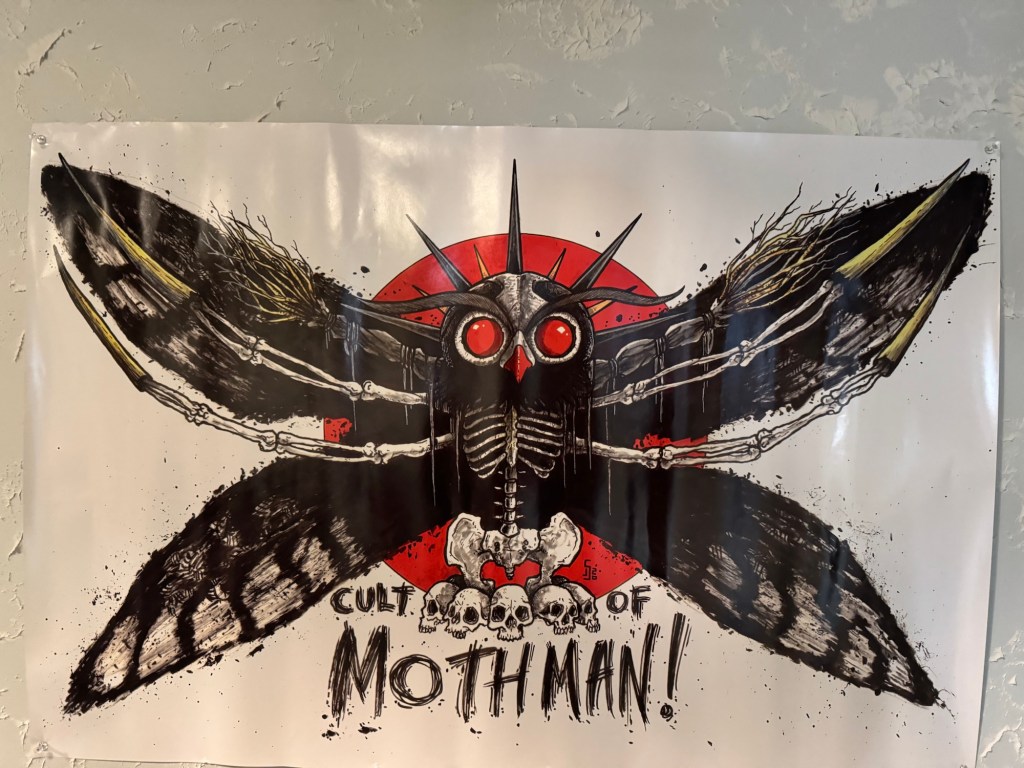
The Mothman Monster: One of the most myterious places on Earth

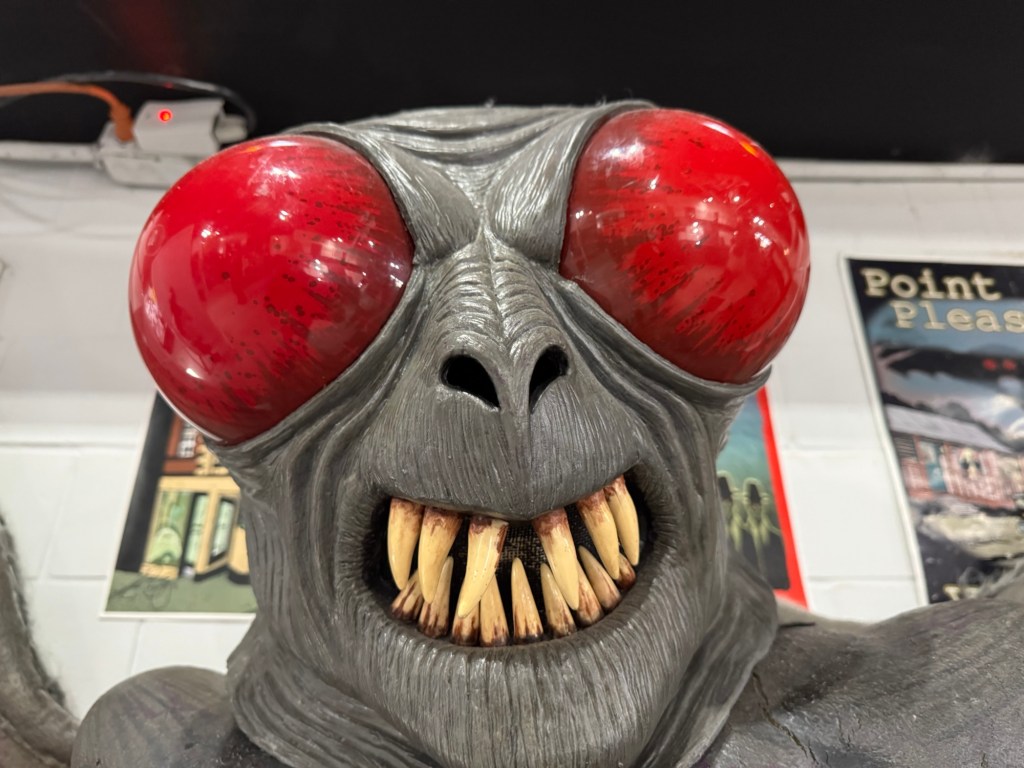
So, what do I think the Mothman Monster is?  I believe it is Stolis from The Lesser Keys of Solomon, or one of the 26 legions of demons that he commands, likely conjured up by the occult rituals of some maniacal lunatic in the region of Point Pleasant, West Virginia during the years 1966 to 1967.  Hundreds of people saw the Mothman Monster during that year, leading up to a bridge collapse that killed a lot of people transporting themselves over to Ohio from Point Pleasant.  Of course, demons and spiritual monsters are not regional to the Near East, nor are they concerned about what time they are in, as they seem to exist outside of our dimensional limitations.  Many described the Mothman as it appeared over seven feet tall with glowing red eyes and wings that allowed it to fly and harass innocent people.  I think the case with a lot of elements of cryptozoology is that these creatures are timeless and have been captured in classic literature, the mythologies of the world, particularly Greek and Roman myths, and of course the demonology of Europe exported to the world as the Bible grew in popularity and people wanted to figure out what the heck Paul was talking about in Ephesians.  I certainly believe in the cryptids that are reported. I have been to many sites where they have been found, particularly Sasquatches, which are again chronicled in books like the Lesser Keys and evoked through occult practices.  I think someone in the Point Pleasant region called on a monster from the Stolis family tree, and the thing ran around haunting people in a truly terrifying way.  I enjoy these topics a lot, so when my family asked me how I wanted to spend my birthday, we discussed a ghost hunt at Moonville, which I have spoken of.  But my main thing was that I wanted to go to the Mothman Museum in Point Pleasant, West Virginia.

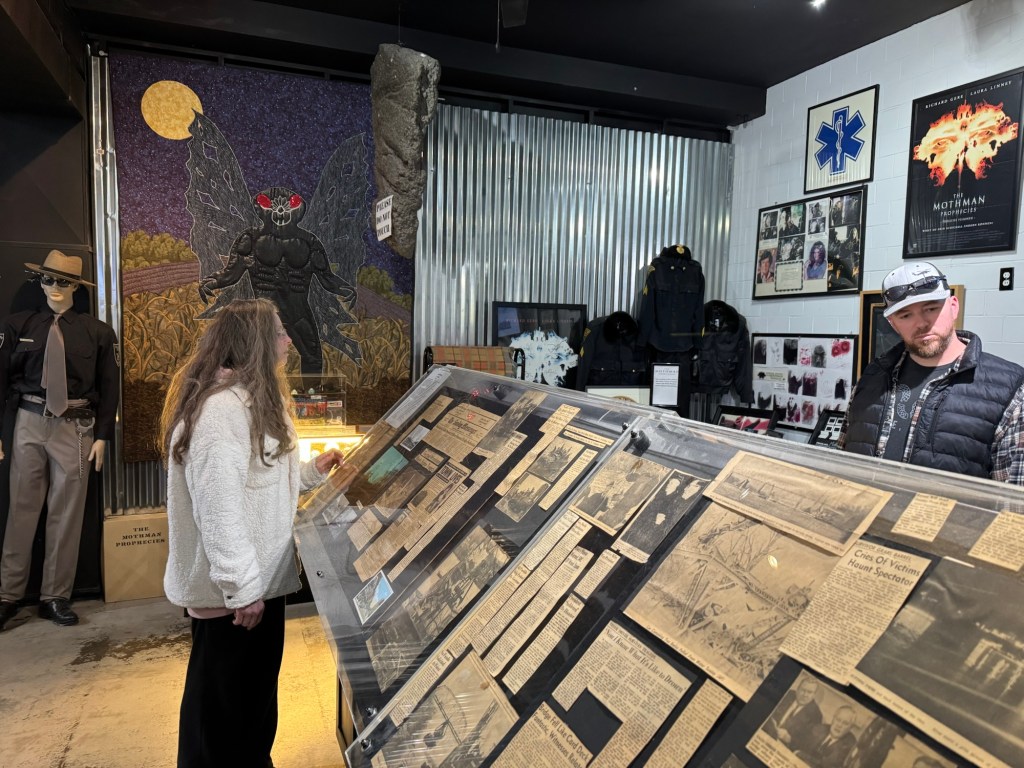
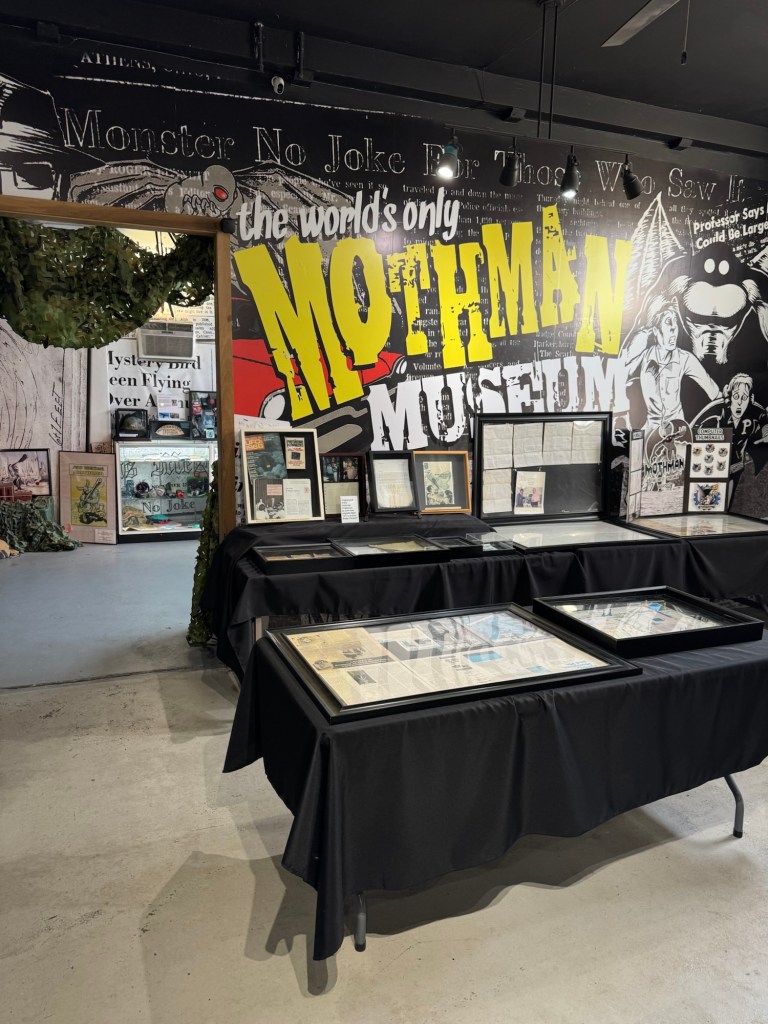
I’ve been there before, and so have some of my kids at different times, but I wanted to go again and spend some time there with my family all in one place, and we had a great day.  The Mothman story is genuinely creepy; all those people weren’t conspiring to lie about what they saw, the entire town was substantially haunted, even to this day.  The latest Mothman sighting in Point Pleasant was as recent as 2016.  It also shows up in Chicago now and then.  And that’s not all.  I think this Stolis character is the same one that the people of the pyramid of Cahokia worshipped, just outside of St. Louis, at the giant mound works there.  And it’s what the Indians called the Thunderbird.  I love the topic. We spent over 1,000 dollars in the gift shop there, part of the cool museum I wanted to visit so badly.  It’s cheesy, and very pulpy, but that is because the truly terrifying aspect of this giant creature that flies around foretelling doom to people so mysteriously has to have some psychological means of dealing with the crises.  And it’s a kind of wet blanket hanging over all of eastern Ohio, even the ghost hunt at Moonville I was talking about.  We’re dealing with a very ancient civilization in that precise location with all the mounds of West Virginia and Ohio up and down the Ohio River that have a very creepy vibe to them even if you didn’t know the stories of the various monsters that appear often to many people, even now. 

Truth be told, that day at the Mothman Museum was one of the happiest days I’ve ever had in my life.  Trump was in office doing good things.  And I had my family to myself living out of our RVs and visiting places like the Mothman Museum, thinking about the kinds of things I like to think about, the politics of demons and spiritual manipulators who plot and scheme against humanity with terror and temptations.  Even better, the Mothman sightings, well documented at the museum, were accompanied by Men in Black visits, a CIA and FBI kind of conspiracy theory.  Only the reports were that these guys were never quite human who visited people at their homes after Mothman sightings to tell them they weren’t seeing what they were seeing.  There were also UFOs all over the place abducting people and doing experiments on them, so we are dealing with a lot more than just the haunting of a monster upon innocent people along the Ohio River.  But we are touching on a phenomenon that traces back to why so many mounds were built by ancient people in the region in the first place.  Those kinds of fears are always buzzing in the background of how a conscious society builds itself, and in Point Pleasant, West Virginia, there is something to these strange occurrences.  As we were there, I thought of the mound complexes up in Marietta, Ohio, and down the river at Portsmouth.  Then, up the road to Newark, where I discussed discovering the Ten Commandments in America inside a giant mound.  Then there are the graves of all the various giants found in the area, chronicled as evidence by early newspaper reports and a kind of Men in Black conspiracy to tell people that they never existed.  Something was going on, and it was fun to think about, and that was how I spent my birthday this year.  Giving myself fun things to think about that are likely significant to the human condition. 

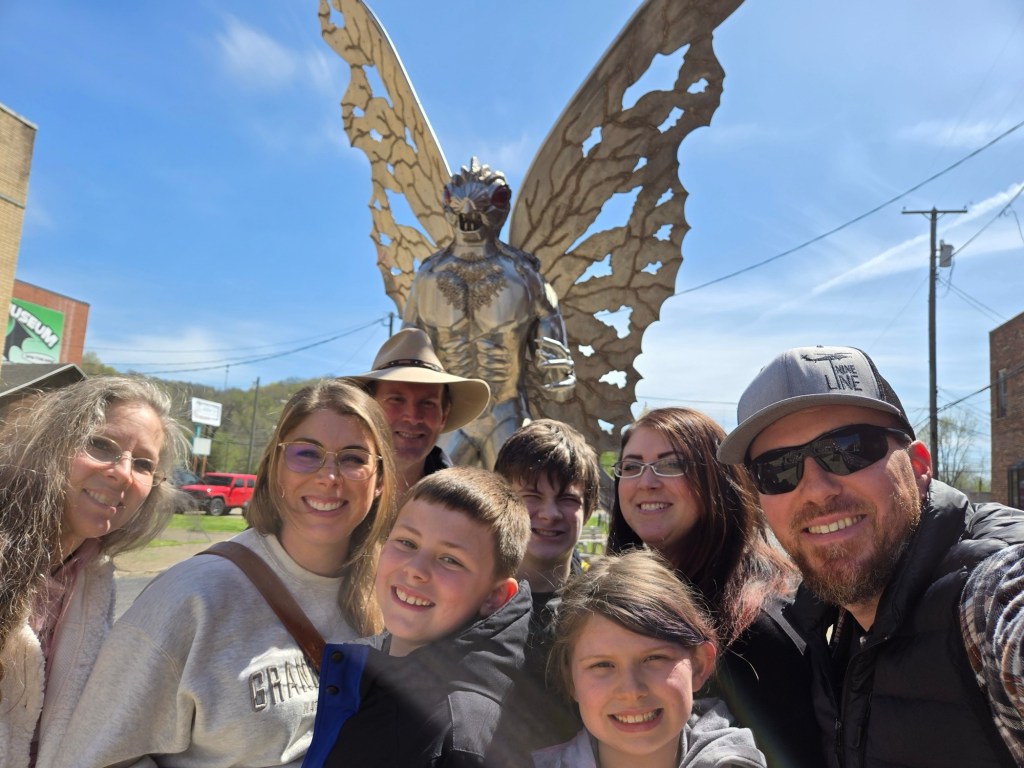
Outside the museum, right in the middle of town, is the Mothman statue; of course, we had to get a family picture by it.  I think The Mothman Prophecy is one of the scariest books I’ve ever read about these events, written by John Keel, a reasonable journalist who didn’t intend to uncover some of the greatest mysteries of modern times.  After his experiences at Point Pleasant he went on to write several books, all of which I have read many times and I do not doubt that there is a lot more to the story of which he was reporting, that there is a political rule over humanity by creatures from beyond time and space that causes us a lot of trouble.  The story of King Solomon commanding these creatures with a ring given to him by God is just one example that has been attempted to be understood by the mind of humanity over the terrors of roaming spirits intent on evil designs.  And sometimes occultists make deals with these demons for benefits that can’t be obtained through some supernatural trade.  And most of us deal with that pressure by just ignoring the problem.  But not me, I want to know all about it. We had a great day at the Mothman Museum and spent significant time in the area thinking about Mothman Monsters and other cryptids who terrorize people worldwide.  Most of them were captured by the writers of The Lesser Keys of Solomon, which lists many similar characters.  There is a lot for us to learn about these creatures, but to say they don’t exist is only a means of avoiding the problem with rationality, because it wasn’t just the Mothman sightings in that region during a particular period, 1966-67.  But it has always been with us, especially along the length of the Ohio River, from Pittsburgh to St. Louis, in what I think is one of the most mysterious places on earth.  And the monsters still roam the night to terrorize the innocent. 

Rich Hoffman

Click Here to Protect Yourself with Second Call Defense https://www.secondcalldefense.org/?affiliate=20707

Controlling Demons to Try to Destroy the Trump Administration: The Lesser Key of Solomon

Among many things, I am an expert on the occult, not a practitioner.  Long before the established religions we have today, there was a cult of planet worshippers who sought the help of supernatural aid frequently, and they had sacrificial cultures designed to appease them.  I don’t even pray to God for myself, let alone conduct magic ceremonies.  I see those types of people as weak and diabolical.  I have written a lot about the evil of Aleister Crowley and Jack Parsons, one of the founders of NASA, and they believed in the help of supernatural aid to help them accomplish their desired tasks, and they were often successful.  When you study the Bible, there is a lot of communication with spirits, angels, and demons to help with earthly desires, so we should not assume that all that desire went away. Instead, I would say that the desire to have relationships with entities outside our terrestrial boundaries is as intense as ever.  If you’ve ever been to the Denver International Airport, you will start to get a good sense of it, and as is predictable, Democrat politics has festered into that specific area purposefully.  Like with Aleister Crowley and the Denver Airport, Masonic lodges are part of the story, and of course, with them, we are talking about their reverence for the ancient builders of King Solomon’s Temple, and specifically Hiram Aboff, of Tyre, who was said to be the architect of the famous temple.  And this is where I think we have to think about these supernatural entities when we ask the question about why so many evil things are happening now against the Trump administration, such as terrorist attacks, airplane accidents, and political upheaval.  To understand all those motivations, I think you can look to a simple book such as The Lesser Key of Solomon and remind yourself that many thousands of people turn to books like that in an attempt to conduct the armies of darkness against the forces of good and that many are putting curses on the Trump administration as we speak, to stop him.

This is a very ancient practice passed down over a very long period of time

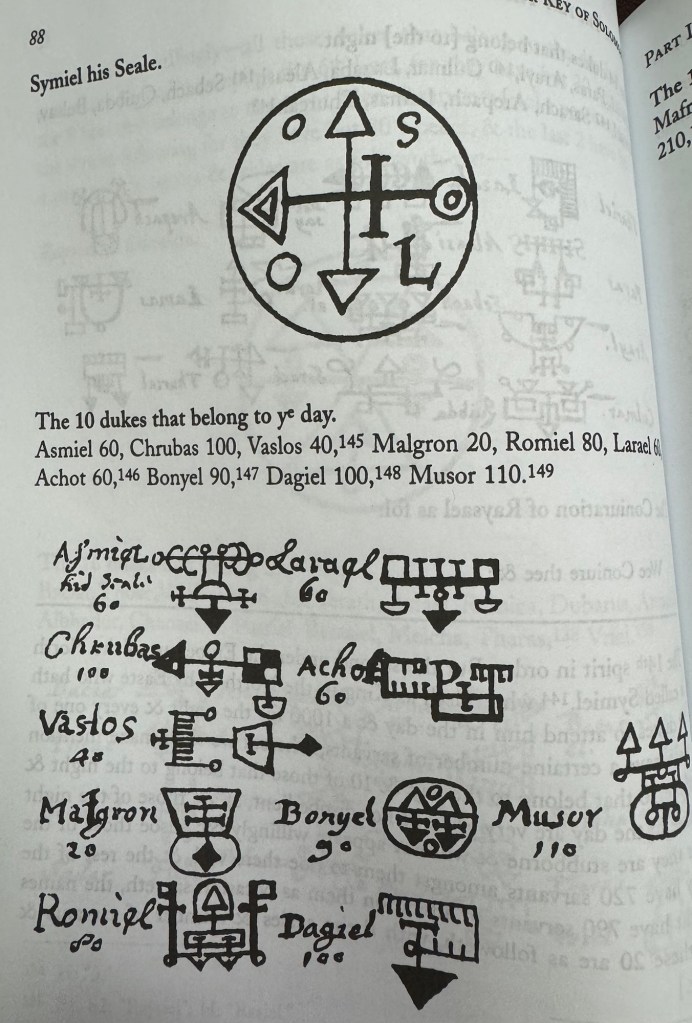
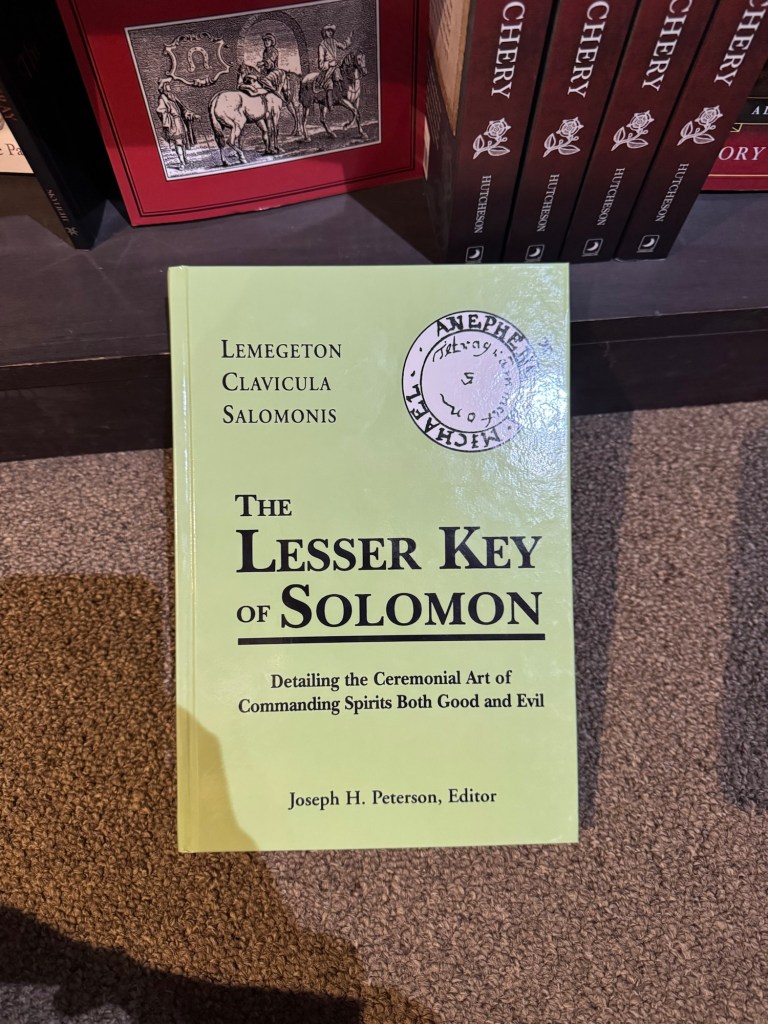
Speaking of curses, just because someone intends harm on you, even from the spirit world, doesn’t mean they will succeed.  Take me, for example. I am speaking to you after four decades of ill intentions cast upon me by almost every malicious character you can imagine.  So, there are always countermeasures.  And I have studied the world’s occult practices to understand the enemy’s weapons.  But I would never use them myself.  To me, asking for help from anybody or anything is weak.  I don’t even ask for directions to a gas station from GPS.  So witchcraft or practicing magic is off the table.  I see them as just as foolish as ancient practices of demonic appeasement with human sacrifice.  But with all that said, my daughters were traveling recently and found themselves in Salem, Massachusetts, which is covered with reverence for witches and all those who think Harry Potter sorcery are a good idea.  They were in an excellent bookstore filled with books on the occult, so they took a picture and sent me an extensive sampling, asking if I wanted any of them while they were there.  I spotted one that I have had my eye on for a long time: The Lesser Key of Solomon, edited by Joseph H. Peterson.  I have read different versions of that book, allegedly written by King Solomon himself and transferred through time to the present through oral traditions and esoteric references.  So they picked it up for me, and it is quite an interesting book, to say the least.

I am working on a line of thought that I have on the Kofun tombs of Japan and how they connect to the empire of King Solomon.  These tombs are all over Osaka. I have seen them by the hundreds, and I think Solomon’s influence ended there at the Pacific Ocean along the Silk Road in ways that nobody has adequately studied or understood.  In Japan, they communicate with good and evil spirits all the time, on just about every street corner, and they call these spirits kami.  In Islam, they call them jinn.  In Western cultures, we call them angels and demons.  In Japan, it always amazes me how people openly seek to appease these spirits and help them in some way or another with incense and prayer.  So I think The Lesser Key of Solomon is one of the reasons that they built all those kofun tombs in the shape of a keyhole, as a way to lock away the people buried there from the evil menace of a hostile spirit world that might harass them in death.  You might recall, dear reader, that the story goes from the Apocrypha text removed from the Bible called The Testament of Solomon, for which The Lesser Key is an extension, that King Solomon was given by God a ring that could seal away demons and actually employed them to his wishes.  It’s an old take on the Arabian Nights stories of the Genie.  The story goes that Solomon captured all these demons to help him build King Solomon’s temple which is why Master Masons and people were so inclined to seek The Lesser Key of Solomon so that they could also command spirits like King Solomon did to build the temple and conduct his business of an empire that extended far away from ancient Israel.  That’s how Aleister Crowley and many like him from the occult practitioner sciences that predate the Hebrew people by many thousands of years get involved in all this demon worship by trying to command spirits as Solomon did for the perpetuation of some terrestrial cause. 

The critical point to remember here is not the conduct of morality attached to discussions like this but understanding the intent.  There are many people in the world, especially practicing Democrats, who seek supernatural aid to help them achieve some political cause.  And the demon world is hectic trying to grant their requests.  And I can assure everyone that all over Washington D.C., wannabe witches, and occult practitioners are trying to put a curse on everything that the Trump administration tries to touch.  So when we see all the crazy stuff in the news and wonder why so many people are doing so many bad things, it’s not always the CIA conducting some coup attempt or the FBI trying to do the same to keep Kash Patel from becoming their boss.  It goes even deeper than that to why people think what they do and how those thoughts pop into their minds.  To deal with this occult menace, we have to admit that it exists in the first place, which many are reluctant to do.  But when I see the kind of news stories that have been common since Trump was elected, I see occult attempts to stop the political tide that so many desire.  But many scandalous characters are seeking the aid of the spirit world to overthrow our political order with a lot of personal investment.  And I think it will get much worse. Yet that doesn’t mean that all these evil intentions will be successful.  All it does mean is that we must look at where the problems are and see the threats for what they truly are.  And not illusively of their origins.  And fight those fights at the doorstep of the enemy. 

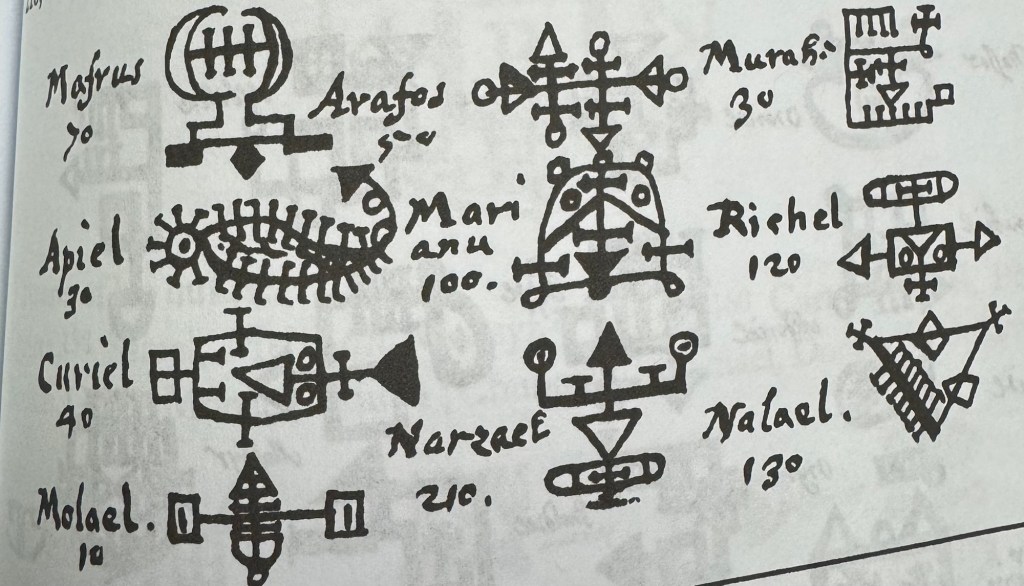
What amazes me about all these images is that they look so much like Indian art, crop circles, and ancient mound construction

Rich Hoffman

Click Here to Protect Yourself with Second Call Defense https://www.secondcalldefense.org/?affiliate=20707

The Evil Avatar of Bishop at the National Cathedral: Fighting back and taking our country away from them

When Bishop Marianan Edgar Budde from the Episcopal Diocese of Washington lectured Trump about progressive causes during the National Prayer Service at the National Cathedral, the only explanation for it was that a vast evil was at work and revealing itself through its earthly avatars.  For which people like her are.  This evil knows that people no longer respect it or are willing to give it a seat at the table in America and that it is losing power.  And it was upset about it.  It reminded me of what happened to Mike Pence at the Broadway play Hamilton after the 2016 election, where the cast there felt they had a right to lecture the incoming Trump administration to keep itself in the dirt and not to get any funny ideas about elevating humanity to any assumption of greatness, and otherwise to scare people away from following God’s commandments to a better life.  Mike Pence himself has shown a tendency to be one of these avatars of evil and it’s always the same demonic voice that pops up in different people.  Evil is not the same entity, but it spawns from the same type of voice that has always loomed in the background.  Only this time, there was a kind of Wicked Witch of the North sort of panic in it, and it came out that day in front of the nice and wonderful Trump family sitting there to have a national prayer before the Inauguration Day ceremonies.  Yes, Melania’s big hat that day was appropriate for the evil we are all fighting, but now, instead of hiding in the background, it shows itself with a sort of desperation we knew was always there.  It was utterly inappropriate but not unexpected.

We didn’t see the clips until later, the next couple of days after the National Prayer, and Trump had to call her what she was and dismiss her radicalism essentially, but I kept thinking of my favorite Akira Kurosawa movie, Dreams when thinking about that day.  It is something I’ve mentioned to my audience before, and I talk about it a lot when appropriate, but there is a fantastic scene in that movie that Japanese people seem to understand better than almost any culture in the world, and that is the nature of evil and how to manage it.  Three mountain climbers are lost during a snowstorm, and they can’t find their camp, and they are dying.  An angel comes to whisper in their ears to let go of this life and to join her in the next.  She is very beautiful and convincing, and to escape the pain of the storm, the leader of the group is tempted to follow her to death.  But while she gently nudges him, he remembers who he is and decides to fight back, so he begins to resist.  The angel starts to panic because she intends to take him away into the realm of death.  After several minutes of this struggle, the demon gives up, and its face reveals what it always was: the face of a skull, not a beautiful woman; it evaporates into the storm, and shortly, the skies clear, and it is revealed to the three dying climbers that they had found their camp.  It was always there, but evil kept them from seeing it.  It’s an excellent scene from a fantastic movie by an outstanding film director.  And it applied to that Bishop that day who thought she had a right and obligation to lecture Trump on how he needed to run his administration. 

Evil has been working through DEI and many other left-leaning practices to deplete our culture and send us all back into the realm of Hell, where they rule through broken people and low ambition.  When we notice in the Bible that the Hebrews have many rules against a dirty life, it is essentially to push back against this desecration of human achievement, and the cheerleaders are always these weak people who seem to have lost their minds because, in truth, they are being controlled by a vast evil that uses them for their magical practices.  In many ways, our country turned away from that evil by electing Trump, and we decided to push back against these evil creatures, one of which showed itself as a Bishop in a Church that the radical left tried to burn down just four years ago.  This is how people like this Bishop even get into those jobs to begin with, as the people who run the church feel they need to appease evil by giving them one of their own so that the vast evil that is always lurking in the shadows won’t try to destroy them again.  Appeasement is the game; we have been playing it as a country for far too long.  We are pushing back against their influence, and they aren’t happy about it.  They hide their intentions behind good causes, just as this bishop was hiding within the safety of the Church.  So, how many of these other evil creatures have been hiding behind DEI policies that mean to kill us all and convince us to give up a good life and follow manipulative demons into the world of death and destruction? 

Trump was right to demand an apology and not to accept her nonsense just because she was evil hiding behind the role of a church bishop.  Like those mountain climbers in that Akira Kurasawa story, Trump was pushing back at evil, representing us so that we could drive many of these evil characters out of the White House and our government in general.  To Make America Great Again means we must embrace the concept of greatness and not lower ourselves to assumptions of guilt and futility.  We are not going to build our society around the seductions of evil, to take advantage of our compassion for those less fortunate, and to be tricked into building our entire culture around weakness disguised as compassion while destroying, in the process, everything that is good.  And maybe for the first time from such a public person, Trump pushed back when otherwise everyone would have just shut their mouths because the person speaking was a bishop, and from an evil point of view, nobody in their right mind would criticize a person of God.  Except it’s all been a trick, and Trump, like that mountain climber, pushed back at evil and sent it on its way in frustration, which came out in the voice of the Bishop.  She was, like the seductress demon, rejected and now displaced.  The demons of Hell are confused as to what can be done now that people are aware of them and want to fight back instead of appeasing them with unearned guilt.  Saul Alinsky understood how to usher in this vast evil by the good nature of Christian people.  And it had been working; evil has been having its way with all of us.  Until now…………

Rich Hoffman

Click Here to Protect Yourself with Second Call Defense https://www.secondcalldefense.org/?affiliate=20707

The Politics of Heaven: Why BlackRock is producing assassins trying to kill President Trump

After this election, I am seriously considering writing another book begging me to write it. I think about it all the time. It’s called The Politics of Heaven because I believe people need to understand the impact of a Divine Council on our lives and the purpose of humanity’s creation, to begin with, about a more prominent political structure that falls well outside our terrestrial appraisals.  I feel uniquely positioned to discuss that matter because it has always been war, and our role in it is essential relative to the strategies of Heaven and God’s plight as a universal force of good.  But God has challengers, and our political system reflects this battle on many dimensional planes of reality across time and space, and our religions, I think, get only a tiny fraction of an understanding of its expanse. But whenever divine providence shows itself on a mass scale, such as this assassination attempt against President Trump, it provokes my thoughts in that direction.  I think people could use some context that goes further than the faith of religion.  But God’s hand is the only scientific explanation for all these close calls President Trump has survived.  But who is causing all the trouble?  It’s not enough to say that it is Satan; we need to understand the politics of why there are so many rebels trying to destroy God and his kingdom, and the creation on earth as it is in Heaven, America as its best representative of that political order in four-dimensional existence, our length, width, height and time which our five basic senses are built from.

I have some relationship with divine providence, which is reflected well in the Bible, especially the Old Testament; when God tells the Hebrew people to go forth and take the land of Canaan, he expects them to trust him.  Instead, the first time, they cowered in fear because the spies saw giants occupying the land, and they shied away in fear only to be punished for forty more years in the wilderness.  I have experienced this same kind of thing, but I never shy away.  I never have.  When things look terrible and impossible, I do things anyway, and miraculously, the people who swear to kill me or destroy my life in all the ways that human beings can or want to end up dying of heart attacks.  After a long life of this kind of thing, I am no longer surprised by the phone calls telling me that so-and-so died last night of a heart attack when, in fact, they had made themselves my sworn enemies.  God works in mysterious ways, so I want to write a book about it.  It’s something I thought of while traveling in Japan, where the Shinto religion constantly seeks to appease the kami spirits that aggressively permeate their culture.  In our own culture of America, we have best contemplated the efforts of these evil spirits in our lives by putting our minds to Satan and five demonic spirits that assist him on the Divine Council in their rebellion against God and all creation—which we see as the Democrats pursuing globalism on Earth to destroy God’s people and the creation of them for the perpetuation of that Heavenly political order on earth by its enemies that Satan has sworn to kill in retaliation of God from the very first moment that the Garden of Eden was created and people put in it.  In Japan, the kami are as common as you and I and are a part of their everyday culture.  Which we have chosen to ignore in the West, and perhaps we shouldn’t, where the Bible is our best guide through that political territory that extends well beyond terrestrial politics.

I think all this can be explained in quantum mechanics, and to review what I’ve said before about the CIA paper on The Gateway Project, where people can be manipulated through remote viewing, the past and future can be seen and tampered with, and the basic concept that our entire reality is something like the Matrix that is the product of a massive program, and that reality isn’t reality at all.  I think that is all perspective and that life permeates all dimensional planes of reality, so what that paper is talking about is reality from a particular perspective, which is relevant to that dimension, but not all of them.  And we get hints of this perspective in the story of Job in the Bible, where Satan provokes God to bring great misery to a loyal servant.  God isn’t always in charge the way they teach us in Sunday school as a king and overlord of the universe.  He has political personalities that are always trying to destroy his creation.  Satan is the character that sits on God’s Divine Council of the Elohim and causes all kinds of problems that have been recorded in our various myths and religious chronicles.  And it is there that things start to make sense where they don’t otherwise because no human beings on earth could coordinate some of the events we are witnessing unless you consider more dimensional influences in the context of eternity and its political motivations. 

To this second attempted killing of President Trump on his golf course in Florida, I think the only explanation that makes sense as to the connection between that assassination attempt and the other one in Butler, Pennsylvania, is BlackRock.  It’s not an accident that participants in BlackRock commercials were motivated to kill Trump during the climax of our election season.  That has an occult root cause instead of a terrestrial motivation to our standard forms of conduct.  And yes, when you have someone like Larry Fink, who owns BlackRock, Bill Gates, who ran Microsoft, or George Soros, who behaves like the Satan character from the Bible of Western civilization, you start to see how some of the demons who serve Satan behave.  And that has provoked a lot of talk in our culture about who they are by some of our most contemplative religious minds.  And those demons manipulating large companies like BlackRock through their ownership as single-point contacts are the classics from the time we have managed to name.  I think many thousands of these characters are always working in the background, but to name a few, we know Baal from the Bible.  Much of what we see in our politics, especially in what the Palestinians are always up to, you can see the fingerprints of Baal all over them.  For context on globalism, remember there are tributes to Baal in New York City and London, England, that are fresh and at the heart of all globalism.  That is their God of reference, known as one of the critical rebels against God and his creation—the human race.  Three more demons, Leviathan, the Spirit of Lilith, and Asmodeus, are advocates of homosexual lifestyles and are openly seeking to destroy the human race of God’s design by altering the value of sex and reproduction, which we see the effects everywhere we look these days.  Those demons are attached direction to the odd obsession that Democrats and other globalists have for abortion.  Then there is the classic Baphomet, the Knights Templer character passed down through many of the Masonic temples as the embodiment of the Devil.  It’s the character they talk about in Motley Crue songs and thousands of other references.  Baphomet is all about the sacrificing of children, which is the ultimate spitting in the face of God that you can get.  And that war is clearly at play presently in our politics.  To understand the evil at work looming perpetually in the background, you must understand these characters working against God and who their human contacts are in our earthly realm.  Once you know that, you can understand the motivations of BlackRock, Larry Fink, and the World Economic Forum.  And why they are trying to kill and destroy President Trump at every turn and the rest of us with their political antagonisms.  Their efforts go well beyond our lives here and now.  But extend into eternity, where The Politics of Heaven is well underway in ways we are just beginning to understand. 

Rich Hoffman

Click Here to Protect Yourself with Second Call Defense https://www.secondcalldefense.org/?affiliate=20707

The Testament of Solomon: History that is critical to our task

The Testament of Solomon is a pseudepigraphical work attributed to King Solomon, the son of David, and the purported author of several Old Testament texts. The work is believed to have been written in the late first or early second century AD, and it tells the story of how Solomon was granted the power to command demons and other supernatural beings by God.

The Testament of Solomon is a fascinating text that sheds light on the beliefs and practices of early Jewish and Christian communities. It is also an important source of information about the history of demonology and magic in the ancient world.

The text is divided into two parts. The first part describes how Solomon was approached by the demon Ornias, who offered to bring him great wealth and power in exchange for his soul. Solomon, however, was wise enough to outsmart Ornias, and he forced the demon to reveal the names of all the other demons and spirits that were under his command.

Using this knowledge, Solomon was able to command the demons and spirits to build the Temple in Jerusalem and perform other tasks for him. The second part of the text is a collection of spells and incantations that Solomon used to control these supernatural beings.

The Testament of Solomon was highly influential in the development of both Jewish and Christian demonology. Many of the demons and spirits that are mentioned in the text became part of the standard demonological taxonomy used by later Jewish and Christian writers.

In addition, the Testament of Solomon influenced the development of magic in the ancient world. The spells and incantations that are included in the text were widely copied and adapted by later writers, and they continue to be used by practitioners of magic to this day.

Overall, the Testament of Solomon is a fascinating and important text that provides insight into the beliefs and practices of ancient Jewish and Christian communities. It is a testament to the enduring power of myth and legend in human culture, and it remains a valuable resource for scholars of religion, history, and folklore.

The Common Era (CE) is a calendar era that is widely used around the world. It is also known as the Christian Era or the Current Era. The year CE is equivalent to AD (Anno Domini), which means “in the year of our Lord” in Latin. The Common Era began on January 1, 1 CE, which is the year that is believed to be the birth year of Jesus Christ.

Rich Hoffman

Do You Know Someone Possessed by a Demon: They are a lot more common than most might believe

With all the evil that is obvious in the world, the question has been brought up a lot about the nature of demons and whether or not they are taking over people’s bodies, and if they were, how would we know?  This has been most discussed when explaining the behavior of a recent school board member who has shown a noticeable behavior change from campaign mode to actual board service.  The personality shift has been stunning, leading people to conclude that some other life form has taken hold of his body and is driving the car.  Which is precisely how I think demons work.  Our bodies are like the cars we drive.  The drivers of the car can change, but the car is a car; it ages, gets old, and eventually breaks down and stops running.  But when it comes to paranormal activity, I think quantum mechanics can largely explain it.  Then knowing that there are lifeforms in several dimensional realities, our own 4-dimensional space being just one of them.  Yet in them all, there are lifeforms in various manifestations teaming with activity.  And if they can take root in our reality by grabbing hold of a car to drive, such as one of our bodies, then they will do it and do it often.  We can all tell stories of people we know who behave differently when they drink or use drugs.  I would say this is what it’s like when there are multiple passengers in a car but only one driver.  If the driver lets go of the wheel or maybe even gets out of the car for some reason and a new driver takes their place, then you could see how there might be a behavioral change from one driver to the next. 

Listening to women talk about people is often very entertaining; they associate a personality with the biological DNA of a person they know or have been raising.  When they say to someone else, “oh, look, he has your mouth,” or “he has your eyes,” they are saying something we all do to a point, we identify a lifeform with the vehicle it inhabits.  There is to a body the biological codes that put it together, and we associate those mechanisms with a personality.  And to a large degree, people are what their biological makeup determines them to be.  Whether they are short-tempered, whether they are tall, short, smart, dumb, happy, or sad are all attributes that are genetically inherited.  And when a person dies, those traits are no longer useful and peel away into memory.  But because that’s what we see about a person, we tend to associate those attributes with them, so we often get confused when we witness a behavioral change in their personality.  When we see the same physical features, only they suddenly behave differently, as if someone else is driving those bodies, it upsets us because we thought we knew them.  I tend to think of people in their eternal aspect, the parts of them that are not associated with the biological devices of a body but are the drivers which reside there during a lifetime.  When you really get to know someone, you could be said to get to know their “soul” rather than just getting to know the person that was raised by so and so at a such and such address that became friends because of a birthday party when you were both five years old.  Those aspects of life are conditional based on DNA and the combination of those elements in a four-dimensional reality.  That life might contribute to a soul’s development, but the car’s driver is not the car.

I tend to think the push for intoxication and the abuse of bodies comes from competing lifeforms trying to sneak their way into a body by either pushing out the driver or convincing the driver that someone else could drive their car better.  By whatever means, once a driver surrenders their body to another lifeform, we can see then a noticeable behavioral difference.  The owner of the body might even still be in the body, but something else is clearly driving, especially under intoxicating circumstances.  I think there are a lot of lifeforms out there, some of them very jealous of our four-dimensional existence, and they would love to take over a person’s body and experience life as we do.  Is it appropriate to call these lifeforms demons?  I think so, and I think they are ubiquitous.  Do they take up permanent residence in a body, or is it just temporary?  Well, I think that varies depending on the need to drive the car and why they are there in the first place.  Maybe they are just joyriding in our dimensional reality.  Or perhaps they want to go somewhere and need a body to get there.  Or perhaps there is a massive interdimensional strategy that makes sense to their reality where influence over our reality makes sense to them.  What we call evil may be perfectly justified to them in their quantum realm.  That doesn’t give them the right to do what they do to us, but it may explain the desire to occupy bodies massively to destroy life in the way we observe. 

Yet we are born into our bodies, which are ours to keep.  We do not have to share them with other life forms.  And throughout life, there are many times when others would clearly like to drive our car because they like it and want one for themselves.  It’s up to us if we allow ourselves to be tricked into surrendering ourselves to their manipulation, and I think many gullible people get suckered in this way.  Sometimes it’s by choice, such as by allowing intoxication to unlock the doors for others to get into our car.  Sometimes it’s by blood, where ancient lifeforms might have known the DNA code of a family lineage and find themselves attracted to the driver of that car and want to reside within that car with the driver for as long as they can because it’s familiar to them.  And sometimes it’s just malicious; it’s a Grand Theft Auto kind of thing where they abuse their ability to jump in and out of other people’s cars and shove them out of the driver’s seat for a criminal-inspired joy ride.  There are many ways that other lifeforms can jump into our cars and drive our bodies without us realizing it or knowing it as observers, especially if we assume that the person we know is the biological thing we can see.

People are far more than just the cars that they drive.  And when it comes to observing the vast amounts of evil that we see today, yes, I think many of them are driven by demons.  And there are lots of demons at work, armies of them.  More than we could possibly ever count.  And their motives are likely as endless as an imagination could conceive.  But do they have a right?  Of course not.  Our bodies are our own, and we should guard them aggressively.  We should not take for granted anything about our lives, and we should treat our bodies just as greedily as we lock our cars when we park them somewhere, with utmost security.  We should be careful what kind of music we listen to and what we eat and drink.  We should be cautious about what we learn and share intimate details and with whom.  Because there are lots of reasons for demons to inhabit bodies, and as we see in reality, they often do, and with terrifying results. 

Rich Hoffman

Click to buy The Gunfighter’s Guide to Business

Graham Hancock’s Great Book, ‘Visionary’: To what degree does the spirit world shape modern politics and our everyday lives

I do get excited about my books, and when I read a great one, I often talk about it extensively. Books are my favorite things in the world, I could never have enough of them, and they have been with me most of my life as priorities. But this year, I knew Graham Hancock was releasing an update to his famous book previously, called Supernatural, with the new title Visionary. It was coming out on April 4th, so I nabbed it up and treated myself to a birthday treat of reading it voraciously. I talk a lot about politics and education issues. Still, I enjoy no subject more than the pseudo-sciences, and Graham Hancock, the former journalist, turned pseudo-science investigator, is one of the best currently in the field.    So for a birthday gift to myself, I gave myself a few weeks of April to just sit down and read his new book and soak it up because it’s one of those types of books. Actually, it has all the potential to be a life-changing book because it deals with the kind of stuff that is at the core of all human concerns. What were we before we were born, and what will we become after? What’s the point of it all. Now, I love Graham Hancock’s books. He and I have very close beliefs about bureaucracy’s effect on the sciences. He is into pseudo-science because traditional science, institutionalized, just does not keep pace with the rate of discovery that is occurring in this information age that we are in. Institutionalism is at war with the rate of understanding occurring, and they hate people like Graham Hancock. But Hancock brings his background as a journalist to science and takes what is known by traditional scientific discoveries and pieces everything together in a noninstitutionalized way, which is how things need to be done anyway. And as a result, he asks big questions seeking big answers to things. And for human beings, there is nothing more significant than how the spirit world interacts with the conscious world. 

For many years I have talked about the role that ultraterrestrials play in our human lives. I had done many articles on the giant race of people who lived in the Ohio region well before the times of Jesus Christ and actually had an empire all the way to the Gulf of Mexico before what we know of as Native Americans were even on the world stage. They were as sophisticated as the Stonehenge and Avebury cultures in England and obviously were part of the same culture from the same time periods of influence. So Graham’s topics are not new to me. I learned about these giants while attending the Mothman Festival at Point Pleasant, West Virginia, so it’s a real thing that certainly is under-researched. Traditional science driven by the university system is just too slow. They are guarding too much of their previous assumptions actually to answer these kinds of questions, so that is where Graham Hancock comes in. After reading the book by John Keel on the Mothman Prophecies, I am quite certain that the ultraterrestrials talked about in that book, which Graham’s Visionary is essentially a sequel, the spirit world of angels and demons that so concern religions have shown themselves in stories chronicled in the work of John Keel so effectively. But he was just touching on the surface, and Graham Hancock has taken several additional steps toward unraveling these interdimensional worlds and how they interact with the world of the living and actually redefining what “dead” means. 

Now, where Graham Hancock and I part ways is over the issue of drugs. I get his argument on the Pinery gland and how drugs can pull off the restrictor plate of brain activity to see things that are always there but that we filter out within the visual spectrum of our senses. He advocates for the open and legalized use of drugs to produce real hallucinogenic effects. Still, they are elements that our eyes can’t see because we live life in a four-dimensional world. I’m against all drugs, at any time, over anything. I don’t even take aspirin. I will occasionally sip on a beer socially, but nothing more, and I certainly never get intoxicated. But I am not closed off to his ideas that some of these drugs don’t produce hallucinations but are, in fact, reality seen for what they really are. This is why I was so interested in his book. I recently saw petroglyphs in New Mexico and Utah that were almost identical to known cave art in South Africa and Europe that span thousands of years from each other, and many thousands of miles of travel, so the cultures could not have been communicating 15,000 years ago or even 50,000. Yet they all tell similar stories painted on the rocks, and how they arrived at those images looks to be something Graham has pieced together correctly. He also puts UFO phenomena into the mix, which I had just had a research trip to Roswell fresh on my mind. So, his book reaffirmed many things that I had already been thinking about. And to add to that, he actually used ayahuasca and reported what he had seen, which was independent verification that he didn’t know he would experience. I wouldn’t do it, but I’m glad he was willing to report it scientifically instead of from the perspective of some drug-crazed lunatic. 

There is a taco place I like to go to at The Greene in Dayton called Condado Tacos, and ayahuasca hallucinations obviously inspire the interior. Or is it hallucinations? Is it a reality? I think it’s reality personally, and I think when we talk about political elements, we have to understand that there is an influence from these places that run quantumly with our 4-dimensional existence. Remember, we mathematically know that our present universe supports 11 dimensions that are likely within our current reality. But, outside of our universe, there is a possibility of 26, and within each of those dimensions, likely lifeforms are interacting with us at all times. Our business is to understand these lifeforms, especially if they are interacting with us.

We may not have the eyes and ears to hear them, but our minds certainly do, even if remotely. And that’s not a very fair fight if they have an easier time at communicating than we do, and they take advantage of that aspect often to push the world where we may not want it to go. We might say it’s the will of the spirit world, but what if it’s a maleficent demon who wants to destroy the world and everyone in it. Do you really want to listen to it? Perhaps this is the kind of influence that has brought so much great evil into the world. Or, maybe this is where all the good is, and that the purpose of life is to build a great soul to travel in these realms as an individual instead of just a collection of cosmic dust, and that the act of creation is what matters, of life being a creative process that gives birth to a human soul that then sheds the body for this afterlife. And that the afterlife is just another life that is depicted on those walls at Condado’s in Dayton. I think perhaps so. But regardless, a great book like Visionary is a rare treat, and a journey I was happy to take, and one of the best birthday presents I have ever given to myself. Time and the content to think about that truly has meaning.

Rich Hoffman

Click to buy The Gunfighter’s Guide to Business