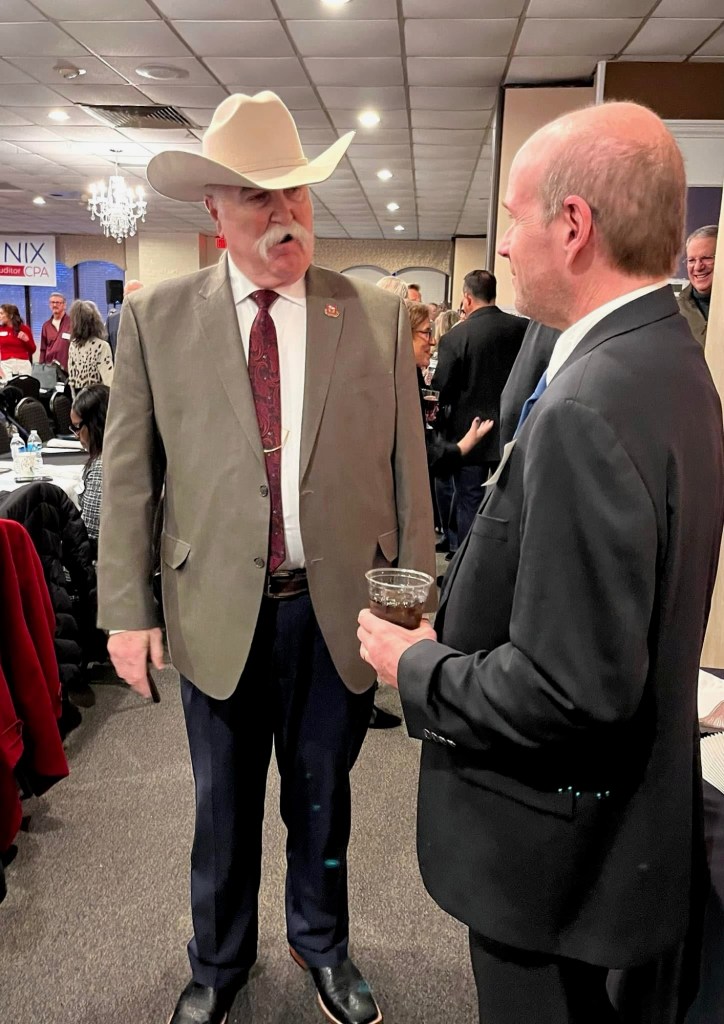
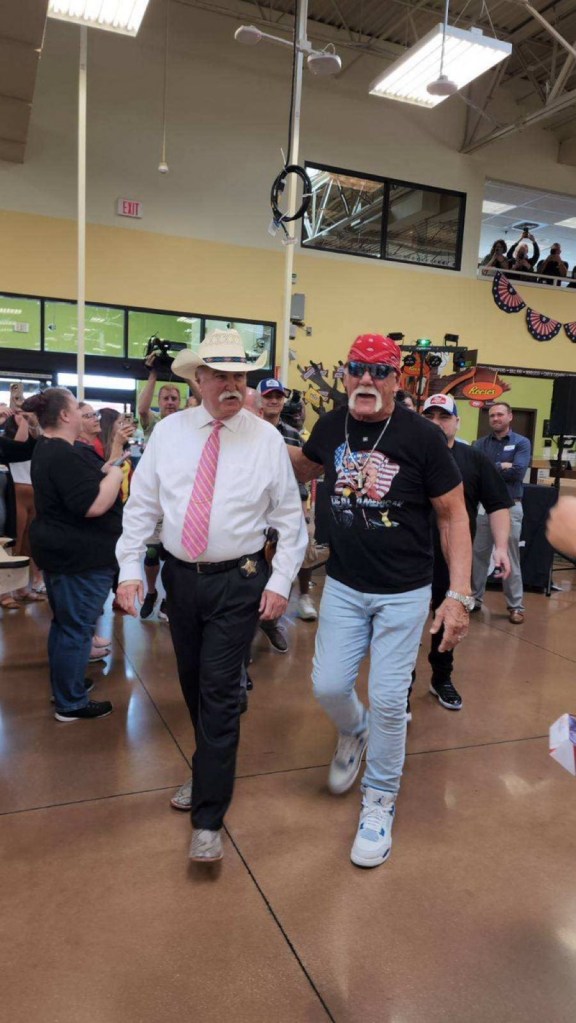
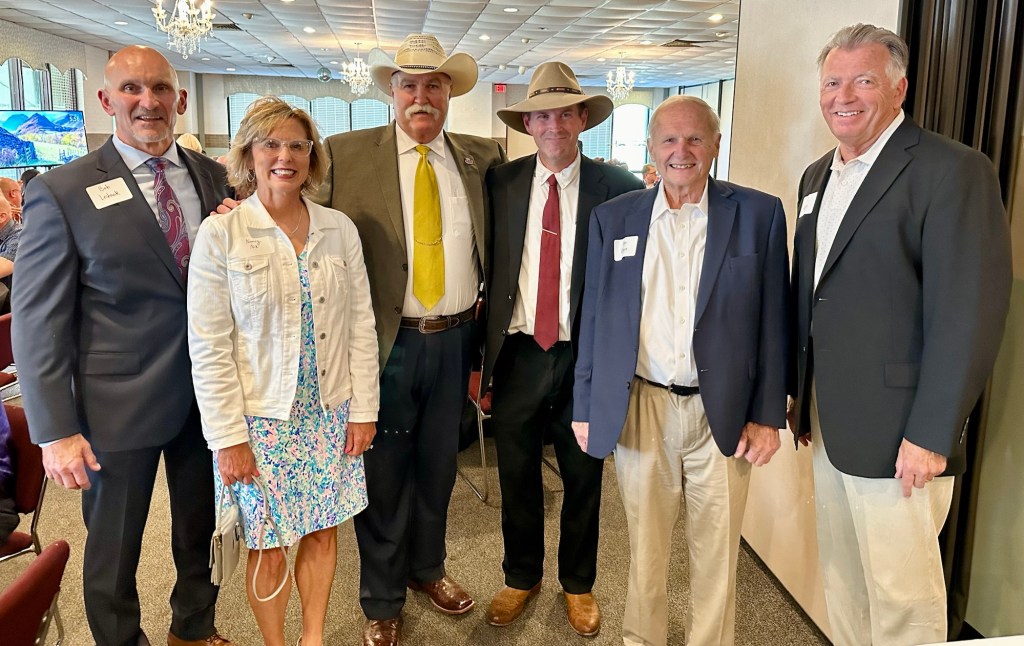
I have been sitting with Sheriff Richard K. Jones’s book for about 24 hours now, turning the pages the way a man turns over an old photograph that still has the power to surprise him. They Call Me Jonesy: Let’s Get Real About Saving America is not a polished political memoir written by committee. It is the voice of a man who has spent a lifetime walking the same ground I have walked in Butler County, speaking the same language of family, order, and personal accountability that once held communities together before the experts decided those things were negotiable. Jones has always been the Sheriff who runs his office the way Andy Griffith ran Mayberry and Marshall Dillon ran Dodge City, with a healthy dose of Waffle House common sense thrown in for good measure. You show up, you tell the truth, you do the job, and you do not apologize for the results. That approach has kept Butler County safer than most places that spend three times the money and twice the consultants, and it is why so many of us who live here still call him simply Jones.
What kept pulling me back to the book was not the policy talk or the war stories about the jail, though those are solid enough. It was the cautionary tales about family and the slow corrosion of the values that once made a man accountable to his own house before he tried to run anyone else’s. Jones and I share a deep and permanent hatred of the drug culture that has hollowed out so many families in this county and across the country. We have both watched too many good people lose children, lose marriages, lose the simple ability to look their grandchildren in the eye without shame. He writes about those losses without the usual soft language of the therapeutic class. He writes like a man who has had to clean up the mess afterward. That kind of honesty is rare now, and it is the reason the book feels less like a campaign document and more like a dispatch from someone who has been on the wall for a long time and is finally willing to say what he has seen.
But the story that made me laugh out loud, the one that sent me straight back to October of 2016, is the one about the night he opened for Donald Trump at U.S. Bank Arena. I was there. Not in the sense that I was sitting in the same row or riding in the same car. I was backstage, working the edges of the same event, trying to find a quiet corner where I could take a conference call with people on the other side of the world while the whole building shook. And I watched the exchange Jones describes in the book unfold in real time.
It was Thursday, October 13, 2016. The Access Hollywood tape had dropped only six days earlier, on October 7, and the professional political class was still in full panic. Most of the Ohio Republican establishment had already decided Trump was finished. They had lined up behind Marco Rubio, Ted Cruz, or John Kasich, the local favorite who was still twisting arms for support even as the primary season was long over. Supporting Trump in those weeks was not the fashionable choice. It was the choice that got you labeled a crank, a risk, a man who did not understand how power actually worked. Senator George Lang, I, and a handful of others had been in that camp early. We had met Trump, sat with him, watched him operate before the primaries even heated up in Ohio. We knew the ground. Most of the smart people in the room did not.
Jones was one of the few who never flinched. By the time the campaign asked him to warm up the crowd at U.S. Bank Arena, the atmosphere was thick with the kind of nervous energy that only comes when the people in charge are not sure the candidate is going to survive the next news cycle. The director of the program that night wanted a script. He wanted to know exactly what the Sheriff was going to say. He wanted control. Jones looked at him the way he has looked at a thousand people who try to put a leash on him and said, essentially, that is not how I work. I talk from the hip. I have been talking all year. You tell me how long you need and I will fill the time. I do not need a teleprompter or your talking points.
I was standing close enough to hear the exchange while they were trying to get me upstairs to a box where I could take that overseas call. Giuliani was somewhere in the mix. The production people were frantic. Trump’s plane was still in the air. The arena was filling from the floor to the upper decks, and the noise was already starting to build. Jones went out there anyway. He did not have a prepared speech. He walked onto the stage and did the thing he has always done: he talked to the people the way a man talks to his neighbors when the subject is serious. Fifteen minutes turned into something closer to thirty. The crowd answered him the way Butler County has always answered him. They roared. From the high box where I finally closed the windows and tried to finish my call, Jones looked like a small figure on a distant stage, but the sound of that arena was impossible to shut out. I had the volume turned up on my headset and still could barely hear the people on the other end of the line. Part of me was irritated that my business meeting was being drowned out by a Sheriff who refused to stay on script. Most of me was very proud.
Trump claimed the crowd that night was 21,000, with thousands more outside who could not get in. Mike Pence put the number around 19,000 the next morning. The arena’s concert capacity sits somewhere in the neighborhood of 17,500, and some of the upper seats behind the stage were empty according to the reporters who were counting chairs instead of energy. The exact headcount is the kind of detail the media loves to argue about when they do not want to talk about what the crowd actually felt. What I saw from that box was a building packed tight enough that the noise had nowhere to go but up. People had not been paid to be there. They had not been bused in. They had decided that the Access Hollywood tape and the coordinated media effort to sink the candidate were not going to decide the election for them. Jones understood that before most of the professionals in the room did.
I have watched Jones make hard calls for more than twenty years. We have not always stood on the same side of every primary or every local fight. There have been nights when we were polite but cool because we were representing different candidates or different issues on the ballot. We have always found our way back to the common ground, because the common ground is larger than the temporary disagreements. Supporting Trump when it was still radioactive inside the Ohio Republican Party was one of those moments when the ground became visible. The same people who told us we were going to destroy our own political futures are now the ones who want their picture taken with the man. That is how these things usually go. The smart set picks the wrong horse for the wrong reasons, and then they rewrite the story after the race is over.
Jones has always had a gift for seeing through the fog. When Corey Lewandowski came through Ross’ Big Bull later, the first person he sought out was the same Sheriff who had refused to read from a script on a night when the campaign was still bleeding. That is the kind of quiet authority that does not show up on a résumé. It shows up when the building is full, and the professionals are nervous, and somebody still has to walk out there and speak without a net.
I recommend the book without reservation. Read the parts about family and the slow destruction of the old rules. Read the parts about the jail and the daily work of keeping order in a county that still believes order is possible. And read the part about that night at U.S. Bank Arena, because it captures something essential about the man. He is not a performer. He is not a consultant’s idea of a lawman. He is the product of a certain kind of American stubbornness that refuses to be managed, and on the nights when it matters most, that stubbornness turns out to be the smartest thing in the room.
I was proud of him that night. I am proud of him for putting the story down on paper without sanding off the edges. Some of us were right when it was expensive to be right. Ten years later, it is still a pleasure to remember it.
Footnotes
1. Richard K. Jones, They Call Me Jonesy: Let’s Get Real About Saving America (publication details as available through standard retail channels, 2025–2026). The account of the U.S. Bank Arena appearance appears in the sections dealing with early Trump support and the political pressures of the 2016 general election campaign.
2. The Access Hollywood recording was published by The Washington Post on October 7, 2016. See “Donald Trump recorded having extremely lewd conversation about women in 2005,” Washington Post, October 7, 2016.
3. Attendance estimates for the October 13, 2016, rally at U.S. Bank Arena (now Heritage Bank Center) varied. Trump publicly claimed 21,000 inside with additional thousands outside; Mike Pence cited approximately 19,000 the following day. Contemporary reporting noted the arena’s concert configuration capacity near 17,500 and observed some empty upper-level seats. See “How many people attended Trump’s Cincy rally? No one seems to agree,” WCPO, October 13–14, 2016; and arena capacity data from Heritage Bank Center / U.S. Bank Arena historical records.
4. Photographic and contemporaneous coverage confirming Sheriff Jones’s appearance as a speaker that evening can be found in the Cincinnati Enquirer photo gallery, “Trump supporters rally at U.S. Bank Arena,” October 13, 2016, and related local television reports from WCPO and WLWT.
5. On the broader context of early Ohio support for Trump amid establishment resistance, see contemporaneous reporting on the positions of figures such as then-Senator Rob Portman, Governor John Kasich, and local Republican organizational dynamics in the weeks following the Access Hollywood release.
Selected Bibliography for Further Reading
Jones, Richard K. They Call Me Jonesy: Let’s Get Real About Saving America.
Fahrenthold, David A. “Trump recorded having extremely lewd conversation about women in 2005.” The Washington Post, October 7, 2016.
“How many people attended Trump’s Cincy rally?” WCPO 9 News, October 2016.
Heritage Bank Center (formerly U.S. Bank Arena) venue history and capacity documentation.
Rich Hoffman is an author, political consultant, and strategic advisor based in Cincinnati, Ohio, and the creator of The Politics of Heaven—a unique framework that connects biblical theology, ancient history, and modern power structures to explain how moral alignment and spiritual forces shape global events. Blending real-world political experience with deep research into archaeology, UFO phenomena, and suppressed historical narratives, Hoffman offers compelling commentary on topics ranging from ancient civilizations and the Dead Sea Scrolls to modern populist movements, paranormal continuity, and leadership strategy in chaotic environments. As the author of The Gunfighter’s Guide to Business and the forthcoming Politics of Heaven, he brings a grounded yet provocative voice to media discussions, supported by firsthand experiences and a cross-disciplinary approach that bridges science, history, and theology. For interviews, speaking engagements, or expert analysis, visit richhoffmanbooks.com or contact directly via phone at 513-307-5815 or email at rhoffman@richhoffmanbooks.com. If you’ve seen the movie, Disclosure Day and want to talk about it and the implications of Presidnet Trump’s UAP disclosures, let me know and we can bring some color to your coverage. https://richhoffmanbooks.com/media-inquiries-broadcast-topics-and-contact-info/?frame-nonce=ad51e7ecba I do have a firsthand UFO encounter to discuss.
It was a Friday night in mid-July 2026, and I was in one of those nice theaters with the little tables—the kind that make an evening out feel intentional rather than just another screen in the dark. The film was Young Washington, the new one about George Washington’s early years in the French and Indian War, before he was the marble statue on the dollar bill or the father of a nation. It was a good picture, the kind that puts you in a patriotic frame of mind without preaching. I had my phone face-down on the table because I didn’t want to be that guy checking messages during the show. But even silenced, I could feel it lighting up now and then. When the credits rolled and I finally turned it over, there were more notifications than I expected. One of them was from Sheriff Jones.
I like Sheriff Jones. I always have. He’s one of those larger-than-life figures who makes Butler County feel like it still has some old-fashioned backbone left. When he texted to let me know he had a new book out—“They Call Me Jonesy: Let’s Get Real About Saving America”—I was genuinely surprised. It had come out back in May, and I hadn’t heard a thing about it until that message. He said if I wanted to talk about it or pick one up, to reach out. I told him right then I’d get it read. I could have driven over and grabbed a copy from him directly, but I wanted to do it the right way—support the work properly—so I opened Amazon on the spot and bought it. As I write this, the book hasn’t arrived yet. I’ve been busy, the way most of us are these days, and sometimes the important people and the important things slip through the cracks until a text like that snaps you back to attention.
While I wait for it to show up, I’ve been thinking about what it means to have a Sheriff like Richard K. Jones in our community—and why the public relations side of his job might be every bit as important as the operational side most people picture when they think “law enforcement.”
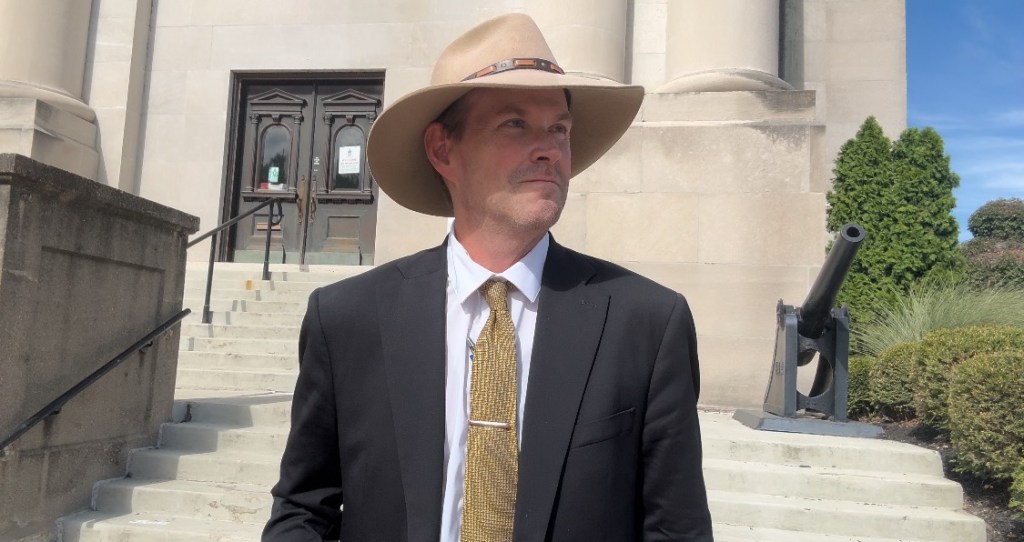
In Butler County, Jones is more than the man who runs the jail and signs the paychecks for deputies. He’s a character in the classic sense: the tall figure in the signature cowboy hat and those big ostrich boots, the one who shows up at fundraisers for youth shooting sports, compares hats with old friends, and isn’t afraid to talk about the realities of the job—the lawsuits that come with the territory, the guns he carries or the ones the department fields, the constant pressure from every direction. He’s been doing this a long time. First elected in 2004, he’s now well into what I’d call his seventh term of service, having worked through multiple governors, multiple presidents, and the full spectrum of political weather in Ohio and beyond. He’s dealt with the Bush years, the Obama years, the Biden years, and whatever comes next. Through all of it, he’s stayed visible, outspoken, and unapologetic in a way that feels increasingly rare.
That visibility is the part a lot of people miss when they talk about what a Sheriff is supposed to do. Some folks think the job is purely about kicking in doors and locking up bad guys. And yes, that work matters—more than most civilians will ever understand. But if you only do the enforcement piece and ignore the executive piece, you eventually lose the community you’re sworn to protect. People start seeing the badge as something distant and ominous rather than something that belongs to them. They start questioning why their tax dollars go to support it. Morale inside the department suffers when the public narrative turns against you. Jones figured this out a long time ago, long before national figures made “brand” a dirty word or a political weapon. He understood that in a republic, especially at the county level where government is closest to the people, you have to build something citizens can latch onto and believe in. You have to make law and order feel like a shared project rather than an imposition.
That’s what I mean when I talk about executive leadership. I’ve written about it in The Gunfighter’s Guide to Business and I’m still working through the lessons in my own professional life—an aerospace executive who spends a lot of hours every week trying to impose will on circumstances, build teams that believe in the mission, and create something durable enough to survive the inevitable storms. The gunfighter doesn’t just draw fast; he creates the conditions where the draw is rarely necessary because the reputation and the relationships do half the work. Same principle applies to a Sheriff’s office. If the community sees the department as “us” rather than “them,” you get better cooperation on tips, better juries, better budgets, better young people considering the career, and a healthier society overall. Jones has spent years cultivating exactly that. He gets on TV. He does the interviews. He shows up. He lets people see the human being behind the badge—the one with the cowboy hat and the straight talk—and that makes all the difference when something goes wrong and the cameras show up for the wrong reasons.
I’ll be honest: when I saw his name on my phone that night, part of me hoped it was the other kind of message. The one where he says they’re getting ready to hit a house or round up some cartel types or serve a warrant that might need an extra set of eyes and a steady hand. I’ve lived long enough and seen enough to know that sometimes the only thing that moves the needle is decisive action on the ground. I would have been in the truck in five minutes, and I think he knows that. But instead he wanted to tell me about the book, and that’s valuable in its own right. Because writing the book is also action—it’s distilling decades of experience into something other people can use. From everything I’ve seen in the descriptions and early word, They Call Me Jonesy is exactly what you’d expect from the man: candid, humorous in that tough-love Midwestern way, deeply patriotic, and full of stories about leadership under pressure, the cost of political correctness, the realities of “the swamp” at every level, and what it actually takes to push back. It’s a call to action for people who still believe in law and order, traditional values, and straight talk. And it comes from someone who’s walked the walk for more than twenty years in one of the most visible law enforcement jobs in Ohio.
We share a mutual friend in David Kern, the longtime Liberty Township trustee. David and I have known each other all my life. He’s always been a solid political figure—practical, engaged, the kind of person who gets things done without needing to be the loudest voice in the room. Jones and I have connected over that shared respect more than once. We’ve not always agreed on every detail of every issue, but we’ve always been able to shake hands, compare cowboy hats (mine’s been a fixture since I was in third or fourth grade, a declaration that I wasn’t going to blend into whatever the culture was selling that week), and keep the relationship real. That matters in a county like ours. It’s how you get things done when the easy path would be to retreat into your own silo and let the rest of the world burn.
There’s something refreshing about a public servant who still understands that the job includes selling the mission. Not in a slick, consultant-driven way—Jones is too much of a character for that—but in the old-fashioned sense of showing people why it’s worth supporting. He’s not afraid to be seen. He’s not afraid to be himself. And because of that, when Butler County residents look at the Sheriff’s Office, they don’t automatically default to suspicion or resentment. They see someone who’s been there through the hard times, who’s willing to say the unpopular thing out loud, and who’s built enough goodwill that the community is willing to give him the benefit of the doubt when the inevitable controversies flare. That’s brand building at its most practical. It’s also leadership at its most effective.
I’m proud of Sheriff Jones for putting this book out into the world. Not every lawman has the discipline or the inclination to turn the raw material of a long career into something readable and useful for the next generation. He’s become something of an international figure in certain circles because of his willingness to speak plainly about immigration, crime, and the erosion of common sense in policy. But he’s stayed rooted here. That says something. And for those of us who call Butler County home, it means we have a Sheriff who gets the big picture: saving America isn’t just a slogan or a national election every four years. It happens in places like this, one relationship, one visible stand, one candid conversation at a time.
The book is available on Amazon right now—“They Call Me Jonesy: Let’s Get Real About Saving America” by Richard K. Jones. I’m looking forward to reading it the moment it lands on my doorstep, and I’ll have more to say once I’ve had a chance to digest it properly. If it captures even a fraction of the personality and the hard-won wisdom I’ve come to associate with the man who sent me that text, it’ll be time well spent. And if you’re the kind of person who still believes that strong, unapologetic leadership at the local level is part of how we turn this country around, then do yourself a favor and pick up a copy too.
In the meantime, I’ll keep my phone close. You never know when the next message from the Sheriff might come through—maybe about the book, maybe about something more immediate. Either way, I’m glad he’s out there, hat and all, doing the work of building something worth believing in. We need more like him.
Footnotes
[1] Richard K. Jones, They Call Me Jonesy: Let’s Get Real About Saving America (Independently published, May 18, 2026). The paperback edition became available around that date; a Kindle edition is also offered. See the official site at theycallmejonesy.com and the Amazon listing for current purchasing options and a free sample.
[2] The book’s public description emphasizes candid leadership lessons drawn from Jones’s decades in corrections and law enforcement, including direct commentary on crime, political correctness, “the swamp,” patriotism, and practical steps for those who want to help save America. Early testimonials have come from figures including former Arizona Sheriff Mark Lamb and former Middletown Police Chief Rodney Muterspaw.
[3] Sheriff Richard K. Jones was first elected Butler County Sheriff in November 2004 (taking office January 2005) and, as of mid-2026, is serving what official records describe as his sixth term. In personal conversation and local perception, the length and continuity of his service often register as an even longer tenure of steady leadership through changing political environments.
[4] Rich Hoffman, The Gunfighter’s Guide to Business (available through standard retailers). The book explores themes of resilience, imposing will on circumstances, building loyal teams, and the executive’s role in creating something people will fight to preserve—lessons that parallel the brand-building and leadership approach discussed here.
[5] Purchase They Call Me Jonesy: Let’s Get Real About Saving America directly through Amazon or the author’s site (theycallmejonesy.com). As of July 2026 it remains a recent release and is easy to find with a quick search for the title and author.
Bibliography
Jones, Richard K. They Call Me Jonesy: Let’s Get Real About Saving America. Independently published, May 18, 2026.
Rich Hoffman is an author, political consultant, and strategic advisor based in Cincinnati, Ohio, and the creator of The Politics of Heaven—a unique framework that connects biblical theology, ancient history, and modern power structures to explain how moral alignment and spiritual forces shape global events. Blending real-world political experience with deep research into archaeology, UFO phenomena, and suppressed historical narratives, Hoffman offers compelling commentary on topics ranging from ancient civilizations and the Dead Sea Scrolls to modern populist movements, paranormal continuity, and leadership strategy in chaotic environments. As the author of The Gunfighter’s Guide to Business and the forthcoming Politics of Heaven, he brings a grounded yet provocative voice to media discussions, supported by firsthand experiences and a cross-disciplinary approach that bridges science, history, and theology. For interviews, speaking engagements, or expert analysis, visit richhoffmanbooks.com or contact directly via phone at 513-307-5815 or email at rhoffman@richhoffmanbooks.com. If you’ve seen the movie, Disclosure Day and want to talk about it and the implications of Presidnet Trump’s UAP disclosures, let me know and we can bring some color to your coverage. https://richhoffmanbooks.com/media-inquiries-broadcast-topics-and-contact-info/?frame-nonce=ad51e7ecba I do have a firsthand UFO encounter to discuss.
I have watched this story unfold with a mixture of anger, sadness, and that familiar sinking feeling that comes when you realize the system is working exactly as designed—not for the kids, but for the adults who feed off the perpetual motion machine of public money and institutional self-preservation. A mother filed a federal lawsuit on July 1, 2026, alleging that a Lakota Local Schools teacher groomed and sexually abused her daughter over roughly three years, starting when the girl was 13 years old in seventh grade at Liberty Junior School.
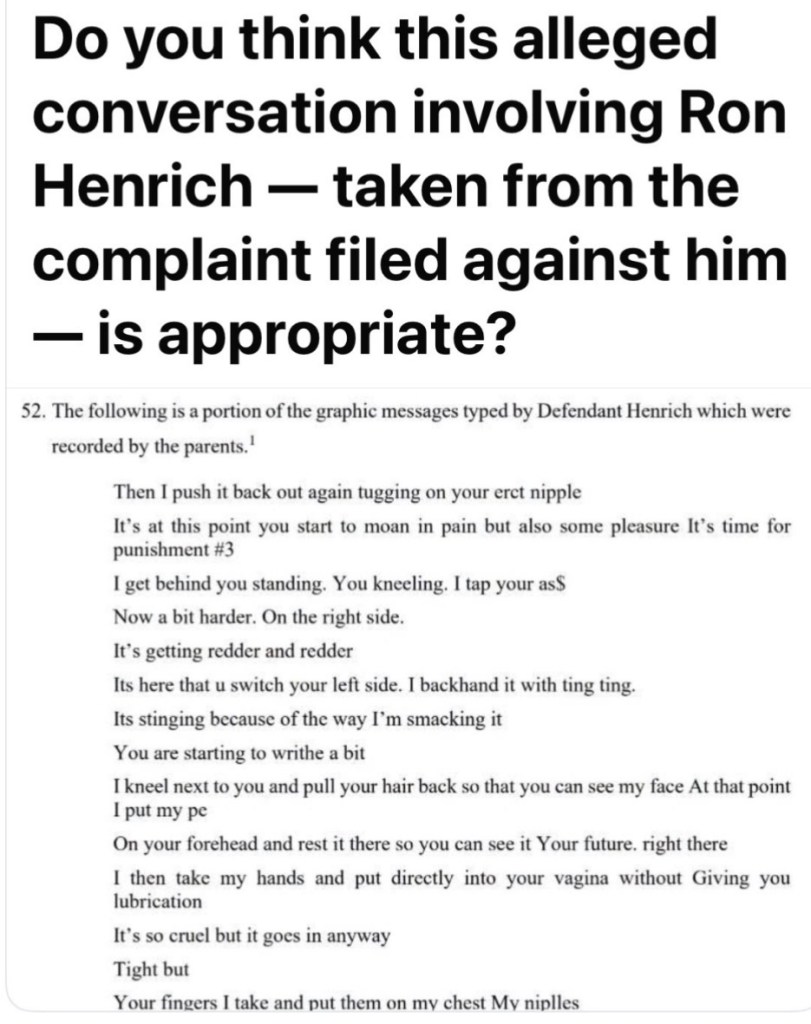
According to the detailed complaint, the teacher—identified in court documents as Ronald Henrich—did not even teach the girl in any of her classes. He welcomed her into his classroom during study hall periods, showed her “special attention,” and began building a relationship. Messages started on the district’s own Remind app. The student confided personal struggles, including mental health issues. The communications continued and escalated even after the mother tried to set boundaries. By ninth grade, the meetings moved to a closed-door “mindfulness room” for Friday lunches. Communications shifted to district email and Google Docs when access to Remind was curtailed. In March 2025, the mother discovered the teacher actively typing “extremely sexually graphic content” into a shared Canva document with her daughter. She recorded it. She called the Butler County Sheriff’s Office.
The district’s response, according to the lawsuit, was to promise administrative leave and restricted access to technology, then quietly allow the teacher to take Family and Medical Leave Act leave instead. Less than two weeks after the explicit messages surfaced—and while investigations by the district, sheriff, and children’s services were still open—the district approved his retirement. No public discipline. No immediate report to the Ohio Department of Education, as many parents would expect. The teacher walked away with his pension and benefits intact while the family was left to pick up the pieces.
The superintendent, Ashley Whitely, issued the standard institutional denial: the district “denies all allegations” and claims student safety is its top priority. Meanwhile, the mother’s lawsuit also details earlier reports she made that went unaddressed, repeated class pull-outs without parental notification, and even troubling lapses in how the school nurse handled the student’s medication—stockpiling Tylenol that contributed to a suicide attempt and failing to manage anxiety medication on a trip properly. These are not small administrative hiccups. They paint a picture of a system that had multiple opportunities to intervene and chose not to.
Then there is the part that really sticks in my craw. According to people who have followed the internal handling, the HR director—Jeff Rouff—essentially shrugged and said something to the effect that the age of consent in Ohio is 16, so what’s the big deal? Two consenting adults. Nothing illegal happened. That line of thinking is exactly why these situations metastasize. It ignores the entire grooming process that began at 13, when the girl was under the care and authority of this adult in a position of power inside a public school building. It ignores the use of school-issued devices and district apps to conduct the relationship. It ignores the closed doors, the missed classes, the emotional manipulation of a vulnerable child who had already suffered prior sexual abuse. Age of consent statutes were never intended to give cover to adults in positions of trust who spend years cultivating access to minors. That is not a gray area. That is the precise reason we have laws and professional conduct codes for educators in the first place.
I heard about problems surrounding this teacher roughly a year before the lawsuit dropped. Other parents and observers had been talking. The circle had already started to form. When the story finally broke across local media—Channel 5, Local 12, FOX 19—the superintendent’s immediate public move was not a somber address about accountability and root-cause fixes. It was a cheerleading video hyping a fall tax increase, talking about hiring dozens more staff members, rolling out a corporate “roadmap” with “stakeholders,” and reminding everyone to keep supporting public schools. The timing felt deliberate. Distract, then reassure the taxpayers who write the checks. Keep the money flowing.
That is the game I have been describing for years. Lakota, like many large suburban districts, is constantly in or approaching levy mode. The narrative must be controlled: we are great, we are improving, we need a little more of your property tax money to keep doing the wonderful things we do. Bad stories—especially stories that suggest adults in the building are preying on children and that leadership circled the wagons—threaten that narrative. So the wagons circle. The teacher retires quietly. HR offers the age-of-consent talking point. The superintendent films the upbeat video. The teachers’ union, which exists in large part to protect its members from consequences, stays largely silent or issues the usual generic statements about due process. And the machine keeps turning.
This is not an isolated incident. The lawsuit itself references a pattern of other cases involving Lakota employees over the years—some that resulted in convictions or license revocations, others that were handled with quiet exits. Former board member Darbi Boddy, who has remained a vocal parent advocate even after her time on the board ended, issued a clear public statement criticizing the handling of this situation. Good for her. We need more people willing to say the obvious out loud rather than hide behind “stakeholder engagement” jargon.
What troubles me most is how predictable the protection response has become. When something like this surfaces, the institution’s first instinct is not “How do we make sure this never happens again and how do we support the victim?” It is “How do we contain the damage to our brand and our funding pipeline?” The HR director’s reported comment about 16 being legal is a perfect example of that mindset. It treats the endpoint—the moment the child turned 16—as the only thing that matters, while erasing the years of grooming and boundary erosion that got her there. It treats a minor student in a teacher’s care as just another “consenting adult” the second the calendar flips. That is not how any responsible adult in education should think. It is how an institution thinks when its primary loyalty is to itself and the revenue stream that sustains it.
Public education in its current monopolistic, union-protected, tax-funded form has structural problems that make these failures almost inevitable. When you combine compulsory attendance, massive budgets, powerful collective bargaining agreements that make firing even grossly negligent employees difficult and expensive, and a culture that treats any criticism as an attack on “the children” or “public education itself,” you create exactly the conditions for cover-ups. The money keeps coming in as long as the bad stories stay buried or get spun. Parents who raise hell are dismissed as “haters” or people with “unrealistically high moral standards.” Meanwhile, the actual standard on the ground—don’t have sex with kids in the classroom or via school devices, don’t groom them for years, don’t let it slide when a parent reports it—somehow becomes negotiable the moment it threatens the budget or the reputation.
I am not saying every teacher is doing this, but too many are. The vast majority are not. But the ones who are counting on the system’s reluctance to act decisively. They count on the HR director who will find the legal technicality. They count on the superintendent, who will film the upbeat video instead of cleaning house. They count on the union that will fight to the last dollar of taxpayer money to protect a member who should never have been in a classroom with minors. And they count on enough parents staying disengaged or intimidated for the story to fade before real accountability arrives.
The mother in this case did what too few parents feel empowered to do: she documented, she reported, she refused to let it disappear. Her lawsuit is now public. The allegations are serious and detailed. Whether every claim is ultimately proven in court is for the legal process to decide. But the pattern of institutional response—quiet exit, legal denials, distraction videos, and the age-of-consent shrug—is already on display for anyone willing to look. That pattern is what should alarm every parent in Lakota and every parent in any district that operates the same way.
How many other kids right now are in unhealthy dynamics with adults who hold power over their grades, their schedules, their daily lives inside these buildings? How many school-issued devices are carrying messages that would make any decent parent’s blood run cold if they saw them? How many times has a concerned parent been told some version of “nothing to see here, move along, and please vote yes on the next levy”? I would be willing to bet the number is higher than any of us want to admit. This case only became a story because one mother refused to be quiet. The rest stay invisible because the system is optimized for exactly that outcome.
We keep being told that more money, more staff, more programs, and more “roadmaps” will fix what ails public education. I have watched this play out locally for years. The money keeps increasing. The problems—academic stagnation in too many areas, cultural capture, and now these horrifying failures of basic child protection—persist or worsen. At some point, parents have to ask whether the institution itself is the problem, not the lack of funding. When the first instinct of leadership is to protect the adult and the budget rather than the child, the social contract has already been broken.
Summary of Doe v. Lakota Local Schools (Filed July 1, 2026)
Important: This is a civil complaint containing allegations made by the plaintiffs. The allegations have been filed in federal court but have not been proven in court unless and until established through litigation. [Doe v Lakota Schools | PDF]
Overview
A mother (“Jane Doe”) and her daughter (“Jill Doe”), a minor student in the Lakota Local School District, filed a federal lawsuit against:
Lakota Local Schools
Former teacher Ronald Henrich
Superintendent Ashley Whitely
Principal Bill Brinkman
The lawsuit alleges that Henrich groomed and sexually abused Jill over approximately three years and that district officials failed to prevent, investigate, or properly respond to the misconduct. [Doe v Lakota Schools | PDF]
Timeline of Alleged Events
2022–2023 School Year (7th Grade)
According to the complaint:
Jill was 13 years old and had documented mental health struggles and prior trauma.
Although she was not formally identified as a gifted student, she began attending a gifted-program study hall supervised by Ronald Henrich.
Henrich allegedly began developing a special relationship with her and communicating extensively through the district’s Remind messaging app.
Jill reportedly disclosed personal information, including mental health struggles and prior abuse.
The lawsuit alleges the district failed to monitor or investigate the growing relationship. [Doe v Lakota Schools | PDF]
January 2024 Suicide Attempt
The complaint alleges:
Jill stockpiled Tylenol obtained from a school nurse over several days.
On January 22, 2024, she consumed approximately 4,500 mg in a suicide attempt while at school.
She was hospitalized and spent four days in psychiatric care.
Henrich continued communicating with Jill during summer break.
Messages allegedly became increasingly personal.
Jill’s mother became concerned and restricted access to the messaging app outside school hours.
The complaint argues district monitoring failed to detect inappropriate communications. [Doe v Lakota Schools | PDF]
2024–2025 School Year (9th Grade)
The complaint alleges that:
Henrich was assigned to a different school building but continued visiting Jill’s building.
He allegedly met her weekly for private lunches.
He brought her food and regularly pulled her from class for mentoring sessions.
Communications allegedly shifted to district email and Google documents after the Remind app was discontinued.
Jill reportedly missed significant class time due to meetings with Henrich.
Teachers allegedly expressed concerns about her absences, but her mother was not informed. [Doe v Lakota Schools | PDF]
January–March 2025 Escalation
According to the complaint:
Henrich allegedly contacted Jill’s therapist directly without parental permission.
The two allegedly arranged a meeting at a driving range.
On March 14, 2025, Jill participated in a gifted-program event where her parents observed what they considered unusual interactions between her and Henrich. [Doe v Lakota Schools | PDF]
She discovered a shared Canva document allegedly being used for communication between Jill and Henrich.
The mother and stepfather reportedly recorded nearly an hour of sexually explicit messages allegedly typed by Henrich.
The complaint includes graphic excerpts from those messages.
Butler County Sheriff’s deputies were called to the home and allegedly observed additional messages being typed while officers were present. [Doe v Lakota Schools | PDF]
After Discovery
The lawsuit claims:
The Sheriff’s Office informed the district on March 21, 2025.
The family was initially told Henrich would be placed on administrative leave and barred from district property.
Later, the parents discovered through board records that Henrich had instead been granted Family Medical Leave and subsequently retired.
The complaint alleges the district failed to investigate adequately and failed to report misconduct to state authorities. [Doe v Lakota Schools | PDF]
Children’s Services Finding
The complaint states that:
Butler County Children Services substantiated abuse allegations involving Henrich and Jill.
The family argues the district still failed to take meaningful disciplinary action. [Doe v Lakota Schools | PDF]
Return to School
The lawsuit alleges:
Jill was prohibited from using a Chromebook as a safety measure.
Teachers allegedly failed to provide equivalent paper assignments.
She allegedly faced stigma and negative treatment related to the abuse investigation.
The complaint argues Henrich’s case reflects a larger pattern within Lakota Schools.
It references previous incidents involving:
Justin Dennis
Nick McGill
Former Superintendent Matt Miller
George Merk
Robert Supinger
Angela Johnson
The plaintiffs argue these incidents demonstrate a longstanding failure by the district to identify, stop, or adequately respond to staff misconduct involving students. These allegations, presented by the plaintiffs as evidence of a pattern, have not been adjudicated in this case. [Doe v Lakota Schools | PDF]
Claims Filed
The lawsuit includes numerous claims, including:
Federal Civil Rights Claims (42 U.S.C. § 1983)
State-created danger
Special relationship doctrine
Conduct that “shocks the conscience”
Equal protection violations
Inadequate district policies and protection systems
Disability Claims
Americans with Disabilities Act (ADA)
Section 504 of the Rehabilitation Act
State Law Claims
Negligent supervision
Negligence per se
Negligent infliction of emotional distress
Intentional infliction of emotional distress (against Henrich)
The complaint alleges that a Lakota teacher groomed and sexually abused a vulnerable student over several years using district facilities, technology, and access to the student, while school administrators allegedly ignored warning signs, failed to take corrective action after discovery, and inadequately protected the student afterward. The lawsuit seeks damages under federal civil rights laws, disability laws, and Ohio tort law. [Doe v Lakota Schools | PDF]
Based on the civil complaint, the accusations and behaviors of Ronald Henrich against the minor plaintiff include a systematic pattern of grooming, manipulation, and sexual abuse over three years:
**Grooming and Relationship Development**
**Unauthorized Access:** Henrich allowed Jill to attend his “gifted” program study hall instead of her assigned one in seventh grade, despite her not being a designated gifted student.
**Targeting Vulnerabilities:** He built a relationship with Jill by showing her “special attention” and exploiting her personal struggles, including her history of anxiety, self-harm, and past sexual abuse, which she shared with him.
**Mentoring Pretense:** He repeatedly pulled Jill out of her regular classes for one-on-one “mentoring” sessions, claiming it was necessary for her anxiety and mental health.
**App-Based Communication:** He messaged Jill frequently on the District’s Remind app, often outside of school hours, with messages that became increasingly personal, such as saying “good morning” and “good night” and discussing their dinners.
**Switching Platforms:** When the District ended its contract with the Remind app, Henrich continued his daily personal communications through Jill’s District email and Google Docs accounts.
**Boundary Violations and Stalking**
**Secluded Lunches:** During Jill’s ninth-grade year, Henrich—who was no longer assigned to her building—visited her every Friday to eat lunch alone with her in a “mindfulness room” with the door closed, often bringing her food from outside the school.
**Inappropriate Physical Presence:** He “stalked” Jill by visiting her after band practice in a building where he had no official responsibilities.
**Circumventing Parents:** He reached out directly to Jill’s therapist without her mother’s consent to discuss “developments” in Jill’s mental health.
**Orchestrated Meetings:** He arranged to meet Jill at a local driving range outside of school hours and feigned that their encounter was a “coincidence” to her family.
**Inappropriate Conversation with Mother:** He told Jill’s mother that he had lost sleep and weight over their relationship and that he “missed how things used to be,” when teachers could drive students alone in their vehicles.
**Sexual Abuse and Graphic Misconduct**
**Canva Incident:** On March 20, 2025, Jill’s mother discovered Henrich was actively typing and immediately deleting extremely sexually graphic messages on a live Canva document shared with Jill.
**Graphic Content:** These recorded messages included detailed descriptions of Henrich engaging in rough sexual foreplay and penetrative acts with Jill, which he referred to as “punishment.”
**Physical Abuse:** The messages depicted Henrich causing Jill pain, pulling her hair, and smacking her.
**Post-Discovery Misconduct**
**Unauthorized Contact:** In December 2025, after Butler County Children’s Services had substantiated the abuse, Henrich communicated with Jill during the school day via another student’s phone.
**Physical Encounter:** A few days later, Henrich picked Jill up from a mandatory school band practice and drove her to a park where they “laid together” in his vehicle before he returned her to school.
Footnotes
1. Details of the federal lawsuit filed July 1, 2026, in the U.S. District Court for the Southern District of Ohio, as reported in contemporaneous coverage by the Cincinnati Enquirer and Journal-News.
2. Allegations regarding the timeline, use of the Remind app, Canva document, mindfulness room meetings, and district response drawn from the complaint were summarized in multiple local outlets.
3. District statement denying allegations and emphasizing student safety priorities, reported across local media following the lawsuit filing.
4. References to prior incidents and pattern allegations contained within the 2026 lawsuit filings and prior local reporting on other Lakota employee cases.
5. Ohio age of consent is 16; however, professional conduct codes for educators and laws regarding persons in positions of authority create additional prohibitions on sexual conduct with students that do not turn solely on the general age of consent.
Bibliography for Further Reading
• Cincinnati Enquirer, “Parent says Lakota teacher groomed and abused her daughter,” July 8, 2026.
• Journal-News, “Lawsuit: Lakota teacher ‘groomed and sexually abused’ a student and was allowed to take medical leave, retire,” July 7, 2026 (updated July 9).
• FOX19 / Local 12 coverage of the July 2026 lawsuit and related statements.
• Ohio Department of Education professional conduct standards for educators (ongoing reference for context on boundaries and reporting obligations).
• General resources on educator sexual misconduct patterns: U.S. Department of Education reports and studies on employee misconduct in K-12 settings (searchable via ED.gov).
• Local coverage of prior Lakota cases involving Justin Dennis and others referenced in the 2026 lawsuit for pattern context.
• Darbi Boddy’s public statements and commentary on Lakota issues (available via local media archives and her public channels).
• Ohio Revised Code sections on sexual battery, unlawful sexual conduct with a minor, and school employee reporting requirements.
Rich Hoffman is an author, political consultant, and strategic advisor based in Cincinnati, Ohio, and the creator of The Politics of Heaven—a unique framework that connects biblical theology, ancient history, and modern power structures to explain how moral alignment and spiritual forces shape global events. Blending real-world political experience with deep research into archaeology, UFO phenomena, and suppressed historical narratives, Hoffman offers compelling commentary on topics ranging from ancient civilizations and the Dead Sea Scrolls to modern populist movements, paranormal continuity, and leadership strategy in chaotic environments. As the author of The Gunfighter’s Guide to Business and the forthcoming Politics of Heaven, he brings a grounded yet provocative voice to media discussions, supported by firsthand experiences and a cross-disciplinary approach that bridges science, history, and theology. For interviews, speaking engagements, or expert analysis, visit richhoffmanbooks.com or contact directly via phone at 513-307-5815 or email at rhoffman@richhoffmanbooks.com. If you’ve seen the movie, Disclosure Day and want to talk about it and the implications of Presidnet Trump’s UAP disclosures, let me know and we can bring some color to your coverage. https://richhoffmanbooks.com/media-inquiries-broadcast-topics-and-contact-info/?frame-nonce=ad51e7ecba I do have a firsthand UFO encounter to discuss.
The Fourth of July 2026 hit different this year, especially as the nation leaned into the spirit of the 250th-anniversary celebrations and all the ceremonies marking two and a half centuries since that bold declaration in Philadelphia. It felt pretty, pretty, pretty cool—pretty good, really—to see people embracing the moment with genuine enthusiasm, more than I’ve sensed in years. The Trump administration put real energy behind it, and it showed. Out here in Liberty Township, Butler County, Ohio, the whole valley came alive in a way that reminded me why this ground matters. I stepped out of my driveway late into the night, and the fireworks kept rolling until midnight, echoing from Trenton, Fairfield, Hamilton, and everywhere in between. Living on this elevated piece of property overlooking the Great Miami River valley gives you a front-row seat to it all. If you’ve ever been over, you understand the geography—the way the land rises high and commanding, the river snaking below through Middletown, Trenton, and Hamilton. It’s the same high ground that made the Voice of America broadcast site so strategically vital back in the day, right over in Mason. My kids went to the museum for the Fourth and came back buzzing about it, sharing pictures of the Crossley innovations, those three massive towers that once beamed American ideals and resolve across the world.
I grew up looking out my window at those towers. The silver structures are gone now, but the concrete pylons and foundations remain, silent sentinels of a time when America projected strength and clarity without apology. I explained it to the grandkids and my daughters that evening after the fireworks: this high ground wasn’t random. The Great Miami River valley, with its elevated ridges running from Liberty Township all the way over toward Mason, offered natural advantages—commanding views, defensibility, and that clear line of sight and signal propagation that made the Voice of America a high-priority target for adversaries like the Soviets during the Cold War. Evendale and other key industrial sites were on the lists too, but the broadcasting power here symbolized something deeper: the projection of Americanism, individual liberty, capitalism, and self-reliance to a world that needed to hear them. Standing there with the family as fireworks lit the sky, thousands upon thousands popping off every second and ricocheting off the hillsides, I felt that same spirit alive in 2026. People were spending their own money, blowing things up in celebration of rebellion and independence. It was loud, chaotic, joyful—exactly the kind of unscripted gusto that built this country.
My wife and I soaked it in with the grandkids. We had an epic family day: picking up fireworks, setting them off on the property, swimming late into the warm night while the valley below erupted in color and sound. The geology here adds to the magic—the river carving through the valley floor, hills rising on either side like ancient guardians, with earthwork structures and mounds reminding us of deep human history on this land long before the founding. One hillside across the way mirrors the kind of elevated features you see near Miamisburg. It’s high ground that has always mattered, whether for broadcasting freedom or simply giving families like ours a vantage point to watch communities celebrate. I told the kids, as everyone headed out around eleven, that I wish more people fought for ideas and principles with the same energy they put into lighting up the sky. The Trump administration did a solid job of coordinating national ceremonies, and it was great to see Mount Rushmore back in the mix after years of diminished patriotism under previous leadership.
I’ve said it before, and I’ll say it again: there’s hardly a more patriotic place on earth than Mount Rushmore. I love Washington, D.C.—the cleaned-up streets, the Library of Congress, the Supreme Court, Capitol Hill, the White House grounds we’ve walked recently. The intent behind the founding documents still resonates there if you listen closely. But nothing matches standing at the base of those carved faces with flags waving along the avenue of flags, the bookstore full of real history, the sense of scale and permanence. Back in 2020, after watching the Trump fireworks display at Mount Rushmore on TV, I was so inspired that my wife and I packed up the campers with the family the next year and headed west. We hit Deadwood, Devils Tower, and, of course, Mount Rushmore itself. Buffaloes came right up to the car—wild, majestic, a perfect backdrop. That trip stayed with me: the open road, teaching the grandkids resilience and wonder, standing where giants of American history stare out across the Black Hills. The Biden years canceled that patriotic spark at the site, which always struck me as telling. They didn’t want the visual of fireworks honoring the founders on that sacred ground. Seeing it revived in 2026 felt like a correction, a return to celebrating what makes us exceptional rather than apologizing for it.
The local celebrations grounded all that national energy in something real and immediate. My daughter participated in the community parade, and she came back with sharp observations. The Republicans led it strongly, but she was surprised by how many Democrats showed up further back. I told her that’s how it works—they’re there, even in Butler County. About thirty to forty percent in many areas, often quiet until they sense weakness. They move in from coasts and high-tax states, bringing ideas that erode self-reliance, and they play the long game: friendly on the surface, organizing in schools, unions, and local offices. Law teachers, public employees, transplants—they blend in at Walmart but push collective priorities when it counts. I explained it to her plainly: they know they’re a minority on core issues, so they infiltrate, stay polite to your face, and wait for Republicans to nap on turnout and vigilance. West Chester Township has seen shifts for exactly those reasons. Don’t underestimate them. My daughter was a bit taken aback, but it’s reality. The enemy isn’t always overseas; some are neighbors who reject the founding premise of individual initiative and ordered liberty.
That evening, as we swam in the pool and wrapped up the family dinner, I kept the radio on WLW in the garage—part of the old Voice of America legacy complex. They played clips of past Fourth of July speeches: presidents from different eras celebrating the republic. It was striking to hear the contrast. Obama’s “you didn’t build that” collectivism, the emphasis on “we” over “I,” the downplaying of individual heroes in favor of consensus circles and government-guided outcomes. Bush had his moments, but the through-line in some Democratic rhetoric leaned toward collective pronouncements that castigate personal achievement. Compare that to the Americanism that built the Voice of America towers I grew up seeing—broadcasting individual rights, capitalism, and innovation to counter tyranny. I’ve always approached business and life the same way: find the best and brightest, give them room to rise through merit, reward contribution without penalizing success. That’s what creates upper mobility. Socialism and heavy collectivism punish the very drive that lifts everyone. The grandkids listened as I connected the dots among the fireworks, the high-ground history, and the ongoing fight for ideas.
A recent encounter drove this home powerfully. A couple of weeks before the Fourth, a high-level executive—a substantial Democratic donor who had given over a million to the Hillary and Biden campaigns—flew into Cincinnati on his private jet, hired a car, and came straight to my office. He wanted me to sign copies of The Gunfighter’s Guide to Business. He’d bought hundreds to distribute to his employees as a gift, complete with a big warehouse event using a Skyjack lift for the presentation. This guy had despised my views for years, thought I was extreme, especially on Trump. But after Trump’s return and watching how events unfolded, he revisited my writings and videos. He admitted I’d been ahead on many business and cultural issues. He respected the track record enough to fly across the country for a twenty-minute conversation, shake my hand, and get the books signed personally. We talked politics openly—he knew my strong views, and I knew his past support. No fighting, just honest exchange. He even mentioned considering Vivek Ramaswamy for governor and the need to clean up election integrity issues in places like California to let real leaders rise. I told him ideas matter more than parties; convert through clarity, not confrontation. He left impressed, and I later grabbed dinner at Jag’s—celebrating a small win in the battle of minds with a great meal.
That story isn’t isolated. Plenty of former skeptics are reassessing after seeing results. My daughter asked about next year’s parade—maybe a family float with her Jeep, the grandkids, and yes, bullwhips cracking to symbolize discipline and precision. The youngest grandson already wants in. I’m on a time crunch these days with writing, business, and the manuscript for The Politics of Heaven, but we’ll make it happen. Parades, fireworks, family gatherings—they’re more than fun. They’re reminders of the rebellion we celebrate and the vigilance required to defend it. Enemies within—those pushing socialism, eroding self-initiation, favoring collective penalties over individual reward—operate in the background, polite at the neighborhood level while undermining capitalism. The fireworks show the spirit is still there; now we channel that gusto into winning minds, just as the Voice of America once projected truth globally from this very high ground.
The geology and history here reinforce it all. The Great Miami River valley, with its elevated townships and ancient mounds, has hosted human striving for millennia. The Voice of America site leveraged that topography to broadcast freedom. Today, from my driveway, watching fireworks echo across the same ridges, I see continuity: people choosing to celebrate independence loudly, despite internal challenges. The 250th-anniversary push, Mount Rushmore revival, national ceremonies—it all points to renewal. I’ve traveled enough—Gettysburg, Space Coast, D.C.—to know America’s symbols retain power when defended. My wife and I keep building those memories with the grandkids: rockets, parades, history lessons, fireworks on the hill. It’s a privilege and a responsibility. As I told the family that night, match the fireworks energy with idea-fighting. Convert where possible, stand firm always. That Democrat donor, crossing the country for a signature, showed that ideas can bridge divides when lived authentically. Here on the high ground, overlooking the valley where the river snakes and communities light up the sky, it feels like the fight for the American idea remains winnable—one conversation, one celebration, one broadcast of truth at a time.
Expanding outward, the broader 2026 Fourth carried that same resonance nationally. With the 250th anniversary momentum, communities from coast to coast reflected on founding principles amid modern pressures. In Ohio, local parades and fireworks displays underscored resilience after years of division. The Trump administration’s emphasis on patriotism—reviving Mount Rushmore events, coordinating ceremonies—contrasted sharply with prior diminishment. I remember the inspiration from 2020 vividly; it wasn’t just spectacle. It prompted real family action: the cross-country camper trip, teaching grandkids about self-reliance amid buffalo herds and carved mountains. Canceling such displays later felt like rejecting the founding rebellion itself. Fireworks embody that: loud, bright, unapologetic declarations against tyranny.
Locally, the high ground advantage isn’t lost on me. Living elevated above the Great Miami, with Trenton and Hamilton below, mirrors strategic history. The Voice of America towers—Crossley’s engineering marvels—broadcast from similar terrain, making the site a priority target. Soviets and others recognized its power in projecting American exceptionalism. Today, those foundations remain, a reminder that ideas travel far from strong ground. Explaining this to the kids after the museum visit tied the past to the present: we stand on land that amplified liberty. The river valley amplifies sound too—fireworks ricocheting for miles, thousands detonating in celebration. It was auditory proof of widespread participation, people investing personally in joy and memory-making. My grandkids’ eyes lit up; the youngest already planning next year’s parade role. These shared experiences build the next generation of defenders.
Politically, my daughter’s insights from the parade were instructive. Front-loaded Republicans, Democrats further back—visible yet strategic. Transplants from California and New England bring habits and assumptions that shift trustee balances, as in West Chester. They operate politely, infiltrating schools and unions, waiting for lapses in vigilance. I’ve seen it for decades: don’t nap, or offices flip. In many locales, about 30-40% reject core capitalism—individual reward for contribution—in favor of collective leveling that punishes success. Fireworks enthusiasts likely include many such neighbors, enjoying the spectacle while quietly supporting policies that erode its foundations. The lesson: engage ideas relentlessly.
The donor story exemplifies it. A powerful California executive in the space economy, longtime Hillary/Biden backer, flew in specifically for my signature on The Gunfighter’s Guide. He’d distributed hundreds to employees as he planned a major event. Once hostile, he credited Trump’s return and my consistent track record for prompting reevaluation. We spoke candidly—no shouting, just clarity. He acknowledged that election integrity needs in blue states are a requirement for leaders like Ramaswamy or Hilton to succeed. I offered no conversion pressure, just principles: merit, self-initiation, rewarding contribution. He left motivated, and I enjoyed Jag’s later, reflecting on small victories in the marketplace of ideas. Such encounters affirm the approach—live boldly, engage honestly, let results persuade.
Tying it together, 2026’s Fourth blended local joy with national renewal. From valley fireworks echoing off ancient high ground once used for global broadcasts to family parades and personal redemptions, it reaffirmed America’s enduring appeal. Enemies within push collectivism; we counter with lived individualism and vigilant celebration. My wife and I prioritize these traditions—rockets with grandkids, history lessons, unashamed patriotism—because they forge resilience. As the towers once did, we project strength from elevated places, literal and philosophical. The fight continues: match fireworks energy with idea warfare. Convert neighbors through clarity. Celebrate rebellion daily. This high ground, this valley, this family—this is where America renews.
Footnotes
1. Local geography and Voice of America history, Butler County/Mason area.
2. 2020 Mount Rushmore event and family trip reflections.
3. Observations on parade dynamics and local political realities.
4. Account of executive donor meeting and book distribution.
5. Broader 250th anniversary context and national ceremonies.
6. Great Miami River valley geology and historical significance.
Bibliography for Further Reading
• Crossley Broadcasting and Voice of America archives (historical engineering and Cold War context).
• The Gunfighter’s Guide to Business (personal reflections on merit and leadership).
• Ohio Historical Society materials on the Great Miami River and ancient earthworks.
• Public reports on 2026 Fourth of July national events and Mount Rushmore programming.
• Personal travel accounts from Black Hills region (Mount Rushmore, Devils Tower).
Rich Hoffman is an author, political consultant, and strategic advisor based in Cincinnati, Ohio, and the creator of The Politics of Heaven—a unique framework that connects biblical theology, ancient history, and modern power structures to explain how moral alignment and spiritual forces shape global events. Blending real-world political experience with deep research into archaeology, UFO phenomena, and suppressed historical narratives, Hoffman offers compelling commentary on topics ranging from ancient civilizations and the Dead Sea Scrolls to modern populist movements, paranormal continuity, and leadership strategy in chaotic environments. As the author of The Gunfighter’s Guide to Business and the forthcoming Politics of Heaven, he brings a grounded yet provocative voice to media discussions, supported by firsthand experiences and a cross-disciplinary approach that bridges science, history, and theology. For interviews, speaking engagements, or expert analysis, visit richhoffmanbooks.com or contact directly via phone at 513-307-5815 or email at rhoffman@richhoffmanbooks.com. If you’ve seen the movie, Disclosure Day and want to talk about it and the implications of Presidnet Trump’s UAP disclosures, let me know and we can bring some color to your coverage. https://richhoffmanbooks.com/media-inquiries-broadcast-topics-and-contact-info/?frame-nonce=ad51e7ecba I do have a firsthand UFO encounter to discuss.
I have been saying for years that the vertical air taxi market—powered by electric vertical takeoff and landing (eVTOL) aircraft—would quite literally take off, and that by the end of 2026 it would become commonplace in major cities and airports across the country. Leading up to 2025 and into 2026, I told everyone who would listen that Joby Aviation was positioned to lead this transformation, turning what many dismissed as science fiction into everyday reality. And right on cue, at the end of April 2026—specifically during demonstrations from April 25 through April 27 and extending into the following days—Joby completed New York City’s first-ever point-to-point eVTOL air taxi flights, soaring from John F. Kennedy International Airport (JFK) to Manhattan heliports in under 10 minutes (some reports clocked segments at just seven minutes). This wasn’t just a flashy stunt; it was a critical FAA milestone under the eVTOL Integration Pilot Program (eIPP), showcasing seamless integration into one of the world’s busiest and most tightly regulated airspaces. The flights validated everything I had predicted: quiet, emissions-free, stable vertical flight that outperforms noisy traditional helicopters, all while promising to slash travel times and transform how we move in and out of urban centers.
To understand why this moment feels so validating, it helps to step back and consider the substantial background of the eVTOL industry and Joby Aviation specifically. eVTOL technology represents the convergence of electric propulsion, advanced batteries, distributed electric propulsion (multiple rotors for redundancy and safety), and fly-by-wire controls—essentially combining the vertical agility of a helicopter with the efficiency and quiet operation of a fixed-wing aircraft. Unlike traditional helicopters, which rely on loud combustion engines and single rotors, Joby’s S4 aircraft uses 12 electric propellers (six tilting for forward flight, six dedicated for lift) powered by high-energy-density batteries. This design delivers near-silent operation—reportedly 100 times quieter than helicopters during takeoff and landing in some metrics —with cruise noise levels around 45 dB at altitude, quieter than normal conversation. It uses no jet fuel, produces zero tailpipe emissions, and offers far greater stability in flight. The aircraft carries a pilot and up to four passengers, making it ideal for premium, on-demand service akin to Uber Black but in the sky.
Joby Aviation, founded in 2009 and headquartered in Santa Cruz, California, has spent more than a decade refining this vision. Backed by heavyweights like Toyota (a manufacturing partner providing automotive-grade expertise and capital), Delta Air Lines, and Uber, the company has methodically progressed through FAA certification stages. By early 2026, Joby had flown its first FAA-conforming aircraft (March 11), entered the final Type Inspection Authorization phase, and cleared Stage 4 of the five-stage certification process. The April 2026 Manhattan demonstrations—part of a week-long campaign using existing heliports such as Downtown Skyport, West 30th Street, and East 34th Street—were not passenger-carrying commercial flights but rather critical proof-of-concept operations. They demonstrated point-to-point integration with FAA-controlled airspace at one of America’s busiest airports, building on New York’s selection as part of the White House-backed eIPP announced in March 2026. Joby was named a partner on five projects spanning 12 states, accelerating the path to commercial rollout. These flights weren’t isolated; Joby has conducted similar demos globally, but Manhattan’s dense urban environment was the ultimate credibility check.
The numbers tell a compelling story of momentum. Joby aims to launch a paying passenger service in late 2026, starting potentially in Dubai (where regulatory support is strong) before scaling in the U.S. Production is ramping aggressively: the company acquired a second major facility in Dayton, Ohio—a 700,000-square-foot site now operational and poised to help double output to four aircraft per month by 2027. Combined with its California operations, this positions Joby for rapid scaling. Analysts project that the global eVTOL market could reach tens of billions of dollars annually within a decade, driven by urban congestion relief, airport access, and tourism applications. Joby has already acquired Blade Air Mobility’s passenger business, integrating into Uber’s app for seamless booking. Early economics suggest fares comparable to premium ground services or helicopters today, but with far greater speed and comfort. I have watched this trajectory closely, and the April 2026 events align perfectly with the economic development path I outlined a year ago: infrastructure, certification, and political vision converging to make air taxis as routine as ride-sharing.
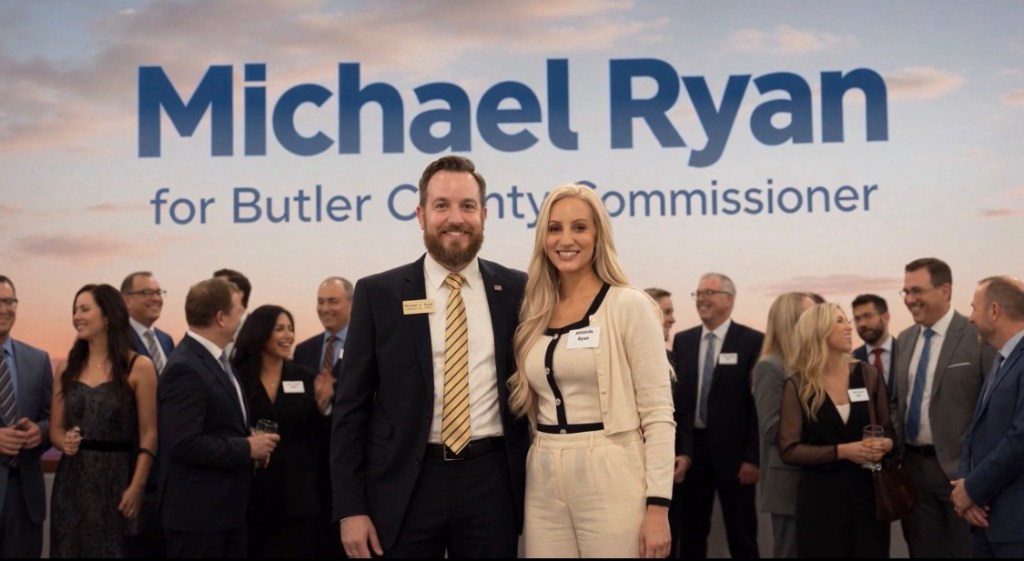
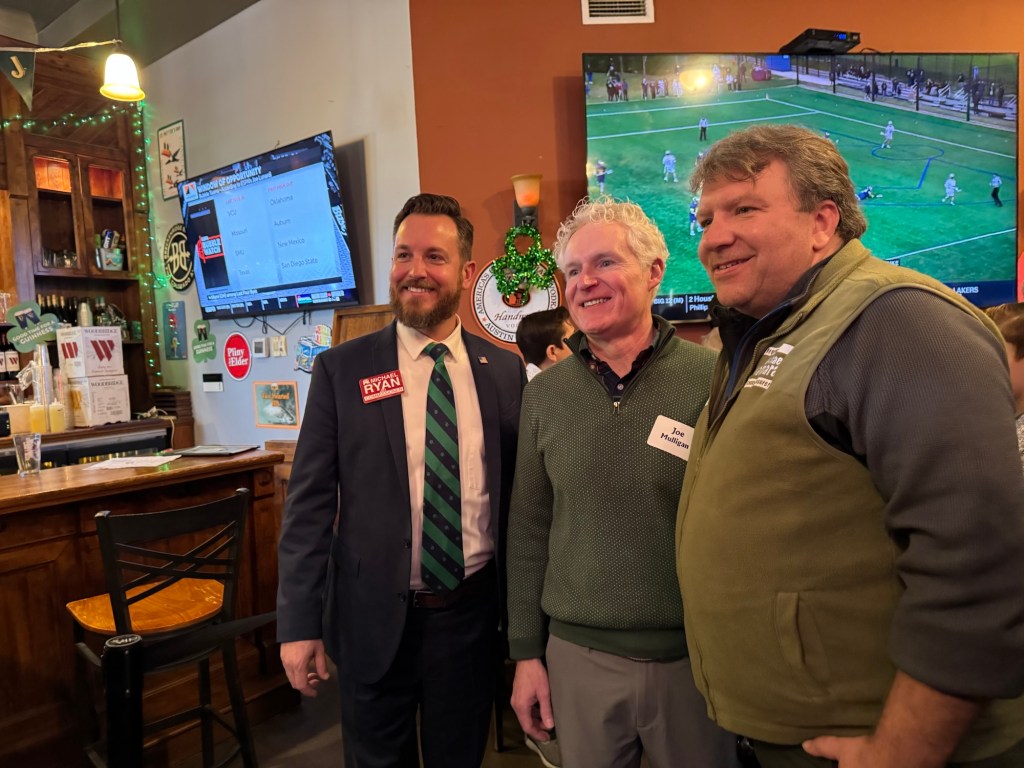
Here in southern Ohio, this revolution hits close to home. Butler County—home to Hamilton, Middletown, Fairfield, and Oxford—sits just north of Cincinnati and is ideally positioned for an air taxi hub. I have long advocated for this alongside Michael Ryan, the Republican nominee for Butler County Commissioner and a forward-thinking leader who gets it. Ryan, a former Hamilton City Councilman and Vice Mayor, has been pushing for advanced manufacturing and aviation infrastructure since his early days in local government. He has toured facilities such as the National Advanced Air Mobility Center of Excellence and met with Joby representatives multiple times in late 2025 to lay the groundwork for a vertiport (vertical takeoff/landing pad) in Hamilton or across broader Butler County. While others dismissed it as futuristic fantasy, Ryan saw the opportunity to position our community as a leader rather than a late adopter. With Joby’s Dayton facility just up the road—already gearing up for mass production—Butler County could become a regional nexus for eVTOL operations, serving Cincinnati/Northern Kentucky International Airport, Dayton International, and local business travelers. Imagine skipping hour-long traffic snarls on I-75: a quick app hail from a city-center pad or Westchester area, a 10-15 minute flight, and you’re at the terminal. No more rental cars, buses, or tolls for trips to Orlando’s cruise ports or Disney parks—direct sky taxi from hotel to ship in under 15 minutes.
This brings us squarely into the political arena and the critical May 2026 primary election. As primaries loom in early May—specifically May 5 for Butler County—the choice for commissioner couldn’t be clearer. Michael Ryan is the endorsed Republican candidate, backed overwhelmingly by the Butler County Republican Party (71% of the central committee vote in January 2026). He faces incumbent Cindy Carpenter, who chose not to seek the party’s endorsement and has a track record that many in the community find troubling. Roger Reynolds, the former county auditor whose past legal issues lingered in the background, briefly entered the race but dropped out after the GOP’s decisive support for Ryan. I have driven around Butler County and seen the contrast in campaign signs firsthand. Ryan’s signs look sharp, crisp, and well-maintained—fresh volunteers keeping them upright across Hamilton, Middletown, and beyond. Carpenter’s signs, plastered aggressively in early April (or late March), now appear tattered, faded, and weather-beaten just weeks before the vote. They flap like old, neglected flags, a visual metaphor for a campaign lacking the grassroots energy to sustain momentum. Signs can deceive at first glance, projecting illusory support, but maintenance reveals the truth: real backing requires ongoing work, not just a burst of spending at the outset.
I have followed local politics closely, and the differences between the candidates stand out vividly. Michael Ryan is a conservative with proven results in job creation, tax relief, and economic development during his time on Hamilton City Council. As vice mayor, he championed initiatives like the Advanced Manufacturing Hub and aviation-related projects that align directly with the eVTOL future. His energy, fresh ideas, and willingness to engage visionaries like Joby early—when they were still navigating hurdles—set him apart. Ryan understands that politicians with foresight bring communities into leadership roles on emerging technologies. Butler County doesn’t need to play catch-up a decade from now; it can lead now, while the market is at its hottest. The vertical airspace sector is arguably the most dynamic in the U.S. economy right now, with Dubai, China, Los Angeles, San Francisco, and Orlando all moving fast. A Joby hub here would mean jobs, tourism boosts, and infrastructure that attracts businesses—opportunities that would be impossible without proactive leadership.
In contrast, Cindy Carpenter’s tenure has been marked by controversies that have alienated even fellow Republicans. She has faced scrutiny for public behavior unbecoming of high office—including documented incidents of intimidation and foul language—and was caught campaigning for Democrats in races like Middletown’s mayoral contest, a move that cost her the GOP endorsement. Everyone I speak with wants to move on from that style of politics. Her campaign’s reliance on outdated signs and legacy networks feels like an attempt to manufacture the illusion of broad support from “Rhino” elements resistant to change. But voters see through it. The Republican Party has adjusted, listening to the grassroots and aligning with leaders who embrace the future rather than clinging to the past. Ryan’s team has volunteers out maintaining visibility because the support is real—not propped up by a handful of upset insiders.
As someone who has collaborated with Ryan on these forward-looking ideas, I can attest to his genuine commitment. He has been trying to schedule deeper engagements with Joby, but their schedule is now packed, as Joby is the hottest ticket in aviation. That alone shows how prescient his initial outreach in 2025 was. Once through the primary—widely seen as the real contest in this heavily Republican county—Ryan will be well-positioned for the general election. Over the summer and fall of 2026, I expect him to facilitate demonstration events showcasing Joby aircraft right here in Butler County. Imagine community fly-ins or vertiport planning sessions that highlight the vision: quick hops to Dayton or Cincinnati airports, avoiding traffic, and positioning us as an eVTOL leader alongside Manhattan, Dubai, and Orlando. This is the kind of bold, conservative leadership that drives sustainable growth without raising taxes or burdening residents.
The broader implications extend far beyond one county. Globally, places like Orlando are eyeing eVTOLs to ferry tourists from Disney hotels directly to cruise terminals on the Space Coast—no more buses, rental cars, or toll roads. China and the Middle East are investing heavily. Here at home, airports like Dayton International and regional pads in Westchester or Hamilton could become hubs. Joby and competitors like Archer Aviation (with its focus on Georgia) are racing, but Joby’s Dayton presence and certification lead give it the edge, in my view. Archer has strong backing and production ambitions, yet Joby’s momentum—Toyota manufacturing expertise, Uber integration, and real-world demos—makes it the frontrunner for near-term scale. The industry isn’t zero-sum; both will grow, but early adopters like Butler County win by partnering with the most advanced player now.
I do not doubt that if elections were held today under these dynamics, Michael Ryan would prevail because voters crave representatives who deliver results and vision. Primaries often see lower turnout, but that makes every vote crucial. Do not take it for granted—get out and vote for Michael Ryan on May 5, 2026. This primary is the gateway to a stronger general election campaign and, ultimately, to realizing these opportunities. With Ryan in the commissioner’s seat, Butler County secures its place in the new transportation economy. Cindy Carpenter’s approach—reactive, divisive, and disconnected from innovation—offers no such path. Her signs may have looked imposing at the campaign’s start, but their current state tells the real story: neglected support from a candidate whose time has passed.
Looking ahead, the future of air taxis is bright and efficient. Start with pilots, transition to autonomous operations as regulations evolve, and watch as it becomes as simple as ordering an Uber. For working professionals, families heading to cruises, or business travelers dodging gridlock, this changes everything. Joby’s Manhattan milestone isn’t the end—it’s the beginning of nationwide rollout. And thanks to leaders like Michael Ryan, who embraced it early, southern Ohio won’t be left behind. I have been consistent on this for years because the technology, economics, and political will are aligning exactly as forecasted. Those who invested early—financially or politically—stand to benefit enormously. The hottest market sector in the economy is vertical airspace, and Butler County is poised to claim its share.
This episode also underscores a deeper truth about politics and progress: true leadership adapts to people’s needs and future realities, much like the representative government I have discussed in other contexts. Trump voters and everyday Americans choose leaders who listen and deliver—not those trapped in past grievances. Ryan embodies that forward momentum. Carpenter’s record of supporting Democrats in key races and public missteps has left her isolated. The party’s decision to back fresh ideas over incumbency was wise and reflects a broader adjustment toward innovation.
The rubber is hitting the road—or rather, the aircraft are taking off. Joby Aviation’s April 2026 demonstrations in Manhattan confirm what I have been saying all along. With Michael Ryan leading Butler County into this new era, our communities stand to gain jobs, infrastructure, and a competitive edge that legacy thinking could never provide. Vote early, vote often in spirit, and make your voice heard in the primary. The future is electric, vertical, and fast—and it’s arriving right on schedule.
Footnotes
¹ Joby Aviation press release detailing April 2026 NYC demonstrations and eIPP participation.
² FAA certification progress and conforming aircraft timeline from industry reports.
³ Noise and stability comparisons between eVTOLs and helicopters.
⁴ Butler County Republican Party endorsement and primary candidate details.
⁵ Michael Ryan’s economic development record and aviation advocacy.
⁶ Joby manufacturing expansion in Dayton, Ohio.
⁷ Market projections and global adoption outlook for the eVTOL sector.
Rich Hoffman is an aerospace executive, political strategist, systems thinker, and independent researcher of ancient history, the paranormal, and the Dead Sea Scrolls tradition. His life in high‑stakes manufacturing, high‑level politics, and cross‑functional crisis management gives him a field‑tested understanding of power — both human and unseen.
He has advised candidates, executives, and public leaders, while conducting deep, hands‑on exploration of archaeological and supernatural hotspots across the world.
Hoffman writes with the credibility of a problem-solver, the curiosity of an archaeologist, and the courage of a frontline witness who has gone to very scary places and reported what lurked there. Hoffman has authored books including The Symposium of Justice, The Gunfighter’s Guide to Business, and Tail of the Dragon, often exploring themes of freedom, individual will, and societal structures through a lens influenced by philosophy (e.g., Nietzschean overman concepts) and current events.
I warned what would happen in West Chester Township during the November 2025 election, and it’s playing out just as I said it would. I don’t want to pick on Amanda Ortiz personally—she seems like a pleasant enough young lady, a veterinarian and mom who presented herself in a way that felt approachable and non-threatening—but the reality is that her victory as a West Chester trustee represents something much larger and more dangerous than one local race. I warned everyone during the campaign that we should have stuck with Mark Welch, the longtime trustee who had helped build West Chester into the thriving, well-managed community it had become under Republican leadership. Instead, we now have a radical Democrat on the board, and the consequences are already starting to reveal themselves in ways that should worry every taxpayer and resident who values fiscal responsibility and growth without the typical left-wing overreach. Mark Welch was the only real hedge against the lean-Democrat influences that were already creeping into township decisions, and by losing him, we have opened the door to a shift that could erode the very foundations of what made West Chester successful in the first place. I have said it before, and I will say it again here: this was not just an election loss; it was a calculated Trojan horse maneuver by the Democrats, and the proof is right there in how they celebrated it afterward.
Let me walk through exactly how this unfolded because I believe people must understand the playbook Democrats are using in Republican strongholds like Butler County, Ohio, and across the country. Amanda Ortiz ran a campaign that deliberately downplayed her partisan affiliation. She did not go door-to-door shouting that she was a Democrat. She positioned herself as a nice mom, a community-oriented professional who cared about infrastructure, parks, and listening to residents rather than developers. Her website and materials emphasized “people over business,” which sounds reasonable on the surface, but in practice, it is code for a regulatory mindset that slows growth and increases costs for everyone else. People who were moderate or independent, or even some Republicans who were tired of seeing the same faces, listened to her and thought she represented a fresh, safe choice. They got suckered, plain and simple. I heard it from so many voters after the fact—folks who admitted they had no idea she was a card-carrying Democrat until after the ballots were cast. She kept it quiet, ran as a non-partisan in a technically non-partisan race on the ballot, and relied on the fact that most people do not dig deep into local trustee races. That is how Democrats win in places like West Chester, where the population has grown rapidly, and people are busy raising families rather than following every political nuance. They sneak in under the radar, sounding rational and moderate, and only reveal their true colors once they are safely behind the lines. I have watched this strategy play out time and again, and it only benefits Democrats in Republican areas because it creates ambiguity that allows them to peel off just enough votes from the center without mobilizing the full conservative base.
The proof of how Democrats viewed this victory came shortly after the election, at the Butler County Democratic Party’s Spring 2026 Gala. They awarded Amanda Ortiz their Democrat of the Year honor, and the room was packed with the party’s heavy hitters celebrating what they openly called a monumental win. I have followed local politics long enough to know that a township trustee seat in West Chester would normally not draw this statewide and even out-of-state attention, but here it was, front and center. Governor Andy Beshear from Kentucky flew up to speak at the event, using the platform to bash Vice President JD Vance and energize the crowd. Beshear, whom I have long maintained won his own close election through questionable means involving teacher unions and irregularities out of Louisville and Lexington, was there to lend his star power to this “victory.” Amy Acton was there too—the former Ohio Health Director under Governor Mike DeWine, who became the face of the COVID lockdowns that devastated our state’s economy and small businesses. She is now running for governor herself in 2026, and her presence alongside Beshear and the rest of the “misfit toys,” as I like to call them, sent a clear message: this seat mattered to them. Kathy Wyenandt, the chair of the Butler County Democrat Party and the architect of so much of their behind-the-scenes maneuvering, was at the heart of it all. She has always been nice to me personally, cordial and polite whenever our paths cross, but I have learned over the years that her brand of niceness is strategic. When you lack the raw political power to force your agenda through head-on, you smile, you build relationships, and you slip your candidates through the cracks. That is exactly what happened with Ortiz. No one knew who she was a year before the election, yet the party machinery got her across the finish line by keeping her Democrat identity low-key and letting her play the moderate mom card.
I have talked about this construct before in my writings and on my platforms, but it bears repeating here because Amanda Ortiz embodies the new Democrat strategy in places like Butler County. Their bench is shallow. They do not have deep pools of talent or proven leaders who can win on ideas alone in conservative territory. So instead, they recruit friendly faces who can pass as independents or moderates, avoid any mention of national Democrat policies that would scare off voters, and rely on the fact that local races often fly under the radar. Ortiz herself acknowledged in her acceptance remarks how grateful she was for the support of Kathy Wyenandt and others, as without them, she would not have been elected. That is code for admitting the party did the heavy lifting while she stayed in the background as the palatable front. Meanwhile, Mark Welch had been there for years, carrying forward policies that George Lang and others had helped establish—policies that turned West Chester into a model of explosive growth, strong infrastructure, and fiscal prudence. Welch was not flashy, but he was steady. He understood the balance between development and quality of life. He had built relationships and institutional knowledge that kept the township humming. Republicans around him, influenced by advisors who thought they needed to court moderates by pairing him with Lee Wong—a candidate who leans a bit more toward the center and attracts crossover appeal—made the fatal mistake of playing it too safe. They advised Welch not to go on the attack, not to “punch Democrats in the face” by exposing Ortiz’s true affiliations and the broader agenda she represented. Instead, they tried to run a cordial, moderate campaign, assuming Butler County’s Republican lean would carry the day. That was a miscalculation, and it cost us the seat.
I remember talking with Mark Welch around election time, and he expressed readiness to move on to other things after so many years of service, but he stayed in the race largely to hold the line for the township’s future. He had been a bulwark against the kind of creeping leftward drift that Democrats specialize in once they gain a foothold. West Chester’s success did not happen by accident. It came from years of Republican-led decisions that encouraged business growth while protecting the residential quality of life. The cash reserves, the infrastructure investments, the explosive population boom—all of that was built on policies that prioritized results over ideology. But now, with a Democrat on the board, I fully expect to see that foundation tested. Democrats are not known for preserving the status quo in places like this; they tend to burn through reserves with new spending priorities, push for more regulations under the guise of “sustainability” or “equity,” and gradually shift the culture. I have seen it in other communities, and the pattern is predictable. The explosive growth that fueled West Chester’s prosperity will be at risk if the board starts listening more to activist voices than to the taxpayers who actually fund the operation. That is why this seat mattered so much to the Democrats. It was not just one trustee position; it was a crack in the armor of one of Ohio’s most reliably Republican townships. They poured resources into it, celebrated it nationally by bringing in Beshear, and used it as a rallying cry because they see it as proof that their Trojan horse model works.
Too many Republicans fell for the moderate trap. I have been vocal about this for years, and people dismiss me as the guy in the cowboy hat who shoots guns and talks tough—but they always work in the background to steer people who should listen, away, but the record shows I am right more often than not. Look at the FirstEnergy scandal a few years back, where Democrats framed legitimate energy policy debates as corruption, and Republicans got defensive instead of fighting back on principle. Some ended up in jail because they failed to defend the traditional bases of power against the incursion of renewable energy. The same dynamic played out in West Chester. Advisors told Mark Welch and the local party to play nice, to embrace moderates like Lee Wong, to avoid aggressive attacks because voters supposedly wanted civility. But history proves otherwise. Look at George Lang’s campaigns—he has always been cordial in public, willing to talk to anyone, including Kathy Wyenandt, but when it comes to winning, he knows how to draw the line and mobilize the base. Successful Republicans do not win by bleeding over Democrats; they win by energizing their own voters and exposing the opposition for what it is. Donald Trump proved this time and again. He did not play nice; he punched back, exposed weaknesses, and forced the other side to defend indefensible positions. That is how you get turnout and loyalty. Playing in the middle of the road gets you run over. I told people during the campaign that if we wanted to keep West Chester red and strong, we had to treat this race like the battle it was. Instead, the gloves stayed on, and Democrats slipped Ortiz through.
This connects directly to what is happening at higher levels, too. Amy Acton is using the same playbook in her run for governor—positioning herself as a doctor who cares about people, downplaying the economic destruction her lockdown policies caused during COVID. She destroyed small businesses, prolonged unnecessary restrictions, and Ohio still has not fully recovered in many sectors. Yet she is out there smiling, talking about “power back to the people,” and Democrats are lapping it up. Beshear’s visit to the gala was no coincidence; he sees Ohio as a battleground and this local win as a template. Kathy Wyenandt has orchestrated this model for years. She ran for state senate herself back in 2020, lost, but stayed embedded in the county party, building relationships and waiting for opportunities like this. She is nice when she needs to be because she understands power dynamics. When Republicans hold the majority, as they do in Butler County, the only way for Democrats to advance is through deception and incremental gains. Sneak in a trustee here, a school board member there, keep the races non-partisan on paper so voters do not scrutinize the D next to the name, and slowly erode the conservative advantage. It is a long game, and they are patient. Meanwhile, too many Republicans think civility will win the day. I have heard it from moderate voices: “Don’t listen to that crazy Rich Hoffman; and his cowboy hat, bullwhips and talks about punching people.” But the truth is, elections are not won by being the nicest guy in the room. They are won by showing a path to victory and fighting for it.
I have always believed that people vote for winners, not for moderates who split the difference. Trump’s success was built on that truth. He did not apologize for being aggressive; he celebrated it. Vivek Ramaswamy is going to have to learn the same lesson as his own campaign heat up. Playing nice with the establishment or trying to bleed over left-leaning voters only works if you are already in a dominant position, and even then, it is risky. In a place like Butler County, where registered Republicans far outnumber Democrats, the winning formula is to expose the Trojan horse before it crosses the gates. We should have hammered the fact that Ortiz was the Democrat Party’s chosen candidate. We should have highlighted her endorsements and the national figures waiting in the wings to celebrate her. Instead, the campaign listened to advisors who thought Lee Wong’s moderate appeal would carry the ticket. Wong brings in some crossover, sure, but at what cost? When the race tightened, that strategy left Welch vulnerable. People took for granted how good Welch had been. He had helped implement policies that kept taxes reasonable, infrastructure moving, and growth exploding. West Chester’s success was built on Republican vision, and now Democrats are positioning themselves to claim credit while quietly undermining the principles that made it possible.
Looking back, I can see the buyer’s remorse already setting in among some voters who supported Ortiz, thinking she was a safe, independent choice. Christians, especially people of faith who value traditional values and fiscal conservatism are particularly vulnerable. We need that same clarity here. Moderates and independents who listened to Ortiz’s pitch about parks and walkability did not realize they were voting for a party that celebrates lockdown architects like Acton and out-of-state governors who benefit from questionable election practices. I stand by my view that Beshear’s first win involved enough irregularities through teacher unions and urban strongholds to tip the scales. The details from Louisville and Lexington have never been fully addressed, and this fits the pattern of Democrats resorting to deceit when ideas alone cannot prevail. Whether it is election irregularities or Trojan horse candidacies, the result is the same: power gained through misdirection rather than merit.
The interconnections here are fascinating and telling. Kathy Wyenandt, Amy Acton, Andy Beshear, and the entire Butler County Democrat machine rallied around Amanda Ortiz because they recognize a model when they see one. A minor trustee seat became their national rallying cry because it showed they could infiltrate Republican territory without triggering a full defensive response. They will copy this playbook everywhere—find a likable face, run non-partisan, keep the D quiet, and celebrate quietly at galas with big-name guests to build momentum. It worked here because Republicans underestimated the threat and overestimated the value of moderation. George Lang has shown the right way: be cordial when possible, but fight to win when it counts. I remember specific elections where challengers who got “down and dirty,” as the saying goes, came out on top because they connected with voters who want strength, not appeasement. The secret sauce is showing you are willing to win, not just participate.
As I reflect on all of this, I cannot help but reference my own book, The Gunfighter’s Guide to Business. It lays out the philosophy I have lived by: in any competition, whether business or politics, you prepare for the fight, you understand the terrain, and you do not hesitate to draw when necessary. Playing nice only works if the other side respects the rules, and Democrats have shown they do not. They use sweetness as a weapon when outgunned, then reveal their agenda once inside the gates. I told everyone this would happen with Ortiz. I warned that Mark Welch’s experience and steadiness were irreplaceable in the short term. People dismissed it as over-the-top, but now the proof is in the award she received and the high-profile attendees who showed up to congratulate her. Democrats are proud of this win because it validates their shallow-bench strategy. They do not have a deep roster of stars; they have to manufacture victories like this one. That is why Beshear came from Kentucky and Acton showed up—they see it as a blueprint for flipping Ohio one local seat at a time.
The months ahead will test West Chester in ways we have not seen before. With Ortiz on the board, I expect more emphasis on “resident voices” that conveniently align with progressive priorities—more spending on social programs disguised as infrastructure, pressure to slow development under environmental pretexts, and a gradual shift away from the pro-growth policies that built our cash reserves. The explosive growth we have enjoyed will begin to be strained under new ideological weights, and the positive gains Mark Welch helped secure will be spent down. That is the Democrat nature: they inherit success and then erode it. I have seen it in school boards, county seats, and trustee races across Ohio. Non-partisan labeling only helps them in red areas because it hides the ball. Voters who lean conservative or independent think they are making a safe choice, but they are actually handing power to people whose national party pushes policies that would never win in a straight-up partisan fight here.
Republicans in Butler County and beyond need to learn the lesson: expose the Trojan horse early, attack the strategy aggressively, and mobilize the base by showing you are fighters, not moderators. Lee Wong’s approach might bring in a few crossover votes, but it leaves the door open for the very incursions we saw with Ortiz. Trump proved you win by being unapologetic. Vivek will have to internalize that as primaries approach. Amy Acton will try the nice-moderate route for governor, but the way to beat her is to knock her off her feet with the truth about lockdowns and economic damage. The same goes for every local race. Kathy Wyenandt’s model relies on Republicans playing nice. Deny her that, and the weaknesses become obvious. Their base is thin; they rely on deceit because ideas alone do not sell in places like West Chester.
People who voted for Ortiz because she seemed like a nice alternative to a longtime incumbent are already starting to feel that buyer’s remorse I mentioned. I talk to them regularly—moderates, independents, even some who thought they were supporting a Republican-leaning independent. They tell me they did not realize the full picture until the gala photos surfaced and the awards were handed out. That is the danger of low-information local voting. Trustees matter. They control budgets, zoning, and infrastructure—decisions that directly impact your property values, taxes, and daily life. When Democrats sneak one in, it is not harmless; it is the thin edge of the wedge. I do not doubt that the Democrat Party will try to replicate this in other townships, school boards, and county offices. The gala was not just a celebration; it was a strategy session disguised as a party. Out-of-state attention from Beshear signaled that this is now a national template. A trustee seat in West Chester drew Kentucky’s governor because Democrats see Ohio as winnable if they can chip away at the red wall one non-partisan race at a time.
I take no pleasure in saying “I told you so,” but the record shows I did. I urged people to support Mark Welch, to recognize the threat, to fight rather than accommodate. Listening to the moderate voices who advised playing it safe cost us. West Chester is too important to let it slip through niceness and naivety. The township’s success was built on strong Republican leadership, and preserving it requires the same aggressive defense that Trump and other proven winners have demonstrated. If we learn from this, expose future Trojan horses before they arrive, and reject the idea that moderation equals victory, we can reverse the damage. Democrats are proud of Ortiz because she represents their best shot at relevance in a county that should be solidly red. Their celebration with Acton, Beshear, and Wyenandt shows how desperate and coordinated they are. Our response must meet that coordination with clarity, energy, and a willingness to punch back. That is how elections are won, how communities stay strong, and how we prevent the kind of regret that is now settling over too many voters who gave Amanda Ortiz a chance she never should have had. The future of West Chester and similar communities depends on remembering this lesson: nice gets you nothing when the other side is playing for keeps. Fight smart, fight hard, and win.
Footnotes
1. Journal-News article on longtime West Chester trustee unseated, November 6, 2025, detailing Amanda Ortiz’s victory over Mark Welch.
2. Ballotpedia entry for Amanda Ortiz’s 2025 campaign for West Chester Township Trustee.
3. Amanda Ortiz for Trustee campaign website, outlining her platform and background.
4. ABC News report on Andy Beshear’s remarks at the Butler County Democratic Party Spring Gala, March 22, 2026.
5. Ohio Capital Journal coverage of Amy Acton’s announcement and campaign for Ohio governor, January 2025 onward.
6. Butler County Democratic Party official website listing Kathy Wyenandt as chair.
7. Overmanwarrior.wordpress.com post from February 4, 2026, discussing the West Chester election and Democratic endorsement of Ortiz.
8. Historical context on FirstEnergy scandal drawn from public records and Ohio political reporting.
9. Election results from the Butler County Board of Elections, November 2025.
10. George Lang campaign references from prior Butler County and state-level coverage.
Rich Hoffman is an aerospace executive, political strategist, systems thinker, and independent researcher of ancient history, the paranormal, and the Dead Sea Scrolls tradition. His life in high‑stakes manufacturing, high‑level politics, and cross‑functional crisis management gives him a field‑tested understanding of power — both human and unseen.
He has advised candidates, executives, and public leaders, while conducting deep, hands‑on exploration of archaeological and supernatural hotspots across the world.
Hoffman writes with the credibility of a problem-solver, the curiosity of an archaeologist, and the courage of a frontline witness who has gone to very scary places and reported what lurked there. Hoffman has authored books including The Symposium of Justice, The Gunfighter’s Guide to Business, and Tail of the Dragon, often exploring themes of freedom, individual will, and societal structures through a lens influenced by philosophy (e.g., Nietzschean overman concepts) and current events.
The governor of New York, Kathy Hochul, recently stood up at a forum and essentially begged the wealthy who have fled her state to return and keep paying the bills that fund her vision of big government. She said something along the lines of, ” Go down to Palm Beach, see who you can bring back home, because our tax base has been eroded. She admitted that New York is now in direct competition with other states that impose a lighter tax burden on corporations and individuals, and that Wall Street businesses are looking to Texas instead of staying captive in Manhattan. This is the same Kathy Hochul who, just a couple of years earlier, had told political opponents to jump on a bus and head down to Florida, where they belong, if they didn’t represent New York values. Now she’s pleading for those same people—and their money—to return so she can keep the generous social programs afloat. It’s a stunning reversal that proves exactly what I have been saying for four decades: liberal policies, built on endless taxation, endless spending, and the assumption that people will stay put and keep writing checks, are collapsing under their own weight. The free market is working exactly as it should, and people are voting with their feet.
I was recently talking with folks in my local community here in Butler County, Ohio, about the Lakota Local School District, and the conversation crystallized everything happening on the national stage. Lakota had put a massive $506 million bond issue and levy on the ballot in November 2025—one of the largest school funding requests in Ohio history—tied to a master facilities plan that would demolish and rebuild buildings, supposedly to accommodate growth and modernize things. The district discussed reducing the number of buildings from 21 to 16, improving safety, and freeing up money for students. But voters saw through it. The levy was rejected by a decisive 61 to 39 percent margin. Even with promises that the actual net tax increase would be phased in later and capped at something like $93 per hundred thousand dollars of appraised value, thanks to debt roll-offs and state matching funds, people said no. They were tired of the trajectory. They didn’t want more property taxes funding a system that keeps growing its administration, its facilities wish list, and its social agenda while the real value delivered to families keeps getting questioned. This isn’t just a local story. It’s the same story playing out in New York, in California, and in every high-tax, high-spending blue state or district where the easy-money days of the past have finally run out.
For decades, people tolerated these large social programs and bloated public education budgets because the economy seemed to be working in their favor. Compound interest in savings accounts was real. Home values kept climbing year after year, creating paper wealth that let families cash out when the kids grew up—sell the house, pocket half a million or more, and move into something smaller while still feeling ahead of the game. Property taxes felt like a tolerable price to pay for nice communities, decent schools that acted as reliable babysitters during work hours, and the social approval that came with supporting “the kids.” You could afford to be a little generous at the next neighborhood gathering or school board meeting because your net worth was rising faster than the tax bill. But that scheme is over. Inflation has eroded real returns. Interest rates have fluctuated wildly. Home appreciation isn’t the guaranteed golden ticket it once was for everyone. People are looking at their tax bills, looking at what their money is actually buying in public schools, and saying enough. The taxation trajectory that propped up liberalism for generations is now pointing downward, and the people who built their political power on it are panicking.
Look at what Hochul and her fellow Democrats are confronting. New York has been bleeding residents and businesses for years. Domestic migration data from the U.S. Census show New York losing hundreds of thousands of people, net, to lower-tax states like Florida and Texas. California is in the same boat, with net losses exceeding 200,000 annually in recent cycles. Florida alone has gained hundreds of thousands of domestic migrants, and Texas even more. These aren’t just retirees heading south for the weather. They are working families, entrepreneurs, corporations, and high-net-worth individuals who have had it with sky-high income taxes, property taxes, regulatory burdens, and the cultural policies that come attached. New York’s per-pupil spending is among the highest in the nation—often topping $30,000 per student—yet educational outcomes measured by national assessments like NAEP remain middling at best. Florida and Texas spend far less per pupil, around 12,000 to 14,000, and deliver competitive or better results in many categories while keeping taxes lower overall. No state income tax in either place. That is real competition, and Hochul is finally admitting it out loud even as she tries to guilt-trip people into returning for the “patriotic” duty of funding her programs.
This is liberalism eating itself. For years, I have pointed out that every socialist experiment in history required walls—literal or figurative—to keep people from leaving. North Korea has its borders sealed. Cuba had its rafters and its political prisoners. East Germany built the Berlin Wall because people were fleeing to the West. China, even with its economic openings, maintains tight control because the alternative is mass exodus. The Soviet Union collapsed when the pressure to contain its people became unsustainable. Here in America, Democrats have relied on the soft walls of economic dependency, guilt, and cultural pressure. But those walls are crumbling because people can move. They can load up a U-Haul, drive to a free state, and never look back. Florida, under Governor Ron DeSantis, has become a magnet precisely because it refuses to play the high-tax, high-regulation game. Texas is booming for the same reasons. And here in Ohio, we are seeing the early stages of the same shift. People are coming to us from the collapsing blue states, and the lesson is clear: competitive models win. Punitive taxation and endless government expansion lose.
The property tax itself is at the heart of this fight, and it always has been a flawed, almost feudal concept dressed up in modern language. Its roots go back to William the Conqueror in 1066 England, where the king claimed ownership of all land and extracted perpetual payments from tenants and knights. The American version evolved through the Northwest Ordinance and the general property tax of the nineteenth century, which treated land and personal property as subject to state taxation indefinitely in exchange for “protecting” them. It was never truly about voluntary contribution; it was rent paid to the government for the privilege of owning what you thought you owned. Critics have long called it the most hated tax in America for good reason. It punishes ownership, discourages improvement, and ties local services—especially schools—to ever-rising assessments that have nothing to do with a family’s ability to pay. In places like New York and California, it became a weapon to fund expansive social programs that many residents never asked for and no longer support. Florida is leading the charge to change this. Governor DeSantis and state lawmakers have advanced multiple constitutional amendments to phase out homestead property taxes over time, ultimately eliminating them. Proposals include massive increases in exemptions—hundred-thousand-dollar jumps annually until nonschool property taxes on primary residences disappear. Ohio has its own movement gathering signatures for a 2026 ballot initiative to ban real property taxes altogether. Even some national voices aligned with President Trump have floated ideas for broader relief or elimination as part of a freedom agenda that recognizes property rights as fundamental. Why should anyone be penalized year after year simply for owning a home? It is a socialist march concept from the beginning, and people are waking up to it.
Here in Butler County and at Lakota specifically, the failed levy is a microcosm of the larger revolt. The district wanted hundreds of millions for bricks and mortar, for renovations, and for a smaller footprint that supposedly saves money in the long term. Yet the community looked at the track record: rising administrative costs, questions about curriculum priorities, and the reality that public education has been turned into something far beyond basic reading, writing, and arithmetic. Parents are sick of teacher strikes or walkouts that leave kids without instruction while unions demand more pay and less accountability. They are tired of seeing resources funneled into social experiments—coloring hair purple, pushing premature discussions of sexual lifestyles on young children, and ideological lessons that many families consider inappropriate or even damaging. Schools were supposed to be trusted babysitters that prepared kids for smart, productive lives. Instead, too many have become vehicles for cultural agendas that parents never voted for and refuse to subsidize with their property taxes. When the easy-money era ended, and families started feeling the real pinch, the willingness to keep writing blank checks vanished. One more mill or two more mills might not sound like much on paper, but when it is attached to policies people actively oppose, it becomes unacceptable—even if it is just one extra dollar.
The same dynamic plays out with every other government service funded by these taxes. Look at the TSA—Transportation Security Administration—as a perfect example of what happens when critical infrastructure is handed to unionized government workers attached to the Democratic extortion economy. Long lines, delays, sickouts, threats of shutdowns whenever funding fights arise. People who once flew without a second thought are now choosing sixteen-hour drives rather than enduring the inefficiency and the political games. Airlines struggle to maintain themselves while government mandates and union leverage create artificial bottlenecks. Taxpayers are funding something broken, something that punishes them for trying to travel freely, and they are done with it. Democrats love to attach these unionized workforces to essential services because it gives them leverage—hold the public hostage, blame Republicans or “underfunding,” and demand more money. It is the same playbook with public schools, public transportation, and welfare systems. When people can no longer afford it or no longer support the ideology behind it, they stop paying voluntarily. They move. They vote against levies. They support politicians who promise reform.
I have been part of the no-more-taxes, lower-taxes movement my entire adult life because I saw this coming. High taxes deter growth. They drive away the productive. They reward inefficiency. In New York, California, and places like them, the richest were supposed to stick around for the social clubs, the prestige, the elbow-rubbing with the political class. Instead, they took their money, their businesses, and their talent to Florida, Texas, and increasingly to states like Ohio that are positioning themselves as the next frontier of opportunity. Ohio’s future cannot be more government, more spending, more taxes. It has to be the opposite. We have legislators and potential future leaders who understand that. We have a governor’s race and local movements that are aligning with the national shift toward lower costs, smaller government, and actual freedom. Property tax relief is coming—whether through caps tied to inflation, homestead exemptions that grow dramatically, or outright abolition in some form. Sales taxes can be reformed or reduced. Income taxes, where they exist, must be kept competitive. The gravy train that funded reckless social spending is over because the people who pay the bills have decided they no longer consent to the product being delivered.
This is why the walls of the old order are failing. In communist countries, the only way to keep the system intact was violence and threats—shooting people who tried to cross to freedom. Here, Democrats assumed guilt, cultural inertia, and the inability to leave would suffice. But remote work changed everything. The pandemic accelerated the realization. Free states with lower taxes, better governance, and respect for individual rights became irresistible. People are not afraid anymore. They are packing up and leaving New York, California, Illinois—anywhere the liberal model has run its course. The tax base erodes, the deficits grow, the pleas become more desperate, and the cycle accelerates. Hochul’s Palm Beach pilgrimage is just the latest symptom. She and the supermoms and the big-government cheerleaders who built careers around this model are late to the party. Bernie Sanders-style socialism always sounded good in the abstract until the bill came due and people realized the cost to their communities, their families, and their futures. Now the bill is here, and the payers are walking away.
Locally, Lakota and districts like it will have to adjust. No more assuming taxpayers will fund every wish list. Superintendents and boards will need to trim administration, focus on core education, respect parental values, and operate within realistic budgets. If that means fewer buildings, fewer non-essential programs, or actual efficiency reforms, so be it. The same applies statewide. Ohio cannot import the failing model from the coasts. We have to export the successful low-tax, high-freedom model. That is how we attract the people and businesses fleeing the collapse. That is how we keep our own residents from looking elsewhere. Competitive states win. Coercive ones lose.
I have warned about this for forty years because the math was always inevitable. Socialism requires coercion. When the coercion fails—when people can leave or vote no—the system collapses. We are watching it happen in real time. New York’s tax base is eroding. California is eroding. The liberal dream of endless spending funded by other people’s money is dripping through their fingers like water. They cannot hold it. They cannot force it. And they certainly cannot guilt-trip a free people into submission when better alternatives exist just a moving van away.
The future belongs to the states and communities that understand this. Florida is already moving toward eliminating property taxes on primary homes. Texas thrives without an income tax. Ohio has the chance to lead the Midwest in the same direction. Property tax abolition movements are gaining steam nationally because people are tired of being treated like tenants on their own land. Schools will be funded differently—perhaps through choice, vouchers, or learner operations that actually deliver value. Overall, government services will shrink because the public will no longer subsidize failure. TSA lines will either improve through competition and accountability, or people will keep driving. Either way, the extortion ends.
This is the movement of the world now. Anti-tax sentiment is rising everywhere because people have lived through the consequences of big government. They have seen the waste, the indoctrination, the inefficiency, and the cultural decay funded by their dollars. They voted for change at the national level with President Trump and the Republican wave because they want a different kind of government—one that does not punish success, ownership, or families trying to raise children in line with their values. Fraud in elections will continue to be exposed. The 50-50 split on paper was never real; it was propped up by manipulation. When people vote their true preferences without interference, the results will be even stronger.
For anyone still clinging to the old model, the message is simple: it is over. The easy money is gone. The guilt trips no longer work. The walls are down. People are free, and they are choosing freedom. Here in Ohio, in Butler County, at Lakota and beyond, we will learn the same lessons New York is learning the hard way. Budgets will be cut. Priorities will be realigned. Taxes will come down. And communities will thrive—not because government spends more, but because it spends less and interferes less.
I have always been clear on this. Beware of any politician who wants higher taxes. They are dangerous. They are going out of fashion fast. My book, Gunfighter’s Guide to Business, lays out the philosophy of self-reliance, competitive thinking, and the rejection of coercive systems that have guided my warnings for decades. It is more relevant now than ever. Subscribe, read it, and join the fight. The future is bright for those willing to embrace lower taxes, smaller government, and genuine freedom. The collapse we are witnessing is not the end of America—it is the end of a failed experiment. And the rebirth that follows will be something worth building.
Footnotes
1. U.S. Census Bureau migration estimates, 2024-2025 data releases.
2. Tax Foundation State Business Tax Climate Index, 2026 rankings.
3. National Assessment of Educational Progress (NAEP) reports on per-pupil spending vs. outcomes.
4. Historical analysis of property tax origins from feudal England through the U.S. Northwest Ordinance.
Bibliography for Further Reading
• Fox News coverage of Hochul’s Palm Beach comments and tax base erosion (March 2026).
• Cincinnati Enquirer and local Butler County reporting on Lakota levy failure (November 2025).
• U.S. Census Bureau State-to-State Migration Flows tables (2023-2025).
• Tax Foundation reports on property tax relief proposals in Florida, Ohio, and national trends (2026).
• The Atlantic historical piece on feudal roots of American property tax (2016, with updates in policy debates).
• DeSantis administration statements on Florida homestead tax elimination proposals.
• Hoffman, Rich. Gunfighter’s Guide to Business (self-published, available via subscription platforms).
• Additional data from NAEP/Nations Report Card and state education spending comparisons.
These sources provide the factual backbone while the analysis reflects four decades of observation on tax policy, education funding, and the failure of coercive governance models. The era of unchecked liberalism is ending, and the evidence is everywhere for those willing to see it.
Rich Hoffman is an independent writer, philosopher, political advisor, and strategist based in the Cincinnati/Middletown, Ohio area. Born in Hamilton, Ohio, he has worked professionally since age 12 in various roles, from manual labor to high-level executive positions in aerospace and related industries. Known as “The Tax-killer” for his activism against tax increases, Hoffman has authored books including The Symposium of Justice, The Gunfighter’s Guide to Business, and Tail of the Dragon, often exploring themes of freedom, individual will, and societal structures through a lens influenced by philosophy (e.g., Nietzschean overman concepts) and current events.
He publishes the blog The Overmanwarrior (overmanwarrior.wordpress.com), where he shares insights on politics, culture, history, and personal stories. Active on X as @overmanwarrior, Instagram, and YouTube, Hoffman frequently discusses space exploration, family values, and human potential. An avid fast-draw artist and family man, he emphasizes passing practical skills and intellectual curiosity to younger generations.
It was an intriguing week in Ohio politics, one that began with the State of the State address at the Statehouse in Columbus, where I had the opportunity to engage with Governor Mike DeWine and several legislators deeply invested in the direction of our state and nation. These conversations unfolded in a setting that felt both historic and intimate, surrounded by the echoes of decisions that shape lives far beyond the marble halls. As someone who’s been navigating the blurry lines between business, authorship, and political commentary for years, I find these moments invaluable—they peel back the layers of headlines and reveal the human elements driving policy and principle. The air was thick with concern over Congressman Warren Davidson’s recent vote against President Trump’s war powers in the context of the Iran situation, a decision that aligned him with Democrats like Thomas Massie and sparked alarm among some Republicans. I spoke with several people in the legislature who expressed real unease about this, viewing it as a potential fracture in party unity at a time when the margins are razor-thin. Yet, after spending at least ten minutes talking directly with Warren about it, I came away with a deeper appreciation for his stance. I like Warren a lot; he’s a principled man, and his position makes sense when you consider the broader implications for executive power. [1]
The vote in question stemmed from the recent escalation with Iran, where decisive action was taken and not yet resolved within 24 hours, but it reignited debates about the boundaries of presidential authority. Warren’s point, as he explained it to me, is that while we all appreciate a strong leader like Trump who can act swiftly in defense of the nation, we don’t want unchecked executive powers that could drag us into prolonged conflicts without congressional oversight. Congress alone has the constitutional mandate to declare war and authorize sustained military engagements; the president can respond defensively, but perpetual conquests à la Napoleon aren’t the American way. I get that—it’s about trusting the process, not just the person. With Trump in the White House, everyone might agree with Warren’s caution because we’ve seen how he handles power responsibly, but what about future administrations? That’s the crux of it. Warren is aligned with Trump on nearly everything else; if you look at his record, it’s a testament to conservative values. For instance, there was that illuminating hearing where he went toe-to-toe with Maxine Waters over her attempts to label ICE as a terrorist organization. He defended ICE vigorously, emphasizing its role in maintaining national security under the Trump administration. It was a moment of clarity amid partisan noise, underscoring Warren’s commitment to border integrity and law enforcement.[2]
I recall Warren’s “warrior heart” speech when he announced his vote—it was poignant and well-articulated, echoing his military background as a West Point graduate and Army veteran. He’s done this before on issues like the debt ceiling, standing firm even when it means bucking party lines. Representing Ohio’s 8th Congressional District, which includes much of the Butler County region—a stronghold of Trump support—he knows his constituents value the Constitution above all. Behind closed doors, I’m sure Trump would affirm that honest checks on power are essential, much like in any executive role in business or governance. Sometimes you leverage friendships, positive thinking, or even brokered terminations to achieve consensus, but the assumption is always that representatives should adhere tightly to foundational principles. Up in Columbus, I heard similar sentiments from people in the know, those who deal with these tightropes daily. It’s a balance: following what you believe your constituents want while resisting peer pressure from either side. Most of us want Republicans to support the Trump administration fully, given the slim majorities, to tackle threats like Venezuela, Mexican cartels, Iran’s aggressions, and China’s economic maneuvers against the dollar. Yet, after listening to Warren, I can say he’s every bit the Trump supporter, but he stands by his principles, and that’s what we elect representatives for.[3]
At the time of his vote, it was clear the measure would pass in the House and head to the Senate, so his stance wasn’t going to derail Trump’s initiatives. Instead, it was a principled record-setter, emphasizing that this administration—and future ones—must operate within constitutional bounds. When the lights are off, and it’s one-on-one, no doubt Trump would agree with Warren on the need for debate. That’s healthy; cross-purposes foster better governance. I also had a substantial conversation with Vivek Ramaswamy during the same timeframe, overlapping with discussions involving the governor and others. The question on many minds was what happens now that DeWine’s term is winding down at the end of this year. It’s shaping up to be a Vivek-led Republican era, with Democrats like Amy Acton—the so-called “lockdown lady” from the COVID days—vying to upend that. I chatted with DeWine about his Lockdown legacy or whatever remnants of those policies linger, but it was light, just folks talking. He seemed a bit sad; politics has been his life, from prosecutor to senator to governor, and this is the final chapter. He’ll likely hang around in some meaningful way, but the Republicans in Columbus are eagerly awaiting the new governor.[4]
Vivek and I delved into a lot, from his transition from CEO of biotech firms like Roivant Sciences to politics, to the mood post-State of the State. His question to me was about the governor’s mindset, and my take was simple: everyone’s waiting for the new era. Vivek has great ideas; he needs gubernatorial support to implement them. It was an intimate gathering, not a broad spectacle, allowing for real one-on-one talks. These smaller venues let you gauge what people are truly about, beyond the surface. Media often isn’t equipped for that—they skim the headlines without understanding the nuts and bolts. With Vivek facing scrutiny, primary challengers like Casey Putsch, and rhetoric from radical Democrats, getting to the deeper level reveals his genuine intent. As for Warren, many wonder why he went against Trump, but he’s been stellar on other fronts. He wants to ensure that in two years, or ten, or fifteen, we don’t have rubber-stamp wars. Even with a strong CEO like Trump making executive decisions on Iran—a radical ideology threatening economic dominance—we need constitutional fidelity first. More discussion, healthy debate—that’s key in any government endeavor.[5]
I love Warren Davidson; every time I talk to him and his wife, Lisa, they’re just sweet, nice people in it for the right reasons. He walks that fine line between pressure and principle, drawing from his “warrior heart” ethos. In one-on-one settings, you see he’s the real deal—a good guy through and through. Even amid anger from some over his vote, he redeems himself not by owing anyone, but by being authentic. People at the steakhouse in Columbus were disappointed that he wasn’t fully on the Republican bandwagon at that moment, but he’s a strong conservative who’ll defend the Constitution fiercely, even against a powerhouse president like Trump. It’s not anti-Trump; it’s pro-debate. Shifting to Vivek, all these threads centered around the Statehouse. I told everyone, including Vivek, that he’s got the right attention for this. He’s very wealthy and young, and could retire to a beach in Rhode Island and vanish happily. Instead, he wants to apply his success to lead Ohio beneficially. Ahead of the primaries on May 5, he’s poised to do great things. As I said to him, echoing my chats with others: everyone’s waiting for DeWine to step aside. DeWine isn’t bad—he’s been decent on business, not obstructing the Business First Caucus or investments like Intel’s chip plant—but many Republicans like me feel he’s leaned too Democrat, especially on COVID lockdowns that hammered the economy. We’re still recovering.[6]
Vivek’s been good at uniting people; the Republican Party endorsed him, and we discussed that. It’s great seeing coalescence. When Vivek becomes governor, it’ll be a solid period—Warren finishing his term, Trump advancing his agenda, but with healthy checks in place. On war powers, it’s constitutional: Congress declares war, manages finances. Nothing wrong with reminding everyone of that. It was refreshing getting context directly from these guys. We’re better off with them in office, representing us well. I told both to their faces how proud I am; it was sincere, just people connecting. They’re willing to tackle the hard stuff, and that’s not easy.
To delve deeper, let’s consider the historical underpinnings of these discussions. The War Powers Resolution of 1973, passed over President Nixon’s veto, was designed precisely to prevent unchecked executive military actions following the Vietnam War. It requires the president to notify Congress within 48 hours of committing forces and withdraw them within 60 days without authorization.[7] In the recent flare-up in Iran, Trump’s swift response mirrored the 2020 Soleimani strike, but Warren’s vote echoes past bipartisan efforts to reclaim congressional prerogative. Think of Libya in 2011 under Obama or Syria under Trump—debates raged then, too. Warren’s consistency here aligns with libertarians like Massie, who often prioritize constitutional limits over party loyalty. His district, encompassing Butler, Darke, Miami, Preble, and parts of Hamilton and Warren counties, is a microcosm of Ohio’s conservative heartland, where Trump won big in 2024, yet values like fiscal responsibility and limited government resonate deeply.[8]
My interaction with Warren reminded me of why I admire him: he’s not swayed by theater. In that Maxine Waters exchange, he dismantled her narrative point by point, highlighting ICE’s role in combating human trafficking and drug cartels—issues hitting Ohio hard with the fentanyl crisis. Statistics show Ohio’s overdose deaths peaked during the pandemic, underscoring the need for strong borders.[9] Warren’s “warrior heart” isn’t rhetoric; it’s rooted in his Ranger service, where decisions meant life or death. As for the peer pressure, it’s real—in thin-majority Congresses, every vote counts, but representatives like him embody the Founders’ intent: a deliberative body, not a monolith.
Turning to DeWine, our chat was poignant. His term ends January 11, 2027, after two terms limited by Ohio’s constitution.[10] He’s been in politics since the 1970s—Greene County prosecutor, state senator, congressman, lieutenant governor, U.S. senator, attorney general, governor. A lifetime, really. He seemed reflective, perhaps melancholic, about wrapping up. But Republicans are chomping at the bit for a more conservative shift. DeWine’s handled business influx well—think Honda’s EV investments or Amazon’s expansions—but his COVID policies, with Acton’s guidance, locked down too hard for many. The economy took a hit; unemployment spiked to 16.4% in April 2020, and the recovery has been uneven.[11] Vivek aims to dismantle that legacy by promising tax cuts, deregulation, and a revival of innovation. His biotech background—founding Roivant, worth billions—positions him uniquely.[12]
Talking to Vivek, I sensed his authenticity. He’s endorsed by Trump and the Ohio GOP, leading polls against Putsch and Hill.[13] His running mate, Senate President Rob McColley, adds legislative heft. We discussed the primaries—not even close, in my view. Republicans can’t wait for Vivek in the mansion. He’s stepping down from ivory towers; governing’s harder than CEO-ing, balancing disagreeing factions. But his heart’s in it—genuine, like Warren’s. These personal convos, eye-to-eye, reveal good people wanting to do well. For those curious about headlines—Davidson’s “betrayal,” Vivek’s “outsider” status, DeWine’s heritage (his family’s from Ireland, actually, but he’s Ohio-born)—it’s about job performance. I’m happy to have these talks amid speculation about Iran’s duration or primaries. It’s a tricky world, but when everything is founded in sincerity, which it is, the direction of the future is much clearer.
[1] For more on Warren Davidson’s military background and voting rationale, see his official congressional biography.
[2] Reference to the 2019 House Financial Services Committee hearing, where Davidson challenged Waters on ICE labeling.
[3] Ohio’s 8th District demographics from the U.S. Census Bureau data.
[4] Details on DeWine’s term limits per the Ohio Constitution, Article III, Section 2.
[5] Historical context from the War Powers Resolution, 50 U.S.C. §§ 1541-1548.
[6] Ohio unemployment data from the Bureau of Labor Statistics.
[7] Nixon veto overridden November 7, 1973; see Congressional Record.
[8] 2024 election results in Ohio districts from the Ohio Secretary of State.
[9] Ohio Department of Health overdose statistics, 2020-2025.
[10] DeWine’s political timeline from Ballotpedia.
[11] BLS data on Ohio’s pandemic economic impact.
[12] Roivant Sciences’ founding and valuation from Forbes profiles.
[13] Recent polling from Emerson College and others on the 2026 Ohio gubernatorial race.
Rich Hoffman is an independent writer, philosopher, political advisor, and strategist based in the Cincinnati/Middletown, Ohio area. Born in Hamilton, Ohio, he has worked professionally since age 12 in various roles, from manual labor to high-level executive positions in aerospace and related industries. Known as “The Tax-killer” for his activism against tax increases, Hoffman has authored books including The Symposium of Justice, The Gunfighter’s Guide to Business, and Tail of the Dragon, often exploring themes of freedom, individual will, and societal structures through a lens influenced by philosophy (e.g., Nietzschean overman concepts) and current events.
He publishes the blog The Overmanwarrior (overmanwarrior.wordpress.com), where he shares insights on politics, culture, history, and personal stories. Active on X as @overmanwarrior, Instagram, and YouTube, Hoffman frequently discusses space exploration, family values, and human potential. An avid fast-draw artist and family man, he emphasizes passing practical skills and intellectual curiosity to younger generations.
It was really nice to attend the Butler County Friends of Youth Shooting Sports annual fundraiser dinner and auction on March 6, 2026, at Receptions of Fairfield. The place was packed with a large crowd of good, normal people—families, shooters, law enforcement folks, and community leaders—all there to support youth programs that teach firearm safety, marksmanship, discipline, and responsibility. I enjoyed every minute of it: the excellent food, the company, the auctions (silent and live, with plenty of guns and gear on offer), raffles, games, and the overall positive energy in the room. Doors opened at 5:30 p.m., and my wife and I stayed for three or four hours, just soaking it in and talking with good people who share the same fundamental values.
What stood out most was meeting so many young people involved in shooting sports. These kids have a brightness in their eyes, a confidence that comes from handling responsibility early. They learn to clean guns properly, shoot straight, hit targets, and manage danger in a controlled, supervised way. That kind of training builds character—it translates to life. You don’t see school shootings or reckless behavior from kids raised like this. Instead, they grow into solid adults who value family, hard work, and living constructively. They buy cars thoughtfully, choose good spouses, raise their own kids right, and pass on those same lessons.
I particularly enjoyed meeting the children of Butler County Treasurer Mike McNamara. He’s stepped into a big role after Nancy Nix (who was outstanding as treasurer and is now doing great as auditor), and he’s really grown on me. When he first took over, I wondered if anyone could fill those shoes as well as Nancy did, but Mike has proven himself capable and committed. More importantly, he’s solidly behind the Second Amendment and shooting sports. His kids were there wearing nice cowboy hats—just like I did back in third, fourth, and fifth grade, and still do today. We got into a fun conversation about it. People always ask why I wear a cowboy hat everywhere, and I tell them it’s my way of declaring I’m aspiring to something different from the mainstream secular world. It’s like wearing a T-shirt or pin that says, “I’m not going along with the crowd.” Those kids had the same spirit—bold, unapologetic, proclaiming traditional values at a young age. Their eyes had that refreshing light; you can see a lot about the parents in how the children carry themselves. Mike and his wife have raised a solid family, and it was heartening to see.
The event reminded me why these gatherings feel so reassuring. In everyday life—at Walmart or out in broader society—you encounter all kinds of people, some bright-eyed and well-raised, others not so much. Maybe they didn’t have good parents or healthy influences. Conservatives tend to be accommodating toward those folks, giving them a fair shake while holding to our own standards. But when you step into a room like this one, filled with hundreds of people dedicated to the Second Amendment, you see what’s possible when values align: large crowds of normal, productive people celebrating youth excellence, law and order, and personal liberty.
Handling firearms responsibly does something profound for a person. It teaches you to manage danger, focus, follow rules, and achieve precision. Those skills carry over. Kids who excel in shooting sports under good supervision become reliable adults. They don’t turn to violence; they build healthy lives. That’s why programs like those supported by Friends of Youth Shooting Sports—through 4-H clubs, local ranges, safety training, and more—are so vital. Every dollar raised stays local, funding equipment, events, and opportunities for Butler County kids.
Prominent people were there, fully embracing these principles. Sheriff Richard K. Jones gave a powerful speech that captured the mood perfectly. He talked about standing firm despite constant lawsuits (he said he has about 20 at any time), threats, and even people following him to the restroom trying to kill him. But he takes it—he has a spine. His office has deported thousands of illegal immigrants from dozens of countries, working with ICE, putting up signs that say “illegal aliens” without apology. He warned about border threats, getaways, potential terrorists already here, and urged everyone to be careful when traveling or at festivals. He credited President Trump for giving folks like him the backbone. The room erupted in chants: “Trump, Trump, Trump,” then “Vance, Vance, Vance” (a nod to potential future leadership), and “USA, USA.” It was electric, patriotic, and unfiltered.
Sheriff Jones has built a culture of law and order in Butler County. His jail got featured on Discovery Channel’s 120 Hours Behind Bars recently—showing productive reforms, even the infamous Warden Burger (which I’ve tried on tours; yeah, it’s as bad as the jokes say). He’s in his sixth term, setting an example others emulate. People like him, Treasurer McNamara, State Senator George Lang (majority whip and a strong supporter of shooting sports), and Sean Maloney (the main organizer from Second Call Defense) make these events what they are.
Sean Maloney has poured his passion into Second Call Defense for years. It’s a network that provides legal and financial help if you use a firearm in self-defense—protecting you from the legal headaches that often follow, even when you’re in the right. Ohio’s laws have improved dramatically over the last decade: better stand-your-ground, concealed carry, and self-defense protections. Groups like his have helped make that happen.
I support Second Call Defense because it’s effective, and events like this one demonstrate the community’s backing for it. We talked about real concerns—off the mainstream media grid—things the popular narrative pushes against: gun ownership as essential to preventing tyranny, whether from kings, Marxism, or overreaching government acting like a parent over adults. A world without self-defense rights leads to administrative intrusions on liberty. That’s not the trajectory humanity should take.
Butler County feels unique. It’s MAGA country through and through—from Tea Party days to Trump’s wins (and I believe the 2020 irregularities were real; free speech in 2024 helped bring sanity back). CNN even came here years ago, interviewing folks at places like Rick’s Tavern near the venue, trying to figure out why we supported Trump despite the scandals and attacks. It’s because we see through power-structure games. Gun ownership is key: a population armed and trained stays free to speak, organize, and resist overreach.
That’s why I’ve stayed in Butler County all these years, despite chances to live or work elsewhere. Sheriff Jones’s speech nailed it—local pride, taking care of our own, standing up. Property values are high; it’s desirable to live here because of safe communities, strong families, and representatives who embody the character: law and order, Second Amendment support, and traditional values.
This wasn’t a bunch of fringe types talking revolution. These are everyday people—government officials, families, business folks—who elect leaders like Jones (popular for decades), McNamara, and Lang. They want this kind of representation. Strip away the social layers, and you see shared beliefs about building a good society: family, individual strength, and no centralized parental government.
Seeing the youth there—the next generation with cowboy hats, bright eyes, no fear—gives hope. I’ve seen that same light in rodeos, Christian groups, Bible studies: confident kids from strong families and support structures. It starts with learning to handle firearms safely and building confidence under adult guidance. That produces people who stick around for decades, keeping the Republican Party strong here and events like this thriving.
The mainstream media slants toward progressive agendas—disarmament, accommodation of brokenness over traditional standards. But we’re not victims. We’ve been polite, giving seats at the table, but we don’t have to accept their direction. Events like this remind me that goodness is worth fighting for.
It was a wonderful evening—good food, great company, encouragement from like-minded people. I appreciated the invite and loved meeting the young people, especially those like McNamara’s kids. Their boldness, the light in their eyes—it’s refreshing. That’s why places like Butler County endure and why these principles matter: family building, strong individuals, defense of liberty through understanding and ownership of firearms. Gun ownership is the key to a successful society of self-rule. And that is the backbone of success in Butler County, Ohio.
Footnotes
1. Event details from American Freedom Liberty Foundation (aflf.org/banquet), confirming March 6, 2026, at Receptions of Fairfield, with activities including dinner, auctions, raffles, and local youth program support.
2. Sheriff Jones’s background and jail features were drawn from public reports (e.g., Discovery Channel 120 Hours Behind Bars, March 2026 coverage).
3. Second Call Defense and Sean Maloney from the official site (secondcalldefense.org).
4. Butler County officials (McNamara, Nix, Lang) from county websites and election records.
5. Youth shooting programs reference Ohio 4-H and local clubs.
Bibliography
• American Freedom Liberty Foundation. “Butler County Friends of Youth Shooting Sports Banquet.” aflf.org/banquet.
• Buckeye Firearms Association. Related banquet announcements (2025–2026).
The last day of February 2026 marked a pivotal moment in Butler County politics with the official launch of Michael Ryan’s “Boots on the Ground” campaign for Butler County Commissioner. Held amid enthusiastic support from local Republicans, the event drew a strong turnout of volunteers, elected officials, and community members ready to canvass neighborhoods, distribute materials, and build momentum ahead of the May 5 primary and the November general election. This gathering was more than a routine campaign kickoff; it represented a broader call for generational renewal in conservative leadership, fiscal responsibility, and unapologetic advocacy for free-market principles in one of Ohio’s key counties.
Butler County, encompassing cities like Hamilton, Middletown, Fairfield, and Oxford, has long been a Republican stronghold in southwest Ohio, though not without its internal tensions and occasional Democratic inroads through local races. The county commissioners oversee a budget in the hundreds of millions, managing everything from infrastructure and economic development to public safety and social services. The position demands not just administrative competence but the ability to unite diverse stakeholders—townships, cities, businesses, and residents—while resisting the temptations of prolonged incumbency that can lead to complacency or overreach.
The current dynamics in the 2026 race stem from dissatisfaction with the status quo. Incumbent Commissioner Cindy Carpenter, who has held the office since her first election around 2011 and has been re-elected multiple times, faced mounting criticism for her tenure. Critics pointed to a perceived lack of strong fiscal oversight, strained relationships with constituents and colleagues, and a series of personal and professional controversies. Notably, in November 2025, Carpenter was involved in a heated incident at Level 27, an apartment complex near Miami University in Oxford, where her granddaughter resided. The complex manager accused her of using inappropriate and allegedly racist language, leveraging her political position for intimidation, and making an obscene gesture during a dispute over rent and eviction matters. Video footage captured parts of the exchange, prompting a formal complaint and an investigation by Butler County Prosecutor Michael Gmoser. In December 2025, the prosecutor cleared Carpenter of criminal misconduct, stating that her behavior did not rise to that level and questioning the complainant’s credibility. While no charges resulted, the episode fueled perceptions of poor judgment and an inability to handle pressure gracefully under public scrutiny.<sup>1</sup>
Another contender in the race, Roger Reynolds, brought his own baggage. A longtime political figure who served as Butler County Auditor from 2008 until his removal following legal issues, Reynolds was convicted in December 2022 on a felony count of unlawful interest in a public contract related to corruption allegations. He was sentenced to community control, a fine, and jail time (stayed pending appeal). The conviction was overturned by an appeals court in 2024, restoring his eligibility to hold office, but the Ohio Supreme Court declined to restore him to the auditor position in a related quo warranto case in September 2024. The episode cast a long shadow over his reputation, with legal battles, public scrutiny, and associations with controversy making him a polarizing figure, even among some Republicans who preferred fresher leadership unencumbered by such history.<sup>2</sup>
Into this landscape stepped Michael Ryan, a 40-year-old lifelong Butler County resident and former Hamilton City Council member. Born and raised in Hamilton, Ohio—the county seat—Ryan graduated from Stephen T. Badin High School in 2003. He earned a B.A. from Wright State University and an Associate of Applied Sciences from the Cincinnati College of Mortuary Science. Following in his father’s footsteps—his father, Don Ryan, served as former Hamilton Mayor—Michael entered public service by winning a seat on Hamilton City Council in 2017, where he was the top vote-getter and subsequently selected as Vice Mayor for two years under the city’s charter. He repeated this success in 2021, again topping the ticket and serving another term as Vice Mayor. During his eight years on council (he opted not to seek a third term in 2025 to pursue the commissioner race), Ryan was credited with supporting initiatives that fostered job creation, economic revitalization in Hamilton—a city historically challenged by manufacturing decline—and collaboration with businesses and residents. He played a key role in taxpayer advocacy efforts, including opposition to certain aspects of the Miami Conservancy District that threatened assessment increases, and contributed to projects like historical preservation (e.g., the train depot) and potential infrastructure improvements such as Amtrak stops.<sup>3</sup>
Professionally, Ryan has worked full-time for over a decade as a life insurance underwriter for Western & Southern Financial Group. He is married to his wife Amanda, with whom he has been together for seven years at the time of the campaign launch; the couple resides in Hamilton with their two pugs, Piper and Jackson. Ryan’s family-oriented life, stable career, and emphasis on faith and conservative values have been highlighted as reflective of his character and leadership style.<sup>4</sup>
In May 2025, Ryan announced his candidacy for the Butler County Commissioner seat held by Carpenter. In January 2026, the Butler County Republican Party delivered a resounding endorsement to Ryan, with 71% of the central committee vote (118-42 over Reynolds, with some abstentions), a margin described as “historic” by party leaders. This overwhelming support, including backing from figures such as Auditor Nancy Nix, State Representative Thomas Hall, State Senator George Lang, U.S. Congressman Warren Davidson (who endorsed him in February 2026), and others like Treasurer Michael McNamara, signaled a clear preference for new leadership over incumbency or past controversies. The endorsement eliminated ambiguity: Ryan was the official Republican choice heading into the primary.<sup>5</sup>
The February 28, 2026, launch event exemplified this momentum. Attendees included Ryan’s wife Amanda, his brother Chris, his boss from Western & Southern, and elected officials like Thomas Hall, Nancy Nix, and others. The day began with a prayer for protection and peace, particularly for U.S. soldiers amid global tensions, followed by a moment of silence to honor service members. Speakers emphasized themes of inevitable, beneficial change—drawing analogies from nature where stagnation gives way to resilient growth—and applied them to politics. One introducer highlighted Ryan’s composure, integrity, and proven track record in defending against unjust policies, noting how he mentored others in collaborative advocacy. The event stressed grassroots activation: door-knocking, sign placement, and voter conversations focused on simple questions like “Are you ready for change?” or “Are you okay with the status quo?”
Ryan himself spoke directly, thanking supporters and outlining his vision. He called for engagement to place someone in office who would fight for core values—fiscal responsibility, strong communities, and a voice for every corner of Butler County. He framed the race as preparation for 2050 and beyond, building a winning team that delivers results rather than perpetuating old patterns. With early voting starting April 5 and the primary on May 5, he urged activation to build momentum against Democrats already organizing. The speech closed with gratitude, a call for volunteers, and patriotic blessings.
The enthusiasm at the event was palpable. Volunteers rallied not just for a candidate but for a shift in Republican identity: away from apologetic or conciliatory postures toward Democrats and toward confident, unapologetic advocacy for success rooted in hard work, family values, church involvement, and economic freedom. Ryan embodies this next generation—articulate, family-oriented (with a supportive wife and stable home life signaling character), and tied to practical successes in Hamilton. Unlike predecessors who plateaued in interpersonal skills or succumbed to power’s pitfalls, Ryan appears equipped to unite rather than divide, recruit moderates through ideas rather than coercion, and extend Butler County’s economic strengths.
This campaign reflects larger national trends in the post-Trump Republican Party, often termed MAGA conservatism. Ohio has seen figures like JD Vance rise nationally, with speculation about future leaders like Vivek Ramaswamy in statewide roles. Locally, Ryan’s approach rejects the old unspoken accommodations where Republicans “play nice” to avoid seeming mean or greedy. Instead, it embraces capitalism without apology, viewing success—decent homes, stable families, business ownership—as virtues to celebrate, not excuses to atone for. Democrats, facing demographic and ideological shifts, have lost ground; even some like Pennsylvania’s John Fetterman have moderated to survive. In Butler County, any Democratic gains (as in certain trustee races) often relied on obfuscating party labels, tactics unlikely to work against a well-endorsed, visible conservative like Ryan, especially with potential high-profile support from Trump in midterms.
The commissioner’s role, managing vast resources, requires someone who avoids scandals, handles relationships deftly, and prioritizes growth. Long tenures can breed entitlement; Ryan’s relative youth and fresh perspective promise renewal without inexperience. His association with successes in Hamilton—economic rebirth, taxpayer advocacy—suggests he can sharpen county-wide efforts.
As volunteers fan out in the coming weeks, the race tests whether Butler County voters embrace this change: from ambiguity to clarity, from incumbency’s risks to new leadership’s promise. Michael Ryan stands as the embodiment of that shift—a conservative not afraid to win, rooted in community, and ready to lead Butler County toward a more prosperous, principled future. In an era demanding bold stewardship, his campaign offers a compelling case that the best is yet to come.
Footnotes
1. See coverage of the November 2025 incident and December 2025 clearance: “Butler County commissioner cleared of misconduct despite heated exchange caught on camera,” WKRC (Dec. 4, 2025); “Prosecutor clears Butler County commissioner of misconduct after apartment dispute,” Journal-News (Dec. 3, 2025); prosecutor’s letter via local media.
2. On Reynolds’ conviction, overturn, and related cases: “After overturned conviction, Roger Reynolds is running for commissioner,” Cincinnati Enquirer (Sep. 8, 2025); Ohio Supreme Court decision in State ex rel. Reynolds v. Nix (Sep. 25, 2024); Attorney General sentencing release (Mar. 31, 2023).
3. Ryan’s council service and achievements: “Hamilton councilman Ryan to run for Butler County Commission,” Journal-News (May 19, 2025); campaign site ryanforbutler.com; announcements crediting work on economic projects and Miami Conservancy opposition.
4. Personal biography: From official campaign website ryanforbutler.com (“Faith and Family” section); family ties noted in “Newcomer Michael Ryan becomes Hamilton’s vice mayor,” Journal-News (Dec. 28, 2017).
5. Endorsement details: “County GOP backs new face for commissioner over incumbent,” Cincinnati Enquirer (Jan. 10, 2026); “Butler County GOP puts support behind county commission candidate Ryan,” Journal-News (Jan. 12, 2026); Warren Davidson endorsement release (Feb. 23, 2026) via campaign Facebook.