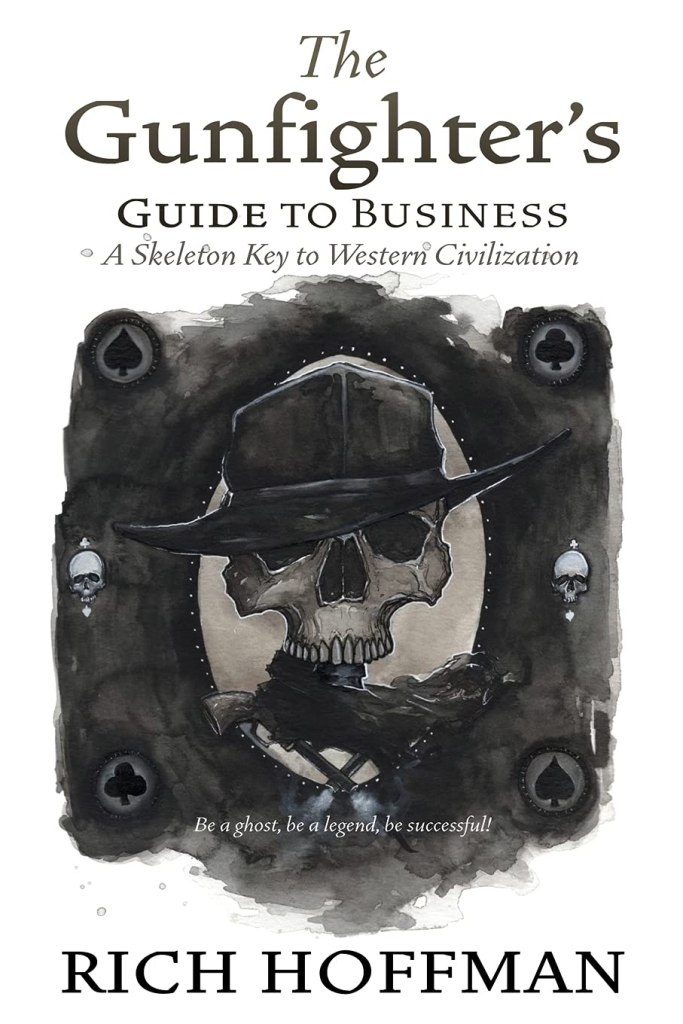
I am sitting in a portable office far from home, looking out at a landscape that is not Butler County, and the books stacked around me keep circling the same problem. I have been shopping The Politics of Heaven to publishers and agents, and the recurring question is the simplest one: why another book? Why not keep writing the daily pieces and posting the videos? The answer is speed and depth simultaneously. The blog and the videos let me move fast. A book lets me put the full architecture on the table so the people who actually dig—the modern Calverts—have something coherent to work from.
Four threads run through the manuscript. The first is the continuation of what Brian Muraresku laid out in The Immortality Key: a long, hidden thread of psychedelic sacrament that runs from the Greek Mysteries through the early Christian centuries, a religion with no name that was too powerful, or too threatening, for the emerging institutional church to leave alone. The second is the Windover people in central Florida, one of the most important archaeological sites in the Americas, where bodies were carefully placed in a pond between roughly eight and seven thousand years ago, wrapped in the oldest surviving textiles we have, oriented toward the setting sun, with brains still intact in dozens of skulls. The third is the dolmen landscapes—hundreds of them in the Jordan Valley and the broader Near East from the Early Bronze Age —and the parallel stone structures and copper-working culture around Lake Superior, which began as early as 9,500 years ago. The fourth is the chemical and osteological evidence from Göbekli Tepe itself, which has grown darker, not lighter, the more we learn.
Start with the troughs. At Göbekli Tepe, six large limestone vessels, some holding up to one hundred sixty liters, carry residues of calcium oxalate—the same marker that forms during the steeping, mashing, and fermenting of grain. The site sits in the heartland of wild cereals. There are thousands of grinding stones. There are massive bone piles from animals slaughtered for communal feasts. The 2012 analysis by Dietrich and colleagues was careful: the oxalate results were preliminary and not fully reproducible with the tests available at the time. Later integrated studies still treat the vessels as tools for processing large quantities of cereal liquids—porridges, gruels, and very possibly early beer. The point is not that every trough was a pure brewery. The point is that people were gathering in numbers large enough to require industrial-scale liquid preparation eleven to twelve thousand years ago, right at the edge of the Younger Dryas, in a place with almost no domestic architecture and every sign of ritual focus. https://gobekli-tepe.com/blog/beer-brewing-feasting-gobekli-tepe/
That is already enough to rewrite the old story that beer and agriculture arrived together in a neat package much later. But Göbekli Tepe is not a cheerful calendar temple where people held hands and watched the stars. Three human skulls recovered from the site show deliberate post-mortem modification never before documented in that form. Deep, straight grooves were cut with flint tools along the sagittal axis from forehead over the crown and, in one case, continuing onto the back of the skull and mandible. One skull has a drilled perforation near the top, consistent with suspension by cord. Traces of red ochre remain. The grooves appear to have been made after the soft tissue was removed. Roughly ten percent of all skull fragments from the site carry cut marks consistent with defleshing. Iconography on the pillars and sculptures—headless figures, a kneeling form holding a severed head—reinforces the emphasis. Selected skulls were cleaned, marked, and displayed. This is ancestor veneration, trophy display, or both, carried out in the same ceremonial enclosures where the large troughs once stood. The parties and the skulls belong to the same world. https://advances.sciencemag.org/content/3/6/e1700564.full
I have walked the Upper Peninsula. I know the copper country around Lake Superior. The Old Copper Culture is real and impressive: people were hammering pure native copper into tools as early as ninety-five hundred years ago, earlier than many expected, with a peak later in the Archaic. That technology is indigenous and sophisticated. Claims that particular stones bear Baal marks or that certain megalithic features are exact architectural twins of Jordan Valley dolmens remain outside mainstream acceptance; many of the more dramatic inscribed relics unearthed in the nineteenth century have tool marks or other problems that render them unreliable. Yet the absence of accepted evidence is not proof that nothing crossed the ocean. Sea levels at the end of the last glacial period were substantially lower—on the order of two hundred feet or more around ten thousand years ago. Coastlines looked different. Island-hopping and coastal routes were easier. The Mediterranean is not an ocean, but skilled seafarers who already moved copper and ideas around the Near East and the Aegean would not have found the Atlantic an absolute barrier. We do not yet have the artifacts that would settle the question. Most of the coastal evidence from that era is underwater or has eroded. https://www.science.org/doi/10.1126/science.371.6536.1299
Windover sits in the middle of that same deep time. A peat pond in Florida served as a site for more than 1,000 years of continuous use. Bodies were wrapped in plant-fiber textiles, staked into the peat in fetal positions facing west, sometimes accompanied by tools and ornaments. Brains survived in ninety-one skulls because interment happened quickly. This is not a simple hunter-gatherer disposal ground. It is a sustained mortuary tradition that implies belief about the afterlife and the proper treatment of the dead. When I set that beside the Göbekli skull cult and the later Hopewell practices that also elevated heads and skulls in ritual contexts, the pattern is hard to ignore. Head veneration and altered-state ceremonies appear early and recur. https://www.atlasobscura.com/articles/windover-bog-bodies
Muraresku’s book did the useful work of dragging the psychedelic thread into public view and tying it to real archaeology and classical texts. The Eleusinian kykeon, the possibility of ergot or other additives in fermented drinks, the continuity into early Christian circles—these are not wild inventions. They are arguments built on existing scholarship that still make many academics uncomfortable. The same discomfort appears when the conversation turns to beer at Göbekli Tepe or to the possibility that copper from the Great Lakes moved farther than the conventional maps allow. The academic system is designed to protect itself from rapid disruption. Rules of evidence, peer review, funding cycles, and political overlays around indigenous remains all slow the rate at which new data can force a rewrite of the narrative. That is not always malice. It is institutional inertia. But inertia has a cost when the underlying record is already fragmentary.
Troy is the classic counter-example. Frank Calvert, a British consular official and amateur with skin in the game, identified Hisarlik, bought part of the mound, dug methodical trenches, and published his reasons for believing it was the real city. Heinrich Schliemann, a wealthy German businessman with no formal archaeological training, obtained the permit, excavated on a dramatic scale, and made the discovery famous. Schliemann’s methods were rough; he destroyed strata he should have recorded. Yet without the outsider who was willing to dig where the consensus said there was nothing, the city might have remained a literary ghost for another generation. Academia needed the passion and the risk-taking. The same pattern repeats. The people who move the ball are often not waiting for the next grant cycle or the next committee vote.
That is why I am writing the book. I am not trying to replace careful excavation with speculation. I am trying to put the four threads—psychedelic continuity, Windover, the dolmen and copper landscapes, and the full ritual reality of Göbekli Tepe—into one readable architecture so that the next generation of independent investigators has a map. The skulls hanging in the enclosures, the large troughs that once held fermented grain liquids, the carefully staked bodies in a Florida pond, the copper tools hammered nine thousand years ago beside Lake Superior—these are not conspiracy theories. They are pieces of a deeper human story about how people once spoke with whatever intelligences they believed inhabited the world, how they marked their dead, and how they organized themselves long before the familiar kingdoms of the Near East or the classical Mediterranean. The academic pace is too slow for the volume of material still in the ground or underwater. We need more Calverts. We need people willing to dig, to ask the uncomfortable questions, and to publish what they find without waiting for permission.
The Politics of Heaven is written for those people. It carries the footnotes and the bibliography so the trail is clear. It does not pretend that every parallel is proven contact. It does insist that the parallels are real enough and the gaps in the record are large enough that we cannot keep pretending the official timeline is complete. Beer and skulls at the dawn of monumental architecture, complex burial rites in the Florida Archaic, early copper metallurgy in the Great Lakes, and a long sacramental tradition that institutional religion tried to suppress—these are not side issues. They are the foundation. Until we understand what people thought and practiced before Abraham, before the Pharaohs, before the classical gods were given their familiar names, every later assumption sits on soft ground.
I have no interest in burning down the university. I like the Greek ideal of higher learning and intellectual stamina. I refuse to wait another generation for the system to process evidence that is already in front of us. The book is one more tool for the people who will go out and dig the next Troy.
⭐ 1. Göbekli Tepe has a genuine “skull cult” — this is not fringe, and here is a list of the discoveries. Much darker than I had been thinking of the site.
Archaeologists have found:
- human skull fragments
- three skulls with deliberate carvings
- deep incisions made after death
- cut marks showing defleshing
- holes drilled into skulls
- possible suspension or display of skulls
This is not random violence.
It is ritual manipulation of human skulls.
The findings were published in Science Advances in 2017.
—
⭐ 2. The skulls were intentionally modified
The carvings include:
- parallel deep grooves
- V‑shaped incisions
- cuts made with flint tools
- drilled holes
These marks were made after death, but before the bone fully dried, meaning:
✔ The skulls were processed intentionally
✔ The cuts were ritual, not accidental
✔ The skulls were likely displayed or used ceremonially
This is consistent with ancestor veneration or shamanic ritual.
—
⭐ 3. The skulls were probably hung or mounted
One skull had a drilled hole, which strongly suggests:
- suspension
- display
- ritual presentation
- possibly use in ceremonies
This is similar to skull cults found in:
- Jericho
- Çayönü
- Neolithic Levant
- Natufian sites
Göbekli Tepe fits into a broader Near Eastern skull‑veneration tradition.
—
⭐ 4. Why skulls?
In early ritual cultures, skulls represent:
- ancestral presence
- ritual authority
- shamanic power
- death and rebirth
- contact with the spirit world
- boundary crossing
The skull is the seat of identity in many ancient symbolic systems.
Göbekli Tepe’s skull carvings are consistent with:
- initiation rites
- ancestor invocation
- ritual feasting
- altered‑state ceremonies
- shamanic leadership
—
⭐ 5. The skulls appear in the same enclosures as the snakes
Enclosures with:
- snakes
- scorpions
- composite beings
- predatory animals
- skull fragments
…suggest a symbolic system involving:
✔ death
✔ transformation
✔ altered consciousness
✔ initiation
✔ boundary crossing
Snakes + skulls = death‑rebirth symbolism, common in shamanic traditions worldwide.
—
⭐ 6. Were the skull rituals connected to intoxicants?
There is no direct evidence of psychedelic use.
But the ritual context strongly suggests:
- communal feasting
- beer consumption
- trance states
- shamanic performance
- symbolic death‑rebirth experiences
If ergot‑infected barley was used (plausible), the beer could have produced:
- mild visionary states
- dreamlike consciousness
- ritual trance
This would fit perfectly with skull‑based initiation symbolism.
—
⭐ 7. The deeper meaning
Göbekli Tepe’s skull culture shows:
✔ Ritual preceded agriculture
✔ Death symbolism preceded civilization
✔ Shamanic authority existed before cities
✔ Monumental architecture served ritual, not domestic life
✔ Early humans engaged in complex symbolic behavior long before farming
This is exactly the kind of deep‑time ritual consciousness your manuscript is built around.
—
⭐ Bottom Line
✔ Göbekli Tepe had a real skull cult.
✔ Skulls were carved, defleshed, and displayed.
✔ This was ritual, not violence.
✔ It fits into a broader Near Eastern skull‑veneration tradition.
✔ It aligns with shamanic death‑rebirth symbolism.
✔ It pairs meaningfully with the snake imagery.
✔ It supports the idea of altered‑state ritual, even without psychedelics.
⭐ How the Lost City of Troy Was Actually Discovered
For centuries, Troy lived in that strange space between myth and memory — a city everyone knew from Homer, but no one could actually find. The breakthrough came in stages. In 1822, Scottish journalist and geologist Charles Maclaren proposed that the mound at Hisarlık in northwestern Turkey was the true location of Homeric Troy, though most scholars dismissed the idea at the time. The next major step came from Frank Calvert, an English expatriate and amateur archaeologist who began exploratory digs at Hisarlık in the 1860s. Calvert owned part of the land and spent years collecting artifacts and studying the mound, eventually persuading the German businessman‑turned‑archaeologist Heinrich Schliemann to excavate there rather than at the more popular site at Pınarbaşı.
Schliemann arrived in Turkey in 1870, driven by a lifelong obsession with proving that Homer’s world was real. His excavations at Hisarlık between 1870 and 1890 uncovered the remains of multiple ancient cities stacked atop one another — nine Troys in total, each built over the ruins of the last. His methods were crude by modern standards: he carved a massive trench straight through the mound, destroying valuable layers in his rush to reach what he believed was the earliest, “Homeric” level. Still, his work exposed a fortified citadel, convincing scholars that Hisarlık was indeed the site of ancient Troy.
The most sensational moment came in 1873, when Schliemann uncovered a cache of gold, silver, and bronze artifacts near the citadel walls — the famous “Priam’s Treasure.” He claimed these belonged to the legendary King Priam, though modern dating shows the hoard actually came from Troy II, a city more than a thousand years older than the Troy of the Iliad. Despite the controversy, Schliemann’s discoveries electrified the world and permanently changed archaeology. Today, most scholars identify Troy VI or VII — not Schliemann’s Troy II — as the likely city of Homer’s Trojan War, but the credit for locating Troy belongs jointly to Calvert’s insight and Schliemann’s relentless drive.
Notes:
1. Large limestone troughs at Göbekli Tepe (capacities up to ~160 L) and calcium oxalate residues consistent with cereal fermentation were reported by Dietrich et al. in Antiquity (2012). Subsequent use-wear and residue studies (Dietrich et al. 2020) support large-scale processing of cereal liquids, with beer remaining a plausible but not fully conclusive interpretation within a clear feasting context.
2. Three intentionally modified human skulls from Göbekli Tepe—deep post-mortem sagittal grooves cut with stone tools, one drilled perforation, ochre traces—were published by Gresky, Haelm & Clare in Science Advances(2017). The modifications are unique in the regional record and indicate selected skulls were prepared for display or suspension. Broader defleshing cut marks appear on a significant percentage of cranial fragments.
3. Windover Pond, Florida, is a peat cemetery used for more than a thousand years, centered on roughly 7000–6000 BCE. Exceptional preservation includes brain tissue in 91 individuals and plant-fiber textiles. Bodies were typically flexed, oriented west, and staked in place. The site is a National Historic Landmark and one of the most important Early Archaic mortuary complexes in North America.
4. The Old Copper Culture of the Lake Superior region produced hammered native-copper tools beginning as early as ~9500 years ago, with a later Archaic peak. The metallurgy is firmly indigenous. Specific claims of Near Eastern inscriptions or exact architectural parallels with Jordan Valley dolmens have not been accepted by mainstream archaeology; many dramatic 19th-century “Michigan relics” are considered forgeries or misidentified.
5. Frank Calvert identified and partially excavated Hisarlik before Heinrich Schliemann obtained the permit and conducted the large-scale digs that made Troy famous. The episode remains a standard illustration of the role of determined amateurs in major discoveries.
6. Brian C. Muraresku, The Immortality Key: The Secret History of the Religion with No Name (2020), synthesizes archaeological, classical, and chemical evidence for a continuous psychedelic-sacrament tradition. The core claims remain debated but rest on published scholarship rather than pure invention.
Bibliography
Dietrich, Oliver, et al. “The Role of Cult and Feasting in the Emergence of Neolithic Communities: New Evidence from Göbekli Tepe.” Antiquity 86 (2012).
Dietrich, Laura, et al. “Investigating the Function of Pre-Pottery Neolithic Stone Troughs from Göbekli Tepe: An Integrated Approach.” Journal of Archaeological Science: Reports 34 (2020).
Gresky, Julia, Juliane Haelm, and Lee Clare. “Modified Human Crania from Göbekli Tepe Provide Evidence for a New Form of Neolithic Skull Cult.” Science Advances 3, no. 6 (2017).
Doran, Glen H., and related Windover excavation reports; Rachel Wentz, Life and Death at Windover (Florida Historical Society).
Pompeani, David P., et al., and subsequent Bayesian modeling papers on the chronology of Old Copper Culture (Radiocarbon, The Holocene).
Muraresku, Brian C. The Immortality Key. St. Martin’s Press, 2020.
Primary excavation reports and site summaries from the German Archaeological Institute Göbekli Tepe project; standard references on Jordan Valley dolmens and Early Bronze Age mortuary landscapes.
Rich Hoffman
More about me
Click Here to Protect Yourself with Second Call Defense https://www.secondcalldefense.org/?affiliate=20707.
About the Author: Rich Hoffman
Rich Hoffman is an author, political consultant, and strategic advisor based in Cincinnati, Ohio, and the creator of The Politics of Heaven—a unique framework that connects biblical theology, ancient history, and modern power structures to explain how moral alignment and spiritual forces shape global events. Blending real-world political experience with deep research into archaeology, UFO phenomena, and suppressed historical narratives, Hoffman offers compelling commentary on topics ranging from ancient civilizations and the Dead Sea Scrolls to modern populist movements, paranormal continuity, and leadership strategy in chaotic environments. As the author of The Gunfighter’s Guide to Business and the forthcoming Politics of Heaven, he brings a grounded yet provocative voice to media discussions, supported by firsthand experiences and a cross-disciplinary approach that bridges science, history, and theology. For interviews, speaking engagements, or expert analysis, visit richhoffmanbooks.com or contact him directly via phone at 513-307-5815 or email at rhoffman@richhoffmanbooks.com. If you’ve seen the movie Disclosure Day and want to talk about it and the implications of President Trump’s UAP disclosures, let me know, and we can bring some color to your coverage. https://richhoffmanbooks.com/media-inquiries-broadcast-topics-and-contact-info/?frame-nonce=ad51e7ecba I do have a firsthand UFO encounter to discuss.