Congratulations to Ben Nguyen To the Lakota School Board: What would it take for me to support public schools

There’s a lot to say about the recent Lakota school board election, and I want to start by congratulating Ben Nguyen on his historic win. At just 18 years old, he’s now the youngest person ever elected to the Lakota Board of Education, and he achieved this with a clear, conservative message that resonated with voters in Butler County. Nguyen earned 18.61% of the vote, joining incumbent Kelley Casper and newcomer Alex Argo on the five-member board. His victory wasn’t just symbolic—it was a direct response to the district’s failed $506 million levy, which voters rejected by a 61% margin. That levy, which would have demolished nine buildings and built four new ones, was a bloated attempt to reinvent the district with taxpayer money. Nguyen’s campaign stood firmly against it, and his win signals that the community is tired of being asked to fund ideological experiments disguised as infrastructure upgrades.  However, there is much more to all this.  The questions that arose during this campaign and election season, in general, concern my support of Lakota schools, which school board member Doug Horton brought up in a video he posted just before the election.  In short, if Lakota management wants to know what it would take to get my support, I would say to them to stop destroying the kind of school board members that I support.  And I would be a lot less critical.  But when the school board pushes away good people and lobbies to keep the kind of people who glaze over sex scandals, horrendous Democrat strategies in the school to teach young people, and ask for tax increases, especially the most expensive in the history of Ohio, then I’m going to be very critical, and I will provide that criticism in voluminous detail so much so, that the anti tax movement in Butler County will continue to grow, as it has over these years since 2013, and even earlier.

Ben Nguyen is a start, not a solution to what I would call a detrimental school board full of liberal losers. The real problem is systemic. For years, we’ve seen conservative school board members pushed out by coordinated efforts from union-backed liberals and their media allies. Darbi Boddy is a prime example. Elected in 2021, she was removed in 2024 after a civil protection order filed by fellow board member Isaac Adi—once her political ally—barred her from attending meetings for over 90 days. The board declared her absence “insufficient,” and just like that, she was gone. Her removal wasn’t about functionality—it was a matter of political theater. Boddy had challenged DEI programs, opposed transgender policies, and criticized the district’s hiring practices. That made her a target. The board censured her, demanded her resignation, and ultimately replaced her with Christina French, a longtime district insider. It’s a pattern: elect a conservative, stir up controversy, isolate them, and replace them with someone more “manageable.”  I know all the characters of that conservative board very well, and I know what was done to pit them against each other, and when a school system plays that game, and expects to get away with it, well, they have another thing coming.  I’m not in the business of putting up with that, and I never will be.  I was in the district long before many of these people were even born, and I will be around long after they all leave to buy condos in Florida to escape the high taxes they leave behind.  Darbi is just one example of this kind of radical school board behavior; therefore, when asked what it would take to win my support for Lakota schools, the answer is easy.  Don’t run off school board members whom I support.  Radicalism can go both ways, ladies and gentlemen. 

This is why I’ve been so critical of Lakota Schools over the years. It’s not that I hate education—I would say my track record shows where my heart is; there are few people anywhere who love education more than I do.  I respect people who read books and work to sharpen and utilize their intelligence.  I do not trust institutionalized education because it’s often populated by less-than-great individuals, which is reflected directly in the product. And with public schools, I don’t respect the system that’s been built on a century-old foundation of progressive ideology. Public schools, as they exist today, are more about managing perception than delivering results. When you fill school boards with people like Julie Shaffer and Kelley Casper—both endorsed by the Butler County Democrat Party—you get a culture of spending, secrecy, and suppression. They don’t want scrutiny because scrutiny threatens their funding. They don’t wish to be judged because judgment exposes their failures. And when scandals happen—whether it’s inappropriate teacher behavior, administrative misconduct, or ideological overreach—they bury it. That’s why I created my own media platform: to report what they won’t. If you want to know what’s really going on in Lakota, you won’t find it in the district’s press releases. You’ll find it in the stories they try to silence.

So here’s the deal: I’ll support Lakota when Lakota supports the community. That means electing people like Ben Nguyen—people who understand the value of education without being beholden to the liberal establishment. It means rejecting levies that ask for hundreds of millions without accountability. It means standing up for parents, taxpayers, and students—not just the union’s comfort level of lazy labor desires, such as short workdays, fewer students to teach, summers off, and high pay for doing very little. I’ve seen good people try to make a difference on the board, only to be run off by political manipulation; it’s all well-documented. I’m encouraged that Nguyen, with his sharp mind and diplomatic personality, can navigate those waters and bring real change. If we can recruit two or three more like him, we might finally see a board that genuinely reflects the community’s values.  But given the election cycles, it’s going to take a while unless we push off some of these losers the way they have pushed away our conservatives, like Darbi, and Todd Parnell—even Lynda O’Connor.  And with Lynda, I know exactly how that game unfolded; she became so deeply involved in the liberal Lakota movement that she essentially had to adopt its values to attend the meetings.  I don’t think strong personalities like Ben Nguyen will be pushed away, because he has that extra gear that is so needed in these kinds of controversial political environments.  He, like Vivek Ramaswamy, who will be Ohio’s next governor, is part of a new generation that will play these old political games better than they have been played in the past.  We have tried to play it straight with these current school board members, and all they have given us are Antifa like union tactics of left-wing radicalism, and many people in the district simply aren’t going to put up with it.  I’m certainly not going to, under any conditions.  And until there are more options on the school board, I’ll continue to call it as I see it. If you want me to stop criticizing Lakota, stop putting bad people in charge. Put in people I can respect.  But asking, even demanding respect when Lakota hasn’t earned it, is a ridiculous proposition that only losers would even think of.  And until there are more people like Ben Nguyen involved in Lakota schools, I will criticize them extensively because they deserve it.

Rich Hoffman
Click Here to Protect Yourself with Second Call Defense https://www.secondcalldefense.org/?affiliate=20707

The Hidden Game: How Sports Betting is Giving Power to the Mob and the NFL

This is a story that quickly disappeared: the NBA gambling scandal.  However, one of the great things about money is that it reveals a lot about the people who want it. In the gambling world, where easy money is a prospect for those who are lazy, the character of all endeavors is relatively easy to reveal.  And it’s not just the NBA; I would say the rigged games in favor of betting odds are much worse in the NFL.  In the age of legalized sports betting, the question isn’t just who will win the game—it’s whether the game itself is being played fairly. As billions of dollars flow through betting platforms and fantasy leagues, the integrity of professional sports is under more scrutiny than ever. Recent scandals in the NBA and questionable officiating in the NFL have reignited concerns that games may be influenced not just by athletic performance, but by money, power, and even organized crime.

The NBA was rocked by a recent FBI investigation led by Kash Patel, which exposed a network of players and insiders allegedly involved in illegal gambling activities. The scandal implicated figures like Chauncey Billups, Terry Rozier, and Damon Jones, who were accused of sharing confidential injury information to manipulate betting outcomes. The scheme reportedly involved rigged poker games backed by mafia families and the use of cheating technologies like altered shuffling machines and hidden cameras.

This wasn’t just a case of players making side bets—it resembled insider trading. Athletes and coaches acted as “tippers,” passing non-public information to bettors who profited from the edge. The FBI’s involvement underscores the seriousness of the issue and suggests that this may be just the beginning of a broader crackdown.

The idea that sports can be rigged isn’t new. The infamous 1919 Black Sox scandal involved eight Chicago White Sox players who were accused of throwing the World Series in exchange for money from gamblers. Pete Rose, one of baseball’s greatest hitters, was banned for betting on games while managing the Cincinnati Reds, even back then.  These days, it can only be thought to be much, much worse.

In the NBA, referee Tim Donaghy admitted to betting on games he officiated and providing inside information to mob-connected bookies. His case revealed how easily a single official could influence the outcome of a match through foul calls, clock management, and momentum shifts.

Organized crime families like the Genovese, Gambino, Lucchese, and Bonanno have long used sports betting as a tool for money laundering and manipulation. With the legalization of sports betting in many states, the opportunities for corruption have only grown.  And would a referee be inclined to rig a game through penalties to cover a margin?  I would think the answer is an emphatic yes, and that it’s a problem that the NFL itself has very little control over.  Players aren’t welcomingly encouraged to criticize the referees.  They may disagree with the calls, but if they want to play the game, they have to honor the game within the game—the sports betting that is the real fuel for the industry. 

While basketball and baseball have their own vulnerabilities, the NFL may be the most susceptible sport to manipulation. Why? Because of the nature of clock management and the subjective power of referees.

In football, a single penalty can stop the clock, reverse a touchdown, or shift field position dramatically. Referees have enormous discretion in calling holding, pass interference, and roughing the passer—penalties that can change the momentum of a game in seconds.

A recent study from the University of Texas at El Paso found that referees disproportionately favor teams with large fan bases, such as the Dallas Cowboys and Kansas City Chiefs. This bias isn’t necessarily intentional, but it reflects the subtle pressures officials face in high-stakes environments.

One of the most glaring examples of potential manipulation came during the Tampa Bay Buccaneers’ matchup against the Detroit Lions. Tampa Bay, a team that had been gaining momentum and sitting at 4-1, faced a Detroit team also vying for NFC dominance.

The game was riddled with controversial calls:

• A missed tripping penalty on Baker Mayfield, who was clearly impeded while scrambling.

• A fourth-down catch by Cade Otton that was reviewed twice—despite NFL rules prohibiting double reviews.

• A reversal of a completed catch into a turnover on downs.

• Multiple missed defensive holding calls and phantom illegal contact penalties.

Mayfield, known for his competitive fire, publicly criticized the officiating, saying, “I work my ass off… when things I don’t deem are fair, I’m going to let somebody know.”

These calls didn’t just affect the scoreboard—they disrupted Tampa Bay’s rhythm, shifted momentum, and arguably changed the outcome of the game. For fans who know their team well, the inconsistencies were glaring.

The NFL is a multi-billion-dollar entertainment empire. When one team dominates the standings early in the season, it can lead to reduced viewer engagement and betting activity. A close, competitive playoff race keeps fans watching, betting, and spending.

If Tampa Bay had continued its winning streak, it could have created a lopsided picture in the NFC. By slowing their momentum—intentionally or not—the league maintains parity and keeps the narrative exciting. This benefits advertisers, sportsbooks, and the league itself.

Legalized betting has created a new layer of influence. Referees, who earn significantly less than star players, may be more susceptible to corruption. Even if the league itself isn’t orchestrating outcomes, individual officials could be incentivized to make calls that favor betting interests.

At some point, fans must ask: Is the NFL a sport or a scripted entertainment product?

Like professional wrestling, where outcomes are predetermined to maximize drama, the NFL may be leaning into narrative manipulation. Injuries, rivalries, and comeback stories make for compelling television—but when officiating inconsistencies align too neatly with betting odds, it raises eyebrows.

This doesn’t mean every game is rigged. Players still compete fiercely, and many games are decided by skill and strategy. However, the influence of money, media, and betting creates an environment where manipulation is not only possible but also profitable.

Legal sportsbooks have helped uncover scandals, such as the lifetime ban of NBA player Jontay Porter for betting violations. But they also create conflicts of interest. Integrity monitors like Sportradar and Genius Sports are financially tied to the leagues they’re supposed to oversee.

Betting is now embedded in broadcasts, apps, and team partnerships. Fans are encouraged to wager on everything from coin tosses to player stats. This normalization of gambling makes it increasingly difficult to distinguish between sport and speculation.

Despite these challenges, some teams still manage to win. Tampa Bay, led by Baker Mayfield and a strong coaching staff, has shown resilience. Even when calls go against them, they find ways to compete.

But it’s harder. When referees disrupt momentum, call phantom penalties, or ignore obvious infractions, it forces teams to play not just against their opponents—but against the system itself.

Professional sports are no longer just games—they’re entertainment products shaped by money, media, and betting interests. Fans must approach them with a critical eye, understanding that while the athleticism is real, the forces behind the scenes may not be.

The NBA scandal is a wake-up call. The NFL’s officiating inconsistencies are a warning. And the rise of legalized betting is a game-changer.

Enjoy the games. Cheer for your team. But remember: the real game is always happening off the field.

Rich Hoffman

Click Here to Protect Yourself with Second Call Defense https://www.secondcalldefense.org/?affiliate=20707
Bill Gates Walks Back Climate Alarmism: A Reckoning Years in the Making

Even if Trump is playing nice with Bill Gates these days, I’m still firmly in the camp where the Microsoft founder needs to be in jail for all that he did.  I remember it well, and I reported it here in a way that no other news outlet in the world did at the time, as it was happening.  Even Rush Limbaugh was slow to see what was happening.  But I said that it was a scam the day that Bill Gates and Dr. Fauci walked into the Oval Office and told President Trump to shut down the economy in the United States, which he did for a few weeks.  But by then, the damage had been done, and lots of very liberal governors of states had taken the sucker bait and followed, and it was really terrible.  Bill Gates needs to pay for his very active role in creating that crisis.  Created I say because we know that Covid was created by gain of function research to jump to hosts in ways that nature does not provide, so it was a bioweapon that had roots running into the DOD that Dr. Fauci knew all about and a lot of people died as a result of this virus that was created in a Chinese lab and let loose in the world on purpose, not by accident.  All the evidence points in that direction, and Bill Gates was one of the key insiders involved in the whole tragedy.  Few figures have polarized public opinion in the 21st century like Bill Gates. Once hailed as a visionary technologist and philanthropist, Gates’ role during the COVID-19 pandemic and his aggressive climate activism have drawn intense scrutiny. However, politics have changed significantly over the last five years, and now Gates realizes he has been excluded from almost everything, and he wants to get back in.  So he has been groveling to President Trump and is starting to walk back his ridiculous climate change proposals, which is quite extraordinary considering his level of tyrannical commitment.  He tried to rearrange our entire society.  So any walk back from him is astonishing, and very telling.  Now, in late 2025, Gates has released a memo that marks a significant shift in his stance on climate change—one that critics argue is a strategic retreat rather than a genuine change of heart.

In October 2025, Gates published a 17-page memo ahead of the COP30 climate summit in Brazil. In it, he argued that climate change, while profound, is not the apocalyptic threat many activists claim. He emphasized that:

• Climate change “will not lead to humanity’s demise.”

• The focus should shift from temperature targets to improving human welfare.

• Investments should prioritize poverty, disease, and economic development over emissions reduction

This pivot was immediately seized upon by climate skeptics and political figures, including President Donald Trump, who declared on Truth Social:

“I (WE!) just won the War on the Climate Change Hoax. Bill Gates has finally admitted that he was completely WRONG on the issue.”

Despite the celebratory tone from skeptics, Gates pushed back, calling Trump’s interpretation a “gigantic misreading.” He reaffirmed his belief that climate change is a serious issue, but argued that the “doomsday outlook” has led to the misallocation of resources.

“Every tenth of a degree of heating that we prevent is hugely beneficial because a stable climate makes it easier to improve people’s lives.”

Gates’ reputation suffered a significant blow during the COVID-19 pandemic. His advocacy for lockdowns, vaccine mandates, and digital surveillance tools, such as Microsoft Teams, was seen by many as overreach. Critics argue that Gates, alongside Dr. Anthony Fauci, played a central role in shaping a global response that devastated economies and civil liberties.

• Gates was accused of using the pandemic to push a technocratic agenda.

• His ties to gain-of-function research and vaccine monopolies raised ethical concerns.

• Public trust in Gates plummeted, with many calling for accountability and even criminal charges.

Climate Change: From Alarmism to Adaptation

Gates’ climate activism has long centered on achieving net-zero emissions. His 2021 book How to Avoid a Climate Disaster laid out a roadmap for decarbonization. But in 2025, Gates now argues that:

• The worst-case scenarios are no longer plausible.

• Technological innovation has already begun reducing emissions.

• Economic growth and health infrastructure are better defenses against climate impacts.

This shift aligns more closely with Elon Musk’s pragmatic approach to climate and energy—focusing on innovation rather than regulation.

Gates’ recent dinner with President Trump lasted over three hours and reportedly focused on global health, innovation, and pandemic preparedness.  While Gates has criticized Trump’s cuts to USAID, he appears to be recalibrating his public posture to remain relevant in a political landscape increasingly dominated by populist skepticism of climate alarmism.

One of the most striking elements of Gates’ memo is his implicit endorsement of adaptation over mitigation. He suggests that humanity has the tools to thrive—even in a warming world. This echoes broader conversations about terraforming Mars and using technology to reshape environments, rather than surrendering to climate fatalism.

Critics argue that Gates’ technocratic worldview—where unelected billionaires shape global policy—poses a threat to democracy. The COVID response and climate mandates are seen as examples of how centralized control can override individual freedoms.

“You can’t let tyrants rule. You have to have market pressures and competitive elections to check power.” Rich Hoffman

Bill Gates’ pivot on climate change is not just a policy shift—it’s a reckoning. It reflects the limits of technocratic influence and the resilience of democratic accountability. Whether Gates is genuinely rethinking his views or simply repositioning himself politically, the public response underscores a broader demand for transparency, humility, and checks on power.  If we had not elected Trump and put him back in office, people like Bill Gates would be running the world right now.  A lot of hard lessons were learned, and we are a lot better off now than we were. Trump is the kind of person who can keep everyone close, allowing him to negotiate effectively with them.  I think it’s very appropriate that President Trump is taking credit for this issue with Gates.  He could do a lot more to embarrass the techno geek.  However, this is a powerful position for Gates and the Climate Change hoax in general.  The world is not coming to an end because of artificial intelligence.  We could terraform the entire planet if we want to, as we are planning to do in other places around the solar system as we speak.  For Gates, it was always about control.  He wanted to control the management of the human race through techno tyranny, and he played President Trump as a sucker who trusted him during his first term.  So Gates has a lot of embarrassment coming.  And I would argue that there would be a lot of jail time.  However, his admission is a significant development and a major shift in the world toward a much stronger economy.  The walls on this ridiculous control mechanism are coming down, and people like Gates have lost power because of our free elections in America.  That’s why managing elections is so important; you can’t trust anybody to do anything right.  And if you don’t have secure polls or a way to elect someone like Trump to office, and Bill Gates clearly didn’t think that such a thing was possible, and that he’d get away with everything because he had enough money to insulate himself from that grim discovery, then these people will always threaten the entire human race.  In this case, due to the Trump election, we dodged a major catastrophe, and we should feel pretty good about Bill Gates walking back his previous statements.

Rich Hoffman

Click Here to Protect Yourself with Second Call Defense https://www.secondcalldefense.org/?affiliate=20707
The Shutdown Standoff and the Filibuster Flashpoint: A Political Reckoning with American communists

Speaking with Bernie Moreno recently, it’s clear that the U.S. Senate is at a pivotal moment. The government shutdown, now entering its 40th day, has become a crucible for ideological warfare, with President Trump urging Senate Republicans to reconsider the filibuster rule to break the impasse and reshape the future of American governance.  I think Trump has a good idea, and that the nuclear option should be used, never to let Democrats have power again, so there is no reason to play nice with them.  Democrats, most of them, and around 10-15 Republicans are the enemy of our country and should not be given a seat at the table. 

At the heart of the standoff are three distinct factions: a Democrat Party increasingly defined by its progressive wing, a MAGA-aligned Republican base pushing for aggressive reform, and a centrist bloc of senators hesitant to abandon institutional norms. The Democrats, led by figures like Chuck Schumer and bolstered by progressives otherwise known as “communists” such as Bernie Sanders and Alexandria Ocasio-Cortez, have refused to support any continuing resolution (CR) that doesn’t include a vote on extending Affordable Care Act (ACA) premium tax credits. Their strategy hinges on leveraging the shutdown to galvanize their base and preserve key health care provisions.  They are not that unlike the terrorists who bombed New York City with the 9/11 terrorist action.  If they destroyed commercial air travel to maintain socialized medicine, they are all for it.  They would love to harm the economy to slow down Trump ahead of the midterms.  These are the same people who wanted to use COVID to shut down the economy during Trump’s last year of his first term.  So this kind of economic terrorism is typical for them.

Meanwhile, Senate Republicans, under Majority Leader John Thune, have proposed a compromise: advance the House-passed CR and amend it with a “minibus” of three long-term appropriations bills, extending government funding through January 30, 2026. This deal, which has gained traction among at least eight Democrats, includes a future vote on ACA subsidies—a concession aimed at breaking the deadlock.  As I have always said, healthcare is a nasty hill to die on, because we are on the precipice of significant changes.  The way healthcare is today is not how it will be tomorrow, and the cost structure needs to be completely reinvented.  For Democrats, healthcare is about controlling the lives of individual people in a mass way, and has nothing to do with caring for people. 

Yet, the filibuster remains the elephant in the room. Trump’s call to eliminate the 60-vote threshold for passing legislation has reignited debate over Senate rules. He argues that the filibuster is a relic that Democrats have weaponized to obstruct progress, and that Republicans must act decisively to secure election reform, border security, and economic stability. “If we do it, we will never lose the midterms,” Trump declared, pressing for one-day voting and voter ID laws.  He’s right, there is no reason to play fair with the Democrats.  They almost went nuclear during Biden’s term, except for two senators who prevented it. Otherwise, they currently have 49 senators who were willing to go nuclear when they had power, a clear warning sign to Republicans.  So, if the shoe is ever on their feet again, they will do it; therefore, there is no reason to play fair now.  Don’t give them a chance at terrorism in the future because they are already thinking about it.  We are only here now because we dodged a bullet then.  Don’t expect that to happen twice.

Despite Trump’s pressure, Senate leadership remains divided. Thune and others have resisted the nuclear option, citing the need to preserve minority rights and avoid legislative chaos. A limited carve-out—lowering the threshold to 51 votes for clean CRs—was floated but appears unlikely to pass.

The shutdown’s impact is severe: over 1,000 flights have been canceled, SNAP benefits have been disrupted, and $5 billion in arms exports to NATO and Ukraine have been delayed. Air traffic controllers are stretched thin, and federal workers remain unpaid. The crisis has exposed the fragility of government-dependent systems and reignited calls for the privatization of critical infrastructure.  I’m certainly one of those who think we should not have a government involved in essential services like air traffic control.  Airlines should provide their own employees, and they would do a better job.  Sticking the government in the middle of critical infrastructure is a really dumb idea.  And to make matters worse, the pay scale and attitude of these employees are already poor, as they are unionized, which should be outlawed for all government positions.  In a short time, AI will be able to do a much better job with air traffic control than humans anyway, so why should we ever allow the government to stand in the way of human necessity?  It’s an incredibly dumb idea. 

In this climate, the filibuster debate is more than procedural—it’s existential. For Trump-aligned Republicans, eliminating it is a strategic imperative to prevent Democrats from regaining power and advancing what they view as radical, anti-capitalist policies. For moderates and institutionalists, it’s a dangerous precedent that could unravel the Senate’s deliberative foundation.  And that’s where the future of America is anyway, with Democrats moving hard socialist and communist as a party, we can’t let them have a seat at the table.  We have to draw the line somewhere.  Let the moderates be the new left-wing party, but don’t play nice with the communists and give them fairness.  Because they will destroy our country if given a chance, and that is at the heart of the debate.  Look at what they have been willing to do with the air traffic controllers.  If they can bring down American infrastructure to maintain control over healthcare, then they certainly will.  Those kinds of Democrats can never again be allowed to vote for the filibuster rule, because the next time, they will get it.  It’s been a race to beat the other to the punch for a long time, and we happen to be fortunate to have this impasse happening while Trump is in the White House. 

The stakes couldn’t be higher. The outcome will not only determine the fate of the shutdown but may also redefine the balance of power in Washington for years to come, regardless of any short-term CR. Whether the filibuster survives or falls, the political landscape is shifting—and the next chapter in America’s legislative history is being written in real time.  And you don’t want to lose your country by playing nice with those who wish to destroy it.  It was interesting to speak with Bernie Moreno about his first year as a senator.  Of course, we didn’t talk about any of these kinds of details; he’s a very level-headed person who was reporting on the lay of the land in the Senate.  But what is obvious is that we already have three parties, and one of them certainly wants to destroy the concept of a capitalist America and to push everything into communist control, much the way China operates.  And it’s me saying it, along with Trump, that we don’t want to be a sucker on this, we need to play tough, and forget playing fair.  This is a game of beating the other side to the punch, and that other side are radical communists, as exhibited by the newly elected New York Mayor, Zohran Mamdani. In a world where people like that are debating the Filibuster, they will go nuclear.  We are fortunate to be in a time when fairness still prevails, and we should be wise in utilizing that power while we still have it. Because there is nothing less patriotic than letting hostile agents destroy your country, and in case it’s still not known to the vast majority, the Democrats are the enemy. 

Rich Hoffman

Click Here to Protect Yourself with Second Call Defense https://www.secondcalldefense.org/?affiliate=20707

The Evils of Corporate Culture: Why we love and hate them

One of the things that is most ill-defined in our country, and certainly in the world, is the understanding of why we tend to hate corporate culture.  Yet almost in the same sentence, we desire to be a part of them.  It’s actually pretty straightforward and obvious, which goes back to the foundations of capitalism and the work of Adam Smith in 1776, as well as the intrusive and corrosive nature of Karl Marx’s communism, which ultimately have led to many of the problems we see today.  We hate communism with the same ambiguity, and the reason in all cases is that corporations exist to allow the mediocre to feel validated in mass society, and that it shields them from the insults of competition.  Corporate cultures are often characterized by collectivism and are seldom driven by unique individuals with great vision.  By the time a company goes “corporate,” it loses that unique leadership that likely built the company into something publicly traded and valuable.  So when we say that something is “corporate,” we are saying that it is of less quality than something that isn’t.  Corporations allow mass collectivism to appear valuable by leveraging the efforts that built a company.   I’ve been thinking about this recently because I have had a front-row seat to a corporate takeover, and it has been astonishing to watch.  The people involved are really dumb.  And I don’t say that as an insult, but as an observation where individual intelligence is completely vacant from the minds of those involved, which is typically associated with stupidity or dumbness if taken in isolation.  But if many such people assert something, then there is a belief that a majority then gives validation, even to stupidity.  It’s one thing to read about these things happening in the world and to know the type of people involved.  But I usually have some insulation from this kind of thing by living my life, until those types of people stepped into my interaction by their own choice.  And I have had to establish their base reality, the only way that it can be defined, that they are dumb people looking for easy money in the world, and they accomplish this through mass collectivism, the same way that labor unions are a problem.  Wherever people hide value in groups, we see a loss in the quality of the visionary experience.  You don’t think of a boardroom as a group of people who solve big problems.  Typically, we think of a group of individuals who appease each other in a setting, at the expense of innovation.

I tend to support large organizations because their creation generates the flow of money, and I like money as a measure of a healthy society.  The more money a society has, the more corporations that create it, the more opportunities that society has to improve the lives of its people.  However, that is a very high-level assumption because, unfortunately, most people do not have positive corporate experiences, as many of the ideas we have about things are flawed from the start.  Even all the years of economic evolution that brought about the excellent book, The Wealth of Nations, there is always uncertainty in individuals about their ability to function in the world productively, so they seek joint relationships to hide in, and that is how the corporation came about as these ideas of capitalism and Marxism emerged as the world became smaller and easier to travel in.  Even if there were more opportunities for boldness and adventure, it was still the same kind of people who took them, leaving most of the rest of the world looking for a way to participate without the risk of actually doing so.  We prefer corporate jobs for the high pay we can earn within their structure.  But the pay usually comes at the cost of individual integrity.  You have to give up one thing to get the security of another.  And as human beings, we look down our noses at such a concession because we deem it inherently evil.  Evil because it destroys individuals, rather than enhancing them.

It’s not unusual for a family to applaud that a youthful personality has just joined a respected corporation at Thanksgiving Dinner.  The applause comes because we care about the young person and want them to have financial security.  But also in the back of our minds, we know that something is dying in that person, the ability to become all the dreams of youth as a unique individual.  Corporate environments are about giving voice to mediocrity for the benefits of mass collectivism. So that unique person we knew growing up will likely give up some of their dreams in the process of conformity.  They might gain an extensive paycheck, but in the process, they’ll lose their soul.  And we now understand this process well, having undergone many years of separating business from being run by kingdoms.  However, by default, the corporation evolved to give the mediocre a kind of unionized collective bargaining against the tendency toward cowardice, the act of waking up in the morning and having the courage to be an individual.  I know about such people, but I usually avoid them like a sickness until I had to speak to them often, when they came to my doorstep.  And it’s remarkable how typical dumbness is.  And when we say “dumbness,” we are referring to a lack of individual thought, where a person thinks something and acts on it without careful consideration. Instead, they feel a sense of unity for the preservation of the group, and their ambitions are collectively shaped through the force of numbers, rather than individual vision.  So, obviously, a corporation run by a board, even if there is a strong CEO, ultimately exists to sell mass collectivism to a consuming public, and we only notice when it impacts us, because there aren’t many pure examples of capitalism to measure real value against. 

We might like money, but there haven’t been enough examples of corporations that have survived due to corporate social responsibility efforts to give better examples of how things should be, or how humans should even make a living.  I’m talking about Robert Pirsig’s Metaphysics of Quality again, the difference between back-of-the-train people and those who dare to live in the front.  The corporate environment was not intended to put the best in charge.  But to make mediocrity rule the masses through collective ambition.  The loss of individuality to the concept of just being another number.  And in the process, everything is less effective.  And so, there is this cheerleading effort by corporations to acquire privately owned companies, as the corporation and its inhabitants want to believe, through the force of confiscated resources, that they can be as good as the visionary owner.  But they never are, and that little secret rots them into their graves.  They may be able to buy a second home in Florida and have the nicest cars to drive.  They may make enough money to turn their kids into younger versions of themselves by sending them to a communist camp we call “college,” by saying we want to give those kids the best chance at life, when we secretly fear that they will grow up to be better than us.  There is a lot wrong with corporate thought and the people who have defined it over the years. Based on what I’ve seen of it, an entirely new definition for money-making needs to be introduced.  The faceless monster of corporate ownership is just an extension of Marxism that emerged in the void of any other definition at that time of its growth into everyday language.  And many of us really want to be associated with the corporate culture for the security of income.  However, it comes at the expense of individual integrity, and for that reason, we secretly view corporations as inherently evil.  However, since most of us lack the security of personal wealth and thought, we want to be associated with something so that, by default, other people won’t see what we really are.  And that we won’t be found out as phonies, even if that’s what we think each day when we get out of bed. 

Rich Hoffman

Click Here to Protect Yourself with Second Call Defense https://www.secondcalldefense.org/?affiliate=20707

Republicans Played Too Nicely in the Election of 2025: Who to blame in the West Chester Trustee race

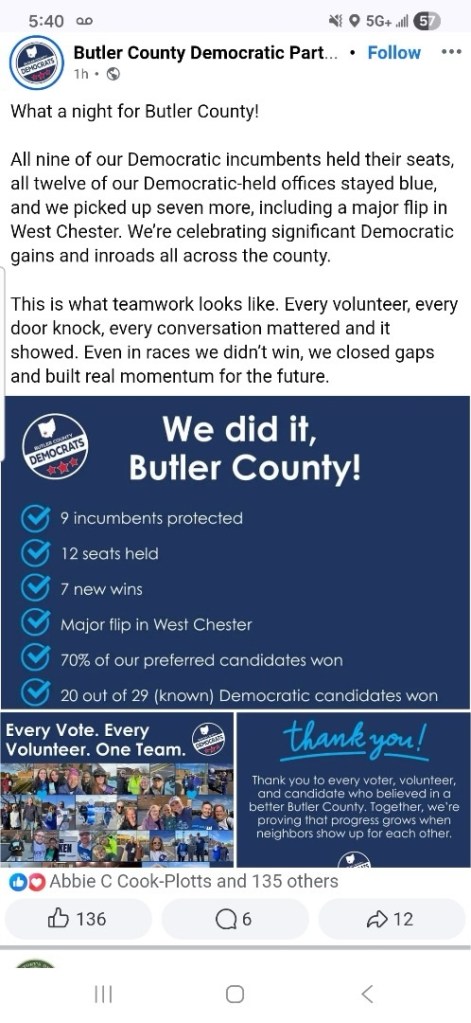
It is a bit surprising to listen to everyone’s post-election analysis, where they think Democrats did a lot better than they actually did.  In West Chester, Ohio, there is a lot of chest beating that Democrats found themselves in a lot of seats, especially the West Chester Trustee position, where I went to bed feeling like my guy, Mark Welch, the incumbent who has done a good job, came in third in a six-person race for two spots, was going to win.  There was a Trojan horse effect there, where the average person didn’t know who the Democrats were.  In the West Chester race, that certainly would be the case.  Mark was a Republican-endorsed candidate, but there wasn’t much advertising for the Democrats running, as they hoped to slip under the radar without the general public knowing who they were.  I still felt Mark was strong enough to win anyway.  I might have had disagreements with the way that Republicans set themselves up for this election.  But I wasn’t surprised by anything in Virginia, New York, or California.  Where Republicans ran away from President Trump, Republicans lost to Democrats, and it’s pretty much that simple.  Republicans, the same old Never Trump types, a year after his magnificent election, tried to go it alone, and they lost.  I hear a lot of analysis, and they are all mostly missing the point.  The Republican Party traditionalists still don’t want to admit what MAGA America really is.  The West Chester race, like the Lakota levy issue, truly captured a national sentiment worth mentioning.  I’ve spoken to Mark, and he’ll have the opportunity to do many great things.  Meanwhile, West Chester was warned what electing a bunch of Democrats would do, which is what the Lakota school board has been experiencing.  And people are going to have to learn some hard lessons. 

But here’s the deal.  While I support and endorse various candidates, and I certainly did endorse Mark Welch, I disagreed with the “niceness” campaign.  Mark is a nice guy, but everyone has to remember he won as a Tea Party conservative, and the Republican Party at that time was led in that effort by a scrappy George Lang, who when pressed can be pretty ruthless to those he runs against.  It was the Tea Party types who went out and fought to put Mark on the Board of Trustees of one of the most successful communities in America, and he has been great in that position.  Over time, people have forgotten what it took to get there and what it takes to keep a community great.  New York is going through that same cycle. Over time, people get complacent when things are stable for a long time, and they dare to make changes that might sound “nicer.”  And when it comes to me and many political people, there are always these tagalongs who aren’t very savvy, and they certainly don’t like me.  When I see Mark at an event and speak to him, there are always those who swoop in after me and ask him why he gives me the time of day.  There are lots of whispers in the ears of some of these people who want to believe that the world is something other than what it is, and that I should not have a place in it.  But I’ll tell you what, if I were managing Mark Welch’s campaign, he wouldn’t have lost.  I would have advised him to be a lot more competitive and a less smiling, more angry, Mark.  The belief was that Mark needed to get Democrats to vote for him, so he needed to be more like Lee Wong, whom conservatives thought of as safe to vote for, but who would undoubtedly receive a bleed over of Democrat votes.  The belief was that in West Chester, if you wanted to win the trustee seat, Democrats would have to step over and vote for Mark. 

But in truth, as it was everywhere in the country, it’s the MAGA base that supports Trump that everyone had to tap into.  Because even there, there are already Democrats who have left the party and are voting for Republicans because of Trump.  So, in Mark’s case, and this is the fault of all those people who whisper in his ear when I leave the room, playing “keep away” with these office seats is not the way to win.  Democrats are trying to sneak under the door, and Republicans are trying not to look too mean to win over Democrats.  When the real desire is for MAGA Republicans to grow in number, and people in West Chester would have loved to know that Mark was much more MAGA than just being a nice guy incumbent.  The reason why Mark didn’t pull out one of the two top spots was engagement.  The MAGA people, the old Tea Party types, weren’t excited about this election cycle, so they stayed home.  And Democrats were desperate for relevancy, so they worked the polls, mailed out their mailers, knocked on doors, and tried to sneak under the door wherever possible so people wouldn’t know who they were.  Mark worked hard, but the people around him were on their heels, and that was obvious.  They were on cruise control and wanted him to play keep away, to not do anything that might steer away those Democrats that they are so afraid of. 

This year, more than other years, I have been doing a lot of video coverage of important political figures, not because I’m some radical right winged maniac, as those people who were whispering to Mark criticisms toward him for even talking to me, but because I know what I’m talking about and I always know how to handle these kinds of things with an excellent track record.  If someone listens to me, they will have a significantly better chance of winning their issue, regardless of who they are.  I’m so good at it that lots of people want to pay me a lot of money to do it, but I look down my nose at that kind of business, because I don’t respect people who take money for something that is essentially part of our republican form of government.  It should be a labor of love, in my opinion, not something you profit from.  So I already don’t respect a lot of those types of people who are critical of me.  Everything gets back to me, so I know who those people are.  And I think so little of them that I don’t even waste my time speaking with them at a lot of those events.  I see them as a waste of time.  They don’t understand the game, and they don’t respect the people who vote.  They are busy trying to make the world into what it isn’t.  Because they like Democrats secretly, and they don’t want to fight them, they want to get along with them.  I advocate destroying them.  Why wouldn’t you want to destroy people who are trying to ruin our civilization?  And I understand that a lot of the people I’m talking about don’t think of things on a vast scale for the actuality of existence.  That’s the only way I think.  So do I care if they find my outlook repulsive? Absolutely not.  I see them as a waste of time, and they have a lot to learn about life.  And when they give bad advice, as they certainly have been, don’t be surprised when your guy loses.  Republicans lost in races they could have won because they were too nice to Democrats.  And it’s that simple. 

Rich Hoffman

We’re rebuilding the school board. Good management is the best way to defeat tax increases.

Click Here to Protect Yourself with Second Call Defense https://www.secondcalldefense.org/?affiliate=20707

Doug Horton in His Own Words: The Joy of Taking a Shower in Liberal Tears

I’m not the kind of person who spikes the football.  However, just before the Lakota levy attempt in 2025, school board member Doug Horton posted a video (shown here) where he emphasized the last levy won by Lakota back in 2013.  That was a swipe at me personally, so I have to address it, specifically.  He also indicated another Democrat talking point that has been circulating for many years, and that is that I, and about a dozen other anti-levy people, are a vociferous minority who do not represent the rest of the community.  So his message is not to listen to us and vote for his monstrous tax proposal because we love children.  However, these days, many more than a dozen people are opposed to the Lakota tax spending addictions.  And there are a lot more than I who take a position and help out during these political campaigns.  In this case, I had very little to do with the official campaign.  I do the things I always do, but with many more people working on the campaign, and they are brilliant and organized individuals.  And I’m proud of the great work they did.  And that effort is only going to grow in the future, especially with a successful defeat of the Lakota levy, the first one since 2013, which barely, and I mean barely, squeaked by.  Back then, it was Sheriff Jones who stepped over the line to support the public school teachers because he was still mad at the Tea Party effort to make public sector unions illegal in Ohio, which was the side I was on.  It was due to Sheriff Jones’ support that the 2013 levy passed by just a tiny bit, and another hasn’t passed since then. 

And why should a levy pass? It’s not like the community isn’t giving Lakota enough money.  They have a budget of over a quarter of a billion dollars per year, and for their collective bargaining contracts, that’s not enough for their insatiable desires.  It took about a decade, but Sheriff Jones and I are mostly on the same page, and that’s how the ball bounces in politics.  And for this levy attempt, and any others that Lakota proposes in a declining enrollment district with education changing dramatically in the years to come, that’s how it’s going to be.  This leaves people like Doug Horton on the extreme outside, and because he made the statements he did, we must address his point of view as a costly school board member and as a proper representative of the poor management currently on the board.  For many years, we had something of a conservative on the board who worked with everyone to keep more taxes off the ballot.  We even managed to get a majority on the board to control costs, which Horton referred to.  And I found some of his comments incredibly out of touch, especially regarding Darby Boddy, the conservative school board member whom Lakota, as an organization, lobbied hard to remove, literally the moment she was sworn in.  If Doug Horton is worried about Lakota headlines not being negative in the national media, then don’t support superintendents who have sex fests on Craigslist and tell the police that he fantasized about engaging with children who were going to the school at the time.  Horton proposes ignoring the problems so they can receive good press, pass tax increases, and gloss over trouble for the greater good of the school brand, which is a kind of fake sentiment that is at the heart of many problems when raising children.  A topic we could spend many books writing about, given its incorrect point of view. 

Doug Horton and many others in the background have worked hard to destabilize the school board so that they could get rid of the conservatives and essentially get to this big facilities plan, which has been in the planning phase since Trump’s last term, a very long time.  And they believed that if only they had enough liberals on the school board, the community would pass the levy.  And my thoughts have been for a long time to let them have the school board, let them try to run a levy, and let that levy crash and burn when they find out just how many people in the community are against them, many more than just a dozen or so.  In the case of this levy, the defeat was even more than I thought; it lost 60% to 39%.  I thought our side might get into the high 50s.  I was impressed to see it hit 60 in a down-year election, where engagement was naturally low.  It was actually a good simulation of what we expect Lakota to do next, and that is try to slide another levy under the door in May when people want to forget about school and turnout is low, or in August when nobody is thinking about politics.  Turnout was not very vigorous for this election, and still, Lakota lost massively, so that’s a good start for the tax defenders.  And it proves something even more profound that I knew we had to get to once we essentially kicked the control of the school board over to the liberals.  They needed to see what I’ve been telling them all along, which they obviously pay attention to, because Doug Horton essentially announced it to the world as a matter of fact.  People are not with them; they are against them in massive ways.  And they never believed it because they don’t speak to people outside their social circles, which are proportionally very small. 

The biggest problem with our conservative majority is that we let them play the game of division; they got our people all fighting each other with the belief that, in the vacuum, they would regain power and win the hearts of the public.  And Doug Horton does represent the rest of the board, especially Julie Shaffer and Kelly Casper, in his point of view, and that is the public would spend money on their dumb ideas if only I weren’t around, or a dozen or so noisy people, which they have justified to themselves as a small minority.  What reality says, however, is that those voices represent a majority of the Butler County population, and as I said would happen, when given a chance to talk, they would voice their opinion at the ballot box.  And they did, they crushed the Lakota levy.  I don’t think about it too much, but when I see videos like his, it’s a grotesque reminder of just how stupid some of these people are, and it really makes me sick that they are my neighbors.  I’ve lived in the area longer than most of these pro-levy types have been alive, and I will be around long after all of them are gone.  To me, they are the unwelcome noise of a thriving community, where people come from other places and bring their misguided ideas with them, which are socially very destructive.  But when things get tough, I like to let people show what they have, and he certainly did.  And rather than warn them not to pass a levy, I’m fine to let them try, which they did.  And what I said would happen, happened.  And it was because a lot more than a dozen people got information to the voters that helped them make the right decision.  And the amount of support we have had in that effort has grown over the years; it hasn’t declined.  The real solution lies in young people like Ben Nguyen, who was just elected to the school board, and I think will bring many good ideas with him, along with healthy and intelligent debate.  And we’ll need about three or four more like him to push off all these ridiculous liberals.  But first, they had to be exposed for what they were.  And they have, so now it’s time for a lot more work, focusing on school board building rather than defending our property values against those who are clearly out of touch and not very smart.

Rich Hoffman

We’re rebuilding the school board. Good management is the best way to defeat tax increases.

Click Here to Protect Yourself with Second Call Defense https://www.secondcalldefense.org/?affiliate=20707

How to Pick Up Women: Not hiding in the herd like a coward

I have several people in my life who are young and are just starting to be interested in girls, an anxiety that most men never get over. Forget about the modern attempt to rewrite human behavior; biology is biology.  Women, in the form of young girls, are meant to establish upon the human race a survival of the fittest kind of competition that is intended to inspire greatness.  I’ve told the story more than once about how I met my own wife; it was under very challenging circumstances, and I’m the type of person who doesn’t yield to anything.  Nothing is off limits to me.  So, I saw her in a car on a date with another guy, and I knocked on the window, essentially asking her to marry me.  And we’ve been married now for nearly 38 years.  I would advise all young people concerned about attracting young girls to be confident and direct.  Because here’s the secret.  Women don’t like slugs.  If you are outgoing, most women will want to leverage whatever attractiveness they have to reel you in, as they desire those qualities in their own family building and for their future children.  They may not be consciously aware of all that, but their essential biological necessity establishes it in their behavior quite clearly.  I think one of the wisest movies in the history of cinema came from the movie Scarface, starring Al Pacino, during the pool scene.  Tony Montana’s friend wanted to pick up a pretty girl at the pool and was being very obvious about his sexual intentions.  Tony tried to warn him not to be improper with her, but he did it anyway. He talked to her for a minute, then stuck his tongue out in a sexually suggestive manner, as if all the young woman wanted was sexual pleasure, and she slapped him. 

After that scene, Tony tried to help his wounded friend by telling him that in America, you have to make money first.  Then the women will love you.  But not until then.  Make some money, show that you are successful, and getting women will be no problem.  That is generally true in most cases.  No matter how much radical liberals try to rewrite human behavior, that basic biological necessity holds.  If you are confident, women in the form of young girls will see a basic ingredient for success, and they will find a way to make room for you under any condition.  Because the chances are, anybody they might happen to be dating, probably isn’t very confident.  Another rule is that any mildly attractive woman is likely attached to someone, but most of the time, until she’s around 35 years old, she is always looking for someone better.  Always, even on their wedding day.  This is why many women are drawn to successful individuals.  It’s the way that the human race is wired to sustain itself perpetually forward.  The privilege to sexual interaction can be psychologically constructed toward perpetuation, but that won’t stop a wandering eye from always zeroing in on someone who has the potential for great success.  So I always tell young people, ‘If you want girls, make yourself useful, and they’ll find you.’ You won’t have to go looking for them.  If you are a successful young person, you won’t be short on opportunities.  However, you must be the genuine article. If you dress for success and try to smooze over unsuspecting women at the club with too much cologne and a cheesy outfit, they’ll discover real quick that you aren’t what you sold yourself to be, and they’ll check out fast and move on to someone else.

Of course, I’m not talking about girls when I’m talking about girls.  But essential ingredients regarding the human race.  Women are often the standard bearers for all existence. If you want to be associated with a good one, you have to be a person they think of as good.  And most women are disappointed with the men in their lives, because our society teaches boys to be not very good men.  Boys learn all the cosmetic stuff, but when it comes time to change the oil, they are lost.  I have a friend in his fifties who is recently divorced.  He’s a demolition derby driver, professionally, so he knows how to tear down a car and rebuild it from the ground up.  He does it for fun almost every day of the week and throughout the weekend.  Once word got around that he was no longer married, he had about 40 different girls half his age wanting to date him; it was really out of control.  Now he’s not that wealthy by any means.  However, he knows how to work on cars, and most of them have cars that need to be repaired, so he possesses skills that the other men in the millennial age group don’t have.   And the girls are very aggressive about solving that problem by wanting to date my friend.  As I joke with him, I say that being able to change oil is like being a millionaire in this overly progressive society, where feminism has been a joke and a massive failure.  He is the evidence of that.  You can’t hoodwink skills over fake charm; women figure it out really fast. 

However, that same approach essentially carries over into all aspects of life.  You can’t fake it, whether you are dealing with women or men; people are people, and they judge each other based on these essential truths.  And once you understand this, it’s good to separate yourself from the herd by not chasing around traits that you think will make you likable, but are essentially a waste of time.  I often discuss the Metaphysics of Quality, particularly regarding the back-of-the-train types, which are most people.  Where you always want to be is in the front of the train, where it takes courage to be.  Of course, women will be more attracted to you there, as opposed to the back, where all the others are hiding.  But it’s not just women; all people respond similarly, even if they themselves don’t have that kind of personal courage.  They are attracted to those who do.  So, it’s best in life not to associate yourself with others who are considered losers, but are hiding that trait under some premise of collectivism to disguise their cowardly behavior, which reveals them to be back-of-the-train types, rather than leaders from the front.  As Tony Montana said in Scarface, to get the women in America, you have to make the money.  But even more than that, you have to be willing to emerge from the crowd and show a confidence that can achieve success, whether it’s making millions of dollars or just being able to change the oil in a car.  Apparently, millennial women are very stressed about being able to change oil. The bar for success has significantly lowered over the years, as it used to be that all young men could change their own oil.  But being able to do something better than everyone else is the key to getting opportunities in life.  And those who separate themselves from the masses have much better lives, in just about every case. 

Rich Hoffman

Click Here to Protect Yourself with Second Call Defense https://www.secondcalldefense.org/?affiliate=20707

Why Lakota Voters Should Reject the Largest School Levy in Ohio History: Vote for Ben Nguyen and listen to my Friend, Jamie Minniear on 55 KRC

In the heart of Butler County, the Lakota School District is asking voters to approve what would be the largest school tax levy in Ohio history—a staggering $506.4 million bond issue paired with a permanent improvement levy. This proposal, if passed, would cost homeowners $208 per year for every $100,000 of appraised property value, with collections beginning in 2029. While district officials claim the net increase will be closer to $93.10 per $100,000 due to retiring debt, the reality remains: this is a massive financial commitment for taxpayers, especially seniors and working families already burdened by inflation and rising costs. The levy’s purpose? To demolish nine existing schools—some only 40 years old—and build four new elementary schools, while reducing the total number of buildings from 21 to 16. But many residents, including Jamie and Todd Minniear, leaders of the No More Lakota Taxes campaign, argue that this plan is fiscally irresponsible and prioritizes construction over classroom needs.

Jamie Minniear, speaking on 55KRC with Brian Thomas, passionately advocated for Ben Nguyen, a 2025 Lakota graduate and conservative school board candidate who opposes the levy. She described Nguyen as a sharp, creative thinker with fresh ideas for education reform and a deep understanding of the district’s challenges. Nguyen’s candidacy represents a new generation of leadership—one that values fiscal discipline, educational outcomes, and community engagement over extravagant spending. Jamie emphasized that the levy is not about improving teacher pay or classroom instruction; it’s about tearing down buildings and replacing them with new ones, regardless of whether they truly need replacement. She and Brian Thomas, the host, recalled his own experience attending classes in trailers and rundown buildings, yet still receiving a quality education. Her point was clear: education doesn’t require luxury—it requires commitment, good teachers, and community support.

The Minniear-led opposition has gained traction by highlighting the lack of transparency and misleading ballot language. While the ballot shows a 5.94-mill increase, the district claims the real impact will be 2.66 mills due to debt roll-off. This discrepancy has confused voters and raised concerns about the district’s communication strategy. Moreover, the district’s plan to reconfigure grade bands, shift students between buildings, and consolidate campuses has sparked anxiety among parents who fear disruption and overcrowding. Critics argue that the district should focus on maintaining existing infrastructure, investing in teacher development, and enhancing academic programs—not launching a half-billion-dollar construction spree. The Ohio Facilities Construction Commission rated many of the buildings slated for demolition as “borderline” or “satisfactory,” further questioning the necessity of such drastic measures.

Ultimately, the levy represents a philosophical divide in the community: between those who believe more spending equals better education, and those who believe in doing more with less. Jamie Minniear and her husband Todd have galvanized a grassroots movement that champions responsible stewardship, local control, and student-centered priorities. Their campaign is not anti-education—it’s pro-accountability. They believe that rejecting this levy is the first step toward a broader conversation about what truly matters in public education. With Ben Nguyen on the ballot and a growing chorus of concerned citizens, Lakota voters have a chance to send a clear message: we support our schools, but we demand smarter solutions. On November 4, vote NO on the Lakota levy!

Rich Hoffman

Click Here to Protect Yourself with Second Call Defense https://www.secondcalldefense.org/?affiliate=20707

The Only Investment Guide You’ll Ever Need: How it all started

Here’s another good story about A.I. and why I think it is beneficial, not a hindrance to the human race.  I have a unique business philosophy regarding money and how to save a significant amount, allowing me to live comfortably without needing a lot of it for various reasons, which enables me to maintain my independence from parasitic individuals and vastly evil corporations.  And that started for me in the summer of 1987.  I don’t often tell this story because it’s usually better just to let the water drift under the bridge and move on.  We have a lot of family events each year, and I have to see many of these people and behave as nicely as possible. However, many things are simply unforgivable, and that’s what happened to me during the early stages of dating my wife, just after high school and before college.  She was being groomed to marry one of those race-to-mediocrity people from the Beckett Ridge Country Club during its heyday.  She was a model being considered for supermodel status, and her parents had ideas for her life that they wanted to be associated with.  When you have a beautiful kid like that, it’s hard not to want to cash in on her in some social way.  So the last thing they wanted was for her to let them know that she was dating a person whom everyone was scared of at the time.  To say I got into a lot of trouble would be an understatement.  I was not the kind of person that parents wanted their daughter to bring home.  Which I thought was always strange, and still do, because I am precisely the kind of person every parent should want their kids affiliated with, at least the way I see it.

So, her parents forbade the relationship. As is true with everything in my life, when someone challenges me to a fight, I never let go of it, and that would undoubtedly be the case in our marriage.  We’ve now been married for almost 38 years, but not without a lot of unnecessary hardship being imposed on us.  So our dating period got cut dramatically short when a family therapist advised them to throw her out of the house and force me to take care of her, essentially to take away all the fun stuff so that the romance would be taken out of our relationship and we’d break up and she would move back home and start dating people her parents liked, and be done with me.  So they kicked her out of her very nice house at the time and forced her to move in with me.  I had 36 points on my driver’s license and was at that time serving something like a 9-year suspension of my driver’s license, for reckless driving as society measures it.  I raced a lot of cars in those days, got into a lot of fights, and was in court a lot.  But I was willing to put that life away to marry this girl, because she was worth it.  It was, therefore, a very much a Romeo and Juliet romance, only without the tragic ending.  Instead, I was determined to fight off the world, whatever it took, and marry this young girl, making a family with her.  And nobody was going to get in the way.  So here I was in a little townhouse in Sharonville with a good friend of mine living on our own, and suddenly this girl was kicked out of her house and living with us in a kind of three-way arrangement that was very, very tough. 

Like I usually do when things get tough, I read books. That summer, I had to learn a lot about money quickly so I could win the game of starting a family and become smart about the financial games of life.  I still do this, and it’s why I read an average of 3 to 4 books a week, still.  Because there’s a lot to know, and if you want to win at life, you have to know more than the people you are dealing with.  In that case, with my future wife, we would have been married a year later, but at that time, it was a tragedy of Shakespearean proportions, with all the ruthlessness one could imagine, difficult beyond reason or belief.  Crushing difficulty.  To alleviate that pressure, I went down the road from our townhouse and checked out Andrew Tobias’ very well-known book, ‘The Only Investment Guide You’ll Ever Need,’ from the library.  I spent the summer reading it, and the next several decades thinking about it, and it has formed my basic approach to wealth creation, to stay off the treadmill of social expectation, because there is a lot of wasted money spent on it, and to use good money to defeat bad, time and time again.  However, it is mostly on minimalism that Andrew Tobias discusses regarding money management. Stay out of the casino of money making, and you’ll actually come out way ahead.  And with that basic approach, my wife and I have navigated some treacherous waters over the years and defeated many formidable characters. 

I have been professionally dealing with a similar issue that involves a lot of money and people, and they have been commenting on my position, which gives them minimal access to my life and those in it, much to their frustration. This essentially stems from the basic strategy I formulated in that book so long ago.  But for the life of me, I couldn’t remember the title, just the contents.  Back then, I used to check out books at the library and had to return them.  These days, I put them on a shelf and refer to them repeatedly.  But that early in my life, I didn’t even have a house yet.  So once my wife moved back in with her parents and they reached out to me to see if we could all reconcile, I turned the book back into the Sharonville Library and never saw it again.  But at my current age, I wanted to reread it because it was relevant to my current circumstances and I wanted to reconnect with my roots.  So, I asked the Grok A.I. which book I had read on finance during the summer of 1987 from the Sharonville Library, and it told me within seconds, ‘The Only Investment Guide You’ll Ever Need.’  It was interesting because the book was on record in that library at the time, and they knew I had checked it out based on their reporting.  I was finally able to buy a copy from Amazon, and it was hand-delivered to my front porch the next day.  And I read it again and really enjoyed it.  It had been updated from the 1987 version I had read into a 2016 view of the world, but the same basic book was still there.  Same cover and everything.  It’s the kind of book everyone should read on finance, and that’s why it’s still popular, even today.  It has certainly helped me throughout the years, and strategically speaking, it works very well.  I have always thought of it, and because of A.I., I was able to reconnect with it.  Nobody will promise you a nice and easy future.  But if you are smart and apply innovative strategies to your life, you’d be surprised at what you can survive and endure.  And for a lot of reasons, Andrew’s book will always be a treasure for me.  A treasure I was able to enjoy because of A.I. and its ability to know so much, so quickly.

Rich Hoffman

Click Here to Protect Yourself with Second Call Defense https://www.secondcalldefense.org/?affiliate=20707