

An Academic Reflection from Put-in-Bay and the Kings Island Haunt, 2026
This paper examines how fear functions as a primary mechanism of cultural programming and social control, drawing on personal fieldwork conducted in 2025–2026. It integrates archaeological, anthropological, and psychological perspectives with experiential data from a period of deliberate privation (finishing The Politics of Heaven at Put-in-Bay, Ohio) and embodied performance (portraying Jason Voorhees in the “Blood Reigns” attraction at Kings Island’s Haunt). The argument posits that non-human intelligence—whether framed as demons, interdimensional entities, or residual “software” written into human cognition—operates primarily through fear, peer pressure, and mythic narratives. Observations of gendered responses to terror, connections to ancient shamanic and Canaanite practices, and the broader “Truman Show” constraints of modern society are developed. The work is offered as a foundational paper toward a larger doctoral-scale thesis.
Introduction: Writing Under Privation and the Search for Root Causes
I have long maintained that the written word remains the most durable vehicle for knowledge transfer, even as video and podcast media dominate contemporary communication. My books are intended not merely for commercial circulation but as time capsules—relevant to readers centuries hence. The Politics of Heaven, completed in draft at Put-in-Bay, Ohio, in 2026, addresses the political order of conspirators against God (or Yahweh), using history, archaeology, and anthropology to map the software that programs human intellect and society.¹
Influences include James Frazer’s comparative mythology, the psychology of Jung and Freud, the poetry of T. S. Eliot, and the science fiction of Frank Herbert (Dune), whose Bene Gesserit and later revelations about programmed human destiny illuminate how mythologies function as code.² We live in a constrained existence often analogized to The Truman Show or The Matrix: perceptions are filtered, free will is debated, and destinies are described as “meant to be.” Who writes the program? My working hypothesis, refined through decades of study and travel, is that non-human intelligence—lingering outside or adjacent to dimensional reality—has shaped human software for millennia. JD Vance and others have used the language of demons; Timothy Alberino’s work on the Book of Enoch and related texts has brought these questions into wider circulation.³ I align with much, though not all, of that framing.
Archaeology and anthropology remain central. Periodicals on human settlement, migration, skull cults at Göbekli Tepe (c. 10,000 BCE), copper cultures of the Upper Peninsula of Michigan, the Windover people of Central Florida (c. 7,000–8,000 years ago), dolmens and shaman caves in the Jordan Valley and near the Sea of Galilee (dating to 14,000–15,000 years ago), and the unresolved questions surrounding the First Temple period in Jerusalem all indicate advanced activity long before conventional biblical timelines.⁴ Graham Hancock’s The Sign and the Seal modeled an adventure-correspondence approach I adapted, though my expenditure of roughly half a million dollars in travel and research produced a more systematic chronology of museums and sites.⁵ The goal was never light entertainment but a serious attempt to order the politics of spiritual adversaries.
Method: Privation, Shamanic Parallel, and the Truman Show
Shamans historically depleted themselves—through fasting, stress, sleep deprivation, or plant medicines such as ayahuasca—to heighten interaction with the spirit world. Jesus’s fasting in the wilderness and Pablo Amaringo’s visionary work (emerging from Hancock’s circles) illustrate the pattern.⁶ I employ a parallel method when finishing major works: deliberate hardship to push perception beyond ordinary constraints.
I finished The Gunfighter’s Guide to Business in Roswell, New Mexico, during a snowstorm after racing from Kansas City through untreated roads. The setting let me research the 1947 incidents, John Chisum’s economic impact, and the Lincoln County War. Similarly, Put-in-Bay provided isolation. Hostile actors—corporate pirates, political adversaries, and those who label dissent “crazy” to enforce social ostracism—create constant vigilance. I have maintained a zero-violence policy while carrying defensive arms and varying routes, informed by early exposure to organized-crime environments in the Cincinnati area (hitmen who preferred chaotic public sites such as stoplights to minimize witnesses).⁷ Put-in-Bay’s limited geography and reduced chaos allowed genuine relaxation for several days, revealing the extent of chronic self-preservation stress. Jacques Vallée’s books, read there, confirmed that readers of my manuscript already recognized the parallel to his hypotheses on non-human intelligence and control systems.⁸
The “Truman Show” is not metaphor alone. Peer pressure, institutional relief valves, and mythic programming keep populations within acceptable bounds. Politics is software input. Questions of free will, destiny, and “God’s plan” require root-cause analysis rather than repetition of received narratives.
Archaeological Foundations and Pre-Biblical Complexity
Göbekli Tepe’s skull cult, beer production, and monumental architecture predate conventional agricultural narratives. Michigan copper sources potentially fueled early Bronze Age metallurgy. Windover bog burials demonstrate sophisticated indigenous cultures in Florida long before 1619-project framings. Near-Eastern shaman caves show continuous use of psychoactive means to contact non-human intelligence. Jerusalem’s stratigraphy—layers of soil obscuring First Temple remains, the Dome of the Rock’s contested holiness, debates over the Ark of the Covenant—illustrates selective historical emphasis.⁹

I contend that when humans return to the Moon and Mars in the 2030s, archaeology will expand into space. Evidence of prior habitation—structures, temples, or genetic serial numbers distinguishing populations—may confirm that modern humanity is either a continuation or an edited product of earlier intelligences. Giants in biblical and extra-biblical texts may reflect lower-gravity origins as readily as Nephilim mating. Erich von Däniken and Zechariah Sitchin, though contested, raised questions that academic orthodoxy often dismisses too quickly.¹⁰ The 1619 Project and related efforts to reframe American founding as purely extractive ignore the long Western-civilizational arc emerging from the Near East through political and religious turmoil into constitutional self-government.¹¹
Fear as the Core Control Mechanism
Fear constructs society. Loss of employment, social ostracism, political realignment, parental authority, spectral threats—all function as relief valves or enforcement tools. Communism and modern institutional capture operate similarly. Haunted attractions, by contrast, offer bounded terror: participants pay to confront fear while guaranteed physical safety.
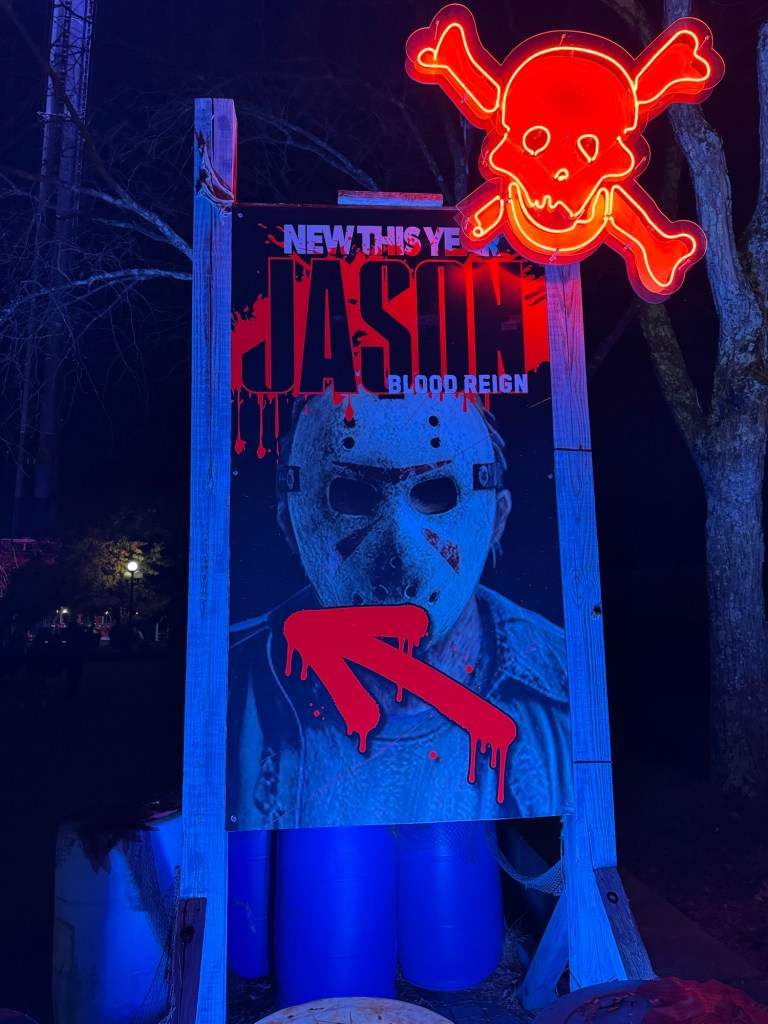
In September–October 2026, I auditioned for Kings Island’s Haunt. My walk—shaped by decades of executive work, proximity to power without subservience, and early familiarity with violent environments—led casting directors to select me as Jason Voorhees for the “Blood Rains” house, which drew heavily on the first four Friday the 13th films. Six Flags invested substantially in authentic sets, pine scent, rain effects, and practical lighting/sound. I worked Thursday–Sunday nights from mid-September through Halloween, typically 5 p.m. to after midnight, among a cast largely in their teens and twenties. The Saturday before Halloween saw multi-hour lines extending into the mall area; tens of thousands of guests passed through.¹²

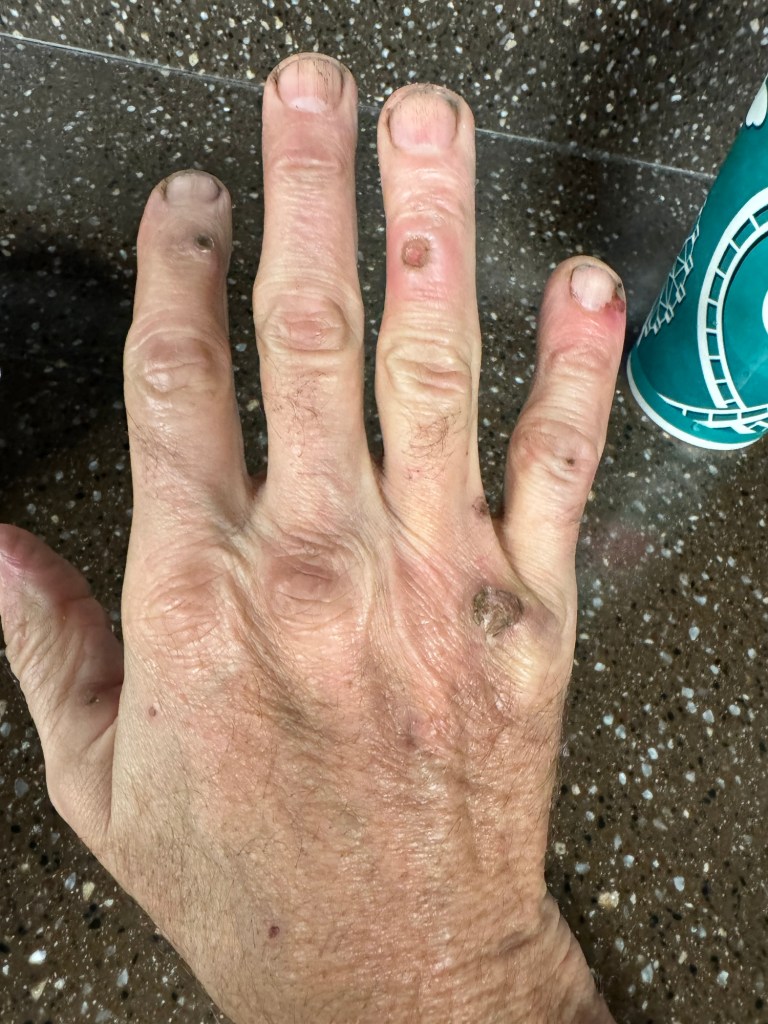
Jason does not speak. Presence, posture, and eye contact project threat. I employed every available non-verbal means—strobe activation, machete motion, wall strikes when audio failed—to maximize effect. Physical cost was real: cut hands from repeated machete handling, bloodied knuckles, observed injuries among other performers. The experience supplied a large statistical sample of human response under controlled terror.
Gendered and Developmental Responses to Terror
Males (boys and men) predominantly sought engagement: “Hi Jason,” fist-bump requests, verbal acknowledgment that affirmed survival and status. Females, especially adolescents (roughly 15–18), frequently defaulted to sexual display or verbal seduction—“I love you, Jason,” blown kisses, tongue gestures, exposure—under hive conditions in groups of six or more. This was not universal but patterned and striking. I remained fully in character and found the behavior revealing rather than gratifying.
These responses map onto older fertility and goddess-cult practices. Academic literature sometimes underplays the sexual dimensions of Canaanite religion—temple prostitution, fertility rites offered to deities. Under uncertainty (future, status, survival), young females appear to test sexual capital as appeasement. Parallel questions arise regarding high-school relationships with older authority figures: the same calculus of power and fear can and do operate. Once reproductive and household realities set in, the pattern typically attenuates.¹³
Haunted-house guests emerge smiling, having survived bounded terror. The certainty of the scare itself provides relief from the more diffuse fears of ordinary life. People want to locate the monsters and the pecking order.
Canaanite Cults, Shamanism, and Western Counter-Narratives
Why did populations worship Canaanite deities with sexual and sacrificial rites? Fear and the desire for fertility or protection. Shamanic caves throughout the region, continuous with Göbekli Tepe traditions, indicate long interaction with non-human intelligence. The Protestant Reformation’s debates over the Apocrypha (Luther et al.) and the Bible’s selective time-capsule nature leave room for pre-Adamite or edited human populations.¹⁴ Western civilization, emerging through Christian and classical synthesis, largely rejected the more destructive cultic practices even while retaining fear as a social tool.
My observations in the Haunt supplied modern ethnographic data: under acute fear, sexual appeasement and status-seeking appear as default strategies. This does not require endorsement of any particular theology; it requires acknowledging that non-human intelligence (or residual programming attributed to it) continues to exploit fear. In The Politics of Heaven, Yahweh faces ongoing conspirators; human beings are both targets and potential representatives.
Implications for Programming, Free Will, and Future Archaeology
Stories and folklore write software. Families, companies, political parties, and nations transmit it. Elon Musk’s enterprises (SpaceX, Tesla, Starlink) illustrate an engineer bringing science-fiction templates into hardware; the same logic applies to cultural templates. Disclosure discussions around non-human intelligence remain constrained by institutional incentives.
When archaeological work reaches Mars and the Moon, prior human or human-intelligence presence will force timeline revisions. Genetic distinctions among populations may be re-read as creator “serial numbers.” Fear will remain the primary enforcement mechanism unless deliberately countered by clearer understanding of the program and its authors. Bounded experiences of terror (haunts, controlled shamanic methods) can illuminate the mechanism without surrendering to it.
Conclusion
The 2026 season—completing The Politics of Heaven under conditions of hostility, reading Vallée at Put-in-Bay, and embodying Jason Voorhees for tens of thousands of guests—functioned as an extended field experiment. Fear governs more of human society than is commonly admitted. Gendered responses, ancient cultic parallels, and the architecture of the Truman Show all converge on the same point: non-human intelligence, or the residual code it left, continues to shape outcomes. Academic archaeology, anthropology, and psychology supply tools; personal privation and embodied performance supply data. Further work will expand this foundation into a fuller thesis. The Haunt was excellent service; the learning exceeded any wage.
Jason: Blood Reign and the Quiet Proof of Leadership
I went into the 2026 Halloween Haunt at Kings Island deliberately choosing the hard, less-visible work. For a long time the projects I’ve been around have tended to succeed, and it can become difficult to know how much of that success you actually carry with you versus how much simply arrives because you’re standing next to it. So I picked something outside my usual wheelhouse—seasonal work as Jason Voorhees inside the new licensed Friday the 13th maze, Jason: Blood Reign—and treated it as a personal experiment. Could I still move the needle when the assignment was physically demanding, the hours long, the setting unfamiliar, and the success of the night depended on people I had to help form into a team under real pressure?
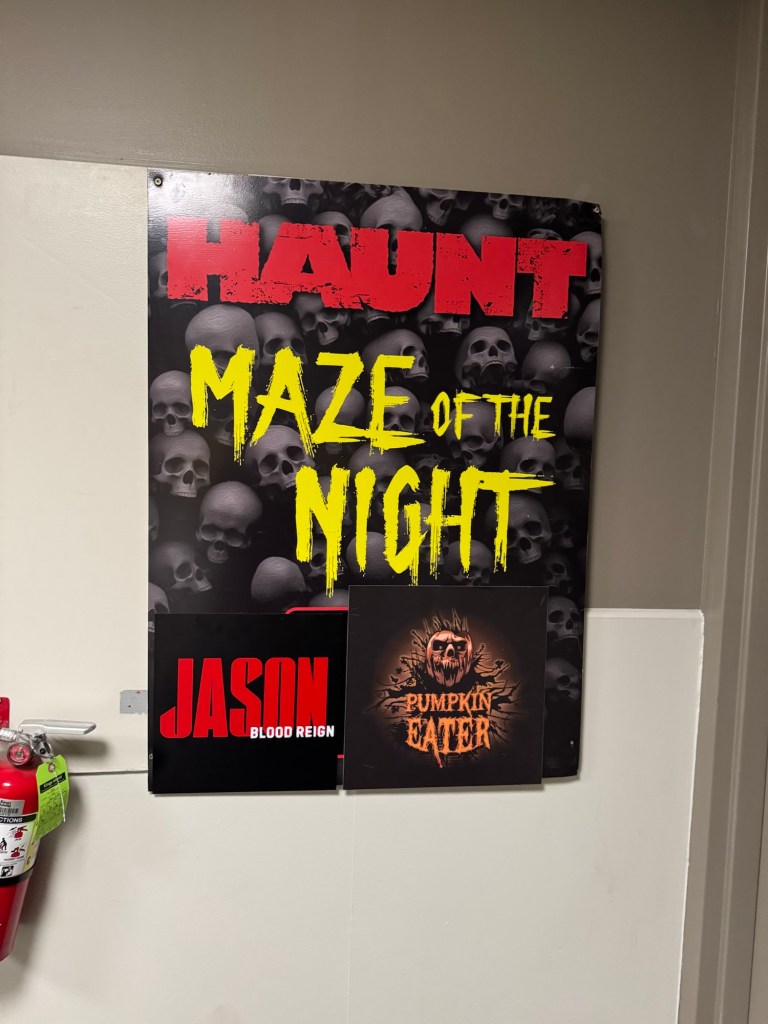
It was hard. Very hard on the body and on the schedule. But the result was clearer than I expected. Blood Reign became one of the headlining mazes of the season. Kings Island ran seven haunted mazes in 2026 (Blood Reign and Metal Massacre new; Order of the Dragon, Alien Abyss, Killmart, Slaughter House, and the separate add-on Conjuring experience). Blood Reign was the line people planned around. Early in the run it regularly posted 60-minute medians on Fridays and Saturdays and hit 180 minutes on at least one Saturday. Guests who waited still came out talking about it. Reviews from park regulars and content creators repeatedly called the production a step up for the park—strong sets that moved between woods and camp scenes drawn from the franchise, effective scares, and actors who kept the tension alive rather than just jumping out. Multiple people described it as “S-tier,” “some of the best production I’ve seen at Kings Island,” and worth the extra Haunted Attractions Pass. The same maze ran at two other Six Flags parks this year (SCarowinds and Great Adventure’s Fright Fest); at Kings Island the long lines and the volume of positive guest reactions after they exited were the clearest local verdict.
What I take from it is not the mask or the machete. It is the confirmation that my strongest lever is still team-building and culture. When you can get the people around you to raise their game, stay consistent under fatigue, and care about the experience the guest is having, the maze performs. There were the usual background conversations about what actually makes a good haunt—staffing, pacing, the difference between a cheap jump and a sustained sense that something is hunting you—and the group that formed around the maze worked through those. Six Flags supplied a budget and the licensed concept; the actors and the people supporting them turned it into something guests wanted to stand in line for and then recommended to others. Tens of thousands of people moved through that experience across the roughly 22 operating nights. The ones I saw leaving were generally happy with what they had just paid for.
That outcome matters to me for 2027. It was not my normal environment. It was physical, seasonal, and outside the usual executive or advisory frame. Yet the same pattern held: get the culture right, elevate the people doing the work, and the thing tends to succeed. That is the blank check I was looking for. Whatever projects I put my name next to next year—whether they look familiar or deliberately difficult—I now have another clear data point that the method travels. The lines, the reviews, and the team that held together through the hard nights are the evidence. I’m proud of the contribution. More than that, I’m satisfied that the experiment worked.
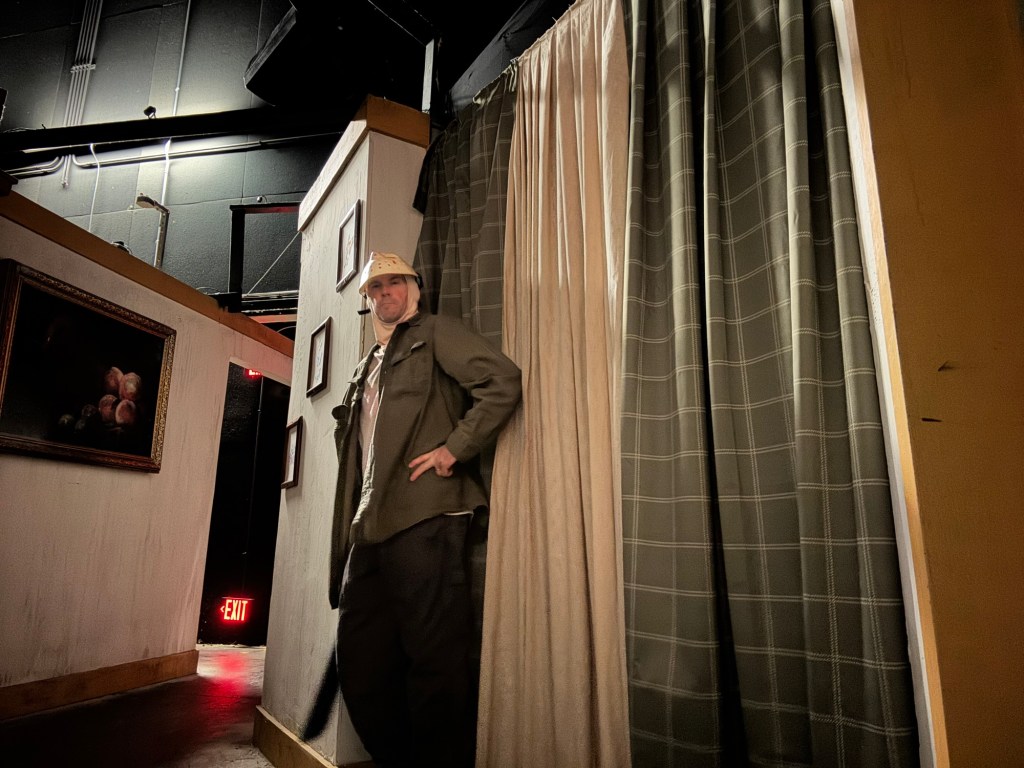
I was especially happy to hear the guys at Tower Topics—Don Helbig and Ryan Suhr—talk about Jason: Blood Reign on their podcast. Around the four-minute mark of the episode where Ryan reviewed this year’s Haunt (“Ryan Went to Haunt So Don Didn’t Have To”), he specifically described what he ran into at the curtain. That’s where they put me most nights—about 80% of the time. I’m fast, and I developed a way of timing the button that triggers the sound effect and the light visuals so the jump lines up exactly when I rip the curtain open.
I call it the Jack-in-the-Box effect. You know the jump is coming. You can see me twisting the knot and the handle just a little, building the anticipation, but you still don’t know the exact second. Ryan came through multiple times—I recognized him once I saw him on the podcast—and he kept coming back through the maze the way a lot of people do once they’ve been scared. Across the hall from the curtain there’s a little graphic animation of Jason killing someone in shadow. Guests lock onto that. While they’re looking at it, I come out behind them. Even when people have already been through several times and know I’m standing there, the timing still gets them. A lot of them fall down. Some crawl out of the room on their hands and knees. Others jump so hard they pull the people in front of them down with them. It happens often enough that I’m sure there will be reviews mentioning the safety side of it, but the reaction is real.
Groups of thirty or so would come through. I’d get the first couple, then people four or five back would see me and still get hit when I timed the jump. They’d say “I knew you were behind that curtain—I just went through here” and then admit I still scared them. I never broke character. They’d try to get you to talk or react, but I stayed locked in. The goal every night was simple: they paid good money, so give them everything you’ve got. Don’t hold back. Don’t phone it in.
We had a strong group—mostly younger people—and we built a positive, high-energy culture. I challenged myself by stepping into something outside my normal element, injecting energy and creativity day after day, and treating every guest like they deserved the full scare. It was a tough, physical job with long hours, but being part of making it succeed felt good. Hearing Ryan Suhr, who has been through a lot of haunts and isn’t easy to impress, talk about Jason: Blood Reign as one of the best in the country made me proud of the part I played in it. These guys do a half-hour to hour-long show and still came away with a genuinely positive take. That meant something.
I’m happy they had a good experience, and I’m glad Ryan recognized the work we put in at the curtain. It was a successful season, and I was glad to contribute to it.Notes
- Rich Hoffman, The Politics of Heaven (manuscript, 2026).
- Frank Herbert, Dune series (1965–1985); James G. Frazer, The Golden Bough (1890–1915); C. G. Jung, Archetypes and the Collective Unconscious (1959).
- Timothy Alberino, Birthright and related lectures on Enochic literature; public statements by JD Vance on demonic language.
- Klaus Schmidt, Göbekli Tepe: A Stone Age Sanctuary in South-Eastern Anatolia (2012); reports on Windover archaeological site (Florida); copper provenance studies linking Lake Superior to Near Eastern Bronze Age.
- Graham Hancock, The Sign and the Seal (1992).
- Pablo Amaringo and Luis Eduardo Luna, Ayahuasca Visions (1991); biblical accounts of Jesus’s wilderness fasting (Matthew 4; Luke 4).
- Personal observational data from Cincinnati-area environments, 1980s–1990s; general criminological literature on witness behavior in chaotic public spaces.
- Jacques Vallée, Passport to Magonia (1969) and Dimensions (1988).
- Standard stratigraphic reports on the City of David and Temple Mount; debates summarized in Israel Finkelstein and Neil Asher Silberman, The Bible Unearthed (2001), read critically.
- Erich von Däniken, Chariots of the Gods? (1968); Zechariah Sitchin, The 12th Planet (1976).
- Critical responses to the 1619 Project, including those emphasizing continuity of Western legal and philosophical traditions.
- Kings Island Haunt operational data and personal field notes, September–October 2026.
- Comparative material on Canaanite religion in William G. Dever, Did God Have a Wife? (2005); ethnographic parallels in fear and fertility rites.
- Martin Luther’s prefaces to the Apocrypha; standard introductions to biblical canon formation.
Selected Bibliography for Further Reading
Alberino, Timothy. Works on Enoch and related pseudepigrapha.
Amaringo, Pablo, and Luis Eduardo Luna. Ayahuasca Visions.
Dever, William G. Did God Have a Wife?
Finkelstein, Israel, and Neil Asher Silberman. The Bible Unearthed.
Frazer, James G. The Golden Bough.
Hancock, Graham. The Sign and the Seal; Fingerprints of the Gods.
Herbert, Frank. Dune series.
Jung, C. G. Collected works on archetypes and the unconscious.
Schmidt, Klaus. Göbekli Tepe.
Sitchin, Zechariah. Earth Chronicles series.
Vallée, Jacques. Passport to Magonia; Dimensions; Confrontations.
von Däniken, Erich. Chariots of the Gods?
Additional primary archaeological reports on Göbekli Tepe, Windover, Michigan copper, and Levantine dolmens and caves; criminological studies of public violence and witness behavior; psychological literature on fear conditioning and gender differences under stress (e.g., works descending from Freud, Jung, and modern terror-management theory).
Rich Hoffman
More about me
Click Here to Protect Yourself with Second Call Defense https://www.secondcalldefense.org/?affiliate=20707
About the Author: Rich Hoffman
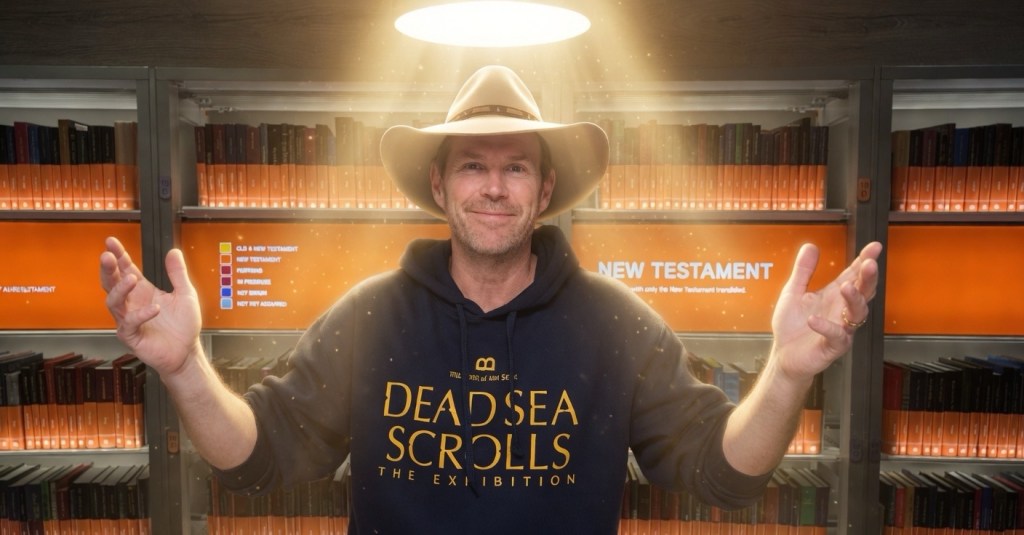
Rich Hoffman is an author, political consultant, and strategic advisor based in Cincinnati, Ohio, and the creator of The Politics of Heaven—a unique framework that connects biblical theology, ancient history, and modern power structures to explain how moral alignment and spiritual forces shape global events. Blending real-world political experience with deep research into archaeology, UFO phenomena, and suppressed historical narratives, Hoffman offers compelling commentary on topics ranging from ancient civilizations and the Dead Sea Scrolls to modern populist movements, paranormal continuity, and leadership strategy in chaotic environments. As the author of The Gunfighter’s Guide to Business and the forthcoming Politics of Heaven, he brings a grounded yet provocative voice to media discussions, supported by firsthand experiences and a cross-disciplinary approach that bridges science, history, and theology. For interviews, speaking engagements, or expert analysis, visit richhoffmanbooks.com or contact directly via phone at 513-307-5815 or email at rhoffman@richhoffmanbooks.com. If you’ve seen the movie, Disclosure Day and want to talk about it and the implications of Presidnet Trump’s UAP disclosures, let me know and we can bring some color to your coverage. https://richhoffmanbooks.com/media-inquiries-broadcast-topics-and-contact-info/?frame-nonce=ad51e7ecba I do have a firsthand UFO encounter to discuss.

