

Nate Silver’s latest FLIPR model for the November 2026 midterms has Democrats at roughly 75 percent to take the Senate and 93 percent to take the House. Those numbers treat the election as a standard second-year reaction against the party holding the White House. I do not see it that way. Silver has been wrong before when the underlying conditions changed. The conditions have changed again. Trump did not create the political order we are living in. A large group of Americans who rejected the prior direction created the opening that Trump filled. That group is still here, and the administrative class clustered around Tysons Corner does not appear to understand why.
The Model Assumes the Old Midterm Pattern Still Holds
Silver’s framework, like most quantitative election models, leans on historical patterns. The president’s party tends to lose seats in the midterms. Voters register dissatisfaction with the status quo. Generic-ballot movement and polling in a handful of competitive states (Michigan, Ohio, Texas, and others) get translated into chamber-control probabilities. When the model shows Democrats leading by a few points in places Trump won comfortably in 2024, the simulation produces a blue wave.
I have watched enough of these cycles to know the pattern is not iron law. It assumes a normal presidency, normal opposition, and voters who treat the midterms as a routine check. Trump was not a normal candidate, and the coalition that put him in office was not reacting to ordinary policy drift. People watched the border, inflation, cultural institutions, and the administrative expansion and decided they wanted a different representative. Models that treat that choice as a temporary fever that cools after two years are modeling the wrong thing. They are modeling the expectation inside the permanent government that the fever will pass if they simply wait.
Watching the Permanent Government at the Tysons Corner Walmart
My wife and I have been to the Walmart in Tysons Corner enough times that we have a preferred parking level in the garage. The store sits inside a dense cluster of high-rises roughly 15–16 miles west of downtown Washington, near Langley and the concentration of defense contractors and intelligence-community support firms that define Fairfax County. It is not the freestanding big-box with the wide parking lot that most people picture when they hear “Walmart.” It is compressed vertically, stacked into the same footprint as the surrounding office and residential towers. The people shopping there are not primarily the ones who drive in from the farther suburbs for bulk groceries. A large share live and work inside the federal-contractor economy that expanded after 9/11 and never really contracted.
I have written a chapter about this place in The Politics of Heaven. The observation is not complicated. You watch people move through the freezer section for chicken nuggets and the wine aisle with the same expression I have seen in other high-density administrative centers. They are performing the motions of ordinary life while remaining largely insulated from the consequences that ordinary voters experience. Pensions are secure. Housing is expensive but stable for those inside the system. The work is process-oriented rather than output-oriented. When you talk to them, the default expectation is that presidents come and go, but the block of offices, contracts, and clearances remains. They will wait. They have waited before.
That expectation is visible in the way the midterm forecasts are discussed inside the same circle. Trump’s approval, gas prices, or a few state polls are treated as sufficient to restore the prior equilibrium. The deeper reason voters chose him—the desire for someone who would actually represent the people who do not live inside that equilibrium—is treated as noise. Silver’s probabilities reflect the same assumption at scale. The model does not need to assume conspiracy. It only needs to assume that the historical midterm reaction will reassert itself because that is what the people who live near the model’s data sources expect to happen.
Trump Was the Hand That Went Up, Not the Creator of the Demand
I have been around the Trump issue since the Tea Party period. The demand existed before he filled it. People wanted a representative who would treat the border as a border, treat the administrative state as something that could be constrained, and reject the idea that the United States should converge toward the European or coastal-institutional model. When someone raised a hand and said he would do the job, enough of them voted for him twice. The same people are still there. Some will stay home if the candidate is weak. Many more will show up if they believe the alternative is a return to the prior arrangement.
That is why I do not treat the current Senate and House probabilities as predictive. They rest on the idea that voters will punish the president’s party for the ordinary reasons and then accept whatever the permanent government produces afterward. The people I talk to outside the Tysons corridor do not describe their choice that way. They describe it as a decision not to accept managed decline, open-ended migration without assimilation, or the expansion of process jobs at the expense of productive ones. Those preferences do not expire on a fixed calendar. They persist until the underlying conditions change or until voters decide the representative they chose is no longer doing the job.
Steve Bannon and others have floated the third-term idea. That is a separate legal and political question. The more immediate point is that the coalition does not disappear when one person leaves the stage. The administrative class that believes it can simply outlast the current presidency and restore the previous operating rules is counting on a reversion that the voters who created the opening have not signaled they want. Fairfax County mansions and secure pensions are real. They are not evidence that the rest of the country has decided to fund them indefinitely under the old terms.
What the Numbers Are Actually Measuring
Silver’s model is transparent about its inputs: polls, fundamentals, historical midterm patterns, and expert ratings. Those inputs are useful when the electorate is behaving within historical ranges. They become less useful when a significant share of the electorate has already rejected the range. The 75 percent and 93 percent figures measure the current state of polling and the weight the model assigns to past midterm reactions. They do not measure whether the people who voted for enforcement, energy production, and institutional constraint have changed their minds. From what I see, they have not.
We will know more on election night. Models can be updated. Voters can be wrong about the consequences of their choices. What I do not expect is a simple return to the equilibrium that the people shopping at the Tysons Corner Walmart treat as normal. That equilibrium required the rest of the country to keep accepting arrangements they had already rejected. Trump was the available instrument. He was not the source of the rejection. Treating the midterms as the moment when the instrument is discarded and the prior arrangement resumes is the hopeful reading inside one corridor of the administrative state. It is not the reading I take from the voters who put the instrument in place.
Footnotes
1. Contemporary reporting in early-to-mid October 2026 placed Nate Silver’s FLIPR model at approximately 75 percent for Democratic Senate control and 93 percent for House control, consistent with the figures discussed here. The model incorporates polling averages, historical midterm patterns, and other fundamentals.
2. Tysons Corner (Fairfax County, Virginia) sits adjacent to major defense-contractor concentrations and roughly a short drive from CIA headquarters in Langley. The multi-level Walmart is a documented feature of the dense, high-rise development that replaced earlier suburban patterns in the area.
3. Post-9/11 defense and intelligence contracting expanded the economic footprint of Northern Virginia. Accounts of the region describe the concentration of firms, clearances, and related employment that remains visible in the local commercial landscape.
Bibliography for Further Reading
• Nate Silver, Silver Bulletin / FLIPR methodology posts and midterm forecast updates (2026), including discussions of historical midterm waves and polling inputs.
• Paul E. Ceruzzi, Internet Alley: High Technology in Tysons Corner, 1945–2005 (history of the defense-contractor and technology corridor).
• Tim Shorrock, Spies for Hire and related reporting on the privatization of intelligence and defense functions in the Washington region.
• Victor Davis Hanson, essays on administrative growth, cultural divergence between coastal/institutional centers and the broader electorate, and the persistence of voter preferences on borders and institutions.
• Contemporary coverage of 2026 generic-ballot movement and competitive Senate races (Michigan, Ohio, Texas, and others) from multiple polling aggregators.
• Ayn Rand, Atlas Shrugged (on the distinction between productive enterprise and politically protected process).
• Local and regional reporting on Fairfax County demographics, federal contracting
Rich Hoffman
More about me
Click Here to Protect Yourself with Second Call Defense https://www.secondcalldefense.org/?affiliate=20707
About the Author: Rich Hoffman
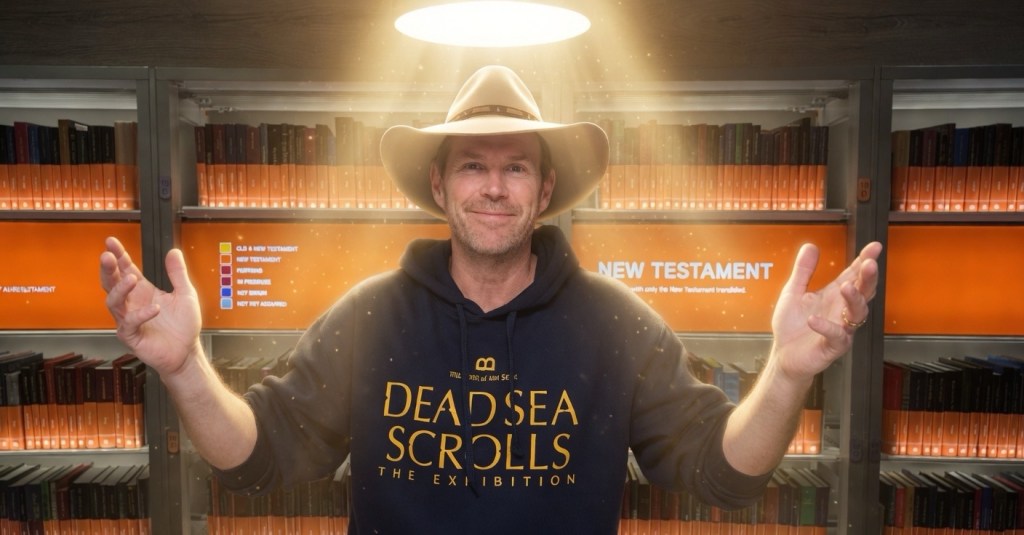
Rich Hoffman is an author, political consultant, and strategic advisor based in Cincinnati, Ohio, and the creator of The Politics of Heaven—a unique framework that connects biblical theology, ancient history, and modern power structures to explain how moral alignment and spiritual forces shape global events. Blending real-world political experience with deep research into archaeology, UFO phenomena, and suppressed historical narratives, Hoffman offers compelling commentary on topics ranging from ancient civilizations and the Dead Sea Scrolls to modern populist movements, paranormal continuity, and leadership strategy in chaotic environments. As the author of The Gunfighter’s Guide to Business and the forthcoming Politics of Heaven, he brings a grounded yet provocative voice to media discussions, supported by firsthand experiences and a cross-disciplinary approach that bridges science, history, and theology. For interviews, speaking engagements, or expert analysis, visit richhoffmanbooks.com or contact directly via phone at 513-307-5815 or email at rhoffman@richhoffmanbooks.com. If you’ve seen the movie, Disclosure Day and want to talk about it and the implications of Presidnet Trump’s UAP disclosures, let me know and we can bring some color to your coverage. https://richhoffmanbooks.com/media-inquiries-broadcast-topics-and-contact-info/?frame-nonce=ad51e7ecba I do have a firsthand UFO encounter to discuss.

