

I have been hinting at this for weeks, and I still won’t say exactly what I am doing. I can tell you the shape of it. I have been toying with a Ph.D. for several years, and I think the trigger has finally been pulled. I already know what the doctoral thesis will be. A version of it will live on the blog, because I am not going to make people wait five or six years to hear the argument. A humanities dissertation runs on the order of 80,000 words. That is a long walk. It is also, if you do it right, a bridge between things the academy will not put in the same room.
I am not happy about what has happened to academia. I am not happy that a credential which was supposed to mean rigor has been rendered, in too many departments, into a party card for liberal politics. I think there are a lot of problems with that, and I would like to get on that side of the argument for my own reasons. A Ph.D. is a tool. It is not a personality. It gives you a seat in a fight that otherwise dismisses you as a blogger with a whip and a podcast. I do not want the universities left entirely to people who have already decided the conclusion. Big tent, small tent, ethics, the lack of ethics: this is the same argument I have been making about parties and about sheriffs. If you will not go into the room, you do not get to complain that the room was captured.
The thesis comes out of The Politics of Heaven. Even while I am doing everything else, if I write several books in that line, and if I am involved in aerospace work that makes money and does cool things, none of that changes the strategy. Money is a tool. You do not do the long work to get paid for it. The Politics of Heaven, in the draft I have been editing, is over 200,000 words. The published book will be shorter. Parts of it are clean. I’m combining two bodies of evidence in the same paragraph because few others have read both piles. The politics of heaven, as I am using the phrase, are my speculations built on a very wide reading. Very few people read as much of this material as I do, or as diversely. I put things together in places the guild system of the sciences cannot handle, because the guild system is paid to stay in its lane. There needs to be a bridge. If I am going to write a thesis anyway, I might as well make the bridge the doctorate.
People I trust with a book want an entry. They want to know the information has been through a fight. Academic argument, when it is actually argument and not a loyalty oath, comes across better if you get on their side of the table and make them defend the status quo. I think I have a hook. Less than one percent of the people who encounter it are going to love it. Everyone else will scratch their heads and say they are not ready. That is fine. A lot of what I assert is not laboratory science. It is immersion. It is psychology. It is a lifetime of reading. I make assertions that are not “scientifically grounded” in the sense a journal referee means, and I am not going to pretend otherwise. They are grounded in experience, in a level of ethical attention, and in a concern I am willing to name: the ethical behavior of the spirit world, how it moves against the human race, and how it plots against God’s design. That is the concern. I am not worried about putting the frame of it out here. Somebody might try to steal it. I’m happy to share them and see if anyone can do anything with them. Most people cannot.
The thesis, as I am presuming to pursue it, is Jason Voorhees: why he is scary, and why Yahweh had to save the world from the gods of Canaan. And why those are not two subjects.
A book I saw advertised through Biblical Archaeology Review took the very progressive line that the Palestinians are the indigenous people and that Israel is the invader, the same argument you hear about American Indians. I heard a woman out of Portland, Oregon, the other day, talking about the drug problem on those streets, the cities run by blue mayors, and she concluded that we need to teach kids to do drugs, because the Indians were doing drugs, talking to spirits, going on vision quests. Democrats, in that telling, need this to happen to our young people. Break them away from their parents at twelve and thirteen. Send them on a spirit journey under drug consumption. Let them communicate with the other world. Coyote. Peyote. The vision.
I am writing, among other things, about why you should not do that, and about what you are actually encountering when you go looking for the spirit world on those terms. I talk about three rivers a lot. I talk about the origin stories of the Aztecs. I talk about a claim almost no working archaeologist or anthropologist will yet admit in public, which is that the Noah story has a geographical hook in eastern Turkey that the guild retired, and that some of the people who wrote the retirement papers are themselves retired, and that methods we were told settled the question are being reopened because the ground will not stay closed. I am saying yes to some of those reopenings because I know where the argument is going. For me, proof is not a single carbon date. Proof is accumulated experience and a willingness to read the thing the department will not assign.
So the thesis, in a sentence: Jason Voorhees and how Yahweh saved the human race from the gods of Canaan; the rest of the map is the same type. Indian cultures. Central Mexican cultures. Large parts of South America. If we were allowed to explore the same questions in Russia, China, Afghanistan, and India with the same honesty, we would know more about them too. I hear the argument every week that Buddhism, Zoroastrianism, and the Hindu traditions are older than Christianity, and the related argument that Hindu and Buddhist ideas migrated into the community around Jesus, that John the Baptist was a rebel against orthodox Judaism, that Greek society had already been in those eastern regions for two or three hundred years before the Roman machine arrived, with its gods and its planetary worship and its mystery cults. We would also understand the dolmens of the Jordan Valley better than we do. We would ask a ruder question: why do we have stone chambers in New England, and mound-and-monument landscapes in the northern Great Lakes and the Michigan peninsula, that keep getting explained away as root cellars and colonial oddities. At the same time, the Jordan field is allowed to be religion? Those are good questions. They are not simple. They are the complicated kind of simple, the kind that looks obvious once you stop protecting the departmental border.
Here is the hook I plan to share before November. The thirteenth villain, the one America actually produced, could not have been created anywhere but here. No other artistic culture had the combination. A commercial horror film, made for almost nothing, aimed at teenagers, indifferent to critics’ approval, and then kept alive by the audience for forty-six years. That figure explains something the ancient Near Eastern texts only describe from the other side: why people worshiped the deities of Canaan, why Yahweh was necessary, why the land had to be cleared of rival cults if anyone wanted a garden rather than an altar, why there could not be another god before him, and why human beings keep drifting back to the lesser worship anyway. I will explain more of the operational evidence after Halloween. I cannot discuss that part yet. I can tell you I am obsessed with why Jason Voorhees was invented in American cinema, and why people are still obsessed with him.
I got interested again when I saw how people reacted. My grandkids and my wife play Dead by Daylight on the PlayStation 5 a lot, all the time. I wanted to know why this character was in the room. I remembered him from when I was a teenager. In those years, you watched the movies because you wanted to see kids get killed and you wanted the cheap thrill, and you filed it under science fiction, fantasy, and horror, and you moved on. He did not move on. Then I realized there was a psychological mechanism under the costume, and I immersed myself in it until I had something I could call objective evidence. Enough, I think, for 80,000 words on why Jason Voorhees matters in the art and entertainment of human cultures, and why he had to be invented in America.
The academic position I want to refuse is the one that treats indigenous worship as automatically virtuous. Worship of lesser gods, as against Yahweh, or against what I will call for the thesis an Alpha claim on the divine, is not a heritage to be restored. It is a psychology. It has a shape. It shows up in Canaan. It shows up in the vision-quest argument. It shows up in the woman who thinks the drug policy of a failing city is a sacrament. It shows up, dressed as entertainment, in a hockey mask. If you want to talk about the psychology of goodness in a culture, and about how you defend a big-tent civilization against people who think every altar is equal, you have to be willing to look at the altar people actually kneel at when nobody from the department is watching.
This will be a quiet undertaking. It is not the thing that makes the money. I think it is needed if the human race is going to get a psychological look at itself that is not written by the people who already agree with the Portland sermon. For my part, I jump off the board before the pool is finished filling. A lot of things have to happen on the way down. I have often made the large moves under dangerous circumstances, because that is where the world actually is. You do not find the treasure by doing the same thing everyone else is doing. I think I have found something in Jason Voorhees and the Friday the 13th series: why human beings are so ready to worship an idea, and why a certain kind of academia wants to point everyone toward the indigenous deity and call it liberation. That is why the drug argument keeps coming back. I understand why people feel that way. I do not feel anything close to it. Liberal-minded people, tending to vote Democrat, accommodate the opinion because they have talked themselves into believing every spirit is a friend if it arrives wearing the costume of the oppressed. I have a different reading now of why Jason is revered across cultures and across decades, and why he became a killer in Dead by Daylight not as a memory of the movies but as a current character. I know him from the movies, from the games, and from everything that has cascaded off him. I have watched that cascade go through generations.
I am deep in it. It will not make anyone rich. The information I have learned is more than most people will ever care to know about the character and about the public reaction to him. In November, I will share the details I can’t share now. It is the doctoral idea. To help the academics, I will put it on ground they already understand, and on ground everybody else understands: a horror movie. It is a good comment. It is a big concept. I am going to use it to launch the reasoning about why those older worships were dangerous, why people still practice them, why they are still impactful, and why a society that wants to fix itself has to fix that before it fixes the tax bill.
It will be entertaining. I promise that. Some of the apocalyptic discussions I have had came from real reflection, because I put myself through a considerable amount of discomfort to see the thing from the inside. It is not enough to stand on the dock and throw a theory at the water. You have to go in with the sharks and the snakes and the vipers and see what is actually down there. I would like it to be easier. I want the design of the world to be more accommodating to personal pleasure. Here is the deal. I will get further into this over the coming weeks and months as I work up to it. A thesis, in the ordinary academic calendar, is five or six years of hard work. In another sense, I have already been at the reading for longer than that. I know what the end needs to be. It needs to be this. And it has an academic entrance, which you cannot use unless you have gone down the rabbit hole past Alice, further by a lot. That is what I am talking about. I think I understand Jason Voorhees, the public reaction to him, the fascination, and why the human race turns away from Yahweh and Jesus Christ and finds itself worshiping the old neighbors.
The Jewish people worshiped the calf when Moses took too long coming down with the commandments. The guidance drifted. Even Aaron drifted. He drifted for a reason. What is the reason? I think I have it. I will put it in the books, in the thesis, and in future academic work. I will also put it here, because I am not going to make people wait five or six years. Putting it out helps me. The feedback helps. People send notes. They ask questions I had not framed. I get a better answer, and I refine it. That is the process. It is not always the way I would design it. It has been working.
A dose of reality with a fire under it has been hard. This particular immersion has been out of my comfort zone. It will make for a richer discussion, which is the point of the effort. Job titles are transitory. Acquisitions are transitory. Most of them are built on compliance with human systems. I mean compliance with a cosmic claim. The Bible is not a hint. I think it is part of a larger story we are going to be covering for thousands of years, and that we miraculously captured some of it through prophets and through voices that managed to get a portion written down, and that the portion lasted through purges and reformations and kingdoms and empires to reach us.
I find that survival a miracle. There is a lot more, and when a generation is done with the portion it inherited, it still has to ask questions. It has to cut into the topic with evidence-based trajectories. That is what I am doing. I wish it were easier to get. If it were easy, more people would do it. Very few have the stomach for the fight. I have gone down the rabbit hole. I have seen what is down there. I know a treasure was left behind, and I think it is my task, because I have been given a voice, to bring some of that treasure into the light.
The structural thesis on Jason Voorhees is the door. I think people are going to get a kick out of it. It is going to be fun. If you liked The Gunfighter’s Guide to Business, you’ll know the voice. The subject is different. The standard is not.
NOTES
1. A typical humanities doctoral thesis in the United States and Britain falls somewhere around 80,000 to 100,000 words, excluding bibliography. I am using 80,000 as the working target, not as a university requirement already assigned to me. I am not enrolled in a program as of this writing. The point of saying the number is to mark the scale: this is not a blog post, and it is not a five-year wait for the blog either.
2. The Politics of Heaven is the manuscript I have described elsewhere as completed in draft in 2026, in final edits, and aimed at publication in 2027. The draft I am editing has run past 200,000 words. The published book will be cut down. The thesis is a bridge out of that book, not a substitute for it.
3. Friday the 13th, produced and directed by Sean S. Cunningham, written by Victor Miller, opened in the United States on May 9, 1980. Budget reported under $600,000. Domestic gross about $39.8 million; worldwide about $59.8 million. It was the first independent slasher picked up by a major studio, Paramount. See Friday the 13th (1980 film), Wikipedia, revised 2026; Ryan Gilbey, “Friday the 13th at 40,” The Guardian, May 9, 2020.
4. In the first film, the killer is Pamela Voorhees, Jason’s mother. Jason himself appears at the end as a jump scare. Makeup designer Tom Savini has said the beat was his idea after Carrie: “let’s bring in Jason.” Victor Miller later objected to the sequels making Jason the killer: “Jason was dead from the very beginning. He was a victim, not a villain.” That argument inside the creative team is part of the evidence. The culture did not accept the victim. It promoted the corpse. See Friday the 13th (1980 film), Wikipedia, production history.
5. The hockey mask arrives in Friday the 13th Part III, released August 13, 1982, directed by Steve Miner, the only film in the series released in 3-D. On-set accounts say a Detroit Red Wings goaltender mask belonging to 3-D effects supervisor Martin Jay Sadoff was put on actor Richard Brooker for a lighting test, then enlarged by makeup effects. In Part 2, Jason had worn a sack. The mask is an American industrial object, a piece of sporting armor, not a cult image designed by a priest. That is the point.
6. The franchise then did what Canaanite cults did. It would not stay dead. Sequels, a 2009 reboot, a crossover with A Nightmare on Elm Street, novels, song references from Tupac to Eminem, The Simpsons, and, in 2026, a playable killer. Gilbey notes that Jason became the first fictional character to receive an MTV Lifetime Achievement Award. The culture promoted a murderer of teenagers into an institution.
7. Dead by Daylight, from Behavior Interactive, added Jason as Chapter 40 on June 16, 2026. In the game, he is called The Slasher. The chapter shipped as paid downloadable content at $4.99 or 500 Auric Cells, with a hockey-mask cosmetic and a “Misty Cabin” banner. He joined Michael Myers, Freddy Krueger, Ghostface, and Leatherface on the same roster. My wife and my grandchildren play the game. That is not a footnote to the thesis. That is the transmission mechanism: a character I met as a teenager is now a weekly opponent for children who were not alive for the original film.
8. The Canaanite comparison is the theological half of the thesis, and I am stating it here as my claim, not as a finding already peer-reviewed. The biblical polemic is not subtle. Israel is commanded not to do what the nations did on their high places. Child sacrifice to Molech is forbidden and treated as a capital offense (Leviticus 18:21, 20:2-5; Deuteronomy 12:31; 2 Kings 23:10; Jeremiah 32:35). The contest on Carmel is a direct trial between Yahweh and Baal (1 Kings 18). Josiah’s reform demolishes the high places, the asherim, and the Topheth in the Valley of Hinnom (2 Kings 23). John Day, Molech: A God of Human Sacrifice in the Old Testament (Cambridge, 1989), belongs in the bibliography so the fight is visible. My claim is that the psychological pattern survives the argument about body counts.
9. The golden calf is the control case inside Israel itself. Exodus 32: Aaron builds the calf because the people will not wait for Moses to come down. The text does not treat this as a moment of heritage. It treats it as drift under impatience, including drift by the priest. That is the mechanism I think I can show in the modern material: absence of the harder claim, impatience, a visible substitute, and a leader who accommodates the substitute so the crowd will not leave.
10. The Portland remark is from a broadcast comment I heard, a woman arguing that children should be taught drug use because indigenous vision quests used intoxicants to speak with spirits, set against the open drug scenes of cities run by Democratic mayors. I am not hanging the thesis on her name. I am hanging it on the argument, which is now common: the pre-Christian or non-Christian rite is the authentic one, the parental household is the interruption, and the drug is the sacrament. Standard starting points on the Native American Church and peyote, which is not the same thing as a municipal drug market, include Weston La Barre, The Peyote Cult (1938 and later editions), and Employment Division v. Smith, 494 U.S. 872 (1990).
11. On the Biblical Archaeology Review advertisement and the “Palestinians as indigenous, Israel as invader” line: BAR has long carried a range of politics alongside the archaeology, and the indigenous framing of the Palestinian claim has become a standard academic position in parts of Near Eastern studies since the 1990s, drawing on the same vocabulary used for Native American land claims. I am marking the parallel as my reading of that advertisement and of the wider literature, not as a quotation from a single editor. A fair bibliography has to carry both William G. Dever, Who Were the Early Israelites and Where Did They Come From? (Eerdmans, 2003), and the more minimalist and postcolonial work the department actually assigns.
12. Jordan Valley dolmens are not a rumor. Fields run along the escarpment east of the Jordan, south from the Yarmuk toward the Kerak plateau, with a heavy Early Bronze Age I burial use and a possible late Chalcolithic beginning. See the radiometric dolmen paper in Journal of Archaeological Science: Reports (2023), and David Gilead, “Burial Customs and the Dolmen Problem,” Palestine Exploration Quarterly 100 (1968). James A. Fraser’s Dolmens in the Levant (2018) is the modern synthesis. More than a century of work has still not produced dolmens west of the Jordan south of the Upper Galilee.
13. New England stone chambers are the contested American analog, and I am not going to pretend the guild has conceded the point. The colonial root-cellar explanation is the standard one. A luminescence study of structures in Massachusetts and Rhode Island, published in 2022 in Quaternary Geochronology, reported sediment ages under some structures in the late sixteenth century, before sustained colonial settlement. That is not a Phoenician colony. It is a date that does not fit the root-cellar story cleanly. The thesis does not need the chambers to be dolmens. It needs the question to stay open.
14. The Michigan peninsula and the northern Great Lakes are a different monumental tradition: Late Woodland mounds and earthworks, roughly AD 1200-1600, not Levantine dolmens. Meghan C. L. Howey, Mound Builders and Monument Makers of the Northern Great Lakes, 1200-1600 (University of Arizona Press, 2012), is a careful book. I raise the peninsula because the public is told these are separate phenomena by disciplinary border, while the psychological function, a built place where the dead or the spirit is dealt with outside the household, keeps rhyming. The rhyme is my claim. The distinction in architecture is the academy’s fact. Both go in the thesis.
15. The Durupinar formation near Dogubayazit, eastern Turkey, is the Noah’s Ark claim I am referring to. The geological consensus, including a 1996 paper by Lorence Collins and David Fasold, “Bogus ‘Noah’s Ark’ from Turkey Exposed as a Common Geologic Structure,” is that the boat shape is a natural formation. In 2026, a team led by Cenker Atila of Sivas Cumhuriyet University ran further scans and reported right-angled subsurface anomalies and higher carbon inside the formation than outside it. Mainstream outlets treated the new work as another round of a claim already rejected. I am not asking the reader to call it the Ark. I am asking why a formation that will not stay out of the news is professionally required to be a closed case, while vision-quest pharmacology is professionally required to be an open sacrament.
16. Aztec origin traditions are a separate dossier in The Politics of Heaven. The relevant point for the thesis is the public one: a civilization that built an imperial sacrificial system on a calendar of blood is still routinely taught as a heritage interrupted by Europeans, while the biblical refusal of that kind of altar is taught as the crime. The primary narrative is in the Florentine Codex of Bernardino de Sahagún and in Diego Durán. The archaeological frame is Michael E. Smith, The Aztecs. The moral question is mine.
17. Greek and eastern mystery religion in the centuries before Jesus is not an internet invention. The Hellenistic kingdoms sat on the Levant from Alexander’s campaigns in the late fourth century BC. The claim that Jesus or John the Baptist is a Buddhist or Hindu import is modern. The mainstream counter is still the Jewish context: Second Temple Palestine, the Dead Sea Scrolls, Josephus, and the Gospels. A clean entry is Martin Hengel, Judaism and Hellenism (1974).
18. The ethical claim of the thesis, which will not be popular in a religious-studies faculty, is that the spirit world has a moral direction, and that “indigenous” is not a moral category. A rite can be old and still be a violation. I am using Jason as the modern control because nobody can accuse a Paramount slasher of being a colonial slander against a living tribe. America invented him in New Jersey in 1980, out of a marketing bet on Halloween (1978). The audience then did what audiences have always done with the lesser god. It kept him, masked him, sold him, and handed him to the children.
19. I am withholding, until after Halloween and into November, the field observations from the seasonal work that put me inside the costume and inside the crowd reaction. That material is the part of the evidence I will not sketch in public yet. The thesis does not depend on gossip about a haunt. It depends on the crowd, which I have now watched from both sides of the mask.
20. The Gunfighter’s Guide to Business is the earlier book in which I used a popular American figure to carry an argument about discipline, producers, and the refusal to live by permission. The Jason thesis is the same method on a darker subject. Readers who want the voice can start there. Readers who want the cosmology can start with The Politics of Heaven when it is out.
BIBLIOGRAPHY
Collins, Lorence G., and David Fasold. “Bogus ‘Noah’s Ark’ from Turkey Exposed as a Common Geologic Structure.” Journal of Geoscience Education, 1996.
Cunningham, Sean S., director. Friday the 13th. Paramount Pictures, 1980. Screenplay by Victor Miller.
Day, John. Molech: A God of Human Sacrifice in the Old Testament. Cambridge: Cambridge University Press, 1989.
Dead by Daylight Wiki. “CHAPTER 40: Jason.” Behavior Interactive release, June 16, 2026.
Dever, William G. Who Were the Early Israelites and Where Did They Come From? Grand Rapids: Eerdmans, 2003.
Duran, Diego. The History of the Indies of New Spain. Translated by Doris Heyden. Norman: University of Oklahoma Press, 1994.
Employment Division, Department of Human Resources of Oregon v. Smith, 494 U.S. 872 (1990).
Fraser, James A. Dolmens in the Levant. London: Routledge, 2018.
Gilbey, Ryan. “Friday the 13th at 40: the maligned slasher that’s haunted pop culture.” The Guardian, May 9, 2020.
Gilead, David. “Burial Customs and the Dolmen Problem.” Palestine Exploration Quarterly 100, no. 1 (1968): 16-26.
Hengel, Martin. Judaism and Hellenism. Philadelphia: Fortress Press, 1974.
Howey, Meghan C. L. Mound Builders and Monument Makers of the Northern Great Lakes, 1200-1600. Tucson: University of Arizona Press, 2012.
La Barre, Weston. The Peyote Cult. New Haven: Yale University Press, 1938.
Mahan, Shannon, and colleagues. Luminescence dating of enigmatic rock structures in New England. Quaternary Geochronology, 2022.
Miner, Steve, director. Friday the 13th Part III. Paramount Pictures, 1982.
Sahagun, Bernardino de. Florentine Codex: General History of the Things of New Spain. Translated by Arthur J. O. Anderson and Charles E. Dibble. Salt Lake City: University of Utah Press, 1950-1982.
Smith, Michael E. The Aztecs. 3rd ed. Malden, MA: Wiley-Blackwell, 2012.
The Holy Bible. Exodus 32; Leviticus 18 and 20; Deuteronomy 12; 1 Kings 18; 2 Kings 23; Jeremiah 32.
Rich Hoffman
More about me
Click Here to Protect Yourself with Second Call Defense https://www.secondcalldefense.org/?affiliate=20707
About the Author: Rich Hoffman
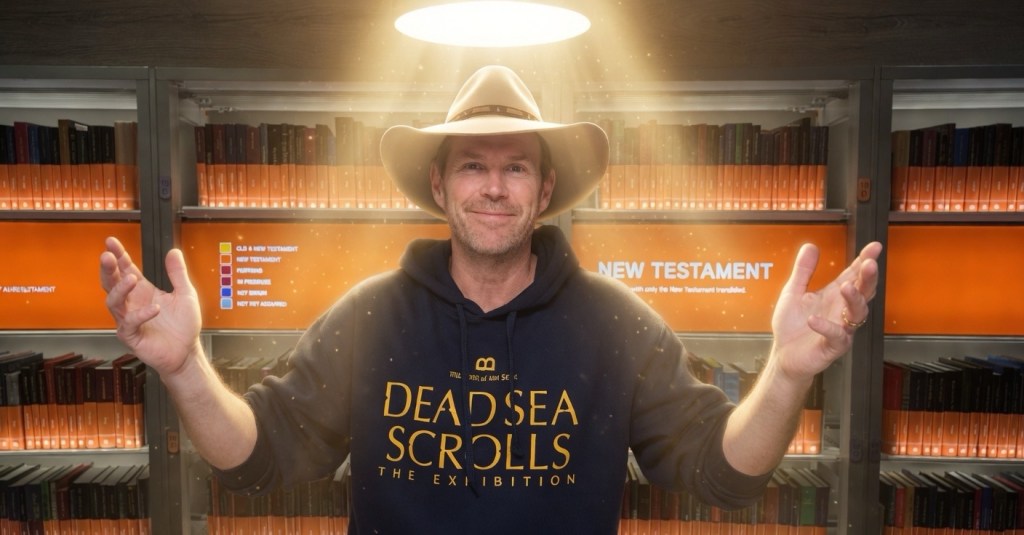
Rich Hoffman is an author, political consultant, and strategic advisor based in Cincinnati, Ohio, and the creator of The Politics of Heaven—a unique framework that connects biblical theology, ancient history, and modern power structures to explain how moral alignment and spiritual forces shape global events. Blending real-world political experience with deep research into archaeology, UFO phenomena, and suppressed historical narratives, Hoffman offers compelling commentary on topics ranging from ancient civilizations and the Dead Sea Scrolls to modern populist movements, paranormal continuity, and leadership strategy in chaotic environments. As the author of The Gunfighter’s Guide to Business and the forthcoming Politics of Heaven, he brings a grounded yet provocative voice to media discussions, supported by firsthand experiences and a cross-disciplinary approach that bridges science, history, and theology. For interviews, speaking engagements, or expert analysis, visit richhoffmanbooks.com or contact directly via phone at 513-307-5815 or email at rhoffman@richhoffmanbooks.com. If you’ve seen the movie, Disclosure Day and want to talk about it and the implications of Presidnet Trump’s UAP disclosures, let me know and we can bring some color to your coverage. https://richhoffmanbooks.com/media-inquiries-broadcast-topics-and-contact-info/?frame-nonce=ad51e7ecba I do have a firsthand UFO encounter to discuss.

