

I have been saying this more and more lately: if you have not yet picked up a copy of the new Jonathan Edwards Study Bible: Experience Abiding Joy in Christ (NKJV), get one. Thomas Nelson released it on August 18, 2026, with Dr. Matthew Everhard as general editor, and it is one of the best things to happen this year. The paper smells wonderful. The binding, the Comfort Print type, the two-color printing, the inclusion of Edwards’ own Resolutions, and the study notes drawn straight from his sermons, treatises, and “Blank Bible”—everything about it invites serious engagement. I already had a solid Bible, but this one is different. It is a tool for the kind of long, disciplined conversations about Christian values and biblical order that I expect to keep having for hundreds of hours in the years ahead.¹
Biblical Foundations for Healthy Families, Churches, and Government
What is really at stake is not merely personal piety. The Bible records how a particular people, and then a wider civilization, survived more than a thousand years of human turmoil by clinging to values capable of building a healthy society. Translation history—from Hebrew and Greek through the Reformation and Martin Luther’s work into new European standards—matters, but the deeper point is functional: those values produce good families, good churches that help form good families, and, from among those people, a portion willing and able to serve in political office.² Good government does not appear by magic or by bureaucratic decree. It is downstream of character. Without good people formed by good families and churches, the supply of those fit for limited, constitutional office shrinks.
I have a granddaughter just over one year old. Watching her, and remembering the same stages with the other grandchildren, sharpens the contrast. Content aimed at children under two is still largely constructive: language, association, positive voices, basic formation. By the time a child reaches eight, nine, or ten, and especially the 10-to-13 and 13-to-16 windows, the cultural message shifts. “Adult” content is coded as sexually charged, reckless, and liberally sprinkled with cuss words. Children who want to be treated as grown-ups learn to associate maturity with those markers. We are careful what we pour into toddlers’ brains; we become careless, or even actively destructive, once they hit double digits. Then we express surprise when people in their twenties, thirties, and forties remain stuck in the same patterns—never growing up, treating foul language and sexualized recklessness as signs of sophistication.³
From Educational Under-Twos to Sexualized Teens: The Cultural Pipeline
This is not abstract. I watch the YouTube videos my teenage grandson (turning 15) chooses when he visits. I pay attention because culture follows what marketers push to each age cohort. Research confirms the scale. A 2025 report from the Children’s Commissioner for England found that 70 percent of young people had seen pornography before age 18, with more than a quarter first exposed by age 11 and some as young as six; social media platforms, not dedicated adult sites, were the dominant source. Common Sense Media, Thorn, and Ofcom data show substantial rates of sexual content and interactions among minors on TikTok, YouTube, Instagram, and related apps. Ofcom has repeatedly flagged TikTok and YouTube for feeding harmful content to large majorities of teens via recommendation systems.⁴ Algorithms do not merely reflect demand; they amplify it. Creators who want reach—and I know many of them—alter content toward whatever is trending. When the trend is sexualized, vulgar, or adversarial, that is what gets pushed.⁵
Algorithms as the Modern Adversary: Rewarding the Bad
Who controls the algorithm controls the content. TikTok (Chinese-owned), YouTube (Alphabet/Google), and similar platforms systematically reward material that maximizes engagement: outrage, sexualization, cussing, laziness framed as authenticity. Positive, formative, or explicitly “good” content is rarely the algorithmic winner. Internal evidence from whistleblowers and external audits (Center for Countering Digital Hate, academic studies of recommendation systems) shows platforms have repeatedly prioritized borderline or harmful material because it drives time-on-site and revenue. The result is a pipeline that takes children from constructive early programming and, within a few years, immerses them in the opposite. We then wonder why so many adults never exit the pattern.⁶
This is the modern version of an old story. In the Book of Job, the adversary (Satan) is granted permission to test Job’s loyalty. The figure is not a cartoon; the biblical picture includes a divine council and adversarial spiritual powers that operate through deception, cultural capture, and the redefinition of good. Today’s adversaries—whether understood spiritually, institutionally, or both—do the same work through media, education, and policy. Public schools teach compliance with whatever the current policy defines as good. When that definition rewards sexual openness, foul language, and mediocrity while punishing high standards or traditional formation, the output is predictable. “Good” becomes relative, socially managed, and hostile to excellence. People learn that being too good makes others look bad, so they stay mediocre or worse. Corruption, fraud, and waste in public office become rational strategies for advancement rather than moral failures.⁷
The Shortage of Good People and the Case for Small Government
My wife and I hear it constantly during election seasons: we need good people in office who will uphold the Constitution. The practical question is where those people come from. A society that has deliberately removed character formation from schools, rewarded the opposite through media algorithms, and redefined good according to the manipulators’ interests will not produce a deep bench of people capable of limited, constitutional government. Good people still emerge—statistical anomalies of family, church, and personal resolve—but they are scarce. Not everyone is interchangeable. Attributes differ. When we pretend otherwise and lower the standard so that bad people can hold power, the results are devastating.⁸
This is one of the strongest practical arguments for small government. Large government requires a continuous supply of competent, character-bound people to staff it. When that supply shrinks by design, expanding the state simply multiplies failure. The corporate-state complex has spent decades treating people as interchangeable inputs; the results show declining literacy and numeracy (NAEP data showing large shares of students below basic proficiency), eroded character metrics reported by teachers, and a persistent inability to reduce fraud and waste. We taught the next generation that corruption is how you get ahead, then wondered why public office is hard to staff with anyone who will actually fight it.⁹
Political Parties as Sorters of Character
Political parties exist, among other reasons, to sort. A party that attracts and elevates people of genuine character—and refuses to authorize the opposite—will outperform one that does not. I affiliate with the Republican Party in my county precisely because its stated goals still include sorting for better rather than worse. That sorting is imperfect and always under pressure, but the alternative is worse. When “good” is redefined by adversarial forces, the people who remain resolute become rarer and more identifiable. Everyone who is paying attention already knows who they are.
I do not believe God is stupid or passively all-seeing in a way that removes human responsibility. The biblical picture allows for adversarial powers that test, deceive, and exploit the desire to fit in more than the desire to be good. Most people prefer belonging to excellence. The result is a thinner stock of people ready for the duties of self-government. The remedy begins where Edwards began: with deliberate resolve, steady engagement with Scripture, and the formation of families and churches that still know the difference between good and its counterfeit. The new Study Bible is a practical aid to that work. Without returning to making good people on purpose, the vacancies, corruption, and cultural pipeline will continue. The plot to destroy good families, good people, and therefore good government has always been there. The difference now is how efficiently the tools of the age execute it—and how clearly the results are visible.
Notes
1. Thomas Nelson, The Jonathan Edwards Study Bible: Experience Abiding Joy in Christ (NKJV), general editor Dr. Matthew Everhard (Nashville: Thomas Nelson, August 18, 2026). Features include study notes drawn from Edwards’ works (with source citations to the Yale edition), Edwards’ seventy Resolutions, full-page essays on his theology and the First Great Awakening, and his miscellanies note-taking system. See also Matthew Everhard’s discussions of the project on the Unashamed Truth channel.
2. On the historical transmission of biblical values and their role in social order, see standard treatments such as Diarmaid MacCulloch, Christianity: The First Three Thousand Years (New York: Viking, 2010), and earlier works on the Reformation’s impact on European moral and political standards. Edwards himself argued that true religion produces the highest happiness and ordered life; see his Religious Affections and the Resolutions (1722–1723).
3. Personal observation of age-graded media targeting is consistent with long-term content analyses such as UCLA’s Center for Scholars and Storytellers longitudinal survey of values in children’s television (fame and image rising relative to community and benevolence across decades).
4. Children’s Commissioner for England, reports on children’s exposure to pornography (2023 and 2025 updates); Common Sense Media, research on teens and explicit/AI-generated material (2026); Thorn, Youth Perspectives on Online Safety (2025); Ofcom, findings on harmful content exposure via recommendation feeds for UK teens.
5. Center for Countering Digital Hate (CCDH) reports on algorithmic amplification of harmful content; academic audits of TikTok and YouTube Shorts recommendation systems (e.g., studies showing rapid increase in toxic or misogynistic content after minimal engagement); BBC and other reporting on whistleblower accounts of platforms prioritizing engagement over safety.
6. Same sources as note 5; additional context in Ofcom regulatory findings and ISD Global analyses of search and recommendation bias on TikTok.
7. The Job narrative (Job 1–2) provides the classic biblical example of adversarial testing within the framework of divine sovereignty and a heavenly council. Edwards’ theology of spiritual conflict and the necessity of resolve appears throughout his writings and the new Study Bible notes.
8. Teacher surveys on declining student character (e.g., 2026 data showing majority of educators reporting behavioral and ethical decline); NAEP reading and math trends showing rising shares of students below basic proficiency; historical analyses of the retreat of deliberate character education from public schools after the mid-20th century.
9. On the removal of character and moral formation from public education and associated social trends, see B. Edward McClellan, Moral Education in America, and later data on literacy, civic knowledge, and ethical attitudes among youth (Josephson Institute reports and similar).
Bibliography
Everhard, Matthew D. Holy Living: Jonathan Edwards’s Seventy Resolutions for Living the Christian Life. Hendrickson, 2019 (and related lectures/videos on the Resolutions).
Edwards, Jonathan. The Works of Jonathan Edwards. Yale University Press edition (edwards.yale.edu). Especially Religious Affections, sermons, and the Resolutions (1722–1723).
The Jonathan Edwards Study Bible: Experience Abiding Joy in Christ (NKJV). General editor Matthew Everhard. Thomas Nelson, 2026.
MacCulloch, Diarmaid. Christianity: The First Three Thousand Years. Viking, 2010.
Children’s Commissioner for England. Reports on children’s exposure to pornography and online harm (2023–2025).
Common Sense Media. Research on teens, pornography, and AI-generated explicit material (2026).
Thorn. Youth Perspectives on Online Safety (2025).
Ofcom. Regulatory findings on harmful content recommendation to UK teens (multiple reports).
Center for Countering Digital Hate. Reports on algorithmic amplification of harmful and polarizing content.
National Assessment of Educational Progress (NAEP). Long-term trends in reading and mathematics proficiency.
UCLA Center for Scholars and Storytellers. Longitudinal studies of values conveyed in children’s and teen media.
McClellan, B. Edward. Moral Education in America: Schools and the Shaping of Character from Colonial Times to the Present.
Josephson Institute. Reports on the ethics of American youth.
Additional recommended reading: works on the divine council motif in biblical studies (e.g., Michael Heiser), studies of recommendation-system design and engagement incentives, and historical accounts of the First Great Awakening and Puritan moral formation.
Rich Hoffman
More about me
Click Here to Protect Yourself with Second Call Defense https://www.secondcalldefense.org/?affiliate=20707
About the Author: Rich Hoffman
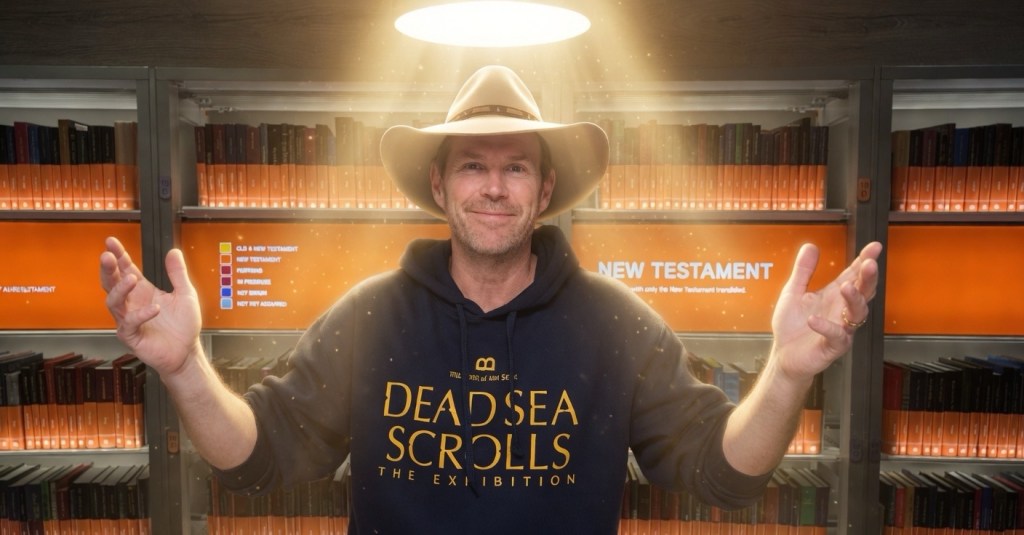
Rich Hoffman is an author, political consultant, and strategic advisor based in Cincinnati, Ohio, and the creator of The Politics of Heaven—a unique framework that connects biblical theology, ancient history, and modern power structures to explain how moral alignment and spiritual forces shape global events. Blending real-world political experience with deep research into archaeology, UFO phenomena, and suppressed historical narratives, Hoffman offers compelling commentary on topics ranging from ancient civilizations and the Dead Sea Scrolls to modern populist movements, paranormal continuity, and leadership strategy in chaotic environments. As the author of The Gunfighter’s Guide to Business and the forthcoming Politics of Heaven, he brings a grounded yet provocative voice to media discussions, supported by firsthand experiences and a cross-disciplinary approach that bridges science, history, and theology. For interviews, speaking engagements, or expert analysis, visit richhoffmanbooks.com or contact directly via phone at 513-307-5815 or email at rhoffman@richhoffmanbooks.com. If you’ve seen the movie, Disclosure Day and want to talk about it and the implications of Presidnet Trump’s UAP disclosures, let me know and we can bring some color to your coverage. https://richhoffmanbooks.com/media-inquiries-broadcast-topics-and-contact-info/?frame-nonce=ad51e7ecba I do have a firsthand UFO encounter to discuss.

