
The Conditions that Make People Poor: Bill Gates as usual, is way off the mark

In the modern discourse surrounding climate change, healthcare, and economic disparity, we often find ourselves circling the same ideological drain without ever confronting the root of the issue: how we define and address poverty. Recently, Bill Gates made headlines by walking back some of his climate change positions, suggesting that economic development must be prioritized alongside environmental goals. This echoes a more profound truth—one that Donald Trump touched on when he proposed sending healthcare payments directly to individuals rather than filtering them through bureaucratic systems. These moments reveal a fundamental tension in our society: the battle between centralized control and individual empowerment. At the heart of this tension lies a philosophical divide between those who believe in micromanaging outcomes through administrative states and those who believe in unleashing human potential through economic liberty. The former seeks to engineer fairness through redistribution, while the latter aims to cultivate prosperity by removing barriers to opportunity.

This divide is best understood through the lens of The Oz Principle, published in 1994 by Roger Connors, Tom Smith, and Craig Hickman, a widely respected business philosophy that categorizes individuals and cultures as either “above the line” or “below the line.” I love the book and its sequel, The Oz Principle Journey, which was published in 2011, many years later, offering a wealth of new ideas that utilize Wizard of Oz metaphors to articulate effective business practices and the proper social conduct of society at large.  Above-the-line thinkers are proactive, solution-oriented, and driven by positive energy. They ask, “What else can I do?” and take ownership of outcomes. Below-the-line thinkers, by contrast, dwell in a state of victimhood, blaming others and avoiding accountability. In business, cultures dominated by above-the-line thinkers thrive—they innovate, adapt, and grow. Cultures saturated with below-the-line mentalities stagnate, collapse, or become toxic. The same applies to nations. When a country fosters a culture of victimization, entitlement, and dependency, it creates systemic poverty. It’s not merely about access to resources; it’s about the mindset with which people approach life. Suppose the dominant narrative teaches individuals that they are powerless, oppressed, or owed something by the state. In that case, the result is a population that waits for handouts rather than builds solutions.

This is the trap of the administrative state, particularly as envisioned by modern leftist ideologies. The Democrat Party, increasingly driven by collectivist impulses, seeks to centralize control over healthcare, education, and economic redistribution. Their vision of “fairness” is not about equal opportunity but about equal outcomes, regardless of effort or merit. They create systems that reward victimhood and penalize initiative. Public education, once a bastion of enlightenment and upward mobility, has become a breeding ground for thought patterns that are below the line. Teachers, often radicalized by personal grievances and ideological indoctrination, pass on a worldview that prioritizes identity politics, grievance culture, and dependency over personal responsibility, excellence, and ambition. Instead of teaching Shakespeare or the principles of economics, they teach children to see themselves as oppressed, marginalized, and incapable of success without government intervention. This is not education—it’s indoctrination into failure.

As of 2025, approximately 10.1% of the global population—roughly 839 million people—live in extreme poverty, defined by the World Bank as surviving on less than $3.00 per day (2021 PPP). The burden of poverty is not evenly distributed across all individuals. Sub-Saharan Africa remains the most affected region, with 46% of its population living in extreme poverty. Within this region, Eastern and Southern Africa report rates exceeding 53%, while Western and Central Africa hover around 35.7%. In stark contrast, high-income countries and territories, such as Europe, East Asia, and North America, report poverty rates below 1%, underscoring the profound impact of economic systems and governance on wealth distribution.

The disparity in GDP per capita between economically free and administratively controlled nations is staggering. In 2025, Luxembourg leads the world with a GDP per capita of $141,080, followed by Switzerland ($111,716), Ireland ($107,243), and Singapore ($93,956). These nations consistently rank among the highest in economic freedom indices, characterized by low regulatory burdens, strong property rights, and open markets. Meanwhile, countries with heavy administrative oversight and limited economic freedom—such as Burundi, South Sudan, and the Central African Republic—report GDP per capita figures below $1,000, reflecting the economic stagnation that results from centralized control and restricted market access.

The Fraser Institute’s Economic Freedom of the World (EFW) report reveals a direct correlation between economic freedom and prosperity. Nations in the freest quartile enjoy an average income of $40,376, compared to just $5,649 in the least free quartile—a 7.1x difference. The poorest 10% in free economies earn 7.9x more than their counterparts in the least free nations. Moreover, life expectancy in free countries is 15 years longer, and infant mortality rates are 6.8x lower. The UN World Happiness Index also shows that citizens in economically free nations report life satisfaction scores two points higher on average than those in restrictive economies.  These metrics confirm that economic liberty is not just a path to wealth—it’s a foundation for human flourishing.  If you want to help people have access to wealth, teach them, and empower them to be “above the line people.”  Solution-based and to enjoy the result of that way of thinking with wealth creation, the ability to enjoy a full bank account, and the results of a task well done. 

The rise of the administrative state—defined by expansive government agencies that regulate economic activity—has been linked to sluggish growth and persistent poverty. While initially intended to address industrial complexity and social inequality, these bureaucracies often stifle innovation and delay wealth creation. The U.S. federal administrative apparatus now issues thousands of regulations annually, with the Code of Federal Regulations exceeding 185,000 pages, quadruple the size of the U.S. Code of Laws passed by Congress.  This regulatory overload disproportionately affects small businesses and low-income entrepreneurs, who face barriers to entry and limited access to capital. In contrast, countries that have adopted deregulation, sound monetary policies, and trade expansion have experienced significant reductions in poverty and increases in GDP.

The solution is not more government, more regulation, or more redistribution. The solution is to cultivate a culture of thinking above the line. This means empowering individuals to take control of their lives, make better decisions, and pursue success through effort and innovation. Capitalism, despite its imperfections, remains the most effective mechanism for lifting people out of poverty because it rewards productivity, creativity, and personal responsibility. When people have access to capital and the freedom to use it, they build wealth—not just for themselves, but for their communities and nations. The administrative state, by contrast, stifles this process. It throws up regulatory stop sticks, preventing people from even starting a lemonade stand. It confiscates wealth under the guise of fairness and redistributes it through inefficient bureaucracies that serve more to perpetuate their own existence than to solve problems. To reduce poverty, we must dismantle these barriers, reject the cult of victimization, and return to a model that celebrates personal agency, economic liberty, and the power of positive thinking. That’s how you build a society that thrives—not by managing poverty, but by eliminating the conditions that create it.  Too much “below the line thinking” creates depraved conditions that bring down all cultures.  And if you want to prevent that way of thinking, then you have to change where people are on that invisible line that we draw in the sand, above and below.  It’s not a political line, it’s one of personal responsibility.  And when you teach people to be victims, of course, you are then teaching them to be poor.  And no amount of money that you throw at them will help them if they don’t think right about how to use it. 

Rich Hoffman

Click Here to Protect Yourself with Second Call Defense https://www.secondcalldefense.org/?affiliate=20707
Modern Piracy: How Private Equity Looters Are Killing American Enterprise

In the heart of America’s industrial backbone, a quiet but devastating transformation is underway. Private equity and hedge fund takeovers of privately owned businesses are reshaping the landscape of capitalism—not through innovation or value creation, but through extraction, manipulation, and short-term profiteering. Having spent a lifetime affiliated with private ownership, I’ve witnessed firsthand the strength of entrepreneurial risk-taking, long-term stewardship, and the pride that comes with building something meaningful. But now, I find myself on the front lines of a hostile shift—watching a company in West Chester, Ohio, where I’ve long been involved, fall prey to the very forces that threaten the integrity of American enterprise. These financial entities, often cloaked in the language of capitalism, are anything but capitalist in nature. Their methods—leasebacks, dividend recapitalizations, strategic bankruptcies, and forced partnerships—are not tools of growth but instruments of plunder. They are not builders; they are pirates in suits, looting the value created by others and leaving behind hollowed-out shells of once-thriving companies.  This isn’t capitalism—it’s cannibalism. Private equity firms have become modern-day pirates, looting companies and leaving wreckage in their wake. From my personal experience in dealing with what I would consider an industry full of really stupid people, I intend to expose their tactics, highlight real-world consequences, and draw parallels to Atlas Shrugged’s prophetic warnings.  While the honeymoon is over for significant political change, it’s now time to do the real work and be honest about what we see, and determine if, as a culture, we dare to do what we need to.

The tactics used by private equity firms are as predictable as they are destructive. Leasebacks strip companies of their real estate assets, forcing them into long-term leases that drain future earnings and profits. Dividend recaps saddle businesses with debt to pay out investors, often exceeding the original equity investment. Strategic bankruptcies are engineered not from mismanagement but from deliberate overleveraging, allowing firms to walk away with profits while workers and communities bear the cost. Forced partnerships and roll-ups dilute control and homogenize operations, eroding brand identity and operational efficiency. Tax avoidance schemes shift liabilities away from investors and onto the companies themselves, while layoffs, price hikes, and quality cuts are implemented to fund the looting behavior. These are not isolated incidents—they are systemic. Brands like Toys ‘ R ‘ Us, Friendly’s Ice Cream, RadioShack, and countless others have been gutted by these practices. The result is a managed decline, not a capitalist renaissance. It’s a form of economic socialism, where wealth is redistributed—not to people with low incomes, but to the politically connected elite who manipulate the system for personal gain.

This phenomenon is not just economic—it’s deeply cultural. The people behind these financial maneuvers often hail from urban centers like New York, where they assume superiority over the so-called flyover states that actually produce the goods, labor, and logistics that drive the economy. They view the Midwest as backward, failing to grasp the value of raw materials, highway interchanges, and the human capital that exists outside their echo chambers. Their arrogance is matched only by their ignorance. They are not deep thinkers, nor are they builders. They are short-sighted opportunists who measure success by the size of their boats, the exclusivity of their golf clubs, and the social currency of their wealth. This mindset is perfectly captured in Ayn Rand’s Atlas Shrugged, where Lillian Rearden scoffs at the bracelet made from her husband’s revolutionary steel—not because it lacks beauty, but because it lacks social status. She is the embodiment of parasitic elitism, living off the efforts of others without appreciation. Today’s private equity managers are Lillian Reardons—dismissive of innovation, obsessed with optics, and blind to the value of creation. They destroy what they do not understand, and they do so with the full complicity of a political system that feeds off their donations and influence. 

The Rise of Private Equity

Private equity emerged in the 1980s during the leveraged buyout boom. Initially marketed as a way to unlock value, it quickly devolved into a system of extraction. Firms like KKR pioneered debt-fueled acquisitions, setting the stage for decades of corporate cannibalism.

The Playbook of Plunder

  • Sale-Leasebacks: Selling real estate to raise cash, then leasing it back at inflated rates.
  • Dividend Recaps: Loading companies with debt to pay investors massive dividends.
  • Strategic Bankruptcies: Using bankruptcy as a tool to shed obligations while owners profit.
  • Roll-Ups: Forcing mergers that destroy brand identity and operational efficiency.
  • Tax Schemes: Exploiting carried interest loopholes and offshore havens.

Mainstream Brand Casualties

  • Toys ‘R’ Us: Acquired by Bain Capital and KKR, saddled with $5B debt. Bankruptcy wiped out 33,000 jobs.
  • Sears & Kmart: Eddie Lampert’s hedge fund stripped assets, sold prime real estate, hollowed out iconic brands.
  • J.Crew: Leveraged to pay dividends, collapsed during COVID.
  • Payless ShoeSource: PE-backed buyout led to liquidation and 16,000 job losses.
  • Gymboree: Multiple bankruptcies under PE ownership.
  • RadioShack & Pier 1 Imports: Victims of debt-driven roll-ups.
  • Healthcare: Steward Health Care cut staff, and ER mortality rose 13.4%.

Atlas Shrugged Parallels

Hank Rearden represents builders—innovators who create value. James Taggart and Orren Boyle symbolize individuals who exploit systems for personal gain. Today’s private equity firms are Taggart incarnate: thriving on the virtue of producers while dismantling their creations. This is Lillian Rearden syndrome—obsession with optics over substance.

The Cultural Fallout

Communities hollowed out. Factories shuttered. Innovation stifled. From West Chester to Wichita, towns lose their lifeblood as PE firms chase short-term gains. Quality declines, prices rise, and workers bear the brunt of greed.

The Data Doesn’t Lie

  • 56% of large bankruptcies in 2024 were PE-backed despite only 6.5% of GDP.
  • $80.4B in dividend recaps in one year.
  • ER deaths up 13.4% post-acquisition.
  • Tens of thousands of layoffs annually.

Regional Devastation

Ohio’s manufacturing belt gutted by PE roll-ups. Texas hospitals closing under Cerberus Capital. California retail chains liquidated for real estate flips. Each region tells the same story: extraction over creation.

Solutions & Call to Action

  1. Tax Reform: End carried interest loopholes.
  2. Bankruptcy Oversight: Stop strategic bankruptcies.
  3. Ownership Incentives: Reward long-term stewardship.
  4. Transparency: Mandate disclosure of debt and payouts.
  5. Cultural Shift: Celebrate builders, shame looters.

Private equity is not capitalism—it’s piracy. Unless we act, America becomes a ghost ship. Builders must rise, looters must fall. Draw the line. Stop the plunder.  If we are serious about restoring economic integrity and making America great again, we must confront this modern piracy head-on. That means protecting private ownership, incentivizing long-term stewardship, and reforming the laws that allow financial looters to operate unchecked. We need tax reform that eliminates carried interest loopholes, bankruptcy oversight that prevents strategic exits, and transparency requirements that expose the true nature of these deals. We must elevate above-the-line thinking—solution-based, accountable, and proactive—over the victim-based, reactive mindset that dominates our administrative state. The Oz Principle teaches us that cultures thrive when they are led by people who ask, “What else can I do?” rather than “Who can I blame?” Private equity firms operate below the line, dragging down the businesses they acquire and the communities they affect. If we want a thriving economy, we must draw a line in the sand. We must stop the plunder, protect the creators, and reject the parasites. Only then can we preserve the legacy of American enterprise and ensure that the companies built by hard-working families are not sacrificed on the altar of short-term greed.

Rich Hoffman

Click Here to Protect Yourself with Second Call Defense https://www.secondcalldefense.org/?affiliate=20707

The Future of Healthcare Is Regenerative: Repulicans need to redefine the discussion for 2028 and beyond

The American healthcare system is broken. Not just cracked or inefficient—broken. It’s a bloated, bureaucratic monstrosity built not to heal, but to manage decline. It’s a system designed to keep people sick just long enough to extract maximum profit from their suffering. And the worst part? It’s been institutionalized through policies like Obamacare, which entrenched a model that props up insurance companies, pharmaceutical giants, and hospital unions at the expense of innovation, affordability, and actual healing.

Let’s be clear: the Affordable Care Act (ACA) didn’t fix healthcare. It expanded coverage, yes, but it did so by inflating costs and embedding a rigid structure that rewards inefficiency. Since its implementation in 2010, the uninsured rate dropped from 16.3% to 8%—a 51% improvement. But premiums for employer-sponsored family plans surged from $13,770 to $22,463—a 63% increase. Deductibles rose 67%, and federal spending on healthcare ballooned from $814 billion to $1.5 trillion. That’s not reform. That’s a transfer of wealth from taxpayers to insurance companies.  A lot of money was made off the healthcare industry, but it did not improve people’s lives, which was the whole debate after the 2025 government shutdown.  Republicans really need to take away the emotional message that Democrats tried to exploit for a system built on pure insanity.

The ACA’s economic impact is staggering. Over the decade from 2023 to 2032, the Congressional Budget Office estimates it will reduce the deficit by 0.5% of GDP annually, totaling $1.6 trillion. But that reduction comes with a catch: it’s built on a model that sustains high costs and low innovation. It’s a system where a basic CAT scan can cost thousands, not because of the technology, but because of the insurance and administrative overhead baked into every transaction.  The system is built on taking advantage of sick people who can’t afford the diligence of skepticism.  The worst kind of exploitation.

The future of healthcare is regenerative medicine. It’s not about managing decline—it’s about reversing it. It’s about healing, restoring, and optimizing the human body using stem cells, gene therapy, and cellular regeneration. It’s about moving beyond the pharmaceutical treadmill and embracing treatments that actually work.  For instance, in placentas, which hospitals throw away after every birth, there are a lot of stem cells that can save lives and dramatically improve healthcare.  Yet, you didn’t hear Democrats saying anything like this during the shutdown, because for them, it’s all about the scam of healthcare costs and padding the pockets of their donors. 

Consider the case of Ohio State Senator George Lang. Diagnosed with stage four colon cancer—a death sentence under traditional protocols—Lang refused to accept the managed decline model. He sought out regenerative treatments, including stem cell therapy, and spent a small fortune traveling the globe to access care that should be available in every Walgreens in America. Today, his tumor is shrinking. He’s not dying—he’s healing. And he’s living proof that regenerative medicine isn’t science fiction. It’s science fact.

Stem cell therapy is already showing success rates of 60–70% in blood cancers and up to 80% in autoimmune and joint conditions. The National Cancer Institute confirms that stem cell transplants are effective in treating leukemia, lymphoma, multiple myeloma, and other cancers. Yet these treatments remain out of reach for most Americans, locked behind regulatory barriers and insurance exclusions.

Why? Because the current system isn’t built to accommodate healing. It’s built to perpetuate illness. Pharmaceutical companies don’t profit from cures—they profit from chronic conditions. Insurance companies don’t thrive on competition—they thrive on predictable, inflated costs. Hospitals don’t want disruption—they want stability, even if it means stagnation.

Medicaid fraud alone costs the U.S. upwards of $100 billion annually. That’s not just waste—it’s theft. It’s money that could be funding regenerative research, subsidizing stem cell therapies, and building a decentralized, competitive healthcare model that puts patients first.

The regenerative medicine market is exploding globally. It’s projected to grow from $24.88 billion in 2025 to $148.42 billion by 2033—a compound annual growth rate of 25.09%. Over 3,100 companies are driving innovation, backed by $7.11 billion in investments from firms like Bayer, Merck, and Zimmer Biomet. The U.S. leads in patents, with over 430 filed in 2025 alone.

And yet, the FDA and insurance industry lag behind. Treatments that could save lives are stuck in clinical trial purgatory or only available overseas. Ivermectin, for example, is showing promise in cancer treatment by disrupting cancer stem cells and enhancing immune response. But it’s not available as a mainstream option because it threatens the status quo.

Republicans have a strategic opportunity here. Stop defending the old model. Stop arguing over the merits of Obamacare. It’s a dead system. Instead, embrace the future. Make regenerative medicine a campaign pillar. Show America that healing is possible—and affordable—when you unleash market forces and innovation.

JD Vance, as he gears up for 2028, should take note. This is a winning issue. It’s pro-life, pro-family, pro-freedom. It’s about giving people hope, not just coverage. It’s about making healthcare affordable by making it effective. It’s about taking away the emotional leverage Democrats have wielded for decades and replacing it with real solutions.

The insurance industry will adapt. They’ll have to. Just like energy is shifting toward decentralization and personal autonomy, healthcare must follow. The grid is outdated. The classroom is outdated. And the hospital is outdated. It’s time to reimagine the entire infrastructure.

Let’s build a system where every birth provides stem cells that can heal. Let’s make regenerative therapies as common as antibiotics. Let’s stop throwing billions at managed decline and start investing in managed recovery.

George Lang’s story is just the beginning. There are thousands more waiting for their chance—not just to survive, but to thrive. The science is here. The market is ready. All we need is the political will to make it happen.

Republicans, take the lead. Be the party of healing. Be the party of innovation. Be the party that ends the racket and restores the promise of American medicine.  Ohio is uniquely positioned to lead the charge in this transformation. Senator George Lang, drawing from his personal battle with stage four cancer, is preparing to introduce legislation that would make ivermectin and other emerging precancer treatments more widely available. His experience—traveling the world to access regenerative therapies that ultimately reversed his terminal diagnosis—has galvanized his commitment to reform.

This initiative gains even more momentum with the potential governorship of Vivek Ramaswamy, a biotech entrepreneur who understands the science and the stakes. Under his leadership, Ohio could become a national model for healthcare innovation, breaking the stranglehold of pharmaceutical monopolies and insurance cartels. Imagine a future where ivermectin, stem cells, and other regenerative treatments are available at your local Walgreens—not just in elite clinics overseas.

The COVID-19 pandemic exposed the fragility and politicization of our healthcare system. It also revealed untapped potential in treatments like ivermectin, which showed promise not only in viral suppression but also in inhibiting cancer cell replication. These discoveries, once dismissed, are now gaining traction among researchers and legislators alike. Lang’s proposed legislation would open the door to these therapies, allowing patients to access life-saving options before their conditions become terminal.

This is not just about Ohio. It’s about setting a precedent. If Ohio can pass laws that prioritize healing over decline, other states will follow. And if Republicans embrace this vision nationally, they can redefine the healthcare debate—away from coverage quotas and toward actual cures. It’s a chance to reframe the narrative, reclaim the moral high ground, and offer a future where healthcare is not a burden, but a blessing.  And, it would allow Republicans to take away from Democrats the moral argument of healthcare funding.  And once that is done, the Democrats would have nothing to stand on, politically. 

Rich Hoffman

Click Here to Protect Yourself with Second Call Defense https://www.secondcalldefense.org/?affiliate=20707
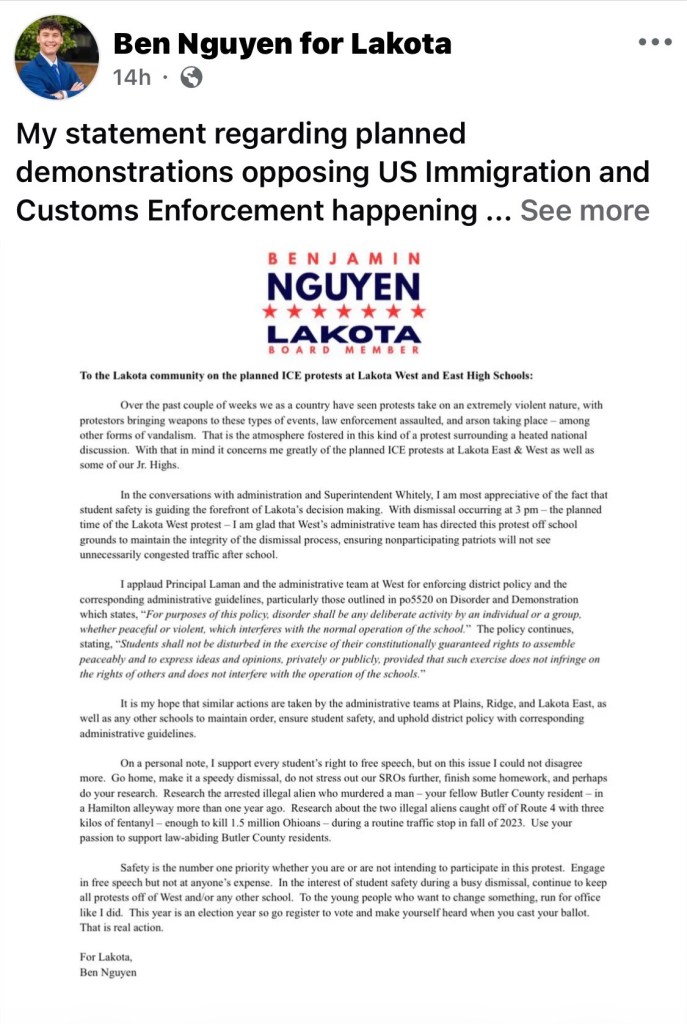
Congratulations to Ben Nguyen To the Lakota School Board: What would it take for me to support public schools

There’s a lot to say about the recent Lakota school board election, and I want to start by congratulating Ben Nguyen on his historic win. At just 18 years old, he’s now the youngest person ever elected to the Lakota Board of Education, and he achieved this with a clear, conservative message that resonated with voters in Butler County. Nguyen earned 18.61% of the vote, joining incumbent Kelley Casper and newcomer Alex Argo on the five-member board. His victory wasn’t just symbolic—it was a direct response to the district’s failed $506 million levy, which voters rejected by a 61% margin. That levy, which would have demolished nine buildings and built four new ones, was a bloated attempt to reinvent the district with taxpayer money. Nguyen’s campaign stood firmly against it, and his win signals that the community is tired of being asked to fund ideological experiments disguised as infrastructure upgrades.  However, there is much more to all this.  The questions that arose during this campaign and election season, in general, concern my support of Lakota schools, which school board member Doug Horton brought up in a video he posted just before the election.  In short, if Lakota management wants to know what it would take to get my support, I would say to them to stop destroying the kind of school board members that I support.  And I would be a lot less critical.  But when the school board pushes away good people and lobbies to keep the kind of people who glaze over sex scandals, horrendous Democrat strategies in the school to teach young people, and ask for tax increases, especially the most expensive in the history of Ohio, then I’m going to be very critical, and I will provide that criticism in voluminous detail so much so, that the anti tax movement in Butler County will continue to grow, as it has over these years since 2013, and even earlier.

Ben Nguyen is a start, not a solution to what I would call a detrimental school board full of liberal losers. The real problem is systemic. For years, we’ve seen conservative school board members pushed out by coordinated efforts from union-backed liberals and their media allies. Darbi Boddy is a prime example. Elected in 2021, she was removed in 2024 after a civil protection order filed by fellow board member Isaac Adi—once her political ally—barred her from attending meetings for over 90 days. The board declared her absence “insufficient,” and just like that, she was gone. Her removal wasn’t about functionality—it was a matter of political theater. Boddy had challenged DEI programs, opposed transgender policies, and criticized the district’s hiring practices. That made her a target. The board censured her, demanded her resignation, and ultimately replaced her with Christina French, a longtime district insider. It’s a pattern: elect a conservative, stir up controversy, isolate them, and replace them with someone more “manageable.”  I know all the characters of that conservative board very well, and I know what was done to pit them against each other, and when a school system plays that game, and expects to get away with it, well, they have another thing coming.  I’m not in the business of putting up with that, and I never will be.  I was in the district long before many of these people were even born, and I will be around long after they all leave to buy condos in Florida to escape the high taxes they leave behind.  Darbi is just one example of this kind of radical school board behavior; therefore, when asked what it would take to win my support for Lakota schools, the answer is easy.  Don’t run off school board members whom I support.  Radicalism can go both ways, ladies and gentlemen. 

This is why I’ve been so critical of Lakota Schools over the years. It’s not that I hate education—I would say my track record shows where my heart is; there are few people anywhere who love education more than I do.  I respect people who read books and work to sharpen and utilize their intelligence.  I do not trust institutionalized education because it’s often populated by less-than-great individuals, which is reflected directly in the product. And with public schools, I don’t respect the system that’s been built on a century-old foundation of progressive ideology. Public schools, as they exist today, are more about managing perception than delivering results. When you fill school boards with people like Julie Shaffer and Kelley Casper—both endorsed by the Butler County Democrat Party—you get a culture of spending, secrecy, and suppression. They don’t want scrutiny because scrutiny threatens their funding. They don’t wish to be judged because judgment exposes their failures. And when scandals happen—whether it’s inappropriate teacher behavior, administrative misconduct, or ideological overreach—they bury it. That’s why I created my own media platform: to report what they won’t. If you want to know what’s really going on in Lakota, you won’t find it in the district’s press releases. You’ll find it in the stories they try to silence.

So here’s the deal: I’ll support Lakota when Lakota supports the community. That means electing people like Ben Nguyen—people who understand the value of education without being beholden to the liberal establishment. It means rejecting levies that ask for hundreds of millions without accountability. It means standing up for parents, taxpayers, and students—not just the union’s comfort level of lazy labor desires, such as short workdays, fewer students to teach, summers off, and high pay for doing very little. I’ve seen good people try to make a difference on the board, only to be run off by political manipulation; it’s all well-documented. I’m encouraged that Nguyen, with his sharp mind and diplomatic personality, can navigate those waters and bring real change. If we can recruit two or three more like him, we might finally see a board that genuinely reflects the community’s values.  But given the election cycles, it’s going to take a while unless we push off some of these losers the way they have pushed away our conservatives, like Darbi, and Todd Parnell—even Lynda O’Connor.  And with Lynda, I know exactly how that game unfolded; she became so deeply involved in the liberal Lakota movement that she essentially had to adopt its values to attend the meetings.  I don’t think strong personalities like Ben Nguyen will be pushed away, because he has that extra gear that is so needed in these kinds of controversial political environments.  He, like Vivek Ramaswamy, who will be Ohio’s next governor, is part of a new generation that will play these old political games better than they have been played in the past.  We have tried to play it straight with these current school board members, and all they have given us are Antifa like union tactics of left-wing radicalism, and many people in the district simply aren’t going to put up with it.  I’m certainly not going to, under any conditions.  And until there are more options on the school board, I’ll continue to call it as I see it. If you want me to stop criticizing Lakota, stop putting bad people in charge. Put in people I can respect.  But asking, even demanding respect when Lakota hasn’t earned it, is a ridiculous proposition that only losers would even think of.  And until there are more people like Ben Nguyen involved in Lakota schools, I will criticize them extensively because they deserve it.

Rich Hoffman

Click Here to Protect Yourself with Second Call Defense https://www.secondcalldefense.org/?affiliate=20707

The Heart to Take Away Hearts: Taking a stand against mediocrity in Ohio

The 2025 redistricting process in Ohio has emerged as a pivotal moment in the broader national battle over congressional control, with implications that stretch far beyond the Buckeye State. On October 31, the Ohio Redistricting Commission unanimously approved a new congressional map that shifts the balance of power decisively toward Republicans, giving them a projected 12-3 advantage across the state’s 15 districts. This outcome was the result of a tense, behind-the-scenes negotiation between Republican and Democratic leaders, including Governor Mike DeWine, Secretary of State Frank LaRose, Auditor Keith Faber, and legislative appointees like Rep. Brian Stewart and Sen. Jane Timken. Democrats on the commission—Senate Minority Leader Nickie Antonio and House Minority Leader Dani Isaacsohn—reluctantly supported the map, citing the threat of a more extreme 13-2 GOP-dominated map if negotiations failed. The new map redraws key battlegrounds: Rep. Greg Landsman’s OH-1 district now leans Republican (54%-47%), Marcy Kaptur’s OH-9 shifts to a 54.5%-45.5% GOP tilt, while Emilia Sykes’ OH-13 becomes slightly more Democratic at 52%-48%. These changes reflect a broader national trend, where Republican-led states, such as Texas, Missouri, and North Carolina, have aggressively redrawn maps to consolidate power, often under direct encouragement from President Donald Trump. Ohio’s redistricting, however, was not entirely unilateral; constitutional reforms passed in 2015 and 2018 required bipartisan approval for maps to remain valid for a full decade. The compromise avoided a costly referendum that could have frozen the existing 10-5 map and delayed the 2026 primaries, potentially costing taxpayers $50 million.

The political personalities behind Ohio’s redistricting drama reflect the ideological fault lines within the Republican Party itself. Senator Bernie Moreno, a staunch Trump ally, predicted early on that Ohio Republicans would push for a map that reduced Democrats to just two seats. His comments echoed the sentiments of Rep. Warren Davidson and State Senator George Lang, both of whom have expressed frustration with what they perceive as excessive compromise with Democrats. Davidson’s own district, OH-8, has long been a textbook case of gerrymandering, stretching from Troy to majority-minority communities in Hamilton County, effectively diluting Democratic votes. Lang, known for his “business-first” approach, has remained relatively quiet on the specifics of redistricting but is widely seen as aligned with the GOP’s strategic goals. Secretary of State Frank LaRose, meanwhile, played a key role in supporting the bipartisan map, arguing that it reflected Ohio’s political geography and avoided a chaotic referendum fight backed by “dark money special interests”. His stance, however, has drawn criticism from grassroots activists and legal watchdogs, many of whom argue that the map remains a gerrymandered artifact of one-party rule. Former Attorney General Eric Holder, chair of the National Democratic Redistricting Committee, called the map “a gerrymander placed on top of another gerrymander,” though he acknowledged it preserved Democratic incumbents’ ability to compete.  And when you get a compliment from Eric Holder, you are doing the wrong thing for the wrong reasons.

Nationally, Ohio’s redistricting fits into a broader pattern of mid-decade map manipulation driven by Trump’s directive to Republican governors and legislatures. Texas led the charge, redrawing its map to flip five Democratic seats, followed by Missouri and North Carolina, each adding one GOP-leaning district. Ohio’s shift adds two more Republican-leaning districts to the national tally, bringing the potential GOP gain to nine seats before the 2026 midterms. Democrats have responded in kind: California passed Proposition 50, a ballot measure allowing the legislature to redraw its map to add five Democratic seats, countering Texas’s move. Virginia and Illinois are also considering redistricting maneuvers, while states like Indiana and Florida have begun legislative discussions under pressure from Trump and Vice President J.D. Vance. The redistricting arms race has triggered lawsuits, referendums, and constitutional amendments across the country, with the Supreme Court’s upcoming ruling on the Voting Rights Act poised to reshape the landscape further. In this context, Ohio’s 12-3 map is seen by many Republicans as a strategic win, while Democrats view it as a defensive maneuver to preserve viability in key districts. The bipartisan nature of Ohio’s deal, although rare, underscores the high stakes and complex trade-offs involved in redistricting under the Trump-era political landscape, which is a good thing.  The Trump White House understands the situation.

Ultimately, Ohio’s redistricting saga reveals the tension between political pragmatism and ideological purity. Democrats like Dani Isaacsohn and Nickie Antonio have defended their votes as necessary to preserve competitive districts and avoid a worse outcome, even as activists accuse them of capitulation. Republicans, meanwhile, remain divided between hardliners like Moreno and Davidson, who favor aggressive gerrymandering, and institutionalists like DeWine and LaRose, who prioritize stability and legal defensibility. The map itself, while favoring Republicans, does not guarantee outcomes; Democrats have won in GOP-leaning districts before, and the 2026 midterms will test the durability of these new boundaries. What’s clear is that redistricting has become a central battlefield in the fight for congressional control, with Ohio playing a critical role in shaping the national narrative. As Trump’s second term unfolds, and as Democrats mobilize to counteract GOP gains, the redistricting wars will continue to define the contours of American democracy. Whether Ohio’s compromise map proves to be a tactical success or a strategic misstep remains to be seen—but it has already become a case study in the politics of power, representation, and the enduring struggle between exceptionalism and mediocrity.

The fundamental flaw in compromising with Democrats during redistricting—especially under the guise of fairness—is that it inadvertently empowers the very mediocrity that exceptional societies must resist. While it may appear noble or politically sophisticated to preserve all viewpoints and accommodate ideological diversity, the reality is that mediocrity, when institutionalized, becomes a corrosive force. It stifles innovation, suppresses excellence, and erodes the competitive spirit that drives societal advancement. Democrats, often aligned with collectivist ideologies like socialism and Marxism, have historically championed policies that prioritize equality of outcome over merit-based achievement. In doing so, they mask mediocrity as compassion, and fairness becomes a Trojan horse for cultural stagnation. When Republicans yield ground in the name of bipartisanship, they risk legitimizing this mediocrity and weakening the foundations of a high-performing society. Authentic leadership demands the courage to elevate exceptionalism—not dilute it. Redistricting is not merely a cartographic exercise; it is a strategic opportunity to shape the future. If Republicans fail to assert dominance when the political terrain allows it, they may find themselves governed by the very forces they sought to contain. The Ohio map, while a tactical win, reflects a deeper philosophical hesitation—a reluctance to confront mediocrity head-on. And in that hesitation lies the danger of losing the war for cultural and political excellence.  So, while many think it was good to play nice with Democrats, the danger lies in compromise when standards are set and social norms are established.  A failure to take away the heart of mediocrity in a society advancing for greatness might appear to have a merit of its own.  However, in the context of achievement, it undermines the very foundation of excellence we strive for.  And in going forward with these mechanisms of government strategy, when you get a chance to put your foot on the throat of the enemy and put them out of existence, we should do it. Playing fair with Democrats if it brings down your entire society is not a good thing.  It might make those lunches with colleagues more approachable, less tense.  However, by letting mediocrity prevail over logic, nobody is enjoying a better life under the influence of compromise.

Rich Hoffman

Click Here to Protect Yourself with Second Call Defense https://www.secondcalldefense.org/?affiliate=20707

Bill Gates Walks Back Climate Alarmism: A Reckoning Years in the Making

Even if Trump is playing nice with Bill Gates these days, I’m still firmly in the camp where the Microsoft founder needs to be in jail for all that he did.  I remember it well, and I reported it here in a way that no other news outlet in the world did at the time, as it was happening.  Even Rush Limbaugh was slow to see what was happening.  But I said that it was a scam the day that Bill Gates and Dr. Fauci walked into the Oval Office and told President Trump to shut down the economy in the United States, which he did for a few weeks.  But by then, the damage had been done, and lots of very liberal governors of states had taken the sucker bait and followed, and it was really terrible.  Bill Gates needs to pay for his very active role in creating that crisis.  Created I say because we know that Covid was created by gain of function research to jump to hosts in ways that nature does not provide, so it was a bioweapon that had roots running into the DOD that Dr. Fauci knew all about and a lot of people died as a result of this virus that was created in a Chinese lab and let loose in the world on purpose, not by accident.  All the evidence points in that direction, and Bill Gates was one of the key insiders involved in the whole tragedy.  Few figures have polarized public opinion in the 21st century like Bill Gates. Once hailed as a visionary technologist and philanthropist, Gates’ role during the COVID-19 pandemic and his aggressive climate activism have drawn intense scrutiny. However, politics have changed significantly over the last five years, and now Gates realizes he has been excluded from almost everything, and he wants to get back in.  So he has been groveling to President Trump and is starting to walk back his ridiculous climate change proposals, which is quite extraordinary considering his level of tyrannical commitment.  He tried to rearrange our entire society.  So any walk back from him is astonishing, and very telling.  Now, in late 2025, Gates has released a memo that marks a significant shift in his stance on climate change—one that critics argue is a strategic retreat rather than a genuine change of heart.

In October 2025, Gates published a 17-page memo ahead of the COP30 climate summit in Brazil. In it, he argued that climate change, while profound, is not the apocalyptic threat many activists claim. He emphasized that:

• Climate change “will not lead to humanity’s demise.”

• The focus should shift from temperature targets to improving human welfare.

• Investments should prioritize poverty, disease, and economic development over emissions reduction

This pivot was immediately seized upon by climate skeptics and political figures, including President Donald Trump, who declared on Truth Social:

“I (WE!) just won the War on the Climate Change Hoax. Bill Gates has finally admitted that he was completely WRONG on the issue.”

Despite the celebratory tone from skeptics, Gates pushed back, calling Trump’s interpretation a “gigantic misreading.” He reaffirmed his belief that climate change is a serious issue, but argued that the “doomsday outlook” has led to the misallocation of resources.

“Every tenth of a degree of heating that we prevent is hugely beneficial because a stable climate makes it easier to improve people’s lives.”

Gates’ reputation suffered a significant blow during the COVID-19 pandemic. His advocacy for lockdowns, vaccine mandates, and digital surveillance tools, such as Microsoft Teams, was seen by many as overreach. Critics argue that Gates, alongside Dr. Anthony Fauci, played a central role in shaping a global response that devastated economies and civil liberties.

• Gates was accused of using the pandemic to push a technocratic agenda.

• His ties to gain-of-function research and vaccine monopolies raised ethical concerns.

• Public trust in Gates plummeted, with many calling for accountability and even criminal charges.

Climate Change: From Alarmism to Adaptation

Gates’ climate activism has long centered on achieving net-zero emissions. His 2021 book How to Avoid a Climate Disaster laid out a roadmap for decarbonization. But in 2025, Gates now argues that:

• The worst-case scenarios are no longer plausible.

• Technological innovation has already begun reducing emissions.

• Economic growth and health infrastructure are better defenses against climate impacts.

This shift aligns more closely with Elon Musk’s pragmatic approach to climate and energy—focusing on innovation rather than regulation.

Gates’ recent dinner with President Trump lasted over three hours and reportedly focused on global health, innovation, and pandemic preparedness.  While Gates has criticized Trump’s cuts to USAID, he appears to be recalibrating his public posture to remain relevant in a political landscape increasingly dominated by populist skepticism of climate alarmism.

One of the most striking elements of Gates’ memo is his implicit endorsement of adaptation over mitigation. He suggests that humanity has the tools to thrive—even in a warming world. This echoes broader conversations about terraforming Mars and using technology to reshape environments, rather than surrendering to climate fatalism.

Critics argue that Gates’ technocratic worldview—where unelected billionaires shape global policy—poses a threat to democracy. The COVID response and climate mandates are seen as examples of how centralized control can override individual freedoms.

“You can’t let tyrants rule. You have to have market pressures and competitive elections to check power.” Rich Hoffman

Bill Gates’ pivot on climate change is not just a policy shift—it’s a reckoning. It reflects the limits of technocratic influence and the resilience of democratic accountability. Whether Gates is genuinely rethinking his views or simply repositioning himself politically, the public response underscores a broader demand for transparency, humility, and checks on power.  If we had not elected Trump and put him back in office, people like Bill Gates would be running the world right now.  A lot of hard lessons were learned, and we are a lot better off now than we were. Trump is the kind of person who can keep everyone close, allowing him to negotiate effectively with them.  I think it’s very appropriate that President Trump is taking credit for this issue with Gates.  He could do a lot more to embarrass the techno geek.  However, this is a powerful position for Gates and the Climate Change hoax in general.  The world is not coming to an end because of artificial intelligence.  We could terraform the entire planet if we want to, as we are planning to do in other places around the solar system as we speak.  For Gates, it was always about control.  He wanted to control the management of the human race through techno tyranny, and he played President Trump as a sucker who trusted him during his first term.  So Gates has a lot of embarrassment coming.  And I would argue that there would be a lot of jail time.  However, his admission is a significant development and a major shift in the world toward a much stronger economy.  The walls on this ridiculous control mechanism are coming down, and people like Gates have lost power because of our free elections in America.  That’s why managing elections is so important; you can’t trust anybody to do anything right.  And if you don’t have secure polls or a way to elect someone like Trump to office, and Bill Gates clearly didn’t think that such a thing was possible, and that he’d get away with everything because he had enough money to insulate himself from that grim discovery, then these people will always threaten the entire human race.  In this case, due to the Trump election, we dodged a major catastrophe, and we should feel pretty good about Bill Gates walking back his previous statements.

Rich Hoffman

Click Here to Protect Yourself with Second Call Defense https://www.secondcalldefense.org/?affiliate=20707

I Have Written Over 8.1 Million Words Dedicated to Justice: Jack Smith needs more than jail

In the early 2010s, I found myself at a crossroads. I had spent years immersed in creative pursuits — writing screenplays, attending film festivals, and building a career in the entertainment industry. But something wasn’t sitting right. The characters I wrote about were fighting for justice, standing up against corruption, and defending the values of liberty and freedom. I realized that fiction wasn’t enough. The world needed real people to stand up and fight — not just stories. That realization led me to the Liberty Township Tea Party in Butler County, Ohio, where I began applying my skills to political activism.

I produced short videos on the 10th Amendment and illegal immigration — modest productions with a simple camera, aimed at educating and inspiring local citizens. These weren’t viral hits or high-budget documentaries. They were grassroots efforts aimed at sparking conversation and defending constitutional principles. But even these small acts of civic engagement drew the attention of powerful forces. The IRS, under Lois Lerner’s direction, targeted our Tea Party group, and I was swept into a campaign of intimidation and scrutiny. That moment changed everything. I abandoned my entertainment ambitions and committed myself fully to political writing and activism.  And looming in the background of the Lois Lerner activism was Jack Smith.

Since that turning point, I’ve written over 1200 words a day — every day — for more than 15 years. That’s millions of words, thousands of articles, and countless hours spent documenting, analyzing, and challenging the misuse of government power. My blog, Overmanwarrior’s Wisdom, became a platform for truth-telling, and my voice joined a chorus of others who refused to be silenced. I didn’t just write about politics — I lived it. I used my media connections to amplify the message, appearing on the radio and television, and producing daily videos to keep the conversation alive.  Since 2010, I’ve written more than 6.9 million words from daily writing alone. Additionally, I’ve authored three full-length books, contributing an additional 210,000 words, and published hundreds of periodical articles, totaling nearly 1 million more. Altogether, my body of work exceeds 8.1 million words, a testament to the discipline, passion, and relentless drive that fuel my efforts to challenge government overreach and defend the principles of representative government.  And when you do that much work, that’s why I’m able these days to speak on so many topics differently than anybody else does, anywhere in media, on any network, radio show, or podcast.

The catalyst for this relentless output was the abuse I experienced at the hands of the IRS and the Department of Justice — specifically under the influence of prosecutor Jack Smith. Smith, who later became a central figure in high-profile investigations, had long been part of a system that weaponized law enforcement against political dissent. His role in the IRS scandal, along with his broader pattern of targeting conservative voices, revealed a disturbing trend: the rise of a fourth branch of government, unaccountable to voters and hostile to the representative efforts of self-government.

Jack Smith’s actions weren’t isolated. They were part of a larger ecosystem of government overreach, where agencies like the FBI and DOJ operated with impunity. From spying on senators to leveraging investigations for political gain, these institutions strayed far from their constitutional mandates. The goal wasn’t justice — it was control. Figures like Letitia James in New York and James Clapper in the intelligence community, among others, followed similar paths, using their offices to suppress opposition and manipulate public perception.

This isn’t just about Donald Trump. It’s about every citizen who dares to speak out, organize, or challenge the status quo. Trump’s rise in 2015 and 2016 wasn’t a fluke — it was a response to years of systemic abuse. Americans saw the infection beneath the surface, and Trump pulled the scab off. What followed was a reckoning. The prosecutions, the media attacks, the relentless investigations — all of it was designed to punish dissent and preserve the power of entrenched elites. But it backfired. It awakened a movement that refuses to back down.

I’ve never been one to seek conflict, but I’ve always stood my ground. Whether facing bullies on the playground or bureaucrats in Washington, I don’t tolerate intimidation. Jack Smith and Lois Lerner made the mistake of targeting me — and I’ve spent the last decade making sure their actions don’t go unanswered. I’m not alone. Millions of Americans have joined this fight, demanding accountability, transparency, and a return to constitutional governance.

The pursuit of justice is finally catching up. Smith, James, Clapper — they’re all facing scrutiny, and rightly so. This isn’t about revenge. It’s about restoring trust in our institutions and sending a message that abuse of power will not be tolerated. I’ll continue writing, filming, and speaking out — not because I enjoy conflict, but because I believe in the promise of America. We are a nation of laws, not of men. And when those laws are twisted to serve political ends, it’s our duty to resist.  And in my case, it’s not just to lash back, but to hold the wrongdoers to unforgivable scrutiny and to destroy the lives of the perpetrators because of what they did.  I learned in those days of 2010 that you don’t fight people like this on turf they control, which is the courtrooms, with lawyers in their pocket, and judges they play golf with.  A system they built from the ground up to create terror among an unsuspecting population prone to blind trust.  I turned to writing because many of them are too dumb to have thoughts of their own, and they can’t defend an expanse of thoughtful debate.  At that point, their actions fall apart very quickly once people can scrutinize their efforts in relation to the discussion. 

So my method has been very effective.  Millions and millions of words are doing that work on my behalf all hours of the day, day in and day out, to all who care to contemplate questioning the system that people like Jack Smith have controlled for far too long.  And I am very proud of that role, with each of these prosecutions that have been released now that we are into the first year of Trump’s presidency.  I would have loved a more glorious and dramatic revenge for all that I have seen and experienced.  However, in whatever form justice may come, I have always been deeply committed to it.  I never forget or forgive anything, and I did all this essentially over just those two videos that the IRS scrutinized me over.  I have many other revenge plots working in the background over various issues that I will never get over, and I will see justice for all of them in due time.  Many tell me that I should forgive people, that all this hate hurts me.  I tell them that those thoughts are absolutely untrue.  I love getting revenge on bad people, and I think it is very healthy to express it, rather than suppressing it under some social expectation of forgiveness.  It is much better to express your hate than to be consumed by it.  And all these actions I have taken over the years toward the justice of people like Jack Smith are just the beginning.  But you can bet that I am happy to see people like him starting to fall from grace.  He deserves it.  And there are many more to come; either Trump will do it legally, or we’ll find some other means.  They should feel lucky that a system of law and order protects them, because what would otherwise be a lot harder on them, and much more spectacular, would be a ruthless act of revenge.  But regardless, justice is coming for them all, because it has to.

Rich Hoffman

We’re rebuilding the school board. Good management is the best way to defeat tax increases.

Click Here to Protect Yourself with Second Call Defense https://www.secondcalldefense.org/?affiliate=20707

Republicans Played Too Nicely in the Election of 2025: Who to blame in the West Chester Trustee race

It is a bit surprising to listen to everyone’s post-election analysis, where they think Democrats did a lot better than they actually did.  In West Chester, Ohio, there is a lot of chest beating that Democrats found themselves in a lot of seats, especially the West Chester Trustee position, where I went to bed feeling like my guy, Mark Welch, the incumbent who has done a good job, came in third in a six-person race for two spots, was going to win.  There was a Trojan horse effect there, where the average person didn’t know who the Democrats were.  In the West Chester race, that certainly would be the case.  Mark was a Republican-endorsed candidate, but there wasn’t much advertising for the Democrats running, as they hoped to slip under the radar without the general public knowing who they were.  I still felt Mark was strong enough to win anyway.  I might have had disagreements with the way that Republicans set themselves up for this election.  But I wasn’t surprised by anything in Virginia, New York, or California.  Where Republicans ran away from President Trump, Republicans lost to Democrats, and it’s pretty much that simple.  Republicans, the same old Never Trump types, a year after his magnificent election, tried to go it alone, and they lost.  I hear a lot of analysis, and they are all mostly missing the point.  The Republican Party traditionalists still don’t want to admit what MAGA America really is.  The West Chester race, like the Lakota levy issue, truly captured a national sentiment worth mentioning.  I’ve spoken to Mark, and he’ll have the opportunity to do many great things.  Meanwhile, West Chester was warned what electing a bunch of Democrats would do, which is what the Lakota school board has been experiencing.  And people are going to have to learn some hard lessons. 

But here’s the deal.  While I support and endorse various candidates, and I certainly did endorse Mark Welch, I disagreed with the “niceness” campaign.  Mark is a nice guy, but everyone has to remember he won as a Tea Party conservative, and the Republican Party at that time was led in that effort by a scrappy George Lang, who when pressed can be pretty ruthless to those he runs against.  It was the Tea Party types who went out and fought to put Mark on the Board of Trustees of one of the most successful communities in America, and he has been great in that position.  Over time, people have forgotten what it took to get there and what it takes to keep a community great.  New York is going through that same cycle. Over time, people get complacent when things are stable for a long time, and they dare to make changes that might sound “nicer.”  And when it comes to me and many political people, there are always these tagalongs who aren’t very savvy, and they certainly don’t like me.  When I see Mark at an event and speak to him, there are always those who swoop in after me and ask him why he gives me the time of day.  There are lots of whispers in the ears of some of these people who want to believe that the world is something other than what it is, and that I should not have a place in it.  But I’ll tell you what, if I were managing Mark Welch’s campaign, he wouldn’t have lost.  I would have advised him to be a lot more competitive and a less smiling, more angry, Mark.  The belief was that Mark needed to get Democrats to vote for him, so he needed to be more like Lee Wong, whom conservatives thought of as safe to vote for, but who would undoubtedly receive a bleed over of Democrat votes.  The belief was that in West Chester, if you wanted to win the trustee seat, Democrats would have to step over and vote for Mark. 

But in truth, as it was everywhere in the country, it’s the MAGA base that supports Trump that everyone had to tap into.  Because even there, there are already Democrats who have left the party and are voting for Republicans because of Trump.  So, in Mark’s case, and this is the fault of all those people who whisper in his ear when I leave the room, playing “keep away” with these office seats is not the way to win.  Democrats are trying to sneak under the door, and Republicans are trying not to look too mean to win over Democrats.  When the real desire is for MAGA Republicans to grow in number, and people in West Chester would have loved to know that Mark was much more MAGA than just being a nice guy incumbent.  The reason why Mark didn’t pull out one of the two top spots was engagement.  The MAGA people, the old Tea Party types, weren’t excited about this election cycle, so they stayed home.  And Democrats were desperate for relevancy, so they worked the polls, mailed out their mailers, knocked on doors, and tried to sneak under the door wherever possible so people wouldn’t know who they were.  Mark worked hard, but the people around him were on their heels, and that was obvious.  They were on cruise control and wanted him to play keep away, to not do anything that might steer away those Democrats that they are so afraid of. 

This year, more than other years, I have been doing a lot of video coverage of important political figures, not because I’m some radical right winged maniac, as those people who were whispering to Mark criticisms toward him for even talking to me, but because I know what I’m talking about and I always know how to handle these kinds of things with an excellent track record.  If someone listens to me, they will have a significantly better chance of winning their issue, regardless of who they are.  I’m so good at it that lots of people want to pay me a lot of money to do it, but I look down my nose at that kind of business, because I don’t respect people who take money for something that is essentially part of our republican form of government.  It should be a labor of love, in my opinion, not something you profit from.  So I already don’t respect a lot of those types of people who are critical of me.  Everything gets back to me, so I know who those people are.  And I think so little of them that I don’t even waste my time speaking with them at a lot of those events.  I see them as a waste of time.  They don’t understand the game, and they don’t respect the people who vote.  They are busy trying to make the world into what it isn’t.  Because they like Democrats secretly, and they don’t want to fight them, they want to get along with them.  I advocate destroying them.  Why wouldn’t you want to destroy people who are trying to ruin our civilization?  And I understand that a lot of the people I’m talking about don’t think of things on a vast scale for the actuality of existence.  That’s the only way I think.  So do I care if they find my outlook repulsive? Absolutely not.  I see them as a waste of time, and they have a lot to learn about life.  And when they give bad advice, as they certainly have been, don’t be surprised when your guy loses.  Republicans lost in races they could have won because they were too nice to Democrats.  And it’s that simple. 

Rich Hoffman

We’re rebuilding the school board. Good management is the best way to defeat tax increases.

Click Here to Protect Yourself with Second Call Defense https://www.secondcalldefense.org/?affiliate=20707

How to Pick Up Women: Not hiding in the herd like a coward

I have several people in my life who are young and are just starting to be interested in girls, an anxiety that most men never get over. Forget about the modern attempt to rewrite human behavior; biology is biology.  Women, in the form of young girls, are meant to establish upon the human race a survival of the fittest kind of competition that is intended to inspire greatness.  I’ve told the story more than once about how I met my own wife; it was under very challenging circumstances, and I’m the type of person who doesn’t yield to anything.  Nothing is off limits to me.  So, I saw her in a car on a date with another guy, and I knocked on the window, essentially asking her to marry me.  And we’ve been married now for nearly 38 years.  I would advise all young people concerned about attracting young girls to be confident and direct.  Because here’s the secret.  Women don’t like slugs.  If you are outgoing, most women will want to leverage whatever attractiveness they have to reel you in, as they desire those qualities in their own family building and for their future children.  They may not be consciously aware of all that, but their essential biological necessity establishes it in their behavior quite clearly.  I think one of the wisest movies in the history of cinema came from the movie Scarface, starring Al Pacino, during the pool scene.  Tony Montana’s friend wanted to pick up a pretty girl at the pool and was being very obvious about his sexual intentions.  Tony tried to warn him not to be improper with her, but he did it anyway. He talked to her for a minute, then stuck his tongue out in a sexually suggestive manner, as if all the young woman wanted was sexual pleasure, and she slapped him. 

After that scene, Tony tried to help his wounded friend by telling him that in America, you have to make money first.  Then the women will love you.  But not until then.  Make some money, show that you are successful, and getting women will be no problem.  That is generally true in most cases.  No matter how much radical liberals try to rewrite human behavior, that basic biological necessity holds.  If you are confident, women in the form of young girls will see a basic ingredient for success, and they will find a way to make room for you under any condition.  Because the chances are, anybody they might happen to be dating, probably isn’t very confident.  Another rule is that any mildly attractive woman is likely attached to someone, but most of the time, until she’s around 35 years old, she is always looking for someone better.  Always, even on their wedding day.  This is why many women are drawn to successful individuals.  It’s the way that the human race is wired to sustain itself perpetually forward.  The privilege to sexual interaction can be psychologically constructed toward perpetuation, but that won’t stop a wandering eye from always zeroing in on someone who has the potential for great success.  So I always tell young people, ‘If you want girls, make yourself useful, and they’ll find you.’ You won’t have to go looking for them.  If you are a successful young person, you won’t be short on opportunities.  However, you must be the genuine article. If you dress for success and try to smooze over unsuspecting women at the club with too much cologne and a cheesy outfit, they’ll discover real quick that you aren’t what you sold yourself to be, and they’ll check out fast and move on to someone else.

Of course, I’m not talking about girls when I’m talking about girls.  But essential ingredients regarding the human race.  Women are often the standard bearers for all existence. If you want to be associated with a good one, you have to be a person they think of as good.  And most women are disappointed with the men in their lives, because our society teaches boys to be not very good men.  Boys learn all the cosmetic stuff, but when it comes time to change the oil, they are lost.  I have a friend in his fifties who is recently divorced.  He’s a demolition derby driver, professionally, so he knows how to tear down a car and rebuild it from the ground up.  He does it for fun almost every day of the week and throughout the weekend.  Once word got around that he was no longer married, he had about 40 different girls half his age wanting to date him; it was really out of control.  Now he’s not that wealthy by any means.  However, he knows how to work on cars, and most of them have cars that need to be repaired, so he possesses skills that the other men in the millennial age group don’t have.   And the girls are very aggressive about solving that problem by wanting to date my friend.  As I joke with him, I say that being able to change oil is like being a millionaire in this overly progressive society, where feminism has been a joke and a massive failure.  He is the evidence of that.  You can’t hoodwink skills over fake charm; women figure it out really fast. 

However, that same approach essentially carries over into all aspects of life.  You can’t fake it, whether you are dealing with women or men; people are people, and they judge each other based on these essential truths.  And once you understand this, it’s good to separate yourself from the herd by not chasing around traits that you think will make you likable, but are essentially a waste of time.  I often discuss the Metaphysics of Quality, particularly regarding the back-of-the-train types, which are most people.  Where you always want to be is in the front of the train, where it takes courage to be.  Of course, women will be more attracted to you there, as opposed to the back, where all the others are hiding.  But it’s not just women; all people respond similarly, even if they themselves don’t have that kind of personal courage.  They are attracted to those who do.  So, it’s best in life not to associate yourself with others who are considered losers, but are hiding that trait under some premise of collectivism to disguise their cowardly behavior, which reveals them to be back-of-the-train types, rather than leaders from the front.  As Tony Montana said in Scarface, to get the women in America, you have to make the money.  But even more than that, you have to be willing to emerge from the crowd and show a confidence that can achieve success, whether it’s making millions of dollars or just being able to change the oil in a car.  Apparently, millennial women are very stressed about being able to change oil. The bar for success has significantly lowered over the years, as it used to be that all young men could change their own oil.  But being able to do something better than everyone else is the key to getting opportunities in life.  And those who separate themselves from the masses have much better lives, in just about every case. 

Rich Hoffman

Click Here to Protect Yourself with Second Call Defense https://www.secondcalldefense.org/?affiliate=20707

The Only Investment Guide You’ll Ever Need: How it all started

Here’s another good story about A.I. and why I think it is beneficial, not a hindrance to the human race.  I have a unique business philosophy regarding money and how to save a significant amount, allowing me to live comfortably without needing a lot of it for various reasons, which enables me to maintain my independence from parasitic individuals and vastly evil corporations.  And that started for me in the summer of 1987.  I don’t often tell this story because it’s usually better just to let the water drift under the bridge and move on.  We have a lot of family events each year, and I have to see many of these people and behave as nicely as possible. However, many things are simply unforgivable, and that’s what happened to me during the early stages of dating my wife, just after high school and before college.  She was being groomed to marry one of those race-to-mediocrity people from the Beckett Ridge Country Club during its heyday.  She was a model being considered for supermodel status, and her parents had ideas for her life that they wanted to be associated with.  When you have a beautiful kid like that, it’s hard not to want to cash in on her in some social way.  So the last thing they wanted was for her to let them know that she was dating a person whom everyone was scared of at the time.  To say I got into a lot of trouble would be an understatement.  I was not the kind of person that parents wanted their daughter to bring home.  Which I thought was always strange, and still do, because I am precisely the kind of person every parent should want their kids affiliated with, at least the way I see it.

So, her parents forbade the relationship. As is true with everything in my life, when someone challenges me to a fight, I never let go of it, and that would undoubtedly be the case in our marriage.  We’ve now been married for almost 38 years, but not without a lot of unnecessary hardship being imposed on us.  So our dating period got cut dramatically short when a family therapist advised them to throw her out of the house and force me to take care of her, essentially to take away all the fun stuff so that the romance would be taken out of our relationship and we’d break up and she would move back home and start dating people her parents liked, and be done with me.  So they kicked her out of her very nice house at the time and forced her to move in with me.  I had 36 points on my driver’s license and was at that time serving something like a 9-year suspension of my driver’s license, for reckless driving as society measures it.  I raced a lot of cars in those days, got into a lot of fights, and was in court a lot.  But I was willing to put that life away to marry this girl, because she was worth it.  It was, therefore, a very much a Romeo and Juliet romance, only without the tragic ending.  Instead, I was determined to fight off the world, whatever it took, and marry this young girl, making a family with her.  And nobody was going to get in the way.  So here I was in a little townhouse in Sharonville with a good friend of mine living on our own, and suddenly this girl was kicked out of her house and living with us in a kind of three-way arrangement that was very, very tough. 

Like I usually do when things get tough, I read books. That summer, I had to learn a lot about money quickly so I could win the game of starting a family and become smart about the financial games of life.  I still do this, and it’s why I read an average of 3 to 4 books a week, still.  Because there’s a lot to know, and if you want to win at life, you have to know more than the people you are dealing with.  In that case, with my future wife, we would have been married a year later, but at that time, it was a tragedy of Shakespearean proportions, with all the ruthlessness one could imagine, difficult beyond reason or belief.  Crushing difficulty.  To alleviate that pressure, I went down the road from our townhouse and checked out Andrew Tobias’ very well-known book, ‘The Only Investment Guide You’ll Ever Need,’ from the library.  I spent the summer reading it, and the next several decades thinking about it, and it has formed my basic approach to wealth creation, to stay off the treadmill of social expectation, because there is a lot of wasted money spent on it, and to use good money to defeat bad, time and time again.  However, it is mostly on minimalism that Andrew Tobias discusses regarding money management. Stay out of the casino of money making, and you’ll actually come out way ahead.  And with that basic approach, my wife and I have navigated some treacherous waters over the years and defeated many formidable characters. 

I have been professionally dealing with a similar issue that involves a lot of money and people, and they have been commenting on my position, which gives them minimal access to my life and those in it, much to their frustration. This essentially stems from the basic strategy I formulated in that book so long ago.  But for the life of me, I couldn’t remember the title, just the contents.  Back then, I used to check out books at the library and had to return them.  These days, I put them on a shelf and refer to them repeatedly.  But that early in my life, I didn’t even have a house yet.  So once my wife moved back in with her parents and they reached out to me to see if we could all reconcile, I turned the book back into the Sharonville Library and never saw it again.  But at my current age, I wanted to reread it because it was relevant to my current circumstances and I wanted to reconnect with my roots.  So, I asked the Grok A.I. which book I had read on finance during the summer of 1987 from the Sharonville Library, and it told me within seconds, ‘The Only Investment Guide You’ll Ever Need.’  It was interesting because the book was on record in that library at the time, and they knew I had checked it out based on their reporting.  I was finally able to buy a copy from Amazon, and it was hand-delivered to my front porch the next day.  And I read it again and really enjoyed it.  It had been updated from the 1987 version I had read into a 2016 view of the world, but the same basic book was still there.  Same cover and everything.  It’s the kind of book everyone should read on finance, and that’s why it’s still popular, even today.  It has certainly helped me throughout the years, and strategically speaking, it works very well.  I have always thought of it, and because of A.I., I was able to reconnect with it.  Nobody will promise you a nice and easy future.  But if you are smart and apply innovative strategies to your life, you’d be surprised at what you can survive and endure.  And for a lot of reasons, Andrew’s book will always be a treasure for me.  A treasure I was able to enjoy because of A.I. and its ability to know so much, so quickly.

Rich Hoffman

Click Here to Protect Yourself with Second Call Defense https://www.secondcalldefense.org/?affiliate=20707