
Trump’s Lower Poll Numbers: People expect more than tough talk

I’ve cooled off a lot on Trump since he signed that stupid executive order on marijuana, and the damage for me is permanent.  Yet again, he got suckered by the health people into doing something terrible.  After he signed that order, the first thing I did was rip down all the campaign signs I had hanging in my garage, well over 50 of them, and throw them all away.  And for me, that’s significant. I’ve been a Trump person for over a decade now, and I even flew a Trump flag out in front of my house since 2020.  I’ve been there with him through everything.  But when it comes to pot, that’s my off-ramp, I can’t go there.  I remember the surge—the big‑arena rally electricity, the “we’re going to fix this” certainty, the promise that the swamp would finally feel handcuffs, not hashtags. Enthusiasm is an accelerant: it makes the first months of any administration think like a rocket, but governing is ballast. You can talk like an MMA weigh-in; then you hit the first year, and the levers don’t move like switches. You’re turning a tender boat into a heavy ship, and it doesn’t pivot just because the helmsman barks louder. That gap—between campaign voltage and governing torque—shows up in the numbers. As 2026 starts, the national trackers have Trump underwater: RealClearPolitics’ late‑December average had him at 43.4% approve, 53.3% disapprove; The Economist/YouGov and Gallup show similar or lower figures. Even outlets aggregating friendlier samples, like Trafalgar or InsiderAdvantage, only briefly nudge him above water. Net‑net, the public mood reflects a rollercoaster: from early‑term +2 net approval to roughly −10 to −18 through late December, with a modest tick up right at New Year’s. 1234

That swing—call it 15 to 18 points from honeymoon to grind—doesn’t surprise me. It maps to two realities people feel viscerally. First, the ceremonial ceiling of the presidency: Article II is not a crown. You can veto, you can appoint, you can persuade; prosecution runs through the Department of Justice and independent courts, not the Resolute Desk’s social media feed. Madison built it that way on purpose. Checks and balances are designed to slow action, to force coalition, to prevent any one figure from conducting government as a one-person show. That means even if a president wants a dramatic perp‑walk tomorrow, the machinery says: probable cause, grand jury, trial, appeal. The Constitution puts the brakes on rage. 567

Second, expectations on crime and corruption collided with the political physics of institutions. If you’ve got an FBI director, an Attorney General, and a thousand career AUSAs who live by procedure and fear appellate reversals, you won’t see “handcuffs by Friday.” That disconnect fuels voter irritation, especially among people like me who wanted visible consequences for government abuse. It’s why you can have weeks of tough talk about Somali fraud in Minnesota, accelerated federal deployments, and endless press hits—but arrests and convictions trail the rhetoric by months or years. And when the rhetoric goes nowhere, it bleeds support beyond the base. 8910

I don’t do the marijuana thing for anybody. For me, that EO was a line. It told me the posture was more New York live‑and‑let‑live than “law‑and‑order, no exceptions.” That order didn’t itself reschedule cannabis; it directed DOJ to expedite moving marijuana from Schedule I to Schedule III, completing a process that began under HHS/DEA in 2024. But the signal was unmistakable: prioritize medical research, loosen tax handcuffs on the industry, and press Congress to revisit hemp and CBD definitions—precisely the kind of conciliatory, technocratic reform that calms markets more than it excites the “no mercy for drug crime” crowd, which I certainly am.  I pulled the flags down in my garage that day and they’ll never go back up.  I’m not against Trump, but my excitement for them cooled off a lot, so much so that I don’t want to think about them every day as I walk through my garage, because they are embarrassing to me. 111213

Here’s the thing, though—and it’s the uncomfortable truth most voters gravitate toward regardless of culture‑war skirmishes: the economy is the scoreboard. If gas prices stabilize, if mortgage rates come off the boil, if you can finally buy a starter home because affordability improves, you forgive a lot. On the macro, there’s real movement. The BEA’s delayed report shows 3Q 2025 real GDP at a 4.3% annualized pace—the fastest in two years—following 3.8% in Q2. Final sales to private domestic purchasers rose 3.0%. Corporate profits jumped by $166.1B in the quarter. Inflation metrics ticked up (PCE 2.8%, core 2.9%), but not enough to erase the growth story. That’s the tail catching the dog’s head: policies set in early 2025 are working their way through the system, with the visible payoff likely in 2026–2027. 141516

Of course, growth isn’t a sermon; it’s cash flow after taxes, interest, and insurance. You feel it when payroll expands in your county, when inventory turns faster, when suppliers quote shorter lead times, and your WIP finally clears. That’s why a published GDP line doesn’t erase public skepticism—especially if unemployment has bumped or affordability still stings. Polling narratives underline the tension: by late December, news roundups cataloged affordability as Trump’s weak spot, even as GDP surprised to the upside. Voters want price relief and housing access more than they want a Nobel speech. 217

Meanwhile, the marijuana decision isn’t just polls—it’s a coalition test. Gallup shows an 88–90% supermajority supporting legalization at least for medical use, but a notable 2025 dip in Republican support for broader legalization (down to ~40%). So rescheduling to Schedule III threads a needle: it concedes medical utility, accelerates research, and removes the industry’s punitive 280E tax hit—without federal legalization. That satisfies some independents and seniors who want regulated access for pain or chemo‑nausea, but it irritates law-and-order conservatives who expected a crackdown. Politically, that move trades intensity for breadth; in approval math, it’s a mixed bag, and you can see it in the net‑negative trend lines. 1819

If the presidency is more persuasion than prosecution, the question becomes: what persuasion works? Voters forgive drama when the ledger smiles. A 4.3% quarter isn’t destiny, but if you string quarters of 3–5% growth, ease tariffs where they hurt consumers, and let rates drift down without spooking inflation, the swing back is real. You can see the early narrative already forming in coverage: growth beating forecasts, AI/data‑center investment underwriting business capex, exports up, and consumption resilient despite elevated prices—tempered by caution about labor market softness and a shutdown’s hangover. That says 2026 could indeed be the payoff year if the policy tailwinds don’t get clipped by court rulings, trade shocks, or an inflation relapse. 2021

But I won’t pretend the justice gap away. People voted for “accountability” as much as for “affordability.” When they hear weeks of talk about Somali fraud and see federal surge operations, but still don’t see high-level perp walks, they conclude the system protects itself. Some of the public rhetoric has been sloppy—fact‑checks have knocked down the “billions every year” and “90% Somali fraud” claims as overstatements. It’s precisely the kind of overreach that costs net approval points with suburban voters who want credibility even when they agree with the crackdown. 2210

So where am I? Cool‑off, yes. Vote, yes. Flags in the garage, gone. It’s the ledger test now. If 2026 delivers—tailwinds in GDP growth, price relief, and visible competence—then you’ll see that 18-point swing reverse itself. If the administration wants that faster, it needs a visible chain of successes: clean arrests that stick, targeted prosecutions that demonstrate competence, not vengeance, and a disciplined economic message focused on prices, housing, and small‑business cost of capital. Show justice without bluster, and deliver growth without gimmicks. Voters reward that more than they reward the pre-fight theatrics.

The ceremonial nature of the office remains a burden, and that’s by design. You can’t govern like a king—and you shouldn’t. But you can marshal DOJ’s independence with steadiness, not soundbites; you can turn the ship with patient torque, not wheel‑spins. If the heavy ship keeps turning, by late 2026, people will feel it in their household math before they see it in the polls. And then, ironically, the numbers that cooled the base will warm back up again, not because the tough talk got louder, but because the cash registers did.

—

Key data points (late 2025 / early 2026)

• Approval averages: RCP (Dec 1–30, 2025): 43.4% approve, 53.3% disapprove (−9.9 net). Gallup late Dec polls show around 36–41% approve, 54–61% disapprove. The Economist/YouGov: ~39–42% approve, 55–56% disapprove. Some polls (Trafalgar, InsiderAdvantage) show temporary +1 to +9 net, but the aggregate remains negative. 132

• GDP (Q3 2025): Real GDP +4.3% annualized; Q2 +3.8%. PCE price index +2.8% (core +2.9%). Corporate profits +$166.1B. Real final sales to private domestic purchasers +3.0%. 14

• Marijuana EO (Dec 18, 2025): Executive Order directs DOJ to expedite rescheduling marijuana to Schedule III; emphasizes medical research and signals hemp/CBD legislative fix. Rulemaking not yet final; rescheduling would not legalize cannabis federally. 1112

• Public opinion on marijuana: Pew Jan–Feb 2025: 54% legal for medical+recreational; 33% medical only; 12% not legal. Gallup Nov 2025: overall support for legalization at 64%, with GOP support declining to ~40%. 1819

• Minnesota Somali fraud rhetoric vs. facts: Administration rhetoric escalated; deployments announced; fact‑checks dispute claims of “billions every year” and broad‑brush culpability; investigations ongoing with mixed publicly verified figures. 8922

—

Footnotes

1. RealClearPolitics “President Trump Job Approval” composite showing 43.4% / 53.3% for Dec 2025 and recent daily poll mix. 1

2. CNN poll‑of‑polls listing individual late‑Dec 2025 surveys (Gallup 36/59; Fox 44/56; Quinnipiac 40/54; Reuters/Ipsos 39/59). 3

3. USA Today roundups summarizing end-of-year approval trackers and issue concerns (affordability, economy). 2

4. The Economist/YouGov approval tracker commentary on net approval trajectory in 2025. 4

5. U.S. Constitution analysis on separation of powers and checks/balances, outlining institutional limits on presidential prosecution influence. 56

6. BEA Q3 2025 GDP report: +4.3% annualized growth; PCE and profits details; delayed due to shutdown. 14

7. CNBC coverage of the same BEA release detailing PCE inflation and corporate profits. 15

8. Pew Research Center short read (July 8, 2025) on Americans and marijuana (medical vs. recreational support). 18

9. Gallup/Marijuana Moment reporting on 2025 legalization support and GOP decline. 19

10. White House Fact Sheet and JURIST explainer on the Dec 18 cannabis EO: expedite rescheduling; not self-executing; rulemaking required. 1112

11. USA Today/Politico/NBC coverage & PBS segment capturing Minnesota Somali controversy, federal surges, and pushback/fact‑checks. 8109

12. Pittsburgh Post-Gazette / FactCheck.org analysis debunking exaggerated claims on amounts and welfare percentages. 22

—

Bibliography & Further Reading

• BEA. “Gross Domestic Product, 3rd Quarter 2025 (Initial Estimate) and Corporate Profits (Preliminary).” Dec 23, 2025. 14

• CNN Polling. “President Trump’s approval ratings | CNN Politics.” Dec 2025. 3

• RealClearPolitics / RealClearPolling. “President Trump Job Approval” aggregates & latest polls pages. Dec 2025–Jan 2026. 123

• The Economist/YouGov. Interactive approval tracker and analysis. Dec 2025–Jan 2026. 4

• USA Today. “Trump approval rating ticks up as 2026 begins.” Jan 2–3, 2026. 224

• Pew Research Center. “9 facts about Americans and marijuana.” July 8, 2025. 18

• Marijuana Moment. “DOJ Could Ignore Trump’s Marijuana Rescheduling Directive…” Dec 29, 2025; “Marijuana Saw Some Big Moments in 2025…” Dec 30, 2025. 2513

• White House Fact Sheet. “President Donald J. Trump is Increasing Medical Marijuana and Cannabidiol Research.” Dec 18, 2025. 11

• JURIST. “Trump signs executive order to expedite marijuana rescheduling.” Dec 19, 2025. 12

• CNBC / CBS News. Coverage of Q3 GDP surprise and inflation details. Dec 23, 2025. 1516

• USA Today / Politico / NBC News / PBS. Somali community coverage, federal deployments, and fact‑checks. Dec 2025–Jan 2026. 8109

• Pittsburgh Post-Gazette / FactCheck.org. “Fact-checking Trump’s verbal attack on Minnesota’s Somali community.” Dec 10, 2025. 22

Rich Hoffman
Click Here to Protect Yourself with Second Call Defense https://www.secondcalldefense.org/?affiliate=20707
The Real America First Movement: Protecting investment around the world from the destruction of socialism and its tyrannical criminals

I’m very happy with the attack on Venezuela and the takeover of its industry by the United States.  Rather than sit around waiting for everyone to come into our country to corrupt it, I would propose that we inspire in the world an America First agenda.  That truly, America First isn’t about putting up walls and trying to keep everyone out, but to help make the rest of the world into what everyone wants in America, to free them from their oppressors.  And this raid into Venezuela is a great “America First” means to help the world in very positive ways, the destruction of socialism as it has looted American investment in countries around the world.  The United States’ strike-and-extraction operation in Venezuela is more than an arrest; it is strategic signaling in a world where cartels profit from governance vacuums and exploit international law to shield mass criminality.  Robust action against drug networks—whether on the high seas or in hostile capitals—disrupts the illicit economies that otherwise corrode nations, capture bureaucracies, and fund terror. It synthesizes recent data from UNODC, CDC, DEA, Treasury/OFAC, and investigative reporting to show (1) the scale and dynamics of the modern drug trade (synthetics, cocaine, logistics), (2) how Mexico’s cartels embed inside state and local institutions, (3) Venezuela’s “Cartel de los Soles” and allied criminal architecture, and (4) how China, Russia, and Iran/Hezbollah link into the supply chain via precursors, routes, and laundering.

—

I. The Moral and Strategic Case for Taking the Fight Forward

The global drug market has morphed into a polycentric criminal ecosystem—synthetic opioids (fentanyl, nitazenes), record-high cocaine production, and multi-vector logistics. UNODC’s World Drug Report 2024 estimates 292 million users worldwide in 2022 (up 20% in a decade), with 64 million suffering drug‑use disorders and only 1 in 11 receiving treatment; synthetics are rising, and cocaine supply/markets are expanding across three continents. 1234

That scale translates directly into social devastation and leverage for violent groups. In North America, fentanyl and analogues became the deadliest driver of overdoses. The CDC’s provisional dashboard and 2025 statements show a ~27% decline in U.S. overdose deaths from 2023 to 2024—but still tens of thousands of deaths, with overdoses remaining the leading cause of death for Americans aged 18–44. This hard-won progress must not be surrendered to transnational supply chains. 5678

Strategic necessity: Cartels and their state enablers exploit international law vacuums and UN bureaucracy to create zones of impunity. When the U.S. demonstrates capability—surgical strikes, maritime interdictions, special operations extractions—that is more than law enforcement; it rebalances deterrence across other negotiations (Ukraine/Russia, the Middle East, and Chinese hostilities toward Taiwan). The Venezuela operation (strikes followed by capture and transfer of Nicolás Maduro for narcoterrorism/cocaine importation conspiracy charges) exemplifies signalling power—warning states and non-state actors that use drug economies to fund aggression and terror. 910

Critics object on sovereignty grounds, yet Maduro and senior officials have faced U.S. indictments and sanctions for years (Cartel de los Soles allegations, coordination with FARC/ELN and major cartels, Treasury’s Kingpin actions against figures like Tareck El Aissami). The recent U.S. designation of Cartel de los Soles as an FTO unlocked authorities to crack down on illicit maritime flows before land operations. 1112131415

Bottom line: Stopping mass poisoning is a moral obligation. Decisive action abroad reduces capacity, raises costs, and deters collusion—and it complements domestic overdose reductions already underway.

—

II. What the Data Say: Scope, Trends, and the “Synthetics + Cocaine” Equation

Global scope. UNODC confirms record cocaine production and the spread of synthetic opioids (including nitazenes, even more potent than fentanyl). Drug production/trafficking now overlaps with wildlife crime, illegal mining, and fraud, reinforcing criminal governance. 213

U.S. public‑health trend. Provisional CDC data: ~80–87k overdose deaths in 2024, down from ~110k in 2023, with fentanyl deaths dropping from ~76k to ~48k. The decline correlates with naloxone scaling, medication-assisted treatment, and supply disruptions. 716

Supply chain pressure. DOJ/DEA reporting for 2024–25 lists millions of pills seized, ton‑scale fentanyl powder, dozens of cartel extraditions, and indictments of China-based precursor suppliers, reflecting link-by-link targeting (China → Mexico → U.S.). 1718

Ports, not footpaths. Data analyses show most fentanyl seizures occur at ports of entry; the majority of smugglers in those cases are U.S. citizens or lawful entrants, underscoring that smarter port security—not conflation with irregular migration—is the key choke point. 19

Mexico’s violence footprint. Over 300,000 homicides in a decade, organized crime as the primary driver, with extortion and firearms crimes surging; public‑security spending is ~0.7% of GDP, far below regional peers—evidence of institutional strain and criminal entrenchment. 2021

—

III. How Cartels Hide Behind the State: Mexico’s Embedded Criminality

Mexico is the central case of cartels entwined with governance. Over the years, major organizations (Sinaloa, CJNG, Zetas successors) have fragmented, diversified (extortion, kidnapping, huachicol fuel theft, migrant smuggling), and embedded in local institutions. Interviews and analyses (FIU’s Evan Ellis; Atlantic Council charts) highlight pervasive extortion (millions of attempts; under-reporting ~97%), kidnapping/extortion spikes, and armed lethality amplified by smuggled weapons, drones, and tactical vehicles. 2223

Human Rights Watch’s 2025 report flags high homicide rates, militarized policing, and judicial reforms that may weaken independence—conditions cartels exploit to preserve impunity. 24

Strategic reading: this is criminal state capture in slices—not monolithic control, but localized erosion of sovereignty. When the U.S. disrupts revenue streams (cocaine legs, precursor flows), cartels lose the cash that bankrolls political influence and violence.

—

IV. Venezuela’s Criminal Architecture: The Cartel de los Soles and Allied Networks

For decades, Venezuela provided transit corridors and protection for multi-ton cocaine shipments—leveraging ports, air bases, and military/intelligence cover. U.S. indictments and sanctions detail state-linked facilitation, diplomatic documents for traffickers, and coordination with FARC/ELN, Sinaloa, Zetas, and Tren de Aragua, the latter now itself on U.S. terror lists alongside the Cartel de los Soles. 112512

OFAC’s Kingpin action against Tareck El Aissami (2017) spelled out how airfields and ports were used to move shipments of>1,000 kg, part of a larger network of front companies and laundering. Subsequent State/Justice actions offered rewards, sanctions enforcement, and criminal charges for evasion—precisely the legal scaffolding needed to take down high-level facilitators. 131426

The 2025–26 escalation—maritime strikes on drug boats, FTO designations, and ultimately land strikes/extraction—signals that the U.S. will deny sanctuary to regimes that operationalize narcotrafficking as state policy. 10

—

V. The Iran/Hezbollah Axis in the Americas: Logistics, Laundering, and Venezuelan Haven

Analysts and U.S. testimony document Hezbollah’s Latin American footprint—not only ideological support, but practical money laundering and logistics, with nodes in free trade zones and networks focusing on cocaine proceeds. Venezuela has served as a hub, amplified by Iran–Venezuela ties (payback in gold/fuel tech, joint factories, propaganda). Budget shortfalls in Tehran push Hezbollah deeper into criminal finance. 2728

Recent reporting and official statements suggest a heightened Hezbollah presence in Venezuela and policy intent to uproot it after Maduro’s capture—key for degrading hybrid narco‑terror finance in the hemisphere. 2930

—

VI. China’s Role: Precursors, Equipment, and the Post-2019 Shift

The fentanyl supply chain changed after China’s 2019 class-wide controls on fentanyl analogues; direct flows to the U.S. largely ceased, but precursor chemicals and pill‑press equipment continued to feed Mexican production. Congressional research notes dozens of analogues and ongoing international scheduling of key precursors (ANPP, NPP, 4‑AP, boc‑4‑AP, norfentanyl; later four‑piperidone). U.S. policy targets PRC-sourced precursors and financial flows. 3132

Chinese white papers emphasize expanded domestic controls and multilateral cooperation—significant if rigorously enforced —but U.S. indictments in 2024 show China-based firms still advertising/shipping precursors to cartels. Bridging this gap—from paper to practice—is critical. 333418

—

VII. Russia’s New Cocaine Routes: The Banana Corridor and Post‑Odesa Diversions

With Odesa’s port constrained by war, traffickers re-routed Ecuadorian cocaine to Russia—where seizures jumped tenfold in 2023–24, often concealed in banana containers through St. Petersburg. Investigations by OCCRP, CBS/AFP, and others show multi-ton busts and Russia’s emergence as a transit hub for European markets. This matters because it reshapes cartel logistics, diversifies laundering, and complicates enforcement across Eurasia. 35363738

—

VIII. The U.S. Play: Link‑by‑Link Pressure and Strategic Signaling

Law‑enforcement pressure: DOJ/DEA have extradited dozens of cartel figures, seized massive quantities of fentanyl, and indicted China-based precursor suppliers—evidence of an end-to-end strategy to break the chain. 17

Financial war: FinCEN’s June 2024 advisory tells banks how to spot precursor procurement (SAR key terms, pill presses), aligning finance surveillance with interdiction. Treasury/OFAC actions (Kingpin designations) freeze assets and deter facilitators. 39

Ports focus: Reorientation toward ports of entry (non-pedestrian smuggling modalities) is empirically justified and should continue with AI inspection, trusted shipper audits, and precursor controls. 19

Military signal: The Venezuela operation—and the prior maritime campaign against drug boats—alters risk calculus for regimes and gangs, conveying that sanctuary is not guaranteed when criminal economies intertwine with governance. 109

—

IX. Statistics of importance (2024–2026 window)

• Global drug users: 292 million in 2022 (+20% over 10 years); 64 million with disorders; treatment gap 1 in 11 globally. 13

• Cocaine production & markets: Record highs; expansion to Europe/Africa/Asia. 2

• U.S. overdoses: Estimated ~80–87k (2024 provisional), down ~25–27% from 2023; synthetic opioid deaths ~48k (2024) vs ~76k (2023). 716

• DEA 2024 actions: 30M+ fentanyl pills and >4,100 lbs powder seized; 2,100 arrests; multiple Chinese company indictments (Oct. 2024). 1718

• Ports of entry reality: Roughly 4 in 5 fentanyl smugglers at the southern border (2018–2024) were U.S. citizens or lawful entrants; focus should be on ports, not migrants on foot. 19

• Mexico violence: >300,000 homicides (2015–2024); organized crime remains primary driver; public security + justice spend ~0.7% GDP; extortion and firearm crimes rising. 2021

• Russia route: 5.2 tons seized (2023–24), tenfold increase; repeated multi-ton seizures in banana cargo from Ecuador. 373536

—

X. Policy Framework: Deny, Smash, Seize, Deter

1. Deny Sanctuary

    • Maintain maritime interdictions and special operations options against declared FTO networks and state facilitators. Use FTO designation to justify kinetic disruption when law enforcement alone cannot access targets. 1012

2. Smash Logistics (Precursors & Ports)

    • Push PRC enforcement from paper to practice: bilateral precursor scheduling completion (4‑piperidone set), export‑verification, and industry audits; follow with U.S. indictments when necessary. Pair with U.S. port tech (AI/analytics) to detect small‑volume, high‑potency flows. 333118

3. Seize Money & Equipment

    • Use FinCEN red‑flags (pill presses, die molds, unusual chemical purchases) and civil/criminal forfeiture; scale kingpin sanctions for Venezuelan facilitators and Hezbollah financiers (FTZ networks). 39

4. Deter State Collusion

    • Maintain visible consequences for regimes weaponizing narcotics. The Maduro capture sets a precedent: narco‑terror as grounds for cross-border arrest and trial. Pair with diplomatic off‑ramps for post-regime transitions to restore lawful oil output and deny illicit funding to foreign adversaries. 9

5. Sustain Domestic Demand‑Side Gains

    • Keep overdose momentum: naloxone saturation, medication-assisted treatment, Overdose Data to Action (OD2A) funding—because supply shocks work best when demand falls. 56

—

XI. Answering Common Critiques

• “Isn’t this about oil?”

Oil matters—but the central predicate is narco‑terror, cocaine importation conspiracy, and state-backed criminality. Sanctioned regimes have used oil rents + criminal economies to entrench power; restoring lawful production under a non-criminal government reduces cartel financing, improves regional stability, and removes a strategic lever for Iran/Russia proxies. 1130

• “International law says no.”

The counterargument is self-defense against non-state actors designated as foreign terrorists, aided and abetted by officials under prior indictments and sanctions; the U.S. campaign explicitly framed strikes as part of an armed conflict with cartels after FTO designation, then executed a law‑enforcement handoff in U.S. courts. 10

• “Focus at home first.”

We are—and we must do both. CDC data prove that domestic interventions are working, but global supply chains will re-route unless external pressure remains. This is two‑fronts: treatment/prevention at home, interdiction/pressure abroad. 56

—

XII. Justice as Deterrence, Deterrence as Peace

When criminal economies become state practice, freedom erodes—first in the barrios and border towns, then in courts and media, and finally in the geopolitics that decide whether terror proxies project power in our hemisphere. The Venezuela operation—preceded by months of boat strikes and backed by years of indictments and sanctions—was smart policy because it reanchors deterrence: America can reach you; your sanctuary is temporary; your money will be seized; your routes will be broken.

In parallel, the U.S. must keep overdose deaths falling—the quiet revolution that saves lives every day—while systematically stripping cartels of their cross-border logistics, their state patrons, and their money men. That is how we protect culture, restore the rule of law, and signal to Russia, Iran, and China that the narco‑strategy is a dead strategy when the cost of doing business keeps rising.  The best “America First” policy is to make American ideas the values of the world, and to stop messing around with all this global hand holding.  If we are going to pay for everything, then lets insist that they do things our way.  And where drug manufacture is most abundant, and supported by hostile countries who intend to see our people poisoned, and killed, we must take that fight to their doorstep.  Which I more than fully support!

—

Footnotes

1. UNODC, World Drug Report 2024—press and key findings: users (292M), treatment gap, synthetics & cocaine trends. 1234

2. CDC, Provisional Drug Overdose Data (dashboard) and 2025 media statements on 2024 declines and OD2A. 56

3. U.S. DOJ/DEA, 2024–25 actions: seizures, arrests, extraditions; China-based precursor indictments (Oct. 24, 2024). 1718

4. American Immigration Council, Fentanyl Smuggling at Ports—modalities and citizenship data (2018–2024). 19

5. Mexico violence + institutional capacity: IEP Mexico Peace Index (2025), Latin Times synthesis, HRW World Report 2025. 212024

6. Venezuela narco‑architecture: DOJ indictments (2020, updated 2026) and U.S. FTO designation explainer (Al Jazeera); NDTV summary of newly unsealed charges; OFAC Kingpin actions vs. Tareck El Aissami. 11122513

7. U.S. escalation timeline and strike rationale: PBS/AP timeline; CBS coverage of capture & court proceedings. 109

8. Hezbollah/Iran in Venezuela: Washington Institute testimony, Senate drug caucus testimony, Fox/Jewish Insider coverage of policy intent post-Maduro. 27282930

9. China’s precursor role: CRS China Primer (2024), PRC white paper (2025) on domestic controls; U.S. indictments show residual illicit supply. 313318

10. Russia’s cocaine corridor: OCCRP investigations; CBS/AFP report; Moscow Times/Newsweek coverage of seizure surges. 35363738

11. Financial system alerts: FinCEN Supplemental Advisory (June 20, 2024), focusing on precursors, equipment, and SAR flags. 39

—

Annotated Bibliography (Selected)

• UNODC (2024): World Drug Report. Definitive global analysis of drug markets, users, and harms; details on synthetics and cocaine expansion. PDF press release, Key findings.

• CDC (2024–2025): Provisional Drug Overdose Data & Statements. Interactive counts by drug class and jurisdiction; context on overdose decline. Dashboard, Statement.

• DOJ/DEA (2024–25): Supply‑chain enforcement. Indictments of China-based chemical companies; cartel extraditions; seizure metrics. DEA press release, DOJ fact sheet.

• American Immigration Council (2025): Fentanyl Smuggling at Ports of Entry. Empirical breakdown correcting common misconceptions. Fact sheet.

• IEP / Mexico Peace Index (2025): Long-run violence metrics, institutional spending, and organized crime as the primary drivers. Press release; see Latin Times synthesis. Article.

• HRW World Report 2025—Mexico: Human rights context for security/militarization and justice reforms. Chapter.

• OFAC/Treasury (2017): Kingpin designation of Tareck El Aissami. Press release.

• DOJ/NPR/NDTV (2026): Updated indictments and unsealed charges against Maduro & associates; operational details. NPR, NDTV.

• PBS/AP Timeline (2026): Escalation sequence, FTO policy, maritime strikes before land operation. Timeline.

• Washington Institute / Senate CINC (2025): Hezbollah’s Latin American networks, laundering, and Venezuelan nodes. Policy analysis, Testimony.

• CRS China Primer (2024): Post-2019 shift from analogues to precursors and equipment; bilateral efforts. CRS.

• PRC White Paper (2025): Official depiction of China’s control regime for fentanyl precursors. White paper.

• OCCRP/CBS/Moscow Times/Newsweek (2025): Russia’s banana‑concealed cocaine corridor and seizure spikes. OCCRP, CBS, Moscow Times, Newsweek.

• FinCEN Advisory (2024): Financial‑system red flags for precursor procurement and equipment. Advisory.

Rich Hoffman

Click Here to Protect Yourself with Second Call Defense https://www.secondcalldefense.org/?affiliate=20707
Casey the Car Guy Doesn’t Stand A Chance: Vivek Ramaswamy is much better for Ohio

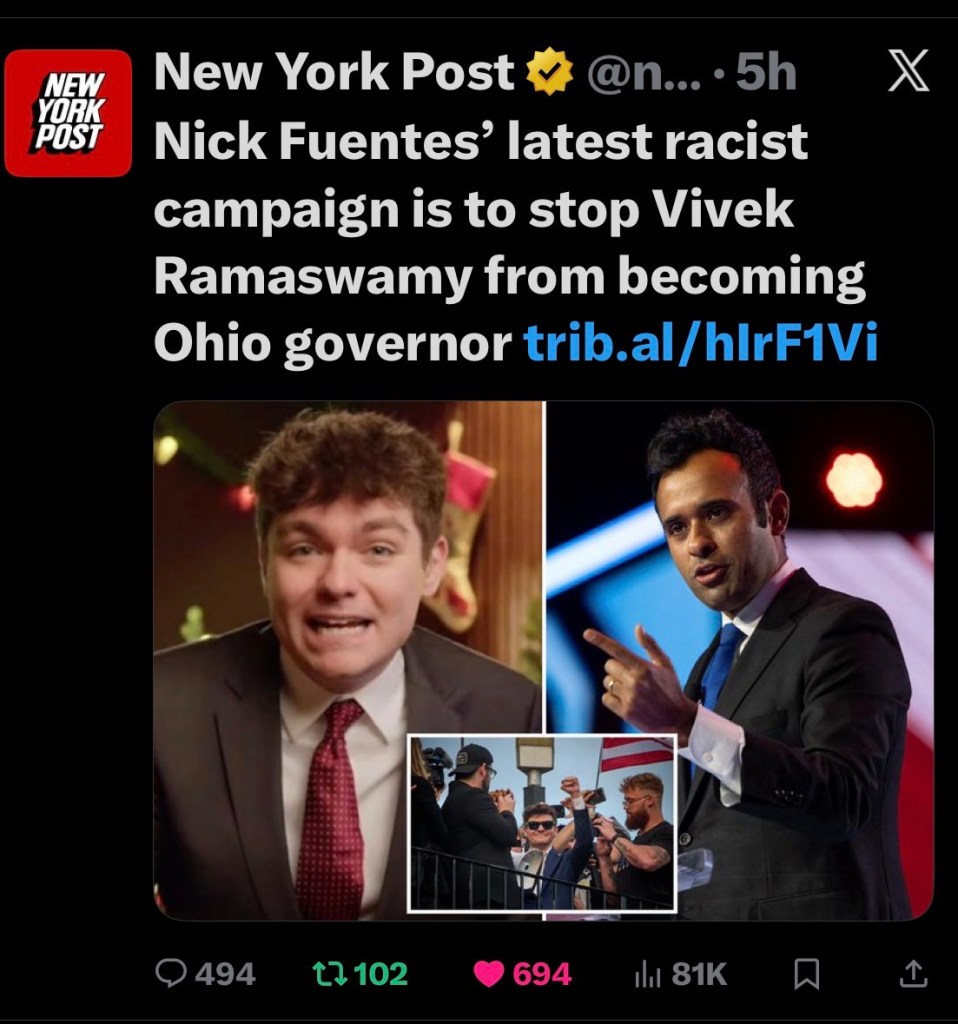
The ongoing debate surrounding Vivek Ramaswamy’s candidacy for governor of Ohio in 2026 reveals deep tensions within conservative circles, particularly among those who claim to champion an “America First” agenda. Critics, including figures such as automotive entrepreneur Casey Putsch—often referred to in informal commentary as “the car guy”—and far-right influencers such as Nick Fuentes, have launched attacks questioning Ramaswamy’s eligibility and loyalty based on his Hindu faith and Indian heritage. These criticisms, which include claims that he is an “anchor baby” or that his election would lead to Diwali celebrations in the governor’s mansion rather than Christmas, strike at the heart of what it means to be American. Such rhetoric is not only divisive but fundamentally at odds with the principles of merit, hard work, and shared national identity that the MAGA movement purports to uphold.[^1]  I don’t think “far-right” is the right word; that’s the media word for it.  But Hitler was a socialist, not a capitalist or a free-market personality.  When we talk about political scale, we have Karl Marx on the left and Adam Smith on the right.  And most people fit in somewhere along those viewpoints.  But not in all cases.  But when it comes to someone who declares that they are against someone running, and that is their purpose in life, as Casey the Car Guy has said, that opens up a whole set of new problems.  Personally, listening to all these characters talk, I don’t think they harm Vivek Ramaswamy at all.  They will actually help him with moderate voters, and the MAGA types will vote for Vivek because he’s Trump’s endorsed candidate.  But the efforts to make a fire out of these little rebellions are more than telling.

Ramaswamy, born in Cincinnati to immigrant parents who arrived legally and built successful lives, embodies the American dream in a way that should resonate with conservatives. His parents instilled in him values of family, community, and respect—qualities evident in his devotion to his wife, children, and the state of Ohio. Far from being an outsider, Ramaswamy has deep roots in the Buckeye State, having achieved extraordinary success as a biotech entrepreneur through sheer intelligence and determination. Founding Roivant Sciences, he developed multiple FDA-approved drugs and grew his wealth independently, without needing political favors or handouts. This self-made status allows him to approach public service without financial dependencies, motivated purely by a desire to give back after building a fortune.[^2]

His political evolution further demonstrates a genuine commitment to conservative ideals. Initially apolitical, Ramaswamy entered the public arena critiquing “woke” corporate culture in his 2021 book Woke, Inc., which exposed how companies exploit social justice for profit. He followed with works like Nation of Victims and others that refined his platform against identity politics and in favor of meritocracy. His 2024 presidential run brought him national prominence, where he positioned himself as an unapologetic American nationalist, ultimately endorsing Donald Trump and briefly co-leading the Department of Government Efficiency before pivoting to state leadership. Trump’s full endorsement of Ramaswamy’s gubernatorial bid, along with backing from the Ohio Republican Party and figures like JD Vance, underscores his alignment with the movement’s core.[^3]

I have had a personal acquaintance with Ramaswamy over the years that reveals a man who has undergone a thoughtful arc: from a successful CEO impressed by independent, non-“woke” businesses to someone compelled to enter politics for the sake of his family and community. As I hosted events where Vivek interacted with Ohio innovators and saw how people away from Wall Street lived in the trenches, he was inspired; he saw the potential for the state to revive its industrial strength. His plan, reportedly shaped in consultation at Mar-a-Lago, aims to extend Trump’s agenda to Ohio—focusing on business-friendly policies, efficiency, and opportunity for all who embrace American values of hard work and innovation, regardless of background.  I had a front row seat to this development in Vivek, and I understand it.  I think it says a lot about him that he wants to step away from making money as he has and step into public service to give something back.  After meeting him, I can say I know he loves his wife, his kids, his parents, and Ohio.  And he feels he’s been fortunate in life, that he has a lot of talent in talking.  And that he can give something back to Ohio so that more people can get a chance at success, too.  That is what ultimately comes from Vivek Ramaswamy as governor, an extension of the Trump White House into Ohio.  But, not a copy of Trump, but a new generation of innovation and opportunity from someone who has had great success and knows how to make spaghetti in the kitchen. 

In contrast, the fringe criticisms leveled against him appear designed to fracture the conservative coalition. Putsch, a YouTube personality and founder of Genius Garage—a nonprofit teaching engineering through car building—entered the Republican primary, positioning himself as a purer “America First” alternative, decrying immigration and H-1B visas while accusing Ramaswamy of failing working-class Ohioans.[^4] Yet these attacks often veer into nativism, echoing the very identity politics conservatives decry. True conservatism demands testing ideas and character through rigorous debate, not exclusion based on ethnicity or religion. Ramaswamy’s family-oriented upbringing, success in the private sector, and willingness to serve without personal gain make him trustworthy and effective—qualities rare in politics.

Politics requires compromise and collaboration to achieve results; isolation and perpetual rebellion yield nothing. Ramaswamy understands this, having built coalitions across persuasions. He may need to adopt a scrappier style in the primary, punching back against baseless smears, but his trajectory positions him as the overwhelming favorite to lead Ohio forward—reviving its economy, supporting families, and carrying the Trump mantle effectively—the alternative—yielding to divisive saboteurs—risks handing power to Democrats and stalling the broader movement. Ramaswamy’s story is an Ohio story: one of opportunity realized through merit, deserving emphatic support.

It is a late entry to the race, this Casey the Car Guy challenging Vivek Ramaswamy in the primary.  I think it’s an excellent opportunity for Vivek. Bloody campaigns tend to bring out the truth of things, and I think that will work well in favor of the Republican Party once the smoke clears.  And Vivek won’t have any difficulty defeating the stringy-haired Amy Acton from the Democrat side.  She will always be known as Mike DeWine’s girlfriend, the Lockdown Lady.  She has a track record of destruction that will be very easy to defeat in the general.  But first, Vivek has to win the primary, and Casey the Car Guy has invited himself to be punched in the face.  And my advice to Vivek would be not to be so nice and, metaphorically, knock his teeth out. 

[^1]: Far-right figures like Nick Fuentes have explicitly opposed Ramaswamy on religious and ethnic grounds, while Casey Putsch has framed his challenge around immigration and economic nationalism.

[^2]: Ramaswamy’s net worth, estimated at nearly $2 billion by Forbes in 2025, stems from Roivant Sciences and savvy investments; he graduated summa cum laude from Harvard and earned a J.D. from Yale.

[^3] Ramaswamy’s books include Woke, Inc. (2021), Nation of Victims (2022), and others articulating anti-ESG, pro-merit views; he received Trump’s endorsement upon launching his Ohio campaign in February 2025.

[^4]: Putsch, a Tiffin native running Genius Garage, announced his bid in December 2025 as an “America First” option, criticizing Ramaswamy on H-1B visas and foreign interests.

Bibliography

•  Associated Press. “Trump-backed Vivek Ramaswamy wins Ohio Republican Party’s endorsement in 2026 governor’s race.” May 9, 2025.

•  Ohio Capital Journal. Various articles on the 2026 Ohio gubernatorial race, 2025.

•  Wikipedia. “2026 Ohio gubernatorial election” and “Vivek Ramaswamy.” Accessed December 2025.

•  The Columbus Dispatch. “Who is running for Ohio governor in 2026?” December 18, 2025.

•  Times of India and other outlets reporting on criticisms from Fuentes and Putsch, December 2025.

•  Britannica and Forbes profiles on Ramaswamy’s biography and business career.

Rich Hoffman

Click Here to Protect Yourself with Second Call Defense https://www.secondcalldefense.org/?affiliate=20707

The Left’s Trojan Horse: Nick Fuentes and Tucker Carlson–fallen angels who are trying to stop Vivek Ramaswamy in Ohio

The left-leaning media strategy is obvious: platform a disruptive young firebrand, inject anti-Jewish chatter, agitate through YouTube and podcasts, then aim the shrapnel at Trump and at Trump-aligned picks like Vivek Ramaswamy in Ohio to destroy the MAGA movement in ways that have not previously been successful under any condition.  Suddenly, a kid I’d barely heard of—Nick Fuentes—gets catapulted into mainstream attention. He was the tag-along at Ye’s (Kanye West’s) dinner with Trump in 2022 at Mar-a-Lago; the former president later said he didn’t know who Fuentes was when he sat down, but the meeting still drew bipartisan condemnation because Fuentes is a white nationalist and Holocaust denier.  Not the kind of guy the media would typically embrace, but under these conditions, where nothing to take down Trump has worked, this is the strategy of the left, to promote these fallen stars from the MAGA movement in one last Hail Mary, no matter who gets hurt in the process.  I’m certainly not one who would be calling for censorship.  But it is surprising how quickly everyone forgot about some basic rules of decency in these political fights, which have changed the landscape of debate forever. 123

Ordinarily, a guy with that track record wouldn’t touch mainstream platforms; they would be pushed off into obscurity, and they certainly never would have been on the Piers Morgan show or any other form of media.  Newspapers would have gone on a crusade of personal destruction, much the way they did with Marge Schott back when she owned the Reds and made similar comments, and had her life utterly destroyed for it.  Nick has been banned by YouTube and other majors for hate‑speech violations, with intermittent reinstatements elsewhere and then more removals; even Rumble has suspended his streams for “incitement to violence” after an antisemitic rally—so historically, gatekeepers did act. 45 But now, post‑Musk’s changes to X, he’s back on high‑visibility rails, popping up in interviews and friendly chats that launder his extremism for broader audiences. When you see that kind of boost—especially in late-cycle political windows—it looks less like “free speech flourishing” and more like a tactical Hail Mary to fracture the coalition right before decisive races. 67

Layer onto that Tucker Carlson’s recent, sharp pivot into anti-Israel rhetoric and repeated platforming of figures accused of antisemitism. Multiple watchdogs and Jewish outlets have documented the shift and the blowback—Shapiro blasting him at Heritage, Newsmax siding against him, and even StopAntisemitism labeling Carlson “Antisemite of the Year” in December 2025. I don’t endorse that label; I’m noting the documentation and the political consequence: it’s a wedge inside MAGA world, precisely when unity matters, but don’t cry about it, all is fair in love and war, with war being the point of emphasis. 8910

The script is predictable: amplify anti-Jewish frames, set up a fight between “America First” isolationists and pro-Israel conservatives, then bait Republicans into intramural brawls—Ben Shapiro versus Tucker Carlson, Heritage under strain, Turning Point USA’s AmericaFest turning into a civil‑war stage after Charlie Kirk’s assassination and the conspiracy storms that followed. The result isn’t persuasion; it’s erosion—energy wasted on policing purity rather than winning seats. 11129

My stance is well defined: antisemitism is not appropriate. Praising Hitler is evil. That isn’t “edgy” speech; it’s a moral rot that corrodes any serious movement. Fuentes has a documented record of white nationalist and Holocaust‑denying rhetoric; platforming him in chum-style interviews mainstreams what should remain radioactive. If the goal is to split MAGA and sandbag Trump-aligned candidates, this is the fastest path—smuggle in bigotry so the whole tent gets smeared. Don’t take the bait. 113

Ohio is the case study. Vivek Ramaswamy launched his 2026 gubernatorial run in February 2025, attracted heavy attention, and is now the clear GOP frontrunner in most coverage. Democrats have rallied around Amy Acton; early polling varies by sponsor, but the race is competitive at the surface level. None of that changes the fundamentals: if you let provocateurs redefine “America First” as a race-based or anti-Jewish crusade, you’re handing your opponent a cudgel. Stay on economic delivery, state competence, and merit-driven reform—the stuff that wins governors’ races. 141516

So the advice to Vivek—and by extension to Trump’s slate—is steady and aggressive: do what got you here. Don’t chase the troll theater or appease the grievance‑economy influencers. Use your success arc as a shield and spear: wealth built ethically, businesses scaled, a vision for schools, safety, and jobs—make that the daily drumbeat. When the attack line is “he’s a globalist” or “he’s Hindu,” swat it down as the unserious bigotry it is; it’s not Ohio’s problem set. Ohio’s problem set is growth, crime, schools, and affordability, not the color of Vivek’s skin or whether he wears shoes on stage. 17

In past examples, American society—especially institutions and mainstream media—moved swiftly to suppress voices veering into anti-Semitic or extremist territory. Take, for instance, the post-WWII era: the “Columbians,” an openly pro-Hitler group in Atlanta circa 1946, were acting out Nazi salutes and rhetoric in public. Their organizational charter was revoked and leaders were arrested within months—demonstrating how clear the lines were once drawn against fascist ideologies 1. Likewise, throughout much of the 20th century, publishers, broadcasters, and even churches regularly screened out Holocaust denial, pro-Hitler propaganda, or conspiracies about Rothschilds or “Jewish control.” These ideologies were actively repressed, not platformed.

Fast forward to just a few years ago in Ohio: when the West Chester Tea Party hosted Harald Zieger, who promoted conspiratorial tropes of “Jews control the media, economy, government, even child sacrifice,” it sparked immediate backlash 23. The local Jewish Community Relations Council publicly condemned the event, and the church hosting them was effectively “cancelled,” cutting off their meeting space within weeks 4. It was a classic case of communal and media accountability shutting down extremist speech—without hesitation.

Contrast that with today’s landscape: figures like Nick Fuentes—an avowed white supremacist who praises Hitler, espouses Holocaust denial, and rails against minorities—are not only finding platforms but being endorsed by mainstream media (e.g., Tucker Carlson, Piers Morgan) and embraced by major tech alike 567. Fuentes’s X account, once deplatformed for hate speech, was restored by Elon Musk; he now commands millions of followers, with his extremist rhetoric once erased now normalized—even cheered—on major platforms 68.

This dramatic shift—the difference between swift cancellation and open platforming—highlights a deeper cultural realignment. What was once unthinkable and renounced without hesitation is now acceptable if it serves the political objective of undermining Trump-endorsed candidates. It’s as if the old moral guard has crumbled: conspiratorial tropes against Jews, previously banished, are now resurfacing with institutional backing. The West Chester Tea Party’s fate—banished from public space for a single speaker’s conspiracies—is emblematic of a past where community standards mattered. Today, those same standards are reversed: bigoted voices are amplified if they align with the current political winds. The irony is stark and unsettling.

The broader conservative movement also needs line‑drawing without self-sabotage: condemn antisemitism unequivocally, refuse to sugarcoat Nazi apologetics, and stop platforming it as “debate.” That doesn’t mean gagging policy critique of Israel; it means rejecting conspiratorial claims about “organized Jewry” and dual‑loyalty smears that historically precede violence. When Ben Shapiro calls that out, he’s not gatekeeping taste; he’s trying to keep the movement morally sane. And when Tucker frames it as “just asking questions,” the net effect is still mainstreaming. The cycle is well documented across Jewish and mainstream outlets.  This is a new element to these kinds of games that has never succeeded before, under any circumstances.  But free speech works both ways; success is the best voice for a vote, and these critics have done nothing in their lives except say things.  Vivek has a long track record of great success, and that is his calling card for this election. If that is made clear, there is nothing any of these verbal attackers can do to move the mark.  And as hurtful as all that might be, success heals a lot of wounds, and that is where the focus in Ohio needs to remain.  Vote for Vivek Ramaswamy for governor in 2026 and take politics to a place it’s never been before as a representative republic that will do great things for a very optimistic future. 818

—

Supplemental material (footnoted):

• Mar-a-Lago dinner (Nov. 2022): Trump dined with Ye and Nick Fuentes; Trump said he didn’t know Fuentes; bipartisan condemnation followed because Fuentes is a white nationalist/Holocaust denier. 123

• Fuentes’ platform status: Banned by YouTube (2020) for hate speech; Spotify removed his podcast for hate‑speech violations; Meta/Twitch/Reddit bans noted; Rumble suspended streams after “holy war” rhetoric; X reinstated him under Musk, boosting reach. 456

• Carlson’s anti-Israel turn & intra-right backlash: Watchdogs charted rising harmful Israel content; Shapiro publicly denounced Carlson at Heritage; Newsmax echoed criticism; “Antisemite of the Year” label amplified controversy. 1881910

• TPUSA/AmericaFest fracture: After Charlie Kirk’s assassination, AmericaFest showcased rifts (Owens/Fuentes/Israel); JD Vance urged unity; Shapiro attacked “frauds and grifters”; coverage across CBS/USA Today/Deseret. 92011

• Ohio 2026 governor landscape: Ramaswamy announced run (Feb. 24, 2025) with platform on education/safety/regulation; media note Trump endorsement and competitive polling vs. Amy Acton. 14171516

—

Bibliography / Further reading:

1. ABC News, “Trump hosts Kanye West, Nick Fuentes at Mar‑a‑Lago dinner.” 1

2. NBC News, “Inside story of Trump’s explosive dinner with Ye and Nick Fuentes.” 2

3. USA Today, “Donald Trump dined with Holocaust denier Nick Fuentes… at Mar‑a‑Lago.” 3

4. Global Project Against Hate & Extremism, “The Sanitization of Antisemite Nick Fuentes.” 13

5. Media Matters, “Rumble removed Nick Fuentes’ antisemitic rally; far‑right figures turned on Rumble.” 5

6. JTA, “Conservative influencers Tucker Carlson and Candace Owens sharply increased anti-Israel rhetoric in 2025.” 18

7. Times of Israel, “Ben Shapiro blasts Tucker Carlson at Heritage.” 8

8. CBS News, “AmericaFest puts conservative rift on display.” 9

9. USA Today, “Tucker Carlson, Ben Shapiro clash over Candace Owens in Phoenix.” 20

10. Ohio Capital Journal, “Vivek Ramaswamy officially launches bid for Ohio governor in 2026.” 14

11. Deseret News, “Ramaswamy announces Ohio governor run, outlines platform.” 17

12. Fox News, “Ramaswamy announces 2026 bid for Ohio governor.” 15

13. Newsweek, “Polls on Amy Acton vs. Vivek Ramaswamy.” 16

Rich Hoffman

Click Here to Protect Yourself with Second Call Defense https://www.secondcalldefense.org/?affiliate=20707
Marijuana Use at the High Place of Tel Arad, Israel: The problem with legalizing communication with inter-dimensional entities

I promised more context for why I hate the legalization of marijuana so much, and in the case of mass society, intoxicants.  It’s not enough to say that drugs should be illegal; people need to understand why.  And for me, it’s a battle of consciousness and who controls your thoughts.  How can people, for instance, fight for small government and the benefits of an intelligent republic, but then surrender all thought through intoxication over to other forces that invade your personal sovereignty, and the most important at that, our minds and the thoughts that those minds produce?  When smoke filled the air of an inner sanctum, it was never accidental. It was engineered. In the eighth century BCE, at the Judahite fortress shrine of Tel Arad, roughly thirty-five miles south of Jerusalem, two limestone altars stood before the threshold of the “holy of holies.” Laboratory analysis of the charred residue on those altars has now told us plainly what ancient worshipers were inhaling: on one, frankincense blended with animal fat to volatilize its perfume at higher temperatures; on the other, cannabis mixed with animal dung to slow‑burn at lower temperatures, releasing a psychoactive aerosol sufficient to induce altered states. The compounds identified—THC, CBD, CBN, terpenes, and terpenoids—leave no doubt that the cannabis inflorescences were burned not for fragrance but for ecstasy.¹ ² ³ ⁴ 1234

That is the kind of hard, physical evidence that strips away modern euphemisms. At Tel Arad, cannabis was a ritual technology. It was the apparatus by which priests or officiants crossed the threshold from sober perception to trance, much as frankincense, sourced via Arabian trade routes, made the sanctum smell like heaven even as cannabis smoke tuned human minds to hear it.¹ ³ ⁵ 135 The shrine’s use window, ca. 760–715 BCE, places it squarely in Judah’s political and religious turbulence, between the First Temple’s glory and the Assyrian pressure, when competing cults and high places dotted the land. The Arad altars stood not in a marginal folk‑site but in a fortress on the southern frontier—a liminal place in geography and consciousness.² ⁵ 25

The broader archaeology of Canaan corroborates that mind-altering substances were embedded in ritual. In the Late Bronze Age cemetery at Tel Yehud, archaeologists recovered imported Base‑Ring jugs shaped like poppy heads whose residues test positive for opium—likely associated with funerary rites and the cult of the dead, whether to raise spirits or ease the passage.⁶ 6 Across the Near East, ecstasy was not a fringe practice; it was a cultivated technique. Tel Arad’s twin altars memorialize that technique at the threshold of the inner sanctum, where incense regulated the smell and cannabis regulated the state of mind.¹ ³ 14

From that ancient record, one conclusion emerges that remains relevant today: cannabis was used to override sober cognition in a sacred framework. It did not sharpen judgment; it sought communion—voices, visions, feedback from a realm beyond ordinary waking life. Whether you interpret those experiences as genuine encounters with non-human intelligences or as products of hyper-stimulated neural circuitry, the public‑policy implication is the same. Normalizing marijuana enshrines altered consciousness as a cultural good. The more potent the product and the wider the adoption, the more a society tunes its public square toward ritualized disinhibition.

You can see the continuity of this logic in India’s long bhang tradition. Bhang, a paste made from cannabis leaves, has been woven into festivals like Holi and Maha Shivaratri for centuries, with references in Vedic literature and Ayurvedic lore and with colonial observers documenting its ubiquity.⁷ ⁸ ⁹ ¹⁰ 78910 Contemporary estimates run in the millions of annual consumers around major festivals, placing cannabis within a sacred calendar rather than on the margins of culture.⁸ 8 In visual culture, the art that issues from such states is strikingly consistent across continents: charged neon geometrics, entity‑forms, fractal mandalas—repertoire that echoes shamanic cosmologies from Siberia to Amazonia and now saturates modern psychedelic aesthetics. The continuity of motifs suggests a continuity of effect: the same kinds of altered states produce the same types of visions.

But where ancient priests burned cannabis to induce ecstasy within a small, controlled ritual community, modern legalization scales that effect to whole populations. That is where archeology’s lesson collides with public health. If cannabis is a portal, the portal’s throughput matters. Epidemiology repeatedly associates heavier or earlier cannabis use with increased risk of psychotic outcomes, observing dose‑response effects: meta‑analysis finds the heaviest users have odds ratios near 3.9 for schizophrenia or related psychoses compared with non‑users.¹¹ 11 A 2025 synthesis applying Hill’s criteria argues there is a high likelihood cannabis contributes to schizophrenia development overall, with a pooled OR ≈ 2.88 and roughly two‑fold greater risk for adolescent users.¹⁴ 12 More granular clinical work shows that in diagnosed schizophrenia, cannabis use is tied to increased positive symptoms (hallucinations, delusions) and higher excitement, even as negative symptom patterns can vary; no causality is claimed, but the association is robust.¹³ 13 And among people with schizophrenia, cannabis use is significantly associated with some suicide‑related outcomes, including elevated odds of attempted suicide and increased hazards for suicide death.¹⁵ 14

Jurisdiction-level studies add a societal lens. After U.S. recreational legalization (2009–2019), modeling shows +5.8% injury crash rates and +4.1% fatal crash rates in the aggregate, controlling for factors like unemployment, speed limits, seat‑belt use, rural miles, and alcohol trends—effects vary by state, but the direction is worrisome.¹⁶ ¹⁷ 1516 Systematic reviews converge on negative road‑safety impacts in most studies, and national surveys now find 4–6% of drivers self‑report driving within an hour of cannabis use, with risk perceptions conspicuously more lenient than for alcohol.¹⁸ ¹⁹ 1718 None of this proves that every consumer will suffer harm; it demonstrates that scaled access increases measurable externalities—most acutely among young men, high‑potency users, and those who combine cannabis with alcohol.¹² ¹⁸ 1917

So why invoke Tel Arad in a twenty-first-century legalization debate? Because it reveals what cannabis was for in a culture that canonized sacred space: it was for ecstasy, for crossing boundaries, for letting something else participate in one’s thinking. If you grant the metaphysical possibility that those “somethings” are genuine non-human intelligences, then mass legalization looks like opening a wide conduit into a population’s decision-making machinery. If you deny that and call the entities neural artifacts, the conclusion hardly changes: repeated entry into states that mimic external agency undermines habituated sovereignty and clarity—what a civilization requires for law, craft, and self-government.

There is also a moral claim at stake. Cultures thrive on lucidity—on earned competence and honest accountability. We do not need to romanticize intoxication because it looks antiquarian. Tel Arad was not quaint. It was precise. One altar perfumed the sanctum; the other hijacked cognition. Judah’s priests were innovating in ritual engineering, not engaging in harmless herbalism. The residue composition—the dung matrix, the cannabinoid profile, the deliberate temperature control—shows purposeful design to modulate consciousness.¹ ² ³ 123 That is the legacy modern marijuana culture inherits: techniques to create porosity. Legalization, commercialization, and age-neutral marketing scale porosity to a level ancient officiants never imagined, and the data on psychosis and road safety tell us the cost.

For these reasons, I reject marijuana as a cultural good. The Tel Arad shrine is a fossilized warning: cannabis has been a conduit into ecstasy in high places for a very long time, and cultures that survive do not hand their sovereignty to smoke. The way forward is not to sacralize intoxication, but to honor clarity—frankincense is fragrant; cannabis is psychoactive. The former perfumes a room; the latter reprograms it. Tel Arad did both. We should do neither.

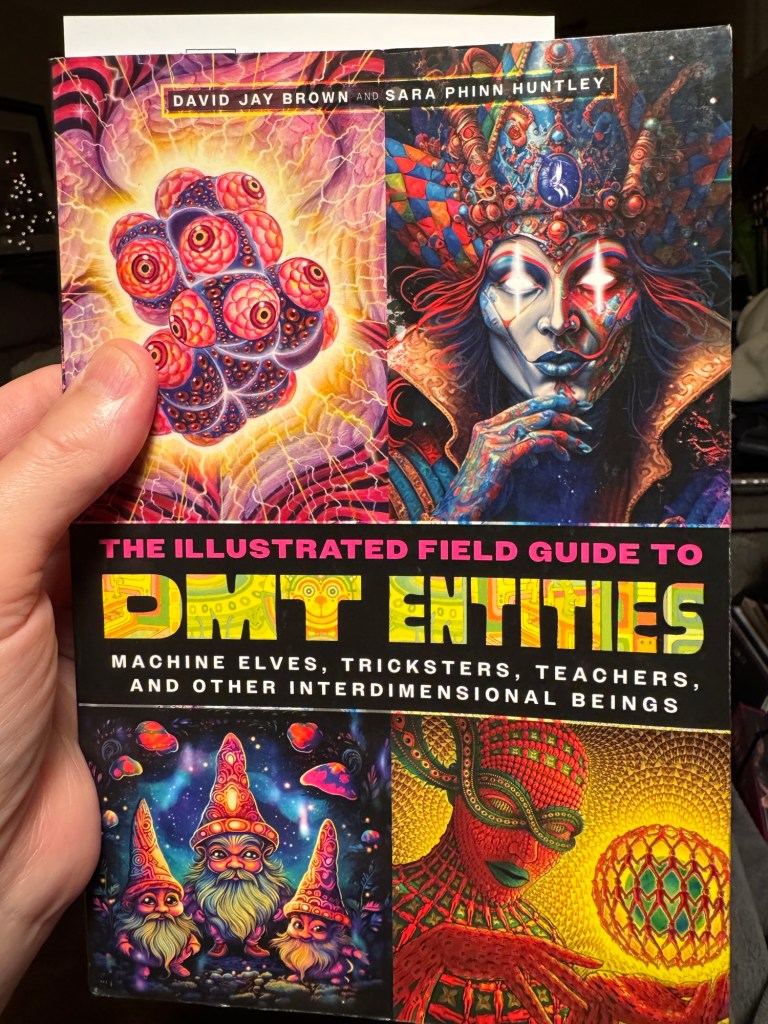
David Jay Brown and Sara Phinn Huntley’s The Illustrated Field Guide to DMT Entities: Machine Elves, Tricksters, Teachers, and Other Interdimensional Beings (2025) brings this conversation into sharp modern focus. Structured like a naturalist’s handbook for hyperspace, the book catalogs 25 distinct entity types encountered in DMT and ayahuasca experiences—from self-transforming machine elves and mantis insectoids to reptilians, gray aliens, fairies, nature spirits, and divine forms like Grandmother Ayahuasca and the Virgin Mary. Each chapter includes encounter narratives from trip reports and scientific studies, rich descriptions of behavior, appearance, and the messages or teachings they impart, accompanied by visionary artwork from artists such as Alex Grey and Sara Phinn Huntley herself 12. The field guide poses a profound question: Are these beings mere constructs of the human psyche, or are they independent intelligences inhabiting other dimensions? That question lies at the heart of every cross-cultural psychedelic tradition, from Tel Arad’s cannabis altars to global shamanic rites.

The guide has not only attracted readers interested in visionary art or entheogens but has also gained credibility through endorsements from figures like Graham Hancock and through guest appearances by Brown and Huntley on platforms like the “Rebel Spirit Radio” podcast 3. Meanwhile, mainstream voices like Joe Rogan regularly revisit “DMT astronauts”—individuals who deliberately seek these entities for spiritual insight or practical guidance—and discuss whether contemporary governments and institutions might align with such interdimensional “high priests” to influence mass consciousness 45. This book is a frontier consideration into a new science of analysis and reinforces the core argument: humanity’s engagement with psychoactive smoke—from ancient altars to modern DMT breakthroughs—is not benign. It is a politics of consciousness intervention, where the line between personal sovereignty and external mental imposition is perilously blurred.  And it’s very dangerous, and should under no rational endeavor, should ever be legalized in a serious society.

Footnotes

1. Arie, Rosen, Namdar (2020), GC‑MS identification of THC/CBD/CBN; animal dung/fat matrices; dating and functional interpretation. 1

2. Science News coverage of the shrine context, the cannabis–dung mixture, and THC levels consistent with altered states. 2

3. Taylor & Francis newsroom summary highlighting frankincense chemistry (boswellic acids) and deliberate psychoactive use of cannabis. 3

4. Times of Israel report: cannabis “to stimulate ecstasy” and implications for Temple ritual analogs. 4

5. Sci. News overview of shrine chronology, fortress border function, and compositional findings. 5

6. Biblical Archaeology Society: Tel Yehud opium residues in Base‑Ring jugs; cult‑of‑the‑dead context. 6

7. Wikipedia (summary with sources) on bhang as an edible cannabis preparation and festival use. 7

8. Firstpost explainer on Holi and bhang’s historical embedding; contemporary practice estimates. 8

9. IndiaTimes feature with Vedic/Ayurvedic references and colonial documentation of bhang. 9

10. SAGE review on the historical context and research state of cannabis use in India. 10

11. Marconi et al. (2016) meta-analysis: dose‑response; OR≈3.9 for heaviest use vs. non-use. 11

12. JAMA Network Open invited commentary (2025) summarizing evidence and Ontario cohort demographics; rising PARF after medical legalization. 19

13. eClinicalMedicine IPD meta-analysis (2023) associating cannabis use with higher positive and excitement dimensions in schizophrenia. 13

14. Biomolecules (2025) systematic review applying Hill’s criteria; overall OR≈2.88; doubled adolescent risk. 12

15. Psychological Medicine (2025) meta-analysis: cannabis use in schizophrenia linked to attempted suicide and suicide death hazards. 14

16. Journal of Studies on Alcohol and Drugs (2022): legalization associated with +5.8% injury crashes and +4.1% fatal crashes in aggregate. 15

17. IIHS bibliography summary of the same study’s methodology and state heterogeneity. 16

18. MDPI systematic review (2023) concluding negative impacts of legalization on road safety in most studies; risk profiles. 17

19. AAA Foundation (2024) fact sheet on DUI‑C prevalence (~4–6%), risk perceptions, and sex differences. 18

—

Bibliography

Arie, E.; Rosen, B.; Namdar, D. (2020). Cannabis and Frankincense at the Judahite Shrine of Arad. Tel Aviv, 47(1), 5–28. 1

Bower, B. (2020). An Israeli shrine may have hosted the first ritual use of marijuana. Science News. 2

Farmer, C. M.; Monfort, S. S.; Woods, A. N. (2022). Changes in Traffic Crash Rates After Legalization of Marijuana. Journal of Studies on Alcohol and Drugs, 83, 494–501. 15

Marconi, A., et al. (2016). Meta-analysis of the Association Between the Level of Cannabis Use and Risk of Psychosis. Schizophrenia Bulletin, 42(5), 1262–1269. 11

Argote, M., et al. (2023). Association between cannabis use and symptom dimensions in schizophrenia spectrum disorders. eClinicalMedicine, 64, 102199. 13

Pourebrahim, S., et al. (2025). Does Cannabis Use Contribute to Schizophrenia? Biomolecules, 15, 368. 12

Mulligan, L. D., et al. (2025). Cannabis use and suicide in schizophrenia. Psychological Medicine, 55, e79. 14

González Sala, F., et al. (2023). Effects of Cannabis Legalization on Road Safety: A Literature Review. IJERPH, 20(5), 4655. 17

AAA Foundation for Traffic Safety (2024). Cannabis Use, Public Health, and Traffic Safety (Fact Sheet). 18

Biblical Archaeology Society (2022). Narcotics used in Canaanite Cult: Opium in Late Bronze Age Graves. 6

Firstpost (2025). The Big ‘Bhang Theory’: Why Indians drink bhang on Holi. 8

IndiaTimes (2023). On Holi, a look at the tradition of using bhang and its legality. 9


Rich Hoffman

Click Here to Protect Yourself with Second Call Defense https://www.secondcalldefense.org/?affiliate=20707

It All Comes Down to Sullivan: Live by the Legal Sword, die by it too

These people never learn. When you are the front runner in a serious commissioner election in Butler County, Ohio, as Michael Ryan is, the dirty tricks trying to prevent his momentum are just the kind of thing that give politics a bad name.  What starts you on the road to good health in politics isn’t kale or cardio, it’s truth without legalese, straight talk without a billable hour attached. I deal with lawyers all the time—good ones, bad ones, and the “print this from the shelf and scare them” variety—and my general opinion, even conceding that the profession began with noble intentions, is that far too much of it has drifted into a uniform intimidation racket. You’ve seen the type: the form-letter cease-and-desist that looks like an astrology reading for defamation, except the fortune costs you a retainer and the outcome is a long, nervous wait for a judge who usually tosses it after you’ve lost sleep and savings. The trick is the tone, not the law: it’s written to make you believe you must respond with a lawyer, because only priests of the temple may interpret the runes. I don’t like the practice and personally think it should be destroyed, and that the perpetrators of such legal manipulation should be thrown in jail and punished with career-ending justice, just for applying the kind of abuses of power that are all too common.

And then there’s this, additionally

This is why the old play of lawfare against rivals—especially in local races where reputations are accessible targets—needs to be called out. We’ve watched how it stains the process in Butler County. Roger Reynolds, who was convicted on a single count in late 2022, later saw that conviction overturned on appeal in May 2024 for “insufficient evidence,” with the appellate panel ordering an acquittal and discharge. The case centered on the golf academy idea tied to Lakota Schools and Four Bridges; the court noted that the proposal never matured, that the school board held the authority, and that the key witness’s legal counsel ended the discussion before any contract could be secured. 1234 In September 2024, the Ohio Supreme Court declined to restore him to the auditor’s office immediately (the seat had been filled due to the bar against felons holding office at the time of his conviction) but clarified he remains eligible to run in the future. 5 That’s the landscape: facts matter, timelines matter, and our politics should run on open argument, not legal intimidation.

Then there’s Cindy Carpenter. She recently walked into a student housing office in Oxford to resolve back rent tied to a family member. A surveillance camera caught her flipping off the counter during the exchange; staff alleged racist language and abuse of office. The Butler County Prosecutor investigated and concluded that her conduct, while “unseemly,” did not rise to the level of misconduct or abuse of power. 67 It’s all on tape and all public now; the gesture happened, the allegations were made, and the official finding closed the matter without charges. 86 You can dislike the behavior—I do—but voters deserve a campaign where candidates fight this out in daylight, not by hiring attorneys to stuff the mailbox of a rival.

Enter Michael Ryan. He’s a Hamilton City Councilman turned countywide candidate, and he’s collected a long list of conservative endorsements—state senator George Lang, multiple township trustees and councilmembers, and county auditor Nancy Nix among them—because he’s making the case for generational leadership and a forward-looking county agenda. 9 He launched his commission bid in May 2025, framing it around growth, jobs, and fewer distractions—promising to fight for every city, township, and village, and to recruit the next-generation workforce. 10 Ryan’s pitch has resonated in part because people are tired of courthouse drama and lawfare theatrics; they want a debate about budgets, infrastructure, and living standards, not another stack of demand letters mailed in bulk from counsel. And he’s not alone—the GOP field is crowded, with Reynolds and Carpenter in the mix for the May 2026 primary—but the voter mood described by local reporting is unmistakable: they’re weighing future capacity, not re-litigating yesterday’s trials. 11

Now, when the intimidation letter lands—as it did from Reynolds to Ryan—you don’t have to swallow the premise that only a lawyer can answer it. You can answer it yourself, plainly and legally, because the guardrail is still the Sullivan standard from 1964. New York Times Co. v. Sullivan was a 9–0 Supreme Court decision that put a constitutional backbone into defamation law for public officials: to win, a public official must prove “actual malice,” meaning the speaker knew the statement was false or acted with reckless disregard for its truth, and must do so with “convincing clarity.” 1213 The case grew out of a civil rights-era advertisement that contained factual errors; a local jury hit the Times with $500,000 in damages, but the Supreme Court reversed, explaining that debate on public issues must be “uninhibited, robust, and wide-open,” even when the attacks are “vehement” and sometimes “unpleasantly sharp.” 1415

If you want numbers: the jury’s original $500,000 damage award (an enormous sum in 1960) was wiped away; the final holding established a higher burden that has, for six decades, made defamation claims by public officials very hard to win without proof of knowing falsity or reckless disregard. 1514 In practical terms, that means campaign statements, press releases, and political commentary about public officeholders are protected—unless the speaker crosses the line into deliberate falsehood or reckless disregard for the truth. 1316 The standard is why you don’t need to hire a lawyer to say, “We disagree, and our statements are protected political speech,” and it’s why cease-and-desist letters are so often theatre: they depend on the recipient’s fear, not on an actual path to winning under Sullivan.

So let’s put it together. Reynolds’ single-count conviction was reversed; whatever lessons he took from the ordeal, sending form-letter threats at a rival to police campaign commentary is the wrong takeaway. 12 Carpenter’s apartment-office incident was embarrassing but not criminal; voters can judge her temperament, but the prosecutor closed the file. 6 Ryan, meanwhile, has stacked endorsements and is running an argument-heavy, growth-forward race; that’s where the energy is. 9 Let them debate. Let voters see who can build coalitions and deliver results without resorting to legal cudgels. And when the legal cudgel shows up anyway, answer it with Sullivan—because in American political life, the First Amendment demands a high tolerance for hard speech about public officials, and the courts have enforced that by design. 1315

In the decades since Sullivan, the Supreme Court clarified and extended the actual-malice requirement through several landmark decisions:

Gertz v. Robert Welch, Inc. (1974)

This case distinguished between public officials, public figures, and private individuals. The Court held that the actual‑malice standard does not apply to defamation claims by private individuals. Instead, states may allow recovery with a lower standard of fault—such as negligence—when proven, and plaintiffs are limited to actual damages unless actual malice is shown 12.

• Outcome: Private individuals need not meet the high threshold; states can define fault and damages within constitutional bounds 23.

Curtis Publishing Co. v. Wally Butts (1967)

Extending Sullivan, the Court held that public figures (like former coach Wally Butts) must prove actual malice to prevail in libel suits. The investigation in question fell short of reasonable journalistic standards, leading to damages after the Court found reckless disregard for truth 45.

Philadelphia Newspapers v. Hepps (1986)

When private individuals sue over speech on matters of public concern, the Court ruled they must bear the burden of proving falsity—not leave it to the defendant. This ensures truth holds primacy in public discourse and avoids chilling speech 67.

Hustler Magazine, Inc. v. Falwell (1988)

This case affirmed that even intentional infliction of emotional distress torts related to offensive parody do not evade the actual‑malice rule when a public figure is involved. Religious leader Jerry Falwell could not recover without proving that Hustler knowingly published false statements or acted with reckless disregard 89.

• Result: Political satire and parody targeting public figures are constitutionally protected—even if deeply offensive—absent false statements made with actual malice.

—

Together, these rulings illustrate how Sullivan’s actual‑malice standard has been reinforced and nuanced:

• It does apply to both public officials and public figures (Butts, Falwell).

• It does not apply to private individuals (Gertz), though they must still show fault and harm.

• Plaintiffs challenge private or public speech tied to public concern must prove falsity (Hepps).

These cases bolster the legal shield for political speech—underscoring that public dialogue outpaces legal intimidation unless clearly false and malicious.

We’ve seen it too often, when candidates in politics can’t make a good argument, they turn to lawfare and hope that the public perception of expensive lawyers will do the work for them of winning an office they otherwise don’t deserve.  In Roger Reynold’s case, he is the one who got himself into trouble in the first place, and nobody wants to see that kind of trouble in the office of the Butler County Commissioners, just to repair the reputation of a person looking for respect that he lost during the process.  There are other ways to win respect, and this isn’t how you do it.  Showing leadership is the way to restore party integrity, not to make more rifts that cost more than reputations.  And hiring expensive, pin-headed lawyers to send out form letters of intimidation on a case they know is phony as they sent it, is why there are problems in politics to begin with.

Footnotes

1. New York Times Co. v. Sullivan set the “actual malice” standard for public officials, requiring proof that the defendant knew a statement was false or acted with reckless disregard, and emphasized “uninhibited, robust, and wide-open” debate on public issues. 1314

2. The original jury verdict in Alabama awarded L.B. Sullivan $500,000 in damages; the U.S. Supreme Court reversed unanimously in 1964. 15

3. Former Butler County Auditor Roger Reynolds’ 2022 unlawful-interest conviction was overturned for insufficient evidence in May 2024; the appeals court ordered acquittal and discharge. 12

4. The Ohio Supreme Court, in September 2024, declined to restore Reynolds to office mid-term but affirmed his eligibility to run in the future. 5

5. Butler County Prosecutor Michael Gmoser cleared Commissioner Cindy Carpenter of misconduct after the Oxford apartment incident, noting the gesture was “unseemly” but not unlawful. 6

6. Michael Ryan launched his commission bid in May 2025 and lists numerous Republican endorsements on his campaign website. 109

7. Local reporting describes a crowded May 2026 GOP primary field for the commission seat and outlines competing narratives about experience versus future focus. 11

Bibliography

• New York Times Co. v. Sullivan case summaries and analyses: LII / Cornell Wex; First Amendment Encyclopedia (MTSU); Wikipedia overview; FindLaw case history; Encyclopaedia Britannica.

• Reynolds appellate decision and related coverage: Twelfth District opinion (PDF); WCPO; Cincinnati Enquirer; WLWT; Ohio Supreme Court case update.

• Carpenter incident and prosecutorial review: Journal-News; Local 12 WKRC; Cincinnati.com video clip.

• Michael Ryan campaign and endorsements: Ryan for Butler County website; Journal-News launch story; Primary field coverage.

Rich Hoffman

Click Here to Protect Yourself with Second Call Defense https://www.secondcalldefense.org/?affiliate=20707

There’s Not a Lot of Compassion for Rob Reiner: Hollywood has made itself the enemy of America

The December 2025 killings of filmmaker Rob Reiner and his wife, photographer and producer Michele Singer Reiner, and the subsequent charging of their son Nick Reiner, ignited polarized reactions across news and social platforms.   The recent tragedy has sparked intense debate—not only about the crime itself but about the cultural backdrop that shaped this family. Critics have noted that President Trump’s response lacked overt compassion, but this reaction must be understood in context. Rob Reiner was not just a filmmaker; he was a leading voice in Hollywood’s anti-Trump activism, often positioning himself against traditional American values. For years, Hollywood has distanced itself from the everyday realities of most Americans, creating a cultural divide that has eroded public sympathy for its employees.  Hollywood has made itself the enemy of traditional America, and in that regard, Rob Reiner was considered an immoral slob that nobody should feel sorry for. 

The contrast between Trump’s family values and Hollywood’s permissive lifestyle is stark. Trump famously raised his children with strict rules—no drugs, no drinking, no tattoos—reinforcing accountability and discipline. Hollywood, by contrast, often fosters environments where excess and indulgence are normalized. This permissiveness has consequences: many children of Hollywood figures struggle with addiction and instability. In Nick Reiner’s case, reports of substance abuse and personal turmoil underscore a broader pattern—liberal culture rarely emphasizes personal responsibility, and the fallout can be devastating.

Examples abound. From Sean “Diddy” Combs’ recent court revelations of grotesque excess to Charlie Sheen’s own admissions of destructive behavior, the Hollywood lifestyle often spirals into dysfunction. These stories are not isolated—they reflect an industry that glamorizes extremes while neglecting the foundations of family and morality. When tragedy strikes in such a context, the expectation of widespread public compassion becomes complicated. Americans increasingly view these outcomes as the predictable result of choices and values that run counter to the principles most families hold dear.

This is not about piling on during a tragedy; it is about recognizing the cultural divide. Rob Reiner championed a worldview that sought to undermine traditional norms, and the consequences of that worldview are now painfully evident. While no one justifies violence, the reality is that Hollywood’s broken culture produces broken lives. When those lives implode, the public’s reaction—muted sympathy at best—reflects a growing rejection of the values Hollywood promotes.

The timeline:

• Discovery and identification: On December 14, 2025, Los Angeles authorities found Rob Reiner (78) and Michele Singer Reiner (70) dead in their Brentwood home. The L.A. County Medical Examiner later listed the cause of death as “multiple sharp force injuries,” manner: homicide. 123

• Arrest and charges: Police arrested Nick Reiner (32) hours later, and he was charged with two counts of first-degree murder, with special‑circumstance allegations that could carry life without parole or the death penalty; he is being held without bail. 456

• Court appearances and schedule: Nick appeared in court on Dec. 17; his arraignment was set for Jan. 7, 2026, after his counsel waived speedy arraignment. 789

• Family statements: Siblings Jake and Romy Reiner issued a statement calling the loss “horrific and devastating” and asking for privacy and compassion. 710

Medical Examiner determinations and arrest/charging information are consistent across CBS News, Deadline, USA TODAY, and ABC reports. The dates (Dec. 14–17, 2025) and charging language (“first‑degree murder” with exceptional circumstances) appear verbatim or in close paraphrase across those outlets. 1254 

• In contrast, documented coverage after the killings focused on President Trump’s own posts, in which he mocked Reiner and attributed the deaths to “Trump Derangement Syndrome.” Mainstream outlets, not fabricated screenshots, reported these remarks. 1415

Snopes (Dec. 17 & 19) and Lead Stories (Dec. 17) show no record of Reiner endorsing political violence; USA TODAY and Axios document Trump’s remarks following the homicide. 1211131415

• Nick Reiner’s publicly discussed struggles with addiction date back to his teens, including multiple rehab stints, homelessness, and collaborative work with his father on Being Charlie (2015/16), a film loosely inspired by those experiences. 1617

• After the killings, reporting highlighted Nick’s longstanding challenges, with sources and past interviews noting volatility and non-linear recovery—common in chronic substance‑use disorders. None of these reports. 185

USA TODAY and PEOPLE provide direct quotations from earlier interviews/podcasts, situating addiction history in a verifiable record while avoiding speculative causation. 1617

—

1. Celebrity activism and partisanship: Rob Reiner’s role as a high-profile critic of Trump and supporter of Democratic causes shaped how political audiences perceived him—before and after his death. 1415

2. Media dynamics: The Reiner case drew wall-to-wall coverage, but notable outlets also ran fact‑checks to counter false claims (e.g., fabricated posts, conspiracy theories about “secret tunnels”). The effect: a fractured information environment in which audiences pick narratives that fit their priors. 20

USA TODAY/Axios frames Reiner’s political profile; Snopes/AFP/AllSides documents rumor‑correction cycles that coexist with breaking news coverage. 1415111920

• Responsible inferences: It is fair to conclude that political identity and celebrity status influence public reaction, that false quotes altered perceptions of Reiner’s character, and that addiction history was part of Nick’s public narrative before 2025.  Those quotes that were attributed to Reiner were in the spirit of the way he projected himself, leading people to draw their own conclusions past the clean public relations efforts that actors often use to hide their true feelings which they utter to other people in private. 121417

• Where we should not refrain: this family’s tragedy is a sweeping indictment of entire political or cultural communities in regard to Hollywood as a culture.  And we must make claims of definitive causation without court findings because the courts as we have seen recently no longer represent the kind of justice Americans expect, and we don’t have time to wait on them. Nick Reiner’s case is ongoing; presumption of innocence applies even as the blood drips from the weapons he used to conduct the killings. 5

While in the past a story like this might have sparked weeks of discussion and reflection on Rob Reiner’s life, as an artist most people knew something about.  But in the wake of his political statements and his attempts to steer people away from supporting Trump, he has essentially angered most of the country.  And when something bad happens in Hollywood culture now, people have much less compassion and are ready to move on from the story much more quickly.  Forgiveness of these terrible Hollywood families and the lifestyles they live, and produce children out of, is not on the table any longer.  And Trump represents that evolution in his comments after the murders.  Because it’s not Trump that leads the nation, it’s Trump who is a creation of that nation and their sentiments.  And Hollywood, clearly, didn’t respect that process, and they took advantage of the power they did have within the entertainment desires of American culture.

Footnotes

1. L.A. County Medical Examiner cause of death: “multiple sharp force injuries,” homicide; Dec. 17, 2025. 12

2. LAPD and DA timeline; arrest, charges, special‑circumstance allegations. 45

3. Court appearance and arraignment scheduling. 78

4. Family statements requesting compassion and privacy. 710

5. Debunked quotes attributed to Reiner about the Trump shooting attempt. 1112

6. Documented coverage of President Trump’s remarks after Reiner’s death. 1415

7. Nick Reiner’s publicly discussed addiction history; Being Charlie context. 1716

8. Rumor‑correction cycle (fabricated posts; conspiracy content). 1920

—

Bibliography & Further Reading

• CBS News — “L.A. County medical examiner releases Rob and Michele Reiner’s causes of death.” Link

• Deadline — “Rob Reiner’s Official Cause Of Death Revealed By LA Medical Examiner.” Link

• ABC News — “Rob Reiner’s son, Nick Reiner, charged with 1st‑degree murder with special circumstances.” Link

• USA TODAY — “Rob Reiner’s son Nick charged with murder in parents’ deaths.” Link

• CBS News — “Nick Reiner, Rob and Michele Reiner’s son, appears in court; arraignment set for Jan. 7.” Link

• Snopes — “Rumor claiming Rob Reiner said he wished would‑be Trump assassin ‘hadn’t missed’ is unfounded.” Link

• Snopes — “Did Rob Reiner say ‘too bad he turned his head’ about Trump assassination attempt? There’s no proof.” Link

• USA TODAY — “What did Rob Reiner say about Trump? POTUS called it ‘derangement.” Link

• Axios — “Trump mocks Rob Reiner after death. Here’s what Reiner said about Trump and Charlie Kirk.” Link

• PEOPLE — “Rob Reiner’s Son Nick Previously Spoke About His Struggles with Drug Addiction and Homelessness.” Link

• USA TODAY — “Rob Reiner’s son Nick once ‘wrecked’ his parents’ guest house” (podcast recollections). Link

• AllSides (Snopes reprint) — “False claim of secret tunnels beneath Rob Reiner’s home spreads online.”

Rich Hoffman

Click Here to Protect Yourself with Second Call Defense https://www.secondcalldefense.org/?affiliate=2070

A Mask of Radicalism: Somali policies in Ohio and the Trojan Horse Democrats are using to overthrow America

One of the biggest blind spots in government workforce planning is the tendency to treat people as raw numbers—bodies that fill a statistical need—without considering the cultural and ideological factors that shape behavior. When policymakers focus only on headcount, they ignore the reality that ideas matter. Religion, values, and worldview are not incidental; they influence how communities adapt to laws, civic norms, and workplace expectations. If those dynamics are overlooked, the result isn’t just inefficiency—it’s instability.  And to that point, religions that start with an angel talking to one person, then that person writes down everything that the rest of society accepts as a religion, such as Mormonism, Scientology with L. Ron Hubbard, or Islam with Muhammad who had the angel Gabriel show up at his cave every Monday to give him sections of the Quaran over a long period of time, that would become the Islam of today, we should always behold some logical scrutiny, which is certainly missing from third world politics.  Islam has shown that it has a desire to overthrow Western civilization, so in that intention, we have to take them at their word and deal with the situation appropriately—as a hostile intention, not a doctrine of peace and prosperity. 

Ohio’s approach to immigration illustrates this risk. In the push to attract labor for manufacturing and logistics, politicians like Mike DeWine and this ridiculous Democrat Mayor of Columbus have often prioritized quantity over quality, assuming that any influx of workers will strengthen the economy. But history shows that cultural adaptation is not automatic. Communities arriving from regions with vastly different governance traditions—especially those rooted in rigid ideological systems—face steep challenges adjusting to the norms of a constitutional republic. When adaptation fails, the gap doesn’t just affect productivity; it can foster resentment, isolation, and, in rare but dangerous cases, radicalization.

This isn’t about denying opportunity. It’s about acknowledging that importing large populations without a clear integration strategy can introduce third-world social patterns into first-world systems. When those patterns persist—whether through insular neighborhoods, resistance to civic norms, or ideological rigidity—they undermine the very conditions that make economic growth possible. A workforce strategy that ignores these realities is not a strategy at all; it’s a gamble with public safety and long-term stability.

A statistical and policy analysis of Somali-linked issues in Ohio requires precise demography, a clear account of recent federal immigration enforcement in Columbus, and rigorous scrutiny of crime correlations. Evidence from American Community Survey (ACS) rollups, Ohio administrative refugee data, municipal statements, and peer-reviewed/official crime research indicates: (1) Franklin County and Columbus anchor Ohio’s Somali population; (2) municipal policy in Columbus separates civil immigration status from local criminal policing while acknowledging federal arrest authority; (3) immigrant crime rates—documented and undocumented—are consistently lower than those of U.S.-born populations in the best-identified state-level datasets; and (4) citywide violent-crime trends in 2024–2025 declined markedly, complicating claims that heightened federal presence is necessary for local safety.  I would argue that these stats are down because law enforcement has not occurred as it should because of the politics involved.  The Biden administration did not do its job and allowed these cells to grow on purpose.  Just because law enforcement doesn’t do its job, because it wants a political disturbance to occur, doesn’t mean the problem doesn’t exist.  Only that it was ignored.12345

ACS-derived demographic summaries attribute approximately 26,402 residents of Somali ancestry to Ohio, with approximately 22,899 within the City of Columbus and approximately 24,432 in Franklin County overall; concentration thus clusters in central Ohio rather than being evenly distributed statewide.12 Language-use indicators from Franklin County’s HealthMap show Somali and other Afro‑Asiatic language speakers rising from 25,051 (2019) to 27,074 (2022) in Columbus, situating the metro among the nation’s highest concentrations and frequently described as second only to Minneapolis–St. Paul by press accounts referencing ACS compilations.3

Refugee intake to Ohio has been concentrated in five counties, including Franklin. State administrative records document ongoing arrivals by nationality, with Somalia among recent cohorts. In 2024, records show 326 Somali refugee arrivals statewide, with roughly 301 in Columbus, reflecting federal resettlement pipelines and secondary migration toward existing community networks.  And in regard to their assimilation into general productive culture, I can say that recently I was leaving the Statehouse in Columbus and just one block south along a major roadway with thousands of people going by, there was a Somali man standing on the corner without his pants, his penis in full view of everyone driving by.  He made no attempt to cover himself, but just looked at everyone going by like he was on another planet.4

Columbus policy—initiated by executive order in 2017 and codified thereafter—directs city resources not to assist federal immigration enforcement based solely on civil immigration status. Local policing remains engaged for criminal conduct and public‑safety incidents, but civil-status enforcement is explicitly outside the municipal scope. Public reaffirmations in December 2025 by the mayor, police chief, and city attorney emphasized that the Division of Police does not investigate residents solely based on immigration status.567, which is why the crime statistics are down.  Because they just don’t do the job, such as arrest that person I mentioned for indecent exposure.  There was a police car in front of me as I drove by, and they did nothing about the indecent exposure that was obvious. During mid‑December 2025, city officials verified increased activity by federal immigration agents. Rights guidance highlighted warrant requirements, non‑obstruction, and legal-aid resources; contemporaneous reporting noted limited operational transparency from federal authorities to local agencies.67

In late May–early June 2025, a federal list of so‑called ‘sanctuary jurisdictions’ briefly included Columbus and Franklin County. Following cross‑jurisdiction pushback and accuracy challenges—including objections from jurisdictions that actively support federal enforcement—the Department of Homeland Security removed the list within days; Associated Press summaries and local outlets documented misspellings and unclear criteria. Subsequent Justice Department publications (August 5, 2025) did not enumerate Columbus/Franklin among listed cities, underscoring definitional volatility across federal communications.89101112

Claims that immigration elevates crime often rely on anecdote or single‑case salience. High‑integrity state-series recording of immigration status in arrest data provides more probative value. A National Institute of Justice–funded analysis of Texas arrest records (2012–2018) found undocumented immigrants arrested at less than half the rate of U.S.-born citizens for violent and drug crimes and roughly a quarter the rate for property crimes; homicide arrest rates among undocumented immigrants were the lowest across the series.13 National syntheses explain persistent gaps in incarceration and prosecution. Migration Policy Institute’s 2024 explainer details lower incarceration rates among immigrants, including unauthorized residents, and the absence of a consistent positive relationship between immigrant presence and violent crime in state and city studies. Historical comparisons of Census-linked incarceration (Northwestern University, 2024) show immigrants never exceeding U.S.-born incarceration rates over 150 years, with modern periods reflecting approximately 60 percent lower incarceration among immigrants.  That says more about the point that police don’t do the job, than that there aren’t crimes from these communities.  If a tree falls in the forest and people don’t see it, did it really happen?  Well, of course.  The crimes happen, but the police are often too busy at the coffee shop getting a donut because they know there is no political support from the political order to arrest hostile immigrants and their abundance of crime.1415

Citywide violent‑crime metrics declined markedly. Public briefings and media coverage reported homicides down ~35 percent year‑over‑year, felonious assaults down ~22 percent, non‑fatal shootings down ~26 percent, and car thefts down ~18 percent by December 18, 2025. Year‑end counts indicated ≈81 homicides, the lowest annual number in a decade; mid‑year reporting documented substantial reductions in homicides, felony assaults, and shootings relative to 2024 benchmarks.  This could largely be attributed to the incoming Trump administration federally, compared to the policies of Joe Biden’s White House that ignored crime from immigrant communities.5161718

Manufacturing, logistics, health care, and service sectors in central Ohio draw from multilingual labor pools that include Somali‑origin workers. Predictable, rights‑respecting enforcement climates strengthen stability in attendance, safety compliance, and neighborhood trust. Municipal non‑cooperation on civil status—paired with a commitment to investigate criminal conduct—preserves emergency calling and witness cooperation while acknowledging federal arrest authority.56 Education administrators disseminated protocols reiterating visitor control, warrant verification, and student release rules; these messages stabilize operations during periods of heightened federal activity reports and curb rumor‑driven disruptions to essential services.19

Minnesota hosts the largest Somali‑origin population in the United States. Recent reporting places statewide estimates at 61,000–80,000, with a concentration in Minneapolis–St. Paul and a majority of residents holding citizenship or permanent residency; Temporary Protected Status for Somali nationals covers only several hundred nationwide. Allegations linking social‑service fraud to terrorism lacked prosecutorial material‑support charges at the time of reporting, indicating the need to separate rhetoric from chargeable facts.22021

Federal authority encompasses deportation orders, criminal‑alien priorities, and visa‑overstay enforcement; municipal discretion in Columbus allocates police resources toward criminal matters rather than civil status while maintaining emergency response and public‑safety duties. If safety is the stated rationale for escalated civil‑status operations, downward violent‑crime trajectories before and during federal surges complicate attribution, absent transparent arrest composition and case outcomes. Public records of ICE detention holds provide volume hints but lack disaggregated origin and offense detail necessary for robust inference.51222

Ohio’s Somali population is predominantly concentrated in Franklin County and Columbus, with measurable language‑use growth and documented refugee arrivals. Municipal policy delineates a boundary between civil immigration status and local criminal policing. The strongest available arrest/incarceration evidence indicates lower offending rates among immigrants relative to U.S.-born populations, and Columbus’s 2025 violent‑crime reductions challenge assertions that broader status‑driven enforcement is required to secure local safety. Transparent metrics and risk‑weighted priorities constitute the appropriate framework for enforcement policy.

The Somali issue in Columbus is a case study in this tension. What began as a resettlement initiative to meet labor needs has evolved into a demographic shift with political and cultural consequences. When enforcement agencies raise concerns about radicalization risks, and local officials respond by shielding entire communities from scrutiny, the conversation gets framed as discrimination instead of security. That framing prevents honest debate about how to balance compassion with accountability—and how to ensure that immigration policy strengthens, rather than erodes, the foundations of a free society.  You can take third-world ideas about religion, obedience, economy, and social values and inject them into a first-world, law-driven utopia.  In some cases, it might work, depending on the religious affiliation of the people involved.  But in cases such as we have seen from Somali refugees in Minnesota and in Ohio, we have to take action proactively.  All things, all people, and all religions are not equal, and dumb politicians need to learn the difference to have a properly functioning society.  There are a lot of forces in the world that want to use the radicalized religion of Islam as a weapon of destruction against the Western world.  And for that reason, we have to have ICE raids to remove those elements for the security of our nation.

Notes

1. Neilsberg, ‘Somali Population in Ohio by City: 2025 Ranking & Insights,’ updated October 1, 2025, https://www.neilsberg.com/insights/lists/somali-population-in-ohio-by-city/.

2. Neilsberg, ‘Somali Population in Franklin County, OH by City: 2025 Ranking & Insights,’ updated October 1, 2025, https://www.neilsberg.com/insights/lists/somali-population-in-franklin-county-oh-by-city/.

3. Samantha Hendrickson, ‘Non-English languages are increasing in Columbus, recent data show,’ The Columbus Dispatch, June 27, 2025, https://www.dispatch.com/story/news/local/2025/06/27/non-english-languages-are-increasing-in-columbus-recent-data-show/84332788007/.

4. Ohio Department of Job & Family Services, ‘Refugee Arrivals,’ 2024 table, https://jfs.ohio.gov/cash-food-and-refugee-assistance/refugee-services/refugee-arrivals/refugee-arrivals.

5. WBNS 10TV, ‘Mayor, police chief address reported ICE operations in Columbus,’ December 18, 2025, https://www.10tv.com/article/news/local/mayor-police-chief-release-video-addressing-ice-operations-columbus/530-84a4b4f4-aefb-43e4-81a6-0b8a1633566f.

6. WOSU, ‘Reports of increased ICE activity spark response from Columbus city officials and police,’ December 18, 2025, https://www.wosu.org/politics-government/2025-12-18/reports-of-increased-ice-activity-spark-response-from-columbus-city-officials-and-police.

7. WCMH/NBC4, ‘Columbus mayor, police chief respond to ICE deployment,’ December 18, 2025, https://www.nbc4i.com/news/local-news/columbus/columbus-mayor-police-chief-release-statement-regarding-ice-deployment/.

8. USA TODAY / The Columbus Dispatch, ‘Mayor says ICE operations in Columbus won’t turn city into “vehicle of fear”,’ December 18, 2025, https://www.usatoday.com/story/news/local/2025/12/18/ice-raids-in-columbus-ohio-mayor-police-chief-respond-to-claims/87813200007/.

9. USA TODAY (Cincinnati Enquirer), ‘DHS removes “sanctuary jurisdictions” list that included Columbus,’ June 2, 2025, https://ftw.usatoday.com/story/news/local/2025/06/02/dhs-removes-sanctuary-jurisdictions-list-that-included-columbus/83990702007/.

10. WOSU (AP), ‘List of “sanctuary jurisdictions” removed from federal government website following criticism,’ June 2, 2025, https://www.wosu.org/politics-government/2025-06-02/list-of-sanctuary-jurisdictions-removed-from-federal-government-website-following-criticism.

11. Spectrum News 1 (AP), ‘List of “sanctuary jurisdictions” removed from U.S. government website,’ June 1, 2025, https://spectrumnews1.com/oh/columbus/politics/2025/06/01/list-of–sanctuary-jurisdictions–removed-from-u-s–government-website.

12. U.S. Department of Justice, Office of Public Affairs, ‘Justice Department Publishes List of Sanctuary Jurisdictions,’ August 5, 2025, https://www.justice.gov/opa/pr/justice-department-publishes-list-sanctuary-jurisdictions.

13. National Institute of Justice, ‘Undocumented Immigrant Offending Rate Lower Than U.S.-Born Citizen Rate,’ September 12, 2024; congressional copy: https://docs.house.gov/meetings/JU/JU01/20250122/117827/HHRG-119-JU01-20250122-SD004.pdf.

14. Migration Policy Institute, ‘Immigrants and Crime in the United States (Explainer),’ October 2024, https://www.migrationpolicy.org/sites/default/files/publications/mpi-explainer-immigration-crime-2024_final.pdf.

15. Northwestern Now, ‘Immigrants are significantly less likely to commit crimes than the U.S.-born,’ March 12, 2024, https://news.northwestern.edu/stories/2024/03/immigrants-are-significantly-less-likely-to-commit-crimes-than-the-us-born.

16. WOSU, ‘Columbus homicides down mid-way through 2025 as U.S. expects steep drop nationwide,’ July 1, 2025, https://www.wosu.org/news/2025-07-01/columbus-homicides-down-mid-way-through-2025-as-u-s-expects-steep-drop-nationwide.

17. Bailey Gallion, ‘Columbus homicides drop to historic levels in early 2025,’ The Columbus Dispatch, May 4, 2025, https://www.dispatch.com/story/news/crime/2025/05/04/columbus-homicides-murders-drop-to-historic-levels-in-early-2025/83406673007/.

18. Shahid Meighan, ‘Homicide total in Columbus falls below 100 for 2025,’ USA TODAY / The Columbus Dispatch, December 17, 2025, https://www.usatoday.com/story/news/local/2025/12/17/homicide-victims-momcc-columbus-2025/87814313007/.

19. Cole Behrens, ‘Columbus schools issue warning amid heightened concern over possible ICE activity,’ The Columbus Dispatch, December 18, 2025, https://www.dispatch.com/story/news/education/2025/12/18/columbus-schools-warn-parents-about-possible-ice-activity/87830542007/.

20. OPB/NPR, ‘How Minnesota became a hub for Somali immigrants in the U.S.,’ December 4, 2025, https://www.opb.org/article/2025/12/04/minnesota-somali-population/.

21. PBS NewsHour (AP), ‘5 things to know about the Somali community in Minnesota after Trump’s attacks,’ December 3, 2025, https://www.pbs.org/newshour/nation/5-things-to-know-about-the-somali-community-in-minnesota-after-trumps-attacks.

22. The Columbus Dispatch, ‘What is ICE doing in Columbus? What we know as of Friday Dec. 19, December 19, 2025, https://www.dispatch.com/story/news/local/2025/12/19/what-is-ice-doing-in-columbus-what-we-know-as-of-friday-dec-19/87844272007/.

Bibliography

Hendrickson, Samantha. ‘Non-English languages are increasing in Columbus, recent data show.’ The Columbus Dispatch. June 27, 2025.

Migration Policy Institute. ‘Immigrants and Crime in the United States.’ October 2024.

National Institute of Justice. ‘Undocumented Immigrant Offending Rate Lower Than U.S.-Born Citizen Rate.’ September 12, 2024.

Neilsberg. ‘Somali Population in Ohio by City: 2025 Ranking & Insights.’ Updated October 1, 2025.

Neilsberg. ‘Somali Population in Franklin County, OH by City.’ Updated October 1, 2025.

Ohio Department of Job & Family Services. ‘Refugee Arrivals.’ 2024.

OPB/NPR. ‘How Minnesota became a hub for Somali immigrants in the U.S.’ December 4, 2025.

PBS NewsHour/AP. ‘5 things to know about the Somali community in Minnesota after Trump’s attacks.’ December 3, 2025.

USA TODAY / The Columbus Dispatch. ‘Mayor says ICE operations in Columbus won’t turn city into “vehicle of fear”.’ December 18, 2025.

WBNS 10TV. ‘Mayor, police chief address reported ICE operations in Columbus.’ December 18, 2025.

WOSU. ‘Reports of increased ICE activity spark response from Columbus city officials and police.’ December 18, 2025.

WOSU. ‘Columbus homicides down mid-way through 2025 as U.S. expects steep drop nationwide.’ July 1, 2025.

The Columbus Dispatch. ‘Columbus homicides drop to historic levels in early 2025.’ May 4, 2025.

USA TODAY / The Columbus Dispatch. ‘Homicide total in Columbus falls below 100 for 2025.’ December 17, 2025.

Rich Hoffman

Click Here to Protect Yourself with Second Call Defense https://www.secondcalldefense.org/?affiliate=2070

Nick Fuentes Picked a Fight with the Heavyweight, Vivek Ramaswamy: And he’ll get his teeth knocked out and his jaw broke, just like Jake Paul–but he’ll be rich

Jake Paul’s recent fight with Anthony Joshua is the perfect illustration of what happens when spectacle replaces substance. Paul, a YouTube celebrity with millions of followers, stepped into the ring against a world-class heavyweight—a man with Olympic gold and years of professional dominance. The pre-fight theatrics were designed to sell the drama, but anyone who understood boxing knew the outcome was inevitable. Paul fought briefly, suffered a broken jaw in two places, and left the arena humiliated in front of tens of millions of viewers. Yet, for him, the payday—reportedly $92 million—made the beating worthwhile. It was never about winning; it was about monetizing attention, even at the cost of personal dignity.

In many ways, that’s exactly what Nick Fuentes is doing with his attacks on Vivek Ramaswamy and, by extension, the MAGA movement. Vivek is the Trump-endorsed candidate for Ohio governor, a heavyweight in political terms, and Nick is trying to build his brand by picking a fight he cannot win. The goal isn’t policy or principle—it’s clicks, donations, and notoriety. Like Paul, Fuentes is willing to take a beating if it means short-term gains. But compromising integrity for a few bucks is a dangerous trade. Real influence comes from credibility, not shock-jock theatrics, and when the dust settles, Vivek will be fine. Nick, on the other hand, risks being remembered as the guy who sold his future for a viral moment.

Before we get lost in the weeds on Nick and the “war” he’s trying to gin up against Vivek Ramaswamy in Ohio, the first thing to understand is that this is a publicity grab, a brand‑building exercise in the attention economy dressed up as a crusade. Tucker Carlson’s long sit‑down with Nick dropped late October 2025 and lit up the right for weeks—not because Nick said anything new, but because platforming him without hard pushback sparked a visible fracture among conservatives: Shapiro condemned the interview as “normalizing” a Hitler apologist, Heritage’s president defended Tucker as a free‑speech stand, and even Senate Republicans openly rebuked the tone and content. That intra‑movement rift is real, it’s documented, and it tells you what lane Nick is driving in: controversy converts to cash. 12345

When Nick went on Piers Morgan Uncensored in December 2025, he doubled down—“Hitler was very f***ing cool,” he said, shrugging off historical atrocity with aesthetic fanboy talk about uniforms and parades. That wasn’t clipped speculation; it aired, it was challenged in real time, and it produced the predictable outrage cycle. He also conceded “at least six million” Jews were killed, but framed Holocaust memory as a mechanism to browbeat white Christians—a rhetorical move that’s been part of his pattern: push past decency, trivialize mass murder, court the shock. The point isn’t whether he “means” it; the point is that publicly saying it pays in a donor‑driven creator market. 678

And sure, people will ask how a 27‑ or 28‑year‑old ends up with this microphone. There’s a timeline: Unite the Right 2017, Groyper wars harassing mainstream conservative events in 2019, deplatforming cycles from YouTube for hate speech, and then re‑ascendance on platforms willing to host him; he even turned up at Mar‑a‑Lago in November 2022 when Ye (Kanye) brought him to dinner with Trump—a fiasco the former president later said he didn’t foresee. That dinner is a hinge in the public memory; it proved how oxygen flows to extremism when spectacle meets lax vetting. 910111213

Now, does Nick hurt Vivek in Ohio? No—he helps him by contrast. Ohio 2026 is shaping up as Ramaswamy vs. Acton, and the fundamentals are what they are: Vivek’s cash advantage, statewide endorsements, and consolidated GOP backing set the terrain; Acton’s own story is COVID‑era and compassion‑branded, but even Gov. DeWine has publicly said those shutdown decisions were his, not hers—undercutting the “Lockdown Lady” moniker his party uses.  Because, DeWine is really a Democrat, and Amy was his girl.  On balance, the race is competitive in public polling but leans Republican in a red‑trending Ohio; when the smoke clears, voters will choose jobs, affordability, and competence over influencer theatrics. That’s why a shock‑jock swipe from Nick won’t move the needle—it hardens a tiny niche while most Ohioans tune out the performative nihilism. 141516171819

And here’s the part nobody wants to say out loud: this is a business model. The pundit economy rewards dopamine spikes—outrage, taboo, transgression—because creator monetization has shifted from legacy ad rails to direct fan funding. Platforms like Rumble now integrate Bitcoin tipping (with Tether) so audiences can spray micro‑payments across controversial content in seconds. You don’t need brand safety; you need attention. That’s why “Hitler is cool” becomes an economic lever: it draws fire, it drives views, it pulls in tips from an aggrieved subculture that feels ignored by institutions. In this incentive structure, “being unhinged” is not a bug; it’s a feature. 202122

So, the math here is straightforward. Nick’s short‑term revenue maximizes by attacking Trump‑aligned figures like Vivek; it creates a pseudo‑rebellion narrative (“I speak the truths your gatekeepers won’t”), harvests donations, and inflates his standing with under‑30 males who see no path in a culture saturated with porn, atomized dating markets, and collapsing family formation—all frustrations he riffs on. But that same strategy destroys long‑term trust and any real governing coalition. Tucker’s interview gave Nick oxygen; Shapiro’s response—and the broader backlash—marked the boundary lines of mainstream conservatism. Vivek will do well to stay above it, keep on policy‑first, and connect with Ohio’s economy and families, and let the theatrics burn themselves out. That contrast, in the end, will decide everything. 3235

I’ll add one more note because I’ve lived this choice set: taking money and chasing the algorithm means someone else owns your argument. Independent voices who refuse the pay‑to‑play goose—whether that’s bot‑inflated follower counts or crypto tip farms—give up the easy ego pop in exchange for credibility with serious people who need facts, not theatrics. In Ohio, facts look like campaign filings, union endorsements crossing over, county‑by‑county organizing, and policy planks about taxes, education, and industry. That’s where Vivek is playing. That’s where this race will be decided. 1516

 While Vivek Ramaswamy will be fine in Ohio—his strategy is solid, his Trump endorsement is strong—he could easily swat away Nick Fuentes by pointing to the Jake Paul fight as a metaphor. Picking a fight with a heavyweight when you’re clearly outmatched is reckless, and Nick’s attempt to derail Vivek’s campaign is no different. It’s a stunt, not a strategy, and it will fail.

But here’s the deeper truth Nick is tapping into: the rise of a disenfranchised generation. Under‑30 men are angry, disconnected, and increasingly unwilling to pursue marriage or family because they see the culture as broken—porn saturation, hookup norms, and progressive narratives have eroded trust. Nick speaks to that frustration, and that’s why his voice resonates even when his tactics are self‑destructive. This is the future of media and politics: decentralized, unfiltered, and without institutional guardrails. Legacy platforms can’t contain it, and the genie isn’t going back in the bottle. Even when Vivek wins and MAGA thrives for now, the next wave will be shaped by these angry young men who feel robbed of a normal life—and commentators like Nick will only grow louder in that vacuum.

—

Footnotes

1. Tucker Carlson’s interview with Nick Fuentes published Oct. 27, 2025; episode listings and YouTube analytics confirm timing and reach. 12

2. Coverage of the interview’s fallout and intra‑GOP rift (Heritage defense; Shapiro’s critique; Senate Republicans’ reactions). 345

3. Piers Morgan interview (Dec. 8–9, 2025) where Fuentes said “Hitler was very f***ing cool”; additional reportage on his Holocaust remarks. 687

4. Fuentes background and extremism timeline: Unite the Right, Groyper wars, deplatforming, ideological positions. 9

5. Mar‑a‑Lago dinner (Nov. 22–25, 2022) with Ye and Fuentes; Trump’s later statements on not recognizing Fuentes. 10111213

6. Ohio 2026 overview: Ramaswamy’s fundraising and endorsements; Acton’s profile; DeWine clarifying COVID decisions. 141516171819

7. Creator‑economy monetization and Rumble’s Bitcoin tipping integration (Tether partnership; rollout timing). 202122

8. Shapiro’s extended takedown of Tucker/Fuentes; the boundary between mainstream conservatism and the groyper fringe. 235

—

Selected Bibliography

• Tucker Carlson x Nick Fuentes: “Tucker Carlson Interviews Nick Fuentes” (Podchaser listing, Oct. 27, 2025); “Tucker Carlson Interviews Nick Fuentes” (YouTube). 12

• Intra‑movement rift: USA TODAY analysis of interview fallout; POLITICO on Shapiro’s critique and Heritage backlash; Fox News coverage of the AmericaFest sparring. 345

• Piers Morgan interview: The Independent, Jewish Telegraphic Agency, and The Forward reports on Fuentes’ Hitler comments and Holocaust remarks (Dec. 2025). 687

• Mar‑a‑Lago dinner (2022): USA TODAY, NBC News, ABC News, POLITICO accounts and Trump’s statement. 10111213

• Ohio 2026: Cleveland Scene and Columbus Underground on fundraising and endorsements; Acton campaign site; NBC4 on DeWine’s COVID responsibility remarks; Ohio Capital Journal profile. 1415241718

• Creator monetization: Cointelegraph and industry reports on Rumble’s Bitcoin tipping rollout and Tether partnership. 20

Rich Hoffman

Click Here to Protect Yourself with Second Call Defense https://www.secondcalldefense.org/?affiliate=2070

The Cause of the Affordability Crisis: Managed economies and political interventions have destroyed cost structures

The truth about affordability, because that’s the tired drumbeat the Left will pound all the way into 2026: “prices are high, blame the billionaire.” It’s the same old class-war script—paint the rich guy as out of touch, pretend the pain at the pump and the grocery store fell from the sky, and hope voters forget who built the scaffolding for that pain. The truth is, affordability has roots—deep, structural roots—in policy choices that take years to unwind. Unwinding is slow; rebuilding competitive markets is slower; letting innovation breathe is slower still. But it happens. And when it happens—especially around energy and health care—you feel it first in the path of prices, then in the path of opportunity. That’s the meat and potatoes of the issue that everyone needs to understand as we go forward.

Starting with health care because it’s so grotesquely obvious—the Democrats’ favorite talking point and, paradoxically, their favorite controlled market. What the public senses as “expensive care” is really an industry whose cost structure is defended by regulation, protected monopolies, and financial engineering that prioritizes jobs and margin over cures. Just look at the macro: national health expenditures reached roughly $4.9 trillion in 2023—17.6% of GDP—and blew past $5 trillion in 2024, with CMS projecting the health share of the economy could hit 20.3% by 2033. That’s not me speculating; it’s the official actuaries. They estimate spending growth of 8.2% in 2024 and 7.1% in 2025—outpacing GDP—driven by rising utilization and coverage levels. 1234 You don’t need a PhD in economics to hear what that says: health care, as currently constituted, is set on an upward cost glide path that eats the economy.

Dig beneath the top line, and you find what patients feel: hospitals posted double-digit spending growth in 2023; physician services accelerated; prescription drugs jumped more than 11% in 2023 alone. 1 These are not isolated blips—they’re part of a financing machine that has learned to monetize chronic decline. It’s the difference between maintaining weakness for revenue and making patients truly well, which would shrink the revenue base. That philosophical choice drives both policy and practice.

Layer in the private‑equity wave. In health care, PE ownership has expanded rapidly across hospitals, specialty practices, nursing homes, and ancillaries. Systematic reviews in BMJ and updates from Wharton’s HMPI synthesize dozens of empirical studies and repeatedly find what clinicians and patients suspect: PE ownership is most consistently associated with higher costs to patients or payers and mixed-to-harmful impacts on quality. Staffing skews downward, administrative pressure increases, and the exit horizon is 3–7 years, with debt piled onto the acquired entity. 56 Even JAMA’s coverage of the evidence lands in the same place: higher costs, quality concerns. 7 Now, to be fair, not every PE hospital outcome is catastrophic; a late‑2025 research brief found no excess closures and cost-cutting concentrated in admin rather than core medicine, though patient satisfaction dipped. 8 But the through‑line is unmistakable: financialization has bridged into care delivery, and the pass-through is inflationary for payers and patients. When you lace debt service, management fees, and rapid roll-up incentives on top of already rising unit costs, affordability dies by a thousand cuts.

And we haven’t even touched the bigger affordability architecture—consolidation and financialization across supply chains. Ten years ago, lean shops squeezed costs by owning their processes and competing in open markets. Today, in many sectors—manufacturing, food processing, distribution—the playbook is add-on acquisitions, platform roll-ups, and fee-driven intermediaries. Private equity has poured roughly $262 billion into U.S. manufacturing firms since 2020, explicitly to consolidate and “unlock value at speed,” while debt financing has been layered into an already fragile logistics environment. 910 The National Economic Council’s 2021–2024 Quadrennial Supply Chain Review lays it out in sober terms: critical chains—from energy components to pharmaceuticals and agri‑food—were brittle, policy‑distorted, and subject to non-market practices that amplified shocks. 11

Why should voters care about that alphabet soup of capital and supply chain policy? Because the price on your shelf has a genealogy. COVID made that visible; economists at Brookings argue that the inflation shock was largely supply-driven, with long lags as delivery times normalized and margins reset—proving that what breaks upstream ripples downstream for years. 12 The Richmond Fed estimates that about half of a disruption’s total effect comes from amplification through the supply network; shocks abroad propagate into U.S. GDP and inflation, and re-shoring, redundancy, and inventory carry real cost. 13 Translation: if you replace diversified mom‑and‑pop networks with concentrated platforms, then hit those platforms with a once-in-a-century shock and policy friction, you get sticker shock that doesn’t vanish overnight.

Then there are the minimum wage mandates, which I warned about a decade ago when Democrats pushed for them and which, mainly, got what they wanted during Covid—the bottom-up piece of the affordability puzzle. The Left sells them as “free money,” then acts surprised when menus and price tags jump. The CPI tells a straightforward story: food away from home rose 3.6% in 2024, outpacing grocery inflation, and industry groups show menu prices still rising into late 2025. 1415 CNBC put a fine point on limited-service meals: almost 28% price growth from 2019 to 2023—well above the overall CPI—driven in part by labor cost increases that chains passed on to customers, especially in high-mandate states. 16 The academic literature fills in the mechanism. Recent meta-analysis estimates a 0.03–0.11 price elasticity to minimum wage changes—meaning a 10% hike produces roughly 0.3–1.1% price increases, bigger in labor-intensive sectors like restaurants. 17 NBER and Upjohn surveys show mixed employment effects but clear evidence of slower job growth and hours adjustments over time, with price pass-through in narrow industries. 1819 And when wage floors leap in gig delivery, the “unintended consequences” are no longer theoretical; a 2025 NBER working paper tracking Seattle’s 2024 ordinance found base pay doubled per task, but tips and order volume fell, netting out the gains for most active drivers within a month while delivery costs popped and idle time rose. 20 All that flows straight into the affordability experience at the counter. If your value meal used to be $5 and now feels like $10, it’s not imaginary—the chain is absorbing higher mandated labor costs, higher input volatility, and a consolidated middleman layer that taxes every step. The macro data confirm the sting: food prices rose 2.5% overall in 2024, but restaurant inflation was higher, and eggs, beef, and insurance were outliers. 14

The other pillar in the affordability conversation is energy—because it feeds trucks, ships, harvesters, ovens, and heat. Here’s some good news: U.S. oil production set records through 2024 and 2025, with the EIA projecting record crude and gas output in 2025, and AAA reports December 2025 gasoline averages around $2.89 nationally—the cheapest December since 2020. That’s not partisan; that’s a supply reality. 212223 The EIA’s Short‑Term Energy Outlook expects Brent to settle near $55/bbl through 2026 as inventories rise, while dry gas production continues climbing. 24 In plain English: drilling and efficiency gains—especially in the Permian—have kept domestic supply high and prices stable, muting one of the biggest drivers of household pain. 25 So when we say a pro‑production posture affects affordability, this is the line we draw: more barrels and cubic feet, fewer spikes at the pump, cheaper freight, easier input cost for food and goods.

Affordability isn’t “high versus low prices in a vacuum.” It’s the architecture of how costs stack up: energy feeds logistics; logistics feed input prices; input prices feed menus and store shelves; health care premiums drain the checking account regardless. If your cost stack is built on regulated scarcity, consolidated intermediaries, debt‑service layers, and mandated wage floors, you’ve engineered inflation. If you reverse the stack—by increasing supply (energy), rebuilding distributed ownership (manufacturing and ag), and unleashing cures (health)—you engineer disinflation. And yes, it has a lag because capital redeployments and networks re-route over quarters, not weeks.

Now, about health care’s future—the part that sounds disruptive because it is. The frontier is not the following billing code; it’s gene editing, cellular regeneration, and targeted micro‑devices that fix the plumbing without cracking open the chest. CRISPR-based therapies have already crossed the FDA threshold for specific indications, signaling that programmable biology isn’t science fiction anymore, though current price points are eye-watering and regulatory guardrails are tight. 26 Stem cell advances proceed unevenly under FDA frameworks, but the pipeline is real, and the durability of regenerative approaches changes the calculus on chronic disease costs. 27 As for “nanobots in arteries,” let’s be scientifically precise: at present, that’s experimental vision—nanotechnology for targeted delivery and plaque management is under research, but widespread, approved deployment in the U.S. is still a few years away, as in 2030. The trajectory, however, is toward minimally invasive, programmable interventions that obviate today’s expensive, labor-intensive procedures. If you strip the hype and ask, “What happens to costs if cures replace maintenance?” the answer is radical deflation in medical services that today require giant physical plants, armies of staff, and recurring billing. The only things stopping acceleration are policy acceptance and risk-tolerant frameworks that protect patients while allowing innovation to scale.

That leads to the tricky question: do we design a system that keeps people sick slowly—so the machine gets paid—or do we create a system that heals fast, and then reallocates labor to growth sectors like space, advanced manufacturing, and AI-enabled industrials? We can’t flip that switch in two months. If you liberated regenerative and gene therapies tomorrow without adjusting reimbursement and licensure, you’d displace millions of jobs and crash legacy revenue streams. But over a decade, with clear lanes for innovation and targeted transition support, you can migrate human capital to sectors that compound prosperity—what I call the “space economy” and adjacent fields—so people live longer, healthier lives and earn across extended productive spans. Morgan Stanley and others project trillion-dollar trajectories in space-enabled services, manufacturing, and communications; the point isn’t the exact number, it’s the labor shift: from managing decline to building frontiers. 28

Affordability also lives in the home. Property taxes are the most visible local lever, and they’ve been creeping up. ATTOM’s national analysis finds the average single-family property tax bill rose about 5–6% in 2024 to roughly $4,300, while effective rates ticked slightly down as home values rebounded. The press summary in early 2025 pegged average bills around $4,172 and highlighted regional variance, with Northeast/Midwest rates higher. Different methodologies, same lived experience: homeowners feel the pinch. 2930 AAA talks about gas as one side of the ledger; property taxes are the other, especially in school-heavy budgets. The Lincoln Institute’s state-by-state comparison shows effective rates are a function of reliance on property tax, home values, and spending levels, with Detroit at the high end and Honolulu at the low end for homestead effective rates. Assessment limits can shift burdens onto new buyers—a silent affordability killer. 31 Economists even argue that higher property taxes can—counterintuitively—reduce entry prices and reallocate homeownership toward younger families by capitalizing the tax burden into lower upfront costs, though that shifts pain onto older and low-income owners. 32 My point isn’t that one tax tweak fixes affordability; it’s that you can’t jack up wages, ignore supply, and raise local levies without squeezing families from three directions. If wages must rise for entry-level dignity, then energy, health, and taxes must fall—or the squeeze is intolerable. That’s arithmetic.

Ask yourself: who broke the affordability architecture? Food-at-home inflation cooled in 2024—USDA pegs it at around 1.2%—because some inputs normalized after supply shocks, yet restaurants remained pricier because labor and overhead didn’t normalize. Eggs spiked again on disease resurgence; beef rose on low cattle inventories. 33 Meanwhile, gasoline trended down year‑over‑year into late 2025; the national average sat below $3 by December. 2223 None of that aligns with the “blame the billionaire” slogan. It aligns with policy levers: energy supply, wage mandates, consolidation rules, and the health care financing model.

So when critics sneer, “What does a billionaire know about affordability?” the answer is: affordability isn’t about your bank account, it’s about whether you understand the machine. In 2017-2019, we saw what pro-production energy, plus regulatory breathing room, can do—pump prices stabilized, and freight costs fell. In 2024‑2026, EIA projections show strong domestic output and soft global prices—potential tailwinds if you don’t throttle drilling or overregulate pipelines. 2124 In the next three to five years, health innovation could begin to bend the cost curve—but only if you let it. And over the same window, you can chip away at consolidation by encouraging distributed ownership, limiting fee extraction, and restoring competitive procurement in sectors like aerospace and ag.

Agriculture is instructive. USDA reports 1.89 million farms in 2023—down slightly—with land in farms also down and acreage concentrating in high‑sales classes. In 2023, farms with $500,000+ in sales operated roughly half of all farmland—a consolidation pattern built over decades. 34 ERS’s historical work shows crop acreage shifting persistently toward larger operations; livestock consolidation has been episodic but dramatic in some lines. 3536 Production expenditures climbed to about $482 billion in 2023, with feed, labor, and services dominating the cost share. 37 That’s not a mom-and-pop landscape; it’s an industrial farm economy whose cost base moves with energy, labor, and finance. If you push mandates and taxes up while tolerating monopolized inputs, you get $6 milk and $10 burgers.

Affordability doesn’t fix itself in a quarter. It takes enthusiasm and patience—years, not months. In a MAGA-style agenda, you’d do three things at once: push energy to keep gasoline, diesel, and electricity stable; open lanes for regenerative medicine and gene therapy with reimbursement and safety frameworks that accelerate cures; and de-financialize chokepoints in supply chains by favoring private ownership, competition, and transparency over fee-stacked intermediaries. The lag effect is real. CMS projects health’s share of GDP rising, not falling, through 2033 under current assumptions; turning that curve requires more than rhetoric. 38 But you can feel affordability improve in the interim if energy and freight stay tame and food inflation stays cooled—as the 2024 numbers did. 1433

The choice at the center of health care affordability, because it’s moral as much as economic: do we maintain people’s weaknesses to preserve a sprawling, union-protected, fee-protected medical services empire, or do we make them strong again—knowing we must redeploy those workers into frontier industries? If you want the second outcome, embrace innovation and plan the transition. The space economy, industrials, AI-enabled maintenance, precision manufacturing—those aren’t sci-fi; they’re labor sinks ready to absorb talent. 28 You don’t solve affordability by berating billionaires; you solve it by designing an economy that doesn’t require families to hemorrhage cash for energy, food, and maintenance of decline.

Today’s gas is under $3 in many regions. 22 Food-at-home inflation cooled to near 1%. 33 Health spending is still climbing because we feed the maintenance machine. 1 Minimum wage hikes push menus higher, especially in limited‑service. 1617 Consolidation and financialization tax every step of the supply chain. 1110 Property taxes squeeze homeowners even as effective rates wobble with valuation cycles. 29 If you want affordability, you have to unwind the stack that made it scarce—and that takes leadership, authentic leadership that is very hard to get and takes a lot of guts to utilize.

—

Footnotes

1. National health expenditures and projections: CMS NHE Fact Sheet and analyses indicate $4.9T in 2023 (17.6% GDP); projected 8.2% spending growth in 2024 and continued gains through 2033 to ~20.3% of GDP. 123

2. 2023 component growth: hospital (+10.4%), physician services (+7.4%), prescription drugs (+11.4%). 1

3. PE in health care—cost and quality impacts: BMJ systematic review (2023); HMPI update (2024); JAMA coverage (2023). 567

4. PE hospitals: no excess closures; admin cost cuts; patient satisfaction decline. 8

5. Supply-driven inflation and lagged normalization: Brookings commentary (2024). 12

6. Supply chain shock amplification: Richmond Fed Economic Brief (2025). 13

7. Restaurant price dynamics: BLS CPI (2024 review); National Restaurant Association menu price notes (2025). 1415

8. Limited‑service price increases vs CPI: CNBC analysis (2019–2023). 16

9. Price pass-through elasticities from minimum wage hikes: meta-analysis (2025). 17

10. Seattle gig delivery minimum wage outcomes (2024–2025): NBER working paper coverage. 20

11. Energy production and prices: EIA STEO (Dec 2025), projections of record crude/gas; AAA national average ~$2.89 in Dec 2025; EIA weekly regional gasoline data. 24212223

12. U.S. oil production highs in 2025 (EIA/Reuters round-ups). 25

13. CRISPR therapy approvals and trajectory: FDA‑tracked approvals in 2023–2024; cost and regulation context. 26

14. Stem cell therapy/regulatory status: overviews and policy context. 27

15. Space economy outlooks and manufacturing metrics: NIST manufacturing report (2024) for macro context; industry projections. 28

16. Property tax trends: ATTOM 2024 analysis; Mortgage Professional America summary (2025); Lincoln Institute 50-state comparison; Minneapolis Fed analysis on property taxes and home prices. 29303132

17. Agriculture consolidation and expenditure trends: USDA NASS Farms and Land in Farms (2023); ERS “Three Decades of Consolidation”; AEI policy slides; NASS production expenditures (2023). 34353637

18. Food‑at‑home inflation easing in 2024; category specifics and 2025 outlook: USDA ERS Charts of Note. 33

—

Bibliography & Further Reading

• Centers for Medicare & Medicaid Services (CMS). “NHE Fact Sheet.” 1

• American Hospital Association summary of CMS projections (June 2025). 2

• Peter G. Peterson Foundation on health share of GDP. 3

• American Medical Association Policy Research Perspectives on NHE 2023. 4

• BMJ (2023). “Evaluating trends in private equity ownership…” 5

• HMPI (2024). “Update on impacts of PE ownership in health care.” 6

• JAMA (2023). “Private Equity Ownership in Health Care Linked to Higher Costs…” 7

• Cato Institute (2025). “Private Equity in the Hospital Industry.” 8

• Brookings (2024). “Lagged effects of COVID-19 supply chain disruptions.” 12

• Federal Reserve Bank of Richmond (2025). “Supply Chain Resilience and Shocks.” 13

• BLS. “Consumer Price Index: 2024 in review.” 14

• National Restaurant Association. “Menu Prices,” Dec 2025. 15

• CNBC (2024). “Why fast-food price increases have surpassed overall inflation.” 16

• NBER Working Paper (2024/2025 meta & surveys). 1839

• Jorge Pérez Pérez (2025). Meta-analysis on minimum wage and prices. 17

• Reason (summarizing NBER Seattle delivery study) (2025). 20

• EIA Short‑Term Energy Outlook (Dec 2025). 24

• Offshore Technology (Mar 2025). “EIA forecasts record US crude and gas production…” 21

• AAA Fuel Prices Newsroom (Dec 2025). 40

• EIA Gasoline & Diesel Update (Dec 2025). 23

• Pipeline & Gas Journal (Aug 2025). “U.S. Oil Production Hit Record High in June.” 25

• FDA-related coverage and analyses of CRISPR therapies (2023–2024). 26

• Health journalism on stem cell regulatory landscape (2025). 27

• NIST (2024). “Annual Report on the U.S. Manufacturing Economy.” 28

• ATTOM (Apr/Jul 2025). “2024 Property Tax Analysis.” 29

• Mortgage Professional America (Apr 2025). “US property tax bill jumped again in 2024.” 30

• Lincoln Institute (Jul 2025). “50-State Property Tax Comparison Study.” 31

• Minneapolis Fed (Nov 2024). “How higher property taxes increase home affordability.” 32

• USDA NASS (Feb/Jul 2024). Farms and Land in Farms; Production Expenditures. 3437

• USDA ERS (2018). “Three Decades of Consolidation in U.S. Agriculture.” 35

• AEI (Feb 2023). “Farm Consolidation: Three Implications for Farm Policy.” 36

• USDA ERS (Jan 2025). “Retail food price inflation subsided across most categories in 2024.” 33

Rich Hoffman

Click Here to Protect Yourself with Second Call Defense https://www.secondcalldefense.org/?affiliate=20707