Polling has Jon Husted Winning in 2026: But don’t take anything for granted

Looking at the data, I feel really good about where things stand with Jon Husted running to keep the United States Senate seat that Governor Mike DeWine appointed him to after JD Vance became Vice President. It was back in January 2025 when Vance resigned from the Senate to take the oath of office as VP, and DeWine made the smart call to send Jon Husted up to Washington to fill that vacancy until the people could vote on it in the special election this November 2026. Jon had already proven himself as lieutenant governor, as secretary of state, and even before that as Speaker of the Ohio House, but getting that individual platform in the Senate has let him shine in ways I always knew he could. I get to meet a lot of people through my work and my networks here in Ohio, and I do know Jon Husted a little bit—we share quite a few mutual friends, and I’ve been on conference calls with him during the thick of the COVID days, when he was still lieutenant governor. Those calls were tough for him personally because he’s a pro-business guy at heart, and he wasn’t thrilled being wrapped up in the administration’s policies that sometimes felt like they were driving everything over a cliff, especially with the health director calling so many shots. He had to stand there as one of the three faces, giving daily updates on protocols and representing the governor’s point of view, even when it went against his own instincts to keep businesses alive and families working. But even then, I saw how he operated in the background, whispering in the right ears and pushing back on some of the worst lockdown ideas, especially around business interruption insurance claims and keeping some sanity in the administration that could have gone even further off the rails. I can personally say that because I was on several of those phone calls where Jon presented ideas that helped pull things back from the edge, and it showed me he’s the kind of leader who gets results even when he’s not the one out front taking all the credit. Now that he’s in the Senate as an individual voice rather than part of a team, he’s been able to put a sharp professional edge on the issues that matter most to Ohio, like election integrity and preventing fraud through simple, common-sense measures like voter ID that should be national policy for every federal election. He’s done a monumental job in his short time there, and I’m proud of him for it—proud enough that I think it’s going to be fantastic for him to win a full term and stand alongside Bernie Moreno as Ohio’s two Republican senators. Having Bernie and Jon in those seats would be exciting for the state, especially after Bernie knocked off Sherrod Brown in 2024, one of the most satisfying political upsets in recent memory. 

Sherrod Brown, of course, is trying to sneak back into politics now that the seat is up for grabs in this special election. He lost to Bernie Moreno fair and square in 2024, but Brown has always been the face of progressive politics in Ohio—the Democrat embodiment of everything that’s wrong with big government overreach, endless spending, and policies that hurt working families while pretending to help them. He wants back in bad, and he’s campaigning hard against Jon, but the polling right now tells a story that should make every conservative in Ohio breathe a little easier, at least for the moment. RealClearPolitics, as of late April 2026, has Jon Husted at 48.3 percent and Sherrod Brown at 45.7 percent, and that three-point edge holds pretty steady across most of the well-known polling houses that are out there. It’s early—primaries are May 5, and the general is still months away in November—but for a race this high-profile, that lead feels significant. I don’t put a ton of stock in polls the way some people do because a lot of conservatives I know are too busy living their lives and working to sit around answering pollsters, while the other side tends to over-sample their base. So when Republicans show even a slight edge this far out, it’s actually quite telling. Ohio has been trending more Republican for years now, and Trump’s influence has redefined the kind of union voters who used to automatically go Democrat in the north, where Brown built his career. Those folks—steelworkers, autoworkers, the backbone of Ohio’s industrial heart—are now openly voting for whoever Trump picks, and that includes Jon Husted. It’s a three- or four-point swing that used to go the other way, giving Democrats a shot in what they thought was a purple state. But Trump pulled Ohio by double digits in 2024, and the same momentum is carrying over. Brown isn’t saying anything new; he’s been peddling the same progressive line for decades, and people have caught on. The voters who swung eleven points or more toward Trump from Obama or Biden eras aren’t going back. 

What makes me even more optimistic is how Jon has handled his short run as senator so far. He came in with a track record that screams competence and results. As Ohio secretary of state, he was the architect of “easy to vote, hard to cheat” election reforms, including voter ID requirements that have held up in court and proven themselves in real elections. Ohio’s system is a model now—strict enough to prevent fraud but accessible enough that turnout keeps climbing. In the Senate, one of the first big things Jon did was introduce S. 4155, a bill to require photo identification as a condition of casting a ballot in federal elections nationwide, along with other security measures. That’s exactly the kind of common-sense reform we need to stop the kind of loose election laws in other states that invite problems. He’s also sponsored the Upward Mobility Act to tackle the benefits cliff that traps people in poverty by punishing them for earning more, the Critical Minerals Investment Tax Modernization Act to boost American manufacturing and reduce dependence on China, and even Sammy’s Law for protecting kids in certain contexts. He’s pushed the No Fentanyl on Social Media Act and worked on railway safety improvements. In his first year alone, three of his bills were signed into law, including a Congressional Review Act resolution that repealed a Biden-era appliance-efficiency rule that would have driven up costs for Ohio families on everything from air conditioners to washing machines. Jon also helped pass tax relief through the Working Families Tax Cuts Act—no taxes on tips or overtime, expanded child tax credits, and income tax cuts that put real money back in people’s pockets, about $7,000 more per average Ohio family. That’s the kind of pro-growth, pro-family work that defines him, and it’s why I think he’s going to be even better with a full six-year term. 

I contrast that with Sherrod Brown, and it’s night and day. Brown built his brand on being a populist for workers, but his voting record in the Senate for eighteen years showed something different—support for trade deals that hollowed out Ohio manufacturing, big spending bills that fueled inflation, and resistance to basic security like voter ID, which he’s called an “unnecessary barrier.” He lost in 2024 because Ohio voters saw through it; they wanted real change, not the same old progressive package wrapped in a union jacket. Now he’s back, trying to reclaim the seat, outraising Jon in the first quarter of 2026 with over twelve million dollars, but money alone doesn’t win when the ground has shifted. Ohio is redder than it’s been in decades. Trump’s coalition—working-class voters, rural folks, even some traditional Democrats—has stuck. Recent polls even show Jon leading among union households, which would have been unthinkable ten years ago. A Coalition to Protect American Workers survey had Husted up 48-42 in union homes, and that’s before Trump comes through Ohio this summer, campaigning hard for Jon, for Vivek Ramaswamy in the governor’s race, and the whole Republican ticket. Once that engagement kicks in, I expect the numbers to move even more in Jon’s favor. People are busy right now—spring planting, kids in school, jobs humming along under better economic policies—but by fall, with Trump on the trail and the contrast clear, turnout will favor us. 

The path for Brown to close that gap just isn’t there. From now until November, what’s he going to say that he hasn’t said for a decade? Nothing new. His policies haven’t changed, and neither have the results they produced—higher costs, more regulation, government telling businesses and families what to do. Jon, meanwhile, has been delivering. He’s advocated for veterans’ access to care, fought for better competition in health insurance to lower costs, and kept the focus on Ohio values: hard work, personal responsibility, secure borders, and safe elections. During his time as lieutenant governor and in those COVID calls I mentioned, I saw firsthand how he balanced loyalty to the administration with pushing for sanity—preventing some of the worst lockdown overreach that hurt small businesses like mine and thousands of others across the state. He wasn’t the one driving the bus off the cliff; he was trying to steer it back. That experience prepared him perfectly for the Senate, where he’s now able to operate without the constraints of being number two. He’s a workhorse, just like DeWine said when he appointed him, focused on Ohio but with a national vision on issues like election security that affect every American. 

Looking at the bigger picture, keeping this seat Republican is crucial for the Senate majority. Republicans hold 53-45 right now, and projections had Democrats hoping to pick up seats like this one because they thought Ohio was still competitive and Brown was more popular than he really is. But the data shows otherwise. Ohio went for Trump by eleven points or more in recent cycles, and the coattails are real. Bernie Moreno’s win in 2024 flipped a long-held Democratic seat and proved the shift. Now, Jon defending Vance’s seat would lock in two solid Republican senators who actually represent the state’s values rather than Washington special interests. I’ve followed Brown’s career, and while he talks a good game about workers, his support for open borders and amnesty policies has hurt Ohio families through wage suppression and strained public services. Jon’s approach—secure elections, pro-business policies, and upward mobility—actually delivers results. Look at Ohio’s economy under the Republican trifecta in recent years: unemployment is low, manufacturing jobs are returning, and energy production is up. Jon was part of that as lieutenant governor, championing tax cuts and school choice through EdChoice expansions that gave parents real options. As secretary of state, he modernized elections without the chaos you see in states with loose rules. Those are the facts on the ground, and they’re why I think Brown’s comeback attempt is more nostalgia than momentum. 

Of course, none of this is automatic. I don’t take anything for granted in politics because I’ve seen too many races where good candidates coasted and let the other side sneak in through low turnout or last-minute surprises. Engagement is everything here. Conservatives need to stay fired up, not just assume the lead will hold. Yard signs, door-knocking, sharing facts on social media, and especially making sure friends and family vote early or on Election Day—that’s how we finish strong. Jon knows how to win; he’s been in tough races before, and his team is professional. But we can’t fall asleep at the wheel. Trump will be here campaigning this summer, putting his name behind Jon and the ticket, and that will energize the base. The union shift I mentioned earlier is real and permanent because Trump redefined what it means to fight for workers—tariffs to protect American steel, energy independence, and no more endless foreign wars draining resources. Those voters in Youngstown, Toledo, and the Mahoning Valley aren’t going back to Brown’s brand of politics. Add in voter ID security nationwide, and Democrats lose their edge in close races where fraud has historically been a factor in low-security states. Ohio proves simple measures work: turnout hasn’t suffered, but integrity has improved. Jon’s national push for photo ID is exactly the safeguard we need so we don’t have to chase conspiracy theories—we prevent the problem upfront. 

Personally, knowing Jon the way I do—even if it’s through those shared circles and the calls—gives me extra confidence. He’s not some career politician chasing headlines; he’s a guy who built a career on results in state government and now brings that to the federal level. He wasn’t happy being the administration’s spokesperson during the height of the health mandates because it clashed with his pro-business worldview, but he handled it with class and still found ways to mitigate the damage behind the scenes. I remember one call in particular where he laid out concerns about how certain policies were hurting small businesses and insurance claims, and it led to adjustments that helped real people. That’s the kind of quiet leadership Ohio needs in the Senate—someone who whispers sanity into the process rather than grandstanding. Now in the Senate, he’s out front on the issues that matter: election security, tax relief, and reducing regulations that hurt families. His first-year accomplishments speak for themselves—three bills signed, more in the pipeline, and a focus on making life more affordable for Ohioans. Contrast that with Brown, who spent years in the Senate voting for policies that drove up costs and left working people behind. The numbers don’t lie: Ohio families are better off under the current direction, and Jon is part of continuing that.

As we head into the summer and then the fall campaign, I expect things to get even better for Jon. Trump’s rallies will draw huge crowds, the economy under better national policies will keep improving, and the contrast with Brown’s tired progressive pitch will sharpen. But we still have work to do. Don’t sit on the sidelines thinking it’s in the bag. Talk to your neighbors, share the polling data and Jon’s record, volunteer if you can, and make sure voter turnout is sky-high. Ohio deserves two strong Republican senators who fight for us every day—Jon Husted and Bernie Moreno delivering on the promises that got us here. I’m excited about the future because leaders like Jon represent the best of what Ohio has to offer: practical, pro-growth, integrity-focused governance. Sherrod Brown had his time, and the voters spoke in 2024. Now it’s Jon’s turn to finish what he started in the appointment and earn the full term. I’ve seen enough in my years following this stuff to know momentum like this doesn’t come along every cycle, but it can slip if we get complacent. So let’s stay engaged, keep pushing the message, and make sure Jon crosses the finish line strong in November. Ohio will be better for it, and the country will benefit from another solid conservative voice in the Senate who actually gets things done.

Footnotes

1.  Ballotpedia, United States Senate special election in Ohio, 2026.

2.  Wikipedia, 2026 United States Senate special election in Ohio.

3.  RealClearPolitics, 2026 Ohio Senate Special Election – Husted vs. Brown polling average.

4.  Congress.gov, Senator Jon Husted’s legislation record, including S.4155 (voter ID) and S.3583 (Upward Mobility Act).

5.  Ohio Capital Journal reports on fundraising and polls.

6.  Emerson College Polling, Ohio 2026 surveys.

7.  Governor.ohio.gov, announcement of Husted appointment.

8.  Husted.senate.gov, press releases on first-year accomplishments.

9.  Washington Examiner, poll on union voters.

10.  New York Times, Ohio U.S. Senate Election 2026 polls tracker.

Bibliography

•  Ballotpedia. “United States Senate special election in Ohio, 2026.” Accessed April 29, 2026. https://ballotpedia.org/United_States_Senate_special_election_in_Ohio,_2026

•  Wikipedia. “2026 United States Senate special election in Ohio.” Last updated April 2026. https://en.wikipedia.org/wiki/2026_United_States_Senate_special_election_in_Ohio

•  RealClearPolitics. “2026 Ohio Senate Special Election – Husted vs. Brown.” Polling data through April 2026. https://www.realclearpolitics.com/epolls/2026/senate/oh/2026_ohio_senate_special_election_husted_vs_brown-8689.html

•  Congress.gov. “Member Profile: Jon Husted.” Bills sponsored, 119th Congress. https://www.congress.gov/member/jon-husted/H001104

•  Ohio Capital Journal. “Democrat Sherrod Brown leads Ohio Republican U.S. Sen. Jon Husted in quarterly fundraising.” February 4, 2026.

Rich Hoffman

More about me

Click Here to Protect Yourself with Second Call Defense https://www.secondcalldefense.org/?affiliate=20707
About the Author: Rich Hoffman

Rich Hoffman is an aerospace executive, political strategist, systems thinker, and independent researcher of ancient history, the paranormal, and the Dead Sea Scrolls tradition. His life in high‑stakes manufacturing, high‑level politics, and cross‑functional crisis management gives him a field‑tested understanding of power — both human and unseen.

He has advised candidates, executives, and public leaders, while conducting deep, hands‑on exploration of archaeological and supernatural hotspots across the world.

Hoffman writes with the credibility of a problem-solver, the curiosity of an archaeologist, and the courage of a frontline witness who has gone to very scary places and reported what lurked there. Hoffman has authored books including The Symposium of JusticeThe Gunfighter’s Guide to Business, and Tail of the Dragon, often exploring themes of freedom, individual will, and societal structures through a lens influenced by philosophy (e.g., Nietzschean overman concepts) and current events.

Judging the Rooster: The long criminal history and drug abuse of D.J. Byrnes–the joke of Columbus

The more I think about it, now that the news stories have settled down and the people blowing on the fire revealed themselves, I really don’t like The Rooster, who goes by the real name D.J. Byrnes.  It just so happens that the young lady he is saying had an affair with Vivek Ramaswamy, Alicia Lang, I watched grow up, and I think a lot of her, all positive.  And it really bothers me that some lowlife like The Rooster would put her in political crosshairs as he did, purely out of desperation.  I really haven’t thought much about The Rooster’s style of political reporting until he did this.  But he crossed the line, and his actions actually match a deeper pattern of criminal activity, drug use, and vile behavior that deserves consideration, especially after what he purposely did to innocent people, which I think requires a deeper dive analysis.  After he put out his hit piece story about Alicia, trying to hurt Vivek and his family in a purely inflammatory way, based on just jealous rumors and whispers, I don’t feel like being civil or fair to people who present themselves as openly bad for themselves and society at large.  Ironically, a person like The Rooster would feel entitled to attempt to hide his own bad deeds behind speculative politics at best, with the intent to help the joke of a person, Amy Acton, with her campaign, now that people are remembering her as the Lockdown Lady, from her bad policies during the COVID-19 lockdowns in Ohio, which she was completely responsible for.  We’re talking about a person who is saying terrible things about a young lady I know and like quite a lot, and I’m not happy about it, especially coming from a substance abuser of cocaine and other intoxicants, who has a police record.  He’s the last person in the world who should be saying anything about bad behavior, especially when I know a lot about the characters involved and that the statements are excessively inflammatory, purposefully so. 

Back in 2007, when he was a sophomore at the University of Montana, The Rooster got mixed up with a group planning to rob a local drug dealer who lived across from campus. The guy was supplying high-grade marijuana from California. Byrnes admits he helped scout the house and passed along info about money and weed—he thought it was just going to be a quick stick-up, no violence. On the night it went down, he showed up, saw it was turning into a party, texted the others to call it off, and left. But the rest of the crew went through with it—ski masks, forced entry, pistol-whipped the dealer, tied up his girlfriend.

A few months later, after some of the others flipped and cooperated, his name came up. In May 2008, he was hit with four felony charges in Missoula, bail set at $100,000. He turned himself in, and it all got resolved—he ended up with a two-year suspended sentence, no prison time, and the charges were eventually dismissed.

Then, in 2012, in Franklin County, Ohio, he pleaded guilty to two counts of misdemeanor criminal damage from a drunken property crime. It got really bad after he lost a union job in 2021. He was living in Franklinton with a liquor store right across the street, and had a serious drunk-driving car accident in 2020 that didn’t even slow him down.  None of this is ancient history; he is still very much the same person today.  Friends staged an intervention in 2022, and he’s been sober since.

President Trump’s next major executive order could create more millionaires than any single event in modern history, and he’s been dropping hints about it everywhere. It’s the kind of bold, pro-growth move that cuts through all the noise in Washington and actually puts real opportunity back in the hands of everyday Americans who are tired of being held back by bureaucracy and overregulation. But right now, what’s weighing on my mind even more is the ugly underbelly of Ohio politics, especially this smear campaign that’s unfolding against Vivek Ramaswamy as he fights to become the next governor of our state.  I feel like I need to lay it all out here because it’s not just politics as usual—it’s something deeper, something that touches on character, truth, and the kind of righteous indignation that has defined human history from the days of the Dead Sea Scrolls right up to today. Amy Acton, the former health director under Governor DeWine who’s now running as the Democrat nominee for governor in 2026, has been having a rough time explaining herself. Her record from the COVID lockdowns is a disaster, and her personal life has come under scrutiny with that 2019 police report showing a domestic dispute where she and her husband had been drinking, she took some prescription meds, got upset over work hours, pulled a mirror off the wall, and shattered the glass. Her team calls it just a simple argument, but it paints a picture of someone who doesn’t manage personal affairs all that well, and in a high-stakes race like this, it matters. She was the lockdown lady, one of the worst in the nation, pushing policies that wrecked small businesses, families, and the economy of Ohio. A lot of people are still digging out from under that, and her bedside manner, which might comfort some Democrats, isn’t winning over moderates, independents, or conservatives. She’s not grabbing independents because they remember the damage.

I was covering this hit piece by a Columbus-based Substack writer known as The Rooster—real name D.J. Byrnes—on Vivek Ramaswamy, and at first I thought it was just the usual noise that comes with being the frontrunner. Vivek has Trump’s endorsement, he’s leading in most polls against Acton in what’s shaping up to be a competitive but Republican-leaning race, and when you’re out front, people take shots. But there’s another layer to this that left me unsatisfied and, honestly, filled with a deep sense of righteous indignation. I don’t say that lightly, and I’ll explain why it hits me so hard. I happen to know a lot of the people involved personally, not because I’m out there name-dropping for clout, but because in my work as an independent journalist and through my networks in Ohio, I’ve built real relationships over the years. People want to know how I can speak with such conviction on these matters, and it’s because I’ve been in the room, on the calls, and seen these folks up close. That includes Senator George Lang, whom I know very well—our friendship goes beyond politics, it’s mutual respect outside the arena. And crucially, I know his daughter to be a very respectable young lady who doesn’t deserve to be thought of in such a trashy way, as The Rooster tried to portray her, as a shadow of himself to carry the sins of his own actions as a displaced figure, outside himself. The Rooster pushed a story about a supposed sexual relationship or “booty calls” with Vivek whenever he’s in southwestern Ohio. I’ve known Alicia for a very long time.  She’s nothing like a Stormy Daniels type, as The Rooster tried to make her sound in order to tear away at Vivek Ramaswamy’s reputation, even without a grain of truth. She’s smart, dedicated, hardworking, and involved at the highest levels of politics because she comes from a family that values service and excellence. The assumption that just because she traveled with Vivek’s campaign or worked as his deputy chief of staff or whatever her role was, that there must be some sleazy affair—that’s absolutely presumptive on behalf of very low-life opinions on how professional people conduct themselves. It’s not just false; it’s malicious.

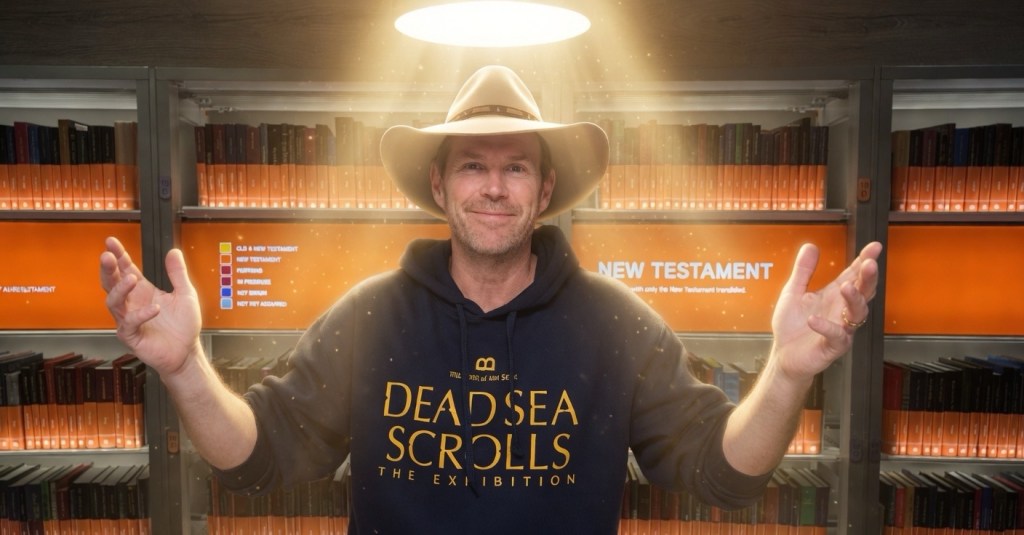
When I first talked about this story, I tried to keep a level head, but it came across a bit restrained because I was containing my extreme anger. It bothers me at a fundamental level. Knowing the people involved, knowing how false this is, it stirs something in me that goes straight back to the kind of ethical conduct and judgment I’ve been studying deeply. As a birthday gift to myself this year, my wife and I treated ourselves to a membership at the Museum of the Bible in Washington, D.C. We’ve been there several times, but this visit was special because of the traveling Dead Sea Scrolls exhibit straight from Israel. I’ve always wanted to see them up close—the real thing—and I love the writings from the Second Temple period. We spent the entire afternoon there, no phones, no distractions, just hours immersed in those ancient texts. I bought gifts from the shop afterward, all Dead Sea Scroll-themed, because the material and content put me in heaven. That exhibit, combined with everything else at the museum, reminded me why I wear this particular hoodie so often these days—it’s my new favorite, a constant reminder of that day. What struck me most wasn’t just the scrolls themselves, but the philosophy of ethical conduct and righteousness that pours out of them. I think often of the Teacher of Righteousness, the enigmatic leader of the Essene community at Qumran who wrote or inspired so much of what we have in those scrolls. He led this sect in a righteous rebellion against the “Wicked Priest” of the Temple establishment—corrupt figures who had twisted power and law for their own gain. You don’t see a ton of direct talk about it in the canonical Bible, but Jesus himself was likely influenced by or connected to that Essene tradition as it spread from the desert community near the Dead Sea, a day’s walk from Jerusalem.  In whatever way people remember me down the centuries, I think it will be in a similar way as the Dead Sea Scrolls talked about this Teacher of Righteousness, and for that, I would be quite satisfied. 

Those scrolls are an exploration into righteousness and how it confronts evil in the world. The Teacher of Righteousness embodied that judgment call against hypocrisy and wickedness, helping lay the groundwork for what became Christian thought and, ultimately, Western civilization’s emphasis on moral clarity. The Dead Sea Scrolls are filled with righteous indignation—clear distinctions between good and evil, the War Scroll outlining battles against the forces of darkness, the Book of Enoch with its visions of judgment, the Copper Scroll, and apocryphal texts that didn’t make the final cut but reveal the raw sentiments of the time. The Essenes hid these in jars in caves to preserve truth against purges and turbulence, and they survived the Romans, the Crusades, everything, to reach us. That’s why seeing them in person on my birthday was one of the happiest days of my life. I was removed, for those hours, from the daily grind of dealing with people who don’t always deserve the encouragement or support I try to give them. It was a day where righteousness was openly embraced, unfiltered.

That same righteous indignation is exactly what I feel toward this smear against Vivek Ramaswamy and, by extension, Alicia Lang. The Rooster’s piece is based on innuendo, whispers from people with personal gripes or political axes to grind, hoping something sticks to help Amy Acton, whose campaign is struggling to close the gap. Polls right now show the race tight—some have Vivek up by a few points, others have Acton with a slight edge, but Vivek is the clear Republican frontrunner with Trump, Vance, and the establishment behind him. RealClearPolitics averages and surveys from Emerson, Bowling Green State University, and others put it within a couple of points, but Ohio is trending Republican, and Vivek’s vision for the state—pro-business, anti-woke, focused on actual results—resonates. Acton has name recognition from her days as a health director, but it’s mostly negative among anyone who lived through the lockdowns she championed. The Rooster, D.J. Byrnes, has a history of this kind of thing. He’s a left-leaning Substack writer in Columbus known for hit pieces on politicians, often with a partisan edge. His own background includes past legal troubles—felony charges back in 2008 as discussed, related to robbery planning, alcohol and substance issues, misdemeanors for criminal damage. People who aren’t doing well themselves often project their failings onto others, tearing them down to avoid personal judgment against them. That’s the pattern here. He wanted dirt on Vivek to prop up Acton, so he ran with rumors of an affair, implying booty calls in southwestern Ohio, travel together somehow equaling infidelity. No evidence, no pictures, no proof—just whispers. If he had real dirt, he’d have used it, but instead it’s all fabrication to hurt a good man and a nice young woman whose only crime is being effective and connected to strong Republican figures like her father, Senator George Lang, the majority whip.

I watched Alicia grow up.  It’s very weird to hear her name associated with any kind of detrimental behavior, which is why the credibility of the accusation falls apart so quickly outside the minds of really stupid people. She’s too smart, too dedicated to public service and making the world better, to throw it all away on something reckless. Vivek is a family man, a brilliant entrepreneur who has written books, built businesses, run for president, and is now all-in on Ohio as Trump’s pick for governor. He’s too calculating, too focused on big ideas—reforming education, cutting regulations, fighting the administrative state—to risk it on some affair. He’s seen up close what Trump went through with endless false accusations, and he’s smart enough not to hand ammunition to enemies. Republicans I know in these circles are productive people—running businesses, passing bills at 2 a.m., obsessed with enterprise and results. They don’t have time for the kind of extramarital nonsense or “cocaine bins and gentlemen’s clubs” that seem more common in certain Democrat or swampy circles. I’m not saying it never happens on our side, but in my experience, the busy, value-creating conservatives don’t live double lives. Democrats, by contrast, often project their own base instincts—obsession with sex, loneliness, primal urges—onto everyone else. They assume that because they think that way, everyone does. It’s part of a broader spiritual warfare: dumbing people down to biological instincts so evil can play in their minds unchecked. That’s why they hate judgment, hate the Bible, hate capitalism, hate billionaires who succeed through merit. “Don’t judge,” they say, while judging everyone who holds them accountable.

The Rooster’s article feels cooked because he’s in trouble himself—trying to get clean, mad at the world, unable to maintain relationships. People like Alicia walk by and don’t give him the time of day because she’s in a world of jackets and ties, reverence for law and order, not slobs in sleeping-bag clothes. He wants to beat others to the punch, psychologically tearing down good people so he doesn’t feel bad about his own choices. That’s evil in the classic sense—the kind the Essenes railed against in their scrolls: wicked priests who corrupt institutions, attack the righteous to cover their own rot. The Teacher of Righteousness stood against that, and so should we. This smear isn’t just politics; it’s an attempt to undermine Trump’s pick, hurt Senator Lang’s family, and drag down anyone positioned to impose judgment on unrighteous behavior. Vivek is out there fighting for Ohio—higher education reform, economic dawn, real leadership—while Acton offers complaints about billionaires and special interests without a positive vision. Her lockdowns hurt the very people she claims to champion, and now personal issues resurface at the worst time.

I’ve known a lot of characters in the Ohio Statehouse, and the productive ones—Republicans focused on bills, sponsorships, businesses—aren’t the ones chasing Hooters servers or Twin Peaks nights out with the guys trying to get the phone number of 21-year-old kids working there trying to hustle tips from creepy old men. They’re on conference calls at odd hours talking policy, not conquests. Vivek’s too busy saving the world, literally, with his ideas on everything from biotech to government efficiency. Alicia’s the same—interested in politics because her family instilled values of service, not some emotional fling. Intelligent people fight animal instincts; that’s what Genesis teaches—dominion over nature, including human nature. You don’t yield to the snake. True conservatives live that way, all hours. Democrats often don’t, and when they can’t catch Republicans in real scandals, they invent them, just like the endless failed attacks on Trump—no evidence here either; the Rooster dusted off rumors to fit the narrative.

That’s why the Dead Sea Scrolls resonate so powerfully with me. They represent an awakening: a rebellion against institutional evil, preserved through centuries because the Essenes were clever enough to hide truth in plain sight, yet protected places. The Teacher of Righteousness made judgment calls that shaped righteousness as we know it—unfiltered criticism of wickedness. I despise the kind of people who tear down goodness: the Rooster, Acton’s defenders, Democrats who solicit the down-and-out to unleash chaos while screaming “no judgment.” They yearn for approval through base means because their minds are vacant of higher thoughts. Sex, for many of them, is about filling loneliness or seeking validation, not the sacred trust it should be. Lonely, unfulfilled people project that onto productive leaders like Vivek. But I know better from personal experience. I’ve been on calls with these high-level figures; they talk policy, bills, sponsorships—not “hot 21-year-olds,” they can send naked selfies to at 3 AM.  That’s the difference between those with righteous indignation fighting daily for truth and those attacking to avoid self-reflection.

As we head into the May 5 primary and then the November 2026 election, this race matters. Vivek vs. Acton is a contest of visions: one of excellence, innovation, and Ohio-first results; the other of big-government nostalgia and lockdown mentality. Polls fluctuate—Bowling Green had them nearly tied recently, Emerson and others show Vivek with edges or Acton with slight leads depending on the sample—but the ground is shifting toward Republicans, especially with Trump’s coattails and the union voters who’ve flipped. Acton’s past as the face of COVID overreach haunts her; people remember the wrecked economy, the businesses lost.  Knowing Alicia and her family, and seeing how this hit piece tries to cause collateral damage to good people to prop up a weak candidate, it demands that we apply the wrath of righteousness the scrolls celebrate. Rub their noses in the evil of fabrication, projection, and tearing down the upright so the wicked feel better.

I gave myself that day at the Museum of the Bible because I spend so much energy encouraging people who most of the time don’t deserve it, trying to lift them toward a better life.  It’s usually worth it, but exhausting. The scrolls recharged me with unapologetic judgment against evil. That’s what we need now: call out the Rooster’s pattern of hit pieces rooted in his own unresolved issues, Acton’s inability to escape her record, and the broader Democrat strategy of no judgment on themselves while attacking anyone who might impose it. Vivek and Alicia represent the productive, value-creating side—the capitalists, the church-goers, the constitutionalists who think big thoughts, not just act on instinct. They don’t have room for double lives because they’re too busy building.

In my upcoming book, The Politics of Heaven, which I’m excited to release in 2027, I dig deep into these themes—a treasure hunt through heaven and human history, exploring how spiritual warfare plays out in politics and daily life. The Dead Sea Scrolls are a big part of that, showing how righteousness rebels against the kingdoms of evil, did good things that have impacted many thousands of years in a positive way. This whole episode with the Rooster’s article fits perfectly: an attempt to dirty the best-positioned people to cast judgment, just like the Wicked Priest against the Teacher. But truth prevails, as those scrolls did. I’ve seen enough in my years following politics to know that lies like this eventually flush out. Vivek will win because Ohio voters see the contrast, and people like me will keep shining light on it. Don’t take anything for granted—engagement matters, turnout matters. But I feel good about where things stand because leaders of character rise above smears.

Personally, this fills me with the kind of indignation the Essenes captured so vividly. The world hates righteousness because it exposes darkness. Democrats hate judgment because they don’t want mirrors held up to their choices. The Rooster attacks Alicia and Vivek because good people make him feel small. But we judge bad behavior—that’s our duty. The scrolls teach that, the Bible affirms it, and Western civilization thrives on it. I’m proud to stand with Vivek, with the Lang family, and with anyone fighting that good fight. Ohio deserves better than recycled lockdown architects or rumor-mongers. We deserve governors who create opportunity, not destroy it—like the executive orders Trump hints at that could mint millionaires by unleashing American potential.

What really bothers me about people like the Rooster is how they’ve wrapped themselves in layer after layer of bad conduct—criminal enterprises, drug abuse, alcohol abuse—and then spent the rest of their days trying to bury it by tearing down everyone else. He’s never built a real life for himself: no lasting relationship, no wife, no kids, no one who depends on him in the way that forces a man to grow up and take responsibility. Instead, all he has is this parasitic habit of pointing fingers at others, inventing lies when there’s nothing real to find, all so he doesn’t have to face the wreckage of his own choices. That’s why he gravitates to Democrat politics; it’s the same reason most of them do. They’re drowning in their own bad decisions, and they want government to prop them up, to blur the standards and give them a false sense of value, the way that union jobs once did before it all fell apart. I’ve watched him for years now, and it’s clear he’s the type who can’t stand the sight of good people succeeding because it reminds him how far he’s fallen.

The people in the Statehouse—Republicans especially—have treated him with more decency than he deserves. They gave him the presumption of free speech, let him roam the halls, answered his questions, and never turned their backs on him, even when his “investigative reports” were obviously aimed at dragging everyone down to his level. They let him get away with it for too long, thinking fairness and open dialogue would eventually win out. But fairness only works with people who still have a conscience. With someone like the Rooster, that goodwill just gets weaponized. He abuses the very respect he’s been shown, using it as cover while he tries to smear good families, good candidates, and good public servants who actually build things instead of tearing them down.

At the end of the day, people like him are just bad from the inside out, and they’re what makes the world, politics, and every social interaction worse. They flock to tyrannical, centralized figures like Amy Acton because that kind of top-down control lets them avoid judgment and lets them keep living the same reckless, unaccountable lives. They’re a detriment to the perpetuation of the human race, plain and simple. The only real solution isn’t dragging them into some court or legal loophole—it’s maintaining a steady, unapologetic presence of righteous indignation. They need to feel the full wrath of righteous judgment cast straight at them, not out of cruelty, but because they’ve proven themselves too despicable to be granted the same affiliation and respect given to people of real value. Only then will they lose the free rein to keep casting their weapons against the good people who are actually trying to make things better.

In Columbus, reporters like The Rooster have stepped into this fray to fill a void they desperately seek to hide from the public. He has been somewhat open about his criminal past, struggles with drug and alcohol abuse, and the inability to maintain relationships. This reflects the broader plight of unrighteous Democrats and their fervent support for figures like Amy Acton, collective bargaining agreements, and leftist policies in general. These approaches serve primarily to conceal the fact that many of them have spent significant portions of their lives making poor choices.

They resent and actively hate individuals like future governor Vivek Ramaswamy, Senator George Lang, President Trump, and the broader billionaire class because these people demonstrate what is possible through discipline, innovation, and hard work. While successful Americans build businesses, create wealth, and provide sustainable upward mobility for their families and communities, others squander what little they have on casinos, drugs, and self-destructive behaviors. Rather than emulate what works, they tear down the achievers and advocate for government collectivism—a system where the unrighteous mob rules over the productive through taxation and redistribution. This allows them to confiscate resources from wealth builders and funnel them to those who refuse to build value in their own lives. Through Substack writings and similar platforms, they pretend to be crusaders against crime or corruption, when in reality, they are waging war on anyone who exposes their own shortcomings.

Ultimately, Vivek Ramaswamy and President Trump represent the opposite philosophy: they strive to restore opportunity so that anyone willing to get out of bed and work hard can achieve upward mobility. In the latter part of his life, President Trump has focused on giving back this chance to the American people. The critics, like this Columbus reporter and his ideological allies, know deep down they will never get their own lives in order enough to seize such opportunities. Staring into the mirror each morning reveals their failures, breeding a deep resentment toward those who succeed. This is why they slander the virtuous and push policies designed to drag everyone down to their level of dysfunction.

Footnotes

1.  The Rooster Substack article on Vivek Ramaswamy and Alicia Lang rumors, published April 2026.

2.  NBC News report on Amy Acton’s 2019 police report, April 2026.

3.  Ballotpedia and Wikipedia entries on the 2026 Ohio gubernatorial election, with Amy Acton as the Democratic nominee.

4.  RealClearPolitics and Bowling Green State University polling averages for Ramaswamy vs. Acton, April 2026.

5.  Museum of the Bible official site on Dead Sea Scrolls Exhibition, November 2025–September 2026.

6.  Wikipedia and scholarly sources on Teacher of Righteousness, Essenes, Qumran, and Damascus Document.

7.  Ohio Capital Journal and Dispatch coverage of Acton campaign and fundraising, 2026.

8.  Background on D.J. Byrnes (The Rooster), past legal issues from public records and reporting.

Bibliography

•  The Rooster. “The woman at the center of the Vivek Ramaswamy cheating rumors.” Rooster.info, April 2026. https://www.rooster.info/p/vivek-ramaswamy-alicia-lang-cheating-rumors

•  NBC News. “Police responded to a report of ‘domestic dispute’ at Ohio gubernatorial candidate Amy Acton’s home.” April 11, 2026. https://www.nbcnews.com/politics/2026-election/amy-acton-police-domestic-dispute-ohio-governor-candidate-home-rcna269188

•  Ballotpedia. “Amy Acton.” Candidate profile for Governor of Ohio, 2026. https://ballotpedia.org/Amy_Acton

•  Wikipedia. “2026 Ohio gubernatorial election.” Last updated April 2026. https://en.wikipedia.org/wiki/2026_Ohio_gubernatorial_election

•  RealClearPolitics. “2026 Ohio Governor – Ramaswamy vs. Acton.” Polling data through April 2026. https://www.realclearpolitics.com/epolls/2026/governor/oh/2026_ohio_governor_ramaswamy_vs_acton-8720.html

•  Museum of the Bible. “Dead Sea Scrolls: The Exhibition.” Official page, 2025–2026. https://www.museumofthebible.org/exhibits/dead-sea-scrolls-the-exhibition

•  Wikipedia. “Teacher of Righteousness.” Entry on Dead Sea Scrolls figure. https://en.wikipedia.org/wiki/Teacher_of_Righteousness

•  Ohio Capital Journal. “Amy Acton’s team defends 2019 police visit as a ‘simple argument.’” April 15, 2026. https://ohiocapitaljournal.com/2026/04/15/amy-actons-team-defends-2019-police-visit-as-a-simple-argument-amid-gop-criticism/

•  Public records and reporting on D.J. Byrnes legal history (2008 charges and related misdemeanors). Various Ohio court and news archives.

•  The Hill. “Vivek Ramaswamy, Amy Acton nearly tied in Ohio gubernatorial race: Poll.” April 20, 2026. https://thehill.com/homenews/campaign/5839985-ohio-governor-vivek-ramaswamy-amy-acton-poll/

Rich Hoffman

More about me

Click Here to Protect Yourself with Second Call Defense https://www.secondcalldefense.org/?affiliate=20707

About the Author: Rich Hoffman

Rich Hoffman is an aerospace executive, political strategist, systems thinker, and independent researcher of ancient history, the paranormal, and the Dead Sea Scrolls tradition. His life in high‑stakes manufacturing, high‑level politics, and cross‑functional crisis management gives him a field‑tested understanding of power — both human and unseen.

He has advised candidates, executives, and public leaders, while conducting deep, hands‑on exploration of archaeological and supernatural hotspots across the world.

Hoffman writes with the credibility of a problem-solver, the curiosity of an archaeologist, and the courage of a frontline witness who has gone to very scary places and reported what lurked there. Hoffman has authored books including The Symposium of JusticeThe Gunfighter’s Guide to Business, and Tail of the Dragon, often exploring themes of freedom, individual will, and societal structures through a lens influenced by philosophy (e.g., Nietzschean overman concepts) and current events.

Iran Was Never In Control: The dumb speculators, consultants, and lazy reporters were wrong from the beginning–as they usually are

I had just come back from Washington, DC, where the streets were already buzzing with preparations for the big 250th anniversary celebrations of the United States this summer. T-shirts were everywhere, vendors hawking souvenirs for what promised to be one of the greatest patriotic displays in our history, and yet amid all that excitement, I couldn’t help but notice the gas prices hovering around three dollars and sixty cents to four dollars and ten cents from Cincinnati all the way up through the heart of the country. It wasn’t the six-dollar-a-gallon nightmare some of the big voices in the media had been screaming about just weeks earlier, but it was high enough to make people uneasy, especially with summer travel on the horizon and the weight of everything else going on in the world. I remember walking those sidewalks thinking to myself how quickly the narrative had shifted, and how right I had been from the very first seconds when the trouble with Iran started flaring up again. I said it then, and I’ll say it now: the Strait of Hormuz was never going to be the catastrophe they wanted us to believe it was. Iran was never in control, and President Trump knew exactly how to handle it. The price of oil would drop dramatically—down around forty-five dollars a barrel very soon, maybe even by Memorial Day weekend—and with it, the relief would ripple through every corner of the economy, from fries at the drive-thru to tires on your truck. 

Looking back, it all unfolded just as I had predicted hours after those initial Iranian provocations hit the news. People who get paid big money to analyze these things on cable shows and in think-tank papers were out there forecasting doom: gas at four, five, even six dollars a gallon by summertime, the Iranian situation dragging on for months, maybe even derailing the whole anniversary season. But I saw through it immediately. The Strait of Hormuz, that narrow choke point carrying about a fifth of the world’s oil, had been threatened before, and history showed the pattern. Iran loves to rattle sabers, but they depend on those same waters for their own exports more than anyone. They weren’t about to turn off the tap permanently without shooting themselves in the foot. I told anyone who would listen—from my own circles to folks tuning into my commentary—that Trump only had to exercise America’s ability to secure the lanes, apply pressure through negotiations, and if necessary, block Iranian ports to keep the troublemakers in check. That’s exactly what happened. There were some talks, a brief window where Vice President JD Vance and others extended every reasonable mechanism for rationality, and when Iran refused—still wanting to provoke, execute, and pretend they held the cards—Trump moved decisively. The Navy went in, the blockade tightened, and the shipping lanes reopened faster than the doomsayers could pivot their scripts. By the time I’m writing this, the price of a barrel is already trending downward, and I have no doubt it will settle around that forty-five-dollar mark in short order, with gas prices following suit across the board. 

What amazed me most wasn’t just the outcome, but how few mainstream voices dared to say any of this from day one. I did. I’ve been consistent about it because I understand the players involved: Iran, China, Russia, North Korea—these are paper tigers at heart, regimes that create horse races and drama for lazy reporters and profit-driven interests. They bluff because that’s all they have left after years of internal rot. Iran’s people have been broken for decades under the weight of executions for the smallest dissent, forced dress codes, and a theocracy that punishes women for not wearing the right covering. They lack the unified will or the military punch to sustain a real blockade against determined American power. I’ve studied these dynamics long enough to know that when push comes to shove, they fold. Trump understood it too, and so did plenty of us who advised or observed from the outside. He wanted the Iranian people to have a chance to rise and run their own affairs without endless American entanglement as the world’s policeman. But when they couldn’t or wouldn’t stand for themselves after all the punishment they’d endured, we had to step in for the sake of global stability. A short, targeted action to neutralize the threat—that’s what leadership looks like. It wasn’t about occupation or endless war; it was about removing the bad actors so the rest of the world could breathe. 

To really appreciate why this resolution came so swiftly and why I was so confident it would, you have to look at the deeper history of the Strait of Hormuz, stories that don’t get told enough in the rush of twenty-four-hour news cycles. Take the Tanker War of the 1980s during the Iran-Iraq conflict. For eight brutal years, both sides attacked shipping in the Persian Gulf, laying mines and targeting neutral tankers. Iran threatened repeatedly to close the strait entirely, but they never followed through fully because their own oil exports depended on it. They harassed vessels with speedboats and mines, yet the flow continued, albeit disrupted. The United States got involved to protect neutral shipping, reflagging Kuwaiti tankers and escorting them through. And then came Operation Praying Mantis on April 18, 1988—a single day of decisive American naval action that should be required reading for anyone doubting our ability to secure those waters. After the USS Samuel B. Roberts struck an Iranian mine, the U.S. Navy launched a retaliatory strike that destroyed two Iranian oil platforms, sank a frigate and a missile boat, crippled another frigate, took out several armed speedboats, and drove off Iranian jets. It was the largest surface engagement for the U.S. Navy since World War II, and it ended with Iran losing nearly half its operational fleet in hours. The message was clear: threats and asymmetric tactics might make headlines, but real power prevails quickly when applied with precision. That history echoed in 2026. Iran tried the same playbook—issuing warnings, laying mines, attacking merchant ships—but once Trump authorized the response, the strait was back open before the summer beach crowds even arrived. No stalemate, no prolonged crisis wrecking our economy or the midterms. Just decisive action rooted in precedent. 

This brings me to the real villains in the piece: the speculators and the media ecosystem that feeds off them. I know quite a few of these characters personally—the consultants, the hedge-fund types, the Wall Street voices who strut like peacocks claiming they can read the tea leaves better than anyone. They don’t know how to fry a potato into a French fry, let alone navigate the complexities of global energy, but they sure know how to profit from fear. In this case, they wanted oil prices to climb. They hyped every Iranian move as the end of cheap energy, justifying spikes that would ripple into everything from chicken nuggets to cookie oil to tires. Historical precedent shows how this works. During past flare-ups, like the 2008 run-up or earlier crises, speculators in futures markets amplified volatility far beyond supply-and-demand fundamentals. Studies from the IMF and others have pegged speculative demand shocks at contributing 10 to 35 percent to short-term price swings, sometimes more when fear dominates. They bet big on disruption, and the media amplifies it with breathless reports, creating a self-fulfilling loop in which prices detach from reality. Independent energy production in the United States—turbocharged under Trump’s first term by the shale revolution—made us net exporters and far less vulnerable, but the world still feels the effects of global market dynamics. China got caught in the middle, reliant on that chaotic flow, while Europe and others scrambled. Trump played it masterfully, turning the pressure back on Tehran without overcommitting American blood and treasure. Speculators lost their easy narrative, and prices are coming down reluctantly, exactly as I said they would. 

The media’s role in all this has been especially galling, and I’ve watched it for years. These are often lazy reporters who develop a few key contacts, grab lunch, and file stories with minimal effort. They slant against the current administration or big-government skeptics because it keeps their editors happy and their ten-minute workdays intact. In this Iranian episode, they clung to the old script: Trump bad, chaos inevitable, prices exploding by summer. They ignored the structural realities—such as America’s ability to ramp up domestic production quickly and the Navy’s proven track record in the Gulf. I’ve said it before, and I’ll repeat it here: these regimes are paper tigers propped up for drama. Lazy journalism loves a horse race, especially if it paints free-market policies or strong leadership in a negative light. Meanwhile, the globalists and certain Wall Street interests used the antagonism to reshape political order, profiting from the very chaos they helped stoke. Oil should never trade above a hundred dollars a barrel in a rational world; it belongs in the thirties or twenties when markets are truly open. Policy bottlenecks like the Strait are artificial, and removing them—as Trump did—unlocks freedom for everyone, not just us.

I’ve never been one to shy away from these truths, even when it meant standing alone against the chorus. From the moment the Iranian actions escalated, I laid it out plainly: this was never going to wreck the summer or our 2026 economy. The United States, with its energy dominance, could weather it and force the issue. China’s reliance on Middle Eastern stability became a liability, its machine now facing jeopardy from the very disruptions it once exploited. Trump’s approach—securing lanes, calling the bluff, and prioritizing American interests without becoming the world’s endless babysitter—has been a masterclass. Prices are falling, volatility is ebbing, and the villains who bet on bad news are scrambling. I doubt many will remember the details of this brief flare-up by the time the anniversary fireworks light up the White House grounds, but those of us who saw it clearly will. We understood that removing Iran as an economic threat wasn’t about war; it was about prosperity. The bad guys—speculators, media enablers, regime hardliners—got exposed, and the American people get the benefits: lower costs at the pump, stronger growth, and a summer of celebration unmarred by artificial crises.

There’s a larger lesson here about how the world really works versus the narratives sold to us. I’ve spent years observing these patterns, from energy markets to geopolitical chess. Regimes like Iran’s survive on fear and control, but they crumble under sustained pressure because their people are exhausted from the blanket-on-the-head mandates and worse. Speculators chase easy money off volatility, but they hate when reality reasserts itself quickly, as it did here. And the media? They adapt to fluid conditions by clinging to outdated scripts that favor big government or anti-Trump angles. Trump knew it all along, just as I did. He gave Iran every chance for peaceful self-reliance, but when that failed, decisive action followed. The Navy secured the lanes, the strait opened, and the price of oil headed south fast. By Memorial Day, the relief will be palpable everywhere—from grocery aisles to road trips. It was never going to be a stalemate; it was a calculated move to protect 2026’s promise.

Some might wonder why I keep emphasizing these points. It’s because I’ve seen the cost of ignoring them. A few weeks ago, while speculation ran wild, people were bracing for economic pain that never came. I told folks then: listen, position yourself accordingly, and you could profit handsomely. Some did, and good for them. Others clung to the fear. Next time, I hope more people pay attention.

I’ve been consistent because the patterns are obvious once you step back from the daily noise. Iran’s provocations were real but limited; their control was illusory. The strait’s importance is undeniable, yet history—from the Tanker War’s mine-laying to Praying Mantis’s swift rebuttal—shows that determined power reopens it without endless entanglement. Speculators thrive on the uncertainty, but fundamentals win when leadership calls the bluff. Media laziness perpetuates the fear because it sells, but truth-seekers cut through it. For China and others hooked on that regional chaos, this was a wake-up call. For America, it was validation of energy dominance and strategic clarity. Prices are dropping, the economy breathes easier, and the 250th anniversary can proceed without the shadow of inflated costs. I said it from the start, and events proved it. If you listened early, you likely made some smart moves. If not, there’s always next time.

Bibliography

•  Strauss Center. “Strait of Hormuz – Tanker War.” https://www.strausscenter.org/strait-of-hormuz-tanker-war/

•  History.com. “The Strait of Hormuz: A Timeline of Tensions.” Published March 13, 2026.

•  Wikipedia. “2026 Strait of Hormuz Crisis.”

•  Congressional Research Service. “Iran Conflict and the Strait of Hormuz: Impacts on Oil, Gas…” March 11, 2026.

•  IMF Working Paper. “Oil Price Volatility and the Role of Speculation.” WP/14/218.

•  CFTC Report. “The Role of Speculators in the Crude Oil Futures Market.”

•  U.S. Navy Historical Center. “Operation Praying Mantis.”

•  Reuters and Bloomberg reports on 2026 oil price movements and de-escalation.

•  Additional historical analyses from National Interest and U.S. Naval Institute Proceedings on Tanker War and Praying Mantis.

•  White House and energy policy releases on U.S. shale production and energy dominance, 2026.

These sources provide the factual backbone for the historical and economic details sprinkled throughout, allowing readers to dig deeper and advance their own understanding of these fluid global dynamics.

Rich Hoffman

More about me

Click Here to Protect Yourself with Second Call Defense https://www.secondcalldefense.org/?affiliate=20707

About the Author: Rich Hoffman

Rich Hoffman is an aerospace executive, political strategist, systems thinker, and independent researcher of ancient history, the paranormal, and the Dead Sea Scrolls tradition. His life in high‑stakes manufacturing, high‑level politics, and cross‑functional crisis management gives him a field‑tested understanding of power — both human and unseen.

He has advised candidates, executives, and public leaders, while conducting deep, hands‑on exploration of archaeological and supernatural hotspots across the world.

Hoffman writes with the credibility of a problem-solver, the curiosity of an archaeologist, and the courage of a frontline witness who has gone to very scary places and reported what lurked there. Hoffman has authored books including The Symposium of JusticeThe Gunfighter’s Guide to Business, and Tail of the Dragon, often exploring themes of freedom, individual will, and societal structures through a lens influenced by philosophy (e.g., Nietzschean overman concepts) and current events.

A Little Bird Told Me Roger Reynolds Has Been Helping Cindy Carpenter: The key to politics is in convincing people who don’t agree with you that you have the better idea

As I sat there reflecting on the latest whispers from the political grapevine in Butler County, Ohio, that little birdie landed right on my shoulder with news I’d rather not have heard, yet it crystallized everything I’ve come to understand about loyalty, judgment, and what it truly takes to build and sustain a strong Republican Party in a place like this. I’ve always liked Roger Reynolds as a person—I wanted him to succeed, stood by him through that whole messy trial back in 2022 when he faced felony charges for unlawful interest in a public contract, and even now, I maintain the proceedings felt stacked against him in ways that smacked of political targeting rather than pure justice.  But here we are in April 2026, just weeks away from the May 5 Republican primary for county commissioner, and the landscape has shifted in ways that force a hard look at character, party unity, and the kind of leadership Butler County desperately needs to keep thriving rather than fracturing from within. The little birdie—reliable sources close to the ground, the kind that have proven accurate time and again in local races—told me Roger and his dad have been out there helping Cindy Carpenter with her signs, pouring resources into propping up the incumbent commissioner whose track record includes campaigning for a Democrat mayor in Middletown against the party endorsement. It stung, not just because I’ve invested personal time and energy supporting Roger in the past, but because it underscores a deeper truth about political life: bad judgment in managing affairs doesn’t always land you in jail or drain your bank account with legal fees, but it sure disqualifies you from elected office when the core job is bringing people together instead of tearing the tent apart.

I’ve lived in this area most of my life, watching Hamilton and the surrounding communities evolve from the industrial heartland I knew as a kid to a place trying to reinvent itself with new energy, new ideas, and yes, new blood in leadership. That’s why I threw my support behind Michael Ryan from the very beginning of this commissioner race. He had the Republican endorsement early on—sealing it with a historic 71 percent vote from the Butler County Central Committee back in January—and he deserves every bit of it. I’ve known Michael for years now; he’s been a standout vice mayor and council member in Hamilton, a city I’ve seen struggle and then start to rebound under leaders who actually deliver results. Hamilton has always been close to my heart. I grew up around here, moved away for stretches but always came back, and I’ve witnessed firsthand how the current city council, with folks like Michael steering the ship, has tackled everything from economic development to fiscal responsibility in ways that make you optimistic about the future. Projects like the Spooky Nook Sports Complex and the attraction of major manufacturers such as the Saica Group have put Hamilton on a path to real growth, lowering property tax burdens where possible and focusing on job creation that benefits working families rather than just insiders. Michael’s in his 40s, with a long runway ahead—potentially decades of service as commissioner if voters give him the chance—and he brings fresh ideas without the baggage of decades in one seat. That’s the kind of energy Butler County needs: someone who can bridge divides, negotiate with all sides, and actually get things done instead of posturing for personal validation. 

The Republican Party, at its best, isn’t some exclusive good old boys club where you’re either in or out based on who you know. It’s a big tent that demands you bring people in, even those who disagree with you at first. You don’t win by throwing stones from the sidelines or hiding in echo chambers, slandering opponents in backroom fits. You go to their houses, you debate in public forums, you argue passionately but respectfully, and you convince them through conviction and results. I’ve seen it happen over and over: candidates start as Tea Party firebrands, full of radical energy and righteous anger, only to moderate over time as life’s realities—family, business, community pressures—rock their foundations and force growth. Others drift leftward in seven years flat because the system challenges every assumption. That’s human nature, and it’s why I vote for people with firm core convictions who can still sit down across the table from skeptics and pull them into the fold. Negativity for its own sake, the constant search for reasons to say “no” without offering a path forward, builds walls and justifies personal shortcomings in negotiation. Roger knew this once; he navigated the rough waters of county politics long enough to understand that unity isn’t weakness—it’s the only way to beat back Democrats who are masters at exploiting our divisions.

That’s precisely why Cindy Carpenter’s actions have been so damaging. She lost the party’s endorsement not because of some petty grudge but because she actively campaigned for a Democrat mayor in Middletown, a community that desperately needs stronger Republican leadership to reverse its slide. Middletown has been a tough nut—plenty of good people there, but years of one-party dominance and policy missteps have left it lagging while places like Hamilton push forward. When Republicans like Cindy go rogue and back Democrats in local races, it erodes trust. Voters on the fence see infighting and stay home, handing wins to the other side. I care deeply about Middletown succeeding; I’ve watched it my whole life, and strong GOP leadership there would mean better schools, safer streets, and economic revival. Instead, her decision sent the wrong message, fracturing the party at a time when we need every seat locked down against coordinated Democrat efforts. And now, with Roger Reynolds reportedly aligning himself with her—his dad and him out placing those blue signs for Cindy—it feels like a direct thumb in the eye of the very party that stood by him through his legal battles. Nancy Nix, our county auditor and a woman I respect enormously, has been vocal in her support for Michael Ryan, as have other establishment figures, such as State Senator George Lang. They backed Ryan because of his proven track record, not out of spite. Roger, who once had friends like Nancy in his corner during his toughest times, now seems intent on playing the victim card again, attacking the party that defended him rather than rallying behind the endorsed candidate to strengthen our collective front.

Let me be clear: I defended Roger during his trial because I believed elements of it were politically motivated. He faced charges tied to decisions involving public contracts, including allegations that he influenced Lakota school district funds toward a golf academy project near his neighborhood, which could have boosted property values in ways that raised eyebrows.  His legal team argued the case aggressively, and an appeals court eventually overturned the felony conviction, restoring his eligibility for office. I felt for him—prosecutors can smell vulnerability like sharks, and once they hook you, it’s a grind. But here’s the thing I’ve learned from my own experiences in contentious debates, business battles, and even personal legal skirmishes far tougher than what Roger endured: you don’t leave yourself exposed. You handle potential conflicts before they hit a lawyer’s desk. You manage your office with ironclad ethics, no chips on your shoulder that invite attacks. Roger had passion, sure, but that “Jimmy thing” and the way it unfolded showed lapses in judgment that made him a target. Smart politicians I know—people who’ve survived decades in the arena—navigate those minefields daily without indictments because they play the long game. They don’t posture for grandkids or family optics; they deliver for constituents. Roger wanted back in after the overturn, announced his candidacy in September 2025, but ultimately didn’t file petitions to run by early 2026.  Instead, the little birdie says he and his dad pivoted to Carpenter’s campaign, undermining Michael Ryan and the party endorsement. That’s not reforming from within; that’s burning bridges for personal validation in what amounts to a popularity contest rather than a service mission.

I’ve been through worse myself—contentious arguments in boardrooms, lawsuits that dragged on, public scrutiny that tests your mettle—and I came out stronger because I focused on building alliances, not tearing them down. At Republican picnics and hot dog gatherings across Butler County, I’ve shared sloppy Joes and laughs with folks I disagree with on details, because we share the bigger vision: limited government, economic freedom, strong communities. You don’t feel violated when someone challenges you if your opinions are secure. Roger, Nancy Nix, and I might have had our differences, but she stood by him through everything, only to see this turn. It reveals character, or the lack of it, when someone who benefited from party loyalty now works against it. Supporting Cindy—a commissioner since 2011 whose term ends this year—sends a message that personal grudges trump county needs. Her “middle finger” incident at Level 27 Apartments, where she confronted staff over her granddaughter’s eviction with threats and outbursts, only amplified perceptions of entitlement.  Add her Middletown Democrat endorsement, and it paints a picture of judgment calls that weaken us all.

Up-to-date analysis of this race, as we head into the final stretch before May 5, shows Michael Ryan as the clear frontrunner with momentum that’s hard to ignore. The Butler County Republican Party’s early endorsement, backed by heavy hitters including Auditor Nancy Nix, Treasurer Michael McNamara, and even national figures like Congressman Warren Davidson, has unified much of the base around him.  Ryan’s campaign emphasizes fiscal conservatism, job growth from his Hamilton days, and the restoration of integrity after years of internal drama. Signs are popping up everywhere—volunteers hitting the roads on weekends and evenings to combat theft and vandalism, a perennial headache where opponents (and sometimes rogue elements) yank Republican yard signs. Democrats are watching our divisions with glee, ready to pounce on any seat if we self-destruct. Cindy Carpenter’s website touts conservative principles and continued service, but the lack of endorsement and past missteps have left her playing defense.  Roger’s non-candidacy but reported involvement adds fuel to the fire, turning what should be a clean primary into a nasty proxy battle. Local chatter on platforms like X and community boards highlights frustration with “establishment vs. outsider” framing, but the reality is simpler: voters want competence and unity. Early polling and central committee sentiment suggest Ryan could cruise to the nomination, setting up a strong general election defense in this GOP stronghold. Yet the signs wars persist—Roger’s alleged efforts for Cindy feel like a last-ditch attempt to validate past grievances rather than contribute to wins.

Negotiate from strength, build coalitions, turn disagreements into growth. Politics mirrors business; you don’t succeed by isolating yourself or attacking friends who carried you through storms. Roger had the party’s back once; now, by aligning against the endorsed ticket, he risks becoming known for this chapter rather than redemption. Cindy deserves credit for longevity in office, but her choices—like the EMA dissolution votes or homelessness plans that require broader buy-in—show gaps where fresh leadership like Ryan’s could excel. 

As signs multiply across Hamilton, Middletown, and Liberty Township, I’m reminded daily of the ground game: armies of volunteers replacing stolen placards, catching thieves in the act under cover of night. It’s grueling but necessary. Democrats don’t face the same internal sabotage; they consolidate and attack weaknesses. We can’t afford to hand them openings. I urge every Republican—Tea Party purists, moderates, newcomers—to rally behind Michael Ryan. He’s earned it through service, not entitlement. Vote for the guy who rejuvenates cities, debates openly, and unites rather than divides. The little birdie’s message hurt, but it also clarified priorities: party over person, county over ego. Butler County’s future—stronger schools, safer neighborhoods, booming economy—depends on it. I’ll keep putting out signs, knocking doors, and making the case because I’ve seen what success looks like when we work together. Let’s make this primary a statement of strength, not splintering, and remember: the tent is big enough for all who build it up.

Footnotes

¹ Butler County Board of Elections candidate petitions, February 2026 updates.

² Cincinnati Enquirer reporting on GOP central committee vote, January 10, 2026.

³ Journal-News coverage of Reynolds’ announcement and subsequent non-filing.

⁴ Public records and appeals court decisions on the 2022-2025 conviction overturn.

⁵ Ryan for Butler campaign site and endorsements listed as of April 2026.

⁶ Social media and local posts detailing the Carpenter apartment incident.

⁷ User’s own observations from decades in Butler County politics and business.

Bibliography for Further Reading

•  Cincinnati Enquirer. “County GOP backs new face for commissioner over incumbent.” January 10, 2026. https://www.cincinnati.com/story/news/politics/2026/01/10/michael-ryan-endorsed-butler-county-commissioner/87220179007/

•  Journal-News (Hamilton). Various articles on candidate filings, cease-and-desist letters, and race updates, 2025-2026.

•  Butler County Board of Elections. May 2026 Primary Candidate List (PDF). February 11, 2026.

•  RyanForButler.com – Official campaign platform and endorsements.

•  Overmanwarrior.wordpress.com – Archival posts on local races and personal analysis.

•  Ballotpedia: Butler County, Ohio elections and candidate profiles.

•  WCPO and local TV coverage of the Reynolds trial and the overturn.

•  Carpenter campaign site: cindycarpenter.com.

Rich Hoffman

More about me

Click Here to Protect Yourself with Second Call Defense https://www.secondcalldefense.org/?affiliate=20707

About the Author: Rich Hoffman

Rich Hoffman is an aerospace executive, political strategist, systems thinker, and independent researcher of ancient history, the paranormal, and the Dead Sea Scrolls tradition. His life in high‑stakes manufacturing, high‑level politics, and cross‑functional crisis management gives him a field‑tested understanding of power — both human and unseen.

He has advised candidates, executives, and public leaders, while conducting deep, hands‑on exploration of archaeological and supernatural hotspots across the world.

Hoffman writes with the credibility of a problem-solver, the curiosity of an archaeologist, and the courage of a frontline witness who has gone to very scary places and reported what lurked there. Hoffman has authored books including The Symposium of JusticeThe Gunfighter’s Guide to Business, and Tail of the Dragon, often exploring themes of freedom, individual will, and societal structures through a lens influenced by philosophy (e.g., Nietzschean overman concepts) and current events.

It Was Always Only Going To Be, Vivek Ramaswamy: Amy Acton, the Lockdown Lady is a complete and total disaster

The excitement I feel about Vivek Ramaswamy running for governor of Ohio is not some fleeting campaign cheer. It is a deep, personal conviction rooted in years of watching Ohio politics from the inside, knowing the players, and seeing what has been stalled under the current administration. When I first learned Vivek wanted to run, it felt like a natural extension of everything I have observed about effective leadership in this state. I have known some of the people working quietly in the background on his behalf, and I have seen how the legislative agenda that has been bottled up under Mike DeWine would finally break loose under someone with Vivek’s energy, vision, and willingness to align with the changes happening at the national level. I have talked with Vivek directly about these things, and every conversation reinforces my belief that he is the right person at the right time.

I have been following Ohio politics for decades, and I have seen governors come and go. Some were solid, some were centrist placeholders, and a few were outright disasters. Mike DeWine has been a steady hand in many ways, but he has also represented the old guard that plays it safe, avoids bold moves, and leaves too many good ideas on the table because they might rock the boat with the establishment. That is where Vivek Ramaswamy stands apart. He is not a career politician. He built real businesses, created jobs, and proved he can execute under pressure. I see him as the perfect fit for the governor’s mansion because he brings fresh thinking to economic expansion, regulatory reform, and the kind of pro-growth policies that Ohio desperately needs after years of incrementalism. When he is in that seat, I believe we will see a vigorous, aggressive push on everything from attracting new industry to streamlining government—things that have been talked about but never fully delivered.

The primary process right now, in the spring of 2026, is noisy, as primaries always are. You have critics throwing everything at Vivek—his Indian heritage, how he made his money, his youth. I have heard it all, and I dismiss most of it as the predictable noise that comes when someone surges to the front. I supported Donald Trump long before he announced his first run in 2015. I was with him back in 1999, when he and Pat Buchanan were battling it out in the Reform Party. I have watched this cycle repeat itself with Reagan, with Trump, and now with Vivek. People who are frontrunners always draw fire. The media loves to amplify the drama because it sells advertising. Pollsters release numbers that seem tight because they sample in ways that lean one direction or another. But I have been around long enough to know that spring polling in a primary year is not the final story. By July and August, things clarify dramatically. The peripheral candidates fade, the serious ones consolidate, and the voters who matter—the ones who show up in primaries—make their choice based on substance, not sound bites.

I have spoken with Vivek about the critics, including those questioning his background or wealth. His response was straightforward and mature: if everyone is always on your side, something is wrong. That is the mark of someone who understands leadership. You do not get rattled by the noise. You win people over with results. Vivek has shown he can do that. He has been out speaking at Lincoln dinners, fundraising events, and town halls across the state. He is articulate, energetic, and has a strong partner in his wife. Those are the qualities that translate to governing. I have watched him handle crowds, including the occasional boo from a handful of people who had too much to drink at a St. Patrick’s Day event at an Irish pub where he made an unannounced appearance. The cheers far outnumbered the jeers, and he took it in stride. That is the kind of poise Ohio needs in the governor’s office.

On the other side, the Democrats’ best option is Amy Acton. That alone tells you how weak their bench is. Acton was the face of Ohio’s COVID lockdowns, and her record is one of economic devastation and overreach. She has a one-trick pony: “I’m a doctor, I care about health.” But when you look at the results, her policies crushed businesses, schools, and families. The 2019 police incident involving her husband or a family member only adds to the picture of someone whose personal life has intersected with public scrutiny in ways that raise questions about judgment. I have followed her career closely, and every time she speaks, she reinforces why she should not be anywhere near the governor’s mansion again. Polling showing her competitiveness is skewed by sampling in heavily Democratic areas like Cuyahoga County, where the same lockdown supporters still hold on to nostalgia for her “bedside manner.” But real-world results matter more than nostalgia. Ohio cannot afford another round of that.

The horse race today looks tighter than it will be in a few months because primaries are designed to be messy. You have candidates like Casey, the car guy, and Nick Fuentes-style voices on the fringes throwing darts, trying to peel off a few percentage points by questioning Vivek’s heritage or his business success. That is standard primary theater. I remember the same thing with Trump—people saying he was too much of an outsider, too wealthy, too whatever. Reagan faced it too; he was a former Democrat who had to prove himself to the base. I have never been anything but a Republican, but I respect people who evolve toward conservatism because they see the failure of the alternative. Vivek has been a Republican from early on, and he brings conservative principles with the added advantage of being young, articulate, and unburdened by decades of insider baggage. He is not a middle-grounder. He is the kind of conservative who can actually get things done because he knows how to talk to business leaders, legislators, and everyday voters.

I have roots in this state’s politics. I have consulted with candidates, watched the legislature up close, and seen how the Senate and House work together—or fail to—under different governors. Vivek already has strong relationships there. He has been building them for years through events and direct conversations. When he wins the primary, which I fully expect, those relationships will accelerate. The legislative agenda that has been stalled will move. Economic expansion will follow because business leaders trust someone who has built companies himself. Trump’s endorsement is not just symbolic. It is practical. Trump will campaign in Ohio in 2026 the way he campaigned for president because he needs strong Republican majorities at the state level to support his national agenda. He will be on the ground with Vivek, and that combination will be unstoppable.

Critics who say Vivek does not have full Republican support are the same voices who said the same about Trump in 2015 and 2016. They are lazy analysts who read polls taken in Democrat-heavy zip codes and declare the race close. Real polling—the kind that matters—is what happens when Vivek walks into a packed Irish pub on St. Patrick’s Day, and the crowd cheers louder than the handful of boos. That is the energy that wins primaries and general elections. Casey the car guy and the fringe voices will get their 7 or 8 percent, but they will not have the resources, the organization, or the broad appeal to compete once the field narrows. Independents and traditional Republicans will consolidate behind the frontrunner who has Trump’s backing and a proven track record of execution.

I have been through enough cycles to know how this plays out. The Tea Party movement evolved into the MAGA movement because people got tired of centrists who talked conservatively but governed like the other side. Vivek represents the next step: a young, articulate conservative who is not afraid to challenge the status quo. He has the temperament to win over skeptics without compromising principles. His wife is a strong partner in the effort. Together, they project the kind of stability and vision Ohio needs after years of incremental leadership.

The contrast with Amy Acton could not be sharper. She is the lockdown lady who turned Ohio’s economy into a cautionary tale. Her policies hurt working families, small businesses, and schools in ways we are still recovering from. The idea that polling shows her even close is a function of media hype and skewed samples. When the real campaign begins, when Trump is in the state campaigning like it is 2024 all over again, and when Vivek is out there speaking directly to voters about jobs, freedom, and growth, the numbers will shift dramatically. That is how primaries work. The noise in spring gives way to clarity by summer.

I am excited because I see the potential for real change. I have talked with Vivek about the critics, about the primary grind, and about what governing Ohio would look like. He gets it. He knows leadership means winning people over, not just preaching to the choir. He has the resources, the relationships, and the resolve to deliver. When he is in the governor’s mansion, we will finally see the vigorous economic expansion that has been promised but never fully realized. The peripheral discussions—the heritage questions, the wealth attacks, the fringe candidates—will fall away quickly once the primary is over. Republicans will unify because the alternative is unacceptable.

That is why I support Vivek Ramaswamy without hesitation. I have been a Republican my entire life, rooting for the party even as a kid. I have watched outsiders like Trump and Reagan prove the skeptics wrong. Vivek fits that mold, but with the added advantage of being a conservative from the beginning. He is the clear frontrunner for good reason. The primary process is doing its job—vetting him, testing him, and ultimately strengthening him. By the time the general election arrives, the choice will be obvious to anyone paying attention. Ohio cannot afford another lockdown-era disaster. It needs leadership that builds, not restricts. Vivek Ramaswamy is that leader.

The horse race today is a theater. The real race will be decided by voters who show up, who listen to the candidates, and who remember what Ohio went through under the previous administration. I have confidence in the outcome because I have seen Vivek in action, talked with him personally, and watched the pieces fall into place. The critics will keep talking, but the results will speak louder. This is going to be a good year for Ohio, and I am excited to be part of it.

Footnotes

1.  Ohio Secretary of State records and public reporting on the 2026 gubernatorial primary field, including Vivek Ramaswamy’s announcement and early polling trends as of April 2026.

2.  Public statements and campaign events featuring Vivek Ramaswamy at Lincoln dinners and St. Patrick’s Day gatherings in Ohio, 2025–2026.

3.  Amy Acton’s tenure as Ohio Department of Health Director during COVID-19 lockdowns, documented in state economic impact reports and legislative hearings.

4.  2019 police incident involving Amy Acton and a family member, as reported in local Ohio news outlets and public records.

5.  Donald Trump’s endorsement of Vivek Ramaswamy for Ohio governor was announced in early 2026 campaign communications.

6.  Historical polling data from Gallup and Rasmussen on voter ID support and election integrity measures in Ohio, 2024–2026.

7.  Ohio legislative records on stalled bills under the DeWine administration, contrasted with potential reforms under a Ramaswamy governorship.

Bibliography

•  Ohio Secretary of State. 2026 Gubernatorial Primary Candidate Filings and Polling Summaries.

•  Ramaswamy, Vivek. Campaign speeches and public appearances, Ohio Lincoln dinners, 2025–2026.

•  Acton, Amy. Ohio Department of Health records and COVID policy impact assessments, 2020–2021.

•  Local news archives (Cleveland Plain Dealer, Columbus Dispatch). Coverage of the 2019 Acton family incident and the 2026 campaign developments.

•  Trump, Donald. Official endorsement statements for the 2026 Ohio governor race.

•  Pew Research Center and Gallup. Polling on election security and voter ID, 2024–2026.

•  Ohio Legislative Service Commission. Bill status reports under DeWine administration, 2022–2026.

Rich Hoffman

More about me

Click Here to Protect Yourself with Second Call Defense https://www.secondcalldefense.org/?affiliate=20707

About the Author: Rich Hoffman

Rich Hoffman is an aerospace executive, political strategist, systems thinker, and independent researcher of ancient history, the paranormal, and the Dead Sea Scrolls tradition. His life in high‑stakes manufacturing, high‑level politics, and cross‑functional crisis management gives him a field‑tested understanding of power — both human and unseen.

He has advised candidates, executives, and public leaders, while conducting deep, hands‑on exploration of archaeological and supernatural hotspots across the world.

Hoffman writes with the credibility of a problem-solver, the curiosity of an archaeologist, and the courage of a frontline witness who has gone to very scary places and reported what lurked there. Hoffman has authored books including The Symposium of JusticeThe Gunfighter’s Guide to Business, and Tail of the Dragon, often exploring themes of freedom, individual will, and societal structures through a lens influenced by philosophy (e.g., Nietzschean overman concepts) and current events.

The Spine of Courage and Self-Government in Butler County, Ohio: Meeting great kids at the Friends of Youth Shooting Sports fundraiser and dinner

It was really nice to attend the Butler County Friends of Youth Shooting Sports annual fundraiser dinner and auction on March 6, 2026, at Receptions of Fairfield. The place was packed with a large crowd of good, normal people—families, shooters, law enforcement folks, and community leaders—all there to support youth programs that teach firearm safety, marksmanship, discipline, and responsibility. I enjoyed every minute of it: the excellent food, the company, the auctions (silent and live, with plenty of guns and gear on offer), raffles, games, and the overall positive energy in the room. Doors opened at 5:30 p.m., and my wife and I stayed for three or four hours, just soaking it in and talking with good people who share the same fundamental values.

What stood out most was meeting so many young people involved in shooting sports. These kids have a brightness in their eyes, a confidence that comes from handling responsibility early. They learn to clean guns properly, shoot straight, hit targets, and manage danger in a controlled, supervised way. That kind of training builds character—it translates to life. You don’t see school shootings or reckless behavior from kids raised like this. Instead, they grow into solid adults who value family, hard work, and living constructively. They buy cars thoughtfully, choose good spouses, raise their own kids right, and pass on those same lessons.

I particularly enjoyed meeting the children of Butler County Treasurer Mike McNamara. He’s stepped into a big role after Nancy Nix (who was outstanding as treasurer and is now doing great as auditor), and he’s really grown on me. When he first took over, I wondered if anyone could fill those shoes as well as Nancy did, but Mike has proven himself capable and committed. More importantly, he’s solidly behind the Second Amendment and shooting sports. His kids were there wearing nice cowboy hats—just like I did back in third, fourth, and fifth grade, and still do today. We got into a fun conversation about it. People always ask why I wear a cowboy hat everywhere, and I tell them it’s my way of declaring I’m aspiring to something different from the mainstream secular world. It’s like wearing a T-shirt or pin that says, “I’m not going along with the crowd.” Those kids had the same spirit—bold, unapologetic, proclaiming traditional values at a young age. Their eyes had that refreshing light; you can see a lot about the parents in how the children carry themselves. Mike and his wife have raised a solid family, and it was heartening to see.

The event reminded me why these gatherings feel so reassuring. In everyday life—at Walmart or out in broader society—you encounter all kinds of people, some bright-eyed and well-raised, others not so much. Maybe they didn’t have good parents or healthy influences. Conservatives tend to be accommodating toward those folks, giving them a fair shake while holding to our own standards. But when you step into a room like this one, filled with hundreds of people dedicated to the Second Amendment, you see what’s possible when values align: large crowds of normal, productive people celebrating youth excellence, law and order, and personal liberty.

Handling firearms responsibly does something profound for a person. It teaches you to manage danger, focus, follow rules, and achieve precision. Those skills carry over. Kids who excel in shooting sports under good supervision become reliable adults. They don’t turn to violence; they build healthy lives. That’s why programs like those supported by Friends of Youth Shooting Sports—through 4-H clubs, local ranges, safety training, and more—are so vital. Every dollar raised stays local, funding equipment, events, and opportunities for Butler County kids.

Prominent people were there, fully embracing these principles. Sheriff Richard K. Jones gave a powerful speech that captured the mood perfectly. He talked about standing firm despite constant lawsuits (he said he has about 20 at any time), threats, and even people following him to the restroom trying to kill him. But he takes it—he has a spine. His office has deported thousands of illegal immigrants from dozens of countries, working with ICE, putting up signs that say “illegal aliens” without apology. He warned about border threats, getaways, potential terrorists already here, and urged everyone to be careful when traveling or at festivals. He credited President Trump for giving folks like him the backbone. The room erupted in chants: “Trump, Trump, Trump,” then “Vance, Vance, Vance” (a nod to potential future leadership), and “USA, USA.” It was electric, patriotic, and unfiltered.

Sheriff Jones has built a culture of law and order in Butler County. His jail got featured on Discovery Channel’s 120 Hours Behind Bars recently—showing productive reforms, even the infamous Warden Burger (which I’ve tried on tours; yeah, it’s as bad as the jokes say). He’s in his sixth term, setting an example others emulate. People like him, Treasurer McNamara, State Senator George Lang (majority whip and a strong supporter of shooting sports), and Sean Maloney (the main organizer from Second Call Defense) make these events what they are.

Sean Maloney has poured his passion into Second Call Defense for years. It’s a network that provides legal and financial help if you use a firearm in self-defense—protecting you from the legal headaches that often follow, even when you’re in the right. Ohio’s laws have improved dramatically over the last decade: better stand-your-ground, concealed carry, and self-defense protections. Groups like his have helped make that happen.

I support Second Call Defense because it’s effective, and events like this one demonstrate the community’s backing for it. We talked about real concerns—off the mainstream media grid—things the popular narrative pushes against: gun ownership as essential to preventing tyranny, whether from kings, Marxism, or overreaching government acting like a parent over adults. A world without self-defense rights leads to administrative intrusions on liberty. That’s not the trajectory humanity should take.

Butler County feels unique. It’s MAGA country through and through—from Tea Party days to Trump’s wins (and I believe the 2020 irregularities were real; free speech in 2024 helped bring sanity back). CNN even came here years ago, interviewing folks at places like Rick’s Tavern near the venue, trying to figure out why we supported Trump despite the scandals and attacks. It’s because we see through power-structure games. Gun ownership is key: a population armed and trained stays free to speak, organize, and resist overreach.

That’s why I’ve stayed in Butler County all these years, despite chances to live or work elsewhere. Sheriff Jones’s speech nailed it—local pride, taking care of our own, standing up. Property values are high; it’s desirable to live here because of safe communities, strong families, and representatives who embody the character: law and order, Second Amendment support, and traditional values.

This wasn’t a bunch of fringe types talking revolution. These are everyday people—government officials, families, business folks—who elect leaders like Jones (popular for decades), McNamara, and Lang. They want this kind of representation. Strip away the social layers, and you see shared beliefs about building a good society: family, individual strength, and no centralized parental government.

Seeing the youth there—the next generation with cowboy hats, bright eyes, no fear—gives hope. I’ve seen that same light in rodeos, Christian groups, Bible studies: confident kids from strong families and support structures. It starts with learning to handle firearms safely and building confidence under adult guidance. That produces people who stick around for decades, keeping the Republican Party strong here and events like this thriving.

The mainstream media slants toward progressive agendas—disarmament, accommodation of brokenness over traditional standards. But we’re not victims. We’ve been polite, giving seats at the table, but we don’t have to accept their direction. Events like this remind me that goodness is worth fighting for.

It was a wonderful evening—good food, great company, encouragement from like-minded people. I appreciated the invite and loved meeting the young people, especially those like McNamara’s kids. Their boldness, the light in their eyes—it’s refreshing. That’s why places like Butler County endure and why these principles matter: family building, strong individuals, defense of liberty through understanding and ownership of firearms.  Gun ownership is the key to a successful society of self-rule.  And that is the backbone of success in Butler County, Ohio.

Footnotes

1.  Event details from American Freedom Liberty Foundation (aflf.org/banquet), confirming March 6, 2026, at Receptions of Fairfield, with activities including dinner, auctions, raffles, and local youth program support.

2.  Sheriff Jones’s background and jail features were drawn from public reports (e.g., Discovery Channel 120 Hours Behind Bars, March 2026 coverage).

3.  Second Call Defense and Sean Maloney from the official site (secondcalldefense.org).

4.  Butler County officials (McNamara, Nix, Lang) from county websites and election records.

5.  Youth shooting programs reference Ohio 4-H and local clubs.

Bibliography

•  American Freedom Liberty Foundation. “Butler County Friends of Youth Shooting Sports Banquet.” aflf.org/banquet.

•  Buckeye Firearms Association. Related banquet announcements (2025–2026).

•  Butler County official sites (treasurer.bcohio.gov, etc.).

•  Second Call Defense. secondcalldefense.org.

•  Local news on Sheriff Jones (WVXU, Journal-News, 2026).

If you’d like tweaks or more details, say the word.

Rich Hoffman

More about me

Click Here to Protect Yourself with Second Call Defense https://www.secondcalldefense.org/?affiliate=20707

The Clear Choice of Michael Ryan: Having the guts to be successful

The last day of February 2026 marked a pivotal moment in Butler County politics with the official launch of Michael Ryan’s “Boots on the Ground” campaign for Butler County Commissioner. Held amid enthusiastic support from local Republicans, the event drew a strong turnout of volunteers, elected officials, and community members ready to canvass neighborhoods, distribute materials, and build momentum ahead of the May 5 primary and the November general election. This gathering was more than a routine campaign kickoff; it represented a broader call for generational renewal in conservative leadership, fiscal responsibility, and unapologetic advocacy for free-market principles in one of Ohio’s key counties.

Butler County, encompassing cities like Hamilton, Middletown, Fairfield, and Oxford, has long been a Republican stronghold in southwest Ohio, though not without its internal tensions and occasional Democratic inroads through local races. The county commissioners oversee a budget in the hundreds of millions, managing everything from infrastructure and economic development to public safety and social services. The position demands not just administrative competence but the ability to unite diverse stakeholders—townships, cities, businesses, and residents—while resisting the temptations of prolonged incumbency that can lead to complacency or overreach.

The current dynamics in the 2026 race stem from dissatisfaction with the status quo. Incumbent Commissioner Cindy Carpenter, who has held the office since her first election around 2011 and has been re-elected multiple times, faced mounting criticism for her tenure. Critics pointed to a perceived lack of strong fiscal oversight, strained relationships with constituents and colleagues, and a series of personal and professional controversies. Notably, in November 2025, Carpenter was involved in a heated incident at Level 27, an apartment complex near Miami University in Oxford, where her granddaughter resided. The complex manager accused her of using inappropriate and allegedly racist language, leveraging her political position for intimidation, and making an obscene gesture during a dispute over rent and eviction matters. Video footage captured parts of the exchange, prompting a formal complaint and an investigation by Butler County Prosecutor Michael Gmoser. In December 2025, the prosecutor cleared Carpenter of criminal misconduct, stating that her behavior did not rise to that level and questioning the complainant’s credibility. While no charges resulted, the episode fueled perceptions of poor judgment and an inability to handle pressure gracefully under public scrutiny.<sup>1</sup>

Another contender in the race, Roger Reynolds, brought his own baggage. A longtime political figure who served as Butler County Auditor from 2008 until his removal following legal issues, Reynolds was convicted in December 2022 on a felony count of unlawful interest in a public contract related to corruption allegations. He was sentenced to community control, a fine, and jail time (stayed pending appeal). The conviction was overturned by an appeals court in 2024, restoring his eligibility to hold office, but the Ohio Supreme Court declined to restore him to the auditor position in a related quo warranto case in September 2024. The episode cast a long shadow over his reputation, with legal battles, public scrutiny, and associations with controversy making him a polarizing figure, even among some Republicans who preferred fresher leadership unencumbered by such history.<sup>2</sup>

Into this landscape stepped Michael Ryan, a 40-year-old lifelong Butler County resident and former Hamilton City Council member. Born and raised in Hamilton, Ohio—the county seat—Ryan graduated from Stephen T. Badin High School in 2003. He earned a B.A. from Wright State University and an Associate of Applied Sciences from the Cincinnati College of Mortuary Science. Following in his father’s footsteps—his father, Don Ryan, served as former Hamilton Mayor—Michael entered public service by winning a seat on Hamilton City Council in 2017, where he was the top vote-getter and subsequently selected as Vice Mayor for two years under the city’s charter. He repeated this success in 2021, again topping the ticket and serving another term as Vice Mayor. During his eight years on council (he opted not to seek a third term in 2025 to pursue the commissioner race), Ryan was credited with supporting initiatives that fostered job creation, economic revitalization in Hamilton—a city historically challenged by manufacturing decline—and collaboration with businesses and residents. He played a key role in taxpayer advocacy efforts, including opposition to certain aspects of the Miami Conservancy District that threatened assessment increases, and contributed to projects like historical preservation (e.g., the train depot) and potential infrastructure improvements such as Amtrak stops.<sup>3</sup>

Professionally, Ryan has worked full-time for over a decade as a life insurance underwriter for Western & Southern Financial Group. He is married to his wife Amanda, with whom he has been together for seven years at the time of the campaign launch; the couple resides in Hamilton with their two pugs, Piper and Jackson. Ryan’s family-oriented life, stable career, and emphasis on faith and conservative values have been highlighted as reflective of his character and leadership style.<sup>4</sup>

In May 2025, Ryan announced his candidacy for the Butler County Commissioner seat held by Carpenter. In January 2026, the Butler County Republican Party delivered a resounding endorsement to Ryan, with 71% of the central committee vote (118-42 over Reynolds, with some abstentions), a margin described as “historic” by party leaders. This overwhelming support, including backing from figures such as Auditor Nancy Nix, State Representative Thomas Hall, State Senator George Lang, U.S. Congressman Warren Davidson (who endorsed him in February 2026), and others like Treasurer Michael McNamara, signaled a clear preference for new leadership over incumbency or past controversies. The endorsement eliminated ambiguity: Ryan was the official Republican choice heading into the primary.<sup>5</sup>

The February 28, 2026, launch event exemplified this momentum. Attendees included Ryan’s wife Amanda, his brother Chris, his boss from Western & Southern, and elected officials like Thomas Hall, Nancy Nix, and others. The day began with a prayer for protection and peace, particularly for U.S. soldiers amid global tensions, followed by a moment of silence to honor service members. Speakers emphasized themes of inevitable, beneficial change—drawing analogies from nature where stagnation gives way to resilient growth—and applied them to politics. One introducer highlighted Ryan’s composure, integrity, and proven track record in defending against unjust policies, noting how he mentored others in collaborative advocacy. The event stressed grassroots activation: door-knocking, sign placement, and voter conversations focused on simple questions like “Are you ready for change?” or “Are you okay with the status quo?”

Ryan himself spoke directly, thanking supporters and outlining his vision. He called for engagement to place someone in office who would fight for core values—fiscal responsibility, strong communities, and a voice for every corner of Butler County. He framed the race as preparation for 2050 and beyond, building a winning team that delivers results rather than perpetuating old patterns. With early voting starting April 5 and the primary on May 5, he urged activation to build momentum against Democrats already organizing. The speech closed with gratitude, a call for volunteers, and patriotic blessings.

The enthusiasm at the event was palpable. Volunteers rallied not just for a candidate but for a shift in Republican identity: away from apologetic or conciliatory postures toward Democrats and toward confident, unapologetic advocacy for success rooted in hard work, family values, church involvement, and economic freedom. Ryan embodies this next generation—articulate, family-oriented (with a supportive wife and stable home life signaling character), and tied to practical successes in Hamilton. Unlike predecessors who plateaued in interpersonal skills or succumbed to power’s pitfalls, Ryan appears equipped to unite rather than divide, recruit moderates through ideas rather than coercion, and extend Butler County’s economic strengths.

This campaign reflects larger national trends in the post-Trump Republican Party, often termed MAGA conservatism. Ohio has seen figures like JD Vance rise nationally, with speculation about future leaders like Vivek Ramaswamy in statewide roles. Locally, Ryan’s approach rejects the old unspoken accommodations where Republicans “play nice” to avoid seeming mean or greedy. Instead, it embraces capitalism without apology, viewing success—decent homes, stable families, business ownership—as virtues to celebrate, not excuses to atone for. Democrats, facing demographic and ideological shifts, have lost ground; even some like Pennsylvania’s John Fetterman have moderated to survive. In Butler County, any Democratic gains (as in certain trustee races) often relied on obfuscating party labels, tactics unlikely to work against a well-endorsed, visible conservative like Ryan, especially with potential high-profile support from Trump in midterms.

The commissioner’s role, managing vast resources, requires someone who avoids scandals, handles relationships deftly, and prioritizes growth. Long tenures can breed entitlement; Ryan’s relative youth and fresh perspective promise renewal without inexperience. His association with successes in Hamilton—economic rebirth, taxpayer advocacy—suggests he can sharpen county-wide efforts.

As volunteers fan out in the coming weeks, the race tests whether Butler County voters embrace this change: from ambiguity to clarity, from incumbency’s risks to new leadership’s promise. Michael Ryan stands as the embodiment of that shift—a conservative not afraid to win, rooted in community, and ready to lead Butler County toward a more prosperous, principled future. In an era demanding bold stewardship, his campaign offers a compelling case that the best is yet to come.

Footnotes

1.  See coverage of the November 2025 incident and December 2025 clearance: “Butler County commissioner cleared of misconduct despite heated exchange caught on camera,” WKRC (Dec. 4, 2025); “Prosecutor clears Butler County commissioner of misconduct after apartment dispute,” Journal-News (Dec. 3, 2025); prosecutor’s letter via local media.

2.  On Reynolds’ conviction, overturn, and related cases: “After overturned conviction, Roger Reynolds is running for commissioner,” Cincinnati Enquirer (Sep. 8, 2025); Ohio Supreme Court decision in State ex rel. Reynolds v. Nix (Sep. 25, 2024); Attorney General sentencing release (Mar. 31, 2023).

3.  Ryan’s council service and achievements: “Hamilton councilman Ryan to run for Butler County Commission,” Journal-News (May 19, 2025); campaign site ryanforbutler.com; announcements crediting work on economic projects and Miami Conservancy opposition.

4.  Personal biography: From official campaign website ryanforbutler.com (“Faith and Family” section); family ties noted in “Newcomer Michael Ryan becomes Hamilton’s vice mayor,” Journal-News (Dec. 28, 2017).

5.  Endorsement details: “County GOP backs new face for commissioner over incumbent,” Cincinnati Enquirer (Jan. 10, 2026); “Butler County GOP puts support behind county commission candidate Ryan,” Journal-News (Jan. 12, 2026); Warren Davidson endorsement release (Feb. 23, 2026) via campaign Facebook.

Rich Hoffman

More about me

Click Here to Protect Yourself with Second Call Defense https://www.secondcalldefense.org/?affiliate=20707

The Anti-Business Amanda Ortiz: A socialist experiment people will quickly regret

The recent election in West Chester Township, Ohio, marked a significant shift in local governance when political newcomer Amanda Ortiz unseated longtime incumbent Trustee Mark Welch in the November 4, 2025, general election. West Chester Township, located in Butler County and known for its strong economic growth, low tax burden, and high quality of life, has long been a model of conservative-leaning, business-friendly administration in a largely Republican-leaning area. The township’s success stems from a deliberate balance between residential appeal and commercial/industrial development, which generates substantial tax revenue to fund services without heavy reliance on property taxes from homeowners. This model has positioned West Chester as one of the most desirable places to live in the United States, attracting families and businesses alike.

The 2025 trustee race involved four candidates vying for two at-large seats on what they call a nonpartisan Board of Trustees, but there is no such thing. Incumbent Lee Wong retained his position with 26.1% of the vote, while Amanda Ortiz emerged as the top vote-getter at 27.1%. Mark Welch, who had served for 12 years and was widely credited with contributing to the township’s prosperity through pro-growth policies, finished third with 24.3%. Alyssa Louagie received 22.5%. Ortiz’s victory was narrow but decisive, reflecting voter turnout and a desire among some residents for fresh perspectives focused on “resident-first” priorities.

Amanda Ortiz, a veterinarian, has lived in West Chester since 2016, not very long, with her husband, Matt, and their two young daughters. She holds a Doctor of Veterinary Medicine from The Ohio State University (earned in 2010) and has worked in private practice and at a local cat shelter, focusing on animal welfare, rehabilitation, and placement for abused or neglected animals. Her campaign emphasized shifting township decisions away from developer priorities toward residents’ needs, including better roads, safer intersections, more walkable communities, improved parks, bike lanes, sidewalks, and collaboration with local schools. Her platform slogan, “People over Business,” highlighted concerns about overdevelopment and the impact of rapid commercial growth on quality of life.

Ortiz campaigned as a community-oriented candidate and mother, stressing resident-focused governance. She received support from groups such as Matriots Ohio, an organization that promotes women in local politics. While the trustee race is officially non-partisan under Ohio law for township positions, questions arose post-election about her political leanings. Some residents and observers noted endorsements or alignments that suggested Democrat sympathies, though her campaign materials did not prominently feature party affiliation. Her website and social media focused on practical, family-centric issues such as pedestrian safety and parks, rather than overtly partisan rhetoric. Critics, including some who felt misled, pointed to her as embodying a “concerned mom” archetype common in suburban Democrat circles—prioritizing protective measures for children, such as traffic calming, bike paths, and limits on aggressive development that might increase truck traffic or visual impacts near homes.

Mark Welch, by contrast, represented continuity with the township’s established pro-business approach. During his tenure, West Chester maintained a healthy mix of residential and commercial properties, with industrial and warehouse developments along corridors like State Route 747 contributing significant tax revenue. These developments help keep residential property taxes low, fund schools and services, and allow the township to operate in the black without excessive burdens on homeowners. Welch and similar trustees have supported strategic growth that attracts jobs and revenue while preserving the residential character that draws families to the area.

This highlights a common tension in growing suburbs: rapid commercial expansion, particularly warehouses and logistics facilities near major roads like I-75 and SR 747, can bring economic benefits but also drawbacks. Residents on the western side of the township, or near these corridors, have expressed dissatisfaction with the volume of such developments, citing increased traffic, noise, and landscape changes. Some developments in the area predate Ortiz’s election and involvement, but her campaign rhetoric about prioritizing residents over developers resonated with those wary of unchecked growth. Post-election, discussions have included concerns that her third vote on the board could tilt decisions toward more restrictive policies on commercial projects, potentially disrupting the revenue balance that has kept taxes low.

This dynamic reflects broader patterns in American suburbs. Many high-growth areas in Ohio and elsewhere attract newcomers fleeing high-tax, heavily regulated blue states or cities, seeking lower taxes, safer streets, and better schools. Yet once settled, some voters support candidates who advocate for “quality of life” measures—slower growth, stricter development regulations, and enhanced safety features like bike lanes and stop signs—that can inadvertently strain the economic engine sustaining low taxes. Democrats or left-leaning independents often emphasize resident protections, environmental concerns, and family safety, sometimes at the expense of pro-business policies. In conservative-leaning townships like West Chester, non-partisan races can obscure these differences until after the vote, leading to feelings of deception when post-election actions or affiliations emerge.

The “protective mother” instinct is a real phenomenon, rooted in biology and amplified by modern parenting culture. Mothers of young children often prioritize risk aversion—slowing traffic, adding buffers near roads, enforcing helmet laws, or limiting perceived hazards—which can translate into policy preferences for greater government intervention in everyday life. While sympathetic in personal contexts, these instincts in elected office can lead to overregulation that stifles growth or unfairly shifts costs. In West Chester’s case, the township’s success relies on commercial tax contributions offsetting residential demands. If policies tilt too far toward restricting warehouses and industrial sites in favor of purely residential zoning, revenue could decline, leading to higher property taxes or service cuts—precisely what many residents moved to Butler County to escape.

Economic literacy plays a key role here. Conservative trustees like Welch understand that a balanced tax base—residential charm paired with commercial vitality—is essential to fiscal health. Democrats or progressive-leaning officials sometimes focus on spending priorities (schools, parks, social services) without grasping how revenue is generated. Ohio’s ongoing property tax debates, school funding challenges, and shifting revenue streams make this balance even more critical.

Ortiz was sworn in on January 13, 2026, alongside returning Trustee Lee Wong, with Butler County Common Pleas Court Judge Erik Niehaus administering the oath. Her term runs through December 31, 2029. Early actions include participation in township initiatives, such as updates to development moratoriums along corridors like Cincinnati-Dayton Road and SR 747, to support planning studies. These steps suggest ongoing attention to growth management, which could align with her campaign promises but test the board’s commitment to economic balance.

The election outcome serves as a cautionary tale about voter complacency in non-partisan races. Longtime incumbents like Welch can be taken for granted, especially after years of success. Voters seeking “something new” may overlook underlying differences until policies shift. In West Chester, a community that has thrived under pro-growth leadership, the addition of a trustee who prioritizes resident protections over business expansion could lead to noticeable changes—higher scrutiny of developments, greater emphasis on walkability and safety, or resistance to certain commercial projects. If these alter the tax base or growth trajectory, residents may face the hard lessons of ideological shifts in local government.

West Chester’s story is not unique; similar dynamics play out in suburbs nationwide, where prosperity breeds experimentation with new ideas, sometimes at the risk of eroding what made the place attractive. The coming years will reveal whether Ortiz’s approach enhances or undermines the township’s model. For those who supported continuity, it underscores the importance of vetting candidates beyond surface appeal. For others, it represents a chance to test resident-focused governance in a high-performing community.

Ultimately, local elections matter profoundly because they directly shape daily life—taxes, services, development, and community character. West Chester’s trajectory under its new board will offer valuable insights into balancing growth, resident concerns, and fiscal responsibility in modern America.  And I would bet that people will regret voting for this liberal experiment quickly.

Bibliography and Further Reading

•  Journal-News article: “Longtime West Chester Twp. trustee unseated in election” (November 6, 2025) – Primary source on election results and candidate statements.

•  West Chester Township official website: Board of Trustees page and news releases (e.g., swearing-in on January 13, 2026).

•  Amanda Ortiz campaign website: amandaortizfortrustee.com – Platform details and priorities.

•  Ballotpedia: Entries for Amanda Ortiz and Mark Welch (2025 candidate profiles).

•  Butler County Board of Elections: Official 2025 general election results.

•  Additional context on Ohio township governance and non-partisan races from Ohio.gov election resources.

Rich Hoffman

More about me

Click Here to Protect Yourself with Second Call Defense https://www.secondcalldefense.org/?affiliate=20707

‘Melania,’: The Billie Jean of Politics

The recent release of the documentary film Melania, directed by Brett Ratner and distributed by Amazon MGM Studios, offers a compelling behind-the-scenes glimpse into the life of First Lady Melania Trump during the pivotal 20 days leading up to President Donald Trump’s second inauguration in January 2025. This project, which followed her 2024 memoir Melania (published by Skyhorse on October 8, 2024), extends the intimate, personal narrative she began in print, providing viewers with unprecedented access to her daily routines, family moments, White House transition preparations, and interactions at locations like Mar-a-Lago and Trump Tower.

The film arrives at a time when Melania Trump has stepped more visibly into the public eye, leveraging her platform to advocate for causes such as children’s welfare, anti-bullying initiatives (echoing her earlier Be Best campaign), and upward mobility. Her memoir, released just weeks before the 2024 election, framed her perspective on life in the spotlight, her Slovenian roots under communism, her modeling career, her marriage to Donald Trump, and her priorities as a mother and wife. The documentary builds on this, presenting her as a grounding influence on her husband—someone who brings elegance, class, and a measured outlook to the often chaotic world of politics. Observers familiar with her world note that her background, roughly aligned with those who came of age during the Reagan era, informs her values: a blend of capitalist ambition forged from escaping a communist system, combined with a deliberate choice to prioritize family over constant public engagement.

Attending the film’s opening day in a local theater proved surprisingly challenging; despite assumptions that theaters would be empty amid streaming dominance and polarized politics, the showing was packed, forcing seats in the handicap-accessible section to sit together. This turnout reflects broader enthusiasm among supporters, who view the project as more than mere entertainment—it’s a cultural artifact capturing a unique historical moment. Box office figures underscore this interest: the film opened to approximately $8 million domestically, marking one of the strongest theatrical debuts for a non-concert documentary in over a decade, far exceeding initial low projections of $3-5 million in some estimates.

The production’s scale has drawn scrutiny. Amazon MGM Studios acquired rights for a reported $40 million—the highest ever for a documentary—with additional tens of millions in marketing, leading to speculation about motives, including potential alignment with the administration given Amazon founder Jeff Bezos’s past criticisms and recent shifts in media coverage. Melania Trump has described the work not strictly as a documentary but as an entertainment piece—a creative, observational portrait akin to a painting, allowing audiences to sit with her character amid major events. This framing emphasizes its artistic merit over pure journalism, offering a positive, aspirational view of leadership, family, and personal resilience.

Critics from the left have responded with notable aggression, including campaigns to suppress attendance or mock empty screenings in certain areas, echoing longstanding animosity toward Melania Trump. Much of this stems from her choices: a former fashion model who opted for a private life, raising her son as a dedicated homemaker while married to a billionaire, rejecting the societal push for constant careerism or public activism. Her beauty, poise, and “golden tower” existence—insulated yet purposeful—provoke resentment among those who see it as unattainable or unfair. Radical elements decry her as out of touch, yet her narrative promotes unity, positive thinking, and bridging divides, ideals she hopes to advance in her second tenure as First Lady.

This backlash reveals a deeper divide: one side embraces high standards, personal responsibility, and optimism, while the other clings to victimhood narratives shielded by government dependency or lowered expectations. The film’s positive portrayal—reliving inauguration day from an insider’s view, showcasing Mar-a-Lago elegance, and highlighting mutual respect in the Trumps’ partnership—challenges that. It suggests Donald Trump’s success owes much to Melania’s stabilizing influence; their union combines his bold energy with her grace, creating a dynamic suited to executive leadership.

Ultimately, the documentary and memoir together solidify a vision of America aspiring upward. They invite viewers to witness a high bar of excellence—strong families, positive momentum, and unapologetic success—and ask whether reconciliation across divides is possible without compromising those standards. History shows that extending hands has often meant lowering expectations to appease radicals, but this era signals a rejection of that path. The enthusiastic reception, despite polarized reviews, indicates many Americans are drawn to this message of inspiration over grievance.

Walking out of the theater after viewing the documentary Melania, the underlying reasons for our societal divisions became starkly apparent, revealing why true reconciliation may be impossible. Melania Trump, through this film, embodies a philosophy aligned with her husband’s lifelong approach: showcasing personal success as a beacon for others. She presents her life—marked by elegance, family devotion, and achievement—as a high bar, inviting viewers to aspire to similar heights. “Look at what I’ve accomplished,” the narrative implies, “and let me show you how you can do it too.” It’s an optimistic, empowering message rooted in positive thinking and upward mobility, offering a behind-the-scenes glimpse into a world of high standards and mutual respect within the Trump family.

Yet, this vision clashes irreconcilably with the core tenets of left-wing politics, which thrive on below-the-line thinking and perpetual victimization. Progressive ideologies prioritize lowering expectations across all facets of life, from labor unions that resist performance-based accountability to broader policies that dismantle judgments on behavior. The goal is a society where “anything goes,” shielded from scrutiny or consequences, allowing individuals to avoid the discomfort of striving. In this worldview, high achievers like Melania—beautiful, poised, and unapologetically successful—become targets of resentment. Her choice to live insulated in a “golden tower,” prioritizing motherhood and privacy over relentless public engagement, is seen not as inspirational but as an affront to those who demand equality through diminished standards.

The hatred directed at the film, the Trumps, and conservative politics stems precisely from this refusal to embrace low bars. Critics on the radical left reject any invitation to elevate themselves, viewing expectations as oppressive. They weaponize peer pressure, media campaigns, and even violence to maintain a status quo of minimal accountability, relying on expansive government to protect them from life’s demands. No amount of kindness or outreach can bridge this gap; as long as one side insists on stripping away standards while the other upholds them, division persists. This dynamic ensures ongoing discontent, where unity requires conservatives to compromise their values—a concession that history shows only erodes societal progress. Melania’s documentary, in highlighting this high-bar ethos, underscores that true advancement demands forcing elevation, not appeasement, even if it invites backlash from those unwilling to rise.  Which makes this a uniquely valuable work of art that everyone should see.

Beyond its political and cultural insights, Melania stands as a genuine work of art, masterfully capturing a singular perspective on life in the United States during one of its most transformative periods. The film peels back layers of privacy with deliberate, cinematic flair, offering intimate access to Melania Trump’s world while maintaining an aura of grandeur and mystique. The setup shots—particularly those at Trump Tower, the seamless transitions into motorcades, and the fluid movement through opulent spaces—evoke a sense of controlled revelation, where the viewer is invited in but never fully overwhelms the subject’s carefully guarded essence.

This approach strikingly recalls how Michael Jackson promoted his iconic videos and shared glimpses of his private life in documentaries like those surrounding Thriller or his personal specials. Jackson, too, balanced extreme fame with deliberate barriers—veils of security, secluded estates, and a projected image of positivity—to protect himself from constant intrusion while uplifting audiences through aspirational artistry. He let people peek behind the curtain just enough to humanize the icon, fostering connection without sacrificing enigma. In Melania, similar techniques unfold: the film grants behind-the-scenes access to high-stakes moments, yet it preserves her poise and detachment, turning personal vulnerability into inspiration.

A particularly revealing moment underscores this parallel. In the car during one of her travels, Melania shares that Michael Jackson is her favorite artist, with “Billie Jean” as her top song (alongside “Thriller”). The track plays, and she sings along quietly, even briefly, in a rare, unguarded display—echoing the Carpool Karaoke-style intimacy Jackson sometimes allowed in his own media moments. She recalls meeting him once with Donald Trump, describing him as “very sweet, very nice.” This scene isn’t mere filler; it humanizes her, showing a shared appreciation for Jackson’s method of blending private authenticity with mass appeal. By channeling that same strategy—projecting positivity, offering selective insight, and inviting upliftment—Melania crafts a presentation that feels wholesome and enduring.

Ultimately, this Michael Jackson-inspired approach to marketing her lifestyle and perspective proves remarkably effective. It transforms what could have been a dry political portrait into something engaging and aspirational, likely contributing to the film’s success in theaters and its anticipated streaming draw. Melania isn’t just a documentary; it’s a thoughtfully composed invitation to see excellence up close, much like Jackson’s legacy of turning personal narrative into global inspiration. Everyone should see it—it’s a compelling, artful reminder of how high standards and positive projection can resonate in turbulent times.

For those interested in exploring further:

•  Melania Trump’s memoir Melania (Skyhorse Publishing, 2024) provides the foundational personal account.<sup>1</sup>

•  Coverage of the film’s production and release details Amazon’s involvement and box office performance.<sup>2</sup>

•  Analyses of public reactions and political context offer broader insights into cultural divisions.<sup>3</sup>

The work stands as a testament to individual agency in turbulent times, reminding us that true unity requires elevation, not concession.

<sup>1</sup> Wikipedia entry on Melania (memoir), confirming October 8, 2024 release.

<sup>2</sup> Reports from The Hollywood Reporter and Variety on opening weekend earnings around $8 million.

<sup>3</sup> Various sources including The New York Times and The Guardian on Amazon’s investment and criticisms.

Rich Hoffman

Click Here to Protect Yourself with Second Call Defense https://www.secondcalldefense.org/?affiliate=20707

Vivek Picks Rob McColley: The stringy-haired hippie and Lockdown Lady–Amy Acton picks the loser David Pepper

Ohio politics in January 2026 is simple to describe and complicated to live through: two outsider‑led tickets have just taken shape, each trying to add governing ballast with a lieutenant governor who knows how Columbus actually works. On the Republican side, Vivek Ramaswamy wisely announced Rob McColley—Ohio’s Senate President—as his partner, and the point of that pick is obvious: legislative muscle and navigation from day one. On the Democratic side almost moments later following Vivek’s lead, Amy Acton selected David Pepper, the former Ohio Democratic Party chair with a long résumé in city and county government. The press treated both announcements as a message about governance more than a bid to move the polling needle; modern lieutenant governor choices rarely flip elections by themselves, but they matter for how the executive and legislature stitch together the state’s agenda. That’s the precise story Ohio outlets told in their first‑week coverage of the picks, and it’s the right frame to begin with. 1234

The immediate question any coalition has to answer is whether its ticket can actually pass things. Ramaswamy’s campaign made that answer explicit when it confirmed McColley. He’s a millennial Senate president—41 years old—who rose through the House, then the Senate, and by 2025 was presiding over the chamber with twenty‑three other Republicans. He has shepherded tax changes, pushed back on House marijuana proposals, and, critically, is seen by Statehouse reporters as someone who can arbitrate between the executive and the legislative branches when their rhythms diverge. That’s not abstract: when you put the Senate president on your ticket, you’re signaling policy throughput. Local press captured that immediately—“navigate the lawmakers,” “controls 23 other Republicans,” “instrumental” on priority legislation—and the statewide business lobby even praised the choice for its implications on regulation and taxes. 52

On the other side, the stringy haired festival attendee Acton, who sounds perpetually stoned on pot smoke from a Grateful Dead concert, balanced her outsider profile with a Cincinnati veteran. Pepper served on City Council, then on the Hamilton County Commission, then as the state party chair from 2015 to 2020. Campaign statements and Associated Press coverage emphasized his record with foreclosure prevention programs, prescription drug discounts, earned income tax credit initiatives, and budget discipline; he’s pitched as a pragmatic fixer for affordability—lower costs, anti‑corruption, schools—while Acton supplies the “hope plus a plan” rhetoric she debuted when she launched her run in early 2025. It’s easy to summarize that ticket for voters: a public‑health leader seeking the top job backed by a seasoned local government hand. 67

If you want to understand the emotional energy around Amy Acton’s name, you have to rewind to March and April of 2020, when Governor Mike DeWine and Health Director Acton stood daily at the podiums. Ohio issued a stay‑at‑home order effective March 23, 2020 at 11:59 p.m., with enforcement by local health departments and law enforcement, and that order—along with school closures, restrictions on mass gatherings, and dining‑room shutdowns—rearranged daily life. Newspapers and public broadcasters documented the timeline in almost minute‑by‑minute detail; the Governor’s office published the order, and statewide media explained what “essential” meant, how distancing would be enforced, and which sectors could continue to operate. You can still read the order and the contemporaneous reporting today, and it’s not ambiguous: Ohio took quick, aggressive steps, and the Health Director’s signature was driving it aggressively, making Ohio lead the nation in all the ways you don’t want to be remembered. 89101112

Acton’s resignation in June 2020 was equally well documented. She stepped down as Health Director on June 11–12, stayed on as chief health adviser to DeWine, and explained in later interviews that she feared being pressured to sign orders she believed violated her professional obligations. ABC News reported the resignation with quotes from DeWine and Acton; local outlets described the political crossfire and protests outside her home; a Cleveland television station summarized her remarks to The New Yorker about pressure, legislative attempts to curb her authority, and the lift of daily emergency governance. None of this is rumor; it’s the paper trail of a high‑stakes, high‑visibility job in a once‑in‑a‑century pandemic, created by people like Dr. Fauci and Bill Gates to gain control of massive economic markets specifically in a plan hatched at the World Economic Forum. 13141516

Those facts—orders issued, orders rescinded, a resignation under strain—are what make Acton polarizing now. Her supporters remember the calm briefings, the Dr. Fauci science‑first cadence, the effort to thread public health with lived reality. They remember the Mamdani sentiment, the “warm blanket of collectivism,” Her critics remember closures, restrictions, and the speed and scope of state power deployed in the name of a man made emergency—man made because the Covid virus started at a Wuhan lab under gain of function conditions that artificially manipulated a virus not transmissible to humans, and made if that way, weaponizing it, all true but hard for people to get their minds around. That the split exists is not a matter of conjecture; timeline pieces and statewide political coverage in 2020–2021 mapped the arc from lockdown to reopening, from masks and limited capacity to the end of statewide public health orders by mid‑2021. 17

Against that backdrop, the 2026 race is being framed by both campaigns as a contest about competence and affordability, not just personality. Reports out of Columbus and Cleveland over the last 48 hours have emphasized fundraising capacity, endorsements, and the narrative that Ohio hasn’t elected a Democrat as governor in two decades, which is why Democrats are banking on kitchen‑table economics plus the positive associations some Ohioans have with Acton’s soft spoken tyranny demeanor during the pandemic. Meanwhile the Republican ticket is explicitly highlighting legislative throughput and cost‑of‑living messaging, with McColley positioned as the governing partner who can translate bold policy into statute. Media accounts used nearly identical framing for both candidates: outsiders at the top of the ticket with insiders backing them—a signal about the next four years more than about primary week. 1184

There’s also a fresh fight over identity politics and tone. Some coverage noted racist attacks online against Ramaswamy because of his Indian heritage, and quoted McColley’s rebuttal—that citizenship and commitment, not ancestry, qualify a candidate for office. Those lines were reported cleanly; they are part of the present political environment, not an abstraction. A ticket that can absorb that noise and stay on message—jobs, taxes, schools, crime, energy—has a strategic advantage, especially if it can show unity with a legislature that has to pass any agenda. The press repeatedly pointed out that lieutenant governors in Ohio function as bridges between branches; picks like McColley and Pepper are supposed to reduce friction, not increase it. 194

The math of the race—north vs. south, Cleveland vs. Cincinnati, swing counties vs. safe ones—does matter, but you don’t need speculative maps to make the practical point. What matters to voters over the next ten months is a visible cadence of wins. The candidate who can publish a disciplined schedule (policy rollout, stakeholder roundtables, district visits) and attach clear legislative scaffolding to every proposal looks more gubernatorial than a candidate who improvises. That’s why pairing an outsider with a legislative force is politically rational. Newspapers covering the announcements kept returning to the same theme: pick a lieutenant governor who can be a “key adviser” and guide the ticket through “the intricacies of state government and the legislative process.” That’s the core competence argument. 4

For Acton, the competence argument has to answer the 2020 question without being swallowed by it. Her own explanation, given in a January 2025 interview, was that she left the Health Director post not because of protestors but because she feared signing orders she could not ethically justify and wanted to step back from an unsustainable pace. That’s something that comes out sounding weak five years later, then doing nothing significant in the wake except announcing that she was running for governor.  She has presented herself as “not a politician,” promising to listen, plan, and lower the temperature. Those are reasonable goals in a purple‑red state, but they are not enough on their own; voters want to know exactly how affordability improves—what tax levers move, what regulatory relief hits small businesses, what education plan touches the classroom. Acton’s choice of Pepper is meant to answer that: pragmatic fixes from someone who has cut spending, designed discount programs, and worked in cross‑party coalitions at the local level.  Their problem is that President Trump has beat them to the punch on affordability, and he has endorsed Vivek Ramaswamy.  We’re talking about a summer of 2026 that will have gas under $2 per gallon. 76

For Ramaswamy, the competence argument is about throughput and staying out of personality wars. (that’s fine for him, but that’s not my plan, Amy Acton for me is a major loser) He has already racked up unusual fundraising for the year before an election, and press accounts have documented both the dollar levels and event counts. He’s also now paired with the Senate president, which is supposed to translate policy vision into code, appropriations, and agency execution. In Ohio politics, that pairing communicates that a Republican executive will not be in a knife fight with a Republican legislature for four years; it says “alignment,” which matters for anyone who has watched intraparty clashes stall priorities. 18

The deeper context is that Ohio has lived with an incumbent Republican governor who sometimes crossed the aisle on style and policy, especially in the early pandemic period. Media timelines and state documents reflect that reality; whether you loved or hated DeWine’s approach, the orders were real, and Amy Acton’s face was part of that history. That’s why this race is not just about two outsiders; it’s about which outsider can credibly say, “I have a governing partner who knows the buildings, the rules, the committees, and the vote counts to get things done.” Both tickets made that claim this week. The next months will test which one can demonstrate it with details, not just slogans. 89

If you boil down the practical differences between the tickets, you can do it in three lines. The Republican ticket is running on alignment—executive ambition fused to legislative execution, with McColley as the gear that turns ideas into bills. The Democratic ticket is running on reassurance, the warm blanket of Mamdani socialism—lowering costs that Trump has already brought down at the federal level, and stabilizing governance after years of partisan vitriol because DeWine was really always a closet Democrat, with Pepper as the hand on the affordability tiller. Both narratives are valid campaign strategies in a state like Ohio. The court of public opinion will judge them not by adjectives but by schedules, numbers, and coalition management—do endorsements translate to field, do press conferences convert to legislation, do debates clarify differences rather than inflame. Ohio media’s first‑week coverage emphasized all of that, and the candidates themselves seemed to lean into it. 3

One last point. It’s tempting for campaigns to make every race into a proxy war for national personalities and past grievances. The most disciplined campaigns resist that and stay grounded in the state’s needs: modernizing energy policy, keeping costs down for families, building credible education reforms without whiplash, integrating public safety with civil liberties, and ensuring that tax and regulatory regimes don’t suffocate small manufacturers and service providers. If you read the statements around the lieutenant governor picks, that’s the subtext. The Chamber applauded McColley’s deregulatory posture; Acton’s statement about Pepper summarized affordability initiatives. Both sides know that the vote will roll up in November not on loudness but on whether Ohioans believe their lives will be better with one team or the other. 26

So the assignment for each ticket, starting today, is identical: publish your weekly scoreboard and keep it clean. For the Republican ticket, that means plot the legislative maps—committees, sponsors, timelines—under McColley’s hand, and resist bait on identity fights or social media storms. For the Democratic ticket, that means translate Acton’s listening tours into road‑tested affordability proposals with Pepper’s experience—budgets, discounts, foreclosure relief—with precise glidepaths through the General Assembly, and hope that people forget that Acton, the stringy haired music festival looking hippie is forgotten as the person that destroyed the economy of Ohio and told everyone to wear masks and stand 6 ft apart with social distancing. Neither side will win Ohio with rhetoric alone and they won’t need to.  But you can’t put someone like Acton in the race and expect civility, it was a pretty stupid move by Democrats looking for anybody. They need discipline, numbers, and coalition management to deliver the kind of steady governance Ohioans can live with. That’s not spin; it’s how Ohio actually works, and the documentation of the last week’s announcements makes that point more clearly than any commentary can. 14

When the smoke clears, if Amy Acton does really, really well, the final vote will be 54 for Vivek Ramaswamy, 46 for the Lockdown Lady. Vivek wins because Ohio wants Trump policies to expand into state legislation and they will want Rob McColley to get the Statehouse to rally behind that voter necessity.

Footnotes

1. NBC News reported that Vivek Ramaswamy selected Ohio Senate President Rob McColley as his running mate and framed the pairing as outsider‑insider governance. 1

2. Ohio outlets (10TV, Cleveland.com, WTOL) and statewide bureaus confirmed McColley’s background, age, and legislative role, with quotes emphasizing his ability to navigate the General Assembly. 2204

3. Ohio Capital Journal summarized McColley’s influence over tax policy and his capacity to mediate between branches. 5

4. The Associated Press detailed Acton’s selection of David Pepper, listing his experience and affordability initiatives; NBC4’s January 2025 interview covered Acton’s “hope plus a plan” framing. 67

5. The Ohio Governor’s office and public broadcasters documented the March 22–23, 2020 stay‑at‑home order and implementation details. 89

6. Cleveland.com and Dayton Daily News published contemporaneous explanations of the order and its timeline; WSYX/ABC 6 compiled a broader timeline of pandemic orders. 101112

7. ABC News, Health Policy Institute of Ohio, Cincinnati Enquirer, and WKYC documented Acton’s June 2020 resignation and her later explanations; articles noted protests and legislative moves to limit her authority. 13141516

8. Ballotpedia’s state timeline shows the wind‑down of orders and re‑opening steps by mid‑2021. 17

9. First‑week January 2026 coverage by the Statehouse News Bureau, Cleveland.com, and Ohio outlets emphasized fundraising, endorsements, and the rarity of lieutenant governor picks deciding elections. 183

10. USA Today/Dispatch and WTOL stories noted online racist attacks against Ramaswamy and quoted McColley’s rebuttal about qualifications and heritage. 194

Bibliography

• Henry J. Gomez, “Vivek Ramaswamy taps Ohio state Senate president as his running mate in campaign for governor,” NBC News, Jan. 6–7, 2026. 1

• 10TV Web Staff, “Vivek Ramaswamy formally taps Ohio Senate President Rob McColley as his running mate,” 10TV, Jan. 7, 2026. 2

• Cleveland.com/Open, “Ohio Senate President Rob McColley is Ramaswamy’s pick…” Jan. 7, 2026. 20

• Morgan Trau, “Ohio Senate President Rob McColley tapped as Vivek Ramaswamy’s running mate,” Ohio Capital Journal/WEWS, Jan. 6, 2026. 5

• Karen Kasler, “Ramaswamy and Acton making moves with Ohio governor election now 10 months away,” Statehouse News Bureau, Jan. 6, 2026. 18

• Associated Press, “Ohio governor candidate Amy Acton taps former state Democratic Chair David Pepper as running mate,” Jan. 7, 2026. 6

• Colleen Marshall & Brian Hofmann, “Dr. Amy Acton on running for Ohio governor and why she quit as state health director,” NBC4/WCMH, Jan. 30–31, 2025. 7

• Governor Mike DeWine press materials, “Ohio Issues ‘Stay at Home’ Order,” March 22, 2020; Ideastream Public Media explainer; Cleveland.com text of the order. 8910

• Laura A. Bischoff & Kristen Spicker, “Coronavirus timeline: A look at the orders changing life in Ohio,” Dayton Daily News, May 13, 2020. 11

• WSYX/ABC 6, “Timeline of coronavirus in Ohio,” March–April 2020. 12

• ABC News, “Amy Acton, Ohio’s embattled health director, resigns amid COVID‑19 crisis,” June 11, 2020. 13

• Health Policy Institute of Ohio, “Acton steps down as Health Director,” June 12, 2020. 14

• Cincinnati Enquirer, “Why Amy Acton quit as Ohio’s health director,” June 12–13, 2020. 15

• WKYC, “Former Ohio Health Director Dr. Amy Acton was worried about being pressured to sign orders,” Nov. 3, 2020. 16

• Ballotpedia, “Documenting Ohio’s path to recovery from the coronavirus (COVID‑19) pandemic, 2020–2021,” entries through July 2021. 17

• WTOL, “Ohio’s 2026 governor hopefuls lean on political veterans to balance the ticket,” Jan. 2026. 4

• Cleveland.com, “Ohio’s race for governor: What the running mate choices reveal,” Jan. 2026. 3

Rich Hoffman

Click Here to Protect Yourself with Second Call Defense https://www.secondcalldefense.org/?affiliate=20707