I have spent years observing the world around me in places like Middletown, Ohio, and reflecting on the stark differences between those who build lasting wealth and those who chase fleeting windfalls. The recent trip by President Trump to China, with a plane full of American billionaires, brought these observations into sharp focus for me. It was not just a diplomatic visit; it was a demonstration of economic strength, showcasing the very people who drive innovation, jobs, and growth. Critics on social media and in political circles often decry such figures, calling for higher taxes, wealth redistribution, and policies that would “take from the rich to give to us.” Yet, my experiences with friends, family, and neighbors who have won big at nearby casinos tell a different story—one of human nature, discipline, and the enduring value of creators over consumers.
Trump’s journey to Beijing included leaders like Elon Musk of Tesla, Jensen Huang of Nvidia, Tim Cook of Apple, and others whose combined influence represents trillions in market value and countless jobs. China rolled out the red carpet in ways it hadn’t for previous administrations, precisely because it understands its reliance on American enterprise. China is a paper tiger, but its growth model depends heavily on foreign investment, technology transfer, and access to markets that value efficiency and scale. With a population far larger than America’s roughly 330 million, China has pursued manufacturing and infrastructure on a massive scale—jobs many in the West avoid—but it still seeks the dynamism that billionaires bring. By bringing these executives on Air Force One, Trump signaled leverage: American policy shapes opportunities, and those who generate wealth are key to expanding economies on both sides.
This isn’t abstract theory. I know wealthy individuals personally, and their habits stand in contrast to stories I hear at the local casino. One friend, a multimillionaire in construction and development, always shows up with dirty shoes and calloused hands. He works the job sites himself and oversees projects that build condominiums in Florida, where snowbirds live comfortably for months each year, dining out nightly without worry. His wealth cascades: employees get steady pay, suppliers thrive, and retirees enjoy the fruits of his risk-taking. He doesn’t chase flashy displays; he reinvests to create more. This pattern repeats among true wealth creators. They treat money as a tool for expansion, not a ticket to indulgence.
Contrast this with lottery and casino winners I have known. Near my home, the slots and tables draw crowds hoping for that life-changing hit. Some walk away with $15,000, $25,000, or even $100,000 checks. The stories that follow are depressingly familiar. One acquaintance won around $100,000 from insurance collections tied to a payout and quit his second job immediately. Overtime vanished. Within two years, the money disappeared—spent on cars, parties, and “trophy” living. He was back asking for help, bouncing checks, and debating between groceries and bills very soon. Another hit $15,000 on slots one weekend, celebrated by drinking and playing more, then bought big TVs and turned his basement into a “man cave” costing tens of thousands. Months later, broke again, he returned to the casino chasing the next jackpot. These aren’t isolated cases. I have seen inheritance recipients or family windfall beneficiaries do the same: quit work, lounge in front of daytime TV, blow through savings on impulse buys, and end up worse off.
Statistics bear this out, adding sobering color. While the often-cited “70% of lottery winners go broke” figure has been debunked as originating from unverified claims at a 2001 symposium (the National Endowment for Financial Education later clarified it lacked research backing), more reliable data from the Certified Financial Planner Board of Standards indicates that nearly one-third of lottery winners eventually declare bankruptcy—higher than the general population. Many face this within 3-5 years. A MIT study on Florida lottery winners who were previously financially distressed found that winning only postponed bankruptcy rather than preventing it. Stories abound: Bud Post won $16.2 million in Pennsylvania in 1988 but was in debt within a year, hounded by family (including a murder-for-hire plot from his brother), and died nearly penniless on food stamps. Suzanne Mullins won $4.2 million in Virginia, yet lost it to loans and medical bills. Callie Rogers in the UK squandered her winnings on parties and surgery. The pattern is consumption without creation.
Why does this happen so frequently? Psychology offers insights. Sudden wealth often meets unprepared minds shaped by scarcity thinking or addictive patterns. Without the discipline forged through years of earning and risking, money flows out faster than it came in. Social pressures mount—friends and relatives appear with hands out. Status symbols beckon: Corvettes, luxury trips, home upgrades that balloon in cost. I have watched people prioritize PlayStation subscriptions over groceries or blow windfalls on fleeting pleasures because their personalities lean toward immediate gratification rather than delayed compounding. Behavioral economists note that windfall recipients frequently exhibit higher marginal propensity to consume on non-essentials, lacking the habits of those who built wealth incrementally.
Wealth creators operate differently. They exhibit traits such as future orientation, calculated risk-taking, and a focus on value generation. Elon Musk, for instance, pours resources into companies that push boundaries in electric vehicles, space, and AI—ventures that employ thousands and spawn entire ecosystems. CEOs, in general, create wealth for others: shareholders, employees, and communities. Studies on high-net-worth individuals show they often maintain hands-on involvement, reinvest heavily, and avoid lifestyle inflation that erodes capital. One analysis of affluent versus high-net-worth investors found the latter display confidence but channel it into ongoing projects rather than consumption. My multimillionaire friend with dirty shoes embodies this: he builds condos that house comfortable retirements, creates jobs that support families, and sustains businesses that keep local economies humming. Billionaires scale this principle globally.
This distinction matters profoundly for policy. Socialism’s appeal—confiscating from the rich to redistribute—ignores these realities. Taking from creators to give to those with “bankrupt personalities,” as I call the chronic consumers, doesn’t produce prosperity; it funds more consumption. Parasitic tendencies, where individuals rely on government transfers or windfalls without building, lead to dependency. Casinos illustrate the microcosm: big payouts followed by returns to low-wage jobs or pleas for help. Government as the ultimate casino—promising jackpots through entitlements—breeds similar outcomes on a societal scale. Democrats and figures like Alexandria Ocasio-Cortez often rail against billionaires, but history shows societies thrive with more of them, not fewer. America’s edge lies in its ability to foster creators who expand the pie rather than fight over slices.
China’s economic story reinforces this. Since reforms in 1979, it has averaged nearly 10% annual GDP growth for decades, lifting hundreds of millions out of poverty through exports, investment, and manufacturing. Yet it remains hungry for American capital and know-how. Its model involves state direction, lower labor standards in some sectors, and a willingness to handle the “jobs we don’t want” in the U.S.—polluting industries, assembly lines, and resource extraction. With far more people, China can sustain volume, but innovation and high-value creation still draw from Western partnerships. Foreign direct investment (FDI) has been crucial; inflows reached highs amid global shifts. Trump’s delegation signaled that U.S. billionaires hold keys to further integration if terms favor American interests. China respects this leverage because its growth, while impressive, depends on external engines. U.S. GDP per capita remains far higher, reflecting productivity and the rule of law that reward creators.
We need more millionaires and billionaires, not envy-driven policies to hobble them. More CEOs mean more opportunities cascading downward. Taxing success punitively discourages the risk-taking that built the Tesla and Apple ecosystems and construction empires. Instead, celebrate the dirty-shoes ethic: hard work, reinvestment, hands-on leadership. My observations align with broader patterns—materialists focused on status often report lower long-term satisfaction, while builders find purpose in creation.
Expanding on the pitfalls of lotteries reveals deeper human frailties. Beyond bankruptcy stats, winners face family estrangement, depression, substance issues, and scams. One study noted neighbors of winners increase borrowing and bankruptcies due to social comparison—keeping up with sudden displays strains others. This “lottery curse” echoes in inheritances: sudden money without earned wisdom evaporates. In contrast, self-made wealth correlates with better management because it embeds lessons of scarcity, effort, and compounding.
Consider Florida’s snowbirds again. Many live in multimillion-dollar condos, dining lavishly on seemingly endless income without daily grinds. Who enables this? Developers like my friend, whose projects multiply value. Scaled up, billionaires do the same nationally and internationally. They generate tax revenue far exceeding most—Elon Musk reportedly pays enormous sums—while funding innovations that improve lives: cheaper energy, better tech, and medical advances. Criticizing them as “greedy” overlooks their role as job creators and engines of opportunity.
Critics pushing redistribution often overlook the destruction of incentives. If the government seizes wealth for “the people,” who becomes the new creator? Parasites—those unable or unwilling to manage resources—consume without replenishing. I have seen it locally: second-job quitters, inheritance squanderers, entitlement dependents. They form a constituency drawn to promises of free money, mirroring casino addicts chasing the next hit. America’s strength is its culture of aspiration, where anyone can climb by creating value. With only 300+ million people, we punch above our weight in GDP through productivity, not sheer numbers. Encouraging more creators expands this.
Trump’s visit to China highlighted mutual dependence. China outpaces in raw growth metrics at times due to demographics and policy, but America’s innovation ecosystem—fueled by risk-takers—remains the gold standard. Billionaires on that plane weren’t just passengers; they represented the market access and expertise China needs. Respect shown to Trump reflected recognition of this dynamic. Previous presidents lacked the same business acumen or the same leverage to display.
Personal reflection deepens my conviction. Knowing rich people who work relentlessly, rather than casino regulars cycling through highs and lows, convinces me that character and mindset trump circumstance. Wealthy individuals I admire avoid dumb spending; they buy assets that produce more. Consumers chase experiences or goods that depreciate instantly. This gap explains societal outcomes. Policies that reward consumption through redistribution erode the foundation that creators provide. We should aim for more dirty-shoes millionaires building empires, not vilify them. Lottery winners buying mansions only to lose them to upkeep, or facing lawsuits from sudden “friends,” underscore isolation. One winner built a bowling alley that drained funds. Another’s family demanded shares, leading to rifts. Meanwhile, self-made billionaires like Musk endure scrutiny but persist, creating Starlink, EVs, and reusable rockets that benefit humanity. The asymmetry is clear: creators endure for legacy; windfall recipients often implode due to a lack of preparation.
The Trump China trip with billionaires celebrated American dynamism. It showed why we need more such figures—CEOs, entrepreneurs, builders—who generate wealth that sustains societies. Lottery lessons warn against easy-money illusions. Human nature favors discipline and creation over consumption. Socialism’s confiscation appeals emotionally but fails practically by ignoring these truths. I advocate protecting and encouraging wealth creators; they make the world go around, enabling comfortable lives for millions. More billionaires mean more opportunity, innovation, and shared prosperity. America’s secret sauce is its producers. Cherish them, emulate their habits, and watch economies flourish.
Footnotes
1. Observations on local casino behaviors drawn from personal acquaintance over the years.
2. Data on bankruptcy rates from CFP Board and related studies.
3. Details on Trump’s delegation from public reports.
4. China’s economic reliance on FDI from the World Bank and trade analyses.
5. Psychological insights from consumer behavior research.
Bibliography
• Certified Financial Planner Board of Standards reports on lottery winners.
• MIT study on Florida lottery bankruptcy postponement.
• NEFE clarification on 70% statistic.
• CRS Report on China’s Economic Rise.
• Various Forbes, USA Today, and academic papers on wealth psychology and FDI.
• Public news on Trump’s China visit (PBS, Fox, etc.).
Rich Hoffman is an aerospace executive, political strategist, systems thinker, and independent researcher of ancient history, the paranormal, and the Dead Sea Scrolls tradition. His life in high‑stakes manufacturing, high‑level politics, and cross‑functional crisis management gives him a field‑tested understanding of power — both human and unseen.
He has advised candidates, executives, and public leaders, while conducting deep, hands‑on exploration of archaeological and supernatural hotspots across the world.
Hoffman writes with the credibility of a problem-solver, the curiosity of an archaeologist, and the courage of a frontline witness who has gone to very scary places and reported what lurked there. Hoffman has authored books including The Symposium of Justice, The Gunfighter’s Guide to Business, and Tail of the Dragon, often exploring themes of freedom, individual will, and societal structures through a lens influenced by philosophy (e.g., Nietzschean overman concepts) and current events.
The merger is complete. All assets are secure. That phrase has been echoing in my mind lately as I sit down with state leaders like Senator George Lang, the Ohio State Treasurer, and others in the growing movement here in the Buckeye State. We are not just talking about balancing budgets or tweaking tax policy anymore. We are staring down the barrel of a much deeper conversation—one that cannot happen in a vacuum. Preserving Ohio’s financial future, and by extension the country’s, demands we confront a natural byproduct of decades of drift into pure financial engineering: the dominance of financialization. It is the term that has surfaced repeatedly in our private discussions, and it is the invisible force that has warped our economy into something unrecognizable from the one the Founders envisioned.
Kevin Freeman, the author of Pirate Money: Discovering the Founders’ Hidden Plan for Economic Justice and Defeating the Great Reset, has laid out the principles that are now gaining traction. Under a potential Vivek Ramaswamy administration in 2026–2027—and with leaders like Senator Lang stepping forward—this idea is poised to evolve into policy. The core concept is straightforward yet revolutionary: states create a gold reserve managed directly by the treasurer. Citizens can hold value in physical gold or silver, stored securely in a state depository, and access it through a modern debit card or electronic transfer for everyday purchases. The money in your account is not fiat paper subject to endless printing; it is backed ounce-for-ounce by hard metal. You spend gold without ever carrying a coin. The value stays anchored to something real.
Senator Lang has been vocal about this in legislative circles. Ohio House Bill 206, introduced by Representatives Jennifer Gross and Riordan McClain, already proposes exactly this framework: a state-managed transactional currency rooted in gold and silver. The treasurer would hold the bullion in a protected reserve, and citizens could buy, hold, and spend it electronically. Every “dollar” spent would be convertible to actual metal. It is optional, constitutional (states have clear authority under Article I, Section 10), and already working in pilot form in Texas, Florida, Louisiana, and elsewhere. Freeman calls it “gold you can spend.” I call it sanity.
But here is the catch—and this is where the conversation with Lang and the treasurer always turns serious: you cannot build the infrastructure for a gold-backed system while the economy remains addicted to financialization. That addiction is the black hole at the center of everything. It is the reason Main Street has been swallowed by Wall Street. It is why so many companies that used to make things now make money off money. And it is why a growing number of us—myself included—have deliberately refused to play the game.
Financialization is not some abstract academic term. It is the process by which the financial sector—banks, hedge funds, private equity, asset managers—stops serving the real economy and instead becomes the economy. Profits come not from producing better hamburgers, better tires, better homes, or better steel, but from trading debt like baseball cards, leveraging interest rates, securitizing everything, and extracting fees from every layer of the transaction. BlackRock is the poster child. With over $10 trillion in assets under management, it is the largest shareholder in nearly 90 percent of the S&P 500. Larry Fink’s firm does not build factories; it owns pieces of every factory, every airline, every retailer. It profits whether the underlying company succeeds or fails because the game is now about ownership of the capital structure itself, not the output.
This is not capitalism as Adam Smith or even Henry Ford understood it. This is a casino layered on top of the real economy. When you buy someone’s debt, package it, sell it, insure it, and then bet against it—all while the Federal Reserve keeps interest rates artificially low or high to favor the house—you create wealth that has no anchor in physical reality. The Dow Jones Industrial Average looks healthy on paper, but much of that “growth” is stock buybacks funded by cheap debt, not new factories humming three shifts a day. BlackRock and its peers have perfected this. They gained enormous power during the 2008 crisis by managing toxic assets for the Fed, then used the same tools to consolidate control. Today the Big Three (BlackRock, Vanguard, State Street) control roughly a fifth of all S&P 500 shares. They vote those shares, influence boards, and extract fees regardless of whether the company actually produces anything of lasting value.
I have had a front-row seat to this vortex my entire adult life. I made deliberate choices—every single year, every opportunity—to stay out of it. I could have leveraged real estate deals, flipped debt instruments, ridden the private-equity wave, or parked money in funds that profited from the very inflation the Fed engineered. Many friends did exactly that. They have swimming pools of cash, second homes in the Bahamas, and portfolios that look impressive on a spreadsheet. I do not begrudge them the money. But I watched what it did to their thinking. Success became detached from making something people genuinely wanted. It became about timing the next rate cut, the next bailout, the next round of quantitative easing. The forbidden fruit of financialization tastes sweet in college textbooks and MBA programs, but it rots the soul of production.
This is why I have always measured my own economic decisions by a simple test: Does this create a better physical product or service that competes in the open market? If I make a better hamburger, I get rich because people buy more of them. If I build better homes with honest materials at honest prices, the market rewards me. The value is in the wood, the stone, the craftsmanship—not in how cleverly I can leverage a bank loan or securitize the mortgage payments into a derivative. When companies start measuring success by how much debt they can service or how many assets they can flip rather than how many units they ship, the culture shifts. Plants close on weekends. Third shifts disappear. Executives leave at 5 p.m. sharp and do not answer the phone. Why work harder when the real money comes from the interest-rate spread, the management fee, or the carried-interest loophole?
The data backs this up brutally. Since the United States fully abandoned the gold standard—first under FDR in 1933 with Executive Order 6102 (which confiscated private gold holdings) and then under Nixon in 1971—the dollar has lost roughly 90 percent of its purchasing power. That is not an accident. When money can be printed without limit, the incentive structure flips. Central bankers at Jackson Hole sip lattes and debate “monetary theory” while companies learn that the fastest path to shareholder value is not innovation but financial engineering. The Federal Reserve keeps rates high enough to reward bondholders and asset managers but low enough (in crisis) to bail them out. The result? An entire generation of executives who treat labor as a cost to minimize rather than a partner in production. They do not need to run three shifts seven days a week when leverage and cheap debt do the heavy lifting.
Trump’s short-term approach—flood the system with energy, tariffs, and stimulus—will ignite the wet wood and create a roaring blaze of apparent prosperity. People will feel wealthier in their pockets for a while. That is the point of the first four years: get the engine turning again. But the long-term conversation, the one Lang, the treasurer, and Freeman are pushing in Ohio, is what happens next. How do we protect the value of that freshly created wealth? How do we prevent it from being inflated away or siphoned into the same financial black hole?
The answer is not complicated, but it is hard. We must divorce the economy from financialization and re-anchor it to Main Street production. A state gold reserve with a debit card is step one. It gives citizens an escape hatch from fiat volatility. But the deeper reform is cultural and structural: companies must be measured—and rewarded—by what they actually make, how efficiently they make it, and how many people willingly pay for it in the open market. Not by how cleverly they shuffle debt or extract fees. Not by how many weekends they can take off because the balance sheet looks good on paper.
I have lived this choice for thirty-plus years. I have walked past opportunities that would have made me “rich” by Wall Street standards because they required me to play the game I instinctively knew was phony. I would rather build something real—something that lasts, something people value—than swim in a pool of spreadsheet wealth that evaporates the moment the Fed changes course. That is not sacrifice; it is principle. And it is the principle Ohio must adopt if we are serious about a gold-backed system.
Look around manufacturing today. Plants that once ran 24/7 now shutter at 5 p.m. Friday and stay dark until Monday. Executives brag about “work-life balance” while the balance sheet is propped up by financial tricks. The workforce has absorbed the lesson: show up, collect the paycheck, go home. Why push for excellence when the real profits come from the Delta between phony valuation and actual output? This is the lazy class financialization has bred—not just at the top, but throughout the ranks. People with nice houses and nice cars who have never felt the exhaustion of building something that actually competes. They are the modern equivalent of the Ferris Bueller dads—out of touch, coasting on leverage, wondering why their kids do not respect them.
The Founders understood this danger. They wrote gold and silver into the Constitution precisely because they had lived through the chaos of unbacked paper money during the Revolution. States were explicitly forbidden from issuing bills of credit for good reason. Hamilton and Jefferson debated banks, but both agreed the ultimate measure of wealth was productive capacity, not financial sleight of hand. We drifted away from that wisdom first in 1933 and then decisively in 1971. The result is the hollowed-out economy we see today: record stock valuations alongside shuttered factories, record CEO pay alongside stagnant wages for those who still make things.
Ohio is at a crossroads. With leaders like Senator Lang and a treasurer willing to explore transactional gold, we have a chance to lead. Texas and Florida have already moved. More states are watching. If we pair a state gold depository and debit-card system with policies that reward actual production—tax incentives for three-shift operations, penalties for excessive financial engineering, honest accounting that separates real assets from leveraged paper—we can rebuild what was lost.
This is bigger than monetary policy. It is about the soul of work. Do we want an economy where success is measured by how many physical goods and services we create that the world actually wants? Or do we want one where success is measured by how cleverly we game the spreadsheets? The first path builds real wealth that can be passed to grandchildren. The second builds a pyramid that eventually collapses.
I have made my choice. I attach myself to hard assets and real output. I have sacrificed short-term paper gains for long-term substance. I will not change course now, even as the financialization racket reaches its peak. The game is ending. Trump’s four years will provide the fuel, but the states—and Ohio in particular—must provide the guardrails. A gold standard without a return to production-based measurement is just another pretty facade. We need both.
The merger is complete. All assets are secure. Now the real work begins: making sure those assets are real, not phantom. Ohio has the leaders, the moment, and the model. The question is whether the rest of the country—and especially the next generation—will have the courage to follow.
Footnotes
[1] Kevin Freeman, Pirate Money (Post Hill Press, 2024); see also his presentations to state legislatures on transactional gold, October 2024.
[2] Ohio House Bill 206 (2025), establishing state-managed gold/silver transactional currency.
[3] Senator George Lang, sponsor testimony on related financial legislation, Ohio Senate, 2025–2026 sessions.
[4] Executive Order 6102 (April 5, 1933), Franklin D. Roosevelt; full text available in Federal Register.
[5] BlackRock 10-K filings and asset-under-management reports, 2025–2026; see also analyses in Harvard Business Review on the “Big Three” asset managers.
[6] U.S. dollar purchasing-power loss since 1971, calculated via BLS and ShadowStats methodologies.
[7] Constitutional Currency / TransactionalGold.com resources on state-level gold legislation.
[8] Federal Reserve History essays on Roosevelt’s gold program and Nixon shock.
[9] Economic War Room with Kevin Freeman (BlazeTV) episodes on state depositories and debit-card systems.
Bibliography (selected for further research)
• Freeman, Kevin D. Pirate Money: Discovering the Founders’ Hidden Plan for Economic Justice and Defeating the Great Reset. Post Hill Press, 2024.
• Ohio Legislative Service Commission analyses of HB 206 and Senate Bill 269 (2025–2026).
• “States Work To Make Gold And Silver Alternative Currencies,” Guildhall Precious Metals / Epoch Times, 2025–2026 reporting.
• “How Asset Managers Like BlackRock Took Over the World,” LSE Review of Books, June 2025.
• Federal Reserve History: “Roosevelt’s Gold Program” and related primary documents.
• U.S. Senate Permanent Subcommittee on Investigations: “Wall Street and the Financial Crisis: Anatomy of a Financial Collapse,” 2011 (updated analyses available).
• Constitutional Currency / TransactionalGold.com policy toolkits and model legislation.
• Biblical Archaeology Review and related economic history archives for broader context on ancient sound-money systems (cross-reference for philosophical grounding).
• Ohio Senate GOP and Business First Caucus materials on economic growth targets to $1 trillion GDP by 2030.
This is not theory. This is the hard conversation we must have before the next cycle of phony prosperity pulls us back under. The merger is complete. The assets are secure. Now let us make sure they stay that way—anchored to what we actually build, not what we pretend to own on paper.
Rich Hoffman is an independent writer, philosopher, political advisor, and strategist based in the Cincinnati/Middletown, Ohio area. Born in Hamilton, Ohio, he has worked professionally since age 12 in various roles, from manual labor to high-level executive positions in aerospace and related industries. Known as “The Tax-killer” for his activism against tax increases, Hoffman has authored books including The Symposium of Justice, The Gunfighter’s Guide to Business, and Tail of the Dragon, often exploring themes of freedom, individual will, and societal structures through a lens influenced by philosophy (e.g., Nietzschean overman concepts) and current events.
He publishes the blog The Overmanwarrior (overmanwarrior.wordpress.com), where he shares insights on politics, culture, history, and personal stories. Active on X as @overmanwarrior, Instagram, and YouTube, Hoffman frequently discusses space exploration, family values, and human potential. An avid fast-draw artist and family man, he emphasizes passing practical skills and intellectual curiosity to younger generations.
The coining of money and the imposition of tariffs represent two interconnected levers of economic sovereignty that the framers of the Constitution intended to place firmly in the hands of the people’s representatives, yet the practical evolution of American governance has exposed persistent vulnerabilities in how these powers are exercised. Article I, Section 8 grants Congress the authority “to coin Money, regulate the Value thereof, and of foreign Coin,” establishing a clear congressional role in monetary matters, while the power to lay and collect duties, imposts, and excises—including tariffs—resides with the legislative branch as a core taxing function. In theory, this framework ensures democratic accountability: elected lawmakers, responsive to voters, would shape both the nation’s currency and its trade policies to protect domestic interests and maintain economic balance.
Yet, over more than two centuries, the regulation of money has slipped through constitutional cracks into an administrative realm dominated by extra-legislative influences. The creation of the Federal Reserve in 1913, while nominally under congressional charter, delegated vast monetary policy authority to a quasi-independent entity influenced by international banking interests and private financial networks. This backdoor arrangement has allowed unelected actors—often aligned with globalist priorities—to leverage America’s economic freedoms in ways that favor concentrated wealth over broad national prosperity. Congress retains oversight in name, but the practical ability to define how money is created, its value regulated, or interest rates set has been diluted, creating a loophole where monetary policy operates beyond direct electoral accountability. The result has been chronic trade imbalances, wealth redistribution upward through financial mechanisms, and a system where banking interests exert disproportionate sway, often at the expense of American workers and industries.
This monetary vacuum stands in stark contrast to the current debates over tariff authority, particularly in the context of recent executive actions upheld as necessary to restore trade equilibrium. While some argue that returning tariff regulation strictly to Congress aligns with separation of powers—emphasizing Congress’s constitutional primacy over taxation and commerce—such a move risks exacerbating existing imbalances. Justices like Chief Justice John Roberts and Justice Amy Coney Barrett have expressed concerns during oral arguments about unchecked executive overreach, questioning broad delegations that could allow presidents to impose sweeping tariffs without clear congressional limits, potentially eroding legislative authority. Roberts highlighted tariffs as fundamentally a form of taxation on Americans, a core congressional power, while Barrett probed whether statutes like the International Emergency Economic Powers Act truly confer such expansive authority, warning against interpretations that grant presidents near-unlimited discretion over imports from any nation.
These concerns about checks and balances are valid on paper, yet they overlook the deeper structural flaw: the Constitution’s under-specified framework for monetary regulation has already permitted centuries of exploitation by unaccountable financial elites. Upholding executive tariff powers in this instance—particularly when used to counter predatory trade practices and rectify persistent deficits—actually enhances overall balance. A strong executive, directly elected and subject to voter judgment every four years, provides a more immediate mechanism for the people’s will to influence financial and trade outcomes. Voters can reward or punish administrations based on tangible results in jobs, wages, and national wealth retention, bypassing the slower, more insulated congressional processes often swayed by lobbying and international pressures.
In contrast, rigid congressional control over tariffs, without addressing the monetary loophole, would likely perpetuate the status quo of unprofitable trade arrangements that have functioned as a stealth wealth pre-distribution scheme favoring global capital over domestic producers. The Trump-era tariffs, by leveraging executive action to force renegotiated deals and protect strategic industries, demonstrate how proactive leadership can begin to correct these distortions more swiftly than fragmented legislative efforts. While Roberts and Barrett rightly guard against executive aggrandizement in general, their emphasis on defined separations should not blind us to the reality that monetary policy’s administrative drift has created far greater long-term vulnerabilities than targeted executive trade interventions. True constitutional fidelity demands closing the money regulation gap—perhaps through renewed congressional assertion or structural reform—while recognizing that a vigorous executive, checked by elections, offers the quickest path to voter-driven corrections in trade and finance. Upholding such executive authority in the tariff realm thus restores a practical balance of power, empowering citizens to regulate their economic destiny more effectively than the current system ever has, and paving the way for genuine, profitable equilibrium in America’s global standing.
In mid-January 2026, the Supreme Court stands on the threshold of a consequential ruling that will define the practical limits of presidential power over trade and the durability of “emergency” tariff programs launched in 2025. The consolidated challenges—captioned in press and policy coverage as Learning Resources, Inc. v. Trump and Trump v. V.O.S. Selections, Inc.—ask whether the International Emergency Economic Powers Act of 1977 (IEEPA) authorizes the President to impose sweeping, global, and “reciprocal” tariffs without new, specific congressional direction. Oral argument on November 5, 2025, suggested significant skepticism from justices across the ideological spectrum about using IEEPA as the legal engine for across-the-board import duties. The Court has not yet issued a decision, after passing on its first January opinion day and again this week. That delay is notable because the Court purposely fast-tracked these cases from the Court of International Trade and the Federal Circuit. 1234
The stakes are immediate and measurable. Customs authorities reported more than $200 billion in tariff collections during 2025 under the new suite of executive orders, while estimates of potential refund liability if the IEEPA tariffs fall range from roughly $150 billion upward, depending on how the Court structures remedies. Market and logistics watchers warn that an adverse ruling could trigger a surge in imports as firms rush to capture a “tariff holiday” window before any replacement system comes online. The freight cycle, inventory planning, and pricing strategies across large swaths of the economy will respond quickly to whatever the Court decides. 567
Here, we want to take a strictly factual, doctrinal, and quantitative approach to the pending decision, as many key players in the process will read it, perhaps ahead of time, to avert a disaster. Few people like the Supreme Court in the world as much as I do; I understand their role in all this very well. But these are history-making circumstances that require unique, new definitions. It (1) outlines the legal question presented and the Court’s apparent lines of concern; (2) catalogs the statutory scaffolding of U.S. tariff authority, distinguishing IEEPA from Section 232 (national security) and Section 301 (unfair practices); (3) quantifies revenue and exposure; (4) compares analogous Supreme Court and lower‑court precedents in the tariff/delegation space; and (5) sketches credible “Plan B” pathways if the Court curtails the 2025 IEEPA program, with attention to timing, procedures, and policy leverage.
—
I. What the Court Is Being Asked to Decide
The 2025 tariff program had two pillars: (a) “trafficking” tariffs, tied to fentanyl and illicit drug flows from China, Canada, and Mexico, and (b) “reciprocal” tariffs, including a 10% baseline global duty and higher rates calibrated to perceived imbalances. The Administration grounded both in IEEPA after declaring national emergencies affecting national security, foreign policy, and the economy. The lower courts held that the program exceeded statutory authority, and the Supreme Court granted expedited review. During the argument, justices repeatedly pressed the government for the textual hook in IEEPA authorizing the imposition of general import duties—tariffs—as opposed to targeted sanctions or restrictions. Several also raised the “major questions” and nondelegation doctrines, signaling discomfort with reading an emergency statute to confer a virtually open-ended tariff power, typically associated with Article I, rather than a more specific trade statute. 12
Press and legal analyses after the argument captured that mood: both liberal and conservative justices “appeared to cast doubt” on IEEPA’s suitability as a vehicle for comprehensive tariffs, even while recognizing that Congress has, in discrete statutes, granted presidents contingent tariff tools in specific contexts. Reuters and SCOTUSblog, among others, reported that a majority of the Court seemed skeptical that the 1977 law—long used for asset freezes and sanctions—also permitted an across-the-board import duty regime. 31
Since January’s first opinion day, the Court has released decisions in other argued cases but has not resolved the tariffs matter—leaving businesses, importers, and government accounts in limbo. Newsrooms tracking the Court’s calendar expect additional opinion days this month; still, no one outside the Court can reliably predict the exact release date of this decision, underscoring the need for scenario planning on both sides of Pennsylvania Avenue. 89
—
II. The Statutory Map: IEEPA vs. Section 232 vs. Section 301
IEEPA (50 U.S.C. §§ 1701‑1707). Enacted in 1977, IEEPA gives the President broad powers to regulate transactions involving “any property in which any foreign country or a national thereof has any interest” during a declared national emergency tied to national security, foreign policy, or the economy. Historically, administrations used IEEPA for targeted sanctions, asset blocks, and export/import prohibitions directed at specific adversaries or behaviors—not for comprehensive tariff schedules. The text does not use the words “tariff,” “duty,” or “tax.” Those omissions featured prominently in the justices’ questions and in lower‑court opinions that found the 2025 program ultra vires. 102
Section 232 (19 U.S.C. § 1862). By contrast, Section 232 expressly allows the President to act—after a Commerce Department investigation and finding—to “adjust” imports that “threaten to impair” national security. The Supreme Court held in Algonquin (1976) that the President may require licenses and impose fees within Section 232’s framework, and, in 2018‑- 2020 litigation, courts rejected nondelegation challenges to the 232 steel/aluminum tariffs. Yet the Court has never squarely blessed the use of IEEPA for general tariffs. Of note, since early 2025, the Administration increased and expanded 232 duties (e.g., raising aluminum to 25%, adding derivative products, eliminating country exemptions), and Commerce/BIS formalized derivative‑coverage procedures—moves that could support a post‑IEEPA “Plan B.” 111213
Section 301 (19 U.S.C. § 2411). Section 301 authorizes the U.S. Trade Representative to investigate and respond to unfair trade practices with duties and other measures—after notice‑and‑comment and findings. The Federal Circuit in 2025 upheld the legality of the 2018‑- 2019 expansions of China 301 tariffs, confirming that 301 provides a durable (if slower) pathway for targeted tariffs. In 2024, USTR completed the statutory four-year review and locked in additional increases on strategic items (e.g., EVs, solar, semiconductors), underscoring that the policy machinery for 301 remains active and court-tested. 1415
Policy think tanks and trade‑law advisories have, accordingly, framed three tiers of fallback authority if IEEPA tariffs are struck: (1) 232 (national security) investigations and proclamations; (2) 301 (unfair practices) investigations and tariff lists; and (3) narrower legacy tools (e.g., Section 338) in limited contexts. These paths differ sharply in speed, scope, and litigation risk—critical for planning if the Court narrows IEEPA. 1617
—
III. Revenues, Effective Rates, and Refund Exposure
Collections. U.S. Customs and Border Protection (CBP) reported collecting “more than $200 billion” in tariffs between January 20 and December 15, 2025, attributing the surge to “more than 40” executive orders under the tariff program. Independent modeling by the Penn Wharton Budget Model suggests that from January to June 2025 alone, new tariffs raised $58.5 billion in customs revenue and lifted the average effective tariff rate from ~2.2% to ~9.1%, with China-linked flows facing the steepest increases. 518
Macro‑budget effects. The Congressional Budget Office (CBO), in an August 2025 update, estimated that if the higher tariff levels persist through 2035, primary deficits would fall by ~$3.3 trillion and total deficits by ~$4.0 trillion, with an ~18‑percentage‑point jump in the effective tariff rate relative to 2024 flows. CBO caveated that these are projections contingent on policy continuity and trade diversion dynamics. 19
Refund risk. Reuters reported companies, customs brokers, and trade counsel bracing for a potential refund fight “approaching $150 billion” if the Court voids IEEPA-based collections, a figure echoed across the trade press. The sheer transaction volume—hundreds of thousands of importers and tens of millions of entries—would make any refund program administratively complex, and CBP quietly prepared for electronic refund processing to take effect in February 2026. 6
Sectoral and logistics impact. Freight analysts warn that a ruling against IEEPA tariffs could quickly boost U.S. inbound volumes, particularly ahead of Lunar New Year and spring replenishment, after a 2025 “rate recession” and inventory drawdowns; Project44’s tariff report cited sharp year-over-year contractions in U.S.–China trade during 2025. A tariff‑pause window—even brief—could spur import front‑loading as firms hedge against whatever successor regime the Administration deploys. 7
Pre‑2025 baselines. To contextualize the 2025 spike, remember that the first-term 301 China tariffs and Section 232 actions already raised annual customs duties to historically high levels, with FY2024 customs receipts around the upper tens of billions. The 2025 additions layered global and reciprocal constructs on top of the existing 301/232 scaffolding, which helps explain the extraordinary jump in CBP collections in late FY2025. 20
—
IV. The Doctrinal Frame: Separation of Powers and Trade
The Court’s resolution will likely turn on statutory interpretation sharpened by separation‑of‑powers canons. Three strands matter:
1. Text and structure of IEEPA. IEEPA empowers the President to “investigate, regulate, or prohibit” transactions in foreign‑interest property during a declared emergency. Courts have long treated it as a sanctions statute—powerful, but not a blank check to “lay and collect” duties, a core Article I function typically exercised via detailed tariff statutes. If the government asks the Court to accept a reading that silently authorizes all-purpose tariff authority, skepticism follows. 102
2. Major Questions and Nondelegation. Recent terms saw the Court invoke “major questions” to require explicit congressional authorization for actions of vast economic significance. While that doctrine often polices agency interpretations, the logic—demanding a clear statement when the Executive claims vast new powers from old statutes—can carry over to IEEPA. Relatedly, nondelegation concerns lurk: if IEEPA were read to grant open-ended tariff authority, would that constitute an impermissible transfer of legislative power? Oral argument reflected precisely these themes. 2
3. Trade precedents: Algonquin, AIIS, and Transpacific. The Supreme Court in Algonquin upheld a then-current version of Section 232 and found no nondelegation problem where Congress set a process keyed to national security findings. More recently, the Federal Circuit in American Institute for International Steel rejected a facial nondelegation attack on Section 232 steel tariffs, and the Supreme Court denied certiorari. In Transpacific Steel, the Federal Circuit addressed the timing and scope of Section 232 and again denied review. Those decisions underscore that Congress can and does arm presidents with tariff levers—but by statute‑and by specific design. That makes the IEEPA controversy distinct: the question is not whether presidents may ever levy tariffs, but whether this emergency statute authorizes these tariffs, absent the procedural guardrails and more explicit statements found in 232/301. 112122
—
V. If the Court Narrows IEEPA: Practical Plan‑B Pathways
Almost every serious brief and policy memo anticipates that an IEEPA loss would prompt tariff-makers to seek other authorities. The key considerations are speed, scope, and justiciability:
A. Section 232 (Trade Expansion Act).
Speed & process. A Commerce investigation, public comment, and report precede presidential action; “emergency‑fast” still means 60–90+ days, and complex cases can run longer. Scope. Security tethered and product-specific, but the 2025 expansions (including autos/parts and derivatives) show how 232 can reach large value streams—litigation risk. Algonquin remains a pillar, and AIIS / Transpacific litigation history suggests courts tolerate 232 if process and findings are followed. Operationally, Commerce/BIS’s 2025 inclusions process and expanded derivative codes would make a rapid, well-documented reprise feasible. 171213
B. Section 301 (Trade Act).
Speed & process. Investigations are procedurally heavier (petitions, hearings, findings); typical timelines are measured in months, not weeks. Scope. Country‑ or practice‑specific (e.g., PRC IP/tech transfer), not a global baseline—litigation risk. The 2018–2019 expansions survived appellate scrutiny in 2025, reinforcing 301’s staying power for targeted regimes. Operationally, USTR’s 2024 four-year review and targeted increases in strategic sectors provide ready-to-deploy playbooks. 1415
C. Hybrid and interim measures.
Refund/off‑ramp management. If the Court invalidates IEEPA tariffs, it may or may not dictate the mechanics of refunds. CBP planned electronic refunds beginning February 6, 2026, but Treasury and Justice could seek limiting constructions (e.g., net‑of‑pass-through, documentation thresholds) to moderate fiscal impact—market signaling. Agencies could announce immediate 232/301 initiations to compress any “holiday” window, dampening import surges and price whipsaw—foreign‑policy posture. Even in the absence of IEEPA, the Administration can combine export controls, procurement preferences, and inbound investment screening to maintain leverage while 232/301 spools up. 617
—
VI. If the Court Upholds IEEPA Tariffs: What That Would Mean
A win for the government would validate a novel reading of IEEPA as a general‑tariff instrument during a declared emergency. That would preserve the Administration’s preferred speed and scope and keep the reciprocal/baseline design intact. But it would also mark a meaningful shift in the balance of‑powers in trade, making the White House—any White House—the central actor for broad import duties absent new congressional limits. Expect reactions on several fronts:
• Congressional recalibration. A decision upholding IEEPA tariffs could spur bipartisan efforts to cabin emergency powers in trade, as we saw with attempts to reform Section 232 post-2018. 10
• Global response. Trading partners could challenge IEEPA-based tariffs at the WTO or retaliate; retaliatory cycles would depend on the scope, carve-outs, and negotiation dynamics. (Press coverage has already tied 2025 tariff moves to escalating global trade uncertainty.) 23
• Domestic litigation. Even with a green light from IEEPA authority, commodity‑ – or country-specific challenges would continue (e.g., exemptions, product coverage, due process), as seen under 232/301. 1214
—
VII. The “Checks and Balances” Debate: Courts vs. Elections vs. Congress
This case has revived a perennial question: where are the real checks on economic power—in the elected presidency (via election cycles), in Congress’s Article I tariff prerogatives, or in judicially enforced statutory limits? On one side, skeptics of judicial intervention argue that a president elected on a mandate to renegotiate trade relationships should retain leverage tools—tariffs included—to force outcomes that Congress could not or would not legislate. On the other hand, the Constitution assigns tariff-taxing power to Congress, and emergency statutes like IEEPA are not presumed to displace that allocation absent clear text. The Court’s doctrinal trend—major questions, limits on agency adventurism—leans toward requiring Congress to speak plainly when it wishes to authorize sweeping economic moves. Oral argument reflected this balance: the justices queried whether IEEPA’s “regulate or prohibit” language could bear the weight of a global tariff system without a more specific, contemporary congressional say. 21
If the Court narrows IEEPA here, that doesn’t foreclose robust tariff policy; it pushes the Executive to use trade-specific statutes (232/301) that incorporate the processes and findings Congress designed. The Administration has plainly anticipated this outcome, and policy analyses across the spectrum acknowledge multiple “Plan B‑F” tracks already sketched out. The question is timing: how quickly can those processes be triggered to avoid leverage loss and economic whiplash if IEEPA collections stop? 1716
Although Article I gives Congress authority “to coin Money [and] regulate the Value thereof,” the Constitution leaves the modern mechanics of monetary governance—and the interaction between domestic liquidity, cross‑border finance, and trade accounts—to a sprawling lattice of statutes and administrative actors developed long after the Founding. That institutional reality has produced a practical “administrative gap”: global banking and market infrastructures can shape capital flows and relative prices faster than Congress can legislate, yet courts lack obvious textual hooks to referee those dynamics ex ante. In that setting, shifting all broad tariff levers back to Congress may vindicate separation‑of‑powers in theory while still leaving intact the back‑door channels through which financial interests exert pressure on trade outcomes in practice. The constitutional allocation of tariff power and the constitutional silence on contemporary monetary intermediation simply do not map one‑to‑one.
Chief Justice Roberts and Justice Barrett have signaled, in different contexts, a premium on clear lines: Congress writes the big rules; the Executive executes those rules; courts enforce the boundaries. If they cabin IEEPA on that basis, they will reinforce an elegant blueprint—but they will not, by doing so, resolve the persistent vulnerability created by the Constitution’s sparse treatment of modern money and market plumbing. A strong, election‑checked Executive tariff tool operates as a direct, voter‑responsive counterweight to those vulnerabilities: it allows the White House to alter relative prices at the border in real time when global financing channels or state‑capitalist rivals tilt the playing field. In that sense, upholding the 2025 tariff architecture would not erase Congress’s role; it would supply a democratic “fast gear” that complements Congress’s slower, statute‑driven “torque.”
Nor is this an argument for unbounded presidential discretion. The point is that, where monetary and financial influences can exploit gaps the Framers could not fully specify, a court‑affirmed executive tariff lever—subject to judicial review for statutory fit and to electoral review by the public—can restore a measure of balance that monetary‑policy lawmaking alone has not delivered. For Roberts and Barrett, who prize administrable limits, the question is whether a narrowed but viable emergency‑trade instrument can coexist with Congress’s trade statutes to keep power distributed across branches and, critically, responsive to voters. Preserving that instrument would give citizens a more immediate say over how the United States defends its terms of trade—something the Constitution’s money clauses, standing alone, have never been able to guarantee.
—
VIII. Quantifying What’s at Risk—Short‑Run and Long‑Run
Short‑run (next 90‑180 days).
Revenue. A ‑less adverse decision could halt IEEPA collections immediately, potentially opening a short “free trade” interval before 232/301 measures kick in. That’s particularly salient with seasonal ordering cycles (apparel, consumer durables, autos) already in motion—trade volumes. Logistics managers expect a near-term import bounce if duties drop, especially in categories hit with elevated 2025 rates—fiscal exposure. Refund claims processing—if ordered—would begin amid questions of pass-through and interest. 76
Medium‑run (6‑18 months).
Replacement architecture. A sequenced deployment—232 for strategic categories (steel, aluminum, autos/parts, strategic minerals), 301 refreshes for PRC practices—could reconstruct much of the leverage with more procedural guardrails—market adaptation. Effective rates would likely settle below IEEPA’s 2025 peaks but above pre-2018 levels, depending on scope and carve-outs. Budget path. CBO’s $4 trillion decade-long deficit effect is explicitly conditional; a narrower regime reduces that top line. 121519
Long‑run (multi-year).
Precedent. A Supreme Court ruling limiting IEEPA for tariffs would set an enduring boundary between “sanctions-style” emergency tools and the tariff‑taxing power, nudging big trade choices back toward Congress or trade-specific delegations—institutional response. Expect Congress to revisit emergency‑powers statutes and tariff‑process statutes, and expect administrations of both parties to plan with 232/301 front‑of‑mind for large-scale tariffs. 10
—
IX. Comparable Cases and Lessons
Three bodies of law are particularly instructive:
1. National‑security-linked tariff actions: Algonquin (1976) validated a 232 regime embedded in executive‑branch investigation and findings. Later challenges to 232 (2018–2022) failed on nondelegation grounds (AIIS) and on procedural‑timing theories (Transpacific), with SCOTUS denying cert. The through‑line: Congress can delegate tariff levers when it provides intelligible principles and procedures; courts tend to defer if the statute is specific and the Executive follows the steps. 112122
2. Trade‑remedy statutes with administrative processes: Section 301 litigation in 2018–2025 resulted in a Federal Circuit decision upholding USTR’s authority to modify and expand China tariff lists. These cases show courts accept robust tariff countermeasures when Congress built the pathway and agencies compile the record. 14
3. Emergency powers repurposed for fiscal instruments: The novelty of using IEEPA to impose a generalized tariff schedule is what attracted the Court’s scrutiny. Post‑Loper Bright (Chevron’s demise), claims of broad executive power from ambiguous statutes face a steeper climb—especially when the asserted authority has vast economic consequences, and Congress has enacted detailed, alternative tariff statutes. 2
—
X. A Practical Note on Implementation, Regardless of Outcome
Whatever the decision, implementation choices will shape real-world impact:
• If IEEPA is curtailed: The Court could (a) invalidate prospectively, (b) remand with guidance while staying the mandate to allow transition, or (c) order broader remedies affecting past collections. A stay or phase‑out would blunt immediate shocks, though not remove refund fights. Agencies will likely announce rapid 232/301 steps to signal continuity of trade policy objectives. 617
• If IEEPA is upheld: Expect challenges to particular rates, categories, and exemptions, and congressional moves to refine emergency trade powers. International countermoves are likely. Agencies may still shift some weight to 232/301 to reduce litigation exposure while keeping IEEPA as a backstop. 2312
—
The Court’s pending tariffs decision is not a referendum on whether the United States may use tariffs as leverage; it is a statutory and constitutional inquiry into which branch authorizes what, and under which law. If the justices read IEEPA narrowly—as the argument hints—they will be vindicating Congress’s primacy over tariff design while leaving the Executive ample room to pursue similar objectives through Section 232 and Section 301. Those alternatives are slower and more procedurally demanding, but they anchor policy in text and precedent the Court has historically respected. But it will cost a tremendous amount of revenue our country desperately needs, with no real recourse to fill the hole with a path forward.
From a policy‑operations standpoint, the Administration’s leverage need not evaporate with an IEEPA loss; it would, however, require a disciplined pivot to trade‑specific authorities and a careful choreography to avoid a damaging “shock‑gap” in collections and bargaining power. Conversely, an IEEPA win would secure maximum executive flexibility, while likely triggering congressional oversight and international friction that would re-enter the calculus.
Either outcome will echo beyond this term. It will signal how the Roberts Court balances emergency‑power claims against Congress’s Article I prerogatives in the economic sphere—an area where the Court has lately demanded clear legislative statements for actions of significant significance. That signal will guide not just tariff policy in 2026, but the larger architecture of U.S. economic statecraft in the years ahead. 1
—
Footnotes
1. Oral‑argument coverage and analysis emphasizing skepticism toward IEEPA tariffs: SCOTUSblog argument analysis; Holland & Knight post‑argument alert. 12
2. Docket timing and opinion‑day reporting indicating no tariff opinion yet and next windows: Reuters; USA Today; SCOTUSblog live coverage. 384
3. Overview of the 2025 tariff program and legal challenges: Reuters; The Center Square case roundup. 324
4. CBP 2025 collections announcement; PWBM practical rate analysis through June 2025. 518
13. Continuing press chronology of January opinion‑day expectations and non-decisions. 89
—
Bibliography (selected)
• Primary Legal & Congressional Analyses
• Congressional Research Service, Court Decisions Regarding Tariffs Imposed Under IEEPA (LSB11332, Sept. 15, 2025). 10
• CRS Insight, Expanded Section 232 Tariffs on Steel and Aluminum (IN12519, Sept. 26, 2025). 12
• U.S. Dept. of Commerce/BIS, Adoption and Procedures of the Section 232 Steel and Aluminum Tariff Inclusions Process (Federal Register notice, Aug. 19, 2025). 13
• Supreme Court & Appellate Cases
• Fed. Energy Admin. v. Algonquin SNG, Inc., 426 U.S. 548 (1976). (discussed in sources). 11
• American Institute for International Steel v. United States, 806 F. App’x 982 (Fed. Cir. 2020), cert. denied, 141 S. Ct. 133 (2020). 2111
• Transpacific Steel LLC v. United States, 4 F.4th 1306 (Fed. Cir. 2021), cert. denied, 142 S. Ct. 1414 (2022). 2225
• Oral‑Argument & Docket Coverage
• SCOTUSblog, Court appears dubious of Trump’s tariffs (Nov. 5, 2025); No tariff opinion (Jan. 9, 2026). 14
• Reuters/US News & World Report, Supreme Court Plans Rulings … as Trump awaits fate of tariffs (Jan. 9, 2026). 3
This is a story that quickly disappeared: the NBA gambling scandal. However, one of the great things about money is that it reveals a lot about the people who want it. In the gambling world, where easy money is a prospect for those who are lazy, the character of all endeavors is relatively easy to reveal. And it’s not just the NBA; I would say the rigged games in favor of betting odds are much worse in the NFL. In the age of legalized sports betting, the question isn’t just who will win the game—it’s whether the game itself is being played fairly. As billions of dollars flow through betting platforms and fantasy leagues, the integrity of professional sports is under more scrutiny than ever. Recent scandals in the NBA and questionable officiating in the NFL have reignited concerns that games may be influenced not just by athletic performance, but by money, power, and even organized crime.
The NBA was rocked by a recent FBI investigation led by Kash Patel, which exposed a network of players and insiders allegedly involved in illegal gambling activities. The scandal implicated figures like Chauncey Billups, Terry Rozier, and Damon Jones, who were accused of sharing confidential injury information to manipulate betting outcomes. The scheme reportedly involved rigged poker games backed by mafia families and the use of cheating technologies like altered shuffling machines and hidden cameras.
This wasn’t just a case of players making side bets—it resembled insider trading. Athletes and coaches acted as “tippers,” passing non-public information to bettors who profited from the edge. The FBI’s involvement underscores the seriousness of the issue and suggests that this may be just the beginning of a broader crackdown.
The idea that sports can be rigged isn’t new. The infamous 1919 Black Sox scandal involved eight Chicago White Sox players who were accused of throwing the World Series in exchange for money from gamblers. Pete Rose, one of baseball’s greatest hitters, was banned for betting on games while managing the Cincinnati Reds, even back then. These days, it can only be thought to be much, much worse.
In the NBA, referee Tim Donaghy admitted to betting on games he officiated and providing inside information to mob-connected bookies. His case revealed how easily a single official could influence the outcome of a match through foul calls, clock management, and momentum shifts.
Organized crime families like the Genovese, Gambino, Lucchese, and Bonanno have long used sports betting as a tool for money laundering and manipulation. With the legalization of sports betting in many states, the opportunities for corruption have only grown. And would a referee be inclined to rig a game through penalties to cover a margin? I would think the answer is an emphatic yes, and that it’s a problem that the NFL itself has very little control over. Players aren’t welcomingly encouraged to criticize the referees. They may disagree with the calls, but if they want to play the game, they have to honor the game within the game—the sports betting that is the real fuel for the industry.
While basketball and baseball have their own vulnerabilities, the NFL may be the most susceptible sport to manipulation. Why? Because of the nature of clock management and the subjective power of referees.
In football, a single penalty can stop the clock, reverse a touchdown, or shift field position dramatically. Referees have enormous discretion in calling holding, pass interference, and roughing the passer—penalties that can change the momentum of a game in seconds.
A recent study from the University of Texas at El Paso found that referees disproportionately favor teams with large fan bases, such as the Dallas Cowboys and Kansas City Chiefs. This bias isn’t necessarily intentional, but it reflects the subtle pressures officials face in high-stakes environments.
One of the most glaring examples of potential manipulation came during the Tampa Bay Buccaneers’ matchup against the Detroit Lions. Tampa Bay, a team that had been gaining momentum and sitting at 4-1, faced a Detroit team also vying for NFC dominance.
The game was riddled with controversial calls:
• A missed tripping penalty on Baker Mayfield, who was clearly impeded while scrambling.
• A fourth-down catch by Cade Otton that was reviewed twice—despite NFL rules prohibiting double reviews.
• A reversal of a completed catch into a turnover on downs.
Mayfield, known for his competitive fire, publicly criticized the officiating, saying, “I work my ass off… when things I don’t deem are fair, I’m going to let somebody know.”
These calls didn’t just affect the scoreboard—they disrupted Tampa Bay’s rhythm, shifted momentum, and arguably changed the outcome of the game. For fans who know their team well, the inconsistencies were glaring.
The NFL is a multi-billion-dollar entertainment empire. When one team dominates the standings early in the season, it can lead to reduced viewer engagement and betting activity. A close, competitive playoff race keeps fans watching, betting, and spending.
If Tampa Bay had continued its winning streak, it could have created a lopsided picture in the NFC. By slowing their momentum—intentionally or not—the league maintains parity and keeps the narrative exciting. This benefits advertisers, sportsbooks, and the league itself.
Legalized betting has created a new layer of influence. Referees, who earn significantly less than star players, may be more susceptible to corruption. Even if the league itself isn’t orchestrating outcomes, individual officials could be incentivized to make calls that favor betting interests.
At some point, fans must ask: Is the NFL a sport or a scripted entertainment product?
Like professional wrestling, where outcomes are predetermined to maximize drama, the NFL may be leaning into narrative manipulation. Injuries, rivalries, and comeback stories make for compelling television—but when officiating inconsistencies align too neatly with betting odds, it raises eyebrows.
This doesn’t mean every game is rigged. Players still compete fiercely, and many games are decided by skill and strategy. However, the influence of money, media, and betting creates an environment where manipulation is not only possible but also profitable.
Legal sportsbooks have helped uncover scandals, such as the lifetime ban of NBA player Jontay Porter for betting violations. But they also create conflicts of interest. Integrity monitors like Sportradar and Genius Sports are financially tied to the leagues they’re supposed to oversee.
Betting is now embedded in broadcasts, apps, and team partnerships. Fans are encouraged to wager on everything from coin tosses to player stats. This normalization of gambling makes it increasingly difficult to distinguish between sport and speculation.
Despite these challenges, some teams still manage to win. Tampa Bay, led by Baker Mayfield and a strong coaching staff, has shown resilience. Even when calls go against them, they find ways to compete.
But it’s harder. When referees disrupt momentum, call phantom penalties, or ignore obvious infractions, it forces teams to play not just against their opponents—but against the system itself.
Professional sports are no longer just games—they’re entertainment products shaped by money, media, and betting interests. Fans must approach them with a critical eye, understanding that while the athleticism is real, the forces behind the scenes may not be.
The NBA scandal is a wake-up call. The NFL’s officiating inconsistencies are a warning. And the rise of legalized betting is a game-changer.
Enjoy the games. Cheer for your team. But remember: the real game is always happening off the field.
Here’s another good story about A.I. and why I think it is beneficial, not a hindrance to the human race. I have a unique business philosophy regarding money and how to save a significant amount, allowing me to live comfortably without needing a lot of it for various reasons, which enables me to maintain my independence from parasitic individuals and vastly evil corporations. And that started for me in the summer of 1987. I don’t often tell this story because it’s usually better just to let the water drift under the bridge and move on. We have a lot of family events each year, and I have to see many of these people and behave as nicely as possible. However, many things are simply unforgivable, and that’s what happened to me during the early stages of dating my wife, just after high school and before college. She was being groomed to marry one of those race-to-mediocrity people from the Beckett Ridge Country Club during its heyday. She was a model being considered for supermodel status, and her parents had ideas for her life that they wanted to be associated with. When you have a beautiful kid like that, it’s hard not to want to cash in on her in some social way. So the last thing they wanted was for her to let them know that she was dating a person whom everyone was scared of at the time. To say I got into a lot of trouble would be an understatement. I was not the kind of person that parents wanted their daughter to bring home. Which I thought was always strange, and still do, because I am precisely the kind of person every parent should want their kids affiliated with, at least the way I see it.
So, her parents forbade the relationship. As is true with everything in my life, when someone challenges me to a fight, I never let go of it, and that would undoubtedly be the case in our marriage. We’ve now been married for almost 38 years, but not without a lot of unnecessary hardship being imposed on us. So our dating period got cut dramatically short when a family therapist advised them to throw her out of the house and force me to take care of her, essentially to take away all the fun stuff so that the romance would be taken out of our relationship and we’d break up and she would move back home and start dating people her parents liked, and be done with me. So they kicked her out of her very nice house at the time and forced her to move in with me. I had 36 points on my driver’s license and was at that time serving something like a 9-year suspension of my driver’s license, for reckless driving as society measures it. I raced a lot of cars in those days, got into a lot of fights, and was in court a lot. But I was willing to put that life away to marry this girl, because she was worth it. It was, therefore, a very much a Romeo and Juliet romance, only without the tragic ending. Instead, I was determined to fight off the world, whatever it took, and marry this young girl, making a family with her. And nobody was going to get in the way. So here I was in a little townhouse in Sharonville with a good friend of mine living on our own, and suddenly this girl was kicked out of her house and living with us in a kind of three-way arrangement that was very, very tough.
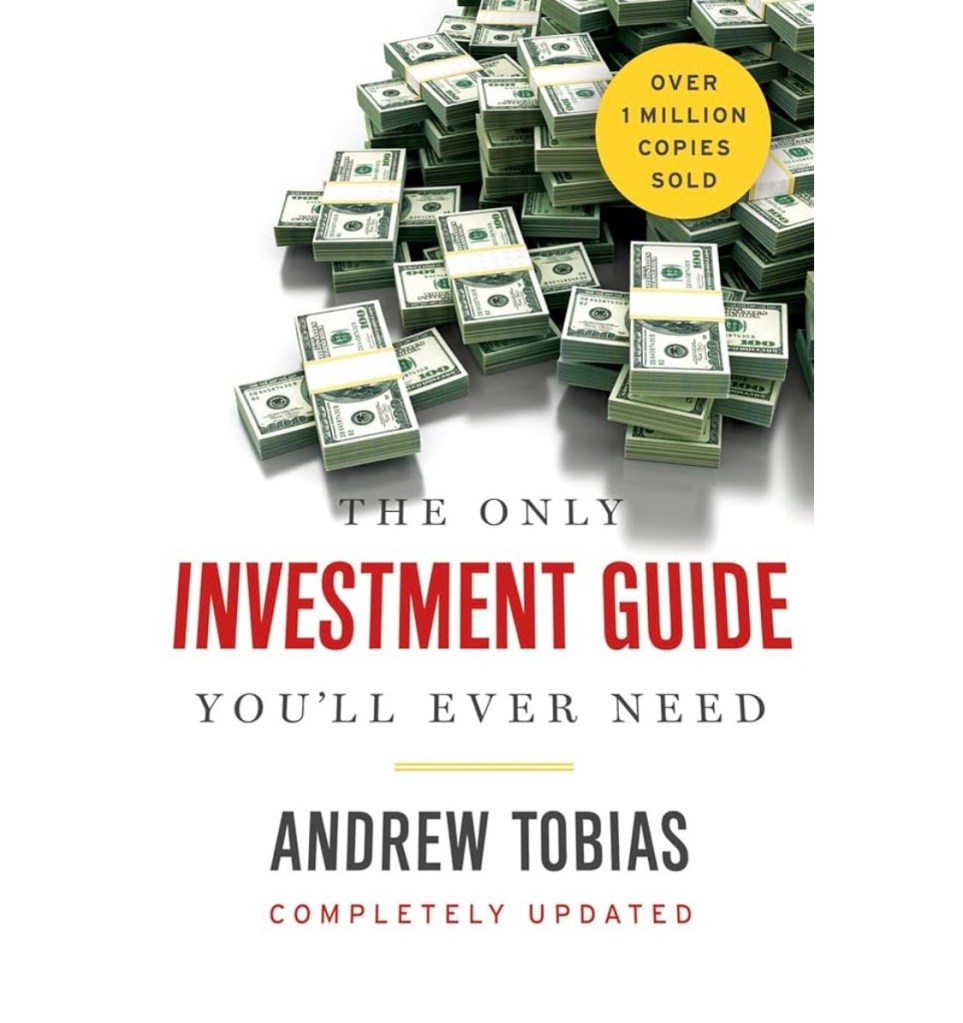
Like I usually do when things get tough, I read books. That summer, I had to learn a lot about money quickly so I could win the game of starting a family and become smart about the financial games of life. I still do this, and it’s why I read an average of 3 to 4 books a week, still. Because there’s a lot to know, and if you want to win at life, you have to know more than the people you are dealing with. In that case, with my future wife, we would have been married a year later, but at that time, it was a tragedy of Shakespearean proportions, with all the ruthlessness one could imagine, difficult beyond reason or belief. Crushing difficulty. To alleviate that pressure, I went down the road from our townhouse and checked out Andrew Tobias’ very well-known book, ‘The Only Investment Guide You’ll Ever Need,’ from the library. I spent the summer reading it, and the next several decades thinking about it, and it has formed my basic approach to wealth creation, to stay off the treadmill of social expectation, because there is a lot of wasted money spent on it, and to use good money to defeat bad, time and time again. However, it is mostly on minimalism that Andrew Tobias discusses regarding money management. Stay out of the casino of money making, and you’ll actually come out way ahead. And with that basic approach, my wife and I have navigated some treacherous waters over the years and defeated many formidable characters.
I have been professionally dealing with a similar issue that involves a lot of money and people, and they have been commenting on my position, which gives them minimal access to my life and those in it, much to their frustration. This essentially stems from the basic strategy I formulated in that book so long ago. But for the life of me, I couldn’t remember the title, just the contents. Back then, I used to check out books at the library and had to return them. These days, I put them on a shelf and refer to them repeatedly. But that early in my life, I didn’t even have a house yet. So once my wife moved back in with her parents and they reached out to me to see if we could all reconcile, I turned the book back into the Sharonville Library and never saw it again. But at my current age, I wanted to reread it because it was relevant to my current circumstances and I wanted to reconnect with my roots. So, I asked the Grok A.I. which book I had read on finance during the summer of 1987 from the Sharonville Library, and it told me within seconds, ‘The Only Investment Guide You’ll Ever Need.’ It was interesting because the book was on record in that library at the time, and they knew I had checked it out based on their reporting. I was finally able to buy a copy from Amazon, and it was hand-delivered to my front porch the next day. And I read it again and really enjoyed it. It had been updated from the 1987 version I had read into a 2016 view of the world, but the same basic book was still there. Same cover and everything. It’s the kind of book everyone should read on finance, and that’s why it’s still popular, even today. It has certainly helped me throughout the years, and strategically speaking, it works very well. I have always thought of it, and because of A.I., I was able to reconnect with it. Nobody will promise you a nice and easy future. But if you are smart and apply innovative strategies to your life, you’d be surprised at what you can survive and endure. And for a lot of reasons, Andrew’s book will always be a treasure for me. A treasure I was able to enjoy because of A.I. and its ability to know so much, so quickly.
I don’t think I’m becoming an anti-technology, cruddy old man because the world is leaving me behind as it goes faster and faster and is designed for much younger people. I expect things to work, and as I have been wrapped up in some severe trouble lately, dealing with bone-crushing topics, at the end of the day, I hope the television at least works. However, the TV in our bedroom is supposed to be a high-tech, smart TV that is very sophisticated. However, it makes me mad all the time because it is completely wireless, and when my wife walks into the room, she always scrambles the signal. It’s a long story, but my wife has unusual electromagnetic imprints on the world. It’s always been a problem, but back in the old days, these televisions were hard-wired into the wall. But not anymore. These days, everything is wireless, and I’ve found that none of it works as well as the old stuff, which is getting on my nerves. The other day, I was enjoying a show when my wife came into the room. The TV lost its signal and showed a spinning death icon, saying, “Please wait.” Then, after a few minutes, it simply stopped and informed me that “it couldn’t process the request at this time.” I was so mad that I just about threw the whole thing through the nearby window and out into the front yard. I didn’t “request” anything. I commanded the television to show me a channel, and it was failing to perform its basic task. And who did that stupid television think it was? But what was worse was the message code that framed the operation of the television as a “request,” as if the TV had an option to choose to do what I asked of it. And that’s part of a much larger problem that I am seeing across all of society, and it’s a significant one.
People were taken advantage of by technology as tech bros tried to capture market share with control mechanisms that suited their needs. The quest to make things easier has only given us things that are too intrusive into our lives, as they are constantly collecting information on us, which can be irritating. However, the technology never really works, and the by-product of the effort probably should never have been utilized to begin with. However, we are people who like to put our generational stamp on things, and technology is a means of making a new generation feel better about themselves by gaining market dominance over the previous one. But at a certain point, coffee is coffee, a phone is a phone, and an elevator does one primary thing. You might add some fancy buttons that display different colors, but you don’t change their function. However, in the world of business, we have transitioned from note-taking to computer processing. When systems fail, instead of completing tasks the old-fashioned way, as we have in the past, we have become a culture that accepts failure and waits patiently for resolution. When you are talking to other businesses out there and trying to process a PO, or manage inventory, or send supporting paperwork with a shipment, most of the time there is a system failure in the chain and the people involved are waiting for IT to resolve it so that the world can resume its business. This arrangement has simply not been working. We tried to make it all easier, but it’s ended up being much less effective.
There are some large companies that I am aware of, which are attempting to move away from their computerized management systems and return to taking notes on paper. The paper notes don’t give you failure messages like my TV, which assumes that the technology has an option to perform or not. If we are going to have technology in our lives, we need to let it know who’s boss. And that when we tell it to do something, it does it, and does it quickly. All this week, I had heard countless examples of ERP systems that were down, and people were waiting for them to come back up so that parts could be shipped. The kind of geeks who work in IT are about as out of touch as human beings on earth could be. They would take things more seriously if they were playing the game Fortnite. However, real-life things are much less interesting to them. They are the kind of people who sit at a table of 12 but prefer to interact with a computer screen rather than with real people. And those same personality types are what programming these cause codes in these TVs think are appropriate answers. I used language a few times this week to them while on the phone with them that I did with that stupid television, and you would have thought I ran over their dog. They are such pasty people, way too sheltered from reality, and they are in charge of how this technology forms in our society, even down to our TVs. To me, if the technology doesn’t perform, get rid of it and get something else. And you could tell that the young people were using technology to hide in the world and to conceal their poor performance behind it. And it ticked me off.
I’m not against technology. If something is invented that’s better, great. However, if it’s not improving our lives, or we’re trying to accommodate technology when we should reject it, as in the case of smart TVs that aren’t so smart, we should discard them. Because what I see happening is that technology has been used to hide the bad performance of lazy losers who are trying to hide in the background. And it’s lowering the performance standards of our society as a whole. I attended a substantial event the other day that included valet parking. I didn’t feel like dealing with people, but the young fellows doing the valet parking were sharp and ambitious. And after seeing numerous technological failures throughout the week, it was refreshing to see the competence of ambitious young people trying to earn a few bucks. And after a hard day, you want to hear Yes, sir, and No, sir, and Here are your keys. You don’t want to hear from technology that it has lost your keys, requiring you to wait for it to process your request. Or anything that takes away the performance standard. It was raining outside, and those kids were working in it, not bumping cars into each other or making guests wait. They were running to get the cars so people wouldn’t have to wait. And it was good to see. Not the kind of service that computers are giving us these days. And perhaps we should reconsider many aspects of it. I gave the young men a twenty as a tip just because I appreciated the level of competency, and they were a little shocked. But they had no idea what kind of week I had just survived and how much technology had made it much more difficult, rather than easier. I was just happy to deal with hungry human beings who wanted to do a good job. When you need something done, it’s not a request; it’s a command, and we need to put an end to technology that isn’t respectful enough of our time, especially during our leisure time.
Don’t worry about the Moody’s downgrade of the U.S. credit rating. Much of the problem starts with the Iranian apologist Mark Zandi and background anti-Trumpers like Warren Buffett using Berkshire Hathaway as a front for the story. This is a game that has been ongoing in the background for a long time, and the concept is that you want them to want you. Not where they want you to want them in the balance of power in a relationship, and the course Trump is taking with the American economy will force them to crawl like dogs into the Oval Office begging to be affiliated with the success story that is coming. But for too long, a lot of weak, stupid people have groveled to these losers of finance who have giggled at the idea of American freedom in the background because they know they control everyone’s money. And there has been peace, somewhat so, as long as the credit card works. However, these are power-hungry entities, and this is a common strategy they employ in finance to exert control over domestic policy in favor of globalist intentions. There are a lot of businesses that have been victims to just this kind of predatory lending and power struggle for control of those companies and what we are seeing applied to the Trump administration is a hatred for the America First policy of Trump and a refocus of their hatred for him and the MAGA movement in general. The downgrade by Moody’s is not a surprise, and the result will be similar to everything the Never Trumpers have tried to do to Trump and those who support him. They are attempting to regain control of the world, utilizing traditional financial tactics to achieve this. And those tricks are baked into the system as it was built.
This behavior from finance, not just by Moody’s but around the world, is a communist playbook that is precisely how China was set up as a communist country, propped up by these same financial, international monsters. Their tongue-in-cheek statements about how countries should be run are that people can beat on their chest and declare independence all they want, but it would be central banking that would control people and their lives. Like fish, they lure people into buying into their credit controls with the bait of easy money, then they snare them with a deep hook, allowing them to control every aspect of their lives. And they make a lot of money from the debt of the countries to which they have loaned money. And they believe that control has given them considerable power to override domestic policy on all fronts. So they use credit ratings to control behavior. It’s just another variation of the Chinese social media score. If you exhibit behavior that the government dislikes, they will restrict your access to funds, which in a world where everything is paid for by credit card, could be devastating. Which is why it has been set up that way, to get everyone addicted to easy cash at a low rate, so they could establish a deep-seated control hook in everyone’s life to run every aspect of their life. And don’t kid yourself, they mean to do just that. It’s a power trip that has always been a problem. They are not our friends, these tyrants who work in finance. They delude themselves about their actual value, and this impasse was always inevitable. It has taken this long for a President to occupy the White House who truly represents the needs of the people, as the republic was designed.
Moody’s cited the growing national debt, with projections exceeding $36 trillion, as one of its reasons, after it became apparent that Trump’s proposed budget would pass through Congress. They also cited persistent fiscal deficits that are expected to worsen as government spending is outpacing revenue. This is a shot at Trump’s tax cuts, aimed at extending the tax cuts from his previous term. Moody’s people want more taxes on individuals, as they are unhappy about the lack of revenue. They also don’t like that Trump plans to recover revenue by shifting it to tariffs, which has taken advantage of America’s economic power by reallocating wealth around the world to socialist and communist countries with unearned merit. Moody’s wants that practice of unfairness to benefit them because globalism has set that system up to their advantage. Moody’s also indicated that rising interest rates are crowding out other fiscal priorities. However, those rates are directly tied to the Federal Reserve, which has painted itself into a corner with currency manipulation that it had counted on going in an entirely different direction. Entitlement spending is expected to increase due to an aging population that lacks a sufficient birthrate to support the next generation, thereby requiring additional funding. Most of what Moody’s indicated as justification for the downgrade are fears of what might happen. But not so disguised is a hatred for Trump’s domestic policies that turn the power of the American economy back into a nationalist system that runs counter to all the manipulations of globalism have enacted to control all countries through fiscal policy. It is the same communist controls they have in China and North Korea, even in Iran, where Marxism runs in the background of everything they do. And in America, that was always the fate they intended for us, and they are angry that we aren’t doing what they expected us to do.
This fight goes back to even before the Presidency of Andrew Jackson, who I think was one of America’s greatest presidents. The battle with the banks needed to happen, and all this time, there has been a kind of stalemate. But in the finance industry, if you have had to work with them, there is an obvious power struggle that laughs at the Constitution and the premise that people can run themselves as a government. Moody’s downgrade is essentially a social credit score designed to put pressure on Americans to comply with international expectations. But Trump knows how to play this poker game, which essentially is what it is. And the power of the American economy will force Moody’s to retract its position; it won’t be able to draw a hard line in the sand, as it hopes. Because they will have a business need to affiliate themselves with success, don’t give a second thought to the Moody’s downgrade. Those losers will have egg on their face in a much-deserved way for their pro-Communist China affiliation. But remember that China would be nowhere if not for the money that has been stolen from the United States to prop it up as a communist state and example of the kind of government that central finance, with the option of a digital currency, always wanted. They wanted to destroy the dollar, destroy American capitalism, and buy up all the debt so they could control all domestic policy around the world. What these big banks have been doing is nothing short of a military incursion. And they were out for blood, and Trump is taking all that away from them. They are losing control, and all they have left is a downgrade to our credit rating. But when you gain control of your economy so that revenue surpasses their fears, that power returns to the people who run the country. And those banks and credit agencies will be forced to grovel at our feet. And when they do, we’ll make a footstool of their cheesy haircuts and golf shirts. They are going to lose control and there is nothing they can do to stop it.
There continues to be a lot of discussion about all the wealthy people who are around Trump in the White House, and to express that condition as if it were a bad thing. Those criticisms are mainly coming from communist Democrats like Bernie Sanders, who have openly embraced the philosophies of Karl Marx and are inherently un-American. I love that so many wealthy people associate with President Trump because it shows that successful people are around him. How do you know they are successful, because they are wealthy? Wealth is a measure of success. It’s the scoreboard of life. When people say you can’t take your wealth with you, why try? You are hearing a loser’s point of view, where someone wants to erase the scoreboard and use other value judgments that don’t make them look so lazy and dumb. Wealth is a measure of success. It’s not the only measure, but if a person has built independent wealth, the chances are that they have been very successful in life. So when wealthy people surround Trump, it shows that he is surrounded by people who know what they are doing, and that’s a good thing. I like and trust wealthy people because the scoreboard shows they know what they are doing, which is why a society of wealthy people is good. Critics of this system tend to be losers trying to justify bad decisions they have made in life with some social condition that hides their incompetence. So they hate the wealthy and disparage the wealthy as some immoral embodiment of social erosion, instead of representatives of the best that a person can be by being a winner at life. Wealth lets people know of those victories with measures that truly matter.
That’s not to say that all wealthy people are good, but it does give a measure to put next to the value of a person. Someone like Nancy Pelosi, who has gained a lot of wealth off government information with insider knowledge of the markets, is not the same. Some people cheat in life to get wealth. But even in that condition, you learn much about the people involved based on how they play the game. Because the scoreboard matters. The pressure to put points on the board makes people do all kinds of things to show a winning score. However, the pressure to play the game was what Karl Marx was trying to build a society to avoid. Even in a biblical context, when wealth is discussed, the writers who have spent their lives writing and thinking philosophically about things tended not to have very much money, so there is always a little jealousy when they look at the scoreboard and see that they haven’t put up many points of their own. To get through life and say it’s not whether you win or lose at life, but how you play the game, is to try to substitute the game with another value system that embraces other ways of showing success at life. I see great morality in wealth earned because it forces people to compete and win at life, which shows that they did something of great value somewhere along the line. And if you want to hire the best person for the job, how else do you determine their value? If you are building a new driveway and you quote the job to two different contractors and one shows up in a barely running pickup truck looking like they just rolled out of bed, and the other shows up in a brand new dual wheeled truck with a nice paint job and advertising painted on the door, who do you think will do a better job?
While it’s true that the contractor with the beat-up truck might be a diamond in the rough, generally speaking, if people have been successful in life, they tend to show it in their social interactions. If you go to a fancy restaurant on a Friday night and a man smelling like expensive cologne gets out of a bright red supercar, with a date that looks like she just climbed off the cover of a fashion magazine, what do you think about him? He’s successful at something because he has acquired assets that society would consider the best of what can be gained in life from the perspective of living. Can you take all that with you into the afterlife? No, just like people forget the score of a football game they watched on Sunday, by Monday. But that doesn’t mean that the players shouldn’t try hard to play and win the game. To say the game isn’t worth playing because the score doesn’t matter is a loser position in life, and lazy. And to be envious of the person who has a lot of wealth because they won at life a lot is petty, and a bad foundation for measuring the value of life. Wealth is a good thing, and it’s better in life to win and to have a scoreboard that shows it than a value system that avoids the competition altogether. Those like Bernie Sanders, and other socialists, communists, and Marxists from the Democrat party want to get rid of the scoreboards in life so that there is no measure of how much of a loser they are. They aren’t looking to help people experiencing poverty, but to exploit them so that they don’t look so bad themselves.
The reason Trump is getting respect around the world, especially during this Saudi Arabian visit, is that the world likes scoreboards, and America has been for them that guy getting out of the fancy car at valet parking with the hot chick on his arm smelling good for a night on the town. And everyone else has fallen into a measurement system of a loser mentality. They disparage wealth because they are too lazy to play the game to win themselves. Most of us root for our favorite sports teams when they play, and when they win, we feel good. When they lose, we get upset about it. And the difference between those two things is the scoreboard. We might like the players, but if they can’t win the game as measured by the scoreboard, they can’t be considered outstanding players in that sport. The scoreboard matters, it matters in life, and in death. The wins and losses a person has tell others they should listen to you. How else would one generation know to listen to a previous one? It all comes down to the scoreboard and what people do to win or lose. Even if they cheat to win, it shows the world what they are, which is much better than saying that the scoreboard doesn’t even matter, which is the Marxist proposal. When it comes to the Trump White House, which I just recently visited, it is good to see the displays of wealth around President Trump. And it shows in the wins we are now getting out of the Executive Branch. And losers like those in the Democrat Party don’t get to hide their detrimental status from the world with social criticism of a system, so they don’t look like the fools they are. We must see it for ourselves and measure its value to the world.
With all that said I know a lot of people who have made a lot of money by being boot lickers, con artists, and general social lowlifes who have traded their very souls to have a full wallet. Just as in sports, our favorite teams don’t always win. Sometimes the refs rig the game, people cheat, or luck doesn’t point in the direction of success. Even among the very rich, most of them have not been entirely ethical along the way. But the game itself evolves the value, and that value has great worth in its own context, one win at a time. And it is in the pursuit of victory that life improves for everyone, and the drama of competition brings out the truth in people that would otherwise not be seen. And behind all the merits of wealth building, there is a desire for quality, whether it’s fake or genuine, that forces a value judgement where values are very much in need of definition. And the world is a lot better off with those judgments.
One of the big takeaways when you meet people who have all kinds of psychological problems and tend to lean toward Democrat politics is that they are bad with money. They don’t understand money, don’t like to talk about money, and tend to have a natural hatred toward people who do have money because of what money represents in the world. Money is a measure of value; it’s what something means to someone else in an agreed-upon value of exchange. Then naturally, those who don’t produce much value in the world or are insecure about that value and what people think of it resent money because it exposes them to all their insecurities. That is why I say that the participants have problems in Democrat politics, which is why they are attracted to forms of collectivism to hide their lack of value from the world behind disguised altruism. They are broken people who are otherwise detrimental to all existence. And I don’t say all this to disparage people needlessly, but we have to understand why and how these people have moved into government employment and regulation. As we move into talks about reducing government employment and the many millions on a government payroll who do too little and get paid way too much, at the heart of the problem is this problem of Democrat politics, the hatred of money, and the desperate effort to use collective services to hide their otherwise worthless, social traits. Government expansion for the sake of social goalposts rather than the value of a job well done and work performed that people value and want. The great fear many have about the efforts of D.O.G.E demanding, for instance, that people return to work after years of staying home and getting paid for it has at the heart of it this sense of entitlement that is expensive. A person exists, and someone needs to pay them for that existence rather than earn their way through life for the value performed that people want. This makes any government oversight a rejection of people who have decided to be worthless to the world because of their lack of productivity.
You see this kind of thing all the time in business these days, with woke politics and its attempts to embed itself into an American capitalist culture. Hidden behind the complaints is a genuine desire to conceal their worthless nature. Companies use money to measure value. In that case, it is that premise that liberalism has used through Democrat politics to hide useless behavior and attempt to disguise it as a value. For the same reason that Joe Biden is working to sign protection for federal workers before he leaves office, allowing them to stay home under continued employment, by law, the same methodology has been applied to the world of business and attempting to attack profit and loss statements and replace those values with woke compliance. Once that is the assumed value, all actions that relate to the measurement of money become irrelevant, and it’s not soon after that a company goes bankrupt. Or at least performing poorly financially. It has been stunning over these last few years because many of the money haters out there thought things were shifting in their direction to see how many open Marxists have emerged and how much they profess for more government regulation to impose their version of fairness upon the world, that ultimately means, to protect them from value judgments that are traditionally measured in money. They want more government pay for less work done, and the gig only works if everything takes away the value of money to measure success and replaces those needs with woke politics.
Karl Marx was always a money-hating despot who wrote his philosophy with an eye toward total social disruption. And for people who question their value, Marxism gave them a home to hide in from the world in hopes that nobody would notice how lazy and stupid they were. Karl Marx himself died a very broke person. The only reason his philosophy of communism and, overall, Marxism spread the way it did was that it was a weaponized idea that served the concept of centralized governments. Over time, these ideas migrated into the human resource departments of most of our companies and their measurement policies of money. As many scratched their heads about this activity, the attempt was to replace monetary value as a measurement of social compliance scores and to make dog-eat-dog capitalism subservient to fairness measurements imposed by the government for more government expansion. And under that premise, of course, the government grew in uncomfortable ways and cost too much money to maintain because too many worthless participants were leeching off the system. That has been my argument about public schools for years. Finally, more people are catching up to it, and we are now having honest conversations about it. But it wasn’t always that way. We were told to spend infinite amounts of money on public schools no matter the results because the measurement wasn’t in cash but in creating fairness in the world. And from there, budgets ran out of control. Most of the time, when you see a runaway budget, Democrat politics is looming in the background and is seeking to be subsidized by emotional measures to avoid monetary value.
Money has to be the measure to have a healthy relationship with the world. And everyone should love money for the truth it reveals about people. And we must have a government that honors and respects money as a measure of value. For instance, the Biden administration is purposely selling off portions of the border wall with Mexico out of spite because Trump is returning to the White House, and they want to make it hard for him to return to building the wall. The wall itself is a statement of value that people crossing that border are moving from a Marxist government in Mexico to a capitalist government in America, and one is better than the other. But Marxists want to hide that value measurement from the world with borderless sentiments so that people hopefully won’t notice. That kind of policy ends up on P&L statements worldwide, slowly destroying everything in the background. But at the heart of it is a hatred of money because it exposes bankrupt personalities from judgments cast upon them for their worthlessness. Such people could be given millions of dollars, but they still waste it faster than they get it because they are bottomless pits of destructive personality traits that they attempt to hide from the world through government power and a change in how value is perceived. In truth, there is only one way to measure value, and money is the agreement among the human race on how to express it across culture and social alliance. Having a love of money because it measures shared value accurately is healthy and good. And we must return to it for the good of a productive future. And not fuel jealousy from those who don’t work hard to be good people and reside behind social policies that point to money as the villain when it’s the other way around.
Perspective is an important thing, especially when its based on experience. And unless you live in a culture that can produce experience, it will be difficult to create a society that embraces any hope of wisdom. Recently, I think it was a combination of the Kentucky Derby and all its festivities, where invites to that event created challenges to our schedule and the 36th anniversary of my marriage to my wife. Many things get said, and stories are told, especially when people discover how long my wife and I have been married. There are just assumptions that nobody stays married that long these days for any reason. Our perspective on social values is very traditional, as well as our opinions on money, how it’s made, and what it says about people. One story about our early days is worth some perspective and sharing, which is the point here. I’ve told many stories about my past; it was unique. To put it mildly, I worked for the mob, not because I wanted to work for mobsters, but because it was an excellent job to get some experience in Sharonville, Ohio, along the Chester Road corridor, which back then was the entertainment zone for the entire city of Cincinnati. I was a very ambitious young man who wasn’t afraid of anything, which was very attractive to my employers. I came to know many influential people in Cincinnati politics very early in my life, and some of the wealthiest people were people I called friends. I was the private chauffeur for many local celebrities, especially team members of the Bengals at that time, so I had an early education about the value of people unique to my circumstances. I was making more money before I turned 18 than my parents had, and I was just getting started.
Naturally, once I left that job for something more traditional, income was a prime concern and I wanted to make as much as I possibly could at 18 years old as I was moving out on my own. And again, I would make more money at this time than my parents which was important to me. I was in a race to conquer the world the way that the world measured it. I would go as far as to say that I was ruthless and was intent on having millions of dollars of hard-earned money in my bank account within a few months of working as a car salesman at a local Tri-County front group for money laundering. That was common in those days and why I know so much about the current Ukraine operation that the government is involved in, and why I said that the mob moved into government. I was on the front line of that movement and watched it happen up close. My job was legitimate: sell new and used cars to people and make a commission off that effort. Even if the job itself only existed to wash money from organized crime efforts at that time, the ownership and upper managers were all in on the effort. And yes, at all these jobs, the police were involved, and judges, and I knew everyone. Or, instead, they knew me and were proud to tell people they did. As I have said before, I had a get-out-of-jail-free card in several communities that lasted as long as I made people a lot of money. But the moment I didn’t, it was a different story.
But I had moved out of the house and made more than most adults in the Cincinnati area. However, along the way, I met my wife. The timing was inconvenient. I wasn’t looking for a wife then; she had everything you would look for. She was a fashion model, her family was wealthy, and they were prominent Beckett Ridge Country Club members nearby. So our relationship got serious quickly, and soon, she visited me at my job for lunch dates. On one particular day, she came to my desk just as I was sending over one of the most significant commissions this dealership had ever seen; it was an older man I was selling a used truck to for over $5,000 over invoice and to show how strong I was at the sale, I had him going across the street to the bank to take out all the cash to pay for it with a pile of money. It was a big deal, and it set the men from the boys in the sales world in that particular culture, and I thought my wife would be impressed. But she wasn’t, she started crying. She already knew many successful people and wanted to get out of that life. She was being set up to be the trophy wife of some doctor in that Beckett Ridge Country Club who was older than her dad, and she wanted off that train at 17 years old. And I was that rebellious ticket. So, to make her happy, I redid the deal and gave the guy the truck for just a bit over margin, and he was pleased. I went from hero to zero in that dealership within an hour, and many life lessons were learned that set the course for many years. Just making money isn’t enough, especially with people like my wife. How you make it matters more, and this will be a theme for us over the next four decades.
It was hard; I went from living high on the hog and being the center of every social circle to the opposite life. To make my wife happy, I worked at a series of complex manufacturing jobs to earn money as honestly as possible, and I learned a lot of precious experiences from that perspective. My wife’s requirement to earn money honestly seriously crippled my lifestyle, and it has been challenging over the years. But that standard has allowed me to have a perspective that few ever get or survive in life—especially the Kentucky Derbi crowd, where the goal is to see and be seen in the crowd. But most of it is cosmetic and not what my wife values in people. And naturally, with those values, we have a concise list of people we associate with. Because most people are still at that phase I was in at 18, where money is the measure of your worth, so you do whatever you can to make it. To advance beyond that is a journey that few ever get to. But obviously, we have been married for 36 years for a reason, and if she hadn’t pushed me the way she did, I might never have learned some of those hard lessons about money and value sometimes, when someone gives you a 7 figure opportunity, its better not to take that job but to do something that fulfills other requirements in your life. But before you can do that, you must have standards to live up to. At an early age, we were both blessed to have had the chance to get that kind of life out of our systems. By age 19, I was married, and we were working hard to start a life of our own together, which continues to this day. But when I say that making money is easy, how you make it matters most; that is the context. I have never been impressed with people who make a lot of money. But money is a good measure of people’s value because it tells you a lot about the quality of the person making it. If they are cheats or cutthroats, money will reveal it, as opposed to some communist centralized government that is entirely built around who you know and how much they like you. My perspective comes from that critical experience at the dealership and the highlife that came with it. And the value of an great woman to chase after took me on a wild ride that brought experiences wealth itself could never provide alone.