The “Right Stuff” in Medicine: If we aren’t curing cancer we can’t call ourselves an advanced culture

I have spent a great deal of time observing how modern society reacts to both achievement and decline, and nowhere is this contrast more visible than in the way we collectively respond to technological ambition on one hand and human vulnerability on the other. There is a recurring pattern I cannot ignore, one that surfaces in moments that should otherwise be met with admiration or compassion. Instead, what I often detect is something more complicated—a quiet, sometimes barely concealed satisfaction when success is interrupted, or when prominent individuals are reminded of their own mortality.

I noticed the same pattern in reactions to high-profile technical setbacks, such as rocket failures tied to ambitious space programs. When a launch vehicle explodes or a mission is delayed, the tone in certain corners of the media and commentary ecosystem can shift from analytical to subtly dismissive. It is as if the grander the objective—reaching orbit, returning to the Moon, advancing human presence in space—the more satisfying it becomes for some observers to see that effort fail spectacularly. I do not believe this is universal, but it is present, and it reflects something deeper than mere critique. It reflects a discomfort with ambition itself, particularly when that ambition aims to elevate human capability beyond its current limits.

I have seen that same tone emerge in a very different context: the public reporting of illness, especially serious diagnoses such as cancer among well-known figures. When those diagnoses are announced, the coverage often carries an undertone that goes beyond simple reporting. The message, implicit rather than explicit, is that no level of success, status, or influence insulates a person from biological reality. That part, of course, is true. But what troubles me is when that truth is delivered with an almost leveling satisfaction—an unspoken reassurance that the “lofty” are ultimately brought down to the same plane as everyone else.

I find that reaction deeply problematic. In my view, the proper response to illness—whether it affects a public figure or a private individual—is empathy paired with determination. Determination not merely to treat symptoms, but to fundamentally improve the systems and technologies that govern health outcomes. Instead, what we often see is a cultural normalization of disease, as if the persistence of illnesses like cancer is inevitable and beyond our reach in any meaningful sense.

My perspective has been shaped in part by personal exposure to the healthcare system through family and close observation. I have seen both extraordinary dedication among practitioners and systemic issues that are far more difficult to reconcile. The healthcare industry, particularly in developed nations, is structurally complex and in many ways financially incentive-driven. According to data from the Centers for Medicare & Medicaid Services, U.S. healthcare spending exceeded $4.5 trillion in 2022, representing nearly 18% of GDP.[1] That scale alone introduces distortions—economic, behavioral, and institutional—that are not always aligned with optimal patient outcomes.

I do not believe it is accurate or fair to reduce healthcare professionals to a single characterization. The field contains individuals of remarkable skill and integrity. At the same time, it operates within a framework that often rewards volume over prevention, treatment over cure, and cost expansion over efficiency. These systemic incentives have been widely discussed in policy literature, including analyses from the National Academy of Medicine and the World Health Organization, both of which highlight structural inefficiencies and misaligned incentives as persistent challenges.[2][3]

Where I draw a sharper distinction is in the cultural posture surrounding health and illness. In many ways, modern healthcare systems are built around managing disease rather than eliminating it. Chronic illness management, long-term pharmaceutical dependency, and repeated procedural interventions form the economic backbone of the system. While these approaches save lives and extend survival, they do not always reflect a paradigm aimed at decisive resolution.

This is where I believe the contrast with fields like aerospace engineering becomes instructive. In aerospace, failure is analyzed, corrected, and systematically eliminated through iterative design. The goal is not to manage risk indefinitely, but to reduce it to near zero through engineering discipline. The “right stuff,” a term popularized by Tom Wolfe, captures this blend of analytical rigor and bold experimentation.[4] It is the willingness to push boundaries while refining systems to the point of reliability.

I have long believed that healthcare would benefit from adopting more of that mindset. Instead of accepting certain diseases as enduring features of human existence, the focus should shift toward eradication or, at minimum, transformative mitigation. There are promising developments in this direction. Advances in immunotherapy, gene editing technologies such as CRISPR, and regenerative medicine have begun to change the landscape of what is medically possible.[5][6] In cancer treatment alone, survival rates have improved significantly over the past several decades due to earlier detection and targeted therapies.[7]

However, it is critical to ground expectations in current scientific reality. While substantial progress has been made, there is no single universal cure for cancer at this time, yet.   But by this time, there should be. Cancer is not one disease but a collection of hundreds of distinct conditions, each with unique genetic and environmental drivers.[8] The goal of cancer treatment should be to defeat it. What can be said, with confidence, is that the trajectory of research is accelerating, and breakthroughs that once seemed theoretical are increasingly entering clinical practice.

I believe this distinction matters, particularly when we speak to audiences capable of influencing investment, policy, and innovation. The objective should not be to declare premature victory, but to articulate a clear and urgent mandate: accelerate the transition from disease management to disease elimination wherever scientifically feasible. That requires alignment across research institutions, funding mechanisms, regulatory frameworks, and private-sector innovation.

It also requires a cultural shift. We should not accept illness as something that simply “grounds” individuals or equalizes outcomes. Instead, we should view every diagnosis as a challenge to be solved—systematically, rapidly, and with the same intensity that we apply to other complex engineering problems. That mindset does not diminish humility; it enhances purpose.

I remain optimistic that such a transformation is possible. The convergence of biotechnology, artificial intelligence, and advanced materials science is creating capabilities that did not exist even a decade ago. Machine learning models are already being used to identify drug candidates, predict protein structures, and optimize treatment pathways.[9] Personalized medicine, once an abstract concept, is becoming increasingly tangible as genomic sequencing becomes more accessible.

The question is not whether progress will continue, but whether it will accelerate at a rate commensurate with its potential. That acceleration depends on leadership—across government, industry, and the scientific community. It depends on prioritizing long-term outcomes over short-term financial gain. And it depends on fostering a culture that celebrates breakthroughs rather than fixating on failure.

When I reflect on the reactions I described at the outset—whether to a rocket explosion or a cancer diagnosis—I see them as symptoms of a broader cultural hesitation to embrace ambition fully. There is comfort in the notion that limits are fixed and universal. There is less comfort in confronting the possibility that those limits may be overcome and that doing so requires sustained effort, risk, and transformation.

I do not share that hesitation. I believe that human progress has always depended on challenging perceived constraints, whether in flight, exploration, or medicine. The same spirit that drives us to reach beyond Earth should drive us to eliminate preventable suffering here on it.

In that sense, the future of healthcare and the future of technological advancement are not separate conversations. They are part of the same continuum: the pursuit of a more capable, more resilient, and ultimately more humane civilization. And if we approach that pursuit with the right balance of discipline and daring—the true “right stuff”—then the outcomes we once considered extraordinary may become routine.

Footnotes & References

  1. Centers for Medicare & Medicaid Services. National Health Expenditure Data, 2023.
  2. National Academy of Medicine. The Learning Healthcare System: Workshop Summary, 2007.
  3. World Health Organization. Health Systems Financing: The Path to Universal Coverage, 2010.
  4. Wolfe, Tom. The Right Stuff. Farrar, Straus and Giroux, 1979.
  5. National Cancer Institute. Immunotherapy for Cancer, updated 2024.
  6. Doudna, J., & Charpentier, E. “The new frontier of genome engineering with CRISPR-Cas9.” Science, 2014.
  7. American Cancer Society. Cancer Facts & Figures 2025.
  8. Hanahan, D., & Weinberg, R. “Hallmarks of Cancer: The Next Generation.” Cell, 2011.
  9. Jumper, J. et al. “Highly accurate protein structure prediction with AlphaFold.” Nature, 2021.

Rich Hoffman

More about me

Click Here to Protect Yourself with Second Call Defense https://www.secondcalldefense.org/?affiliate=20707
About the Author: Rich Hoffman

Rich Hoffman is an aerospace executive, political strategist, systems thinker, and independent researcher of ancient history, the paranormal, and the Dead Sea Scrolls tradition. His life in high‑stakes manufacturing, high‑level politics, and cross‑functional crisis management gives him a field‑tested understanding of power — both human and unseen.

He has advised candidates, executives, and public leaders, while conducting deep, hands‑on exploration of archaeological and supernatural hotspots across the world.

Hoffman writes with the credibility of a problem-solver, the curiosity of an archaeologist, and the courage of a frontline witness who has gone to very scary places and reported what lurked there. Hoffman has authored books including The Symposium of JusticeThe Gunfighter’s Guide to Business, and Tail of the Dragon, often exploring themes of freedom, individual will, and societal structures through a lens influenced by philosophy (e.g., Nietzschean overman concepts) and current events

When Democrats say,” You didn’t build that”: Wealth confiscation to fund evil in the eyes of a healthy society

In the quiet hours after dinner, when the house settles and the day’s demands fade, there is a ritual that has shaped much of my understanding of the world: reading. Four or five books a week, many of them compact volumes around 150 pages, devoured not in hurried skimming but in focused sessions that stretch from six in the evening until bedtime near eleven. This habit is no idle pastime. It is a deliberate investment in clarity, particularly when navigating the complexities of economics, politics, leadership, and personal initiative. Over the years, I have delved into texts on capitalism, risk-taking, and the historical role of government in society. These readings have reinforced a core conviction: true prosperity springs from individual effort, innovation, and the willingness to shoulder risk, not from the heavy hand of centralized authority. Yet, time and again, I hear prominent Democrats echo a different philosophy—one that diminishes the entrepreneur and elevates government as the indispensable architect of success. This notion, articulated by figures like Barack Obama, Elizabeth Warren, Alexandria Ocasio-Cortez, Chuck Schumer, and Bernie Sanders, strikes me as not only misguided but deeply corrosive to the American spirit of mobility and achievement.

I recall Obama’s remarks on July 13, 2012, in Roanoke, Virginia, during a campaign event. He stated, “If you’ve got a business—you didn’t build that. Somebody else made that happen.” The context was his push against tax cuts and for greater government investment in infrastructure. He pointed to roads, bridges, and the broader system as the true enablers of private success. To me, this reflects a profound misunderstanding of how wealth is created. It dismisses the sleepless nights, the personal financial risks, the years of trial and error that entrepreneurs endure. Government may provide some foundational services, but it does not conceive the idea, secure the capital, hire the workers, or innovate the product. That burden falls on the individual willing to bet their own resources and reputation. Obama’s words, which drew sharp criticism at the time, encapsulate a worldview in which the state claims credit for outcomes it merely facilitates — at best—and often hinders through regulation and taxation. 

Elizabeth Warren expressed similar sentiments in 2011, declaring, “There is nobody in this country who got rich on his own. Nobody.” She cited roads, police, fire protection, and public education as the invisible partners in every fortune. AOC has echoed this, arguing that corporations and individuals rely on public investment, taxpayers, and government systems to generate profit and thus owe a larger share back. Bernie Sanders, with his open socialist leanings and history of praising aspects of regimes like the Soviet Union during his honeymoon in Moscow, has repeated variations of this theme for decades. Chuck Schumer and others in the party reinforce it to justify expansive government programs. In my view, this rhetoric is not mere political posturing; it reveals a fundamental ignorance—or willful disregard—of how risk and investment drive economic growth. Karl Marx never fully grasped the entrepreneurial function, viewing capital as the extraction of surplus value rather than as the reward for foresight and courage. Modern Democrats, steeped in similar academic traditions, carry forward that flawed analysis.

I have spent considerable time reflecting on these ideas, especially in the context of my home in Butler County, Ohio, and the broader national landscape, now a couple of years into President Trump’s second term. Democrats appear to be struggling to regain their footing, doubling down on big-government justifications amid voter pushback against high taxes and inefficiency. After the May elections, when numerous school levies failed across Ohio—with only about 23% passing statewide—I saw this philosophy in action. In my neighborhood, Lakota schools and others attempted to slip levies through during low-turnout off-cycle votes, yet many were rejected. Voters are weary of pouring billions into public education systems that deliver mediocre results despite per-pupil spending often exceeding $15,000 to $17,000 annually in large districts. Half-billion-dollar budgets for districts with thousands of students yield outcomes that fail to prepare young people for the risks and rewards of a free market. Instead, we see protests and entitlement mindsets among graduates shaped by these institutions. This is not success; it is a drag, subsidized by the confiscation of wealth from those who actually produce it.

The historical backdrop to this debate is rich and instructive. Governments have long used taxation not merely for basic services but as a tool to consolidate power and redistribute resources, often under the guise of societal benefit. In ancient Rome, heavy taxes on provinces funded imperial excess while stifling local initiative. Medieval European monarchies imposed levies that enriched aristocracies at the expense of merchants and farmers, leading to revolts when burdens grew intolerable. The Marxist tradition, emerging in the 19th century, formalized the idea that private property and profit represent exploitation, necessitating state intervention to “correct” inequalities. Marx and Engels viewed taxes as a mechanism for the proletariat to wrest control, but in practice, such systems—from the Soviet Union to modern Venezuela—have produced stagnation, corruption, and poverty. Wealth creators flee or cease innovating when the fruits of their labor are seized. America, by contrast, was founded on principles of limited government, individual rights, and economic liberty. The progressive income tax, introduced in the early 20th century, marked a shift toward European-style redistribution, with rates climbing dramatically during wartime and the New Deal era. These policies, while raising revenue, often coincided with economic distortions, capital flight, and reduced incentives for risk-taking.

I believe the opposite of the Democratic mantra is true: government, when overgrown, is a primary obstacle to success. High progressive taxation, property taxes, and regulatory burdens raise barriers to entry for aspiring entrepreneurs. Starting a business today requires navigating compliance costs that can run into tens or hundreds of thousands of dollars before the first sale. This environment favors large incumbents who can absorb the overhead, while discouraging the bold who might otherwise create the next wave of jobs and innovation. In places like California and New York, socialist-leaning policies—high taxes, aggressive regulations—have triggered a mass exodus. Businesses and individuals migrate to Texas, Arizona, Florida, and yes, Ohio, seeking friendlier climates. New York’s once-dominant economy unravels as talent and capital depart. Here in Ohio, we see the benefits of more restrained approaches, though even we grapple with remnants of overreach, such as the lingering effects of COVID-era policies.

The COVID lockdowns provide a stark example of the government’s capacity to destroy value under the banner of the collective good. As someone deeply involved in local observations and discussions during that period, I know the decisions made in Ohio under Governor Mike DeWine and Health Director Amy Acton. Acton, often called the state’s version of Dr. Fauci, pushed aggressive measures including school closures, business shutdowns, and even attempts to influence elections. These were framed as necessary for public health, yet they inflicted billions in economic damage. Small businesses folded, families suffered, and mental health crises surged. Ohio’s recovery has been slow in many sectors. I was on calls and followed the developments closely; the reliance on federal guidance from figures like Fauci, whom I believe bears significant responsibility for overreach, turned a health challenge into an economic catastrophe. Republicans like DeWine were not immune to the pressure, but the episode underscores a broader truth: when government wields unchecked power, risk-takers pay the price. Acton’s legacy will haunt her political ambitions, as voters remember the pain inflicted on job creators and families.

In my own life, I have witnessed the power of personal initiative. Married for 38 years, raising children and now enjoying grandchildren, I have balanced family responsibilities with a commitment to understanding these dynamics through relentless reading and community engagement. I have served on grand juries, toured facilities like the Butler County Jail, and spoken directly with officials, including Sheriff Jones. These experiences reveal that institutions function best when they support rather than supplant individual effort. Government excels at certain core functions—national defense, basic infrastructure, rule of law—but falters when it expands into wealth redistribution and micromanagement. The “you didn’t build that” philosophy ignores this. It treats entrepreneurs as lucky beneficiaries of public goods rather than as the engines that generate tax revenue in the first place. Roads and bridges do not appear magically; the productive economy funds them. Without risk-takers investing capital, hiring workers, and innovating, there is no revenue base to maintain them.

Consider the mechanics of wealth creation. Profit is not exploitation but the signal that value has been delivered to customers. An entrepreneur spots a need, assumes the risk of failure—potentially losing savings, home equity, or years of effort—and, if successful, reaps rewards that fund expansion, jobs, and further innovation. Employees benefit from stable paychecks without bearing that upside-downside exposure. Capitalism channels human ambition into mutual gain. Democrats, by contrast, frame profit as something to be clawed back, citing “public investment” as justification. This inverts reality. Public services should be lean and efficient, funded through mechanisms that align costs with usage, such as consumption or sales taxes. Progressive income taxes and property taxes punish success and discourage investment. They extract from paychecks before individuals even see the money, fostering dependency and resentment.

I have long advocated for alternatives. Sales taxes or user fees for services allow people to pay as they go, revealing true demand and preventing blank-check funding for inefficient programs. Public education, for instance, consumes enormous sums with disappointing results. When levies fail, as many did recently in Ohio, it signals voter recognition that more money does not equal better outcomes. Charter schools, vocational training, and market-driven reforms offer paths to genuine improvement. Similarly, infrastructure can be funded through public-private partnerships or dedicated consumption levies rather than general taxation that fuels unrelated entitlements.

The European aristocratic mindset, imported via Marxist academia, underpins much of this thinking. Obama’s formative years, including time in Indonesia and exposure to radical influences, shaped his views. Sanders and Warren draw from the same well. These leaders, often insulated by government salaries and pensions, lecture risk-takers while enjoying security unavailable to those on the front lines of business. They project their reliance on the system onto others, accusing capitalists of freeloading. In truth, it is the administrative state—bloated with high-cost employees delivering marginal value—that leaches off productive society. Protests by young people, many of whom are products of overfunded yet underperforming schools, highlight the failure. They demand “free” everything, unaware that nothing is free; it is merely transferred from creators to consumers via coercion.

Historically, excessive taxation has precipitated decline. In post-war Japan, a one-time capital levy at high rates was attempted but proved exceptional; generally, heavy extraction deters growth. Ancient regimes collapsed under fiscal burdens. America’s success stemmed from low barriers and high rewards for ingenuity. Trump’s policies, emphasizing deregulation and tax relief, align with this by removing impediments. Capitalists support such approaches because they restore incentives. Workers, even those preferring the stability of a paycheck, ultimately thrive when employers can expand profitably. Without risk, there are no rewards—no new jobs, no advancements, no upward mobility.

Critics of capitalism often point to inequality, but they overlook mobility. In the U.S., even without extraordinary guts, one can join a venture started by others and rise. Attacking the rich as villains, as seen in New York under leaders like Hochul or in California, accelerates exodus and hollows out economies. Ohio benefits from inflows of businesses fleeing those burdens. To sustain this, we must reject the “nobody built that” narrative. It demoralizes innovators and empowers looters—politicians who redistribute without creating.

Biblical principles align with this emphasis on personal responsibility and stewardship. Proverbs extols diligence and warns against sloth. The Parable of the Talents rewards those who multiply their gifts through risk and effort. Societies thrive when virtue—integrity, hard work, prudence—underpins economic life, not when government supplants it. Expecting institutions alone to engineer fairness ignores human nature; fallen individuals in power often amplify flaws rather than correct them.

In project management and leadership, which I study extensively, success demands balancing inputs while anchoring in clear objectives. Emotional intelligence helps navigate stakeholder dynamics, but the core vision—rooted in truth—prevails. Applied to governance, this means limited government that enables, not directs, private endeavor. Democrats’ approach inverts this, making the state the protagonist and citizens supporting actors. The result is drag: slower growth, fewer startups, persistent poverty traps.

As I reflect on these issues, my reading reinforces optimism in capitalism’s resilience. Books on economics, history, and management reveal patterns: freer societies outperform controlled ones. Post-dinner sessions and lunch-hour dives into these texts accumulate wisdom. They counter the noise of political rhetoric with evidence. Trump’s embrace of bold risk-takers contrasts sharply with predecessors’ guilt-tripping. Democrats’ frustration stems from seeing their vision erode as voters prioritize opportunity over equity enforced by edict.

Ultimately, I maintain that government is necessary for core functions but becomes detrimental when it claims authorship of private success. The world improves with smaller, accountable, government-funded, transparently incentivizing rather than penalizing risk. Wealth creation demands courage; confiscation breeds complacency. By defending entrepreneurs and reforming taxes toward consumption models, we unlock potential for all—job creators and workers alike. This is the American way, proven through history and lived experience. More must embrace it to counter the Marxist-infused notions still permeating one side of the aisle.

Footnotes

1.  Obama’s Roanoke speech, July 13, 2012, as documented in White House archives and contemporary reports.

2.  Warren’s 2011 remarks on wealth creation and public infrastructure.

3.  Historical analyses of Marxist taxation theories and their implementation in various regimes.

4.  Ohio school levy results from May 2026 elections, showing widespread failures.

5.  Accounts of Ohio COVID response under DeWine and Acton, 2020.

Bibliography for Further Reading

•  Obama, Barack. Remarks at Campaign Event in Roanoke, Virginia (July 13, 2012).

•  Warren, Elizabeth. Various speeches and writings on economic fairness (2011 onward).

•  Marx, Karl, and Friedrich Engels. The Communist Manifesto and related economic texts.

•  Gilder, George. Wealth and Poverty – Defense of supply-side economics and risk.

•  Sowell, Thomas. Basic Economics – Comprehensive explanation of market principles.

•  Hazlitt, Henry. Economics in One Lesson – On unseen costs of government intervention.

•  Mises, Ludwig von. Human Action – A Treatise on Praxeology and Free Markets.

•  Friedman, Milton. Capitalism and Freedom – Advocacy for limited government.

•  Stone, Richard. The Project Management Blueprint (2024) – Insights on leadership and execution.

•  Goleman, Daniel. Emotional Intelligence – For understanding interpersonal dynamics in leadership.

•  Various historical texts on Roman, medieval, and 20th-century taxation policies.

•  Ohio Department of Education reports on school funding and outcomes.

•  Public records on Ohio COVID-19 orders and economic impacts.

•  Additional readings on capital flight from high-tax states (California, New York) versus growth in low-tax states (Texas, Florida).

Rich Hoffman

More about me

Click Here to Protect Yourself with Second Call Defense https://www.secondcalldefense.org/?affiliate=20707

About the Author: Rich Hoffman

Rich Hoffman is an aerospace executive, political strategist, systems thinker, and independent researcher of ancient history, the paranormal, and the Dead Sea Scrolls tradition. His life in high‑stakes manufacturing, high‑level politics, and cross‑functional crisis management gives him a field‑tested understanding of power — both human and unseen.

He has advised candidates, executives, and public leaders, while conducting deep, hands‑on exploration of archaeological and supernatural hotspots across the world.

Hoffman writes with the credibility of a problem-solver, the curiosity of an archaeologist, and the courage of a frontline witness who has gone to very scary places and reported what lurked there. Hoffman has authored books including The Symposium of JusticeThe Gunfighter’s Guide to Business, and Tail of the Dragon, often exploring themes of freedom, individual will, and societal structures through a lens influenced by philosophy (e.g., Nietzschean overman concepts) and current events.

The Safety Marxists and The Right Stuff: Don’t let the New Glenn Explosion Slow Down Space Development

The explosion of Blue Origin’s New Glenn rocket on the evening of May 28, 2026, at Launch Complex 36 in Cape Canaveral Space Force Station sent a massive fireball into the Florida night sky, visible for miles across the Space Coast. The incident occurred during a static-fire test of the vehicle’s seven BE-4 methane engines as preparations advanced for the planned launch of Amazon Project Kuiper satellites. No injuries were reported, and the payload satellites had not yet been integrated, yet the blast destroyed the first stage, damaged the second stage, and inflicted significant harm on the launch infrastructure, including collapsed lightning towers and compromised ground systems. 

This event, while dramatic and costly in the short term, fits into a long pattern of challenges that have defined human spaceflight from its earliest days. The Space Coast, with its rich history of ambition and setback, absorbed another chapter in that story. Observers familiar with the area—its restaurants, beaches, and the electric atmosphere that builds before night launches—could imagine the shock felt by those gathered on Cocoa Beach with lawn chairs, expecting a spectacular light show but witnessing an uncontrolled conflagration instead. The infrastructure at Cape Canaveral has always accounted for such possibilities by deliberately spacing the pads, allowing continued operations even amid localized damage. Indeed, within hours, SpaceX successfully launched a Falcon 9 from a nearby complex, underscoring the resilience built into modern commercial space operations. 

The development of heavy-lift rockets has never been without risk. Blue Origin’s New Glenn, standing roughly 320 feet tall and designed as a reusable two-stage vehicle powered by innovative BE-4 engines, represents a serious contender in the emerging space economy. Its setback comes as the company works to close the gap with established players while contributing to NASA’s Artemis program, which aims to return humans to the Moon and establish a sustained presence there. Historical parallels abound. In the 1960s, the Apollo program endured multiple failures, including the tragic Apollo 1 fire that claimed three astronauts’ lives during a ground test. Engineers learned from those events, iterating rapidly under intense pressure. Similarly, the Space Shuttle era saw the 1986 Challenger disaster and Columbia’s loss in 2003, both rooted in technical vulnerabilities exposed under operational stress. These tragedies slowed momentum temporarily but ultimately reinforced the necessity of pushing boundaries rather than retreating into excessive caution. 

The phrase “The Right Stuff,” popularized by Tom Wolfe’s account of the Mercury Seven astronauts, captures the blend of courage, technical skill, and calculated risk that propelled early space exploration. Yet that era also demonstrated that safety in its purest form—zero tolerance for any anomaly—would have halted progress entirely. Test pilots and engineers accepted that prototypes and new systems carried inherent dangers. Leaks in propellant lines, valve failures, and unexpected combustion events were common during the frantic pace of the Space Race. Today’s commercial sector echoes this reality. SpaceX itself experienced numerous Falcon 1 failures before achieving orbital success and endured Starship test explosions that became public spectacles before rapid iterations led to operational reliability. These events highlight a core truth: progress in extreme engineering environments demands tolerance for learning through failure, especially when no crew is aboard.

In the case of the New Glenn incident, the anomaly likely stemmed from complexities in the fueling and pressurization systems—long runs of piping that transfer cryogenic propellants under high pressure. Such setups involve numerous seams, valves, and sensors where even minor imperfections can cascade. Static fire tests exist precisely to uncover these issues on the ground, far preferable to in-flight catastrophes. Blue Origin had achieved prior successes with earlier New Glenn vehicles, demonstrating the maturity of much of the architecture. The company’s track record before this event showed methodical advancement, free of major public mishaps. The response from leadership emphasized thorough investigation and a commitment to recovery, a stance aligned with the industry’s need to maintain cadence. 

Broader implications extend far beyond a single launchpad. The space economy promises transformative growth. Estimates suggest that extracting rare minerals from the Moon, asteroids, and Mars could unlock trillions in new value. Zero-gravity manufacturing offers advantages in producing flawless crystals, advanced alloys, and pharmaceuticals that are impossible to replicate efficiently on Earth. Orbital facilities, potentially spanning hundreds of thousands of square feet and serviced by autonomous systems, could host heavy industry where massive components are maneuvered with minimal force. Power generation from solar arrays in continuous sunlight, combined with vacuum conditions ideal for certain processes, positions space as the next frontier for economic expansion. Blue Origin, SpaceX, and others are laying infrastructure for this vision, with New Glenn intended to complement smaller vehicles in delivering heavy cargo for lunar bases and satellite constellations.

Critics who view such explosions as reasons to slow or more strictly regulate the sector often overlook historical precedent and economic logic. Overly restrictive safety regimes, sometimes influenced by broader societal trends favoring precaution over innovation, risk stifling the very dynamism required for breakthroughs. During the COVID-19 period, widespread shutdowns illustrated how prioritizing absolute safety can contract economic activity. Similar dynamics appear in debates over infrastructure projects, energy development, and now space. Proponents of rapid iteration argue that autonomous systems and robotic precursors should shoulder initial risks, allowing humans to follow once reliability improves. This approach mirrors early aviation and automotive industries, where rapid prototyping and field failures drove safety improvements over time.

The competition between Blue Origin and SpaceX exemplifies healthy market forces. New Glenn’s development has been watched closely as a potential counterbalance, encouraging faster innovation across the board. Setbacks for one player do not equate to industry-wide failure; rather, they test organizational resilience. SpaceX’s ability to launch the day after the New Glenn event demonstrated asset isolation and a rapid operational tempo. Blue Origin possesses additional vehicles in various stages of assembly. Activating parallel production lines, implementing extended shifts where feasible, and focusing engineering resources on root cause analysis could help compress recovery timelines. Historical examples support this: After Virgin Galactic’s 2014 SpaceShipTwo accident, the company rebuilt, iterated, and advanced toward commercial operations. Similar recoveries followed other high-profile incidents.

Calls to maintain schedules for Artemis-related missions reflect urgency around lunar return timelines targeted for the late 2020s. Delaying hardware availability could cascade into broader program slips. Sustained public and investor enthusiasm requires visible progress—regular news of launches, landings, and new capabilities. Filing necessary regulatory documentation with the FAA promptly, conducting transparent reviews, and returning to test campaigns signal commitment. The Space Coast community, long accustomed to the rhythms of launch windows, benefits from this continuity. Local economies tied to tourism, engineering talent, and supply chains thrive when activity remains high.

Robotics and artificial intelligence will play central roles in mitigating human risk during expansion. Tesla Optimus-style systems and advanced autonomy can handle hazardous assembly, refueling, and initial exploration tasks. Concerns about job displacement on Earth—exacerbated by wage policies that reduce hiring incentives—find partial resolution in new high-skill opportunities created by space infrastructure. Staffing orbital manufacturing would require oversight roles, maintenance expertise, and creative problem-solving that complement rather than replace human labor. The vision of floating facilities between Earth and Moon, processing lunar regolith into construction materials or extracting platinum-group metals, represents a multi-trillion-dollar opportunity that rewards those who move decisively.

Critics sometimes celebrate such explosions as brakes on capitalism in space, preferring centralized control or slower pacing aligned with terrestrial priorities. Yet the data suggests otherwise. Reusable architectures have already driven launch costs down dramatically, enabling constellations like Starlink that deliver global connectivity. Further reductions through heavy-lift vehicles will accelerate science, communications, Earth observation, and eventual off-world settlement. Mining asteroids could supply resources without the terrestrial environmental trade-offs associated with some mining operations. The long-term payoff justifies accepting manageable risks during development phases.

Learning from past programs remains essential. NASA’s early days involved accepting higher failure probabilities to achieve national goals. Private industry now carries much of that mantle, operating under market accountability that incentivizes efficiency. Blue Origin’s facility near the Space Coast showcases impressive engineering infrastructure. Leveraging that base, combined with lessons from the recent anomaly, positions the team for a rebound. Recommendations include prioritizing redundant systems in propellant handling, enhancing sensor density for early leak detection, and maintaining aggressive parallel development of follow-on vehicles.

The cultural dimension cannot be ignored. Narratives framing innovation as inherently dangerous sometimes serve to justify regulatory expansion rather than technical solutions. Balancing legitimate safety with progress requires distinguishing between reckless disregard and the informed risk inherent to frontier work. Test pilots of the 1950s and 1960s embodied the latter; modern rocket engineers continue that tradition. Public fascination with space endures because of visible achievement, not perfect safety records. Night launches lighting up the sky over Cocoa Beach remind onlookers of humanity’s reach beyond the planet.

In reflecting on the New Glenn event, several practical steps emerge for stakeholders. First, conduct a swift yet comprehensive investigation and share non-proprietary findings to benefit the industry. Second, repair and upgrade the launch complex while constructing contingency capabilities. Third, accelerate manufacturing of replacement hardware through multi-shift operations where workforce conditions allow. Fourth, engage regulators constructively to resume testing promptly. Fifth, communicate progress transparently to maintain confidence among partners like NASA and Amazon. These actions align with best practices observed in successful recovery cases.

The space economy’s trajectory points toward exponential growth. Initial billions in revenue from launches and services will expand into trillions as resource utilization scales. Manufacturing in microgravity could revolutionize materials science, producing superior semiconductors, fiber optics, and medical isotopes. Robotic precursors will establish outposts, followed by human crews supported by advanced life-support and propulsion systems. Starship-class vehicles are expected to serve as foundational transport, with complementary systems like New Glenn providing specialized heavy-lift capacity. Competition drives down costs and spurs ingenuity.

Skeptics who hoped the explosion would dampen momentum underestimate the sector’s adaptability. The isolation of launch infrastructure, proven redundancies, and private capital’s risk tolerance all favor continuation. For those invested in humanity’s multi-planetary future, the message is clear: analyze, adapt, and advance. The fireworks of May 28, 2026, while startling, illuminated both the challenges and the enduring allure of reaching for the stars.

Expanding on historical context, one must consider the Soviet N1 rocket program during the Moon race. Multiple catastrophic explosions on the pad during static tests delayed ambitions but provided data that informed later designs, even if political factors ultimately curtailed the effort. American Saturn V development faced engine instabilities and structural issues, which were resolved through iterative ground testing. Each failure refined understanding of combustion dynamics, materials under extreme loads, and control systems. Modern simulations and sensors offer greater insight, yet physical testing remains irreplaceable for uncovering subtle integration problems.

Economically, the multiplier effects of space activity extend deep into supply chains. Florida’s Space Coast employs thousands directly and indirectly. Tourism spikes around launches, while high-tech manufacturing attracts talent. A slowdown would ripple through these ecosystems. Maintaining tempo supports broader goals like climate monitoring satellites, disaster response, and technological spin-offs that improve daily life on Earth.

Philosophically, the tension between safety absolutism and exploratory daring echoes debates in other domains. Aviation advanced despite early crashes. Nuclear power improved safety records through experience despite accidents. Space demands similar maturity. Overemphasis on “safety tyrants”—those prioritizing zero incidents above all—can paralyze organizations, leading to bureaucratic bloat and opportunity costs. Instead, layered risk management, in which ground tests absorb early failures, allows for safe progression toward crewed missions.

Blue Origin’s path forward involves embodying that balanced approach. With vehicles in production, experienced teams, and strong backing, recovery is feasible within compressed timelines. Targeting return-to-flight before year’s end, while supporting Artemis milestones, would demonstrate resolve. The industry watches not just for technical fixes but for cultural signals: whether setbacks become excuses for delay or catalysts for acceleration.

In the end, the New Glenn explosion of late May 2026 joins a distinguished lineage of events that test character and capability. Those who treat it as temporary, learn its lessons, and press onward will shape the coming era of space industrialization. The fireball may have lit the sky briefly, but sustained effort will illuminate a future of expanded human presence beyond Earth. The Space Coast, with its resilient vibe and storied past, stands ready for the next chapter.

1.  Details drawn from contemporary reporting on the May 28, 2026, static fire anomaly.

2.  Tom Wolfe, The Right Stuff (1979), for cultural framing of risk in aerospace.

3.  NASA historical records on Apollo and Shuttle programs.

4.  Industry analyses of reusable rocket economics, including SpaceX flight cadence data.

5.  Projections on space resource utilization from various economic studies (e.g., asteroid mining valuations).

Bibliography

•  Wolfe, Tom. The Right Stuff. Farrar, Straus and Giroux, 1979.

•  NASA. “Apollo Program Summary.” Historical archives.

•  Spaceflight Now and Reuters coverage of the 2026 New Glenn event.

•  Economic reports on space mining potential (various sources, 2020s).

•  Virgin Galactic post-accident recovery documentation.

Rich Hoffman

More about me

Click Here to Protect Yourself with Second Call Defense https://www.secondcalldefense.org/?affiliate=20707

About the Author: Rich Hoffman

Rich Hoffman is an aerospace executive, political strategist, systems thinker, and independent researcher of ancient history, the paranormal, and the Dead Sea Scrolls tradition. His life in high‑stakes manufacturing, high‑level politics, and cross‑functional crisis management gives him a field‑tested understanding of power — both human and unseen.

He has advised candidates, executives, and public leaders, while conducting deep, hands‑on exploration of archaeological and supernatural hotspots across the world.

Hoffman writes with the credibility of a problem-solver, the curiosity of an archaeologist, and the courage of a frontline witness who has gone to very scary places and reported what lurked there. Hoffman has authored books including The Symposium of JusticeThe Gunfighter’s Guide to Business, and Tail of the Dragon, often exploring themes of freedom, individual will, and societal structures through a lens influenced by philosophy (e.g., Nietzschean overman concepts) and current events.

Trump’s West Point Speech: Its all about gaining “momentum” in life

I thought Trump’s speech to West Point for their commencement was remarkable and not discussed enough.  The theme of the entire speech was momentum, which was excellent advice that you usually don’t hear coming from a President of the United States, nor do you hear such a thing discussed at any military academy.  Military endeavors, like political experiences, are typically about conformance to a static norm.  Not gaining momentum in life by challenging that static order.  And as examples of capturing momentum in life, Trump mentioned military figures like Billy Mitchell, who was court-martialed and forced into retirement for insisting that the army adopt aerial strategies that utilized the airplane.  Trump mentioned Patten and others who openly challenged the static norms of their day to gain strategic momentum for a tactical advantage, which was excellent advice.  As he was speaking, I thought of the way the great Claire Lee Chennault, the leader of the Flying Tigers, was treated by the military.  There is a long history of clashes between inside-the-box thinking and challengers from the outside.  Yet what is being celebrated at any graduation ceremony is conformance.  The school you are graduating from sets up rules you must learn and comply with, and if you successfully do so, you get a paper from them saying you graduated, and that the world can trust you to play by the rules that are set up.  That’s what employers think they are looking for when they hire people through their human resources department.  If they want a college graduate, they want someone who will follow the rules and not challenge them, and their graduation from an educational institution provides that proof.  However, instead of celebrating compliance, Trump was advocating for rebellion. 

Trump told the inspiring story, but with a sad ending, of William Levitt, who developed Levittown with his family’s company, Levitt & Sons, on Long Island from 1947 to 1951. This development defined the concept of a planned community that has been copied all over the United States ever since.  Bill Levitt was known for walking his building sites picking up nails to save money and pushing his teams to be very frugal on expenses, and Trump indicated that the key to the success of Levitt was his strong work ethic that captured momentum in life and that through that momentum, he achieved a lot of success.  However, Levitt found it challenging to sustain that momentum after achieving success, and by 1968, they were facing mounting debts and struggling to manage the company’s growth.  They got too far out over their skis and started failing with everything they worked on, leaving Levitt as a crumpled-up old man by the time Trump met him in the 1980s at a party with other very influential real estate developers.   Trump found him in the corner of the party of the big shots, sitting alone, with nobody talking to him.  And when President Trump spoke with him, Levitt told him regretfully that he had lost momentum in life and didn’t have it in him anymore, which is an unfortunate story, but it’s essential and motivational because of what it means to the human race.  Playing it safe is not the path to success.  Neither is doing what other people tell you.  Most people who experience the most tremendous success in life work very hard, take a lot of risks, and manage those risks with significant momentum, riding one success story to another with sheer force.  And if they lose their edge, they start to find all their projects failing. 

Remarkably, Trump discussed the momentum killers in life that impacted Bill Levitt, such as his three marriages, most of which were under the strain of collapsing financial circumstances, and the sale of Levitt & Sons to ITT in 1968 for $92 million.  Levitt had gone from that frugal construction site leader picking up nails to buying lavish mansions and purchasing a yacht.  Then, he moved to a house in southern France.  And he blew through his money quickly and wanted to get back into the game, but had to wait ten years due to a non-compete clause preventing him from developing any real estate in the U.S. until 1978.  And after this period, Levitt tried to make his comeback, but failed miserably, until he was the crumpled mess that Trump saw at the party of tycoons in New York City, broken and pushed aside.  And when Trump asked him what happened, the old man said that “he had lost his momentum.”  This was very valuable information for a group of graduating students from a military academy.  Not the kind of things they typically teach in places like West Point.  However, it is very accurate, and one of those topics we should study more.  And Trump would know.  His life had gone through many of those same types of momentum killers.  However, Trump, guided by his basic philosophy of the Power of Positive Thinking, never lost his momentum.  No matter how bad things got, Trump never stopped being that guy on a construction site who picked up nails.  And he always worked hard and long.  Sure, he married three times, but the women could wait until he was done with work for the day, long after most people go to bed.  Rising early and working until everyone else is sleeping is a great way to maintain momentum in life.

And that’s the point of Trump’s commencement speech to the graduates of West Point in 2025.  It’s one thing to bring in a motivational speaker who says these things, and many consultants out there talk a big game, but they don’t stick around long enough to fight through things and do real work.  The world is starving for these kinds of people who say lots of pretty words, but lack the work ethic to be on a job site picking up nails to save money.  I receive numerous offers to be one of those talkers.  But to Trump’s point, you have to do more than talk in life.  You must be genuinely successful, and one key to achieving this is maintaining momentum.  Not to get sidetracked with fancy boats and expensive vacations, or to live in a house in the south of France.  But to think out of the box and break the rules with an all-in bid to gain momentum.  And once you get it, to keep it, you must work harder than everyone else.  And not listening to the negative people who want to break your momentum so that they can compete with you.  Trump’s West Point speech was wonderfully anti-institutional to a group of people who were graduating from a very rigid institution.  The advice about success is one that few people ever realize in life, but Trump, as a President who had to overcome a lot to even be in that position, gave free advice that was worth many millions of dollars.  And it is valuable to anyone who listens, and it is the key to making America Great Again.  Greatness is not achieved by doing what people tell you to do.  It is achieved by capturing momentum and using it to achieve success where others fail, and avoiding challenges to momentum that might stop it and force people to be just like everyone else in life, stuck in the mud, and complaining that their life is meaningless.  Some people gain momentum in life for a short period, such as when they are teenagers moving out of their parents’ home.  Or as business leaders who happen upon a good thing.  But few people ever get it and maintain it.  And Trump’s advice to the West Point graduates was good in that it told them how to keep it so that their graduation ceremony wouldn’t be the best thing to ever happen to them, but rather, just the beginning of an extraordinary life to come. 

Rich Hoffman

Click Here to Protect Yourself with Second Call Defense https://www.secondcalldefense.org/?affiliate=20707

Government Losers are Holding Up Starship 5: The trillions and trillions of dollars of lost opportunity that the Biden administration is costing American industry

For context, Starship 5 has not launched yet. This is the mission from SpaceX that will prove the landing of the booster rocket, Super Heavy with the Chopsticks in Texas upon reentry. The FAA has stalled the application for launch due to some ridiculous concerns over the water fire suppression system impacting the environment.  This is not unique to SpaceX and likely has more to do with why Elon Musk has become in 2024 a very fervent supporter of President Trump because he knows what a bunch of nonsense all this environmental talk is.  A year ago, he was a left-of-center World Economic Forum type who was the poster boy for “saving the earth.”  But trying to perform this Starship program, to which he has dedicated his life in partnership with the government, has proven to be a ridiculous proposal.  I can say with great authority that this is not unique to SpaceX.  But because they are such a great company, and they have done such a great job of engineering, this Starship 5 launch has exposed the government radicalism in ways that even bleeding heart liberals are now questioning.  And it’s why we are on the precipice of doing something very unique: for Trump to put Elon Musk on the efficiency board to make the government work better by cutting away all that fat that is getting in the way.  Starship 5 has been ready at StarBase in Boca Chica, Texas, for over three weeks and was set to launch at the start of September 2024.  All the mechanical issues are fixed; all that everyone is waiting on are a bunch of useless government pinheads from a Biden-led government that is upset that Elon Musk no longer supports the Democrats.  So, they are delaying the application process for purely political reasons by using the government’s power to impose political compliance on people at the expense of integrity. 

Yes!

Many people in government and behind the greenie weenie movement are not participating in environmentalism from a rational, scientific perspective.  Many were running around like drug-induced losers with their clothes off, acting like rabid animals at Woodstock just a month after man landed on the moon.  These people do not want humanity to go to space or to advance beyond their control.  They want as a government bureaucrat to preserve their useless jobs with fat pensions paid for by the taxpayer and to retire at age 55 and buy a condo in Florida so they can socialize with similar losers with a latte in the morning and a stiff mixed drink in the evening talking about nothing at a bar going nowhere.  They do not want people like Elon Musk changing their lives with all this going to space stuff.  They want a lovely, comfortable death after a long retirement to satisfy their lazy souls.  Because they are so lazy and worthless, they get jobs in government so they can have power over people like Elon Musk and others trying to do big things in the world.  We saw this conflict with the Woodstock music festival and its media coverage once Armstrong, Aldrin, and Collins returned from the moon’s surface.  We could look at almost every industry and show this process of eroding innovation when it is asked why Boeing is struggling with its space program, as everyone is; it’s because of this essential desire of government types to expand government into this environmental religion and impose on the world its limits that have nothing to do with science, but the preservation of laziness by the bottom dwellers of the global economy. 

Most companies in the United States have overloaded their staffing with these compliance terrorists who serve no purpose at all but to stall out economic development, and President Trump has identified that he will be targeting this very aspect during his next term.  I think it is fair to say that this scam of government costs America trillions of dollars in opportunity costs each year and is bankrupting many companies, as we speak, from dried-up revenue waiting on the approval of application processes, which is what SpaceX is currently experiencing.  For years, there was a kind of polite cooperation between these two forces: those who wanted to go into space and invent and those who wanted a government job so they could take off their clothes like a bunch of animals and wallow in the mud like a pig, like what we saw with the Woodstock festival, and thousands like it since then.  The excuse of using unscientific environmentalism as a bureaucratic stoppage of work to control the pace of that work has been purposefully crippling and is one of the greatest dangers to our modern economy.   And I think putting Elon Musk in charge of dismantling that massive government machine would be the best thing that could be done, once and for all, in American business.  The rate of invention is critical to the survivability of the human race.  But of course, there are a lot of bottom feeders in government who could care less and are digging their graves happily, day after day, toward that latte sipped in early retirement.  I think the entire federal government needs to be cut down by 80%, just as Musk did with Twitter when he turned it into X, which works much better after he took over.  And that is one of the fears with Trump returning to the White House and putting people like Musk in charge of government efficiency.  Most of them will find they are out of jobs, which is terrifying.  But it’s what we have to do.

Speaking from personal experience, getting patents from the patent office is not like it was back in Edison’s day when he was getting them approved every week for most of his life.  Most people at the patent office work banker hours and are highly inefficient throughout the day.  The process takes way too long, and it forces you to deal with losers who are terrified of the natural world and seek refuge behind a government job with all the excessive benefits.  As a company, you can hire the best people to do all the right things for new inventions, but eventually, because you have to deal with the government, you’ll have to deal with some slug along the way that is slow and cumbersome and to get through them, you’ll have to throw millions of dollars of inefficiency at them to get through their opposition to your project.  And that is essentially all SpaceX is experiencing: a complete shutdown of their Starship launch ability because of political activism and a strategy imposed on the human race that essentially goes back to the Woodstock response to the landing on the moon.  They let Elon Musk play at launching Starships into space, but after that fourth launch, SpaceX achieved most of its technical milestones, which meant that the human race was close to leaving Earth forever and colonizing the solar system.  That would put human beings out of the reach of the government, which would terrify them.  How can governments live off taxpayers if they can get into a Starship and fly off to Mars?  Who is going to fund their early retirement then?  But that’s what we are dealing with, and with the election of Trump, we can expect dramatic changes in this crazy environmental application process in many industries.  And it can’t happen fast enough at this point.  It has already cost us trillions of dollars in lost opportunity costs.  And suppose we don’t dismantle this government machine. In that case, it will bankrupt us all with trillions of dollars more shortly and keep humanity chained to a jealous Mother Earth like a bunch of slack-jawed losers, lacking enough ambition to get up out of bed in the morning and do anything bold than stuffing our faces with useless food to fuel a worthless life.

Rich Hoffman

Click Here to Protect Yourself with Second Call Defense https://www.secondcalldefense.org/?affiliate=20707

Process Efficiency Through Fast Draw Shooting Sports: How to eliminate communism from any culture

There is a root cause of big government and communism in general, and it essentially all comes down to laziness.  The best hedge a country could have to protect itself from communism is an emphasis on hard work and personal improvement.  If you have an efficient society where personal conduct is rewarded, you will have a better society generally.  And they will not vote for communism and all the various follies of Marxism.  I have figured out that over time by participating in Cowboy Fast Draw, particularly a great group of people I have known for quite a while, many years before I started shooting with them, The Ohio Fast Draw Association.  I think of it as one of the best sports that the human race has come up with, but in making it an actual sport that has very rigid rules and regulations, as most shooting sports do that involve real guns and ammunition, the drive toward speed and accuracy has created a window into the purity of human intellect that I find endlessly fascinating.  And that’s what was on my mind as my wife and I had a wonderful meal at the Punderson Manor overlooking one of the deepest lakes formed by glaciation near downtown Cleveland, Ohio.  We were camping across the lake and preparing for one of the first Fast Draw competitions of the year just a few miles to the north, and economic systems and process efficiencies were most on my mind as I thought about current events over pork covered in honey and garlic sauce.  Out of all the educational institutions and means of human intellect, I think the best representation of efficiency matched with risk formed out of Cowboy Fast Draw and America’s fascination with Western arts and entertainment. 

It was something most obviously revealed during Covid, which we all know now was created in a Wuhan lab and released by China and a lot of other nefarious governments for a Great Reset by the World Economic Forum to spread communist-style government micromanaged by a massive, leftist, Administrative State.  And so many companies and governments were ready to jump on and sign us all up for it by a media poised to spread the news as fast as television broadcasts could put up death graphs on the side of their visuals.  This was the theme of my 2021 book, The Gunfighter’s Guide to Business, which I wrote and published during the first year of the Biden presidency, on the heels of the most ostentatious takeover by governments over private industry using Covid as their excuse.  But I wasn’t happy just pointing it out; I wanted to understand why human beings did this to themselves because that is where the real answers to life are.  That is why people were so quick to wear masks during the Covid crises, which were artificially created.  More specifically, when you look at a process for a big company, you will find that they have too many administrative employees and entirely too many rules.  Incompetent people use rules and large administrative practices to hide their incompetency from the eyes of a competitive world.  And you really don’t see that in people until you hang around people addicted to speed like there are in Cowboy Fast Draw events.  Human beings create a lot of rules and drag on any innovation system because they are timid and weak as personalities who look to shield themselves from risk through legislation.  And it is those kinds of people who make governments restrictive and crave communism and the security of a perpetual nanny state.

Of course, the sport of fast draw, especially The Ohio Fast Draw Association that I shoot with several times a year, is to shoot at a target when a light flashes on it and to draw a .45 caliber single action pistol with a wax bullet, as fast as you can from a holster at various distances.  What I like about the Ohio Fast Draw guys is that they have a variety of combat scenarios that are part of their competitions, and it forces you to find the fastest means to achieve the objective within some rigid rules that are always part of shooting sports.  The endeavor aims to manage risk and competence toward the stated goal.  Not to run and hide from it, as most organizations do where this problem of individual merit isn’t addressed.  In my real life, outside of shooting sports, which I consider a real vacation from the sluggish minds of bureaucracy and considerable government inefficiency, I would say that most people have some element of timidity in them that is open to government expansion over improved processing, I see how a lack of management over personal risk drags the world down in unhealthy ways.  People love their rules, their regulations, and their slow rate of completion in things because they are terrified of the actual responsibility of accomplishment.  At Cowboy Fast Draw events, all people generally agree that the goal is to shoot fast, hit the target, and find the most efficient process to perform the task.  That means drawing the gun from my holster in fractions of a second and shooting as soon as the barrel clears the leather.  There is no hiding the intent behind process rules disguised to protect the incompetent from the expectations of performance.  And I never get enough of it.  There are usually six or more events per year, and I always get a lot out of all of them, but what I get most is time away from the sluggish people of the world and their slow obsessions with administrative practices that hide their grotesque lives from competitive expectations. 

Since my last competitive event with these Ohio Fast Draw guys, I have been to Japan twice to deal with real-world issues of efficiency and competence necessity.  In Japan, they do not run from competitive expectations; they fully embrace them as a mass culture.  They are not in love with the process flow that protects themselves from competitive expectations, which is part of their samurai culture that is still alive and well there.  As my wife and I ate our meal and looked out over that lake, this was May of 2024, and my last competition was September of 2023. During that time, I had a chance to observe Japanese culture up close and personal, including how they eat.  Many lights came on for me as to the cause of human society leaning toward communist governments and why corporations of all kinds were so quick to do so.  Those elements of the fast draw and Japanese society painted across the current events of our times revealed a nasty sentiment holding back the human race for many years.  But the sport of fast draw had purged it out and away from its hiding places, and I have found myself obsessed with the results.  It was the root cause behind all the Lean work that had been developed in Japan with the Toyota efficiency standards, into why people behaved the way they did when work was presented to them, and responsibility for success fell on their shoulders.  It would take America’s gun culture to match up with the most successful economy in the world to evolve the sentiment, which I always cherish at competitive shooting events that tell more than just the story of American tradition.  But peel back the veil to the most wonderful elements of human intellect, the ability to use risk to produce efficiency and innovation that otherwise would never come to be.

Rich Hoffman

Click Here to Protect Yourself with Second Call Defense https://www.secondcalldefense.org/?affiliate=20707

Signs of the Future: The duel between Bob Iger and Elon Musk

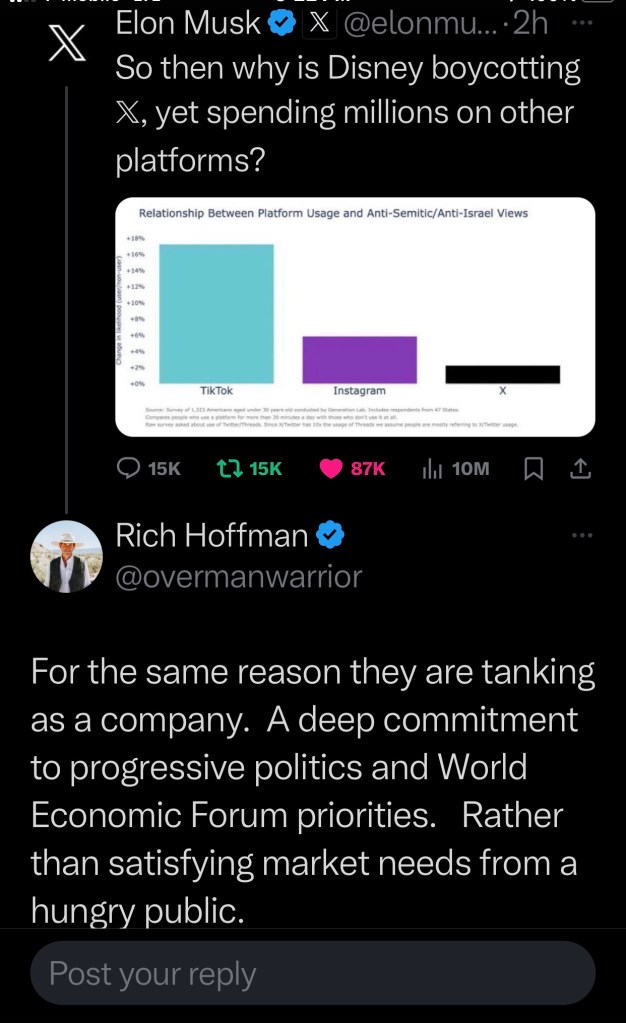
In so many ways the duel between Bob Iger and Elon Musk is indicative of the future warfare that is the key to everything.  Here are two CEOs at the top of their game representing two different directions, and one is distinctly on the wrong side while the other is thriving.  As I say all the time, don’t judge people based on what they say, but on what they do.  And Elon Musk has been evolving slowly for a long time.  This happens to a lot of people as they get more information.  I also say a lot that it’s nearly impossible for a person to have a lot of intelligence and to remain a Democrat.  People might be born into a certain region with specific parents and have certain beliefs.  But through living life and doing things, you learn what works and what doesn’t, and it’s natural to evolve feelings.  And for Elon Musk, it doesn’t take rocket science to figure out that the kind of world he wants to live in, an interplanetary civilization cannot be anything less than a capitalist enterprise.  Centralized governments are too slow and sabotage their society to stay in power, which isn’t good for getting to space.  So Musk has moved in a MAGA direction without calling himself that out of pure necessity, and logic.  Then there is, of course, Bob Iger, Mr. Global Citizen, who has been the CEO of Disney, which has essentially committed suicide to accommodate woke World Economic Forum politics.  Musk has moved away from the World Economic Forum, and Bob Iger has fully embraced it, even giving it a deep French kiss to the doom of his company.  So, it was only a matter of time before these two public personalities would have a very obvious clash.

This new war that we are fighting is one where it’s easy to win against. But the way people are wired exploits them at a very personal level. It is essentially what everyone learned in public school, with the cool kids, the geeks, and the loser social groups and children knowing which one they would all be in, and how social pressure, the need to be liked, would control those behaviors into joining one of those three groups. Because Musk is one of the richest men in the world, of course, he has a lot of parasites looking to live off his efforts, so Disney thought it had leverage on him to pull advertising from the X platform to force Musk to embrace more World Economic Forum strategic goals. Musk responded with an “F You” to Bob Iger and others and made a decidedly sharp turn politically. It was a decided check mate in the chess game of these kinds of activities. Within a few days, Elon Musk facilitated a new show for Tucker Carlson and there was a massive interview with Alex Jones, which resulted in him being reinstated on X, where he had been deplatformed when it was Twitter and a series of events that would spell doom for the World Economic Forum types cascaded into irreversible damage for the big centralized global citizen types that Bob Iger represented. Musk was clearly on the side of tomorrow, whereas Iger was without question on the losing team. But the signs have been stacking up for a while now. The public results were just a matter of time. Disney used to be the center of innovation, but now it was SpaceX and what they have been doing on several technical fronts. Instead of warring with Musk, Disney should have sought to have a relationship with them. Instead, they chose politics, which, as a CEO, was a nail in the coffin for Disney that is quickly sinking the company.

Months before all this occurred, I had taken my family to Disney World for a very large vacation.  I was not crazy about the woke direction of the company, but as I have been saying for several years now, I don’t think that Disney is going to survive as a company, and I wanted my grandchildren and my kids to see it while it is still a great thing.  I love all four of their parks very much, but Epcot Center has always been something special, an optimistic city of tomorrow that showcased all the opportunities of tomorrow.  But tomorrow is today, and many of the things that are showcased at Epcot now look old and out of date.  Disney Parks have become too political; they have not adapted to the true frontier of human need and it shows.  Disney, mainly as Bob Iger has run it, is a looking-back company, not one that is embracing the future.  Bob was all about the World Economic Forum controls from centralized governments that looked to establish equity and inclusion through force and manipulation by those in charge, whereas Elon Musk was embracing the kind of technology that would free people of those methods, and he was looking at capitalism as the means to do it.  Elon Musk wasn’t precisely a Trump guy during his first term.  He wanted to give Joe Biden a chance.  But that quickly changed over the last three years, and now Musk has moved well away from the World Economic Forum view of the world, and that difference is dramatically apparent when you watch SpaceX work and perform a side-by-side analysis of their view of the world with the Epcot Center. 

The trip to Disney had the effect I wanted.  My crew had a really magnificent time at Epcot Center. We went there on two different occasions and used the monorail as our primary means of transportation to get there.  It was great for my family.  But I could see the ghost of a place I used to love, looking old and inward thinking.  It was essentially what the world was trying to do with authoritarian, centralized governments, such as China and the European Union.  That was not the future we were going to experience, and Bob Iger had gambled everything on it.  And when he went to call the bet against Musk, everything went in the opposite direction.  The result was it forced Musk to stop trying to put one foot in and one out on so many topics and go all in toward the future, which means the collapse of central government tyranny.  Putting Alex Jones and Tucker Carlson on X was the reason Musk bought Twitter in the first place.  For the same reason, Trump created his own social media platform, Truth Social.  The future requires a decentralized competition of ideas without the restraint of slow-minded authority figures.  And the results will be very similar to what happened between Musk and Bob Iger but on a truly global scale.  The peer pressure leverage Disney attempted to pull on X is the same kind of backfire that all corporations and political sentiments will experience in the years to come and on a much more ostentatious scale.  Like the Epcot Center, the World Economic Forum’s view of the future was dying and outdated.  It was SpaceX that represented all the opportunities that were coming from a future being designed by capitalism.  And now Elon Musk was fully committed.  Disney had lost that final battle toward forcing the world to become a global citizen at the cost of innovation and freedom.  And if there was any indicator of the things to come, it was that.

Rich Hoffman

When Too Many Rules Destroy Happiness: Observations from a Disney World vacation experince

For most of September, I have been traveling. It has only been recently that travel restrictions regarding COVID-19 were lifted in places I needed to go professionally, like Canada, and Japan so these needed visits had been stacked up and a long time required. That was also the case for a family vacation to Disney World, which I had intended to do for the last three years while my grandchildren, mostly close in age, were prime for the experience. Covid restrictions and mask mandates ruined all those plans, so we waited for them to be removed before committing to anything. In September 2023, a slight window opened to do everything, so I stayed swamped catching everything up. By the end of September, I got off a flight from Tokyo, parked my car, hooked up our RV, and towed it to Florida for a week in Disney World to stay at their wonderful campground, Fort Wilderness. We almost canceled it again because of all the new policies at Disney, but we determined that this was the time if we were ever going to take the family to Disney World. Because as I have said many times over the last decade, I don’t think Disney will survive as a company. And after going there again and comparing the experience to just three years prior when my wife and I went there to see some of the new options they had, there is no question, that Disney is failing everywhere behind the veil of happiness, and I can see the entire thing completely falling apart for many reasons they will never tell you about in the media. But the Fort Wilderness Campground, an official resort for Disney was fantastic, at least from the façade of a vacation experience, and I was happy we went when we did.

From the area I walked around in my video of Fort Wilderness, we could take the boat over to Magic Kingdom and get to all the other parks, Animal Kingdom, Hollywood Studios, and Epcot Center with the park hopper option. It was all costly, but I could show my children and grandchildren many exciting things over three days, and camping at the Fort Wilderness Campground was one of the best experiences I have ever had. It was comfortable, luxurious, convenient, and splendid in everything you expect from a lifetime vacation experience. When I think of Disney I think of a media empire built on family values, and of Fort Wilderness itself, I think of the Davy Crockett television show and Zorro. These days, Disney is more of a princess place, but there are still all the excellent references to Americana that I found very refreshing, such as the clear statement at the entrance to Liberty Square, “The hope for freedom for all. And the courage to fight for it at any cost.” Walt Disney never wanted people to forget what a miracle America was, and he dedicated several parts of his amusement parks to that very service. I wanted to take my family there while the parks were still in their heyday. As for what I wanted out of the trip, I am thrilled with the results. The children were happy even though we averaged about 6 miles of walking daily with the park hopper passes. We saw a lot, experienced a tremendous amount of information, and we had a great six days at Fort Wilderness Campground going to the pool, hanging around the restaurant and trading post, and enjoying camp in one of the best in the world. We purposely picked the 100 loop, which requires a lot of advanced planning so that we were a close walk from the boat dock which had us coming and going constantly.

Yet, to my eyes the mistakes were obvious. Disney, because it’s a giant corporation with many thousands of employees to maintain has destroyed itself by the weight of its own success, like many major corporations do, and this goes way beyond the recent woke policies from BlackRock that have seriously destroyed their business model for good. The current park attendance will soon be a thing of the past because of their killed market share worldwide. Bob Iger, the current CEO should have never returned, and I’m sure he’s realizing that now. Disney needs to constantly produce fresh content that makes a billion dollars each at the box office, and those days are mostly over for them because of the status of the current youth, YouTube options, and their alienation of conservative Americans. For instance, most of the vacationers are Trump supporters at the Fort Wilderness Campground. However, the employees are mostly Democrat-leaning and to offset this discrepancy, Disney has a lot of rules they impose on their workforce to keep everyone lined up correctly. But what they end up with is something much like their rides, everything is great so long as you stay on the rails. But the illusions fall apart quickly if you step out of the boat.

And that became most obvious when we were all exhausted one night. Nobody felt like cooking, so we went to Crockett’s Tavern and the Trail’s End Restaurant to get some pizza. On one of them, we asked for a half and half, one side being deluxe, the other completely cheese because none of the little ones like toppings yet. You’d think that we asked those Disney employees to commit murder, they had a meltdown that involved discussions of being fired and all kinds of drama. It was like being in West World where the robots suddenly started shooting the customers. It was odd, but that wasn’t the only time. What was clear to me was that the expensive façade of the Disney vacation experience was thinner than it had ever been and it wasn’t taking much for that illusion to be shattered for the consumer. Disney had adopted many rules to keep their radical workforce in line and on the message that they had destroyed that personal touch that happy individuals bring to work with them. I’ve been to Disney World many times, and this most recent time showed clear signs of stress behind a radicalized workforce that was coming out against the customers such as we saw over that simple pizza. The pizza was good, and we had a fantastic time with our family. But after some old timers still working at Disney are gone, the next generation is not there to pick up the task and carry it into the future. Disney could hide this from the world so long as they could throw money at the problems. But they can’t even do that anymore. In the news this week, right after we left, Disney had to raise their ticket prices to their parks and there are reports that the CEO is seeking a peace treaty with the Republicans of Florida. The woke battles have left Disney permanently damaged as most people inclined to spend a lot of money at Disney World are also MAGA supporters. Disney joined the wrong politics in a volatile economic environment, which has been costly to them. We enjoyed ourselves. I am glad we made the trip now for the historical value of such a Disney experience in American culture. But given many of the things I observed, it won’t be there forever. It’s failing even worse than I had thought it was.

Rich Hoffman

The Dangers of Marxism in California: Supply chain disruptions due to the electric truck mandates

The magic sauce anywhere in the world for successful government is not how much government can you make to create regulation but how much you can offer freedom to individuals and still have a stable society.  If the government becomes too large due to its expansion, you are failing as a society.  Of course, some government is needed, but when it is used as a crutch for creative enterprise, then the trouble starts.  And anywhere in the world this is true, in every country.  You can tell the success of the country and its measure of economic output, GDP, by this ratio.  Therefore, countries attempting to follow the false methods of the Masonic-driven experiment of Marxism where the government was created as a collectivist blob to replace the rulers of the world, then restricted economies are bound to occur, and that was never more obvious than in the movement against rationality with California imposing electric truck mandates that are starting to go into effect by next year, 2024.  There is no reason for the orders other than the government through its mass and force has decided that it wants to impose some limit on creative enterprise because, as a collective effort, they have a religious belief regarding climate change and its role in the universe.  A modern form of sun worship just like every other society of the past that has risen and fallen has embarked on.  Now, the government of California, and in general, the Biden administration, wants to force Americans into an electric car market one way or another.  And this government tampering shows up directly in economic health, especially in supply chain health.  Wherever supply chains slow down, look now to the size of the government and its not-so-well-thought regulations as the primary culprit. 

California has an increasingly hostile group of radical government believers. Once it is discovered that work is safest when laziness can be hidden behind government forces in size, they have decided to show their validity by disrupting supply chains to show their power to the world because they have openly embraced Marxism as a culture.  And that becomes obvious with their commitment to their power grid problems, and general approach to happy living in the world’s fifth largest economy.  California was always an obvious target for global Marxists who have infiltrated the government just as they do in the American government. Their next target is electric trucks to replace diesel semis by the middle of the next decade, starting with regulations for new truck registrations beginning during the next election year.   And they believe these regulations to be reasonable based on their purely fictional religious beliefs about sun worship.  Science or the marketplace is not driving these decisions, but the hunger for gaining the power of government rather than abusing that power to satisfy a mass religion of leftist values.  Even if the electric trucks were ready for prime time, the government’s radicalism into believing they can force society to live with the constrictions of the economy is truly dangerous.  And this is precisely the kind of behavior that has caused price increases at the grocery store during the Biden administration.  The lack of options and their price directly represent the amount of government regulating the behavior, and the result is slower supply chains and much less creative economic activity to meet the market needs of a free society.  When personal freedom is sacrificed to satisfy the power of government you get price inflation and slow supply chains in whatever industry you might be concerned with. 

Electric trucks could be an option under some conditions, but the marketplace must determine those conditions.  For instance, I have had exposure to electric forklifts for thirty years, and I generally like how quiet they are and how much instant power they provide.  But this is always the story with them; the charge rate requires at least an entire shift to utilize whereas their propane-driven counterparts can operate a total of 24 hours per day with the quick change of a tank.  So imposing electric forklift standards would force businesses to limit themselves to one shift per day where the forklift is charging and not doing work.  Or it would have to purchase another electric forklift that can operate while the other charges.  Either way, a restriction has now been placed on the business that it will have to pay for in some fashion, either in lack of output through production or the cost of more than one forklift that it will now have to maintain.  This is how the government causes inflation and disrupts supply chains, slowing the output to the end-use customer.  With the electric trucks of California, the essential same problem becomes apparent: the government assumes that employers will buy more electric trucks as an increase of the price of more than 30% each.  And that work schedules will be restricted to accommodate the lack of versatility to refuel.  Rather than make market decisions based on the logic of free enterprise, and in getting products to the consumer as quickly and efficiently as possible, the government has through force, imposed a religious belief that then limits the output of productivity.  And because they are a monopoly, there is no competitive means to measure success or failure based on competition. 

This is why Marxism generally does not like competition, because free markets expose their monopoly limits through comparison.  As a captured Marxist asset, California has all the other states in America to compete with, so the economic value can quickly become evident unless all forms, through federal mandate, are forced to do the same.  Therefore, if everyone is performing at the same level of insanity, then a better option will never be known to the public, which is their greatest present desire.  To hide their inefficiency behind government power, controlled free speech, and a lack of competitive criteria to measure against.  If electric truck manufacturers are forced to compete with other options, then their recharge time and other failings might be corrected through innovation.  But behind government force, there is no such incentive, and the limits rule the day.  And that is why the electric truck mandates in California are so disastrous and why government policy on them is so terrible.  Because of government intrusion in the free market of car manufacturing, many bankruptcies are on the horizon, and a significant impact on supply chains as old cars will suddenly become valuable because the new cars are so expensive and limited.  The electric vehicle market, in general, is representative of insanity because there are no power grid assumptions that don’t make electric bills horrendously expensive by forcing everyone to work with just another monopoly not using the best means of energy, the power companies.  We should be using nuclear power, but instead, the government has caused significant issues by going to war with fossil fuels and forcing solar energy and wind power, which is dramatically ineffective as a means of supplying energy.  And as a result, the economy of power becomes too expensive and under-supplied.  And society, in general, is much less vibrant because of the intrusions of a government that has too much power, and not nearly enough competition to keep it honest. 

Rich Hoffman

The Debt Ceiling Debacle: Government needs to be cut by 75% or more

The values expressed by the June 1st made-up deadline for the debt ceiling talks were that it was a bi-partisan agreement, which prevents a first-ever default, protects Biden’s key priorities and accomplishments, and rejects extreme cuts to programs for veterans, seniors, and what families count on. It protects Social Security, Medicare, and Medicaid and keeps President Biden’s student loan relief program for 40 million hardworking borrowers. That is what the White House is saying about it, and it’s the kind of deal you will always get from a corrupt government with a serious spending problem. And the feeling is that Keven McCarthy got suckered even though members of Congress I like from my area; Jim Jordan and Warren Davidson were happy to push back a bit from the Republican perspective; ultimately, these budget fights are going to get messy and would have been better done now than later. Essentially, Republicans bit on the phony deadline for debt payments that Janet Yellen set from the Biden administration, and House Republicans didn’t want to be blamed for a default. We are dealing with radical employees here; it’s precisely the same argument we have been making for years in public schools where the government simply adds too much payroll, then expects taxpayers to pick up their massive expansion of government through job creation, then overpaying those employees. I tend to agree with Davidson and Jordan that McCarthy played a nice game, but in the end, there weren’t wins to justify the effort, and the Biden Democrats get to celebrate a win at taxpayer expense. 

We aren’t all on the same page with this one. The government needs to be radically shrunk, and it will put a lot of people out of work. The entire issue of these budget talks really comes down to whether we are a better nation with all the government workers we have who do so little for the nation in general. Most government workers make 30-40% above market value for jobs that aren’t needed in most cases. And we could likely afford to cut 75% of those and still get an operational government, much like Elon Musk did at Twitter. Real people who run real companies understand that budget impacts on the payroll are the biggest problem of inflated budgets. If employees get increased productivity with their staffing, and that productivity is valuable to the world, then a company could be said to be successful. But we’re not talking about that with this budget problem with our government. Government is a make-work enterprise where they fill positions we don’t need and pay people too much money to perform the job. I would say that the utilization rate of those employees is under 5%, where it should be somewhere between 70% to 90%. That’s the effective time employees are actually doing their jobs while being paid. What we are dealing with when it comes to government workers are lazy radicals who are hidden from job performance by government labor unions who continue to want to throw bodies at positions they create to expand government and take credit for it as politicians. And politicians are never going to give those jobs away without a major fight. And this debt ceiling talk of 2023 would have required people negotiating who actually want to fight. 

And the kryptonite for Republicans is always military spending, but even with that topic, do we really want to waste money on a woke military? In my view of this problem, everything is on the table. What does our military really do for us these days? It seems to only serve for wars that help globalism. It’s not preventing war with China. China has their guy in our White House. They are fighting wars through finance now; nobody is planning to fight a ground war now or in the future. So, Republicans need to be willing to go there. And they must be willing to take away the credit cards from big-spending Democrats and let them have their head-spinning moments. At some point, we are going to have to call the bluff of the big government types and stop wasting money on these massive government programs in every category. Lots of people need to lose their jobs, and a resizing of the real needs of our federal and state government needs to occur because, at the core of it, that is what we are talking about with these talks. Nobody wants to end well-paying jobs for a government that know-nothing politicians created for a job that society generally doesn’t want or need. We are going into debt to do jobs so that foreign interests can make money off the interest rate, and the only entities benefiting are the communist labor unions attached to the government workers. It’s a treadmill that goes nowhere, and we waste all our time and money on essentially nothing. Our nation has not improved because of all the money wasted on these jobs, and the economic value is a negative rather than a positive. We are paying a lot of money to get in the way of productivity, not to enhance it. 

And that’s where the really hard decisions come into play. We all have family members who work in government and did what they needed to to get a job with the government at that overpaid rate, with all the days off and work-from-home policies we have seen over the past several years. Government workers don’t think they owe any productivity to society. They believe that society owes them a job and that they’ll show up for it whenever they get around to it; that is the true cost to the productivity of our culture. We are paying a lot of money for a government that doesn’t do what we need it to. And unless Kevin McCarthy was willing to argue on those merits, the Democrats would own him in the negotiations. McCarthy made a good show of it, working himself over the Memorial Day Holiday, but Democrats knew from the beginning that all the mainstream Republicans could not fight the budget battle where it is really the costliest. Nobody wants to admit that their friends, family, and fellow union members are actually performing worthless tasks for a worthless government. Eventually, we will have to have this discussion because it is what makes deficit spending such a catastrophe. One that few, perhaps only the 20 or so freedom caucus members, are willing even to discuss. Government, in general, with all their labor unions attached at every level, is a bloated machine of communist corruption of no value, and to be a healthy country, those government jobs need to be private sector jobs at a much lower wage rate. And that would essentially destroy the inflated economy of the Beltway culture that entirely exists on debt, not the actual value of the jobs that fuel that economy. Then until we are willing to have that discussion, which is inevitable, we will continue to see debt ceiling discussions like this one with precisely these results. Kevin McCarthy never had a chance because he was making the wrong argument. The government positions that make up the bloated budget we are dealing with need to go away. People will have to be out of work. And the government will have to be significantly minimized, by 75% or more, because anything productive never happens. And we are a long way from that happening with these government politicians. A long way away from reality.

Rich Hoffman

Click to buy The Gunfighter’s Guide to Business