The CIA Found The Ark of the Covenant: Confirming that it is located in Axum, Ethiopia

Is remote viewing possible?  I have discussed this before about Dolores Cannon and a very interesting book she wrote about the Essenes, using regression hypnosis to investigate relationships with Jesus Christ from 2,000 years ago; however, in talking to them in real time, as if they were right in front of us.  I can understand the skepticism, but I think we are talking about conditions of quantum entanglement rather than improbable scientific accidents.  Until people explain to me how ancient people moved large rocks without machines, I will remain skeptical that we are examining the correct science for all conditions.  I think I have a pretty good idea what they are. However, just for fun for my upcoming birthday this year, we are planning to go ghost hunting as a family.  We purchased some paranormal equipment, including an EMF detector, a spirit box, and a voice recorder, designed to detect spirits that are otherwise unable to communicate.  There is a lot invisible to us, such as electricity and radio waves, that are flying around all over the place, interacting with us constantly.  Yet we use these things to advance our society.  So, when it comes to the spirit world, I think there are a lot of life forms roaming around without bodies, across time and space, that do not function according to our linear measure of time, and are interacting with us in dreams, through devices that can pick them up, and even through drug use and hallucinogenic enterprise.  Just because we haven’t figured out all those scientific methods of communication yet, I think Dolores Cannan, and many others, including the CIA, have been able to use remote viewing to learn things they otherwise wouldn’t and to shape events from a great distance without getting up out of their chair.  So yes, I believe the declassified story about the CIA discovering the Ark of the Covenant, and that its location was in Axum, Ethiopia. 

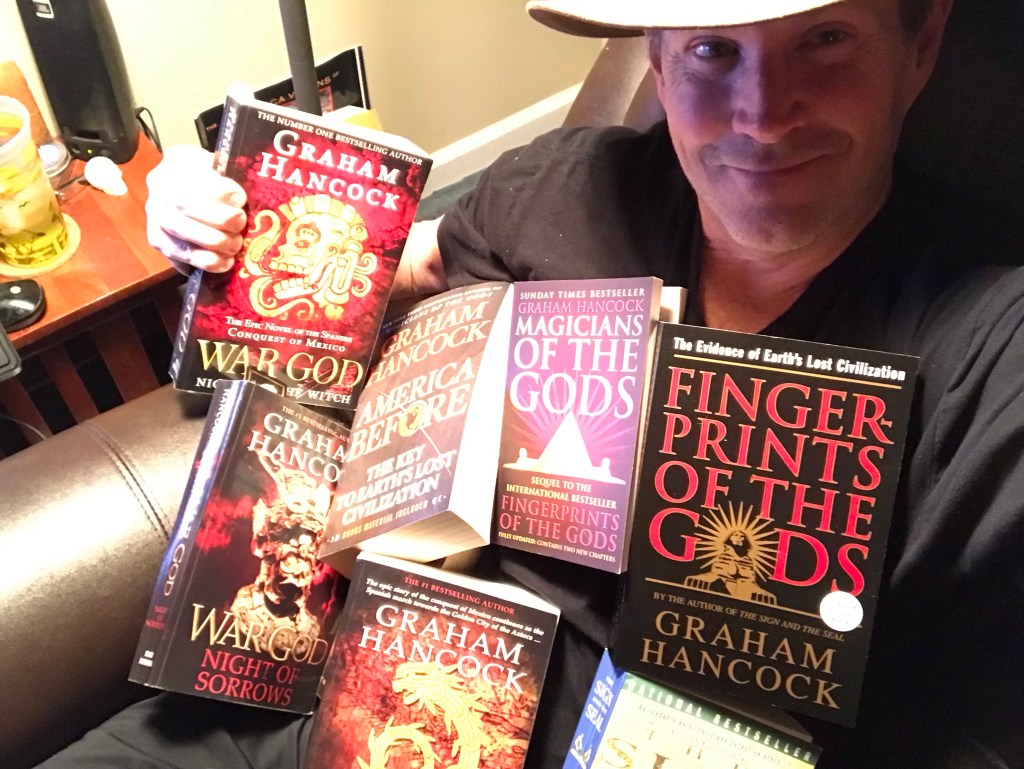
What gives strength to that story is a book I read several years ago by Graham Hancock, which is one of my all-time favorite books, The Sign and the Seal, published in 1992 and heavily inspired by the fictional adventures of Indiana Jones.  Graham Hancock was a beat writer for The Economist and Ethiopia was his territory and they had all these rumors there by the locals that the Jewish Ark was hidden there in Axum because the son of Solomon and the Queen of Sheba had brought it there during his father’s lifetime, before the nations of the world moved against Israel to destroy it.  The story goes that Solomon wanted to preserve the Ark of the Covenant and the laws of Yahweh that were kept inside, the Ten Commandments, so he allowed his son and the Queen to hide them away with what is today a large contingent of Ethiopian Jews dedicated to protecting the Ark from the prying eyes of the world.  In his book, Graham Hancock conducted a tremendous amount of research that essentially led to the gates of a small church in Axum and a guard there who had given his life to protect the Ark from outsiders.  The guard there more or less displayed that at least he believed what he was guarding was the ancient Jewish relic, and he had radiation poisoning to prove it.  The guards at the Ark of Axum are elected to lifetime appointments by the town.  So, whoever gets the job gets it for life, and they typically become ill very quickly from their constant exposure to whatever it is they are guarding. When one dies, the next one is elected to a lifetime appointment, and they perform the service with a smile on their face, driven by the honor of it.  And they never leave their post. 

So to learn that the CIA had successfully confirmed through remote viewing that they discovered the Ark, not physically, not with their hands on it, but with the success of a telepathy practitioner, such as Delores Cannon was, I think only confirms what Graham Hancock, and many others have long said, that the Ark is in Axum Ethiopia and is still there to this day.  And I’ll go a little further as to the value of fantasy characters like Indiana Jones.  The value of those kinds of stories lies in getting people to think about such things, and if not for their popularity, Graham Hancock might have remained a beat writer and travel commentator for the rest of his life.  But because of Indiana Jones, the CIA was investigating the Ark, Graham Hancock wrote a book that changed his life, and many other people, and even now as there is a Trump administration declassifying many things, people are very excited to learn about what’s under the Giza plateau considering all this new news about mysterious objects under the Great Pyramid complex in Egypt, and this story about the Ark of the Covenant in Axum.  Fantasy fiction often drives us to scientific fact, and we are better off for the things we learn.  But as humans, we require some intellectual device that provokes us to ask questions we need to be asking; it’s how we acquire new information.  And there is still a lot we need to learn about the world, and I think the CIA has learned to do more with it than just view things remotely. 
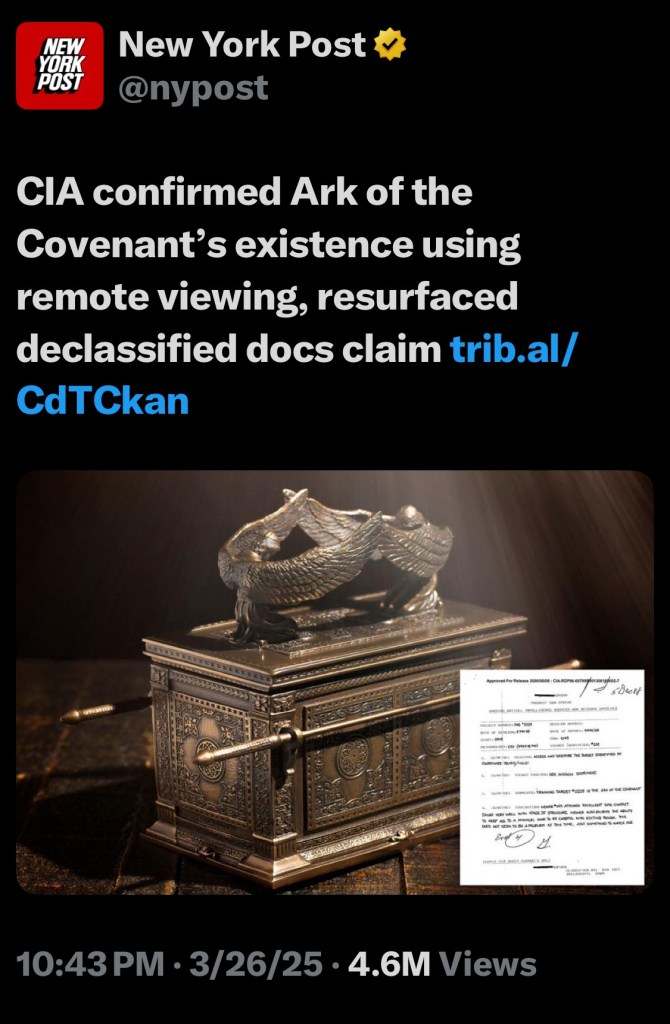
A lot of times when you have a ghostly encounter, and a strange shadow man appears just outside your peripheral vision, I don’t always think it’s a ghost, but someone trying to interact with you, or spy on you from a remote viewing location.  And they might not even be living at the same time that you are.  They could be far in the past or way into the future, interacting with you through a dream, or a purposeful exploit of quantum entanglement.  And that these methods are scientific and can be used to communicate information just like a radio wave can now, or how electricity travels invisibly all around us, and we use it to power our entire civilization.  Even though those things are invisible to us, through our current senses, it doesn’t mean they aren’t real in and of themselves.  So, yes, I believe the CIA story, and I think there will be many more like it.  And I think it mainly because it confirms what Graham Hancock already figured out with hard reporting and boots on the ground regarding the actual location of The Ark of the Covenant and an adventure story that was inspired by Indiana Jones, but took on a life of its own that was even more interesting than the fictional account.  I’m not sure how much of the original Ark would be left, made out of wood and gold as it was.  It’s around 3,200 to 3,500 years old, and not much lasts that long, even when preserved.  However, I think what remains of it is in Axum, and the CIA confirmed this with a remote viewing method, which is exciting news.  However, it’s also just the tip of the iceberg in terms of what remains hidden from us using these same technological methods.  And the mysteries of science that we have yet to discover are still ahead of us, but have been seen through quantum entanglement, and it shows that we have a long way to go.

Rich Hoffman

Click Here to Protect Yourself with Second Call Defense https://www.secondcalldefense.org/?affiliate=20707

The Great Work of Graham Hancock: Understanding more than just history, but in the dangers of institutionalism

I find it very enjoyable that more people are discovering Graham Hancock now than they have at any period in the past because he and others have done some very excellent work in the field of history and its study of it. Graham Hancock has been around for a long-time writing books and has a unique gift to make the past come alive with vigor while going well beyond the accepted norms of science, which ultimately is what is needed in our present time for many reasons. Of course, people are gaining so much understanding of Graham Hancock’s work because of the new Netflix show, Ancient Apocalypse, which features Graham Hancock as the narrator, resulting in over thirty years of his work. What Graham does uniquely is taking many years of hard study by archaeologists, anthropologists, paleontologists, geologists, astronomers, and the like, telling a narrative of the human race that would never be captured if people were only paying attention to those specific fields by themselves. When we have an advanced society like the one we are living in today, somebody must do this so it all makes sense and comes to some point that concerns everyone. I greatly admire scientists’ work; it’s often slow and cumbersome. I would never have the patience to do it, but I admire people who are wired in such a way. But they need someone like a Graham Hancock to tell their story. Just publishing academic papers isn’t enough. Graham’s background is as a journalist, which is precisely what makes him so good at reporting these historical issues. Without Graham, there is a lot of great work that the rest of the world would never know about. But without the great science that has gone on, there would be nothing for Graham to write about. Yet for me, whenever there is a new book by Graham Hancock, I read it with interest, as I do a local personality of a similar type, Ross Hamilton, or the archaeoastronomer Robert Bauval, and publisher/editor Mark Booth. I’ve read many of their books, understand what they are doing, and think it’s infinitely imperative. Yet we are just scratching the surface with all this stuff, there is a lot that we don’t know, and it is with the effort that they approach their subject that is required to do the work we must all do to understand where we came from, and where it’s all going.

Graham Hancock is cautious not to be lumped in with the Ancient Aliens crowd even though I will say it, there was never a question for me after reading Robert Temple’s book on alien visitors from the Sirius star system over 5000 years ago that something to that effect occurred and is still likely happening today. Graham takes himself as an earnest journalist, so he presents the facts from the cutting edge boldly but specifically. He lets the evidence take things where they do. His quest is the search for an ancient civilization that was technically proficient in much the same way we are today and to understand it. Referring to Temple’s famous book The Sirius Mystery, written in 1977 and is a kind of prequel to the type of work Graham Hancock would dedicate himself to, I always wondered why Egyptians had all these strange gods in their pantheon of consideration. The mythologies of the world, which I have spent a great deal of time studying, never made sense until you start thinking in the way Temple proposed, not as some crackpot theory, but as a viable understanding of the facts that are presented. And if you read widely and over a significant number of subjects, then things start coming together to tell the real story of us all. And it is along those lines that the new Netflix show explores. But Graham’s work gives a lot of validity to the kind of thinking that a show like Ancient Aliens proposes, that alien life visited earth and helped seed many of the cultures we study today. Graham’s quest has been to prove or disprove that notion, and unlike Temple, who looked at the facts and took them where they went, Graham’s work is almost seeking a way to prove that not to be the case. But what he finds keeps taking advanced cultures in human civilization back much older than anybody previously considered. 

What’s important about all this is that it proves a fundamental flaw in human nature as to the conflict that has arisen between the expert community of academics and the reporting of Graham Hancock. Long before Covid came along, we caught the government in multiple conspiracies of controlling the media narrative to protect the way that science gets their funding by arriving at conclusions that governments want, not what the truth tells. The conflict over what the truth tells about human civilization is that we are much older than anybody previously thought and that there were global societies in the distant past, whether we call it Atlantis or something else. It’s not speculative musing anymore; it’s a scientific fact. And if the lies and manipulation by governments will make such a fuss over understanding our history, what would they be willing to do over much more serious issues? And that brings us to the present and how all this study is worth something useful.

But I’m not with these guys 100%, as much as I like them. I love them and their work and could talk to them for years without ever getting tired of it. But they likely wouldn’t like me. Like many people in science, publishing, and investigative sciences, they tend to lean more toward socialism than capitalism. I would argue, which they would dispute, that science was best when capital influences gave treasure hunters rewards for finding unique items. If a lot of discoveries that Graham Hancock writes about now were made today, we wouldn’t know much because of the way that science is funded by socialist governments under socialist economic policies for the benefit of institutionalism itself; we would never learn much because of the institutional controls, the same controls that told us we couldn’t take hydroxychloroquine or Ivermectin to fight Covid. Graham and his colleagues tend to see the Bible as an impediment to appreciating the technologies of the past and the worship of the sun and moon. Those religions I see are always trying to make a comeback and are presently in the climate change movement. And ultimately, that is the push behind how these great writers get published because they throw a bone to the religions of environmentalism that I would never do. I think of the Bible as a rebellion against those ancient stories and Canaan’s conquest as justified for human civilization’s progress. Instead of worshiping continued sacrifice to the forces of nature, mankind stepped boldly into self-assertiveness. When considered against the backdrop of what came before, many tens of thousands of years back, that was quite an achievement. But that doesn’t change the facts, only the perception of those facts. And because of the great work of Graham Hancock, we can have a more intelligent discussion about these matters than we ever have before. And I think that is fantastic!   


Rich Hoffman

Click to buy The Gunfighter’s Guide to Business

Graham Hancock’s ‘Ancient Apocalypse’ on Netflix: The most dangerous series on television and what it means to all civilization

I agree with what they are saying about Graham Hancock’s Ancient Apocalypse series on Netflix, that it is their most dangerous show. And I think it’s magnificent. Even though the eight-part series just scratches the surface of how much work has gone into understanding that all evidence points to an advanced human civilization that existed before and during the last ice age and that previous assumptions about tribal diffusion from Russia down into Alaska are wrong, the work that Graham Hancock is doing is essentially the kind that Robert Kennedy has been doing concerning Covid-19. The facts point to a massive government conspiracy to use Covid as a bioweapon and to unleash it upon society to control them from a newly empowered administrative state. What Graham Hancock has been doing in his many great books over the last 30 years has been shaking the foundations of archaeology and, thus, institutionalism under the umbrella of scholarship to its very core. The academic institutions have been lying to people about where mankind came from and, in that way, have been hoping to control where it’s going. And they have been caught; Graham, the investigative reporter from the BBC and The Economist, in a previous lifetime, caught them. And he has traveled all over the world uncovering that lie, which culminated in this Netflix show that I thought was wildly great. The show introduces viewers to some very abstract concepts that Graham Hancock’s books have revealed over many years. So over the holidays of 2022, if you are looking for something great to watch on Netflix, this series Ancient Apocalypse is currently trending number one, and based on the content, it will stay there for a while. 

Probably the most important aspect of Graham Hancock’s work is that he shows that there is a massive interest in the roots of populism, even in the field of archaeology. So it’s not just politics that mass populations push back against institutionalism. In the modern era, as they often do, single-point failure administrative states, whether they be monarchies run by aristocracies, theocracies run by the church, or even governments run by the ambitions of democracy, or even the street thugs who want to burn it all down who George Soros funds, such as Antifa, with thoughts of anarchy, all those organized approaches to gain control over mass populations have failed, and people are quite aware of it. And they are rebelling; whether it’s the Brexit movement in England, the MAGA movement in America, or the support of Balsonaro in Brazil, people are noticing that they don’t like or trust the institutions that have risen in the 20th century under the banners of progressivism and are rethinking just about everything in their lives. And to Graham Hancock’s point, the archaeological community who despises him as a journalist tells this story much clearer than just about any field on earth because what we are digging out of the ground and learning about people who came before us is pointing in one direction, toward a distant past, toward the Plato stories of Atlantis being true and that our society was quite advanced here on earth many tens of thousands of years ago, and that we today have a kind of collective amnesia about the origins of the human race. Instead, we are supposed to accept blindly what institutionalism has told us about history and be happy that they told us anything. It’s the same nonsense where doctors told us not to take Ivermectin to fight off Covid-19, even though by taking it, we could have significantly prevented the effects of the bioweapon created by world governments to gain control over mass populations. 

When I hear Graham Hancock talk about archaeologists, I cringe a bit because we wouldn’t know anything without all the hard work they do. Hancock is a journalist who happens to be interested in archaeological reporting. And as a reporter, he has been able to accumulate a tremendous amount of information and put it all together into a massive story that combines mythology with actual reported finds. And his work is simply amazing. That archaeologists would find Graham’s work disturbing isn’t surprising. They probably didn’t get into the business of digging in the ground for years on end just to find a few little bits of pottery, only to have Graham Hancock call them advocates of conspiracy. I talk to a few archaeologists who are doing good work in the world, and there are some, like Francis Pryor, who does great work for the Heritage group in England, whom I admire quite a lot. I think natural tension is good for science, so just because they don’t like Graham Hancock doesn’t mean that everything Hancock is doing is a massive conspiracy theory. I would call it the accumulation of information that has been gathered by hundreds of thousands of labor hours digging through the dirt and decentralizing the information away from institutional controls to be judged by free market value in the form of bookselling. And our culture is far better off because of it. And all those books sold have now made it possible for Graham Hancock to have the clout to be featured on a Netflix series, making his work much more acceptable to a general audience. It doesn’t hurt archaeology in the least; it probably helps it greatly. This kind of coverage is what gets projects funded, so the archaeology community would do well to get on the train and enjoy the ride. 

But the controversy points to a much more sinister problem, and that is one that I think Graham gets frustrated with too much because he assumes that there will be fair treatment to a superior intellectual debate. And ultimately, if Graham Hancock and I were to have a long chat, he and I would disagree on the value of indigenous people, the course trajectory of modern civilization, and any arrogance that might be holding us back from the knowledge of the past. I would argue that the best mechanism for understanding many of our modern problems is the Vico Cycle and that just because we know that ancient civilizations may have lived longer than we previously thought and that they may have had aspects to their culture that was far superior to what we have today, such as in the building techniques of massive megalithic rocks, we must also understand that those cultures lived and died long before we came along. And because they died away or were shoved into our subconscious only to be revealed in mythology shows how vulnerable cultures are to perpetually being erased away by institutional governments and their self-grabs for power. My position is that modern populism is divorcing this trend from the human race. The fact that we can have a Netflix series that we can watch over the Holidays with our families without getting permission from some ridiculous king shows an aspect to modern culture that is far superior to anything that ever happened in the past. We are headed in the right direction. We have a chance to be better as a human race than we ever were tens of thousands of years ago in the days of Atlantis, during the last Ice Age, or even millions of years ago as humanity tried and tried again to rise only to fall by the Vico Cycle over and over. I would say that because of people like Graham Hancock, who can take lots of tedious reporting from the various sciences, thousands of hours of study, and present it into a story people can understand is part of that miracle. And it’s wonderful to have that kind of information presented on Netflix into what I agree is the most dangerous series on television. That it is dangerous is what makes it so good!

Rich Hoffman

Click to buy The Gunfighter’s Guide to Business

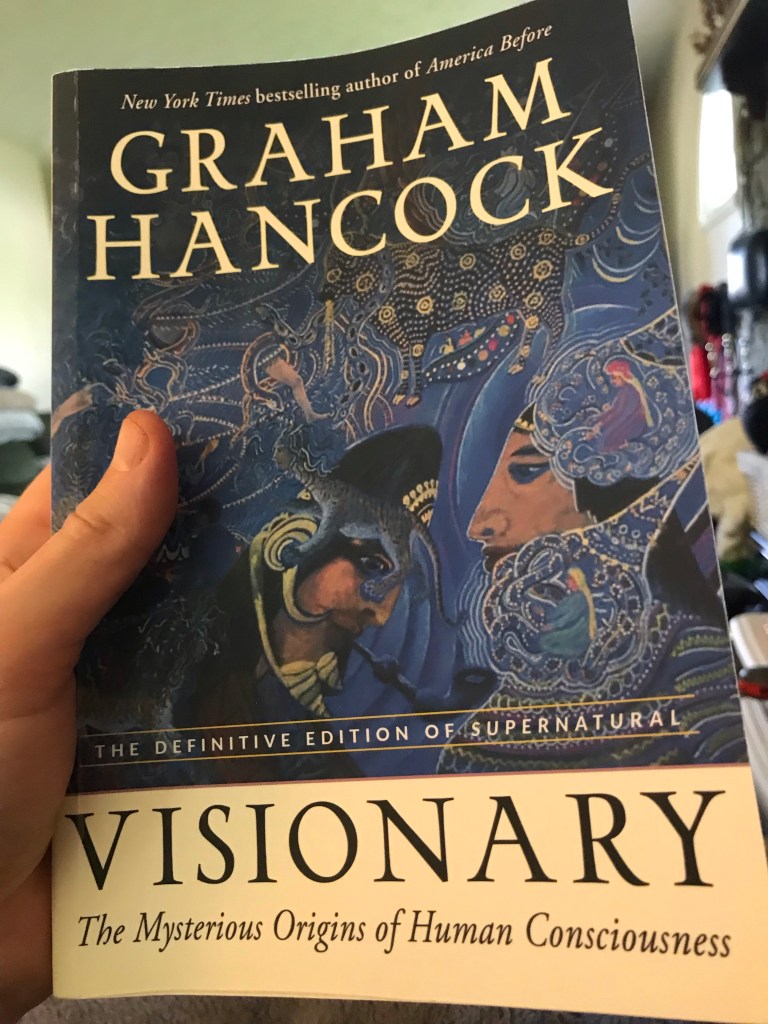
Graham Hancock’s Great Book, ‘Visionary’: To what degree does the spirit world shape modern politics and our everyday lives

I do get excited about my books, and when I read a great one, I often talk about it extensively. Books are my favorite things in the world, I could never have enough of them, and they have been with me most of my life as priorities. But this year, I knew Graham Hancock was releasing an update to his famous book previously, called Supernatural, with the new title Visionary. It was coming out on April 4th, so I nabbed it up and treated myself to a birthday treat of reading it voraciously. I talk a lot about politics and education issues. Still, I enjoy no subject more than the pseudo-sciences, and Graham Hancock, the former journalist, turned pseudo-science investigator, is one of the best currently in the field.    So for a birthday gift to myself, I gave myself a few weeks of April to just sit down and read his new book and soak it up because it’s one of those types of books. Actually, it has all the potential to be a life-changing book because it deals with the kind of stuff that is at the core of all human concerns. What were we before we were born, and what will we become after? What’s the point of it all. Now, I love Graham Hancock’s books. He and I have very close beliefs about bureaucracy’s effect on the sciences. He is into pseudo-science because traditional science, institutionalized, just does not keep pace with the rate of discovery that is occurring in this information age that we are in. Institutionalism is at war with the rate of understanding occurring, and they hate people like Graham Hancock. But Hancock brings his background as a journalist to science and takes what is known by traditional scientific discoveries and pieces everything together in a noninstitutionalized way, which is how things need to be done anyway. And as a result, he asks big questions seeking big answers to things. And for human beings, there is nothing more significant than how the spirit world interacts with the conscious world. 

For many years I have talked about the role that ultraterrestrials play in our human lives. I had done many articles on the giant race of people who lived in the Ohio region well before the times of Jesus Christ and actually had an empire all the way to the Gulf of Mexico before what we know of as Native Americans were even on the world stage. They were as sophisticated as the Stonehenge and Avebury cultures in England and obviously were part of the same culture from the same time periods of influence. So Graham’s topics are not new to me. I learned about these giants while attending the Mothman Festival at Point Pleasant, West Virginia, so it’s a real thing that certainly is under-researched. Traditional science driven by the university system is just too slow. They are guarding too much of their previous assumptions actually to answer these kinds of questions, so that is where Graham Hancock comes in. After reading the book by John Keel on the Mothman Prophecies, I am quite certain that the ultraterrestrials talked about in that book, which Graham’s Visionary is essentially a sequel, the spirit world of angels and demons that so concern religions have shown themselves in stories chronicled in the work of John Keel so effectively. But he was just touching on the surface, and Graham Hancock has taken several additional steps toward unraveling these interdimensional worlds and how they interact with the world of the living and actually redefining what “dead” means. 

Now, where Graham Hancock and I part ways is over the issue of drugs. I get his argument on the Pinery gland and how drugs can pull off the restrictor plate of brain activity to see things that are always there but that we filter out within the visual spectrum of our senses. He advocates for the open and legalized use of drugs to produce real hallucinogenic effects. Still, they are elements that our eyes can’t see because we live life in a four-dimensional world. I’m against all drugs, at any time, over anything. I don’t even take aspirin. I will occasionally sip on a beer socially, but nothing more, and I certainly never get intoxicated. But I am not closed off to his ideas that some of these drugs don’t produce hallucinations but are, in fact, reality seen for what they really are. This is why I was so interested in his book. I recently saw petroglyphs in New Mexico and Utah that were almost identical to known cave art in South Africa and Europe that span thousands of years from each other, and many thousands of miles of travel, so the cultures could not have been communicating 15,000 years ago or even 50,000. Yet they all tell similar stories painted on the rocks, and how they arrived at those images looks to be something Graham has pieced together correctly. He also puts UFO phenomena into the mix, which I had just had a research trip to Roswell fresh on my mind. So, his book reaffirmed many things that I had already been thinking about. And to add to that, he actually used ayahuasca and reported what he had seen, which was independent verification that he didn’t know he would experience. I wouldn’t do it, but I’m glad he was willing to report it scientifically instead of from the perspective of some drug-crazed lunatic. 

There is a taco place I like to go to at The Greene in Dayton called Condado Tacos, and ayahuasca hallucinations obviously inspire the interior. Or is it hallucinations? Is it a reality? I think it’s reality personally, and I think when we talk about political elements, we have to understand that there is an influence from these places that run quantumly with our 4-dimensional existence. Remember, we mathematically know that our present universe supports 11 dimensions that are likely within our current reality. But, outside of our universe, there is a possibility of 26, and within each of those dimensions, likely lifeforms are interacting with us at all times. Our business is to understand these lifeforms, especially if they are interacting with us.

We may not have the eyes and ears to hear them, but our minds certainly do, even if remotely. And that’s not a very fair fight if they have an easier time at communicating than we do, and they take advantage of that aspect often to push the world where we may not want it to go. We might say it’s the will of the spirit world, but what if it’s a maleficent demon who wants to destroy the world and everyone in it. Do you really want to listen to it? Perhaps this is the kind of influence that has brought so much great evil into the world. Or, maybe this is where all the good is, and that the purpose of life is to build a great soul to travel in these realms as an individual instead of just a collection of cosmic dust, and that the act of creation is what matters, of life being a creative process that gives birth to a human soul that then sheds the body for this afterlife. And that the afterlife is just another life that is depicted on those walls at Condado’s in Dayton. I think perhaps so. But regardless, a great book like Visionary is a rare treat, and a journey I was happy to take, and one of the best birthday presents I have ever given to myself. Time and the content to think about that truly has meaning.

Rich Hoffman

Click to buy The Gunfighter’s Guide to Business