The Temptations of Tubber Tintye: Why we must protect ourselves from the lowlifes of government

As I watched the looters, thieves, and outright crooks of the Washington D.C. culture at the State of the Union address of March 1st, 2022, I thought about how wonderful it was that America formed a constitution that limited government not one that fed it. It is no accident that America, out of all the world’s countries, has been the most successful at everything it’s done. That is because it has limited government, not exacerbated it, how centralized governments in the East and in Europe have done. However, the government is management, and we need people to do these tasks. We need government just as we do in all management. But we always need to check its power, not yield to it. And after all that we’ve been through, watching that speech where just about everything Joe Biden said was a complete reversal of everything he’s done, just as Wisconsin announced significant flaws in their election count, which just pours more gas on the fire of the Biden administration even being legitimate, the dangers of low-quality people in government was obvious. The Federal Reserve has fed BlackRock and Larry Fink as a progressive activist for climate change directly connected to the World Economic Forum Davos guys, leading to massive corruption with quantitative easing. With thousands of terrible stories of deceit and scandal, America is a great place regardless of those awful stories. The bad stories don’t define us because we have a great Constitution that separates the lowlifes from the rest of us.

I’ve been on a reading binge, which has only confirmed my thoughts. Last year I spent a lot of time traveling and writing my own book, The Gunfighter’s Guide to Business. It is pretty much the opposite of what all centralized governments want, including corporate structures, how to defend individual will from the desires of a lecherous mob of looters, which most groups and organizations become by default. And learning what I have recently about finance, woke politics, and the movers and players around the world vying for power and control on a grand chessboard has only confirmed my thoughts articulated in that Gunfighter’s Guide. Of course, my opinions create scandal because people generally don’t see themselves as lowlifes who must be defended from. They want to believe that with extensive, fancy educations and lots of money in their bank accounts, they would be respected as some aristocracy of money, which is the fundamental problem of Washington D.C. culture. However, my measure for these kinds of things goes back to the realm of myth, where much of my early reading days were spent thinking about such things. Early in my life, as I was working out the value of the human race over many omelets in Waffle Houses at 4 am in the morning, during my own college days, I studied mythology and comparative religion, and I fell in love with a particular Irish story that captured these values exceptionally well. It’s called King of Erin and the Queen of the Lonesome Island and features a young prince who goes on a treasure hunt to the castle of the Queen of Tubber Tintye to save his mother. This story is how I measure human beings’ worth, why I have no illusions about the kind of people who end up trying to run our lives, and explains why we must always be skeptical of them. 

The young Prince arrives at the castle and steps through a window to combat many monsters and maniacal creatures guarding it. But once he slays them, he comes to a corridor with 12 rooms down it. He sees sleeping there the most beautiful woman he has ever seen in the first room. He is tempted to go in and enjoy her company. But he is a person of great personal worth, so he stays focused on his treasure hunt and resumes his journey down the corridor. In the next room is a woman even more beautiful than the first. And so, it goes down the entire hall until he gets to the last room beyond the 12th. In the 13th room is a giant golden room with the most beautiful woman in existence laying upon a spinning golden couch. Of course, that is the Queen of Tubber Tintye, and the two live happily ever after, relative to the tragic nature of Irish mythology. But the point of the story is obvious. Most people of great wealth in the world usually go into those first two rooms in their lives and never go any further. They’ll grab the beauties and parade them around at parties and fundraisers, so everyone thinks of them as being great people. But they never come close to the treasures that are at the end of the hall. Obviously, there is more to just physical beauty, such as wisdom and experience. But many people I would call lowlifes never come close to those understandings. Instead, they fall for the first beauty they meet in the first room and use that treasure to brag on for the rest of their lives, never developing entirely as people. 

We must have a constitution like our one in America because of this story. Most people who take these jobs can never be trusted. We need them to do the work, but we can’t afford to give them the keys to our kingdom because they are the type of people who fall for the shiny stuff in life and don’t have the guts or patience to explore the whole castle of Tubber Tintye and resist the temptations along the way. Much of the kind of government these people are drawn to feeds their temptations; it doesn’t require them to fight it. And so, we have a world of massive corruption, and we shouldn’t expect anything less from them. But we do need the means to protect ourselves from their natures. Despite having these lowlife scumbags running our government, America has been prosperous because we have protected ourselves from their natures which fall for every temptation that comes at them. When I say that, I think of people like Larry Fink. They have bridged a gap between the Federal Reserve printing endless amounts of money to feed Wall Street, then using the power gained from that exchange to propel the goals of the Davos crowds’ radical progressivism, backdooring our political system in a public/private partnership that has turned out to be detrimental and terribly destructive. To me, Fink is just another sucker who fell for the beauty in the first room. He didn’t even make it to the second room. Let alone the golden chamber beyond the 12 rooms. And primarily, that is the same story we could apply to just about every person in attendance at the State of the Union speech where Biden was illegally inserted to protect that Beltway culture from the judgment of the outside world. And to me, most everyone falls short of my judgment. I’m not saying we get rid of the government. But we wouldn’t have a good country if we allowed the lowlifes who do make their way into government to ruin our lives with their bad decisions. And by bad choices, it’s the kind of people who fall for the temptations in the first rooms of the grand hallways of the Tubber Tintye castle. Within the scheme of things is most everyone. We aren’t proposing to throw those people away as useless. But we do have to protect ourselves from their gullibility to temptations that make them dangerous to the human race. 

Rich Hoffman
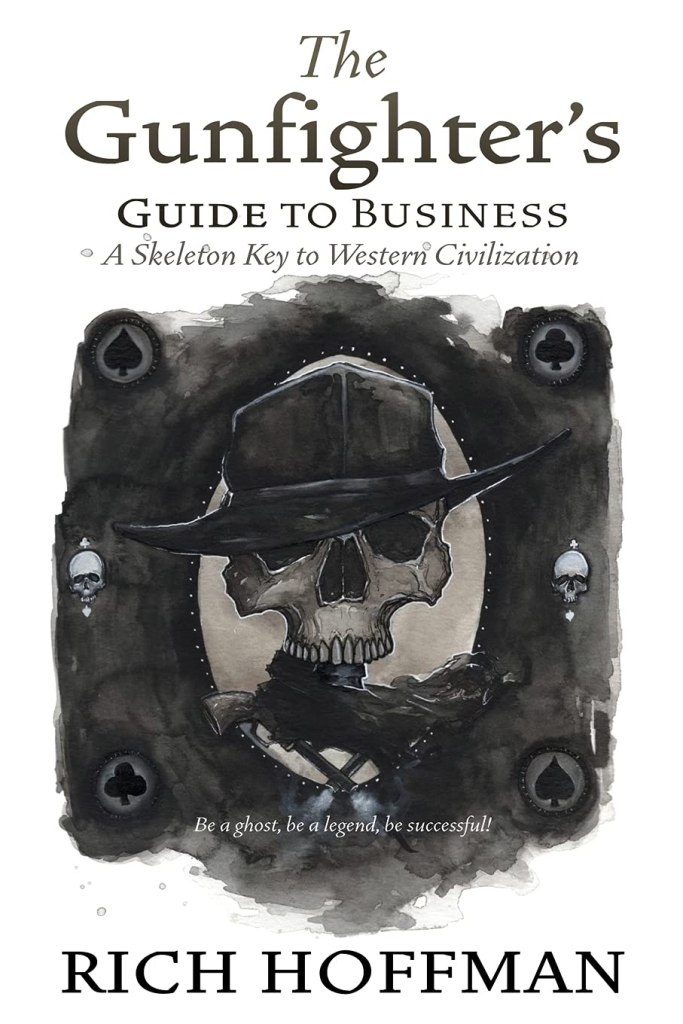
Click to buy The Gunfighter’s Guide to Business

I Love Corruption: Knowing the nature of people is worth more than the wealth of the measure

Corruption is Good if you Capture Human Behavior

Personally, I love corruption. There is a chapter in my book, The Gunfighter’s Guide to Business, called “Money is Not the Root of All Evil, It Reveals It,” that deals specifically with this unique way of looking at the world. Corruption is caused by the insecurity of a person, or a group of people, in their ability to produce. A person lacking corruption and is confident in their ability to produce will not seek shortcuts to success because they understand that the opportunities for which money is generated are always available to them. Whereas the cheaters trying to scam their way through each day feel they will only get a few open doors to financial opportunities in their lives, and they will bend their ethics to step through those open doors. Now all too often, those open doors are traps set by other people for the opportunity to take whatever value someone else has, and the whole game can seem very treacherous and bloodthirsty. But the value is in the money, which then reveals the content of the game’s characters. Once you can see and measure what people will do for money, you can then know everything you need to know about them and turn their efforts toward the success you want to see happening. Corruption shows what kind of people are playing the game, and knowing who is corrupt and who is not is very useful in playing the great games of value. There is a lot of evil in the world that would not be seen if we did not have the value of money to measure it and witness what people will do to get their hands on it.

I tend to view many things in life from the perspective of Poker. The religions of the world have tried for centuries to figure out the motives of mankind and to contain ambition behind otherworldly rules of conduct that, like Santa Claus, might get you into Heaven if you are a good little boy and girl. When religion doesn’t work, we turn to governments to regulate behavior, and the fear of being put in jail might keep us all honest and trustworthy in our interactions with each other. But what these methods essentially only do is to push corrupt behavior deep down and out of sight. It essentially makes all of society like a Thanksgiving Dinner with a family that doesn’t really like each other; when we pass the corn, it’s always very civil and polite. While behind everyone’s backs, there is always plotting and scheming going on. But at the table everyone is polite. That is what we generally have in society and why we are so shocked when we discover that corruption has been happening. Like how shocked many are to learn that Dr. Fauci has been a corrupt administrator in government health for most of his career. He can hide his corruption behind the façade of social rules and conduct. But when we study what he is willing to do for money, or how money moved from government to government employees as him acting as the broker for funding, the need for power is instantly recognizable, and that behavior tells us a lot about the people we are dealing with. The measurement of money reveals a lot about the people trying to possess it. The most corrupt people are the most insecure about how the value of money is generated. People least corrupt understand that money is produced from the value of production. But those naturally lazy and not wanting to produce in life will have all kinds of insecurities about their ability to acquire money and will jump easily at every opportunity to become corrupt to get it because they don’t think many such opportunities will come their way in their lives.

It really comes down to the question of what we want to know about people and if we want to really know it. Governments would like to believe that human behavior can be controlled through fear, such as fearing the law, fearing the power of government, or fearing the opinions of others. Religions believe that good conduct can be controlled in society by fearing what might happen to you in the afterlife. And if only you might listen to them, then maybe you might have everlasting life. Instead, to my eyes, a good poker game tells you everything you need to know about people, and a good player can control what everyone at the table is doing and thinking based on how big the pot gets. Poker is a uniquely American game that is born out of pure capitalism, and it’s actually much more moral than we have been led to believe by the same forces who today want us all to fall into centrally controlled socialism. Playing Poker reveals a lot about the characters playing the game to acquire the total sum of the pot bet between game rounds. The good and honest player will be willing to toss away a bad hand and play again in the next round. The corrupt player will try to cheat and stuff cards up their sleeve to pull out when the pots are significant because they fear they might miss such an opportunity if they don’t cheat in some way to make the conditions of the game more favorable to them. To my eyes, knowing such information about people is much more valuable than in the value of the money itself. Money is just a measurement of value. But what people will do to have it is far more critical. 

So it is in that way I see corruption as a good thing to see because it tells you who you are dealing with. The rules of society might make the preacher look like a bastion of Heavenly summation. But when alone with children of the congregation, they might be abusing them all in the name of God. Or the politician might seek legislation to provide good conduct in social interaction while they are taking money from a donor to do something voters don’t want. But the temptation of money makes it hard to turn away from. The social face may look like an outstanding citizen, complete with power dress and nice shoes. But what goes on in the politician’s mind is another matter, will they take shortcuts to get the money, or will they hold true to constitutional principles? Are they worried that they only have a few chances in life to make wealth for themselves, or is every day an opportunity to hit the jackpot and they play the game for the joy of it, knowing they will have plenty of chances for success because of their character? These are the fundamental ways to understand social behavior, and yes, corruption is just one more measurement of a thriving culture. If we have a society with a lot of corruption in it, we obviously need to change something to inspire different behavior. But we can’t delude ourselves into believing that the rules of mankind might encourage good behavior. Instead, we must understand that we must first see it with some kind of measurement and act on that knowledge. Pretending that corruption isn’t happening because we refuse to measure it is not a way to solve problems. Half the battle is in knowing, and when we have money to measure corruption, we can then see a lot that is true about the health of our society, which I find extremely valuable.   

Rich Hoffman

Click to buy The Gunfighter’s Guide to Business

The Original Sin of Taxation: Getting rid of the Revenue Act of 1913

Taxation is Legalized Theft

Based on the behavior of the Biden administration and the reckless antics of Congress and the senate over the Build Back Better Green New Deal’s massive taxation they are working on to satisfy their masters in Glasgow, the only conclusion that can be made is that the government is guilty of tax abuse.  Given what we’ve witnessed under this Congress and this presidential administration, it’s clear that we will have out-of-control spending problems like this in the future unless we take some drastic measures.  And one of those measures needs to be the elimination of the Revenue Act of 1913, which was the start of progressive taxation in the United States.  After more than a century of observing the behavior of government and its desire to grow continuously, we have more than enough history to make arguments that more free-market applications need to be applied to the government, instead of giving them the ability to legally steal our money all in service to a more bloated government that seeks evermore to grow well beyond what can be regulated with logic.  I understand that this is an issue that few are prepared to deal with, and it will take time to let it sink into the population in general.  Too many people have just accepted that this level of taxation is just the way things are.  But, we are at a point where we must ask, why have we let them become that way without debate and a proper understanding of what the government objectives are. 

One of the key reasons I set many arguments for American economic exceptionalism during the great gunfighter’s era of the Gilded Age of western expansion is that we have clear evidence that many of the progressive experiments have proven to be socialist failures.  For much of the last century, we have been living off the greatness passed down to us from the economic expansion of the Gilded Age.  Soon after 1913, specifically with the creation of the Federal Reserve and the implementation of the Revenue Act, America had let socialism into the door to get warm at our fires out of compassion.  But the bastards have been seeking to poison America as we slept and loot our country for all they could while we facilitated their comfort.  Until recently, we dared not show a lack of hospitality toward all thoughts of the world so that we might not be called capitalist pigs or tyrants of imperialism.  But really, all that America was ever guilty of was sharing the great benefits of capitalism with the world, and this jostled the feathers of globalists who did not want to be shown up by the young, agile country.  And since the explosion of economic growth that we have all enjoyed for many decades started during that gunfighter era, we have taken the power of our economy for granted.  This is most obvious in how the Democrats have pushed for all-out socialism in 2021 under the flag of Covid-19 and a stolen election by Big Tech, inserting a reckless insurgent of progressive thought and erasing the vote of millions across the country. They’ve always looked for this opportunity, and we should take them very seriously in the future.  We are no longer talking about conspiracy theories among Democrats.  They have shown their intentions to crush capitalism and rebuild our American society as a socialist state, and their method of achieving their evil has been taxation.

We should have never let the government set its level of tax rates they desire.  I first noticed this ridiculous notion while fighting school levies in my local school district.  It was clear to me that the labor unions ran the schools, and they controlled the school boards as to what their expenses would be.  All government school budgets were then runaway trains of big government spending that the taxpayers were always expected to bail out the stupidity of government.  But it was never just the schools; it was all government, from the military to the losers in Congress.  Are we getting value for what we pay?  No.  If we applied the same market conditions that McDonald’s must deal with while competing with Burger King, the government would fail 100%.  It’s kind of a running joke with everyone, even liberals; government is ineffective and never good at what they do.  Yet, we spend fortunes on the government to manage our affairs. When we continuously give them a blank check, they perpetually provide us with chaos and power grabs funded by the money they legalize themselves to steal from us with various methods. 

Hidden in these massive multi-trillion-dollar infrastructure plans are all kinds of tax increases, and with each, we should be asking the question, what value are we getting for the money spent.  Do we like our government, and do we feel that it’s worth the money?  We ask that question from our fast food to our hardware stores with all other things in life.  In a capitalist economy, we have options, and those options drive down prices.  But when the government can steal the money, they can’t manage it the first time around; why are we standing for any of it?  Well, part of the problem is the payroll taxes that started due to the 1913 Revenue Act.  People paid the tax before it ever hit their pocket, so it was hidden between an employer and the worker, which was a mistake.  Just as we now must look at the John Dewey-designed public education system and admit that it was a mistake from the beginning, we must do the same with the way we are taxed.  The government ultimately is our government.  The people of the United States own it, but they have allowed themselves to forget that they are in fact in charge.  The government has shown that it is power hungry and must be defunded to a minimal level to keep its influence in check. To do that, the burden of value must be shifted from how it is now, hidden in paychecks, and revealed in the light of day, so people consciously see how much money the government steals from them each year. 

If all taxes paid are considered by the average taxpayer, the use taxes on bullets, on soda, on beer, on gas, then with all the local, state, and federal taxes, if people could see like they do the ingredients of a can of food how much they spend on government, they would be shocked and forced to place a more wary eye on what the money is spent on.  The Biden administration’s current government has no care or respect for how much money they steal from hard-working Americans. Otherwise, they would not seek high taxes from the new infrastructure bill and more IRS agents to enforce their authoritarian theft.  Rather than looking at the money the government steals as their property, too many people assume that a portion of all their work will always be stolen by a greedy, bully government.  They have grown to accept this as a fact.  When all along, it should have been heavily scrutinized.  Yet that was always the intention of the Revenue Act of 1913, to pay for a government that didn’t deserve the money and progressively increase the cost of that government through legalized theft over a long period.  The government does not respect us because of it. Before we can change anything, we must go to the source of the problem, 1913, when the government made it so that taxes were stolen from everyday people and that they could take the money without earning it, at whatever rate they decided was appropriate. 

Rich Hoffman

Click to buy The Gunfighter’s Guide to Business

Mexico Doesn’t Have a Good Heritage: The history of why we need a border wall

It is always good to know what we are dealing with and all the factors which helped shape circumstances. As President Trump bit by bit builds his wall which Mexico will pay for in drug confiscation alone, by the time its completed the pressure is really increasing on the forces which are behind the open border movement. A group called M.A.M.O.N. (Monitor Against Mexicans Over Nationwide) made a satirical fantasy sci-fi short film that explores with black humor and consequences of Donald Trump´s plan of banning immigration and building an enormous wall on the Mexico – US border. As a Trump supporter I thought it was pretty funny to see how “they” (Mexicans) see him and how they see themselves—as Mexicans. They obviously don’t know their history, but they also aren’t at fault being born in such a bad place as Mexico. They had no control over that part of their lives, and nobody could blame them from wanting to come into the United States to have some kind of life. But by doing it illegally, and assuming that they could do so, and that they would be operating on Donald Trump as a surgeon is pretty ridiculous, which is the premise for this short 5-minute short film.

Obviously, there are some major problems with the story, for instance, if Donald Trump was on the operating table having open heart surgery performed on him by an illegal alien who was deported during his surgery, then how could the president have been in the giant robot Donald Trump who was attacking all the illegals after they were deported. And how did the chicken Quetzalcoatl blow up the giant robot if we saw feathers from its destruction in the previous scene? It’s still pretty funny and well done even with those obvious little problems. I think the discrepancies tell us more than their complaint about Trump. One thing that the filmmakers did do a good job of was capturing the chaotic nature of what the Mexican people have always been. Once you understand the origin of Mexico and what the open border people are really after, then much more clarity is brought to this subject.

Personally, speaking I think the most moral thing that we could do as Americans for Mexico is to simply make it one of the next states within America. That would solve many problems and give the people of Mexico a chance at a much better life. Essentially when the Spanish took over Mexico from the conquered Mayans and Aztec people and integrated them into their society, but then attempted their own kind of revolution for independence, they were soundly defeated by Sam Houston and many others which caused the borders to be what they are today. If you know the great story of Kit Carson and his friend John Fremont who were sent by President Polk to win the land of California away from the Mexican government, it is obvious that what is happening now is revenge from the forces of Europe who are still upset at the assumption Americans had for Manifest Destiny. Fremont would eventually become the first Republican senator for California as he and Kit Carson united the territory to rise up against the Mexican forces with a series of small skirmishes all across New Mexico, Arizona and California by uniting American farmers to stand up for their work and fight back against the forces of oppression which refused them ownership of their hard work. These were good people in California who fought the Mexicans and made a state out of that former Mexican territory. Kit Carson and John Fremont would eventually fight in the Civil War on the side of the Union as they were both abolitionists who endeavored to keep slavery out of the West.

The way that John Fremont specifically used the farmers of California as members of a future army to repel Mexican forces is obviously what people who want to erase those chapters of successful American history are trying to do in present day illegal immigration politics. They hope to use illegal immigrants to undo American Manifest Destiny and to undo all the gains made in North America through wars legitimately won. When I say legitimately, I mean to say that Mexico was a defeated nation even before it formed—and the results are what present day Mexico is, a miss mash of cultures all still rooted in either the collectivism of Europe or the collectivism of the former Mayan and Aztec cultures. They did not have among them people of the kind of caliber Kit Carson and John Fremont were, or even President Polk for that matter. America was a nation of laws, and of philosophy. For as much as modern American haters take up the plight of the black slaves from Africa, the Indians, or the Mexicans, without people like Polk, Fremont, and Carson the American West would have never happened and slavery would have likely remained in America as it was a practice known throughout the world. The Indians had been living in North America as they were refugees from all over the world at the time—particularly from China and they weren’t able to do anything with the resources of the nation before the Americans arrived. Just as many today point at the wealth of California, which became the 5th largest economy in the world and call it looted wealth. In all truth none of those previous cultures knew what to do with the wealth they were living on. They had no means of taking the natural resources of America and turning them into valuable goods to trade with the rest of the world. If left to their own, North America would look like present day Mexico, a mess of different cultures stumbling calling itself a country when in reality it is just a big gang of organized crime that is less sophisticated than what it was before Santa Anna tried to maintain land north of the Rio Grande for Mexico.

You can’t go back into history and undo the things you don’t like, which is what the open borders advocates are trying to do today. Westward expansion and the Manifest Destiny of American civilization into the Rocky Mountains and into California was a good moral thing to have happened. The Americans didn’t steal anything from the Mexican government. If not for the Spanish there would not have been a Mexico, and if not for the Spanish the Aztecs and Maya might have remained as the rulers of Central America. The blacks brought in for slavery might have stayed in Africa only to become today’s socialists and Marxist revolutionaries which currently have the economy of a kid’s lemonade stand. The freed slaves in America became the pacesetters for the rest of the world where abolition of the slavery practice was born. And no Indian or Mexican would have been able to unlock the great potential of California because they were not a free people able to use their intellect to take something out of the ground and do something big with it. They knew how to survive as tribes of nomads, and that was all.

Even in the modern sense when Mexicans try to assume that they are equal to the efforts of the American people their arguments fall short in the jokes they make about their own confusing existence. They really think that they have rights to the ownership of American labor, to what we’ve done in California, Arizona, New Mexico, and Texas because the real history is just too painful for them to understand. They were always a defeated people, whether they come from the heritage of the Aztec or the Spanish, both sides were up to no good and were blood thirsty cultures intent on domination. Lucky for the world good people like Kit Carson and John Fremont were pathfinding through the American West and putting that vast territory to good use because the morality of Westward Expansion put a light to the world of what freedom could look like, in why slavery should have been abolished, and instead of worshipping foolish gods like Quetzalcoatl mankind in America could actually do something productive and advance as a civilization. You didn’t see Indians building skyscrapers, railroads and using gold to advance society. You certainly didn’t see Mexicans doing anything with their land. They currently sit on some of the greatest resources in the world yet most of their people are struggling with poverty—because they don’t think correctly about the world around them. And that makes all the difference—and is why Trump’s border wall is needed so much. It is important to show the world the definition of values which became America instead of letting the chaos of multiculturalism blur the lines of morality for all to see and witness.

Rich Hoffman
Sign up for Second Call Defense here: http://www.secondcalldefense.org/?affiliate=20707 Use my name to get added benefits.

The Virtue of Material Acquisition and Spending Money: Defying thousands of years of wrongly framed thinking

I am not suggesting that any person spend money like a bottomless pit buying anything everywhere to cover up some deep psychological problem.  That is a different issue from what I’m proposing.  Money is simply a representation of value so when someone spends money without considering the implication of cost they are essentially unable to grasp the concept of value because psychologically, they are lacking the basic foundations to do so.  However, and this is a uniquely American way to think which was drawn incredibly clear for me while traveling recently through London, Paris, Brighton and many other places in between and observing the people there and comparing them to those I have known back home in the United States.  Additionally, as one of my many occupations, I am an employer and am an expert in the breakdown of labor=productivity and the psychological implications of personality=quality+implied effort toward targeted outcomes, so what I’m about to say requires some advanced context—because it eludes most people living on the earth today—and my assertion of these concepts comes from very advanced knowledge earned the hard way, and in my view, the only way.

I had the fortune to grow up and know both of my grandparents very well.  Both were farmers and had obviously had their world outlook shaped by the Great Depression.  One was particularly keen about every penny spent and watched them like a hawk always afraid that some big wave would come and overtake them wiping them out forever into poverty. They were extremely hard-working people and were socially very honorable, but did reflect a constant fear that their money would be taken away by some unknown force be it a disaster or the aggressions of mankind through some form of robbery—so every penny was watched for their entire lives. The other set of grandparents were rather loose with their money.  If they wanted something they bought it and never gave much of a concern if something cost thousands of dollars even back in the 60s, 70s and 80s.  If they wanted it they’d do what they had to in order to obtain it—whether it be a farm, a particular car, or just a lifestyle.

While traveling around Europe there was this constant phantom in the back of every conversation I had with people I interacted with, from family, friends and mild acquaintances which were shocked that we did so much in such a short period of time while people who were regionally located had spent their whole lives 60 miles to 100 miles from the things we were doing as a family in Europe yet had never tried to do them themselves.  And it came up more than once at dinner tables that my youngest grandson who was at this point only 10 months of age had already been to Disney World once, and was now traveling around Europe with my daughter and her husband.  Additionally while he was still a fetus he traveled around Iceland the year before so before he was even a year old had experienced vast cultural influences which are the foundations of a very interesting coming life that he will have—but people hearing all this just didn’t understand.  “You spent how much at that Ramsay restaurant in Chelsea?”  “You took the Eurostar to Paris just to go to the Louvre?” “Why go all the way out to Stonehenge just to look at some old rocks?”  Those were the kind of questions we received just over the last few weeks by people mystified by the amount activities we reported through small talk which of course opened up a deeper sore which rests on the surface of most things human beings do in their lives.  What is the value of a human day and what does one wish to do with those days toward a value that is internally comprehended at the subconscious level?

That same daughter who traveled with me just recently purchased an iPhone 7 Plus after working with mine on that trip and I was proud of her because it’s the best on the market at this particular time and I like to see she does not compromise quality for the comfort of saving a few dollars.  Just like my view that if we are in London and my wife wants to go to the best restaurant that they have—why not do it?  Essentially if I really want something, I typically get it. I don’t feel that way about everything and I do go through a screening process.  Such as Stonehenge is something that I’ve mulled around for years, but the expense wasn’t worth the trip just for that endeavor.  But If I’m in London on business, or leisure, then I’ll find a way to get there—you better believe it.  I am not the kind of person content to just watch from my front porch others doing things and not doing them myself.  To me nothing on earth is off limits—if I want it, I’ll get it.  With that in mind, when I hear someone say that this is too expensive, or that is too far out of reach, I lose respect for those people because what they are really saying is that they are not willing to do the extra work to acquire the things their heart’s desire and are more than willing to yield to complacency.

Such people who do the minimum in life favoring the lazy position of being victims of circumstance are miserable human beings.  One thing that makes Donald Trump a uniquely American product is that he has the kind of mind that never felt limited by circumstances.  He dreamed big, lived big, and was more than happy to show off how much harder he was willing to work than his contemporaries.  Because after all what is a man really showing off when he arrives at an exclusive club in a Lamborghini with a hot woman on his arm looking very debonair?  He’s not saying he just inherited millions of dollars from his dad, or that he’s willing to waste large volumes of money on nothing—he’s saying that he is willing to outwork his peers and has obtained success and by fluffing his feathers declares himself above those around him so that he can have top access to the best that mankind has to offer—whether it be women, productivity, or leisure opportunity.  Those who point jealously at the man are those simply not willing to do what it takes to acquire such things.  They resort to socialism hoping to be equal to the man without having to do the work so that they essentially don’t have to feel the guilt of underperforming in a world which rewards people like the Lamborghini driver over those who watch every penny fearful that the penny might be taken from them at some point forcing them to work one hour longer to make it up in the future.  People who deliberately set low bars for themselves are constantly unhappy when they have to live in a world where people are free to work and gain all they can and this is the cause of much anxiety in the world. By having a guy like that Lamborghini driver in the White House the expectations for our national economy will naturally expand which I see no negative to at all.  People who are afraid of hard work won’t like it because the social bars of expectation will be raised out of their range of desired applied effort—but that’s good for America as a whole for obvious reasons of economic expansion.

What I observed in Europe was something completely foreign to me.  I knew about it, but actually spending significant time there the situation was glaringly obvious.  They think small in Europe.  They have too much vacation time-they sit and talk too much about nothing and are content to live with the limitations they inherited from their ancient ancestors and they have grown as a region to accept many restrictions which keep them from really living life.  I personally don’t have any of those limits in my life because honestly no matter how much I spend, I’m willing to work harder than anybody else to have what I desire.  I may not care to have a Lamborghini because I’m not interested in the social things that come with it.  I’m married and not looking for women, and I usually do things with my family so there isn’t a back seat for them to sit in when we go out to dinner so the value isn’t worth the cost to me.  But if I wanted one, I’d buy one and nothing would stop me from getting it.  There really aren’t many “things” I want in life because material objects don’t bring much value to me—intellectual things do like books—but “things” themselves don’t do it for me.  But when I want a particular gun, or a motorcycle, or an iPhone—or a television—I get the best of whatever it is and I don’t think about the cost because I am literally willing to work 24 hours a day 7 days a week to obtain whatever it is.

That leaves me with absolutely no sympathy for the person who holds onto their money because they either fear someone taking it from them through aggression, or that they just are afraid of hard work. The person who is afraid to take their wife out to a nice dinner isn’t being fiscally prudent as much as they are just being a wimp afraid of giving up their leisure time to make their spouse a little more happy and comfortable. To select the cheaper version of a car to save money is setting the bar lower for other things and such people are artificially restricting the quality of their life to preserve their internal laziness—in most cases.  And that’s a generally accurate way to identify much of what is currently sickening the world in regard to human beings. They want things that they see other people have, but they are not willing to do what it takes to have those things.  In many cases their religions have given them a free pass to be lazy by constantly castigating the wealthy by highlighting poverty as some kind of virtue.  And that has been a cleverly shrouded element in our society which has garnered little to no attention from our everyday life.

I fortunately was able to live in Canterbury for a good part of February 2017 and in that ancient city there are still monks who make the conscious decision to live in poverty—to essentially quit yearning for material objects so that they can earn their way into heaven.  Its one thing to read about such things, it’s quite another to meet them and see them in the streets of Canterbury which I did.  My wife and I even went to their little island in the Stour River to get a sense of how and why they live the way they do.  Additionally, there are quite a few homeless people in Canterbury who have obviously quit life yielding to the escape of alcoholism.  The two groups of purposely poor demographic groups had decided to set the bar so low for themselves that they were victims of circumstance and simply yielded their life to other controlling elements.  Compassion is not the word I would use to explain their circumstance upon meeting them and speaking directly to them about their manner of living.  They have quit life and have tossed it back to what they think “God” is—and by my definition for things are wasting themselves.  It’s not honorable to be poor or to sacrifice their life for some greater good when what they are really hiding is their sheer laziness to get up each day and battle toward personal goals set for the benefit of being alive.  Such as, you can’t take that car, that house and that nice watch with you into the next world.  But what you do take is the experience gained in obtaining those things because the effort expands your intellect which has resonance into the many dimensional planes of reality that your soul resides on.  So in essence, the work utilized in reaching for material goods and services has a natural byproduct that resonates across the universe into your eternal elements—and those monks in Canterbury are missing the point by deciding to live in poverty so to obtain the grace of God.  And regarding the homeless people, I’ve been at points in my life where compared to them, they were much wealthier than I was—but I never quite working.  A person like me would never be on the street without a house or the means to get one and to me there is no excuse in living on the street begging for food or enough scraps to get a bottle of alcohol to indulge in drunkenness.  They are people who lack the internal drive to fight through each day and make the best of it—let’s be honest.

So those are some things to think about in regard to money, value, virtue, and immortal spirit.  When my daughter told me she had bought a new iPhone 7 after working with mine I would say she did more for her eternal spirit than those Canterbury monks have done in 30 years of living deliberately impoverished in dedication to God—because the value isn’t in the material item—it’s in the productive output to acquire it.  The morality of a good economy does more for assisting the soul of its recipients than deliberate quitting of the world does by yielding to the old forces of intellectual control over those willing to submit themselves to every authority.  Doing what the heart desires for the right reasons is a more moral decision than sacrificing it to circumstance.  It is not honorable to say “I can’t do this because of that, or that I don’t have enough of that to do this.”  It is honorable to say I want that so I’m going to do this to have it because the virtue comes in the act of acquiring the means to perform the task.  For instance the virtue of spending over $1000 on a meal isn’t the food itself or the obvious consumable nature of it—it’s in acquiring the $1000 to spend and in sharing that experience with the people you care about for the memory of it—and the message to them that they are more valuable to you than just setting the bar too low for everyone and holding them prisoner to your low expectations for yourself.  Monks hide that low bar behind dedication to God. The homeless behind their lack of internal resolve to fight through personal challenges–and the lazy hide behind circumstances—whether they are too short, not smart enough, too weak, too something to be that guy who shows up to dinner in the Lamborghini with the hot chick on their arm—so reserve themselves to sitting on their front porch watching the world pass them by and claim that they are being “fiscally prudent.”  They are just being wimps.  And that is the harsh reality that so many people need to face—because they aren’t fooling anyone.

Rich Hoffman

 CLIFFHANGER RESEARCH & DEVELOPMENT

Sign up for Second Call Defense here:  http://www.secondcalldefense.org/?affiliate=20707  Use my name to get added benefits.

cropped-img_0202.jpg