Everything You Want to Know About Diamonds: The Hope at the Smithsonian and What Marriage Really Means

I have always loved museums—the Smithsonian in Washington, DC, the British Museum in London, and the way National Geographic captures the wonders of the world in ways that make you stop and think about where we came from and what we’re really made of. They stand as caretakers of our shared human story, holding onto artifacts and treasures that remind us of the long arc of civilization, even when I don’t see eye to eye with every choice they make or every story they tell. I’ve said it many times, and I’ll say it again here: institutions like these sometimes cling to timelines and narratives that don’t hold up under real scrutiny, not because the evidence demands it, but because their beliefs about history shape what they’re willing to accept. That’s why I famously got into it with a curator at the British Museum over their crystal skull display. They had this thing presented as an ancient Mesoamerican relic from around 1000 BC, but the details didn’t add up. A skull like that, carved with such precision without ruining the quartz itself, struck me as something that could have been done even further back—with tools and techniques we have only come to know in more modern times. The museum’s insistence that the skull was more of a fake felt less like science and more like a way of fitting the piece into their preferred timeline of human development, regardless of what the physical evidence suggested. We’ve seen technology rise and fall in cycles throughout history; civilizations have come and gone, and what looks “primitive” to us today might have been achievable with the ingenuity we underestimate. That argument stuck with me because it revealed how even the best caretakers of history can let belief override discovery. But that doesn’t stop me from appreciating what these places offer. The Smithsonian, in particular, has a fantastic collection of all kinds of good stuff, from artifacts spanning continents and eras to displays that spark real conversation. I recommend that anyone visit if they get the chance. It’s not about agreeing with every exhibit; it’s about seeing what’s there and letting it provoke thoughts about our own place in the grand scheme.
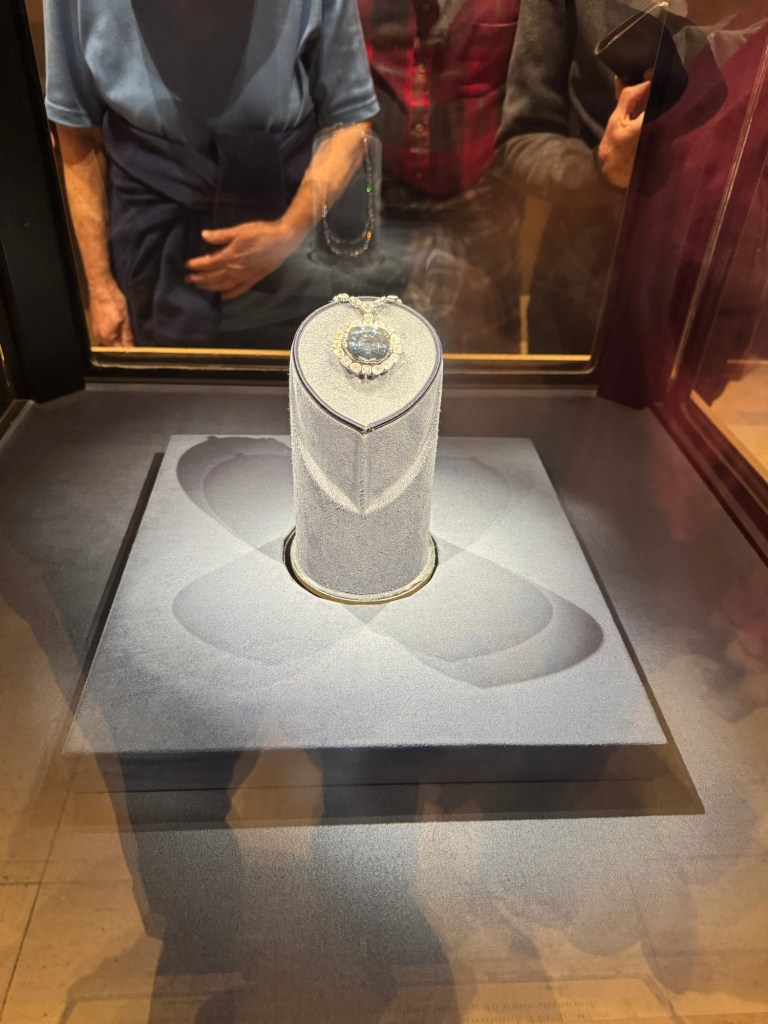
During one of my visits to the Smithsonian’s National Museum of Natural History, I found myself drawn to the minerals and rare jewels section, which is exceptionally well curated. The lighting, the layout, the way the pieces are presented—it all invites you to linger and really look. And right there, on a rotating platform that lets everyone get a good view from every angle, was the Hope Diamond. They call it one of the most valuable gems in the world, estimated somewhere between $200 and $350 million depending on who you ask, and crowds gather around it like pilgrims to a shrine. It’s a 45.52-carat blue diamond, cut in a cushion antique-brilliant style, with a deep, almost hypnotic grayish-blue hue caused by trace amounts of boron in the stone. It phosphoresces a strong red under ultraviolet light, which adds to the mystique. The history of this thing is wild: it started as a much larger rough stone from the Kollur Mine in India back in the 17th century, bought by French merchant Jean-Baptiste Tavernier, then passed to King Louis XIV of France as the Tavernier Blue. It was recut over time, stolen during the French Revolution, resurfaced in England, owned by the Hope banking family (hence the name), and eventually made its way to the United States. Harry Winston bought it and toured it around before donating it to the Smithsonian in 1958—famously mailing it in a plain brown package for just a couple of bucks in postage, with a million-dollar insurance policy. Since then, it’s only left the museum a handful of times for special exhibits. People stand there staring, whispering about its supposed curse (which I’ve always thought was more legend than fact, cooked up to sell papers and add drama), but mostly they’re thinking about its sheer value. “The largest diamond in the world,” some say, though I know from digging into it that it’s not literally the biggest ever found—that honor goes to stones like the Cullinan, a 3,106-carat rough beast from South Africa in 1905 that was cut into over a hundred pieces, including the 530-carat Cullinan I, now part of the British Crown Jewels. Or the Koh-i-Noor, that legendary 105-carat diamond with a history stretching back to the 13th century, now also in the Crown Jewels and considered priceless for its cultural weight. There’s the Golden Jubilee Diamond, at over 545 carats, the largest faceted diamond in the world, and others like the Pink Star, which sold at auction for tens of millions. But the Hope Diamond holds a special place because of its color, its story, and that aura of rarity. Blue diamonds like this are incredibly scarce—only about 0.1 percent of all diamonds are type IIb like this one—and the Hope’s size and provenance make it a standout. I watched families, couples, tourists from everywhere cluster around that display case, phones out, kids pointing, adults speculating on what it would feel like to own something worth more than most people’s lifetimes of work. It wasn’t just the rock; it was what it represented.

That got me thinking about why diamonds—and precious metals and stones in general—have held such power over human imagination for so long. Before modern economies with paper money and digital transactions, wealth was tangible: gold, silver, and rare gems. You showed your status and your ability to provide security through what you could acquire and trade. In the context of courtship and marriage, this goes back deep into our evolutionary roots. Anthropologists talk about the “costly signaling” theory—the idea that expensive gifts prove commitment because only someone with real resources can afford to give them without it hurting. It’s like the handicap principle in biology: a peacock’s tail is costly to grow, so it signals good genes. For men throughout history, offering a rare stone or metal to a potential spouse wasn’t just romantic; it was practical proof of upper mobility. “Look, I can secure a home, protect a family, outcompete the other suitors.” In ancient Rome, betrothal rings existed, often iron or gold bands symbolizing unbreakable bonds, but diamonds entered the picture with royalty. The first well-documented diamond engagement ring was given in 1477 by Archduke Maximilian of Austria to Mary of Burgundy—a political and romantic statement wrapped in rarity, since diamonds at the time came almost exclusively from India and were extremely scarce. Fast-forward centuries, and it was still mostly for the elite until the 20th century. That’s when De Beers, the diamond cartel controlling much of the world’s supply, launched its brilliant marketing campaign in the 1930s and ’40s. Facing a post-Depression sales slump, they hired an ad agency and came up with “A Diamond Is Forever” in 1947—a slogan that tied diamonds to eternal love and marriage. Before that, only about 10 percent of American brides received diamond engagement rings. By the 1990s, it was up to 80 percent. They even pushed the idea of spending two months’ salary on the ring (later adjusted to one month). It worked so well that diamond sales in the U.S. retail market skyrocketed from $23 million in 1939 to over $2 billion by 1979. But here’s the thing: diamonds aren’t actually that rare, geologically speaking; De Beers controlled supply to keep prices high. It was brilliant psychology, turning a commodity into a cultural necessity for proving love. 

Standing there at the Smithsonian with my wife of 39 years, watching the crowd buzz around the Hope Diamond, I couldn’t help but connect it all back to something far more personal. We had talked about it before, but that day it hit different. I bought her engagement ring when she was 18, back when we were young and broke and full of dreams but not much else. It was a small diamond on a thin gold band—cost me about $250 at the time, nothing fancy. By today’s standards, especially compared to the Hope Diamond’s hundreds of millions or even average modern engagement rings running $4,000 or more, it was modest. Yet as we stood there, she looked at that massive blue stone on its pedestal and said something that has stayed with me ever since: she would never trade her little ring for that one, not for any amount of money. Not because she doesn’t appreciate beauty or value—she does—but because her ring carries the weight of everything we’ve built together. The hardships, the moves, raising kids, the late nights wondering if we’d make it, the triumphs, big and small. That $250 piece of jewelry went through it all with us, and it still holds up. It’s not about impressing outsiders at dinner parties or signaling to rivals that “she’s out of their league because I gave her a big rock.” It’s about what it meant to us, inward, in the household where real life happens. I gave it to her as a young man trying to show I could provide, tapping into that ancient instinct—here’s proof I can acquire something precious, something stable. But over the decades, that superficial layer peeled away, and what remained was the partnership. Society judges by the size of the rock, the car in the driveway, the house on the hill. Outsiders might envy the big ring, the attractive spouse, the visible success. They might even plot your demise out of jealousy. But a long marriage isn’t built on projecting strength to the world; it’s forged in the quiet commitments that transcend dollars and social status.

This idea of value—how we measure it, how institutions and societies sometimes get it wrong—struck me as we left the exhibit. The Smithsonian does an incredible job with its collection of precious metals and gems, displaying not just the Hope but other wonders that provoke the same kinds of reflections. Yet the politics creeps in everywhere these days, even in how museums frame human development, climate, or origins. Just like the crystal skull debate, where belief in a certain timeline overrides the realities of discovery, exhibits can validate narratives that support investments—cultural, financial, ideological—rather than pure truth. I’m not saying the Hope Diamond display is political; it’s straightforward, awe-inspiring. But the way people react to it reveals a lot about human behavior. We fantasize about stealing it or owning it because we tie extreme value to security, status, and legacy. Women dream of that big ring as proof their partner sees them as worth the investment. Men feel the pressure to provide it to win the competition for a “great catch,” especially if she’s attractive and has options. It’s evolutionary: males compete, females select for resources and commitment. Studies bear this out in colorful ways. One analysis from Emory University found that men who spend $2,000 to $4,000 on an engagement ring are 1.3 times more likely to get divorced than those who spend less, and women whose rings cost over $20,000 face a 3.5 times higher risk of divorce. Why? Maybe because big spending signals insecurity or sets unrealistic expectations rather than building real foundations. Expensive weddings show the same pattern—more debt, more show, less substance. 

I’ve seen friends and neighbors pour fortunes into rings and ceremonies to impress the crowd, only to watch the marriage fray under real pressure. My wife and I never did that. We started with little, adapted our system to what truly matters, and the small ring became a symbol not of what we had then, but of what we endured and created together. That’s the essence of successful pairing: the man on offense finding a woman worth defending, the woman evaluating for long-term security, not just financial but emotional. In the animal kingdom and human history, resources signal fitness. Precious metals and stones were the currency before banks. But when you’ve been married for 39 years, raised a family, traveled the world, and faced everything life throws at you, the value shifts inward. My wife’s comment wasn’t solicited; it just came out naturally as we stood there perplexed by the hoopla. “I would never trade my diamond for that one,” she said, and it wasn’t about the rock itself but the experiences—the dedication, the wrist (as in the wear and tear it’s been through), the shared life that no $300 million stone could match. Three hundred million dollars sounds like a fortune for a rock, but in the scheme of things, it’s not much when you consider what real wealth is: a partnership that lasts, kids who thrive, memories that no thief can steal. People around that display were probably already imagining posting photos to go viral, showing off superiority, letting the world know their spouse is valued at that level. But they miss the point. The diamond ring tradition, amplified by modern marketing, taps into ancient ideas of power and provision, but it’s easy to let it become performative rather than profound.

Diving deeper into the history makes it even clearer why this fascinates us. Diamonds have been symbols of power and eternity for millennia. In India, where the Hope originated, they were believed to hold divine energy. European royalty used them to seal alliances. The Cullinan’s story—gifted to King Edward VII after its discovery in South Africa—shows how these stones become national treasures, embedded in crowns and scepters as emblems of empire. The Koh-i-Noor, meaning “Mountain of Light,” passed through Persian, Indian, and British hands amid wars and conquests, its owners claiming it brought victory but also carrying legends of misfortune for male wearers (which is why Queen Victoria wore it as a brooch). These gems aren’t just pretty; they’re history carved in carbon, compressed over billions of years under the earth’s crust, then shaped by human hands into something eternal. Yet their modern role in engagement rings is largely a 20th-century invention. Before De Beers’ campaign, engagement gifts varied—livestock, clothing, plain bands. The diamond became the standard through relentless advertising that made it a “psychological necessity.” Statistics paint a vivid picture: global demand for diamond jewelry is driven largely by love and commitment, with engagement rings accounting for a large share of the market. In the U.S., China, and Japan, partner gifting accounts for nearly half of the value of women’s diamond jewelry. Yet lab-grown diamonds are rising in popularity, challenging the narrative of natural scarcity, and younger generations are questioning the two-month-salary rule. Still, the symbolism persists because it works on a primal level. 

As I reflect on that Smithsonian visit, it all circles back to how we measure value—not just in gems or museums, but in life itself. Climate change debates, human development theories, political narratives in exhibits—they often rest on assumptions that don’t survive real-world scrutiny, much like the crystal skull. People get it wrong because they start with the wrong premises. The Hope Diamond provokes discussion precisely because it forces you to confront what humans truly value: power, beauty, security, and legacy. But my wife’s quiet wisdom cut through it all. Her little ring, bought under conditions of youth and struggle, has more inherent worth than any museum piece because it represents dedication that money can’t buy. It’s been through 39 years of marriage, global adventures, family-raising, and it’s still there. That’s the kind of value that transcends social judgments. Outsiders might envy the flash, but they don’t provide the fulfillment. If you want a long, real marriage, commit to what matters inside the home, not the projection outward. Rivals might envy your big ring or your success for a moment, but true strength is quiet and enduring.

Everyone’s circumstances differ. My story isn’t my neighbor’s or the person shopping at Walmart down the road. Value is personal, shaped by experience. Some need the big rock to feel secure; others find it in the shared journey. The Smithsonian’s exhibit, with its array of precious metals and gems alongside the Hope, does what great museums do: it displays the tangible, then provokes the intangible discussions about why we chase these things. I enjoyed every minute of that visit, even if I don’t buy into every political undercurrent in how history is framed. Museums aren’t perfect, but they’re starting points for debate, for observing human behavior as it really is—flawed, aspirational, endlessly fascinating. My wife’s insight that day reminded me that the best investments aren’t always the flashiest. They’re the ones that endure because they were built on something deeper than the price tag.

Footnotes

1.  Smithsonian Institution, “History of the Hope Diamond,” si.edu/spotlight/hope-diamond/history.

2.  Wikipedia, “Hope Diamond,” en.wikipedia.org/wiki/Hope_Diamond (citing carat weight, color, and phosphorescence).

3.  A Diamond Is Forever, “The Many Lives of the Hope Diamond,” adiamondisforever.com (value estimates).

4.  Britannica, “Hope Diamond,” britannica.com/topic/Hope-Diamond.

5.  British Museum conservation reports and Walsh et al. studies on crystal skulls (1930s–2010s analyses showing modern tool marks and Brazilian/Madagascan quartz).

6.  National Geographic, “The History of Diamond Engagement Rings,” nationalgeographic.com/premium/article/diamond-engagement-rings-history-marketing.

7.  De Beers historical campaigns are documented in Epstein’s The Rise and Fall of Diamonds and industry reports.

8.  Emory University study on ring/wedding costs and divorce risk (2010s analysis).

9.  Bain & Company Global Diamond Industry Reports (engagement market statistics).

10.  Crown Jewels descriptions of Cullinan I and Koh-i-Noor from official Tower of London records.

11.  Gemological Institute of America data on blue diamond rarity (type IIb).

12.  Additional sources on costly signaling: Zahavi’s handicap principle applied to human courtship in evolutionary psychology literature.

13.  De Beers “A Diamond Is Forever” campaign impact: pre-1940s vs. post-1990s U.S. bride statistics.

14–20. Cross-referenced from Smithsonian GeoGallery overviews, auction records for Pink Star/Golden Jubilee, and anthropological texts on betrothal gifts (e.g., Rings for the Finger historical accounts).

Bibliography

•  Smithsonian Institution. “Hope Diamond History and Data.” naturalhistory.si.edu.

•  “The Hope Diamond.” Wikipedia (peer-reviewed citations).

•  National Geographic Society. Articles on diamond engagement ring marketing history.

•  Epstein, Edward Jay. The Rise and Fall of Diamonds.

•  Bain & Company. Global Diamond Industry Report (various years).

•  British Museum. Conservation reports on crystal skulls.

•  Zahavi, Amotz. The Handicap Principle (evolutionary biology).

•  Tower of London / Royal Collection Trust. Crown Jewels catalog entries.

•  Gemological Institute of America. Diamond classification and rarity studies.

•  Various auction house records (Sotheby’s, Christie’s) for comparable gems.

Rich Hoffman

More about me

Click Here to Protect Yourself with Second Call Defense https://www.secondcalldefense.org/?affiliate=20707

About the Author: Rich Hoffman

Rich Hoffman is an aerospace executive, political strategist, systems thinker, and independent researcher of ancient history, the paranormal, and the Dead Sea Scrolls tradition. His life in high‑stakes manufacturing, high‑level politics, and cross‑functional crisis management gives him a field‑tested understanding of power — both human and unseen.

He has advised candidates, executives, and public leaders, while conducting deep, hands‑on exploration of archaeological and supernatural hotspots across the world.

Hoffman writes with the credibility of a problem-solver, the curiosity of an archaeologist, and the courage of a frontline witness who has gone to very scary places and reported what lurked there. Hoffman has authored books including The Symposium of JusticeThe Gunfighter’s Guide to Business, and Tail of the Dragon, often exploring themes of freedom, individual will, and societal structures through a lens influenced by philosophy (e.g., Nietzschean overman concepts) and current events.
No, I Don’t Cook: The state of marriage in the world

To answer the most asked question I get during the holidays, no, I don’t cook. My wife does. That’s not a joke, it’s a commitment we made in 1988 when we married young and chose a traditional family on purpose. I mow the grass, fix the cars, bring home the apples; she turns them into pie. That division of labor has kept our household steady for nearly four decades, and every year the same eyebrows go up from people who ask those kinds of questions—“You can’t say that.” Of course I can. We built our marriage like a small business with roles we both wanted, not roles assigned by a committee of strangers. And when someone tries to question our deal at the family gatherings over the years, I keep a poker face, and stay civil and nice—but I remember. My wife remembers too: I had an aunt once who took her to lunch to lecture her on feminism, the in-laws who offered social pressure in progressive wrapping paper, the yearly chorus of “help with the dishes or else.” We pushed back not to score points, but to defend something we knew was worth protecting.

What’s funny—what’s tragic, really—is how much social commentary people will smuggle into a question around stuffing and cranberry sauce. Behind the small talk lives a theory of marriage: some think roles should be erased; we think roles should be agreed upon. I believe in complementary strengths. And I don’t belittle the cook; I admire the work my wife does in our family, she is 100% committed in ways that are nearly gone these days. She’s made possible the work I do when most people are sleeping, because the clothes are clean, the house runs well, and a hot plate finds its way to my chair in the middle of the night. You want to know how I read so much, write so much, keep so many projects moving? It starts with the dinner that arrives without me asking.

Now, if we’re going to talk about how marriages actually fare, let’s invite the numbers into the room. The United States logged 2,041,926 marriages in 2023—about 6.1 per 1,000 people—and 672,502 divorces across 45 reporting states and D.C., roughly 2.4 per 1,000. That’s the official snapshot, and it tells you something simple: marriages rebounded from the pandemic dip, and divorces keep drifting down from their 1980s peak. 12 If you prefer measures that adjust for who’s actually at risk, Bowling Green State University’s National Center for Family & Marriage Research (NCFMR) puts the 2023 refined divorce rate at 14.4 divorces per 1,000 married women, slightly down from 2022; some analysts saw it nudge lower again in 2024. The refined marriage rate for women in 2023 held around 31.5 per 1,000 unmarried women. Translate that: fewer divorces relative to the number married, and a stable likelihood of marriage among those unmarried. 34

Of course, national averages flatten out the geography. In 2023, Utah had the highest refined marriage rate (49 marriages per 1,000 unmarried women), while Louisiana and Delaware were near the bottom; for divorce, Alaska had the highest rate and Vermont the lowest, with the U.S. at 14.4 overall. That’s culture, economics, and age composition all doing their dance. 43

And how long do marriages last? The federal government no longer publishes fine-grained duration tables the way it once did, but the NSFG’s event histories and Census reports paint enough of the outline: the median age at first marriage has climbed to historic highs—about 30.2 for men and 28.4 for women in 2023—meaning couples enter marriage later, after more schooling and work. Later marriages tend to be more stable than teen marriages, and the divorce hazards have shifted more toward economic stress and mismatched expectations than any single “traditional vs. egalitarian” switch. 56

If you step back and trace the arc since the mid-20th century, the significant facts are now old facts: we marry later, we marry less often, and divorce rates (by multiple measures) are lower than they were at their peak. OECD cross-national data puts the crude marriage rate for many wealthy countries between 3 and 5 per 1,000 today; the U.S. is higher than most at around 6, but it’s still far below the 1970s. Pandemic disruptions knocked weddings down in 2020, and they bounced back in 2021–2023. 78

The household story is equally stark: fewer than half of U.S. households today are married‑couple households. That was 78.8% after World War II; it’s been under half since 2010. Does that mean marriage is dead?  The cost of progressive lifestyles really starts to show here.  Our living arrangements have diversified, and a growing share of adults delay or forgo marriage—and often cohabit instead. 910 Pew’s longer view shows that most Americans now find cohabitation acceptable, even for couples who don’t plan to marry, though a majority still believes the country is better off if long-term couples eventually marry. Cohabitation has grown across age groups; by 2022, roughly 9% of Americans ages 18–64 were cohabiting at a point in time, up from 7.8% a decade earlier, with the highest shares in the late 20s. 1112

Does all that mean traditional marriage is disappearing? It’s more honest to say we’re in a sorting era. The median age at first marriage rose; remarriage fell; and the marriage share is increasingly concentrated among the college-educated and the religiously observant in certain regions. NCFMR shows the remarriage rate declining steadily since 2008—down to about 34.4 per 1,000 previously‑married men and 18.5 for women in 2023—suggesting fewer second chances through formal vows and more cohabitation after divorce. 13

And yet, under all the trends, the old expectations haven’t entirely vanished. A widely cited study in American Sociological Review found that in marriages formed after 1975, a husband’s lack of full-time employment predicts higher divorce risk, while a wife’s full-time employment does not—evidence that the breadwinner norm still carries weight even as homemaking expectations for wives have softened. 14 Another line of research argues that when partners’ gender norms clash—when the meaning of “husband” and “wife” isn’t mutually agreed—marriage becomes both more complicated to form and easier to break. That’s not ideology; it’s matching theory with real data on cohorts and states. 15

Once you admit the obvious—that marriage is a covenant built on agreements—my answer about holiday cooking stops sounding provocative and starts sounding like governance. The deal in our house is clear and cherished. We never outsourced it to a trend line or surrendered it to an aunt with a pamphlet. And when the holiday question lands, I hear the undertone: “Are you compliant with the new code?” No, we’re compliant with our vows. That choice has paid dividends in steadiness, in output, in the way we raise children and grandchildren, and yes, in sanity.

Around the globe, OECD figures show crude marriage rates clustered around the 4‑per‑1,000 mark with wide variance, and Our World in Data summarizes the broad pattern: most rich countries see later marriage, fewer marriages, and a decoupling of marriage from childbearing. In lower-income regions, median marriage ages are younger and formal rates are higher, but there’s intense regional variety, and progress on ending child marriage remains uneven and far too slow. 71617

Where does that leave the “traditional marriage comeback”? In the U.S., there’s no sudden surge in crude marriage rates; what we do see is a stabilization post-pandemic, a continued decline in divorce rates, and a concentration of marriage among those who treat it as a purposeful life strategy rather than an automatic milestone. Whether a couple chooses entirely traditional roles, fully egalitarian roles, or something bespoke for their house, the risk lies in misalignment—pressure from outside to reshape the inside. What saves a marriage is consented clarity. My wife and I made ours long ago, and we’ve maintained it against polite frowns and impolite lectures. I didn’t ask the world to bless that agreement, and I certainly didn’t give the world veto power over it. The results, measured by the calendar and the calm of a well-run home, speak for themselves.

So, no, I don’t cook at Christmas, Thanksgiving, or ever. She cooks, I carry the burdens outside the house, and the house hums. If the conversation at the table drifts toward social engineering, I smile and let the numbers do the talking: later marriages, fewer divorces, more cohabitation, fewer married‑couple households, and a stubborn breadwinner signal that hasn’t lost its force. You can read those trends as doom or as instruction; I read them as proof that the marriages that last are the ones grounded in agreed roles, mutual respect, and a united front against outside manipulation. That’s our holiday recipe. It’s kept us going for 37 winters, and it works.  And always remember, advice is only as good as the people giving it.  And most people aren’t qualified to give it.

Notes & Sources (selected)

• U.S. marriages and divorces (2023): 2,041,926 marriages; 6.1 per 1,000 population; 672,502 divorces across 45 reporting states and D.C.; 2.4 per 1,000. Centers for Disease Control and Prevention (CDC), NCHS FastStats & NVSS tables. 12

• Refined rates: NCFMR refined divorce rate ~14.4 (2023) and refined marriage rate ~31.5 (2023); state variation (Utah high marriage, Alaska high divorce). 34

• Median age at first marriage (U.S., 2023–2024): ~30.2 men, ~28.4 women; historical series since 1890. U.S. Census (MS‑2) and NCFMR profiles. 65

• Married‑couple household share under 50%; historical peak ~78.8% (1949). Census & USAFacts syntheses. 910

• Cohabitation attitudes and prevalence: Pew Research Center (2019) and NCFMR (2012–2022 CPS analysis). 1112

• Remarriage decline (2008–2023): NCFMR Family Profile on remarriage rates. 13

• Breadwinner signal & divorce risk: Alexandra Killewald, American Sociological Review (2016). 14

• Gender‑norm conflict and marital outcomes: Antman, Kalsi, Lee, Journal of Demographic Economics (2021). 15

• OECD cross‑national marriage/divorce comparisons & COVID disruption: OECD Family Database & documentation; Our World in Data. 78

• Global institution change overview: Our World in Data’s “Marriages and Divorces.” 16

• Child marriage progress & pace to elimination: UNICEF Data brief (2023). 17

Annotated Bibliography

• CDC/NCHS – FastStats: Marriage and Divorce. U.S. nationwide counts and crude rates for marriages and divorces; latest provisional (2023). Clear definitions and coverage notes about non-reporting states for divorce. 1

• CDC/NVSS – National Marriage & Divorce Rate Trends (2000–2023). Historical tables showing year-by-year changes in crude marriage and divorce rates, with footnotes on state coverage. 2

• NCFMR (Bowling Green State University) – Refined Marriage & Divorce Rates (2023). ACS-based indicators that adjust for the population at risk; state maps and margins of error. Essential for understanding geographic variation and trends beyond crude rates. 43

• U.S. Census – Historical Marital Status Tables (MS‑1 & MS‑2). Extended‑run time series on marital status and median age at first marriage. Useful for context on age trends and the shrinking share of married adults. 6

• USAFacts – “How has marriage in the US changed over time?” (2025). Synthesizes Census series into digestible charts on age at first marriage and household composition; suitable for communicating to general audiences. 10

• Pew Research Center – “Marriage and Cohabitation in the U.S.” (2019). Attitudes and experiences around living together; relationship satisfaction comparisons; long-term shifts in cohabitation acceptance. 11

• NCFMR – “A Decade of Change in Cohabitation Across Age Groups: 2012 & 2022” (2024). CPS-based point-in-time prevalence by age; growth concentrated in late‑20s cohorts. 12

• NCFMR – “Remarriage Rate, 2023” (2025). ACS event counts and rates documenting the decline of remarriage across sexes and ages. 13

• Killewald (2016) – “Money, Work, and Marital Stability” (ASR). Panel Study of Income Dynamics analysis distinguishing economic resources from role signals: the persistent effect of male full-time employment on stability. 14

• Antman, Kalsi, Lee (2021) – “Gender norm conflict and marital outcomes” (JDE). Theory and evidence on how norm mismatch reduces marriage formation and increases fragility. 15

• OECD Family Database – SF3.1 Marriage and Divorce Rates. International comparisons of crude rates, mean age at first marriage, and pandemic‑era disruptions; handy Excel annexes. 7

• Our World in Data – “Marriages and Divorces” & grapher for marriage rates. Broad global synthesis with interactive charts; connects U.S. trends to wider patterns. 168

• UNICEF Data – “Is an End to Child Marriage within Reach?” (2023). Global progress and uneven pace; regional concentration and projected timelines. 17

Rich Hoffman

Click Here to Protect Yourself with Second Call Defense https://www.secondcalldefense.org/?affiliate=20707

Why I Never Go To Bachelor Parties: The Temple of Astarte and the sex rituals of collectivism

Several times a year, I get invited to a bachelor party of some kind, and one of those times was this past week.  And I always say no, which hurts the feelings of the people asking.  But for context, I never go to bachelor parties.  I find them reprehensible and socially destructive.  I would go as far as to say that I hate them.  But of course, people never understand why, because bachelor and bachelorette parties are accepted practices, and my policy is wildly out of step with social tradition.  Many people are unaware of the origins of bachelor and bachelorette parties, so they observe them without understanding their history.  However, I do know, and I’m just telling everyone, that the premise was created for all the wrong reasons, and that nothing good happens to them that is conducive to a good marriage with someone who is supposed to last a lifetime.  When I had my bachelor party over 37 years ago, it entailed a few friends from the wedding party coming over to my house and watching The Empire Strikes Back.  The most outrageous thing we did was go to Kroger and get some snacks, chips, and pop.  And that’s how I liked it.  You can’t start a good life with someone if, at the start of it, you are doing serious mischief. That’s the way bachelor parties are thought up – as one last fling with friends and family before bringing in someone with whom you will share a life and build a family around.  There is a purposeful anti-family construction to these social reiterations that dates back a long time in human culture, specifically in this case, to the primary conditions found in the land of Canaan.  One of the main reasons that God Yahweh targeted that land for destruction was that it was to be given to the people of Israel. 

We’re talking about the widespread worship at the Temples of Astarte, where once a year women, all women, would prostitute themselves to perfect strangers and pay the church the wages of their disgrace.  Women were to step outside of their social status as married women, moms, daughters, granddaughters, and would have sex with perfect strangers to show that there was nothing greater than admission to the collective sum that was outside of the individual choices a person makes.  To become married to one person and build a family with that person, excluding outside social influences, is an affirmation to the gods that they are still acknowledged as greater than individual choices.  And so it was with the fertility goddess Astarte, a consort of Ishtar.   Having sex with perfect strangers was an appeasement to the cosmic forces that predated Yahweh and were commonly practiced all over the world, even to this very day.  The sex with perfect strangers ritual has migrated into what we now call our bachelor and bachelorette parties of the modern age.  The hope has always been that by aligning our integrity with the cosmic order, we might find rain for our crops, fertility for our women, and good luck for our offspring.  And this was the kind of thing that Yahweh was rebelling against in the Biblical narrative.  The Temples of Astarte were common in the Holy Land, and most everyone accepted them as usual, just as we do bachelor parties today.  And the sexual practices were personally disgraceful, but were viewed as necessary for the greater good.  That individual choices must always yield to the forces of collectivism.  And that the Goddess Astarte would be pleased by such a public disgrace to appease her whims. 

I have refused this tradition for all these reasons and more, and I have always said no to the invites.  I have known a lot of people who have gone, and they do the Vegas thing that involves strippers and all kinds of terrible behavior, and often sex with strangers is involved.  And women are no better, it is not uncommon for women attending these sexual rituals to see grandma sucking on a penis shaped popsicle and everyone laughing about it.  Granddaugters raised by those same older women get to see their ideas of childhood debased in public by sexual rituals, such as a stripper getting a tip put into his G-string by that same grandma, or mom, in front of all her peers, and the guys penis slips out for all to see and she grabs it under the peer pressure of the mob to show that she still has it, sexually.  The point of the ritual is for all the women to bond around the secrets of the bachelorette party.  And from then on, at every Thanksgiving Dinner, or Christmas gathering, all the women will share the secrets of the disgrace that shows that the commitment to the collective whole of disgrace is more potent than the personal commitments of the individuals involved.  At the heart of the bachelor’s and bachelor rituals is the assurance that sin together trumps personal obligations to the participants of a family and their personal decisions toward each other.  At those same Thanksgiving dinners, the men remember when they touched the boob of a stripper as their wives cook in the kitchen, and they snicker about it while they watch football games.  The common practice is not to discuss what happens at these parties, because the ritual is thought to be greater than the individual content. 

Not that we are looking for the boogeyman of Marxism everywhere, but now we can see why that collectivist-based thought process took root in human cultures. It essentially goes back to the beginning of how human beings maintain a relationship with the universe.  Astarte, as a goddess, or Ishtar and her sexual proclivities then and now, was thought to have the ability to grant relief to those who appeased her.  Whether it’s just in the form of good luck, the appeasement of her through sexual practice is a collectivist affirmation for those not strong enough individually to stand on their own in life.  And seeking the benefits of hiding in the herd is very tempting to the timid mind.  But that has never been me, nor will it ever.  I have always thought less of the people I know who have done these rituals, especially family members.   I find them repulsive and anti-God, and anti-American.  And they are certainly anti-Family.  It is ridiculous to expect to start a marriage with debasement to the powers of collectivist sex as opposed to individual commitment to one person for a lifetime, which is the ultimate rebellion against the cosmic forces and their expectations.  This was one of the reasons why Yahweh wanted the people of the land of Canaan crushed and destroyed utterly.  And we still see those same forces at work today, for all the same reasons.  The same people planning their next bachelor party to Vegas are the same people who can’t make up their mind toward the creation of a Palestinian state or the creation of Israel, because at the heart of their decision-making processes is a yielding to the forces of nature and how they are greater than any individual sum.  It might be personally fun to indulge in a striptease while sitting in a chair around all the men of your life and let them watch you in a state of weakness to satisfy some ancient goddess.  The men aren’t thinking about Astarte or Ishtar; they are thinking about boobies and pornography as a stimulus to collective notions of masculinity.   But the forces at war with the human race want their desecration to validate their tyranny; they love to see appeasement toward their power through personal and purposeful weakness.  Something that I will never give them.  Under any conditions.  That’s why I don’t go to bachelor parties. 

Rich Hoffman

Click Here to Protect Yourself with Second Call Defense https://www.secondcalldefense.org/?affiliate=20707

Making People Great Again: What would you do if you were Lot

It’s an unfortunate Civil War, and this whole issue of the H-1B visas is a problem, but everyone is missing the real point on the matter.  I don’t think the issue of looking for skilled immigrant labor over domestic skilled labor because they are cheaper is the issue.  That might be the fear of the labor unions and this is the danger of bringing people into the Republican Party who aren’t really conservative.  And we know Elon Musk was a Democrat for most of his life and was converted because of Trump.  And the people demanding only using domestic labor have more of a labor union view of the world on this issue.  The real issue isn’t financial; the quality of people available is the real problem.  You might want to hire domestic people for some enterprise, but there is a reason foreign labor is so attractive, and it’s not money.  Nor is it regional.  It’s value-based.  At least, that’s my experience.  And to cover the point, I think we need to reframe the premise a bit, which is an issue that has come up for me more and more: a personal story about my son-in-law that gets on my nerves often these days.  I have terrific kids, but that’s not by accident.  There was a lot of hard work that went into raising them, and there isn’t much in society that rewards good parenting the way it should.  All you get is seeing your kids grow up and becoming something good.  But social recognition is almost entirely nonexistent.  And worse, and this is the case every New Year, people who were very critical of how I raised my kids go way out of their way to surround themselves with them because they are such good people.  Not to get too personal about it, but it is such an unusual story these days; many of those same critics from over a decade ago are now the people who want to be the best friends of my oldest daughter and her husband, who married young, have stayed married for over 15 years, and have only ever dated each other.  As a result, they are raising a very nice family that everyone wants to emulate.  And the efforts lately have gotten in my way of having a schedule to enjoy my family, which gets on my nerves.  But is a story worth telling. 

I also got married at a very young age because I found the right woman.  But she was a very pretty young woman, and for men who get into those kinds of relationships, you understand what I mean by every male in the world who looks at a woman like that, wants to take her from you.  And when you are young, you don’t have much in life yet to fend them off but violence and tenacity.  Needless to say, I often saw the ugly side of human beings in ways that explain why that recent social media woman on TikTok slept with over 100 men in a day and that it was a story of fascination focused on the morality of the young woman.  But my issue would be with the men; how are there that many men not already committed to a relationship and would have sex with her right after some other dude had done the deed?  Yuk.  And to go at such a pace to do 100 men in a single day, there are only 24 hours in a day, so the math portrays a pretty cheap and loser woman and a bunch of disgusting men as a statistical sample addicted to a pornographic and destructive lifestyle.  So when you have a pretty wife who, of course, is going to produce pretty kids, you have a dramatic portion of society that is plotting and scheming continuously to stick stuff in them for their personal pleasure.  And when it comes to my family, this is a question that came up to me recently as I was talking about Lot from the Bible offering up his daughters to the mob to rape, to save his home guests, a couple of angels……I’m not Lot.  What would I do if I were Lot?  Well, I’ve been there, and many people know exactly what I’d do, I’d fight them.  And I’d fight them all to win, no matter how many of them there were. 

That left me with an unusual problem once my daughters started coming into their teens and wanted to date boys.  I’m sure there are nice young men on a farm in Iowa milking cows at 5 AM every morning and going to church on Sunday for their entire lives who might have been decent people for my daughters to date.  I hear success stories here and there where good men marry into a family and live happily ever after.  But the truth of the matter, which most women will tell you, is that the quality of men just isn’t very good.  They have bad parents and immoral lifestyles, and they certainly aren’t going to grow up with good leadership skills to make good husbands and fathers to my future grandchildren.  So, I was a hard no on the dating experience.  I instead advocated foreign relationships with online boys my kids found in England because they were polite kids from a polite culture.  And in one case, my future son-in-law had a very nice, traditional family with great values.  The other kid’s broken family eventually fell apart and didn’t work out, despite the best intentions.  But in one case, it worked great and continues to work wonderfully.

During this process, I received many criticisms that still exist today.  People didn’t get why I wouldn’t let my kids date some boy down the road.  Why did I think my stuff didn’t stink, and why did I think my daughters were so lofty that some average boy shouldn’t or couldn’t have access to her?  I feel so strongly about all this that I even wrote a book dealing with this issue called The Symposium of Justice, which is a very defined commitment for me.  So when some of those same critics want to think it was by some accident that my oldest daughter and her husband are such good and intact people, it makes me pretty furious.  It wasn’t an accident.  It was a good policy from me, and I turned out to be right about everything, as I usually am.  The rest of the world was wrong.  Dreadfully wrong.  I was never going to be Lot kicking my daughters out into the street to the mob that just wanted to rape them for personal pleasure.  And you don’t want to think of people having such low lives.  But when it comes to sex, they often are.  The quality of people is revealed very quickly, and because of my experience raising daughters, I can say that the quality of people out there is very low.  So now that I often said as they were growing up, I didn’t think any boys in America could date my daughters these days.  Maybe during the World War II generation.  But certainly not now. 

So, it was very controversial for me to only allow my kids to date boys from other countries.  And it wasn’t from some third-world nation like India or China because of cheap labor.  It’s because they had at least found one with whom they could date and build a family.  To further clarify, I don’t go to bachelor parties when other people get married.  My family invited my wife to a bachelorette party once, which caused a rift in our family that persists to this day and probably always will.  I’m rigid hardcore on this morality issue; I’m probably more conservative than Amish people are on this matter.  If you approach a marriage with such scandal in your mind from the beginning, you can’t expect it to last over the generations, and family building is impossible.  So people laughed and giggled about my approach, but they aren’t laughing so much these days.  As I said, I turned out to be right about everything.  I’d rather destroy the mob than turn my daughters over to their disgusting lust.  And I feel the same way about the workforce.  I think everyone has a chance to show that they are high-quality people.  But they don’t grow on trees, and America has been the target of attack by those wanting to destroy it person by person through the education system for decades now, and that has left our workforce a long way from the Right Stuff.  Being a good person and husband or wife takes a good thought process.  Or to raise good kids.  You can’t cheat it.  You can’t create a policy that makes it that way within a human resource department.  You either have good people, or you don’t.  And using the Bible reference, you are either the people in the mob trying to rape Lot and his home guests, or you are trying to defend something precious from the angry mob.  And knowing all that, you have to Make America Great Again somehow.  But it will take more than cheap talk about marriage. All the while, people see strippers at a bachelor party and giggle like a bunch of idiots under the desecration of value in front of an entire family.  Those aren’t the foundations of a good marriage.  And they certainly don’t make good workers, not to the way I think of things.  And when you are looking for workers who get married, stay married, show up on time, and can put their skills to good use, not just to have them, but to work hard enough to use them, often you find that the people you need for those positions are not produced by the culture you are recruiting from.  It might break your heart to be so discriminatory.  However, discretion often leads to much better decisions and more successful enterprises.  And to have a good society, you have to have good people in it.  And to make good people, you need good families.  And we just don’t have enough of those these days for all kinds of reasons. 

Rich Hoffman

Click Here to Protect Yourself with Second Call Defense https://www.secondcalldefense.org/?affiliate=20707

‘Melania’: A book review, the power behind the President

I said I couldn’t wait to read Melania Trump’s new book, so when it came out during the first week of October 2024, I read it just for pleasure.  Then, I reread it a few more times for the perspective it was trying to communicate because I think of it as something quite extraordinary.  Not just because it is the hottest-selling book in the world right now but also because it was a well-placed October surprise of its own from the Trump campaign, a brilliant strategy to soften Trump’s image to women and independents.  Without question, the purpose of the book Melania was to be a campaign platform from her perspective to say to the world, “Vote for Donald Trump; if things get a little too crazy, he listens to me.  And you can trust me.”  I believe he does listen to her more than anybody has been led to believe.  I’ve had a chance to meet Melania a few times and have wondered about her marriage to President Trump.  Melania is the same age as my wife, so I understand her background.  My wife was also a model, so I knew what that work was like.  Melania took the business to a new level in high society by modeling in Paris and New York, which put her in contact with one of the world’s most successful people, Donald Trump.  But Trump was the age of my wife’s parents, so it would be weird to have the in-laws over for dinner but to have them be the same age as the husband.  So I, along with everyone else, wondered what there could be for a woman like Melania to have a husband like Trump, given the age difference.  And I’d say that this book, Melania, answered all those questions quite well.  And it said a lot more.  However, she is very optimistic about why she married President Trump when she could have had access to just about any man on earth. What attracted her to Trump is that he is one of the best examples of the power of positive thinking in the world.  And as a couple, that is what brought them together.

When he met Melania, Trump collected beautiful women like baseball cards and lived his best life as a New York high society playboy.  However, at that time, Trump was going through a maturing phase.  That playboy life is good for telling your enemies what a magnificent person you are with beautiful women on your arm to convey the sentiment, but it doesn’t make a very good life partner.  In Melania, Trump saw in her a beautiful woman who was very smart and optimistic and who he could partner with.  She made him better, which is quite evident in the book, as what Melania got out of the relationship is a path to inner peace, as she is very private.  Trump also got someone who was very positive, had never been crushed in life before, and who he could bounce off of in positive ways.  She was not a drag on his active lifestyle but enhanced it.  And that relationship carried over into the White House in very positive ways.  President Trump’s White House was very classy, and because of Melania, she maintained an administration that allowed him to be everywhere all the time and still have a White House that broadcast excellence to all who visited and certainly raised the level of expectation as to what it meant to America. 

Here’s a poll for you. They can’t keep Melania’s book in stock at Target. But they can’t give away Kamala’s or Hillary’s. I took this picture the day of this article and watched this shelf all week. Melania’s has refilled several times. None of the other books moved.

Melania is an immigrant who is very proud to become an American citizen and achieve what she has in life.  What’s unique about a couple like Trump and Melania is that older relationships usually don’t center on the value of being bedmates but on actually helping each other achieve common goals.  Marriage has been so trashed by the vile elements of our present society that very few people in the modern media can relate to what a healthy relationship even looks like.  So they assumed Melania slept her way to the top because she was beautiful.  But that was not the case.  Melania Trump is not just another pretty face.  She’s very classy, sophisticated, independent (fiercely), and she’s brilliant.  And again, knowing she’s the same age as my wife, and I see it in her eyes, Melania is still a rebel fashion model from Slovenia who has always nurtured a spark of defiance that she never put away.  She has raised her son Barron and is now an empty nester with a husband who has been harassed and nearly killed many times now. After the FBI raided her home and invaded her privacy, she decided to be more of an active part of the campaign.  And with a fashion sense for the extraordinary, she waited until now to pitch herself for the White House, to finish what she started in her own right.  The book Melania is a job application, taking readers through her many experiences and asking voters to give her a chance to do much more in a second term, which she wants to do.  Trump isn’t dragging her along.  Melania Trump likes helping people, and now, with a grown son, she is ready to be a mother to America and bring health to a country that could use pure love and care. 

This book was distinctly different as I read Melania, which is put together like many books from former first ladies I have read over the years.  Because Melania is such a unique person, it was interesting to get her report of some of the world’s most extraordinary events, especially in the final year of their first term, from the perspective of the White House, the year of Covid and election fraud where Melania showed that rebel side of herself more than a few times.  By the time you add the assassination attempts against her husband, the lawfare, the impeachments, the January 6th incident, and her first-hand report on most of the influential people around the world, you come away from this book with a real sense of something extraordinary going on in the world.  And Melania Trump, through her good looks and grace, has been able to elevate the human race in ways never before.  It all points back to the power of positive thinking, as represented by Melania Trump’s Be Best initiative.  Melania wants to help the world be better and looks forward to President Trump’s second term in the White House.  She isn’t being drugged into it, but I would say that if not for Melania, President Trump would still be Donald Trump, the entertainment mogul and splashy media personality.  He’d be successful.  But he wouldn’t have ever been president.  Nor would he be trying to do it again.  Melania Trump is the secret sauce in the background with very high standards.  She wants those high standards returned to the United States because she genuinely loves America as an immigrant.  And she wants to bring that love to many people for all the right reasons. Her book, Melania, is an extraordinary collection of thoughts and a strategic necessity for the Trump campaign in the final weeks of a long election journey.  And I can’t recommend it enough. 

Rich Hoffman

Click Here to Protect Yourself with Second Call Defense https://www.secondcalldefense.org/?affiliate=20707

Yes, My Wife and I Have Been Married for more than 35 Years: Danger is the key to happiness

On a lighter note, it has come up almost every day since the Nancy Nix fundraiser on Friday, August 4th.  Yes, it’s true; my wife and I have been married for 35 years.  It was at that event because I was sitting right next to the stage where some excellent comedians were performing next to my wife where I was the set-up for a joke that personal details about my life would be discussed in public.  I knew as I sat in a room full of people that I would be the subject of their comedy acts, but that was part of the fun.  After all, I am shy and like to keep a low profile, which helps me come out of my shell a bit.  So the comedian asked me how long my wife and I had been married, assuming we were much younger than we were.  He was working on a joke that poked fun at our conservative nature.  My wife is attractive, and it’s always an assumption that people make when they meet us in person that there must be some interesting story and that premarital sex would likely be involved.  That’s where the comedian was going with the line of questioning.  He asked how long we had been married.  I told him 35 years.  There was a bit of a gasp from the audience and in his face because it blew his set-up.  People don’t think we are that old, but we are.  And the following line of questioning was that we have kids in their 30s, which is also unusual.  Because his joke required us to have children older than our marriage, and in our case, that just wasn’t possible.  So to recover from this mild disappointment, he asked me if we ever argue, assuming that I would say the typical thing for a long-standing marriage, that we get along great and love each other emphatically.  My response was that we argue daily, which drew a laugh because everyone assumes conflict is destructive for a marriage.  But it’s the only way I can have a relationship with anybody, especially a wife. 

Since that nice fundraiser, I have been asked about the length of our marriage and whether it was true that my wife and I argue daily or if it was all just a joke from many of the people there.  No, it’s true; we have been married for 35 years and argue daily.  People wrongly assume that getting along is how you have a good marriage, and spicy conversation is the key, at least for me.  I like to fight; I will fight about anything, anywhere, about anything.  Peace is boring to me.  I would be mind numb if there was no conflict, so for me, conflict is a heavenly device, and the more conflict there is in my life, the happier I am.  However, arguing with someone doesn’t mean that you don’t love them.  It means you care for them; otherwise, you wouldn’t try to convince them of your opinion.  If you didn’t love or care for them, you likely wouldn’t want to convince them over to your position.  In the case of a marriage, through an argument.  And I can say honestly that my wife and I have argued over something passionately nearly every day of those 35 years and likely will for another 30 years.  The reason is that I am a very volatile personality.  And she is a very cautious person.  She gets what she doesn’t naturally have in me: a constant presence of danger and instability.  In her, I get someone to argue with.  It’s a recipe for a great relationship. 

I could tell stories from now until the end of time on a few examples, but a few that come to mind for context is one recently where we were in the mountains of Idaho driving down into Utah from a very high elevation with our RV in tow.  The wind was gusting so severely that there were cautions about going in it.  So we had our RV blowing behind us like a giant sail that felt like it would drag us right off the mountain.  We had much of our family in the car, four adults and a few children, and a dog, and there were very few guard rails.  A wrong move, and we could have easily been swept over a thousand-foot drop to the river below.  My wife was white-knuckling any handhold she could grab and was terrified with each wind gust.  She wanted me to stop immediately and wait out the wind, which would not happen soon.  We were in the middle of nowhere, and going backward was just as dangerous as going forward.  So I did what I did in most of those situations: I went faster and more aggressively and enjoyed the whole thing immensely.  We had another such incident just a year before, where we were outrunning an incoming snowstorm coming out of Colorado into New Mexico.  And the roads were covered with snow and ice drifting across the desert.  It was the same situation; we were hauling our RV at a high rate of speed, trying to outrun the storm after driving 13 straight hours to Roswell, New Mexico.  She wanted me to stop because we were sliding all over the road, and I had to go fast to outrun the cumulous cloud above us that was gaining steam from the setting sun.  It was night, and the lack of a sun fueled the storm into a monstrosity of more cold air, and it was moving across the desert at over 80 miles per hour.  She was furious with me, and I had a giant smile.  Those are what keep marriages together for 35 years. 

I would be bored out of my mind without experiences like that, and truthfully, she loves having those experiences with me.  I can only tell you how happy she was when we arrived in Roswell, New Mexico alive, or Vernal, Utah, with all our family safe after that scary trip on the mountain tops at over 6000 feet.  Surviving those kinds of things make the microwave popcorn taste a lot better when you get to camp and enjoy the luxuries of home in some distant place, in a favorite foldout chair.  And that’s also why we sat right next to the stage at that comedy event.  Being safe is not fun for me.  And if not for me, my wife would not push herself to expand her boundaries of comfort.  She is rarely comfortable with how I do things, but if she didn’t grab on like she does, cursing at me and all, there are a lot of crazy stories she wouldn’t have in life that have made our life together very interesting.  I could tell of one from Paris recently that is very funny, and it involved a bicycle and a few more of my kids as we were trying to catch a train.  We still joke about it at Thanksgiving dinner, which makes for an exciting life.  And while people make assumptions about safety being the root cause of happiness, I can report the opposite as accurate.  Danger is the best thing for a long marriage; to maintain a long one, comfort zones must be pushed to have a healthy relationship.  And zest is undoubtedly the key ingredient to frequent arguments.  Docile compliance would be disastrous.  Arguing is very beneficial in almost all circumstances in all parts of a life, marriages especially.

Rich Hoffman

Marriage is Between a Man and a Woman, Only: Global governments and their war against family

As the same-sex marriage protections were passed in Congress, one common theme essentially said, “you have a right to marry whoever you love regardless of the color of your skin or the orientation, and it shouldn’t be controversial. Our nation was built on the notion of individual liberty.” Yet, and this is speaking from my personal experience, I’ve been married for over 33 years, and I can say that marriage isn’t about sex. You don’t get married to have sex. You get married to start and to raise a family. And it’s hard work. You get married to go into a partnership with another person that lasts for many years. You don’t get married just to get a divorce over silly disagreements, like one of the marriage partners doesn’t like the color of a new car that is bought. You get married to work out problems together and to teach future generations how to approach life. And even when all the kids are grown up and move away, you stay married, so there is a place for them to go on Thanksgiving and Christmas to recharge their batteries and continue fighting for the creation of their own families. In other words, the creation of a family is the first form of government in modern society, and we should do everything we can to protect it, nurture it, and respect it. And all that Congress has done with the passage of their same-sex protections act is desecrate the basic premise of family creation. Government sees the creation of family as a rival to their form of central government, which is the reason for their position, which is insulting to all those who endeavor to have a good family that starts with a good marriage. 

I’ve always liked the Bible, it is the foundation of law and order for western civilization, so it becomes very obvious when rivals to that law and order come along and attempt to erode away the foundations of that understanding. And the efforts to separate biblical understanding through the separation of church and state have really been about attacking the value systems of western civilization in order to create something else, something more “eastern” in its value systems. So a desecration of all that western civilization has been built upon is a deliberate strategy, and those participants reveal their intentions in doing so. That is clearly the crime of this lame-duck congress upon passing a bill of desecration intended for the American family. From every progressive front, our legal system, which encourages divorce, our entertainment culture that has sought to cheapen marriage to the silly vestiges of sex and sex only, forgetting that the purpose of sex is exclusively in the creation of children, not in the expression and pursuit of recreation. Or even the purpose of the internet, which seems solely to have been built to spy on people and to poison their minds with easy images of pornography to appeal to the animal natures of human beings so that they would be easier to control by centralized governments stripped of their primary purposes in life, which was to create good families, the first foundation of a stable society. The war against the American family, and families all over the world, has been going on for a long time by purposeful desecrators intent on eradicating the premise so that people would be vulnerable to the instigations of an all-powerful government that replaces the concept of mother and father so that children would all share the same home, the ultimate collectivism of communism, the China Model. 

What I like about the Bible are passages like this one from Deuteronomy 22:5 “The woman shall not wear that which pertained unto a man, neither shall a man put on a woman’s garment: for all that do so are an abomination unto the LORD thy God.” To the kind of people who supported what Congress did on that same-sex bill, they would laugh at that statement and would call it old-fashioned and naive. But what they are really saying is that the notions of such divisions of recognition between the sexes have been successfully suppressed by progressive society, where the destruction of Christian ideas has been all but destroyed. And such Bible references are laughable and out of touch. Then I would say, as a person who has been married to the same woman for many years and raised kids and grandkids, that anybody who doesn’t live their life close to that Bible passage has no chance at a successful life in the creation of families, which is the point of the destruction in the first place. Progressives, global liberals, have always intended to eradicate Christian support from the laws of society so that they would not have to acknowledge the primary foundation of all government, which is the formation of the family. Government wants to be an organism of itself, and it doesn’t want to bend the knee to a family of any kind. Government wants to be like the concept of family in China, where the government is the ultimate mother and father, as a unisex tradition, and all of society are its children. And to perform such a desecration upon their primary rivals in the world, The United States, and in general, western civilization itself, the concept of a traditional family must go along with the Christian foundations which supported it in the first place.

When I was first married over three decades ago, I was surprised at how antagonistic people were to my ideas of marriage. Some really hostile people in my life were against the marriage. They had bit into the poison fruit of a progressive society that wanted to follow the rules being applied, and I simply rejected them. My idea of marriage was traditional and Biblical, with clear divisions between the role of men and women. My wife would be a stay-at-home mother and would dedicate her life to our children. I would do all the strong stuff and ensure the family always had what it needed. I did it if that required working three shifts a day, seven days a week. And even if that sounds like an exaggeration, there were several years when I had to do just that. And I did it without a second car, so I rode a bicycle to work so my wife would have the car to care for the children and drive them to school. You don’t complain; you don’t cry. You don’t bend the knee to the pressures of the universe. You fight back, you fight for the right to raise a family, and you let that family know that no matter what, you are a pillar that holds everything up so they can develop safely within your family. And even when they are all grown up, your home is a safe place for them to return to and always find their footing. Even when you are 90 years old and have been married to the same person for 70 years. You don’t get divorced over sex. You don’t spend your time wasting it thinking about some form of sexual discharge. You don’t waste your efforts on stupid stuff that doesn’t make a family great. And that is what a marriage is, and it’s hard work on a good day. And most of the time, it’s not fun and games. It’s picking a person to spend a life with and solving problems within a partnership, and sex is often not even a relevant question or consideration, nor should it be. Sex is for producing children and for that purpose only. We’ve made it into a recreation, and the government has wanted that to distract us from the goals of family, which they see as rivals for their pursuits of control. And that is why this Congressional push for same-sex marriage is an abomination to the American family and an act of war toward the sovereignty of every household that means our total destruction, and nothing less. And in my view, anything that does not promote family values and the sustainability of a family in any way is completely worthless to the human race.

Rich Hoffman

Click to buy The Gunfighter’s Guide to Business