The No Kings Sedition: Its all paid for by those trying to overthrow America

Democrats have been lying low in the shadows, licking their wounds after the last election cycle, and waiting for the perfect moment to strike back with all their usual finagling. They’ve been pounding away with constant pushback on everything from the economy to foreign policy, but the Iranian situation right now—this whole mess with the Strait of Hormuz and the threats of escalation—is where they’re making their big, calculated move. It’s not random; it’s orchestrated. They’ve been taking it on the chin for a while, staying quiet while the country started to feel the momentum of real leadership again, and now they’re emerging with their germs of dissent and their coordinated push because they see an opening. But here’s the thing I keep telling everyone who tunes in: there’s always a counter to their moves, and President Trump is the master of reading the room and delivering it. This Iranian thing couldn’t have come at a better time, even if it looks threatening and bad on the surface. If you’re going to confront it, do it decisively, get it out of the way before summer fully hits, and watch the gas prices snap back under control—which is exactly what’s going to happen. I told everybody weeks ago that the Iranians are not going to be allowed to clog up that vital waterway. It’s just not going to work out the way they ever wanted or planned. Their little game of running speedboats and firing rockets at tankers might make headlines for a day or two, but it’ll be dealt with pretty quickly. In the grand scheme of things, it’s not the insurmountable problem they’re hyping it up to be.

To really understand why this moment feels so pivotal, you have to go back into the background of U.S.-Iran relations, something I’ve unpacked in detail because it’s not just current events—it’s decades of bad policy piling up. The story starts in the 1950s with the CIA-backed coup against Prime Minister Mohammad Mossadegh, which put the Shah back in power and set the stage for resentment that boiled over in the 1979 Islamic Revolution. That revolution wasn’t some organic people’s uprising in the way the left likes to romanticize it; it was a theocratic takeover that replaced a flawed but modernizing monarchy with a brutal mullah regime that has oppressed its own citizens ever since. The embassy hostage crisis, the Iran-Iraq War, where they used human waves and chemical weapons, the tanker wars in the Strait of Hormuz back in the 1980s—including the U.S. Navy’s Operation Earnest Will and the downing of Iran Air Flight 655 by the USS Vincennes—all of that set patterns we’re still living with. Iran has threatened to close the Strait dozens of times over the years because they know it carries about 20 percent of the world’s oil supply. A blockade spikes global prices overnight, which is exactly what we’ve seen in the last few weeks with gas creeping toward five dollars a gallon in some spots before the latest pause kicked in. Trump pulled us out of Obama’s JCPOA nuclear deal in 2018 for good reason—it was a giveaway that funneled cash to the regime while they kept enriching uranium and funding proxies like Hezbollah and the Houthis. His “maximum pressure” campaign starved them of revenue, and now, in 2026, we’re seeing the regime double down because they’re cornered. I believe Trump was counting on the Iranian people themselves to take back their country eventually. They’ve been beaten down by decades of oppression—the morality police, the executions, the economic misery—but recent protests like the 2022 Woman, Life, Freedom movement after Mahsa Amini’s death showed flashes of resistance. Hundreds killed, thousands arrested, yet it fizzled because the regime’s Revolutionary Guard and Basij thugs are a mismatched bunch of enforcers, not a unified military facing a real, organized opposition. The people run around in rubber boats trying to clog up the Strait with rockets and mines, but that’ll be handled fast—not a big problem when you have real naval power and allies who understand the stakes.

Democrats, on the other hand, have always had a soft spot for Iran and other authoritarian governments. They loved the JCPOA because it let them pretend diplomacy was working while the mullahs built their bomb and spread terror. They cozy up to China’s Communist Party, overlook Venezuela’s socialist collapse under Maduro, and cheer whenever a strongman sticks it to the West. It’s all about it for them now—power centralized, control over the masses, the illusion of equity through force. That’s why this rash of protests we’ve been watching—the so-called “No Kings” movement—isn’t just a spontaneous reaction to the Iranian standoff. They attempt to manufacture chaos and shift the narrative back in their direction. And I think it’s a great thing in the long run. All this stuff forces the opposition to show their true colors. Elections, at their core, are negotiations over positions and power. Republicans have historically read the room wrong because so many of us are good Christian people raised to turn the other cheek. We forgive our neighbor even when that neighbor wants to cut our heads off and crucify us on live television. We look for ways to have lunch and find common ground, which is noble but leaves us on the wrong side of hard negotiations. That’s exactly why so many of us gravitated to Trump—he’s not the typical Republican who folds for the sake of decorum. Trump is about wins, plain and simple. He’s Republican in name but results-oriented in action, and that’s why people keep supporting him even through the noise. He gets things done. Just to let everybody know, Trump’s going to be back on the road this summer doing all that good stuff—rallies, appearances, the full campaign energy even though he’s already in office. It’s like he’s running for president all over again because momentum never stops. The best way to start getting everything moving in the right direction when you’re in a fight is to bring your past along—bring Speaker Johnson and the whole unified team, just like he did before. Get everybody together, have some fun, and show the country that government can be energetic and effective again instead of this dour, bureaucratic slog we endured for years.

I would also say to everybody paying attention that disclosure is a smart play here. Releasing more on the UFO/UAP files takes away a huge media headline that the Democrats and their allies have been salivating over. They love that stuff because it feeds into narratives of government secrecy and elite control, something very close to their hearts. Trump could snatch that away from them entirely, and he’s already signaling he’s willing to do a lot of good things in that space. It gives him leeway on the Iranian deal, too—he has to give a little on the political theater side to break something loose that’s been a problem forever. Ultimately, it will bring gas prices down to a great level and solve many downstream issues. There are plenty of speculators out there right now profiting off the manufactured crisis; media reports are spiking prices for the moment, but they’ll get back under control pretty fast once the Strait reopens and the visits from U.S. assets make their point. Let’s talk more about the “No Kings” movement because calling Trump a king or an authoritarian is the height of projection. He certainly isn’t one, but I think all this noise is good because it forces the opposition to reveal who they really are. I’ve seen these movements pop up in England, all over Europe, Washington D.C., and right here at the Ohio Statehouse in Columbus—not far from my home in Middletown. They look the same everywhere: not organic grassroots uprisings driven by free speech or genuine voter frustration. This is a coordinated effort involving roughly 500 organizations—radical liberal, socialist, and even radical Islamic elements—all tied together by the Soros network. George Soros and his son Alex have poured billions—estimates put the Open Society Foundations and related groups at over three billion dollars funneled through these channels—buying influence, printing signs, busing people in, and funding media amplification. If not for the money, a lot of these folks wouldn’t show up at all. They’re franchise Democrats who turn out for a free lunch, a free T-shirt, or a pallet of pre-printed rocks and signs ready to throw. That’s the kind of organization we’re dealing with—hostile to the American experiment, cheerleading from corporate media outlets that pretend it’s all spontaneous outrage against the Trump White House.

In my view, and I’ve said this locally in Ohio and at the federal level, this “No Kings” push is no organic movement. It’s a paid-for infomercial produced by the radical left to try to destroy the United States from within. They used to hide behind other liberal causes—racism narratives, minority crisis issues—but now the mask is off with a bunch of crazy radicals who look and sound like people you wouldn’t want to sit next to on a bus. Those are the faces on TV advocating for the movement, and it’s pushing independents straight into the arms of Republicans. If only the GOP would dare wrap its arms around those voters, it couldn’t be easier. Trump has a clear strategy to steer things back on track, playing the Iran game in a way no previous president has dared. That’s why these problems festered in the background for so long—the left’s weapons of radical Islam, radical Marxism, and communism are being taken away one by one. So, of course, the money flows: three billion dollars into five hundred organizations, protests erupting like clockwork the moment Trump takes a hard line. But here’s the reality check: locally in Ohio, where I live, and certainly at the national level, Democrats have scored a few little pickup victories only when Republicans got asleep at the wheel or too cocky riding the Trump wave without defending turf properly. Some in the party got their hearts out of it because they secretly expected Democrats to retake power and didn’t want the responsibility that comes with winning. It’s hard when you’re in charge—you have no one to complain about except yourself. There’s a fair number of Republicans who want Democrats back in so they can stay in the comfortable role of opposition. This movement gives them an off-ramp from behaving like actual Republicans. But it’s going to blow up in everybody’s face because it’s not organic. It’s a funded operation by radicals who’ve been trying to undermine the country for decades. What they don’t have anymore is the polite illusion. People watching these idiots on TV are saying, “I don’t want that. I don’t want to be associated with that. I can’t vote for that.” It’s pushing the country the other way.

Just look at the contrast: Trump supporters stand in line for eight, twelve, twenty-four hours to get a seat ten rows back at a rally because they’re excited about real change. These protest crowds don’t have that energy. They’ve got franchise lunatics trading time for cash, drugs, or free swag. They’re not high-quality people showing up on camera, and it’s kind of humorous how badly it makes their side look. As far as worrying about it goes, only Republicans who don’t understand how to read the leaves are sweating this. They need more confidence in themselves because the victory is clear if you’re actually listening beyond the nightly news spin. Where do you think all that three billion dollars is coming from, and who’s receiving it? The media will say anything for a few bucks or a free steak dinner, but that money buys influence and it shows in the quality of the foot soldiers—radical losers who look horrible on screen and remind everyday Americans exactly why they voted for Trump in the first place. The most likely consequence as we head into June and July—especially if Trump keeps the pressure on without letting the Democrats steal the narrative—is that gas prices recover rapidly. This isn’t something that lingers for years or even months once the Strait issue is settled. Real victories are there for the taking, and it really comes down to having the courage to stay in power whether some in the party want the responsibility or not. Democrats don’t have much gas left in their tank; it takes three billion dollars just to get their people to show up and look stupid on camera. That’s not a winning position. You might as well be a Republican right now, and that’s how the ball is going to bounce when the dust settles. Don’t worry about it. It’s going to come out just the way logic and history say it will. In the meantime, they’re being exposed as the crazy lunatics they always were, and we know exactly how much they were paid to act that way. Good things come to those who wait, especially those who hate what we’ve picked for representative government and are trying to flatten the tires to push toward the midterms. They’re acting desperate, and desperate doesn’t photograph well. Looking good for Republicans overall.

If you ever want to dig deeper into the philosophy that underpins all this—how to navigate chaos, win negotiations, and build something lasting instead of tearing down—I’d point you toward my book, The Gunfighter’s Guide to Business: A Skeleton Key to Western Civilization. It lays out the mindset that treats life and politics like the Old West: know your terrain, carry the right tools, and don’t apologize for defending what’s yours. Trump embodies a lot of that frontier spirit, which is why the radical left hates it so much. They prefer managed decline and dependency. We prefer wins, clarity, and a government that gets out of the way so people can thrive.

Looking ahead, Trump’s going to keep leveraging this Iran situation for broader gains—getting the Russia-Ukraine conflict out of the headlines where it’s been conveniently ignored, pushing for better negotiating positions on everything from rare earth metals to energy independence. A lot is going on behind the scenes that’s headed toward proper closure, and the Democrats know it. That’s why the protests are ramping up—to try and bring people to their cause. But again, their whole side is paid for. It’s not organic. It’s not the kind of passion that fills arenas or lines up for hours. It’s manufactured, and the country is seeing through it. The bad guys are desperate, and that desperation is their undoing. Republicans need to keep reading the room correctly, stay unified, and remember that we win when we stop turning the other cheek and start delivering results. I’m confident it’s all going to balance out in our favor by the time summer rolls around, and the American people will be reminded once again why they put their trust in leadership that actually fights for them.

Footnotes

1.  Recent reporting on the April 2026 U.S.-Iran ceasefire negotiations and Strait of Hormuz reopening conditional on infrastructure threats; see coverage from Reuters and Al Jazeera on Trump’s deadlines and conditional pause.

2.  Background on U.S.-Iran history drawn from Council on Foreign Relations timelines, including JCPOA withdrawal (2018), maximum pressure campaign, and 2022-2023 Woman, Life, Freedom protests (BBC, Human Rights Watch reports on regime crackdowns).

3.  Trump’s 2026 public schedule and rally-style events referenced in White House releases and conservative outlets, noting continued campaign-style travel.

4.  “No Kings” protest network details, including Indivisible’s Soros/Open Society Foundations grants (~$3M direct) and broader ecosystem of 500+ progressive groups with combined revenues exceeding $3 billion; Fox News investigations and Capital Research Center analyses of funding flows.

5.  Ohio-specific protest activity at Statehouse and local coverage in Columbus Dispatch/Middletown outlets; national patterns documented in New York Post and Washington Examiner reporting on astroturf elements.

Bibliography

•  Council on Foreign Relations. “U.S.-Iran Relations: A Timeline.” CFR.org (updated 2026).

•  Open Society Foundations annual reports and grant databases (public filings via InfluenceWatch/Capital Research Center).

•  Human Rights Watch. “Iran: Crackdown on Woman, Life, Freedom Protests” (2022-2025 updates).

•  Hoffman, Rich. The Gunfighter’s Guide to Business: A Skeleton Key to Western Civilization. Self-published, 2021 (expanded editions available via Overmanwarrior.com).

•  Reuters. “Trump Announces Conditional Ceasefire in Iran Standoff” (April 2026).

•  Fox News. “Soros Network Funds ‘No Kings’ Protests: Inside the $3B Progressive Machine” (2026 investigative series).

•  BBC Persian Service archives on Iranian internal dissent and Strait of Hormuz incidents.

•  U.S. Energy Information Administration. “Strait of Hormuz Oil Transit Chokepoint” (fact sheets, 2026).

•  Additional further reading: George Soros’s Open Society writings for a primary source on his philanthropy philosophy; compare with critiques in David Horowitz’s The Shadow Party (updated editions) and recent think-tank papers from Heritage Foundation on foreign policy leverage strategies.

Rich Hoffman

More about me

Click Here to Protect Yourself with Second Call Defense https://www.secondcalldefense.org/?affiliate=20707
About the Author: Rich Hoffman

Rich Hoffman is an aerospace executive, political strategist, systems thinker, and independent researcher of ancient history, the paranormal, and the Dead Sea Scrolls tradition. His life in high‑stakes manufacturing, high‑level politics, and cross‑functional crisis management gives him a field‑tested understanding of power — both human and unseen.

He has advised candidates, executives, and public leaders, while conducting deep, hands‑on exploration of archaeological and supernatural hotspots across the world.

Hoffman writes with the credibility of a problem-solver, the curiosity of an archaeologist, and the courage of a frontline witness who has gone to very scary places and reported what lurked there. Hoffman has authored books including The Symposium of Justice, The Gunfighter’s Guide to Business, and Tail of the Dragon, often exploring themes of freedom, individual will, and societal structures through a lens influenced by philosophy (e.g., Nietzschean overman concepts) and current events.
All Signs Point to Michael Ryan for Butler County Commissioner: Cindy Carpenter has been a mess

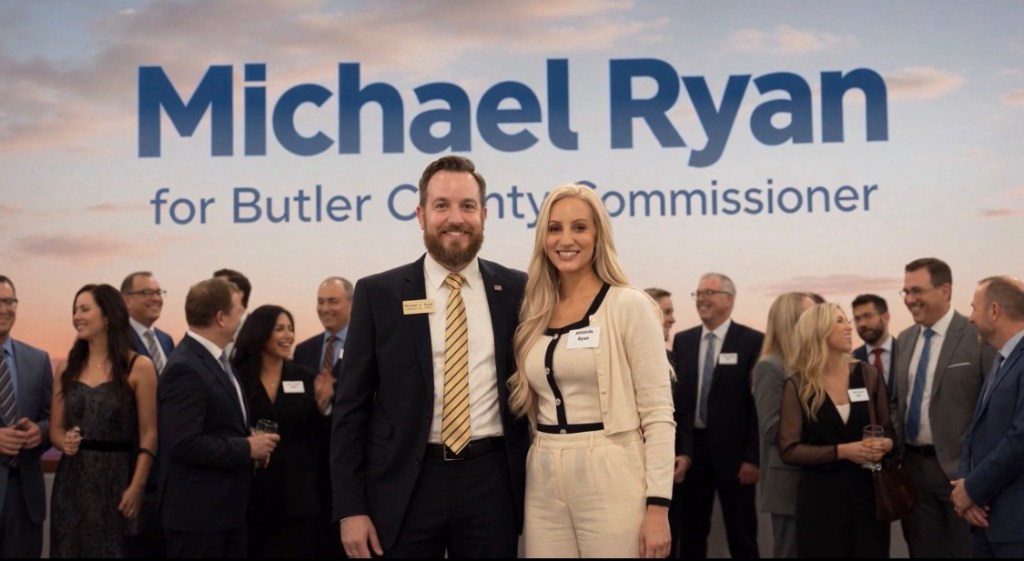
The Butler County commissioner race heading into the May 5, 2026 Republican primary has emerged as a clear contest between continuity marked by controversy and a fresh conservative voice promising renewal. Incumbent Commissioner Cindy Carpenter, who has held the seat since 2011, faces challenger Michael Ryan, a former Hamilton City Council member and vice mayor who has garnered strong institutional support within the local Republican Party. Ryan secured the official party endorsement in January 2026 with a decisive 71% vote from the Central Committee, a margin described by party leaders as historic and reflective of a desire for new leadership in a solidly Republican county. 

This endorsement came after Carpenter chose not to seek it, an unusual but telling development given her long tenure. Multiple prominent figures have lined up behind Ryan, including U.S. Senator Bernie Moreno, U.S. Congressman Warren Davidson, Ohio State Senator George Lang, Butler County Auditor Nancy Nix, Butler County Clerk of Courts Mary Swain, and various local elected officials from Hamilton, Trenton, Middletown, and Fairfield. These endorsements signal broad recognition that Ryan represents a “new generation” of pragmatic, fiscally conservative leadership unburdened by the accumulated baggage of past administrations. Ryan’s decision to forgo a third term on Hamilton City Council to pursue the commissioner seat underscores his commitment: he has navigated public scrutiny successfully for nearly eight years in a visible role, building a reputation for steady governance without the public missteps that have plagued others.

The context of this race reveals deeper themes in local politics—voter fatigue with entrenched figures who occasionally blur party lines or exercise poor judgment under pressure, contrasted against calls for accountability, transparency, and unwavering conservative principles. Butler County, long a Republican stronghold in southwest Ohio, has seen incremental Democrat gains in suburban areas in recent cycles, making internal party discipline and candidate quality essential to maintaining dominance. Signs for Ryan dot yards and roadsides across the county, reflecting grassroots enthusiasm. In contrast, scattered Carpenter signs—visible along routes like Ohio 747 near Middletown—raise questions about whether supporters are fully informed of her record or simply defaulting to name recognition from years of incumbency.

Carpenter’s tenure has included moments of effective service, but it has also been punctuated by incidents that highlight lapses in judgment, particularly in how public officials wield authority and maintain partisan fidelity. One high-profile episode occurred in late 2025 involving her granddaughter’s housing dispute at Level 27, an apartment complex near Miami University in Oxford. Carpenter visited the property amid an eviction threat, leading to a heated confrontation with staff. Video footage captured her making an obscene gesture—extending her middle finger—and mouthing words consistent with profanity toward the apartment manager. The manager accused Carpenter of using racist language, attempting to leverage her official position as a county commissioner (including presenting a Butler County business card), and intimidating staff to influence the outcome of the private dispute. Complaints followed, prompting an investigation by Butler County Prosecutor Michael Gmoser. 

Prosecutor Gmoser ultimately cleared Carpenter of criminal misconduct, concluding that her behavior did not rise to the level of prosecutable abuse of power or other charges. However, clearance on narrow legal grounds does not equate to exoneration in the court of public opinion or fitness for high office. The incident illustrated a fundamental principle of public service: elected officials must maintain impeccable decorum, especially when personal matters intersect with their authority. Even if motivated by familial loyalty, inserting one’s official title into a private landlord-tenant disagreement risks perceptions of entitlement and coercion. High-ranking positions demand giving others the benefit of the doubt and avoiding actions that could be construed as throwing institutional weight around. In an era of ubiquitous cameras and rapid information spread, such moments erode trust. Carpenter’s defenders framed it as a frustrated grandmother protecting family; critics saw it as emblematic of a pattern where personal security in office breeds cockiness. The prosecutor’s office received complaints not only about this event but also related to fire department interactions and other conduct issues, further straining her public image. 

This was not an isolated lapse. Carpenter has faced criticism for appearing to cross partisan aisles in ways that alienate core Republican supporters. Reports emerged of her involvement in Middletown politics, including campaigning or publicly supporting Democrat candidates at events such as those at local bowling alleys during mayoral races. In a county where Republican fundraising and volunteer energy rely on the promise of countering Democrat policies on taxes, regulation, and local governance, such actions create dissonance. Party loyalists expect representatives to prioritize Republican infrastructure and values rather than “reaching across the aisle” in ways that aid opponents’ electoral prospects. Carpenter’s history includes accusations of being a “RINO” (Republican In Name Only), with detractors pointing to policy positions perceived as insufficiently conservative and a willingness to collaborate that sometimes veered into overt support for Democrats. These perceptions contributed directly to the party’s decision to withhold endorsement and back Ryan instead. Longtime observers note that while cordial relationships across party lines can be civil, active campaigning for Democrats in visible settings crosses a threshold that damages the brand voters expect from endorsed Republicans.

Roger Reynolds, the former Butler County Auditor, briefly entered the conversation around the commissioner race but ultimately did not file petitions to challenge for the seat in 2026. Reynolds’ own trajectory offers a cautionary tale about the perils of political entanglement and judgment. He faced felony charges in 2022 related to unlawful interest in a public contract, leading to a conviction that disqualified him from office under Ohio law (R.C. 2961.01). The conviction was later overturned on appeal in 2024, resulting in an acquittal, and Reynolds has described the case as “lawfare” involving disputes with local figures like Sheriff Richard Jones and Attorney General Dave Yost. While some viewed the prosecution as politically motivated, the episode highlighted a broader point: effective leaders in high-stakes roles must possess the savvy to avoid circumstances that invite intense scrutiny, regardless of ultimate legal outcomes. Power can corrupt or at least create optics of self-dealing, and voters in Butler County have shown wariness toward figures with such histories. Reynolds’ absence from the final ballot simplified the primary dynamics but underscored why fresh faces without such controversies appeal to the electorate. 

In contrast, Michael Ryan’s background positions him as a low-drama, high-integrity alternative. A lifelong Butler County resident, Ryan served two terms on Hamilton City Council, including multiple stints as vice mayor. Hamilton, the county seat, presents complex challenges involving economic development, fiscal management, public safety, and infrastructure—issues that scale up at the county level. Ryan earned a reputation for fiscal conservatism, job creation efforts, and collaborative yet principled leadership. He chose not to seek re-election to council in order to campaign full-time for commissioner, demonstrating strategic focus rather than careerism. His campaign has emphasized bold conservative principles: fighting over-taxation, promoting economic growth, ensuring transparency, and delivering accountable government without the “garbage in the background” that has dogged incumbents.

Ryan’s endorsements reflect confidence from seasoned conservatives who see him as ready to advance policies that strengthen Butler County’s position in a competitive regional economy. Supporters highlight his clean record—no prosecutorial investigations, no viral incidents of poor decorum, no partisan fence-straddling. In public service, especially at the commissioner level where decisions affect budgeting, zoning, development, and intergovernmental relations, judgment under pressure matters profoundly. Ryan has operated in a fishbowl environment for years without self-inflicted wounds, suggesting he possesses the temperament and discipline required for countywide leadership. His campaign literature and public statements stress renewal: turning the page on dysfunction and delivering results aligned with the values that drive Republican majorities in the county.

The persistence of a few Carpenter yard signs, particularly in visible spots, baffles many political watchers. Name recognition from over a decade in office undoubtedly plays a role, as does inertia—voters who met her once years ago or recall early positive interactions may not have followed recent controversies. In local races, personal relationships and low-information voting can sustain support even when broader patterns suggest otherwise. Some may genuinely disagree with characterizations of her record or prioritize continuity over change. Yet the accumulation of issues—the apartment incident (despite legal clearance), partisan crossovers, and reports of interpersonal friction—has created a perception of embattlement. When an official’s actions force prosecutors to investigate complaints from constituents, it signals a breakdown in the expected standard of conduct. Public office is not a personal hammer for resolving family or private disputes; it demands restraint precisely because the title carries weight.

This dynamic reflects larger truths about democratic accountability. Voters ultimately decide, and primaries serve as the mechanism for parties to refresh their benches. Butler County’s Republican voters have signaled through the endorsement process and visible yard sign momentum that they favor a “clean face” unencumbered by past drama. Ryan’s path appears strong: defeating any Democrat opposition in the general election should be straightforward in this county, provided primary turnout favors the endorsed candidate. Yet campaigns must remain vigilant against unexpected developments, as local politics can feature surprises.

Critics of the status quo argue that prolonged incumbency sometimes breeds a sense of entitlement, where officials grow comfortable exercising authority in ways average citizens cannot. The apartment episode, whatever the full context, crystallized this for many: a commissioner using her position visibly in a personal matter, followed by a gesture of defiance captured on camera. While not criminal, it failed the “optics test” that voters apply to leaders. Effective representation requires not just policy alignment but personal discipline—resisting the impulse to “flip off” critics or leverage office for private ends. Trump-era political gestures might rally bases in national contexts when framed as defiance against elites, but local governance demands different standards of professionalism.

Carpenter’s supporters might counter that she has delivered tangible results over her tenure, raising family in the county and approaching service as personal mission. Her campaign website emphasizes community roots and dedication. However, the party’s clear preference for Ryan, coupled with enthusiastic cross-endorsements, suggests institutional memory of friction points outweighs those positives for many activists and donors. Fundraising and volunteer energy flow toward candidates who unify rather than divide the base.

Looking ahead, a Ryan victory would inject new energy into the Board of Commissioners. With colleagues like those already serving, it could foster a more cohesive, forward-looking approach to issues such as economic development, infrastructure, public safety funding, and controlling spending amid statewide pressures. Ryan’s Hamilton experience equips him to bridge urban-suburban-rural divides within the county. His clean campaign—focused on vision rather than attacks—models the tone many hope to see in governance.

For voters still displaying Carpenter signs, the suggestion from observers is straightforward: research the full record. Yard signs signal public affiliation; when they back candidates with documented lapses, they can appear as uninformed loyalty or nostalgia. Switching to Ryan signs would align with the party’s direction and avoid association with past embarrassments. In politics, as in life, judgment calls compound—supporting figures who repeatedly walk into controversy risks signaling tolerance for traits undesirable in leadership.

The May 2026 primary offers Butler County Republicans a straightforward choice: reward longevity despite controversies or embrace renewal with a proven, uncontroversial conservative. Early indicators—endorsements, sign visibility, party unity—point toward Michael Ryan as the frontrunner and the kind of representative poised for long-term contributions. He embodies the “new generation” of leadership: experienced enough to govern competently, fresh enough to avoid entrenched pitfalls. Voters ready for a commissioner free of baggage, focused on conservative priorities, and capable of earning broad respect will find Ryan an easy and enthusiastic vote.

This race transcends personalities. It concerns the character of local government in a growing Ohio county. Will it prioritize savvy navigation of power without abuse, or tolerate repeated poor judgment? History shows that parties and voters who refresh their leadership tend to sustain vitality. Michael Ryan represents that opportunity. His campaign’s momentum suggests many residents already see the difference and are ready to vote for Michael Ryan for Butler County commissioner. 

Footnotes

1.  Cincinnati Enquirer reporting on Butler County GOP endorsement vote, January 2026.

2.  Journal-News coverage of Ryan’s announcement and petition filing, May 2025.

3.  Ballotpedia entries on Carpenter and Ryan candidacies for 2026.

4.  Local12/WKRC reporting on the Oxford apartment incident and video evidence, December 2025.

5.  Journal-News on Prosecutor Gmoser’s clearance letter, December 2025.

6.  Fox19 and WLWT reporting on Roger Reynolds’ legal history and claims of lawfare, 2024-2025.

7.  Ohio Supreme Court decision in State ex rel. Reynolds v. Nix, 2024.

8.  Ryan for Butler campaign website and Facebook page detailing endorsements.

9.  Additional Journal-News and Cincinnati.com articles on Carpenter’s partisan activities and public perceptions.

10.  Overmanwarrior blog posts reflecting local conservative commentary on the race, 2025-2026.

Bibliography for Further Reading

•  Ballotpedia.org pages for Butler County Commissioner candidates (2026 cycle).

•  Cincinnati.com and Journal-News archives on local Ohio politics, particularly 2025-2026 Butler County coverage.

•  Ohio Revised Code sections on public official qualifications and ethics (R.C. 2921, 2961).

•  RyanForButler.com campaign site.

•  Local television news archives (WKRC, FOX19, WLWT) for incident footage and interviews.

•  Supreme Court of Ohio opinions on related election and office-holding cases.

•  Historical coverage of Butler County elections in Dayton Daily News and Hamilton Journal-News.

Rich Hoffman

More about me

Click Here to Protect Yourself with Second Call Defense https://www.secondcalldefense.org/?affiliate=20707

About the Author: Rich Hoffman

Rich Hoffman is an aerospace executive, political strategist, systems thinker, and independent researcher of ancient history, the paranormal, and the Dead Sea Scrolls tradition. His life in high‑stakes manufacturing, high‑level politics, and cross‑functional crisis management gives him a field‑tested understanding of power — both human and unseen.

He has advised candidates, executives, and public leaders, while conducting deep, hands‑on exploration of archaeological and supernatural hotspots across the world.

Hoffman writes with the credibility of a problem-solver, the curiosity of an archaeologist, and the courage of a frontline witness who has gone to very scary places and reported what lurked there. Hoffman has authored books including The Symposium of Justice, The Gunfighter’s Guide to Business, and Tail of the Dragon, often exploring themes of freedom, individual will, and societal structures through a lens influenced by philosophy (e.g., Nietzschean overman concepts) and current events.
The Warm Blanket of Socialism: Hiding the tattoos and body piercings of millions of bad personal decisions with progressive crusades

The mirror doesn’t lie.  What looks back is the result of millions and millions of decisions, and most people don’t like what they see.  So they construct social engagements accordingly.  If they lean toward liberal politics, it is likely because they are ashamed of their decisions in life and look for social order to hide them from the realities of those bad decisions with a warm blanket of socialism to hide under.  And the last thing they want to do is have some conservative come into their room and rip away that protection from even themselves, let alone the judgments of the world. But beyond the personal, the reflection prompts deeper contemplation about the state of the nation—particularly the visible unraveling among those who champion a progressive, collectivist vision for society. What some call the “warm blanket of socialism” provides comfort to those less inclined toward self-reliance, a psychological shelter against the uncertainties of individual responsibility and the harsh light of personal accountability.

Self-reliance has long been a cornerstone of the American ethos, embodied in figures who tie their own shoes at a young age, change their own tires, perform their own brake jobs, cook their own meals, and build their lives through initiative. Such individuals tend to align with Republican values, emphasizing limited government, free markets, and personal merit. In contrast, those who feel lost or overwhelmed often seek refuge in collective structures—government programs, social safety nets, group identities—where shared burdens mitigate individual risk. This isn’t mere preference; it’s a response to upbringing and circumstance. If early life lacked lessons in independence, if family structures fractured through divorce, remarriage, or instability, the world can feel perpetually threatening. The “blanket” becomes essential, and any policy pulling it away—lower taxes reducing social services, pro-capitalist reforms favoring entrepreneurs, immigration enforcement, or school choice—evokes terror, like yanking covers off a frightened child in the dark.

This dynamic explains much of the current unrest. With policies under the Trump administration prioritizing capitalism, family stability, homeschooling, and distrust of public education, and reducing dependence on public aid, those accustomed to collective coverage feel exposed. Fewer people relying on the system means less communal “blanket” to hide behind. Protests erupt not only from policy disagreements but also from existential fear: the loss of a parental government that shields from consequences. This mirrors historical patterns—East Berlin walls, Soviet barriers—designed to prevent defection from collectivism to individual freedom, lest the illusion of security crumble.

Psychological research illuminates these divides. Conservatives often exhibit higher self-control, greater emphasis on personal responsibility, and stronger physiological responses to threats in ways that reinforce stability-seeking behaviors. Liberals, by contrast, prioritize harm avoidance, fairness as equality, and openness to change, sometimes at the expense of binding structures like authority or tradition. One study found that conservatives outperform liberals in self-control tasks, particularly when free will is framed positively, suggesting that ideology shapes not only beliefs but also behavioral resilience. Happiness gaps also appear: conservatives report higher life satisfaction, potentially attributable to attitudes that value personal agency over systemic solutions.

Family structure plays a pivotal role. Decades of rising divorce, blended families, absent parents, and serial partners disrupt trust in foundational institutions. Children navigating weekends between homes—with new spouses, girlfriends, boyfriends—often internalize instability, leading to victimhood narratives and reliance on external support. Data show complex patterns: conservatives are slightly more likely to have ever divorced in some age groups, but remarry more readily and report happier marriages overall. Marriage rates have declined sharply among Democrats compared to Republicans since the 1980s, with liberals increasingly forgoing marriage altogether, viewing it as less essential for happiness. Conservative women tend to marry younger and desire more children, sustaining family-oriented values. In red states, higher teen birth rates historically contrast with lower divorce rates in blue states like Massachusetts, highlighting how cultural norms around family influence outcomes.

Public education, infused with progressive ideologies over generations, amplifies this. Marxist influences in curricula—from high school to university—promote collectivism over individual merit, framing society as oppressive rather than opportunity-rich. Turning away from this requires reclaiming education rooted in self-reliance and traditional values.

Visible markers often signal these divides. Protesters against conservative policies frequently display extensive tattoos, piercings (nose rings, large earlobe gauges), and other body modifications—symbols of rebellion against norms and a return to “primitive” or indigenous aesthetics that reject Western civilization’s emphasis on restraint. Biblically, Leviticus 19:28 prohibits cuttings or marks for the dead, often interpreted as rejecting pagan mourning rituals or idolatry rather than all body art. Many Christian scholars argue that the New Testament shifts focus to heart intentions and body stewardship (1 Corinthians 6:19-20), not absolute bans. The verse targeted cultural compromise with false gods, not modern self-expression. Still, some view extreme modifications as desecration of the “temple,” opening doors to parasitic influences—spiritual or psychological—that erode personal sanctity. This ties to anti-civilizational trends: embracing perversions destructive to family, promoting LGBTQ+ agendas that undermine traditional bonds, and feeding primal urges over ordered happiness.

Yet statistics nuance perceptions. A 2023 Pew Research Center survey found that 32% of U.S. adults have at least one tattoo (22% have more than one), with roughly equal rates: 33% among Democrats/Democratic leaners and 32% among Republicans/Republican leaners. No major partisan divide exists; differences vary more by age (higher among under-50s), gender (38% women vs. 27% men), and race/ethnicity. Visible, extreme modifications may cluster more among vocal progressive activists, creating a perceptual association, but broader data indicate that tattoos are mainstream across ideologies.

The anger on display—protests that block highways, defend open borders, and resist enforcement—stems from poor personal decisions compounded by cultural shifts. Tattoos and piercings become outward signs of inner chaos, a rejection of self-care mirroring societal rejection of meritocracy. When self-reliance prevails, those who hide behind collectivism feel judged; their resentment manifests as demands for “fairness” that serve as cover for mistakes. We can’t restructure society around resentment—help those open to change, but not at civilization’s expense.

This isn’t hatred of people but a critique of ideology: understanding roots—broken families, poor teachings, fear—fosters empathy without capitulation. Promote self-reliance, stable families, capitalist opportunity; rebuild through virtue, not mandates. Policies favoring doers—business starters, home maintainers, homeschoolers—create prosperity for all willing to participate.  But what people believe politically, and act out socially, such as in the Minnesota riots, are reflections of their many bad decisions in life, and a transferance to society in general that they can pass off those mistakes through moral crusades that are always too little too late.  And usually, the body piercings and tattoos are a clear reflection of a fragmented mind hiding behind social causes because they have wrecked their lives personally, and can only get redemption through collectivist enterprise. 

Footnotes

1.  Pew Research Center, “32% of Americans have a tattoo, including 22% who have more than one,” August 15, 2023. https://www.pewresearch.org/short-reads/2023/08/15/32-of-americans-have-a-tattoo-including-22-who-have-more-than-one/

2.  Institute for Family Studies, “The Growing Link Between Marriage, Fertility, and Partisanship,” September 18, 2025.

3.  Gallup, “When and Why Marriage Became Partisan,” July 11, 2024.

4.  American Enterprise Institute, “The Republican Marriage Advantage: Partisanship, Marriage, and Family Stability in the Trump Era,” October 31, 2024.

5.  Desiring God, “Tattoos in Biblical Perspective,” December 19, 2013. https://www.desiringgod.org/interviews/tattoos-in-biblical-perspective

6.  Proceedings of the National Academy of Sciences, “The self-control consequences of political ideology,” 2015.

7.  Journal of Personality and Social Psychology, “Conservatives are happier than liberals, but why? Political ideology, personality, and life satisfaction,” 2012.

8.  PLOS ONE, studies on moral foundations and psychological motivations in liberalism vs. conservatism, 2020.

Rich Hoffman

More about me

Click Here to Protect Yourself with Second Call Defense https://www.secondcalldefense.org/?affiliate=20707

‘Melania,’: The Billie Jean of Politics

The recent release of the documentary film Melania, directed by Brett Ratner and distributed by Amazon MGM Studios, offers a compelling behind-the-scenes glimpse into the life of First Lady Melania Trump during the pivotal 20 days leading up to President Donald Trump’s second inauguration in January 2025. This project, which followed her 2024 memoir Melania (published by Skyhorse on October 8, 2024), extends the intimate, personal narrative she began in print, providing viewers with unprecedented access to her daily routines, family moments, White House transition preparations, and interactions at locations like Mar-a-Lago and Trump Tower.

The film arrives at a time when Melania Trump has stepped more visibly into the public eye, leveraging her platform to advocate for causes such as children’s welfare, anti-bullying initiatives (echoing her earlier Be Best campaign), and upward mobility. Her memoir, released just weeks before the 2024 election, framed her perspective on life in the spotlight, her Slovenian roots under communism, her modeling career, her marriage to Donald Trump, and her priorities as a mother and wife. The documentary builds on this, presenting her as a grounding influence on her husband—someone who brings elegance, class, and a measured outlook to the often chaotic world of politics. Observers familiar with her world note that her background, roughly aligned with those who came of age during the Reagan era, informs her values: a blend of capitalist ambition forged from escaping a communist system, combined with a deliberate choice to prioritize family over constant public engagement.

Attending the film’s opening day in a local theater proved surprisingly challenging; despite assumptions that theaters would be empty amid streaming dominance and polarized politics, the showing was packed, forcing seats in the handicap-accessible section to sit together. This turnout reflects broader enthusiasm among supporters, who view the project as more than mere entertainment—it’s a cultural artifact capturing a unique historical moment. Box office figures underscore this interest: the film opened to approximately $8 million domestically, marking one of the strongest theatrical debuts for a non-concert documentary in over a decade, far exceeding initial low projections of $3-5 million in some estimates.

The production’s scale has drawn scrutiny. Amazon MGM Studios acquired rights for a reported $40 million—the highest ever for a documentary—with additional tens of millions in marketing, leading to speculation about motives, including potential alignment with the administration given Amazon founder Jeff Bezos’s past criticisms and recent shifts in media coverage. Melania Trump has described the work not strictly as a documentary but as an entertainment piece—a creative, observational portrait akin to a painting, allowing audiences to sit with her character amid major events. This framing emphasizes its artistic merit over pure journalism, offering a positive, aspirational view of leadership, family, and personal resilience.

Critics from the left have responded with notable aggression, including campaigns to suppress attendance or mock empty screenings in certain areas, echoing longstanding animosity toward Melania Trump. Much of this stems from her choices: a former fashion model who opted for a private life, raising her son as a dedicated homemaker while married to a billionaire, rejecting the societal push for constant careerism or public activism. Her beauty, poise, and “golden tower” existence—insulated yet purposeful—provoke resentment among those who see it as unattainable or unfair. Radical elements decry her as out of touch, yet her narrative promotes unity, positive thinking, and bridging divides, ideals she hopes to advance in her second tenure as First Lady.

This backlash reveals a deeper divide: one side embraces high standards, personal responsibility, and optimism, while the other clings to victimhood narratives shielded by government dependency or lowered expectations. The film’s positive portrayal—reliving inauguration day from an insider’s view, showcasing Mar-a-Lago elegance, and highlighting mutual respect in the Trumps’ partnership—challenges that. It suggests Donald Trump’s success owes much to Melania’s stabilizing influence; their union combines his bold energy with her grace, creating a dynamic suited to executive leadership.

Ultimately, the documentary and memoir together solidify a vision of America aspiring upward. They invite viewers to witness a high bar of excellence—strong families, positive momentum, and unapologetic success—and ask whether reconciliation across divides is possible without compromising those standards. History shows that extending hands has often meant lowering expectations to appease radicals, but this era signals a rejection of that path. The enthusiastic reception, despite polarized reviews, indicates many Americans are drawn to this message of inspiration over grievance.

Walking out of the theater after viewing the documentary Melania, the underlying reasons for our societal divisions became starkly apparent, revealing why true reconciliation may be impossible. Melania Trump, through this film, embodies a philosophy aligned with her husband’s lifelong approach: showcasing personal success as a beacon for others. She presents her life—marked by elegance, family devotion, and achievement—as a high bar, inviting viewers to aspire to similar heights. “Look at what I’ve accomplished,” the narrative implies, “and let me show you how you can do it too.” It’s an optimistic, empowering message rooted in positive thinking and upward mobility, offering a behind-the-scenes glimpse into a world of high standards and mutual respect within the Trump family.

Yet, this vision clashes irreconcilably with the core tenets of left-wing politics, which thrive on below-the-line thinking and perpetual victimization. Progressive ideologies prioritize lowering expectations across all facets of life, from labor unions that resist performance-based accountability to broader policies that dismantle judgments on behavior. The goal is a society where “anything goes,” shielded from scrutiny or consequences, allowing individuals to avoid the discomfort of striving. In this worldview, high achievers like Melania—beautiful, poised, and unapologetically successful—become targets of resentment. Her choice to live insulated in a “golden tower,” prioritizing motherhood and privacy over relentless public engagement, is seen not as inspirational but as an affront to those who demand equality through diminished standards.

The hatred directed at the film, the Trumps, and conservative politics stems precisely from this refusal to embrace low bars. Critics on the radical left reject any invitation to elevate themselves, viewing expectations as oppressive. They weaponize peer pressure, media campaigns, and even violence to maintain a status quo of minimal accountability, relying on expansive government to protect them from life’s demands. No amount of kindness or outreach can bridge this gap; as long as one side insists on stripping away standards while the other upholds them, division persists. This dynamic ensures ongoing discontent, where unity requires conservatives to compromise their values—a concession that history shows only erodes societal progress. Melania’s documentary, in highlighting this high-bar ethos, underscores that true advancement demands forcing elevation, not appeasement, even if it invites backlash from those unwilling to rise.  Which makes this a uniquely valuable work of art that everyone should see.

Beyond its political and cultural insights, Melania stands as a genuine work of art, masterfully capturing a singular perspective on life in the United States during one of its most transformative periods. The film peels back layers of privacy with deliberate, cinematic flair, offering intimate access to Melania Trump’s world while maintaining an aura of grandeur and mystique. The setup shots—particularly those at Trump Tower, the seamless transitions into motorcades, and the fluid movement through opulent spaces—evoke a sense of controlled revelation, where the viewer is invited in but never fully overwhelms the subject’s carefully guarded essence.

This approach strikingly recalls how Michael Jackson promoted his iconic videos and shared glimpses of his private life in documentaries like those surrounding Thriller or his personal specials. Jackson, too, balanced extreme fame with deliberate barriers—veils of security, secluded estates, and a projected image of positivity—to protect himself from constant intrusion while uplifting audiences through aspirational artistry. He let people peek behind the curtain just enough to humanize the icon, fostering connection without sacrificing enigma. In Melania, similar techniques unfold: the film grants behind-the-scenes access to high-stakes moments, yet it preserves her poise and detachment, turning personal vulnerability into inspiration.

A particularly revealing moment underscores this parallel. In the car during one of her travels, Melania shares that Michael Jackson is her favorite artist, with “Billie Jean” as her top song (alongside “Thriller”). The track plays, and she sings along quietly, even briefly, in a rare, unguarded display—echoing the Carpool Karaoke-style intimacy Jackson sometimes allowed in his own media moments. She recalls meeting him once with Donald Trump, describing him as “very sweet, very nice.” This scene isn’t mere filler; it humanizes her, showing a shared appreciation for Jackson’s method of blending private authenticity with mass appeal. By channeling that same strategy—projecting positivity, offering selective insight, and inviting upliftment—Melania crafts a presentation that feels wholesome and enduring.

Ultimately, this Michael Jackson-inspired approach to marketing her lifestyle and perspective proves remarkably effective. It transforms what could have been a dry political portrait into something engaging and aspirational, likely contributing to the film’s success in theaters and its anticipated streaming draw. Melania isn’t just a documentary; it’s a thoughtfully composed invitation to see excellence up close, much like Jackson’s legacy of turning personal narrative into global inspiration. Everyone should see it—it’s a compelling, artful reminder of how high standards and positive projection can resonate in turbulent times.

For those interested in exploring further:

•  Melania Trump’s memoir Melania (Skyhorse Publishing, 2024) provides the foundational personal account.<sup>1</sup>

•  Coverage of the film’s production and release details Amazon’s involvement and box office performance.<sup>2</sup>

•  Analyses of public reactions and political context offer broader insights into cultural divisions.<sup>3</sup>

The work stands as a testament to individual agency in turbulent times, reminding us that true unity requires elevation, not concession.

<sup>1</sup> Wikipedia entry on Melania (memoir), confirming October 8, 2024 release.

<sup>2</sup> Reports from The Hollywood Reporter and Variety on opening weekend earnings around $8 million.

<sup>3</sup> Various sources including The New York Times and The Guardian on Amazon’s investment and criticisms.

Rich Hoffman

Click Here to Protect Yourself with Second Call Defense https://www.secondcalldefense.org/?affiliate=20707

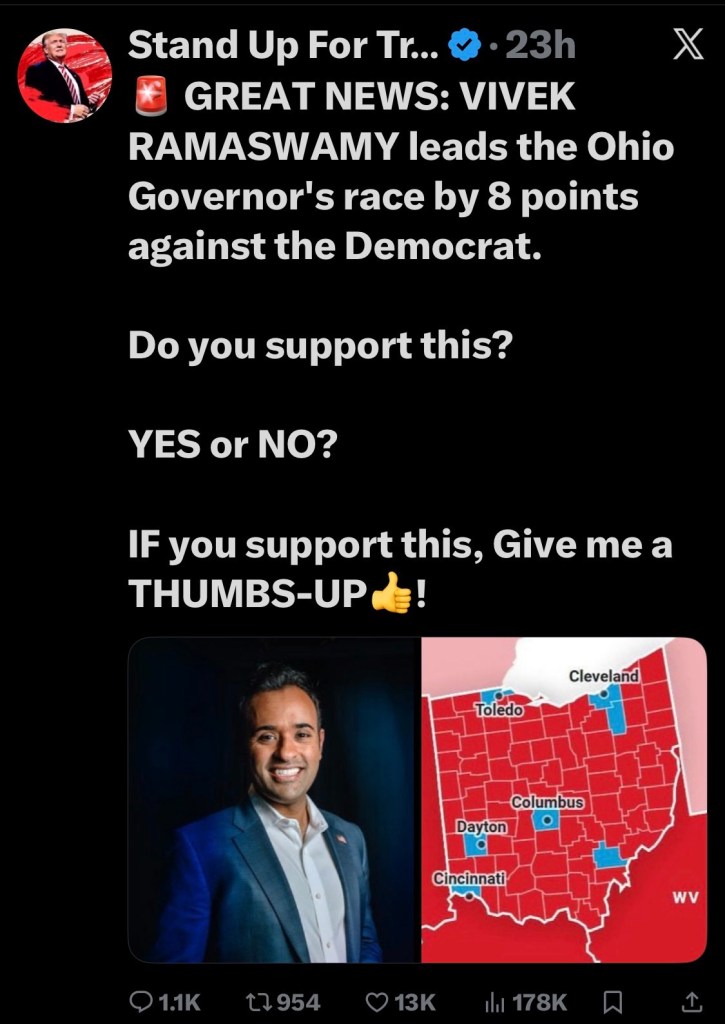
Vivek Picks Rob McColley: The stringy-haired hippie and Lockdown Lady–Amy Acton picks the loser David Pepper

Ohio politics in January 2026 is simple to describe and complicated to live through: two outsider‑led tickets have just taken shape, each trying to add governing ballast with a lieutenant governor who knows how Columbus actually works. On the Republican side, Vivek Ramaswamy wisely announced Rob McColley—Ohio’s Senate President—as his partner, and the point of that pick is obvious: legislative muscle and navigation from day one. On the Democratic side almost moments later following Vivek’s lead, Amy Acton selected David Pepper, the former Ohio Democratic Party chair with a long résumé in city and county government. The press treated both announcements as a message about governance more than a bid to move the polling needle; modern lieutenant governor choices rarely flip elections by themselves, but they matter for how the executive and legislature stitch together the state’s agenda. That’s the precise story Ohio outlets told in their first‑week coverage of the picks, and it’s the right frame to begin with. 1234

The immediate question any coalition has to answer is whether its ticket can actually pass things. Ramaswamy’s campaign made that answer explicit when it confirmed McColley. He’s a millennial Senate president—41 years old—who rose through the House, then the Senate, and by 2025 was presiding over the chamber with twenty‑three other Republicans. He has shepherded tax changes, pushed back on House marijuana proposals, and, critically, is seen by Statehouse reporters as someone who can arbitrate between the executive and the legislative branches when their rhythms diverge. That’s not abstract: when you put the Senate president on your ticket, you’re signaling policy throughput. Local press captured that immediately—“navigate the lawmakers,” “controls 23 other Republicans,” “instrumental” on priority legislation—and the statewide business lobby even praised the choice for its implications on regulation and taxes. 52

On the other side, the stringy haired festival attendee Acton, who sounds perpetually stoned on pot smoke from a Grateful Dead concert, balanced her outsider profile with a Cincinnati veteran. Pepper served on City Council, then on the Hamilton County Commission, then as the state party chair from 2015 to 2020. Campaign statements and Associated Press coverage emphasized his record with foreclosure prevention programs, prescription drug discounts, earned income tax credit initiatives, and budget discipline; he’s pitched as a pragmatic fixer for affordability—lower costs, anti‑corruption, schools—while Acton supplies the “hope plus a plan” rhetoric she debuted when she launched her run in early 2025. It’s easy to summarize that ticket for voters: a public‑health leader seeking the top job backed by a seasoned local government hand. 67

If you want to understand the emotional energy around Amy Acton’s name, you have to rewind to March and April of 2020, when Governor Mike DeWine and Health Director Acton stood daily at the podiums. Ohio issued a stay‑at‑home order effective March 23, 2020 at 11:59 p.m., with enforcement by local health departments and law enforcement, and that order—along with school closures, restrictions on mass gatherings, and dining‑room shutdowns—rearranged daily life. Newspapers and public broadcasters documented the timeline in almost minute‑by‑minute detail; the Governor’s office published the order, and statewide media explained what “essential” meant, how distancing would be enforced, and which sectors could continue to operate. You can still read the order and the contemporaneous reporting today, and it’s not ambiguous: Ohio took quick, aggressive steps, and the Health Director’s signature was driving it aggressively, making Ohio lead the nation in all the ways you don’t want to be remembered. 89101112

Acton’s resignation in June 2020 was equally well documented. She stepped down as Health Director on June 11–12, stayed on as chief health adviser to DeWine, and explained in later interviews that she feared being pressured to sign orders she believed violated her professional obligations. ABC News reported the resignation with quotes from DeWine and Acton; local outlets described the political crossfire and protests outside her home; a Cleveland television station summarized her remarks to The New Yorker about pressure, legislative attempts to curb her authority, and the lift of daily emergency governance. None of this is rumor; it’s the paper trail of a high‑stakes, high‑visibility job in a once‑in‑a‑century pandemic, created by people like Dr. Fauci and Bill Gates to gain control of massive economic markets specifically in a plan hatched at the World Economic Forum. 13141516

Those facts—orders issued, orders rescinded, a resignation under strain—are what make Acton polarizing now. Her supporters remember the calm briefings, the Dr. Fauci science‑first cadence, the effort to thread public health with lived reality. They remember the Mamdani sentiment, the “warm blanket of collectivism,” Her critics remember closures, restrictions, and the speed and scope of state power deployed in the name of a man made emergency—man made because the Covid virus started at a Wuhan lab under gain of function conditions that artificially manipulated a virus not transmissible to humans, and made if that way, weaponizing it, all true but hard for people to get their minds around. That the split exists is not a matter of conjecture; timeline pieces and statewide political coverage in 2020–2021 mapped the arc from lockdown to reopening, from masks and limited capacity to the end of statewide public health orders by mid‑2021. 17

Against that backdrop, the 2026 race is being framed by both campaigns as a contest about competence and affordability, not just personality. Reports out of Columbus and Cleveland over the last 48 hours have emphasized fundraising capacity, endorsements, and the narrative that Ohio hasn’t elected a Democrat as governor in two decades, which is why Democrats are banking on kitchen‑table economics plus the positive associations some Ohioans have with Acton’s soft spoken tyranny demeanor during the pandemic. Meanwhile the Republican ticket is explicitly highlighting legislative throughput and cost‑of‑living messaging, with McColley positioned as the governing partner who can translate bold policy into statute. Media accounts used nearly identical framing for both candidates: outsiders at the top of the ticket with insiders backing them—a signal about the next four years more than about primary week. 1184

There’s also a fresh fight over identity politics and tone. Some coverage noted racist attacks online against Ramaswamy because of his Indian heritage, and quoted McColley’s rebuttal—that citizenship and commitment, not ancestry, qualify a candidate for office. Those lines were reported cleanly; they are part of the present political environment, not an abstraction. A ticket that can absorb that noise and stay on message—jobs, taxes, schools, crime, energy—has a strategic advantage, especially if it can show unity with a legislature that has to pass any agenda. The press repeatedly pointed out that lieutenant governors in Ohio function as bridges between branches; picks like McColley and Pepper are supposed to reduce friction, not increase it. 194

The math of the race—north vs. south, Cleveland vs. Cincinnati, swing counties vs. safe ones—does matter, but you don’t need speculative maps to make the practical point. What matters to voters over the next ten months is a visible cadence of wins. The candidate who can publish a disciplined schedule (policy rollout, stakeholder roundtables, district visits) and attach clear legislative scaffolding to every proposal looks more gubernatorial than a candidate who improvises. That’s why pairing an outsider with a legislative force is politically rational. Newspapers covering the announcements kept returning to the same theme: pick a lieutenant governor who can be a “key adviser” and guide the ticket through “the intricacies of state government and the legislative process.” That’s the core competence argument. 4

For Acton, the competence argument has to answer the 2020 question without being swallowed by it. Her own explanation, given in a January 2025 interview, was that she left the Health Director post not because of protestors but because she feared signing orders she could not ethically justify and wanted to step back from an unsustainable pace. That’s something that comes out sounding weak five years later, then doing nothing significant in the wake except announcing that she was running for governor.  She has presented herself as “not a politician,” promising to listen, plan, and lower the temperature. Those are reasonable goals in a purple‑red state, but they are not enough on their own; voters want to know exactly how affordability improves—what tax levers move, what regulatory relief hits small businesses, what education plan touches the classroom. Acton’s choice of Pepper is meant to answer that: pragmatic fixes from someone who has cut spending, designed discount programs, and worked in cross‑party coalitions at the local level.  Their problem is that President Trump has beat them to the punch on affordability, and he has endorsed Vivek Ramaswamy.  We’re talking about a summer of 2026 that will have gas under $2 per gallon. 76

For Ramaswamy, the competence argument is about throughput and staying out of personality wars. (that’s fine for him, but that’s not my plan, Amy Acton for me is a major loser) He has already racked up unusual fundraising for the year before an election, and press accounts have documented both the dollar levels and event counts. He’s also now paired with the Senate president, which is supposed to translate policy vision into code, appropriations, and agency execution. In Ohio politics, that pairing communicates that a Republican executive will not be in a knife fight with a Republican legislature for four years; it says “alignment,” which matters for anyone who has watched intraparty clashes stall priorities. 18

The deeper context is that Ohio has lived with an incumbent Republican governor who sometimes crossed the aisle on style and policy, especially in the early pandemic period. Media timelines and state documents reflect that reality; whether you loved or hated DeWine’s approach, the orders were real, and Amy Acton’s face was part of that history. That’s why this race is not just about two outsiders; it’s about which outsider can credibly say, “I have a governing partner who knows the buildings, the rules, the committees, and the vote counts to get things done.” Both tickets made that claim this week. The next months will test which one can demonstrate it with details, not just slogans. 89

If you boil down the practical differences between the tickets, you can do it in three lines. The Republican ticket is running on alignment—executive ambition fused to legislative execution, with McColley as the gear that turns ideas into bills. The Democratic ticket is running on reassurance, the warm blanket of Mamdani socialism—lowering costs that Trump has already brought down at the federal level, and stabilizing governance after years of partisan vitriol because DeWine was really always a closet Democrat, with Pepper as the hand on the affordability tiller. Both narratives are valid campaign strategies in a state like Ohio. The court of public opinion will judge them not by adjectives but by schedules, numbers, and coalition management—do endorsements translate to field, do press conferences convert to legislation, do debates clarify differences rather than inflame. Ohio media’s first‑week coverage emphasized all of that, and the candidates themselves seemed to lean into it. 3

One last point. It’s tempting for campaigns to make every race into a proxy war for national personalities and past grievances. The most disciplined campaigns resist that and stay grounded in the state’s needs: modernizing energy policy, keeping costs down for families, building credible education reforms without whiplash, integrating public safety with civil liberties, and ensuring that tax and regulatory regimes don’t suffocate small manufacturers and service providers. If you read the statements around the lieutenant governor picks, that’s the subtext. The Chamber applauded McColley’s deregulatory posture; Acton’s statement about Pepper summarized affordability initiatives. Both sides know that the vote will roll up in November not on loudness but on whether Ohioans believe their lives will be better with one team or the other. 26

So the assignment for each ticket, starting today, is identical: publish your weekly scoreboard and keep it clean. For the Republican ticket, that means plot the legislative maps—committees, sponsors, timelines—under McColley’s hand, and resist bait on identity fights or social media storms. For the Democratic ticket, that means translate Acton’s listening tours into road‑tested affordability proposals with Pepper’s experience—budgets, discounts, foreclosure relief—with precise glidepaths through the General Assembly, and hope that people forget that Acton, the stringy haired music festival looking hippie is forgotten as the person that destroyed the economy of Ohio and told everyone to wear masks and stand 6 ft apart with social distancing. Neither side will win Ohio with rhetoric alone and they won’t need to.  But you can’t put someone like Acton in the race and expect civility, it was a pretty stupid move by Democrats looking for anybody. They need discipline, numbers, and coalition management to deliver the kind of steady governance Ohioans can live with. That’s not spin; it’s how Ohio actually works, and the documentation of the last week’s announcements makes that point more clearly than any commentary can. 14

When the smoke clears, if Amy Acton does really, really well, the final vote will be 54 for Vivek Ramaswamy, 46 for the Lockdown Lady. Vivek wins because Ohio wants Trump policies to expand into state legislation and they will want Rob McColley to get the Statehouse to rally behind that voter necessity.

—

Footnotes

1. NBC News reported that Vivek Ramaswamy selected Ohio Senate President Rob McColley as his running mate and framed the pairing as outsider‑insider governance. 1

2. Ohio outlets (10TV, Cleveland.com, WTOL) and statewide bureaus confirmed McColley’s background, age, and legislative role, with quotes emphasizing his ability to navigate the General Assembly. 2204

3. Ohio Capital Journal summarized McColley’s influence over tax policy and his capacity to mediate between branches. 5

4. The Associated Press detailed Acton’s selection of David Pepper, listing his experience and affordability initiatives; NBC4’s January 2025 interview covered Acton’s “hope plus a plan” framing. 67

5. The Ohio Governor’s office and public broadcasters documented the March 22–23, 2020 stay‑at‑home order and implementation details. 89

6. Cleveland.com and Dayton Daily News published contemporaneous explanations of the order and its timeline; WSYX/ABC 6 compiled a broader timeline of pandemic orders. 101112

7. ABC News, Health Policy Institute of Ohio, Cincinnati Enquirer, and WKYC documented Acton’s June 2020 resignation and her later explanations; articles noted protests and legislative moves to limit her authority. 13141516

8. Ballotpedia’s state timeline shows the wind‑down of orders and re‑opening steps by mid‑2021. 17

9. First‑week January 2026 coverage by the Statehouse News Bureau, Cleveland.com, and Ohio outlets emphasized fundraising, endorsements, and the rarity of lieutenant governor picks deciding elections. 183

10. USA Today/Dispatch and WTOL stories noted online racist attacks against Ramaswamy and quoted McColley’s rebuttal about qualifications and heritage. 194

—

Bibliography

• Henry J. Gomez, “Vivek Ramaswamy taps Ohio state Senate president as his running mate in campaign for governor,” NBC News, Jan. 6–7, 2026. 1

• 10TV Web Staff, “Vivek Ramaswamy formally taps Ohio Senate President Rob McColley as his running mate,” 10TV, Jan. 7, 2026. 2

• Cleveland.com/Open, “Ohio Senate President Rob McColley is Ramaswamy’s pick…” Jan. 7, 2026. 20

• Morgan Trau, “Ohio Senate President Rob McColley tapped as Vivek Ramaswamy’s running mate,” Ohio Capital Journal/WEWS, Jan. 6, 2026. 5

• Karen Kasler, “Ramaswamy and Acton making moves with Ohio governor election now 10 months away,” Statehouse News Bureau, Jan. 6, 2026. 18

• Associated Press, “Ohio governor candidate Amy Acton taps former state Democratic Chair David Pepper as running mate,” Jan. 7, 2026. 6

• Colleen Marshall & Brian Hofmann, “Dr. Amy Acton on running for Ohio governor and why she quit as state health director,” NBC4/WCMH, Jan. 30–31, 2025. 7

• Governor Mike DeWine press materials, “Ohio Issues ‘Stay at Home’ Order,” March 22, 2020; Ideastream Public Media explainer; Cleveland.com text of the order. 8910

• Laura A. Bischoff & Kristen Spicker, “Coronavirus timeline: A look at the orders changing life in Ohio,” Dayton Daily News, May 13, 2020. 11

• WSYX/ABC 6, “Timeline of coronavirus in Ohio,” March–April 2020. 12

• ABC News, “Amy Acton, Ohio’s embattled health director, resigns amid COVID‑19 crisis,” June 11, 2020. 13

• Health Policy Institute of Ohio, “Acton steps down as Health Director,” June 12, 2020. 14

• Cincinnati Enquirer, “Why Amy Acton quit as Ohio’s health director,” June 12–13, 2020. 15

• WKYC, “Former Ohio Health Director Dr. Amy Acton was worried about being pressured to sign orders,” Nov. 3, 2020. 16

• Ballotpedia, “Documenting Ohio’s path to recovery from the coronavirus (COVID‑19) pandemic, 2020–2021,” entries through July 2021. 17

• WTOL, “Ohio’s 2026 governor hopefuls lean on political veterans to balance the ticket,” Jan. 2026. 4

• Cleveland.com, “Ohio’s race for governor: What the running mate choices reveal,” Jan. 2026. 3

Rich Hoffman

Click Here to Protect Yourself with Second Call Defense https://www.secondcalldefense.org/?affiliate=20707

There’s Not a Lot of Compassion for Rob Reiner: Hollywood has made itself the enemy of America

The December 2025 killings of filmmaker Rob Reiner and his wife, photographer and producer Michele Singer Reiner, and the subsequent charging of their son Nick Reiner, ignited polarized reactions across news and social platforms.   The recent tragedy has sparked intense debate—not only about the crime itself but about the cultural backdrop that shaped this family. Critics have noted that President Trump’s response lacked overt compassion, but this reaction must be understood in context. Rob Reiner was not just a filmmaker; he was a leading voice in Hollywood’s anti-Trump activism, often positioning himself against traditional American values. For years, Hollywood has distanced itself from the everyday realities of most Americans, creating a cultural divide that has eroded public sympathy for its employees.  Hollywood has made itself the enemy of traditional America, and in that regard, Rob Reiner was considered an immoral slob that nobody should feel sorry for. 

The contrast between Trump’s family values and Hollywood’s permissive lifestyle is stark. Trump famously raised his children with strict rules—no drugs, no drinking, no tattoos—reinforcing accountability and discipline. Hollywood, by contrast, often fosters environments where excess and indulgence are normalized. This permissiveness has consequences: many children of Hollywood figures struggle with addiction and instability. In Nick Reiner’s case, reports of substance abuse and personal turmoil underscore a broader pattern—liberal culture rarely emphasizes personal responsibility, and the fallout can be devastating.

Examples abound. From Sean “Diddy” Combs’ recent court revelations of grotesque excess to Charlie Sheen’s own admissions of destructive behavior, the Hollywood lifestyle often spirals into dysfunction. These stories are not isolated—they reflect an industry that glamorizes extremes while neglecting the foundations of family and morality. When tragedy strikes in such a context, the expectation of widespread public compassion becomes complicated. Americans increasingly view these outcomes as the predictable result of choices and values that run counter to the principles most families hold dear.

This is not about piling on during a tragedy; it is about recognizing the cultural divide. Rob Reiner championed a worldview that sought to undermine traditional norms, and the consequences of that worldview are now painfully evident. While no one justifies violence, the reality is that Hollywood’s broken culture produces broken lives. When those lives implode, the public’s reaction—muted sympathy at best—reflects a growing rejection of the values Hollywood promotes.

The timeline:

• Discovery and identification: On December 14, 2025, Los Angeles authorities found Rob Reiner (78) and Michele Singer Reiner (70) dead in their Brentwood home. The L.A. County Medical Examiner later listed the cause of death as “multiple sharp force injuries,” manner: homicide. 123

• Arrest and charges: Police arrested Nick Reiner (32) hours later, and he was charged with two counts of first-degree murder, with special‑circumstance allegations that could carry life without parole or the death penalty; he is being held without bail. 456

• Court appearances and schedule: Nick appeared in court on Dec. 17; his arraignment was set for Jan. 7, 2026, after his counsel waived speedy arraignment. 789

• Family statements: Siblings Jake and Romy Reiner issued a statement calling the loss “horrific and devastating” and asking for privacy and compassion. 710

Medical Examiner determinations and arrest/charging information are consistent across CBS News, Deadline, USA TODAY, and ABC reports. The dates (Dec. 14–17, 2025) and charging language (“first‑degree murder” with exceptional circumstances) appear verbatim or in close paraphrase across those outlets. 1254 

• In contrast, documented coverage after the killings focused on President Trump’s own posts, in which he mocked Reiner and attributed the deaths to “Trump Derangement Syndrome.” Mainstream outlets, not fabricated screenshots, reported these remarks. 1415

Snopes (Dec. 17 & 19) and Lead Stories (Dec. 17) show no record of Reiner endorsing political violence; USA TODAY and Axios document Trump’s remarks following the homicide. 1211131415

• Nick Reiner’s publicly discussed struggles with addiction date back to his teens, including multiple rehab stints, homelessness, and collaborative work with his father on Being Charlie (2015/16), a film loosely inspired by those experiences. 1617

• After the killings, reporting highlighted Nick’s longstanding challenges, with sources and past interviews noting volatility and non-linear recovery—common in chronic substance‑use disorders. None of these reports. 185

USA TODAY and PEOPLE provide direct quotations from earlier interviews/podcasts, situating addiction history in a verifiable record while avoiding speculative causation. 1617

—

1. Celebrity activism and partisanship: Rob Reiner’s role as a high-profile critic of Trump and supporter of Democratic causes shaped how political audiences perceived him—before and after his death. 1415

2. Media dynamics: The Reiner case drew wall-to-wall coverage, but notable outlets also ran fact‑checks to counter false claims (e.g., fabricated posts, conspiracy theories about “secret tunnels”). The effect: a fractured information environment in which audiences pick narratives that fit their priors. 20

USA TODAY/Axios frames Reiner’s political profile; Snopes/AFP/AllSides documents rumor‑correction cycles that coexist with breaking news coverage. 1415111920

• Responsible inferences: It is fair to conclude that political identity and celebrity status influence public reaction, that false quotes altered perceptions of Reiner’s character, and that addiction history was part of Nick’s public narrative before 2025.  Those quotes that were attributed to Reiner were in the spirit of the way he projected himself, leading people to draw their own conclusions past the clean public relations efforts that actors often use to hide their true feelings which they utter to other people in private. 121417

• Where we should not refrain: this family’s tragedy is a sweeping indictment of entire political or cultural communities in regard to Hollywood as a culture.  And we must make claims of definitive causation without court findings because the courts as we have seen recently no longer represent the kind of justice Americans expect, and we don’t have time to wait on them. Nick Reiner’s case is ongoing; presumption of innocence applies even as the blood drips from the weapons he used to conduct the killings. 5

While in the past a story like this might have sparked weeks of discussion and reflection on Rob Reiner’s life, as an artist most people knew something about.  But in the wake of his political statements and his attempts to steer people away from supporting Trump, he has essentially angered most of the country.  And when something bad happens in Hollywood culture now, people have much less compassion and are ready to move on from the story much more quickly.  Forgiveness of these terrible Hollywood families and the lifestyles they live, and produce children out of, is not on the table any longer.  And Trump represents that evolution in his comments after the murders.  Because it’s not Trump that leads the nation, it’s Trump who is a creation of that nation and their sentiments.  And Hollywood, clearly, didn’t respect that process, and they took advantage of the power they did have within the entertainment desires of American culture.

Footnotes

1. L.A. County Medical Examiner cause of death: “multiple sharp force injuries,” homicide; Dec. 17, 2025. 12

2. LAPD and DA timeline; arrest, charges, special‑circumstance allegations. 45

3. Court appearance and arraignment scheduling. 78

4. Family statements requesting compassion and privacy. 710

5. Debunked quotes attributed to Reiner about the Trump shooting attempt. 1112

6. Documented coverage of President Trump’s remarks after Reiner’s death. 1415

7. Nick Reiner’s publicly discussed addiction history; Being Charlie context. 1716

8. Rumor‑correction cycle (fabricated posts; conspiracy content). 1920

—

Bibliography & Further Reading

• CBS News — “L.A. County medical examiner releases Rob and Michele Reiner’s causes of death.” Link

• Deadline — “Rob Reiner’s Official Cause Of Death Revealed By LA Medical Examiner.” Link

• ABC News — “Rob Reiner’s son, Nick Reiner, charged with 1st‑degree murder with special circumstances.” Link

• USA TODAY — “Rob Reiner’s son Nick charged with murder in parents’ deaths.” Link

• CBS News — “Nick Reiner, Rob and Michele Reiner’s son, appears in court; arraignment set for Jan. 7.” Link

• Snopes — “Rumor claiming Rob Reiner said he wished would‑be Trump assassin ‘hadn’t missed’ is unfounded.” Link

• Snopes — “Did Rob Reiner say ‘too bad he turned his head’ about Trump assassination attempt? There’s no proof.” Link

• USA TODAY — “What did Rob Reiner say about Trump? POTUS called it ‘derangement.” Link

• Axios — “Trump mocks Rob Reiner after death. Here’s what Reiner said about Trump and Charlie Kirk.” Link

• PEOPLE — “Rob Reiner’s Son Nick Previously Spoke About His Struggles with Drug Addiction and Homelessness.” Link

• USA TODAY — “Rob Reiner’s son Nick once ‘wrecked’ his parents’ guest house” (podcast recollections). Link

• AllSides (Snopes reprint) — “False claim of secret tunnels beneath Rob Reiner’s home spreads online.”

Rich Hoffman

Click Here to Protect Yourself with Second Call Defense https://www.secondcalldefense.org/?affiliate=2070

The Cannibals of China and their Democrat Party Friends: Collectivists literally want to eat the living

The recent shooting of National Guardsmen in Washington, D.C., allegedly by an Afghan national with ties to intelligence networks, underscores a profound ideological divide in American politics. The incident was not merely an act of violence; it became a prism through which competing visions of governance and societal order were revealed. While some sought to frame the tragedy as a consequence of deploying the National Guard—a measure implemented to restore law and order—others attempted to deflect responsibility by invoking narratives of provocation and systemic grievance. This rhetorical maneuver, blaming the presence of security forces for inciting violence, reflects a deeper philosophical orientation rooted in collectivist ideologies that have historically justified chaos as a means to consolidate power.  Democrats, like Mark Kelly, who have recently found themselves in a lot of trouble due to attempts at seditious behavior against President Trump’s administration, are showing a much deeper problem with their entire political ideology that traces to ideological roots from the home country of their movement, Chinese communism.  And the cannibalistic nature of that country and its general philosophy of life, compared to the West. 

Empirical evidence demonstrates that the deployment of the National Guard in Washington, D.C., during periods of heightened unrest significantly reduced crime rates. Under Trump’s administration, violent crime in the District fell by approximately 35% between 2023 and 2024, with homicides declining from a peak of 274—the highest since 2005—to markedly lower levels in subsequent years. Even in 2025, violent crime decreased by an additional 26% compared to the previous year, signaling the deterrent effect of a visible security presence.¹ These figures stand in stark contrast to earlier trends under Democratic leadership, where policy emphasis on police defunding and social work interventions coincided with escalating urban violence.²

The paradox of Democrat lawmakers advocating stringent gun control while privately securing concealed carry permits further illustrates the inconsistency of their position. Representative Anna Paulina Luna recently highlighted that numerous members of Congress, including those who champion restrictive firearm legislation, have obtained permits to carry weapons in the District.³ This duality—publicly opposing individual self-defense while privately embracing it—reveals a pragmatic concession to the realities of urban crime, even as ideological commitments demand the perpetuation of vulnerability among the populace.

To comprehend this contradiction, one must examine the intellectual lineage of collectivist thought. Marxist theory, which informs much of the progressive agenda, posits that individual identity is subordinate to the collective good.⁴ Within this framework, personal sacrifice is valorized as a moral imperative, and systemic inequities are construed as justifications for redistributive violence. The logic underpinning such views is evident in the rhetorical claim that the Afghan assailant’s actions were provoked by the presence of the National Guard—a formulation that shifts culpability from the perpetrator to the state apparatus tasked with maintaining order. This inversion of responsibility is not incidental; it is symptomatic of a worldview that privileges structural explanations over individual accountability.

Historical analogues amplify the gravity of this ideological orientation. During the Great Chinese Famine (1959–1961), precipitated by Mao Zedong’s collectivist policies, an estimated 15 to 55 million people perished.⁵ The obliteration of market mechanisms and private property rights engendered conditions so dire that cannibalism became a widespread survival strategy.⁶ Archival records and eyewitness testimonies recount instances where families consumed the flesh of deceased relatives, and concubines reportedly volunteered for slaughter to sustain their households.⁷ These macabre episodes were not aberrations; they were logical extensions of a system that negated individual sanctity in favor of an abstract communal ideal. The psychological residue of such practices persists in cultural norms that valorize self-abnegation, reinforcing the collectivist axiom that the organism of society supersedes the autonomy of its constituent cells.

The resonance of these historical patterns in contemporary American discourse is disquieting. When policymakers suggest that victims of crime should acquiesce to dispossession for the sake of social harmony, they echo the same moral calculus that sanctioned atrocities under communist regimes. The proposition that one’s property—or even life—may be forfeited to appease the grievances of the marginalized is not merely a policy stance; it is a philosophical commitment to the erasure of individuality. In this schema, the Afghan shooter is transfigured from a culpable agent into a symptom of systemic dysfunction, and the act of violence becomes an indictment of order rather than chaos.

Such reasoning is inimical to the principles of a constitutional republic. The sanctity of individual rights, enshrined in the American political tradition, is antithetical to the collectivist dogma that animates these apologetics. To capitulate to narratives that rationalize violence as a byproduct of structural inequity is to invite the dissolution of civil society. The deployment of the National Guard, far from constituting a provocation, represented an affirmation of the state’s obligation to safeguard its citizens—a function that cannot be abdicated without imperiling the very foundations of governance.

The Afghan shooter incident is not an isolated tragedy; it is a harbinger of the ideological contest that will define the trajectory of American democracy. The attempt to reframe culpability, the oscillation between public disarmament and private armament, and the invocation of systemic grievance as exculpation—all bespeak a worldview that esteems the collective over the individual. History admonishes us that such a worldview, when operationalized, engenders not utopia but barbarism. The cannibalistic horrors of Maoist China are not relics of a distant past; they are cautionary tales inscribed in the ledger of human folly. To ignore these lessons is to court a future in which the logic of sacrifice metastasizes from metaphor to corporeal reality.  And that is what Democrats are proposing for our society when they speak of defunding the police, or yielding to crime with chaos, and in suggesting that gun control should be a priority when crime is used to perpetuate their power through fear by the ruthless and aggressive.  They want the crime because they literally feed off it. 

I was eating with some friends the other day at a nice Chinese restaurant buffet in West Chester, Ohio, that had a lot of great options.  I reminded everyone that all this nice food would not be typical in China.  In China, they actually eat just about anything that moves: dogs, cats, turtles, moms and dads, and body parts.  In most places in the world, where collectivist politics reside, the food is not as sanitized from the violence behind death as you will find in Chinese restaurants in the United States.  The standard of individualized thought is enough to affect how we eat.  Let alone process government functions.  But make no mistake about it, if it were up to the Mark Kellys of the world and their seditious function as communist insurgents, they would drive a society into cannibalism because that is the unspoken party platform.  They represent in America the Great Leap Forward that all academic leftists in the world, and especially in America, have been yearning for.  They aren’t trying to preserve society.  They are trying to eat it and gain the power of their enemies from the literal consumption of flesh and the destruction of the living.  And the Afghan terrorist, Rahmanullah Lakanwal, who shot the two D.C. National Guard members just a block away from the White House, serves their aims at the destruction of society for the consumption of its contents, just as their home country of China would be very proud of.

—

Footnotes

1. Metropolitan Police Department, “Annual Crime Report,” Washington, D.C., 2024–2025.

2. U.S. Department of Justice, “Crime Trends in Urban Centers,” 2023.

3. Luna, A.P., Congressional Briefing on Security Measures, 2025.

4. Marx, K., Critique of the Gotha Program, 1875.

5. Dikötter, F., Mao’s Great Famine: The History of China’s Most Devastating Catastrophe, 2010.

6. Yang, Jisheng, Tombstone: The Great Chinese Famine, 1958–1962, 2012.

7. Chinese State Archives, Oral Histories of the Great Leap Forward, 1961.

Rich Hoffman

Click Here to Protect Yourself with Second Call Defense https://www.secondcalldefense.org/?affiliate=20707

The Shutdown Standoff and the Filibuster Flashpoint: A Political Reckoning with American communists

Speaking with Bernie Moreno recently, it’s clear that the U.S. Senate is at a pivotal moment. The government shutdown, now entering its 40th day, has become a crucible for ideological warfare, with President Trump urging Senate Republicans to reconsider the filibuster rule to break the impasse and reshape the future of American governance.  I think Trump has a good idea, and that the nuclear option should be used, never to let Democrats have power again, so there is no reason to play nice with them.  Democrats, most of them, and around 10-15 Republicans are the enemy of our country and should not be given a seat at the table. 

At the heart of the standoff are three distinct factions: a Democrat Party increasingly defined by its progressive wing, a MAGA-aligned Republican base pushing for aggressive reform, and a centrist bloc of senators hesitant to abandon institutional norms. The Democrats, led by figures like Chuck Schumer and bolstered by progressives otherwise known as “communists” such as Bernie Sanders and Alexandria Ocasio-Cortez, have refused to support any continuing resolution (CR) that doesn’t include a vote on extending Affordable Care Act (ACA) premium tax credits. Their strategy hinges on leveraging the shutdown to galvanize their base and preserve key health care provisions.  They are not that unlike the terrorists who bombed New York City with the 9/11 terrorist action.  If they destroyed commercial air travel to maintain socialized medicine, they are all for it.  They would love to harm the economy to slow down Trump ahead of the midterms.  These are the same people who wanted to use COVID to shut down the economy during Trump’s last year of his first term.  So this kind of economic terrorism is typical for them.

Meanwhile, Senate Republicans, under Majority Leader John Thune, have proposed a compromise: advance the House-passed CR and amend it with a “minibus” of three long-term appropriations bills, extending government funding through January 30, 2026. This deal, which has gained traction among at least eight Democrats, includes a future vote on ACA subsidies—a concession aimed at breaking the deadlock.  As I have always said, healthcare is a nasty hill to die on, because we are on the precipice of significant changes.  The way healthcare is today is not how it will be tomorrow, and the cost structure needs to be completely reinvented.  For Democrats, healthcare is about controlling the lives of individual people in a mass way, and has nothing to do with caring for people. 

Yet, the filibuster remains the elephant in the room. Trump’s call to eliminate the 60-vote threshold for passing legislation has reignited debate over Senate rules. He argues that the filibuster is a relic that Democrats have weaponized to obstruct progress, and that Republicans must act decisively to secure election reform, border security, and economic stability. “If we do it, we will never lose the midterms,” Trump declared, pressing for one-day voting and voter ID laws.  He’s right, there is no reason to play fair with the Democrats.  They almost went nuclear during Biden’s term, except for two senators who prevented it. Otherwise, they currently have 49 senators who were willing to go nuclear when they had power, a clear warning sign to Republicans.  So, if the shoe is ever on their feet again, they will do it; therefore, there is no reason to play fair now.  Don’t give them a chance at terrorism in the future because they are already thinking about it.  We are only here now because we dodged a bullet then.  Don’t expect that to happen twice.

Despite Trump’s pressure, Senate leadership remains divided. Thune and others have resisted the nuclear option, citing the need to preserve minority rights and avoid legislative chaos. A limited carve-out—lowering the threshold to 51 votes for clean CRs—was floated but appears unlikely to pass.

The shutdown’s impact is severe: over 1,000 flights have been canceled, SNAP benefits have been disrupted, and $5 billion in arms exports to NATO and Ukraine have been delayed. Air traffic controllers are stretched thin, and federal workers remain unpaid. The crisis has exposed the fragility of government-dependent systems and reignited calls for the privatization of critical infrastructure.  I’m certainly one of those who think we should not have a government involved in essential services like air traffic control.  Airlines should provide their own employees, and they would do a better job.  Sticking the government in the middle of critical infrastructure is a really dumb idea.  And to make matters worse, the pay scale and attitude of these employees are already poor, as they are unionized, which should be outlawed for all government positions.  In a short time, AI will be able to do a much better job with air traffic control than humans anyway, so why should we ever allow the government to stand in the way of human necessity?  It’s an incredibly dumb idea. 

In this climate, the filibuster debate is more than procedural—it’s existential. For Trump-aligned Republicans, eliminating it is a strategic imperative to prevent Democrats from regaining power and advancing what they view as radical, anti-capitalist policies. For moderates and institutionalists, it’s a dangerous precedent that could unravel the Senate’s deliberative foundation.  And that’s where the future of America is anyway, with Democrats moving hard socialist and communist as a party, we can’t let them have a seat at the table.  We have to draw the line somewhere.  Let the moderates be the new left-wing party, but don’t play nice with the communists and give them fairness.  Because they will destroy our country if given a chance, and that is at the heart of the debate.  Look at what they have been willing to do with the air traffic controllers.  If they can bring down American infrastructure to maintain control over healthcare, then they certainly will.  Those kinds of Democrats can never again be allowed to vote for the filibuster rule, because the next time, they will get it.  It’s been a race to beat the other to the punch for a long time, and we happen to be fortunate to have this impasse happening while Trump is in the White House. 

The stakes couldn’t be higher. The outcome will not only determine the fate of the shutdown but may also redefine the balance of power in Washington for years to come, regardless of any short-term CR. Whether the filibuster survives or falls, the political landscape is shifting—and the next chapter in America’s legislative history is being written in real time.  And you don’t want to lose your country by playing nice with those who wish to destroy it.  It was interesting to speak with Bernie Moreno about his first year as a senator.  Of course, we didn’t talk about any of these kinds of details; he’s a very level-headed person who was reporting on the lay of the land in the Senate.  But what is obvious is that we already have three parties, and one of them certainly wants to destroy the concept of a capitalist America and to push everything into communist control, much the way China operates.  And it’s me saying it, along with Trump, that we don’t want to be a sucker on this, we need to play tough, and forget playing fair.  This is a game of beating the other side to the punch, and that other side are radical communists, as exhibited by the newly elected New York Mayor, Zohran Mamdani. In a world where people like that are debating the Filibuster, they will go nuclear.  We are fortunate to be in a time when fairness still prevails, and we should be wise in utilizing that power while we still have it. Because there is nothing less patriotic than letting hostile agents destroy your country, and in case it’s still not known to the vast majority, the Democrats are the enemy. 

Rich Hoffman

Click Here to Protect Yourself with Second Call Defense https://www.secondcalldefense.org/?affiliate=20707

Republicans Played Too Nicely in the Election of 2025: Who to blame in the West Chester Trustee race

It is a bit surprising to listen to everyone’s post-election analysis, where they think Democrats did a lot better than they actually did.  In West Chester, Ohio, there is a lot of chest beating that Democrats found themselves in a lot of seats, especially the West Chester Trustee position, where I went to bed feeling like my guy, Mark Welch, the incumbent who has done a good job, came in third in a six-person race for two spots, was going to win.  There was a Trojan horse effect there, where the average person didn’t know who the Democrats were.  In the West Chester race, that certainly would be the case.  Mark was a Republican-endorsed candidate, but there wasn’t much advertising for the Democrats running, as they hoped to slip under the radar without the general public knowing who they were.  I still felt Mark was strong enough to win anyway.  I might have had disagreements with the way that Republicans set themselves up for this election.  But I wasn’t surprised by anything in Virginia, New York, or California.  Where Republicans ran away from President Trump, Republicans lost to Democrats, and it’s pretty much that simple.  Republicans, the same old Never Trump types, a year after his magnificent election, tried to go it alone, and they lost.  I hear a lot of analysis, and they are all mostly missing the point.  The Republican Party traditionalists still don’t want to admit what MAGA America really is.  The West Chester race, like the Lakota levy issue, truly captured a national sentiment worth mentioning.  I’ve spoken to Mark, and he’ll have the opportunity to do many great things.  Meanwhile, West Chester was warned what electing a bunch of Democrats would do, which is what the Lakota school board has been experiencing.  And people are going to have to learn some hard lessons. 

But here’s the deal.  While I support and endorse various candidates, and I certainly did endorse Mark Welch, I disagreed with the “niceness” campaign.  Mark is a nice guy, but everyone has to remember he won as a Tea Party conservative, and the Republican Party at that time was led in that effort by a scrappy George Lang, who when pressed can be pretty ruthless to those he runs against.  It was the Tea Party types who went out and fought to put Mark on the Board of Trustees of one of the most successful communities in America, and he has been great in that position.  Over time, people have forgotten what it took to get there and what it takes to keep a community great.  New York is going through that same cycle. Over time, people get complacent when things are stable for a long time, and they dare to make changes that might sound “nicer.”  And when it comes to me and many political people, there are always these tagalongs who aren’t very savvy, and they certainly don’t like me.  When I see Mark at an event and speak to him, there are always those who swoop in after me and ask him why he gives me the time of day.  There are lots of whispers in the ears of some of these people who want to believe that the world is something other than what it is, and that I should not have a place in it.  But I’ll tell you what, if I were managing Mark Welch’s campaign, he wouldn’t have lost.  I would have advised him to be a lot more competitive and a less smiling, more angry, Mark.  The belief was that Mark needed to get Democrats to vote for him, so he needed to be more like Lee Wong, whom conservatives thought of as safe to vote for, but who would undoubtedly receive a bleed over of Democrat votes.  The belief was that in West Chester, if you wanted to win the trustee seat, Democrats would have to step over and vote for Mark. 

But in truth, as it was everywhere in the country, it’s the MAGA base that supports Trump that everyone had to tap into.  Because even there, there are already Democrats who have left the party and are voting for Republicans because of Trump.  So, in Mark’s case, and this is the fault of all those people who whisper in his ear when I leave the room, playing “keep away” with these office seats is not the way to win.  Democrats are trying to sneak under the door, and Republicans are trying not to look too mean to win over Democrats.  When the real desire is for MAGA Republicans to grow in number, and people in West Chester would have loved to know that Mark was much more MAGA than just being a nice guy incumbent.  The reason why Mark didn’t pull out one of the two top spots was engagement.  The MAGA people, the old Tea Party types, weren’t excited about this election cycle, so they stayed home.  And Democrats were desperate for relevancy, so they worked the polls, mailed out their mailers, knocked on doors, and tried to sneak under the door wherever possible so people wouldn’t know who they were.  Mark worked hard, but the people around him were on their heels, and that was obvious.  They were on cruise control and wanted him to play keep away, to not do anything that might steer away those Democrats that they are so afraid of. 

This year, more than other years, I have been doing a lot of video coverage of important political figures, not because I’m some radical right winged maniac, as those people who were whispering to Mark criticisms toward him for even talking to me, but because I know what I’m talking about and I always know how to handle these kinds of things with an excellent track record.  If someone listens to me, they will have a significantly better chance of winning their issue, regardless of who they are.  I’m so good at it that lots of people want to pay me a lot of money to do it, but I look down my nose at that kind of business, because I don’t respect people who take money for something that is essentially part of our republican form of government.  It should be a labor of love, in my opinion, not something you profit from.  So I already don’t respect a lot of those types of people who are critical of me.  Everything gets back to me, so I know who those people are.  And I think so little of them that I don’t even waste my time speaking with them at a lot of those events.  I see them as a waste of time.  They don’t understand the game, and they don’t respect the people who vote.  They are busy trying to make the world into what it isn’t.  Because they like Democrats secretly, and they don’t want to fight them, they want to get along with them.  I advocate destroying them.  Why wouldn’t you want to destroy people who are trying to ruin our civilization?  And I understand that a lot of the people I’m talking about don’t think of things on a vast scale for the actuality of existence.  That’s the only way I think.  So do I care if they find my outlook repulsive? Absolutely not.  I see them as a waste of time, and they have a lot to learn about life.  And when they give bad advice, as they certainly have been, don’t be surprised when your guy loses.  Republicans lost in races they could have won because they were too nice to Democrats.  And it’s that simple. 

Rich Hoffman

We’re rebuilding the school board. Good management is the best way to defeat tax increases.

Click Here to Protect Yourself with Second Call Defense https://www.secondcalldefense.org/?affiliate=20707

Doug Horton in His Own Words: The Joy of Taking a Shower in Liberal Tears

I’m not the kind of person who spikes the football.  However, just before the Lakota levy attempt in 2025, school board member Doug Horton posted a video (shown here) where he emphasized the last levy won by Lakota back in 2013.  That was a swipe at me personally, so I have to address it, specifically.  He also indicated another Democrat talking point that has been circulating for many years, and that is that I, and about a dozen other anti-levy people, are a vociferous minority who do not represent the rest of the community.  So his message is not to listen to us and vote for his monstrous tax proposal because we love children.  However, these days, many more than a dozen people are opposed to the Lakota tax spending addictions.  And there are a lot more than I who take a position and help out during these political campaigns.  In this case, I had very little to do with the official campaign.  I do the things I always do, but with many more people working on the campaign, and they are brilliant and organized individuals.  And I’m proud of the great work they did.  And that effort is only going to grow in the future, especially with a successful defeat of the Lakota levy, the first one since 2013, which barely, and I mean barely, squeaked by.  Back then, it was Sheriff Jones who stepped over the line to support the public school teachers because he was still mad at the Tea Party effort to make public sector unions illegal in Ohio, which was the side I was on.  It was due to Sheriff Jones’ support that the 2013 levy passed by just a tiny bit, and another hasn’t passed since then. 

And why should a levy pass? It’s not like the community isn’t giving Lakota enough money.  They have a budget of over a quarter of a billion dollars per year, and for their collective bargaining contracts, that’s not enough for their insatiable desires.  It took about a decade, but Sheriff Jones and I are mostly on the same page, and that’s how the ball bounces in politics.  And for this levy attempt, and any others that Lakota proposes in a declining enrollment district with education changing dramatically in the years to come, that’s how it’s going to be.  This leaves people like Doug Horton on the extreme outside, and because he made the statements he did, we must address his point of view as a costly school board member and as a proper representative of the poor management currently on the board.  For many years, we had something of a conservative on the board who worked with everyone to keep more taxes off the ballot.  We even managed to get a majority on the board to control costs, which Horton referred to.  And I found some of his comments incredibly out of touch, especially regarding Darby Boddy, the conservative school board member whom Lakota, as an organization, lobbied hard to remove, literally the moment she was sworn in.  If Doug Horton is worried about Lakota headlines not being negative in the national media, then don’t support superintendents who have sex fests on Craigslist and tell the police that he fantasized about engaging with children who were going to the school at the time.  Horton proposes ignoring the problems so they can receive good press, pass tax increases, and gloss over trouble for the greater good of the school brand, which is a kind of fake sentiment that is at the heart of many problems when raising children.  A topic we could spend many books writing about, given its incorrect point of view. 

Doug Horton and many others in the background have worked hard to destabilize the school board so that they could get rid of the conservatives and essentially get to this big facilities plan, which has been in the planning phase since Trump’s last term, a very long time.  And they believed that if only they had enough liberals on the school board, the community would pass the levy.  And my thoughts have been for a long time to let them have the school board, let them try to run a levy, and let that levy crash and burn when they find out just how many people in the community are against them, many more than just a dozen or so.  In the case of this levy, the defeat was even more than I thought; it lost 60% to 39%.  I thought our side might get into the high 50s.  I was impressed to see it hit 60 in a down-year election, where engagement was naturally low.  It was actually a good simulation of what we expect Lakota to do next, and that is try to slide another levy under the door in May when people want to forget about school and turnout is low, or in August when nobody is thinking about politics.  Turnout was not very vigorous for this election, and still, Lakota lost massively, so that’s a good start for the tax defenders.  And it proves something even more profound that I knew we had to get to once we essentially kicked the control of the school board over to the liberals.  They needed to see what I’ve been telling them all along, which they obviously pay attention to, because Doug Horton essentially announced it to the world as a matter of fact.  People are not with them; they are against them in massive ways.  And they never believed it because they don’t speak to people outside their social circles, which are proportionally very small. 

The biggest problem with our conservative majority is that we let them play the game of division; they got our people all fighting each other with the belief that, in the vacuum, they would regain power and win the hearts of the public.  And Doug Horton does represent the rest of the board, especially Julie Shaffer and Kelly Casper, in his point of view, and that is the public would spend money on their dumb ideas if only I weren’t around, or a dozen or so noisy people, which they have justified to themselves as a small minority.  What reality says, however, is that those voices represent a majority of the Butler County population, and as I said would happen, when given a chance to talk, they would voice their opinion at the ballot box.  And they did, they crushed the Lakota levy.  I don’t think about it too much, but when I see videos like his, it’s a grotesque reminder of just how stupid some of these people are, and it really makes me sick that they are my neighbors.  I’ve lived in the area longer than most of these pro-levy types have been alive, and I will be around long after all of them are gone.  To me, they are the unwelcome noise of a thriving community, where people come from other places and bring their misguided ideas with them, which are socially very destructive.  But when things get tough, I like to let people show what they have, and he certainly did.  And rather than warn them not to pass a levy, I’m fine to let them try, which they did.  And what I said would happen, happened.  And it was because a lot more than a dozen people got information to the voters that helped them make the right decision.  And the amount of support we have had in that effort has grown over the years; it hasn’t declined.  The real solution lies in young people like Ben Nguyen, who was just elected to the school board, and I think will bring many good ideas with him, along with healthy and intelligent debate.  And we’ll need about three or four more like him to push off all these ridiculous liberals.  But first, they had to be exposed for what they were.  And they have, so now it’s time for a lot more work, focusing on school board building rather than defending our property values against those who are clearly out of touch and not very smart.

Rich Hoffman

We’re rebuilding the school board. Good management is the best way to defeat tax increases.

Click Here to Protect Yourself with Second Call Defense https://www.secondcalldefense.org/?affiliate=20707