
The New Jonathan Edwards Bible: I appreciate all the kind words

We’re going to go down a rabbit hole here for a bit, because we need to. The evil we are dealing with is pretty easy to beat. And the Bible is one of the best ways to beat it. I’ve confirmed that with a long journey and a lot of experience but for now, let me give you a great weapon to fight that evil. I was reading Biblical Archaeology Review the way I always read it when a new one comes to my mailbox. I take the day. I sit with the issue and I shut off the world to do what I enjoy most. I have been receiving that magazine since the 1970s, when it first came out, and it is still one of the happiest things I do with a stretch of quiet hours.¹ My wife understands that. Most people never see it. I do not usually talk about it. I think its time that we defend our American laws with a bibilical understanding and framework. And just let the Karl Marx lovers have their faces melt. I’m tired of them personally, and their ridiculous view of human affairs.
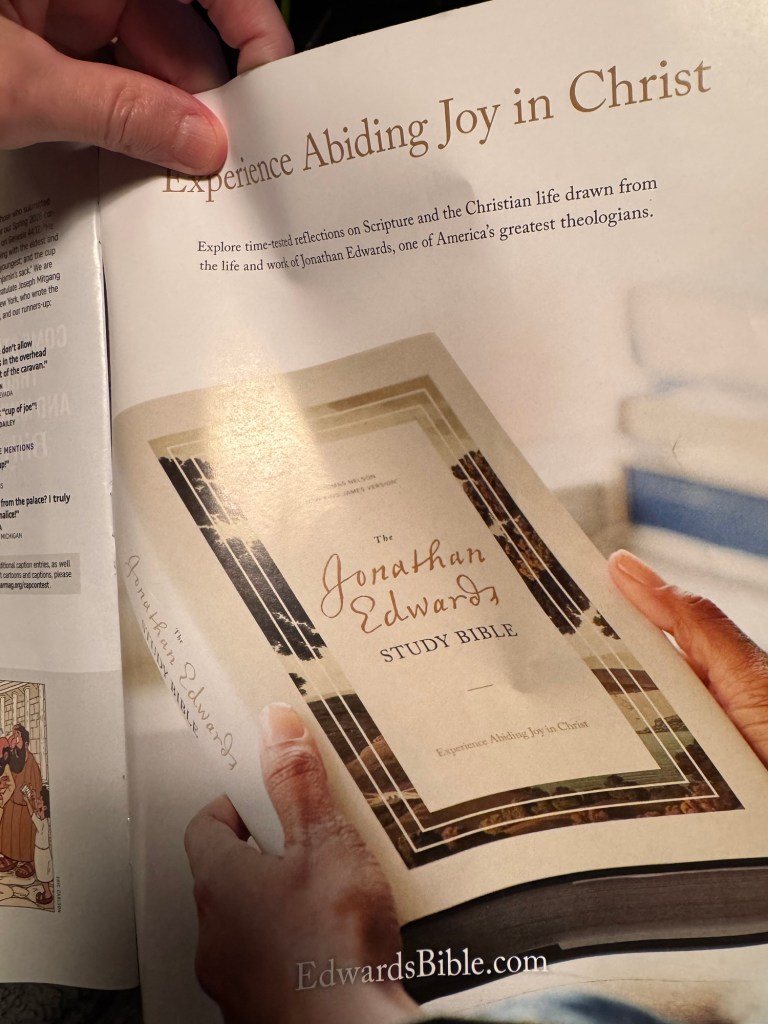
Then I saw an advertisement for a new study Bible centered on Jonathan Edwards,I wanted others to know it exists. I like the people who put it together and I want to see it sell successfully. The Jonathan Edwards Study Bible is out now from Thomas Nelson, New King James Version, general editor Dr. Matthew Everhard, who is a fantastic scholar. The publication date was August 18, 2026. It comes in hardcover, flexible Leathersoft, and genuine leather.² I already have more study Bibles than a reasonable person needs. I plan to make this the next one I put my hands on every day. I would suggest all my readers get a copy, and to use it so we can have much better discussions in the coming years. Do not let the God-hating Marxist left define our law-and-order society.

I would argue that Edwards shaped the moral weather that made the United States possible, in the 1730s and 1740s, in the First Great Awakening, from a pulpit in Northampton and from a mind that refused to separate joy in God from serious thought.³ I recommend getting the new Bible and living with it. That is the news. The rest is why the news landed on me the way it did.

The Bible in the Green Bag

The Bible I typically carry has been through airports all over the world. Soft pages. Maps in the back. Notes in every blank the editors left me. I have filled the margins to the end. It does not look ruined. It looks used. I could carry it another ten years, and it would still hold. I keep it in a green utility bag with my laptop, the phone, a charging brick, and whatever snack will survive security. One bag. One pass through the scanner. Then I sit at the gate and do what I have always done while a plane loads: I look at the maps, the timelines, the concordance, and a note I wrote two years ago in another terminal.

I am not opening it because I think God will only forgive me if the other passengers watch. I open it because I like it. I like the history that survived. I like the drawings. I like having a piece of the ancient world in my hands while the PA system talks about zone two.

That Carry Bible is not my only one. I keep going back to the Crossway ESV Archaeology Study Bible. I gave a softcover of that one to my youngest daughter. I kept the copy I use. It is a wealth of a book: the text, then the dirt beneath the text, the photographs, the sidebars, the sense that Abraham, Hezekiah, and Paul walked on actual ground.⁴ I first saw it advertised in Biblical Archaeology Review years ago and kept it on the back burner until I bought it. A decade later, I still reach for it more than almost anything else on the shelf, because archaeology is the companion that keeps the stories from floating.

Then there is the MacArthur Study Bible a friend put in my hands on June 12, 2023. He wrote in the front. I did not ask for it. He was a retired Army colonel, later president of aerospace companies, and he valued the conversations we had about biblical context. He walked into the office, set down one of his favorites, and left. I keep it where I can see it from the chair.⁵

Those three sit in a kind of rotation: the traveler, the archaeologist, the gift. The Edwards volume is the first new study Bible in a while that I would consider letting the traveler retire to the shelf.

Museum of the Bible and a Pin from Qumran Country

My favorite day of 2026 so far was my birthday. I took a break from work. My wife and I went to the Museum of the Bible in Washington. We are members. Besides the main reading room at the Library of Congress, that museum is my favorite place on earth, and inside it, my favorite gallery is the History of the Bible exhibit. You walk into architecture that evokes a cathedral. You watch the book move through languages, empires, paper, print, and culture. I am not talking about a private feeling there. I am talking about the measurable power a set of texts has had on human civilization.⁶

I carry a small pin from a Dead Sea Scrolls exhibition in the same bag. I do not want to forget that trip. The Teacher of Righteousness in the Qumran literature is, for me, one of the most compelling figures in Second Temple history. I do not flatten Jesus into that figure. I do not need to. A man is born into a world that already has a language, a priesthood, a Roman shadow, and a set of arguments about purity and power. John the Baptist and Jesus both make more sense when you have sat with the Community Rule, the Habakkuk Pesher, and the people who left Jerusalem’s gravity for the desert.⁷ The Essenes were suspicious of wealth and of a priesthood they thought had made itself comfortable with the wrong masters. That is not a modern talking point. That is the air of the first century.

I find the psychology of that period inexhaustible. Conference calls still get my attention. I listen. Some of them take an hour to arrive at the sentence that could have been said in four minutes. In those stretches I used to slide the desk Bible over and keep my mind working: instead of getting bored: a map, a timeline, a note. Not as theater. As ballast.

What People Thought They Were Looking At

I dress for work—shirt, jacket, often a tie. I have a White House tie. I have one Ross Perot gave me years ago. I have silk ties from the Trump Organization, the kind with the mark on the back, soft, well-made. Ties are not a costume. They are respect for the room I am walking into and the work we do there. 

TSA has watched that combination for years: the jacket, the green bag, the Bible coming out of it. More than once the assumption has been that I must be a preacher or some other official holy man. I am not. I am an executive who likes Scripture, archaeology, and not wasting the twenty minutes before a plane pushes back. People sitting in the next seat have asked, in so many words, why a person would look at a Bible in an airport unless he were trying to get something forgiven. I find that question more revealing than they intend. You can live a decent life and still want the book. You can refuse tattoos, refuse to deface the body, refuse the little wink that says “I am as wrecked as you are,” and still not be a priest. You can be a man who thinks the human temple is not a billboard.⁸

I have been stunned, this summer of 2026, at how much hostility that posture draws once you leave a familiar building. Inside two-decade-old relationships, people who suddenly miss me are letting me know just how much, they miss the Bible on my desk realizing it was more than just furniture. People who ran large companies told me later it was the first thing they trusted when they walked in my office.  Not the speeches I gave them. The book. A flag that said the room was safe for a person who still went to church on Sunday and did not need to advertise a tattoo on the inside of their arm or hidden on an ankle.  

I have had something like forty or fifty messages in the last three weeks from people who used to come through that door. The line repeats. They miss the Bible on the desk. Some of them have more money than they will ever be able to spend and can afford to say what they think in their older years. What they valued was not a performance of righteousness. It was a reminder that the world was not all bad. That has been the shock of changing circumstances. You do not know who was quietly depending on a habit you thought was private until the habit is no longer in the same room.

A New Market, an Old Warning About Wealth

I have been talking with new people in Butler County and in the space-adjacent market I have watched for years. I first heard the pitch the way you hear a hundred pitches on LinkedIn. Everybody has a new idea. My own working estimate, from the work I have actually done, is that the space economy is heading toward something on the order of three trillion dollars by around 2033.⁹ That is not hype. That is a forecast based on experience. If it is even close, the people who build the right things will be rewarded on a scale that sounds like island-buying money to anyone still thinking in last decade’s units.

I am not embarrassed by the pursuit of wealth. I am careful about it. Jesus was not sentimental about rich men. The people behind the Dead Sea Scrolls were not sentimental about rich men. A needle is still a needle.¹⁰ If I had no dime and a box of chicken nuggets from Kroger and a new issue of Biblical Archaeology Review, I would still be myself. The magazine and the book are the happy part. The wealth is the instrument. Nicodemus had standing in the priesthood and still came to Jesus at night. He did not have to choose between influence and curiosity. I would rather earn the hours from five to ten in the evening, the hours when a man who has already taken care of his people can sit in a chair and read, than pretend poverty is automatically holy.¹¹

The colonel who gave me the MacArthur Bible had seen the military change and then seen large companies change until he barely recognized them. He told those stories in an office that still had a Bible on the desk. When he retired, I lost interest in the polite version of going along. That is a disclosure, not a press release. The people who stepped into some of those roles were closer to the airport glance than to the man who wrote in the front of a study Bible. Why are you wearing a tie? Why don’t you have the tattoo? Why don’t you throw a curse word into the meeting so we know you are not a robot? I have known that weather existed. I had commented on it from a protected side of the glass. This year I have been on the other side of the glass.

The Teacher of Righteousness did not win a popularity contest in Jerusalem. The community at Qumran put miles between itself and a priesthood it thought had made peace with the wrong power. I do not think the answer for a modern working life is to move to a desert. I do think the answer is to stop being surprised that people who are only sails, and never a keel, hate a keel when they see one. They go with the wind. A person who gets up in the morning intending to be good is steering. Those two habits do not like each other.

Why Edwards, and Why Now

Jonathan Edwards filled notebooks. The Miscellanies, the Notes on Scripture, the Resolutions he wrote as a young man and kept. The new study Bible is built out of that habit. Everhard’s edition puts Edwards’s own doctrinal work under the NKJV text, adds essays on his life and the Awakening, reprints the Resolutions, and explains the note system so a reader can start one of his own.¹² That is not merchandising. That is an old American technology: write what you see in the text until the text starts writing back to you.

I have been doing a smaller version of that in the carry Bible for years. Lines in the places the publisher left blank. Thoughts in the maps. Reactions I did not want to lose between Dayton and some other runway. Edwards did it at a different scale in the 1740s and 1750s. The country that came after him, the republic that knew his sermons even when it argued with them, did not appear out of a vacuum. If you want a founding-era mind that treated Scripture as something a serious adult could spend a life on, he is near the head of the line.

I am loyal to the Bible that has already been around the world with me. I am not going to mistreat it. I am thinking about letting it live on the shelf and putting a leather Edwards next to the chair and in the bag. A new study Bible is not a better God. It is another set of trained eyes, another century of notes, another chance to keep the mind awake while the rest of the cabin looks at a phone.

If you need a first Bible, or another Bible, this is the one I would put in front of you this month. Hardcover if it will stay on a table. Leathersoft or leather if it is going to travel. Read Edwards’s own sentence on the cover logic of the edition: the enjoyment of God is the only happiness with which the soul can be satisfied.¹³ Then read the maps. Then write in the blanks.

What I Am Building Next

I have said for a while that the age of disclosure and the politics of heaven are not separate subjects. They are the same story told from two altitudes. That work is coming.¹⁴ Until it does, the ordinary practice remains the same. Subscribe to a better day. Sit with a magazine that still believes the dirt in Israel and Jordan and the West Bank can teach you to read. Carry a book that has already outlived empires. Dress as if the work matters. Do not wait for a stranger in an airport to bless the habit.

If you have been one of the people writing to say you missed the Bible on my desk, I appreciate all the kind words and have been impressed how many people were using that object as something stable in their life. Edwards can sit where the last one sat. The green bag still does its work and carries in it what’s truly valuable. 

Notes

1.  Biblical Archaeology Review began publication in 1975 under Hershel Shanks and the Biblical Archaeology Society. I have read it across five decades. The Fall 2026 issue includes work on Negev tombs, Kidron Valley monuments, Tell Qasile, and spacing in the Dead Sea Scrolls.

2.  The Jonathan Edwards Study Bible: Experience Abiding Joy in Christ (NKJV), Thomas Nelson, general editor Matthew Everhard. Hardcover ISBN 9781400339532; also issued in brown Leathersoft and black genuine leather. Comfort Print, red letter, maps, concordance, essays, Resolutions, and an introduction to Edwards’s Miscellanies method.

3.  Jonathan Edwards (1703–1758), pastor at Northampton, later missionary at Stockbridge and president of the College of New Jersey—the First Great Awakening’s most demanding American theologian. “Sinners in the Hands of an Angry God” (1741) is the famous shard. The Religious Affections and the Miscellanies are the longer works.

4.  ESV Archaeology Study Bible, Crossway, editorial oversight by John Currid and David Chapman, first issued 2018, later TruTone editions. Field notes, photographs, maps, timelines. I have also used Zondervan’s older NIV Archaeological Study Bible; they are different books.

5.  The MacArthur Study Bible, long associated with John MacArthur and issued in NASB, NKJV, ESV, and other texts across many printings. The copy on my shelf is the one dated in the front, June 12, 2023.

6.  Museum of the Bible, Washington, D.C. The History of the Bible floor remains, for me, the heart of the building. Membership is how we treat a place we intend to keep returning to.

7.  Teacher of Righteousness: the sectarian leader in the Damascus Document, the Habakkuk Pesher (1QpHab), and related Qumran texts. I read him as a Second Temple reformer whose conflict with a “Wicked Priest” and with Jerusalem’s establishment belongs in any serious account of the world Jesus and John walked into. That is history and typology, not a claim that the Gospel is only Qumran.

8.  I mean the body as temple in the Pauline sense, 1 Corinthians 6:19–20, not a fashion rule I am prepared to police on strangers. It is a rule I keep.

9.  Public forecasts of the commercial space economy vary. Morgan Stanley and others have used a trillion-dollar frame toward 2040. My three-trillion-by-2033 figure is an experience-based working number, not a consensus estimate. Treat it as a claim to test.

10.  Matthew 19:24 and parallels. The camel and the needle. The point is not that wealth is impossible. The point is that it is spiritually expensive.

11.  John 3; John 7:50–51; John 19:39–40. Nicodemus again, because he is the patron saint of people in positions who still want the conversation.

12.  Edwards’s “Resolutions” (1722–1723) and the Miscellanies notebooks are in the Yale Edition of the Works of Jonathan Edwards. Everhard’s study Bible is a reading edition of that archive under Scripture, not a replacement for the Yale volumes.

13.  The cover quotation is Edwards on the enjoyment of God as the soul’s only satisfying happiness. Related language runs through the Miscellanies and The End for Which God Created the World.

14.  The Politics of Heaven is the book I have been building toward; “the age of disclosure” is the public weather that book has to walk into. Forthcoming. The desk Bible is older than both.

Bibliography for Further Reading

Study Bibles and Editions

The Jonathan Edwards Study Bible: Experience Abiding Joy in Christ (NKJV). Edited by Matthew Everhard. Thomas Nelson, 2026.

ESV Archaeology Study Bible. Edited by John D. Currid and David Chapman. Crossway, 2018.

ESV Study Bible. Crossway, 2008.

The MacArthur Study Bible. Various texts and publishers; Thomas Nelson and others.

NIV Archaeological Study Bible. Zondervan, 2005.

Holy Bible, New King James Version. Thomas Nelson.

Holy Bible, English Standard Version. Crossway.

Biblia Hebraica Stuttgartensia and Nestle-Aland Novum Testamentum Graece. For readers who want the next shelf over.

Jonathan Edwards

Edwards, Jonathan. The Works of Jonathan Edwards. 26 vols. Yale University Press, 1957–2008. Especially vol. 2, Religious Affections; vol. 8, Ethical Writings; vol. 13 and following, the Miscellanies; vol. 15, Notes on Scripture.

Edwards, Jonathan. A Jonathan Edwards Reader. Edited by John E. Smith, Harry S. Stout, and Kenneth P. Minkema. Yale University Press, 1995.

Edwards, Jonathan. “Resolutions.” 1722–1723.

Edwards, Jonathan. “Sinners in the Hands of an Angry God.” 1741.

Marsden, George M. Jonathan Edwards: A Life. Yale University Press, 2003.

McClymond, Michael J., and Gerald R. McDermott. The Theology of Jonathan Edwards. Oxford University Press, 2012.

Noll, Mark A. The Rise of Evangelicalism. InterVarsity, 2003.

Stout, Harry S. The New England Soul. Oxford University Press, 1986.

Tracy, Patricia J. Jonathan Edwards, Pastor. Hill and Wang, 1980.

Qumran, Second Temple Judaism, and the Teacher of Righteousness

The Dead Sea Scrolls Study Edition. Edited by Florentino García Martínez and Eibert J. C. Tigchelaar. Brill / Eerdmans.

Vermes, Geza. The Complete Dead Sea Scrolls in English. Penguin, revised editions.

Collins, John J. The Scepter and the Star. 2nd ed. Eerdmans, 2010.

Collins, John J. Beyond the Qumran Community. Eerdmans, 2010.

Cross, Frank Moore. The Ancient Library of Qumran. 3rd ed. Sheffield, 1995.

Fitzmyer, Joseph A. The Dead Sea Scrolls and Christian Origins. Eerdmans, 2000.

Magness, Jodi. The Archaeology of Qumran and the Dead Sea Scrolls. 2nd ed. Eerdmans, 2021.

Schiffman, Lawrence H. Reclaiming the Dead Sea Scrolls. Doubleday, 1994.

VanderKam, James C. The Dead Sea Scrolls Today. 2nd ed. Eerdmans, 2010.

Wise, Michael, Martin Abegg Jr., and Edward Cook. The Dead Sea Scrolls: A New Translation. Harper.

Biblical Archaeology and the Land

Biblical Archaeology Review. Biblical Archaeology Society, 1975–present.

Cline, Eric H. Biblical Archaeology: A Very Short Introduction. Oxford University Press, 2009.

Currid, John D. Doing Archaeology in the Land of the Bible. Baker, 1999.

Dever, William G. What Did the Biblical Writers Know and When Did They Know It? Eerdmans, 2001.

Hoffmeier, James K. The Archaeology of the Bible. Lion Hudson, 2008.

Kitchen, K. A. On the Reliability of the Old Testament. Eerdmans, 2003.

Mazar, Amihai. Archaeology of the Land of the Bible, 10,000–586 B.C.E. Doubleday, 1990.

Shanks, Hershel. Freeing the Dead Sea Scrolls. Continuum, 2010.

Stern, Ephraim. Archaeology of the Land of the Bible, Vol. 2. Doubleday, 2001.

Museum of the Bible. Permanent exhibition catalogs and the History of the Bible gallery materials. Washington, D.C.

Scripture, Wealth, and the Conscience of a Working Life

Augustine. Confessions and City of God.

Bonhoeffer, Dietrich. The Cost of Discipleship.

Calvin, John. Institutes of the Christian Religion.

Lewis, C. S. Mere Christianity and The Abolition of Man.

Niebuhr, Reinhold. Moral Man and Immoral Society. Scribner, 1932.

Pascal, Blaise. Pensées.

Wesley, John. “The Use of Money.”

The Gospel of John, chapters 3, 7, and 19.

Matthew 19:16–30.

1 Corinthians 6:19–20.

American Religion and the Public Order

Ahlstrom, Sydney E. A Religious History of the American People. Yale University Press, 1972.

Bailyn, Bernard. The Ideological Origins of the American Revolution. Harvard University Press, 1967.

Kidd, Thomas S. The Great Awakening. Yale University Press, 2007.

Noll, Mark A. America’s God. Oxford University Press, 2002.

Sweeney, Douglas A. The American Evangelical Story. Baker, 2005.

Space, Industry, and the Instrument of Wealth

Bezos, Jeff, and the public Blue Origin/industrial-space record read as primary sources, not devotionals.

Hoffmeier is archaeology; for space, keep the shelf honest:

Logsdail, various commercial space market outlooks; Morgan Stanley Research, “Space: Investing in the Final Frontier,” and subsequent updates.

National Academies and NASA commercial market assessments, 2020–2026.

Hoffman, Rich. The Gunfighter’s Guide to Business. Liberty Hill Publishing, 2021.

Hoffman, Rich. The Politics of Heaven. Forthcoming.

On Dress, Attention, and the Desk as a Signal

Carnegie, Dale. How to Win Friends and Influence People. Only after you already know why you would wear the tie without him.

Postman, Neil. Amusing Ourselves to Death. Viking, 1985.

Sennett, Richard. The Fall of Public Man. Knopf, 1977.

Weil, Simone. Gravity and Grace. Attention as the real liturgy of a working day.

Rich Hoffman

More about me

Click Here to Protect Yourself with Second Call Defense https://www.secondcalldefense.org/?affiliate=20707
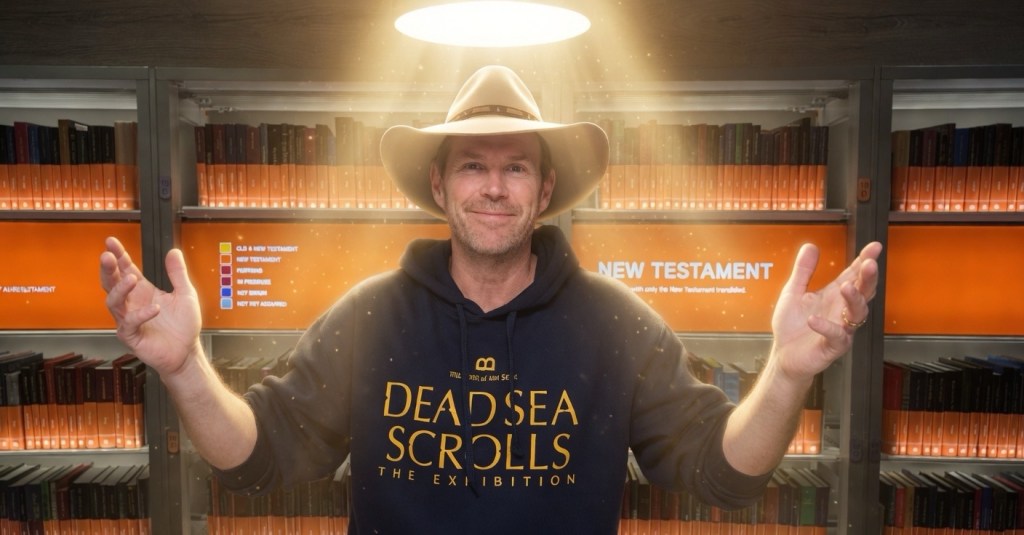
About the Author: Rich Hoffman

Rich Hoffman is an author, political consultant, and strategic advisor based in Cincinnati, Ohio, and the creator of The Politics of Heaven—a unique framework that connects biblical theology, ancient history, and modern power structures to explain how moral alignment and spiritual forces shape global events. Blending real-world political experience with deep research into archaeology, UFO phenomena, and suppressed historical narratives, Hoffman offers compelling commentary on topics ranging from ancient civilizations and the Dead Sea Scrolls to modern populist movements, paranormal continuity, and leadership strategy in chaotic environments. As the author of The Gunfighter’s Guide to Business and the forthcoming Politics of Heaven, he brings a grounded yet provocative voice to media discussions, supported by firsthand experiences and a cross-disciplinary approach that bridges science, history, and theology. For interviews, speaking engagements, or expert analysis, visit richhoffmanbooks.com or contact directly via phone at 513-307-5815 or email at rhoffman@richhoffmanbooks.com.  If you’ve seen the movie, Disclosure Day and want to talk about it and the implications of Presidnet Trump’s UAP disclosures, let me know and we can bring some color to your coverage. https://richhoffmanbooks.com/media-inquiries-broadcast-topics-and-contact-info/?frame-nonce=ad51e7ecba I do have a firsthand UFO encounter to discuss.

George Lang’s Bible in the Backseat, Jonathan Edwards, Darbi Boddy: Lessons to build a better, and stronger, GOP in Butler County

I am not a separation of church and state guy the way the left has used it to push a secular agenda. But to understnad that, you have to understand history, and many people just don’t. And those same people don’t know much about one of the people I consider to be one of the early American Founding Fathers, Jonathan Edwards. I say, use what works and is healthy for a great society, and don’t argue with the poliitcal left the interpritation of law and order when they want to destroy America by using its own laws and policy against its creation. Since that is their method, I would advise that we drop the polite veil and admit what we are all thinking: churches go well with Republican politics, and we should be a whole lot more open about it, and just let the Marxists of the Democratic Party have their faces melt. Art Sauerwein is the new chairman of the Butler County Republican Party. The Journal-News piece I have been talking about put his wish list in public: take back the schools and make them more conservative; see more Christian values in the community; and, most of all, Republicans already in office need to learn to cut spending and cut taxes. I agree with most of that list. I would put the disagreement, if there is one, in a sliver. Five percent, maybe. The problem is not the nouns. The problem is that a county chairman saying he is displeased with his own officeholders signals to every Democrat and every reporter in the room that the party is not united.¹

I have a particular soft spot for people who take thankless chairs. I also have a long memory of what happens when the Bush years go slack, when Clinton years teach the other side to use government as a wealth-transfer machine, and when a Republican majority forgets that it was elected to stop that machine, not to learn its levers. Small-government capitalism is not the same project as confiscating through the tax code and redistributing under a better letterhead. I have been on that argument since before the Tea Party years. I have not left it.

What I will not do is pretend that the way you get Christian schools and lower taxes is to twist the arms of the people you still need on the card. That is the Democrat tactic with different hymns. Ostracize, purity-test, call the holdout a RINO, and then act surprised when the tent is an empty Sunday-school classroom with folding chairs and no majority.

Why I Walked George Lang to His Car

People tell me I cannot be trusted because I am friends with George Lang. I was invited to an evening with him and his wife, Debbie. We get along. I like them. I like George. Not because he is a state senator from the 4th District. Because we can stay on a subject until the parking lot lights are the only ones left.²

We started years ago with a mutual fascination with Ayn Rand and the long story of human order. She was an atheist. I was not. We did not make religion the ticket into the room. We made taxes, small business, the Ohio caucus work, jobs that let a family buy nice things without the government picking the neighbor’s pocket. Those are the planks you can stand on with a man who is not yet where you are on Sunday morning. Then you walk him to the car.

This year, 2026, not a decade ago, we were still talking when we got to his car, extending the evening as much as possible because the conversation was good. He knows what I carry. He knows the maps and the notes. He pulled out a Bible that had been given to him in the Senate. It was beautiful. I would have liked it for the shelf. It was his. He had been going through it. Debbie has said, in the way honest people say it, that they have not always lived in that lane. I did not need a performance. I needed the book’s facts in the car of a man who helps write Ohio law. That is how influence works. That is Nicodemus in a parking lot instead of a midnight stair.³

If the chairperson’s job is to get people on the card, then the chairman’s job is to make nights like that more common, not to publish a scolding that makes the next senator keep the Bible in the trunk.

Jonathan Edwards Did Not Found America From a Letter to the Editor

The Jonathan Edwards Study Bible came out in August 2026 from Thomas Nelson, NKJV, notes drawn from Edwards’s own work, edited by Matthew Everhard. I saw it advertised in Biblical Archaeology Review, which is still the magazine I would take to a desert island and be happy with nothing else.   I will likely make that Edwards volume my next daily Bible. The one I have carried through airports is full of notes. Every blank space they left me has writing in it.⁴

Edwards did his public work in the 1730s through the 1750s, while a young George Washington was still making himself and Franklin was already allergic to other people’s piety and still able to hear the weather. The Awakening put biblical speech in the streets. The colonies that broke from England were not a faculty workshop. They were a people who had been arguing, singing, and frightening themselves with sermons about a God who was not a mascot. I do not claim Edwards “founded” the United States. I claim the country is harder to imagine without that pressure in the air.

He was also the grandfather of Aaron Burr, who later killed Alexander Hamilton. I am not a Hamilton man. I mention the grandson so nobody thinks I am selling a stained-glass window. Edwards’s own church in Northampton eventually threw him out because he would not lower the table to the town’s comfort. He finished in a smaller charge at Stockbridge, among the Mahican, and then the College of New Jersey—Princeton—made him president. He lasted about a month. He took the smallpox inoculation during an outbreak, fever followed, and he died on March 22, 1758. His last counsel was to trust God and not be afraid. The same college that begged him to come later drifted into the progressive machine that now congratulates itself for unmaking the civilization he helped catechize.⁵

That arc is the warning. You can put a Christian on a letterhead and still lose the building. You can also lose the building by refusing to put your arm around anyone who is not already converted.

Darbi Boddy and the Noble Death That Vacates the Seat

I have always had a soft spot for Darbi Boddy on the Lakota school board. She came out of a Puritan temperament: right is right, wrong is wrong, say it, take the heat. I admired the spine. The political class asked whether she knew she had to go to other people and shake hands. She drew a line so hard that the people who should have been part of her coalition treated her as a problem to be managed. She was removed. Not enough Republicans came to her defense in the way that kept the seat. I was very angry about that. I still am.⁶

There is a Christian imagination that treats the pike as the only honorable furniture—burned, sawn, beheaded, and therefore faithful. The martyrs were real. Rome tried to kill the church, and the church outlived the attempt. I am asking a different question for a school board and a county party. Are we here to die beautifully and hand the district back to the purple-haired people eaters or are we here to keep the chair and put more than one adult in the room?

A public school system designed as an agent of social reconstruction will not become conservative because a chairman tells the Journal-News he would like that very much. You need people on the board who can last. You need people around them who do not run at the first ugly headline. You need a farm team that was not raised only in a sanctuary, because most of the county was not. Maybe forty percent can make the born-again jump on a timetable that satisfies a Sunday-school teacher. The rest will come, if they come, the way George came toward a Bible in a backseat: over years, over taxes, over ancient history, over the proof that you will still walk them to the car when they are not yet where you are.

The Church That Taught Me Business Had Classrooms and a Mortgage

I saw my grandson today, and I told him about my years between eleven and sixteen, High Adventure, the Scout post that met at a big church on RT42 in West Chester. We made pizzas in the church kitchen, and people came to pick them up. That was a fundraiser, a civics lesson, and a first business plan. My family church in Fairfield was the other building. My wife and I were married there. Catechism, Sunday school, the pastor’s house on the property, the side rooms where a kid learned how adults talk when they think they are only running a troop meeting. Then the money ran out. They sold it. It broke my family’s heart. It is not on the market presently. I have been thinking about buying it back for a couple of million. dollars In any other use, that ground in Fairfield is a different number. Because it is a church, the market treats it like a problem.⁷

I am not announcing a closing. I am saying the thought is serious, and Jonathan Edwards is the reason the thought got louder. Churches decline when they have no profit model and a pastor who thinks Jesus only ever taught under a tree. Jesus could walk from village to village. A sanctuary in a hot real-estate corridor has a mortgage. Nicodemus money, the quiet help that keeps a ministry on its feet, is not a compromise with Egypt. It is how a thing survives long enough to teach the next boy how to sell a pizza and keep the books.

The West Chester Tea Party lost a church venue while I was in Japan not that long ago. A guest, a fight, and the door closed. For years the movement lived on donated fellowship halls and cookies after the meeting. Streamers, Republicans, whoever would come. That was a big tent that still knew the room had been a sanctuary an hour earlier. I want a building in this county that Tea Party groups and Republican meetings can use without a landlord who gets nervous. Not a state church. A civic table with a steeple still on it.

Princeton Forgot. The Party Should Not Copy the Forgetting.

Edwards as president of Princeton is the picture I cannot shake. The college wanted the man who could make seniors write on divinity and then talk about it. A short generation later, the heirs of that project began the long surrender. Liberty University and the older schools are not the same charter, but the temptation is the same: keep the Christian name, lose the Christian nerve, export Democrats with verse numbers. Complaining about that in a newspaper will not reverse it. Buying a pulpit, filling a room, putting your arm around a senator who keeps a Bible in the backseat, teaching a Scout to make change for a pizza—that is the slower work.

Peer pressure is not evangelism. “Agree, or we will put you outside” is what the other party already does. If we do it with better footnotes, we still lose the county. Jesus did not recruit from the Sanhedrin’s banquet list. He took the people who had fallen out of the wagon. Edwards could fill a town and still get voted out. Both facts matter. The first tells you preaching works. The second tells you preaching without a coalition becomes a memorial service.

What I Want the Chairman to Do Instead of Being Displeased

Help officeholders get elected. Help them get money. Help them get on the slate card. If you want Christian values in the community, put a beautiful Bible in more backseats by being the kind of man a senator will linger with in a parking lot. If you want the schools, do not design another martyr and then wonder why the seat is empty after they are killed or lose their seat in the next election. If you want taxes cut, stay on the subject with people who will go to the small-business caucus before they will go to your Wednesday Bible study volunteer class.

I will keep reading BAR. I will keep the Edwards volume in the rotation. I will keep walking George to the car. I will keep thinking about the Fairfield church, not because nostalgia is a strategy, but because the kids I see now do not have the side room I had, and a party that cannot raise its own young in a hall it does not have to rent is a party that will keep leasing its future from people who do not like its hymn.

Lead. Do not write the other side’s headline for them.

Notes

1.  Art Sauerwein, Butler County GOP executive chairman, quoted in late-August 2026 Journal-News coverage on local Republicans, schools, Christian values, spending, and taxes. A public rebuke of sitting Republican officeholders is usable copy for the other party. That is not mind-reading. That is how newspapers work.

2.  George F. Lang, Republican, Ohio Senate 4th District since 2021; previously Ohio House 52nd; West Chester. Married to Debbie Lang. I am describing a private evening in 2026 and a longer friendship. I am not claiming he has asked me to speak for him.

3.  John 3; 7:50–51; 19:39–42. Nicodemus keeps his station and still moves toward the teacher. Influence that can only speak in the sanctuary will not reach the people who write statutes.

4.  The Jonathan Edwards Study Bible (NKJV), Thomas Nelson, August 18, 2026, general editor Matthew Everhard. Biblical Archaeology Review, Biblical Archaeology Society, 1975–present.

5.  Edwards was inaugurated at the College of New Jersey on February 16, 1758; died March 22, 1758, after smallpox inoculation. Buried in the Presidents’ Lot, Princeton Cemetery. Esther Edwards married Aaron Burr Sr.; their son was Aaron Burr Jr. Northampton dismissed Edwards in 1750 over communion discipline; Stockbridge followed.

6.  Darbi Boddy won a Lakota Local Schools board seat in 2021 on a conservative platform and was removed by the board in March 2024 after a long, ugly fight and a 90-day absence tied to a protection-order conflict with another member. I am not retrying that case here. I am talking about coalition and what happens when courage has no bench.

7.  The Fairfield church of my childhood and marriage is named as a family fact and a present thought, not as a listed property and not as a pledge. High Adventure and the West Chester church on the Cincinnati-Dayton Road corridor are the Scout years as I lived them.

Bibliography for Further Reading

Local Politics and the People Named

Journal-News (Hamilton). Late-August 2026 coverage of Butler County Republicans and Chairman Art Sauerwein.

Lang, George F. Ohio Senate, District 4. Public record, 2021–present; Ohio House, 2017–2020.

Ballotpedia and the Ohio Legislature biographical pages for George Lang.

Journal-News. “2 conservative newcomers, incumbent win Lakota seats.” November 2021.

WVXU. “Darbi Boddy is removed from Lakota’s school board.” March 20, 2024.

WLWT. Lakota board appointment coverage following the vacant seat, April 2024.

FOX19. “Criminal charge dismissed against former Lakota school board member.” August 1, 2024.

Jonathan Edwards and the Awakening

The Jonathan Edwards Study Bible: Experience Abiding Joy in Christ (NKJV). Edited by Matthew Everhard. Thomas Nelson, 2026.

Edwards, Jonathan. The Works of Jonathan Edwards. 26 vols. Yale University Press.

Edwards, Jonathan. Religious Affections; Freedom of the Will; “Sinners in the Hands of an Angry God.”

Marsden, George M. Jonathan Edwards: A Life. Yale University Press, 2003.

Marsden, George M. A Short Life of Jonathan Edwards. Eerdmans, 2008.

McClymond, Michael J., and Gerald R. McDermott. The Theology of Jonathan Edwards. Oxford, 2012.

Noll, Mark A. The Rise of Evangelicalism. InterVarsity, 2003.

Kidd, Thomas S. The Great Awakening. Yale University Press, 2007.

Princeton University. Presidential biographies: Jonathan Edwards, 1758.

This Day in Presbyterian History. “February 23: Jonathan Edwards.” On the inoculation and death.

Princeton and the Long Drift

The Princetonians and official presidential histories of the College of New Jersey.

Noll, Mark A. Princeton and the Republic, 1768–1822. Princeton University Press, 1989.

Marsden, George M. The Soul of the American University. Oxford, 1994.

Burtchaell, James Tunstead. The Dying of the Light. Eerdmans, 1998.

Church, Money, and the Nicodemus Problem

The Gospel of John, chapters 3, 7, 19.

Luke 8:1–3. The women who funded the ministry.

Acts 4:32–37; 16:14–15. Property and hospitality in the first churches.

Wesley, John. “The Use of Money.”

Newbigin, Lesslie. The Gospel in a Pluralist Society. Eerdmans, 1989.

Bonhoeffer, Dietrich. Life Together.

Schaeffer, Francis A. The Church at the End of the 20th Century.

Schools, Boards, and the Limits of Martyrdom

Sowell, Thomas. Inside American Education. Free Press, 1993.

Hirsch, E. D., Jr. The Schools We Need. Doubleday, 1996.

Murray, Charles. Real Education. Crown Forum, 2008.

Gatto, John Taylor. Dumbing Us Down. New Society, 1992.

Ohio Department of Education standards files for the official language boards to actually vote on.

Parties, Tents, and Coalition

Burke, Edmund. Reflections on the Revolution in France. 1790.

Rauch, Jonathan. Political Realism. Brookings, 2015.

Riker, William H. The Theory of Political Coalitions. Yale, 1962.

Skocpol, Theda, and Vanessa Williamson. The Tea Party and the Remaking of Republican Conservatism. Oxford, 2012.

Hoffman, Rich. The Gunfighter’s Guide to Business. Liberty Hill, 2021.

Hoffman, Rich. The Politics of Heaven. Forthcoming.

Scripture, Friendship, and Slow Conversion

Lewis, C. S. Mere Christianity and The Four Loves.

Newby, Elizabeth. On ordinary friendship as the delivery system of belief, read against Lewis.

Augustine. Confessions. The long way toward a book that was already in the house.

Biblical Archaeology Review. For the magazine that sits on the table while the political argument goes on.

Boy Scouts of America. Handbook and the old troop-and-post structure. The side room was a civics school whether the adults knew it or not. 

Rich Hoffman

More about me

Click Here to Protect Yourself with Second Call Defense https://www.secondcalldefense.org/?affiliate=20707

About the Author: Rich Hoffman

Rich Hoffman is an author, political consultant, and strategic advisor based in Cincinnati, Ohio, and the creator of The Politics of Heaven—a unique framework that connects biblical theology, ancient history, and modern power structures to explain how moral alignment and spiritual forces shape global events. Blending real-world political experience with deep research into archaeology, UFO phenomena, and suppressed historical narratives, Hoffman offers compelling commentary on topics ranging from ancient civilizations and the Dead Sea Scrolls to modern populist movements, paranormal continuity, and leadership strategy in chaotic environments. As the author of The Gunfighter’s Guide to Business and the forthcoming Politics of Heaven, he brings a grounded yet provocative voice to media discussions, supported by firsthand experiences and a cross-disciplinary approach that bridges science, history, and theology. For interviews, speaking engagements, or expert analysis, visit richhoffmanbooks.com or contact directly via phone at 513-307-5815 or email at rhoffman@richhoffmanbooks.com.  If you’ve seen the movie, Disclosure Day and want to talk about it and the implications of Presidnet Trump’s UAP disclosures, let me know and we can bring some color to your coverage. https://richhoffmanbooks.com/media-inquiries-broadcast-topics-and-contact-info/?frame-nonce=ad51e7ecba I do have a firsthand UFO encounter to discuss.

Podcast Episode: Ayn Rand’s Return of the Primitive: The Anti-Industrial Revolution and the War on the Mind

Pip: The Overmanwarrior has a knack for finding the book that explains the headlines before the headlines know what hit them.

Mara: Rich Hoffman is doing exactly that this week — working through Ayn Rand’s Return of the Primitive, a collection that ties progressive education, environmentalism, identity politics, and the philosophy of money into one sustained argument about where Western civilization is headed.

Pip: So: a 1971 book about the 1960s that apparently describes last Tuesday.

Mara: That’s the claim, and the post makes a serious case for it. Let’s start with what Rand actually argued and why the diagnosis keeps resurfacing.

Ayn Rand’s Return of the Primitive: Reason Under Siege

Mara: The central question the post puts on the table is whether the cultural movements that call themselves progressive are actually a retreat — a deliberate dismantling of the rational, industrial civilization that allows human beings to survive.

Pip: The post sets that up with a pointed line from Rand’s title essay, describing what she imagined as the logical endpoint: “There is no gradual, restrained retreat from technology. There is only the continued advance of the mind or the descent into helplessness and death.”

Mara: So the upshot is that Rand treats technology not as a convenience but as the concrete product of conceptual thought — remove it and you haven’t simplified life, you’ve ended it. That’s the stakes she’s arguing from.

Pip: And the post traces that argument across several fronts. The environmental movement of her day, she contended, rejected the premise that human life and human comfort outrank pristine wilderness — which she read as a rejection of the human mind itself.

Mara: The post quotes her framing directly: activists simultaneously attacked scientific progress as violence against the planet while advocating what she called “universal slavery for men under expanding state control.” The moral inversion, as the post puts it, is that creators get cast as aggressors.

Pip: Then there’s the education angle, which is where it gets uncomfortable for anyone who sat through a lot of group projects.

Mara: The essay called “The Comprachicos” draws the analogy to seventeenth-century criminals who physically deformed children for profit. Rand’s claim is that progressive education — shaped by Dewey and pragmatism — performs the same operation on the mind by replacing conceptual training with social adjustment and group conformity.

Pip: The post also covers the 1999 expanded edition, where Peter Schwartz extends the argument to multiculturalism and identity politics — ethnicity, race, and sex elevated as primary political categories, the individual dissolved into the group.

Mara: And “The Cashless Society” essay gets its own treatment. The post connects Rand’s argument there — that money is the barometer of a society’s virtue, and that when political pull replaces production, distribution reverts to force and favor — to contemporary corporate-political entanglement.

Pip: Montessori comes up as the affirmative alternative: independent, purposeful activity that builds the conceptual faculties rather than training children to defer to the pack.

Mara: The post is candid that the frame can be enlarged beyond Rand’s strict empiricism — it notes that questions raised by UAP disclosures and non-human intelligence involve dimensions she didn’t fully address, while still holding that her core political insight stands: the individual is the smallest and most important minority.

Pip: Which lands us squarely on the question of what a society looks like when it stops producing people who can think about first principles — and that’s a short walk to how power actually moves.


Mara: The through-line across all of this is a single claim: the conflict between the productive individual and the collectivist demand for regression is the defining contest of the era, and it has educational, philosophical, and economic roots.

Pip: Rand called it fifty years ago, the post argues. The outer forms have changed. The pattern hasn’t. Worth keeping an eye on what that pattern looks like next week.

Rich Hoffman

More about me

Click Here to Protect Yourself with Second Call Defense https://www.secondcalldefense.org/?affiliate=20707

About the Author: Rich Hoffman

Rich Hoffman is an author, political consultant, and strategic advisor based in Cincinnati, Ohio, and the creator of The Politics of Heaven—a unique framework that connects biblical theology, ancient history, and modern power structures to explain how moral alignment and spiritual forces shape global events. Blending real-world political experience with deep research into archaeology, UFO phenomena, and suppressed historical narratives, Hoffman offers compelling commentary on topics ranging from ancient civilizations and the Dead Sea Scrolls to modern populist movements, paranormal continuity, and leadership strategy in chaotic environments. As the author of The Gunfighter’s Guide to Business and the forthcoming Politics of Heaven, he brings a grounded yet provocative voice to media discussions, supported by firsthand experiences and a cross-disciplinary approach that bridges science, history, and theology. For interviews, speaking engagements, or expert analysis, visit richhoffmanbooks.com or contact directly via phone at 513-307-5815 or email at rhoffman@richhoffmanbooks.com.  If you’ve seen the movie, Disclosure Day and want to talk about it and the implications of Presidnet Trump’s UAP disclosures, let me know and we can bring some color to your coverage. https://richhoffmanbooks.com/media-inquiries-broadcast-topics-and-contact-info/?frame-nonce=ad51e7ecba I do have a firsthand UFO encounter to discuss.

Why The Fountainhead Is Still the Most Important Novel in America:  Why so many Americans now treat the producer as the problem and the parasite as the moral authority

I sit down most days and watch the news panels the same way many people do. Fox News, the War Room, the usual circuit. Smart people, serious people, many of them I respect. Steve Bannon and his guests especially. And yet I keep hearing the same stunned tone when they talk about the sudden popularity of socialism, the rise of candidates who openly flirt with Marxist language, the young people who treat Bernie Sanders or Alexandria Ocasio-Cortez as prophets. They act as if this is some new weather system that just blew in.

I have been talking about the same weather for decades. The adverse effects of collectivism on a free human culture are not a mystery to me. They destroy the individual while pretending to help the group. I have committed a large portion of my working life to saying so, in writing, on the air, and in private conversation. So when the panels discover it late, I find myself less angry than simply tired. The diagnosis has been available the entire time. It sits on the shelf as a single novel that most of them will not touch.

That novel is The Fountainhead by Ayn Rand.

It is, without qualification, my favorite book. Not one of my favorites. The favorite. I have read it more times than I can cleanly count. I talked about it for years. I have carried its central argument into boardrooms, courtrooms, and conversations with my own grandchildren. When people ask me what single work of fiction best explains why so many Americans now treat the producer as the problem and the parasite as the moral authority, I do not hesitate. Read The Fountainhead. Then read it again.

Ayn Rand’s Escape from Communism and the American Novel That Resulted

Ayn Rand was a Russian refugee who escaped the Soviet system and came to America precisely because she wanted the opposite of what she had left. She watched the early years of the Bolshevik experiment up close. She understood, in her bones, what happens when the collective claims the right to own a man’s mind and the products of his mind. She wrote The Fountainhead as an artist, not as a political pamphlet, and the result is one of the clearest, most sustained examinations of the creator versus the second-hander that American literature has ever produced. 

Howard Roark is an architect who will not compromise the integrity of his buildings. When the establishment forces mediocrity onto a housing project he designed, he dynamites the result rather than allow his work to stand as a diluted lie. That act is not teenage rebellion. It is the logical end of a man who treats his own mind as the final court of appeal. The courtroom speech that closes the book is, in my view, as powerful as John Galt’s radio address in Atlas Shrugged. It is pure intellectual dynamite. Roark explains, without apology, the difference between the man who lives by the work of his own mind and the man who lives by borrowing, begging, or looting the work of others.

Most people do not want to see themselves as second-handers. That is exactly why the book still stings.

Why Some Conservatives Keep Their Distance from Ayn Rand

I remain mystified that so many people on the right, including voices I otherwise admire, treat Rand as radioactive. Bannon and others have expressed open dislike. The explanation usually circles her atheism. She was an atheist. She never pretended otherwise. That fact has allowed generations of religious conservatives to dismiss the entire body of work rather than engage the actual argument about production, integrity, and the moral status of the individual.

I am a Bible guy. I read it constantly. I take Joshua seriously—the man who marches around Jericho because God said to, who trusts the order larger than himself even when the math looks insane. I also take the Grail quest seriously. Percival finds the castle only when he stops forcing the journey and rides with looser reins. Those stories are not in conflict with the best of what Rand saw. They deepen it.

The Tower of Babel story is often read as a simple warning against human pride. Rand would have celebrated the ambition itself. The real sin in that story is the unified collective that tries to storm heaven by consensus rather than by individual excellence. When a man’s personal vision actually lines up with the larger order—when he becomes the vehicle rather than a cog—the result looks a lot like Joshua’s conquest and a lot like Roark’s refusal to bend. The difference is the source of the certainty. One man says “God told me.” The other says “I will not pretend.” Both refuse the noise of the crowd.

I live closer to Joshua’s path in daily practice. I want the commitment of marriage, the long obedience in the same direction, the willingness to enjoy the life God actually gave me rather than treat every compromise as spiritual death. But I understand what Roark was protecting. The forces that tried to break him are the same forces the Bible warns about under different names—the ones that pull a man away from the work he was made to do. Uncompromising clarity in the face of that noise is a form of spiritual discipline, whether the author acknowledged it or not.

Creators Versus Parasites and Why We Have So Few Edisons

The central question of The Fountainhead is simple and uncomfortable: are you creating, or are you feeding off someone else’s creation? Most people never ask it of themselves. Committees do not invent the light bulb. Consensus does not produce the theory of relativity. Those things come from individuals who refuse to bend.

My daughter recently took my grandson to Thomas Edison’s boyhood home in Milan, Ohio, for exactly that reason. I am not trying to manufacture another Edison. I want him to see that there are alternatives to the box the culture keeps trying to sell. Edison woke up every day trying to be a fountainhead. He made mistakes—plenty of them—but the posture was unmistakable. The same posture explains why an Elon Musk can exist in America and why a Jack Ma eventually runs into the wall in a more collective system. The culture that still has room for the uncompromising creator is the culture that keeps producing them. The culture that treats that spirit as a threat eventually smothers it. 

Hollywood’s Long War Against the Fountainhead Spirit

The resistance is not abstract. Zack Snyder, the director of 300 and a string of visually ambitious films, has spent years trying to adapt The Fountainhead. Studios treat the material as radioactive. He has said publicly that the book is considered “taboo” among the people who green-light projects. The same pattern appeared with the low-budget Atlas Shrugged trilogy made between 2011 and 2014. Funding was scraped together in pieces. Actors who appeared in it paid a quiet professional price. The collective does not need to ban the book. It only needs to make sure no one with real resources is allowed to put the story on a large screen without punishment. 

Clint Eastwood understood the same energy. He carried versions of it through Dirty Harry, the preacher in Pale Rider, Frank Morris in Escape from Alcatraz, and the driven director in White Hunter Black Heart. In the 1980s, when he was still fighting for the kind of films he wanted to make, those characters walked through the frame like men who would rather dynamite the building than let the second-handers own the final cut. White Hunter Black Heart feels, to me, like Eastwood’s private reckoning with the cost of that stance. He played the uncompromising artist for most of the running time and then, at the end, allowed the character a moment of regret. After that film, the pure Roark energy largely left his work. Age and the system both take their toll. 

Even Walt Disney once understood. In the American Adventure pavilion at Epcot, there is a quote set into the wall: “Throughout the centuries there were men who took first steps down new roads, armed with nothing but their own vision.” It is Ayn Rand’s line. I have stood in front of it with my grandchildren and told them it is one of the most important things in the entire park. Modern operators tend to cover it with seasonal decorations or other displays. The plaque is still there. The spirit that put it there is harder to find. 

Trump, the Ballroom, and the Same Old Courtroom Drama

I recently walked through the construction site of the new White House ballroom with my wife. We were invited. What is rising out of that hole in the ground is a clear, large-scale vision. The resistance to it has been immediate and predictable: you did not get our approval, the process was not followed, the collective must control the final shape. It is the same drama Roark faced, only now the building is the people’s house and the second-handers wear different titles. Trump has said publicly that The Fountainhead relates to business, beauty, life, and inner emotions—that it relates to everything. The comparison is not perfect, and pure Objectivists often bristle at it, but the pattern of an uncompromising builder meeting institutional resistance is hard to miss. 

Robert Kincaid, the Bridges of Madison County, and the Quiet Hunger for the Fountainhead Life

Robert James Waller’s The Bridges of Madison County sold in enormous numbers for a reason that had very little to do with the affair itself. Robert Kincaid is a roaming photographer who lives by his own vision in a landscape that offers almost nothing to support it. Francesca sees, for a few days, what it looks like to be the vehicle rather than another wheel on someone else’s ride. Most people settle for the comfortable, arranged path—the prom-king marriage, the nice house, the pool—and then spend the rest of their lives wondering why the castle never appears. The book worked because American readers still recognize the difference even if they no longer have the language for it.

What I Tell My Grandchildren and Why Independent Media Matters

When I take the grandchildren to Epcot or to Edison’s house or talk to them at the kitchen table, I am not trying to turn them into little Objectivists. I am trying to show them that they do not have to be cogs. They can be the vehicle. That requires a certain rebelliousness against the noise of the culture. It requires the willingness to trust a larger order while still showing up with full intensity, the way Joshua did and the way Percival finally learned to do. The plaque on the wall, the boyhood home of an inventor, the courtroom speech at the end of a long novel—these are seeds. They may not bloom for years. When the world starts testing them, I want the memory of their grandfather getting excited about a simple line of text to be one of the things that makes them stop and think there might be another way to live.

Independent media is the slow trickle that keeps these ideas alive when the big networks and the entertainment unions will not touch them. I do this work for that reason. The Tea Party years showed that people will reach for Rand when they are hungry for an explanation of what is happening to them. The hunger has not gone away. It has only been driven underground by the same second-hand mechanisms the books describe.

Read the Book. Then Read It Again.

The Fountainhead is not a new religion. Treating it that way is one of the fastest ways to miss the point. It is a work of art that dramatizes a permanent conflict: the man who creates versus the man who lives second-hand. It is a big book. It is demanding. It does not flatter. That is precisely why it remains useful, even as television panels are still trying to figure out why socialist language keeps gaining ground among the young.

I have the advantage of having watched the cultural impact of these ideas across decades—what worked, what failed, where the atheism limited Rand’s own reach, and where the moral clarity she captured still cuts through every fashionable excuse. The Bible, the Grail stories, Edison’s stubbornness, Eastwood’s best characters, the quiet rebellion of a man who refuses to hand his voice to a committee—all of it belongs in the same conversation. Rand never fully arrived at the larger synthesis. That does not make the novel less valuable. It makes the rest of us responsible for finishing the thought.

If you have never read it, get it. If you read it once and bounced off the characters or the length, try again. The courtroom speech alone is worth the price of admission. Then look around at the news, at the schools, at the institutions that keep trying to turn creators into employees of the collective, and ask yourself the question Roark never stopped asking: are you the fountainhead, or are you content to be another wheel?

I know which side I am on. I have known it for a long time. The work continues.

Footnotes

1.  Ayn Rand, The Fountainhead (New York: Bobbs-Merrill, 1943). The novel has sold more than ten million copies and remains in continuous print.

2.  For Rand’s early life and escape from Soviet Russia, see Anne C. Heller, Ayn Rand and the World She Made (New York: Nan A. Talese/Doubleday, 2009).

3.  The quote appears in the rotunda of the American Adventure pavilion at Epcot. Multiple visitor accounts and Disney historians confirm its presence; seasonal overlays have at times obscured individual plaques.

4.  Zack Snyder has discussed his unproduced Fountainhead adaptation in interviews, including on the Joe Rogan Experience (2024), describing industry resistance to the material as “taboo.”

5.  The Atlas Shrugged film trilogy (2011–2014) was produced independently on limited budgets after repeated failures to secure traditional Hollywood financing.

6.  Clint Eastwood’s interest in Rand’s work and the Roark-like qualities of several of his characters are documented in contemporary profiles and in the production history of White Hunter Black Heart (1990).

7.  Donald Trump’s public comments on The Fountainhead appear in a 2016 interview with Kirsten Powers for USA Today.

8.  Thomas Edison Birthplace Museum, Milan, Ohio; National Historic Landmark.

9.  Robert James Waller, The Bridges of Madison County (New York: Warner Books, 1992).

10.  On the broader cultural reception of Rand among conservatives and the persistent tension with her atheism, see Jennifer Burns, Goddess of the Market: Ayn Rand and the American Right (Oxford: Oxford University Press, 2009).

Selected Bibliography

Rand, Ayn. The Fountainhead. New York: Bobbs-Merrill, 1943.

Rand, Ayn. Atlas Shrugged. New York: Random House, 1957.

Rand, Ayn. Anthem. Caldwell, Idaho: Caxton Printers, 1966 (orig. 1938).

Heller, Anne C. Ayn Rand and the World She Made. New York: Nan A. Talese/Doubleday, 2009.

Burns, Jennifer. Goddess of the Market: Ayn Rand and the American Right. Oxford: Oxford University Press, 2009.

The Holy Bible, various translations (particularly the Book of Joshua and accounts of the Tower of Babel).

Chrétien de Troyes and later Grail romances (Percival tradition).

Waller, Robert James. The Bridges of Madison County. New York: Warner Books, 1992.

Viertel, Peter. White Hunter, Black Heart. New York: Doubleday, 1953 (basis for the 1990 film).

Eastwood, Clint, dir. White Hunter Black Heart. Warner Bros., 1990.

Eastwood, Clint, dir. Pale Rider. Warner Bros., 1985.

Eastwood, Clint, dir. Escape from Alcatraz. Paramount, 1979.

Snyder, Zack (unproduced adaptation notes and public statements on The Fountainhead).

Edison Birthplace Museum archival materials, Milan, Ohio.

Disney historical accounts of the American Adventure pavilion, Epcot.

Hoffman, Rich. The Gunfighter’s Guide to Business.

Hoffman, Rich. The Politics of Heaven (forthcoming).

Rich Hoffman

More about me

Click Here to Protect Yourself with Second Call Defense https://www.secondcalldefense.org/?affiliate=20707

About the Author: Rich Hoffman

Rich Hoffman is an author, political consultant, and strategic advisor based in Cincinnati, Ohio, and the creator of The Politics of Heaven—a unique framework that connects biblical theology, ancient history, and modern power structures to explain how moral alignment and spiritual forces shape global events. Blending real-world political experience with deep research into archaeology, UFO phenomena, and suppressed historical narratives, Hoffman offers compelling commentary on topics ranging from ancient civilizations and the Dead Sea Scrolls to modern populist movements, paranormal continuity, and leadership strategy in chaotic environments. As the author of The Gunfighter’s Guide to Business and the forthcoming Politics of Heaven, he brings a grounded yet provocative voice to media discussions, supported by firsthand experiences and a cross-disciplinary approach that bridges science, history, and theology. For interviews, speaking engagements, or expert analysis, visit richhoffmanbooks.com or contact directly via phone at 513-307-5815 or email at rhoffman@richhoffmanbooks.com.  If you’ve seen the movie, Disclosure Day and want to talk about it and the implications of Presidnet Trump’s UAP disclosures, let me know and we can bring some color to your coverage. https://richhoffmanbooks.com/media-inquiries-broadcast-topics-and-contact-info/?frame-nonce=ad51e7ecba I do have a firsthand UFO encounter to discuss.

The Lake Superior Copper Mines, Transatlantic Trade Before Columbus, and Why Orthodoxy Fears the Evidence

Never forget what’s possible

I have been thinking about group behavior again. There is a reason people are afraid of conspiracies, or more accurately, afraid of going against the grain. They fear being ostracized from the group. It is not abstract philosophy. It is survival. In academic, professional, and corporate fields, the pattern is the same. When a narrative hardens, stepping outside it carries real costs. Jobs disappear. Funding dries up. Colleagues suddenly see a friend across the room and need to talk to them. The conversation ends. I have watched it happen more times than I can count, and not only in archaeology.

This is why the copper of Lake Superior remains such a charged subject. It should not be. The evidence is physical, measurable, and increasingly hard to dismiss. Yet the moment the discussion turns toward possible contact between the Near East and North America in the Bronze Age or earlier, the temperature changes. People get skittish. They change the subject. I do not believe the copper trade from Lake Superior is a conspiracy theory. I believe it is an under-examined historical reality, and the resistance to it reveals more about institutional incentives than about the data.

Roger L. Jewell’s Ancient Mines of Kitchi-Gummi: Cypriot / Minoan Traders in North America remains one of the more level-headed treatments of the subject. Jewell does not rant. He lays out the scale of prehistoric mining on Isle Royale and the Keweenaw Peninsula, the volume of pure native copper removed, and the awkward fact that so much of it seems to have vanished from North America’s archaeological record. Estimates vary, but the lower end runs to tens of millions of pounds extracted over centuries beginning roughly 3000 BCE or earlier. The upper estimates are higher still. Native copper of that purity, occurring in large masses that could be worked cold, is geologically unusual. Lake Superior is the standout source. 

I have been up there myself. The Upper Peninsula leaves an impression. The landscape, the isolation, the sheer number of ancient pits still visible in places, all of it sits in the mind differently once you have walked the ground. Mainstream accounts, such as Susan R. Martin’s Wonderful Power, document the Native mining and the extensive trade of copper artifacts across the Midwest and beyond. That part is not in dispute. The Hopewell and Adena cultures moved copper hundreds of miles. They moved Yellowstone obsidian even farther. Orthodoxy accepts long-distance foot and canoe trade within the continent. It balks at the idea that the same copper, or knowledge of the same source, could have reached the Mediterranean by sea. 

I attended a lecture by John E. Hancock when his Smithsonian Books volume on the Hopewell Ceremonial Earthworks came out. The book is careful, well-illustrated, and frames the sites within the indigenous narrative that has become the required language for World Heritage and institutional publication. Hancock has done serious work on the geometry and lunar alignments of the Ohio earthworks. The conversation before and after the talk was civil. Then the subject of copper trade came up, and the tone shifted. Once it became clear I was not content to stop at the indigenous-only explanation, the interest cooled. That is the pattern. UNESCO recognition is valuable. The political framing that accompanies it is not optional if you want the institutional platform. I understand the pressure. I do not accept that it settles the historical question. 

The Blue Pill Pays Well, but the Truth is in the Red Pill, Not a Popular Decision:

The same dynamic appears across fields. During COVID, expert consensus hardened rapidly around certain data interpretations from the CDC and related bodies. Dissent carried professional risk. Careers were damaged. People who had built comfortable lives inside the consensus had every incentive to stay inside it. The sociological pattern is not unique to public health. It operates in archaeology, history, and the soft sciences whenever a preferred narrative about origins, land, or cultural purity is at stake. A professor at Marquette or any similar institution who begins teaching that Mediterranean traders may have been active on Lake Superior risks the quiet professional death that follows from being labeled unreliable or politically tone-deaf. No one has to fire you formally. The invitations stop. The grants dry up. The department stops protecting you. Group behavior does the rest.

I do not romanticize the red-pill posture. It is often lonely, and it does not pay well. But the alternative is to pretend that evidence stops mattering once it threatens the story. Behind my interest in the copper is a long-standing rebellion against that academic etiquette. Truth is not a popularity contest.

Here are the primary reasons I find the case for significant transatlantic movement of Lake Superior copper, and associated cultural contact, between roughly 3000 BCE and 10000 BCE persuasive. The list is not exhaustive, and not every item is equally strong. Taken together, they form a pattern that orthodoxy has not adequately answered.

First, the sheer volume and purity of the copper. Prehistoric miners removed enormous quantities of nearly pure native copper from the Lake Superior region. Much of it is not accounted for in the surviving North American archaeological inventory. Bronze Age Mediterranean societies consumed copper at industrial scale. A source of cold-workable, high-purity copper would have been economically transformative. The Uluburun shipwreck, dated to around 1320 BCE, off the coast of Turkey, carried approximately 10 tons of copper ingots, along with tin and other luxury goods. The vessel was a substantial, sophisticated craft. If such ships were operating in the eastern Mediterranean in the Late Bronze Age, then the technological capacity for longer voyages in the northern Atlantic existed earlier. 

Second, long-distance trade is already conceded inside North America. Hopewell people obtained copper from the Superior region and obsidian from the Yellowstone area. Distances of 900 miles or more, traveled on foot or by water, are accepted without controversy. Once that capacity is granted, the additional claim that no one ever continued the northern route via Hudson Bay, Greenland, Iceland, and the British Isles becomes an assumption rather than a demonstrated barrier. Sea levels were lower for long stretches of the relevant period. Coastal and island-hopping routes would have been more forgiving than they are today.

The Lesson of Captain Bligh:

Third, human capability for open-boat ocean travel is not theoretical. After the mutiny on the Bounty, Captain William Bligh and a small loyal crew covered roughly 3,618 nautical miles in a 23-foot open launch, navigating by memory, dead reckoning, and the stars, reaching Timor in about 45 to 47 days. They avoided hostile landings and stretched meager provisions across the Pacific. If a determined 18th-century British officer could do that without charts under survival conditions, then Bronze Age or earlier sailors, with purpose, better vessels, and knowledge of prevailing winds and currents, could have managed the northern Atlantic circuit. The Phoenicians and earlier Mediterranean seafarers were not less capable. 

Fourth, certain artifacts refuse to fit neatly. The Newberry Tablet, recovered in 1896 in Michigan’s Upper Peninsula after a storm toppled a tree and exposed objects entangled in the roots, carried inscriptions in 140 squares. Photographs survive; the original deteriorated after poor storage. Some researchers have argued the signs resemble Cypro-Minoan or related scripts. The discovery predates modern knowledge of Linear A and related systems. A tree of that size does not grow overnight over a planted modern fraud. The Michigan Relics as a broader category include clear forgeries, but the Newberry find has peculiarities that keep it from being dismissed with a wave of the hand. Similar problems attach to other contested pieces such as the Wilmington Tablet from the Adena context in Ohio. Orthodoxy prefers to label them all frauds aimed at dispossessing indigenous claims. That explanation is politically convenient. It is not always archaeologically decisive. 

Cocaine in Egyptian Mummies:

Fifth, the botanical evidence from Egyptian mummies. In 1992, toxicologist Svetlana Balabanova and colleagues reported traces of nicotine and cocaine in tissues and hair of Egyptian mummies spanning a wide date range. Cocaine is derived from a New World plant. Nicotine is more complicated because other Old World plants contain it, yet the concentrations and the presence of cocaine raised the contact question immediately. Subsequent work has been contested, with contamination from modern handling or insecticides offered as explanations. Forensic-style testing, as used in criminal courts, produced the original results. The debate continues, but the data did not vanish simply because it was inconvenient. 

Sixth, architectural and astronomical parallels. The lunar standstill alignments at Stonehenge have counterparts in the Hopewell earthworks of Ohio, particularly the Newark complex. Dolmens and related megalithic forms appear in the Jordan Valley, the British Isles, New England, and the Upper Great Lakes region. Mainstream geology attributes many of the American examples to glacial deposition. The formal similarities and the association of some of these landscapes with skull cults, beer brewing, and ritual architecture at sites like Göbekli Tepe (and related early Holocene complexes) invite comparison rather than automatic dismissal. A submerged stone alignment in Grand Traverse Bay, located in 2007 at a depth of roughly 40 feet by Mark Holley, dates to a period when lake levels were lower, and the area was dry land. Media called it a “Stonehenge.” Holley himself has been more cautious, describing a long linear arrangement rather than a classic henge. The date range, however, places human activity on that landscape thousands of years before the classical Hopewell. 

Seventh, cultural and religious correspondences. Skull veneration, psychedelic or beer-based ritual, and communication with non-ordinary intelligences appear in early Near Eastern contexts, in Greek mystery practices that laced wine, and in ethnographic accounts of North American shamanism. The same pattern of entities contacted through altered states recurs. I do not treat this as proof of direct migration of priests. I treat it as evidence that the same spiritual technology and the same class of non-human intelligences were being engaged on both sides of the ocean. The Canaanite and broader Levantine world that produced the biblical accounts of Rephaim and related giant clans occupied the same landscape of dolmens and high places. Early newspaper reports of large skeletal remains in Ohio mounds were later suppressed or explained away, partly because they complicated the emerging political narrative that all significant pre-Columbian culture was indigenous and that European presence began with Columbus. The political utility of that narrative does not make it complete history.

Eighth, the northern route is geographically coherent. From the copper districts one can move by water and portage toward Hudson Bay, then by sea past Greenland and Iceland to the British Isles and down the Atlantic coast into the Mediterranean. The Odyssey, though a literary work, preserves descriptions of long days that fit higher latitudes better than the confined Mediterranean. Most classical literature of the period did not survive. What remains is a thin sample. Treating Homer’s poem as pure fantasy while ignoring the possibility that it encodes remembered routes is a choice, not a necessity. Troy was real. The ships of the period were real. The copper cargoes were real.

It’s All About the Bog People

Ninth, recent discoveries continue to complicate the closed story. Windover in Florida yielded remarkably well-preserved brains and evidence of a caring, structured society thousands of years ago, whose genetic profile does not map neatly onto later-known tribes. Poverty Point, the Adena and Hopewell sequences, and Cahokia (whose Monk’s Mound remains one of the largest earthen pyramids in the Americas) show complex, interconnected societies that moved materials and ideas across vast distances. Each new site that surfaces, whether under construction or by sonar, forces another quiet revision. The institutional response is usually to absorb the data into the existing indigenous-only model and move on. The model is stretched thinner with every decade.

I could continue. The point is not that every anomalous tablet is genuine or that every newspaper giant story from the 19th century is accurate. The point is that the cumulative weight of mining scale, missing metal, admitted intra-continental trade, demonstrated seafaring capacity, contested but persistent artifacts, botanical anomalies, architectural parallels, and ritual correspondences is more than noise. It is a signal. Orthodoxy’s refusal to engage it seriously is itself evidence of the group behavior problem I began with.

Jewell’s Book is a Good Start

I finished Jewell’s book and found it useful precisely because it stays relatively measured. I go further than he does in terms of chronological depth and the frequency of contact. Lower sea levels, better boats than we sometimes assume, and powerful economic and spiritual incentives make repeated voyages plausible across millennia. The same human ingenuity that built the pyramids and the Sphinx, that organized the copper trade of the eastern Mediterranean, and that produced the precise lunar geometry of the Ohio earthworks is not suddenly incompetent when the Atlantic intervenes.

The blue-pill life is comfortable. It comes with pensions, conference invitations, and the warm feeling of belonging. The red-pill alternative does not. I have watched capable people choose the paycheck. I understand the choice. I do not respect it when it requires pretending that inconvenient evidence does not exist. Whether the subject is COVID data, election integrity, or the copper of Lake Superior, the pattern is the same. Group survival is prioritized over truth-seeking. That is why the conversation keeps getting shut down. That is also why it will not stay shut down. Physical evidence has a longer half-life than institutional consensus.

The copper mines of Lake Superior are one of the largest archaeological stories still sitting in plain sight. They should be mainstream. Serious, multi-disciplinary work that follows the metal, the isotopes, the boat technology, and the ritual parallels wherever they lead is overdue. I will continue to say so. Popularity is not the measure. Evidence is.

I base my opinions about Lake Superior Copper Trade again on these factors:  

  • My trip to the Upper Peninsula
  • The Newberry tablet.
  • The Dolmans of the Near East. 
  • The admission that copper was traded by the Hopewell culture, 900 miles away.  
  • That Captain Bligh traveled from Tonga to Timor — Dutch East Indies (modern Indonesia)  3,600 nautical miles over 36 days with only 1 week of food and water.  It was a death sentence.  
  • Cocaine and tobacco in Egypt, 1992: the material is in the hair shafts, not contamination. 
  • The Uluburun shipwreck (1300 BCE) shows Egypt, Canaan, Cyprus, and the Aegean were part of a massive trade network. George Bass.
  • Stonehenge off Traverse City, 9000 years ago.  Validates Newberry. It was first discovered in 2007 by sonar.
  • Of course, Windover. 
  • Communication might have occurred through shamans rather than through evolutionary contact.  
  • LiDAR in South America
  • Cahokia
  • The Odyssey path. 
  • Poverty Point and Olmecs, my Wilmington Tablet

Notes

1.  Roger L. Jewell, Ancient Mines of Kitchi-Gummi: Cypriot / Minoan Traders in North America (Jewell Histories, various editions). Summarizes the scale of prehistoric extraction and the Mediterranean trader hypothesis.

2.  Susan R. Martin, Wonderful Power: The Story of Ancient Copper Working in the Lake Superior Basin (Wayne State University Press, 1999). Mainstream archaeological synthesis of Native mining and trade.

3.  On the Uluburun wreck and its copper cargo, see the Institute of Nautical Archaeology summaries and Cemal Pulak’s publications; roughly ten tons of copper ingots, late 14th century BCE.

4.  Captain Bligh’s open-boat voyage: standard historical accounts place the distance at approximately 3,618 nautical miles in 45–47 days.

5.  Newberry Tablet: contemporary newspaper reports from 1896; later discussions in epigraphic and alternative archaeology literature; original largely destroyed by poor storage.

6.  Balabanova et al., early 1990s toxicological studies on Egyptian mummies; subsequent controversy over contamination versus genuine presence of New World alkaloids.

7.  Grand Traverse Bay stone alignment: Mark Holley, 2007 discovery; media “Stonehenge” framing versus Holley’s more restrained description of a linear feature on a former shoreline.

8.  John E. Hancock, Hopewell Ceremonial Earthworks: Landscape Monuments of the Ancient Ohio Valley (Smithsonian Books). Documents the UNESCO sites and indigenous framing.

9.  On Hopewell long-distance trade networks, standard archaeological literature accepts Superior copper and Rocky Mountain obsidian among other materials.

Selected Bibliography

Bass, George F., et al. Publications on the Uluburun shipwreck (Institute of Nautical Archaeology).

Hancock, John E. Hopewell Ceremonial Earthworks: Landscape Monuments of the Ancient Ohio Valley. Smithsonian Books.

Jewell, Roger L. Ancient Mines of Kitchi-Gummi: Cypriot / Minoan Traders in North America. Jewell Histories.

Martin, Susan R. Wonderful Power: The Story of Ancient Copper Working in the Lake Superior Basin. Wayne State University Press, 1999.

Pulak, Cemal. Various papers on the Uluburun cargo and Late Bronze Age maritime trade.

Additional primary reports on the Newberry find (1896 local Michigan newspapers), Balabanova toxicology papers (1992 onward), and Holley’s Grand Traverse Bay survey notes. Classical sources include Homer’s Odyssey (any standard translation) for the literary reflection of long-distance seafaring memory.

Rich Hoffman

More about me

Click Here to Protect Yourself with Second Call Defense https://www.secondcalldefense.org/?affiliate=20707

About the Author: Rich Hoffman

Rich Hoffman is an author, political consultant, and strategic advisor based in Cincinnati, Ohio, and the creator of The Politics of Heaven—a unique framework that connects biblical theology, ancient history, and modern power structures to explain how moral alignment and spiritual forces shape global events. Blending real-world political experience with deep research into archaeology, UFO phenomena, and suppressed historical narratives, Hoffman offers compelling commentary on topics ranging from ancient civilizations and the Dead Sea Scrolls to modern populist movements, paranormal continuity, and leadership strategy in chaotic environments. As the author of The Gunfighter’s Guide to Business and the forthcoming Politics of Heaven, he brings a grounded yet provocative voice to media discussions, supported by firsthand experiences and a cross-disciplinary approach that bridges science, history, and theology. For interviews, speaking engagements, or expert analysis, visit richhoffmanbooks.com or contact directly via phone at 513-307-5815 or email at rhoffman@richhoffmanbooks.com.  If you’ve seen the movie, Disclosure Day and want to talk about it and the implications of Presidnet Trump’s UAP disclosures, let me know and we can bring some color to your coverage. https://richhoffmanbooks.com/media-inquiries-broadcast-topics-and-contact-info/?frame-nonce=ad51e7ecba I do have a firsthand UFO encounter to discuss.

A message to Senator George Lang: Making deals with the dead for earthly power

Yes, George, you need to watch this video. I had to finish our discussion from lunch. I had a good lunch with Senator George Lang the other day. Nothing formal, nothing staged for the cameras, just two guys who have known each other a long time sitting outside at a place we both like, talking the way we always end up talking when the politics finally take a back seat. People assume that every time I sit down with a senator or a sheriff or a treasurer around here, it is some closed-door strategy session. It is not. George and I share a long-standing interest in ancient history, the kind of deep, layered history that most people in public life never get the chance to dig into. He likes that I run into the stranger corners of it. I like that he actually reads the books I recommend and asks the kind of questions that keep the conversation alive long after the plates are cleared.

We ran out of time that day. Rain started coming down hard while we were still outside, and I had only gotten started on the things I wanted to walk him through. So I am continuing the conversation here the same way I would if he were still sitting across from me and the rest of you were at the next table over. Nothing confidential. Nothing I would not say in front of anyone. Just the thoughts that were already in motion when we had to pack it up.

I updated him on where The Politics of Heaven stands, my next book. The manuscript is finished. The first full draft has been through enough eyes that the early feedback keeps coming back in the same surprising way. More than one reader, including people who know the publishing world, has said the same thing: this book reminds them of The Immortality Key. That 2020 book from St. Martin’s Press by Brian Muraresku, the one Graham Hancock helped put on the map. I told George that I had already decided to go back through The Immortality Key carefully, not because I think I borrowed from it, but because the comparison keeps arriving uninvited and I want to be precise about where the overlap ends and where my own line of inquiry begins. Publication is a relationship, like any other. You do not jump straight into sharing an apartment. You get dinner. You talk. You figure out whether the trust is real. That process takes time, and patience is part of the work.

What pushed me back into The Immortality Key was the same impulse that had me reading Sharon and Derek Gilbert’s Veneration in the early hours before that lunch. Timothy Alberino had been discussing related material on Joe Rogan, and the conversation turned to the older Near Eastern material that most people never hear about. The Gilberts work from a biblical frame, and they do it with real attention to the primary texts. I respect that. Their book digs into the cult of the Rephaim, those dead aristocratic warrior kings whose spirits the living kings of the Late Bronze Age still summoned by name. The Ugaritic tablet known as KTU 1.161 records the liturgy. The dead are called up. Food and drink are set for them. The living king anchors his own right to rule in a line that stretches back into a mythic age of heroes. The meal is not polite remembrance. It is consultation. It is power.

That is the system the biblical writers were confronting. When the scouts came back from Canaan and said they felt like grasshoppers beside the people living there, they were describing more than physical size. They were describing a culture that still fed and consulted the spirits of the giants who had once ruled. Og of Bashan, the last of the remnant of the Rephaim, still had an iron bedstead measured in cubits that made the point for anyone who needed numbers. The physical and spiritual threats were the same. The command to wipe the system out was not simple land hunger. It was an attempt to close the door that the cult of the dead kept trying to hold open.

Mount Hermon sits at the center of that geography. In the Book of Enoch it is the place where the Watchers came down. In the older Canaanite material it is the mountain of assembly, the seat of the divine council that opposed Yahweh. When Jesus took his disciples to the region of Caesarea Philippi at the foot of that mountain and said the gates of hell would not prevail, he was standing on the front porch of the old cult and issuing a direct challenge. The Gilberts make that geography impossible to ignore once you have seen it.

I have been reading this material with one eye on the Near East and the other on the ground under my own feet. The Wheel of the Giants, Gilgal Refaim, sits up in the Golan Heights, a massive set of concentric stone circles that some call the Stonehenge of the East. It belongs to the same broad horizon of ritual architecture that appears along the Jordan and then, in different forms, moves westward. At the same time, over here in the Ohio Valley, the Hopewell people were raising enormous ceremonial centers with the same intensity of purpose. The Milford Works, the great earthworks near the confluence of the Little Miami and the East Fork, the alignments at Newark, the mounds that once stood all through what is now Butler County and Warren County and on up the Scioto. These were not random piles of dirt. They were places where the living gathered to deal with the dead and whatever else they believed could be reached through the right rituals and alignments.

I keep coming back to the Windover site just west of Titusville, a few miles from the Kennedy Space Center. Seven to eight thousand years old. Bodies preserved in peat with brain tissue still intact. Textiles more sophisticated than anything the standard story allows for at that early stage. Directional burial practices. A people who do not fit neatly into the later tribal identities we project backward. Some of the individuals were tall by the standards of the time. The site sits in a region that later becomes part of the same trade networks that moved copper out of the Lake Superior mines and into the wider world just as the Bronze Age was taking shape. The usual explanations for exotic materials found in these contexts grow more strained the longer you look at them. Bananas and turmeric proteins in elite Near Eastern burials. Advanced textiles and possible African or Mediterranean contacts at Windover. The copper that left the Upper Peninsula in quantities that still have not been fully accounted for. At some point, the assumption that the oceans were closed until Columbus made his journey starts to look like a real leap of faith.

The Loveland Frogmen sightings sit right in the middle of this local landscape. 1955, then 1972, later reports still in the same general corridor. Small, grayish, bipedal figures near the water, not far from the old Hopewell ceremonial centers. I am not claiming they are the same entities the Ugaritic kings were feeding under the palace benches. I am saying that when you map the places where people once worked hard to open contact with the dead, and then you look at the places where anomalous encounters keep showing up in the modern record, the overlap is hard to ignore. Point Pleasant and the Mothman. The poltergeist activity that still gets reported in houses built over older burial grounds. The same pattern appears in other parts of the world whenever the old ritual centers are disturbed or left alone long enough for whatever was once invited to keep answering.

I told George that the deeper I go into this material, the clearer it becomes that the biblical story is not a late invention dropped into an empty landscape. It is a record of conflict in a world already thick with competing claims about who had the right to rule and whose spirits still held authority. The non-human intelligences that show up in the older texts, the ones that later get called demons or Watchers or the shades of the Rephaim, did not disappear when the last physical giant was killed. The cult changed its methods. Psychedelics appear to have been one of the technologies that kept the door open. Muraresku’s work on the ritual use of those substances in the ancient Mediterranean and their possible survival into early Christian practice is part of the same larger picture. If you want to understand why a culture builds a certain kind of religion, you have to understand what it was taking and what it thought it was talking to while it was under the influence.

My own book takes the next step. It treats the entire span from the deep pre-biblical period to the present as a single continuous political and spiritual struggle. The copper, the earthworks, the burial practices, the later attempts to rebury or reclassify the evidence, the modern fascination with ascended masters and ancient aliens and celebrity necromancy, all of it belongs to the same long contest. The entities that once sat at the banquet tables under the palace floors in Ugarit are still trying to claim a seat at the table. The question is whether we keep setting places for them.

I am not interested in scaring people. I am interested in making the pattern visible so that the next time someone tries to sell a new version of the old system we recognize it for what it is. The Gilberts do that work from one angle. Muraresku does it from another. Alberino keeps pushing the conversation into the open. I am simply adding the North American material and the long view that comes from living in a place where the mounds are still under the subdivisions, and the river valleys still remember older traffic.

Notes:

¹ Brian C. Muraresku, The Immortality Key: The Secret History of the Religion with No Name (New York: St. Martin’s Press, 2020). Foreword by Graham Hancock.

² Sharon K. Gilbert and Derek P. Gilbert, Veneration: Unveiling the Ancient Realms of Demonic Kings and Satan’s Battle Plan for Armageddon (Crane, MO: Defender, 2020).

³ KTU 1.161 (Ugaritic funerary liturgy), standard edition in Manfried Dietrich, Oswald Loretz, and Joaquín Sanmartín, The Cuneiform Alphabetic Texts from Ugarit, Ras Ibn Hani and Other Places (Münster: Ugarit-Verlag, 2013). See also Baruch A. Levine and Jean-Michel de Tarragon, “Dead Kings and Rephaim: The Patrons of the Ugaritic Dynasty,” Journal of the American Oriental Society 104 (1984): 649–659.

⁴ On Gilgal Refaim / Rujm el-Hiri see Yonathan Mizrachi et al., recent satellite survey work published in PLOS ONE (2026) documenting additional circular structures in the Golan; earlier discussions in Yonathan Paz and others on Early Bronze Age ritual landscapes.

⁵ Glen H. Doran, ed., Windover: Multidisciplinary Investigations of an Early Archaic Florida Cemetery (Gainesville: University Press of Florida, 2002). See also subsequent DNA and textile studies confirming the site’s uniqueness within the Archaic Southeast.

⁶ On Hopewell ceremonial centers, alignments, and ritual feasting, see Bradley T. Lepper, Ohio Archaeology (Wilmington, OH: Orange Frazer Press, various editions) and the UNESCO World Heritage documentation for the Hopewell Ceremonial Earthworks. For the Milford Works specifically, nineteenth-century surveys by Squier and Davis remain foundational.

⁷ Book of Enoch (1 Enoch) 6–16 on the descent of the Watchers at Mount Hermon; standard translation by R. H. Charles or George W. E. Nickelsburg and James C. VanderKam.

⁸ Timothy Alberino’s appearance on The Joe Rogan Experience #2530 (July 2026) discusses the Rephaim, the kispum rites, and the continued occult utility of giant remains in modern contexts.

Bibliography for further reading

Alberino, Timothy. Various lectures and the special edition of The Book of Enoch with commentary (2026).

Byers, A. Martin. Sacred Games, Death, and Renewal in the Ancient Eastern Woodlands. Knoxville: University of Tennessee Press, 2011.

Charles, R. H., trans. The Book of Enoch. Oxford: Clarendon Press, 1912 (and later editions).

Doran, Glen H., ed. Windover. Gainesville: University Press of Florida, 2002.

Gilbert, Derek P., and Sharon K. Gilbert. Veneration. Crane, MO: Defender, 2020.

———. Giants, Gods & Dragons. Crane, MO: Defender, 2020.

———. The Great Inception. Crane, MO: Defender, 2017.

Hancock, Graham. America Before. New York: St. Martin’s Press, 2019.

Heiser, Michael S. The Unseen Realm. Bellingham, WA: Lexham Press, 2015.

Lepper, Bradley T. Ohio Archaeology. Wilmington, OH: Orange Frazer Press.

Muraresku, Brian C. The Immortality Key. New York: St. Martin’s Press, 2020.

Nickelsburg, George W. E., and James C. VanderKam. 1 Enoch: The Hermeneia Translation. Minneapolis: Fortress Press, 2012.

Pardee, Dennis. Ritual and Cult at Ugarit. Atlanta: Society of Biblical Literature, 2002.

Squier, Ephraim G., and Edwin H. Davis. Ancient Monuments of the Mississippi Valley. Washington: Smithsonian Institution, 1848 (reprint editions widely available).

Vallée, Jacques. Passport to Magonia. Chicago: Henry Regnery, 1969 (and later editions).

Additional primary Near Eastern texts are available in The Context of Scripture, ed—William W. Hallo (Leiden: Brill), and in the standard Ugaritic editions cited above.

Rich Hoffman

More about me

Click Here to Protect Yourself with Second Call Defense https://www.secondcalldefense.org/?affiliate=20707

About the Author: Rich Hoffman

Rich Hoffman is an author, political consultant, and strategic advisor based in Cincinnati, Ohio, and the creator of The Politics of Heaven—a unique framework that connects biblical theology, ancient history, and modern power structures to explain how moral alignment and spiritual forces shape global events. Blending real-world political experience with deep research into archaeology, UFO phenomena, and suppressed historical narratives, Hoffman offers compelling commentary on topics ranging from ancient civilizations and the Dead Sea Scrolls to modern populist movements, paranormal continuity, and leadership strategy in chaotic environments. As the author of The Gunfighter’s Guide to Business and the forthcoming Politics of Heaven, he brings a grounded yet provocative voice to media discussions, supported by firsthand experiences and a cross-disciplinary approach that bridges science, history, and theology. For interviews, speaking engagements, or expert analysis, visit richhoffmanbooks.com or contact directly via phone at 513-307-5815 or email at rhoffman@richhoffmanbooks.com.  If you’ve seen the movie, Disclosure Day and want to talk about it and the implications of Presidnet Trump’s UAP disclosures, let me know and we can bring some color to your coverage. https://richhoffmanbooks.com/media-inquiries-broadcast-topics-and-contact-info/?frame-nonce=ad51e7ecba I do have a firsthand UFO encounter to discuss.

The Echoes of Ancient Fires: Human Sacrifice, Modern Idolatry, and the Fall from Solomon’s Legacy

I stood outside Mustang Sally’s in the Liberty Center shopping complex (now closed), my neighborhood in Liberty Township, minding my own business in my cowboy hat and the way I’ve dressed for decades in Butler County, when a couple approached me. They had moved from the East Coast, via New Hampshire, to our area with certain expectations. They weren’t happy. Their comments made it clear they wanted to reshape this place into something more like where they came from. My response was direct: You moved into my backyard and brought your garbage with you, expecting the region to bend to your liking. You left a place you helped mess up, and now you want to import the same problems here. You don’t like the Bible belts, the cowboy hats, or the people who still go to church on Sundays with Christian origins. Do you really expect to show up and change everything overnight? 

That encounter lingered with me, not because it was unique—I get recognized from my videos, blog, and activism against the Lakota levies—but because it tied directly into the themes I’ve been exploring in my book The Politics of Heaven. Human sacrifice has always been a recurring temptation for humanity, a way to appease false gods in pursuit of power, prosperity, or protection. This came sharply into focus during graduation season, the rituals in which parents parade their children as offerings to the modern altars of secular success. I’m not particularly fond of these ceremonies; too often, they reveal parents who have done a poor job raising resilient children in a world that demands conformity to destructive ideologies. To understand this, we must go back to the Bible, to the days after King Solomon, when the seeds of betrayal bore bitter fruit. 

King Solomon, for all his wisdom and the glory of the First Temple, failed spectacularly. He had hundreds of wives and concubines from foreign nations, each bringing their gods—Ashtoreth, Molech, Chemosh—and he built high places for them. Yahweh, the God of his father David, was provoked to anger. The kingdom would be torn apart after his death, and his descendants would inherit the consequences. Fast-forward roughly 200 years to the reign of Ahaz, king of Judah, a direct descendant of that troubled line. Second Chronicles 28:3 tells us plainly: “He burned sacrifices in the Valley of Ben Hinnom and sacrificed his children in the fire, engaging in the detestable practices of the nations the Lord had driven out before the Israelites.” 

This wasn’t a minor slip. Ahaz walked in the ways of the kings of Israel, making molded images for the Baals. He sacrificed and burned incense on high places, hills, and under every green tree. In his distress, he grew more unfaithful, turning to the gods of Damascus that had defeated him, reasoning that if they helped his enemies, they might help him. He shut the doors of the Temple in Jerusalem and set up altars everywhere. The Chronicler emphasizes the depth of this apostasy: Ahaz burned his sons—plural—in the fire according to the abominations of the nations Yahweh had cast out. This was Molech worship, the fiery offering of children in the Tophet of the Hinnom Valley, later called Gehenna, a place of judgment. 

Archaeology confirms the horror. Sites across the ancient Near East, from Canaanite high places at Gezer with infant bones in jars beneath standing stones, to the vast Tophets of Carthage (a Phoenician colony with Canaanite roots), reveal urns filled with burned child remains, often dedicated to Baal-Hammon or Tanit. Estimates suggest thousands of such sacrifices over centuries. Classical writers like Diodorus Siculus described bronze statues where children were placed and rolled into flames, with drums beating to drown out the screams so parents wouldn’t relent. The Bible’s condemnation in Leviticus 18:21, Deuteronomy 12:31, Jeremiah 7:31, and elsewhere aligns with this evidence. Yahweh had driven out the Canaanites precisely because of these practices—the land “vomited them out.” Yet Israel repeatedly fell into the same pit. 

In the time of Ahaz, about two centuries after Solomon’s peak, the First Temple still stood, a visible reminder of David’s purchase of the threshing floor and the covenant. Yet Judah’s king, with all the advantages of that heritage, chose Molech over Yahweh. He sacrificed his own children—flesh and blood—to secure political advantage, rain, victory, or prosperity. The priests beat drums to mask the cries. This wasn’t abstract theology; it was a direct betrayal of the God who demanded justice, not the blood of innocents. Ezekiel and Jeremiah later railed against similar abominations in the Valley of Hinnom, where people built high places to Baal and burned sons and daughters. 

I see the same pattern today in what I call the “Lego moms”—those levy supporters with their uniform, block-like conformity, who confront people like me for wearing a cowboy hat or standing against higher property taxes for public schools. They move here from places they’ve ruined, expecting Butler County’s Bible-belt roots to yield. At graduation ceremonies, they beam with pride as their children are sent off to woke institutions, sacrificing them on the altars of liberal causes, corporate conformity, pronouns, and careerism. “Where’s your kid going to school?” they ask, as if the choice of secular university is a burnt offering for future success. These parents, often in their 40s and 50s, resent the very children who “hold them back,” trading family for social approval and hedge-fund portfolios. 

This is modern child sacrifice, not with literal flames but with the slow burn of indoctrination. Abortion, too, fits the pattern—millions offered up for convenience, autonomy, or economic “luck.” Democrats and progressives advocate policies that treat children as obstacles to personal fulfillment. Just as Ahaz hoped Molech would deliver victory, today’s secularists sacrifice the next generation to the gods of climate alarmism, gender ideology, and big government. Public schools become free babysitting services funded by property taxes, turning children into wards of the state while parents pursue careers. I’ve said it before: many parents don’t love their children more than Ahaz loved his. They send pretty little girls and boys to the “meat market” of liberal campuses, where they learn to hate their heritage and conform or perish. 

My own experiences in the 1990s living on UC’s campus during the Clinton years showed the early creep of this. It wasn’t as extreme then, but the trajectory was clear. Now, it’s full-blown. These Lego types despise the Bible because it judges them. Second Chronicles 28 provides the reference point for righteous anger against such evil. Yahweh condemned it because He values life, covenant, and moral order—not the appeasement of demons through innocent blood. The prophets tied this to spiritual adultery, just as Solomon’s foreign wives led him astray. 

Expanding on the biblical context, the temptation was immense. Before the full revelation of the Torah as we know it, the ancient Near East teemed with gods. Baal, the storm god, demanded loyalty through fertility rites and sometimes blood. Molech (or Milcom of the Ammonites) was particularly associated with child sacrifice for protection or prosperity. Kings like Ahaz, facing military threats from Aram and Israel, panicked and offered what was most precious—their offspring. This mirrored practices among the Phoenicians, Carthaginians, and even farther afield. In the Americas, the Mississippian culture at Cahokia, near modern St. Louis, featured massive earthen pyramids and evidence of ritual sacrifice, including dozens of young women buried with elites in Mound 72. Aztec, Maya, and other indigenous groups practiced heart extraction and other offerings on a grand scale. Trade networks may have linked these ideas across continents. My old screenplay, The Lost Cannibals of Cahokia, explored this, drawing on real archaeology of the mounds that rivaled European cities in scale. 

Native American cultures, often romanticized today, shared these ritual elements—burials with retainers, possible foundation sacrifices. The Bible’s command to conquer Canaan wasn’t arbitrary; it targeted a society steeped in such evil to prevent its spread. Yet Israel’s failure shows how seductive it is. Even after the Temple’s destruction and exile, echoes persisted. In the Middle Ages, burnings at the stake during the Reformation carried ritualistic overtones, sometimes tied to power struggles between kings and popes, much like Solomon’s wives influencing policy. Thomas More’s execution comes to mind—resistance to the new order met with fiery judgment. 

In our time, the drums still beat to drown dissent. Media, academia, and government celebrate “Pride” and “choice” while parents cheer their children’s transition or ideological capture. The same people who sneer at Bible-thumpers and cowboy hats push levies that raise taxes for more indoctrination. They moved to Ohio’s suburbs expecting to import coastal progressivism, then get angry when locals resist. I despise this weakness. As I’ve written in The Gunfighter’s Guide to Business, true strength comes from imposing will on chaos with discipline, not sacrificing the future for short-term gains. Trump’s approach with his own children—high standards, no nonsense—contrasts sharply with the sacrificial failures of figures like Hunter Biden or the ideological offspring of elite Democrats. 

The spiritual warfare is clear. The Politics of Heaven delves into Nephilim, divine rebellion, and how ancient conspiracies echo today. Population agendas, occult influences in media—from 1950s family themes to later hedonism and Crowley-inspired chaos—all serve the same anti-human forces. Graduation ceremonies become pageants of pride in sacrifice: “Aren’t you proud? We’re sending ours to the best (woke) schools.” Meanwhile, resilient families teaching morality, history, and faith get labeled anti-child for wanting better. 

Archaeological and historical studies reinforce the Bible. Excavations at Gezer, Carthage’s Tophet (with up to 20,000 urns), and biblical sites show burned infant remains tied to vows for divine favor. Scholars like Patricia Smith analyzed teeth to confirm age and ritual context. The practice wasn’t rare or exaggerated propaganda; it was systemic until reformers like Josiah purged the Tophet. Yet it recurs because humans crave control over the unknown through blood offerings. 

I’ve confronted these dynamics locally in Butler County—in Lakota schools, commissioner races, and tax fights. The Lego levy supporters embody the spirit of Ahaz: willing to burn the next generation for perceived advantage. They resent traditional symbols because they expose the guilt. The Bible offers judgment and hope. Hezekiah, Ahaz’s son, reversed much of the damage, reopening the Temple. Repentance is possible, but it requires rejecting the false gods. 

Footnotes

1.  2 Chronicles 28:3 (NIV).

2.  Commentary on Ahaz’s reign, Enduring Word Bible Commentary.

3.  Archaeological reports on Canaanite Tophets, Biblical Archaeology Review.

4.  Diodorus Siculus on Carthaginian practices.

5.  Excavations at Cahokia Mounds, National Park Service, and related studies.

6.  Leviticus 18:21; Deuteronomy 12:31.

7.  Jeremiah 7:31; 32:35.

8.  Personal reflections on local politics and graduations in Butler County, Ohio.

9.  The Gunfighter’s Guide to Business by Rich Hoffman.

10.  Studies on Molech worship by John Day and others.

Bibliography

•  The Holy Bible, New International Version.

•  Dearman, J. Andrew. “The Tophet in Jerusalem.” Journal of Northwest Semitic Languages.

•  Heider, George C. The Cult of Molek. JSOT Supplement Series.

•  Smith, Patricia. “Infants Sacrificed? The Tale Teeth Tell.” Biblical Archaeology Review.

•  Stager, Lawrence E., and Samuel R. Wolff. “Child Sacrifice at Carthage.” Biblical Archaeology Review.

•  Tatlock, Jason. Child Sacrifice in the Ancient Near and Middle East. Oxford University Press.

•  Various archaeological reports on Gezer, Carthage, and Cahokia.

•  Hoffman, Rich. The Politics of Heaven (manuscript) and blog/podcast archives.

•  Additional sources from Biblical Archaeology Review, ASOR publications, and historical texts on Phoenician and Mississippian cultures.

Rich Hoffman

More about me

Click Here to Protect Yourself with Second Call Defense https://www.secondcalldefense.org/?affiliate=20707

About the Author: Rich Hoffman

Rich Hoffman is an author, political consultant, and strategic advisor based in Cincinnati, Ohio, and the creator of The Politics of Heaven—a unique framework that connects biblical theology, ancient history, and modern power structures to explain how moral alignment and spiritual forces shape global events. Blending real-world political experience with deep research into archaeology, UFO phenomena, and suppressed historical narratives, Hoffman offers compelling commentary on topics ranging from ancient civilizations and the Dead Sea Scrolls to modern populist movements, paranormal continuity, and leadership strategy in chaotic environments. As the author of The Gunfighter’s Guide to Business and the forthcoming Politics of Heaven, he brings a grounded yet provocative voice to media discussions, supported by firsthand experiences and a cross-disciplinary approach that bridges science, history, and theology. For interviews, speaking engagements, or expert analysis, visit richhoffmanbooks.com or contact directly via phone at 513-307-5815 or email at rhoffman@richhoffmanbooks.com.  If you’ve seen the movie, Disclosure Day and want to talk about it and the implications of Presidnet Trump’s UAP disclosures, let me know and we can bring some color to your coverage. https://richhoffmanbooks.com/media-inquiries-broadcast-topics-and-contact-info/?frame-nonce=ad51e7ecba I do have a firsthand UFO encounter to discuss.
Addicted to Failure: Weaponized honesty

I’ve been getting a flood of emails lately that reveal something deeper than policy disagreements. A year into President Trump’s term, with real wins stacking up, some voices in and around the Republican Party are still finding ways to peel away, to justify holding back or even undermining success. Thomas Massie and Marjorie Taylor Greene have made headlines with talk of rebellion, redefining MAGA, pushing back against the party’s direction, and even floating ideas to reshape or even overthrow elements of it.  I read these things and listen to the arguments, and my take is more psychological than purely political: some people are genuinely afraid of success. They sabotage it when it arrives. It’s a real phenomenon I’ve seen in life, in business, and now in politics.

You see it with lottery winners who blow through millions and end up broke. You see it with people who stay in debt, terrified of paying off the mortgage or buying a car outright because the stability scares them—they prefer the familiar depletion. There’s a subset of the Republican Party that seems wired the same way. They had the losing habit for so long that winning feels unnatural, even threatening. So they manufacture reasons to complain, to fracture, to hold onto the comfort of opposition. And one of the biggest excuses I see surfacing in these emails and public statements is Israel. “You’re an Israel lover,” they say. “Part of the military-industrial complex. Sellout.” As if supporting the Jewish state and its right to exist automatically disqualifies you from America First principles.

I love Israel. I say that plainly because I do. I’m obsessed with the contents of the Dead Sea Scrolls, those ancient manuscripts discovered in the caves near Qumran that have done so much to validate biblical texts.  I love the figure of the Teacher of Righteousness described in them. I love the way those scrolls illuminate concepts of justice, righteousness, and resistance to corruption in the Second Temple period. For anyone wanting the scholarly background, the prevailing view among many experts is that the scrolls were likely produced by the Essenes, a Jewish sect that withdrew from mainstream society in protest against what they saw as corruption in the Temple priesthood. 

The Essenes emerged during the turbulent Second Temple era, roughly the second century BCE onward, as one of several distinct Jewish groups navigating Hellenistic influence, Roman power, and internal religious strife. The major sects included the Pharisees, Sadducees, and Essenes. The Sadducees were largely aristocratic, tied to the Temple rituals and priestly elite, and often more willing to accommodate external powers. They emphasized the written Torah (primarily the first five books of Moses) and rejected ideas such as the resurrection and extensive oral traditions. The Pharisees, by contrast, had broader popular support, developed the Oral Law alongside the written Torah, believed in the resurrection and angels, and focused on practical piety and interpretation applicable to daily life. They are often seen as spiritual forebears of later rabbinic Judaism. 

The Essenes stood apart, disgusted by the worldliness and compromises they perceived in Jerusalem. They formed ascetic, communal settlements—most famously at Qumran on the shores of the Dead Sea—devoted to strict purity, study, and preparation for what they believed was an impending divine intervention. They followed a different calendar, emphasized communal property, ritual baths, and a highly disciplined life. Many scholars link them directly to the production and hiding of the Dead Sea Scrolls. 

Central to their story is the Teacher of Righteousness, a mysterious yet pivotal leader raised by God, according to texts such as the Damascus Document, to guide the community “in the way of His heart” after a period of groping in the wilderness. He was likely a Zadokite priest, part of the legitimate high priestly line, who clashed with the “Wicked Priest”—often interpreted as a corrupt Temple figure during the Hasmonean period, perhaps around the second century BCE. The Teacher interpreted the prophets, revealed hidden mysteries, and called for true righteousness in opposition to a compromised establishment. The scrolls portray him as persecuted yet authoritative, with the community seeing itself as the faithful remnant preserving pure worship amid apostasy. 

This wasn’t some abstract theological debate. It was a rebellion against corruption in the name of righteousness. The Teacher of Righteousness and his followers challenged the Temple authorities who had strayed. There’s resonance here with John the Baptist and Jesus—figures who operated outside the official power structures, calling people to repentance, critiquing hypocrisy, and pointing toward a renewed covenant. Some scholars have even explored possible connections or parallels between Essene thought and early Christianity, though Jesus and John were independent voices who resonated with similar themes of justice and reform. 

The Pharisees, in the Gospel accounts, often clashed with Jesus over matters of tradition, Sabbath observance, and authority. They plotted against him alongside other factions, fearing loss of influence. The kings of Israel—David, Solomon, and others—had failed magnificently over generations, mixing greatness with moral collapse, idolatry, and injustice. The experiment of ancient Israel under the Jewish faith offers profound lessons for every culture: the tension between covenant fidelity and human frailty, the danger of institutional corruption, and the recurring need for righteous reformers.

Supporting Israel today doesn’t mean endorsing every policy or every corrupt element within any community—Jewish or otherwise. It means recognizing the shared history, the biblical roots, the strategic reality in a dangerous region, and the value of a democratic ally that, despite flaws, stands as a bulwark against worse alternatives. The Jewish people have a layered story: chosen for a purpose, yet repeatedly falling short, producing prophets and reformers who called them back. The Essenes, the Teacher of Righteousness, the early Christian movement emerging from that soil—all reflect a pattern of internal critique and pursuit of higher righteousness.

When people today weaponize criticism of Israel as a blanket attack, I see echoes of older poisons. Adolf Hitler, in prison, absorbed ideas from The Protocols of the Elders of Zion, a fabricated antisemitic text circulated by anonymous authors to stoke conspiracy theories about Jewish global control. It influenced Nazi ideology profoundly, even though it was exposed as a forgery. Hitler treated it as revealing supposed “inner truths” about Jewish machinations.  In modern times, figures like Nick Fuentes or even some late-arriving voices without deep grounding in Christian theology—people who achieved sudden success in their 50s, with money, platforms, and crowds hanging on their words—sometimes torpedo their own trajectories with similar rhetoric. Tucker Carlson has faced accusations in this vein. Success brings ego, visibility, and temptation to chase edgier applause or differentiate through controversy. Fear of fully embracing victory leads to self-sabotage.

I’ve paid an extraordinary cost for my positions—millions of dollars in opportunity, professional friction, the kind of price that comes from refusing to bend to prevailing narratives in business, politics, and culture. I’ve fought corruption my whole life, from local Ohio issues to national ones. I was in the Reform Party before the Tea Party, and now MAGA, because I can’t abide the rot in establishments—whether Pharisee-like insiders clinging to power or RINO Republicans protecting their perks. If the Essenes were around today, I’d probably feel at home with their disciplined stand against compromise. That’s why I’m a MAGA Republican: it’s a rebellion for righteousness, for imposing order on chaos, for winning without apology.

My wife and I have been married 38 years. You don’t sustain that by lying to each other about the hard truths. Honesty in partnership, in teams, in politics—it builds something real.

I’m shopping my new book, The Politics of Heaven, out there to agents and readers who might not share every viewpoint. That’s how you build coalitions—you don’t just preach to the choir. You engage, you offer an entry point, you show how ancient spiritual warfare, giants, demons, divine rebellion, and population agendas connect to today’s fights. Writing it required talking to people with different lenses, inviting them into a biblical treasure hunt through history. That’s the work of conversion, of moving votes and minds toward truth, sovereignty, and America First without the self-sabotage.

The Teacher of Righteousness fought the Wicked Priest not because Yahweh’s covenant was flawed, but because its stewards had corrupted it. Jesus and John the Baptist challenged the religious and political orders of their day for the same reason—to restore righteousness, end corrupt sacrifices, and reorient toward a genuine relationship with the divine. Christianity developed a moral framework based on conduct, not just ethnic or institutional identity. The Jewish sects of the era—Pharisees as the popular teachers and interpreters, Sadducees as the Temple elite, Essenes as the separatist purists—provide a rich context for understanding these dynamics. They weren’t monolithic. They debated, split, and influenced the trajectory that led to the preservation of scripture and the birth of movements that reshaped the world. 

Studying the Dead Sea Scrolls aggressively reveals how these texts validate biblical history, illuminate the pursuit of justice, and warn against complacency. The scrolls weren’t just historical artifacts; they were a library of resistance, eschatological hope, and communal discipline preserved in the desert while empires rose and fell. Contemplating the Teacher of Righteousness—his insights into the prophets, his call to the faithful remnant—feels profoundly relevant. Societies thrive when they confront internal wickedness and pursue righteousness. They fail when fear of success or an addiction to complaint wins out.

Massie and Greene’s talk of redefining the party, overthrowing elements, or breaking away echoes historical patterns of factionalism. It’s happened before in movements that tasted power. But true MAGA, to me, is about winning and securing the wins—securing borders, economy, culture, alliances that make sense. Not perpetual opposition for its own sake. The emails I get reveal that fear: the discomfort with victory, the need to find a scapegoat like Israel to justify pulling back.

I’ve walked through local politics in Butler County, Ohio; grand jury service; aerospace executive challenges; cultural critiques from the 1970s-80s music shifts to today’s spiritual attacks on family. The pattern is consistent: forces that hate success, that prefer managed decline or chaos. My philosophy—Overman warrior, with the whip as a symbol of discipline and precision—rejects that. Impose will on circumstances. Build teams. Fight smart. Stay married, stay honest, stay armed if needed, stay rooted in biblical truth.

The Politics of Heaven dives deeper into these conspiracies of heaven, the giants, the rebellions, the lessons for our time. I share the manuscript with serious readers because ideas this big require conversation across lines. Not everyone agrees at first. That’s the point. You convert by engaging, not isolating.

People afraid of success will always find reasons—Israel, foreign policy, personality clashes—to torpedo momentum. But history, archaeology, and faith show another way. The Essenes preserved light in darkness. Reformers like the Teacher called out corruption. Jesus built on that foundation toward redemption. We can learn those lessons without hating the people or the land that birthed them. Support Israel as an ally and an idea while demanding righteousness everywhere, including our own house.

That’s my stance. It’s cost me, but it’s worth it. Success isn’t scary—it’s the goal. Winning isn’t the end of the fight; it’s the beginning of stewardship. The Republican Party, MAGA especially, should embrace that instead of f1earing it. The scrolls and the scriptures validate the path of righteousness over endless grievance. Let’s choose victory.

Footnotes

1.  On recent political commentary regarding Massie and Greene, see various news reports from 2025-2026.

2.  For lottery winners and self-sabotage psychology, common observations in behavioral economics.

3.  Dead Sea Scrolls discovery and significance: Biblical Archaeology Review archives and standard introductions. 

4.  Essenes and Qumran: Josephus, Jewish War 2.119-166; scholarly consensus in Vermes and others. 

5.  Teacher of Righteousness and Wicked Priest: Damascus Document (CD), Habakkuk Pesher (1QpHab); see Wikipedia summary and Rowley. 

6.  Jewish sects overview: Josephus, Antiquities and Jewish War

7.  Protocols of the Elders of Zion: Exposed forgery; see USHMM and Wikipedia. 

8.  Additional parallels and Second Temple context drawn from standard histories.

Bibliography

•  Biblical Archaeology Review (various issues, especially on Dead Sea Scrolls).

•  Flavius Josephus. The Jewish War and Jewish Antiquities.

•  García Martínez, Florentino. The Dead Sea Scrolls Translated.

•  Vermes, Geza. The Complete Dead Sea Scrolls in English.

•  The Protocols of the Elders of Zion (as a documented forgery; primary analyses in Segel, Levy, etc.).

•  Schiffman, Lawrence H. Works on Qumran and Second Temple Judaism.

•  Eisenman, Robert (various theories on Teacher of Righteousness).

Rich Hoffman

More about me

Click Here to Protect Yourself with Second Call Defense https://www.secondcalldefense.org/?affiliate=20707

About the Author: Rich Hoffman

Rich Hoffman is an aerospace executive, political strategist, systems thinker, and independent researcher of ancient history, the paranormal, and the Dead Sea Scrolls tradition. His life in high‑stakes manufacturing, high‑level politics, and cross‑functional crisis management gives him a field‑tested understanding of power — both human and unseen.

He has advised candidates, executives, and public leaders, while conducting deep, hands‑on exploration of archaeological and supernatural hotspots across the world.

Hoffman writes with the credibility of a problem-solver, the curiosity of an archaeologist, and the courage of a frontline witness who has gone to very scary places and reported what lurked there. Hoffman has authored books including The Symposium of JusticeThe Gunfighter’s Guide to Business, and Tail of the Dragon, often exploring themes of freedom, individual will, and societal structures through a lens influenced by philosophy (e.g., Nietzschean overman concepts) and current events

The Mysterious London Stone: Secrets hidden behind polite society

The fascination with human history, particularly its deepest archaeological and anthropological layers, often begins in childhood curiosity and persists as a lifelong pursuit. For many, including those drawn to the remnants of ancient civilizations, the pull toward uncovering what lies beneath the surface—literally and figuratively—stems from an innate sense that the official narratives taught in schools and textbooks are incomplete. These narratives, built incrementally on prior assumptions by scholars who prefer orderly progression over disruption, have long dominated our understanding of the past. Yet, as access to information expands online and discoveries emerge, the time has come to question the narrow timeline we assign to human achievement. Civilizations like the Romans, often seen as ancient, appear in this light as relatively recent inheritors of far older knowledge, layering their societies atop foundations laid millennia earlier.

This reevaluation finds a compelling voice in David Flynn’s work, particularly in his book Temple at the Center of Time: Newton’s Bible Codex Finally Deciphered and the Year 2012. Published around 2008, the book initially struck many as speculative or fringe. Flynn drew on patterns in geography, history, and biblical prophecy, suggesting that pivotal events and locations are connected in time and space to the Temple Mount in Jerusalem. He built on Isaac Newton’s own pursuits of ancient wisdom, or prisca sapientia, tracing how distances from the Temple Mount to global sites encode prophetic timelines. For Flynn, the Temple Mount served as a literal and symbolic center, where measurements of space and time intersect, hinting at a predestined framework governing human affairs. While mainstream academia dismissed such ideas as pseudoscience, Flynn’s approach—combining scriptural proficiency, geometric analysis, and historical events—revealed connections that challenge the linear view of progress.

Flynn’s earlier work, Cydonia: The Secret Chronicles of Mars, explored apparent artificial structures on Mars (like the “Face on Mars”) and their potential ties to ancient earthly mysteries, including ley lines and occult knowledge passed through mystery schools. His untimely death in 2012, from what some describe as mysterious circumstances common among researchers in these fields, cut short further exploration, but his ideas have gained renewed attention through figures like Timothy Alberino. Alberino, an explorer and author focused on biblical narratives intersecting with alternative history, UFO phenomena, and megalithic sites, has highlighted Flynn’s contributions as foundational, emphasizing a theological lens on discovery that pairs scripture with archaeology.

These themes resonate deeply when considering sacred stones and central markers that anchor cities and cultures. The London Stone, a block of oolitic limestone (likely from the Cotswolds or similar Jurassic sources) embedded in Cannon Street, London, exemplifies this mystery. First recorded around 1100 CE, its origins remain debated—possibly Roman, perhaps a milestone used to measure distances in Roman Britain, akin to Rome’s Milliarium Aureum. Legends tie it to Brutus of Troy, the mythical founder of Britain, or pre-Roman Druidic significance, with folklore warning that London’s fate is linked to the stone’s preservation. People walk past it daily without realizing its potential antiquity, predating Roman occupation and possibly connecting to Neolithic or earlier peoples. Cities built around such markers suggest intentional placement, as if ancient builders recognized inherent geographic or cosmic importance.

A parallel exists in Paris with the Point Zéro des Routes de France, a bronze marker set into the pavement in the forecourt of Notre-Dame Cathedral. Established formally in the 18th century (with roots earlier), it serves as the official origin for measuring all road distances across France—“Paris 250 km” means from this spot. The city’s street grid spirals outward from here, symbolizing Paris as the nation’s heart. Why Notre-Dame? The cathedral itself overlays older sites, and the marker’s placement evokes questions of erasure—attempts to burn Notre-Dame or destroy historical records, much like the Library of Alexandria’s loss, conceal deeper layers. These points hint at a pattern: humans gravitate toward specific locations for measurement and reverence, perhaps echoing ancient knowledge of earth’s geometry.

This pattern extends to monumental earthworks aligned with celestial bodies that track time and cosmic cycles. In Britain, sites like Stonehenge—its massive sarsen stones forming precise alignments to solstices and lunar standstills—demonstrate sophisticated astronomy predating written history. Circular ditches, henges, and stone circles obsess over stellar orientations, suggesting a culture chronicling seasons, harvests, and perhaps metaphysical events. David R. Abram’s Aerial Atlas of Ancient Britain captures these from above, revealing Neolithic tombs, Iron Age hillforts, and alignments across landscapes, many of which share constructs with global counterparts—circular forms, ditches, and star-oriented placements.

In North America, particularly the Ohio Valley and Miami Valley near Middletown, similar earthworks abound. The Hopewell culture (circa 100 BCE–500 CE) constructed vast geometric enclosures—circles, squares, octagons—often aligned to lunar cycles (e.g., the 18.6-year standstill at Newark Earthworks’ Octagon) or solar events. Serpent Mound in Ohio aligns with solstices and possibly the Milky Way’s “Path of Souls,” a motif in indigenous cosmologies linking earth to afterlife journeys. Adena mounds (earlier, circa 1000–200 BCE) and Hopewell sites feature precise geometry, trade networks spanning continents, and astronomical observatories. These predate European arrival by millennia, challenging notions of “primitive” hunter-gatherers. Nearby, the Miami Valley hosts mounds echoing these patterns, with alignments suggesting cosmic clocks for ritual and seasonal life.

A groundbreaking North American site is the Windover Bog in Florida, discovered during development in the 1980s. Dating to 6990–8120 years ago (over 3,500 years before Egypt’s pyramids), it yielded 167+ burials in a peat pond, preserved remarkably due to anaerobic conditions. Bodies were placed on left sides, heads west, faces north, often fetal, staked to prevent floating—indicating directional symbolism and care. Most strikingly, 91 skulls contained preserved brain tissue (shrunken but with cellular structure and DNA recoverable), the oldest known human brain preservation. This suggests rapid burial (within 48 hours post-mortem) and sophisticated rituals, perhaps tied to beliefs in body preservation for dimensional or spiritual continuity. Far from primitive, Windover reveals an organized society with advanced mortuary practices, challenging shallow historical timelines.

These sites—London Stone, Point Zéro, Stonehenge, Ohio earthworks, Windover—point to a global reverence for specific places: stones, mounds, alignments marking time, space, and perhaps destiny. Why bury with heads west? Why align to stars? Why build temples on threshing floors (as with Solomon’s Temple on the site Abraham nearly sacrificed Isaac)? Flynn posits these as entry points or measurements in a cosmic grid, possibly from ancient visitors or lost knowledge, tied to biblical hints of pre-flood civilizations and migrations (e.g., Egyptian ties to Atlantis via Plato). The Bible, as a preserved chronicle amid lost libraries, offers context—books like Judges establishing moral foundations for governance, echoed in modern gestures like beautiful study Bibles gifted to legislators (as shared in conversations with figures like Senator George Lang, a pro-business advocate who values ancient history alongside capitalism).

This raises profound questions: Is free will illusory if events align with predestined patterns? Horoscopes, zodiacs, and fate tied to birth location persist because ancient knowledge intuited cosmic influences. Temples, stones, and mounds chronicle timelines across generations, measuring planetary proximities and earthly geometry. Contested sites like the Temple Mount—proximity to Mecca’s Black Stone—underscore not mere religion but fundamental roles in time-space measurement.

The Windover people, with their preserved brains and oriented burials, key this reevaluation. They hint at sophisticated understanding predating “civilized” history, urging us to extend timelines backward. Romans inherited; Greeks contemplated Atlantis; Egyptians migrated from fallen ties. We must reverse-engineer ancient thinking with math and logic, applying it to mounds, stones, and alignments worldwide.

Flynn knocked on genius’s door by connecting dots others dismissed. As evidence accumulates—new digs, reexaminations—his questions gain traction. A healthier future demands honest reckoning with this past: not dismissing speculation but embracing patterns in remnants. Archaeology, anthropology, and theology together illuminate what survives erosion, guiding productive fulfillment of fate. Magnificent understandings await, if we dig deeper and contemplate openly.

Bibliography and Further Reading (footnotes-style references drawn from sources):

1.  Flynn, David. Temple at the Center of Time: Newton’s Bible Codex Finally Deciphered and the Year 2012. Official Disclosure, 2008. (Core text on Temple Mount measurements and prophetic timelines.)

2.  Flynn, David E. Cydonia: The Secret Chronicles of Mars. (Explores Mars-Earth connections and ancient knowledge.)

3.  Abram, David R. Aerial Atlas of Ancient Britain. Thames & Hudson, 2022. (Visual documentation of British prehistoric sites and alignments.)

4.  Doran, G.H. et al. “Anatomical, cellular and molecular analysis of 8000-yr-old human brain tissue from the Windover archaeological site.” Nature, 1986. (Scientific paper on Windover preservation.)

5.  Wikipedia and Historic UK entries on London Stone (various dates). (Overview of history and myths.)

6.  Atlas Obscura and related sources on Paris Point Zéro. (Details on the marker and its significance.)

7.  Ohio History Connection and NPS resources on Hopewell Ceremonial Earthworks/Newark Earthworks. (Astronomical alignments in Ohio mounds.)

8.  Alberino, Timothy. Various works and interviews referencing Flynn (e.g., Birthright and podcasts). (Modern continuation of alternative history themes.)

Rich Hoffman

More about me

Click Here to Protect Yourself with Second Call Defense https://www.secondcalldefense.org/?affiliate=20707

About the Author: Rich Hoffman

Rich Hoffman is an independent writer, philosopher, political advisor, and strategist based in the Cincinnati/Middletown, Ohio area. Born in Hamilton, Ohio, he has worked professionally since age 12 in various roles, from manual labor to high-level executive positions in aerospace and related industries. Known as “The Tax-killer” for his activism against tax increases, Hoffman has authored books including The Symposium of JusticeThe Gunfighter’s Guide to Business, and Tail of the Dragon, often exploring themes of freedom, individual will, and societal structures through a lens influenced by philosophy (e.g., Nietzschean overman concepts) and current events.

He publishes the blog The Overmanwarrior (overmanwarrior.wordpress.com), where he shares insights on politics, culture, history, and personal stories. Active on X as @overmanwarrior, Instagram, and YouTube, Hoffman frequently discusses space exploration, family values, and human potential. An avid fast-draw artist and family man, he emphasizes passing practical skills and intellectual curiosity to younger generations.

The Book of Enoch: Understanding the 10 Heavens and the political structure of angelic bureaucracy

I’ve been reflecting deeply on this pivotal moment in human history, where the trajectory of our entire species feels intentional—like everything, from the invention of widespread online communication to the collapse of institutional secrecy, has been building toward a massive unveiling. We’re living in what I call the age of disclosure, not just about UFOs and their implications, but about Earth’s true creation story, humanity’s original role, and our relationship with the divine. The internet has turned the world into one giant village, where discussions happen proactively, 24/7, without the old limits of gatekeepers. The sum of all these conversations is propelling us toward truth, stripping away power from those who once hoarded knowledge through secrecy.

I argue that even the tragedies of 2020—the COVID era, the global lockdowns, the antagonisms tied to what increasingly looks like a lab-manufactured event (with declassified materials and books pointing to gain-of-function research)—were necessary, as dark as they were. They shattered blind trust in authorities and sparked the open dialogue we have now. People are throwing ideas into the wind, leading to advanced, healthy exchanges that connect ancient mysteries to modern phenomena.

This brings me to the edition of the Book of Enoch that Timothy Alberino put together with the Blurry Creatures guys (Nathan Henry and Luke Rodgers). I’ve been immersed in it lately, and it’s exceptional. This complete version includes 1 Enoch (the main Ethiopic text), 2 Enoch, and 3 Enoch, with Alberino’s scholarly introduction and detailed commentary—especially on the Book of the Watchers (chapters 1-36). What makes it stand out are the full-color concept art illustrations: scenes of fallen Watchers, Nephilim giants, heavenly ascents, and interactions between celestial beings and humans. One image that struck me depicts a UFO-like encounter on a mountain with people below—it visualizes Enoch’s visions in ways that echo modern sightings and interdimensional ideas.

I don’t see this as science fiction or fantasy; I treat it as a historical text, preserved through the Ethiopians, referenced in the Dead Sea Scrolls, and influential in Second Temple Judaism. Fragments were found at Qumran alongside the Book of Giants, showing how central it was to that community—the Essenes, the Teacher of Righteousness, even figures like Jesus and John the Baptist would have known it. It was debated during canon formation but excluded from the standard Bible, yet it fills gaps in Genesis, explaining the “sons of God,” the Nephilim, the corruption that necessitated the flood, and Enoch’s own journey.

Enoch ascends through multiple heavens, encounters angelic orders, witnesses cosmic structures, and transforms into Metatron—God’s trusted scribe and advocate. The Watchers rebel, driven by lust for human women, father hybrid giants, teach forbidden arts, and corrupt everything, leading to the deluge as a reset. This narrative echoes flood myths worldwide and potentially ties into cryptids, Bigfoot-like beings, shadow people I’ve encountered in haunted spots, UFOs, and ghosts—perhaps residual spirits or something more multidimensional.

I love how Alberino and the Blurry Creatures team integrate global legends without apology. They frame it boldly as relevant today, linking pre-flood giants to anomalies like the Windover Bog site in central Florida. I recently visited the Brevard Museum there and filmed a short video that I sent to Timothy and others. The site dates to about 7,000–8,000 years ago, with over 160 burials preserved in peat. Remarkably, 91 skulls held intact or partially preserved brain tissue—shrunken but with gross anatomy, cellular structure, and extractable DNA. Grave goods included sophisticated woven fabrics rivaling modern textiles. While not exaggerated “giants” (skeletons lean on the high side of normal human height), the preservation and age challenge young-earth views and support deeper antiquity for advanced human activity, possibly tying into antediluvian sophistication described in Enoch.

This edition avoids the hesitant tone of older translations; it presents the text as essential for biblical theology, morality, and understanding Jesus’ mission amid cosmic rebellion. It survived in secret societies (Templars, Masons) while the masses got a sanitized version. Now, in our mass-publishing era, secrecy crumbles—books like this reach everyone.

I binge Alberino’s work—his writing, podcasts, everything—because his generation builds on Hancock and Von Däniken but roots it firmly in scripture. It grounds assumptions from archaeology and matches discoveries to ancient literature. The Book of Enoch likely predates or influenced Sumerian, Indus Valley, and other civilizations, with elements adopted across cultures (similar to how later traditions borrowed biblical motifs).

We’re in a unique time: humanity birthing a renewed relationship with God and truth through open exchange. The Holy Spirit operates multidimensionally, outside time—God, the Son yielding to the Father’s will at crucifixion, the Trinity bridging realities. Books like this facilitate real dialogue: What are ghosts? Interdimensional echoes? Do cryptids connect to fallen entities? Why the flood across every culture?

I highly recommend grabbing this edition—it is flying off shelves and sparks the right conversations. If you’re into biblical studies, lost books, disclosure, or matching scripture to the dirt digging of archaeology, it’s indispensable. It reframes Genesis, the deluge, and our role in profound ways. This is the great-grandfather material to Moses’ era, pre-flood history that validates so much.

It’s a wonderful book, full of love and context from Alberino and the team. I read it while at Windover, pondering these layers, and the implications are profound.

Footnotes

1.  Alberino, T., Rodgers, L., & Henry, N. (2024). The Book of Enoch: With Commentary & Concept Art on the Book of the Watchers (Complete Edition, includes 1, 2, & 3 Enoch). Independently published. (Released June 13, 2024; draws on public-domain translations including R.H. Charles for 1 Enoch [1917], W.R. Morfill for 2 Enoch [1896], and Hugo Odeberg for 3 Enoch [1928]).

2.  Doran, G.H., et al. (1986). “Anatomical, cellular and molecular analysis of 8000-yr-old human brain tissue from the Windover archaeological site.” Nature, 323, 803–806. (Details preserved brain tissue in 91 skulls, radiocarbon dates ~7,790–8,290 years BP.)

3.  Milik, J.T. (1976). The Books of Enoch: Aramaic Fragments from Qumrân Cave 4. Oxford: Clarendon Press. (Documents Aramaic fragments of 1 Enoch from Dead Sea Scrolls, covering parts of the Book of the Watchers and related texts like the Book of Giants.)

4.  U.S. Right to Know. (2026). FOIA-released Defense Intelligence Agency records (e.g., March 27, 2020 assessment on Wuhan Institute of Virology lab-origin scenario). Available via usrtk.org/covid-19-origins.

5.  Office of the Director of National Intelligence. (2021). Declassified Assessment on COVID-19 Origins. (IC assessment noting plausible lab-associated incident hypothesis.)

6.  Charles, R.H. (1917). The Book of Enoch or 1 Enoch. Oxford: Clarendon Press. (Classic translation of the Ethiopic 1 Enoch, basis for many modern editions including Alberino’s.)

Bibliography

•  Alberino, Timothy, Luke Rodgers, and Nathan Henry. The Book of Enoch: With Commentary & Concept Art on the Book of the Watchers (Complete Edition). Independently published, 2024.

•  Charles, R.H. The Book of Enoch or 1 Enoch. Oxford: Clarendon Press, 1917.

•  Doran, G.H., et al. “Anatomical, cellular and molecular analysis of 8000-yr-old human brain tissue from the Windover archaeological site.” Nature 323 (1986): 803–806.

•  Milik, Józef T. The Books of Enoch: Aramaic Fragments from Qumrân Cave 4. Oxford: Clarendon Press, 1976.

•  Office of the Director of National Intelligence. Declassified Assessment on COVID-19 Origins. 2021. https://www.dni.gov/files/ODNI/documents/assessments/Declassified-Assessment-on-COVID-19-Origins.pdf.

•  U.S. Right to Know. FOIA productions from Defense Intelligence Agency (2025–2026 releases). https://usrtk.org/covid-19-origins.

•  Windover Archaeological Site overview. Wikipedia and related sources (e.g., The History Center, Titusville; Atlas Obscura articles summarizing excavations and preservation details).

Rich Hoffman

More about me

Click Here to Protect Yourself with Second Call Defense https://www.secondcalldefense.org/?affiliate=20707