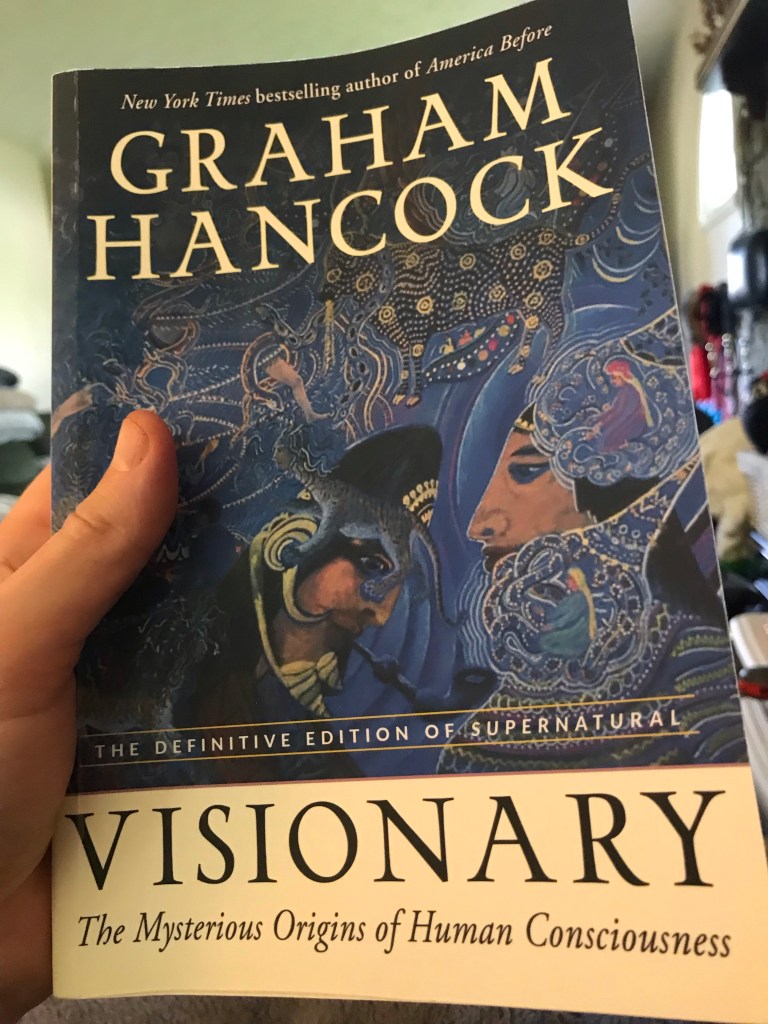
I do get excited about my books, and when I read a great one, I often talk about it extensively. Books are my favorite things in the world, I could never have enough of them, and they have been with me most of my life as priorities. But this year, I knew Graham Hancock was releasing an update to his famous book previously, called Supernatural, with the new title Visionary. It was coming out on April 4th, so I nabbed it up and treated myself to a birthday treat of reading it voraciously. I talk a lot about politics and education issues. Still, I enjoy no subject more than the pseudo-sciences, and Graham Hancock, the former journalist, turned pseudo-science investigator, is one of the best currently in the field. So for a birthday gift to myself, I gave myself a few weeks of April to just sit down and read his new book and soak it up because it’s one of those types of books. Actually, it has all the potential to be a life-changing book because it deals with the kind of stuff that is at the core of all human concerns. What were we before we were born, and what will we become after? What’s the point of it all. Now, I love Graham Hancock’s books. He and I have very close beliefs about bureaucracy’s effect on the sciences. He is into pseudo-science because traditional science, institutionalized, just does not keep pace with the rate of discovery that is occurring in this information age that we are in. Institutionalism is at war with the rate of understanding occurring, and they hate people like Graham Hancock. But Hancock brings his background as a journalist to science and takes what is known by traditional scientific discoveries and pieces everything together in a noninstitutionalized way, which is how things need to be done anyway. And as a result, he asks big questions seeking big answers to things. And for human beings, there is nothing more significant than how the spirit world interacts with the conscious world.
For many years I have talked about the role that ultraterrestrials play in our human lives. I had done many articles on the giant race of people who lived in the Ohio region well before the times of Jesus Christ and actually had an empire all the way to the Gulf of Mexico before what we know of as Native Americans were even on the world stage. They were as sophisticated as the Stonehenge and Avebury cultures in England and obviously were part of the same culture from the same time periods of influence. So Graham’s topics are not new to me. I learned about these giants while attending the Mothman Festival at Point Pleasant, West Virginia, so it’s a real thing that certainly is under-researched. Traditional science driven by the university system is just too slow. They are guarding too much of their previous assumptions actually to answer these kinds of questions, so that is where Graham Hancock comes in. After reading the book by John Keel on the Mothman Prophecies, I am quite certain that the ultraterrestrials talked about in that book, which Graham’s Visionary is essentially a sequel, the spirit world of angels and demons that so concern religions have shown themselves in stories chronicled in the work of John Keel so effectively. But he was just touching on the surface, and Graham Hancock has taken several additional steps toward unraveling these interdimensional worlds and how they interact with the world of the living and actually redefining what “dead” means.
Now, where Graham Hancock and I part ways is over the issue of drugs. I get his argument on the Pinery gland and how drugs can pull off the restrictor plate of brain activity to see things that are always there but that we filter out within the visual spectrum of our senses. He advocates for the open and legalized use of drugs to produce real hallucinogenic effects. Still, they are elements that our eyes can’t see because we live life in a four-dimensional world. I’m against all drugs, at any time, over anything. I don’t even take aspirin. I will occasionally sip on a beer socially, but nothing more, and I certainly never get intoxicated. But I am not closed off to his ideas that some of these drugs don’t produce hallucinations but are, in fact, reality seen for what they really are. This is why I was so interested in his book. I recently saw petroglyphs in New Mexico and Utah that were almost identical to known cave art in South Africa and Europe that span thousands of years from each other, and many thousands of miles of travel, so the cultures could not have been communicating 15,000 years ago or even 50,000. Yet they all tell similar stories painted on the rocks, and how they arrived at those images looks to be something Graham has pieced together correctly. He also puts UFO phenomena into the mix, which I had just had a research trip to Roswell fresh on my mind. So, his book reaffirmed many things that I had already been thinking about. And to add to that, he actually used ayahuasca and reported what he had seen, which was independent verification that he didn’t know he would experience. I wouldn’t do it, but I’m glad he was willing to report it scientifically instead of from the perspective of some drug-crazed lunatic.
There is a taco place I like to go to at The Greene in Dayton called Condado Tacos, and ayahuasca hallucinations obviously inspire the interior. Or is it hallucinations? Is it a reality? I think it’s reality personally, and I think when we talk about political elements, we have to understand that there is an influence from these places that run quantumly with our 4-dimensional existence. Remember, we mathematically know that our present universe supports 11 dimensions that are likely within our current reality. But, outside of our universe, there is a possibility of 26, and within each of those dimensions, likely lifeforms are interacting with us at all times. Our business is to understand these lifeforms, especially if they are interacting with us.
We may not have the eyes and ears to hear them, but our minds certainly do, even if remotely. And that’s not a very fair fight if they have an easier time at communicating than we do, and they take advantage of that aspect often to push the world where we may not want it to go. We might say it’s the will of the spirit world, but what if it’s a maleficent demon who wants to destroy the world and everyone in it. Do you really want to listen to it? Perhaps this is the kind of influence that has brought so much great evil into the world. Or, maybe this is where all the good is, and that the purpose of life is to build a great soul to travel in these realms as an individual instead of just a collection of cosmic dust, and that the act of creation is what matters, of life being a creative process that gives birth to a human soul that then sheds the body for this afterlife. And that the afterlife is just another life that is depicted on those walls at Condado’s in Dayton. I think perhaps so. But regardless, a great book like Visionary is a rare treat, and a journey I was happy to take, and one of the best birthday presents I have ever given to myself. Time and the content to think about that truly has meaning.
Rich Hoffman