NAGPRA: Worse than book burning–the Time Team shows how to do it right

As I reflect on this continuation of my birthday gift to myself—the deep dive into the Windover Archaeological Site and everything it represents—I can’t help but feel a profound sense of urgency mixed with frustration. My wife suggested we check it out because it tied directly into a project I was working on, and while I had heard about it before, seeing the exhibits up close and then immersing myself in the details through books like Glen H. Doran’s Windover: Multidisciplinary Investigations of an Early Archaic Florida Cemetery (published by the University Press of Florida in 2002) changed everything for me. That visit wasn’t just a casual outing; it was a revelation about what American archaeology could be and what it has become under policies that, in my view, prioritize political narratives over truth-seeking discovery. This is part two of that discussion, building on what I wrote earlier about the dig itself, but now zooming in on why the Native American Graves Protection and Repatriation Act—NAGPRA, which I’ve come to call the “Wolves Act” because of the cultural buzz around Dances with Wolves during its passage—needs to be repealed or fundamentally reformed. We should be following the example of Britain’s Time Team, not letting a 1990 law bury our history, as the developers and politicians did with that Florida pond after just three seasons of excavation.

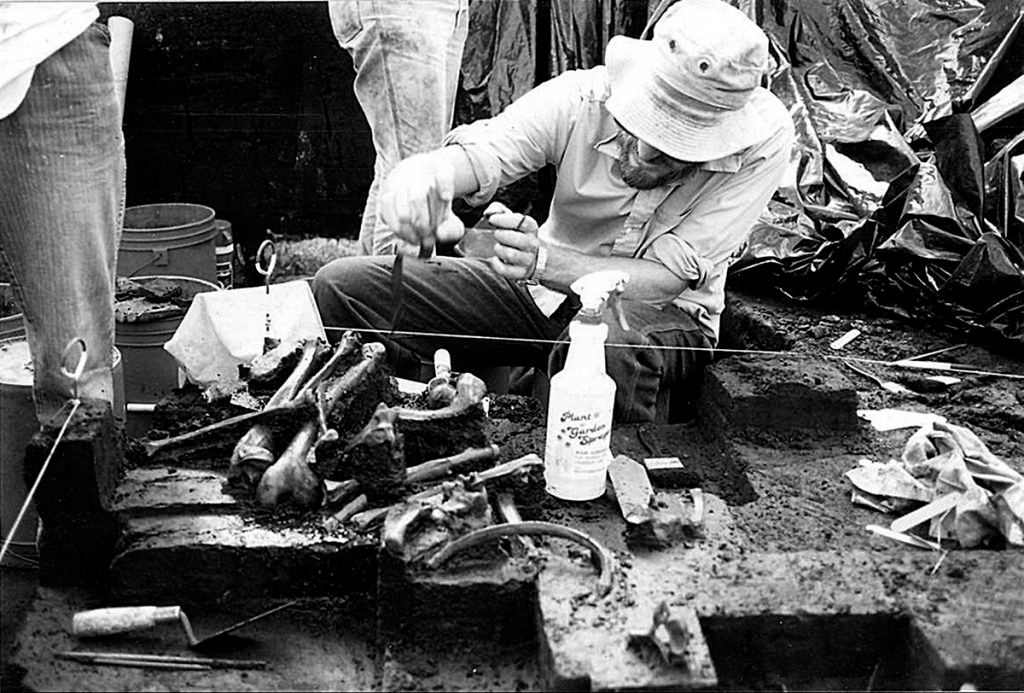
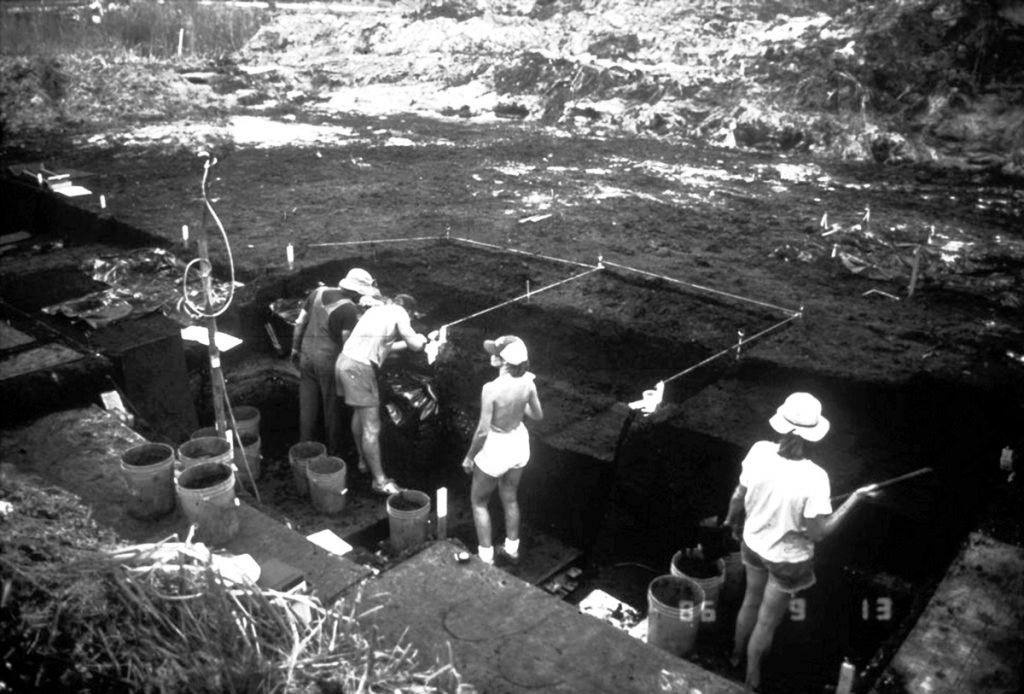
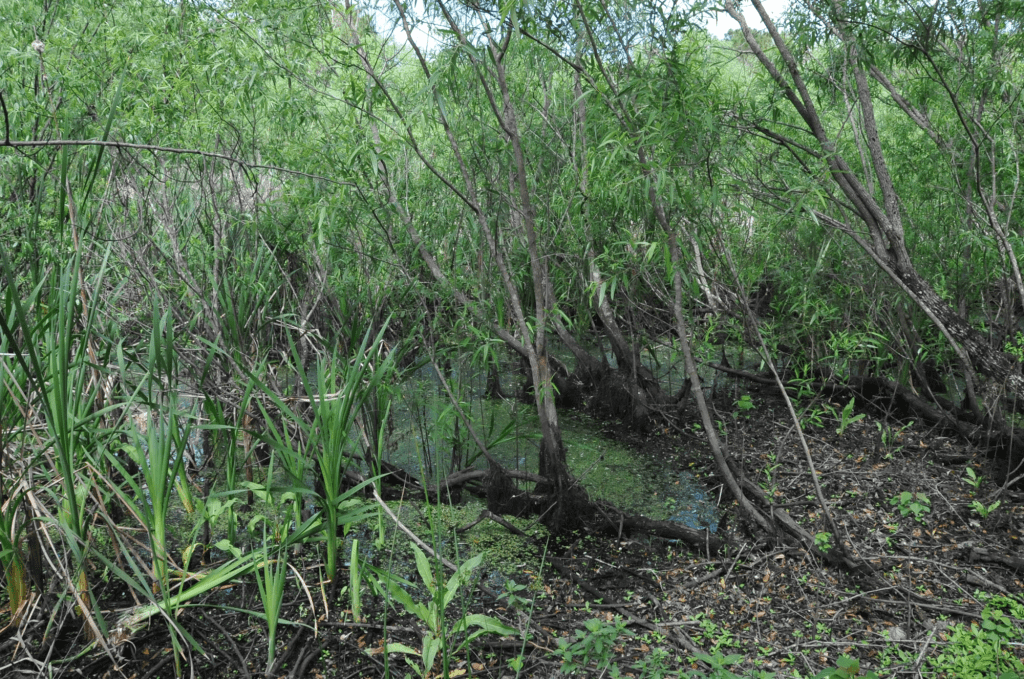
Let me start from the beginning of my personal connection to this. I remember driving out to the area near Titusville with my wife, the kind of trip where you expect a quiet museum stop but walk away astonished. The Windover site, discovered in 1982 during road construction for a housing development called Windover Farms, turned out to be one of the most significant archaeological finds in the Western Hemisphere. A backhoe operator scooped up skulls, and what followed was a frantic but methodical excavation led by Glen Doran from Florida State University between 1984 and 1986. They uncovered remains of about 168 individuals buried in a shallow pond that had become a natural peat bog, preserving everything from brain tissue—the oldest known in the world at the time—to intricate textiles, wooden artifacts, bone tools, and more. These people lived around 7,000 to 8,000 years ago in the Early Archaic period, long before what we think of as “Native American” tribes like the Cherokee or Seminole even formed as we know them today. The preservation was phenomenal because of the pond’s anaerobic conditions; it was like a time capsule from a world we barely understand.

Reading Doran’s book afterward felt like stepping into that excavation myself. It’s a multidisciplinary masterpiece—environmental analysis, radiocarbon dating, paleoethnobotany, DNA studies from the brain tissue, mortuary patterns, the works. They found the oldest woven fabrics in the Southeast, complex cordage, and evidence of sophisticated lifeways that challenge the simplistic “hunter-gatherer” stereotypes. My wife and I stood there in the museum exhibits, looking at replicas and displays (some now limited or relocated due to modern restrictions), and I kept thinking: This is North America’s equivalent of discovering a lost civilization, yet it barely registers in our national consciousness. Why? Because right around the time the final analyses were wrapping up, NAGPRA dropped in 1990 like a political hammer. The law was signed by President George H.W. Bush on November 16, 1990, after being introduced in the House by Democrat Mo Udall of Arizona. It sailed through on voice votes, with strong Democratic backing amid a wave of activism and cultural sentiment fueled by movies like Dances with Wolves, which painted indigenous peoples as noble victims of American aggression. I was living through that era, very aware of the buzz in Washington. I wasn’t a Bush fan—I voted against him, worked against him in the ’92 election, even flirted with the Reform Party because I saw him as a RINO continuing the same globalist, sovereignty-eroding policies Democrats had long championed. This wasn’t some Republican innovation; it was a bipartisan surrender to a narrative that America’s foundations were built on theft and needed constant atonement.

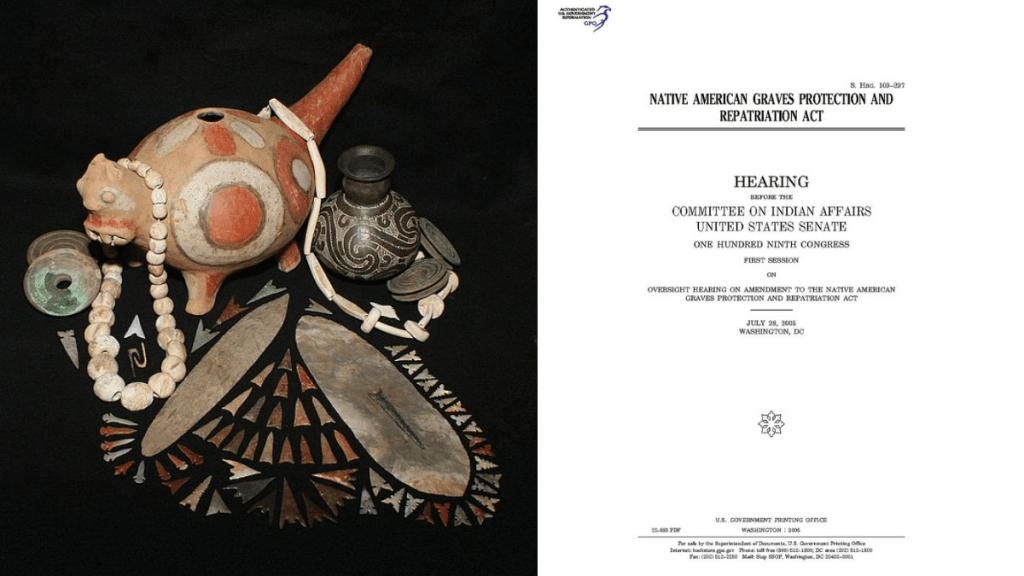
NAGPRA’s stated goal was to protect Native American graves, repatriate human remains and cultural items from museums and federal agencies to lineal descendants or culturally affiliated tribes. On paper, it sounds reasonable—addressing real historical wrongs like grave robbing in the 19th century. But in practice, and especially for ancient sites like Windover, it’s been devastating. The remains at Windover predate any known modern tribal affiliations by millennia. DNA studies from the site (what little could be done before restrictions tightened) showed haplogroups tracing back to ancient Asian migrations, but nothing that tied them neatly to today’s federally recognized tribes. Yet the law forces institutions like Florida State University to consult tribes, inventory collections, and often repatriate or rebury without full study. FSU has issued NAGPRA notices for some collections, and the process drags on, limiting further research. The pond was partially backfilled after the initial dig; half the cemetery remains untouched, not because the science was done, but because funding dried up amid the political winds. Developers and archaeologists knew what was coming, so they rushed what they could. Today, if a similar site were found, it might never see the light of day beyond a quick salvage operation before reburial. That’s not science; that’s erasure disguised as respect.  It’s equivalent to modern-day book burning, only the material is destroyed before we even have a chance to discover it. 

I’ve seen this pattern before, and it screams deliberate policy to undermine American sovereignty. Democrats have long used “victim” groups—indigenous peoples, in this case—as levers to dismantle narratives of Western expansion and self-reliance. NAGPRA wasn’t born in a vacuum; it was part of a broader 1990s push that included open-border sentiments and identity politics. The same era gave us policies questioning every aspect of American settlement, from land use to energy. Bush signed it, sure, but as a continuation of the previous administration’s trajectory. I stepped away from the GOP at the time because it felt like the party was complicit in weakening the republic from within. This law doesn’t just repatriate; it creates a framework in which federal recognition of tribes governs everything on or near federal lands, which is a huge chunk of the country. It turns archaeologists into bureaucrats navigating tribal consultations instead of digging for truth. And for sites with no clear affiliation—like the 8,000-year-old Windover bones, which likely belonged to pre-Clovis or early Archaic peoples who other groups later displaced—it effectively halts inquiry. How do you return remains to a tribe that didn’t exist yet? You don’t; you bury the evidence and pretend the history starts with the groups Democrats designate as “indigenous.”

This ties directly into the speculation about giants and multiple cultures in the Ohio Valley and Mississippi River mounds that I’ve pondered for years. Old newspaper accounts and 19th-century reports from the Smithsonian and others described oversized skulls and skeletons in Adena and Hopewell mounds—evidence, some say, of earlier populations. Modern archaeology dismisses much of it as exaggeration or hoaxes, but the pattern is suspicious: NAGPRA and similar policies make it risky even to revisit those claims with new tech like DNA. If there were prior cultures—perhaps Solutrean influences from Europe or other migrations predating the Beringia model—it challenges the singular “Native Americans as eternal stewards” narrative. Pre-Clovis sites like Buttermilk Creek in Texas (15,000+ years old) and genetic evidence of multiple waves into the Americas already poke holes in the old Clovis-first theory. Yet NAGPRA’s cultural affiliation rules often default to modern tribes, erasing the complexity. It’s the same playbook as border policies today: open the gates, label critics as aggressors, and rewrite the founding story to justify dismantling sovereignty. Democrats didn’t invent this overnight; it’s been their trajectory—using “aggrieved” groups to fracture the American experiment.

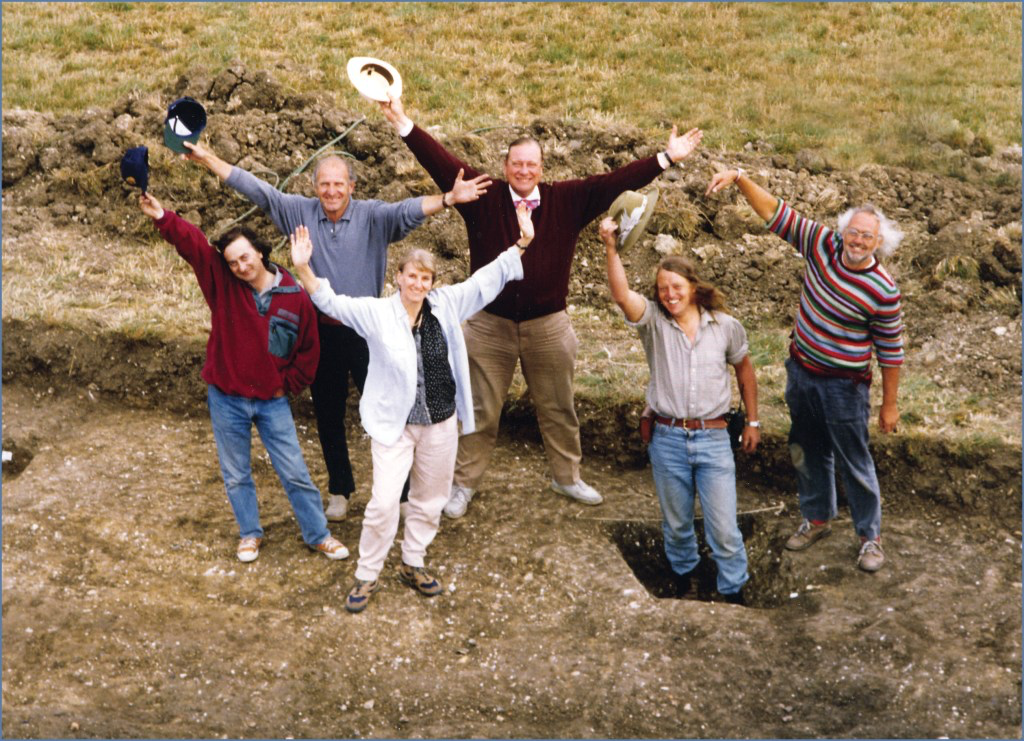
Compare that to what’s happening in Great Britain with Time Team. If you’ve never watched it, do yourself a favor—episodes are all over YouTube now, even after the show ended its main run on Channel 4. Hosted by Tony Robinson with archaeologists like Mick Aston, Phil Harding, and Carenza Lewis, it was a phenomenon from 1994 to 2014. They’d show up at a site—often tipped off by locals or metal detectorists—spend three days digging with geophysics, volunteers, and experts, then reveal everything from Roman villas to Neolithic tombs to medieval villages. No endless permits bogged down by politics; English Heritage and local councils supported it. The archaeologists became celebrities, the public ate it up, and it funded real research while turning history into entertainment. They published scientific papers too—more than some university departments. Stonehenge, Hadrian’s Wall, Roman baths: Britain celebrates layer upon layer of its past, from Mesolithic to medieval, without erasing any group. Bones from Iron Age, Bronze Age, or Roman contexts are studied for diet, disease, migration—not reburied to appease a modern political framework. It’s respectful scholarship that builds national pride, not guilt. I’ve been to England; their heritage sites are tourist magnets, economic engines, and educational goldmines. Archaeologists there are rock stars, not bureaucrats.

Why can’t we do that here? Japan has underwater sites off the coast of Osaka; China guards its ancient tombs but still excavates selectively. Even in the volatile Middle East, guys like Joel Kramer on his Expedition Bible YouTube channel navigate borders, checkpoints, and regimes to document sites from Sodom to Shiloh. His book Where God Came Down is a masterclass in persistence amid obstacles. The Biblical Archaeology Society and Biblical Archaeology Review fight for dig seasons in Israel despite political minefields—hostile neighbors, military oversight, and permit battles. Yet they publish voraciously because the region’s history is too vital to bury. In the U.S., we have a free country, capital markets, and vast untouched potential—from Florida ponds to Ohio mounds to underwater sites off the coasts—and we tie our hands with NAGPRA. Developers bulldoze sites quietly to avoid red tape; museums shelve collections. The Windover team saw the writing on the wall and wrapped up just as the law hit. The 2002 book exists as a snapshot of what was possible pre-NAGPRA; post-law, that level of open inquiry is gone.

This isn’t abstract. It harms research into who we really are as Americans. Western expansion wasn’t just conquest; it was building on layers of human history, some of which involved the displacement of earlier groups by later ones—just like everywhere else on Earth. Suppressing that validates a one-sided story used to push globalist agendas: open borders, energy restrictions framed as “respecting the land,” and centralized control. The same forces behind NAGPRA cheer solar mandates while demonizing natural gas and erasing our industrial heritage, just as they erase pre-Columbian complexity. I’ve said it before in my writings and streams: Rumble and independent platforms are game-changers because legacy media conceals this. There’s no evidence of giants or advanced pre-Native societies, they claim—yet policies prevent the digs that could prove or disprove it. Old Smithsonian reports from the 1800s detailed large skeletons in mounds; modern DNA from Hopewell and Adena sites shows continuity with later Native groups but also hints of admixture. Why not let the marketplace of ideas decide through open science?

Imagine an American Time Team. Archaeologists as celebrities on the Discovery Channel, live digs at mound sites or Florida bogs, public volunteers, and tourist revenue fund more work. Stonehenge draws millions; why not make Windover or Serpent Mound a Disney-level attraction with VR reconstructions, exhibits, and ongoing excavations? We have the capital, the freedom, the talent. Instead, we have rogue developers destroying sites, and universities complying with repatriation, which halts study. FSU still holds some Windover materials, but NAGPRA inventories and consultations limit what can be done. Rachel Wentz’s popular book Life and Death at Windover captures the human story—families, health, rituals—but even that feels like a last gasp before the freeze.

Repealing or reforming NAGPRA for remains older than, say, 5,000 years—where affiliation is impossible—would be a start. Treat ancient bones like science treats Ötzi the Iceman in Europe: study, learn, share. Respect living tribes’ concerns for recent remains, but don’t let it blanket 15,000 years of migration and replacement. England’s approach proves you can honor the dead without erasing history. Their Time Team episodes on Roman occupation or Neolithic life don’t undermine modern Britain; they enrich it. We need that here—full stop.

My effort in writing this and in pushing these ideas on my platforms stems from that museum visit and the book that followed. It’s personal: I want my kids and grandkids to know the full story of this continent, not a sanitized version designed to undermine the republic. The Windover discovery was a window—a fantastic, irreplaceable one—into a sophisticated past. NAGPRA closed it. Democrats knew what they were doing in 1990, riding the Dances with Wolves wave to frame America as a perpetual aggressor. Republicans like Bush went along. It’s the same game as today’s policies. We deserve better: open archaeology, public celebration, evidence wherever it leads. Let’s make American digs rock stars again. The Time Team model isn’t just British; it’s what humanity needs. And it starts by repealing the laws that bury our past to serve political ends.

Footnotes

1.  Glen H. Doran, ed., Windover: Multidisciplinary Investigations of an Early Archaic Florida Cemetery (University Press of Florida, 2002). Core source for site details, artifacts, and analyses.

2.  Rachel Wentz, Life and Death at Windover: Excavations of a 7,000-Year-Old Pond Cemetery (personal accounts and bioarchaeology).

3.  Native American Graves Protection and Repatriation Act, Pub. L. 101-601 (1990). Legislative history via Congress.gov; signed by GHW Bush.

4.  Time Team episodes, Channel 4 (UK), available on YouTube; see also English Heritage reports on public archaeology impact.

5.  Joel P. Kramer, Where God Came Down: The Archaeological Evidence (Expedition Bible publications); YouTube channel documents border and access challenges.

6.  Biblical Archaeology Review archives detail permit struggles in the Holy Land due to geopolitics.

7.  Pre-Clovis and migration studies: e.g., Waters et al. on Buttermilk Creek (Science, 2011); ancient DNA papers in PNAS and Nature on multiple waves.

8.  Historical mound reports: 19th-century Smithsonian and newspaper accounts (contextualized in modern critiques); DNA from Hopewell sites (Ohio History Connection studies).

Bibliography for Further Reading

•  Doran, Glen H., ed. Windover: Multidisciplinary Investigations of an Early Archaic Florida Cemetery. University Press of Florida, 2002.

•  Wentz, Rachel. Life and Death at Windover. University Press of Florida (related publications).

•  U.S. Congress. Native American Graves Protection and Repatriation Act (NAGPRA), 25 U.S.C. 3001 et seq. (1990).

•  Robinson, Tony, et al. Time Team series (1994–2014). Channel 4; scientific outputs summarized in Current Archaeology and English Heritage reports.

•  Kramer, Joel P. Where God Came Down. Expedition Bible, 2022 (approx.).

•  Biblical Archaeology Society. Biblical Archaeology Review (ongoing issues on global dig challenges).

•  Waters, Michael R., et al. “The Buttermilk Creek Complex and the Origins of Clovis at the Debra L. Friedkin Site, Texas.” Science, 2011.

•  Mills, Lisa A. “Ancient DNA from the Ohio Hopewell.” Ohio History Connection research.

•  ProPublica/NBC investigations on NAGPRA implementation (2023 reports on repatriation delays and impacts).

•  Additional: Federal Register notices on FSU NAGPRA inventories (2021+); Archaeological Conservancy site profiles on Windover.

Rich Hoffman

More about me

Click Here to Protect Yourself with Second Call Defense https://www.secondcalldefense.org/?affiliate=20707

About the Author: Rich Hoffman

Rich Hoffman is an aerospace executive, political strategist, systems thinker, and independent researcher of ancient history, the paranormal, and the Dead Sea Scrolls tradition. His life in high‑stakes manufacturing, high‑level politics, and cross‑functional crisis management gives him a field‑tested understanding of power — both human and unseen.

He has advised candidates, executives, and public leaders, while conducting deep, hands‑on exploration of archaeological and supernatural hotspots across the world.

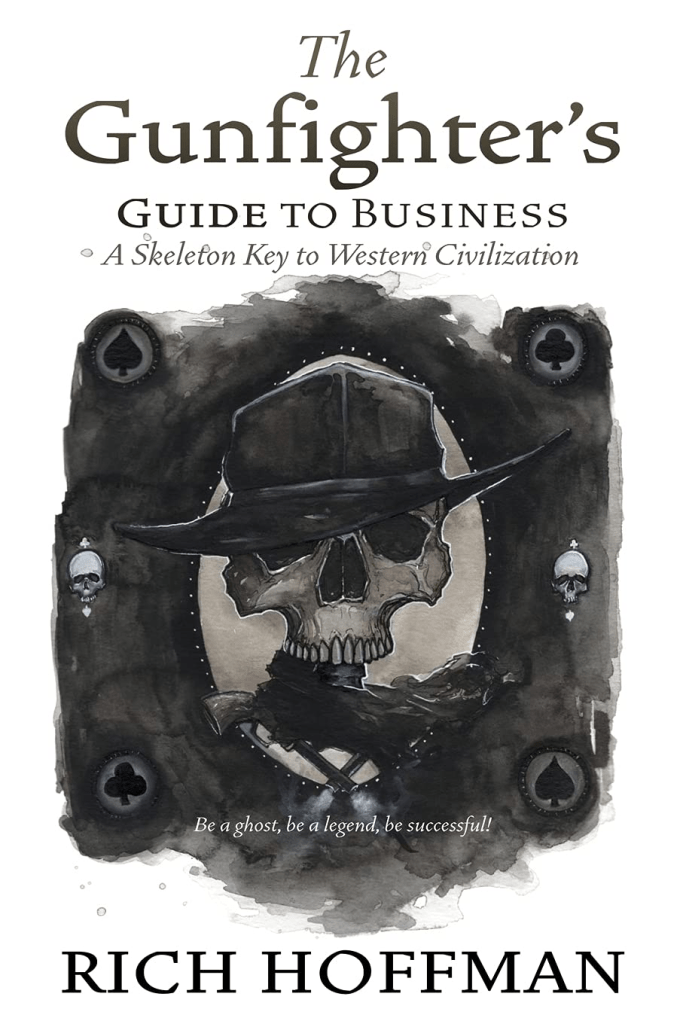
Hoffman writes with the credibility of a problem-solver, the curiosity of an archaeologist, and the courage of a frontline witness who has gone to very scary places and reported what lurked there. Hoffman has authored books including The Symposium of JusticeThe Gunfighter’s Guide to Business, and Tail of the Dragon, often exploring themes of freedom, individual will, and societal structures through a lens influenced by philosophy (e.g., Nietzschean overman concepts) and current events.

The Hidden Library of Ecuador: Another block falling away from Disclosure

The narrative surrounding Erich von Däniken’s The Gold of the Gods (1973) exemplifies how speculative literature can propel real-world exploration, blending pseudoscience with genuine adventure and leaving enduring questions about hidden histories. Von Däniken’s book amplified claims originating from Juan Moricz, who described discovering artificial tunnels, gold artifacts, peculiar sculptures, and a “metallic library” of inscribed plates—potentially chronicling ancient knowledge or extraterrestrial intervention—within Ecuador’s Cueva de los Tayos, a sprawling natural cave system in the Morona-Santiago province amid the eastern Andean foothills. These assertions tied into von Däniken’s broader ancient astronaut hypothesis, suggesting advanced civilizations received extraterrestrial aid, and the book’s bestseller status amplified global fascination with the Amazon’s subterranean mysteries.

The claims directly catalyzed the most ambitious investigation of the site: the 1976 Anglo-Ecuadorian expedition, orchestrated by Scottish civil engineer and explorer Stan Hall. Inspired by von Däniken’s account, Hall secured backing from the governments of Ecuador and the United Kingdom, assembling a formidable team of more than 100 members. This included speleologists, archaeologists, geologists, biologists, film crews, and logistical support from British and Ecuadorian military forces—joint special forces handled security, helicopter transport, and clearing landing zones in dense jungle terrain. The operation, one of the largest and costliest cave explorations ever mounted, transported 45 tons of equipment and provisions into remote wilderness. At its helm as Honorary President stood Neil Armstrong, the first human to walk on the Moon in 1969 during Apollo 11. Armstrong, who had retired from NASA but retained an insatiable curiosity for uncharted frontiers, accepted Hall’s invitation—partly due to shared Scottish ancestral ties (Hall hailed from Dollar, near Armstrong’s family roots in Clackmannanshire). Armstrong’s participation lent unparalleled credibility, drawing media attention and underscoring the expedition’s serious intent beyond mere sensationalism.

The mission unfolded amid challenging conditions: participants descended via vine ladders or ropes through vertiginous entrances, including a primary 213-foot (65-meter) vertical shaft leading to vast chambers—one measuring 295 by 787 feet—and passages extending at least 4-5 km (with more potentially unmapped). The team employed rigorous scientific protocols, mapping the karstic limestone-sandstone system, documenting unique ecology (such as colonies of oilbirds, whose eerie screams echoed through the darkness, alongside newly identified species of bats, butterflies, and beetles), and recovering archaeological evidence. Artifacts and human remains dated to approximately 3500 BCE confirmed ancient indigenous use, likely for rituals or shelter, while natural formations like the symmetrical “Moricz Portal” briefly mimicked artificial construction before geological analysis affirmed their natural origins.

Despite exhaustive searches—no metallic library, gold mounds, inscribed plates, or extraterrestrial artifacts emerged—the expedition yielded substantial value. It advanced speleological knowledge, cataloged biodiversity, and highlighted human historical engagement with the cave. Armstrong, ever the reserved engineer, participated actively in descents and surveys, reportedly expressing profound satisfaction with the endeavor. Accounts from expedition members and later reflections suggest he viewed the underground journey as comparable in exploratory thrill to his lunar experience—entering unknown territories, confronting isolation, and learning anew. One reported remark framed both as profound encounters with the uncharted: ascending to the Moon and descending into Earth’s depths represented complementary frontiers of human inquiry. Though Armstrong remained characteristically private, avoiding extensive public commentary, his involvement spoke to a lifelong pursuit of discovery beyond fame.

Armstrong’s post-Apollo life reflected this exploratory ethos, often intersecting with mysteries and anomalies that fueled speculation. While mainstream records show no verified extraterrestrial encounters during Apollo 11—claims of UFOs trailing the spacecraft or structures on the lunar surface stem from hoaxes (e.g., those propagated by science fiction writer Otto Binder) or misinterpretations (jettisoned panels matching the craft’s velocity)—persistent rumors have linked his reticence to unspoken observations. Some narratives suggest the lunar mission’s isolation, the stark desolation of the regolith, or fleeting visual phenomena (like transient flashes reported by astronauts across missions) left lasting impressions. Armstrong’s reclusive retirement—avoiding interviews, shunning celebrity, and focusing on teaching aeronautics—has been interpreted by some as evidence of deeper reflections on cosmic unknowns, though he consistently emphasized scientific rigor over speculation.

His Tayos participation fits this pattern: drawn to a site steeped in legend, he approached it methodically, prioritizing evidence over myth. The expedition’s “failure” to locate von Däniken’s treasures did not diminish its legacy; instead, it exemplified how adventurous inquiry, even when debunking exaggeration, advances knowledge. The Shuar people, traditional stewards of the region with historical warrior practices including headhunting and tsantsa creation, likely influenced outcomes—guiding teams to accessible areas while protecting sacred or sensitive zones, contributing to incomplete searches amid cultural secrecy and remote dangers (jungle hazards, cartel-adjacent violence in parts of the Amazon).

Contemporary tools like LiDAR continue to validate the potential for hidden layers in such landscapes. Recent surveys in Ecuador’s Upano Valley revealed extensive pre-Columbian networks—platforms, roads, and settlements dating to 500 BCE—buried beneath the canopy, reshaping views of Amazonian complexity. Parallel discoveries in Peru, Bolivia, and Brazil uncover engineered features that align with indigenous lore, suggesting that legends like Tayos may encode real, undiscovered elements. Adjacent caves or modifications near Tayos could await detection, as LiDAR penetrates vegetation and soil anomalies.

Later explorations, including Josh Gates’ 2018 Expedition Unknown revisit with Shuar collaboration, employed drones and scanning to expand mapped areas, uncovering more tools and ceramics, but no library. Ongoing efforts propose UNESCO recognition of the Tayos as a natural and cultural geosite.

Von Däniken’s work, though critiqued for embellishment, ignited healthy debate and mobilization. It parallels transformative finds like the Dead Sea Scrolls, which authenticated ancient texts yet revealed only fragments of broader histories. The Amazon’s emerging record—vast subterranean and surface engineering—hints at greater mysteries, accessible through funded, technology-driven research.

In an era of accelerating disclosure through remote sensing and interdisciplinary collaboration, such stories highlight the interplay between speculation and science. Questioning narratives, when grounded in boots-on-the-ground verification, propels understanding of shared planetary history—preparing humanity for future frontiers, from Earth’s depths to space.  But with all that said, I think the library is still out there, not unlike what von Däniken proposed in his original text.  There is a lot hidden, sometimes in plain sight.  And when you have headhunters as your guides, I don’t think enough people questioned their methods of direction.  And that they well know of other caves in the area still hidden, and under their protection. And that with just a little bit of looking, we’ll find it.  And a whole lot more.

Bibliography / Further Reading

•  von Däniken, Erich. The Gold of the Gods. Putnam, 1973.

•  Hall, Stan. Tayos Gold: The Archives of Atlantis. The Athol Press, 2006.

•  Rostain, Stéphen et al. “2000 years of garden urbanism in the upper Amazon.” Science, vol. 383, no. 6679, 2024.

•  Wikipedia contributors. “Cueva de los Tayos.” Wikipedia.

•  Tayos.org (expedition archives).

•  Expedition Unknown, “Hunt for the Metal Library” (2018).

•  Toulkeridis, Theofilos. Geological studies on Tayos karst.

•  Atlas Obscura, “Cueva de los Tayos.”

•  Outside Online, “A Journey Inside the World’s Most Mysterious Cave” (2020).

•  Ancient Origins, Tayos expedition coverage.

Footnotes

1.  Von Däniken, The Gold of the Gods; Wikipedia, “Cueva de los Tayos.”

2.  Jason Colavito analyses: archaeological consensus.

3.  Tayos.org; BBC Mundo on Armstrong.

4.  Hall, Tayos Gold; Outside Online.

5.  Atlas Obscura; Ecuador Eco Adventure on Shuar.

6.  Expedition Unknown summaries.

7.  ResearchGate geosite proposals.

8.  Science 2024; BBC/Guardian Upano coverage.

9.  Smithsonian, Nature on Amazon LiDAR.

10.  Historical parallels; disclosure themes in exploration literature.

Rich Hoffman

More about me

Click Here to Protect Yourself with Second Call Defense https://www.secondcalldefense.org/?affiliate=20707

Josh Gates and the Secrets of All Civilization: Why the World Economic Forum is involved in the ancient site of Gobekli Tepe

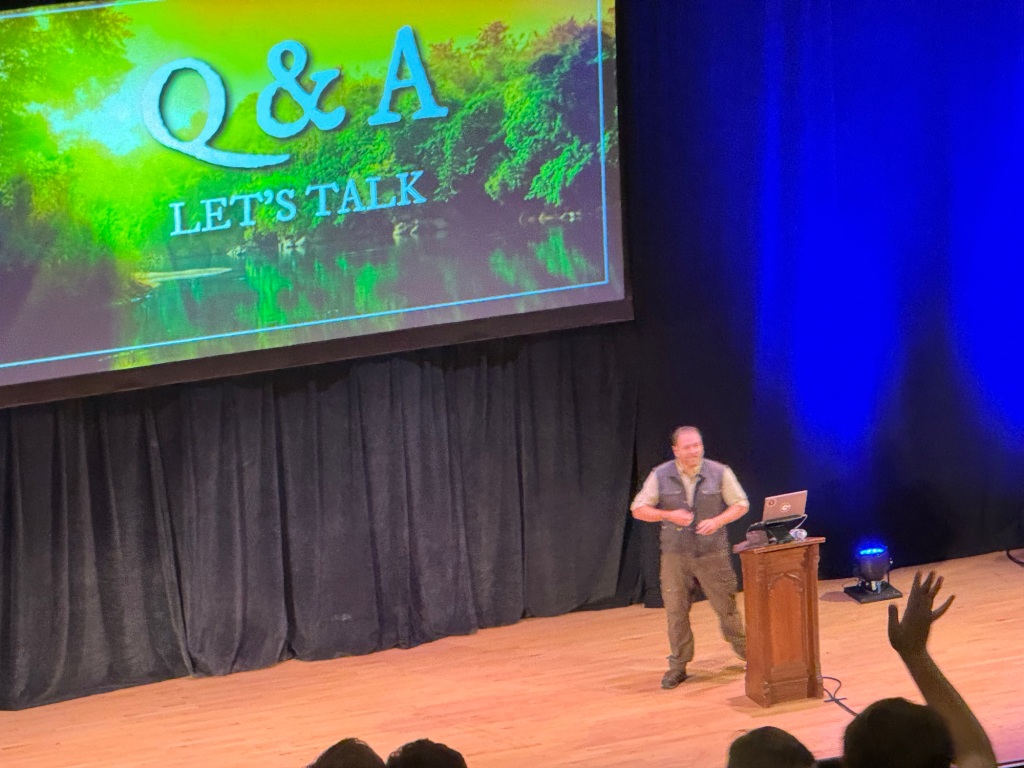
I do a lot of important things over a week.  But as I told my kids while we were in line to get into the Josh Gates Live: An Evening of Legends, Mysteries, and Tales of Adventure at the Taft Theater in downtown Cincinnati, nothing was more important than the three of us going there together while my wife watched all the grandkids.  My kids grew up on Josh Gates, and more specifically, Indiana Jones, who obviously very much inspired Josh Gates. It was important in ways that most people don’t measure things.  Specifically, I wanted to know a few things about Josh Gates in person that don’t come through the editing of his many thousands and thousands of television shows and interactions through the filter of social media.  Josh Gates is a very talented and good guy who has done much with a quirky in-between media lifestyle.  My family has immensely enjoyed his trips around the world.  My kids were interested in going, so I bought some tickets, not knowing what to expect from a live show.  But I did get my answers, answered.  And it’s not so much what he said, but what he didn’t say as a very successful producer of several shows on Discovery Channel and the Sci-Fi Channel over the years.  He’s seen everywhere on earth, all the various political systems, and conducted paranormal research in some of the most haunted places in the world.  But as I spent time with my kids for that evening in Cincinnati and ran into a surprising number of people I have known over the years, as the place was packed, I was thinking of a video my youngest daughter had sent me by Jimmey Corsetti at Bright Insight, a video channel dedicated to the next generation Josh Gates, Graham Hancock type of material that permeates the foundation of everything and leads right to the doorstep of the World Economic Forum.  So, there was a lot to unpack as the lights dimmed, and Josh Gates came out with a roaring applause to confirm a mystery I had long been wondering about.  And it turned out to be a fantastic evening.

At the end of the night, Josh Gates answered a question from the audience: does he believe in the paranormal after all his adventures? His answer was a cryptic one; my interpretation of it was that there was a social narrative driving the finance industry to not discuss their fingerprints in the activities that most haunt the human race.  Josh Gates is a mainstream guy who gets to fly worldwide, filming exciting television.   But he has had to make a deal with the many devils of that industry who like the ratings, but it’s best to always keep the answers just out of reach of the audience as the Oak Island show does.  Take people on an adventure and show them lots of exciting stuff.  But don’t bring meaning or personal opinions into it; we’ll fund your shows.  Let people ask questions, but never give them the answer.  It’s the way that people who want to control other people control other people, which is why, as Josh Gates was talking, I was thinking of that Bright Insight segment that featured why Gobekli Tepe in Turkey was being protected for tourism by the World Economic Forum disguised as helpful, but in truth, it is to prevent further excavations that show just how advanced humanity has been for over 10,000 years now.  As a professional, Josh knows where the lines are, and he stays within them even if there is plenty of evidence that shows just how mysterious the world is. 

Josh Gates gave an excellent answer to the audience when he answered that what matters in all these adventures is the stories, not so much how true they are.  Philosophically, reality can be decided by all kinds of circumstances.  However, the value of a story in unlocking the brain is ultimately more important.  I was thinking of many mysteries that personally bother me because I know there is a significant game of control trying to keep all humankind from discovering their true origins.  Most wars are about keeping everyone so unstable that the official narrative of human existence can be contained in a narrative controlled by those who want to rule the world.  I didn’t get to answer Josh Gates when he asked the audience what he should explore paranormally in Cincinnati if he were to try after a person from the audience asked him.  I would have told him that most of the downtown area of Cincinnati is deeply haunted and has been long before the city was ever built, especially along 5th Street.  Fountain Square and Jeff Ruby’s Steakhouse in the center of the town are built over the locations of a giant Indian Mound that was destroyed to create the city, so the whole area has deep ties to a paranormal world that is much older than many people think.  Including the Taft Theater where we were.  One of the people I know who went there and talked to me the day after received a tour of the place, not realizing she was a ghost.  She’s been there for years and haunts people often, disguising herself as a helpful usher.  But for no reason at all, she took him and his wife on a tour of the whole place and showed him where all the people who had died in the building still resided.  I believed his story, quite certainly.  I have some “experiences” at the Masonic lodge near the P&G headquarters that more than confirm the presence of lots of paranormal activity.  That whole street from Mt. Adams to the Museum Center is a haunted hot spot, and Josh Gates could have an exciting show there.  But my only question to the storyteller was, “Did she show you where the bathroom was?” 

Adventure has many layers, and I do travel and see things for myself.  I admire how much Gates has been able to travel and return to tell about it.  My family loves to travel, and we try to travel together as much as possible.  However, few people worldwide have traveled as much as Josh Gates; his perspective is important.  We live in a haunted world, hiding deep mysteries that are being kept from us deliberately to maintain a social order conducive to the rule of a narrow band of aristocrats to maintain an illusion of ruling over us.  And that is why the World Economic Forum communists are suppressing further investigations at Gobekli Tepe and many other historic sites around the world. It’s the same attitude they have in China, where many of the world’s biggest mysteries can’t even make it out of the communist media market.  They want to be the god their public worships; they don’t want their people to know much about their past.  So, the real fight in the world is between this knowledge of more and the people who want to rule and try to control the narrative.  Josh Gates said that his job is to show people many exciting places.  And that the value of those places is in the stories they tell.  Through those stories, you can learn the truth about things you otherwise wouldn’t have.  But the real essence of the mysteries is under the world’s political order, which is where my interest is.  And I got more out of that little event than I would have thought, and it was a wonderful evening.  Josh Gates is a wonderful dude. 

Rich Hoffman

Click Here to Protect Yourself with Second Call Defense https://www.secondcalldefense.org/?affiliate=20707

Let’s Talk About God: Understanding the Politics of Heaven

For further conversations, it’s time to talk seriously about God and the politics of Heaven and, in general, everlasting life.  A lot of people think that death is the end of it all, but I would argue that it’s just the beginning, and part of the point of life is to grow into something that can function well in the existence of a multidimensional political universe, because as it is in Heaven, so it is on Earth.  The original sin was that God created man in his image because he wanted a family who would rule on his behalf over the Earth in ways that always had the eternal perspective in mind, and in that way, humanity was created to be over angels and demons relative to the Divine Council as it is talked about in the Bible many places, especially Psalm 82.  This is important because to understand the fight we have today, politically, we have to get our minds around the concept of God and not think of him as a solitary figure sitting on a thrown in everlasting life waiting for everyone to go to Heaven and sit around in the pearly gates to do “something” for the rest of eternity.  We tend to view Heaven as a destination at the end of the tunnel of life.  But I think that’s just where the battles begin, and what we see on earth are reflections of that eternal life, and God, Yahweh, has always been under pressure to manage the vast populations of eternal existence.  And that is why the Fall in the Garden was such a tragic occasion for him, which he has spent many thousands of years trying to resolve to his satisfaction.  That might seem strange for an entity that created the universe and everything in it.  But there is more to the story regarding the challenge of free will that is ultimately the point. 

We all know the story of the Garden of Eden, where the snake tempted Eve to eat from the Tree of Good and Evil.  This is the fruit of the lesser Gods, those in the pantheon at that time, for which Yahweh managed within this universal spectrum but constantly tried to undermine his authority.  Those Gods would be characters who had been around for many tens of thousands of years before the biblical period we are talking about here, gods like Baal, Moloch, Ishtar, Marduk, and a long list of the same names that would be called other names in other countries such as Greece, Egypt, and the Americas, but would be the same essential characters.  Yahweh was trying to do something different, and the rebellion on the Divine Council was certainly intent to challenge his authority, just as we see in our political order, which we can say reflects the actions of eternal life.  Of course, once God’s creation had eaten from the Tree of Knowledge of Good and Evil and become like “them,” the gods of the Divine Council, they had to be cast away for God to try again and again to make the human experiment work by comprehending the aspects of Eternal Life that God intended for humanity.  Not the kind of stuff they teach you in Sunday school or Church.  But if you dig into scripture and read what it tells us from thousands of years of interpretation and analysis, things start to appear much more as they indeed are. In that case, the world opens up much differently for those with the courage to eat from that Tree of Eternal Life. 

Humans couldn’t handle such a task, so they were thrown out of the Garden guarded now by Cherubim, creatures that have a recurring theme in ancient times.  And eventually, because they fell from grace and were now functioning in the politics of the lesser Gods, such as Baal, God wiped them all away with the flood story, which is very much the same story we find in the Epic of Gilgamesh.  Noah and his family are God’s chosen people, and they try to start the Garden story once more.  Only to fail when people attempted to build the Tower of Babel, again setting their sights on the kind of mistakes the Divine Council had made for thousands of years.  God came along and scrambled their speech so they could no longer build the Tower of Babel to reach Heaven.  And Yahweh sent them to the corners of the earth to separate them politically from one another.  But God doesn’t give up on this experiment with humans. Instead, he turns to Abraham and decides to make a new people from his line, which becomes the generations of Israel, Moses, King David, King Solomon, and the like.  But again, once Solomon died, his children fell to the temptations of Baal and the gang, so God allowed Nebuchadnezzar to raid his people and punish them for their discourse, which was their political alignment and worship of the lesser gods of the Divine Council.  Understanding that Divine Council, it helps to read from the ancient literature that comes out of Syria and modern-day Iraq.  No wonder those areas are war-torn today; the conflict is a mask of the truth.  Governments always want to think they are in charge as they completely are creatures eating from the Tree of Knowledge of Good and Evil.  From there, after 70 years, God allows the people of Israel to rebuild and continue again, but of course, they fail, so he sends Jesus, his representation on earth, to be sacrificed like just another lamb out of Nazareth to solve the political problem with that Divine Council once and for all.

God’s problem, which is eternal, is how to get people to do the right thing of their own free will.  God could undoubtedly punish them and impose his desires through force.  But the divine experiment and the intentions of God’s purpose, and therefore, the meaning of life, is to create religious partners who can function for what’s right as interpreted by an eternal perspective.  Not to eat from the Tree of Knowledge of Good and Evil, the political world of the Divine Council.  But the infinite aspects of all existence, as the universe knows and understands it.  God was looking for reflections of him and his intent to do on Earth as it is in Heaven and to share rule with such creations.  To say God has struggled with the Divine Council might seem odd, but the problem is free will, whether talking about people or angels, demons, and the pantheon of maniacal characters of eternal existence.  Life and death is not the goal of these considerations, but free will is.  And it is free will that is at the core of the American experiment, and it is the suppression of that free will that the world is attempting to stop presently in our political world.  But the root cause of the problem is an ancient one, considering the fall in the garden and why it was so tragic to God.  Because the politics of the Divine Council sought to corrupt the effort from the beginning, those characters would not allow God to create beings superior to them, such as humans were designed to be.  To hatch from life into death as reflections of God himself and to rule over the Divine Council.  And once that is understood, much of the trouble of our current time can be comprehended more fully.

Rich Hoffman

The Mystery of Mt. Brilliant: Archaeological evidence of an ancient city under modern day Lexington, Kentucky

Reports were coming in from all over the strange new land of America that similar to the ruins of Greece and Rome, this new world had watched many cultures rise and fall.  A mysterious people called Indians were presently occupying the west relative to Washington City where Thomas Jefferson was president and very curious about the history that lay beyond sight.  Staving off an attempt by his former vice-president to split the union Jefferson had ordered the arrest of Aaron Burr and his financier the Illuminati member Harman Blennerhassett.  Blennerhassett a lover of the occult built his home in the middle of the earthen mounds of his fascination in Marietta, and the various structures in West Virginia likely sought protective council during the winter solstice of 1806 in a graveyard of buried giants that had resided undisturbed before being destroyed by the building of Augusta, Kentucky.  Among his beliefs was that the spirit of the ancients might answer his desperate call.  There is a belief within some of these cult groups that such ancient locations beheld magical properties and could draw on the spirits of the dead to assist with the living—if the proper sacrifices to the proper gods were made.  In association with the lost race of Augusta Giants which Blennerhassett knew of for his mysterious summit with destiny was the 1783 reports coming in from Thomas Ashe from his 1806 book Travels in America.  In that book came the report of an ancient race of people who had settled in the area where Lexington was being built and the ruins there dwarfed much of what was being discovered in and around Ohio.  Click to review a previous article on this topic for a proper back story.

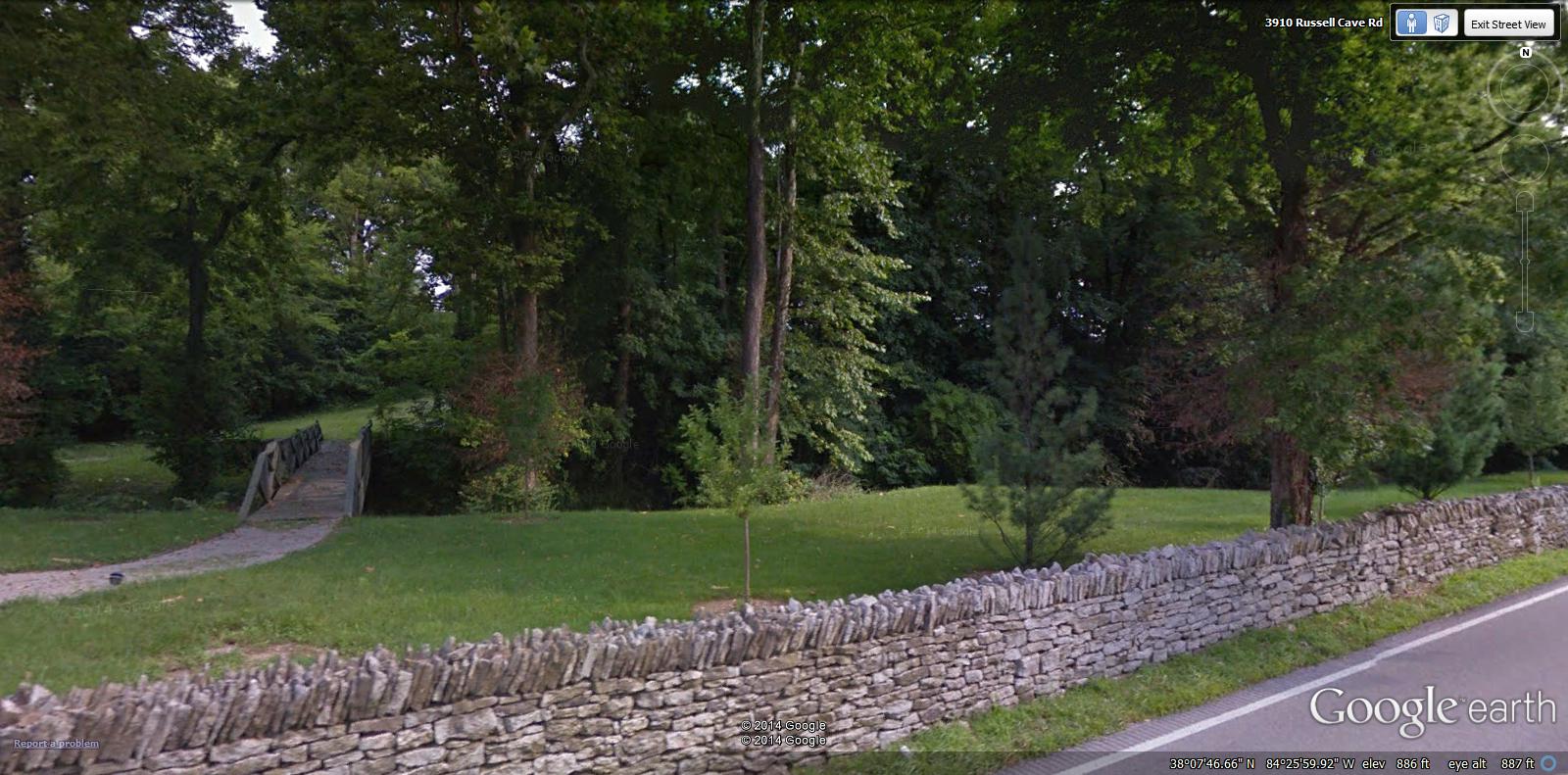
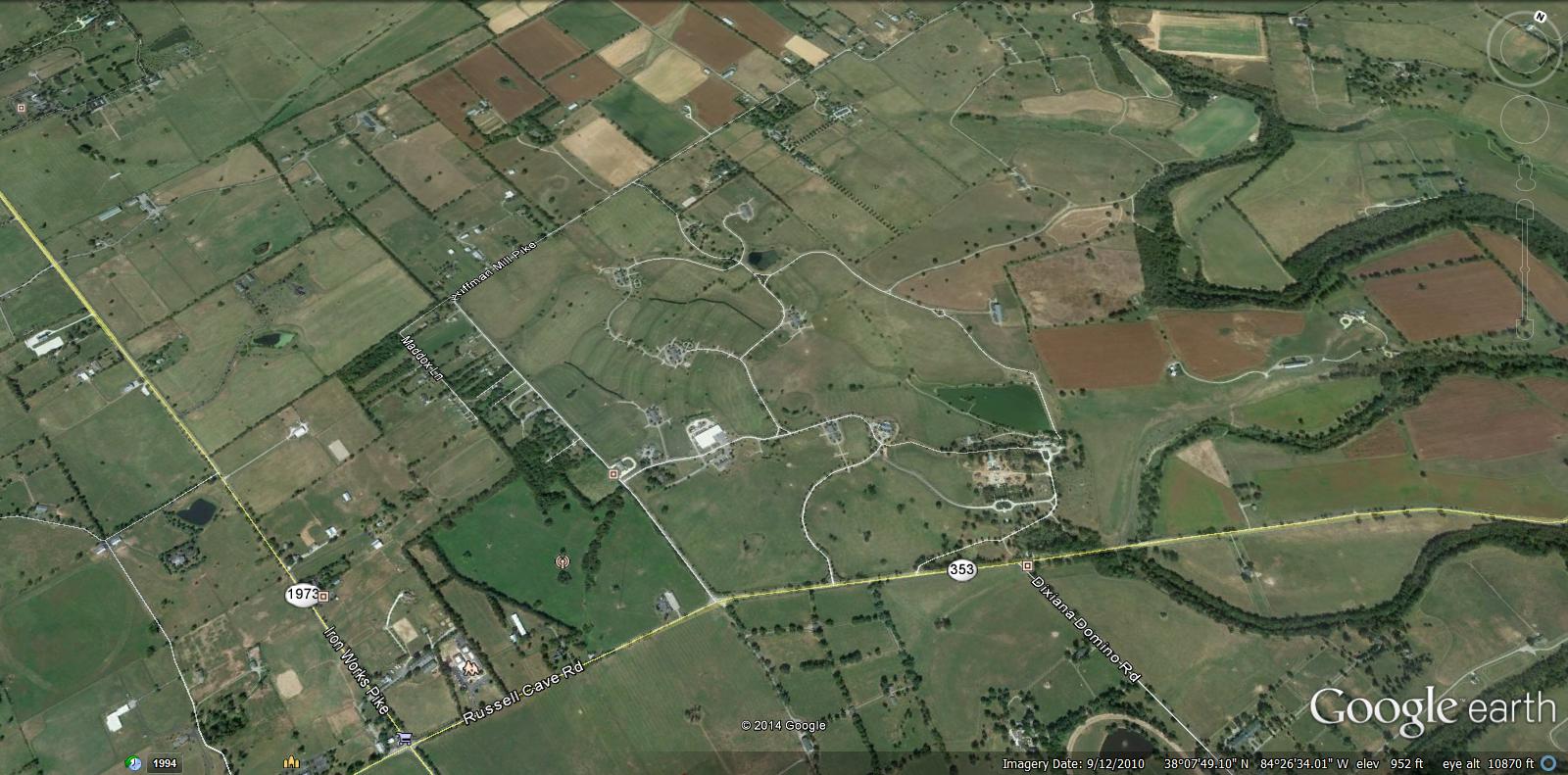
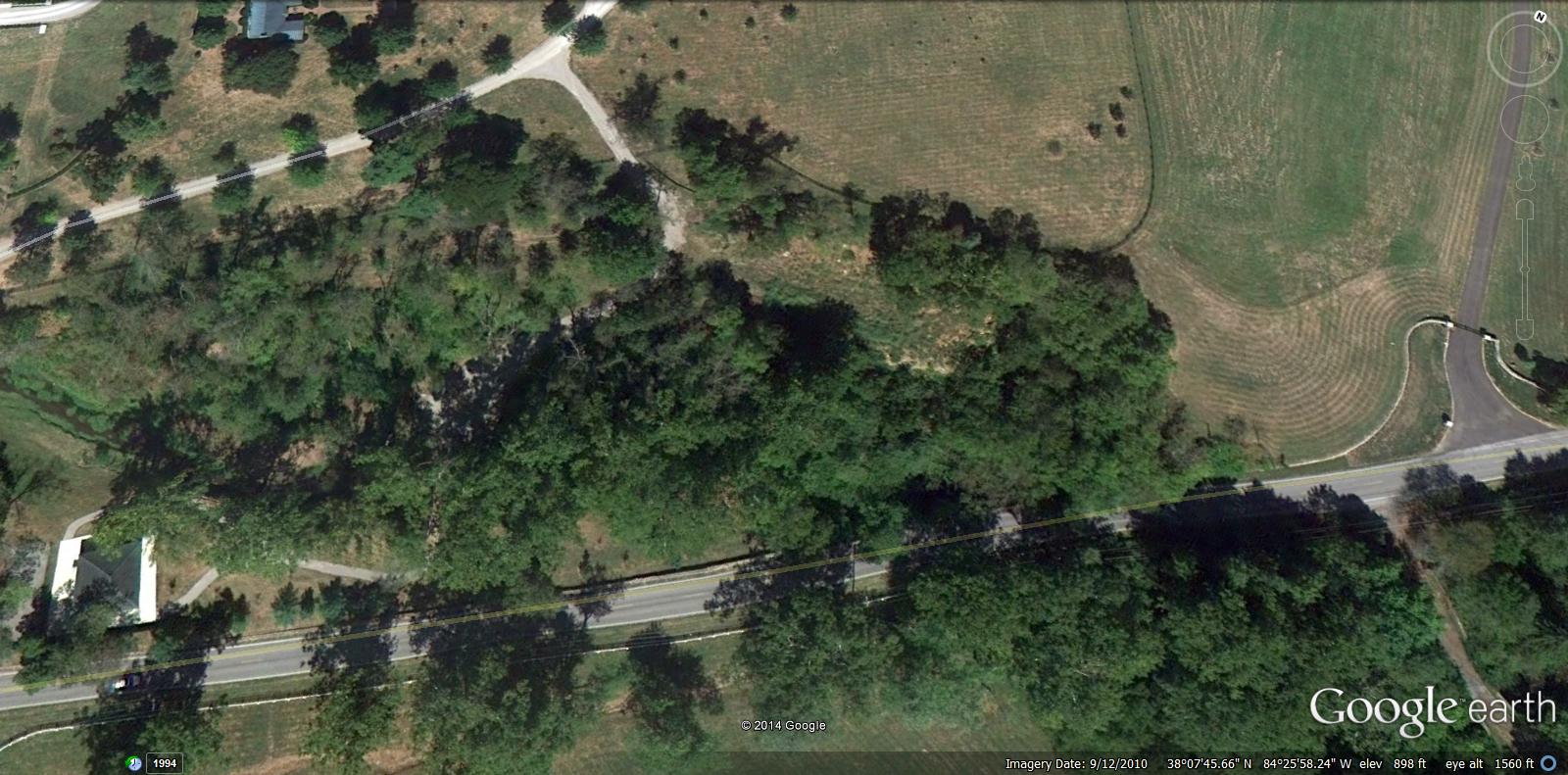
To find the center of the ancient Lexington city it is fairly easy if you know what you are looking for.  For those familiar with Lexington simply get off the highway exit that delivers you to the Kentucky Horse Park.  Instead of turning in, proceed down Iron Works Pike road for a few miles until you arrive at the store Jot-Em Down.  Turn left onto Russell Cave Road.  When you arrive at the gate to the destroyed Mt Brilliant mansion you will be there.  It was on this property that some of the largest and most organized mounds aligned in a similar way as to the Newark earthworks near Columbus, Ohio once stood.  The site on the Mt. Brilliant property first reported by the traveler Thomas Ashe chronicled in the 1872 book by George W. Ranck breaks down the precise measurements as they were before construction and farming destroyed them entirely.  But that’s not all, the site was vast extending from the location 6 miles north-east of the downtown area to areas dotting all around the core of the current city.  It is difficult now to know how many homes were built through the burial remains of these ancient dwellers, but the account according to Ranck’s book is that it was numerous saying “These well-attested facts, together with the tradition related to this day of an extensive cave existing under the city of Lexington, relieve of its improbable air the statement that a subterranean cemetery of the original inhabitants of this place was discovered here nearly a century ago.  In 1776, three years before the first permanent white settlement was made at Lexington, some venturesome hunters, most probably from Boonesborough, had their curiosity excited by the strange appearance of some stones they saw in the woods where our city now stands. They removed these stones, and came to others of peculiar workmanship, which, upon examination, they found had been placed there to conceal the entrance to an ancient catacomb, formed in the solid rock, fifteen feet below the surface of the earth. They discovered that a gradual descent from the opening brought them to a passage, four feet wide and seven feet high, leading into a spacious apartment, in which were numerous niches, which they were amazed to find occupied by bodies which, from their perfect state of preservation, had evidently been embalmed. For six years succeeding this discovery, the region in which this catacomb was located, was visited by bands of raging Indians and avenging whites; and during this period of blood and passion, the catacomb was dispelled, and its ancient mummies, probably the rarest remains of a forgotten era that man has ever seen, were well nigh swept out of existence. But not entirely. Some years after the red men and the settlers had ceased hostilities; the old sepulcher was again visited and inspected.  It was found to be three hundred feet long, one hundred feet wide, and eighteen feet high. The floor was covered with rubbish and fine dust, from which was extracted several sound fragments of human limbs. At this time the entrance to this underground cemetery of Ancient Lexington is totally unknown. For nearly three-quarters of a century, its silent chamber has not echoed to a human footfall. It is hidden from sight, as effectually as was once buried Pompeii, and even the idea that it ever existed is laughed at by those who walk over it, as heedless of its near presence as were the generations of incredulous peasants who unconsciously danced above the long-lost villa of Diomedes”

But the heart of this ancient city, its cultural epitaph was on the location of the present day Mt. Brilliant site.  For those who know anything about horses and thoroughbred racing the current owner of the Mt. Brilliant property owns the nearby stud barn of Man o’ War who won all but one of his 21 lifetime starts—which is a remarkable accomplishment.  That stud barn is right in the middle of this ancient archaeological site of ancient earthworks.   Of course farming and construction have all but destroyed all the present day evidence—and if not for the books by Thomas Ashe and George W. Ranck there would be no evidence at all.  The closest that history has come to indicating anything at all was amiss in the area were that the Indians in the area were terrified of Kentucky land—as chronicled in the novels by Allan W Eckert.  The Indians would hunt in the area, but they never settled a tribe there, and one of their early arguments with the arrival of the white settlers was that the whites did not respect that land as the Indians did.  The whites had no fear of the spirits which resided there—as they did fear those ephemeral entities.   Their reason was that they viewed the Lexington, Kentucky area as a “dark and bloody ground.”  It was a shadow-land to the Indians. In 1800, some Sacs who were in St. Louis said of Kentucky that it was full of the souls of a strange race which their people had long ago exterminated. They regarded this land with superstitious awe. Here they hunted and here they fought, but no tribe was ever known to settle permanently in it.”  The eradication of the evidence of that ancient people started in 1774 when Thomas Jefferson granted 2,000 acres of land north of the Kentucky River to William Russell in recognition of his brother Henry’s outstanding military service in the French and Indian War.

The land was eventually divided between William’s two youngest sons, Robert Spotswood Russell and William Russell, Jr. Shortly after the end of the Revolutionary War, young William laid claim to the smaller portion (800 acres) so he could enjoy the mystical cave and ever-flowing spring that add an enchanting ambiance to what is now known as Mt. Brilliant. Russell chose the name to commemorate the Virginia estate of Patrick Henry’s family.

In 1792, Russell built the central portion of the house. Cuming remarked in his 1807 book, “Tour of the West”, that Mt. Brilliant, surrounded by a wall with turrets at each end, lacked “only the vineyards” in its similarity to the French Provincial regions of Languedoc and Provence.

Russell died in 1824 and his heirs sold Mt. Brilliant in 1863. In 1832, Mount Brilliant passed to Hamilton Atchison Jr. The historical connection here is the relation to David Rice Atchison, “President for a Day” between Presidents James Polk and Zachary Taylor, who often visited his cousins at Mount Brilliant. A Lexington native and 1825 graduate of Transylvania, Atchison moved to Missouri and later Kansas. He was a U.S. senator and an organizer of the Atchison-Topeka and Santa Fe Railway Mount Brilliant was sold in 1861 to Thomas Hughes, who later owned historical Elk Hill and Clifton. Arthur Delong acquired Mount Brilliant in 1891, until 1905 when it was purchased by James Ben Ali Haggin. The Haggin family owned the farm for the next 85 years, and it became a fixture in the Kentucky political and social scene in the 20th Century.

In fact, it was at a political rally held at Russell Cave, which lays on the Mt. Brilliant property, that the infamous duel between abolitionist Cassius Clay and Samuel M. Brown took place. Clay, Henry Clay’s cousin, was saved by a stroke of astonishing fortune when the bullet aimed directly for his heart ricocheted off the silver-lined sheath of his Bowie knife.  Samuel Brown was in fact a hired assassin sent to kill Clay for his insistence that slavery be banned.  It was in that very same cave on the Mt Brilliant property that many escaped slaves hid while on their journey north into Cincinnati.  But the cave has a much deeper—and mystical quality that points back to the politics of the day.  After all, it is more than a little intriguing that a political rally for which the Clay, Brown duel occurred was in a cave when a perfectly good mansion was available just a few hundred feet away above the creek bed.

Feel free to read more about this history at these links:

http://mtbrilliant.com/about/history

http://haggin.org/Mount.Brilliant.History.html

http://www.theconspiracyzone.org/posts/27710

http://www.mcguiresplace.net/Discovery/

Let us now study what was around that cave on the Mt Brilliant property as described in 1872 by George Washington Ranck.   I include it here as I have looked for a hard copy of the book but only know of the scanned online copy by Cornell University.  Should fortunes change and documentation of such resources online cease—a proper record of the evidence is necessary.  It may also be desired to perform some archaeology if the owner would permit it.  In the cave, bones were found of these ancient people and has been the site of many turbulent events since.  There are few caves in the world that have hosted such a variety of characters as that of Russell Cave, but spelunking is not the most comfortable.  Much of it is flooded so trudging through the cold water to the locations where archaeology could be properly performed will take some effort and discomfort.   But it is there and only there that the ancient race of people can ever hope to be ascertained, as all the remnants of what is described below has been destroyed except for the text you are about to read.  Of that text I have performed some basic editing to make it more digestible.  The pictures included I deliberately kept the property of Mt. Brilliant out of the pictures to respect the owners privacy.  Only the cave area is zoomed in on due to the historical significance of it.  The wide pan shot is of the area described below.  The elements described below used to be sprawled out within the picture frame and were quite large.  If anything still remains, it would be difficult to detect due to 200 years of aggressive use of the land, and modern construction along with farming.  The original text can be found at the concluding link

“Some months after he had examined and described the fortification at the head of Hickman creek, Prof. Eafinesque surveyed the upper group on North Elkhorn, near Russell’s cave, or what is now known as the West place. We quote his description of it, which will be read with more and more interest and wonder as time passes, and slowly but surely levels with the earth and blots out forever all that is left to remind us of a lost race, whose stupendous structures covered the fertile tract which afterward became the favorite hunting ground of savage tribes. He says:  “I visited this upper group of monuments, a few days ago, in company with two gentlemen of Lexington. They are situated about six miles from this town, in a north-northeast direction, on the west and back part of Colonel Russell’s farm, which stands on the road leading from Lexington to Cynthiana.  “The ground on which they stand is a beautiful level spot, covered with young trees and short grass, or line turf, on the south side of a bend of North Elkhorn creek, nearly opposite the mouth, and close by Hamilton’s farm and spring, which lie west of them. They extend as far as Russell’s cave, on the east side of the Cynthiana road.  “No. 1, which stands nearly in the center, is a circular enclosure, six hundred feet in circumference, formed of four parts : 1. A broad circular parapet, now about twenty feet broad, and two feet high.  2. An inward ditch, now very shallow and nearly on a level with the outward ground.  3. A gateway, lying due north, raised above the ditch, about fifteen feet broad, and leading to the central area.  4. A square central area, raised nearly three feet above the ditch, perfectly square and level, each side seventy feet long and facing the four cardinal points.  ” No. 2 lies northeast of No. 1, at about two hundred and fifty feet distance; it is a regular, circular, convex mound, one hundred and seventy-five feet in circumference, and nearly four feet high, surrounded by a small outward ditch.  ” No. 3 lies nearly north of No. 1, and at about two hundred and fifty feet distance from No. 2. It is a singular and complicated monument, of an irregular square form, nearly conical, or narrower at the upper end, facing the creek. It consists: 1. Of a high and broad parapet, about one hundred feet long and more than five feet high, as yet, above the inward ditch on the south base, which is about seventy-five feet long. 2. Of an inside ditch. 3. Of an area of the same form with the outward parapet, but rather uneven. 4. Of an obsolete broad gateway at the upper west side. 5. Of an irregular raised platform, connected with the outward parapet, and extending toward the north to connect it with several mounds. 6.
Mt. Brilliant caveOf three small mounds, about fifty feet in circumference, and two feet high, standing irregularly around that platform, two on the west side and one on the east.  ” No. 4. These are two large sunken mounds, connected with No. 3. One of them stands at the upper end of the platform, and is sunk in an outward circular ditch, about two hundred and fifty feet in circumference, and two feet deep. The mound, which is perfectly round and convex, is only two feet high, and appears sunk in the ditch. Another similar mound stands in a corn-field, connected by a long raised way to the upper east end of the parapet in No. 3.  “No. 5 is a monument of an oblong square form, consisting of the four usual parts of a parapet, an inward ditch, a central area, and a gateway. This last stands nearly opposite the gateway of No. 3, at about one hundred and twenty-five feet distance, and leads over the ditch to the central area. The whole outward circumference of the parapet is about four hundred and forty feet. The longest side fronts the southwest and northeast, and is one hundred and twenty feet long, while the shortest is one hundred feet long. The central area is level, and has exactly half the dimensions of the parapet, being sixty feet long and fifty wide. It is raised two or three feet as well as the parapet. The end opposite the gateway is not far from Hamilton’s spring.  “Now to No. 6 is a mound without a ditch, one hundred and ninety feet in circumference, and five feet high. It lies nearly west from No. 1.  

“No. 7 is a stone mound, on the east side of Russell’s spring, and on the brim of the gully. It lies east from the other monuments and more than half a mile distant. It is ten feet high and one hundred and seventy-five feet in circumference, being formed altogether by loose stones heaped together, but now covered with a thin soil of stone and grass.  “No. 8 is a similar stone mound, but rather smaller, lying north of number. 7, at the confluence of Russell’s spring with North Elkhorn.  “Among the principal peculiarities, which I have noticed in this .group of monuments, the square area of No. 1, enclosed within a circular ditch and parapet, is very interesting, since it exhibits’ a new compound geometrical form of building. The ditch must have been much deeper once, and the parapet, with the area, much higher; since, during the many centuries which have elapsed over these monuments, the rains, dust, decayed plants, and trees must have gradually filled the ditch, etc. I was told by Mr. Martin that within his recollection, or about twenty-five years ago, the ditch in the monument at the head of Hickman’s creek was at least one foot deeper. “Whenever we find central and separated areas in the Alleghawian monuments, we must suppose they were intended for the real places of worship and sacrifices, where only the priests and chiefs were admitted, while the crowd stood probably on the parapet to look on; and, in fact, these parapets are generally convex and sloping inward or toward the central area.  “The ditched mound, No. 2, is remarkable, and must have had a peculiar destination, like the sunken mounds. No. 4, which differ from No. 2 merely by being much lower, and appearing, therefore, almost sunk in the ditch.  “The stone mounds, Nos. 7 and 8, are also peculiar and evidently sepulchral. But why were the dead bodies covered here with stone instead of earth? Perhaps these mounds belonged to different tribes, or the conveniency of finding stones, in the rocky neighborhood of Russell’s cave and spring, may have been an inducement for employing them.”  Some of these mounds described by Rafinesque were visited in 1846, and found to be nearly obliterated ; others, however, near the dividing line between the old military survey of Dandridge and Meredith, were still distinct, and were described in 1847 as follows: ” The most easterly work is on the estate of C. C. Moore. It is on the top of a high bluff, on the west side of Elkhorn, in the midst of a very thick growth, mostly of sugar trees, the area within a deep and broad circular ditch is about a quarter of an acre of land. The ditch is still deep enough in some places to hide a man on horseback. The dirt taken from, the ditch is thrown outward; and there is a gateway where the ditch was never dug, some ten feet wide on the north side of the circle. Trees several hundred years old are growing on the bank and in the bottom of the ditch and over the area which it encloses, and the whole region about it. There is another work a quarter of a mile west of the above one. It commences on the Meredith estate and runs over on the Cabells’ Dale property, and contains about ten acres of land. The shape of the area is not unlike that of the moon when about two-thirds full. The dirt from the ditch inclosing this area is thrown sometimes out, sometimes in, and sometimes both ways. An ash tree was cut down in the summer of 1845, which stood upon the brink of this ditch, which, upon being examined, proved to be four hundred years old. The ditch is still perfectly distinct throughout its whole extent, and in some places is so deep and steep as to be dangerous to pass with a carriage.  A mound connected with this same chain of works was opened in the summer of 1871. It is situated about half a mile west of the earthwork already described as on top of the bluff, and about a quarter of a mile north of the larger oval one. It is on the farm of Mr. James Fisher, adjoining the plantation on which Dr. Eobert Peter at present resides, and is part of the old Meredith property before mentioned. Area of interestThe mound has a diameter of about seventy feet, and rises with a regular swell in the center to the height of three and a half to four feet above the general level of the valley pasture on which it is located, only about fifteen feet above low water in the North Elkhorn creek, and about three hundred and twenty-five feet south from its margin. Mr. Fisher made an excavation into the center of this mound about four to five feet in diameter and about three and a half feet deep, in which, in a bed of wood-ashes containing charred fragments of small wood, he found a number of interesting copper, flint, bone, and other relics of the ancient Mound Builders, which were carefully packed by Dr. Robert Peter (who resides on the adjoining Meredith farm), and transmitted to the Smithsonian Institute, at “Washington, for preservation.  The copper articles were five in number; three of which were irregularly oblong-square implements or ornaments, about four inches in length and two and one-eighth to three and three-quarter inches wide and one-quarter inch thick at lower end (varying somewhat in size, shape, and thickness); each with two curved horns attached to the corners of one end, which is wider and thinner than the other end. These were evidently made of native copper, by hammering, are irregular in thickness and rude in workmanship, and have been greatly corroded in the Japseof time, so that they not only have upon them a thick coating of green carbonate and red oxide of copper, but the carbonate had cemented these articles, with adjoining flint arrow-heads, pieces of charcoal, etc., into one cohering mass, in the bed of ashes, etc., in which they were found lying irregularly one upon the other.  The other two copper implements were axes or hatchets; one nearly six inches long, the other nearly four inches; each somewhat adze-shaped wider at one end, which end had a sharp cutting edge.   With these were found nearly a peck of flint arrow-heads, all splintered and broken, as by the action of fire; also, three hemispherical polished pieces of red hematitic iron ore about two inches in diameter; some door-button shaped pieces of limestone, each perforated with two holes; several pieces of sandstone, which seemed to have been used for grinding and polishing purposes; and many fragments of bones of animals, mostly parts of ribs, which appeared to have been ground or shaped ; among which was one, blackened by fire, which seemed to have been part of a handle of a dagger; also, some fragments of pottery, etc. The fragments of charcoal, lying near the copper articles, were saturated with carbonate of copper, resulting from the oxidation of the copper articles, parts of which were oxidized to the center, although a quarter of an inch in thickness; and many pieces of this coal and portions of flint arrow-heads remain strongly cemented to the copper implements by this carbonate.  To what uses these rude, oblong- square horned copper articles were put, except for ornament, cannot be conjectured. No inscription or significant murk was found on any of them.  No human bones could be distinguished among the fragments found, but only the immediate center of the mound was opened.  The citizens of Lexington may, in truth, muse among the ancient ruins and awe-inspiring relics of a once mighty people. “Who and what were the beings who fought with these weapons, ate from these vessels, built these tombs and mounds and altars, and slept at last in this now concealed catacomb? Where existed that strange nation, whose grand chain of works seemed to have Lexington for its nucleus and center? We can only speculate! One  inclines to the opinion that they were contemporaries of the hardy Picts. Another declares them identical with the Alleghawians or progenitors of the Aztecs, and cites as proof, the remains of their temples, which are declared to be wonderfully similar to those of the ancient Mexicans described by Baron Humboldt. The earthen vessels here plowed up from the virgin soil, he says, were like those used by the Alleghawians for cooking purposes. Still another writer, dwelling upon the mummies here discovered, sees in the original inhabitants of Lexington, a people descended from the Egyptians. Other authors, eminent and learned, almost without number, have discussed this subject, but their views are as conflicting as those already mentioned, and nothing is satisfactory, except the negative assurance that the real first settlers of Lexington, the State of Kentucky, and the entire Mississippi valley, were not the American Indians, as no Indian nation has ever built walled cities, defended by entrenchments, or buried their dead in sepulchers hewn in the solid rock.  “Who, then, were these mysterious beings? Burial caveFrom whence did they come? What were the forms of their religion and government? Are questions that will probably never be solved by mortal man; but that they lived and flourished centuries before the Indian who can doubt? Where they erected their Cyclopean temples and cities, with no vision of the red men who would come after them, and chase the deer and the buffalo over their leveled and grass-covered walls. Here they lived, and labored, and died, before Columbus had planted the standard of old Spain upon the shores of a new world; while Gaul, and Britain, and Germany were occupied by roving tribes of barbarians, and, it may be, long before imperial Rome had reached the height of her glory and splendor. But they had no literature, and when they died they were utterly forgotten. They may have been a great people, but it is all the same to those who came if they were not, for their greatness was never recorded. Their history was never written not a letter of their language remains, and even their name is forgotten. They trusted in the mighty works of their hands, and now, indeed, are they a dead nation and a lost race. The ancient city which stood where Lexington now stands, has vanished like a dream, and vanished forever. Another has well said: “Hector and Achilles, though mere barbarians, live because sung by Homer. Grermanicus lives as the historian himself said, because narrated by Tacitus; but these builders of mounds perish because no Homerarid no Tacitus has told of them. It is the spirit only, which, by the pen, can build immortal monuments.”   It is a favorite theory of many that the Indians of North America migrated from Asia; that the once noble race, which has almost melted away, was descended from the ten tribes of Israel which were driven from Palestine seven hundred years before the birth of Christ. But this is a theory only. The advent of the Indians and the stock from which they sprung will never be determined; but that they came after the “Mound Builders” is evident. The appearance of the Indians was the death-knell of that doomed race whose rich and beautiful lands and spoil-gorged cities inflamed the desperate and destitute invaders. The numerous tumuli which yet remain attest the fierceness of the conflict which ensued. A great people were swept out of existence, their cities disappeared, the grass grew above them, and in time the forests.”

https://archive.org/stream/cu31924028845993/cu31924028845993_djvu.txt

Avid readers of the day like Thomas Jefferson and the Illuminati practitioner Harman Blennerhassett knew of Thomas Ashe’s book from his Travels in America—which wasn’t published until 1806, but word of its contents were spreading as Ashe visited taverns and allowed listeners to know the contents of his manuscripts.  Ashe was the third son of a half-pay officer, and was born at Glasnevin, near Dublin, 15 July 1770. He received a commission in the 83rd regiment of foot, which, however, was almost immediately afterwards disbanded; and he was sent to a counting-house at Bordeaux. There he suffered a short imprisonment for wounding in a duel a gentleman whose sister he had seduced, but, the wound not proving fatal, the prosecution was not persisted in.

Returning to Dublin, Ashe was appointed secretary to the Diocesan and Endowed Schools Commission, but, getting into debt, resigned his office and retired to Switzerland. He then spent several years in foreign travel, living, according to his own account,[1] in a free and unconstrained fashion, and experiencing a somewhat chequered fortune.

In his later years Ashe was short of money. He died at Bath on 17 December 1835.

Besides recording in his Memoirs his impressions of the countries he visited, Ashe published separately:

  • Travels in America in 1806, 1808;
  • Memoirs of Mammoth and other Bones found in the vicinity of the Ohio, 1806; and
  • A Commercial and Geographical Sketch of Brazil and Madeira, 1812.

He was also the author of novels, including the Spirit of the Book, 1811, 4th edition 1812; the Liberal Critic, or Henry Percy, 1812: and the Soldier of Fortune, 1816.

http://en.wikipedia.org/wiki/Thomas_Ashe_(writer)

The skeptic might be reluctant to believe in Ashe’s accounts of an ancient Lexington, and I might too if I did not know that a housing development nearly bulldozed the ancient city of Cahokia outside of St. Louis mistaking the mounds there as simple hills.  If nobody had put a stop to the process during construction of the St Louis eastside, Monks Mound would have been leveled as well and the bones within the mounds destroyed nearly unnoticed under the trampling of machinery.  In Lexington, with the violent past it had and history with Transylvania added to the complicated history making legitimate archaeological study of the area nearly impossible.  Transylvania, or the Transylvania Colony, was a short-lived, extra-legal colony founded in 1775 by Richard Henderson, who controlled the North Carolina based Transylvania Company, which had reached an agreement to purchase the land from the Cherokee in the “Treaty of Sycamore Shoals”. This area was claimed at the time by the Province of Virginia —especially following Lord Dunmore’s War —and North Carolina. It is primarily located in what is now the central and western parts of the State of Kentucky. American pioneer Daniel Boone was hired by Henderson to establish the Wilderness Road going through the Cumberland Gap into central “Kentuckee”, where he founded Boonesborough, the designated capital of the Transylvania colony. Transylvania officially ceased to exist after the Virginia General Assembly invalidated the Transylvania Company’s purchase in 1776.  Richard Henderson fancied the start of his own colony prior to the Revolutionary War.  If he had succeeded it would have been a 14th colony.  So there was some recklessness in the building of Lexington as ownership changed hands, Indians continuously attacked, and only blood thirsty soldiers of fortune and those fleeing religious persecution were the first to fill the land plagued with violence.  Lexington was erected as a city under forged conditions—and archaeology was not their primary concern.

http://en.wikipedia.org/wiki/Transylvania_(colony)

But the Illuminati in America knew what they thought that ancient race was, and they built their secrets around that knowledge attempting to tap into that energy believed to reside around them.  It is therefore ironic that the horse racing culture emerged so prominently in Lexington of all places, and that the spirited horses born there have an otherworldly appeal.  It is also ironic that politics, the abolitionist movement and many important historic events culminated at that very spot around Russell’s Cave for well over 200 years—but the evidence of those happenings has been carefully obscured—and overlooked.  Instead modern society is obsessed with the mansions, the gardens, and the horses of that former ancient society.  The spender of elegance has disguised the fact that an entire race of people unknown to time was eradicated at that very spot.  With earthworks only rivaling the Newark, Ohio site and Serpent Mound a picture of a vast civilization that lived in the Kentucky and Ohio region well before any Indian hunted with a spear or threw a rock is evident.  These were people who mummified their bodies, offered sacrifices on stone alters, and had advanced mathematical knowledge.  Their evidence has been confined behind a thin veil of opulence associated with the horse racing culture and the hidden knowledge of secret societies.

The political rally in 1843 where so many prominent politicians and events collected themselves for more than the acoustical qualities of a cave, it was known among them that in such a cave the ancients of that great race dwelled and buried their dead.  But being part of a new country these early settlers had no predilection in assuming they were the first to arrive in such a vast landscape.  They had no Columbus Day to celebrate, or progressive history in maintaining a history of the African-American or Indian people.  They simply hoped to learn from those ancient people what they could as they forged a new country and if you were a good little politician or financial donor you might be invited to that secret Illuminati/Masonic knowledge of those strange people who resided in Lexington Kentucky thousands of years before a white man ever arrived—or an Indian.

http://bowieknifefightsfighters.blogspot.com/2011/03/cassius-clay-sam-brown-fight-eyewitness.html

And so it goes one of the greatest mysteries in the North American continent is buried under the city of Lexington and is only hinted at by the Masonic architecture littering the region, or the artwork at the various mansions around the Lexington horse farms.  Knowledge is power, and so long as few people knew of this ancient race, there was unification in that harmonious correspondence with those who were invited to gather in the ancient catacombs of what was left of the great race who originally founded America and were dedicated to the service of freedom for all—even the slaves as Cassius Clay so valiantly defended in the cave’s mouth under the estate of Mt. Brilliant built upon the ruins of a lost race.  Lexington was the destruction of a genius lost to history and only known to a few of the most educated and enlightened.  But now dear reader—you can count yourselves among them—because you know too the truth long suppressed.

Rich Hoffman

www.OVERMANWARRIOR.com


The Ghost Ship of Cincinnati: John Rogers Maxwell’s spectral remains and lifetime of adventure

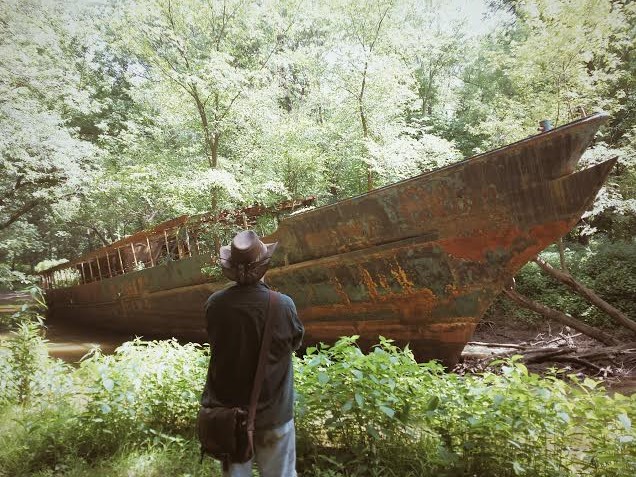
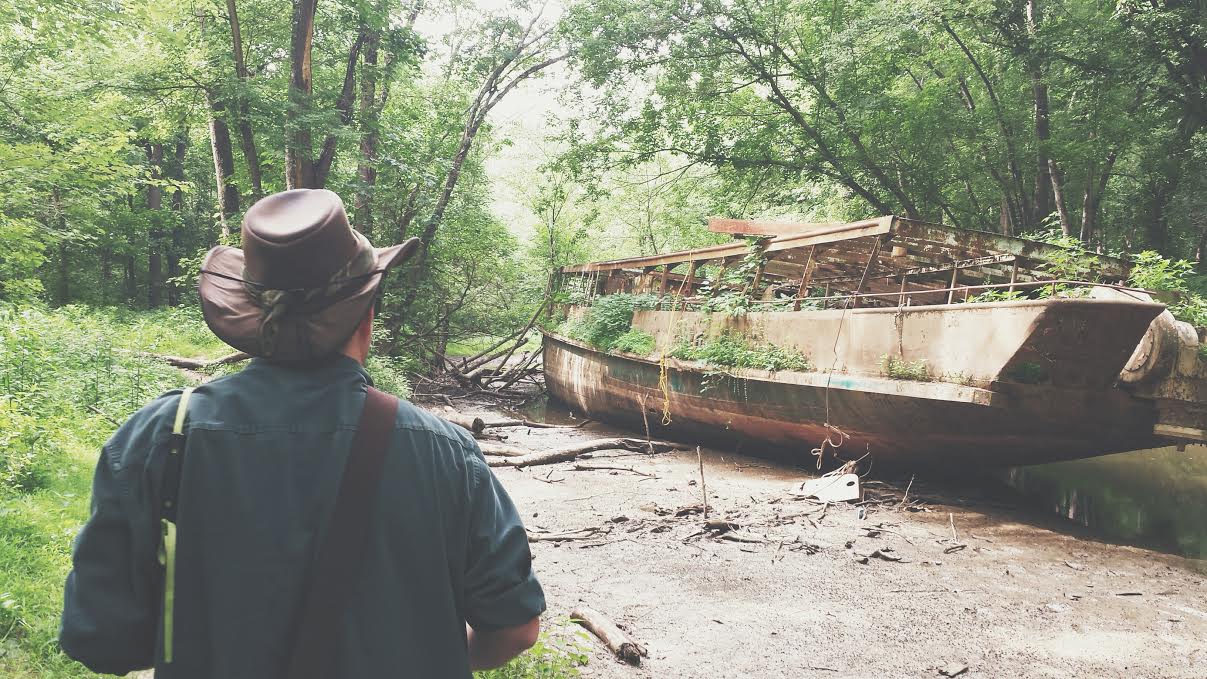
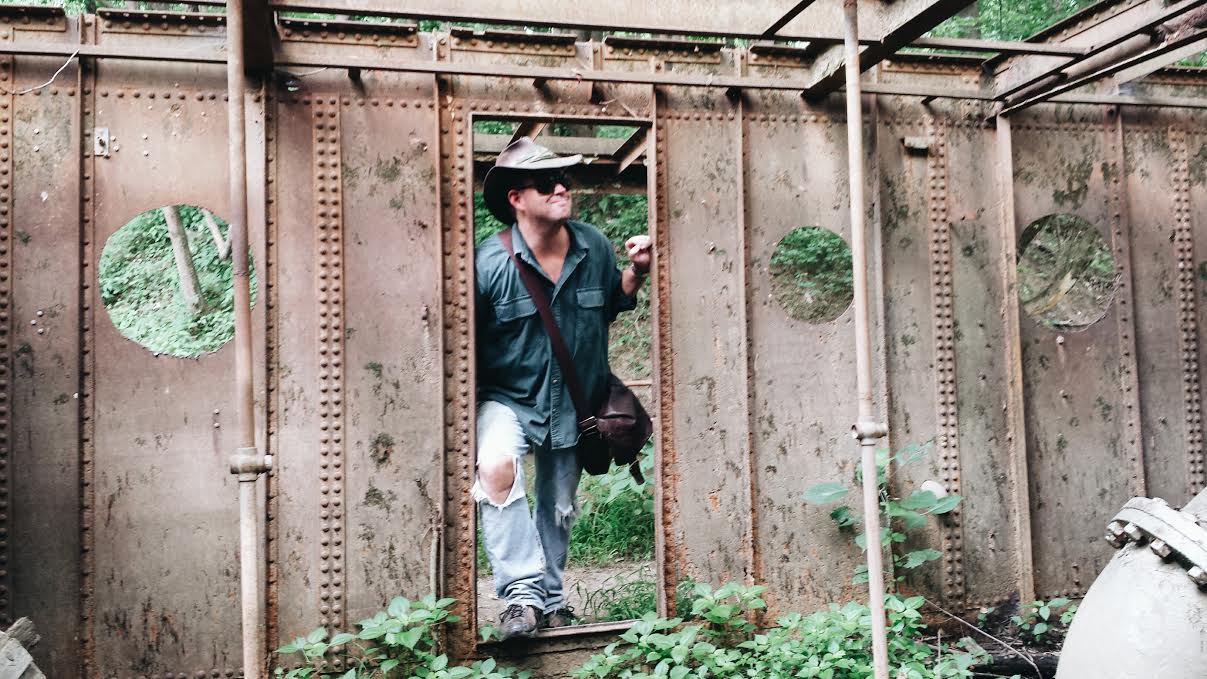
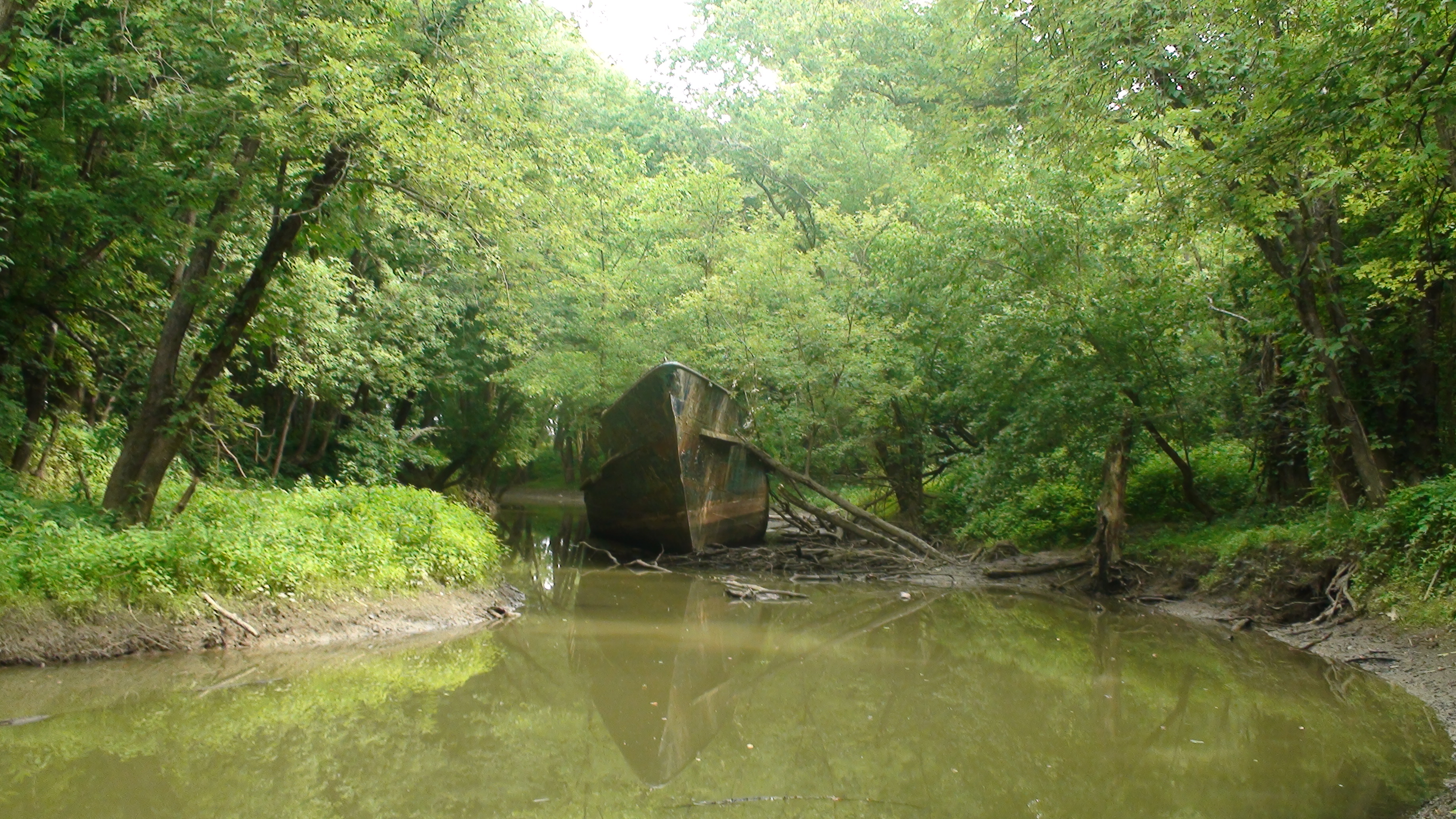
Ship2I have spent a lifetime climbing in and around human creations that once felt timeless and permanent in a historical context only to erode away into nothing glimpsed one last time by only a few curious eyes.  The process is actually remarkably fast.  I have seen towns die, homes vanish, and entire cultures philosophically collapse on themselves.  I have seen companies come and go, family dynasties raise and fall and the creations of mankind flourish then founder.  I have explored the empty carcasses of many old homes, cars, and cemeteries to study the static patterns of previous societies so to come to conclusions about the direction of our current one.  Many of my opinions about all manners of discussion were formulated in these explorations.  My mild obsessions with a giant race of men who once lived in Ohio, or the supernormal happenings in and around some of the darkest corners of our planet are rooted in observed fact and come from putting my hands and eyes on a flickering light from the past one last time before it leaves our eyes forever.  So before such a thing happened to a unique part of our history residing directly across from Lawrenceburg, Indiana nearly across from the Hollywood Casino, I had to go with my daughter to visit, and chronicle the mysterious “Ghost Ship” which is quickly fading into history.  See the video of our trip here:   

The ship really isn’t a ghost at all, but rather was a luxury yacht named the Celt and has a real life history that is nothing short of remarkable.  It was best known during World War II as The Phenakite, a training vessel designed to detect and destroy submarines.  So the story of how it ended up in a tributary of the Ohio River is a complex one that carries with it the winds of dreams contemplated by the many thousands which graced its decks.  From the bow of that ship enemies were destroyed, ruckus parties were conducted, beasts were tamed, musical careers were launched, and America celebrated the re-lighting of the Statue of Liberty by President Ronald Reagan.  Through all of its owners, the now known “Ghost Ship” all shared a sense of permanence where they believed that their lives, culture, and history were as steady as that ship.  They believed they could change its name but that the thing itself would always be there—but as the evidence of that old relic shows—nothing lasts unless it is maintained.  If things fall into disrepair they end and that goes for all things created by mankind including the culture of the countries they inhabit.

The Phenakite was built 1902 as the yacht Celt by Pusey and JonesWilmington, Delaware, for J. Rogers Maxwell, a railroad executive. It was launched on 12 April 1902.

Shortly after the United States entry in to the First World War, it was acquired by the U.S. Navy 3 July 1917. It was placed in service as USS Sachem (SP 192) on 19 August 1917 and used as a Coastal Patrol Yacht.[1] During its Navy service, it was loaned to inventor Thomas Edison who conducted government-funded experiments with it as a submarine killer.

After the end of World War I, the Sachem was returned to her owner, Manton B. Metcalf of New York, 10 February 1919. It was sold to Philadelphia banker Roland L. Taylor. It was resold in 1932 to Jacob “Jake” Martin who converted it into a fishing boat and adventure vessel.  For $2.00 Jake would take anybody anywhere they wanted to go in the Caribbean.

It was reacquired by the Navy on 17 February 1942 for $65,000 and converted for naval service at Robert Jacobs Inc., City Island, New York. It was commissioned as USS Phenakite (PYc-25), 1 July 1942 at Tompkinsville, New York and patrolled the waters off of the Florida Keys as a training vessel for sonar reading. It was decommissioned to undergo modifications and placed back in service 17 November 1944. It was used for testing sonar systems before being placed out of service on 2 October 1945 at Tompkinsville, and transferred to the Maritime Commission for disposal on 5 November 1945.[1]

The vessel was then returned to her previous owner, Mr. J. Martin of Brooklyn, NY and renamed Sachem on 29 December 1945. It was struck from the Naval Register 7 February 1946. It was subsequently resold to the Circle Line of New York City and renamed Sightseer, but was later renamed Circle Line V. It served as a tour boat until 1983. It appeared in Madonna‘s Papa Don’t Preach video in 1986.

It was purchased by Robert Miller in 1986.Ship 4

The Circle Line V was reportedly scrapped in 1984 but was found abandoned outside of Lawrenceburg, Indiana, on the Kentucky side of the Ohio River, where it has been since 1987.[1] It is a popular destination for kayak enthusiasts in the Cincinnati area and is commonly referred to as “The Ghost Ship”[2] [3]

In March 2014 it was the subject of a story on the Internet comedy news podcast Broken News Daily.  CLICK THE LINK to see a condensed visual history of the vessel.

http://en.wikipedia.org/wiki/USS_Phenakite

It is one thing to read about these kinds of things, it is quite another to put your hands on them.  When you see it with your own eyes, it is quickly determined how something can be lost to the slipping sand of an hourglass into the context of historical documentation.  History is often lost because that same hourglass of time measurement is turned upside down just to keep the sand moving leaving all the patterns of the previous measurement lost forever.  The Phenakite (Ghost Ship) is only 110 years old, but within a few years it will be gone only memorialized by articles like this one and a few fragmented documents.  This erosion of history is happening right in front of our faces and actually right near a resort complex that houses tens of thousands of people and moves millions of dollars of economic activity per year—but is invisible to the rest of the world.

The ironic story of The Phenakite is that it has had one of the most glorious pasts that a man-made creation can have, it has known celebrity, it has known two World Wars, it has been around and done it all and even with all that prestige, it is rotting away in plain sight little known to the rest of the world.  The same could be said of the Malden Island mysteries, my Giants of Ohio and their bones which sit as objects of curious speculation in private collections and museum back rooms not fitting in well with the fossil history of our known past.  The crystal pyramids sitting on the bottom of the Atlantic Ocean.  The knowledge that North America was actually settled by the Chinese during the Ming Dynasty and that most of what we think of as Native Americas were a result of these voyages which took place well before the Europeans had equal naval ability.  As magnificent as the yacht named Celt was in 1902 built for John Rogers Maxwell, Chairman of the Executive Committee of the Central Railroad of New Jersey, and President of the Atlas Portland Cement Company, it was only a flash in the mind of history which had been audaciously neglected by those same sands of time which vanish all too quickly by minds unable to behold the meaning of that history.   The yacht like its original owner who had been a director of many railroads and other companies, and an enthusiastic and widely known yachtsman died suddenly on December 10th 1910 at his home on 78 Eighth Avenue, Brooklyn, of cerebral apoplexy.  Even though the yacht would go on to embark on a century of further adventures it was the heart and will of John Rogers Maxwell that breathed the life of creation into the future “ghost ship,” which began to end the moment that creator died.Ship3

And this is the same story no matter what the topic—history is a poor caretaker of itself no matter how proud it may be of its accomplishments.  Without the efforts of a dreamer and producer, all the achievements accomplished in a lifetime vanish in less than an instant.  Without question Robert Miller was a man like Maxwell and had intentions of giving the old yacht new life but those goals fell short on the shores of the Ohio River.  The ship became a ghost of its former owner even during its heyday as the life which was breathed into it vanished just as the history which followed soon will as well.  This is the common thread that can be seen in virtually anything that is created—once that driving force is gone, the history of that object, culture, or living thing begins to end.  Once the drive of a producer leaves the life of anything—decline back into the realm of nothingness begins.  The force which drives history is not museums, academic scholarship, or text books—but the life of producers which advance the story for future generations so long as neglect does not enter into the equation.  For The Phenakite history stopped once it was dropped off in the tributary of the Ohio River by Miller who obviously had a change in his ability to preserve the craft.  But the process of that ghostly decline actually began the moment John Rogers Maxwell died in his home after a life lived well, and fully for The Phenakite and all its service to the nation, Thomas Edison, Madonna and Ronald Reagan’s Statue of Liberty lighting party in 1986 were all second-handers to the creation of a railroad tycoon.  Without him, none of the magnificent history centering on The Phenakite would have happened and because of him, there is at least a history to come to an end quietly and without much notice across from Lawrenceburg, Indiana.

In tomorrow’s article, I will cover in more detail the present owner, Robert Miller and explore what might be done to save this ship from being lost to history forever. Ship1

 For more on this topic see my article on Kerr City.  CLICK HERE. For further reading and discovery about the Cincinnati Ghost Ship see the links below:

  1. http://www.navsource.org/archives/12/1425.htm
  2. http://ohiokayak.blogspot.com/2012/11/a-trip-to-historic-lost-ghost-ship.html
  3. http://www.wcpo.com/entertainment/ship-lends-ghostly-history-to-paddlefest

Rich Hoffman   www.OVERMANWARRIOR.com