I was down at the Johnson-Humrickhouse House Museum in Coshocton the other day, just wandering through the exhibits and glancing at the shop shelves the way you do when you’re killing a little time in a small Ohio town. Something caught my eye—a sandstone replica, maybe five inches long, a few inches wide, sitting there like a forgotten coaster. The people running the place didn’t know what it was. They couldn’t put a price on it because they didn’t recognize it. But I did. Instantly. I’d carried that exact design in my head for years.
It was the Wilmington Tablet. [1]
I knew it from Joseph Campbell’s Historical Atlas of World Mythology, the big, rich volumes my daughter hunted down for me one Christmas when they were long out of print and going for serious money on the secondary market. She knew how much those books meant to me. I’d been deep into Campbell in my twenties—reading at Perkins and Denny’s at all hours while other people my age were doing whatever twenty-somethings do. I even joined the Joseph Campbell Foundation back then, partly because George Lucas was on the board and I wanted the chance to talk to the man who made Star Wars and Indiana Jones. The foundation sent me the first of those atlas volumes. They were dense, illustrated treasures. When I saw the Wilmington Tablet sitting on that museum shelf, the memory came flooding back—the line work, the central figure, the sense that it was recording something far more than decoration.
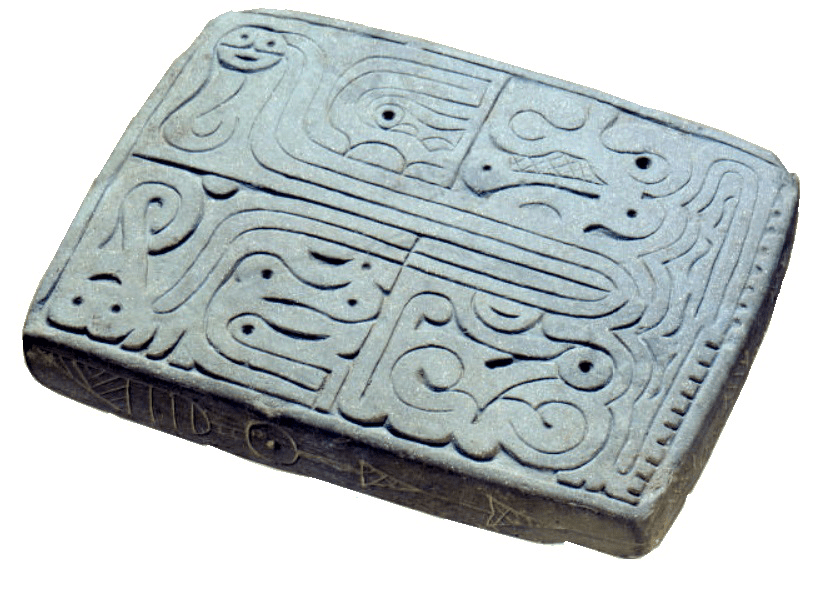
The original is Adena culture, roughly 2,000 years old, recovered from a mound near Wilmington, Ohio. Sandstone. Compact. The engraving shows a powerful central form that reads to me as a bird-like or avian prayer figure—with wings or feathered aspects suggested by the flowing lines, and a sense of movement across what looks like mirrored or dimensional space. One side echoes the other. What happens here happens there. That’s the phrase that keeps coming back when I look at it. These weren’t doodles. They were records. Shamanic. Visionary. The kind of thing you carve after you’ve been somewhere else and come back with a story the ordinary world needs to remember. [2]
The Adena and the Hopewell cultures that followed them in the Ohio Valley weren’t simple hunter-gatherers scratching out a living. They built geometric earthworks on a scale that still stuns people—Newark’s great octagon and circle, Fort Ancient up the road from here, the Miamisburg Mound half an hour away. They moved materials across enormous distances: copper from the Great Lakes, mica from the southern Appalachians, marine shell from the Gulf, obsidian from the Rockies. They aligned structures to lunar standstills and solar events with precision that modern surveyors respect. And they left behind these small, dense tablets that nobody has fully decoded because the people who could read them are gone and the credentialed class that inherited the sites prefers older, safer stories. [3]
That brings me to the copper.
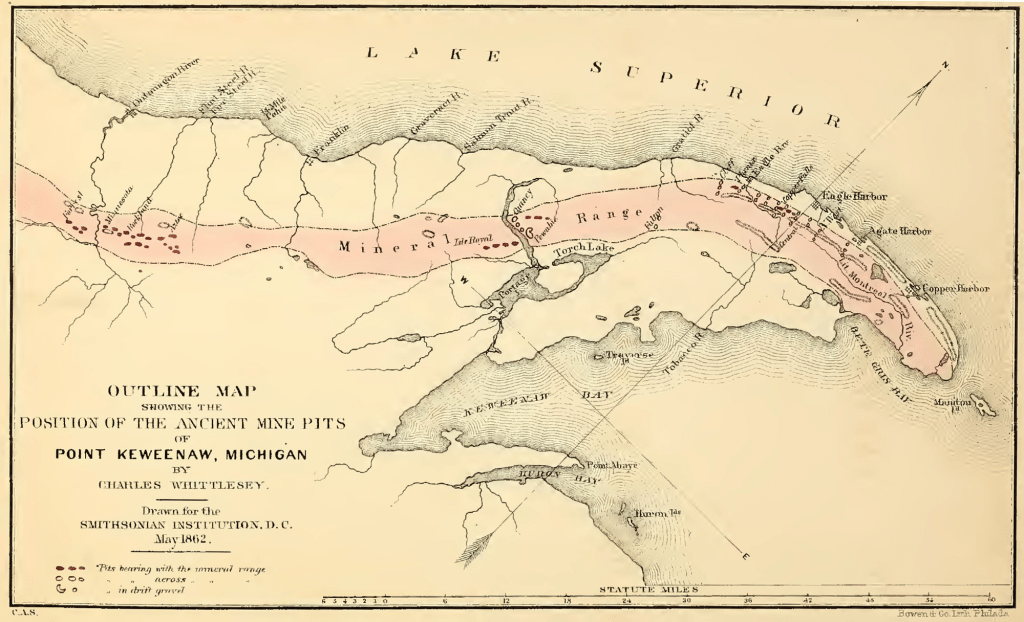
The Old Copper Complex along Lake Superior—Keweenaw Peninsula, Isle Royale, the Brule River country—represents one of the earliest large-scale metalworking traditions in the world. People were mining native copper there by at least 4000–5000 BC, cold-hammering it into tools, points, and ornaments without smelting. Thousands of pits are documented. One historical estimate put the total copper removed in the hundreds of thousands to over a million pounds; some older analyses floated even higher figures. Sediment cores from the region still carry the chemical signature of that ancient mining activity from six thousand years ago—copper, lead, potassium from the fires used to anneal the metal. [4]
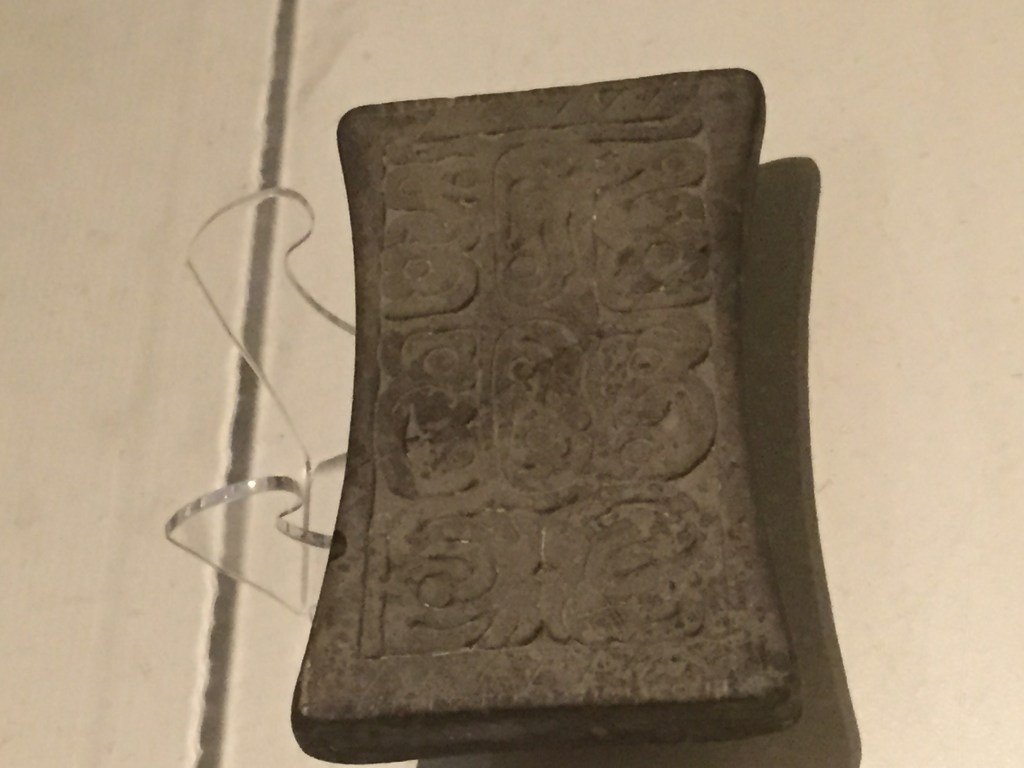
Where did all that copper go? It traveled. Artifacts show up far outside the immediate region. But the sheer volume raises the same question that serious people have been asking for a long time: was this purely an internal trade among indigenous networks, or did the scale and timing suggest something more—visitors, traders, or knowledge moving in both directions across what we now call oceans? The Newberry Tablet, found in Michigan’s Upper Peninsula, near the old mining country, in 1896, bears a grid of characters that Smithsonian and University of Michigan experts at the time could not decipher. Some later researchers read it as possible Old World script. The Cincinnati Tablet, recovered in the 1840s from a mound right downtown where a UPS facility sits today, carries its own dense symbolic language. [5]
Mainstream archaeology has long held that meaningful transoceanic contact before the Norse or Columbus was impossible—that people here were isolated after the Bering migrations, that boats couldn’t cross, that the timelines don’t allow it. I understand the institutional reasons. Once you admit earlier or more complex movements of people and ideas, many published books, careers, and tidy secular narratives have to be revisited. The same instinct that made credentialed experts during COVID say “trust the science” while gain-of-function research happened in under-regulated labs in Wuhan and elsewhere is alive in archaeology. Protect the published record. Don’t upset the people whose names are on the big monographs. The result is the same: progress slows, anomalies get explained away or ignored, and the public gets a thinner story than the evidence supports. [6]
I see the same pattern in my own industry. Aerospace is full of brilliant PhD engineers who treat drawings from twenty or thirty years ago like sacred texts. “My name is on that print. You can’t change it.” Even when better materials exist, even when regulations have evolved, even when a simpler design would work better and cost less. Changing the print means committees, reviews, months or years of delay, and sometimes millions in added cost. Personalities clash. Egos lock in. You end up herding cats on a hot tin roof to get something built that should have been obvious. It’s not that the people are bad. Many of them are very good at what they do. But the system rewards protecting the old requirement more than it rewards solving the actual problem.
SpaceX operates differently. Gwynne Shotwell explained it plainly in a recent CNBC interview. They used to put “pushers” on the Super Heavy booster to shove the Starship upper stage away during separation—extra hardware, extra mass, extra failure points. Following what she called Elon’s algorithm—get rid of stupid requirements, get rid of the part—they eliminated them. Now they use hot staging: light the upper-stage engines while still attached, let the flames and pressure do the separation work, and divert those flames through a simple ring structure on the booster. Fewer parts. Higher reliability. Faster learning. That’s why they’re catching boosters with chopsticks at Boca Chica, and why the rest of the industry will eventually have to copy the approach or fall behind. [7]
The same logic applies to history. We don’t need to protect every old theory just because a credentialed person wrote it down in 1957 or 1972. We need to let the evidence lead and be willing to revise when better data arrives. The Wilmington Tablet, the copper mines, the geometric precision of the Hopewell earthworks, the Windover Bog People in Florida with their 7,000–8,000-year-old preserved remains—these things are not problems to be explained away. They are invitations.
I brought that replica home. It sits where I can see it. It reminds me why I wrote The Politics of Heaven and why I keep talking about these things. The book is a long treasure hunt through heaven and human history—biblical conspiracies, giants, non-human intelligences, spiritual warfare, the politics that play out beyond the veil. These tablets fit inside that story. They look like records left by people who encountered something avian, something serpentine, something that crossed between realms. Shamans under the influence of what we would now call entheogens, or in dream states, or in direct contact, carving what they saw so the next generation would remember: there are more layers to reality than the daylight world admits. The Mothman sightings at Point Pleasant, the Birdman imagery at Cahokia, the reverence for the feathered serpent farther south—they rhyme. Current UAP disclosures are forcing the credential class to talk about non-human intelligences again. Once that door opens, many older doors that were nailed shut start to creak.
There are also the old Shawnee silver legends around Clifton Gorge and Yellow Springs, right in this part of Ohio. Stories of rich deposits or hidden caches that go back to Blue Jacket’s time and earlier. Geologists have found traces. Amateur shafts and assays over the years turned up silver. The mother lode, if it exists in any serious quantity, has never been properly located. The area has changed—some of it flooded, some developed—but the stories persist because the geology allows for it and because people who lived here before us clearly knew things about the land we’re still re-learning. Another thread worth pulling. [8]
The larger point is simple. We are living through a moment when old gatekeeping structures are under real pressure—from space companies that refuse to accept “that’s how we’ve always done it,” from citizens who watched credentialed experts lie or overreach during COVID, from independent researchers and venture-funded digs that don’t need a university committee’s permission to ask inconvenient questions. The Smithsonian and the old academic apparatus still carry enormous cultural weight, but they no longer have a monopoly on attention or funding. Capitalism, properly applied, is excellent at this. It rewards people who eliminate stupid requirements and penalizes those who cling to them out of ego or job security. SpaceX is proving it in orbit. The same principle can work on the ground, in the archives, and in the dirt.
I’m not saying every fringe theory is correct. I’m saying the evidence deserves better than reflexive defense of mid-twentieth-century consensus. The Wilmington Tablet is one small, heavy piece of that evidence. It sat on a museum shelf, unrecognized, because upstream experts had told the people in charge it wasn’t important enough to feature. That’s the system working exactly as designed. It protects the published record and keeps the public from getting too curious.
We can do better. Dig the copper country properly. Re-examine the tablets with fresh eyes and better tools. Fund the dives on the underwater anomalies in the Great Lakes. Let serious, well-resourced people chase the silver legends with modern methods. And keep watching what SpaceX and the companies that follow them do—because the mindset that catches rockets with chopsticks is the same mindset that will eventually fund the archaeology we should have been doing all along.
The age of disclosure isn’t just about UAPs. It’s about everything we were told was settled that never actually was. The tablet on my shelf is a quiet reminder. What happens here still echoes there. The only question left is whether we dare to listen.
Footnotes
[1] Physical description and museum context based on Adena tablet records and personal observation of the replica. See also noahsage.com archaeological summaries.
[2] Interpretive framework drawing from comparative mythology in Campbell’s work and user analysis of symbolic avian/interdimensional motifs common in Adena/Hopewell artifacts.
[3] Hopewell interaction sphere and earthwork details from standard references on Ohio Valley mound-builder cultures.
[4] Old Copper Complex data: Martin (1995), Drier et al. (1961), and sediment studies. Estimates vary but highlight significant prehistoric extraction.
[5] Newberry and Cincinnati Tablet descriptions from historical accounts, including Smithsonian correspondence and Cincinnati Museum Center records.
[6] Parallel to COVID credentialism drawn from public records, emails, and congressional testimony on gain-of-function research and lab-leak origins.
[7] Gwynne Shotwell CNBC interview (June 2026) on Starship hot staging and elimination of pusher mechanisms.
[8] Shawnee silver legends and Clifton Gorge/Yellow Springs geology from local historical accounts and assay reports.
Bibliography
• Campbell, Joseph. Historical Atlas of World Mythology, Vol. 1: The Way of the Animal Powers. Harper & Row, 1983 (and subsequent volumes/foundation editions).
• Drier, Roy W., and Octave J. Du Temple. Prehistoric Copper Mining in the Lake Superior Region. 1961.
• Lepper, Bradley T. Ohio Archaeology: An Illustrated Chronicle of Ohio’s Ancient American Indian Cultures. Orange Frazer Press, 2005.
• Martin, Susan R. Wonderful Power: The Story of Ancient Copper Working in the Lake Superior Basin. Wayne State University Press, 1999.
• Mills, Lisa A. “Mitochondrial DNA Analysis of the Ohio Hopewell of the Hopewell Mound Group.” PhD Dissertation, Ohio State University, 2003.
• Pompeani, David P., et al. “Sediment Record of Prehistoric and Historic Metal Mining in Lake Superior.” EOS, 2014.
• Squier, Ephraim G., and Edwin H. Davis. Ancient Monuments of the Mississippi Valley. Smithsonian Contributions to Knowledge, 1848.
• Various primary accounts on Newberry Tablet (1896 discovery) and Cincinnati Tablet (1841 mound find), Cincinnati Museum Center and Smithsonian archives.
• Barry Fell’s epigraphic works (controversial; for diffusionist perspectives).
• Recent UAP/UFO disclosure materials: ODNI reports and congressional hearings (2020s).
• Local histories on Shawnee silver legends, Clifton Gorge, and Yellow Springs (Greene County historical collections).
• Shotwell, Gwynne. CNBC interview transcript on SpaceX Starship development, June 2026.
Rich Hoffman
More about me
Click Here to Protect Yourself with Second Call Defense https://www.secondcalldefense.org/?affiliate=20707
About the Author: Rich Hoffman
Rich Hoffman is an author, political consultant, and strategic advisor based in Cincinnati, Ohio, and the creator of The Politics of Heaven—a unique framework that connects biblical theology, ancient history, and modern power structures to explain how moral alignment and spiritual forces shape global events. Blending real-world political experience with deep research into archaeology, UFO phenomena, and suppressed historical narratives, Hoffman offers compelling commentary on topics ranging from ancient civilizations and the Dead Sea Scrolls to modern populist movements, paranormal continuity, and leadership strategy in chaotic environments. As the author of The Gunfighter’s Guide to Business and the forthcoming Politics of Heaven, he brings a grounded yet provocative voice to media discussions, supported by firsthand experiences and a cross-disciplinary approach that bridges science, history, and theology. For interviews, speaking engagements, or expert analysis, visit richhoffmanbooks.com or contact directly via phone at 513-307-5815 or email at rhoffman@richhoffmanbooks.com. If you’ve seen the movie, Disclosure Day and want to talk about it and the implications of Presidnet Trump’s UAP disclosures, let me know and we can bring some color to your coverage. https://richhoffmanbooks.com/media-inquiries-broadcast-topics-and-contact-info/?frame-nonce=ad51e7ecba I do have a firsthand UFO encounter to discuss.