

If you came here looking for a populist hit piece, this is not that. I write for people who lead, want to lead, or at least refuse to stay on the couch while the culture is rewritten around their children. Scripture is not a campaign prop. It is the sharpest instrument I know for cutting through a coordinated lie. That is the politics of heaven: not party first, not personality first, but the question of whether a people will still call good good and evil evil when the price of doing so is social exile.
I. THE AGE OF DISCLOSURE AND THE POLITICS OF HEAVEN
We are living in what I call an age of disclosure. Not merely the disclosure of secrets in government files, though that conversation is loud enough. I mean something older and more dangerous: the moment when a civilization is forced to admit what it has been doing in the dark. The ideologies that were supposed to stay in graduate seminars leaked into human-resources manuals, then into public schools, then into pediatric clinics. The result is not a private lifestyle. The result is a public demand that the rest of us recite the new creed or be treated as a moral contaminant.
The politics of heaven answers that demand. Heaven is not a voting bloc. Heaven is not a branding exercise. Heaven is the claim that God made the world a certain way, that male and female are not costumes, that children are not raw material for adult ideology, and that a nation which inverts those realities will not stay strong merely because its GDP looks impressive for another quarter.[1]
Paul said he was not ashamed of the gospel of Christ.[2] That sentence is doing more work in 2026 than most platform planks. Shame is the enforcement mechanism of the present order. If they can make you embarrassed to name what you love, they do not have to refute you. They only have to watch you edit yourself until there is nothing left worth hearing.
I will not edit it.
II. FALSE COMPASSION IS NOT LOVE
Start with the word that has been most abused: compassion.
True compassion would protect children from irreversible medical decisions they cannot possibly understand. What we have instead is a coordinated social contagion, especially visible among elites, in which adults congratulate themselves for “affirming” a minor into a pathway of puberty blockers, cross-sex hormones, and surgery. That is not love. That is sacrificing children to an ideology. I will call it what it is: a form of child abuse dressed up as progress.[3]
I am not talking about the rare, severe, persistent cases that clinicians used to treat with extreme caution. I am talking about the sudden clustering, the peer networks, the online scripts, the school social transitions done behind parents’ backs, and the astonishing overrepresentation of transgender-identifying children in a handful of zip codes, friend groups, and celebrity households. When parents, schools, corporations, and entertainment all push the same story at once, vulnerable children get swept up. That is not a coincidence. It is social engineering, plain and simple.
Look at Hollywood. The list of high-profile actors and actresses with children who identify as transgender or non-binary has become a genre of its own. Charlize Theron, Jamie Lee Curtis, Robert De Niro, Jennifer Lopez, Megan Fox, Dwyane Wade, Annette Bening and Warren Beatty, Cynthia Nixon, Sigourney Weaver, Naomi Watts—the names keep accumulating.[4] In a country where transgender identification among youth was, until recently, vanishingly rare, that concentration is not “just visibility.” Visibility does not create statistical spikes this localized unless something in the environment is recruiting.
Some researchers and activists insist there is no social contagion, and they would be wrong. Other researchers, clinicians, and dissenters say the opposite, and the Cass Review in the United Kingdom was blunt about the weakness of the evidence base that was used to medicalize children.[5] I do not need a unanimous journal to use my eyes. When a belief system travels through prestige networks faster than it travels through farm towns, you are not watching a spontaneous awakening. You are watching fashion with a clinical billing code.
Scripture is not ambiguous about the created order. God created them male and female.[6] To catechize children into rebellion against that order is not pastoral care. It is a revolt against the Creator, outsourced to minors who will live with the consequences long after the adults have moved on to the next cause.
The proper Christian response is not cruelty. It is not mockery of the suffering. It is this: speak truth with clarity, protect children from harm, and offer genuine compassion to those who are distressed—without affirming the lie that is injuring them. Affirmation of a falsehood is not mercy. It is participation.
III. WHY THE RATES ARE NOT RANDOM
People who do not want to face this subject hide in averages. They will tell you that “only a small percentage” of children identify this way, as if a small percentage plus institutional capture is nothing. The point is not only prevalence. The point is location.
Certain circles have dramatically higher rates of trans-identifying children. Elite schools. Entertainment. Specific online subcultures. Certain therapeutic fashions. Human-resources departments that rewrote the rules of speech and then dared the rest of the country to object. The same class of people who draft the corporate training also sit on museum boards, donate to universities, and lecture the working class about which words are now violence.
I have watched this move through institutions the way termites move through a beam. You do not notice the first memo. You notice the tenth, when a teacher is punished for using ordinary sexed language, or a parent is treated as the threat for refusing to transition a twelve-year-old socially. By then the lie has become policy.
This is why I reject the slogan that “silence is kindness.” Silence in a captured institution is how the capture finishes. If you work in a place where DEI language has been used to smuggle gender ideology into childhood, you already know the mechanism. It was not a grassroots cry from children. It was a professional class writing rules that everyone else was expected to obey while calling the obedience righteousness.
I do not owe that project my vocabulary.
IV. YOU ARE NOT REQUIRED TO SURRENDER WHAT YOU LOVE
There is a related lie, and it is aimed at Christians specifically: that the loving thing is to mute your own faith so that people who despise it can feel comfortable.
I reject that.
It is one thing to say we should not be cruel. It is another thing to say that Islam, progressive sexual ideology, and the new civic religion of the public school must be handled with velvet, while Christian speech must be handled with a muzzle. I am supposed to be endlessly compassionate toward alternative sexual lifestyles and toward the latest curriculum, and then I am supposed to treat my own Scripture as a private hobby that might offend the room.
No.
You like what you like. I like what I like. I am not going to edit the Bible to make you happy. You do not care if I am unhappy. So I am going to talk about the Bible. I am going to talk about the Scripture I enjoy. I believe this is what God says, and I will not be ashamed of it.
That kind of honest, unapologetic speech is far more powerful than the aggressive politeness of people who sand their faith down until it can pass a diversity seminar. The world feels no obligation to make Christians comfortable. Reciprocal self-erasure is not tolerance. It is surrender.
As Paul said, I am not ashamed of the gospel of Christ.[2] Speaking Scripture openly, without apology, is one of the most effective ways to push back against cultural pressure. It draws a clear line. It gives courage to people who have been staying quiet. Leaders who speak plainly strengthen the faithful and expose deception at the same time.
There is nothing wrong with liking Christian things and professing them openly. You do not have to put a lid on your viewpoint while everybody else imposes theirs and you are told to shut up and take it. That hour is over, or it should be.
V. THE MUSEUM OF THE BIBLE AND THE POWER OF BEING UNASHAMED
Let me give a point of reference I have used for years.
The Museum of the Bible in Washington, D.C., is one of my favorite places in the world.[7] I never liked Washington much until the political weather changed and I had reason to be there. I have been more than once. I am a member and a supporter. In the background of my life, I love using the Bible, and I love a building three blocks from the Capitol that says: here is the history of this book. See it. Relish it. Enjoy it.
They are not required to plant flags all over the National Mall. You can still go to the Smithsonian. You can still do every other official thing the capital offers. People love the Museum of the Bible anyway, because it feeds them. It does not pretend to be a neutral warehouse. It professes that this book is good. It is open about that goodness. It loves being good.
That is the model.
Other places I enjoy for the same reason: the Ark Encounter and the Creation Museum in northern Kentucky, the work of Ken Ham and Answers in Genesis.[8] I love those guys. I may not agree with their young-earth timeline. I am an old-earth kind of guy. We would argue, probably at length, about whether the earth is six thousand years old or many millions. I have read Ham. I understand the argument. I would still debate him profusely on the age of the earth. That disagreement does not cancel the thing I actually love: their embrace of goodness.
When you walk those sites, you cannot help but see how hard they try to be good, and they do not hide it. They do not cram it down every throat on earth. They also do not crush their own enjoyment to satisfy people who arrive already offended. The offended party does not mind offending you. It is quite fine to go the other way—to be audacious about your love for what you value. You do not have to destroy it to make someone else happy.
Jonathan Edwards understood the same principle in a different century. True religion is not mere outward show. When the heart is captured by the beauty of God and His word, it cannot stay silent. The joy overflows.[9] Dimming that joy to appease people who hate its source is not love, and it is not tolerance. It betrays the truth you claim to love.
You do not have to attack persons. You also must not shrink back. Let the light shine clearly. Those who love truth will be drawn to it. I have watched that happen in the galleries of the Museum of the Bible. Stand firm. Speak plainly. Enjoy God’s goodness without shame. That is every Christian’s duty, not a branding strategy for an election cycle.
VI. KEN HAM, BILL NYE, AND THE DIFFERENCE BETWEEN CORE AND SECONDARY
I was at the Creation Museum not long ago, wearing a Museum of the Bible shirt—the kind I wear often, because it reminds me of the things I actually like when a lot of darkness surrounds me. The woman at the counter said it was great that I go to the Museum of the Bible. I told her I love that museum, and I also love what Ken Ham built. Ham set a public philosophy in motion. The exhibits are well done. I have read the books. I understand why the young-earth argument matters to the people who hold it.
The real discussion is larger than a debate-club win. Science and theology are allowed to argue. I would argue with Ham that the earth is much older than six thousand years. I would also tell Bill Nye that sneering at Genesis as if the only alternatives were a cartoon ark or a materialist closed system is a different kind of ignorance. The point for this essay is not to settle geology. The point is that Christians can disagree on the age of the earth and still refuse to surrender the created order, the moral law, and the right to love Scripture out loud.
That is maturity. Rally around the core of the confession, not around every secondary interpretation. Ken Ham loves what he believes and says it without shame. I will not take that joy from him. I wish more people in public life had that spine, even when I think their timeline is wrong.
VII. JD VANCE, BUTLER COUNTY, AND WHY SCRIPTURE AT A RALLY IS NOT A GIMMICK
JD Vance is from my part of the world. Middletown. Butler County. Monroe just down the road. I know those hardy people. I know the flea markets—Traders World, Treasure Island—where folks come out of church on Sunday and walk the aisles looking at vendors, wall art, and the kind of homemade biblical kitsch that elites mock and ordinary people actually live with.[10]
Vance knows that country. His people are those people. When he talks about Scripture, it does not sound like a consultant discovered “faith outreach” on a whiteboard. It sounds like Butler County. That matters.
I have been glad to see President Trump and Vice President Vance put Scripture into the open at the Texas midterm moment and in surrounding speeches and interviews.[11] Vance has been unusually explicit that Christianity is not a private hobby you hide to keep a coalition calm. He has said Christianity is America’s creed—not that every citizen must be a Christian, but that the moral language that actually formed the country is Christian.[12] He has said Satan’s favorite trick is convincing Christians that faith and politics belong in separate rooms.[13] He has even been willing to talk about end times without collapsing into either panic or passivity: do the work in front of you; do not outsource your whole moral life to a countdown clock.[14]
I think that is smart. It will help the midterms. Not because Bible verses are magic turnout dust, but because a lot of serious churchgoing conservatives have concluded that politicians are blabbermouths who say one thing at the banquet and another in the agency. Those people will stay home if they think the language is rented. They will show up if they think the man actually fears God more than he fears the clip.
I am not naive. Quoting Scripture at a rally is easy. Governing in a way that honors the God of that Scripture is harder. The test is not whether a line lands in a speech. The test is whether the administration’s actions, over time, hate what God hates and love what God loves. A leader who merely drapes verses over policies that protect evil is a hypocrite. A leader who fears God will not be silent when innocent blood, confused children, and public lies are being baptized as kindness.
For midterms, for holding the House and the Senate, the Christian vote is not a sentiment. It is a body of people who still believe first allegiance is not to a party. If you want them off the couch, do not give them another focus-grouped paragraph about “values.” Give them the thing they already know is true and have been told to whisper.
VIII. THREE VERSES LEADERS SHOULD NOT BE AFRAID TO SAY OUT LOUD
If a leader wants language that encourages the faithful and warns the powerful at the same time, he does not need a speechwriter to invent it. It is already in the book.
First: “Righteousness exalts a nation, but sin is a reproach to any people.”[15]
That is Proverbs 14:34. It directly assaults the idea that a country becomes great by GDP, weapons, or branding. Moral order is not an accessory. If we keep normalizing what Scripture calls evil, we are not becoming sophisticated. We are becoming weak. Wealth will not save a people that has taught its children to despise the created order.
Second: “Woe to those who call evil good, and good evil; who put darkness for light, and light for darkness.”[16]
Isaiah 5:20 is the verse for this exact hour. It names the mechanism. The deception is not only that people do wrong. The deception is that they rename the wrong and then punish the person who remembers the old name. Redefine marriage, celebrate the confusion of sex, treat biblical speech as harm, and you have not expanded compassion. You have inverted the moral dictionary. A leader who will not say that sentence is not being pastoral. He is being careful about his future bookings.
Third: “Blessed is the nation whose God is the Lord.”[17]
Psalm 33:12 is not a magic formula for a superpower. It is a reminder of allegiance. The Christian community’s ultimate loyalty is not to a party, a personality, or a news cycle. Blessing, in the biblical sense, attaches to a people that still knows who God is. That is hope, not nostalgia. It tells serious people why they should bother.
These three verses do what a good rally needs: moral clarity, a warning against deception, and a promise larger than the next quarter. They are short enough to remember. They are sharp enough to divide light from fog.
IX. DO NOT WAIT FOR THE RAPTURE WHILE EVIL DOES THE WORK
Here is the pastoral failure I have watched for decades.
Many people I know will say they are good Christians because they refuse to “engage.” They will hang the Ten Commandments on the wall, go to church on Sunday, and then treat public evil as a problem God will vacuum up at the end of the age. They do not want to confront anybody. They do not want to fight. They want the apocalypse to do the job they were too tired or too timid to do. They call that humility. I call it a religious mask on laziness.
The same Bible that promises the return of Christ also commands believers to resist the devil, hate what is evil, do justice, and love mercy.[18] God never called a people to nap while wickedness reorganizes the schools. Waiting for God to fix everything while we do nothing is not faith. It is presumption.
Moses did not treat Egypt as a spectator sport. Deborah did not. David did not. Nehemiah did not rebuild a wall by quoting a verse about patience and going home. The apostles did not treat the ruling authorities as an excuse to go mute. Romans 13 tells Christians to recognize governing authority. Acts 5:29 tells them that when those authorities command what God forbids, the first allegiance is to God.[19] Submission to God is not submission to evil—quite the opposite.
If a world leader will not bow to the authority of God, that does not mean the rest of us take a back seat and wait for the credits. It means discernment. It means we do not confuse a Bible on the podium with a conscience in the chest. It also means we do not treat politics as a substitute for conversion. A man can win a midterm and still lose his soul. Reformation that begins only in rallies and podcasts, and never in the soul’s submission to Christ, profits nothing.
However, the opposite error is just as real: using “God will handle it” as cover for refusing to handle the thing in front of you. Faith works in its own generation. It prays for the kingdom to come and then spends its breath on righteousness while it still has breath.
X. FLEA-MARKET CHRISTIANITY AND THE DIFFERENCE BETWEEN DECORATION AND BACKBONE
I like Traders World. I like Treasure Island. Monroe, Ohio, is a strange and specific place, and I love it for what it is. Walk those markets, and you will see a lot of people who came straight from church. You will see biblical references on the walls. Treasure Island, in particular, draws a large Mexican immigrant population, and if you have spent time in Mexico, you already know how Catholic that visual world is. They love images of Jesus. They carried older indigenous forms into Catholic form and made something that is not a seminar paper. It is folk theology in color. I love Mexican religious art, including the Christianized approach to death that outsiders reduce to a cartoon of “the cult of the dead.” It is not voodoo. It is a people who still think the dead and the living are not sealed off from each other by a shopping mall.
I can love all of that and still say the hard thing: too many of those same households treat Scripture as interior decorating.
They will buy the plaque. They will love the verse. They will tell you they left it to Jesus. Then, when the school, the HR office, or the culture demands that they deny what the plaque says, they fold and call the fold piety. That is not devotion. That is decoration. Faith that only admires Scripture on a wall, and will not stand for the same commandments when the cost is a customer, a job, or a family argument, is not the faith that built anything worth keeping.
True Christianity has always required backbone. Nice religious imagery is easy. JD Vance coming out of that same region makes the stakes sharper. Those people need to see a leader who will fight for what the wall art claims to believe. If he only sounds like church on Sunday and then governs like every other manager of decline, the flea-market vote will stay home, and the professional class that rewrote childhood will not.
XI. CHRISTIANITY IS A WEAPON — BUT NOT THE WAY THE MOB MEANS WEAPON
People get nervous when you say Christianity is a weapon. They should get the meaning right.
Christianity is not a weapon in the way a riot is a weapon. It is not deceit. It is not a secret police of the pious. The word of God is living and active, sharper than any two-edged sword.[20] Truth is the blade. When a leader speaks Scripture with actual conviction, it cuts through slogans, exposes the rename-the-evil trick, and wakes a conscience that had gone to sleep under the word “kindness.”
That is how you fight evil in high places without becoming the thing you oppose.
Many of the policies I have been watching—the sexual ones, the speech ones, the childhood ones—were designed in the background to wear away a society that still had a Christian base. You do not have to invent a conspiracy chart to see the sequence. First, the language changes. Then the training changes. Then the child is caught in the middle, and the parent is the last to be informed. The answer is not to copy the enemy’s methods. The answer is to stop being ashamed of the only thing that can actually defeat the darkness: the gospel of Jesus Christ, spoken as if you mean it.
A leader should stand on Scripture not as a mascot but as a man who fears God more than he fears the mob. This generation is starving for that kind of boldness. Amen. Let it be said without the usual throat-clearing.
XII. ISLAM, SAUDI ARABIA, AND THE RIGHT TO DEFEND YOUR OWN HOUSE
A short word on a subject that makes consultants sweat.
Twenty-five years after 9/11, a lot of people are angry that American leadership will not spend every morning railing at Saudi Arabia and at radical Islam in the old post-2001 register. Radical Islam is not a hallucination. It is still at work. It is fair game. I also think you can put your hand on the Bible without turning every speech into a comparative-religion insult comic.
You do not have to be condescending toward every competing religion to defend Christianity. [21] A leader who fears God will not be silent when innocent blood is shed in the name of religion. He also needs wisdom. Sometimes the most effective stand is not the loudest anathema. It is the clear, consistent defense of truth and justice, and the refusal to treat Christianity as the one faith that must apologize for existing.
If Trump or Vance quote Scripture, the test is not the quote. The test is whether their actions line up with the book they opened. Religion used as a costume for power is an old trick. Religion used as the thing a man actually submits to is rarer, and it is the only version worth the airtime.
XIII. THE JONATHAN EDWARDS STUDY BIBLE AND A PRACTICAL NEXT STEP
If you want an entry point that is not a meme and not a campaign pamphlet, start with a book that expects you to stay.
The Jonathan Edwards Study Bible, published by Thomas Nelson in August 2026 and edited by Matthew Everhard, is built on the NKJV and Edwards’s own notes, resolutions, and theological instincts.[22] Edwards’s great theme was not American politics. It was joy in God. “The enjoyment of God is the only happiness with which our souls can be satisfied.” That is the sentence under the project. Study notes drawn from his work, essays on the Great Awakening, his Resolutions, and his miscellanies system are all there if you want to do more than highlight a rally verse.
I love a study Bible that treats Scripture as something you live inside, not something you mine for applause lines. I do not agree with every secondary system any commentator has ever hung on the text. I do not need to. The point is daily reading, public love, and an unashamed life. Treat yourself to something good. Read it. Let people know you love it. At this stage of the game, visible joy in the word is not a small witness. It is one of the last clean ones left.
XIV. WHAT I WANT FROM LEADERS — AND WHAT I WILL NOT PRETEND
I want leaders who will:
Protect children from medical and social experiments they cannot consent to in any meaningful sense.
Stop treating “compassion” as a synonym for affirmation.
Speak Scripture as if it were true, not as if it were a demographic.
Refuse the HR liturgy that recodes male and female as optional.
Understand that Christian voters are not a prop. They are people whose first loyalty is supposed to be higher than a ticket.
Fight in their own generation instead of waiting for the sky to split.
Keep their joy. An ashamed church is a disarmed church.
I will say this: goodness is not something you have to apologize for. Find it. Love it. Project it. Evil is not shy about encroaching. You are not obligated to meet that encroachment with a permanent second cheek and a taped mouth. The job, when you see the lie eating children and renaming itself kindness, is to conquer it with righteousness and to be bold about the source of that righteousness.
Do not be ashamed of the gospel.
Do not be ashamed of the book.
Do not be ashamed of liking what is good.
That is the politics of heaven in an age that keeps disclosing how much of our public life was built on a dare: that ordinary people would rather be polite than tell the truth about their own sons and daughters.
XV. A LAST WORD TO THE PEOPLE WHO ACTUALLY LEAD
This was never written for the algorithm that wants a screaming thumbnail. It was written for the smaller room: the people who draft, who vote in caucuses, who manage institutions, who sit close enough to power to change a line in a bill or a tone in a speech.
It is safe to put your arm around Scripture.
It is not safe, in the only sense that matters, to keep pretending that the sexual revolution’s latest chapter is too delicate to name.
You are allowed to enjoy the Museum of the Bible, the Creation Museum, a Mexican retablo of Christ, a Jonathan Edwards page, a Butler County flea market, and a Vice President who will still say the name of Jesus without coughing. You are allowed to disagree about the age of the earth and still agree that a girl is not a boy because a school counselor said so.
The light does not need your permission to be light. It needs you to stop putting a basket over it.
Speak plainly. Protect the children. Love the good without apology. Leave the shame to the people who require it.
That is how you strengthen the faithful. That is how you expose the deception. That is how a nation finds out, in an age of disclosure, whether it still remembers the politics of heaven.
NOTES
[1] The phrase “politics of heaven” is used here in the older Christian sense: the public consequences of God’s reign and moral law, not a claim that any party is the kingdom of God. See Augustine, The City of God, esp. Books XIV–XIX, on the interweaving of the city of God and the city of man.
[2] Romans 1:16: “For I am not ashamed of the gospel of Christ, for it is the power of God to salvation for everyone who believes.”
[3] On the distinction between pastoral care for distressed youth and the affirmation-only medical pathway, see Hilary Cass, Independent Review of Gender Identity Services for Children and Young People: Final Report (NHS England, 2024); Abigail Shrier, Irreversible Damage (Regnery, 2020); Lisa Littman, “Parent reports of adolescents and young adults perceived to show signs of a rapid onset of gender dysphoria,” PLOS ONE 13, no. 8 (2018).
[4] Reporting and commentary on the clustering of transgender-identifying children in celebrity households include Rikki Schlott, “How social contagion created a generation of trans kids in Hollywood,” New York Post, June 4, 2026; “The rise of the celebrity trans kid,” The Spectator, April 10, 2024; and recurring profiles in mainstream entertainment coverage of specific families. Clustering is not the same as a complete census; it is a pattern that demands an explanation beyond “visibility.”
[5] Cass, Independent Review (2024). For the contrary claim that social contagion is unsupported, see Jack Turban et al., “Sex Assigned at Birth Ratio among Transgender and Gender Diverse Adolescents in the United States,” Pediatrics (2022). For more recent discussion of declining youth identification after the peak years, see analysis associated with Eric Kaufmann’s 2025 commentary on survey trends. The existence of a debate is the point: the science was never “settled” in the way school districts pretended.
[6] Genesis 1:27; Matthew 19:4; Mark 10:6.
[7] Museum of the Bible, 400 4th Street SW, Washington, D.C.; opened November 17, 2017; founded through the Green family / Museum of the Bible, Inc. See museumofthebible.org and the institution’s published FAQ on mission, square footage, and exhibit floors.
[8] Ken Ham, Answers in Genesis; Creation Museum, Petersburg, Kentucky (opened 2007); Ark Encounter, Williamstown, Kentucky (opened 2016). See answersingenesis.org.
[9] Jonathan Edwards, A Treatise Concerning Religious Affections (1746); The Life of David Brainerd; and the Resolutions. Edwards’s insistence that true religion engages the affections, not merely the mouth, is the through-line of the 2026 study Bible project cited below.
[10] Traders, World and Treasure Island are long-running flea-market / vendor sites serving the Monroe–Middletown corridor in Butler County, Ohio. JD Vance’s upbringing in Middletown and family ties in the county are documented in Hillbilly Elegy (Harper, 2016) and in subsequent local reporting.
[11] Coverage of Trump and Vance at the Republican midterm convention in Dallas, September 2026, includes contemporaneous reports from ABC and other national outlets. Vance’s broader 2025–2026 record of public Christian speech includes the Turning Point USA AmFest 2025 address and the May 2026 “Rededicate 250” remarks on the National Mall.
[12] JD Vance, AmFest / Turning Point USA remarks, December 2025: “Christianity is America’s creed,” with the explicit caveat that one need not be a Christian to be an American. See also Catholic News Agency, “Vice President JD Vance presents a Christian vision of politics,” December 2025.
[13] Ryan Foley, “JD Vance: Satan wants Christians to separate faith from politics,” The Christian Post, July 20, 2026, reporting on Vance’s conversation with Bishop Robert Barron.
[14] Maya Yang, “JD Vance says he is doing ‘God’s work – and if that leads to the end times, OK,’” The Guardian / syndicated, September 2, 2026, on the Bryce Crawford interview.
[15] Proverbs 14:34 (NKJV): “Righteousness exalts a nation, but sin is a reproach to any people.”
[16] Isaiah 5:20.
[17] Psalm 33:12: “Blessed is the nation whose God is the Lord, the people He has chosen as His own inheritance.”
[18] James 4:7; Romans 12:9; Micah 6:8; Psalm 97:10.
[19] Romans 13:1–7; Acts 5:29. The Deborah and David narratives are Judges 4–5 and 1 Samuel 16–31 / 2 Samuel.
[20] Hebrews 4:12; Ephesians 6:17.
[21] John 14:6; Acts 4:12.
[22] The Jonathan Edwards Study Bible: Experience Abiding Joy in Christ (NKJV), general editor Matthew Everhard (Thomas Nelson, August 18, 2026). Features include Edwards-derived study notes, doctrinal articles, essays on Edwards and the Great Awakening, the Resolutions, and an introduction to his miscellanies method.
BIBLIOGRAPHY AND FURTHER READING
Scripture and Classic Christian Sources
The Holy Bible, New King James Version. Augustine of Hippo. The City of God. Trans. Henry Bettenson. London: Penguin, 2003. Calvin, John. Institutes of the Christian Religion. Ed. John T. McNeill. Louisville: Westminster John Knox, 1960. Edwards, Jonathan. A Treatise Concerning Religious Affections. 1746. In The Works of Jonathan Edwards, Vol. 2. New Haven: Yale University Press. Edwards, Jonathan. “Resolutions.” In Letters and Personal Writings, Works of Jonathan Edwards, Vol. 16. New Haven: Yale University Press. Edwards, Jonathan. Sinners in the Hands of an Angry God. 1741. The Jonathan Edwards Study Bible: Experience Abiding Joy in Christ (NKJV). General editor Matthew Everhard. Nashville: Thomas Nelson, 2026. Packer, J. I. Knowing God. Downers Grove, IL: InterVarsity Press, 1973. Lewis, C. S. The Abolition of Man. Oxford: Oxford University Press, 1943. Lewis, C. S. Mere Christianity. London: Geoffrey Bles, 1952. Niebuhr, Reinhold. Moral Man and Immoral Society. New York: Scribner, 1932. Solzhenitsyn, Aleksandr. “Live Not by Lies.” 1974. Schaeffer, Francis A. How Should We Then Live? Old Tappan, NJ: Revell, 1976. Schaeffer, Francis A. A Christian Manifesto. Westchester, IL: Crossway, 1981.
Creation, Museums, and Public Christian Witness
Ham, Ken. The Lie: Evolution. Green Forest, AR: Master Books, 1987; rev. eds. thereafter. Ham, Ken. Gospel Reset. Green Forest, AR: Master Books, 2018. Answers in Genesis. Creation Museum and Ark Encounter visitor guides and position papers. https://answersingenesis.org Museum of the Bible. Institutional FAQs, exhibit guides, and annual materials. Washington, D.C. https://www.museumofthebible.org Wishard, Grant. “Love to Tell the Story.” Washington Examiner, November 17, 2017. Zauzmer Weil, Julie, and Sarah Pulliam Bailey. “The ark vs. the covenant: the dramatic contrast between the Creation Museum and the Museum of the Bible.” Washington Post, November 20, 2017.
Sex, Children, Medicine, and Social Contagion
Cass, Hilary. Independent Review of Gender Identity Services for Children and Young People: Final Report. NHS England, 2024. Shrier, Abigail. Irreversible Damage: The Transgender Craze Seducing Our Daughters. Washington, D.C.: Regnery, 2020. Shrier, Abigail. Bad Therapy: Why the Kids Are Not Growing Up. New York: Sentinel, 2024. Littman, Lisa. “Parent reports of adolescents and young adults perceived to show signs of a rapid onset of gender dysphoria.” PLOS ONE 13, no. 8 (2018). Bailey, J. Michael, and Ray Blanchard. Clinical and taxonomic papers on autogynephilia and rapid-onset presentations (various). Laidlaw, Michael, et al. Endocrine and pediatric critique literature on puberty blockade. SEGM (Society for Evidence-Based Gender Medicine). Collected reviews. Turban, Jack L., et al. “Sex Assigned at Birth Ratio among Transgender and Gender Diverse Adolescents in the United States.” Pediatrics (2022). [Contrary thesis; included so the reader can see both sides of the official argument.] Kaufmann, Eric. Commentary and data notes on declining youth LGBT / transgender identification after the early-2020s peak (2025). Schlott, Rikki. “How social contagion created a generation of trans kids in Hollywood.” New York Post, June 4, 2026. “The rise of the celebrity trans kid.” The Spectator, April 10, 2024. “Hollywood’s growing A-list of non-binary, transgender kids.” The Daily Telegraph, 2025. Hruz, Paul W., Lawrence S. Mayer, and Paul R. McHugh. “Growing Pains: Problems with Puberty Suppression in Treating Gender Dysphoria.” The New Atlantis, 2017. McHugh, Paul. “Transgender Surgery Is not the Solution.” Wall Street Journal, 2014, and related Johns Hopkins commentary. Soh, Debra. The End of Gender. New York: Threshold, 2020. Joyce, Helen. Trans: When Ideology Meets Reality. London: Oneworld, 2021. Hilton, Emma, and Colin Wright. Biological-sex primer essays in Reality’s Last Stand and related venues. Singal, Jesse. Long-form reporting on youth gender medicine, The Atlantic and later independent work.
Culture, Elite Capture, and Institutional Language
Murray, Douglas. The Madness of Crowds. London: Bloomsbury, 2019. Murray, Douglas. The War on the West. New York: Harper, 2022. Trueman, Carl R. The Rise and Triumph of the Modern Self. Wheaton, IL: Crossway, 2020. Trueman, Carl R. Strange New World. Wheaton, IL: Crossway, 2022. Hanby, Michael. Various essays on technology, liberalism, and the body, First Things. Lasch, Christopher. The Culture of Narcissism. New York: Norton, 1979. Rieff, Philip. The Triumph of the Therapeutic. New York: Harper & Row, 1966. MacIntyre, Alasdair. After Virtue. Notre Dame: University of Notre Dame Press, 1981. Sowell, Thomas. The Vision of the Anointed. New York: Basic Books, 1995. Sowell, Thomas. Intellectuals and Society. New York: Basic Books, 2009. Darel E. Paul. From Tolerance to Equality. Waco: Baylor University Press, 2018.
Vance, Ohio, and the Present Political-Religious Moment
Vance, J. D. Hillbilly Elegy. New York: Harper, 2016. Vance, J. D. Communion: Finding My Way Back to Faith. 2026. “Vice President JD Vance presents a Christian vision of politics.” Catholic News Agency, December 2025. “JD Vance: Satan wants Christians to separate faith from politics.” Christian Post, July 20, 2026. “Religious Vance seeks to avoid MAGA schism as he keeps the faith for 2028.” The Guardian / syndicated, September 13, 2026. Yang, Maya. “JD Vance says he is doing ‘God’s work – and if that leads to the end times, OK.’” September 2, 2026. Forbes Breaking News. “The Morality & Religion That Formed The American Consciousness Were Decidedly Christian.” National Mall remarks, May 2026. Local reporting on Middletown, the Cleveland-Cliffs mill, and Vance’s hometown visits: Cincinnati Enquirer, Journal-News, Fox News, 2023–2026. Dreher, Rod. Live Not by Lies. New York: Sentinel, 2020. Renn, Aaron M. Life in the Negative World. Washington, D.C.: Zondervan / related 2024 essays on post-Christian America.
Islam, Religious Liberty, and Public Courage
Ibn Warraq. Why I Am Not a Muslim. Amherst, NY: Prometheus, 1995. Spencer, Robert. The History of Jihad. New York: Bombardier, 2018. [Use critically; included because the public argument exists.] Griffith, Sidney H. The Church in the Shadow of the Mosque. Princeton: Princeton University Press, 2008. Weigel, George. Faith, Reason, and the War against Jihadism. New York: Doubleday, 2007. First Amendment and religious-liberty case law: Employment Division v. Smith; Fulton v. City of Philadelphia; 303 Creative v. Elenis; related commentary in Harvard Journal of Law & Public Policy.
Ohio Color, Folk Religion, and Place
Hoffman, Rich. Prior columns and commentary at OvermanWarrior / related essays on Middletown, Monroe, and regional culture. Brandes, Stanley. Skulls to the Living, Bread to the Dead: The Day of the Dead in Mexico and Beyond. Oxford: Blackwell, 2006. Carmichael, Elizabeth, and Chloë Sayer. The Skeleton at the Feast: The Day of the Dead in Mexico. Austin: University of Texas Press, 1991. Nutini, Hugo G. Todos Santos en Rural Tlaxcala. Princeton: Princeton University Press, 1988. Local vendor culture around Traders World (Monroe, Ohio) and Treasure Island as primary, on-the-ground observation rather than academic monograph.
Journalism and Primary Documents Worth Keeping
Cass Review full report and supporting research annexes (NHS England). WPATH Files / leaked internal files and subsequent journalistic treatment (2024). SEGM, Genspect, and Society for Evidence-Based Gender Medicine bibliographies. Museum of the Bible press FAQs. Answers in Genesis statement of faith and museum interpretative materials. Thomas Nelson catalog entry and Everhard interviews on the Jonathan Edwards Study Bible (August 2026).
Suggested Reading Paths
If you lead and have one night: Romans 1 and 13, Acts 5, Proverbs 14, Isaiah 5, Psalm 33, Hebrews 4; then Cass’s final report summary; then Vance’s Communion on why he will not keep the faith in a separate drawer.
If you want the child-medicine argument without online noise: Cass; Shrier; Hruz/Mayer/McHugh; then one contrary paper (Turban, 2022) so you know what the institutions cited.
If you want the soul of the thing rather than the policy: Edwards’s Religious Affections; the 2026 Edwards Study Bible notes on joy; Augustine’s two cities; Solzhenitsyn’s “Live Not by Lies.”
Suppose you want to walk the places named here: Museum of the Bible in Washington; Creation Museum and Ark Encounter in Kentucky; a Sunday-to-Monday loop through Middletown and the Monroe markets. The argument is clearer after you have stood in the rooms.
About the Author
Rich Hoffman writes from the Middletown, Ohio, side of the country, for readers who still think Scripture is allowed in public and that children are not a canvas for someone else’s revolution. This essay is not a substitute for a church, a clinician, or a ballot. It is a refusal to whisper.
© 2026 Rich Hoffman. First-person essay for circulation and reprint in the author’s usual channels.
Rich Hoffman
More about me
Click Here to Protect Yourself with Second Call Defense https://www.secondcalldefense.org/?affiliate=20707
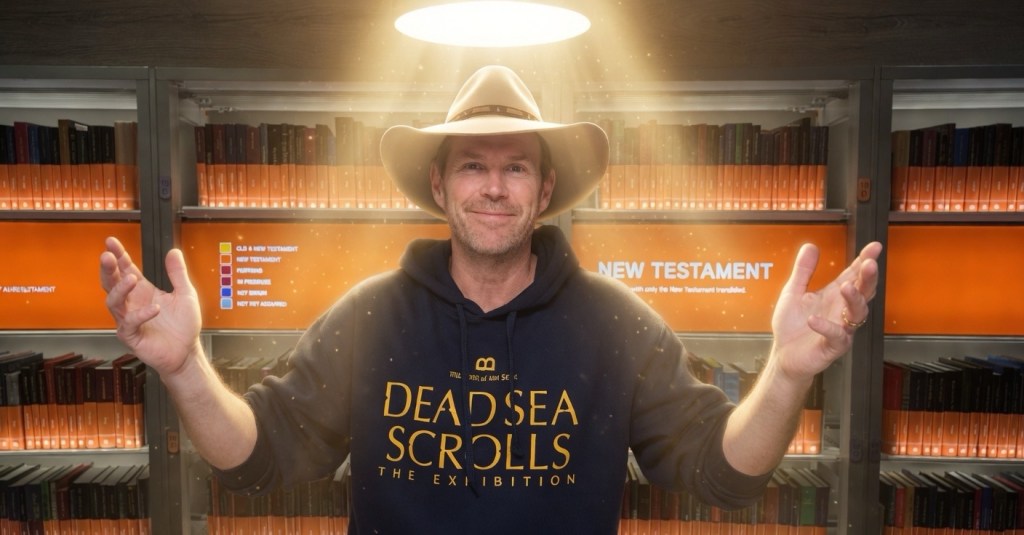
About the Author: Rich Hoffman
Rich Hoffman is an author, political consultant, and strategic advisor based in Cincinnati, Ohio, and the creator of The Politics of Heaven—a unique framework that connects biblical theology, ancient history, and modern power structures to explain how moral alignment and spiritual forces shape global events. Blending real-world political experience with deep research into archaeology, UFO phenomena, and suppressed historical narratives, Hoffman offers compelling commentary on topics ranging from ancient civilizations and the Dead Sea Scrolls to modern populist movements, paranormal continuity, and leadership strategy in chaotic environments. As the author of The Gunfighter’s Guide to Business and the forthcoming Politics of Heaven, he brings a grounded yet provocative voice to media discussions, supported by firsthand experiences and a cross-disciplinary approach that bridges science, history, and theology. For interviews, speaking engagements, or expert analysis, visit richhoffmanbooks.com or contact directly via phone at 513-307-5815 or email at rhoffman@richhoffmanbooks.com. If you’ve seen the movie, Disclosure Day and want to talk about it and the implications of Presidnet Trump’s UAP disclosures, let me know and we can bring some color to your coverage. https://richhoffmanbooks.com/media-inquiries-broadcast-topics-and-contact-info/?frame-nonce=ad51e7ecba I do have a firsthand UFO encounter to discuss.

