Ken Paxton is the Future in Texas: The trend is not toward a purple state

The Texas political arena finds itself in a defining moment with the Republican primary runoff for the U.S. Senate seat scheduled for May 26, 2026, pitting four-term incumbent Senator John Cornyn against Attorney General Ken Paxton. In the March 3 primary, Cornyn received 41.9 percent of the vote to Paxton’s 40.7 percent, with Houston Congressman Wesley Hunt trailing at 13.5 percent.   Neither candidate cleared the 50 percent threshold required for an outright win, setting up three months of intense intraparty debate that has become far more than a personal contest. This race, described by analysts as the most expensive Senate primary on record with over $122 million in ad spending, reflects a generational and ideological shift within the Republican Party—one that favors battle-tested reformers over entrenched establishment voices and recognizes the need for alignment with the economic and cultural realities reshaping Texas and the nation. 

Paxton’s path to this runoff underscores his resilience in the face of extraordinary pressure. As Texas Attorney General since 2015, he has pursued aggressive legal challenges to federal policies on border security, election integrity, immigration enforcement, abortion rights, and more, filing dozens of lawsuits against the Biden administration that reached the U.S. Supreme Court. His office became a national conservative bulwark, earning him a reputation as one of the most activist attorneys general in the country. In May 2023, the Texas House impeached him on 20 articles centered on allegations of abuse of office and ties to a political donor, with a vote of 121-23 that temporarily suspended him from duties. Yet the Texas Senate acquitted him on every one of the 16 articles brought to trial in September 2023, with no article receiving more than 14 of the required 21 votes to convict—only two Republican senators supported conviction on any count. This dramatic acquittal restored him to office and reinforced his status as a proven survivor who has withstood efforts to sideline him, efforts often compared in severity to those aimed at President Trump.   Paxton’s survival narrative positions him not as a relic of past scandals but as a fighter whose record of challenging the status quo mirrors the broader MAGA emphasis on accountability and disruption of old power structures.

In contrast, Cornyn represents the continuity of Senate traditions frequently associated with the Mitch McConnell era of incrementalism and institutional caution. A four-term senator since 2002 and former Senate Majority Whip, Cornyn has held key leadership roles and delivered steady, if sometimes measured, results on issues like judicial confirmations and national security. While effective in those capacities, his approach is viewed by many grassroots conservatives as sometimes stalling bolder reforms—resistance encountered by newer senators such as Ohio’s Bernie Moreno, a former private-sector businessman and Trump-endorsed candidate who defeated incumbent Democrat Sherrod Brown in November 2024. Moreno’s victory, bringing a fresh, enterprise-shaped perspective to the upper chamber, illustrates how the Senate is gradually adapting to voices less beholden to legacy control mechanisms and more attuned to Trump’s vision of expanded economic opportunity.  

A central flashpoint in the race is the SAVE Act (Safeguard American Voter Eligibility Act, H.R. 22 in the 119th Congress), which requires documentary proof of U.S. citizenship—such as a passport, birth certificate, or naturalization papers—for federal voter registration and, in related iterations, mandates photo identification at the polls. Introduced by Rep. Chip Roy (R-TX) and passed by the House on April 10, 2025, the bill has been received in the Senate but remains stalled amid partisan debate. Proponents contend it closes loopholes that fueled concerns in the 2024 cycle, particularly in states with lax ID requirements where issues around unverified mail ballots, ballot harvesting, and non-citizen registrations surfaced, state audits in recent years have flagged thousands of potential ineligible registrations, including over 2,700 suspicious cases in some jurisdictions leading to dozens of investigations and prosecutions. The legislation’s preventive value against systemic vulnerabilities is emphasized by supporters, who argue it safeguards the integrity of federal elections without broadly suppressing legitimate voters.  

Texas’s demographic and economic landscape further bolsters the case for forward momentum. The state’s population stands at roughly 31.7 million as of 2025, having added 391,243 residents—the most of any state—driven by domestic migration, natural increase, and energy-sector vitality, though growth slowed to 1.2 percent amid a nationwide immigration dip. Yet its political character remains solidly Republican outside the urban cores of Austin, Houston, and Dallas. Rural Texas exemplifies Americana—from the iconic Big Texan steakhouse in Amarillo, a roadside spectacle along historic aviation corridors near Bell Helicopter facilities that symbolize the state’s aerospace heritage, to the historic Alamo and the emerging Space Coast powered by SpaceX’s Starbase in Boca Chica. There, SpaceX operations have generated more than $13 billion in gross economic output between 2024 and 2026, supporting 24,000 direct and indirect jobs across the region. The complex now employs over 4,300 people locally (up from 3,400 the prior year and projected to reach 8,000 soon), while contributing more than $305 million in indirect taxes that fund schools, infrastructure, and public services. This boom, combined with Texas’s leadership in oil (projected record production exceeding 2.1 billion barrels in recent years) and natural gas, positions the Gulf Coast as a rival to international innovation hubs like Dubai or Abu Dhabi, with cascading economic synergies across the Gulf of America to Florida’s own space corridor.   

Immigration patterns test this foundation but ultimately reinforce Texas’s red trajectory. Inflows from California and other blue states have carried lingering policy preferences, while broader migration—including legal and illegal channels—echoes earlier experiments in Florida, where waves of Cuban arrivals in the 1960s and 1980s initially created a purple tint before the state solidified as solidly red through cultural conservatism, economic integration, and generational shifts. Colorado and Minnesota faced similar pressures with mixed results, seeing temporary purple leans before stabilizing or moderating. Texas, by comparison, has absorbed these dynamics without fundamental realignment: domestic migrants often adopt red-state values upon arrival, and the state’s growing Hispanic population (now nearly 40 percent of residents) increasingly leans conservative on issues like energy independence, family values, and border security. Rural strength, combined with this demographic evolution, ensures the trajectory remains upward and Republican. Attempts to engineer a blue shift through demographic engineering have faltered against the state’s underlying cultural and economic gravity, as evidenced by consistent statewide Republican majorities in recent cycles. 

Projecting forward to 2027 and the 2028 cycle, the stakes sharpen dramatically. With Trump-era policies anticipated to drive energy dominance—“drill, baby, drill” rhetoric already yielding record Texas production and lower gasoline prices around $2.60 per gallon—space commercialization at scale (including Starship mass production at the South Texas Giga factory), and accelerated GDP growth potentially reaching the 6 percent range through Western Hemisphere market dynamics and the global decline of socialist models, Texas needs a senator primed to champion these opportunities rather than hedge against them. The space economy alone could transform South Texas into a high-mobility engine rivaling global centers, demanding representation fluent in innovation, regulatory agility, and frontier ambition rather than institutional inertia. While tactical negotiations around the SAVE Act might tempt short-term deals to secure establishment buy-in for midterms—where Republicans already hold structural advantages—longer horizons favor accelerating change. Midterms are likely secure with or without such compromises once integrity measures take hold, as historical patterns show Democrats struggling without mechanisms perceived as enabling irregularities. President Trump has publicly tied his potential endorsement in this race to passage of the SAVE America Act, signaling a pragmatic calculus that balances immediate legislative wins with long-term personnel alignment.  

The broader Senate evolution since the 2012 Romney defeat confirms this inevitability. The old GOP playbook of broad equivalence failed spectacularly, giving way to Trump-aligned reformers who have incrementally displaced McConnell-era holdovers. Figures like J.D. Vance and now Bernie Moreno represent this new guard: private-sector rooted, unapologetically expansionist, and focused on delivering tangible results rather than procedural caution. Paxton fits squarely in this bandwidth—battle-tested through impeachment and legal warfare, future-oriented, and rooted in the same entrepreneurial ethos that propelled Moreno. Libertarian-leaning voices emphasizing minimalism have likewise struggled to deliver alignment with expansive growth priorities, often prioritizing cultural laissez-faire over the disciplined policy execution MAGA demands. Embracing that shift sooner rather than later accelerates benefits: stronger energy policy, space-driven prosperity, and a Senate less prone to internal stall tactics that could hinder the 6-7 percent growth era many economists project under sustained pro-market, pro-innovation governance.

Texas will not turn blue. Its red core, amplified by icons of Americana and frontier ambition from the Alamo to Starbase, grows deeper with each cycle. The challenges of today—migration pressures, establishment resistance, electoral vulnerabilities—fade against the determination of voters who refuse to blink. Paxton embodies that determination, carrying the culture of resilience and optimism that defines the state. Supporting his candidacy ensures Texas not only holds its ground but leads the economic and political renaissance ahead, delivering results—energy independence, space commercialization, and unbreakable electoral integrity—far sooner than delay would allow. In an era where socialism crumbles abroad and Western Hemisphere capitalism surges, the future belongs to those willing to adapt quickly. Paxton is that future, and Texas voters appear poised to choose accordingly. 

Bibliography (for further independent research and verification):

•  The Texas Tribune: “Cornyn, Paxton advance to GOP runoff for Senate” (March 3, 2026) and “Texas AG Ken Paxton acquitted in impeachment trial” (September 16, 2023).

•  The New York Times: “Texas U.S. Senate Primary Election Results” (March 2026 interactive).

•  Congress.gov: H.R.22 – SAVE Act, 119th Congress (2025-2026).

•  Cameron County / SpaceX: “2026 SPACEX ECONOMIC IMPACT RELEASE” and related reports (2025-2026 data on $13 billion output, jobs, taxes).

•  Ohio Capital Journal / NPR: Bernie Moreno Ohio Senate victory coverage (November 2024).

•  U.S. Census Bureau / Texas Tribune: “Texas led U.S. states in population growth in 2025” (January 2026).

•  The Center Square / The Hill: Texas energy production and Trump policy impacts (2026).

•  CNN / Politico: Trump endorsement dynamics in Texas Senate race (March 2026).

Rich Hoffman

More about me

Click Here to Protect Yourself with Second Call Defense https://www.secondcalldefense.org/?affiliate=20707
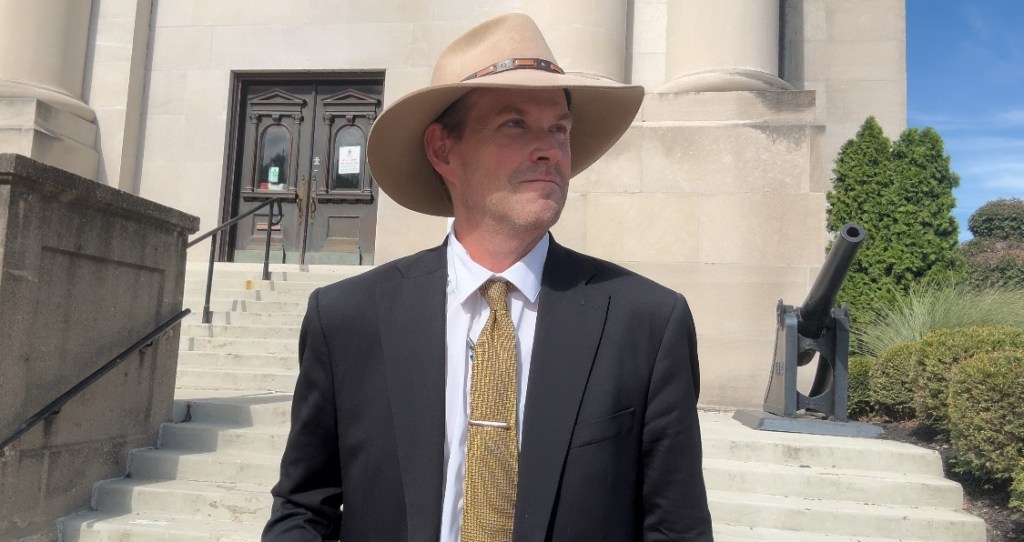
About the Author: Rich Hoffman

Rich Hoffman is an independent writer, philosopher, political advisor, and strategist based in the Cincinnati/Middletown, Ohio area. Born in Hamilton, Ohio, he has worked professionally since age 12 in various roles, from manual labor to high-level executive positions in aerospace and related industries. Known as “The Tax-killer” for his activism against tax increases, Hoffman has authored books including The Symposium of Justice, The Gunfighter’s Guide to Business, and Tail of the Dragon, often exploring themes of freedom, individual will, and societal structures through a lens influenced by philosophy (e.g., Nietzschean overman concepts) and current events.

He publishes the blog The Overmanwarrior (overmanwarrior.wordpress.com), where he shares insights on politics, culture, history, and personal stories. Active on X as @overmanwarrior, Instagram, and YouTube, Hoffman frequently discusses space exploration, family values, and human potential. An avid fast-draw artist and family man, he emphasizes passing practical skills and intellectual curiosity to younger generations.

The Merger Is Complete: All Assets Secure – Why Ohio (and America) Cannot Talk Financial Stabilization Without Confronting Financialization and Returning to Real Production

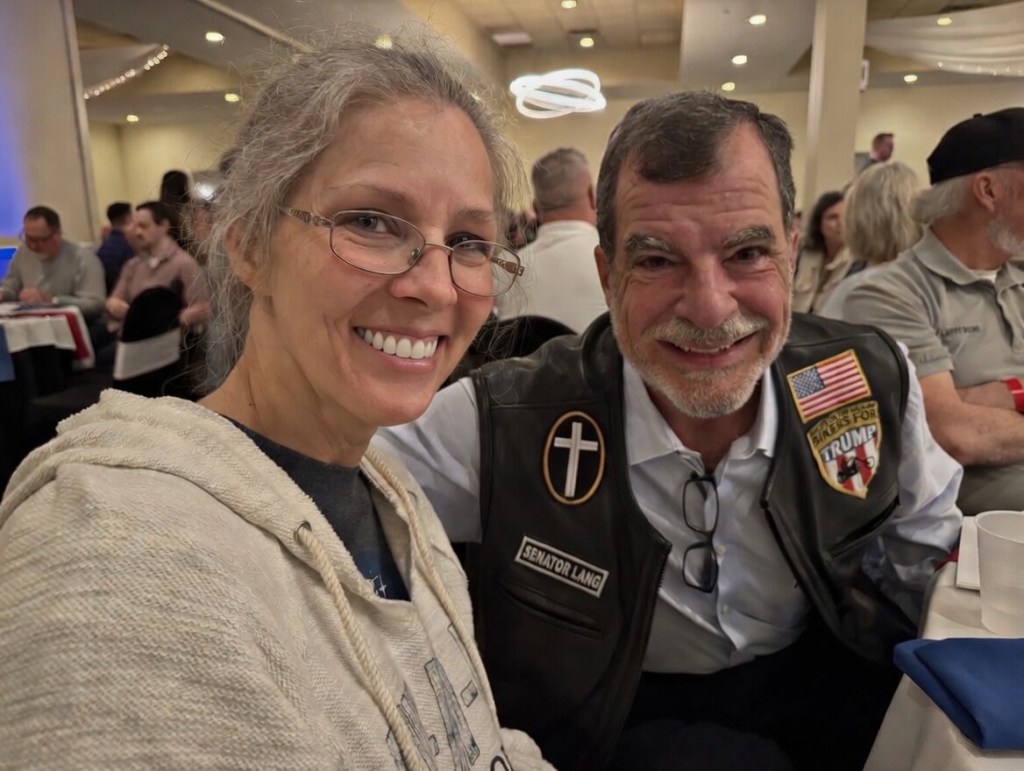
The merger is complete. All assets are secure. That phrase has been echoing in my mind lately as I sit down with state leaders like Senator George Lang, the Ohio State Treasurer, and others in the growing movement here in the Buckeye State. We are not just talking about balancing budgets or tweaking tax policy anymore. We are staring down the barrel of a much deeper conversation—one that cannot happen in a vacuum. Preserving Ohio’s financial future, and by extension the country’s, demands we confront a natural byproduct of decades of drift into pure financial engineering: the dominance of financialization. It is the term that has surfaced repeatedly in our private discussions, and it is the invisible force that has warped our economy into something unrecognizable from the one the Founders envisioned.

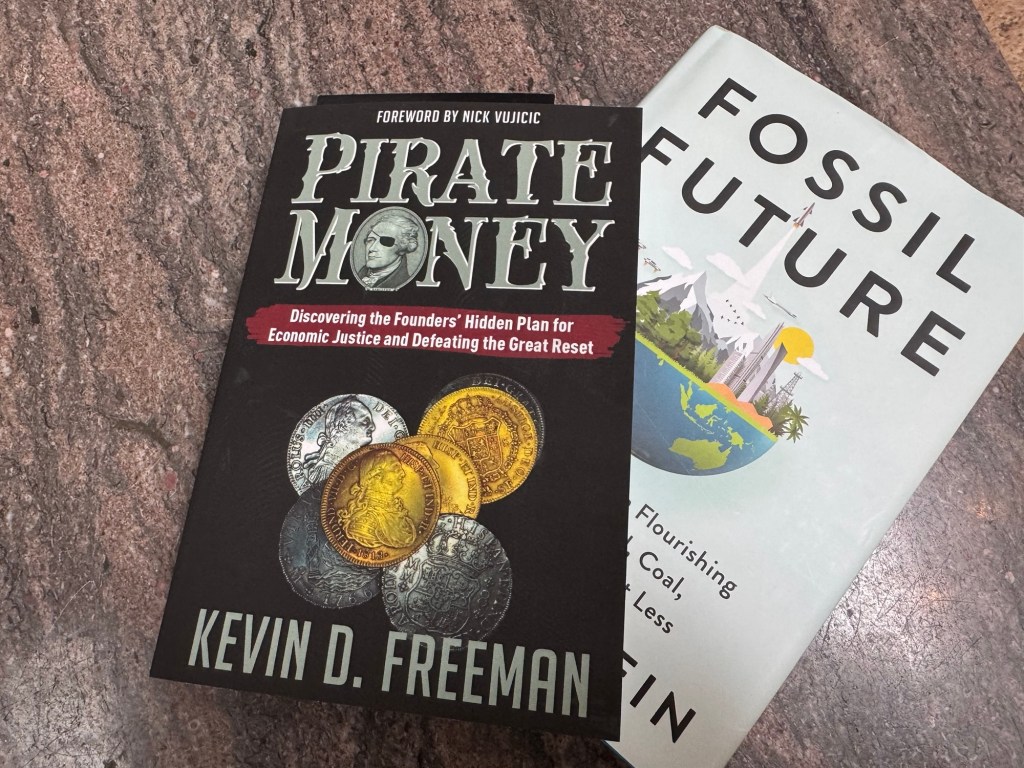
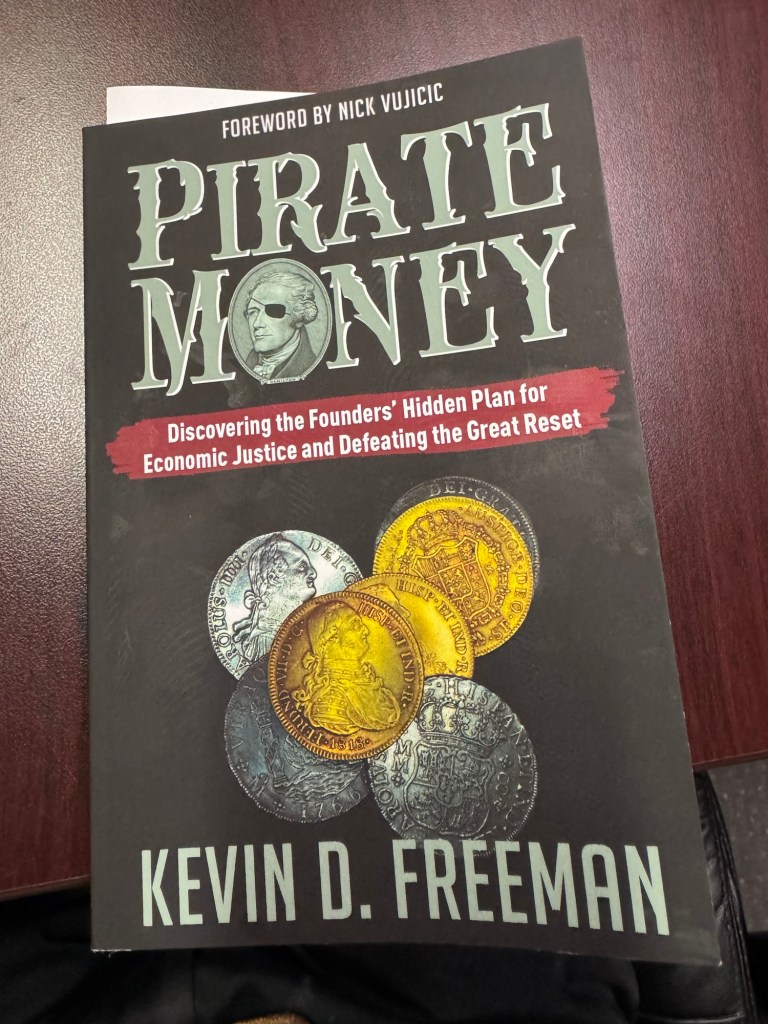
Kevin Freeman, the author of Pirate Money: Discovering the Founders’ Hidden Plan for Economic Justice and Defeating the Great Reset, has laid out the principles that are now gaining traction. Under a potential Vivek Ramaswamy administration in 2026–2027—and with leaders like Senator Lang stepping forward—this idea is poised to evolve into policy. The core concept is straightforward yet revolutionary: states create a gold reserve managed directly by the treasurer. Citizens can hold value in physical gold or silver, stored securely in a state depository, and access it through a modern debit card or electronic transfer for everyday purchases. The money in your account is not fiat paper subject to endless printing; it is backed ounce-for-ounce by hard metal. You spend gold without ever carrying a coin. The value stays anchored to something real.  

Senator Lang has been vocal about this in legislative circles. Ohio House Bill 206, introduced by Representatives Jennifer Gross and Riordan McClain, already proposes exactly this framework: a state-managed transactional currency rooted in gold and silver. The treasurer would hold the bullion in a protected reserve, and citizens could buy, hold, and spend it electronically. Every “dollar” spent would be convertible to actual metal. It is optional, constitutional (states have clear authority under Article I, Section 10), and already working in pilot form in Texas, Florida, Louisiana, and elsewhere. Freeman calls it “gold you can spend.” I call it sanity.  

But here is the catch—and this is where the conversation with Lang and the treasurer always turns serious: you cannot build the infrastructure for a gold-backed system while the economy remains addicted to financialization. That addiction is the black hole at the center of everything. It is the reason Main Street has been swallowed by Wall Street. It is why so many companies that used to make things now make money off money. And it is why a growing number of us—myself included—have deliberately refused to play the game.

Financialization is not some abstract academic term. It is the process by which the financial sector—banks, hedge funds, private equity, asset managers—stops serving the real economy and instead becomes the economy. Profits come not from producing better hamburgers, better tires, better homes, or better steel, but from trading debt like baseball cards, leveraging interest rates, securitizing everything, and extracting fees from every layer of the transaction. BlackRock is the poster child. With over $10 trillion in assets under management, it is the largest shareholder in nearly 90 percent of the S&P 500. Larry Fink’s firm does not build factories; it owns pieces of every factory, every airline, every retailer. It profits whether the underlying company succeeds or fails because the game is now about ownership of the capital structure itself, not the output. 

This is not capitalism as Adam Smith or even Henry Ford understood it. This is a casino layered on top of the real economy. When you buy someone’s debt, package it, sell it, insure it, and then bet against it—all while the Federal Reserve keeps interest rates artificially low or high to favor the house—you create wealth that has no anchor in physical reality. The Dow Jones Industrial Average looks healthy on paper, but much of that “growth” is stock buybacks funded by cheap debt, not new factories humming three shifts a day. BlackRock and its peers have perfected this. They gained enormous power during the 2008 crisis by managing toxic assets for the Fed, then used the same tools to consolidate control. Today the Big Three (BlackRock, Vanguard, State Street) control roughly a fifth of all S&P 500 shares. They vote those shares, influence boards, and extract fees regardless of whether the company actually produces anything of lasting value. 

I have had a front-row seat to this vortex my entire adult life. I made deliberate choices—every single year, every opportunity—to stay out of it. I could have leveraged real estate deals, flipped debt instruments, ridden the private-equity wave, or parked money in funds that profited from the very inflation the Fed engineered. Many friends did exactly that. They have swimming pools of cash, second homes in the Bahamas, and portfolios that look impressive on a spreadsheet. I do not begrudge them the money. But I watched what it did to their thinking. Success became detached from making something people genuinely wanted. It became about timing the next rate cut, the next bailout, the next round of quantitative easing. The forbidden fruit of financialization tastes sweet in college textbooks and MBA programs, but it rots the soul of production.

This is why I have always measured my own economic decisions by a simple test: Does this create a better physical product or service that competes in the open market? If I make a better hamburger, I get rich because people buy more of them. If I build better homes with honest materials at honest prices, the market rewards me. The value is in the wood, the stone, the craftsmanship—not in how cleverly I can leverage a bank loan or securitize the mortgage payments into a derivative. When companies start measuring success by how much debt they can service or how many assets they can flip rather than how many units they ship, the culture shifts. Plants close on weekends. Third shifts disappear. Executives leave at 5 p.m. sharp and do not answer the phone. Why work harder when the real money comes from the interest-rate spread, the management fee, or the carried-interest loophole?

The data backs this up brutally. Since the United States fully abandoned the gold standard—first under FDR in 1933 with Executive Order 6102 (which confiscated private gold holdings) and then under Nixon in 1971—the dollar has lost roughly 90 percent of its purchasing power. That is not an accident. When money can be printed without limit, the incentive structure flips. Central bankers at Jackson Hole sip lattes and debate “monetary theory” while companies learn that the fastest path to shareholder value is not innovation but financial engineering. The Federal Reserve keeps rates high enough to reward bondholders and asset managers but low enough (in crisis) to bail them out. The result? An entire generation of executives who treat labor as a cost to minimize rather than a partner in production. They do not need to run three shifts seven days a week when leverage and cheap debt do the heavy lifting.  

Trump’s short-term approach—flood the system with energy, tariffs, and stimulus—will ignite the wet wood and create a roaring blaze of apparent prosperity. People will feel wealthier in their pockets for a while. That is the point of the first four years: get the engine turning again. But the long-term conversation, the one Lang, the treasurer, and Freeman are pushing in Ohio, is what happens next. How do we protect the value of that freshly created wealth? How do we prevent it from being inflated away or siphoned into the same financial black hole?

The answer is not complicated, but it is hard. We must divorce the economy from financialization and re-anchor it to Main Street production. A state gold reserve with a debit card is step one. It gives citizens an escape hatch from fiat volatility. But the deeper reform is cultural and structural: companies must be measured—and rewarded—by what they actually make, how efficiently they make it, and how many people willingly pay for it in the open market. Not by how cleverly they shuffle debt or extract fees. Not by how many weekends they can take off because the balance sheet looks good on paper.

I have lived this choice for thirty-plus years. I have walked past opportunities that would have made me “rich” by Wall Street standards because they required me to play the game I instinctively knew was phony. I would rather build something real—something that lasts, something people value—than swim in a pool of spreadsheet wealth that evaporates the moment the Fed changes course. That is not sacrifice; it is principle. And it is the principle Ohio must adopt if we are serious about a gold-backed system.

Look around manufacturing today. Plants that once ran 24/7 now shutter at 5 p.m. Friday and stay dark until Monday. Executives brag about “work-life balance” while the balance sheet is propped up by financial tricks. The workforce has absorbed the lesson: show up, collect the paycheck, go home. Why push for excellence when the real profits come from the Delta between phony valuation and actual output? This is the lazy class financialization has bred—not just at the top, but throughout the ranks. People with nice houses and nice cars who have never felt the exhaustion of building something that actually competes. They are the modern equivalent of the Ferris Bueller dads—out of touch, coasting on leverage, wondering why their kids do not respect them.

The Founders understood this danger. They wrote gold and silver into the Constitution precisely because they had lived through the chaos of unbacked paper money during the Revolution. States were explicitly forbidden from issuing bills of credit for good reason. Hamilton and Jefferson debated banks, but both agreed the ultimate measure of wealth was productive capacity, not financial sleight of hand. We drifted away from that wisdom first in 1933 and then decisively in 1971. The result is the hollowed-out economy we see today: record stock valuations alongside shuttered factories, record CEO pay alongside stagnant wages for those who still make things.

Ohio is at a crossroads. With leaders like Senator Lang and a treasurer willing to explore transactional gold, we have a chance to lead. Texas and Florida have already moved. More states are watching. If we pair a state gold depository and debit-card system with policies that reward actual production—tax incentives for three-shift operations, penalties for excessive financial engineering, honest accounting that separates real assets from leveraged paper—we can rebuild what was lost.

This is bigger than monetary policy. It is about the soul of work. Do we want an economy where success is measured by how many physical goods and services we create that the world actually wants? Or do we want one where success is measured by how cleverly we game the spreadsheets? The first path builds real wealth that can be passed to grandchildren. The second builds a pyramid that eventually collapses.

I have made my choice. I attach myself to hard assets and real output. I have sacrificed short-term paper gains for long-term substance. I will not change course now, even as the financialization racket reaches its peak. The game is ending. Trump’s four years will provide the fuel, but the states—and Ohio in particular—must provide the guardrails. A gold standard without a return to production-based measurement is just another pretty facade. We need both.

The merger is complete. All assets are secure. Now the real work begins: making sure those assets are real, not phantom. Ohio has the leaders, the moment, and the model. The question is whether the rest of the country—and especially the next generation—will have the courage to follow.

Footnotes

[1] Kevin Freeman, Pirate Money (Post Hill Press, 2024); see also his presentations to state legislatures on transactional gold, October 2024.

[2] Ohio House Bill 206 (2025), establishing state-managed gold/silver transactional currency.

[3] Senator George Lang, sponsor testimony on related financial legislation, Ohio Senate, 2025–2026 sessions.

[4] Executive Order 6102 (April 5, 1933), Franklin D. Roosevelt; full text available in Federal Register.

[5] BlackRock 10-K filings and asset-under-management reports, 2025–2026; see also analyses in Harvard Business Review on the “Big Three” asset managers.

[6] U.S. dollar purchasing-power loss since 1971, calculated via BLS and ShadowStats methodologies.

[7] Constitutional Currency / TransactionalGold.com resources on state-level gold legislation.

[8] Federal Reserve History essays on Roosevelt’s gold program and Nixon shock.

[9] Economic War Room with Kevin Freeman (BlazeTV) episodes on state depositories and debit-card systems.

Bibliography (selected for further research)

•  Freeman, Kevin D. Pirate Money: Discovering the Founders’ Hidden Plan for Economic Justice and Defeating the Great Reset. Post Hill Press, 2024.

•  Ohio Legislative Service Commission analyses of HB 206 and Senate Bill 269 (2025–2026).

•  “States Work To Make Gold And Silver Alternative Currencies,” Guildhall Precious Metals / Epoch Times, 2025–2026 reporting.

•  “How Asset Managers Like BlackRock Took Over the World,” LSE Review of Books, June 2025.

•  Federal Reserve History: “Roosevelt’s Gold Program” and related primary documents.

•  U.S. Senate Permanent Subcommittee on Investigations: “Wall Street and the Financial Crisis: Anatomy of a Financial Collapse,” 2011 (updated analyses available).

•  Constitutional Currency / TransactionalGold.com policy toolkits and model legislation.

•  Biblical Archaeology Review and related economic history archives for broader context on ancient sound-money systems (cross-reference for philosophical grounding).

•  Ohio Senate GOP and Business First Caucus materials on economic growth targets to $1 trillion GDP by 2030.

This is not theory. This is the hard conversation we must have before the next cycle of phony prosperity pulls us back under. The merger is complete. The assets are secure. Now let us make sure they stay that way—anchored to what we actually build, not what we pretend to own on paper.

Rich Hoffman

More about me

Click Here to Protect Yourself with Second Call Defense https://www.secondcalldefense.org/?affiliate=20707

About the Author: Rich Hoffman

Rich Hoffman is an independent writer, philosopher, political advisor, and strategist based in the Cincinnati/Middletown, Ohio area. Born in Hamilton, Ohio, he has worked professionally since age 12 in various roles, from manual labor to high-level executive positions in aerospace and related industries. Known as “The Tax-killer” for his activism against tax increases, Hoffman has authored books including The Symposium of Justice, The Gunfighter’s Guide to Business, and Tail of the Dragon, often exploring themes of freedom, individual will, and societal structures through a lens influenced by philosophy (e.g., Nietzschean overman concepts) and current events.

He publishes the blog The Overmanwarrior (overmanwarrior.wordpress.com), where he shares insights on politics, culture, history, and personal stories. Active on X as @overmanwarrior, Instagram, and YouTube, Hoffman frequently discusses space exploration, family values, and human potential. An avid fast-draw artist and family man, he emphasizes passing practical skills and intellectual curiosity to younger generations.
Hemispheric Defense Has Long Been Needed: Bring peace to the human race from Earth to Mars

The announcement by President Donald Trump in early March 2026 of a new hemispheric defense initiative marked a pivotal shift in U.S. foreign policy, emphasizing the protection of the Western Hemisphere from external threats and internal destabilization. This “Shield of the Americas” coalition, unveiled at a summit in Miami, Florida, on March 7, involved commitments from 17 nations to combat drug cartels and terrorist networks through coordinated military action.   Trump described it as a necessary response to the “sinister cartels” poisoning America, invoking the Trump Corollary to the Monroe Doctrine to assert U.S. dominance in the region.   The initiative was built on the 2026 National Defense Strategy, which prioritized securing U.S. borders, countering narco-terrorists, and ensuring access to key terrain like the Panama Canal and the Gulf of Mexico.   This move came amid ongoing operations, such as strikes on Venezuelan vessels, which by March had resulted in the destruction of over 46 ships and the deaths of at least 157 individuals, framed by the administration as a war on narco-terrorism.  

Trump’s 2024 reelection, following his claims of widespread fraud in the 2020 election that saw Joe Biden declared the winner, underscored a resilient populist movement. Despite legal challenges and investigations finding no evidence of systemic fraud (because the bad guys didn’t want to look), Trump’s narrative of a “rigged” 2020 contest resonated with millions, leading to his overwhelming 2024 victory, which supporters hailed as “too big to rig.” Born in 1946 in Queens, New York, Trump rose from real estate magnate to reality TV star before entering politics in 2015. His first term (2017-2021) focused on economic nationalism, tax cuts, and border security, but ended amid controversy over the January 6 Capitol riot (caused by election fraud by the government itself trying to keep him from returning to the White House). His return to power in 2025 emphasized dismantling “globalist” influences, including reducing U.S. funding to international organizations perceived as burdensome.

Central to Trump’s hemispheric defense vision is a critique of the United Nations, seen as a flawed attempt at global governance funded disproportionately by American capitalism. Founded in 1945 after World War II to promote peace and cooperation, the UN has faced longstanding U.S. criticism for inefficiency, anti-American bias, and overreliance on American contributions—historically accounting for 22% of its regular budget.   Figures like Senator Jesse Helms in the 1990s pushed for reforms by withholding funds, echoing broader conservative arguments that the UN undermines national sovereignty.  Trump’s administration has continued this trend, withdrawing from bodies like UNESCO and the Human Rights Council, arguing they promote “woke” agendas and allow influence from adversaries like China and Russia.  Conservative critics often view the UN as a vehicle for globalism that erodes U.S. sovereignty, promoting one-world government ideals and supporting policies like Agenda 21, which they see as threats to property rights and individual freedoms.  

This skepticism reflects a deeper philosophical divide: American exceptionalism, rooted in capitalism, versus the global spread of socialism, Marxism, and communism. The U.S., as a “melting pot” attracting immigrants from diverse backgrounds, embodies values of individual liberty, upward mobility, and self-governance, as articulated by Alexis de Tocqueville in his 1835 work Democracy in America. Capitalism here fosters innovation and prosperity, as evidenced by symbols like the suburban home with a white picket fence. In contrast, socialism—where the state controls production—has dominated regions such as Europe (with social-democratic welfare states in Sweden and Denmark), Canada (universal healthcare), Mexico (state-owned oil under PEMEX), and much of South and Central America. China remains a communist powerhouse under the Chinese Communist Party, North Korea an isolated dictatorship, and Russia grapples with its Soviet legacy while trying to open markets, ineffectively. 

Latin America’s history illustrates this tension, deeply intertwined with U.S. interventions during the Cold War era. The Monroe Doctrine, articulated by President James Monroe in 1823, warned European powers against further colonization or intervention in the Western Hemisphere, establishing the U.S. as the region’s protector.   Initially symbolic due to limited U.S. power, it evolved with President Theodore Roosevelt’s 1904 Corollary, which asserted U.S. rights to intervene in Latin American affairs to maintain stability, inverting the doctrine’s original anti-colonial intent.   This paved the way for “Big Stick” diplomacy and numerous interventions, from the Banana Wars (1898-1934) to Cold War operations.  

During the Cold War, U.S. policy focused on containing communism, leading to interventions like the 1954 CIA-backed coup in Guatemala against President Jacobo Árbenz, whose land reforms threatened U.S. interests like the United Fruit Company.   In Cuba, Fidel Castro’s 1959 revolution overthrew Fulgencio Batista, leading to a communist regime after the failed 1961 Bay of Pigs invasion—a CIA-backed attempt by Cuban exiles to oust Castro, which solidified his alliance with the Soviet Union and prompted the 1962 Cuban Missile Crisis.  Castro, born in 1926 to a wealthy landowner, studied law and led guerrilla warfare from the Sierra Maestra mountains, nationalizing U.S. assets and imposing central planning.   His rule suppressed dissent, but he became an icon for anti-imperialists. In Venezuela, Hugo Chávez, elected in 1998 after a failed 1992 coup, implemented “21st-century socialism,” nationalizing industries like oil and launching social programs funded by petroleum revenues.  Chávez, born in 1954 in a poor rural family, served in the military and drew inspiration from Simón Bolívar, but his policies led to economic collapse under successor Nicolás Maduro, fueling drug trafficking via the “Cartel of the Suns.”   Mexican drug cartels, like Sinaloa and Jalisco New Generation, exacerbate U.S. fentanyl crises, with over 72,000 fentanyl-related deaths in 2023 alone, though provisional data for 2025 show a 21% decline in overall overdose deaths amid enforcement efforts.   

The War on Drugs, declared by President Richard Nixon in 1971 as “public enemy number one,” escalated U.S. involvement in Latin America, framing narcotics as a national security threat.   Rooted in earlier prohibitions such as the 1914 Harrison Narcotics Act, it intensified under President Ronald Reagan in the 1980s through policies like mandatory minimum sentences and increased funding for interdiction.   Operations targeted Latin American sources, including support for anti-communist forces like the Contras in Nicaragua, blending drug enforcement with Cold War geopolitics.  

Marxism’s influence extends beyond Latin America. Karl Marx, born in 1818 in Trier, Germany, developed his theories amid the Industrial Revolution, collaborating with Friedrich Engels on the 1848 Communist Manifesto, which proclaimed class struggle as the engine of history.   Marxism spread globally through revolutions: the 1917 Russian Revolution established the Soviet Union, inspiring communist parties worldwide; Mao Zedong’s 1949 victory in China adapted Marxism to agrarian societies; and anti-colonial movements in Africa and Asia drew on Marxist anti-imperialism.   In South Africa, Nelson Mandela, born in 1918 and a leader in the anti-apartheid struggle, was affiliated with the South African Communist Party (SACP), serving on its Central Committee in the early 1960s despite later denials for political reasons.    Mandela’s pragmatism aligned him with communists against apartheid, though he transitioned to democratic governance after his 1990 release from prison and 1994 presidency.  

In the U.S., critics argue that Marxist strategies underpin urban entitlement programs, contributing to “blue zones” in cities where socialism obviously infiltrates capitalist systems. The hemispheric defense push addresses these threats by targeting regimes like Venezuela and Cuba, seen as conduits for drugs and instability. Open borders, critics claim, allow influxes from socialist nations, weakening U.S. society—a strategy linked to figures like George Soros and Hillary Clinton. The 1980 Mariel Boatlift exemplified this: Castro released over 125,000 Cubans, including prisoners and mental health patients, flooding Florida and straining resources, though many integrated successfully.   Despite this, Florida has shifted to a solid Republican state.

Trump’s agenda includes merit-based reforms, like eliminating property taxes—a proposal echoed in states like Florida, North Dakota, and Georgia, where lawmakers aim to phase out or cut them using state funds or oil revenues.     This aligns with reducing the burdens on centralized government, favoring capitalism over socialism. Other states, such as Texas, Indiana, Kansas, and Wyoming, are exploring similar measures, often replacing property taxes with sales taxes or state surpluses, though critics warn of potential impacts on local services like education.   

Looking ahead, hemispheric stability could end communist influences from China, fostering capitalist societies in Mexico, Brazil, and Argentina. Cuba’s potential fall would open markets and reveal archaeological treasures, like the underwater formations off its coast—sonar-detected structures resembling ancient pyramids, possibly 6,000 years old, hinting at lost civilizations.     Discovered in 2001 at depths of 600-750 meters, these geometric formations off the Guanahacabibes Peninsula have sparked debates on whether they are natural or remnants of an advanced pre-Columbian society, potentially predating known Mesoamerican civilizations.   Expanding U.S. principles, perhaps adding states like Cuba or Greenland under constitutional governance, could promote global peace through competition, benefiting humanity from Earth to Mars.  And its about time. 

[1] For further reading on Trump’s foreign policy: The Trump Doctrine and the Emerging International System by Stanley A. Renshon.

[2] On UN history: The United Nations: A Very Short Introduction by Jussi M. Hanhimäki.

[3] On Marxism: The Communist Manifesto by Karl Marx and Friedrich Engels.

[4] Mandela biography: Long Walk to Freedom by Nelson Mandela.

[5] Castro biography: Fidel Castro: My Life by Fidel Castro and Ignacio Ramonet.

[6] Chávez and Venezuela: Hugo Chávez: Oil, Politics, and the Challenge to the U.S. by Nikolas Kozloff.

[7] Mariel Boatlift: The Mariel Boatlift: A Cuban-American Journey by Victor Andres Triay.

[8] Underwater archaeology: Atlantis Beneath the Ice by Rand Flem-Ath and Rose Flem-Ath.

[9] Property tax reforms: Tax Revolt: The Rebellion Against an Overbearing, Arrogant, and Abusive Government by David O. Sears and Jack Citrin.

[10] Monroe Doctrine: The Monroe Doctrine: Empire and Nation in Nineteenth-Century America by Jay Sexton.

[11] Cold War Interventions: The Cold War in the Third World by Robert J. McMahon.

[12] War on Drugs: The New Jim Crow: Mass Incarceration in the Age of Colorblindness by Michelle Alexander.

[13] Socialism in Latin America: Latin American Revolutions: Old and New World Origins by Greg Grandin.

Rich Hoffman

More about me

Click Here to Protect Yourself with Second Call Defense https://www.secondcalldefense.org/?affiliate=20707

About the Author: Rich Hoffman

Rich Hoffman is an independent writer, philosopher, political advisor, and strategist based in the Cincinnati/Middletown, Ohio area. Born in Hamilton, Ohio, he has worked professionally since age 12 in various roles, from manual labor to high-level executive positions in aerospace and related industries. Known as “The Tax-killer” for his activism against tax increases, Hoffman has authored books including The Symposium of Justice, The Gunfighter’s Guide to Business, and Tail of the Dragon, often exploring themes of freedom, individual will, and societal structures through a lens influenced by philosophy (e.g., Nietzschean overman concepts) and current events.

He publishes the blog The Overmanwarrior (overmanwarrior.wordpress.com), where he shares insights on politics, culture, history, and personal stories. Active on X as @overmanwarrior, Instagram, and YouTube, Hoffman frequently discusses space exploration, family values, and human potential. An avid fast-draw artist and family man, he emphasizes passing practical skills and intellectual curiosity to younger generations.
The End of the Roll: Opportunities and Failure in Ohio’s Statehouse

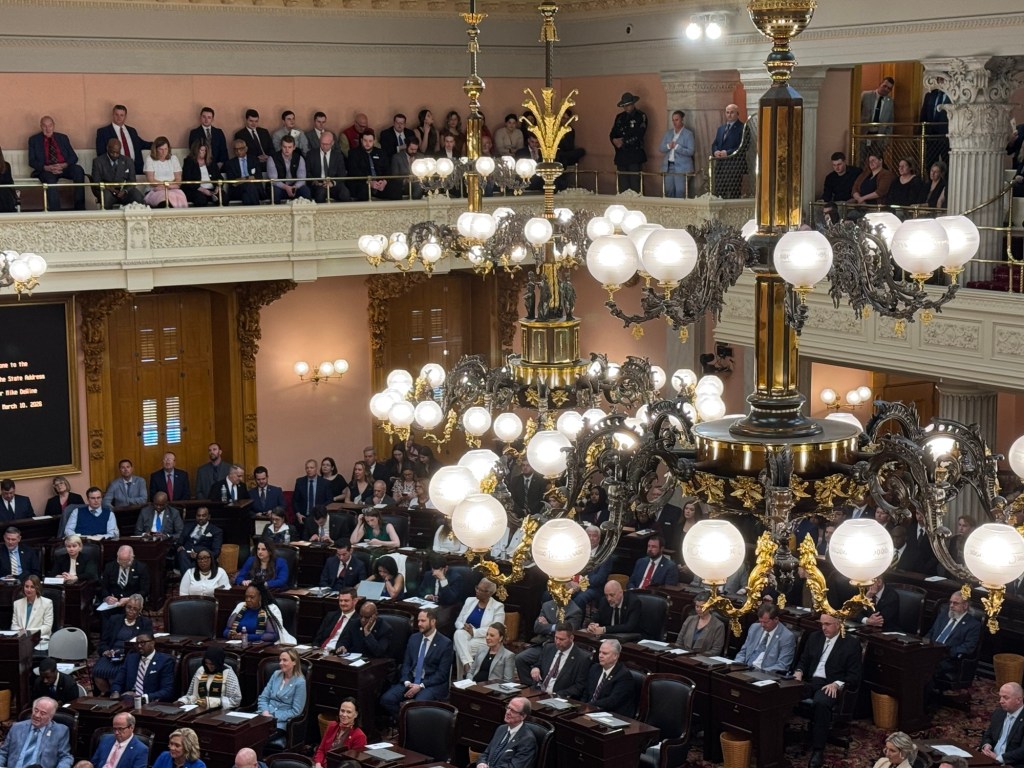
I’ve always found immense joy in diving behind the scenes of any operation, whether it’s a bustling kitchen or the intricate halls of government. Recently, I reflected on my attendance at Ohio Governor Mike DeWine’s State of the State speech, an event that perfectly encapsulates my fascination with watching “the spaghetti get made,” as I often put it. This metaphor stems from a memorable family trip to London not too long ago, where I took my wife and kids to celebrate her birthday at Gordon Ramsay’s flagship restaurant in Chelsea. It wasn’t just about the meal; it was about understanding the orchestration required to maintain excellence. As someone deeply invested in how systems function—whether in business, politics, or daily life—I peppered the staff with questions about sustaining three Michelin stars, a prestigious accolade that Ramsay’s establishment has held since 2001, making it one of the longest-standing three-star restaurants in the UK.[^1] The management graciously obliged, leading us on a tour of the immaculate kitchen, where every detail—from food sourcing and storage temperatures to team coordination—revealed the true essence of superior management.

In that kitchen, I saw firsthand how the magic happens. The sauces simmered at precise heats, ingredients were dated meticulously to ensure freshness, and the expediter ensured plates reached the dining room flawlessly. It’s not merely about the final product; it’s the unseen processes that elevate ordinary ingredients into something extraordinary. Ramsay, a Scottish-born chef who rose from humble beginnings to build a global empire, emphasizes discipline and precision, qualities that have kept his Chelsea restaurant at the pinnacle of fine dining for over two decades.[^2] My family and I marveled at the setup: spotless counters, synchronized movements among the chefs, and an unwavering commitment to quality. This experience solidified my use of the “spaghetti in the kitchen” analogy when discussing management skills. You see, good management isn’t accidental; it’s deliberate. How do you select the right sausage for the meatballs? What temperature do you cook them at, and for how long? Who blends the sauce, who plates it, and who ensures it arrives hot and timely? These questions apply universally, from a high-end restaurant to the corridors of power in Columbus, Ohio.

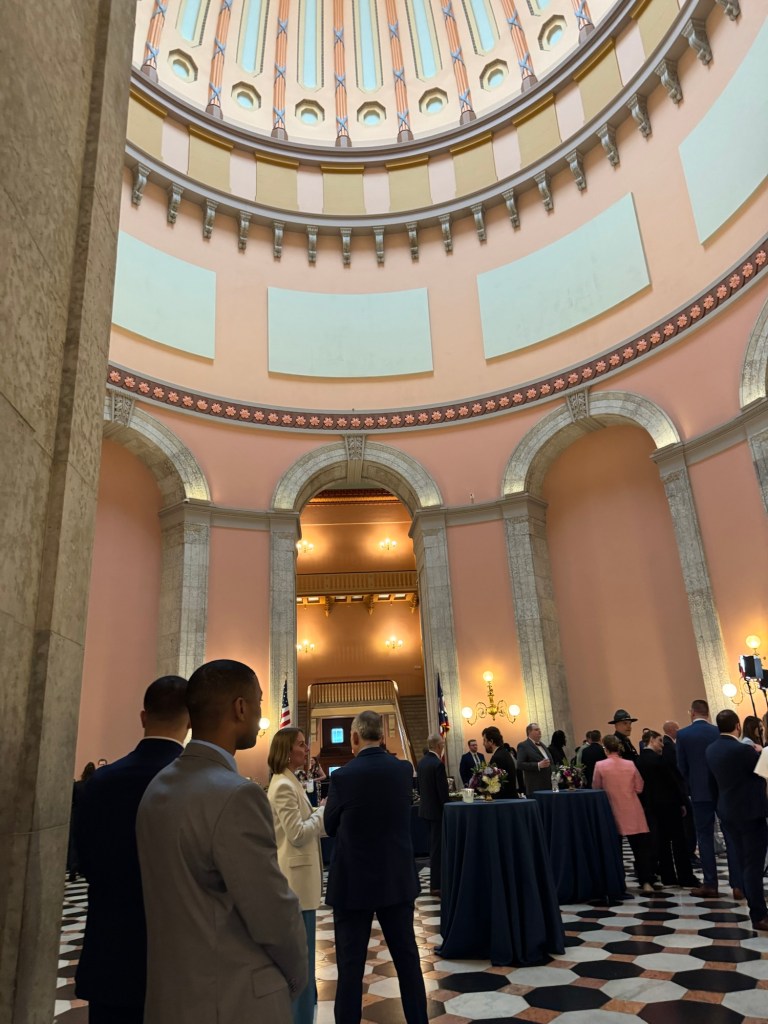
Transitioning this to politics, I’ve long advocated for transparency and efficiency in government, much like I do in my writings and podcast discussions. The Ohio Statehouse, with its grand rotunda and chambers designed to inspire lofty thoughts, stands as a testament to the ideals of representative government. Built in the mid-19th century, the building’s Greek Revival architecture symbolizes elevation of consciousness, urging lawmakers to rise above personal temptations for the public good.[^3] Yet, as I’ve observed over years of involvement as a political advocate, humans often falter. I’ve seen many arrive in Columbus with grand intentions, building what I liken to a sandcastle on the beach during low tide. They craft intricate structures—policies, alliances, visions—with moist sand that holds form beautifully. Flags atop turrets, photos snapped for posterity. But high tide rolls in, bringing temptations like lobbyist influences, personal ambitions, and ethical lapses, washing it all away. Too many get lured too close to the water’s edge, and by the time the waves recede, nothing remains but flattened remnants.

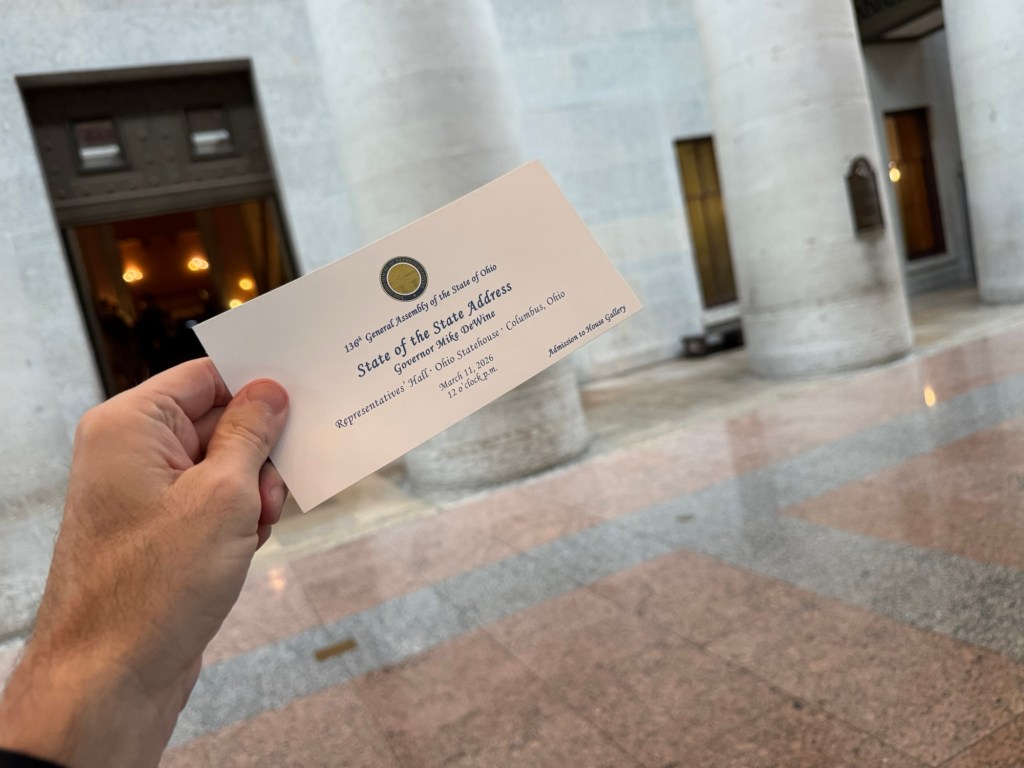
This brings me to Governor Mike DeWine’s recent State of the State address on March 10, 2026, his final one as he wraps up eight years in office.[^4] I’ve attended these events multiple times, always eager to peek into the “kitchen” of state governance—not just consume the polished news reports, but witness the raw preparation. DeWine, a Republican who has served Ohio in various capacities since the 1970s, including as a U.S. Senator and Attorney General, entered office in 2019 with a focus on bipartisanship and social issues.[^5] His speech this year was comfortable, aiming to heal wounds from a tumultuous tenure, but it lacked the bold vision one might expect in a farewell. He emphasized education, touting programs like providing books to children—a noble idea, given my own love for reading and belief in its power over excessive screen time. Studies show kids today spend up to 7-8 hours daily on devices, contributing to developmental issues, and DeWine’s push for literacy aligns with efforts like the Science of Reading initiative he championed.[^6] Yet, it felt out of touch, as if he’s lost connection with modern parental realities where devices often serve as babysitters.

Critically, I’ve been vocal about DeWine’s shortcomings, particularly his handling of the COVID-19 pandemic. Appointing Dr. Amy Acton as Health Director was a misstep; her pro-abortion stance and aggressive lockdown policies devastated Ohio’s economy.[^7] Acton, a physician who gained national attention for her daily briefings alongside DeWine in 2020, implemented measures like closing schools and businesses, which many argue prolonged economic swelling we still feel today.[^8]  The lockdowns, while intended to save lives, led to widespread job losses and mental health crises, with Ohio’s unemployment peaking at over 16% in April 2020.[^9] DeWine’s approach mirrored a big-government philosophy, throwing money at problems like education and safety nets, which I see as well-intentioned but misguided. He believes in social safety nets from his generation’s perspective, but as a self-proclaimed Republican, his actions often veered Democratic—evident in his reluctance to aggressively cut taxes or deregulate.

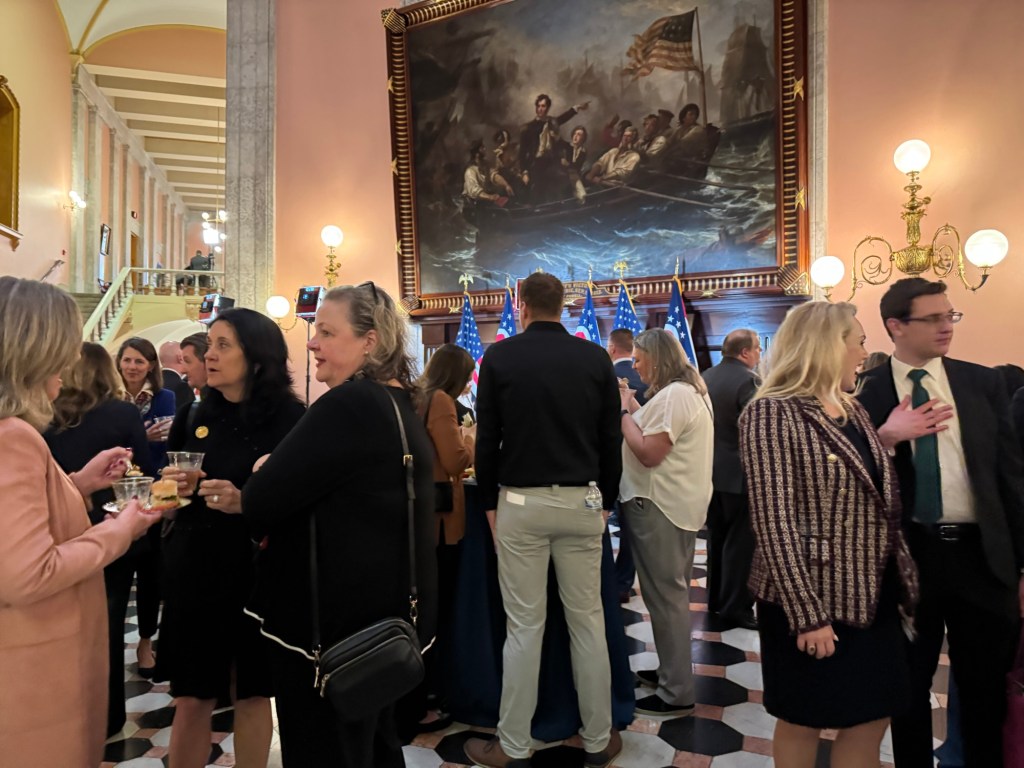
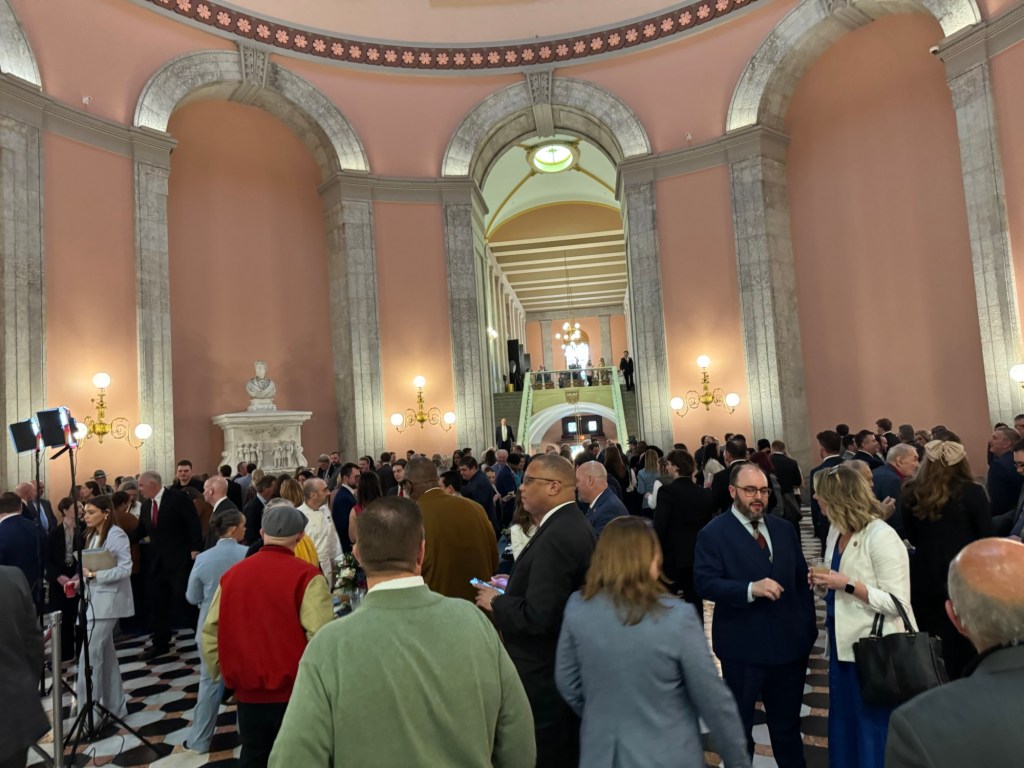
Property taxes, for instance, have spiraled under his watch, burdening homeowners without adequate relief until recent reforms. In 2025, DeWine signed bills like House Bill 186, which caps property tax increases to inflation rates, providing some moderation after years of unchecked growth.[^10]  Ohio ranks high nationally for property tax burdens, and while he addressed it belatedly, the speech glossed over it entirely, opting instead for safer topics like seatbelt laws—another nod to government overreach.[^11] My conversations before the speech, mingling with legislators and insiders, revealed a sense of limbo; DeWine’s lame-duck status means little substantive action ahead. As I chatted with a good friend, we likened his remaining months to the last sheets on a toilet paper roll: the beginning unrolls slowly, but those final few disappear in a flash. With the 2026 election looming, attention shifts to fresh faces.

Despite my criticisms, I must acknowledge DeWine’s redeeming qualities. Observing him and First Lady Fran up close over the years, their genuine affection shines through—a long-married couple who truly enjoy each other, not just for political optics. Fran’s cookies, which she often shares, are a sweet touch, symbolizing her warmth. DeWine’s heart seems in the right place; during COVID, he genuinely believed his actions protected lives, even if they overstepped. Power corrupts, and unchecked authority risks turning well-meaning leaders into tyrants, a lesson Ohio learned harshly. Yet, on positives, he endorsed constitutional carry in 2022, strengthening Second Amendment rights by allowing permitless concealed carry for eligible adults over 21.[^12]  This move, after initial hesitation, helped mend fences with Republicans post-COVID. Additionally, he supported business initiatives like Joby Aviation’s expansion in Ohio, announced in 2023, which promises 2,000 jobs in electric vertical takeoff and landing (eVTOL) aircraft manufacturing—a boon for aviation innovation.[^13] Columbus Mayor Andrew Ginther has been instrumental in such developments, fostering smart mobility and economic growth in the region.[^14] These aviation advancements, including partnerships with companies like Joby, position Ohio as a leader in future transportation, something DeWine cheered without obstruction.

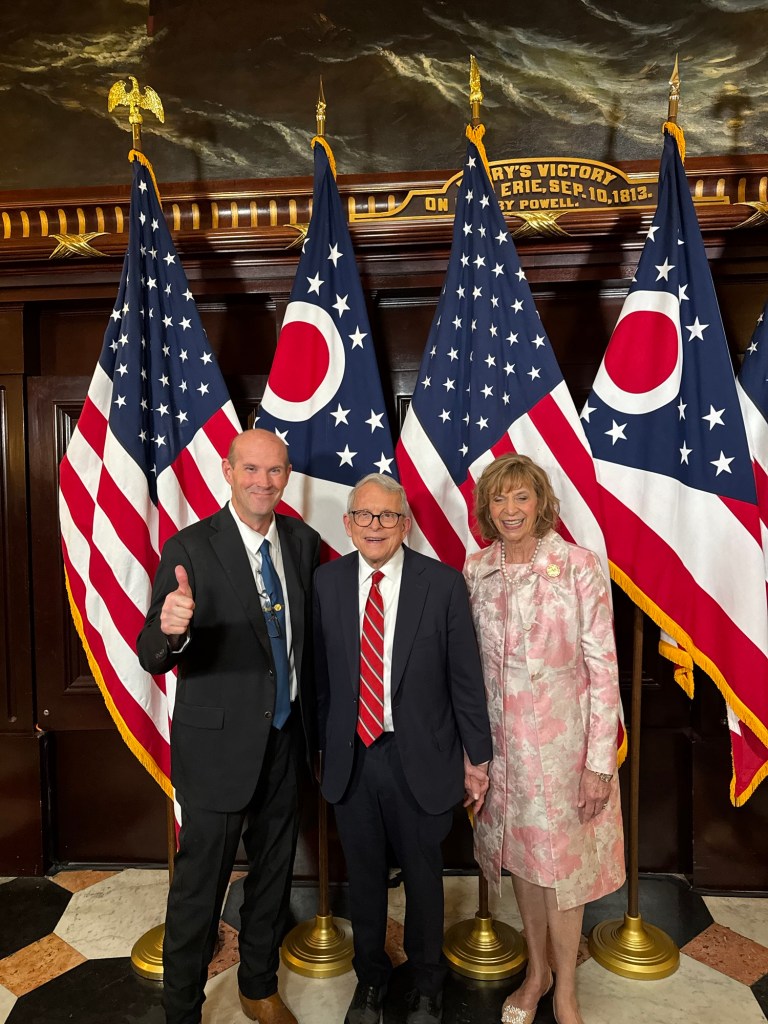
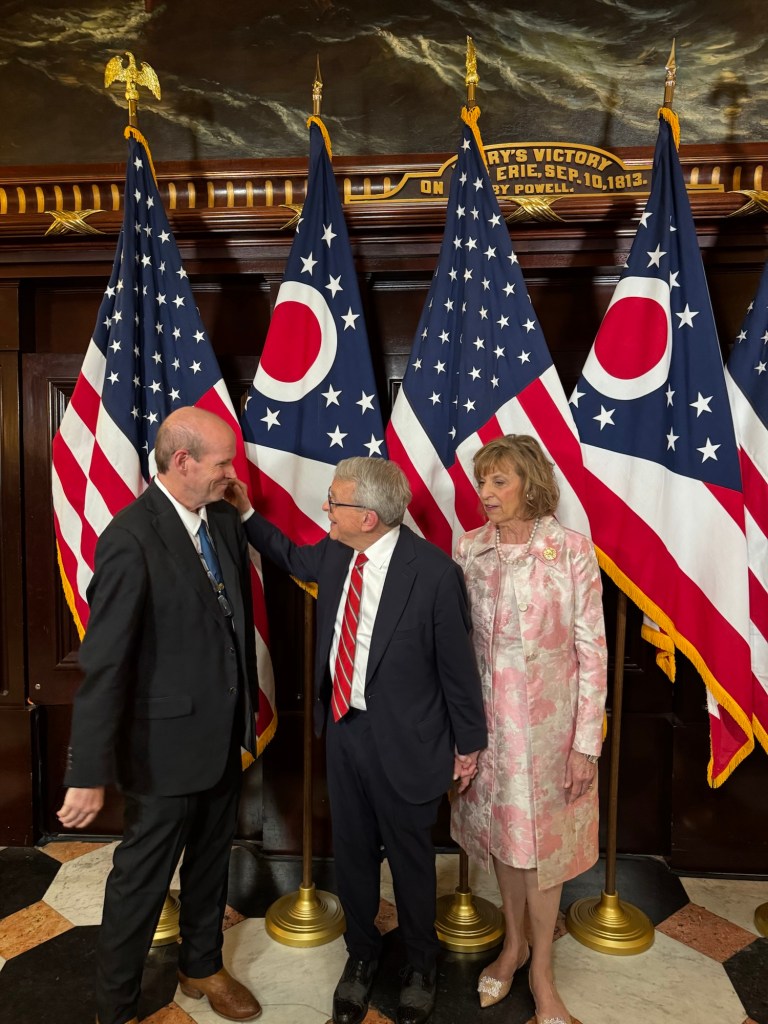
An awkward yet telling moment occurred when I ended up in a photo with DeWine. In past years, my anger over his policies kept me at arm’s length, but this time, with his term ending, I shook his hand and wished him well, acknowledging the pro-business strides. Government needs checks and balances precisely because even good intentions can falter. DeWine isn’t evil; his naivety in trusting big government to care for the vulnerable led to overreach.

Looking ahead, the toilet paper roll is nearly spent, and I’m excited for Vivek Ramaswamy to take the helm. Ramaswamy, a Cincinnati native and biotech entrepreneur who founded Roivant Sciences and ran for president in 2024, announced his gubernatorial bid in 2025 with Trump’s endorsement.[^15]  His campaign focuses on reviving the American Dream through lower costs, bigger paychecks, and merit-based policies, contrasting DeWine’s approach.[^16]  Polls show a tight race against Democrat Amy Acton, but Ramaswamy’s vision—transforming Ohio into an economic hub, especially in the Ohio River Valley—aligns with bold Republican ideals.[^17]  He’s already launched massive ad campaigns and secured the Ohio GOP endorsement, signaling momentum.[^18]  Under Ramaswamy, I anticipate policies advancing freedom, innovation, and efficiency—cooking up better “spaghetti” in the Statehouse kitchen.

Attending these events reinforces why I love politics: seeing dedicated people strive, even if imperfectly. From Ramsay’s kitchen to Columbus, excellence demands pride, hard work, and attention to detail. Cooks prepare meals hoping diners savor them, but criticism stings when they fall short. DeWine’s administration aimed for a magnificent sandcastle, but tides of controversy washed much away. Still, remnants like stronger gun rights and business growth endure. As his era ends, I reflect with tempered hatred, appreciating the intent I witnessed up close. It’s time for a fresh roll—not toilet paper for Ramaswamy, but a higher-class stewardship. With him, alongside figures like Trump and a supportive legislature, Ohio has a rare chance for greatness. I look forward to much better food coming out of the kitchen to come.

[^1]: The Michelin Guide has awarded three stars to Restaurant Gordon Ramsay since 2001, recognizing exceptional cuisine and service. 

[^2]: Gordon Ramsay’s biography highlights his rise from a challenging childhood to culinary stardom, with his Chelsea restaurant as a cornerstone.

[^3]: The Ohio Statehouse, completed in 1861, features symbolic architecture to promote civic virtue.

[^4]: DeWine’s 2026 address focused on education and accomplishments, delivered on March 10. 

[^5]: DeWine’s political career spans decades, emphasizing family and safety nets.

[^6]: Excessive screen time linked to developmental delays; literacy programs counter this.

[^7]: Acton supported abortion rights and led lockdowns.

[^8]: Acton’s role in COVID response included school closures. 

[^9]: Ohio’s economic impact from COVID policies.

[^10]: House Bill 186 caps tax increases. 

[^11]: Ohio’s high property tax ranking.

[^12]: Signed SB 215 in 2022. 

[^13]: Joby Aviation’s Ohio expansion creates jobs in eVTOL.

[^14]: Ginther promotes smart mobility in Columbus.

[^15]: Ramaswamy’s 2026 bid announced in 2025. 

[^16]: Campaign priorities include economic revival. 

[^17]: Polls show competitive race. 

[^18]: GOP endorsement in 2025. 

Bibliography

1.  Ramsay, Gordon. Humble Pie: My Autobiography. HarperCollins, 2006. (For insights into Ramsay’s management style.)

2.  DeWine, Mike. Ohio’s Path Forward. Ohio Governor’s Office Publications, 2025. (Overview of DeWine’s policies.)

3.  Ramaswamy, Vivek. Woke, Inc.: Inside Corporate America’s Social Justice Scam. Center Street, 2021. (Ramaswamy’s views on business and politics.)

4.  Acton, Amy. Leading Through Crisis: Lessons from Ohio’s Pandemic Response. Self-published, 2024. (Acton’s reflections on COVID.)

5.  Hoffman, Rich. The Gunfighter’s Guide to Business. Overman Warrior Publications, 2020. (My own book on management principles.)

6.  Ohio Historical Society. The Ohio Statehouse: A History of Democracy. Arcadia Publishing, 2015. (Background on the Statehouse.)

7.  Tax Foundation Reports. Property Tax Burdens in the U.S. Annual editions, 2020-2026. (Data on Ohio taxes.)

8.  National Rifle Association. Second Amendment Victories: Constitutional Carry Laws. NRA Publications, 2023. (On gun rights reforms.)

9.  Joby Aviation. Annual Report 2025. (Details on Ohio expansion.)

10.  Michelin Guide. Great Britain & Ireland. Michelin Travel Publications, annual. (Restaurant ratings.)

Rich Hoffman

More about me

Click Here to Protect Yourself with Second Call Defense https://www.secondcalldefense.org/?affiliate=20707

About the Author: Rich Hoffman

Rich Hoffman is an independent writer, philosopher, political advisor, and strategist based in the Cincinnati/Middletown, Ohio area. Born in Hamilton, Ohio, he has worked professionally since age 12 in various roles, from manual labor to high-level executive positions in aerospace and related industries. Known as “The Tax-killer” for his activism against tax increases, Hoffman has authored books including The Symposium of Justice, The Gunfighter’s Guide to Business, and Tail of the Dragon, often exploring themes of freedom, individual will, and societal structures through a lens influenced by philosophy (e.g., Nietzschean overman concepts) and current events.

He publishes the blog The Overmanwarrior (overmanwarrior.wordpress.com), where he shares insights on politics, culture, history, and personal stories. Active on X as @overmanwarrior, Instagram, and YouTube, Hoffman frequently discusses space exploration, family values, and human potential. An avid fast-draw artist and family man, he emphasizes passing practical skills and intellectual curiosity to younger generations.
‘Pirate Money’ in Ohio: The way to fight back against a failed Federal Reserve and inflation-based big government economy

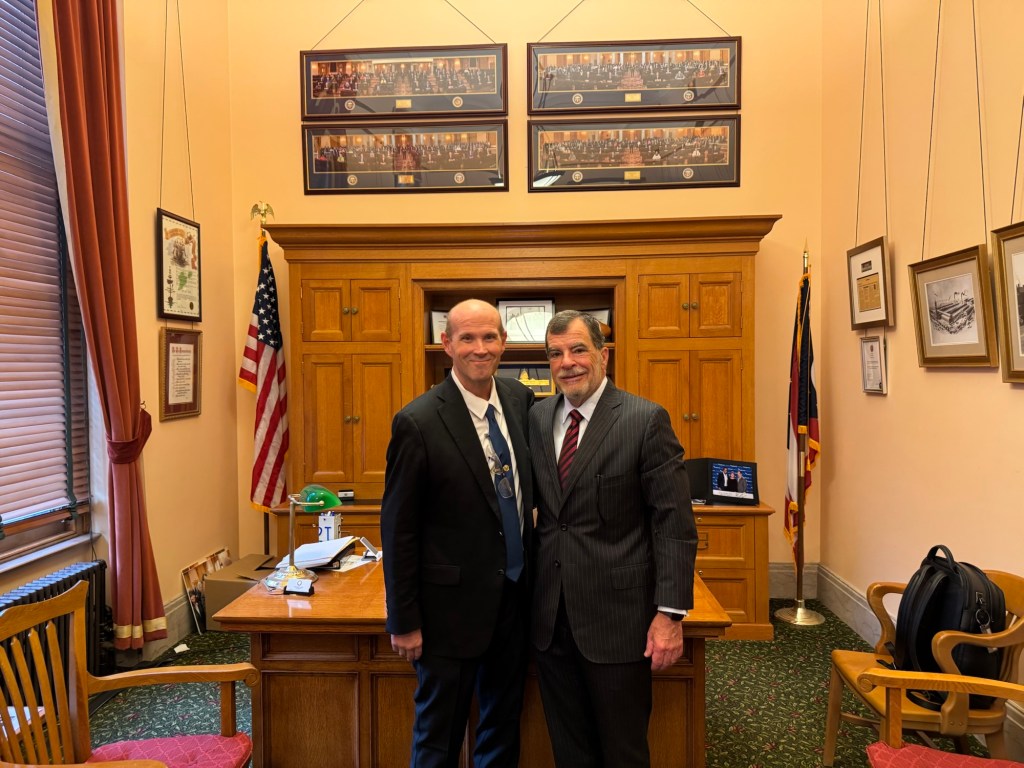
The question that often arises in discussions about state-issued currencies is whether such initiatives, like those proposed in Kentucky or Ohio, are constitutional. They function as a form of currency that could serve as a pillar of stability for our nation, especially in an era where federal monetary policy has led to rampant inflation and economic uncertainty. I found myself pondering this deeply during a recent visit to the Ohio Statehouse, where I reconnected with old friends who work there. It was a serendipitous encounter that led me straight into the office of Senator George Lang, a man I’ve always admired for his sharp intellect and unwavering commitment to conservative principles. Lang and I have shared many conversations over the years, often diving into the world of books—recommendations that challenge the status quo and inspire action. On this particular day, as we caught up, the discussion turned to a topic that has been gaining traction among legislators and economic thinkers alike: a return to sound money through a state-level gold standard.

Lang handed me a copy of a relatively new book by Kevin Freeman, titled Pirate Money. The Blaze publishes it, and Freeman, whom I’ve followed through his economic commentary on that platform, draws from his extensive background advising the Pentagon and military leaders on financial warfare. I’ve known people at The Blaze over the years, and Freeman’s insights into global economics have always struck me as prescient. This book isn’t just another treatise on monetary policy; it’s a call to action, proposing an innovative way for states to reclaim control over their currencies using gold and silver, bypassing the Federal Reserve’s failures. As Lang and I talked, he mentioned that he’s been encouraging his colleagues in the legislature to read it by passing out copies from his office. The concept resonated with me immediately, especially after my own harrowing experiences with banks in 2025—a year that exposed the ugly underbelly of the financial industry in ways I hadn’t fully appreciated before.

You see, I’m not inherently anti-bank; they’ve served a purpose in facilitating commerce. But last year, I encountered the kind of predatory behavior that makes you question the entire system. Hidden fees, arbitrary account freezes, and a lack of transparency revealed the “ugly people” behind the polished facades—executives and regulators who prioritize control over service. This isn’t isolated; it’s symptomatic of a broader issue tied to the Federal Reserve and its monopoly on money creation. Freeman’s book delves into this, explaining how the Fed’s policies have enabled entities like BlackRock to amass unprecedented power, launder printed money through Wall Street, and impose agendas such as ESG (Environmental, Social, and Governance) criteria on corporations. If a CEO steps out of line, they risk deplatforming or worse—losing access to banking services based on social media profiles or political affiliations. I’ve seen this firsthand; banks now scrutinize applicants’ online presence, denying services to those deemed “undesirable.” This social credit system, imported from communist China, has infiltrated American finance, and it’s out of control.

My conversation with Lang covered a lot of ground, but the gold standard idea stood out. Freeman argues for a “constitutional backdoor” via Article 1, Section 10 of the U.S. Constitution, which prohibits states from coining money or emitting bills of credit but explicitly allows them to make “nothing but gold and silver coin a tender in payment of debts.”  This clause, rooted in the Founders’ distrust of fiat currency following the inflationary disasters of the Continental Dollar during the Revolutionary War, grants states the authority to establish gold and silver as legal tender. Freeman’s proposal builds on this: states could create vaults where citizens deposit gold, which is then used as backing for a digital debit card system. You’d buy gold with dollars, store it in the state vault, and spend it via a card that deducts the equivalent value in real time, adjusted for market prices. No need to carry physical coins; it’s as convenient as swiping a credit card, but insulated from inflation.

A new kind of gold card

This isn’t a pie-in-the-sky theory. Texas has already paved the way with its Texas Bullion Depository, established in 2015, a state-run facility for storing precious metals.  In 2025, Texas advanced further with House Bill 1056, enabling gold and silver deposits to be spent via debit-style cards, creating a digital payments platform backed by physical bullion.  By January 2026, the Texas Comptroller was seeking industry input on this system, aiming to implement it by May 2027 without state funding, relying instead on service fees.  Ohio is following suit. In April 2025, Representatives Brian Lorenz, Mark Johnson, and Josh Williams sponsored House Bill 208 (though some records refer to similar legislation as HB 206, sponsored by Representative Jennifer Gross), which aims to establish a transactional currency based on gold and silver.  The bill has been circulating but is currently stuck in the Judiciary Committee, needing leadership to push it forward. Lang and Gross are key supporters, with Lang distributing Freeman’s book to build momentum. This isn’t just for the wealthy; it’s a democratizing force that allows everyday people to protect their savings from erosion.

To understand why this is urgent, we must revisit the history of America’s monetary system—a tale of stability lost to central planning. In colonial America, currency was scarce and chaotic. The British Crown restricted silver and gold inflows to the colonies, forcing settlers to rely on foreign coins, barter, or makeshift scrip. The most common was the Spanish “piece of eight,” or eight-reales silver coin, minted in the New World and prized for its consistent value.  Pirates played a surprising role here; they plundered Spanish galleons, circulating these coins throughout the Atlantic world. Freeman draws the title Pirate Money from this era, noting that “pirate money”—looted Spanish silver—fueled early American commerce by evading royal monopolies.  These coins were often cut into “bits” for change—a one-reale bit equaled 12.5 cents, hence “two bits” for a quarter.  This decentralized, metal-backed system contrasted sharply with the inflationary paper-money experiments, such as Massachusetts’ pine-tree shillings or the Continental Congress’s fiat notes, which collapsed under overprinting.

The Founders, scarred by hyperinflation during the Revolution—where “not worth a Continental” became a proverb—enshrined sound money in the Constitution. Congress was granted the power to “coin money” and regulate its value, while states were barred from issuing fiat currency but were allowed to accept gold and silver tender.  The U.S. adopted a bimetallic standard in 1792, with the dollar defined as a specific weight of silver or gold. This stability propelled economic growth until the 20th century. But cracks appeared with the Civil War’s greenbacks, fiat notes that depreciated rapidly. Post-war, the U.S. returned to gold in 1879, enjoying decades of low inflation and prosperity.

The turning point came in 1913 with the Federal Reserve’s creation, ostensibly to stabilize banking, but it granted a private cartel monopoly over the money supply. Critics, including Freeman, argue this enabled endless printing, detached from real assets. Then, in 1933, amid the Great Depression, President Franklin D. Roosevelt issued Executive Order 6102, confiscating private gold holdings at $20.67 per ounce, only to revalue it at $35 shortly after via the Gold Reserve Act of 1934—a 69% devaluation that transferred wealth to the government.   This severed the dollar’s domestic full gold backing, though international convertibility persisted under Bretton Woods.

The final blow was the “Nixon Shock” in 1971. Facing gold outflows and inflation from Vietnam War spending, President Richard Nixon suspended dollar-to-gold convertibility on August 15, 1971, effectively ending the gold standard.   This unleashed fiat money, where dollars are backed only by faith in the government. The results? Catastrophic inflation. In the 1970s, prices soared, with annual rates peaking at 15% in 1980.  A dollar from 1970 buys just 13 cents worth of goods today—an 87% erosion.  Over the last century, the dollar has lost over 96% of its purchasing power since 1913.  From 1925 to 2025, it’s declined 95%, with stark generational impacts: $100 in 1975 is worth $16.40 today. 

This inflation isn’t accidental; it’s baked into the system. The Fed targets 2% annual inflation, but real rates often exceed that target, especially post-2020, with COVID stimulus flooding trillions into the economy. Homes, once affordable on a single income, now price out young families. Everything’s too expensive because money loses value yearly. Freeman highlights the shift from a production economy—making stuff—to a finance economy, where wealth comes from trading paper assets, interest rates, and debt manipulation. BlackRock exemplifies this: managing trillions, it influences CEOs via asset control, pushing agendas that prioritize globalism over American interests.  During the pandemic, the Fed hired BlackRock to manage bond purchases, raising conflict-of-interest concerns by blurring the lines between public policy and private profit.  

Compounding this domestic rot are external threats. President Trump understood this, cracking down on Iran, Venezuela, Mexico, and Canada to protect the dollar from attacks. Why Greenland? Strategic resources. But the real adversary is China, propped up since Nixon’s 1972 visit, which opened the door to currency manipulation and intellectual property theft.  Freeman, an expert in economic warfare, warns that wars today are fought through finance, not just bombs. China has been waging a stealth assault on the dollar: dumping U.S. Treasuries, stockpiling gold, and promoting the renminbi as a reserve currency.   In 2026, Beijing issued directives for financial institutions to divest Treasuries en masse, spiking yields and straining U.S. debt financing.  Allies like the BRICS nations follow suit, accelerating de-dollarization. If the dollar falls, America’s global clout crumbles—exactly China’s aim.

Trump provided a reprieve from 2017 to 2021, stabilizing the dollar amid these assaults. But with Democrats pushing centralized planning and Republicans sometimes complicit, the direction is toward more control. The Great Reset, championed by globalists, envisions a world where you “own nothing and be happy,” with currencies digitized for surveillance. Freeman’s Pirate Money counters this: states like Ohio and Texas can rebel by creating gold-backed systems, using the cashless infrastructure against the centralizers.

Imagine: You deposit your paycheck into an Ohio vault, converting it to gold at current prices. Your “black card” deducts value for purchases—gas, groceries, PlayStation—without inflation’s bite. Gold appreciates, so savings grow. No more losing 2-5% per year; your money retains value. This forces the Fed to compete, curbing excesses. It’s not Bitcoin’s volatility; it’s stable, tangible gold, recognized worldwide since antiquity.

Critics say it’s for the rich, but Freeman argues otherwise. Centralized bankers thrive on monopoly, leveraging inflation to steal value. By decentralizing, more people retain wealth, reducing inequality. In Ohio, HB 208 needs champions. Knock on Lang’s door; he’ll give you the book. Gross is sponsoring related efforts. With Vivek Ramaswamy as governor in Ohio and in partnership with a Trump administration, support could surge.

This isn’t radical; it’s constitutional. States have the right, and the time is now, while Trump stabilizes the dollar. Democrats should back it too—protecting value benefits all. If we wait, inflation will devour more. As Freeman notes, pirates used gold to win independence; we can too.

In conclusion, Kentucky’s notes—or any state’s gold tender—are constitutional under Article 1, Section 10. They stabilize our nation against Fed failures, BlackRock’s influence, and China’s attacks. Ohio, lead the way with HB 208. I’ll be one of the first to sign up. 

Footnotes

1.  U.S. Constitution, Article 1, Section 10: “No State shall… coin Money; emit Bills of Credit; make any Thing but gold and silver Coin a Tender in Payment of Debts…” 

2.  Kevin D. Freeman, Pirate Money (The Blaze, 2025), pp. 45-67, discussing colonial use of Spanish coins.

3.  Executive Order 6102, April 5, 1933, by Franklin D. Roosevelt, requiring the surrender of gold at below-market rates. 

4.  Gold Reserve Act of 1934, revaluing gold from $20.67 to $35 per ounce.

5.  Nixon Shock: Suspension of gold convertibility, August 15, 1971. 

6.  Inflation statistics: Dollar lost 87% value since the 1970s; peaked at 15% in 1980. 

7.  BlackRock’s role in Fed bond programs, 2020. 

8.  China’s Treasury divestment, 2026 directives. 

9.  Texas Bullion Depository, established 2015; HB 1056, 2025. 

10.  Ohio HB 206 (or 208 variant): Gold and silver transactional currency. 

Bibliography

•  Freeman, Kevin D. Pirate Money: The Constitutional Path to Sound Money. The Blaze, 2025.

•  Griffin, G. Edward. The Creature from Jekyll Island: A Second Look at the Federal Reserve. American Media, 1994.

•  Rothbard, Murray N. What Has Government Done to Our Money? Ludwig von Mises Institute, 1963.

•  Eichengreen, Barry. Golden Fetters: The Gold Standard and the Great Depression, 1919-1939. Oxford University Press, 1992.

•  Lowenstein, Roger. “The Nixon Shock.” Bloomberg Businessweek, August 4, 2011.

•  U.S. Constitution, Annotated Edition. Library of Congress.

•  Federal Reserve Economic Data (FRED). “Purchasing Power of the Consumer Dollar.”

•  Texas Comptroller of Public Accounts. “Request for Information: Digital Payment System Backed by Bullion,” January 2026.

•  Ohio House of Representatives. “H.B. No. 206: Establish a Transactional Currency Based on Gold and Silver.”

•  Freeman, Kevin D. Advisory Reports to Pentagon on Economic Warfare, Various Dates.

Rich Hoffman

More about me

Click Here to Protect Yourself with Second Call Defense https://www.secondcalldefense.org/?affiliate=20707

About the Author: Rich Hoffman

Rich Hoffman is an independent writer, philosopher, political advisor, and strategist based in the Cincinnati/Middletown, Ohio area. Born in Hamilton, Ohio, he has worked professionally since age 12 in various roles, from manual labor to high-level executive positions in aerospace and related industries. Known as “The Tax-killer” for his activism against tax increases, Hoffman has authored books including The Symposium of Justice, The Gunfighter’s Guide to Business, and Tail of the Dragon, often exploring themes of freedom, individual will, and societal structures through a lens influenced by philosophy (e.g., Nietzschean overman concepts) and current events.

He publishes the blog The Overmanwarrior (overmanwarrior.wordpress.com), where he shares insights on politics, culture, history, and personal stories. Active on X as @overmanwarrior, Instagram, and YouTube, Hoffman frequently discusses space exploration, family values, and human potential. An avid fast-draw artist and family man, he emphasizes passing practical skills and intellectual curiosity to younger generations.
The Invincible Mind: Navigating Human Relationships, Politics, and the Pursuit of Truth

Human beings interact in countless ways, layered with psychological complexities that often obscure simple truths. Friendships form, alliances shift, and conflicts arise—not always from malice, but from differing visions of what is right. In politics especially, these dynamics intensify: tides turn, candidates rise and fall, and people find themselves on opposite sides of debates. Yet, amid the noise, some relationships endure. Observers sometimes question loyalties: “How can you be so friendly with someone you disagree with politically?”

I’ve had some very public disagreements with people. But I can never think of a time that I wouldn’t ever talk to someone again

This question has arisen repeatedly in my interactions with Butler County Sheriff Richard K. Jones and many others. We’ve shared public moments of warmth and camaraderie, even as political winds have blown in conflicting directions. The same applies to recent encounters with Ohio Governor Mike DeWine. After years of sharp criticism—particularly over his administration’s handling of COVID policies and other matters—I shook his hand following his final State of the State address. We discussed areas of agreement, such as Second Amendment rights and efforts to combat AI-generated child exploitation. These moments highlight a core principle: genuine regard for individuals ‘ needs need not hinge on perfect alignment. Relationships built on authenticity withstand disagreement; those rooted in manipulation crumble.

We were talking about his wife’s great cookies. The second amendment during his administration. Taxes. And his endorsement of Vivek Ramaswamy.

This perspective stems from a life shaped by diverse encounters. Growing up in Ohio, I navigated rough characters and “celebrity” figures in my early adult years—individuals carrying heavy psychological burdens and disappointments. These experiences, often intense and sleepless, taught navigation of human darkness. I awoke each day intent on being the “good guy,” never contemplating villainy. This innate drive toward justice, perhaps divinely guided, clashed with destructive forces, leading through ominous courtrooms and rigorous trials.

The lofty expectations of public office. Few people ever live up to those expectations. But the building was built with the expectation of exceptionalism.

These trials instilled resilience. I’ve seen the worst of human behavior: betrayal, manipulation, and raw conflict. Yet, they clarified priorities. Nothing since has felt catastrophic by comparison. This foundation allows aloof observation—staying “lofty” amid chaos—while engaging directly when needed.

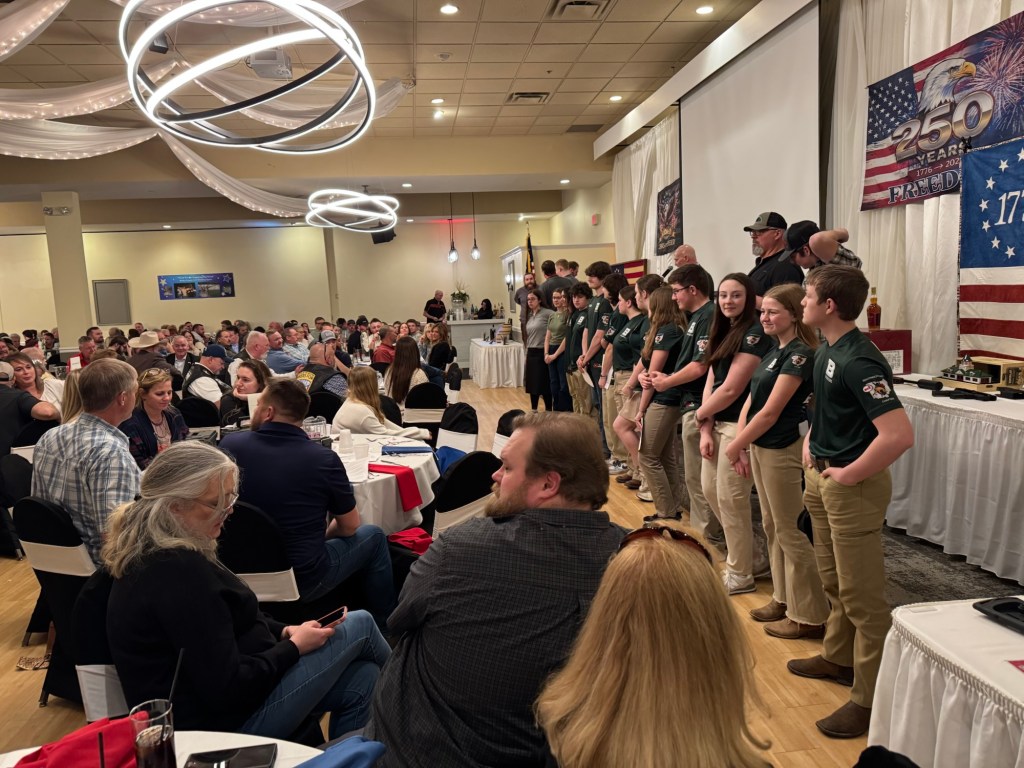
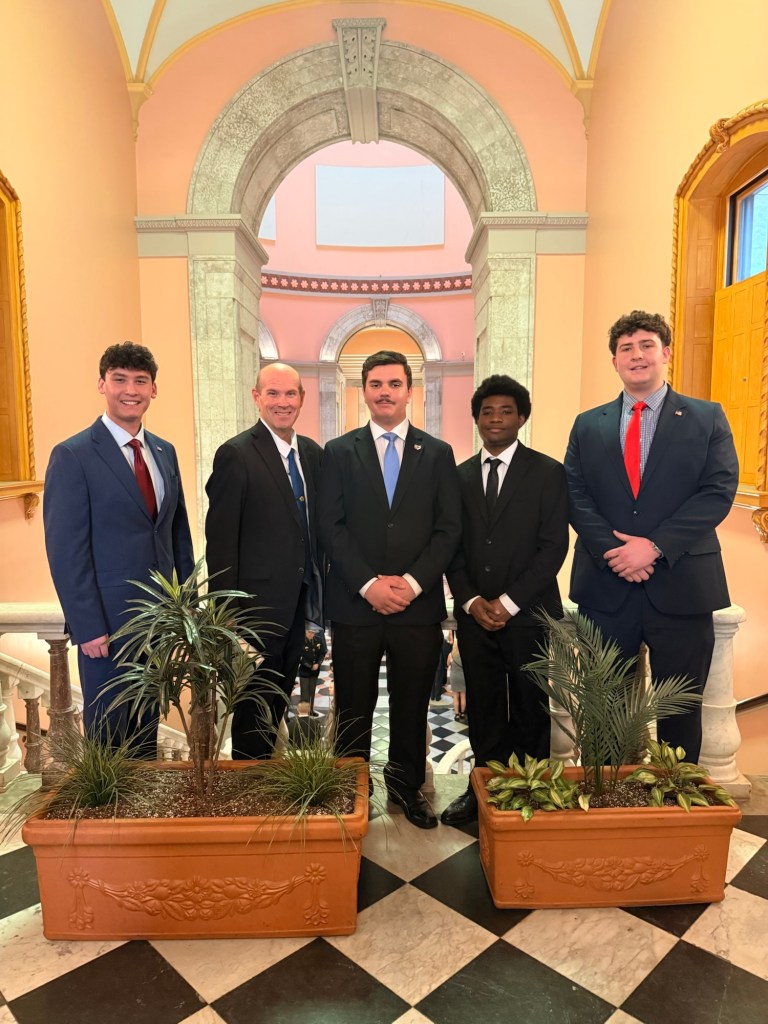
I love to see the future, in the here and now. Great young people!

Professionally, I’ve channeled this into commentary via platforms like The Overmanwarrior blog, podcasts, and writings (including books like The Symposium of Justice and business guides). As a fast-draw enthusiast and strategist, I’ve advised on local and state issues. Public friendships, like with Sheriff Jones, stem from shared values on law, order, and community—despite occasional political divergences. These are not performative; they’re authentic.

Most relationships reduce to two levers of control. The first is friendship as leverage: people offer smiles, hugs, or inclusion to gain compliance. When denied, they withdraw—“I’m not your friend anymore unless you…” This mirrors childhood games (stickers on lockers) and adult dynamics (passive-aggression in marriages, where affection is withheld until demands are met). In politics, it’s “endorse my candidate or lose my support.” Women and men alike use emotional coziness as currency; it’s learned early and persists.

The second is the threat of violence or intimidation. When friendship fails, escalation follows: harassment, protests, spiritual “warfare,” or physical threats—“Do what I say or face consequences.” Authoritarian regimes amplify this; bullies in parking lots embody it personally. Both aim at submission through fear.

I’ve rejected both. Secure in my positions, I express them openly—here, on podcasts, in writing—without needing validation. Disagreement doesn’t prompt cliff-jumping; it invites dialogue or indifference. If someone withdraws friendship over opinions, that’s their choice. If intimidation arises, I handle it unflinchingly, drawing from early lessons in facing rough characters.

This stance echoes timeless wisdom, like Sun Tzu’s The Art of War: become invincible by rendering tactics ineffective. Control what you can—your actions, values, responses—and influence outcomes without direct domination.

Sheriff Jones exemplifies this. We’ve agreed on much: law enforcement, border security, deportations, and community protection. His office’s work with ICE and unapologetic stance on illegal immigration align with my views. Publicly, we’re friendly—podcasts, events, and genuine conversations about his brand and duties.

Yet, political motivations diverge at times. Endorsements or strategies might differ. Critics note our chumminess amid such gaps, confused by loyalty despite opposition. The answer: I like him authentically. His character, spine, and public service earn respect. If we clash, we may not talk for a while—that’s fine. Friendship isn’t conditional on perfect alignment. I won’t manipulate him (or allow manipulation) to force agreement. Truth emerges through pressure and process, not emotional blackmail.

This extends broadly. I like many who’ve opposed me politically, and I reserve the right to value people independently. Indifference to reciprocity preserves freedom.

A recent addition underscores this: Governor DeWine’s final State of the State address. His administration faced criticism—over COVID handling and other policies—creating opposition, which I had been very critical of, rightfully so. Yet, post-speech, we shook hands and spoke cordially.

We aligned on key issues: Second Amendment defense, and crucially, combating AI-generated child sexual abuse material (often called “simulated” or “AI child porn”). DeWine and Attorney General Dave Yost highlighted predators using AI to create exploitative images of children, urging legislation to criminalize creation, possession, and distribution. This addresses a growing threat where legal gaps allow evasion of traditional child pornography laws. I expressed support, noting agreement despite past differences, such as when Yost was running against my supported candidate, Vivek Ramaswamy for governor.

This exchange wasn’t leverage-seeking. It prioritized common ground—protecting children—over grudges. Putting differences aside when opportunities arise fosters the emergence of truth, not manipulation through fear of lost friendship.

Politics amplifies these dynamics: RINOs vs. traditional conservatives, reform movements, religious clashes. Belief systems collide; scores settle. Yet, values about people shouldn’t depend on outcomes. I like or dislike based on character, not scoreboard.

Pursuing righteousness means respecting all sides, allowing truth to reveal itself through conflict’s “fog of war.” Hot tempers subside; smoke clears; good emerges. Manipulation—friendship withdrawal or intimidation—crowds ideas into small-mindedness. Independence enables macro focus: immortal existence over micro squabbles (marriages, divorces, family disputes).

A good friend of mine gave me some homework to do

I’ve built a life affording this luxury: secure positions, no fear of loss. Many seek friendship; time limits interactions. Some engage strategically to advance balls—purely functional, not manipulative.

It’s okay to like those who hate you, to be friendly with opponents, and to shake hands after battles. Truth often surfaces in conflict; observation reveals positions. By staying outside manipulation’s reach, one accomplishes greatly where others falter.

In the end, righteousness is rooted in truth, not personal desires or leverage. Respect others’ thoughts—even wrong ones. Good people come around; disputes fade. We shake hands, share hot dogs at picnics, and discuss lofty things as emotions drift.

George Lang is a great guy in all aspects, what a lot of people don’t know about him is he loves books. Something we share beyond the immediacy of politics

 Bibliography

Overmanwarrior blog (overmanwarrior.wordpress.com) – Primary source for writings on politics, philosophy, and personal insights. Butler County Sheriff’s Office interactions – Public podcasts and events with Sheriff Jones (e.g., discussions on immigration, law enforcement). Ohio Governor Mike DeWine’s State of the State address (2026) – Focused on AI restrictions, including child exploitation; references from news coverage (e.g., Toledo Blade, ABC6). Attorney General Dave Yost’s efforts – Collaboration on bills like SB 217/SB 163 targeting AI-generated CSAM. The Art of War by Sun Tzu – Concept of invincibility through non-engagement with opponent strengths. Personal books: The Symposium of Justice, business guides – Available via Overmanwarrior platforms.

This framework allows engagement without compromise, advancing righteousness amid human complexity.

1.  Hoffman, Rich. The Symposium of Justice. iUniverse, 2004.

A novel blending fiction with philosophical themes of justice, freedom, and confronting sinister forces—written as a counterpoint to real-world political and personal battles. Available on Amazon: https://www.amazon.com/Symposium-Justice-Rich-Hoffman/dp/1412020158.

2.  Hoffman, Rich. Tail of the Dragon. CreateSpace Independent Publishing Platform, 2012.

Explores themes of freedom, law, and high-stakes conflict through a narrative rooted in real altercations and political activism and often described as “faction” (fact-based fiction).

3.  Hoffman, Rich. The Gunfighter’s Guide to Business: A Skeleton Key to Western Civilization. Liberty Hill Publishing, 2021.

A practical and philosophical guide that draws parallels among gunfighting strategy, business, and life—offering a Western counterpoint to Eastern classics like The Art of War. Emphasizes invincibility through preparation and independence. Available on Amazon and referenced in Hoffman’s bio.

4.  Hoffman, Rich. “The Overmanwarrior” (blog). WordPress.com, ongoing since ~2010. Primary URL: https://overmanwarrior.wordpress.com/.

Daily posts on politics, culture, philosophy, personal stories, and current events in Ohio (e.g., Butler County issues, tax fights, and human dynamics). Includes author bio, reflections on early life, and discussions of books like The Symposium of Justice.

5.  Sun Tzu. The Art of War. Translated by Lionel Giles (1910 edition) or modern versions (e.g., Everyman’s Library). Original ~5th century BCE.

Key concept from Chapter 4 (“Formation”): “Invincibility lies in oneself; vulnerability lies in the enemy.” The skilled make themselves invincible through self-preparation, rendering opponent tactics ineffective—directly echoed in the essay’s rejection of manipulation levers.

6.  “DeWine calls for new AI regs, parental control rules in 2026 State of the State.” Cleveland.com (via various outlets, including Facebook reposts and Toledo Blade coverage), March 2026.

Covers Governor Mike DeWine’s final State of the State address, urging legislation on AI guardrails, including outlawing the creation, possession, and distribution of AI-generated child sexual abuse material (CSAM). Aligns with the essay’s mention of agreement on child protection despite past differences.

7.  “Ohio struggles to combat AI-generated child porn amid legal gaps.” ABC6 On Your Side, January 29, 2026.

Details legislative efforts (involving DeWine and Attorney General Dave Yost) to close gaps in prosecuting AI-simulated child exploitation, highlighting the growing threat and push for criminalization.

8.  Butler County Sheriff’s Office. “In The Saddle With Sheriff Richard K. Jones” (podcast series). Apple Podcasts and related platforms, ongoing.

Episodes featuring Sheriff Richard K. Jones on law enforcement, immigration (e.g., 287(g) agreements), and community issues. Includes collaborations and discussions with Rich Hoffman (e.g., Rumble episodes on ICE detainees and related topics).

9.  Various public interactions: Butler County Sheriff’s Office Facebook posts and YouTube videos (e.g., “Ohio 287(g) with Butler County Sheriff Richard Jones,” November 2025).

Document friendly exchanges, podcasts, and joint appearances between Sheriff Jones and Rich Hoffman on topics like border security and prisoner handling.

Top Notes for Further Reading

•  Start with Hoffman’s blog (The Overmanwarrior) for the most direct, unfiltered context—search archives for terms like “Sheriff Jones,” “DeWine,” “friendship,” “manipulation,” or “invincibility” to find raw reflections mirroring the essay’s monologue.

•  For philosophical grounding on invincibility and non-manipulative strategy, read The Art of War Chapter 4 alongside The Gunfighter’s Guide to Business—Hoffman explicitly positions his work as a Western response to Sun Tzu.

•  On Ohio politics and the examples: Follow coverage from Cleveland.com, Toledo Blade, and ABC6 for updates on AI/CSAM bills (e.g., potential SB 217/SB 163 analogs) and DeWine’s 2026 address. Sheriff’s Office social media provides real-time context on Jones’ work and public persona.

•  For broader insights into human relationships and power dynamics: Explore related classics like Machiavelli’s The Prince (on manipulation) or Nietzsche’s ideas on the “overman” (influencing the blog’s name), though Hoffman’s approach emphasizes righteousness over conquest.

Rich Hoffman

More about me

Click Here to Protect Yourself with Second Call Defense https://www.secondcalldefense.org/?affiliate=20707

About the Author: Rich Hoffman

Rich Hoffman is an independent writer, philosopher, political advisor, and strategist based in the Cincinnati/Middletown, Ohio area. Born in Hamilton, Ohio, he has worked professionally since age 12 in various roles, from manual labor to high-level executive positions in aerospace and related industries. Known as “The Tax-killer” for his activism against tax increases, Hoffman has authored books including The Symposium of Justice, The Gunfighter’s Guide to Business, and Tail of the Dragon, often exploring themes of freedom, individual will, and societal structures through a lens influenced by philosophy (e.g., Nietzschean overman concepts) and current events.

He publishes the blog The Overmanwarrior (overmanwarrior.wordpress.com), where he shares insights on politics, culture, history, and personal stories. Active on X as @overmanwarrior, Instagram, and YouTube, Hoffman frequently discusses space exploration, family values, and human potential. An avid fast-draw artist and family man, he emphasizes passing practical skills and intellectual curiosity to younger generations.
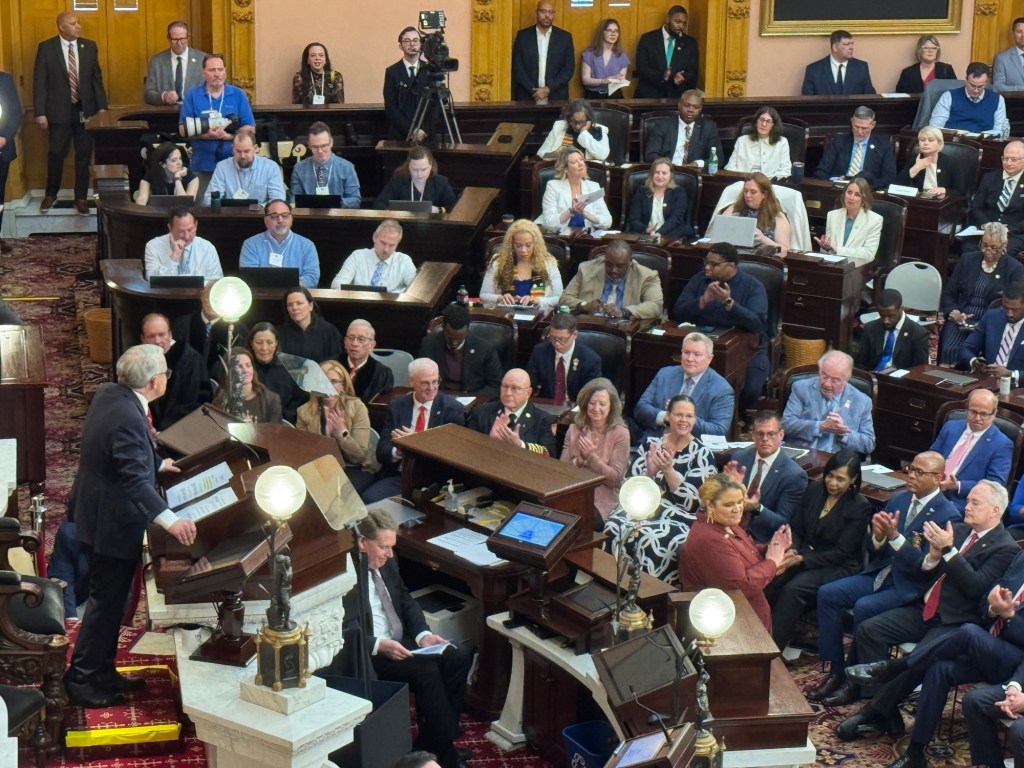
The Spine of Courage and Self-Government in Butler County, Ohio: Meeting great kids at the Friends of Youth Shooting Sports fundraiser and dinner

It was really nice to attend the Butler County Friends of Youth Shooting Sports annual fundraiser dinner and auction on March 6, 2026, at Receptions of Fairfield. The place was packed with a large crowd of good, normal people—families, shooters, law enforcement folks, and community leaders—all there to support youth programs that teach firearm safety, marksmanship, discipline, and responsibility. I enjoyed every minute of it: the excellent food, the company, the auctions (silent and live, with plenty of guns and gear on offer), raffles, games, and the overall positive energy in the room. Doors opened at 5:30 p.m., and my wife and I stayed for three or four hours, just soaking it in and talking with good people who share the same fundamental values.

What stood out most was meeting so many young people involved in shooting sports. These kids have a brightness in their eyes, a confidence that comes from handling responsibility early. They learn to clean guns properly, shoot straight, hit targets, and manage danger in a controlled, supervised way. That kind of training builds character—it translates to life. You don’t see school shootings or reckless behavior from kids raised like this. Instead, they grow into solid adults who value family, hard work, and living constructively. They buy cars thoughtfully, choose good spouses, raise their own kids right, and pass on those same lessons.

I particularly enjoyed meeting the children of Butler County Treasurer Mike McNamara. He’s stepped into a big role after Nancy Nix (who was outstanding as treasurer and is now doing great as auditor), and he’s really grown on me. When he first took over, I wondered if anyone could fill those shoes as well as Nancy did, but Mike has proven himself capable and committed. More importantly, he’s solidly behind the Second Amendment and shooting sports. His kids were there wearing nice cowboy hats—just like I did back in third, fourth, and fifth grade, and still do today. We got into a fun conversation about it. People always ask why I wear a cowboy hat everywhere, and I tell them it’s my way of declaring I’m aspiring to something different from the mainstream secular world. It’s like wearing a T-shirt or pin that says, “I’m not going along with the crowd.” Those kids had the same spirit—bold, unapologetic, proclaiming traditional values at a young age. Their eyes had that refreshing light; you can see a lot about the parents in how the children carry themselves. Mike and his wife have raised a solid family, and it was heartening to see.

The event reminded me why these gatherings feel so reassuring. In everyday life—at Walmart or out in broader society—you encounter all kinds of people, some bright-eyed and well-raised, others not so much. Maybe they didn’t have good parents or healthy influences. Conservatives tend to be accommodating toward those folks, giving them a fair shake while holding to our own standards. But when you step into a room like this one, filled with hundreds of people dedicated to the Second Amendment, you see what’s possible when values align: large crowds of normal, productive people celebrating youth excellence, law and order, and personal liberty.

Handling firearms responsibly does something profound for a person. It teaches you to manage danger, focus, follow rules, and achieve precision. Those skills carry over. Kids who excel in shooting sports under good supervision become reliable adults. They don’t turn to violence; they build healthy lives. That’s why programs like those supported by Friends of Youth Shooting Sports—through 4-H clubs, local ranges, safety training, and more—are so vital. Every dollar raised stays local, funding equipment, events, and opportunities for Butler County kids.

Prominent people were there, fully embracing these principles. Sheriff Richard K. Jones gave a powerful speech that captured the mood perfectly. He talked about standing firm despite constant lawsuits (he said he has about 20 at any time), threats, and even people following him to the restroom trying to kill him. But he takes it—he has a spine. His office has deported thousands of illegal immigrants from dozens of countries, working with ICE, putting up signs that say “illegal aliens” without apology. He warned about border threats, getaways, potential terrorists already here, and urged everyone to be careful when traveling or at festivals. He credited President Trump for giving folks like him the backbone. The room erupted in chants: “Trump, Trump, Trump,” then “Vance, Vance, Vance” (a nod to potential future leadership), and “USA, USA.” It was electric, patriotic, and unfiltered.

Sheriff Jones has built a culture of law and order in Butler County. His jail got featured on Discovery Channel’s 120 Hours Behind Bars recently—showing productive reforms, even the infamous Warden Burger (which I’ve tried on tours; yeah, it’s as bad as the jokes say). He’s in his sixth term, setting an example others emulate. People like him, Treasurer McNamara, State Senator George Lang (majority whip and a strong supporter of shooting sports), and Sean Maloney (the main organizer from Second Call Defense) make these events what they are.

Sean Maloney has poured his passion into Second Call Defense for years. It’s a network that provides legal and financial help if you use a firearm in self-defense—protecting you from the legal headaches that often follow, even when you’re in the right. Ohio’s laws have improved dramatically over the last decade: better stand-your-ground, concealed carry, and self-defense protections. Groups like his have helped make that happen.

I support Second Call Defense because it’s effective, and events like this one demonstrate the community’s backing for it. We talked about real concerns—off the mainstream media grid—things the popular narrative pushes against: gun ownership as essential to preventing tyranny, whether from kings, Marxism, or overreaching government acting like a parent over adults. A world without self-defense rights leads to administrative intrusions on liberty. That’s not the trajectory humanity should take.

Butler County feels unique. It’s MAGA country through and through—from Tea Party days to Trump’s wins (and I believe the 2020 irregularities were real; free speech in 2024 helped bring sanity back). CNN even came here years ago, interviewing folks at places like Rick’s Tavern near the venue, trying to figure out why we supported Trump despite the scandals and attacks. It’s because we see through power-structure games. Gun ownership is key: a population armed and trained stays free to speak, organize, and resist overreach.

That’s why I’ve stayed in Butler County all these years, despite chances to live or work elsewhere. Sheriff Jones’s speech nailed it—local pride, taking care of our own, standing up. Property values are high; it’s desirable to live here because of safe communities, strong families, and representatives who embody the character: law and order, Second Amendment support, and traditional values.

This wasn’t a bunch of fringe types talking revolution. These are everyday people—government officials, families, business folks—who elect leaders like Jones (popular for decades), McNamara, and Lang. They want this kind of representation. Strip away the social layers, and you see shared beliefs about building a good society: family, individual strength, and no centralized parental government.

Seeing the youth there—the next generation with cowboy hats, bright eyes, no fear—gives hope. I’ve seen that same light in rodeos, Christian groups, Bible studies: confident kids from strong families and support structures. It starts with learning to handle firearms safely and building confidence under adult guidance. That produces people who stick around for decades, keeping the Republican Party strong here and events like this thriving.

The mainstream media slants toward progressive agendas—disarmament, accommodation of brokenness over traditional standards. But we’re not victims. We’ve been polite, giving seats at the table, but we don’t have to accept their direction. Events like this remind me that goodness is worth fighting for.

It was a wonderful evening—good food, great company, encouragement from like-minded people. I appreciated the invite and loved meeting the young people, especially those like McNamara’s kids. Their boldness, the light in their eyes—it’s refreshing. That’s why places like Butler County endure and why these principles matter: family building, strong individuals, defense of liberty through understanding and ownership of firearms.  Gun ownership is the key to a successful society of self-rule.  And that is the backbone of success in Butler County, Ohio.

Footnotes

1.  Event details from American Freedom Liberty Foundation (aflf.org/banquet), confirming March 6, 2026, at Receptions of Fairfield, with activities including dinner, auctions, raffles, and local youth program support.

2.  Sheriff Jones’s background and jail features were drawn from public reports (e.g., Discovery Channel 120 Hours Behind Bars, March 2026 coverage).

3.  Second Call Defense and Sean Maloney from the official site (secondcalldefense.org).

4.  Butler County officials (McNamara, Nix, Lang) from county websites and election records.

5.  Youth shooting programs reference Ohio 4-H and local clubs.

Bibliography

•  American Freedom Liberty Foundation. “Butler County Friends of Youth Shooting Sports Banquet.” aflf.org/banquet.

•  Buckeye Firearms Association. Related banquet announcements (2025–2026).

•  Butler County official sites (treasurer.bcohio.gov, etc.).

•  Second Call Defense. secondcalldefense.org.

•  Local news on Sheriff Jones (WVXU, Journal-News, 2026).

If you’d like tweaks or more details, say the word.

Rich Hoffman

More about me

Click Here to Protect Yourself with Second Call Defense https://www.secondcalldefense.org/?affiliate=20707

Fighting Monsters: Culture at Liberty Center in Butler County that is healthy and wise

The recent Lunar New Year celebration at Liberty Center in Liberty Township, Ohio, brought back a flood of memories for me. On February 28, 2026, the mall complex—always a wonderful development just north of the I-275 loop—hosted a vibrant Lunar Festival organized by the Alliance of Chinese Culture & Arts. The event featured classic dragon and lion dances, Chinese music, Asian drums, acrobatics, Taiji demonstrations, and more, filling the space with energy and drawing crowds from the local community in Butler County. It was a positive, constructive way to launch the next phase of the year, embracing Eastern cultural traditions in a modern American setting. The performances were well-coordinated, tasteful, and joyful, with vendors offering dumplings and other treats amid the festivities, and watching the dragon soar and the lions prance reminded me of my own early experiences with these rituals.

As a teenager in the mid-1980s—around 1984, 1985, and 1986—I had one of my first real jobs at Emperor’s Wok, a highly decorated Chinese restaurant on Chester Road in Sharonville, Ohio. It was one of the most elaborate spots in Cincinnati at the time, with intricate interiors dedicated to Chinese culture. Everyone went there for authentic food in an immersive environment. The owners and family were wonderful; I got to know the cooks and the performers who handled the dragon dances. My role included customer service—dressing sharply in a bowtie to hustle tips in a classic, high-energy setting—but during Chinese New Year, it became something more adventurous. They kept the dragon costume and props in a closet year-round, and I was tasked with climbing onto the roof and the magnificent awning where cars pulled up for drop-offs. The restaurant had a grand entrance, and the parking lot would fill with spectators as the traditional dragon dance unfolded.

The dance lasted about half an hour, complete with booming drums, crashing cymbals, and the performers underneath the long, colorful dragon puppet. My job was to feed strings of thousands of firecrackers off the awning, setting them off in bursts that exploded above the dragon’s head as it twisted and leaped below. The noise, smoke, and flashes created an electric atmosphere, scaring away bad spirits in the tradition while entertaining the crowd. Firecrackers were key—loud explosions to drive off evil—and the whole thing felt proactive: humans creating their own spectacle to combat terror. Seeing similar elements at Liberty Center in 2026 brought it all rushing back: the coordination, the percussion, the acrobatics, and the sense of community triumph over unseen threats.

These dances aren’t just entertainment; they’re deeply rooted in Chinese mythology and serve a spiritual purpose. The lion dance, prominent in southern China, is often associated with the legend of the Nian (or Nian beast), a ferocious monster that terrorized villages on New Year’s Eve. Descriptions vary—some say it resembled a flat-faced lion with a horn, others a massive creature larger than an elephant with sharp teeth—but the core story is consistent. The Nian feared loud noises, bright lights, and the color red. Villagers discovered this and used firecrackers, fireworks, red decorations, lanterns, and couplets on doors to repel it. Over time, these customs evolved into annual traditions: red envelopes for luck, staying up late, and performances to ensure protection and prosperity. The lion dance mimics this defense, with performers in vibrant, red-heavy costumes embodying strength and courage. The dragon dance, dating back to the Han Dynasty or earlier, honors the dragon as a symbol of power, wisdom, benevolence, good fortune, and control over rain and water—essential for agriculture and abundance.

A key figure in many lion dances is the Laughing Buddha, or Big Head Buddha (Dai Tou Fat), often portrayed as a jolly, potbellied character in a mask, waving a fan. This isn’t the historical Buddha of Buddhism but a folk figure inspired by Budai (or Hotei), the “Laughing Buddha” known for joy, prosperity, and contentment. In the dance, he provides comic relief, teasing and guiding the lions—sometimes playfully chasing them or interacting with the crowd—while coordinating to the music. His presence adds lightness: amid the fierce combat against evil, there’s laughter, pranks, and confidence. The potbelly symbolizes a full, prosperous life, laughing in the face of danger. It’s a brilliant touch—turning fear into joy, showing human ingenuity in overcoming darkness through humor and skill. The martial arts elements, acrobatics, and kung fu displays highlight dexterity and strength, reinforcing that humans can triumph over lurking monsters.

This reverence for the spirit world extends across Eastern cultures. In Japan, Shinto temples feature similar beliefs in kami (spirits), with rituals to balance the seen and unseen. Korea and other regions share roots in warding off malevolent forces through noise, color, and performance. The thin veil between the physical and spiritual worlds means monsters or evil spirits—rambunctious and ever-present—must be managed proactively. Red wards off negativity; mirrors on costumes reflect evil back; drums and gongs create an overwhelming sound to dispel it. It’s optimistic: approach the unknown with boldness, abundance, and good fortune, much like fortune cookies that always deliver positive messages.

These patterns aren’t unique to the East. Globally, cultures confront “monsters” or paranormal threats through ritual. North American Indigenous traditions often involve drums, yelling, colorful regalia, and dances to connect with or control spirit visions—sometimes blurred by hallucinogenic plants in shamanic practices, creating colorful, terrifying projections that demand management for societal harmony. The use of red, loud percussion, and aggressive displays taps into the idea of warding off evil, much like firecrackers or mirrors. In Christianity, demons are pushed out through prayer, exorcism, or faith in divine protection. Everywhere, humans develop mechanisms to live with terror—whether invisible forces, cryptids, or existential fears.

This brings me to the Mothman legend from Point Pleasant, West Virginia (close to Ohio roots). Sightings in 1966-1967 described a large, winged humanoid with glowing red eyes, often near the TNT area (a former munitions site). It became tied to the tragic Silver Bridge collapse in December 1967, killing 46 people, turning Mothman into a harbinger of doom. Some link it to Native American lore, such as thunderbirds or curses (e.g., Chief Cornstalk’s), or even misidentified birds, such as sandhill cranes. But the archetype persists: a monster emerging seasonally or in crisis, attacking or foretelling harm. Around Christmas or New Year periods, it echoes the Nian—seasonal terror tied to transitions. Both involve communities responding: firecrackers and dances for Nian, vigilance and folklore for Mothman.

Expanding further, many speculate on shared origins for such creatures. Ancient astronaut theories suggest amphibious or serpentine beings from places like Sirius (as in Dogon African traditions of Nommo from Sirius B) influenced global myths. Chinese dragons—long, serpentine, benevolent yet powerful—might reflect memories of advanced visitors or natural phenomena, migrating from regions like the Indus Valley over the Himalayas into East Asia. From the Near East westward, dragons became adversarial (e.g., biblical serpents or European fire-breathers), but in the East, they’re auspicious. Amphibious gods (e.g., Babylonian Oannes or Dagon) appear in Sumerian and other lore, possibly tied to seafaring or aquatic extraterrestrials who seeded civilization. The persistence of monster myths—winged humanoids, serpents, beasts—suggests a universal human concern with the “other”: unseen threats in the dark, whether paranormal, spiritual, or existential.

Yet cultures don’t just fear; they innovate. Eastern approaches—optimistic, proactive, laughing at danger—offer lessons. The Laughing Buddha prances confidently amid monsters, embodying joy despite peril. Drums attack the spirit world aggressively, red banners proclaim victory, and firecrackers create human-made chaos to counter it. This mindset—embracing abundance, prosperity, and humor—helps build constructive societies. Liberty Center’s event wonderfully blended this ancient wisdom with modern community life, reminding us that engaging with other cultures enriches our own without duplicating rituals wholesale. We have strengths in the West, but learning to face “monsters”—whether literal cryptids, personal demons, or global uncertainties—builds resilience.

My time at Emperor’s Wok taught me early about cultural depth beyond surface festivity. Friendships with the family performers, the thrill of the rooftop explosions, the cultural immersion—all shaped how I view the world. Watching the 2026 festival, I saw echoes of those days: positive energy pushing back darkness, joy in the face of the unknown. It’s a healthy reverence for survival, a reminder that humans thrive by confronting fears creatively. Watch out for the monsters—they’re everywhere—but find ways to laugh, drum, and dance them away.

For further reading and research:

•  Wikipedia entries on “Nian,” “Lion dance,” “Dragon dance,” and “Mothman” provide solid overviews with sources.

•  Britannica’s article on the Chinese New Year details legends and traditions.

•  Books like The Mothman Prophecies by John Keel explore the Point Pleasant events.

•  Robert K.G. Temple’s The Sirius Mystery discusses Dogon-Sirius connections (though controversial).

•  Academic sources on shamanism and global folklore, such as studies on Indigenous North American rituals or comparative mythology.

Rich Hoffman

More about me

Click Here to Protect Yourself with Second Call Defense https://www.secondcalldefense.org/?affiliate=20707

The Wonderful Dinosaur Store on the Space Coast: What good economies produce

The Dinosaur Store in Cocoa Beach, Florida, stands as a remarkable testament to personal passion, entrepreneurial spirit, and the enduring human fascination with the ancient world. Nestled at 250 West Cocoa Beach Causeway, just a short distance—literally a football’s throw—from the iconic Ron Jon Surf Shop, this family-run establishment has evolved from a modest fossil and mineral shop into one of the Space Coast’s most captivating attractions. For decades, it has drawn families, tourists, and enthusiasts alike, blending commerce with education in a way that feels refreshingly authentic in an era often dominated by corporate chains.

The story begins in November 1996, when the store first opened its doors as a small retail space focused on fossils, minerals, geodes, and related curiosities. Founded by Steve and Donna Cayer, it capitalized on a surge of interest in prehistoric life sparked by cultural phenomena like the 1993 blockbuster Jurassic Park. Visitors flocking to Cocoa Beach for sun, surf, and the nearby Ron Jon Surf Shop—a massive complex synonymous with Florida beach culture—would often wander over to pick up unique souvenirs: polished ammonites, shark teeth, or perhaps a necklace strung with genuine dinosaur bone fragments. The location was ideal, perched in a high-traffic tourist corridor along State Road 520, where beachgoers and space enthusiasts from nearby Cape Canaveral mingled.

What set the Dinosaur Store apart from typical souvenir shops was its authenticity. The family didn’t merely resell imported trinkets; they traveled extensively during the off-season, when summer crowds thinned and families headed to Disney World or other attractions. Steve and Donna ventured to fossil-rich sites across the globe, including the badlands of Montana, where heavy rains routinely erode sedimentary rock and expose new specimens. They collected ethically, often from permitted digs, and brought back high-quality pieces: Spinosaurus teeth, Allosaurus claws, brachiopods, and meteorites. These items formed the backbone of their inventory, supplemented by jewelry crafted from dinosaur fossils—pendants, earrings, and rings that turned ancient remnants into wearable history. Customers could purchase a Spinosaurus tooth or a slice of petrified wood table, items that carried a tangible connection to deep time.

Over the years, the store thrived. The post-Jurassic Park boom turned it into a lucrative family business, profitable enough to support not just daily operations but ambitious dreams. Rather than resting on success—perhaps buying a condo, a boat, or indulging in lavish vacations—the Cayers channeled their earnings into something far more enduring. They acquired property and constructed a multi-story building dedicated to their passions. What began as a single-floor operation in a strip mall setting expanded into a three-story edifice, transforming the ground level into a sprawling gift shop and adventure zone while reserving the upper floors for something extraordinary: the Museum of Dinosaurs and Ancient Cultures.

The museum opened to the public in April 2017 (on Earth Day) after roughly eight years of planning and development, following the store and Adventure Zone’s launch on the first floor in March 2009. It occupies approximately 20,000 to 26,000 square feet across the second and third floors (sources vary slightly on exact footage, but the scale is immense for a private venture). It operates as a nonprofit entity, with proceeds supporting preservation, education, and ongoing exhibits. Entry requires a ticket purchased downstairs (around $16 for adults, with discounts and combo options including the Adventure Zone downstairs), and last admissions are timed to ensure a full experience before closing.

The museum’s design is ingeniously immersive. Upon taking the elevator up, visitors enter a vast, open space where the second floor soars to the ceiling, allowing for life-sized dinosaur skeletons and models that dominate the view. A standout is the 46-foot Giganotosaurus skeleton, one of the largest theropod displays in a private setting. Floor-to-ceiling mounts include roaring recreations, fleshed-out models, and over 60 dinosaur skeletons alongside more than 80 taxidermy specimens spanning 200 million years of natural history. The layout encourages looking upward, with necks and heads stretching toward the rafters, creating a sense of awe akin to standing beneath towering Jurassic giants. Authentic fossils abound—real bones, claws, and teeth sourced from the family’s expeditions—blended seamlessly with high-quality replicas for educational impact. Additional features include a Mineral Cave with ultraviolet-reactive crystals and a Dawn of Man section with paleolithic tools and hominid skull casts.

The third floor adds a mezzanine-like platform that zigzags through the space, offering elevated views of the dinosaur exhibits below while transitioning into human history. Here, the focus shifts to ancient cultures, bridging paleontology with anthropology and archaeology. Dedicated galleries showcase regions worldwide: ancient Egypt features a detailed replication of King Tutankhamun’s tomb, complete with replicas of artifacts and mummified animals; China includes a diorama of Terracotta Army soldiers; Mesoamerica highlights Aztec and Mayan elements, such as Chichen Itza-inspired structures; and additional sections cover tribal Africa and New Guinea. Authentic artifacts—pottery, tools, jewelry—sit alongside taxidermy from relevant regions, creating a narrative that connects prehistoric life to the rise of human civilizations. The exhibits emphasize how cultures emerged over millennia, often in relation to the natural world preserved in the fossil record.

This integration is what makes the museum unique. While major institutions like the Field Museum in Chicago, the Smithsonian, or the British Museum boast world-class collections, they are often vast, bureaucratic, and spread across enormous campuses. The Dinosaur Store’s museum achieves comparable quality on a more intimate, privately funded scale. It feels personal—born from passion rather than institutional mandate. The Cayers’ love for digging, collecting, and sharing shines through: they didn’t stop at selling fossils; they built a bridge between dinosaurs and the ancient peoples who might have encountered similar wonders in myth or reality. In doing so, they’ve created a place where visitors can ponder the history of life on Earth—from extinct megafauna to the ingenuity of pyramid-builders and terra-cotta warriors.

For many families, including my own, the Dinosaur Store has been a recurring touchstone. Over the years, trips to the Space Coast—often tied to Kennedy Space Center visits or beach days—included obligatory stops here. My daughter once bought me a Spinosaurus tooth as a gift, a small but meaningful token that still sits on my shelf, evoking memories of laughter, wonder, and the simple joy of discovery. We’d browse the shop, admire the geodes and meteorites, then head out with a new trinket: a dinosaur bone necklace or a polished fossil slab. Those visits built family traditions, turning a roadside attraction into something heartfelt.

A decade passed without a return—life shifted to other pursuits, including following developments in the space program during periods of stagnation. But with renewed activity under recent administrations, the pull of the Space Coast returned in 2026. Stepping back into the store felt like greeting old friends. The family behind the counter remembered familiar faces, sharing stories of their travels and the museum’s growth. Ascending to the upper floors revealed the jaw-dropping evolution: the towering skeletons, the meticulous cultural dioramas, the seamless flow between prehistory and antiquity. It surpassed expectations—better than many celebrated exhibits elsewhere, achieved through private ambition and capitalist ingenuity.

This success story underscores a broader point about passion in free economies. In places like the Space Coast, with its vibrant tourism, surf culture, and proximity to high-tech endeavors, individuals can turn hobbies into legacies. The Cayers could have cashed out comfortably, but they invested in education and wonder. Their museum doesn’t just display bones and artifacts; it invites reflection on deep time, cultural continuity, and humanity’s place in the cosmos. In a world where many pursuits prioritize profit alone, here is a rare example of going above and beyond—creating something magnificent not for acclaim, but because the topic demands it. The project reportedly cost around $3.7 million to develop, with an estimated $3 million in artifacts at opening, underscoring the scale of their commitment.

If you find yourself near Disney, the beaches, or Cape Canaveral, make the detour. Park (free, conveniently located), grab a Ron Jon T-shirt if you like, then step into the Dinosaur Store. Browse the ground-floor treasures—perhaps snag a Spinosaurus tooth or a fossil necklace—then head upstairs. The museum awaits: a private passion project that rivals global institutions in ambition and execution. You’ll leave with a renewed appreciation for the ancient past, the power of dedication, and the simple thrill of discovery.

For those eager to explore further, the official website offers details on hours, tickets, and exhibits. Reviews on platforms like TripAdvisor and Google (consistently 4.4+ stars from thousands) echo the sentiment: it’s a hidden gem worth the trip. Academic resources on paleontology provide deeper context on fossils, while studies on ancient cultures offer complementary reading. The museum itself serves as an accessible gateway, proving that wonder can thrive in unexpected places when fueled by genuine enthusiasm.

Footnotes

¹ The Museum of Dinosaurs and Ancient Cultures opened in April 2017.¹

² The museum spans 20,000–26,000 square feet, with variations in reported size across sources.²

³ Development took approximately eight years, following the first-floor openings in 2009.³

⁴ Estimated cost of $3.7 million, with $3 million in artifacts at opening.⁴

⁵ Founders Steve and Donna Cayer.⁵

⁶ Giganotosaurus skeleton measures 46 feet.⁶

⁷ Over 60 dinosaur skeletons and 80+ taxidermy specimens.⁷

⁸ Nonprofit status supports preservation and education.⁸

⁹ Google rating of 4.4 stars from over 2,300 reviews.⁹

Bibliography

•  The Dinosaur Store. “Home.” Accessed March 2026. https://dinosaurstore.com/.

•  The Dinosaur Store. “Museum of Dinosaurs & Ancient Cultures.” Accessed March 2026. https://dinosaurstore.com/museum.

•  The Dinosaur Store. “About Us.” Accessed March 2026. https://dinosaurstore.com/about-us.

•  Wikipedia. “Museum of Dinosaurs and Ancient Cultures.” Accessed March 2026. https://en.wikipedia.org/wiki/Museum_of_Dinosaurs_and_Ancient_Cultures.

•  TripAdvisor. “The Dinosaur Store (2026).” Accessed March 2026. https://www.tripadvisor.com/Attraction_Review-g34145-d2285722-Reviews-The_Dinosaur_Store-Cocoa_Beach_Brevard_County_Florida.html.

•  Visit Space Coast. “Museum of Dinosaurs & Ancient Cultures.” Accessed March 2026. https://www.visitspacecoast.com/profile/cocoa-beach/things-to-do/museum-of-dinosaurs-ancient-cultures.

•  Florida Today. “This Cocoa Beach spot pays tribute to dinosaurs, ancient cultures.” October 9, 2025. https://www.floridatoday.com/story/news/hidden-gems/2025/10/09/beachside-brevard-building-houses-massive-ancient-cultures-dino-exhibit/86170682007.

•  USA Today. “Museum of Dinosaurs and Ancient Cultures opening in Cocoa Beach.” April 20, 2017. (Referenced in Wikipedia citation).

Rich Hoffman

More about me

Click Here to Protect Yourself with Second Call Defense https://www.secondcalldefense.org/?affiliate=20707

Its Time for NASA to get The Right Stuff, Again: They need to work faster, longer, and launches need to happen much more often

My wife and I recently returned from a trip to NASA’s Space Coast in Florida, a place that has held a special significance in my life for over 30 years. My family has owned a condominium complex in the area for decades, and we’ve visited the Cape Canaveral region dozens of times. It’s been a big part of our lives, from family vacations to watching the ebb and flow of the aerospace industry along the coast. This latest visit was particularly exciting because I wanted to get a firsthand look at the facilities tied to the Artemis program, as well as the impressive campuses of private companies like SpaceX and Blue Origin. I am deeply invested in the expansion of human presence off-planet Earth—not just for the adventure and acquisition of knowledge, but for risk mitigation against existential threats to humanity and to unlock the full potential of human intellect beyond our world. I want a thriving space economy, and I want NASA to succeed spectacularly in leading that charge. However, my observations during this trip left me with a mix of enthusiasm and constructive criticism about the current state of NASA’s Artemis program.

We timed our visit toward the end of February 2026, hoping to catch some activity. SpaceX had a busy schedule with multiple Falcon 9 launches deploying Starlink satellites, including one on a Wednesday, another on a Friday, and a Saturday night launch around 9 p.m. that I was particularly eager to witness. These launches have become so routine and reliable that they barely make headlines anymore, which is actually a good thing—it means the infrastructure is robust, dependable, and taken for granted like buses running on schedule.¹ Yet for me, personally, it was a milestone: after all these years of visiting the area, including many stays at our family condo with views toward the launch sites, I had never personally witnessed a launch until that Saturday night. I set up my camera on the balcony, and when the Falcon 9 lifted off, it was thrilling—a bright streak lighting up the night sky, followed by the booster’s controlled descent. It felt like a long-overdue personal victory, but it also underscored a deeper issue: launches from the Space Coast should be commonplace, not rare exceptions.

In contrast, the Artemis program felt stagnant. While touring the Kennedy Space Center facilities, I noticed a heavy emphasis on historical reverence—the Apollo era, the Shuttle program, the achievements of the past. There’s immense pride in what NASA accomplished when it was the only game in town, but far less visible momentum on current endeavors. The exhibits and tours celebrate the “right stuff” mentality of old, yet the gift shop selling “The Right Stuff” merchandise feels like a relic rather than a living ethos.² When stacked against the dynamic energy at SpaceX and Blue Origin, the difference is stark.

SpaceX’s operations are behind secure gates, but their pace is undeniable. During our visit, we saw a Falcon booster that had just landed on a droneship being towed into Port Canaveral on a flatbed truck, cleaned up near restaurants where cruise ships depart, and prepared for reuse—all on a Saturday, with crews working as if it were a regular weekday.³ The company had three launches in a short window that week alone, demonstrating frequency, reusability, and high employee engagement. Blue Origin’s campus, visible right outside the visitor center gates, is enormous—once an empty field, now dominated by a massive factory complex for their New Glenn rocket and lunar lander work, rivaling or exceeding large industrial sites I’ve seen elsewhere, like GE facilities in Ohio.⁴ Their footprint signals serious investment in a new space economy.

Artemis, however, hit a snag during our stay. NASA had been preparing for an early-March launch of Artemis II, the crewed lunar flyby mission using the Space Launch System (SLS) rocket and Orion spacecraft. But during final checks, including a dry run or wet dress rehearsal, issues emerged: leaks (including helium flow anomalies in the upper stage and prior hydrogen concerns) and other mechanical problems.⁵ The decision was made to scrub the March window, roll the stack back into the Vehicle Assembly Building (VAB) for fixes, and target April at the earliest.⁶ This delay was disappointing but not surprising given the program’s history of setbacks.

I offer this as constructive criticism because I genuinely want Artemis to work. The program represents NASA’s path to sustained lunar presence, eventual Mars exploration, and broader human expansion. But it suffers from several structural issues. First, the cadence is too slow. Apollo launches happened far more frequently, with shorter intervals that kept teams sharp, knowledge fresh, and momentum high.⁷ In Artemis, years pass between major flights—Artemis I was uncrewed in 2022, Artemis II is now pushed further, and landings are delayed. This leads to entropy: experienced personnel move on, retire, or shift careers, and institutional knowledge erodes. High turnover in skilled aerospace roles exacerbates this.

Second, there’s a cultural shift away from the bold, risk-accepting “right stuff” era.⁸ In the past, engineers and workers stayed late, worked extra shifts, and treated the mission as an adventure worth personal sacrifice. Today, NASA seems more bureaucratic—9-to-5 mindsets, emphasis on protocols (even lingering COVID-era restrictions in some views), and fear of media backlash from any failure. Catastrophic risks like Challenger and Columbia are memorialized heartbreakingly at the Atlantis exhibit, but those risks were part of pushing boundaries. Adventurers accepted it; today, there’s paralysis by analysis and PR caution.⁹

Third, workforce engagement appears lower than that of private firms. SpaceX recruits passionate people who work multiple shifts, weekends included, to meet aggressive schedules. NASA has fallen into patterns where not all hires prioritize the mission’s higher purpose—some treat it as just a job. This ties into broader criticisms of prioritizing diversity, equity, and inclusion (DEI) metrics over merit-based selection of the “best and brightest” for frontline problem-solving.¹⁰ While inclusion is valuable, the core must remain technical excellence and drive.

The recent program changes highlight these struggles. NASA announced major revisions: adding an interim mission (now Artemis III in 2027) for low-Earth orbit tests of docking with commercial landers (from SpaceX and Blue Origin), life support, and other systems—pushing the first lunar landing to Artemis IV in 2028, with potential for another that year.¹¹ This “sprinkling in” another mission before attempting a landing suggests the original Artemis III step was too ambitious given accumulated delays and risks, including ongoing Orion heat shield concerns from Artemis I (unexpected char loss, leading to trajectory adjustments rather than full redesign for Artemis II).¹² Changing reentry vectors might be more practical than material overhauls, which could take a decade, but it still reflects caution over boldness.

Historically, political decisions have hampered NASA. The Obama-era cancellation of Constellation, reliance on Russian Soyuz for ISS access, and redirection toward other priorities (like studying Islamic contributions to science) felt like a betrayal of the adventure spirit.¹³ The Trump administration’s creation of Space Force and push for resurgence helped, but sustained congressional support has been inconsistent.¹⁴ Without it, NASA can’t match the frequency of private players.

The local Space Coast economy reflects this. Property values have stabilized but not exploded as they could with consistent activity.¹⁵ Cocoa Beach and the surrounding areas thrive more from tourism and private launches than NASA events. When launches were rare, the vibrancy lagged; now, with SpaceX’s dominance, there’s renewed energy—people shopping at Publix, upper mobility in aerospace jobs, families coming to watch launches.

I remain optimistic. NASA has the infrastructure—Kennedy Space Center is ideal for launches—and partnerships with SpaceX, Blue Origin, and others. Administrator statements post-delay emphasized fixing issues quickly, increasing cadence (targeting more frequent SLS flights), and returning to basics to accelerate progress toward 2028 landings.¹⁶ But success requires cultural revival: robust second and third shifts, seven-day operations, passion over paycheck, acceptance of managed risk for exploration, and political unity beyond one administration.

I’ve seen the Space Coast transform, from Apollo’s glory to the Shuttle era to today’s commercial boom. My first personal launch sighting was exhilarating, but it shouldn’t have taken 30+ years. Launches should be daily occurrences—maybe grab pizza and watch one every evening. That’s the expectation we need: frequent, reliable, advancing humanity. Artemis can lead if it recaptures the right stuff—not just in a gift shop, but in every engineer, worker, and decision.

The space economy could double U.S. GDP contributions through innovation, jobs, and knowledge gains.¹⁷ It’s not just money; it’s human bandwidth expanding. Congress, local leaders, the White House—everyone must rally. Private companies are setting the pace; NASA should leverage that, not lag.  But to do all that, NASA needs to work harder and faster.  A lot faster. 

Footnotes:

¹ SpaceX Starlink launches in late February 2026 included multiple launches from Cape Canaveral.

² “The Right Stuff” refers to the 1979 book/1983 film on Mercury program bravery.

³ Reusable Falcon 9 boosters routinely recovered and refurbished.

⁴ Blue Origin’s KSC facility is massive for New Glenn production.

⁵ Helium flow anomaly in SLS upper stage led to rollback.

⁶ NASA targeted April 2026 for Artemis II post-rollback.

⁷ Apollo had a higher launch frequency in peak years.

⁸ Tom Wolfe’s “The Right Stuff” captured the early astronaut/test pilot ethos.

⁹ Analysis paralysis and PR fears cited in delays.

¹⁰ Broader debates on merit vs. DEI in technical fields.

¹¹ NASA added a mission, shifted landing to Artemis IV in 2028.

¹² Orion heat shield char loss from Artemis I prompted changes.

¹³ Obama-era program shifts and ISS reliance on Russia.

¹⁴ Space Force established in 2019 under Trump.

¹⁵ Local economy tied to aerospace activity levels.

¹⁶ Post-delay press conference emphasized speed and fixes.

¹⁷ Estimates of space economy growth potential.

Bibliography / Further Reading

•  NASA official Artemis updates: https://www.nasa.gov/artemis

•  Artemis II delay announcements (Feb 2026): NASA blogs and press releases on helium issues and rollback.

•  SpaceX launch manifests: https://www.spacex.com/launches

•  Blue Origin facilities overview: Wikipedia and company announcements on KSC campus.

•  Orion heat shield investigation: NASA technical reports post-Artemis I.

•  Historical Apollo cadence: NASA history archives.

•  “The Right Stuff” by Tom Wolfe (1979).

•  Space economy reports: Various economic analyses on growth projections.

•  Political history: Coverage of Constellation cancellation and Space Force creation.

Rich Hoffman

More about me

Click Here to Protect Yourself with Second Call Defense https://www.secondcalldefense.org/?affiliate=20707