These people never learn. When you are the front runner in a serious commissioner election in Butler County, Ohio, as Michael Ryan is, the dirty tricks trying to prevent his momentum are just the kind of thing that give politics a bad name. What starts you on the road to good health in politics isn’t kale or cardio, it’s truth without legalese, straight talk without a billable hour attached. I deal with lawyers all the time—good ones, bad ones, and the “print this from the shelf and scare them” variety—and my general opinion, even conceding that the profession began with noble intentions, is that far too much of it has drifted into a uniform intimidation racket. You’ve seen the type: the form-letter cease-and-desist that looks like an astrology reading for defamation, except the fortune costs you a retainer and the outcome is a long, nervous wait for a judge who usually tosses it after you’ve lost sleep and savings. The trick is the tone, not the law: it’s written to make you believe you must respond with a lawyer, because only priests of the temple may interpret the runes. I don’t like the practice and personally think it should be destroyed, and that the perpetrators of such legal manipulation should be thrown in jail and punished with career-ending justice, just for applying the kind of abuses of power that are all too common.
And then there’s this, additionally
This is why the old play of lawfare against rivals—especially in local races where reputations are accessible targets—needs to be called out. We’ve watched how it stains the process in Butler County. Roger Reynolds, who was convicted on a single count in late 2022, later saw that conviction overturned on appeal in May 2024 for “insufficient evidence,” with the appellate panel ordering an acquittal and discharge. The case centered on the golf academy idea tied to Lakota Schools and Four Bridges; the court noted that the proposal never matured, that the school board held the authority, and that the key witness’s legal counsel ended the discussion before any contract could be secured. 1234 In September 2024, the Ohio Supreme Court declined to restore him to the auditor’s office immediately (the seat had been filled due to the bar against felons holding office at the time of his conviction) but clarified he remains eligible to run in the future. 5 That’s the landscape: facts matter, timelines matter, and our politics should run on open argument, not legal intimidation.
Then there’s Cindy Carpenter. She recently walked into a student housing office in Oxford to resolve back rent tied to a family member. A surveillance camera caught her flipping off the counter during the exchange; staff alleged racist language and abuse of office. The Butler County Prosecutor investigated and concluded that her conduct, while “unseemly,” did not rise to the level of misconduct or abuse of power. 67 It’s all on tape and all public now; the gesture happened, the allegations were made, and the official finding closed the matter without charges. 86 You can dislike the behavior—I do—but voters deserve a campaign where candidates fight this out in daylight, not by hiring attorneys to stuff the mailbox of a rival.
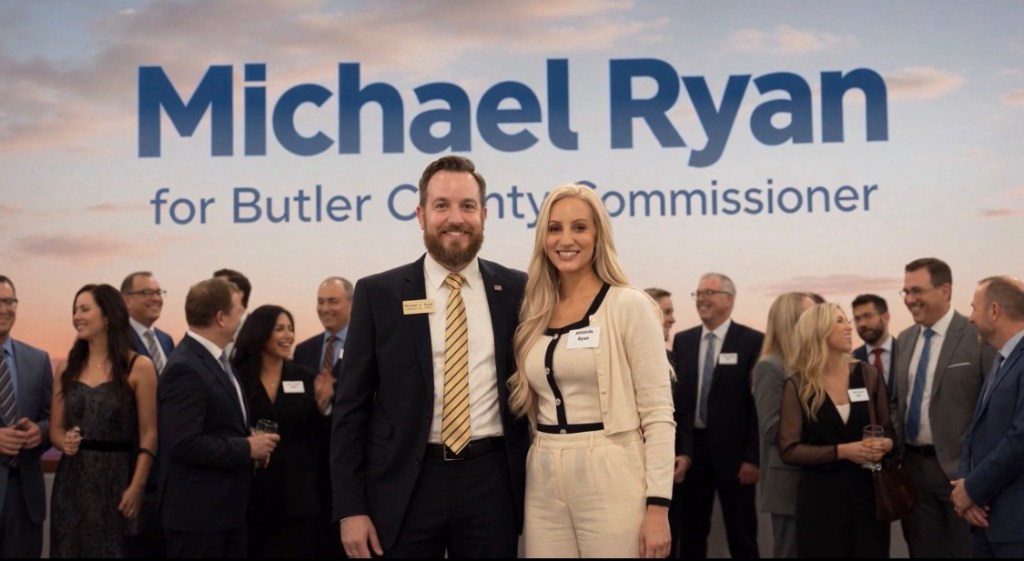
Enter Michael Ryan. He’s a Hamilton City Councilman turned countywide candidate, and he’s collected a long list of conservative endorsements—state senator George Lang, multiple township trustees and councilmembers, and county auditor Nancy Nix among them—because he’s making the case for generational leadership and a forward-looking county agenda. 9 He launched his commission bid in May 2025, framing it around growth, jobs, and fewer distractions—promising to fight for every city, township, and village, and to recruit the next-generation workforce. 10 Ryan’s pitch has resonated in part because people are tired of courthouse drama and lawfare theatrics; they want a debate about budgets, infrastructure, and living standards, not another stack of demand letters mailed in bulk from counsel. And he’s not alone—the GOP field is crowded, with Reynolds and Carpenter in the mix for the May 2026 primary—but the voter mood described by local reporting is unmistakable: they’re weighing future capacity, not re-litigating yesterday’s trials. 11
Now, when the intimidation letter lands—as it did from Reynolds to Ryan—you don’t have to swallow the premise that only a lawyer can answer it. You can answer it yourself, plainly and legally, because the guardrail is still the Sullivan standard from 1964. New York Times Co. v. Sullivan was a 9–0 Supreme Court decision that put a constitutional backbone into defamation law for public officials: to win, a public official must prove “actual malice,” meaning the speaker knew the statement was false or acted with reckless disregard for its truth, and must do so with “convincing clarity.” 1213 The case grew out of a civil rights-era advertisement that contained factual errors; a local jury hit the Times with $500,000 in damages, but the Supreme Court reversed, explaining that debate on public issues must be “uninhibited, robust, and wide-open,” even when the attacks are “vehement” and sometimes “unpleasantly sharp.” 1415
If you want numbers: the jury’s original $500,000 damage award (an enormous sum in 1960) was wiped away; the final holding established a higher burden that has, for six decades, made defamation claims by public officials very hard to win without proof of knowing falsity or reckless disregard. 1514 In practical terms, that means campaign statements, press releases, and political commentary about public officeholders are protected—unless the speaker crosses the line into deliberate falsehood or reckless disregard for the truth. 1316 The standard is why you don’t need to hire a lawyer to say, “We disagree, and our statements are protected political speech,” and it’s why cease-and-desist letters are so often theatre: they depend on the recipient’s fear, not on an actual path to winning under Sullivan.
So let’s put it together. Reynolds’ single-count conviction was reversed; whatever lessons he took from the ordeal, sending form-letter threats at a rival to police campaign commentary is the wrong takeaway. 12 Carpenter’s apartment-office incident was embarrassing but not criminal; voters can judge her temperament, but the prosecutor closed the file. 6 Ryan, meanwhile, has stacked endorsements and is running an argument-heavy, growth-forward race; that’s where the energy is. 9 Let them debate. Let voters see who can build coalitions and deliver results without resorting to legal cudgels. And when the legal cudgel shows up anyway, answer it with Sullivan—because in American political life, the First Amendment demands a high tolerance for hard speech about public officials, and the courts have enforced that by design. 1315
In the decades since Sullivan, the Supreme Court clarified and extended the actual-malice requirement through several landmark decisions:
Gertz v. Robert Welch, Inc. (1974)
This case distinguished between public officials, public figures, and private individuals. The Court held that the actual‑malice standard does not apply to defamation claims by private individuals. Instead, states may allow recovery with a lower standard of fault—such as negligence—when proven, and plaintiffs are limited to actual damages unless actual malice is shown 12.
• Outcome: Private individuals need not meet the high threshold; states can define fault and damages within constitutional bounds 23.
Curtis Publishing Co. v. Wally Butts (1967)
Extending Sullivan, the Court held that public figures (like former coach Wally Butts) must prove actual malice to prevail in libel suits. The investigation in question fell short of reasonable journalistic standards, leading to damages after the Court found reckless disregard for truth 45.
Philadelphia Newspapers v. Hepps (1986)
When private individuals sue over speech on matters of public concern, the Court ruled they must bear the burden of proving falsity—not leave it to the defendant. This ensures truth holds primacy in public discourse and avoids chilling speech 67.
Hustler Magazine, Inc. v. Falwell (1988)
This case affirmed that even intentional infliction of emotional distress torts related to offensive parody do not evade the actual‑malice rule when a public figure is involved. Religious leader Jerry Falwell could not recover without proving that Hustler knowingly published false statements or acted with reckless disregard 89.
• Result: Political satire and parody targeting public figures are constitutionally protected—even if deeply offensive—absent false statements made with actual malice.
—
Together, these rulings illustrate how Sullivan’s actual‑malice standard has been reinforced and nuanced:
• It does apply to both public officials and public figures (Butts, Falwell).
• It does not apply to private individuals (Gertz), though they must still show fault and harm.
• Plaintiffs challenge private or public speech tied to public concern must prove falsity (Hepps).
These cases bolster the legal shield for political speech—underscoring that public dialogue outpaces legal intimidation unless clearly false and malicious.
We’ve seen it too often, when candidates in politics can’t make a good argument, they turn to lawfare and hope that the public perception of expensive lawyers will do the work for them of winning an office they otherwise don’t deserve. In Roger Reynold’s case, he is the one who got himself into trouble in the first place, and nobody wants to see that kind of trouble in the office of the Butler County Commissioners, just to repair the reputation of a person looking for respect that he lost during the process. There are other ways to win respect, and this isn’t how you do it. Showing leadership is the way to restore party integrity, not to make more rifts that cost more than reputations. And hiring expensive, pin-headed lawyers to send out form letters of intimidation on a case they know is phony as they sent it, is why there are problems in politics to begin with.
Footnotes
1. New York Times Co. v. Sullivan set the “actual malice” standard for public officials, requiring proof that the defendant knew a statement was false or acted with reckless disregard, and emphasized “uninhibited, robust, and wide-open” debate on public issues. 1314
2. The original jury verdict in Alabama awarded L.B. Sullivan $500,000 in damages; the U.S. Supreme Court reversed unanimously in 1964. 15
3. Former Butler County Auditor Roger Reynolds’ 2022 unlawful-interest conviction was overturned for insufficient evidence in May 2024; the appeals court ordered acquittal and discharge. 12
4. The Ohio Supreme Court, in September 2024, declined to restore Reynolds to office mid-term but affirmed his eligibility to run in the future. 5
5. Butler County Prosecutor Michael Gmoser cleared Commissioner Cindy Carpenter of misconduct after the Oxford apartment incident, noting the gesture was “unseemly” but not unlawful. 6
6. Michael Ryan launched his commission bid in May 2025 and lists numerous Republican endorsements on his campaign website. 109
7. Local reporting describes a crowded May 2026 GOP primary field for the commission seat and outlines competing narratives about experience versus future focus. 11
For those who want to know why tensions these days feel so elevated—why headlines keep circling Jewish identity, Islamic claims, Christian end‑times talk—the short answer is that Jerusalem’s Temple Mount sits at the junction of theology and sovereignty, where small shifts can echo like earthquakes and often do more and more these days. Since 1967, Israel has retained overall security control in East Jerusalem while delegating day-to-day religious administration of the Mount to the Jordanian-backed Islamic Waqf—the long-standing “status quo” under which Jews may visit but overt Jewish prayer has been restricted, and Al‑Aqsa Mosque and the Dome of the Rock remain under Waqf management. That arrangement has been incrementally eroded and repeatedly contested, with some Israeli politicians openly praying on the Mount and advocacy groups pressing for expanded Jewish worship, while Jordan, the Palestinian Authority, and others warn that changes risk broader violence. Over time, there has been so much violence involved with that piece of real estate that, regardless of the threats, the Jewish people are preparing to retake the Temple. 1234 This isn’t just some fringe group in Jerusalem making these plans; it has operated in the background for hundreds of years. Everyone in Masonic circles knows about Hiram Abiff, the architect of the first Temple, and that Sykes-Picot was always behind this story, and that the creation of the state of Israel after World War II was this intention to rebuild the Temple and get back into the sacrifice cycle that the Temple performed for over a thousand years. There is a lot of effort behind this momentum that is colliding at this particular moment in history, and there really isn’t anything Muslims can do to stop it. The Jewish people are the oldest known people in the world to have remained intact, and they believe that to be close to God, they must restore his house so he can literally reside on Earth in his home, and must be fed through sacrifice the contents of a voracious appetite of animal blood.
Within parts of Orthodox and evangelical circles, preparatory efforts linked to a future Third Temple—from crafting ritual vessels to interest in the red heifer purification rite described in Numbers 19—regularly attract media attention. Most people in the media, in politics, and even in theology don’t understand the scope of this situation and how it translates into the United States. When the Jewish people are accused of all that they are, and for being in control of so much of our modern world, especially economically, the end goal for them is the rebuilding of the Temple. And a partnership with the United States gives them the scale and weight to execute their long-term plans. In 2025, organizers publicized a practice run of a red‑heifer burning (not the formal rite required by traditional rabbinic standards), and there have been conflicting claims about whether any heifers currently meet halakhic criteria; some religious institutions have trained would-be priests and reconstructed implements, while others emphasize the legal, halakhic, and geopolitical barriers. The ritual itself—rare, exacting, and historically attested in rabbinic sources—remains halakhically complex and politically explosive given the Mount’s Islamic sanctuaries. Right now, out of five red heifers bred in Texas, Jewish authorities believe they have two. 5678910
On the militant front, Hamas has explicitly framed the October 7, 2023, attack (“Al‑Aqsa Flood”) in religious‑national terms, repeatedly declaring Jerusalem and Al‑Aqsa as the conflict’s core. Its official documents claim the assault was a “necessary step,” emphasize Al‑Aqsa’s Muslim sanctity, and deny intentional targeting of civilians—statements contradicted by extensive evidence and casualty counts; the movement continues to cast any shift on the Mount as existential. Whatever one’s view of prophecy or politics, the practical reality is that any perceived move toward “Jewish sovereignty” on the Mount—whether expanded prayer or talk of Temple reconstruction—triggers immediate backlash from Hamas, the PA, Jordan, and others, with regional and global reverberations. 111213 What all this means is that there is no scenario in which Islam maintains control over the Temple Mount, and the time is very near when the Jewish people are planning to move back onto it, which means everything that is there now will be erased away. So the spill-over conflicts, such as the hostile terrorist attacks in the United States, and the efforts to build mosques in Texas for Islam, are to erode what they think of as the Big Satan, by supplying Israel with the military power to defend itself from further attacks. A lot of people are saying that Trump is the anti-Christ who is ushering in peace in the Middle East, and is taking away the leverage that Hamas has through fear over the region. By making peace, they lose the Temple Mount because it only emboldens the Jewish people to reclaim their sovereignty over it. It has only been the threat of violence that has kept the Jewish people from rebuilding the Temple up to this point. So there is no scenario where there is peace for all parties involved. Regulating the Jewish people to only pray at the Wailing Wall has been ridiculous and was always poised to a spillover point.
Historically, even emperors were singed by this terrain—Julian’s 363 CE attempt to rebuild the Temple is recorded in both pagan and Christian sources, with reports that fires erupted near the foundations, halting the works. Whether natural phenomena or theological messaging, those accounts underline how fiercely charged the site has been for centuries. Today, polling on a Third Temple is fragmentary and politically inflected, but the legal and diplomatic constraints—from status-quo understandings to security controls and international reactions—are heavy. Any durable path forward will be less about end-times scripts and more about clear legal frameworks, de-escalation mechanisms, and credible guarantees of access for all faiths—because the place where prophecy meets police lines is where small changes become significant crises. 1415
Many would even go so far to say, in Masonic circles, that the creation of the United States, the New Jerusalem was made to enable all this to happen, the re-creation of the State of Israel, the acquisition of the greatest military in the world, so that war in the Middle East could efficiently be utilized to fight the Islamic forces practicing their caliphate over the region. Everyone has played nicely together for over a thousand years, but the Crusades never stopped, and there are very dedicated efforts behind finance, politics, and religion to make a move for Temple restoration once and for all. So this debate that we are having, this anti-Israel position, the anti-Jew talk, the utterings of anti-Christ emergence, it all falls on deaf ears because the momentum is moving in the direction of rebuilding the Temple for the third time, and even Jesus was reluctant to say when and where. But to fulfill the Messianic promise, the Temple has to be rebuilt, and it is the story, behind the story, behind the story of our modern news cycle. And there is nothing that Islam will be able to do to prevent it from happening. And that is why all the deterioration is happening now, on every front. And the fight between Christians and Jews is that the Jewish people refuse to accept Christ as the Messiah because, unless he rebuilds the temple, he cannot be the Messiah. But for Christ, the body was the Temple, and for that to be true, it ruins thousands of years of carefully constructed plans to feed literal blood to the deity Yahweh and maintain an ancient order rooted in sacrifice. Yet Jesus, through his acts, took away the need.
—
Sources
Temple Mount status quo/prayer restrictions
• Miami Law review of Israel’s Protection of Holy Places Law and the status‑quo arrangement (overview; prayer limits). 1
• INSS paper on risks of altering the Mount’s status quo; notes gradual changes and political pressure. 2
• Jerusalem Institute study on the erosion of the status quo since 1967. 3
• Times of Israel coverage of a senior minister praying openly on the Mount (Aug. 3, 2025), and regional condemnations. 4
Third Temple and red‑heifer debates
• Religion News Service: practice run of a red‑heifer ritual (July 1, 2025) publicized by organizers; context on Numbers 19 requirements and controversy. 5
• Charisma/Prophecy Watchers reports on disqualification claims and disputes over location and rabbinic standards (Aug. 8, 2025). 6
• Encyclopaedia Britannica, My Jewish Learning, and Sefaria: Numbers 19 and classical sources on the red‑heifer rite and halakhic constraints. 91617
Hamas framing of “Al‑Aqsa Flood” (Oct. 7)
• Al Jazeera coverage of Hamas’s “Our Narrative” document (Jan. 21, 2024) describing motives and denials. 11
• Asharq Al‑Awsat summary of the same Jan. 2024 document and context. 12
• JustTheNews recap of Hamas statements tying the conflict to Jerusalem/Al‑Aqsa. 13
• GlobalSecurity hosts the PDF of Hamas’s “Our Narrative” pamphlet. 18
Late‑antique attempt to rebuild the Temple
• JSTOR/Brill scholarship compiling sources on Julian’s 363 CE project and reported fire phenomena near the foundations. 1419
• BAS Library overview of Julian’s motives and the Christian reaction. 15
The December 2025 killings of filmmaker Rob Reiner and his wife, photographer and producer Michele Singer Reiner, and the subsequent charging of their son Nick Reiner, ignited polarized reactions across news and social platforms. The recent tragedy has sparked intense debate—not only about the crime itself but about the cultural backdrop that shaped this family. Critics have noted that President Trump’s response lacked overt compassion, but this reaction must be understood in context. Rob Reiner was not just a filmmaker; he was a leading voice in Hollywood’s anti-Trump activism, often positioning himself against traditional American values. For years, Hollywood has distanced itself from the everyday realities of most Americans, creating a cultural divide that has eroded public sympathy for its employees. Hollywood has made itself the enemy of traditional America, and in that regard, Rob Reiner was considered an immoral slob that nobody should feel sorry for.
The contrast between Trump’s family values and Hollywood’s permissive lifestyle is stark. Trump famously raised his children with strict rules—no drugs, no drinking, no tattoos—reinforcing accountability and discipline. Hollywood, by contrast, often fosters environments where excess and indulgence are normalized. This permissiveness has consequences: many children of Hollywood figures struggle with addiction and instability. In Nick Reiner’s case, reports of substance abuse and personal turmoil underscore a broader pattern—liberal culture rarely emphasizes personal responsibility, and the fallout can be devastating.
Examples abound. From Sean “Diddy” Combs’ recent court revelations of grotesque excess to Charlie Sheen’s own admissions of destructive behavior, the Hollywood lifestyle often spirals into dysfunction. These stories are not isolated—they reflect an industry that glamorizes extremes while neglecting the foundations of family and morality. When tragedy strikes in such a context, the expectation of widespread public compassion becomes complicated. Americans increasingly view these outcomes as the predictable result of choices and values that run counter to the principles most families hold dear.
This is not about piling on during a tragedy; it is about recognizing the cultural divide. Rob Reiner championed a worldview that sought to undermine traditional norms, and the consequences of that worldview are now painfully evident. While no one justifies violence, the reality is that Hollywood’s broken culture produces broken lives. When those lives implode, the public’s reaction—muted sympathy at best—reflects a growing rejection of the values Hollywood promotes.
The timeline:
• Discovery and identification: On December 14, 2025, Los Angeles authorities found Rob Reiner (78) and Michele Singer Reiner (70) dead in their Brentwood home. The L.A. County Medical Examiner later listed the cause of death as “multiple sharp force injuries,” manner: homicide. 123
• Arrest and charges: Police arrested Nick Reiner (32) hours later, and he was charged with two counts of first-degree murder, with special‑circumstance allegations that could carry life without parole or the death penalty; he is being held without bail. 456
• Court appearances and schedule: Nick appeared in court on Dec. 17; his arraignment was set for Jan. 7, 2026, after his counsel waived speedy arraignment. 789
• Family statements: Siblings Jake and Romy Reiner issued a statement calling the loss “horrific and devastating” and asking for privacy and compassion. 710
Medical Examiner determinations and arrest/charging information are consistent across CBS News, Deadline, USA TODAY, and ABC reports. The dates (Dec. 14–17, 2025) and charging language (“first‑degree murder” with exceptional circumstances) appear verbatim or in close paraphrase across those outlets. 1254
• In contrast, documented coverage after the killings focused on President Trump’s own posts, in which he mocked Reiner and attributed the deaths to “Trump Derangement Syndrome.” Mainstream outlets, not fabricated screenshots, reported these remarks. 1415
Snopes (Dec. 17 & 19) and Lead Stories (Dec. 17) show no record of Reiner endorsing political violence; USA TODAY and Axios document Trump’s remarks following the homicide. 1211131415
• Nick Reiner’s publicly discussed struggles with addiction date back to his teens, including multiple rehab stints, homelessness, and collaborative work with his father on Being Charlie (2015/16), a film loosely inspired by those experiences. 1617
• After the killings, reporting highlighted Nick’s longstanding challenges, with sources and past interviews noting volatility and non-linear recovery—common in chronic substance‑use disorders. None of these reports. 185
USA TODAY and PEOPLE provide direct quotations from earlier interviews/podcasts, situating addiction history in a verifiable record while avoiding speculative causation. 1617
—
1. Celebrity activism and partisanship: Rob Reiner’s role as a high-profile critic of Trump and supporter of Democratic causes shaped how political audiences perceived him—before and after his death. 1415
2. Media dynamics: The Reiner case drew wall-to-wall coverage, but notable outlets also ran fact‑checks to counter false claims (e.g., fabricated posts, conspiracy theories about “secret tunnels”). The effect: a fractured information environment in which audiences pick narratives that fit their priors. 20
USA TODAY/Axios frames Reiner’s political profile; Snopes/AFP/AllSides documents rumor‑correction cycles that coexist with breaking news coverage. 1415111920
• Responsible inferences: It is fair to conclude that political identity and celebrity status influence public reaction, that false quotes altered perceptions of Reiner’s character, and that addiction history was part of Nick’s public narrative before 2025. Those quotes that were attributed to Reiner were in the spirit of the way he projected himself, leading people to draw their own conclusions past the clean public relations efforts that actors often use to hide their true feelings which they utter to other people in private. 121417
• Where we should not refrain: this family’s tragedy is a sweeping indictment of entire political or cultural communities in regard to Hollywood as a culture. And we must make claims of definitive causation without court findings because the courts as we have seen recently no longer represent the kind of justice Americans expect, and we don’t have time to wait on them. Nick Reiner’s case is ongoing; presumption of innocence applies even as the blood drips from the weapons he used to conduct the killings. 5
While in the past a story like this might have sparked weeks of discussion and reflection on Rob Reiner’s life, as an artist most people knew something about. But in the wake of his political statements and his attempts to steer people away from supporting Trump, he has essentially angered most of the country. And when something bad happens in Hollywood culture now, people have much less compassion and are ready to move on from the story much more quickly. Forgiveness of these terrible Hollywood families and the lifestyles they live, and produce children out of, is not on the table any longer. And Trump represents that evolution in his comments after the murders. Because it’s not Trump that leads the nation, it’s Trump who is a creation of that nation and their sentiments. And Hollywood, clearly, didn’t respect that process, and they took advantage of the power they did have within the entertainment desires of American culture.
Footnotes
1. L.A. County Medical Examiner cause of death: “multiple sharp force injuries,” homicide; Dec. 17, 2025. 12
2. LAPD and DA timeline; arrest, charges, special‑circumstance allegations. 45
3. Court appearance and arraignment scheduling. 78
4. Family statements requesting compassion and privacy. 710
5. Debunked quotes attributed to Reiner about the Trump shooting attempt. 1112
6. Documented coverage of President Trump’s remarks after Reiner’s death. 1415
7. Nick Reiner’s publicly discussed addiction history; Being Charlie context. 1716
Jake Paul’s recent fight with Anthony Joshua is the perfect illustration of what happens when spectacle replaces substance. Paul, a YouTube celebrity with millions of followers, stepped into the ring against a world-class heavyweight—a man with Olympic gold and years of professional dominance. The pre-fight theatrics were designed to sell the drama, but anyone who understood boxing knew the outcome was inevitable. Paul fought briefly, suffered a broken jaw in two places, and left the arena humiliated in front of tens of millions of viewers. Yet, for him, the payday—reportedly $92 million—made the beating worthwhile. It was never about winning; it was about monetizing attention, even at the cost of personal dignity.
In many ways, that’s exactly what Nick Fuentes is doing with his attacks on Vivek Ramaswamy and, by extension, the MAGA movement. Vivek is the Trump-endorsed candidate for Ohio governor, a heavyweight in political terms, and Nick is trying to build his brand by picking a fight he cannot win. The goal isn’t policy or principle—it’s clicks, donations, and notoriety. Like Paul, Fuentes is willing to take a beating if it means short-term gains. But compromising integrity for a few bucks is a dangerous trade. Real influence comes from credibility, not shock-jock theatrics, and when the dust settles, Vivek will be fine. Nick, on the other hand, risks being remembered as the guy who sold his future for a viral moment.
Before we get lost in the weeds on Nick and the “war” he’s trying to gin up against Vivek Ramaswamy in Ohio, the first thing to understand is that this is a publicity grab, a brand‑building exercise in the attention economy dressed up as a crusade. Tucker Carlson’s long sit‑down with Nick dropped late October 2025 and lit up the right for weeks—not because Nick said anything new, but because platforming him without hard pushback sparked a visible fracture among conservatives: Shapiro condemned the interview as “normalizing” a Hitler apologist, Heritage’s president defended Tucker as a free‑speech stand, and even Senate Republicans openly rebuked the tone and content. That intra‑movement rift is real, it’s documented, and it tells you what lane Nick is driving in: controversy converts to cash. 12345
When Nick went on Piers Morgan Uncensored in December 2025, he doubled down—“Hitler was very f***ing cool,” he said, shrugging off historical atrocity with aesthetic fanboy talk about uniforms and parades. That wasn’t clipped speculation; it aired, it was challenged in real time, and it produced the predictable outrage cycle. He also conceded “at least six million” Jews were killed, but framed Holocaust memory as a mechanism to browbeat white Christians—a rhetorical move that’s been part of his pattern: push past decency, trivialize mass murder, court the shock. The point isn’t whether he “means” it; the point is that publicly saying it pays in a donor‑driven creator market. 678
And sure, people will ask how a 27‑ or 28‑year‑old ends up with this microphone. There’s a timeline: Unite the Right 2017, Groyper wars harassing mainstream conservative events in 2019, deplatforming cycles from YouTube for hate speech, and then re‑ascendance on platforms willing to host him; he even turned up at Mar‑a‑Lago in November 2022 when Ye (Kanye) brought him to dinner with Trump—a fiasco the former president later said he didn’t foresee. That dinner is a hinge in the public memory; it proved how oxygen flows to extremism when spectacle meets lax vetting. 910111213
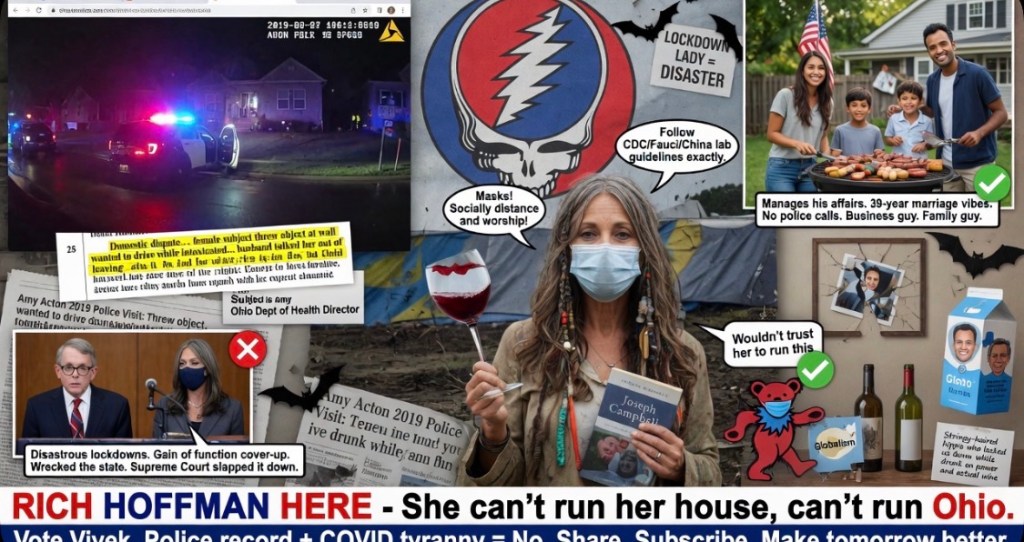
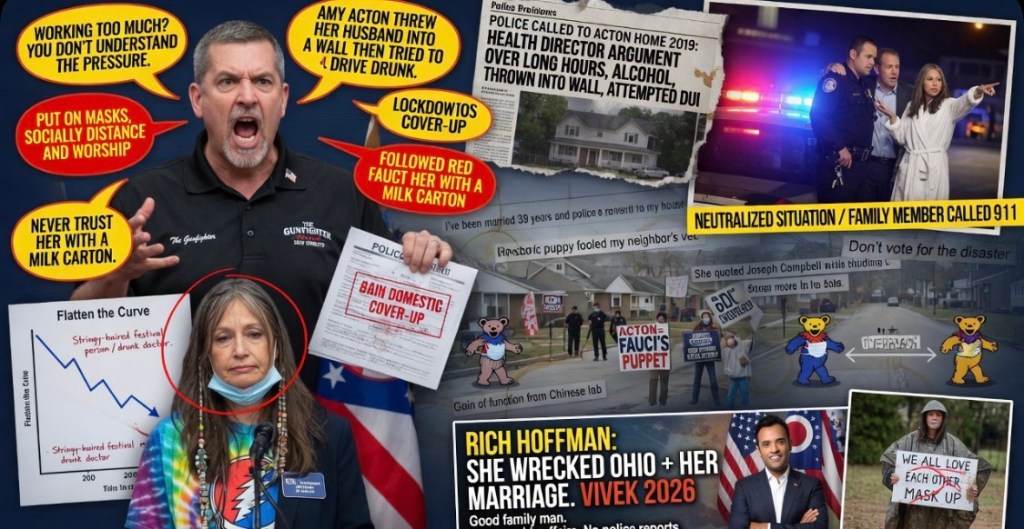
Now, does Nick hurt Vivek in Ohio? No—he helps him by contrast. Ohio 2026 is shaping up as Ramaswamy vs. Acton, and the fundamentals are what they are: Vivek’s cash advantage, statewide endorsements, and consolidated GOP backing set the terrain; Acton’s own story is COVID‑era and compassion‑branded, but even Gov. DeWine has publicly said those shutdown decisions were his, not hers—undercutting the “Lockdown Lady” moniker his party uses. Because, DeWine is really a Democrat, and Amy was his girl. On balance, the race is competitive in public polling but leans Republican in a red‑trending Ohio; when the smoke clears, voters will choose jobs, affordability, and competence over influencer theatrics. That’s why a shock‑jock swipe from Nick won’t move the needle—it hardens a tiny niche while most Ohioans tune out the performative nihilism. 141516171819
And here’s the part nobody wants to say out loud: this is a business model. The pundit economy rewards dopamine spikes—outrage, taboo, transgression—because creator monetization has shifted from legacy ad rails to direct fan funding. Platforms like Rumble now integrate Bitcoin tipping (with Tether) so audiences can spray micro‑payments across controversial content in seconds. You don’t need brand safety; you need attention. That’s why “Hitler is cool” becomes an economic lever: it draws fire, it drives views, it pulls in tips from an aggrieved subculture that feels ignored by institutions. In this incentive structure, “being unhinged” is not a bug; it’s a feature. 202122
So, the math here is straightforward. Nick’s short‑term revenue maximizes by attacking Trump‑aligned figures like Vivek; it creates a pseudo‑rebellion narrative (“I speak the truths your gatekeepers won’t”), harvests donations, and inflates his standing with under‑30 males who see no path in a culture saturated with porn, atomized dating markets, and collapsing family formation—all frustrations he riffs on. But that same strategy destroys long‑term trust and any real governing coalition. Tucker’s interview gave Nick oxygen; Shapiro’s response—and the broader backlash—marked the boundary lines of mainstream conservatism. Vivek will do well to stay above it, keep on policy‑first, and connect with Ohio’s economy and families, and let the theatrics burn themselves out. That contrast, in the end, will decide everything. 3235
I’ll add one more note because I’ve lived this choice set: taking money and chasing the algorithm means someone else owns your argument. Independent voices who refuse the pay‑to‑play goose—whether that’s bot‑inflated follower counts or crypto tip farms—give up the easy ego pop in exchange for credibility with serious people who need facts, not theatrics. In Ohio, facts look like campaign filings, union endorsements crossing over, county‑by‑county organizing, and policy planks about taxes, education, and industry. That’s where Vivek is playing. That’s where this race will be decided. 1516
While Vivek Ramaswamy will be fine in Ohio—his strategy is solid, his Trump endorsement is strong—he could easily swat away Nick Fuentes by pointing to the Jake Paul fight as a metaphor. Picking a fight with a heavyweight when you’re clearly outmatched is reckless, and Nick’s attempt to derail Vivek’s campaign is no different. It’s a stunt, not a strategy, and it will fail.
But here’s the deeper truth Nick is tapping into: the rise of a disenfranchised generation. Under‑30 men are angry, disconnected, and increasingly unwilling to pursue marriage or family because they see the culture as broken—porn saturation, hookup norms, and progressive narratives have eroded trust. Nick speaks to that frustration, and that’s why his voice resonates even when his tactics are self‑destructive. This is the future of media and politics: decentralized, unfiltered, and without institutional guardrails. Legacy platforms can’t contain it, and the genie isn’t going back in the bottle. Even when Vivek wins and MAGA thrives for now, the next wave will be shaped by these angry young men who feel robbed of a normal life—and commentators like Nick will only grow louder in that vacuum.
—
Footnotes
1. Tucker Carlson’s interview with Nick Fuentes published Oct. 27, 2025; episode listings and YouTube analytics confirm timing and reach. 12
2. Coverage of the interview’s fallout and intra‑GOP rift (Heritage defense; Shapiro’s critique; Senate Republicans’ reactions). 345
3. Piers Morgan interview (Dec. 8–9, 2025) where Fuentes said “Hitler was very f***ing cool”; additional reportage on his Holocaust remarks. 687
4. Fuentes background and extremism timeline: Unite the Right, Groyper wars, deplatforming, ideological positions. 9
5. Mar‑a‑Lago dinner (Nov. 22–25, 2022) with Ye and Fuentes; Trump’s later statements on not recognizing Fuentes. 10111213
8. Shapiro’s extended takedown of Tucker/Fuentes; the boundary between mainstream conservatism and the groyper fringe. 235
—
Selected Bibliography
• Tucker Carlson x Nick Fuentes: “Tucker Carlson Interviews Nick Fuentes” (Podchaser listing, Oct. 27, 2025); “Tucker Carlson Interviews Nick Fuentes” (YouTube). 12
• Intra‑movement rift: USA TODAY analysis of interview fallout; POLITICO on Shapiro’s critique and Heritage backlash; Fox News coverage of the AmericaFest sparring. 345
• Piers Morgan interview: The Independent, Jewish Telegraphic Agency, and The Forward reports on Fuentes’ Hitler comments and Holocaust remarks (Dec. 2025). 687
• Mar‑a‑Lago dinner (2022): USA TODAY, NBC News, ABC News, POLITICO accounts and Trump’s statement. 10111213
• Ohio 2026: Cleveland Scene and Columbus Underground on fundraising and endorsements; Acton campaign site; NBC4 on DeWine’s COVID responsibility remarks; Ohio Capital Journal profile. 1415241718
• Creator monetization: Cointelegraph and industry reports on Rumble’s Bitcoin tipping rollout and Tether partnership. 20
(I wrote this before Trump signed that stupid pot executive order. I won’t write any more support for Trump, or speak favourably of him in any more videos. This article is still true, and is the case with Ohio in general. People can do what they want. For me, this is where I step off the Trump train. It was fun while it lasted. He said people from my side didn’t call him to warn him away from making that really dumb decision. Well, I warned him, and he did it anyway. So I’ve cooled off a lot on Trump and don’t feel like defending him any longer, as it’s a waste of my time. With that said, the facts of this article still hold. The Democrats are offering worse people, with even dumber ideas about pot and civilization in general. So the facts are the facts. But because of Trump’s all talk and no action on the essential things, and his alignment with pot, I am done with his administration. I took down all my Trump signs and got rid of all my Trump collectibles. I didn’t throw them away; I put them away and out of sight. They are part of history. But I am no longer as proud of Trump as I have been for 10 years. Needless to say, between him and the Democrats, Ohio will still pick him.)
Ohio didn’t suddenly sour on Trump because one online poll said so, and the breathless headlines that tried to turn a three-month, opt-in web survey into a pronouncement on the Buckeye State’s political soul tell you more about the media’s incentives than about voters. The story making the rounds came from Morning Consult’s December state-level approval tracker, which rolled up interviews from September through November and reported Ohio at 49% disapprove, 48% approve, 2% don’t know—net −1, same as Iowa. That is the entire basis for the “Ohio flips negative” narrative. It’s wafer-thin, within the plausible margin for any nonprobability sample, and it relies on online panel responses that are later weighted to look representative. If you know how Ohio votes, and who actually shows up on Election Day, the “flip” reads like a media convenience, not a signal. 12
Start with what the poll is, not what people pretend it is. Morning Consult’s state approval series is an online, quota‑- and sample-tracking program; they interview registered voters every day via a network of web panels, then weight those respondents to government benchmarks and past vote, and publish a three-month rolling average for each state. They’re transparent about it: a July 2025 methodology primer spells out the quota sampling, ranking, and the +/-1 to +/-6 point state-level margins, depending on population. In other words, these are not random samples drawn from a known frame of all Ohio voters; they are scaled, modeled estimates built from opt-in online interviews, aggregated across a quarter. That matters when the “movement” being hyped is a one-point net change. 34
If you want to understand why these numbers gyrate month to month, look at how they’re constructed. Nonprobability online panels can be excellent for speed and topic tracking; they also introduce two significant vulnerabilities in politics: coverage and self-selection. Every serious polling standards body has wrestled with this. AAPOR’s task force reports—one classic from 2013 and another extensive update in 2022—explain that opt-in online samples don’t give you known selection probabilities for respondents, so you rely on weighting and modeling to back into representativeness. That’s defensible for many uses, but it’s also where nonresponse and selection biases can sneak in, mainly when partisan participation differs across modes. The reports also catalog quality metrics to diagnose panel drift and response attentiveness; the punchline is that online panels can be made useful, but you must keep their inferential limits in mind. None of that supports turning a −1 net in a rolling average into “Ohio abandons Trump.” 56
It’s not just theory. The lived reality in Ohio has been three straight presidential cycles of double-digit rightward lean relative to the country and consistent Trump wins. In 2024, Trump carried Ohio by about eleven points—roughly 55% to 44%—adding more raw votes than he had in 2020, even as total turnout dipped slightly. That outcome reinforced the long glide from swing‑state status to reliable red terrain, with the GOP broadening margins across most counties. Anyone living here saw the on-the-ground coalition: working-age voters in exurbs and small industrial towns whose politics are shaped by affordability, energy, and cultural stability—not by who answers online surveys on their phone during lunch. That’s the fundamental disconnect between online approval tracking and honest Ohio elections. 789
Media framed the December tracker as a “flip” because it fits a larger storyline about Trump underwater in swing states and a blue wave threat in 2026, but step back and you see the core fact the headlines buried: even Morning Consult’s own map shows Trump net‑positive in 22 states, with Ohio and Iowa moving to net −1 inside an error band. When your method can swing a couple of points on panel composition changes or weighting updates, you don’t declare reversals—you caution readers. The Cincinnati Enquirer piece, which repeats the 49/48/2 figures, at least notes that margins vary by state and are derived from a three-month roll-up; it still presented the “flip” as a dramatic change without grappling with how fragile a one-point net is on an online panel. That’s precisely how suppression narratives work: take noisy readings, build a doom arc, hope the mood sticks. 110
Iowa and Ohio were singled out, but notice how the same tracker had Florida at 50/46 approval for Trump—net positive—and Pennsylvania at 47 approve/50 disapprove—basically what you would expect from a purple state. If you are trying to tell the story of collapsing support in former GOP strongholds, Florida’s numbers don’t help that narrative, so they get footnoted, while the two net −1 states get the spotlight. That’s selection by headline, not by method. And again, we’re talking about slim differences inside modeled margins: it’s a map designed for trend reading, not knife-edge pronouncements. 11
Now, to the core critique: online panels systematically underrepresent the kind of “silent majority” MAGA voters most common in Ohio. You can hear it in any shop floor breakroom: people who work fifty or sixty hours a week aren’t clicking survey invites, and they’re not keen on sharing opinions with strangers for points or coupons. AAPOR’s work on nonprobability sampling and online panels acknowledges the coverage problem and the dependence on weighting to correct for it. Pollsters like YouGov defend their panels as high‑quality with strong fraud detection and advanced weighting; they also admit that recruitment tilts toward the more digitally connected. Even when you calibrate to census and voter file benchmarks, you’re still correcting a nonrandom, volunteer sample. When the political signal you’re measuring is heavily driven by turnout and preference intensity among people who aren’t panel joiners, you can miss a lot of real-world support until ballots are counted. 12136
There’s also the “shy” question. In 2016 and 2020, analysts argued about social desirability creating a hidden Trump vote. The academic record is mixed: a Yale list experiment found no evidence that Trump support was under-reported; FiveThirtyEight suggested shy voters weren’t the main driver of error. On the other hand, the USC Dornsife team showed systematic differences across modes, with self-administered polls showing higher Trump support than live interviewer surveys, consistent with a discomfort effect. The newest work on social pressure finds cross-pressured partisans on both sides, with the aggregate bias likely dampened. Put all that together, and I’d call the shy effect situational, not universal—more relevant where stigma is high, less relevant in places where Trump is a social norm. In Ohio, especially outside a handful of urban neighborhoods, there’s not much stigma in saying you’re for Trump. The bigger bias here is availability: who answers at all—online, by phone, or at the door. 14151617
When the media reach for “approval” to make a case about electoral strength, they also conflate two different animals. Approval is a temperature check about job performance; elections are about choice under constraints—issues, opponents, down-ballot dynamics, mobilization, and rules. Look at Emerson’s December 2025 Ohio survey: it used mixed mode (cellphone text/IVR plus an online panel), and found Trump approval 46/48 among Ohio voters—again a slight net negative—, but in the same poll, Democrats gained some ground in governor and Senate horse races as women consolidated for Amy Acton while men stayed with Vivek Ramaswamy. That’s not a collapse; it’s issue sorting. It tells you that campaign narratives and mobilization matter more than a two-point swing in approval. And even Emerson’s series acknowledged that, since August, Trump’s approval fell by three points while disapproval rose by six—but the economy remained the top issue (44%), immigration (8%), and education (7%)—a profile that has historically favored Republicans in Ohio. 1819
There’s an additional wrinkle: turnout validation. When researchers link surveys to voter files, they consistently find that self-reported voting overstates actual turnout, and that this bias is disproportionately among the more educated and politically attentive—precisely the groups who are more likely to complete online polls. Harvard’s Kosuke Imai and UNC’s Ted Enamorado showed that once you validate against the voter file, inflated turnout claims drop, and the sample’s voting behavior looks more like the real electorate. If your online panel tilts toward habitual survey‑takers who also overreport civic activity, no amount of ranking thoroughly fixes the difference between “people who like to answer surveys” and “people who actually vote.” This is one reason approval and intention measures in opt-in panels can underperform in high‑salience elections—turnout composition swamps neat demographic weights. 2021
So what can you actually learn from the Ohio “flip” month? Two things: first, the national mood in late fall 2025 went sour around affordability and government dysfunction; national aggregates showed Trump underwater at the end of the shutdown, with Gallup at 36% approve, NBC/YouGov, and Quinnipiac similarly negative. That atmospheric dip can tint state panels—even red ones—for a few weeks. Second, you should watch trajectories across methods, not a single three-month roll-up. Emerson’s Ohio series put Trump’s approval in the mid-40s; Morning Consult’s national tracker had him in the mid-40s, too; RealClear’s compilation showed a spread across outlets from the high 30s to the mid-40s. All consistent with a choppy environment, not with Ohio turning blue. 2223
The media hook—“Ohio flips negative”—also ignores a simple, durable counter‑fact: elections here continue to break for Republicans, even when national approval wobbles. The 2024 map showed GOP dominance across nearly all counties, and state certification confirmed that Trump netted more votes than his 2020 Ohio total despite slightly lower turnout. That doesn’t happen in a state “flipping away”; it occurs in a state consolidating. 89
Let’s talk method faults more directly, because that’s the part that actually teaches you something worthwhile. Nonprobability online polling faces four recurring problems in U.S. electoral work:
First, coverage error. Not all likely voters are reachable or inclined to join web panels. Internet access is high, but panel participation has its own skews: time availability, digital comfort, and willingness to trade opinions for incentives. AAPOR’s reports and YouGov’s own methodology notes acknowledge this and lean on active sampling and propensity scoring to compensate. In practice, compensation helps; it does not erase differences in contactability. The working-age, shift-based voters who anchor Ohio’s GOP strength are precisely under-covered by panel culture. 125
Second, selection and nonresponse. Even if you invite a demographically balanced slice of your panel, the people who respond to political surveys at a given moment are not random. During periods of partisan enthusiasm, one side may “show up” more in surveys; during periods of disgust or cynicism, response rates fall unevenly. AAPOR’s 2022 task force walks through how response quality metrics can improve detection, but it doesn’t change the fact that in high‑polarization cycles, panel response is a mood-weighted sample. When affordability becomes the top issue—as it did in late 2025—people irritated with politics may be less inclined to answer; that alone can shift approval by 2 points without any underlying change in vote intent. 6
Third, mode effects. In political polling, live‑caller phone, IVR, text‑to‑web, and online panel surveys can produce different distributions, especially on sensitive questions. USC’s 2016 work showed online self-administered surveys yielded higher Trump support than interviewer-administered phone polls, consistent with social comfort patterns. In Ohio, where “Trump talk” is everyday in many communities, the mode effect probably flattens, but nationally, when media storms frame a narrative of controversy, online samples can absorb more activism from the left—people who like surveys and like being heard. That can tilt a short‑window tracker. 16
Fourth, translating approval to a vote. Approval is not a ballot. Ohio voters have repeatedly separated “job rating” judgments from vote choice, prioritizing affordability, energy prices, border policy, and cultural guardrails. Emerson’s December Ohio poll confirmed the issue stack: economy at 44%, then “threats to democracy” at 13%, healthcare at 11%, housing at 9%, immigration at 8%. That landscape, coupled with historic vote margins, suggests Republicans will remain favored unless they become complacent. A one-point net approval drift in a web panel doesn’t rewrite that reality. 18
Now, some readers will push back with other online trackers. Civiqs, for instance, had Ohio at 51% disapprove/44% approve of Trump in early December after the shutdown, and local coverage highlighted the dip among younger voters and college-educated respondents. That’s a data point; it shows how shifts in subgroup composition can affect approval. But even that report noted the split by age—50+ approve, 18–49 disapprove—and the gender gap. Translate that to turnout and geographic distribution—older voters vote more, and Ohio’s GOP strength is outside the big metros—and the electoral consequences look less dire than the topline suggests. 22
If you want Ohio-specific reassurance that the fundamentals haven’t changed, look at actual 2024 results and how they mapped across counties: red strength intensified almost everywhere; Democrats tightened only in a few suburban counties like Union, Clermont, and Delaware. The new coalition here is anchored in places the media rarely visits, and it shows up when it matters—not in online panels, but on paper ballots. That’s the silent majority phenomenon people talk about—not “shy,” just disinterested in surveys. 24
Two practical lessons for reading polls as we head into 2026:
First, weigh the method, not the headline. An online three-month tracker is useful for trend sense; don’t treat a one-point net as a regime change. Check whether other modes—mixed IVR/text, live‑caller statewide polls—show the same movement. In December, Emerson’s mixed-mode Ohio survey clocked Trump at 46/48 approval, consistent with Morning Consult’s national mid-40s; RealClear’s national batteries ranged from 39–46 approve, depending on the house effects. That triangulation tells you the mood was softer, not collapsing. 1823
Second, remember the reality of turnout and election timing. Polls measure talking; elections measure doing. Pew’s “validated voter” work makes this plain: the people who say they vote are not always the ones who do, and compositional differences matter more in midterms. The Ohio electorate that shows up in 2026 will look more like 2024 Ohio voters than like a national online panel. That means more weight on the working class and the 50+ cohort, less on the disengaged younger respondents who fill out online surveys between classes. 25
Gas will be under $2 going into the next election cycle. What matters politically: perceived affordability. Voters judge by weekly spend—fuel, utilities, groceries—and by whether they feel their community is stabilizing or fraying. Trump’s rallies have leaned hard into affordability and border policy precisely because those resonate in Ohio. Even the USA Today roundups that touted the “flip” acknowledged that Florida remains net‑positive on Trump and that national averages ticked up slightly after the November low. If energy stays cheaper and wages steady, approval will follow—but more importantly, votes will hold. 11
Is the left trying to plant suppression narratives through poll headlines? Of course, that’s politics. The tactic is as old as Gallup: shape mood, depress the other side’s excitement, declare inevitability. The antidote is local reality: county maps, early vote patterns, precinct work, and actual field operations. Ohio Republicans have a structural advantage here; if they keep “same‑day, paper, ID” as a rallying cry and focus on precinct captains instead of Twitter fights, they’ll out-organize online sentiment. The 2024 map already proved the coalition is resilient. 8
For readers who want receipts—the footnotes that help you judge the robustness—here’s a compact reference set you can use whenever the following “flip” headline drops:
• Morning Consult’s tracker and its state-level methodology primer, detailing the three-month roll-up and weighting to CPS benchmarks. 23
• The Cincinnati Enquirer and USA Today write-ups that summarized the December update (the 49/48/2 Ohio figure and the context of 22 net‑positive states) are useful to see how reporters framed the same dataset. 111
• Emerson College Polling’s December 2025 Ohio survey, showing mixed‑mode data for gubernatorial and Senate matchups and Trump approval at 46/48 with issue salience led by the economy. Local TV and NBC4 coverage of that same poll adds clarity on sample size (n≈850, MOE ±3.3). 1819
• Civiqs-based local coverage indicating a post-shutdown approval dip (Ohio 51 disapprove / 44 approve), with subgroup splits by age and education—worth reading but always weighed against turnout patterns. 22
• The election result confirmations: NBC News Ohio 2024 live results (55–44), county breakdowns from NBC4, and certification notes from Cleveland.com on turnout and vote totals. These ground everything. 789
• AAPOR’s nonprobability sampling reports (2013; updated task force on online panels and data quality metrics in 2022/2023). These are the “how the sausage is made” documents for opt-in online surveys. 5626
• Mode‑effect and shy‑vote literature: Yale’s list experiment (no shy effect), FiveThirtyEight’s skeptical analysis, USC’s 2016 mode comparison, and recent work on social pressure showing cross-pressured partisans on both sides. Use these to push back when someone waves “shy voters” as either a cure-all or a fantasy. 14151617
• Turnout validation studies: linking surveys to voter files to debias self-reported voting, which underscores why online samples overrepresent habitual survey‑takers. 20
If you collect those sources, you’ll see how flimsy the “Ohio flips negative on Trump” headline is in methodological terms. It’s a cautious tracker’s small net move during a rough national month, not a realignment. And even inside the tracker’s own series, Florida and other GOP states remained net‑positive, with the number of above-water states still exceeding similar points in Trump’s first term. The narrative breaks under its own weight. 11
What should Ohio Republicans do with this? Treat it as a lesson in media jujitsu. When a web panel drifts two points, smile and keep organizing. Push precinct-level turnout plans, show up in the workplaces and churches where surveys don’t go, and keep beating the drum on affordability with receipts: local gas averages, utility bills, grocery basket comparisons over six months. You don’t need a poll to tell you what the checkout line tells you. And if you want a poll, prefer mixed‑mode, registration-based samples connected to the voter file (SSRS’s Voter Poll methods statement is a good model). Those designs reduce the self-selection bias of pure opt-in panels and tend to track the actual electorate more accurately. 27
Ohio didn’t flip. It yawned while national pundits tried to turn a rounding error into prophecy. The people who will decide 2026 are not filling out online “approval” pulse checks; they’re making shifts, fixing machines, and then voting. And when you look past the headlines to the county maps and the validation studies and the complex math of turnout, the story is the same one you’ve seen for three cycles: Ohio is MAGA country, not a trending blue lab experiment. Polls will keep trying to tell a different story because it sells. But the ballots—paper, same day, with ID—are what count. Those who have told the truth about Ohio for years now will continue to do so. 7 Ohio won’t turn away from Trump in exchange for the kind of people who buy lottery tickets and fill out online polls.
—
Sources for further reading (a handy set to clip under the essay body for footnoted context):
• Morning Consult state tracker and methodology: “Tracking Trump” and “Methodology Primer—State‑Level Tracking (July 2025).” 23
• Local coverage of the December Ohio/Iowa net‑one reading: Cincinnati Enquirer; USA Today overview. 111
• Emerson College Polling—Ohio (Dec. 6–8, 2025) plus NBC4/WLWT write-ups. 181928
There’s a difference between people who hold a line because it feels righteous and those who keep asking questions because they know reality changes with every new fact. Reporters live—or should live—on that second path. The more evidence you collect, the more you grow, and growth tends to look messy from the outside. Tucker Carlson’s evolution has had plenty of critics, but what deserves attention is the basic craft: go to the places other media avoid, ask the blunt questions, publish the exchange, and let the audience judge. His recent interview in Doha with Qatar’s prime minister, Sheikh Mohammed bin Abdulrahman Al Thani, landed exactly in that territory: controversial, necessary, and clarifying—especially if your goal is to understand how diplomacy actually works in the Middle East, where U.S. forces rely on Al Udeid Air Base and where back‑channels with difficult actors are the price of getting hostages out and guns silenced, even temporarily.[^1][^2]
If you’re serious about peace, you talk. You talk to adversaries, to intermediaries, to people whose ideology makes your skin crawl, because the alternative is to guess their motives and fire at shadows. Qatar sits at the nexus of two realities that make Americans uncomfortable: it’s a major non‑NATO ally hosting the largest U.S. base in the region, and it has, for years, served as a conduit to Hamas and other hard actors—often at Washington’s request.[^3][^4] That dual role draws fire. Critics say, with reason, that Doha has tolerated extremist financiers and given political oxygen to movements we reject.[^5][^6] Defenders point out that Doha’s mediation has repeatedly produced outcomes Washington needed—hostage exchanges, ceasefire windows, and channels to groups we won’t meet directly.[^7][^8] Both can be true at once; the practical question is whether engagement through Qatar, under U.S. conditions, yields more stability than posturing in its absence.
Carlson’s Doha exchange turned the subtext into text. He put the prime minister on the hook: why host Hamas, and what money goes where? Al Thani’s answer was pointed—that Hamas’s presence in Doha began as a U.S. and Israeli‑approved channel, with transfers to civilians in Gaza coordinated transparently.[^9][^10] Believe that fully or not, the claim is now on record. As viewers, we got posture, context, and accountability: a mediator stating publicly the rationale and process. From there the discussion veered to an even sharper controversy—reports of Israeli operations striking in Doha during mediation, and the unusual moment when President Trump pushed Prime Minister Netanyahu to issue a formal apology to Qatar for violating a mediator’s “safe space.”[^11][^12] That detail matters, because it shows business‑style leadership doing something Washington rarely does: pressing a close ally to respect a process that serves U.S. interests, not just alliance optics. If you want ceasefires and hostages home, you protect your channels, even when doing so costs political points with familiar audiences.
Now, you don’t have to be a “fan” of Carlson to see the utility of the interview. The point is the reporting: ask hard questions, surface contradictions, let the audience trace the through‑line to policy. Media that refuses to platform controversial interlocutors substitutes judgment for evidence; the audience gets a filtered picture that flatters ideology. The record—on readiness at Al Udeid, on the scale of Qatari lobbying in Washington, on LNG leverage and sovereign wealth—demands more than slogans.[^13][^14][^15] Qatar isn’t a sidebar; it’s a strategic keystone in the current security architecture. U.S. operations across the region depend on basing and overflight, and since 2003 Qatar has pumped billions into infrastructure that CENTCOM, AFCENT, and Special Operations rely on every day.[^3][^16] When the U.S. chooses to engage through Doha to reach groups like Hamas or Taliban political offices, it’s choosing the least bad path to outcomes other channels can’t deliver. That’s not romance; it’s logistics.
Enter Ted Cruz. His criticism of Carlson for interviewing Doha’s head of government—and later jabbing at Carlson’s announcement that he would buy property in Qatar—reads as a continuation of a summer feud that began with Cruz’s hawkish case for regime change in Iran and ran aground on basic facts.[^17][^18][^19] In the viral exchange, Carlson pressed Cruz for the population size and ethnic composition of the country he was urging the U.S. to help topple. Cruz couldn’t answer, then pivoted to accusation. The clip went everywhere because it reduced a complex policy argument to one essential question: if you want to kill a government, do you know the country you’re about to break?[^20][^21] It wasn’t a debating trick; it was a reporter asking for the minimal knowledge that makes an intervention policy serious. The broader MAGA family split between business‑first pragmatists and maximalist hawks was already visible; this spat simply made the line brighter. Months later in Doha, Cruz lashed publicly, accusing Carlson of shilling for a “terror state” and posting taunts that did more to inflame than to persuade.[^22][^23][^24] The problem with this style of critique isn’t passion; it’s shallow framing. If Carlson’s interview put facts on the table about mediation, basing, and aid, then the appropriate counter is data: track transfers, cite Treasury designations, show where Doha violates commitments, and argue for remedies that preserve U.S. interests while constraining Qatar’s worst habits.
So let’s put those numbers down. Economically, Qatar is small in headcount and huge in energy. It has the world’s third‑largest proven gas reserves, sits among the top LNG exporters, and is moving through a multi‑year North Field expansion intended to nearly double LNG capacity by 2030.[^25][^26] Marketed natural gas output held steady at ~170 bcm in 2024, with domestic consumption around 42 bcm.[^27] Hydrocarbon revenues fell with global prices from 2022 to 2023, but hydrocarbons still accounted for a dominant share of government income.[^26] Real GDP growth hovered near 2% in 2024 by IMF estimates, with non‑hydrocarbon sectors advancing under the Third National Development Strategy (NDS‑3) and Vision 2030.[^28][^29] The sovereign wealth footprint—Qatar Investment Authority—sits in the hundreds of billions and projects soft‑power reach through high‑profile stakes and global partnerships.[^29] The upshot is leverage: Doha can fund influence, absorb reputational bruises, and keep playing mediator because LNG cash cushions the risk.
Security ties with the United States are institutional, not episodic. The State Department fact sheets lay it out: access, basing, and overflight privileges facilitate operations against al‑Qa’ida affiliates and ISIS; Al Udeid hosts forward headquarters for multiple U.S. commands; and Foreign Military Sales with Qatar exceed $26 billion, including F‑15QA fighters and advanced air defense.[^3] The Trump White House readouts in 2017 and 2018 acknowledged the need to resolve the GCC rift while recognizing Qatar’s counterterrorism MOU progress; they also leaned into trade, investment, and defense procurement as stabilizers in the relationship.[^30][^31][^32] In 2025, Trump’s visit to Al Udeid produced headlines about Qatari investment in the base and defense purchases—exactly the business‑style diplomacy that critics deride and practitioners call reality.[^33] Even during acute tensions, like Iran’s missile attack on Al Udeid in June 2025 following U.S. strikes in Iran, Doha maintained posture as a U.S. ally condemning the attack and signaling response rights.[^34] That’s not a trivial point; basing partnerships show their character under fire.
On the other side of the ledger, accusations of terror financing and extremist hospitality have shadowed Doha for years. Treasury officials, analysts, and NGOs have documented permissive environments for designated financiers, support for Islamist movements, and Doha’s long encouragement of Hamas’s political bureau.[^5][^6][^35] Critics in Israel and the U.S. point to the billions in transfers to Gaza since 2018 and argue that aid inevitably strengthens Hamas’s governance.[^36][^37] Qatar’s counter is always two‑part: (1) mediation requires contact, and (2) funds for civilians were coordinated and monitored, with Israel’s participation.[^10][^36] Washington’s posture has waxed and waned. In late 2024, amid stalemates in hostage talks, reports surfaced that the U.S. asked Doha to expel Hamas’s political leadership and that Qatar temporarily suspended mediation out of frustration with both sides.[^38][^39][^40] Yet by January 2025, Doha helped broker a new ceasefire and hostage exchange with U.S. and Egyptian negotiators, underscoring the bipartisan reality: when talks matter, you want the mediator who knows the rooms and the personalities.[^41][^42] You can hate that arrangement and still need it.
This is where business leadership in public office makes a difference. A dealmaker’s instinct is to preserve optionality and keep lines open long enough to test whether interests can align. It looks ambiguous because it is. Trump’s approach to Qatar—leaning into investment, leveraging basing ties, and pushing allies privately to respect mediation—fits that mold.[^30][^33][^12] Purists will say ambiguity equals moral compromise. Practitioners will say ambiguity equals leverage. In the Middle East, leverage is often the only bridge between bad choices and less‑bad outcomes. You can meet Kim Jong Un, Xi Jinping, Vladimir Putin, or Sheikh Mohammed Al Thani without endorsing their systems; you do it because future decisions are better when today’s signals are clearer. And yes, sometimes you compliment the counterpart in public to keep a channel from collapsing while your team demands changes behind the door. That isn’t lying; it’s sequencing.
Critics like Ted Cruz would cast this as disingenuous—insisting that any public warmth is complicity with terror sponsors. But that framing misses the mechanics of influence. You don’t get ceasefires by humiliating mediators; you get them by constraining their worst incentives and rewarding their best. If Qatar wants legitimacy in Washington—as the Quincy Institute tallied, Doha spent nearly $250 million on registered lobbying and PR since 2016 to cultivate precisely that—it will pay reputational costs for any backsliding on financing or hospitality for extremists.[^15] The same pressure campaign that plastered Times Square with anti‑Qatar billboards in 2024 can push Congress toward tighter conditions on aid monitoring and final‑mile disbursement in Gaza.[^41] But the hard question for hawks is: when Doha is out, who replaces them? Egypt will mediate; so will other Gulf states in narrower rooms. None has Qatar’s combination of access, money, and U.S. basing ties. Kicking Doha out satisfies anger but reduces your toolset.
In the Carlson–Cruz feud, the impulse to turn a complex policy dispute into a loyalty test shortchanges the audience. Carlson’s insistence on basic knowledge before regime‑change rhetoric isn’t anti‑hawk; it’s anti‑reckless. Cruz’s insistence that engagement equals endorsement ignores decades of U.S. practice using adversarial channels for adversarial needs. Consider Qatar’s role with the Taliban: Washington leveraged Doha for talks that led to prisoner exchanges and the exit framework from Afghanistan.[^60][^56] Consider hostage mediation in Russia or the Middle East: Doha helped facilitate discussions for detainees like Evan Gershkovich and served as a neutral space in otherwise impossible dialogues.[^1][^8] These aren’t fairy tales; they’re messy, partial wins, and they depend on TVs and microphones bringing the people in charge into public view. That’s what interviews like Carlson’s accomplish when they’re done right. He asked, the PM answered, and viewers can now calibrate their own assessment with specific claims to confirm or reject.
The economic overlay matters too. A state as energy‑rich as Qatar will always try to convert LNG revenue into geopolitical insulation. The IMF and EIA numbers make clear that hydrocarbon cash dominates fiscal capacity even as NDS‑3 pushes diversification.[^28][^26][^23] That has two effects. First, Doha can bankroll long mediations and PR campaigns without bleeding out; second, Western capitals keep incentives to tolerate the mediator they dislike because they want supply security and logistics continuity. If you want Europe warm in winter and U.S. aircraft running in theater, you do not casually sever the relationship with the Gulf’s gas giant. The grown‑up move is to bind Doha to verifiable conditions—Treasury enforcement, intelligence coordination, and staged monitoring of any humanitarian flows—while protecting Al Udeid as a strategic asset. Business practice calls this creating a “win set”: align enough interests that cooperation beats non‑cooperation for all critical actors.
Which brings us back to interviewing controversial leaders. The point is not to canonize the interviewer; it’s to normalize the discipline. Serious journalism is adversarial but curious. You ask the uncomfortable question about hosting Hamas. You press the claim about transfers. You challenge the narrative on strikes and apologies. Then you publish—and the audience gets data points to test. Telling reporters they can’t sit down with a prime minister because online factions see treachery in the flight itinerary is a recipe for self‑inflicted ignorance. If free speech means anything, it means we hear answers from the source and decide. That’s healthier than relying on curated outrage.
None of this excuses Qatar’s poorest choices. Treasury, intelligence, and independent watchdogs should keep the heat on permissive financing networks and hospitality for designated actors.[^5][^6][^16] Congress should scrutinize any extravagant “gifts” to U.S. administrations—the 747‑8 controversy raised legitimate espionage concerns that deserve rigorous technical vetting, not partisan shrugs.[^43][^44] And U.S. policymakers should keep footing Qatar’s mediation inside clear boundaries: verifiable aid channels, explicit non‑funding of militant reconstruction, and sunset clauses on offices for organizations that reject compromise.[^1][^10][^41] But we also keep talking. Because talking—especially via mediators we can pressure—beats bombing channels into rubble and then wondering why prisoners don’t come home.
In the movement space, there’s a temptation to equate criticism of allies with betrayal. That assumption wrecks coalitions. If Trump does something worthy of critique, critique it. If a reporter catches a senator flat‑footed on basic facts, don’t convert hurt pride into a campaign against engagement. Carlson’s Iran exchange exposed a habit among some hawks of treating intervention as a posture rather than a plan. Plans begin with numbers—population, composition, economic throughput—and follow with a theory of change. That’s not softness; it’s competence. When a prime minister in Doha says the quiet part out loud—about who asked for Hamas’s office and how transfers were overseen—the competent response is to document, verify, and adjust policy steps accordingly. It is not to shoot the messenger for doing a job.
The Middle East will not reward purity tests. It rewards leverage and consistency. Qatar fits awkwardly in that frame: ally to the U.S., conduit to groups we oppose, and energy engine with a long bank account. You can push Doha toward better behavior, and you should. But you should also use interviews—especially tense ones—to educate a public hungry for unfiltered answers. Carlson is not a savior figure, and he would probably laugh at the suggestion. He’s a reporter who, in this case, asked the right questions in the right room. If ten years from now you want a record that shows how we got hostages back and froze fires long enough to move aid trucks, you’ll need the transcript.
In business, the rule is simple: find one thing you can build on, even when you dislike nine others. That’s how families stay intact; it’s how companies close deals; and it’s how countries avoid wars they can’t win. The Doha interview, and the larger debate over Qatar’s role, is exactly that kind of test. We should be sophisticated enough to take it.
—
Footnotes / Sources
[^1]: U.S. Department of State, U.S. Security Cooperation With Qatar (Jan. 20, 2025), detailing Al Udeid basing, U.S. command presence, and defense cooperation.
[^6]: Wikipedia summary with citations, “Qatar and state-sponsored terrorism,” noting Treasury concerns (David S. Cohen, 2014) and legislative changes.
[^9]: RealClearPolitics video brief and transcript excerpts: Qatari PM to Carlson—Hamas in Doha “at the request of the U.S.”; transfers coordinated with Israel (Dec. 7, 2025).
[^22]: Mediaite (Dec. 5, 2025) and Algemeiner (Dec. 8, 2025) on Cruz’s #QatarFirst jab and later explicit taunts after Carlson’s property announcement.
If you’ve lived a clean, orderly life—showed up to work, did the math, obeyed the rules, paid the bills—you learn a certain kind of strength: the strength of process. Republicans tend to be good at that kind of thing. They thrive where procedures are clear, contracts are binding, and a judge or a bookkeeper can settle disputes without theatrics. Put them in a courtroom with a well‑pled complaint? They can handle it. Put them at a negotiating table? They can handle that, too. But throw them into chaos—into the screaming, the doxxing, the crowd at a private front door—and many freeze, not because they’re cowards, but because they believe society ought to operate by rules, not by mob. That belief is noble. And it’s exactly why intimidation campaigns target them. The tactic exploits an instinct for order, and it weaponizes the fear that comes when the normal guardrails vanish. That is what we’re living through: a season where leak‑driven outrage, targeted protests at private residences, doxxing, swatting, and the constant electricity of public shaming are used to stop people from speaking, voting, and governing according to conscience.[1][2]
When people ask me—usually over the holidays, when social circles get wider and worlds collide—why they see guns in every room at my house, why there are pistols in the car, why I’m wary at a stoplight, I don’t answer with ideology. I answer with experience. Doxxing is not theoretical. It’s not just some internet spat. It’s real names, real addresses, real phone numbers circulating with an explicit purpose: to frighten opponents into silence.[3][4] It’s organized pressure at the home of a judge, or the spouse of an official, or the family of a journalist. And it’s sometimes followed by swatting—false emergency calls meant to trigger an armed police response—because the goal isn’t debate; it’s compliance or catastrophe.[5][6] There is a reason federal law exists that bars picketing “in or near” a judge’s residence with intent to influence a decision.[7][8][9] There is a reason Congress and the Department of Justice have repeatedly briefed on threats to Supreme Court justices since the Dobbs leak in May 2022 and on the criminal intent behind campaigns to frighten the court before a ruling is issued.[10][11] There is a reason why a man armed with a handgun, tactical knife, pepper spray, zip ties, and other gear was arrested outside Justice Kavanaugh’s home, reportedly intending to kill him over the Dobbs decision.[12] These are not hypotheticals; these are police reports and sworn filings. And if you want to understand the psychology of intimidation, look at patterns: find a leak, publish private data, escalate at the home, and hope a target simply opts out of public life.
If you ask why Republicans are particularly vulnerable to this, it’s because the tactic is engineered to exploit lawful personalities. Conservatives often draw lines around “acceptable conflict”: argue in court, vote at the legislature, publish a rebuttal in the paper. They rarely relish the street theater that Saul Alinsky framed as agitation.[13][14] Alinsky famously opened Rules for Radicals with a sly epigraph acknowledging “the very first radical … who rebelled against the establishment … Lucifer,” a provocation not as theology but as theater—a wink that lampoons establishment decorum and celebrates disruption.[15][16] It’s exactly that form of disruption—contrived conflict—that many order‑minded people find repellent or confusing. Republicans don’t “hide”; they trust the system. They don’t “cower”; they prefer the law. But the radicals who rely on intimidation know those preferences, and they know that broadcasting your address, swamping your phones, and showing up at your home on a Thursday night is not about persuasion. It’s about teaching you that rules won’t protect you, so you’d better stop talking.[17][18]
Let’s be clear about terms. Doxxing refers to publicizing personally identifiable information—home address, phone numbers, family details—often scraped from data brokers, court records, or social media, with malicious intent.[19][20] It has become a mainstream hazard. Surveys suggest roughly 4% of American adults—about 11.7 million people—have been doxxed, and more than half of adults now avoid posting political views online for fear of it.[21] Pew Research found four in ten Americans have experienced online harassment in some form, and severe harassment including threats and stalking has risen sharply; politics is the top reason people believe they were targeted.[22] Doxxing leads to real‑world harm: harassment, stalking, vandalism, job loss, and, in extreme cases, physical danger. The tactic is often paired with swatting, which weaponizes law enforcement response, creating scenarios where someone could easily be injured or killed when police arrive primed for violence at a residence over a fabricated emergency.[23][24] This is why the Department of Homeland Security published multilingual resources for individuals to mitigate doxxing risk—privacy hygiene, takedown requests, documentation, and reporting—because the hazard is not a niche edge case; it’s an everyday vulnerability in a data‑brokered world.[25][26]
If you want case studies, there are plenty. After the Dobbs draft leak in May 2022, groups publicized the home addresses of conservative Supreme Court justices and organized rolling protests outside those residences.[27][28] Virginia and Maryland governors called for enforcement of 18 U.S.C. § 1507, the federal law barring demonstrations aimed at influencing judges in or near their residences, and legal scholars noted the statute is constitutional under the logic of Cox v. Louisiana and related cases distinguishing protests targeted at judicial decision‑making from general public speech.[29][30][31] House Judiciary Republicans pressed the Justice Department for briefings and enforcement, documenting home protests and bounties for real‑time location data of justices.[32] And the armed would‑be assassin at Justice Kavanaugh’s home wasn’t a myth; it was an arrest with detailed evidence of intent.[12] Regardless of partisan preference, anyone with a sense of what judicial independence requires can see the problem. You don’t need to carry a law degree to understand that “mob law is the antithesis of due process,” as the Court wrote decades ago.[30]
Consider the media ecosystem. Whether you support or oppose the content, the controversy surrounding the outing of the “Libs of TikTok” account in 2022 showcased both sides of the doxxing debate: critics accused The Washington Post of doxxing the account operator; defenders framed it as legitimate reporting on a powerful influencer.[33][34][35] The episode itself fueled online pile‑ons, family door‑knocking, Times Square billboards, and more—evidence of how identity exposure now functions as a tactic to mobilize harassment, reputational harm, and, in some cases, physical intimidation.[36][37] Move to protest reporting: conservative journalist Andy Ngo has been repeatedly targeted and physically assaulted covering protests in Portland; while one jury in 2023 found some defendants not liable, other defendants defaulted and were ordered to pay $300,000 for assault, battery, and intentional infliction of emotional distress, and the U.S. Press Freedom Tracker documented the injuries and the pattern of targeting.[38][39][40][41] You can disagree with his coverage, his framing, or his politics. That doesn’t change the reality that violence was used—and that the tactic aims not at debate but at deterrence.
Swatting is the sharper edge of this blade. In late 2023 and into 2024, swatting attacks targeted elected officials and public figures across parties—including Christmas Day incidents against Sen. Tommy Tuberville, Rep. Marjorie Taylor Greene, and others—followed by further waves into January, with subsequent federal indictments of foreign nationals for threats and false information.[42] Reporting cataloged hundreds of cases of political violence since January 6, including threats to election workers and public officials, with a rising use of intimidation tactics and fentanyl‑laced mail to offices.[43][44] By 2025, news outlets documented a new spate of swatting directed at conservative media figures and commentators; the FBI publicly acknowledged the trend and said it was investigating.[45][46][47] Some of these accounts are partisan, some editorialized, but the common denominator is not ideology; it’s the escalation of tactics to make people fear speaking or serving. That’s the line we’re crossing repeatedly.
So back to the holiday question: why so many guns, why the defensive posture, why the wariness at a stoplight? The honest answer is that after decades confronting radical intimidation—labor agitation that spills into private threats, targeted campaigns to hurt families, road‑rage entrapments—you stop treating it as a moral fable and you start treating it as risk management. In Ohio, the law recognizes you don’t have to retreat if you’re in a place you have a right to be: Senate Bill 175, effective April 6, 2021, eliminated the duty to retreat and clarified the burden of proof, while Ohio Revised Code § 2901.05 presumes self‑defense when someone unlawfully enters your residence or vehicle.[48][49][50][51] “Stand your ground” is not a license to escalate; it’s a legal recognition that you may use proportional defensive force when you reasonably believe you face imminent serious harm, without first being required to flee.[52][53] The prosecution bears the burden to disprove self‑defense beyond a reasonable doubt when there is evidence supporting the claim.[48] The instruction is precise: don’t start the fight, don’t use unreasonable force, but don’t let a criminal threat define your fate. That’s not bravado; that’s statutory language.
For those who have not endured doxxing in the real world, it might sound dramatic to talk about every room armed, every trip armed, every stoplight scanned. But the reality is that doxxing shrinks the buffer zones people rely on for privacy and safety. If your address is repeatedly published, if strangers show up at your house to shout threats, if camera crews lurk at your driveway, if people try your door handles and peer into windows, those are not expressions of speech; they are acts of intimidation and sometimes of criminal conduct. In Ohio, if someone unlawfully enters your occupied vehicle, the law presumes your defensive force was justified; that presumption exists for a reason—to prevent victims from being second‑guessed into paralysis.[48] And while each fact pattern matters, the principle holds: defensive readiness is not mania; it’s the sober conclusion of years spent dealing with people who believe fear is a legitimate political tool.
Why does the left’s radical edge rely so heavily on tactics like doxxing? Because it collapses distance. It shortens the time from a post to a porch. It transforms speech into confrontation at scale. Alinsky’s theory was that agitation “vents hostilities,” forces institutions to accommodate demands, and conditions targets to yield when noise gets high enough.[54][13] In our digital environment, that agitation is algorithmic and archival; it can mobilize instantly and persist indefinitely. The result is that ordinary civic actors—school board members, judges, election staff, journalists, donors—face targeted campaigns in their private lives, and many are quitting. Princeton’s Bridging Divides Initiative released a dataset capturing hundreds of threats and harassment incidents targeting local officials nationwide since 2022 and found events rising year‑over‑year and dispersed across nearly every state; they warn that civic spaces are being normalized to hostility.[55] West Point’s Combating Terrorism Center reviewed federal charges from 2013–2024 and found threats to public officials nearly doubled, driven by ideologically motivated actors; preliminary 2024 data suggested new record highs.[56] The Center for Strategic and International Studies cataloged domestic terrorism plots against government targets and found a dramatic increase since 2016, including attacks against elected officials motivated by partisan grievance.[57] This isn’t hyperbole; it’s the statistical backdrop to your holiday lunch.
What does a healthy society do with that backdrop? It doesn’t tell targets to hide. It doesn’t say “stop talking and they’ll leave you alone.” It sets standards for lawful protest and enforces them. It distinguishes between petitions to government and pressure campaigns at private residences intended to influence rulings or votes. It enforces statutes like 18 U.S.C. § 1507 when the intent element is satisfied—a narrow law designed to protect the independence of the judiciary.[7][36][39] It recognizes doxxing as a form of technology‑facilitated violence, not merely “speech,” and updates state codes where necessary to criminalize malicious dissemination of personally identifiable information when paired with threats or harassment, while preserving legitimate reporting and accountability journalism.[16][19] It treats swatting as the attempted lethal use of law enforcement and imposes serious penalties—twenty years in some precedents where deaths occurred from false calls; federal investigations and international cooperation are already underway where foreign actors are involved.[24][42] And it trains citizens practically: privacy hygiene, data broker opt outs, situational awareness, contact protocols with local law enforcement, and documentation.[25][26]
Some will say that armed readiness escalates risk. The answer is that readiness isn’t escalation; misuse is. If you carry, train. If you defend, do it within the law: proportionality, imminence, no initial aggression. Study the elements and jury instructions; they exist for a reason.[50][54] Remember that the point is not to “win a fight”; it’s to preserve life and liberty in a society where intimidation is being tested as policy. The rule of law is not reinforced by retreating from public space. It’s reinforced by participating vigorously and refusing to let mobs define the boundaries of speech. When someone says, “Why not just ignore it?” the reply is: because silence is often the objective. They doxx you to make you mute. They swat you to make you fear your own home. They crowd your driveway to make you cave. Every line of statute and case law that protects private residences and recognizes self‑defense exists to keep the conversation going, not to end it.
I don’t romanticize conflict. I prefer production to protest, contracts to chants, negotiation to theatrics. But if you challenge entrenched interests—public‑sector unions, radical activist cells, political patronage networks—some will test you at the edges: at your windows, at your stoplights, at your side doors. Over time you stop taking it personally and start treating it as maintenance. You document. You report. You opt out of data brokers. You invest in lighting, cameras, and training. You meet local officers and share phone numbers. You file complaints when lines are crossed. And you stay engaged. Because in the end, intimidation tactics corrode institutions only if they work. Every time they fail, the tactic loses power. Every time someone doxxes and gets silence in return, they’ll do it again. Every time someone doxxes and gets lawful resistance and prosecutorial consequences, the tactic loses shine.
If you’re reading this as a Republican who dreads confrontation, understand that your discomfort is exactly what the tactic seeks to leverage. You don’t have to become a “street fighter” to push back; you just have to become a disciplined citizen who knows the law, asserts your rights, and refuses to concede your private space to political theater. It’s not about swagger. It’s about keeping civic life normal. Judges should not be pressured at home over pending opinions; we have codes, ethics rules, and legal processes for that.[7][31] Journalists should not be beaten for coverage even if you dislike their editorial line; press freedom norms and assault statutes exist to prevent that.[40][41] Election workers should not receive fentanyl‑laced letters or doxxed phone lists; we have criminal laws for that and should fund the protection of local offices.[44][49] And families should not be forced to choose between speech and safety. The law exists to make that a false choice. Use it.
If you still wonder why someone like me treats doxxing as an “opportunity,” it’s because intimidation reveals intent—and intent clarifies response. When someone shows up at your window with a threat, they’re making a legal mistake. When someone posts your address with a call to harass, they’re making a legal mistake. When someone calls the police with a false emergency to trigger a SWAT response, they’re making a potentially lethal legal mistake. Every one of those mistakes creates a trail, and every trail is a chance to enforce norms. That’s not vigilante justice; that’s the civic feedback loop. And if more people participated in it—opted out of fear, opted into law—the chaos would recede. That’s not naïve. It’s work. But it works.
So to the friends who ask why the car is set up the way it is, why the house looks like a training facility, why the daily routines read like checklists, the answer is that it’s easier to live joyfully when preparedness is a habit. I’d rather shoot recreationally than defensively. I’d rather build than guard. But I’d also rather be alive and free. You don’t have to love conflict to be good at living through it. You just have to refuse to let people who love chaos define the terms of your life. And if more rule‑minded citizens made that refusal loudly and lawfully, our politics would be calmer, not hotter.
In the end, Republicans aren’t “afraid” of conflict. They’re allergic to lawlessness. That’s why intimidation often works—once. And that’s why it stops working when the targets read the statutes, log the evidence, and enforce the boundary between protest and persecution. The radicals will keep trying; agitation is their model. But order is a model, too. The best answer to doxxing isn’t censorship. It’s bright legal lines, practiced citizens, and consequences for people who turn speech into menace. That’s not rhetoric. That’s the operating manual. And it’s written in a language anyone can learn. So don’t be afraid. Use the laws we have to ensure we have a good world to live in.
—
Footnotes
[1] Pew Research Center, “The State of Online Harassment,” Jan. 13, 2021 (politics cited as top reason for harassment); link.[22]
[2] CSIS, “The Rising Threat of Anti-Government Domestic Terrorism,” Oct. 21, 2024; link.[57]
[3] DHS Office of Partnership and Engagement, “Resources for Individuals on the Threat of Doxing” (Infographic), Jan. 16, 2024; link.[26]
[4] Emerald Insight (Anderson & Wood), “Doxxing: A Scoping Review and Typology,” 2021; link.[16]
[5] NAAG Journal, “The Escalating Threats of Doxxing and Swatting,” Aug. 12, 2025; link.[23]
[6] Wikipedia summary of swatting against American politicians, Dec. 2023–Jan. 2024, and DOJ indictments, Aug. 2024; link.[42]
[7] 18 U.S.C. § 1507 (picketing or parading near judge’s residences); Cornell LII; link.[35]
[8] PolitiFact, “Is it legal to protest outside justices’ homes? The law suggests no,” May 13, 2022; link.[37]
[11] MTSU First Amendment Encyclopedia, “Picketing Outside the Homes of Judges and Justices,” Aug. 11, 2023 (notes governors’ calls for enforcement), link.[39]
[12] House Judiciary Committee GOP press release, “Judiciary Committee Raises Concerns on Safety of Supreme Court Justices,” July 23, 2024 (details Kavanaugh plot and home protests), link.[26]
[13] Chicago Magazine, “Conservatives Might Agree With Hillary Clinton’s Thesis on Saul Alinsky,” July 20, 2016; link.[4]
[14] Wikipedia, “Hillary Rodham Senior Thesis,” summary of Alinsky framing and Clinton’s critique; link.[2]
[15] PolitiFact, “What Ben Carson said about Hillary Clinton, Saul Alinsky and Lucifer,” July 20, 2016; link.[3]
[16] Skeptics StackExchange, analysis of the Lucifer epigraph vs. dedication myth (cites book text); link.[6]
[17] Heritage Foundation Commentary, “Refusing to Prosecute Those Protesting at Supreme Court Justices’ Homes Is Inexcusable,” June 1, 2022; link.[27]
[18] Syracuse Law Review, “Protests by Abortion Advocates at Justices’ Homes,” May 19, 2022; link.[28]
[19] DHS OPE Infographic defining doxing and mitigation steps; link.[32]
[20] Abuse Refuge Org, “Doxing and Privacy Violations: The Weaponization of Personal Information,” Apr. 25, 2025; link.[33]
[21] SafeHome.org, “2025 Doxxing Report,” Oct. 24, 2025 (prevalence, fear of posting politics), link.[14]
[22] Pew Research Center, “The State of Online Harassment,” Jan. 13, 2021; link.[13]
[23] NAAG Journal (Wang), “Doxxing and Swatting—Legal Responses,” Aug. 12, 2025; link.[15]
[24] Case example: Wichita swatting death; general sentencing coverage summarized in NAAG Journal; link.[15]
[25] DHS Resource Page “Resources for Individuals on the Threat of Doxing,” update listings in multiple languages, Apr. 8, 2024; link.[18]
[38] Portland Mercury report on 2023 jury verdict (two defendants not liable), Aug. 9, 2023; link.[44]
[39] Newsweek, “Conservative Journalist Gets $300,000 After ‘Antifa’ Assault,” Aug. 22, 2023 (default judgments), link.[41]
[40] U.S. Press Freedom Tracker incident record (Ngo assault), updated Aug. 21, 2023; link.[45]
[41] The Post Millennial recap of civil case and counsel rhetoric (biased outlet), Aug. 8, 2023; link.[40]
[42] Wikipedia compilation, “Swatting of American politicians (2023–2024),” plus DOJ indictments of foreign nationals, Aug. 2024; link.[21]
[43] ABC News, “Election officials continue to face threats, harassment…,” July 25, 2024 (King County doxxing; fentanyl letters; Brennan Center commentary); link.[49]
[44] Wikipedia, “Political violence in the 2024 U.S. presidential election” (compilation of incidents & context), Oct. 2024; link.[50]
[45] Fox News, “FBI investigating rise in swatting incidents…,” Mar. 14, 2025; link.[24]
[46] Shooting News Weekly, “Swatting… continues across the country,” Mar. 16, 2025 (partisan framing but incident citations); link.[20]
[47] Scene in America, “The Rising Threat of Swatting… targeting conservative voices,” Mar. 17, 2025 (commentary), link.[19]
The December 2025 arrest of a Christ Hospital scheduler in Cincinnati, following a filmed confrontation by the citizen group Predator Poachers, has become a focal case for debating how modern communities should respond to the immense scale and evolving dynamics of child sexual exploitation online and offline. In the incident, local coverage documented that a 31‑year‑old employee, Benjamin Naylor, was charged with three counts of pandering sexually oriented material involving a minor and one count of illegal use of a minor in a nudity‑oriented performance after police intervened following a videotaped encounter outside a hospital facility; the hospital confirmed immediate termination and cooperation with law enforcement. 1 In companion reporting, Predator Poachers’ founder, Alex Rosen, described how his team tracked online activity, confronted Naylor at the workplace, elicited admissions on camera, and then contacted police; local court documents referenced the regional electronics investigations unit, underscoring the role of formal multi‑agency coordination once a citizen tip triggers official action. 23
The case illustrates the messy frontier where citizen “predator‑hunting” content intersects professional criminal investigations. On the one hand, watchdog groups can function as high‑visibility tip generators, producing leads that law enforcement may otherwise not receive as quickly; on the other hand, police departments have repeatedly warned that unsanctioned stings can create safety risks, contaminate evidentiary chains, and imperil prosecutions. This tension was evident in the 2025 Branson, Missouri episode, where Rosen himself was arrested during a restaurant confrontation and later received probation for a disturbance; police emphasized the primacy of trained investigators, lawful procedures, and prosecutable evidence, even while acknowledging that some private groups are dedicated to protecting victims. 45 There is nothing less safe than in letting predators get away with the crimes even if the professionals paid to do the job can’t get to the cases in time to save kids. If not for people like Rosen, how many kids would have been saved because he and his organization do the work that the professionals don’t have time for? The Cincinnati arrest thus points to a practical equilibrium: citizen content may catalyze attention and yield tips, but sustainable enforcement rests on institutional capacity, formal task forces, and prosecutorial standards that will withstand judicial scrutiny. 3 And that may not be the desired outcome, because based on my own grand jury experience on these matters, we don’t have time to wait for professional institutions to expand their capacity to the enormity of the problem. We need more Rosens in the world, for sure.
To understand the enforcement backbone, it helps to map the architecture that operates primarily out of public view. The Internet Crimes Against Children (ICAC) Task Force Program—funded and coordinated by the Office of Juvenile Justice and Delinquency Prevention—supports 61 task forces and more than 5,000 federal, state, local, and Tribal agencies nationwide. In fiscal year 2024 alone, ICAC task forces helped conduct approximately 203,467 investigations, led to more than 12,600 arrests, and trained roughly 46,000 criminal justice professionals. 6 These numbers, staggering as they are, capture the organizational scale needed to process the torrent of digital evidence and to convert leads into lawful warrants, forensic examinations, and prosecutable cases. They also suggest why any model that relies only on citizen stings, rather than specialized units, will be outmatched by the complexity of technology‑facilitated offending.
Parallel infrastructure operates on the reporting side. The National Center for Missing & Exploited Children’s (NCMEC) CyberTipline received 20.5 million reports in 2024—adjusted to about 29.2 million distinct incident submissions once bundled events were de‑duplicated—and these figures remain deeply concerning given recent statutory expansions of mandatory reporting to cover online enticement and child sex trafficking. 7 Such volume escalations reflect how offenders adapt to encrypted platforms, decentralized networks, and rapidly advancing generative tools; they are precisely the kind of workload for which systematized triage, investigative handoffs, and specialized forensics are essential. Enforcement outputs, such as the Department of Justice’s Operation Restore Justice—an FBI‑led nationwide crackdown conducted over five days in May 2025 that resulted in 205 arrests and 115 rescues—show what concentrated, interagency campaigns can achieve when intelligence, victim services, and prosecutorial resources are aligned. 89
Sentencing data illuminate the gravity of production‑ and distribution‑related offenses and the judicial response. According to the U.S. Sentencing Commission’s FY 2024 Quick Facts, sexual‑abuse offenses have increased by 62.5% since FY 2020, with an average sentence of 221 months; production of child pornography cases averaged 273 months, and those involving mandatory minimum penalties averaged 305 months of imprisonment. 10 Beyond the raw years, these figures communicate policy priorities: that federal courts treat the creation and dissemination of child sexual abuse material (CSAM) as among the most severe crimes short of direct contact offenses. The scale, technology, and interstate elements common to such cases make them well-suited to federal prosecution, reinforcing why lasting outcomes depend on the rigor of official investigative processes rather than the drama of public confrontations. But the problem remains: there are not enough jails to hold all these offenders, and their cost to society is enormous, given the prison terms provided. And we aren’t coming close to catching them all, not by a long shot. There aren’t enough law enforcement officers available to perform the task to match the enormity of the problem.
Still, enforcement statistics do not occur in a vacuum. The geography of victimization and offending has long been associated with socioeconomic conditions, a link that modern data reiterate and refine. Bureau of Justice Statistics analysis of the National Crime Victimization Survey (2008–2012) shows that individuals in poor households experienced more than double the rate of nonfatal violent victimization compared to those in high‑income households; firearm‑involved violence was also higher among the poor. 11 A foundational meta‑analysis by Hsieh and Pugh pooled 34 aggregate studies and found that 97% of the zero‑order correlations between violent crime and either poverty or income conditions were positive, with homicide and assault more closely associated than rape or robbery. At the same time, the precise effect sizes vary by covariates, the overall pattern confirms the persistence of the relationship. 12 Complementing that, Pratt and Cullen’s macro‑level meta‑analysis concluded that indicators of concentrated disadvantage (poverty, family disruption, heterogeneity) are among the strongest and most stable predictors of area‑level crime. At the same time, get‑tough variables have comparatively weak and inconsistent effects once structural conditions are considered. 13
The time‑series evidence adds nuance. A review of 17 studies by Rufrancos and colleagues indicates that property crime tends to increase with rising income variation, and specific violent crimes such as homicide and robbery display sensitivity to social standards over time; aggregated violent‑crime measures show inconsistencies likely driven by reporting differences, but the signal remains strongest for offense types with clearer opportunity structures. 14 Policy‑oriented synthesis by Brookings similarly argues that public safety and economic opportunity are intertwined across urban, suburban, and rural America, recommending investment in youth, family supports, and neighborhood revitalization alongside law enforcement. 15 Critics have cautioned against deterministic readings of poverty‑crime relationships by pointing to heterogeneity across demographic groups and cultures, yet the caution itself supports a more granular philosophy: crime does not rise because a single variable shifts but because a constellation of social and situational conditions permits opportunities and reduces guardianship. 16
Situational criminology offers a complementary lens. Routine Activity Theory (RAT), first articulated by Cohen and Felson, proposes that crime occurs when three elements converge in time and space: a motivated offender, a suitable target, and the absence of capable guardianship. In their seminal 1979 analysis, the authors linked postwar social change to increased dispersion of daily activities away from the home, thereby increasing opportunities (targets) while reducing guardianship, even as many socioeconomic indicators improved—a sociological paradox. 17 Contemporary crime‑science research emphasizes spatio‑temporal rhythms—hours of day, seasons, school days versus non‑school days—as crucial dimensions for understanding and preventing offenses, urging analysts to disaggregate crime by time and place to identify high‑risk windows where motivated offenders and unguarded targets are most likely to coincide. 18 Recent empirical work indicates that unstructured spare time, particularly out of home, is a robust predictor of adolescent offending—often rivaling or exceeding traditional predictors—while structured activities and effective place‑management reduce opportunities. 1920 I would add that substantial income paired with too much leisure time is a significant contributor to the problem and is why we find so many sexual perversion cases common among high-income earners with shorter worker hours per week.
Against this secular framework, many communities also appeal to moral, religious, and cultural narratives to motivate vigilance and civic responsibility. The biblical tradition contains several motifs relevant to civic idleness and social decay without resorting to graphic description. Ezekiel’s diagnosis of Sodom faults the city for pride, excess of food, and prosperous ease, coupled with neglect of the poor—an image of complacent affluence that tracks closely with modern concerns about idle time, conspicuous consumption, and weakened neighborly care. 23 The wisdom literature warns of the slow ruin that flows from idleness: Proverbs exhorts the sluggard to observe the ant who prepares in season, while Ecclesiastes observes that negligence leads to a sagging roof and leaking house; in the New Testament, Paul admonishes early Christian communities not to enable chronic idleness, insisting that others should not subsidize those unwilling to work. 242526
Situating the Cincinnati case within this dual framework—professional enforcement and civic guardianship—points toward practical synthesis. First, jurisdictions should continue strengthening the official channels for reporting and triage, including the CyberTipline and ICAC Task Forces, since the sheer torrent of suspected exploitation demands coordinated investigative capacity and rigorous evidentiary standards. 67 The episodic spectacle of citizen stings may momentarily galvanize public outrage, but without chain‑of‑custody integrity, digital forensics, and lawful interviews, outcomes may falter in court; even advocates of citizen engagement concede that lawful interviews and case construction are non‑negotiable. 4 Second, prosecutors and judges should continue deploying sentence lengths proportionate to the harm involved in production and distribution, endorsing the pattern seen in federal data as a deterrent and as an expression of seriousness aligned with victim rights. 10 Third, city governments and school systems can translate situational theory into design and schedule: expand structured evening and weekend programming for adolescents, target guardianship to high‑risk time blocks, and apply place‑management strategies to venues where exposure and anonymity co‑exist. 18 Fourth, civic leaders should recognize the empirical linkage between disadvantage and victimization without succumbing to fatalism or simplistic causation; invest in youth, family supports, and neighborhood revitalization as partners to enforcement, since both reduced opportunity and strengthened social ties weaken the conditions that exploitation preys upon. 1513
None of this precludes a role for citizen vigilance, but that role must be channeled wisely. The Cincinnati episode demonstrates how citizen video can surface a lead and prompt police response; yet it equally explains why the decisive act—the arrest, charges, and eventual adjudication—belongs to sworn officers and courts. 13 As police advisories note, confrontations can escalate unpredictably, bystanders may be endangered, and suspects may be alerted prematurely; even when the target is arrested, procedural missteps can weaken a case. 4 A safer ethic encourages watchers to collect publicly accessible information, preserve it carefully, and deliver it to authorities, then allow specialized units to conduct interviews, obtain warrants, and secure devices for forensic examination. Such collaboration honors both the community’s desire to protect children and the criminal justice system’s duty to prosecute with integrity. But even with those legal statements to consider in prosecutions of cases, there is nothing more dangerous than inaction.
The broader crime environment provides context for urgency and hope. Multi‑city analyses indicate violent crime declined across many U.S. cities through mid‑2025, with homicides down about 17% compared to the first half of 2024 in the Council on Criminal Justice sample, and key property offenses also falling; trends are not uniform, and some places remain above 2019 baselines, but the direction suggests that sustained policing and community strategies can move the needle. 2122 The implication for exploitation cases is twofold: first, neither victory nor defeat is foregone, and second, the most effective strategies weave together many threads—rapid interagency action, prevention programs, civic vigilance, and economic opportunity. 15
If one reads Ezekiel’s admonition against prosperous ease alongside Routine Activity Theory’s emphasis on guardianship, a striking consonance emerges. The ancient critique is not a rejection of prosperity or leisure per se, but of complacency that neglects the vulnerable and allows the roof to sag. 2325 The modern theory similarly warns that unstructured spare time and poorly managed spaces constitute opportunity structures that invite harm. 1719 In concrete terms, this means that while we rightly prioritize arresting and sentencing those who produce, trade, or consume CSAM, we also need to rebuild the social and temporal architecture of guardianship: parents, mentors, teachers, coaches, community workers, and place‑managers who ensure that the hours and places where children move are watched, equipped, and purpose‑filled. The Cincinnati case, unsettling as it is, can therefore be read as a summons to strengthen both the formal machinery of justice and the informal networks of neighborly care.
Turning citizen outrage into lasting protection requires reframing the debate. The drama of a cell‑phone confrontation is not the whole of justice, just the start; the hard work of forensic analysis, interagency coordination, and courtroom proof is. 8 The moral energy that motivates citizens is not wasted; it is most helpful when directed through lawful channels that enable the ICAC network and prosecutors to do what they are designed to do at scale. 6 The correlations between disadvantage and victimization are not destiny; they are instructions to policymakers to counteract concentrated risk through economic opportunity and structured guardianship, especially at specific times and places where routine activities and reduced supervision coincide. 1318 And the theological warnings against idleness are not antiquated; they are invitations to cultivate diligence, hospitality, and care for people experiencing poverty, which, in civic practice, look like programming, mentorship, and watchfulness over those who are most exposed. 2426 The lessons reach beyond one hospital’s perimeter and one city’s court docket. They teach that when a community aligns citizen vigilance with professionalized enforcement, when it pairs strategy against opportunity structures with investment in families and neighborhoods, and when it roots its energy in a moral vision that rejects complacency, exploitation becomes harder to commit and easier to prosecute. The path forward is not glamorous, but it is clear: keep the tips flowing to the CyberTipline and local task forces; sustain interagency actions like Operation Restore Justice; maintain sentencing severity for production and distribution; expand structured leisure and guardianship; and attend to the economic and cultural conditions that alter daily routines. Socialism makes more poor people for instance. Capitalism builds more wealth, which gives society as a whole more upward mobility and expectations of good conduct. 78101915 If Cincinnati’s unsettling episode is to yield anything more than outrage, it should be this disciplined integration—one that honors both the call to protect children and the rule of law that ultimately secures them. But ultimately, if it hadn’t been for the Predator Poachers extra work, this child predator case in Cincinnati would have gone unpunished. 13
I’ve decided that I don’t like England anymore. I did like England when Brexit was the rallying cry—a nation reclaiming sovereignty, shaking off the European Union’s bureaucratic grip. Nigel Farage embodied that spirit of independence, and I could respect that. But who they are now, or have really, always been? That’s a different story. Since COVID, my view has shifted dramatically, and not without reason.
The pandemic exposed something deep in the English psyche: a cultural obsession with compliance. During lockdown, police in England enforced rules with a zeal that bordered on authoritarian. They issued over 120,000 Fixed Penalty Notices for breaches of COVID regulations, ranging from meeting a friend outdoors to traveling without a “reasonable excuse.” Officers even had the authority to enter homes and forcibly return individuals to their residences if they were found outside without justification.¹ This wasn’t just about health—it was about control. It revealed a society that values safety over liberty, process over spontaneity, and certainty over courage.
And then came the social media policing. In England today, posting the wrong thing online can land you in handcuffs. Under Section 127 of the Communications Act 2003 and the Malicious Communications Act 1988, police made 12,183 arrests in 2023 alone for “offensive” or “grossly offensive” posts—a staggering 58% increase since 2019.² That’s about 30 arrests every single day for speech crimes. Think about that. In a country that once gave the world John Locke and the principles of liberty, people are now being dragged from their homes for tweets.
Consider the case of Graham Linehan, co-creator of Father Ted. He was arrested at Heathrow Airport after returning from the U.S., his crime being posts critical of transgender ideology.³ Or the IT consultant who posted a photo with a shotgun during a Florida trip—police raided his home, seized his devices, and subjected him to 13 weeks of investigation.⁴ Then there’s Maxie Allen and Rosalind Levine, who faced a six-officer raid over a sarcastic WhatsApp message criticizing a school official.⁵ These aren’t isolated incidents—they’re part of a pattern. The UK now has elite police units dedicated to monitoring online speech for “hate” or “extremism,” often targeting those with anti-migrant views.⁶
This is not freedom. It’s thought control. And the cultural soil that allows this to grow is England’s love of process—its obsession with rules, procedures, and certainty. They plan everything: the route to the gas station, the tea ritual, the itinerary for a simple drive. It’s a society that trades spontaneity for safety, adventure for predictability. That might sound quaint until you realize what it means in practice: a population conditioned to obey.
Even their illusion of free speech is telling. London’s Speaker’s Corner is often romanticized as a bastion of open dialogue, but in reality, it’s a monitored zone—a symbolic gesture that says, “You can speak here, under our watch.” Outside that corner, the state’s grip tightens. Arrests for silent prayer near abortion clinics, for tweets deemed “offensive,” for Facebook posts criticizing politicians—these are not anomalies; they are the norm.⁷ The U.S. State Department has even flagged the UK for “serious restrictions on freedom of expression.”⁸ That should alarm anyone who values liberty.
And while the state clamps down on speech, another force reshapes the cultural landscape: demographic change. The Muslim population in England has grown from 4.9% in 2011 to about 6.5% in 2021—roughly 4 million people—and is projected to reach 13 million by 2050.⁹ This isn’t just a statistic; it’s a transformation. In urban centers, Islamic fundamentalism finds fertile ground in a society already conditioned to compliance. When a culture is beaten into submission by its own government, it becomes vulnerable to ideologies that demand even stricter obedience. That’s not diversity—that’s a recipe for cultural collapse.
Contrast this with America’s founding spirit. The United States exists because people rejected monarchy, hierarchy, and the suffocating weight of tradition. They fled Europe’s kingdoms for the unknown, embracing risk and adventure. That courage—the willingness to live without guarantees—is what built America. England, by contrast, never shed its psychological chains. Even now, with a “token” King Charles, the monarchy persists as a cultural anchor, a reminder that the people are subjects, not sovereigns. That mindset matters. A society that wants to be ruled already has something broken in its DNA.
Brexit was a flicker of rebellion, a moment when England seemed ready to reclaim its independence. Nigel Farage gave voice to that impulse, railing against the EU’s bureaucratic overreach. But where is that spirit now? Drowned in lockdown mandates, speech policing, and a nanny-state mentality that arrests citizens for jokes. Farage’s Reform UK party still fights, but it’s swimming against a cultural tide that prefers process to freedom.¹⁰
I’ve tried to rationalize some affection for England over the years. I admired their bookstores, their literary tradition, and their politeness. My own family ties made it tempting to look the other way. But honesty demands clarity: England today is not a beacon of liberty. It is a cautionary tale—a society that traded freedom for safety, individuality for compliance, and courage for comfort. And the world is watching. When London becomes the attack vector for global liberalism, when its cultural weakness enables ideological invasions, when its police knock on doors for tweets, we should ask: Is this the future we want?
America must never follow that path. Our strength lies in the unknown, in the willingness to risk, in the refusal to bow. England chose differently. And for that reason, I can no longer admire what it has become. I would say that England has always been this way, and it has only excelled as a culture when it has endeavored to be more like America, as it did with Brexit. But remember, this is the same culture that literally tortured and killed William Wallace, the Scottish rebel shown so well in the movie Braveheart. When they killed him, to quell any future rebellions, they gutted him in front of the crowd and burned his intestines while he was still alive. After they cut off his head after a very torturous death, they cut up his body and sent his arms and legs to the far reaches of the kingdom. And they put his head on a pike on London Bridge and kept it there for a long time. To remind people of what would happen to other rebels should they think to take the same path. And that same behavior is present in their policing of social media posts. Any culture that is willing to put up with that kind of oppression is not a good culture for the world. And that is the value system they seem to support most: compliance with authority over freedom of thought. English culture is built on compliance, and history shows us over an extended period what a disaster that is. Which is why I no longer like or respect England and its role in the world.
—
Footnotes:
¹ UK lockdown enforcement: Fixed Penalty Notices and home entry powers 123
² Arrest statistics under Section 127 and the Malicious Communications Act 4
I’ve been here before, and I’ve seen the anxiety that grips people when they start talking about Islam in America—the building of mosques, the infiltration into elected offices, and the aggressive ideological attack vector aimed at dismantling Christianity. It’s not paranoia; it’s a strategy. I’ve read the Qur’an many times, studied it, and I can tell you this: as a piece of literature, it’s not inherently evil. But when weaponized, it becomes a problem. And that’s what we’re dealing with—weaponization. So what do you do about it? Do you take it? Do you let it happen? There is no way to make peace with it, because its implementation into society is meant to be disruptive and destructive. And it’s not a problem that will go away on its own.
Let me tell you the solution to this whole problem, and it’s not what most people think. I learned it during a grand jury experience where I served as foreman. I swore in many dozens of people—maybe a hundred—over my term. And I brought my Bible with me. The same Bible I’ve carried through airports all over the world, the same one that sits on my desk in my office. Not because I’m trying to thump people into submission, but because it’s a reference point for me—a running dialogue I’ve had for decades.
When I set that Bible on my desk in the grand jury room, people gave me looks. In these progressive times, swearing on the Bible isn’t common anymore. They’ve moved away from it because they don’t want to offend anyone—atheists, Muslims, whoever. But I insisted. I was the foreman, and it was my call. That Bible sat there like a sentinel among the case files. And here’s what I noticed: the emotional reaction it provoked was profound.
People who were already anxious—victims, witnesses—reacted to the presence of something pure. It wasn’t hostility; it was respect, maybe even fear. And I realized something: the Bible, as a symbol, is more powerful than any gun I’ve ever carried. And I’ve carried guns for a long time. I’m known for it. People think of me as a writer and a very aggressive gun carrier. I’ve walked into convenience stores with a Desert Eagle under my vest, and I know the look people give when they see it. Guns intimidate. But the Bible? It unsettles evil in a way guns never can.
That experience modified my thinking of the Bible as a weapon against evil itself. The greatest weapon you can carry in this modern age isn’t a .50 caliber—it’s the Bible. Not because you’re trying to convert people, but because it represents the foundation of Western civilization. And that’s why there’s a war against it. They’re trying to remove it from society and replace it with radical ideologies—specifically, radical Islam.
Make no mistake: this is a crusade. They are infiltrating. We saw it with the Afghan shooter in Washington, and with cells springing up in Texas. They target heavily Christian areas and try to flip them. They use the Qur’an as their ideological spear, aiming to replace the Bible and, with it, the entire cultural framework of the West. Their goal is simple: take over society by eroding its foundation.
And here’s the truth: if you want to fight that, you don’t start with bullets—you begin with roots. Get to know your Bible. Let people know you have a relationship with it. Don’t be shy because the perpetrators of this ideological war are trying to strip away that security so they can replace it with something else. If you hold firm, you make their task harder. And that’s how you win wars: you make the enemy’s objectives impossible to achieve.
The Bible is unique among religious texts because it chronicles evil. It names it. It defines it. And evil hates being named. That’s why radical Islam despises the Bible—it exposes the darkness they operate in. The Qur’an doesn’t do that in the same way; it’s often used as a justification for dominance, not as a mirror for self-reflection.
Western law, ethics, and governance were built on biblical principles. The Ten Commandments influenced early common law. Concepts like justice, equality, and individual rights trace back to Judeo-Christian thought. Remove that, and you don’t just lose religion—you lose the moral architecture of the West. That’s why swearing on the Bible in court mattered. It wasn’t just a ritual; it was a declaration that truth is sacred. When we abandon that, we open the door to ideologies that don’t share those values.
Radical Islam isn’t just about personal faith—it’s about political control. Sharia law isn’t compatible with constitutional law. And yet, movements are pushing for its implementation in Western municipalities. That’s not speculation; it’s documented. Infiltration happens through cultural erosion first—symbols, language, rituals. When you stop swearing on the Bible, you’re not just being inclusive; you’re surrendering ground.
So here’s what I say: stop running from the Bible. Make it part of your life. Carry it. Read it. Let people see it because its presence alone is a deterrent. It frustrates the plans of those who want to replace Western civilization with something hostile to freedom. And it costs nothing—except your commitment.
If you want to combat radical Islam, don’t bend to the fear they are trying to invoke. Start with confidence in your own heritage. The Bible is unique in that it purposefully explores the nature of evil, and evil indeed responds to it when they see it. They show noticeable anger toward it and want to supplant it whenever possible. It should come as no surprise that evil people in the world want to remove the Bible and replace it with other religions, because the Bible does such a good job of combating evil as a collection of ideas. Like no other piece of literature ever attempted by the human race, the Bible tells the story of a God perpetually frustrated by the workings of evil in the world and offers a means to escape the ramifications of an evil lifestyle. But before it can do that, it points out what evil is, what it does, and how damaging it is to the perpetual existence of the human race. And while other religions work to establish obedience to a godly premise, the Bible goes many steps further: it spells out the impact of evil, the root cause, and the impediment to its utilization. And evil, as it embodies itself in other people, consciously or unconsciously, knows the threat that the Bible poses to a positive society. And they hate it for it.
—
Supplemental Context & Footnotes
1. Mosque Growth in the U.S.: The number of mosques in America grew from 1,209 in 2000 to 2,769 in 2020, reflecting a significant demographic and cultural shift.1
2. Radicalization Trends: Since 2021, over 50 jihadist-inspired incidents have occurred in the U.S., with lone-wolf attacks being the dominant form of violence.2
3. Recent Attacks: The New Orleans truck attack killed 14; an Afghan migrant assassinated National Guardsmen in Washington 34
4. Historical Role of the Bible: Western law and democratic ideals were deeply influenced by biblical principles, including concepts of justice and equality.5
5. Psychological Impact of Symbols: Studies show that religious symbols in courtrooms evoke moral authority and solemnity, influencing behavior and perception.6