After the mistrial of Lindsay Clancy today, people are wondering a lot about evil, which I just so happen to spend a lot of time talking about. So let’s set some ground rules here and talk about what makes evil work in the world so that we can prepare ourselves to defeat it. Emphatically! And ruthlessly. Let’s begin. When we see a jury of our peers unable to see right from wrong, we have to understand the strategy of evil to weaken the resolve of jurors, the manipulations of lawyers, and the antics of political persuasion, and ultimately, the power of government. I would suggest, in addition to this text, that you watch this video. It has a lot of different kinds of things in it.
What the Word Actually Means
The New Testament word behind “principalities” is archai, rulers, first things, authorities at the head of an order. It is almost always paired with exousiai, powers, the right to act. In Ephesians 6:12 Paul adds two more phrases: the kosmokratores of this darkness, world-rulers, and the pneumatika of wickedness in the heavenly places. The sentence is built to take the fight off the sidewalk. “We wrestle not against flesh and blood.”¹. This is a political statement, not a religious one. And I will likely spend the next 20 years of my life proving it and defining it for people. But it’s quite a statement, and a big, major political problem.
Colossians 1:16 says thrones, dominions, principalities, and powers were created through Christ and for Him. The vocabulary is larger than demons. It can name any organized spiritual authority, loyal or rebel. In the spiritual-warfare conversations most people know, the word has narrowed in scope. Principalities are treated as territorial, as the unseen administration behind nations, systems, and persons. I use the word that way because that is how the encounter presented itself. I do not use it as a slogan. “Satan is working” is a bumper sticker. The question is the work. Against whom. Through whom. Toward what political end.
Our eyes were built for human scale. They miss the microbe and the principality. That is not an argument that the unseen is imaginary. It is an argument that the instrument is limited. I would not take a courtroom’s word that a virus does not exist because the jury cannot see it.
I Met the Same Character in Two Different People
I met a personality recently. I met it in two people, in two different business settings, close enough in time that I could not pretend I was imagining a mood. The bodies were unrelated. The personality was not. Same language. Same pressure. This thing made sure to let me know it was the same “thing” in two different bodies. It was very specific to me almost with a wink and a nod. Same intent. Same way of coming at the conversation. If you have ever watched a driver get out of one car and into another and keep the same hands on the wheel, you know the feeling. The vehicle changed. The driver did not.²
I have written in The Politics of Heaven that people who drink hard, who live on painkillers, who hollow out the pronoun I, surrender the vehicle they live in. I do not mean every drinker is possessed. I mean an empty house is easier to occupy than a house with a resident who knows his own name. The two men I am talking about were not sophisticated. They were not formidable on their own. They were vacant enough to be used. Both had the same kind of tattoo on the inner arm, the kind you can cover with a sleeve in a professional room and flash when the Monday-night crowd wants to know you are still one of the rebels at BW3s half drunk by the second quarter of a Monday Night Football game. I do not think the ink is the spirit. I think the ink, in those cases, was a marker of a type: the man who wants the title of an executive and the alibi of a slob, who will fold under peer pressure, who has already practiced not being fully present in his own skin.³
If you have a tattoo on the inside of your arm and you are reading this to see whether I just called you evil, I did not. Sit with the other layer. When the lights are out, what do you rehearse in your head? That is the question I am asking about susceptibility, not about ink.
I have seen the same signature in places that could not have compared notes. A café. A terminal. Tokyo, Paris, Heathrow. A young waitress who has no idea she is being used, who thinks she is only tired and behind on a car payment, and then another person on another continent running the same play against the same target. The temptation is not always lust. Sometimes it is the attempt to get a man to blow up his public life so the rest of his work becomes easy to dismiss. That is a political move. It is not a horror-movie fog. It is an operation.
The Book of Enoch Is No Longer a Basement Subject
Jude quotes Enoch. Genesis 6 leaves the door open rather than closing it. The Book of the Watchers, preserved in 1 Enoch and among the Dead Sea Scrolls, tells the story the short biblical verses assume the reader already knows: two hundred Watchers conspire, descend, take wives from the daughters of men, beget the giants, and teach what heaven had not authorized.⁴ The text is not in most Protestant canons. It is nothing. A book the New Testament can cite is a book a serious reader of the Bible has to account for.
Timothy Alberino has been making that case for years in Birthright and in his commentary on Enoch. In late 2025, he sat down with Glenn Beck on episode 274 of the podcast, and the conversation moved from Genesis 6 to the Watchers to transhumanism in front of an audience that does not live on fringe forums.⁵ Ten years ago, this was a few tens of thousands of people online. I have been in the subject more than twenty years. Millions can now hear the same file. That does not make every inference true. It does mean the subject is no longer easy to exile with a laugh track.
Alberino’s warning about “Nephilim 2.0” is not that a chatbot is a demon. It is that the old pattern—hybridizing the human, seizing Adam’s brief, rewriting the creature so the Cross no longer applies to it—can return as gene editing, machine merger, and the dream of becoming an immortal without God. Fire is not evil. The heart that uses fire to burn a village is. I use AI as a tool on this show. I do not think the tool is the Watcher. I think the Watcher would be happy to have a new kind of empty vessel.
Augustine, Giants, and What the Flood Did Not Wash Away
City of God is one of the books I go back to a lot and I absolutely love it. I love it so much so that if I wasn’t already married to my wife, I’d marry it!. It takes time. It is worth the time. Augustine is writing as Rome is coming apart and as Christianity is being asked to explain why the city of man is not the City of God. In Book XV he talks about giants. He says sepulchers give up bones of incredible size. He says he himself, with others, saw on the shore at Utica a human molar so large that, cut down to ordinary teeth, it might have made a hundred. He believed it belonged to a giant. He thought the bodies of the ancients were larger, and the giants larger still.⁶
That is a fifth-century report, not a modern osteology paper. I do not need Augustine to have measured a femur correctly to take his witness seriously. He assumed his readers around the Mediterranean already knew the old world had held larger men. Goliath is in the canon. Og’s bed is in the canon. Genesis says the Nephilim were in the earth in those days, and also after.⁷
I live with the Hopewell and Adena earthworks in my own river valley. I have written about copper culture and the mounds for years. I think we have been timid about what the ground still holds. I also think a spirit does not have to maintain the skeleton of a fifteen-foot body to keep working. A soul is not required to be the size of the corpse. If a soul can be smaller than a cell, then the death of a giant does not retire the intelligence that used the giant. The flood judged a world. I do not believe it vacuumed every rebel power out of the air. If it had, Paul would not have written Ephesians 6 to a church living after Noah, after Abraham, after the Cross.
Job Is the Political Text People Skip
The book of Job is not only a book about suffering. It is a book about a courtroom. Satan presents himself among the sons of God and asks permission to wreck a loyal servant. The motive is political. Prove that worship is a transaction. Prove that the kingdom is only as strong as the hedge. Take that lesson off the page, and you have a method. Harass the person who would otherwise be a problem. Empty the person who can be worn like a coat. Conceal the operation by making the subject sound unhinged, so the Trojan horse never has to come out of the wood in daylight.⁸
That is why I keep using the word political. Democrats in a Republican county do not need a majority on Tuesday if they can spend two years sanding down trust. Principalities do not need to win a show of hands if they can unmake the image they hate. The conspiracy, if you want the old word, is not a committee in a basement. It is the long project of erasing the original: the garden, the image, the Son. The Watchers’ crime in Enoch is not only lust. It is a vote against the arrangement God had made. Two hundred of them decided heaven’s rule was negotiable.
The empty vessel is useful because it does not argue. Legalize the solvents, praise the erasure of the pronoun I, call rootedness oppression, and you have manufactured occupancy. I am not saying every short man who drinks after work is a portal. I am saying, from what I have watched, insecure people who already live outside themselves are cheaper to run than people who wake up intending to be good.
What I Saw, and What I Cannot Photograph
I cannot put the principality on a slide. I can report the pattern. Same speech in two mouths that had no business sharing a script. Same type of compromised body. Same objective: get inside the work, dirty the witness, keep the war from being named. Quantum talk about entanglement is a modern vocabulary for an old claim: that distance and clock time do not bind a spirit the way they bind a truck. I do not pretend that vocabulary is a proof. I am saying the observed thing is older than the vocabulary.
Spider-Man: Far From Home put a body-jumping antagonist on a screen because storytellers keep stumbling into the mechanic. I did not get the idea from the movie. I got it from the meeting. Science fiction is often late to the church’s mail.
If you stay in the Bible and refuse this subject, you stay in a censored Bible. The inconvenient pages are the ones that tell you the war did not end when the water receded. We assume God has won at the end of the story, and I believe He does. That is not the same as assuming the field is quiet. Turning the other cheek is a command about revenge. It is not a claim that no one is swinging.
A Tool, a Book, and the Work in Front of Us
I will keep using the tools in front of me, including this one, because a principality is not allergic to electricity, and neither is the other side. The point is the heart. Play God, rewrite the creature, chase deathlessness without the Creator, and you are back in Genesis 6 with better lab equipment. Ask a question, solve a problem, put language on an encounter you would rather not leave in a fog, and you are doing what readers of Scripture have always done with the instruments of their century.
Alberino’s books are on the table. Enoch is on the table. Augustine is on the table. Paul is on the table. The Politics of Heaven is my effort to write the psychology and the politics of that war in one place, because quoting Ephesians 6:12 is not the same as understanding why the enemy wants the city. I will not agree with every explorer on every bone in every mound. I will not pretend I did not recognize the same face in two different, short men with tattoos on the inside of their arms, to conceal who they are.
Do not give a principality the courtesy of silence just because it would prefer to stay in the shadows. Hey, I’ve been traveling a lot and thinking about these things on long camping trips while everyone else has been sleeping inside my camper, with the smell of woodsmoke from our campfire dying away into the deep night. I think I understand and can relate to Paul as he wrote Ephesians. You have to go through some tough stuff, then think in isolation before you can begin to see the tormentors of existence. And I think it is there that we have to focus on the real war at hand. I think Paul, and only Paul, could have written the marvelous work of Ephesians and begin to contemplate the efforts of principalities.
Notes
1. Greek of Ephesians 6:12: palē, wrestling, not a vague struggle; archas, exousias, kosmokratoras tou skotous toutou, pneumatika tēs ponērias en tois epouraniois. See also Ephesians 1:21; 3:10; Colossians 1:16; 2:15; Romans 8:38; 1 Corinthians 15:24.
2. This is testimony, not a lab result. I am describing two business encounters within days of each other and a recognition I have had in other cities. I am not asking a reader to take my word as canon. I am asking a reader of Paul to leave room for the thing Paul said we wrestle.
3. Inner-arm tattoos as a tell are my field notes from these cases and from a type I have watched for years. They are not a doctrine. Plenty of marked skin belongs to people who are awake in their own lives. The question is occupancy, not decoration.
4. 1 Enoch 6–16, the Book of the Watchers. Jude 14–15 cites Enoch. Genesis 6:1–4 remains the canonical hinge. 1 Enoch fragments are among the Dead Sea Scrolls; the full Ethiopic corpus preserved the book for the Ethiopian Church.
5. “The RETURN of a Hidden Biblical Alien Race?” Timothy Alberino with Glenn Beck, The Glenn Beck Podcast, Ep. 274, November 2025. Alberino, Birthright: The Coming Posthuman Apocalypse and the Usurpation of Adam’s Dominion on Planet Earth (2020), and The Book of Enoch, with commentary on the Book of the Watchers.
6. Augustine, City of God 15.9, the Utica Murmur; 15.23 on angels and the daughters of men. Written in the years after 410. I read him as an early Christian mind defending the faith inside a failing imperial order, not as a modern archaeologist.
7. Genesis 6:4; Deuteronomy 3:11; 1 Samuel 17. “Also after that” is the phrase that keeps the subject from dying in the Flood chapter.
8. Job 1–2. The Accuser’s politics are the demand that loyalty be exposed as a deal. Homer’s Trojan Horse is only a later picture of concealment. I use it as an image, not as Scripture.
Bibliography for Further Reading
Scripture and the Powers
The Holy Bible. Especially Genesis 6; Deuteronomy 3; 1 Samuel 17; Job 1–2; Daniel 10; Matthew 4; Mark 5; John 12:31; Romans 8:38–39; 1 Corinthians 15:24–26; Ephesians 1:21; 2:2; 3:10; 6:10–20; Colossians 1:16; 2:10, 15; Jude 6, 14–15; Revelation 12.
Arnold, Clinton E. Powers of Darkness: Principalities and Powers in Paul’s Letters. InterVarsity, 1992.
Arnold, Clinton E. Ephesians: Power and Magic. Baker, 1989.
Caird, G. B. Principalities and Powers. Clarendon, 1956.
Heiser, Michael S. The Unseen Realm. Lexham, 2015.
Heiser, Michael S. Reversing Hermon. Defender, 2017.
O’Brien, Peter T. “Principalities and Powers.” Evangelical Review of Theology 16 (1992).
Wink, Walter. Naming the Powers. Fortress, 1984. Read as a map of the vocabulary even where the theology diverges.
Wright, N. T. Paul and the Faithfulness of God. Fortress, 2013. For the larger Pauline world in which the powers sit.
Enoch, Watchers, and Second Temple Literature
1 Enoch. Translations by R. H. Charles (1912); George W. E. Nickelsburg and James C. VanderKam (Fortress); and the Alberino / Blurry Creatures edition with commentary on the Book of the Watchers.
2 Enoch and 3 Enoch, in Charlesworth, James H., ed. The Old Testament Pseudepigrapha. 2 vols. Doubleday, 1983–85.
Nickelsburg, George W. E. 1 Enoch 1. Hermeneia. Fortress, 2001.
VanderKam, James C. Enoch and the Growth of an Apocalyptic Tradition. Catholic Biblical Association, 1984.
Collins, John J. The Apocalyptic Imagination. 3rd ed. Eerdmans, 2016.
Stuckenbruck, Loren T. The Myth of Rebellious Angels. Mohr Siebeck, 2014.
Boccaccini, Gabriele. Beyond the Essene Hypothesis. Eerdmans, 1998.
The Dead Sea Scrolls Study Edition. García Martínez and Tigchelaar.
Vermes, Geza. The Complete Dead Sea Scrolls in English.
Augustine and the Early Church
Augustine. The City of God. Especially Books XI–XV. Translations by Marcus Dods; R. W. Dyson; and the Loeb edition.
Augustine. Confessions.
Kelly, J. N. D. Early Christian Doctrines. Harper, 1978.
Pelikan, Jaroslav. The Christian Tradition, Vol. 1. University of Chicago Press, 1971.
Giants, Genesis 6, and the Old World
Doak, Brian R. The Last of the Rephaim. Brown Judaic Studies, 2012.
Hendel, Ronald. “The Nephilim Were on the Earth.” In The Fall of the Angels, ed. Auffarth and Stuckenbruck. Brill, 2004.
Annus, Amar. “On the Origin of Watchers.” Journal for the Study of the Pseudepigrapha 19 (2010).
Homer. Iliad. For the older-and-larger-bodies tradition Augustine also cites through Pliny.
Pliny the Elder. Natural History 7.
Alberino, Beck, and the Present Conversation
Alberino, Timothy. Birthright: The Coming Posthuman Apocalypse and the Usurpation of Adam’s Dominion on Planet Earth. 2020.
Alberino, Timothy. The Book of Enoch. With Blurry Creatures. Commentary on 1 Enoch 1–36.
Beck, Glenn, host. The Glenn Beck Podcast, Ep. 274, “The RETURN of a Hidden Biblical Alien Race?” with Timothy Alberino. November 2025.
Heiser, Michael S. Demons. Lexham, 2020.
Missler, Chuck. Return of the Nephilim. Briefings and notes, Koinonia House.
Spiritual Warfare, Discernment, and the Occupied Life
Lewis, C. S. The Screwtape Letters. 1942.
Lewis, C. S. The Great Divorce. 1945.
Peretti, Frank. This Present Darkness. Crossway, 1986. Fiction that taught a generation the furniture of the subject. Not evidence. Atmosphere.
Nee, Watchman. The Spiritual Man. Christian Fellowship Publishers.
Bounds, E. M. Power Through Prayer and the Satan volumes.
Leahy, Frederick S. Satan Cast Out. Banner of Truth, 1975.
Unger, Merrill F. Biblical Demonology. Scripture Press, 1952.
Politics, Concealment, and the Long War
Hoffman, Rich. The Politics of Heaven. Forthcoming.
Hoffman, Rich. The Gunfighter’s Guide to Business. Liberty Hill Publishing, 2021.
Ellul, Jacques. The Presence of the Kingdom and The Subversion of Christianity.
O’Donovan, Oliver. The Desire of the Nations. Cambridge, 1996.
Schaeffer, Francis A. How Should We Then Live? Revell, 1976.
Voegelin, Eric. The New Science of Politics. University of Chicago Press, 1952. For the old habit of immanentizing what belongs to another city.
Consciousness, Tools, and the Limit of the Eye
Chalmers, David J. The Conscious Mind. Oxford, 1996. For the hardness of the problem, not for angels.
Penrose, Roger. The Emperor’s New Mind. Oxford, 1989.
Polkinghorne, John. Quantum Physics and Theology. Yale, 2007.
Scruton, Roger. The Face of God. Continuum, 2012.
Local Ground and the Older America
Squier and Davis. Ancient Monuments of the Mississippi Valley. 1848.
Webb, William S., and Charles E. Snow. The Adena People.
Romain, William F. Mysteries of the Hopewell. University of Akron Press, 2000.
Baldwin, John D. Ancient America. 1872. Read with a modern filter and an open map.
Rich Hoffman
More about me
Click Here to Protect Yourself with Second Call Defense https://www.secondcalldefense.org/?affiliate=20707
About the Author: Rich Hoffman
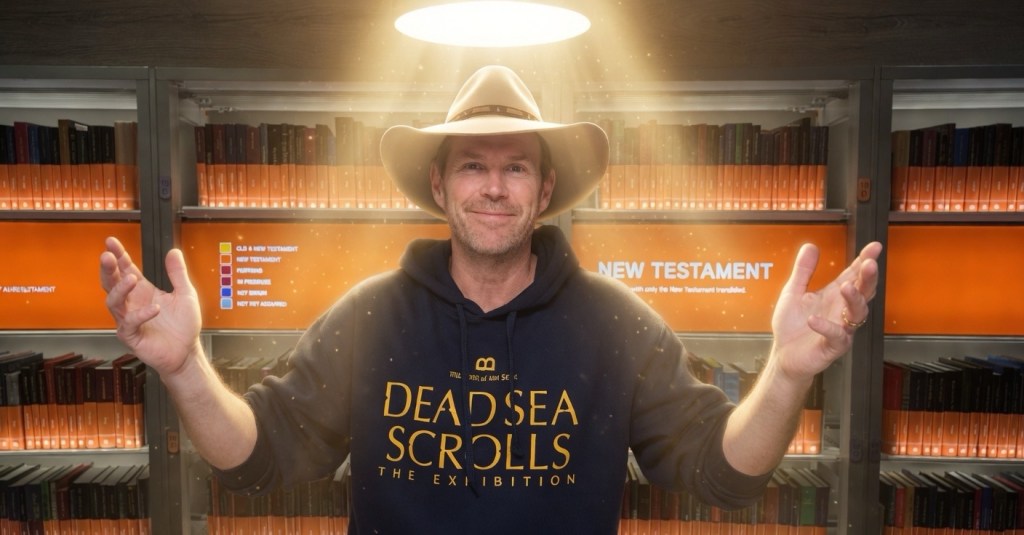
Rich Hoffman is an author, political consultant, and strategic advisor based in Cincinnati, Ohio, and the creator of The Politics of Heaven—a unique framework that connects biblical theology, ancient history, and modern power structures to explain how moral alignment and spiritual forces shape global events. Blending real-world political experience with deep research into archaeology, UFO phenomena, and suppressed historical narratives, Hoffman offers compelling commentary on topics ranging from ancient civilizations and the Dead Sea Scrolls to modern populist movements, paranormal continuity, and leadership strategy in chaotic environments. As the author of The Gunfighter’s Guide to Business and the forthcoming Politics of Heaven, he brings a grounded yet provocative voice to media discussions, supported by firsthand experiences and a cross-disciplinary approach that bridges science, history, and theology. For interviews, speaking engagements, or expert analysis, visit richhoffmanbooks.com or contact directly via phone at 513-307-5815 or email at rhoffman@richhoffmanbooks.com. If you’ve seen the movie, Disclosure Day and want to talk about it and the implications of Presidnet Trump’s UAP disclosures, let me know and we can bring some color to your coverage. https://richhoffmanbooks.com/media-inquiries-broadcast-topics-and-contact-info/?frame-nonce=ad51e7ecba I do have a firsthand UFO encounter to discuss.