I Don’t Like England Anymore: Compliant people are dangerous to thoughtful innovation

I’ve decided that I don’t like England anymore. I did like England when Brexit was the rallying cry—a nation reclaiming sovereignty, shaking off the European Union’s bureaucratic grip. Nigel Farage embodied that spirit of independence, and I could respect that. But who they are now, or have really, always been? That’s a different story. Since COVID, my view has shifted dramatically, and not without reason.

The pandemic exposed something deep in the English psyche: a cultural obsession with compliance. During lockdown, police in England enforced rules with a zeal that bordered on authoritarian. They issued over 120,000 Fixed Penalty Notices for breaches of COVID regulations, ranging from meeting a friend outdoors to traveling without a “reasonable excuse.” Officers even had the authority to enter homes and forcibly return individuals to their residences if they were found outside without justification.¹ This wasn’t just about health—it was about control. It revealed a society that values safety over liberty, process over spontaneity, and certainty over courage.

And then came the social media policing. In England today, posting the wrong thing online can land you in handcuffs. Under Section 127 of the Communications Act 2003 and the Malicious Communications Act 1988, police made 12,183 arrests in 2023 alone for “offensive” or “grossly offensive” posts—a staggering 58% increase since 2019.² That’s about 30 arrests every single day for speech crimes. Think about that. In a country that once gave the world John Locke and the principles of liberty, people are now being dragged from their homes for tweets.

Consider the case of Graham Linehan, co-creator of Father Ted. He was arrested at Heathrow Airport after returning from the U.S., his crime being posts critical of transgender ideology.³ Or the IT consultant who posted a photo with a shotgun during a Florida trip—police raided his home, seized his devices, and subjected him to 13 weeks of investigation.⁴ Then there’s Maxie Allen and Rosalind Levine, who faced a six-officer raid over a sarcastic WhatsApp message criticizing a school official.⁵ These aren’t isolated incidents—they’re part of a pattern. The UK now has elite police units dedicated to monitoring online speech for “hate” or “extremism,” often targeting those with anti-migrant views.⁶

This is not freedom. It’s thought control. And the cultural soil that allows this to grow is England’s love of process—its obsession with rules, procedures, and certainty. They plan everything: the route to the gas station, the tea ritual, the itinerary for a simple drive. It’s a society that trades spontaneity for safety, adventure for predictability. That might sound quaint until you realize what it means in practice: a population conditioned to obey.

Even their illusion of free speech is telling. London’s Speaker’s Corner is often romanticized as a bastion of open dialogue, but in reality, it’s a monitored zone—a symbolic gesture that says, “You can speak here, under our watch.” Outside that corner, the state’s grip tightens. Arrests for silent prayer near abortion clinics, for tweets deemed “offensive,” for Facebook posts criticizing politicians—these are not anomalies; they are the norm.⁷ The U.S. State Department has even flagged the UK for “serious restrictions on freedom of expression.”⁸ That should alarm anyone who values liberty.

And while the state clamps down on speech, another force reshapes the cultural landscape: demographic change. The Muslim population in England has grown from 4.9% in 2011 to about 6.5% in 2021—roughly 4 million people—and is projected to reach 13 million by 2050.⁹ This isn’t just a statistic; it’s a transformation. In urban centers, Islamic fundamentalism finds fertile ground in a society already conditioned to compliance. When a culture is beaten into submission by its own government, it becomes vulnerable to ideologies that demand even stricter obedience. That’s not diversity—that’s a recipe for cultural collapse.

Contrast this with America’s founding spirit. The United States exists because people rejected monarchy, hierarchy, and the suffocating weight of tradition. They fled Europe’s kingdoms for the unknown, embracing risk and adventure. That courage—the willingness to live without guarantees—is what built America. England, by contrast, never shed its psychological chains. Even now, with a “token” King Charles, the monarchy persists as a cultural anchor, a reminder that the people are subjects, not sovereigns. That mindset matters. A society that wants to be ruled already has something broken in its DNA.

Brexit was a flicker of rebellion, a moment when England seemed ready to reclaim its independence. Nigel Farage gave voice to that impulse, railing against the EU’s bureaucratic overreach. But where is that spirit now? Drowned in lockdown mandates, speech policing, and a nanny-state mentality that arrests citizens for jokes. Farage’s Reform UK party still fights, but it’s swimming against a cultural tide that prefers process to freedom.¹⁰

I’ve tried to rationalize some affection for England over the years. I admired their bookstores, their literary tradition, and their politeness. My own family ties made it tempting to look the other way. But honesty demands clarity: England today is not a beacon of liberty. It is a cautionary tale—a society that traded freedom for safety, individuality for compliance, and courage for comfort. And the world is watching. When London becomes the attack vector for global liberalism, when its cultural weakness enables ideological invasions, when its police knock on doors for tweets, we should ask: Is this the future we want?

America must never follow that path. Our strength lies in the unknown, in the willingness to risk, in the refusal to bow. England chose differently. And for that reason, I can no longer admire what it has become.  I would say that England has always been this way, and it has only excelled as a culture when it has endeavored to be more like America, as it did with Brexit.  But remember, this is the same culture that literally tortured and killed William Wallace, the Scottish rebel shown so well in the movie Braveheart.  When they killed him, to quell any future rebellions, they gutted him in front of the crowd and burned his intestines while he was still alive.  After they cut off his head after a very torturous death, they cut up his body and sent his arms and legs to the far reaches of the kingdom.  And they put his head on a pike on London Bridge and kept it there for a long time.  To remind people of what would happen to other rebels should they think to take the same path.  And that same behavior is present in their policing of social media posts.  Any culture that is willing to put up with that kind of oppression is not a good culture for the world.  And that is the value system they seem to support most: compliance with authority over freedom of thought.  English culture is built on compliance, and history shows us over an extended period what a disaster that is.  Which is why I no longer like or respect England and its role in the world.

Footnotes:

¹ UK lockdown enforcement: Fixed Penalty Notices and home entry powers 123

² Arrest statistics under Section 127 and the Malicious Communications Act 4

³ Graham Linehan case 56

⁴ IT consultant arrested over Florida photo 5

⁵ Maxie Allen & Rosalind Levine WhatsApp raid 4

⁶ Elite units monitoring online speech 7

⁷ Arrests for silent prayer and speech restrictions 89

⁸ U.S. State Department criticism of UK free speech limits 9

⁹ Muslim population growth and projections 1011

¹⁰ Farage and Reform UK political context 1213

Rich Hoffman
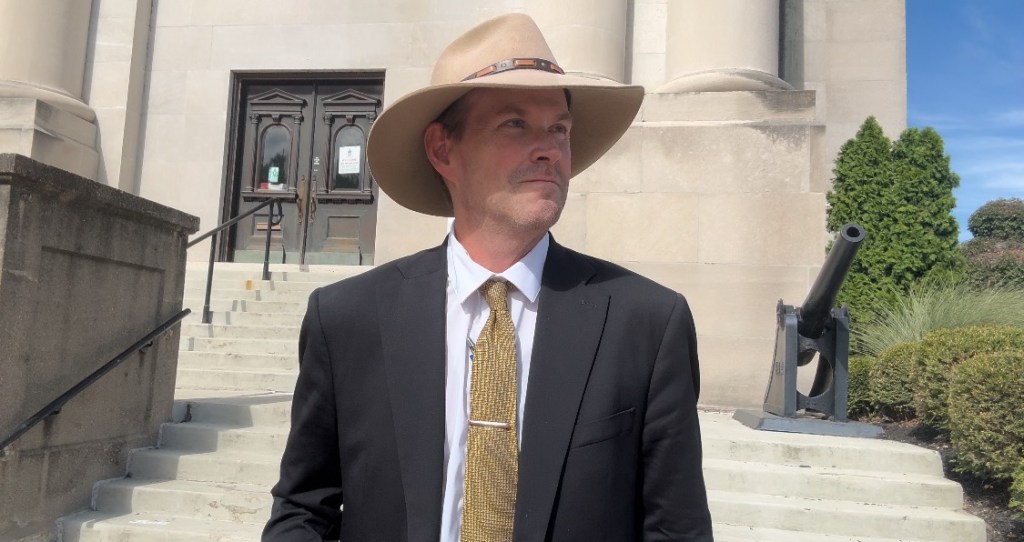
Click Here to Protect Yourself with Second Call Defense https://www.secondcalldefense.org/?affiliate=20707

A Conversation with My Mom: Understanding the Cult of Trump

It was an easy answer that had been coming up more frequently, especially with the Trump indictments by a corrupt legal system run by a crime boss in Joe Biden, who was only in power because of a stolen election. And the thugs were showing that they were in charge, but they were mystified as to why so many people still supported Trump. They had not thought that to be the case. Instead, they expected submission, groveling, and fear from the Trump supporters. Even as they distributed a mugshot of a former president to show their power over him and much of his former staff. We saw a coup by Marxist insurgents, just like Lenin, Mao, or Castro in Cuba. This happened in the United States, and they thought they had it all figured out. Yet, instead, they didn’t understand why Trump was getting more popular, and nobody seemed able to explain it, even the Trump supporters. But the issue became very clear as I visited my elderly mom in the hospital. We were having one of those life-flashing-before-her-eyes discussions as if checking the validity of everything’s worth. From issues when she was a little girl that were coming back to her very fluidly. To things that happened just yesterday. And in her condition, she had been telling all the nurses who were tending to her about some of my very violent past because it was on her mind, and we were talking about it in a way we never had before. Life moved quickly, and there hadn’t been time to catch up, at least for me. She felt she had done something wrong, producing a person like me who was so angry that many people outright hated. She came from the Happy Days generation, where people measured success by how many people liked them. Not me. She didn’t understand why I needed to carry a gun everywhere. She said to me, “Maybe if you just did what you were told, so many people wouldn’t be after you,” she said.

Vote for Trump to fight Marxism

We reflected on many stories, but the one she had told the nurses was one where I was involved in a large fight where many people were killed in the process.  As we reflected, only a few were still alive out of all the people involved.  She was upset that I was so proud of that incident.  She felt guilt about it while I took great pride in it, and that was the core of the problem and why we hadn’t talked about it over all these years.  But that wasn’t the only issue.  I reminded her of the first grade when I poked the school bully in the eye with my scissors.  He was picking on somebody. I had stepped in to stop it, and a fight ensued in class.  He was a really big kid, and everyone was terrified of him.  So, knowing he was dangerous, I fought him that way and stabbed him in the eye with my scissors.  I got into a lot of trouble.  Another time, I was on the school bus.  I always rode in the back, as far away from the figures of authority as possible.  But that was always where the kids who did terrible things sat, and I witnessed many bad things.  One day, they were doing drugs, sharing apparent stimulant pills, and they tried to force me to take one.  I threw it out the window, as I have never taken any drugs, ever in my life.  And I felt very strongly about it even back then.  A huge fight ensued, many of them against me, and many people got hurt, some of them badly.  I got into a lot of trouble.  A lot of trouble.

I don’t sit around thinking about it, but I had dozens and dozens of those kinds of stories, and as my mom reflected on them like older adults do as they are trying to work things out about their own lives, I just let her talk.  But up to that point, I am not a sit-down-and-talk-about-it person.  I keep the throttle down pretty hard, and I like things to go fast.  Not that I’m trying to outrun my past.  I don’t like getting stuck thinking about it because I see it as a waste of time.  But visiting her in that condition it was on her mind, and she felt like she had done something wrong to have such a socially ostracized kid, and she was being hard on herself for all the death and mayhem that was in the wake of it all.  Then, telling her how proud I was of my life was too much.  Yet she had said something that explained the current situation with Trump and the Marxists, who were essentially trying to take over the American government, and why there was such a lack of understanding about the whole issue.  The theme of my life was pretty easy to sum up: resisting anybody who wanted to control my life in some way. I have had the unique circumstance of never being beaten into any submission.  But from my mom’s point of view, she felt that I would have had a much easier life if I had just done what people told me to do.  But I didn’t want an easy life.  I enjoyed the violence.  I enjoyed the heartbreak.  I liked the pain.  Because I wanted more than anything to be free, free as a person to think what I wanted when I wanted to.  So, to me, all those horrible things were good, and I was proud to now reflect on them, knowing what I had to do to arrive at this moment.  On the other hand, she valued safety as the primary criterion of goodness, and because of that, she felt like she had failed. 

Not all Americans had my experience.  Many, at some point in their lives, had taken that pill to keep from being beaten up.  Or they avoided stabbing a bully in the eye because they were afraid to hurt the other person, so they ended up getting beaten up themselves.  And they said yes to the pushing and shoving against them, where a long history of dead bodies didn’t populate their past.  It costs a lot to resist the bullies in life, and there are many of them, and most people do not feel as strongly as I do about it.  But their inner rebel does come out when it comes to Trump.  And secretly, they support that he has been so strong as their representative, and where the Marxist insurgents expected to bully people and have them fold up like cheap lawn chairs, people have continued to support Trump, and that support has increased with each new indictment.  As I answered my mom, appeasing the bad guys does not improve life.  I’d instead carry a gun like I do now everywhere, knowing that lots of people would love to kill me.  That was her fear: if you, just for once in your life, would appease all those bad people, maybe they’d leave you alone.  But no, they never leave you alone.  All they understand is force, and in my way, I have fought very hard with lots of casualties along the way to maintain my freedom.  And now, I was watching the nation of America waking up to that same sentiment.  And I think it’s good, and about time.  Better late than never, but I can certainly say that I understand it fully.  And what’s to come quite well. 

Rich Hoffman

Brian Williams Signs Off: The smoke on the horizon that all progressives see coming

The Smoke on the Horizon

I had some very interesting thoughts about Brian Williams signing off his show on MSNBC, The 11th Hour, for the last time.  About the same time on Fox, the long-time news guy Chris Wallace was leaving for CNN, and Steven Spielberg, along with Disney, was reeling from the rejection of West Side Story that had just been released to theaters.  All kinds of mystification were transpiring at many levels of our society. Still, it all pointed back to one essential thing, something that had been brewing since the creation of America really.  Brian Williams could see, as they all could, that with Trump gone from the White House for a year, Democrats controlling all the levers of power couldn’t duplicate the success of the previous administration, and now they were folding under the pressures of their party.  The cracks were just too big.  Dr. Fauci had just been caught representing our government in creating a bioweapon, Covid-19, in a lab in partnership with China to cause a great reset in the world, and he had been caught.  IN CASE NOBODY WAS PAYING ATTENTION, Robert F. Kennedy’s book, The Real Dr. Fauci, was still the best seller on Amazon for several consecutive weeks.  That meant that millions and millions of people were getting their hands on the content to learn just what role Bill Gates and Dr. Fauci had played in a global insurrection using Covid-19 as the cover story.  And to pave the way for that plan, many Democrat types had got themselves involved in some form or another in election fraud, to steal the election from Trump and give it to their hand-picked guy, Joe Biden.  And that wasn’t working out too well.  People weren’t buying it, and institutionalists like Brian Williams have been some of the first to see the direction the world is moving in. 

To see the story clearly, I think you need to look at the history of the United States as a whole, at the time when the Whig Party broke up and split into two factions, the Republicans who would go on to become the party of Abraham Lincoln and the “Know-Nothings” which was advocated by America’s most famous novelist and sensationalists, Edward Z. C. Judson.  Why were they called the “Know-Nothings” you might ask?  Well, when people asked them about their existence, members would say, “I know nothing.” They were a secret society of the Native American Party who were very skeptical of global powers moving to America as immigrants and bringing dumb, European ideas with them.  Democrats at that time were pushing to split the country in two because they were all about slavery and wanted to preserve it.  Those forces were at work against each other for most of the 19th century. Of course, after the Civil War, many factions were guilty of serious crimes, and progressivism from Europe came in as the Know-Nothings feared always they would and steered our country into a different direction using institutions to help the pill go down.

This went on for over the next hundred years, the rise of institutionalism and the class structure that European immigrants had brought with them to America to turn a free country into just another European territory essentially.  Sigmond Freud came along as a seller of institutionalism to discuss the practices of sex.  Albert Einstein sold physics, Carl Jung sold dream analysis.  Many fields of science arrived from universities copying Europe to create archaeology, paleontology, geology, astronomy, and many other “ologies.” The European answer to the problem in America was more education that was controlled by Edward Bellamy’s fans and the book about socialism Looking Backward.  Institutions were formed to give a tapestry to society that showed sophistication and innovation, just as the novel Looking Backward did projecting society into the future of the year 2000, all in an attempt to sell the work of Karl Marx to a gullible public on their heels after the Civil War.  The political left from Europe, the come lately that the Know-Nothing Party had warned everyone about, led to the Astor House riot and several others across the country that were very violent over essentially immigration issues.  The Know-Nothings believed the Come Lately’s did not have the country’s best interests in mind, and history showed their suspicions to be correct.  Yeah, compared to those riots, the little thing that Democrats saw on January 6th, 2020 was nothing; it was kiddie pool stuff. 

Progressives from the Democrat and Republican Party hoped to mask all these issues with institutionalism which worked for a while thanks to a few World Wars and several other regional wars like Korea, Vietnam, Iraq, and Afghanistan.  But essentially, the worry of mid 19th century Republicans and Know-Nothings who had formed out of the former Whig Party was still very much alive.  The concerns had not abated generationally because they were human in scope.  People who came to America came for freedom, but different people had different ideas of what freedom was.  And Europe, then later, the rest of the world was all too jealous to allow such a thing to occur, and people, real people who have to make a living every day, saw that as the case.  Now being someone who reads a lot of history, I knew a lot of this, but after Joe Biden was sworn in under the most scandalous circumstances, I hit the road with my wife to see what America was really about.  I learned that much of the country is still as it was initially.  They didn’t like institutionalism and wanted to be free of it.  It had nothing to do with President Trump.  He was just the latest vehicle that they thought might give them insulation from global nosiness.  They were still very much rebels in their hearts and minds, which the institutionalists know.  They know how many people really voted for Trump, and they know how much they had to cheat to make it happen.  They know what they did with Covid, and they expected to hide it from the public.  But, the public isn’t buying it because institutionalism is not providing the cover that Democrats and other liberals expected it would, as it had in the past. 

The failure of institutionalism has been evident for a long time, but you can really see it when films like West Side Story come out, and the early reports from Disney about their Star Wars Hotel, which is falling flat on its face with woke politics.  People don’t want that garbage; they never did.  People don’t care what college celebrities like Carl Jung say about dreams or scientists say about global warming manipulating data as they have with Covid to create a political platform.  People see through this stuff, as they always have.  And they want options.  And now that progressives went all-in after over a century of planning and manipulation, they are suddenly like the teenage daughter who was full of rebellion, wanting to run off with her boyfriend, smoking, and getting tattoos to declare her independence.   Once she had her freedom, she realized that smoking ruined her skin.  The tattoos stretched out as she got fat sitting around on her third husband in 10 years while she waited for a government check to arrive in the mail so she could get groceries.  The rebellion of instituting institutionalism was long over, and now people like Brian Williams could see the smoke on the horizon headed their way.  It was the same angry Americans who had been abused and treated terribly by these classes of people looking for social insurrection.  And now the table has turned on them, and it’s only going to get worse.  I should know, I’ve seen these people up close, and they are not happy.  

Rich Hoffman

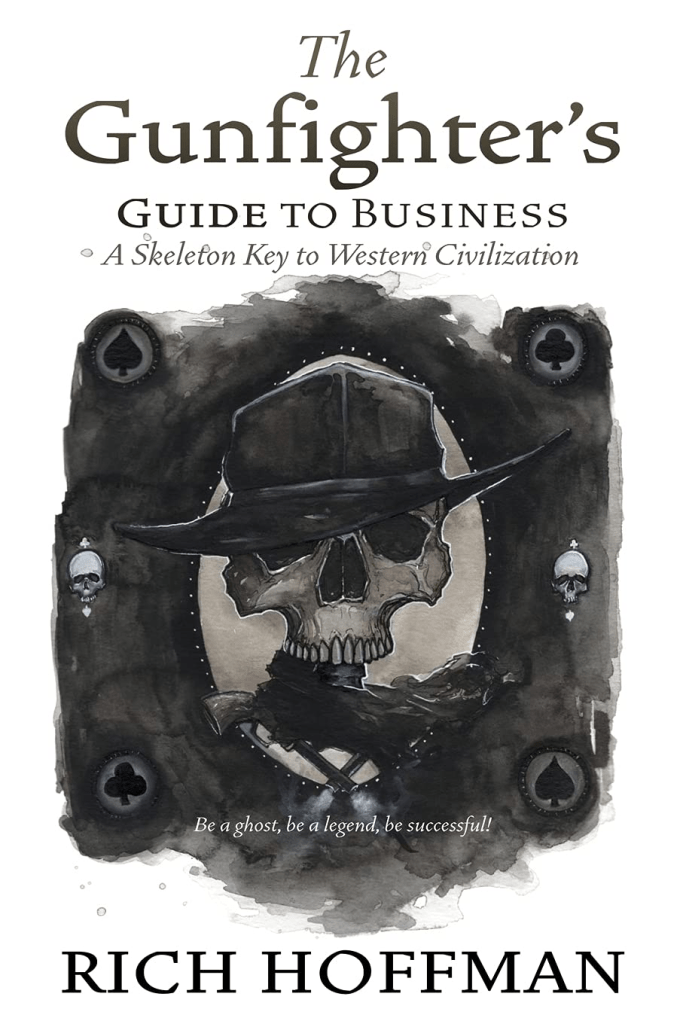
Click to buy The Gunfighter’s Guide to Business