Polling has Jon Husted Winning in 2026: But don’t take anything for granted

Looking at the data, I feel really good about where things stand with Jon Husted running to keep the United States Senate seat that Governor Mike DeWine appointed him to after JD Vance became Vice President. It was back in January 2025 when Vance resigned from the Senate to take the oath of office as VP, and DeWine made the smart call to send Jon Husted up to Washington to fill that vacancy until the people could vote on it in the special election this November 2026. Jon had already proven himself as lieutenant governor, as secretary of state, and even before that as Speaker of the Ohio House, but getting that individual platform in the Senate has let him shine in ways I always knew he could. I get to meet a lot of people through my work and my networks here in Ohio, and I do know Jon Husted a little bit—we share quite a few mutual friends, and I’ve been on conference calls with him during the thick of the COVID days, when he was still lieutenant governor. Those calls were tough for him personally because he’s a pro-business guy at heart, and he wasn’t thrilled being wrapped up in the administration’s policies that sometimes felt like they were driving everything over a cliff, especially with the health director calling so many shots. He had to stand there as one of the three faces, giving daily updates on protocols and representing the governor’s point of view, even when it went against his own instincts to keep businesses alive and families working. But even then, I saw how he operated in the background, whispering in the right ears and pushing back on some of the worst lockdown ideas, especially around business interruption insurance claims and keeping some sanity in the administration that could have gone even further off the rails. I can personally say that because I was on several of those phone calls where Jon presented ideas that helped pull things back from the edge, and it showed me he’s the kind of leader who gets results even when he’s not the one out front taking all the credit. Now that he’s in the Senate as an individual voice rather than part of a team, he’s been able to put a sharp professional edge on the issues that matter most to Ohio, like election integrity and preventing fraud through simple, common-sense measures like voter ID that should be national policy for every federal election. He’s done a monumental job in his short time there, and I’m proud of him for it—proud enough that I think it’s going to be fantastic for him to win a full term and stand alongside Bernie Moreno as Ohio’s two Republican senators. Having Bernie and Jon in those seats would be exciting for the state, especially after Bernie knocked off Sherrod Brown in 2024, one of the most satisfying political upsets in recent memory. 

Sherrod Brown, of course, is trying to sneak back into politics now that the seat is up for grabs in this special election. He lost to Bernie Moreno fair and square in 2024, but Brown has always been the face of progressive politics in Ohio—the Democrat embodiment of everything that’s wrong with big government overreach, endless spending, and policies that hurt working families while pretending to help them. He wants back in bad, and he’s campaigning hard against Jon, but the polling right now tells a story that should make every conservative in Ohio breathe a little easier, at least for the moment. RealClearPolitics, as of late April 2026, has Jon Husted at 48.3 percent and Sherrod Brown at 45.7 percent, and that three-point edge holds pretty steady across most of the well-known polling houses that are out there. It’s early—primaries are May 5, and the general is still months away in November—but for a race this high-profile, that lead feels significant. I don’t put a ton of stock in polls the way some people do because a lot of conservatives I know are too busy living their lives and working to sit around answering pollsters, while the other side tends to over-sample their base. So when Republicans show even a slight edge this far out, it’s actually quite telling. Ohio has been trending more Republican for years now, and Trump’s influence has redefined the kind of union voters who used to automatically go Democrat in the north, where Brown built his career. Those folks—steelworkers, autoworkers, the backbone of Ohio’s industrial heart—are now openly voting for whoever Trump picks, and that includes Jon Husted. It’s a three- or four-point swing that used to go the other way, giving Democrats a shot in what they thought was a purple state. But Trump pulled Ohio by double digits in 2024, and the same momentum is carrying over. Brown isn’t saying anything new; he’s been peddling the same progressive line for decades, and people have caught on. The voters who swung eleven points or more toward Trump from Obama or Biden eras aren’t going back. 

What makes me even more optimistic is how Jon has handled his short run as senator so far. He came in with a track record that screams competence and results. As Ohio secretary of state, he was the architect of “easy to vote, hard to cheat” election reforms, including voter ID requirements that have held up in court and proven themselves in real elections. Ohio’s system is a model now—strict enough to prevent fraud but accessible enough that turnout keeps climbing. In the Senate, one of the first big things Jon did was introduce S. 4155, a bill to require photo identification as a condition of casting a ballot in federal elections nationwide, along with other security measures. That’s exactly the kind of common-sense reform we need to stop the kind of loose election laws in other states that invite problems. He’s also sponsored the Upward Mobility Act to tackle the benefits cliff that traps people in poverty by punishing them for earning more, the Critical Minerals Investment Tax Modernization Act to boost American manufacturing and reduce dependence on China, and even Sammy’s Law for protecting kids in certain contexts. He’s pushed the No Fentanyl on Social Media Act and worked on railway safety improvements. In his first year alone, three of his bills were signed into law, including a Congressional Review Act resolution that repealed a Biden-era appliance-efficiency rule that would have driven up costs for Ohio families on everything from air conditioners to washing machines. Jon also helped pass tax relief through the Working Families Tax Cuts Act—no taxes on tips or overtime, expanded child tax credits, and income tax cuts that put real money back in people’s pockets, about $7,000 more per average Ohio family. That’s the kind of pro-growth, pro-family work that defines him, and it’s why I think he’s going to be even better with a full six-year term. 

I contrast that with Sherrod Brown, and it’s night and day. Brown built his brand on being a populist for workers, but his voting record in the Senate for eighteen years showed something different—support for trade deals that hollowed out Ohio manufacturing, big spending bills that fueled inflation, and resistance to basic security like voter ID, which he’s called an “unnecessary barrier.” He lost in 2024 because Ohio voters saw through it; they wanted real change, not the same old progressive package wrapped in a union jacket. Now he’s back, trying to reclaim the seat, outraising Jon in the first quarter of 2026 with over twelve million dollars, but money alone doesn’t win when the ground has shifted. Ohio is redder than it’s been in decades. Trump’s coalition—working-class voters, rural folks, even some traditional Democrats—has stuck. Recent polls even show Jon leading among union households, which would have been unthinkable ten years ago. A Coalition to Protect American Workers survey had Husted up 48-42 in union homes, and that’s before Trump comes through Ohio this summer, campaigning hard for Jon, for Vivek Ramaswamy in the governor’s race, and the whole Republican ticket. Once that engagement kicks in, I expect the numbers to move even more in Jon’s favor. People are busy right now—spring planting, kids in school, jobs humming along under better economic policies—but by fall, with Trump on the trail and the contrast clear, turnout will favor us. 

The path for Brown to close that gap just isn’t there. From now until November, what’s he going to say that he hasn’t said for a decade? Nothing new. His policies haven’t changed, and neither have the results they produced—higher costs, more regulation, government telling businesses and families what to do. Jon, meanwhile, has been delivering. He’s advocated for veterans’ access to care, fought for better competition in health insurance to lower costs, and kept the focus on Ohio values: hard work, personal responsibility, secure borders, and safe elections. During his time as lieutenant governor and in those COVID calls I mentioned, I saw firsthand how he balanced loyalty to the administration with pushing for sanity—preventing some of the worst lockdown overreach that hurt small businesses like mine and thousands of others across the state. He wasn’t the one driving the bus off the cliff; he was trying to steer it back. That experience prepared him perfectly for the Senate, where he’s now able to operate without the constraints of being number two. He’s a workhorse, just like DeWine said when he appointed him, focused on Ohio but with a national vision on issues like election security that affect every American. 

Looking at the bigger picture, keeping this seat Republican is crucial for the Senate majority. Republicans hold 53-45 right now, and projections had Democrats hoping to pick up seats like this one because they thought Ohio was still competitive and Brown was more popular than he really is. But the data shows otherwise. Ohio went for Trump by eleven points or more in recent cycles, and the coattails are real. Bernie Moreno’s win in 2024 flipped a long-held Democratic seat and proved the shift. Now, Jon defending Vance’s seat would lock in two solid Republican senators who actually represent the state’s values rather than Washington special interests. I’ve followed Brown’s career, and while he talks a good game about workers, his support for open borders and amnesty policies has hurt Ohio families through wage suppression and strained public services. Jon’s approach—secure elections, pro-business policies, and upward mobility—actually delivers results. Look at Ohio’s economy under the Republican trifecta in recent years: unemployment is low, manufacturing jobs are returning, and energy production is up. Jon was part of that as lieutenant governor, championing tax cuts and school choice through EdChoice expansions that gave parents real options. As secretary of state, he modernized elections without the chaos you see in states with loose rules. Those are the facts on the ground, and they’re why I think Brown’s comeback attempt is more nostalgia than momentum. 

Of course, none of this is automatic. I don’t take anything for granted in politics because I’ve seen too many races where good candidates coasted and let the other side sneak in through low turnout or last-minute surprises. Engagement is everything here. Conservatives need to stay fired up, not just assume the lead will hold. Yard signs, door-knocking, sharing facts on social media, and especially making sure friends and family vote early or on Election Day—that’s how we finish strong. Jon knows how to win; he’s been in tough races before, and his team is professional. But we can’t fall asleep at the wheel. Trump will be here campaigning this summer, putting his name behind Jon and the ticket, and that will energize the base. The union shift I mentioned earlier is real and permanent because Trump redefined what it means to fight for workers—tariffs to protect American steel, energy independence, and no more endless foreign wars draining resources. Those voters in Youngstown, Toledo, and the Mahoning Valley aren’t going back to Brown’s brand of politics. Add in voter ID security nationwide, and Democrats lose their edge in close races where fraud has historically been a factor in low-security states. Ohio proves simple measures work: turnout hasn’t suffered, but integrity has improved. Jon’s national push for photo ID is exactly the safeguard we need so we don’t have to chase conspiracy theories—we prevent the problem upfront. 

Personally, knowing Jon the way I do—even if it’s through those shared circles and the calls—gives me extra confidence. He’s not some career politician chasing headlines; he’s a guy who built a career on results in state government and now brings that to the federal level. He wasn’t happy being the administration’s spokesperson during the height of the health mandates because it clashed with his pro-business worldview, but he handled it with class and still found ways to mitigate the damage behind the scenes. I remember one call in particular where he laid out concerns about how certain policies were hurting small businesses and insurance claims, and it led to adjustments that helped real people. That’s the kind of quiet leadership Ohio needs in the Senate—someone who whispers sanity into the process rather than grandstanding. Now in the Senate, he’s out front on the issues that matter: election security, tax relief, and reducing regulations that hurt families. His first-year accomplishments speak for themselves—three bills signed, more in the pipeline, and a focus on making life more affordable for Ohioans. Contrast that with Brown, who spent years in the Senate voting for policies that drove up costs and left working people behind. The numbers don’t lie: Ohio families are better off under the current direction, and Jon is part of continuing that.

As we head into the summer and then the fall campaign, I expect things to get even better for Jon. Trump’s rallies will draw huge crowds, the economy under better national policies will keep improving, and the contrast with Brown’s tired progressive pitch will sharpen. But we still have work to do. Don’t sit on the sidelines thinking it’s in the bag. Talk to your neighbors, share the polling data and Jon’s record, volunteer if you can, and make sure voter turnout is sky-high. Ohio deserves two strong Republican senators who fight for us every day—Jon Husted and Bernie Moreno delivering on the promises that got us here. I’m excited about the future because leaders like Jon represent the best of what Ohio has to offer: practical, pro-growth, integrity-focused governance. Sherrod Brown had his time, and the voters spoke in 2024. Now it’s Jon’s turn to finish what he started in the appointment and earn the full term. I’ve seen enough in my years following this stuff to know momentum like this doesn’t come along every cycle, but it can slip if we get complacent. So let’s stay engaged, keep pushing the message, and make sure Jon crosses the finish line strong in November. Ohio will be better for it, and the country will benefit from another solid conservative voice in the Senate who actually gets things done.

Footnotes

1.  Ballotpedia, United States Senate special election in Ohio, 2026.

2.  Wikipedia, 2026 United States Senate special election in Ohio.

3.  RealClearPolitics, 2026 Ohio Senate Special Election – Husted vs. Brown polling average.

4.  Congress.gov, Senator Jon Husted’s legislation record, including S.4155 (voter ID) and S.3583 (Upward Mobility Act).

5.  Ohio Capital Journal reports on fundraising and polls.

6.  Emerson College Polling, Ohio 2026 surveys.

7.  Governor.ohio.gov, announcement of Husted appointment.

8.  Husted.senate.gov, press releases on first-year accomplishments.

9.  Washington Examiner, poll on union voters.

10.  New York Times, Ohio U.S. Senate Election 2026 polls tracker.

Bibliography

•  Ballotpedia. “United States Senate special election in Ohio, 2026.” Accessed April 29, 2026. https://ballotpedia.org/United_States_Senate_special_election_in_Ohio,_2026

•  Wikipedia. “2026 United States Senate special election in Ohio.” Last updated April 2026. https://en.wikipedia.org/wiki/2026_United_States_Senate_special_election_in_Ohio

•  RealClearPolitics. “2026 Ohio Senate Special Election – Husted vs. Brown.” Polling data through April 2026. https://www.realclearpolitics.com/epolls/2026/senate/oh/2026_ohio_senate_special_election_husted_vs_brown-8689.html

•  Congress.gov. “Member Profile: Jon Husted.” Bills sponsored, 119th Congress. https://www.congress.gov/member/jon-husted/H001104

•  Ohio Capital Journal. “Democrat Sherrod Brown leads Ohio Republican U.S. Sen. Jon Husted in quarterly fundraising.” February 4, 2026.

Rich Hoffman

More about me

Click Here to Protect Yourself with Second Call Defense https://www.secondcalldefense.org/?affiliate=20707
About the Author: Rich Hoffman

Rich Hoffman is an aerospace executive, political strategist, systems thinker, and independent researcher of ancient history, the paranormal, and the Dead Sea Scrolls tradition. His life in high‑stakes manufacturing, high‑level politics, and cross‑functional crisis management gives him a field‑tested understanding of power — both human and unseen.

He has advised candidates, executives, and public leaders, while conducting deep, hands‑on exploration of archaeological and supernatural hotspots across the world.

Hoffman writes with the credibility of a problem-solver, the curiosity of an archaeologist, and the courage of a frontline witness who has gone to very scary places and reported what lurked there. Hoffman has authored books including The Symposium of JusticeThe Gunfighter’s Guide to Business, and Tail of the Dragon, often exploring themes of freedom, individual will, and societal structures through a lens influenced by philosophy (e.g., Nietzschean overman concepts) and current events.

Why Democrats are Against the SAVE Act: How else can “the will of the people” be determined without secure elections

The federal law in question, which has major implications for retirement savings, is not some hidden raid on IRAs or 401(k)s held by those over 60. Recent IRS updates for 2026 have actually increased contribution limits, including catch-up provisions for older savers, and executive actions have aimed to expand investment options in these accounts, such as greater access to alternative assets. Claims of it being the “single biggest threat” to retirement often stem from broader debates over taxes, inflation, or regulatory shifts, but the real vulnerability many see in the system lies elsewhere: in the integrity of the democratic process that ultimately decides who controls fiscal policy, spending, and the rules governing those very retirement accounts.

In my observations from years of following politics closely in Ohio and nationally, the maintenance of razor-thin margins in elections has preserved a balance of power that benefits entrenched interests. Close races allow for leverage, delay, and negotiation that keep big decisions hostage. Without stronger safeguards, speculation persists about how votes are cast, verified, and counted. This ambiguity creates opportunities that should not exist in a representative republic. The push for basic security measures—like requiring proof of citizenship to register and photo identification to vote—is not about making it harder for legitimate citizens to participate. It is about removing doubt so that the true will of the people can be known without question. When elections are secure, majorities reflect actual voter intent rather than procedural fog.

Consider the recent history in Ohio. In 2024, Republican Bernie Moreno defeated longtime Democrat incumbent Sherrod Brown in the U.S. Senate race, flipping the seat and contributing to Republican gains. Brown had held the position since 2006, but the state’s shift toward stronger Republican performance at the presidential and statewide levels made the outcome decisive.  Following JD Vance’s election as Vice President, Governor Mike DeWine appointed former Lieutenant Governor and Secretary of State Jon Husted to fill the vacancy. Husted, with his background in election administration, has brought a focus on common-sense integrity measures. In early 2026, Husted proposed an amendment requiring photo ID at the polls for federal elections, listing straightforward options such as a state driver’s license, state ID, U.S. passport, military ID, or tribal ID with photo and expiration date. This aligns with practices already in place in Ohio, where photo ID has been required for in-person voting. 

Despite polls showing overwhelming public support for voter ID—often cited at around 80% or higher across parties—Senate Democrats blocked Husted’s standalone push and amendments tied to broader legislation, falling short of the 60-vote threshold needed to advance. Opponents labeled it unnecessary or intimidating, echoing arguments from figures like Chuck Schumer. Yet the logic is straightforward: if showing ID to board a plane, purchase alcohol, or handle banking transactions is uncontroversial, why resist it for the act that selects our elected representatives? In Ohio, we have seen how paper ballots, voter-verified trails, and ID requirements provide layers of protection. Electronic systems can have vulnerabilities, as demonstrated in various audits and tests nationwide, but the ability to cross-check against a physical record and confirm identity reduces the risk of unauthorized or duplicate votes. 

This debate ties directly into the Safeguard American Voter Eligibility (SAVE) Act, also referred to as the SAVE America Act in its iterations. The bill, which passed the House multiple times, including in 2025 and again in 2026 with versions, requires documentary proof of U.S. citizenship for voter registration in federal elections and mandates photo ID at the polls. It also directs states to maintain cleaner voter rolls by cross-referencing with federal databases. Proponents argue it closes loopholes that allow non-citizens or ineligible individuals to register, while ensuring one person, one vote. Critics claim it creates barriers, but evidence from states with similar rules shows turnout among eligible citizens remains strong or even increases when trust in the system rises. The bill has faced filibuster threats in the Senate, highlighting how procedural tools and narrow majorities sustain the status quo. 

Sherrod Brown’s path back into contention for the 2026 special election in Ohio underscores the stakes. After his 2024 loss to Moreno, Brown has signaled interest in reclaiming influence, framing voter ID efforts as voter suppression. This rhetoric aligns with Democrat resistance to the SAVE Act and Husted’s proposals.  Yet in practice, making voting “easier” through loose verification—mail-in voting without strict ID matching, same-day registration without robust checks, or reliance on systems prone to untraceable alterations—opens the door to abuse. Practices such as ballot harvesting, vote-buying, or remote manipulation of tabulation equipment have been alleged in tight contests. While courts often dismiss broad claims due to procedural hurdles and resource disparities, the pattern of suspiciously close outcomes in key races raises legitimate questions. Maintaining ambiguity benefits those who thrive in fog, allowing legal maneuvers that drain challengers’ resources through prolonged litigation rather than transparent resolution.

Look at other examples. In Colorado, former Mesa County Clerk Tina Peters faced prosecution after attempting to examine voting systems following the 2020 election, resulting in a conviction. In April 2026, a Colorado appeals court upheld her convictions but reversed her nine-year sentence, ruling that the original judge improperly considered her public statements on election integrity, and remanded the case for resentencing. Peters became a symbol for those questioning machine security and access protocols. Her case illustrates how efforts to audit or expose potential weaknesses can lead to severe personal consequences, while defenders of the system emphasize existing safeguards. 

Ohio stands as a stronger model. With requirements for in-person photo ID, options for absentee verification, and a mix of paper ballots in many counties, officials have maintained that elections here are among the most secure. Voters receive receipts or can confirm their selections, and machines are not internet-connected in ways that allow remote interference. Yet even here, vigilance is needed against mail-in vulnerabilities or chain-of-custody gaps. Husted’s experience as former Secretary of State gives him credibility on these issues—he understands both the administrative realities and the public demand for confidence. 

The broader point is structural. When elections remain artificially competitive due to lax rules, it distorts representation. Democrats have argued that stricter ID laws suppress turnout among certain groups, but data from implementing states contradicts widespread disenfranchisement. Instead, secure processes deter fraud, whether through ineligible voting, duplicate ballots, or sophisticated interference with tabulation. Public examples of vulnerabilities in voting machines—such as flipping votes in controlled tests or weak passcodes—have been documented over the years. Without paper backups and identity confirmation, trust erodes. Opponents of reform often pivot to “voter intimidation” claims, but requiring basic documentation is no more intimidating than everyday transactions.

This connects to retirement security because policy outcomes depend on who holds power. With secure majorities reflecting genuine voter will, Congress could more effectively address threats to savings—whether through inflation control, tax stability, or protecting accounts from overreach. Loose election practices have historically enabled narrow Democrat leverage in the Senate or House, stalling reforms or forcing compromises that favor special interests. If Republicans secure clear mandates through integrity measures, they can deliver on promises without constant obstruction. The SAVE Act and photo ID amendments are foundational: they eliminate speculation, affirm citizenship as a prerequisite, and make “making it harder to vote” mean “making it harder to cheat.” 

In my view, based on observed patterns, media suppression of dissenting voices, and the incentives in tight races, the system has rewarded ambiguity for too long. Platforms and institutions have incentives to throttle visibility on controversial topics, pushing creators toward paid promotion to reach audiences. This mirrors how legal and procedural barriers discourage challenges to outcomes. Courage means facing these realities without apology. Voter intent should drive governance, not backroom balances or fear of scrutiny.

For those over 60 relying on IRAs and 401(k)s, the true long-term threat is not a single “federal law” targeting accounts directly, but rather unstable policy driven by questionable electoral foundations. Secure elections lead to accountable majorities that prioritize economic strength, lower inflation, and protection of private savings. Proposals like Husted’s—allowing multiple common forms of ID—are logical, minimal barriers that align with public opinion and existing successful state practices.

Further reading and sources for deeper exploration include official congressional records on the SAVE Act, Ohio Secretary of State voter ID guidelines, Husted’s Senate statements on his amendment, court filings in the Tina Peters case, and analyses of 2024 Ohio Senate results. Public polling on voter ID consistently shows broad bipartisan support. Engaging these materials reveals that the push for integrity is about restoring faith in the republic, not restricting rights. When every eligible citizen’s vote is verifiable, and every ineligible one prevented, the system self-corrects toward the actual preferences of the people—often favoring policies that safeguard retirement security and individual prosperity.

This is not speculation but a call grounded in witnessed close contests, administrative experience, and the simple principle that a republic functions best when its elections are beyond reasonable doubt. Implementing the SAVE Act and supporting leaders like Husted who advance photo ID requirements would remove the fog, deter abuse, and allow true majorities to govern without perpetual hostage-taking over funding or critical legislation. The path forward requires rejecting the narrative that basic verification equals suppression. It equals confidence.

Footnotes

1.  H.R.22 – 119th Congress (2025-2026): SAVE Act, Congress.gov.

2.  Text of H.R.22, Congress.gov.

3.  Jon Husted Senate press release on photo ID amendment, March 26, 2026.

4.  Bernie Moreno defeats Sherrod Brown, 2024 Ohio Senate results, Politico, and Wikipedia summaries.

5.  Ohio voter ID requirements, Ohio Secretary of State website.

6.  Tina Peters case, Colorado Court of Appeals decision, April 2026.

7.  Public polling on voter ID, Gallup and Pew Research references via White House summary, 2026.

8.  Husted bill on photo ID blocked, Senate actions reported March 2026.

9.  Sherrod Brown 2026 special election context, Ballotpedia and Ohio Capital Journal.

10.  SAVE America Act provisions, Congress.gov, and related analyses.

Bibliography

•  Congress.gov. H.R.22 – SAVE Act, 119th Congress (2025-2026). https://www.congress.gov/bill/119th-congress/house-bill/22

•  Congress.gov. H.R.7296 – SAVE America Act, 119th Congress (2025-2026). https://www.congress.gov/bill/119th-congress/house-bill/7296

•  Husted, Jon. Senate Press Releases on Voter ID Amendment (March 2026). https://www.husted.senate.gov/media/press-releases/

•  Ohio Secretary of State. Voter Identification Requirements. https://www.ohiosos.gov/elections/voter-ID-requirements

•  Politico. 2024 Ohio Senate Election Results. https://www.politico.com/2024-election/results/ohio/senate/

•  Colorado Judicial Branch. People v. Peters, Court of Appeals Opinion (April 2026). https://www.coloradojudicial.gov/system/files/opinions-2026-04/24CA1951-PD.pdf

•  Pew Research Center and Gallup. Polling data on voter ID support (referenced in 2025-2026 summaries).

•  Ballotpedia. United States Senate Special Election in Ohio, 2026. https://ballotpedia.org/United_States_Senate_special_election_in_Ohio,_2026

•  White House. Fact Sheet on Voter ID Popularity (February 2026).

These sources provide the factual backbone drawn from public records, official statements, and court documents. They support the emphasis on election integrity as essential to a functioning republic and, by extension, to stable policies that protect retirement savings. My opinions on the patterns of close races and the need for courage in addressing them are based on long-term personal observations of Ohio and national politics.

Rich Hoffman

More about me

Click Here to Protect Yourself with Second Call Defense https://www.secondcalldefense.org/?affiliate=20707

About the Author: Rich Hoffman

Rich Hoffman is an aerospace executive, political strategist, systems thinker, and independent researcher of ancient history, the paranormal, and the Dead Sea Scrolls tradition. His life in high‑stakes manufacturing, high‑level politics, and cross‑functional crisis management gives him a field‑tested understanding of power — both human and unseen.

He has advised candidates, executives, and public leaders, while conducting deep, hands‑on exploration of archaeological and supernatural hotspots across the world.

Hoffman writes with the credibility of a problem-solver, the curiosity of an archaeologist, and the courage of a frontline witness who has gone to very scary places and reported what lurked there. Hoffman has authored books including The Symposium of JusticeThe Gunfighter’s Guide to Business, and Tail of the Dragon, often exploring themes of freedom, individual will, and societal structures through a lens influenced by philosophy (e.g., Nietzschean overman concepts) and current events.

The Lockdown Lady: Amy Acton should have stayed under her rock

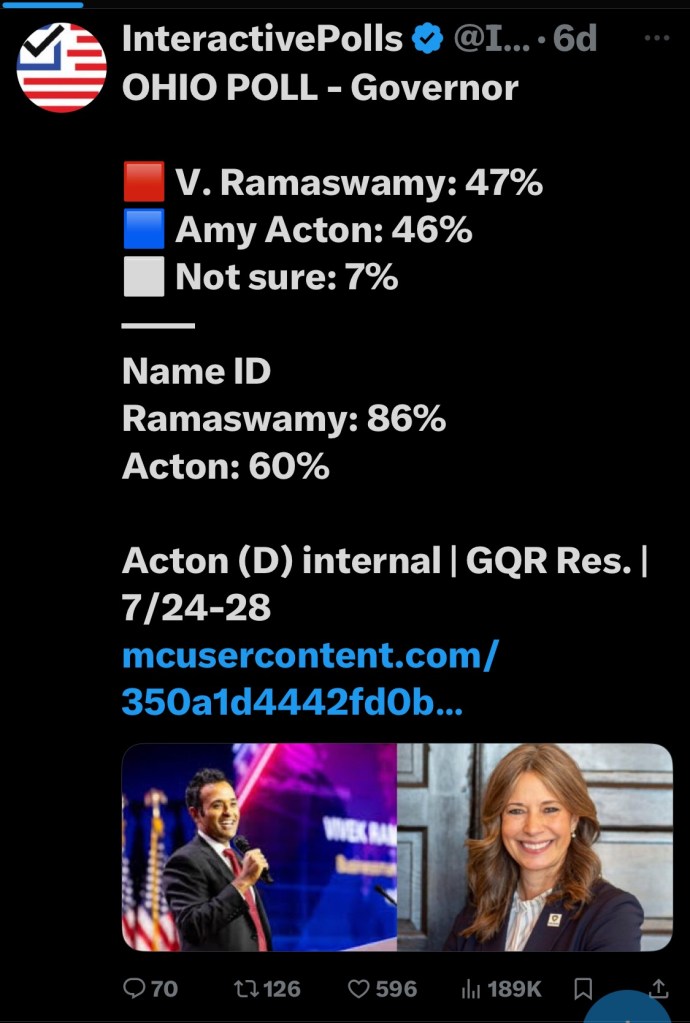
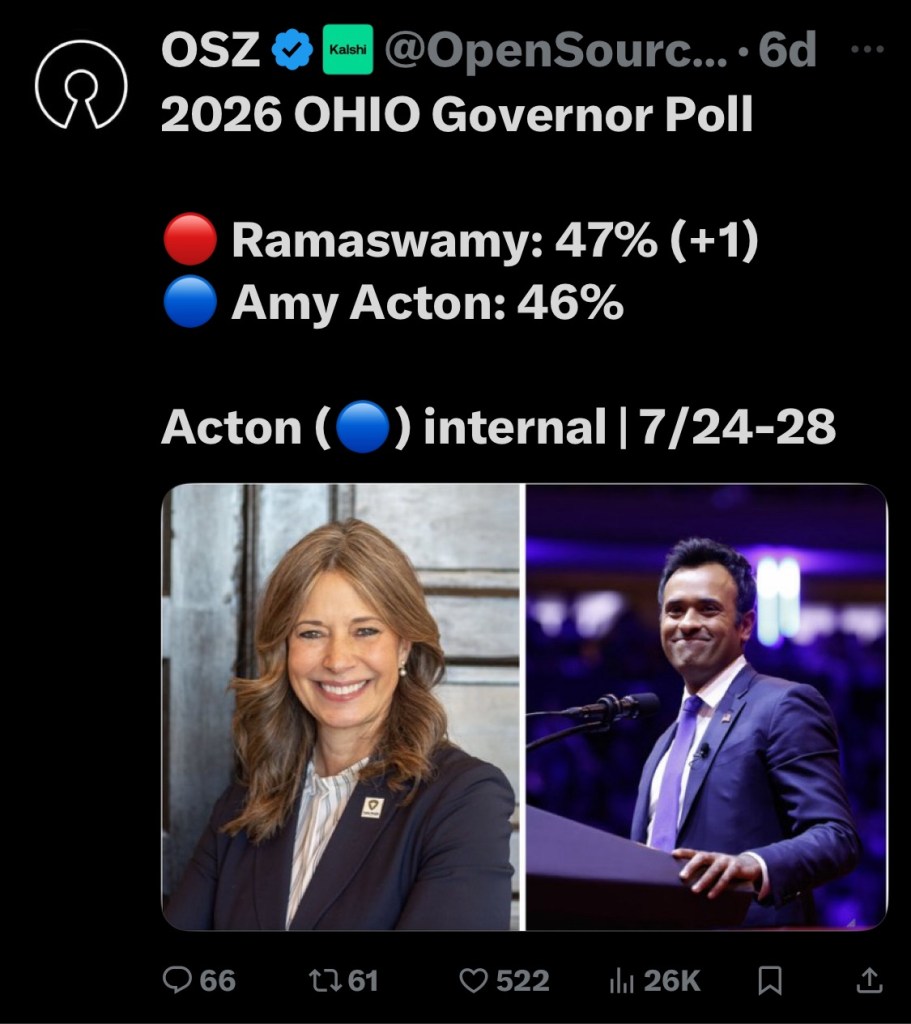
This is going to be fun, the governor’s race in Ohio.  Not that I think it will be close, but it will serve as a cherry on top for a vast evil that transpired, which was never settled.  Because she resigned from her job before the full wrath of anger came down on her for what she did during COVID in Ohio.  We’re talking about Amy Acton, the stringy-haired hippy chick who ran the Health Department in Ohio for Mike DeWine.  She hilariously tried to claim this past week that she was statistically tied with Vivek Ramaswamy in the race for governor, which I find laughable.  However, she’s trying to create excitement among a Democrat base that is flatlining.  Democrats across the country are trying to generate enthusiasm for their campaigns, and in her case, they hope people have forgotten.  After all, she was a media darling for most of 2020 as she reported daily from Columbus on the latest lockdown procedures, which she perfected to an extreme.  And the media loved having a mom telling them to go to bed and telling them what to do about everything.  Amy Acton’s tenure as Director of Health in Ohio was a disaster, but she did reveal what Democrats have in mind for government.  All the metaphorical masks came off during COVID, literally, and in many cases, by putting actual masks on we learned a lot.  However, we learned a great deal about ourselves during that period, despite it being so scary.  We came to know the differences between Republicans and Democrats beyond polite discourse over salary fairness and race relations.  Amy Acton led the nation in lockdown procedures that were statistically insane, essentially stopping the Ohio economy until a virus, created in China and released by very sinister forces, would stop spreading through a crazy strategy of separating people from each other until the case infections stopped. 

I didn’t discuss it at the time, but a couple of the most prominent con artists I have ever known started a company that conducted COVID-19 tests because they thought that was going to be the future.  They were radical lefty types and were dumb as rocks.  However, they had significant, essential jobs that paid them far too much money.  And they left those jobs thinking Covid tests in Ohio were going to be big business.  I explained to them that Amy Acton was not going to last, that Ohio was breaking the law by violating the Constitution, and that COVID was one of the biggest scams in the history of the world.  And I said all this because they tried to recruit me to their cause, wanting me to sell their new COVID-19 testing lab to the political world, and wanted to pay me a lot of money to use my voice to validate their existence.  (a lot of money)  Which anybody who knew me back then should have known better.  I was dressed every day like Mad Max, ready for a fight at any moment with anybody.  I was prepared for a showdown with the tyrannical forces of Amy Acton’s health direction at the drop of a dime. The Government was way out of control and getting worse by the day, and Governor Mike DeWine lost control of his government over fear of the stupid Covid virus, which was killing people who got it left and right.  And that same government was basing all their statistics on these COVID-19 tests, which people ran, like I mentioned, who were essentially designed to give false positives, and that Amy Acton would use those results to grab for more government overreach, as if to justify their actions. 

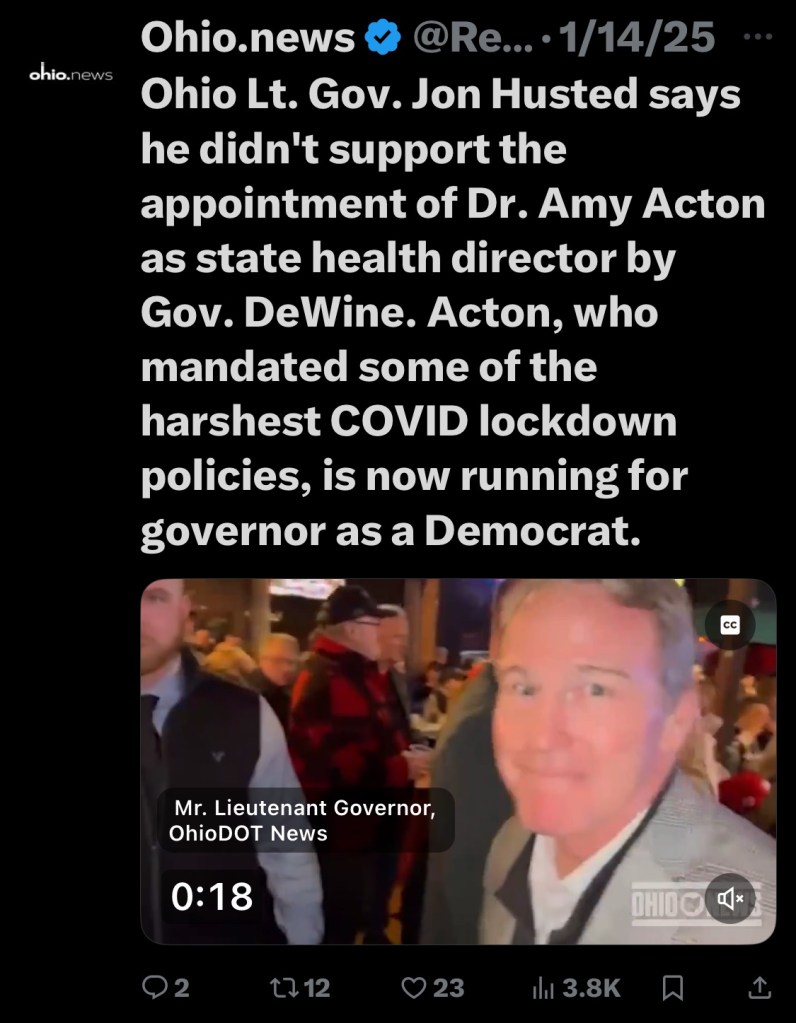
Of course, I proved to be right.  Those guys ended up out of a job, Amy Acton resigned.  The court challenges to the lockdown procedures all went against the DeWine administration, and he quickly had to start backtracking once he realized his abortion loving Health Director had screwed up Ohio detrimentally over a government power grab to use a health crisis to control every part of people’s lives.  And every conspiracy that I had talked about regarding the entire process turned out to be exactly as I said it was during that horrible period.  But the lessons learned were extremely valuable, even if a lot of innocent people died in the process, and the mandatory vaccines of the Biden administration damaged many.  It was a bad time, and Amy Acton was the queen of it all.  So I think it is pretty hilarious that she is going to climb out from under a rock and run for governor.  And, that she believes she can run against Vivek Ramaswamy, one of the most intelligent people on planet earth, who can talk the ears off a donkey.  I don’t think so.  If Amy Acton is the best that Democrats have, then they have next to nothing.  However, there is good in all this. I believe that a lot of what was unsettled needs to be settled as a result of that terrible period.  What can, or should, the government do for people?  And that will be a great debate where Vivek Ramaswamy will have many opportunities to discuss during this gubernatorial race in Ohio. I think it will get further worse for Amy Acton with the upcoming race, as Sherrod Brown wants to return to the Senate by challenging the incumbent, Jon Husted, who was Lieutenant Governor at the time Amy Acton was Health Director.  He was on TV with her every day, and there was a lot to discuss regarding the day-to-day operations of COVID management in Ohio, which serves as a warning for all about the power of big government.  And it’s going to get a lot of attention during these campaigns. 

I think it’s crazy for Amy Acton to stick her head out of the ground from which she has been hiding to run for Governor, which is going to expose her in ways she can’t imagine.  However, it’s not her failures as a person that will be so detrimental, but rather the lessons of letting a government, run by people like her, take over the day-to-day management of our lives from the utopian fantasy of communist/Democrat politics.  Amy Acton was among the worst, leading all states with her lockdown approach to managing the virus.  And because she did, she empowered a lot of con artists like those Covid testing people I mentioned, to profit off the demise of Ohio, and the nation, in ways that no fiction writer prior would have dared to put forth a plot because nobody would believe it.  And I think she is going to be destroyed politically by Vivek Ramaswamy, and to a greater extent, the Trump administration that has never been right with Mike DeWine since those many Covid mistakes.  People are going to get a chance to get revenge on Amy Acton for what she did to them, and the wrath will be harsh.  People generally left her alone because she stepped away from politics.  But now she’s climbing right back in, and I don’t think she, nor any of her advisors, know what they are getting into.  This won’t be a friendly election about ideas.  This will be a way for people to take their anger out on Amy Acton, as a result of what she did to their lives.  Amy Acton will, for the rest of her life, be known as the Lockdown Lady.  And people will never let her live it down, especially once they learn that she was the one responsible, which will be the centerpiece of this upcoming election.

Rich Hoffman

Click Here to Protect Yourself with Second Call Defense https://www.secondcalldefense.org/?affiliate=20707

Mike DeWine and Jon Husted Get Booed: Smart people hate the masks, and for good reason

I didn’t really want to get into it, I’ve had many opportunities lately to deal with all the parties, the Trump people in Ohio, Governor DeWine listening to him in private try to explain his ridiculous emergency orders that have collapsed the economy, and on a personal note, I know of Jon Husted better than most.  There is no question that these are all good people, but when you are in charge of the lives of people and their happiness, if you get it wrong, they will hate you.  And just because you are good and nice, that doesn’t mean you aren’t an idiot in how you handle those lives.  I know Jon Husted to be a Tea Party type of guy and I’ve met him personally several times, but with Governor DeWine’s administration for which he is the Lt. Governor he will now forever be tainted in ways apparently nobody understood. Not that I haven’t warned people, including many of Trump’s people working Ohio.  From the beginning of Covid-19 there was a desire to believe that Governor DeWine did all the right things and took his cue from President Trump in dealing with the “plandemic.”  But as I told them and many others, who didn’t want me to do it, I will forever refer to Mike DeWine as “Dummy DeWine” and that he should be impeached, and obviously, I’m not the only Trump supporter who thinks so.  During Trump’s two stops in Ohio this week, the President learned to what extent people really hate anybody from the DeWine administration, including the sell-out Jon Husted who ruined his political future by playing nice with the left leaning Republican Mike DeWine.

Obviously, Trump’s people didn’t tell him how much many of the Republican base hated Mike DeWine, otherwise they never would have put them out on stage.  Trump likely thought all was well with them because nobody was admitting the truth, and talking about how many state Republicans were talking about impeaching DeWine for his handling of Covid-19 and the f**ked up mask mandates the idiot issued around the state and for all employees who wanted to try to stay in business through the massive debacle that the governor caused, destroying so many jobs in Ohio in the process.  Likely, the Trump people read the great polling that was coming out of the newspapers and the positive television news coverage and they thought everything was good.  But why would they think that, because those same outlets were the ones trying to kill Trump’s presidency and of course they were rewarding DeWine for thinking more like a Democrat than a Republican in dealing with the virus?  I know I spoke to a few Trump people and they really wanted to like the governor mostly because they felt it was necessary to win Ohio, to have a united party by election time. But of course my position has been and still is, DeWine broke the law and he must be punished, and in order to have a strong, united party, we had to take a stand against DeWine.

So it was no surprise that members of the Trump rally booed Jon Husted and Mike DeWine, and Trump was unusually surprised by the reaction.  I have always thought Trump had to thread the needle with Covid-19 because the issue was the ultimate straw man argument that liberals like to make, a defenseless, invisible enemy nobody could see or touch.  It was Orson Wells and his War of the Worlds radio broadcast that had everyone convinced there was an alien invasion, only to find out it was just an advertisement.  Even as “experts” say that we just passed 200,000 Covid death complications in the United States, I would doubt every one of them as fake news.  I don’t believe anything about Covid-19, I don’t trust how the government measured it, I don’t trust the models of experts, I don’t trust the death certificates.  I don’t trust anything the government has said about the virus or what we should do about it, the stupid “social distancing” the ridiculous “masks.”  Nothing.  Trump had to play along in an election year, but Dummy DeWine should have known better, instead he became the vehicle the political left needed to advance their cause and force Trump to play along.  But many people are now joining my long-term stance on Covid-19, and thinking that it was a massive hoax from the beginning, and the ultimate political scam to trap Trump.

For Governor DeWine to not understand how he has been played he is either too stupid to run our government as a governor or he is in on the scam and used the Trump administration as a cover for a power grab that ignored the legislature and the Ohio constitution for most of 2020.  He has personally destroyed many thousands of lives and likely killed more people than Covid ever did with his policies, and to hide those crimes, he uses the mask mandates as many liberals are to force people to acknowledge the danger and give them a cover story for their bad decisions.  Trump gets why people hate the masks, and I’ve been to several big events recently where the mask mandates were completely ignored, and for good reason.  There is no science which states that masks do anything to protect people from a phony, made up virus.  I don’t even trust the testing of the tests, likely there were many false positives in order to feed the media narrative that was at the center of the whole thing, and the wonderful polling that DeWine was getting for being a good boy and doing what the political left told him to do.

I’ve been on meetings with these guys, DeWine and Husted throughout the Covid “crises” and I know they have been tone death to the many House and Senate representatives who have been demanding to be part of the leadership process, only to be ignored.  DeWine has been functioning as the Emperor who has No Clothes for many months now because nobody was willing to tell him his wee wee was dangling in the wind and he had a few dingle berries hanging from his ass, because they didn’t want to piss him off because for a little guy, he has a bad temper.  And the Trump people wanted to make nice with all Republicans to deliver the state for the President, which was never in danger anyway.  But folks, you must stand for things in this life.  You don’t have to wear a bumper sticker on your forehead, but you can’t be a loser either.   The polling that really counts is at these rallies.  There were likely more people booing than the thousand or so samplings of registered voters who have been giving the newspapers their polling results.  And that’s precisely why you can’t trust these polls, and Trump did get caught looking at them.  The real voters were at his rally and DeWine and Husted are forever damaged.  They have embraced a liberal cause in Covid-19 and people will never forgive them for the mask mandates which will forever seal the fate of how the DeWine administration is judged and will destroy the careers of everyone attached.  Yes, it is a serious matter and is a perfect example of how even Trump can be sideswiped by the “experts” who are advising him on things they’d like to see, rather than how things really are.

Cliffhanger the Overmanwarrior

Sign up for Second Call Defense at the link below. Use my name to get added benefits.
http://www.secondcalldefense.org/?affiliate=20707

Jon Husted, Mike DeWine and Amy Acton, Don’t Lecture Us: Government tampering in a free market is the cause of all the misery

Friday was a stunning day, the whole week has been for all of us of course, but I know something about Jon Husted, the Lieutenant Governor in Ohio to Mike DeWine and he shocked me with a lecture about behavior in the press conference he did with the governor and the health freak Amy Acton hinting that Ohio might be next to submit to martial law if businesses didn’t behave themselves. I’ve met Jon on several occasions and have thought of him as a Tea Party conservative, and he was part of the way that the Republican Party sweetened the deal of getting behind the rino-at-best, Mike DeWine in the last election. But Jon sounded like some communist leader of some third world country right from the capital of Ohio and it was shameful. Despicable from a person who should know better. Where is the Jon Husted that we all know and love? Listen dude, we don’t need a lecture on proper behavior by some government official. Most of the reason people are suffering is due to the inaction of our leadership in the state and that isn’t something that you get to pawn off and lecture to us about how we should behave or when. It was Ohio government led by Amy Acton that has overreacted to this Covid-19 crises and put everyone at each other’s throats. It was mismanagement of the governor’s office that started this chain reaction all across the country and you have only yourselves to blame. President Trump promoted social distancing, you idiots took it 20 steps further and now the nation is in a competition not to get back to work, but to how close to martial law they can push it until people break and start fighting back against the government. The press conference was a disaster to say the least.

Here’s the problem, the whole driver of this extreme social distancing measure is to slow the spread of the virus Covid-19, because there is a fear, (not a fact) that hospital beds will be in short supply and government wants to manage the panic. But in so doing, you have created massive panic, really bad panic. So bad that I had to waste my time going to Wal-Mart with my wife last night to get food for the weekend because she was too scared to go by herself during the day while I was working—working to undo a lot of the mistakes this state government has placed on top of us economically. Supply chains all across the country are closing down because their states have declared stay home orders and its wrecking everything. The last thing I want to do on a Friday night is go to Wal-Mart because my wife was in such a panic that she was worried about being attacked over bread. And as I walked the empty aisles, caused by our Ohio government, the other people were also just as terrified—afraid to talk to each other, walking around with masks and afraid to make eye contact—and here we get a lecture about being civil from the Lieutenant Governor of Ohio on proper conduct. Are you kidding me? Wal-Mart closed at 8:30 PM on a Friday night, it felt a lot like we were living in a communist country, limited options, short supplies, dead spirited people—empty ambitions—all in just one week of activist Ohio government sticking its nose in business it didn’t belong in.

The hospital shortage of any kind is due to government interference. With every regulation is a barrier to capitalist response to any crises. The reason more people are not in the health care business to provide for surge protection from some virus outbreak is because government is too far involved. Medicaid expansion from the last liberal governor John Kasich is one of those bad decisions, where providing services has a cost that many potential doctors don’t want to deal with. Medicine should be as common as food. Government doesn’t decide how many fast food places are put on the corner of a highway exit, and it shouldn’t be tampering with the market of healthcare in any way. Because it does through much regulation, and the unions attached to the medical industry, it is slow to react to the needs of the public and the lack of innovation has provided an artificial constraint. That constraint is why we must worry about not having enough hospital beds for a virus surge. If the free market were more allowed to function in the field of medicine, we’d have a lot more options and wouldn’t have to shut down our state economy because of a shortage of hospital beds.

But who says we have a shortage of hospital beds? Amy Acton? She’s the person getting her information around the world from all these climate radicals who are using computer models to tell the story of an outbreak that they want to see happen, for their own political reasons. Why in the hell are you guys listening to her—because she’s a “professional?” Get fu**ing serious! Have you guys lost your minds? Just about everything the governor’s office has said this entire past week has been wrong from a supposed Republican free market capitalist point of view. This big brother government “knows best” position has been embarrassing. You might expect such nonsense by a liberal governor and their office, but not a solid Republican state like Ohio. Then to end a week of misery once many more have suffered the down effects of DeWine’s decision to lock down almost all economic activity with a lecture of how to behave and how we want to be remembered after this crises is over—if its ever over at all—was reprehensible. And yes, when will the crises ever be over? Are we going to track every virus that emerges for the rest of our lives? You can bet the news will try to provoke such a panic, look how successful they were with you guys in Ohio government.

Oh, I can hear your thoughts, you know more than we do, you’ve seen the models, you’ve heard the concerns, you’ve suffered losses from friends who are losing people to this terrible Covid-19 virus. Wrong, you have your face against the glass and you have let liberal activists push it so hard that your nose is breaking. You can’t see the forest for the trees because your looking in the wrong, panic driven direction. And its OK to make mistakes, which our Ohio government has, but its not OK to try to justify it with caretaking for the innocent. There are many more people suffering over a lack of food, jobs, and fear of an unknown that you guys have created than anybody suffering a respiratory problem who is in their 80s and may actually need a hospital bed due to Covid-19 to help with their breathing. Because the DeWine administration was suckered into this over-reaction, many more people are suffering needlessly, and yes, we expect you to know better than to bite on the hook that was placed in the water.

We don’t need a lecture from government on how to behave. The problems of this entire Covid-19 virus outbreak was caused by government standing in the way of capitalist enterprise and to hide that fact, government has shut down almost all economic activity. People are mad, they are getting angrier by the hour and that fault is on Ohio state government for mismanaging the Covid-19 outbreak. You took some direction from the Trump administration which is fighting its own battles with Doctor Doom at the CDC, and you guys went several steps too far and now you can’t easily put it back in the bottle. And instead of apologizing, you gave us a lecture.

Rich Hoffman

Sign up for Second Call Defense at the link below. Use my name to get added benefits.
http://www.secondcalldefense.org/?affiliate=20707